EP4574829A1 - Compound containing cyclohexyl - Google Patents
Compound containing cyclohexyl Download PDFInfo
- Publication number
- EP4574829A1 EP4574829A1 EP23854513.1A EP23854513A EP4574829A1 EP 4574829 A1 EP4574829 A1 EP 4574829A1 EP 23854513 A EP23854513 A EP 23854513A EP 4574829 A1 EP4574829 A1 EP 4574829A1
- Authority
- EP
- European Patent Office
- Prior art keywords
- group
- formula
- membered
- alkyl
- compound
- Prior art date
- Legal status (The legal status is an assumption and is not a legal conclusion. Google has not performed a legal analysis and makes no representation as to the accuracy of the status listed.)
- Pending
Links
Classifications
-
- A—HUMAN NECESSITIES
- A61—MEDICAL OR VETERINARY SCIENCE; HYGIENE
- A61P—SPECIFIC THERAPEUTIC ACTIVITY OF CHEMICAL COMPOUNDS OR MEDICINAL PREPARATIONS
- A61P35/00—Antineoplastic agents
-
- A—HUMAN NECESSITIES
- A61—MEDICAL OR VETERINARY SCIENCE; HYGIENE
- A61K—PREPARATIONS FOR MEDICAL, DENTAL OR TOILETRY PURPOSES
- A61K31/00—Medicinal preparations containing organic active ingredients
- A61K31/33—Heterocyclic compounds
- A61K31/395—Heterocyclic compounds having nitrogen as a ring hetero atom, e.g. guanethidine or rifamycins
- A61K31/41—Heterocyclic compounds having nitrogen as a ring hetero atom, e.g. guanethidine or rifamycins having five-membered rings with two or more ring hetero atoms, at least one of which being nitrogen, e.g. tetrazole
- A61K31/42—Oxazoles
- A61K31/423—Oxazoles condensed with carbocyclic rings
-
- A—HUMAN NECESSITIES
- A61—MEDICAL OR VETERINARY SCIENCE; HYGIENE
- A61K—PREPARATIONS FOR MEDICAL, DENTAL OR TOILETRY PURPOSES
- A61K31/00—Medicinal preparations containing organic active ingredients
- A61K31/33—Heterocyclic compounds
- A61K31/395—Heterocyclic compounds having nitrogen as a ring hetero atom, e.g. guanethidine or rifamycins
- A61K31/41—Heterocyclic compounds having nitrogen as a ring hetero atom, e.g. guanethidine or rifamycins having five-membered rings with two or more ring hetero atoms, at least one of which being nitrogen, e.g. tetrazole
- A61K31/42—Oxazoles
- A61K31/424—Oxazoles condensed with heterocyclic ring systems, e.g. clavulanic acid
-
- A—HUMAN NECESSITIES
- A61—MEDICAL OR VETERINARY SCIENCE; HYGIENE
- A61K—PREPARATIONS FOR MEDICAL, DENTAL OR TOILETRY PURPOSES
- A61K31/00—Medicinal preparations containing organic active ingredients
- A61K31/33—Heterocyclic compounds
- A61K31/395—Heterocyclic compounds having nitrogen as a ring hetero atom, e.g. guanethidine or rifamycins
- A61K31/435—Heterocyclic compounds having nitrogen as a ring hetero atom, e.g. guanethidine or rifamycins having six-membered rings with one nitrogen as the only ring hetero atom
- A61K31/44—Non condensed pyridines; Hydrogenated derivatives thereof
- A61K31/445—Non condensed piperidines, e.g. piperocaine
- A61K31/451—Non condensed piperidines, e.g. piperocaine having a carbocyclic group directly attached to the heterocyclic ring, e.g. glutethimide, meperidine, loperamide, phencyclidine, piminodine
-
- A—HUMAN NECESSITIES
- A61—MEDICAL OR VETERINARY SCIENCE; HYGIENE
- A61K—PREPARATIONS FOR MEDICAL, DENTAL OR TOILETRY PURPOSES
- A61K31/00—Medicinal preparations containing organic active ingredients
- A61K31/33—Heterocyclic compounds
- A61K31/395—Heterocyclic compounds having nitrogen as a ring hetero atom, e.g. guanethidine or rifamycins
- A61K31/435—Heterocyclic compounds having nitrogen as a ring hetero atom, e.g. guanethidine or rifamycins having six-membered rings with one nitrogen as the only ring hetero atom
- A61K31/44—Non condensed pyridines; Hydrogenated derivatives thereof
- A61K31/445—Non condensed piperidines, e.g. piperocaine
- A61K31/4523—Non condensed piperidines, e.g. piperocaine containing further heterocyclic ring systems
- A61K31/4545—Non condensed piperidines, e.g. piperocaine containing further heterocyclic ring systems containing a six-membered ring with nitrogen as a ring hetero atom, e.g. pipamperone, anabasine
-
- A—HUMAN NECESSITIES
- A61—MEDICAL OR VETERINARY SCIENCE; HYGIENE
- A61K—PREPARATIONS FOR MEDICAL, DENTAL OR TOILETRY PURPOSES
- A61K31/00—Medicinal preparations containing organic active ingredients
- A61K31/33—Heterocyclic compounds
- A61K31/395—Heterocyclic compounds having nitrogen as a ring hetero atom, e.g. guanethidine or rifamycins
- A61K31/495—Heterocyclic compounds having nitrogen as a ring hetero atom, e.g. guanethidine or rifamycins having six-membered rings with two or more nitrogen atoms as the only ring heteroatoms, e.g. piperazine or tetrazines
- A61K31/496—Non-condensed piperazines containing further heterocyclic rings, e.g. rifampin, thiothixene or sparfloxacin
-
- A—HUMAN NECESSITIES
- A61—MEDICAL OR VETERINARY SCIENCE; HYGIENE
- A61K—PREPARATIONS FOR MEDICAL, DENTAL OR TOILETRY PURPOSES
- A61K31/00—Medicinal preparations containing organic active ingredients
- A61K31/33—Heterocyclic compounds
- A61K31/395—Heterocyclic compounds having nitrogen as a ring hetero atom, e.g. guanethidine or rifamycins
- A61K31/495—Heterocyclic compounds having nitrogen as a ring hetero atom, e.g. guanethidine or rifamycins having six-membered rings with two or more nitrogen atoms as the only ring heteroatoms, e.g. piperazine or tetrazines
- A61K31/50—Pyridazines; Hydrogenated pyridazines
- A61K31/501—Pyridazines; Hydrogenated pyridazines not condensed and containing further heterocyclic rings
-
- A—HUMAN NECESSITIES
- A61—MEDICAL OR VETERINARY SCIENCE; HYGIENE
- A61K—PREPARATIONS FOR MEDICAL, DENTAL OR TOILETRY PURPOSES
- A61K31/00—Medicinal preparations containing organic active ingredients
- A61K31/33—Heterocyclic compounds
- A61K31/395—Heterocyclic compounds having nitrogen as a ring hetero atom, e.g. guanethidine or rifamycins
- A61K31/495—Heterocyclic compounds having nitrogen as a ring hetero atom, e.g. guanethidine or rifamycins having six-membered rings with two or more nitrogen atoms as the only ring heteroatoms, e.g. piperazine or tetrazines
- A61K31/505—Pyrimidines; Hydrogenated pyrimidines, e.g. trimethoprim
- A61K31/506—Pyrimidines; Hydrogenated pyrimidines, e.g. trimethoprim not condensed and containing further heterocyclic rings
-
- A—HUMAN NECESSITIES
- A61—MEDICAL OR VETERINARY SCIENCE; HYGIENE
- A61K—PREPARATIONS FOR MEDICAL, DENTAL OR TOILETRY PURPOSES
- A61K31/00—Medicinal preparations containing organic active ingredients
- A61K31/33—Heterocyclic compounds
- A61K31/395—Heterocyclic compounds having nitrogen as a ring hetero atom, e.g. guanethidine or rifamycins
- A61K31/495—Heterocyclic compounds having nitrogen as a ring hetero atom, e.g. guanethidine or rifamycins having six-membered rings with two or more nitrogen atoms as the only ring heteroatoms, e.g. piperazine or tetrazines
- A61K31/505—Pyrimidines; Hydrogenated pyrimidines, e.g. trimethoprim
- A61K31/513—Pyrimidines; Hydrogenated pyrimidines, e.g. trimethoprim having oxo groups directly attached to the heterocyclic ring, e.g. cytosine
-
- A—HUMAN NECESSITIES
- A61—MEDICAL OR VETERINARY SCIENCE; HYGIENE
- A61K—PREPARATIONS FOR MEDICAL, DENTAL OR TOILETRY PURPOSES
- A61K31/00—Medicinal preparations containing organic active ingredients
- A61K31/33—Heterocyclic compounds
- A61K31/395—Heterocyclic compounds having nitrogen as a ring hetero atom, e.g. guanethidine or rifamycins
- A61K31/55—Heterocyclic compounds having nitrogen as a ring hetero atom, e.g. guanethidine or rifamycins having seven-membered rings, e.g. azelastine, pentylenetetrazole
-
- A—HUMAN NECESSITIES
- A61—MEDICAL OR VETERINARY SCIENCE; HYGIENE
- A61K—PREPARATIONS FOR MEDICAL, DENTAL OR TOILETRY PURPOSES
- A61K47/00—Medicinal preparations characterised by the non-active ingredients used, e.g. carriers or inert additives; Targeting or modifying agents chemically bound to the active ingredient
- A61K47/50—Medicinal preparations characterised by the non-active ingredients used, e.g. carriers or inert additives; Targeting or modifying agents chemically bound to the active ingredient the non-active ingredient being chemically bound to the active ingredient, e.g. polymer-drug conjugates
- A61K47/51—Medicinal preparations characterised by the non-active ingredients used, e.g. carriers or inert additives; Targeting or modifying agents chemically bound to the active ingredient the non-active ingredient being chemically bound to the active ingredient, e.g. polymer-drug conjugates the non-active ingredient being a modifying agent
- A61K47/54—Medicinal preparations characterised by the non-active ingredients used, e.g. carriers or inert additives; Targeting or modifying agents chemically bound to the active ingredient the non-active ingredient being chemically bound to the active ingredient, e.g. polymer-drug conjugates the non-active ingredient being a modifying agent the modifying agent being an organic compound
- A61K47/55—Medicinal preparations characterised by the non-active ingredients used, e.g. carriers or inert additives; Targeting or modifying agents chemically bound to the active ingredient the non-active ingredient being chemically bound to the active ingredient, e.g. polymer-drug conjugates the non-active ingredient being a modifying agent the modifying agent being an organic compound the modifying agent being also a pharmacologically or therapeutically active agent, i.e. the entire conjugate being a codrug
-
- C—CHEMISTRY; METALLURGY
- C07—ORGANIC CHEMISTRY
- C07D—HETEROCYCLIC COMPOUNDS
- C07D405/00—Heterocyclic compounds containing both one or more hetero rings having oxygen atoms as the only ring hetero atoms, and one or more rings having nitrogen as the only ring hetero atom
- C07D405/02—Heterocyclic compounds containing both one or more hetero rings having oxygen atoms as the only ring hetero atoms, and one or more rings having nitrogen as the only ring hetero atom containing two hetero rings
- C07D405/04—Heterocyclic compounds containing both one or more hetero rings having oxygen atoms as the only ring hetero atoms, and one or more rings having nitrogen as the only ring hetero atom containing two hetero rings directly linked by a ring-member-to-ring-member bond
-
- C—CHEMISTRY; METALLURGY
- C07—ORGANIC CHEMISTRY
- C07D—HETEROCYCLIC COMPOUNDS
- C07D405/00—Heterocyclic compounds containing both one or more hetero rings having oxygen atoms as the only ring hetero atoms, and one or more rings having nitrogen as the only ring hetero atom
- C07D405/14—Heterocyclic compounds containing both one or more hetero rings having oxygen atoms as the only ring hetero atoms, and one or more rings having nitrogen as the only ring hetero atom containing three or more hetero rings
-
- C—CHEMISTRY; METALLURGY
- C07—ORGANIC CHEMISTRY
- C07D—HETEROCYCLIC COMPOUNDS
- C07D413/00—Heterocyclic compounds containing two or more hetero rings, at least one ring having nitrogen and oxygen atoms as the only ring hetero atoms
- C07D413/02—Heterocyclic compounds containing two or more hetero rings, at least one ring having nitrogen and oxygen atoms as the only ring hetero atoms containing two hetero rings
- C07D413/04—Heterocyclic compounds containing two or more hetero rings, at least one ring having nitrogen and oxygen atoms as the only ring hetero atoms containing two hetero rings directly linked by a ring-member-to-ring-member bond
-
- C—CHEMISTRY; METALLURGY
- C07—ORGANIC CHEMISTRY
- C07D—HETEROCYCLIC COMPOUNDS
- C07D413/00—Heterocyclic compounds containing two or more hetero rings, at least one ring having nitrogen and oxygen atoms as the only ring hetero atoms
- C07D413/14—Heterocyclic compounds containing two or more hetero rings, at least one ring having nitrogen and oxygen atoms as the only ring hetero atoms containing three or more hetero rings
-
- C—CHEMISTRY; METALLURGY
- C07—ORGANIC CHEMISTRY
- C07D—HETEROCYCLIC COMPOUNDS
- C07D471/00—Heterocyclic compounds containing nitrogen atoms as the only ring hetero atoms in the condensed system, at least one ring being a six-membered ring with one nitrogen atom, not provided for by groups C07D451/00 - C07D463/00
- C07D471/02—Heterocyclic compounds containing nitrogen atoms as the only ring hetero atoms in the condensed system, at least one ring being a six-membered ring with one nitrogen atom, not provided for by groups C07D451/00 - C07D463/00 in which the condensed system contains two hetero rings
- C07D471/10—Spiro-condensed systems
-
- C—CHEMISTRY; METALLURGY
- C07—ORGANIC CHEMISTRY
- C07D—HETEROCYCLIC COMPOUNDS
- C07D491/00—Heterocyclic compounds containing in the condensed ring system both one or more rings having oxygen atoms as the only ring hetero atoms and one or more rings having nitrogen atoms as the only ring hetero atoms, not provided for by groups C07D451/00 - C07D459/00, C07D463/00, C07D477/00 or C07D489/00
- C07D491/02—Heterocyclic compounds containing in the condensed ring system both one or more rings having oxygen atoms as the only ring hetero atoms and one or more rings having nitrogen atoms as the only ring hetero atoms, not provided for by groups C07D451/00 - C07D459/00, C07D463/00, C07D477/00 or C07D489/00 in which the condensed system contains two hetero rings
- C07D491/04—Ortho-condensed systems
- C07D491/044—Ortho-condensed systems with only one oxygen atom as ring hetero atom in the oxygen-containing ring
-
- C—CHEMISTRY; METALLURGY
- C07—ORGANIC CHEMISTRY
- C07D—HETEROCYCLIC COMPOUNDS
- C07D491/00—Heterocyclic compounds containing in the condensed ring system both one or more rings having oxygen atoms as the only ring hetero atoms and one or more rings having nitrogen atoms as the only ring hetero atoms, not provided for by groups C07D451/00 - C07D459/00, C07D463/00, C07D477/00 or C07D489/00
- C07D491/02—Heterocyclic compounds containing in the condensed ring system both one or more rings having oxygen atoms as the only ring hetero atoms and one or more rings having nitrogen atoms as the only ring hetero atoms, not provided for by groups C07D451/00 - C07D459/00, C07D463/00, C07D477/00 or C07D489/00 in which the condensed system contains two hetero rings
- C07D491/04—Ortho-condensed systems
- C07D491/044—Ortho-condensed systems with only one oxygen atom as ring hetero atom in the oxygen-containing ring
- C07D491/048—Ortho-condensed systems with only one oxygen atom as ring hetero atom in the oxygen-containing ring the oxygen-containing ring being five-membered
-
- C—CHEMISTRY; METALLURGY
- C07—ORGANIC CHEMISTRY
- C07D—HETEROCYCLIC COMPOUNDS
- C07D491/00—Heterocyclic compounds containing in the condensed ring system both one or more rings having oxygen atoms as the only ring hetero atoms and one or more rings having nitrogen atoms as the only ring hetero atoms, not provided for by groups C07D451/00 - C07D459/00, C07D463/00, C07D477/00 or C07D489/00
- C07D491/02—Heterocyclic compounds containing in the condensed ring system both one or more rings having oxygen atoms as the only ring hetero atoms and one or more rings having nitrogen atoms as the only ring hetero atoms, not provided for by groups C07D451/00 - C07D459/00, C07D463/00, C07D477/00 or C07D489/00 in which the condensed system contains two hetero rings
- C07D491/04—Ortho-condensed systems
- C07D491/044—Ortho-condensed systems with only one oxygen atom as ring hetero atom in the oxygen-containing ring
- C07D491/052—Ortho-condensed systems with only one oxygen atom as ring hetero atom in the oxygen-containing ring the oxygen-containing ring being six-membered
-
- C—CHEMISTRY; METALLURGY
- C07—ORGANIC CHEMISTRY
- C07D—HETEROCYCLIC COMPOUNDS
- C07D491/00—Heterocyclic compounds containing in the condensed ring system both one or more rings having oxygen atoms as the only ring hetero atoms and one or more rings having nitrogen atoms as the only ring hetero atoms, not provided for by groups C07D451/00 - C07D459/00, C07D463/00, C07D477/00 or C07D489/00
- C07D491/02—Heterocyclic compounds containing in the condensed ring system both one or more rings having oxygen atoms as the only ring hetero atoms and one or more rings having nitrogen atoms as the only ring hetero atoms, not provided for by groups C07D451/00 - C07D459/00, C07D463/00, C07D477/00 or C07D489/00 in which the condensed system contains two hetero rings
- C07D491/10—Spiro-condensed systems
- C07D491/107—Spiro-condensed systems with only one oxygen atom as ring hetero atom in the oxygen-containing ring
-
- C—CHEMISTRY; METALLURGY
- C07—ORGANIC CHEMISTRY
- C07D—HETEROCYCLIC COMPOUNDS
- C07D498/00—Heterocyclic compounds containing in the condensed system at least one hetero ring having nitrogen and oxygen atoms as the only ring hetero atoms
- C07D498/02—Heterocyclic compounds containing in the condensed system at least one hetero ring having nitrogen and oxygen atoms as the only ring hetero atoms in which the condensed system contains two hetero rings
- C07D498/04—Ortho-condensed systems
-
- C—CHEMISTRY; METALLURGY
- C07—ORGANIC CHEMISTRY
- C07D—HETEROCYCLIC COMPOUNDS
- C07D498/00—Heterocyclic compounds containing in the condensed system at least one hetero ring having nitrogen and oxygen atoms as the only ring hetero atoms
- C07D498/02—Heterocyclic compounds containing in the condensed system at least one hetero ring having nitrogen and oxygen atoms as the only ring hetero atoms in which the condensed system contains two hetero rings
- C07D498/10—Spiro-condensed systems
Definitions
- the present application relates to a compound containing cyclohexyl, a preparation method therefor, a pharmaceutical composition containing the compound, and use thereof for treating a related disease (e.g., cancer).
- a related disease e.g., cancer
- the androgen receptor is a steroid receptor in the nuclear receptor superfamily. When bound to androgens (such as testosterone and dihydrotestosterone), AR is released from the complex formed by heat shock proteins for a phosphorylation reaction to form a dimer. The dimer is transferred into the nucleus and binds to a DNA fragment associated there with, thereby stimulating transcription of its target gene. The transcriptional activity of androgen receptors activated by ligand binding is coordinated by co-activator proteins.
- AR antagonists have the main function of treating prostatic cancer by directly preventing the binding of testosterone or dihydrotestosterone to androgen receptors and thus blocking the action of androgens on cells, playing the roles of resisting androgens and inhibiting cell growth and finally resulting in apoptosis.
- the proteolysis targeting chimera (PROTAC) molecule is a bifunctional compound capable of binding to a target protein and E3 ubiquitin ligase simultaneously. Such compounds can induce the target protein to be recognized by proteasomes of cells, cause the degradation of the target protein, and effectively reduce the content of the target protein in the cells.
- the introduction of ligands capable of binding to different target proteins into PROTAC molecules has made it possible to apply the PROTAC technology to the treatment of various diseases, and this technology has received much attention in recent years.
- the present application relates to a compound of formula I-AA, a stereoisomer thereof, or a pharmaceutically acceptable salt thereof, wherein,
- ring A is absent or selected from the group consisting of C 5-10 cycloalkenyl, 5- to 10-membered heterocycloalkenyl, phenyl, and 5- to 6-membered heteroaryl.
- ring B is selected from the group consisting of phenyl and 6-membered heteroaryl.
- ring C is selected from 5-membered heteroaryl.
- ring G is selected from the group consisting of phenyl and 5- to 6-membered heteroaryl. In some embodiments, ring G is selected from the group consisting of phenyl and 6-membered heteroaryl. In some embodiments, ring G is phenyl.
- ring E is selected from the group consisting of C 3-9 cycloalkyl and 3- to 9-membered heterocycloalkyl. In some embodiments, ring E is selected from the group consisting of C 4-9 cycloalkyl and 4- to 9-membered heterocycloalkyl. In some embodiments, ring E is selected from the group consisting of C 4-7 cycloalkyl and 4- to 7-membered heterocycloalkyl. In some embodiments, ring E is selected from C 5-7 cycloalkyl. In some embodiments, ring E is selected from C 4-6 cycloalkyl. In some embodiments, ring E is cyclohexyl.
- ring F is selected from the group consisting of C 6-10 aryl and 5- to 7-membered heteroaryl. In some embodiments, ring F is selected from the group consisting of phenyl and 5- to 6-membered heteroaryl. In some embodiments, ring F is selected from the group consisting of phenyl and 6-membered heteroaryl. In some embodiments, ring F is selected from the group consisting of phenyl, pyridazinyl, pyrimidinyl, and pyrazinyl.
- R t is selected from the group consisting of hydrogen, -OH, C 1-4 alkyl, C 3-6 cycloalkyl, and 3- to 6-membered heterocycloalkyl, wherein the C 1-4 alkyl, C 3-6 cycloalkyl, or 3- to 6-membered heterocycloalkyl is optionally substituted.
- R t is selected from the group consisting of hydrogen, -OH, C 1-3 alkyl, C 3-4 cycloalkyl, and 3- to 4-membered heterocycloalkyl, wherein the C 1-3 alkyl, C 3-4 cycloalkyl, or 3- to 4-membered heterocycloalkyl is optionally substituted.
- R t is selected from the group consisting of hydrogen and C 1-3 alkyl (e.g., methyl, ethyl, or propyl).
- the "optionally substituted” or “optionally substituted with one or more substituents” described above means being optionally substituted with one or more of the following groups: halogen (e.g., fluorine, chlorine, bromine, or iodine), CN, OH, and NH 2 .
- halogen e.g., fluorine, chlorine, bromine, or iodine
- the present application relates to a compound of formula I-1, a stereoisomer thereof, or a pharmaceutically acceptable salt thereof, wherein,
- the present application relates to a compound of formula I, a stereoisomer thereof, or a pharmaceutically acceptable salt thereof, wherein,
- ring A is absent or selected from the group consisting of C 5-7 cycloalkenyl, 5- to 9-membered heterocycloalkenyl, phenyl, and 5- to 6-membered heteroaryl.
- ring A is absent or selected from the group consisting of C 5-6 cycloalkenyl, 5- to 10-membered heterocycloalkenyl, phenyl, and 5- to 6-membered heteroaryl.
- ring A is absent or selected from the group consisting of C 5-6 cycloalkenyl, 5- to 9-membered heterocycloalkenyl, phenyl, and 5- to 6-membered heteroaryl.
- ring A is absent or selected from the group consisting of C 5-6 cycloalkenyl, 5- to 9-membered heterocycloalkenyl, phenyl, and 5-membered heteroaryl.
- ring A is absent or selected from the group consisting of C 5-6 cycloalkenyl, 5- to 9-membered heterocycloalkenyl, phenyl, pyrrolyl, pyrazolyl, furanyl, and oxazolyl. In some embodiments, ring A is absent or selected from the group consisting of C 5 cycloalkenyl, C 6 cycloalkenyl, 5-membered, 6-membered, 7-membered, 8-membered, and 9-membered heterocycloalkenyl, phenyl, pyrrolyl, pyrazolyl, furanyl, and oxazolyl.
- ring A is absent or selected from the group consisting of cyclopentenyl, monocyclohexenyl, bicyclohexenyl, dihydropyrrolyl, tetrahydropyridinyl, tetrahydroazepinyl, azaspirooctenyl, azaspirononenyl, phenyl, pyrrolyl, pyrazolyl, furanyl, oxazolyl, and dihydrooxazinyl.
- ring A is absent or selected from the group consisting of cyclopentenyl, bicyclohexenyl, dihydropyrrolyl, tetrahydropyridinyl, tetrahydroazepinyl, azaspirooctenyl, azaspirononenyl, phenyl, pyrrolyl, pyrazolyl, furanyl, oxazolyl, and dihydrooxazinyl. In some embodiments, ring A is selected from monocyclohexenyl.
- ring A is selected from the group consisting of C 5-6 cycloalkenyl, 5- to 10-membered heterocycloalkenyl, phenyl, and 5-membered heteroaryl. In some specific embodiments, ring A is selected from the group consisting of C 5-9 cycloalkenyl, 5- to 9-membered heterocycloalkenyl, phenyl, and 5-membered heteroaryl.
- the structural fragment is selected from the group consisting of In some embodiments, the structural fragment is selected from the group consisting of or the structural fragment is selected from the group consisting of or the structural fragment is selected from the group consisting of or the structural fragment is selected from
- X 1 and X 2 are CH, and X 3 is CH. In some embodiments, X 1 and X 2 are N, and X 3 is CH. In some embodiments, X 2 and X 3 are N, and X 1 is CH.
- the structural fragment is selected from the group consisting of or the structural fragment is selected from the group consisting of or the structural fragment is selected from the group consisting of or the structural fragment is selected from the group consisting of or the structural fragment is selected from the group consisting of ; or the structural fragment is selected from the group consisting of
- the structural fragment is selected from the group consisting of and or the structural fragment is selected from the group consisting of or the structural fragment is selected from the group consisting of
- the structural fragment -Cy 1 -LNK-, -LNK-Cy 2 -, -Cy 1 -Cy 2 -, or -Cy 1 -LNK-Cy 2 - is as described above.
- the compound of the present application is not the following compound:
- the compound of the present application is not the following compound:
- the structural moiety is not selected from the group consisting of
- the structural fragment is not selected from the group consisting of In some embodiments, the structural fragment is not selected from the group consisting of In some embodiments, the structural fragment is not selected from the group consisting of
- the present application relates to a compound of formula I' or I", a moiety, a stereoisomer thereof, a derivative (such as a Protac molecule), or a pharmaceutically acceptable salt thereof,
- ring A is absent or selected from the group consisting of C 5-7 cycloalkenyl, 5- to 9-membered heterocycloalkenyl, phenyl, and 5- to 6-membered heteroaryl.
- ring A is absent or selected from the group consisting of C 5-6 cycloalkenyl, 5- to 9-membered heterocycloalkenyl, phenyl, and 5-membered heteroaryl.
- ring A is absent or selected from the group consisting of C 5-6 cycloalkenyl, 5- to 9-membered heterocycloalkenyl, phenyl, pyrrolyl, pyrazolyl, furanyl, and oxazolyl.
- ring A is selected from the group consisting of C 5-9 cycloalkenyl, 5- to 9-membered heterocycloalkenyl, phenyl, and 5-membered heteroaryl.
- ring A is selected from the group consisting of C 5-6 cycloalkenyl, 5- to 9-membered heterocycloalkenyl, phenyl, and 5-membered heteroaryl.
- ring A is selected from the group consisting of C 5-9 cycloalkenyl and 5- to 9-membered heterocycloalkenyl. In some specific embodiments, ring A is selected from the group consisting of C 5-6 cycloalkenyl and 5- to 9-membered heterocycloalkenyl.
- ring A is selected from the group consisting of cyclopentenyl, dihydropyrrolyl, tetrahydropyridinyl, tetrahydroazepinyl, azaspirononenyl, azaspirooctenyl, phenyl, pyrrolyl, and pyrazolyl.
- ring A is selected from the group consisting of cyclopentenyl, dihydropyrrolyl, tetrahydropyridinyl, tetrahydroazepinyl, azaspirononenyl, and azaspirooctenyl. In some specific embodiments, ring A is selected from the group consisting of cyclopentenyl, dihydropyrrolyl, tetrahydropyridinyl, tetrahydroazepinyl, and azaspirooctenyl.
- ring A is selected from the group consisting of
- the structural moiety is selected from the group consisting of and
- the structural fragment is selected from the group consisting of In some embodiments, the structural fragment is selected from the group consisting of and or the structural fragment is selected from the group consisting of and or the structural fragment is selected from the group consisting of and or the structural fragment is selected from
- the structural fragment is selected from the group consisting of
- the structural fragment is selected from the group consisting of In some more specific embodiments, the structural fragment is selected from the group consisting of or the structural fragment is selected from the group consisting of
- the structural fragment is selected from the group consisting of
- the structural fragment is selected from the group consisting of in some more specific embodiments, the structural fragment is selected from the group consisting of and or the structural fragment is selected from the group consisting of
- each R 1a is independently selected from the group consisting of halogen, -OH, -CHO, (CH 3 ) 3 COC(O)-, C 1-3 alkyl, cyclobutyl, and piperidinyl, wherein the C 1-3 alkyl, cyclobutyl, or piperidinyl is optionally substituted with one or more of the following groups: -OH, (CH 3 ) 3 COC(O)-, and cyclobutyl optionally substituted with (CH 3 ) 3 COC(O)-.
- each R 1a is independently selected from the group consisting of F, -OH, -CHO, (CH 3 ) 3 COC(O)-, -CH 2 OH,
- n is selected from the group consisting of 0, 1, and 2. In some embodiments, n is selected from the group consisting of 0 and 1. In some embodiments, n is 0.
- the present application relates to the following compound, a moiety, a stereoisomer thereof, a derivative (such as a Protac molecule), or a pharmaceutically acceptable salt thereof, or,
- the present application relates to use of the compound (e.g., formula I' or formula I", formula I'-a or formula I"-a, or a specific compound), the moiety, the isomer (e.g., stereoisomer) thereof, or the derivative thereof in a Protac molecule.
- the present application relates to use of the compound (e.g., formula I' or formula I", formula I'-a or formula I"-a, or a specific compound), the moiety, the isomer (e.g., stereoisomer) thereof, or the derivative thereof for constituting part of a Protac molecule.
- the present application relates to the compound (e.g., formula I' or formula I", formula I'-a or formula I"-a, or a specific compound), the moiety, the isomer (e.g., stereoisomer) thereof, or the derivative thereof present in the form of a Protac molecule.
- the present application relates to use of the compound (e.g., formula I' or formula I", formula I'-a or formula I"-a, or a specific compound), the moiety, the isomer (e.g., stereoisomer) thereof, or the derivative thereof for degrading a protein.
- the compound e.g., formula I' or formula I", formula I'-a or formula I"-a, or a specific compound
- the moiety, the isomer (e.g., stereoisomer) thereof, or the derivative thereof degrades the protein in the form of a Protac molecule.
- the present application relates to use of the compound (e.g., formula I' or formula I", formula I'-a or formula I"-a, or a specific compound), the moiety, the isomer (e.g., stereoisomer) thereof, or the derivative thereof for degrading a protein in the form of a Protac molecule.
- the present application relates to use of the compound (e.g., formula I' or formula I", formula I'-a or formula I"-a, or a specific compound), the moiety, the isomer (e.g., stereoisomer) thereof, or the derivative thereof (e.g., as a preparation intermediate) for preparing a Protac molecule.
- the present application relates to use of the compound (e.g., formula I' or formula I", formula I'-a or formula I"-a, or a specific compound), the moiety, the isomer (e.g., stereoisomer) thereof, or the derivative thereof (e.g., as a preparation intermediate) for preparing a protein degrader.
- the present application relates to a compound of formula I-AA, a compound of formula I, or a compound of formula I-1, a stereoisomer thereof, or a pharmaceutically acceptable salt thereof, wherein,
- the present application also relates to the following compound, a stereoisomer thereof, or a pharmaceutically acceptable salt thereof: or
- the pharmaceutically acceptable salt is selected from maleate.
- the present application relates to a pharmaceutical composition
- a pharmaceutical composition comprising the compound, the stereoisomer thereof, or the pharmaceutically acceptable salt thereof of the present application described above.
- the pharmaceutical composition of the present application also comprises a pharmaceutically acceptable excipient.
- the present application relates to use of the compound, the stereoisomer thereof, or the pharmaceutically acceptable salt thereof, or the pharmaceutical composition thereof described above for preparing a medicament for preventing or treating a disorder treated by degrading a target protein (e.g., androgen receptor, AR) that binds to a targeting ligand.
- a target protein e.g., androgen receptor, AR
- the present application relates to use of the compound, the stereoisomer thereof, or the pharmaceutically acceptable salt thereof, or the pharmaceutical composition thereof described above for preparing a medicament for preventing or treating a disorder treated by binding to cereblon protein in vivo.
- the present application relates to use of the compound, the stereoisomer thereof, or the pharmaceutically acceptable salt thereof, or the pharmaceutical composition thereof described above for preparing a medicament for preventing or treating an AR-related disease.
- the present application relates to a method for treating or preventing a disorder treated by degrading a target protein (e.g., androgen receptor, AR) that binds to a targeting ligand in a mammal, which comprises administering to a mammal (preferably a human) in need of such treatment a therapeutically effective amount of the compound, the stereoisomer thereof, or the pharmaceutically acceptable salt thereof, or the pharmaceutical composition thereof of the present application described above.
- a target protein e.g., androgen receptor, AR
- the present application relates to a method for treating or preventing a disorder treated by binding to cereblon protein in vivo, which comprises administering to a mammal (preferably a human) in need of such treatment a therapeutically effective amount of the compound, the stereoisomer thereof, or the pharmaceutically acceptable salt thereof, or the pharmaceutical composition thereof of the present application described above.
- the present application relates to a method for treating an AR-related disease in a mammal, which comprises administering to a mammal (preferably a human) in need of such treatment a therapeutically effective amount of the compound, the stereoisomer thereof, or the pharmaceutically acceptable salt thereof, or the pharmaceutical composition thereof of the present application described above.
- the present application relates to the compound, the stereoisomer thereof, or the pharmaceutically acceptable salt thereof, or the pharmaceutical composition thereof described above for use in preventing or treating a disorder treated by binding to cereblon protein in vivo.
- the present application relates to the compound, the stereoisomer thereof, or the pharmaceutically acceptable salt thereof, or the pharmaceutical composition thereof described above for use in preventing or treating an AR-related disease.
- the present application relates to use of the compound, the stereoisomer thereof, or the pharmaceutically acceptable salt thereof, or the pharmaceutical composition thereof described above for preventing or treating a disorder treated by degrading a target protein (e.g., androgen receptor, AR) that binds to a targeting ligand.
- a target protein e.g., androgen receptor, AR
- the present application relates to use of the compound, the stereoisomer thereof, or the pharmaceutically acceptable salt thereof, or the pharmaceutical composition thereof described above for preventing or treating a disorder treated by binding to cereblon protein in vivo.
- the present application relates to use of the compound, the stereoisomer thereof, or the pharmaceutically acceptable salt thereof, or the pharmaceutical composition thereof described above for preventing or treating an AR-related disease.
- the AR-related disease described above is selected from the group consisting of disorders treated by degrading and/or inhibiting a protein (androgen receptor, AR) that binds to an AR target protein ligand; in some specific embodiments, the AR-related disease described above is selected from the group consisting of disorders treated by binding to cereblon protein in vivo ; in some embodiments, the disease or disorder described above is selected from the group consisting of cancers, e.g., prostatic cancer.
- the disorder treated by binding to cereblon protein in vivo and/or by degrading a target protein that binds to a targeting ligand described above is selected from the group consisting of AR-related diseases; in some specific embodiments, the AR-related disease described above is selected from the group consisting of cancers, e.g., prostatic cancer.
- One or more used herein refers to an integer ranging from one to ten.
- “one or more” refers to one, two, three, four, five, six, seven, eight, nine, or ten; in some embodiments, the "one or more” is selected from the group consisting of one, two, three, four, five, and six. In some embodiments, the “one or more” is selected from the group consisting of one, two, and three. In some embodiments, the "one or more” is selected from the group consisting of one and two.
- the present application encompasses the variables defined above and embodiments thereof, as well as any combination thereof.
- the compounds of the present application have degradation activity against VCaP cell ARs and LNCaP cell ARs and have inhibitory activity against the proliferation of VCaP cells and LNCaP cells.
- the compounds of the present application also have good in vitro liver microsome stability and good in vivo pharmacokinetic properties (such as AUC and other parameters) in mammals (such as mice), can inhibit the growth of tumors in vivo, and show good druggability.
- substituted means that any one or more hydrogen atoms on a specific atom are substituted with substituents, as long as the valence of the specific atom is normal and the resulting compound is stable.
- ethyl being “optionally” substituted with halogen means that the ethyl may be unsubstituted (CH 2 CH 3 ), monosubstituted (for example, CH 2 CH 2 F), polysubstituted (for example, CHFCH 2 F and CH 2 CHF 2 ), or fully substituted (CF 2 CF 3 ). It can be understood by those skilled in the art that for any groups comprising one or more substituents, no substitutions or substitution modes that are impossible to spatially exist and/or synthesize will be introduced.
- C m-n used herein means that the moiety has an integer number of carbon atoms in the given range.
- C 1-6 means that the group may have 1 carbon atom, 2 carbon atoms, 3 carbon atoms, 4 carbon atoms, 5 carbon atoms, or 6 carbon atoms.
- variable e.g., R
- the definition of the variable in each case is independent. For example, if a group comprises 2 R, the definition of each R is independent.
- the bond When a bond is crosslinked to two atoms of a ring (including monocyclic, fused, or spiro ring), the bond may be bonded to any atom on the ring (including monocyclic, fused, or spiro ring).
- the structural unit indicates that the bonds on two sides may be linked to any two different atoms on ring A, ring B, or ring C; for another example, indicates that the bonds on two sides may be linked to any two different atoms on ring A, the middle benzene ring, or ring C; for further example, indicates that the bonds on two sides may be linked to any two different atoms of the four rings in the system.
- halo- or halogen refers to fluorine, chlorine, bromine, and iodine.
- hydroxy refers to -OH group.
- amino refers to -NH 2 group.
- cyano refers to -CN group.
- alkyl refers to hydrocarbyl with a general formula of C n H 2n+1 .
- the alkyl may be linear or branched.
- C 1 - 6 alkyl refers to alkyl containing 1 to 6 carbon atoms (for example, methyl, ethyl, n-propyl, isopropyl, n-butyl, isobutyl, sec-butyl, tert -butyl, n-pentyl, 1-methylbutyl, 2-methylbutyl, 3-methylbutyl, neopentyl, hexyl, and 2-methylpentyl).
- the alkyl moieties i.e., alkyl
- alkyl of alkoxy, alkylamino, dialkylamino, alkylsulfonyl, and alkylthio have the same definition as those described above.
- alkylene refers to a divalent group formed by the removal of one hydrogen at any position of alkyl.
- C 1 - 6 alkyl refers to alkylene containing 1 to 6 carbon atoms
- C 1 - 4 alkyl refers to alkylene containing 1 to 4 carbon atoms, including but not limited to -CH 2 -, -CH 2 CH 2 -, -CH 2 CH 2 CH 2 -, or - CH 2 CH 2 CH 2 CH 2 -.
- alkenylene refers to a divalent group formed by the removal of one hydrogen at any position of alkenyl.
- C 2 - 6 alkenyl refers to alkenylene containing 2 to 6 carbon atoms
- heteroalkyl is linear or branched alkyl consisting of a certain number of carbon atoms and at least one heteroatom; it has preferably 1 to 14 carbons, more preferably 1 to 10 carbons, even more preferably 1 to 6 carbons, and most preferably 1 to 3 carbons in the chain, and preferably has 1, 2, or 3 heteroatoms selected from the group consisting of S, O, and N.
- C m heteroalkyl represents alkyl consisting of m carbon atoms and at least one heteroatom (e.g., 1-3 heteroatoms selected from the group consisting of S, O, and N) located between any two carbon atoms or attached to the endmost carbon atom and having a heteroatom inserted in the chain.
- the nitrogen and sulfur atoms are optionally oxidized and the nitrogen atom is optionally quaternized.
- the heteroatom or heteroatom group may be located at any internal position of heterohydrocarbyl, including the position where the hydrocarbyl is attached to the rest of the molecule.
- Exemplary heteroalkyl includes alkyl ether, secondary alkylamine and tertiary alkylamine, amide, sulfide, and the like, including alkoxy, alkylthio, and alkylamino.
- C 1-6 heteroalkyl includes C 1 , C 2 , C 3 , C 4 , C 5 , and C 6 heteroalkyl, e.g., C 1-6 alkoxy, C 1-6 alkylthio, or C 1-6 alkylamino.
- heteroalkylene refers to a divalent group formed by the removal of one hydrogen at any position of heteroalkyl.
- alkoxy refers to -O- alkyl
- alkenyl refers to linear or branched unsaturated aliphatic hydrocarbyl consisting of carbon atoms and hydrogen atoms and having at least one double bond.
- alkenyl include, but are not limited to, ethenyl, 1-propenyl, 2-propenyl, 1-butenyl, isobutenyl, 1,3-butadienyl, and the like.
- cycloalkenyl refers to a non-aromatic carbocyclic ring that is not fully saturated and may exist as a monocyclic ring, a bicyclic bridged ring, or a spiro ring.
- the carbocyclic ring is usually a 4- to 16-membered ring, a 4- to 12-membered ring, a 4- to 10-membered ring, or a 4- to 8-membered ring.
- Non-limiting examples of cycloalkenyl include, but are not limited to, cyclopentenyl, cyclopentadienyl, cyclohexenyl, cyclohexadienyl, cycloheptenyl, cycloheptadienyl, and the like.
- cycloalkyl refers to a carbocyclic ring that is fully saturated and may exist as a monocyclic ring, a bridged ring, or a spiro ring. Unless otherwise specified, the carbocyclic ring is usually a 3- to 16-membered ring (e.g., a 3- to 10-membered ring or a 5- to 8-membered ring).
- Non-limiting examples of the cycloalkyl include, but are not limited to, cyclopropyl, cyclobutyl, cyclopentyl, cyclohexyl, norbornyl (bicyclo[2.2.1]heptyl), bicyclo[2.2.2]octyl, adamantyl, and the like.
- heterocycloalkyl refers to a cyclic group that is fully saturated and may exist as a monocyclic ring, a bridged ring, or a spiro ring. Unless otherwise specified, the heterocyclyl is usually a 3- to 16-membered, 3- to 11-membered, 3- to 10-membered, 3- to 7-membered, 3- to 6-membered, or 3- to 5-membered ring containing 1 to 3 heteroatoms (preferably 1 or 2 heteroatoms) independently selected from the group consisting of sulfur, oxygen, and nitrogen.
- 3-membered heterocycloalkyl examples include, but are not limited to, oxiranyl, thiiranyl, and aziranyl; non-limiting examples of 4-membered heterocycloalkyl include, but are not limited to, azetidinyl, oxetanyl, and thietanyl; examples of 5-membered heterocycloalkyl include, but are not limited to, tetrahydrofuranyl, tetrahydrothienyl, pyrrolidinyl, isoxazolidinyl, oxazolidinyl, isothiazolidinyl, thiazolidinyl, imidazolidinyl, and tetrahydropyrazolyl; examples of 6-membered heterocycloalkyl include, but are not limited to, piperidinyl, tetrahydropyranyl, tetrahydrothiopyranyl, morpholinyl, piperazinyl, 1,4-o
- spiro ring refers to a fully saturated or partially unsaturated polycyclic ring system in which monocyclic rings share one carbon atom (referred to as a spiro atom), including carbocyclic rings and heterocyclic rings. Unless otherwise specified, the spiro ring is 5- to 20-membered, preferably 6- to 14-membered, and more preferably 8- to 12-membered.
- spirocycloalkyl refers to a fully saturated all-carbon polycyclic ring in which monocyclic rings share one carbon atom (referred to as a spiro atom).
- the spirocycloalkyl is 5- to 20-membered, preferably 6- to 14-membered, and more preferably 8- to 12-membered. According to the number of spiro atoms shared among the rings, the spirocycloalkyl is monospirocycloalkyl, bispirocycloalkyl, or polyspirocycloalkyl, preferably monospirocycloalkyl or bispirocycloalkyl, and more preferably 4-membered/4-membered, 4-membered/5-membered, 4-membered/6-membered, 5-membered/5-membered, or 5-membered/6-membered monospirocycloalkyl.
- Non-limiting examples of the spirocycloalkyl include and
- spiro-heterocycloalkyl refers to a fully saturated polycyclic ring in which monocyclic rings share one carbon atom (referred to as a spiro atom), wherein one or more ring atoms in the polycyclic ring are heteroatoms (preferably 1 or 2 heteroatoms) selected from the group consisting of N, O, S(O) n , and P(O) n (wherein n is 0, 1, or 2), and the remaining ring atoms are carbon atoms.
- the spiro-heterocycloalkyl is 5- to 20-membered, preferably 6- to 14-membered, and more preferably 6- to 10-membered.
- the spiro heterocyclic ring is a monospiro heterocyclic ring, a bispiro heterocyclic ring, or a polyspiro heterocyclic ring, preferably a monospiro heterocyclic ring or a bispiro heterocyclic ring, and more preferably a 4-membered/4-membered, 4-membered/5-membered, 4-membered/6-membered, 5-membered/5-membered, or 5-membered/6-membered monospiro heterocyclic ring.
- Non-limiting examples of the spiro-heterocycloalkyl include or the like.
- heterocycloalkenyl includes cycloalkenyl in which one or more (e.g., 1-5, 1-4, 1-3, or 1-2) carbon atoms are substituted with a heteroatom, such as, specifically, cycloalkenyl in which up to 3 carbon atoms, in one embodiment up to 2 carbon atoms, and in another embodiment 1 carbon atom, are each independently replaced by O, S, S(O), or N, provided that at least one cycloalkenyl carbon-carbon double bond is preserved.
- a heteroatom such as, specifically, cycloalkenyl in which up to 3 carbon atoms, in one embodiment up to 2 carbon atoms, and in another embodiment 1 carbon atom, are each independently replaced by O, S, S(O), or N, provided that at least one cycloalkenyl carbon-carbon double bond is preserved.
- the heterocycloalkenyl may be a cyclic group that exists as a monocyclic ring, a bridged ring, or a spiro ring and may be a 3- to 16-membered ring (for example, a 3- to 12-membered or 5- to 8-membered ring, specifically, for example, a 5-membered, 6-membered, 7-membered, 8-membered, 9-membered, 10-membered, or 11-membered ring).
- Examples of heterocycloalkenyl include, but are not limited to, dihydropyrrolyl, tetrahydropyridinyl, tetrahydroazepinyl, or azaspirooctenyl.
- aryl refers to an all-carbon aromatic monocyclic or fused polycyclic group having a conjugated ⁇ -electron system.
- aryl may have 6-20 carbon atoms, 6-14 carbon atoms, or 6-12 carbon atoms.
- Non-limiting examples of the aryl include, but are not limited to, phenyl, naphthyl, anthryl, 1,2,3,4-tetrahydronaphthalene, and the like.
- heteroaryl refers to a monocyclic or fused polycyclic system that comprises at least one (e.g., 1-5, 1-4, 1-3, or 1-2) ring atom selected from the group consisting of N, O, and S, with the remaining ring atoms being C, and that has at least one aromatic ring.
- the heteroaryl has a single 4- to 8-membered ring, in particular a 5- to 8-membered ring (e.g., 5-membered, 6-membered, 7-membered, or 8-membered), or has a plurality of fused rings comprising 6-14 ring atoms, in particular 6-10 (e.g., 6, 7, 8, 9, or 10) ring atoms.
- a 5- to 8-membered ring e.g., 5-membered, 6-membered, 7-membered, or 8-membered
- fused rings comprising 6-14 ring atoms, in particular 6-10 (e.g., 6, 7, 8, 9, or 10) ring atoms.
- heteroaryl examples include, but are not limited to, pyrrolyl, furanyl, thienyl, imidazolyl, oxazolyl, pyrazolyl, pyridinyl, pyrimidinyl, pyrazinyl, quinolyl, isoquinolyl, tetrazolyl, triazolyl, triazinyl, benzofuranyl, benzothienyl, indolyl, isoindolyl, and the like.
- substituted includes all substituents and substitutions with substituents mentioned in the text, and may be, e.g., the terms “halogen”, “deuterium”, “O “, “-NH 2 ", “-NH(C 1-4 alkyl)”, “-N(C 1-4 alkyl) 2 ", “-OH”, “-OC 1-4 alkyl”, “-CN”, “C 1-4 alkyl”, and “3- to 6-membered heterocycloalkyl”, and the corresponding non-limiting or exemplary groups mentioned below, wherein some non-limiting examples of the "substituent” include sulfydryl, nitro, nitroso, cyano, azido, a sulfoxide group, a sulfone group, a sulfonamide group, carboxyl, an aldehyde group, an imine group, alkyl, halogenated alkyl
- the "substituent" is selected from the group consisting of deuterium, tritium, hydroxyl, sulfydryl, halogen, amino, nitro, nitroso, cyano, azido, a sulfoxide group, a sulfone group, a sulfonamide group, carboxyl, an aldehyde group, an imine group, C 1-12 alkyl, halogenated C 1-12 alkyl, 3- to 12-membered cycloalkyl, halogenated 3- to 12-membered cycloalkyl, C 2-12 alkenyl, halogenated C 2-12 alkenyl, 3- to 12-membered cycloalkenyl, halogenated 3- to 12-membered cycloalkenyl, C 2-12 alkynyl, halogenated C 2-12 alkynyl, 8- to 12-membered cycloalkynyl, halogenated 8- to
- hetero refers to a heteroatom or a heteroatom group (i.e., a heteroatom-containing group), including atoms other than carbon (C) and hydrogen (H) and groups containing such heteroatoms.
- derivative refers to a new compound or a group of new compounds that are produced through one or more chemical reactions or structural evolutions.
- the derivative retains the basic structure of the parent compound, with changes or modifications occurring in the side chains, functional groups, or substituents only.
- one of the absolute configurations e.g., one of specifically represents
- one of the relative configurations e.g., represents
- the compounds disclosed herein include both E and Z geometric isomers when they contain olefinic double bonds or other centers of geometric asymmetry.
- all tautomeric forms are included within the scope of the present application.
- the group or structural fragment in the present application such as -LNK 1 -Cy 1 -LNK-Cy 2 -LNK 2 -, -Cy 1 -Cy 2 -LNK 2 -, LNK, Cy 1 , Cy 2 , -Cy 1 -LNK-Cy 2 -, -Cy 1 -LNK-, or -LNK-Cy 2 -, and specific options thereof, optionally can be linked to the left-side group and the right-side group of the group or fragment respectively in the general formula in a left-to-right reading order.
- the left side of Cy 1 is linked to the fragment on the corresponding left side in the general formula, and the right side is linked to the fragment on the right side, resulting in a fragment
- the group or structural fragment in the present application such as -LNK 1 -Cy 1 -LNK-Cy 2 -LNK 2 -, -Cy 1 -Cy 2 -LNK 2 -, LNK, Cy 1 , Cy 2 , -Cy 1 -LNK-Cy 2 -, -Cy 1 -LNK-, or -LNK-Cy 2 -, and specific options thereof, can be linked to the left-side group and the right-side group of the group or fragment respectively in the general formula in a right-to-left reading order.
- treat means administering the compound or formulation of the present application to ameliorate or eliminate a disease or one or more symptoms associated with the disease, and includes: (i) inhibiting the disease or disease state, i.e., arresting its progression; and (ii) relieving the disease or disease state, i.e., causing regression of the disease or disease state.
- prevent means administering the compound or formulation of the present application to prevent a disease or one or more symptoms associated with the disease, and includes: preventing the occurrence of the disease or disease state in a mammal, particularly when such a mammal is predisposed to the disease state but has not yet been diagnosed with it.
- terapéuticaally effective amount refers to an amount of the compound of the present application for (i) treating or preventing a specific disease, condition, or disorder; (ii) alleviating, ameliorating, or eliminating one or more symptoms of a specific disease, condition, or disorder, or (iii) preventing or delaying onset of one or more symptoms of a specific disease, condition, or disorder described herein.
- the amount of the compound of the present application composing the “therapeutically effective amount” varies depending on the compound, the disease state and its severity, the mode of administration, and the age of the mammal to be treated, but may be determined routinely by those skilled in the art in accordance with their knowledge and the present disclosure.
- pharmaceutically acceptable is used herein for those compounds, materials, compositions, and/or dosage forms that are, within the scope of sound medical judgment, suitable for use in contact with the tissues of human beings and animals without excessive toxicity, irritation, allergic response, or other problems or complications, and commensurate with a reasonable benefit/risk ratio.
- a pharmaceutically acceptable salt may be a metal salt, an ammonium salt, a salt formed with an organic base, a salt formed with an inorganic acid, a salt formed with an organic acid, and a salt formed with a basic or acidic amino acid.
- pharmaceutical composition refers to a mixture consisting of one or more of the compounds or the salts thereof of the present application and a pharmaceutically acceptable excipient.
- the pharmaceutical composition is intended to facilitate the administration of the compound of the present application to an organic entity.
- pharmaceutically acceptable excipient refers to those that do not have a significant irritating effect on an organic entity and do not impair the biological activity and properties of the active compound. Suitable excipients are well known to those skilled in the art, such as carbohydrate, wax, water-soluble and/or water-swellable polymers, hydrophilic or hydrophobic material, gelatin, oil, solvent, and water.
- tautomer or "tautomeric form” refers to structural isomers of different energies that can interconvert via a low energy barrier.
- a proton tautomer also referred to as prototropic tautomer
- proton transfer such as keto-enol isomerization and imine-enamine isomerization.
- a specific example of a proton tautomer is an imidazole moiety where a proton can transfer between two ring nitrogen atoms.
- a valence tautomer includes the interconversion via recombination of some bonding electrons.
- any of the compounds of the present disclosure in which, for example, pyrazolyl is independent or as part of heterocyclyl may exist in the form of any two tautomers or a mixture of two tautomers in any amount, i.e., The present disclosure includes all possible tautomers of the compounds of the present disclosure, either as a single tautomer or any mixture of the tautomers in any ratio.
- the present application also includes isotopically labeled compounds of the present application which are identical to those recited herein but have one or more atoms replaced by an atom having an atomic mass or mass number different from the atomic mass or mass number generally found in nature.
- isotopes that can be incorporated into the compounds of the present application include isotopes of hydrogen, carbon, nitrogen, oxygen, phosphorus, sulfur, fluorine, iodine, and chlorine, such as 2 H, 3 H, 11 C, 13 C, 14 C, 13 N, 15 N, 15 O, 17 O, 18 O, 31 P, 32 P, 35 S, 18 F, 123 I, 125 I, and 36 Cl.
- Certain isotopically labeled compounds of the present application can be used to analyze compounds and/or substrate tissue distribution. Tritiated (i.e., 3 H) and carbon-14 (i.e., 14 C) isotopes are particularly preferred for their ease of preparation and detectability.
- Positron emitting isotopes such as 15 O, 13 N, 11 C, and 18 F, can be used in positron emission tomography (PET) studies to determine substrate occupancy.
- Isotopically labeled compounds of the present application can generally be prepared by following procedures analogous to those disclosed in the schemes and/or examples below while substituting a non-isotopically labeled reagent with an isotopically labeled reagent.
- substitution with heavier isotopes such as deuterium may provide certain therapeutic advantages (e.g., increased in vivo half-life or reduced dose) resulting from greater metabolic stability and hence may be preferred in some circumstances in which deuterium substitution may be partial or complete, wherein partial deuterium substitution refers to substitution of at least one hydrogen with at least one deuterium.
- the compound of the present application may be asymmetrical, for example, having one or more stereoisomers. Unless otherwise stated, all stereoisomers include, for example, enantiomers and diastereoisomers.
- the compound of the present application containing asymmetrical carbon atoms may be separated in an optically pure form or in a racemic form. The optically pure form may be separated from a racemic mixture or may be synthesized using a chiral raw material or a chiral reagent.
- the pharmaceutical composition of the present application may be prepared by combining the compound of the present application with a suitable pharmaceutically acceptable excipient, and may be formulated, for example, into a solid, semisolid, liquid, or gaseous formulation such as tablet, pill, capsule, powder, granule, ointment, emulsion, suspension, suppository, injection, inhalant, gel, microsphere, and aerosol.
- a suitable pharmaceutically acceptable excipient such as tablet, pill, capsule, powder, granule, ointment, emulsion, suspension, suppository, injection, inhalant, gel, microsphere, and aerosol.
- Typical routes of administration of the compound or the pharmaceutically acceptable salt thereof or the pharmaceutical composition thereof of the present application include, but are not limited to, oral, rectal, local, inhalation, parenteral, sublingual, intravaginal, intranasal, intraocular, intraperitoneal, intramuscular, subcutaneous, and intravenous administration.
- the pharmaceutical composition of the present application may be manufactured using methods well known in the art, such as conventional mixing, dissolving, granulating, dragee-making, levigating, emulsifying, and lyophilizing.
- the pharmaceutical composition is in an oral form.
- the pharmaceutical composition can be formulated by mixing the active compounds with pharmaceutically acceptable excipients well known in the art. These excipients enable the compounds of the present application to be formulated into tablets, pills, pastilles, dragees, capsules, liquids, gels, slurries, suspensions, and the like for oral administration to a patient.
- a solid oral composition can be prepared by conventional mixing, filling, or tableting. For example, it can be obtained by the following method: mixing the active compounds with solid excipients, optionally grinding the resulting mixture, adding additional suitable excipients if desired, and processing the mixture into granules to get the core parts of tablets or dragees.
- suitable excipients include, but are not limited to: binders, diluents, disintegrants, lubricants, glidants, sweeteners, flavoring agents, or the like.
- the pharmaceutical composition may also be suitable for parenteral administration, such as a sterile solution, a suspension, or a lyophilized product in a suitable unit dosage form.
- the daily dose administered is from 0.01 mg/kg to 200 mg/kg of body weight, given in individual or separated doses.
- the compounds of the present application can be prepared using a variety of synthetic methods well known to those skilled in the art, including the specific embodiments listed below, embodiments formed by combinations thereof with other chemical synthetic methods, and equivalents thereof known to those skilled in the art.
- the preferred embodiments include, but are not limited to, the examples of the present application.
- the compound of formula I of the present application can be prepared by one skilled in the art of organic synthesis through the following routes:
- a compound of general formula I-1 is subjected to a substitution reaction to obtain a compound of general formula 1-2, the compound of general formula I-2 is subjected to a deprotection reaction to obtain a compound of general formula I-3 , then a condensation reaction is carried out to obtain a compound of general formula I-4 , and the compound of general formula I-4 is subjected to an oxidation reaction to obtain a compound of general formula I-5; the chloro-substituted aromatic ring-containing carboxylic acid is subjected to a substitution reaction with hydroxyl-substituted Cy 1 to obtain a compound of general formula I-6 ; a compound of general formula I-7 is obtained by a deprotection reaction; finally, the compound of general formula I-5 and the compound of general formula I-7 are subjected to a reductive amination reaction to obtain a compound of general formula I.
- a compound of general formula I-3 and a compound of general formula I-10 are subjected to a condensation reaction to obtain a compound of general formula I-8 , and the compound of general formula I-8 is subjected to a deprotection reaction to obtain a compound of general formula I-9 ; the chloro-substituted aromatic ring-containing carboxylic acid is subjected to a substitution reaction with Boc-protected Cy 1 to obtain a compound of general formula I-10 ; a compound of general formula I-11 is obtained by an oxidation reaction; the compound of general formula I-9 and the compound of general formula I-11 are subjected to a reductive amination reaction to obtain a compound of the general formula I.
- Boc represents tert -butyloxycarbonyl
- Et represents ethyl
- EA represents ethyl acetate
- DMSO dimethyl sulfoxide
- DMF represents N,N -dimethylformamide
- BINAP represents 2,2'-bis(diphenylphosphino)-1,1'-binaphthyl
- DCM represents dichloromethane
- Pd 2 (dba) 3 represents tris(dibenzylideneacetone)dipalladium(0)
- THF represents tetrahydrofuran
- PMB represents p -methoxybenzyl
- MeOH represents methanol
- PE represents petroleum ether
- IBX represents 2-iodoxybenzoic acid
- DIPEA represents N,N' -diisopropylethylamine
- DIBAL-H represents diisobutylaluminum hydride
- NIS represents N -iodosuccinimide
- the reaction solution was extracted with ethyl acetate (500 mL) and water (800 mL), dried over anhydrous sodium sulfate, and filtered, and the filtrate was concentrated by evaporation under reduced pressure to remove the solvent, thus giving the target intermediate 3f (8.96 g).
- aqueous phases were then combined, adjusted to pH 3 with 1 M hydrochloric acid, extracted with ethyl acetate (200 mL), dried over anhydrous sodium sulfate, and filtered, and the filtrate was concentrated by evaporation under reduced pressure to remove the solvent, thus giving the target intermediate 3h (9.01 g).
- reaction solution was extracted with ethyl acetate (500 mL) and water (800 mL).
- the organic phase was separated, dried over anhydrous sodium sulfate, and filtered, and the filtrate was concentrated by evaporation under reduced pressure to remove the solvent, thus giving the target intermediate 4f (19.83 g).
- Acetic anhydride (5.65 g) was slowly added dropwise to a stirred solution of 5e (17.0 g) and triethylamine (7.63 g) in dichloromethane (200 mL) at 0 °C under nitrogen atmosphere. After the dropwise addition, the mixture was allowed to react at room temperature. After the reaction was completed, the reaction solution was slowly poured into water (200 mL). The organic phase was separated, washed with a saturated sodium chloride solution, dried over anhydrous sodium sulfate, filtered, and concentrated to give 5f (19.8 g).
- Trifluoroacetic anhydride (122 g) was slowly added dropwise to a stirred solution of intermediate 6d (40.5 g) and DIPEA (76 g) in DCM (500 mL) at -20 °C under nitrogen atmosphere, and the mixture was stirred at -5 °C for 0.5 h, then warmed to room temperature, and reacted. After the reaction was completed, water (100 mL) was added to quench the reaction, and the mixture was extracted with DCM, washed with a 10% citric acid aqueous solution, a saturated sodium bicarbonate aqueous solution, and a saturated sodium chloride aqueous solution in sequence, dried over anhydrous sodium sulfate, filtered, and concentrated. The residue was subjected to silica gel column chromatography to give intermediate 6e (64.2 g).
- the filtrate was extracted with dichloromethane (100 mL) and water (100 mL), and the organic phase was separated, dried over anhydrous sodium sulfate, filtered, and concentrated by evaporation under reduced pressure to remove the solvent, thus giving the target intermediate 11i (32.5 g).
- the organic phase was separated, and a saturated sodium bicarbonate solution was added to adjust the pH to 8.
- the organic phase was separated, dried over anhydrous sodium sulfate, and filtered, and the filtrate was purified by a silica gel column to give the target intermediate 12d (3.27 g).
- Trifluoromethanesulfonic acid 40 mL was slowly added dropwise to a stirred solution of intermediate 14c (14.11 g) and chloroacetyl chloride (5.13 g, 3.61 mL) under an ice bath. After the addition, the mixture was stirred at room temperature for 1 h. After the reaction was completed, the reaction solution was poured into an icy aqueous solution (500 mL), and the mixture was extracted with ethyl acetate, dried over anhydrous sodium sulfate, filtered, and concentrated by evaporation under reduced pressure to remove the solvent, thus giving the target intermediate 14d (15.23 g).
- the organic phase was separated, dried over anhydrous sodium sulfate, filtered, and concentrated by evaporation under reduced pressure to remove the solvent.
- the concentrate was dissolved in tetrahydrofuran (600 mL), then hydrochloric acid (82 mL, 6 M) was added, and the mixture was reacted at room temperature for 0.5 h. After the reaction was completed, the reaction solution was adjusted to pH 8-9 with a saturated sodium bicarbonate solution and extracted with ethyl acetate. The organic phases were combined, dried over anhydrous sodium sulfate, and filtered. The filtrate was concentrated, and then the residue was purified by silica gel column chromatography to give the target intermediate 16c (35.1 g).
- 17b (20.5 g) and a solution of hydrochloric acid in 1,4-dioxane (100 mL) were added to a reaction flask in sequence, and the mixture was reacted at room temperature.
- the reaction solution was concentrated by rotary evaporation to remove the solvent, and the residue was slurried with n-hexane at room temperature and filtered. The filter cake was collected and dried to give 17c (18.3 g).
- reaction solution was diluted with ethyl acetate (100 mL), washed with a 10% citric acid aqueous solution (100 mL), and then washed with a saturated sodium bicarbonate solution (100 mL). The organic phase was dried over anhydrous sodium sulfate, filtered, and concentrated to give 24d (1.61 g).
- 24d (1.61 g), DCM (20 mL), and trifluoroacetic acid (5 mL) were added to a reaction flask in sequence, and the mixture was reacted at room temperature. After the reaction was completed, the mixture was added to a saturated sodium bicarbonate solution (200 mL), and DCM (200 mL) was added for extraction. The organic phase was dried over anhydrous sodium sulfate, filtered, and concentrated to give 24e (1.3 g).
- 26a (5.94 g), DMSO (30 mL), DIPEA (1.23 g, 15.39 mL), and methyl 6-chloropyridazine-3-carboxylate (5 g) were added to a reaction flask in sequence, and the mixture was reacted at 90 °C. After the reaction was completed, the mixture was poured into ice water, and the mixture was filtered under vacuum. The filter cake was dried to give 26b (11.3 g).
Landscapes
- Chemical & Material Sciences (AREA)
- Organic Chemistry (AREA)
- Health & Medical Sciences (AREA)
- Life Sciences & Earth Sciences (AREA)
- Pharmacology & Pharmacy (AREA)
- Animal Behavior & Ethology (AREA)
- General Health & Medical Sciences (AREA)
- Public Health (AREA)
- Veterinary Medicine (AREA)
- Medicinal Chemistry (AREA)
- Epidemiology (AREA)
- Engineering & Computer Science (AREA)
- Bioinformatics & Cheminformatics (AREA)
- General Chemical & Material Sciences (AREA)
- Nuclear Medicine, Radiotherapy & Molecular Imaging (AREA)
- Chemical Kinetics & Catalysis (AREA)
- Pharmaceuticals Containing Other Organic And Inorganic Compounds (AREA)
- Organic Low-Molecular-Weight Compounds And Preparation Thereof (AREA)
- Acyclic And Carbocyclic Compounds In Medicinal Compositions (AREA)
- Heterocyclic Carbon Compounds Containing A Hetero Ring Having Nitrogen And Oxygen As The Only Ring Hetero Atoms (AREA)
Abstract
Description
- The present application claims priority and benefits to the following Chinese patent applications filed with the China National Intellectual Property Administration, the contents of which are incorporated herein by reference in their entireties:
-
Chinese Patent Application No. 202211000005.5, filed on August 19, 2022 -
Chinese Patent Application No. 202310206412.X, filed on January 16, 2023 -
Chinese Patent Application No. 202310996368.7, filed on August 08, 2023 - The present application relates to a compound containing cyclohexyl, a preparation method therefor, a pharmaceutical composition containing the compound, and use thereof for treating a related disease (e.g., cancer).
- The androgen receptor (AR) is a steroid receptor in the nuclear receptor superfamily. When bound to androgens (such as testosterone and dihydrotestosterone), AR is released from the complex formed by heat shock proteins for a phosphorylation reaction to form a dimer. The dimer is transferred into the nucleus and binds to a DNA fragment associated there with, thereby stimulating transcription of its target gene. The transcriptional activity of androgen receptors activated by ligand binding is coordinated by co-activator proteins. AR antagonists have the main function of treating prostatic cancer by directly preventing the binding of testosterone or dihydrotestosterone to androgen receptors and thus blocking the action of androgens on cells, playing the roles of resisting androgens and inhibiting cell growth and finally resulting in apoptosis.
- The proteolysis targeting chimera (PROTAC) molecule is a bifunctional compound capable of binding to a target protein and E3 ubiquitin ligase simultaneously. Such compounds can induce the target protein to be recognized by proteasomes of cells, cause the degradation of the target protein, and effectively reduce the content of the target protein in the cells. The introduction of ligands capable of binding to different target proteins into PROTAC molecules has made it possible to apply the PROTAC technology to the treatment of various diseases, and this technology has received much attention in recent years.
- In one aspect, the present application relates to a compound of formula I-AA, a stereoisomer thereof, or a pharmaceutically acceptable salt thereof,

- ring A is absent or selected from the group consisting of C5-15 cycloalkenyl, 5- to 15-membered heterocycloalkenyl, phenyl, and 5- to 6-membered heteroaryl;
- ring B is selected from the group consisting of phenyl and 5- to 6-membered heteroaryl;
- ring C is selected from 5- to 6-membered heteroaryl (e.g., isoxazolyl or furanyl);
- each R1 is independently selected from the group consisting of halogen, -OH, -NH2, -CN, C1-10 alkyl (e.g., C1-6 alkyl), C1-10 alkoxy (e.g., C1-6 alkoxy), and halogenated C1-10 alkyl (e.g., halogenated C1-6 alkyl), wherein the -OH, -NH2, C1-10 alkyl (e.g., C1-6 alkyl), C1-10 alkoxy (e.g., C1-6 alkoxy), or halogenated C1-10 alkyl (e.g., halogenated C1-6 alkyl) is optionally substituted with one or more substituents;
- n is selected from the group consisting of 0, 1, 2, and 3;
- L is selected from a connecting group;
- X5 is selected from the group consisting of CH and N;
- X6 is selected from the group consisting of -O-, -NH-, and -N(C1-6 alkyl)-, wherein the -NH- or -N(C1-6 alkyl)- is optionally substituted with one or more substituents;
- each R2, R3, and R4 is independently selected from the group consisting of halogen, -OH, -NH2, -CN, C1-10 alkyl (e.g., C1-6 alkyl), C1-10 alkoxy (e.g., C1-6 alkoxy), and halogenated C1-10 alkyl (e.g., halogenated C1-6 alkyl), wherein the -OH, -NH2, C1-10 alkyl, C1-10 alkoxy, or halogenated C1-10 alkyl is optionally substituted with one or more substituents;
- m, p, and q are each independently selected from the group consisting of 0, 1, 2, 3, and 4;
- ring G is selected from the group consisting of C6-10 aryl and 5- to 10-membered heteroaryl;
- ring E is selected from the group consisting of C3-10 cycloalkyl and 3- to 10-membered heterocycloalkyl;
- ring F is selected from the group consisting of C6-10 aryl and 5- to 10-membered heteroaryl;
- Rt is selected from the group consisting of hydrogen, -OH, C1-6 alkyl, C3-10 cycloalkyl, and 3- to 10-membered heterocycloalkyl, wherein the C1-6 alkyl, C3-10 cycloalkyl, or 3- to 10-membered heterocycloalkyl is optionally substituted.
- In some embodiments, ring A is absent or selected from the group consisting of C5-10 cycloalkenyl, 5- to 10-membered heterocycloalkenyl, phenyl, and 5- to 6-membered heteroaryl.
- In some embodiments, ring B is selected from the group consisting of phenyl and 6-membered heteroaryl.
- In some embodiments, ring C is selected from 5-membered heteroaryl.
- In some embodiments, ring G is selected from the group consisting of phenyl and 5- to 6-membered heteroaryl. In some embodiments, ring G is selected from the group consisting of phenyl and 6-membered heteroaryl. In some embodiments, ring G is phenyl.
- In some embodiments, ring E is selected from the group consisting of C3-9 cycloalkyl and 3- to 9-membered heterocycloalkyl. In some embodiments, ring E is selected from the group consisting of C4-9 cycloalkyl and 4- to 9-membered heterocycloalkyl. In some embodiments, ring E is selected from the group consisting of C4-7 cycloalkyl and 4- to 7-membered heterocycloalkyl. In some embodiments, ring E is selected from C5-7 cycloalkyl. In some embodiments, ring E is selected from C4-6 cycloalkyl. In some embodiments, ring E is cyclohexyl.
- In some embodiments, ring F is selected from the group consisting of C6-10 aryl and 5- to 7-membered heteroaryl. In some embodiments, ring F is selected from the group consisting of phenyl and 5- to 6-membered heteroaryl. In some embodiments, ring F is selected from the group consisting of phenyl and 6-membered heteroaryl. In some embodiments, ring F is selected from the group consisting of phenyl, pyridazinyl, pyrimidinyl, and pyrazinyl.
- In some embodiments, Rt is selected from the group consisting of hydrogen, -OH, C1-4 alkyl, C3-6 cycloalkyl, and 3- to 6-membered heterocycloalkyl, wherein the C1-4 alkyl, C3-6 cycloalkyl, or 3- to 6-membered heterocycloalkyl is optionally substituted. In some embodiments, Rt is selected from the group consisting of hydrogen, -OH, C1-3 alkyl, C3-4 cycloalkyl, and 3- to 4-membered heterocycloalkyl, wherein the C1-3 alkyl, C3-4 cycloalkyl, or 3- to 4-membered heterocycloalkyl is optionally substituted. In some embodiments, Rt is selected from the group consisting of hydrogen and C1-3 alkyl (e.g., methyl, ethyl, or propyl).
- In some embodiments, the "optionally substituted" or "optionally substituted with one or more substituents" described above means being optionally substituted with one or more of the following groups: halogen (e.g., fluorine, chlorine, bromine, or iodine), CN, OH, and NH2.
- In one aspect, the present application relates to a compound of formula I-1, a stereoisomer thereof, or a pharmaceutically acceptable salt thereof,

- ring A is absent or selected from the group consisting of C5-10 cycloalkenyl, 5- to 10-membered heterocycloalkenyl, phenyl, and 5- to 6-membered heteroaryl;
- ring B is selected from phenyl;
- ring C is selected from the group consisting of isoxazolyl and furanyl;
- each R1 is independently selected from the group consisting of halogen, -OH, -NH2, -CN, C1-4 alkyl, C1-4 alkoxy, and halogenated C1-4 alkyl;
- n is selected from the group consisting of 0, 1, 2, and 3;
- L is selected from a connecting group;
- X1, X2, X3, and X4 are each independently selected from the group consisting of N and CH;
- X3 is selected from the group consisting of CH and N;
- X6 is selected from the group consisting of -O-, -NH-, and -N(C1-6 alkyl)-;
- each R2, R3, and R4 is independently selected from the group consisting of halogen, -OH, -NH2, -CN, C1-4 alkyl, C1. 4 alkoxy, and halogenated C1-4 alkyl;
- m, p, and q are each independently selected from the group consisting of 0, 1, 2, 3, and 4.
- In one aspect, the present application relates to a compound of formula I, a stereoisomer thereof, or a pharmaceutically acceptable salt thereof,

- ring A is absent or selected from the group consisting of C5-10 cycloalkenyl, 5- to 10-membered heterocycloalkenyl, phenyl, and 5- to 6-membered heteroaryl;
- ring B is selected from phenyl;
- ring C is selected from the group consisting of isoxazolyl and furanyl;
- each R1 is independently selected from the group consisting of halogen, -OH, -NH2, -CN, C1-4 alkyl, C1-4 alkoxy, and halogenated C1-4 alkyl;
- n is selected from the group consisting of 0, 1, 2, and 3;
- L is selected from a connecting group;
- X1, X2, X3, and X4 are each independently selected from the group consisting of N and CH;
- X3 is selected from the group consisting of CH and N;
- X6 is selected from the group consisting of -O-, -NH-, and -N(C1-6 alkyl)-;
- each R2, R3, and R4 is independently selected from the group consisting of halogen, -OH, -NH2, -CN, C1-4 alkyl, C1-4 alkoxy, and halogenated C1-4 alkyl;
- m, p, and q are each independently selected from the group consisting of 0, 1, 2, 3, and 4.
- In some embodiments, ring A is absent or selected from the group consisting of C5-7 cycloalkenyl, 5- to 9-membered heterocycloalkenyl, phenyl, and 5- to 6-membered heteroaryl.
- In some embodiments, ring A is absent or selected from the group consisting of C5-6 cycloalkenyl, 5- to 10-membered heterocycloalkenyl, phenyl, and 5- to 6-membered heteroaryl.
- In some embodiments, ring A is absent or selected from the group consisting of C5-6 cycloalkenyl, 5- to 9-membered heterocycloalkenyl, phenyl, and 5- to 6-membered heteroaryl.
- In some embodiments, ring A is absent or selected from the group consisting of C5-6 cycloalkenyl, 5- to 9-membered heterocycloalkenyl, phenyl, and 5-membered heteroaryl.
- In some embodiments, ring A is absent or selected from the group consisting of C5-6 cycloalkenyl, 5- to 9-membered heterocycloalkenyl, phenyl, pyrrolyl, pyrazolyl, furanyl, and oxazolyl. In some embodiments, ring A is absent or selected from the group consisting of C5 cycloalkenyl, C6 cycloalkenyl, 5-membered, 6-membered, 7-membered, 8-membered, and 9-membered heterocycloalkenyl, phenyl, pyrrolyl, pyrazolyl, furanyl, and oxazolyl.
- In some embodiments, ring A is absent or selected from the group consisting of cyclopentenyl, monocyclohexenyl, bicyclohexenyl, dihydropyrrolyl, tetrahydropyridinyl, tetrahydroazepinyl, azaspirooctenyl, azaspirononenyl, phenyl, pyrrolyl, pyrazolyl, furanyl, oxazolyl, and dihydrooxazinyl.
- In some embodiments, ring A is absent or selected from the group consisting of cyclopentenyl, bicyclohexenyl, dihydropyrrolyl, tetrahydropyridinyl, tetrahydroazepinyl, azaspirooctenyl, azaspirononenyl, phenyl, pyrrolyl, pyrazolyl, furanyl, oxazolyl, and dihydrooxazinyl. In some embodiments, ring A is selected from monocyclohexenyl.
- In some specific embodiments, ring A is selected from the group consisting of C5-6 cycloalkenyl, 5- to 10-membered heterocycloalkenyl, phenyl, and 5-membered heteroaryl. In some specific embodiments, ring A is selected from the group consisting of C5-9 cycloalkenyl, 5- to 9-membered heterocycloalkenyl, phenyl, and 5-membered heteroaryl.
- In some specific embodiments, ring A is selected from the group consisting of C5-6 cycloalkenyl, 5- to 9-membered heterocycloalkenyl, phenyl, and 5-membered heteroaryl.
- In some specific embodiments, ring A is selected from the group consisting of C5-9 cycloalkenyl and 5- to 9-membered heterocycloalkenyl. In some specific embodiments, ring A is selected from the group consisting of C5-6 cycloalkenyl and 5- to 9-membered heterocycloalkenyl. In some specific embodiments, ring A is selected from C5-9 cycloalkenyl. In some specific embodiments, ring A is selected from C5-6 cycloalkenyl. In some specific embodiments, ring A is selected from 5- to 9-membered heterocycloalkenyl.
- In some specific embodiments, ring A is selected from the group consisting of cyclopentenyl, dihydropyrrolyl, tetrahydropyridinyl, tetrahydroazepinyl, azaspirononenyl, azaspirooctenyl, phenyl, pyrrolyl, and pyrazolyl.
- In some more specific embodiments, ring A is selected from the group consisting of cyclopentenyl, dihydropyrrolyl, tetrahydropyridinyl, tetrahydroazepinyl, azaspirononenyl, and azaspirooctenyl.
- In some more specific embodiments, ring A is selected from the group consisting of phenyl, pyrrolyl, and pyrazolyl. In some specific embodiments, ring C is isoxazolyl. In some specific embodiments, ring C is furanyl.
- In some embodiments, the structural fragment


- In some embodiments, the structural fragment


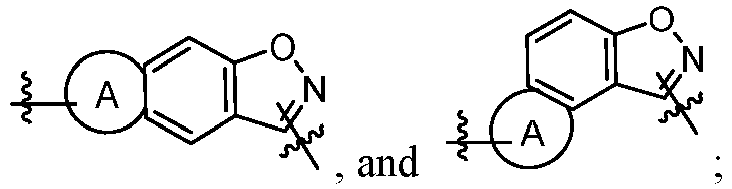


- In some embodiments, the structural fragment


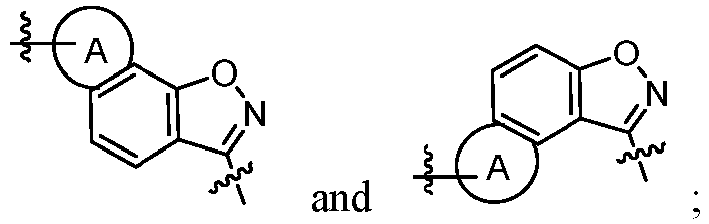


- In some embodiments, the structural fragment


- In some embodiments, the structural fragment


- In some specific embodiments, the structural fragment


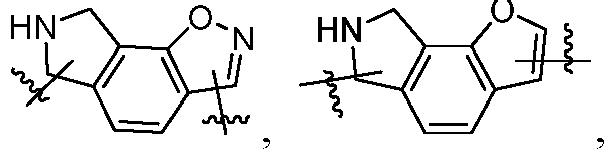



- In some embodiments, the structural fragment


- In some embodiments, the structural fragment


- In some specific embodiments, the structural fragment


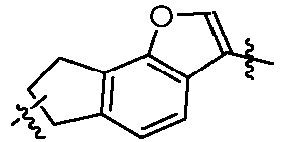


- In some embodiments, the structural fragment


- In some embodiments, the structural fragment





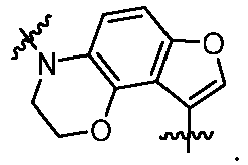
- In some specific embodiments, the structural fragment


- In some more specific embodiments, the structural fragment


- In some embodiments, each R1 is independently selected from the group consisting of halogen, -OH, -NH2, -CN, C1-3 alkyl, C1-3 alkoxy, and halogenated C1-3 alkyl. In some embodiments, each R1 is independently selected from the group consisting of fluorine, chlorine, bromine, -OH, -NH2, and -CN. In some embodiments, each R1 is independently selected from the group consisting of fluorine, chlorine, and bromine. In some embodiments, each R1 is independently selected from fluorine.
- In some embodiments, n is selected from the group consisting of 0, 1, and 2. In some embodiments, n is selected from the group consisting of 0 and 1.
- In some specific embodiments, n is selected from 0.
- In some embodiments, the structural fragment
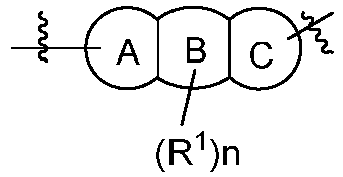


- In some specific embodiments, the structural fragment


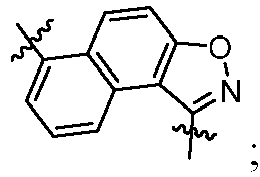


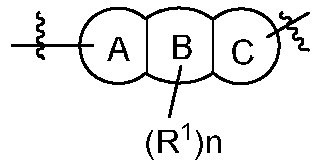


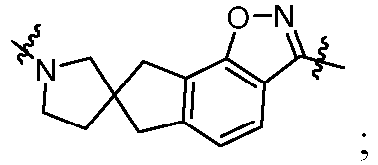


- In some embodiments, L is selected from the group consisting of C1-30 alkylene, C2-30 alkenylene, and C2-30 alkynylene, wherein one or more -CH2- of the C1-30 alkylene, C2-30 alkenylene, or C2-30 alkynylene are optionally substituted with -O-, C3-12 cycloalkyl, 3- to 12-membered heterocycloalkyl, 4- to 12-membered heterocycloalkenyl, C6-12 aryl, 5- to 12-membered heteroaryl, -NH-, -N(C1-6 alkyl)-, or -S-, and the C1-30 alkylene, C2-30 alkenylene, or C2-30 alkynylene is optionally substituted with one or more substituents.
- In some embodiments, L is selected from the group consisting of C1-20 alkylene, C2-20 alkenylene, and C2-20 alkynylene, wherein one or more -CH2- of the C1-20 alkylene, C2-20 alkenylene, or C2-20 alkynylene are optionally substituted with -O-, C3-10 cycloalkyl, 3- to 10-membered heterocycloalkyl, 4- to 10-membered heterocycloalkenyl, C6-10 aryl, 5- to 10-membered heteroaryl, -NH-, -N(C1-6 alkyl)-, or -S-, and the C1-20 alkylene, C2-20 alkenylene, or C2-20 alkynylene is optionally substituted with one or more substituents.
- In some embodiments, L is selected from the group consisting of C1-15 alkylene, C2-15 alkenylene, and C2-15 alkynylene, wherein one or more -CH2- of the C1-15 alkylene, C2-15 alkenylene, or C2-15 alkynylene are optionally substituted with -O-, C3-8 cycloalkyl, 3- to 8-membered heterocycloalkyl, 4- to 8-membered heterocycloalkenyl, C6-8 aryl, 5- to 8-membered heteroaryl, -NH-, -N(C1-4 alkyl)-, or -S-, and the C1-20 alkylene, C2-15 alkenylene, or C2-15 alkynylene is optionally substituted with one or more substituents.
- In some embodiments, L is selected from the group consisting of C1-10 alkylene, C2-10 alkenylene, and C2-10 alkynylene, wherein one or more -CH2- of the C1-10 alkylene, C2-10 alkenylene, or C2-10 alkynylene are optionally substituted with -O-, C3-6 cycloalkyl, 3- to 6-membered heterocycloalkyl, 4- to 6-membered heterocycloalkenyl, C6 aryl, 5- to 6-membered heteroaryl, -NH-, -N(C1-3 alkyl)-, or -S-, and the C1-10 alkylene, C2-10 alkenylene, or C2-10 alkynylene is optionally substituted with one or more substituents.
- In some embodiments, L is selected from the group consisting of C1-6 alkylene, C2-6 alkenylene, and C2-6 alkynylene, wherein one or more -CH2- of the C1-6 alkylene, C2-6 alkenylene, or C2-6 alkynylene are optionally substituted with -O-, C3-6 cycloalkyl, 3- to 6-membered heterocycloalkyl, 4- to 6-membered heterocycloalkenyl, C6 aryl, 5- to 6-membered heteroaryl, -NH-, -N(C1-3 alkyl)-, or -S-, and the C1-6 alkylene, C2-6 alkenylene, or C2-6 alkynylene is optionally substituted with one or more substituents.
- In some embodiments, L is selected from the group consisting of C1-4 alkylene, C2-4 alkenylene, and C2-4 alkynylene, wherein one or more (e.g., 1 or 2, 1 or 3, etc.) -CH2- of the C1-4 alkylene, C2-4 alkenylene, or C2-4 alkynylene are optionally substituted with -O-, C4-6 cycloalkyl, 4- to 6-membered heterocycloalkyl, 4- to 6-membered heterocycloalkenyl, C6 aryl, 5- to 6-membered heteroaryl, -NH-, -N(C1-3 alkyl)-, or -S-, and the C1-4 alkylene, C2-4 alkenylene, or C2-4 alkynylene is optionally substituted with one or more substituents.
- In some embodiments, L is selected from the group consisting of C1-6 alkylene, wherein one or more -CH2- of the C1-6 alkylene are optionally substituted with a group selected from the group consisting of -O-, C3-10 cycloalkyl, 4-to 10-membered heterocycloalkyl, 4- to 10-membered heterocycloalkenyl, -NH-, -N(C1-3 alkyl)-, and -S-, and the C1-6 alkylene is optionally substituted with one or more substituents.
- In some embodiments, in the definition of L, the substituent is selected from the group consisting of =O, OH, NH2, halogen, CN, C1-6 alkyl, and C1-6 alkoxy. In some embodiments, in the definition of L, the substituent is selected from the group consisting of =O, OH, NH2, halogen, and CN.
- In some embodiments, L is selected from -LNK1-Cy1-LNK-Cy2-LNK2-, wherein,
- Cy1 is selected from the group consisting of a bond and the following groups optionally substituted with one or more Ra: C3-12 cycloalkyl, 4- to 12-membered heterocycloalkyl, and 4- to 12-membered heterocycloalkenyl; LNK, LNK1, and LNK2 are each independently selected from the group consisting of a bond, C1-12 alkylene, and C1-12 heteroalkylene;
- Cy2 is selected from the group consisting of a bond and the following groups optionally substituted with one or more Rb: C3-12 cycloalkyl, 4- to 12-membered heterocycloalkyl, and 4- to 12-membered heterocycloalkenyl;
- each Ra and Rb is independently selected from the group consisting of halogen, -OH, -NH2, -CN, C1-4 alkyl, C1-4 alkoxy, halogenated C1-4 alkyl, C1-4 alkylamino, di-C1-4 alkylamino, C3-12 cycloalkyl, and 4- to 12-membered heterocycloalkyl.
- In some embodiments, L is selected from -LNK1-Cy1-LNK-Cy2-LNK2-, wherein,
- Cy1 is selected from the group consisting of a bond and the following groups optionally substituted with one or more Ra: C3-12 cycloalkyl and 4- to 12-membered heterocycloalkyl;
- LNK, LNK1, and LNK2 are each independently selected from the group consisting of a bond, C1-12 alkylene, and C1-12 heteroalkylene;
- Cy2 is selected from the group consisting of a bond and the following groups optionally substituted with one or more Rb: C3-12 cycloalkyl and 4- to 12-membered heterocycloalkyl;
- each Ra and Rb is independently selected from the group consisting of halogen, -OH, -NH2, -CN, C1-4 alkyl, C1-4 alkoxy, halogenated C1-4 alkyl, C1-4 alkylamino, and di-C1-4 alkylamino.
- In some embodiments, L is selected from -LNK1-Cy1-LNK-Cy2-LNK2-, wherein Cy1 and Cy2 are not bonds at the same time.
- In some embodiments, L is selected from the group consisting of -Cy1-LNK-Cy2-LNK2-, -LNK1-Cy1-Cy2-LNK2-, - Cy1-LNK-Cy2-, -Cy1-Cy2-LNK2-, -LNK-Cy2-LNK2-, -Cy1-LNK-, -Cy1-Cy2-, and -Cy2-.
- In some embodiments, L is selected from the group consisting of -Cy1-LNK-Cy2- and -Cy1-Cy2-LNK2-. In some embodiments, L is selected from -Cy1-LNK-Cy2-. In some embodiments, L is selected from -Cy1-Cy2-LNK2-. In some embodiments, L is selected from -Cy1-LNK-Cy2-LNK2-.
- In some embodiments, L or -Cy1-LNK-Cy2- is selected from the group consisting of -Cy1-, -Cy1-LNK-, -Cy1-Cy2-, -Cy1-LNK-Cy2-, -Cy2-, and -LNK-Cy2-. In some embodiments, L or -Cy1-LNK-Cy2- is selected from the group consisting of -Cy1-, -Cy1-Cy2-, and -Cy2-. In some specific embodiments, L or -Cy1-LNK-Cy2- is selected from the group consisting of -Cy1-LNK-, -Cy1-LNK-Cy2-, and -LNK-Cy2-. In some specific embodiments, L or -Cy1-LNK-Cy2- is selected from -Cy1-LNK-. In some specific embodiments, L or -Cy1-LNK-Cy2- is selected from -Cy1-LNK-Cy2-. In some specific embodiments, L or -Cy1-LNK-Cy2- is selected from -LNK-Cy2-. In some embodiments, Cy1 is selected from the group consisting of the following groups optionally substituted with one or more Ra: C3-12 cycloalkyl and 4- to 12-membered heterocycloalkyl; Cy2 is selected from the group consisting of a bond and the following groups optionally substituted with one or more Rb: C3-12 cycloalkyl and 4- to 12-membered heterocycloalkyl.
- In some embodiments, LNK, LNK1, and LNK2 are selected from a bond. In some embodiments, LNK1 is a bond. In some embodiments, LNK is selected from the group consisting of C1-6 alkylene and C1-6 heteroalkylene, and LNK1 and LNK2 are bonds.
- In some embodiments, LNK2 is selected from the group consisting of C1-6 alkylene and C1-6 heteroalkylene, and LNK and LNK1 are bonds.
- In some embodiments, LNK1 and LNK2 are selected from a bond, LNK is selected from the group consisting of a bond, C1-6 alkylene, and C1-6 heteroalkylene, Cy2 is a bond, and Cy1 is selected from the group consisting of the following groups optionally substituted with one or more Ra: C4-11 cycloalkyl and 4- to 11-membered heterocycloalkyl.
- In some embodiments, LNK is selected from the group consisting of C1-6 alkylene and C1-6 heteroalkylene, and LNK1 and LNK2 are bonds;
Cy2 is a bond, and Cy1 is selected from the group consisting of the following groups optionally substituted with one or more Ra: C4-11 cycloalkyl and 4- to 11-membered heterocycloalkyl. - In some embodiments, LNK is selected from the group consisting of C1-6 alkylene and C1-6 heteroalkylene, and LNK1 and LNK2 are bonds;
Cy1 is a bond, and Cy2 is selected from the group consisting of the following groups optionally substituted with one or more Rb: C4-11 cycloalkyl and 4- to 11-membered heterocycloalkyl. - In some embodiments, LNK is selected from the group consisting of C1-6 alkylene and C1-6 heteroalkylene, and LNK1 and LNK2 are bonds;
Cy1 is selected from the group consisting of the following groups optionally substituted with one or more Ra: C4-11 cycloalkyl and 4- to 11-membered heterocycloalkyl, and Cy2 is selected from the group consisting of the following groups optionally substituted with one or more Rb: C4-11 cycloalkyl and 4- to 11-membered heterocycloalkyl. - In some embodiments, Cy1 is a bond or the following groups optionally substituted with one or more Ra: C4-11 cycloalkyl, 4- to 11-membered heterocycloalkyl, and 4- to 11-membered heterocycloalkenyl.
- In some embodiments, Cy1 is a bond. In some embodiments, Cy1 is selected from the group consisting of the following groups optionally substituted with one or more Ra: C6-9 cycloalkyl, 4- to 11-membered heterocycloalkyl, or 4- to 9-membered heterocycloalkenyl (e.g., 5- to 7-membered heterocycloalkenyl).
- In some embodiments, Cy1 is selected from the group consisting of the following groups optionally substituted with one or more Ra: C6 cycloalkyl, C9 cycloalkyl, 4-membered, 5-membered, 6-membered, 7-membered, 8-membered, 9-membered, 10-membered, and 11-membered heterocycloalkyl, and 6-membered heterocycloalkenyl.
- In some embodiments, Cy1 is selected from the group consisting of the following groups optionally substituted with one or more Ra: C6 cycloalkyl, C9 cycloalkyl, 4-membered, 6-membered, and 8- to 11-membered heterocycloalkyl, and 5- to 6-membered heterocycloalkenyl. In some embodiments, Cy1 is selected from the group consisting of the following groups optionally substituted with one or more Ra: C6 cycloalkyl, C9 cycloalkyl, 4-membered, 6-membered, and 8- to 11-membered heterocycloalkyl, and 6-membered heterocycloalkenyl.
- In some embodiments, Cy1 is selected from the group consisting of a bond and the following groups optionally substituted with one or more Ra: C4-11 cycloalkyl and 4- to 11-membered heterocycloalkyl.
- In some embodiments, Cy1 is a bond. In some embodiments, Cy1 is selected from the group consisting of the following groups optionally substituted with one or more Ra: C6-9 cycloalkyl and 4- to 11-membered heterocycloalkyl.
- In some embodiments, Cy1 is selected from the group consisting of the following groups optionally substituted with one or more Ra: C6 cycloalkyl, C9 cycloalkyl, and 4-membered, 5-membered, 6-membered, 7-membered, 8-membered, 9-membered, 10-membered, and 11-membered heterocycloalkyl.
- In some embodiments, Cy1 is selected from the group consisting of the following groups optionally substituted with one or more Ra: C6 cycloalkyl, C9 cycloalkyl, and 4-membered, 6-membered, and 8- to 11-membered heterocycloalkyl. In some embodiments, Cy1 is selected from the group consisting of the following groups optionally substituted with one or more Ra: 4-membered and 5-membered heterocycloalkyl. In some embodiments, Cy1 is selected from the group consisting of the following groups optionally substituted with one or more Ra: 6- to 9-membered heterocycloalkyl. In some embodiments, Cy1 is selected from the group consisting of the following groups optionally substituted with one or more Ra: 6-membered, 8-membered, and 9-membered heterocycloalkyl. In some specific embodiments, Cy1 is selected from the group consisting of the following groups optionally substituted with one or more Ra: 6-membered heterocycloalkyl and 9-membered heterocycloalkyl.
- In some embodiments, Cy1 is selected from the group consisting of the following groups optionally substituted with one or more Ra: piperidinyl, diazaspirononanyl, piperazinyl, monoazaspirononanyl, cyclohexyl, spirononanyl, azetidinyl, pyrrolidinyl, octahydrocyclopentapyrrolyl, azabicyclononanyl, monoazaspiroundecanyl, diazaspiroundecanyl, and tetrahydropyridinyl.
- In some embodiments, Cy1 is selected from the group consisting of the following groups optionally substituted with one or more Ra: piperidinyl, diazaspirononanyl, piperazinyl, monoazaspirononanyl, cyclohexyl, spirononanyl, azetidinyl, octahydrocyclopentapyrrolyl, azabicyclononanyl, monoazaspiroundecanyl, and diazaspiroundecanyl. In some specific embodiments, Cy1 is selected from the group consisting of the following groups optionally substituted with one or more Ra: piperidinyl, diazaspirononanyl, piperazinyl, and monoazaspirononanyl. In some specific embodiments, Cy1 is selected from the group consisting of the following groups optionally substituted with one or more Ra: azetidinyl, pyrrolidinyl, and tetrahydropyridinyl.
- In some embodiments, Cy1 is selected from the group consisting of the following groups optionally substituted with one or more Ra:


- In some other embodiments, Cy1 is selected from the group consisting of the following groups optionally substituted with one or more Ra:


- In some specific embodiments, Cy1 is selected from the group consisting of the following groups optionally substituted with one or more Ra:


- In some embodiments, LNK, LNK1, and LNK2 are each independently selected from the group consisting of a bond, C1-6 alkylene, and C1-6 heteroalkylene.
- In some embodiments, LNK, LNK1, and LNK2 are each independently selected from the group consisting of a bond, C1-3 alkylene, and C1-3 heteroalkylene.
- In some embodiments, LNK, LNK1, and LNK2 are each independently selected from the group consisting of a bond and C1-4 alkylene.
- In some embodiments, LNK, LNK1, and LNK2 are each independently selected from the group consisting of a bond and C1-3 alkylene.
- In some embodiments, LNK, LNK1, and LNK2 are each independently selected from the group consisting of a bond and -CH2-. In some specific embodiments, LNK is a bond. In some specific embodiments, LNK, LNK1, and LNK2 are each independently -CH2-.
- In some embodiments, Cy2 is selected from the group consisting of a bond and the following groups optionally substituted with one or more Rb: C4-11 cycloalkyl and 4- to 11-membered heterocycloalkyl. In some specific embodiments, Cy2 is a bond. In some specific embodiments, Cy2 is selected from the group consisting of the following groups optionally substituted with one or more Rb: C4-11 cycloalkyl and 4- to 11-membered heterocycloalkyl.
- In some embodiments, Cy2 is selected from the group consisting of a bond and the following groups optionally substituted with one or more Rb: C4-6 cycloalkyl and 4- to 6-membered heterocycloalkyl. In some embodiments, Cy2 is selected from the group consisting of the following groups optionally substituted with one or more Rb: C4-6 cycloalkyl and 4- to 6-membered heterocycloalkyl.
- In some embodiments, Cy2 is selected from the group consisting of a bond and the following groups optionally substituted with one or more Rb: cyclobutyl, cyclopentyl, cyclohexyl, azetidinyl, pyrrolidinyl, and piperidinyl. In some specific embodiments, Cy2 is selected from the group consisting of a bond and the following groups optionally substituted with one or more Rb: cyclobutyl, cyclopentyl, cyclohexyl, azetidinyl, and piperidinyl.
- In some embodiments, Cy2 is selected from the group consisting of a bond,





- In some embodiments, Ra and Rb are each independently selected from the group consisting of halogen, -OH, -NH2, -CN, C1-3 alkyl, C1-3 alkoxy, halogenated C1-3 alkyl, C1-3 alkylamino, and di-C1-3 alkylamino.
- In some embodiments, Ra and Rb are each independently selected from the group consisting of halogen, -OH, -NH2, -CN, and C1-3 alkyl.
- In some embodiments, Ra and Rb are each independently selected from the group consisting of halogen, -OH, -NH2, and -CN.
- In some embodiments, the structural fragment -Cy1-LNK- is selected from the group consisting of


- In some other embodiments, the structural fragment -Cy1-LNK- is selected from the group consisting of


- In some specific embodiments, the structural fragment -Cy1-LNK- is selected from the group consisting of

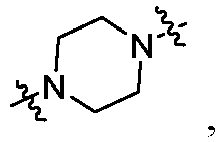

- In some other embodiments, the structural fragment -LNK-Cy2- is selected from the group consisting of a bond, - CH2-,


- In some specific embodiments, the structural fragment -LNK-Cy2- is selected from the group consisting of a bond, -CH2-,


- In some embodiments, the structural fragment -Cy1-Cy2- is selected from the group consisting of


- In some other embodiments, the structural fragment -Cy1-Cy2- is selected from the group consisting of


- In some specific embodiments, the structural fragment -Cy1-Cy2- is selected from the group consisting of


- In some embodiments, the structural fragment -Cy1-Cy2-LNK2- is selected from the group consisting of

- In some embodiments, the structural fragment or -Cy1-Cy2-LNK2- is selected from the group consisting of

- In some embodiments, the structural fragment -L- or -LNK1-Cy1-LNK-Cy2-LNK2- is selected from the group consisting of


- In some other embodiments, the structural fragment -L- or -LNK1-Cy1-LNK-Cy2-LNK2- is selected from the group consisting of


- In some specific embodiments, the structural fragment -L- or -LNK1-Cy1-LNK-Cy2-LNK2- is selected from the group consisting of


- In some embodiments, the structural fragment













- In some embodiments, the structural fragment


- In some embodiments, X1, X2, and X3 are each independently selected from the group consisting of N and CH, and X4 is CH. In some embodiments, X1 and X2 are each independently selected from the group consisting of N and CH, and X3 and X4 are CH. In some embodiments, X1 and X2 are each independently N, and X3 and X4 are CH. In some embodiments, X1, X2, X3, and X4 are CH. In some embodiments, X1 and X4 are CH, and X2 and X3 are N. In some embodiments, X2 and X3 are each independently CH, and X1 and X4 are N. In some embodiments, X1 and X3 are each independently CH, and X2 and X4 are N. In some embodiments, X2 and X3 are each independently selected from the group consisting of N and CH, and X1 and X4 are CH. In some embodiments, X1 and X3 are each independently selected from the group consisting of N and CH, X2 is N, and X4 is CH.
- In some embodiments, X5 is CH.
- In some embodiments, X6 is selected from the group consisting of -O-, -NH-, and -N(C1-3 alkyl)-. In some embodiments, X6 is selected from the group consisting of -O- and -N(CH3)-.
- In some embodiments, each R2 is independently selected from the group consisting of halogen, -OH, -NH2, -CN, C1-3 alkyl, C1-3 alkoxy, and C1-3 alkyl halide. In some embodiments, each R2 is independently selected from the group consisting of halogen, -OH, -NH2, -CN, and C1-3 alkyl. In some embodiments, each R2 is independently selected from the group consisting of fluorine, chlorine, bromine, -OH, -NH2, and -CN. In some embodiments, each R2 is independently selected from the group consisting of fluorine, chlorine, bromine, and -CN. In some embodiments, each R2 is independently selected from the group consisting of chlorine and -CN.
- In some embodiments, each R4 is independently selected from the group consisting of halogen, -OH, -NH2, -CN, C1-3 alkyl, C1-3 alkoxy, and C1-3 alkyl halide. In some embodiments, each R4 is independently selected from the group consisting of halogen, -OH, -NH2, -CN, and C1-3 alkyl. In some embodiments, each R4 is independently selected from the group consisting of fluorine, chlorine, bromine, -OH, -NH2, and -CN.
- In some embodiments, m is selected from the group consisting of 0, 1, 2, and 3. In some embodiments, m is selected from the group consisting of 1, 2, and 3. In some embodiments, m is 2. In some embodiments, q is selected from the group consisting of 0, 1, 2, and 3. In some embodiments, q is selected from the group consisting of 0 and 1. In some embodiments, q is 0.
- In some embodiments, the structural fragment
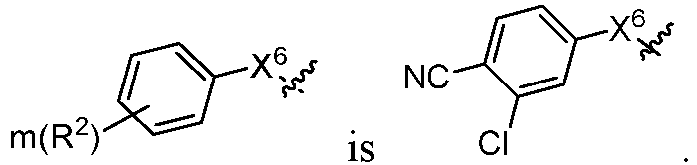
- In some embodiments, each R3 and R4 is independently selected from the group consisting of halogen, -OH, -NH2, -CN, C1-3 alkyl, C1-3 alkoxy, and C1-3 alkyl halide. In some embodiments, each R3 and R4 is independently selected from the group consisting of halogen, -OH, -NH2, -CN, and C1-3 alkyl. In some embodiments, each R3 and R4 is independently selected from the group consisting of fluorine, chlorine, bromine, -OH, -NH2, and -CN.
- In some embodiments, p and q are each independently selected from the group consisting of 0, 1, 2, and 3. In some embodiments, p and q are each independently selected from the group consisting of 0 and 1. In some embodiments, p and q are 0.
- In some embodiments, the structural fragment


- In some embodiments, the structural fragment


- In some embodiments, the structural fragment


- In some embodiments, the structural fragment


- In some specific embodiments, the structural fragment


- In some specific embodiments, the structural fragment


- In some specific embodiments, the structural fragment


- In some embodiments, the heterocycloalkenyl, heteroaryl, heterocycloalkyl, or heteroalkylene described above comprises one or more heteroatoms or heteroatom groups independently selected from the group consisting of -O-, -NH-, -N-, -S-, C=O, -C(=O)NH-, -C(=O)O-, -S(=O)-, and -S(=O)2-; in some embodiments, the heterocycloalkenyl, heteroaryl, heterocycloalkyl, or heteroalkylene described above comprises one or more heteroatoms or heteroatom groups independently selected from the group consisting of -O-, -NH-, -N-, and -S-; in some embodiments, the heterocycloalkenyl, heteroaryl, heterocycloalkyl, or heteroalkylene described above comprises one or more heteroatoms or heteroatom groups independently selected from the group consisting of -O-, -NH-, and -N-. In some embodiments, the number of the heteroatoms or heteroatom groups is independently selected from the group consisting of 1, 2, 3, 4, 5, and 6, or is selected from the group consisting of 1, 2, 3, and 4, or is selected from the group consisting of 1, 2, and 3, or is selected from the group consisting of 1 and 2.
- In some embodiments, the heteroatom in the heterocycloalkenyl described above is selected from the group consisting of N, NH, O, and S. In some embodiments, the heteroatom in the heterocycloalkenyl described above is selected from the group consisting of N, O, and S. In some specific embodiments, the heteroatom in the heterocycloalkenyl described above is selected from the group consisting of N and O. In some embodiments, the number of the heteroatoms in the heterocycloalkenyl described above is selected from the group consisting of 1, 2, 3, 4, 5, and 6. In some embodiments, the number of the heteroatoms in the heterocycloalkenyl described above is selected from the group consisting of 1, 2, 3, and 4. In some embodiments, the number of the heteroatoms in the heterocycloalkenyl described above is selected from the group consisting of 1, 2, and 3. In some specific embodiments, the number of the heteroatoms in the heterocycloalkenyl described above is selected from the group consisting of 1 and 2.
- In some specific embodiments, the heterocycloalkenyl contains 1-3 (e.g., 1-2) heteroatoms selected from the group consisting of -O-, -NH-, -N-, and -S-. In some specific embodiments, the heteroaryl contains 1-3 (e.g., 1-2) heteroatoms selected from the group consisting of -O-, -NH-, -N-, and -S-. In some specific embodiments, the heterocycloalkyl contains 1-3 (e.g., 1-2) heteroatoms selected from the group consisting of -O-, -NH-, -N-, and -S-. In some specific embodiments, the heteroalkylene contains 1-3 (e.g., 1-2) heteroatoms selected from the group consisting of -O-, -NH-, -N-, and -S-.
- It should be understood that any embodiment of the compounds of the present application as described above, and any specific substituents set forth herein with respect to particular X1, X2, X3, X4, X5, X6, ring A, ring B, ring C, ring E, ring F, ring G, R1, R2, R3, R4, Rt, and L substituents in the compounds of the present application as described above, may be independently combined with other embodiments of the present application and/or substituents of the compounds to form embodiments of the present application not specifically set forth above. Further, when a range of substituents is disclosed in specific embodiments and/or claims with respect to any particular X1, X2, X3, X4, X5, X6, ring A, ring B, ring C, ring E, ring F, ring G, R1, R2, R3, R4, Rt, and L substituents, it should be understood that one or more substituents may be deleted from the range and the remaining range of substituents should also be considered as an embodiment of the present application.
- The compound of formula I-AA, the compound of formula I-1 or the compound of formula I, the stereoisomer thereof, or the pharmaceutically acceptable salt thereof is selected from a compound of formula I-A1 or a compound of formula I-A, a stereoisomer thereof, or a pharmaceutically acceptable salt thereof,

- In some embodiments, the structural fragments


- wherein ring A, ring B, ring C, R1, n, R2, m, X1, X2, X3, X5, X6, Cy1, Cy2, LNK, LNK1, and LNK2 are as defined herein;
- X is selected from the group consisting of CH and N.
- The compound of formula I-AA, the compound of formula I-1, the compound of formula I or the compound of formula I-A, the stereoisomer thereof or the pharmaceutically acceptable salt thereof is selected from a compound of formula I-1A-1, formula I-2A-1, formula I-3A-1, formula I-4A-1, formula I-5A-1, formula I-6A-1, formula I-7A-1, formula I-8A-1, formula I-9A-1, formula I-10A-1, formula I-11A-1, formula I-12A-1, formula I-13A-1, formula I-14A-1, formula I-15A-1, formula I-16A-1 or formula I-17A-1, a stereoisomer thereof, or a pharmaceutically acceptable salt thereof,





- wherein ring A, ring B, ring C, R1, R2, m, n, X1, X2, X3, X5, X6, Cy1, Cy2, LNK, LNK1, and LNK2 are as defined herein;
- X is selected from the group consisting of CH and N.
- In some embodiments, X1 and X2 are CH, and X3 is CH. In some embodiments, X1 and X2 are N, and X3 is CH. In some embodiments, X2 and X3 are N, and X1 is CH.
- In some embodiments, X1 and X2 are CH. In some embodiments, X1 and X2 are N.
- In some embodiments, the structural fragment


- In some embodiments, the structural fragment
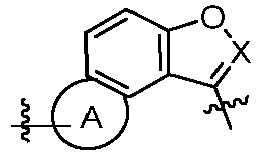




- In some embodiments, the structural fragment

- In some embodiments, optionally, the compound of the present application is not the following compound:


- In some embodiments, optionally, the compound of the present application is not the following compound:


- In some embodiments, the structural moiety


- In some embodiments, the structural moiety




- In some embodiments, the structural moiety


- In some embodiments, the structural fragment


- In another aspect, the present application relates to a compound of formula I' or I", a moiety, a stereoisomer thereof, a derivative (such as a Protac molecule), or a pharmaceutically acceptable salt thereof,

- wherein ring A is absent or selected from the group consisting of C5-10 cycloalkenyl, 5- to 10-membered heterocycloalkenyl, phenyl, and 5- to 6-membered heteroaryl;
- ring B is selected from phenyl;
- ring C is selected from the group consisting of isoxazolyl and furanyl;
- L is selected from a connecting group; optionally, L is as defined herein; optionally, R1 and n are as defined herein.
- In some embodiments, the structural moiety

- In another aspect, the present application relates to a compound of formula I'-a or I"-a, a moiety, a stereoisomer thereof, a derivative (such as a Protac molecule), or a pharmaceutically acceptable salt thereof,

- wherein ring A is absent or selected from the group consisting of C5-10 cycloalkenyl, 5- to 10-membered heterocycloalkenyl, phenyl, and 5- to 6-membered heteroaryl;
- ring B is selected from phenyl;
- ring C is selected from the group consisting of isoxazolyl and furanyl;
- each R1a is independently selected from the group consisting of halogen, -OH, -NH2, -CN, =O, -CHO, C1-4 alkyl, C1-4 alkoxy, C1-6 alkyl OC(O)-, C3-12 cycloalkyl, and 4- to 12-membered heterocycloalkyl, wherein the C1-4 alkyl, C1-4 alkoxy, C3-12 cycloalkyl, or 4- to 12-membered heterocycloalkyl is optionally substituted with one or more of the following groups: halogen, =O, -OH, -NH2, -CN, CHO, COOH, -C1-4 alkyl-OH, C1-6 alkyl OC(O)-, and 4- to 10-membered heterocycloalkyl optionally substituted with C1-6 alkyl COC(O)-;
- n is selected from the group consisting of 0, 1, 2, and 3.
- In some embodiments, ring A is absent or selected from the group consisting of C5-7 cycloalkenyl, 5- to 9-membered heterocycloalkenyl, phenyl, and 5- to 6-membered heteroaryl.
- In some embodiments, ring A is absent or selected from the group consisting of C5-6 cycloalkenyl, 5- to 10-membered heterocycloalkenyl, phenyl, and 5- to 6-membered heteroaryl.
- In some embodiments, ring A is absent or selected from the group consisting of C5-6 cycloalkenyl, 5- to 9-membered heterocycloalkenyl, phenyl, and 5- to 6-membered heteroaryl.
- In some embodiments, ring A is absent or selected from the group consisting of C5-6 cycloalkenyl, 5- to 9-membered heterocycloalkenyl, phenyl, and 5-membered heteroaryl.
- In some embodiments, ring A is absent or selected from the group consisting of C5-6 cycloalkenyl, 5- to 9-membered heterocycloalkenyl, phenyl, pyrrolyl, pyrazolyl, furanyl, and oxazolyl.
- In some embodiments, ring A is absent or selected from the group consisting of C5 cycloalkenyl, C6 cycloalkenyl, 5-membered, 6-membered, 7-membered, 8-membered, and 9-membered heterocycloalkenyl, phenyl, pyrrolyl, pyrazolyl, furanyl, and oxazolyl.
- In some embodiments, ring A is absent or selected from the group consisting of cyclopentenyl, monocyclohexenyl, bicyclohexenyl, dihydropyrrolyl, tetrahydropyridinyl, tetrahydroazepinyl, azaspirooctenyl, azaspirononenyl, phenyl, pyrrolyl, pyrazolyl, furanyl, oxazolyl, and dihydrooxazinyl.
- In some specific embodiments, ring A is selected from the group consisting of C5-9 cycloalkenyl, 5- to 9-membered heterocycloalkenyl, phenyl, and 5-membered heteroaryl.
- In some specific embodiments, ring A is selected from the group consisting of C5-6 cycloalkenyl, 5- to 9-membered heterocycloalkenyl, phenyl, and 5-membered heteroaryl.
- In some specific embodiments, ring A is selected from the group consisting of C5-9 cycloalkenyl and 5- to 9-membered heterocycloalkenyl. In some specific embodiments, ring A is selected from the group consisting of C5-6 cycloalkenyl and 5- to 9-membered heterocycloalkenyl.
- In some specific embodiments, ring A is selected from C5-9 cycloalkenyl. In some specific embodiments, ring A is selected from C5-6 cycloalkenyl. In some specific embodiments, ring A is selected from 5- to 9-membered heterocycloalkenyl.
- In some specific embodiments, ring A is selected from the group consisting of cyclopentenyl, dihydropyrrolyl, tetrahydropyridinyl, tetrahydroazepinyl, azaspirononenyl, azaspirooctenyl, phenyl, pyrrolyl, and pyrazolyl.
- In some specific embodiments, ring A is selected from the group consisting of cyclopentenyl, dihydropyrrolyl, tetrahydropyridinyl, tetrahydroazepinyl, azaspirononenyl, and azaspirooctenyl. In some specific embodiments, ring A is selected from the group consisting of cyclopentenyl, dihydropyrrolyl, tetrahydropyridinyl, tetrahydroazepinyl, and azaspirooctenyl.
- In some specific embodiments, ring A is selected from cyclopentenyl. In some specific embodiments, ring A is selected from the group consisting of dihydropyrrolyl, tetrahydropyridinyl, tetrahydroazepinyl, and azaspirooctenyl. In some specific embodiments, ring A is selected from the group consisting of phenyl, pyrrolyl, and pyrazolyl.
- In some embodiments, ring A is selected from the group consisting of


- In some specific embodiments, ring C is isoxazolyl. In some specific embodiments, ring C is furanyl.
- In some embodiments, the structural moiety


- In some embodiments, the structural fragment


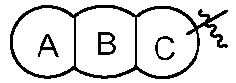

- In some embodiments, the structural fragment


- In some embodiments, the structural fragment




- In some specific embodiments, the structural fragment


- In some embodiments, the structural fragment


- In some specific embodiments, the structural fragment




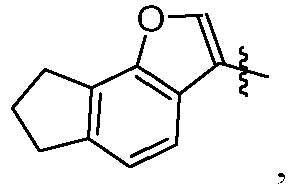


- In some embodiments, each R1a is independently selected from the group consisting of halogen, -OH, -NH2, -CN,-CHO, C1-6 alkyl OC(O)-, C1-4 alkyl, C1-4 alkoxy, C3-10 cycloalkyl, and 4- to 10-membered heterocycloalkyl, wherein the C1-4 alkyl, C1-4 alkoxy, C3-10 cycloalkyl, or 4- to 10-membered heterocycloalkyl is optionally substituted with one or more of the following groups: halogen, =O, -OH, -NH2, -CN, CHO, COOH, -C1-4 alkyl-OH, C1-6 alkyl OC(O)-, and 4- to 10-membered heterocycloalkyl optionally substituted with C1-6 alkyl COC(O)-.
- In some embodiments, each R1a is independently selected from the group consisting of halogen, -OH, -NH2, -CN, - CHO, C1-4 alkyl OC(O)-, C1-3 alkyl, C1-3 alkoxy, C3-9 cycloalkyl, and 4- to 9-membered heterocycloalkyl, wherein the C1-3 alkyl, C1-3 alkoxy, C3-9 cycloalkyl, or 4- to 9-membered heterocycloalkyl is optionally substituted with one or more of the following groups: halogen, -OH, =O, -NH2, -CN, CHO, COOH, -C1-4 alkyl-OH, C1-4 alkyl OC(O)-, and 4- to 9-membered heterocycloalkyl optionally substituted with C1-4 alkyl COC(O)-.
- In some embodiments, each R1a is independently selected from the group consisting of halogen, -OH, -NH2, -CN, - CHO, C1-6 alkyl OC(O)-, C1-3 alkyl, C1-3 alkoxy, C3-6 cycloalkyl, and 4- to 6-membered heterocycloalkyl, wherein the C1-3 alkyl, C1-3 alkoxy, C4-6 cycloalkyl, or 4- to 6-membered heterocycloalkyl is optionally substituted with one or more of the following groups: halogen, -OH, =O, -NH2, -CN, CHO, COOH, -C1-4 alkyl-OH, C1-6 alkyl OC(O)-, and 3- to 6-membered heterocycloalkyl optionally substituted with C1-6 alkyl COC(O)-.
- In some embodiments, each R1a is independently selected from the group consisting of halogen, -OH, -NH2, -CN, - CHO, C1-4 alkyl OC(O)-, C1-3 alkyl, and 4- to 6-membered heterocycloalkyl, wherein the C1-3 alkyl or 4- to 6-membered heterocycloalkyl is optionally substituted with one or more of the following groups: -OH, =O, -NH2, - CN, CHO, COOH, C1-4 alkyl OC(O)-, and 4- to 6-membered heterocycloalkyl optionally substituted with C1-4 alkyl OC(O)-.
- In some embodiments, each R1a is independently selected from the group consisting of halogen, -OH, -CHO, (CH3)3COC(O)-, C1-3 alkyl, cyclobutyl, and piperidinyl, wherein the C1-3 alkyl, cyclobutyl, or piperidinyl is optionally substituted with one or more of the following groups: -OH, (CH3)3COC(O)-, and cyclobutyl optionally substituted with (CH3)3COC(O)-.
- In some embodiments, each R1a is independently selected from the group consisting of F, -OH, -CHO, (CH3)3COC(O)-, -CH2OH,

- In some embodiments, n is selected from the group consisting of 0, 1, and 2. In some embodiments, n is selected from the group consisting of 0 and 1. In some embodiments, n is 0.
- The present application relates to the following compound, a moiety, a stereoisomer thereof, a derivative (such as a Protac molecule), or a pharmaceutically acceptable salt thereof,







- In another aspect, the present application relates to use of the compound (e.g., formula I' or formula I", formula I'-a or formula I"-a, or a specific compound), the moiety, the isomer (e.g., stereoisomer) thereof, or the derivative thereof in a Protac molecule. In another aspect, the present application relates to use of the compound (e.g., formula I' or formula I", formula I'-a or formula I"-a, or a specific compound), the moiety, the isomer (e.g., stereoisomer) thereof, or the derivative thereof for constituting part of a Protac molecule. In another aspect, the present application relates to the compound (e.g., formula I' or formula I", formula I'-a or formula I"-a, or a specific compound), the moiety, the isomer (e.g., stereoisomer) thereof, or the derivative thereof present in the form of a Protac molecule. In another aspect, the present application relates to use of the compound (e.g., formula I' or formula I", formula I'-a or formula I"-a, or a specific compound), the moiety, the isomer (e.g., stereoisomer) thereof, or the derivative thereof for degrading a protein. For example, the compound (e.g., formula I' or formula I", formula I'-a or formula I"-a, or a specific compound), the moiety, the isomer (e.g., stereoisomer) thereof, or the derivative thereof degrades the protein in the form of a Protac molecule. In another aspect, the present application relates to use of the compound (e.g., formula I' or formula I", formula I'-a or formula I"-a, or a specific compound), the moiety, the isomer (e.g., stereoisomer) thereof, or the derivative thereof for degrading a protein in the form of a Protac molecule. The present application relates to use of the compound (e.g., formula I' or formula I", formula I'-a or formula I"-a, or a specific compound), the moiety, the isomer (e.g., stereoisomer) thereof, or the derivative thereof (e.g., as a preparation intermediate) for preparing a Protac molecule. The present application relates to use of the compound (e.g., formula I' or formula I", formula I'-a or formula I"-a, or a specific compound), the moiety, the isomer (e.g., stereoisomer) thereof, or the derivative thereof (e.g., as a preparation intermediate) for preparing a protein degrader.
- In some embodiments, the present application relates to a compound of formula I-AA, a compound of formula I, or a compound of formula I-1, a stereoisomer thereof, or a pharmaceutically acceptable salt thereof, wherein,
- ring A is selected from the group consisting of C5-6 cycloalkenyl, 5- to 8-membered heterocycloalkenyl containing 1-3 heteroatoms selected from the group consisting of N, O, and S (e.g., 1-2 heteroatoms selected from the group consisting of N and O), phenyl, and 5- to 6-membered heteroaryl containing 1-3 heteroatoms selected from the group consisting of N, O, and S (e.g., 1-2 heteroatoms selected from the group consisting of N and O);
- ring B is phenyl;
- ring C is selected from the group consisting of isoxazolyl and furanyl;
- each R1 is independently selected from the group consisting of halogen, -OH, -NH2, -CN, and C1-3 alkyl (e.g., methyl, ethyl, or propyl);
- n is selected from the group consisting of 0 and 1;
- L is selected from LNK1-Cy1-LNK-Cy2-LNK2-, wherein LNK, LNK1, and LNK2 are each independently selected from the group consisting of a bond and C1-3 alkylene, Cy1 is selected from the group consisting of a bond, C3-7 cycloalkyl, 4- to 7-membered heterocycloalkyl, and 5- to 7-membered heterocycloalkenyl, Cy2 is selected from the group consisting of a bond, C3-7 cycloalkyl, 4- to 7-membered heterocycloalkyl, and 5- to 7-membered heterocycloalkenyl, and Cy1 and Cy2 are not bonds at the same time;
- X1, X2, X3, and X4 are each independently selected from the group consisting of N and CH;
- X3 is selected from the group consisting of CH and N;
- X6 is selected from the group consisting of -O-, -NH-, and -N(C1-6 alkyl)-;
- each R2, R3, and R4 is independently selected from the group consisting of halogen, -OH, -NH2, -CN, and C1-3 alkyl (e.g., methyl, ethyl, or propyl);
- m is selected from the group consisting of 1 and 2;
- p and q are each independently selected from the group consisting of 0 and 1.
- In some embodiments, the present application relates to a compound of formula I-AA, a compound of formula I, or a compound of formula I-1, a stereoisomer thereof, or a pharmaceutically acceptable salt thereof, wherein,
- ring A is selected from the group consisting of cyclopentenyl, dihydropyrrolyl, tetrahydropyridinyl, tetrahydroazepinyl, azaspirooctenyl, phenyl, pyrrolyl, and pyrazolyl;
- ring B is phenyl;
- ring C is selected from the group consisting of isoxazolyl and furanyl;
- n is 0;
- L is selected from the group consisting of piperidinyl, diazaspirononanyl, piperazinyl, monoazaspirononanyl,


- X1, X2, X3, and X4 are all CH, or two of X1, X2, X3, and X4 are N and the other two are CH;
- X5 is selected from the group consisting of CH and N;
- X6 is selected from the group consisting of -O-, -NH-, and -N(C1-4 alkyl)-;
- R2 is selected from the group consisting of halogen and -CN;
- m is 2;
- p and q are each independently 0.
- The present application also relates to the following compound, a stereoisomer thereof, or a pharmaceutically acceptable salt thereof:





















- In some embodiments, the pharmaceutically acceptable salt is selected from maleate.
- The present application also covers solutions obtained by any combination, deletion, or exchange of the embodiments described above.
- In another aspect, the present application relates to a pharmaceutical composition comprising the compound, the stereoisomer thereof, or the pharmaceutically acceptable salt thereof of the present application described above. The pharmaceutical composition of the present application also comprises a pharmaceutically acceptable excipient.
- In another aspect, the present application relates to use of the compound, the stereoisomer thereof, or the pharmaceutically acceptable salt thereof, or the pharmaceutical composition thereof described above for preparing a medicament for preventing or treating a disorder treated by degrading a target protein (e.g., androgen receptor, AR) that binds to a targeting ligand.
- In another aspect, the present application relates to use of the compound, the stereoisomer thereof, or the pharmaceutically acceptable salt thereof, or the pharmaceutical composition thereof described above for preparing a medicament for preventing or treating a disorder treated by binding to cereblon protein in vivo.
- In another aspect, the present application relates to use of the compound, the stereoisomer thereof, or the pharmaceutically acceptable salt thereof, or the pharmaceutical composition thereof described above for preparing a medicament for preventing or treating an AR-related disease.
- The present application relates to a method for treating or preventing a disorder treated by degrading a target protein (e.g., androgen receptor, AR) that binds to a targeting ligand in a mammal, which comprises administering to a mammal (preferably a human) in need of such treatment a therapeutically effective amount of the compound, the stereoisomer thereof, or the pharmaceutically acceptable salt thereof, or the pharmaceutical composition thereof of the present application described above.
- The present application relates to a method for treating or preventing a disorder treated by binding to cereblon protein in vivo, which comprises administering to a mammal (preferably a human) in need of such treatment a therapeutically effective amount of the compound, the stereoisomer thereof, or the pharmaceutically acceptable salt thereof, or the pharmaceutical composition thereof of the present application described above.
- In another aspect, the present application relates to a method for treating an AR-related disease in a mammal, which comprises administering to a mammal (preferably a human) in need of such treatment a therapeutically effective amount of the compound, the stereoisomer thereof, or the pharmaceutically acceptable salt thereof, or the pharmaceutical composition thereof of the present application described above.
- In another aspect, the present application relates to the compound, the stereoisomer thereof, or the pharmaceutically acceptable salt thereof, or the pharmaceutical composition thereof described above for use in preventing or treating a disorder treated by degrading a target protein (e.g., androgen receptor, AR) that binds to a targeting ligand.
- In another aspect, the present application relates to the compound, the stereoisomer thereof, or the pharmaceutically acceptable salt thereof, or the pharmaceutical composition thereof described above for use in preventing or treating a disorder treated by binding to cereblon protein in vivo.
- In another aspect, the present application relates to the compound, the stereoisomer thereof, or the pharmaceutically acceptable salt thereof, or the pharmaceutical composition thereof described above for use in preventing or treating an AR-related disease.
- In another aspect, the present application relates to use of the compound, the stereoisomer thereof, or the pharmaceutically acceptable salt thereof, or the pharmaceutical composition thereof described above for preventing or treating a disorder treated by degrading a target protein (e.g., androgen receptor, AR) that binds to a targeting ligand.
- In another aspect, the present application relates to use of the compound, the stereoisomer thereof, or the pharmaceutically acceptable salt thereof, or the pharmaceutical composition thereof described above for preventing or treating a disorder treated by binding to cereblon protein in vivo.
- In another aspect, the present application relates to use of the compound, the stereoisomer thereof, or the pharmaceutically acceptable salt thereof, or the pharmaceutical composition thereof described above for preventing or treating an AR-related disease.
- In some specific embodiments, the AR-related disease described above is selected from the group consisting of disorders treated by degrading and/or inhibiting a protein (androgen receptor, AR) that binds to an AR target protein ligand; in some specific embodiments, the AR-related disease described above is selected from the group consisting of disorders treated by binding to cereblon protein in vivo; in some embodiments, the disease or disorder described above is selected from the group consisting of cancers, e.g., prostatic cancer.
- In some specific embodiments, the disorder treated by binding to cereblon protein in vivo and/or by degrading a target protein that binds to a targeting ligand described above is selected from the group consisting of AR-related diseases; in some specific embodiments, the AR-related disease described above is selected from the group consisting of cancers, e.g., prostatic cancer.
- "One or more" used herein refers to an integer ranging from one to ten. For example, "one or more" refers to one, two, three, four, five, six, seven, eight, nine, or ten; in some embodiments, the "one or more" is selected from the group consisting of one, two, three, four, five, and six. In some embodiments, the "one or more" is selected from the group consisting of one, two, and three. In some embodiments, the "one or more" is selected from the group consisting of one and two.
- In some embodiments, the present application encompasses the variables defined above and embodiments thereof, as well as any combination thereof.
- The compounds of the present application have degradation activity against VCaP cell ARs and LNCaP cell ARs and have inhibitory activity against the proliferation of VCaP cells and LNCaP cells. In addition, the compounds of the present application also have good in vitro liver microsome stability and good in vivo pharmacokinetic properties (such as AUC and other parameters) in mammals (such as mice), can inhibit the growth of tumors in vivo, and show good druggability.
- Unless otherwise stated, the following terms used in the present application shall have the following meanings. A certain term, unless otherwise specifically defined, should not be considered uncertain or unclear, but construed according to its common meaning in the art. When referring to a trade name, it is intended to refer to its corresponding commercial product or its active ingredient.
- The term "substituted" means that any one or more hydrogen atoms on a specific atom are substituted with substituents, as long as the valence of the specific atom is normal and the resulting compound is stable. When the substituent is oxo (i.e., =O), it means that two hydrogen atoms are substituted, and oxo is not possible in an aromatic group.
- The term "optional" or "optionally" means that the subsequently described event or circumstance may, but does not necessarily, occur. The description includes instances where the event or circumstance occurs and instances where it does not. "Optionally substituted" includes unsubstituted and substituted. For example, ethyl being "optionally" substituted with halogen means that the ethyl may be unsubstituted (CH2CH3), monosubstituted (for example, CH2CH2F), polysubstituted (for example, CHFCH2F and CH2CHF2), or fully substituted (CF2CF3). It can be understood by those skilled in the art that for any groups comprising one or more substituents, no substitutions or substitution modes that are impossible to spatially exist and/or synthesize will be introduced.
- Cm-n used herein means that the moiety has an integer number of carbon atoms in the given range. For example, "C1-6" means that the group may have 1 carbon atom, 2 carbon atoms, 3 carbon atoms, 4 carbon atoms, 5 carbon atoms, or 6 carbon atoms.
- When any variable (e.g., R) occurs once or more times in the constitution or structure of a compound, the definition of the variable in each case is independent. For example, if a group comprises 2 R, the definition of each R is independent.
- When a bond is crosslinked to two atoms of a ring (including monocyclic, fused, or spiro ring), the bond may be bonded to any atom on the ring (including monocyclic, fused, or spiro ring). For example, the structural unit


- The term "halo-" or "halogen" refers to fluorine, chlorine, bromine, and iodine.
- The term "hydroxy" refers to -OH group.
- The term "amino" refers to -NH2 group.
- The term "cyano" refers to -CN group.
- The term "alkyl" refers to hydrocarbyl with a general formula of CnH2n+1. The alkyl may be linear or branched. For example, the term "C1-6 alkyl" refers to alkyl containing 1 to 6 carbon atoms (for example, methyl, ethyl, n-propyl, isopropyl, n-butyl, isobutyl, sec-butyl, tert-butyl, n-pentyl, 1-methylbutyl, 2-methylbutyl, 3-methylbutyl, neopentyl, hexyl, and 2-methylpentyl). Similarly, the alkyl moieties (i.e., alkyl) of alkoxy, alkylamino, dialkylamino, alkylsulfonyl, and alkylthio have the same definition as those described above.
- The term "alkylene" refers to a divalent group formed by the removal of one hydrogen at any position of alkyl. For example, the term "C1-6 alkyl" refers to alkylene containing 1 to 6 carbon atoms; the term "C1-4 alkyl" refers to alkylene containing 1 to 4 carbon atoms, including but not limited to -CH2-, -CH2CH2-, -CH2CH2CH2-, or - CH2CH2CH2CH2-.
- The term "alkenylene" refers to a divalent group formed by the removal of one hydrogen at any position of alkenyl. For example, the term "C2-6 alkenyl" refers to alkenylene containing 2 to 6 carbon atoms; the term "C2-4 alkenyl" refers to alkenylene containing 2 to 4 carbon atoms, including but not limited to -CH2CH=CH-, -CH2CH2CH=CH-, or -CH2CH=CHCH2-.
- The term "alkynylene" refers to a divalent group formed by the removal of one hydrogen at any position of alkynyl. For example, the term "C2-6 alkynyl" refers to alkynylene containing 2 to 6 carbon atoms; the term "C2-4 alkynyl" refers to alkynylene containing 2 to 4 carbon atoms, including but not limited to -C≡C-, -H2C-C≡C-, -H2C-H2C-C≡C-, or -H2C-C≡C-CH2-.
- The term "heteroalkyl" is linear or branched alkyl consisting of a certain number of carbon atoms and at least one heteroatom; it has preferably 1 to 14 carbons, more preferably 1 to 10 carbons, even more preferably 1 to 6 carbons, and most preferably 1 to 3 carbons in the chain, and preferably has 1, 2, or 3 heteroatoms selected from the group consisting of S, O, and N. For example, Cm heteroalkyl represents alkyl consisting of m carbon atoms and at least one heteroatom (e.g., 1-3 heteroatoms selected from the group consisting of S, O, and N) located between any two carbon atoms or attached to the endmost carbon atom and having a heteroatom inserted in the chain. The nitrogen and sulfur atoms are optionally oxidized and the nitrogen atom is optionally quaternized. The heteroatom or heteroatom group may be located at any internal position of heterohydrocarbyl, including the position where the hydrocarbyl is attached to the rest of the molecule. Exemplary heteroalkyl includes alkyl ether, secondary alkylamine and tertiary alkylamine, amide, sulfide, and the like, including alkoxy, alkylthio, and alkylamino. Unless otherwise specified, C1-6 heteroalkyl includes C1, C2, C3, C4, C5, and C6 heteroalkyl, e.g., C1-6 alkoxy, C1-6 alkylthio, or C1-6 alkylamino.
- The term "heteroalkylene" refers to a divalent group formed by the removal of one hydrogen at any position of heteroalkyl.
- The term "alkoxy" refers to -O- alkyl.
- The term "alkenyl" refers to linear or branched unsaturated aliphatic hydrocarbyl consisting of carbon atoms and hydrogen atoms and having at least one double bond. Non-limiting examples of the alkenyl include, but are not limited to, ethenyl, 1-propenyl, 2-propenyl, 1-butenyl, isobutenyl, 1,3-butadienyl, and the like.
- The term "cycloalkenyl" refers to a non-aromatic carbocyclic ring that is not fully saturated and may exist as a monocyclic ring, a bicyclic bridged ring, or a spiro ring. Unless otherwise specified, the carbocyclic ring is usually a 4- to 16-membered ring, a 4- to 12-membered ring, a 4- to 10-membered ring, or a 4- to 8-membered ring. Non-limiting examples of cycloalkenyl include, but are not limited to, cyclopentenyl, cyclopentadienyl, cyclohexenyl, cyclohexadienyl, cycloheptenyl, cycloheptadienyl, and the like.
- The term "cycloalkyl" refers to a carbocyclic ring that is fully saturated and may exist as a monocyclic ring, a bridged ring, or a spiro ring. Unless otherwise specified, the carbocyclic ring is usually a 3- to 16-membered ring (e.g., a 3- to 10-membered ring or a 5- to 8-membered ring). Non-limiting examples of the cycloalkyl include, but are not limited to, cyclopropyl, cyclobutyl, cyclopentyl, cyclohexyl, norbornyl (bicyclo[2.2.1]heptyl), bicyclo[2.2.2]octyl, adamantyl, and the like.
- The term "heterocycloalkyl" refers to a cyclic group that is fully saturated and may exist as a monocyclic ring, a bridged ring, or a spiro ring. Unless otherwise specified, the heterocyclyl is usually a 3- to 16-membered, 3- to 11-membered, 3- to 10-membered, 3- to 7-membered, 3- to 6-membered, or 3- to 5-membered ring containing 1 to 3 heteroatoms (preferably 1 or 2 heteroatoms) independently selected from the group consisting of sulfur, oxygen, and nitrogen. Examples of 3-membered heterocycloalkyl include, but are not limited to, oxiranyl, thiiranyl, and aziranyl; non-limiting examples of 4-membered heterocycloalkyl include, but are not limited to, azetidinyl, oxetanyl, and thietanyl; examples of 5-membered heterocycloalkyl include, but are not limited to, tetrahydrofuranyl, tetrahydrothienyl, pyrrolidinyl, isoxazolidinyl, oxazolidinyl, isothiazolidinyl, thiazolidinyl, imidazolidinyl, and tetrahydropyrazolyl; examples of 6-membered heterocycloalkyl include, but are not limited to, piperidinyl, tetrahydropyranyl, tetrahydrothiopyranyl, morpholinyl, piperazinyl, 1,4-oxathianyl, 1,4-dioxanyl, thiomorpholinyl, 1,3-dithianyl, and 1,4-dithianyl; examples of 7-membered heterocycloalkyl include, but are not limited to, azepanyl, oxepanyl, and thiepanyl. Monocyclic heterocycloalkyl having 5 or 6 ring atoms is preferred.
- The term "spiro ring" refers to a fully saturated or partially unsaturated polycyclic ring system in which monocyclic rings share one carbon atom (referred to as a spiro atom), including carbocyclic rings and heterocyclic rings. Unless otherwise specified, the spiro ring is 5- to 20-membered, preferably 6- to 14-membered, and more preferably 8- to 12-membered. When the spiro ring is a heterocyclic ring, one or more ring atoms in the polycyclic ring are heteroatoms (preferably 1 or 2 heteroatoms) selected from the group consisting of N, O, S(O)n, and P(O)n (wherein n is 0, 1, or 2), and the remaining ring atoms are carbon atoms. The term "spirocycloalkyl" refers to a fully saturated all-carbon polycyclic ring in which monocyclic rings share one carbon atom (referred to as a spiro atom). Unless otherwise specified, the spirocycloalkyl is 5- to 20-membered, preferably 6- to 14-membered, and more preferably 8- to 12-membered. According to the number of spiro atoms shared among the rings, the spirocycloalkyl is monospirocycloalkyl, bispirocycloalkyl, or polyspirocycloalkyl, preferably monospirocycloalkyl or bispirocycloalkyl, and more preferably 4-membered/4-membered, 4-membered/5-membered, 4-membered/6-membered, 5-membered/5-membered, or 5-membered/6-membered monospirocycloalkyl. Non-limiting examples of the spirocycloalkyl include


- The term "spiro-heterocycloalkyl" refers to a fully saturated polycyclic ring in which monocyclic rings share one carbon atom (referred to as a spiro atom), wherein one or more ring atoms in the polycyclic ring are heteroatoms (preferably 1 or 2 heteroatoms) selected from the group consisting of N, O, S(O)n, and P(O)n (wherein n is 0, 1, or 2), and the remaining ring atoms are carbon atoms. Unless otherwise specified, the spiro-heterocycloalkyl is 5- to 20-membered, preferably 6- to 14-membered, and more preferably 6- to 10-membered. According to the number of spiro atoms shared among the rings, the spiro heterocyclic ring is a monospiro heterocyclic ring, a bispiro heterocyclic ring, or a polyspiro heterocyclic ring, preferably a monospiro heterocyclic ring or a bispiro heterocyclic ring, and more preferably a 4-membered/4-membered, 4-membered/5-membered, 4-membered/6-membered, 5-membered/5-membered, or 5-membered/6-membered monospiro heterocyclic ring. Non-limiting examples of the spiro-heterocycloalkyl include

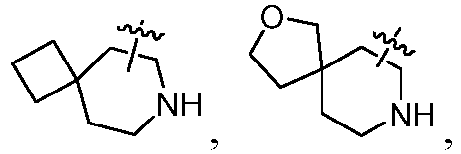
- The term "heterocycloalkenyl" includes cycloalkenyl in which one or more (e.g., 1-5, 1-4, 1-3, or 1-2) carbon atoms are substituted with a heteroatom, such as, specifically, cycloalkenyl in which up to 3 carbon atoms, in one embodiment up to 2 carbon atoms, and in another embodiment 1 carbon atom, are each independently replaced by O, S, S(O), or N, provided that at least one cycloalkenyl carbon-carbon double bond is preserved. The heterocycloalkenyl may be a cyclic group that exists as a monocyclic ring, a bridged ring, or a spiro ring and may be a 3- to 16-membered ring (for example, a 3- to 12-membered or 5- to 8-membered ring, specifically, for example, a 5-membered, 6-membered, 7-membered, 8-membered, 9-membered, 10-membered, or 11-membered ring). Examples of heterocycloalkenyl include, but are not limited to, dihydropyrrolyl, tetrahydropyridinyl, tetrahydroazepinyl, or azaspirooctenyl.
- The term "aryl" refers to an all-carbon aromatic monocyclic or fused polycyclic group having a conjugated π-electron system. For example, aryl may have 6-20 carbon atoms, 6-14 carbon atoms, or 6-12 carbon atoms. Non-limiting examples of the aryl include, but are not limited to, phenyl, naphthyl, anthryl, 1,2,3,4-tetrahydronaphthalene, and the like.
- The term "heteroaryl" refers to a monocyclic or fused polycyclic system that comprises at least one (e.g., 1-5, 1-4, 1-3, or 1-2) ring atom selected from the group consisting of N, O, and S, with the remaining ring atoms being C, and that has at least one aromatic ring. Preferably, the heteroaryl has a single 4- to 8-membered ring, in particular a 5- to 8-membered ring (e.g., 5-membered, 6-membered, 7-membered, or 8-membered), or has a plurality of fused rings comprising 6-14 ring atoms, in particular 6-10 (e.g., 6, 7, 8, 9, or 10) ring atoms. Non-limiting examples of the heteroaryl include, but are not limited to, pyrrolyl, furanyl, thienyl, imidazolyl, oxazolyl, pyrazolyl, pyridinyl, pyrimidinyl, pyrazinyl, quinolyl, isoquinolyl, tetrazolyl, triazolyl, triazinyl, benzofuranyl, benzothienyl, indolyl, isoindolyl, and the like.
- Unless otherwise specified, the term "hetero" refers to a heteroatom or a heteroatom group (i.e., a heteroatom-containing group), including atoms other than carbon (C) and hydrogen (H) and groups containing such heteroatoms, including, for example, oxygen (O), nitrogen (N), sulfur (S), phosphorus (P), silicon (Si), germanium (Ge), aluminum (Al), boron (B), -O-, -S-, =O, =S, -P(=O)-, -P(=O)2-, -P(=O)O-, -P(=O)2O-, -C(=O)O-, -C(=O)-, - C(=S)-, -S(=O)-, -S(=O)2-, and optionally substituted -C(=O)N(H)-, -N(H)-, -C(=NH)-, -S(=O)2N(H)-, or - S(=O)N(H)-.
- The term "derivative" refers to a new compound or a group of new compounds that are produced through one or more chemical reactions or structural evolutions. The derivative retains the basic structure of the parent compound, with changes or modifications occurring in the side chains, functional groups, or substituents only.
- The term "substituent", "optionally substituted with one or more substituents", or "optionally substituted" includes all substituents and substitutions with substituents mentioned in the text, and may be, e.g., the terms "halogen", "deuterium", "O", "-NH2", "-NH(C1-4 alkyl)", "-N(C1-4 alkyl)2", "-OH", "-OC1-4 alkyl", "-CN", "C1-4 alkyl", and "3- to 6-membered heterocycloalkyl", and the corresponding non-limiting or exemplary groups mentioned below, wherein some non-limiting examples of the "substituent" include sulfydryl, nitro, nitroso, cyano, azido, a sulfoxide group, a sulfone group, a sulfonamide group, carboxyl, an aldehyde group, an imine group, alkyl, halogenated alkyl, cycloalkyl, halogenated cycloalkyl, alkenyl, halogenated alkenyl, cycloalkenyl, halogenated cycloalkenyl, alkynyl, halogenated alkynyl, cycloalkynyl, halogenated cycloalkynyl, heteroalkyl, halogenated heteroalkyl, alkoxy, alkylthio, aryl, aryloxy, arylthio, arylalkylene, arylalkoxy, arylalkylthio, heteroaryl, heteroaryloxy, heteroarylthio, heteroarylalkylene, heteroarylalkoxy, heteroarylalkylthio, heterocyclyl, heterocyclyloxy, heterocyclylthio, heterocyclylalkylene, heterocyclylalkoxy, heterocyclylalkylthio, acyl, acyloxy, a carbamate group, amido, ureido, an epoxy group, an ester group, oxo, and the like, wherein these substituents are optionally substituted with one or more substituents selected from the group consisting of the following substituents: oxo, hydroxy, amino, nitro, halogen, cyano, alkyl, alkenyl, alkynyl, alkoxy, halogenated alkoxy, alkylamino, dialkylamino, halogenated alkylamino, halogenated dialkylamino, carboxyl, -C(O)O-alkyl, -OC(O)-alkyl, -C(O)NH2, -C(O)NH-alkyl, - C(O)N(alkyl)2, -NHC(O)-alkyl, -C(O)-alkyl, -S(O)-alkyl, -S(O)2-alkyl, -S(O)2NH2, -S(O)2NH-alkyl, - S(O)2N(alkyl)2, cycloalkyl, cycloalkylalkylene, cycloalkyloxy, heterocyclyl, heterocyclylalkylene, heterocyclyloxy, heterocycloalkyl, heterocycloalkylalkylene, heterocycloalkyloxy, heteroaryl, heteroarylalkylene, heteroaryloxy, aryl, arylalkylene, and aryloxy.

- In some embodiments herein, the "substituent" is selected from the group consisting of deuterium, tritium, hydroxyl, sulfydryl, halogen, amino, nitro, nitroso, cyano, azido, a sulfoxide group, a sulfone group, a sulfonamide group, carboxyl, an aldehyde group, an imine group, C1-12 alkyl, halogenated C1-12 alkyl, 3- to 12-membered cycloalkyl, halogenated 3- to 12-membered cycloalkyl, C2-12 alkenyl, halogenated C2-12 alkenyl, 3- to 12-membered cycloalkenyl, halogenated 3- to 12-membered cycloalkenyl, C2-12 alkynyl, halogenated C2-12 alkynyl, 8- to 12-membered cycloalkynyl, halogenated 8- to 12-membered cycloalkynyl, C1-12 heteroalkyl, halogenated C1-12 heteroalkyl, C1-12 alkoxy, C1-12 alkylthio, 6- to 10-membered aryl, 6- to 10-membered aryloxy, 6- to 10-membered arylthio, 6- to 10-membered aryl C1-12 alkylene, 6- to 10-membered aryl C1-12 alkoxy, 6- to 10-membered aryl C1-12 alkylthio, 5- to 10-membered heteroaryl, 5- to 10-membered heteroaryloxy, 5- to 10-membered heteroarylthio, 5-to 10-membered heteroarylalkylene, 5- to 10-membered heteroarylalkoxy, 5- to 10-membered heteroarylalkylthio, 3- to 12-membered heterocyclyl, 3- to 12-membered heterocyclyloxy, 3- to 12-membered heterocyclylthio, 3- to 12-membered heterocyclyl C1-12 alkylene, 3-to 12-membered heterocyclyl C1-12 alkoxy, 3- to 12-membered heterocyclyl C1-12 alkylthio, C1-12 acyl, C1-12 acyloxy, a carbamate group, C1-12 amido, ureido, an epoxy group, a C2-12 ester group, and oxo, wherein these substituents are optionally substituted with one or more substituents selected from the group consisting of the following substituents: oxo, hydroxy, amino, nitro, halogen, cyano, C1-12 alkyl, C2-12 alkenyl, C2-12 alkynyl, C1-12 alkoxy, halogenated C1-12 alkoxy, C1-12 alkylamino, di-C1-12 alkylamino, halogenated C1-12 alkylamino, halogenated di-C1-12 alkylamino, carboxyl, -C(O)O-C1-12 alkyl, -OC(O)-C1-12 alkyl, -C(O)NH2, - C(O)NH-C1-12 alkyl, -C(O)N(C1-12 alkyl)2, -NHC(O)-C1-12 alkyl, -C(O)-C1-12 alkyl, -S(O)-C1-12 alkyl, -S(O)2-C1-12 alkyl, -S(O)2NH2, -S(O)2NH-C1-12 alkyl, -S(O)2N(C1-12 alkyl)2, 3- to 12-membered cycloalkyl, 3- to 12-membered cycloalkyl C1-12 alkylene, 3- to 12-membered cycloalkyloxy, 3- to 12-membered heterocyclyl, 3- to 12-membered heterocyclyl C1-12 alkylene, 3- to 12-membered heterocyclyloxy, 3- to 12-membered heterocycloalkyl, 3- to 12-membered heterocycloalkyl C1-12 alkylene, 3- to 12-membered heterocycloalkyloxy, 5- to 10-membered heteroaryl, 5- to 10-membered heteroaryl C1-12 alkylene, 5- to 10-membered heteroaryloxy, 6- to 10-membered aryl, 6- to 10-membered aryl C1-12 alkylene, and 6- to 10-membered aryloxy.
- Unless otherwise specified, the term "hetero" refers to a heteroatom or a heteroatom group (i.e., a heteroatom-containing group), including atoms other than carbon (C) and hydrogen (H) and groups containing such heteroatoms. For example, heteroatoms include, but are not limited to, oxygen (O), nitrogen (N), sulfur (S), phosphorus (P), silicon (Si), germanium (Ge), aluminum (Al), and boron (B); specific heteroatoms or heteroatom groups are, e.g., -O-, -S-, -N=, =O, =S, -P(=O)-, -P(=O)2-, -P(=O)O-, -P(=O)2O-, -C(=O)O-, -C(=O)-, -C(=S)-, - S(=O), -S(=O)2-, and optionally substituted -C(=O)N(H)-, -N(H)-, -C(=NH)-, -S(=O)2N(H)-, or -S(=O)N(H)-. Preferably, the term "hetero" means that a heteroatom or a heteroatom of a heteroatom group (i.e., a heteroatom-containing group) is selected from the group consisting of oxygen, nitrogen, and sulphur.
- The term "derivative" refers to a new compound or a group of new compounds that are produced through one or more chemical reactions or structural evolutions. The derivative retains the basic structure of the parent compound, with changes or modifications occurring in the side chains, functional groups, or substituents only.In the present application, one of the absolute configurations (e.g., one of


 ). Unless otherwise specified, the compounds disclosed herein include both E and Z geometric isomers when they contain olefinic double bonds or other centers of geometric asymmetry. Likewise, all tautomeric forms are included within the scope of the present application.
- The group or structural fragment in the present application, such as -LNK1-Cy1-LNK-Cy2-LNK2-, -Cy1-Cy2-LNK2-, LNK, Cy1, Cy2, -Cy1-LNK-Cy2-, -Cy1-LNK-, or -LNK-Cy2-, and specific options thereof, optionally can be linked to the left-side group and the right-side group of the group or fragment respectively in the general formula in a left-to-right reading order. For example, in the case that L is selected from -Cy1-LNK-Cy2-, when Cy1 is selected from


- The term "treat", "treating", or "treatment" means administering the compound or formulation of the present application to ameliorate or eliminate a disease or one or more symptoms associated with the disease, and includes: (i) inhibiting the disease or disease state, i.e., arresting its progression; and (ii) relieving the disease or disease state, i.e., causing regression of the disease or disease state.
- The term "prevent", "preventing", or "prevention" means administering the compound or formulation of the present application to prevent a disease or one or more symptoms associated with the disease, and includes: preventing the occurrence of the disease or disease state in a mammal, particularly when such a mammal is predisposed to the disease state but has not yet been diagnosed with it.
- The term "therapeutically effective amount" refers to an amount of the compound of the present application for (i) treating or preventing a specific disease, condition, or disorder; (ii) alleviating, ameliorating, or eliminating one or more symptoms of a specific disease, condition, or disorder, or (iii) preventing or delaying onset of one or more symptoms of a specific disease, condition, or disorder described herein. The amount of the compound of the present application composing the "therapeutically effective amount" varies depending on the compound, the disease state and its severity, the mode of administration, and the age of the mammal to be treated, but may be determined routinely by those skilled in the art in accordance with their knowledge and the present disclosure.
- The term "pharmaceutically acceptable" is used herein for those compounds, materials, compositions, and/or dosage forms that are, within the scope of sound medical judgment, suitable for use in contact with the tissues of human beings and animals without excessive toxicity, irritation, allergic response, or other problems or complications, and commensurate with a reasonable benefit/risk ratio.
- A pharmaceutically acceptable salt, for example, may be a metal salt, an ammonium salt, a salt formed with an organic base, a salt formed with an inorganic acid, a salt formed with an organic acid, and a salt formed with a basic or acidic amino acid.
- The term "pharmaceutical composition" refers to a mixture consisting of one or more of the compounds or the salts thereof of the present application and a pharmaceutically acceptable excipient. The pharmaceutical composition is intended to facilitate the administration of the compound of the present application to an organic entity.
- The term "pharmaceutically acceptable excipient" refers to those that do not have a significant irritating effect on an organic entity and do not impair the biological activity and properties of the active compound. Suitable excipients are well known to those skilled in the art, such as carbohydrate, wax, water-soluble and/or water-swellable polymers, hydrophilic or hydrophobic material, gelatin, oil, solvent, and water.
- The word "comprise" and variations thereof such as "comprises" or "comprising" will be understood in an open, non-exclusive sense, i.e., "including but not limited to".
- Unless otherwise specified clearly in the context, singular terms herein encompass plural referents, and vice versa. Similarly, unless otherwise specified clearly in the context, the word "or" herein is intended to include "and". Unless otherwise stated, all numbers expressing the amounts of ingredients, measurements, or reaction conditions used herein are to be understood as being modified in all instances by the term "about". The term "about" when connected to a percentage may mean, for example, ±1%, preferably, ±0.5%, and more preferably, ±0.1%.
- The compounds and intermediates of the present application may also exist in different tautomeric forms, and all such forms are included within the scope of the present application. The term "tautomer" or "tautomeric form" refers to structural isomers of different energies that can interconvert via a low energy barrier. For example, a proton tautomer (also referred to as prototropic tautomer) includes interconversion via proton transfer, such as keto-enol isomerization and imine-enamine isomerization. A specific example of a proton tautomer is an imidazole moiety where a proton can transfer between two ring nitrogen atoms. A valence tautomer includes the interconversion via recombination of some bonding electrons. Specifically, any of the compounds of the present disclosure in which, for example, pyrazolyl is independent or as part of heterocyclyl, may exist in the form of any two tautomers or a mixture of two tautomers in any amount, i.e.,

- The present application also includes isotopically labeled compounds of the present application which are identical to those recited herein but have one or more atoms replaced by an atom having an atomic mass or mass number different from the atomic mass or mass number generally found in nature. Examples of isotopes that can be incorporated into the compounds of the present application include isotopes of hydrogen, carbon, nitrogen, oxygen, phosphorus, sulfur, fluorine, iodine, and chlorine, such as 2H, 3H, 11C, 13C, 14C, 13N, 15N, 15O, 17O, 18O, 31P, 32P, 35S, 18F, 123I, 125I, and 36Cl.
- Certain isotopically labeled compounds of the present application (e.g., those labeled with 3H and 14C) can be used to analyze compounds and/or substrate tissue distribution. Tritiated (i.e., 3H) and carbon-14 (i.e., 14C) isotopes are particularly preferred for their ease of preparation and detectability. Positron emitting isotopes, such as 15O, 13N, 11C, and 18F, can be used in positron emission tomography (PET) studies to determine substrate occupancy. Isotopically labeled compounds of the present application can generally be prepared by following procedures analogous to those disclosed in the schemes and/or examples below while substituting a non-isotopically labeled reagent with an isotopically labeled reagent.
- Furthermore, substitution with heavier isotopes such as deuterium (i.e., 2H) may provide certain therapeutic advantages (e.g., increased in vivo half-life or reduced dose) resulting from greater metabolic stability and hence may be preferred in some circumstances in which deuterium substitution may be partial or complete, wherein partial deuterium substitution refers to substitution of at least one hydrogen with at least one deuterium.
- The compound of the present application may be asymmetrical, for example, having one or more stereoisomers. Unless otherwise stated, all stereoisomers include, for example, enantiomers and diastereoisomers. The compound of the present application containing asymmetrical carbon atoms may be separated in an optically pure form or in a racemic form. The optically pure form may be separated from a racemic mixture or may be synthesized using a chiral raw material or a chiral reagent.
- The pharmaceutical composition of the present application may be prepared by combining the compound of the present application with a suitable pharmaceutically acceptable excipient, and may be formulated, for example, into a solid, semisolid, liquid, or gaseous formulation such as tablet, pill, capsule, powder, granule, ointment, emulsion, suspension, suppository, injection, inhalant, gel, microsphere, and aerosol.
- Typical routes of administration of the compound or the pharmaceutically acceptable salt thereof or the pharmaceutical composition thereof of the present application include, but are not limited to, oral, rectal, local, inhalation, parenteral, sublingual, intravaginal, intranasal, intraocular, intraperitoneal, intramuscular, subcutaneous, and intravenous administration.
- The pharmaceutical composition of the present application may be manufactured using methods well known in the art, such as conventional mixing, dissolving, granulating, dragee-making, levigating, emulsifying, and lyophilizing. In some embodiments, the pharmaceutical composition is in an oral form. For oral administration, the pharmaceutical composition can be formulated by mixing the active compounds with pharmaceutically acceptable excipients well known in the art. These excipients enable the compounds of the present application to be formulated into tablets, pills, pastilles, dragees, capsules, liquids, gels, slurries, suspensions, and the like for oral administration to a patient.
- A solid oral composition can be prepared by conventional mixing, filling, or tableting. For example, it can be obtained by the following method: mixing the active compounds with solid excipients, optionally grinding the resulting mixture, adding additional suitable excipients if desired, and processing the mixture into granules to get the core parts of tablets or dragees. Suitable excipients include, but are not limited to: binders, diluents, disintegrants, lubricants, glidants, sweeteners, flavoring agents, or the like.
- The pharmaceutical composition may also be suitable for parenteral administration, such as a sterile solution, a suspension, or a lyophilized product in a suitable unit dosage form.
- In all of the administration methods of the compound of general formula I described herein, the daily dose administered is from 0.01 mg/kg to 200 mg/kg of body weight, given in individual or separated doses.
- The compounds of the present application can be prepared using a variety of synthetic methods well known to those skilled in the art, including the specific embodiments listed below, embodiments formed by combinations thereof with other chemical synthetic methods, and equivalents thereof known to those skilled in the art. The preferred embodiments include, but are not limited to, the examples of the present application.
- The chemical reactions in the specific embodiments of the present application are conducted in a proper solvent that must be suitable for the chemical changes in the present application and the reagents and materials required. In order to obtain the compounds of the present application, it is sometimes necessary for those skilled in the art to modify or select a synthesis procedure or a reaction process based on the existing embodiments.
- An important consideration in synthetic route planning in the art is the selection of suitable protective groups for reactive functional groups (e.g., amino in the present application). For example, reference may be made to Greene's Protective Groups in Organic Synthesis (4th Ed.) Hoboken, New Jersey: John Wiley & Sons, Inc.
- In some embodiments, the compound of formula I of the present application can be prepared by one skilled in the art of organic synthesis through the following routes:


- A compound of general formula I-1 is subjected to a substitution reaction to obtain a compound of general formula 1-2, the compound of general formula I-2 is subjected to a deprotection reaction to obtain a compound of general formula I-3, then a condensation reaction is carried out to obtain a compound of general formula I-4, and the compound of general formula I-4 is subjected to an oxidation reaction to obtain a compound of general formula I-5; the chloro-substituted aromatic ring-containing carboxylic acid is subjected to a substitution reaction with hydroxyl-substituted Cy1 to obtain a compound of general formula I-6; a compound of general formula I-7 is obtained by a deprotection reaction; finally, the compound of general formula I-5 and the compound of general formula I-7 are subjected to a reductive amination reaction to obtain a compound of general formula I.
- A compound of general formula I-3 and a compound of general formula I-10 are subjected to a condensation reaction to obtain a compound of general formula I-8, and the compound of general formula I-8 is subjected to a deprotection reaction to obtain a compound of general formula I-9; the chloro-substituted aromatic ring-containing carboxylic acid is subjected to a substitution reaction with Boc-protected Cy1 to obtain a compound of general formula I-10; a compound of general formula I-11 is obtained by an oxidation reaction; the compound of general formula I-9 and the compound of general formula I-11 are subjected to a reductive amination reaction to obtain a compound of the general formula I.
- The following abbreviations are used in the present application:
Boc represents tert-butyloxycarbonyl; Et represents ethyl; EA represents ethyl acetate; DMSO represents dimethyl sulfoxide; DMF represents N,N-dimethylformamide; BINAP represents 2,2'-bis(diphenylphosphino)-1,1'-binaphthyl; DCM represents dichloromethane; Pd2(dba)3 represents tris(dibenzylideneacetone)dipalladium(0); THF represents tetrahydrofuran; PMB represents p-methoxybenzyl; MeOH represents methanol; PE represents petroleum ether; IBX represents 2-iodoxybenzoic acid; DIPEA represents N,N'-diisopropylethylamine; DIBAL-H represents diisobutylaluminum hydride; NIS represents N-iodosuccinimide; NBS represents N-bromosuccinimide; Tf represents -OSO2CF3; HATU represents O-(7-azabenzotriazol-1-yl)-N,N,N',N'-tetramethyluronium hexafluorophosphate; xantphos represents 4,5-bis(diphenylphosphino)-9,9-dimethylxanthene; DCE represents dichloroethane; DMA or DMAC represents N,N-dimethylacetamide; AIBN represents azobisisobutyronitrile; DMAP represents 4-dimethylaminopyridine; CCl4 represents carbon tetrachloride; and Ruphos represents 2-dicyclohexylphosphino-2',6'-diisopropoxybiphenyl. - For clarity, the present application is further described with the following examples, which are, however, not intended to limit the scope of the present application. All reagents used in the present application are commercially available and can be used without further purification.
-


- At 10 °C, 1a (81 g), 2,4-dimethoxybenzylamine (83 g), and acetic acid (500 mL) were added to a reaction flask in sequence, and the mixture was warmed to 80 °C and reacted. After the reaction was completed as monitored, water (800 mL) was added to the reaction solution, and the mixture was filtered under vacuum. The filter cake was washed with water and dried to give intermediate 1b (95.78 g).
- MS (ESI, [M-H]-) m/z: 312.02.
- 1H NMR (500 MHz, DMSO-d 6) δ 11.03 (s, 1H), 7.62 (dd, J = 8.4, 7.1 Hz, 1H), 7.29 (d, J = 7.1 Hz, 1H), 7.22 (d, J = 8.4 Hz, 1H), 6.90 (d, J = 8.4 Hz, 1H), 6.56 (d, J= 2.4 Hz, 1H), 6.43 (dd, J = 8.4, 2.4 Hz, 1H), 4.60 (s, 2H), 3.80 (s, 3H), 3.73 (s, 3H).
- At 10 °C, a 2.5 M solution of lithium aluminum hydride in tetrahydrofuran (227 mL) was slowly added dropwise to a solution of 1b (96.00 g) in tetrahydrofuran (1000 mL), and the mixture was reacted at 80 °C. A 15% sodium hydroxide aqueous solution (30.5 g) and water (100 mL) were added to the reaction solution, and the mixture was filtered under vacuum. The filter cake was washed with a solution of dichloromethane/MeOH = 1/1, and the filtrate was concentrated. The crude product was separated and purified by silica gel column chromatography to give intermediate 1c (55.87 g).
- MS (ESI, [M+H]+) m/z: 286.01
1H NMR (500 MHz, DMSO-d 6) δ 9.28 (s, 1H), 7.24 (d, J = 8.3 Hz, 1H), 6.97 (t, J = 7.7 Hz, 1H), 6.64 (d, J = 7.4 Hz, 1H), 6.59 (d, J= 8.0 Hz, 1H), 6.55 (d, J= 2.4 Hz, 1H), 6.51 (dd, J = 8.3, 2.4 Hz, 1H), 3.81 - 3.71 (m, 12H). - 1c (48.00 g), methanol (350 mL), palladium hydroxide (4.8 g), and di-tert-butyl dicarbonate (41.4 g) were added to a reaction flask in sequence, and the mixture was reacted at 25 °C under hydrogen atmosphere. The reaction solution was filtered under vacuum. The filtrate was concentrated, extracted with water (200 mL) and ethyl acetate, washed with saturated brine, dried over anhydrous sodium sulfate, and filtered. The filtrate was concentrated, and the crude product was separated and purified by silica gel column chromatography to give intermediate 1d (34.43 g).
- 1H NMR (500 MHz, DMSO-d 6) δ 7.07 (t, J = 7.7 Hz, 1H), 6.68 (ddd, J = 18.9, 7.8, 2.7 Hz, 2H), 4.56 - 4.50 (m, 2H), 4.48 - 4.42 (m, 2H), 1.45 (s, 9H).
- 1d (35.00 g), methanol (250 mL), and a 4 M solution of hydrochloric acid in 1,4-dioxane (123 mL) were added to a reaction flask in sequence, and the mixture was reacted at 25 °C for 3 h. The reaction solution was concentrated, pyridine (200 mL) and trifluoroacetic anhydride (25.20 g) were added, and the mixture was stirred at 25 °C for 40 h. The reaction solution was poured into a 3 M hydrochloric acid aqueous solution, and the mixture was vigorously stirred, extracted with ethyl acetate, washed with saturated brine, dried over anhydrous sodium sulfate, and filtered. The filtrate was concentrated to give intermediate 1e (32.48 g).
- MS (ESI, [M-H]-) m/z: 229.99.
- 1H NMR (500 MHz, DMSO-d 6)δ 9.82 (d, J = 24.4 Hz, 1H), 7.16 (td, J = 7.7, 3.7 Hz, 1H), 6.81 (dd, J = 11.5, 7.5 Hz, 1H), 6.74 (d, J = 8.0 Hz, 1H), 4.99 (s, 1H), 4.89 (s, 1H), 4.80 (s, 1H), 4.70 (s, 1H).
- 1e (32.48 g), dichloromethane (300 mL), triethylamine (28.40 g), 4-dimethylaminopyridine (1.72 g), and acetic anhydride (15.78 g) were added to a reaction flask in sequence, and the mixture was reacted at 25 °C. After the reaction was completed, the reaction solution was poured into water, and the mixture was vigorously stirred, extracted with dichloromethane, washed with saturated brine, dried over anhydrous sodium sulfate, and filtered. The filtrate was concentrated, and the crude product was separated by silica gel column chromatography to give intermediate 1f (33.82 g).
- 1H NMR (500 MHz, DMSO-d 6)δ 7.41 (td, J = 7.8, 2.3 Hz, 1H), 7.30 (t, J = 8.5 Hz, 1H), 7.12 (dd, J = 7.9, 2.9 Hz, 1H), 5.09 (s, 1H), 4.90 (d, J = 12.3 Hz, 2H), 4.72 (s, 1H), 2.31 (d, J = 3.4 Hz, 3H).
- 1f (30.00 g), aluminum trichloride (29.30 g), and orthodichlorobenzene (200 mL) were added to a reaction flask in sequence, and the mixture was reacted at 150 °C for 1 h. The reaction solution was then poured into an citric acid aqueous solution, and the mixture was vigorously stirred, extracted with ethyl acetate, washed with saturated brine, dried over anhydrous sodium sulfate, and filtered. The filtrate was concentrated, and the crude product was separated by silica gel column chromatography to give intermediate 1g (18.19 g).
- 1H NMR (500 MHz, DMSO-d 6) δ 12.38 (s, 1H), 7.94 (dd, J = 8.2, 4.7 Hz, 1H), 7.01 (dd, J = 12.7, 8.1 Hz, 1H), 5.07 (s, 1H), 4.94 (s, 1H), 4.86 (s, 1H), 4.74 (d, J = 1.6 Hz, 1H), 2.66 (d, J = 1.0 Hz, 3H).
- 1g (18.19 g), sodium hydroxide (7.56 g), methanol (150 mL), and water (150 mL) were added to a reaction flask in sequence, and the mixture was reacted at 25 °C. The reaction solution was concentrated to remove the methanol, 1,4-dioxane (150 mL) and di-tert-butyl dicarbonate (15.14 g) were added to the residue, and the mixture was stirred at 25 °C. After the reaction was completed, the reaction solution was poured into water, and the mixture was vigorously stirred, extracted with ethyl acetate, washed with saturated brine, dried over anhydrous sodium sulfate, and filtered. The filtrate was concentrated, and the crude product was separated by silica gel column chromatography to give intermediate 1h (14.10 g).
- MS (ESI, [M-H]-) m/z: 276.07.
- 1H NMR (500 MHz, DMSO-d 6) δ 12.36 (s, 1H), 7.89 (dd, J = 8.1, 2.9 Hz, 1H), 6.95 (t, J = 8.0 Hz, 1H), 4.62 (dt, J = 13.4, 2.2 Hz, 2H), 4.51 (dt, J = 13.9, 2.3 Hz, 2H), 2.65 (s, 3H), 1.46 (s, 9H).
- 1h (14.10 g), diethyl carbonate (27.00 g), and toluene (200 mL) were added to a reaction flask in sequence, and the mixture was cooled to 0 °C. After 60 wt% sodium hydride (9.16 g) was added, the mixture was warmed to 120 °C and stirred. After the reaction was completed, the reaction solution was poured into a 3 M hydrochloric acid aqueous solution, and the mixture was vigorously stirred, extracted with ethyl acetate, washed with saturated brine, dried over anhydrous sodium sulfate, and filtered. The filtrate was concentrated, and the crude product was separated by silica gel column chromatography to give intermediate 1i (14.96 g).
- 1H NMR (500 MHz, DMSO-d 6) δ 11.72 (d, J = 9.6 Hz, 1H), 7.82 (dd, J = 8.2, 4.7 Hz, 1H), 6.97 (t, J = 8.4 Hz, 1H), 4.63 (dt, J= 12.4, 2.1 Hz, 2H), 4.53 (dt, J = 13.7, 2.1 Hz, 2H), 4.22 (d, J = 2.5 Hz, 2H), 4.13 (q, J = 7.1 Hz, 2H), 1.46 (d, J= 1.9 Hz, 9H), 1.19 (t, J = 7.1 Hz, 3H).
- 1i (14.96 g), a 50% hydroxylamine aqueous solution (6.36 g), and ethanol (150 mL) were added to a reaction flask in sequence, and the mixture was stirred at 85 °C for 3 h. The reaction solution was concentrated and extracted with water and ethyl acetate, followed by liquid separation, and the organic phase was washed with saturated brine, dried over anhydrous sodium sulfate, and filtered. The filtrate was concentrated to give a crude product of intermediate 1j (10.13 g).
- MS (ESI, [M-H]-) m/z: 317.20.
- 1H NMR (500 MHz, DMSO-d 6) δ 12.59 (s, 1H), 7.78 (d, J = 8.2 Hz, 1H), 7.38 (t, J = 7.6 Hz, 1H), 4.85 (dt, J = 13.5, 2.5 Hz, 2H), 4.75 (dt, J = 12.2, 2.4 Hz, 2H), 4.11 (s, 2H), 1.49 (d, J = 2.1 Hz, 9H).
- 1j (10.13 g), potassium carbonate (12.55 g), N,N-dimethylacetamide (150 mL), and iodoethane (7.08 g) were added to a reaction flask in sequence, and the mixture was stirred at 80 °C for 1 h. The reaction solution was poured into water, and the mixture was vigorously stirred, extracted with ethyl acetate, washed with saturated brine, dried over anhydrous sodium sulfate, and filtered. The filtrate was concentrated, and the residue was separated by silica gel column chromatography to give intermediate 1k (11.22 g).
- MS (ESI, [M+H]+) m/z: 347.16.
- 1H NMR (500 MHz, DMSO-d 6)δ 7.78 (d, J = 8.0 Hz, 1H), 7.39 (t, J = 7.5 Hz, 1H), 4.89 - 4.82 (m, 2H), 4.75 (dd, J= 11.8, 2.8 Hz, 2H), 4.22 (d, J= 4.3 Hz, 2H), 4.13 (p, J = 7.2 Hz, 2H), 1.48 (d, J= 2.1 Hz, 9H), 1.21 - 1.17 (m, 3H).
- Acrylamide (1.32 g) was slowly added to a stirred solution of 1k (10.72 g) in tetrahydrofuran (50 mL) at 0 °C under N2 atmosphere, a 1 M solution of potassium tert-butoxide in tetrahydrofuran (18.63 mL) was then added dropwise, and the mixture was stirred at 0 °C for 3 h. The reaction solution was poured into an ammonium chloride aqueous solution, and the mixture was vigorously stirred, extracted with ethyl acetate, washed with saturated brine, dried over anhydrous sodium sulfate, and filtered. The filtrate was concentrated, and the crude product was separated by silica gel column chromatography to give intermediate 1l (7.52 g).
- MS (ESI, [M+H]+) m/z: 372.02.
- 1H NMR (500 MHz, DMSO-d 6) δ 11.11 (s, 1H), 7.80 (dd, J = 8.1, 2.7 Hz, 1H), 7.37 (t, J = 7.9 Hz, 1H), 4.85 (dd, J = 12.2, 2.6 Hz, 2H), 4.75 (dt, J = 12.0, 2.3 Hz, 2H), 4.63 (dd, J= 12.1, 4.9 Hz, 1H), 2.78 (ddd, J = 17.3, 12.1, 5.3 Hz, 1H), 2.67 - 2.51 (m, 2H), 2.20 (dq, J = 13.5, 4.7 Hz, 1H), 1.49 (d, J = 2.6 Hz, 9H).
- 1l (1.00 g), a 4 M solution of hydrochloric acid in 1,4-dioxane (10 mL), and ethyl acetate (50 mL) were added to a reaction flask in sequence, and the mixture was reacted at 25 °C for 8 h. The reaction solution was then directly filtered, and the filter cake was washed with ethyl acetate and then dried to give intermediate 1 (0.83 g).
- MS (ESI, [M+H]+) m/z: 272.11.
- 1H NMR (500 MHz, DMSO-d 6) δ 11.13 (s, 1H), 10.36 (s, 2H), 7.90 (d, J = 8.1 Hz, 1H), 7.45 (d, J = 8.2 Hz, 1H), 4.81 (s, 2H), 4.70 - 4.63 (m, 3H), 2.79 (ddd, J = 17.4, 12.2, 5.3 Hz, 1H), 2.62 (dt, J = 17.3, 4.0 Hz, 1H), 2.59 - 2.52 (m, 1H), 2.21 (ddt, J = 13.2, 5.1, 2.5 Hz, 1H).
-


- 2a (18 g), AIBN (0.738 g), carbon tetrachloride (500 mL), and NBS (47.8 g) were added to a reaction flask in sequence, and the mixture was warmed to 60 °C and reacted. The reaction solution was then cooled to room temperature and concentrated by evaporation under reduced pressure to remove the solvent, and dichloromethane (200 mL) was added to the residue. The mixture was washed with saturated brine, dried over anhydrous sodium sulfate, and filtered. The filtrate was concentrated by evaporation under reduced pressure to remove the solvent, and the residue was purified by silica gel column chromatography to give intermediate 2b (18.7 g).
- 2b (18.7 g), benzylamine (1.78 mL), N,N-diisopropylethylamine (7.13 mL), and toluene (50 mL) were added to a reaction flask in sequence, and the mixture was warmed to 50 °C and reacted. The reaction solution was then cooled to room temperature. After the reaction was completed, the reaction solution was extracted with ethyl acetate (200 mL) and an icy HCl aqueous solution (1 M, 200 mL). The aqueous phase was collected, adjusted to about pH 8 with a sodium bicarbonate solid, and extracted with ethyl acetate. The organic phase was collected, dried over anhydrous sodium sulfate, filtered, and concentrated by evaporation under reduced pressure to remove the solvent, thus giving intermediate 2c (9.6 g).
- MS(ESI, [M+H]+) m/z: 240.1.
- 2c (9.6 g), methanol (200 mL), 10% palladium on carbon (5 g), and toluene (50 mL) were added to a reaction flask in sequence, and the mixture was purged three times with hydrogen and reacted at room temperature under hydrogen atmosphere. The palladium on carbon was filtered out, and the filter cake was washed with methanol. The filtrate was collected and concentrated by evaporation under reduced pressure to remove the solvent, thus giving 2d (4.5 g).
- MS(ESI, [M+H]+) m/z: 149.9.
- 2d (4 g), tetrahydrofuran (50 mL), and trifluoroacetic anhydride (5.63 g) were added to a reaction flask in sequence, and the mixture was reacted at room temperature. An aqueous solution (200 mL) was added to the reaction solution to quench the reaction, and ethyl acetate was then added for extraction. The organic phase was separated, dried over anhydrous sodium sulfate, and purified by silica gel column chromatography to give 2e (4.58 g).
- 1H NMR (500 MHz, DMSO-d6) δ 7.29 (t, J = 9.3 Hz, 1H), 6.98 (d, J = 8.6 Hz, 1H), 6.93 - 6.86 (m, 1H), 4.97 (d,J = 21.7 Hz, 2H), 4.77 (dd, J = 21.4, 5.2 Hz, 2H), 3.76 (dd, J = 3.6, 1.6 Hz, 3H).
- 2e (4.6 g), dichloromethane (200 mL), and boron tribromide (1 M, 18.76 mL) were added to a reaction flask in sequence, and the mixture was reacted at room temperature. An aqueous solution (200 mL) was added to the reaction solution under an ice bath to quench the reaction. The organic phase was separated, and the aqueous phase was extracted with dichloromethane. The organic phases were combined, dried over anhydrous sodium sulfate, and concentrated by evaporation under reduced pressure to remove the solvent, thus giving 2f (4.2 g).
- 1H NMR (500 MHz, DMSO-d6) δ 7.16 (t, J = 8.8 Hz, 1H), 6.87 - 6.59 (m, 2H), 4.92 (d, J = 20.8 Hz, 2H), 4.72 (d, J = 19.9 Hz, 2H).
- 2f (6.5 g), dichloromethane (60 mL), triethylamine (7.8 mL), and acetic anhydride (2.94 mL) were added to a reaction flask in sequence, and the mixture was reacted at room temperature. The organic solvent dichloromethane (200 mL) and water (300 mL) were added to the reaction solution. The organic phase was separated, washed with saturated brine, dried over anhydrous sodium sulfate, filtered, and concentrated by evaporation under reduced pressure to remove the solvent, thus giving 2g (7 g).
- 1H NMR (500 MHz, DMSO-d6) δ 7.42 (dd, J = 10.0, 8.3 Hz, 1H), 7.17 (dd, J = 14.0, 2.1 Hz, 1H), 7.09 (d, J = 8.2 Hz, 1H), 5.03 (d, J = 6.6 Hz, 2H), 4.83 (d, J = 6.9 Hz, 2H), 2.27 (s, 3H).
- 2g (6 g) and aluminum trichloride (4.39 g) were added to a reaction flask in sequence, and the mixture was gradually heated from room temperature to 150 °C and reacted. The reaction solution was then cooled to room temperature, and water (500 mL) and a 3 M hydrochloric acid aqueous solution (100 mL) were added to the residue. The organic phase was separated, washed with saturated brine (100 mL), dried over anhydrous sodium sulfate, and filtered. The filtrate was concentrated under reduced pressure to remove the solvent, and the residue was purified by silica gel column chromatography to give 2h (3.78 g).
- MS(ESI, [M-H]-) m/z: 271.9.
- 2h (550 mg), MeOH (5.00 mL), and a solution of sodium hydroxide (242 mg) in water (5.00 mL) were added to a reaction flask in sequence, and the mixture was reacted at room temperature. The reaction solution was concentrated to remove the methanol, and the aqueous phase was retained, thus giving 2i. 1,4-Dioxane (5 mL) and Boc anhydride (439 mg, 0.462 mL) were added to the system, and the mixture was reacted at room temperature. The reaction solution was extracted with ethyl acetate (200 mL) and saturated brine (200 mL), and the organic phase was dried over anhydrous sodium sulfate, filtered, and concentrated to give 2j (200 mg).
- 1H NMR (500 MHz, DMSO-d6) δ 12.11 (d, J = 19.3 Hz, 1H), 7.88 (d, J = 9.5 Hz, 1H), 6.74 - 6.56 (m, 1H), 4.60 - 4.50 (m, 4H), 2.63 (d, J = 6.5 Hz, 3H), 1.45 (s, 9H).
- 2j (3.5 g) and THF (300 mL) were added to a reaction flask in sequence, and diethyl carbonate (14.91 g, 15.29 mL) was added. The mixture was cooled to about 0 °C, and 60 wt% sodium hydride (5.05 g, 126 mmol) was added in portions. The mixture was heated to 85 °C and reacted. The reaction solution was cooled to room temperature and slowly poured into ice water (500 mL). The mixture was extracted with ethyl acetate, and the organic phase was discarded. The aqueous phase was adjusted to pH = 1-2 with 3 M hydrochloric acid, then extracted with ethyl acetate, dried over anhydrous sodium sulfate, filtered, and concentrated by evaporation under reduced pressure to remove the solvent, thus giving 2k (7.0 g).
- MS(ESI, [M-H]-) m/z: 348.3.
- 2k (4.4 g), an hydroxylamine aqueous solution (4.16 g, 63.0 mmol), and ethanol (50 mL) were added to a reaction flask in sequence, and the mixture was reacted at 85 °C. The reaction solution was then cooled to room temperature, ethyl acetate (200 mL) and a saturated sodium carbonate aqueous solution (100 mL) were added to the residue for extraction, and the organic phase was discarded. The aqueous phase was adjusted to pH = 2-3 with a 1 M HCl aqueous solution, extracted with ethyl acetate, dried over anhydrous sodium sulfate, filtered, and concentrated by evaporation under reduced pressure to remove the solvent, thus giving 2l (3.25 g).
- 1H NMR (500 MHz, DMSO-d 6) δ 12.83 (s, 1H), 7.74 (d, J = 13.0 Hz, 1H), 7.68 (d, J = 3.5 Hz, 1H), 4.71 (d, J = 13.6 Hz, 2H), 4.66 (d, J = 11.4 Hz, 2H), 4.07 (s, 2H), 1.47 (s, 9H).
- 2l (3.14 g), potassium carbonate (1.500 g), DMA (5 mL), and iodoethane (2.308 g, 1.183 mL) were added to a reaction flask in sequence, and the mixture was heated to 80 °C and reacted. The reaction solution was then cooled to room temperature and poured into a mixed solution of ethyl acetate (100 mL) and water (200 mL). The organic phase was separated, dried over anhydrous sodium sulfate, and filtered. The filtrate was concentrated by evaporation under reduced pressure to remove the solvent, thus giving 2m (2.47 g).
- 1H NMR (500 MHz, DMSO-d 6) δ 7.73 (d, J = 15.9 Hz, 1H), 7.69 (d, J = 3.5 Hz, 1H), 4.69 (dd, J = 23.8, 12.4 Hz, 4H), 4.19 - 4.11 (m, 4H), 1.47 (s, 9H), 1.20 (t, J = 7.1 Hz, 3H).
- 2m (1.5 g) and THF (75 mL) were added to a reaction flask in sequence, acrylamide (0.215 g) was added, and the mixture was cooled to about -15 °C. A 1 M solution of potassium tert-butoxide in tetrahydrofuran (2.60 mL) was added, and the system was warmed to 0 °C and reacted for 1.5 h. The mixture was added dropwise to an ammonium chloride solution (200 mL) to quench the reaction and extracted with ethyl acetate. The organic phase was separated, dried over anhydrous sodium sulfate, and filtered, and the filtrate was concentrated and then purified by silica gel column chromatography to give 2n (0.88 g).
- 1H NMR (500 MHz, DMSO-d 6) δ 11.11 (d, J = 3.4 Hz, 1H), 7.78 (d, J = 12.4 Hz, 1H), 7.70 (s, 1H), 4.68 (dd, J = 29.4, 13.3 Hz, 4H), 4.58 (dd, J = 12.0, 4.9 Hz, 1H), 2.79 (ddd, J = 17.3, 12.1, 5.3 Hz, 1H), 2.62 (dt, J = 17.3, 4.1 Hz, 1H), 2.56 - 2.50 (m, 1H), 2.31 - 2.14 (m, 1H), 1.47 (d, J = 1.5 Hz, 9H).
- 2n (0.428 g) and dichloromethane (10.00 mL) were added to a reaction flask in sequence, then trifluoroacetic acid (3.29 g, 2.211 mL) was added, and the mixture was reacted at room temperature for 1 h. Water (80 mL) was added to the reaction solution, and the mixture was adjusted to pH 7-8 with saturated sodium bicarbonate and extracted with dichloromethane. The organic phases were combined, dried over anhydrous sodium sulfate, and concentrated by rotary evaporation to remove the solvent, thus giving intermediate 2 (0.439 g).
- MS(ESI, [M+H]+) m/z: 272.24.
- 1H NMR (500 MHz, DMSO-d6) δ 7.81 - 7.77 (m, 1H), 7.74 (s, 1H), 4.59 (dd, J = 12.1, 5.0 Hz, 1H), 4.49 (s, 2H), 4.43 (s, 2H), 2.79 (ddd, J = 17.4, 12.2, 5.3 Hz, 1H), 2.62 (dt, J = 17.3, 4.0 Hz, 1H), 2.47 (dd, J = 12.4, 4.4 Hz, 1H), 2.20 (ddt, J = 13.3, 5.2, 2.6 Hz, 1H).
-

- Intermediate 3a (25 g) was completely dissolved in methanol (1000 mL) and acetic acid (103 g, 99 mL, 1722 mmol) and then injected into a flow hydrogenation reactor at a pressure of 3 MPa, a temperature of 110 °C, and a flow rate of 3 mL/min. After the reaction was completed, the reaction solution was concentrated by evaporation under reduced pressure to remove the solvent, and a solution of hydrochloric acid in 1,4-dioxane (4 mol/L, 100 mL) was added to the residue. The mixture was concentrated by evaporation under reduced pressure to remove the solvent, and the residue was slurried with ethyl acetate and filtered. The filter cake was collected to give the target intermediate 3b (28.97 g).
- MS(ESI, [M+H]+) m/z: 150.0.
- 1H NMR (500 MHz, DMSO-d6) δ 10.01 (s, 1H), 7.06 (t, J = 7.8 Hz, 1H), 6.76 (d, J = 8.0 Hz, 1H), 6.64 (d, J = 7.6 Hz, 1H), 4.01 (t, J = 4.9 Hz, 2H), 3.33 - 3.25 (m, 2H), 2.94 (t, J = 6.2 Hz, 2H).
- Intermediate 3b (28.97 g) and tetrahydrofuran (300 mL) were added to a reaction flask in sequence, and trifluoroacetic anhydride (27.0 mL) was added under an ice bath. The mixture was reacted at room temperature. After the reaction was completed, the reaction solution was extracted with ethyl acetate (500 mL) and water (1000 mL). The organic phase was separated, and the aqueous phase was extracted with ethyl acetate. The organic phases were combined, washed with saturated brine, dried over anhydrous sodium sulfate, filtered, and concentrated by evaporation under reduced pressure to remove the solvent. The filter cake was collected by filtration to give the target intermediate 3c (22.67 g).
- MS(ESI, [M-H]-) m/z: 244.0.
- 1H NMR (500 MHz, DMSO-d6) δ 7.03 (q, J = 7.9 Hz, 1H), 6.74 - 6.68 (m, 1H), 6.64 (t, J = 6.9 Hz, 1H), 4.61 (d, J = 23.5 Hz, 2H), 3.78 (td, J = 6.0, 3.7 Hz, 2H), 2.84 (dt, J = 16.8, 5.9 Hz, 2H).
- Intermediate 3c (22.67 g), dichloromethane (200 mL), triethylamine (28.1 g, 38.6 mL), and DMAP (0.282 g) were added to a reaction flask in sequence, and acetic anhydride (10.38 g, 9.68 mL) was added under an ice bath. The mixture was warmed to room temperature and reacted. After the reaction was completed, the reaction solution was concentrated by evaporation under reduced pressure to remove the solvent, and ethyl acetate (500 mL) and water (1000 mL) were added to the residue for extraction. The organic phase was separated, washed with a saturated ammonium chloride solution and saturated brine separately, dried over anhydrous sodium sulfate, and filtered, and the filtrate was concentrated by evaporation under reduced pressure to remove the solvent, thus giving the target intermediate 3d (21.94 g).
- 1H NMR (500 MHz, DMSO-d6) δ 7.30 (dt, J = 11.1, 7.8 Hz, 1H), 7.18 - 7.11 (m, 1H), 7.05 (dt, J = 8.0, 2.2 Hz, 1H), 4.59 (s, 2H), 3.81 (q, J = 6.1 Hz, 2H), 2.95 (dt, J = 10.1, 6.0 Hz, 2H), 2.33 (d, J = 9.5 Hz, 3H).
- Intermediate 3d (21 g) and aluminum trichloride (14.62 g) were added to a reaction flask in sequence, and the mixture was heated to 170 °C and reacted under N2 atmosphere. After the reaction was completed, the reaction solution was cooled to room temperature, water (300 mL) was added to quench the reaction, and then dichloromethane was added for extraction. The organic phases were combined, washed with saturated brine (500 mL), dried over anhydrous sodium sulfate, and filtered, and the filtrate was purified by a silica gel column to give the target intermediate 3e (10.16 g).
- MS(ESI, [M-H]-) m/z: 286.0.
- 1H NMR (500 MHz, DMSO-d6) δ 12.76 (d, J = 8.4 Hz, 1H), 7.83 (t, J = 8.8 Hz, 1H), 6.86 (dd, J = 8.3, 5.7 Hz, 1H), 4.67 (d, J = 25.1 Hz, 2H), 3.86 - 3.78 (m, 2H), 2.94 (dt, J = 13.3, 5.9 Hz, 2H), 2.64 (d, J = 1.2 Hz, 3H).
- Intermediate 3e (10.16 g) and methanol (100 mL) were added to a reaction flask in sequence, and a solution of sodium hydroxide (4.24 g) in water (100 mL) was added dropwise under an ice bath. The mixture was warmed to room temperature and reacted. After the reaction was completed, the reaction solution was concentrated by evaporation under reduced pressure to remove the methanol, and 1,4-dioxane (100 mL) and di-tert-butyl dicarbonate (8.49 g, 9.03 mL) were added. The mixture was reacted at room temperature. After the reaction was completed, the reaction solution was extracted with ethyl acetate (500 mL) and water (800 mL), dried over anhydrous sodium sulfate, and filtered, and the filtrate was concentrated by evaporation under reduced pressure to remove the solvent, thus giving the target intermediate 3f (8.96 g).
- MS(ESI, [M+H]+) m/z: 292.0.
- 1H NMR (500 MHz, DMSO-d6) δ 12.72 (s, 1H), 7.76 (d, J = 8.2 Hz, 1H), 6.80 (d, J = 8.2 Hz, 1H), 4.41 (s, 2H), 3.55 (t, J = 5.8 Hz, 2H), 2.80 (t, J = 5.8 Hz, 2H), 2.63 (s, 3H), 1.43 (s, 9H).
- Intermediate 3f (8.76 g), diethyl carbonate (17.76 g, 18.21 mL), and toluene (90 mL) were added to a reaction flask in sequence, and 60 wt% sodium hydride (6.01 g) was added in portions under an ice bath. The mixture was heated to 120 °C and reacted. After the reaction was completed, the reaction solution was cooled to room temperature and poured into ice water to quench the reaction. A 1 M hydrochloric acid solution was added to adjust the pH to 1-2, and ethyl acetate (300 mL) was added for extraction. The organic phase was separated, dried over anhydrous sodium sulfate, and filtered, and the filtrate was concentrated by evaporation under reduced pressure to remove the solvent, thus giving the target intermediate 3g (12.03 g).
- Intermediate 3g (9.54 g), EtOH (100 mL), and an hydroxylamine aqueous solution (9.93 g, 9.21 mL) were added to a reaction flask in sequence, and the mixture was heated to 85 °C and reacted. After the reaction was completed, the reaction solution was adjusted to pH 9-10 with a saturated sodium carbonate solution (200 mL) and extracted with ethyl acetate. The organic phase was separated and extracted twice with water. The aqueous phases were then combined, adjusted to pH 3 with 1 M hydrochloric acid, extracted with ethyl acetate (200 mL), dried over anhydrous sodium sulfate, and filtered, and the filtrate was concentrated by evaporation under reduced pressure to remove the solvent, thus giving the target intermediate 3h (9.01 g).
- MS(ESI, [M-H]-) m/z: 331.0.
- Intermediate 3h (9.01 g), potassium carbonate (11.24 g), DMA (90 mL), and iodoethane (5.07 g, 2.63 mL) were added to a reaction flask in sequence, and the mixture was heated to 80 °C and reacted under N2 atmosphere. After the reaction was completed, the reaction solution was cooled to room temperature and extracted with ethyl acetate (200 mL) and water (1000 mL). The organic phase was separated, dried over anhydrous sodium sulfate, and filtered, and the filtrate was purified by a silica gel column to give the target intermediate 3i (7.33 g).
- MS(ESI, [M+H]+) m/z: 361.0.
- 1H NMR (500 MHz, DMSO-d6) δ 7.63 (d, J = 8.1 Hz, 1H), 7.21 (d, J = 8.2 Hz, 1H), 4.76 (s, 2H), 4.18 (s, 2H), 4.13 (q, J = 7.1 Hz, 2H), 3.66 (t, J = 5.8 Hz, 2H), 2.93 (t, J = 5.8 Hz, 2H), 1.45 (s, 9H), 1.19 (t, J = 7.1 Hz, 3H).
- Intermediate 3i (7.3 g), tetrahydrofuran (80 mL), and acrylamide (0.864 g) were added to a reaction flask in sequence, the mixture was cooled to -15 °C under N2 atmosphere, and then a solution of potassium tert-butoxide in tetrahydrofuran (1 mol/L, 11.14 mL) was added dropwise. After the dropwise addition, the mixture was warmed to 0 °C and reacted. After the reaction was completed, the resulting reaction system was added to a saturated ammonium chloride solution (200 mL), and ethyl acetate was added for extraction. The organic phase was separated, dried over anhydrous sodium sulfate, and filtered, and the filtrate was purified by a silica gel column to give the target intermediate 3j (4.54 g).
- MS(ESI, [M-H]-) m/z: 384.3.
- 1H NMR (500 MHz, DMSO-d6) δ 11.09 (s, 1H), 7.65 (d, J = 8.1 Hz, 1H), 7.20 (d, J = 8.2 Hz, 1H), 4.76 (s, 2H), 4.58 (dd, J = 12.0, 5.0 Hz, 1H), 3.66 (t, J = 5.8 Hz, 2H), 2.93 (t, J = 5.8 Hz, 2H), 2.77 (ddd, J = 17.3, 12.1, 5.3 Hz, 1H), 2.61 (dt, J = 17.3, 4.1 Hz, 1H), 2.54 (d, J = 4.5 Hz, 1H), 2.18 (dtd, J = 13.5, 5.2, 3.6 Hz, 1H), 1.45 (s, 9H).
- Intermediate 3j (300 mg) and ethyl acetate (5 mL) were added to a reaction flask in sequence, a solution of hydrochloric acid in 1,4-dioxane (4 mol/L, 3.89 mL) was added, and the mixture was reacted at room temperature. After the reaction was completed, the reaction solution was concentrated to give intermediate 3 (235 mg). MS(ESI, [M+H]+) m/z: 286.10.
- 1H NMR (500 MHz, DMSO-d6) δ 11.08 (s, 1H), 7.55 (d, J = 8.1 Hz, 1H), 7.10 (d, J = 8.2 Hz, 1H), 4.55 (dd, J = 11.9, 5.0 Hz, 1H), 4.07 (s, 2H), 3.00 (t, J = 5.7 Hz, 2H), 2.81 (t, J = 5.7 Hz, 2H), 2.78 - 2.71 (m, 1H), 2.60 (dt, J = 17.3, 4.2 Hz, 1H), 2.46 (dd, J = 12.2, 4.5 Hz, 1H), 2.18 (dq, J = 13.6, 4.9 Hz, 1H).
-


- Intermediate 4a was completely dissolved in methanol (1680 mL) and acetic acid (166 mL) and then injected into a flow hydrogenation reactor at a pressure of 3 MPa, a temperature of 110 °C, and a flow rate of 3 mL/min. After the reaction was completed, the reaction solution was concentrated by evaporation under reduced pressure to remove the solvent, and a solution of hydrochloric acid in 1,4-dioxane (4 mol/L, 200 mL) was added to the residue. The mixture was concentrated by evaporation under reduced pressure to remove the solvent, and the residue was slurried with ethyl acetate (100 mL) and filtered. The filter cake was collected to give the target intermediate 4b (46.96 g). MS(ESI, [M+H]+) m/z: 150.0.
- 1H NMR (500 MHz, DMSO-d6) δ 9.81 (s, 1H), 7.03 (t, J = 7.7 Hz, 1H), 6.78 (d, J = 7.8 Hz, 1H), 6.62 (d, J = 7.6 Hz, 1H), 4.15 (s, 2H), 3.35 (s, 2H), 2.79 (s, 2H).
- Intermediate 4b (40 g) and tetrahydrofuran (400 mL) were added to a reaction flask in sequence, and trifluoroacetic anhydride (61.9 g, 41.0 mL) was added under an ice bath. The mixture was reacted at room temperature. After the reaction was completed, the reaction solution was extracted with ethyl acetate (500 mL) and water (1000 mL). The organic phase was separated, dried over anhydrous sodium sulfate, and filtered, and the filtrate was concentrated by evaporation under reduced pressure to remove the solvent, thus giving the target intermediate 4c (81 g).
- MS(ESI, [M-H]-) m/z: 244.04.
- Intermediate 4c (65.3 g), dichloromethane (650 mL), triethylamine (81 g, 111 mL), and DMAP (0.813 g) were added to a reaction flask in sequence, and acetic anhydride (29.9 g, 27.9 mL) was added under an ice bath. The mixture was reacted at room temperature. After the reaction was completed, the reaction solution was concentrated by evaporation under reduced pressure to remove the solvent, and ethyl acetate (500 mL) and water (1000 mL) were added to the residue for extraction. The organic phase was separated, washed with a saturated ammonium chloride solution and saturated brine separately, dried over anhydrous sodium sulfate, and filtered, and the filtrate was concentrated by evaporation under reduced pressure to remove the solvent, thus giving the target intermediate 4d (55.6 g).
- 1H NMR (500 MHz, Chloroform-d) δ 7.28 (d, J = 7.9 Hz, 1H), 7.10 - 7.02 (m, 1H), 7.02 - 6.95 (m, 1H), 4.79 (d, J = 27.0 Hz, 2H), 3.92 - 3.78 (m, 2H), 2.82 - 2.72 (m, 2H), 2.33 (d, J = 2.0 Hz, 3H).
- Intermediate 4d (30.73 g) and aluminum trichloride (21.40 g) were added to a reaction flask in sequence, and the mixture was heated to 170 °C and reacted under N2 atmosphere. After the reaction was completed, the reaction solution was cooled to room temperature, water (300 mL) was added to quench the reaction, and the mixture was extracted with dichloromethane. The organic phase was separated, dried over anhydrous sodium sulfate, and filtered, and the filtrate was purified by a silica gel column to give the target intermediate 4e (16.21 g).
- MS(ESI, [M-H]-) m/z: 286.0.
- 1H NMR (500 MHz, DMSO-d6) δ 12.74 (d, J = 11.3 Hz, 1H), 7.82 (d, J = 8.3 Hz, 1H), 6.91 (dd, J = 14.9, 8.3 Hz, 1H), 4.80 (d, J = 9.9 Hz, 2H), 3.86 (dt, J = 8.2, 5.9 Hz, 2H), 2.77 (dt, J = 17.7, 6.1 Hz, 2H), 2.64 (s, 3H).
- Intermediate 4e (15.7 g) and methanol (160 mL) were added to a reaction flask in sequence, and a solution of sodium hydroxide (6.56 g) in water (160 mL) was added dropwise under an ice bath. The mixture was warmed to room temperature and reacted. After the reaction was completed, the reaction solution was concentrated by evaporation under reduced pressure to remove the methanol, and 1,4-dioxane (160 mL) and di-tert-butyl dicarbonate (13.12 g, 13.96 mL) were added. The mixture was reacted at room temperature for 1 h. After the reaction was completed, the reaction solution was extracted with ethyl acetate (500 mL) and water (800 mL). The organic phase was separated, dried over anhydrous sodium sulfate, and filtered, and the filtrate was concentrated by evaporation under reduced pressure to remove the solvent, thus giving the target intermediate 4f (19.83 g).
- MS(ESI, [M+H]+) m/z: 292.5.
- 1H NMR (500 MHz, DMSO-d6) δ 12.76 (s, 1H), 7.76 (d, J = 8.3 Hz, 1H), 6.80 (d, J = 8.3 Hz, 1H), 4.52 (s, 2H), 3.57 (d, J = 1.8 Hz, 2H), 2.64 (d, J = 6.1 Hz, 5H), 1.43 (s, 9H).
- Intermediate 4f (15.92 g), diethyl carbonate (32.3 g, 33.1 mL), and toluene (200 mL) were added to a reaction flask in sequence, and 60 wt% sodium hydride (10.93 g) was added in portions under an ice bath. The mixture was heated to 120 °C and reacted. After the reaction was completed, the reaction solution was cooled to room temperature and poured into ice water to quench the reaction. A 1 M hydrochloric acid solution was added to adjust the pH to 1-2, and ethyl acetate was added for extraction. The organic phases were separated, combined, washed with saturated brine, dried over anhydrous sodium sulfate, and filtered, and the filtrate was concentrated by evaporation under reduced pressure to remove the solvent. The residue was slurried with petroleum ether (100 mL) and filtered, and the filter cake was collected to give the target intermediate 4g (12 g).
- 1H NMR (500 MHz, DMSO-d6) δ 12.46 (s, 1H), 7.64 (d, J = 8.1 Hz, 1H), 7.17 (d, J = 8.2 Hz, 1H), 5.56 (s, 1H), 4.60 (s, 2H), 3.62 (t, J = 6.0 Hz, 2H), 2.83 (t, J = 5.8 Hz, 2H), 1.44 (s, 9H).
- Intermediate 4g (12 g), ethanol (120 mL), and an hydroxylamine aqueous solution (12.49 g, 11.59 mL) were added to a reaction flask in sequence, and the mixture was heated to 85 °C and reacted. After the reaction was completed, a saturated sodium bicarbonate solution (200 mL) was added to the reaction solution, and ethyl acetate (100 mL) was added for extraction. The organic phase was separated, and the aqueous phase was adjusted to pH 3 with 1 M hydrochloric acid and extracted with ethyl acetate (200 mL). The organic phases were combined, washed with saturated brine, dried over anhydrous sodium sulfate, and filtered, and the filtrate was concentrated by evaporation under reduced pressure to remove the solvent, thus giving the target intermediate 4h (10.44 g).
- MS(ESI, [M-H]-) m/z: 331.0.
- 1H NMR (500 MHz, DMSO-d6) δ 12.85 (s, 1H), 7.63 (d, J = 8.1 Hz, 1H), 7.21 (d, J = 8.2 Hz, 1H), 4.67 (s, 2H), 4.07 (s, 2H), 3.69 (t, J = 5.9 Hz, 2H), 2.98 (t, J = 5.9 Hz, 2H), 1.44 (s, 9H).
- Intermediate 4h (10.44 g), potassium carbonate (13.02 g), DMA (110 mL), and iodoethane (5.88 g, 3.05 mL) were added to a reaction flask in sequence, and the mixture was heated to 80 °C and reacted under N2 atmosphere. After the reaction was completed, the reaction solution was cooled to room temperature and extracted with ethyl acetate (200 mL) and water (1000 mL). The organic phase was separated, dried over anhydrous sodium sulfate, and filtered, and the filtrate was purified by a silica gel column to give the target intermediate 4i (8.31 g).
- MS(ESI, [M+H]+) m/z: 361.2.
- Intermediate 4i (5.5 g), tetrahydrofuran (50 mL), and acrylamide (0.759 g) were added to a reaction flask in sequence, the mixture was cooled to -15 °C under N2 atmosphere, and then a solution of potassium tert-butoxide in tetrahydrofuran (1 mol/L, 9.92 mL) was added dropwise. After the dropwise addition, the mixture was warmed to 0 °C and reacted. After the reaction was completed, the resulting reaction system was added to a saturated ammonium chloride solution (200 mL), and ethyl acetate was added for extraction. The organic phase was separated, dried over anhydrous sodium sulfate, and filtered, and the filtrate was purified by a silica gel column to give the target intermediate 4j (2.81 g).
- MS(ESI, [M-H]-) m/z: 384.34.
- 1H NMR (500 MHz, DMSO-d6) δ 11.09 (s, 1H), 7.64 (d, J = 8.2 Hz, 1H), 7.20 (d, J = 8.3 Hz, 1H), 4.67 (s, 2H), 4.57 (dd, J = 12.0, 5.0 Hz, 1H), 3.69 (t, J = 5.9 Hz, 2H), 2.98 (t, J = 5.9 Hz, 2H), 2.77 (ddd, J = 17.3, 12.1, 5.3 Hz, 1H), 2.61 (dt, J = 17.3, 4.1 Hz, 1H), 2.54 (d, J = 4.5 Hz, 1H), 2.18 (dtd, J = 13.5, 5.2, 3.7 Hz, 1H), 1.44 (s, 9H).
- Intermediate 4j (850 mg) and ethyl acetate (20 mL) were added to a reaction flask in sequence, a solution of hydrochloric acid in 1,4-dioxane (4 mol/L, 11.03 mL) was added, and the mixture was reacted at room temperature. After the reaction was completed, the reaction solution was concentrated to give intermediate 4 (760 mg). MS(ESI, [M+H]+) m/z: 286.12.
- 1H NMR (500 MHz, DMSO-d6) δ 11.08 (s, 1H), 7.54 (d, J = 8.1 Hz, 1H), 7.05 (d, J = 8.2 Hz, 1H), 4.54 (dd, J = 11.8, 5.0 Hz, 1H), 3.97 (s, 2H), 3.03 (t, J = 5.8 Hz, 2H), 2.86 (t, J = 5.8 Hz, 2H), 2.76 (td, J = 12.0, 5.9 Hz, 1H), 2.60 (dt, J = 17.3, 4.2 Hz, 1H), 2.46 (dd, J = 12.2, 4.4 Hz, 1H), 2.18 (dq, J = 13.5, 4.8 Hz, 1H).
-


- Liquid bromine (55.5 g) was added dropwise to a solution of 5a (50 g) in acetic acid (180 mL) at 15 °C. After the dropwise addition, the mixture was allowed to react at room temperature for 1 h. Methyl tert-butyl ether (800 mL) was added dropwise to the reaction solution, and the mixture was filtered. The filter cake was collected and dried to give intermediate 5b (95 g).
- MS(ESI, [M+H]+) m/z: 230.1.
- 5b (80 g), glyoxal dimethyl acetal (66.9 g), triethylamine (27.3 g), anhydrous sodium sulfate (80 g), and methanol (600 mL) were added to a reaction flask in sequence, and the mixture was reacted at room temperature overnight. The reaction solution was cooled to -15 °C, and sodium borohydride (14.6 g) was added in portions. After the addition, the mixture was reacted at room temperature. The reaction solution was concentrated, and dichloromethane (400 mL) and water (700 mL) were added to the concentrate. The organic phase was separated, washed with a saturated sodium chloride solution, dried over anhydrous sodium sulfate, filtered, and concentrated. The concentrate was separated and purified by silica gel column chromatography to give intermediate 5c (60 g).
- MS(ESI, [M+H]+) m/z: 318.1.
- 5c (47 g) was added dropwise to trifluoroacetic anhydride (148 g) at 0 °C under nitrogen atmosphere. After the dropwise addition, the mixture was allowed to react at room temperature. Trifluoroacetic acid (87 g) was added dropwise, and the mixture was warmed to 40 °C and reacted. Triethylsilane (68 g) was added dropwise, and the mixture was warmed to 60 °C and reacted. Ethyl acetate (400 mL) and water (600 mL) were added to the reaction solution. The organic phase was separated, washed with a saturated sodium chloride solution, dried over anhydrous sodium sulfate, filtered, and concentrated. The concentrate was separated and purified by silica gel column chromatography to give intermediate 5d (20.5 g).
- 1H NMR (500 MHz, DMSO-d6) δ 7.46 (dd, J = 8.9, 1.7 Hz, 1H), 6.87 (d, J = 8.9 Hz, 1H), 3.77 (d, J = 2.8 Hz, 3H), 3.67 (ddt, J = 14.4, 5.7, 3.4 Hz, 4H), 3.22 (ddd, J = 11.9, 6.4, 4.6 Hz, 2H), 3.16 - 3.06 (m, 2H).
- A solution of boron tribromide in dichloromethane (146 mL, 1 M) was slowly added dropwise to a stirred solution of 5d (20.5 g) in dichloroethane (200 mL) at 0 °C under nitrogen atmosphere. After the dropwise addition, the mixture was allowed to react at room temperature. After the reaction was completed, the reaction solution was slowly poured into ice water (400 mL), and the mixture was stirred and filtered. The filter cake was collected and dried to give 5e (18.5 g).
- MS(ESI, [M-H] -) m/z: 336.1.
- 1H NMR (500 MHz, DMSO-d6) δ 9.74 (s, 1H), 7.26 (dd, J = 8.7, 1.3 Hz, 1H), 6.68 (dd, J = 8.7, 3.1 Hz, 1H), 3.73 - 3.61 (m, 4H), 3.23 - 3.13 (m, 2H), 3.12 - 3.02 (m, 2H).
- Acetic anhydride (5.65 g) was slowly added dropwise to a stirred solution of 5e (17.0 g) and triethylamine (7.63 g) in dichloromethane (200 mL) at 0 °C under nitrogen atmosphere. After the dropwise addition, the mixture was allowed to react at room temperature. After the reaction was completed, the reaction solution was slowly poured into water (200 mL). The organic phase was separated, washed with a saturated sodium chloride solution, dried over anhydrous sodium sulfate, filtered, and concentrated to give 5f (19.8 g).
- MS(ESI, [M+H]+) m/z: 380.1.
- 5f (19.5 g), aluminum trichloride (18.7 g), and orthodichlorobenzene (80 mL) were added to a reaction flask in sequence, and the mixture was warmed to 150 °C and reacted. After the reaction was completed, the reaction solution was cooled to room temperature, and 3 N diluted hydrochloric acid (250 mL) was added, followed by extraction with ethyl acetate. The organic phases were combined, washed with saturated brine, dried over anhydrous sodium sulfate, and filtered, and the concentrate was separated and purified by silica gel column chromatography to give intermediate 5g (11.2 g).
- MS(ESI, [M-H]-) m/z: 300.0.
- 1H NMR (500 MHz, DMSO-d6) δ 12.83 (d, J = 4.8 Hz, 1H), 7.78 (dd, J = 8.1, 3.5 Hz, 1H), 6.83 (t, J = 8.3 Hz, 1H), 3.69 (ddd, J = 12.9, 9.6, 5.9 Hz, 4H), 3.11 - 3.00 (m, 4H), 2.64 (s, 3H).
- 5g (9.5 g), methanol (100 mL), water (20 mL), and sodium hydroxide (1.9 g) were added to a reaction flask in sequence, and the mixture was reacted at room temperature. Then, di-tert-butyl dicarbonate (8.2 g) was added. After the reaction was completed, ethyl acetate (200 mL) and water (400 mL) were added to the reaction solution. The organic phase was separated, washed with saturated brine, dried over anhydrous sodium sulfate, and filtered, and the concentrate was separated and purified by silica gel column chromatography to give intermediate 5h (8.5 g).
- 1H NMR (500 MHz, DMSO-d 6) δ 12.80 (s, 1H), 7.74 (d, J = 8.1 Hz, 1H), 6.79 (d, J = 8.2 Hz, 1H), 3.45 (dt, J = 11.6, 5.0 Hz, 4H), 2.92 (q, J = 5.0 Hz, 4H), 2.63 (s, 3H), 1.38 (s, 9H).
- 5h (8.5 g), diethyl carbonate (16.4 g), and toluene (100 mL) were added to a reaction flask in sequence, and 60 wt% sodium hydride (5.57 g) was added in portions. The reaction solution was warmed to 115 °C and reacted. After the reaction was completed, the reaction solution was cooled to room temperature, and ethyl acetate (200 mL) and water (300 mL) were added to the reaction solution. The organic phase was separated, washed with saturated brine, dried over anhydrous sodium sulfate, and filtered, and the concentrate was separated and purified by silica gel column chromatography to give intermediate 5i (9.0 g).
- MS(ESI, [M-H]-) m/z: 330.1.
- 5i (9.0 g), an hydroxylamine aqueous solution (8.7 g), and ethanol (100 mL) were added to a reaction flask in sequence, and the reaction solution was warmed to 80 °C and reacted. After the reaction was completed, the reaction solution was cooled to room temperature, and ethyl acetate (200 mL) and water (300 mL) were added to the reaction solution. The organic phase was separated, washed with saturated brine, dried over anhydrous sodium sulfate, and filtered, and the concentrate was separated and purified by silica gel column chromatography to give intermediate 5j (8.5 g).
- MS(ESI, [M-H]-) m/z: 345.4.
- 1H NMR (500 MHz, DMSO-d 6) δ 7.53 (d, J = 8.0 Hz, 1H), 7.12 (d, J = 8.0 Hz, 1H), 3.73 (q, J = 13.9, 11.5 Hz, 2H), 3.59 - 3.54 (m, 2H), 3.52 - 3.47 (m, 2H), 3.13 (t, J = 5.2 Hz, 2H), 3.07 - 2.98 (m, 2H), 1.40 (s, 9H).
- 5j (8.5 g), potassium carbonate (3.3 g), iodoethane (5.1 g), and DMA (70 mL) were added to a reaction flask in sequence, and the reaction solution was warmed to 80 °C and reacted. The reaction solution was cooled to room temperature, and ethyl acetate (200 mL) and water (300 mL) were added to the reaction solution. The organic phase was separated, washed with saturated brine, dried over anhydrous sodium sulfate, and filtered, and the concentrate was separated and purified by silica gel column chromatography to give intermediate 5k (6.5 g).
- MS(ESI, [M-H]-) m/z: 373.1.
- 1H NMR (500 MHz, DMSO-d 6) δ 7.56 (d, J = 8.0 Hz, 1H), 7.22 (d, J = 8.0 Hz, 1H), 4.13 (dd, J = 13.7, 6.6 Hz, 4H), 3.55 (dt, J = 28.2, 5.0 Hz, 4H), 3.17 (s, 2H), 3.05 (t, J = 5.2 Hz, 2H), 1.38 (dd, J = 9.3, 4.4 Hz, 9H), 1.19 (t, J= 6.5 Hz, 3H).
- A solution of sodium tert-butoxide in tetrahydrofuran (14 mL, 1 M) was slowly added dropwise to a stirred solution of 5k (5.6 g) in tetrahydrofuran (70 mL) at -10 °C under nitrogen atmosphere. After the dropwise addition, the mixture was reacted for 30 min with the temperature maintained. Acrylamide (0.71 g) was weighed out and dissolved in tetrahydrofuran (5 mL), and the resulting solution was added dropwise to the reaction solution. The mixture was reacted for 2 h with the temperature maintained. The reaction solution was slowly poured into saturated ammonium chloride solution (200 mL), and ethyl acetate (200 mL) was added. The organic phase was separated, washed with a saturated sodium chloride solution, dried over anhydrous sodium sulfate, and filtered, and the concentrate was separated and purified by silica gel column chromatography to give intermediate 5l (2.5 g).
- MS(ESI, [M-H]-) m/z: 397.9.
- 1H NMR (500 MHz, DMSO-d 6) δ 11.08 (s, 1H), 7.58 (d, J = 8.0 Hz, 1H), 7.21 (d, J = 8.1 Hz, 1H), 4.55 (dd, J = 12.0, 4.9 Hz, 1H), 3.55 (dt, J = 31.4, 5.0 Hz, 4H), 3.22 - 3.00 (m, 4H), 2.77 (ddd, J = 17.3, 12.0, 5.3 Hz, 1H), 2.60 (dt, J = 17.3, 4.1 Hz, 1H), 2.46 (dd, J = 12.2, 4.4 Hz, 1H), 2.20 - 2.12 (m, 1H), 1.38 (d, J = 6.3 Hz, 9H).
- 51 (2.5 g), ethyl acetate (30 mL), and a solution of hydrochloric acid in 1,4-dioxane (15 mL,4 M) were added to a reaction flask in sequence, and the mixture was reacted at room temperature. After the reaction was completed, the mixture was filtered, and the filter cake was collected and dried to give intermediate 5 (18.5 g).
- MS(ESI, [M+H]+) m/z: 300.2.
- 1H NMR (500 MHz, DMSO-d6) δ 11.10 (s, 1H), 9.53 (s, 2H), 7.65 (d, J = 8.1 Hz, 1H), 7.27 (d, J = 8.1 Hz, 1H), 4.59 (dd, J = 12.1, 4.9 Hz, 1H), 3.43 (dd, J = 7.0, 3.3 Hz, 2H), 3.37 - 3.19 (m, 6H), 2.78 (ddd, J = 17.3, 12.1, 5.3 Hz, 1H), 2.61 (dt, J= 17.3, 4.1 Hz, 1H), 2.17 (dtd, J = 13.4, 5.2, 3.6 Hz, 1H).
-


- Carbon tetrachloride (1500 mL), 6a (100 g), 2,2-azobisisobutyronitrile (4.1 g), and N-bromosuccinimide (265 g) were added to a reaction flask in sequence, and the mixture was heated to 80 °C and reacted. After the reaction was completed, the mixture was filtered under vacuum, and the mother liquor was concentrated to dryness. The residue was slurried with petroleum ether and filtered under vacuum. The filter cake was collected and dried to give intermediate 6b (154 g).
- 1H NMR (500 MHz, DMSO-d6) δ 7.36-7.33 (m, 1H), 7.09-7.04 (m, 2H), 4.78 (s, 2H), 4.76 (s, 2H), 3.87 (s, 3H).
- 2,2-Dimethyl-1,3-dioxane-4,6-dione (150 g), DMSO (500 mL), triethylamine (255 mL), and intermediate 6b (120 g) were added to a reaction flask in sequence, and the mixture was reacted at room temperature. After the reaction was completed, the reaction solution was poured into water, extracted with EA, washed with a saturated citric acid aqueous solution, a saturated sodium bicarbonate aqueous solution, and saturated brine in sequence, dried over anhydrous sodium sulfate, filtered, and concentrated. The concentrate was dissolved in THF with heating. A solid was precipitated at room temperature, and the mixture was filtered under vacuum. The filter cake was collected and dried to give intermediate 6c (45 g).
- 1H NMR (500 MHz, DMSO-d6) δ 7.21 (t, J = 7.8 Hz, 1H), 6.83 (t, J = 7.0 Hz, 2H), 3.79 (s, 3H), 3.63 (s, 2H), 3.49 (s, 2H), 1.77 (s, 6H).
- A solution of lithium aluminum hydride in tetrahydrofuran (1 M, 163 mL) was slowly added dropwise to a stirred solution of intermediate 6c (45 g) in THF (500 mL) at 0 °C under nitrogen atmosphere, and the temperature was controlled below 5 °C. The mixture was reacted at 0 °C for 0.5 h and then warmed to room temperature. After the reaction was completed, a saturated ammonium chloride solution (200 mL) was added to quench the reaction, and the mixture was extracted with EA, washed with saturated brine, dried over anhydrous sodium sulfate, filtered, and concentrated to give intermediate 6d (40.5 g).
- 1H NMR (500 MHz, DMSO-d6) δ 7.07 (t, J = 7.8 Hz, 1H), 6.74 (d, J = 7.4 Hz, 1H), 6.70 (d, J = 8.1 Hz, 1H), 4.59 (t, J = 5.3 Hz, 2H), 3.73 (s, 3H), 3.34 (d, J = 5.4 Hz, 4H), 2.68 (s, 2H), 2.58 (s, 2H).
- Trifluoroacetic anhydride (122 g) was slowly added dropwise to a stirred solution of intermediate 6d (40.5 g) and DIPEA (76 g) in DCM (500 mL) at -20 °C under nitrogen atmosphere, and the mixture was stirred at -5 °C for 0.5 h, then warmed to room temperature, and reacted. After the reaction was completed, water (100 mL) was added to quench the reaction, and the mixture was extracted with DCM, washed with a 10% citric acid aqueous solution, a saturated sodium bicarbonate aqueous solution, and a saturated sodium chloride aqueous solution in sequence, dried over anhydrous sodium sulfate, filtered, and concentrated. The residue was subjected to silica gel column chromatography to give intermediate 6e (64.2 g).
- 1H NMR (500 MHz, DMSO-d6) δ 7.20 - 7.16 (m, 1H), 6.84 - 6.80 (m, 2H), 4.25 (s, 4H), 3.77 (s, 3H), 2.87 (s, 2H), 2.77 (s, 2H).
- Intermediate 6e (63.4 g), benzylamine (11.51 g), DIPEA (41.6 g), and acetonitrile (500 mL) were added to a reaction flask in sequence at room temperature under nitrogen atmosphere, and the mixture was reacted at room temperature overnight. After the reaction was completed, the mixture was subjected to silica gel column chromatography to give intermediate 6f (31.5 g).
- 1H NMR (500 MHz, DMSO-d6) δ 7.33 - 7.24 (m, 4H), 7.24 - 7.18 (m, 1H), 7.09 (t, J = 7.8 Hz, 1H), 6.78 (d, J = 7.4 Hz, 1H), 6.73 (d, J = 8.1 Hz, 1H), 3.74 (s, 3H), 3.56 (s, 2H), 3.15 - 3.08 (m, 4H), 3.06 (s, 2H), 2.96 (s, 2H).
- A solution of hydrochloric acid in 1,4-dioxane (4 M, 79 mL) was added to a solution of intermediate 6f (25.2 g) in DCM (500 mL) at 0 °C, and the mixture was reacted for 5 min and concentrated to dryness under reduced pressure. DCM (500 mL) was then added, the mixture was cooled to -78 °C, and a solution of boron tribromide in dichloromethane (1 M, 271 mL) was slowly added dropwise. After the dropwise addition, the mixture was warmed to room temperature and reacted overnight. After the reaction was completed, the reaction solution was cooled under an ice bath. Methanol was added to quench the reaction, and a saturated sodium bicarbonate solution was added to adjust the pH to neutral. The mixture was extracted with DCM, washed with saturated brine, dried over anhydrous sodium sulfate, filtered, and concentrated to give intermediate 6g (29.6 g).
- MS(ESI, [M+H]+) m/z: 266.1.
- 1H NMR (500 MHz, DMSO-d6) δ 9.26 (s, 1H), 7.47 - 7.31 (m, 5H), 6.94 (t, J = 7.7 Hz, 1H), 6.64 (d, J = 7.3 Hz, 1H), 6.58 (d, J = 8.0 Hz, 1H), 4.42 - 3.41 (m, 6H), 3.13 (s, 2H), 3.06 (s, 2H).
- Intermediate 6g (29.60 g), palladium on carbon (10%, 29.6 g), and MeOH (600 mL) were added to a reaction flask in sequence, and the mixture was purged with hydrogen and then reacted at 40 °C under hydrogen atmosphere overnight. After the reaction was completed, the mixture was filtered under vacuum and concentrated to give intermediate 6h (23.1 g).
- MS(ESI, [M+H]+) m/z: 176.1.
- Intermediate 6h (23.5 g), THF (500 mL), and trifluoroacetic anhydride (28.4 g) were added to a reaction flask in sequence at room temperature, and the mixture was reacted at room temperature. After the reaction was completed, saturated sodium bicarbonate (200 mL) was added to quench the reaction, and the mixture was extracted with EA, washed with saturated brine, dried over anhydrous sodium sulfate, filtered, and concentrated. The residue was subjected to silica gel column chromatography to give intermediate 6i (25.92 g).
- MS(ESI, [M-H]-) m/z: 270.1.
- Intermediate 6i (23.5 g), DCM (500 mL), triethylamine (17.53 g), DMAP (1.058 g), and acetic anhydride (9.73 g) were added to a reaction flask in sequence at room temperature, and the mixture was reacted at room temperature. After the reaction was completed, water was added to quench the reaction, and the mixture was extracted with DCM. The organic phase was collected, washed with a 5% citric acid aqueous solution, a saturated sodium bicarbonate aqueous solution, and a saturated sodium chloride aqueous solution in sequence, dried over anhydrous sodium sulfate, filtered, and concentrated to give intermediate 6j (18.58 g).
- 1H NMR (500 MHz, DMSO-d6) δ 7.20 (t, J = 7.7 Hz, 1H), 7.16 - 7.10 (m, 1H), 6.91 (dd, J = 8.0, 0.9 Hz, 1H), 4.43 - 4.31 (m, 2H), 4.10 - 3.98 (m, 2H), 3.25 (s, 2H), 3.07 (s, 2H), 2.28 (s, 3H).
- Intermediate 6j (18.4 g), aluminum trichloride (15.66 g), and orthodichlorobenzene(200 mL) were added to a reaction flask in sequence, and the mixture was gradually warmed from 70 °C to 150 °C and reacted. After the reaction was completed, the mixture was cooled to room temperature, and EA (1000 mL), 3 M hydrochloric acid (60 mL), and water (200 mL) were added in sequence for dissolution. The mixture was extracted with EA, washed with saturated brine, dried over anhydrous sodium sulfate, filtered, and concentrated. The residue was subjected to silica gel column chromatography to give intermediate 6k (15.11 g).
- MS(ESI, [M-H]-) m/z: 312.1.
- 1H NMR (500 MHz, DMSO-d6) δ 12.35 (s, 1H), 7.78 (d, J = 8.0 Hz, 1H), 6.87 (d, J = 8.0 Hz, 1H), 4.41 (d, J = 5.9 Hz, 2H), 4.10 - 4.06 (m, 2H), 3.27 (s, 2H), 3.17 (s, 2H), 2.62 (s, 3H).
- An sodium hydroxide aqueous solution (1 M, 97 mL) was added to a solution of intermediate 6k (15.11 g) in MeOH (150 mL) at 0 °C, and the mixture was reacted at room temperature. After the reaction was completed, the mixture was concentrated to remove the methanol, and water was retained. Dioxane (150 mL) and Boc anhydride (11.58 g) were added to the residue, and the mixture was reacted at room temperature. After the reaction was completed, 10% citric acid was added to adjust the pH to 5-6, and the mixture was extracted with EA, then washed with a saturated sodium bicarbonate aqueous solution and a saturated sodium chloride aqueous solution in sequence, dried over anhydrous sodium sulfate, filtered, and concentrated. The residue was subjected to silica gel column chromatography to give intermediate 6l (11.40 g).
- MS(ESI, [M-H]-) m/z: 316.1.
- 1H NMR (500 MHz, DMSO-d6) δ 12.34 (s, 1H), 7.77 (d, J = 8.0 Hz, 1H), 6.85 (d, J = 8.0 Hz, 1H), 3.81 (s, 4H), 3.18 (s, 2H), 3.06 (s, 2H), 2.61 (s, 3H), 1.38 (s, 9H).
- Sodium hydride (60 wt%, 6.93 g) was added in portions to a solution of intermediate 6l (11 g) and diethyl carbonate (20.47 g) in a mixed solvent of toluene (200 mL) and THF (100 mL) at 0 °C, and the mixture was warmed to 100 °C and reacted. After the reaction was completed, the reaction solution was cooled to room temperature, water was added to quench the reaction, and the mixture was extracted with EA. The organic phases were combined, washed with saturated brine, dried over anhydrous sodium sulfate, filtered, and concentrated. The residue was subjected to silica gel column chromatography to give intermediate 6m (12.62 g).
- MS(ESI, [M-H]-) m/z: 388.2.
- 1H NMR (500 MHz, DMSO-d6) δ 11.74 (s, 1H), 7.70 (d, J = 8.1 Hz, 1H), 6.87 (d, J = 8.1 Hz, 1H), 4.19 (s, 2H), 4.12 (q, J = 7.1 Hz, 2H), 3.82 (s, 4H), 3.19 (s, 2H), 3.08 (s, 2H), 1.38 (s, 9H), 1.18 (t, J = 7.1 Hz, 3H).
- Intermediate 6m (12.5 g), hydroxylamine (5.30 g), and ethanol (200 mL) were added to a reaction flask in sequence, and the mixture was reacted at 85 °C. After the reaction was completed, the reaction solution was cooled to room temperature and concentrated by evaporation under reduced pressure to remove the solvent. EA (500 mL), water (200 mL), and a saturated sodium carbonate aqueous solution (150 mL) were added to the residue, and the aqueous phase was collected, then adjusted to about pH 4 with 1 M diluted hydrochloric acid, and extracted with EA. The organic phases were combined, washed with saturated brine (200 mL), dried over anhydrous sodium sulfate, filtered, and concentrated to give intermediate 6n (10.12 g).
- 1H NMR (500 MHz, DMSO-d6) δ 12.86 (s, 1H), 7.62 (d, J = 8.0 Hz, 1H), 7.27 (d, J = 8.1 Hz, 1H), 4.05 (s, 2H), 3.95 - 3.79 (m, 4H), 3.38 (s, 2H), 3.30 (s, 2H), 1.39 (s, 9H).
- Intermediate 6n (9.6 g), potassium carbonate (11.11 g), DMA (150 mL), and iodoethane (6.27 g) were added to a reaction flask in sequence, and the mixture was reacted at 85 °C. After the reaction was completed, the reaction solution was cooled to room temperature, water (600 mL) was added, and the mixture was extracted with EA, washed with saturated brine, dried over anhydrous sodium sulfate, filtered, and concentrated. The residue was subjected to silica gel column chromatography to give intermediate 6o (11.02 g).
- MS(ESI, [M+H]+) m/z: 387.2.
- A solution of potassium tert-butoxide in tetrahydrofuran (1 M, 15.52 mL) was slowly added dropwise to a stirred solution of intermediate 6o (10 g) and acrylamide (1.104 g) in THF (300 mL) at -5 °C under nitrogen atmosphere. After 10 min, the dropwise addition was completed, and then the mixture was stirred at -5 °C. A saturated ammonium chloride solution (200 mL) was added to quench the reaction, and the mixture was extracted with DCM (300 mL × 2). The organic phases were combined, washed with saturated brine, dried over anhydrous sodium sulfate, filtered, and concentrated. The residue was subjected to silica gel column chromatography to give intermediate 6p (4.32 g). MS(ESI, [M+H]+) m/z: 412.2.
- 1H NMR (500 MHz, DMSO-d 6) δ 11.08 (s, 1H), 7.64 (d, J = 8.1 Hz, 1H), 7.26 (d, J = 8.1 Hz, 1H), 4.57 (dd, J = 12.0, 4.9 Hz, 1H), 3.98 - 3.80 (m, 4H), 3.38 (s, 2H), 3.30 (s, 2H), 2.82 - 2.71 (m, 1H), 2.65 - 2.56 (m, 1H), 2.49 - 2.43 (m, 1H), 2.22 - 2.14 (m, 1H), 1.39 (s, 9H).
- 6p (50 mg), DCM (5.00 mL), and EA (5 mL) were added to a reaction flask in sequence. After the reaction solution achieved complete dissolution, trifluoroacetic acid (1 mL) was added. The mixture was stirred at 25 °C overnight.
- After the reaction was completed, the reaction solution was concentrated to dryness, and the residue was dissolved in DMSO, purified by reversed-phase chromatography, and lyophilized to give intermediate 6 (25 mg).
- MS(ESI, [M+H]+) m/z: 312.2.
- 1H NMR (500 MHz, DMSO-d6) δ 7.63 (d, J = 8.0 Hz, 1H), 7.27 (d, J = 8.1 Hz, 1H), 4.56 (dd, J = 11.9, 5.0 Hz, 1H), 3.61 (q, J = 8.2 Hz, 4H), 3.36 (s, 2H), 3.28 (s, 2H), 2.82 - 2.71 (m, 1H), 2.60 (dt, J = 17.3, 4.1 Hz, 1H), 2.49 - 2.43 (m, 1H), 2.22 - 2.12 (m, 1H).
-


- 7a (33.3 g), MeOH (500 mL), iodobenzene diacetate (82 g, 246 mmol), and potassium hydroxide (127 g) were added to a reaction flask in sequence under an ice bath, and the mixture was reacted at room temperature for 3 h. The reaction solution was concentrated by evaporation under reduced pressure to remove the solvent, and ethyl acetate (500 mL) and a sodium bicarbonate solution (1000 mL) were added to the residue for extraction. The organic phase was separated, dried over anhydrous sodium sulfate, filtered, and concentrated by evaporation under reduced pressure to remove the solvent. The residue was dissolved in THF (500 mL), and then hydrochloric acid (6 M, 68.4 mL) was added. The mixture was reacted at room temperature. After the reaction was completed, the reaction solution was adjusted to pH 8 with a saturated sodium bicarbonate solution, extracted with ethyl acetate, dried over anhydrous sodium sulfate, concentrated, and purified by silica gel column chromatography to give 7b (16 g).
- MS(ESI, [M+H]+) m/z: 178.9.
- 7b (80 g) and MeOH (1000 mL) were added to a reaction flask in sequence, and after complete dissolution, sodium borohydride (17.83 g, 471 mmol) was added. The mixture was reacted at room temperature. After the reaction was completed, a saturated ammonium chloride solution (500 mL) was added dropwise to the reaction solution to quench the reaction, and ethyl acetate was added for extraction. The organic phase was dried over anhydrous sodium sulfate, filtered, and concentrated by evaporation under reduced pressure to remove the solvent, thus giving 7c (82 g).
- 1H NMR (500 MHz, DMSO-d6) δ 7.17 (t, J = 7.8 Hz, 1H), 6.87 (d, J = 7.4 Hz, 1H), 6.80 (d, J = 8.1 Hz, 1H), 5.34 (d, J = 6.3 Hz, 1H), 5.13 (d, J = 5.0 Hz, 1H), 4.67 (t, J = 5.8 Hz, 1H), 4.06 (ddd, J = 12.0, 6.8, 5.1 Hz, 1H), 3.75 (s, 3H), 3.03 (dd, J = 15.8, 7.1 Hz, 1H), 2.43 (dd, J = 15.8, 6.5 Hz, 1H).
- 7c (35 g), toluene (300 mL), and p-toluenesulfonic acid (66.9 g) were added to a reaction flask in sequence, and the mixture was heated to 120 °C and reacted. After the reaction was completed, the reaction solution was cooled to room temperature, and the organic solvent ethyl acetate (200 mL) and water (500 mL) were added to quench the reaction. The organic phase was separated, dried over anhydrous sodium sulfate, filtered, and concentrated by evaporation under reduced pressure to remove the solvent, thus giving 7d (35.5 g).
- 1H NMR (500 MHz, DMSO-d6) δ 7.26 - 7.22 (m, 1H), 6.93 - 6.87 (m, 2H), 3.79 (s, 3H), 3.53 (s, 2H), 3.37 (s, 2H). Step 4: Preparation of compound 7e
- 7d (35 g), MeOH (400 mL), and sodium borohydride (5.83 g) were added to a reaction flask in sequence, and the mixture was reacted at room temperature. After the reaction was completed, a saturated ammonium chloride solution (500 mL) was added dropwise to the reaction solution to quench the reaction, and ethyl acetate was added for extraction. The organic phase was dried over anhydrous sodium sulfate, filtered, and concentrated by evaporation under reduced pressure to remove the solvent, thus giving 7e (18 g).
- 1H NMR (500 MHz, DMSO-d6) δ 7.13 - 7.07 (m, 1H), 6.83 - 6.78 (m, 1H), 6.74 (d, J = 8.1 Hz, 1H), 4.81 (d, J = 3.8 Hz, 1H), 4.49 (tq, J = 6.5, 3.4 Hz, 1H), 3.75 (s, 3H), 3.04 (dd, J = 16.1, 6.1 Hz, 1H), 2.94 (dd, J = 16.3, 6.2 Hz, 1H), 2.79 - 2.61 (m, 2H).
- 7e (60 g), dichloromethane (500 mL), triethylamine (111 g, 152 mL), and acetic anhydride (41.0 g, 38.2 mL) were added to a reaction flask in sequence, and the mixture was reacted at room temperature. After the reaction was completed, the reaction solution was washed with a saturated ammonium chloride solution (500 mL) and saturated brine (500 mL) separately, dried over anhydrous sodium sulfate, filtered, and concentrated under reduced pressure to give 7f (37.2 g).
- 1H NMR (500 MHz, DMSO-d6) δ 7.22 - 7.06 (m, 1H), 6.82 (dd, J = 27.3, 8.3 Hz, 2H), 5.41 (s, 1H), 3.78 (d, J = 13.2 Hz, 3H), 3.32 - 3.20 (m, 1H), 3.18 - 3.09 (m, 1H), 2.85 (dd, J = 34.6, 17.1 Hz, 2H), 1.97 (d, J = 15.3 Hz, 3H).
- Boron trichloride (19.22 g, 164 mL) was slowly added dropwise to a stirred solution of 7f (17 g) in dichloromethane (500 mL) under an ice bath. After the dropwise addition, the mixture was naturally warmed to room temperature and reacted. After the reaction was completed, 1 M HCl (160 mL) and an aqueous solution (200 mL) were added to the reaction solution to quench the reaction, and then dichloromethane was added for extraction. The organic phase was separated, dried over anhydrous sodium sulfate, and concentrated by evaporation under reduced pressure to remove the solvent, thus giving 7g (15 g).
- MS(ESI, [M-H]-) m/z: 190.9.
- 7g (16 g), dichloromethane (200 mL), triethylamine (9.50 g, 13.01 mL), and acetic anhydride (5.27 g, 4.91 mL) were added to a reaction flask in sequence, and the mixture was reacted at room temperature. After the reaction was completed, the reaction solution was washed with a saturated ammonium chloride solution (500 mL) and saturated brine (500 mL) separately, dried over anhydrous sodium sulfate, filtered, and concentrated under reduced pressure to give 7h (14.8 g).
- MS(ESI, [M-H]-) m/z: 233.01.
- 7h (11.6 g), dichloromethane (300 mL), and zirconium tetrachloride (46.2 g) were added to a reaction flask in sequence, and the mixture was reacted at 50 °C. After the reaction was completed, the reaction solution was cooled to room temperature, and a 3 M hydrochloric acid aqueous solution (200 mL) was added to the residue, followed by the addition of water (100 mL) and dichloromethane (100 mL). The organic phase was separated, dried over anhydrous sodium sulfate, filtered, and concentrated by evaporation under reduced pressure to remove the solvent, thus giving 7i (11.4 g).
- 1H NMR (500 MHz, DMSO-d6) δ 12.34 (s, 1H), 7.80 (d, J = 8.0 Hz, 1H), 6.91 (d, J = 8.0 Hz, 1H), 5.45 (tt, J = 6.3, 2.2 Hz, 1H), 3.37 - 3.33 (m, 1H), 3.19 (dd, J = 17.3, 6.3 Hz, 1H), 2.95 (dd, J = 17.9, 2.2 Hz, 1H), 2.86 (dd, J = 17.3, 2.1 Hz, 1H), 2.63 (s, 3H), 1.97 (s, 3H).
- 7i (15.4 g), ethanol (200 mL), and a solution of sodium hydroxide (2.63 g) in water (10.00 mL) were added to a reaction flask in sequence, and the mixture was reacted at room temperature. After the reaction was completed, the reaction solution was adjusted to pH 2-3 with a 2 M HCl aqueous solution, extracted with ethyl acetate (100 mL) and water (200 mL), dried over anhydrous sodium sulfate, filtered, and concentrated by evaporation under reduced pressure to remove the solvent, thus giving a crude product of intermediate 7j. Dichloroethane (200 mL), imidazole (17.90 g), and TBSCl (39.6 g) were added, and the mixture was reacted under reflux overnight. The reaction solution was cooled to room temperature, and dichloromethane (100 mL) and water (300 mL) were added for extraction. The organic phase was dried over anhydrous sodium sulfate, filtered, and concentrated by evaporation under reduced pressure to remove the solvent, thus giving 7k (15.4 g).
- 1H NMR (500 MHz, DMSO-d6) δ 12.25 (s, 1H), 7.69 (d, J = 8.0 Hz, 1H), 6.79 (d, J = 8.0 Hz, 1H), 4.64 (dq, J = 6.2, 3.2 Hz, 1H), 3.05 (ddd, J = 56.3, 16.6, 6.2 Hz, 2H), 2.71 (dd, J = 17.0, 3.6 Hz, 1H), 2.61 (dd, J = 16.3, 3.5 Hz, 1H), 2.51 (s, 3H), 0.78 (s, 9H), 0.00 (s, 6H).
- 7k (8.4 g) and THF (300 mL) were added to a reaction flask in sequence, and diethyl carbonate (16.19 g, 16.52 mL) was added. The mixture was cooled to about 0 °C, and 60 wt% sodium hydride (5.48 g, 137 mmol) was added in portions. The mixture was heated to 85 °C and reacted. After the reaction was completed, the reaction solution was cooled to room temperature and slowly poured into ice water (500 mL). The mixture was extracted with ethyl acetate (200 mL), and the organic phase was discarded. The aqueous phase was adjusted to pH = 1-2 with 3 M hydrochloric acid, then extracted with ethyl acetate, dried over anhydrous sodium sulfate, filtered, and concentrated by evaporation under reduced pressure to remove the solvent, thus giving 7l (10 g).
- MS(ESI, [M-H]-) m/z: 331.2.
- 7l (10 g), an hydroxylamine aqueous solution (9.93 g, 9.93 mL), and ethanol (100 mL) were added to a reaction flask in sequence, and the mixture was reacted at 85 °C. After the reaction was completed, the reaction solution was cooled to room temperature, ethyl acetate (200 mL) and a saturated sodium carbonate aqueous solution (100 mL) were added to the residue for extraction, and the organic phase was discarded. The aqueous phase was adjusted to pH = 2-3 with a 1 M HCl aqueous solution, extracted with ethyl acetate, dried over anhydrous sodium sulfate, filtered, and concentrated by evaporation under reduced pressure to remove the solvent, thus giving 7m (11 g).
- MS(ESI, [M-H]-) m/z: 346.2.
- 7m (10 g), ethanol (150 mL), and sulfuric acid (14.40 g, 7.83 mL) were added to a reaction flask in sequence, and the mixture was reacted at 85 °C. After the reaction was completed, the reaction solution was cooled to room temperature and adjusted to pH = 7 with dichloromethane (200 mL) and a saturated sodium bicarbonate aqueous solution. The organic phase was separated, dried over anhydrous sodium sulfate, filtered, and concentrated by evaporation under reduced pressure to remove the solvent, thus giving 7n (5.8 g).
- MS(ESI, [M+H]+) m/z: 261.97.
- 1H NMR (500 MHz, DMSO-d6) δ 7.65 (d, J = 8.0 Hz, 1H), 7.33 (d, J = 8.0 Hz, 1H), 5.09 (d, J = 4.0 Hz, 1H), 4.71 (dt, J = 6.4, 3.1 Hz, 1H), 4.26 - 4.12 (m, 4H), 3.30 (ddd, J = 31.0, 16.5, 6.0 Hz, 2H), 2.98 (ddd, J = 31.6, 16.5, 3.0 Hz, 2H), 1.22 (t, J = 7.1 Hz, 3H).
- Compound 7n (300 mg), dichloromethane (10 mL), and Dess-Martin periodinane (974 mg) were added to a reaction flask in sequence, and the mixture was stirred at room temperature. After the reaction was completed, the reaction solution was poured into a saturated sodium sulfite solution to quench the reaction, and then ethyl acetate (100 mL) was added for extraction. The organic phase was separated, and the aqueous phase was extracted with ethyl acetate. The organic phases were then combined, washed with a saturated sodium bicarbonate solution and saturated brine separately, dried over anhydrous sodium sulfate, and filtered, and the filtrate was concentrated by evaporation under reduced pressure to remove the solvent, thus giving intermediate 7 (320 mg).
- MS(ESI, [M+H]+) m/z: 260.0.
- 1H NMR (500 MHz, DMSO-d6) δ 7.74 (d, J = 8.1 Hz, 1H), 7.38 (d, J = 8.1 Hz, 1H), 4.21 (s, 2H), 4.14 (q, J = 7.1 Hz, 2H), 3.79 (s, 2H), 3.72 (s, 2H), 1.19 (t, J = 7.1 Hz, 3H).
-


- CCl4 (6750 mL), 8a (450 g), 2,2-azobisisobutyronitrile (18.45 g), and N-bromosuccinimide (1194 g) were added to a reaction flask in sequence. The mixture was heated to 80 °C and reacted. After the reaction was completed, the reaction solution was filtered, and the filtrate was concentrated by evaporation under reduced pressure to remove the solvent. The residue was slurried with petroleum ether and filtered. The filter cake was collected to give intermediate 8b (833 g).
- 1H NMR (500 MHz, DMSO-d6) δ 7.34 (d, J = 8.1 Hz, 1H), 7.06 (ddd, J = 17.8, 8.1, 1.1 Hz, 2H), 4.77 (d, J = 9.5 Hz, 4H), 3.87 (s, 3H).
- 60 wt% NaH (187 g) and THF (2000 mL) were added to a reaction flask in sequence, and diethyl malonate (300 g, 284 mL) was added under an ice bath. The mixture was stirred at room temperature for 30 min, and then 8b (606 g) was added. The mixture was then stirred at room temperature for 2 h. After the reaction was completed, the reaction solution was slowly added dropwise to a saturated ammonium chloride solution to quench the reaction, and the mixture was extracted with petroleum ether (2000 mL) and water (2000 mL), then dried over anhydrous sodium sulfate, and filtered. The filtrate was concentrated by evaporation under reduced pressure to remove the solvent, and the residue was purified by silica gel column chromatography to give intermediate 8c (262 g).
- MS(ESI, [M-H]-) m/z: 291.2
- 1H NMR (500 MHz, DMSO-d6) δ 7.16 (t, J = 7.8 Hz, 1H), 6.80 (dd, J = 15.3, 7.8 Hz, 2H), 4.14 (q, J = 7.1 Hz, 4H), 3.77 (s, 3H), 3.48 (s, 2H), 3.38 (s, 2H), 1.17 (t, J = 7.0 Hz, 6H).
- 8c (130 g), DMSO (1000 mL), H2O (300 mL), and lithium chloride (42.6 g) were added to a reaction flask, and the mixture was stirred at 180 °C. After the reaction was completed, the reaction solution was poured into ice water (1000 mL) to quench the reaction, and 1 M hydrochloric acid was added to adjust the pH to 2-3. The mixture was extracted with ethyl acetate, dried over anhydrous sodium sulfate, and filtered, and the filtrate was concentrated by evaporation under reduced pressure to remove the solvent, thus giving intermediate 8d (191 g).
- MS(ESI, [M+H]+) m/z: 193.05.
- 8d (85 g), ethanol (1000 mL), and concentrated sulfuric acid (44 g) were added to a reaction flask in sequence, and the mixture was heated to 70 °C and reacted. After the reaction was completed, the reaction solution was cooled to room temperature and concentrated by evaporation under reduced pressure to remove the solvent. The residue was poured into ice water, and a saturated sodium bicarbonate aqueous solution was added for neutralization. Petroleum ether (1000 mL) was then added for extraction, and the organic phase was separated, dried over anhydrous sodium sulfate, and filtered. The filtrate was concentrated by evaporation under reduced pressure to remove the solvent, thus giving intermediate 8e (99 g).
- MS(ESI, [M+H]+) m/z: 221.1.
- 1H NMR (500 MHz, DMSO-d6) δ 7.13 (t, J = 7.8 Hz, 1H), 6.81 (d, J = 7.5 Hz, 1H), 6.76 (d, J = 8.2 Hz, 1H), 4.09 (q, J = 7.1 Hz, 2H), 3.76 (s, 3H), 3.36 - 3.31 (m, 1H), 3.20 - 3.10 (m, 2H), 3.10 - 2.96 (m, 2H), 1.20 (t, J = 7.1 Hz, 3H).
- In a reaction flask, boron tribromide (415 g, 1657 mL) was added dropwise to a stirred solution of 8e (150 g) in dichloromethane (750 mL) under N2 atmosphere, and the mixture was reacted at 0 °C. After the reaction was completed, MeOH (500 mL) was added, and the mixture was then gradually warmed to room temperature and stirred. The reaction solution was then poured into a mixed solvent of ice water (1000 mL) and dichloromethane (1000 mL), and the mixture was stirred, separated by a separating funnel, washed with saturated brine, dried over anhydrous sodium sulfate, and filtered. The filtrate was concentrated under reduced pressure to remove the solvent, thus giving intermediate 8f (122 g).
- 1H NMR (500 MHz, DMSO-d6) δ 9.24 (s, 1H), 6.95 (t, J = 7.7 Hz, 1H), 6.70 - 6.60 (m, 1H), 6.62 - 6.52 (m, 1H), 4.10 (q, J = 7.1 Hz, 2H), 3.33 - 3.27 (m, 1H), 3.13 - 3.01 (m, 3H), 2.96 (dd, J = 16.1, 7.1 Hz, 1H), 1.20 (t, J = 7.1 Hz, 3H).
- 8f (130 g) and tetrahydrofuran (2000 mL) were added to a reaction flask in sequence at 0 °C under N2 atmosphere, and a solution of lithium aluminum hydride in tetrahydrofuran (1 M, 438 mL) was slowly added dropwise. The mixture was reacted under an ice-water bath. After the reaction was completed, water (3 L) was slowly added dropwise to quench the reaction, and the mixture was adjusted to pH 1-2 with concentrated hydrochloric acid and extracted with ethyl acetate. The organic layer was dried over anhydrous sodium sulfate and filtered, and the filtrate was concentrated under reduced pressure to remove the solvent, thus giving intermediate 8g (129 g).
- 1H NMR (500 MHz, DMSO-d6) δ 6.88 (t, J = 7.7 Hz, 1H), 6.58 (d, J = 7.3 Hz, 1H), 6.52 (d, J = 7.9 Hz, 1H), 3.38 - 3.32 (m, 2H), 2.84 (ddd, J = 33.5, 16.2, 8.3 Hz, 2H), 2.60 (dq, J = 13.9, 8.1, 6.6 Hz, 1H), 2.55 - 2.49 (m, 3H).
- 8g (120 g), 4-dimethylaminopyridine (7.14 g), dichloromethane (2000 mL), and triethylamine (177 g, 244 mL) were added to a reaction flask in sequence, and acetyl chloride (101 g, 91 mL) was slowly added dropwise at 0 °C. The mixture was reacted at room temperature. After the reaction was completed, the reaction solution was poured into a mixed solvent of dichloromethane (1000 mL) and water (1000 mL). The organic phase was separated, dried over anhydrous sodium sulfate, and filtered, and the filtrate was purified by silica gel column chromatography to give intermediate 8h (127 g).
- MS(ESI, [M+H]+) m/z: 249.3.
- 1H NMR (500 MHz, DMSO-d6) δ 7.18 (t, J = 7.7 Hz, 1H), 7.11 (d, J = 7.4 Hz, 1H), 6.88 (d, J = 7.9 Hz, 1H), 4.07 - 3.96 (m, 2H), 3.11 - 3.00 (m, 1H), 2.87 (dd, J = 15.9, 7.8 Hz, 1H), 2.81 - 2.69 (m, 2H), 2.56 - 2.50 (m, 1H), 2.27 (s, 3H), 2.02 (s, 3H).
- 8h (91 g), dichloromethane (2000 mL), and zirconium tetrachloride (342 g) were added to a reaction flask in sequence, and the mixture was stirred at 50 °C under N2 atmosphere overnight. After the reaction was completed, the reaction solution was cooled to room temperature and then poured into a mixed solvent of ice water (1000 mL) and dichloromethane (1000 mL). The organic phase was separated, and the aqueous phase was extracted with dichloromethane. The organic phases were combined, dried over anhydrous sodium sulfate, and filtered, and the filtrate was purified by silica gel column chromatography to give intermediate 8i (90 g).
- MS(ESI, [M-H]-) m/z: 247.2.
- 8i (95 g) and ethanol (900 mL) were added to a reaction flask in sequence, and a solution of sodium hydroxide (77 g) in H2O (800 mL) was added dropwise under an ice bath. The mixture was reacted at room temperature under N2 atmosphere. After the reaction was completed, the reaction solution was diluted with ethyl acetate (2 L) and water (1 L), and 3 M hydrochloric acid was slowly added to adjust the pH to 3, followed by liquid separation. The aqueous layer was extracted with ethyl acetate. The organic phases were combined, washed with saturated brine, dried over anhydrous sodium sulfate, and filtered, and the filtrate was concentrated by evaporation under reduced pressure to remove the solvent, thus giving intermediate 8j (86 g).
- MS(ESI, [M-H]-) m/z: 205.1.
- 1H NMR (500 MHz, DMSO-d6) δ 12.34 (s, 1H), 7.73 (d, J = 8.0 Hz, 1H), 6.84 (d, J = 8.0 Hz, 1H), 4.68 (t, J = 5.3 Hz, 1H), 3.36 (ddd, J = 7.0, 5.2, 2.0 Hz, 2H), 2.98 (dd, J = 17.0, 8.2 Hz, 1H), 2.92 - 2.82 (m, 1H), 2.72 (dd, J = 16.9, 5.6 Hz, 1H), 2.61 (s, 3H), 2.61 - 2.53 (m, 2H).
- 8j (37 g), 1,2-dichloroethane (700 mL), imidazole (36.6 g), and tert-butyldimethylsilyl chloride (29.7 g) were added to a reaction flask in sequence, and the mixture was reacted at 75 °C. After the reaction was completed, the reaction solution was cooled to room temperature, and dichloromethane (1000 mL) and water (1000 mL) were added. The organic phase was separated, washed with saturated brine, dried over anhydrous sodium sulfate, and filtered, and the filtrate was concentrated by evaporation under reduced pressure to remove the solvent, thus giving intermediate 8k (60 g).
- 1H NMR (500 MHz, DMSO-d6) δ 12.31 (s, 1H), 7.71 (d, J = 8.0 Hz, 1H), 6.82 (d, J = 8.0 Hz, 1H), 3.52 (d, J = 6.4 Hz, 2H), 2.97 (dd, J = 16.9, 8.0 Hz, 1H), 2.85 (dd, J = 15.4, 7.5 Hz, 1H), 2.69 (dd, J = 16.9, 5.6 Hz, 1H), 2.64 - 2.59 (m, 1H), 2.58 (s, 3H), 2.55 (d, J = 5.6 Hz, 1H), 0.82 (s, 9H), 0.00 (s, 6H).
- 8k (55 g), diethyl carbonate (101 g, 103 mL), and toluene (1000 mL) were added to a reaction flask in sequence. The reaction solution was cooled to 0 °C, and 60 wt% sodium hydride (34.3 g, 858 mmol) was added in portions. After the addition, the mixture was slowly heated to 120 °C and reacted. After the reaction was completed, the reaction solution was slowly poured into ice water (2000 mL), and the mixture was extracted with ethyl acetate. The aqueous phase was adjusted to pH = 3 with 3 N hydrochloric acid and extracted with ethyl acetate, and the organic phases were combined, dried over anhydrous sodium sulfate, filtered, and concentrated by evaporation under reduced pressure to remove the solvent, thus giving intermediate 8l (53.6 g).
- MS(ESI, [M-H]-) m/z: 345.1.
- 1H NMR (500 MHz, DMSO-d6) δ 12.31 (s, 1H), 7.57 (d, J = 7.9 Hz, 1H), 7.16 (d, J = 7.9 Hz, 1H), 5.49 (s, 1H), 3.56 (d, J = 6.4 Hz, 2H), 3.04 (ddd, J = 16.0, 13.3, 8.1 Hz, 2H), 2.75 (td, J = 14.8, 13.3, 4.4 Hz, 2H), 2.71 - 2.63 (m, 1H), 0.81 (s, 9H), 0.00 (s, 6H).
- 8l (51 g), hydroxylamine hydrochloride (61.4 g), sodium ethoxide (61.1 g), and ethanol (2000 mL) were added to a reaction flask in sequence, and the mixture was heated to 85 °C and reacted under N2 atmosphere. After the reaction was completed, the reaction solution was concentrated under reduced pressure to remove the solvent, and water (2 L) was added. The mixture was adjusted to pH = 8-9 with a saturated sodium carbonate solution and extracted with ethyl acetate. The aqueous phase was collected, adjusted to pH = 6-7 with 1 M hydrochloric acid, and extracted with ethyl acetate. The organic phase was collected, washed with saturated brine, dried over anhydrous sodium sulfate, and filtered, and the filtrate was concentrated under reduced pressure to remove the solvent, thus giving intermediate 8m (47 g).
- MS(ESI, [M-H]-) m/z: 360.2.
- 1H NMR (500 MHz, DMSO-d6) δ 7.55 (d, J = 8.0 Hz, 1H), 7.22 (d, J = 8.0 Hz, 1H), 3.97 (s, 2H), 3.57 (d, J = 6.6 Hz, 2H), 3.16 - 3.07 (m, 2H), 2.88 - 2.72 (m, 3H), 0.81 (s, 9H), 0.00 (s, 6H).
- 8m (47 g), ethanol (1500 mL), and concentrated sulfuric acid (65.1 g, 35.4 mL) were added to a reaction flask in sequence, and the mixture was heated to 85 °C and reacted under N2 atmosphere. The reaction solution was cooled to room temperature and concentrated by rotary evaporation to remove the solvent. Dichloromethane (1000 mL) was added, and a saturated sodium bicarbonate aqueous solution was added dropwise for neutralization. The mixture was washed with saturated brine, dried over anhydrous sodium sulfate, and filtered, and the filtrate was concentrated by evaporation under reduced pressure to remove the solvent, thus giving intermediate 8n (43 g).
- MS (ESI, [M+H]+) m/z: 276.1.
- 1H NMR (500 MHz, DMSO-d6) δ 7.58 (d, J = 8.0 Hz, 1H), 7.27 (d, J = 8.0 Hz, 1H), 4.74 (q, J = 4.9 Hz, 1H), 4.16 (s, 2H), 4.12 (t, J = 7.1 Hz, 2H), 3.43 (dd, J = 6.8, 5.3 Hz, 2H), 3.15 (ddd, J = 29.7, 16.4, 8.3 Hz, 2H), 2.93 - 2.81 (m, 2H), 2.79 - 2.70 (m, 1H), 1.19 (t, J = 7.1 Hz, 3H).
- Preparative resolution: Intermediate 8n (43 g) was dissolved in a solution of dichloromethane in ethanol (430 mL) to achieve a concentration of about 100.0 mg/mL. The mixture was filtered through a 0.45 µm organic filter membrane, and the filtrate was collected. Instrument: YMC high pressure preparative chromatograph; chromatographic column: CHIRALPAK IG (Innovation 036#, 30 × 250 mm, S-10 µm); mobile phases: A: ethanol, B: n-hexane. The prepeak gave intermediate 8o-1 (9.057 g) and the postpeak gave intermediate 8o-2 (8.833 g).
- 80-1:MS(ESI, [M+H]+) m/z: 276.1.
- 8o-2:MS(ESI, [M+H]+) m/z: 276.1.
- 8o-1 (11.93 g), THF (200 mL), and acrylamide (3.39 g) were added to a reaction flask in sequence under N2 atmosphere. After the mixture was cooled to 0 °C, a solution of potassium tert-butoxide in tetrahydrofuran (1 M, 34.7 mL) was added. The mixture was reacted at 0 °C. After the reaction was completed, the reaction solution was added dropwise to an icy saturated ammonium chloride aqueous solution, and ethyl acetate (1000 mL) was added for extraction. The aqueous phase was extracted with ethyl acetate (500 mL). The organic phases were then combined, washed with saturated brine, dried over anhydrous sodium sulfate, and filtered, and the filtrate was concentrated by evaporation under reduced pressure to remove the solvent and filtered. The filter cake was collected to give intermediate 8 (6.77 g).
- 1H NMR (500 MHz, DMSO-d6) δ 11.08 (s, 1H), 7.60 (d, J = 8.0 Hz, 1H), 7.25 (d, J = 8.1 Hz, 1H), 4.74 (td, J = 5.3, 2.2 Hz, 1H), 4.56 (dd, J = 11.8, 5.0 Hz, 1H), 3.43 (dd, J = 6.8, 5.3 Hz, 2H), 3.22 - 3.09 (m, 2H), 2.94 - 2.83 (m, 2H), 2.76 (dq, J = 16.9, 6.3 Hz, 2H), 2.60 (dt, J = 17.3, 4.2 Hz, 1H), 2.50 - 2.44 (m, 1H), 2.23 - 2.13 (m, 1H). Step 16: Synthesis of intermediate 9
- 8o-2 (12.83 g), THF (200 mL), and acrylamide (3.64 g) were added to a reaction flask in sequence. After the mixture was cooled to 0 °C, a solution of potassium tert-butoxide in tetrahydrofuran (1 M, 37.3 mL) was added. The mixture was reacted at 0 °C under N2 atmosphere. After the reaction was completed, the reaction solution was added dropwise to an icy saturated ammonium chloride aqueous solution, and ethyl acetate was added for extraction. The aqueous phase was extracted with ethyl acetate. The organic phases were then combined, washed with saturated brine, dried over anhydrous sodium sulfate, and filtered, and the filtrate was concentrated by evaporation under reduced pressure to remove the solvent and filtered. The filter cake was collected to give intermediate 9 (7.454 g).
- 1H NMR (500 MHz, DMSO-d6) δ 11.08 (s, 1H), 7.60 (d, J = 8.2 Hz, 1H), 7.25 (d, J = 8.1 Hz, 1H), 4.74 (td, J = 5.3, 2.2 Hz, 1H), 4.56 (dd, J = 11.8, 5.0 Hz, 1H), 3.43 (dd, J = 6.8, 5.2 Hz, 2H), 3.21 - 3.09 (m, 2H), 2.94 - 2.83 (m, 2H), 2.80 - 2.71 (m, 2H), 2.60 (dt, J = 17.3, 4.2 Hz, 1H), 2.46 (dd, J = 12.1, 4.5 Hz, 1H), 2.23 - 2.15 (m, 1H).
-


- 10a (100 g), 2,4-dimethoxybenzylamine (102 g), and acetic acid (600 mL) were added to a reaction flask in sequence, and the mixture was reacted at 80 °C. After the reaction was completed, water was added to the reaction solution, and the mixture was filtered under vacuum. The filter cake was washed with water and dried to give intermediate 10b (95.7 g).
- MS (ESI, [M-H]-) m/z: 312.02.
- 1H NMR (500 MHz, DMSO-d 6) δ 11.03 (s, 1H), 7.62 (dd, J = 8.4, 7.1 Hz, 1H), 7.29 (d, J = 7.1 Hz, 1H), 7.22 (d, J = 8.4 Hz, 1H), 6.90 (d, J = 8.4 Hz, 1H), 6.56 (d, J = 2.4 Hz, 1H), 6.43 (dd, J = 8.4, 2.4 Hz, 1H), 4.60 (s, 2H), 3.80 (s, 3H), 3.73 (s, 3H).
- Intermediate 10b (130 g), potassium carbonate (97 g), iodomethane (65 mL), and N,N-dimethylformamide (1 L) were added to a reaction flask in sequence, and the mixture was reacted at 80 °C. After the reaction was completed, the reaction solution was cooled to room temperature, and water was added thereto. The mixture was filtered under vacuum, and the filter cake was washed with water and dried to give intermediate 10c (126 g).
- MS (ESI, [M+H]+) m/z: 327.99.
- 1H NMR (500 MHz, DMSO-d6) δ 7.80 (dd, J = 8.5, 7.2 Hz, 1H), 7.48 (d, J = 8.4 Hz, 1H), 7.45 - 7.39 (m, 1H), 6.91 (d, J = 8.5 Hz, 1H), 6.56 (d, J = 2.4 Hz, 1H), 6.43 (dd, J = 8.4, 2.4 Hz, 1H), 4.60 (s, 2H), 3.95 (s, 3H), 3.79 (s, 3H), 3.72 (s, 3H).
- Intermediate 10c (128 g) and tetrahydrofuran (800 mL) were added to a reaction flask in sequence, and lithium aluminum hydride (89 g) was slowly added at 0 °C under N2 atmosphere. The mixture was warmed to 80 °C and reacted. After the reaction was completed, water (89 mL) was slowly added dropwise to the reaction solution under an ice bath, and a 15% NaOH aqueous solution (267 mL) was then added, followed by the addition of water (89 mL). The mixture was stirred for 0.5 h and filtered through diatomite under vacuum, and the filter cake was washed with ethyl acetate. The filtrate was collected, and the organic layer was separated, dried over anhydrous sodium sulfate, and filtered. The filtrate was concentrated to give intermediate 10d (86.4 g).
- MS (ESI, [M+H]+) m/z: 300.20.
- 1H NMR (500 MHz, DMSO-d6) δ 7.26 (d, J = 8.3 Hz, 1H), 7.18 (t, J = 7.8 Hz, 1H), 6.90 - 6.77 (m, 2H), 6.57 (d, J = 2.4 Hz, 1H), 6.52 (dd, J = 8.3, 2.4 Hz, 1H), 3.92 (s, 2H), 3.89 - 3.80 (m, 4H), 3.78 (s, 3H), 3.76 (d, J = 3.6 Hz, 6H).
- Intermediate 10d (86 g), 10% palladium on carbon (15 g), methanol (500 mL), and di-tert-butyl dicarbonate (63.3 g) were added to a reaction flask in sequence, and the mixture was reacted at 0 °C under hydrogen atmosphere at room temperature. After the reaction was completed, the reaction solution was filtered, and the filtrate was concentrated to give intermediate 10e (100 g).
- 1H NMR (500 MHz, DMSO) δ 7.27 (t, J = 7.9 Hz, 1H), 6.93 - 6.86 (m, 2H), 4.60 - 4.53 (m, 2H), 4.50 - 4.43 (m, 2H), 3.80 (d, J = 1.4 Hz, 3H), 1.45 (s, 9H).
- Intermediate 10e (100 g), dichloromethane (1000 mL), and trifluoroacetic acid (457 g) were added to a reaction flask in sequence, and the mixture was reacted at room temperature for 2 h. After the reaction was completed, the reaction solution was directly concentrated, and the concentrate was dissolved in tetrahydrofuran (1000 mL). Trifluoroacetic anhydride (84 g) was then added under an ice-water bath, and the mixture was reacted at room temperature. After the reaction was completed, the reaction solution was slowly added to a saturated sodium bicarbonate solution to quench the reaction, and then ethyl acetate was added for extraction. The organic phases were combined, dried over anhydrous sodium sulfate, and filtered, and the filtrate was concentrated to give intermediate 10f (57.4 g).
- Intermediate 10f (40 g) and acetonitrile (500 mL) were added to a reaction flask in sequence. After dissolution, N-bromosuccinimide (30.5 g) was added, and the mixture was reacted at 75 °C. After the reaction was completed, ice water was added to the reaction solution to quench the reaction, and the mixture was filtered under vacuum. The filter cake was washed with water and dried to give intermediate 10g (60 g).
- 1H NMR (500 MHz, DMSO-d6) δ 7.51 (dd, J = 8.7, 1.5 Hz, 1H), 6.96 (d, J = 8.6 Hz, 1H), 4.95 (d, J = 29.1 Hz, 2H), 4.76 (d, J = 29.7 Hz, 2H), 3.83 (d, J = 2.4 Hz, 3H).
- 10g (40 g) and chloroacetyl chloride (30 mL) were added to a reaction flask in sequence, and trifluoromethanesulfonic acid (120 mL) was slowly added dropwise under an ice-water bath. The mixture was reacted at 50 °C. After the reaction was completed, the reaction solution was slowly added dropwise to ice water, and then the mixture was extracted twice with dichloromethane. The organic phases were combined and then washed twice with a saturated sodium bicarbonate aqueous solution. The organic layer was separated, dried over anhydrous sodium sulfate, and filtered. The filtrate was concentrated, and then the residue was purified by silica gel column chromatography to give the target intermediate 10h (20 g).
- 1H NMR (500 MHz, DMSO-d6) δ 7.84 (d, J = 8.8 Hz, 1H), 5.31 (s, 1H), 5.15 (s, 1H), 5.01 (d, J = 2.4 Hz, 2H), 4.99 (s, 1H), 4.79 (s, 1H), 3.93 (d, J = 19.4 Hz, 3H).
- 10h (20 g) and dichloromethane (300 mL) were added to a reaction flask in sequence, and boron trichloride (149 mL) was slowly added dropwise under an ice-water bath. The mixture was reacted at room temperature. After the reaction was completed, the reaction solution was slowly added to ice water, and then the mixture was extracted twice with dichloromethane. The organic phases were combined, dried over anhydrous sodium sulfate, and filtered, and the filtrate was concentrated to give the target intermediate 10i (20 g).
- MS (ESI, [M+H]+) m/z: 386.00.
- 1H NMR (500 MHz, DMSO-d6) δ 11.37 (s, 1H), 7.98 (d, J = 2.5 Hz, 1H),5.18 (s, 2H),5.09 (s, 1H), 5.00 (s, 1H), 4.89 (s, 1H),4.80 (s, 1H).
- 10i (19.5 g), sodium bicarbonate (12.7 g), and acetonitrile (900 mL) were added to a reaction flask in sequence, and the mixture was reacted at 80 °C. After the reaction was completed, water and ethyl acetate were added. The organic layer was collected, dried over anhydrous sodium sulfate, and filtered, and the filtrate was concentrated to give the target intermediate 10j (24 g).
- 1H NMR (500 MHz, DMSO-d6) δ 7.87 (s, 1H), 5.21 (d, J= 2.4 Hz, 1H), 5.06 (s, 1H), 4.99 (d, J= 2.1 Hz, 1H), 4.97 (d, J = 3.1 Hz, 2H), 4.85 (s, 1H).
- 10j (23.4 g), 10% palladium on carbon (1.4 g), sodium bicarbonate (5.61 g), and ethanol (400 mL) were added to a reaction flask in sequence, and the mixture was reacted at room temperature under hydrogen atmosphere. After the reaction was completed, the reaction solution was filtered, and the filtrate was concentrated by evaporation under reduced pressure to remove the solvent. Ethyl acetate and water were added to the residue, and the organic layer was separated, dried over anhydrous sodium sulfate, and filtered. The filtrate was concentrated, and then the residue was purified by silica gel column chromatography to give the target intermediate 10k (12 g).
- MS (ESI, [M-H]-) m/z: 270.00.
- 1H NMR (500 MHz, DMSO-d6) δ 7.65 (dd, J = 7.9, 2.5 Hz, 1H), 7.20 (dd, J = 12.0, 7.9 Hz, 1H), 5.14 (s, 1H), 5.10 (s, 1H), 4.94 (s, 1H), 4.92 - 4.88 (m, 3H).
- 10k (11.5 g), (carbethoxymethylene)triphenylphosphorane (22.2 g), and toluene (30 mL) were added to a reaction flask in sequence, and the mixture was reacted at 120 °C under N2 atmosphere. After the reaction was completed, ethyl acetate and water were added to the reaction system. The organic layer was separated, dried over anhydrous sodium sulfate, and filtered. The filtrate was concentrated, and then the residue was purified by silica gel column chromatography to give the target intermediate 10l (5.3 g).
- 1H NMR (500 MHz, DMSO-d6) δ 7.96 (d, J = 2.9 Hz, 1H), 7.60 (dd, J = 8.0, 3.3 Hz, 1H), 7.33 - 7.27 (m, 1H), 5.27 (s, 1H), 5.15 (s, 1H), 5.07 (s, 1H), 4.96 (s, 1H), 4.11 (q, J = 7.1 Hz, 2H), 3.81 (d, J = 1.0 Hz, 2H), 1.19 (t, J = 7.1 Hz, 3H).
- 10l (5.3 g), potassium carbonate (6.4 g), and ethanol (50 mL) were added to a reaction flask in sequence, and the mixture was reacted at room temperature. After the reaction was completed, ethyl acetate and water were added to the reaction system. The organic layer was separated, dried over anhydrous sodium sulfate, and filtered, and the filtrate was concentrated to give the target intermediate 10m (4.3 g).
- MS(ESI, [M+H]+) m/z: 246.10.
- 10m (4.3 g), triethylamine (3.47 g), and dichloromethane (50 mL) were added to a reaction flask in sequence, then di-tert-butyl dicarbonate (4.11 g) was added, and the mixture was reacted at room temperature. After the reaction was completed, water was added to the reaction system. The organic layer was separated, dried over anhydrous sodium sulfate, and filtered. The filtrate was concentrated, and then the residue was purified by silica gel column chromatography to give the target intermediate 10n (3.7 g).
- 1H NMR (500 MHz, DMSO-d6) δ7.93 (s, 1H), 7.53 (d, J = 7.9 Hz, 1H), 7.23 (t, J = 7.6 Hz, 1H), 4.80 (dd, J = 12.9, 2.4 Hz, 2H), 4.73 - 4.66 (m, 2H), 4.11 (q, J = 7.1 Hz, 2H), 3.79 (s, 2H), 1.48 (s, 9H), 1.19 (t, J = 7.1 Hz, 3H). Step 14: Preparation of intermediate 10o
- 10n (3.7 g), acrylamide (0.84 g), and N,N-dimethylformamide (50 mL) were added to a reaction flask in sequence, and the mixture was cooled to 0 °C. Potassium tert-butoxide (8.6 mL, 1 M) was slowly added dropwise, and the mixture was reacted at 0 °C. After the reaction was completed, the reaction solution was added dropwise to an icy ammonium chloride aqueous solution, and ethyl acetate was added for extraction. The organic layer was separated, dried over anhydrous sodium sulfate, and filtered. The filtrate was concentrated, and then the residue was purified by silica gel column chromatography to give the target intermediate 10o (2.6 g).
- 1H NMR (500 MHz, DMSO-d6) δ10.90 (s, 1H), 7.91 (s, 1H), 7.53 (dd, J = 8.0, 1.9 Hz, 1H), 7.22 (t, J = 7.9 Hz, 1H), 4.86 - 4.77 (m, 2H), 4.69 (d, J = 11.8 Hz, 2H), 4.15 (dd, J = 12.1, 5.0 Hz, 1H), 2.77 - 2.69 (m, 1H), 2.58 (dt, J= 17.4, 4.0 Hz, 1H), 2.33 (qd, J = 12.5, 4.4 Hz, 1H), 2.15 - 2.07 (m, 1H), 1.48 (d, J = 2.6 Hz, 9H).
- 10o (2.4 g) and dioxane (15 mL) were added to a reaction flask in sequence, then a solution of hydrochloric acid in dioxane (15 mL, 4 M) was added, and the mixture was reacted at room temperature. After the reaction was completed, methyl tert-butyl ether was added to the reaction system, and the mixture was filtered under vacuum. The filter cake was washed with methyl tert-butyl ether, collected, and dried to give the target intermediate 10 (2.0 g).
- MS(ESI, [M+H]+) m/z: 271.15.
- 1H NMR (500 MHz, DMSO-d6) δ10.92 (s, 1H), 10.16 (s, 2H), 7.99 (s, 1H), 7.61 (d, J = 8.0 Hz, 1H), 7.29 (d, J = 8.1 Hz, 1H), 4.75 (d, J = 5.0 Hz, 2H), 4.61 (d, J = 5.1 Hz, 2H), 4.18 (dd, J = 12.2, 4.9 Hz, 1H), 2.80 - 2.71 (m, 1H), 2.58 (dt, J = 17.3, 4.0 Hz, 1H), 2.34 (qd, J = 12.6, 4.4 Hz, 1H), 2.11 (dtd, J = 13.2, 5.2, 3.4 Hz, 1H).
-


- Intermediate 11a and methanol (1500 mL) were added to a reaction flask in sequence, then sodium cyanoborohydride (148 g) was added at 0 °C, and the mixture was reacted at 0 °C for 10 min. Boron trifluoride diethyl etherate (334 g) was added dropwise at 0 °C, and the mixture was warmed to 75 °C and reacted. After the reaction was completed, a saturated sodium bicarbonate solution (50 mL) was added to the reaction solution. The mixture was concentrated by evaporation under reduced pressure to remove the solvent, and dichloromethane and water were added for extraction. The organic phase was separated, dried over anhydrous sodium sulfate, and filtered, and the filtrate was concentrated by evaporation under reduced pressure to remove the solvent, thus giving the target intermediate 11b (102.65 g).
- MS(ESI, [M+H]+) m/z: 212.2.
- 1H NMR (500 MHz, DMSO-d6) δ 7.38 (dd, J = 7.7, 1.4 Hz, 1H), 7.08 (dd, J = 16.0, 7.5 Hz, 2H), 3.74 (s, 2H), 2.89 (t, J = 5.8 Hz, 2H), 2.68 (t, J = 5.8 Hz, 2H).
- Intermediate 11b (100.06 g) and tetrahydrofuran (1000 mL) were added to a reaction flask in sequence, and trifluoroacetic anhydride (95 g, 63.2 mL) was added under an ice bath. The mixture was warmed to room temperature and reacted. After the reaction was completed, the reaction solution was extracted with ethyl acetate (1000 mL) and water (2000 mL). The organic phase was separated, dried over anhydrous sodium sulfate, and filtered, and the filtrate was concentrated by evaporation under reduced pressure to remove the solvent, thus giving the target intermediate 11c (137.6 g).
- 1H NMR (500 MHz, DMSO-d6) δ 7.54 (dd, J = 7.9, 1.4 Hz, 1H), 7.26 (q, J = 7.0, 5.9 Hz, 1H), 7.23 - 7.18 (m, 1H), 4.71 (d, J = 27.7 Hz, 2H), 3.82 (t, J = 6.0 Hz, 2H), 2.95 (dt, J = 13.6, 6.0 Hz, 2H).
- Intermediate 11c (137.6 g), [1,1'-bis(diphenylphosphino)ferrocene]palladium dichloride dichloromethane complex (36.5 g), bis(pinacolato)diboron (136 g), potassium acetate (131 g), and dioxane (1500 mL) were added to a reaction flask in sequence, and the mixture was heated to 85 °C and reacted under N2 atmosphere. After the reaction was completed, the reaction solution was filtered, and the filtrate was concentrated by evaporation under reduced pressure to remove the solvent. The residue was slurried with petroleum ether and filtered, and the filtrate was extracted with water (2 L). The organic phase was dried over anhydrous sodium sulfate and filtered, and the filtrate was concentrated by evaporation under reduced pressure to remove the solvent, thus giving the target intermediate 11d (165.4 g).
- MS(ESI, [M+H]+) m/z: 356.2.
- 1H NMR (500 MHz, DMSO-d6) δ 7.59 (ddd, J = 7.4, 3.7, 1.4 Hz, 1H), 7.33 (ddd, J = 17.9, 7.6, 1.4 Hz, 1H), 7.29 - 7.22 (m, 1H), 5.03 (d, J = 38.6 Hz, 2H), 3.80 (t, J = 6.2 Hz, 1H), 3.75 (t, J = 6.4 Hz, 1H), 2.94 (t, J = 6.3 Hz, 2H), 1.31 (d, J = 4.3 Hz, 12H).
- Intermediate 11d (165.4 g), tetrahydrofuran (1000 mL), and acetic acid (98 g, 93 mL) were added to a reaction flask in sequence, and 30% hydrogen peroxide (185 g, 166 mL) was added under an ice bath. The mixture was warmed to room temperature and reacted. After the reaction was completed, the reaction solution was poured into an icy saturated sodium thiosulfate solution to quench the reaction, the mixture was adjusted to pH 8 with a saturated sodium bicarbonate solution, and ethyl acetate was added for extraction. The organic phase was separated, dried over anhydrous sodium sulfate, and filtered, and the filtrate was concentrated by evaporation under reduced pressure to remove the solvent. The residue was slurried with petroleum ether/methyl tert-butyl ether (200 mL) and filtered, and the filter cake was collected to give the target intermediate 11e (85.3 g).
- MS(ESI, [M-H]-) m/z: 244.2.
- 1H NMR (500 MHz, DMSO-d6) δ 9.80 (d, J = 25.4 Hz, 1H), 7.03 (q, J = 7.9 Hz, 1H), 6.71 (dd, J = 8.0, 3.1 Hz, 1H), 6.64 (t, J = 6.9 Hz, 1H), 4.61 (d, J = 23.4 Hz, 2H), 3.81 - 3.75 (m, 2H), 2.84 (dt, J = 16.8, 5.9 Hz, 2H).
- Intermediate 11e (30 g), acetonitrile (300 mL), potassium carbonate (33.8 g), and tert-butyl bromoacetate (26.3 g, 19.89 mL) were added to a reaction flask in sequence, and the mixture was heated to 80 °C and reacted. After the reaction was completed, the reaction solution was extracted with ethyl acetate (500 mL) and water (1000 mL). The organic phase was separated, dried over anhydrous sodium sulfate, filtered, and concentrated by evaporation under reduced pressure to remove the solvent, thus giving the target intermediate 11f (47.4 g).
- 1H NMR (500 MHz, DMSO-d6) δ 7.18 (q, J = 8.2 Hz, 1H), 6.83 (t, J = 6.9 Hz, 1H), 6.78 (dd, J = 8.3, 2.8 Hz, 1H), 4.75 - 4.66 (m, 4H), 3.83 - 3.77 (m, 2H), 2.89 (dt, J = 17.6, 6.0 Hz, 2H), 1.43 - 1.41 (m, 9H).
- Intermediate 11f (47.4 g), dichloromethane (500 mL), and trifluoroacetic acid (207 g, 140 mL) were added to a reaction flask in sequence, and the mixture was reacted at room temperature for 1 h. After the reaction was completed, the reaction solution was concentrated by evaporation under reduced pressure to remove the solvent, and dichloromethane was added to the residue. The mixture was then concentrated by evaporation under reduced pressure to remove the solvent, thus giving the target intermediate 11g (34.2 g).
- MS(ESI, [M-H]-) m/z: 302.0.
- 1H NMR (500 MHz, DMSO-d6) δ 13.04 (s, 1H), 7.18 (q, J = 7.9 Hz, 1H), 6.85 - 6.75 (m, 2H), 4.78 - 4.66 (m, 4H), 3.81 (q, J = 5.6 Hz, 2H), 2.88 (dt, J = 18.5, 5.9 Hz, 2H).
- Intermediate 11g (33.7 g), tetrahydrofuran (350 mL), and thionyl chloride (39.7 g) were added to a reaction flask in sequence, and the mixture was heated to 75 °C and reacted. After the reaction was completed, the reaction solution was cooled to room temperature and concentrated by evaporation under reduced pressure to remove the solvent, thus giving the target intermediate 11h. Intermediate 11h was added to dichloromethane (350 mL) and aluminum trichloride (39.7 g), and the mixture was stirred at room temperature. After the reaction was completed, the reaction solution was poured into ice water (500 mL) to quench the reaction, and the mixture was filtered through diatomite.
- The filtrate was extracted with dichloromethane (100 mL) and water (100 mL), and the organic phase was separated, dried over anhydrous sodium sulfate, filtered, and concentrated by evaporation under reduced pressure to remove the solvent, thus giving the target intermediate 11i (32.5 g).
- 1H NMR (500 MHz, DMSO-d6) δ 7.50 (dd, J = 9.6, 7.9 Hz, 1H), 7.02 (dd, J = 8.0, 5.7 Hz, 1H), 4.87 (s, 2H), 4.78 (d, J = 21.1 Hz, 2H), 3.88 (td, J = 5.9, 2.5 Hz, 2H), 3.02 (dt, J = 13.1, 5.8 Hz, 2H).
- Intermediate 11i (32.5 g), (carbethoxymethylene)triphenylphosphorane (54.7 g), and toluene (350 mL) were added to a reaction flask in sequence, and the mixture was heated to 120 °C and reacted under N2 atmosphere. After the reaction was completed, the reaction solution was extracted with ethyl acetate (300 mL) and water (800 mL). The organic phase was dried over anhydrous sodium sulfate and filtered, and the filtrate was purified by a silica gel column to give the target intermediate 11j (19.37 g).
- 1H NMR (500 MHz, DMSO-d6) δ 7.92 (s, 1H), 7.47 (t, J = 8.2 Hz, 1H), 7.12 (dd, J = 8.0, 5.9 Hz, 1H), 4.99 (d, J = 22.7 Hz, 2H), 4.11 (q, J = 7.1 Hz, 2H), 3.93 - 3.87 (m, 2H), 3.78 (d, J = 1.0 Hz, 2H), 3.02 (dt, J = 13.4, 5.9 Hz, 2H), 1.19 (td, J = 7.1, 1.3 Hz, 3H).
- Intermediate 11j, potassium carbonate (22.60 g, 164 mmol), and ethanol (200 mL) were added to a reaction flask in sequence, and the mixture was reacted at room temperature. After the reaction was completed, the reaction solution was extracted with ethyl acetate (300 mL) and water (500 mL). The organic phase was separated, and the aqueous phase was extracted with ethyl acetate. The organic phases were combined, washed with saturated brine, dried over anhydrous sodium sulfate, and filtered, and the filtrate was concentrated by evaporation under reduced pressure to remove the solvent, thus giving the target intermediate 11k (13.12 g).
- MS(ESI, [M+H]+) m/z: 260.1.
- 1H NMR (500 MHz, DMSO-d6) δ 7.81 (s, 1H), 7.32 (d, J = 8.0 Hz, 1H), 6.97 (d, J = 7.9 Hz, 1H), 4.10 (q, J = 7.1 Hz, 2H), 4.05 (s, 2H), 3.73 (d, J = 1.0 Hz, 2H), 2.98 (t, J = 5.8 Hz, 2H), 2.76 (t, J = 5.7 Hz, 2H), 1.18 (t, J = 7.1 Hz, 3H).
- Intermediate 11k (13.12 g), dichloromethane (130 mL), triethylamine (10.24 g, 14.10 mL), and di-tert-butyl dicarbonate (12.15 g, 12.92 mL) were added to a reaction flask in sequence, and the mixture was reacted at room temperature. After the reaction was completed, the reaction solution was concentrated by evaporation under reduced pressure to remove the solvent, and ethyl acetate (300 mL) and water (500 mL) were added to the residue for extraction. The organic phase was separated, dried over anhydrous sodium sulfate, and filtered, and the filtrate was purified by a silica gel column to give the target intermediate 11l (16.32 g).
- MS(ESI, [M+H]+) m/z: 360.2.
- 1H NMR (500 MHz, DMSO-d6) δ 7.88 (s, 1H), 7.40 (d, J = 7.9 Hz, 1H), 7.06 (d, J = 7.9 Hz, 1H), 4.73 (s, 2H), 4.10 (q, J = 7.1 Hz, 2H), 3.78 - 3.75 (m, 2H), 3.63 (t, J = 5.8 Hz, 2H), 2.87 (t, J = 5.8 Hz, 2H), 1.45 (s, 9H), 1.19 (t, J = 6.6 Hz, 3H).
- Intermediate 11l (16.32 g), N,N-dimethylformamide (160 mL), and acrylamide (3.55 g) were added to a reaction flask in sequence. The mixture was cooled to 0 °C under N2 atmosphere, then a solution of potassium tert-butoxide in tetrahydrofuran (1 mol/L, 40.9 mL) was added, and the mixture was reacted at 0 °C. After the reaction was completed, the reaction solution was added dropwise to an icy saturated ammonium chloride aqueous solution, and ethyl acetate was added for extraction. The organic phase was separated, dried over anhydrous sodium sulfate, filtered, and concentrated by evaporation under reduced pressure to remove the solvent. The residue was slurried with petroleum ether/ethyl acetate (200 mL) and filtered, and the filter cake was collected to give the target intermediate 11m (14.5 g).
- MS(ESI, [M+H]+) m/z: 385.1.
- 1H NMR (500 MHz, DMSO-d6) δ 10.89 (s, 1H), 7.88 (s, 1H), 7.39 (d, J = 8.0 Hz, 1H), 7.05 (d, J = 8.0 Hz, 1H), 4.73 (s, 2H), 4.12 (dd, J = 12.0, 4.9 Hz, 1H), 3.63 (t, J = 5.8 Hz, 2H), 2.87 (t, J = 5.8 Hz, 2H), 2.73 (td, J = 12.2, 6.0 Hz, 1H), 2.59 - 2.54 (m, 1H), 2.31 (qd, J = 12.5, 4.4 Hz, 1H), 2.10 (ddt, J = 9.9, 5.2, 2.7 Hz, 1H), 1.44 (s, 9H).
- Intermediate 11m (14.5 g), dichloromethane (150 mL), and a solution of hydrochloric acid in 1,4-dioxane (4 mol/L, 141 mL) were added to a reaction flask in sequence, and the mixture was reacted at room temperature. The reaction solution was concentrated by evaporation under reduced pressure to remove the solvent. The residue was slurried with methyl tert-butyl ether and filtered, and the filter cake was collected to give intermediate 11 (12.6 g).
- MS(ESI, [M+H]+) m/z: 285.1.
- 1H NMR (500 MHz, DMSO-d6) δ 10.90 (s, 1H), 9.87 (s, 2H), 7.93 (s, 1H), 7.49 (d, J = 8.0 Hz, 1H), 7.10 (d, J = 8.1 Hz, 1H), 4.45 (s, 2H), 4.15 (dd, J = 12.1, 4.8 Hz, 1H), 3.40 (t, J = 6.1 Hz, 2H), 3.12 (t, J = 6.1 Hz, 2H), 2.75 (ddd, J = 17.4, 12.3, 5.3 Hz, 1H), 2.57 (dt, J = 17.3, 4.0 Hz, 1H), 2.32 (qd, J = 12.6, 4.5 Hz, 1H), 2.10 (ddt, J = 9.9, 5.2, 2.6 Hz, 1H).
-


- Intermediate 4c, acetonitrile (130 mL), potassium carbonate (14.09 g), and tert-butyl bromoacetate (10.94 g, 8.29 mL) were added to a reaction flask in sequence, and the mixture was heated to 80 °C and reacted. After the reaction was completed, ethyl acetate (200 mL) and water (500 mL) were added for extraction. The organic phase was separated, and the aqueous phase was extracted with ethyl acetate. The organic phases were then combined, washed with saturated brine, dried over anhydrous sodium sulfate, filtered, and concentrated by evaporation under reduced pressure to remove the solvent, thus giving the target intermediate 12a (20.33 g).
- 1H NMR (500 MHz, DMSO-d6) δ 7.17 (t, J = 8.0 Hz, 1H), 6.87 (t, J = 7.8 Hz, 1H), 6.76 (t, J = 8.0 Hz, 1H), 4.75 (d, J = 4.8 Hz, 2H), 4.70 (d, J = 4.6 Hz, 2H), 3.84 (t, J = 6.1 Hz, 2H), 2.81 (dt, J = 16.3, 6.1 Hz, 2H), 1.41 (d, J = 2.4 Hz, 9H).
- Intermediate 12a (20.33 g), dichloromethane (100 mL), and trifluoroacetic acid (29.0 g, 19.61 mL) were added to a reaction flask in sequence, and the mixture was reacted at room temperature. After the reaction was completed, the reaction solution was concentrated by evaporation under reduced pressure to remove the solvent, and dichloromethane was added to the residue. The mixture was then concentrated by evaporation under reduced pressure to remove the solvent, thus giving the target intermediate 12b (16.2 g).
- MS(ESI, [M-H]-) m/z: 301.9.
- 1H NMR (500 MHz, DMSO-d6) δ 13.00 (s, 1H), 7.17 (t, J = 7.9 Hz, 1H), 6.87 (t, J = 8.0 Hz, 1H), 6.77 (t, J = 7.6 Hz, 1H), 4.74 (d, J = 4.7 Hz, 2H), 4.72 (d, J = 4.1 Hz, 2H), 3.84 (t, J = 6.1 Hz, 2H), 2.81 (dt, J = 16.2, 6.1 Hz, 2H).
- Intermediate 12b (16.2 g), tetrahydrofuran (160 mL), and thionyl chloride (30.0 g, 18.29 mL) were added to a reaction flask in sequence, and the mixture was heated to 75 °C and reacted for 2 h. After the reaction was completed, the reaction solution was concentrated by evaporation under reduced pressure to remove the solvent, thus giving the target intermediate 12c. Trifluoromethanesulfonic acid (100 mL) was added dropwise to intermediate 12c under an ice bath, and the mixture was stirred at room temperature. After the reaction was completed, the reaction solution was poured into an icy aqueous solution (2000 mL), and ethyl acetate (500 mL) was added. The organic phase was separated, and a saturated sodium bicarbonate solution was added to adjust the pH to 8. The organic phase was separated, dried over anhydrous sodium sulfate, and filtered, and the filtrate was purified by a silica gel column to give the target intermediate 12d (3.27 g).
- 1H NMR (500 MHz, DMSO-d6) δ 7.49 (d, J = 8.0 Hz, 1H), 7.08 (dd, J = 13.3, 8.0 Hz, 1H), 4.89 - 4.84 (m, 4H), 3.90 (dt, J = 10.0, 6.1 Hz, 2H), 2.88 (dt, J = 17.6, 6.0 Hz, 2H).
- Intermediate 12d (4.59 g), (carbethoxymethylene)triphenylphosphorane (8.41 g), and toluene (100 mL) were added to a reaction flask in sequence, and the mixture was heated to 130 °C and reacted under N2 atmosphere. After the reaction was completed, ethyl acetate (200 mL) and water (300 mL) were added for extraction. The organic phase was separated, and the aqueous phase was extracted with ethyl acetate. The organic phases were combined, washed with saturated brine, dried over anhydrous sodium sulfate, and filtered, and the filtrate was purified by a silica gel column to give the target intermediate 12e (3.93 g).
- 1H NMR (500 MHz, DMSO-d6) δ 7.92 (d, J = 2.7 Hz, 1H), 7.46 (dd, J = 8.1, 3.2 Hz, 1H), 7.16 (t, J = 8.4 Hz, 1H), 4.88 (d, J = 7.3 Hz, 2H), 4.10 (q, J = 7.1 Hz, 2H), 3.97 - 3.91 (m, 2H), 3.77 (d, J = 1.0 Hz, 2H), 3.09 (dt, J = 15.5, 6.0 Hz, 2H), 1.19 (td, J = 7.0, 0.8 Hz, 3H).
- Intermediate 12e (3.93 g), potassium carbonate (4.36 g), and ethanol (50 mL) were added to a reaction flask in sequence, and the mixture was reacted at room temperature. After the reaction was completed, ethyl acetate (200 mL) and water (300 mL) were added for extraction. The organic phase was separated, and the aqueous phase was extracted with ethyl acetate. The organic phases were combined, washed with saturated brine, dried over anhydrous sodium sulfate, filtered, and concentrated by evaporation under reduced pressure to remove the solvent, thus giving the target intermediate 12f (2.63 g).
- MS(ESI, [M+H]+) m/z: 260.1.
- 1H NMR (500 MHz, DMSO-d6) δ 7.83 (s, 1H), 7.31 (d, J = 7.9 Hz, 1H), 6.92 (d, J = 7.9 Hz, 1H), 4.09 (t, J = 7.1 Hz, 2H), 3.92 (s, 2H), 3.74 (d, J = 1.0 Hz, 2H), 3.02 (t, J = 5.9 Hz, 2H), 2.83 (t, J = 5.9 Hz, 2H), 1.18 (t, J = 7.1 Hz, 3H).
- Intermediate 12f (2.63 g), dichloromethane (30 mL), triethylamine (2.053 g, 2.83 mL), and di-tert-butyl dicarbonate (2.435 g, 2.59 mL) were added to a reaction flask in sequence, and the mixture was reacted at room temperature. After the reaction was completed, the reaction solution was concentrated by evaporation under reduced pressure to remove the solvent, and ethyl acetate (200 mL) and water (200 mL) were added to the residue for extraction. The organic phase was separated, and the aqueous phase was extracted with ethyl acetate. The organic phases were then combined, washed with saturated brine, dried over anhydrous sodium sulfate, and filtered, and the filtrate was purified by a silica gel column to give the target intermediate 12g (3.53 g).
- MS(ESI, [M+H]+) m/z: 360.1.
- 1H NMR (500 MHz, DMSO-d6) δ 7.88 (d, J = 1.1 Hz, 1H), 7.40 (d, J = 8.0 Hz, 1H), 7.06 (d, J = 8.0 Hz, 1H), 4.61 (s, 2H), 4.10 (q, J = 7.1 Hz, 2H), 3.76 (d, J = 1.1 Hz, 2H), 3.66 (t, J = 5.9 Hz, 2H), 2.94 (t, J = 5.9 Hz, 2H), 1.43 (s, 9H), 1.18 (t, J = 7.1 Hz, 3H).
- Intermediate 12g (3.71 g), N,N-dimethylformamide (12 mL), and acrylamide (0.807 g) were added to a reaction flask in sequence. The mixture was cooled to 0 °C under N2 atmosphere, then a solution of potassium tert-butoxide in tetrahydrofuran (1 mol/L, 8.26 mL) was added, and the mixture was reacted at 0 °C for 1 h. After the reaction was completed, the reaction solution was added dropwise to an icy saturated ammonium chloride aqueous solution, and ethyl acetate was added for extraction. The organic phase was separated, and the aqueous phase was extracted with ethyl acetate. The organic phases were then combined, washed with saturated brine, dried over anhydrous sodium sulfate, and filtered, and the filtrate was purified by a silica gel column to give the target intermediate 12h (2.57 g).
- MS(ESI, [M+H]+) m/z: 385.2.
- 1H NMR (500 MHz, DMSO-d6) δ 10.89 (s, 1H), 7.87 (s, 1H), 7.40 (d, J = 8.0 Hz, 1H), 7.05 (d, J = 8.1 Hz, 1H), 4.61 (s, 2H), 4.11 (dd, J = 12.0, 4.9 Hz, 1H), 3.66 (t, J = 6.0 Hz, 2H), 2.95 (t, J = 5.9 Hz, 2H), 2.74 (ddd, J = 17.3, 12.2, 5.3 Hz, 1H), 2.57 (dt, J = 17.3, 4.1 Hz, 1H), 2.35 - 2.27 (m, 1H), 2.10 (dtd, J = 13.5, 5.2, 3.7 Hz, 1H), 1.43 (s, 9H).
- Intermediate 12h (2.57 g), dichloromethane (25 mL), and a solution of hydrochloric acid in 1,4-dioxane (4 mol/L, 25.10 mL) were added to a reaction flask in sequence, and the mixture was reacted at room temperature. After the reaction was completed, the reaction solution was concentrated by evaporation under reduced pressure to remove the solvent. The residue was slurried with methyl tert-butyl ether and filtered, and the filter cake was collected to give intermediate 12 (2.09 g).
- MS(ESI, [M+H]+) m/z: 285.1.
- 1H NMR (500 MHz, DMSO-d6) δ 10.90 (s, 1H), 9.72 (s, 2H), 7.94 (s, 1H), 7.48 (d, J = 8.1 Hz, 1H), 7.10 (d, J = 8.2 Hz, 1H), 4.35 (d, J = 4.1 Hz, 2H), 4.14 (dd, J = 12.1, 4.9 Hz, 1H), 3.38 (s, 2H), 3.18 (t, J = 6.2 Hz, 2H), 2.75 (ddd, J = 17.4, 12.3, 5.4 Hz, 1H), 2.57 (dt, J = 17.3, 4.0 Hz, 1H), 2.32 (qd, J = 12.6, 4.4 Hz, 1H), 2.10 (dtd, J = 13.4, 5.2, 3.5 Hz, 1H).
-


- 5d (32.0 g), 10% palladium on carbon (6.1 g), and methanol (250 mL) were added to a reaction flask in sequence, and the mixture was purged three times with hydrogen and reacted overnight. After the reaction was completed, the mixture was filtered through diatomite, the filtrate was concentrated to dryness by rotary evaporation, and ethyl acetate (200 mL) and water (300 mL) were added. The organic phase was separated, washed with saturated brine, dried over anhydrous sodium sulfate, filtered, and concentrated to give intermediate 13a (22.7 g).
- MS(ESI, [M+H]+) m/z: 274.0.
- A solution of boron tribromide in dichloromethane (125 mL, 1 M) was slowly added dropwise to a solution of 13a (22.7 g) in dichloromethane (200 mL) at 0 °C under nitrogen atmosphere. After the dropwise addition, the mixture was warmed to room temperature and reacted. After the reaction was completed, the reaction solution was slowly poured into ice water (350 mL), and the mixture was stirred for 10 min, concentrated to dryness by rotary evaporation to remove the dichloromethane, and filtered. The filter cake was collected and dried to give 13b (21.1 g).
- MS(ESI, [M-H]-) m/z: 258.1.
- 1H NMR (500 MHz, DMSO-d6) δ 9.39 (s, 1H), 6.93 (td, J = 7.7, 3.0 Hz, 1H), 6.71 (ddd, J = 8.1, 4.7, 1.1 Hz, 1H), 6.61 (t, J = 7.2 Hz, 1H), 3.72 - 3.57 (m, 4H), 3.07 - 2.86 (m, 4H).
- 13b (20.5 g), tert-butyl bromoacetate (18.5 g), potassium carbonate (27.3 g), and DMF (100 mL) were added to a reaction flask in sequence, and the reaction solution was warmed to 80 °C and reacted. The reaction solution was cooled to room temperature, and ethyl acetate (200 mL) and water (300 mL) were added to the reaction solution. The organic phase was separated, washed with saturated brine, dried over anhydrous sodium sulfate, filtered, and concentrated to give 13c (34.5 g).
- MS(ESI, [M-H]-) m/z: 372.1.
- 13c (29.5 g), trifluoroacetic acid (90.2 g), and dichloromethane (200 mL) were added to a reaction flask in sequence, and the mixture was reacted at room temperature. After the reaction was completed, the reaction solution was concentrated to dryness by rotary evaporation to remove the dichloromethane, and water (300 mL) was added. The mixture was stirred for 10 min and filtered, and the filter cake was collected and dried to give 13d (23.5 g).
- MS(ESI, [M-H]-) m/z: 316.0.
- 13d (21.2 g), thionyl chloride (79.5 g), and tetrahydrofuran (200 mL) were added to a reaction flask in sequence, and the reaction solution was warmed to 80 °C and reacted. The reaction solution was concentrated by rotary evaporation to remove the solvent, thus giving 13e, followed by the addition of dichloromethane (200 mL). The reaction solution was cooled to 0 °C, and trifluoromethanesulfonic acid (49.7 g) was slowly added dropwise. After the dropwise addition, the mixture was allowed to react at room temperature. The reaction solution was slowly poured into ice water (400 mL), and dichloromethane was added. The organic phase was separated, washed with a saturated sodium chloride solution, dried over anhydrous sodium sulfate, and filtered, and the concentrate was separated and purified by silica gel column chromatography to give intermediate 13f (8.8 g).
- MS(ESI, [M+H]+) m/z: 300.1.
- 1H NMR (500 MHz, DMSO-d 6) δ 7.44 (dd, J = 7.8, 1.9 Hz, 1H), 7.01 (t, J = 8.4 Hz, 1H), 4.82 (d, J = 2.0 Hz, 2H), 3.73 (dq, J = 9.9, 5.8 Hz, 4H), 3.16 - 3.06 (m, 4H).
- 13f (8.8 g), (carbethoxymethylene)triphenylphosphorane (14.2 g), and toluene (50 mL) were added to a reaction flask in sequence, and the reaction solution was warmed to 130 °C and reacted overnight. The reaction solution was cooled to room temperature, and ethyl acetate (50 mL) and water (60 mL) were added. The organic phase was separated, washed with a saturated sodium chloride solution, dried over anhydrous sodium sulfate, and filtered, and the concentrate was separated and purified by silica gel column chromatography to give intermediate 13g (6.8 g).
- MS(ESI, [M+H]+) m/z: 370.1
- 1H NMR (500 MHz, DMSO-d6) δ 7.92 - 7.84 (m, 1H), 7.36 (dd, J = 7.8, 3.1 Hz, 1H), 7.10 (t, J = 7.9 Hz, 1H), 4.10 (q, J = 7.1 Hz, 2H), 3.81 - 3.70 (m, 6H), 3.30 - 3.20 (m, 2H), 3.16 - 3.06 (m, 2H), 1.19 (t, J = 7.1 Hz, 3H).
- 13g (6.8 g), potassium carbonate (7.6 g), and ethanol (100 mL) were added to a reaction flask in sequence, and the reaction solution was warmed to 50 °C and reacted overnight. The reaction solution was cooled to room temperature, and ethyl acetate (70 mL) and water (150 mL) were added. The organic phase was separated, washed with a saturated sodium chloride solution, dried over anhydrous sodium sulfate, and filtered, and the concentrate was separated and purified by silica gel column chromatography to give intermediate 13h (3.8 g).
- MS(ESI, [M+H]+) m/z: 274.2
- 13h (3.8 g), triethylamine (2.8 g), and dichloromethane (50 mL) were added to a reaction flask in sequence, Boc anhydride (3.64 g) was added under stirring, and the mixture was reacted at room temperature. Dichloromethane (70 mL) and water (100 mL) were added. The organic phase was separated, washed with a saturated sodium chloride solution, dried over anhydrous sodium sulfate, and filtered, and the concentrate was separated and purified by silica gel column chromatography to give intermediate 13i (3.9 g).
- A solution of potassium tert-butoxide in tetrahydrofuran (7.7 mL, 1 M) was slowly added dropwise to a solution of 13i (3.7 g) and acrylamide (0.7 g) in DMF (30 mL) at 0 °C under nitrogen atmosphere. After the dropwise addition, the mixture was reacted with the temperature maintained. After the reaction was completed, the reaction solution was slowly poured into saturated ammonium chloride solution (100 mL), and the mixture was stirred for 10 min and filtered. The filter cake was collected, slurried with ethyl acetate, filtered, and dried to give 13j (2.1 g). MS(ESI, [M-H]-) m/z: 397.0.
- 1H NMR (500 MHz, DMSO-d6) δ 10.88 (s, 1H), 7.85 (s, 1H), 7.30 (d, J = 7.9 Hz, 1H), 7.05 (d, J = 7.9 Hz, 1H), 4.09 (dd, J = 11.9, 4.9 Hz, 1H), 3.52 (dt, J = 28.7, 4.3 Hz, 4H), 3.11 (d, J = 6.2 Hz, 2H), 3.02 - 2.92 (m, 2H), 2.73 (ddd, J = 17.2, 12.1, 5.3 Hz, 1H), 2.56 (dt, J = 17.3, 4.1 Hz, 1H), 2.30 (qd, J= 12.3, 4.4 Hz, 1H), 2.14 - 2.04 (m, 1H), 1.40 (s, 9H).
- 13j (2.1 g), a solution of hydrochloric acid in 1,4-dioxane (10 mL), and dichloromethane (10 mL) were added to a reaction flask in sequence, and the mixture was reacted at room temperature. After the reaction was completed, the mixture was filtered, and the filter cake was rinsed with a small amount of methyl tert-butyl ether and dried to give intermediate 13 (1.6 g).
- MS(ESI, [M+H]+) m/z: 299.1
- 1H NMR (500 MHz, DMSO-d 6) δ 10.89 (s, 1H), 9.57 (s, 2H), 7.91 (s, 1H), 7.37 (d, J = 7.8 Hz, 1H), 7.11 (d, J = 8.0 Hz, 1H), 4.12 (dd, J = 12.1, 4.9 Hz, 1H), 3.38 (s, 2H), 3.26 (td, J = 8.1, 7.3, 3.8 Hz, 4H), 3.20 (dt, J = 8.6, 3.9 Hz, 2H), 2.75 (ddd, J = 17.4, 12.3, 5.4 Hz, 1H), 2.57 (dt, J = 17.2, 4.1 Hz, 1H), 2.32 (qd, J = 12.6, 4.4 Hz, 1H), 2.09 (dq, J = 13.5, 4.7 Hz, 1H).
-


- Intermediate 8e (14.95 g) and THF (200 mL) were added to a reaction flask in sequence. The mixture was cooled to 0 °C under N2 atmosphere, and then a solution of lithium aluminum hydride in tetrahydrofuran (5.67 g, 59.8 mL) was added. After the dropwise addition, the mixture was reacted at 0 °C for 2 h. After the reaction was completed, water was slowly added dropwise to the reaction solution at 0 °C to quench the reaction, and anhydrous sodium sulfate was added. The mixture was filtered, and the filtrate was concentrated by evaporation under reduced pressure to remove the solvent, thus giving the target intermediate 14a (11.15 g).
- 1H NMR (500 MHz, DMSO-d6) δ 7.08 (t, J = 7.7 Hz, 1H), 6.81 - 6.76 (m, 1H), 6.71 (d, J = 8.2 Hz, 1H), 4.62 (t, J = 5.3 Hz, 1H), 3.74 (s, 3H), 3.35 (dd, J = 6.8, 5.3 Hz, 2H), 2.92 (dd, J = 16.0, 8.2 Hz, 1H), 2.88 - 2.79 (m, 1H), 2.65 (dd, J = 16.1, 5.7 Hz, 1H), 2.60 - 2.51 (m, 2H).
- Intermediate 14a, dichloromethane (100 mL), triethylamine (18.99 g), and 4-dimethylaminopyridine (0.191 g) were added to a reaction flask in sequence, acetic anhydride (7.03 g, 6.55 mL) was added under an ice bath, and the mixture was warmed to room temperature and reacted for 1 h. After the reaction was completed, the reaction solution was concentrated by evaporation under reduced pressure to remove the solvent, and ethyl acetate (300 mL) and water (500 mL) were added to the residue for extraction. The organic phase was separated, washed with a saturated ammonium chloride solution and saturated brine separately, dried over anhydrous sodium sulfate, and filtered, and the filtrate was concentrated by evaporation under reduced pressure to remove the solvent, thus giving the target intermediate 14b (12.97 g).
- 1H NMR (500 MHz, DMSO-d6) δ 7.13 - 7.09 (m, 1H), 6.80 (d, J = 7.2 Hz, 1H), 6.74 (d, J = 8.0 Hz, 1H), 4.00 (d, J = 7.1 Hz, 2H), 3.75 (s, 3H), 2.99 (dd, J = 15.6, 7.9 Hz, 1H), 2.92 (dd, J = 16.1, 8.1 Hz, 1H), 2.77 - 2.69 (m, 1H), 2.66 (dd, J = 15.6, 6.4 Hz, 1H), 2.55 (dd, J = 16.2, 6.2 Hz, 1H), 2.02 (s, 3H).
- Intermediate 14b (10.15 g), N-bromosuccinimide (9.02 g), and acetonitrile (100 mL) were added to a reaction flask in sequence, and the mixture was heated to 75 °C and reacted for 1 h. After the reaction was completed, ethyl acetate (200 mL) and water (500 mL) were added for extraction. The organic phase was separated, and the aqueous phase was extracted with ethyl acetate. The organic phases were then combined, washed with saturated brine, dried over anhydrous sodium sulfate, filtered, and concentrated by evaporation under reduced pressure to remove the solvent, thus giving the target intermediate 14c (14.11 g).
- 1H NMR (500 MHz, DMSO-d6) δ 7.31 (d, J = 8.7 Hz, 1H), 6.76 (d, J = 8.6 Hz, 1H), 4.06 - 4.00 (m, 2H), 3.76 (s, 3H), 3.02 (ddd, J = 16.3, 14.7, 8.3 Hz, 2H), 2.81 - 2.73 (m, 1H), 2.70 - 2.62 (m, 2H), 2.03 (s, 3H).
- Trifluoromethanesulfonic acid (40 mL) was slowly added dropwise to a stirred solution of intermediate 14c (14.11 g) and chloroacetyl chloride (5.13 g, 3.61 mL) under an ice bath. After the addition, the mixture was stirred at room temperature for 1 h. After the reaction was completed, the reaction solution was poured into an icy aqueous solution (500 mL), and the mixture was extracted with ethyl acetate, dried over anhydrous sodium sulfate, filtered, and concentrated by evaporation under reduced pressure to remove the solvent, thus giving the target intermediate 14d (15.23 g).
- 1H NMR (500 MHz, DMSO-d6) δ 7.67 (s, 1H), 4.99 (s, 2H), 4.07 (dd, J = 6.9, 4.6 Hz, 2H), 3.86 (s, 3H), 3.28 (dd, J = 16.2, 8.2 Hz, 1H), 3.05 (dd, J = 16.9, 8.2 Hz, 1H), 2.94 (dd, J = 16.2, 6.7 Hz, 1H), 2.87 - 2.81 (m, 1H), 2.72 (dd, J = 16.9, 6.7 Hz, 1H), 2.03 (s, 3H).
- A solution of boron trichloride in dichloromethane (1 mol/L, 73.0 mL) was slowly added dropwise to a stirred solution of intermediate 14d (15.23 g) in dichloromethane (450 mL) at -35 °C under N2 atmosphere. After the dropwise addition, the mixture was stirred at -30 °C. After the reaction was completed, an hydrochloric acid aqueous solution (1 M, 100 mL) was added to the reaction solution at -30 °C to quench the reaction. The mixture was warmed to room temperature, and the organic phase was separated, washed with saturated brine, dried over anhydrous sodium sulfate, filtered, and concentrated by evaporation under reduced pressure to remove the solvent, thus giving the target intermediate 14e (15.24 g).
- MS(ESI, [M+H]+) m/z: 361.1.
- 1H NMR (500 MHz, DMSO-d6) δ 11.26 (s, 1H), 7.87 (s, 1H), 5.19 (s, 2H), 4.05 (dd, J = 7.0, 2.5 Hz, 2H), 3.13 - 3.06 (m, 2H), 2.84 (ddd, J = 8.4, 5.1, 1.8 Hz, 1H), 2.76 - 2.71 (m, 2H), 2.03 (s, 3H).
- Intermediate 14e (15.24 g), acetonitrile (150 mL), and sodium carbonate (4.41 g) were added to a reaction flask in sequence, and the mixture was heated to 75 °C and reacted. After the reaction was completed, ethyl acetate (200 mL) and water (500 mL) were added for extraction. The organic phase was separated, and the aqueous phase was extracted with ethyl acetate. The organic phases were then combined, washed with saturated brine, dried over anhydrous sodium sulfate, filtered, and concentrated by evaporation under reduced pressure to remove the solvent, thus giving the target intermediate 14f (13.97 g).
- 1H NMR (500 MHz, DMSO-d6) δ 7.64 (s, 1H), 4.86 (s, 2H), 4.08 (t, J = 6.4 Hz, 2H), 3.20 - 3.11 (m, 2H), 2.94 - 2.90 (m, 1H), 2.85 - 2.77 (m, 2H), 2.03 (s, 3H).
- Intermediate 14f (6.85 g), (carbethoxymethylene)triphenylphosphorane (11.01 g), and toluene (80 mL) were added to a reaction flask in sequence, and the mixture was heated to 130 °C and reacted under N2 atmosphere. After the reaction was completed, ethyl acetate (200 mL) and water (300 mL) were added for extraction. The organic phase was separated, and the aqueous phase was extracted with ethyl acetate. The organic phases were combined, washed with saturated brine, dried over anhydrous sodium sulfate, and filtered, and the filtrate was purified by a silica gel column to give the target intermediate 14g (4.09 g).
- 1H NMR (500 MHz, DMSO-d6) δ 7.90 (s, 1H), 7.65 (s, 1H), 4.13 - 4.08 (m, 4H), 3.77 (s, 2H), 3.16 - 3.11 (m, 1H), 3.01 - 2.91 (m, 2H), 2.76 (ddd, J = 23.5, 16.3, 6.3 Hz, 2H), 2.04 (s, 3H), 1.19 (t, J = 7.1 Hz, 3H).
- Intermediate 14g (1.2 g), 10% palladium on carbon (1.2 g), ethanol (40 mL), and dichloromethane (20 mL) were added to a reaction flask in sequence, and the mixture was purged with H2 and then reacted at room temperature. After the reaction was completed, the reaction mixture was filtered through diatomite. The filtrate was adjusted to pH 8 with a saturated sodium bicarbonate solution, and ethyl acetate (200 mL) and water (200 mL) were added for extraction. The organic phase was separated, and the aqueous phase was extracted with ethyl acetate. The organic phases were combined, washed with saturated brine (300 mL), dried over anhydrous sodium sulfate, filtered, and concentrated by evaporation under reduced pressure to remove the solvent, thus giving the target intermediate 14h (1.01 g).
- Intermediate 14h (0.98 g), potassium carbonate (1.713 g), and ethanol (15 mL) were added to a reaction flask in sequence, and the mixture was reacted at room temperature for 18 h. After the reaction was completed, ethyl acetate (100 mL) and water (100 mL) were added for extraction. The organic phase was separated, dried over anhydrous sodium sulfate, filtered, and concentrated by evaporation under reduced pressure to remove the solvent, thus giving the target intermediate 14i (0.9 g). Intermediate 14i was separated by preparative high performance liquid chromatography to give intermediates 14i-1 (0.36 g) and 14i-2 (0.42 g). The conditions for the preparative chromatography were as follows:
Instrument and preparative column: YMC K-prep Lab100g high pressure preparative chromatograph was used, and the preparative column was CHIRALART Amylose-SA (5 µm, 30 × 250 mm). Mobile phase system: n-hexane/ethanol, isocratic elution: n-hexane/ethanol = 90/10. - The data of 14i-1 were as follows:
MS(ESI, [M+H]+) m/z: 275.2. - 1H NMR (500 MHz, DMSO-d6) δ 7.81 (s, 1H), 7.34 (d, J = 7.8 Hz, 1H), 7.11 (d, J = 7.9 Hz, 1H), 4.69 (t, J = 5.3 Hz, 1H), 4.10 (q, J = 7.1 Hz, 2H), 3.76 - 3.72 (m, 2H), 3.41 (ddd, J = 6.8, 5.2, 1.4 Hz, 2H), 3.12 (dd, J = 16.1, 8.3 Hz, 1H), 3.05 (dd, J = 15.9, 8.2 Hz, 1H), 2.86 (dd, J = 16.2, 5.7 Hz, 1H), 2.78 (dd, J = 15.9, 5.7 Hz, 1H), 2.68 (ddd, J = 13.6, 8.0, 5.8 Hz, 1H), 1.19 (t, J = 7.1 Hz, 3H).
- Intermediate 14i-1 (350 mg), N,N-dimethylformamide (10 mL), and acrylamide (100 mg) were added to a reaction flask in sequence. The mixture was cooled to 0 °C under N2 atmosphere, then a solution of potassium tert-butoxide in tetrahydrofuran (1 mol/L, 1.025 mL) was added, and the mixture was reacted at 0 °C for 1 h. After the reaction was completed, the reaction solution was added dropwise to an icy saturated ammonium chloride aqueous solution, and ethyl acetate was added for extraction. The organic phase was separated, and the aqueous phase was extracted with ethyl acetate. The organic phases were then combined, washed with saturated brine, dried over anhydrous sodium sulfate, and filtered, and the filtrate was purified by a silica gel column to give intermediate 14 (0.204 g).
- MS(ESI, [M+H]+) m/z: 300.1.
- 1H NMR (500 MHz, DMSO-d6) δ 10.87 (s, 1H), 7.80 (s, 1H), 7.33 (d, J = 7.8 Hz, 1H), 7.09 (d, J = 7.9 Hz, 1H), 4.69 (t, J = 5.2 Hz, 1H), 4.10 (dd, J = 11.9, 4.9 Hz, 1H), 3.41 (t, J = 6.1 Hz, 2H), 3.18 - 3.03 (m, 2H), 2.86 (dd, J = 16.2, 5.6 Hz, 1H), 2.81 - 2.76 (m, 1H), 2.74 - 2.63 (m, 2H), 2.56 (dt, J = 17.3, 4.2 Hz, 1H), 2.30 (qd, J = 12.2, 4.4 Hz, 1H), 2.13 - 2.06 (m, 1H).
-


- Intermediate 14i-2 (420 mg), N,N-dimethylformamide (10 mL), and acrylamide (120 mg) were added to a reaction flask in sequence. The mixture was cooled to 0 °C under N2 atmosphere, then potassium tert-butoxide (1 mol/L, 1.221 mL) was added, and the mixture was reacted at 0 °C. After the reaction was completed, the reaction solution was added dropwise to an icy saturated ammonium chloride aqueous solution, and ethyl acetate was added for extraction. The organic phase was separated, and the aqueous phase was extracted with ethyl acetate. The organic phases were then combined, washed with saturated brine, dried over anhydrous sodium sulfate, and filtered, and the filtrate was purified by a silica gel column to give intermediate 15 (0.237 g).
- MS(ESI, [M+H]+) m/z: 300.1.
- 1H NMR (500 MHz, DMSO-d6) δ 10.87 (s, 1H), 7.80 (s, 1H), 7.33 (d, J = 7.8 Hz, 1H), 7.09 (d, J = 7.9 Hz, 1H), 4.69 (t, J = 5.2 Hz, 1H), 4.10 (dd, J = 11.8, 4.9 Hz, 1H), 3.41 (t, J = 6.1 Hz, 2H), 3.18 - 3.04 (m, 2H), 2.86 (dd, J = 16.2, 5.6 Hz, 1H), 2.78 (dd, J = 15.9, 5.7 Hz, 1H), 2.72 (dd, J = 11.3, 6.0 Hz, 1H), 2.70 - 2.63 (m, 1H), 2.56 (dt, J = 17.3, 4.2 Hz, 1H), 2.30 (qd, J = 12.2, 4.4 Hz, 1H), 2.14 - 2.06 (m, 1H).
-


- 16a (60 g), potassium carbonate (1.315 g), N,N-dimethylformamide (500 mL), and iodomethane (172 g) were added to a reaction flask in sequence, and the mixture was heated to 80 °C and reacted under N2 atmosphere. After the reaction was completed, the reaction solution was cooled to room temperature, diluted with ethyl acetate, and washed with a saturated sodium chloride solution. The organic layer was collected, dried over anhydrous sodium sulfate, filtered, and concentrated to give the target intermediate 16b (64.5 g).
- MS(ESI, [M+H]+) m/z: 163.10.
- Potassium hydroxide (152 g) and methanol (600 mL) were added to a reaction flask in sequence, and the mixture was stirred for 20 min under an ice bath. Intermediate 16b (40 g) was then added, and the mixture was stirred for another 20 min, followed by the addition of iodobenzene diacetate (98 g). The mixture was reacted at room temperature under N2 atmosphere for 1 h. After the reaction was completed, the reaction solution was concentrated by evaporation under reduced pressure to remove the solvent, and ethyl acetate and a saturated sodium bicarbonate solution were added to the residue. The organic phase was separated, dried over anhydrous sodium sulfate, filtered, and concentrated by evaporation under reduced pressure to remove the solvent. The concentrate was dissolved in tetrahydrofuran (600 mL), then hydrochloric acid (82 mL, 6 M) was added, and the mixture was reacted at room temperature for 0.5 h. After the reaction was completed, the reaction solution was adjusted to pH 8-9 with a saturated sodium bicarbonate solution and extracted with ethyl acetate. The organic phases were combined, dried over anhydrous sodium sulfate, and filtered. The filtrate was concentrated, and then the residue was purified by silica gel column chromatography to give the target intermediate 16c (35.1 g).
- 1H NMR (500 MHz, Chloroform-d) δ 7.42 - 7.31 (m, 2H), 7.08 (dd, J = 7.2, 1.7 Hz, 1H), 4.51 (dd, J = 7.8, 4.7 Hz, 1H), 3.91 (s, 3H), 3.57 (dd, J = 17.0, 7.8 Hz, 1H), 3.02 (s, 1H), 2.84 (dd, J = 17.0, 4.7 Hz, 1H).
- Intermediate 16c (37 g) and methanol (500 mL) were added to a reaction flask in sequence, then sodium borohydride (8.25 g) was added, and the mixture was reacted at room temperature for 1.5 h. After the reaction was completed, a saturated ammonium chloride solution was added dropwise to the reaction solution to quench the reaction, and ethyl acetate was added for extraction. The organic phases were combined, dried over anhydrous sodium sulfate, and filtered, and the filtrate was concentrated to give intermediate 16d (50 g).
- Intermediate 16d (35 g), toluene (300 mL), and p-toluenesulfonic acid (66.9 g) were added to a reaction flask in sequence, and the mixture was reacted at 120 °C under N2 atmosphere. After the reaction was completed, the reaction solution was cooled to room temperature and concentrated by evaporation under reduced pressure to remove the solvent, and ethyl acetate and water were added to the residue. The organic layer was separated, and the aqueous layer was extracted with ethyl acetate. The organic layers were combined, dried over anhydrous sodium sulfate, and filtered. The filtrate was concentrated, and then the residue was purified by silica gel column chromatography to give the target intermediate 16e (35.5 g).
- 1H NMR (500 MHz, DMSO-d6) δ 7.26 - 7.22 (m, 1H), 6.93 - 6.87 (m, 2H), 3.79 (s, 3H), 3.53 (s, 2H), 3.37 (s, 2H).
- Intermediate 16e (35 g) and methanol (400 mL) were added to a reaction flask in sequence at 0 °C, and sodium borohydride (5.83 g) was added in portions. The mixture was reacted at room temperature. After the reaction was completed, a saturated ammonium chloride solution was added dropwise to the reaction solution to quench the reaction, and water and ethyl acetate were added. The organic phase was separated, dried over anhydrous sodium sulfate, and filtered. The filtrate was concentrated, and then the residue was purified by silica gel column chromatography to give the target intermediate 16f (18 g).
- 1H NMR (500 MHz, DMSO-d6) δ 7.10 (td, J= 7.9, 7.4, 0.9 Hz, 1H), 6.83 - 6.78 (m, 1H), 6.74 (d, J= 8.1 Hz, 1H), 4.81 (d, J= 3.8 Hz, 1H), 4.49 (tq, J = 6.5, 3.4 Hz, 1H), 3.75 (s, 3H), 3.04 (dd, J = 16.1, 6.1 Hz, 1H), 2.94 (dd, J= 16.3, 6.2 Hz, 1H), 2.76 - 2.69 (m, 1H), 2.65 (dd, J = 16.4, 3.4 Hz, 1H).
- 16f (15 g), dichloromethane (150 mL), triethylamine (27.8 g), and 4-dimethylaminopyridine (0.28 g) were added to a reaction flask in sequence, and acetic anhydride (10.2 g) was added under an ice bath. The mixture was reacted at room temperature. After the reaction was completed, the reaction solution was concentrated by evaporation under reduced pressure to remove the solvent, and ethyl acetate and water were added to the residue. The organic layer was separated, and the aqueous layer was extracted with ethyl acetate. The organic layers were combined, dried over anhydrous sodium sulfate, and filtered. The filtrate was concentrated, and then the residue was purified by silica gel column chromatography to give the target intermediate 16g (9.3 g).
- MS(ESI, [M+H]+) m/z: 207.10.
- 1H NMR (500 MHz, DMSO-d6) δ 7.22 - 7.06 (m, 1H), 6.82 (dd, J= 27.3, 8.3 Hz, 2H), 5.41 (s, 1H), 3.78 (d, J = 13.2 Hz, 3H), 3.32 - 3.20 (m, 1H), 3.18 - 3.09 (m, 1H), 2.85 (dd, J= 34.6, 17.1 Hz, 2H), 1.97 (d, J= 15.3 Hz, 3H). Step 7: Preparation of intermediate 16h
- 16g (5.6 g), N-bromosuccinimide (5.32 g), and acetonitrile (50 mL) were added to a reaction flask in sequence, and the mixture was reacted at 70 °C. After the reaction was completed, the reaction solution was cooled to room temperature, and water and ethyl acetate were added. The organic phase was separated, dried over anhydrous sodium sulfate, and filtered. The filtrate was concentrated, and then the residue was purified by silica gel column chromatography to give the target intermediate 16h (6.4 g).
- 1H NMR (500 MHz, DMSO-d6) δ 7.36 (d, J = 8.6 Hz, 1H), 6.81 (d, J = 8.7 Hz, 1H), 5.41 (tt, J = 6.4, 2.0 Hz, 1H), 3.77 (s, 3H), 3.31 - 3.23 (m, 2H), 2.92 (dd, J= 17.5, 2.0 Hz, 1H), 2.85 (dd, J = 17.4, 2.0 Hz, 1H), 1.97 (s, 3H). Step 8: Preparation of intermediate 16i
- 16h (6.3 g) and chloroacetyl chloride (7.49 g) were added to a reaction flask in sequence, and trifluoromethanesulfonic acid (60 mL) was slowly added dropwise under an ice-water bath. The mixture was reacted at room temperature. After the reaction was completed, the reaction solution was slowly added dropwise to ice water, and the mixture was extracted with dichloromethane. The organic phases were combined and washed with a saturated sodium bicarbonate aqueous solution. The organic layer was separated, dried over anhydrous sodium sulfate, and filtered. The filtrate was concentrated, and then the residue was purified by silica gel column chromatography to give the target intermediate 16i (7.3 g).
- 1H NMR (500 MHz, DMSO-d6) δ 7.71 (s, 1H), 5.46 (tq, J = 7.5, 3.4, 2.7 Hz, 1H), 5.00 (s, 2H), 3.87 (d, J = 1.9 Hz, 3H), 3.57 (dd, J = 17.3, 6.2 Hz, 1H), 3.39 - 3.33 (m, 1H), 3.18 (dd, J = 17.4, 2.0 Hz, 1H), 2.92 (dd, J = 18.0, 1.9 Hz, 1H), 1.99 (s, 3H).
- 16i (7.0 g) and dichloromethane (70 mL) were added to a reaction flask in sequence, and boron trichloride (58 mL) was slowly added dropwise under an ice-water bath. The mixture was reacted at room temperature. After the reaction was completed, the reaction solution was slowly added dropwise to ice water, and the mixture was extracted with dichloromethane. The organic phases were combined, dried over anhydrous sodium sulfate, and filtered. The filtrate was concentrated, and then the residue was purified by silica gel column chromatography to give the target intermediate 16j (5.0 g).
- MS(ESI, [M-H]-) m/z: 347.00.
- 1H NMR (500 MHz, DMSO-d6) δ 11.24 (s, 1H), 7.90 (s, 1H), 5.44 (tq, J = 8.1, 3.5, 2.8 Hz, 1H), 5.19 (s, 2H), 3.38 (d, J = 6.3 Hz, 1H), 3.31 (t, J = 6.8 Hz, 1H), 3.03 (dd, J = 17.6, 1.8 Hz, 1H), 2.92 (dd, J = 18.2, 1.9 Hz, 1H), 1.98 (s, 3H).
- 16j (4.9 g), sodium carbonate (2.99 g), and acetonitrile (120 mL) were added to a reaction flask in sequence, and the mixture was reacted at 50 °C. After the reaction was completed, water and ethyl acetate were added. The organic layer was collected, dried over anhydrous sodium sulfate, and filtered. The filtrate was concentrated, and then the residue was purified by silica gel column chromatography to give the target intermediate 16k (3.7 g).
- 1H NMR (500 MHz, DMSO-d6) δ 7.69 (s, 1H), 5.51 (tt, J = 6.4, 1.9 Hz, 1H), 4.88 (s, 2H), 3.49 - 3.36 (m, 2H), 3.08 (dd, J = 17.5, 1.8 Hz, 1H), 2.97 (dd, J = 18.3, 1.8 Hz, 1H), 1.99 (s, 3H).
- 16k (3.0 g), 10% palladium on carbon (0.257 g), sodium bicarbonate (0.81 g), and ethanol (90 mL) were added to a reaction flask in sequence, and the mixture was reacted at room temperature under hydrogen atmosphere. After the reaction was completed, the reaction solution was filtered, and the filtrate was concentrated by evaporation under reduced pressure to remove the solvent. Ethyl acetate and water were added to the residue, and the organic layer was separated, dried over anhydrous sodium sulfate, and filtered. The filtrate was concentrated to give the target intermediate 161 (2.4 g).
- 1H NMR (500 MHz, DMSO-d6) δ7.90 (d, J = 8.5 Hz, 1H), 6.95 (d, J = 8.6 Hz, 1H), 5.42 (s, 1H), 3.87 (s, 2H), 3.44 (d, J= 6.3 Hz, 1H), 3.27 (dd, J = 18.6, 1.9 Hz, 1H), 3.09 (d, J = 6.5 Hz, 1H), 2.80 (dd, J = 17.6, 1.8 Hz, 1H), 1.94 (s, 3H).
- 16l (2.4 g), (carbethoxymethylene)triphenylphosphorane (5.4 g), and toluene (30 mL) were added to a reaction flask in sequence, and the mixture was reacted at 120 °C under N2 atmosphere. After the reaction was completed, ethyl acetate and water were added to the reaction system. The organic layer was separated, dried over anhydrous sodium sulfate, and filtered. The filtrate was concentrated, and then the residue was purified by silica gel column chromatography to give the target intermediate 16m (0.58 g).
- 1H NMR (500 MHz, DMSO-d6) δ 7.85 (s, 1H), 7.42 (d, J = 7.9 Hz, 1H), 7.18 (d, J = 7.9 Hz, 1H), 5.54 (tt, J = 6.3, 2.3 Hz, 1H), 4.10 (q, J = 7.1 Hz, 2H), 3.77 (s, 2H), 3.46 (dd, J = 17.0, 6.2 Hz, 1H), 3.40 (dd, J = 17.0, 6.4 Hz, 1H), 3.11 (dd, J = 17.1, 2.2 Hz, 1H), 3.02 (dd, J = 17.0, 2.4 Hz, 1H), 1.97(s, 3H), 1.19 (t, J = 7.1 Hz, 3H).
- 16m (2.4 g), potassium carbonate (0.79 g), and ethanol (30 mL) were added to a reaction flask in sequence, and the mixture was reacted at room temperature. After the reaction was completed, ethyl acetate and water were added to the reaction system. The organic layer was separated, dried over anhydrous sodium sulfate, and filtered. The filtrate was concentrated, and then the residue was purified by silica gel column chromatography to give the target intermediate 16n (0.42 g).
- MS(ESI, [M+H]+) m/z: 261.10.
- 1H NMR (500 MHz, DMSO-d6) δ7.89 (s, 1H), 7.36 (d, J = 7.8 Hz, 1H), 7.13 (d, J = 7.8 Hz, 1H), 4.96 (d, J = 4.1 Hz, 1H), 4.62 (td, J = 6.2, 2.8 Hz, 1H), 4.10 (q, J = 7.1 Hz, 2H), 3.75 (d, J = 1.0 Hz, 2H), 3.24 (dd, J = 16.2, 6.1 Hz, 1H), 3.18 (dd, J = 16.0, 6.0 Hz, 1H), 2.92 (dd, J = 16.2, 3.3 Hz, 1H), 2.85 (dd, J = 16.0, 3.3 Hz, 1H), 1.18 (t, J = 7.1 Hz, 3H).
- 16n (90 mg), acrylamide (27 mg), and N,N-dimethylformamide (4 mL) were added to a reaction flask in sequence, and the mixture was cooled to 0 °C. Potassium tert-butoxide (0.28 mL, 1 M) was slowly added dropwise, and the mixture was reacted at 0 °C. After the reaction was completed, the reaction solution was added dropwise to an icy ammonium chloride aqueous solution, and ethyl acetate was added for extraction. The organic layer was separated, dried over anhydrous sodium sulfate, and filtered. The filtrate was concentrated, and then the residue was purified by silica gel column chromatography to give the target intermediate 16 (20 mg).
- 1H NMR (500 MHz, DMSO-d6) δ 10.88 (s, 1H), 7.80 (s, 1H), 7.35 (d, J = 7.8 Hz, 1H), 7.11 (d, J = 7.9 Hz, 1H), 4.62 (tt, J = 6.8, 3.4 Hz, 1H), 4.11 (dd, J = 11.8, 4.9 Hz, 1H), 3.24 (dd, J = 16.2, 6.1 Hz, 1H), 3.17 (dd, J = 16.0, 6.0 Hz, 1H), 2.92 (dd, J = 16.2, 3.3 Hz, 1H), 2.85 (dd, J = 16.1, 3.3 Hz, 1H), 2.73 (ddd, J = 17.3, 12.0, 5.3 Hz, 1H), 2.56 (dt, J = 17.4, 4.2 Hz, 1H), 2.37 - 2.24 (m, 1H), 2.10 (dq, J = 13.7, 4.7 Hz, 1H).
-


- Sodium hydride (60 wt%, 7.7 g) was added in portions to a solution of 17a (20.0 g) and trans-4-Boc-aminocyclohexanol (27.7 g) in DMF (100 mL) at 0 °C under nitrogen atmosphere. After the addition, the mixture was reacted at room temperature. After the reaction was completed, the reaction solution was slowly poured into ice water (400 mL), and the mixture was stirred for 10 min and filtered. The filter cake was collected and dried to give 17b (39.1 g).
- MS(ESI, [M+H]+) m/z: 351.1.
- 1H NMR (500 MHz, DMSO-d6) δ 7.84 (d, J = 8.7 Hz, 1H), 7.37 J = 2.4 Hz, 1H), 7.11 (dd, J = 8.8, 2.4 Hz, 1H), 6.90 - 6.80 (m, 1H), 4.49 (ddt, J = 14.2, 9.8, 4.1 Hz, 1H), 3.29 (t, J = 8.4 Hz, 1H), 2.09 - 1.99 (m, 2H), 1.87 - 1.74 (m, 2H), 1.38 (s, 13H).
- 17b (20.5 g) and a solution of hydrochloric acid in 1,4-dioxane (100 mL) were added to a reaction flask in sequence, and the mixture was reacted at room temperature. The reaction solution was concentrated by rotary evaporation to remove the solvent, and the residue was slurried with n-hexane at room temperature and filtered. The filter cake was collected and dried to give 17c (18.3 g).
- MS(ESI, [M+H]+) m/z: 251.1.
- 17d (10.0 g), 4-piperidinemethanol (8.1 g), DIPEA (11.2 g), and DMSO (90 mL) were added to a reaction flask in sequence, and the reaction solution was warmed to 90 °C and reacted. After the reaction was completed, the reaction solution was poured into water (300 mL), and the mixture was extracted with DCM. The organic phase was dried over anhydrous sodium sulfate, filtered, and concentrated to give intermediate 17e (12.0 g).
- MS(ESI, [M+H]+) m/z: 252.0.
- 1H NMR (500 MHz, DMSO-d6) δ 7.80 (d, J = 9.7 Hz, 1H), 7.27 (d, J= 9.7 Hz, 1H), 4.58 - 4.46 (m, 3H), 3.86 (s, 3H), 3.28 (t, J= 5.6 Hz, 2H), 3.00 (td, J= 12.8, 2.6 Hz, 2H), 1.84 - 1.67 (m, 3H), 1.21 - 1.07 (m, 2H).
- 17e (10.1 g), sodium hydroxide (2.4 g), methanol (100 mL), and water (10 mL) were added to a reaction flask in sequence, and the mixture was reacted at room temperature for 1 h. After the reaction was completed, the reaction solution was adjusted to pH 3-4 with concentrated hydrochloric acid and concentrated by rotary evaporation to remove the solvent. The residue was slurried with DCM:MEOH and filtered, and the filtrate was concentrated to dryness to give intermediate 17f (1.2 g).
- MS(ESI, [M-H]-) m/z: 236.2.
- 1H NMR (500 MHz, DMSO-d6) δ 7.91 (ddd, J = 9.8, 5.4, 2.9 Hz, 1H), 7.57 (d, J = 9.3 Hz, 1H), 4.51 (d, J = 13.4 Hz, 2H), 3.40 - 3.24 (m, 2H), 3.20 - 3.16 (m, 2H), 3.11 (t, J = 12.8 Hz, 2H), 1.78 (t, J = 14.5 Hz, 3H), 1.29 - 1.14 (m, 2H).
- 17f(1.1 g), 17c (1.1 g), HATU (2.2 g), DIPEA (1.5 g), and DMF (20 mL) were added to a reaction flask in sequence, and the mixture was reacted at room temperature. After the reaction was completed, ethyl acetate (70 mL) and water (150 mL) were added. The organic phase was separated, washed with a saturated sodium chloride solution, dried over anhydrous sodium sulfate, and filtered, and the concentrate was separated and purified by silica gel column chromatography to give intermediate 17g (1.2 g).
- MS(ESI, [M+H]+) m/z: 470.4.
- 1H NMR (500 MHz, DMSO-d6) δ 8.63 - 8.50 (m, 1H), 7.88 - 7.71 (m, 2H), 7.43 - 7.24 (m, 2H), 7.12 (tq, J = 7.7, 4.7, 3.7 Hz, 1H), 4.50 (dtt, J = 20.4, 10.3, 4.6 Hz, 4H), 3.90 - 3.76 (m, 1H), 2.97 (q, J = 13.1 Hz, 2H), 2.87 (dd, J = 14.4, 6.2 Hz, 1H), 2.71 (dd, J = 14.3, 6.2 Hz, 1H), 2.07 (d, J = 13.1 Hz, 2H), 1.87 (d, J = 12.8 Hz, 2H), 1.79 - 1.67 (m, 3H), 1.61 (q, J = 12.5 Hz, 2H), 1.57 - 1.44 (m, 2H), 1.20 - 1.04 (m, 2H).
- 17g (0.5 g), Dess-Martin periodinane (1.3 g), and dichloromethane (30 mL) were added to a reaction flask in sequence, and the mixture was reacted at room temperature. After the reaction was completed, dichloromethane (70 mL) and water (100 mL) were added. The organic phase was separated, washed with a saturated sodium chloride solution, dried over anhydrous sodium sulfate, filtered, and concentrated to give intermediate 17h (0.6 g).
- 17h (90 mg), intermediate 1 (60 mg), sodium acetate (16 mg), and DCE/isopropanol (5:1, 20 mL) were added to a reaction flask in sequence, and the mixture was reacted at room temperature for 30 min. Sodium cyanoborohydride (24 mg) was then added, and the mixture was reacted at room temperature. After the reaction was completed, the reaction solution was concentrated by rotary evaporation to remove the solvent, and the crude product was separated and purified by silica gel column chromatography to give compound 17 (30 mg).
- MS(ESI, [M+H]+) m/z: 723.4.
- 1H NMR (500 MHz, DMSO-d6 ) δ 11.09 (s, 1H), 8.58 (d, J = 8.2 Hz, 1H), 7.85 (d, J = 8.8 Hz, 1H), 7.81 (d, J = 9.5 Hz, 1H), 7.72 (d, J = 8.1 Hz, 1H), 7.41 - 7.28 (m, 3H), 7.14 (dd, J = 8.7, 2.4 Hz, 1H), 4.60 (dd, J = 11.9, 5.0 Hz, 1H), 4.57 - 4.46 (m, 3H), 4.16 (d, J = 2.4 Hz, 2H), 4.05 (t, J = 2.3 Hz, 2H), 3.86 (tdt, J = 11.4, 8.1, 4.0 Hz, 1H), 3.11 - 3.01 (m, 2H), 2.77 (ddd, J = 17.2, 11.9, 5.3 Hz, 1H), 2.69 - 2.57 (m, 3H), 2.20 (dq, J = 13.5, 4.8 Hz, 1H), 2.16 - 2.06 (m, 2H), 1.91 (d, J = 13.7 Hz, 4H), 1.58 (ddt, J = 63.2, 13.6, 10.8 Hz, 5H), 1.19 (d, J = 13.4 Hz, 3H).
-


- Intermediate 3 (70 mg), intermediate 17h (102 mg), sodium acetate (17.85 mg), 1,2-dichloroethane (5 mL), isopropanol (1 mL), and sodium cyanoborohydride (41.0 mg) were added to a reaction flask in sequence, and the mixture was reacted at room temperature. After the reaction was completed, a saturated sodium bicarbonate solution (2 mL) was added to the reaction solution to neutralize acetic acid, and then dichloromethane (50 mL) and water (100 mL) were added for extraction. The organic phase was separated, dried over anhydrous sodium sulfate, and filtered, and the filtrate was purified by a silica gel column to give compound 18 (42 mg).
- MS(ESI, [M+H]+) m/z: 737.3.
- 1H NMR (500 MHz, DMSO-d6) δ 11.09 (s, 1H), 8.59 (d, J = 8.2 Hz, 1H), 7.85 (d, J = 8.8 Hz, 1H), 7.80 (d, J = 9.5 Hz, 1H), 7.60 (d, J = 8.1 Hz, 1H), 7.39 (d, J = 2.4 Hz, 1H), 7.34 (d, J = 9.6 Hz, 1H), 7.14 (t, J = 7.6 Hz, 2H), 4.55 (td, J = 10.9, 10.0, 4.8 Hz, 2H), 4.49 (d, J = 13.4 Hz, 2H), 3.86 (dd, J = 9.5, 5.0 Hz, 1H), 3.82 (s, 2H), 3.06 (t, J = 12.6 Hz, 2H), 2.97 (t, J = 5.7 Hz, 2H), 2.76 (p, J = 6.2, 5.6 Hz, 3H), 2.60 (dt, J = 17.4, 4.3 Hz, 1H), 2.48 (s, 1H), 2.44 (d, J = 7.3 Hz, 2H), 2.18 (dq, J = 13.2, 4.5 Hz, 1H), 2.13 - 2.04 (m, 3H), 1.88 (t, J = 14.1 Hz, 4H), 1.64 (q, J = 12.2 Hz, 2H), 1.55 - 1.47 (m, 2H), 1.15 (dd, J = 18.0, 7.8 Hz, 2H).
-


- Intermediate 4 (70 mg), intermediate 17h (102 mg), sodium acetate (17.85 mg), 1,2-dichloroethane (5 mL), isopropanol (1 mL), and sodium cyanoborohydride (41.0 mg) were added to a reaction flask in sequence, and the mixture was reacted at room temperature. After the reaction was completed, a saturated sodium bicarbonate solution (2 mL) was added to the reaction solution to neutralize acetic acid, and then dichloromethane (50 mL) and water (100 mL) were added for extraction. The organic phase was separated, and the aqueous phase was extracted with dichloromethane. The organic phases were then combined, washed with saturated brine, dried over anhydrous sodium sulfate, and filtered, and the filtrate was purified by a silica gel column to give compound 19 (48 mg).
- MS(ESI, [M+H]+) m/z: 737.3.
- 1H NMR (500 MHz, DMSO-d6) δ 11.09 (s, 1H), 8.59 (d, J = 8.1 Hz, 1H), 7.85 (d, J = 8.8 Hz, 1H), 7.80 (d, J = 9.5 Hz, 1H), 7.58 (d, J = 8.1 Hz, 1H), 7.39 (d, J = 2.4 Hz, 1H), 7.34 (d, J = 9.6 Hz, 1H), 7.16 - 7.08 (m, 2H), 4.56 (dt, J = 10.5, 5.2 Hz, 2H), 4.49 (d, J = 13.1 Hz, 2H), 3.90 - 3.82 (m, 1H), 3.71 (s, 2H), 3.05 (d, J = 12.6 Hz, 2H), 3.00 (t, J = 6.1 Hz, 2H), 2.76 (dt, J = 17.3, 5.6 Hz, 3H), 2.61 (dt, J = 17.5, 4.3 Hz, 1H), 2.47 (s, 1H), 2.39 (d, J = 7.2 Hz, 2H), 2.19 (dq, J = 13.3, 4.5 Hz, 1H), 2.10 (d, J = 12.0 Hz, 2H), 2.04 (s, 1H), 1.88 (t, J = 16.2 Hz, 4H), 1.64 (q, J = 12.5 Hz, 2H), 1.51 (q, J = 12.0 Hz, 2H), 1.16 (d, J = 12.4 Hz, 2H).
-


- 17h (95 mg), intermediate 5 (60 mg), sodium acetate (18 mg), and DCE/isopropanol (5:1, 20 mL) were added to a reaction flask in sequence, and the mixture was reacted at room temperature for 30 min. Sodium cyanoborohydride (26 mg) was then added, and the mixture was reacted at room temperature. The reaction solution was concentrated by rotary evaporation to remove the solvent, and the crude product was separated and purified by silica gel column chromatography to give compound 20 (22 mg).
- MS(ESI, [M+H]+) m/z: 751.6.
- 1H NMR (500 MHz, DMSO-d6 ) δ 11.08 (s, 1H), 8.58 (d, J= 8.2 Hz, 1H), 7.83 (dd, J= 24.4, 9.1 Hz, 2H), 7.54 (d, J= 8.0 Hz, 1H), 7.41 - 7.30 (m, 2H), 7.23 - 7.10 (m, 2H), 4.61 - 4.44 (m, 4H), 3.93 - 3.80 (m, 1H), 3.20 - 3.10 (m, 2H), 3.09 - 2.98 (m, 4H), 2.77 (ddd, J = 17.2, 12.0, 5.3 Hz, 1H), 2.69 - 2.65 (m, 2H), 2.65 - 2.61 (m, 2H), 2.34 (d, J= 7.0 Hz, 2H), 2.18 (dq, J = 8.8, 4.3 Hz, 1H), 2.14 - 2.06 (m, 2H), 1.89 (t, J= 15.3 Hz, 5H), 1.64 (dt, J = 13.7, 11.0 Hz, 2H), 1.59 - 1.45 (m, 3H), 1.17 (t, J= 11.3 Hz, 3H).
-


- 17h (85 mg), intermediate 6 (66 mg), sodium acetate (20 mg), and DCE/isopropanol (5:1, 20 mL) were added to a reaction flask in sequence, and the mixture was reacted at room temperature for 30 min. Sodium cyanoborohydride
- (28 mg) was then added, and the mixture was reacted at room temperature. After the reaction was completed, the reaction solution was concentrated by rotary evaporation to remove the solvent, and the crude product was separated and purified by silica gel column chromatography to give compound 21 (42 mg).
- MS(ESI, [M+H]+) m/z: 763.5.
- 1H NMR (500 MHz, DMSO-d6) δ 11.08 (s, 1H), 8.58 (d, J = 8.2 Hz, 1H), 7.86 (d, J = 8.8 Hz, 1H), 7.79 (d, J = 9.6 Hz, 1H), 7.62 (d, J = 8.0 Hz, 1H), 7.39 (d, J = 2.4 Hz, 1H), 7.32 (d, J = 9.6 Hz, 1H), 7.26 (d, J = 8.2 Hz, 1H), 7.14 (dd, J = 8.8, 2.4 Hz, 1H), 4.55 (ddd, J = 16.3, 11.2, 5.4 Hz, 2H), 4.46 (d, J = 13.2 Hz, 2H), 3.91 - 3.81 (m, 1H), 2.98 (t, J = 12.5 Hz, 2H), 2.77 (ddd, J = 17.2, 12.0, 5.3 Hz, 1H), 2.60 (dt, J = 17.4, 4.2 Hz, 1H), 2.32 (s, 2H), 2.17 (dq, J = 13.4, 4.7 Hz, 1H), 2.10 (d, J = 11.7 Hz, 2H), 1.93 - 1.86 (m, 2H), 1.84 - 1.76 (m, 2H), 1.69 - 1.59 (m, 3H), 1.58 - 1.45 (m, 3H), 1.18 - 1.09 (m, 3H).
-
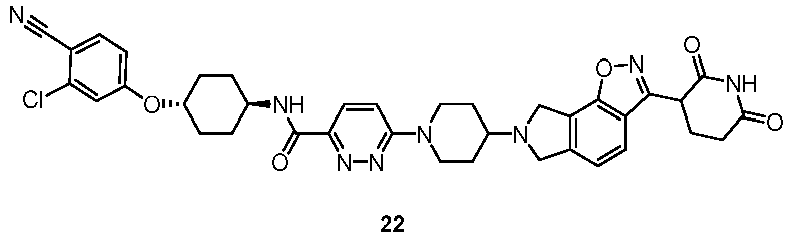

- 17d (10.0 g), 4-hydroxypiperidine (7.1 g), DIPEA (11.2 g), and DMSO (90 mL) were added to a reaction flask, and the reaction solution was warmed to 90 °C and reacted for 2 h. After the reaction was completed, the reaction solution was poured into water (300 mL), and the mixture was filtered. The filter cake was collected and dried to give intermediate 22a (8.2 g).
- MS(ESI, [M+H]+) m/z: 238.1.
- 1H NMR (500 MHz, DMSO-d6) δ 7.80 (d, J= 9.6 Hz, 1H), 7.29 (d, J= 9.7 Hz, 1H), 4.79 (d, J= 4.2 Hz, 1H), 4.16 (dt, J= 13.6, 4.8 Hz, 2H), 3.87 (s, 3H), 3.79 (tq, J = 8.2, 4.0 Hz, 1H), 3.38 (ddd, J = 13.2, 9.6, 3.3 Hz, 2H), 1.87 - 1.79 (m, 2H), 1.45 - 1.35 (m, 2H).
- 22a (8.3 g), sodium hydroxide (2.8 g), methanol (70 mL), and water (10 mL) were added to a reaction flask in sequence, and the mixture was reacted at room temperature. After the reaction was completed, the reaction solution was adjusted to pH 3-4 with concentrated hydrochloric acid and concentrated by rotary evaporation to remove the solvent. The residue was slurried with DCM:MeOH and filtered, and the filtrate was concentrated to dryness to give intermediate 22b (1.2 g).
- MS(ESI, [M-H]-) m/z: 222.1.
- 1H NMR (500 MHz, DMSO-d6) δ 7.80 (d, J= 9.5 Hz, 1H), 7.27 (d, J= 9.6 Hz, 1H), 4.81 (s, 1H), 4.14 (dt, J = 13.5, 4.7 Hz, 2H), 3.77 (tt, J= 8.4, 3.9 Hz, 1H), 3.34 - 3.30 (m, 3H), 1.82 (ddd, J = 13.1, 5.8, 3.3 Hz, 2H), 1.39 (ddt, J= 13.4, 9.1, 4.6 Hz, 2H).
- 22b (1.5 g), 17c (1.3 g), HATU (3.0 g), DIPEA(2.1 g), and DMF (30 mL) were added to a reaction flask in sequence, and the mixture was reacted at room temperature. After the reaction was completed, ethyl acetate (70 mL) and water (150 mL) were added. The organic phase was separated, washed with a saturated sodium chloride solution, dried over anhydrous sodium sulfate, and filtered, and the concentrate was separated and purified by silica gel column chromatography to give intermediate 22c (1.4 g).
- MS(ESI, [M+H]+) m/z: 456.3.
- 1H NMR (500 MHz, DMSO-d6) δ 8.58 (d, J = 8.2 Hz, 1H), 7.83 (dd, J = 25.8, 9.1 Hz, 2H), 7.41 - 7.32 (m, 2H), 7.14 (dd, J = 8.8, 2.4 Hz, 1H), 4.77 (d, J = 4.2 Hz, 1H), 4.54 (tt, J = 10.3, 4.2 Hz, 1H), 4.14 (dt, J = 13.5, 4.7 Hz, 2H), 3.83 (ddtd, J= 36.7, 12.6, 8.5, 8.0, 4.0 Hz, 2H), 3.35 (td, J = 9.8, 4.7 Hz, 2H), 2.14 - 2.07 (m, 2H), 1.90 (dd, J= 13.1, 3.8 Hz, 2H), 1.85 - 1.77 (m, 2H), 1.69 - 1.58 (m, 2H), 1.57 - 1.46 (m, 2H), 1.39 (dtd, J= 12.9, 9.1, 3.8 Hz, 2H).
- 22c (0.5 g), Dess-Martin periodinane (1.4 g), and dichloromethane (30 mL) were added to a reaction flask in sequence, and the mixture was reacted at room temperature for 1 h. After the reaction was completed, dichloromethane (70 mL) and water (100 mL) were added. The organic phase was separated, washed with a saturated sodium chloride solution, dried over anhydrous sodium sulfate, filtered, and concentrated to give intermediate 22d (0.6 g).
- 22d (88 mg), intermediate 1 (69 mg), sodium acetate (25 mg), and DMA (20 mL) were added to a reaction flask in sequence, and the mixture was reacted at room temperature for 30 min. Sodium cyanoborohydride (31 mg) was then added, and the mixture was reacted at room temperature for 2 h. The reaction solution was concentrated by rotary evaporation to remove the solvent, and the crude product was separated and purified by silica gel column chromatography to give compound 22 (32 mg).
- MS(ESI, [M+H]+) m/z: 709.3.
- 1H NMR (500 MHz, DMSO-d6) δ 11.10 (s, 1H), 8.61 (d, J = 8.2 Hz, 1H), 7.84 (dd, J = 14.1, 9.1 Hz, 2H), 7.72 (d, J = 8.0 Hz, 1H), 7.43 - 7.37 (m, 2H), 7.32 (d, J = 8.2 Hz, 1H), 7.14 (dd, J = 8.8, 2.4 Hz, 1H), 4.60 (dd, J = 11.9, 5.0 Hz, 1H), 4.54 (tt, J = 9.7, 4.0 Hz, 1H), 4.40 - 4.29 (m, 2H), 4.23 (s, 2H), 4.12 (s, 2H), 3.91 - 3.81 (m, 1H), 3.29 (d, J = 10.7 Hz, 2H), 2.86 (d, J = 10.1 Hz, 1H), 2.77 (ddd, J = 17.2, 11.9, 5.3 Hz, 1H), 2.61 (dt, J = 17.3, 4.3 Hz, 1H), 2.21 (dq, J= 8.6, 4.5, 3.9 Hz, 1H), 2.14 - 2.08 (m, 2H), 2.08 - 2.00 (m, 2H), 1.94 - 1.85 (m, 2H), 1.72 - 1.59 (m, 3H), 1.59 - 1.45 (m, 4H).
-


- 22d (108 mg), intermediate 5 (79 mg), sodium acetate (28 mg), and DMA (20 mL) were added to a reaction flask in sequence, and the mixture was reacted at room temperature for 30 min. Sodium cyanoborohydride (33 mg) was then added, and the mixture was reacted at room temperature. The reaction solution was concentrated by rotary evaporation to remove the solvent, and the crude product was separated and purified by silica gel column chromatography to give compound 23 (27 mg).
- MS(ESI, [M+H]+) m/z: 737.4.
- 1H NMR (500 MHz, DMSO-d6) δ 11.07 (s, 1H), 8.59 (d, J = 8.2 Hz, 1H), 7.83 (dd, J = 24.2, 9.2 Hz, 2H), 7.53 (d, J = 8.0 Hz, 1H), 7.43 - 7.30 (m, 2H), 7.23 - 7.10 (m, 2H), 4.54 (td, J = 11.0, 9.6, 5.9 Hz, 4H), 3.86 (dtd, J = 11.3, 7.6, 4.1 Hz, 1H), 3.13 (t, J = 4.9 Hz, 2H), 2.98 (dt, J = 31.3, 12.8 Hz, 5H), 2.82 - 2.64 (m, 5H), 2.60 (dt, J = 17.3, 4.2 Hz, 1H), 2.46 (dd, J= 12.1, 4.5 Hz, 1H), 2.18 (dq, J= 8.5, 4.4 Hz, 1H), 2.14 - 2.05 (m, 2H), 1.90 (d, J= 13.6 Hz, 2H), 1.80 (d, J= 12.2 Hz, 2H), 1.70 - 1.58 (m, 2H), 1.51 (qd, J= 12.4, 6.0 Hz, 4H).
-


- 24a (1.443 g), DMSO (10 mL), DIPEA (2.247 g, 3.08 mL), and methyl 6-chloropyridazine-3-carboxylate (1 g) were added to a reaction flask in sequence, and the mixture was reacted at 90 °C. After the reaction was completed, the mixture was poured into ice water, and the mixture was filtered under vacuum. The filter cake was dried to give 24b (2.7 g).
- MS(ESI, [M+H]+) m/z: 363.16.
- 1H NMR (500 MHz, DMSO-d6) δ 7.81 (d, J= 9.6 Hz, 1H), 7.32 (d, J= 9.7 Hz, 1H), 3.86 (s, 3H), 3.71 (s, 8H), 1.74 (t, J= 5.6 Hz, 4H), 1.39 (s, 9H).
- 24b (2.6 g), MeOH (30 mL), and water (3 mL) were added to a reaction flask in sequence, sodium hydroxide (1.43
- g) was then added, and the mixture was reacted at room temperature. After the reaction was completed, the system was adjusted to pH 4-5 with 6 M hydrochloric acid, concentrated to remove the solvent, and then slurried with
- MeOH/DCM (v:v = 1/10) (about 100 mL). The solid was removed by filtration under vacuum, and the mother liquor was concentrated to give 24c (1.9 g).
- MS(ESI, [M+H]+) m/z: 349.25.
- 17c (0.85 g), 24c (1.031 g), DCM (10 mL), HATU (1.68 g), and DIPEA (1.148 g, 1.551 mL) were added to a reaction flask in sequence, and the mixture was reacted at room temperature. After the reaction was completed, the reaction solution was diluted with ethyl acetate (100 mL), washed with a 10% citric acid aqueous solution (100 mL), and then washed with a saturated sodium bicarbonate solution (100 mL). The organic phase was dried over anhydrous sodium sulfate, filtered, and concentrated to give 24d (1.61 g).
- MS(ESI, [M+H]+) m/z: 581.28.
- 24d (1.61 g), DCM (20 mL), and trifluoroacetic acid (5 mL) were added to a reaction flask in sequence, and the mixture was reacted at room temperature. After the reaction was completed, the mixture was added to a saturated sodium bicarbonate solution (200 mL), and DCM (200 mL) was added for extraction. The organic phase was dried over anhydrous sodium sulfate, filtered, and concentrated to give 24e (1.3 g).
- MS(ESI, [M+H]+) m/z: 481.22.
- 1H NMR (500 MHz, DMSO-d6) δ 8.59 (dd, J= 8.2, 5.4 Hz, 1H), 7.84 (dd, J = 20.6, 9.1 Hz, 2H), 7.41 - 7.33 (m, 2H), 7.13 (dd, J= 8.8, 2.4 Hz, 1H), 4.53 (tt, J= 9.9, 4.2 Hz, 1H), 3.85 (dtd, J= 15.2, 7.8, 3.9 Hz, 1H), 3.68 (t, J= 5.7 Hz, 4H), 3.57 (s, 4H), 2.16 - 2.05 (m, 2H), 1.94 - 1.85 (m, 2H), 1.84 - 1.76 (m, 3H), 1.74 - 1.44 (m, 5H). Step 5: Preparation of intermediates 24f-1 and 24f-2
- 24e (350 mg), 1,2-dichloroethane (10 mL), isopropanol (3 mL), intermediate 7 (208 mg), and one drop of acetic acid were added to a reaction flask in sequence, then sodium cyanoborohydride (137 mg) was added, and the mixture was reacted at room temperature overnight. After the reaction was completed, a saturated sodium bicarbonate solution (20 mL) and water (50 mL) were added to the reaction solution, and then dichloromethane was added for extraction. The organic phase was separated, dried over anhydrous sodium sulfate, filtered, and concentrated, and the residue was purified by silica gel column chromatography to give a crude product. The crude product was separated by preparative high performance liquid chromatography to give prepeak intermediate 24f-1 (95 mg) and postpeak intermediate 24f-2 (85 mg) in sequence.
- The conditions for the preparative chromatography were as follows: Instrument and preparative column: YMC high pressure preparative chromatograph was used, and the preparative column was CHIRALART Cellose-SB. Mobile phase system: ethanol:dichloromethane (1:1)/n-hexane, isocratic elution: ethanol:dichloromethane (1:1)/n-hexane = 50/50.
- The characterization data of 24f-1 were as follows:
MS(ESI, [M+H]+) m/z: 724.30. - 1H NMR (500 MHz, DMSO-d6) δ 8.58 (d, J= 8.2 Hz, 1H), 7.85 (d, J= 8.7 Hz, 1H), 7.79 (d, J= 9.6 Hz, 1H), 7.61 (d, J= 8.0 Hz, 1H), 7.41 - 7.32 (m, 2H), 7.27 (d, J= 8.1 Hz, 1H), 7.13 (dd, J = 8.7, 2.4 Hz, 1H), 4.54 (dq, J = 10.5, 5.8, 5.1 Hz, 1H), 4.23 - 4.08 (m, 4H), 3.90 - 3.80 (m, 1H), 3.67 (t, J= 5.6 Hz, 4H), 3.46 (s, 1H), 3.13 (d, J = 24.8 Hz, 5H), 2.84 (ddd, J= 31.4, 16.6, 3.1 Hz, 2H), 2.16 - 2.05 (m, 2H), 1.89 (d, J= 9.9 Hz, 3H), 1.71 (t, J = 5.6 Hz, 4H), 1.68 - 1.58 (m, 2H), 1.56 - 1.45 (m, 2H), 1.19 (t, J = 7.0 Hz, 3H).
- 24f-1 (91 mg), acrylamide (8.93 mg), and THF (10 mL) were added to a reaction flask in sequence, and a 1 M solution of potassium tert-butoxide in tetrahydrofuran (0.088 mL) was added under an ice bath. The mixture was reacted at 0 °C. After the reaction was completed, the reaction solution was added dropwise to an icy saturated ammonium chloride aqueous solution, and ethyl acetate was added for extraction. The organic phase was separated, dried over anhydrous sodium sulfate, filtered, and concentrated, and the residue was purified by silica gel column chromatography to give compound 24 (17 mg).
- MS(ESI, [M+H]+) m/z: 749.30.
- 1H NMR (500 MHz, DMSO-d6) δ 11.09 (s, 1H), 8.57 (d, J = 8.2 Hz, 1H), 7.85 (d, J = 8.7 Hz, 1H), 7.79 (d, J = 9.5 Hz, 1H), 7.62 (d, J = 8.1 Hz, 1H), 7.42 - 7.31 (m, 2H), 7.26 (d, J = 8.1 Hz, 1H), 7.13 (dd, J = 8.8, 2.4 Hz, 1H), 4.60 - 4.49 (m, 2H), 3.85 (d, J = 10.3 Hz, 1H), 3.67 (t, J = 5.4 Hz, 4H), 3.60 (d, J = 6.1 Hz, 1H), 3.06 (s, 5H), 2.89 - 2.74 (m, 3H), 2.66 - 2.55 (m, 2H), 2.18 (dd, J = 13.1, 5.2 Hz, 1H), 2.10 (d, J = 11.8 Hz, 2H), 2.00 (q, J = 7.7 Hz, 1H), 1.93 - 1.85 (m, 2H), 1.74 (d, J = 21.8 Hz, 4H), 1.63 (d, J = 12.4 Hz, 2H), 1.51 (d, J = 12.0 Hz, 2H).
- 24f-2 (80 mg), acrylamide (7.93 mg), and THF (10 mL) were added to a reaction flask in sequence, and a 1 M solution of potassium tert-butoxide in tetrahydrofuran (0.078 mL) was added under an ice bath. The mixture was reacted at 0 °C. After the reaction was completed, the reaction solution was added dropwise to an icy saturated ammonium chloride aqueous solution, and ethyl acetate was added for extraction. The organic phase was separated, dried over anhydrous sodium sulfate, filtered, and concentrated, and the residue was purified by silica gel column chromatography to give compound 25 (15 mg).
- MS(ESI, [M+H]+) m/z: 749.52.
- 1H NMR (500 MHz, DMSO-d6) δ 11.09 (s, 1H), 8.57 (d, J= 8.2 Hz, 1H), 7.85 (d, J= 8.7 Hz, 1H), 7.79 (d, J = 9.5 Hz, 1H), 7.62 (d, J = 8.1 Hz, 1H), 7.42 - 7.31 (m, 2H), 7.26 (d, J = 8.1 Hz, 1H), 7.13 (dd, J = 8.8, 2.4 Hz, 1H), 4.60 - 4.49 (m, 2H), 3.85 (d, J = 10.3 Hz, 1H), 3.67 (t, J = 5.4 Hz, 4H), 3.60 (d, J = 6.1 Hz, 1H), 3.06 (s, 5H), 2.89 - 2.74 (m, 3H), 2.66 - 2.55 (m, 2H), 2.18 (dd, J = 13.1, 5.2 Hz, 1H), 2.10 (d, J = 11.8 Hz, 2H), 2.00 (q, J = 7.7 Hz, 1H), 1.93 - 1.85 (m, 2H), 1.74 (d, J= 21.8 Hz, 4H), 1.63 (d, J = 12.4 Hz, 2H), 1.51 (d, J = 12.0 Hz, 2H).
-


- 26a (5.94 g), DMSO (30 mL), DIPEA (1.23 g, 15.39 mL), and methyl 6-chloropyridazine-3-carboxylate (5 g) were added to a reaction flask in sequence, and the mixture was reacted at 90 °C. After the reaction was completed, the mixture was poured into ice water, and the mixture was filtered under vacuum. The filter cake was dried to give 26b (11.3 g).
- MS(ESI, [M+H]+) m/z: 323.07.
- 1H NMR (500 MHz, DMSO-d6) δ 7.87 (d, J = 9.6 Hz, 1H), 7.29 (d, J= 9.7 Hz, 1H), 3.87 (s, 3H), 3.80 - 3.69 (m, 4H), 3.47 (dd, J = 6.3, 4.0 Hz, 4H), 1.43 (s, 9H).
- 26b (11.3 g), MeOH (100 mL), and water (30 mL) were added to a reaction flask in sequence, sodium hydroxide (7.01 g) was then added, and the mixture was reacted at room temperature. After the reaction was completed, the system was adjusted to pH 4-5 with 6 M hydrochloric acid, concentrated to remove the solvent, and then slurried with MeOH/DCM (v:v = 1/10) (about 100 mL). The solid was removed by filtration under vacuum, and the mother liquor was concentrated to give 26c (9.8 g).
- MS(ESI, [M+H]+) m/z: 308.99.
- 17c (2.5 g), 26c (2.68 g), DCM (30 mL), HATU (4.30 g), and DIPEA (5.63 g, 7.60 mL) were added to a reaction flask in sequence, and the mixture was reacted at room temperature. After the reaction was completed, the system was diluted with ethyl acetate (100 mL), washed with a 10% citric acid aqueous solution (100 mL), and then washed with a saturated sodium bicarbonate solution. The organic phase was dried over anhydrous sodium sulfate, filtered, and concentrated to give 26d (3.2 g).
- MS(ESI, [M+H]+) m/z: 541.21.
- 26d (3.2 g), DCM (20 mL), and trifluoroacetic acid (5 mL) were added to a reaction flask in sequence, and the mixture was reacted at room temperature. After the reaction was completed, the mixture was added to a saturated sodium bicarbonate solution (200 mL) and extracted with DCM. The organic phase was dried over anhydrous sodium sulfate, filtered, and concentrated to give 26e (2.56 g).
- MS(ESI, [M+H]+) m/z: 441.20.
- 1H NMR (500 MHz, DMSO-d6) δ 8.62 (d, J= 8.2 Hz, 1H), 7.85 (t, J = 9.3 Hz, 2H), 7.39 (d, J= 2.4 Hz, 1H), 7.34 (d, J = 9.6 Hz, 1H), 7.14 (dd, J = 8.8, 2.4 Hz, 1H), 4.53 (tt, J= 10.3, 4.2 Hz, 1H), 3.86 (tdt, J = 11.8, 8.2, 4.0 Hz, 1H), 3.77 - 3.61 (m, 4H), 2.99 - 2.80 (m, 4H), 2.16 - 2.05 (m, 2H), 1.95 - 1.84 (m, 2H), 1.64 (qd, J = 13.1, 3.1 Hz, 2H), 1.58 - 1.45 (m, 2H).
- Intermediate 8 (50 mg), Dess-Martin periodinane (141 mg), dichloromethane (5 mL), and DMF (1 mL) were added to a reaction flask in sequence, and the mixture was reacted at room temperature. After the reaction was completed, the reaction solution was extracted with water (50 mL) and ethyl acetate (20 mL). The organic phases were combined, washed with a saturated sodium chloride solution, dried over anhydrous sodium sulfate, and filtered, and the filtrate was concentrated by evaporation under reduced pressure to remove the solvent, thus giving the target intermediate 26f (50 mg).
- MS(ESI, [M+H]+) m/z: 299.51.
- Intermediate 26f (50 mg), 1,2-dichloroethane (6 mL), isopropanol (2 mL), intermediate 26e (88 mg), acetic acid (5.00 mg), and sodium cyanoborohydride (20.93 mg) were added to a reaction flask in sequence, and the mixture was stirred at room temperature. After the reaction was completed, a saturated sodium bicarbonate solution (2 mL) was added to the reaction solution to neutralize acetic acid, and then dichloromethane (50 mL) and water (100 mL) were added for extraction. The organic phase was separated, and the aqueous phase was extracted with dichloromethane. The organic phases were combined, washed with saturated brine, dried over anhydrous sodium sulfate, filtered, and concentrated, and the residue was purified by a silica gel column to give compound 26g (30 mg).
- MS(ESI, [M+H]+) m/z: 723.36.
- 26g (30 mg), maleic acid (4.81 mg), and MeOH/DCM (v:v = 1/10, 5 mL) were added to a reaction flask in sequence, and after complete dissolution, the reaction solution was concentrated. The reaction solution was slurried with petroleum ether (10 mL) and filtered under vacuum to give 26 (32 mg).
- MS(ESI, [M+H]+) m/z: 723.43.
- 1H NMR (500 MHz, DMSO-d6) δ 11.09 (s, 1H), 8.66 (d, J= 8.2 Hz, 1H), 7.93 (d, J= 9.4 Hz, 1H), 7.86 (d, J= 8.7 Hz, 1H), 7.66 (d, J= 8.2 Hz, 1H), 7.54 - 7.42 (m, 1H), 7.39 (d, J= 2.5 Hz, 1H), 7.30 (d, J= 8.1 Hz, 1H), 7.13 (dd, J= 8.9, 2.5 Hz, 1H), 6.11 (s, 2H), 4.56 (dq, J= 22.4, 6.0, 5.1 Hz, 2H), 3.93 - 3.83 (m, 1H), 3.17 (s, 13H), 3.09 (s, 1H), 3.01 (d, J= 16.1 Hz, 1H), 2.90 (dd, J = 16.4, 6.1 Hz, 1H), 2.77 (td, J = 12.0, 5.8 Hz, 1H), 2.61 (d, J= 18.1 Hz, 1H), 2.25 - 2.05 (m, 3H), 1.96 - 1.83 (m, 2H), 1.65 (q, J = 12.4 Hz, 2H), 1.59 - 1.42 (m, 2H).
-
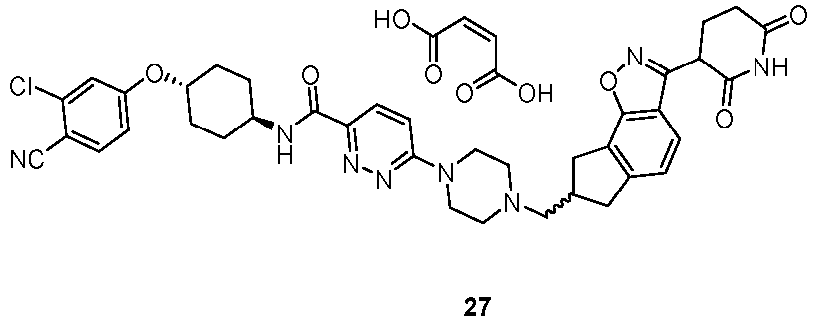

- Intermediate 9 (50 mg), Dess-Martin periodinane (141 mg), dichloromethane (5 mL), and DMF (1 mL) were added to a reaction flask in sequence, and the mixture was reacted at room temperature. After the reaction was completed, the reaction solution was extracted with water (50 mL) and ethyl acetate (20 mL). The organic phases were combined, washed with a saturated sodium chloride solution, dried over anhydrous sodium sulfate, and filtered, and the filtrate was concentrated by evaporation under reduced pressure to remove the solvent, thus giving the target intermediate 27a (50 mg).
- MS(ESI, [M+H]+) m/z: 299.31.
- Intermediate 27a (50 mg), 1,2-dichloroethane (6 mL), isopropanol (2 mL), intermediate 26e (88 mg), acetic acid (5.00 mg), and sodium cyanoborohydride (20.93 mg) were added to a reaction flask in sequence, and the mixture was stirred at room temperature. After the reaction was completed, a saturated sodium bicarbonate solution (2 mL) was added to the reaction solution to neutralize acetic acid, and then dichloromethane (50 mL) and water (100 mL) were added for extraction. The organic phase was separated, and the aqueous phase was extracted with dichloromethane. The organic phases were combined, washed with saturated brine, dried over anhydrous sodium sulfate, filtered, and concentrated, and the residue was purified by a silica gel column to give compound 27b (53 mg).
- MS(ESI, [M+H]+) m/z: 723.42.
- 27b (53 mg), maleic acid (8.51 mg), and MeOH/DCM (v:v = 1/10, 5 mL) were added to a reaction flask in sequence, and after complete dissolution, the reaction solution was concentrated. The concentrate was slurried with petroleum ether (10 mL) and filtered under vacuum to give 27 (58 mg).
- MS(ESI, [M+H]+) m/z: 723.52.
- 1H NMR (500 MHz, DMSO-d6) δ 11.09 (s, 1H), 8.66 (d, J = 8.2 Hz, 1H), 7.93 (d, J = 9.4 Hz, 1H), 7.86 (d, J = 8.7 Hz, 1H), 7.66 (d, J = 8.2 Hz, 1H), 7.54 - 7.42 (m, 1H), 7.39 (d, J= 2.5 Hz, 1H), 7.30 (d, J= 8.1 Hz, 1H), 7.13 (dd, J = 8.9, 2.5 Hz, 1H), 6.11 (s, 2H), 4.56 (dq, J = 22.4, 6.0, 5.1 Hz, 2H), 3.93 - 3.83 (m, 1H), 3.17 (s, 13H), 3.09 (s, 1H), 3.01 (d, J = 16.1 Hz, 1H), 2.90 (dd, J = 16.4, 6.1 Hz, 1H), 2.77 (td, J = 12.0, 5.8 Hz, 1H), 2.61 (d, J= 18.1 Hz, 1H), 2.25 - 2.05 (m, 3H), 1.96 - 1.83 (m, 2H), 1.65 (q, J = 12.4 Hz, 2H), 1.59 - 1.42 (m, 2H).
-


- Intermediate 14 (50 mg), IBX (94 mg), and dimethyl sulfoxide (5 mL) were added to a reaction flask in sequence, and the mixture was reacted at room temperature. After the reaction was completed, the reaction solution was extracted with a sodium bicarbonate solution (100 mL) and ethyl acetate (100 mL). The organic phase was washed with a saturated sodium chloride solution, dried over anhydrous sodium sulfate, filtered, and concentrated to give the target intermediate 28a (50 mg).
- MS(ESI, [M+H]+) m/z: 298.41.
- Intermediate 28a (50 mg), 1,2-dichloroethane (6 mL), isopropanol (2 mL), intermediate 26e (90 mg), acetic acid (5.00 mg), and sodium cyanoborohydride (20 mg) were added to a reaction flask in sequence, and the mixture was stirred at room temperature for 1 h. After the reaction was completed, a saturated sodium bicarbonate solution (2 mL) was added to the reaction solution to neutralize acetic acid, and then dichloromethane (50 mL) and water (100 mL) were added for extraction. The organic phase was separated, and the aqueous phase was extracted with dichloromethane. The organic phases were combined, washed with saturated brine, dried over anhydrous sodium sulfate, filtered, and concentrated, and the residue was purified by a silica gel column to give compound 28 (72 mg). MS(ESI, [M+H]+) m/z: 722.43.
- 1H NMR (500 MHz, DMSO-d6) δ 10.87 (d, J = 2.1 Hz, 1H), 8.61 (d, J = 8.2 Hz, 1H), 7.84 (dd, J = 18.0, 8.6 Hz, 3H), 7.44 - 7.28 (m, 3H), 7.20 - 7.04 (m, 2H), 4.53 (dq, J = 10.0, 5.4, 4.3 Hz, 1H), 4.11 (dd, J = 11.8, 4.9 Hz, 1H), 3.93 - 3.81 (m, 1H), 3.73 (t, J = 4.8 Hz, 4H), 3.17 (ddd, J = 29.9, 16.6, 8.4 Hz, 2H), 2.98 - 2.85 (m, 2H), 2.84 - 2.67 (m, 2H), 2.65 - 2.52 (m, 5H), 2.40 (d, J = 7.4 Hz, 2H), 2.31 (qd, J = 12.4, 4.4 Hz, 1H), 2.16 - 2.05 (m, 3H), 1.95 - 1.85 (m, 2H), 1.72 - 1.58 (m, 2H), 1.51 (q, J= 11.8, 11.3 Hz, 2H).
-


- Intermediate 15 (50 mg), IBX (94 mg), and dimethyl sulfoxide (5 mL) were added to a reaction flask in sequence, and the mixture was reacted at room temperature. After the reaction was completed, the reaction solution was extracted with a sodium bicarbonate solution (100 mL) and ethyl acetate (100 mL). The organic phase was washed with a saturated sodium chloride solution, dried over anhydrous sodium sulfate, filtered, and concentrated to give the target intermediate 29a (50 mg).
- MS(ESI, [M+H]+) m/z: 298.35.
- Intermediate 29a (50 mg), 1,2-dichloroethane (6 mL), isopropanol (2 mL), intermediate 26e (90 mg), acetic acid (5.00 mg), and sodium cyanoborohydride (20 mg) were added to a reaction flask in sequence, and the mixture was stirred at room temperature for 1 h. After the reaction was completed, a saturated sodium bicarbonate solution (2 mL) was added to the reaction solution to neutralize acetic acid, and then dichloromethane (50 mL) and water (100 mL) were added for extraction. The organic phase was separated, and the aqueous phase was extracted with dichloromethane. The organic phases were combined, washed with saturated brine, dried over anhydrous sodium sulfate, filtered, and concentrated, and the residue was purified by a silica gel column to give compound 29 (93 mg). MS(ESI, [M+H]+) m/z: 722.47.
- 1H NMR (500 MHz, DMSO-d6) δ 10.87 (d, J = 2.1 Hz, 1H), 8.61 (d, J = 8.2 Hz, 1H), 7.84 (dd, J = 18.0, 8.6 Hz, 3H), 7.44 - 7.28 (m, 3H), 7.20 - 7.04 (m, 2H), 4.53 (dq, J = 10.0, 5.4, 4.3 Hz, 1H), 4.11 (dd, J = 11.8, 4.9 Hz, 1H), 3.93 - 3.81 (m, 1H), 3.73 (t, J = 4.8 Hz, 4H), 3.17 (ddd, J = 29.9, 16.6, 8.4 Hz, 2H), 2.98 - 2.85 (m, 2H), 2.84 - 2.67 (m, 2H), 2.65 - 2.52 (m, 5H), 2.40 (d, J = 7.4 Hz, 2H), 2.31 (qd, J = 12.4, 4.4 Hz, 1H), 2.16 - 2.05 (m, 3H), 1.95 - 1.85 (m, 2H), 1.72 - 1.58 (m, 2H), 1.51 (q, J= 11.8, 11.3 Hz, 2H).
-

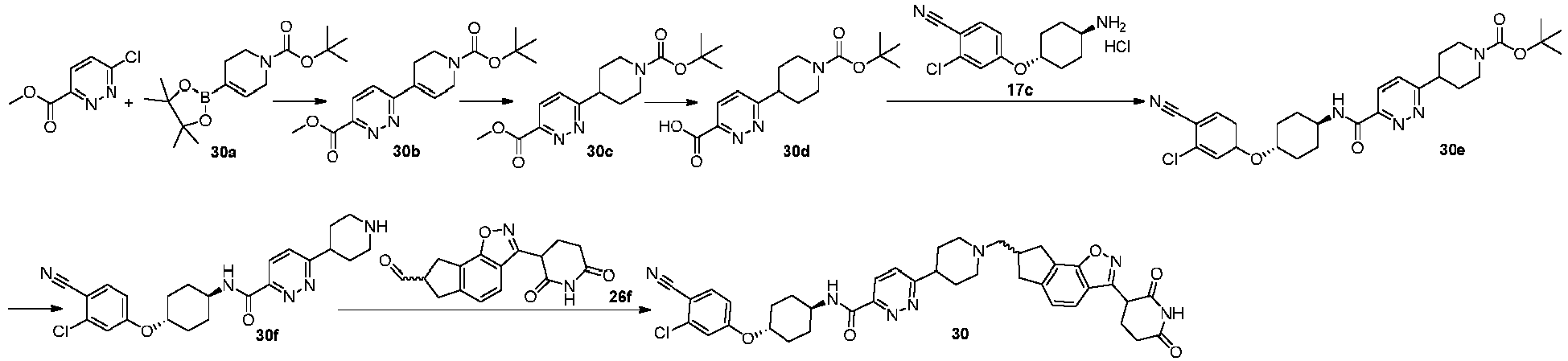
- Methyl 6-chloropyridazine-3-carboxylate (10 g), intermediate 30a (26.9 g), [1,1'-bis(diphenylphosphino)ferrocene]palladium dichloride dichloromethane complex (4.73 g), sodium carbonate (18.43 g), dioxane (200 mL), and water (7 mL) were added to a reaction flask in sequence, and the mixture was heated to 85 °C and reacted under N2 atmosphere. After the reaction was completed, ethyl acetate (200 mL) and water (200 mL) were added for extraction. The organic phase was separated, dried over anhydrous sodium sulfate, and filtered, and the filtrate was purified by a silica gel column to give the target intermediate 30b (8.92 g).
- MS(ESI, [M+H]+) m/z: 320.0.
- 1H NMR (500 MHz, DMSO-d6) δ 8.17 (d, J = 9.0 Hz, 1H), 8.08 (d, J = 8.9 Hz, 1H), 6.98 (s, 1H), 4.18 - 4.10 (m, 2H), 3.96 (s, 3H), 3.59 (t, J = 5.7 Hz, 2H), 2.72 (tt, J = 6.0, 2.1 Hz, 2H), 1.44 (s, 9H).
- Intermediate 30b (8.92 g), methanol (210 mL), dichloromethane (30 mL), and 10% palladium on carbon (2.23 g) were added to a reaction flask in sequence. The mixture was purged with H2 and reacted at room temperature for 5 h. After the reaction was completed, the mixture was filtered, and the filtrate was concentrated by evaporation under reduced pressure to remove the solvent. The residue was added with dimethyl sulfoxide (20 mL) and filtered, and the filter cake was collected, slurried with water (50 mL), and filtered. The filter cake was collected to give the target intermediate 30c (2.66 g).
- MS(ESI, [M+H]+) m/z: 322.1.
- 1H NMR (500 MHz, DMSO-d6) δ 8.15 (d, J = 8.7 Hz, 1H), 7.85 (d, J = 8.7 Hz, 1H), 4.16 - 4.05 (m, 2H), 3.95 (s, 3H), 3.21 (ddt, J = 15.2, 11.5, 5.8 Hz, 1H), 2.91 (d, J = 3.3 Hz, 2H), 1.94 - 1.88 (m, 2H), 1.67 (qd, J = 12.5, 4.3 Hz, 2H), 1.42 (s, 9H).
- Intermediate 30c (1.7 g), sodium hydroxide (0.423 g), methanol (20 mL), and water (1 mL) were added to a reaction flask in sequence, and the mixture was reacted at room temperature. After the reaction was completed, a saturated citric acid solution was added to adjust the pH to 2-3, and dichloromethane was added. The organic phase was washed with saturated brine, dried over anhydrous sodium sulfate, filtered, and concentrated by evaporation under reduced pressure to remove the solvent, thus giving the target intermediate 30d (1.63 g).
- MS(ESI, [M-H]-) m/z: 306.2.
- 1H NMR (500 MHz, DMSO-d6) δ 13.75 (s, 1H), 8.12 (d, J = 8.6 Hz, 1H), 7.83 (d, J = 8.7 Hz, 1H), 4.10 (d, J = 12.9 Hz, 2H), 3.21 (tt, J = 12.0, 3.6 Hz, 1H), 2.90 (s, 2H), 1.93 - 1.88 (m, 2H), 1.68 (qd, J = 12.5, 4.3 Hz, 2H), 1.42 (s, 9H).
- Intermediate 30d (1.637 g), dichloromethane (30 mL), HATU (2.430 g), N,N-diisopropylethylamine (2.75 g, 3.72 mL), and intermediate 17c (1.335 g) were added to a reaction flask in sequence, and the mixture was reacted at room temperature. After the reaction was completed, ethyl acetate (200 mL) and a saturated citric acid solution (300 mL) were added. The organic phase was separated, washed with a saturated sodium bicarbonate solution and saturated brine separately, dried over anhydrous sodium sulfate, filtered, and concentrated by evaporation under reduced pressure to remove the solvent, thus giving the target intermediate 30e (2.52 g).
- MS(ESI, [M+H]+) m/z: 540.3.
- Intermediate 30e (2.52 g), dichloromethane (30 mL), and trifluoroacetic acid (37.0 g, 25 mL) were added to a reaction flask in sequence, and the mixture was reacted at room temperature. After the reaction was completed, the reaction solution was concentrated by evaporation under reduced pressure to remove the solvent, and the residue was added with dichloromethane/methanol (v:v = 9/1) (200 mL) and adjusted to pH of strong alkalinity with a 20% sodium hydroxide solution. The organic phase was separated, and the aqueous phase was extracted with dichloromethane/methanol (v:v = 9/1) (100 mL). The organic phases were combined, washed with saturated brine, dried over anhydrous sodium sulfate, filtered, and concentrated by evaporation under reduced pressure to remove the solvent, thus giving the target intermediate 30f (1.88 g).
- MS(ESI, [M+H]+) m/z: 440.3.
- 1H NMR (500 MHz, DMSO-d6) δ 9.04 (d, J = 8.1 Hz, 1H), 8.13 (d, J = 8.7 Hz, 1H), 7.83 (dd, J = 31.5, 8.8 Hz, 2H), 7.40 (s, 1H), 7.15 (d, J = 9.0 Hz, 1H), 4.54 (d, J = 11.6 Hz, 1H), 3.92 (q, J = 11.0, 10.4 Hz, 1H), 3.19 (d, J = 12.6 Hz, 3H), 2.81 (t, J = 12.3 Hz, 2H), 2.69 (s, 1H), 2.12 (d, J = 12.2 Hz, 2H), 1.88 (dq, J = 24.6, 12.6, 12.0 Hz, 6H), 1.69 (q, J = 12.6 Hz, 2H), 1.52 (q, J = 13.6, 12.7 Hz, 2H).
- Intermediate 26f (60 mg), 1,2-dichloroethane (5 mL), isopropanol (1 mL), intermediate 30f (88 mg), and sodium cyanoborohydride (37.7 mg) were added to a reaction flask in sequence, and the mixture was stirred at room temperature. After the reaction was completed, a saturated sodium bicarbonate solution (2 mL) was added to the reaction solution to neutralize acetic acid, and then dichloromethane (50 mL) and water (100 mL) were added for extraction. The organic phase was separated, and the aqueous phase was extracted with dichloromethane. The organic phases were combined, washed with saturated brine, dried over anhydrous sodium sulfate, and filtered, and the filtrate was purified by a silica gel column to give compound 30 (77 mg).
- MS(ESI, [M+H]+) m/z: 722.5.
- 1H NMR (500 MHz, DMSO-d6) δ 11.09 (s, 1H), 9.03 (d, J = 8.2 Hz, 1H), 8.11 (d, J = 8.6 Hz, 1H), 7.85 (dd, J = 8.7, 5.0 Hz, 2H), 7.62 (d, J = 8.1 Hz, 1H), 7.40 (d, J = 2.5 Hz, 1H), 7.28 (d, J = 8.1 Hz, 1H), 7.14 (dd, J = 8.8, 2.5 Hz, 1H), 4.60 - 4.52 (m, 2H), 3.97 - 3.87 (m, 1H), 3.28 - 3.22 (m, 1H), 3.22 - 3.16 (m, 1H), 3.06 (d, J = 10.5 Hz, 2H), 3.00 (t, J = 5.1 Hz, 1H), 2.93 (d, J = 13.1 Hz, 2H), 2.85 (dd, J = 16.1, 4.8 Hz, 1H), 2.77 (td, J = 11.8, 5.8 Hz, 1H), 2.64 - 2.58 (m, 1H), 2.46 (s, 1H), 2.39 (d, J = 7.3 Hz, 2H), 2.20 (dq, J = 9.2, 4.3 Hz, 1H), 2.12 (d, J = 11.8 Hz, 4H), 1.94 - 1.84 (m, 6H), 1.70 (q, J = 12.4 Hz, 2H), 1.53 (q, J = 11.3 Hz, 2H).
-


- Intermediate 27a (60 mg), 1,2-dichloroethane (5 mL), isopropanol (1 mL), intermediate 30f (88 mg), and sodium cyanoborohydride (37.7 mg) were added to a reaction flask in sequence, and the mixture was stirred at room temperature. After the reaction was completed, a saturated sodium bicarbonate solution (2 mL) was added to the reaction solution to neutralize acetic acid, and then dichloromethane (50 mL) and water (100 mL) were added for extraction. The organic phase was separated, and the aqueous phase was extracted with dichloromethane. The organic phases were combined, washed with saturated brine, dried over anhydrous sodium sulfate, and filtered, and the filtrate was purified by a silica gel column to give compound 31 (48 mg).
- MS(ESI, [M+H]+) m/z: 722.5.
- 1H NMR (500 MHz, DMSO-d6) δ 11.09 (s, 1H), 9.03 (d, J = 8.2 Hz, 1H), 8.11 (d, J = 8.6 Hz, 1H), 7.86 (dd, J = 8.8, 5.0 Hz, 2H), 7.62 (d, J = 8.1 Hz, 1H), 7.40 (d, J = 2.4 Hz, 1H), 7.28 (d, J = 8.1 Hz, 1H), 7.14 (dd, J = 8.6, 2.5 Hz, 1H), 4.55 (tt, J = 11.0, 5.5 Hz, 2H), 3.92 (dtd, J = 11.7, 7.7, 4.1 Hz, 1H), 3.28 - 3.22 (m, 1H), 3.18 (dd, J = 16.8, 8.1 Hz, 1H), 3.06 (d, J = 10.7 Hz, 2H), 3.00 (p, J = 6.2 Hz, 1H), 2.93 (d, J = 13.0 Hz, 2H), 2.85 (dd, J = 16.2, 4.8 Hz, 1H), 2.77 (ddd, J = 17.2, 11.8, 5.3 Hz, 1H), 2.61 (dt, J = 17.8, 4.5 Hz, 1H), 2.47 (s, 1H), 2.39 (d, J = 7.3 Hz, 2H), 2.20 (dq, J = 8.9, 4.3 Hz, 1H), 2.12 (d, J = 12.0 Hz, 4H), 1.92 (d, J = 12.2 Hz, 5H), 1.85 (d, J = 11.8 Hz, 1H), 1.70 (q, J = 11.8, 11.4 Hz, 2H), 1.53 (td, J = 13.5, 6.9 Hz, 2H).
-


- Intermediate 28a (50 mg), 1,2-dichloroethane (5 mL), isopropanol (1 mL), intermediate 30f (73.5 mg), and sodium cyanoborohydride (31.5 mg) were added to a reaction flask in sequence, and the mixture was stirred at room temperature. After the reaction was completed, a saturated sodium bicarbonate solution (2 mL) was added to the reaction solution to neutralize acetic acid, and then dichloromethane (50 mL) and water (100 mL) were added for extraction. The organic phase was separated, and the aqueous phase was extracted with dichloromethane. The organic phases were combined, washed with saturated brine, dried over anhydrous sodium sulfate, and filtered, and the filtrate was purified by a silica gel column to give compound 32 (44 mg).
- MS(ESI, [M+H]+) m/z: 721.6.
- 1H NMR (500 MHz, DMSO-d6) δ 10.89 (s, 1H), 9.04 (d, J = 8.2 Hz, 1H), 8.11 (d, J = 8.6 Hz, 1H), 7.86 (dd, J = 8.8, 5.5 Hz, 2H), 7.81 (s, 1H), 7.40 (s, 1H), 7.34 (d, J = 7.8 Hz, 1H), 7.17 - 7.10 (m, 2H), 4.58 - 4.51 (m, 1H), 4.11 (dd, J = 12.0, 4.9 Hz, 1H), 3.92 (d, J = 9.3 Hz, 1H), 3.20 - 3.10 (m, 2H), 3.02 (d, J = 31.3 Hz, 3H), 2.88 (d, J = 14.3 Hz, 2H), 2.81 - 2.70 (m, 2H), 2.57 (d, J = 18.2 Hz, 1H), 2.42 - 2.34 (m, 2H), 2.30 (dt, J = 12.6, 6.3 Hz, 1H), 2.13 (d, J = 13.3 Hz, 5H), 1.92 (d, J = 12.5 Hz, 6H), 1.70 (q, J = 12.4 Hz, 2H), 1.53 (q, J = 12.1 Hz, 2H).
-


- Intermediate 29a (50 mg), 1,2-dichloroethane (5 mL), isopropanol (1 mL), intermediate 30f (73.5 mg), and sodium cyanoborohydride (31.5 mg) were added to a reaction flask in sequence, and the mixture was stirred at room temperature. After the reaction was completed, a saturated sodium bicarbonate solution (2 mL) was added to the reaction solution to neutralize acetic acid, and then dichloromethane (50 mL) and water (100 mL) were added for extraction. The organic phase was separated, and the aqueous phase was extracted with dichloromethane. The organic phases were combined, washed with saturated brine, dried over anhydrous sodium sulfate, and filtered, and the filtrate was purified by a silica gel column to give compound 33 (37 mg).
- MS(ESI, [M+H]+) m/z: 721.6.
- 1H NMR (500 MHz, DMSO-d6) δ 10.88 (s, 1H), 9.03 (d, J = 8.2 Hz, 1H), 8.11 (d, J = 8.7 Hz, 1H), 7.86 (dd, J = 8.8, 5.2 Hz, 2H), 7.81 (s, 1H), 7.40 (d, J = 2.4 Hz, 1H), 7.34 (d, J = 7.9 Hz, 1H), 7.17 - 7.10 (m, 2H), 4.55 (dq, J = 10.9, 6.3, 5.4 Hz, 1H), 4.11 (dd, J = 11.8, 4.9 Hz, 1H), 3.95 - 3.88 (m, 1H), 3.15 (dq, J = 22.0, 7.4, 6.4 Hz, 2H), 3.02 (d, J = 30.2 Hz, 3H), 2.88 (d, J = 13.2 Hz, 2H), 2.81 - 2.77 (m, 1H), 2.75 - 2.68 (m, 1H), 2.57 (d, J = 18.0 Hz, 1H), 2.38 (d, J = 7.3 Hz, 2H), 2.30 (td, J = 12.3, 4.2 Hz, 1H), 2.12 (d, J = 12.9 Hz, 5H), 1.92 (d, J = 12.3 Hz, 6H), 1.70 (q, J = 12.4 Hz, 2H), 1.53 (q, J = 12.1 Hz, 2H).
-


- 34a (3 g), DCM (30 mL), and trifluoroacetic acid (5 mL) were added to a reaction flask in sequence and reacted at room temperature. After the reaction was completed, the reaction solution was concentrated to give 34b (2.67 g). Step 2: Preparation of intermediate 34c
- 34b (2.67 g), DMSO (30 mL), DIPEA (15 mL), and methyl 6-chloropyridazine-3-carboxylate (2 g) were added to a reaction flask in sequence, and the mixture was reacted at 120 °C. After the reaction was completed, the reaction solution was diluted with ethyl acetate and extracted with a saturated potassium carbonate solution. The organic phase was dried over anhydrous sodium sulfate, filtered, and concentrated to give 34c (3.1 g).
- MS(ESI, [M+H]+) m/z: 292.18.
- 34c (3 g), MeOH (100 mL), and water (30 mL) were added to a reaction flask in sequence, sodium hydroxide (2.88 g) was then added, and the mixture was reacted at room temperature. After the reaction was completed, the system was adjusted to pH 4-5 with 6 M hydrochloric acid, concentrated to remove the solvent, and slurried with MeOH/DCM. The solid was removed by filtration under vacuum, and the mother liquor was concentrated to give 34d (3.1 g).
- MS(ESI, [M+H]+) m/z: 278.14.
- 17c (1 g), 34d (1.48 g), DCM (10 mL), HATU (1.58 g), and DIPEA( 2.43 mL) were added to a reaction flask in sequence, and the mixture was reacted at room temperature. After the reaction was completed, the reaction solution was diluted with ethyl acetate (100 mL), extracted with a 10% citric acid aqueous solution (100 mL), and then extracted with a saturated sodium bicarbonate solution (100 mL). The organic phase was dried over anhydrous sodium sulfate, filtered, and concentrated to give 34e (1.1 g).
- MS(ESI, [M+H]+) m/z: 510.21.
- 1H NMR (500 MHz, DMSO-d6) δ 8.56 (d, J= 8.2 Hz, 1H), 7.85 (d, J= 8.7 Hz, 1H), 7.79 (d, J = 9.5 Hz, 1H), 7.38 (d, J= 2.4 Hz, 1H), 7.33 (d, J= 9.6 Hz, 1H), 7.13 (dd, J= 8.8, 2.4 Hz, 1H), 4.57 - 4.50 (m, 1H), 4.45 (t, J= 5.3 Hz, 1H), 3.85 (ddd, J = 11.3, 6.6, 2.9 Hz, 1H), 3.72 - 3.66 (m, 2H), 3.60 (dd, J = 6.8, 4.4 Hz, 2H), 3.38 (t, J = 5.8 Hz, 2H), 2.36 (p, J = 7.4 Hz, 1H), 2.14 - 2.07 (m, 2H), 1.92 - 1.82 (m, 4H), 1.67 - 1.60 (m, 4H), 1.57 - 1.48 (m, 6H). Step 5: Preparation of intermediate 34f
- 34e (600 mg), DCM (10 mL), and Dess-Martin periodinane (926 mg) were added to a reaction flask in sequence, and the mixture was reacted at room temperature. After the reaction was completed, the reaction solution was quenched with a saturated sodium thiosulfate solution and a sodium bicarbonate solution and extracted with dichloromethane. The organic phase was separated, collected, dried over anhydrous sodium sulfate, filtered, and concentrated, and the residue was purified by silica gel column chromatography to give 34f (490 mg).
- 1H NMR (500 MHz, DMSO-d6) δ 9.71 (d, J = 1.6 Hz, 1H), 8.57 (d, J = 8.2 Hz, 1H), 7.85 (d, J = 8.7 Hz, 1H), 7.80 (d, J= 9.6 Hz, 1H), 7.38 (d, J= 2.4 Hz, 1H), 7.35 (d, J = 9.7 Hz, 1H), 7.13 (dd, J = 8.8, 2.4 Hz, 1H), 4.57 - 4.50 (m, 1H), 3.86 (dtd, J = 11.3, 7.5, 4.0 Hz, 1H), 3.73 - 3.67 (m, 2H), 3.65 - 3.59 (m, 2H), 3.23 (dtd, J = 9.3, 7.6, 6.1 Hz, 1H), 2.14 - 2.07 (m, 2H), 2.04 - 1.97 (m, 4H), 1.92 - 1.87 (m, 2H), 1.71 - 1.59 (m, 4H), 1.51 (ddt, J = 12.8, 10.7, 4.0 Hz, 4H).
- Intermediate 34f (111 mg), 1,2-dichloroethane (6 mL), isopropanol (2 mL), intermediate 1 (70 mg), sodium acetate (17 mg), and sodium cyanoborohydride (27 mg) were added to a reaction flask in sequence, and the mixture was stirred at room temperature. After the reaction was completed, a saturated sodium bicarbonate solution (2 mL) was added to the reaction solution to neutralize acetic acid, and then dichloromethane (50 mL) and water (100 mL) were added for extraction. The organic phase was separated, and the aqueous phase was extracted with dichloromethane. The organic phases were combined, washed with saturated brine, dried over anhydrous sodium sulfate, filtered, and concentrated, and the residue was purified by a silica gel column to give compound 34g (40 mg).
- MS(ESI, [M+H]+) m/z: 763.18.
- 34g (40 mg), maleic acid (6 mg), and MeOH/DCM (1/10, 5 mL) were added to a reaction flask in sequence, and after complete dissolution, the reaction solution was concentrated. The reaction solution was slurried with petroleum ether and filtered under vacuum to give compound 34 (43 mg).
- MS(ESI, [M+H]+) m/z: 763.58.
- 1H NMR (500 MHz, DMSO-d6 ) δ 11.12 (s, 1H), 8.56 (d, J = 8.2 Hz, 1H), 7.87 (dd, J= 13.6, 8.4 Hz, 2H), 7.81 (d, J=9.5 Hz, 1H), 7.43 (d, J = 8.2 Hz, 1H), 7.41 - 7.31 (m, 2H), 7.13 (dd, J = 8.8, 2.5 Hz, 1H), 6.07 (s, 2H), 5.02 - 4.32 (m, 6H), 3.86 (tdt, J= 11.6, 8.1, 3.8 Hz, 1H), 3.73 (t, J= 5.3 Hz, 2H), 3.69 - 3.62 (m, 2H), 3.32 (s, 2H), 2.78 (dtd, J = 18.5, 13.4, 12.8, 6.7 Hz, 2H), 2.63 (dt, J = 17.2, 4.1 Hz, 1H), 2.58 - 2.53 (m, 1H), 2.21 (dq, J = 13.5, 4.6 Hz, 1H), 2.18 - 2.02 (m, 4H), 1.96 - 1.85 (m, 2H), 1.61 (dddd, J = 71.5, 36.0, 12.6, 7.2 Hz, 10H).
-


- Intermediate 3 (70 mg), intermediate 34f (111 mg), sodium acetate (17.85 mg), 1,2-dichloroethane (5 mL), isopropanol (1 mL), and sodium cyanoborohydride (27.3 mg) were added to a reaction flask in sequence, and the mixture was stirred at room temperature for 1 h. After the reaction was completed, a saturated sodium bicarbonate solution (2 mL) was added to the reaction solution to neutralize acetic acid, and then dichloromethane (50 mL) and water (100 mL) were added for extraction. The organic phase was separated, and the aqueous phase was extracted with dichloromethane. The organic phases were combined, washed with saturated brine, dried over anhydrous sodium sulfate, and filtered, and the filtrate was purified by a silica gel column to give intermediate 35a (92 mg).
- MS(ESI, [M+H]+) m/z: 777.5.
- Intermediate 35a (92 mg), dichloromethane (10 mL), methanol (5 mL), and maleic acid (15.11 mg) were added to a reaction flask in sequence, and the mixture was reacted at room temperature. After the reaction was completed, the mixture was concentrated by evaporation under reduced pressure to remove the solvent. The residue was slurried with petroleum ether and filtered, and the filter cake was collected to give compound 35 (63 mg).
- MS(ESI, [M+H]+) m/z: 777.5.
- 1H NMR (500 MHz, DMSO-d6) δ 11.10 (s, 1H), 9.97 (s, 1H), 8.56 (d, J = 8.2 Hz, 1H), 7.86 (d, J = 8.8 Hz, 1H), 7.81 (d, J = 9.4 Hz, 1H), 7.77 (d, J = 8.2 Hz, 1H), 7.40 - 7.34 (m, 2H), 7.28 (d, J = 8.2 Hz, 1H), 7.13 (dd, J = 8.8, 2.4 Hz, 1H), 6.08 (s, 2H), 4.61 (dd, J = 12.2, 5.0 Hz, 2H), 4.54 (dq, J = 10.5, 5.4 Hz, 2H), 3.88 - 3.83 (m, 1H), 3.73 (t, J = 5.4 Hz, 2H), 3.64 (t, J = 5.3 Hz, 2H), 3.23 (s, 6H), 2.88 (q, J = 8.0 Hz, 1H), 2.82 - 2.75 (m, 1H), 2.62 (dt, J = 17.5, 4.1 Hz, 1H), 2.54 (d, J = 16.2 Hz, 1H), 2.21 - 2.09 (m, 5H), 1.94 - 1.87 (m, 2H), 1.73 - 1.51 (m, 10H).
-


- Intermediate 4 (70 mg), intermediate 34f (111 mg), sodium acetate (17.85 mg), 1,2-dichloroethane (5 mL), isopropanol (1 mL), and sodium cyanoborohydride (27.3 mg) were added to a reaction flask in sequence, and the mixture was stirred at room temperature for 1 h. After the reaction was completed, a saturated sodium bicarbonate solution (2 mL) was added to the reaction solution to neutralize acetic acid, and then dichloromethane (50 mL) and water (100 mL) were added for extraction. The organic phase was separated, and the aqueous phase was extracted with dichloromethane. The organic phases were combined, washed with saturated brine, dried over anhydrous sodium sulfate, and filtered, and the filtrate was purified by a silica gel column to give the target intermediate 36a (97 mg).
- MS(ESI, [M+H]+) m/z: 777.5.
- Intermediate 36a (97 mg), dichloromethane (10 mL), methanol (5 mL), and maleic acid (15.93 mg) were added to a reaction flask in sequence, and the mixture was reacted at room temperature. After the reaction was completed, the mixture was concentrated by evaporation under reduced pressure to remove the solvent. The residue was slurried with petroleum ether and filtered, and the filter cake was collected to give compound 36 (100 mg).
- MS(ESI, [M+H]+) m/z: 777.5.
- 1H NMR (500 MHz, DMSO-d6) δ 11.10 (s, 1H), 9.94 (s, 1H), 8.55 (d, J = 8.2 Hz, 1H), 7.86 (d, J = 8.7 Hz, 1H), 7.81 (d, J = 9.6 Hz, 1H), 7.76 (d, J = 8.2 Hz, 1H), 7.42 - 7.33 (m, 2H), 7.24 (d, J = 8.3 Hz, 1H), 7.13 (dd, J = 8.8, 2.4 Hz, 1H), 6.09 (s, 2H), 4.68 - 4.36 (m, 4H), 3.86 (dtd, J = 11.5, 7.6, 4.0 Hz, 1H), 3.76 - 3.70 (m, 2H), 3.65 - 3.60 (m, 2H), 3.18 (d, J = 5.7 Hz, 6H), 2.80 (ddt, J = 17.3, 12.1, 6.8 Hz, 2H), 2.62 (dt, J = 17.5, 4.1 Hz, 1H), 2.55 (d, J = 13.0 Hz, 1H), 2.23 - 2.07 (m, 5H), 1.94 - 1.86 (m, 2H), 1.60 (dddd, J = 58.7, 33.4, 13.0, 7.2 Hz, 10H).
-


- Intermediate 34f (106 mg), 1,2-dichloroethane (6 mL), isopropanol (2 mL), intermediate 5 (70 mg), sodium acetate (17 mg), and sodium cyanoborohydride (26 mg) were added to a reaction flask in sequence, and the mixture was stirred at room temperature. After the reaction was completed, a saturated sodium bicarbonate solution (2 mL) was added to the reaction solution to neutralize acetic acid, and then dichloromethane (50 mL) and water (100 mL) were added for extraction. The organic phase was separated, and the aqueous phase was extracted with dichloromethane. The organic phases were combined, washed with saturated brine, dried over anhydrous sodium sulfate, filtered, and concentrated, and the residue was purified by a silica gel column to give compound 37a (70 mg).
- MS(ESI, [M+H]+) m/z: 791.23.
- 37a (70 mg), maleic acid (10 mg), and MeOH/DCM (1/10, 5 mL) were added to a reaction flask in sequence, and after complete dissolution, the reaction solution was concentrated. The reaction solution was slurried with petroleum ether and filtered under vacuum to give compound 37 (73 mg).
- MS(ESI, [M+H]+) m/z: 791.35.
- 1H NMR (500 MHz, DMSO-d 6) δ 11.09 (s, 1H), 9.67 (s, 1H), 8.55 (d, J = 8.2 Hz, 1H), 7.83 (dd, J = 25.1, 9.1 Hz, 2H), 7.67 (d, J = 8.0 Hz, 1H), 7.45 - 7.33 (m, 2H), 7.29 (d, J = 8.1 Hz, 1H), 7.13 (dd, J = 8.7, 2.5 Hz, 1H), 6.10 (s, 2H), 4.68 - 4.46 (m, 2H), 3.89 - 3.80 (m, 1H), 3.66 (dt, J = 47.6, 5.3 Hz, 7H), 3.52 - 3.31 (m, 7H), 2.79 (ddd, J = 17.0, 11.6, 5.2 Hz, 2H), 2.67 - 2.58 (m, 1H), 2.56 (m, 1H), 2.22 - 2.04 (m, 5H), 1.95 - 1.83 (m, 2H), 1.73 - 1.44 (m, 10H).
-


- 38a (50 g), diethyl carbonate (216.9 g), and toluene (500 mL) were added to a reaction flask in sequence. The reaction solution was cooled to 0 °C, and 60 wt% sodium hydride (44.06 g) was added in portions. The mixture was first warmed to 70 °C and reacted for about 10 min, and then heated to 120 °C and reacted for 5 h. The reaction solution was cooled to room temperature and slowly poured into stirred ice water. The mixture was extracted with ethyl acetate, and the organic phase was discarded. The aqueous phase was adjusted to pH = 3 with 3 N hydrochloric acid and extracted with ethyl acetate, and the organic phases were combined, dried over anhydrous sodium sulfate, filtered, and concentrated to give intermediate 38b (55 g).
- 1H NMR (500 MHz, DMSO-d 6) δ 12.52 (s, 1H), 7.83 (dd, J = 7.8, 1.7 Hz, 1H), 7.65 (ddd, J = 8.6, 7.2, 1.7 Hz, 1H), 7.43 - 7.32 (m, 2H), 5.61 (s, 1H).
- Intermediate 38b (55 g), methanol (500 mL), hydroxylamine hydrochloride (63.5 g), and sodium ethoxide (80.8 g) were added to a reaction flask in sequence, and the mixture was heated to 80 °C and reacted overnight. The reaction solution was cooled to room temperature, added with 3 N hydrochloric acid to adjust the pH to 5, concentrated, and added with water (2 L). The reaction flask was placed under an ice-water bath to cool, and meanwhile the pH was adjusted to 3 with 3 N hydrochloric acid. The mixture was stirred for 30 min and filtered. The filter cake was collected and dried to give intermediate 38c (54.5 g).
- 1H NMR (500 MHz, DMSO-d6 ) δ 12.90 (s, 1H), 7.86 (dt, J = 7.9, 1.0 Hz, 1H), 7.74 (d, J = 8.4 Hz, 1H), 7.66 (ddd, J = 8.3, 7.0, 1.2 Hz, 1H), 7.40 (td, J = 7.4, 7.0, 0.9 Hz, 1H), 4.11 (s, 2H).
- Intermediate 38c (54 g), ethanol (400 mL), and sulfuric acid (106 g) were added to a reaction flask in sequence, and the mixture was heated to 90 °C and reacted for 2 h. The reaction solution was cooled to room temperature and concentrated by evaporation under reduced pressure to remove the solvent, and ethyl acetate (1 L) and water (1 L) were added to the residue for dilution. A saturated sodium bicarbonate solution was added to adjust the pH to 7, and the organic phase was separated. The aqueous phase was extracted with ethyl acetate, and the organic phases were combined, dried over anhydrous sodium sulfate, filtered, and concentrated to give intermediate 38d (62 g). MS(ESI, [M+H]+) m/z: 206.1.
- Intermediate 38d (30 g) and sulfuric acid (200 mL) were added to a reaction flask in sequence, and a mixed solution of nitric acid (11.05 g) in sulfuric acid (4 mL) was slowly added under an ice bath. After the dropwise addition, the mixture was slowly warmed to room temperature and reacted for 1 h. The reaction solution was slowly poured into ice water (2 L) and extracted with ethyl acetate. The organic phase was collected, and the aqueous phase was extracted with ethyl acetate. The organic phases were combined, dried over anhydrous sodium sulfate, filtered, and concentrated, and the concentrate was separated and purified by silica gel column chromatography to give intermediate 38e (29.3 g).
- MS(ESI, [M+H]+) m/z: 251.1.
- Intermediate 38e (29 g), ethanol (300 mL), and stannous chloride dihydrate (130.76 g) were added to a reaction flask in sequence, and the mixture was stirred at room temperature for 4 h. The reaction solution was concentrated, and dichloromethane (1 L) and water (0.5 L) were added to the residue. A saturated sodium bicarbonate solution was slowly added under an ice bath to adjust the pH to 9-10. The mixture was filtered, and the organic phase of the filtrate was separated, dried over anhydrous sodium sulfate, filtered, and concentrated. The concentrate was separated and purified by silica gel column chromatography to give intermediate 38f (24.3 g).
- MS(ESI, [M-H]-) m/z: 219.1.
- Intermediate 38f (24 g) and DCM (200 mL) were added to a reaction flask in sequence, NBS (21.34 g) was added at 0 °C, and the mixture was reacted at room temperature for 1 h. DCM (500 mL) and water (500 mL) were added to the reaction solution. The organic phase was separated, washed with a saturated sodium chloride solution, dried over anhydrous sodium sulfate, filtered, and concentrated, and the concentrate was separated and purified by silica gel column chromatography to give intermediate 38g (22.4 g).
- MS(ESI, [M+H]+) m/z: 299.2.
- 1H NMR (500 MHz, DMSO-d6 ) δ 7.52 (d, J = 8.9 Hz, 1H), 7.17 (d, J = 8.9 Hz, 1H), 4.87 (s, 2H), 4.19 - 4.11 (m, 4H), 1.20 (t, J = 7.1 Hz, 3H).
- Intermediate 38g (30.0 g), ethoxyvinyl borate (24.83 g), cesium carbonate (94.25 g), palladium acetate (2.16 g), Ruphos (9.00 g), and 1,4-dioxane (500 mL) were added to a reaction flask, and the mixture was stirred at 100 °C. After the reaction was completed, the reaction solution was added with water (1000 mL) and extracted with ethyl acetate. The organic layers were combined, dried over anhydrous sodium sulfate, filtered under vacuum, and concentrated, and the residue was purified by silica gel column chromatography to give intermediate 38h (14.50 g). MS(ESI, [M+H]+) m/z: 291.11.
- Intermediate 38i (20 g), MeOH (500 mL), trimethyl orthoformate (61.99 g), and p-toluenesulfonic acid (2.01 g) were added to a reaction flask, and the mixture was stirred at room temperature overnight. After the reaction was completed as confirmed, the reaction solution was added with a saturated NaHCO3 solution (100 mL) and subjected to rotary evaporation. The residue was added with water (200 mL) and extracted with DCM, and the organic layers were combined, dried over anhydrous sodium sulfate, filtered under vacuum, and concentrated to give intermediate 38j (21.65 g), which was directly used in the next step.
- Intermediate 38h (7.5 g), intermediate 38j (16.84 g), acetonitrile (150 mL), iodine (656 mg), and triethylsilane (6.01 g) were added to a reaction flask, and the mixture was stirred at room temperature overnight. After the reaction was completed, the reaction solution was added with a sodium thiosulfate solution (100 mL) and subjected to rotary evaporation, and the residue was added with water (200 mL) and extracted with DCM. The organic layers were combined, dried over anhydrous sodium sulfate, filtered under vacuum, and concentrated, and the residue was purified by silica gel column chromatography to give intermediate 38k (5.05 g).
- MS(ESI, [M+H]+) m/z: 446.16.
- Intermediate 38k (5.00 g) and DCM (100 mL) were added to a reaction flask, a solution of hydrochloric acid in 1,4-dioxane (4 M, 4.21 mL) was added dropwise under stirring, and the mixture was stirred at room temperature for 1 h. After the reaction was completed, the reaction solution was added with water (200 mL), oscillated, left to stand, and separated. The aqueous layer was extracted with DCM. The organic layers were combined, dried over anhydrous sodium sulfate, filtered under vacuum, and concentrated, and the residue was purified by silica gel column chromatography to give intermediate 381 (1.35 g).
- MS(ESI, [M+H]+) m/z: 400.15.
- Intermediate 381 (1.30 g), acrylamide (254 mg), and anhydrous THF (30 mL) were added to a reaction flask, and a solution of potassium tert-butoxide in THF (4.88 mL, 4.88 mmol) was slowly added dropwise at -5 °C. After the dropwise addition, the mixture was reacted at room temperature. After the reaction was completed, the reaction solution was added dropwise to a mixed solution of a saturated NH4Cl solution (100 mL) and ethyl acetate (50 mL) under stirring, and the mixture was oscillated, left to stand, and separated. The aqueous layer was extracted with EA (50 mL). The organic layers were combined, dried over anhydrous sodium sulfate, filtered under vacuum, and concentrated, and the residue was purified by silica gel column chromatography to give intermediate 38m (400 mg). MS(ESI, [M+H]+) m/z: 425.1.
- Intermediate 38m (390 mg) and DCM (5 mL) were added to a reaction flask, trifluoroacetic acid (3.45 mL) was added dropwise under stirring, and the mixture was stirred at room temperature for 1 h. After the reaction was completed, the reaction solution was directly subjected to rotary evaporation to dryness to give intermediate 38n (451 mg).
- MS(ESI, [M+H]+) m/z: 325.13.
- Intermediate 17h (100 mg), intermediate 38n (101 mg), 1.2-dichloroethane (20 mL), and isopropanol (4 mL) were added to a reaction flask, and the mixture was stirred at room temperature for 5 min. Sodium triacetoxyborohydride (138 mg) was then added, and the mixture was stirred at room temperature. After the reaction was completed, the reaction solution was added with a saturated NaHCO3 solution (1 mL), and the mixture was purified by a silica gel column and a reversed-phase column in sequence to give compound 38 (28 mg).
- Q-TOF (ESI, [M+H]+) m/z: 776.3078.
- 1H NMR (500 MHz, DMSO-d 6) δ 11.17 (s, 1H), 8.57 (d, J= 8.2 Hz, 1H), 7.92 (d, J = 9.1 Hz, 1H), 7.89 - 7.83 (m, 2H), 7.80 (d, J = 9.5 Hz, 1H), 7.50 (d, J = 9.1 Hz, 1H), 7.41 - 7.31 (m, 2H), 7.13 (dd, J = 8.8, 2.5 Hz, 1H), 6.65 (d, J= 3.1 Hz, 1H), 5.29 (p, J= 6.7 Hz, 1H), 4.70 (dd, J = 11.8, 5.1 Hz, 1H), 4.59 - 4.43 (m, 3H), 3.85 (t, J= 7.4 Hz, 3H), 3.37 (t, J= 6.6 Hz, 2H), 3.01 (td, J= 13.1, 2.6 Hz, 2H), 2.85 (ddd, J = 17.3, 12.1, 5.4 Hz, 1H), 2.64 (dt, J = 17.1, 4.3 Hz, 1H), 2.44 (dd, J = 14.5, 5.4 Hz, 3H), 2.24 (dt, J = 13.6, 4.6 Hz, 1H), 2.11 (d, J = 11.8 Hz, 2H), 1.93 - 1.87 (m, 2H), 1.87 - 1.80 (m, 2H), 1.69 (d, J= 14.8 Hz, 1H), 1.67 - 1.58 (m, 2H), 1.51 (dt, J = 13.2, 9.8 Hz, 2H), 1.18 (qd, J = 12.6, 4.1 Hz, 2H).
-


- Intermediate 22d (100 mg), intermediate 38n (101 mg), 1.2-dichloroethane (20 mL), and isopropanol (4 mL) were added to a reaction flask, and the mixture was stirred at room temperature for 5 min. Sodium triacetoxyborohydride (138 mg) was then added, and the mixture was stirred at room temperature. After the reaction was completed, the reaction solution was added with a saturated NaHCO3 solution (1 mL), and the mixture was purified by a silica gel column and a reversed-phase column in sequence to give compound 39 (28 mg).
- Q-TOF (ESI, [M+H]+) m/z: 762.3078.
- 1H NMR (500 MHz, DMSO-d 6) δ 11.18 (s, 1H), 8.60 (d, J = 8.2 Hz, 1H), 7.93 (d, J = 9.2 Hz, 1H), 7.91 - 7.79 (m, 3H), 7.51 (d, J = 9.1 Hz, 1H), 7.41 - 7.34 (m, 2H), 7.14 (dd, J = 8.8, 2.5 Hz, 1H), 6.66 (d, J = 3.1 Hz, 1H), 5.31 (p, J = 6.7 Hz, 1H), 4.71 (dd, J = 11.9, 5.1 Hz, 1H), 4.54 (p, J = 5.7 Hz, 1H), 4.19 (d, J = 13.3 Hz, 2H), 3.88 (t, J = 7.2 Hz, 3H), 3.45 - 3.36 (m, 5H), 2.85 (ddd, J = 17.3, 11.9, 5.3 Hz, 1H), 2.64 (dt, J = 17.0, 4.1 Hz, 1H), 2.43 (td, J = 12.3, 4.2 Hz, 1H), 2.28 - 2.20 (m, 1H), 2.14 - 2.07 (m, 2H), 1.94 - 1.87 (m, 2H), 1.80 (d, J = 12.8 Hz, 2H), 1.64 (q, J = 11.9 Hz, 2H), 1.57 - 1.46 (m, 2H), 1.36 - 1.27 (m, 2H).
-


- Intermediate 40a (10 g), MeOH (100 mL), trimethyl orthoformate (10.65 g), and p-toluenesulfonic acid (0.432 g) were added to a reaction flask, and the mixture was stirred at room temperature overnight. After the reaction was completed, the reaction solution was added with a saturated NaHCO3 solution (100 mL) and subjected to rotary evaporation. The residue was added with water (200 mL) and extracted twice with DCM, and the organic layers were combined, dried over anhydrous sodium sulfate, filtered under vacuum, and concentrated to give intermediate 40b (12.2 g).
- 1H NMR (500 MHz, DMSO-d 6) δ 3.28 (t, J = 5.7 Hz, 4H), 3.09 (s, 6H), 1.59 (dd, J = 6.9, 4.8 Hz, 4H), 1.39 (s, 9H).
- Intermediate 38h (12.0 g), intermediate 40b (12.17 g), acetonitrile (120 mL), iodine (1.05 g), and triethylsilane (9.61 g) were added to a reaction flask, and the mixture was stirred at room temperature overnight. After the reaction was completed, the reaction solution was added with a sodium thiosulfate solution (100 mL) and subjected to rotary evaporation, and the residue was added with water (200 mL) and extracted with DCM. The organic layers were combined, dried over anhydrous sodium sulfate, filtered under vacuum, and concentrated, and the residue was purified by silica gel column chromatography to give intermediate 40c (9.45 g).
- MS(ESI, [M+H]+) m/z: 474.21.
- Intermediate 40c (9.40 g) and DCM (100 mL) were added to a reaction flask, a solution of hydrochloric acid in 1,4-dioxane (4 M, 7.84 mL) was added dropwise under stirring, and the mixture was stirred at room temperature for 1 h. After the reaction was completed, the reaction solution was added with water (200 mL), oscillated, left to stand, and separated. The aqueous layer was extracted once with DCM. The organic layers were combined, dried over anhydrous sodium sulfate, filtered under vacuum, and concentrated, and the residue was purified by silica gel column chromatography to give intermediate 40d (7.09 g).
- MS(ESI, [M+H]+) m/z: 428.20.
- Intermediate 40d (7.05 g), acrylamide (1.17 g), and anhydrous THF (50 mL) were added to a reaction flask, and a solution of potassium tert-butoxide in THF (20.49 mL) was slowly added dropwise at -5 °C. After the dropwise addition, the mixture was reacted at room temperature. After the reaction was completed, the reaction solution was added dropwise to a mixed solution of a saturated NH4Cl solution (150 mL) and ethyl acetate (100 mL) under stirring, and the mixture was oscillated, left to stand, and separated. The aqueous layer was extracted with EA. The organic layers were combined, dried over anhydrous sodium sulfate, filtered under vacuum, and concentrated, and the residue was purified by silica gel column chromatography to give intermediate 40e (7.55 g).
- MS(ESI, [M+H]+) m/z: 453.11.
- Intermediate 40e (7.50 g) and DCM (30 mL) were added to a reaction flask, trifluoroacetic acid (54.85 mL) was added dropwise under stirring, and the mixture was stirred at room temperature for 1 h. After the reaction was completed, the reaction solution was directly subjected to rotary evaporation to dryness to give intermediate 40f (8.45 g).
- MS(ESI, [M+H]+) m/z: 353.16.
- Intermediate 22d (130 mg), intermediate 40f (100 mg), dichloroethane (15 mL), isopropanol (3 mL), and glacial acetic acid (17 mg) were added to a reaction flask, and the mixture was stirred at room temperature for 5 min. Sodium cyanoborohydride (36 mg) was then added, and the mixture was warmed to 80 °C and reacted for 12 h. After the reaction was completed, the reaction solution was added with water (100 mL) and extracted with dichloromethane (100 mL). The organic phases were combined, dried over anhydrous sodium sulfate, filtered under vacuum, and concentrated, and the residue was purified by silica gel column chromatography to give compound 40 (73 mg).
- Q-TOF (ESI, [M+H]+) m/z: 790.3046.
- 1H NMR (500 MHz, DMSO-d6 ) δ 11.18 (s, 1H), 8.60 (d, J = 8.2 Hz, 1H), 7.93 (d, J = 9.2 Hz, 1H), 7.84 (dd, J = 16.9, 9.2 Hz, 2H), 7.75 (d, J= 3.2 Hz, 1H), 7.48 (d, J= 9.1 Hz, 1H), 7.41 - 7.35 (m, 2H), 7.14 (dd, J = 8.7, 2.4 Hz, 1H), 6.56 (d, J = 3.1 Hz, 1H), 4.68 (dd, J = 11.8, 5.2 Hz, 1H), 4.59 - 4.48 (m, 4H), 3.86 (dtd, J = 11.5, 7.8, 4.3 Hz, 1H), 3.04 (d, J = 11.4 Hz, 4H), 2.85 (ddd, J = 17.4, 12.1, 5.4 Hz, 1H), 2.73 (t, J = 11.6 Hz, 1H), 2.63 (dt, J = 17.4, 4.3 Hz, 1H), 2.42 (td, J = 12.4, 4.1 Hz, 3H), 2.21 (dq, J = 14.0, 5.0 Hz, 1H), 2.14 - 2.07 (m, 2H), 1.98 (s, 4H), 1.94 - 1.87 (m, 4H), 1.64 (q, J = 12.1 Hz, 2H), 1.51 (qd, J = 13.3, 12.6, 5.6 Hz, 4H).
-


- Intermediate 17h (100 mg), intermediate 40f (119 mg), 1.2-dichloroethane (20 mL), and isopropanol (4 mL) were added to a reaction flask, and the mixture was stirred at room temperature for 5 min. Sodium triacetoxyborohydride (162 mg) was then added, and the mixture was stirred at room temperature. After the reaction was completed, the reaction solution was added with a saturated NaHCO3 solution (1 mL), and the mixture was directly subjected to rotary evaporation and purified by a silica gel column and a reversed-phase column in sequence to give compound 41 (31 mg).
- Q-TOF (ESI, [M+H]+) m/z: 804.3393.
- 1H NMR (500 MHz, DMSO-d6 ) δ 11.17 (s, 1H), 8.57 (d, J = 8.2 Hz, 1H), 7.94 (d, J = 9.2 Hz, 1H), 7.83 (dd, J = 23.1, 9.2 Hz, 2H), 7.75 (d, J = 3.2 Hz, 1H), 7.49 (d, J= 9.1 Hz, 1H), 7.41 - 7.31 (m, 2H), 7.13 (dd, J = 8.8, 2.4 Hz, 1H), 6.57 (d, J = 3.0 Hz, 1H), 4.68 (dd, J= 11.9, 5.2 Hz, 1H), 4.59 - 4.46 (m, 4H), 3.86 (tdd, J = 11.3, 9.5, 7.5, 4.0 Hz, 1H), 3.03 (t, J = 12.7 Hz, 3H), 2.85 (ddd, J = 17.3, 12.0, 5.4 Hz, 1H), 2.63 (dt, J = 17.2, 4.2 Hz, 1H), 2.43 (td, J= 12.6, 4.4 Hz, 1H), 2.27 - 2.16 (m, 5H), 2.14 - 2.07 (m, 2H), 2.06 - 1.96 (m, 4H), 1.88 (dd, J = 20.7, 12.9 Hz, 5H), 1.70 - 1.58 (m, 2H), 1.57 - 1.46 (m, 3H), 1.20 - 1.09 (m, 2H).
-


- Intermediate 38g (1 g), methylboronic acid (0.6 g), Pd(dppf)2Cl2 (0.245 g), cesium fluoride (1.625 g), and 1,4-dioxane (20 mL) were added to a reaction flask in sequence, and the mixture was heated to 85 °C and reacted under N2 atmosphere for 4 h. After the reaction was completed, the reaction solution was cooled to room temperature, and ethyl acetate (100 mL) and water (200 mL) were added to the system. The organic phase was separated, and the aqueous phase was then extracted with ethyl acetate. The organic phases were combined, dried over anhydrous sodium sulfate, filtered, and concentrated, and the concentrate was separated and purified by silica gel column chromatography to give intermediate 42b (0.64 g).
- MS(ESI, [M+H]+) m/z: 235.1.
- 1H NMR (500 MHz, DMSO-d 6) δ 7.26 (d, J = 8.8 Hz, 1H), 7.01 (d, J = 8.8 Hz, 1H), 4.89 (s, 2H), 4.18 (s, 2H), 4.15 (q, J= 7.1 Hz, 2H), 2.18 (s, 3H), 1.20 (t, J = 7.1 Hz, 3H).
- Intermediate 42b (0.42 g), potassium acetate (0.563 g), and toluene (20 mL) were added to a reaction flask in sequence, acetic anhydride (0.366 g) was added at 0 °C, and the mixture was reacted at room temperature for 2 h. The reaction solution was warmed to 75 °C, tert-butyl nitrite (0.555 g) was then added, and the mixture was reacted at 75 °C overnight. The reaction solution was cooled to room temperature, and DCM (100 mL) and water (100 mL) were added to the system. The organic phase was separated, dried over anhydrous sodium sulfate, filtered, and concentrated, and the concentrate was dissolved in EtOH (20 mL). Hydrochloric acid (0.327 g) was added, and the mixture was reacted at room temperature for 2 h. The reaction solution was concentrated, and DCM (100 mL) and a saturated NaHCO3 solution (100 mL) were then added. The organic phase was separated, washed with a saturated sodium chloride solution, dried over anhydrous sodium sulfate, filtered, and concentrated to give intermediate 42c (0.48 g).
- MS(ESI, [M+H]+) m/z: 246.1.
- 1H NMR (500 MHz, DMSO-d 6) δ 13.67 (s, 1H), 8.24 (s, 1H), 7.88 (dd, J = 9.2, 1.0 Hz, 1H), 7.76 (d, J = 9.2 Hz, 1H), 4.35 (s, 2H), 4.15 (q, J = 7.1 Hz, 2H), 1.17 (t, J = 7.1 Hz, 3H).
- Iodine (40 g), triphenylphosphine (30.3 g), imidazole (11.79 g), and toluene (100 mL) were added to a reaction flask, intermediate 42d (10 g) was then added, and the mixture was warmed to 100 °C and reacted. The reaction was stopped, a saturated sodium bicarbonate solution (400 mL) and EA (400 mL) were added to the reaction solution, and the organic phase was separated and washed with saturated sodium sulfite. After washing, the organic phase was dried over anhydrous sodium sulfate, filtered, and concentrated, and the concentrate was separated and purified by silica gel column chromatography to give intermediate 42e (14.2 g).
- 1H NMR (500 MHz, Chloroform-d) δ 4.64 (ddd, J = 9.3, 7.8, 1.3 Hz, 2H), 4.47 (tt, J = 7.7, 5.1 Hz, 1H), 4.29 (ddd, J= 9.8, 5.1, 1.3 Hz, 2H), 1.44 (s, 9H).
- Intermediate 42c (2.5 g), intermediate 42e (3.46 g), cesium carbonate (6.64 g), and DMF (20 mL) were added to a reaction flask in sequence, and the mixture was warmed to 60 °C and reacted for 12 h. The reaction solution was cooled to room temperature, and EA (200 mL) and water (200 mL) were added to the system. The organic phase was separated, dried over anhydrous sodium sulfate, filtered, and concentrated, and the concentrate was separated and purified by silica gel column chromatography to give intermediate 42f (1.28 g) and intermediate 42g (1.37 g). Intermediate 42f:
- MS(ESI, [M+H]+) m/z: 401.1.
- 1H NMR (500 MHz, DMSO-d 6) δ 8.38 (s, 1H), 8.03 (d, J= 9.3 Hz, 1H), 7.86 (d, J= 9.3 Hz, 1H), 5.85 (tt, J= 7.9, 5.3 Hz, 1H), 4.42 (t, J= 8.2 Hz, 2H), 4.37 (s, 2H), 4.29 (s, 2H), 4.16 (q, J = 7.2 Hz, 2H), 1.44 (s, 9H), 1.19 (t, J = 7.1 Hz, 3H).
- MS(ESI, [M+H]+) m/z: 401.2.
- 1H NMR (500 MHz, DMSO-d 6) δ 8.72 (s, 1H), 7.96 (d, J= 9.4 Hz, 1H), 7.73 (d, J = 9.5 Hz, 1H), 5.61 (tt, J = 7.9, 5.0 Hz, 1H), 4.45 (t, J= 8.3 Hz, 2H), 4.34 - 4.25 (m, 4H), 4.15 (q, J= 7.1 Hz, 2H), 1.44 (s, 9H), 1.18 (t, J= 7.1 Hz, 3H).
- Intermediate 42f (1.2 g), acrylamide (0.234 g), and tetrahydrofuran (40 mL) were added to a reaction flask in sequence. Potassium tert-butoxide (0.471 g) was added at -15 °C under N2 atmosphere, and the mixture was reacted at room temperature for 3 h. After the reaction was completed, a saturated ammonium chloride aqueous solution was added dropwise to the reaction solution to quench the reaction, and the mixture was extracted with ethyl acetate. The organic phase was separated, and the aqueous phase was extracted with ethyl acetate. The organic phases were combined, dried over anhydrous sodium sulfate, filtered, and concentrated, and the concentrate was separated and purified by silica gel column chromatography to give intermediate 42h (0.952 g).
- MS(ESI, [M+H]+) m/z: 426.2.
- 1H NMR (500 MHz, DMSO-d 6) δ 11.18 (s, 1H), 8.35 (s, 1H), 8.04 (d, J = 9.3 Hz, 1H), 7.88 (d, J= 9.3 Hz, 1H), 5.90 - 5.81 (m, 1H), 4.80 (dd, J = 12.3, 4.9 Hz, 1H), 4.42 (t, J = 8.4 Hz, 2H), 4.28 (s, 2H), 2.83 (ddd, J = 17.4, 12.2, 5.3 Hz, 1H), 2.67 (dt, J = 17.3, 4.1 Hz, 1H), 2.55 (d, J = 12.8 Hz, 1H), 2.32 - 2.23 (m, 1H), 1.43 (s, 9H).
- Intermediate 42h (0.95 g), DCM (30 mL), and trifluoroacetic acid (5 mL) were added to a reaction flask in sequence, and the mixture was reacted at room temperature for 3 h. After the reaction was completed, the reaction solution was concentrated to dryness to give intermediate 42i (0.71 g).
- MS(ESI, [M+H]+) m/z: 326.2.
- Intermediate 17h (90 mg), intermediate 42i (85 mg), dichloroethane (10 mL), isopropanol (2 mL), and glacial acetic acid (13 mg) were added to a reaction flask, and the mixture was stirred at room temperature for 5 min. Sodium cyanoborohydride (32 mg) was then added, and the mixture was reacted at room temperature for 4 h. After the reaction was completed, the reaction solution was added with water (100 mL) and extracted with dichloromethane (100 mL). The organic phases were combined, dried over anhydrous sodium sulfate, filtered under vacuum, and concentrated, and the residue was purified by silica gel column chromatography to give compound 42 (42 mg).
- Q-TOF (ESI, [M+H]+) m/z: 777.3045.
- 1H NMR (500 MHz, DMSO-d6 ) δ 11.18 (s, 1H), 8.59 (d, J = 8.2 Hz, 1H), 8.27 (s, 1H), 8.15 (d, J = 9.3 Hz, 1H), 7.88 - 7.77 (m, 3H), 7.39 (s, 1H), 7.34 (d, J = 9.6 Hz, 1H), 7.14 (d, J = 8.9 Hz, 1H), 5.65 - 5.58 (m, 1H), 4.79 (dd, J = 12.3, 5.0 Hz, 1H), 4.51 (t, J = 17.0 Hz, 3H), 3.88 (t, J = 7.4 Hz, 3H), 3.54 (d, J = 7.0 Hz, 2H), 3.01 (t, J = 12.5 Hz, 2H), 2.84 (ddd, J = 17.3, 12.3, 5.4 Hz, 1H), 2.67 (d, J = 17.7 Hz, 1H), 2.47 (s, 2H), 2.33 - 2.25 (m, 1H), 2.16 - 2.08 (m, 2H), 1.93 - 1.86 (m, 2H), 1.83 (d, J = 12.7 Hz, 2H), 1.72 (s, 1H), 1.64 (q, J= 12.5, 12.0 Hz, 2H), 1.51 (q, J= 11.9 Hz, 2H), 1.19 (tt, J = 16.5, 9.6 Hz, 3H).
-


- Intermediate 22d (100 mg), intermediate 42i (96 mg), dichloroethane (15 mL), isopropanol (3 mL), and glacial acetic acid (17 mg) were added to a reaction flask, and the mixture was stirred at room temperature for 5 min. Sodium cyanoborohydride (34 mg) was then added, and the mixture was reacted at room temperature for 4 h. After the reaction was completed, the reaction solution was added with water (100 mL) and extracted with dichloromethane (100 mL). The organic phases were combined, dried over anhydrous sodium sulfate, filtered under vacuum, and concentrated, and the residue was purified by silica gel column chromatography to give compound 43 (28 mg).
- Q-TOF (ESI, [M+H]+) m/z: 763.2878.
- 1H NMR (500 MHz, DMSO-d 6) δ 11.17 (s, 1H), 8.61 (d, J = 8.2 Hz, 1H), 8.28 (s, 1H), 8.15 (d, J = 9.3 Hz, 1H), 7.84 (dd, J = 18.2, 9.3 Hz, 3H), 7.43 - 7.34 (m, 2H), 7.14 (dd, J = 8.8, 2.4 Hz, 1H), 5.63 (p, J = 7.1 Hz, 1H), 4.80 (dd, J = 12.2, 5.0 Hz, 1H), 4.54 (tt, J = 10.1, 4.2 Hz, 1H), 4.20 (dt, J = 13.9, 4.5 Hz, 2H), 3.89 (dd, J = 13.0, 5.8 Hz, 3H), 3.59 (td, J = 7.0, 4.0 Hz, 2H), 3.36 (dd, J = 11.6, 7.9 Hz, 2H), 2.83 (ddd, J = 17.4, 12.3, 5.4 Hz, 1H), 2.67 (dt, J = 17.4, 4.2 Hz, 1H), 2.58 (tt, J = 8.7, 4.0 Hz, 1H), 2.28 (dq, J = 13.5, 4.4 Hz, 1H), 2.15 - 2.07 (m, 2H), 1.94 - 1.87 (m, 2H), 1.85 - 1.78 (m, 2H), 1.70 - 1.59 (m, 2H), 1.52 (td, J = 13.9, 13.4, 6.8 Hz, 2H), 1.31 (qd, J = 8.8, 4.3 Hz, 2H).
-


- Intermediate 42g (1.0 g), acrylamide (0.234 g), and tetrahydrofuran (40 mL) were added to a reaction flask in sequence. Potassium tert-butoxide (0.471 g) was added at -15 °C under N2 atmosphere, and the mixture was reacted at room temperature for 3 h. After the reaction was completed, a saturated ammonium chloride aqueous solution was added dropwise to the reaction solution to quench the reaction, and the mixture was extracted with ethyl acetate. The organic phase was separated, and the aqueous phase was extracted with ethyl acetate. The organic phases were combined, dried over anhydrous sodium sulfate, filtered, and concentrated, and the concentrate was separated and purified by silica gel column chromatography to give intermediate 44b (0.63 g).
- MS(ESI, [M+H]+) m/z: 426.2.
- 1H NMR (500 MHz, DMSO-d 6) δ 11.12 (s, 1H), 8.67 (s, 1H), 7.97 (d, J = 9.4 Hz, 1H), 7.74 (d, J = 9.4 Hz, 1H), 5.57 (td, J = 7.8, 4.1 Hz, 1H), 4.68 (dd, J= 12.3, 4.9 Hz, 1H), 4.44 (d, J = 8.7 Hz, 2H), 4.28 (s, 2H), 2.81 (ddd, J = 17.4, 12.1, 5.4 Hz, 1H), 2.65 (dt, J = 17.3, 4.0 Hz, 1H), 2.47 (dd, J = 12.5, 4.4 Hz, 1H), 2.27 - 2.18 (m, 1H), 1.43 (s, 9H).
- Intermediate 44b (0.63 g), DCM (30 mL), and trifluoroacetic acid (5 mL) were added to a reaction flask in sequence, and the mixture was reacted at room temperature for 3 h. After the reaction was completed, the reaction solution was concentrated to dryness to give intermediate 44c (0.6 g).
- MS(ESI, [M+H]+) m/z: 326.2.
- Intermediate 17h (100 mg), intermediate 44c (85 mg), dichloroethane (10 mL), isopropanol (2 mL), and glacial acetic acid (14 mg) were added to a reaction flask, and the mixture was stirred at room temperature for 5 min. Sodium cyanoborohydride (33 mg) was then added, and the mixture was reacted at room temperature for 4 h. After the reaction was completed, the reaction solution was added with water (100 mL) and extracted with dichloromethane. The organic phases were combined, dried over anhydrous sodium sulfate, filtered under vacuum, and concentrated, and the residue was purified by silica gel column chromatography to give compound 44 (55 mg). Q-TOF (ESI, [M+H]+) m/z: 777.3040.
- 1H NMR (500 MHz, DMSO-d 6) δ 11.13 (s, 1H), 8.66 - 8.53 (m, 2H), 7.95 (d, J = 9.4 Hz, 1H), 7.86 (d, J = 8.6 Hz, 1H), 7.80 (d, J = 9.4 Hz, 1H), 7.72 (d, J= 9.4 Hz, 1H), 7.39 (d, J = 2.4 Hz, 1H), 7.34 (d, J = 9.6 Hz, 1H), 7.14 (dd, J = 8.9, 2.5 Hz, 1H), 5.35 (q, J = 6.9 Hz, 1H), 4.70 (dd, J = 12.2, 5.0 Hz, 1H), 4.55 (d, J = 10.1 Hz, 1H), 4.49 (d, J = 13.5 Hz, 2H), 3.90 (s, 1H), 3.86 (d, J= 8.2 Hz, 3H), 3.57 (d, J= 6.5 Hz, 2H), 3.00 (t, J = 12.6 Hz, 2H), 2.82 (td, J = 14.2, 11.8, 5.3 Hz, 1H), 2.71 - 2.62 (m, 1H), 2.47 (d, J = 5.9 Hz, 2H), 2.29 - 2.22 (m, 1H), 2.14 - 2.07 (m, 2H), 1.90 (d, J = 12.0 Hz, 2H), 1.83 (d, J = 12.7 Hz, 2H), 1.64 (q, J = 12.6, 11.9 Hz, 3H), 1.57 - 1.47 (m, 2H), 1.17 (d, J = 12.7 Hz, 2H).
-


- Intermediate 22d (100 mg), intermediate 44c (90 mg), dichloroethane (10 mL), isopropanol (2 mL), and glacial acetic acid (14 mg) were added to a reaction flask, and the mixture was stirred at room temperature for 5 min. Sodium cyanoborohydride (33 mg) was then added, and the mixture was reacted at room temperature for 4 h. After the reaction was completed, the reaction solution was added with water (100 mL) and extracted with dichloromethane (100 mL). The organic phases were combined, dried over anhydrous sodium sulfate, filtered under vacuum, and concentrated, and the residue was purified by silica gel column chromatography to give compound 45b (31 mg). Compound 45b (31 mg) was dissolved in MeOH (5 mL), maleic acid (4.7 mg) was then added, and the mixture was stirred at room temperature for 0.5 h and then concentrated to dryness. n-Hexane was added, and the mixture was stirred, filtered under vacuum, and dried to give compound 45 (27 mg).
- MS (ESI, [M+H]+) m/z: 763.30.
- 1H NMR (500 MHz, DMSO-d 6) δ 11.12 (s, 1H), 8.72 - 8.60 (m, 2H), 7.99 (d, J = 9.4 Hz, 1H), 7.87 (t, J = 8.8 Hz, 2H), 7.81 (d, J = 9.5 Hz, 1H), 7.46 (d, J = 9.6 Hz, 1H), 7.39 (d, J = 2.4 Hz, 1H), 7.14 (dd, J = 8.9, 2.4 Hz, 1H), 6.13 (s, 2H), 5.70 (s, 1H), 4.69 (dd, J = 12.3, 5.0 Hz, 2H), 4.65 - 4.51 (m, 5H), 3.92 - 3.84 (m, 3H), 3.16 - 3.00 (m, 5H), 2.85 (ddd, J = 17.5, 12.0, 5.4 Hz, 1H), 2.72 - 2.63 (m, 1H), 2.29 - 2.21 (m, 1H), 2.17 - 2.06 (m, 4H), 1.91 (d, J = 12.0 Hz, 2H), 1.65 (q, J= 12.2, 11.5 Hz, 2H), 1.58 - 1.48 (m, 2H), 1.43 (s, 2H).
-


- Intermediate 46a (3.7 g) and MeOH (30 mL) were added to a reaction flask in sequence, sodium borohydride (1.192 g) was added under an ice bath under N2 atmosphere, and the mixture was reacted at room temperature for 3 h. After the reaction was completed, a saturated ammonium chloride aqueous solution was added dropwise to the reaction solution to quench the reaction, and ethyl acetate (200 mL) and water (200 mL) were then added for extraction. The organic phase was separated, dried over anhydrous sodium sulfate, filtered, and concentrated to give intermediate 46b (3.81 g).
- 1H NMR (500 MHz, Chloroform-d) δ 7.38 - 7.26 (m, 5H), 4.42 (s, 2H), 3.91 (p, J= 7.2 Hz, 1H), 3.69 - 3.58 (m, 2H), 2.79 - 2.65 (m, 2H), 1.93 (dtd, J = 9.5, 7.6, 2.9 Hz, 2H).
- Intermediate 46b (0.2 g), DCM (5 mL), and triethylamine (0.341 g) were added to a reaction flask in sequence, p-toluenesulfonic acid (0.257 g) was then added, and the mixture was reacted at room temperature for 3 h. After the reaction was completed, DCM (50 mL) and water (50 mL) were added for extraction, the organic phase was separated, dried over anhydrous sodium sulfate, filtered, and concentrated, and the residue was purified by silica gel column chromatography to give intermediate 46c (0.135 g).
- 1H NMR (500 MHz, DMSO-d 6) δ 7.77 (d, J = 7.8 Hz, 2H), 7.47 (d, J = 7.9 Hz, 2H), 7.36 - 7.23 (m, 5H), 4.48 (p, J= 7.2 Hz, 1H), 4.31 (s, 2H), 3.63 (p, J= 6.8 Hz, 1H), 2.54 (dd, J= 7.2, 3.9 Hz, 2H), 2.42 (s, 3H), 1.93 (h, J = 6.4 Hz, 2H).
- Intermediate 42c (1.3 g), intermediate 46c (2.11 g), potassium carbonate (1.46 g), and DMF (20 mL) were added to a reaction flask in sequence, and the mixture was warmed to 80 °C and reacted for 12 h. The reaction solution was cooled to room temperature, and EA (200 mL) and water (200 mL) were added to the system. The organic phase was separated, dried over anhydrous sodium sulfate, filtered, and concentrated, and the concentrate was separated and purified by silica gel column chromatography to give intermediate 46d (0.28 g).
- MS(ESI, [M+H]+) m/z: 406.2.
- 1H NMR (500 MHz, DMSO-d 6) δ 8.28 (s, 1H), 8.04 (dd, J = 9.3, 0.9 Hz, 1H), 7.80 (d, J = 9.3 Hz, 1H), 7.41 - 7.29 (m, 5H), 5.59 (tt, J = 8.5, 5.5 Hz, 1H), 4.48 (s, 2H), 4.36 (s, 2H), 4.16 (q, J = 7.0 Hz, 2H), 2.84 - 2.73 (m, 2H), 2.67 (ddd, J = 13.0, 8.3, 4.0 Hz, 3H), 1.18 (t, J = 7.1 Hz, 3H).
- Intermediate 46d (0.28 g), a 10% palladium on carbon catalyst (0.14 g), MeOH (10 mL), and hydrochloric acid (0.074 mL, 4 mol/L) were added to a reaction flask in sequence, and the mixture was reacted at room temperature under H2 atmosphere for 4 h. The reaction solution was filtered under vacuum, and the filtrate was concentrated and then separated and purified by silica gel column chromatography to give intermediate 46e (0.19 g).
- MS(ESI, [M+H]+) m/z: 316.2.
- 1H NMR (500 MHz, DMSO-d 6) δ 8.29 - 8.24 (m, 1H), 8.00 (dd, J= 9.4, 5.5 Hz, 1H), 7.79 (dd, J = 9.3, 4.4 Hz, 1H), 5.52 (tt, J = 8.8, 5.2 Hz, 1H), 4.63 - 4.54 (m, 2H), 4.16 (q, J= 7.1 Hz, 2H), 3.69 (s, 1H), 2.82 - 2.70 (m, 3H), 1.18 (t, J= 7.1 Hz, 2H), 1.06 (t, J= 7.0 Hz, 3H).
- Intermediate 46e (0.16 g), acrylamide (0.04 g), and tetrahydrofuran (10 mL) were added to a reaction flask in sequence. Potassium tert-butoxide (0.08 g) was added at -15 °C under N2 atmosphere, and the mixture was reacted at room temperature for 3 h. After the reaction was completed, a saturated ammonium chloride aqueous solution was added dropwise to the reaction solution to quench the reaction, and the mixture was extracted with ethyl acetate. The organic phase was separated, dried over anhydrous sodium sulfate, filtered, and concentrated, and the concentrate was separated and purified by silica gel column chromatography to give intermediate 46f (0.12 g).
- MS(ESI, [M+H]+) m/z: 341.2.
- Intermediate 46f (0.1 g), acetonitrile (10 mL), and an IBX oxidant (0.11 g) were added to a reaction flask in sequence, and the mixture was reacted at 80 °C for 1 h. The reaction solution was filtered, and the filtrate was concentrated to give intermediate 46g (0.09 g).
- MS(ESI, [M+H]+) m/z: 339.2.
- Intermediate 30f (60 mg), intermediate 46g (85 mg), dichloroethane (10 mL), isopropanol (2 mL), and glacial acetic acid (10 mg) were added to a reaction flask, and the mixture was stirred at room temperature for 5 min. Sodium cyanoborohydride (25 mg) was then added, and the mixture was reacted at room temperature for 4 h. After the reaction was completed, the reaction solution was added with water (100 mL) and extracted with dichloromethane. The organic phases were combined, dried over anhydrous sodium sulfate, filtered under vacuum, and concentrated, and the residue was purified by silica gel column chromatography to give compound 46 (15 mg).
- Q-TOF (ESI, [M+H]+) m/z: 762.2929.
- 1H NMR (500 MHz, DMSO-d 6) δ 11.19 (s, 1H), 9.05 (d, J = 8.2 Hz, 1H), 8.26 (s, 1H), 8.10 (dd, J = 15.1, 9.0 Hz, 2H), 7.85 (dt, J = 7.0, 3.5 Hz, 3H), 7.40 (d, J = 2.4 Hz, 1H), 7.14 (dd, J = 8.8, 2.4 Hz, 1H), 5.21 (s, 1H), 4.79 (dd, J = 12.2, 5.0 Hz, 1H), 4.59 - 4.50 (m, 1H), 3.97 - 3.86 (m, 1H), 3.02 (s, 3H), 2.84 (ddd, J= 17.4, 12.2, 5.4 Hz, 1H), 2.78 - 2.62 (m, 5H), 2.32 - 2.25 (m, 3H), 2.16 - 2.09 (m, 2H), 1.99 (d, J = 12.3 Hz, 2H), 1.91 (dt, J = 24.5, 12.0 Hz, 6H), 1.75 - 1.65 (m, 2H), 1.58 - 1.48 (m, 2H).
-


- Intermediate 47a (20 g), 1,2-dichloroethane (200 mL), acetyl chloride (7.04 g), and aluminum trichloride (17.93 g) were added to a reaction flask in sequence, and the mixture was heated to 85 °C and reacted 2 h. After the reaction was completed, the reaction solution was cooled to room temperature, slowly added to 1 M diluted hydrochloric acid with ice, and extracted with dichloromethane. The organic phase was separated, and the aqueous phase was then extracted with dichloromethane. The organic phases were combined, dried over anhydrous sodium sulfate, and filtered, and the filtrate was concentrated by evaporation under reduced pressure to remove the solvent. The residue was separated by silica gel column chromatography to give intermediate 47b (21.1 g).
- MS(ESI, [M-H]-) m/z: 262.9.
- 1H NMR (500 MHz, DMSO-d6 ) δ 10.81 (s, 1H), 8.10 - 8.04 (m, 1H), 7.73 (dt, J = 8.5, 1.0 Hz, 1H), 7.62 (s, 1H), 7.56 (ddd, J = 8.4, 6.7, 1.4 Hz, 1H), 7.49 (ddd, J = 8.1, 6.8, 1.2 Hz, 1H), 2.61 (s, 3H).
- Intermediate 47b (21 g), diethyl carbonate (46.4 g), and toluene (200 mL) were added to a reaction flask in sequence. The reaction solution was cooled to 0 °C, and 60 wt% sodium hydride (9.43 g) was added in portions. The mixture was heated to 120 °C and reacted for 4 h. After the reaction was completed, the reaction solution was cooled to room temperature and slowly poured into stirred ice water. The mixture was extracted with ethyl acetate, and the organic phase was discarded. The aqueous phase was adjusted to pH = 3 with 3 N hydrochloric acid and extracted with ethyl acetate, and the organic phases were combined, dried over anhydrous sodium sulfate, filtered, and concentrated by evaporation under reduced pressure to remove the solvent, thus giving intermediate 47c (20.2 g). MS(ESI, [M-H]-) m/z: 288.9.
- 1H NMR (500 MHz, DMSO-d6 ) δ 8.07 (dd, J = 8.4, 1.2 Hz, 1H), 7.85 - 7.81 (m, 1H), 7.62 - 7.56 (m, 2H), 7.50 (ddd, J = 8.2, 6.9, 1.3 Hz, 1H), 4.08 (s, 2H).
- Intermediate 47c (20 g), an hydroxylamine aqueous solution (21.05 mL), and ethanol (200 mL) were added to a reaction flask in sequence, and the mixture was reacted at 85 °C for 16 h. The reaction solution was cooled to room temperature and concentrated by evaporation under reduced pressure to remove the solvent, and ethyl acetate (200 mL) and a saturated sodium carbonate aqueous solution (200 mL) were added to the residue for extraction. The organic phase was separated, and the aqueous phase was collected, adjusted to pH 2-3 with a 3 M HCl aqueous solution, and extracted with ethyl acetate. The organic phase was collected, dried over anhydrous sodium sulfate, filtered, and concentrated by evaporation under reduced pressure to remove the solvent, thus giving intermediate 47d (18.5 g).
- MS(ESI, [M-H]-) m/z: 303.9.
- 1H NMR (500 MHz, DMSO-d 6) δ 13.09 (s, 1H), 8.51 (s, 1H), 8.37 (dd, J = 8.4, 1.2 Hz, 1H), 8.28 - 8.21 (m, 1H), 7.87 (ddd, J = 8.3, 7.0, 1.3 Hz, 1H), 7.79 (ddd, J = 8.3, 7.0, 1.3 Hz, 1H), 4.43 (s, 2H).
- Intermediate 47d (18 g), ethanol (150 mL), and sulfuric acid (3.13 mL) were added to a reaction flask in sequence, and the mixture was heated to 85 °C and reacted for 2 h. After the reaction was completed, the reaction solution was cooled to room temperature and concentrated by evaporation under reduced pressure to remove the solvent. Ethyl acetate (300 mL) and water (300 mL) were added to the residue for dilution, and a saturated sodium bicarbonate aqueous solution was added to adjust the pH = 7. The organic phase was separated, and the aqueous phase was extracted with ethyl acetate. The organic phases were combined, dried over anhydrous sodium sulfate, filtered, and concentrated by evaporation under reduced pressure to remove the solvent, thus giving intermediate 47e (17.42 g). MS(ESI, [M+H]+) m/z: 334.12.
- 1H NMR (500 MHz, DMSO-d6 ) δ 8.52 (s, 1H), 8.38 (dd, J = 8.4, 1.2 Hz, 1H), 8.19 (dd, J = 8.1, 1.0 Hz, 1H), 7.86 (ddd, J = 8.2, 7.0, 1.3 Hz, 1H), 7.79 (ddd, J = 8.2, 7.0, 1.2 Hz, 1H), 4.54 (s, 2H), 4.15 (q, J = 7.1 Hz, 2H), 1.16 (t, J = 7.1 Hz, 3H).
- Intermediate 47e (3.0 g), azetidin-3-ylmethanol (1.173 g), potassium phosphate (5.72 g), palladium acetate (0.302 g), xantphos (1.558 g), and 1,4-dioxane (50 mL) were added to a reaction flask, and the mixture was heated at 100 °C under nitrogen atmosphere. After the reaction was completed, the reaction solution was added with water (10 mL) and extracted with ethyl acetate. The organic layers were combined, washed with saturated brine, dried over anhydrous sodium sulfate, filtered, and subjected to silica gel column chromatography to give intermediate 47f (3.0 g).
- MS(ESI, [M+H]+) m/z: 341.30.
- 1H NMR (500 MHz, DMSO-d 6) δ 8.13 (dd, J = 8.6, 1.2 Hz, 1H), 8.01 (dd, J = 8.3, 1.2 Hz, 1H), 7.66 (ddd, J = 8.2, 5.7, 1.2 Hz, 1H), 7.50 (ddd, J = 8.4, 6.9, 1.3 Hz, 1H), 7.35 - 7.25 (m, 1H), 6.70 (s, 1H), 4.83 (t, J = 5.3 Hz, 1H), 4.31 (t, J = 8.0 Hz, 4H), 4.14 (q, J= 7.1 Hz, 2H), 4.01 (dd, J = 7.8, 5.5 Hz, 2H), 3.68 - 3.60 (m, 1H), 2.85 (tt, J = 8.1, 5.7 Hz, 1H), 1.17 (t, J = 7.1 Hz, 3H).
- Intermediate 47f (1.5 g) and acrylamide (0.275 g) were added to a reaction flask. The reaction apparatus was sealed, then anhydrous tetrahydrofuran (30 mL) was added, and a solution of potassium tert-butoxide in THF was slowly added dropwise (1 M, 3.22 mL). After the dropwise addition, the temperature was maintained at 0 °C and the mixture was reacted for 30 min, and then the mixture was reacted at room temperature for 30 min. The reaction solution was added dropwise to a mixed system of a saturated ammonium chloride solution-ethyl acetate under stirring. The organic layer was separated, dried over anhydrous sodium sulfate, filtered, mixed with silica gel, and purified by column chromatography to give intermediate 47g (581 mg).
- MS(ESI, [M+H]+) m/z: 366.30.
- 1H NMR (500 MHz, DMSO-d6 ) δ 11.09 (s, 1H), 8.16 - 8.11 (m, 1H), 7.65 (ddd, J = 8.2, 6.9, 1.2 Hz, 1H), 7.54 - 7.47 (m, 2H), 6.73 (s, 1H), 4.90 (dd, J= 10.9, 4.9 Hz, 1H), 4.82 (t, J= 5.4 Hz, 1H), 4.31 (q, J= 7.9 Hz, 2H), 4.01 (td, J= 7.9, 5.4 Hz, 2H), 3.65 (t, J= 5.8 Hz, 2H), 2.89 - 2.75 (m, 2H), 2.59 (dt, J= 17.3, 4.6 Hz, 1H), 2.46 (dd, J = 10.9, 4.3 Hz, 1H), 2.33 (dq, J = 13.8, 5.0 Hz, 1H).
- Intermediate 47g (280 mg), Dess-Martin periodinane (584 mg), and dichloromethane (20 mL) were added to a reaction flask, and the mixture was stirred at room temperature. After the reaction was completed, the reaction solution was filtered under vacuum, and the filter cake was washed with dichloromethane. The filtrate and the washing solution were combined and subjected to rotary evaporation to dryness, thus giving intermediate 47h (300 mg).
- MS(ESI, [M+H]+) m/z: 364.2.
- Intermediate 30f (100 mg), intermediate 47h (103 mg), dichloroethane (10 mL), isopropanol (2 mL), and glacial acetic acid (14 mg) were added to a reaction flask, and the mixture was stirred at room temperature for 5 min. Sodium cyanoborohydride (96 mg) was then added, and the mixture was reacted at room temperature for 4 h. After the reaction was completed, the reaction solution was added with water (100 mL) and extracted with dichloromethane (100 mL). The organic layers were combined, dried over anhydrous sodium sulfate, filtered under vacuum, and concentrated, and the residue was purified by silica gel column chromatography to give compound 47i (65 mg). Compound 47i (65 mg) was dissolved in MeOH (5 mL), maleic acid (9 mg) was then added, and the mixture was stirred at room temperature for 0.5 h and then concentrated to dryness. Methanol was added, and the mixture was stirred, filtered under vacuum, and dried to give compound 47 (55 mg).
- Q-TOF (ESI, [M+H]+) m/z: 787.3132.
- 1H NMR (500 MHz, DMSO-d6 ) δ 11.11 (s, 1H), 9.04 (d, J = 8.2 Hz, 1H), 8.15 (dd, J = 24.5, 8.3 Hz, 3H), 7.86 (t, J = 8.1 Hz, 2H), 7.68 (t, J = 7.6 Hz, 1H), 7.54 (t, J = 7.7 Hz, 1H), 7.40 (d, J = 2.4 Hz, 1H), 7.14 (dd, J = 8.8, 2.4 Hz, 1H), 6.83 (s, 1H), 6.05 (s, 2H), 4.93 (dd, J = 11.1, 4.9 Hz, 1H), 4.52 (ddt, J = 22.8, 15.3, 6.8 Hz, 3H), 4.09 (q, J = 7.9, 7.5 Hz, 2H), 3.93 (tdt, J = 11.8, 8.1, 4.0 Hz, 1H), 3.68 - 3.58 (m, 2H), 3.54 (s, 3H), 3.16 (s, 3H), 2.82 (ddd, J = 17.1, 11.5, 5.5 Hz, 1H), 2.61 (dt, J = 17.3, 4.6 Hz, 1H), 2.56 - 2.51 (m, 1H), 2.35 (dt, J = 13.9, 4.7 Hz, 1H), 2.22 (d, J= 13.4 Hz, 3H), 2.17 - 2.08 (m, 3H), 1.96 - 1.88 (m, 2H), 1.76 - 1.64 (m, 2H), 1.59 - 1.49 (m, 2H).
-


- Intermediate 47e (4 g), azetidin-3-ol (1.050 g), palladium acetate (0.537 g), xantphos (2.77 g), potassium phosphate (7.62 g), and 1,4-dioxane (30 mL) were added to a reaction flask in sequence, and the mixture was heated to 100 °C and reacted under N2 atmosphere for 3 h. After the reaction was completed, the reaction solution was cooled to room temperature, and ethyl acetate (100 mL) and water (200 mL) were added to the system. The organic phase was separated, and the aqueous phase was then extracted with ethyl acetate. The organic phases were combined, dried over anhydrous sodium sulfate, and filtered, and the filtrate was concentrated by evaporation under reduced pressure to remove the solvent. The crude product was separated by silica gel column chromatography to give intermediate 48b (3.03 g).
- MS(ESI, [M+H]+) m/z: 327.28.
- Intermediate 48b (580 mg), acrylamide (126 mg), and tetrahydrofuran (10 mL) were added to a reaction flask in sequence. The mixture was purged three times with nitrogen, and potassium tert-butoxide (299 mg) was added at - 15 °C. The mixture was reacted at room temperature for 3 h. After the reaction was completed, a saturated ammonium chloride aqueous solution was added dropwise to the reaction solution to quench the reaction, and the mixture was extracted with ethyl acetate. The organic phase was separated, and the aqueous phase was extracted with ethyl acetate. The organic phases were combined, dried over anhydrous sodium sulfate, filtered, and concentrated by evaporation under reduced pressure to remove the solvent, and the residue was separated by silica gel column chromatography to give intermediate 48c (0.41 g).
- MS(ESI, [M-H]-) m/z: 350.12.
- Intermediate 48c (410 mg), acetonitrile (10 mL), and an IBX oxidant (980 mg) were added to a reaction flask in sequence, and the mixture was heated to 85 °C and reacted under N2 atmosphere for 2 h. After the reaction was completed, the reaction solution was cooled to room temperature and filtered, and the filtrate was concentrated by evaporation under reduced pressure to remove the solvent. The crude product was separated by silica gel column chromatography to give intermediate 48d (0.39 g).
- MS(ESI, [M-H]-) m/z: 348.21.
- Intermediate 30f (100 mg), intermediate 48d (99 mg), dichloroethane (10 mL), isopropanol (2 mL), and glacial acetic acid (14 mg) were added to a reaction flask, and the mixture was stirred at room temperature for 5 min. Sodium cyanoborohydride (96 mg) was then added, and the mixture was reacted at room temperature for 4 h. After the reaction was completed, the reaction solution was added with water (100 mL) and extracted with dichloromethane (100 mL). The organic layers were combined, dried over anhydrous sodium sulfate, filtered under vacuum, and concentrated, and the residue was purified by silica gel column chromatography to give compound 48e (22 mg). Compound 48e (22 mg) was dissolved in MeOH (5 mL), maleic acid (3 mg) was then added, and the mixture was stirred at room temperature for 0.5 h and then concentrated to dryness. n-Hexane was added, and the mixture was stirred, filtered under vacuum, and dried to give compound 48 (20 mg).
- Q-TOF (ESI, [M+H]+) m/z: 773.2977.
- 1H NMR (500 MHz, DMSO-d6 ) δ 11.11 (s, 1H), 9.04 (d, J = 8.2 Hz, 1H), 8.15 (dd, J = 15.0, 8.5 Hz, 3H), 7.86 (d, J = 8.8 Hz, 2H), 7.71 (t, J = 7.7 Hz, 1H), 7.57 (t, J = 7.7 Hz, 1H), 7.40 (s, 1H), 7.14 (d, J = 8.8 Hz, 1H), 6.96 (s, 1H), 6.13 (s, 3H), 4.95 (dd, J = 11.1, 4.9 Hz, 1H), 4.56 (dd, J= 18.2, 9.2 Hz, 3H), 4.46 (s, 2H), 4.18 (s, 1H), 3.95 - 3.89 (m, 2H), 3.64 (s, 3H), 2.87 - 2.79 (m, 2H), 2.63 (s, 1H), 2.35 (d, J = 12.6 Hz, 1H), 2.24 (s, 2H), 2.16 - 2.00 (m, 5H), 1.92 (d, J = 13.6 Hz, 2H), 1.69 (q, J = 12.4 Hz, 2H), 1.53 (q, J = 12.3 Hz, 2H).
-


- Intermediate 38h (5.3 g), 3-(benzyloxy)-1-cyclobutanone (3.38 g), methanol (50 mL), and glacial acetic acid (0.384 g) were added to a reaction flask, and the mixture was stirred at room temperature for 5 min. Sodium cyanoborohydride (1.606 g) was then added, and the mixture was stirred at room temperature overnight. After the reaction was completed, the reaction solution was added with water (300 mL) and extracted with dichloromethane (300 mL). The organic layers were combined, dried over anhydrous sodium sulfate, filtered under vacuum, and concentrated, and the residue was purified by silica gel column chromatography to give intermediate 49b (3.95 g).
- MS(ESI, [M+H]+) m/z: 451.38.
- 1H NMR (500 MHz, DMSO-d6 ) δ 7.41 - 7.37 (m, 1H), 7.35 - 7.32 (m, 4H), 7.30 - 7.28 (m, 1H), 6.91 - 6.76 (m, 1H), 6.67 (t, J = 13.3 Hz, 1H), 5.65 (dd, J = 13.0, 7.8 Hz, 1H), 4.92 (dd, J = 10.5, 6.5 Hz, 1H), 4.42 - 4.37 (m, 2H), 4.21 - 4.11 (m, 2H), 4.10 - 4.04 (m, 4H), 3.94 (q, J = 7.0 Hz, 2H), 2.73 (dtdd, J = 9.2, 6.7, 4.8, 2.9 Hz, 2H), 2.37 (tt, J= 10.7, 4.9 Hz, 1H), 1.85 (qd, J= 8.5, 2.8 Hz, 1H), 1.30 (td, J= 7.0, 1.6 Hz, 3H), 1.20 - 1.17 (m, 3H).
- Intermediate 49b (3.95 g), dichloromethane (40 mL), and hydrochloric acid (6.58 mL, 4 mol/L) were added to a reaction flask in sequence, and the mixture was reacted at room temperature for 4 h. An NaHCO3 aqueous solution (200 mL) and dichloromethane (200 mL) were added to the reaction solution. The organic phase was separated, dried over anhydrous sodium sulfate, filtered, and concentrated, and the concentrate was separated and purified by silica gel column chromatography to give intermediate 49c (2.51 g).
- MS(ESI, [M+H]+) m/z: 405.3.
- 1H NMR (500 MHz, DMSO-d 6) δ 7.87 - 7.75 (m, 2H), 7.47 (dd, J = 9.1, 7.2 Hz, 1H), 7.41 - 7.27 (m, 6H), 6.69 (t, J = 3.6 Hz, 1H), 4.48 (s, 2H), 4.42 - 4.33 (m, 1H), 4.26 (d, J= 1.4 Hz, 2H), 4.14 (qd, J = 7.1, 2.3 Hz, 2H), 4.05 - 3.96 (m, 1H), 2.97 (dtd, J = 9.1, 6.7, 2.9 Hz, 1H), 2.69 (dt, J = 8.5, 5.4 Hz, 1H), 2.34 (ddd, J= 11.7, 9.1, 7.4 Hz, 1H), 1.18 (td, J = 7.1, 3.0 Hz, 3H).
- Intermediate 49c (1.5 g), a 10% palladium on carbon catalyst (0.75 g), MeOH (30 mL), and hydrochloric acid (0.926 mL, 4 mol/L) were added to a reaction flask in sequence, and the mixture was reacted at room temperature under H2 atmosphere for 4 h. The reaction solution was filtered under vacuum, and the filtrate was concentrated and then separated and purified by silica gel column chromatography to give intermediate 49d (0.765 g).
- MS(ESI, [M+H]+) m/z: 315.2.
- 1H NMR (500 MHz, DMSO-d 6) δ 7.83 - 7.77 (m, 1H), 7.77 - 7.71 (m, 1H), 7.46 (dd, J = 9.1, 4.1 Hz, 1H), 6.67 (t, J = 2.8 Hz, 1H), 5.25 (tt, J = 8.2, 5.8 Hz, 1H), 4.61 (tt, J = 9.3, 7.2 Hz, 1H), 4.31 - 4.24 (m, 2H), 4.12 (dq, J = 13.5, 7.1 Hz, 2H), 4.07 - 4.00 (m, 1H), 2.93 (dtd, J = 9.7, 6.9, 2.9 Hz, 1H), 2.71 - 2.59 (m, 1H), 2.53 (dd, J = 8.2, 4.2 Hz, 1H), 2.29 - 2.22 (m, 1H), 1.18 (td, J = 7.1, 1.5 Hz, 3H).
- Intermediate 49d (1.7 g), acrylamide (0.461 g), and anhydrous tetrahydrofuran (30 mL) were added to a reaction flask in sequence. Potassium tert-butoxide (0.91 g) was slowly added under an ice bath, and the mixture was reacted for 1 h. A saturated ammonium chloride aqueous solution (100 mL) was added to the reaction solution to quench the reaction, and the mixture was extracted with dichloromethane. The organic phase was separated, dried over anhydrous sodium sulfate, filtered, and concentrated, and the concentrate was separated and purified by silica gel column chromatography to give intermediate 49e (0.84 g).
- MS(ESI, [M+H]+) m/z: 340.2.
- Intermediate 49e (400 mg), acetonitrile (10.00 mL), and an IBX oxidant (353 mg) were added to a reaction flask in sequence, and the mixture was reacted at 80 °C for 1 h. The reaction solution was directly filtered to remove solids, and the filtrate was concentrated to give intermediate 49f (410 mg).
- MS(ESI, [M+H]+) m/z: 338.3.
- Intermediate 30f (200 mg), intermediate 49f (177 mg), dichloroethane (20 mL), isopropanol (4 mL), and glacial acetic acid (21 mg) were added to a reaction flask, and the mixture was stirred at room temperature for 15 min. Sodium cyanoborohydride (54.9 mg) was then added, and the mixture was stirred at room temperature overnight. After the reaction was completed, the reaction solution was added with water (100 mL) and extracted with dichloromethane (100 mL). The organic phases were combined, dried over anhydrous sodium sulfate, filtered under vacuum, and concentrated, and the residue was purified by silica gel column chromatography to give compound 49g (128 mg). The compound was separated by preparative high performance liquid chromatography to give compound 49 (84 mg) and compound 50 (11 mg) separately. The conditions for the preparative chromatography were as follows:
Instrument and preparative column: Shimadzu LC-20AD high performance liquid chromatograph was used, and the preparative column was Uitimate XB-Phenyl (4.6×250 mm, 10 µm). Mobile phase system: acetonitrile/10 mM ammonium acetate, isocratic elution: acetonitrile/10 mM ammonium acetate = 60/40. - MS(ESI, [M+H]+) m/z: 761.45.
- 1H NMR (500 MHz, DMSO-d 6) δ 11.20 (s, 1H), 9.05 (d, J = 8.2 Hz, 1H), 8.12 (d, J = 8.6 Hz, 1H), 7.91 - 7.84 (m, 3H), 7.80 (d, J = 9.1 Hz, 1H), 7.49 (d, J = 9.0 Hz, 1H), 7.40 (d, J= 2.4 Hz, 1H), 7.15 (dd, J = 8.9, 2.4 Hz, 1H), 6.63 (d, J = 3.0 Hz, 1H), 5.18 (s, 1H), 4.71 (dd, J= 11.8, 5.1 Hz, 1H), 4.55 (tt, J = 10.1, 4.3 Hz, 1H), 3.92 (ddp, J = 11.7, 8.1, 4.1 Hz, 1H), 3.21 - 2.98 (m, 4H), 2.87 (ddd, J = 17.4, 12.1, 5.4 Hz, 1H), 2.72 - 2.60 (m, 3H), 2.54 (t,J = 7.0 Hz, 3H), 2.44 (td, J = 12.4, 4.3 Hz, 1H), 2.25 (dt, J = 13.6, 4.7 Hz, 1H), 2.16 - 2.09 (m, 2H), 2.03 - 1.85 (m, 4H), 1.70 (td, J = 14.2, 7.1 Hz, 2H), 1.53 (td, J = 13.8, 7.0 Hz, 2H), 1.32 - 1.18 (m, 3H).
- MS(ESI, [M+H]+) m/z: 761.51.
- 1H NMR (500 MHz, DMSO-d6 ) δ 11.19 (s, 1H), 9.03 (d, J = 8.2 Hz, 1H), 8.11 (d, J = 8.7 Hz, 1H), 7.86 (td, J = 9.6, 7.7 Hz, 3H), 7.78 (d, J= 3.2 Hz, 1H), 7.51 (d, J= 9.1 Hz, 1H), 7.40 (d, J= 2.4 Hz, 1H), 7.14 (dd, J = 8.8, 2.4 Hz, 1H), 6.61 (d, J = 3.1 Hz, 1H), 4.87 (p, J = 8.6 Hz, 1H), 4.70 (dd, J = 11.9, 5.1 Hz, 1H), 4.54 (tt, J = 9.9, 4.1 Hz, 1H), 3.91 (dtt, J = 11.5, 8.0, 4.0 Hz, 1H), 3.03 (d, J = 11.0 Hz, 3H), 2.85 (ddd, J = 26.9, 13.5, 7.1 Hz, 3H), 2.75 - 2.68 (m, 1H), 2.64 (dt, J= 17.2, 4.2 Hz, 1H), 2.44 (qd, J = 12.3, 4.4 Hz, 4H), 2.28 - 2.19 (m, 3H), 2.16 - 2.08 (m, 2H), 2.04 - 1.79 (m, 5H), 1.69 (qd, J= 13.2, 3.2 Hz, 2H), 1.58 - 1.46 (m, 2H).
-


- Intermediate 38h (5.0 g), 3-(benzyloxymethyl)-1-cyclobutanone (4.42 g), methanol (50 mL), and glacial acetic acid (0.465 g) were added to a reaction flask, and the mixture was stirred at room temperature for 5 min. Sodium cyanoborohydride (1.606 g) was then added, and the mixture was heated at 60 °C. After the reaction was completed, the reaction solution was added with water (300 mL) and extracted with dichloromethane (300 mL). The organic layers were combined, dried over anhydrous sodium sulfate, filtered under vacuum, and concentrated, and the residue was purified by silica gel column chromatography to give intermediate 51b (4.73 g).
- MS(ESI, [M+H]+) m/z: 465.30.
- Intermediate 51b (4.60 g), dichloromethane (50 mL), and hydrochloric acid (5.94 mL, 4 mol/L) were added to a reaction flask in sequence, and the mixture was reacted at room temperature for 4 h. An NaHCO3 aqueous solution (200 mL) and dichloromethane (200 mL) were added to the reaction solution. The organic phase was separated, dried over anhydrous sodium sulfate, filtered, and concentrated, and the concentrate was separated and purified by silica gel column chromatography to give intermediate 51c (3.56 g).
- MS(ESI, [M+H]+) m/z: 419.33.
- Intermediate 51c (3.50 g), a 10% palladium on carbon catalyst (1.75 g), MeOH (35 mL), and hydrochloric acid (2.01 mL, 4 mol/L) were added to a reaction flask in sequence, and the mixture was reacted at room temperature under H2 atmosphere for 4 h. The reaction solution was filtered under vacuum, and the filtrate was concentrated and then separated and purified by column chromatography to give intermediate 51d (2.05 g).
- MS(ESI, [M+H]+) m/z: 329.32.
- Intermediate 51d (2.0 g), acrylamide (0.476 g), and anhydrous tetrahydrofuran (30 mL) were added to a reaction flask in sequence. A solution of potassium tert-butoxide in THF (1.03 g, 9.14 mL, 9.14 mmol) was slowly added under an ice bath, and the mixture was reacted for 1 h. A saturated ammonium chloride aqueous solution (100 mL) was added to the reaction solution to quench the reaction, and the mixture was extracted with dichloromethane. The organic phase was separated, dried over anhydrous sodium sulfate, filtered, and concentrated, and the concentrate was separated and purified by silica gel column chromatography to give intermediate 51e (1.40 g).
- MS(ESI, [M+H]+) m/z: 354.35.
- Intermediate 51e (1.2 g), acetonitrile (10.00 mL), and an IBX oxidant (1.43 g) were added to a reaction flask in sequence, and the mixture was reacted at 80 °C for 1 h. The reaction solution was filtered, and the filtrate was concentrated to give intermediate 51f (1.39 g).
- MS(ESI, [M+H]+) m/z: 352.36.
- Intermediate 30f (150 mg), intermediate 51f (127 mg), dichloroethane (10 mL), isopropanol (4 mL), and glacial acetic acid (9.83 mg) were added to a reaction flask, and the mixture was stirred at room temperature for 5 min. Sodium triacetoxyborohydride (139 mg) was then added, and the mixture was stirred at room temperature overnight. After the reaction was completed, the reaction solution was added with water (100 mL) and extracted with dichloromethane (100 mL). The organic phases were combined, dried over anhydrous sodium sulfate, filtered under vacuum, and concentrated, and the residue was purified by silica gel column chromatography to give compound 51g (162 mg). The compound was separated by preparative high performance liquid chromatography to give compound 51 (85 mg) and compound 52 (21 mg) in sequence. The conditions for the preparative chromatography were as follows:
Instrument and preparative column: Shimadzu LC-20AD high performance liquid chromatograph was used, and the preparative column was Uitimate XB-Phenyl (4.6×250 mm, 10 µm). Mobile phase system: acetonitrile/10 mM ammonium acetate, isocratic elution: acetonitrile/10 mM ammonium acetate = 60/40. - MS(ESI, [M+H]+) m/z: 775.34.
- 1H NMR (500 MHz, DMSO-d 6) δ 11.19 (s, 1H), 9.02 (d, J = 8.2 Hz, 1H), 8.10 (d, J = 8.6 Hz, 1H), 7.89 - 7.81 (m, 3H), 7.79 (d, J = 3.2 Hz, 1H), 7.49 (d, J = 9.1 Hz, 1H), 7.40 (d, J = 2.4 Hz, 1H), 7.14 (dd, J = 8.7, 2.5 Hz, 1H), 6.60 (d, J = 3.1 Hz, 1H), 4.99 (p, J= 8.5 Hz, 1H), 4.70 (dd, J = 11.8, 5.1 Hz, 1H), 4.54 (tt, J = 10.2, 4.3 Hz, 1H), 3.91 (dtd, J = 11.6, 7.7, 4.2 Hz, 1H), 3.04 - 2.93 (m, 3H), 2.86 (ddd, J = 17.3, 12.1, 5.4 Hz, 1H), 2.79 - 2.70 (m, 2H), 2.64 (dt, J = 17.1, 4.2 Hz, 1H), 2.54 (d, J = 6.8 Hz, 3H), 2.44 (dp, J = 17.5, 6.9, 5.9 Hz, 3H), 2.23 (dq, J = 13.9, 4.8 Hz, 1H), 2.13 (q, J = 9.7, 8.6 Hz, 5H), 1.95 - 1.79 (m, 5H), 1.69 (qd, J = 13.3, 3.2 Hz, 2H), 1.58 - 1.46 (m, 2H).
- MS(ESI, [M+H]+) m/z: 775.45.
- 1H NMR (500 MHz, DMSO-d6 ) δ 11.19 (s, 1H), 9.02 (d, J = 8.2 Hz, 1H), 8.10 (d, J = 8.6 Hz, 1H), 7.89 - 7.81 (m, 4H), 7.49 (d, J = 9.0 Hz, 1H), 7.40 (d, J = 2.4 Hz, 1H), 7.14 (dd, J = 8.8, 2.4 Hz, 1H), 6.61 (d, J = 3.1 Hz, 1H), 5.30 (p, J = 7.7 Hz, 1H), 4.70 (dd, J = 11.9, 5.1 Hz, 1H), 4.54 (tt, J = 10.1, 4.2 Hz, 1H), 3.91 (tdt, J = 11.8, 8.3, 4.0 Hz, 1H), 3.06 (d, J = 10.9 Hz, 2H), 3.00 (dq, J = 11.2, 5.6, 3.9 Hz, 1H), 2.86 (ddd, J = 17.2, 12.0, 5.3 Hz, 1H), 2.68 - 2.62 (m, 3H), 2.58 (dq, J = 15.7, 8.0, 7.6 Hz, 3H), 2.48 - 2.36 (m, 3H), 2.24 (dt, J = 8.9, 4.6 Hz, 1H), 2.22 - 2.12 (m, 3H), 2.11 (d, J = 3.9 Hz, 1H), 1.91 (td, J = 12.6, 11.4, 7.0 Hz, 5H), 1.85 (dd, J = 12.3, 8.9 Hz, 1H), 1.69 (qd, J = 13.2, 3.3 Hz, 2H), 1.58 - 1.46 (m, 2H).
-


- Intermediate 53a (5 g), trimethyl orthoformate (11.2 g),p-toluenesulfonic acid (0.606 g), and ethanol (50 mL) were added to a reaction flask in sequence, and the mixture was reacted at room temperature overnight. The system was added with a saturated sodium bicarbonate aqueous solution (about 100 mL) and extracted with ethyl acetate. The organic phases were combined, dried over anhydrous sodium sulfate, filtered, and concentrated, and the concentrate was separated and purified by silica gel column chromatography to give intermediate 53b (4.5 g).
- 1H NMR (500 MHz, Chloroform-d) δ 4.14 (q, J= 7.1 Hz, 2H), 3.21 (d, J= 10.6 Hz, 6H), 2.92 - 2.81 (m, 1H), 2.14 - 2.03 (m, 2H), 2.01 - 1.91 (m, 2H), 1.91 - 1.78 (m, 2H), 1.25 (t, J= 7.1 Hz, 3H).
- Intermediate 53b (4.5 g) and THF (50 mL) were added to a reaction flask, lithium aluminum hydride (0.998 g) was slowly added under an ice bath, and the mixture was then slowly warmed to room temperature and reacted for 1 h. After the reaction was completed, a small amount of ice water was added to the reaction solution under an ice bath to quench the reaction, and DCM (200 mL) and water (200 mL) were then added. The mixture was filtered, and the organic phase of the filtrate was separated, washed with a saturated sodium chloride solution, dried over anhydrous sodium sulfate, filtered, and concentrated to give intermediate 53c (3.9 g).
- 1H NMR (500 MHz, Chloroform-d) δ 3.55 (dhept, J = 15.8, 5.4, 4.9 Hz, 2H), 3.21 (d, J = 3.0 Hz, 6H), 2.28 (dddd, J = 15.1, 8.8, 7.6, 3.9 Hz, 1H), 2.05 - 1.96 (m, 1H), 1.90 (dddd, J = 10.2, 8.8, 3.7, 1.5 Hz, 2H), 1.85 - 1.81 (m, 1H), 1.80 - 1.73 (m, 1H), 1.58 (ddd, J = 13.4, 7.3, 1.3 Hz, 1H), 1.51 - 1.40 (m, 1H).
- Intermediate 38g (2.2 g), intermediate 53c (1.3 g), triethylsilane (1.71 g), and acetonitrile (20 mL) were added to a reaction flask, iodine (1.87 g) was then added, and the mixture was warmed to 90 °C and reacted overnight. The reaction solution was cooled to room temperature and concentrated, and DCM (200 mL) and water (200 mL) were added. The organic phase was separated, washed with a saturated sodium chloride solution, dried over anhydrous sodium sulfate, filtered, and concentrated, and the concentrate was separated and purified by silica gel column chromatography to give intermediate 53d (1.9 g).
- MS (ESI, [M+H]+) m/z: 319.2.
- Intermediate 53d (1.9 g) and DCM (30 mL) were added to a reaction flask in sequence, NBS (1.06 g) was then added, and the mixture was reacted at room temperature for 1 h. DCM (100 mL) and water (100 mL) were added to the reaction solution. The organic phase was separated, washed with a saturated sodium chloride solution, dried over anhydrous sodium sulfate, filtered, and concentrated, and the concentrate was separated and purified by silica gel column chromatography to give intermediate 53e (0.75 g).
- MS(ESI, [M+H]+) m/z: 397.2.
- Intermediate 53e (0.7 g), (E)-1-ethoxyvinyl-2-boronic acid pinacol ester (0.419 g), [1,1'-bis(diphenylphosphino)ferrocene]palladium dichloride dichloromethane complex (0.129 g), potassium carbonate (0.731 g), 1,4-dioxane (10 mL), and water (2 mL) were added to a microwave tube in sequence, N2 was bubbled, and the mixture was microwaved at 120 °C and reacted for 2 h. The reaction solution was cooled to room temperature, and ethyl acetate (100 mL) and water (100 mL) were added. The organic phase was separated, dried over anhydrous sodium sulfate, filtered, and concentrated, and the concentrate was separated and purified by silica gel column chromatography to give intermediate 53f (0.51 g).
- MS(ESI, [M+H]+) m/z: 389.2.
- Intermediate 53f (0.5 g), DCM (20 mL), and hydrochloric acid (0.644 mL, 4 mol/L) were added to a reaction flask in sequence, and the mixture was reacted at room temperature for 5 h. DCM (100 mL) and a saturated sodium bicarbonate solution (100 mL) were added to the system. The organic phase was separated, and the aqueous phase was then extracted with DCM (50 mL). The organic phases were combined, dried over anhydrous sodium sulfate, filtered, and concentrated, and the concentrate was separated and purified by silica gel column chromatography to give intermediate 53g (0.24 g).
- MS(ESI, [M+H]+) m/z: 343.1.
- Intermediate 53g was separated by preparative high performance liquid chromatography to give intermediates 53g-1 (0.77 g) and 53g-2 (1.51 g) in sequence. The conditions for the preparative chromatography were as follows:
- Instrument and preparative column: YMC K-prep Lab100g high pressure preparative chromatograph was used, and the preparative column was YMC Sil SLG12S11-2530 (30×250 mm, 10 µm). Mobile phase system: ethanol/n-hexane, isocratic elution: ethanol/n-hexane = 60/40.
- MS(ESI, [M+H]+) m/z: 343.3.
- 1H NMR (500 MHz, DMSO-d 6) δ 7.91 - 7.84 (m, 1H), 7.68 (d, J = 3.1 Hz, 1H), 7.47 (d, J = 9.1 Hz, 1H), 6.65 (d, J = 3.1 Hz, 1H), 5.05 (p, J = 7.1 Hz, 1H), 4.61 (t, J = 5.3 Hz, 1H), 4.26 (s, 2H), 4.14 (q, J = 7.1 Hz, 2H), 3.40 (ddd, J = 6.7, 5.2, 1.5 Hz, 2H), 2.42 - 2.31 (m, 1H), 2.22 (tdd, J = 13.3, 9.0, 6.0 Hz, 1H), 2.01 - 1.89 (m, 4H), 1.46 (tdd, J = 13.4, 7.5, 4.5 Hz, 1H), 1.18 (td, J = 7.1, 3.8 Hz, 3H).
- MS(ESI, [M+H]+) m/z: 343.2.
- 1H NMR (500 MHz, DMSO-d 6) δ 7.90 (d, J = 9.0 Hz, 1H), 7.72 (d, J = 3.2 Hz, 1H), 7.46 (d, J = 9.1 Hz, 1H), 6.65 (d, J = 3.1 Hz, 1H), 5.02 (dq, J = 9.5, 7.6 Hz, 1H), 4.62 (t, J = 5.2 Hz, 1H), 4.26 (s, 2H), 4.16 - 4.12 (m, 2H), 3.44 (ddd, J = 6.5, 5.2, 1.6 Hz, 2H), 2.32 (dt, J = 12.4, 7.3 Hz, 1H), 2.20 (dddd, J = 25.0, 12.5, 8.0, 6.0 Hz, 2H), 1.97 - 1.75 (m, 2H), 1.72 - 1.59 (m, 2H), 1.18 (t, J = 7.1 Hz, 3H).
- Intermediate 53g-2 (0.35 g), acrylamide (0.078 g), and anhydrous tetrahydrofuran (20 mL) were added to a reaction flask in sequence. Potassium tert-butoxide (0.123 g) was slowly added under an ice bath, and the mixture was reacted for 1 h. A saturated ammonium chloride aqueous solution (100 mL) was added to the reaction solution to quench the reaction, and the mixture was extracted with dichloromethane. The organic phase was separated, dried over anhydrous sodium sulfate, filtered, and concentrated, and the concentrate was separated and purified by silica gel column chromatography to give intermediate 53h (0.27 g).
- MS(ESI, [M+H]+) m/z: 368.2.
- 1H NMR (500 MHz, DMSO-d 6) δ 11.18 (s, 1H), 7.91 (d, J = 9.2 Hz, 1H), 7.72 (d, J = 3.2 Hz, 1H), 7.48 (d, J = 9.1 Hz, 1H), 6.57 (d, J = 3.1 Hz, 1H), 5.02 (p, J = 8.1 Hz, 1H), 4.69 (dd, J = 11.9, 5.1 Hz, 1H), 4.62 (t, J = 5.2 Hz, 1H), 3.46 - 3.41 (m, 2H), 2.85 (ddd, J = 17.4, 12.1, 5.4 Hz, 1H), 2.63 (dt, J = 17.2, 4.2 Hz, 1H), 2.44 (qd, J = 12.2, 4.4 Hz, 1H), 2.31 (dt, J = 12.2, 7.3 Hz, 1H), 2.21 (ddt, J = 26.5, 12.5, 5.5 Hz, 3H), 1.94 - 1.79 (m, 2H), 1.64 (tdd, J = 12.4, 5.9, 3.3 Hz, 2H).
- Intermediate 53h (0.27 g), acetonitrile (20.00 mL), and an IBX oxidant (0.309 g) were added to a reaction flask in sequence, and the mixture was reacted at 80 °C for 1 h. The reaction solution was directly filtered, and the filtrate was concentrated to give intermediate 53i (0.25 g).
- MS(ESI, [M+H]+) m/z: 366.3.
- Intermediate 30f (60 mg), intermediate 53i (59 mg), dichloroethane (10 mL), and isopropanol (2 mL) were added to a reaction flask, sodium triacetoxyborohydride (21 mg) was added, and the mixture was stirred at room temperature overnight. After the reaction was completed, the reaction solution was added with water (100 mL) and extracted with dichloromethane (100 mL). The organic phase was separated, dried over anhydrous sodium sulfate, filtered under vacuum, and concentrated, and the residue was purified by silica gel column chromatography and C18 reversed-phase column chromatography to give compound 53 (31 mg).
- Q-TOF(ESI, [M+H]+) m/z: 789.3286.
- 1H NMR (500 MHz, DMSO-d 6) δ 11.18 (s, 1H), 9.02 (d, J = 8.2 Hz, 1H), 8.09 (d, J = 8.7 Hz, 1H), 7.91 (d, J = 9.2 Hz, 1H), 7.84 (dd, J = 17.6, 8.7 Hz, 2H), 7.75 (d, J = 3.2 Hz, 1H), 7.49 (d, J = 9.1 Hz, 1H), 7.40 (d, J = 2.5 Hz, 1H), 7.14 (dd, J = 8.8, 2.4 Hz, 1H), 6.59 (t, J = 2.5 Hz, 1H), 5.10 - 5.00 (m, 1H), 4.69 (dd, J = 11.8, 5.2 Hz, 1H), 4.54 (tt, J = 10.3, 4.0 Hz, 1H), 3.91 (qd, J = 8.4, 5.7, 4.3 Hz, 1H), 3.05 (s, 2H), 2.98 (s, 1H), 2.86 (ddd, J = 17.3, 12.3, 5.5 Hz, 1H), 2.63 (dt, J = 17.3, 4.1 Hz, 1H), 2.42 (dt, J = 23.6, 7.2 Hz, 5H), 2.22 (dd, J = 13.2, 6.1 Hz, 2H), 2.11 (d, J = 11.0 Hz, 4H), 1.90 (d, J = 13.8 Hz, 5H), 1.83 (d, J = 11.9 Hz, 2H), 1.74 - 1.58 (m, 4H), 1.57 - 1.47 (m, 3H).
-


- Intermediate 38h (1.0 g), 4-hydroxycyclohexanone (0.662 g), methanol (20 mL), and glacial acetic acid (0.384 g) were added to a reaction flask, and the mixture was stirred at room temperature for 5 min. Sodium cyanoborohydride (1.606 g) was then added, and the mixture was stirred at room temperature overnight. After the reaction was completed, the reaction solution was added with water (100 mL) and extracted with dichloromethane (100 mL). The organic phases were combined, dried over anhydrous sodium sulfate, filtered under vacuum, and concentrated, and the residue was purified by silica gel column chromatography to give intermediate 54b (0.71 g).
- MS(ESI, [M+H]+) m/z: 389.31.
- 1H NMR (500 MHz, DMSO-d 6) δ 7.44 - 7.38 (m, 1H), 7.05 (d, J = 9.1 Hz, 1H), 6.66 (d, J = 13.1 Hz, 1H), 5.63 (d, J = 13.1 Hz, 1H), 4.47 - 4.38 (m, 1H), 4.27 (d, J = 8.5 Hz, 1H), 4.11 - 4.04 (m, 4H), 3.94 (q, J = 7.1 Hz, 2H), 3.70 (q, J = 4.0 Hz, 1H), 3.38 (d, J = 7.4 Hz, 1H), 2.37 (ddd, J = 14.0, 8.2, 5.9 Hz, 1H), 2.22 (ddd, J = 15.8, 8.5, 5.8 Hz, 1H), 1.95 - 1.86 (m, 1H), 1.77 - 1.70 (m, 1H), 1.62 (q, J = 6.4, 6.0 Hz, 2H), 1.54 (dt, J = 6.7, 3.5 Hz, 2H), 1.30 (t, J = 7.1 Hz, 3H), 1.19 (d, J = 6.9 Hz, 3H).
- Intermediate 54b (0.45 g), dichloromethane (10 mL), and hydrochloric acid (0.87 mL, 4 mol/L) were added to a reaction flask in sequence, and the mixture was reacted at room temperature for 4 h. An NaHCO3 aqueous solution (50 mL) and dichloromethane (50 mL) were added to the reaction solution. The organic phase was separated, dried over anhydrous sodium sulfate, filtered, and concentrated, and the concentrate was separated and purified by silica gel column chromatography to give intermediate 54c (0.24 g).
- MS(ESI, [M+H]+) m/z: 343.3.
- Intermediate 54c (0.25 g), acrylamide (0.057 g), and anhydrous tetrahydrofuran (10 mL) were added to a reaction flask in sequence. Potassium tert-butoxide (0.09 g) was slowly added under an ice bath, and the mixture was reacted for 1 h. A saturated ammonium chloride aqueous solution (50 mL) was added to the reaction solution to quench the reaction, and the mixture was extracted with dichloromethane (50 mL). The organic phase was separated, dried over anhydrous sodium sulfate, filtered, and concentrated, and the concentrate was separated and purified by silica gel column chromatography to give intermediate 54d (0.21 g).
- MS(ESI, [M+H]+) m/z: 368.2.
- 1H NMR (500 MHz, DMSO-d 6) δ 11.18 (s, 1H), 7.92 (d, J = 9.2 Hz, 1H), 7.70 - 7.66 (m, 1H), 7.50 - 7.46 (m, 1H), 6.56 (d, J = 3.1 Hz, 1H), 4.68 (dd, J = 11.9, 5.1 Hz, 1H), 4.57 - 4.50 (m, 2H), 3.94 (q, J = 3.0 Hz, 1H), 2.85 (ddd, J = 17.4, 12.2, 5.4 Hz, 1H), 2.63 (dt, J = 17.3, 4.1 Hz, 1H), 2.43 (td, J = 12.7, 4.6 Hz, 1H), 2.27 - 2.09 (m, 4H), 1.83 (d, J = 13.0 Hz, 3H), 1.78 - 1.69 (m, 2H).
- Intermediate 54d (2.3 g), acetonitrile (10.00 mL), and an IBX oxidant (2.104 g) were added to a reaction flask in sequence, and the mixture was reacted at 80 °C for 1 h. The reaction solution was directly filtered, and the filtrate was concentrated to give intermediate 54e (1.63 g).
- MS(ESI, [M+H]+) m/z: 366.3.
- 1H NMR (500 MHz, DMSO-d 6) δ 11.18 (s, 1H), 8.04 (d, J = 9.1 Hz, 1H), 7.76 - 7.71 (m, 1H), 7.54 (d, J = 9.1 Hz, 1H), 6.59 (dd, J = 8.9, 3.2 Hz, 1H), 5.15 (tt, J = 11.1, 4.2 Hz, 1H), 4.73 - 4.64 (m, 1H), 3.17 (d, J = 3.7 Hz, 1H), 2.90 - 2.75 (m, 3H), 2.63 (dt, J = 16.3, 3.7 Hz, 1H), 2.44 (tt, J = 12.3, 6.1 Hz, 1H), 2.38 - 2.29 (m, 3H), 2.24 (tt, J = 9.1, 3.9 Hz, 3H).
- Intermediate 30f (100 mg), intermediate 54e (183 mg), dichloroethane (20 mL), isopropanol (4 mL), and glacial acetic acid (26 mg) were added to a reaction flask, and the mixture was stirred at room temperature for 5 min. Sodium cyanoborohydride (53 mg) was then added, and the mixture was warmed to 80 °C and reacted for 12 h. After the reaction was completed, the reaction solution was added with water (100 mL) and extracted with dichloromethane. The organic phases were combined, dried over anhydrous sodium sulfate, filtered under vacuum, and concentrated. The residue was purified by silica gel column chromatography to give compound 54f (110 mg), which was then purified by C18 reversed-phase column chromatography to give compound 54 (34 mg) and compound 54-2 (41 mg) in sequence.
- Q-TOF(ESI, [M+H]+) m/z: 789.3283.
- 1H NMR (500 MHz, DMSO-d 6) δ 11.19 (s, 1H), 9.02 (d, J = 8.2 Hz, 1H), 8.14 (d, J = 8.7 Hz, 1H), 7.99 (d, J = 9.2 Hz, 1H), 7.87 (dd, J = 8.7, 2.7 Hz, 2H), 7.69 (s, 1H), 7.50 (d, J = 9.1 Hz, 1H), 7.40 (d, J = 2.4 Hz, 1H), 7.15 (dd, J = 8.8, 2.5 Hz, 1H), 6.57 (d, J = 3.0 Hz, 1H), 4.70 (dd, J = 11.8, 5.2 Hz, 2H), 4.55 (tt, J = 10.4, 4.4 Hz, 1H), 3.92 (dtt, J = 11.5, 7.8, 4.0 Hz, 1H), 3.05 (s, 1H), 2.86 (ddd, J = 17.3, 12.0, 5.3 Hz, 1H), 2.63 (dt, J = 17.1, 4.2 Hz, 1H), 2.43 (td, J = 12.5, 4.3 Hz, 1H), 2.23 (dq, J = 14.6, 5.6, 5.1 Hz, 3H), 2.16 - 2.10 (m, 5H), 2.06 - 1.97 (m, 4H), 1.96 - 1.89 (m, 4H), 1.82 (s, 3H), 1.76 - 1.64 (m, 5H), 1.58 - 1.49 (m, 2H).
-


- Compound 54-2 (41 mg) was dissolved in MeOH (5 mL), maleic acid (6 mg) was then added, and the mixture was stirred at room temperature for 0.5 h and then concentrated to dryness. n-Hexane was added, and the mixture was stirred, filtered under vacuum, and dried to give compound 55 (37 mg).
- Q-TOF(ESI, [M+H]+) m/z: 789.3298.
- 1H NMR (500 MHz, DMSO-d 6) δ 11.18 (s, 1H), 10.00 (s, 1H), 9.05 (d, J = 8.2 Hz, 1H), 8.19 (d, J = 8.7 Hz, 1H), 7.96 (d, J = 9.2 Hz, 1H), 7.85 (dd, J = 15.9, 8.7 Hz, 2H), 7.74 - 7.67 (m, 1H), 7.54 (d, J = 9.1 Hz, 1H), 7.40 (s, 1H), 7.15 (d, J = 8.9 Hz, 1H), 6.63 - 6.57 (m, 1H), 6.12 (s, 2H), 4.69 (dd, J = 11.8, 5.2 Hz, 1H), 4.64 (s, 1H), 4.56 (d, J = 12.1 Hz, 1H), 3.93 (s, 1H), 3.61 (d, J = 11.2 Hz, 2H), 2.92 - 2.81 (m, 1H), 2.64 (d, J = 16.5 Hz, 1H), 2.33 - 2.23 (m, 7H), 2.20 - 2.11 (m, 5H), 1.99 (d, J = 12.1 Hz, 3H), 1.92 (s, 5H), 1.70 (q, J = 12.6 Hz, 3H), 1.59 - 1.49 (m, 2H).
-


- Intermediate 56b (95 g) and methanol (950 mL) were added to a reaction flask in sequence, intermediate 56a (94 g, 79 mL) was added dropwise under an ice bath, and the mixture was reacted at room temperature overnight. After the reaction was completed, the reaction solution was filtered, and the filter cake was washed with an icy methanol solution, collected, and dried at 35 °C under reduced pressure to give intermediate 56c (104.2 g).
- 1H NMR (500 MHz, DMSO-d6) δ 9.26 (d, J = 7.4 Hz, 1H), 6.75 (d, J = 8.0 Hz, 1H), 3.54 (dtd, J = 11.5, 7.6, 3.7 Hz, 1H), 3.17 (dt, J = 14.0, 9.7 Hz, 1H), 1.77 (dt, J = 13.9, 8.5 Hz, 4H), 1.37 (s, 11H), 1.26 - 1.16 (m, 2H).
- 60 wt% sodium hydride (6.44 g) was added to a stirred solution of intermediate 56c (50 g) in N,N-dimethylformamide (500 mL) at 0 °C in portions, and after the addition, the mixture was stirred at 0 °C for 0.5 h. Iodomethane (20.58 g, 9.07 mL) was slowly added dropwise to the reaction solution, and the mixture was warmed to room temperature and stirred. After the reaction was completed, the reaction solution was poured into crushed ice water, a 2 N citric acid solution was added to adjust the pH to 2-3, and the mixture was filtered and collected to give intermediate 56d (39.38 g).
- 1H NMR (500 MHz, DMSO-d6) δ 6.73 (t, J = 7.5 Hz, 1H), 4.07 - 3.53 (m, 1H), 3.24 (ddp, J = 11.8, 8.1, 3.8 Hz, 1H), 2.95 (d, J = 1.7 Hz, 2H), 2.86 (s, 1H), 1.84 (d, J = 12.7 Hz, 2H), 1.78 (td, J = 12.5, 3.5 Hz, 1H), 1.65 (qd, J = 12.6, 5.2 Hz, 2H), 1.59 - 1.54 (m, 1H), 1.38 (s, 9H), 1.25 (td, J = 11.9, 3.7 Hz, 2H).
- Intermediate 56d (38.5 g) and methanol (380 mL) were added to a reaction flask in sequence, and the mixture was heated to 50 °C. After the system was completely dissolved, sodium hydroxide (6.17 g) was added, and the mixture was cooled to room temperature and reacted. After the reaction was completed, the reaction solution was concentrated by evaporation under reduced pressure to remove the solvent, the residue was added with a 2 N citric acid solution to adjust the pH to 2-3, and dichloromethane/methanol (10/1) (500 mL) was added for extraction. The organic phase was separated, and the aqueous phase was adjusted to pH 11-12 with a 2 N sodium hydroxide solution and extracted with dichloromethane/methanol (9/1) (800 mL). The organic phases were combined, washed with saturated brine, dried over anhydrous sodium sulfate, and filtered to give intermediate 56e (25.43 g).
- 1H NMR (500 MHz, DMSO-d6) δ 6.67 (d, J = 8.1 Hz, 1H), 3.15 (dt, J = 7.5, 3.8 Hz, 1H), 2.23 (s, 3H), 2.11 (tt, J = 10.8, 3.8 Hz, 1H), 1.85 - 1.80 (m, 2H), 1.75 - 1.70 (m, 2H), 1.37 (s, 9H), 1.16 - 1.10 (m, 2H), 0.98 - 0.91 (m, 2H). Step 4: Preparation of intermediate 56f
- 2-Chloro-4-fluorobenzonitrile (12.65 g), intermediate 56e (20.43 g), dimethyl sulfoxide (200 mL), and N,N-diisopropylethylamine (21.02 g, 28.4 mL) were added to a reaction flask in sequence, and the mixture was heated to 100 °C and reacted. After the reaction was completed, ethyl acetate (500 mL) and water (1000 mL) were added for extraction, the organic phase was separated, and the aqueous phase was extracted with ethyl acetate. The organic phases were combined, washed with water and saturated brine, dried over anhydrous sodium sulfate, and filtered, and the filtrate was concentrated by evaporation under reduced pressure to remove the solvent. The residue was slurried with ethyl acetate and filtered, and the filter cake was collected to give intermediate 56f (18.37 g).
- MS(ESI, [M+H]+) m/z: 364.2.
- 1H NMR (500 MHz, DMSO-d6) δ 7.58 (d, J = 9.0 Hz, 1H), 6.93 (d, J = 2.5 Hz, 1H), 6.83 - 6.77 (m, 2H), 3.71 (tt, J = 10.3, 5.2 Hz, 1H), 3.30 - 3.19 (m, 1H), 2.81 (s, 3H), 1.87 - 1.78 (m, 2H), 1.66 - 1.57 (m, 4H), 1.39 (s, 9H), 1.34 (t, J = 5.9 Hz, 2H).
- The target intermediate 56f (19.5 g), 1,4-dioxane (150 mL), and a solution of hydrochloric acid in 1,4-dioxane (4 mol/L, 201 mL) were added to a reaction flask in sequence, and the mixture was reacted at room temperature. After the reaction was completed, the reaction solution was concentrated by evaporation under reduced pressure to remove the solvent. The residue was slurried with ethyl acetate and filtered, and the filter cake was collected to give intermediate 56g (15.75 g).
- MS(ESI, [M+H]+) m/z: 264.2.
- 1H NMR (500 MHz, DMSO-d6) δ 8.26 (d, J = 5.4 Hz, 3H), 7.59 (d, J = 8.9 Hz, 1H), 6.97 (d, J = 2.5 Hz, 1H), 6.84 (dd, J = 9.1, 2.5 Hz, 1H), 3.77 (tt, J = 10.3, 5.3 Hz, 1H), 3.02 (dt, J = 11.9, 6.0 Hz, 1H), 2.81 (s, 3H), 2.07 - 2.00 (m, 2H), 1.68 (td, J = 10.7, 9.6, 3.2 Hz, 4H), 1.58 (tt, J = 12.0, 5.9 Hz, 2H).
- Intermediate 56h (10 g), 4-hydroxymethylpiperidine (8.97 g), N,N-diisopropylethylamine (16.77 g, 22.66 mL), and dimethyl sulfoxide (100 mL) were added to a reaction flask in sequence, and the mixture was heated to 90 °C and reacted. After the reaction was completed, ethyl acetate (300 mL) and water (1000 mL) were added for extraction, the organic phase was separated, and the aqueous phase was extracted with ethyl acetate. The organic phases were combined, washed with saturated brine, dried over anhydrous sodium sulfate, and filtered, and the filtrate was concentrated by evaporation under reduced pressure to remove the solvent. The residue was slurried with petroleum ether/ethyl acetate and filtered, and the filter cake was collected to give intermediate 56i (10.03 g).
- MS(ESI, [M+H]+) m/z: 250.2.
- 1H NMR (500 MHz, DMSO-d6) δ 7.76 (d, J = 9.1 Hz, 2H), 6.95 (d, J = 9.0 Hz, 2H), 4.49 (t, J = 5.3 Hz, 1H), 3.92 (dd, J = 12.8, 3.2 Hz, 2H), 3.76 (s, 3H), 3.29 - 3.24 (m, 2H), 2.81 (td, J = 12.6, 2.7 Hz, 2H), 1.76 - 1.69 (m, 2H), 1.61 (dddd, J = 17.8, 11.5, 6.4, 3.3 Hz, 1H), 1.22 - 1.12 (m, 2H).
- Intermediate 56i (9.9 g), methanol (100 mL), sodium hydroxide (7.94 g), and water (5 mL) were added to a reaction flask in sequence, and the mixture was heated to 60 °C and reacted. After the reaction was completed, concentrated hydrochloric acid was added to adjust the pH to 2-3. The mixture was concentrated by evaporation under reduced pressure to remove the solvent, the residue was slurried with water and filtered, and the filter cake was collected to give intermediate 56j (6.01 g).
- MS(ESI, [M+H]+) m/z: 236.1.
- 1H NMR (500 MHz, DMSO-d6) δ 7.87 (d, J = 8.4 Hz, 2H), 7.34 (s, 2H), 3.82 - 3.74 (m, 2H), 3.30 (d, J = 6.3 Hz, 2H), 3.09 (s, 2H), 1.84 - 1.77 (m, 2H), 1.68 (td, J = 9.6, 7.8, 4.0 Hz, 1H), 1.50 - 1.36 (m, 2H).
- Intermediate 56g (1.13 g), intermediate 56j (0.927 g), N,N-diisopropylethylamine (2.55 g, 3.44 mL), dichloromethane (50 mL), and HATU (1.948 g) were added to a reaction flask in sequence, and the mixture was reacted at room temperature. After the reaction was completed, the reaction solution was concentrated by evaporation under reduced pressure to remove the solvent, and the residue was extracted with ethyl acetate (200 mL) and water (200 mL). The organic phase was separated, and the aqueous phase was extracted with ethyl acetate. The organic phases were combined, washed with saturated brine, dried over anhydrous sodium sulfate, and filtered, and the filtrate was purified by a silica gel column to give intermediate 56k (1.34 g).
- MS(ESI, [M+H]+) m/z: 481.3.
- 1H NMR (500 MHz, DMSO-d6) δ 7.92 (d, J = 7.6 Hz, 1H), 7.74 - 7.70 (m, 2H), 7.60 (d, J = 9.0 Hz, 1H), 6.95 - 6.91 (m, 3H), 6.83 (dd, J = 9.1, 2.6 Hz, 1H), 4.48 (t, J = 5.3 Hz, 1H), 3.85 (dd, J = 12.8, 3.4 Hz, 2H), 3.77 (ddt, J = 13.7, 10.8, 5.0 Hz, 2H), 3.27 (t, J = 5.8 Hz, 2H), 2.85 (s, 3H), 2.73 (td, J = 12.5, 2.6 Hz, 2H), 1.91 (dd, J = 13.3, 3.9 Hz, 2H), 1.70 (ddt, J = 27.1, 9.6, 4.3 Hz, 7H), 1.56 (tt, J = 12.0, 3.8 Hz, 3H).
- Intermediate 56k (1 g), dichloromethane (40 mL), and Dess-Martin periodinane (1.763 g) were added to a reaction flask in sequence, and the mixture was reacted at room temperature. After the reaction was completed, dichloromethane (100 mL) and water (200 mL) were added for extraction. The organic phase was separated, and the aqueous phase was extracted with dichloromethane. The organic phases were combined, washed with saturated brine, dried over anhydrous sodium sulfate, and filtered, and the filtrate was purified by a silica gel column to give intermediate 56l (1.05 g).
- MS(ESI, [M+H]+) m/z: 479.3.
- Intermediate 3 (100 mg), intermediate 56l (149 mg), sodium acetate (25.5 mg), 1,2-dichloroethane (5 mL), isopropanol (1 mL), and sodium cyanoborohydride (39.1 mg) were added to a reaction flask in sequence, and the mixture was stirred at room temperature. After the reaction was completed, a saturated sodium bicarbonate solution (2 mL) was added to the reaction solution to neutralize acetic acid, and then dichloromethane (50 mL) and water (100 mL) were added for extraction. The organic phase was separated, and the aqueous phase was extracted with dichloromethane. The organic phases were combined, washed with saturated brine, dried over anhydrous sodium sulfate, and filtered, and the filtrate was purified by a silica gel column to give compound 56 (81 mg).
- MS(ESI, [M+H]+) m/z: 748.2.
- 1H NMR (500 MHz, DMSO-d6) δ 11.09 (s, 1H), 7.92 (d, J = 7.6 Hz, 1H), 7.73 (d, J = 8.4 Hz, 2H), 7.60 (d, J = 8.6 Hz, 2H), 7.15 (d, J = 8.2 Hz, 1H), 6.99 - 6.88 (m, 3H), 6.83 (d, J = 9.1 Hz, 1H), 4.56 (dd, J = 11.9, 5.0 Hz, 1H), 3.90 - 3.72 (m, 6H), 2.96 (t, J = 5.5 Hz, 2H), 2.89 - 2.72 (m, 8H), 2.60 (dt, J = 17.7, 4.4 Hz, 1H), 2.49 (s, 1H), 2.44 (d, J = 7.3 Hz, 2H), 2.22 - 2.14 (m, 1H), 1.91 (d, J = 11.8 Hz, 3H), 1.83 (d, J = 12.7 Hz, 2H), 1.70 (q, J = 13.5, 12.6 Hz, 4H), 1.61 - 1.50 (m, 2H), 1.23 (q, J = 12.6, 11.9 Hz, 2H).
-


- 56l (120 mg), intermediate 1 (82 mg), sodium acetate (35 mg), and DCE/isopropanol (5:1, 30 mL) were added to a reaction flask in sequence, and the mixture was reacted at room temperature for 30 min. Sodium cyanoborohydride (33 mg) was then added, and the mixture was reacted at room temperature for 2 h. The reaction solution was concentrated by rotary evaporation to remove the solvent, and the crude product was separated and purified by silica gel column chromatography to give compound 57 (48 mg).
- MS(ESI, [M+H]+) m/z: 734.2.
- 1H NMR (500 MHz, DMSO-d 6) δ 11.10 (s, 1H), 7.93 (d, J = 7.7 Hz, 1H), 7.72 (t, J = 8.2 Hz, 3H), 7.60 (d, J = 9.0 Hz, 1H), 7.31 (d, J = 8.1 Hz, 1H), 6.94 (dd, J = 5.9, 3.1 Hz, 3H), 6.83 (dd, J = 9.1, 2.5 Hz, 1H), 4.60 (dd, J = 11.9, 5.0 Hz, 1H), 4.15 (s, 2H), 4.05 (s, 2H), 3.94 - 3.70 (m, 4H), 2.87 - 2.72 (m, 6H), 2.68 - 2.57 (m, 3H), 2.55 (d, J = 4.5 Hz, 1H), 2.20 (dt, J= 13.5, 4.8 Hz, 1H), 1.96 - 1.85 (m, 4H), 1.83 - 1.63 (m, 5H), 1.61 - 1.49 (m, 2H), 1.31 - 1.19 (m, 2H).
-


- Intermediate 4 (100 mg), intermediate 56l (149 mg), sodium acetate (25.5 mg), 1,2-dichloroethane (5 mL), isopropanol (1 mL), and sodium cyanoborohydride (39.1 mg) were added to a reaction flask in sequence, and the mixture was stirred at room temperature for 1 h. After the reaction was completed, a saturated sodium bicarbonate solution (2 mL) was added to the reaction solution to neutralize acetic acid, and then dichloromethane (50 mL) and water (100 mL) were added for extraction. The organic phase was separated, and the aqueous phase was extracted with dichloromethane. The organic phases were combined, washed with saturated brine, dried over anhydrous sodium sulfate, and filtered, and the filtrate was purified by a silica gel column to give compound 58 (71 mg).
- MS(ESI, [M+H]+) m/z: 748.2.
- 1H NMR (500 MHz, DMSO-d6) δ 11.09 (s, 1H), 7.93 (d, J = 7.6 Hz, 1H), 7.73 (d, J = 8.4 Hz, 2H), 7.59 (t, J = 8.9 Hz, 2H), 7.11 (d, J = 8.3 Hz, 1H), 6.98 - 6.90 (m, 3H), 6.86 - 6.80 (m, 1H), 4.56 (dd, J = 11.8, 5.0 Hz, 1H), 3.85 (d, J = 12.5 Hz, 2H), 3.81 - 3.74 (m, 2H), 3.71 (s, 2H), 3.00 (t, J = 5.6 Hz, 2H), 2.84 (s, 3H), 2.78 (q, J = 9.6, 7.4 Hz, 5H), 2.61 (dt, J = 17.5, 4.3 Hz, 1H), 2.45 (d, J = 4.0 Hz, 1H), 2.39 (d, J = 6.9 Hz, 2H), 2.19 (dq, J = 13.7, 4.8 Hz, 1H), 1.91 (d, J = 13.9 Hz, 3H), 1.83 (d, J = 13.4 Hz, 2H), 1.69 (q, J = 13.7, 12.7 Hz, 4H), 1.59 - 1.51 (m, 2H), 1.23 (t, J = 12.2 Hz, 2H).
-
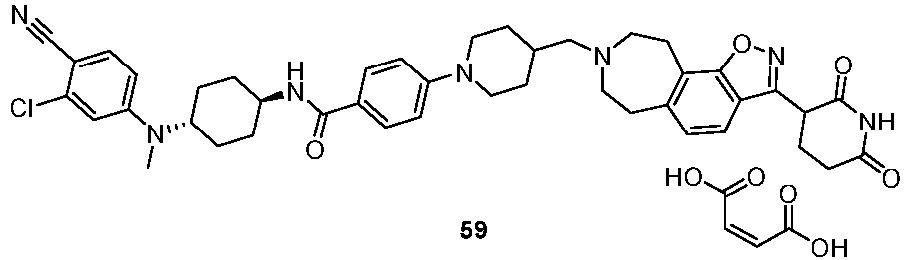

- 56l (110 mg), intermediate 5 (82 mg), sodium acetate (35 mg), and DCE/isopropanol (5:1, 30 mL) were added to a reaction flask in sequence, and the mixture was reacted at room temperature for 30 min. Sodium cyanoborohydride (33 mg) was then added, and the mixture was reacted at room temperature for 2 h. The reaction solution was concentrated by rotary evaporation to remove the solvent, and the crude product was separated and purified by silica gel column chromatography to give compound 59a (55 mg).
- MS(ESI, [M+H]+) m/z: 762.2.
- 59a (55 mg), maleic acid (18 mg), and methanol (5 mL) were added to a reaction flask in sequence, and the mixture was reacted at room temperature for 30 min. After the reaction was completed, the reaction solution was concentrated by rotary evaporation to remove the solvent, slurried with petroleum ether, and filtered, and the filter cake was collected and dried to give compound 59 (65 mg).
- 1H NMR (500 MHz, DMSO-d 6) δ 11.09 (s, 1H), 7.93 (d, J = 7.7 Hz, 1H), 7.73 (d, J = 8.5 Hz, 2H), 7.57 (dd, J = 29.4, 8.5 Hz, 2H), 7.19 (d, J = 8.2 Hz, 1H), 7.01 - 6.89 (m, 3H), 6.83 (dd, J= 9.1, 2.6 Hz, 1H), 4.55 (dd, J = 11.9, 5.0 Hz, 1H), 3.91 - 3.71 (m, 4H), 3.22 - 3.00 (m, 4H), 2.85 (s, 3H), 2.82 - 2.72 (m, 3H), 2.66 (s, 2H), 2.65 - 2.56 (m, 3H), 2.46 (d, J = 4.6 Hz, 1H), 2.34 (d, J = 6.5 Hz, 2H), 2.18 (dt, J = 13.6, 4.3 Hz, 1H), 1.96 - 1.88 (m, 2H), 1.87 - 1.63 (m, 7H), 1.61 - 1.50 (m, 2H), 1.21 (q, J = 11.9, 10.9 Hz, 2H).
-


- Intermediate 6 (142 mg), intermediate 56l (160 mg), 1,2-dichloroethane (5 mL), isopropanol (1 mL), and sodium cyanoborohydride (42.0 mg) were added to a reaction flask in sequence, and the mixture was stirred at room temperature. After the reaction was completed, a saturated sodium bicarbonate solution (2 mL) was added to the reaction solution to neutralize acetic acid, and then dichloromethane (50 mL) and water (100 mL) were added for extraction. The organic phase was separated, and the aqueous phase was extracted with dichloromethane. The organic phases were combined, washed with saturated brine, dried over anhydrous sodium sulfate, and filtered, and the filtrate was purified by a silica gel column to give intermediate 60a (46 mg).
- MS(ESI, [M+H]+) m/z: 774.4.
- Intermediate 60a (46 mg), dichloromethane (10 mL), methanol (5 mL), and maleic acid (6.90 mg) were added to a reaction flask in sequence, and the mixture was reacted at room temperature for 0.5 h. After the reaction was completed, the mixture was concentrated by evaporation under reduced pressure to remove the solvent. The residue was slurried with petroleum ether and filtered, and the filter cake was collected to give compound 60 (35 mg).
- MS(ESI, [M+H]+) m/z: 774.4.
- 1H NMR (500 MHz, DMSO-d6) δ 11.09 (s, 1H), 9.76 (s, 1H), 7.94 (d, J = 7.7 Hz, 1H), 7.74 (d, J = 8.4 Hz, 2H), 7.68 (d, J = 8.1 Hz, 1H), 7.60 (d, J = 9.0 Hz, 1H), 7.36 - 7.26 (m, 1H), 6.95 (d, J = 7.5 Hz, 3H), 6.83 (d, J = 9.0 Hz, 1H), 6.08 (s, 2H), 4.58 (d, J = 6.4 Hz, 1H), 4.35 - 4.17 (m, 4H), 3.87 (d, J = 12.4 Hz, 2H), 3.77 (s, 2H), 3.53 (d, J = 44.3 Hz, 4H), 3.21 (s, 4H), 2.85 (s, 3H), 2.76 (t, J = 11.7 Hz, 3H), 2.61 (d, J = 18.3 Hz, 1H), 2.17 (d, J = 11.0 Hz, 1H), 1.91 (d, J = 11.8 Hz, 2H), 1.79 - 1.65 (m, 6H), 1.56 (t, J = 12.4 Hz, 2H), 1.28 (q, J = 15.4, 13.8 Hz, 2H).
-


- Intermediate 56h (10 g), 4-hydroxypiperidine (7.87 g), N,N-diisopropylethylamine (25.2 g, 34.0 mL), and dimethyl sulfoxide (100 mL) were added to a reaction flask in sequence, and the mixture was heated to 100 °C and reacted overnight. After the reaction was completed, ethyl acetate (300 mL) and water (1000 mL) were added for extraction, the organic phase was separated, and the aqueous phase was extracted with ethyl acetate. The organic phases were combined, washed with saturated brine, dried over anhydrous sodium sulfate, and filtered, and the filtrate was concentrated by evaporation under reduced pressure to remove the solvent. The residue was slurried with petroleum ether/ethyl acetate and filtered, and the filter cake was collected to give intermediate 61a (9.47 g).
- MS(ESI, [M+H]+) m/z: 236.1.
- 1H NMR (500 MHz, DMSO-d6) δ 7.76 (d, J = 9.0 Hz, 2H), 6.96 (d, J = 9.0 Hz, 2H), 4.72 (d, J = 4.2 Hz, 1H), 3.77 (s, 3H), 3.74 - 3.67 (m, 3H), 3.04 (ddd, J = 13.1, 9.9, 3.2 Hz, 2H), 1.83 - 1.76 (m, 2H), 1.45 - 1.36 (m, 2H).
- Intermediate 61a (9.47 g), methanol (200 mL), sodium hydroxide (8.05 g), and water (5 mL) were added to a reaction flask in sequence, and the mixture was heated to 60 °C and reacted. After the reaction was completed, concentrated hydrochloric acid was added to adjust the pH to 2-3. The mixture was concentrated by evaporation under reduced pressure to remove the solvent, the residue was slurried with water and filtered, and the filter cake was collected to give intermediate 61b (10.04 g).
- MS(ESI, [M+H]+) m/z: 222.1.
- 1H NMR (500 MHz, DMSO-d6) δ 7.88 (d, J = 8.4 Hz, 2H), 7.37 (s, 2H), 3.78 (tt, J = 8.1, 3.7 Hz, 1H), 3.68 (dt, J = 11.5, 4.6 Hz, 2H), 3.22 (t, J = 10.8 Hz, 2H), 2.09 - 1.84 (m, 2H), 1.64 (q, J = 10.2 Hz, 2H).
- Intermediate 56g (1.5 g), intermediate 61b (1.258 g), N,N-diisopropylethylamine (3.12 g, 4.22 mL), dichloromethane (50 mL), and HATU (2.389 g) were added to a reaction flask in sequence, and the mixture was reacted at room temperature. After the reaction was completed, the reaction solution was concentrated by evaporation under reduced pressure to remove the solvent, and the residue was extracted with ethyl acetate (200 mL) and water (200 mL). The organic phase was separated, and the aqueous phase was extracted with ethyl acetate. The organic phases were combined, washed with saturated brine, dried over anhydrous sodium sulfate, and filtered, and the filtrate was purified by a silica gel column to give intermediate 61c (1.39 g).
- MS(ESI, [M+H]+) m/z: 467.3.
- 1H NMR (500 MHz, DMSO-d6) δ 7.93 (d, J = 7.6 Hz, 1H), 7.72 (d, J = 8.6 Hz, 2H), 7.60 (d, J = 8.9 Hz, 1H), 6.96 - 6.90 (m, 3H), 6.83 (dd, J = 9.0, 2.5 Hz, 1H), 4.70 (d, J = 4.2 Hz, 1H), 3.77 (tt, J = 11.1, 5.2 Hz, 2H), 3.66 (ddt, J = 12.1, 7.9, 4.5 Hz, 3H), 2.95 (ddd, J = 13.2, 10.1, 3.1 Hz, 2H), 2.85 (s, 3H), 1.94 - 1.88 (m, 2H), 1.80 (dq, J = 12.7, 4.0 Hz, 2H), 1.69 (dtd, J = 17.4, 10.3, 8.8, 3.5 Hz, 4H), 1.55 (qd, J = 12.5, 3.7 Hz, 2H), 1.42 (dtd, J = 12.9, 9.4, 3.7 Hz, 2H).
- Intermediate 61c (600 mg), dimethyl sulfoxide (10 mL), and 2-iodoxybenzoic acid (720 mg) were added to a reaction flask in sequence, and the mixture was reacted at room temperature for 1 h. After the reaction was completed, ethyl acetate (100 mL) and water (200 mL) were added for extraction, the organic phase was separated, and the aqueous phase was extracted with ethyl acetate. The organic phases were combined, washed with saturated brine, dried over anhydrous sodium sulfate, and filtered, and the filtrate was concentrated by evaporation under reduced pressure to remove the solvent, thus giving intermediate 61d (650 mg).
- MS(ESI, [M+H]+) m/z: 465.2.
- Intermediate 6 (120 mg), intermediate 61d (131 mg), 1,2-dichloroethane (5 mL), isopropanol (1 mL), and sodium cyanoborohydride (53.2 mg) were added to a reaction flask in sequence, and the mixture was stirred at room temperature. After the reaction was completed, a saturated sodium bicarbonate solution (2 mL) was added to the reaction solution to neutralize acetic acid, and then dichloromethane (50 mL) and water (100 mL) were added for extraction. The organic phase was separated, and the aqueous phase was extracted with dichloromethane. The organic phases were combined, washed with saturated brine, dried over anhydrous sodium sulfate, and filtered, and the filtrate was purified by a silica gel column to give compound 61 (68 mg).
- MS(ESI, [M+H]+) m/z: 760.2.
- 1H NMR (500 MHz, DMSO-d6) δ 11.09 (s, 1H), 7.93 (d, J = 7.6 Hz, 1H), 7.73 (d, J = 8.2 Hz, 2H), 7.67 - 7.56 (m, 2H), 7.26 (d, J = 8.1 Hz, 1H), 6.93 (d, J = 10.5 Hz, 3H), 6.83 (d, J = 9.1 Hz, 1H), 4.56 (dd, J = 11.7, 5.1 Hz, 1H), 3.75 (dd, J = 32.0, 12.5 Hz, 4H), 3.21 (d, J = 28.6 Hz, 8H), 2.86 (d, J = 10.7 Hz, 5H), 2.80 - 2.72 (m, 1H), 2.60 (d, J = 17.5 Hz, 1H), 2.43 (s, 1H), 2.29 - 2.14 (m, 2H), 1.91 (d, J = 11.8 Hz, 2H), 1.79 - 1.62 (m, 6H), 1.56 (t, J = 12.6 Hz, 2H), 1.25 (q, J = 10.6, 9.9 Hz, 2H).
-


- 56l (118 mg), intermediate 2 (72 mg), sodium acetate (36 mg), and DCE/isopropanol (5:1, 30 mL) were added to a reaction flask in sequence, and the mixture was reacted at room temperature for 30 min. Sodium cyanoborohydride (38 mg) was then added, and the mixture was reacted at room temperature for 2 h. The reaction solution was concentrated by rotary evaporation to remove the solvent, and the crude product was separated and purified by silica gel column chromatography to give intermediate 62a (46 mg).
- MS(ESI, [M+H]+) m/z: 720.4.
- 62a (46 mg), maleic acid (13 mg), and methanol (5 mL) were added to a reaction flask in sequence, the mixture was reacted at room temperature for 30 min, then concentrated by rotary evaporation to remove the solvent, slurried with petroleum ether (5 mL), and filtered, and the filter cake was collected and dried to give compound 62 (51 mg). 1H NMR (500 MHz, DMSO-d 6) δ 11.13 (s, 1H), 7.97 (d, J = 7.7 Hz, 1H), 7.86 (d, J = 8.1 Hz, 1H), 7.77 (d, J = 8.5 Hz, 2H), 7.60 (d, J = 9.0 Hz, 1H), 7.41 (d, J = 8.2 Hz, 1H), 7.01 (d, J = 8.5 Hz, 2H), 6.95 (d, J = 2.4 Hz, 1H), 6.83 (dd, J = 9.1, 2.5 Hz, 1H), 6.07 (s, 2H), 4.65 (dd, J = 12.1, 4.9 Hz, 5H), 3.97 (s, 2H), 3.77 (dtd, J = 11.4, 7.7, 3.9 Hz, 2H), 2.90 (t, J = 12.2 Hz, 2H), 2.85 (s, 3H), 2.79 (ddd, J = 17.4, 12.1, 5.3 Hz, 1H), 2.63 (dt, J = 17.4, 4.2 Hz, 1H), 2.55 (dd, J = 12.6, 4.4 Hz, 2H), 2.27 - 2.11 (m, 3H), 1.96 - 1.88 (m, 2H), 1.79 - 1.62 (m, 6H), 1.55 (qd, J = 12.6, 3.7 Hz, 2H).
-


- 56g (1.5 g), tert-butyl 4-(4-carboxyphenyl)piperazine-1-carboxylate (1.5 g), DCM (10 mL), HATU (2.85 g), and DIPEA (3.5 mL) were added to a reaction flask in sequence, and the mixture was reacted at room temperature. After the reaction was completed, the system was diluted with ethyl acetate, washed with a 10% citric acid aqueous solution, and then washed with a saturated sodium bicarbonate solution. The organic phase was dried over anhydrous sodium sulfate, filtered, and concentrated to give 63a (2.66 g).
- MS(ESI, [M+H]+) m/z: 552.51.
- 63a (2.6 g), DCM (20 mL), and trifluoroacetic acid (5 mL) were added to a reaction flask in sequence, and the mixture was reacted at room temperature. After the reaction was completed, the mixture was added to a saturated sodium bicarbonate solution (200 mL) and extracted with DCM. The organic phase was dried over anhydrous sodium sulfate, filtered, and concentrated to give 63b (1.92 g).
- MS(ESI, [M+H]+) m/z: 452.13.
- 63b (400 mg), 1,2-dichloroethane (10 mL), isopropanol (3 mL), intermediate 7 (252 mg), one drop of acetic acid, and sodium cyanoborohydride (167 mg) were added to a reaction flask in sequence, and the mixture was reacted at room temperature overnight. After the reaction was completed, the reaction solution was added with a saturated sodium bicarbonate solution (20 mL) and water (50 mL) and then extracted with dichloromethane. The organic phase was separated, dried over anhydrous sodium sulfate, filtered, and concentrated, the residue was purified by silica gel column chromatography to give a crude product, and the crude product was separated by preparative high performance liquid chromatography to give intermediate prepeak 63c-1 (165 mg) and postpeak 63c-2 (180 mg) in sequence.
- The conditions for the preparative chromatography were as follows: Instrument and preparative column: YMC high pressure preparative chromatograph was used, and the preparative column was CHIRALART Amylose-SA. Mobile phase system: ethanol-dichloromethane (10:3)/n-hexane, isocratic elution: ethanol-dichloromethane (10:3)/n-hexane = 65/35.
- The data of 63c-1 were as follows:
- MS(ESI, [M+H]+) m/z: 695.12.
- 1H NMR (500 MHz, DMSO-d 6) δ 7.96 (d, J = 7.7 Hz, 1H), 7.74 (d, J = 8.7 Hz, 2H), 7.61 (t, J = 8.7 Hz, 2H), 7.29 (d, J = 8.1 Hz, 1H), 7.01 - 6.92 (m, 3H), 6.83 (dd, J = 9.0, 2.6 Hz, 1H), 4.22 - 4.09 (m, 4H), 3.77 (dq, J = 11.7, 6.0, 5.5 Hz, 2H), 3.43 (p, J = 7.7 Hz, 1H), 3.36 (d, J = 7.9 Hz, 1H), 3.31 - 3.19 (m, 5H), 3.03 (dt, J = 16.9, 9.1 Hz, 2H), 2.85 (s, 3H), 2.62 (p, J = 6.2, 5.3 Hz, 4H), 1.91 (d, J = 11.5 Hz, 2H), 1.70 (q, J = 12.8 Hz, 4H), 1.61 - 1.50 (m, 2H), 1.19 (t, J = 7.1 Hz, 3H).
- 63c-1 (165 mg), acrylamide (20 mg), and THF (10 mL) were added to a reaction flask in sequence, a 1 M solution of potassium tert-butoxide in tetrahydrofuran (0.19 mL) was added under an ice bath, and the mixture was reacted at 0 °C. After the reaction was completed, the reaction solution was added dropwise to an icy saturated ammonium chloride aqueous solution, and ethyl acetate was added for extraction. The organic phase was separated, dried over anhydrous sodium sulfate, filtered, and concentrated, and the residue was purified by silica gel column chromatography to give compound 63d (98 mg).
- MS(ESI, [M+H]+) m/z: 720.13.
- 63d (98 mg), maleic acid (15.7 mg), and MeOH/DCM (1/10, 5 mL) were added to a reaction flask in sequence, and after complete dissolution, the reaction solution was concentrated. The reaction solution was slurried with petroleum ether and filtered under vacuum to give compound 63 (101 mg).
- MS(ESI, [M+H]+) m/z: 720.46.
- 1H NMR (500 MHz, DMSO-d 6) δ 11.10 (d, J = 2.1 Hz, 1H), 8.01 (d, J = 7.6 Hz, 1H), 7.80 (d, J = 8.5 Hz, 2H), 7.73 (d, J = 8.0 Hz, 1H), 7.60 (d, J = 8.9 Hz, 1H), 7.34 (d, J = 8.1 Hz, 1H), 7.04 (d, J = 8.5 Hz, 2H), 6.95 (d, J = 2.6 Hz, 1H), 6.83 (dd, J = 9.0, 2.5 Hz, 1H), 6.13 (s, 3H), 4.60 (ddd, J = 12.0, 5.0, 2.7 Hz, 1H), 4.23 (s, 1H), 3.78 (hd, J = 8.0, 4.1 Hz, 3H), 3.62 (dd, J = 16.5, 8.0 Hz, 2H), 3.56 - 3.35 (m, 9H), 2.85 (s, 3H), 2.77 (ddd, J = 12.7, 5.8, 3.1 Hz, 1H), 2.66 - 2.58 (m, 1H), 2.55 (d, J = 4.9 Hz, 1H), 2.20 (tq, J = 9.0, 4.7, 3.8 Hz, 1H), 1.96 - 1.88 (m, 2H), 1.79 - 1.64 (m, 4H), 1.56 (qd, J= 12.4, 3.7 Hz, 2H).
- 63c-2 (180 mg), acrylamide (22 mg), and THF (10 mL) were added to a reaction flask in sequence, a 1 M solution of potassium tert-butoxide in tetrahydrofuran (0.2 mL) was added under an ice bath, and the mixture was reacted at 0 °C. After the reaction was completed, the reaction solution was added dropwise to an icy saturated ammonium chloride aqueous solution, and ethyl acetate (50 mL) was added for extraction. The organic phase was separated, dried over anhydrous sodium sulfate, filtered, and concentrated, and the residue was purified by silica gel column chromatography to give compound 64a (105 mg).
- MS(ESI, [M+H]+) m/z: 720.46.
- 64a (105 mg), maleic acid (16.9 mg), and MeOH/DCM (1/10, 5 mL) were added to a reaction flask in sequence, and after complete dissolution, the reaction solution was concentrated. The reaction solution was slurried with petroleum ether and filtered under vacuum to give compound 64 (117 mg).
- MS(ESI, [M+H]+) m/z: 720.44.
- 1H NMR (500 MHz, DMSO-d 6) δ 11.10 (d, J = 2.1 Hz, 1H), 8.01 (d, J = 7.6 Hz, 1H), 7.80 (d, J = 8.5 Hz, 2H), 7.73 (d, J = 8.0 Hz, 1H), 7.60 (d, J = 8.9 Hz, 1H), 7.34 (d, J = 8.1 Hz, 1H), 7.04 (d, J = 8.5 Hz, 2H), 6.95 (d, J = 2.6 Hz, 1H), 6.83 (dd, J = 9.0, 2.5 Hz, 1H), 6.13 (s, 3H), 4.60 (ddd, J = 12.0, 5.0, 2.7 Hz, 1H), 4.23 (s, 1H), 3.78 (hd, J = 8.0, 4.1 Hz, 3H), 3.62 (dd, J = 16.5, 8.0 Hz, 2H), 3.56 - 3.35 (m, 9H), 2.85 (s, 3H), 2.77 (ddd, J = 12.7, 5.8, 3.1 Hz, 1H), 2.66 - 2.58 (m, 1H), 2.55 (d, J = 4.9 Hz, 1H), 2.20 (tq, J = 9.0, 4.7, 3.8 Hz, 1H), 1.96 - 1.88 (m, 2H), 1.79 - 1.64 (m, 4H), 1.56 (qd, J = 12.4, 3.7 Hz, 2H).
-


- 56g (1.5 g), 1-Boc-4-(4'-carboxyphenyl)piperidine (1.5 g), DCM (10 mL), HATU (2.85 g), and DIPEA (3.5 mL) were added to a reaction flask in sequence, and the mixture was reacted at room temperature. After the reaction was completed, the system was diluted with ethyl acetate (100 mL), washed with a 10% citric acid aqueous solution (100 mL), and then washed with a saturated sodium bicarbonate solution. The organic phase was dried over anhydrous sodium sulfate, filtered, and concentrated to give 65a (3.2 g).
- MS(ESI, [M+H]+) m/z: 551.4.
- 65a (3.2 g), DCM (20 mL), and trifluoroacetic acid (5 mL) were added to a reaction flask in sequence, and the mixture was reacted at room temperature. After the reaction was completed, the mixture was added to a saturated sodium bicarbonate solution (200 mL) and extracted with DCM. The organic phase was dried over anhydrous sodium sulfate, filtered, and concentrated to give 65b (1.85 g).
- MS(ESI, [M+H]+) m/z: 451.34.
- 65b (400 mg), 1,2-dichloroethane (10 mL), isopropanol (3 mL), intermediate 7 (252 mg), one drop of acetic acid, and sodium cyanoborohydride (167 mg) were added to a reaction flask in sequence, and the mixture was reacted at room temperature overnight. After the reaction was completed, the reaction solution was added with a saturated sodium bicarbonate solution (20 mL) and water (50 mL) and then extracted with dichloromethane. The organic phase was separated, dried over anhydrous sodium sulfate, filtered, and concentrated, the residue was purified by silica gel column chromatography to give a crude product, and the crude product was separated by preparative high performance liquid chromatography to give intermediate prepeak 65c-1 (150 mg) and postpeak 65c-2 (155 mg) in sequence.
- The conditions for the preparative chromatography were as follows: Instrument and preparative column: YMC high pressure preparative chromatograph was used, and the preparative column was CHIRALART Amylose-SA. Mobile phase system: ethanol:dichloromethane (1:3)/n-hexane, isocratic elution: ethanol:dichloromethane (1:3)/n-hexane = 50/50.
- The data of 65c-1 were as follows:
MS(ESI, [M+H]+) m/z: 694.20. - 1H NMR (500 MHz, DMSO-d 6) δ 8.18 (d, J = 7.6 Hz, 1H), 7.78 (d, J = 8.0 Hz, 2H), 7.61 (dd, J = 8.6, 6.5 Hz, 2H), 7.31 (dd, J = 22.0, 8.1 Hz, 3H), 6.95 (d, J = 2.5 Hz, 1H), 6.84 (dd, J = 9.1, 2.6 Hz, 1H), 4.22 - 4.06 (m, 4H), 3.89 - 3.72 (m, 2H), 3.44 (d, J = 7.0 Hz, 1H), 3.31 - 3.32 (m, 1H), 3.25 - 3.17 (m, 1H), 3.03 (s, 4H), 2.85 (s, 3H), 2.58 (s, 1H), 2.16 (d, J = 10.2 Hz, 2H), 1.92 (d, J = 12.1 Hz, 2H), 1.85 - 1.62 (m, 8H), 1.61 - 1.48 (m, 2H), 1.19 (t, J = 7.1 Hz, 3H).
- 65c-1 (150 mg), acrylamide (16.9 mg), and THF (10 mL) were added to a reaction flask in sequence, a 1 M solution of potassium tert-butoxide in tetrahydrofuran (0.17 mL) was added under an ice bath, and the mixture was reacted at 0 °C. After the reaction was completed, the reaction solution was added dropwise to an icy saturated ammonium chloride aqueous solution, and ethyl acetate was added for extraction. The organic phase was separated, dried over anhydrous sodium sulfate, filtered, and concentrated, and the residue was purified by silica gel column chromatography to give compound 65 (70 mg).
- MS(ESI, [M+H]+) m/z: 719.19.
- 1H NMR (500 MHz, DMSO-d 6) δ 11.09 (s, 1H), 8.18 (d, J = 7.6 Hz, 1H), 7.78 (d, J = 8.2 Hz, 2H), 7.61 (dd, J = 15.4, 8.5 Hz, 2H), 7.34 (d, J = 8.0 Hz, 2H), 7.27 (d, J = 8.1 Hz, 1H), 6.95 (d, J = 2.6 Hz, 1H), 6.84 (dd, J = 9.1, 2.5 Hz, 1H), 4.57 (dd, J = 11.9, 5.0 Hz, 1H), 3.79 (dd, J = 11.5, 5.1 Hz, 2H), 3.44 (t, J = 7.5 Hz, 1H), 3.31 (s, 1H), 3.22 (dd, J = 16.2, 7.6 Hz, 1H), 3.11 - 2.93 (m, 4H), 2.85 (s, 3H), 2.77 (ddd, J = 17.2, 12.0, 5.3 Hz, 1H), 2.61 (dt, J = 17.0, 4.3 Hz, 2H), 2.47 (d, J = 8.1 Hz, 1H), 2.18 (td, J = 9.4, 5.4 Hz, 3H), 1.96 - 1.88 (m, 2H), 1.83 - 1.63 (m, 8H), 1.61 - 1.51 (m, 2H).
- 65c-2 (165 mg), acrylamide (16.9 mg), and THF (10 mL) were added to a reaction flask in sequence, a 1 M solution of potassium tert-butoxide in tetrahydrofuran (0.19 mL) was added under an ice bath, and the mixture was reacted at 0 °C. After the reaction was completed, the reaction solution was added dropwise to an icy saturated ammonium chloride aqueous solution, and ethyl acetate was added for extraction. The organic phase was separated, dried over anhydrous sodium sulfate, filtered, and concentrated, and the residue was purified by silica gel column chromatography to give compound 66 (65 mg).
- MS(ESI, [M+H]+) m/z: 719.28.
- 1H NMR (500 MHz, DMSO-d 6) δ 11.09 (s, 1H), 8.18 (d, J = 7.6 Hz, 1H), 7.78 (d, J = 8.2 Hz, 2H), 7.61 (dd, J = 15.4, 8.5 Hz, 2H), 7.34 (d, J = 8.0 Hz, 2H), 7.27 (d, J = 8.1 Hz, 1H), 6.95 (d, J = 2.6 Hz, 1H), 6.84 (dd, J = 9.1, 2.5 Hz, 1H), 4.57 (dd, J = 11.9, 5.0 Hz, 1H), 3.79 (dd, J = 11.5, 5.1 Hz, 2H), 3.44 (t, J = 7.5 Hz, 1H), 3.31 (s, 1H), 3.22 (dd, J = 16.2, 7.6 Hz, 1H), 3.11 - 2.93 (m, 4H), 2.85 (s, 3H), 2.77 (ddd, J = 17.2, 12.0, 5.3 Hz, 1H), 2.61 (dt, J = 17.0, 4.3 Hz, 2H), 2.47 (d, J = 8.1 Hz, 1H), 2.18 (td, J = 9.4, 5.4 Hz, 3H), 1.96 - 1.88 (m, 2H), 1.83 - 1.63 (m, 8H), 1.61 - 1.51 (m, 2H).
-


- Intermediate 61d (415 mg), DMA (10 mL), intermediate 5 (100 mg), sodium acetate (25 mg), and sodium cyanoborohydride (187 mg) were added to a reaction flask in sequence, and the mixture was reacted at 80 °C. After the reaction was completed, a saturated sodium bicarbonate solution (2 mL) was added to the reaction solution to neutralize acetic acid, and then ethyl acetate and water were added for extraction. The organic phase was separated, dried over anhydrous sodium sulfate, filtered, and concentrated, and the residue was purified by a silica gel column to give compound 67 (90 mg).
- MS(ESI, [M+H]+) m/z: 748.46.
- 1H NMR (500 MHz, DMSO-d 6) δ 11.08 (s, 1H), 7.94 (s, 1H), 7.72 (d, J = 8.6 Hz, 2H), 7.56 (dd, J = 32.9, 8.3 Hz, 2H), 7.18 (s, 1H), 6.89 (d, J = 51.9 Hz, 4H), 4.67 - 4.39 (m, 1H), 4.05 - 3.62 (m, 4H), 3.14 (s, 2H), 3.02 (s, 2H), 2.77 (t, J = 32.1 Hz, 13H), 2.18 (s, 1H), 1.72 (dd, J = 105.4, 71.9 Hz, 12H).
-


- Intermediate 26f (90 mg), intermediate 65b (150 mg), 1,2-dichloroethane (10 mL), isopropanol (1 mL), and sodium triacetoxyborohydride (128 mg) were added to a reaction flask in sequence, and the mixture was reacted at room temperature. After the reaction was completed, a saturated sodium bicarbonate solution was added to the reaction system to quench the reaction, and the mixture was extracted with dichloromethane. The organic layer was collected, dried over anhydrous sodium sulfate, and filtered. The filtrate was concentrated, and then the residue was purified by silica gel column chromatography to give compound 68 (60 mg).
- MS(ESI, [M+H]+) m/z: 733.39.
- 1H NMR (500 MHz, DMSO-d6) δ11.09 (d, J = 1.3 Hz, 1H), 8.19 (d, J = 7.6 Hz, 1H),7.83 - 7.75 (m, 2H), 7.61 (dd, J = 8.6, 6.6 Hz, 2H), 7.34 (d, J = 8.2 Hz, 2H), 7.27 (d, J = 8.1 Hz, 1H), 6.95 (d, J = 2.6 Hz, 1H), 6.84 (dd, J = 9.1, 2.5 Hz, 1H), 4.57 (ddd, J = 11.9, 5.0, 1.7 Hz, 1H), 3.79 (dq, J = 11.5, 3.9 Hz, 2H), 3.20 (ddd, J = 25.1, 16.6, 8.2 Hz, 2H), 3.02 (d, J = 10.6 Hz, 2H), 2.92 (d, J = 14.3 Hz, 2H), 2.85 (s, 4H), 2.77 (ddd, J = 17.2, 11.9, 5.4 Hz, 1H), 2.68 - 2.52 (m, 3H), 2.37 (d, J = 7.2 Hz, 2H),2.25 - 2.13 (m, 1H), 2.04 (t, J = 10.9 Hz, 2H), 1.98 - 1.89 (m, 2H), 1.79 - 1.64 (m, 8H), 1.61 - 1.51 (m, 2H).
-


- Intermediate 27a (90 mg), intermediate 65b (150 mg), 1,2-dichloroethane (10 mL), isopropanol (1 mL), and sodium triacetoxyborohydride (128 mg) were added to a reaction flask in sequence, and the mixture was reacted at room temperature. After the reaction was completed, a saturated sodium bicarbonate solution was added to the reaction system to quench the reaction, and the mixture was extracted with dichloromethane. The organic layer was collected, dried over anhydrous sodium sulfate, and filtered. The filtrate was concentrated, and then the residue was purified by silica gel column chromatography to give compound 69 (60 mg).
- MS(ESI, [M+H]+) m/z: 733.39.
- 1H NMR (500 MHz, DMSO-d6) δ11.09 (d, J = 1.3 Hz, 1H), 8.19 (d, J = 7.6 Hz, 1H), 7.83 - 7.75 (m, 2H), 7.61 (dd, J = 8.6, 6.6 Hz, 2H),7.34 (d, J = 8.2 Hz, 2H), 7.27 (d, J = 8.1 Hz, 1H), 6.95 (d, J = 2.6 Hz, 1H), 6.84 (dd, J = 9.1, 2.5 Hz, 1H), 4.57 (ddd, J = 11.9, 5.0, 1.7 Hz, 1H), 3.79 (dq, J = 11.5, 3.9 Hz, 2H), 3.20 (ddd, J = 25.1, 16.6, 8.2 Hz, 2H), 3.02 (d, J = 10.6 Hz, 2H), 2.92 (d, J = 14.3 Hz, 2H), 2.85 (s, 4H), 2.77 (ddd, J = 17.2, 11.9, 5.4 Hz, 1H), 2.68 - 2.52 (m, 3H), 2.37 (d, J = 7.2 Hz, 2H), 2.25 - 2.13 (m, 1H), 2.04 (t, J = 10.9 Hz, 2H), 1.98 - 1.89 (m, 2H), 1.79 - 1.64 (m, 8H), 1.61 - 1.51 (m, 2H).
-
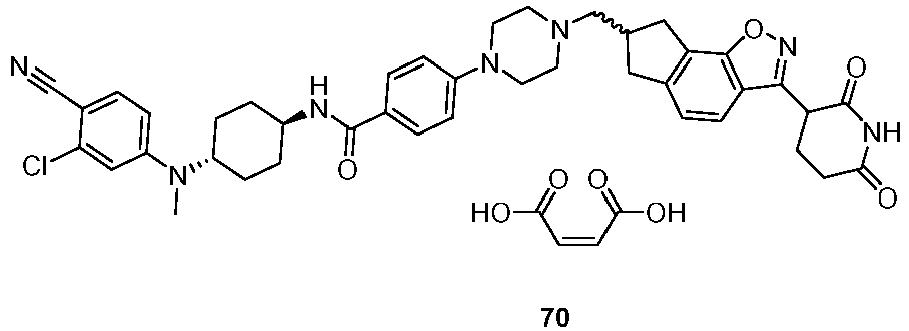

- Intermediate 26f (90 mg), intermediate 63b (150 mg), 1,2-dichloroethane (10 mL), isopropanol (1 mL), and sodium triacetoxyborohydride (128 mg) were added to a reaction flask in sequence, and the mixture was reacted at room temperature. After the reaction was completed, a saturated sodium bicarbonate solution was added to the reaction system to quench the reaction, and the mixture was extracted with dichloromethane. The organic layer was collected, dried over anhydrous sodium sulfate, and filtered. The filtrate was concentrated, and then the residue was purified by silica gel column chromatography to give compound 70a (70 mg).
- MS(ESI, [M+H]+) m/z: 734.10.
- Intermediate 70a (70 mg), dichloromethane (10 mL), methanol (1 mL), and maleic acid (11.1 mg) were added to a reaction flask in sequence, and the mixture was reacted at room temperature. After the reaction was completed, the mixture was concentrated by evaporation under reduced pressure to remove the solvent. The residue was slurried with petroleum ether and filtered, and the filter cake was collected to give compound 70 (70 mg).
- MS(ESI, [M+H]+) m/z: 734.10.
- H NMR (500 MHz, DMSO-d6) δ11.10 (s, 1H), 8.02 (d, J = 7.6 Hz, 1H), 7.80 (d, J = 8.4 Hz, 2H), 7.66 (d, J = 8.1 Hz, 1H), 7.60 (d, J = 9.0 Hz, 1H), 7.31 (d, J = 8.1 Hz, 1H), 7.04 (d, J = 8.5 Hz, 2H), 6.95 (d, J = 2.5 Hz, 1H), 6.83 (dd, J = 9.1, 2.5 Hz, 1H), 6.08 (s, 2H), 4.58 (ddd, J = 12.0, 5.1, 2.5 Hz, 1H), 3.78 (ddt, J = 16.1, 7.6, 4.4 Hz, 3H), 3.40 (s, 3H), 3.34 - 3.20 (m, 8H), 3.14 (d, J = 25.2 Hz, 4H), 3.01 (dd, J = 15.9, 6.4 Hz, 2H), 2.90 (dd, J = 16.3, 6.6 Hz, 1H), 2.78 (ddd, J = 17.2, 11.7, 5.1 Hz, 1H), 2.61 (dq, J = 17.1, 3.7 Hz, 1H), 2.19 (dp, J = 12.9, 4.3 Hz, 1H), 1.99 - 1.87 (m, 2H), 1.80 - 1.63 (m, 4H), 1.56 (qd, J = 12.3, 3.7 Hz, 2H).
-


- Intermediate 27a (90 mg), intermediate 63b (150 mg), 1,2-dichloroethane (10 mL), isopropanol (1 mL), and sodium triacetoxyborohydride (128 mg) were added to a reaction flask in sequence, and the mixture was reacted at room temperature. After the reaction was completed, a saturated sodium bicarbonate solution was added to the reaction system to quench the reaction, and the mixture was extracted with dichloromethane. The organic layer was collected, dried over anhydrous sodium sulfate, and filtered. The filtrate was concentrated, and then the residue was purified by silica gel column chromatography to give compound 71a (70 mg).
- MS(ESI, [M+H]+) m/z: 734.10.
- Intermediate 71a (70 mg), dichloromethane (10 mL), methanol (1 mL), and maleic acid (11.1 mg) were added to a reaction flask in sequence, and the mixture was reacted at room temperature. After the reaction was completed, the mixture was concentrated by evaporation under reduced pressure to remove the solvent. The residue was slurried with petroleum ether and filtered, and the filter cake was collected to give compound 71 (70 mg).
- MS(ESI, [M+H]+) m/z: 734.10.
- 1H NMR (500 MHz, DMSO-d6) δ11.10 (s, 1H), 8.02 (d, J = 7.6 Hz, 1H), 7.80 (d, J = 8.4 Hz, 2H), 7.66 (d, J = 8.1 Hz, 1H), 7.60 (d, J = 9.0 Hz, 1H), 7.31 (d, J = 8.1 Hz, 1H), 7.04 (d, J = 8.5 Hz, 2H), 6.95 (d, J = 2.5 Hz, 1H), 6.83 (dd, J = 9.1, 2.5 Hz, 1H), 6.10 (s, 2H), 4.58 (ddd, J = 12.0, 5.1, 2.5 Hz, 1H), 3.78 (ddt, J = 16.1, 7.6, 4.4 Hz, 3H), 3.41 (dd, J = 15.9, 7.5 Hz, 3H), 3.37 - 3.23 (m, 8H), 3.14 (d, J = 24.2 Hz, 4H), 3.01 (dd, J = 15.9, 6.5 Hz, 2H), 2.90 (dd, J = 16.3, 6.6 Hz, 1H), 2.78 (ddd, J = 17.2, 11.7, 5.3 Hz, 1H), 2.61 (dq, J = 17.1, 3.7 Hz, 1H), 2.18 (dp,J = 12.9, 4.3 Hz, 1H), 1.96 - 1.88 (m, 2H), 1.79 - 1.64 (m, 4H), 1.56 (qd, J = 12.5, 3.6Hz, 2H).
-


- 72a (47 g), triethylamine (60.8 g), and dichloromethane (500 mL) were added to a reaction flask in sequence. The mixture was cooled to 0 °C, and Boc anhydride (48.1 g) was added dropwise. The mixture was reacted at room temperature. After the reaction was completed, the reaction solution was washed with a saturated ammonium chloride aqueous solution, the organic phase was separated, washed with saturated brine, dried over anhydrous sodium sulfate, and filtered, and the filtrate was concentrated to give intermediate 72b (60 g).
- 72b (60 g), bis(pinacolato)diboron (53.7 g), potassium acetate (38.5 g), dimethyl sulfoxide (600 mL), and 1,1'-bis(diphenylphosphino)ferrocenepalladium dichloride (8.2 g) were added to a reaction flask in sequence, and the mixture was purged three times with nitrogen, warmed to 100 °C, and reacted for 4 h. After the reaction was completed, the mixture was added with water (2.5 L) and extracted with ethyl acetate, washed with saturated brine, dried over anhydrous sodium sulfate, and filtered. The filtrate was concentrated, and the crude product was separated and purified by silica gel column chromatography to give intermediate 72c (58 g).
- MS (ESI, [M+H]+) m/z: 346.20.
- 72c (55 g), tetrahydrofuran (500 mL), and glacial acetic acid (47.8 g) were added to a reaction flask in sequence. The mixture was cooled to 0 °C, and hydrogen peroxide (36.1 g) was added dropwise. After the dropwise addition, the mixture was reacted at room temperature for 5 h. After the reaction was completed, water (800 mL) was added, and excess hydrogen peroxide was neutralized with sodium thiosulfate. The mixture was extracted with ethyl acetate, washed with saturated brine, dried over anhydrous sodium sulfate, and filtered, and the filtrate was concentrated to give intermediate 72d (37 g).
- MS (ESI, [M-H]-) m/z: 234.08.
- 72d (35.00 g) and a 4 M solution of hydrochloric acid in 1,4-dioxane (300 mL) were added to a reaction flask in sequence, and the mixture was reacted at room temperature for 3 h. After the reaction was completed, the reaction solution was concentrated and added with dichloromethane (300 mL) and triethylamine (60.5 g). The mixture was cooled to 0 °C, and trifluoroacetic anhydride (33.6 g) was added dropwise. The mixture was reacted at room temperature for 2 h. After the reaction was completed, the reaction solution was washed with a saturated ammonium chloride solution, the organic phase was separated, washed with saturated brine, dried over anhydrous sodium sulfate, and filtered, and the filtrate was concentrated to give intermediate 72e (25 g).
- MS (ESI, [M-H]-) m/z: 230.12.
- 72e (25 g), bromoacetaldehyde diethyl acetal (46 g), potassium carbonate (32.3 g), and dimethylacetamide (200 mL) were added to a reaction flask in sequence, and the mixture was warmed to 150 °C and reacted. After the reaction was completed, the mixture was added with water (800 mL) and extracted with ethyl acetate, washed with saturated brine, dried over anhydrous sodium sulfate, and filtered. The filtrate was concentrated, and the crude product was separated and purified by silica gel column chromatography to give intermediate 72f (22 g).
- 72f (22 g), chlorobenzene (150 mL), and phosphoric acid (31 g) were added to a reaction flask in sequence, and the mixture was reacted at 130 °C. After the reaction was completed, the mixture was added with water (400 mL), extracted with ethyl acetate, washed with saturated brine, dried over anhydrous sodium sulfate, and filtered. The filtrate was concentrated, and the crude product was separated and purified by silica gel column chromatography to give intermediate 72g (15.2 g).
- MS (ESI, [M+H]+) m/z: 256.02.
- 72g (12 g), sodium hydroxide (5.64 g), methanol (150 mL), and water (35 mL) were added to a reaction flask in sequence, and the mixture was reacted at room temperature for 1 h. After the reaction was completed, di-tert-butyl dicarbonate (12.32 g) was added, and the mixture was reacted at room temperature for 2 h. After the reaction was completed, the reaction solution was poured into water, vigorously stirred, extracted with ethyl acetate, washed with saturated brine, dried over anhydrous sodium sulfate, and filtered. The filtrate was concentrated, and the crude product was separated by silica gel column chromatography to give intermediate 72h (10.4 g).
- 72h (10.4 g) and DCM (300 mL) were added to a reaction flask in sequence, and the mixture was cooled to 0 °C. Liquid bromine (8.32 g) was added, and the mixture was reacted at room temperature for 0.5 h. After the reaction was completed, the mixture was concentrated by rotary evaporation to remove the solvent. Ethanol (80 mL) and potassium hydroxide (3.89 g) were added to the residue, and the mixture was warmed to 70 °C and reacted for 0.5 h. After the reaction was completed, the reaction solution was poured into water, vigorously stirred, extracted with ethyl acetate, washed with saturated brine, dried over anhydrous sodium sulfate, and filtered. The filtrate was concentrated, and the crude product was separated by silica gel column chromatography to give intermediate 72i (4.61 g).
- MS (ESI, [M+H]+) m/z: 338.01.
- 72i (4.05 g), 3-(4-methoxybenzyl)dihydropyrimidine-2,4(1H,3H)-dione (3.32 g), (1R,2R)-N1,N2-dimethylcyclohexane-1,2-diamine (0.84 g), copper(I) iodide (1.13 g), cesium carbonate (11.56 g), and 1,4-dioxane (100 mL) were added to a reaction flask in sequence, and the mixture was reacted at 120 °C for 15 h. After the reaction was completed, the reaction solution was concentrated and extracted with water and ethyl acetate, followed by liquid separation. The organic phase was washed with saturated brine, dried over anhydrous sodium sulfate, and filtered. The filtrate was concentrated, and the crude product was separated by silica gel column chromatography to give intermediate 72j (3.65 g).
- MS (ESI, [M+H]+) m/z: 492.01.
- 72j (3.65 g), dichloromethane (40 mL), and trifluoroacetic acid (20 mL) were added to a reaction flask in sequence, and the mixture was reacted at room temperature for 1 h. After the reaction was completed, the reaction solution was concentrated to give intermediate 72k (4.68 g).
- 72k (3.65 g) and trifluoromethanesulfonic acid (40 mL) were added to a reaction flask in sequence, and the mixture was reacted at room temperature for 3 h. After the reaction was completed, the reaction solution was added dropwise to a solution of DIPEA (66.3 g, 90 mL) in DCM (90 mL). After the dropwise addition, the mixture was warmed to room temperature. Di-tert-butyl dicarbonate (2.56 g, 2.73 mL) was added, and the mixture was reacted at room temperature. After the reaction was completed, the reaction solution was concentrated by evaporation under reduced pressure to remove the solvent and extracted with ethyl acetate (200 mL) and water (500 mL). The organic phase was separated, washed with saturated brine, dried over anhydrous sodium sulfate, and filtered, and the filtrate was purified by silica gel column chromatography to give the target intermediate 721 (1.1 g).
- MS (ESI, [M+H]+) m/z: 372.01.
- 72l (1.1 g) and DCM (5 mL) were added to a reaction flask in sequence, a solution of hydrochloric acid in 1,4-dioxane (4 mol/L, 16.35 mL) was added, and the mixture was reacted at room temperature. After the reaction was completed, the reaction solution was concentrated to give intermediate 72 (0.58 g).
- MS (ESI, [M+H]+) m/z: 272.08.
- 1H NMR (500 MHz, DMSO-d6) δ 10.56 (s, 1H), 10.18 (s, 2H), 8.21 (s, 1H), 7.63 (d, J = 8.1 Hz, 1H), 7.33 (d, J = 8.1 Hz, 1H), 4.77 (d, J = 4.6 Hz, 2H), 4.63 (d, J = 4.5 Hz, 2H), 3.84 (t, J = 6.7 Hz, 2H), 2.79 (t, J = 6.7 Hz, 2H).
-


- Intermediate 3c (30 g), bromoacetaldehyde diethyl acetal (48.2 g), potassium carbonate (33.8 g), and DMA (300 mL) were added to a reaction flask in sequence, and the mixture was heated to 150 °C and reacted. After the reaction was completed, the reaction solution was extracted with ethyl acetate (500 mL) and water (1000 mL). The organic phase was separated, washed with saturated brine, dried over anhydrous sodium sulfate, and filtered, and the filtrate was purified by silica gel column chromatography to give the target intermediate 73a (31.48 g).
- Intermediate 73a (32.48 g), phosphoric acid (51.8 g), and chlorobenzene (100 mL) were added to a reaction flask in sequence, and the mixture was heated to 120 °C and reacted. After the reaction was completed, the reaction solution was extracted with ethyl acetate (500 mL) and water (1000 mL). The organic phase was separated, washed with saturated brine, dried over anhydrous sodium sulfate, and filtered, and the filtrate was concentrated by evaporation under reduced pressure to remove the solvent, thus giving the target intermediate 73b (20.58 g).
- Intermediate 73b (20.58 g) and methanol (150 mL) were added to a reaction flask in sequence, a solution of sodium hydroxide (8.23 g) in water (150 mL) was added dropwise under an ice bath, and the mixture was warmed to room temperature and reacted. After the reaction was completed, the reaction solution was concentrated by evaporation under reduced pressure to remove the methanol, and 1,4-dioxane (150 mL) and di-tert-butyl dicarbonate (16.46 g, 17.51 mL) were added. The mixture was reacted at room temperature. After the reaction was completed, the reaction solution was extracted with ethyl acetate (500 mL) and water (800 mL), dried over anhydrous sodium sulfate, and filtered, and the filtrate was concentrated by evaporation under reduced pressure to remove the solvent, thus giving the target intermediate 73c (26.48 g).
- Intermediate 73c (26.34 g), DCM (200 mL), and liquid bromine (12.94 g, 4.15 mL) were added to a reaction flask in sequence, and the mixture was reacted at room temperature. After the reaction was completed, the reaction solution was concentrated by evaporation under reduced pressure to remove the solvent, and EtOH (200 mL) and potassium hydroxide (7.57 g) were added. The mixture was heated to 70 °C and reacted. After the reaction was completed, the reaction solution was cooled to room temperature and concentrated by evaporation under reduced pressure to remove the solvent. The residue was extracted with ethyl acetate (200 mL) and water (500 mL). The organic phase was separated, washed with saturated brine, dried over anhydrous sodium sulfate, and filtered, and the filtrate was purified by silica gel column chromatography to give the target intermediate 73d (4.8 g).
- Intermediate 73d (4.8 g), 3-(4-methoxybenzyl)dihydropyrimidine-2,4(1H,3H)-dione (4.15 g), copper(I) iodide (1.298 g), trans-(1R,2R)-N,N'-dimethyl-1,2-cyclohexanediamine (0.969 g, 1.089 mL), cesium carbonate (13.32 g), and 1,4-dioxane (100 mL) were added to a reaction flask in sequence, and the mixture was heated to 130 °C and reacted under N2 atmosphere. After the reaction was completed, the reaction solution was cooled to room temperature and extracted with ethyl acetate (200 mL) and water (500 mL). The organic phase was separated, washed with saturated brine, dried over anhydrous sodium sulfate, and filtered, and the filtrate was purified by silica gel column chromatography to give the target intermediate 73e (5.9 g).
- Intermediate 73e (5.4 g) and DCM (37 mL) were added to a reaction flask in sequence, trifluoromethanesulfonic acid (67.8 g, 40 mL) was added dropwise under an ice bath, and the mixture was warmed to room temperature and reacted. After the reaction was completed, the reaction solution was added dropwise to a solution of DIPEA (66.3 g, 90 mL) in DCM (90 mL). After the dropwise addition, the mixture was warmed to room temperature. Di-tert-butyl dicarbonate (2.56 g, 2.73 mL) was added, and the mixture was reacted at room temperature. After the reaction was completed, the reaction solution was concentrated by evaporation under reduced pressure to remove the solvent and extracted with ethyl acetate (200 mL) and water (500 mL). The organic phase was separated, washed with saturated brine, dried over anhydrous sodium sulfate, and filtered, and the filtrate was purified by silica gel column chromatography to give the target intermediate 73f (1.5 g).
- Intermediate 73f (1.5 g) and DCM (5 mL) were added to a reaction flask in sequence, a solution of hydrochloric acid in 1,4-dioxane (4 M/L, 16.35 mL) was added, and the mixture was reacted at room temperature. After the reaction was completed, the reaction solution was concentrated to give intermediate 73 (1.39 g).
- MS(ESI, [M+H]+) m/z: 286.1.
- 1H NMR (500 MHz, DMSO-d6) δ 10.54 (s, 1H), 9.77 (s, 2H), 8.16 (s, 1H), 7.51 (d, J = 8.1 Hz, 1H), 7.14 (d, J = 8.2 Hz, 1H), 4.48 (s, 2H), 3.84 (t, J = 6.7 Hz, 2H), 3.41 (t, J = 6.2 Hz, 2H), 3.13 (t, J = 6.2 Hz, 2H), 2.78 (t, J = 6.7 Hz, 2H).
-


- Intermediate 4c (30 g), bromoacetaldehyde diethyl acetal (34.6 g), potassium carbonate (32.4 g), and DMA (300 mL) were added to a reaction flask in sequence, and the mixture was heated to 150 °C and reacted. After the reaction was completed, the reaction solution was extracted with ethyl acetate (500 mL) and water (1000 mL). The organic phase was separated, washed with saturated brine, dried over anhydrous sodium sulfate, and filtered, and the filtrate was purified by silica gel column chromatography to give the target intermediate 74a (15.67 g).
- 1H NMR (500 MHz, DMSO-d6) δ 7.18 (t, J = 7.9 Hz, 1H), 6.87 (dt, J = 20.1, 7.9 Hz, 2H), 4.81 (td, J = 5.2, 1.5 Hz, 1H), 4.73 (d, J = 4.3 Hz, 2H), 3.96 (d, J = 5.2 Hz, 2H), 3.83 (t, J = 6.1 Hz, 2H), 3.68 (ddt, J = 9.7, 8.5, 6.4 Hz, 2H), 3.61 - 3.54 (m, 2H), 2.76 (dt, J = 15.9, 6.1 Hz, 2H), 1.14 (t, J = 7.1 Hz, 6H).
- Intermediate 74a (15.67 g), phosphoric acid (25.5 g), and chlorobenzene (80 mL) were added to a reaction flask in sequence, and the mixture was heated to 120 °C and reacted. After the reaction was completed, the reaction solution was extracted with ethyl acetate (500 mL) and water (1000 mL). The organic phase was separated, washed with saturated brine, dried over anhydrous sodium sulfate, and filtered, and the filtrate was concentrated by evaporation under reduced pressure to remove the solvent, thus giving the target intermediate 74b (11.34 g).
- 1H NMR (500 MHz, DMSO-d6) δ 8.00 (dd, J = 3.1, 2.2 Hz, 1H), 7.52 (dd, J = 8.0, 2.1 Hz, 1H), 7.16 (t, J = 8.1 Hz, 1H), 6.95 (t, J = 1.8 Hz, 1H), 4.88 (d, J = 7.2 Hz, 2H), 3.96 - 3.92 (m, 2H), 3.14 - 3.08 (m, 2H)
- Intermediate 74b (11.34 g) and methanol (100 mL) were added to a reaction flask in sequence, a solution of sodium hydroxide (5.05 g) in water (100 mL) was added dropwise under an ice bath, and the mixture was warmed to room temperature and reacted. After the reaction was completed, the reaction solution was concentrated by evaporation under reduced pressure to remove the methanol, and 1,4-dioxane (100 mL) and di-tert-butyl dicarbonate (10.11 g, 10.76 mL) were added. The mixture was reacted at room temperature. After the reaction was completed, the reaction solution was extracted with ethyl acetate (500 mL) and water (800 mL), dried over anhydrous sodium sulfate, and filtered, and the filtrate was concentrated by evaporation under reduced pressure to remove the solvent, thus giving the target intermediate 74c (15.12 g).
- MS(ESI, [M+H]+) m/z: 174.2.
- 1H NMR (500 MHz, DMSO-d6) δ 7.96 (d, J = 2.2 Hz, 1H), 7.47 (d, J = 8.0 Hz, 1H), 7.05 (d, J = 8.0 Hz, 1H), 6.92 (d, J = 2.2 Hz, 1H), 4.61 (s, 2H), 3.66 (t, J = 6.0 Hz, 2H), 2.96 (t, J = 5.9 Hz, 2H), 1.44 (s, 9H).
- Intermediate 74c (15.12 g), DCM (300 mL), and liquid bromine (7.80 g, 2.499 mL) were added to a reaction flask in sequence, and the mixture was reacted at room temperature. After the reaction was completed, the reaction solution was concentrated by evaporation under reduced pressure to remove the solvent, and EtOH (100 mL) and potassium hydroxide (4.56 g) were added. The mixture was heated to 70 °C and reacted. After the reaction was completed, the reaction solution was cooled to room temperature and concentrated by evaporation under reduced pressure to remove the solvent. The residue was extracted with ethyl acetate (200 mL) and water (500 mL). The organic phase was separated, washed with saturated brine, dried over anhydrous sodium sulfate, and filtered, and the filtrate was purified by silica gel column chromatography to give the target intermediate 74d (5.88 g).
- 1H NMR (500 MHz, DMSO-d6) δ 8.27 (s, 1H), 7.36 (d, J = 8.0 Hz, 1H), 7.21 (s, 1H), 4.64 (s, 2H), 3.67 (s, 2H), 2.96 (s, 2H), 1.44 (s, 9H).
- Intermediate 74d (5.5 g), 3-(4-methoxybenzyl)dihydropyrimidine-2,4(1H,3H)-dione (3.11 g), copper(I) iodide (1.945 g), trans-(1R,2R)-N,N'-dimethyl-1,2-cyclohexanediamine (1.452 g, 1.632 mL), cesium carbonate (9.98 g), and 1,4-dioxane (60 mL) were added to a reaction flask in sequence, and the mixture was heated to 130 °C and reacted under N2 atmosphere. After the reaction was completed, the reaction solution was cooled to room temperature and extracted with ethyl acetate (200 mL) and water (500 mL). The organic phase was separated, washed with saturated brine, dried over anhydrous sodium sulfate, and filtered, and the filtrate was purified by silica gel column chromatography to give the target intermediate 74e (3.59 g).
- MS(ESI, [M+H]+) m/z: 506.1.
- 1H NMR (500 MHz, DMSO-d6) δ 8.13 (s, 1H), 7.37 (d, J = 8.1 Hz, 1H), 7.25 - 7.23 (m, 2H), 7.08 (d, J = 8.1 Hz, 1H), 6.88 - 6.86 (m, 2H), 4.84 (s, 2H), 4.61 (s, 2H), 3.85 (t, J = 6.7 Hz, 2H), 3.73 (s, 3H), 3.66 (t, J = 5.8 Hz, 2H), 2.95 (dt, J = 6.2, 2.8 Hz, 4H), 1.43 (s, 9H)
- Intermediate 74e (3.59 g) and DCM (50 mL) were added to a reaction flask in sequence, trifluoromethanesulfonic acid (34.2 g, 20 mL) was added dropwise under an ice bath, and the mixture was warmed to room temperature and reacted. After the reaction was completed, the reaction solution was added dropwise to a solution of DIPEA (34.1 g, 46 mL) in DCM (50 mL). After the dropwise addition, the mixture was warmed to room temperature. Di-tert-butyl dicarbonate (1.585 g, 1.687 mL) was added, and the mixture was reacted at room temperature. After the reaction was completed, the reaction solution was concentrated by evaporation under reduced pressure to remove the solvent and extracted with ethyl acetate (200 mL) and water (500 mL). The organic phase was separated, washed with saturated brine, dried over anhydrous sodium sulfate, and filtered, and the filtrate was purified by silica gel column chromatography to give the target intermediate 74f (1.09 g).
- 1H NMR (500 MHz, DMSO-d6) δ 10.51 (s, 1H), 8.09 (s, 1H), 7.42 (d, J = 8.1 Hz, 1H), 7.08 (d, J = 8.2 Hz, 1H), 4.62 (s, 2H), 3.83 (t, J = 6.7 Hz, 2H), 3.66 (t, J = 6.0 Hz, 2H), 2.95 (t, J = 6.0 Hz, 2H), 2.78 (t, J = 6.7 Hz, 2H), 1.44 (s, 9H).
- Intermediate 74f (1.09 g) and DCM (5 mL) were added to a reaction flask in sequence, a solution of hydrochloric acid in 1,4-dioxane (4 mol/L, 9.14 mL) was added, and the mixture was reacted at room temperature. After the reaction was completed, the reaction solution was concentrated to give intermediate 74 (0.89 g).
- MS(ESI, [M+H]+) m/z: 286.1.
- 1H NMR (500 MHz, DMSO-d6) δ 10.54 (s, 1H), 9.71 (s, 2H), 8.17 (s, 1H), 7.50 (d, J = 8.1 Hz, 1H), 7.13 (d, J = 8.2 Hz, 1H), 4.36 (s, 2H), 3.84 (t, J = 6.6 Hz, 2H), 3.45 (t, J = 6.2 Hz, 2H), 3.19 (t, J = 6.5 Hz, 2H), 2.78 (t, J = 6.6 Hz, 2H).
-


- The starting materials 13b (38 g), potassium carbonate (35.3 g), bromoacetaldehyde diethyl acetal (50.4 g), and N,N-dimethylacetamide (380 mL) were added to a reaction flask in sequence, and the mixture was heated to 150 °C and reacted for 6 h. After the reaction was completed, the reaction solution was cooled to room temperature, diluted with ethyl acetate, and washed with a saturated sodium chloride solution, and the organic layer was collected, dried over anhydrous sodium sulfate, and filtered. The filtrate was concentrated, and then the residue was purified by silica gel column chromatography to give the target intermediate 75d (23 g).
- 1H NMR (500 MHz, DMSO-d6) δ 7.10 (td, J = 7.8, 3.3 Hz, 1H), 6.91 (d, J = 8.3 Hz, 1H), 6.80 (q, J = 7.2 Hz, 1H), 4.86 - 4.77 (m, 1H), 3.92 (dd, J = 5.3, 1.0 Hz, 2H), 3.67 (tdd, J = 10.1, 5.1, 2.9 Hz, 6H), 3.60 - 3.55 (m, 2H), 3.11 - 3.01 (m, 2H), 2.98 (ddd, J = 14.3, 8.1, 4.1 Hz, 2H), 1.16 - 1.12 (m, 6H).
- The starting material 75d (23 g), phosphoric acid (28.8 g), and chlorobenzene (230 mL) were added to a reaction flask in sequence, and the mixture was heated to 130 °C and reacted for 2 h. After the reaction was completed, the reaction solution was cooled to room temperature and added with ethyl acetate and water, and the organic layer was separated. The aqueous layer was extracted twice with ethyl acetate. The organic layers were combined, dried over anhydrous sodium sulfate, and filtered. The filtrate was concentrated, and then the residue was purified by silica gel column chromatography to give the target intermediate 75e (17 g).
- 1H NMR (500 MHz, DMSO-d6) δ 7.96 (t, J = 2.2 Hz, 1H), 7.42 (dd, J = 7.8, 2.8 Hz, 1H), 7.09 (t, J = 7.6 Hz, 1H), 6.92 (d, J = 2.2 Hz, 1H), 3.84 - 3.76 (m, 2H), 3.76 - 3.69 (m, 2H), 3.31 - 3.28 (m, 1H), 3.28 - 3.24 (m, 1H), 3.16 - 3.11 (m, 1H), 3.11 - 3.07 (m, 1H).
- The starting materials 75e (17 g), sodium hydroxide (7.2 g), methanol (135 mL), and water (45 mL) were added to a reaction flask in sequence, and the mixture was reacted at room temperature for 2 h. After the reaction was completed, di-tert-butyl dicarbonate (15.7 g) was added, and the mixture was reacted at room temperature for 2 h. After the reaction was completed, part of the solvent was removed by concentration, the reaction solution was added with ethyl acetate and water, and the organic layer was separated. The aqueous layer was extracted with ethyl acetate. The organic layers were combined, dried over anhydrous sodium sulfate, and filtered. The filtrate was concentrated, and then the residue was purified by silica gel column chromatography to give the target intermediate 75f (19 g).
- 1H NMR (500 MHz, DMSO-d6) δ 8.24 (s, 1H), 7.28 (d, J = 7.9 Hz, 1H), 7.19 (d, J = 8.0 Hz, 1H), 3.54 (d, J = 6.7 Hz, 2H), 3.50 (t, J = 5.1 Hz, 2H), 3.14 (d, J = 5.7 Hz, 2H), 3.05 - 2.95 (m, 2H).1.47 (s, 9H).
- The starting materials 75f (17.2 g) and dichloromethane (510 mL) were added to a reaction flask in sequence, and bromine (14.4 g) was added under an ice bath. After the addition, the mixture was reacted at room temperature for 0.5 h. After the reaction was completed, a saturated aqueous sodium thiosulfate solution was added to the reaction solution to quench the reaction, and the organic layer was separated. The aqueous layer was extracted twice with dichloromethane. The organic layers were combined, dried over anhydrous sodium sulfate, and filtered, and the filtrate was concentrated to give a crude product. The crude product was dissolved in ethanol (170 mL), potassium hydroxide (10.1 g) was added, and the mixture was reacted at 80 °C for 1 h. After the reaction was completed, the mixture was cooled to room temperature and concentrated to remove part of the solvent, the reaction solution was added with ethyl acetate and water, and the organic layer was separated. The aqueous layer was extracted with ethyl acetate. The organic layers were combined, dried over anhydrous sodium sulfate, and filtered. The filtrate was concentrated, and then the residue was purified by silica gel column chromatography to give the target intermediate 75g (14 g).
- 1H NMR (500 MHz, DMSO-d6) δ 8.24 (s, 1H), 7.28 (d, J = 7.9 Hz, 1H), 7.19 (d, J = 8.0 Hz, 1H), 3.54 (d, J = 6.7 Hz, 2H), 3.50 (t, J = 5.1 Hz, 2H), 3.14 (d, J = 5.7 Hz, 2H), 3.05 - 2.95 (m, 2H).1.47 (s, 9H).
- The starting materials 75g (11.8 g), 3-(4-methoxybenzyl)dihydropyrimidine-2,4(1H,3H)-dione (9.81 g), (1S,2S)-N1,N2-dimethylcyclohexane-1,2-diamine (2.29 g), copper(I) iodide (3.07 g), and cesium carbonate (31.5 g) were added to a reaction flask in sequence, and the mixture was heated to 120 °C and reacted for 12 h. After the reaction was completed, the mixture was cooled to room temperature and purified by silica gel column chromatography to give the target intermediate 75h (14 g).
- 1H NMR (500 MHz, DMSO-d6) δ 8.11 (s, 1H), 7.28 (d, J = 7.8 Hz, 1H), 7.26 - 7.21 (m, 2H), 7.08 (d, J = 8.0 Hz, 1H), 6.91 - 6.84 (m, 2H), 4.83 (s, 2H), 3.84 (t, J = 6.7 Hz, 2H), 3.72 (s, 3H), 3.52 (dt, J = 28.0, 5.1 Hz, 4H), 3.13 (d, J = 5.5 Hz, 2H), 2.97 (dt, J = 18.2, 5.8 Hz, 4H), 1.40 (s, 9H).
- The starting materials 75h (22 g) and trifluoromethanesulfonic acid (220 mL) were added to a reaction flask in sequence, and the mixture was reacted at room temperature for 2 h. After the reaction was completed, the reaction solution was slowly added to a solution of N,N-diisopropylethylamine in dichloromethane to quench the reaction, di-tert-butyl dicarbonate (10.2 g) was added, and the mixture was reacted at room temperature for 2 h. After the reaction was completed, the reaction solution was added with water, and the organic layer was separated. The aqueous layer was extracted with dichloromethane. The organic layers were combined, dried over anhydrous sodium sulfate, and filtered. The filtrate was concentrated, and then the residue was purified by silica gel column chromatography to give the target intermediate 75i (4.9 g).
- MS(ESI, [M+H]+) m/z: 400.10.
- 75i (5.0 g) and 1,4-dioxane (25 mL) were added to a reaction flask in sequence, a solution of hydrochloric acid in 1,4-dioxane (25 mL, 4 M) were added, and the mixture was reacted at room temperature for 2 h. After the reaction was completed, the reaction system was added with methyl tert-butyl ether and filtered under vacuum, and the filter cake was washed with methyl tert-butyl ether, collected, and dried to give the target intermediate 75 (4.1 g).
- MS(ESI, [M+H]+) m/z: 300.09.
- 1H NMR (500 MHz, DMSO-d6) δ 10.52 (s, 1H), 9.33 (s, 2H), 8.13 (s, 1H), 7.40 (d, J = 7.9 Hz, 1H), 7.15 (d, J = 8.0 Hz, 1H), 3.82 (t, J = 6.7 Hz, 2H), 3.38 (dd, J = 7.1, 3.3 Hz, 2H), 3.30 - 3.18 (m, 6H), 2.78 (t, J = 6.7 Hz, 2H).
-


- The starting materials 16g (36 g) and dichloromethane (360 mL) were added to a reaction flask in sequence, and boron tribromide (96 g) was slowly added under an ice bath. After the addition, the mixture was warmed to room temperature and reacted for 2 h. After the reaction was completed, the reaction solution was poured into ice water to quench the reaction, and the organic layer was separated. The aqueous layer was extracted with dichloromethane. The organic layers were combined, dried over anhydrous sodium sulfate, and filtered. The filtrate was concentrated, and then the residue was purified by silica gel column chromatography to give the target intermediate 76a (31 g).
- 1H NMR (500 MHz, DMSO-d6) δ 9.26 (s, 1H), 6.98 (t, J = 7.7 Hz, 1H), 6.69 (d, J = 7.4 Hz, 1H), 6.60 (d, J = 7.9 Hz, 1H), 5.39 (tt, J = 6.3, 2.5 Hz, 1H), 3.22 (dd, J = 17.0, 6.3 Hz, 1H), 3.11 (dd, J = 17.1, 6.3 Hz, 1H), 2.83 (ddd, J = 21.7, 17.0, 2.4 Hz, 2H), 1.96 (s, 3H).
- The starting materials 76a (32 g), cesium carbonate (108 g), potassium iodide (5.53 g), bromoacetaldehyde diethyl acetal (82 g), and N,N-dimethylformamide (320 mL) were added to a reaction flask in sequence, and the mixture was heated to 90 °C and reacted for 4 h. After the reaction was completed, the reaction solution was cooled to room temperature, diluted with ethyl acetate, and washed with a saturated sodium chloride solution, the organic layer was collected, dried over anhydrous sodium sulfate, and filtered. The filtrate was concentrated, and then the residue was purified by silica gel column chromatography to give the target intermediate 76b (46 g).
- 1H NMR (500 MHz, DMSO-d6) δ 7.13 (t, J = 7.8 Hz, 1H), 6.85 (d, J = 7.4 Hz, 1H), 6.81 (d, J = 8.1 Hz, 1H), 5.41 (tt, J = 6.4, 2.4 Hz, 1H), 4.79 (t, J = 5.2 Hz, 1H), 3.95 (d, J = 5.2 Hz, 2H), 3.68 (dq, J = 9.5, 7.0 Hz, 2H), 3.57 (dqd, J = 9.7, 7.0, 1.2 Hz, 2H), 3.26 (dd, J = 17.0, 6.3 Hz, 1H), 3.15 (dd, J = 17.2, 6.3 Hz, 1H), 2.86 (ddd, J = 36.0, 17.1, 2.2 Hz, 2H), 1.96 (s, 3H), 1.14 (t, J = 7.0 Hz, 6H).
- The starting material 76b (43 g), phosphoric acid (65.6 g), and chlorobenzene (430 mL) were added to a reaction flask in sequence, and the mixture was heated to 130 °C and reacted for 2 h. After the reaction was completed, the reaction solution was cooled to room temperature and added with ethyl acetate and water, and the organic layer was separated. The aqueous layer was extracted with ethyl acetate. The organic layers were combined, dried over anhydrous sodium sulfate, and filtered. The filtrate was concentrated, and then the residue was purified by silica gel column chromatography to give the target intermediate 76c (31 g).
- 1H NMR (500 MHz, DMSO-d6) δ 7.92 (d, J = 2.2 Hz, 1H), 7.49 (d, J = 7.8 Hz, 1H), 7.17 (d, J = 7.8 Hz, 1H), 6.94 (d, J = 2.2 Hz, 1H), 5.54 (tt, J = 6.3, 2.4 Hz, 1H), 3.51 - 3.44 (m, 1H), 3.40 (dd, J = 16.9, 6.3 Hz, 1H), 3.12 (dd, J = 17.1, 2.3 Hz, 1H), 3.02 (dd, J = 16.8, 2.3 Hz, 1H), 1.97 (s, 3H).
- The starting materials 76c (21 g) and dichloromethane (630 mL) were added to a reaction flask in sequence, and bromine (23.3 g) was added under an ice bath. After the addition, the mixture was reacted at room temperature for 0.5 h. After the reaction was completed, a saturated sodium thiosulfate aqueous solution was added to the reaction solution to quench the reaction, and the organic layer was separated. The aqueous layer was extracted with dichloromethane. The organic layers were combined, dried over anhydrous sodium sulfate, and filtered, and the filtrate was concentrated to give a crude product. The crude product was dissolved in ethanol (210 mL), potassium hydroxide (16.4 g) was added, and the mixture was reacted at 80 °C for 1 h. After the reaction was completed, the mixture was cooled to room temperature and concentrated to remove part of the solvent, the reaction solution was added with ethyl acetate and water, and the organic layer was separated. The aqueous layer was extracted with ethyl acetate. The organic layers were combined, dried over anhydrous sodium sulfate, and filtered. The filtrate was concentrated, and then the residue was purified by silica gel column chromatography to give the target intermediate 76d (14 g).
- 1H NMR (500 MHz, DMSO-d6) δ 8.20 (s, 1H), 7.32 (d, J = 7.8 Hz, 1H), 7.25 (d, J = 7.8 Hz, 1H), 4.64 (tq, J = 6.2, 3.0 Hz, 1H), 3.26 - 3.22 (m, 1H), 2.98 - 2.91 (m, 2H), 2.88 (dd, J = 16.3, 3.3 Hz, 2H).
- The starting materials 76d (12 g), 3-(4-methoxybenzyl)dihydropyrimidine-2,4(1H,3H)-dione (8.66 g), (1S,2S)-N1,N2-dimethylcyclohexane-1,2-diamine (2.1 g), copper(I) iodide (2.71 g), and cesium carbonate (27.8 g) were added to a reaction flask in sequence, and the mixture was heated to 120 °C and reacted for 12 h. After the reaction was completed, the mixture was cooled to room temperature and purified by silica gel column chromatography to give the target intermediate 76e (7.0 g).
- MS(ESI, [M+H]+) m/z: 407.10.
- The starting materials 76e (7 g) and trifluoromethanesulfonic acid (70 mL) were added to a reaction flask in sequence, and the mixture was reacted at room temperature for 2 h. After the reaction was completed, the reaction solution was slowly added to a saturated sodium bicarbonate solution to quench the reaction, dichloromethane was added, and the organic layer was separated. The aqueous layer was extracted with dichloromethane. The organic layers were combined, dried over anhydrous sodium sulfate, and filtered. The filtrate was concentrated, and then the residue was purified by silica gel column chromatography (methanol/dichloromethane) to give the target intermediate 76 (0.47 g).
- MS(ESI, [M+H]+) m/z: 287.05.
- 1H NMR (500 MHz, DMSO-d6) δ 10.49 (s, 1H), 8.03 (s, 1H), 7.38 (d, J = 7.9 Hz, 1H), 7.15 (d, J = 7.9 Hz, 1H), 4.97 (d, J = 4.1 Hz, 1H), 4.64 (td, J = 6.2, 2.9 Hz, 1H), 3.82 (t, J = 6.7 Hz, 2H), 3.25 (dd, J = 16.2, 6.1 Hz, 1H), 3.19 (dd, J = 16.1, 6.0 Hz, 1H), 2.94 (dd, J = 16.2, 3.3 Hz, 1H), 2.86 (dd, J = 16.0, 3.4 Hz, 1H), 2.78 (t, J = 6.7 Hz, 2H).
-

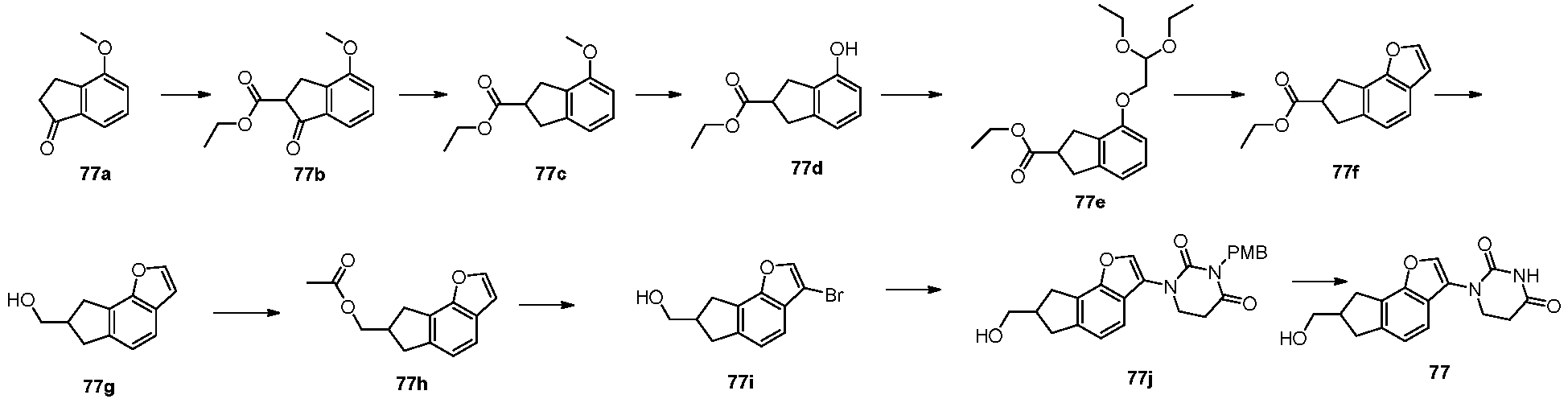
- 77a (100 g), diethyl carbonate (146 g), and tetrahydrofuran (2000 mL) were added to a reaction flask in sequence, and the mixture was cooled to 0 °C. Sodium hydride (49.3 g) was added in portions, and the mixture was reacted at room temperature for 3 h. After the reaction was completed, the reaction solution was slowly poured into ice water (3 L), and ethyl acetate was added for extraction. The organic phase was separated, dried over anhydrous sodium sulfate, and purified by silica gel column chromatography to give 77b (97 g).
- MS(ESI, [M+H]+) m/z: 235.13.
- 77b (95 g), 10% palladium on carbon (20 g), and ethanol (400 mL) were added to a reaction flask in sequence, and the mixture was purged with hydrogen and then warmed to 50 °C and reacted for 36 h. After the reaction was completed, the mixture was concentrated by rotary evaporation to remove the solvent, ethyl acetate and water were added, and the organic phase was separated, dried over anhydrous sodium sulfate, and purified by silica gel column chromatography to give 77c (60 g).
- MS(ESI, [M+H]+) m/z: 221.15.
- 77c (60 g) and tetrahydrofuran (500 mL) were added to a reaction flask in sequence, and the mixture was cooled to 0 °C. Boron tribromide (240 mL) was slowly added dropwise, and after the dropwise addition, the mixture was reacted for 3 h with the temperature maintained. After the reaction was completed, the reaction solution was slowly poured into ice water, and ethyl acetate was added for extraction. The organic phase was separated, dried over anhydrous sodium sulfate, and concentrated by evaporation under reduced pressure to remove the solvent, thus giving 77d (42 g).
- 77d (41 g), bromoacetaldehyde diethyl acetal (82 g), cesium carbonate (135 g), potassium iodide (6.89 g), and dimethylacetamide (300 mL) were added to a reaction flask in sequence, and the mixture was warmed to 90 °C and reacted for 3 h. After the reaction was completed, the mixture was added with water (800 mL) and extracted with ethyl acetate, washed with saturated brine, dried over anhydrous sodium sulfate, and filtered. The filtrate was concentrated, and the crude product was separated and purified by silica gel column chromatography to give intermediate 77e (55.4 g).
- 77e (55 g), chlorobenzene (200 mL), and phosphoric acid (83.6 g) were added to a reaction flask in sequence, and the mixture was reacted at 130 °C for 1 h. After the reaction was completed, the mixture was extracted with water (400 mL) and ethyl acetate, washed with saturated brine, dried over anhydrous sodium sulfate, and filtered. The filtrate was concentrated, and the crude product was separated and purified by silica gel column chromatography to give intermediate 77f (33 g).
- MS(ESI, [M+H]+) m/z: 231.10.
- 77f (33 g) and tetrahydrofuran (300 mL) were added to a reaction flask in sequence. The mixture was cooled to 0 °C, and a solution of lithium aluminum hydride in tetrahydrofuran (152 mL) was added dropwise. After the dropwise addition, the mixture was reacted for 2 h with the temperature maintained. After the reaction was completed, the reaction solution was slowly poured into ice water (600 mL), and ethyl acetate was added for extraction. The organic phase was separated, dried over anhydrous sodium sulfate, and concentrated by evaporation under reduced pressure to remove the solvent, thus giving 77g (30 g).
- 77g (30 g), dichloromethane (300 g), and DIPEA (41.2 g) were added to a reaction flask in sequence. The mixture was cooled to 0 °C, acetic anhydride (17.9 g) was slowly added dropwise, and the mixture was allowed to react at room temperature for 2 h. After the reaction was completed, water (400 mL) was added, the organic phase was separated, washed with a saturated ammonium chloride aqueous solution, dried over anhydrous sodium sulfate, and filtered, and the filtrate was concentrated to give intermediate 77h (29 g).
- 77h (30 g) and DCM (500 mL) were added to a reaction flask in sequence, and the mixture was cooled to 0 °C. Liquid bromine (21.86 g) was added, and the mixture was reacted at room temperature for 0.5 h. After the reaction was completed, the mixture was concentrated by rotary evaporation to remove the solvent. Ethanol (140 mL) and potassium hydroxide (21.93 g) were added to the residue, and the mixture was warmed to 70 °C and reacted for 0.5 h. After the reaction was completed, the reaction solution was poured into water, vigorously stirred, extracted with ethyl acetate, washed with saturated brine, dried over anhydrous sodium sulfate, and filtered. The filtrate was concentrated, and the crude product was separated by silica gel column chromatography to give intermediate 77i (33.6 g).
- 77i (4.35 g), 3-(4-methoxybenzyl)dihydropyrimidine-2,4(1H,3H)-dione (3.52 g), (1R,2R)-N1,N2-dimethylcyclohexane-1,2-diamine (0.88 g), copper(I) iodide (1.17 g), cesium carbonate (12.42 g), and 1,4-dioxane (100 mL) were added to a reaction flask in sequence, and the mixture was reacted at 120 °C for 15 h. After the reaction was completed, the reaction solution was concentrated and extracted with water and ethyl acetate, followed by liquid separation. The organic phase was washed with saturated brine, dried over anhydrous sodium sulfate, and filtered. The filtrate was concentrated, and the crude product was separated by silica gel column chromatography to give intermediate 77j (3.82 g).
- MS(ESI, [M+H]+) m/z: 421.11.
- 77j (3.82 g) and trifluoromethanesulfonic acid (40 mL) were added to a reaction flask in sequence, and the mixture was reacted at room temperature for 0.5 h. After the reaction was completed, the reaction solution was slowly added to water, and the mixture was adjusted to pH 7-8 with sodium bicarbonate and extracted with ethyl acetate. The organic phase was separated, washed with saturated brine, dried over anhydrous sodium sulfate, and filtered, and the filtrate was purified by silica gel column chromatography to give intermediate 77 (0.54 g).
- 1H NMR (500 MHz, DMSO-d6) δ 10.49 (s, 1H), 8.02 (s, 1H), 7.36 (d, J = 7.9 Hz, 1H), 7.13 (d, J = 8.0 Hz, 1H), 4.70 (t, J = 5.2 Hz, 1H), 3.82 (t, J = 6.7 Hz, 2H), 3.41 (ddd, J = 6.7, 5.3, 1.3 Hz, 2H), 3.10 (ddd, J = 35.6, 16.1, 8.2 Hz, 2H), 2.93 - 2.74 (m, 4H), 2.70 (dqd, J = 8.2, 6.8, 5.5 Hz, 1H).
-


- Intermediate 17c (8.25 g), intermediate 61b (8.60 g), N,N-diisopropylethylamine (14.85 g, 20.07 mL), dichloromethane (150 mL), and HATU (13.11 g) were added to a reaction flask in sequence, and the mixture was reacted at room temperature. After the reaction was completed, the reaction solution was concentrated by evaporation under reduced pressure to remove the solvent, and the residue was extracted with ethyl acetate (200 mL) and water (200 mL). The organic phase was separated, washed with saturated brine, dried over anhydrous sodium sulfate, and filtered, and the filtrate was purified by silica gel column chromatography to give intermediate 78a (9.82 g).
- MS(ESI, [M+H]+) m/z: 454.1.
- Intermediate 78a (3.48 g), dimethyl sulfoxide (20 mL), and 2-iodoxybenzoic acid (2.361 g) were added to a reaction flask in sequence, and the mixture was reacted at room temperature overnight. After the reaction was completed, ethyl acetate (100 mL) and water (200 mL) were added for extraction. The organic phase was separated, washed with saturated brine, dried over anhydrous sodium sulfate, and filtered, and the filtrate was concentrated by evaporation under reduced pressure to remove the solvent, thus giving intermediate 78b (3.22 g).
- MS(ESI, [M+H]+) m/z: 452.1.
- Intermediate 78b (1.0 g), DMA (30 mL), 3-hydroxyazetidine hydrochloride (0.41 g), and sodium acetate (0.46 g) were added to a reaction flask in sequence, and the mixture was heated to 80 °C. Sodium cyanoborohydride (0.47 g) was added, and the mixture was reacted for 2 h with the temperature maintained. After the reaction was completed, the reaction solution was added with water and ethyl acetate. The organic phase was separated, washed with saturated brine, dried over anhydrous sodium sulfate, filtered, and concentrated, and the residue was purified by silica gel column chromatography to give intermediate 78c (0.65 g).
- MS(ESI, [M+H]+) m/z: 509.2.
- Intermediate 78c (0.65 g), acetonitrile (50 mL), and 2-iodoxybenzoic acid (0.53 g) were added to a reaction flask in sequence, boron trifluoride diethyl etherate (1.81 g) was added dropwise, and the mixture was reacted at room temperature for 4 h. After the reaction was completed, ethyl acetate (100 mL) and water (200 mL) were added for extraction. The organic phase was separated, washed with saturated brine, dried over anhydrous sodium sulfate, and filtered, and the filtrate was concentrated by evaporation under reduced pressure to remove the solvent, thus giving intermediate 78d (0.69 g).
- MS(ESI, [M+H]+) m/z: 507.2.
- Intermediate 1 (70 mg), intermediate 78d (102 mg), sodium acetate (17.85 mg), 1,2-dichloroethane (5 mL), isopropanol (1 mL), and sodium cyanoborohydride (41.0 mg) were added to a reaction flask in sequence, and the mixture was reacted at room temperature. After the reaction was completed, a saturated sodium bicarbonate solution (2 mL) was added to the reaction solution to neutralize acetic acid, and then dichloromethane (50 mL) and water (100 mL) were added for extraction. The organic phase was separated, dried over anhydrous sodium sulfate, and filtered, and the filtrate was purified by silica gel column chromatography to give compound 78 (65 mg).
- MS(ESI, [M+H]+) m/z: 762.2.
- 1H NMR (500 MHz, DMSO-d6) δ 11.09 (s, 1H), 7.95 (d, J = 7.6 Hz, 1H), 7.86 (d, J = 8.8 Hz, 1H), 7.79 - 7.67 (m, 3H), 7.38 (d, J = 2.4 Hz, 1H), 7.31 (d, J = 8.1 Hz, 1H), 7.14 (dd, J = 8.7, 2.4 Hz, 1H), 6.93 (d, J = 8.7 Hz, 2H), 4.60 (dd, J = 11.9, 5.0 Hz, 1H), 4.53 (q, J = 5.4 Hz, 1H), 4.16 (s, 2H), 4.05 (t, J = 2.4 Hz, 2H), 3.80 (s, 1H), 3.67 (d, J = 12.3 Hz, 2H), 3.53 (q, J = 6.3 Hz, 1H), 3.43 (s, 2H), 3.34 (s, 1H), 3.04 (s, 2H), 2.91 (t, J = 10.8 Hz, 2H), 2.77 (ddd, J = 17.2, 11.9, 5.3 Hz, 1H), 2.65 - 2.57 (m, 1H), 2.27 (s, 1H), 2.24 - 2.16 (m, 1H), 2.10 (d, J = 10.6 Hz, 2H), 1.89 (d, J = 11.1 Hz, 2H), 1.73 (d, J = 11.7 Hz, 2H), 1.59 - 1.43 (m, 4H), 1.30 - 1.21 (m, 2H).
-


- Intermediate 5 (82 mg), intermediate 78d (105 mg), sodium acetate (16.45 mg), 1,2-dichloroethane (5 mL), isopropanol (1 mL), and sodium cyanoborohydride (44.3 mg) were added to a reaction flask in sequence, and the mixture was reacted at room temperature. After the reaction was completed, a saturated sodium bicarbonate solution (2 mL) was added to the reaction solution to neutralize acetic acid, and then dichloromethane (50 mL) and water (100 mL) were added for extraction. The organic phase was separated, dried over anhydrous sodium sulfate, and filtered, and the filtrate was purified by silica gel column chromatography to give compound 79 (65 mg).
- MS(ESI, [M+H]+) m/z: 790.4.
- 1H NMR (500 MHz, DMSO-d6) δ 11.07 (s, 1H), 7.96 (d, J= 7.6 Hz, 1H), 7.86 (d, J = 8.7 Hz, 1H), 7.72 (d, J = 8.4 Hz, 2H), 7.55 (d, J = 7.9 Hz, 1H), 7.38 (d, J = 2.4 Hz, 1H), 7.23 - 7.11 (m, 2H), 6.93 (d, J = 8.5 Hz, 2H), 4.54 (dt, J = 12.5, 6.1 Hz, 2H), 3.85 - 3.62 (m, 3H), 3.49 (s, 2H), 3.15 (d, J = 5.5 Hz, 2H), 3.09 - 2.97 (m, 3H), 2.89 (t, J = 11.4 Hz, 2H), 2.77 (ddd, J = 17.0, 11.8, 5.2 Hz, 2H), 2.60 (dt, J = 17.5, 4.5 Hz, 1H), 2.50 - 2.37 (m, 7H), 2.18 (dq, J = 13.2, 4.5 Hz, 1H), 2.10 (d, J = 10.6 Hz, 2H), 1.89 (d, J = 9.1 Hz, 2H), 1.75 (s, 2H), 1.52 (tt, J = 13.9, 7.4 Hz, 4H), 1.34 - 1.21 (m, 2H).
-
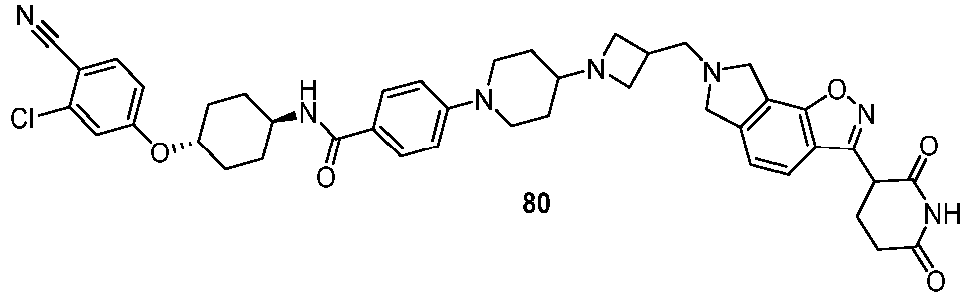

- Intermediate 78b (0.95 g), DMA (30 mL), 3-hydroxymethylazacyclobutadiene hydrochloride (0.46 g), and sodium acetate (0.52 g) were added to a reaction flask in sequence, and the mixture was stirred at room temperature for 10 min. Sodium cyanoborohydride (0.55 g) was added, and the mixture was reacted at room temperature for 2 h. After the reaction was completed, the reaction solution was added with water and ethyl acetate. The organic phase was separated, washed with saturated brine, dried over anhydrous sodium sulfate, filtered, and concentrated, and the residue was purified by silica gel column chromatography to give intermediate 80a (0.84 g).
- Intermediate 80a (0.81 g), acetonitrile (50 mL), and 2-iodoxybenzoic acid (0.72 g) were added to a reaction flask in sequence, boron trifluoride diethyl etherate (2.42 g) was added dropwise, and the mixture was reacted at room temperature for 4 h. After the reaction was completed, ethyl acetate (100 mL) and water (200 mL) were added for extraction. The organic phase was separated, washed with saturated brine, dried over anhydrous sodium sulfate, and filtered, and the filtrate was concentrated by evaporation under reduced pressure to remove the solvent, thus giving intermediate 80b (0.69 g).
- Intermediate 80b (108 mg), compound 1 (114 mg), sodium acetate (13.49 mg), 1,2-dichloroethane (5 mL), isopropanol (1 mL), and sodium cyanoborohydride (43.3 mg) were added to a reaction flask in sequence, and the mixture was reacted at room temperature. After the reaction was completed, a saturated sodium bicarbonate solution (2 mL) was added to the reaction solution to neutralize acetic acid, and then dichloromethane (50 mL) and water (100 mL) were added for extraction. The organic phase was separated, dried over anhydrous sodium sulfate, and filtered, and the filtrate was purified by silica gel column chromatography to give compound 80 (75 mg).
- MS(ESI, [M+H]+) m/z: 776.2.
- 1H NMR (500 MHz, DMSO-d6) δ 11.08 (s, 1H), 7.96 (d, J = 7.6 Hz, 1H), 7.86 (d, J = 8.7 Hz, 1H), 7.72 (t, J = 8.6 Hz, 3H), 7.38 (d, J = 2.4 Hz, 1H), 7.29 (d, J = 8.1 Hz, 1H), 7.14 (dd, J = 8.9, 2.4 Hz, 1H), 6.93 (d, J = 8.6 Hz, 2H), 4.56 (ddd, J = 34.2, 11.0, 5.1 Hz, 2H), 4.12 (s, 2H), 4.01 (s, 2H), 3.84 - 3.64 (m, 3H), 3.43 (s, 4H), 2.98 - 2.70 (m, 7H), 2.62 (td, J = 14.3, 13.0, 7.5 Hz, 2H), 2.54 (d, J = 4.4 Hz, 1H), 2.49 - 2.45 (m, 1H), 2.20 (dq, J = 13.5, 4.7 Hz, 1H), 2.15 - 2.07 (m, 2H), 1.93 - 1.86 (m, 2H), 1.73 (s, 2H), 1.58 - 1.44 (m, 4H).
-


- Intermediate 3 (70 mg), intermediate 80b (113 mg), sodium acetate (17.85 mg), 1,2-dichloroethane (5 mL), isopropanol (1 mL), and sodium cyanoborohydride (27.3 mg) were added to a reaction flask in sequence, and the mixture was reacted at room temperature. After the reaction was completed, dichloromethane (50 mL) and water (100 mL) were added for extraction. The organic phase was separated, dried over anhydrous sodium sulfate, and filtered, and the filtrate was purified by silica gel column chromatography to give the target intermediate 81a (47 mg).
- MS(ESI, [M+H]+) m/z: 790.2.
- Intermediate 81a (47 mg), maleic acid (7.59 mg), and MeOH/DCM (v:v = 1/10, 5 mL) were added to a reaction flask in sequence, and after complete dissolution, the reaction solution was concentrated. The reaction solution was slurried with petroleum ether (10 mL) and filtered under vacuum to give compound 81 (38 mg).
- MS(ESI, [M+H]+) m/z: 790.2.
- 1H NMR (500 MHz, DMSO-d6) δ 11.09 (s, 1H), 10.16 (s, 1H), 7.99 (d, J = 7.6 Hz, 1H), 7.86 (d, J = 8.7 Hz, 1H), 7.75 (d, J = 8.3 Hz, 2H), 7.65 (d, J = 8.1 Hz, 1H), 7.38 (s, 1H), 7.19 (d, J = 8.3 Hz, 1H), 7.14 (d, J = 8.9 Hz, 1H), 6.98 (d, J = 8.5 Hz, 2H), 6.12 (s, 2H), 4.62 - 4.49 (m, 2H), 4.24 (d, J = 9.8 Hz, 2H), 4.05 (s, 2H), 3.97 (d, J = 12.6 Hz, 4H), 3.80 (s, 1H), 3.42 (s, 3H), 3.01 (d, J = 32.0 Hz, 6H), 2.78 (t, J = 13.3 Hz, 3H), 2.61 (d, J = 18.6 Hz, 1H), 2.23 - 2.16 (m, 1H), 2.11 (d, J = 10.6 Hz, 2H), 1.98 (d, J = 11.7 Hz, 2H), 1.89 (d, J = 11.0 Hz, 2H), 1.51 (q, J = 13.1 Hz, 4H), 1.44 - 1.35 (m, 2H).
-


- Intermediate 80b (147 mg), 1,2-dichloroethane (6 mL), isopropanol (2 mL), intermediate 4 (70 mg), sodium acetate (17 mg), and sodium triacetoxyborohydride (165 mg) were added to a reaction flask in sequence, and the mixture was stirred at room temperature. After the reaction was completed, dichloromethane (50 mL) and water (100 mL) were added for extraction. The organic phase was separated, washed with saturated brine, dried over anhydrous sodium sulfate, filtered, and concentrated, and the residue was purified by silica gel column chromatography to give compound 82a (30 mg).
- MS(ESI, [M+H]+) m/z: 790.62.
- 82a (30 mg), maleic acid (5 mg), and MeOH/DCM (v:v = 1/10, 5 mL) were added to a reaction flask in sequence, and after complete dissolution, the reaction solution was concentrated. The reaction solution was slurried with petroleum ether and filtered under vacuum to give compound 82 (15 mg).
- MS(ESI, [M+H]+) m/z: 790.21.
- 1H NMR (500 MHz, DMSO-d6) δ 11.08 (s, 1H), 9.09 (s, 1H), 7.98 (d, J = 7.6 Hz, 1H), 7.86 (d, J = 8.7 Hz, 1H), 7.75 (d, J = 8.3 Hz, 2H), 7.57 (d, J = 8.0 Hz, 1H), 7.38 (s, 1H), 7.21 (d, J = 8.1 Hz, 1H), 7.14 (d, J = 8.8 Hz, 1H), 6.97 (d, J = 8.5 Hz, 2H), 6.02 (s, 2H), 4.55 (dd, J = 12.4, 5.3 Hz, 2H), 3.97 (d, J = 12.1 Hz, 2H), 3.80 (s, 1H), 3.14 (d, J = 56.1 Hz, 6H), 3.00 - 2.56 (m, 10H), 2.22 - 2.06 (m, 3H), 2.04 - 1.78 (m, 6H), 1.76 - 1.36 (m, 8H).
-


- Intermediate 80b (98 mg), intermediate 5 (84 mg), sodium acetate (11.25 mg), 1,2-dichloroethane (5 mL), isopropanol (1 mL), and sodium cyanoborohydride (38.4 mg) were added to a reaction flask in sequence, and the mixture was reacted at room temperature. After the reaction was completed, a saturated sodium bicarbonate solution (2 mL) was added to the reaction solution to neutralize acetic acid, and then dichloromethane (50 mL) and water (100 mL) were added for extraction. The organic phase was separated, dried over anhydrous sodium sulfate, and filtered, and the filtrate was purified by silica gel column chromatography to give intermediate 83a (78 mg).
- MS(ESI, [M+H]+) m/z: 804.2.
- 83a (78 mg), dichloromethane (10 mL), and methanol (1 mL) were added to a reaction flask in sequence. After complete dissolution by stirring, maleic acid (6.4 mg) was added, and the mixture was stirred at room temperature for 10 min. The mixture was concentrated and then slurried with petroleum ether to give compound 83 (74 mg).
- 1H NMR (500 MHz, DMSO-d6) δ 11.08 (s, 1H), 7.99 (d, J = 7.6 Hz, 1H), 7.86 (d, J = 8.7 Hz, 1H), 7.76 (d, J = 8.4 Hz, 2H), 7.58 (d, J = 8.0 Hz, 1H), 7.38 (d, J = 2.4 Hz, 1H), 7.22 (d, J = 8.1 Hz, 1H), 7.14 (dd, J = 8.8, 2.5 Hz, 1H), 6.98 (d, J = 8.5 Hz, 2H), 6.04 (s, 2H), 4.55 (td, J = 9.9, 7.9, 5.0 Hz, 2H), 4.17 (t, J = 9.1 Hz, 2H), 4.02 - 3.74 (m, 5H), 3.21 (s, 2H), 3.14 - 3.07 (m, 2H), 2.97 (s, 3H), 2.91 - 2.73 (m, 6H), 2.61 (dt, J = 17.3, 4.3 Hz, 1H), 2.53 (s, 1H), 2.50 - 2.44 (m, 2H), 2.22 - 2.06 (m, 3H), 1.93 (dd, J = 35.7, 11.5 Hz, 4H), 1.59 - 1.44 (m, 4H), 1.34 (tt, J = 13.0, 9.3, 7.7 Hz, 2H).
-


- Intermediate 78b (1 g), 4-hydroxypiperidine (0.227 g), 1,2-dichloroethane (5 mL), isopropanol (1 mL), and sodium cyanoborohydride (0.352 g) were added to a reaction flask in sequence, and the mixture was heated to 80 °C and reacted. After the reaction was completed, dichloromethane (100 mL) and water (100 mL) were added for extraction. The organic phase was separated, dried over anhydrous sodium sulfate, and filtered, and the filtrate was purified by silica gel column chromatography to give the target intermediate 84a (0.775 g).
- MS(ESI, [M+H]+) m/z: 537.3.
- 1H NMR (500 MHz, DMSO-d6) δ 8.00 (d, J = 7.6 Hz, 1H), 7.86 (d, J = 8.7 Hz, 1H), 7.74 (d, J = 8.5 Hz, 2H), 7.39 (d, J = 2.4 Hz, 1H), 7.14 (dd, J = 8.8, 2.4 Hz, 1H), 6.96 (d, J = 8.3 Hz, 2H), 4.99 (s, 1H), 4.54 (td, J = 9.9, 4.6 Hz, 1H), 4.07 - 3.73 (m, 4H), 3.57 (s, 1H), 3.17 (d, J = 3.4 Hz, 1H), 2.76 (t, J = 12.4 Hz, 2H), 2.23 - 1.38 (m, 19H).
- Intermediate 84a (550 mg), 2-iodoxybenzoic acid (430 mg), acetonitrile (10 mL), and boron trifluoride diethyl etherate (1453 mg, 1.264 mL) were added to a reaction flask in sequence, and the mixture was reacted at room temperature. After the reaction was completed, ethyl acetate (200 mL) and a saturated sodium bicarbonate solution (200 mL) were added for extraction. The organic phase was dried over anhydrous sodium sulfate, filtered, and concentrated to give the target intermediate 84b (400 mg).
- MS(ESI, [M+H]+) m/z: 535.4.
- Intermediate 1 (60 mg), intermediate 84b (100 mg), sodium acetate (15.99 mg), 1,2-dichloroethane (5 mL), isopropanol (1 mL), and sodium cyanoborohydride (36.8 mg) were added to a reaction flask in sequence, and the mixture was heated to 80 °C and reacted. After the reaction was completed, dichloromethane (50 mL) and water (100 mL) were added for extraction. The organic phase was separated, dried over anhydrous sodium sulfate, and filtered, and the filtrate was purified by silica gel column chromatography to give the target intermediate 84c (42 mg).
- MS(ESI, [M+H]+) m/z: 790.2.
- Intermediate 84c (42 mg), maleic acid (6.78 mg), and MeOH/DCM (v:v = 1/10, 5 mL) were added to a reaction flask in sequence, and after complete dissolution, the reaction solution was concentrated. The reaction solution was slurried with petroleum ether (10 mL) and filtered under vacuum to give compound 84 (27 mg).
- MS(ESI, [M+H]+) m/z: 790.2.
- 1H NMR (500 MHz, DMSO-d6) δ 11.11 (s, 1H), 9.46 (s, 2H), 8.00 (d, J = 7.6 Hz, 1H), 7.86 (d, J = 8.7 Hz, 1H), 7.83 - 7.67 (m, 3H), 7.38 (s, 2H), 7.14 (d, J = 8.9 Hz, 1H), 6.99 (d, J = 8.5 Hz, 2H), 6.18 (s, 2H), 4.63 (dd, J = 11.9, 4.9 Hz, 1H), 4.58 - 4.38 (m, 3H), 4.26 (dd, J = 58.3, 20.8 Hz, 2H), 4.03 (d, J = 12.4 Hz, 2H), 3.80 (s, 2H), 3.71 - 3.58 (m, 2H), 3.44 (s, 3H), 3.05 (s, 3H), 2.85 - 2.74 (m, 3H), 2.66 - 2.59 (m, 1H), 2.33 (d, J = 12.9 Hz, 1H), 2.23 - 2.18 (m, 1H), 2.11 (d, J = 10.8 Hz, 4H), 1.89 (d, J = 11.2 Hz, 3H), 1.72 (s, 2H), 1.51 (q, J = 14.4, 13.8 Hz, 4H).
-


- Intermediate 5 (100 mg), acetonitrile (10 mL), tert-butyl 4-oxopiperidine-1-carboxylate (178 mg), sodium acetate (24 mg), and sodium cyanoborohydride (94 mg) were added to a reaction flask in sequence, and the mixture was stirred at 80 °C. After the reaction was completed, dichloromethane (50 mL) and water (100 mL) were added for extraction. The organic phase was separated, washed with saturated brine, dried over anhydrous sodium sulfate, filtered, and concentrated, and the residue was purified by silica gel column chromatography to give compound 85a (110 mg).
- 85a (110 mg), DCM (10 mL), and trifluoroacetic acid (2 mL) were added to a reaction flask in sequence and reacted at room temperature. After the reaction was completed, the reaction solution was concentrated to give compound 85b (198 mg).
- MS(ESI, [M+H]+) m/z: 383.2.
- Intermediate 78b (140 mg), acetonitrile (10 mL), 85b (189 mg), sodium acetate (76 mg), and sodium cyanoborohydride (58 mg) were added to a reaction flask in sequence, and the mixture was stirred at 80 °C. After the reaction was completed, dichloromethane (50 mL) and water (100 mL) were added for extraction. The organic phase was separated, washed with saturated brine, dried over anhydrous sodium sulfate, filtered, and concentrated, and the residue was purified by silica gel column chromatography to give compound 85c (45 mg).
- MS(ESI, [M+H]+) m/z: 818.2.
- 85c (45 mg), maleic acid (6 mg), and MeOH/DCM (v:v = 1/10, 5 mL) were added to a reaction flask in sequence, and after complete dissolution, the reaction solution was concentrated. The reaction solution was slurried with petroleum ether and filtered under vacuum to give compound 85 (48 mg).
- MS(ESI, [M+H]+) m/z: 818.19.
- 1H NMR (500 MHz, DMSO-d6) δ 11.08 (s, 1H), 9.09 (s, 1H), 7.98 (d, J = 7.6 Hz, 1H), 7.86 (d, J = 8.7 Hz, 1H), 7.75 (d, J = 8.3 Hz, 2H), 7.57 (d, J = 8.0 Hz, 1H), 7.38 (s, 1H), 7.21 (d, J = 8.1 Hz, 1H), 7.14 (d, J = 8.8 Hz, 1H), 6.97 (d, J = 8.5 Hz, 2H), 6.02 (s, 2H), 4.55 (dd, J = 12.4, 5.3 Hz, 2H), 3.97 (d, J = 12.1 Hz, 2H), 3.80 (s, 1H), 3.14 (d, J = 56.1 Hz, 6H), 3.00 - 2.56 (m, 10H), 2.22 - 2.06 (m, 3H), 2.04 - 1.78 (m, 6H), 1.76 - 1.36 (m, 8H).
-


- 87b (150 mg), intermediate 1 (81 mg), sodium acetate (46 mg), 1,2-dichloroethane (10 mL), and isopropanol (2 mL) were added to a reaction flask in sequence, and the mixture was stirred at room temperature for 10 min. Sodium triacetoxyborohydride (58 mg) was then added, and the mixture was reacted at room temperature for 2 h. After the reaction was completed, a saturated sodium bicarbonate solution was added to the reaction system to quench the reaction, and the mixture was extracted with dichloromethane. The organic layer was collected, dried over anhydrous sodium sulfate, and filtered. The filtrate was concentrated, and then the residue was purified by silica gel column chromatography (dichloromethane/methanol) to give the target compound 86 (14 mg).
- MS(ESI, [M+H]+) m/z: 806.51.
- 1H NMR (500 MHz, DMSO-d6) δ 11.11 (s, 1H), 8.61 (d, J = 8.2 Hz, 1H), 7.86 (dd, J = 21.2, 9.1 Hz, 2H), 7.73 (d, J = 8.1 Hz, 1H), 7.45 - 7.35 (m, 2H), 7.32 (d, J = 8.1 Hz, 1H), 7.16 (dd, J = 8.7, 2.4 Hz, 1H), 4.68 - 4.47 (m, 4H), 4.14 (s, 2H), 4.04 (s, 2H), 3.88 (d, J = 10.0 Hz, 1H), 3.02 (t, J = 12.6 Hz, 2H), 2.91 (s, 2H), 2.80 (ddd, J = 17.3, 11.7, 5.3 Hz, 1H), 2.64 (dd, J = 16.1, 6.1 Hz, 4H), 2.30 - 2.18 (m,2H), 2.18 - 2.08 (m, 2H), 1.93 (d, J = 13.1 Hz, 4H), 1.81 (d, J = 12.3 Hz, 2H), 1.67 (q, J = 12.3 Hz, 2H), 1.53 (dt, J = 25.5, 12.0 Hz, 5H), 1.24 - 1.07 (m, 4H).
-
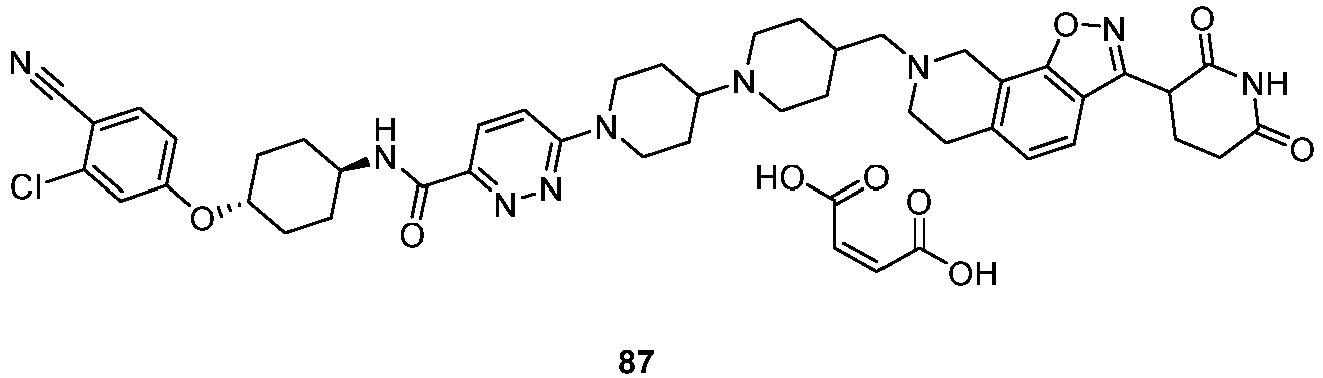

- 22d (2.0 g), 4-hydroxymethylpiperidine (0.56 g), and N,N-dimethylacetamide (20 mL) were added to a reaction flask in sequence, sodium cyanoborohydride (6.65 g) was added in portions, and the mixture was reacted at 80 °C for 8 h. After the reaction was completed, the reaction solution was cooled to room temperature, diluted with ethyl acetate, and washed with an potassium carbonate aqueous solution and a saturated sodium chloride solution in sequence, the organic layer was collected, dried over anhydrous sodium sulfate, and filtered. The filtrate was concentrated, and then the residue was purified by silica gel column chromatography (dichloromethane/methanol) to give the target intermediate 87a (1.2 g).
- MS(ESI, [M+H]+) m/z: 553.55.
- 87a (1.5 g), 2-iodoxybenzoic acid (1.5 g), and dimethyl sulfoxide (15 mL) were added to a reaction flask in sequence, and the mixture was reacted at 50 °C for 6 h. After the reaction was completed, the reaction solution was cooled to room temperature, quenched with a saturated sodium bicarbonate solution, and diluted with ethyl acetate. The organic layer was separated and washed with an sodium thiosulfate aqueous solution and a saturated sodium chloride solution in sequence. The organic layer was collected, dried over anhydrous sodium sulfate, and filtered. The filtrate was concentrated, and then the residue was purified by silica gel column chromatography (dichloromethane/methanol) to give the target intermediate 87b (0.32 g).
- MS(ESI, [M+H]+) m/z: 551.2.
- 87b (70 mg), intermediate 3 (40 mg), sodium acetate (21 mg), 1,2-dichloroethane (10 mL), and isopropanol (2 mL) were added to a reaction flask in sequence, and the mixture was stirred at room temperature for 10 min. Sodium triacetoxyborohydride (24 mg) was then added, and the mixture was reacted at room temperature for 2 h. After the reaction was completed, a saturated sodium bicarbonate solution was added to the reaction system to quench the reaction, and the mixture was extracted with dichloromethane. The organic layer was collected, dried over anhydrous sodium sulfate, and filtered. The filtrate was concentrated, and then the residue was purified by silica gel column chromatography (dichloromethane/methanol) to give the target compound 87c (30 mg).
- MS(ESI, [M+H]+) m/z: 820.2.
- Intermediate 87c (30 mg), dichloromethane (10 mL), methanol (1 mL), and maleic acid (4.24 mg) were added to a reaction flask in sequence, and the mixture was reacted at room temperature for 1 h. After the reaction was completed, the mixture was concentrated by evaporation under reduced pressure to remove the solvent. The residue was slurried with petroleum ether and filtered, and the filter cake was collected to give compound 87 (30 mg). MS(ESI, [M+H]+) m/z: 820.2.
- 1H NMR (500 MHz, DMSO-d6) δ11.09 (s, 1H), 8.98 (s, 1H), 8.61 (d, J = 8.3 Hz, 1H), 7.86 (t, J = 8.6 Hz, 2H), 7.65 (d, J = 8.2 Hz, 1H), 7.45 (d, J = 9.5 Hz, 1H), 7.38 (d, J = 2.4 Hz, 1H), 7.19 (d, J = 8.3 Hz, 1H), 7.13 (dd, J = 8.6, 2.5 Hz, 1H), 6.09 (s, 2H), 4.67 (d, J = 13.2 Hz, 2H), 4.54 (ddt, J = 19.2, 10.1, 4.7 Hz, 2H), 4.02 (d, J = 44.0 Hz, 2H), 3.86 (d, J = 10.0 Hz, 1H), 3.60 - 3.46 (m, 3H), 3.03 (d, J = 13.4 Hz, 8H), 2.77 (ddd, J = 17.4, 12.0, 5.4 Hz, 2H), 2.70 - 2.57 (m, 2H), 2.15 (dt, J = 43.5, 8.2 Hz, 6H), 2.02 (d, J = 13.9 Hz, 2H), 1.94 - 1.85 (m, 2H), 1.64 (q, J = 12.4, 11.8 Hz, 4H), 1.52 (q, J = 12.1 Hz,3H), 1.43 - 1.32 (m, 2H).
-


- 87b (150 mg), intermediate 4 (87 mg), sodium acetate (46 mg), 1,2-dichloroethane (10 mL), and isopropanol (2 mL) were added to a reaction flask in sequence, and the mixture was stirred at room temperature for 10 min. Sodium triacetoxyborohydride (52 mg) was then added, and the mixture was reacted at room temperature for 2 h. After the reaction was completed, a saturated sodium bicarbonate solution was added to the reaction system to quench the reaction, and the mixture was extracted with dichloromethane. The organic layer was collected, dried over anhydrous sodium sulfate, and filtered. The filtrate was concentrated, and then the residue was purified by silica gel column chromatography (dichloromethane/methanol) to give the target compound 88 (13 mg).
- MS(ESI, [M+H]+) m/z: 820.49.
- 1H NMR (500 MHz, DMSO-d6) δ 11.07 (s, 1H), 8.58 (d, J = 8.2 Hz, 1H), 7.83 (dd, J = 21.2, 9.1 Hz, 2H), 7.56 (d, J = 8.1 Hz, 1H), 7.42 - 7.31 (m, 2H), 7.16 - 7.04 (m, 2H), 4.54 (td, J = 11.6, 5.9 Hz, 4H), 3.86 (dtd, J = 11.7, 7.6, 4.1 Hz, 1H), 3.67 (s, 2H), 2.98 (q, J = 9.5, 6.9 Hz, 4H), 2.83 (d, J = 29.6 Hz, 2H), 2.76 (dt, J = 17.9, 6.0 Hz, 3H), 2.60 (dt, J = 17.3, 4.3 Hz, 2H), 2.53 (d, J = 8.8 Hz, 0.5H), 2.48 - 2.44 (m, 0.5H), 2.34 (d, J = 7.3 Hz, 2H), 2.18 (dq, J = 14.1, 5.2, 4.7 Hz, 2H), 2.13 - 2.06 (m, 2H), 1.94 - 1.81 (m, 4H), 1.74 (s, 2H), 1.68 - 1.38 (m, 8H), 1.13 (s, 2H). Example 89: Synthesis of Compound 89

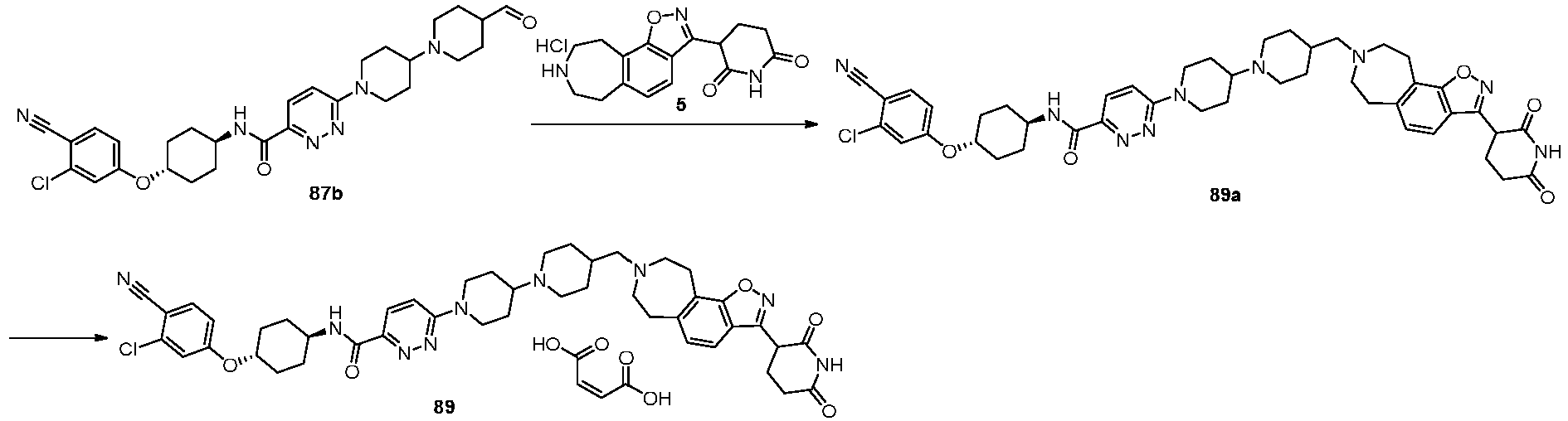
- Intermediate 5 (170 mg), intermediate 87b (279 mg), sodium acetate (41.5 mg), 1,2-dichloroethane (5 mL), isopropanol (1 mL), and sodium triacetoxyborohydride (215 mg) were added to a reaction flask in sequence, and the mixture was reacted at room temperature. After the reaction was completed, dichloromethane (50 mL) and water (100 mL) were added for extraction. The organic phase was separated, dried over anhydrous sodium sulfate, and filtered, and the filtrate was purified by silica gel column chromatography to give the target intermediate 89a (43 mg).
- MS(ESI, [M+H]+) m/z: 834.2.
- Intermediate 89a (43 mg), maleic acid (5.84 mg), and MeOH/DCM (v:v = 1/10, 5 mL) were added to a reaction flask in sequence, and after complete dissolution, the reaction solution was concentrated. The reaction solution was slurried with petroleum ether (10 mL) and filtered under vacuum to give compound 89 (48 mg).
- MS(ESI, [M+H]+) m/z: 834.2.
- 1H NMR (500 MHz, DMSO-d6) δ 11.09 (s, 1H), 10.17 (s, 1H), 8.61 (d, J = 8.2 Hz, 1H), 7.94 - 7.79 (m, 2H), 7.63 (d, J = 7.9 Hz, 1H), 7.48 - 7.34 (m, 2H), 7.26 (d, J = 7.9 Hz, 1H), 7.13 (d, J = 8.8 Hz, 1H), 6.05 (s, 2H), 4.67 (d, J = 13.1 Hz, 2H), 4.61 - 4.49 (m, 2H), 3.91 - 3.83 (m, 1H), 3.64 - 3.40 (m, 7H), 3.22 (s, 3H), 3.01 (dd, J = 30.9, 17.9 Hz, 6H), 2.87 - 2.71 (m, 2H), 2.61 (d, J = 17.8 Hz, 2H), 2.14 (dt, J = 56.0, 17.2 Hz, 8H), 1.90 (d, J = 12.2 Hz, 2H), 1.60 (ddd, J = 72.3, 25.0, 12.4 Hz, 8H).
-


- Intermediate 1 (120 mg), tert-butyl 3-formylazetidine-1-carboxylate (164 mg), sodium acetate (73 mg), 1,2-dichloroethane (10 mL), and isopropanol (2 mL) were added to a reaction flask in sequence, and the mixture was stirred at room temperature for 10 min. Sodium triacetoxyborohydride (188 mg) was then added, and the mixture was reacted at room temperature for 2 h. After the reaction was completed, a saturated sodium bicarbonate solution was added to the reaction system to quench the reaction, and the mixture was extracted with dichloromethane. The organic layer was collected, dried over anhydrous sodium sulfate, and filtered. The filtrate was concentrated, and then the residue was purified by silica gel column chromatography (dichloromethane/methanol) to give the target compound 90a (110 mg).
- 90a (100 mg), dichloromethane (2 mL), and trifluoroacetic acid (2 mL) were added to a reaction flask in sequence, and the mixture was reacted at room temperature for 2 h. After the reaction was completed, the mixture was concentrated to remove the solvent, thus giving 90b. The crude product was directly used in the next step. MS(ESI, [M+H]+) m/z: 341.2.
- 90b (160 mg), compound 22d (264 mg), sodium acetate (80 mg), and acetonitrile (20 mL) were added to a reaction flask in sequence, and the mixture was stirred at room temperature for 10 min. Sodium cyanoborohydride (61 mg) was then added, and the mixture was reacted at room temperature for 2 h. After the reaction was completed, a saturated sodium bicarbonate solution was added to the reaction system to quench the reaction, and the mixture was extracted with dichloromethane. The organic layer was collected, dried over anhydrous sodium sulfate, and filtered. The filtrate was concentrated, and then the residue was purified by silica gel column chromatography (dichloromethane/methanol) to give the target compound 90c (45 mg).
- MS(ESI, [M+H]+) m/z: 778.3.
- Intermediate 90c (45 mg), dichloromethane (10 mL), methanol (1 mL), and maleic acid (7.4 mg) were added to a reaction flask in sequence, and the mixture was reacted at room temperature for 1 h. After the reaction was completed, the mixture was concentrated by evaporation under reduced pressure to remove the solvent by using a rotary evaporator. The residue was slurried with petroleum ether and filtered, and the filter cake was collected to give compound 90 (30 mg).
- MS(ESI, [M+H]+) m/z: 778.51.
- 1H NMR (500 MHz, DMSO-d6) δ 11.10 (s, 1H), 8.61 (d, J = 8.2 Hz, 1H), 7.96 - 7.69 (m, 3H), 7.45 (d, J = 9.1 Hz, 1H), 7.38 (d, J = 2.4 Hz, 1H), 7.36 - 7.30 (m, 1H), 7.13 (dd, J = 8.7, 2.5 Hz, 1H), 6.13 (s, 2H), 4.72 - 4.47 (m, 4H), 4.40 - 4.12 (m, 5H), 3.93 (d, J = 58.6 Hz, 3H), 3.56 (q, J = 20.9, 19.8 Hz, 2H), 3.20 - 3.09 (m, 3H), 3.03 (t, J = 12.7 Hz, 3H), 2.78 (ddd, J = 17.5, 11.9, 5.4 Hz, 1H), 2.62 (d, J = 18.2 Hz, 1H), 2.25 - 2.16 (m, 1H), 2.15 - 1.98 (m, 4H), 1.96 - 1.84 (m, 2H), 1.58 (dq, J = 62.0, 12.3 Hz, 4H), 1.41 - 1.27 (m, 2H).
-


- Intermediate 22d (0.87 g), DMA (30 mL), 3-hydroxymethylazacyclobutadiene hydrochloride (0.44 g), and sodium acetate (0.51 g) were added to a reaction flask in sequence. The mixture was stirred at room temperature for 10 min, sodium cyanoborohydride (0.55 g) was added, and the mixture was reacted at room temperature for 2 h. After the reaction was completed, the reaction solution was added with water and ethyl acetate. The organic phase was separated, washed with saturated brine, dried over anhydrous sodium sulfate, filtered, and concentrated, and the residue was purified by silica gel column chromatography to give intermediate 91a (0.78 g).
- Intermediate 91a (0.75 g), acetonitrile (50 mL), and 2-iodoxybenzoic acid (0.75 g) were added to a reaction flask in sequence, boron trifluoride diethyl etherate (2.32 g) was added dropwise, and the mixture was reacted at room temperature for 4 h. After the reaction was completed, ethyl acetate (100 mL) and water (200 mL) were added for extraction. The organic phase was separated, washed with saturated brine, dried over anhydrous sodium sulfate, and filtered, and the filtrate was concentrated by evaporation under reduced pressure to remove the solvent, thus giving intermediate 91b (0.52 g).
- Intermediate 91b (98 mg), intermediate 3 (92 mg), sodium acetate (11.44 mg), 1,2-dichloroethane (5 mL), isopropanol (1 mL), and sodium cyanoborohydride (32.4 mg) were added to a reaction flask in sequence, and the mixture was reacted at room temperature. After the reaction was completed, a saturated sodium bicarbonate solution (2 mL) was added to the reaction solution to neutralize acetic acid, and then dichloromethane (50 mL) and water (100 mL) were added for extraction. The organic phase was separated, dried over anhydrous sodium sulfate, and filtered, and the filtrate was purified by silica gel column chromatography to give compound 91 (62 mg). MS(ESI, [M+H]+) m/z: 792.2.
- 1H NMR (500 MHz, DMSO-d6) δ 11.08 (s, 1H), 8.58 (d, J = 8.2 Hz, 1H), 7.85 (d, J = 8.7 Hz, 1H), 7.80 (d, J = 9.5 Hz, 1H), 7.58 (d, J = 8.1 Hz, 1H), 7.38 (d, J = 2.4 Hz, 1H), 7.34 (d, J = 9.6 Hz, 1H), 7.13 (dd, J = 8.7, 2.7 Hz, 2H), 4.54 (ddt, J = 14.3, 9.8, 4.5 Hz, 2H), 4.19 (d, J = 12.1 Hz, 2H), 3.86 (dtd, J = 11.4, 7.6, 4.0 Hz, 1H), 3.78 (s, 2H), 3.44 (s, 2H), 3.23 (s, 3H), 2.99 - 2.81 (m, 4H), 2.74 (q, J = 5.5 Hz, 6H), 2.60 (dt, J = 17.2, 4.3 Hz, 1H), 2.46 (dd, J = 12.3, 4.3 Hz, 1H), 2.18 (dq, J = 13.6, 4.7 Hz, 1H), 2.15 - 2.06 (m, 2H), 1.95 - 1.85 (m, 2H), 1.74 (d, J = 12.3 Hz, 2H), 1.64 (qd, J = 13.0, 3.1 Hz, 2H), 1.57 - 1.46 (m, 2H), 1.24 - 1.15 (m, 2H).
-


- Intermediate 4 (130 mg), tert-butyl 3-formylazetidine-1-carboxylate (200 mg), sodium acetate (80 mg), 1,2-dichloroethane (10 mL), and isopropanol (2 mL) were added to a reaction flask in sequence, and the mixture was stirred at room temperature for 10 min. Sodium triacetoxyborohydride (195 mg) was then added, and the mixture was reacted at room temperature for 2 h. After the reaction was completed, a saturated sodium bicarbonate solution was added to the reaction system to quench the reaction, and the mixture was extracted with dichloromethane. The organic layer was collected, dried over anhydrous sodium sulfate, and filtered. The filtrate was concentrated, and then the residue was purified by silica gel column chromatography (dichloromethane/methanol) to give the target compound 92a (110 mg).
- 92a (110 mg), dichloromethane (2 mL), and trifluoroacetic acid (2 mL) were added to a reaction flask in sequence, and the mixture was reacted at room temperature for 2 h. After the reaction was completed, the mixture was concentrated to remove the solvent, thus giving 92b. The crude product was directly used in the next step. MS(ESI, [M+H]+) m/z: 355.5.
- 92b (130 mg), compound 22d (200 mg), sodium acetate (83 mg), and acetonitrile (20 mL) were added to a reaction flask in sequence, and the mixture was stirred at room temperature for 10 min. Sodium cyanoborohydride (65 mg) was then added, and the mixture was reacted at room temperature for 2 h. After the reaction was completed, a saturated sodium bicarbonate solution was added to the reaction system to quench the reaction, and the mixture was extracted with dichloromethane. The organic layer was collected, dried over anhydrous sodium sulfate, and filtered. The filtrate was concentrated, and then the residue was purified by silica gel column chromatography (dichloromethane/methanol) to give the target compound 92c (50 mg).
- MS(ESI, [M+H]+) m/z: 792.5.
- Intermediate 92c (50 mg), dichloromethane (10 mL), methanol (1 mL), and maleic acid (8.6 mg) were added to a reaction flask in sequence, and the mixture was reacted at room temperature for 1 h. After the reaction was completed, the mixture was concentrated by evaporation under reduced pressure to remove the solvent. The residue was slurried with petroleum ether and filtered, and the filter cake was collected to give compound 92 (40 mg).
- MS(ESI, [M+H]+) m/z: 792.5.
- 1H NMR (500 MHz, DMSO-d6) δ 11.08 (s, 1H), 8.61 (d, J = 8.2 Hz, 1H), 7.86 (dd, J = 9.2, 6.0 Hz, 2H), 7.61 (d, J = 8.1 Hz, 1H), 7.51 - 7.35 (m, 2H), 7.12 (t, J = 8.6 Hz, 2H), 6.06 (s, 2H), 4.70 - 4.47 (m, 4H), 4.22 (t, J = 9.4 Hz, 2H), 4.02 - 3.73 (m, 5H), 3.61 - 3.47 (m, 2H), 3.04 (d, J = 10.5 Hz, 4H), 2.88 (s, 4H), 2.77 (ddd, J = 17.3, 11.9, 5.3 Hz, 1H), 2.61 (dt, J = 17.3, 4.3 Hz, 1H), 2.46 (d, J = 8.0 Hz, 1H), 2.24 - 1.99 (m, 5H), 1.95 - 1.85 (m, 2H), 1.64 (q, J = 12.1 Hz, 2H), 1.58 - 1.45 (m, 2H), 1.29 (tt, J = 12.0, 7.1 Hz, 2H).
-


- Intermediate 91b (85 mg), intermediate 5 (88 mg), sodium acetate (11.44 mg), 1,2-dichloroethane (5 mL), isopropanol (1 mL), and sodium cyanoborohydride (35.6 mg) were added to a reaction flask in sequence, and the mixture was reacted at room temperature. After the reaction was completed, a saturated sodium bicarbonate solution (2 mL) was added to the reaction solution to neutralize acetic acid, and then dichloromethane (50 mL) and water (100 mL) were added for extraction. The organic phase was separated, dried over anhydrous sodium sulfate, and filtered, and the filtrate was purified by silica gel column chromatography to give compound intermediate 93a (56 mg).
- MS(ESI, [M+H]+) m/z: 806.3.
- 93a (56 mg), dichloromethane (10 mL), and methanol (1 mL) were added to a reaction flask in sequence. After complete dissolution by stirring, maleic acid (17.8 mg) was added, and the mixture was stirred at room temperature for 10 min. The mixture was concentrated and then slurried with petroleum ether to give compound 93 (58 mg).
- 1H NMR (500 MHz, DMSO-d6) δ 11.09 (s, 1H), 8.61 (d, J = 8.2 Hz, 1H), 7.87 (dd, J = 9.1, 6.4 Hz, 2H), 7.61 (d, J = 8.0 Hz, 1H), 7.48 - 7.37 (m, 2H), 7.24 (d, J = 8.1 Hz, 1H), 7.13 (dd, J = 8.7, 2.4 Hz, 1H), 6.07 (s, 2H), 4.55 (td, J = 11.3, 10.8, 4.9 Hz, 4H), 4.19 (t, J = 8.6 Hz, 2H), 4.00 - 3.83 (m, 3H), 3.49 (s, 3H), 3.21 - 2.92 (m, 12H), 2.78 (ddd, J = 17.5, 12.2, 5.5 Hz, 1H), 2.65 - 2.57 (m, 1H), 2.22 - 2.15 (m, 1H), 2.07 (dd, J = 41.1, 12.0 Hz, 4H), 1.95 - 1.85 (m, 2H), 1.64 (q, J = 12.4, 11.7 Hz, 2H), 1.52 (q, J = 12.0 Hz, 2H), 1.38 - 1.26 (m, 2H).
-


- Intermediate 1 (120 mg), 1-tert-butoxycarbonyl-3-azetidinone (151 mg), sodium acetate (73 mg), 1,2-dichloroethane (10 mL), and isopropanol (2 mL) were added to a reaction flask in sequence, and the mixture was stirred at room temperature for 10 min. Sodium triacetoxyborohydride (188 mg) was then added, and the mixture was reacted at room temperature for 2 h. After the reaction was completed, a saturated sodium bicarbonate solution was added to the reaction system to quench the reaction, and the mixture was extracted with dichloromethane. The organic layer was collected, dried over anhydrous sodium sulfate, and filtered. The filtrate was concentrated, and then the residue was purified by silica gel column chromatography (dichloromethane/methanol) to give the target compound 94a (110 mg).
- 94a (110 mg), dichloromethane (2 mL), and trifluoroacetic acid (2 mL) were added to a reaction flask in sequence, and the mixture was reacted at room temperature for 2 h. After the reaction was completed, the mixture was concentrated to remove the solvent, thus giving 94b. The crude product was directly used in the next step. MS(ESI, [M+H]+) m/z: 327.2.
- 94b (120 mg), compound 22d (124 mg), sodium acetate (95 mg), and acetonitrile (20 mL) were added to a reaction flask in sequence, and the mixture was stirred at room temperature for 10 min. Sodium cyanoborohydride (31 mg) was then added, and the mixture was reacted at room temperature for 2 h. After the reaction was completed, a saturated sodium bicarbonate solution was added to the reaction system to quench the reaction, and the mixture was extracted with dichloromethane. The organic layer was collected, dried over anhydrous sodium sulfate, and filtered. The filtrate was concentrated, and then the residue was purified by silica gel column chromatography (dichloromethane/methanol) to give the target compound 94c (80 mg).
- MS(ESI, [M+H]+) m/z: 764.3.
- Intermediate 94c (45 mg), dichloromethane (10 mL), methanol (1 mL), and maleic acid (7.4 mg) were added to a reaction flask in sequence, and the mixture was reacted at room temperature for 1 h. After the reaction was completed, the mixture was concentrated by evaporation under reduced pressure to remove the solvent. The residue was slurried with petroleum ether and filtered, and the filter cake was collected to give compound 90 (30 mg).
- MS(ESI, [M+H]+) m/z: 764.3.
- 1H NMR (500 MHz, DMSO-d6) δ 11.10 (s, 1H), 8.61 (d, J = 8.2 Hz, 1H), 7.86 (dd, J = 9.2, 6.7 Hz, 2H), 7.76 (d, J = 8.1 Hz, 1H), 7.44 (d, J = 9.6 Hz, 1H), 7.40 - 7.33 (m, 2H), 7.13 (dd, J = 8.8, 2.5 Hz, 1H), 6.10 (s, 2H), 4.61 (dd, J = 11.5, 4.9 Hz, 3H), 4.53 (tt, J = 9.9, 4.1 Hz, 1H), 4.31 (s, 5H), 4.16 (s, 3H), 3.86 (tdt, J = 11.6, 7.9, 4.0 Hz, 2H), 3.65 (d, J = 89.7 Hz, 2H), 3.03 (s, 2H), 2.78 (ddd, J = 17.2, 11.9, 5.3 Hz, 1H), 2.62 (dt, J = 17.3, 4.1 Hz, 1H), 2.20 (dq, J = 13.3, 4.6 Hz, 1H), 2.11 (d, J = 15.1 Hz, 4H), 1.95 - 1.85 (m, 2H), 1.71 - 1.58 (m, 2H), 1.58 - 1.45 (m, 2H), 1.35 (d, J = 14.9 Hz, 2H).
-


- Intermediate 5 (92 mg), 1-Boc-3-azetidinone (90 mg), sodium acetate (12.44 mg), 1,2-dichloroethane (5 mL), isopropanol (1 mL), and sodium cyanoborohydride (33.6 mg) were added to a reaction flask in sequence, and the mixture was reacted at room temperature. After the reaction was completed, a saturated sodium bicarbonate solution (2 mL) was added to the reaction solution to neutralize acetic acid, and then dichloromethane (50 mL) and water (100 mL) were added for extraction. The organic phase was separated, dried over anhydrous sodium sulfate, and filtered, and the filtrate was purified by silica gel column chromatography to give compound intermediate 95a (105 mg).
- Intermediate 95a (105 mg), DCM (10 mL), and trifluoroacetic acid (2 mL) were added to a reaction flask in sequence, and the mixture was reacted at room temperature. After the reaction was completed, the mixture was concentrated to remove the solvent, thus giving intermediate 95b (142 mg).
- Intermediate 22d (92 mg), intermediate 95b (90 mg), sodium acetate (12.44 mg), 1,2-dichloroethane (5 mL), isopropanol (1 mL), and sodium cyanoborohydride (33.6 mg) were added to a reaction flask in sequence, and the mixture was reacted at room temperature. After the reaction was completed, a saturated sodium bicarbonate solution (2 mL) was added to the reaction solution to neutralize acetic acid, and then dichloromethane (50 mL) and water (100 mL) were added for extraction. The organic phase was separated, dried over anhydrous sodium sulfate, and filtered, and the filtrate was purified by silica gel column chromatography to give compound intermediate 95c (36 mg).
- MS(ESI, [M+H]+) m/z: 792.2.
- 95c (36 mg), dichloromethane (10 mL), and methanol (1 mL) were added to a reaction flask in sequence. After complete dissolution by stirring, maleic acid (10.56 mg) was added, and the mixture was stirred at room temperature for 10 min. The mixture was concentrated and then slurried with petroleum ether to give compound 95 (33 mg). MS(ESI, [M+H]+) m/z: 792.2.
- 1H NMR (500 MHz, DMSO-d6) δ 11.08 (s, 1H), 8.61 (d, J = 8.2 Hz, 1H), 7.87 (dd, J = 9.1, 6.1 Hz, 2H), 7.58 (d, J = 7.9 Hz, 1H), 7.44 (d, J = 9.5 Hz, 1H), 7.39 (d, J = 2.5 Hz, 1H), 7.23 (d, J = 8.0 Hz, 1H), 7.13 (dd, J = 8.7, 2.5 Hz, 1H), 6.15 (s, 2H), 4.64 - 4.50 (m, 4H), 4.22 (t, J = 8.5 Hz, 2H), 4.08 (t, J = 8.4 Hz, 2H), 3.91 - 3.83 (m, 1H), 3.19 (d, J = 5.6 Hz, 3H), 3.11 - 2.99 (m, 5H), 2.78 (ddd, J = 17.3, 11.8, 5.2 Hz, 1H), 2.67 - 2.58 (m, 3H), 2.57 - 2.53 (m, 2H), 2.25 - 1.99 (m, 6H), 1.95 - 1.85 (m, 2H), 1.65 (q, J = 12.4 Hz, 2H), 1.52 (q, J = 12.6, 11.3 Hz, 2H), 1.39 - 1.28 (m, 2H).
-

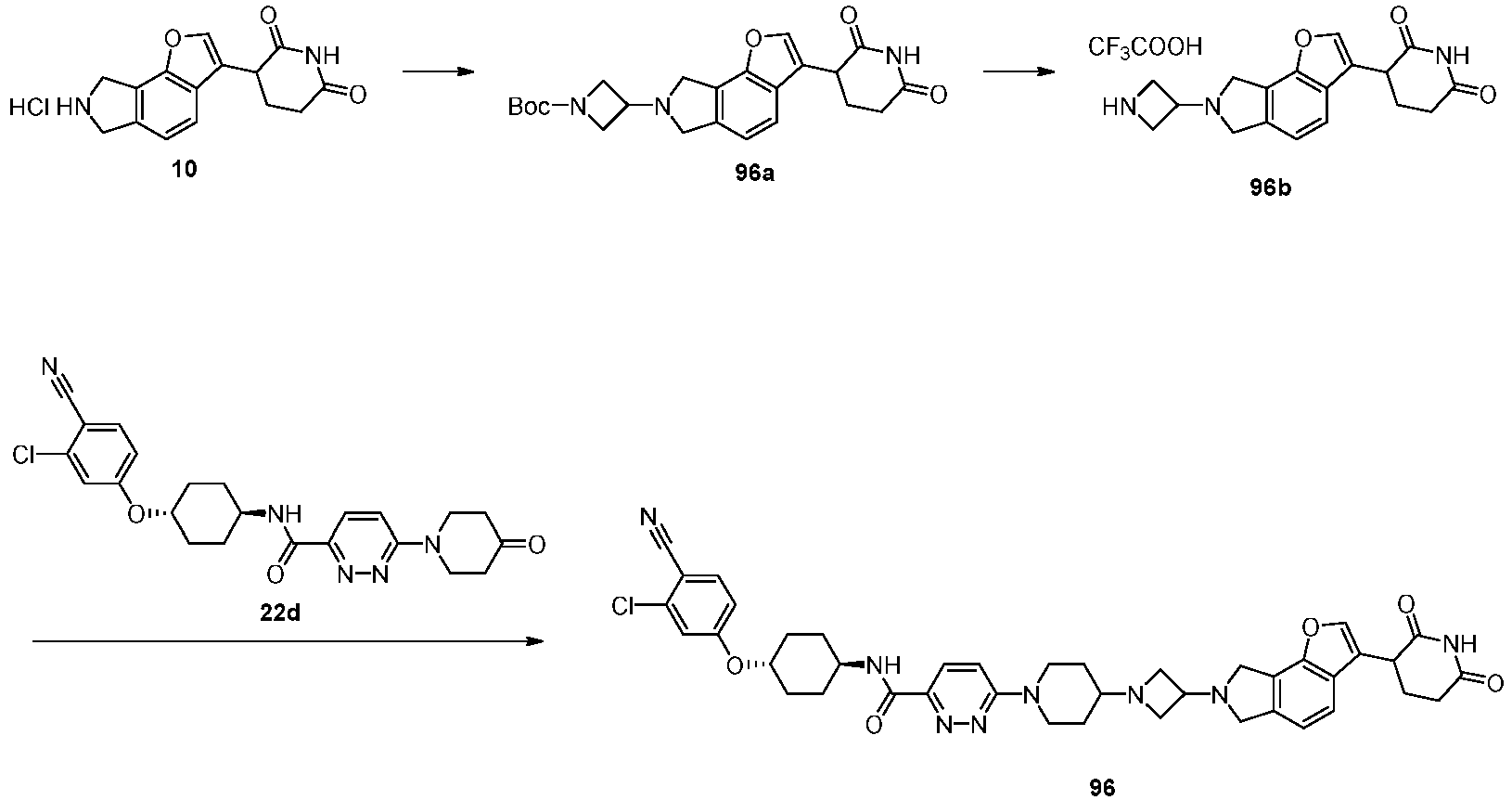
- Intermediate 10 (120 mg), 1-tert-butoxycarbonyl-3-azetidinone (151 mg), sodium acetate (73 mg), 1,2-dichloroethane (10 mL), and isopropanol (2 mL) were added to a reaction flask in sequence, and the mixture was stirred at room temperature for 10 min. Sodium triacetoxyborohydride (188 mg) was then added, and the mixture was reacted at room temperature for 2 h. After the reaction was completed, a saturated sodium bicarbonate solution was added to the reaction system to quench the reaction, and the mixture was extracted with dichloromethane. The organic layer was collected, dried over anhydrous sodium sulfate, and filtered. The filtrate was concentrated, and then the residue was purified by silica gel column chromatography (dichloromethane/methanol) to give the target compound 96a (110 mg).
- MS(ESI, [M+H]+) m/z: 426.2.
- 96a (110 mg), dichloromethane (2 mL), and trifluoroacetic acid (2 mL) were added to a reaction flask in sequence, and the mixture was reacted at room temperature for 2 h. After the reaction was completed, the mixture was concentrated to remove the solvent, thus giving 96b. The crude product was directly used in the next step. MS(ESI, [M+H]+) m/z: 326.2.
- 96b (130 mg), compound 22d (128 mg), sodium acetate (95 mg), and acetonitrile (20 mL) were added to a reaction flask in sequence, and the mixture was stirred at room temperature for 10 min. Sodium cyanoborohydride (39 mg) was then added, and the mixture was reacted at room temperature for 2 h. After the reaction was completed, a saturated sodium bicarbonate solution was added to the reaction system to quench the reaction, and the mixture was extracted with dichloromethane. The organic layer was collected, dried over anhydrous sodium sulfate, and filtered. The filtrate was concentrated, and then the residue was purified by silica gel column chromatography (dichloromethane/methanol) to give the target compound 96 (30 mg).
- MS(ESI, [M+H]+) m/z: 763.3.
- 1H NMR (500 MHz, DMSO-d6) δ 10.88 (s, 1H), 8.58 (d, J= 8.2 Hz, 1H), 7.92 - 7.75 (m, 3H), 7.48 - 7.28 (m, 3H), 7.20 - 7.08 (m, 2H), 4.59 - 4.48 (m, 1H), 4.28 - 4.05 (m, 5H), 3.99 (s, 2H), 3.83 (d, J = 30.3 Hz, 2H), 3.67 - 3.41 (m, 4H), 3.08 (s, 2H), 2.80 - 2.58 (m, 2.5H), 2.45 - 2.24 (m, 2.5H), 2.16 - 2.04 (m, 3H), 1.90 (d, J = 11.1 Hz, 2H), 1.76 (s, 2H), 1.57 (dq, J = 63.5, 13.0 Hz, 5H).
-


- Intermediate 13 (96 mg), 1-Boc-3-azetidinone (93 mg), sodium acetate (14.44 mg), 1,2-dichloroethane (5 mL), isopropanol (1 mL), and sodium cyanoborohydride (33.6 mg) were added to a reaction flask in sequence, and the mixture was reacted at room temperature. After the reaction was completed, a saturated sodium bicarbonate solution (2 mL) was added to the reaction solution to neutralize acetic acid, and then dichloromethane (50 mL) and water (100 mL) were added for extraction. The organic phase was separated, dried over anhydrous sodium sulfate, and filtered, and the filtrate was purified by silica gel column chromatography to give compound intermediate 97a (112 mg).
- Intermediate 97a (110 mg), DCM (10 mL), and trifluoroacetic acid (2 mL) were added to a reaction flask in sequence, and the mixture was reacted at room temperature. After the reaction was completed, the mixture was concentrated to remove the solvent, thus giving intermediate 97b (142 mg).
- Intermediate 22d (92 mg), intermediate 97b (90 mg), sodium acetate (12.44 mg), 1,2-dichloroethane (5 mL), isopropanol (1 mL), and sodium cyanoborohydride (33.6 mg) were added to a reaction flask in sequence, and the mixture was reacted at room temperature. After the reaction was completed, a saturated sodium bicarbonate solution (2 mL) was added to the reaction solution to neutralize acetic acid, and then dichloromethane (50 mL) and water (100 mL) were added for extraction. The organic phase was separated, dried over anhydrous sodium sulfate, and filtered, and the filtrate was purified by silica gel column chromatography to give compound intermediate 97c (36 mg).
- MS(ESI, [M+H]+) m/z: 791.3.
- 97c (42 mg), dichloromethane (10 mL), and methanol (1 mL) were added to a reaction flask in sequence. After complete dissolution by stirring, maleic acid (6.73 mg) was added, and the mixture was stirred at room temperature for 10 min. The mixture was concentrated and then slurried with petroleum ether to give compound 97 (33 mg). 1H NMR (500 MHz, DMSO-d6) δ 10.88 (s, 1H), 8.61 (d, J= 8.2 Hz, 1H), 7.86 (q, J= 5.0, 4.1 Hz, 3H), 7.49 - 7.27 (m, 3H), 7.10 (dd, J = 34.4, 8.4 Hz, 2H), 6.16 (s, 2H), 4.66 - 4.49 (m, 3H), 4.27 - 4.01 (m, 5H), 3.92 - 3.81 (m, 1H), 3.23 - 2.99 (m, 8H), 2.74 (ddd, J = 17.6, 12.4, 5.4 Hz, 1H), 2.55 (s, 5H), 2.38 - 2.27 (m, 1H), 2.18 - 1.99 (m, 5H), 1.98 - 1.84 (m, 2H), 1.65 (q, J = 12.5 Hz, 2H), 1.52 (q, J = 12.5, 12.1 Hz, 2H), 1.42 - 1.28 (m, 2H).
-

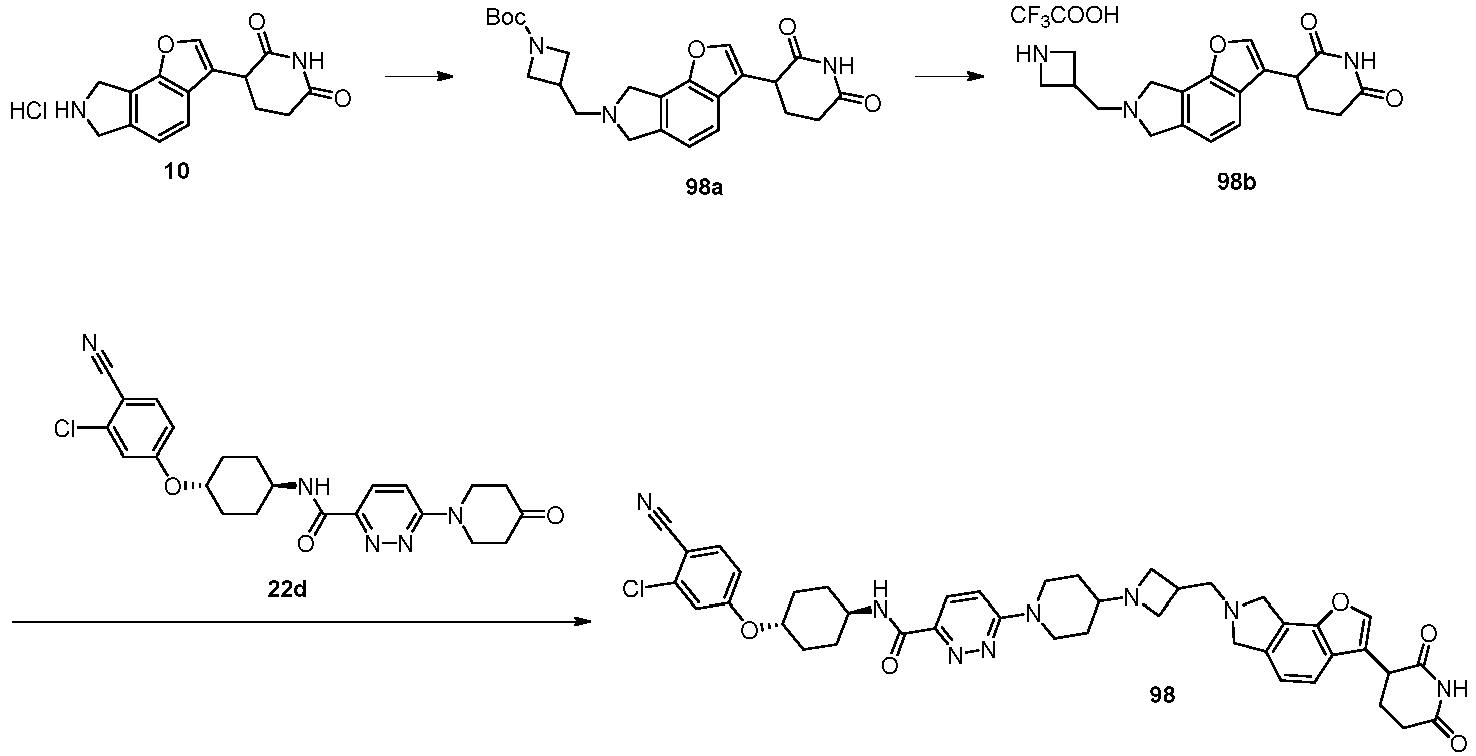
- Intermediate 10 (120 mg), tert-butyl 3-formylazetidine-1-carboxylate (188 mg), sodium acetate (73 mg), 1,2-dichloroethane (10 mL), and isopropanol (2 mL) were added to a reaction flask in sequence, and the mixture was stirred at room temperature for 10 min. Sodium triacetoxyborohydride (188 mg) was then added, and the mixture was reacted at room temperature for 2 h. After the reaction was completed, a saturated sodium bicarbonate solution was added to the reaction system to quench the reaction, and the mixture was extracted with dichloromethane. The organic layer was collected, dried over anhydrous sodium sulfate, and filtered. The filtrate was concentrated, and then the residue was purified by silica gel column chromatography (dichloromethane/methanol) to give the target compound 98a (150 mg).
- MS(ESI, [M+H]+) m/z: 440.2.
- 98a (150 mg), dichloromethane (2 mL), and trifluoroacetic acid (2 mL) were added to a reaction flask in sequence, and the mixture was reacted at room temperature for 2 h. After the reaction was completed, the mixture was concentrated to remove the solvent, thus giving 98b. The crude product was directly used in the next step. MS(ESI, [M+H]+) m/z: 340.2.
- 98b (165 mg), compound 22d (265 mg), sodium acetate (80 mg), and acetonitrile (20 mL) were added to a reaction flask in sequence, and the mixture was stirred at room temperature for 10 min. Sodium cyanoborohydride (61 mg) was then added, and the mixture was reacted at room temperature for 2 h. After the reaction was completed, a saturated sodium bicarbonate solution was added to the reaction system to quench the reaction, and the mixture was extracted with dichloromethane. The organic layer was collected, dried over anhydrous sodium sulfate, and filtered.
- The filtrate was concentrated, and then the residue was purified by silica gel column chromatography (dichloromethane/methanol) to give the target compound 98 (30 mg).
- MS(ESI, [M+H]+) m/z: 777.3.
- 1H NMR (500 MHz, DMSO-d6) δ 10.88 (s, 1H), 8.58 (d, J= 8.2 Hz, 1H), 7.85 (d, J= 7.8 Hz, 2H), 7.81 (d, J= 9.5 Hz, 1H), 7.42 (d, J = 7.9 Hz, 1H), 7.40 - 7.31 (m, 2H), 7.17 - 7.09 (m, 2H), 4.53 (tt, J = 9.8, 4.2 Hz, 1H), 4.26 - 4.10 (m, 3H), 4.07 (s, 2H), 3.95 (s, 2H), 3.91 - 3.80 (m, 1H), 3.44 (t, J = 35.0 Hz, 2.5H), 3.27 (d, J = 11.6 Hz, 2.5H), 2.90 (d, J= 7.4 Hz, 3H), 2.79 - 2.53 (m, 4H), 2.31 (qd, J= 12.5, 4.4 Hz, 2H), 2.15 - 2.05 (m, 3H), 1.95 - 1.85 (m, 2H), 1.74 (s, 2H), 1.69 - 1.45 (m, 5H).
-


- Intermediate 91b (105 mg), intermediate 13 (92 mg), sodium acetate (16.44 mg), 1,2-dichloroethane (5 mL), isopropanol (1 mL), and sodium cyanoborohydride (40.2 mg) were added to a reaction flask in sequence, and the mixture was reacted at room temperature. After the reaction was completed, a saturated sodium bicarbonate solution (2 mL) was added to the reaction solution to neutralize acetic acid, and then dichloromethane (50 mL) and water (100 mL) were added for extraction. The organic phase was separated, dried over anhydrous sodium sulfate, and filtered, and the filtrate was purified by silica gel column chromatography to give compound 99 (42 mg).
- MS (ESI, [M+H]+) m/z: 805.3.
- 1H NMR (500 MHz, DMSO-d6) δ 10.87 (s, 1H), 8.58 (d, J= 8.2 Hz, 1H), 7.89 - 7.77 (m, 3H), 7.39 (d, J = 2.4 Hz, 1H), 7.33 (d, J= 9.6 Hz, 1H), 7.26 (d, J= 7.9 Hz, 1H), 7.13 (dd, J = 8.8, 2.5 Hz, 1H), 7.01 (d, J= 7.9 Hz, 1H), 4.53 (tt, J= 10.0, 4.2 Hz, 1H), 4.16 (d, J = 12.8 Hz, 2H), 4.08 (dd, J= 11.7, 5.0 Hz, 1H), 3.85 (dtt, J= 11.7, 8.2, 4.2 Hz, 1H), 3.25 (t, J = 11.0 Hz, 2H), 3.09 (dd, J = 6.6, 3.3 Hz, 2H), 2.94 (dd, J = 6.6, 3.4 Hz, 2H), 2.73 (ddd, J = 17.3, 12.1, 5.4 Hz, 3H), 2.69 - 2.52 (m, 8H), 2.30 (qd, J= 12.7, 12.3, 4.4 Hz, 2H), 2.15 - 2.05 (m, 3H), 1.95 - 1.86 (m, 2H), 1.76 - 1.59 (m, 4H), 1.57 - 1.46 (m, 2H), 1.19 (q, J= 9.7 Hz, 3H).
-
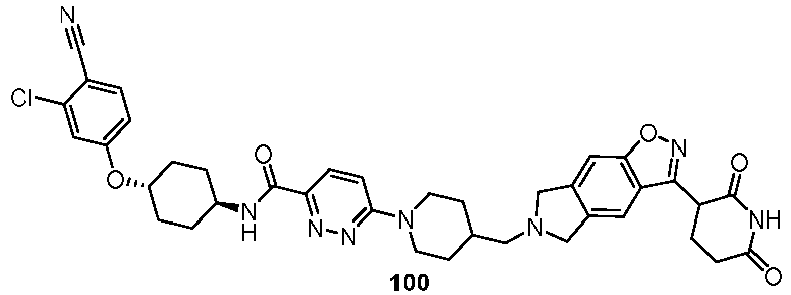

- Intermediate 17h (125 mg), intermediate 2 (102 mg), sodium acetate (22.52 mg), 1,2-dichloroethane (5 mL), isopropanol (1 mL), and sodium cyanoborohydride (44.5 mg) were added to a reaction flask in sequence, and the mixture was reacted at room temperature. After the reaction was completed, a saturated sodium bicarbonate solution (2 mL) was added to the reaction solution to neutralize acetic acid, and then dichloromethane (50 mL) and water (100 mL) were added for extraction. The organic phase was separated, dried over anhydrous sodium sulfate, and filtered, and the filtrate was purified by silica gel column chromatography to give compound 100 (78 mg).
- MS (ESI, [M+H]+) m/z: 723.1.
- 1H NMR (500 MHz, DMSO-d6) δ 11.08 (s, 1H), 8.57 (d, J= 8.2 Hz, 1H), 7.85 (d, J= 8.8 Hz, 1H), 7.80 (d, J= 9.5 Hz, 1H), 7.63 (d, J= 18.2 Hz, 2H), 7.40 - 7.32 (m, 2H), 7.13 (dd, J= 8.8, 2.4 Hz, 1H), 4.59 - 4.46 (m, 4H), 3.94 (s, 2H), 3.92 - 3.82 (m, 3H), 3.17 (d, J = 5.3 Hz, 2H), 3.06 (t, J = 12.4 Hz, 2H), 2.78 (ddd, J = 17.2, 11.9, 5.3 Hz, 1H), 2.60 (dd, J = 17.6, 5.3 Hz, 3H), 2.47 (dd, J = 12.1, 4.3 Hz, 1H), 2.20 (td, J = 8.7, 8.0, 3.7 Hz, 1H), 2.11 (d, J= 11.2 Hz, 2H), 1.91 (d, J = 8.9 Hz, 5H), 1.69 - 1.59 (m, 2H), 1.57 - 1.47 (m, 2H).
-


- Intermediate 91b (105 mg), intermediate 2 (97 mg), sodium acetate (22.52 mg), 1,2-dichloroethane (5 mL), isopropanol (1 mL), and sodium cyanoborohydride (41.5 mg) were added to a reaction flask in sequence, and the mixture was reacted at room temperature. After the reaction was completed, a saturated sodium bicarbonate solution (2 mL) was added to the reaction solution to neutralize acetic acid, and then dichloromethane (50 mL) and water (100 mL) were added for extraction. The organic phase was separated, dried over anhydrous sodium sulfate, and filtered, and the filtrate was purified by silica gel column chromatography to give intermediate 101a (45 mg).
- MS(ESI, [M+H]+) m/z: 778.2.
- 101a (43 mg), dichloromethane (10 mL), and methanol (1 mL) were added to a reaction flask in sequence. After complete dissolution by stirring, maleic acid (6.86 mg) was added, and the mixture was stirred at room temperature for 10 min. The mixture was concentrated and then slurried with petroleum ether to give compound 101 (35 mg). MS (ESI, [M+H]+) m/z: 778.3.
- 1H NMR (500 MHz, DMSO-d6) δ 11.08 (s, 1H), 9.78 (s, 1H), 8.61 (d, J = 8.2 Hz, 1H), 7.87 (dd, J= 9.1, 6.4 Hz, 2H), 7.65 (d, J = 14.8 Hz, 2H), 7.44 (d, J = 9.7 Hz, 1H), 7.38 (d, J = 2.5 Hz, 1H), 7.13 (dd, J = 8.8, 2.5 Hz, 1H), 6.04 (s, 2H), 4.55 (dtd, J = 17.7, 10.0, 4.4 Hz, 4H), 4.21 (d, J = 10.0 Hz, 2H), 4.04 - 3.84 (m, 7H), 3.02 (dd, J = 23.8, 10.9 Hz, 6H), 2.78 (ddd, J = 17.2, 12.0, 5.4 Hz, 1H), 2.61 (dd, J = 17.3, 4.2 Hz, 1H), 2.49 - 2.42 (m, 1H), 2.20 (dq, J = 13.6, 4.8 Hz, 1H), 2.16 - 2.00 (m, 4H), 1.97 - 1.86 (m, 2H), 1.64 (qd, J = 13.2, 3.2 Hz, 2H), 1.57 - 1.48 (m, 2H), 1.30 (qd, J = 12.1, 4.1 Hz, 2H).
-


- Intermediate 2 (400 mg), tert-butyl 3-formylazetidine-1-carboxylate (360 mg), sodium acetate (213 mg), 1,2-dichloroethane (20 mL), isopropanol (4 mL), and sodium triacetoxyborohydride (520 mg) were added to a reaction flask in sequence, and the mixture was reacted at room temperature for 1 h. After the reaction was completed, a saturated sodium bicarbonate solution (2 mL) was added to the reaction solution to neutralize acetic acid, and then dichloromethane (50 mL) and water (100 mL) were added for extraction. The organic phase was separated, dried over anhydrous sodium sulfate, and filtered, and the filtrate was purified by silica gel column chromatography to give intermediate 102a (410 mg).
- MS(ESI, [M+H]+) m/z: 385.1.
- Intermediate 102a (410 mg), dichloromethane (20 mL), and trifluoroacetic acid (5 mL) were added to a reaction flask in sequence, and the mixture was reacted at room temperature for 1 h. After the reaction was completed, the reaction solution was concentrated by evaporation under reduced pressure to remove the solvent, thus giving the target intermediate 102b (642 mg).
- Intermediate 102b (225 mg), intermediate 17h (125 mg), sodium acetate (26.52 mg), 1,2-dichloroethane (5 mL), isopropanol (1 mL), and sodium cyanoborohydride (44.5 mg) were added to a reaction flask in sequence, and the mixture was reacted at room temperature. After the reaction was completed, a saturated sodium bicarbonate solution (2 mL) was added to the reaction solution to neutralize acetic acid, and then dichloromethane (50 mL) and water (100 mL) were added for extraction. The organic phase was separated, dried over anhydrous sodium sulfate, and filtered, and the filtrate was purified by silica gel column chromatography to give compound 102 (86 mg).
- MS(ESI, [M+H]+) m/z: 792.1.
- 1H NMR (500 MHz, DMSO-d6) δ 11.07 (s, 1H), 8.56 (d, J = 8.2 Hz, 1H), 7.82 (dd, J= 29.7, 9.1 Hz, 2H), 7.61 (d, J= 21.5 Hz, 2H), 7.42 - 7.28 (m, 2H), 7.13 (dd, J = 8.8, 2.5 Hz, 1H), 4.59 - 4.41 (m, 4H), 3.87 (d, J = 24.2 Hz, 5H), 2.98 (t, J = 12.6 Hz, 2H), 2.92 - 2.71 (m, 5H), 2.68 - 2.57 (m, 2H), 2.46 (dd, J= 12.2, 4.4 Hz, 1H), 2.30 (s, 2H), 2.18 (dq, J = 13.6, 4.7 Hz, 1H), 2.15 - 2.05 (m, 2H), 1.94 - 1.85 (m, 2H), 1.76 (d, J = 12.8 Hz, 2H), 1.69 - 1.58 (m, 3H), 1.52 (td, J = 13.1, 6.3 Hz, 2H), 1.17 - 1.05 (m, 2H).
-


- Intermediate 17c (10 g), 2-chloropyrimidine-5-carboxylic acid (6.62 g), DCM (200 mL), HATU (15.89 g), and DIPEA (18.00 g, 24.33 mL) were added to a reaction flask in sequence, and the mixture was reacted at room temperature. After the reaction was completed, the reaction solution was concentrated by evaporation under reduced pressure to remove the solvent and extracted with ethyl acetate (500 mL) and water (1000 mL). The organic phase was separated, washed with saturated brine, dried over anhydrous sodium sulfate, and filtered, and the filtrate was concentrated, slurried with EA/PE (v:v = 5/1, 50 mL), and filtered. The filter cake was collected and dried under reduced pressure to give the target intermediate 103a (6.72 g).
- Intermediate 103a (2 g), 4-hydroxypiperidine (0.620 g), DIPEA (1.982 g, 2.68 mL), and DMSO (20 mL) were added to a reaction flask in sequence, and the mixture was heated to 100 °C and reacted. After the reaction was completed, the reaction solution was extracted with ethyl acetate (100 mL) and water (200 mL). The organic phase was separated, washed with saturated brine, dried over anhydrous sodium sulfate, and filtered, and the filtrate was concentrated, slurried with ethyl acetate, and filtered. The filter cake was collected and dried under reduced pressure to give the target intermediate 103b (2.17 g).
- MS(ESI, [M+H]+) m/z: 456.2.
- Intermediate 103b (2.07 g), DCM (30 mL), and Dess-Martin periodinane (3.85 g) were added to a reaction flask in sequence, and the mixture was reacted at room temperature. After the reaction was completed, the reaction solution was quenched with a saturated sodium thiosulfate solution (100 mL) and a sodium bicarbonate solution (100 mL) and extracted with dichloromethane (100 mL). The organic phase was separated, washed with saturated brine, dried over anhydrous sodium sulfate, and filtered, and the filtrate was purified by silica gel column chromatography to give the target intermediate 103c (1.64 g).
- MS(ESI, [M-H]-) m/z: 452.2.
- Intermediate 98b (332 mg), intermediate 103c (169 mg), sodium acetate (305 mg), acetonitrile (10 mL), and sodium cyanoborohydride (46.7 mg) were added to a reaction flask in sequence, and the mixture was heated to 80 °C and reacted. After the reaction was completed, dichloromethane (50 mL) and water (100 mL) were added for extraction. The organic phase was separated, dried over anhydrous sodium sulfate, and filtered, and the filtrate was purified by silica gel column chromatography to give compound 103 (64 mg).
- MS(ESI, [M+H]+) m/z: 777.1.
- 1H NMR (500 MHz, DMSO-d6) δ 10.89 (s, 1H), 8.76 (s, 2H), 8.13 (d, J = 7.4 Hz, 1H), 7.86 (d, J = 8.1 Hz, 2H), 7.50 - 7.30 (m, 2H), 7.14 (t, J = 6.7 Hz, 2H), 4.50 (d, J = 51.1 Hz, 3H), 4.13 (dd, J = 11.8, 4.9 Hz, 1H), 4.08 (s, 2H), 3.96 (s, 2H), 3.80 (s, 1H), 3.55 (s, 2H), 3.19 (d, J = 22.7 Hz, 3H), 3.13 - 2.80 (m, 4H), 2.73 (td, J = 19.3, 13.1, 6.4 Hz, 2H), 2.57 (d, J = 18.8 Hz, 1H), 2.31 (q, J = 12.9, 11.8 Hz, 1H), 2.10 (s, 3H), 1.92 (d, J = 9.0 Hz, 2H), 1.76 (s, 2H), 1.50 (q, J = 9.3 Hz, 4H), 1.23 - 1.04 (m, 2H).
-


- Intermediate 11 (150 mg), tert-butyl 3-formylazetidine-1-carboxylate (173 mg), sodium acetate (38.4 mg), 1,2-dichloroethane (5 mL), isopropanol (1 mL), and sodium triacetoxyborohydride (198 mg) were added to a reaction flask in sequence, and the mixture was reacted at room temperature. After the reaction was completed, dichloromethane (50 mL) and water (100 mL) were added for extraction. The organic phase was separated, dried over anhydrous sodium sulfate, and filtered, and the filtrate was purified by silica gel column chromatography to give the target intermediate 104a (225 mg).
- MS(ESI, [M+H]+) m/z: 454.2.
- Intermediate 104a (225 mg), DCM (5 mL), and TFA (1480 mg, 1 mL) were added to a reaction flask in sequence, and the mixture was reacted at room temperature. After the reaction was completed, the reaction solution was concentrated by evaporation under reduced pressure to remove the solvent, thus giving the target intermediate 104b (475 mg).
- MS(ESI, [M+H]+) m/z: 354.2.
- Intermediate 104b (475 mg), intermediate 103c (232 mg), sodium acetate (209 mg), acetonitrile (10 mL), and sodium cyanoborohydride (96 mg) were added to a reaction flask in sequence, and the mixture was heated to 80 °C and reacted. After the reaction was completed, dichloromethane (50 mL) and water (100 mL) were added for extraction. The organic phase was separated, dried over anhydrous sodium sulfate, and filtered, and the filtrate was purified by silica gel column chromatography to give compound 104 (81 mg).
- MS(ESI, [M+H]+) m/z: 791.1.
- 1H NMR (500 MHz, DMSO-d6) δ 10.87 (s, 1H), 8.76 (s, 2H), 8.13 (d, J = 7.4 Hz, 1H), 7.89 - 7.78 (m, 2H), 7.42 - 7.30 (m, 2H), 7.14 (d, J = 8.9 Hz, 1H), 6.99 (d, J = 8.1 Hz, 1H), 4.62 - 4.35 (m, 3H), 4.10 (dd, J = 11.9, 5.0 Hz, 1H), 3.78 (d, J = 19.6 Hz, 5H), 3.25 - 3.11 (m, 3H), 2.94 - 2.66 (m, 9H), 2.59 - 2.55 (m, 1H), 2.38 - 2.02 (m, 5H), 1.91 (d, J = 9.0 Hz, 2H), 1.77 (s, 2H), 1.50 (q, J = 9.4 Hz, 4H), 1.23 - 1.11 (m, 2H).
-


- Intermediate 12 (150 mg), tert-butyl 3-formylazetidine-1-carboxylate (173 mg), sodium acetate (38.4 mg), 1,2-dichloroethane (5 mL), isopropanol (1 mL), and sodium triacetoxyborohydride (198 mg) were added to a reaction flask in sequence, and the mixture was reacted at room temperature. After the reaction was completed, dichloromethane (50 mL) and water (100 mL) were added for extraction. The organic phase was separated, dried over anhydrous sodium sulfate, and filtered, and the filtrate was purified by silica gel column chromatography to give the target intermediate 105a (240 mg).
- MS(ESI, [M+H]+) m/z: 454.2.
- Intermediate 105a (240 mg), DCM (5 mL), and TFA (1480 mg, 1 mL) were added to a reaction flask in sequence, and the mixture was reacted at room temperature. After the reaction was completed, the reaction solution was concentrated by evaporation under reduced pressure to remove the solvent, thus giving the target intermediate 105b (530 mg).
- MS(ESI, [M+H]+) m/z: 354.2.
- Intermediate 105b (530 mg), intermediate 103c (217 mg), sodium acetate (196 mg), acetonitrile (10 mL), and sodium cyanoborohydride (90 mg) were added to a reaction flask in sequence, and the mixture was heated to 80 °C and reacted. After the reaction was completed, dichloromethane (50 mL) and water (100 mL) were added for extraction. The organic phase was separated, dried over anhydrous sodium sulfate, and filtered, and the filtrate was purified by silica gel column chromatography to give compound 105 (60 mg).
- MS(ESI, [M+H]+) m/z: 791.1.
- 1H NMR (500 MHz, DMSO-d6) δ 10.87 (s, 1H), 8.74 (s, 2H), 8.11 (d, J = 7.5 Hz, 1H), 7.89 - 7.80 (m, 2H), 7.38 (d, J = 2.4 Hz, 1H), 7.32 (d, J = 7.9 Hz, 1H), 7.14 (dd, J = 8.8, 2.4 Hz, 1H), 6.94 (d, J = 8.1 Hz, 1H), 4.55 (dq, J = 9.6, 4.4 Hz, 1H), 4.37 (d, J = 12.8 Hz, 2H), 4.10 (dd, J = 11.8, 4.9 Hz, 1H), 3.83 - 3.75 (m, 1H), 3.62 (s, 2H), 3.42 (s, 2H), 3.24 (d, J = 10.9 Hz, 3H), 2.94 (t, J = 5.8 Hz, 2H), 2.86 (s, 1H), 2.77 - 2.65 (m, 6H), 2.59 - 2.54 (m, 1H), 2.31 (ddd, J = 20.4, 14.8, 10.3 Hz, 2H), 2.10 (dp, J = 9.1, 4.9, 4.5 Hz, 3H), 1.97 - 1.86 (m, 2H), 1.75 - 1.63 (m, 2H), 1.50 (dt, J = 11.0, 6.6 Hz, 4H), 1.13 (q, J = 9.5 Hz, 2H).
-


- Intermediate 13 (380 mg), tert-butyl 3-formylazetidine-1-carboxylate (360 mg), sodium acetate (213 mg), 1,2-dichloroethane (20 mL), isopropanol (4 mL), and sodium triacetoxyborohydride (520 mg) were added to a reaction flask in sequence, and the mixture was reacted at room temperature for 1 h. After the reaction was completed, a saturated sodium bicarbonate solution (2 mL) was added to the reaction solution to neutralize acetic acid, and then dichloromethane (50 mL) and water (100 mL) were added for extraction. The organic phase was separated, dried over anhydrous sodium sulfate, and filtered, and the filtrate was purified by silica gel column chromatography to give intermediate 106a (425 mg).
- Intermediate 106a (425 mg), dichloromethane (20 mL), and trifluoroacetic acid (5 mL) were added to a reaction flask in sequence, and the mixture was reacted at room temperature for 1 h. After the reaction was completed, the reaction solution was concentrated by evaporation under reduced pressure to remove the solvent, thus giving the target intermediate 106b (672 mg).
- Intermediate 106b (210 mg), intermediate 103c (110 mg), sodium acetate (23.52 mg), 1,2-dichloroethane (5 mL), isopropanol (1 mL), and sodium cyanoborohydride (42.5 mg) were added to a reaction flask in sequence, and the mixture was reacted at room temperature. After the reaction was completed, a saturated sodium bicarbonate solution (2 mL) was added to the reaction solution to neutralize acetic acid, and then dichloromethane (50 mL) and water (100 mL) were added for extraction. The organic phase was separated, dried over anhydrous sodium sulfate, and filtered, and the filtrate was purified by silica gel column chromatography to give compound 106 (86 mg).
- MS(ESI, [M+H]+) m/z: 805.2.
- 1H NMR (500 MHz, DMSO-d6) δ 10.87 (s, 1H), 8.74 (s, 2H), 8.10 (d, J = 7.5 Hz, 1H), 7.89 - 7.80 (m, 2H), 7.39 (d, J= 2.4 Hz, 1H), 7.26 (d, J= 7.8 Hz, 1H), 7.14 (dd, J = 8.8, 2.5 Hz, 1H), 7.01 (d, J = 8.0 Hz, 1H), 4.55 (dt, J = 9.9, 5.4 Hz, 1H), 4.35 (d, J = 12.7 Hz, 2H), 4.15 - 4.04 (m, 2H), 3.79 (s, 1H), 3.26 (t, J = 11.2 Hz, 2H), 3.09 (dd, J = 6.9, 3.3 Hz, 2H), 2.98 - 2.91 (m, 2H), 2.84 - 2.69 (m, 3H), 2.66 (d, J = 6.4 Hz, 2H), 2.63 - 2.55 (m, 5H), 2.30 (qd, J = 13.1, 12.3, 4.5 Hz, 2H), 2.09 (dp, J = 9.3, 5.3, 4.6 Hz, 3H), 1.96 - 1.87 (m, 2H), 1.67 (d, J = 12.4 Hz, 2H), 1.58 - 1.44 (m, 4H), 1.11 (dtd, J= 13.3, 9.9, 9.3, 3.7 Hz, 2H).
-


- Intermediate 26e (700 mg), 1-Boc-3-azetidinone (502 mg), sodium acetate (601 mg), 1,2-dichloroethane (5 mL), isopropanol (1 mL), and sodium cyanoborohydride (184 mg) were added to a reaction flask in sequence, and the mixture was heated to 80 °C and reacted. After the reaction was completed, dichloromethane (50 mL) and water (100 mL) were added for extraction. The organic phase was separated, dried over anhydrous sodium sulfate, and filtered, and the filtrate was purified by silica gel column chromatography to give the target intermediate 107a (290 mg).
- MS(ESI, [M+H]+) m/z: 596.5.
- Intermediate 107a (290 mg), DCM (5 mL), and TFA (832 mg, 0.562 mL) were added to a reaction flask in sequence, and the mixture was reacted at room temperature. After the reaction was completed, the reaction solution was concentrated by evaporation under reduced pressure to remove the solvent, thus giving the target intermediate 107b (487 mg).
- Intermediate 28a (70 mg), intermediate 107b (232 mg), sodium acetate (96 mg), 1,2-dichloroethane (5 mL), isopropanol (1 mL), and sodium triacetoxyborohydride (99 mg) were added to a reaction flask in sequence, and the mixture was reacted at room temperature. After the reaction was completed, dichloromethane (50 mL) and water (100 mL) were added for extraction. The organic phase was separated, dried over anhydrous sodium sulfate, and filtered, and the filtrate was purified by silica gel column chromatography to give compound 107 (72 mg).
- MS(ESI, [M+H]+) m/z: 777.1.
- 1H NMR (500 MHz, DMSO-d6) δ 10.87 (s, 1H), 8.60 (d, J = 8.2 Hz, 1H), 7.93 - 7.74 (m, 3H), 7.36 (dd, J = 18.4, 7.5 Hz, 3H), 7.11 (dd, J = 18.5, 8.4 Hz, 2H), 4.59 - 4.48 (m, 1H), 4.10 (dd, J = 11.9, 5.0 Hz, 1H), 3.86 (q, J = 11.1, 9.8 Hz, 1H), 3.77 - 3.51 (m, 6H), 3.22 - 3.13 (m, 2H), 3.12 - 2.96 (m, 3H), 2.87 - 2.68 (m, 4H), 2.65 - 2.53 (m, 3H), 2.40 (s, 4H), 2.29 (tt, J = 12.6, 6.4 Hz, 1H), 2.17 - 2.04 (m, 3H), 1.90 (d, J = 11.3 Hz, 2H), 1.64 (q, J = 12.3 Hz, 2H), 1.51 (q, J = 11.9 Hz, 2H).
-


- Intermediate 29a (70 mg), intermediate 107b (232 mg), sodium acetate (96 mg), 1,2-dichloroethane (5 mL), isopropanol (1 mL), and sodium triacetoxyborohydride (99 mg) were added to a reaction flask in sequence, and the mixture was reacted at room temperature. After the reaction was completed, dichloromethane (50 mL) and water (100 mL) were added for extraction. The organic phase was separated, dried over anhydrous sodium sulfate, and filtered, and the filtrate was purified by silica gel column chromatography to give compound 108 (99 mg).
- MS(ESI, [M+H]+) m/z: 777.1.
- 1H NMR (500 MHz, DMSO-d6) δ 10.87 (s, 1H), 8.60 (d, J = 8.1 Hz, 1H), 7.94 - 7.74 (m, 3H), 7.47 - 7.29 (m, 3H), 7.12 (dd, J = 16.3, 8.4 Hz, 2H), 4.54 (d, J = 10.5 Hz, 1H), 4.11 (dd, J = 12.0, 5.0 Hz, 1H), 3.95 - 3.59 (m, 7H), 3.14 (ddd, J = 47.2, 17.3, 7.5 Hz, 5H), 2.77 (ddt, J = 29.4, 16.6, 5.8 Hz, 4H), 2.66 - 2.53 (m, 3H), 2.42 (s, 4H), 2.33 - 2.25 (m, 1H), 2.17 - 2.04 (m, 3H), 1.90 (d, J = 11.3 Hz, 2H), 1.64 (q, J = 12.3 Hz, 2H), 1.52 (q, J = 12.2 Hz, 2H).
-


- Intermediate 103a (1.7 g), 1-Boc-piperazine (1.13 g), DIPEA (1.12 mg), and DMSO (20 mL) were added to a reaction flask in sequence, and the mixture was heated to 100 °C and reacted. After the reaction was completed, ethyl acetate (50 mL) and water (100 mL) were added for extraction. The organic phase was separated, dried over anhydrous sodium sulfate, and filtered, and the filtrate was purified by silica gel column chromatography to give the target intermediate 109a (1.72 g).
- MS(ESI, [M+H]+) m/z: 541.2.
- Intermediate 109a (1.72 g) and a 4 M solution of hydrochloric acid in 1,4-dioxane (30 mL) were added to a reaction flask in sequence, and the mixture was reacted at room temperature. After the reaction was completed, the reaction solution was concentrated by evaporation under reduced pressure to remove the solvent, thus giving the target intermediate 109b (1.42 g).
- MS(ESI, [M+H]+) m/z: 441.2.
- Intermediate 109b (1.2 g), 1-tert-butoxycarbonyl-3-aminocyclobutylamine (0.86 g), 1,2-dichloroethane (30 mL), isopropanol (5 mL), sodium acetate (0.31 g), and sodium cyanoborohydride (0.41 g) were added to a reaction flask in sequence, and the mixture was heated to 80 °C and reacted. After the reaction was completed, a saturated sodium bicarbonate solution (5 mL) was added to the reaction solution to neutralize acetic acid, and then dichloromethane (50 mL) and water (100 mL) were added for extraction. The organic phase was separated, dried over anhydrous sodium sulfate, and filtered, and the filtrate was purified by silica gel column chromatography to give intermediate 109c (1.2 g).
- MS(ESI, [M+H]+) m/z: 596.2.
- Intermediate 109c (1.1 g), DCM (30 mL), and trifluoroacetic acid (10 mL) were added to a reaction flask in sequence, and the mixture was reacted at room temperature. After the reaction was completed, the reaction solution was concentrated by evaporation under reduced pressure to remove the solvent, thus giving the target intermediate 109d (1.72 g).
- Intermediate 28a (50 mg), intermediate 109d (110 mg), 1,2-dichloroethane (5 mL), isopropanol (1 mL), and sodium cyanoborohydride (25.3 mg) were added to a reaction flask in sequence, and the mixture was reacted at room temperature. After the reaction was completed, a saturated sodium bicarbonate solution (2 mL) was added to the reaction solution to neutralize acetic acid, and then dichloromethane (50 mL) and water (100 mL) were added for extraction. The organic phase was separated, dried over anhydrous sodium sulfate, and filtered, and the filtrate was purified by silica gel column chromatography to give compound 109 (42 mg).
- MS(ESI, [M+H]+) m/z: 777.2.
- 1H NMR (500 MHz, DMSO-d6) δ 10.87 (s, 1H), 8.76 (s, 2H), 8.13 (d, J = 7.5 Hz, 1H), 7.86 (d, J = 8.8 Hz, 1H), 7.80 (s, 1H), 7.39 (d, J= 2.4 Hz, 1H), 7.33 (d, J= 7.8 Hz, 1H), 7.14 (dd, J = 8.8, 2.5 Hz, 1H), 7.09 (d, J = 7.9 Hz, 1H), 4.55 (dq, J = 9.7, 4.5 Hz, 1H), 4.10 (dd, J = 11.8, 4.9 Hz, 1H), 3.87 - 3.75 (m, 5H), 3.50 (s, 2H), 3.16 - 3.10 (m, 1H), 3.07 (dd, J= 15.6, 6.5 Hz, 1H), 3.02 - 2.84 (m, 3H), 2.82 - 2.69 (m, 3H), 2.56 (dq, J = 12.5, 4.1 Hz, 3H), 2.35 - 2.27 (m, J= 4.3 Hz, 5H), 2.10 (dd, J= 8.8, 4.4 Hz, 3H), 1.91 (s, 3H), 1.50 (dt, J= 10.9, 6.7 Hz, 4H).
-
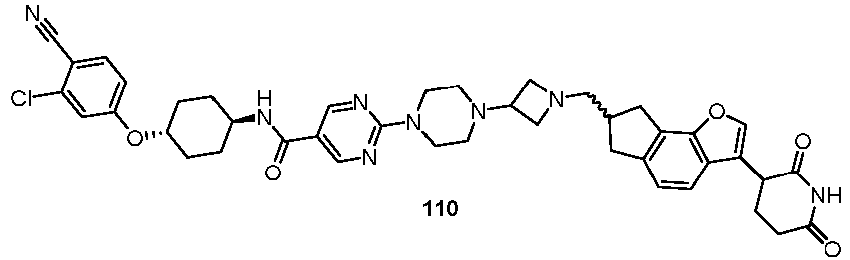

- Intermediate 29a (50 mg), intermediate 109d (110 mg), 1,2-dichloroethane (5 mL), isopropanol (1 mL), and sodium cyanoborohydride (25.3 mg) were added to a reaction flask in sequence, and the mixture was reacted at room temperature. After the reaction was completed, a saturated sodium bicarbonate solution (2 mL) was added to the reaction solution to neutralize acetic acid, and then dichloromethane (50 mL) and water (100 mL) were added for extraction. The organic phase was separated, dried over anhydrous sodium sulfate, and filtered, and the filtrate was purified by silica gel column chromatography to give compound 110 (57 mg).
- MS(ESI, [M+H]+) m/z: 777.2.
- 1H NMR (500 MHz, DMSO-d6) δ 10.87 (s, 1H), 8.76 (s, 2H), 8.13 (d, J = 7.5 Hz, 1H), 7.86 (d, J = 8.8 Hz, 1H), 7.80 (s, 1H), 7.39 (d, J= 2.4 Hz, 1H), 7.33 (d, J= 7.8 Hz, 1H), 7.14 (dd, J = 8.8, 2.5 Hz, 1H), 7.09 (d, J = 7.9 Hz, 1H), 4.54 (dd, J = 9.7, 4.6 Hz, 1H), 4.12 - 4.07 (m, 1H), 3.86 - 3.75 (m, 5H), 3.46 (s, 2H), 3.16 - 3.10 (m, 1H), 3.06 (dd, J= 15.8, 7.3 Hz, 1H), 2.89 (d, J = 20.9 Hz, 3H), 2.82 - 2.69 (m, 3H), 2.56 (dt, J = 17.8, 4.4 Hz, 3H), 2.35 - 2.26 (m, 5H), 2.10 (dd, J= 8.5, 4.2 Hz, 3H), 1.96 - 1.88 (m, 2H), 1.50 (dt, J = 11.2, 6.7 Hz, 4H).
-


- 103a (1.7 g), 4-BOC amino-1-cyclohexene boronic acid pinacol ester (1.6 g), [1,1'-bis(diphenylphosphino)ferrocene]palladium dichloride dichloromethane complex (0.31 g), potassium carbonate (1.2 g), 1,4-dioxane (50 mL), and water (5 mL) were added to a reaction flask in sequence, and the mixture was heated to 100 °C and reacted under N2 atmosphere. After the reaction was completed, ethyl acetate (200 mL) and water (200 mL) were added for extraction. The organic phase was separated, dried over anhydrous sodium sulfate, and filtered, and the filtrate was purified by silica gel column chromatography to give the target intermediate 111a (1.78 g).
- 111a (1.78 g), 10% palladium on carbon (0.52 g), methanol (10 mL), and ethyl acetate (30 mL) were added to a reaction flask in sequence, and the mixture was purged three times with hydrogen and reacted overnight under hydrogen atmosphere. After the reaction was completed, ethyl acetate (100 mL) and water (100 mL) were added for extraction. The organic phase was separated, dried over anhydrous sodium sulfate, and filtered, and the filtrate was purified by silica gel column chromatography to give the target intermediate 111b (1.02 g).
- MS(ESI, [M+H]+) m/z: 540.1.
- 111b (1.02 g) and a 4 M solution of hydrochloric acid in 1,4-dioxane (30 mL) were added to a reaction flask in sequence, and the mixture was reacted for 2 h. After the reaction was completed, the mixture was concentrated by evaporation under reduced pressure to remove the solvent, thus giving the target intermediate 111c (1.02 g). MS(ESI, [M+H]+) m/z: 440.1.
- Intermediate 111c (400 mg), 1-tert-butoxycarbonyl-3-aminocyclobutylamine (287 mg), sodium acetate (138 mg), 1,2-dichloroethane (25 mL), isopropanol (5 mL), and sodium cyanoborohydride (106 mg) were added to a reaction flask in sequence, and the mixture was heated to 80 °C and reacted for 2 h. After the reaction was completed, a saturated sodium bicarbonate solution (20 mL) was added to the reaction solution to neutralize acetic acid, and then dichloromethane (100 mL) and water (100 mL) were added for extraction. The organic phase was separated, dried over anhydrous sodium sulfate, and filtered, and the filtrate was purified by silica gel column chromatography to give intermediate 111d (310 mg).
- MS(ESI, [M+H]+) m/z: 595.2.
- Intermediate 111d (300 mg), dichloromethane (20 mL), and trifluoroacetic acid (10 mL) were added to a reaction flask in sequence, and the mixture was reacted at room temperature for 1 h. After the reaction was completed, the reaction solution was concentrated by evaporation under reduced pressure to remove the solvent, thus giving the target intermediate 111e (572 mg).
- MS(ESI, [M+H]+) m/z: 495.2.
- Intermediate 111e (200 mg), 29a (95 mg), sodium acetate (138 mg), 1,2-dichloroethane (10 mL), isopropanol (2 mL), and sodium cyanoborohydride (56 mg) were added to a reaction flask in sequence, and the mixture was reacted at room temperature. After the reaction was completed, a saturated sodium bicarbonate solution (10 mL) was added to the reaction solution to neutralize acetic acid, and then dichloromethane (50 mL) and water (50 mL) were added for extraction. The organic phase was separated, dried over anhydrous sodium sulfate, and filtered, and the filtrate was purified by silica gel column chromatography to give compound 111 (45 mg).
- MS(ESI, [M+H]+) m/z: 776.6.
- 1H NMR (500 MHz, DMSO-d6) δ 10.87 (s, 1H), 9.08 (s, 2H), 8.58 (d, J = 7.5 Hz, 1H), 7.86 (d, J = 8.7 Hz, 1H), 7.81 (s, 1H), 7.40 (d, J= 2.5 Hz, 1H), 7.34 (d, J= 7.8 Hz, 1H), 7.15 (dd, J = 8.8, 2.4 Hz, 1H), 7.10 (d, J = 7.9 Hz, 1H), 4.57 (dq, J= 10.0, 4.5 Hz, 1H), 4.10 (dd, J= 11.9, 4.9 Hz, 1H), 3.90 - 3.79 (m, 1H), 3.51 (s, 2H), 3.16 (d, J= 8.6 Hz, 1H), 3.08 (dd, J = 15.7, 7.5 Hz, 1H), 3.02 - 2.66 (m, 9H), 2.56 (dt, J= 17.3, 4.2 Hz, 4H), 2.30 (qd, J = 12.5, 4.5 Hz, 1H), 2.10 (td, J = 8.9, 4.4 Hz, 3H), 1.95 (d, J = 13.0 Hz, 6H), 1.79 (d, J = 13.2 Hz, 2H), 1.60 - 1.47 (m, 4H).
-


- Intermediate 111e (180 mg), 28a (85 mg), sodium acetate (132 mg), 1,2-dichloroethane (10 mL), isopropanol (2 mL), and sodium cyanoborohydride (55 mg) were added to a reaction flask in sequence, and the mixture was reacted at room temperature. After the reaction was completed, a saturated sodium bicarbonate solution (10 mL) was added to the reaction solution to neutralize acetic acid, and then dichloromethane (50 mL) and water (50 mL) were added for extraction. The organic phase was separated, dried over anhydrous sodium sulfate, and filtered, and the filtrate was purified by silica gel column chromatography to give compound 112 (57 mg).
- MS(ESI, [M+H]+) m/z: 776.6.
- 1H NMR (500 MHz, DMSO-d6) δ 10.87 (s, 1H), 9.08 (d, J = 2.7 Hz, 2H), 8.57 (d, J = 7.3 Hz, 1H), 7.86 (dd, J = 8.7, 2.1 Hz, 1H), 7.80 (d, J= 2.4 Hz, 1H), 7.45 - 7.38 (m, 1H), 7.33 (d, J = 7.7 Hz, 1H), 7.20 - 7.13 (m, 1H), 7.09 (d, J= 8.0 Hz, 1H), 4.57 (td, J= 9.5, 4.6 Hz, 1H), 4.10 (dd, J= 11.7, 5.0 Hz, 1H), 3.92 - 3.79 (m, 1H), 3.50 (s, 2H), 3.15 (dd, J= 14.4, 6.2 Hz, 1H), 3.07 (dd, J = 15.7, 7.0 Hz, 1H), 2.98 - 2.68 (m, 9H), 2.63 - 2.52 (m, 4H), 2.38 - 2.25 (m, 1H), 2.19 - 2.06 (m, 3H), 1.93 (d, J= 14.9 Hz, 6H), 1.78 (q, J = 12.0 Hz, 2H), 1.61 - 1.47 (m, 4H).
-


- Methyl 4-iodobenzoate (5.0 g), 3-azetidinemethanol hydrochloride (2.83 g), L-proline (0.88 g), copper(I) iodide (0.73 g), potassium carbonate (13.18 g), and dimethyl sulfoxide (50 mL) were added to a reaction flask in sequence, and the mixture was reacted at 100 °C for 3 h. After the reaction was completed, the reaction solution was extracted with water and ethyl acetate, followed by liquid separation. The organic phase was washed with saturated brine, dried over anhydrous sodium sulfate, and filtered, and the filtrate was concentrated. The crude product was separated by silica gel column chromatography to give intermediate 113a (3.32 g).
- MS(ESI, [M+H]+) m/z: 222.2.
- 113a (3.4 g), methanol (50 mL), water (10 mL), and sodium hydroxide (1.84 g) were added to a reaction flask in sequence, and the mixture was reacted at room temperature for 2 h. After the reaction was completed, the reaction solution was added with water, and the pH was adjusted to about 3 with hydrochloric acid. The mixture was filtered under vacuum, and the filter cake was dried by air blasting to give intermediate 113b (2.32 g).
- MS(ESI, [M+H]+) m/z: 208.1.
- 113b (0.5 g), 56g (0.72 g), HATU (1.3 g), DIPEA (1.2 g), and DMF (20 mL) were added to a reaction flask in sequence, and the mixture was reacted at room temperature. After the reaction was completed, ethyl acetate (70 mL) and water (150 mL) were added. The organic phase was separated, washed with a saturated sodium chloride solution, dried over anhydrous sodium sulfate, and filtered, and the concentrate was separated and purified by silica gel column chromatography to give intermediate 113c (0.75 g).
- MS(ESI, [M+H]+) m/z: 453.2.
- 113c (0.3 g), Dess-Martin periodinane (0.84 g), and dichloromethane (30 mL) were added to a reaction flask in sequence, and the mixture was reacted at room temperature for 1 h. After the reaction was completed, dichloromethane (70 mL) and water (100 mL) were added. The organic phase was separated, washed with a saturated sodium chloride solution, dried over anhydrous sodium sulfate, filtered, and concentrated to give intermediate 113d (0.4 g).
- Intermediate 113d (112 mg), compound 4 (80 mg), sodium acetate (40.8 mg), 1,2-dichloroethane (10 mL), isopropanol (2 mL), and sodium cyanoborohydride (31 mg) were added to a reaction flask in sequence, and the mixture was reacted at room temperature. After the reaction was completed, a saturated sodium bicarbonate solution (10 mL) was added to the reaction solution to neutralize acetic acid, and then dichloromethane (50 mL) and water (50 mL) were added for extraction. The organic phase was separated, dried over anhydrous sodium sulfate, and filtered, and the filtrate was purified by silica gel column chromatography to give compound 113 (65 mg).
- MS(ESI, [M+H]+) m/z: 720.2.
- 1H NMR (500 MHz, DMSO-d 6) δ 11.08 (s, 1H), 7.87 (d, J = 7.6 Hz, 1H), 7.76 - 7.69 (m, 2H), 7.59 (dd, J = 8.6, 5.8 Hz, 2H), 7.10 (d, J= 8.3 Hz, 1H), 6.94 (d, J= 2.6 Hz, 1H), 6.83 (dd, J = 9.1, 2.6 Hz, 1H), 6.44 - 6.38 (m, 2H), 4.56 (dd, J= 11.9, 5.0 Hz, 1H), 4.02 (t, J = 7.6 Hz, 2H), 3.76 (d, J = 17.9 Hz, 4H), 3.59 (dd, J = 7.5, 5.4 Hz, 2H), 3.09 (q, J= 6.8 Hz, 1H), 3.00 (t, J = 5.9 Hz, 2H), 2.87 - 2.73 (m, 8H), 2.61 (dt, J= 17.2, 4.2 Hz, 1H), 2.47 (dd, J = 12.1, 4.4 Hz, 1H), 2.19 (dq, J= 13.5, 4.8 Hz, 1H), 1.95 - 1.87 (m, 2H), 1.75 - 1.64 (m, 4H), 1.55 (td, J= 12.2, 3.6 Hz, 2H).
-

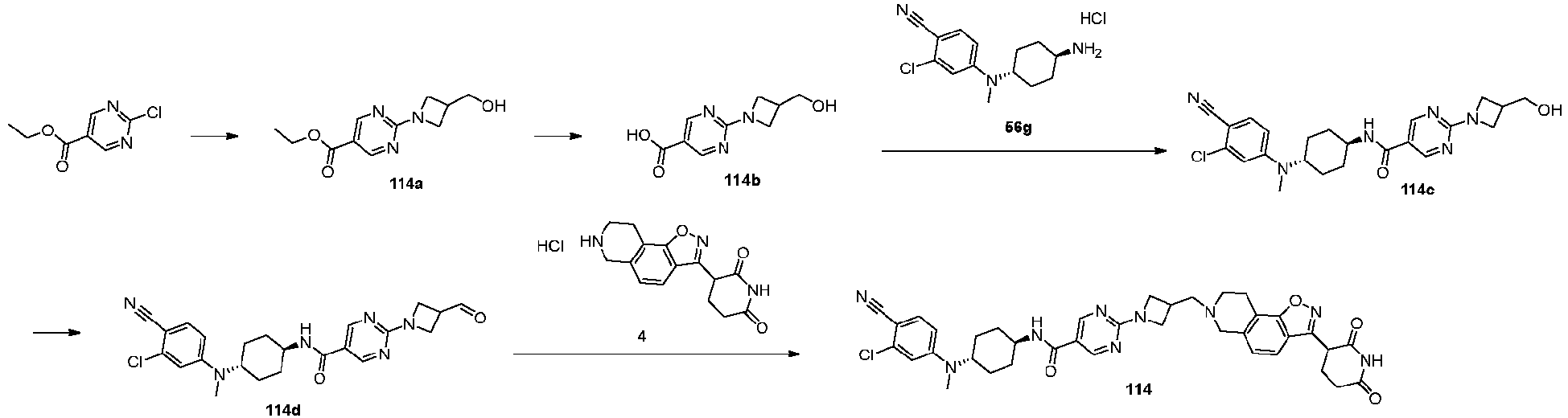
- Ethyl 2-chloropyrimidine-5-carboxylate (9.06 g), 3-azetidinylmethanol hydrochloride (5.02 g), potassium carbonate (16.78 g), and DMF (50 mL) were added to a reaction flask in sequence, and the mixture was reacted at room temperature for 2 h. After the reaction was completed, ethyl acetate (100 mL) and water (150 mL) were added. The organic phase was separated, washed with a saturated sodium chloride solution, dried over anhydrous sodium sulfate, filtered, and concentrated to give intermediate 114a (7.4 g).
- MS(ESI, [M+H]+) m/z: 238.2.
- 114a (7.4 g), methanol (70 mL), water (7 mL), and sodium hydroxide (2.36 g) were added to a reaction flask in sequence, and the mixture was reacted at room temperature for 2 h. After the reaction was completed, the reaction solution was added with water, and the pH was adjusted to about 3 with hydrochloric acid. The mixture was filtered under vacuum, and the filter cake was dried by air blasting to give intermediate 114b (5.3 g).
- 114b (0.38 g), intermediate 56g (0.50 g), HATU (0.95 g), DIPEA (0.86 g), and DMF (20 mL) were added to a reaction flask in sequence, and the mixture was reacted at room temperature. After the reaction was completed, ethyl acetate (70 mL) and water (150 mL) were added. The organic phase was separated, washed with a saturated sodium chloride solution, dried over anhydrous sodium sulfate, and filtered, and the concentrate was separated and purified by silica gel column chromatography to give intermediate 114c (0.55 g).
- MS(ESI, [M+H]+) m/z: 453.1.
- 114c (0.3 g), Dess-Martin periodinane (0.84 g), and dichloromethane (30 mL) were added to a reaction flask in sequence, and the mixture was reacted at room temperature for 1 h. After the reaction was completed, dichloromethane (70 mL) and water (100 mL) were added. The organic phase was separated, washed with a saturated sodium chloride solution, dried over anhydrous sodium sulfate, filtered, and concentrated to give intermediate 114d (0.4 g).
- Intermediate 114d (98 mg), intermediate 4 (76 mg), sodium acetate (37.8 mg), 1,2-dichloroethane (10 mL), isopropanol (2 mL), and sodium cyanoborohydride (31 mg) were added to a reaction flask in sequence, and the mixture was reacted at room temperature. After the reaction was completed, a saturated sodium bicarbonate solution (10 mL) was added to the reaction solution to neutralize acetic acid, and then dichloromethane (50 mL) and water (50 mL) were added for extraction. The organic phase was separated, dried over anhydrous sodium sulfate, and filtered, and the filtrate was purified by silica gel column chromatography to give compound 114 (55 mg).
- MS(ESI, [M+H]+) m/z: 722.1.
- 1H NMR (500 MHz, DMSO-d6) δ 11.07 (s, 1H), 8.74 (s, 2H), 8.12 (d, J = 7.5 Hz, 1H), 7.59 (dd, J = 8.6, 5.6 Hz, 2H), 7.11 (d, J= 8.3 Hz, 1H), 6.95 (d, J= 2.6 Hz, 1H), 6.84 (dd, J= 9.1, 2.5 Hz, 1H), 4.56 (dd, J= 11.9, 5.0 Hz, 1H), 4.23 (t, J= 8.6 Hz, 2H), 3.86 - 3.72 (m, 6H), 3.07 (dt, J = 14.2, 6.9 Hz, 1H), 3.00 (t, J = 5.9 Hz, 2H), 2.84 (d, J= 5.6 Hz, 7H), 2.79 - 2.72 (m, 1H), 2.61 (dt, J= 17.3, 4.3 Hz, 1H), 2.47 (dd, J = 12.2, 4.4 Hz, 1H), 2.19 (dq, J = 13.4, 4.9 Hz, 1H), 1.93 (d, J = 11.7 Hz, 2H), 1.78 - 1.63 (m, 4H), 1.59 - 1.49 (m, 2H).
-


- 2-(4-Hydroxymethylpiperidin-1-yl)pyrimidine-5-carboxylic acid (1.3 g), intermediate 56g (1.50 g), HATU (2.95 g), DIPEA (2.58 g), and DMF (20 mL) were added to a reaction flask in sequence, and the mixture was reacted at room temperature. After the reaction was completed, ethyl acetate (70 mL) and water (150 mL) were added. The organic phase was separated, washed with a saturated sodium chloride solution, dried over anhydrous sodium sulfate, and filtered, and the concentrate was separated and purified by silica gel column chromatography to give intermediate 115a (2.2 g).
- MS(ESI, [M+H]+) m/z: 483.2.
- 115a (0.35 g), Dess-Martin periodinane (0.94 g), and dichloromethane (30 mL) were added to a reaction flask in sequence, and the mixture was reacted at room temperature for 1 h. After the reaction was completed, dichloromethane (70 mL) and water (100 mL) were added. The organic phase was separated, washed with a saturated sodium chloride solution, dried over anhydrous sodium sulfate, filtered, and concentrated to give intermediate 115b (0.4 g).
- 115b (172 mg), compound 1 (100 mg), sodium acetate (82 mg), and DCE/isopropanol (5:1, 20 mL) were added to a reaction flask in sequence, and the mixture was reacted at room temperature for 30 min. Sodium cyanoborohydride (63 mg) was then added, and the mixture was reacted at room temperature. After the reaction was completed, the reaction solution was concentrated by rotary evaporation to remove the solvent, and the crude product was separated and purified by silica gel column chromatography to give compound 115 (95 mg).
- MS(ESI, [M+H]+) m/z: 736.2.
- 1H NMR (500 MHz, DMSO-d6) δ 11.09 (s, 1H), 8.75 (s, 2H), 8.08 (d, J = 7.5 Hz, 1H), 7.72 (d, J = 8.0 Hz, 1H), 7.60 (d, J= 9.0 Hz, 1H), 7.31 (d, J = 8.1 Hz, 1H), 6.95 (d, J= 2.5 Hz, 1H), 6.84 (dd, J = 9.0, 2.5 Hz, 1H), 4.75 (d, J = 13.0 Hz, 2H), 4.60 (dd, J = 11.9, 5.0 Hz, 1H), 4.16 (s, 2H), 4.08 - 4.02 (m, 2H), 3.78 (ddp, J = 12.1, 8.3, 4.5, 4.0 Hz, 2H), 3.01 (t, J = 12.5 Hz, 2H), 2.84 (s, 3H), 2.77 (ddd, J= 17.1, 11.9, 5.3 Hz, 1H), 2.68 - 2.58 (m, 3H), 2.54 (d, J= 4.4 Hz, 1H), 2.20 (dq, J = 13.6, 4.8 Hz, 1H), 1.99 - 1.85 (m, 5H), 1.76 - 1.63 (m, 4H), 1.53 (qd, J = 12.4, 3.5 Hz, 2H), 1.17 - 1.06 (m, 2H).
-


- 115b (142 mg), intermediate 3 (85 mg), sodium acetate (78 mg), and DCE/isopropanol (5:1, 20 mL) were added to a reaction flask in sequence, and the mixture was reacted at room temperature for 30 min. Sodium cyanoborohydride (54 mg) was then added, and the mixture was reacted at room temperature. After the reaction was completed, the reaction solution was concentrated by rotary evaporation to remove the solvent, and the crude product was separated and purified by silica gel column chromatography to give compound 116 (75 mg).
- MS(ESI, [M+H]+) m/z: 750.2.
- 1H NMR (500 MHz, DMSO-d6) δ 11.08 (s, 1H), 8.74 (s, 2H), 8.08 (d, J = 7.5 Hz, 1H), 7.59 (d, J = 9.0 Hz, 2H), 7.15 (d, J= 8.2 Hz, 1H), 6.95 (d, J= 2.5 Hz, 1H), 6.84 (dd, J = 9.1, 2.6 Hz, 1H), 4.73 (d, J = 13.2 Hz, 2H), 4.56 (dd, J= 11.9, 5.0 Hz, 1H), 3.80 (d, J = 12.6 Hz, 4H), 3.05 - 2.94 (m, 4H), 2.84 (s, 3H), 2.77 (dp, J = 12.2, 5.7 Hz, 3H), 2.60 (dt, J= 17.4, 4.2 Hz, 1H), 2.48 (d, J= 4.3 Hz, 1H), 2.44 (d, J = 7.3 Hz, 2H), 2.18 (dq, J = 13.7, 4.7 Hz, 1H), 2.03 (dd, J= 8.8, 5.2 Hz, 1H), 1.98 - 1.90 (m, 2H), 1.85 (d, J = 12.9 Hz, 2H), 1.77 - 1.65 (m, 4H), 1.53 (qd,J = 12.3, 3.6 Hz, 2H), 1.09 (qd, J= 12.4, 4.2 Hz, 2H).
-


- 115b (145 mg), intermediate 4 (84 mg), sodium acetate (73 mg), and DCE/isopropanol (5:1, 20 mL) were added to a reaction flask in sequence, and the mixture was reacted at room temperature for 30 min. Sodium cyanoborohydride (57 mg) was then added, and the mixture was reacted at room temperature. After the reaction was completed, the reaction solution was concentrated by rotary evaporation to remove the solvent, and the crude product was separated and purified by silica gel column chromatography to give compound 117 (86 mg).
- MS(ESI, [M+H]+) m/z: 750.2.
- 1H NMR (500 MHz, DMSO-d6) δ 11.07 (s, 1H), 8.74 (s, 2H), 8.08 (d, J = 7.5 Hz, 1H), 7.59 (t, J = 8.7 Hz, 2H), 7.10 (d, J= 8.3 Hz, 1H), 6.95 (d, J= 2.5 Hz, 1H), 6.84 (dd, J = 9.1, 2.5 Hz, 1H), 4.73 (d, J = 13.0 Hz, 2H), 4.56 (dd, J= 11.9, 5.0 Hz, 1H), 3.82 - 3.75 (m, 2H), 3.71 (s, 2H), 2.99 (dt, J = 13.7, 7.7 Hz, 3H), 2.84 (s, 3H), 2.76 (dt, J= 14.7, 5.4 Hz, 3H), 2.61 (dt, J= 17.3, 4.1 Hz, 1H), 2.46 (dd, J= 12.1, 4.4 Hz, 1H), 2.39 (d, J= 7.2 Hz, 2H), 2.19 (dq, J= 8.7, 4.6 Hz, 1H), 2.07 (s, 1H), 2.00 (s, 1H), 1.93 (d, J = 12.0 Hz, 2H), 1.89 - 1.81 (m, 2H), 1.77 - 1.63 (m, 4H), 1.59 - 1.48 (m, 2H), 1.09 (t, J = 11.5 Hz, 2H).
-


- Intermediate 17f (1.23 g), intermediate 56g (1.55 g), HATU (2.75 g), DIPEA (2.68 g), and DMF (20 mL) were added to a reaction flask in sequence, and the mixture was reacted at room temperature. After the reaction was completed, ethyl acetate (70 mL) and water (150 mL) were added. The organic phase was separated, washed with a saturated sodium chloride solution, dried over anhydrous sodium sulfate, and filtered, and the concentrate was separated and purified by silica gel column chromatography to give intermediate 118a (2.6 g).
- MS(ESI, [M+H]+) m/z: 483.2.
- 118a (0.55 g), Dess-Martin periodinane (1.24 g), and dichloromethane (30 mL) were added to a reaction flask in sequence, and the mixture was reacted at room temperature for 1 h. After the reaction was completed, dichloromethane (70 mL) and water (100 mL) were added. The organic phase was separated, washed with a saturated sodium chloride solution, dried over anhydrous sodium sulfate, filtered, and concentrated to give intermediate 118b (0.62 g).
- Intermediate 118b (125 mg), intermediate 4 (74 mg), sodium acetate (82 mg), and DCE/isopropanol (5:1, 20 mL) were added to a reaction flask in sequence, and the mixture was reacted at room temperature for 30 min. Sodium cyanoborohydride (62 mg) was then added, and the mixture was reacted at room temperature. After the reaction was completed, the reaction solution was concentrated by rotary evaporation to remove the solvent, and the crude product was separated and purified by silica gel column chromatography to give compound 118 (45 mg).
- MS(ESI, [M+H]+) m/z: 750.2.
- 1H NMR (500 MHz, DMSO-d6) δ 11.07 (s, 1H), 8.47 (d, J= 8.3 Hz, 1H), 7.80 (d, J = 9.6 Hz, 1H), 7.59 (dd, J = 11.8, 8.5 Hz, 2H), 7.34 (d, J= 9.6 Hz, 1H), 7.10 (d, J= 8.3 Hz, 1H), 6.94 (d, J= 2.5 Hz, 1H), 6.82 (dd, J= 9.1, 2.5 Hz, 1H), 4.56 (dd, J= 11.9, 5.0 Hz, 1H), 4.49 (d, J= 13.1 Hz, 2H), 3.81 (ddt, J= 36.6, 11.2, 5.5 Hz, 2H), 3.71 (s, 2H), 3.11 - 2.96 (m, 4H), 2.85 (s, 3H), 2.82 - 2.73 (m, 3H), 2.61 (dt, J= 17.3, 4.3 Hz, 1H), 2.47 (dd, J = 12.3, 4.4 Hz, 1H), 2.39 (d, J= 7.2 Hz, 2H), 2.19 (dt, J= 13.2, 4.6 Hz, 1H), 2.03 (s, 1H), 1.89 (dd, J = 28.6, 11.8 Hz, 4H), 1.81 - 1.61 (m, 6H), 1.21 - 1.11 (m, 2H).
-


- Intermediate 103a (2.35 g), 4-hydroxymethylpiperidine (0.830 g), DIPEA (2.329 g, 3.15 mL), and DMSO (20 mL) were added to a reaction flask in sequence, and the mixture was heated to 100 °C and reacted. After the reaction was completed, the reaction solution was extracted with ethyl acetate (100 mL) and water (200 mL). The organic phase was separated, washed with saturated brine, dried over anhydrous sodium sulfate, and filtered, and the filtrate was concentrated, slurried with ethyl acetate (20 mL), and filtered. The filter cake was collected and dried under reduced pressure to give the target intermediate 119a (1.91 g).
- Intermediate 119a (3.1 g), 2-iodoxybenzoic acid (3.69 g), and DMSO (30 mL) were added to a reaction flask in sequence, and the mixture was reacted at room temperature. After the reaction was completed, ethyl acetate (200 mL) and a saturated sodium bicarbonate solution (200 mL) were added for extraction. The organic phase was dried over anhydrous sodium sulfate and filtered, and the filtrate was purified by silica gel column chromatography to give compound 119b (1.77 g).
- Intermediate 119b (134 mg), 1,2-dichloroethane (6 mL), isopropanol (2 mL), intermediate 1 (80 mg), sodium acetate (23 mg), and sodium triacetoxyborohydride (165 mg) were added to a reaction flask in sequence, and the mixture was stirred at room temperature. After the reaction was completed, dichloromethane (50 mL) and water (100 mL) were added for extraction. The organic phase was separated, washed with saturated brine, dried over anhydrous sodium sulfate, filtered, and concentrated, and the residue was purified by silica gel column chromatography to give compound 119 (110 mg).
- MS(ESI, [M+H]+) m/z: 723.1.
- 1H NMR (500 MHz, DMSO-d6) δ 11.09 (s, 1H), 8.75 (s, 2H), 8.10 (d, J = 7.4 Hz, 1H), 7.86 (d, J = 8.7 Hz, 1H), 7.71 (d, J = 8.0 Hz, 1H), 7.39 (d, J = 2.4 Hz, 1H), 7.31 (d, J = 8.2 Hz, 1H), 7.14 (dd, J = 8.7, 2.4 Hz, 1H), 4.75 (d, J = 13.0 Hz, 2H), 4.65 - 4.50 (m, 2H), 4.16 (s, 2H), 4.05 (t, J = 2.4 Hz, 2H), 3.80 (s, 1H), 3.01 (t, J = 12.3 Hz, 2H), 2.77 (ddd, J = 17.1, 11.9, 5.3 Hz, 1H), 2.69 - 2.58 (m, 3H), 2.56 - 2.52 (m, 1H), 2.24 - 2.16 (m, 1H), 2.11 (s, 2H), 1.90 (d, J = 13.8 Hz, 5H), 1.59 - 1.44 (m, 4H), 1.18 - 1.04 (m, 2H).
-


- 119b (130 mg), intermediate 3 (95 mg), sodium acetate (46 mg), and acetonitrile (20 mL) were added to a reaction flask in sequence, and the mixture was stirred at room temperature for 10 min. Sodium triacetoxyborohydride (115 mg) was then added, and the mixture was reacted at room temperature for 2 h. After the reaction was completed, a saturated sodium bicarbonate solution was added to the reaction system to quench the reaction, and the mixture was extracted with dichloromethane. The organic layer was collected, dried over anhydrous sodium sulfate, and filtered. The filtrate was concentrated, and then the residue was purified by silica gel column chromatography (dichloromethane/methanol) to give the target compound 120 (80 mg).
- MS(ESI, [M+H]+) m/z: 737.1.
- 1H NMR (500 MHz, DMSO-d6) δ 11.07 (s, 1H) , 8.74 (s, 2H), 8.09 (d, J = 7.5 Hz, 1H), 7.85 (d, J = 8.8 Hz, 1H), 7.59 (d, J = 8.1 Hz, 1H), 7.38 (d, J = 2.4 Hz, 1H), 7.19 - 7.10 (m, 2H), 4.73 (d, J = 13.0 Hz, 2H), 4.55 (dt, J = 11.7, 5.8 Hz, 2H), 3.81 (s, 3H), 3.07 - 2.92 (m, 4H), 2.77 (dp, J = 12.0, 5.5 Hz, 3H), 2.60 (dt, J = 17.4, 4.2 Hz, 1H), 2.52 (d, J = 4.4 Hz, 0.5H), 2.47 (d, J = 4.2 Hz, 0.5H), 2.43 (d, J = 7.3 Hz, 2H), 2.18 (dq, J = 13.7, 4.7 Hz, 1H), 2.14 - 1.99 (m, 3H), 1.91 (d, J = 7.6 Hz, 2H), 1.85 (d, J = 13.0 Hz, 2H), 1.58 - 1.43 (m, 4H), 1.07 (dd, J = 12.3, 8.9 Hz, 2H).
-


- Intermediate 4 (80 mg), intermediate 119b (116 mg), sodium acetate (20.40 mg), 1,2-dichloroethane (5 mL), isopropanol (1 mL), and sodium triacetoxyborohydride (105 mg) were added to a reaction flask in sequence, and the mixture was reacted at room temperature. After the reaction was completed, dichloromethane (50 mL) and water (100 mL) were added for extraction. The organic phase was separated, dried over anhydrous sodium sulfate, and filtered, and the filtrate was purified by silica gel column chromatography to give compound 121 (133 mg). MS(ESI, [M+H]+) m/z: 737.1.
- 1H NMR (500 MHz, DMSO-d6) δ 11.08 (s, 1H), 8.74 (s, 2H), 8.09 (d, J = 7.5 Hz, 1H), 7.86 (d, J = 8.8 Hz, 1H), 7.58 (d, J= 8.1 Hz, 1H), 7.38 (d, J= 2.4 Hz, 1H), 7.14 (dd, J = 8.8, 2.4 Hz, 1H), 7.10 (d, J = 8.3 Hz, 1H), 4.76 - 4.71 (m, 2H), 4.56 (dd, J = 11.8, 5.0 Hz, 2H), 3.79 (d, J = 9.7 Hz, 1H), 3.71 (s, 2H), 3.02 - 2.95 (m, 4H), 2.81 - 2.73 (m, 3H), 2.64 - 2.58 (m, 1H), 2.50 - 2.44 (m, 1H), 2.39 (d, J = 7.2 Hz, 2H), 2.19 (dq, J = 13.6, 4.7 Hz, 1H), 2.12 - 2.07 (m, 2H), 2.00 (ddd, J = 11.6, 7.6, 3.8 Hz, 1H), 1.95 - 1.89 (m, 2H), 1.87 - 1.81 (m, 2H), 1.50 (dt, J = 10.6, 6.7 Hz, 4H), 1.08 (qd, J = 12.6, 4.2 Hz, 2H).
-


- Intermediate 5 (80 mg), intermediate 119b (111 mg), sodium acetate (19.54 mg), 1,2-dichloroethane (5 mL), isopropanol (1 mL), and sodium triacetoxyborohydride (101 mg) were added to a reaction flask in sequence, and the mixture was reacted at room temperature. After the reaction was completed, dichloromethane (50 mL) and water (100 mL) were added for extraction. The organic phase was separated, dried over anhydrous sodium sulfate, and filtered, and the filtrate was purified by silica gel column chromatography to give compound 122 (77 mg).
- MS(ESI, [M+H]+) m/z: 751.2.
- 1H NMR (500 MHz, DMSO-d6) δ 11.08 (s, 1H), 8.75 (s, 2H), 8.10 (d, J = 7.5 Hz, 1H), 7.86 (d, J = 8.8 Hz, 1H), 7.54 (d, J = 8.0 Hz, 1H), 7.39 (d, J = 2.4 Hz, 1H), 7.18 (d, J = 8.1 Hz, 1H), 7.14 (dd, J = 8.8, 2.5 Hz, 1H), 4.74 (d, J = 12.9 Hz, 2H), 4.54 (dd, J = 11.9, 5.1 Hz, 2H), 3.80 (s, 1H), 3.18 - 3.13 (m, 2H), 3.04 (d, J = 7.2 Hz, 2H), 2.98 (t, J = 12.5 Hz, 2H), 2.80 - 2.73 (m, 1H), 2.69 - 2.65 (m, 2H), 2.64 - 2.58 (m, 3H), 2.49 - 2.44 (m, 1H), 2.34 (d, J = 6.8 Hz, 2H), 2.18 (dq, J = 13.9, 4.8 Hz, 1H), 2.13 - 2.07 (m, 2H), 1.92 (d, J = 8.6 Hz, 3H), 1.85 (d, J = 13.8 Hz, 2H), 1.54 - 1.47 (m, 4H), 1.11 - 1.03 (m, 2H).
-


- Intermediate 26f (100 mg), intermediate 109b (103 mg), 1,2-dichloroethane (10 mL), isopropanol (2 mL), and sodium triacetoxyborohydride (141 mg) were added to a reaction flask in sequence, and the mixture was reacted at room temperature. After the reaction was completed, a saturated sodium bicarbonate solution was added to the reaction system to quench the reaction, and the mixture was extracted with dichloromethane. The organic layer was collected, dried over anhydrous sodium sulfate, and filtered. The filtrate was concentrated, and then the residue was purified by silica gel column chromatography to give compound 123 (70 mg).
- MS(ESI, [M+H]+) m/z: 723.11.
- 1H NMR (500 MHz, DMSO-d6) δ 11.08 (s, 1H), 8.77 (s, 2H), 8.13 (d, J = 7.4 Hz, 1H), 7.86 (d, J = 8.8 Hz, 1H), 7.62 (d, J= 8.0 Hz, 1H), 7.39 (d, J= 2.4 Hz, 1H), 7.27 (d, J= 8.1 Hz, 1H), 7.14 (dd, J= 8.8, 2.4 Hz, 1H), 4.57 (ddd, J= 11.8, 5.0, 1.7 Hz, 2H), 3.92 - 3.71 (m, 5H), 3.29 - 3.15 (m, 2H), 2.98 - 2.71 (m, 4H), 2.65 - 2.57 (m, 1H), 2.48 (d, J= 5.4 Hz, 5H), 2.39 (d, J= 7.3 Hz, 2H), 2.19 (dd, J = 8.8, 4.3 Hz, 1H), 2.14 - 2.05 (m, 2H), 1.92 (s, 2H), 1.57 - 1.42 (m, 4H).
-


- Intermediate 27a (100 mg), intermediate 109b (100 mg), 1,2-dichloroethane (10 mL), isopropanol (2 mL), and sodium triacetoxyborohydride (140 mg) were added to a reaction flask in sequence, and the mixture was reacted at room temperature. After the reaction was completed, a saturated sodium bicarbonate solution was added to the reaction system to quench the reaction, and the mixture was extracted with dichloromethane. The organic layer was collected, dried over anhydrous sodium sulfate, and filtered. The filtrate was concentrated, and then the residue was purified by silica gel column chromatography to give compound 124 (63 mg).
- MS(ESI, [M+H]+) m/z: 723.31.
- 1H NMR (500 MHz, DMSO-d6) δ 11.08 (s, 1H), 8.77 (s, 2H), 8.13 (d, J = 7.4 Hz, 1H), 7.86 (d, J = 8.8 Hz, 1H), 7.62 (d, J = 8.0 Hz, 1H), 7.39 (d, J = 2.4 Hz, 1H), 7.27 (d, J = 8.1 Hz, 1H), 7.14 (dd, J = 8.8, 2.4 Hz, 1H), 4.57 (ddd, J = 11.8, 5.0, 1.7 Hz, 2H), 3.92 - 3.71 (m, 5H), 3.29 - 3.15 (m, 2H), 2.98 - 2.71 (m, 4H), 2.65 - 2.57 (m, 1H), 2.48 (d, J = 5.4 Hz, 5H), 2.39 (d, J = 7.3 Hz, 2H), 2.19 (dd, J = 8.8, 4.3 Hz, 1H), 2.14 - 2.05 (m, 2H), 1.92 (s, 2H), 1.57 - 1.42 (m, 4H).
-


- Intermediate 26f (100 mg), intermediate 111c (105 mg), 1,2-dichloroethane (10 mL), isopropanol (2 mL), and sodium triacetoxyborohydride (140 mg) were added to a reaction flask in sequence, and the mixture was reacted at room temperature. After the reaction was completed, a saturated sodium bicarbonate solution was added to the reaction system to quench the reaction, and the mixture was extracted with dichloromethane. The organic layer was collected, dried over anhydrous sodium sulfate, and filtered. The filtrate was concentrated, and then the residue was purified by silica gel column chromatography to give compound 125 (66 mg).
- MS(ESI, [M+H]+) m/z: 722.14.
- 1H NMR (500 MHz, DMSO-d6) δ 11.08 (s, 1H), 9.08 (s, 2H), 8.57 (d, J = 7.5 Hz, 1H), 7.86 (d, J = 8.8 Hz, 1H), 7.61 (d, J = 8.0 Hz, 1H), 7.40 (d, J = 2.4 Hz, 1H), 7.27 (d, J = 8.1 Hz, 1H), 7.15 (dd, J = 8.8, 2.4 Hz, 1H), 4.68 - 4.48 (m, 2H), 3.84 (d, J = 8.5 Hz, 1H), 3.29 - 3.11 (m, 2H), 3.04 - 2.71 (m, 7H), 2.66 - 2.56 (m, 1H), 2.47 (dd, J = 12.1, 4.4 Hz, 1H), 2.37 (d, J = 7.3 Hz, 2H), 2.26 - 2.02 (m, 5H), 2.02 - 1.77 (m, 6H), 1.54 (p, J= 10.8, 9.2 Hz, 4H). Example 126: Synthesis of Compound 126
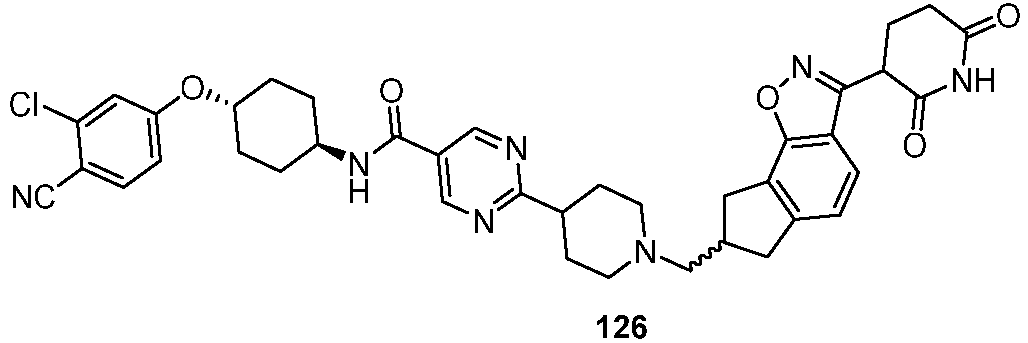

- Intermediate 27a (100 mg), intermediate 111c (103 mg), 1,2-dichloroethane (10 mL), isopropanol (2 mL), and sodium triacetoxyborohydride (140 mg) were added to a reaction flask in sequence, and the mixture was reacted at room temperature. After the reaction was completed, a saturated sodium bicarbonate solution was added to the reaction system to quench the reaction, and the mixture was extracted with dichloromethane. The organic layer was collected, dried over anhydrous sodium sulfate, and filtered. The filtrate was concentrated, and then the residue was purified by silica gel column chromatography to give compound 126 (73 mg).
- MS(ESI, [M+H]+) m/z: 722.21.
- 1H NMR (500 MHz, DMSO-d6) δ 11.08 (s, 1H), 9.08 (s, 2H), 8.57 (d, J = 7.5 Hz, 1H), 7.86 (d, J = 8.8 Hz, 1H), 7.61 (d, J = 8.0 Hz, 1H), 7.40 (d, J = 2.4 Hz, 1H), 7.27 (d, J = 8.1 Hz, 1H), 7.15 (dd, J = 8.8, 2.4 Hz, 1H), 4.68 - 4.48 (m, 2H), 3.84 (d, J = 8.5 Hz, 1H), 3.29 - 3.11 (m, 2H), 3.04 - 2.71 (m, 7H), 2.66 - 2.56 (m, 1H), 2.47 (dd, J = 12.1, 4.4 Hz, 1H), 2.37 (d, J = 7.3 Hz, 2H), 2.26 - 2.02 (m, 5H), 2.02 - 1.77 (m, 6H), 1.54 (p, J = 10.8, 9.2 Hz, 4H).
-


- Intermediate 111a (300 mg), ethyl acetate (10 mL), and a solution of hydrochloric acid in 1,4-dioxane (4 M, 2 mL) were added to a reaction flask in sequence, and the mixture was reacted at room temperature. After the reaction was completed, the reaction system was filtered under vacuum and dried to give compound 127a (265 mg).
- Intermediate 26f (100 mg), intermediate 127a (103 mg), 1,2-dichloroethane (10 mL), isopropanol (2 mL), and sodium triacetoxyborohydride (141 mg) were added to a reaction flask in sequence, and the mixture was reacted at room temperature. After the reaction was completed, a saturated sodium bicarbonate solution was added to the reaction system to quench the reaction, and the mixture was extracted with dichloromethane. The organic layer was collected, dried over anhydrous sodium sulfate, and filtered. The filtrate was concentrated, and then the residue was purified by silica gel column chromatography to give compound 127 (93 mg).
- MS(ESI, [M+H]+) m/z: 720.1.
- 1H NMR (500 MHz, DMSO-d6) δ 11.08 (s, 1H), 9.10 (s, 2H), 8.58 (d, J = 7.4 Hz, 1H), 7.86 (d, J = 8.8 Hz, 1H), 7.61 (d, J= 8.1 Hz, 1H), 7.40 (d, J = 2.4 Hz, 1H), 7.36 - 7.24 (m, 2H), 7.15 (dd, J = 8.8, 2.4 Hz, 1H), 4.63 - 4.48 (m, 2H), 3.85 (s, 1H), 3.29 - 3.11 (m, 4H), 3.02 - 2.56 (m, 9H), 2.49 - 2.42 (m, 1H), 2.26 - 2.06 (m, 3H), 2.02 - 1.87 (m, 2H), 1.54 (q, J = 10.1, 9.5 Hz, 4H).
-

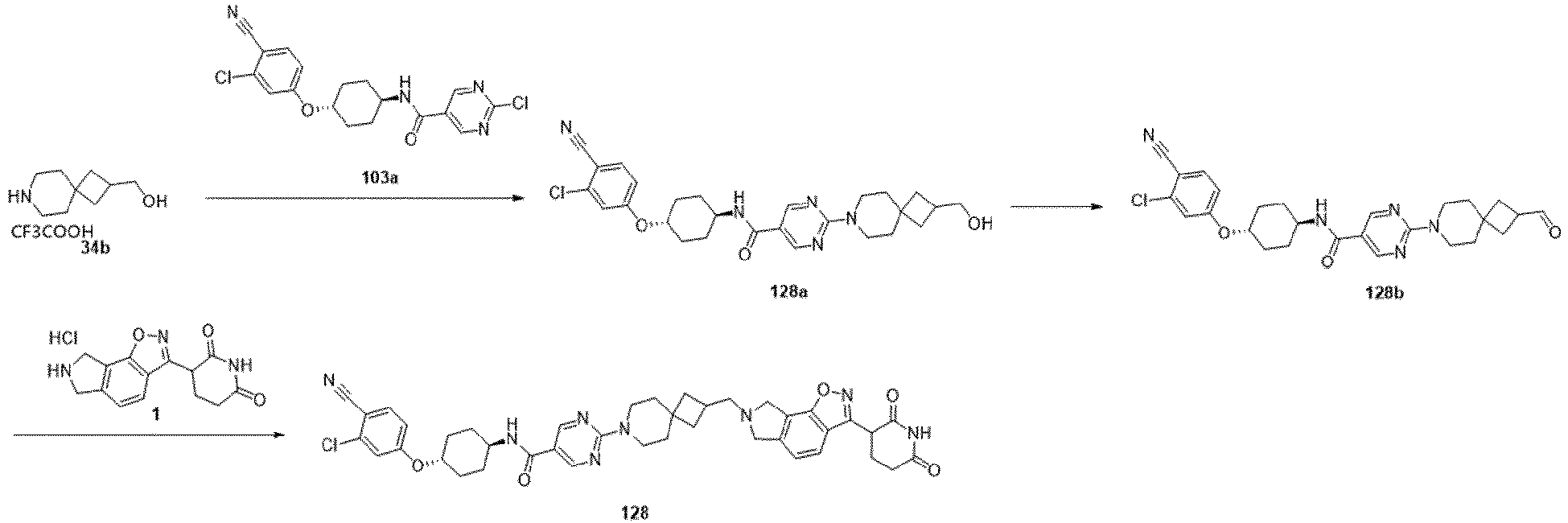
- 34b (0.56 g), compound 103a (1.0 g), N,N-diisopropylethylamine (1.8 g), and dimethyl sulfoxide (10 mL) were added to a reaction flask in sequence, and the mixture was reacted at 80 °C for 2 h. After the reaction was completed, the reaction solution was cooled to room temperature, diluted with ethyl acetate, and washed with a saturated sodium chloride solution, and the organic layer was collected, dried over anhydrous sodium sulfate, and filtered. The filtrate was concentrated, and then the residue was purified by silica gel column chromatography (dichloromethane/methanol) to give the target intermediate 128a (1.0 g).
- 128a (1.5 g), Dess-Martin periodinane (1.7 g), and dichloromethane (15 mL) were added to a reaction flask in sequence, and the mixture was reacted at room temperature for 3 h. After the reaction was completed, the reaction solution was quenched with a saturated sodium bicarbonate solution. The organic layer was separated and washed with a saturated sodium chloride solution. The organic layer was collected, dried over anhydrous sodium sulfate, and filtered. The filtrate was concentrated, and then the residue was purified by silica gel column chromatography (dichloromethane/methanol) to give the target intermediate 128b (1.3 g).
- MS(ESI, [M+H]+) m/z: 508.2.
- 128b (140 mg), intermediate 1 (95 mg), sodium acetate (46 mg), and acetonitrile (20 mL) were added to a reaction flask in sequence, and the mixture was stirred at room temperature for 10 min. Sodium triacetoxyborohydride (120 mg) was then added, and the mixture was reacted at room temperature for 2 h. After the reaction was completed, a saturated sodium bicarbonate solution was added to the reaction system to quench the reaction, and the mixture was extracted with dichloromethane. The organic layer was collected, dried over anhydrous sodium sulfate, and filtered. The filtrate was concentrated, and then the residue was purified by silica gel column chromatography
- MS(ESI, [M+H]+) m/z: 763.3.
- 1H NMR (500 MHz, DMSO-d6) δ 11.08 (s, 1H), 8.73 (s, 2H), 8.09 (d, J = 7.4 Hz, 1H), 7.85 (d, J = 8.7 Hz, 1H), 7.70 (d, J = 8.0 Hz, 1H), 7.38 (d, J = 2.4 Hz, 1H), 7.29 (d, J = 8.1 Hz, 1H), 7.14 (dd, J = 8.8, 2.4 Hz, 1H), 4.69 - 4.48 (m, 2H), 4.12 (s, 2H), 4.01 (s, 2H), 3.77 (dt, J = 45.1, 5.4 Hz, 5H), 2.91 - 2.71 (m, 3H), 2.59 (ddd, J = 22.4, 12.5, 6.3 Hz, 3H), 2.20 (dq, J = 14.3, 4.7 Hz, 1H), 2.05 (dd, J = 24.9, 14.8 Hz, 4H), 1.98 - 1.84 (m, 2H), 1.71 - 1.42 (m, 10H).
-


- 128b (120 mg), intermediate 3 (90 mg), sodium acetate (40 mg), and acetonitrile (20 mL) were added to a reaction flask in sequence, and the mixture was stirred at room temperature for 10 min. Sodium triacetoxyborohydride (110 mg) was then added, and the mixture was reacted at room temperature for 2 h. After the reaction was completed, a saturated sodium bicarbonate solution was added to the reaction system to quench the reaction, and the mixture was extracted with dichloromethane. The organic layer was collected, dried over anhydrous sodium sulfate, and filtered. The filtrate was concentrated, and then the residue was purified by silica gel column chromatography (dichloromethane/methanol) to give the target compound 129 (60 mg).
- MS(ESI, [M+H]+) m/z: 777.1.
- 1H NMR (500 MHz, DMSO-d6) δ 11.07 (s, 1H) , 8.73 (s, 2H), 8.09 (d, J = 7.5 Hz, 1H), 7.85 (d, J = 8.7 Hz, 1H), 7.58 (d, J = 8.1 Hz, 1H), 7.38 (d, J = 2.5 Hz, 1H), 7.18 - 7.10 (m, 2H), 4.62 - 4.49 (m, 2H), 3.89 - 3.75 (m, 5H), 3.71 (t, J = 5.6 Hz, 2H), 2.93 (q, J = 5.6 Hz, 2H), 2.81 - 2.70 (m, 3H), 2.69 - 2.57 (m, 4H), 2.53 (s, 0.5H), 2.46 (dd, J = 12.2, 4.5 Hz, 0.5H), 2.18 (dq, J = 13.4, 4.8 Hz, 1H), 2.14 - 1.99 (m, 4H), 1.97 - 1.86 (m, 2H).1.63 (t, J = 5.6 Hz, 2H), 1.59 - 1.43 (m, 8H).
-


- 128b (100 mg), intermediate 4 (80 mg), sodium acetate (35 mg), and acetonitrile (20 mL) were added to a reaction flask in sequence, and the mixture was stirred at room temperature for 10 min. Sodium triacetoxyborohydride (101 mg) was then added, and the mixture was reacted at room temperature for 2 h. After the reaction was completed, a saturated sodium bicarbonate solution was added to the reaction system to quench the reaction, and the mixture was extracted with dichloromethane. The organic layer was collected, dried over anhydrous sodium sulfate, and filtered. The filtrate was concentrated, and then the residue was purified by silica gel column chromatography (dichloromethane/methanol) to give the target compound 130 (55 mg).
- MS(ESI, [M+H]+) m/z: 777.5.
- 1H NMR (500 MHz, DMSO-d6) δ 11.07 (s, 1H), 8.73 (s, 2H), 8.09 (d, J = 7.4 Hz, 1H), 7.86 (d, J = 8.7 Hz, 1H), 7.57 (d, J = 8.2 Hz, 1H), 7.38 (d, J = 2.4 Hz, 1H), 7.14 (dd, J = 8.7, 2.5 Hz, 1H), 7.09 (d, J = 8.3 Hz, 1H), 4.55 (dt, J = 10.1, 5.0 Hz, 2H), 3.88 - 3.75 (m, 3H), 3.74 - 3.62 (m, 4H), 2.98 (t, J = 5.9 Hz, 2H), 2.76 (qd, J = 8.7, 8.3, 6.0 Hz, 3H), 2.69 - 2.55 (m, 4H), 2.52 (d, J = 4.2 Hz, 0.3H), 2.46 (dd, J = 12.1, 4.4 Hz, 0.7H), 2.18 (dq, J = 13.5, 4.8 Hz, 1H), 2.09 (dd, J = 9.6, 4.4 Hz, 2H), 2.06 - 1.98 (m, 2H), 1.92 (dd, J = 9.4, 4.3 Hz, 2H), 1.62 (t, J = 5.5 Hz, 2H), 1.57 - 1.43 (m, 8H).
-


- 128b (105 mg), intermediate 5 (88 mg), sodium acetate (40 mg), and acetonitrile (20 mL) were added to a reaction flask in sequence, and the mixture was stirred at room temperature for 10 min. Sodium triacetoxyborohydride (109 mg) was then added, and the mixture was reacted at room temperature for 2 h. After the reaction was completed, a saturated sodium bicarbonate solution was added to the reaction system to quench the reaction, and the mixture was extracted with dichloromethane. The organic layer was collected, dried over anhydrous sodium sulfate, and filtered. The filtrate was concentrated, and then the residue was purified by silica gel column chromatography (dichloromethane/methanol) to give the target compound 131a (50 mg).
- MS(ESI, [M+H]+) m/z: 791.1.
- Intermediate 131a (50 mg), dichloromethane (10 mL), methanol (1 mL), and maleic acid (10 mg) were added to a reaction flask in sequence, and the mixture was reacted at room temperature for 1 h. After the reaction was completed, the reaction solution was concentrated by evaporation under reduced pressure to remove the solvent. The residue was slurried with petroleum ether and filtered, and the filter cake was collected to give compound 131 (46 mg).
- MS(ESI, [M+H]+) m/z: 791.5.
- 1H NMR (500 MHz, DMSO-d6) δ 11.09 (s, 1H), 9.67 (s, 1H), 8.74 (s, 2H), 8.10 (d, J = 7.4 Hz, 1H), 7.86 (d, J = 8.9 Hz, 1H), 7.67 (d, J = 8.1 Hz, 1H), 7.38 (d, J = 2.4 Hz, 1H), 7.29 (d, J = 8.1 Hz, 1H), 7.14 (dd, J = 8.8, 2.4 Hz, 1H), 6.09 (s, 2H), 4.56 (ddd, J = 20.7, 11.1, 5.1 Hz, 2H), 3.80 (q, J = 10.2, 7.8 Hz, 3H), 3.71 (t, J = 5.6 Hz, 3H), 3.29 (s, 9H), 2.79 (ddd, J = 17.3, 12.2, 5.8 Hz, 2H), 2.61 (dt, J = 17.3, 4.1 Hz, 1H), 2.54 (d, J = 12.6 Hz, 0.6H), 2.47 (s, 0.4H), 2.22 - 2.03 (m, 5H), 1.91 (dd, J = 9.7, 4.4 Hz, 2H), 1.64 (dd, J = 12.2, 8.1 Hz, 4H), 1.57 - 1.42 (m, 6H).
-


- 119b (100 mg), intermediate 10 (80 mg), sodium acetate (43 mg), and acetonitrile (20 mL) were added to a reaction flask in sequence, and the mixture was stirred at room temperature for 10 min. Sodium triacetoxyborohydride (108 mg) was then added, and the mixture was reacted at room temperature for 2 h. After the reaction was completed, a saturated sodium bicarbonate solution was added to the reaction system to quench the reaction, and the mixture was extracted with dichloromethane. The organic layer was collected, dried over anhydrous sodium sulfate, and filtered. The filtrate was concentrated, and then the residue was purified by silica gel column chromatography (dichloromethane/methanol) to give the target compound 132 (32 mg).
- MS(ESI, [M+H]+) m/z: 722.1.
- 1H NMR (500 MHz, DMSO-d6) δ 10.88 (s, 1H), 8.75 (s, 2H), 8.10 (d, J = 7.4 Hz, 1H), 7.86 (d, J = 7.4 Hz, 2H), 7.41 (dd, J = 22.9, 5.2 Hz, 2H), 7.14 (d, J = 8.2 Hz, 2H), 4.74 (d, J = 13.0 Hz, 2H), 4.62 - 4.48 (m, 1H), 4.22 - 4.05 (m, 3H), 3.98 (s, 2H), 3.80 (s, 1H), 3.00 (t, J = 12.5 Hz, 2H), 2.74 (ddd, J = 17.4, 12.2, 5.3 Hz, 1H), 2.68 - 2.54 (m, 3H), 2.39 - 2.25 (m, 1H), 2.12 (dt, J = 15.3, 5.2 Hz, 3H), 1.89 (d, J = 14.0 Hz, 5H), 1.59 - 1.43 (m, 4H), 1.11 (q, J = 13.2, 12.5 Hz, 2H).
-


- Intermediate 11 (80 mg), intermediate 119b (117 mg), sodium acetate (40.9 mg), 1,2-dichloroethane (5 mL), isopropanol (1 mL), and sodium triacetoxyborohydride (106 mg) were added to a reaction flask in sequence, and the mixture was reacted at room temperature. After the reaction was completed, dichloromethane (50 mL) and water (100 mL) were added for extraction. The organic phase was separated, dried over anhydrous sodium sulfate, and filtered, and the filtrate was purified by silica gel column chromatography to give compound 133 (130 mg).
- MS(ESI, [M+H]+) m/z: 736.4.
- 1H NMR (500 MHz, DMSO-d6) δ 10.87 (s, 1H), 8.74 (s, 2H), 8.09 (d, J = 7.5 Hz, 1H), 7.86 (d, J = 8.8 Hz, 1H), 7.82 (s, 1H), 7.38 (d, J = 2.5 Hz, 1H), 7.35 (d, J = 8.0 Hz, 1H), 7.14 (dd, J = 8.8, 2.4 Hz, 1H), 7.00 (d, J = 8.1 Hz, 1H), 4.76 - 4.70 (m, 2H), 4.58 - 4.51 (m, 1H), 4.10 (dd, J = 11.8, 4.9 Hz, 1H), 3.79 (d, J = 12.3 Hz, 3H), 2.99 (td, J = 13.0, 2.6 Hz, 2H), 2.91 (t, J = 5.8 Hz, 2H), 2.72 (p, J = 5.9, 5.5 Hz, 3H), 2.59 - 2.55 (m, 1H), 2.41 (d, J = 7.2 Hz, 2H), 2.34 - 2.26 (m, 1H), 2.10 (dp, J = 8.6, 4.3 Hz, 3H), 2.02 (td, J = 11.4, 10.5, 5.7 Hz, 1H), 1.95 - 1.89 (m, 2H), 1.88 - 1.81 (m, 2H), 1.54 - 1.46 (m, 4H), 1.08 (qd, J = 12.1, 3.8 Hz, 2H).
-


- Intermediate 12 (80 mg), intermediate 119b (117 mg), sodium acetate (40.9 mg), 1,2-dichloroethane (5 mL), isopropanol (1 mL), and sodium triacetoxyborohydride (106 mg) were added to a reaction flask in sequence, and the mixture was reacted at room temperature. After the reaction was completed, dichloromethane (50 mL) and water (100 mL) were added for extraction. The organic phase was separated, dried over anhydrous sodium sulfate, and filtered, and the filtrate was purified by silica gel column chromatography to give compound 134 (107 mg).
- MS(ESI, [M+H]+) m/z: 736.4.
- 1H NMR (500 MHz, DMSO-d6) δ 10.87 (s, 1H), 8.74 (s, 2H), 8.09 (d, J = 7.5 Hz, 1H), 7.88 - 7.82 (m, 2H), 7.38 (d, J = 2.4 Hz, 1H), 7.33 (d, J = 8.0 Hz, 1H), 7.14 (dd, J = 8.8, 2.4 Hz, 1H), 6.95 (d, J = 8.2 Hz, 1H), 4.73 (dt, J = 13.1, 3.3 Hz, 2H), 4.58 - 4.51 (m, 1H), 4.10 (dd, J = 11.8, 4.9 Hz, 1H), 3.79 (s, 1H), 3.65 (s, 2H), 3.02 - 2.94 (m, 4H), 2.78 - 2.69 (m, 3H), 2.59 - 2.54 (m, 1H), 2.36 (d, J = 7.1 Hz, 2H), 2.29 (td, J = 12.2, 4.1 Hz, 1H), 2.14 - 2.06 (m, 3H), 2.03 - 1.96 (m, 1H), 1.94 - 1.88 (m, 2H), 1.87 - 1.80 (m, 2H), 1.50 (dt, J = 10.7, 6.2 Hz, 4H), 1.08 (qd, J = 12.5, 4.1 Hz, 2H).
-


- 119b (105 mg), intermediate 13 (86 mg), sodium acetate (45 mg), and acetonitrile (20 mL) were added to a reaction flask in sequence, and the mixture was stirred at room temperature for 10 min. Sodium triacetoxyborohydride (115 mg) was then added, and the mixture was reacted at room temperature for 2 h. After the reaction was completed, a saturated sodium bicarbonate solution was added to the reaction system to quench the reaction, and the mixture was extracted with dichloromethane. The organic layer was collected, dried over anhydrous sodium sulfate, and filtered. The filtrate was concentrated, and then the residue was purified by silica gel column chromatography (dichloromethane/methanol) to give the target compound 135 (60 mg).
- MS(ESI, [M+H]+) m/z: 750.1.
- 1H NMR (500 MHz, DMSO-d6) δ 10.87 (s, 1H), 8.75 (s, 2H), 8.10 (d, J = 7.5 Hz, 1H), 7.95 - 7.78 (m, 2H), 7.39 (d, J = 2.4 Hz, 1H), 7.26 (d, J = 7.8 Hz, 1H), 7.14 (dd, J = 8.8, 2.4 Hz, 1H), 7.01 (d, J = 8.0 Hz, 1H), 4.74 (d, J = 13.0 Hz, 2H), 4.55 (dd, J = 9.5, 5.2 Hz, 1H), 4.09 (dd, J = 11.9, 4.9 Hz, 1H), 3.80 (s, 1H), 3.12 (d, J = 6.9 Hz, 2H), 3.06 - 2.91 (m, 4H), 2.73 (ddd, J = 17.3, 12.1, 5.4 Hz, 1H), 2.68 - 2.53 (m, 5H), 2.39 - 2.25 (m, 3H), 2.10 (dt, J = 14.9, 5.4 Hz, 3H), 1.99 - 1.80 (m, 5H), 1.50 (dt, J = 10.9, 6.9 Hz, 4H), 1.07 (q, J = 11.1 Hz, 2H).
-


- Intermediate 28a (70 mg), intermediate 109b (103 mg), 1,2-dichloroethane (5 mL), isopropanol (1 mL), and sodium triacetoxyborohydride (99 mg) were added to a reaction flask in sequence, and the mixture was reacted at room temperature. After the reaction was completed, dichloromethane (50 mL) and water (100 mL) were added for extraction. The organic phase was separated, dried over anhydrous sodium sulfate, and filtered, and the filtrate was purified by silica gel column chromatography to give compound 136 (90 mg).
- MS(ESI, [M+H]+) m/z: 722.1.
- 1H NMR (500 MHz, DMSO-d6) δ 10.88 (s, 1H), 8.77 (s, 2H), 8.13 (d, J = 7.4 Hz, 1H), 7.98 - 7.66 (m, 2H), 7.51 - 7.25 (m, 2H), 7.13 (dd, J = 13.1, 8.3 Hz, 2H), 4.55 (s, 1H), 4.11 (dd, J = 12.1, 4.8 Hz, 1H), 3.82 (d, J = 23.6 Hz, 5H), 3.24 - 3.08 (m, 2H), 2.93 - 2.66 (m, 4H), 2.57 (d, J = 18.4 Hz, 1H), 2.47 (s, 4H), 2.34 (dd, J = 33.1, 9.9 Hz, 3H), 2.10 (d, J = 10.3 Hz, 3H), 1.92 (d, J = 9.8 Hz, 2H), 1.67 - 1.35 (m, 4H).
-


- Intermediate 29a (70 mg), intermediate 109b (103 mg), 1,2-dichloroethane (5 mL), isopropanol (1 mL), and sodium triacetoxyborohydride (99 mg) were added to a reaction flask in sequence, and the mixture was reacted at room temperature. After the reaction was completed, dichloromethane (50 mL) and water (100 mL) were added for extraction. The organic phase was separated, dried over anhydrous sodium sulfate, and filtered, and the filtrate was purified by silica gel column chromatography to give compound 137 (80 mg).
- MS(ESI, [M+H]+) m/z: 722.1.
- 1H NMR (500 MHz, DMSO-d6) δ 10.88 (s, 1H), 8.77 (s, 2H), 8.13 (d, J = 7.5 Hz, 1H), 7.94 - 7.74 (m, 2H), 7.43 - 7.28 (m, 2H), 7.13 (dd, J = 13.2, 8.4 Hz, 2H), 4.61 - 4.49 (m, 1H), 4.11 (dd, J = 11.9, 4.9 Hz, 1H), 3.95 - 3.71 (m, 5H), 3.16 (ddd, J = 30.6, 15.8, 7.6 Hz, 2H), 2.88 (q, J = 10.3, 7.8 Hz, 2H), 2.75 (ddd, J = 31.3, 13.9, 5.2 Hz, 2H), 2.57 (d, J = 18.8 Hz, 1H), 2.49 - 2.43 (m, 4H), 2.37 (d, J = 7.3 Hz, 2H), 2.29 (td, J = 12.2, 4.1 Hz, 1H), 2.10 (d, J = 10.1 Hz, 3H), 1.92 (d, J = 9.9 Hz, 2H), 1.61 - 1.41 (m, 4H).
-


- 119b (110 mg), intermediate 72 (92 mg), sodium acetate (45 mg), and acetonitrile (20 mL) were added to a reaction flask in sequence, and the mixture was stirred at room temperature for 10 min. Sodium triacetoxyborohydride (112 mg) was then added, and the mixture was reacted at room temperature for 2 h. After the reaction was completed, a saturated sodium bicarbonate solution was added to the reaction system to quench the reaction, and the mixture was extracted with dichloromethane. The organic layer was collected, dried over anhydrous sodium sulfate, and filtered. The filtrate was concentrated, and then the residue was purified by silica gel column chromatography to give the target compound 138a (40 mg).
- MS(ESI, [M+H]+) m/z: 723.1.
- Intermediate 138a (40 mg), dichloromethane (10 mL), methanol (1 mL), and maleic acid (8 mg) were added to a reaction flask in sequence, and the mixture was reacted at room temperature for 1 h. After the reaction was completed, the reaction solution was concentrated by evaporation under reduced pressure to remove the solvent. The residue was slurried with petroleum ether and filtered, and the filter cake was collected to give compound 138 (36 mg).
- MS(ESI, [M+H]+) m/z: 723.1.
- 1H NMR (500 MHz, DMSO-d6) δ 10.57 (s, 1H), 8.77 (s, 2H), 8.22 (s, 1H), 8.13 (d, J = 7.4 Hz, 1H), 7.86 (d, J = 8.7 Hz, 1H), 7.64 (d, J = 8.1 Hz, 1H), 7.39 (d, J = 2.4 Hz, 1H), 7.32 (d, J = 8.1 Hz, 1H), 7.14 (dd, J = 8.8, 2.4 Hz, 1H), 6.10 (s, 2H), 4.78 (d, J = 13.3 Hz, 3H), 4.56 (q, J = 7.2, 5.8 Hz, 1H), 3.90 - 3.74 (m, 3H), 3.31 - 3.26 (m, 4H), 3.03 (td, J = 13.2, 2.7 Hz, 2H), 2.80 (t, J = 6.7 Hz, 2H), 2.20 (s, 1H), 2.15 - 2.05 (m, 2H), 1.92 (t, J = 7.4 Hz, 4H), 1.51 (p, J = 6.3, 5.8 Hz, 4H), 1.30 - 1.14 (m, 3H).
-


- Intermediate 73 (80 mg), intermediate 119b (116 mg), sodium acetate (40.8 mg), 1,2-dichloroethane (5 mL), isopropanol (1 mL), and sodium triacetoxyborohydride (105 mg) were added to a reaction flask in sequence, and the mixture was reacted at room temperature. After the reaction was completed, dichloromethane (50 mL) and water (100 mL) were added for extraction. The organic phase was separated, dried over anhydrous sodium sulfate, and filtered, and the filtrate was purified by silica gel column chromatography to give compound 139 (119 mg).
- MS(ESI, [M+H]+) m/z: 737.1.
- 1H NMR (500 MHz, DMSO-d6) δ 10.51 (s, 1H), 8.74 (s, 2H), 8.09 (d, J = 7.5 Hz, 1H), 8.05 (s, 1H), 7.86 (d, J = 8.8 Hz, 1H), 7.40 - 7.36 (m, 2H), 7.14 (dd, J = 8.8, 2.5 Hz, 1H), 7.04 (d, J = 8.2 Hz, 1H), 4.73 (d, J = 13.2 Hz, 2H), 4.55 (dt, J = 9.8, 5.6 Hz, 1H), 3.83 (t, J = 6.6 Hz, 2H), 3.78 (s, 3H), 3.03 - 2.97 (m, 2H), 2.92 (t, J = 5.8 Hz, 2H), 2.78 (t, J = 6.7 Hz, 2H), 2.75 - 2.71 (m, 2H), 2.42 (d, J = 7.2 Hz, 2H), 2.13 - 2.08 (m, 2H), 2.02 (s, 1H), 1.91 (t, J = 5.7 Hz, 2H), 1.87 - 1.82 (m, 2H), 1.53 - 1.47 (m, 4H), 1.13 - 1.05 (m, 2H).
-


- Intermediate 74 (80 mg), intermediate 119b (116 mg), sodium acetate (40.8 mg), 1,2-dichloroethane (5 mL), isopropanol (1 mL), and sodium triacetoxyborohydride (105 mg) were added to a reaction flask in sequence, and the mixture was reacted at room temperature. After the reaction was completed, dichloromethane (50 mL) and water (100 mL) were added for extraction. The organic phase was separated, dried over anhydrous sodium sulfate, and filtered, and the filtrate was purified by silica gel column chromatography to give compound 140 (40 mg).
- MS(ESI, [M+H]+) m/z: 737.1.
- 1H NMR (500 MHz, DMSO-d6) δ 10.51 (s, 1H), 8.74 (s, 2H), 8.14 - 8.03 (m, 2H), 7.86 (d, J = 8.8 Hz, 1H), 7.42 - 7.33 (m, 2H), 7.14 (dd, J = 8.8, 2.5 Hz, 1H), 6.99 (d, J = 8.2 Hz, 1H), 4.73 (dt, J = 13.0, 3.4 Hz, 2H), 4.59 - 4.50 (m, 1H), 3.83 (t, J = 6.7 Hz, 3H), 3.66 (s, 2H), 3.04 - 2.91 (m, 4H), 2.77 (dt, J = 13.3, 6.4 Hz, 4H), 2.37 (d, J = 7.1 Hz, 2H), 2.15 - 2.06 (m, 2H), 1.99 (d, J = 8.8 Hz, 1H), 1.96 - 1.88 (m, 2H), 1.88 - 1.80 (m, 2H), 1.56 - 1.44 (m, 4H), 1.08 (qd, J = 12.4, 4.1 Hz, 2H).
-
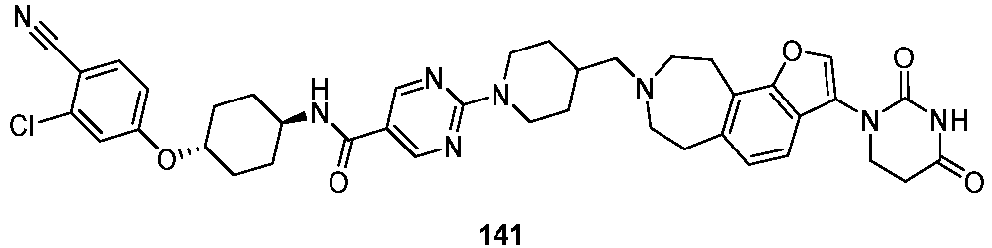

- 119b (110 mg), intermediate 75 (93 mg), sodium acetate (49 mg), and acetonitrile (20 mL) were added to a reaction flask in sequence, and the mixture was stirred at room temperature for 10 min. Sodium triacetoxyborohydride (110 mg) was then added, and the mixture was reacted at room temperature for 2 h. After the reaction was completed, a saturated sodium bicarbonate solution was added to the reaction system to quench the reaction, and the mixture was extracted with dichloromethane. The organic layer was collected, dried over anhydrous sodium sulfate, and filtered. The filtrate was concentrated, and then the residue was purified by silica gel column chromatography to give the target compound 141 (70 mg).
- MS(ESI, [M+H]+) m/z: 751.1.
- 1H NMR (500 MHz, DMSO-d6) δ 10.50 (s, 1H), 8.75 (s, 2H), 8.10 (d, J = 7.5 Hz, 1H), 8.05 (s, 1H), 7.86 (d, J = 8.8 Hz, 1H), 7.39 (d, J = 2.5 Hz, 1H), 7.29 (d, J = 7.8 Hz, 1H), 7.14 (dd, J = 8.8, 2.5 Hz, 1H), 7.06 (d, J = 8.0 Hz, 1H), 4.74 (d, J = 13.1 Hz, 2H), 4.55 (dt, J = 9.7, 5.8 Hz, 1H), 3.82 (t, J = 6.7 Hz, 3H), 3.12 (d, J = 6.8 Hz, 2H), 3.05 - 2.93 (m, 4H), 2.77 (t, J = 6.7 Hz, 2H), 2.70 - 2.56 (m, 4H), 2.32 (d, J = 6.7 Hz, 2H), 2.16 - 2.06 (m, 2H), 1.95 - 1.89 (m, 3H), 1.85 (d, J = 13.1 Hz, 2H), 1.50 (p, J = 6.4, 5.8 Hz, 4H), 1.13 - 1.01 (m, 2H).
-


- Intermediate 103a (500 mg), 3-azetidinemethanol hydrochloride (174 mg), DIPEA (496 mg, 0.670 mL), and DMSO (5 mL) were added to a reaction flask in sequence, and the mixture was heated to 100 °C and reacted. After the reaction was completed, the reaction solution was extracted with ethyl acetate (100 mL) and water (200 mL). The organic phase was separated, washed with saturated brine, dried over anhydrous sodium sulfate, and filtered, and the filtrate was concentrated, slurried with ethyl acetate, and filtered. The filter cake was collected and dried under reduced pressure to give the target intermediate 142a (352 mg).
- MS(ESI, [M+H]+) m/z: 442.2.
- Intermediate 142a (150 mg), DCM (10 mL), and Dess-Martin periodinane (288 mg) were added to a reaction flask in sequence, and the mixture was reacted at room temperature. After the reaction was completed, the reaction solution was quenched with a saturated sodium thiosulfate solution (100 mL) and a sodium bicarbonate solution (100 mL) and extracted with dichloromethane (100 mL). The organic phase was separated, washed with saturated brine, dried over anhydrous sodium sulfate, and filtered, and the filtrate was purified by silica gel column chromatography to give the target intermediate 142b (157 mg).
- Intermediate 11 (110 mg), intermediate 142b (150 mg), sodium acetate (56.1 mg), 1,2-dichloroethane (5 mL), isopropanol (1 mL), and sodium triacetoxyborohydride (145 mg) were added to a reaction flask in sequence, and the mixture was reacted at room temperature. After the reaction was completed, dichloromethane (50 mL) and water (100 mL) were added for extraction. The organic phase was separated, dried over anhydrous sodium sulfate, and filtered, and the filtrate was purified by silica gel column chromatography to give compound 142 (160 mg).
- MS(ESI, [M+H]+) m/z: 709.1.
- 1H NMR (500 MHz, DMSO-d6) δ 11.08 (s, 1H), 8.74 (s, 2H), 8.24 - 8.03 (m, 1H), 7.86 (d, J = 8.9 Hz, 1H), 7.58 (d, J = 8.3 Hz, 1H), 7.38 (s, 1H), 7.12 (dd, J = 16.9, 8.5 Hz, 2H), 4.56 (d, J = 12.2 Hz, 2H), 4.38 - 4.12 (m, 2H), 3.78 (d, J = 34.0 Hz, 5H), 3.17 (s, 1H), 3.04 (d, J = 37.3 Hz, 3H), 2.81 (t, J = 17.4 Hz, 5H), 2.61 (d, J = 17.5 Hz, 1H), 2.15 (d, J = 44.3 Hz, 3H), 1.92 (s, 2H), 1.50 (s, 4H).
-


- Intermediate 103a (300 mg), (R)-pyrrolidine-3-methanol hydrochloride (158 mg), DIPEA (396 mg), and DMSO (15 mL) were added to a reaction flask in sequence, and the mixture was warmed to 70 °C and reacted for 1 h. After the reaction was completed, the reaction solution was extracted with water (50 mL) and ethyl acetate (50 mL). The organic phases were combined, washed with a saturated sodium chloride solution, dried over anhydrous sodium sulfate, and filtered, and the filtrate was concentrated by evaporation under reduced pressure to remove the solvent, thus giving the target intermediate 143a (300 mg).
- MS(ESI, [M+H]+) m/z: 456.1.
- 143a (0.3 g), Dess-Martin periodinane (0.78 g), and dichloromethane (30 mL) were added to a reaction flask in sequence, and the mixture was reacted at room temperature for 1 h. After the reaction was completed, dichloromethane (70 mL) and water (100 mL) were added. The organic phase was separated, washed with a saturated sodium chloride solution, dried over anhydrous sodium sulfate, filtered, and concentrated to give intermediate 143b (0.37 g).
- 143b (105 mg), intermediate 4 (78 mg), sodium acetate (65 mg), and DCE/isopropanol (5:1, 20 mL) were added to a reaction flask in sequence, and the mixture was reacted at room temperature for 30 min. Sodium cyanoborohydride (55 mg) was then added, and the mixture was reacted at room temperature. After the reaction was completed, the reaction solution was concentrated by rotary evaporation to remove the solvent, and the crude product was separated and purified by silica gel column chromatography to give compound 143 (68 mg).
- MS(ESI, [M+H]+) m/z: 723.4.
- 1H NMR (500 MHz, DMSO-d6) δ 11.08 (s, 1H), 8.74 (d, J = 6.0 Hz, 2H), 8.10 (d, J = 7.5 Hz, 1H), 7.86 (d, J = 8.7 Hz, 1H), 7.58 (d, J = 8.1 Hz, 1H), 7.38 (d, J = 2.4 Hz, 1H), 7.16 - 7.07 (m, 2H), 4.56 (dt, J = 13.4, 6.7 Hz, 2H), 3.85 - 3.65 (m, 5H), 3.51 (dt, J = 11.4, 7.6 Hz, 1H), 3.28 (dd, J = 11.5, 7.2 Hz, 1H), 3.01 (t, J = 5.9 Hz, 2H), 2.89 - 2.67 (m, 4H), 2.62 (t, J = 4.3 Hz, 1H), 2.59 (d, J = 7.0 Hz, 2H), 2.47 (dd, J = 12.1, 4.5 Hz, 1H), 2.19 (dq, J = 13.5, 4.8 Hz, 1H), 2.12 (dt, J = 18.2, 4.1 Hz, 3H), 1.98 - 1.87 (m, 2H), 1.75 (dq, J = 12.2, 8.1 Hz, 1H), 1.56 - 1.45 (m, 4H).
-


- Intermediate 103a (300 mg), (S)-pyrrolidine-3-methanol hydrochloride (158 mg), DIPEA (396 mg), and DMSO (15 mL) were added to a reaction flask in sequence, and the mixture was warmed to 70 °C and reacted for 1 h. After the reaction was completed, the reaction solution was extracted with water (50 mL) and ethyl acetate (50 mL). The organic phases were combined, washed with a saturated sodium chloride solution, dried over anhydrous sodium sulfate, and filtered, and the filtrate was concentrated by evaporation under reduced pressure to remove the solvent, thus giving the target intermediate 144a (310 mg).
- MS(ESI, [M+H]+) m/z: 456.1.
- 144a (0.3 g), Dess-Martin periodinane (0.78 g), and dichloromethane (30 mL) were added to a reaction flask in sequence, and the mixture was reacted at room temperature for 1 h. After the reaction was completed, dichloromethane (70 mL) and water (100 mL) were added. The organic phase was separated, washed with a saturated sodium chloride solution, dried over anhydrous sodium sulfate, filtered, and concentrated to give intermediate 144b (0.32 g).
- 144b (105 mg), intermediate 4 (78 mg), sodium acetate (65 mg), and DCE/isopropanol (5:1, 20 mL) were added to a reaction flask in sequence, and the mixture was reacted at room temperature for 30 min. Sodium cyanoborohydride (55 mg) was then added, and the mixture was reacted at room temperature. After the reaction was completed, the reaction solution was concentrated by rotary evaporation to remove the solvent, and the crude product was separated and purified by silica gel column chromatography to give compound 144 (78 mg).
- MS(ESI, [M+H]+) m/z: 723.4.
- 1H NMR (500 MHz, DMSO-d6) δ 11.08 (s, 1H), 8.74 (d, J = 6.0 Hz, 2H), 8.10 (d, J = 7.5 Hz, 1H), 7.86 (d, J = 8.8 Hz, 1H), 7.58 (d, J = 8.1 Hz, 1H), 7.38 (d, J = 2.4 Hz, 1H), 7.18 - 7.07 (m, 2H), 4.56 (dd, J = 11.9, 5.0 Hz, 2H), 3.86 - 3.65 (m, 5H), 3.51 (dt, J = 11.3, 7.6 Hz, 1H), 3.28 (dd, J = 11.6, 7.1 Hz, 1H), 3.01 (t, J = 5.9 Hz, 2H), 2.77 (dddd, J = 39.4, 27.7, 14.9, 6.5 Hz, 4H), 2.60 (dd, J = 17.2, 5.7 Hz, 3H), 2.47 (dd, J = 12.1, 4.4 Hz, 1H), 2.19 (dq, J = 13.2, 4.6 Hz, 1H), 2.12 (d, J = 13.9 Hz, 3H), 1.91 (s, 2H), 1.75 (dq, J = 12.2, 8.1 Hz, 1H), 1.57 - 1.44 (m, 4H). Example 145: Synthesis of Compound 145


- Intermediate 17c (2 g), 5-chloropyrazine-2-carboxylic acid (1.14 g), DCM (20 mL), HATU (3.18 g), and DIPEA (3.64 mL) were added to a reaction flask in sequence, and the mixture was reacted at room temperature. After the reaction was completed, the reaction solution was concentrated by evaporation under reduced pressure to remove the solvent and extracted with ethyl acetate and water. The organic phase was separated, washed with saturated brine, dried over anhydrous sodium sulfate, and filtered, the filtrate was concentrated, and the residue was purified by silica gel column chromatography to give the target intermediate 145a (2.5 g).
- Intermediate 145a (2 g), 4-hydroxymethylpiperidine (0.648 g), DIPEA (2.67 mL), and DMSO (20 mL) were added to a reaction flask in sequence, and the mixture was heated to 100 °C and reacted. After the reaction was completed, the reaction solution was extracted with ethyl acetate and water. The organic phase was separated, washed with saturated brine, dried over anhydrous sodium sulfate, and filtered, the filtrate was concentrated, and the residue was purified by silica gel column chromatography to give the target intermediate 145b (2.04 g).
- MS (ESI, [M+H]+) m/z: 470.28.
- Intermediate 145b (0.6 g), 2-iodoxybenzoic acid (0.71 g), and DMSO (10 mL) were added to a reaction flask in sequence, and the mixture was reacted at room temperature. After the reaction was completed, ethyl acetate and a saturated sodium bicarbonate solution were added for extraction. The organic phase was dried over anhydrous sodium sulfate and filtered, and the filtrate was purified by silica gel column chromatography to give compound 145c (0.56 g).
- Intermediate 4 (85 mg), intermediate 145c (124 mg), sodium acetate (43.3 mg), 1,2-dichloroethane (5 mL), isopropanol (1 mL), and sodium triacetoxyborohydride (112 mg) were added to a reaction flask in sequence, and the mixture was reacted at room temperature. After the reaction was completed, dichloromethane (50 mL) and water (100 mL) were added for extraction. The organic phase was separated, dried over anhydrous sodium sulfate, and filtered, and the filtrate was purified by silica gel column chromatography to give compound 145 (128 mg).
- MS(ESI, [M+H]+) m/z: 737.2.
- 1H NMR (500 MHz, DMSO-d6) δ 11.08 (s, 1H), 8.59 (d, J = 1.3 Hz, 1H), 8.25 (d, J = 1.4 Hz, 1H), 8.06 (d, J = 8.3 Hz, 1H), 7.86 (d, J = 8.8 Hz, 1H), 7.58 (d, J = 8.2 Hz, 1H), 7.37 (d, J = 2.4 Hz, 1H), 7.15 - 7.08 (m, 2H), 4.56 (dd, J = 11.8, 5.0 Hz, 1H), 4.54 - 4.42 (m, 3H), 3.87 - 3.80 (m, 1H), 3.71 (s, 2H), 3.07 - 2.96 (m, 4H), 2.77 (td, J = 11.9, 9.9, 5.8 Hz, 3H), 2.61 (dt, J = 17.3, 4.3 Hz, 1H), 2.47 (dd, J = 12.2, 4.4 Hz, 1H), 2.39 (d, J = 7.2 Hz, 2H), 2.19 (dq, J = 13.5, 4.8 Hz, 1H), 2.09 (dd, J = 12.4, 4.1 Hz, 2H), 2.02 (t, J = 3.6 Hz, 1H), 1.92 - 1.82 (m, 4H), 1.65 - 1.56 (m, 2H), 1.51 (td, J = 12.9, 6.3 Hz, 2H), 1.20 - 1.11 (m, 2H).
-


- Intermediate 17c (2.83 g), 5-bromopyrimidine-2-carboxylic acid (2.0 g), HATU (4.50 g), DIPEA (6.37 g), and DMF (30 mL) were added to a reaction flask in sequence, and the mixture was reacted at room temperature for 1 h. After the reaction was completed, the reaction solution was extracted with water (50 mL) and ethyl acetate (50 mL). The organic phases were combined, washed with a saturated sodium chloride solution, dried over anhydrous sodium sulfate, and filtered, and the filtrate was concentrated by evaporation under reduced pressure to remove the solvent. The crude product was purified by silica gel column chromatography to give the target intermediate 146a (1.1 g). Step 2: Preparation of intermediate 146b
- 146a (800 mg), 4-hydroxymethylpiperidine (254 mg), BINAP (114 mg), palladium acetate (45 mg), cesium carbonate (1.7 g), and 1,4-dioxane (50 mL) were added to a reaction flask in sequence, and the mixture was heated to 100 °C and reacted under N2 atmosphere. After the reaction was completed, ethyl acetate (50 mL) and water (50 mL) were added for extraction. The organic phase was separated, dried over anhydrous sodium sulfate, and filtered, and the filtrate was purified by silica gel column chromatography to give the target intermediate 146b (0.52 g).
- MS(ESI, [M+H]+) m/z: 470.1.
- 146b (0.32 g), Dess-Martin periodinane (0.65 g), and dichloromethane (30 mL) were added to a reaction flask in sequence, and the mixture was reacted at room temperature for 1 h. After the reaction was completed, dichloromethane (70 mL) and water (100 mL) were added. The organic phase was separated, washed with a saturated sodium chloride solution, dried over anhydrous sodium sulfate, filtered, and concentrated to give intermediate 146c (0.32 g).
- 146c (132 mg), intermediate 4 (85 mg), sodium acetate (68 mg), and DCE/isopropanol (5:1, 20 mL) were added to a reaction flask in sequence, and the mixture was reacted at room temperature for 30 min. Sodium cyanoborohydride (62 mg) was then added, and the mixture was reacted at room temperature. After the reaction was completed, the reaction solution was concentrated by rotary evaporation to remove the solvent, and the crude product was separated and purified by silica gel column chromatography to give compound 146 (92 mg).
- MS(ESI, [M+H]+) m/z: 737.4.
- 1H NMR (500 MHz, DMSO-d6) δ 11.08 (s, 1H), 8.52 (s, 2H), 8.29 (d, J = 8.2 Hz, 1H), 7.86 (d, J = 8.7 Hz, 1H), 7.58 (d, J= 8.2 Hz, 1H), 7.37 (d, J= 2.5 Hz, 1H), 7.16 - 7.08 (m, 2H), 4.61 - 4.49 (m, 2H), 3.99 (d, J= 12.9 Hz, 2H), 3.86 - 3.77 (m, 1H), 3.72 (s, 2H), 3.00 (t, J = 5.9 Hz, 2H), 2.91 (td, J = 12.7, 12.3, 2.7 Hz, 2H), 2.83 - 2.74 (m, 3H), 2.61 (dt, J= 17.3, 4.4 Hz, 1H), 2.47 (dd, J= 12.1, 4.4 Hz, 1H), 2.40 (d, J= 7.1 Hz, 2H), 2.23 - 2.15 (m, 1H), 2.13 - 2.06 (m, 2H), 1.98 - 1.83 (m, 5H), 1.66 - 1.47 (m, 4H), 1.24 (q, J= 11.7 Hz, 2H).
- The detection was carried out using the HTRF HUMAN ANDROGEN RECEPTOR DETECTION KIT (cisbio, 64ANDRPEG), 4× Supplemented Lysis buffer was prepared using the Blocking reagent stock solution (100×) and Lysis buffer stock solution (4×), and 1× Supplemented Lysis buffer was prepared using the 4× Supplemented Lysis buffer and ddH2O. Premixed antibody solutions were prepared using Detection buffer, Androgen Receptor Eu Cryptate antibody, and Androgen Receptor d2 antibody.
- VCaP cells in a good growth state were taken, washed with PBS, digested with pancreatin, and added with 2% CSS-FBS phenol red-free DMEM complete medium to terminate the digestion. The cells were collected by using a centrifuge tube, adjusted to a cell density of 1 × 10⁶ cells/mL, and seeded in a 96-well plate (100 µL/well). The cells were incubated overnight in a cell incubator. Compounds were added using a nanoliter pipettor such that the final concentrations of the compounds were 1000 nM-0.977 nM. Two duplicate wells were set for each concentration, and meanwhile, a control was set. After another 24 h of incubation in the cell incubator, the medium was pipetted out, the 1× Supplemented Lysis buffer was added at 40 µL/well to lyse the cells. After the cells were oscillated for 40 min at room temperature, 16 µL of the cell lysate was added to a 384-well plate, the Premixed antibody solutions were added at 4 µL/well, and the mixture was left to stand at 25 °C for 2 h. Fluorescence values were detected at 665 nm/620 nm using an Envision microplate reader, the four-parameter analysis was performed, the dose-response curves were fit, and DC50 (the concentration of the drug when the degradation rate reaches 50%) and Dmax (the maximum degradation rate) were calculated. The results are shown in Table 1.
Table 1 Compound Degradation activity for AR in VCaP cells Compound Degradation activity for AR in VCaP cells Compound Degradation activity for AR in VCaP cells (DC50, nM) (DC50, nM) (DC50, nM) 17 ≤1 82 ≤1 98 ≤1 26 ≤1 86 ≤1 102 ≤1 27 ≤1 87 ≤1 107 ≤1 34 ≤1 88 ≤1 108 ≤1 36 ≤1 90 ≤1 109 ≤1 37 ≤1 91 ≤1 110 ≤1 48 ≤1 92 ≤1 113 ≤1 58 ≤1 94 ≤1 117 ≤1 71 ≤1 95 ≤1 118 ≤1 80 ≤1 96 ≤1 145 ≤1 81 ≤1 97 ≤1 - The detection was carried out using the HTRF HUMAN ANDROGEN RECEPTOR DETECTION KIT (cisbio, 64ANDRPEG), 4× Supplemented Lysis buffer was prepared using the Blocking reagent stock solution (100×) and Lysis buffer stock solution (4×), and 1× Supplemented Lysis buffer was prepared using the 4× Supplemented Lysis buffer and ddH2O. Premixed antibody solutions were prepared using Detection buffer, Androgen Receptor Eu Cryptate antibody, and Androgen Receptor d2 antibody.
- LNCaP cells in a good growth state were taken, washed with PBS, digested with pancreatin, and added with 2% CSS-FBS phenol red-free 1640 complete medium to terminate the digestion. The cells were collected by using a centrifuge tube, adjusted to a cell density of 1 × 10⁶ cells/mL, and seeded in a 96-well plate (100 µL/well). The cells were incubated overnight in a cell incubator. Compounds were added using a nanoliter pipettor such that the final concentrations of the compounds were 500 nM-0.488 nM. Two duplicate wells were set for each concentration, and meanwhile, a control was set. After another 24 h of incubation in the cell incubator, the medium was pipetted out, the 1× Supplemented Lysis buffer was added at 40 µL/well to lyse the cells. After the cells were oscillated for 40 min at room temperature, 16 µL of the cell lysate was added to a 384-well plate, the Premixed antibody solutions were added at 4 µL/well, and the mixture was left to stand at 25 °C for 2 h. Fluorescence values were detected at 665 nm/620 nm using an Envision microplate reader, the four-parameter analysis was performed, the dose-response curves were fit, and DC50 (the concentration of the drug when the degradation rate reaches 50%) and Dmax (the maximum degradation rate) were calculated. The results are shown in Table 2.
Table 2 Compound Degradation activity for AR in LNCaP cells Compound Degradation activity for AR in LNCaP cells (DC50, nM) (Dmax,%) (DC50, nM) (Dmax,%) 18 ≤20 >80% 97 ≤20 >80% 19 ≤20 >80% 98 ≤20 >80% 20 ≤20 >80% 102 ≤20 >80% 34 ≤20 >80% 107 ≤20 >80% 35 ≤20 >80% 109 ≤20 >80% 36 ≤20 >80% 110 ≤20 >80% 37 ≤20 >80% 117 ≤20 >80% 47 ≤20 >80% 118 ≤20 >80% 48 ≤20 >80% 122 ≤20 >80% 90 ≤20 >80% 145 ≤20 >80% 91 ≤20 >80% - The test results show that the compounds of the present application exhibit degradation activity against the ARs in VCaP cells and LNCaP cells.
- VCaP cells in a good growth state were taken, washed with PBS, digested with pancreatin, and added with 5% CSS-FBS phenol red-free DMEM complete medium to terminate the digestion. The cells were collected by using a centrifuge tube, adjusted to a cell density of 1 × 10⁵ cells/mL, and seeded in a 96-well plate (100 µL/well). Meanwhile, compounds were added using a nanoliter pipettor such that the final concentrations of the compounds were 10000 nM-0.61 nM. Two duplicate wells were set for each concentration, and meanwhile, a control was set. After another 168 h of incubation in the cell incubator, the detection reagent CCK-8 (manufacturer: Dojindo, 10 µL/well) was added. After 2.0 h of incubation in the cell incubator, absorbance values were detected at 450 nm using a PerkinElmer Envision microplate reader, the four-parameter analysis was performed, the dose-response curves were fit, and IC50 was calculated. The results are shown in Table 3.
Table 3 Compound Inhibitory activity for VCaP cell proliferation (IC50, nM) Compound Inhibitory activity for VCaP cell proliferation (IC50, nM) Compound Inhibitory activity for VCaP cell proliferation (IC50, nM) 17 <1000 97 <10 122 <100 26 <100 98 <100 123 <1000 27 <100 99 <100 124 <1000 28 <100 101 <10 125 <1000 34 <100 102 <10 127 <100 35 <100 103 <10 128 <100 36 <10 104 <10 129 <100 37 <100 105 <10 130 <100 41 <10 106 <100 131 <100 42 <10 107 <10 132 <1000 46 <10 108 <10 133 <1000 47 <10 109 <100 134 <100 48 <100 110 <100 136 <1000 58 <10 111 <100 137 <1000 59 <10 112 <1000 139 <1000 68 <10 113 <100 142 <1000 90 <10 114 <100 145 <100 91 <10 115 <1000 146 <1000 92 <10 117 <100 93 <10 118 <100 94 <100 119 <100 95 <100 120 <1000 96 <10 121 <10 - LNCaP cells in a good growth state were taken, washed with PBS, digested with pancreatin, and added with 2% CSS-FBS phenol red-free 1640 complete medium to terminate the digestion. The cells were collected by using a centrifuge tube, adjusted to a cell density of 1 × 10⁵ cells/mL, and seeded in a 96-well plate (100 µL/well). Meanwhile, compounds were added using a nanoliter pipettor such that the final concentrations of the compounds were 10000 nM-0.61 nM. Two duplicate wells were set for each concentration, and meanwhile, a control was set. After another 168 h of incubation in the cell incubator, the detection reagent CCK-8 (manufacturer: Dojindo, 10 µL/well) was added. After 2.0 h of incubation in the cell incubator, absorbance values were detected at 450 nm using a PerkinElmer Envision microplate reader, the four-parameter analysis was performed, the dose-response curves were fit, and IC50 was calculated. The results are shown in Table 4.
Table 4 Compound Inhibitory activity for LNCaP cell proliferation (IC50, nM) Compound Inhibitory activity for LNCaP cell proliferation (IC50, nM) Compound Inhibitory activity for LNCaP cell proliferation (IC50, nM) 17 <1000 88 <1000 120 <1000 18 <1000 91 <1000 121 <1000 19 <1000 92 <1000 122 <1000 20 <1000 94 <1000 123 <1000 21 <1000 95 <1000 128 <1000 23 <1000 96 <1000 129 <1000 24 <1000 97 <1000 130 <1000 25 <1000 98 <1000 131 <1000 26 <1000 99 <1000 132 <1000 27 <1000 100 <1000 133 <1000 28 <1000 102 <1000 134 <1000 29 <1000 107 <1000 135 <1000 30 <1000 108 <1000 136 <1000 31 <1000 109 <1000 137 <1000 32 <1000 110 <1000 138 <1000 33 <1000 111 <1000 139 <1000 34 <1000 39 <1000 44 <1000 35 <1000 40 <1000 46 <1000 36 <1000 41 <1000 48 <1000 37 <1000 43 <1000 93 <1000 38 <1000 112 <1000 140 <1000 49 <1000 113 <1000 141 <1000 50 <1000 114 <1000 142 <1000 51 <1000 116 <1000 143 <1000 52 <1000 117 <1000 144 <1000 54 <1000 118 <1000 145 <1000 55 <1000 119 <1000 146 <1000 58 <1000 82 <1000 - The compounds of the present application exhibit inhibitory activity for the proliferation of LNCaP cells and VCaP cells.
- Test Example 3. In Vitro Stability in Liver Microsome
- Liver microsome incubation samples (species: human, monkey, rat, and mouse) were prepared by mixing a PBS buffer (pH = 7.4), a liver microsome solution (0.5 mg/mL), a test compound, and an NADPH + MgCl2 solution and incubated at 37 °C and 300 rpm for 1 h. Zero-hour samples were prepared by mixing a PBS buffer (pH = 7.4), a liver microsome solution (0.5 mg/mL), and a test compound. An acetonitrile solution containing an internal standard was added to the samples, and supernatants were prepared by protein precipitation, diluted, and then assayed by LC/MS/MS. The results are shown in Table 5.
Table 5 Compound Human liver microsome Compound Human liver microsome Residuals at 60 min (%) Residuals at 60 min (%) 17 >85% 27 >85% 18 >85% 34 >85% 21 >85% 47 >85% 48 >85% 48 >85% 24 >85% 94 >85% 25 >85% 90 >85% 26 >85% 119 >85% - The compounds of the present application exhibit in vitro metabolic stability in liver microsomes.
- ICR mice weighing 18-22 g were randomized into groups of 9 after 3-5 days of acclimatization, and then intragastrically given the test compound solution at a dose of 10 mg/kg and intravenously injected with the test compound solution at a dose of 1 mg/kg.
- Blood sampling time points for the intragastrical administration group were 15 min, 0.5 h, 1 h, 2 h, 3 h, 4 h, 6 h, 8 h, 10 h, and 24 h, and blood sampling time points for the intravenous injection administration group were 0.083 min, 15 min, 0.5 h, 1 h, 2 h, 4 h, 6 h, 8 h, 10 h, and 24 h; blood was collected from the orbit to prepare plasma samples to be tested. 30 µL of each of the plasma samples to be tested and a standard curve sample were taken, and an acetonitrile solution containing an internal standard was added. Supernatants were obtained by protein precipitation, diluted, and then assayed by LC/MS/MS. Pharmacokinetic parameters were fitted using a non-compartmental model (see Table 6).
Table 6 Compound Mouse i.v. 1 mpk Mouse i.g. 10 mpk AUC (ng*h/mL) t1/2 (h) Cl (L/hr/kg) AUC (ng*h/mL) t1/2 (h) Cmax (ng/mL) F(%) 17 3164 7.28 0.283 14571 6.82 1161 46.05% 18 5930 0.162 18370 5.52 1197 30.98% 19 2601 7.4 0.342 10821 49.9 562 41.61% 26 5354 7.58 0.167 13249 11 886 24.75% 27 5599 7.6 0.158 20072 5.47 1503 35.85% 119 2717 11.5 0.348 10603 8.6 559 39.02% - The compounds of the present application have good in vivo pharmacokinetic parameters and exhibit advantages in AUC, t1/2, Cmax, or F (%).
- All patents, patent applications, and other publications are explicitly incorporated herein by reference for the purpose of description and disclosure. These publications are provided solely because they were disclosed prior to the filing date of the present application. All statements as to the dates of these documents or descriptions as to the content of these documents are based on the information available to the applicant and do not constitute any admission as to the correctness of the dates or the content of these documents. Moreover, in any country or region, any reference to these publications herein shall not be construed as an admission that the publications form part of the commonly recognized knowledge in the art.
- Those skilled in the art will recognize that the scope of the present application is not limited to the embodiments and examples described above. Instead, various modifications, substitutions, or recombinations may be made without departing from the spirit of the present application, and the embodiments resulting from these adjustments all fall within the protection scope of the present application.
Claims (20)
- A compound of formula I-AA, a stereoisomer thereof, or a pharmaceutically acceptable salt thereof,
 ring A is absent or selected from the group consisting of C5-15 cycloalkenyl, 5- to 15-membered heterocycloalkenyl, phenyl, and 5- to 6-membered heteroaryl;ring B is selected from the group consisting of phenyl and 5- to 6-membered heteroaryl;ring C is selected from the group consisting of 5- to 6-membered heteroaryl;each R1 is independently selected from the group consisting of halogen, -OH, -NH2, -CN, C1-10 alkyl, C1-10 alkoxy, and halogenated C1-10 alkyl, wherein the -OH, -NH2, C1-10 alkyl, C1-10 alkoxy, or halogenated C1-10 alkyl is optionally substituted with one or more substituents;n is selected from the group consisting of 0, 1, 2, and 3;L is selected from a connecting group;X5 is selected from the group consisting of CH and N;X6 is selected from the group consisting of -O-, -NH-, and -N(C1-6 alkyl)-, wherein the -NH- or -N(C1-6 alkyl)- is optionally substituted with one or more substituents;each R2, R3, and R4 is independently selected from the group consisting of halogen, -OH, -NH2, -CN, C1-10 alkyl, C1-10 alkoxy, and halogenated C1-10 alkyl, wherein the -OH, -NH2, C1-10 alkyl, C1-10 alkoxy, or halogenated C1-10 alkyl is optionally substituted with one or more substituents;m, p, and q are each independently selected from the group consisting of 0, 1, 2, 3, and 4;ring G is selected from the group consisting of C6-10 aryl and 5- to 10-membered heteroaryl;ring E is selected from the group consisting of C3-10 cycloalkyl and 3- to 10-membered heterocycloalkyl;ring F is selected from the group consisting of C6-10 aryl and 5- to 10-membered heteroaryl;Rt is selected from the group consisting of hydrogen, -OH, C1-6 alkyl, C3-10 cycloalkyl, and 3- to 10-membered heterocycloalkyl, wherein the C1-6 alkyl, C3-10 cycloalkyl, or 3- to 10-membered heterocycloalkyl is optionally substituted with one or more substituents.
 - The compound, the stereoisomer thereof, or the pharmaceutically acceptable salt thereof according to claim 1, wherein the compound of formula I-AA is selected from a compound of formula I-1,
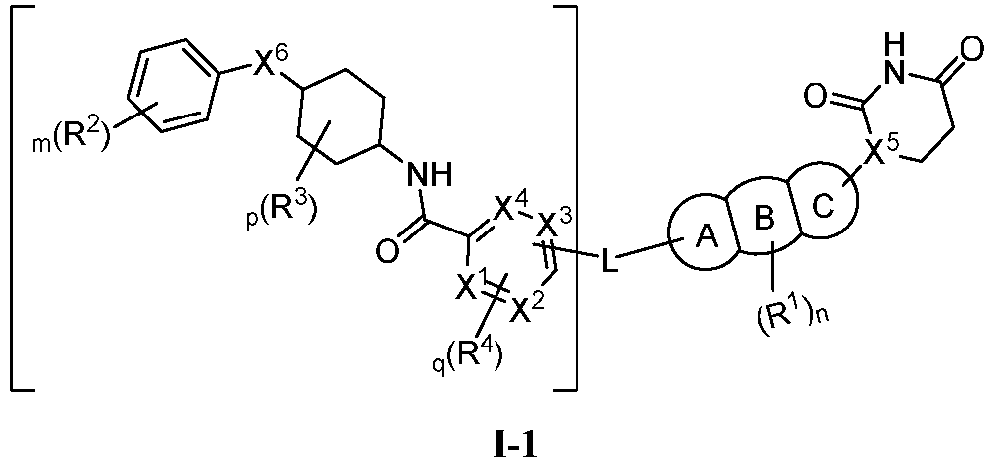 ring A is absent or selected from the group consisting of C5-10 cycloalkenyl, 5- to 10-membered heterocycloalkenyl, phenyl, and 5- to 6-membered heteroaryl;ring B is selected from phenyl;ring C is selected from the group consisting of isoxazolyl and furanyl;each R1 is independently selected from the group consisting of halogen, -OH, -NH2, -CN, C1-4 alkyl, C1-4 alkoxy, and halogenated C1-4 alkyl;n is selected from the group consisting of 0, 1, 2, and 3;L is selected from a connecting group;X1, X2, X3, and X4 are each independently selected from the group consisting of N and CH;X5 is selected from the group consisting of CH and N;X6 is selected from the group consisting of -O-, -NH-, and -N(C1-6 alkyl)-;each R2, R3, and R4 is independently selected from the group consisting of halogen, -OH, -NH2, -CN, C1-4 alkyl, C1-4 alkoxy, and halogenated C1-4 alkyl;m, p, and q are each independently selected from the group consisting of 0, 1, 2, 3, and 4.
 - The compound, the stereoisomer thereof, or the pharmaceutically acceptable salt thereof according to claim 1 or 2, wherein ring A is absent or selected from the group consisting of C5-7 membered cycloalkenyl, 5- to 10-membered heterocycloalkenyl, phenyl, and 5- to 6-membered heteroaryl; orring A is absent or selected from the group consisting of C5-6 membered cycloalkenyl, 5- to 9-membered heterocycloalkenyl, phenyl, and 5- to 6-membered heteroaryl; orring A is absent or selected from the group consisting of cyclopentenyl, monocyclohexenyl, bicyclohexenyl, dihydropyrrolyl, tetrahydropyridinyl, tetrahydroazepinyl, azaspirooctenyl, azaspirononenyl, phenyl, pyrrolyl, pyrazolyl, furanyl, oxazolyl, and dihydrooxazinyl.
- The compound, the stereoisomer thereof, or the pharmaceutically acceptable salt thereof according to any one of claims 1 to 3, wherein the structural fragment

 the structural fragment
 is selected from the group consisting of
 the structural fragment
 is selected from the group consisting of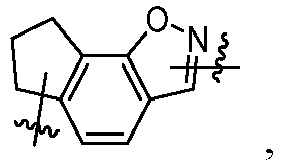


 the structural fragment
 is selected from the group consisting of


 and
and
- The compound, the stereoisomer thereof, or the pharmaceutically acceptable salt thereof according to any one of claims 1 to 4, wherein each R1 is independently selected from the group consisting of halogen, -OH, -NH2, -CN, C1-3 alkyl, C1-3 alkoxy, and halogenated C1-3 alkyl; or
each R1 is independently selected from the group consisting of fluorine, chlorine, bromine, -OH, -NH2, and -CN. - The compound, the stereoisomer thereof, or the pharmaceutically acceptable salt thereof according to any one of claims 1 to 5, wherein L is selected from the group consisting of C1-30 alkylene, C2-30 alkenylene, and C2-30 alkynylene, wherein one or more -CH2- of the C1-30 alkylene, C2-30 alkenylene, or C2-30 alkynylene are optionally substituted with -O-, C3-12 cycloalkyl, 3- to 12-membered heterocycloalkyl, 4- to 12-membered heterocycloalkenyl, C6-12 aryl, 5- to 12-membered heteroaryl, -NH-, -N(C1-6 alkyl)-, or -S-, and the C1-30 alkylene, C2-30 alkenylene, or C2-30 alkynylene is optionally substituted with one or more substituents; orL is selected from the group consisting of -LNK1-Cy1-LNK-Cy2-LNK2-, -Cy1-LNK-Cy2-LNK2-, -LNK1-Cy1-Cy2-LNK2-, -Cy1-LNK-Cy2-, -Cy1-Cy2-LNK2-, -LNK-Cy2-LNK2-, -Cy1-LNK-, -Cy1-Cy2-, and -Cy2-, whereinCy1 is selected from the group consisting of a bond and the following groups optionally substituted with one or more Ra: C3-12 cycloalkyl, 4- to 12-membered heterocycloalkyl, and 4- to 12-membered heterocycloalkenyl;LNK, LNK1, and LNK2 are each independently selected from the group consisting of a bond, C1-12 alkylene, and C1-12 heteroalkylene;Cy2 is selected from the group consisting of a bond and the following groups optionally substituted with one or more Rb: C3-12 cycloalkyl, 4- to 12-membered heterocycloalkyl, and 4- to 12-membered heterocycloalkenyl;each Ra and Rb is independently selected from the group consisting of halogen, -OH, -NH2, -CN, C1-4 alkyl, C1-4 alkoxy, halogenated C1-4 alkyl, C1-4 alkylamino, di-C1-4 alkylamino, C3-12 cycloalkyl, and 4- to 12-membered heterocycloalkyl.
- The compound, the stereoisomer thereof, or the pharmaceutically acceptable salt thereof according to claim 6, wherein Cy1 is selected from the group consisting of a bond and the following groups optionally substituted with one or more Ra: C4-11 cycloalkyl, 4- to 11-membered heterocycloalkyl, and 4- to 11-membered heterocycloalkenyl; orCy1 is selected from the group consisting of the following groups optionally substituted with one or more Ra: piperidinyl, diazaspirononanyl, piperazinyl, monoazaspirononanyl, cyclohexyl, spirononanyl, azetidinyl, octahydrocyclopentapyrrolyl, azabicyclononanyl, monoazaspiroundecanyl, diazaspiroundecanyl, pyrrolidinyl, and tetrahydropyridinyl; orCy1 is selected from the group consisting of the following groups optionally substituted with one or more Ra:



- The compound, the stereoisomer thereof, or the pharmaceutically acceptable salt thereof according to claim 6, wherein Cy2 is selected from the group consisting of a bond and the following groups optionally substituted with one or more Rb: C4-11 cycloalkyl and 4- to 11-membered heterocycloalkyl; orCy2 is selected from the group consisting of a bond and the following groups optionally substituted with one or more Rb: cyclobutyl, cyclopentyl, cyclohexyl, azetidinyl, pyrrolidinyl, and piperidinyl; orCy2 is selected from the group consisting of a bond,



- The compound, the stereoisomer thereof, or the pharmaceutically acceptable salt thereof according to claim 6, wherein the structural fragment -L- or -LNK1-Cy1-LNK-Cy2-LNK2- is selected from the group consisting of






- The compound, the stereoisomer thereof, or the pharmaceutically acceptable salt thereof according to any one of claims 1 to 9, wherein the structural fragment











- The compound, the stereoisomer thereof, or the pharmaceutically acceptable salt thereof according to claim 1 or 2, wherein the structural fragment


- The compound, the stereoisomer thereof, or the pharmaceutically acceptable salt thereof according to any one of claims 1 to 11, wherein the compound of formula I-AA or the compound of formula I-1 is selected from the group consisting of compounds of formula I, formula I-A1, and formula I-A,

 the compound of formula I-AA or the compound of formula I-1 is selected from the group consisting of compounds of formula I-1A, formula I-2A, formula I-3A, formula I-4A, formula I-5A, formula I-6A, formula I-7A, formula I-8A, formula I-9A, formula I-10A, formula I-11A, formula I-12A, formula I-13A, formula I-14A, formula I-15A, formula I-16A, and formula I-17A, wherein





 X is selected from the group consisting of CH and N; orthe compound of formula I-AA or the compound of formula I-1 is selected from the group consisting of compounds of formula I-1A-1, formula I-2A-1, formula I-3A-1, formula I-4A-1, formula I-5A-1, formula I-6A-1, formula I-7A-1, formula I-8A-1, formula I-9A-1, formula I-10A-1, formula I-11A-1, formula I-12A-1, formula I-13A-1, formula I-14A-1, formula I-15A-1, formula I-16A-1, and formula I-17A-1, wherein



 X is selected from the group consisting of CH and N.
 - The compound, the stereoisomer thereof, or the pharmaceutically acceptable salt thereof according to claim 1 or 2, whereinring A is selected from the group consisting of C5-6 cycloalkenyl, 5- to 8-membered heterocycloalkenyl containing 1-3 heteroatoms selected from the group consisting of N, O, and S (e.g., 1-2 heteroatoms selected from the group consisting of N and O), phenyl, and 5- to 6-membered heteroaryl containing 1-3 heteroatoms selected from the group consisting of N, O, and S (e.g., 1-2 heteroatoms selected from the group consisting of N and O);ring B is phenyl;ring C is selected from the group consisting of isoxazolyl and furanyl;each R1 is independently selected from the group consisting of halogen, -OH, -NH2, -CN, and C1-3 alkyl (e.g., methyl, ethyl, or propyl);n is selected from the group consisting of 0 and 1;L is selected from LNK1-Cy1-LNK-Cy2-LNK2-, wherein LNK, LNK1, and LNK2 are each independently selected from the group consisting of a bond and C1-3 alkylene, Cy1 is selected from the group consisting of a bond, C3-7 cycloalkyl, 4- to 7-membered heterocycloalkyl, and 5- to 7-membered heterocycloalkenyl, Cy2 is selected from the group consisting of a bond, C3-7 cycloalkyl, 4- to 7-membered heterocycloalkyl, and 5- to 7-membered heterocycloalkenyl, and Cy1 and Cy2 are not bonds at the same time;X1, X2, X3, and X4 are each independently selected from the group consisting of N and CH;X5 is selected from the group consisting of CH and N;X6 is selected from the group consisting of -O-, -NH-, and -N(C1-6 alkyl)-;each R2, R3, and R4 is independently selected from the group consisting of halogen, -OH, -NH2, -CN, and C1-3 alkyl (e.g., methyl, ethyl, or propyl);m is selected from the group consisting of 1 and 2;p and q are each independently selected from the group consisting of 0 and 1.
- The compound, the stereoisomer thereof, or the pharmaceutically acceptable salt thereof according to any one of claims 1 to 13, wherein the compound is selected from the group consisting of the following compounds:








- A compound of formula I' or formula I", a moiety, a stereoisomer thereof, a derivative, or a pharmaceutically acceptable salt thereof, wherein
 ring A is absent or selected from the group consisting of C5-10 membered cycloalkenyl, 5- to 10-membered heterocycloalkenyl, phenyl, and 5- to 6-membered heteroaryl;ring B is selected from phenyl;ring C is selected from the group consisting of isoxazolyl and furanyl;L is selected from a connecting group.
 - A compound of formula I'-a or formula I"-a, a moiety, a stereoisomer thereof, a derivative, or a pharmaceutically acceptable salt thereof, wherein
 ring A is absent or selected from the group consisting of C5-10 membered cycloalkenyl, 5- to 10-membered heterocycloalkenyl, phenyl, and 5- to 6-membered heteroaryl;ring B is selected from phenyl;ring C is selected from the group consisting of isoxazolyl and furanyl;each R1a is independently selected from the group consisting of halogen, -OH, -NH2, -CN, =O, -CHO, C1-4 alkyl, C1-4 alkoxy, C1-6 alkyl OC(O)-, C3-12 cycloalkyl, and 4- to 12-membered heterocycloalkyl, wherein the C1-4 alkyl, C1-4 alkoxy, C3-12 cycloalkyl, or 4- to 12-membered heterocycloalkyl is optionally substituted with one or more of the following groups: halogen, =O, -OH, -NH2, -CN, CHO, COOH, -C1-4 alkyl-OH, C1-6 alkyl OC(O)-, and 4- to 10-membered heterocycloalkyl optionally substituted with C1-6 alkyl COC(O)-;n is selected from the group consisting of 0, 1, 2, and 3.
 - The compound, the moiety, the stereoisomer thereof, the derivative, or the pharmaceutically acceptable salt thereof according to claim 15 or 16, wherein the compound is selected from the group consisting of:






- Use of the compound, the moiety, the isomer thereof, the derivative thereof, or the pharmaceutically acceptable salt thereof according to any one of claims 15 to 17 in a Protac molecule, or use thereof for constituting part of a Protac molecule, or use thereof for degrading an androgen receptor (AR), wherein the compound is present in the form of a Protac molecule.
- A pharmaceutical composition, comprising the compound, the stereoisomer thereof, or the pharmaceutically acceptable salt thereof according to any one of claims 1 to 14, or the compound, the moiety, the isomer thereof, the derivative thereof, or the pharmaceutically acceptable salt thereof according to any one of claims 15 to 17.
- Use of the compound, the stereoisomer thereof, or the pharmaceutically acceptable salt thereof according to any one of claims 1 to 14, the compound, the moiety, the isomer thereof, the derivative thereof, or the pharmaceutically acceptable salt thereof according to any one of claims 15 to 17, or the pharmaceutical composition according to claim 19 for preparing a medicament for preventing or treating a disorder treated by degrading a target protein that binds to a targeting ligand.
Applications Claiming Priority (4)
| Application Number | Priority Date | Filing Date | Title |
|---|---|---|---|
| CN202211000005 | 2022-08-19 | ||
| CN202310206412 | 2023-01-16 | ||
| CN202310996368 | 2023-08-08 | ||
| PCT/CN2023/113691 WO2024037616A1 (en) | 2022-08-19 | 2023-08-18 | Compound containing cyclohexyl |
Publications (1)
| Publication Number | Publication Date |
|---|---|
| EP4574829A1 true EP4574829A1 (en) | 2025-06-25 |
Family
ID=89940768
Family Applications (1)
| Application Number | Title | Priority Date | Filing Date |
|---|---|---|---|
| EP23854513.1A Pending EP4574829A1 (en) | 2022-08-19 | 2023-08-18 | Compound containing cyclohexyl |
Country Status (8)
| Country | Link |
|---|---|
| US (1) | US20260035384A1 (en) |
| EP (1) | EP4574829A1 (en) |
| JP (1) | JP2025528193A (en) |
| KR (1) | KR20250048580A (en) |
| CN (2) | CN121652167A (en) |
| AU (1) | AU2023325889A1 (en) |
| TW (1) | TW202409025A (en) |
| WO (1) | WO2024037616A1 (en) |
Families Citing this family (1)
| Publication number | Priority date | Publication date | Assignee | Title |
|---|---|---|---|---|
| CN121712778A (en) | 2023-08-23 | 2026-03-20 | 正大天晴药业集团股份有限公司 | Cyclobutyl-containing compounds |
Family Cites Families (14)
| Publication number | Priority date | Publication date | Assignee | Title |
|---|---|---|---|---|
| HK1245791A1 (en) * | 2015-01-20 | 2018-08-31 | 阿尔维纳斯运营股份有限公司 | Compounds and methods for the targeted degradation of the androgen receptor |
| WO2020048548A1 (en) * | 2018-09-07 | 2020-03-12 | 正大天晴药业集团股份有限公司 | Tricyclic compounds acting on crbn proteins |
| US11319330B2 (en) * | 2018-09-07 | 2022-05-03 | Medshine Discovery Inc. | Tricyclic furan-substituted piperidinedione compound |
| US20210317109A1 (en) * | 2018-09-07 | 2021-10-14 | Medshine Discovery Inc. | Tricyclic substituted piperidine dione compound |
| US20220388978A1 (en) * | 2019-08-27 | 2022-12-08 | Regents Of The University Of Michigan | Cereblon e3 ligase inhibitors |
| AU2021229979A1 (en) * | 2020-03-06 | 2022-10-27 | Chia Tai Tianqing Pharmaceutical Group Co., Ltd. | Crystal of tricyclic compound acting on CRBN protein and preparation method therefor |
| WO2021185291A1 (en) * | 2020-03-17 | 2021-09-23 | 南京明德新药研发有限公司 | Proteolysis regulator and method for using same |
| US20230357249A1 (en) * | 2020-05-14 | 2023-11-09 | The Regents Of The University Of Michigan | Androgen receptor protein degraders with a tricyclic cereblon ligand |
| TWI807697B (en) * | 2021-03-17 | 2023-07-01 | 大陸商南京明德新藥研發有限公司 | Furan fused ring substituted glutarimide compounds |
| CN117580575A (en) * | 2021-06-17 | 2024-02-20 | 南京明德新药研发有限公司 | Glutarimide-substituted isoxazole fused ring compounds and their applications |
| WO2023036175A1 (en) * | 2021-09-08 | 2023-03-16 | 南京明德新药研发有限公司 | Glutarimide compound and use thereof |
| WO2023045978A1 (en) * | 2021-09-26 | 2023-03-30 | 南京明德新药研发有限公司 | 2,6-piperidinedione compound and application thereof |
| EP4434992A4 (en) * | 2021-11-18 | 2026-02-11 | Chia Tai Tianqing Pharmaceutical Group Co Ltd | CONDENSED IMIDE DERIVATIVE |
| TW202340196A (en) * | 2021-12-31 | 2023-10-16 | 大陸商正大天晴藥業集團股份有限公司 | Compound containing heterocyclic ring |
-
2023
- 2023-08-18 CN CN202511812551.2A patent/CN121652167A/en active Pending
- 2023-08-18 TW TW112131165A patent/TW202409025A/en unknown
- 2023-08-18 AU AU2023325889A patent/AU2023325889A1/en active Pending
- 2023-08-18 WO PCT/CN2023/113691 patent/WO2024037616A1/en not_active Ceased
- 2023-08-18 EP EP23854513.1A patent/EP4574829A1/en active Pending
- 2023-08-18 KR KR1020257008231A patent/KR20250048580A/en active Pending
- 2023-08-18 JP JP2025507804A patent/JP2025528193A/en active Pending
- 2023-08-18 CN CN202380060384.3A patent/CN119731182A/en active Pending
- 2023-08-18 US US19/099,869 patent/US20260035384A1/en active Pending
Also Published As
| Publication number | Publication date |
|---|---|
| US20260035384A1 (en) | 2026-02-05 |
| JP2025528193A (en) | 2025-08-26 |
| CN121652167A (en) | 2026-03-13 |
| AU2023325889A1 (en) | 2025-03-13 |
| CN119731182A (en) | 2025-03-28 |
| KR20250048580A (en) | 2025-04-09 |
| TW202409025A (en) | 2024-03-01 |
| WO2024037616A1 (en) | 2024-02-22 |
Similar Documents
| Publication | Publication Date | Title |
|---|---|---|
| EP3138842B1 (en) | Polyfluorinated compounds acting as bruton's tyrosine kinase inhibitors | |
| EP4122925A1 (en) | Proteolysis regulator and method for using same | |
| EP4570805A1 (en) | Tricyclic compounds and medical use thereof | |
| EP3442947B1 (en) | Amine-substituted aryl or heteroaryl compounds as ehmt1 and ehmt2 inhibitors | |
| EP4442686A1 (en) | Kras inhibitors, preparation method therefor, and pharmaceutical use thereof | |
| EP4289823A1 (en) | Substituted pyridazine phenol derivatives | |
| EP3312179B1 (en) | Fused-ring or tricyclic aryl pyrimidine compound used as kinase inhibitor | |
| EP4610261A1 (en) | Nitrogen-containing heterocyclic compound, pharmaceutically acceptable salt thereof, preparation method therefor and use thereof | |
| EP3976604B1 (en) | 1,3,4-oxadiazole derivative compounds as histone deacetylase 6 inhibitor, and the pharmaceutical composition comprising the same | |
| EP3538516B1 (en) | Phenoxytriazoles | |
| WO2022228576A1 (en) | Protein regulator-targeted compound and application thereof | |
| EP3331884B1 (en) | Urea derivative or pharmacologically acceptable salt thereof | |
| EP4332100A1 (en) | Phosphonyl derivative, and composition and pharmaceutical application thereof | |
| EP3978073B1 (en) | 1h-benzo[d][1,2,3]triazole derivatives as keap1 inhibitors for the treatment of renal diseases | |
| EP3778573B1 (en) | Compound with anticancer activity | |
| EP4434992A1 (en) | Fused imide derivative | |
| EP4257588A1 (en) | Small molecule inhibitor of cathepsin c and medicinal use thereof | |
| EP4137484A1 (en) | Tricyclic compounds as egfr inhibitors | |
| EP4306520A1 (en) | Thiophene compound and application thereof | |
| EP4534534A1 (en) | Heterocyclic compound ccr4 inhibitor and user thereof | |
| EP3666772A1 (en) | Diarylthiohydantoin compound as androgen receptor antagonist | |
| EP3782995A1 (en) | Histone acetyltransferase (hat) inhibitor and use thereof | |
| EP4385985A1 (en) | Heterocyclic derivative, and composition and pharmaceutical use thereof | |
| EP4108663A1 (en) | Substituted aryl compound | |
| EP3712143A1 (en) | Quinazolinone compound and application thereof |
Legal Events
| Date | Code | Title | Description |
|---|---|---|---|
| STAA | Information on the status of an ep patent application or granted ep patent |
Free format text: STATUS: THE INTERNATIONAL PUBLICATION HAS BEEN MADE |
|
| PUAI | Public reference made under article 153(3) epc to a published international application that has entered the european phase |
Free format text: ORIGINAL CODE: 0009012 |
|
| STAA | Information on the status of an ep patent application or granted ep patent |
Free format text: STATUS: REQUEST FOR EXAMINATION WAS MADE |
|
| 17P | Request for examination filed |
Effective date: 20250224 |
|
| AK | Designated contracting states |
Kind code of ref document: A1 Designated state(s): AL AT BE BG CH CY CZ DE DK EE ES FI FR GB GR HR HU IE IS IT LI LT LU LV MC ME MK MT NL NO PL PT RO RS SE SI SK SM TR |
|
| REG | Reference to a national code |
Ref country code: HK Ref legal event code: DE Ref document number: 40124924 Country of ref document: HK |
|
| DAV | Request for validation of the european patent (deleted) | ||
| DAX | Request for extension of the european patent (deleted) |