EP4574599A1 - Design method and vehicle control device - Google Patents
Design method and vehicle control device Download PDFInfo
- Publication number
- EP4574599A1 EP4574599A1 EP23854747.5A EP23854747A EP4574599A1 EP 4574599 A1 EP4574599 A1 EP 4574599A1 EP 23854747 A EP23854747 A EP 23854747A EP 4574599 A1 EP4574599 A1 EP 4574599A1
- Authority
- EP
- European Patent Office
- Prior art keywords
- difference
- vehicle
- sum
- axle
- model
- Prior art date
- Legal status (The legal status is an assumption and is not a legal conclusion. Google has not performed a legal analysis and makes no representation as to the accuracy of the status listed.)
- Pending
Links
Images





Classifications
-
- B—PERFORMING OPERATIONS; TRANSPORTING
- B60—VEHICLES IN GENERAL
- B60L—PROPULSION OF ELECTRICALLY-PROPELLED VEHICLES; SUPPLYING ELECTRIC POWER FOR AUXILIARY EQUIPMENT OF ELECTRICALLY-PROPELLED VEHICLES; ELECTRODYNAMIC BRAKE SYSTEMS FOR VEHICLES IN GENERAL; MAGNETIC SUSPENSION OR LEVITATION FOR VEHICLES; MONITORING OPERATING VARIABLES OF ELECTRICALLY-PROPELLED VEHICLES; ELECTRIC SAFETY DEVICES FOR ELECTRICALLY-PROPELLED VEHICLES
- B60L15/00—Methods, circuits, or devices for controlling the traction-motor speed of electrically-propelled vehicles
- B60L15/20—Methods, circuits, or devices for controlling the traction-motor speed of electrically-propelled vehicles for control of the vehicle or its driving motor to achieve a desired performance, e.g. speed, torque, programmed variation of speed
- B60L15/2045—Methods, circuits, or devices for controlling the traction-motor speed of electrically-propelled vehicles for control of the vehicle or its driving motor to achieve a desired performance, e.g. speed, torque, programmed variation of speed for optimising the use of energy
-
- B—PERFORMING OPERATIONS; TRANSPORTING
- B60—VEHICLES IN GENERAL
- B60W—CONJOINT CONTROL OF VEHICLE SUB-UNITS OF DIFFERENT TYPE OR DIFFERENT FUNCTION; CONTROL SYSTEMS SPECIALLY ADAPTED FOR HYBRID VEHICLES; ROAD VEHICLE DRIVE CONTROL SYSTEMS FOR PURPOSES NOT RELATED TO THE CONTROL OF A PARTICULAR SUB-UNIT
- B60W30/00—Purposes of road vehicle drive control systems not related to the control of a particular sub-unit, e.g. of systems using conjoint control of vehicle sub-units
- B60W30/18—Propelling the vehicle
- B60W30/188—Controlling power parameters of the driveline, e.g. determining the required power
-
- B—PERFORMING OPERATIONS; TRANSPORTING
- B60—VEHICLES IN GENERAL
- B60K—ARRANGEMENT OR MOUNTING OF PROPULSION UNITS OR OF TRANSMISSIONS IN VEHICLES; ARRANGEMENT OR MOUNTING OF PLURAL DIVERSE PRIME-MOVERS IN VEHICLES; AUXILIARY DRIVES FOR VEHICLES; INSTRUMENTATION OR DASHBOARDS FOR VEHICLES; ARRANGEMENTS IN CONNECTION WITH COOLING, AIR INTAKE, GAS EXHAUST OR FUEL SUPPLY OF PROPULSION UNITS IN VEHICLES
- B60K1/00—Arrangement or mounting of electrical propulsion units
- B60K1/02—Arrangement or mounting of electrical propulsion units comprising more than one electric motor
-
- B—PERFORMING OPERATIONS; TRANSPORTING
- B60—VEHICLES IN GENERAL
- B60K—ARRANGEMENT OR MOUNTING OF PROPULSION UNITS OR OF TRANSMISSIONS IN VEHICLES; ARRANGEMENT OR MOUNTING OF PLURAL DIVERSE PRIME-MOVERS IN VEHICLES; AUXILIARY DRIVES FOR VEHICLES; INSTRUMENTATION OR DASHBOARDS FOR VEHICLES; ARRANGEMENTS IN CONNECTION WITH COOLING, AIR INTAKE, GAS EXHAUST OR FUEL SUPPLY OF PROPULSION UNITS IN VEHICLES
- B60K23/00—Arrangement or mounting of control devices for vehicle transmissions, or parts thereof, not otherwise provided for
- B60K23/08—Arrangement or mounting of control devices for vehicle transmissions, or parts thereof, not otherwise provided for for changing number of driven wheels, for switching from driving one axle to driving two or more axles
- B60K23/0808—Arrangement or mounting of control devices for vehicle transmissions, or parts thereof, not otherwise provided for for changing number of driven wheels, for switching from driving one axle to driving two or more axles for varying torque distribution between driven axles, e.g. by transfer clutch
-
- B—PERFORMING OPERATIONS; TRANSPORTING
- B60—VEHICLES IN GENERAL
- B60K—ARRANGEMENT OR MOUNTING OF PROPULSION UNITS OR OF TRANSMISSIONS IN VEHICLES; ARRANGEMENT OR MOUNTING OF PLURAL DIVERSE PRIME-MOVERS IN VEHICLES; AUXILIARY DRIVES FOR VEHICLES; INSTRUMENTATION OR DASHBOARDS FOR VEHICLES; ARRANGEMENTS IN CONNECTION WITH COOLING, AIR INTAKE, GAS EXHAUST OR FUEL SUPPLY OF PROPULSION UNITS IN VEHICLES
- B60K7/00—Disposition of motor in, or adjacent to, traction wheel
- B60K7/0007—Disposition of motor in, or adjacent to, traction wheel the motor being electric
-
- B—PERFORMING OPERATIONS; TRANSPORTING
- B60—VEHICLES IN GENERAL
- B60W—CONJOINT CONTROL OF VEHICLE SUB-UNITS OF DIFFERENT TYPE OR DIFFERENT FUNCTION; CONTROL SYSTEMS SPECIALLY ADAPTED FOR HYBRID VEHICLES; ROAD VEHICLE DRIVE CONTROL SYSTEMS FOR PURPOSES NOT RELATED TO THE CONTROL OF A PARTICULAR SUB-UNIT
- B60W10/00—Conjoint control of vehicle sub-units of different type or different function
- B60W10/04—Conjoint control of vehicle sub-units of different type or different function including control of propulsion units
- B60W10/08—Conjoint control of vehicle sub-units of different type or different function including control of propulsion units including control of electric propulsion units, e.g. motors or generators
-
- B—PERFORMING OPERATIONS; TRANSPORTING
- B60—VEHICLES IN GENERAL
- B60W—CONJOINT CONTROL OF VEHICLE SUB-UNITS OF DIFFERENT TYPE OR DIFFERENT FUNCTION; CONTROL SYSTEMS SPECIALLY ADAPTED FOR HYBRID VEHICLES; ROAD VEHICLE DRIVE CONTROL SYSTEMS FOR PURPOSES NOT RELATED TO THE CONTROL OF A PARTICULAR SUB-UNIT
- B60W30/00—Purposes of road vehicle drive control systems not related to the control of a particular sub-unit, e.g. of systems using conjoint control of vehicle sub-units
- B60W30/18—Propelling the vehicle
- B60W30/18009—Propelling the vehicle related to particular drive situations
- B60W30/18145—Cornering
-
- B—PERFORMING OPERATIONS; TRANSPORTING
- B60—VEHICLES IN GENERAL
- B60W—CONJOINT CONTROL OF VEHICLE SUB-UNITS OF DIFFERENT TYPE OR DIFFERENT FUNCTION; CONTROL SYSTEMS SPECIALLY ADAPTED FOR HYBRID VEHICLES; ROAD VEHICLE DRIVE CONTROL SYSTEMS FOR PURPOSES NOT RELATED TO THE CONTROL OF A PARTICULAR SUB-UNIT
- B60W30/00—Purposes of road vehicle drive control systems not related to the control of a particular sub-unit, e.g. of systems using conjoint control of vehicle sub-units
- B60W30/18—Propelling the vehicle
- B60W30/20—Reducing vibrations in the driveline
-
- B—PERFORMING OPERATIONS; TRANSPORTING
- B60—VEHICLES IN GENERAL
- B60W—CONJOINT CONTROL OF VEHICLE SUB-UNITS OF DIFFERENT TYPE OR DIFFERENT FUNCTION; CONTROL SYSTEMS SPECIALLY ADAPTED FOR HYBRID VEHICLES; ROAD VEHICLE DRIVE CONTROL SYSTEMS FOR PURPOSES NOT RELATED TO THE CONTROL OF A PARTICULAR SUB-UNIT
- B60W40/00—Estimation or calculation of non-directly measurable driving parameters for road vehicle drive control systems not related to the control of a particular sub unit, e.g. by using mathematical models
- B60W40/10—Estimation or calculation of non-directly measurable driving parameters for road vehicle drive control systems not related to the control of a particular sub unit, e.g. by using mathematical models related to vehicle motion
-
- B—PERFORMING OPERATIONS; TRANSPORTING
- B60—VEHICLES IN GENERAL
- B60L—PROPULSION OF ELECTRICALLY-PROPELLED VEHICLES; SUPPLYING ELECTRIC POWER FOR AUXILIARY EQUIPMENT OF ELECTRICALLY-PROPELLED VEHICLES; ELECTRODYNAMIC BRAKE SYSTEMS FOR VEHICLES IN GENERAL; MAGNETIC SUSPENSION OR LEVITATION FOR VEHICLES; MONITORING OPERATING VARIABLES OF ELECTRICALLY-PROPELLED VEHICLES; ELECTRIC SAFETY DEVICES FOR ELECTRICALLY-PROPELLED VEHICLES
- B60L2220/00—Electrical machine types; Structures or applications thereof
- B60L2220/40—Electrical machine applications
- B60L2220/46—Wheel motors, i.e. motor connected to only one wheel
-
- B—PERFORMING OPERATIONS; TRANSPORTING
- B60—VEHICLES IN GENERAL
- B60L—PROPULSION OF ELECTRICALLY-PROPELLED VEHICLES; SUPPLYING ELECTRIC POWER FOR AUXILIARY EQUIPMENT OF ELECTRICALLY-PROPELLED VEHICLES; ELECTRODYNAMIC BRAKE SYSTEMS FOR VEHICLES IN GENERAL; MAGNETIC SUSPENSION OR LEVITATION FOR VEHICLES; MONITORING OPERATING VARIABLES OF ELECTRICALLY-PROPELLED VEHICLES; ELECTRIC SAFETY DEVICES FOR ELECTRICALLY-PROPELLED VEHICLES
- B60L2240/00—Control parameters of input or output; Target parameters
- B60L2240/10—Vehicle control parameters
- B60L2240/14—Acceleration
- B60L2240/20—Acceleration angular
-
- B—PERFORMING OPERATIONS; TRANSPORTING
- B60—VEHICLES IN GENERAL
- B60L—PROPULSION OF ELECTRICALLY-PROPELLED VEHICLES; SUPPLYING ELECTRIC POWER FOR AUXILIARY EQUIPMENT OF ELECTRICALLY-PROPELLED VEHICLES; ELECTRODYNAMIC BRAKE SYSTEMS FOR VEHICLES IN GENERAL; MAGNETIC SUSPENSION OR LEVITATION FOR VEHICLES; MONITORING OPERATING VARIABLES OF ELECTRICALLY-PROPELLED VEHICLES; ELECTRIC SAFETY DEVICES FOR ELECTRICALLY-PROPELLED VEHICLES
- B60L2240/00—Control parameters of input or output; Target parameters
- B60L2240/40—Drive Train control parameters
- B60L2240/42—Drive Train control parameters related to electric machines
- B60L2240/421—Speed
-
- B—PERFORMING OPERATIONS; TRANSPORTING
- B60—VEHICLES IN GENERAL
- B60L—PROPULSION OF ELECTRICALLY-PROPELLED VEHICLES; SUPPLYING ELECTRIC POWER FOR AUXILIARY EQUIPMENT OF ELECTRICALLY-PROPELLED VEHICLES; ELECTRODYNAMIC BRAKE SYSTEMS FOR VEHICLES IN GENERAL; MAGNETIC SUSPENSION OR LEVITATION FOR VEHICLES; MONITORING OPERATING VARIABLES OF ELECTRICALLY-PROPELLED VEHICLES; ELECTRIC SAFETY DEVICES FOR ELECTRICALLY-PROPELLED VEHICLES
- B60L2240/00—Control parameters of input or output; Target parameters
- B60L2240/40—Drive Train control parameters
- B60L2240/42—Drive Train control parameters related to electric machines
- B60L2240/423—Torque
-
- B—PERFORMING OPERATIONS; TRANSPORTING
- B60—VEHICLES IN GENERAL
- B60W—CONJOINT CONTROL OF VEHICLE SUB-UNITS OF DIFFERENT TYPE OR DIFFERENT FUNCTION; CONTROL SYSTEMS SPECIALLY ADAPTED FOR HYBRID VEHICLES; ROAD VEHICLE DRIVE CONTROL SYSTEMS FOR PURPOSES NOT RELATED TO THE CONTROL OF A PARTICULAR SUB-UNIT
- B60W50/00—Details of control systems for road vehicle drive control not related to the control of a particular sub-unit, e.g. process diagnostic or vehicle driver interfaces
- B60W2050/0001—Details of the control system
- B60W2050/0019—Control system elements or transfer functions
- B60W2050/0028—Mathematical models, e.g. for simulation
-
- B—PERFORMING OPERATIONS; TRANSPORTING
- B60—VEHICLES IN GENERAL
- B60W—CONJOINT CONTROL OF VEHICLE SUB-UNITS OF DIFFERENT TYPE OR DIFFERENT FUNCTION; CONTROL SYSTEMS SPECIALLY ADAPTED FOR HYBRID VEHICLES; ROAD VEHICLE DRIVE CONTROL SYSTEMS FOR PURPOSES NOT RELATED TO THE CONTROL OF A PARTICULAR SUB-UNIT
- B60W50/00—Details of control systems for road vehicle drive control not related to the control of a particular sub-unit, e.g. process diagnostic or vehicle driver interfaces
- B60W2050/0001—Details of the control system
- B60W2050/0019—Control system elements or transfer functions
- B60W2050/0028—Mathematical models, e.g. for simulation
- B60W2050/0037—Mathematical models of vehicle sub-units
- B60W2050/0041—Mathematical models of vehicle sub-units of the drive line
-
- B—PERFORMING OPERATIONS; TRANSPORTING
- B60—VEHICLES IN GENERAL
- B60W—CONJOINT CONTROL OF VEHICLE SUB-UNITS OF DIFFERENT TYPE OR DIFFERENT FUNCTION; CONTROL SYSTEMS SPECIALLY ADAPTED FOR HYBRID VEHICLES; ROAD VEHICLE DRIVE CONTROL SYSTEMS FOR PURPOSES NOT RELATED TO THE CONTROL OF A PARTICULAR SUB-UNIT
- B60W2510/00—Input parameters relating to a particular sub-units
- B60W2510/08—Electric propulsion units
- B60W2510/081—Speed
-
- B—PERFORMING OPERATIONS; TRANSPORTING
- B60—VEHICLES IN GENERAL
- B60W—CONJOINT CONTROL OF VEHICLE SUB-UNITS OF DIFFERENT TYPE OR DIFFERENT FUNCTION; CONTROL SYSTEMS SPECIALLY ADAPTED FOR HYBRID VEHICLES; ROAD VEHICLE DRIVE CONTROL SYSTEMS FOR PURPOSES NOT RELATED TO THE CONTROL OF A PARTICULAR SUB-UNIT
- B60W2510/00—Input parameters relating to a particular sub-units
- B60W2510/08—Electric propulsion units
- B60W2510/088—Inertia
-
- B—PERFORMING OPERATIONS; TRANSPORTING
- B60—VEHICLES IN GENERAL
- B60W—CONJOINT CONTROL OF VEHICLE SUB-UNITS OF DIFFERENT TYPE OR DIFFERENT FUNCTION; CONTROL SYSTEMS SPECIALLY ADAPTED FOR HYBRID VEHICLES; ROAD VEHICLE DRIVE CONTROL SYSTEMS FOR PURPOSES NOT RELATED TO THE CONTROL OF A PARTICULAR SUB-UNIT
- B60W2520/00—Input parameters relating to overall vehicle dynamics
- B60W2520/20—Sideslip angle
-
- B—PERFORMING OPERATIONS; TRANSPORTING
- B60—VEHICLES IN GENERAL
- B60W—CONJOINT CONTROL OF VEHICLE SUB-UNITS OF DIFFERENT TYPE OR DIFFERENT FUNCTION; CONTROL SYSTEMS SPECIALLY ADAPTED FOR HYBRID VEHICLES; ROAD VEHICLE DRIVE CONTROL SYSTEMS FOR PURPOSES NOT RELATED TO THE CONTROL OF A PARTICULAR SUB-UNIT
- B60W2520/00—Input parameters relating to overall vehicle dynamics
- B60W2520/28—Wheel speed
-
- B—PERFORMING OPERATIONS; TRANSPORTING
- B60—VEHICLES IN GENERAL
- B60W—CONJOINT CONTROL OF VEHICLE SUB-UNITS OF DIFFERENT TYPE OR DIFFERENT FUNCTION; CONTROL SYSTEMS SPECIALLY ADAPTED FOR HYBRID VEHICLES; ROAD VEHICLE DRIVE CONTROL SYSTEMS FOR PURPOSES NOT RELATED TO THE CONTROL OF A PARTICULAR SUB-UNIT
- B60W2530/00—Input parameters relating to vehicle conditions or values, not covered by groups B60W2510/00 or B60W2520/00
- B60W2530/10—Weight
-
- B—PERFORMING OPERATIONS; TRANSPORTING
- B60—VEHICLES IN GENERAL
- B60W—CONJOINT CONTROL OF VEHICLE SUB-UNITS OF DIFFERENT TYPE OR DIFFERENT FUNCTION; CONTROL SYSTEMS SPECIALLY ADAPTED FOR HYBRID VEHICLES; ROAD VEHICLE DRIVE CONTROL SYSTEMS FOR PURPOSES NOT RELATED TO THE CONTROL OF A PARTICULAR SUB-UNIT
- B60W2710/00—Output or target parameters relating to a particular sub-units
- B60W2710/08—Electric propulsion units
- B60W2710/083—Torque
-
- B—PERFORMING OPERATIONS; TRANSPORTING
- B60—VEHICLES IN GENERAL
- B60W—CONJOINT CONTROL OF VEHICLE SUB-UNITS OF DIFFERENT TYPE OR DIFFERENT FUNCTION; CONTROL SYSTEMS SPECIALLY ADAPTED FOR HYBRID VEHICLES; ROAD VEHICLE DRIVE CONTROL SYSTEMS FOR PURPOSES NOT RELATED TO THE CONTROL OF A PARTICULAR SUB-UNIT
- B60W2720/00—Output or target parameters relating to overall vehicle dynamics
- B60W2720/40—Torque distribution
- B60W2720/406—Torque distribution between left and right wheel
Definitions
- the embodiment discussed herein relates to a design method and a vehicle control device for output control of a driving source of a vehicle.
- the behavior of the driving power transmission system while the vehicle is running straight is different from the behavior while the vehicle is cornering.
- a control to deal with a vehicle while running straight and a control to deal with the vehicle while cornering.
- Constructing respective controls for the left and right driving systems would result in a complex control configuration.
- the traveling state of a vehicle is sometimes a combined state in which a running-straight state and a cornering state are mixed, which makes it difficult to enhance the controllability.
- one of the objects of the embodiment is to provide a design method and a vehicle control device that achieve preferable control with a simple configuration.
- actions and effects which are derived from each configuration of "Embodiment to Carry out Invention" to be described below and which conventional technique does not attain are regarded as other objects of the present disclosure.
- the disclosed design method and vehicle control device can be achieved in the embodiment and the application to be disclosed below and solve at least some of the above problems.
- the disclosed design method is one for output control of a left driving source and a right driving source in a vehicle provided with a left driving system including a left axle and a left wheel and a right driving system including a right axle and a right wheel, motion power from the left driving source being transmitted to the left axle and the left wheel, motion power from the right driving source being transmitted to the right axle and the right wheel.
- the design method includes: preparing a sum model modeling motion states of the left driving system, the right driving system, the left driving source, and the right driving source while the vehicle is running straight, and a difference model modeling motion states of the left driving system, the right driving system, the left driving source, and the right driving source while the vehicle is cornering; calculating an equivalent sum value corresponding to a sum of a left-axle input/output including an input parameter or an output parameter of the left driving system and a right-axle input/output including an input parameter or an output parameter of the right driving system, and an equivalent difference value corresponding to a difference between the left-axle input/output and the right-axle input/output; grasping motion states of the left driving system and the right driving system while the vehicle is running straight by applying the equivalent sum value to the sum model; and grasping motion states of the left driving system and the right driving system while the vehicle is cornering by applying the equivalent difference value to the difference model.
- the disclosed vehicle control device is a device for output control of a left driving source and a right driving source in a vehicle provided with a left driving system including a left axle and a left wheel and a right driving system including a right axle and a right wheel, motion power from the left driving source being transmitted to the left axle and the left wheel, motion power from the right driving source being transmitted to the right axle and the right wheel.
- the vehicle control device includes: a calculator that calculates an equivalent sum value corresponding to a sum of a left-axle input/output including an input parameter or an output parameter of the left driving system and a right-axle input/output including an input parameter or an output parameter of the right driving system, and an equivalent difference value corresponding to a difference between the left-axle input/output and the right-axle input/output; and a storing unit that stores a sum model modeling motion states of the left driving system, the right driving system, the left driving source, and the right driving source while the vehicle is running straight, and a difference model modeling motion states of the left driving system, the right driving system, the left driving source, and the right driving source while the vehicle is cornering, the equivalent sum value being applied to the sum model, the equivalent difference value being applied to the difference model.
- the disclosed design method and vehicle control device can precisely grasp behaviors of driving systems while the vehicle is running straight by applying an equivalent sum value to a sum model, and can precisely grasp behaviors of the driving systems while the vehicle is cornering by applying an equivalent difference value to a difference model. Accordingly, the method and the device can precisely grasp the state (behavior) of a driving system that have a different characteristic between a running-straight state and a cornering state of the vehicle, and can design control having preferable controllability with a simple configuration.
- the control designed in the disclosed design method is implemented in a vehicle, and is applied to, for example, the disclosed vehicle control device.
- Examples of the type of vehicle that is to implement this control are an engine vehicle (a gasoline-powered vehicle, a diesel-powered vehicle), an electric vehicle, and a hybrid vehicle.
- the vehicle is an automobile that travels by driving left and right wheels (left and right driving wheels) using at least one driving source (e.g., an internal combustion engine or a motor), and is preferably an automobile that travels by driving left and right wheels (left and right drive wheels) using multiple driving sources.
- one of the multiple driving sources is referred to as a left driving source
- another one of the driving sources is referred to as a right driving source.
- one of the left and right wheels positioned on the left side of the vehicle is referred to as a left wheel, and the other is referred to as a right wheel.
- the disclosed design method and vehicle control device are suitable for use in designing a control to be implemented in a vehicle provided with a left driving system including a left axle and a left wheel to which motion power from the left driving source is transmitted and a right driving system including a right axle and a right wheel to which motion power from the right driving source is transmitted, and also for use in controlling the vehicle.
- each of the left driving source and the right driving source may or may not be set to correspond to the left-right direction determined based on the forward-traveling direction of the vehicle.
- the left driving system and the right driving system may operate independently of each other, or may be connected to each other via a transmission mechanism or a power distributing mechanism.
- the disclosed design method and vehicle control device can also be used to design a control that is to be implemented in an in-wheel motor vehicle that drives the left and right wheels with respective different motors and control of the vehicle, or to a design a control to be implemented in a torque vectoring vehicle in which the left and right wheels can transmit a driving force and a torque to each other.
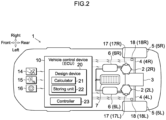
- FIGs. 1 and 2 A configuration of a design device 20 that uses the design method according to an embodiment is illustrated in FIGs. 1 and 2 .
- the design device 20 is a device (computer) for designing a control to be implemented in the vehicle 1.
- FIGs. 1 and 2 shows the configuration of a prospective vehicle 1 as well as the design device 20.
- the designed control can be applied to the prospective vehicle 1.
- the control may be designed using the design device 20 provided independently of the vehicle 1.
- incorporating the function of the design device 20 in the vehicle control device 10 (ECU) makes it possible to utilize the function of the design device 20 also in actual control of the vehicle 1 as well as the design of the control.
- ECU vehicle control device 10
- the vehicle 1 shown in FIGs. 1 and 2 includes left and right wheels 5 (wheels) aligned side by side in the vehicle width direction, a power distributing mechanism 3 (differential mechanism) that applies a torque difference to the left and right wheels 5, and a pair of motors 2 connected to the power distributing mechanism 3.
- alphabets R and L which are attached to the numerical signs represent the arrangement positions of the elements related to the signs (i.e., the positions on the right side and the left side of the vehicle 1).
- the reference sign 5L represents one (left wheel) of the left and right wheels 5 located on the left side of the vehicle 1
- the reference sign 5R represents the other (right wheel) located on the right side.
- the left and right wheels 5 may be positioned anywhere in the front-rear direction, and may be front wheels or rear wheels of the vehicle 1.
- Each motor 2 (driving source) has a function of driving at least either one of the front wheels and the rear wheels of the vehicle 1, and can have a function of driving all four wheels.
- a left motor 2L left driving source
- a right motor 2R right driving source
- the left motor 2L and the right motor 2R operate independently of each other, and may individually output driving forces having different magnitudes from each other.
- These motors 2 are connected to the power distributing mechanism 3 each via a pair of reduction mechanisms provided separately from each other.
- the vehicle 1 includes the power distributing mechanism 3 that amplifies the torque difference between the pair of motors 2 and distributes the torque difference to each of left and right wheels 5.
- the power distributing mechanism 3 of the present embodiment is a differential mechanism having a yaw control function (AYC (Active Yaw Control) function), and is interposed between an axle 4 (left axle 4L, left shaft) connected to the left wheel 5L and an axle 4 (right axle 4R, right shaft) connected to the right wheel 5R.
- the yaw control function is a function that adjusts the yaw moment by actively controlling the sharing ratio of the driving forces (driving torques) of the left and right wheels 5 and stabilizes the posture of the vehicle 1.
- a vehicle driving device including the pair of motors 2 and the power distributing mechanism 3 is also referred to as a DM-AYC (Dual Motor AYC) device.
- DM-AYC Direct Motor AYC
- the power distributing mechanism 3 includes the pair of reduction mechanisms (gear trains surrounded by dashed lines in FIG. 3 ) that reduces the rotational speeds of the motors 2 and a transmission mechanism (gear trains surrounded by one-dot dashed lines in FIG. 3 ).
- Each reduction mechanism is a mechanism that increases the torque by reducing the torque (driving force) output from the corresponding motor 2.
- the reduction ratio G of the reduction mechanism is appropriately set according to the output characteristic and the performance of the motor 2. If the torque performances of the motors 2 are sufficiently high, the reduction mechanisms may be omitted.
- the transmission mechanism is a mechanism that amplifies the difference between torques transmitted to the left and right wheels 5.
- the transmission mechanism of the power distributing mechanism 3 shown in FIG. 3 includes a pair of planetary gear mechanisms. These planetary gear mechanisms have a structure in which planetary gears provided on respective carriers are connected to each other and also the rotation shafts of the planetary gears. Each carrier supports the planetary gears such that the planetary gears can rotate and revolve around a sun gear. Further, the driving forces transmitted from the left and right motors 2 are inputted into the ring gear and the sun gear of one of the planetary gear mechanisms. The driving forces transmitted to the left and right wheels 5 are taken out from the sun gear and the carrier of the other planetary gear mechanism. Note that the structure of the power distributing mechanism 3 shown in FIG. 3 is merely exemplary for achieving the yaw control function, and can be replaced with another known structures.
- the symbol J M represents motor inertia (moment of inertia of the motors 2) and the symbol J w represents wheel inertia (moment of inertia of the left and right wheels 5).
- the symbol T LM represents a left-motor input torque
- the symbol T Lm represents a left-motor input torque reduced by the reduction mechanism
- the symbol ⁇ LM represents a left-motor angular speed
- the symbol ⁇ Lm represents a left-motor angular speed reduced by the reduction mechanism
- the symbol T Lin represents a left driving-side torque
- the symbol T Lds represents a left-axle torque
- the symbol T LL represents a left-wheel load-side torque
- the symbol ⁇ Lds represents a left driving-side angular speed
- the symbol ⁇ LL represents a left-wheel angular speed.
- the symbol T RM represents a right-motor input torque
- the symbol T Rm represents a right-motor input torque reduced by the reduction mechanism
- the symbol ⁇ RM represents a right-motor angular speed
- the symbol ⁇ Rm represents a right-motor angular speed reduced by the reduction mechanism
- the symbol T Rin represents a right driving-side torque
- the symbol T Rds represents a right-axle torque
- the symbol T RL represents a right-wheel load-side torque
- the symbol ⁇ Rds represents a right driving-side angular speed
- the symbol ⁇ RL represents a right-wheel angular speed.
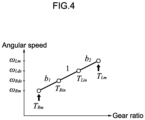
- FIG. 4 is a speed graph of the power distributing mechanism 3.
- the symbols b 1 , b 2 shown in FIGs. 3 and 4 represent torque difference amplification ratios (reduction ratios, differential reduction ratios) determined according to the configuration of the gears incorporated in the power distributing mechanism 3.
- the torque difference amplification ratio related to motion power transmission from the left motor 2L to the right wheel 5R is represented by b 1
- the torque difference amplification ratio related to motion power transmission from the left motor 2L to the left wheel 5L is represented by b 1 +1.
- the torque difference amplification ratio related to motion power transmission from the right motor 2R to the left wheel 5L is represented by b 2 and the torque difference amplification ratio related to motion power transmission from the right motor 2R to the right wheel 5R is represented by b 2 +1.
- each inverter 6 is a converter (DC-AC inverter) that mutually converts the power (DC power) of a DC circuit on the side of the battery 7 and the power (AC power) of the AC circuits on the side of the motors 2.
- the battery 7 is, for example, a lithium-ion secondary battery or a nickel-metal hydride secondary battery, and is a secondary battery capable of supplying a highvoltage DC current of several hundred volts. While the motors 2 are power running, the DC power is converted into AC power by the inverters 6 and the converted AC power is then supplied to the motors 2. At the time of power generation of the motors 2, the generated electric power is converted into DC power by the inverters 6 and is charged into the battery 7. The operating status of each inverter 6 is controlled by the vehicle control device 10.
- the vehicle control device 10 is one of electronic control units (ECUs) mounted on the vehicle 1.
- the vehicle control device 10 has a function of controlling outputs of the left motor 2L (left driving source) and the right motor 2R (right driving source) in the vehicle 1 provided with the left driving system including the left axle 4L and the left wheel 5L to which motion power from the left motor 2L is transmitted and the right driving system including the right axle 4R and the right wheel 5R to which motion power from the right motor 2R is transmitted.
- the vehicle control device 10 includes a processor (central processing unit), a memory (main memory), a storage device (storage), an interface device, and the like, which do not appear in the drawings, and these elements are communicably coupled to each other via an internal bus.
- the contents of the determination and the control performed by the vehicle control device 10 are recorded and stored as firmware or an application program in the memory, and when the program is to be executed, the contents of the program are expanded in a memory space and executed by the processor.
- an accelerator position sensor 14 To the vehicle control device 10, an accelerator position sensor 14, a brake sensor 15, a steering sensor 16, resolvers 17, and wheel speed sensors 18 are connected.
- the accelerator position sensor 14 is a sensor that detects the amount (accelerator opening) of depressing of the accelerator pedal and the depression speed.
- the brake sensor 15 is a sensor that detects the amount (brake pedal stroke) of depressing of the brake pedal and the depression speed.
- the steering sensor 16 is a sensor that detects a steering angle (actual steering angle or steering angle of the steering wheel) of the left and right wheels 5.
- the resolvers 17 are sensors that detect the angular speeds of the motors 2 and are provided one for each of the pair of motors 2. Each resolver 17 outputs data of a rotational angle of the motor 2 in the form of a two-phase AC voltage. The angular speed of the motor 2 is grasped from the chronological change of the AC voltage.
- the wheel speed sensors 18 (18L, 18R) are sensors that detect the angular speeds of the axles 4.
- the vehicle control device 10 controls the operating status of the inverters 6 (6L, 6R) on the basis of the information detected by the above sensors 14 to 18 and thereby controls the outputs of the pair of motors 2 (2L, 2R).
- the resolvers 17 may be replaced by other sensors (e.g., hall sensors and encoders) different in internal structure and operation principle.
- FIG. 5 is a schematic block diagram illustrating a flow of a design method executed by the design device 20.
- a sum model and a difference model are stored in advance. This means that, in the present design method, a sum model and a difference model are first prepared.
- the sum model models motion states of the left driving system, the right driving system, the left driving source (motor 2L), and the right driving source (motor 2R) while the vehicle 1 is running straight
- the difference model models motion states of the left driving system, the right driving system, the left driving source (motor 2L), and the right driving source (motor 2R) while the vehicle 1 is cornering.
- an equivalent sum value to the sum model makes it possible to grasp motion states of the left driving system and the right driving system while the vehicle 1 is running straight
- application of an equivalent difference value to the difference model makes it possible to grasp motion states of the left driving system and the right driving system while the vehicle 1 is cornering.
- the sum model when being applied (inputted) with the equivalent sum value including an input element, the sum model outputs an equivalent sum value (an equivalent sum value including an output element and hereinafter referred to as a "sum-model state quantity") representing motion states of the left driving system and the right driving system while the vehicle 1 is running straight.
- the difference model when being applied (inputted) with the equivalent difference value including an input element, the difference model outputs an equivalent difference value (an equivalent difference value including an output element and hereinafter referred to as a "difference-model state quantity") representing motion states of the left driving system and the right driving system while the vehicle 1 is cornering.
- an equivalent difference value an equivalent difference value including an output element and hereinafter referred to as a "difference-model state quantity" representing motion states of the left driving system and the right driving system while the vehicle 1 is cornering.
- the equivalent sum value is a generic term for a value corresponding to the sum of a left-axle I/O (input and output) including an input parameter or an output parameter of the left driving system (a parameter representing a behavior of the left driving system) and a right-axle I/O including an input parameter or an output parameter of the right driving system (a parameter representing a behavior of the right driving system).
- the equivalent sum value may be not only a simple sum but also a product of the sum and a predetermined coefficient or the half the sum (arithmetic mean value).
- the equivalent difference value is a generic term for a value corresponding to the difference between the left-axle I/O and the right-axle I/O.
- the equivalent difference value may be not only a simple difference but also a product of the difference and a predetermined coefficient.
- Step A1 in FIG. 5 corresponds to a step of calculating the equivalent sum value corresponding to the sum of the left-axle I/O and the right-axle I/O.
- the equivalent sum value calculated in this step is applied to the sum model in Step A3 in FIG. 5 . Consequently, a sum-model state quantity representing the motion states of the left driving system and the right driving system while the vehicle 1 is running straight is obtained, so that the motion state of the vehicle 1 while running straight can be precisely grasped.
- Step A2 in FIG. 5 corresponds to a step of calculating the equivalent difference value corresponding to the difference between the left-axle I/O and the right-axle I/O.
- the equivalent difference value calculated in this step is applied to the difference model in StepA4 in FIG. 5 . Consequently, a difference-model state quantity representing the motion states of the left driving system and the right driving system while the vehicle 1 is cornering is obtained, so that the motion state of the vehicle 1 while cornering can be precisely grasped.
- a calculator 21 and a storing unit 22 are provided inside the design device 20. Further, as shown in FIG. 2 , if the design device 20 is incorporated in the vehicle control device 10, the control unit 23 is provided in the vehicle control device 10. These elements are shown by classifying the functions of the design device 20 and the vehicle control device 10 for convenience. These elements may be described as independent programs for implementing the functions of the respective elements. Alternatively, these elements may be described as a combined program of multiple elements being combined.
- the calculator 21 calculates the equivalent sum value and the equivalent difference value.
- the equivalent sum value and the equivalent difference value are calculated based on a left-axle I/O and a right-axle I/O corresponding to the left-axle I/O.
- Examples of the left-axle I/O include the left-motor input torque T LM , the (reduced) left-motor input torque T Lm , the left driving-side torque T Lin , the left-axle torque T Lds , the left-wheel load-side torque T LL , the left-motor angular speed ⁇ LM , the (reduced) left-motor angular speed ⁇ Lm , the left driving-side angular speed ⁇ Lds , the left-wheel angular speed ⁇ LL , the left-wheel nominal slip ratio ⁇ Ln , and the left-wheel nominal inertia J LL .
- examples of the right-axle I/O include the right-motor input torque T RM , the (reduced) right-motor input torque T Rm, the right driving-side torque T Rin , the right-axle torque T Rds , the right-wheel load-side torque T RL , the right-motor angular speed ⁇ RM , the (reduced) right-motor angular speed ⁇ Rm , the right driving-side angular speed ⁇ Rds , the right-wheel angular speed ⁇ RL , the right-wheel nominal slip ratio ⁇ Rn , and the right-wheel nominal inertia J RL .
- Examples of the equivalent sum value include a sum-mode motor input torque T SM , a (reduced) sum-mode motor input torque T Sm , a sum-mode driving-side torque T Sin , a sum-mode axle torque T Sds , a sum-mode wheel load-side torque T SL , a sum-mode motor angular speed ⁇ SM , a (reduced) sum-mode motor angular speed ⁇ Sm , a sum-mode driving-side angular speed ⁇ Sds , a sum-mode wheel angular speed ⁇ SL , a sum-mode wheel nominal slip ratio ⁇ Sn , sum-mode wheel nominal inertia J SL .
- examples of the equivalent difference value include a difference-mode motor input torque T DM , a (reduced) difference-mode motor input torque T Dm , a difference-mode driving-side torque T Din , a difference-mode axle torque T Dds , a difference-mode wheel load-side torque T DL , a difference-mode motor angular speed ⁇ DM , a (reduced) difference-mode motor angular speed ⁇ Dm , a difference-mode driving-side angular speed ⁇ Dds , a difference-mode wheel angular speed ⁇ DL , a difference-mode wheel nominal slip ratio ⁇ Dn , difference-mode wheel nominal inertia J DL .
- Each of the sum-mode motor input torque T SM and the difference-mode motor input torque T DM is calculated based on the left-motor input torque T LM and the right-motor input torque T RM . Further, each of the (reduced) sum-mode motor input torque T Sm and the (reduced) difference-mode motor input torque T Dm are calculated based on the (reduced) left-motor input torque T Lm and the (reduced) right-motor input torque T Rm .
- T SM T DM 1 2 1 2 1 2 ⁇ 1 2 T RM T LM
- T Sm T Dm 1 2 1 2 1 2 ⁇ 1 2 T Rm T Lm
- T Sin T Din 1 2 1 2 1 2 ⁇ 1 2 T Rin
- Lin T Sds T Dds 1 2 1 2 1 2 ⁇ 1 2 T Rds T Lds
- T SL T DL 1 2 1 2 1 2 ⁇ 1 2 T RL T LL
- ⁇ SM ⁇ DM 1 2 1 2 1 2 ⁇ 1 2 ⁇ RM ⁇ LM
- Sm ⁇ Dm 1 2 1 2 1 2 ⁇ 1 2 ⁇ Rm ⁇ Lm
- ⁇ Sds ⁇ Dds 1 2 1 2 1 2 ⁇ 1 2 ⁇ Rds ⁇ Lds
- ⁇ SL ⁇ DL 1 2 1 2 1 2 ⁇ 1 2 ⁇ RL ⁇ LL
- the storing unit 22 stores the sum model and the difference model.
- the sum model represents motion states of the left driving system, the right driving system, the left driving source (left motor 2L), and the right driving source (right motor 2R) while the vehicle 1 is running straight.
- the difference model represents motion states of the left driving system, the right driving system, the left driving source (left motor 2L), and the right driving source (right motor 2R) while the vehicle 1 is cornering.
- FIG. 6 is a schematic diagram of the configurations of the left driving system and the right driving system of the vehicle 1.
- Each of the left axle 4L and the right axle 4R can be regarded as a structure in which a spring (axle stiffness K s ) and a damper (axle viscosity D s ) are connected in parallel.
- the symbol J LM represents inertia of the side of the power distributing mechanism 3 (driving side) against the left axle 4L
- the symbol J Lw represents inertia of the side of the left wheel 5L (load side) against the left axle 4L
- the symbol J RM represents inertia of the side of the power distributing mechanism 3 (driving side) against the right axle 4R
- the symbol J Rw is inertia of the side of the right wheel 5R (load side) against the right axle 4R.
- FIG. 6 also shows a differential value (left driving-side angular acceleration) of the left driving-side angular speed ⁇ Lds , a differential value (left-wheel angular acceleration) of the left-wheel angular speed ⁇ LL , a differential value (right driving-side angular acceleration) of the right driving-side angular speed ⁇ Rds , and a differential value (right-wheel angular acceleration) of the right-wheel angular speed ⁇ RL .
- both the sum model and the difference model are two-inertia system models, but each may alternatively be configured as a multiinertia system model including three or more moments of inertia or spring dampers.
- the sum model includes driving-side inertia J SM , a spring damper designed with a stiffness K s and a viscosity D s , and load-side inertia (sum-mode wheel nominal inertia) J SL .
- the load-side inertia J SL is calculated based on a vehicle body weight M (calibrated in terms of a wheel).
- T Sds K S ⁇ ⁇ Sds ⁇ ⁇ SL + D S ⁇ Sds ⁇ ⁇ SL
- the difference model includes driving-side inertia J DM corresponding to equivalent inertia when a left-right difference is generated (i.e., while the vehicle 1 is cornering), the spring damper designed with the stiffness K s and the viscosity D s , and load-side inertia (difference-mode wheel nominal inertia) J DL .
- the load-side inertia J DL is calculated based on the yaw inertia (calibrated in terms of a wheel) of the vehicle 1. In the calculation of the driving-side inertia J DM and the load-side inertia J DL , friction may also be considered.
- the equations of motion of the difference model are shown below.
- the sum-model state quantity representing the motion states of the left driving system and the right driving system while the vehicle 1 is running straight is obtained.
- the sum-model state quantity includes one or more parameters of the equivalent sum value except for those applied to the sum model. For example, if the sum-mode wheel angular speed ⁇ SL and the sum-mode wheel nominal inertia J Sn are applied to the sum model, another equivalent sum value (e.g., sum-mode axle torque T Sds ) is obtained as the sum-model state quantity.
- difference-model state quantity representing the motion states of the left driving system and the right driving system while the vehicle 1 is cornering are obtained.
- the difference-model state quantity includes one or more parameters of the equivalent difference value except for those applied to the difference model. For example, if the difference-mode wheel angular speed ⁇ DL and the difference-mode wheel nominal inertia J Dn are applied to the difference model, another equivalent sum (sic, correctly "difference") value (e.g., difference-mode axle torque T Dds ) is obtained as difference-model state quantity.
- the controller 23 controls the outputs of the left motor 2L and the right motor 2R using the sum-model state quantity and the difference-model state quantity.
- the controller 23 controls the operating states of inverters 6 by driving the pair of motors 2 such that the sum-model state quantity and the difference-model state quantity can be obtained (that is, such that both the sum-model state quantity and the difference-model state quantity can be both achieved). This makes the controller 23 possible to conduct accurate control such that the motion states of the left driving system and the right driving system become desired state.
- the calculation of the sum-mode axle torque T Sds and the difference-mode axle torque T Dds can be achieved by performing an inverse operation to the arithmetic operation of the equivalent sum value and the equivalent difference value.
- the torques of the respective motors 2 to be calculated are set to "the left-motor input torque T LM and the right-motor input torque T RM ".
- the values of the left-motor input torque T LM and the right-motor input torque T RM are calculated which make the sum of the left-motor input torque T LM and the right-motor input torque T RM mach the sum-mode axis torque T Sds and also which make the difference between the left-motor input torque T LM and the right-motor input torque T RM match the difference-mode axle torque T Dds .
- the respective inverter 6 are driven such that the calculated left-motor input torque T LM and the right-motor input torque T RM can be obtained.
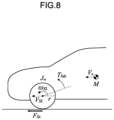
- FIG. 8 is a schematic diagram to derive load-side inertia while the vehicle 1 is running straight.
- the vehicle body speed while the vehicle 1 is running straight is represented by the symbol V x
- the wheel speed (moving forward speed of the left and right wheels 5) is represented by the symbol V SL
- the vehicle body weight is represented by the symbol M
- the wheel angular speed (sum-mode wheel angular speed) is represented by the symbol ⁇ SL
- the driving force of the left and right wheels 5 is represented by the symbol F Sx
- the dynamic rolling radius of the wheel is represented by the symbol r.
- the sum-mode wheel load-side torque T SL (the torque corresponding to the reaction force from the road surface or the driving force) is linearlized on the assumption that the sum-mode wheel load-side torque T SL is determined by the sum-mode axle torque T Sds serving as the driving-side torque, the following equations hold.
- the transfer function on the load-side in the sum mode (a relational equation including a transfer function representing the input/output characteristic of the two-inertia system related to the sum model) can be obtained.
- FIG. 9 is a schematic diagram representing a relationship between a torque and an angular speed while the vehicle 1 is running straight.
- the symbol J SM represents the driving-side inertia
- the symbol J M represents motor inertia
- the symbol D SM represents a sum-mode driving-side viscosity
- the symbol D M represents a motor viscosity
- the symbol D L represents a load-side viscosity.
- the sum-mode driving-side angular speed ⁇ Sds is calculated by multiplying a value obtained by subtracting the sum-mode axle torque T Sds from the sum-mode driving-side torque T Sin with "1/(J SM ⁇ s+D SM )".
- J SM G 2 J M
- D SM G 2 D M hold.
- the sum-mode axle torque T Sds is calculated by multiplying a value obtained by subtracting the sum-mode wheel angular speed ⁇ SL from the sum-mode driving-side angular speed ⁇ Sds with "(K s /s)+D s ".
- K s and D s are the stiffness and the viscosity of the spring damper.
- the sum-mode wheel angular speed ⁇ SL is calculated by multiplying the sum-mode axle torque T Sds by "1/(J SL ⁇ s+ D L )".
- the yaw rate, the dread, the difference between wheel speeds of the left and right wheels while the vehicle 1 is cornering are set to the symbol ⁇ , the symbol d, and the symbol V Dx , respectively.
- the symbol V x represents the vehicle speed
- the symbol V rlx represents the left wheel reference wheel speed
- the symbol V rrx represents the right wheel reference wheel speed.
- equations of motion on the driving side in the difference mode, the yaw motion, and the lateral motion hold as follows.
- the symbol ⁇ f represents the steering angle
- the symbol a y represents a lateral acceleration
- the symbol I represents yaw inertia of the vehicle 1
- the symbol C f represents cornering power of the front wheel
- the symbol C r represents cornering power of the rear wheel
- the symbol I f represents the distance between the center of gravity and the front axle
- the symbol I r represents the distance between the center of gravity and the rear axle
- the symbol ⁇ represents a slip angle of the vehicle body
- the symbol F Dx represents a left-right difference of driving power
- the symbol ⁇ D represents a slip ratio in the difference model.
- the symbol Z 11 represents the reduction ratio from the left driving source (left motor 2L) to the left shaft (left axle 4L)
- the symbol Z 22 represents the reduction ratio from the right driving source (right motor 2R) to the right shaft (right axle 4R)
- the symbol Z c represents the reduction ratio from the left and right driving sources to the respective opposing shafts.
- the above design device 20 includes the calculator 21 and the storing unit 22.
- the calculator 21 calculates the equivalent sum value corresponding to the sum of the left-axle I/O and the right-axle I/O and calculates the equivalent difference value corresponding to the difference between the left-axle I/O and the right-axle I/O.
- the storing unit 22 stores the sum model modeling motion states of the left driving system and the right driving system while the vehicle 1 is running straight and being applied with the equivalent sum value, and the difference model modeling motion states of the left driving system and the right driving system while the vehicle 1 is cornering and being applied with the equivalent difference value.
- a behavior of a driving system while the vehicle 1 is running straight can be precisely grasped by applying the equivalent sum value to the sum model
- a behavior of the driving system while the vehicle 1 is cornering can be precisely grasped by applying an equivalent difference value to a difference model.
- the state (behavior) of the driving system can be precisely grasped and control having preferable controllability (e.g., control accuracy and control response speed) can be designed with a simple configuration.
- both the sum model and the difference model can be constructed to be two-inertia system models. This makes it possible to precisely grasp the motion states of the left and right driving systems while the vehicle 1 is running straight and while the vehicle 1 is cornering with a simple configuration. In addition, on a characteristic that is different between running straight and cornering, control considering the respective viscoelasticity can be carried out. Therefore, the controllability of vehicle 1 can be enhanced.
- the above sum model can be expressed by the two-inertia system including the driving-side inertia calculated based on inertia of the left motor 2L and the right motor 2R, the spring damper designed with the stiffness and viscosity, and the load-side inertia calculated based on the vehicle body weight of the vehicle 1.
- the input/output characteristic of this two-inertia system can be expressed by, for example, the transfer function shown in [Math 5].
- the above difference model can be expressed by the two-inertia system including the driving-side inertia corresponding to the equivalent inertia calculated based on a torque difference amplification ratio of when a left-right difference is generated, the spring damper designed with the stiffness and viscosity, and the load-side inertia calculated based on the yaw inertia of the vehicle 1.
- the input/output characteristic of this two-inertia system can be expressed by, for example, the transfer function shown in [Math 8].
- the above embodiment is merely illustrative, and is not intended to exclude the use of various modifications and techniques not explicitly described in the present embodiment.
- Each configuration of the present embodiment can be variously modified and implemented without departing from the scope thereof.
- the configurations of the present embodiment can be selected and omitted as needed, or can be combined appropriately.
- the above embodiment describes the 1 that mounts thereon the pair of motors 2 serving as driving sources, but the motors 2 may be alternatively replaced by an internal combustion engine.
- the specific type of the driving source is not limited.
- the above embodiment illustrates the vehicle 1 that includes a vehicle driving device (DM-AYC device) including the pair of motors 2 and the power distributing mechanism 3.
- a vehicle driving device D-AYC device
- the concept of the sum model and the difference model can be applied to any vehicle exemplified by a vehicle without the power distributing mechanism 3 or an in-wheel motor vehicle.
- a vehicle provided with at least a left driving system including a left axle and a left wheel to which motion power from the left driving source is transmitted and a right driving system including a right axle and a right wheel to which motion power from the right driving source is transmitted can undergo the control the same as the above embodiment and can obtain the same actions and effects as those of the above embodiment.
- a design device for output control of a left driving source and a right driving source in a vehicle provided with a left driving system including a left axle and a left wheel and a right driving system including a right axle and a right wheel, motion power from the left driving source being transmitted to the left axle and the left wheel, motion power from the right driving source being transmitted to the right axle and the right wheel, the vehicle control device comprising:
- the design device includes a transfer function indicating an input/output characteristic of a two-inertia system including driving-side inertia calculated based on inertia of the left driving source and the right driving source, a spring damper designed with a stiffness and a viscosity, and load-side inertia calculated based on a vehicle body weight of the vehicle.
- the difference model includes a transfer function indicating an input/output characteristic of a two-inertia system including driving-side inertia corresponding to equivalent inertia calculated based on a torque difference amplification ratio of when a left-right difference is generated, a spring damper designed with a stiffness and a viscosity, and load-side inertia calculated based on yaw inertia of the vehicle.
- the present embodiment is applicable to manufacturing industries of a design device and the vehicle control device and also applicable to manufacturing industries of a vehicle that is implemented with the control designed by the design device and a vehicle provided with the vehicle control device.
Landscapes
- Engineering & Computer Science (AREA)
- Transportation (AREA)
- Mechanical Engineering (AREA)
- Automation & Control Theory (AREA)
- Chemical & Material Sciences (AREA)
- Combustion & Propulsion (AREA)
- Physics & Mathematics (AREA)
- Mathematical Physics (AREA)
- Power Engineering (AREA)
- Electric Propulsion And Braking For Vehicles (AREA)
- Control Of Driving Devices And Active Controlling Of Vehicle (AREA)
Abstract
Description
- The embodiment discussed herein relates to a design method and a vehicle control device for output control of a driving source of a vehicle.
- Conventionally, for a vehicle provided with multiple driving sources, a method has been known in which an operating state of each driving source is controlled while suppressing vibration of a driving power transmission system by using a vehicle model that models the behavior of the driving power transmission system (see Patent Document 1).
- [Patent Document 1]
JP 2019-103249 A - The behavior of the driving power transmission system while the vehicle is running straight is different from the behavior while the vehicle is cornering. For the above, there is need to construct a control to deal with a vehicle while running straight and a control to deal with the vehicle while cornering. Constructing respective controls for the left and right driving systems would result in a complex control configuration. In addition, the traveling state of a vehicle is sometimes a combined state in which a running-straight state and a cornering state are mixed, which makes it difficult to enhance the controllability.
- With the foregoing problems in view, one of the objects of the embodiment is to provide a design method and a vehicle control device that achieve preferable control with a simple configuration. In addition to this object, actions and effects which are derived from each configuration of "Embodiment to Carry out Invention" to be described below and which conventional technique does not attain are regarded as other objects of the present disclosure.
- The disclosed design method and vehicle control device can be achieved in the embodiment and the application to be disclosed below and solve at least some of the above problems.
- The disclosed design method is one for output control of a left driving source and a right driving source in a vehicle provided with a left driving system including a left axle and a left wheel and a right driving system including a right axle and a right wheel, motion power from the left driving source being transmitted to the left axle and the left wheel, motion power from the right driving source being transmitted to the right axle and the right wheel. The design method includes: preparing a sum model modeling motion states of the left driving system, the right driving system, the left driving source, and the right driving source while the vehicle is running straight, and a difference model modeling motion states of the left driving system, the right driving system, the left driving source, and the right driving source while the vehicle is cornering; calculating an equivalent sum value corresponding to a sum of a left-axle input/output including an input parameter or an output parameter of the left driving system and a right-axle input/output including an input parameter or an output parameter of the right driving system, and an equivalent difference value corresponding to a difference between the left-axle input/output and the right-axle input/output; grasping motion states of the left driving system and the right driving system while the vehicle is running straight by applying the equivalent sum value to the sum model; and grasping motion states of the left driving system and the right driving system while the vehicle is cornering by applying the equivalent difference value to the difference model.
- Additionally, the disclosed vehicle control device is a device for output control of a left driving source and a right driving source in a vehicle provided with a left driving system including a left axle and a left wheel and a right driving system including a right axle and a right wheel, motion power from the left driving source being transmitted to the left axle and the left wheel, motion power from the right driving source being transmitted to the right axle and the right wheel. The vehicle control device includes: a calculator that calculates an equivalent sum value corresponding to a sum of a left-axle input/output including an input parameter or an output parameter of the left driving system and a right-axle input/output including an input parameter or an output parameter of the right driving system, and an equivalent difference value corresponding to a difference between the left-axle input/output and the right-axle input/output; and a storing unit that stores a sum model modeling motion states of the left driving system, the right driving system, the left driving source, and the right driving source while the vehicle is running straight, and a difference model modeling motion states of the left driving system, the right driving system, the left driving source, and the right driving source while the vehicle is cornering, the equivalent sum value being applied to the sum model, the equivalent difference value being applied to the difference model.
- The disclosed design method and vehicle control device can precisely grasp behaviors of driving systems while the vehicle is running straight by applying an equivalent sum value to a sum model, and can precisely grasp behaviors of the driving systems while the vehicle is cornering by applying an equivalent difference value to a difference model. Accordingly, the method and the device can precisely grasp the state (behavior) of a driving system that have a different characteristic between a running-straight state and a cornering state of the vehicle, and can design control having preferable controllability with a simple configuration.
-
-
FIG. 1 is a block diagram showing a configuration of a vehicle control device and a vehicle. -
FIG. 2 is a block diagram showing a configuration of the vehicle control device being mounted on the vehicle. -
FIG. 3 is a skeleton diagram showing an example of a configuration of a driving system of the vehicle. -
FIG. 4 is a speed graph of a power distributing mechanism of a vehicle having the configuration ofFIG. 3 . -
FIG. 5 is a block diagram showing a flow of a design method. -
FIG. 6 is a schematic diagram schematically showing a left driving system and a right driving system of the vehicle. -
FIG. 7A is a schematic diagram of a sum model andFIG. 7B is a schematic diagram of a difference model. -
FIG. 8 is a schematic diagram considering the behavior of the vehicle while the vehicle is running straight. -
FIG. 9 is a schematic diagram showing a relationship between a torque and an angular speed while the vehicle is running straight. - The control designed in the disclosed design method is implemented in a vehicle, and is applied to, for example, the disclosed vehicle control device. Examples of the type of vehicle that is to implement this control are an engine vehicle (a gasoline-powered vehicle, a diesel-powered vehicle), an electric vehicle, and a hybrid vehicle. The vehicle is an automobile that travels by driving left and right wheels (left and right driving wheels) using at least one driving source (e.g., an internal combustion engine or a motor), and is preferably an automobile that travels by driving left and right wheels (left and right drive wheels) using multiple driving sources. Here, one of the multiple driving sources is referred to as a left driving source, and another one of the driving sources is referred to as a right driving source. In addition, one of the left and right wheels positioned on the left side of the vehicle is referred to as a left wheel, and the other is referred to as a right wheel. The disclosed design method and vehicle control device are suitable for use in designing a control to be implemented in a vehicle provided with a left driving system including a left axle and a left wheel to which motion power from the left driving source is transmitted and a right driving system including a right axle and a right wheel to which motion power from the right driving source is transmitted, and also for use in controlling the vehicle.
- The layout of each of the left driving source and the right driving source may or may not be set to correspond to the left-right direction determined based on the forward-traveling direction of the vehicle. The left driving system and the right driving system may operate independently of each other, or may be connected to each other via a transmission mechanism or a power distributing mechanism. The disclosed design method and vehicle control device can also be used to design a control that is to be implemented in an in-wheel motor vehicle that drives the left and right wheels with respective different motors and control of the vehicle, or to a design a control to be implemented in a torque vectoring vehicle in which the left and right wheels can transmit a driving force and a torque to each other.
- A configuration of a
design device 20 that uses the design method according to an embodiment is illustrated inFIGs. 1 and2 . Thedesign device 20 is a device (computer) for designing a control to be implemented in thevehicle 1. Each ofFIGs. 1 and2 shows the configuration of aprospective vehicle 1 as well as thedesign device 20. The designed control can be applied to theprospective vehicle 1. As shown inFIG. 1 , in a design stage of the control, the control may be designed using thedesign device 20 provided independently of thevehicle 1. Alternatively, as shown inFIG. 2 , incorporating the function of thedesign device 20 in the vehicle control device 10 (ECU) makes it possible to utilize the function of thedesign device 20 also in actual control of thevehicle 1 as well as the design of the control. - The
vehicle 1 shown inFIGs. 1 and2 includes left and right wheels 5 (wheels) aligned side by side in the vehicle width direction, a power distributing mechanism 3 (differential mechanism) that applies a torque difference to the left andright wheels 5, and a pair ofmotors 2 connected to thepower distributing mechanism 3. In the drawing illustrating the embodiment, alphabets R and L which are attached to the numerical signs represent the arrangement positions of the elements related to the signs (i.e., the positions on the right side and the left side of the vehicle 1). For example, thereference sign 5L represents one (left wheel) of the left andright wheels 5 located on the left side of thevehicle 1, and thereference sign 5R represents the other (right wheel) located on the right side. The left andright wheels 5 may be positioned anywhere in the front-rear direction, and may be front wheels or rear wheels of thevehicle 1. - Each motor 2 (driving source) has a function of driving at least either one of the front wheels and the rear wheels of the
vehicle 1, and can have a function of driving all four wheels. Of the pair ofmotors 2, one arranged on the left side is aleft motor 2L (left driving source), and the other arranged on the right side is aright motor 2R (right driving source). Theleft motor 2L and theright motor 2R operate independently of each other, and may individually output driving forces having different magnitudes from each other. Thesemotors 2 are connected to thepower distributing mechanism 3 each via a pair of reduction mechanisms provided separately from each other. - The
vehicle 1 includes thepower distributing mechanism 3 that amplifies the torque difference between the pair ofmotors 2 and distributes the torque difference to each of left andright wheels 5. Thepower distributing mechanism 3 of the present embodiment is a differential mechanism having a yaw control function (AYC (Active Yaw Control) function), and is interposed between an axle 4 (left axle 4L, left shaft) connected to theleft wheel 5L and an axle 4 (right axle 4R, right shaft) connected to theright wheel 5R. The yaw control function is a function that adjusts the yaw moment by actively controlling the sharing ratio of the driving forces (driving torques) of the left andright wheels 5 and stabilizes the posture of thevehicle 1. Inside thepower distributing mechanism 3, a planetary gear mechanism and a differential gear mechanism are incorporated, for example. A vehicle driving device including the pair ofmotors 2 and thepower distributing mechanism 3 is also referred to as a DM-AYC (Dual Motor AYC) device. - As shown in
FIG. 3 , thepower distributing mechanism 3 includes the pair of reduction mechanisms (gear trains surrounded by dashed lines inFIG. 3 ) that reduces the rotational speeds of themotors 2 and a transmission mechanism (gear trains surrounded by one-dot dashed lines inFIG. 3 ). Each reduction mechanism is a mechanism that increases the torque by reducing the torque (driving force) output from thecorresponding motor 2. The reduction ratio G of the reduction mechanism is appropriately set according to the output characteristic and the performance of themotor 2. If the torque performances of themotors 2 are sufficiently high, the reduction mechanisms may be omitted. The transmission mechanism is a mechanism that amplifies the difference between torques transmitted to the left andright wheels 5. - The transmission mechanism of the
power distributing mechanism 3 shown inFIG. 3 includes a pair of planetary gear mechanisms. These planetary gear mechanisms have a structure in which planetary gears provided on respective carriers are connected to each other and also the rotation shafts of the planetary gears. Each carrier supports the planetary gears such that the planetary gears can rotate and revolve around a sun gear. Further, the driving forces transmitted from the left andright motors 2 are inputted into the ring gear and the sun gear of one of the planetary gear mechanisms. The driving forces transmitted to the left andright wheels 5 are taken out from the sun gear and the carrier of the other planetary gear mechanism. Note that the structure of thepower distributing mechanism 3 shown inFIG. 3 is merely exemplary for achieving the yaw control function, and can be replaced with another known structures. - In
FIG. 3 , the symbol JM represents motor inertia (moment of inertia of the motors 2) and the symbol Jw represents wheel inertia (moment of inertia of the left and right wheels 5). Also, in relation to the parameters of a left driving system, the symbol TLM represents a left-motor input torque, the symbol TLm represents a left-motor input torque reduced by the reduction mechanism, the symbol ωLM represents a left-motor angular speed, the symbol ωLm represents a left-motor angular speed reduced by the reduction mechanism, the symbol TLin represents a left driving-side torque, the symbol TLds represents a left-axle torque, the symbol TLL represents a left-wheel load-side torque, the symbol ωLds represents a left driving-side angular speed, and the symbol ωLL represents a left-wheel angular speed. Similarly, in relation to the parameters of a right driving system, the symbol TRM represents a right-motor input torque, the symbol TRm represents a right-motor input torque reduced by the reduction mechanism, the symbol ωRM represents a right-motor angular speed, the symbol ωRm represents a right-motor angular speed reduced by the reduction mechanism, the symbol TRin represents a right driving-side torque, the symbol TRds represents a right-axle torque, the symbol TRL represents a right-wheel load-side torque, the symbol ωRds represents a right driving-side angular speed, and the symbol ωRL represents a right-wheel angular speed. -
FIG. 4 is a speed graph of thepower distributing mechanism 3. The symbols b1, b2 shown inFIGs. 3 and4 represent torque difference amplification ratios (reduction ratios, differential reduction ratios) determined according to the configuration of the gears incorporated in thepower distributing mechanism 3. The torque difference amplification ratio related to motion power transmission from theleft motor 2L to theright wheel 5R is represented by b1 and the torque difference amplification ratio related to motion power transmission from theleft motor 2L to theleft wheel 5L is represented by b1+1. In addition, the torque difference amplification ratio related to motion power transmission from theright motor 2R to theleft wheel 5L is represented by b2 and the torque difference amplification ratio related to motion power transmission from theright motor 2R to theright wheel 5R is represented by b2+1. - As shown in
FIGs. 1 and2 , the pair ofmotors 2 are electrically connected to abattery 7 via respective inverters 6 (6L, 6R). Eachinverter 6 is a converter (DC-AC inverter) that mutually converts the power (DC power) of a DC circuit on the side of thebattery 7 and the power (AC power) of the AC circuits on the side of themotors 2. Thebattery 7 is, for example, a lithium-ion secondary battery or a nickel-metal hydride secondary battery, and is a secondary battery capable of supplying a highvoltage DC current of several hundred volts. While themotors 2 are power running, the DC power is converted into AC power by theinverters 6 and the converted AC power is then supplied to themotors 2. At the time of power generation of themotors 2, the generated electric power is converted into DC power by theinverters 6 and is charged into thebattery 7. The operating status of eachinverter 6 is controlled by thevehicle control device 10. - The
vehicle control device 10 is one of electronic control units (ECUs) mounted on thevehicle 1. Thevehicle control device 10 has a function of controlling outputs of theleft motor 2L (left driving source) and theright motor 2R (right driving source) in thevehicle 1 provided with the left driving system including theleft axle 4L and theleft wheel 5L to which motion power from theleft motor 2L is transmitted and the right driving system including theright axle 4R and theright wheel 5R to which motion power from theright motor 2R is transmitted. - The
vehicle control device 10 includes a processor (central processing unit), a memory (main memory), a storage device (storage), an interface device, and the like, which do not appear in the drawings, and these elements are communicably coupled to each other via an internal bus. The contents of the determination and the control performed by thevehicle control device 10 are recorded and stored as firmware or an application program in the memory, and when the program is to be executed, the contents of the program are expanded in a memory space and executed by the processor. - To the
vehicle control device 10, anaccelerator position sensor 14, a brake sensor 15, asteering sensor 16,resolvers 17, andwheel speed sensors 18 are connected. Theaccelerator position sensor 14 is a sensor that detects the amount (accelerator opening) of depressing of the accelerator pedal and the depression speed. The brake sensor 15 is a sensor that detects the amount (brake pedal stroke) of depressing of the brake pedal and the depression speed. Thesteering sensor 16 is a sensor that detects a steering angle (actual steering angle or steering angle of the steering wheel) of the left andright wheels 5. - The resolvers 17 (17L, 17R) are sensors that detect the angular speeds of the
motors 2 and are provided one for each of the pair ofmotors 2. Eachresolver 17 outputs data of a rotational angle of themotor 2 in the form of a two-phase AC voltage. The angular speed of themotor 2 is grasped from the chronological change of the AC voltage. The wheel speed sensors 18 (18L, 18R) are sensors that detect the angular speeds of theaxles 4. Thevehicle control device 10 controls the operating status of the inverters 6 (6L, 6R) on the basis of the information detected by theabove sensors 14 to 18 and thereby controls the outputs of the pair of motors 2 (2L, 2R). Theresolvers 17 may be replaced by other sensors (e.g., hall sensors and encoders) different in internal structure and operation principle. -
FIG. 5 is a schematic block diagram illustrating a flow of a design method executed by thedesign device 20. In the storage device of thedesign device 20, a sum model and a difference model are stored in advance. This means that, in the present design method, a sum model and a difference model are first prepared. The sum model models motion states of the left driving system, the right driving system, the left driving source (motor 2L), and the right driving source (motor 2R) while thevehicle 1 is running straight, and the difference model models motion states of the left driving system, the right driving system, the left driving source (motor 2L), and the right driving source (motor 2R) while thevehicle 1 is cornering. - As shown in
FIG. 5 , application of an equivalent sum value to the sum model makes it possible to grasp motion states of the left driving system and the right driving system while thevehicle 1 is running straight, and application of an equivalent difference value to the difference model makes it possible to grasp motion states of the left driving system and the right driving system while thevehicle 1 is cornering. Specifically, when being applied (inputted) with the equivalent sum value including an input element, the sum model outputs an equivalent sum value (an equivalent sum value including an output element and hereinafter referred to as a "sum-model state quantity") representing motion states of the left driving system and the right driving system while thevehicle 1 is running straight. Similarly, when being applied (inputted) with the equivalent difference value including an input element, the difference model outputs an equivalent difference value (an equivalent difference value including an output element and hereinafter referred to as a "difference-model state quantity") representing motion states of the left driving system and the right driving system while thevehicle 1 is cornering. - The equivalent sum value is a generic term for a value corresponding to the sum of a left-axle I/O (input and output) including an input parameter or an output parameter of the left driving system (a parameter representing a behavior of the left driving system) and a right-axle I/O including an input parameter or an output parameter of the right driving system (a parameter representing a behavior of the right driving system). The equivalent sum value may be not only a simple sum but also a product of the sum and a predetermined coefficient or the half the sum (arithmetic mean value). The equivalent difference value is a generic term for a value corresponding to the difference between the left-axle I/O and the right-axle I/O. The equivalent difference value may be not only a simple difference but also a product of the difference and a predetermined coefficient.
- Step A1 in
FIG. 5 corresponds to a step of calculating the equivalent sum value corresponding to the sum of the left-axle I/O and the right-axle I/O. The equivalent sum value calculated in this step is applied to the sum model in Step A3 inFIG. 5 . Consequently, a sum-model state quantity representing the motion states of the left driving system and the right driving system while thevehicle 1 is running straight is obtained, so that the motion state of thevehicle 1 while running straight can be precisely grasped. Step A2 inFIG. 5 corresponds to a step of calculating the equivalent difference value corresponding to the difference between the left-axle I/O and the right-axle I/O. The equivalent difference value calculated in this step is applied to the difference model in StepA4 inFIG. 5 . Consequently, a difference-model state quantity representing the motion states of the left driving system and the right driving system while thevehicle 1 is cornering is obtained, so that the motion state of thevehicle 1 while cornering can be precisely grasped. - Next, description will now be made in relation to a specific configuration to perform the above-described control. As shown in
FIGs. 1 and2 , acalculator 21 and a storingunit 22 are provided inside thedesign device 20. Further, as shown inFIG. 2 , if thedesign device 20 is incorporated in thevehicle control device 10, thecontrol unit 23 is provided in thevehicle control device 10. These elements are shown by classifying the functions of thedesign device 20 and thevehicle control device 10 for convenience. These elements may be described as independent programs for implementing the functions of the respective elements. Alternatively, these elements may be described as a combined program of multiple elements being combined. - The
calculator 21 calculates the equivalent sum value and the equivalent difference value. The equivalent sum value and the equivalent difference value are calculated based on a left-axle I/O and a right-axle I/O corresponding to the left-axle I/O. Examples of the left-axle I/O include the left-motor input torque TLM, the (reduced) left-motor input torque TLm, the left driving-side torque TLin, the left-axle torque TLds, the left-wheel load-side torque TLL, the left-motor angular speed ωLM, the (reduced) left-motor angular speed ωLm, the left driving-side angular speed ωLds, the left-wheel angular speed ωLL, the left-wheel nominal slip ratio λLn, and the left-wheel nominal inertia JLL. Similarly, examples of the right-axle I/O include the right-motor input torque TRM, the (reduced) right-motor input torque TRm, the right driving-side torque TRin, the right-axle torque TRds, the right-wheel load-side torque TRL, the right-motor angular speed ωRM, the (reduced) right-motor angular speed ωRm, the right driving-side angular speed ωRds, the right-wheel angular speed ωRL, the right-wheel nominal slip ratio λRn, and the right-wheel nominal inertia JRL. - Examples of the equivalent sum value include a sum-mode motor input torque TSM, a (reduced) sum-mode motor input torque TSm, a sum-mode driving-side torque TSin, a sum-mode axle torque TSds, a sum-mode wheel load-side torque TSL, a sum-mode motor angular speed ωSM, a (reduced) sum-mode motor angular speed ωSm, a sum-mode driving-side angular speed ωSds, a sum-mode wheel angular speed ωSL, a sum-mode wheel nominal slip ratio λSn, sum-mode wheel nominal inertia JSL. Similarly, examples of the equivalent difference value include a difference-mode motor input torque TDM, a (reduced) difference-mode motor input torque TDm, a difference-mode driving-side torque TDin, a difference-mode axle torque TDds, a difference-mode wheel load-side torque TDL, a difference-mode motor angular speed ωDM, a (reduced) difference-mode motor angular speed ωDm, a difference-mode driving-side angular speed ωDds, a difference-mode wheel angular speed ωDL, a difference-mode wheel nominal slip ratio λDn, difference-mode wheel nominal inertia JDL.
- Each of the sum-mode motor input torque TSM and the difference-mode motor input torque TDM is calculated based on the left-motor input torque TLM and the right-motor input torque TRM. Further, each of the (reduced) sum-mode motor input torque TSm and the (reduced) difference-mode motor input torque TDm are calculated based on the (reduced) left-motor input torque TLm and the (reduced) right-motor input torque TRm. The following calculation equations are used when the half of the sum of the left-axle I/O and the right-axle I/O is defined as the equivalent sum value and the half of the difference between the left-axle I/O and the right-axle I/O is defined as the equivalent difference value.

- The storing
unit 22 stores the sum model and the difference model. The sum model represents motion states of the left driving system, the right driving system, the left driving source (leftmotor 2L), and the right driving source (right motor 2R) while thevehicle 1 is running straight. The difference model represents motion states of the left driving system, the right driving system, the left driving source (leftmotor 2L), and the right driving source (right motor 2R) while thevehicle 1 is cornering. Before describing the sum model and the difference model, the schematic configurations of the left driving system and the right driving system ofvehicle 1 will now be described. -
FIG. 6 is a schematic diagram of the configurations of the left driving system and the right driving system of thevehicle 1. Each of theleft axle 4L and theright axle 4R can be regarded as a structure in which a spring (axle stiffness Ks) and a damper (axle viscosity Ds) are connected in parallel. InFIG. 6 , the symbol JLM represents inertia of the side of the power distributing mechanism 3 (driving side) against theleft axle 4L, the symbol JLw represents inertia of the side of theleft wheel 5L (load side) against theleft axle 4L, the symbol JRM represents inertia of the side of the power distributing mechanism 3 (driving side) against theright axle 4R, and the symbol JRw is inertia of the side of theright wheel 5R (load side) against theright axle 4R.FIG. 6 also shows a differential value (left driving-side angular acceleration) of the left driving-side angular speed ωLds, a differential value (left-wheel angular acceleration) of the left-wheel angular speed ωLL, a differential value (right driving-side angular acceleration) of the right driving-side angular speed ωRds, and a differential value (right-wheel angular acceleration) of the right-wheel angular speed ωRL. - On the basis of the above schematic diagram, the configuration of the sum model is modeled to have the configuration shown in
FIG. 7A , and the configuration of the difference model is modeled to have the configuration shown inFIG. 7B . The sum model is preferably used for damping control and slip control on theaxle 4 and the left andright wheels 5 while the vehicle is running straight, and the difference model is preferably used for damping control and slip control on theaxle 4 and the left andright wheels 5 while the vehicle is cornering. In this embodiment, both the sum model and the difference model are two-inertia system models, but each may alternatively be configured as a multiinertia system model including three or more moments of inertia or spring dampers. - As shown in
FIG. 7A , the sum model includes driving-side inertia JSM, a spring damper designed with a stiffness Ks and a viscosity Ds, and load-side inertia (sum-mode wheel nominal inertia) JSL. The driving-side inertia JSM is calculated based on the inertia JM of the driving sources (left driving source and right driving source), and is, for example, expressed by the equation JSM = G 2JM . The load-side inertia JSL is calculated based on a vehicle body weight M (calibrated in terms of a wheel). In the calculation of the driving-side inertia JSM and the load-side inertia JSL, friction may also be considered. The equations of motion of the sum model are shown below.
- As shown in
FIG. 7B , the difference model includes driving-side inertia JDM corresponding to equivalent inertia when a left-right difference is generated (i.e., while thevehicle 1 is cornering), the spring damper designed with the stiffness Ks and the viscosity Ds, and load-side inertia (difference-mode wheel nominal inertia) JDL. The driving-side inertia JDM is calculated based on the inertia JM of the driving sources (left driving source and right driving source) and the torque difference amplification ratios (e.g., b1, b2) of thepower distributing mechanism 3, and is, for example, expressed by the equation JDM = (2b1+1)2G2JM. The load-side inertia JDL is calculated based on the yaw inertia (calibrated in terms of a wheel) of thevehicle 1. In the calculation of the driving-side inertia JDM and the load-side inertia JDL, friction may also be considered. The equations of motion of the difference model are shown below.
- By applying the equivalent sum value to the above sum model, the sum-model state quantity representing the motion states of the left driving system and the right driving system while the
vehicle 1 is running straight is obtained. The sum-model state quantity includes one or more parameters of the equivalent sum value except for those applied to the sum model. For example, if the sum-mode wheel angular speed ωSL and the sum-mode wheel nominal inertia JSn are applied to the sum model, another equivalent sum value (e.g., sum-mode axle torque TSds) is obtained as the sum-model state quantity. - The same is applied to the difference model, and by applying the equivalent difference value to the difference model, difference-model state quantity representing the motion states of the left driving system and the right driving system while the
vehicle 1 is cornering are obtained. The difference-model state quantity includes one or more parameters of the equivalent difference value except for those applied to the difference model. For example, if the difference-mode wheel angular speed ωDL and the difference-mode wheel nominal inertia JDn are applied to the difference model, another equivalent sum (sic, correctly "difference") value (e.g., difference-mode axle torque TDds) is obtained as difference-model state quantity. - The
controller 23 controls the outputs of theleft motor 2L and theright motor 2R using the sum-model state quantity and the difference-model state quantity. Thecontroller 23 controls the operating states ofinverters 6 by driving the pair ofmotors 2 such that the sum-model state quantity and the difference-model state quantity can be obtained (that is, such that both the sum-model state quantity and the difference-model state quantity can be both achieved). This makes thecontroller 23 possible to conduct accurate control such that the motion states of the left driving system and the right driving system become desired state. - Here, description will now be made in relation to the case where application of the sum-mode wheel angular speed ωSL and the difference-mode wheel angular speed ωDL calculated on the basis of target wheel speeds of the left and
right wheels 5 to the sum model and the difference model obtains the sum-mode axle torque TSds, one of the sum-model state quantities, and the difference-mode axle torque TDds, one of the difference-model state quantities. Thecontroller 23 calculates the torque to be outputted by each of the pair ofmotor 2 based on the sum-mode axle torque TSds and the difference-mode axle torque TDds, and drives the pair ofinverters 6 such that the calculated torques can be obtained. - The calculation of the sum-mode axle torque TSds and the difference-mode axle torque TDds can be achieved by performing an inverse operation to the arithmetic operation of the equivalent sum value and the equivalent difference value. For example, the torques of the
respective motors 2 to be calculated are set to "the left-motor input torque TLM and the right-motor input torque TRM". Then, the values of the left-motor input torque TLM and the right-motor input torque TRM are calculated which make the sum of the left-motor input torque TLM and the right-motor input torque TRM mach the sum-mode axis torque TSds and also which make the difference between the left-motor input torque TLM and the right-motor input torque TRM match the difference-mode axle torque TDds. After that, therespective inverter 6 are driven such that the calculated left-motor input torque TLM and the right-motor input torque TRM can be obtained. - This makes the actual wheel speeds to accurately follow the target wheel speeds so that the controllability of the wheel speeds can be enhanced. In addition, since the wheel speeds easily match the target wheel speeds even if disturbance is input, the wheel speed are less likely to change suddenly when the frictional resistance of the traveling road surface and the driving forces change, and consequently the generation of slippage is suppressed.
- As another example, description will now made in relation to the case where application of the sum-mode wheel load-side torque TSL and the difference-mode wheel load-side torque TDL calculated on the basis of target driving torques of the left and
right wheels 5 to the sum model and the difference model obtains the sum-mode axle torque TSds, one of the sum-model state quantities, and the difference-mode axle torque TDds, one of the difference-model state quantities. Thecontroller 23 calculates the torque to be outputted by each of the pair ofmotors 2 based on the sum-mode axle torque TSds and the difference-mode axle torque TDds, and drives the pair ofinverters 6 such that the calculated torques can be obtained. - This makes the actual driving torques of the left and
right wheels 5 to accurately follow the target driving torques so that the controllability of the driving torques can be enhanced. Further, providing the sum model and the difference model independently of each other makes it easy to provide respective different characteristics to the sum-mode axle torque TSds and the difference-mode axle torque TDds. For example, it is possible to impart a characteristic (a characteristic that does not include a resonance frequency component) that is less likely to generate resonance while the vehicle is running straight to the sum-mode axle torque TSds, and to impart a characteristic (a characteristic that does not include a resonance frequency component) that is less likely to generate resonance while the vehicle is cornering to the difference-mode axle torque TDds. This suppresses vibration in any traveling state. -
FIG. 8 is a schematic diagram to derive load-side inertia while thevehicle 1 is running straight. Here, the vehicle body speed while thevehicle 1 is running straight is represented by the symbol Vx, the wheel speed (moving forward speed of the left and right wheels 5) is represented by the symbol VSL , the vehicle body weight is represented by the symbol M, the wheel angular speed (sum-mode wheel angular speed) is represented by the symbol ωSL, the driving force of the left andright wheels 5 is represented by the symbol FSx, and the dynamic rolling radius of the wheel is represented by the symbol r. If the sum-mode wheel load-side torque TSL (the torque corresponding to the reaction force from the road surface or the driving force) is linearlized on the assumption that the sum-mode wheel load-side torque TSL is determined by the sum-mode axle torque TSds serving as the driving-side torque, the following equations hold.
- On the basis of the above equations, the transfer function on the load-side in the sum mode (a relational equation including a transfer function representing the input/output characteristic of the two-inertia system related to the sum model) can be obtained.

-
FIG. 9 is a schematic diagram representing a relationship between a torque and an angular speed while thevehicle 1 is running straight. InFIG. 9 , the symbol JSM represents the driving-side inertia, the symbol JM represents motor inertia, the symbol DSM represents a sum-mode driving-side viscosity, the symbol DM represents a motor viscosity, and the symbol DL represents a load-side viscosity. - The sum-mode driving-side angular speed ωSds is calculated by multiplying a value obtained by subtracting the sum-mode axle torque TSds from the sum-mode driving-side torque TSin with "1/(JSM·s+DSM)". Here, the equations JSM= G2JM and DSM= G2DM hold.
- The sum-mode axle torque TSds is calculated by multiplying a value obtained by subtracting the sum-mode wheel angular speed ωSL from the sum-mode driving-side angular speed ωSds with "(Ks/s)+Ds". Here, the symbols Ks and Ds are the stiffness and the viscosity of the spring damper.
- The sum-mode wheel angular speed ωSL is calculated by multiplying the sum-mode axle torque TSds by "1/(JSL·s+ DL)".
- The yaw rate, the dread, the difference between wheel speeds of the left and right wheels while the
vehicle 1 is cornering are set to the symbol γ, the symbol d, and the symbol VDx, respectively. In addition, the symbol Vx represents the vehicle speed, the symbol Vrlx represents the left wheel reference wheel speed, and the symbol Vrrx represents the right wheel reference wheel speed. - Considering the relationships between the yaw rate γ and the difference-mode wheel angular speed ωDL is considered on the assumption that the steering angle is zero, the following equations hold.

- In addition, equations of motion on the driving side in the difference mode, the yaw motion, and the lateral motion hold as follows. In the equations, the symbol δf represents the steering angle, the symbol ay represents a lateral acceleration, the symbol I represents yaw inertia of the
vehicle 1, the symbol Cf represents cornering power of the front wheel, the symbol Cr represents cornering power of the rear wheel, and the symbol If represents the distance between the center of gravity and the front axle, the symbol Ir represents the distance between the center of gravity and the rear axle, the symbol β represents a slip angle of the vehicle body, and the symbol FDx represents a left-right difference of driving power, the symbol λD represents a slip ratio in the difference model.
- Assuming that the steering angle δf and the lateral acceleration ay are zeros in order to model the state of the transition from a running-straight state to a cornering state of the
vehicle 1, the following transfer function on the load-side in the difference mode (a relational equation including a transfer function representing the input/output characteristic of the two-inertia system related to the difference model) can be obtained.
- In deriving the above sum model and difference model, the
power distributing mechanism 3 may formulate the models as follows by using vector expressions.
- Establishing the equation of motion (sum and difference) on the driving side for each of the left and right sides using the above equations obtains the following result. In the equations, the symbol Z11 represents the reduction ratio from the left driving source (left
motor 2L) to the left shaft (leftaxle 4L), the symbol Z22 represents the reduction ratio from the right driving source (right motor 2R) to the right shaft (right axle 4R), and the symbol Zc represents the reduction ratio from the left and right driving sources to the respective opposing shafts.
- Applying a matrix for conversion to the sum and difference modes to both sides of each of the above equations obtains the following equation.

- Here, assuming b1= b2 = b, the equations Z11-Zc= Z22-Zc = |Z| and Z11+Zc= Z22+Zc = 1 hold. Therefore, the equations can be modified as follows and the equation of motion of the
motors 2 that can deal with the sum and difference modes can be obtained. By dividing the equation of motion of the driving side into the equation of the sum mode and that of the difference mode, the two equations do not interfere with each other.
- Likewise the derivation of the equation of motion of the driving side, the equations of motion of the left and right wheels 5 (load side) and the
axles 4 may be formulated as follows.
-
- (1) The above design method prepares the sum model modeling motion states of the left driving system and the right driving system while the
vehicle 1 is running straight, and the difference model modeling motion states of the left driving system and the right driving system while thevehicle 1 is cornering. In addition, the design method equivalent calculates the sum value corresponding to the sum of the left-axle I/O (input/output) including an input parameter or an output parameter of the left driving system and the right-axle I/O including an input parameter or an output parameter of the right driving system, and the equivalent difference value corresponding to a difference between the left-axle I/O and the right-axle I/O. Furthermore, the design method grasps the motion states of the left driving system and the right driving system while thevehicle 1 is running straight by applying the equivalent sum value to the sum model, and grasps the motion states of the left driving system and the right driving system while thevehicle 1 is cornering by applying the equivalent difference value to the difference model. - The
above design device 20 includes thecalculator 21 and the storingunit 22. Thecalculator 21 calculates the equivalent sum value corresponding to the sum of the left-axle I/O and the right-axle I/O and calculates the equivalent difference value corresponding to the difference between the left-axle I/O and the right-axle I/O. The storingunit 22 stores the sum model modeling motion states of the left driving system and the right driving system while thevehicle 1 is running straight and being applied with the equivalent sum value, and the difference model modeling motion states of the left driving system and the right driving system while thevehicle 1 is cornering and being applied with the equivalent difference value. - With the above configuration, a behavior of a driving system while the
vehicle 1 is running straight can be precisely grasped by applying the equivalent sum value to the sum model, and also a behavior of the driving system while thevehicle 1 is cornering can be precisely grasped by applying an equivalent difference value to a difference model. In a driving system having a different characteristic between running straight and cornering of thevehicle 1, the state (behavior) of the driving system can be precisely grasped and control having preferable controllability (e.g., control accuracy and control response speed) can be designed with a simple configuration. In addition, by separating the sum model corresponding to the running-straight state and the difference model corresponding to the cornering state from each other and constructing the models independent from each other, frequency response-characteristics and other characteristics of the respective states can be clarified, and for example, the damping control and the slip control can be designed more simply. - (2) In the above embodiment, both the sum model and the difference model can be constructed to be two-inertia system models. This makes it possible to precisely grasp the motion states of the left and right driving systems while the
vehicle 1 is running straight and while thevehicle 1 is cornering with a simple configuration. In addition, on a characteristic that is different between running straight and cornering, control considering the respective viscoelasticity can be carried out. Therefore, the controllability ofvehicle 1 can be enhanced. - (3) As shown in
FIG. 7A , the above sum model can be expressed by the two-inertia system including the driving-side inertia calculated based on inertia of theleft motor 2L and theright motor 2R, the spring damper designed with the stiffness and viscosity, and the load-side inertia calculated based on the vehicle body weight of thevehicle 1. The input/output characteristic of this two-inertia system can be expressed by, for example, the transfer function shown in [Math 5]. As a result, the behavior of the driving system while thevehicle 1 is running straight can be precisely grasped, considering the viscoelasticity, so that the controllability of thevehicle 1 can be enhanced. - (4) As shown in
FIG. 7B , the above difference model can be expressed by the two-inertia system including the driving-side inertia corresponding to the equivalent inertia calculated based on a torque difference amplification ratio of when a left-right difference is generated, the spring damper designed with the stiffness and viscosity, and the load-side inertia calculated based on the yaw inertia of thevehicle 1. The input/output characteristic of this two-inertia system can be expressed by, for example, the transfer function shown in [Math 8]. As a result, the behavior of the driving system while thevehicle 1 is cornering can be precisely grasped, considering the viscoelasticity, so that the controllability of thevehicle 1 can be enhanced. - The above embodiment is merely illustrative, and is not intended to exclude the use of various modifications and techniques not explicitly described in the present embodiment. Each configuration of the present embodiment can be variously modified and implemented without departing from the scope thereof. In addition, the configurations of the present embodiment can be selected and omitted as needed, or can be combined appropriately. For example, the above embodiment describes the 1 that mounts thereon the pair of
motors 2 serving as driving sources, but themotors 2 may be alternatively replaced by an internal combustion engine. The specific type of the driving source is not limited. - The above embodiment illustrates the
vehicle 1 that includes a vehicle driving device (DM-AYC device) including the pair ofmotors 2 and thepower distributing mechanism 3. However, the concept of the sum model and the difference model can be applied to any vehicle exemplified by a vehicle without thepower distributing mechanism 3 or an in-wheel motor vehicle. A vehicle provided with at least a left driving system including a left axle and a left wheel to which motion power from the left driving source is transmitted and a right driving system including a right axle and a right wheel to which motion power from the right driving source is transmitted can undergo the control the same as the above embodiment and can obtain the same actions and effects as those of the above embodiment. - In relation to the above embodiment and the modifications, the following appendices will now be disclosed.
- A design device for output control of a left driving source and a right driving source in a vehicle provided with a left driving system including a left axle and a left wheel and a right driving system including a right axle and a right wheel, motion power from the left driving source being transmitted to the left axle and the left wheel, motion power from the right driving source being transmitted to the right axle and the right wheel, the vehicle control device comprising:
- a calculator that calculates an equivalent sum value corresponding to a sum of a left-axle input/output including an input parameter or an output parameter of the left driving system and a right-axle input/output including an input parameter or an output parameter of the right driving system, and an equivalent difference value corresponding to a difference between the left-axle input/output and the right-axle input/output; and
- a storing unit that stores a sum model modeling motion states of the left driving system, the right driving system, the left driving source, and the right driving source while the vehicle is running straight, and a difference model modeling motion states of the left driving system, the right driving system, the left driving source, and the right driving source while the vehicle is cornering, the equivalent sum value being applied to the sum model, the equivalent difference value being applied to the difference model.
- The design device according to
Appendix 1, wherein
the sum model and the difference model are both two-inertia system models. - The design device according to
Appendix
the sum model includes a transfer function indicating an input/output characteristic of a two-inertia system including driving-side inertia calculated based on inertia of the left driving source and the right driving source, a spring damper designed with a stiffness and a viscosity, and load-side inertia calculated based on a vehicle body weight of the vehicle. - The design device according to any one of Appendices 1-3, wherein
the difference model includes a transfer function indicating an input/output characteristic of a two-inertia system including driving-side inertia corresponding to equivalent inertia calculated based on a torque difference amplification ratio of when a left-right difference is generated, a spring damper designed with a stiffness and a viscosity, and load-side inertia calculated based on yaw inertia of the vehicle. - The present embodiment is applicable to manufacturing industries of a design device and the vehicle control device and also applicable to manufacturing industries of a vehicle that is implemented with the control designed by the design device and a vehicle provided with the vehicle control device.
-
- 1: Vehicle
- 2: Motor (Driving Source))
- 3: Power Distributing Mechanism
- 4: Axle
- 5: Left and Right Wheels
- 6: Inverter
- 7: Battery
- 10: Vehicle Control Device
- 14: Accelerator Position Sensor
- 15: Brake Sensor
- 16: Steering Angle Sensor
- 17: Resolver
- 18: Wheel Speed Sensor
- 20: Design Device
- 21: Calculator
- 22: Storing Unit
- 23: Controller
Claims (7)
- A design method for output control of a left driving source and a right driving source in a vehicle provided with a left driving system including a left axle and a left wheel and a right driving system including a right axle and a right wheel, motion power from the left driving source being transmitted to the left axle and the left wheel, motion power from the right driving source being transmitted to the right axle and the right wheel, the design method comprising:preparing a sum model modeling motion states of the left driving system, the right driving system, the left driving source, and the right driving source while the vehicle is running straight, and a difference model modeling motion states of the left driving system, the right driving system, the left driving source, and the right driving source while the vehicle is cornering;calculating an equivalent sum value corresponding to a sum of a left-axle input/output including an input parameter or an output parameter of the left driving system and a right-axle input/output including an input parameter or an output parameter of the right driving system, and an equivalent difference value corresponding to a difference between the left-axle input/output and the right-axle input/output;grasping motion states of the left driving system and the right driving system while the vehicle is running straight by applying the equivalent sum value to the sum model; andgrasping motion states of the left driving system and the right driving system while the vehicle is cornering by applying the equivalent difference value to the difference model.
- The design method according to claim 1, wherein
the sum model and the difference model are both two-inertia system models. - The design method according to claim 1 or 2, wherein
the sum model includes a transfer function indicating an input/output characteristic of a two-inertia system including driving-side inertia calculated based on inertia of the left driving source and the right driving source, a spring damper designed with a stiffness and a viscosity, and load-side inertia calculated based on a vehicle body weight of the vehicle. - The design method according to claim 1 or 2, wherein
the difference model includes a transfer function indicating an input/output characteristic of a two-inertia system including driving-side inertia corresponding to equivalent inertia calculated based on a torque difference amplification ratio of when a left-right difference is generated, a spring damper designed with a stiffness and a viscosity, and load-side inertia calculated based on yaw inertia of the vehicle. - The design method according to claim 3, wherein
the difference model includes a transfer function indicating an input/output characteristic of a two-inertia system including driving-side inertia corresponding to equivalent inertia calculated based on a torque difference amplification ratio of when a left-right difference is generated, a spring damper designed with a stiffness and a viscosity, and load-side inertia calculated based on yaw inertia of the vehicle. - A vehicle control device for output control of a left driving source and a right driving source in a vehicle provided with a left driving system including a left axle and a left wheel and a right driving system including a right axle and a right wheel, motion power from the left driving source being transmitted to the left axle and the left wheel, motion power from the right driving source being transmitted to the right axle and the right wheel, the vehicle control device comprising:a calculator that calculates an equivalent sum value corresponding to a sum of a left-axle input/output including an input parameter or an output parameter of the left driving system and a right-axle input/output including an input parameter or an output parameter of the right driving system, and an equivalent difference value corresponding to a difference between the left-axle input/output and the right-axle input/output; anda storing unit that stores a sum model modeling motion states of the left driving system, the right driving system, the left driving source, and the right driving source while the vehicle is running straight, and a difference model modeling motion states of the left driving system, the right driving system, the left driving source, and the right driving source while the vehicle is cornering, the equivalent sum value being applied to the sum model, the equivalent difference value being applied to the difference model.
- The vehicle control device according to claim 6, further comprising:
a controller that controls outputs of the left driving source and the right driving source, using a sum-model state quantity obtained by applying the equivalent sum value to the sum model and a difference-model state quantity obtained by applying the equivalent difference value to the difference model.
Applications Claiming Priority (2)
| Application Number | Priority Date | Filing Date | Title |
|---|---|---|---|
| JP2022129522 | 2022-08-16 | ||
| PCT/JP2023/025523 WO2024038710A1 (en) | 2022-08-16 | 2023-07-11 | Design method and vehicle control device |
Publications (2)
| Publication Number | Publication Date |
|---|---|
| EP4574599A1 true EP4574599A1 (en) | 2025-06-25 |
| EP4574599A4 EP4574599A4 (en) | 2025-12-03 |
Family
ID=89941454
Family Applications (1)
| Application Number | Title | Priority Date | Filing Date |
|---|---|---|---|
| EP23854747.5A Pending EP4574599A4 (en) | 2022-08-16 | 2023-07-11 | DESIGN METHOD AND VEHICLE CONTROL DEVICE |
Country Status (4)
| Country | Link |
|---|---|
| US (1) | US12534085B2 (en) |
| EP (1) | EP4574599A4 (en) |
| JP (1) | JP7809300B2 (en) |
| WO (1) | WO2024038710A1 (en) |
Families Citing this family (3)
| Publication number | Priority date | Publication date | Assignee | Title |
|---|---|---|---|---|
| WO2022208938A1 (en) * | 2021-03-30 | 2022-10-06 | 三菱自動車工業株式会社 | Drive power adjustment device and method for designing drive power adjustment device |
| WO2023209816A1 (en) * | 2022-04-26 | 2023-11-02 | ジーケーエヌ オートモーティブ リミテッド | Driving system |
| WO2025037495A1 (en) * | 2023-08-16 | 2025-02-20 | 三菱自動車工業株式会社 | Vehicle control device and vehicle control method |
Family Cites Families (12)
| Publication number | Priority date | Publication date | Assignee | Title |
|---|---|---|---|---|
| JPH0698418A (en) * | 1992-09-16 | 1994-04-08 | Hitachi Ltd | Road surface reaction force estimation device, left and right wheel differential device, automobile motor torque control device, and automobile |
| JP2008265461A (en) * | 2007-04-18 | 2008-11-06 | Honda Motor Co Ltd | Body slip angle estimation device |
| JP2010137724A (en) * | 2008-12-11 | 2010-06-24 | Toyota Motor Corp | Device and method for controlling vibration damping |
| JP5442302B2 (en) * | 2009-04-02 | 2014-03-12 | 本田技研工業株式会社 | Driving force distribution device |
| CA2935038C (en) * | 2013-12-27 | 2020-07-14 | Honda Motor Co., Ltd. | Vehicle, and vehicle control method |
| JP6539177B2 (en) * | 2015-09-30 | 2019-07-03 | 株式会社Subaru | Vehicle control device |
| JP6954062B2 (en) | 2017-12-01 | 2021-10-27 | 日産自動車株式会社 | Electric vehicle control method and control device |
| JP7103010B2 (en) * | 2018-07-19 | 2022-07-20 | 住友ゴム工業株式会社 | Road surface condition judgment device, method and program |
| JP7310114B2 (en) * | 2018-10-03 | 2023-07-19 | 三菱自動車工業株式会社 | motor controller |
| WO2021210369A1 (en) * | 2020-04-17 | 2021-10-21 | 三菱自動車工業株式会社 | Drive control device for vehicle |
| JP7272330B2 (en) * | 2020-07-22 | 2023-05-12 | トヨタ自動車株式会社 | vehicle controller |
| WO2023209816A1 (en) * | 2022-04-26 | 2023-11-02 | ジーケーエヌ オートモーティブ リミテッド | Driving system |
-
2023
- 2023-07-11 US US18/880,741 patent/US12534085B2/en active Active
- 2023-07-11 JP JP2024541456A patent/JP7809300B2/en active Active
- 2023-07-11 EP EP23854747.5A patent/EP4574599A4/en active Pending
- 2023-07-11 WO PCT/JP2023/025523 patent/WO2024038710A1/en not_active Ceased
Also Published As
| Publication number | Publication date |
|---|---|
| US12534085B2 (en) | 2026-01-27 |
| JPWO2024038710A1 (en) | 2024-02-22 |
| US20250381964A1 (en) | 2025-12-18 |
| JP7809300B2 (en) | 2026-02-02 |
| WO2024038710A1 (en) | 2024-02-22 |
| EP4574599A4 (en) | 2025-12-03 |
Similar Documents
| Publication | Publication Date | Title |
|---|---|---|
| EP4574599A1 (en) | Design method and vehicle control device | |
| EP4382346A1 (en) | Vehicle control device | |
| CN106458210A (en) | Vehicle motion control method, device, and vehicle equipped with the device | |
| EP4019318A1 (en) | Vehicle control device | |
| JP7371768B2 (en) | Vehicle control device | |
| EP4574533A1 (en) | Vehicle control device and vehicle control method | |
| EP4574534A1 (en) | Vehicle control device and vehicle control method | |
| EP4382345A1 (en) | Control system for vehicle | |
| EP4353513A1 (en) | Vehicle control device | |
| EP4574530A1 (en) | Vehicle control device and vehicle control method | |
| US20260028012A1 (en) | Vehicle control device and vehicle control method | |
| US12441195B2 (en) | Control device for vehicle | |
| WO2025033350A1 (en) | Vehicle control device and vehicle control method | |
| WO2025033351A1 (en) | Vehicle control device and vehicle control method | |
| EP4574531A1 (en) | Vehicle control device and vehicle control method | |
| WO2025033352A1 (en) | Vehicle control device and vehicle control method | |
| WO2025057583A1 (en) | Vehicle control device and vehicle control method | |
| WO2025037495A1 (en) | Vehicle control device and vehicle control method | |
| Ge et al. | Adaptive anti-slip wheel-speed synchronisation control for hill drive of distributed-drive electric vehicles | |
| WO2024195236A1 (en) | Motor control device | |
| Kopczyński | Active torque distribution strategy for electric vehicle independent axle drive | |
| D'Iorio | Vehicle Yaw Control Utilizing Hybrid Electric Drivetrains with Multiple Electric Motors |
Legal Events
| Date | Code | Title | Description |
|---|---|---|---|
| STAA | Information on the status of an ep patent application or granted ep patent |
Free format text: STATUS: THE INTERNATIONAL PUBLICATION HAS BEEN MADE |
|
| PUAI | Public reference made under article 153(3) epc to a published international application that has entered the european phase |
Free format text: ORIGINAL CODE: 0009012 |
|
| STAA | Information on the status of an ep patent application or granted ep patent |
Free format text: STATUS: REQUEST FOR EXAMINATION WAS MADE |
|
| 17P | Request for examination filed |
Effective date: 20250214 |
|
| AK | Designated contracting states |
Kind code of ref document: A1 Designated state(s): AL AT BE BG CH CY CZ DE DK EE ES FI FR GB GR HR HU IE IS IT LI LT LU LV MC ME MK MT NL NO PL PT RO RS SE SI SK SM TR |
|
| DAV | Request for validation of the european patent (deleted) | ||
| DAX | Request for extension of the european patent (deleted) | ||
| A4 | Supplementary search report drawn up and despatched |
Effective date: 20251103 |
|
| RIC1 | Information provided on ipc code assigned before grant |
Ipc: B60W 30/00 20060101AFI20251028BHEP Ipc: B60L 15/20 20060101ALI20251028BHEP Ipc: B60K 1/02 20060101ALI20251028BHEP Ipc: B60K 7/00 20060101ALI20251028BHEP Ipc: B60W 10/08 20060101ALI20251028BHEP Ipc: B60W 30/20 20060101ALI20251028BHEP |