EP4574474A1 - Providing adaptive ground clearance of a vehicle - Google Patents
Providing adaptive ground clearance of a vehicle Download PDFInfo
- Publication number
- EP4574474A1 EP4574474A1 EP24215692.5A EP24215692A EP4574474A1 EP 4574474 A1 EP4574474 A1 EP 4574474A1 EP 24215692 A EP24215692 A EP 24215692A EP 4574474 A1 EP4574474 A1 EP 4574474A1
- Authority
- EP
- European Patent Office
- Prior art keywords
- vehicle
- data
- height
- ground clearance
- path
- Prior art date
- Legal status (The legal status is an assumption and is not a legal conclusion. Google has not performed a legal analysis and makes no representation as to the accuracy of the status listed.)
- Withdrawn
Links
Images


Classifications
-
- B—PERFORMING OPERATIONS; TRANSPORTING
- B60—VEHICLES IN GENERAL
- B60G—VEHICLE SUSPENSION ARRANGEMENTS
- B60G17/00—Resilient suspensions having means for adjusting the spring or vibration-damper characteristics, for regulating the distance between a supporting surface and a sprung part of vehicle or for locking suspension during use to meet varying vehicular or surface conditions, e.g. due to speed or load
- B60G17/015—Resilient suspensions having means for adjusting the spring or vibration-damper characteristics, for regulating the distance between a supporting surface and a sprung part of vehicle or for locking suspension during use to meet varying vehicular or surface conditions, e.g. due to speed or load the regulating means comprising electric or electronic elements
- B60G17/016—Resilient suspensions having means for adjusting the spring or vibration-damper characteristics, for regulating the distance between a supporting surface and a sprung part of vehicle or for locking suspension during use to meet varying vehicular or surface conditions, e.g. due to speed or load the regulating means comprising electric or electronic elements characterised by their responsiveness, when the vehicle is travelling, to specific motion, a specific condition, or driver input
- B60G17/0165—Resilient suspensions having means for adjusting the spring or vibration-damper characteristics, for regulating the distance between a supporting surface and a sprung part of vehicle or for locking suspension during use to meet varying vehicular or surface conditions, e.g. due to speed or load the regulating means comprising electric or electronic elements characterised by their responsiveness, when the vehicle is travelling, to specific motion, a specific condition, or driver input to an external condition, e.g. rough road surface, side wind
-
- B—PERFORMING OPERATIONS; TRANSPORTING
- B60—VEHICLES IN GENERAL
- B60W—CONJOINT CONTROL OF VEHICLE SUB-UNITS OF DIFFERENT TYPE OR DIFFERENT FUNCTION; CONTROL SYSTEMS SPECIALLY ADAPTED FOR HYBRID VEHICLES; ROAD VEHICLE DRIVE CONTROL SYSTEMS FOR PURPOSES NOT RELATED TO THE CONTROL OF A PARTICULAR SUB-UNIT
- B60W30/00—Purposes of road vehicle drive control systems not related to the control of a particular sub-unit, e.g. of systems using conjoint control of vehicle sub-units
- B60W30/08—Active safety systems predicting or avoiding probable or impending collision or attempting to minimise its consequences
- B60W30/095—Predicting travel path or likelihood of collision
- B60W30/0956—Predicting travel path or likelihood of collision the prediction being responsive to traffic or environmental parameters
-
- B—PERFORMING OPERATIONS; TRANSPORTING
- B60—VEHICLES IN GENERAL
- B60C—VEHICLE TYRES; TYRE INFLATION; TYRE CHANGING; CONNECTING VALVES TO INFLATABLE ELASTIC BODIES IN GENERAL; DEVICES OR ARRANGEMENTS RELATED TO TYRES
- B60C23/00—Devices for measuring, signalling, controlling, or distributing tyre pressure or temperature, specially adapted for mounting on vehicles; Arrangement of tyre inflating devices on vehicles, e.g. of pumps or of tanks; Tyre cooling arrangements
- B60C23/001—Devices for manually or automatically controlling or distributing tyre pressure whilst the vehicle is moving
-
- B—PERFORMING OPERATIONS; TRANSPORTING
- B60—VEHICLES IN GENERAL
- B60C—VEHICLE TYRES; TYRE INFLATION; TYRE CHANGING; CONNECTING VALVES TO INFLATABLE ELASTIC BODIES IN GENERAL; DEVICES OR ARRANGEMENTS RELATED TO TYRES
- B60C23/00—Devices for measuring, signalling, controlling, or distributing tyre pressure or temperature, specially adapted for mounting on vehicles; Arrangement of tyre inflating devices on vehicles, e.g. of pumps or of tanks; Tyre cooling arrangements
- B60C23/001—Devices for manually or automatically controlling or distributing tyre pressure whilst the vehicle is moving
- B60C23/002—Devices for manually or automatically controlling or distributing tyre pressure whilst the vehicle is moving by monitoring conditions other than tyre pressure or deformation
-
- B—PERFORMING OPERATIONS; TRANSPORTING
- B60—VEHICLES IN GENERAL
- B60G—VEHICLE SUSPENSION ARRANGEMENTS
- B60G17/00—Resilient suspensions having means for adjusting the spring or vibration-damper characteristics, for regulating the distance between a supporting surface and a sprung part of vehicle or for locking suspension during use to meet varying vehicular or surface conditions, e.g. due to speed or load
- B60G17/015—Resilient suspensions having means for adjusting the spring or vibration-damper characteristics, for regulating the distance between a supporting surface and a sprung part of vehicle or for locking suspension during use to meet varying vehicular or surface conditions, e.g. due to speed or load the regulating means comprising electric or electronic elements
- B60G17/019—Resilient suspensions having means for adjusting the spring or vibration-damper characteristics, for regulating the distance between a supporting surface and a sprung part of vehicle or for locking suspension during use to meet varying vehicular or surface conditions, e.g. due to speed or load the regulating means comprising electric or electronic elements characterised by the type of sensor or the arrangement thereof
-
- B—PERFORMING OPERATIONS; TRANSPORTING
- B60—VEHICLES IN GENERAL
- B60W—CONJOINT CONTROL OF VEHICLE SUB-UNITS OF DIFFERENT TYPE OR DIFFERENT FUNCTION; CONTROL SYSTEMS SPECIALLY ADAPTED FOR HYBRID VEHICLES; ROAD VEHICLE DRIVE CONTROL SYSTEMS FOR PURPOSES NOT RELATED TO THE CONTROL OF A PARTICULAR SUB-UNIT
- B60W10/00—Conjoint control of vehicle sub-units of different type or different function
- B60W10/22—Conjoint control of vehicle sub-units of different type or different function including control of suspension systems
-
- B—PERFORMING OPERATIONS; TRANSPORTING
- B60—VEHICLES IN GENERAL
- B60W—CONJOINT CONTROL OF VEHICLE SUB-UNITS OF DIFFERENT TYPE OR DIFFERENT FUNCTION; CONTROL SYSTEMS SPECIALLY ADAPTED FOR HYBRID VEHICLES; ROAD VEHICLE DRIVE CONTROL SYSTEMS FOR PURPOSES NOT RELATED TO THE CONTROL OF A PARTICULAR SUB-UNIT
- B60W40/00—Estimation or calculation of non-directly measurable driving parameters for road vehicle drive control systems not related to the control of a particular sub unit, e.g. by using mathematical models
- B60W40/02—Estimation or calculation of non-directly measurable driving parameters for road vehicle drive control systems not related to the control of a particular sub unit, e.g. by using mathematical models related to ambient conditions
- B60W40/06—Road conditions
-
- B—PERFORMING OPERATIONS; TRANSPORTING
- B60—VEHICLES IN GENERAL
- B60G—VEHICLE SUSPENSION ARRANGEMENTS
- B60G2400/00—Indexing codes relating to detected, measured or calculated conditions or factors
- B60G2400/80—Exterior conditions
- B60G2400/82—Ground surface
- B60G2400/823—Obstacle sensing
-
- B—PERFORMING OPERATIONS; TRANSPORTING
- B60—VEHICLES IN GENERAL
- B60G—VEHICLE SUSPENSION ARRANGEMENTS
- B60G2400/00—Indexing codes relating to detected, measured or calculated conditions or factors
- B60G2400/80—Exterior conditions
- B60G2400/82—Ground surface
- B60G2400/824—Travel path sensing; Track monitoring
-
- B—PERFORMING OPERATIONS; TRANSPORTING
- B60—VEHICLES IN GENERAL
- B60G—VEHICLE SUSPENSION ARRANGEMENTS
- B60G2401/00—Indexing codes relating to the type of sensors based on the principle of their operation
- B60G2401/14—Photo or light sensitive means, e.g. Infrared
-
- B—PERFORMING OPERATIONS; TRANSPORTING
- B60—VEHICLES IN GENERAL
- B60G—VEHICLE SUSPENSION ARRANGEMENTS
- B60G2401/00—Indexing codes relating to the type of sensors based on the principle of their operation
- B60G2401/14—Photo or light sensitive means, e.g. Infrared
- B60G2401/142—Visual Display Camera, e.g. LCD
-
- B—PERFORMING OPERATIONS; TRANSPORTING
- B60—VEHICLES IN GENERAL
- B60G—VEHICLE SUSPENSION ARRANGEMENTS
- B60G2401/00—Indexing codes relating to the type of sensors based on the principle of their operation
- B60G2401/17—Magnetic/Electromagnetic
- B60G2401/174—Radar
-
- B—PERFORMING OPERATIONS; TRANSPORTING
- B60—VEHICLES IN GENERAL
- B60G—VEHICLE SUSPENSION ARRANGEMENTS
- B60G2500/00—Indexing codes relating to the regulated action or device
- B60G2500/30—Height or ground clearance
-
- B—PERFORMING OPERATIONS; TRANSPORTING
- B60—VEHICLES IN GENERAL
- B60W—CONJOINT CONTROL OF VEHICLE SUB-UNITS OF DIFFERENT TYPE OR DIFFERENT FUNCTION; CONTROL SYSTEMS SPECIALLY ADAPTED FOR HYBRID VEHICLES; ROAD VEHICLE DRIVE CONTROL SYSTEMS FOR PURPOSES NOT RELATED TO THE CONTROL OF A PARTICULAR SUB-UNIT
- B60W2420/00—Indexing codes relating to the type of sensors based on the principle of their operation
- B60W2420/40—Photo, light or radio wave sensitive means, e.g. infrared sensors
- B60W2420/408—Radar; Laser, e.g. lidar
-
- B—PERFORMING OPERATIONS; TRANSPORTING
- B60—VEHICLES IN GENERAL
- B60W—CONJOINT CONTROL OF VEHICLE SUB-UNITS OF DIFFERENT TYPE OR DIFFERENT FUNCTION; CONTROL SYSTEMS SPECIALLY ADAPTED FOR HYBRID VEHICLES; ROAD VEHICLE DRIVE CONTROL SYSTEMS FOR PURPOSES NOT RELATED TO THE CONTROL OF A PARTICULAR SUB-UNIT
- B60W2710/00—Output or target parameters relating to a particular sub-units
- B60W2710/22—Suspension systems
-
- B—PERFORMING OPERATIONS; TRANSPORTING
- B60—VEHICLES IN GENERAL
- B60W—CONJOINT CONTROL OF VEHICLE SUB-UNITS OF DIFFERENT TYPE OR DIFFERENT FUNCTION; CONTROL SYSTEMS SPECIALLY ADAPTED FOR HYBRID VEHICLES; ROAD VEHICLE DRIVE CONTROL SYSTEMS FOR PURPOSES NOT RELATED TO THE CONTROL OF A PARTICULAR SUB-UNIT
- B60W2754/00—Output or target parameters relating to objects
- B60W2754/10—Spatial relation or speed relative to objects
-
- B—PERFORMING OPERATIONS; TRANSPORTING
- B60—VEHICLES IN GENERAL
- B60W—CONJOINT CONTROL OF VEHICLE SUB-UNITS OF DIFFERENT TYPE OR DIFFERENT FUNCTION; CONTROL SYSTEMS SPECIALLY ADAPTED FOR HYBRID VEHICLES; ROAD VEHICLE DRIVE CONTROL SYSTEMS FOR PURPOSES NOT RELATED TO THE CONTROL OF A PARTICULAR SUB-UNIT
- B60W2900/00—Indexing codes relating to the purpose of, or problem solved of road vehicle drive control systems not otherwise provided for in groups B60W30/00
Definitions
- the present disclosure relates generally to the automotive fields.
- the ground clearance of the vehicle can change dynamically throughout the trip based on external and internal conditions of the vehicle.
- the vehicle may travel over speed bumps.
- a given vehicle may be carrying additional weight, thereby lowering the vehicle and reducing the ground clearance.
- additional weight may include extra cargo, passengers, etc.
- a smaller ground clearance increases the risk of the vehicle hitting any raised portion of the road such as speed bumps or objects on the road.
- the present disclosure relates to a system for providing adaptive ground clearance of a vehicle.
- embodiments enable the system to identify objects on the road that may be too high for the ground clearance height of a vehicle. Using cameras to detect and measure such objects, the system automatically adjusts the ground clearance height of the vehicle in order to clear potentially hazardous objects. The system also alerts the driver of such objects.
- the present disclosure provides a computer-implemented method for providing adaptive ground clearance of a vehicle.
- the method includes: capturing data on an external environment using at least one camera positioned at an exterior portion of the vehicle, where the data on the external environment includes data on a ground surface on a path of the vehicle; detecting at least one object in the path of the vehicle based on the data that is captured; estimating an object height of the at least one object; and adjusting a ground clearance height of the vehicle based on an estimated object height of the at least one object in response to the estimated object height being greater than the ground clearance height of the vehicle such that an adjusted ground clearance height of the vehicle is greater than the estimated object height.
- the data on the external environment includes light detection and ranging (Lidar) data.
- the method further includes fetching crowdsourced data on potentially hazardous objects in the path of the vehicle.
- the path of the vehicle is a predicted path.
- the adjusting of the ground clearance height of the vehicle includes adjusting a suspension of the vehicle.
- the adjusting of the ground clearance height of the vehicle includes adjusting a tire pressure of one or more tires of the vehicle.
- the method further includes alerting a driver of the vehicle if one or more of the detected objects are potentially hazardous objects.
- the present disclosure provides an assembly for a vehicle, the assembly including: at least one camera positioned at an exterior portion of the vehicle; and a system including one or more processors and logic encoded in one or more non-transitory computer-readable storage media for execution by the one or more processors.
- the logic when executed is further operable to cause the one or more processors to perform operations including fetching crowdsourced data on potentially hazardous objects in the path of the vehicle.
- the path of the vehicle is a predicted path.
- the adjusting of the ground clearance height of the vehicle includes adjusting a suspension of the vehicle.
- the adjusting of the ground clearance height of the vehicle includes adjusting a tire pressure of one or more tires of the vehicle.
- the logic when executed is further operable to cause the one or more processors to perform operations including alerting a driver of the vehicle if one or more of the detected objects are potentially hazardous objects.
- the present disclosure provides a non-transitory computer-readable storage medium with program instructions stored thereon.
- the program instructions when executed by one or more processors are operable to cause the one or more processors to perform operations including: capturing data on an external environment using at least one camera positioned at an exterior portion of a vehicle, where the data on the external environment includes data on a ground surface on a path of the vehicle; detecting at least one object in the path of the vehicle based on the data that is captured; estimating an object height of the at least one object; and adjusting a ground clearance height of the vehicle based on an estimated object height of the at least one object in response to the estimated object height being greater than the ground clearance height of the vehicle such that an adjusted ground clearance height of the vehicle is greater than the estimated object height.
- the data on the external environment includes light detection and ranging (Lidar) data.
- the instructions when executed are further operable to cause the one or more processors to perform operations including fetching crowdsourced data on potentially hazardous objects in the path of the vehicle.
- the path of the vehicle is a predicted path.
- the adjusting of the ground clearance height of the vehicle includes adjusting a suspension of the vehicle.
- the adjusting of the ground clearance height of the vehicle includes adjusting a tire pressure of one or more tires of the vehicle.
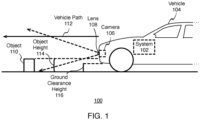
- FIG. 1 is a block diagram of an example environment 100 or external environment 100 for providing adaptive ground clearance of a vehicle.
- the assembly for providing adaptive ground clearance includes a system 102 of a vehicle 104 and at least one camera 106 with a lens 108 positioned at an exterior portion of the vehicle. Being positioned at the exterior portion of the vehicle 104 means that at least one portion of the camera 106 (e.g., the lens 108) is exposed to the environment 100, or external environment 100. As such, the camera 106 captures various types of data on the external environment 100.
- the system 102 captures data on the external environment 100 using the camera 106 positioned at the exterior portion of the vehicle 104.
- the system 102 may utilize multiple cameras and multiple types of cameras and sensors to capture data on the external environment 100.
- the system may utilize light detection and ranging (Lidar) cameras and sensors to collect data.
- Such data may include data on objects on the road.
- objects may include bumps, trash, dead animals, rocks, etc.
- the data may include Lidar data and well as images.
- the images may be a continuous series of images, which may include video.
- the camera is 106 is shown positioned on the bumper of the vehicle 104. In various embodiments, the camera 106 and/or other cameras and sensors may also be positioned or mounted underneath the vehicle 104.
- the camera 106 may be referred to as a client device, which may communicate with the system 102. Such communication may be facilitated via any suitable communication network (not shown) such as a wired network, a Bluetooth network, a Wi-Fi network, etc., or any combination thereof.
- any suitable communication network such as a wired network, a Bluetooth network, a Wi-Fi network, etc., or any combination thereof.
- the data on the external environment 100 includes data on a ground surface on a path of the vehicle, or vehicle path 112.
- the system 102 detects objects in the vehicle path 112 based on the data that is captured.
- the system 102 estimates an object height 114 of the object 110 based on the collected data.
- the system 102 then adjusts a ground clearance height 116 of the vehicle 104 as needed to clear the object 110 if the estimated object height 114 of the object 110 is greater than the ground clearance height 116. In this scenario, the system increases the ground clearance height 116 to be greater than the estimated object height 114. Further example embodiments directed to this process are described in more detail herein, in connection with FIGS. 2 , 3A, and 3B .
- FIG. 1 shows one block for each of the system 102 and the camera 106.
- Blocks 102 and 106 may represent multiple systems and cameras.
- environment 100 may not have all of the components shown and/or may have other elements including other types of elements instead of, or in addition to, those shown herein.
- system 102 performs implementations described herein, in other implementations, any suitable component or combination of components associated with system 102 or any suitable processor or processors associated with system 102 may facilitate performing the implementations described herein.
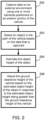
- FIG. 2 is a flow chart for providing adaptive ground clearance of a vehicle.
- a method is initiated at block 202, where a system such as system 102 captures data on the external environment 100 using the camera 106 positioned at the exterior portion of the vehicle 104.
- the data on the external environment 100 includes data on a ground surface on the vehicle path.
- the data on the external environment may include images and/or include Lidar data.
- the particular type of camera used for the camera 106 may vary and will depend on the particular implementation. Also, as indicated above, the camera 106 may represent multiple cameras, which may include different types of cameras.
- the system 102 detects at least one object in the vehicle path 112 based on the data that is captured.
- the system fetches crowdsourced data on potentially hazardous objects in the path of the vehicle.
- the system may fetch crowdsourced data from other drivers who report potentially hazardous objects on the road.
- the system may collect map data from the cloud and use global positioning system (GPS) technology to determine where the vehicle is located on a given road that has a reported hazardous object.
- GPS global positioning system
- the system may use artificial intelligence (AI) and machine learning to track known objects that could cause damage to a vehicle on specific roads or parking areas.
- objects may include permanently placed objects such as speed bumps, as well as high curb transitions between a parking lot or driveway and a road.
- the vehicle path 112 is a predicted path.
- the system may predict the vehicle path 112 based on one or more techniques. For example, in various embodiments, the system may collect map data from the cloud and use GPS technology to determine where the vehicle is located on a given road and determine the vehicle path 112 based on the map and GPS position of the vehicle.
- the system may predict the vehicle path 112 based on the road that the camera 106 detects. For example, the system may detect road indicators (e.g., road lines, road signs, etc.) to predict the vehicle path 112. In some embodiments, the system may use AI and machine learning to determine the vehicle path 112 based on images of the shape of the road that the camera 106 captures ahead of the vehicle 104.
- road indicators e.g., road lines, road signs, etc.
- AI and machine learning to determine the vehicle path 112 based on images of the shape of the road that the camera 106 captures ahead of the vehicle 104.
- the system may also predict the vehicle path 112 based on real-time steering wheel activity.
- the system may determine the rotational position of the steering wheel of the vehicle 104 and if the steering wheel is rotating. The system may then predict the vehicle path 112 based on this information. For example, if the steering wheel is positioned such that the vehicle wheels are positioned to travel straight ahead and the steering wheel is not turning, the system may predict the vehicle path 112 to be directly straight ahead at that moment. If the system determines that steering wheel is rotated either to the left or to the right to a particular degree, the system may predict the vehicle path 112 is curving to a corresponding amount toward the corresponding direction to the left or to the right, accordingly. In various embodiments, the system may also determine the rate that the steering wheel is rotating and then predict the curvature of the vehicle path 112 based on the rotational rate of the steering wheel.
- FIG. 3A is a block diagram of the example external environment 100, where the ground clearance of the vehicle 104 is at a normal or default height.
- the scenario shown in FIG. 3A is similar to that of FIG. 1 , where the object height 114 of the object 110 is greater than that ground clearance height 116 of the vehicle 104.
- the vehicle will hit the object 110, because the ground clearance height 116 is not high enough to clear the object 110.
- the camera 106 and the system 102 are not shown.
- the system 102 estimates the object height 114 of the object 110.
- the system may use Lidar techniques to estimate the object height 114. As shown and indicated above, the object height 114 of the object 11 is greater than that ground clearance height 116 of the vehicle 104.
- the system estimates the object height 114 in order to compare the object height 114 to the current ground clearance height 116 of the vehicle 104. If the object height 114 is less than the current ground clearance height 116, the system need not adjust the ground clearance height 116. If the object height 114 is greater than the current ground clearance height 116, the system needs to adjust the ground clearance height 116. If the system needs to adjust the ground clearance height 116, the system determines how high to adjust the ground clearance height 116 based on the object height 114.
- the system 102 adjusts the ground clearance height 116 of the vehicle 104 based on the estimated object height 114 of the object 110. As indicated above, the system adjusts the ground clearance height 116 in response to the estimated object height 114 being greater than the ground clearance height 116. Example embodiments directed to adjusting the ground clearance height 116 of the vehicle 104 are described in more detail below in connection with FIG. 3 .
- FIG. 3B is a block diagram of the example external environment 100, where the ground clearance of the vehicle 104 is increased.
- the scenario shown in FIG. 3B differs from the scenario shown in FIG. 3A in that ground clearance height 116, as shown in FIG. 3A , is increased to a higher ground clearance height 118, as shown in FIG. 3B .
- the adjusted ground clearance height 118 of the vehicle 104 is greater than the estimated object height 110.
- the vehicle will not hit the object 110, because the ground clearance height 118 is sufficiently high to clear the object 110.
- the system adjusts the ground clearance height of the vehicle 104 by adjusting the suspension of the vehicle.
- the vehicle may have air suspension, which the system adjusts.
- the particular type of suspension that the system adjust may vary, depending on the particular implementation.
- the suspension may involve rubber springs, rigid or leaf springs, control arms, multilinks, torsion beams, struts/coil springs, etc.
- the system adjusts the ground clearance height of the vehicle 104 by adjusting a tire pressure of one or more tires of the vehicle.
- the system may increase the tire pressure of one or more of the tires of the vehicle. Raising the tire pressure inflates the one or more tires, thereby raising the ground clearance height of the vehicle 104.
- the system may adjust just the air suspension, just the tire pressures of one or more tires, or a combination thereof. Also, after the object 110 is cleared, the system automatically returns the ground clearance height 118 back to its normal or default ground clearance height 116.
- FIG. 4 is a block diagram of an environment 400, showing a view toward the front interior of a vehicle. This portion of the vehicle shown may be that of the vehicle 104 shown in FIGS. 1 , 3A, and 3B . Shown is a dashboard 402, a windshield 404, a steering wheel 406, an infotainment display 408, a heads up display 410, and the object 110. In this scenario, the object 110 is visible through the windshield 404. The height of the object 110 may not be apparent to driver. In other words, even if the drive sees the object 110, the driver may not be able to tell if the ground clearance height of the vehicle will clear the object 110.
- the system increases the ground clearance height of the vehicle in order to clear the object 110.
- the system estimates the height of the object 110, as described herein.
- the system may use Lidar techniques to estimate the object height 114.
- the height of the object 110 may be too high for the maximum height that the system could increase the ground clearance height.
- the system also calculates the time of impact of the object 110 based on an estimated distance between the vehicle and the object 110 and based on the speed of the vehicle in order to determine whether this is sufficient time to increase the ground clearance height.
- the system may use Lidar techniques to estimate the distance between the object 110 and the vehicle. In some scenarios, the system might not have sufficient time to increase the ground clearance height soon enough, before the vehicle reaches the object 110.
- the system alerts the driver of the vehicle if one or more of the detected objects are potentially hazardous objects.
- the system may display an alert 412 in the infotainment display 408 and/or in the heads up display 410 to alert the driver of the object 110 as a hazard on the road.
- the system may also sound an audible alarm to alert the driver. As such, the driver may slow down and turn to avoid hitting the object 110.
- the system may still alert the driver as least so that the driver is aware of what is happening. Also, if the driver knows of the potentially hazardous object, the driver may wish to slow down the vehicle anyway.
- the system may track known objects that could cause damage to a vehicle on specific roads or parking areas, wherein such objects may include permanently placed objects such as speed bumps, as well as high curb transitions between a parking lot or drive way and a road. In such situations, the system may alert the driver or suggest alternative routes to avoids such permanent objects.
- the system may implement automatic evasive actions, such as automatically breaking to slow down or halt the vehicle.
- the system may also take control of the steering of the vehicle to automatically drive around the object 110.
- the system may also determine that the external environment is safe to drive around the object 110. For example, before driving around the object 110, the system may first determine that there are no other cars to the side of the vehicle that the vehicle may hit.
- Embodiments described herein have numerous benefits. For example, embodiments automatically adjust the ground clearance height of a vehicle to avoid potentially hazardous objects in the vehicle path. Embodiments also warn the driver of such potentially hazardous objects whether or not the system automatically takes evasive actions.
- FIG. 5 is a block diagram of an example network environment 500 of the present disclosure.
- network environment 500 includes a system 502, which includes a server device 504 and a database 506.
- system 502 may be used to implement system 102 of FIG. 1 , as well as to perform implementations described herein.
- Network environment 500 also includes client devices 510, 520, 530, and 540, which may communicate with system 502 and/or may communicate with each other directly or via system 502.
- Network environment 500 also includes a network 550 through which system 502 and client devices 510, 520, 530, and 540 communicate.
- Network 550 may be any suitable communication network such as a Wi-Fi network, Bluetooth network, the Internet, etc.
- FIG. 5 shows one block for each of system 502, server device 504, and network database 506, and shows four blocks for client devices 510, 520, 530, and 540.
- Blocks 502, 504, and 506 may represent multiple systems, server devices, and network databases. Also, there may be any number of client devices.
- environment 500 may not have all of the components shown and/or may have other elements including other types of elements instead of, or in addition to, those shown herein.
- server device 504 of system 502 performs implementations described herein, in other implementations, any suitable component or combination of components associated with system 502 or any suitable processor or processors associated with system 502 may facilitate performing the implementations described herein.
- a processor of system 502 and/or a processor of any client device 510, 520, 530, and 540 cause the elements described herein (e.g., information, etc.) to be displayed in a user interface on one or more display screens.
- FIG. 6 is a block diagram of an example computing system 600 of the present disclosure.
- the computing system 600 may be used to implement the server system 502 of FIG. 5 and/or the system 102 of FIG. 1 , as well as to perform implementations described herein.
- the computing system 600 typically includes at least one processing unit 602 and a system memory 604.
- the system memory 604 may be volatile such as random-access memory (RAM), non-volatile such as read-only memory (ROM), flash memory, and the like, or some combination of volatile memory and non-volatile memory.
- RAM random-access memory
- ROM read-only memory
- flash memory and the like, or some combination of volatile memory and non-volatile memory.
- the system memory 604 typically maintains an operating system 606, one or more applications 608, and program data 610.
- the operating system 606 may include any number of operating systems executable on desktops or portable devices including, but not limited to, Linux, Microsoft Windows ® , Apple OS ® , or Android ® .
- the computing system 600 may also have additional features or functionality.
- the computing system 600 may also include additional data storage devices (removable and/or non-removable) such as, for example, magnetic disks, optical disks, tape, or flash memory.
- additional storage may include removable storage 612 and non-removable storage 614.
- Computer storage media may include volatile and non-volatile, removable and non-removable media implemented in any method or technology for storage of information, such as computer-readable instructions, data structures, program modules or other data.
- the system memory 604, the removable storage 612, and the non-removable storage 614 are all examples of computer storage media.
- Computer storage media include, but are not limited to, RAM, ROM, EEPROM, flash memory (in both removable and non-removable forms) or other memory technology, CD-ROM, digital versatile disks (DVD) or other optical storage, magnetic cassettes, magnetic tape, magnetic disk storage or other magnetic storage devices, or any other medium which can be used to store the desired information and which can be accessed by the computing system 600. Any such computer storage media may be part of the computing system 600.
- the computing system 600 may also include location circuitry 624.
- the location circuitry 624 may include circuitry including global positioning system (GPS) circuitry and/or geolocation circuitry.
- GPS global positioning system
- the location circuitry 624 may automatically discern its location based on relative positions to multiple GPS satellites and/or triangulation using cellular carrier network(s) and/or IEEE Standard 802.11 wireless (Wi-Fi) networks (collectively referred to as "geolocation services”) to determine location based on multiple cellular communications facilities and/or multiple Wi-Fi networks.
- the location circuitry 624, including GPS circuitry and/or geolocation circuitry is frequently incorporated in smartphones and many other tablets or other portable devices.
- computing system 600 may not have all of the components shown and/or may have other elements including other types of components instead of, or in addition to, those shown herein.
Landscapes
- Engineering & Computer Science (AREA)
- Mechanical Engineering (AREA)
- Transportation (AREA)
- Automation & Control Theory (AREA)
- Physics & Mathematics (AREA)
- Mathematical Physics (AREA)
- Chemical & Material Sciences (AREA)
- Combustion & Propulsion (AREA)
- Traffic Control Systems (AREA)
Abstract
A method for providing adaptive ground clearance of a vehicle. The method includes capturing data on an external environment using at least one camera positioned at an exterior portion of the vehicle, where the data on the external environment includes data on a ground surface on a path of the vehicle. The method further includes detecting at least one object in the path of the vehicle based on the data that is captured. The method further includes estimating an object height of the at least one object. The method further includes adjusting a ground clearance height of the vehicle based on an estimated object height of the at least one object in response to the estimated object height being greater than the ground clearance height of the vehicle such that an adjusted ground clearance height of the vehicle is greater than the estimated object height.
Description
- The present disclosure relates generally to the automotive fields. When a vehicle is traveling, the ground clearance of the vehicle can change dynamically throughout the trip based on external and internal conditions of the vehicle. For example, with regard to external conditions, the vehicle may travel over speed bumps. Also, there may be objects on the road, or the vehicle may be traveling over uneven surfaces. With regard to internal conditions, a given vehicle may be carrying additional weight, thereby lowering the vehicle and reducing the ground clearance. Such additional weight may include extra cargo, passengers, etc. A smaller ground clearance increases the risk of the vehicle hitting any raised portion of the road such as speed bumps or objects on the road.
- The present introduction is provided as background context only and is not intended to be limiting in any manner. It will be readily apparent to those of ordinary skill in the art that the concepts and principles of the present disclosure may be implemented in other applications and contexts equally.
- The present disclosure relates to a system for providing adaptive ground clearance of a vehicle. As described in more detail herein, embodiments enable the system to identify objects on the road that may be too high for the ground clearance height of a vehicle. Using cameras to detect and measure such objects, the system automatically adjusts the ground clearance height of the vehicle in order to clear potentially hazardous objects. The system also alerts the driver of such objects.
- In one illustrative embodiment, the present disclosure provides a computer-implemented method for providing adaptive ground clearance of a vehicle. The method includes: capturing data on an external environment using at least one camera positioned at an exterior portion of the vehicle, where the data on the external environment includes data on a ground surface on a path of the vehicle; detecting at least one object in the path of the vehicle based on the data that is captured; estimating an object height of the at least one object; and adjusting a ground clearance height of the vehicle based on an estimated object height of the at least one object in response to the estimated object height being greater than the ground clearance height of the vehicle such that an adjusted ground clearance height of the vehicle is greater than the estimated object height. Optionally, the data on the external environment includes light detection and ranging (Lidar) data. In some embodiments, the method further includes fetching crowdsourced data on potentially hazardous objects in the path of the vehicle. In some embodiments, the path of the vehicle is a predicted path. In some embodiments, the adjusting of the ground clearance height of the vehicle includes adjusting a suspension of the vehicle. In some embodiments, the adjusting of the ground clearance height of the vehicle includes adjusting a tire pressure of one or more tires of the vehicle. In some embodiments, the method further includes alerting a driver of the vehicle if one or more of the detected objects are potentially hazardous objects.
- In another illustrative embodiment, the present disclosure provides an assembly for a vehicle, the assembly including: at least one camera positioned at an exterior portion of the vehicle; and a system including one or more processors and logic encoded in one or more non-transitory computer-readable storage media for execution by the one or more processors. The logic when executed is operable to cause the one or more processors to perform operations including: capturing data on an external environment using the at least one camera positioned at the exterior portion of the vehicle, where the data on the external environment includes data on a ground surface on a path of the vehicle; detecting at least one object in the path of the vehicle based on the data that is captured; estimating an object height of the at least one object; and adjusting a ground clearance height of the vehicle based on an estimated object height of the at least one object in response to the estimated object height being greater than the ground clearance height of the vehicle such that an adjusted ground clearance height of the vehicle is greater than the estimated object height. Optionally, the data on the external environment includes light detection and ranging (Lidar) data. In some embodiments, the logic when executed is further operable to cause the one or more processors to perform operations including fetching crowdsourced data on potentially hazardous objects in the path of the vehicle. In some embodiments, the path of the vehicle is a predicted path. In some embodiments, the adjusting of the ground clearance height of the vehicle includes adjusting a suspension of the vehicle. In some embodiments, the adjusting of the ground clearance height of the vehicle includes adjusting a tire pressure of one or more tires of the vehicle. In some embodiments, the logic when executed is further operable to cause the one or more processors to perform operations including alerting a driver of the vehicle if one or more of the detected objects are potentially hazardous objects.
- In a further illustrative embodiment, the present disclosure provides a non-transitory computer-readable storage medium with program instructions stored thereon. The program instructions when executed by one or more processors are operable to cause the one or more processors to perform operations including: capturing data on an external environment using at least one camera positioned at an exterior portion of a vehicle, where the data on the external environment includes data on a ground surface on a path of the vehicle; detecting at least one object in the path of the vehicle based on the data that is captured; estimating an object height of the at least one object; and adjusting a ground clearance height of the vehicle based on an estimated object height of the at least one object in response to the estimated object height being greater than the ground clearance height of the vehicle such that an adjusted ground clearance height of the vehicle is greater than the estimated object height. Optionally, the data on the external environment includes light detection and ranging (Lidar) data. In some embodiments, the instructions when executed are further operable to cause the one or more processors to perform operations including fetching crowdsourced data on potentially hazardous objects in the path of the vehicle. In some embodiments, the path of the vehicle is a predicted path. In some embodiments, the adjusting of the ground clearance height of the vehicle includes adjusting a suspension of the vehicle. In some embodiments, the adjusting of the ground clearance height of the vehicle includes adjusting a tire pressure of one or more tires of the vehicle.
- The present disclosure is illustrated and described with reference to the various drawings, in which like reference numbers are used to denote like assembly and/or system components and/or method steps, as appropriate.
-
FIG. 1 is a block diagram of an example environment for providing adaptive ground clearance of a vehicle. -
FIG. 2 is a flow chart for providing adaptive ground clearance of a vehicle. -
FIG. 3A is a block diagram of the example external environment, where the ground clearance of the vehicle is at a normal or default height. -
FIG. 3B is a block diagram of the example external environment, where the ground clearance of the vehicle is increased. -
FIG. 4 is a block diagram of an environment, showing a view toward the front interior of a vehicle. -
FIG. 5 is a block diagram of an example network environment, which may be used for some implementations described herein. -
FIG. 6 is a block diagram of an example computing system of the present disclosure. -
FIG. 1 is a block diagram of anexample environment 100 orexternal environment 100 for providing adaptive ground clearance of a vehicle. As shown, the assembly for providing adaptive ground clearance includes asystem 102 of avehicle 104 and at least onecamera 106 with alens 108 positioned at an exterior portion of the vehicle. Being positioned at the exterior portion of thevehicle 104 means that at least one portion of the camera 106 (e.g., the lens 108) is exposed to theenvironment 100, orexternal environment 100. As such, thecamera 106 captures various types of data on theexternal environment 100. - As described in more detail herein, the
system 102 captures data on theexternal environment 100 using thecamera 106 positioned at the exterior portion of thevehicle 104. For ease of illustration, onecamera 106 is shown. In various embodiments, thesystem 102 may utilize multiple cameras and multiple types of cameras and sensors to capture data on theexternal environment 100. For example, the system may utilize light detection and ranging (Lidar) cameras and sensors to collect data. Such data may include data on objects on the road. For example, such objects may include bumps, trash, dead animals, rocks, etc. The data may include Lidar data and well as images. The images may be a continuous series of images, which may include video. For ease of illustration, the camera is 106 is shown positioned on the bumper of thevehicle 104. In various embodiments, thecamera 106 and/or other cameras and sensors may also be positioned or mounted underneath thevehicle 104. - The
camera 106 may be referred to as a client device, which may communicate with thesystem 102. Such communication may be facilitated via any suitable communication network (not shown) such as a wired network, a Bluetooth network, a Wi-Fi network, etc., or any combination thereof. - In various embodiments, the data on the
external environment 100 includes data on a ground surface on a path of the vehicle, orvehicle path 112. Thesystem 102 detects objects in thevehicle path 112 based on the data that is captured. Thesystem 102 estimates anobject height 114 of theobject 110 based on the collected data. - The
system 102 then adjusts aground clearance height 116 of thevehicle 104 as needed to clear theobject 110 if the estimatedobject height 114 of theobject 110 is greater than theground clearance height 116. In this scenario, the system increases theground clearance height 116 to be greater than the estimatedobject height 114. Further example embodiments directed to this process are described in more detail herein, in connection withFIGS. 2 ,3A, and 3B . - For ease of illustration,
FIG. 1 shows one block for each of thesystem 102 and thecamera 106.Blocks environment 100 may not have all of the components shown and/or may have other elements including other types of elements instead of, or in addition to, those shown herein. - While
system 102 performs implementations described herein, in other implementations, any suitable component or combination of components associated withsystem 102 or any suitable processor or processors associated withsystem 102 may facilitate performing the implementations described herein. -
FIG. 2 is a flow chart for providing adaptive ground clearance of a vehicle. Referring to bothFIGS. 1 and2 , a method is initiated atblock 202, where a system such assystem 102 captures data on theexternal environment 100 using thecamera 106 positioned at the exterior portion of thevehicle 104. In various embodiments, the data on theexternal environment 100 includes data on a ground surface on the vehicle path. In various embodiments, the data on the external environment may include images and/or include Lidar data. The particular type of camera used for thecamera 106 may vary and will depend on the particular implementation. Also, as indicated above, thecamera 106 may represent multiple cameras, which may include different types of cameras. - At block 204, the
system 102 detects at least one object in thevehicle path 112 based on the data that is captured. In various embodiments, the system fetches crowdsourced data on potentially hazardous objects in the path of the vehicle. For example, the system may fetch crowdsourced data from other drivers who report potentially hazardous objects on the road. The system may collect map data from the cloud and use global positioning system (GPS) technology to determine where the vehicle is located on a given road that has a reported hazardous object. - In various embodiments, the system may use artificial intelligence (AI) and machine learning to track known objects that could cause damage to a vehicle on specific roads or parking areas. Such objects may include permanently placed objects such as speed bumps, as well as high curb transitions between a parking lot or driveway and a road.
- In various embodiments, the
vehicle path 112 is a predicted path. In various embodiments, the system may predict thevehicle path 112 based on one or more techniques. For example, in various embodiments, the system may collect map data from the cloud and use GPS technology to determine where the vehicle is located on a given road and determine thevehicle path 112 based on the map and GPS position of the vehicle. - In various embodiments, the system may predict the
vehicle path 112 based on the road that thecamera 106 detects. For example, the system may detect road indicators (e.g., road lines, road signs, etc.) to predict thevehicle path 112. In some embodiments, the system may use AI and machine learning to determine thevehicle path 112 based on images of the shape of the road that thecamera 106 captures ahead of thevehicle 104. - In various embodiments, the system may also predict the
vehicle path 112 based on real-time steering wheel activity. The system may determine the rotational position of the steering wheel of thevehicle 104 and if the steering wheel is rotating. The system may then predict thevehicle path 112 based on this information. For example, if the steering wheel is positioned such that the vehicle wheels are positioned to travel straight ahead and the steering wheel is not turning, the system may predict thevehicle path 112 to be directly straight ahead at that moment. If the system determines that steering wheel is rotated either to the left or to the right to a particular degree, the system may predict thevehicle path 112 is curving to a corresponding amount toward the corresponding direction to the left or to the right, accordingly. In various embodiments, the system may also determine the rate that the steering wheel is rotating and then predict the curvature of thevehicle path 112 based on the rotational rate of the steering wheel. -
FIG. 3A is a block diagram of the exampleexternal environment 100, where the ground clearance of thevehicle 104 is at a normal or default height. The scenario shown inFIG. 3A is similar to that ofFIG. 1 , where theobject height 114 of theobject 110 is greater than thatground clearance height 116 of thevehicle 104. In this scenario, as thevehicle 104 continues on thevehicle path 112 toward theobject 110, the vehicle will hit theobject 110, because theground clearance height 116 is not high enough to clear theobject 110. For ease of illustration, thecamera 106 and thesystem 102 are not shown. - At
block 206, thesystem 102 estimates theobject height 114 of theobject 110. The system may use Lidar techniques to estimate theobject height 114. As shown and indicated above, theobject height 114 of the object 11 is greater than thatground clearance height 116 of thevehicle 104. The system estimates theobject height 114 in order to compare theobject height 114 to the currentground clearance height 116 of thevehicle 104. If theobject height 114 is less than the currentground clearance height 116, the system need not adjust theground clearance height 116. If theobject height 114 is greater than the currentground clearance height 116, the system needs to adjust theground clearance height 116. If the system needs to adjust theground clearance height 116, the system determines how high to adjust theground clearance height 116 based on theobject height 114. - At
block 208, thesystem 102 adjusts theground clearance height 116 of thevehicle 104 based on the estimatedobject height 114 of theobject 110. As indicated above, the system adjusts theground clearance height 116 in response to the estimatedobject height 114 being greater than theground clearance height 116. Example embodiments directed to adjusting theground clearance height 116 of thevehicle 104 are described in more detail below in connection withFIG. 3 . -
FIG. 3B is a block diagram of the exampleexternal environment 100, where the ground clearance of thevehicle 104 is increased. The scenario shown inFIG. 3B differs from the scenario shown inFIG. 3A in thatground clearance height 116, as shown inFIG. 3A , is increased to a higherground clearance height 118, as shown inFIG. 3B . As such, the adjustedground clearance height 118 of thevehicle 104 is greater than the estimatedobject height 110. As a result, in this scenario, as thevehicle 104 continues on thevehicle path 112 toward theobject 110, the vehicle will not hit theobject 110, because theground clearance height 118 is sufficiently high to clear theobject 110. - In various embodiments, the system adjusts the ground clearance height of the
vehicle 104 by adjusting the suspension of the vehicle. In some embodiments, the vehicle may have air suspension, which the system adjusts. The particular type of suspension that the system adjust may vary, depending on the particular implementation. For example, the suspension may involve rubber springs, rigid or leaf springs, control arms, multilinks, torsion beams, struts/coil springs, etc. - In various embodiments, the system adjusts the ground clearance height of the
vehicle 104 by adjusting a tire pressure of one or more tires of the vehicle. To raise the ground clearance height, the system may increase the tire pressure of one or more of the tires of the vehicle. Raising the tire pressure inflates the one or more tires, thereby raising the ground clearance height of thevehicle 104. - In various embodiments, the system may adjust just the air suspension, just the tire pressures of one or more tires, or a combination thereof. Also, after the
object 110 is cleared, the system automatically returns theground clearance height 118 back to its normal or defaultground clearance height 116. - Although the steps, operations, or computations may be presented in a specific order, the order may be changed in particular implementations. Other orderings of the steps are possible, depending on the particular implementation. In some particular implementations, multiple steps shown as sequential in this specification may be performed at the same time. Also, some implementations may not have all of the steps shown and/or may have other steps instead of, or in addition to, those shown herein.
-
FIG. 4 is a block diagram of anenvironment 400, showing a view toward the front interior of a vehicle. This portion of the vehicle shown may be that of thevehicle 104 shown inFIGS. 1 ,3A, and 3B . Shown is adashboard 402, awindshield 404, asteering wheel 406, aninfotainment display 408, a heads updisplay 410, and theobject 110. In this scenario, theobject 110 is visible through thewindshield 404. The height of theobject 110 may not be apparent to driver. In other words, even if the drive sees theobject 110, the driver may not be able to tell if the ground clearance height of the vehicle will clear theobject 110. - As indicated above, the system increases the ground clearance height of the vehicle in order to clear the
object 110. The system estimates the height of theobject 110, as described herein. For example, in various embodiments, the system may use Lidar techniques to estimate theobject height 114. In some scenarios, the height of theobject 110 may be too high for the maximum height that the system could increase the ground clearance height. - In various embodiments, the system also calculates the time of impact of the
object 110 based on an estimated distance between the vehicle and theobject 110 and based on the speed of the vehicle in order to determine whether this is sufficient time to increase the ground clearance height. In various embodiments, the system may use Lidar techniques to estimate the distance between theobject 110 and the vehicle. In some scenarios, the system might not have sufficient time to increase the ground clearance height soon enough, before the vehicle reaches theobject 110. - In either of these scenarios, wherein the maximum adjusted ground clearance height and/or the distance between the vehicle and the object is insufficient, the system alerts the driver of the vehicle if one or more of the detected objects are potentially hazardous objects. The system may display an alert 412 in the
infotainment display 408 and/or in the heads updisplay 410 to alert the driver of theobject 110 as a hazard on the road. In some embodiments, the system may also sound an audible alarm to alert the driver. As such, the driver may slow down and turn to avoid hitting theobject 110. In some embodiments, even if the system is able to adjust the ground clearance height to a safe position, the system may still alert the driver as least so that the driver is aware of what is happening. Also, if the driver knows of the potentially hazardous object, the driver may wish to slow down the vehicle anyway. - As indicated above, the system may track known objects that could cause damage to a vehicle on specific roads or parking areas, wherein such objects may include permanently placed objects such as speed bumps, as well as high curb transitions between a parking lot or drive way and a road. In such situations, the system may alert the driver or suggest alternative routes to avoids such permanent objects.
- In some embodiments, and in these scenarios, the system may implement automatic evasive actions, such as automatically breaking to slow down or halt the vehicle. The system may also take control of the steering of the vehicle to automatically drive around the
object 110. In this case of automatically driving around theobject 110, the system may also determine that the external environment is safe to drive around theobject 110. For example, before driving around theobject 110, the system may first determine that there are no other cars to the side of the vehicle that the vehicle may hit. - Embodiments described herein have numerous benefits. For example, embodiments automatically adjust the ground clearance height of a vehicle to avoid potentially hazardous objects in the vehicle path. Embodiments also warn the driver of such potentially hazardous objects whether or not the system automatically takes evasive actions.
-
FIG. 5 is a block diagram of anexample network environment 500 of the present disclosure. In some implementations,network environment 500 includes asystem 502, which includes aserver device 504 and adatabase 506. In various implementations,system 502 may be used to implementsystem 102 ofFIG. 1 , as well as to perform implementations described herein.Network environment 500 also includesclient devices system 502 and/or may communicate with each other directly or viasystem 502.Network environment 500 also includes anetwork 550 through whichsystem 502 andclient devices Network 550 may be any suitable communication network such as a Wi-Fi network, Bluetooth network, the Internet, etc. - For ease of illustration,
FIG. 5 shows one block for each ofsystem 502,server device 504, andnetwork database 506, and shows four blocks forclient devices Blocks environment 500 may not have all of the components shown and/or may have other elements including other types of elements instead of, or in addition to, those shown herein. - While
server device 504 ofsystem 502 performs implementations described herein, in other implementations, any suitable component or combination of components associated withsystem 502 or any suitable processor or processors associated withsystem 502 may facilitate performing the implementations described herein. - In the various implementations described herein, a processor of
system 502 and/or a processor of anyclient device -
FIG. 6 is a block diagram of anexample computing system 600 of the present disclosure. Thecomputing system 600 may be used to implement theserver system 502 ofFIG. 5 and/or thesystem 102 ofFIG. 1 , as well as to perform implementations described herein. - The
computing system 600 typically includes at least oneprocessing unit 602 and asystem memory 604. Depending on the particular configuration and type of computing device, thesystem memory 604 may be volatile such as random-access memory (RAM), non-volatile such as read-only memory (ROM), flash memory, and the like, or some combination of volatile memory and non-volatile memory. Thesystem memory 604 typically maintains anoperating system 606, one ormore applications 608, andprogram data 610. Theoperating system 606 may include any number of operating systems executable on desktops or portable devices including, but not limited to, Linux, Microsoft Windows®, Apple OS®, or Android®. - The
computing system 600 may also have additional features or functionality. For example, thecomputing system 600 may also include additional data storage devices (removable and/or non-removable) such as, for example, magnetic disks, optical disks, tape, or flash memory. Such additional storage may includeremovable storage 612 andnon-removable storage 614. Computer storage media may include volatile and non-volatile, removable and non-removable media implemented in any method or technology for storage of information, such as computer-readable instructions, data structures, program modules or other data. Thesystem memory 604, theremovable storage 612, and thenon-removable storage 614 are all examples of computer storage media. Available types of computer storage media include, but are not limited to, RAM, ROM, EEPROM, flash memory (in both removable and non-removable forms) or other memory technology, CD-ROM, digital versatile disks (DVD) or other optical storage, magnetic cassettes, magnetic tape, magnetic disk storage or other magnetic storage devices, or any other medium which can be used to store the desired information and which can be accessed by thecomputing system 600. Any such computer storage media may be part of thecomputing system 600. - The
computing system 600 may also have input device(s) 616 such as a keyboard, mouse, pen, voice input device, touchscreen input device, etc. Output device(s) 618 such as a display, speakers, printer, short-range transceivers such as a Bluetooth transceiver, etc., may also be included. Thecomputing system 600 also may include one ormore communication connections 620 that allow thecomputing system 600 to communicate withother computing systems 622, such as over a wired or wireless network or via Bluetooth (a Bluetooth transceiver may be regarded as an input/output device and a communications connection). The one ormore communication connections 620 are an example of communication media. Available forms of communication media typically carry computer-readable instructions, data structures, program modules or other data in a modulated data signal such as a carrier wave or other transport mechanism and include any information delivery media. The term "modulated data signal" may include a signal that has one or more of its characteristics set or changed in such a manner as to encode information in the signal. By way of illustrative example only and not of limitation, communication media may include wired media such as a wired network or direct-wired connection, and wireless media such as acoustic, radio frequency (RF), infrared and other wireless media. The term computer-readable media as used herein includes both storage media and communication media. - The
computing system 600 may also includelocation circuitry 624. In various embodiments, thelocation circuitry 624 may include circuitry including global positioning system (GPS) circuitry and/or geolocation circuitry. Thelocation circuitry 624 may automatically discern its location based on relative positions to multiple GPS satellites and/or triangulation using cellular carrier network(s) and/or IEEE Standard 802.11 wireless (Wi-Fi) networks (collectively referred to as "geolocation services") to determine location based on multiple cellular communications facilities and/or multiple Wi-Fi networks. Thelocation circuitry 624, including GPS circuitry and/or geolocation circuitry, is frequently incorporated in smartphones and many other tablets or other portable devices. In various embodiments,computing system 600 may not have all of the components shown and/or may have other elements including other types of components instead of, or in addition to, those shown herein. - Although the present disclosure is illustrated and described herein with reference to illustrative embodiments and specific examples provided, it will be readily apparent to those of ordinary skill in the art that other embodiments and examples may perform similar functions and/or achieve like results. All such equivalent embodiment and examples are within the spirit and scope of the present disclosure and are intended to be covered by the following non-limiting claims for all purposes.
Claims (15)
- A computer-implemented method for providing adaptive ground clearance of a vehicle (104), the method comprising:capturing (202) data on an external environment using at least one camera positioned at an exterior portion of the vehicle, wherein the data on the external environment comprises data on a ground surface on a path of the vehicle;detecting at least one object (110) in the path of the vehicle based on the data that is captured;estimating (206) an object height (114) of the at least one object; andadjusting (208) a ground clearance height (116) of the vehicle based on an estimated object height of the at least one object in response to the estimated object height being greater than the ground clearance height of the vehicle such that an adjusted ground clearance height of the vehicle is greater than the estimated object height.
- The method of claim 1, wherein the data on the external environment comprises light detection and ranging (Lidar) data.
- The method of any of the preceding claims , further comprising fetching crowdsourced data on potentially hazardous objects in the path of the vehicle (112).
- The method of any of the preceding claims, wherein the path of the vehicle (112) is a predicted path.
- The method of any of the preceding claims, wherein the adjusting of the ground clearance height of the vehicle comprises adjusting a suspension of the vehicle and/or adjusting a tire pressure of one or more tires of the vehicle.
- The method of any of the preceding claims, further comprising alerting a driver of the vehicle if one or more of the detected objects are potentially hazardous objects.
- An assembly for a vehicle, the assembly comprising:at least one camera (106) positioned at an exterior portion of the vehicle; anda system comprising one or more processors and logic encoded in one or more non-transitory computer-readable storage media for execution by the one or more processors and when executed operable to cause the one or more processors to perform operations comprising:capturing (202) data on an external environment using the at least one camera positioned on the exterior portion of the vehicle, wherein the data on the external environment comprises data on a ground surface on a path of the vehicle;detecting at least one object in the path of the vehicle based on the data that is captured;estimating (206) an object height of the at least one object; andadjusting (208) a ground clearance height of the vehicle based on an estimated object height of the at least one object in response to the estimated object height being greater than the ground clearance height of the vehicle such that an adjusted ground clearance height of the vehicle is greater than the estimated object height.
- The assembly of claim 7, wherein the data on the external environment comprises light detection and ranging (Lidar) data.
- The assembly of any of claims 7-8, wherein the logic when executed is further operable to cause the one or more processors to perform operations comprising fetching crowdsourced data on potentially hazardous objects in the path of the vehicle.
- The assembly of any of claims 7-9, wherein the path of the vehicle is a predicted path.
- The assembly of any of claims 7-10, wherein the adjusting of the ground clearance height of the vehicle comprises adjusting a suspension of the vehicle and/or adjusting a tire pressure of one or more tires of the vehicle.
- The assembly of any of claims 7-11, wherein the logic when executed is further operable to cause the one or more processors to perform operations comprising alerting a driver of the vehicle if one or more of the detected objects are potentially hazardous objects.
- A non-transitory computer-readable storage medium with program instructions stored thereon, the program instructions when executed by one or more processors are operable to cause the one or more processors to perform operations comprising:capturing (202) data on an external environment using at least one camera positioned at an exterior portion of a vehicle, wherein the data on the external environment comprises data on a ground surface on a path of the vehicle;detecting at least one object in the path of the vehicle based on the data that is captured;estimating (206) an object height of the at least one object; andadjusting (208) a ground clearance height of the vehicle based on an estimated object height of the at least one object in response to the estimated object height being greater than the ground clearance height of the vehicle such that an adjusted ground clearance height of the vehicle is greater than the estimated object height.
- The computer-readable storage medium of claim 13, wherein the data on the external environment comprises light detection and ranging (Lidar) data.
- The computer-readable storage medium of claim 13, wherein the instructions when executed are further operable to cause the one or more processors to perform operations according to any of claims 3-6.
Applications Claiming Priority (1)
| Application Number | Priority Date | Filing Date | Title |
|---|---|---|---|
| US18/393,968 US20250206298A1 (en) | 2023-12-22 | 2023-12-22 | Providing adaptive ground clearance of a vehicle |
Publications (1)
| Publication Number | Publication Date |
|---|---|
| EP4574474A1 true EP4574474A1 (en) | 2025-06-25 |
Family
ID=93705078
Family Applications (1)
| Application Number | Title | Priority Date | Filing Date |
|---|---|---|---|
| EP24215692.5A Withdrawn EP4574474A1 (en) | 2023-12-22 | 2024-11-27 | Providing adaptive ground clearance of a vehicle |
Country Status (3)
| Country | Link |
|---|---|
| US (1) | US20250206298A1 (en) |
| EP (1) | EP4574474A1 (en) |
| CN (1) | CN120191164A (en) |
Citations (3)
| Publication number | Priority date | Publication date | Assignee | Title |
|---|---|---|---|---|
| SE1950297A1 (en) * | 2019-03-08 | 2019-11-28 | Scania Cv Ab | Method and control arrangement in a vehicle for suspension adjustment |
| US20200247208A1 (en) * | 2019-02-04 | 2020-08-06 | DRiV Automotive Inc. | Advanced driver assistance system |
| US20230182720A1 (en) * | 2021-12-10 | 2023-06-15 | Ford Global Technologies, Llc | Obstacle maneuver assistance systems and methods for vehicles |
Family Cites Families (4)
| Publication number | Priority date | Publication date | Assignee | Title |
|---|---|---|---|---|
| GB2526304B (en) * | 2014-05-20 | 2018-05-30 | Jaguar Land Rover Ltd | Central tyre inflation system |
| KR20220091670A (en) * | 2020-12-23 | 2022-07-01 | 현대자동차주식회사 | Vehicle and method for controlling thereof |
| US12263859B2 (en) * | 2023-04-18 | 2025-04-01 | GM Global Technology Operations LLC | Systems and methods for detecting and warning users of objects in vehicle paths |
| US12545246B2 (en) * | 2023-09-18 | 2026-02-10 | Toyota Motor Engineering & Manufacturing North America, Inc. | Systems and methods for avoiding obstacles in a virtually connected convoy |
-
2023
- 2023-12-22 US US18/393,968 patent/US20250206298A1/en not_active Abandoned
-
2024
- 2024-11-27 EP EP24215692.5A patent/EP4574474A1/en not_active Withdrawn
- 2024-12-16 CN CN202411846546.9A patent/CN120191164A/en active Pending
Patent Citations (3)
| Publication number | Priority date | Publication date | Assignee | Title |
|---|---|---|---|---|
| US20200247208A1 (en) * | 2019-02-04 | 2020-08-06 | DRiV Automotive Inc. | Advanced driver assistance system |
| SE1950297A1 (en) * | 2019-03-08 | 2019-11-28 | Scania Cv Ab | Method and control arrangement in a vehicle for suspension adjustment |
| US20230182720A1 (en) * | 2021-12-10 | 2023-06-15 | Ford Global Technologies, Llc | Obstacle maneuver assistance systems and methods for vehicles |
Also Published As
| Publication number | Publication date |
|---|---|
| US20250206298A1 (en) | 2025-06-26 |
| CN120191164A (en) | 2025-06-24 |
Similar Documents
| Publication | Publication Date | Title |
|---|---|---|
| US9600768B1 (en) | Using behavior of objects to infer changes in a driving environment | |
| US10139818B2 (en) | Visual communication system for autonomous driving vehicles (ADV) | |
| US10521680B2 (en) | Detecting foliage using range data | |
| US9694747B2 (en) | Method and system for providing a collision alert | |
| US11866037B2 (en) | Behavior-based vehicle alerts | |
| CN113228135A (en) | Blind area image acquisition method and related terminal device | |
| EP3953236A1 (en) | A method of determining an allowable vehicle state space for an articulated vehicle | |
| US20240247944A1 (en) | Pothole and speed bump detection based on vehicle's behaviors using computer vision | |
| CN108463690A (en) | Assess u turn feasibility | |
| US12444203B2 (en) | Apparatus and methods for detecting trailer sway | |
| CN106816022A (en) | Traffic information collection method, device and user terminal | |
| US10906556B2 (en) | System and method for oncoming vehicle warning | |
| US10971014B2 (en) | Bollard receiver identification | |
| EP3901725B1 (en) | Method of and system for detecting presence of ruts on current terrain | |
| US20220358842A1 (en) | Information processing apparatus, information processing method, and driving assistance system | |
| EP4574474A1 (en) | Providing adaptive ground clearance of a vehicle | |
| US11958422B2 (en) | Road condition reporter | |
| US20250368193A1 (en) | Customized pilot assist | |
| JP2024062325A (en) | Information processing device and program | |
| US20220398925A1 (en) | Systems and methods for displaying bird's eye view of a roadway | |
| US20250368192A1 (en) | Collision avoidance by observed vehicle wheel rotation | |
| EP4439488A1 (en) | Systems and methods for detecting vehicle following distance | |
| US20250209678A1 (en) | Providing awareness of objects located in the path of a vehicle | |
| US20250136132A1 (en) | Essential Information Prioritizing Display | |
| US20250301288A1 (en) | Communication method and apparatus |
Legal Events
| Date | Code | Title | Description |
|---|---|---|---|
| PUAI | Public reference made under article 153(3) epc to a published international application that has entered the european phase |
Free format text: ORIGINAL CODE: 0009012 |
|
| STAA | Information on the status of an ep patent application or granted ep patent |
Free format text: STATUS: THE APPLICATION HAS BEEN PUBLISHED |
|
| AK | Designated contracting states |
Kind code of ref document: A1 Designated state(s): AL AT BE BG CH CY CZ DE DK EE ES FI FR GB GR HR HU IE IS IT LI LT LU LV MC ME MK MT NL NO PL PT RO RS SE SI SK SM TR |
|
| STAA | Information on the status of an ep patent application or granted ep patent |
Free format text: STATUS: THE APPLICATION HAS BEEN WITHDRAWN |
|
| 18W | Application withdrawn |
Effective date: 20251202 |