[Technical Field]
-
The present invention relates to a smoking article including a lyocell filter in which retention of free nicotine is increased and a problem of discoloration of a filter portion is prevented.
[Background Art]
-
Nowadays, smokers' interest in their health is increasing, and the social perception of smokers is also changing accordingly. This change is leading to the development of new forms of smoking articles that take into account smokers' health, beyond just being used for smoking as a means of nicotine inhalation.
-
In particular, various studies are being conducted to enable smokers to enjoy smoking more healthily by reducing harmful substances contained in smoking articles and changing the method of nicotine inhalation. In some of the studies, efforts are being made to improve the delivery method of nicotine by controlling the pH of tobacco raw materials and converting nicotine salts into free nicotine. Such improvement in the delivery method of nicotine is applied to the development of non-heating type electronic cigarette sticks to allow smokers to still have previous desirable smoking experiences while minimizing harmful substances that may be generated at high temperatures.
-
Non-heating type electronic cigarette sticks are designed to, by converting nicotine salts into the form of free nicotine through pH control of tobacco raw materials, allow users (consumers) to inhale nicotine together with a smaller amount of harmful substances using a characteristic (volatility) of free nicotine without heating.
-
Meanwhile, due to the characteristic (volatility) of free nicotine, free nicotine that should remain in cigarette sticks may move to the outside and cause a problem of degradation of smoking quality. This problem may lead to a decrease in persistence of free nicotine and may have a negative effect on long-term quality maintenance of smoking articles. In addition, due to the movement of free nicotine, a phenomenon of discoloration of other components of smoking articles may occur. Accordingly, there is an emerging need to improve the persistence of free nicotine and prevent discoloration of components due to the movement of free nicotine.
[Disclosure]
[Technical Problem]
-
The present invention is directed to providing a smoking article including a lyocell filter in which a lyocell filter is disposed in a filter and/or a segment disposed on at least one of both ends of a tobacco rod and/or a tobacco filter and/or a smoking article with a medium portion containing free nicotine (or free-base nicotine) disposed therebetween, thereby providing a smoking article in which retention of free nicotine in the tobacco rod and/or the smoking article is improved due to an attractive force between free nicotine and the lyocell filter.
-
The present invention is also directed to providing a smoking article including a lyocell filter in which a lyocell filter is disposed in a filter and/or a segment disposed on at least one of both ends of a tobacco rod and/or a tobacco filter and/or a smoking article with a medium portion containing free nicotine (or free-base nicotine) disposed therebetween, thereby allowing content of free nicotine remaining in the smoking article even after a puff to be higher than content of free nicotine transitioned upon a puff in a non-heating condition. Hereinafter, in the present specification, "free nicotine transitioned upon a puff" may mean free nicotine that moves to the outside of a smoking article and is delivered to a user.
-
Accordingly, it is possible to provide a smoking article in which, due to improvement in retention of free nicotine, the number of puffs containing nicotine is increased as compared to a conventional cellulose acetate filter in a non-heating condition.
-
The present invention is also directed to providing a smoking article of a form healthier to smokers that can be smoked even in a non-heating condition (or a low-temperature heating condition) due to volatility of free nicotine and decreases an amount of harmful substances generated during combustion of the smoking article.
[Technical Solution]
-
A smoking article according to one embodiment for achieving the above objectives includes a first segment, a second segment disposed apart on one side of the first segment, and a medium segment disposed between the first segment and the second segment and including a medium base material including free nicotine, wherein at least one or more of the first segment, the second segment, and the medium segment include lyocell tow including a plurality of lyocell fibers.
-
In some embodiments, the first segment and the second segment may each include a lyocell filter made of the lyocell tow.
-
In some embodiments, the medium base material may include tobacco granules having a pH ranging from 8 to 10 or a reconstituted tobacco slurry having a pH ranging from 8 to 10.
-
In some embodiments, the medium base material may include the reconstituted tobacco slurry having the pH ranging from 8 to 10.
-
In some embodiments, the medium segment may further include a lyocell filter made of the lyocell tow, and the medium base material may be filled in a dispersed form in the lyocell tow. This indicates that the lyocell tow may include the medium base material in a dispersed form.
-
In some embodiments, the first segment or the second segment may be made of the lyocell filter made of the lyocell tow.
-
In some embodiments, the smoking article may further include a third segment that is disposed between the medium segment and the second segment and has a tubular structure including a hollow therein.
-
In some embodiments, free nicotine transferred from the medium segment may be adsorbed onto the first segment or the second segment.
[Advantageous Effects]
-
According to a smoking article according to one embodiment, since a lyocell filter made of lyocell tow including a plurality of lyocell fibers is disposed in a filter and/or a filter segment disposed on at least one of both ends with a medium portion (medium segment) containing free nicotine (or free-base nicotine) disposed therebetween, retention of free nicotine in a tobacco rod and/or the smoking article can be improved due to an attractive force between free nicotine and the lyocell filter.
-
In addition, according to a smoking article according to one embodiment, since content of free nicotine remaining in the smoking article even after a puff is higher than content of free nicotine transitioned upon a puff in a non-heating condition, the number of puffs containing nicotine can be improved.
-
Further, according to a smoking article according to one embodiment, it is possible to provide a smoking article healthier to smokers that can be smoked even in a non-heating condition (or a low-temperature heating condition) due to volatility of free nicotine and decreases an amount of harmful substances generated during combustion of the smoking article.
[Description of Drawings]
-
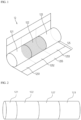
- FIG. 1 is a view illustrating a schematic configuration of a smoking article according to one embodiment of the present invention.
- FIG. 2 is a view illustrating a schematic configuration of a smoking article according to another embodiment of the present invention.
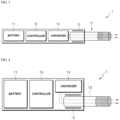
- FIGS. 3 and 4 are views illustrating examples in which a smoking article is inserted into an aerosol generation device.
[Modes of the Invention]
-
Hereinafter, exemplary embodiments of the present disclosure will be described in detail with reference to the accompanying drawings. Advantages and features of the present disclosure and methods of achieving the same should become clear with embodiments described in detail below with reference to the accompanying drawings. However, the technical spirit of the present disclosure is not limited to the following embodiments and may be implemented in various different forms. The following embodiments are only provided to make the technical spirit of the present disclosure complete and completely inform those of ordinary skill in the art to which the present disclosure pertains of the scope of the present disclosure. The technical spirit of the present disclosure is defined only by the scope of the claims.
-
In assigning reference numerals to components of each drawing, it should be noted that the same reference numerals are assigned to the same components wherever possible even when the components are illustrated in different drawings. Also, in describing the present disclosure, when it is determined that the detailed description of a known related configuration or function may obscure the gist of the present disclosure, the detailed description thereof will be omitted.
-
Unless otherwise defined, all terms including technical or scientific terms used herein have the same meaning as commonly understood by those of ordinary skill in the art to which the present disclosure pertains. Terms defined in commonly used dictionaries should not be interpreted in an idealized or overly formal sense unless expressly so defined herein. Terms used herein are for describing the embodiments and are not intended to limit the present disclosure. In the specification, a singular expression includes a plural expression unless the context clearly indicates otherwise.
-
Also, in describing components of the present disclosure, terms such as first, second, A, B, (a), and (b) may be used. Such terms are only used for distinguishing one component from another component, and the essence, order, sequence, or the like of the corresponding component is not limited by the terms. In a case in which a certain component is described as being "connected," "coupled," or "linked" to another component, it should be understood that, although the component may be directly connected or linked to the other component, still another component may also be "connected," "coupled," or "linked" between the two components.
-
The terms "comprises" and/or "comprising" used herein do not preclude the presence or addition of one or more components, steps, operations, and/or devices other than those mentioned.
-
First, some terms used herein will be clarified.
-
In the present specification, "smoking article" may refer to any product that can be smoked or any product that can provide a smoking experience, regardless of whether the product is based on tobacco, tobacco derivatives, expanded tobacco, reconstituted tobacco, or tobacco substitutes. For example, smoking articles may include products that can be smoked, such as cigarettes, cigars, and cigarillos.
-
In the present specification, "smoking material" may refer to any type of material that may be used in a smoking article.
-
In the present specification, "upstream" or "upstream direction" may refer to a direction moving away from an oral region of a smoker, and "downstream" or "downstream direction" may refer to a direction approaching the oral region of the smoker.
-
In the present specification, "longitudinal direction" may refer to a direction corresponding to a longitudinal axis of a smoking article. "Longitudinal axis" of a smoking article may refer to a virtual line extending in a major vertical direction of the smoking article. This axis usually continues from one side end (e.g., an end of a mouthpiece or a filter) of a smoking article to the other side end (e.g., an end of combustion or a heat source).
-
In the present specification, "non-heating type smoking article" may refer to a smoking article configured to deliver nicotine and, selectively, a taste and/or a flavor, without combustion and/or significant heating. "Without significant heating" may refer to a temperature less than 100 °C, preferably, less than 80 °C, more preferably, less than 40 °C.
-
In the present specification, "free nicotine" may refer to the unbound, unprotonated form of nicotine. Free nicotine is present as a free base. In the context of the present application, the terms "free nicotine" and "free-base nicotine" may be interchangeably used.
-
In the present specification, "lyocell tow" includes a plurality of lyocell fibers or is made of a plurality of lyocell fibers.
-
In the present specification, "lyocell fibers" may refer to fibers made of cellulose. In particular, lyocell fibers may be fibers made of cellulose derived, or mainly derived, from wood pulp, in particular, may be semi-synthetic fibers.
-
In the present specification, "reconstituted tobacco" may refer to reconstituted tobacco leaves.
-
In the present specification, "reconstituted tobacco leaves" may refer to sheets made by combining a tobacco by-product selected from the group consisting of a stem, dust, a particle, and a combination thereof with a binder. In some embodiments, reconstituted tobacco leaves are homogenized tobacco leaves.
-
In the present specification, "puff' refers to the act of inhaling or drawing air through a smoking article to produce and inhale smoke or vapor. "Number of puffs" may refer to the total number of inhalations or draws during use of the smoking article. Alternatively, or in addition, the number of puffs may represent the maximum number of inhalations or draws that the smoking article can provide before being completely consumed or ceasing to function. In particular, puffs may be performed under a CRM81 condition.
-
In the present specification, "segment" may refer to a filter segment.
-
Hereinafter, various embodiments of the present disclosure will be described in detail with reference to the accompanying drawings.
-
FIG. 1 is a view illustrating a schematic configuration of a smoking article according to one embodiment of the present invention.
-
Referring to FIG. 1, a smoking article 12 according to one embodiment may include a first segment 121, a second segment 123 disposed apart on one side of the first segment 121 and/or disposed apart from the one side of the first segment 121, and a medium segment 122 disposed between the first segment 121 and the second segment 123. Meanwhile, those of ordinary skill in the art related to the present embodiment should understand that the smoking article 12 may further include universal components other than the components illustrated in FIG. 1. In some embodiments, the smoking article 12 is made of the first segment 121, the second segment 123, and the medium segment 122.
-
In the smoking article 12 according to the present embodiment, a medium base material including free nicotine may be included in the medium segment 122 as will be described below, and in this way, due to volatility of free nicotine, it is possible to implement a non-heating smoking article by volatile free nicotine being transitioned even in a non-heating condition or under a relatively low temperature.
-
In some embodiments, the smoking article 12 may further include a wrapper 125 surrounding at least one or more of the first segment 121, the second segment 123, and the medium segment 122. In some embodiments, the smoking article 12 is made of the first segment 121, the second segment 123, the medium segment 122, and the wrapper 125.
-
In some embodiments, a length of the first segment 121 may range from 5 to 8 mm, preferably, range from 5.5 to 7.5 mm, and more preferably, be 7 mm, a length of the second segment 123 may range from 13 to 15 mm, preferably, range from 13.5 to 14.5 mm, and more preferably, be 14 mm, and a length of the medium segment 122 may range from 14 to 16 mm, preferably, range from 14.5 to 15.5 mm, and more preferably, be 15 mm.
-
The first segment 121 may be a segment adjacent to one side and/or the other side of the medium segment 122. The first segment 121 may prevent the medium segment 122 from falling out. In some embodiments, the first segment 121 may include at least one channel therein, and the channel may be fabricated with various cross-sectional shapes. Here, the channel may refer to a passage through which a gas (e.g., air) and/or an aerosol pass or passes.
-
The second segment 123 may be disposed on one side of the first segment 121 with the medium segment 122 disposed therebetween. The second segment 123 may filter out predetermined components generated during smoking. The predetermined components may be components such as tar, particulate matter, nitroamines, carbon monoxide, volatile organic compounds, ammonia, polycyclic aromatic hydrocarbons, and/or metals.
-
In one embodiment, the medium base material may be filled in the medium segment 122, and at least one or more of the first segment 121, the second segment 123, and the medium segment 122 may include lyocell tow including a plurality of lyocell fibers.
-
In one embodiment, the medium base material may be filled in the medium segment 122.
-
In an exemplary embodiment, the medium segment 122 may include a cavity, and the medium base material may be filled in the cavity.
-
In another exemplary embodiment, the medium segment 122 may include a filter, and the medium base material may be inserted into and filled in the filter. Specifically, in a case in which the medium segment 122 includes a filter and the medium base material inserted into and filled in the filter, when fabricating the medium segment 122, the medium base material may be filled therein to be inserted into the filter. For example, in a process of producing the medium segment 122, in a state in which the tow constituting the filter is spread out, the medium base material may be added into the tow or on the tow, and the tow to which the medium base material is added may be wrapped or rolled into a predetermined shape such as a cylindrical shape to produce the medium segment 122. Accordingly, the medium base material may be inserted and filled to be distributed randomly or uniformly along an entire area or a partial area inside the tow constituting the filter. In other words, the medium base material may be located in a space between the fibers constituting the tow and may be filled in a dispersed form in the tow constituting the filter.
-
In a case in which the medium base material is inserted into the filter, the filter included in the medium segment 122 may include one or more of a paper filter, a cellulose acetate filter, and a lyocell filter. Preferably, the medium segment 122 may include a lyocell filter and the medium base material inserted into and filled in the lyocell filter. Specifically, the medium segment 122 may include a lyocell filter made of lyocell tow and the medium base material inserted to be distributed uniformly or randomly along the inside of the lyocell filter in an entire area or a partial area of the lyocell filter. That is, the medium base material may be filled in a dispersed form in the lyocell tow. Accordingly, the medium base material may be located in a space between a plurality of lyocell fibers included in the lyocell tow, may be seated inside the lyocell tow, and may be filled in the lyocell filter in a form surrounded by the lyocell filter so as not to flow to the outside. In some embodiments, the medium base material filled in the medium segment 122 may include a reconstituted tobacco slurry including free nicotine (or free-base nicotine). However, the present disclosure is not limited thereto, and the medium base material filled in the medium segment 122 may include at least one component among granule-type tobacco (tobacco granules), reconstituted tobacco, and shredded tobacco. Although not limited thereto, the medium segment 122 may contain other additives such as a flavoring agent, a wetting agent, and/or an organic acid. In addition, a flavoring liquid such as menthol or a moisturizer may be added to the medium segment 122 by being sprayed onto the medium segment 122.
-
In one embodiment, the medium filled in the medium segment 122 may be pH-treated. For example, the medium base material may be pH-treated by a pH control agent to have basicity, and the pH control agent may be basic and may include, for example, at least one of potassium carbonate (K2CO3), sodium bicarbonate (NaHCO3), and calcium oxide (CaO). However, the material included in the pH control agent is not limited to the above examples, and a material that generates less negative odor during smoking may be used. In some embodiments, the pH control agent is selected from the group consisting of potassium carbonate (K2CO3), sodium bicarbonate (NaHCO3), and calcium oxide (CaO). A basic pH control agent may increase the pH of the medium base material included in the medium segment 122. In some embodiments, the pH treatment on the medium base material includes mixing the medium base material with the pH control agent. Compared to a medium base material not treated with a basic pH control agent, a medium base material pH-treated with a basic pH control agent increases the amount of nicotine released therefrom. That is, the basic pH-treated medium base material may achieve a sufficient nicotine yield from the medium segment 122 even at low temperatures.
-
In one embodiment, a reconstituted tobacco slurry or paper-type reconstituted tobacco having a pH adjusted to a range of 7.0 to 11, preferably, to a range of 7.5 to 10.5, and more preferably, to a range of 8 to 10 may be included in the medium segment 122. However, the present disclosure is not limited thereto, and tobacco granules or shredded tobacco having a pH adjusted to a range of 7.0 to 11, preferably, to a range of 7.5 to 10.5, and more preferably, to a range of 8 to 10 may be included in the medium segment 122.
-
In one embodiment, the medium base material filled in the medium segment 122 may include nicotine and may be pH-treated with a basic pH control agent so that free nicotine can be transitioned from the medium base material (to a user) even in a non-heating condition or a relatively low temperature condition. That is, by the pH of the medium base material of the medium segment 122 being adjusted to a range of 7.0 to 11, preferably, to a range of 7.5 to 10.5, and more preferably, to a range of 8 to 10, volatile free nicotine can be transitioned (to a user) in a non-heating condition (or a low-temperature heating condition), and a sufficient level of tobacco smoke taste intensity can be realized.
-
Although not limited thereto, a temperature of the medium during smoking of the smoking article according to one embodiment may be less than 100 °C, preferably, room temperature as a non-heating condition, but the present disclosure is not limited thereto. The room temperature may refer to a temperature ranging from 20 °C to 25 °C.
-
In some embodiments, for a reconstituted tobacco slurry including free nicotine, the reconstituted tobacco slurry may be produced by adding potassium carbonate to a mixture for forming the slurry, but the present disclosure is not limited thereto. Specifically, the reconstituted tobacco slurry including free nicotine is produced by adding potassium carbonate into a slurry material containing pulp and ligules of tobacco leaves as its main raw materials and including a moisturizer, such as glycerin, and a binder, and the added amount of potassium carbonate added into the slurry material may range from 3 to 15%, preferably, from 3.5 to 14%, more preferably, from 4 to 13%, even more preferably, from 4.5 to 12%, still more preferably, from 5 to 11%, and yet more preferably, from 6 to 10%, but the present disclosure is not limited thereto. The % may indicate wt% based on the total weight of the slurry material including potassium carbonate.
-
Although not limited thereto, the content of free nicotine included in the medium segment 122 may range from 1.5 mg to 4 mg, preferably, from 1.8 mg to 3.5 mg, more preferably, from 2.0 mg to 3.0 mg, and even more preferably, from 2.2 mg to 2.8 mg, but the present disclosure is not limited thereto.
-
In one embodiment, the smoking article 12 may be wrapped around by at least one wrapper 125. At least one hole through which outside air enters or an inside gas flows out may be formed in the wrapper 125, but the present disclosure is not limited thereto.
-
In one embodiment, at least one or more of the first segment 121 and the second segment 123 may be made of a lyocell filter. In some embodiments, the first segment 121 may be made of a lyocell filter, and the second segment 123 may be made of a cellulose acetate filter. In some other embodiments, the first segment 121 may be made of a cellulose acetate filter, and the second segment 123 may be made of a lyocell filter. In still some other embodiments, both the first segment 121 and the second segment 123 may be made of a lyocell filter.
-
In some embodiments, free nicotine transferred from the medium segment 122 may be adsorbed onto the first segment 121 or the second segment 123. As will be described below, since at least one of the first segment 121 and the second segment 123 is made of a lyocell filter, although free nicotine included in the medium segment 122 is transferred to the first and second segments 121 and 123, free nicotine may also be transferred to the inside of the first and second segments 121 and 123 and stably adsorbed due to a weak attractive force between the lyocell filter and free nicotine. Accordingly, it is possible to alleviate a problem in which, during storage, free nicotine adsorbed into and remaining in the first and second segments 121 and 123 is transferred to the wrapper or other components such as a cigarette pack storing the smoking article.
-
In some embodiments, in a case in which the filter included in the first segment 121 and the second segment 123 is a lyocell filter, mono denier of lyocell tow constituting the lyocell filter may range from 3.0 to 14.0, preferably, from 3.5 to 13.5, more preferably, from 4 to 13, even more preferably, from 4.5 to 12.5, and still more preferably, from 5 to 12, but the present disclosure is not limited thereto. In some embodiments, denier per filament (DPF) of the lyocell tow may range from 3.3 to 15.6 dtex, preferably, from 3.9 to 15.0 dtex, more preferably, from 4.4 to 14.4 dtex, even more preferably, from 5.0 to 13.9 dtex, and still more preferably, from 5.5 to 13.3 dtex.
-
In some embodiments, at least one flavor capsule may be included in one of the first segment 121 and the second segment 123. For example, the second segment 123 may be a lyocell filter into which at least one flavor capsule is inserted. The flavor capsule may include a bursting capsule including an outer shell and an inner core disposed in the outer shell and including an additive.
-
In some embodiments, a lyocell filter constituting any one of the first segment 121 and the second segment 123 may include lyocell tow including a plurality of lyocell fibers and an additive dispersed in the lyocell tow.
-
In addition, in a case in which the medium segment 122 includes a medium base material and a filter into and in which the medium base material is inserted and filled, and the filter of the medium segment 122 includes a lyocell filter, the lyocell filter may include lyocell tow including a plurality of lyocell fibers.
-
Lyocell fibers included in lyocell tow constituting any one of the first segment 121, the second segment 123, and the medium segment 122 are eco-friendly fibers made of cellulose extracted from wood pulp. The lyocell tow refers to a bundle formed by cross-connecting adjacent lyocell fibers.
-
In some embodiments, the lyocell fibers may have a shaped cross-section. The shaped cross-section is defined as a cross-section having a shape including a plurality of protrusions instead of having a circular shape. For example, a cross-section having a shape in which a plurality of protrusions extend from a center, particularly the center of the cross-section, may be referred to as "shaped cross-section."
-
In some embodiments, the lyocell fibers may have a Y-shaped cross-section with three protrusions branching and/or extending from the center and/or the center of the cross-section, a cross-shaped cross-section with four protrusions, a star-shaped cross-section with five protrusions, or an O-shaped cross-section, but the present disclosure is not limited thereto.
-
In one embodiment, the wrapper 125 may include a first wrapper 1251 surrounding the first segment 121, a second wrapper 1252 surrounding the medium segment 122, and a third wrapper 1253 surrounding the second segment 123. The wrapper 125 may further include a fourth wrapper 1255 entirely surrounding the first segment 121, the second segment 123, and the medium segment 122. At least one or more of the first to fourth wrappers 1251, 1252, 1253, and 1255 included in the wrapper 125 may have a basis weight in a range of less than or equal to 90 g/m2. The basis weight may be determined by measuring the mass and area of wrapping paper and/or wrapper and dividing the mass of the wrapping paper and/or wrapper by the area thereof.
-
In the smoking article according to the present invention, the medium segment 122 is configured to include a reconstituted tobacco slurry or tobacco granules including free nicotine, and at least one or more of the first segment 121 and the second segment 123, disposed on both sides of the medium segment 122 with the medium segment 122 disposed therebetween, and the medium segment 122 are configured as a lyocell filter including lyocell tow, and in this way, a weak attractive force is generated between the lyocell filter, which is more hydrophilic than a cellulose acetate filter, and free nicotine included in the medium segment 122, and retention of free nicotine in the smoking article can be increased. Specifically, since the lyocell filter is more hydrophilic than a cellulose acetate filter, and free nicotine has a hydrophilic end group in a portion thereof, a weak attractive force may be generated between the lyocell filter and the hydrophilic end group in free nicotine. Accordingly, retention of free nicotine in the smoking article may increase during storage, smoking satisfaction of a smoker may be met during smoking, and a storage period of non-heating type smoking articles may increase.
-
In some embodiments, the medium segment 122 may include a reconstituted tobacco slurry including free nicotine (or free-base nicotine), the first segment 121 may include a lyocell filter made of lyocell tow including a plurality of lyocell fibers, and the second segment 123 may include a cellulose acetate filter.
-
In some other embodiments, the medium segment 122 may include a reconstituted tobacco slurry including free nicotine (or free-base nicotine), the first segment 121 may include a cellulose acetate filter, and the second segment 123 may include a lyocell filter made of lyocell tow including a plurality of lyocell fibers.
-
In still some other embodiments, the medium segment 122 may include a reconstituted tobacco slurry including free nicotine (or free-base nicotine), and the first and second segments 121 and 123 may include a lyocell filter made of lyocell tow including a plurality of lyocell fibers.
-
In yet some other embodiments, the medium segment 122 may include a reconstituted tobacco slurry including a lyocell filter and free nicotine (or free-base nicotine) inserted into and filled in the lyocell filter. In this case, the first and second segments 121 and 123 may include a cellulose acetate filter, the first and second segments 121 and 123 may include a lyocell filter, or one of the first and second segments 121 and 123 may include a lyocell filter and the other may include a cellulose acetate filter.
-
Even in this case, since at least any one of the first segment 121 and the second segment 123, disposed on both end sides of the medium segment 122 including free nicotine, and the medium segment 122 is configured as a lyocell filter, due to a weak attractive force between free nicotine included in the medium segment and the lyocell filter, the amount of free nicotine held in the smoking article may increase as compared to a smoking article including only a cellulose acetate filter.
-
Further, since volatility of free nicotine allows the smoking article to be smoked even in a non-heating condition (or a low-temperature heating condition), there is an advantage in that the number of types and/or the amount of compounds generated during combustion or high-temperature heating of the smoking article decrease.
-
FIG. 2 is a view illustrating a schematic configuration of a smoking article according to another embodiment of the present invention. For convenience of description, only differences from the smoking article of FIG. 1 will be described, and description of the same configurations will be omitted.
-
Referring to FIG. 2, the smoking article 12 may further include a third segment 127 disposed between the medium segment 122 and the second segment 123. The third segment 127 may include a tubular structure including a hollow therein. The third segment 127 may perform a function of cooling an aerosol generated due to heating in a case in which the smoking article 12 and/or an aerosol generation device 1 using the smoking article 12 are or is heated and used. The third segment 127 may have any tubular structure including a hollow therein and may include a paper tube which is a segment produced in a tubular shape using hard paper having thermal stability. Advantages obtained by further adding the third segment 127 between the medium segment 122 and the second segment 123 are that resistance to draw of the medium segment 122 can be controlled, and thermal stability can be improved.
-
In some embodiments, the smoking article 12 is made of the first segment 121, the second segment 123, the third segment 127, the medium segment 122, and the wrapper 125.
-
In some embodiments, in a case in which the smoking article 12 further includes the third segment 127, a length of the first segment 121 may range from 5 to 8 mm, preferably, range from 5.5 to 7.5 mm, and more preferably, be 7 mm, a length of the second segment 123 may range from 13 to 15 mm, preferably, range from 13.5 to 14.5 mm, and more preferably, be 14 mm, a length of the medium segment 122 may range from 14 to 16 mm, preferably, range from 14.5 to 15.5 mm, and more preferably, be 15 mm, and a length of the third segment 127 may range from 11 to 13 mm, preferably, range from 11.5 to 12.5 mm, and more preferably, be 12 mm.
-
A smoking article was produced as in Table 1 below to perform measurement of content of free nicotine in the smoking article for each storage period and analysis of the content of free nicotine before/after smoking according to one embodiment of the present invention.
[Table 1] | Classification | Weight (mg) | Circumference (mm) | Air dilution rate (%) | PDO (mmH20) | PDC (mmH20) |
| Example 1 | 559.6 | 22.692 | 15.98 | 110.2 | 118.3 |
-
(In Table 1 above, PDC may refer to a measured value of resistance to draw in a state in which the medium segment is open, perforations of the second segment and/or the third segment are blocked, and entry of outside air is blocked, and PDO may refer to a measured value of resistance to draw in a state in which the medium segment is open, the second segment and/or the third segment are not blocked, and outside air enters.)
-
In Example 1 above, a smoking article was produced by constituting the first segment 121 using a lyocell filter with a length of 7 mm, constituting the second segment 123 using a lyocell filter with a length of 14 mm, constituting the medium segment 122 to have a length of 15 mm and filling it with a reconstituted tobacco slurry including free nicotine, placing a paper tube with a length of 12 mm between the medium segment 122 and the second segment 123, and surrounding the above components with a wrapper. The medium segment 122 was produced by adding potassium carbonate at 6 to 10% to a mixing slurry for producing a reconstituted tobacco slurry in order to produce free nicotine. The % may indicate wt% based on the total weight of the mixing slurry.
Experimental Example 1. Measurement of content of free nicotine in medium segment for each period
-
After producing a reconstituted tobacco slurry by adding potassium carbonate at 6 to 10% to a mixing slurry for producing the reconstituted tobacco slurry in order to produce free nicotine, the free nicotine component in the reconstituted tobacco slurry was analyzed, and results of analyzing the content of free nicotine are shown in Table 2 below. Here, the % may indicate wt% based on the total weight of the slurry.
[Table 2] | Storage period | Right after production | After 1 week | After 2 weeks | After 4 weeks |
| Content of free nicotine (%) | 1.38 | 1.58 | 1.61 | 1.57 |
-
As shown in Table 2 above, it can be confirmed that the amount of free nicotine in the reconstituted tobacco slurry increased due to reacting with potassium carbonate right after the production, and the content of free nicotine was stably maintained at a similar level even until the 4th week.
Experimental Example 2. Measurement of content of free nicotine in smoking article before/after smoking
-
The smoking article according to Example 1 was smoked in a low-temperature heating condition (room temperature condition), the content of free nicotine in each segment of the smoking article before/after the smoking was measured, and results thereof are shown in Table 3 below.
-
Specifically, the smoking of the smoking article according to Example 1 was performed in a smoking room with a temperature of about 22±2 °C and a humidity of about 60±5% (specifically, a temperature of about 21.9 °C and a humidity of 64.3%), a total of 14 puffs was performed under a CRM81 condition, which is a standard measurement method for a liquid e-cigarette inhaled by 55ml for 3 seconds and waited for 30 seconds, the content (units: mg) of free nicotine in each segment before/after smoking was measured, and results thereof are shown in Table 3 below. The content (units: mg) of free nicotine in each segment before/after smoking was measured by immersing each segment before/after smoking in water for 1 day, extracting each segment, and analyzing each segment using gas chromatography/mass spectrometer (GC-MS) equipment.
[Table 3] | Classification | First segment | Medium segment | Third segment + second segment | Total |
| Before smoking | 0. 12mg | 2.57mg | 0.34mg | 3.03mg |
| After smoking | 0.07mg | 2.23mg | 0.38mg | 2.68mg |
-
As shown in Table 3 above, it can be confirmed that in a low-temperature heating condition, the content of free nicotine in the smoking article before/after smoking decreased from 3.03 mg to 2.68 mg, in particular, decreased from 2.57 mg to 2.23 mg in the medium segment. That is, it can be confirmed that, although free nicotine included in the medium segment before smoking is partially transferred to the first segment and the second segment each made of a lyocell filter included in the smoking article, free nicotine is transitioned to the outside by moving to the second segment via the first segment and the medium segment due to a puff, and thus free nicotine can be prevented from being transferred to the wrapper or other components (e.g., a cigarette pack). Further, it can be confirmed that, since the content of free nicotine remaining in the smoking article even after smoking (14 puffs) is higher than the content of free nicotine decreased due to smoking, the number of puffs containing nicotine that are performed by a user (consumer) using a single smoking article is improved.
Experimental Example 3. Smoke component analysis after smoking
-
Puffs were performed using the smoking article according to Example 1 in a low-temperature heating condition (room temperature condition), total particulate matter (TPM) and nicotine component were measured, and results thereof are shown in Table 4 below.
-
Specifically, the smoking of the smoking article according to Example 1 was performed in a smoking room with a temperature of about 22±2 °C and a humidity of about 60±5% (specifically, a temperature of about 21.9 °C and a humidity of 64.3%), a total of 14 puffs was performed under a CRM81 condition, which is a standard measurement method for a liquid e-cigarette inhaled by 55ml for 3 seconds and waited for 30 seconds, and smoke generated while performing 14 puffs was collected on a Cambridge filter (pad) and analyzed. The TPM is a value obtained by measuring a change in weight of the Cambridge filter before and after smoking using the smoking device, and the content of other components was confirmed by analyzing the collected smoke using gas chromatography (GC). Specifically, in the GC analysis, the Cambridge filter (pad) having smoke components collected thereon was immersed in methanol, treated with shaker equipment, and passed through a polytetrafluoroethylene (PTFE) filter to remove impurities, and then content of nicotine was measured using GC/MS equipment.
[Table 4] | Classification | TPM (mg) | Free nicotine (mg) |
| Example 1 | 24.49 | 0.20 |
-
Referring to Tables 3 and 4, the content of free nicotine shown in Table 4 is content of free nicotine collected in the generated smoke during the analysis based on 14 puffs and may be understood as content of free nicotine delivered to a user due to a puff. Referring to Table 4, the content of free nicotine transitioned during 14 puffs was 0.2 mg, and referring to Table 3, the content of free nicotine remaining in the smoking article after 14 puffs was 2.68 mg, and in particular, the content of free nicotine remaining in the medium segment was 2.23 mg, and thus it can be confirmed that the content of free nicotine remaining in the smoking article even after 14 puffs is higher than the content of free nicotine transitioned during 14 puffs. That is, it can be confirmed that by placing lyocell filters on both ends of the medium segment including free nicotine, that is, placing a lyocell filter in the first segment and/or the second segment in the smoking article according to the present example, there are advantages in that retention of free nicotine is improved, and the number of puffs in a non-heating condition increases as compared to a conventional cellulose acetate filter.
-
Hereinafter, various inhalation examples using the smoking article 12 of the present invention that has been described above will be described with reference to FIGS. 3 and 4.
-
FIGS. 3 and 4 are views illustrating examples in which a smoking article is inserted into an aerosol generation device.
-
Referring to FIGS. 3 and 4, the aerosol generation device 1 includes a battery 11, a controller 15, a vaporizer 14, and a heater 13. The smoking article 12 may be inserted into an inner space of the aerosol generation device 1.
-
Components related to the present embodiment are illustrated in the aerosol generation device 1 illustrated in FIGS. 3 and 4. Therefore, those of ordinary skill in the art related to the present embodiment should understand that the aerosol generation device 1 may further include universal components other than the components illustrated in FIGS. 3 and 4.
-
In addition, although the heater 13 is illustrated as being included in the aerosol generation device 1 in FIGS. 3 and 4, the heater 13 may be omitted as necessary.
-
Even in the case in which the aerosol generation device 1 does not include the heater 13, since the smoking article 12 according to the present invention is inserted into the aerosol generation device 1 and includes a medium portion (medium segment) containing free nicotine (or free-base nicotine), the smoking article 12 can be smoked in a non-heating condition or a low-temperature heating condition (15 °C to 30 °C, preferably, 18 °C to 28 °C, more preferably, 20 °C to 25 °C) as well as a heating condition due to volatility of free nicotine. Alternatively, as will be described below, an aerosol generated by the vaporizer 14 heating a liquid composition may be delivered to a user through the smoking article 12.
-
Hereinafter, description will be given based on a case in which the heater 13 is included in the aerosol generation device 1.
-
Meanwhile, although the battery 11, the controller 15, the vaporizer 14, and the heater 13 are illustrated as being arranged in a row and/or sequentially in FIG. 3, and the vaporizer 14 and the heater 13 are illustrated as being arranged in parallel in FIG. 4, an inner structure of the aerosol generation device 1 is not limited to those illustrated in FIGS. 3 and 4. In other words, the arrangement of the battery 11, the controller 15, the heater 13, and the vaporizer 14 may be changed according to the design of the aerosol generation device 1.
-
When the smoking article 12 according to the present invention is inserted into the aerosol generation device 1, the aerosol generation device 1 may operate the heater 13 and/or the vaporizer 14 to generate an aerosol. The aerosol generated by the heater 13 and/or the vaporizer 14 is delivered to a user (consumer) through the smoking article 12.
-
Even in a case in which the smoking article 12 is not inserted into the aerosol generation device 1, the aerosol generation device 1 may heat the heater 13 as necessary.
-
The battery 11 supplies power used to operate the aerosol generation device 1. For example, the battery 11 may supply power to allow the heater 13 or the vaporizer 14 to be heated and may supply power necessary for the controller 15 to operate. In addition, the battery 11 may supply power necessary to operate a display, a sensor, a motor, etc., installed on the aerosol generation device 1.
-
The controller 15 controls the overall operation of the aerosol generation device 1. Specifically, the controller 15 controls operation of not only the battery 11, the heater 13, and the vaporizer 14 but also other components included in the aerosol generation device 1. In addition, the controller 15 may check a state of each of the components of the aerosol generation device 1 and may determine whether the aerosol generation device 1 is in an operable state.
-
The controller 15 includes at least one processor. The processor may be implemented using an array of a plurality of logic gates or may be implemented using a combination of a universal microprocessor and a memory storing a program that may be executed by the microprocessor. In addition, those of ordinary skill in the art to which the present embodiment pertains should understand that the processor may also be implemented using other forms of hardware.
-
The heater 13 may be heated by power supplied from the battery 11. For example, when the smoking article 12 is inserted into the aerosol generation device 1, the heater 13 may be located outside the smoking article 12. Therefore, the heated heater 13 may increase a temperature of an aerosol-generating material in the smoking article 12.
-
Meanwhile, since the smoking article 12 according to the present invention can be smoked even in a low-temperature heating condition due to volatility of free nicotine, a heating temperature of the heater 13 may be controlled to be lower as compared to the conventional smoking articles, that is, controlled to be within a range of 15 °C to 30 °C, preferably, 18 °C to 28 °C, and more preferably, 20 °C to 25 °C. However, the present disclosure is not limited thereto, and of course, the smoking article 12 may be smoked with heating performed at a higher temperature (e.g., 30 °C higher) compared to room temperature (20 °C to 25 °C) according to a user's need.
-
The heater 13 may be an electrical resistance heater. For example, the heater 13 may include an electrically conductive track, and the heater 13 may be heated as current flows in the electrically conductive track. However, the heater 13 is not limited to the above example and may correspond to any other type of heater as long as the heater can be heated to a desired temperature. Here, the desired temperature may be preset in the aerosol generation device 1 or may be set by a user. For example, in a case in which a user inserts the smoking article 12 according to the present invention, the user may set a heating temperature to a range of 15 °C to 30 °C, preferably, 18 °C to 28 °C, and more preferably, 20 °C to 25 °C and perform smoking or may perform heating at a higher temperature (e.g., 30 °C higher) compared to room temperature (20 °C to 25 °C) according to a user's need (or preference) and perform smoking. Meanwhile, in another example, the heater 13 may be an induction heating type heater.
-
For example, the heater 13 may include a tubular heating element, a plate-shaped heating element, a needle-shaped heating element, or a rod-shaped heating element and may perform low-temperature heating of the inside or outside of the smoking article 12 according to the shape of the heating element. In addition, a plurality of heaters 13 may be disposed in the aerosol generation device 1.
-
The vaporizer 14 may heat a liquid composition and may generate an aerosol, and the generated aerosol may be delivered to a user through the smoking article 12. In other words, the aerosol generated by the vaporizer 14 may move along an air flow passage of the aerosol generation device 1, and the air flow passage may be configured to allow the aerosol generated by the vaporizer 14 to be delivered to a user through the smoking article 12. The vaporizer 14 may heat a liquid composition to generate an aerosol and may release the aerosol toward the smoking article so that the aerosol passes through the smoking article inserted into a smoking article insertion portion.
-
Meanwhile, the aerosol generated from the liquid composition heated by the vaporizer 14 may pass through the smoking article 12, and free nicotine in the smoking article 12 according to the present invention may be volatilized according to a temperature of the aerosol and may be delivered to a user together with the aerosol. That is, the smoking article 12 according to the present invention can deliver a nicotine component, which is volatilized due to the aerosol generated by the vaporizer 14, together with the aerosol to a user regardless of whether the smoking article 12 is heated to a low temperature (e.g., 20 °C to 25 °C) or not heated.
-
For example, the vaporizer 14 may include a liquid storage portion, a liquid delivery means, and a heating element, but the present disclosure is not limited thereto. For example, the liquid storage portion, the liquid delivery means, and the heating element may be included as independent modules in the aerosol generation device 1.
-
The liquid storage portion may store a liquid composition. For example, the liquid composition may be a liquid containing a tobacco-containing material including a volatile tobacco flavor component or may be a liquid containing a non-tobacco material. The liquid storage portion may be fabricated to be attachable to and detachable from the vaporizer 14 or may be integrally fabricated with the vaporizer 14.
-
For example, the liquid composition may include water, a solvent, ethanol, a plant extract, a fragrance, a flavoring agent, and/or a vitamin mixture. The fragrance may include, but is not limited to, menthol, peppermint, spearmint oil, and/or various fruit-flavored components. The flavoring agent may include components that can provide a variety of flavors or tastes to a user. The vitamin mixture may include, but is not limited to, a mixture of at least one of vitamin A, vitamin B, vitamin C, and vitamin E. In addition, the liquid composition may include an aerosol forming agent such as glycerin and propylene glycol.
-
The liquid delivery means may deliver the liquid composition of the liquid storage portion to the heating element. For example, the liquid delivery means may be a wick made of cotton fibers, ceramic fibers, glass fibers, or porous ceramic but is not limited thereto.
-
The heating element is an element for heating the liquid composition delivered thereto by the liquid delivery means. For example, the heating element may be a metal heating wire, a metal heating plate, a ceramic heater, etc., but is not limited thereto. In addition, the heating element may be made of a conductive filament such as a nichrome wire and may be disposed to have a structure wound around the liquid delivery means. The heating element may be heated by supply of current, may transfer heat to the liquid composition in contact with the heating element, and may heat the liquid composition. As a result, an aerosol may be generated. For example, the vaporizer 14 may be referred to as "cartomizer" or "atomizer," but is not limited thereto.
-
Meanwhile, the aerosol generation device 1 may further include universal components other than the battery 11, the controller 15, the heater 13, and the vaporizer 14. For example, the aerosol generation device 1 may further include a display that can output visual information and/or a motor for outputting tactile information. In addition, the aerosol generation device 1 may include at least one sensor (a puff detection sensor, a temperature detection sensor, a smoking article insertion detection sensor, etc.). In addition, the aerosol generation device 1 may be fabricated to have a structure that allows outside air to enter or an inside gas to flow out even in a state in which the smoking article 12 is inserted.
-
The entire medium segment 122 of the smoking article 12 may be inserted into the aerosol generation device 1, and a portion of the second segment 123 or the third segment 127 may be exposed to the outside. Alternatively, only a portion of the medium segment 122 may be inserted into the aerosol generation device 1.
-
In some embodiments, a user may insert the smoking article 12 into the aerosol generation device 1 not having a heater and may inhale smoke generated from the smoking article 12 in a non-heating mode without operating the vaporizer 14.
-
In some other embodiments, a user may insert the smoking article 12 into the aerosol generation device 1 not having a heater, may operate the vaporizer 14, and as an aerosol generated by the vaporizer 14 passes through the smoking article 12, inhale the aerosol together with smoke generated due to the aerosol.
-
In still some other embodiments, a user may insert the smoking article 12 into the aerosol generation device 1 having the heater 13, may operate the heater 13 without operating the vaporizer 14, and may inhale smoke generated from the smoking article 12 in a low-temperature heating mode (e.g., 20 °C to 25 °C).
-
In yet some other embodiments, a user may insert the smoking article 12 into the aerosol generation device 1 having the heater, may operate the vaporizer 14 and the heater 13, and may simultaneously inhale the smoke generated by the heater 13 and the aerosol generated by the vaporizer 14.
-
According to one aspect, the present invention provides an aerosol generation device 1 including a smoking article 12. The aerosol generation device 1 and the smoking article 12 are as described above.
-
Although embodiments of the present disclosure have been described above with reference to the accompanying drawings, those of ordinary skill in the art to which the present disclosure pertains should understand that the present disclosure may be embodied in other specific forms without changing the technical spirit or essential features thereof. Therefore, the embodiments described above should be understood as being illustrative, instead of limiting, in all aspects. The scope of protection of the present disclosure should be interpreted by the claims below, and all technical ideas within the scope equivalent to the claims should be interpreted as falling within the scope of rights of the technical spirit defined by the present disclosure.