EP4573920A1 - Texturizing complex comprising oleoylethanolamide and at least one fatty substance - Google Patents
Texturizing complex comprising oleoylethanolamide and at least one fatty substance Download PDFInfo
- Publication number
- EP4573920A1 EP4573920A1 EP23307361.8A EP23307361A EP4573920A1 EP 4573920 A1 EP4573920 A1 EP 4573920A1 EP 23307361 A EP23307361 A EP 23307361A EP 4573920 A1 EP4573920 A1 EP 4573920A1
- Authority
- EP
- European Patent Office
- Prior art keywords
- texturizing
- complex
- oil
- complex according
- butter
- Prior art date
- Legal status (The legal status is an assumption and is not a legal conclusion. Google has not performed a legal analysis and makes no representation as to the accuracy of the status listed.)
- Pending
Links
Classifications
-
- A—HUMAN NECESSITIES
- A23—FOODS OR FOODSTUFFS; TREATMENT THEREOF, NOT COVERED BY OTHER CLASSES
- A23D—EDIBLE OILS OR FATS, e.g. MARGARINES, SHORTENINGS OR COOKING OILS
- A23D9/00—Other edible oils or fats, e.g. shortenings or cooking oils
- A23D9/007—Other edible oils or fats, e.g. shortenings or cooking oils characterised by ingredients other than fatty acid triglycerides
- A23D9/013—Other fatty acid esters, e.g. phosphatides
-
- A—HUMAN NECESSITIES
- A23—FOODS OR FOODSTUFFS; TREATMENT THEREOF, NOT COVERED BY OTHER CLASSES
- A23D—EDIBLE OILS OR FATS, e.g. MARGARINES, SHORTENINGS OR COOKING OILS
- A23D7/00—Edible oil or fat compositions containing an aqueous phase, e.g. margarines
- A23D7/01—Other fatty acid esters, e.g. phosphatides
- A23D7/011—Compositions other than spreads
-
- A—HUMAN NECESSITIES
- A23—FOODS OR FOODSTUFFS; TREATMENT THEREOF, NOT COVERED BY OTHER CLASSES
- A23D—EDIBLE OILS OR FATS, e.g. MARGARINES, SHORTENINGS OR COOKING OILS
- A23D7/00—Edible oil or fat compositions containing an aqueous phase, e.g. margarines
- A23D7/01—Other fatty acid esters, e.g. phosphatides
- A23D7/013—Spread compositions
-
- A—HUMAN NECESSITIES
- A61—MEDICAL OR VETERINARY SCIENCE; HYGIENE
- A61K—PREPARATIONS FOR MEDICAL, DENTAL OR TOILETRY PURPOSES
- A61K47/00—Medicinal preparations characterised by the non-active ingredients used, e.g. carriers or inert additives; Targeting or modifying agents chemically bound to the active ingredient
- A61K47/06—Organic compounds, e.g. natural or synthetic hydrocarbons, polyolefins, mineral oil, petrolatum or ozokerite
-
- A—HUMAN NECESSITIES
- A61—MEDICAL OR VETERINARY SCIENCE; HYGIENE
- A61K—PREPARATIONS FOR MEDICAL, DENTAL OR TOILETRY PURPOSES
- A61K47/00—Medicinal preparations characterised by the non-active ingredients used, e.g. carriers or inert additives; Targeting or modifying agents chemically bound to the active ingredient
- A61K47/44—Oils, fats or waxes according to two or more groups of A61K47/02-A61K47/42; Natural or modified natural oils, fats or waxes, e.g. castor oil, polyethoxylated castor oil, montan wax, lignite, shellac, rosin, beeswax or lanolin
-
- A—HUMAN NECESSITIES
- A61—MEDICAL OR VETERINARY SCIENCE; HYGIENE
- A61K—PREPARATIONS FOR MEDICAL, DENTAL OR TOILETRY PURPOSES
- A61K8/00—Cosmetics or similar toiletry preparations
- A61K8/18—Cosmetics or similar toiletry preparations characterised by the composition
- A61K8/30—Cosmetics or similar toiletry preparations characterised by the composition containing organic compounds
- A61K8/40—Cosmetics or similar toiletry preparations characterised by the composition containing organic compounds containing nitrogen
- A61K8/42—Amides
-
- A—HUMAN NECESSITIES
- A61—MEDICAL OR VETERINARY SCIENCE; HYGIENE
- A61K—PREPARATIONS FOR MEDICAL, DENTAL OR TOILETRY PURPOSES
- A61K8/00—Cosmetics or similar toiletry preparations
- A61K8/18—Cosmetics or similar toiletry preparations characterised by the composition
- A61K8/96—Cosmetics or similar toiletry preparations characterised by the composition containing materials, or derivatives thereof of undetermined constitution
- A61K8/98—Cosmetics or similar toiletry preparations characterised by the composition containing materials, or derivatives thereof of undetermined constitution of animal origin
- A61K8/981—Cosmetics or similar toiletry preparations characterised by the composition containing materials, or derivatives thereof of undetermined constitution of animal origin of mammals or bird
- A61K8/986—Milk; Derivatives thereof, e.g. butter
-
- A—HUMAN NECESSITIES
- A61—MEDICAL OR VETERINARY SCIENCE; HYGIENE
- A61K—PREPARATIONS FOR MEDICAL, DENTAL OR TOILETRY PURPOSES
- A61K9/00—Medicinal preparations characterised by special physical form
- A61K9/06—Ointments; Bases therefor; Other semi-solid forms, e.g. creams, sticks, gels
Definitions
- the present invention belongs to the field of texturizing agents and more particularly their applications in several fields like pharmaceutical, food, cosmetic or lube application.
- the present invention relates to a texturizing complex comprising oleoylethanolamide and at least one fatty substance and its process of manufacture.
- the present invention also relates to a composition, such as pharmaceutical, food, cosmetic or lube composition.
- Texturizing agents are present in a wide range of compositions, so their use covers many fields.
- the lipid phase needs to be structured, i.e. given desirable visco-elastic properties.
- This role is assigned to the solid fraction of fats, which is made up of saturated fatty acids and, to a lesser extent, trans-unsaturated fatty acids, which have negative effects on health [1-4].
- Oleoylethanolamide is a natural, endogenous product, i.e. present in our bodies. This product has been FDA-approved since 2017 and sold as a dietary supplement for its physiological effect of inhibiting the sensation of hunger and thus naturally limiting food intake and weight gain [12-16].
- oleoylethanolamide in combination with at least one fatty substance enables the production of a texturizing complex to give more viscosity or firmness to a composition.
- the inventors have thus made an alternative solution to already known texturizing agents without the associated drawbacks mentioned above.
- texturizing agent means any additive which increases the consistency and the firmness of a composition.
- a texturizing agent may be made of starch, natural gum (guar gum, arabic gum, tragacanth gum), casein, phytocolloid (carragenates, alginates, agar), carboxyvinyl polymers (carbomer), acrylic copolymer, polyacrylamide, polysaccharide, dextrin palmitate, clays such as modified clays (bentones) and hydrophobic silica, cellulose oleogelators (ethylcellulose [17], phytosterols/sterol esters mixtures [18], monoglycerides [19], waxes [20], fatty alcohols/fatty acids [21], 12-hydroxystearic acid [22]).
- the invention thus relates in a first aspect to a texturizing complex comprising oleoylethanolamide and at least one fatty substance.
- texturizing complex means a combination of oleoylethanolamide, at least one fatty substance and optionally one wax and/or an excipient.
- the texturizing complex may advantageously replace or reinforce the effect of a texturizing agent in a composition, such as pharmaceutical, food, cosmetic or lube composition.
- the texturizing complex may be in gel form.
- gel form means the complex has a viscoelastic behaviour.
- the mass concentration of the at least one fatty substance relative to the total mass of the texturizing complex may be in the range from 70 to 99.9 %, preferably from 80 to 99 %, and more preferably from 90 to 99 %.
- the mass concentration of oleoylethanolamide relative to the total mass of the texturizing complex may be in the range from 0.1 to 30 %, preferably from 1 to 20%, and more preferably from 1 to 10 %.
- fatty substance means any substance composed mainly of glycerides or other lipids, insoluble in water and soluble in non-polar organic solvents.
- the fatty substance may be natural or synthetic, preferably the fatty substance may be mineral, vegetable or animal origin.
- the fatty substance may be selected from oil, butter, fat, emulsion and mixtures thereof.
- oil means any fatty flammable substance of plant, animal or mineral origin, immiscible in water, miscible in non-polar organic solvent, generally liquid above 10°C, freezing or solidifying at lower temperatures.
- miscible means that the resulting mixture is homogeneous, i.e., a single phase is observed visually and "immiscible” means that the resulting mixture is heterogeneous, ie, at least two phases can be observed visually.
- the oil may be selected from natural oil, synthetic oil and mixtures thereof, preferably from vegetable oil, animal oil, mineral oil and mixtures thereof.
- the oil may be selected from vegetable oil, preferably from rapeseed/canola, sunflower, camellia, olive, coconut, argan, jojoba, castor, soybean, corn, safflower, flaxseed, almond, peanut, algal, palm, palm stearin, palm kernel oil, avocado, apricot, wheat germ, cottonseed, vegetable squalane, caprylic/capric triglycerides, echium, rice bran, sesame, grapeseed, helianthus annuus seed oil, green tea seed oil, macadamia nut oil, rose hips oil, hydrogenated oil, sea buckthorn oil, argan tree kernel oil, lavender oil and mixtures thereof.
- vegetable oil preferably from rapeseed/canola, sunflower, camellia, olive, coconut, argan, jojoba, castor, soybean, corn, safflower, flaxseed, almond, peanut, algal, palm, palm stearin, palm kernel oil, avocado,
- the oil may be selected from animal oil, preferably from fish oil.
- the oil may be selected from natural or synthetic ester-based oil, preferably from isopropyl myristate, ethyl laurate, ethyl myristate, isopropyl palmitate, butyl laurate, hexyl laurate, caprylic/capric triglyceride, butyl glycol dicaprylate/dicaprate, isopropyl myristate, triethylhexanoin, cetyl ethylhexanoate, octyldodecanol, polyol ester and mixtures thereof.
- natural or synthetic ester-based oil preferably from isopropyl myristate, ethyl laurate, ethyl myristate, isopropyl palmitate, butyl laurate, hexyl laurate, caprylic/capric triglyceride, butyl glycol dicaprylate/dicaprate, isopropyl
- the oil may be selected from mineral oil or synthetic oil, preferably from hydrocarbon-based oils including cyclododecane, isooctane, liquid paraffin, Vaseline, hydrogenated polydecene, cyclooctane, cyclopentane, and squalene, isododecane, C 10 to C 40 alkanes mixtures, squalane and mixtures thereof.
- hydrocarbon-based oils including cyclododecane, isooctane, liquid paraffin, Vaseline, hydrogenated polydecene, cyclooctane, cyclopentane, and squalene, isododecane, C 10 to C 40 alkanes mixtures, squalane and mixtures thereof.
- “butter” means any dairy product made from churned cream or any solid fat from vegetal origin.
- the butter may be selected from clarified butter, ghee, shea butter, cocoa butter, peanut butter, avocado butter, nut butter and mixtures thereof, preferably the butter may be shea butter.
- fat means any solid or semi-solid substance, as distinguished from an oil, generally highly flammable, insoluble in water but soluble in non-polar organic solvent (for example in diethyl ether), viscous to the touch, of animal or vegetable origin, and which melts between 20°C and 50°C.
- the fat may be selected from duck fat, ox tallow, sheep tallow, lard and mixtures thereof.
- emulsion means any more or less stable dispersion, in the form of microscopic droplets, of one liquid in a second, immiscible liquid.
- the texturizing agent may further comprise at least one wax.
- wax means any of numerous substances of plant or animal origin that differ from fats in being less greasy, harder, and crumblier (such as fatty acids, alcohols, esters and saturated hydrocarbons).
- waxes may be naturally occurring waxes, synthetic waxes or mixtures thereof.
- the wax may be selected from candelilla wax, carnauba wax/Brazil wax, bee wax, rice bran oil wax, sugarcane wax, lignite wax, shellac wax, red tail fat, ceresin, petroleum jelly, hydrogenated Jojoba wax and mixtures thereof.
- the max may be selected from candelilla wax, carnauba wax/Brazil wax, bee wax, lanolin, bayberry, sugarcane, microcrystalline, petrolatum and carbowax and mixtures thereof.
- the mass concentration of the at least one wax relative to the total mass of the texturizing complex is in the range from 0.01 to 20 %, preferably from 0.1 to 10 %, more preferably 0.1 to 1 %.
- the texturizing complex further comprises at least one excipient, preferably a food, cosmetic, pharmaceutically acceptable or lube excipient.
- excipient means any component of a composition which does not confer its therapeutic or preventive properties, but which may play a role in the absorption (assimilation) and stability of an active substance, as well as in its appearance, colour and taste.
- the texturizing complex according to the invention may comprise an elastic modulus comprised from 1.10 3 to 1.10 7 Pa, preferably 1.10 3 to 1.10 6 Pa, more preferably 1.10 3 to 1.10 5 Pa.
- the incorporation of at least one wax in the texturizing complex according to the invention may have a positive impact on the value of the elastic modulus and/or the stability.
- the elastic modulus may be measured according to the following method.
- the real and imaginary parts of the complex shear modulus were measured with a commercial stress-controlled rheometer (Haake, Mars III), in the oscillatory mode and with a double Couette cell (DG41, Haake).
- the temperature was regulated by a heated bath (Haake F3) and controlled between 20 and 80 °C, within ⁇ 0.05 °C.
- the experiments consisted in following, at a given frequency (1Hz), the evolution of the complex shear modulus of the sample when temperature was progressively decreased or increased between 80 to 20 °C at a rate of 0.25 °C/min.
- the applied stress was between 0,05 and 0,1 Pa to ensure the data belong in the linear response regime.
- a frequency sweep is then conducted from 10 Hz to 0,01 Hz. Then the heating phase takes place from 20 °C to 80 °C at a rate of 0,25 °C/min.
- the texturizing complex according to the invention may comprise from 0.5 to 10 % of oleoylethanolamide, from 89.5 to 98.9 % of oil and from 0.1 to 0.5 % of wax.
- the texturizing complex according to the invention may comprise from 0.5 to 10 % of oleoylethanolamide, from 89.5 to 98.9 % of butter and from 0.1 to 0.5 % of wax.
- the texturizing complex according to the invention may comprise from 0.5 to 10 % of oleoylethanolamide, from 89.5 to 98.9 % of fat and from 0.1 to 0.5 % of wax.
- the invention relates in a second aspect to a food composition comprising a texturizing complex according to the invention.
- the food composition according to the invention may comprise from 3 to 99.9 % of texturizing complex relative to the total mass of the food composition.
- the food excipient may be selected from a pigment, a dye, a natural or artificial colorant, an aroma, a filler, a texturizing agent, a preservative, an emulsifier, a sweetening agent, a flavouring agent, an anti-caking agent and mixtures thereof.
- the invention relates in a third aspect to a cosmetic composition comprising a texturizing complex according to the invention.
- the cosmetic composition according to the invention may comprise from 20 to 99.9 % of texturizing complex relative to the total mass of the cosmetic composition.
- the cosmetic excipient may be selected from a pigment, a perfume, a filler, an emollient, a moisturizer, a stabilizing agent, a humectant, a film-forming agent, a texturizing agent, a cosmetic active ingredient, a UV filter, an antimicrobial agent, a preservative, an emulsifier, a fragrance, a whitening agent, and mixtures thereof.
- the invention relates in a fourth aspect to a pharmaceutical composition
- a pharmaceutical composition comprising a texturizing complex according to the invention and a therapeutically active agent.
- terapéuticaally active agent means any agent tending to cure or prevent a disease or restore health.
- the pharmaceutical composition according to the invention may comprise from 5 to 99 % of texturizing complex relative to the total mass of the pharmaceutical composition.
- the pharmaceutically acceptable excipient may be selected from a filler, a UV filter (such as UVA and/or UVB filter), an antimicrobial agent, a preservative, an emulsifier, a binding agent, a disintegrant, a coating agent, a lubrication agent, and mixtures thereof.
- a UV filter such as UVA and/or UVB filter
- an antimicrobial agent such as UVA and/or UVB filter
- a preservative such as UVA and/or UVB filter
- an antimicrobial agent such as UVA and/or UVB filter
- a preservative such as UVA and/or UVB filter
- an antimicrobial agent such as UVA and/or UVB filter
- a preservative such as UVA and/or UVB filter
- the pharmaceutical composition according to the invention may be a medicament.
- the pharmaceutical composition according to the invention may be for use as a medicament.
- the invention relates in another aspect to a process to manufacture a texturizing complex according to the invention wherein the process comprises:
- step b) and step c) may be implemented simultaneously or consecutively.
- a step of homogenisation means a step carried out by stirring, in the form of mechanical stirring or ultrasonic homogenizer stirring, by any mixer or homogenizer.
- the stability of the texturizing complex over time was assessed visually from the upside-down vial method, meaning the vial in which the texturizing complex was formed was put upside-down and 3 different visual aspects of aging were looked for. Firstly, no visual changes of the texturizing complex from the moment of its formation until the day of inspection, meaning the texturizing complex is stable at a given temperature during that period of time. Secondly, there is syneresis of the fatty substance, but the aspect of the texturizing complex itself is the same as the day of its formation, at a given temperature. And finally, the fatty substance is seeping from the texturizing complex leading to structural and visual deformation of the texturizing complex, which means the texturizing complex isn't stable in those conditions, at a given temperature, and is called demixing.
- OEA/Oil gels A typical preparation for OEA/Oil gels are carried out as followed. Briefly, OEA is weighted based on the desired concentration, then the desired oil is weighted in accordance with the quantity and concentration of the gel. The mixture is then heated at 70°C for 5 to 10 min until complete solubilisation of OEA in the oil. The resulting solution is then cooled to 20°C (or below for low OEA concentration gels) either slowly (simply left on the bench/fume hood) or rapidly (cooling with ice bath or stream of cold water).
- a mixture of OEA and sunflower oil, with an OEA concentration of 4% by weight, is heated for 10 min at 70°C, cooled to 20°C and left at this temperature for 1 h.
- the resulting composition is an opalescent white gel. This gel is stable for at least 3 months at 20°C and does not show any syneresis.
- the resulting composition has an elastic modulus of 10 4 Pa.
- Example 4 OEA/rapeseed oil composition
- Example 5 OEA/olive oil composition
- a mixture of OEA and olive oil, with an OEA concentration of 4% by weight, is heated for 10 min at 70°C, cooled to 20°C and then left at this temperature for 1 hr.
- the resulting composition is an opalescent yellow/green gel. This gel is stable for at least 3 months at 20°C and does not show any syneresis.
- the resulting composition has an elastic modulus of 10 4 Pa.
- the resulting composition is an opalescent yellow gel. This gel is stable for at least 3 months at 20°C and does not show any syneresis.
- the resulting composition has an elastic modulus of 1.5.10 4 Pa.
- the resulting composition is an opalescent white gel. This gel is stable for at least 3 months at 20°C and does not show any syneresis.
- the resulting composition has an elastic modulus of 2.5.10 3 Pa.
- Compositions according to Example 2 have been produced, in the same way as for Examples 3 to 7, for different OEA concentrations and/or for different fatty substances. They are presented in the following tables 1 to 5.
- Table 1 Concentration of 1% OEA (wt%) relative to the total mass: Oil Stability of the gel Sunflower +++ (at 5°C) Argan +++ (at 5°C) +++: >75 days; ++: >50 days; +: >25 days.
- Table 2 Concentration of 2% OEA (wt%) relative to the total mass: Oil Stability of the gel Argan +++ Paraffin ++ Duck fat +++ (at 35°C) +++: >75 days; ++: >50 days; +: >25 days.
- the texturizing complexes according to the invention are stable and represent therefore an alternative to known texturizing agents. Moreover, the texturizing complexes according to the invention comprise oils that are biosourced, harmless, and environment friendly.
Landscapes
- Health & Medical Sciences (AREA)
- Chemical & Material Sciences (AREA)
- Life Sciences & Earth Sciences (AREA)
- Veterinary Medicine (AREA)
- Oil, Petroleum & Natural Gas (AREA)
- Epidemiology (AREA)
- Animal Behavior & Ethology (AREA)
- General Health & Medical Sciences (AREA)
- Public Health (AREA)
- Engineering & Computer Science (AREA)
- Pharmacology & Pharmacy (AREA)
- Medicinal Chemistry (AREA)
- Food Science & Technology (AREA)
- Polymers & Plastics (AREA)
- Birds (AREA)
- Chemical Kinetics & Catalysis (AREA)
- General Chemical & Material Sciences (AREA)
- Zoology (AREA)
- Cosmetics (AREA)
- Edible Oils And Fats (AREA)
Abstract
The present invention belongs to the field of texturizing agents and more particularly their applications in several fields like pharmaceutical, food, cosmetic or lube application.
The prevent invention relates to a texturizing complex comprising oleoylethanolamide and at least one fatty substance and its process of manufacture. The invention also relates to a composition, such as pharmaceutical, food, cosmetic or lube composition.
The prevent invention relates to a texturizing complex comprising oleoylethanolamide and at least one fatty substance and its process of manufacture. The invention also relates to a composition, such as pharmaceutical, food, cosmetic or lube composition.
Description
- The present invention belongs to the field of texturizing agents and more particularly their applications in several fields like pharmaceutical, food, cosmetic or lube application.
- The present invention relates to a texturizing complex comprising oleoylethanolamide and at least one fatty substance and its process of manufacture.
- The present invention also relates to a composition, such as pharmaceutical, food, cosmetic or lube composition.
- In the description below, references between [ ] refer to the list of references at the end of the examples.
- Texturizing agents are present in a wide range of compositions, so their use covers many fields.
- For example, in many food applications, the lipid phase needs to be structured, i.e. given desirable visco-elastic properties. This role is assigned to the solid fraction of fats, which is made up of saturated fatty acids and, to a lesser extent, trans-unsaturated fatty acids, which have negative effects on health [1-4]. There is therefore pressure, both from public health authorities and from consumers, to replace these solid fats with healthier substitutes, while retaining the texture of the lipid phase [7-11].
- In cosmetics, natural oils or at least bio-based solvents are increasingly used in formulations. There is also a need to find new texturizing agents for these oils that are also biosourced, harmless, and environment friendly.
- The inventors have developed a new texturizing complex using oleoylethanolamide of formula (I):
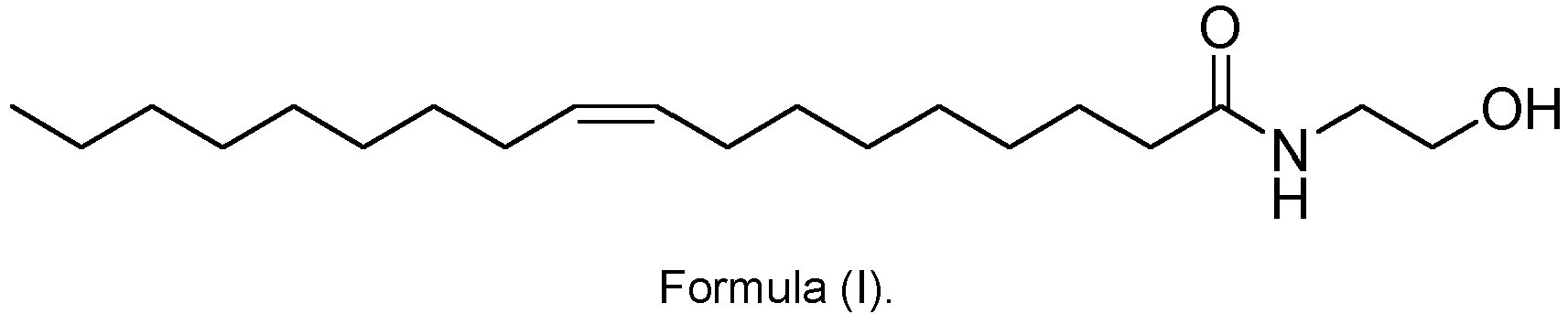
- Oleoylethanolamide is a natural, endogenous product, i.e. present in our bodies. This product has been FDA-approved since 2017 and sold as a dietary supplement for its physiological effect of inhibiting the sensation of hunger and thus naturally limiting food intake and weight gain [12-16].
- The inventors surprisingly found out that oleoylethanolamide in combination with at least one fatty substance enables the production of a texturizing complex to give more viscosity or firmness to a composition. The inventors have thus made an alternative solution to already known texturizing agents without the associated drawbacks mentioned above.
- According to the description "texturizing agent" means any additive which increases the consistency and the firmness of a composition. For example a texturizing agent may be made of starch, natural gum (guar gum, arabic gum, tragacanth gum), casein, phytocolloid (carragenates, alginates, agar), carboxyvinyl polymers (carbomer), acrylic copolymer, polyacrylamide, polysaccharide, dextrin palmitate, clays such as modified clays (bentones) and hydrophobic silica, cellulose oleogelators (ethylcellulose [17], phytosterols/sterol esters mixtures [18], monoglycerides [19], waxes [20], fatty alcohols/fatty acids [21], 12-hydroxystearic acid [22]).
- The invention thus relates in a first aspect to a texturizing complex comprising oleoylethanolamide and at least one fatty substance.
- According to the invention, "texturizing complex" means a combination of oleoylethanolamide, at least one fatty substance and optionally one wax and/or an excipient. The texturizing complex may advantageously replace or reinforce the effect of a texturizing agent in a composition, such as pharmaceutical, food, cosmetic or lube composition.
- Advantageously, the texturizing complex may be in gel form.
- According to the description, "gel form" means the complex has a viscoelastic behaviour.
- Advantageously, the mass concentration of the at least one fatty substance relative to the total mass of the texturizing complex may be in the range from 70 to 99.9 %, preferably from 80 to 99 %, and more preferably from 90 to 99 %.
- Advantageously, the mass concentration of oleoylethanolamide relative to the total mass of the texturizing complex may be in the range from 0.1 to 30 %, preferably from 1 to 20%, and more preferably from 1 to 10 %.
- According to the description, "fatty substance" means any substance composed mainly of glycerides or other lipids, insoluble in water and soluble in non-polar organic solvents. The fatty substance may be natural or synthetic, preferably the fatty substance may be mineral, vegetable or animal origin.
- Advantageously, the fatty substance may be selected from oil, butter, fat, emulsion and mixtures thereof.
- According to the description, "oil" means any fatty flammable substance of plant, animal or mineral origin, immiscible in water, miscible in non-polar organic solvent, generally liquid above 10°C, freezing or solidifying at lower temperatures.
- According to the description, "miscible" means that the resulting mixture is homogeneous, i.e., a single phase is observed visually and "immiscible" means that the resulting mixture is heterogeneous, ie, at least two phases can be observed visually.
- Advantageously, the oil may be selected from natural oil, synthetic oil and mixtures thereof, preferably from vegetable oil, animal oil, mineral oil and mixtures thereof.
- Advantageously, the oil may be selected from vegetable oil, preferably from rapeseed/canola, sunflower, camellia, olive, coconut, argan, jojoba, castor, soybean, corn, safflower, flaxseed, almond, peanut, algal, palm, palm stearin, palm kernel oil, avocado, apricot, wheat germ, cottonseed, vegetable squalane, caprylic/capric triglycerides, echium, rice bran, sesame, grapeseed, helianthus annuus seed oil, green tea seed oil, macadamia nut oil, rose hips oil, hydrogenated oil, sea buckthorn oil, argan tree kernel oil, lavender oil and mixtures thereof.
- Advantageously, the oil may be selected from animal oil, preferably from fish oil.
- Advantageously, the oil may be selected from natural or synthetic ester-based oil, preferably from isopropyl myristate, ethyl laurate, ethyl myristate, isopropyl palmitate, butyl laurate, hexyl laurate, caprylic/capric triglyceride, butyl glycol dicaprylate/dicaprate, isopropyl myristate, triethylhexanoin, cetyl ethylhexanoate, octyldodecanol, polyol ester and mixtures thereof.
- Advantageously, the oil may be selected from mineral oil or synthetic oil, preferably from hydrocarbon-based oils including cyclododecane, isooctane, liquid paraffin, Vaseline, hydrogenated polydecene, cyclooctane, cyclopentane, and squalene, isododecane, C10 to C40 alkanes mixtures, squalane and mixtures thereof.
- According to the description, "butter" means any dairy product made from churned cream or any solid fat from vegetal origin.
- Advantageously, the butter may be selected from clarified butter, ghee, shea butter, cocoa butter, peanut butter, avocado butter, nut butter and mixtures thereof, preferably the butter may be shea butter.
- According to the description, "fat" means any solid or semi-solid substance, as distinguished from an oil, generally highly flammable, insoluble in water but soluble in non-polar organic solvent (for example in diethyl ether), viscous to the touch, of animal or vegetable origin, and which melts between 20°C and 50°C.
- Advantageously, the fat may be selected from duck fat, ox tallow, sheep tallow, lard and mixtures thereof.
- According to the description, "emulsion" means any more or less stable dispersion, in the form of microscopic droplets, of one liquid in a second, immiscible liquid.
- Advantageously, the emulsion may be selected from water in oil emulsion such as margarine.
- Advantageously, the texturizing agent may further comprise at least one wax.
- According to the description, "wax" means any of numerous substances of plant or animal origin that differ from fats in being less greasy, harder, and crumblier (such as fatty acids, alcohols, esters and saturated hydrocarbons). For example, waxes may be naturally occurring waxes, synthetic waxes or mixtures thereof.
- Preferably the wax may be selected from candelilla wax, carnauba wax/Brazil wax, bee wax, rice bran oil wax, sugarcane wax, lignite wax, shellac wax, red tail fat, ceresin, petroleum jelly, hydrogenated Jojoba wax and mixtures thereof. More preferably, the max may be selected from candelilla wax, carnauba wax/Brazil wax, bee wax, lanolin, bayberry, sugarcane, microcrystalline, petrolatum and carbowax and mixtures thereof.
- Advantageously, the mass concentration of the at least one wax relative to the total mass of the texturizing complex is in the range from 0.01 to 20 %, preferably from 0.1 to 10 %, more preferably 0.1 to 1 %.
- Advantageously, the texturizing complex further comprises at least one excipient, preferably a food, cosmetic, pharmaceutically acceptable or lube excipient.
- According to the description, "excipient" means any component of a composition which does not confer its therapeutic or preventive properties, but which may play a role in the absorption (assimilation) and stability of an active substance, as well as in its appearance, colour and taste.
- Advantageously, the texturizing complex according to the invention may comprise an elastic modulus comprised from 1.103 to 1.107 Pa, preferably 1.103 to 1.106 Pa, more preferably 1.103 to 1.105 Pa. The incorporation of at least one wax in the texturizing complex according to the invention may have a positive impact on the value of the elastic modulus and/or the stability.
- The elastic modulus may be measured according to the following method. The real and imaginary parts of the complex shear modulus were measured with a commercial stress-controlled rheometer (Haake, Mars III), in the oscillatory mode and with a double Couette cell (DG41, Haake). The temperature was regulated by a heated bath (Haake F3) and controlled between 20 and 80 °C, within ± 0.05 °C. The experiments consisted in following, at a given frequency (1Hz), the evolution of the complex shear modulus of the sample when temperature was progressively decreased or increased between 80 to 20 °C at a rate of 0.25 °C/min. For all shear measurements the applied stress was between 0,05 and 0,1 Pa to ensure the data belong in the linear response regime. At room temperature, when the sample is gelled, a frequency sweep is then conducted from 10 Hz to 0,01 Hz. Then the heating phase takes place from 20 °C to 80 °C at a rate of 0,25 °C/min.
- In a first variant, the texturizing complex according to the invention may comprise from 0.5 to 10 % of oleoylethanolamide, from 89.5 to 98.9 % of oil and from 0.1 to 0.5 % of wax.
- In a second variant, the texturizing complex according to the invention may comprise from 0.5 to 10 % of oleoylethanolamide, from 89.5 to 98.9 % of butter and from 0.1 to 0.5 % of wax.
- In a third variant, the texturizing complex according to the invention may comprise from 0.5 to 10 % of oleoylethanolamide, from 89.5 to 98.9 % of fat and from 0.1 to 0.5 % of wax.
- The invention relates in a second aspect to a food composition comprising a texturizing complex according to the invention.
- Advantageously, the food composition according to the invention may comprise from 3 to 99.9 % of texturizing complex relative to the total mass of the food composition.
- Advantageously, the food excipient may be selected from a pigment, a dye, a natural or artificial colorant, an aroma, a filler, a texturizing agent, a preservative, an emulsifier, a sweetening agent, a flavouring agent, an anti-caking agent and mixtures thereof.
- The invention relates in a third aspect to a cosmetic composition comprising a texturizing complex according to the invention.
- Advantageously, the cosmetic composition according to the invention may comprise from 20 to 99.9 % of texturizing complex relative to the total mass of the cosmetic composition.
- Advantageously, the cosmetic excipient may be selected from a pigment, a perfume, a filler, an emollient, a moisturizer, a stabilizing agent, a humectant, a film-forming agent, a texturizing agent, a cosmetic active ingredient, a UV filter, an antimicrobial agent, a preservative, an emulsifier, a fragrance, a whitening agent, and mixtures thereof.
- The invention relates in a fourth aspect to a pharmaceutical composition comprising a texturizing complex according to the invention and a therapeutically active agent.
- According to the description, "therapeutically active agent" means any agent tending to cure or prevent a disease or restore health.
- Advantageously, the pharmaceutical composition according to the invention may comprise from 5 to 99 % of texturizing complex relative to the total mass of the pharmaceutical composition.
- Advantageously, the pharmaceutically acceptable excipient may be selected from a filler, a UV filter (such as UVA and/or UVB filter), an antimicrobial agent, a preservative, an emulsifier, a binding agent, a disintegrant, a coating agent, a lubrication agent, and mixtures thereof.
- Advantageously, the pharmaceutical composition according to the invention may be a medicament. The pharmaceutical composition according to the invention may be for use as a medicament.
- The invention relates in another aspect to a process to manufacture a texturizing complex according to the invention wherein the process comprises:
- a) a step of bringing into contact oleoylethanolamide and a fatty substance;
- b) a step of gradually increasing the temperature of the mixture obtained in step a) until the dissolution of the oleoylethanolamide;
- c) a step of homogenisation the mixture obtained in step b) to obtain a homogeneous mixture;
- d) a step of gradually decreasing the temperature of the homogeneous mixture until the texturizing complex according to the invention is formed.
- Advantageously, step b) and step c) may be implemented simultaneously or consecutively.
- According to the description, "a step of homogenisation" means a step carried out by stirring, in the form of mechanical stirring or ultrasonic homogenizer stirring, by any mixer or homogenizer.
- The stability of the texturizing complex over time was assessed visually from the upside-down vial method, meaning the vial in which the texturizing complex was formed was put upside-down and 3 different visual aspects of aging were looked for. Firstly, no visual changes of the texturizing complex from the moment of its formation until the day of inspection, meaning the texturizing complex is stable at a given temperature during that period of time. Secondly, there is syneresis of the fatty substance, but the aspect of the texturizing complex itself is the same as the day of its formation, at a given temperature. And finally, the fatty substance is seeping from the texturizing complex leading to structural and visual deformation of the texturizing complex, which means the texturizing complex isn't stable in those conditions, at a given temperature, and is called demixing.
- The synthesis of oleoylethanolamide (OEA) was carried out according to the following scheme.

- Oleic acid (1 equivalent) and ethanolamine (10 equivalents) were mixed in a round bottom flask and the mixture was stirred at 150°C overnight with a condenser as a safety precaution. After cooling, the reaction mixture was dissolved in ethyl acetate, then washed twice with a 1 M HCl solution, followed by a saturated NaCl solution. The organic phase was dried with anhydrous sodium sulfate, filtered and the solvent evaporated under reduced pressure. Finally, OEA was recrystallized in a minimum of acetone/water, then filtered and washed with cold water. After drying on a vacuum ramp, pure OEA was obtained in the form of white crystals in yields of between 30 and 50%.
- A typical preparation for OEA/Oil gels are carried out as followed. Briefly, OEA is weighted based on the desired concentration, then the desired oil is weighted in accordance with the quantity and concentration of the gel. The mixture is then heated at 70°C for 5 to 10 min until complete solubilisation of OEA in the oil. The resulting solution is then cooled to 20°C (or below for low OEA concentration gels) either slowly (simply left on the bench/fume hood) or rapidly (cooling with ice bath or stream of cold water).
- A mixture of OEA and sunflower oil, with an OEA concentration of 4% by weight, is heated for 10 min at 70°C, cooled to 20°C and left at this temperature for 1 h. The resulting composition is an opalescent white gel. This gel is stable for at least 3 months at 20°C and does not show any syneresis. The resulting composition has an elastic modulus of 104 Pa.
- A mixture of OEA and rapeseed oil, with an OEA concentration of 6% by weight, is heated for 10 min at 70°C, cooled to 20°C and then left at this temperature for 1 hour. The resulting composition is an opalescent white/yellow gel. This gel is stable for at least 3 months at 20°C and does not show any syneresis. The resulting composition has an elastic modulus of 104 Pa.
- A mixture of OEA and olive oil, with an OEA concentration of 4% by weight, is heated for 10 min at 70°C, cooled to 20°C and then left at this temperature for 1 hr. The resulting composition is an opalescent yellow/green gel. This gel is stable for at least 3 months at 20°C and does not show any syneresis. The resulting composition has an elastic modulus of 104 Pa.
- A mixture of OEA and argan oil, at an OEA concentration of 4% by weight, is heated for 10 min at 70°C, cooled to 20°C and left at this temperature for 1 h. The resulting composition is an opalescent yellow gel. This gel is stable for at least 3 months at 20°C and does not show any syneresis. The resulting composition has an elastic modulus of 1.5.104 Pa.
- A mixture of OEA and paraffin oil, with an OEA concentration of 4% by weight, is heated for 10 min at 70°C, then cooled to 20°C and left at this temperature for 1 h. The resulting composition is an opalescent white gel. This gel is stable for at least 3 months at 20°C and does not show any syneresis. The resulting composition has an elastic modulus of 2.5.103 Pa.
- Compositions according to Example 2 have been produced, in the same way as for Examples 3 to 7, for different OEA concentrations and/or for different fatty substances. They are presented in the following tables 1 to 5.
Table 1: Concentration of 1% OEA (wt%) relative to the total mass: Oil Stability of the gel Sunflower +++ (at 5°C) Argan +++ (at 5°C) +++: >75 days; ++: >50 days; +: >25 days. Table 2: Concentration of 2% OEA (wt%) relative to the total mass: Oil Stability of the gel Argan +++ Paraffin ++ Duck fat +++ (at 35°C) +++: >75 days; ++: >50 days; +: >25 days. Table 3: Concentration of 4% OEA (wt%) relative to the total mass: Oil Stability of the gel Sunflower (Example 3) +++ Olive (Example 5) +++ Argan (Example 6) +++ Jojoba + Paraffin (Example 7) +++ Duck fat +++ (at 38°C) +++: >75 days; ++: >50 days; +: >25 days. Table 4: Concentration of 6% OEA (wt%) relative to the total mass: Oil Stability of the gel Rapeseed (Example 4) +++ Coconut + (at 32°C) +++: >75 days; ++: >50 days; +: >25 days. Table 5: Concentration of 10% OEA (wt%) relative to the total mass: Oil Stability of the gel Rapeseed + Sunflower + +++: >75 days; ++: >50 days; +: >25 days. - The texturizing complexes according to the invention are stable and represent therefore an alternative to known texturizing agents. Moreover, the texturizing complexes according to the invention comprise oils that are biosourced, harmless, and environment friendly.
-
- (1) Brouwer, I. A.; Wanders, A. J.; Katan, M. B. Effect of Animal and Industrial Trans Fatty Acids on HDL and LDL Cholesterol Levels in Humans - A Quantitative Review. PLOS ONE 2010, 5 (3), e9434. https://doi.org/10.1371/journal.pone.0009434.
- (2) Zock, P. L.; Katan, M. B. Trans Fatty Acids, Lipoproteins, and Coronary Risk. Can. J. Physiol. Pharmacol. 2011, 75, 211-216. https://doi.org/10.1139/y97-012.
- (3) Brouwer, I. A.; Wanders, A. J.; Katan, M. B. Trans Fatty Acids and Cardiovascular Health: Research Completed? Eur. J. Clin. Nutr. 2013, 67 (5), 541-547. https://doi.org/10.1038/ejcn.2013.43.
- (4) Zhu, Y.; Bo, Y.; Liu, Y. Dietary Total Fat, Fatty Acids Intake, and Risk of Cardiovascular Disease: A Dose-Response Meta-Analysis of Cohort Studies. Lipids Health Dis. 2019, 18 (1), 91. https://doi.org/10.1186/s12944-019-1035-2.
- (5) Scientific Opinion on Dietary Reference Values for Fats, Including Saturated Fatty Acids, Polyunsaturated Fatty Acids, Monounsaturated Fatty Acids, Trans Fatty Acids, and Cholesterol. EFSA J. 2010, 8 (3), 1461. https://doi.org/10.2903/j.efsa.2010.1461.
- (6) Liu, A. G.; Ford, N. A.; Hu, F. B.; Zelman, K. M.; Mozaffarian, D.; Kris-Etherton, P. M. A Healthy Approach to Dietary Fats: Understanding the Science and Taking Action to Reduce Consumer Confusion. Nutr. J. 2017, 16 (1), 53. https://doi.org/10.1186/s12937-017-0271-4.
- (7) Marangoni, A. G.; Co, E. D. Organogels: An Alternative Edible Oil-Structuring Method. J. Am. Oil Chem. Soc. 2012, 89 (5), 749-780. https://doi.org/10.1007/s11746-012-2049-3.
- (8) Wesdorp, L. H.; Melnikov, S. M.; Gaudier, E. A. Trans Fats Replacement Solutions in Europe. In Trans Fats Replacement Solutions; Kodali, D. R., Ed.; AOCS Press, 2014; pp 287-312. https://doi.org/10.1016/B978-0-9830791-5-6.50018-6.
- (9) Zetzl, A. K.; Marangoni, A. G. 10 - Structured Emulsions and Edible Oleogels as Solutions to Trans Fat. In Trans Fats Replacement Solutions; Kodali, D. R., Ed.; AOCS Press, 2014; pp 215-243. https://doi.org/10.1016/B978-0-9830791-5-6.50015-0.
- (10) Davidovich-Pinhas, M.; Barbut, S.; Marangoni, A. g. Development, Characterization, and Utilization of Food-Grade Polymer Oleogels. Annu. Rev. Food Sci. Technol. 2016, 7 (1), 65-91. https://doi.org/10.1146/annurev-food-041715-033225.
- (11) Scharfe, M.; Flöter, E. Oleogelation: From Scientific Feasibility to Applicability in Food Products. Eur. J. Lipid Sci. Technol. 2020, 2000213. https://doi.org/10.1002/ejlt.202000213.
- (12) Fu, J.; Gaetani, S.; Oveisi, F.; Lo Verme, J.; Serrano, A.; Rodriguez de Fonseca, F.; Rosengarth, A.; Luecke, H.; Di Giacomo, B.; Tarzia, G.; Piomelli, D. Oleylethanolamide Regulates Feeding and Body Weight through Activation of the Nuclear Receptor PPAR-α. Nature 2003, 425 (6953), 90-93. https://doi.org/10.1038/nature0921.
- (13) Gaetani, S.; Oveisi, F.; Piomelli, D. Modulation of Meal Pattern in the Rat by the Anorexic Lipid Mediator Oleoylethanolamide. Neuropsychopharmacology 2003, 28 (7), 1311-1316. https://doi.org/10.1038/sj.npp.1300166.
- (14) Nielsen, M. J.; Petersen, G.; Astrup, A.; Hansen, H. S. Food Intake Is Inhibited by Oral Oleoylethanolamide. J. Lipid Res. 2004, 45 (6), 1027-1029. https://doi.org/10.1194/jlr.C300008-JLR200.
- (15) Tutunchi, H.; Ostadrahimi, A.; Saghafi-Asl, M.; Hosseinzadeh-Attar, M.-J.; Shaken, A.; Asghari-Jafarabadi, M.; Roshanravan, N.; Farrin, N.; Naemi, M.; Hasankhani, M. Oleoylethanolamide Supplementation in Obese Patients Newly Diagnosed with Non-Alcoholic Fatty Liver Disease: Effects on Metabolic Parameters, Anthropometric Indices, and Expression of PPAR-α, UCP1, and UCP2 Genes. Pharmacol. Res. 2020, 156, 104770. https://doi.org/10.1016/j.phrs.2020.104770.
- (16) Sabahi, M.; Ahmadi, S. A.; Kazemi, A.; Mehrpooya, M.; Khazaei, M.; Ranjbar, A.; Mowla, A. The Effect of Oleoylethanolamide (OEA) Add-On Treatment on Inflammatory, Oxidative Stress, Lipid, and Biochemical Parameters in the Acute Ischemic Stroke Patients: Randomized Double-Blind Placebo-Controlled Study. Oxid. Med. Cell. Longev. 2022, 2022, e5721167. https://doi.org/10.1155/2022/5721167.
- (17) Davidovich-Pinhas, M.; Barbut, S.; Marangoni, A. G. The Gelation of Oil Using Ethyl Cellulose. Carbohydr. Polym. 2015, 117, 869-878. https://doi.org/10.1016/j.carbpol.2014.10.035.
- (18)
Ritter, H.; Sande, R. L. van de; Muller, V. Liquid Fatty Component Containing Composition. US6846507B1, January 25, 2005 . https://patents.google.com/patent/US6846507B1/en (accessed 2023-02-01). - (19) Ojijo, N. K.; Neeman, I.; Eger, S.; Shimoni, E. Effects of Monoglyceride Content, Cooling Rate and Shear on the Rheological Properties of Olive Oil/Monoglyceride Gel Networks. J. Sci. Food Agric. 2004, 84 (12), 1585-1593. https://doi.org/10.1002/jsfa. 1831.
- (20) Toro-Vazquez, J. F.; Morales-Rueda, J. A.; Dibildox-Alvarado, E.; Charó-Alonso, M.; Alonzo-Macias, M.; González-Chávez, M. M. Thermal and Textural Properties of Organogels Developed by Candelilla Wax in Safflower Oil. J. Am. Oil Chem. Soc. 2007, 84 (11), 989-1000. https://doi.org/10.1007/s11746-007-1139-0.
- (21) Gandolfo, F. G.; Bot, A.; Flöter, E. Structuring of Edible Oils by Long-Chain FA, Fatty Alcohols, and Their Mixtures. J. Am. Oil Chem. Soc. 2004, 81 (1), 1-6. https://doi.org/10.1007/s11746-004-0851-5.
- (22) Elliger, C. A.; Guadagni, D. G.; Dunlap, C. E. Thickening Action of Hydroxystearates in Peanut Butter. J. Am. Oil Chem. Soc. 1972, 49 (9), 536-537. https://doi.org/10.1007/BF02628900.
Claims (15)
- A texturizing complex comprising oleoylethanolamide and at least one fatty substance.
- The texturizing complex according to claim 1, wherein the mass concentration of the at least one fatty substance relative to the total mass of the texturizing complex is in the range from 70 to 99.9 %.
- The texturizing complex according to any of the preceding claims, wherein the mass concentration of oleoylethanolamide relative to the total mass of the texturizing complex is in the range from 0.1 to 30 %.
- The texturizing complex according to any of the preceding claims, wherein the fatty substance is selected from oil, butter, fat, emulsion and mixtures thereof.
- The texturizing complex according to claim 4, wherein the oil is selected from vegetable oil, animal oil, mineral oil, synthetic oil and mixtures thereof.
- The texturizing complex according to claim 4, wherein the butter is selected from clarified butter, ghee, shea butter, cocoa butter, peanut butter, avocado butter, nut butter and mixtures thereof.
- The texturizing complex according to claim 4, wherein the emulsion is selected from water in oil emulsion such as margarine.
- The texturizing complex according to claim 4, wherein the fat is selected from duck fat, ox tallow, sheep tallow, lard and mixtures thereof.
- The texturizing complex according to any of the preceding claims, wherein the texturizing complex further comprises at least one wax.
- The texturizing complex according to claim 9, wherein the mass concentration of the at least one wax relative to the total mass of the texturizing complex is in the range from 0.01 to 20 %.
- A food composition comprising a texturizing complex according to any one of claims 1-10.
- A cosmetic composition comprising a texturizing complex according to any one of claims 1-10.
- A pharmaceutical composition comprising a texturizing complex according to any one of claims 1-10 and an active agent.
- The pharmaceutical composition according to claim 13 for use as a medicament.
- A process to manufacture a texturizing complex according to claim 1 wherein the process comprises:a) a step of bringing into contact oleoylethanolamide and a fatty substance;b) a step of gradually increasing the temperature of the mixture obtained in step a) until the dissolution of the oleoylethanolamide;c) a step of homogenisation the mixture obtained in step b) to obtain a homogeneous mixture;d) a step of gradually decreasing the temperature of the homogeneous mixture until the texturizing complex according to claim 1 is formed.
Priority Applications (2)
| Application Number | Priority Date | Filing Date | Title |
|---|---|---|---|
| EP23307361.8A EP4573920A1 (en) | 2023-12-22 | 2023-12-22 | Texturizing complex comprising oleoylethanolamide and at least one fatty substance |
| PCT/EP2024/087740 WO2025133008A1 (en) | 2023-12-22 | 2024-12-19 | Texturizing complex comprising oleoylethanolamide and at least one fatty substance |
Applications Claiming Priority (1)
| Application Number | Priority Date | Filing Date | Title |
|---|---|---|---|
| EP23307361.8A EP4573920A1 (en) | 2023-12-22 | 2023-12-22 | Texturizing complex comprising oleoylethanolamide and at least one fatty substance |
Publications (1)
| Publication Number | Publication Date |
|---|---|
| EP4573920A1 true EP4573920A1 (en) | 2025-06-25 |
Family
ID=89619388
Family Applications (1)
| Application Number | Title | Priority Date | Filing Date |
|---|---|---|---|
| EP23307361.8A Pending EP4573920A1 (en) | 2023-12-22 | 2023-12-22 | Texturizing complex comprising oleoylethanolamide and at least one fatty substance |
Country Status (2)
| Country | Link |
|---|---|
| EP (1) | EP4573920A1 (en) |
| WO (1) | WO2025133008A1 (en) |
Citations (5)
| Publication number | Priority date | Publication date | Assignee | Title |
|---|---|---|---|---|
| US6846507B1 (en) | 1996-05-10 | 2005-01-25 | Lipton, Division Of Conopco, Inc. | Liquid fatty component containing composition |
| CN102579413A (en) * | 2011-01-14 | 2012-07-18 | 傅瑾 | New application of oleoylethanolamide (OEA) and derivative thereof |
| US20150208708A1 (en) * | 2012-09-07 | 2015-07-30 | Nestec S.A. | Oleoylethanolamide compositions |
| KR20210104207A (en) * | 2020-02-14 | 2021-08-25 | 닥터레이몬드 랩(주) | Cosmetics or pharmaceutical composition containing metabolite of gut microbiome |
| WO2023114722A1 (en) * | 2021-12-13 | 2023-06-22 | The Regents Of The University Of California | Method of treating liver steatosis with bioavailable formulation of oleoylethanolamide |
-
2023
- 2023-12-22 EP EP23307361.8A patent/EP4573920A1/en active Pending
-
2024
- 2024-12-19 WO PCT/EP2024/087740 patent/WO2025133008A1/en active Pending
Patent Citations (5)
| Publication number | Priority date | Publication date | Assignee | Title |
|---|---|---|---|---|
| US6846507B1 (en) | 1996-05-10 | 2005-01-25 | Lipton, Division Of Conopco, Inc. | Liquid fatty component containing composition |
| CN102579413A (en) * | 2011-01-14 | 2012-07-18 | 傅瑾 | New application of oleoylethanolamide (OEA) and derivative thereof |
| US20150208708A1 (en) * | 2012-09-07 | 2015-07-30 | Nestec S.A. | Oleoylethanolamide compositions |
| KR20210104207A (en) * | 2020-02-14 | 2021-08-25 | 닥터레이몬드 랩(주) | Cosmetics or pharmaceutical composition containing metabolite of gut microbiome |
| WO2023114722A1 (en) * | 2021-12-13 | 2023-06-22 | The Regents Of The University Of California | Method of treating liver steatosis with bioavailable formulation of oleoylethanolamide |
Non-Patent Citations (22)
| Title |
|---|
| "Scientific Opinion on Dietary Reference Values for Fats, Including Saturated Fatty Acids, Polyunsaturated Fatty Acids, Monounsaturated Fatty Acids, Trans Fatty Acids, and Cholesterol.", EFSA J., vol. 8, no. 3, 2010, pages 1461, Retrieved from the Internet <URL:https://doi.org/10.2903/j.efsa.2010.1461> |
| BROUWER, I. A.WANDERS, A. J.KATAN, M. B.: "Effect of Animal and Industrial Trans Fatty Acids on HDL and LDL Cholesterol Levels in Humans - A Quantitative Review.", PLOS ONE, vol. 5, no. 3, 2010, pages 9434, Retrieved from the Internet <URL:https://doi.org/10.1371/journal.pone.0009434> |
| BROUWER, I. A.WANDERS, A. J.KATAN, M. B.: "Trans Fatty Acids and Cardiovascular Health: Research Completed?", EUR. J. CLIN. NUTR., vol. 67, no. 5, 2013, pages 541 - 547, XP037763914, Retrieved from the Internet <URL:https://doi.org/10.1038/ejcn.2013.43> DOI: 10.1038/ejcn.2013.43 |
| DAVIDOVICH-PINHAS, M.BARBUT, S.MARANGONI, A. G.: "The Gelation of Oil Using Ethyl Cellulose.", CARBOHYDR. POLYM., vol. 117, 2015, pages 869 - 878, XP029113717, Retrieved from the Internet <URL:https://doi.org/10.1016/j.carbpo1.2014.10.035.> DOI: 10.1016/j.carbpol.2014.10.035 |
| DAVIDOVICH-PINHAS, M.BARBUT, S.MARANGONI, A.: "Development, Characterization, and Utilization of Food-Grade Polymer Oleogels.", ANNU. REV. FOOD SCI. TECHNOL., vol. 7, no. 1, 2016, pages 65 - 91, XP055735800, DOI: 10.1146/annurev-food-041715-033225 |
| ELLIGER, C. A.GUADAGNI, D. G.DUNLAP, C. E.: "Thickening Action of Hydroxystearates in Peanut Butter.", J. AM. OIL CHEM. SOC., vol. 49, no. 9, 1972, pages 536 - 537, Retrieved from the Internet <URL:https://doi.org/10.1007/BF02628900.> |
| FU, J.GAETANI, S.OVEISI, F.LO VERME, J.SERRANO, A.RODRIGUEZ DE FONSECA, F.ROSENGARTH, A.LUECKE, H.DI GIACOMO, B.TARZIA, G.: "Oleylethanolamide Regulates Feeding and Body Weight through Activation of the Nuclear Receptor PPAR-a.", NATURE, vol. 425, no. 6953, 2003, pages 90 - 93, XP002278029, Retrieved from the Internet <URL:https://doi.org/10.1038/natured921.> DOI: 10.1038/nature02020 |
| GAETANI, S.OVEISI, F.PIOMELLI, D.: "Modulation of Meal Pattern in the Rat by the Anorexic Lipid Mediator Oleoylethanolamide.", NEUROPSYCHOPHARMACOLOGY, vol. 28, no. 7, 2003, pages 1311 - 1316, Retrieved from the Internet <URL:https://doi.org/10.1038/sj.npp.1300166.> |
| GANDOLFO, F. G.BOT, A.FLOTER, E.: "Structuring of Edible Oils by Long-Chain FA, Fatty Alcohols, and Their Mixtures.", J. AM. OIL CHEM. SOC., vol. 81, no. 1, 2004, pages 1 - 6, XP001046230, Retrieved from the Internet <URL:https://doi.org/10.1007/s11746-004-0851-5.> DOI: 10.1007/s11746-004-0851-5 |
| LACATUSU I ET AL: "Improved anti-obesity effect of herbal active and endogenous lipids co-loaded lipid nanocarriers: Preparation,in vitroandin vivoevaluation", MATERIALS SCIENCE AND ENGINEERING C, vol. 99, 2019, pages 12 - 24, XP085641079, ISSN: 0928-4931, DOI: 10.1016/J.MSEC.2019.01.071 * |
| LIU, A. G.; FORD, N. A.; HU, F. B.; ZELMAN, K. M.; MOZAFFARIAN, D.; KRIS-ETHERTON, P.M.: "A Healthy Approach to Dietary Fats: Understanding the Science and Taking Action to Reduce Consumer Confusion.", NUTR. J., vol. 16, no. 1, 2017, pages 53, Retrieved from the Internet <URL:https://doi.org/10.1186/s12937-017-0271-4> |
| MARANGONI, A. G.: "Co, E. D. Organogels: An Alternative Edible Oil-Structuring Method.", J. AM. OIL CHEM. SOC., vol. 89, no. 5, 2012, pages 749 - 780, XP055541309, Retrieved from the Internet <URL:https://doi.org/10.1007/s11746-012-2049-3.> DOI: 10.1007/s11746-012-2049-3 |
| NIELSEN, M. J.PETERSEN, G.ASTRUP, A.HANSEN, H. S.: "Food Intake Is Inhibited by Oral Oleoylethanolamide.", J. LIPID RES., vol. 45, no. 6, 2004, pages 1027 - 1029 |
| OJIJO, N. K.NEEMAN, I.EGER, S.SHIMONI, E.: "Effects of Monoglyceride Content, Cooling Rate and Shear on the Rheological Properties of Olive Oil/Monoglyceride Gel Networks.", J. SCI. FOOD AGRIC., vol. 84, no. 12, 2004, pages 1585 - 1593, XP055117541, Retrieved from the Internet <URL:https://doi.org/10.1002/jsfa.1831.> DOI: 10.1002/jsfa.1831 |
| RITTER, H.SANDE, R. L. VAN DEMULLER, V., LIQUID FATTY COMPONENT CONTAINING COMPOSITION. |
| SABAHI, M.AHMADI, S. A.KAZEMI, A.MEHRPOOYA, M.KHAZAEI, M.RANJBAR, A.MOWLA, A.: "The Effect of Oleoylethanolamide (OEA) Add-On Treatment on Inflammatory, Oxidative Stress, Lipid, and Biochemical Parameters in the Acute Ischemic Stroke Patients: Randomized Double-Blind Placebo-Controlled Study.", OXID. MED. CELL. LONGEV., 2022, pages 5721167, Retrieved from the Internet <URL:https://doi.org/10.1155/2022/5721167.> |
| SCHARFE, M.FLOTER, E.: "Oleogelation: From Scientific Feasibility to Applicability in Food Products.", EUR. J. LIPID SCI. TECHNOL., 2020, pages 2000213, Retrieved from the Internet <URL:https://doi.org/10.1002/ejlt.202000213.> |
| TORO-VAZQUEZ, J. F.MORALES-RUEDA, J. A.DIBILDOX-ALVARADO, E.CHARO-ALONSO, M.ALONZO-MACIAS, M.GONZALEZ-CHAVEZ, M. M.: "Thermal and Textural Properties of Organogels Developed by Candelilla Wax in Safflower Oil.", J. AM. OIL CHEM., vol. 84, no. 11, 2007, pages 989 - 1000, XP002578612, Retrieved from the Internet <URL:https://doi.org/10.1007/s11746-007-1139-0.> DOI: 10.1007/S11746-007-1139-0 |
| TUTUNCHI, H.; OSTADRAHIMI, A.; SAGHAFI-ASL, M.; HOSSEINZADEH-ATTAR, M.-J.; SHAKEN, A.; ASGHARI-JAFARABADI, M.; ROSHANRAVAN, N.; FA: "Oleoylethanolamide Supplementation in Obese Patients Newly Diagnosed with Non-Alcoholic Fatty Liver Disease: Effects on Metabolic Parameters, Anthropometric Indices, and Expression of PPAR-a, UCP1, and UCP2 Genes.", PHARMACOL. RES., vol. 156, 2020, pages 104770, Retrieved from the Internet <URL:https://doi.org/10.1016/j.phrs.2020.104770> |
| WESDORP, L. H.MELNIKOV, S. M.GAUDIER, E. A.: "Trans Fats Replacement Solutions", vol. 10, 2014, AOCS PRESS,, article "Structured Emulsions and Edible Oleogels as Solutions to Trans Fat.", pages: 215 - 243 |
| ZHU, Y.; BO, Y.; LIU, Y.: "Dietary Total Fat, Fatty Acids Intake, and Risk of Cardiovascular Disease: A Dose-Response Meta-Analysis of Cohort Studies.", LIPIDS HEALTH DIS., vol. 18, no. 1, 2019, pages 91, Retrieved from the Internet <URL:https://doi.org/10.1186/s12944-019-1035-2.> |
| ZOCK, P. L.; KATAN, M. B.: "Trans Fatty Acids, Lipoproteins, and Coronary Risk.", J. PHYSIOL. PHARMACOL., vol. 75, 2011, pages 211 - 216, Retrieved from the Internet <URL:https://doi.org/10.1139/y97-012.> |
Also Published As
| Publication number | Publication date |
|---|---|
| WO2025133008A1 (en) | 2025-06-26 |
Similar Documents
| Publication | Publication Date | Title |
|---|---|---|
| US11957772B2 (en) | Petrolatum substitution preparation | |
| CN111643376A (en) | Nano-emulsion composition and application thereof | |
| NZ265642A (en) | Cosmetic product; topical lipidic composition, details regarding fatty acid components of triglycerides present | |
| JPH08208452A (en) | Cosmetic lipid composition and method for producing the same | |
| Krasodomska et al. | Viability of fruit seed oil O/W emulsions in personal care products | |
| JP5778908B2 (en) | Oil-in-water emulsion composition | |
| JP2023085504A (en) | Skin emulsion composition | |
| KR20180081265A (en) | Stable oil-in-polyol type composition containing high content of natural scrubbing ingredient | |
| Ceballos et al. | Effect of ethylcellulose on the structure and stability of non-aqueous oil based propylene glycol emulsions | |
| Silva et al. | Soybean oil organogelled emulsions as oral delivery systems of hydroxytyrosol and hydroxytyrosol alkyl esters | |
| US20050233015A1 (en) | Lanolin substitute based on shea butter | |
| Gutierrez et al. | Cottonseed oil composition and its application to skin health and personal care | |
| JP6234112B2 (en) | W / O / W emulsion composition | |
| EP2752202B1 (en) | Soft capsule pharmaceutical preparation, composition for soft capsule pharmaceutical preparation, and method for producing soft capsule pharmaceutical preparation | |
| KR20140067975A (en) | Oily gel composition | |
| del Carpio-Jiménez et al. | Evaluation of properties of Chenopodium pallidicaule (Canihua) oil for possible use in cosmetic formulations | |
| TWI694841B (en) | W/O type emulsifier and its premix | |
| JP3561571B2 (en) | Antioxidant preparation | |
| EP4573920A1 (en) | Texturizing complex comprising oleoylethanolamide and at least one fatty substance | |
| Muna et al. | Application of sacha inchi oil and deterpenated nutmeg oil as natural antiaging in facial cream formulation | |
| JP2010270067A (en) | Emulsion composition | |
| JP2013091617A (en) | Water-in-oil type emulsion composition | |
| JP3671103B2 (en) | Cosmetics | |
| JP5824323B2 (en) | Water-in-oil emulsion composition | |
| JP5567760B2 (en) | Oily gelling agent, gel composition obtained using the same, and use thereof |
Legal Events
| Date | Code | Title | Description |
|---|---|---|---|
| PUAI | Public reference made under article 153(3) epc to a published international application that has entered the european phase |
Free format text: ORIGINAL CODE: 0009012 |
|
| STAA | Information on the status of an ep patent application or granted ep patent |
Free format text: STATUS: THE APPLICATION HAS BEEN PUBLISHED |
|
| AK | Designated contracting states |
Kind code of ref document: A1 Designated state(s): AL AT BE BG CH CY CZ DE DK EE ES FI FR GB GR HR HU IE IS IT LI LT LU LV MC ME MK MT NL NO PL PT RO RS SE SI SK SM TR |
|
| STAA | Information on the status of an ep patent application or granted ep patent |
Free format text: STATUS: THE APPLICATION IS DEEMED TO BE WITHDRAWN |