EP4572587A1 - Organic electroluminescent device and display device - Google Patents
Organic electroluminescent device and display device Download PDFInfo
- Publication number
- EP4572587A1 EP4572587A1 EP23215922.8A EP23215922A EP4572587A1 EP 4572587 A1 EP4572587 A1 EP 4572587A1 EP 23215922 A EP23215922 A EP 23215922A EP 4572587 A1 EP4572587 A1 EP 4572587A1
- Authority
- EP
- European Patent Office
- Prior art keywords
- substituted
- unsubstituted
- alkyl
- group
- composition
- Prior art date
- Legal status (The legal status is an assumption and is not a legal conclusion. Google has not performed a legal analysis and makes no representation as to the accuracy of the status listed.)
- Pending
Links
Images



Classifications
-
- H—ELECTRICITY
- H10—SEMICONDUCTOR DEVICES; ELECTRIC SOLID-STATE DEVICES NOT OTHERWISE PROVIDED FOR
- H10K—ORGANIC ELECTRIC SOLID-STATE DEVICES
- H10K85/00—Organic materials used in the body or electrodes of devices covered by this subclass
- H10K85/60—Organic compounds having low molecular weight
- H10K85/631—Amine compounds having at least two aryl rest on at least one amine-nitrogen atom, e.g. triphenylamine
- H10K85/633—Amine compounds having at least two aryl rest on at least one amine-nitrogen atom, e.g. triphenylamine comprising polycyclic condensed aromatic hydrocarbons as substituents on the nitrogen atom
-
- H—ELECTRICITY
- H10—SEMICONDUCTOR DEVICES; ELECTRIC SOLID-STATE DEVICES NOT OTHERWISE PROVIDED FOR
- H10K—ORGANIC ELECTRIC SOLID-STATE DEVICES
- H10K85/00—Organic materials used in the body or electrodes of devices covered by this subclass
- H10K85/60—Organic compounds having low molecular weight
- H10K85/615—Polycyclic condensed aromatic hydrocarbons, e.g. anthracene
- H10K85/626—Polycyclic condensed aromatic hydrocarbons, e.g. anthracene containing more than one polycyclic condensed aromatic rings, e.g. bis-anthracene
-
- H—ELECTRICITY
- H10—SEMICONDUCTOR DEVICES; ELECTRIC SOLID-STATE DEVICES NOT OTHERWISE PROVIDED FOR
- H10K—ORGANIC ELECTRIC SOLID-STATE DEVICES
- H10K85/00—Organic materials used in the body or electrodes of devices covered by this subclass
- H10K85/60—Organic compounds having low molecular weight
- H10K85/631—Amine compounds having at least two aryl rest on at least one amine-nitrogen atom, e.g. triphenylamine
-
- H—ELECTRICITY
- H10—SEMICONDUCTOR DEVICES; ELECTRIC SOLID-STATE DEVICES NOT OTHERWISE PROVIDED FOR
- H10K—ORGANIC ELECTRIC SOLID-STATE DEVICES
- H10K85/00—Organic materials used in the body or electrodes of devices covered by this subclass
- H10K85/60—Organic compounds having low molecular weight
- H10K85/631—Amine compounds having at least two aryl rest on at least one amine-nitrogen atom, e.g. triphenylamine
- H10K85/636—Amine compounds having at least two aryl rest on at least one amine-nitrogen atom, e.g. triphenylamine comprising heteroaromatic hydrocarbons as substituents on the nitrogen atom
-
- H—ELECTRICITY
- H10—SEMICONDUCTOR DEVICES; ELECTRIC SOLID-STATE DEVICES NOT OTHERWISE PROVIDED FOR
- H10K—ORGANIC ELECTRIC SOLID-STATE DEVICES
- H10K85/00—Organic materials used in the body or electrodes of devices covered by this subclass
- H10K85/60—Organic compounds having low molecular weight
- H10K85/649—Aromatic compounds comprising a hetero atom
- H10K85/654—Aromatic compounds comprising a hetero atom comprising only nitrogen as heteroatom
-
- H—ELECTRICITY
- H10—SEMICONDUCTOR DEVICES; ELECTRIC SOLID-STATE DEVICES NOT OTHERWISE PROVIDED FOR
- H10K—ORGANIC ELECTRIC SOLID-STATE DEVICES
- H10K85/00—Organic materials used in the body or electrodes of devices covered by this subclass
- H10K85/60—Organic compounds having low molecular weight
- H10K85/649—Aromatic compounds comprising a hetero atom
- H10K85/657—Polycyclic condensed heteroaromatic hydrocarbons
-
- H—ELECTRICITY
- H10—SEMICONDUCTOR DEVICES; ELECTRIC SOLID-STATE DEVICES NOT OTHERWISE PROVIDED FOR
- H10K—ORGANIC ELECTRIC SOLID-STATE DEVICES
- H10K85/00—Organic materials used in the body or electrodes of devices covered by this subclass
- H10K85/60—Organic compounds having low molecular weight
- H10K85/649—Aromatic compounds comprising a hetero atom
- H10K85/657—Polycyclic condensed heteroaromatic hydrocarbons
- H10K85/6572—Polycyclic condensed heteroaromatic hydrocarbons comprising only nitrogen in the heteroaromatic polycondensed ring system, e.g. phenanthroline or carbazole
-
- H—ELECTRICITY
- H10—SEMICONDUCTOR DEVICES; ELECTRIC SOLID-STATE DEVICES NOT OTHERWISE PROVIDED FOR
- H10K—ORGANIC ELECTRIC SOLID-STATE DEVICES
- H10K85/00—Organic materials used in the body or electrodes of devices covered by this subclass
- H10K85/60—Organic compounds having low molecular weight
- H10K85/649—Aromatic compounds comprising a hetero atom
- H10K85/657—Polycyclic condensed heteroaromatic hydrocarbons
- H10K85/6574—Polycyclic condensed heteroaromatic hydrocarbons comprising only oxygen in the heteroaromatic polycondensed ring system, e.g. cumarine dyes
-
- H—ELECTRICITY
- H10—SEMICONDUCTOR DEVICES; ELECTRIC SOLID-STATE DEVICES NOT OTHERWISE PROVIDED FOR
- H10K—ORGANIC ELECTRIC SOLID-STATE DEVICES
- H10K2101/00—Properties of the organic materials covered by group H10K85/00
- H10K2101/30—Highest occupied molecular orbital [HOMO], lowest unoccupied molecular orbital [LUMO] or Fermi energy values
-
- H—ELECTRICITY
- H10—SEMICONDUCTOR DEVICES; ELECTRIC SOLID-STATE DEVICES NOT OTHERWISE PROVIDED FOR
- H10K—ORGANIC ELECTRIC SOLID-STATE DEVICES
- H10K50/00—Organic light-emitting devices
- H10K50/10—OLEDs or polymer light-emitting diodes [PLED]
- H10K50/17—Carrier injection layers
Definitions
- the present invention relates to an organic electroluminescent device comprising a p-doped hole injection layer and a display device comprising the organic electroluminescent device.
- Organic electroluminescent devices also named organic light-emitting diodes (OLEDs), which are self-emitting devices, have a wide viewing angle, excellent contrast, quick response, high brightness, excellent operating voltage characteristics, and color reproduction.
- OLEDs organic light-emitting diodes
- a typical OLED comprises an anode layer, a hole injection layer HIL, a hole transport layer HTL, a first emission layer EML, an electron transport layer ETL, and a cathode layer, which are sequentially stacked on a substrate.
- the HIL, the HTL, the EML, and the ETL are thin films formed from organic compounds.
- Performance of an organic electroluminescent device may be affected by characteristics of the hole injection layer, and among them, may be affected by characteristics of the composition of the hole injection layer (HIL).
- HIL hole injection layer
- An aspect of the present invention provides an organic electroluminescent device comprising an anode layer, a cathode layer, a first emission layer, and a hole injection layer, the hole injection layer comprises a composition comprising:
- composition of the hole injection layer consists of said first organic compound, of said second organic compound and said first organic p-dopant.
- composition of the hole injection layer consists of:
- partially fluorinated refers to a C 1 to C 6 alkyl group in which only part of the hydrogen atoms are replaced by fluorine atoms.
- perfluorinated refers to a C 1 to C 6 alkyl group in which all hydrogen atoms are replaced by fluorine atoms.
- substituted refers to one substituted with a partially fluorinated or perfluorinated C 1 to C 6 alkyl, CF 3 , partially fluorinated or perfluorinated C 1 to C 4 alkoxy, OCF 3 , partially fluorinated or perfluorinated C 1 to C 4 alkylsulfonyl, SO 2 CF 3 , F, CN, NO 2 , SF 5 , D and H.
- an "alkyl group” refers to a saturated aliphatic hydrocarbyl group.
- the alkyl group may be a C 1 to C 6 alkyl group.
- a C 1 to C 4 alkyl group includes 1 to 4 carbons in alkyl chain, and may be selected from methyl, ethyl, propyl, iso-propyl, n-butyl, iso-butyl, sec-butyl, and tert-butyl.
- alkyl group may be a methyl group, an ethyl group, a propyl group, an isopropyl group, a butyl group, an iso-butyl group, a sec-butyl group, a tert-butyl group, a pentyl group, a hexyl group.
- fused aryl rings or “condensed aryl rings” is understood the way that two aryl rings are considered fused or condensed when they share at least two common sp 2 -hybridized carbon atoms.
- azine group or "azine” is understood the way that the “azine group” or “azine” can contain more than one ring.
- ix-member ring is understood to mean a ring formed by 6 atoms.
- the ring-forming atoms of the "six-member ring” may be bonded to further atoms outside the ring, for example hydrogen atoms.
- the term "five-member ring” is understood to mean a ring formed by 5 atoms.
- the ring-forming atoms of the "five-member ring” may be bonded to further atoms outside the ring, for example hydrogen atoms.
- the single bond refers to a direct bond.
- aromatic rings is understood to mean aromatic rings which adhere to the Hückel rule of aromaticity.
- the aromatic rings may comprise heteroatoms, such as N, O, S, Se, Si, P, or may be free of heteroatoms.
- every aromatic ring is counted.
- a carbazolyl moiety counts as three aromatic rings.
- contacting sandwiched refers to an arrangement of three layers whereby the layer in the middle is in direct contact with the two adjacent layers.
- light-absorbing layer and “light absorption layer” are used synonymously.
- p-type charge generation layer and "p-CGL” are used synonymously.
- n-type charge generation layer and "n-CGL” are used synonymously.
- OLED organic light-emitting diode
- organic light-emitting device organic light-emitting device
- organic electroluminescent device organic electroluminescent device
- anode anode layer
- anode electrode anode electrode
- cathode cathode layer
- cathode electrode cathode electrode
- hole characteristics refer to an ability to donate an electron to form a hole when an electric field is applied and that a hole formed in the anode may be easily injected into the emission layer and transported in the emission layer due to conductive characteristics according to a highest occupied molecular orbital (HOMO) energy level.
- HOMO highest occupied molecular orbital
- electron characteristics refer to an ability to accept an electron when an electric field is applied and that electrons formed in the cathode may be easily injected into the emission layer and transported in the emission layer due to conductive characteristics according to a lowest unoccupied molecular orbital (LUMO) energy level.
- LUMO lowest unoccupied molecular orbital
- the hole injection layer does not contain at least one or all of compounds DIS-1 to DIS-6: DIS-1, 1,3,5-Tris(1-phenyl-1H-benzimidazol-2-yl)benzene) (TPBi); DIS-2, 4,4'-Bis(N-carbazolyl)-1,1'-biphenyl (CBP); DIS-3, tris(4-carbazoyl-9-ylphenyl)amine (TCTA); DIS-4, N,N'-Di(1-naphthyl)-N,N'-diphenyl-(1,1 '-biphenyl)-4,4'-diamine (NPB); DIS-5, Tris(8-hydroxyquinoline)aluminum (Alq 3 ) and/or DIS-6, 1,4,5,8,9,11-Hexaazatriphenylenehexacarbonitrile (HAT-CN).
- TPBi 1,3,5-Tris(1-phenyl-1
- the hole injection layer is free of HAT-CN.
- the hole injection layer is free of TPBi ( CAS Registry number 192198-85-9 ).
- the hole injection layer is free of TPBi, CBP, NPB, TCTA and/or Alq 3 .
- first organic compound and/or second organic compound are free of metal and/or metal cation.
- first organic compound and/or second organic compound and/or first organic p-dopant of the hole injection layer are free of metal and/or metal cation.
- the organic compounds such as the first organic compound, second organic compound and first organic p-dopant of the present invention, for example according to (Ia) and (Ib) as well as of formula (II) and formula (III) may solve the problem underlying the present invention by enabling organic electroluminescent devices in various aspects superior over the organic electroluminescent devices known in the art, with respect to operating voltage, efficiency and/or sheet resistance of a layer comprising the compounds.
- compounds of formula (Ia) and (Ib) as well as of formula (II) and (III) may have improved HOMO and LUMO energy levels, improved dipole moment and/or improved spontaneous orientation polarization.
- the HOMO and LUMO energy levels, dipole moment and/or spontaneous orientation polarization of the second organic compound may be in the range required for increased sheet resistance and reduced pixel crosstalk.
- the organic electroluminescent device comprising an anode layer, a cathode layer, a first emission layer, and a hole injection layer
- the hole injection layer comprises a composition of a first organic compound, a second organic compound and a first organic p-dopant, wherein the hole injection layer is free of metal and/or metal cations.
- the organic electroluminescent device comprising an anode layer, a cathode layer, a first emission layer, and a hole injection layer
- the hole injection layer comprises a composition of a first organic compound, a second organic compound and a first organic p-dopant
- the second organic compound comprises an azine group, preferably a triazine group, a pyrimidine group, a pyridine group, an acridine group, a dibenzoacridine group, a dibenzo[c,h]acridine group, a benzo[h]quinazoline group and/or a 3,8a-dihydroimidazo[1,5-a]pyridine group, more preferred a pyrimidine group, a pyridine group and/or an acridine group.
- the organic electroluminescent device comprising an anode layer, a cathode layer, a first emission layer, and a hole injection layer
- the hole injection layer comprises a composition of a first organic compound, a second organic compound and a first organic p-dopant, wherein the hole injection layer is free of metal and/or metal cations
- the second organic compound comprises an azine group, preferably a triazine group, a pyrimidine group, a pyridine group, an acridine group, a dibenzoacridine group, a dibenzo[c,h]acridine group, a benzo[h]quinazoline group and/or a 3,8a-dihydroimidazo[1,5-a]pyridine group, more preferred a pyrimidine group, a pyridine group and/or an acridine group.
- the organic electroluminescent device comprising an anode layer, a cathode layer, a first emission layer, and a hole injection layer
- the organic electroluminescent device comprising an anode layer, a cathode layer, a first emission layer, and a hole injection layer
- the organic electroluminescent device comprising an anode layer, a cathode layer, a first emission layer, and a hole injection layer
- the organic electroluminescent device comprising an anode layer, a cathode layer, a first emission layer, and a hole injection layer
- the organic electroluminescent device comprising an anode layer, a cathode layer, a first emission layer, and a hole injection layer
- the organic electroluminescent device comprising an anode layer, a cathode layer, a first emission layer, and a hole injection layer
- the organic electroluminescent device comprising an anode layer, a cathode layer, a first emission layer, and a hole injection layer
- the organic electroluminescent device comprising an anode layer, a cathode layer, a first emission layer, and a hole injection layer
- the organic electroluminescent device comprising an anode layer, a cathode layer, a first emission layer, and a hole injection layer
- the second organic compound comprising ⁇ 7 to ⁇ 14 aromatic rings if formed as a separated organic semiconductor layer, said separated organic semiconductor layer consisting of the second organic compound has a spontaneous orientation polarization in the range of ⁇ 0 mV/nm to ⁇ 150 mV/nm, preferably a spontaneous orientation polarization of ⁇ 5 mV/nm, more preferred ⁇ 10 mV/nm, most preferred ⁇ 15 mV/nm, or a spontaneous orientation polarization of ⁇ 8 mV/nm to ⁇ 100 mV/nm, preferably ⁇ 9 mV/nm and ⁇ 80 mV/nm, more preferred ⁇ 10 mV/nm to ⁇ 70 mV/nm.
- the hole injection layer comprises a composition comprising
- composition of the hole injection layer consists of:
- the spontaneous orientation polarization is a physical property of a layer consisting of the compound or composition.
- the spontaneous orientation polarization cannot be determined for a layer comprised in an organic electroluminescent device, as the other layers in the organic electroluminescent device would interfere with the measurement method.
- a separated organic electronic device has to be prepared which comprises a layer consisting of the compound or composition.
- the term "separated organic semiconductor layer” means a layer consisting of compound or composition in an organic electronic device which has been prepared for the purpose of determining the spontaneous orientation polarization of a layer.
- the spontaneous orientation polarization of a layer may be determined by methods known in the art.
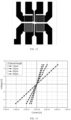
- the spontaneous orientation polarization for a separated organic semiconductor layer may be determined via impedance measurement of a separated organic electronic device (200), see Figure 5 .
- the measurement is conducted by determining the capacitance at varied bias voltage and a fixed frequency of 1kHz at 20 °C of a separated organic electronic device, also named "device”.
- the spontaneous orientation polarization of an organic semiconductor layer may be determined by performing the following steps:
- the layer arrangement of the four devices d1 to d4 can be seen in Figure 5 .
- the four devices d1 to d4 are prepared by performing the following steps:
- the first organic compound may be an organic compound, consisting of or consisting substantially of a covalently bound C, H, O, N, S, which may optionally comprise also covalently bound B, P or Si.
- the first organic compound may be an organic aromatic covalent bonded compound, which is free of metal atoms, and the majority of its skeletal atoms may be selected from C, O, S, N and preferably from C, O and N, wherein the majority of atoms are C-atoms.
- the first organic compound is free of metal atoms and majority of its skeletal atoms may be selected from C and N, preferably the first organic compound is free of metal atoms and majority of its skeletal atoms may be selected from C and the minority of its skeletal atoms may be N.
- the first organic compound of the hole injection layer may have a molecular weight Mw of ⁇ 400 and ⁇ 2000 g/mol, preferably a molecular weight Mw of ⁇ 450 and ⁇ 1500 g/mol, further preferred a molecular weight Mw of ⁇ 500 and ⁇ 1000 g/mol, in addition preferred a molecular weight Mw of ⁇ 550 and ⁇ 900 g/mol, also preferred a molecular weight Mw of ⁇ 600 and ⁇ 800 g/mol.
- the HOMO energy level of the first organic compound may be more negative than the HOMO energy level of N2,N2,N2',N2',N7,N7,N7',N7'-octakis(4-methoxyphenyl)-9,9'-spirobi[fluorene]-2,2',7,7'-tetraamine ( CAS 207739-72-8 ) when determined under the same conditions.
- the HOMO energy level of the first organic compound when calculated using TURBOMOLE V6.5 (TURBOMOLE GmbH, Litzenhardtstrasse 19, 76135 Düsseldorf, Germany) by applying the hybrid functional B3LYP with a 6-31G* basis set in the gas phase, may be more negative than -4.27 eV, preferably more negative than -4.3 eV, alternatively more negative than -4.5 eV, alternatively more negative than -4.6 eV, alternatively more negative than -4.65 eV.
- the HOMO energy level of the first organic compound may be more negative than the HOMO energy level of N2,N2,N2',N2',N7,N7,N7',N7'-octakis(4-methoxyphenyl)-9,9'-spirobi[fluorene]-2,2',7,7'-tetraamine ( CAS 207739-72-8 ) and more positive than the HOMO level of N-([1,1'-biphenyl]-2-yl)-N-(9,9-dimethyl-9H-fluoren-2-yl)-9,9'-spirobi[fluoren]-4-amine when determined under the same conditions.
- the HOMO energy level of the first organic compound when calculated using TURBOMOLE V6.5 (TURBOMOLE GmbH, Litzenhardtstrasse 19, 76135 Düsseldorf, Germany) by applying the hybrid functional B3LYP with a 6-31G* basis set in the gas phase, may be selected in the range of ⁇ -4.27 eV and ⁇ -4.95 eV, alternatively in the range of ⁇ -4.3 eV and ⁇ -4.95 eV, alternatively in the range of ⁇ -4.5 eV and ⁇ -4.95 eV, alternatively in the range of ⁇ -4.6 eV and ⁇ -4.95 eV, alternatively in the range of ⁇ -4.65 eV and ⁇ -4.95 eV; alternatively in the range of ⁇ -4.65 eV and ⁇ -4.93 eV.
- the LUMO energy level of the first organic compound of the hole injection layer is the range of ⁇ -1.5 eV to ⁇ -0.7 eV, preferably ⁇ -1.3 eV to ⁇ -0.8 eV, more preferably ⁇ -1.2 eV to ⁇ -0.85 eV.
- the dipole moment of the first organic compound of the hole injection layer is in the range of ⁇ 0.2 Debye and ⁇ 3 Debye, and preferably ⁇ 0.25 Debye and ⁇ 2.5 Debye.
- the dipole moment of the first organic compound of the hole injection layer when calculated using TURBOMOLE V6.5 (TURBOMOLE GmbH, Litzenhardtstrasse 19, 76135 Düsseldorf, Germany) by applying the hybrid functional B3LYP with a 6-31G* basis set in the gas phase, may be selected in the range of ⁇ 0.2 Debye and ⁇ 3 Debye, preferably ⁇ 0.25 Debye and ⁇ 2.5 Debye.
- the first organic compound of the hole injection layer is free of metals and/or ionic bonds.
- the first organic compound may be free of alkoxy groups.
- the first organic compound comprises at least one arylamine moiety, alternatively a diarylamine moiety, alternatively a triarylamine moiety.
- the first organic compound is free of TPD or NPB.
- the first organic compound is not a p-dopant compound.
- the first organic compound is selected from a compound of formula (Ia) or a compound of formula (Ib): wherein:
- the substituents of Ar 1 , Ar 2 , Ar 3 , Ar 4 and Ar 5 are selected the same or different from the group comprising H, straight-chain alkyl having 1 to 6 carbon atoms, branched alkyl having 1 to 6 carbon atoms, cyclic alkyl having 3 to 6 carbon atoms, alkenyl or alkynyl groups having 2 to 6 carbon atoms, C 6 to C 18 aryl, C 3 to C 18 heteroaryl, a fused ring system comprising 2 to 4 unsubstituted 5- to 7-member rings and the rings are selected from the group comprising unsaturated 5- to 7-member ring of a heterocycle, 5- to 6-member of an aromatic heterocycle, unsaturated 5- to 7-member ring of a non-heterocycle, and 6-member ring of an aromatic non-heterocycle; more preferred the substituents are selected the same or different from the group consisting of H, straight-chain alkyl having 1 to 4 carbon atoms, branched
- the compound of formula (Ia) or (Ib) may have a rate onset temperature suitable for mass production.
- the first organic compound is selected from a compound of formula (Ia) or formula (Ib): wherein
- the first organic compound is selected from a compound of formula (Ia) or formula (Ib): wherein
- the compound of formula (Ia) or (Ib) may have a rate onset temperature suitable for mass production.
- T 1 , T 2 , T 3 , T 4 and T 5 may be independently selected from a single bond, phenylene, biphenylene or terphenylene.
- T 1 , T 2 , T 3 , T 4 and T 5 may be independently selected from phenylene, biphenylene or terphenylene and one of T 1 , T 2 , T 3 , T 4 and T 5 are a single bond. According to an embodiment wherein T 1 , T 2 , T 3 , T 4 and T 5 may be independently selected from phenylene or biphenylene and one of T 1 , T 2 , T 3 , T 4 and T 5 are a single bond.
- T 1 , T 2 , T 3 , T 4 and T 5 may be independently selected from phenylene or biphenylene and two of T 1 , T 2 , T 3 , T 4 and T 5 are a single bond.
- T 1 , T 2 and T 3 may be independently selected from phenylene and one of T 1 , T 2 and T 3 are a single bond.
- T 1 , T 2 and T 3 may be independently selected from phenylene and two of T 1 , T 2 and T 3 are a single bond.
- T 6 may be phenylene, biphenylene, terphenylene. According to an embodiment wherein T 6 may be phenylene.
- T 6 may be biphenylene. According to an embodiment wherein T 6 may be terphenylene.
- Ar 1 , Ar 2 , Ar 3 , Ar 4 and Ar 5 may be independently selected from formulae (A1) to (A16): wherein the asterix "*" denotes the binding position.
- Ar 1 , Ar 2 , Ar 3 , Ar 4 and Ar 5 may be independently selected from (A1) to (A15); alternatively selected from (A1) to (A10) and (A13) to (A15).
- Ar 1 , Ar 2 , Ar 3 , Ar 4 and Ar 3 may be independently selected from the group consisting of (A1), (A2), (A5), (A7), (A9), (A10), (A13) to (A16).
- the rate onset temperature may be in a range particularly suited to mass production, when Ar 1 , Ar 2 , Ar 3 , Ar 4 and Ar 5 are selected in this range.
- first organic compound and “compound of formula (Ia) or formula (Ib) " may be also referred to as "hole transport compound”.
- the compound of formula (Ia) or formula (Ib) may comprises at least ⁇ 1 to ⁇ 6 substituted or unsubstituted aromatic fused ring systems comprising heteroaromatic rings.
- the compound of formula (Ia) or formula (Ib) may comprises at least ⁇ 1 to ⁇ 6 substituted or unsubstituted aromatic fused ring systems comprising heteroaromatic rings and at least ⁇ 1 to ⁇ 3 substituted or unsubstituted unsaturated 5- to 7-member ring of a heterocycle, preferably ⁇ 2 to ⁇ 5 substituted or unsubstituted aromatic fused ring systems comprising heteroaromatic rings.
- the compound of formula (Ia) or formula (Ib) may comprises at least ⁇ 1 to ⁇ 6 substituted or unsubstituted aromatic fused ring systems comprising heteroaromatic rings and at least ⁇ 1 to ⁇ 3 substituted or unsubstituted unsaturated 5- to 7-member ring of a heterocycle, preferably ⁇ 2 to ⁇ 5 substituted or unsubstituted aromatic fused ring systems comprising heteroaromatic rings, and at least ⁇ 1 to ⁇ 3 substituted or unsubstituted unsaturated 5- to 7-member ring of a heterocycle, further preferred 3 or 4 substituted or unsubstituted aromatic fused ring systems comprising heteroaromatic rings and optional at least ⁇ 1 to ⁇ 3 substituted or unsubstituted unsaturated 5- to 7-member ring of a heterocycle, and additional preferred wherein the aromatic fused ring systems comprising heteroaromatic rings are unsubstituted and optional at least ⁇ 1 to ⁇ 3 unsub
- the compound of formula (Ia) or formula (Ib) may comprises:
- aromatic fused ring system may include at least one aromatic ring and at least one substituted or unsubstituted unsaturated 5- to 7- member ring. It should be noted here that the substituted or unsubstituted unsaturated 5- to 7- member ring may not be an aromatic ring.
- the substantially first organic compound comprises at least one naphthyl group, carbazole group, dibenzofurane group, dibenzothiophene group and/or substituted fluorenyl group, wherein the substituents are independently selected from methyl, phenyl or fluorenyl.
- the first organic compound is a compound of formula (Ia).
- the HOMO energy level, LUMO energy level and dipole moment of the first organic compound may be in the particularly preferred range.
- the thermal properties of the first organic compound may be particularly suitable for mass production of organic electroluminescent devices via vacuum thermal evaporation.
- the first organic compound of the hole injection layer or compound of formula (Ia) is selected from formulae (F3) to (F23), more preferred from (F4) to (F23), most preferred from (F4), (F10), (F18), (F22) and (F23).
- the second organic compound consists or may consist substantially of covalently bound C, H, O, N, S, which optionally comprise in addition covalently bound B, P, As and/or Se.
- the second organic compound of the hole injection layer may comprises an azine group, preferably a triazine group, a pyrimidine group, a pyridine group, an acridine group, a dibenzoacridine group, a dibenzo[c,h]acridine group, a benzo[h]quinazoline group and/or a 3,8a-dihydroimidazo[1,5-a]pyridine group, more preferred a pyrimidine group, a pyridine group and/or an acridine group.
- an azine group preferably a triazine group, a pyrimidine group, a pyridine group, an acridine group, a dibenzoacridine group, a dibenzo[c,h]acridine group, a benzo[h]quinazoline group and/or a 3,8a-dihydroimidazo[1,5-a]pyridine group, more preferred a
- the at least one C 2 to C 24 N-heteroaryl may be selected from a compound comprising at least one azine group, preferably at least two azine groups, also preferred three azine groups.
- the second organic compound compound comprises at least one group selected from the list consisting of pyridine, pyrimidine, triazine, imidazole, benzimidazole, benzooxazole, quinoline, quinoxaline, benzoquinoxaline, acridine, phenanthroline, benzoacridine, dibenzoacridine, imidazopyridine.
- the second organic compound compound comprises at least 15 covalently bound atoms, preferably at least 20 covalently bound atoms, more preferably at least 25 covalently bound atoms, and most preferably at least 30 covalently bound atoms.
- the organic substantially covalent additive compound comprises at least 15 covalently bound atoms, preferably at least 20 covalently bound atoms, more preferably at least 25 covalently bound atoms, and most preferably at least 30 covalently bound atoms.
- the second organic compound compound may have a molecular weight Mw of ⁇ 400 and ⁇ 2000 g/mol, preferably a molecular weight Mw of ⁇ 450 and ⁇ 1500 g/mol, further preferred a molecular weight Mw of ⁇ 500 and ⁇ 1000 g/mol, further preferred a molecular weight Mw of ⁇ 550 and ⁇ 900 g/mol, in addition preferred a molecular weight Mw of ⁇ 580 and ⁇ 800 g/mol, also preferred a molecular weight Mw of ⁇ 600 and ⁇ 800 g/mol.
- the second organic of the hole injection layer comprises
- the second organic compound is a substantially covalent second organic compound.
- the second organic compound is free of a metal complex, metal cation and/or metal-organic compound.
- the second organic compound is not a metal complex or metal cation.
- the substantially covalent second organic compound is free of metals and/or ionic bonds.
- the second organic compound is free of triarylamine groups.
- an organic semiconductor layer comprising the second organic compound comprising ⁇ 7 and ⁇ 14 aromatic rings, if formed as a separated organic semiconductor layer, said separated organic semiconductor layer consisting of the second organic compound has a spontaneous orientation polarization in the range of ⁇ 0 mV/nm to ⁇ 150 mV/nm, preferably a spontaneous orientation polarization of ⁇ 5 mV/nm, more preferred ⁇ 10 mV/nm, most preferred ⁇ 15 mV/nm, or a spontaneous orientation polarization of ⁇ 8 mV/nm to ⁇ 100 mV/nm, preferably ⁇ 9 mV/nm and ⁇ 80 mV/nm, more preferred ⁇ 10 mV/nm to ⁇ 70 mV/nm.
- an organic semiconductor layer comprising the second organic compound has a spontaneous orientation polarization of ⁇ 5 mV/nm, preferably ⁇ 10 mV/nm, more preferably ⁇ 15 mV/nm.
- an organic semiconductor layer comprising the second organic compound has a spontaneous orientation polarization of ⁇ 8 mV/nm and ⁇ 100 mV/nm, preferably ⁇ 9 mV/nm and ⁇ 80 mV/nm, more preferred ⁇ 10 mV/nm and ⁇ 70 mV/nm.
- the HOMO energy level of the second organic compound of the hole injection layer is in the range of ⁇ -5 eV to ⁇ -6.3 eV, preferably ⁇ -5 eV to ⁇ -6.2 eV, and more preferably ⁇ -5 eV to ⁇ -6 eV.
- the HOMO energy level of the second organic compound is in the range of ⁇ -5 eV to ⁇ -6.3 eV, preferably ⁇ -5 eV to ⁇ -6.2 eV, more preferably ⁇ -5 eV to ⁇ -6 eV; wherein the HOMO energy level is calculated using the hybrid functional B3LYP with a Gaussian 6-31G* basis set as implemented in the program package TURBOMOLE V6.5; and the values are expressed in the absolute scale referring to vacuum energy level being zero.
- the LUMO energy level of the second organic compound of the hole injection layer is the range of ⁇ -3 eV to ⁇ -0.8 eV, preferably ⁇ -3 eV to ⁇ - 1 eV, more preferably ⁇ -2.5 eV to ⁇ -1 eV, and most preferably ⁇ -2 eV to ⁇ -1.5 eV.
- the second organic compound has a LUMO energy level in the range of ⁇ -3 eV to ⁇ -0.8 eV, preferably ⁇ -3 eV to ⁇ -1 eV, more preferably ⁇ -2.5 eV to ⁇ -1 eV, most preferably ⁇ -2 eV to ⁇ -1.5 eV; wherein the LUMO energy level is calculated using the hybrid functional B3LYP with a Gaussian 6-31G* basis set as implemented in the program package TURBOMOLE V6.5; and the values are expressed in the absolute scale referring to vacuum energy level being zero.
- the second organic compound of the hole injection layer comprises ⁇ 7 to ⁇ 14 aromatic rings
- Particularly improved performance may be obtained when the HOMO and/or LUMO energy level of the second organic compound is selected in this range.
- the dipole moment of the second organic compound of the hole injection layer is in the range of ⁇ 0.2 Debye and ⁇ 7 Debye, preferably ⁇ 0.3 Debye and ⁇ 6 Debye; more preferred ⁇ 0.5 Debye and ⁇ 5 Debye, and alternatively ⁇ 0.5 Debye and ⁇ 4.8 Debye.
- the dipole moment of the second organic compound when calculated using TURBOMOLE V6.5 (TURBOMOLE GmbH, Litzenhardtstrasse 19, 76135 Düsseldorf, Germany) by applying the hybrid functional B3LYP with a 6-31G* basis set in the gas phase, may be selected in the range of ⁇ 0.5 Debye and ⁇ 7 Debye, preferably ⁇ 0.5 Debye and ⁇ 6 Debye; more preferred ⁇ 0.5 Debye and ⁇ 5 Debye; alternatively ⁇ 0.5 Debye and ⁇ 4.8 Debye.
- the second organic compound of the hole injection layer is a compound of formula (II)
- n and m are 1.
- Ar 21 may be selected from phenyl, naphthyl, biphenyl, phenanthrenyl or formulae (C1) to (C58): wherein the asterix "*" denotes the binding position.
- Ar 21 is selected from (C2) to (C56), more preferred from (C2) to (C6) and (C14) to (C45) and (C47) to (C56).
- Ar 23 may be selected from formulae (D1) to (D43) wherein the asterix "*" denotes the binding position.
- a 23 is selected from formulae (D1) to (D40), more preferred (D1) to (D32).
- Ar 21 and Ar 23 are not selected the same; more preferred Ar 21 , Ar 22 and Ar 23 are not selected the same.
- Ar 21 is selected from phenyl, naphthyl, biphenyl, phenanthrenyl and formulae (C1) to (C58);
- Ar 22 is selected from a single bond, phenylene or naphthalene; and
- Ar 23 is selected from formulae (D1) to (D43); or
- Ar 21 is selected from (C2) to (C56), more preferred from (C2) to (C6) and (C14) to (C45) and (C47) to (C56);
- Ar 22 is selected from a single bond, phenylene or naphthalene; and
- a 23 is selected from formulae (D1) to (D40), more preferred (D1) to (D32); or Ar 21 and Ar 23 are not selected the same; or Ar 21 , Ar 22 and Ar 23 are not selected the same.
- the second organic compound and/or compound of formula (II) may be selected from formulae (E1) to (E13) preferably the second organic compound is selected from (E1) to (E9), also preferred from (E1) to (E6) or (E7) to (E9).
- the first organic p-dopant comprises at least ⁇ 4 CN groups or ⁇ 5 to ⁇ 8 CN groups.
- the HOMO energy level of the first organic p-dopant is selected in the range of ⁇ -8.5 eV to ⁇ -6.8 eV, preferably in the range of ⁇ -8.2 eV to ⁇ -7 eV.
- the first organic p-dopant comprises at least two groups independently of each other selected from C 6 to C 19 aryl group or C 3 to C 12 heteroaryl group, wherein each of the C 6 to C 19 aryl group or C 3 to C 12 heteroaryl group is substituted, wherein the one or more substituents are independently of each other selected from halogen, F, CN, partially perfluorinated C 1 to C 12 alkyl, perfluorinated C 1 to C 12 alkyl, CF 3 .
- the first organic p-dopant comprises independently of each other at least two groups selected from C 6 to C 19 aryl group, wherein each of the C 6 to C 19 aryl group is substituted, wherein the one or more substituents are independently of each other selected from halogen, F, CN, partially perfluorinated C 1 to C 12 alkyl, perfluorinated C 1 to C 12 alkyl, CF 3 .
- the first organic p-dopant is selected from a compound of formula (III): wherein
- the C 6 to C 40 aromatic group may be a group which is aromatic, or a group containing at least one aromatic moiety, i.e. an aromatic group may also contain a fused non-aromatic moiety.
- the moiety can contain different atoms.
- the C 2 to C 40 heteroaromatic group may be a group which is heteroaromatic, or a group containing at least one heteroaromatic moiety, i.e. a heteroaromatic group may also contain a fused non-aromatic moiety.
- the moiety can contain different atoms.
- n can be an integer selected from 0, 1, 2, 3, or 4.
- n can be an integer selected from 0, 1, or 2.
- m can be an integer selected from 1. X 1 , X 2 , and X 3
- X 1 , X 2 , and X 3 are independently selected from CR 1a R 2a , CR 1b R 2b , NR 3a , NR 3b ; wherein each X 3 can be selected the same or different.
- X 1 , X 2 , and X 3 are independently selected from CR 1a R 2a , CR 1b R 2b ; wherein each X 3 can be selected the same or different.
- a of formula (III) is selected from a group of G1 to G72: wherein the asteri sk "*" denotes the binding position;
- a of formula (III) is selected from a group of E1 to E27, E44 to E46, E49, E50, E66 to E72: wherein the asterisk "*" denotes the binding position;
- A may be preferably selected from a compound W1 to W22:
- A may be preferably selected from a compound of W1, W2, W3, W4, W7, W8, W10, W11, W13, W15, W18, W19, W20, W21 and/or W22.
- A may be preferably selected from a compound of W1, W2, W18, W19, W20, W21 and/or W22.
- A may be preferably selected from one of the following compounds W2, W18, W19 and/or W20.
- the first organic p-dopant is selected from a compound of formula (IV): wherein in formula (IV)
- electron-withdrawing group refers to a chemical group in a molecule, which can draw electrons away from an adjacent part of the molecule.
- the distance over which the electron-withdrawing group can exert its effect, namely the number of bonds over which the electron-withdrawing effect spans, is extended by conjugated pi-electron systems such as aromatic systems.
- electron-withdrawing groups include NO 2 , CN, halogen, Cl, F, partially fluorinated or perfluorinated alkyl and partially fluorinated or perfluorinated C1 to C12 alkyl, partially fluorinated or perfluorinated alkoxy, partially fluorinated or perfluorinated C1 to C6 alkoxy.
- the first organic p-dopant is a quinoid-like compound when it is reduced, i.e. when oxidation level of said compounds is lowered by one, two, three or four electrons, results in an at least partial aromatization of said first organic p-dopant or of said first organic p-dopant, preferably the quinoid-like compound comprises at least two groups selected from C 6 to C 19 aryl group or C 3 to C 12 heteroaryl group, wherein each of the C 6 to C 19 aryl group or C 3 to C 12 heteroaryl group is substituted, wherein the one or more substituents are independently of each other selected from halogen, F, CN, partially perfluorinated C 1 to C 12 alkyl, perfluorinated C 1 to C 12 alkyl, CF 3 .
- the first organic p-dopant is a quinoid-like compound
- the term "quinoid-like compound” means and/includes a compound which contains a moiety which is (formally) derived from a compound comprising an annelated aromatic system or non-annelated aromatic system whereby one or more carbon atoms of said annelated aromatic system or non-annelated aromatic system are double bonded to an atom or a group outside said annelated aromatic system or non-annelated aromatic system with any necessary rearrangement of double bonds
- the quinoid-like compound comprises at least two groups selected from C 6 to C 19 aryl group or C 3 to C 12 heteroaryl group, wherein each of the C 6 to C 19 aryl group or C 3 to C 12 heteroaryl group is substituted, wherein the one or more substituents are independently of each other selected from halogen, F, CN, partially perfluorinated C 1 to C 12 alkyl, perfluorinated C 1 to C
- the first organic p-dopant is a quinoid-like compound
- the term "quinoid-like compound” means and/includes a compound which contains a moiety which is (formally) derived from a compound comprising an annelated aromatic system or non-annelated aromatic system whereby one or more carbon atoms of said annelated aromatic system or non-annelated aromatic system are double bonded to an atom or a group outside said annelated aromatic system or non-annelated aromatic system with any necessary rearrangement of double bonds and resulting in at least a partial lift of aromaticity in the annelated aromatic system or non-annelated aromatic system;
- the quinoid-like compound comprises at least two groups selected from C 6 to C 19 aryl group or C 3 to C 12 heteroaryl group, wherein each of the C 6 to C 19 aryl group or C 3 to C 12 heteroaryl group is substituted, wherein the one or more substituents are independently of each other selected from halogen
- the first organic p-dopant is a quinoid compound
- the first organic p-dopant has a quinoid structure.
- the first organic p-dopant is a quinoid compound and represented by formula (V), whereby the term "quinoid compound” means and/includes a compound which contains a moiety which is (formally) derived from a compound comprising an annelated aromatic system or non-annelated aromatic system whereby an even number of carbon atoms of said annelated aromatic system or non-annelated aromatic system are double bonded to an atom or a group outside said annelated aromatic system or non-annelated aromatic system with any necessary rearrangement of double bonds and resulting in at least a partial lift of aromaticity in the annelated aromatic system or non-annelated aromatic system
- the quinoid compound comprises at least two groups selected from C 6 to C 19 aryl group or C 3 to C 12 heteroaryl group, wherein each of the C 6 to C 19 aryl group or C 3 to C 12 heteroaryl group is substituted, wherein the one or more substituents are independently of each other selected from hal
- the first organic p-dopant is selected from a compound comprising a quinoid structure, an indacenedione structure or a compound of formula (V):
- the C 6 to C 40 aromatic group may be a group which is aromatic, or a group containing at least one aromatic moiety, i.e. an aromatic group may also contain a fused non-aromatic moiety.
- the moiety can contain different atoms.
- the C 2 to C 40 heteroaromatic group may be a group which is heteroaromatic, or a group containing at least one heteroaromatic moiety, i.e. a heteroaromatic group may also contain a fused non-aromatic moiety.
- the moiety can contain different atoms.
- the first organic p-dopant is a compound of formula (V) wherein
- the compound of formula (V) comprises at least two groups selected from C 6 to C 19 aryl group or C 3 to C 12 heteroaryl group, wherein each of the C 6 to C 19 aryl group or C 3 to C 12 heteroaryl group is substituted, wherein the one or more substituents are independently of each other selected from halogen, F, CN, partially perfluorinated C 1 to C 12 alkyl, perfluorinated C 1 to C 12 alkyl, CF 3 .
- the first organic p-dopant is an indacenedione-type compound whereby the term "indacendione-type compound” means and/includes a compound which contains a moiety which is (formally) derived from a compound comprising an annelated aromatic system or non-annelated aromatic system whereby one or more carbon atoms of said annelated aromatic system or non-annelated aromatic system are double bonded to an atom or a group outside said annelated aromatic system or non-annelated aromatic system without a rearrangement of double bonds, preferably the indacenedione-type compound comprises at least two groups selected from C 6 to C 19 aryl group or C 3 to C 12 heteroaryl group, wherein each of the C 6 to C 19 aryl group or C 3 to C 12 heteroaryl group is substituted, wherein the one or more substituents are independently of each other selected from halogen, F, CN, partially perfluorinated C 1 to C 12 alkyl
- the first organic p-dopant is an indacenedione-type compound whereby the term "indacendione-type compound” means and/includes indacenedione or a compound which contains a moiety which is (formally) derived indacenedione whereby at least one of the two oxygens are replaced by other atoms preferably carbon atoms, without a rearrangement of double bonds preferably the indacenedione-type compound comprises at least two groups selected from C 6 to C 19 aryl group or C 3 to C 12 heteroaryl group, wherein each of the C 6 to C 19 aryl group or C 3 to C 12 heteroaryl group is substituted, wherein the one or more substituents are independently of each other selected from halogen, F, CN, partially perfluorinated C 1 to C 12 alkyl, perfluorinated C 1 to C 12 alkyl, CF 3 .
- the first organic p-dopant is selected from a compound of comprising a indacenedione structure, a radialene compound of formula (IV), or a compound of formula (VIa) or (VIb): wherein
- the first organic p-dopant is selected from a compound of formula (VIa) or (VIb): wherein
- the one or more substituents of the aryl, heteroaryl, alkyl, alkoxy, and ether group when present, are independently of each other selected from C 1 to C 12 alkyl, C 1 to C 12 alkoxy, a C 1 to C 15 heteroalkyl with 1 to 4 heteroatoms one among O, N, O, S, and Si, CN, halogen Cl, F, CF 3 , OCF 3 , Si(CH 3 ) 3 .
- the first organic p-dopant preferably the compound of formula (IV), (V), (VIa) or (VIb), may be selected from a compound H1 to H10:
- the first organic p-dopant is selected from a compound of K1 to K26:
- the first organic p-dopant is selected from K1 to K15. According to one embodiment, wherein the first organic p-dopant is selected from K10 to K16. According to one embodiment, wherein the first organic p-dopant is selected from K17 to K26.
- the first organic p-dopant is free of HAT-CN, F4-TCNQ and/or F6-TCNNQ.
- the hole injection layer comprises a composition comprising
- the composition of the hole injection layer consists of:
- the LUMO energy level :
- the composition may comprise ⁇ 90 wt.-% first organic compound, ⁇ 5 wt.-% second organic compound, and ⁇ 1 wt.-% first organic p-dopant, preferably ⁇ 85 wt.-% first organic compound, ⁇ 10 wt.-% second organic compound, and ⁇ 1 wt.-% first organic p-dopant; more preferred ⁇ 88 wt.-% first organic compound, ⁇ 10 wt.-% second organic compound, and ⁇ 2 wt.-% first organic p-dopant.
- the composition may comprise ⁇ 55 and ⁇ 90 wt.-% first organic compound, ⁇ 10 and ⁇ 35 wt.-% second organic compound and ⁇ 1 and ⁇ 10 wt.-% first organic p-dopant, preferably ⁇ 60 and ⁇ 90 wt.-% first organic compound, ⁇ 10 and ⁇ 30 wt.-% second organic compound and ⁇ 1 and ⁇ 10 wt.-% first organic p-dopant.
- composition may comprise:
- ⁇ [LUMO energy level of the first organic compound - LUMO energy level of the second organic compound] also named “ ⁇ [LUMO (first organic compound) - LUMO (second organic compound)]
- ⁇ [LUMO (first organic compound) - LUMO (second organic compound)] refers to the difference ⁇ between the LUMO energy level of the second organic compound and the LUMO energy level of the first organic compound.
- the difference " ⁇ [LUMO energy level of the first organic compound - LUMO energy level of the second organic compound]” is calculated by subtracting the LUMO energy level of the second organic compound from the LUMO energy level of the first organic compound.
- the ⁇ [LUMO energy level of the first organic compound - LUMO energy level of the second organic compound] is > 0.2 eV and ⁇ 2.5 eV, preferably > 0.3 eV and ⁇ 1.5 eV, more preferred > 0.4 eV and ⁇ 1.3 eV.
- the ⁇ [LUMO energy level of the first organic compound - LUMO energy level of the second organic compound] is > 0.3 eV and ⁇ 1.5 eV, preferably > 0.4 eV and ⁇ 1.4 eV.
- the ⁇ [LUMO energy level of the first organic compound - LUMO energy level of the second organic compound] is > 0.2 eV and ⁇ 2.5 eV, preferably > 0.3 eV and ⁇ 1.5 eV, more preferred > 0.4 eV and ⁇ 1.3 eV; wherein the LUMO energy level is calculated using the hybrid functional B3LYP with a Gaussian 6-31G* basis set as implemented in the program package TURBOMOLE V6.5.
- the ⁇ [LUMO energy level of the first organic compound - LUMO energy level of the second organic compound] is > 0.3 eV and ⁇ 1.5 eV, preferably > 0.4 eV and ⁇ 1.4 eV; wherein the LUMO energy level is calculated using the hybrid functional B3LYP with a Gaussian 6-31G* basis set as implemented in the program package TURBOMOLE V6.5.
- the LUMO energy level of the first organic compound and the LUMO of the second organic compound are selected in this range, particularly improved performance may be obtained.
- ⁇ [HOMO energy level of the first organic compound - LUMO energy level of the first organic p-dopant] also named “ ⁇ [HOMO (first organic compound) - LUMO (first organic p-dopant)]
- ⁇ [HOMO (first organic compound) - LUMO (first organic p-dopant)] refers to the difference ⁇ between the LUMO energy level of the first organic p-dopant and the HOMO energy level of the first organic compound.
- the difference ⁇ [HOMO energy level of the first organic compound - LUMO energy level of the first organic p-dopant] is calculated by subtracting the LUMO energy level of the first organic p-dopant from the HOMO energy level of the first organic compound.
- the difference ⁇ [HOMO energy level of the first organic compound - LUMO energy level of the first organic p-dopant] is ⁇ 0.05 eV, preferably ⁇ [HOMO energy level of the first organic compound - LUMO energy level of the first organic p-dopant] ⁇ 0.1 eV, wherein the HOMO and LUMO energy levels are calculated using the hybrid functional B3LYP with a Gaussian 6-31G* basis set as implemented in the program package TURBOMOLE V6.5.
- the difference ⁇ [HOMO energy level of the first organic compound - LUMO energy level of the first organic p-dopant] is > 0 eV and ⁇ 2 eV, preferably ⁇ [HOMO energy level of the first organic compound - LUMO energy level of the first organic p-dopant] ⁇ 0.05 eV and ⁇ 1.5 eV, more preferred ⁇ [HOMO energy level of the first organic compound - LUMO energy level of the first organic p-dopant] is ⁇ 0.1 eV and ⁇ 1 eV, wherein the HOMO and LUMO energy levels are calculated using the hybrid functional B3LYP with a Gaussian 6-31G* basis set as implemented in the program package TURBOMOLE V6.5.
- particularly efficient p-doping of the first organic compound may be achieved.
- the ⁇ [LUMO energy level of the first organic compound - LUMO energy level of the second organic compound] is > 0.2 eV and ⁇ 3 eV and the ⁇ [HOMO energy level of the first organic compound - LUMO energy level of the first organic p-dopant] > 0 eV and ⁇ 2 eV, preferably the ⁇ [LUMO energy level of the first organic compound - LUMO energy level of the second organic compound] is > 0.3 eV and ⁇ 1.4 eV and the ⁇ [HOMO energy level of the first organic compound - LUMO energy level of the first organic p-dopant] ⁇ 0.05 eV and ⁇ 1.5 eV, more preferred the ⁇ [LUMO energy level of the first organic compound - LUMO energy level of the second organic compound] is > 0.4 eV and ⁇ 1.3 eV and the ⁇ [HOMO energy level of the first organic compound - LUMO energy level of the first organic p-d
- the composition comprises a first organic compound, a second organic compound and a first organic p-dopant, wherein the first organic compound and/or the second organic compound are free of CN groups or partially or perfluorinated alkyl groups.
- the composition of the hole injection layer may comprise ⁇ 90 wt.-% first organic compound, > 5 wt.-% second organic compound, and ⁇ 1 wt.-% first organic p-dopant, preferably ⁇ 85 wt.-% first organic compound, ⁇ 10 wt.-% second organic compound, and ⁇ 1 wt.-% first organic p-dopant; more preferred ⁇ 88 wt.-% first organic compound, ⁇ 10 wt.-% second organic compound, and ⁇ 2 wt.-% first organic p-dopant.
- the composition of the hole injection layer may comprise ⁇ 55 to ⁇ 90 wt.-% first organic compound, > 10 to ⁇ 35 wt.-% second organic compound and ⁇ 1 to ⁇ 10 wt.-% first organic p-dopant, preferably ⁇ 60 to ⁇ 90 wt.-% first organic compound, > 10 to ⁇ 30 wt.-% second organic compound and ⁇ 1 to ⁇ 10 wt.-% first organic p-dopant.
- the thickness of the HIL may be in the range from about 1 nm to about 100 nm, and for example, from about 1 nm to about 25 nm. When the thickness of the HIL is within this range, the HIL may have excellent hole injecting characteristics, without a substantial penalty in driving voltage.
- the hole injection layer is formed on the anode electrode by vacuum deposition.
- the deposition conditions may vary according to the compound that is used to form the HIL, and the desired structure and thermal properties of the HIL. In general, however, conditions for vacuum deposition may include a deposition temperature of 100° C to 500° C, a pressure of 10 -8 to 10 -3 Torr (1 Torr equals 133.322 Pa), and a deposition rate of 0.1 to 10 nm/sec.
- the hole injection layer is preferably "essentially non-emissive" and more preferred “non-emissive”.
- the term "essentially non-emissive" or “non-emissive” means that the contribution of the compound or layer to the visible emission spectrum from the device is less than 10 %, preferably less than 5 % relative to the visible emission spectrum.
- the visible emission spectrum is an emission spectrum with a wavelength of about ⁇ 380 nm to about ⁇ 780 nm.
- the organic electroluminescent device may comprise, besides the layers already mentioned above, further layers. Exemplary embodiments of respective layers are described in the following:
- the substrate may be any substrate that is commonly used in manufacturing of, electronic devices, such as organic light-emitting diodes. If light is to be emitted through the substrate, the substrate shall be a transparent or semitransparent material, for example a glass substrate or a transparent plastic substrate. If light is to be emitted through the top surface, the substrate may be both a transparent as well as a non-transparent material, for example a glass substrate, a plastic substrate, a metal substrate or a silicon substrate.
- the anode layer also named anode electrode, may be formed by depositing or sputtering a material that is used to form the anode layer.
- the material used to form the anode layer may be a high work-function material, so as to facilitate hole injection.
- the anode layer may be a transparent or reflective electrode.
- Transparent conductive oxides such as indium tin oxide (ITO), indium zinc oxide (IZO), tin-dioxide (SnO2), aluminum zinc oxide (AlZO) and zinc oxide (ZnO), may be used to form the anode layer.
- the anode layer may also be formed using metals, typically silver (Ag), gold (Au), or metal alloys.
- the anode layer may comprise two or more anode sub-layers.
- the anode layer comprises a first anode sub-layer and a second anode sub-layer, wherein the first anode sub-layer is arranged closer to the substrate and the second anode sub-layer is arranged closer to the cathode layer.
- the anode layer may comprise a first anode sub-layer comprising or consisting of Ag or Au and a second anode-sub-layer comprising or consisting of transparent conductive oxide.
- the anode layer comprises a first anode sub-layer, a second anode sub-layer and a third anode sub-layer, wherein the first anode sub-layer is arranged closer to the substrate and the second anode sub-layer is arranged closer to the cathode layer, and the third anode sub-layer is arranged between the substrate and the first anode sub-layer.
- the anode layer may comprise a first anode sub-layer comprising or consisting of Ag or Au, a second anode-sub-layer comprising or consisting of transparent conductive oxide and optionally a third anode sub-layer comprising or consisting of transparent conductive oxide.
- the first anode sub-layer may comprise or consists of Ag
- the second anode-sublayer may comprise or consists of ITO or IZO
- the third anode sub-layer may comprises or consists of ITO or IZO.
- the first anode sub-layer may comprise or consists of Ag
- the second anode-sublayer may comprise or consists of ITO
- the third anode sub-layer may comprise or consist of ITO.
- the transparent conductive oxide in the second and third anode sub-layer may be selected the same.
- the anode layer may comprise a first anode sub-layer comprising Ag or Au having a thickness of 100 to 150 nm, a second anode sub-layer comprising or consisting of a transparent conductive oxide having a thickness of 3 to 20 nm and a third anode sub-layer comprising or consisting of a transparent conductive oxide having a thickness of 3 to 20 nm.
- the third anode layer is not part of the substrate.
- the organic electroluminescent device further comprises a hole transport layer, wherein the hole transport layer is arranged between the hole injection layer and the at least one first emission layer.
- the hole transport layer (HTL) may be formed on the HIL by vacuum deposition, spin coating, slot-die coating, printing, casting, Langmuir-Blodgett (LB) deposition, or the like.
- LB Langmuir-Blodgett
- the conditions for deposition and coating may be similar to those for the formation of the HIL.
- the conditions for the vacuum or solution deposition may vary, according to the compound that is used to form the HTL.
- the HTL may be formed of any compound that is commonly used to form a HTL.
- Compounds that can be suitably used are disclosed for example in Yasuhiko Shirota and Hiroshi Kageyama, Chem. Rev. 2007, 107, 953-1010 and incorporated by reference.
- the hole transport layer may comprise a first organic compound as described above.
- the hole transport layer may comprise a compound of formula (Ia) or (Ib) as described above.
- the hole injection layer and the hole transport layer comprises the same first organic compound as described above.
- the hole injection layer and the hole transport layer comprise the same compound of formula (Ia) or (Ib) as described above.
- the thickness of the HTL may be in the range of about 5 nm to about 250 nm, preferably, about 10 nm to about 200 nm, further about 20 nm to about 190 nm, further about 40 nm to about 180 nm, further about 60 nm to about 170 nm, further about 80 nm to about 160 nm, further about 100 nm to about 160 nm, further about 120 nm to about 140 nm.
- a preferred thickness of the HTL may be 170 nm to 200 nm.
- the HTL may have excellent hole transporting characteristics, without a substantial penalty in driving voltage.
- the organic electroluminescent device further comprises a hole transport layer, wherein the hole transport layer is arranged between the hole injection layer and the at least one emission layer.
- the hole transport layer comprises a compound of formula (Ia) or (Ib), wherein more preferably the compound of formula (Ia) or (Ib) in the hole injection layer and hole transport layer is selected the same.
- an electron blocking layer is to prevent electrons from being transferred from an emission layer to the hole transport layer and thereby confine electrons to the emission layer. Thereby, efficiency, operating voltage and/or lifetime are improved.
- the electron blocking layer comprises a triarylamine compound.
- the triarylamine compound may have a LUMO level closer to vacuum level than the LUMO level of the hole transport layer.
- the electron blocking layer may have a HOMO level that is further away from vacuum level compared to the HOMO level of the hole transport layer.
- the thickness of the electron blocking layer may be selected between 2 and 20 nm.
- the electron blocking layer has a high triplet level, it may also be described as triplet control layer.
- the function of the triplet control layer is to reduce quenching of triplets if a phosphorescent green or blue emission layer is used. Thereby, higher efficiency of light emission from a phosphorescent emission layer can be achieved.
- the triplet control layer is selected from triarylamine compounds with a triplet level above the triplet level of the phosphorescent emitter in the adjacent emission layer. Suitable compounds for the triplet control layer, in particular the triarylamine compounds, are described in EP 2 722 908 A1 .
- Emission layer Emission layer
- the emission layer also named first emission layer
- the emission layer may be formed on the HTL by vacuum deposition, spin coating, slot-die coat-ing, printing, casting, LB deposition, or the like.
- the conditions for deposition and coating may be similar to those for the formation of the HIL. However, the conditions for deposition and coating may vary, according to the compound that is used to form the EML.
- the first emission layer comprises an organic emitter host compound and a light-emitting compound.
- the first emission layer comprises an organic emitter host compound and a light-emitting compound.
- the light-emitting compound may also be named emitter dopant.
- the first emission layer does not comprise the first organic compound and/or second organic compound.
- the first emission layer does not comprise the compound of formula (Ia), (Ib) or (II).
- the first emission layer may be formed of a combination of a host and an emitter dopant.
- Example of the host are Alq3, 4,4'-N,N'-dicarbazole-biphenyl (CBP), poly(n-vinylcarbazole) (PVK), 9,10-di(naphthalene-2-yl)anthracene (ADN), 4,4',4"-tris(carbazol-9-yl)-triphenylamine(TCTA), 1,3,5-tris(N-phenylbenzimidazole-2-yl)benzene (TPBI), 3-tert-butyl-9,10-di-2-naphthylanthracenee (TBADN), distyrylarylene (DSA) and bis(2-(2-hydroxyphenyl)benzo-thiazolate)zinc (Zn(BTZ)2).
- CBP 4,4'-N,N'-dicarbazole-biphenyl
- PVK poly(n
- the emitter dopant may be a phosphorescent or fluorescent emitter. Phosphorescent emitters and emitters which emit light via a thermally activated delayed fluorescence (TADF) mechanism may be preferred due to their higher efficiency.
- the emitter may be a small molecule or a polymer.
- red emitter dopants examples include PtOEP, Ir(piq)3, and Btp2lr(acac), but are not limited thereto. These compounds are phosphorescent emitters, however, fluorescent red emitter dopants could also be used.
- Examples of phosphorescent blue emitter dopants are F2Irpic, (F2ppy)2Ir(tmd) and Ir(dfppz)3 and ter-fluorene.
- phosphorescent blue emitter dopants are F2Irpic, (F2ppy)2Ir(tmd) and Ir(dfppz)3 and ter-fluorene.
- 4.4'-bis(4-diphenyl amiostyryl)biphenyl (DPAVBi), 2,5,8,11-tetra-tert-butyl perylene (TBPe) are examples of fluorescent blue emitter dopants.
- the amount of the emitter dopant may be in the range from about 0.01 to about 50 parts by weight, based on 100 parts by weight of the host.
- the first emission layer may consist of a light-emitting polymer.
- the EML may have a thickness of about 10 nm to about 100 nm, for example, from about 20 nm to about 60 nm. When the thickness of the EML is within this range, the EML may have excellent light emission, without a substantial penalty in driving voltage.
- the first emission layer comprises a light-emitting compound of formula (X): wherein
- the first emission layer comprises a light-emitting compound of formula (X), which is selected from formulae (BD 1) to (BD9):
- the first emission layer comprises an organic emitter host compound, wherein the organic emitter host compound comprises
- the organic emitter host compound has the formula (XI) wherein
- the organic emitter host and/or compound of formula (XI) is selected from formulae (BH1) to (BH13):
- the first emission layer comprises a light-emitting dopant of formula (X) and an organic emitter host of formula (XI).
- the hole injection layer comprises a compound of formula (Ia) and/or formula (Ib), a compound of formula (II) and a compound of formula (III)
- the hole transport layer comprises a compound of formula (Ia) and/or formula (Ib), preferably the hole injection layer and the hole transport layer comprise the same compound of formula (Ia) and/or formula (Ib)
- the first emission layer comprises a light-emitting dopant of formula (X) and an organic emitter host of formula (XI); wherein the hole transport layer is arranged between the hole injection layer and the first emission layer, and the first emission layer is arranged between the hole transport layer and the cathode layer.
- the hole injection layer comprises a compound of formula (Ia) and/or formula (Ib), a compound of formula (II) and a compound of formula (III)
- the hole transport layer comprises a compound of formula (Ia) and/or formula (Ib), preferably the hole injection layer and the hole transport layer comprise the same compound of formula (Ia) and/or formula (Ib)
- the first emission layer comprises a light-emitting dopant of formula (X) and an organic emitter host of formula (XI);
- the organic electroluminescent device further comprises a second emission layer, wherein the composition of the second emission layer may be selected the same or differently from the first emission layer, preferably, the composition of the second emission layer is selected the same as the first emission layer.
- HBL Hole blocking layer
- a hole blocking layer may be formed on the EML, by using vacuum deposition, spin coating, slot-die coating, printing, casting, LB deposition, or the like, in order to prevent the diffusion of holes into the ETL.
- the HBL may have also a triplet exciton blocking function.
- the HBL may also be named auxiliary ETL or a-ETL.
- the conditions for deposition and coating may be similar to those for the formation of the HIL. However, the conditions for deposition and coating may vary, according to the compound that is used to form the HBL. Any compound that is commonly used to form a HBL may be used. Examples of compounds for forming the HBL include oxadiazole derivatives, triazole derivatives, phenanthroline derivatives and azine derivatives, preferably triazine or pyrimidine derivatives.
- the HBL may have a thickness in the range from about 5 nm to about 100 nm, for example, from about 10 nm to about 30 nm. When the thickness of the HBL is within this range, the HBL may have excellent hole-blocking properties, without a substantial penalty in driving voltage.
- the hole blocking layer is free of second organic compound and/or compound of formula (II).
- Electron transport layer ETL
- the organic electroluminescent device according to the present invention may further comprise an electron transport layer (ETL).
- ETL electron transport layer
- the electron transport layer may further comprise an azine compound, preferably a triazine compound.
- the electron transport layer may further comprise a dopant selected from an alkali organic complex, preferably LiQ.
- the thickness of the ETL may be in the range from about 15 nm to about 50 nm, for example, in the range from about 20 nm to about 40 nm. When the thickness of the EII, is within this range, the ETL may have satisfactory electron-injecting properties, without a substantial penalty in driving voltage.
- the organic electroluminescent device may further comprise an electron transport layer, wherein the electron transport layer comprises a second organic compound and or compound of formula (II).
- the organic electroluminescent device may further comprise an electron transport layer, wherein the electron transport layer and the hole injection layer comprise the same second organic compound and or compound of formula (II).
- the organic electroluminescent device may further comprise a hole blocking layer and an electron transport layer, wherein the hole blocking layer and the electron transport layer comprise an azine compound.
- the azine compound is a triazine compound.
- the organic electroluminescent device may further comprise a hole blocking layer and an electron transport layer, wherein the electron transport layer and the hole injection layer comprise the same second organic compound and or compound of formula (II).
- Electron injection layer (EIL)
- An optional EIL which may facilitates injection of electrons from the cathode, may be formed on the ETL, preferably directly on the electron transport layer.
- materials for forming the EII include lithium 8-hydroxyquinolinolate (LiQ), LiF, NaCl, CsF, Li2O, BaO, Ca, Ba, Yb, Mg which are known in the art.
- Deposition and coating conditions for forming the EII are similar to those for formation of the HIL, although the deposition and coating conditions may vary, according to the material that is used to form the EIL.
- the thickness of the EIL may be in the range from about 0.1 nm to about 10 nm, for example, in the range from about 0.5 nm to about 9 nm. When the thickness of the EII, is within this range, the EII, may have satisfactory electron-injecting properties, without a substantial penalty in driving voltage.
- the cathode layer is formed on the ETL or optional EIL.
- the cathode layer may be formed of a metal, an alloy, an electrically conductive compound, or a mixture thereof.
- the cathode layer may have a low work function.
- the cathode layer may be formed of lithium (Li), magnesium (Mg), aluminum (Al), aluminum (Al)-lithium (Li), calcium (Ca), barium (Ba), ytterbium (Yb), magnesium (Mg)-indium (In), magnesium (Mg)-silver (Ag), or the like.
- the cathode layer may be formed of a transparent conductive oxide, such as ITO or IZO.
- the thickness of the cathode layer may be in the range from about 5 nm to about 1000 nm, for example, in the range from about 10 nm to about 100 nm.
- the cathode layer may be transparent or semitransparent even if formed from a metal or metal alloy.
- the cathode is transparent.
- the cathode layer is not part of an electron injection layer or the electron transport layer.
- the organic electroluminscent device according to the invention may be an organic light-emitting device, also named organic light-emitting diode (OLED).
- OLED organic light-emitting diode
- an organic electroluminescent device comprising: a substrate; an anode layer formed on the substrate; a hole injection layer comprising a composition comprising a first organic compound, a second organic compound and a first p-dopant, a hole transport layer, an emission layer, an electron transport layer and a cathode layer.
- an organic electroluminescent device comprising: a substrate; an anode layer formed on the substrate; a hole injection layer comprising a composition comprising a first organic compound, a second organic compound and a first organic p-dopant, a hole transport layer, an electron blocking layer, an emission layer, a hole blocking layer, an electron transport layer and a cathode layer.
- an organic electroluminescent device comprising: a substrate; an anode layer formed on the substrate; a hole injection layer comprising a composition comprising a first organic compound, a second organic compound and a first organic p-dopant, a hole transport layer, an electron blocking layer, an emission layer, a hole blocking layer, an electron transport layer, an electron injection layer, and a cathode layer.
- the present invention furthermore relates to a display device comprising an organic electroluminscent device according to the present invention.
- the organic electroluminescent device is arranged on a substrate.
- the display device may comprise several organic electroluminescent devices, wherein the the organic electroluminescent devices are arranged on the substrate.
- the organic electroluminescent devices may also be described as pixels.
- the present invention furthermore relates to a display device comprising a substrate and several organic electroluminescent devices according to the present invention, wherein the organic electroluminescent devices are formed on the substrate as adjacent pixels, wherein the hole injection layer is formed as a common hole injection layer on the adjacent pixels.
- the methods for deposition that can be suitable comprise:
- the method may further include forming on the anode layer, at least one layer selected from the group consisting of forming a hole injection layer, a hole transport layer, an electron blocking layer, a first emission layer, a hole blocking layer, an electron transport layer and an electron injection layer between the anode layer and the cathode layer.
- the method may further include the steps for forming an organic electroluminescent device, wherein
- the organic electroluminescent device may have the following layer structure, wherein the layers having the following order: Anode layer, hole injection layer comprising a composition comprising a first organic compound, a second organic compound and first organic dopant, a hole transport layer, optionally an electron blocking layer, a first emission layer, optionally a hole blocking layer, an electron transport layer, optionally an electron injection layer, and cathode layer.
- the present invention furthermore relates to a method of preparing an organic electroluminescent device according to the present invention, wherein the method involves a step of depositing the hole injection layer on the anode layer in vacuum, preferably the first organic compound is deposited from a first vacuum thermal evaporation source, the second organic compound is deposited from a second vacuum thermal evaporation source and the first organic p-dopant is deposited from a third vacuum thermal evaporation source.
- the present invention furthermore relates to a method of preparing a display according to the present invention, wherein the method involves a step of depositing the hole injection layer on the anode layer in vacuum, preferably the first organic compound is deposited from a first vacuum thermal evaporation source, the second organic compound is deposited from a second vacuum thermal evaporation source and the first organic p-dopant is deposited from a third vacuum thermal evaporation source.
- the present invention further more relates to a method of preparing a display device comprising a substrate and several organic electroluminescent devices according to the present invention, wherein the organic electroluminescent devices are formed in vaccum on the substrate as adjacent pixels, wherein the hole injection layer is formed in vacuum as a common hole injection layer on the adjacent pixels, preferably the first organic compound is deposited from a first vacuum thermal evaporation source, the second organic compound is deposited from a second vacuum thermal evaporation source and the first organic p-dopant is deposited from a third vacuum thermal evaporation source.
- first element when a first element is referred to as being formed or disposed “on” or “onto” a second element, the first element can be disposed directly on the second element, or one or more other elements may be disposed there between.
- first element when referred to as being formed or disposed “directly on” or “directly onto” a second element, no other elements are disposed there between.
- FIG. 1 is a schematic sectional view of an organic electroluminescent device (OLED) 100, according to an exemplary embodiment of the present invention.
- the organic electroluminescent device 100 includes a substrate (110), an anode layer (120) and a hole injection layer (HIL) (130) which may comprise the composition comprising a first organic compound, a second organic compound and a first organic p-dopant.
- the HIL (130) is disposed on the anode layer (120).
- EML emission layer
- cathode layer 190
- FIG. 2 is a schematic sectional view of an organic electroluminescent device (OLED) 100, according to an exemplary embodiment of the present invention.
- the organic electroluminescent device 100 includes a substrate (110), an anode layer (120) and a hole injection layer (HIL) 130 which may comprise the composition comprising a first organic compound, a second organic compound and a first organic p-dopant.
- the HIL (130) is disposed on the anode layer (120).
- a hole transport layer (HTL) (140), a first emission layer (EML) (150), an electron transport layer (ETL) (160), an electron injection layer (EIL) (180) and a cathode layer (190) are disposed.
- EML electron transport layer stack
- ETL electron transport layer stack
- FIG. 3 is a schematic sectional view of an organic electroluminescent device (OLED) 100, according to an exemplary embodiment of the present invention.
- the organic electroluminescent device 100 includes a substrate (110), an anode layer (120) that comprises a first anode sub-layer (121) and a second anode sub-layer (122), a hole injection layer (HIL) (130) which may comprise the composition comprising a first organic compound, a second organic compound and a first organic p-dopant, a hole transport layer (HTL) (140), an electron blocking layer (EBL) (145), a first emission layer (EML) (150), a hole blocking layer (EBL) (155), an electron transport layer (ETL) (160) and a cathode layer (190).
- the layers are disposed exactly in the order as mentioned before.
- FIG. 4 is a schematic sectional view of an organic electroluminescent device (OLED) 100, according to an exemplary embodiment of the present invention.
- the organic electroluminescent device 100 includes a substrate (110), an anode layer (120) that comprises a first anode sub-layer (121), a second anode sub-layer (122) and a third anode sub-layer (123), a hole injection layer (HIL) (130) which may comprise the composition comprising a first organic compound, a second organic compound and a first organic p-dopant, a hole transport layer (HTL) (140), an electron blocking layer (EBL) (145), a first emission layer (EML) (150), a hole blocking layer (EBL) (155), an electron transport layer (ETL) (160) and a cathode layer (190).
- the layers are disposed exactly in the order as mentioned before.
- a capping and/or a sealing layer may further be formed on the cathode layer (190), in order to seal the organic electroluminescent device 100.
- various other modifications may be applied thereto.
- FIG. 5 is a schematic sectional view of a separated organic electronic device 200 to determine the spontaneous orientation polarization of an organic semiconductor layer.
- the separated organic electronic device 200 includes a substrate (210), an anode layer (220) and a transport layer (HTL) (230).
- the HTL (230) is disposed on the anode layer (220).
- an organic semiconductor layer (240) comprising the second organic compound or the composition of the hole injection layer is disposed.
- the cathode layer (250) is disposed.
- a sealing layer may further be formed on the cathode layer 250, in order to seal the separated organic electronic device 200.
- FIG. 6 shows an exemplary diagram to determine the capacitance of the separated organic electronic device 200 of FIG. 5 , wherein the organic semiconductor layer (240) consists of second organic compound E1 with a thickness of 50 nm, 100 nm, 150 nm and 200 nm.
- the capacitance in nano farad (nF) is plotted against the voltage in Volt.
- FIG. 7 shows an exemplary diagram to determine the capacitance of the separated organic electronic device 200 of FIG. 5 , wherein the organic semiconductor layer (240) consists of second organic compound E1 with a thickness of 100 nm.
- the capacitance in nF is plotted against the voltage in Volt. The voltage is determined at the point at which the capacitance increases. This is the so-called transition voltage. To accurately determine the transition voltage it may be beneficial to draw guidelines, see the dotted and dashed line in FIG. 7 .
- FIG. 8 shows an exemplary diagram to determine the spontaneous orientation polarization of second organic compound E1.
- the transition voltage determined in FIG. 7 for four devices comprising the organic semiconductor layer 240 consisting of second organic compound E1 with a thickness of 50 nm, 100 nm, 150 nm and 200 nm is plotted against the thickness of the organic semiconductor layer.
- the slope is the spontaneous orientation polarization.
- FIG. 9 shows the test element comprising two highly conductive electrodes with a gap "I” between the two highly conductive electrodes and a width "w” for the respective highly conductive electrodes.
- FIG. 10 shows schematic representation of a deposited layer stack on a test element group for determining the sheet resistance.
- the test element consists of a channel (test element).
- the deposition layer (300) lies on top of the electrode.
- FIG. 11 shows the test element comprising two highly conductive electrodes with interdigitated finger pattern with a gap "1" between electrode fingers and total width "w” as product of interdigitation width "we” and number of interdigitation areas.
- FIG. 12 shows an ITO coated substrate with 90nm ITO with 10 Ohm/sq sheet resistance patterned with electrode pairs with 4 different channel lengths combined on one substrate with 25 ⁇ 25mm 2 dimension.
- FIG. 13 shows an exemplary diagram of a current-voltage measurement on a substrate shown in Figure 11 .
- FIG. 14 shows an exemplary diagram of sheet resistances derived from current-voltage measurement displayed in FIG. 13 plotted over corresponding channel length and calculation of slope thereof.
- the invention is furthermore illustrated by the following examples which are illustrative only and non-binding.
- the first organic compound, second organic compound, and compounds of formulae (Ia), (Ib), (II), (III) to (VI) may be prepared by methods known in the art.
- the HOMO energy level and LUMO energy level are calculated with the program package TURBOMOLE V6.5 (TURBOMOLE GmbH, Litzenhardtstrasse 19, 76135 Düsseldorf, Germany).
- the optimized geometries and the HOMO energy level and LUMO energy level of the molecular structures are determined by applying the hybrid functional B3LYP with a 6-31G* basis set in the gas phase. If more than one conformation is viable, the conformation with the lowest total energy is selected.
- the dipole moment is determined by a semi-empirical molecular orbital method.
- the geometries of the molecular structures are optimized using the hybrid functional B3LYP with the 6-31G* basis set in the gas phase as implemented in the program package TURBOMOLE V6.5 (TURBOMOLE GmbH, Litzenhardtstrasse 19, 76135 Düsseldorf, Germany). If more than one conformation is viable, the conformation with the lowest total energy is selected to determine the bond lengths of the molecules.
- an organic electronic device 200 is prepared as described below.
- a glass substrate with an anode layer comprising a first anode sub-layer of 120 nm Ag, a second anode sub-layer of 8 nm ITO and a third anode sub-layer of 10 nm ITO was cut to a size of 25 mm ⁇ 25 mm ⁇ 0.7 mm, ultrasonically washed with water for 60 minutes and then with isopropanol for 20 minutes.
- the liquid film was removed in a nitrogen stream, followed by plasma treatment to prepare the anode layer.
- the plasma treatment was performed in an atmosphere comprising 97.6 vol.-% nitrogen and 2.4 vol.-% oxygen.
- the substrate was transferred to a vacuum chamber and biphenyl-4-yl(9,9-diphenyl-9H-fluoren-2-yl)-[4-(9-phenyl-9H-carbazol-3-yl)phenyl] -amine ( CAS 1242056-42-3 ) was vacuum deposited at a rate of 1 ⁇ /s at 10 -7 to 8.10 -7 mbar on the anode, to form a HTL (230) having a thickness of 50 nm.
- the second organic compound or comparative compound is vacuum deposited at a rate of 1 ⁇ /s at 10 -7 to 8 ⁇ 10 -7 mbar on the HTL to form an organic semiconductor layer (240) with a thickness of 50 nm (device d1 with thickness 11), 100 nm (device d2 with thickness t2), 150 nm (device d3 with thickness t3) or 200 nm (device d4 with thickness t4).
- a BPG400 BA Pirani Gauge was used to determine the process pressure at a distance to Substrate > 60 cm.
- the cathode layer (250) is vacuum deposited on the organic semiconductor layer by evaporating Ag:Mg (90:10 vol.-%) at a rate of 0.01 to 1 ⁇ /s at 10 -7 mbar.
- Substrate temperature during deposition process is at room temperature. Waiting time in between individual layers is less than 60 minutes. Deposition is done in the dark.
- the device stack is protected from ambient conditions by encapsulation of the device with a glass lid.
- the glass lid provides a cavity, which includes a getter material for further protection.
- the device Prior evaluation the device is annealed for 3 h at a temperature of 85°C.
- the impedance is measured in the dark at a fixed frequency of 1 kHz and a room temperature of 20°C in Rp-Cp mode by applying a swept bias voltage from -20 V to 20 V in 0.1 V increments and using an AC-amplitude of 50mV for each of the four devices d1 to d4, wherein the thickness of the layer comprising the second organic compound is varied between 50 and 200 nm in 50 nm increments.
- An impedance analyzer Wayne-Kerr-6500P was used to determine the parallel capacitance in Rp-Cp mode.
- the Rp-Cp mode may also be named parallel resistor-capacitor mode.
- the parallel capacitance Cp in nano Farad (nF) is plotted against the voltage in V.
- the transition voltage v1 to v4 is determined as the lowest applied bias voltage at which the capacitance increases, see Figure 7 . If the voltage applied to the organic electronic device is very high current may start to flow. Therefore, valid data points fulfill the equation Rp x Apix > 1 M ⁇ mm 2 , wherein Rp is the parallel resistance in MS2 and Apix is the device electrically active area measured in mm 2 .
- transition voltage v1 to v4 is plotted against the layer thickness t1 to t4 and the spontaneous orientation polarization in mV/nm is determined by determining the slope of a linear fit of the data points, see Figure 8 .
- a glass substrate with an anode layer comprising a first anode sub-layer of 120 nm Ag, a second anode sub-layer of 8 nm ITO and a third anode sub-layer of 10 nm ITO was cut to a size of 25 mm ⁇ 25 mm ⁇ 0.7 mm, ultrasonically washed with water for 60 minutes and then with isopropanol for 20 minutes.
- the liquid film was removed in a nitrogen stream, followed by plasma treatment to prepare the anode layer.
- the plasma treatment was performed in an atmosphere comprising 97.6 vol.-% nitrogen and 2.4 vol.-% oxygen.
- the first organic compound or the compound of formula (I), the second organic compound or the compound of formula (II) and first organic p-dopant or the compound of formula (III) or comparative compounds were co-deposited in vacuum on the anode layer, to form a hole injection layer (HIL).
- the composition of the hole injection layer can be seen in Tables 5 and 6.
- the thickness of the HIL was 10 nm unless noted otherwise.
- the formulae of the first organic compounds or compounds of formula (I) are described above or can be seen in Table 1.
- the formulae of the second organic compounds or compounds of formula (II) are described above or can be seen in Table 2.
- the formulae of the first organic p-dopant or compounds of formula (III) are described above or can be seen in Table 3.
- the formulae of comparative compounds can be seen in Tables 1 and 2.
- first organic compound or compound of formula (I) was vacuum deposited on the HIL, to form a HTL.
- the first organic compound or compound of formula (I) in the HTL is selected the same as the first organic compound in the HIL.
- the thickness of the HTL was 128 nm unless noted otherwise.
- first organic compound F18 was vacuum deposited to form the HTL having a thickness of 128 nm.
- N,N-di([1,1'-biphenyl]-4-yl)-3'-(9H-carbazol-9-yl)-[1,1'-biphenyl]-4-amine was vacuum deposited on the HTL, to form an electron blocking layer (EBL) having a thickness of 5 nm.
- EBL electron blocking layer
- the first emission layer (EML) was formed on the EBL having a thickness of 20 nm by co-depositing in vacuum 99 vol.-% EML host compound BH9 and 1 vol.-% EML dopant BD8.
- HBL hole blocking layer
- the electron transport layer (ETL) having a thickness of 31 nm was formed on the hole blocking layer by co-depositing in vacuum 50 wt.-% 2-(2',6'-diphenyl-[1,1':4',1"-terphenyl]-4-yl)-4-phenyl-6-(3-(pyridin-4-yl)phenyl)-1,3,5-triazine and 50 wt.-% of LiQ.
- EIL electron injection layer
- Ag:Mg (90:10 vol.-%) was evaporated at a rate of 0.01 to 1 ⁇ /s at 10 -7 mbar to form a cathode layer with a thickness of 13 nm on the electron injection layer.
- N-([1,1'-biphenyl]-4-yl)-9,9-dimethyl-N-(4-(9-phenyl-9H-carbazol-3-yl)phenyl)-9H-fluoren-2-amine was vacuum deposited on the cathode layer to form a capping layer with a thickness of 75 nm.
- the OLED stack is protected from ambient conditions by encapsulation of the device with a glass slide. Thereby, a cavity is formed, which includes a getter material for further protection.
- the current efficiency is measured at 20°C.
- the current-voltage characteristic is determined using a Keithley 2635 source measure unit, by sourcing an operating voltage U in V and measuring the current in mA flowing through the device under test. The voltage applied to the device is varied in steps of 0.1V in the range between 0V and 10V.
- the luminance-voltage characteristics and CIE coordinates are determined by measuring the luminance in cd/m 2 using an Instrument Systems CAS-140CT array spectrometer (calibrated by Deutsche Ak relie für sstelle (DAkkS)) for each of the voltage values.
- the emission is forward directed, non-Lambertian and also highly dependent on the micro-cavity.
- the efficiency Eff. is measured in Candela per Ampere (cd/A) and divided by the CIE-y. Thereby, the CEff/CIE-y values are obtained.
- the sheet resistance Rs of an organic semiconductor layer comprising the composition according to invention and comparative compositions is determined by the transmission line below.
- the transmission line method may also be described as transfer length method.
- the sheet resistance Rs cannot be determined in an organic electroluminescent device, as the other layers would interfere with the measurement.
- ITO coated substrates with 90 nm ITO with 10 Ohm/sq sheet resistance were patterned with interdigitated finger structure according to Figure 11 .
- Interdigitation length w e was 4.5mm. Thus total channel width was 103.5mm.
- Channel length w was varied between 20 and 80 ⁇ m in 20 ⁇ m steps. Electrode pairs with 4 different channel lengths were combined on one substrate with 25 ⁇ 25mm 2 dimension like displayed in Figure 12 . After wet cleaning with water based tenside solution and drying by blowing with nitrogen followed by 200°C 120 minutes baking in nitrogen atmosphere, the substrates are conditioned with nitrogen plasma.
- the organic semiconductor layers were deposited on the substrate in such a way that the complete interdigitated finger pattern was covered, as shown in Figure 10 .
- the compounds or compositions according to examples and comparatives examples in Tables 5 and 6 were deposited by co-evaporation in vacuum to form a first organic semiconductor layer having a thickness of 10 nm.
- the deposition of the composition or comparative composition took place at constant rate of approx. 1 ⁇ /s (Angström per second).
- the composition of the first organic semiconductor layer was selected the same as the composition of the hole injection layer in the corresponding OLED device, see Tables 5 and 6.
- a second organic semiconductor layer with a thickness of 120 nm was deposited in a high vacuum by thermal evaporation at a deposition rate of 2 ⁇ /s.
- the vacuum chamber pressure was 3e-7 mbar during the whole deposition process.
- the composition of the second organic semiconductor layer was selected the same as the composition of the hole transport layer in the corresponding OLED device in Tables 5 and 6.
- the substrate layer devices obtained by this method were encapsulated in a Nitrogen filled glovebox using glass lids with integrated desiccant, to prevent sample degradation, after organic layer deposition.
- the sheet resistance Rs is measured for a given deposited layer stack on a test element group (see Figure 9 ) consisting of test elements called channel providing two highly conductive electrodes with gap "l" between each other and a width "w" of each (see Figure 9 ).
- the substrate temperature during this measurement was 23+/-2 °C.
- the Rs is determined in M ⁇ /sq.
- the Rs values in Tables 5 and 6 were determined by this method.
- Table 1 Chemical formulae and physical properties of the first organic compound.
- Table 1 Chemical formulae and physical properties of the first organic compound Referred to as: Chemical formula LUMO HOMO Dipole moment [eV] [eV] [Debye] F1 -1.13 -4.72 0.20 F2 -1.18 -4.81 0.76 F3 -0.89 -4.69 2.46 F4 -1.09 -4.85 0.80 F5 -0.93 -4.73 0.58 F6 -0.93 -4.75 0.98 F7 -0.96 -4.77 0.69 F8 -0.89 -4.71 0.59 F9 -1.15 -4.84 0.55 F10 -1.04 -4.84 0.29 F11 -0.86 -4.93 0.93 F12 -0.99 -4.87 1.20 F13 -1.01 -4.92 0.57 F14 -1.08 -4.84 0.86 F15 -1.01 -4.79 0.55 F16 -1.15 -4.90 0.77 F17
- the physical properties are in the range suitable for organic electroluminescent devices of the present invention.
- Table 2 are shown the chemical formulae and physical properties of the second organic compound and of an organic semiconductor layer consisting of the second organic compound.
- Table 2 Chemical formulae and physical properties of the second organic compound and spontaneous orientation polarization (SOP) of an organic semiconductor layer consisting of the second organic compound Referred to as: Chemical formula SOP [mV/nm] Molecular weight [g/mol] LUMO [eV] HOMO [eV] Dipole Moment [Debye] E1 35 585.69 -1.86 -5.69 1.95 E2 34 585.69 -1.83 -5.70 0.58 E3 52 740.89 -1.81 -5.74 0.54 E4 40 690.83 -1.74 -5.62 2.10 E5 3 3 614.74 -1.73 -5.68 1.89 E6 23 614.74 -1.68 -5.70 2.11 E7 22 688.86 -1.63 -5.73 0.58 E8 34 788.97 -1.78 -5.61 1.88 E9 27 7
- the physical properties of the second organic compound are in the range suitable for organic electroluminescent devices of the present invention.
- spontaneous orientation polarization of an organic semiconductor layer consisting of the second organic compound is within the range suitable for organic electroluminescent devices of the present invention.
- the spontaneous orientation polarization is -47 mV/nm.
- the LUMO energy level is -0.75 eV.
- Table 3 Chemical formulas, LUMO and HOMO energy levels of a range of first organic p-dopants.
- Table 3 Chemical formulas, LUMO and HOMO energy levels of first organic p-dopant Referred to as: Chemical formula LUMO [eV] HOMO [eV] K1 -5.19 -7.82 K2 -5.44 -8.13 K3 -4.82 -7.45 K4 -5.00 -7.69 K5 -5.22 -7.98 K8 -5.10 -7.74 K6 -5.07 -7.76 K7 -5.21 -7.81 K10 -5.31 -7.55 K11 -5.24 -7.58 K12 -5.20 -7.64 K13 -5.25 -7.45 K14 -5.28 -7.43 K15 -5.32 -7.42 K16 -5.35 -7.21 K17 -4.99 -7.43 K18 -5.07 -7.33 K19 -5.15
- the HOMO and LUMO energy levels of the first organic p-dopant are in the range suitable for organic electroluminescent devices.
- compositions comprising a first organic compound, a second organic compound and a first organic p-dopant, wherein the following equations (a) and (b) are fulfilled:
- compositions 1-1 to 1-325, 2-1 to 2-300, 3-1 to 3-288, 4-1 to 4-312 the following equations (a) and (b) are fulfilled:
- composition fulfils these criteria, particularly improved performance may be obtained of an organic electroluminescent device comprising the composition in the hole injection layer.
- comparative composition 1-1 the equations (a) and (b) are fulfilled.
- the spontaneous orientation polarization of comparative compound 1 (CC-1) is -47 mV/nm, see Table 2.
- the composition comprises two first organic compounds, namely formulae F18 and F3.
- the difference ⁇ [LUMO (first organic compound) - LUMO (second organic compound)] is -0.3 eV.
- the difference ⁇ [LUMO energy level of the first organic compound - LUMO energy level of the second organic compound] is -0.15 eV.
- the second organic compound is selected from HAT-CN ( CAS Registry Number 105598-27-4 ).
- the LUMO of HAT-CN is -4.61 eV.
- the difference ⁇ [LUMO energy level of the first organic compound - LUMO energy level of the second organic compound] is 3.69 eV.
- Table 5 are shown the data for organic electroluminescent devices comprising a hole injection layer of the present invention and comparative examples, wherein the thickness of the hole injection layer is 10 nm.
- Table 5 Organic electroluminescent device comprising a hole injection layer having a thickness of 10 nm Referred to as: First organic compound in HIL Wt.-% First organic compound in HIL Second organic compound in HIL Wt.-% second organic compound in HIL First organic p-dopant in HIL wt.-% first organic pdopant in HIL Voltage rel. [%] at 15 mA/cm 2 CEff/CIE-y rel. [%] at 15 mA/cm 2 Rs rel.
- the hole injection layer comprises 98 wt.-% first organic compound F18 and 2 wt.-% first organic p-dopant G1.
- the hole injection layer is free of second organic compound.
- the voltage, CEff/CIE-y and Rs are defined as 100%.
- the hole injection layer comprises 98 wt.-% second organic compound and 2 wt.-% first organic p-dopant G1.
- the hole injection layer is free of first organic compound.
- the voltage is increased, the CEff/CIE-y is reduced and the sheet resistance Rs is reduced compared to comparative example 1-1.
- a low sheet resistance may result in high conductivity of the hole injection layer. Thereby, neighbouring pixels in a display devices may light up if a current is applied to one pixel. This may result in reduced image quality of the display device.
- the hole injection layer comprises 88 wt.-% first organic compound F18, 10 wt.-% second organic compound E1 and 2 wt.-% first organic p-dopant G1.
- the voltage is slightly reduced to 99%, the CEff/CIE-y is unchanged and the sheet resistance Rs is increased.
- a current can be applied to selected pixels without current flowing to neighbouring pixels.
- improved image quality may be obtained, in particular in a display device.
- the hole injection layer comprises a range of weight percentages of first organic compound, second organic compound and first organic p-dopant.
- the voltage and CEff/CIE-y are unchanged or slightly improved relative to comparative example 1-1.
- the sheet resistance Rs is substantially increased relative to comparative example 1-1.
- the hole injection layer comprises 78 wt.-% first organic compound F18, 20 wt.-% second organic compound E9 and 2 wt.-% first organic p-dopant G1.
- the voltage is slightly improved and CEff/CIE-y is unchanged relative to comparative example 1-1.
- the sheet resistance Rs is substantially increased relative to comparative example 1-1.
- the hole injection layer comprises 78 wt.-% first organic compound F18, 20 wt.-% second organic compound E13 and 2 wt.-% first organic p-dopant G1.
- the voltage and CEff/CIE-y are unchanged relative to comparative example 1-1.
- the sheet resistance Rs is substantially increased relative to comparative example 1-1.
- the spontaneous orientation polarization of the second organic compound is -47 mV/nm, see Table 2.
- the voltage is increased to 112%, the CEff/CIE-y is unchanged and the sheet resistance Rs is substantially increased to 922 % relative to comparative example 1-1.
- the hole injection layer is essentially non-conductive.
- the difference ⁇ [LUMO energy level of the first organic compound - LUMO energy level of the second organic compound] is -0.03 eV, see comparative composition 1-2 in Table 4.
- the voltage is unchanged, the CEff/CIE-y is reduced at 98% and the sheet resistance is reduced at 75% relative to comparative example 1-1.
- the conductivity of the organic semiconductor layer and/or hole injection layer comprising the composition is increased relative to comparative example 1-1.
- the comparative composition 1-2 comprises a higher amount of second organic compound compared to comparative example 1-4.
- the voltage and CEff/CIE-y are unchanged compared to comparative example 1-4.
- the sheet resistance is even further reduced to 60% compared to comparative example 1-1.
- the hole injection layer comprises comparative composition 1-3.
- the difference ⁇ [LUMO energy level of the first organic compound - LUMO energy level of the second organic compound] is -0.17 eV, see comparative composition 1-3 in Table 4.
- the voltage is essentially unchanged at 99% and the efficiency is essentially unchanged at 101%.
- the sheet resistance Rs is substantially reduced to 44% relative to comparative example 1-1.
- An increase in sheet resistance Rs may result in reduced conductivity of the hole injection layer. Thereby, selected pixels can be switched on in a display device without substantial current flowing to neighbouring pixels (so-called pixel crosstalk). As a result the colour purity and/or image quality of an organic electroluminescent device and/or display device may be improved, in particular of a display device.
- a reduction in voltage and/or an increase in efficiency CEff/CIE-y may result in reduced power consumption of organic electroluminescent devices, in particular mobile devices.
- Table 6 are shown the data for organic electroluminescent devices comprising a hole injection layer of the present invention and comparative examples, wherein the thickness of the hole injection layer is 10 nm.
- the hole injection layer comprises a different first organic p-dopant compared to Examples 1-1 to 1-7.
- the hole injection layer comprises 98 wt.-% first organic compound F18 and 2 wt.-% first organic p-dopant G4.
- the hole injection layer is free of second organic compound.
- the voltage, CEff/CIE-y and Rs are defined as 100%.
- the hole injection layer comprises 80 wt.-% first organic compound F18, 10 wt.-% second organic compound E1 and 10 wt.-% first organic p-dopant G4.
- the voltage and CEff/CIE-y are unchanged.
- the sheet resistance Rs is substantially increased to 234 % relative to comparative example 2-1.
- the hole injection layer comprises 65 wt.-% first organic compound F18, 25 wt.-% second organic compound E1 and 10 wt.-% first organic p-dopant G4.
- the voltage is slightly reduced and the CEff/CIE-y is unchanged.
- the sheet resistance Rs is increased further to 268 % relative to comparative example 2-1.
- Example 2-1 the hole injection layer comprises 80 wt.-% first organic compound F18, 10 wt.-% second organic compound E4 and 10 wt.-% first organic p-dopant G4.
- Example 2-1 differs from Example 2-1 in the second organic compound. The voltage is unchanged, the CEff/CIE-y is slightly improved and the sheet resistance Rs is substantially increased to 208 % relative to comparative example 2-1.
- the hole injection layer comprises 65 wt.-% first organic compound F18, 25 wt.-% second organic compound E4 and 10 wt.-% first organic p-dopant G4.
- the voltage and CEff/CIE-y are unchanged.
- the sheet resistance Rs is increased to 141 % relative to comparative example 2-1.
Landscapes
- Physics & Mathematics (AREA)
- Spectroscopy & Molecular Physics (AREA)
- Chemical & Material Sciences (AREA)
- Engineering & Computer Science (AREA)
- Materials Engineering (AREA)
- Electroluminescent Light Sources (AREA)
Abstract
The present invention relates to an organic electroluminescent device comprising a p-doped hole injection layer and a display device comprising the organic electroluminescent device.
Description
- The present invention relates to an organic electroluminescent device comprising a p-doped hole injection layer and a display device comprising the organic electroluminescent device.
- Organic electroluminescent devices, also named organic light-emitting diodes (OLEDs), which are self-emitting devices, have a wide viewing angle, excellent contrast, quick response, high brightness, excellent operating voltage characteristics, and color reproduction. A typical OLED comprises an anode layer, a hole injection layer HIL, a hole transport layer HTL, a first emission layer EML, an electron transport layer ETL, and a cathode layer, which are sequentially stacked on a substrate. In this regard, the HIL, the HTL, the EML, and the ETL are thin films formed from organic compounds.
- When a voltage is applied to the anode and the cathode, holes injected from the anode move to the EML, via the HIL and HTL, and electrons injected from the cathode move to the EML, via the ETL. The holes and electrons recombine in the EML to generate excitons. When the excitons drop from an excited state to a ground state, light is emitted. The injection and flow of holes and electrons should be balanced, so that an OLED having the above-described structure has excellent efficiency and/or a long lifetime.
- Performance of an organic electroluminescent device may be affected by characteristics of the hole injection layer, and among them, may be affected by characteristics of the composition of the hole injection layer (HIL).
- There remains a need to improve performance of organic electroluminescent devices as well as display devices comprising the organic electroluminescent devices, in particular to achieve improved operating voltage, improved efficiency and/or improved sheet resistance through improving the characteristics of the compounds comprised therein, in particular compounds in the hole injection layer. In addition, there remains a need to improved the HOMO energy level, LUMO energy level, dipole moment and/or spontaneous orientation polarization of the compounds comprised in the hole injection layer, in particular of the second organic compound.
- An aspect of the present invention provides an organic electroluminescent device comprising an anode layer, a cathode layer, a first emission layer, and a hole injection layer, the hole injection layer comprises a composition comprising:
- a first organic compound comprising ≥ 7 to ≤ 14 aromatic rings and at least one triarylamine moiety; and
- a second organic compound comprising ≥ 7 to ≤ 14 aromatic rings;
wherein the HOMO energy level of the second organic compound is in the range of ≤ -5 eV to ≥ -6.5 eV; and - a first organic p-dopant comprising at least three CN groups, and wherein the first organic p-dopant has a molecular weight of ≥ 400 g/mol, and
- (a) 0.2 eV < Δ [LUMO energy level of the first organic compound - LUMO energy level of the second organic compound] < 3.5 eV; and
- (b) 0 eV < Δ [HOMO energy level of the first organic compound - LUMO energy level of the first organic p-dopant] < 1.5eV;
- According to one embodiment, wherein the composition of the hole injection layer consists of said first organic compound, of said second organic compound and said first organic p-dopant.
- According to one embodiment, wherein the composition of the hole injection layer consists of:
- a first organic compound comprising ≥ 7 to ≤ 14 aromatic rings and at least one triarylamine moiety; and
- a second organic compound comprising ≥ 7 to ≤ 14 aromatic rings; and
- a first organic p-dopant comprising at least three CN groups, and wherein the first organic p-dopant has a molecular weight of ≥ 400 g/mol and ≤ 2000 g/mol.
- It should be noted that throughout the application and the claims any Ar1, Ar2, Ar3, Ar4 and Ar5, Ar21, Ar22 and Ar23, T1, T2, T3, T4, T5 and T6, T21 and T22, Z1, Z2 and Z3, Ar31 and Ar32, R11, R22, R31, R32 and R33, r31, r32 and r33, Ar41, Ar42, L41, L42, R41 to R48, etc. always refer to the same moieties, unless otherwise noted.
- In the present specification, when a definition is not otherwise provided, "partially fluorinated" refers to a C1 to C6 alkyl group in which only part of the hydrogen atoms are replaced by fluorine atoms.
- In the present specification, when a definition is not otherwise provided, "perfluorinated" refers to a C1 to C6 alkyl group in which all hydrogen atoms are replaced by fluorine atoms.
- In the present specification, when a definition is not otherwise provided, "substituted" refers to one substituted with a partially fluorinated or perfluorinated C1 to C6 alkyl, CF3, partially fluorinated or perfluorinated C1 to C4 alkoxy, OCF3, partially fluorinated or perfluorinated C1 to C4 alkylsulfonyl, SO2CF3, F, CN, NO2, SF5, D and H.
- In the present specification, when a definition is not otherwise provided, an "alkyl group" refers to a saturated aliphatic hydrocarbyl group. The alkyl group may be a C1 to C6 alkyl group. For example, a C1 to C4 alkyl group includes 1 to 4 carbons in alkyl chain, and may be selected from methyl, ethyl, propyl, iso-propyl, n-butyl, iso-butyl, sec-butyl, and tert-butyl.
- Specific examples of the alkyl group may be a methyl group, an ethyl group, a propyl group, an isopropyl group, a butyl group, an iso-butyl group, a sec-butyl group, a tert-butyl group, a pentyl group, a hexyl group.
- The term "fused aryl rings" or "condensed aryl rings" is understood the way that two aryl rings are considered fused or condensed when they share at least two common sp2-hybridized carbon atoms.
- The term "azine group" or "azine" is understood the way that the "azine group" or "azine" can contain more than one ring.
- The term "six-member ring" is understood to mean a ring formed by 6 atoms. The ring-forming atoms of the "six-member ring" may be bonded to further atoms outside the ring, for example hydrogen atoms.
- The term "five-member ring" is understood to mean a ring formed by 5 atoms. The ring-forming atoms of the "five-member ring "may be bonded to further atoms outside the ring, for example hydrogen atoms.
- In the present specification, the single bond refers to a direct bond.
- The term "aromatic rings" is understood to mean aromatic rings which adhere to the Hückel rule of aromaticity. The aromatic rings may comprise heteroatoms, such as N, O, S, Se, Si, P, or may be free of heteroatoms. In the first organic compound and the second organic compound, every aromatic ring is counted. For example, a carbazolyl moiety counts as three aromatic rings.
- The term "free of', "does not contain", "does not comprise" does not exclude impurities which may be present in the compounds prior to deposition. Impurities have no technical effect with respect to the object achieved by the present invention.
- The term "contacting sandwiched" refers to an arrangement of three layers whereby the layer in the middle is in direct contact with the two adjacent layers.
- The terms "light-absorbing layer" and "light absorption layer" are used synonymously.
- The terms "light-emitting layer", "light emission layer" and "emission layer" are used synonymously.
- The terms "p-type charge generation layer" and "p-CGL" are used synonymously.
- The terms "n-type charge generation layer" and "n-CGL" are used synonymously.
- The terms "OLED", "organic light-emitting diode", "organic light-emitting device" and "organic electroluminescent device" are used synonymously.
- The terms "anode", "anode layer" and "anode electrode" are used synonymously.
- The terms "cathode", "cathode layer" and "cathode electrode" are used synonymously.
- The terms "voltage" and "operating voltage" are used synonymously.
- In the specification, hole characteristics refer to an ability to donate an electron to form a hole when an electric field is applied and that a hole formed in the anode may be easily injected into the emission layer and transported in the emission layer due to conductive characteristics according to a highest occupied molecular orbital (HOMO) energy level.
- In addition, electron characteristics refer to an ability to accept an electron when an electric field is applied and that electrons formed in the cathode may be easily injected into the emission layer and transported in the emission layer due to conductive characteristics according to a lowest unoccupied molecular orbital (LUMO) energy level.
- According to one embodiment wherein the hole injection layer does not contain at least one or all of compounds DIS-1 to DIS-6:


- According to one embodiment wherein the hole injection layer is free of HAT-CN.
- According to one embodiment wherein the hole injection layer is free of TPBi (CAS Registry number 192198-85-9).
- According to one embodiment wherein the hole injection layer is free of TPBi, CBP, NPB, TCTA and/or Alq3.
- According to one embodiment wherein the first organic compound and/or second organic compound are free of metal and/or metal cation.
- According to one embodiment wherein the hole injection layer is:
- free of HAT-CN; and
- free of TPBi (CAS Registry number 192198-85-9); and
- free of TPBi, CBP, NPB, TCTA and Alq3.
- According to one embodiment wherein the hole injection layer is:
- free of HAT-CN; and
- free of TPBi (CAS Registry number 192198-85-9); and
- free of TPBi, CBP, NPB, TCTA and Alq3; and
- wherein the first organic compound and/or second organic compound and/or first organic p-dopant are free of metal and/or metal cation.
- According to one embodiment wherein the first organic compound and/or second organic compound and/or first organic p-dopant of the hole injection layer are free of metal and/or metal cation.
- Surprisingly, it was found that the organic compounds, such as the first organic compound, second organic compound and first organic p-dopant of the present invention, for example according to (Ia) and (Ib) as well as of formula (II) and formula (III) may solve the problem underlying the present invention by enabling organic electroluminescent devices in various aspects superior over the organic electroluminescent devices known in the art, with respect to operating voltage, efficiency and/or sheet resistance of a layer comprising the compounds.
- Further, it was surprisingly found that compounds of formula (Ia) and (Ib) as well as of formula (II) and (III) may have improved HOMO and LUMO energy levels, improved dipole moment and/or improved spontaneous orientation polarization.
- In particular, it was found that the HOMO and LUMO energy levels, dipole moment and/or spontaneous orientation polarization of the second organic compound may be in the range required for increased sheet resistance and reduced pixel crosstalk.
- According to one embodiment, wherein the organic electroluminescent device comprising an anode layer, a cathode layer, a first emission layer, and a hole injection layer, and the hole injection layer comprises a composition of a first organic compound, a second organic compound and a first organic p-dopant, wherein the hole injection layer is free of metal and/or metal cations.
- According to one embodiment, wherein the organic electroluminescent device comprising an anode layer, a cathode layer, a first emission layer, and a hole injection layer, and the hole injection layer comprises a composition of a first organic compound, a second organic compound and a first organic p-dopant, wherein the second organic compound comprises an azine group, preferably a triazine group, a pyrimidine group, a pyridine group, an acridine group, a dibenzoacridine group, a dibenzo[c,h]acridine group, a benzo[h]quinazoline group and/or a 3,8a-dihydroimidazo[1,5-a]pyridine group, more preferred a pyrimidine group, a pyridine group and/or an acridine group.
- According to one embodiment, wherein the organic electroluminescent device comprising an anode layer, a cathode layer, a first emission layer, and a hole injection layer, and the hole injection layer comprises a composition of a first organic compound, a second organic compound and a first organic p-dopant, wherein the hole injection layer is free of metal and/or metal cations; and wherein the second organic compound comprises an azine group, preferably a triazine group, a pyrimidine group, a pyridine group, an acridine group, a dibenzoacridine group, a dibenzo[c,h]acridine group, a benzo[h]quinazoline group and/or a 3,8a-dihydroimidazo[1,5-a]pyridine group, more preferred a pyrimidine group, a pyridine group and/or an acridine group.
- According to one embodiment, wherein the organic electroluminescent device comprising an anode layer, a cathode layer, a first emission layer, and a hole injection layer,
- the hole injection layer comprises a composition comprising:
- a first organic compound comprising ≥ 7 to ≤ 14 aromatic rings and at least one triarylamine moiety; and
- a second organic compound comprising ≥ 7 to ≤ 14 aromatic rings;
wherein the HOMO energy level of the second organic compound is in the range of ≤ -5 eV to ≥ -6.5 eV; and - a first organic p-dopant comprising at least three CN groups, and wherein the first organic p-dopant has a molecular weight of ≥ 400 g/mol, and
- wherein
the following equations (a) and (b) are fulfilled:- (a) 0.2 eV < Δ [LUMO energy level of the first organic compound - LUMO energy level of the second organic compound] < 3.5 eV; and
- (b) 0 eV < Δ [HOMO energy level of the first organic compound - LUMO energy level of the first organic p-dopant] < 1.5eV;
- wherein
the second organic compound comprising ≥ 7 and ≤ 14 aromatic rings, if formed as a separated organic semiconductor layer, said separated organic semiconductor layer consisting of the second organic compound has a spontaneous orientation polarization in the range of ≥ 0 mV/nm to ≤ 150 mV/nm, preferably a spontaneous orientation polarization of ≥ 5 mV/nm, more preferred ≥ 10 mV/nm, most preferred ≥ 15 mV/nm, or a spontaneous orientation polarization of ≥ 8 mV/nm and ≤ 100 mV/nm, preferably ≥ 9 mV/nm and ≤ 80 mV/nm, more preferred ≥ 10 mV/nm and ≤ 70 mV/nm; and - wherein the hole injection layer is in direct contact with the anode layer.
- According to one embodiment, wherein the organic electroluminescent device comprising an anode layer, a cathode layer, a first emission layer, and a hole injection layer,
- the hole injection layer comprises a composition comprising:
- a first organic compound comprising ≥ 7 to ≤ 14 aromatic rings and at least one triarylamine moiety; and
- a second organic compound comprising ≥ 7 to ≤ 14 aromatic rings;
wherein the HOMO energy level of the second organic compound is in the range of ≤ -5 eV to ≥ -6.5 eV; and - a first organic p-dopant comprising at least three CN groups, and wherein the first organic p-dopant has a molecular weight of ≥ 400 g/mol, and
- wherein
the following equations (a) and (b) are fulfilled:- (a) 0.2 eV < Δ [LUMO energy level of the first organic compound - LUMO energy level of the second organic compound] < 3.5 eV; and
- (b) 0 eV < Δ [HOMO energy level of the first organic compound - LUMO energy level of the first organic p-dopant] < 1.5eV;
- wherein
- the first organic p-dopant comprises independently of each other at least two groups selected from C6 to C19 aryl group or C3 to C12 heteroaryl group, wherein each of the C6 to C19 aryl group or C3 to C12 heteroaryl group is substituted,
- wherein the one or more substituents are independently selected from halogen, F, CN, partially perfluorinated C1 to C12 alkyl, perfluorinated C1 to C12 alkyl, CF3; and
- wherein the hole injection layer is in direct contact with the anode layer.
- According to one embodiment, wherein the organic electroluminescent device comprising an anode layer, a cathode layer, a first emission layer, and a hole injection layer,
- the hole injection layer comprises a composition comprising:
- a first organic compound comprising ≥ 7 to ≤ 14 aromatic rings and at least one triarylamine moiety; and
- a second organic compound comprising ≥ 7 to ≤ 14 aromatic rings;
wherein the HOMO energy level of the second organic compound is in the range of ≤ -5 eV to ≥ -6.5 eV; and - a first organic p-dopant comprising at least three CN groups, and wherein the first organic p-dopant has a molecular weight of ≥ 400 g/mol, and
- wherein
the following equations (a) and (b) are fulfilled:- (a) 0.2 eV < Δ [LUMO energy level of the first organic compound - LUMO energy level of the second organic compound] < 3.5 eV; and
- (b) 0 eV < Δ [HOMO energy level of the first organic compound - LUMO energy level of the first organic p-dopant] < 1.5 eV;
- wherein
the second organic compound comprises azine group, preferably a triazine group, a pyrimidine group, a pyridine group, an acridine group, a dibenzoacridine group, a dibenzo[c,h]acridine group, a benzo[h]quinazoline group and/or a 3,8a-dihydroimidazo[1,5-a]pyridine group, more preferred a pyrimidine group, a pyridine group and/or an acridine group; and - wherein the hole injection layer is in direct contact with the anode layer.
- According to one embodiment, wherein the organic electroluminescent device comprising an anode layer, a cathode layer, a first emission layer, and a hole injection layer,
- the hole injection layer comprises a composition comprising:
- a first organic compound comprising ≥ 7 to ≤ 14 aromatic rings and at least one triarylamine moiety; and
- a second organic compound comprising ≥ 7 to ≤ 14 aromatic rings;
wherein the HOMO energy level of the second organic compound is in the range of ≤ -5 eV to ≥ -6.5 eV; and - a first organic p-dopant comprising at least three CN groups, and wherein the first organic p-dopant has a molecular weight of ≥ 400 g/mol, and
- wherein
the following equations (a) and (b) are fulfilled:- (a) 0.2 eV < Δ [LUMO energy level of the first organic compound - LUMO energy level of the second organic compound] < 3.5 eV; and
- (b) 0 eV < Δ [HOMO energy level of the first organic compound - LUMO energy level of the first organic p-dopant] < 1.5 eV;
- wherein
the second organic compound comprising ≥ 7 and ≤ 14 aromatic rings, if formed as a separated organic semiconductor layer, said separated organic semiconductor layer consisting of the second organic compound has a spontaneous orientation polarization in the range of ≥ 0 mV/nm to ≤ 150 mV/nm, preferably a spontaneous orientation polarization of ≥ 5 mV/nm, more preferred ≥ 10 mV/nm, most preferred ≥ 15 mV/nm, or a spontaneous orientation polarization of ≥ 8 mV/nm and ≤ 100 mV/nm, preferably ≥ 9 mV/nm and ≤ 80 mV/nm, more preferred ≥ 10 mV/nm and ≤ 70 mV/nm; and - wherein
the second organic compound comprises an azine group, preferably a triazine group, a pyrimidine group, a pyridine group, an acridine group, a dibenzoacridine group, a dibenzo[c,h]acridine group, a benzo[h]quinazoline group and/or a 3,8a-dihydroimidazo[1,5-a]pyridine group, more preferred a pyrimidine group, a pyridine group and/or an acridine group; and - wherein the hole injection layer is in direct contact with the anode layer.
- According to one embodiment, wherein the organic electroluminescent device comprising an anode layer, a cathode layer, a first emission layer, and a hole injection layer,
- the hole injection layer comprises a composition comprising:
- a first organic compound comprising ≥ 7 to ≤ 14 aromatic rings and at least one triarylamine moiety; and
- a second organic compound comprising ≥ 7 to ≤ 14 aromatic rings;
wherein the HOMO energy level of the second organic compound is in the range of ≤ -5 eV to ≥ -6.5 eV; and - a first organic p-dopant comprising at least three CN groups, and wherein the first organic p-dopant has a molecular weight of ≥ 400 g/mol, and
- wherein
the following equations (a) and (b) are fulfilled:- (a) 0.2 eV < Δ [LUMO energy level of the first organic compound - LUMO energy level of the second organic compound] < 3.5 eV; and
- (b) 0 eV < Δ [HOMO energy level of the first organic compound - LUMO energy level of the first organic p-dopant] < 1.5 eV;
- wherein
- the second organic compound comprises at least one substituted or unsubstituted C3 to C24 heteroaryl group, azine group, 5-membered N-heteroaryl group, 6-membered N-heteroaryl group, or 6-membered heteroaryl group comprising between 1 and 3 N atoms,
- wherein the substituents of the at least one substituted or unsubstituted C3 to C24 heteroaryl group are selected from the group comprising H, D, F, C(-O)R22, CN, Si(R22)3, P(-O)(R22)2, OR22, S(-O)R22, S(-O)2R22, substituted or unsubstituted straight-chain alkyl having 1 to 20 carbon atoms, substituted or unsubstituted branched alkyl having 1 to 20 carbon atoms, substituted or unsubstituted cyclic alkyl having 3 to 20 carbon atoms, substituted or unsubstituted alkenyl or alkynyl groups having 2 to 20 carbon atoms, substituted or unsubstituted substituted or unsubstituted aromatic ring systems having 6 to 40 aromatic ring atoms, and substituted or unsubstituted heteroaromatic ring systems having 5 to 40 aromatic ring atoms, unsubstituted C6 to C18 aryl, unsubstituted C3 to C18 heteroaryl, a fused ring system comprising 2 to 6 unsubstituted 5- to 7-member rings and the rings are selected from the group comprising unsaturated 5- to 7-member ring of a heterocycle, 5- to 6-member of an aromatic heterocycle, unsaturated 5- to 7-member ring of a non-heterocycle, and 6-member ring of an aromatic non-heterocycle,
- wherein
- the first organic p-dopant comprises independently of each other at least two groups selected from C6 to C19 aryl group or C3 to C12 heteroaryl group, wherein each of the C6 to C19 aryl group or C3 to C12 heteroaryl group is substituted,
wherein the one or more substituents are independently selected from halogen, F, CN, partially perfluorinated C1 to C12 alkyl, perfluorinated C1 to C12 alkyl, CF3; and - wherein the hole injection layer is in direct contact with the anode layer.
- the first organic p-dopant comprises independently of each other at least two groups selected from C6 to C19 aryl group or C3 to C12 heteroaryl group, wherein each of the C6 to C19 aryl group or C3 to C12 heteroaryl group is substituted,
- According to one embodiment, wherein the organic electroluminescent device comprising an anode layer, a cathode layer, a first emission layer, and a hole injection layer,
- the hole injection layer comprises a composition comprising:
- a first organic compound comprising ≥ 7 to ≤ 14 aromatic rings and at least one triarylamine moiety; and
- a second organic compound comprising ≥ 7 to ≤ 14 aromatic rings;
wherein the HOMO energy level of the second organic compound is in the range of ≤ -5 eV to ≥ -6.5 eV; and - a first organic p-dopant comprising at least three CN groups, and wherein the first organic p-dopant has a molecular weight of ≥ 400 g/mol, and
- wherein
the following equations (a) and (b) are fulfilled:- (a) 0.2 eV < Δ [LUMO energy level of the first organic compound - LUMO energy level of the second organic compound] < 3.5 eV; and
- (b) 0 eV < Δ [HOMO energy level of the first organic compound - LUMO energy level of the first organic p-dopant] < 1.5 eV;
- wherein
- the second organic compound comprises at least one substituted or unsubstituted C3 to C24 heteroaryl group, azine group, 5-membered N-heteroaryl group, 6-membered N-heteroaryl group, or 6-membered heteroaryl group comprising between 1 and 3 N atoms,
- wherein the substituents of the at least one substituted or unsubstituted C3 to C24 heteroaryl group are selected from the group comprising H, D, F, C(-O)R22, CN, Si(R22)3, P(-O)(R22)2, OR22, S(-O)R22, S(-O)2R22, substituted or unsubstituted straight-chain alkyl having 1 to 20 carbon atoms, substituted or unsubstituted branched alkyl having 1 to 20 carbon atoms, substituted or unsubstituted cyclic alkyl having 3 to 20 carbon atoms, substituted or unsubstituted alkenyl or alkynyl groups having 2 to 20 carbon atoms, substituted or unsubstituted substituted or unsubstituted aromatic ring systems having 6 to 40 aromatic ring atoms, and substituted or unsubstituted heteroaromatic ring systems having 5 to 40 aromatic ring atoms, unsubstituted C6 to C18 aryl, unsubstituted C3 to C18 heteroaryl, a fused ring system comprising 2 to 6 unsubstituted 5- to 7-member rings and the rings are selected from the group comprising unsaturated 5- to 7-member ring of a heterocycle, 5- to 6-member of an aromatic heterocycle, unsaturated 5- to 7-member ring of a non-heterocycle, and 6-member ring of an aromatic non-heterocycle,
- wherein
the first organic p-dopant comprises independently of each other at least two groups selected from C6 to C19 aryl group or C3 to C12 heteroaryl group, wherein each of the C6 to C19 aryl group or C3 to C12 heteroaryl group is substituted,
wherein the one or more substituents are independently selected from halogen, F, CN, partially perfluorinated C1 to C12 alkyl, perfluorinated C1 to C12 alkyl, CF3; and - wherein
the second organic compound comprising ≥ 7 and ≤ 14 aromatic rings, if formed as a separated organic semiconductor layer, said separated organic semiconductor layer consisting of the second organic compound has a spontaneous orientation polarization in the range of ≥ 0 mV/nm to ≤ 150 mV/nm; and - wherein the hole injection layer is in direct contact with the anode layer.
- According to one embodiment, wherein the organic electroluminescent device comprising an anode layer, a cathode layer, a first emission layer, and a hole injection layer,
- the hole injection layer comprises a composition comprising:
- a first organic compound comprising ≥ 7 to ≤ 14 aromatic rings and at least one triarylamine moiety; and
- a second organic compound comprising ≥ 7 to ≤ 14 aromatic rings;
wherein the HOMO energy level of the second organic compound is in the range of ≤ -5 eV to ≥ -6.5 eV; and - a first organic p-dopant comprising at least three CN groups, and wherein the first organic p-dopant has a molecular weight of ≥ 400 g/mol, and
- wherein
the following equations (a) and (b) are fulfilled:- (a) 0.2 eV < Δ [LUMO energy level of the first organic compound - LUMO energy level of the second organic compound] < 3.5 eV; and
- (b) 0 eV < Δ [HOMO energy level of the first organic compound - LUMO energy level of the first organic p-dopant] < 1.5 eV;
- wherein
- the first organic p-dopant comprises independently of each other at least two groups selected from C6 to C19 aryl group or C3 to C12 heteroaryl group, wherein each of the C6 to C19 aryl group or C3 to C12 heteroaryl group is substituted,
- wherein the one or more substituents are independently selected from halogen, F, CN, partially perfluorinated C1 to C12 alkyl, perfluorinated C1 to C12 alkyl, CF3; and
- wherein
the dipole moment of the second organic compound is selected in the range ≥ 0.5 Debye to ≤ 5 Debye; and - wherein the hole injection layer is in direct contact with the anode layer.
- According to one embodiment, wherein the organic electroluminescent device comprising an anode layer, a cathode layer, a first emission layer, and a hole injection layer,
- the hole injection layer comprises a composition comprising:
- a first organic compound comprising ≥ 7 to ≤ 14 aromatic rings and at least one triarylamine moiety; and
- a second organic compound comprising ≥ 7 to ≤ 14 aromatic rings;
wherein the HOMO energy level of the second organic compound is in the range of ≤ -5 eV to ≥ -6.5 eV; and - a first organic p-dopant comprising at least three CN groups, and wherein the first organic p-dopant has a molecular weight of ≥ 400 g/mol, and
- wherein
the following equations (a) and (b) are fulfilled:- (a) 0.2 eV < Δ [LUMO energy level of the first organic compound - LUMO energy level of the second organic compound] < 3.5 eV; and
- (b) 0 eV < Δ [HOMO energy level of the first organic compound - LUMO energy level of the first organic p-dopant] < 1.5 eV;
- wherein
- the first organic p-dopant comprises independently of each other at least two groups selected from C6 to C19 aryl group or C3 to C12 heteroaryl group, wherein each of the C6 to C19 aryl group or C3 to C12 heteroaryl group is substituted,
- wherein the one or more substituents are independently selected from halogen, F, CN, partially perfluorinated C1 to C12 alkyl, perfluorinated C1 to C12 alkyl, CF3; and
- wherein
the dipole moment of the second organic compound is selected in the range ≥ 0.5 Debye to ≤ 5 Debye; and - wherein
the second organic compound comprises an azine group, preferably a triazine group, a pyrimidine group, a pyridine group, an acridine group, a dibenzoacridine group, a dibenzo[c,h]acridine group, a benzo[h]quinazoline group and/or a 3,8a-dihydroimidazo[1,5-a]pyridine group, more preferred a pyrimidine group, a pyridine group and/or an acridine group; and - wherein the hole injection layer is in direct contact with the anode layer.
- According to one embodiment, wherein the organic electroluminescent device comprising an anode layer, a cathode layer, a first emission layer, and a hole injection layer,
- the hole injection layer comprises a composition comprising:
- a first organic compound comprising ≥ 7 to ≤ 14 aromatic rings and at least one triarylamine moiety; and
- a second organic compound comprising ≥ 7 to ≤ 14 aromatic rings;
wherein the HOMO energy level of the second organic compound is in the range of ≤ -5 eV to ≥ -6.5 eV; and - a first organic p-dopant comprising at least three CN groups, and wherein the first organic p-dopant has a molecular weight of ≥ 400 g/mol, and
- wherein
the following equations (a) and (b) are fulfilled:- (a) 0.2 eV < Δ [LUMO energy level of the first organic compound - LUMO energy level of the second organic compound] < 3.5 eV; and
- (b) 0 eV < Δ [HOMO energy level of the first organic compound - LUMO energy level of the first organic p-dopant] < 1.5eV;
- wherein
- the first organic p-dopant comprises independently of each other at least two groups selected from C6 to C19 aryl group or C3 to C12 heteroaryl group, wherein each of the C6 to C19 aryl group or C3 to C12 heteroaryl group is substituted,
- wherein the one or more substituents are independently selected from halogen, F, CN, partially perfluorinated C1 to C12 alkyl, perfluorinated C1 to C12 alkyl, CF3; and
- wherein the hole injection layer is:
- free of HAT-CN; and
- free of TPBi (CAS Registry number 192198-85-9); and
- free of TPBi, CBP, NPB, TCTA and Alq3; and
- free of metal and/or metal cation; and
- wherein the hole injection layer is in direct contact with the anode layer.
- According to one embodiment, wherein the second organic compound comprising ≥ 7 to ≤ 14 aromatic rings, if formed as a separated organic semiconductor layer, said separated organic semiconductor layer consisting of the second organic compound has a spontaneous orientation polarization in the range of ≥ 0 mV/nm to ≤ 150 mV/nm, preferably a spontaneous orientation polarization of ≥ 5 mV/nm, more preferred ≥ 10 mV/nm, most preferred ≥ 15 mV/nm, or a spontaneous orientation polarization of ≥ 8 mV/nm to ≤ 100 mV/nm, preferably ≥ 9 mV/nm and ≤ 80 mV/nm, more preferred ≥ 10 mV/nm to ≤ 70 mV/nm.
- According to one embodiment, wherein the hole injection layer comprises a composition comprising
- a first organic compound comprising ≥ 7 to ≤ 14 aromatic rings and at least one triarylamine moiety; and
- a second organic compound comprising ≥ 7 to ≤ 14 aromatic rings, wherein the second organic compound comprises at least one substituted or unsubstituted C3 to C24 heteroaryl group, azine group, 5-membered N-heteroaryl group, 6-membered N-heteroaryl group, or 6-membered heteroaryl group comprising between 1 and 3 N atoms,
- wherein the substituents of the at least one substituted or unsubstituted C3 to C24 heteroaryl group are selected from the group comprising H, D, F, C(-O)R22, CN, Si(R22)3, P(-O)(R22)2, OR22, S(-O)R22, S(-O)2R22, substituted or unsubstituted straight-chain alkyl having 1 to 20 carbon atoms, substituted or unsubstituted branched alkyl having 1 to 20 carbon atoms, substituted or unsubstituted cyclic alkyl having 3 to 20 carbon atoms, substituted or unsubstituted alkenyl or alkynyl groups having 2 to 20 carbon atoms, substituted or unsubstituted substituted or unsubstituted aromatic ring systems having 6 to 40 aromatic ring atoms, and substituted or unsubstituted heteroaromatic ring systems having 5 to 40 aromatic ring atoms, unsubstituted C6 to C18 aryl, unsubstituted C3 to C18 heteroaryl, a fused ring system comprising 2 to 6 unsubstituted 5- to 7-member rings and the rings are selected from the group comprising unsaturated 5- to 7-member ring of a heterocycle, 5- to 6-member of an aromatic heterocycle, unsaturated 5- to 7-member ring of a non-heterocycle, and 6-member ring of an aromatic non-heterocycle,
- wherein R22 is selected from H, D, straight-chain alkyl having 1 to 6 carbon atoms, branched alkyl having 1 to 6 carbon atoms, cyclic alkyl having 3 to 6 carbon atoms, alkenyl or alkynyl groups having 2 to 6 carbon atoms, C6 to C18 aryl or C3 to C18 heteroaryl; and
- a first organic p-dopant comprises at least three CN groups, wherein the first organic p-dopant comprises independently of each other at least two groups selected from C6 to C19 aryl group or C3 to C12 heteroaryl group, wherein each of the C6 to C19 aryl group or C3 to C12 heteroaryl group is substituted,
- According to one embodiment, wherein the composition of the hole injection layer consists of:
- a first organic compound comprising ≥ 7 to ≤ 14 aromatic rings and at least one triarylamine moiety; and
- a second organic compound comprising ≥ 7 to ≤ 14 aromatic rings; and
- a first organic p-dopant comprising at least three CN groups, and wherein the first organic p-dopant has a molecular weight of ≥ 400 g/mol and ≤ 2000 g/mol.
- The spontaneous orientation polarization is a physical property of a layer consisting of the compound or composition.
- The spontaneous orientation polarization cannot be determined for a layer comprised in an organic electroluminescent device, as the other layers in the organic electroluminescent device would interfere with the measurement method.
- Instead, a separated organic electronic device has to be prepared which comprises a layer consisting of the compound or composition.
- In this context, the term "separated organic semiconductor layer" means a layer consisting of compound or composition in an organic electronic device which has been prepared for the purpose of determining the spontaneous orientation polarization of a layer.
- The spontaneous orientation polarization of a layer may be determined by methods known in the art.
- The spontaneous orientation polarization for a separated organic semiconductor layer may be determined via impedance measurement of a separated organic electronic device (200), see
Figure 5 . - The measurement is conducted by determining the capacitance at varied bias voltage and a fixed frequency of 1kHz at 20 °C of a separated organic electronic device, also named "device".
- The spontaneous orientation polarization of an organic semiconductor layer may be determined by performing the following steps:
- In a first step, four devices d1 to d4 are prepared as described below;
- In a second step, the impedance at a fixed frequency of 1kHz and environment temperature of 20°C is measured in Rp-Cp mode in the dark by applying a swept bias voltage from -20 V to 20 V in 0.1 V increments and using an AC-amplitude of 50mV for each of the four devices d1 to d4, wherein the thickness t of the organic semiconductor layer consisting of the second organic compound or composition is varied between 50 and 200 nm in 50 nm increments;
- In a third step, the parallel capacitance Cp in nano farad (nF) is plotted against the voltage in V;
- In a fourth step, the transition voltage v1 to v4 is determined for four different thickness t1 to t4 by determining the lowest applied bias voltage at which the capacitance increases;
- In a fifth step, the transition voltage v1 to v4 is plotted against the layer thickness t1 to t4 and the spontaneous orientation polarization in mV/nm is determined by determining the slope of a linear fit of the data points.
- The layer arrangement of the four devices d1 to d4 can be seen in
Figure 5 . - The four devices d1 to d4 are prepared by performing the following steps:
- In a first step, a glass substrate with an anode layer comprising a first anode sub-layer of 120 nm Ag, a second anode sub-layer of 8 nm ITO and a third anode sub-layer of 10 nm ITO was cut to a size of 25 mm x 25 mm x 0.7 mm, ultrasonically washed with water for 60 minutes and then with isopropanol for 20 minutes. The liquid film was removed in a nitrogen stream, followed by plasma treatment to prepare the anode layer. The plasma treatment was performed in an atmosphere comprising 97.6 vol.-% nitrogen and 2.4 vol.-% oxygen to prepare the anode;
- In a second step, the substrate was transferred to an evaporation chamber and biphenyl-4-yl(9,9-diphenyl-9H-fluoren-2-yl)-[4-(9-phenyl-9H-carbazol-3-yl)phenyl]-amine (CAS 1242056-42-3) was vacuum deposited on the anode, to form a HTL (230) having a thickness of 50 nm;
- In a third step, the second organic compound or comparative compound is vacuum deposited at a rate of 1 Å/s at 10-7 to 8.10-7 mbar on the HTL to form an organic semiconductor layer (240) with a thickness of 50 nm (device d1 with thickness t1), 100 nm (device d2 with thickness t2), 150 nm (device d3 with thickness t3) or 200 nm (device d4 with thickness t4), wherein the process pressure was derminted at a distance to the substrate of ≥ 60 cm using a pressure gauge (BPG400 BA Pirani Gauge);
- In a fourth step, the cathode layer (250) is vacuum deposited on the organic semiconductor layer by depositing AgMg alloy (90 vol.-%/ 10 vol.-%);
- In a fifth step, the device stack is protected from ambient conditions by encapsulation of the device with a glass lid. The glass lid comprises a cavity, which may include a getter material for further protection.
- The first organic compound may be an organic compound, consisting of or consisting substantially of a covalently bound C, H, O, N, S, which may optionally comprise also covalently bound B, P or Si. The first organic compound may be an organic aromatic covalent bonded compound, which is free of metal atoms, and the majority of its skeletal atoms may be selected from C, O, S, N and preferably from C, O and N, wherein the majority of atoms are C-atoms. Alternatively, the first organic compound is free of metal atoms and majority of its skeletal atoms may be selected from C and N, preferably the first organic compound is free of metal atoms and majority of its skeletal atoms may be selected from C and the minority of its skeletal atoms may be N.
- According to one embodiment, the first organic compound of the hole injection layer may have a molecular weight Mw of ≥ 400 and ≤ 2000 g/mol, preferably a molecular weight Mw of ≥ 450 and ≤ 1500 g/mol, further preferred a molecular weight Mw of ≥ 500 and ≤ 1000 g/mol, in addition preferred a molecular weight Mw of ≥ 550 and ≤ 900 g/mol, also preferred a molecular weight Mw of ≥ 600 and ≤ 800 g/mol.
- In one embodiment, the HOMO energy level of the first organic compound may be more negative than the HOMO energy level of N2,N2,N2',N2',N7,N7,N7',N7'-octakis(4-methoxyphenyl)-9,9'-spirobi[fluorene]-2,2',7,7'-tetraamine (CAS 207739-72-8) when determined under the same conditions.
- In one embodiment, the HOMO energy level of the first organic compound, when calculated using TURBOMOLE V6.5 (TURBOMOLE GmbH, Litzenhardtstrasse 19, 76135 Karlsruhe, Germany) by applying the hybrid functional B3LYP with a 6-31G* basis set in the gas phase, may be more negative than -4.27 eV, preferably more negative than -4.3 eV, alternatively more negative than -4.5 eV, alternatively more negative than -4.6 eV, alternatively more negative than -4.65 eV.
- In one embodiment, the HOMO energy level of the first organic compound may be more negative than the HOMO energy level of N2,N2,N2',N2',N7,N7,N7',N7'-octakis(4-methoxyphenyl)-9,9'-spirobi[fluorene]-2,2',7,7'-tetraamine (CAS 207739-72-8) and more positive than the HOMO level of N-([1,1'-biphenyl]-2-yl)-N-(9,9-dimethyl-9H-fluoren-2-yl)-9,9'-spirobi[fluoren]-4-amine when determined under the same conditions.
- In one embodiment, the HOMO energy level of the first organic compound, when calculated using TURBOMOLE V6.5 (TURBOMOLE GmbH, Litzenhardtstrasse 19, 76135 Karlsruhe, Germany) by applying the hybrid functional B3LYP with a 6-31G* basis set in the gas phase, may be selected in the range of ≤ -4.27 eV and ≥ -4.95 eV, alternatively in the range of ≤ -4.3 eV and ≥ -4.95 eV, alternatively in the range of ≤ -4.5 eV and ≥ -4.95 eV, alternatively in the range of ≤ -4.6 eV and ≥ -4.95 eV, alternatively in the range of ≤ -4.65 eV and ≥ -4.95 eV; alternatively in the range of < -4.65 eV and ≥ -4.93 eV.
- In one embodiment, the LUMO energy level of the first organic compound of the hole injection layer is the range of ≥ -1.5 eV to ≤ -0.7 eV, preferably ≥ -1.3 eV to ≤ -0.8 eV, more preferably ≥ -1.2 eV to ≤ -0.85 eV.
- In one embodiment, the dipole moment of the first organic compound of the hole injection layer is in the range of ≥ 0.2 Debye and ≤ 3 Debye, and preferably ≥ 0.25 Debye and ≤ 2.5 Debye.
- In one embodiment, the dipole moment of the first organic compound of the hole injection layer, when calculated using TURBOMOLE V6.5 (TURBOMOLE GmbH, Litzenhardtstrasse 19, 76135 Karlsruhe, Germany) by applying the hybrid functional B3LYP with a 6-31G* basis set in the gas phase, may be selected in the range of ≥ 0.2 Debye and ≤ 3 Debye, preferably ≥ 0.25 Debye and ≤ 2.5 Debye.
- Preferably, the first organic compound of the hole injection layer is free of metals and/or ionic bonds.
- In one embodiment of the present invention, the first organic compound may be free of alkoxy groups.
- Preferably, the first organic compound comprises at least one arylamine moiety, alternatively a diarylamine moiety, alternatively a triarylamine moiety.
- Preferably, the first organic compound is free of TPD or NPB.
- The first organic compound is not a p-dopant compound.
- According to another aspect of the present invention, the first organic compound is selected from a compound of formula (Ia) or a compound of formula (Ib):

- T1, T2, T3, T4 and T5 are independently selected from a single bond, phenylene, biphenylene, terphenylene or naphthenylene, preferably a single bond or phenylene;
- T6 is phenylene, biphenylene, terphenylene or naphthenylene;
- Ar1, Ar2, Ar3, Ar4 and Ar5 are independently selected from substituted or unsubstituted C6 to C20 aryl, or substituted or unsubstituted C3 to C20 heteroarylene, substituted or unsubstituted biphenylene, substituted or unsubstituted fluorene, substituted 9-fluorene, substituted 9,9-fluorene, substituted or unsubstituted naphthalene, substituted or unsubstituted anthracene, substituted or unsubstituted phenanthrene, substituted or unsubstituted pyrene, substituted or unsubstituted perylene, substituted or unsubstituted triphenylene, substituted or unsubstituted tetracene, substituted or unsubstituted tetraphene, substituted or unsubstituted dibenzofurane, substituted or unsubstituted dibenzothiophene, substituted or unsubstituted xanthene, substituted or unsubstituted carbazole, substituted 9-phenylcarbazole, substituted or unsubstituted azepine, substituted or unsubstituted dibenzo[b,f]azepine, substituted or unsubstituted 9,9'-spirobi[fluorene], substituted or unsubstituted spiro[fluorene-9,9'-xanthene], or a substituted or unsubstituted aromatic fused ring system comprising at least three substituted or unsubstituted aromatic rings selected from the group comprising substituted or unsubstituted non-hetero, substituted or unsubstituted hetero 5-member rings, substituted or unsubstituted 6-member rings and/or substituted or unsubstituted 7-member rings, substituted or unsubstituted fluorene, or a fused ring system comprising 2 to 6 substituted or unsubstituted 5- to 7-member rings and the rings are selected from the group comprising (i) unsaturated 5- to 7-member ring of a heterocycle, (ii) 5- to 6-member of an aromatic heterocycle, (iii) unsaturated 5- to 7-member ring of a non-heterocycle, (iv) 6-member ring of an aromatic non-heterocycle;
- wherein
- the substituents of Ar1, Ar2, Ar3, Ar4 and Ar3 are selected the same or different from the group comprising H, D, F, C(-O)R11, CN, Si(R11)3, P(-O)(R11)2, OR11, S(-O)R11, S(-O)2R11, substituted or unsubstituted straight-chain alkyl having 1 to 20 carbon atoms, substituted or unsubstituted branched alkyl having 1 to 20 carbon atoms, substituted or unsubstituted cyclic alkyl having 3 to 20 carbon atoms, substituted or unsubstituted alkenyl or alkynyl groups having 2 to 20 carbon atoms, substituted or unsubstituted substituted or unsubstituted aromatic ring systems having 6 to 40 aromatic ring atoms, and substituted or unsubstituted heteroaromatic ring systems having 5 to 40 aromatic ring atoms, unsubstituted C6 to C18 aryl, unsubstituted C3 to C18 heteroaryl, a fused ring system comprising 2 to 6 unsubstituted 5- to 7-member rings and the rings are selected from the group comprising unsaturated 5- to 7-member ring of a heterocycle, 5- to 6-member of an aromatic heterocycle, unsaturated 5- to 7-member ring of a non-heterocycle, and 6-member ring of an aromatic non-heterocycle,
- wherein R11 may be selected from H, D, straight-chain alkyl having 1 to 6 carbon atoms, branched alkyl having 1 to 6 carbon atoms, cyclic alkyl having 3 to 6 carbon atoms, alkenyl or alkynyl groups having 2 to 6 carbon atoms, C6 to C18 aryl or C3 to C18 heteroaryl.
- Preferably, the substituents of Ar1, Ar2, Ar3, Ar4 and Ar5 are selected the same or different from the group comprising H, straight-chain alkyl having 1 to 6 carbon atoms, branched alkyl having 1 to 6 carbon atoms, cyclic alkyl having 3 to 6 carbon atoms, alkenyl or alkynyl groups having 2 to 6 carbon atoms, C6 to C18 aryl, C3 to C18 heteroaryl, a fused ring system comprising 2 to 4 unsubstituted 5- to 7-member rings and the rings are selected from the group comprising unsaturated 5- to 7-member ring of a heterocycle, 5- to 6-member of an aromatic heterocycle, unsaturated 5- to 7-member ring of a non-heterocycle, and 6-member ring of an aromatic non-heterocycle; more preferred the substituents are selected the same or different from the group consisting of H, straight-chain alkyl having 1 to 4 carbon atoms, branched alkyl having 1 to 4 carbon atoms, cyclic alkyl having 3 to 4 carbon atoms and/or phenyl.
- Thereby, the compound of formula (Ia) or (Ib) may have a rate onset temperature suitable for mass production.
- According to an embodiment of the hole injection layer, wherein the first organic compound is selected from a compound of formula (Ia) or formula (Ib):

- T1, T2, T3, T4 and T5 may be independently selected from a single bond, phenylene, biphenylene, terphenylene or naphthenylene, preferably a single bond or phenylene;
- T6 is phenylene, biphenylene, terphenylene or naphthenylene;
- Ar1, Ar2, Ar3, Ar4 and Ar5 may be independently selected from unsubstituted C6 to C20 aryl, or unsubstituted C3 to C20 heteroarylene, unsubstituted biphenylene, unsubstituted fluorene, substituted 9-fluorene, substituted 9,9-fluorene, unsubstituted naphthalene, unsubstituted anthracene, unsubstituted phenanthrene, unsubstituted pyrene, unsubstituted perylene, unsubstituted triphenylene, unsubstituted tetracene, unsubstituted tetraphene, unsubstituted dibenzofurane, unsubstituted dibenzothiophene, unsubstituted xanthene, unsubstituted carbazole, substituted 9-phenylcarbazole, unsubstituted azepine, unsubstituted dibenzo[b,f]azepine, unsubstituted 9,9'-spirobi[fluorene], unsubstituted spiro[fluorene-9,9'-xanthene], or a unsubstituted aromatic fused ring system comprising at least three unsubstituted aromatic rings selected from the group comprising unsubstituted non-hetero, unsubstituted hetero 5-member rings, unsubstituted 6-member rings and/or unsubstituted 7-member rings, unsubstituted fluorene, or a fused ring system comprising 2 to 6 unsubstituted 5- to 7-member rings and the rings are selected from the group comprising (i) unsaturated 5- to 7-member ring of a heterocycle, (ii) 5- to 6-member of an aromatic heterocycle, (iii) unsaturated 5- to 7-member ring of a non-heterocycle, (iv) 6-member ring of an aromatic non-heterocycle.
- According to an embodiment of the hole injection layer, wherein the first organic compound is selected from a compound of formula (Ia) or formula (Ib):

- T1, T2, T3, T4 and T5 may be independently selected from a single bond, phenylene, biphenylene, terphenylene or naphthenylene, preferably a single bond or phenylene;
- T6 is phenylene, biphenylene, terphenylene or naphthenylene;
- Ar1, Ar2, Ar3, Ar4 and Ar5 may be independently selected from unsubstituted C6 to C20 aryl, or unsubstituted C3 to C20 heteroarylene, unsubstituted biphenylene, unsubstituted fluorene, substituted 9-fluorene, substituted 9,9-fluorene, unsubstituted naphthalene, unsubstituted anthracene, unsubstituted phenanthrene, unsubstituted pyrene, unsubstituted perylene, unsubstituted triphenylene, unsubstituted tetracene, unsubstituted tetraphene, unsubstituted dibenzofurane, unsubstituted dibenzothiophene, unsubstituted xanthene, unsubstituted carbazole, substituted 9-phenylcarbazole, unsubstituted azepine, unsubstituted dibenzo[b,f]azepine, unsubstituted 9,9'-spirobi[fluorene], unsubstituted spiro[fluorene-9,9'-xanthene].
- Thereby, the compound of formula (Ia) or (Ib) may have a rate onset temperature suitable for mass production.
- According to an embodiment wherein T1, T2, T3, T4 and T5 may be independently selected from a single bond, phenylene, biphenylene or terphenylene.
- According to an embodiment wherein T1, T2, T3, T4 and T5 may be independently selected from phenylene, biphenylene or terphenylene and one of T1, T2, T3, T4 and T5 are a single bond. According to an embodiment wherein T1, T2, T3, T4 and T5 may be independently selected from phenylene or biphenylene and one of T1, T2, T 3, T4 and T5 are a single bond.
- According to an embodiment wherein T1, T2, T3, T4 and T5 may be independently selected from phenylene or biphenylene and two of T1, T2, T3, T4 and T5 are a single bond.
- According to an embodiment wherein T1, T2 and T3 may be independently selected from phenylene and one of T1, T2 and T3 are a single bond.
- According to an embodiment wherein T1, T2 and T3 may be independently selected from phenylene and two of T1, T2 and T3 are a single bond.
- According to an embodiment wherein T6 may be phenylene, biphenylene, terphenylene. According to an embodiment wherein T6 may be phenylene.
- According to an embodiment wherein T6 may be biphenylene. According to an embodiment wherein T6 may be terphenylene.
- According to an embodiment wherein Ar1, Ar2, Ar3, Ar4 and Ar5 may be independently selected from formulae (A1) to (A16):


- According to an embodiment, wherein Ar1, Ar2, Ar3, Ar4 and Ar5 may be independently selected from (A1) to (A15); alternatively selected from (A1) to (A10) and (A13) to (A15).
- According to an embodiment, wherein Ar1, Ar2, Ar3, Ar4 and Ar3 may be independently selected from the group consisting of (A1), (A2), (A5), (A7), (A9), (A10), (A13) to (A16).
- The rate onset temperature may be in a range particularly suited to mass production, when Ar1, Ar2, Ar3, Ar4 and Ar5 are selected in this range.
- The "first organic compound" and "compound of formula (Ia) or formula (Ib) " may be also referred to as "hole transport compound".
- According to one embodiment the compound of formula (Ia) or formula (Ib) may comprises at least ≥ 1 to < 6 substituted or unsubstituted aromatic fused ring systems comprising heteroaromatic rings.
- According to one embodiment the compound of formula (Ia) or formula (Ib) may comprises at least ≥ 1 to ≤ 6 substituted or unsubstituted aromatic fused ring systems comprising heteroaromatic rings and at least ≥ 1 to ≤ 3 substituted or unsubstituted unsaturated 5- to 7-member ring of a heterocycle, preferably ≥ 2 to ≤ 5 substituted or unsubstituted aromatic fused ring systems comprising heteroaromatic rings.
- According to one embodiment the compound of formula (Ia) or formula (Ib) may comprises at least ≥ 1 to ≤ 6 substituted or unsubstituted aromatic fused ring systems comprising heteroaromatic rings and at least ≥ 1 to ≤ 3 substituted or unsubstituted unsaturated 5- to 7-member ring of a heterocycle, preferably ≥ 2 to ≤ 5 substituted or unsubstituted aromatic fused ring systems comprising heteroaromatic rings, and at least ≥ 1 to ≤ 3 substituted or unsubstituted unsaturated 5- to 7-member ring of a heterocycle, further preferred 3 or 4 substituted or unsubstituted aromatic fused ring systems comprising heteroaromatic rings and optional at least ≥ 1 to ≤ 3 substituted or unsubstituted unsaturated 5- to 7-member ring of a heterocycle, and additional preferred wherein the aromatic fused ring systems comprising heteroaromatic rings are unsubstituted and optional at least ≥ 1 to ≤ 3 unsubstituted unsaturated 5- to 7-member ring of a heterocycle.
- According to one embodiment the compound of formula (Ia) or formula (Ib) may comprises:
- a substituted or unsubstituted aromatic fused ring systems with at least ≥ 2 to ≤ 6, preferably ≥ 3 to ≤ 5, or 4 fused aromatic rings selected from the group comprising substituted or unsubstituted non-hetero aromatic rings, substituted or unsubstituted hetero 5-member rings, substituted or unsubstituted 6-member rings and/or substituted or unsubstituted unsaturated 5-to 7- member ring of a heterocycle; or
- an unsubstituted aromatic fused ring systems with at least ≥ 2 to ≤ 6, preferably ≥ 3 to ≤ 5, or 4 fused aromatic rings selected from the group comprising unsubstituted non-hetero aromatic rings, unsubstituted hetero 5-member rings, unsubstituted 6-member rings and/or unsubstituted unsaturated 5- to 7-member ring of a heterocycle.
- It should be noted here that the wording "aromatic fused ring system" may include at least one aromatic ring and at least one substituted or unsubstituted unsaturated 5- to 7- member ring. It should be noted here that the substituted or unsubstituted unsaturated 5- to 7- member ring may not be an aromatic ring.
- According to one embodiment, the substantially first organic compound comprises at least one naphthyl group, carbazole group, dibenzofurane group, dibenzothiophene group and/or substituted fluorenyl group, wherein the substituents are independently selected from methyl, phenyl or fluorenyl.
- According to an embodiment, the first organic compound is a compound of formula (Ia). Thereby, the HOMO energy level, LUMO energy level and dipole moment of the first organic compound may be in the particularly preferred range. The thermal properties of the first organic compound may be particularly suitable for mass production of organic electroluminescent devices via vacuum thermal evaporation.
- According to an embodiment of the present invention, wherein the first organic compound, compound of formula (Ia) or formula (Ib) are selected from formulae (F 1) to (F23):


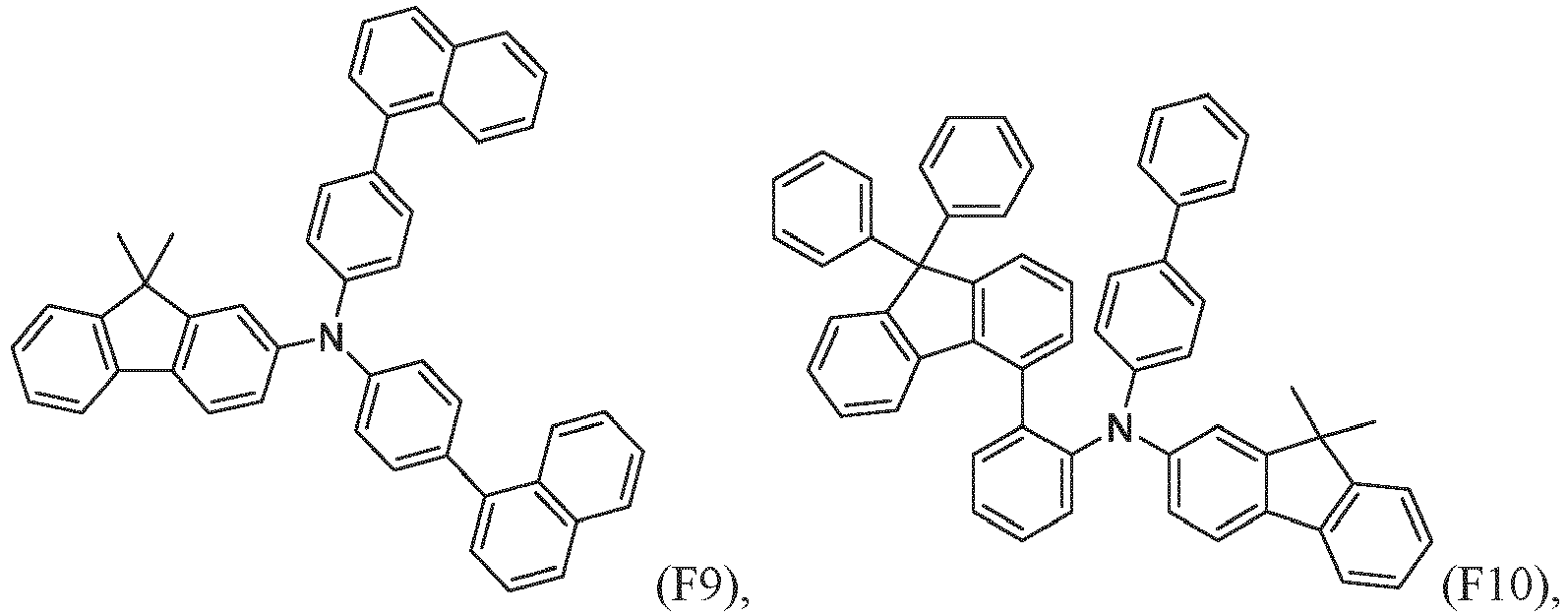


- Preferably, the first organic compound of the hole injection layer or compound of formula (Ia) is selected from formulae (F3) to (F23), more preferred from (F4) to (F23), most preferred from (F4), (F10), (F18), (F22) and (F23).
- The second organic compound consists or may consist substantially of covalently bound C, H, O, N, S, which optionally comprise in addition covalently bound B, P, As and/or Se.
- According to an embodiment of the present invention, the second organic compound compound preferably comprises at least one C2 to C24 N-heteroaryl or P=X group, with X being O, S or Se, with O being especially preferred.
- According to an embodiment of the present invention, the second organic compound of the hole injection layer may comprises an azine group, preferably a triazine group, a pyrimidine group, a pyridine group, an acridine group, a dibenzoacridine group, a dibenzo[c,h]acridine group, a benzo[h]quinazoline group and/or a 3,8a-dihydroimidazo[1,5-a]pyridine group, more preferred a pyrimidine group, a pyridine group and/or an acridine group.
- According to an embodiment of the present invention, the at least one C2 to C24 N-heteroaryl may be selected from a compound comprising at least one azine group, preferably at least two azine groups, also preferred three azine groups.
- According to an embodiment of the present invention, the second organic compound compound comprises at least one group selected from the list consisting of pyridine, pyrimidine, triazine, imidazole, benzimidazole, benzooxazole, quinoline, quinoxaline, benzoquinoxaline, acridine, phenanthroline, benzoacridine, dibenzoacridine, imidazopyridine.
- According to one embodiment, the second organic compound compound comprises at least 15 covalently bound atoms, preferably at least 20 covalently bound atoms, more preferably at least 25 covalently bound atoms, and most preferably at least 30 covalently bound atoms.
- According to one embodiment, the organic substantially covalent additive compound comprises at least 15 covalently bound atoms, preferably at least 20 covalently bound atoms, more preferably at least 25 covalently bound atoms, and most preferably at least 30 covalently bound atoms.
- According to one embodiment, the second organic compound compound may have a molecular weight Mw of ≥ 400 and ≤ 2000 g/mol, preferably a molecular weight Mw of ≥ 450 and ≤ 1500 g/mol, further preferred a molecular weight Mw of ≥ 500 and ≤ 1000 g/mol, further preferred a molecular weight Mw of ≥ 550 and ≤ 900 g/mol, in addition preferred a molecular weight Mw of ≥ 580 and ≤ 800 g/mol, also preferred a molecular weight Mw of ≥ 600 and ≤ 800 g/mol.
- According to one embodiment, the second organic of the hole injection layer comprises
- at least one C2 to C24 N-heteroaryl or P=X group, with X being O, S or Se, with O being especially preferred; wherein the at least one C2 to C24 N-heteroaryl optional be selected from a compound comprising at least one azine group, preferably at least two azine groups, also preferred three azine groups; and/or
- at least one group selected from the list consisting of pyridine, pyrimidine, triazine, imidazole, benzimidazole, benzooxazole, quinoline, quinoxaline, benzoquinoxaline, acridine, phenanthroline, benzoacridine, dibenzoacridine, imidazopyridine; and/or
- at least 15 covalently bound atoms, preferably at least 20 covalently bound atoms, more preferably at least 25 covalently bound atoms, and most preferably at least 30 covalently bound atoms; and/or
- a molecular weight Mw of ≥ 400 to ≤ 2000 g/mol, preferably a molecular weight Mw of ≥ 450 to ≤ 1500 g/mol, further preferred a molecular weight Mw of ≥ 500 to ≤ 1000 g/mol, further preferred a molecular weight Mw of ≥ 550 to ≤ 900 g/mol, in addition preferred a molecular weight Mw of ≥ 580 to ≤ 800 g/mol, also preferred a molecular weight Mw of ≥ 600 to ≤ 800 g/mol.
- According to one embodiment, the second organic compound is a substantially covalent second organic compound.
- According to one embodiment, the second organic compound is free of a metal complex, metal cation and/or metal-organic compound.
- According to one embodiment, the second organic compound is not a metal complex or metal cation.
- Preferably, the substantially covalent second organic compound is free of metals and/or ionic bonds.
- According to one embodiment, the second organic compound is free of triarylamine groups.
- According to one embodiment, an organic semiconductor layer comprising the second organic compound comprising ≥ 7 and ≤ 14 aromatic rings, if formed as a separated organic semiconductor layer, said separated organic semiconductor layer consisting of the second organic compound has a spontaneous orientation polarization in the range of ≥ 0 mV/nm to ≤ 150 mV/nm, preferably a spontaneous orientation polarization of ≥ 5 mV/nm, more preferred ≥ 10 mV/nm, most preferred ≥ 15 mV/nm, or a spontaneous orientation polarization of ≥ 8 mV/nm to ≤ 100 mV/nm, preferably ≥ 9 mV/nm and ≤ 80 mV/nm, more preferred ≥ 10 mV/nm to ≤ 70 mV/nm.
- According to one embodiment of the present invention, an organic semiconductor layer comprising the second organic compound has a spontaneous orientation polarization of ≥ 5 mV/nm, preferably ≥ 10 mV/nm, more preferably ≥ 15 mV/nm.
- According to one embodiment of the present invention, an organic semiconductor layer comprising the second organic compound has a spontaneous orientation polarization of ≥ 8 mV/nm and ≤ 100 mV/nm, preferably ≥ 9 mV/nm and ≤ 80 mV/nm, more preferred ≥ 10 mV/nm and ≤ 70 mV/nm.
- Particularly improved performance may be obtained when the spontaneous orientation polarization of an organic semiconductor layer comprising comprising the second organic compound is selected in this range.
- According to one embodiment, wherein the HOMO energy level of the second organic compound of the hole injection layer is in the range of ≤ -5 eV to ≥ -6.3 eV, preferably ≤ -5 eV to ≥ -6.2 eV, and more preferably ≤ -5 eV to ≥ -6 eV.
- According to one embodiment, the HOMO energy level of the second organic compound is in the range of ≤ -5 eV to ≥ -6.3 eV, preferably ≤ -5 eV to ≥ -6.2 eV, more preferably ≤ -5 eV to ≥ -6 eV; wherein the HOMO energy level is calculated using the hybrid functional B3LYP with a Gaussian 6-31G* basis set as implemented in the program package TURBOMOLE V6.5; and the values are expressed in the absolute scale referring to vacuum energy level being zero.
- According to one embodiment, wherein the LUMO energy level of the second organic compound of the hole injection layer is the range of ≥ -3 eV to ≤ -0.8 eV, preferably ≥ -3 eV to ≤ - 1 eV, more preferably ≥ -2.5 eV to ≤ -1 eV, and most preferably ≥ -2 eV to ≤ -1.5 eV.
- According to one embodiment, the second organic compound has a LUMO energy level in the range of ≥ -3 eV to ≤ -0.8 eV, preferably ≥ -3 eV to ≤ -1 eV, more preferably ≥ -2.5 eV to ≤ -1 eV, most preferably ≥ -2 eV to ≤ -1.5 eV; wherein the LUMO energy level is calculated using the hybrid functional B3LYP with a Gaussian 6-31G* basis set as implemented in the program package TURBOMOLE V6.5; and the values are expressed in the absolute scale referring to vacuum energy level being zero.
- According to one embodiment, wherein the second organic compound of the hole injection layer comprises ≥ 7 to ≤ 14 aromatic rings;
wherein - the HOMO energy level of the second organic compound is in the range of ≤ -5 eV to ≥ -6.5 eV; and
- the LUMO energy level of the second organic compound is in the range of ≤ -1.3 eV to ≥ -3.5 eV.
- Particularly improved performance may be obtained when the HOMO and/or LUMO energy level of the second organic compound is selected in this range.
- According to one embodiment, wherein the dipole moment of the second organic compound of the hole injection layer is in the range of ≥ 0.2 Debye and ≤ 7 Debye, preferably ≥ 0.3 Debye and ≤ 6 Debye; more preferred ≥ 0.5 Debye and ≤ 5 Debye, and alternatively ≥ 0.5 Debye and ≤ 4.8 Debye.
- In one embodiment, the dipole moment of the second organic compound, when calculated using TURBOMOLE V6.5 (TURBOMOLE GmbH, Litzenhardtstrasse 19, 76135 Karlsruhe, Germany) by applying the hybrid functional B3LYP with a 6-31G* basis set in the gas phase, may be selected in the range of ≥ 0.5 Debye and ≤ 7 Debye, preferably ≥ 0.5 Debye and ≤ 6 Debye; more preferred ≥ 0.5 Debye and ≤ 5 Debye; alternatively ≥ 0.5 Debye and < 4.8 Debye.
- According to an embodiment of the present invention, the second organic compound of the hole injection layer is a compound of formula (II)

- T21 and T22
- are independently selected from a single bond, phenylene, biphenylene, terphenylene or naphthenylene, preferably a single bond or phenylene;
- n and m
- is an integer independently selected from 1, 2 or 3, preferably 1 or 2;
- Ar21
- is selected from substituted or unsubstituted C6 to C42 aryl, or substituted or unsubstituted C3 to C41 heteroarylene, substituted or unsubstituted fluorene, substituted 9-fluorene, substituted 9,9-fluorene, substituted or unsubstituted naphthalene, substituted or unsubstituted anthracene, substituted or unsubstituted phenanthrene, substituted or unsubstituted pyrene, substituted or unsubstituted perylene, substituted or unsubstituted triphenylene, substituted or unsubstituted tetracene, substituted or unsubstituted tetraphene, substituted or unsubstituted dibenzofurane, substituted or unsubstituted dibenzothiophene, substituted or unsubstituted xanthene, substituted or unsubstituted carbazole, substituted 9-phenylcarbazole, or a substituted or unsubstituted aromatic fused ring system comprising at least three substituted or unsubstituted aromatic rings selected from the group comprising substituted or unsubstituted non-hetero, substituted or unsubstituted hetero 5-member rings, substituted or unsubstituted 6-member rings and/or substituted or unsubstituted 7-member rings, substituted or unsubstituted fluorene, or a fused ring system comprising 2 to 6 substituted or unsubstituted 5- to 7-member rings and the rings are selected from the group comprising (i) unsaturated 5- to 7-member ring of a heterocycle, (ii) 5- to 6-member of an aromatic heterocycle, (iii) unsaturated 5- to 7-member ring of a non-heterocycle, (Ia) 6-member ring of an aromatic non-heterocycle;
- Ar22
- is selected from substituted or unsubstituted C6 to C20 aryl, or substituted or unsubstituted C3 to C20 heteroarylene, a single bond, phenylene, biphenylene, terphenylene or naphthenylene, preferably a single bond, phenylene or naphthalene,
- Ar23
- is selected from a substituted or unsubstituted C3 to C41 heteroarylene, a substituted or unsubstituted 5-membered or 6-membered heteroarylene comprising 2 or 3 N atoms, subsituted or unsubstituted azine, pyridine, pyrimidine, triazine, imidazole, benzimidazole, benzooxazole, quinoline, quinoxaline, benzoquinoxaline, acridine, phenanthroline, benzoacridine, dibenzoacridine, imadzopyridine;
- Preferably, n and m are 1.
- According to an embodiment wherein Ar21 may be selected from phenyl, naphthyl, biphenyl, phenanthrenyl or formulae (C1) to (C58):


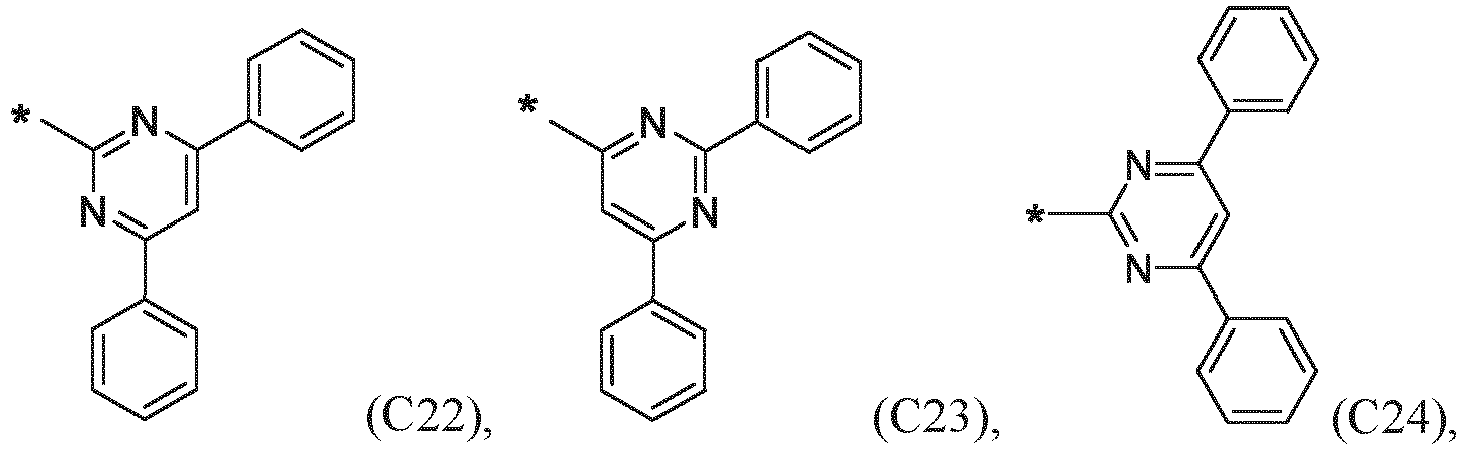


- Preferably, Ar21 is selected from (C2) to (C56), more preferred from (C2) to (C6) and (C14) to (C45) and (C47) to (C56).
- According to an embodiment, Ar23 may be selected from formulae (D1) to (D43)


- Preferably, A23 is selected from formulae (D1) to (D40), more preferred (D1) to (D32).
- Ar21 is selected from phenyl, naphthyl, biphenyl, phenanthrenyl and formulae (C1) to (C58);
- Ar22 is selected from a single bond, phenylene or naphthalene; and
- Ar23 may be selected from formulae (D1) to (D43);
preferably, - Ar21 is selected from (C2) to (C56), more preferred from (C2) to (C6) and (C14) to (C45) and (C47) to (C56);
- Ar22 is selected from a single bond, phenylene or naphthalene; and
- A23 is selected from formulae (D1) to (D40), more preferred (D1) to (D32).
- Preferably, Ar21 and Ar23 are not selected the same; more preferred Ar21, Ar22 and Ar23 are not selected the same.
- According to an embodiment, wherein Ar21 is selected from phenyl, naphthyl, biphenyl, phenanthrenyl and formulae (C1) to (C58); Ar22 is selected from a single bond, phenylene or naphthalene; and Ar23 is selected from formulae (D1) to (D43); or Ar21 is selected from (C2) to (C56), more preferred from (C2) to (C6) and (C14) to (C45) and (C47) to (C56); Ar22 is selected from a single bond, phenylene or naphthalene; and A23 is selected from formulae (D1) to (D40), more preferred (D1) to (D32); or Ar21 and Ar23 are not selected the same; or Ar21, Ar22 and Ar23 are not selected the same.
- The second organic compound and/or compound of formula (II) may be selected from formulae (E1) to (E13)


- According to one embodiment, wherein the first organic p-dopant comprises at least ≥ 4 CN groups or ≥ 5 to ≤ 8 CN groups.
- According to one embodiment, wherein the HOMO energy level of the first organic p-dopant is selected in the range of ≥ -8.5 eV to ≤ -6.8 eV, preferably in the range of ≥ -8.2 eV to ≤ -7 eV.
- According to one embodiment, wherein the first organic p-dopant comprises at least two groups independently of each other selected from C6 to C19 aryl group or C3 to C12 heteroaryl group, wherein each of the C6 to C19 aryl group or C3 to C12 heteroaryl group is substituted, wherein the one or more substituents are independently of each other selected from halogen, F, CN, partially perfluorinated C1 to C12 alkyl, perfluorinated C1 to C12 alkyl, CF3.
- According to one embodiment, wherein the first organic p-dopant comprises independently of each other at least two groups selected from C6 to C19 aryl group, wherein each of the C6 to C19 aryl group is substituted, wherein the one or more substituents are independently of each other selected from halogen, F, CN, partially perfluorinated C1 to C12 alkyl, perfluorinated C1 to C12 alkyl, CF3.
- According to one embodiment, wherein the first organic p-dopant is selected from a compound of formula (III):

- n
- is an integer including 0, 1, 2, 3, 4, 5 or 6, preferably 0, 2, or 4;
- m
- is an integer selected from 0 or 1;
- X1, X2 and X3
- are independently selected from O, S, CR1aR2a, CR1bR2b, NR3a, NR3b or at least one of X1, X2, and X3 form a fused ring with A, and wherein each X3 is selected the same or different, preferably the same,
- R1a, R2a, R1b, and R2b
- are independently selected from an electron-withdrawing group, halogen, Cl, F, substituted or unsubstituted C1 to C8 alkyl, partially fluorinated C1 to C8 alkyl, perfluorinated C1 to C8 alkyl, CF3, substituted or unsubstituted C1 to C8 alkoxy, partially fluorinated C1 to C8 alkoxy, perfluorinated C1 to C8 alkoxy, OCF3, CN, isocyano, SCN, OCN, NO2, SF5, substituted or unsubstituted aryl, substituted or unsubstituted heteroaryl,
wherein the one or more substituents on R1a, R2a, R1b, and R2b are independently selected from D, an electron-withdrawing group, halogen, Cl, F, substituted or unsubstituted C1 to C8 alkyl, partially fluorinated C1 to C8 alkyl, perfluorinated C1 to C8 alkyl, CF3, substituted or unsubstituted C1 to C8 alkoxy, partially fluorinated C1 to C8 alkoxy, perfluorinated C1 to C alkoxy, OCF3, CN, isocyano, SCN, OCN, NO2, SF5, substituted or unsubstituted C6 to C30 aryl, and substituted or unsubstituted C6 to C30 heteroaryl;
wherein the one or more substituents of C6 to C30 aryl, C6 to C30 heteroaryl, C1 to C8 alkyl, C1 to C8 alkoxy are independently selected from D, an electron-withdrawing group, halogen, Cl, F, CN, -NO2, isocyano, SCN, OCN, SF5, partially fluorinated C1 to C8 alkyl, perfluorinated C1 to C8 alkyl, partially fluorinated C1 to C8 alkoxy, perfluorinated C1 to C8 alkoxy; - R3a and R3b
- is selected from an electron-withdrawing group, CN, partially fluorinated C1 to C6 alkyl, perfluorinated C1 to C6 alkyl, CF3, substituted or unsubstituted C6 to C30 aryl, or substituted or unsubstituted C3 to C30 heteroaryl,
wherein the one or more substituents on R3a and R3b are independently selected from D, an electron-withdrawing group, halogen, Cl, F, substituted or unsubstituted C1 to C8 alkyl, partially fluorinated C1 to C8 alkyl, perfluorinated C1 to C8 alkyl, CF3, substituted or unsubstituted C1 to C8 alkoxy, partially fluorinated C1 to C8 alkoxy, perfluorinated C1 to C8 alkoxy, OCF3, CN, isocyano, SCN, OCN, NO2, SF5, substituted or unsubstituted C6 to C30 aryl, and substituted or unsubstituted C6 to C30 heteroaryl;
wherein the one or more substituents of C6 to C30 aryl, C6 to C30 heteroaryl, C1 to C8 alkyl, C1 to C8 alkoxy are independently selected from D, an electron-withdrawing group, halogen, Cl, F, CN, -NO2, isocyano, SCN, OCN, SF5, partially fluorinated C1 to C8 alkyl, perfluorinated C1 to C8 alkyl, partially fluorinated C1 to C8 alkoxy, perfluorinated C1 to C8 alkoxy; - A
- is selected from substituted or unsubstituted C3 to C40 cyclohydrocarbon group, substituted or unsubstituted C3 to C40 cycloalkane group, substituted or unsubstituted C3 to C40 cycloalkane group containing one or more double-bonds, substituted or unsubstituted C3 to C40 cycloalkene group, substituted or unsubstituted C2 to C40 heterocycloalkane group, substituted or unsubstituted C2 to C40 heterocycloalkane group containing one or more double-bonds, substituted or unsubstituted C2 to C40 heterocycloalkene group, substituted or unsubstituted C6 to C40 aromatic group, substituted or unsubstituted C2 to C40 heteroaromatic group,
wherein the one or more substituents on A are independently selected from D, an electron-withdrawing group, halogen, Cl, F, substituted or unsubstituted C1 to C8 alkyl, partially fluorinated C1 to C8 alkyl, perfluorinated C1 to C8 alkyl, CF3, substituted or unsubstituted C1 to C8 alkoxy, partially fluorinated C1 to C8 alkoxy, perfluorinated C1 to C8 alkoxy, OCF3, CN, isocyano, SCN, OCN, NO2, SF5, substituted or unsubstituted C6 to C30 aryl, substituted or unsubstituted C2 to C30 heteroaryl,
wherein the one or more substituents of C6 to C30 aryl, C6 to C30 heteroaryl, C1 to C8 alkyl, C1 to C8 alkoxy are independently selected from D, an electron-withdrawing group, halogen, Cl, F, CN, -NO2, isocyano, SCN, OCN, SF5, partially fluorinated C1 to C8 alkyl, perfluorinated C1 to C8 alkyl, partially fluorinated C1 to C8 alkoxy, perfluorinated C1 to C8 alkoxy, - The C6 to C40 aromatic group may be a group which is aromatic, or a group containing at least one aromatic moiety, i.e. an aromatic group may also contain a fused non-aromatic moiety. The moiety can contain different atoms.
- The C2 to C40 heteroaromatic group may be a group which is heteroaromatic, or a group containing at least one heteroaromatic moiety, i.e. a heteroaromatic group may also contain a fused non-aromatic moiety. The moiety can contain different atoms.
n - According to an embodiment, n can be an integer selected from 0, 1, 2, 3, or 4.
- According to a preferred embodiment, n can be an integer selected from 0, 1, or 2.
m - According to a preferred embodiment, m can be an integer selected from 1.
X1, X2, and X3 - According to an embodiment, X1, X2, and X3 are independently selected from CR1aR2a, CR1bR2b, NR3a, NR3b; wherein each X3 can be selected the same or different.
- According to an embodiment, X1, X2, and X3 are independently selected from CR1aR2a, CR1bR2b; wherein each X3 can be selected the same or different.
- According to an embodiment, wherein A of formula (III) is selected from a group of G1 to G72:


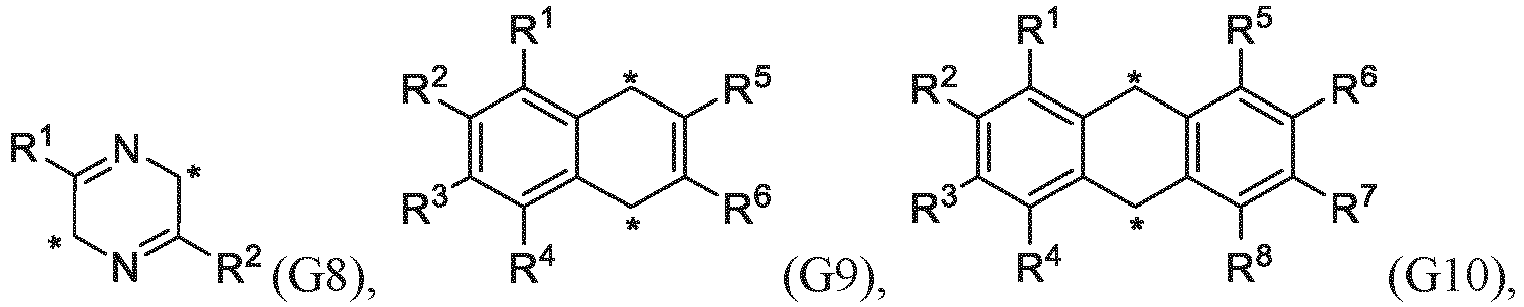


- R1, R2, R3, R4, R5, R6, R7 and R8
- are independently selected from H, D, halogen, Cl, F, substituted or unsubstituted C1 to C6 alkyl, partially fluorinated C1 to C6 alkyl, perfluorinated C1 to C6 alkyl, CF3, substituted or unsubstituted C1 to C6 alkoxy, partially fluorinated C1 to C6 alkoxy, perfluorinated C1 to C6 alkoxy, OCF3, substituted or unsubstituted C6 to C30 aryloxy, partially fluorinated C6 to C30 aryloxy, perfluorinated C6 to C30 aryloxy, substituted or unsubstituted C6 to C30 aryl, substituted or unsubstituted C3 to C30 heteroaryl, CN, isocyano, SCN, OCN, NO2, SF5,
wherein the substituents are selected from D, halogen, Cl, F, partially fluorinated C1 to C6 alkyl, perfluorinated C1 to C6 alkyl, CF3, partially fluorinated C1 to C6 alkoxy, perfluorinated C1 to C6 alkoxy, OCF3, CN, isocyano, SCN, OCN, NO2, SF5, - B1 and B2
- are independently of each other selected from N, CR5A', or CR6A', wherein
- CR5A', or CR6A'
- are each independently selected from other from H, D, F, a substituted or unsubstituted C6 to C12 aryl, a substituted or unsubstituted C1 to C12 heteroaryl with 1 to 4 heteroatoms one among O, N, S and Si, a substituted or unsubstituted C1 to C12 alkyl, a substituted or unsubstituted C1 to C12 alkoxy, a substituted or unsubstituted C1 to C12 ether group, CN, CF3, OCF3, halogen, Cl, F, Si(CH3)3, preferably at least one among R1 to R6 comprises CN, wherein
the one or more substituents on CR5A', or CR6A' are independently selected from each other from D, an electron-withdrawing group, halogen, Cl, F, substituted or unsubstituted C1 to C8 alkyl, partially fluorinated C1 to C8 alkyl, perfluorinated C1 to C8 alkyl, CF3, substituted or unsubstituted C1 to C8 alkoxy, partially fluorinated C1 to C8 alkoxy, perfluorinated C1 to C alkoxy, OCF3, CN, isocyano, SCN, OCN, NO2, SF5, substituted or unsubstituted C6 to C30 aryl, and substituted or unsubstituted C6 to C30 heteroaryl,
wherein the one or more substituents of C6 to C30 aryl, C6 to C30 heteroaryl, C1 to C8 alkyl, C1 to C8 alkoxy are independently selected from each other from D, an electron-withdrawing group, halogen, Cl, F, CN, -NO2, isocyano, SCN, OCN, SF5, partially fluorinated C1 to C8 alkyl, perfluorinated C1 to C8 alkyl, partially fluorinated C1 to C8 alkoxy, perfluorinated C1 to C8 alkoxy. - According to an embodiment, wherein A of formula (III) is selected from a group of E1 to E27, E44 to E46, E49, E50, E66 to E72:


- R1, R2, R3, R4, R5, R6, R7 and R8 are independently selected from H, D, halogen, Cl, F, substituted or unsubstituted C1 to C6 alkyl, partially fluorinated C1 to C6 alkyl, perfluorinated C1 to C6 alkyl, CF3, substituted or unsubstituted C1 to C6 alkoxy, partially fluorinated C1 to C6 alkoxy, perfluorinated C1 to C6 alkoxy, OCF3, substituted or unsubstituted C6 to C30 aryloxy, partially fluorinated C6 to C30 aryloxy, perfluorinated C6 to C30 aryloxy, substituted or unsubstituted C6 to C30 aryl, substituted or unsubstituted C3 to C30 heteroaryl, CN, isocyano, SCN, OCN, NO2, SF5,
wherein the substituents are selected from D, halogen, Cl, F, partially fluorinated C1 to C6 alkyl, perfluorinated C1 to C6 alkyl, CF3, partially fluorinated C1 to C6 alkoxy, perfluorinated C1 to C6 alkoxy, OCF3, CN, isocyano, SCN, OCN, NO2, SF5, - B1 and B2 are independently of each other selected from N, CR5A', or CR6A', wherein CR5A', or CR6A' are each independently selected from each other from H, D, F, a substituted or unsubstituted C6 to C12 aryl, a substituted or unsubstituted C1 to C12 heteroaryl with 1 to 4 heteroatoms one among O, N, S and Si, a substituted or unsubstituted C1 to C12 alkyl, a substituted or unsubstituted C1 to C12 alkoxy, a substituted or unsubstituted C1 to C12 ether group, CN, CF3, OCF3, halogen, Cl, F, Si(CH3)3, preferably at least one among R1 to R6 comprises CN, wherein
the one or more substituents on CR5A', or CR6A'are independently of each other selected from D, an electron-withdrawing group, halogen, Cl, F, substituted or unsubstituted C1 to C8 alkyl, partially fluorinated C1 to C8 alkyl, perfluorinated C1 to C8 alkyl, CF3, substituted or unsubstituted C1 to C8 alkoxy, partially fluorinated C1 to C8 alkoxy, perfluorinated C1 to C alkoxy, OCF3, CN, isocyano, SCN, OCN, NO2, SF5, substituted or unsubstituted C6 to C30 aryl, and substituted or unsubstituted C6 to C30 heteroaryl, wherein
the one or more substituents of C6 to C30 aryl, C6 to C30 heteroaryl, C1 to C8 alkyl, C1 to C8 alkoxy are independently of each other selected from D, an electron-withdrawing group, halogen, Cl, F, CN, -NO2, isocyano, SCN, OCN, SF5, partially fluorinated C1 to C8 alkyl, perfluorinated C1 to C8 alkyl, partially fluorinated C1 to C8 alkoxy, perfluorinated C1 to C8 alkoxy. - According to an embodiment, wherein A may be preferably selected from a compound W1 to W22:


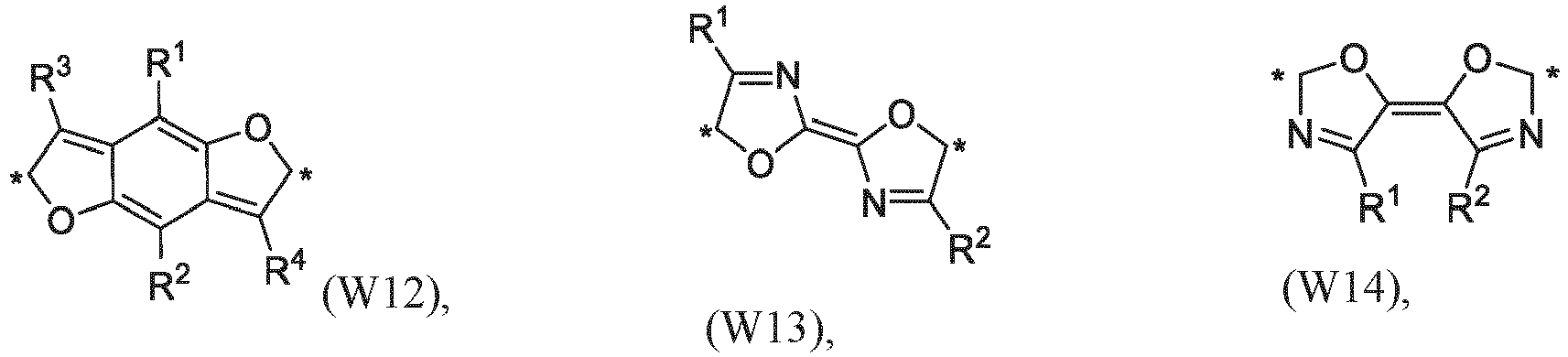


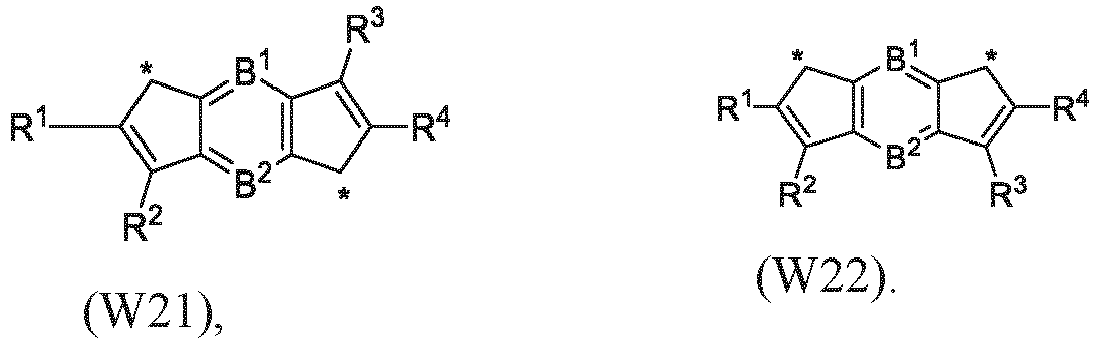
- According to an embodiment, wherein A may be preferably selected from a compound of W1, W2, W3, W4, W7, W8, W10, W11, W13, W15, W18, W19, W20, W21 and/or W22.
- According to an embodiment, wherein A may be preferably selected from a compound of W1, W2, W18, W19, W20, W21 and/or W22.
- According to an embodiment, wherein A may be preferably selected from one of the following compounds W2, W18, W19 and/or W20.
- According to an embodiment, the first organic p-dopant is selected from a compound of formula (IV):

- A1 is independently selected from a group of formula (IVa):

Ar1 is independently selected from substituted or unsubstituted aryl and substituted or unsubstituted heteroaryl, wherein for the case that Ar1 is substituted, one or more of the substituents are independently selected from the group consisting of D, an electron-withdrawing group, halogen, Cl, F, CN, -NO2, substituted or unsubstituted C1 to C8 alkyl, partially fluorinated C1 to C8 alkyl, perfluorinated C1 to C8 alkyl, substituted or unsubstituted C1 to C8 alkoxy, partially fluorinated C1 to C8 alkoxy, perfluorinated C1 to C8 alkoxy, substituted or unsubstituted C6 to C30 aryl, and substituted or unsubstituted C6 to C30 heteroaryl, and
wherein the one or more substituents of C6 to C30 aryl, C6 to C30 heteroaryl, C1 to C8 alkyl, C1 to C8 alkoxy are independently selected from D, an electron-withdrawing group, halogen, Cl, F, CN, -NO2, partially fluorinated C1 to C8 alkyl, perfluorinated C1 to C8 alkyl, partially fluorinated C1 to C8 alkoxy, perfluorinated C1 to C8 alkoxy; - A2 is independently selected from a group of formula (IVb):
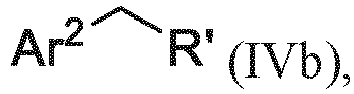
Ar2 is independently selected from substituted or unsubstituted aryl and substituted or unsubstituted heteroaryl, wherein for the case that Ar2 is substituted, one or more of the substituents are independently selected from the group consisting of D, an electron-withdrawing group, halogen, Cl, F, CN, -NO2, substituted or unsubstituted C1 to C8 alkyl, partially fluorinated C1 to C8 alkyl, perfluorinated C1 to C8 alkyl, substituted or unsubstituted C1 to C8 alkoxy, partially fluorinated C1 to C8 alkoxy, perfluorinated C1 to C8 alkoxy, substituted or unsubstituted C6 to C30 aryl, and substituted or unsubstituted C6 to C30 heteroaryl, and
wherein the one or more substituents of C6 to C30 aryl, C6 to C30 heteroaryl, C1 to C8 alkyl, C1 to C8 alkoxy are independently selected from D, an electron-withdrawing group, halogen, Cl, F, CN, -NO2, partially fluorinated C1 to C8 alkyl, perfluorinated C1 to C8 alkyl, partially fluorinated C1 to C8 alkoxy, perfluorinated C1 to C8 alkoxy; - A3 is independently selected from a group of formula (IVc)

Ar3 is independently selected from substituted or unsubstituted aryl and substituted or unsubstituted heteroaryl, wherein for the case that Ar3 is substituted, one or more of the substituents are independently selected from the group consisting of D, an electron-withdrawing group, halogen, Cl, F, CN, -NO2, substituted or unsubstituted C1 to C8 alkyl, partially fluorinated C1 to C8 alkyl, perfluorinated C1 to C8 alkyl, substituted or unsubstituted C1 to C8 alkoxy, partially fluorinated C1 to C8 alkoxy, perfluorinated C1 to C8 alkoxy, substituted or unsubstituted C6 to C30 aryl, and substituted or unsubstituted C6 to C30 heteroaryl, and
wherein the one or more substituents of C6 to C30 aryl, C6 to C30 heteroaryl, C1 to C8 alkyl, C1 to C8 alkoxy are independently selected from D, an electron-withdrawing group, halogen, Cl, F, CN, -NO2, partially fluorinated C1 to C8 alkyl, perfluorinated C1 to C8 alkyl, partially fluorinated C1 to C8 alkoxy, perfluorinated C1 to C8 alkoxy; - wherein in A1, A2, A3 each R' is independently selected from substituted or unsubstituted C6 to C18 aryl, C3 to C18 heteroaryl, electron-withdrawing group, substituted or unsubstituted C1 to C8 alkyl, partially fluorinated C1 to C8 alkyl, perfluorinated C1 to C8 alkyl, halogen, F and CN; and
- wherein preferably the compound of formula (IV) comprises at least two groups selected from aryl C6 to C19 aryl groups, or C3 to C12 heteroaryl group, wherein each of the C6 to C19 aryl group or C3 to C12 heteroaryl group is substituted, wherein the one or more substituents are independently of each other selected from halogen, F, CN, partially perfluorinated C1 to C12 alkyl, perfluorinated C1 to C12 alkyl, CF3.
- The term "electron-withdrawing group" refers to a chemical group in a molecule, which can draw electrons away from an adjacent part of the molecule. The distance over which the electron-withdrawing group can exert its effect, namely the number of bonds over which the electron-withdrawing effect spans, is extended by conjugated pi-electron systems such as aromatic systems. Examples of electron-withdrawing groups include NO2, CN, halogen, Cl, F, partially fluorinated or perfluorinated alkyl and partially fluorinated or perfluorinated C1 to C12 alkyl, partially fluorinated or perfluorinated alkoxy, partially fluorinated or perfluorinated C1 to C6 alkoxy.
- The first organic p-dopant is a quinoid-like compound when it is reduced, i.e. when oxidation level of said compounds is lowered by one, two, three or four electrons, results in an at least partial aromatization of said first organic p-dopant or of said first organic p-dopant, preferably the quinoid-like compound comprises at least two groups selected from C6 to C19 aryl group or C3 to C12 heteroaryl group, wherein each of the C6 to C19 aryl group or C3 to C12 heteroaryl group is substituted, wherein the one or more substituents are independently of each other selected from halogen, F, CN, partially perfluorinated C1 to C12 alkyl, perfluorinated C1 to C12 alkyl, CF3.
- According to an embodiment, the first organic p-dopant is a quinoid-like compound, whereby the term "quinoid-like compound" means and/includes a compound which contains a moiety which is (formally) derived from a compound comprising an annelated aromatic system or non-annelated aromatic system whereby one or more carbon atoms of said annelated aromatic system or non-annelated aromatic system are double bonded to an atom or a group outside said annelated aromatic system or non-annelated aromatic system with any necessary rearrangement of double bonds preferably the quinoid-like compound comprises at least two groups selected from C6 to C19 aryl group or C3 to C12 heteroaryl group, wherein each of the C6 to C19 aryl group or C3 to C12 heteroaryl group is substituted, wherein the one or more substituents are independently of each other selected from halogen, F, CN, partially perfluorinated C1 to C12 alkyl, perfluorinated C1 to C12 alkyl, CF3.
- According to an embodiment, the first organic p-dopant is a quinoid-like compound, whereby the term "quinoid-like compound" means and/includes a compound which contains a moiety which is (formally) derived from a compound comprising an annelated aromatic system or non-annelated aromatic system whereby one or more carbon atoms of said annelated aromatic system or non-annelated aromatic system are double bonded to an atom or a group outside said annelated aromatic system or non-annelated aromatic system with any necessary rearrangement of double bonds and resulting in at least a partial lift of aromaticity in the annelated aromatic system or non-annelated aromatic system; preferably the quinoid-like compound comprises at least two groups selected from C6 to C19 aryl group or C3 to C12 heteroaryl group, wherein each of the C6 to C19 aryl group or C3 to C12 heteroaryl group is substituted, wherein the one or more substituents are independently of each other selected from halogen, F, CN, partially perfluorinated C1 to C12 alkyl, perfluorinated C1 to C12 alkyl, CF3.
- According to an embodiment, the first organic p-dopant is a quinoid compound, whereby the term "quinoid compound" means/includes a compound which contains a moiety which is (formally) derived from a compound comprising an annelated aromatic system or non-annelated aromatic system whereby an even number of carbon atoms of said annelated aromatic system or non-annelated aromatic system are double bonded to an atom or a group outside said annelated aromatic system or non-annelated aromatic system with any necessary rearrangement of double bonds and resulting in at least a partial lift of aromaticity in the annelated aromatic system or non-annelated aromatic system, wherein the even number of carbon atoms of said annelated aromatic system or non-annelated aromatic system which are double bonded to an atom or a group outside said annelated aromatic system or non-annelated aromatic system were a -CH= of said aromatic system or non-annelated aromatic system; preferably the quinoid compound comprises at least two groups selected from C6 to C19 aryl group or C3 to C12 heteroaryl group, wherein each of the C6 to C19 aryl group or C3 to C12 heteroaryl group is substituted, wherein the one or more substituents are independently of each other selected from halogen, F, CN, partially perfluorinated C1 to C12 alkyl, perfluorinated C1 to C12 alkyl, CF3. Reduction of the quinoid compound by one or two electrons, i.e. when the oxidation level of said compounds is lowered by adding two electrons, results in an at least partial aromatization of the quinoid compound.
- According to an embodiment, the first organic p-dopant has a quinoid structure.
- According to an embodiment, the first organic p-dopant is a quinoid compound and represented by formula (V), whereby the term "quinoid compound" means and/includes a compound which contains a moiety which is (formally) derived from a compound comprising an annelated aromatic system or non-annelated aromatic system whereby an even number of carbon atoms of said annelated aromatic system or non-annelated aromatic system are double bonded to an atom or a group outside said annelated aromatic system or non-annelated aromatic system with any necessary rearrangement of double bonds and resulting in at least a partial lift of aromaticity in the annelated aromatic system or non-annelated aromatic system, preferably the quinoid compound comprises at least two groups selected from C6 to C19 aryl group or C3 to C12 heteroaryl group, wherein each of the C6 to C19 aryl group or C3 to C12 heteroaryl group is substituted, wherein the one or more substituents are independently of each other selected from halogen, F, CN, partially perfluorinated C1 to C12 alkyl, perfluorinated C1 to C12 alkyl, CF3; wherein the even number of carbon atoms of said annelated aromatic system or non-annelated aromatic system which are double bonded to an atom or a group outside said annelated aromatic system or non-annelated aromatic system were a -CH= of said aromatic system or non-annelated aromatic system. Reduction of the quinoid compound by one or two electrons, i.e. when the oxidation level of said compounds is lowered by adding two electrons, results in an at least partial aromatization of the quinoid compound.
- According to an embodiment, wherein the first organic p-dopant is selected from a compound comprising a quinoid structure, an indacenedione structure or a compound of formula (V):

- n
- is an integer including 0, 1, 2, 3, 4, 5 or 6, preferably 0, 2, or 4;
- m
- is an integer selected from 0 or 1;
- X1, X2 and X3
- are independently selected from O, S, CR1aR2a, CR1bR2b, NR3a, NR3b or at least one of X1, X2, and X3 form a fused ring with A, and wherein each X3 is selected the same or different, preferably the same,
- R1a, R2a, R1b, and R2b
- are independently selected from an electron-withdrawing group, halogen, Cl, F, substituted or unsubstituted C1 to C8 alkyl, partially fluorinated C1 to C8 alkyl, perfluorinated C1 to C8 alkyl, CF3, substituted or unsubstituted C1 to C8 alkoxy, partially fluorinated C1 to C8 alkoxy, perfluorinated C1 to C8 alkoxy, OCF3, CN, isocyano, SCN, OCN, NO2, SF5, substituted or unsubstituted aryl, substituted or unsubstituted heteroaryl,
wherein the one or more substituents on R1a, R2a, R1b, and R2b are independently selected from D, an electron-withdrawing group, halogen, Cl, F, substituted or unsubstituted C1 to C8 alkyl, partially fluorinated C1 to C8 alkyl, perfluorinated C1 to C8 alkyl, CF3, substituted or unsubstituted C1 to C8 alkoxy, partially fluorinated C1 to C8 alkoxy, perfluorinated C1 to C alkoxy, OCF3, CN, isocyano, SCN, OCN, NO2, SF5, substituted or unsubstituted C6 to C30 aryl, and substituted or unsubstituted C6 to C30 heteroaryl;
wherein the one or more substituents of C6 to C30 aryl, C6 to C30 heteroaryl, C1 to C8 alkyl, C1 to C8 alkoxy are independently selected from D, an electron-withdrawing group, halogen, Cl, F, CN, -NO2, isocyano, SCN, OCN, SF5, partially fluorinated C1 to C8 alkyl, perfluorinated C1 to C8 alkyl, partially fluorinated C1 to C8 alkoxy, perfluorinated C1 to C8 alkoxy; - R3a and R3b
- is selected from an electron-withdrawing group, CN, partially fluorinated C1 to C6 alkyl, perfluorinated C1 to C6 alkyl, CF3, substituted or unsubstituted C6 to C30 aryl, or substituted or unsubstituted C3 to C30 heteroaryl,
wherein the one or more substituents on R3a and R3b are independently selected from D, an electron-withdrawing group, halogen, Cl, F, substituted or unsubstituted C1 to C8 alkyl, partially fluorinated C1 to C8 alkyl, perfluorinated C1 to C8 alkyl, CF3, substituted or unsubstituted C1 to C8 alkoxy, partially fluorinated C1 to C8 alkoxy, perfluorinated C1 to C8 alkoxy, OCF3, CN, isocyano, SCN, OCN, NO2, SF5, substituted or unsubstituted C6 to C30 aryl, and substituted or unsubstituted C6 to C30 heteroaryl;
wherein the one or more substituents of C6 to C30 aryl, C6 to C30 heteroaryl, C1 to C8 alkyl, C1 to C8 alkoxy are independently selected from D, an electron-withdrawing group, halogen, Cl, F, CN, -NO2, isocyano, SCN, OCN, SF5, partially fluorinated C1 to C8 alkyl, perfluorinated C1 to C8 alkyl, partially fluorinated C1 to C8 alkoxy, perfluorinated C1 to C8 alkoxy; - A
- is selected from substituted or unsubstituted C3 to C40 cycloalkane group containing at least one or more double-bonds, substituted or unsubstituted C3 to C40 cycloalkene group, substituted or unsubstituted C2 to C40 heterocycloalkane group, substituted or unsubstituted C2 to C40 heterocycloalkane group containing one or more double-bonds, substituted or unsubstituted C2 to C40 heterocycloalkene group, substituted or unsubstituted C6 to C40 aromatic group, substituted or unsubstituted C2 to C40 heteroaromatic group, wherein X1, X2, and/or X3 are conjugated to each other via a double-bond in A;
wherein the substituents on A, when present, are independently selected from D, an electron-withdrawing group, halogen, Cl, F, substituted or unsubstituted C1 to C8 alkyl, partially fluorinated C1 to C8 alkyl, perfluorinated C1 to C8 alkyl, CF3, substituted or unsubstituted C1 to C8 alkoxy, partially fluorinated C1 to C8 alkoxy, perfluorinated C1 to C8 alkoxy, OCF3, CN, isocyano, SCN, OCN, NO2, SF5, substituted or unsubstituted C6 to C30 aryl, substituted or unsubstituted C2 to C30 heteroaryl,
wherein the substituent of C6 to C30 aryl, C6 to C30 heteroaryl, C1 to C8 alkyl, C1 to C8 alkoxy are independently selected from D, an electron-withdrawing group, halogen, Cl, F, CN, -NO2, isocyano, SCN, OCN, SF5, partially fluorinated C1 to C8 alkyl, perfluorinated C1 to C8 alkyl, partially fluorinated C1 to C8 alkoxy, perfluorinated C1 to C8 alkoxy; - The C6 to C40 aromatic group may be a group which is aromatic, or a group containing at least one aromatic moiety, i.e. an aromatic group may also contain a fused non-aromatic moiety. The moiety can contain different atoms. The C2 to C40 heteroaromatic group may be a group which is heteroaromatic, or a group containing at least one heteroaromatic moiety, i.e. a heteroaromatic group may also contain a fused non-aromatic moiety. The moiety can contain different atoms.
- According to an embodiment, the first organic p-dopant is a compound of formula (V)

- n is an even integer including 0 preferably n is selected from 0, 2, or 4,
- m is an integer selected from 1,
- X1, X2, and X3 are independently selected from O, S, CR1aR2a, CR1bR2b, NR3a, NR3b; wherein each X3 can be selected the same or different,
- wherein
- X1, X2, and X3 can independently of each other form a fused ring with A;
- wherein R1a, R2a, R1b, and R2b, are independently selected from an electron-withdrawing group, halogen, Cl, F, substituted or unsubstituted C1 to C8 alkyl, partially fluorinated C1 to C8 alkyl, perfluorinated C1 to C8 alkyl, CF3, substituted or unsubstituted C1 to C8 alkoxy, partially fluorinated C1 to C8 alkoxy, perfluorinated C1 to C8 alkoxy, OCF3, CN, isocyano, SCN, OCN, NO2, SF5, substituted or unsubstituted aryl, substituted or unsubstituted heteroaryl,
wherein the one or more substituents on R1a, R2a, R1b, and R2b, when present, are independently selected from D, an electron-withdrawing group, halogen, Cl, F, substituted or unsubstituted C1 to C8 alkyl, partially fluorinated C1 to C8 alkyl, perfluorinated C1 to C8 alkyl, CF3, substituted or unsubstituted C1 to C8 alkoxy, partially fluorinated C1 to C8 alkoxy, perfluorinated C1 to C alkoxy, OCF3, CN, isocyano, SCN, OCN, NO2, SF5, substituted or unsubstituted C6 to C30 aryl, and substituted or unsubstituted C6 to C30 heteroaryl;
wherein the one or more substituents of C6 to C30 aryl, C6 to C30 heteroaryl, C1 to C8 alkyl, C1 to C8 alkoxy are independently selected from D, an electron-withdrawing group, halogen, Cl, F, CN, -NO2, isocyano, SCN, OCN, SF5, partially fluorinated C1 to C8 alkyl, perfluorinated C1 to C8 alkyl, partially fluorinated C1 to C8 alkoxy, perfluorinated C1 to C8 alkoxy; - wherein R3a and R3b is selected from an electron-withdrawing group, CN, partially fluorinated C1 to C6 alkyl, perfluorinated C1 to C6 alkyl, CF3, substituted or unsubstituted C6 to C30 aryl, or substituted or unsubstituted C3 to C30 heteroaryl,
wherein the one or more substituents on R3a and R3b, when present, are independently selected from D, an electron-withdrawing group, halogen, Cl, F, substituted or unsubstituted C1 to C8 alkyl, partially fluorinated C1 to C8 alkyl, perfluorinated C1 to C8 alkyl, CF3, substituted or unsubstituted C1 to C8 alkoxy, partially fluorinated C1 to C8 alkoxy, perfluorinated C1 to C8 alkoxy, OCF3, CN, isocyano, SCN, OCN, NO2, SF5, substituted or unsubstituted C6 to C30 aryl, and substituted or unsubstituted C6 to C30 heteroaryl;
wherein the one or more substituents of C6 to C30 aryl, C6 to C30 heteroaryl, C1 to C8 alkyl, C1 to C8 alkoxy are independently selected from D, an electron-withdrawing group, halogen, Cl, F, CN, -NO2, isocyano, SCN, OCN, SF5, partially fluorinated C1 to C8 alkyl, perfluorinated C1 to C8 alkyl, partially fluorinated C1 to C8 alkoxy, perfluorinated C1 to C8 alkoxy; - wherein A is selected from substituted or unsubstituted C3 to C40 cycloalkane group containing at least one or more double-bonds, substituted or unsubstituted C3 to C40 cycloalkene group, substituted or unsubstituted C2 to C40 heterocycloalkane group, substituted or unsubstituted C2 to C40 heterocycloalkane group containing one or more double-bonds, substituted or unsubstituted C2 to C40 heterocycloalkene group, substituted or unsubstituted C6 to C40 aromatic group, substituted or unsubstituted C2 to C40 heteroaromatic group, wherein X1, each X2, and each X3 are conjugated to each other via a double-bond in A;
wherein the one or more substituents on A, when present, are independently selected from D, an electron-withdrawing group, halogen, Cl, F, substituted or unsubstituted C1 to C8 alkyl, partially fluorinated C1 to C8 alkyl, perfluorinated C1 to C8 alkyl, CF3, substituted or unsubstituted C1 to C8 alkoxy, partially fluorinated C1 to C8 alkoxy, perfluorinated C1 to C8 alkoxy, OCF3, CN, isocyano, SCN, OCN, NO2, SF5, substituted or unsubstituted C6 to C30 aryl, substituted or unsubstituted C2 to C30 heteroaryl,
wherein the one or more substituents of C6 to C30 aryl, C6 to C30 heteroaryl, C1 to C8 alkyl, C1 to C8 alkoxy are independently selected from D, an electron-withdrawing group, halogen, Cl, F, CN, -NO2, isocyano, SCN, OCN, SF5, partially fluorinated C1 to C8 alkyl, perfluorinated C1 to C8 alkyl, partially fluorinated C1 to C8 alkoxy, perfluorinated C1 to C8 alkoxy. - According to one embodiment, wherein the compound of formula (V) comprises at least two groups selected from C6 to C19 aryl group or C3 to C12 heteroaryl group, wherein each of the C6 to C19 aryl group or C3 to C12 heteroaryl group is substituted, wherein the one or more substituents are independently of each other selected from halogen, F, CN, partially perfluorinated C1 to C12 alkyl, perfluorinated C1 to C12 alkyl, CF3.
- According to an embodiment, the first organic p-dopant is an indacenedione-type compound whereby the term "indacendione-type compound" means and/includes a compound which contains a moiety which is (formally) derived from a compound comprising an annelated aromatic system or non-annelated aromatic system whereby one or more carbon atoms of said annelated aromatic system or non-annelated aromatic system are double bonded to an atom or a group outside said annelated aromatic system or non-annelated aromatic system without a rearrangement of double bonds, preferably the indacenedione-type compound comprises at least two groups selected from C6 to C19 aryl group or C3 to C12 heteroaryl group, wherein each of the C6 to C19 aryl group or C3 to C12 heteroaryl group is substituted, wherein the one or more substituents are independently of each other selected from halogen, F, CN, partially perfluorinated C1 to C12 alkyl, perfluorinated C1 to C12 alkyl, CF3.
- According to an embodiment, the first organic p-dopant is an indacenedione-type compound whereby the term "indacendione-type compound" means and/includes indacenedione or a compound which contains a moiety which is (formally) derived indacenedione whereby at least one of the two oxygens are replaced by other atoms preferably carbon atoms, without a rearrangement of double bonds preferably the indacenedione-type compound comprises at least two groups selected from C6 to C19 aryl group or C3 to C12 heteroaryl group, wherein each of the C6 to C19 aryl group or C3 to C12 heteroaryl group is substituted, wherein the one or more substituents are independently of each other selected from halogen, F, CN, partially perfluorinated C1 to C12 alkyl, perfluorinated C1 to C12 alkyl, CF3.
- According to an embodiment, the first organic p-dopant is selected from a compound of comprising a indacenedione structure, a radialene compound of formula (IV), or a compound of formula (VIa) or (VIb):

- B1 and B2 are independently of each other selected from N, CR5A' or CR6A',
- R1A', R2A', R3A', R4A', R5A', and R6A' are independently selected from each other from H, D, F, a substituted or unsubstituted C6 to C12 aryl, a substituted or unsubstituted C1 to C12 heteroaryl with 1 to 4 heteroatoms one among O, N, S and Si, a substituted or unsubstituted C1 to C12 alkyl, a substituted or unsubstituted C1 to C12 alkoxy, a substituted or unsubstituted C1 to C12 ether group, CN, CF3, OCF3, halogen, Cl, F, Si(CH3)3, preferably at least one among R1 to R6 comprises CN, wherein
the one or more substituents on CR5A', or CR6A'are independently selected from each other from D, an electron-withdrawing group, halogen, Cl, F, substituted or unsubstituted C1 to C8 alkyl, partially fluorinated C1 to C8 alkyl, perfluorinated C1 to C8 alkyl, CF3, substituted or unsubstituted C1 to C8 alkoxy, partially fluorinated C1 to C8 alkoxy, perfluorinated C1 to C alkoxy, OCF3, CN, isocyano, SCN, OCN, NO2, SF5, substituted or unsubstituted C6 to C30 aryl, and substituted or unsubstituted C6 to C30 heteroaryl, wherein
the one or more substituents of C6 to C30 aryl, C6 to C30 heteroaryl, C1 to C8 alkyl, C1 to C8 alkoxy are independently selected from each other from D, an electron-withdrawing group, halogen, Cl, F, CN, -NO2, isocyano, SCN, OCN, SF5, partially fluorinated C1 to C8 alkyl, perfluorinated C1 to C8 alkyl, partially fluorinated C1 to C8 alkoxy, perfluorinated C1 to C8 alkoxy; - X1 and X2 are independently of each other selected from formula (VIc)

- A and B are independently of each other is selected from H, D, a substituted or unsubstituted C6 to C12 aryl, a substituted or unsubstituted C1 to C12 heteroaryl with 1 to 4 heteroatoms one among O, N, S and Si, a substituted or unsubstituted C1 to C12 alkyl, a substituted or unsubstituted C1 to C12 alkoxy, a substituted or unsubstituted C1 to C12 ether group, CN, CF3, OCF3, halogen, Cl, F, Si(CH3)3, preferably the compound of formula (VIa) or (VIb) comprises at least two groups selected from C6 to C19 aryl group or C3 to C12 heteroaryl group, wherein each of the C6 to C19 aryl group or C3 to C12 heteroaryl group is substituted, wherein
the one or more substituents are independently of each other selected from halogen, F, CN, partially perfluorinated C1 to C12 alkyl, perfluorinated C1 to C12 alkyl, CF3. - According to an embodiment, the first organic p-dopant is selected from a compound of formula (VIa) or (VIb):

- R1A', R2A', R3A', R4A', R5A', and R6A', are each independently of each other selected from H, D, a substituted or unsubstituted C6 to C12 aryl, a substituted or unsubstituted C1 to C12 heteroaryl with 1 to 4 heteroatoms one among O, N, S and Si, a substituted or unsubstituted C1 to C12 alkyl, a substituted or unsubstituted C1 to C12 alkoxy, a substituted or unsubstituted C1 to C12 ether group, CN, CF3, OCF3, halogen, Cl, F, Si(CH3)3, preferably at least one among R1 to R6 comprises CN; and
- X1 and X2 are independently of each other selected from formula (VIc)

- wherein A and B are independently of each other is selected from H, D, a substituted or unsubstituted C6 to C12 aryl, a substituted or unsubstituted C1 to C12 heteroaryl with 1 to 4 heteroatoms one among O, N, S and Si, a substituted or unsubstituted C1 to C12 alkyl, a substituted or unsubstituted C1 to C12 alkoxy, a substituted or unsubstituted C1 to C12 ether group, CN, CF3, OCF3, halogen, Cl, F, Si(CH3)3, preferably the compound of formula (VIa) or (VIb) comprises at least two groups selected from C6 to C19 aryl group or C3 to C12 heteroaryl group, wherein each of the C6 to C19 aryl group or C3 to C12 heteroaryl group is substituted, wherein the one or more substituents are independently of each other selected from halogen, F, CN, partially perfluorinated C1 to C12 alkyl, perfluorinated C1 to C12 alkyl, CF3.
- According to an embodiment, in formula (IV), (V), (VIa), (VIb) the one or more substituents of the aryl, heteroaryl, alkyl, alkoxy, and ether group, when present, are independently of each other selected from C1 to C12 alkyl, C1 to C12 alkoxy, a C1 to C15 heteroalkyl with 1 to 4 heteroatoms one among O, N, O, S, and Si, CN, halogen Cl, F, CF3, OCF3, Si(CH3)3.
- According to an embodiment, the first organic p-dopant, preferably the compound of formula (IV), (V), (VIa) or (VIb), may be selected from a compound H1 to H10:





- According to one embodiment, wherein the first organic p-dopant is selected from a compound of K1 to K26:


- According to one embodiment, wherein the first organic p-dopant is selected from K1 to K15. According to one embodiment, wherein the first organic p-dopant is selected from K10 to K16. According to one embodiment, wherein the first organic p-dopant is selected from K17 to K26.
- According to one embodiment, wherein the first organic p-dopant is free of HAT-CN, F4-TCNQ and/or F6-TCNNQ.
- According to an embodiment, the hole injection layer comprises a composition comprising
- a first organic compound comprising ≥ 7 to ≤ 14 aromatic rings and at least one triarylamine moiety; and
- a second organic compound comprising ≥ 7 to ≤ 14 aromatic rings, wherein the second organic compound comprises at least one substituted or unsubstituted C3 to C24 heteroaryl group, azine group, 5-membered N-heteroaryl group, 6-membered N-heteroaryl group, or 6-membered heteroaryl group comprising between 1 and 3 N atoms,
wherein
the substituents of the at least one substituted or unsubstituted C3 to C24 heteroaryl group are selected from the group comprising H, D, F, C(-O)R22, CN, Si(R22)3, P(-O)(R22)2, OR22, S(-O)R22, S(-O)2R22, substituted or unsubstituted straight-chain alkyl having 1 to 20 carbon atoms, substituted or unsubstituted branched alkyl having 1 to 20 carbon atoms, substituted or unsubstituted cyclic alkyl having 3 to 20 carbon atoms, substituted or unsubstituted alkenyl or alkynyl groups having 2 to 20 carbon atoms, substituted or unsubstituted substituted or unsubstituted aromatic ring systems having 6 to 40 aromatic ring atoms, and substituted or unsubstituted heteroaromatic ring systems having 5 to 40 aromatic ring atoms, unsubstituted C6 to C18 aryl, unsubstituted C3 to C18 heteroaryl, a fused ring system comprising 2 to 6 unsubstituted 5- to 7-member rings and the rings are selected from the group comprising unsaturated 5- to 7-member ring of a heterocycle, 5- to 6-member of an aromatic heterocycle, unsaturated 5- to 7-member ring of a non-heterocycle, and 6-member ring of an aromatic non-heterocycle,
wherein
R22 is selected from H, D, straight-chain alkyl having 1 to 6 carbon atoms, branched alkyl having 1 to 6 carbon atoms, cyclic alkyl having 3 to 6 carbon atoms, alkenyl or alkynyl groups having 2 to 6 carbon atoms, C6 to C18 aryl or C3 to C18 heteroaryl; and - a first organic p-dopant comprises at least three CN groups, wherein the first organic p-dopant comprises independently of each other at least two groups selected from C6 to C19 aryl group or C3 to C12 heteroaryl group, wherein each of the C6 to C19 aryl group or C3 to C12 heteroaryl group is substituted,
- the one or more substituents are independently selected from halogen, F, CN, partially
- perfluorinated C1 to C12 alkyl, perfluorinated C1 to C12 alkyl, CF3;
- According to an embodiment, the composition of the hole injection layer consists of:
- a first organic compound comprising ≥ 7 to ≤ 14 aromatic rings and at least one triarylamine moiety; and
- a second organic compound comprising ≥ 7 to ≤ 14 aromatic rings; and
- a first organic p-dopant comprising at least three CN groups, and wherein the first organic p-dopant has a molecular weight of ≥ 400 g/mol and ≤ 2000 g/mol.
- According to an embodiment, the LUMO energy level:
- of the first organic compound is the range of ≥ -1.5 eV to ≤ -0.7 eV, preferably ≥ -1.3 eV to ≤ - 0.8 eV, more preferably ≥ -1.2 eV to ≤ -0.85 eV; and/or
- of the second organic compound is the range of ≥ -3 eV to ≤ 0 eV, preferably ≥ -3 eV to ≤ -1 eV, more preferably ≥ -2.5 eV to ≤ -1 eV, most preferably ≥ -2 eV to ≤ -1.5 eV.
- According to an embodiment, the dipole moment:
- of the first organic compound is in the range of ≥ 0.2 Debye to ≤ 3 Debye, and preferably ≥ 0.25 Debye to ≤ 2.5 Debye, and/or
- of the second organic compound is in the range of ≥ 0.2 Debye to ≤ 7 Debye, preferably ≥ 0.3 Debye to ≤ 6 Debye; more preferred ≥ 0.5 Debye to ≤ 5 Debye; alternatively ≥ 0.5 Debye to ≤ 4.8 Debye.
- According to an embodiment, the composition may comprise ≤ 90 wt.-% first organic compound, ≥ 5 wt.-% second organic compound, and ≥ 1 wt.-% first organic p-dopant, preferably ≤ 85 wt.-% first organic compound, ≥ 10 wt.-% second organic compound, and ≥ 1 wt.-% first organic p-dopant; more preferred ≤ 88 wt.-% first organic compound, ≥ 10 wt.-% second organic compound, and ≥ 2 wt.-% first organic p-dopant.
- According to an embodiment, the composition may comprise ≥ 55 and ≤ 90 wt.-% first organic compound, ≥ 10 and ≤ 35 wt.-% second organic compound and ≥ 1 and ≤ 10 wt.-% first organic p-dopant, preferably ≥ 60 and ≤ 90 wt.-% first organic compound, ≥ 10 and ≤ 30 wt.-% second organic compound and ≥ 1 and ≤ 10 wt.-% first organic p-dopant.
- According to an embodiment, the composition may comprise:
- ≤ 90 wt.-% first organic compound, ≥ 5 wt.-% second organic compound, and ≥ 1 wt.-% first organic p-dopant, preferably ≤ 85 wt.-% first organic compound, ≥ 10 wt.-% second organic compound, and ≥ 1 wt.-% first organic p-dopant; more preferred ≤ 88 wt.-% first organic compound, > 10 wt.-% second organic compound, and ≥ 2 wt.-% first organic p-dopant; or
- ≥ 55 to ≤ 90 wt.-% first organic compound, ≥ 10 to ≤ 35 wt.-% second organic compound and ≥ 1 to ≤ 10 wt.-% first organic p-dopant, preferably ≥ 60 to ≤ 90 wt.-% first organic compound, ≥ 10 to ≤ 30 wt.-% second organic compound and ≥ 1 to ≤ 10 wt.-% first organic p-dopant.
- The term "Δ [LUMO energy level of the first organic compound - LUMO energy level of the second organic compound]", also named "Δ [LUMO (first organic compound) - LUMO (second organic compound)]", refers to the difference Δ between the LUMO energy level of the second organic compound and the LUMO energy level of the first organic compound. The difference "Δ [LUMO energy level of the first organic compound - LUMO energy level of the second organic compound]" is calculated by subtracting the LUMO energy level of the second organic compound from the LUMO energy level of the first organic compound.
- According to an embodiment, the Δ [LUMO energy level of the first organic compound - LUMO energy level of the second organic compound] is > 0.2 eV and < 2.5 eV, preferably > 0.3 eV and ≤ 1.5 eV, more preferred > 0.4 eV and ≤ 1.3 eV.
- According to an embodiment, the Δ [LUMO energy level of the first organic compound - LUMO energy level of the second organic compound] is > 0.3 eV and < 1.5 eV, preferably > 0.4 eV and ≤ 1.4 eV.
- According to an embodiment, the Δ [LUMO energy level of the first organic compound - LUMO energy level of the second organic compound] is > 0.2 eV and < 2.5 eV, preferably > 0.3 eV and ≤ 1.5 eV, more preferred > 0.4 eV and ≤ 1.3 eV; wherein the LUMO energy level is calculated using the hybrid functional B3LYP with a Gaussian 6-31G* basis set as implemented in the program package TURBOMOLE V6.5.
- According to an embodiment, the Δ [LUMO energy level of the first organic compound - LUMO energy level of the second organic compound] is > 0.3 eV and ≤ 1.5 eV, preferably > 0.4 eV and ≤ 1.4 eV; wherein the LUMO energy level is calculated using the hybrid functional B3LYP with a Gaussian 6-31G* basis set as implemented in the program package TURBOMOLE V6.5.
- If the LUMO energy level of the first organic compound and the LUMO of the second organic compound are selected in this range, particularly improved performance may be obtained.
- The term "Δ [HOMO energy level of the first organic compound - LUMO energy level of the first organic p-dopant]", also named "Δ [HOMO (first organic compound) - LUMO (first organic p-dopant)]", refers to the difference Δ between the LUMO energy level of the first organic p-dopant and the HOMO energy level of the first organic compound. The difference Δ [HOMO energy level of the first organic compound - LUMO energy level of the first organic p-dopant] is calculated by subtracting the LUMO energy level of the first organic p-dopant from the HOMO energy level of the first organic compound.
- According to an embodiment, the difference Δ [HOMO energy level of the first organic compound - LUMO energy level of the first organic p-dopant] is ≥ 0.05 eV, preferably Δ [HOMO energy level of the first organic compound - LUMO energy level of the first organic p-dopant] ≥ 0.1 eV, wherein the HOMO and LUMO energy levels are calculated using the hybrid functional B3LYP with a Gaussian 6-31G* basis set as implemented in the program package TURBOMOLE V6.5.
- According to an embodiment, the difference Δ [HOMO energy level of the first organic compound - LUMO energy level of the first organic p-dopant] is > 0 eV and ≤ 2 eV, preferably Δ [HOMO energy level of the first organic compound - LUMO energy level of the first organic p-dopant] ≥ 0.05 eV and ≤ 1.5 eV, more preferred Δ [HOMO energy level of the first organic compound - LUMO energy level of the first organic p-dopant] is ≥ 0.1 eV and ≤ 1 eV, wherein the HOMO and LUMO energy levels are calculated using the hybrid functional B3LYP with a Gaussian 6-31G* basis set as implemented in the program package TURBOMOLE V6.5. Thereby, particularly efficient p-doping of the first organic compound may be achieved.
- According to an embodiment, the Δ [LUMO energy level of the first organic compound - LUMO energy level of the second organic compound] is > 0.2 eV and < 3 eV and the Δ [HOMO energy level of the first organic compound - LUMO energy level of the first organic p-dopant] > 0 eV and ≤ 2 eV, preferably the Δ [LUMO energy level of the first organic compound - LUMO energy level of the second organic compound] is > 0.3 eV and ≤ 1.4 eV and the Δ [HOMO energy level of the first organic compound - LUMO energy level of the first organic p-dopant] ≥ 0.05 eV and ≤ 1.5 eV, more preferred the Δ [LUMO energy level of the first organic compound - LUMO energy level of the second organic compound] is > 0.4 eV and ≤ 1.3 eV and the Δ [HOMO energy level of the first organic compound - LUMO energy level of the first organic p-dopant] ≥ 0.1 eV and ≤ 1 eV, wherein the HOMO and LUMO energy levels are calculated using the hybrid functional B3LYP with a Gaussian 6-31G* basis set as implemented in the program package TURBOMOLE V6.5.
- Thereby, particularly improved performance of an organic electroluminescent device may be obtained.
- According to an embodiment, the composition comprises a first organic compound, a second organic compound and a first organic p-dopant, wherein the first organic compound and/or the second organic compound are free of CN groups or partially or perfluorinated alkyl groups.
- The composition of the hole injection layer may comprise ≤ 90 wt.-% first organic compound, > 5 wt.-% second organic compound, and ≥ 1 wt.-% first organic p-dopant, preferably ≤ 85 wt.-% first organic compound, ≥ 10 wt.-% second organic compound, and ≥ 1 wt.-% first organic p-dopant; more preferred ≤ 88 wt.-% first organic compound, ≥ 10 wt.-% second organic compound, and ≥ 2 wt.-% first organic p-dopant.
- The composition of the hole injection layer may comprise ≥ 55 to ≤ 90 wt.-% first organic compound, > 10 to ≤ 35 wt.-% second organic compound and ≥ 1 to ≤ 10 wt.-% first organic p-dopant, preferably ≥ 60 to ≤ 90 wt.-% first organic compound, > 10 to ≤ 30 wt.-% second organic compound and ≥ 1 to ≤ 10 wt.-% first organic p-dopant.
- The thickness of the HIL may be in the range from about 1 nm to about 100 nm, and for example, from about 1 nm to about 25 nm. When the thickness of the HIL is within this range, the HIL may have excellent hole injecting characteristics, without a substantial penalty in driving voltage.
- The hole injection layer (HIL) is formed on the anode electrode by vacuum deposition. When the HIL is formed using vacuum deposition, the deposition conditions may vary according to the compound that is used to form the HIL, and the desired structure and thermal properties of the HIL. In general, however, conditions for vacuum deposition may include a deposition temperature of 100° C to 500° C, a pressure of 10-8 to 10-3 Torr (1 Torr equals 133.322 Pa), and a deposition rate of 0.1 to 10 nm/sec.
- The hole injection layer is preferably "essentially non-emissive" and more preferred "non-emissive".
- In the context of the present specification the term "essentially non-emissive" or "non-emissive" means that the contribution of the compound or layer to the visible emission spectrum from the device is less than 10 %, preferably less than 5 % relative to the visible emission spectrum. The visible emission spectrum is an emission spectrum with a wavelength of about ≥ 380 nm to about ≤ 780 nm.
- In accordance with the invention, the organic electroluminescent device may comprise, besides the layers already mentioned above, further layers. Exemplary embodiments of respective layers are described in the following:
- The substrate may be any substrate that is commonly used in manufacturing of, electronic devices, such as organic light-emitting diodes. If light is to be emitted through the substrate, the substrate shall be a transparent or semitransparent material, for example a glass substrate or a transparent plastic substrate. If light is to be emitted through the top surface, the substrate may be both a transparent as well as a non-transparent material, for example a glass substrate, a plastic substrate, a metal substrate or a silicon substrate.
- The anode layer, also named anode electrode, may be formed by depositing or sputtering a material that is used to form the anode layer. The material used to form the anode layer may be a high work-function material, so as to facilitate hole injection. The anode layer may be a transparent or reflective electrode. Transparent conductive oxides, such as indium tin oxide (ITO), indium zinc oxide (IZO), tin-dioxide (SnO2), aluminum zinc oxide (AlZO) and zinc oxide (ZnO), may be used to form the anode layer. The anode layer may also be formed using metals, typically silver (Ag), gold (Au), or metal alloys.
- The anode layer may comprise two or more anode sub-layers.
- According to one embodiment, the anode layer comprises a first anode sub-layer and a second anode sub-layer, wherein the first anode sub-layer is arranged closer to the substrate and the second anode sub-layer is arranged closer to the cathode layer.
- According to one embodiment, the anode layer may comprise a first anode sub-layer comprising or consisting of Ag or Au and a second anode-sub-layer comprising or consisting of transparent conductive oxide.
- According to one embodiment, the anode layer comprises a first anode sub-layer, a second anode sub-layer and a third anode sub-layer, wherein the first anode sub-layer is arranged closer to the substrate and the second anode sub-layer is arranged closer to the cathode layer, and the third anode sub-layer is arranged between the substrate and the first anode sub-layer.
- According to one embodiment, the anode layer may comprise a first anode sub-layer comprising or consisting of Ag or Au, a second anode-sub-layer comprising or consisting of transparent conductive oxide and optionally a third anode sub-layer comprising or consisting of transparent conductive oxide. Preferably the first anode sub-layer may comprise or consists of Ag, the second anode-sublayer may comprise or consists of ITO or IZO and the third anode sub-layer may comprises or consists of ITO or IZO.
- Preferably the first anode sub-layer may comprise or consists of Ag, the second anode-sublayer may comprise or consists of ITO and the third anode sub-layer may comprise or consist of ITO.
- Preferably, the transparent conductive oxide in the second and third anode sub-layer may be selected the same.
- According to one embodiment, the anode layer may comprise a first anode sub-layer comprising Ag or Au having a thickness of 100 to 150 nm, a second anode sub-layer comprising or consisting of a transparent conductive oxide having a thickness of 3 to 20 nm and a third anode sub-layer comprising or consisting of a transparent conductive oxide having a thickness of 3 to 20 nm.
- It is to be understood that the third anode layer is not part of the substrate.
- According to one embodiment of the present invention, the organic electroluminescent device further comprises a hole transport layer, wherein the hole transport layer is arranged between the hole injection layer and the at least one first emission layer.
- The hole transport layer (HTL) may be formed on the HIL by vacuum deposition, spin coating, slot-die coating, printing, casting, Langmuir-Blodgett (LB) deposition, or the like. When the HTL is formed by vacuum deposition or spin coating, the conditions for deposition and coating may be similar to those for the formation of the HIL. However, the conditions for the vacuum or solution deposition may vary, according to the compound that is used to form the HTL.
- The HTL may be formed of any compound that is commonly used to form a HTL. Compounds that can be suitably used are disclosed for example in Yasuhiko Shirota and Hiroshi Kageyama, Chem. Rev. 2007, 107, 953-1010 and incorporated by reference.
- According to one embodiment of the present invention, the hole transport layer may comprise a first organic compound as described above.
- According to one embodiment of the present invention, the hole transport layer may comprise a compound of formula (Ia) or (Ib) as described above.
- According to one embodiment of the present invention, the hole injection layer and the hole transport layer comprises the same first organic compound as described above.
- According to one embodiment of the present invention, the hole injection layer and the hole transport layer comprise the same compound of formula (Ia) or (Ib) as described above.
- The thickness of the HTL may be in the range of about 5 nm to about 250 nm, preferably, about 10 nm to about 200 nm, further about 20 nm to about 190 nm, further about 40 nm to about 180 nm, further about 60 nm to about 170 nm, further about 80 nm to about 160 nm, further about 100 nm to about 160 nm, further about 120 nm to about 140 nm. A preferred thickness of the HTL may be 170 nm to 200 nm.
- When the thickness of the HTL is within this range, the HTL may have excellent hole transporting characteristics, without a substantial penalty in driving voltage.
- According to one embodiment of the present invention, the organic electroluminescent device further comprises a hole transport layer, wherein the hole transport layer is arranged between the hole injection layer and the at least one emission layer.
- According to one embodiment of the present invention, the hole transport layer comprises a compound of formula (Ia) or (Ib), wherein more preferably the compound of formula (Ia) or (Ib) in the hole injection layer and hole transport layer is selected the same.
- Thereby, only a small number of vacuum thermal evaporation sources is required for manufacture of organic electroluminescent devices according to invention.
- The function of an electron blocking layer (EBL) is to prevent electrons from being transferred from an emission layer to the hole transport layer and thereby confine electrons to the emission layer. Thereby, efficiency, operating voltage and/or lifetime are improved. Typically, the electron blocking layer comprises a triarylamine compound. The triarylamine compound may have a LUMO level closer to vacuum level than the LUMO level of the hole transport layer. The electron blocking layer may have a HOMO level that is further away from vacuum level compared to the HOMO level of the hole transport layer. The thickness of the electron blocking layer may be selected between 2 and 20 nm.
- If the electron blocking layer has a high triplet level, it may also be described as triplet control layer.
- The function of the triplet control layer is to reduce quenching of triplets if a phosphorescent green or blue emission layer is used. Thereby, higher efficiency of light emission from a phosphorescent emission layer can be achieved. The triplet control layer is selected from triarylamine compounds with a triplet level above the triplet level of the phosphorescent emitter in the adjacent emission layer. Suitable compounds for the triplet control layer, in particular the triarylamine compounds, are described in
EP 2 722 908 A1 - The emission layer (EML), also named first emission layer, may be formed on the HTL by vacuum deposition, spin coating, slot-die coat-ing, printing, casting, LB deposition, or the like. When the EML is formed using vacuum deposition or spin coating, the conditions for deposition and coating may be similar to those for the formation of the HIL. However, the conditions for deposition and coating may vary, according to the compound that is used to form the EML.
- According to one embodiment, wherein the first emission layer (EML) comprises an organic emitter host compound and a light-emitting compound.
- According to one embodiment, wherein the first emission layer comprises an organic emitter host compound and a light-emitting compound.
- In the present specification the light-emitting compound may also be named emitter dopant.
- According to one embodiment of the present invention, the first emission layer does not comprise the first organic compound and/or second organic compound.
- According to one embodiment of the present invention, the first emission layer does not comprise the compound of formula (Ia), (Ib) or (II).
- The first emission layer (EML) may be formed of a combination of a host and an emitter dopant. Example of the host are Alq3, 4,4'-N,N'-dicarbazole-biphenyl (CBP), poly(n-vinylcarbazole) (PVK), 9,10-di(naphthalene-2-yl)anthracene (ADN), 4,4',4"-tris(carbazol-9-yl)-triphenylamine(TCTA), 1,3,5-tris(N-phenylbenzimidazole-2-yl)benzene (TPBI), 3-tert-butyl-9,10-di-2-naphthylanthracenee (TBADN), distyrylarylene (DSA) and bis(2-(2-hydroxyphenyl)benzo-thiazolate)zinc (Zn(BTZ)2).
- The emitter dopant may be a phosphorescent or fluorescent emitter. Phosphorescent emitters and emitters which emit light via a thermally activated delayed fluorescence (TADF) mechanism may be preferred due to their higher efficiency. The emitter may be a small molecule or a polymer.
- Examples of red emitter dopants are PtOEP, Ir(piq)3, and Btp2lr(acac), but are not limited thereto. These compounds are phosphorescent emitters, however, fluorescent red emitter dopants could also be used.
- Examples of phosphorescent green emitter dopants are Ir(ppy)3 (ppy = phenylpyridine), Ir(ppy)2(acac), Ir(mpyp)3.
- Examples of phosphorescent blue emitter dopants are F2Irpic, (F2ppy)2Ir(tmd) and Ir(dfppz)3 and ter-fluorene. 4.4'-bis(4-diphenyl amiostyryl)biphenyl (DPAVBi), 2,5,8,11-tetra-tert-butyl perylene (TBPe) are examples of fluorescent blue emitter dopants.
- The amount of the emitter dopant may be in the range from about 0.01 to about 50 parts by weight, based on 100 parts by weight of the host. Alternatively, the first emission layer may consist of a light-emitting polymer. The EML may have a thickness of about 10 nm to about 100 nm, for example, from about 20 nm to about 60 nm. When the thickness of the EML is within this range, the EML may have excellent light emission, without a substantial penalty in driving voltage.
- According to a preferred embodiment, the first emission layer comprises a light-emitting compound of formula (X):

- Z1, Z2 and Z3
- are the same as or different from each other, and are each independently selected from the group comprising a monocyclic to polycyclic aromatic hydrocarbon ring or monocyclic to polycyclic aromatic hetero ring;
- Ar31 and Ar32
- are the same as or selected different from each other, and are each independently a substituted or unsubstituted alkyl group, a substituted or unsubstituted aryl group, or a substituted or unsubstituted heteroaryl group, or are bonded to an adjacent substituent to form a substituted or unsubstituted aromatic ring or a substituted or unsubstituted aliphatic ring;
- R31, R32 and R33
- are the same as or different from each other, and are each independently selected from the group comprising hydrogen, deuterium, a substituted or unsubstituted alkyl group, a substituted or unsubstituted silyl group, a substituted or unsubstituted amine group, a substituted or unsubstituted aryl group, or a substituted or unsubstituted heteroaryl group, or adjacent substituents are bonded to each other to form a substituted or unsubstituted aromatic ring or a substituted or unsubstituted aliphatic ring,
- r31, r32 and r33
- are each an integer from 0, 1, 2, 3 or 4, and when r31 to r13 are 2 or higher, substituents in the parenthesis are the same as or different from each other.
- According to one embodiment, for formula (X):
- Z1, Z2 and Z3
- are the same as or selected different from each other, and are each independently selected from the group comprising a monocyclic to bicyclic aromatic hydrocarbon ring, or a monocyclic to bicyclic aromatic hetero ring containing O, N or S;
- Ar31 and Ar32
- are the same as or selected different from, and are each independently selected from the group comprising an alkyl group having 1 to 10 carbon atoms, which is unsubstituted or substituted with an aryl group, an aryl group having 6 to 30 carbon atoms, which is unsubstituted or substituted with an aryl group, or a heteroaryl group having 2 to 30 carbon atoms;
- R31, R32 and R33
- are the same as or selected different from each other, and are each independently selected from the group comprising hydrogen, deuterium, a substituted or unsubstituted alkyl group, a substituted or unsubstituted cycloalkyl group, a substituted or unsubstituted silyl group, a substituted or unsubstituted aryl group, or a substituted or unsubstituted heteroaryl group.
- According to one embodiment, wherein for formula (X):
- Z1, Z2 and Z3
- are the same as or selected different from each other, and are each independently selected from the group comprising a benzene ring or a thiophene ring;
- Ar31 and Ar32
- are the same as or selected different from each other, and are each independently selected from the group comprising phenyl group, a biphenyl group, a naphthyl group, a dimethyl fluorenyl group, a diphenyl fluorenyl group, a dibenzofuran group, or a dibenzothiophene group;
- R31, R32 and R33
- are the same as or selected different from each other, and are each independently selected from the group comprising hydrogen, deuterium, a substituted or unsubstituted alkyl group having 1 to 10 carbon atoms, a substituted or unsubstituted cycloalkyl group having 5 to 30 carbon atoms, a substituted or unsubstituted silyl group having 1 to 10 carbon atoms, a substituted or unsubstituted aryl group having 6 to 30 carbon atoms, or a substituted or unsubstituted heteroaryl group having 2 to 30 carbon atoms.
- According to a preferred embodiment, the first emission layer comprises a light-emitting compound of formula (X), which is selected from formulae (BD 1) to (BD9):

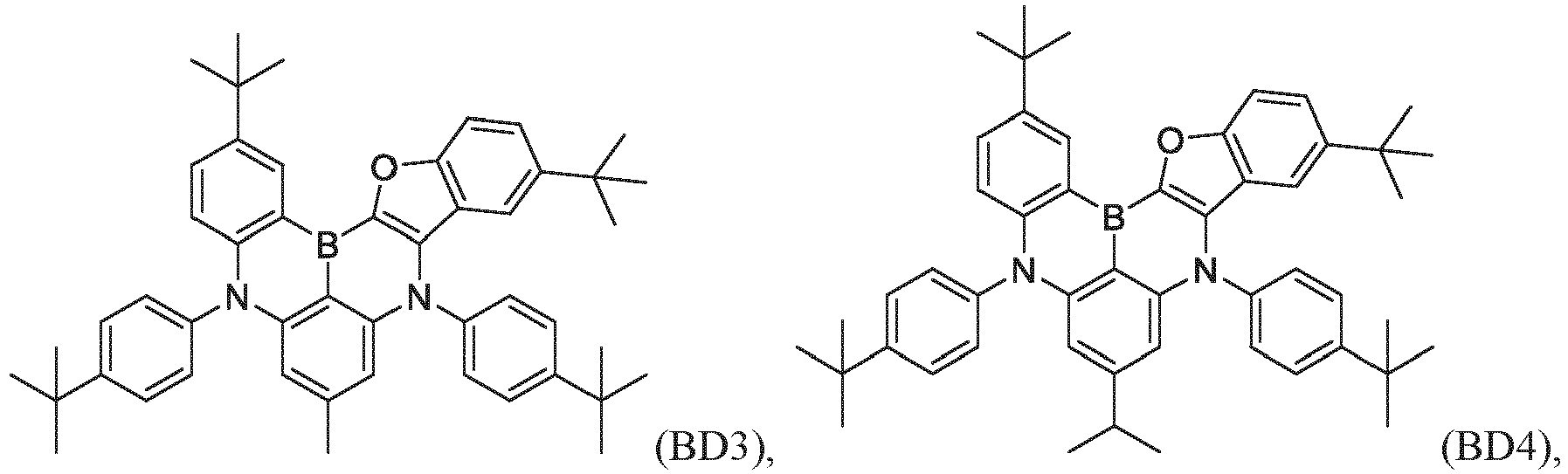


- According to a preferred embodiment of the present invention, the first emission layer comprises an organic emitter host compound, wherein the organic emitter host compound comprises
- at least one condensed aromatic ring system consisting of 3 to 5 rings, and
- 3 to 7 aromatic or heteroaromatic rings, wherein one or more sub-groups of the aromatic and/or heteroaromatic rings may be condensed to form fused aromatic or heteroaromatic ring systems;
- According to a preferred embodiment of the present invention, the organic emitter host compound has the formula (XI)

- Ar41 and Ar42 are independently selected from substituted or unsubstituted C6 to C24 aryl, substituted or unsubstituted C3 to C24 heteroaryl;
- L41 and L42 are independently selected from a direct bond or substituted or unsubstituted C6 to C24 arylene, substituted or unsubstituted C3 to C24 heteroarylene;
- R41 to R48 are independently selected from H, D, substituted or unsubstituted C1 to C12 alkyl, substituted or unsubstituted C6 to C19 aryl, substituted or unsubstituted C3 to C12 heteroaryl;
- wherein
- the substituents on Ar41, Ar42, L41, L42, R41 to R48 are independently selected from D, C6 to C10 aryl, C3 to C9 heteroaryl, C1 to C6 alkyl, C1 to C6 alkoxy, C3 to C6 branched alkyl, C3 to C6 cyclic alkyl, C3 to C6 branched alkoxy, C3 to C6 cyclic alkoxy, partially or perfluorinated C1 to C16 alkyl, partially or perfluorinated C1 to C16 alkoxy, partially or perdeuterated C1 to C6 alkyl, partially or perdeuterated C1 to C6 alkoxy, halogen, F or CN.
- According to a preferred embodiment of the present invention, the organic emitter host and/or compound of formula (XI) is selected from formulae (BH1) to (BH13):


- According to a preferred embodiment of the present invention, the first emission layer comprises a light-emitting dopant of formula (X) and an organic emitter host of formula (XI).
- According to a preferred embodiment of the organic electroluminescent device, the hole injection layer comprises a compound of formula (Ia) and/or formula (Ib),a compound of formula (II) and a compound of formula (III), the hole transport layer comprises a compound of formula (Ia) and/or formula (Ib), preferably the hole injection layer and the hole transport layer comprise the same compound of formula (Ia) and/or formula (Ib) and the first emission layer comprises a light-emitting dopant of formula (X) and an organic emitter host of formula (XI);
wherein the hole transport layer is arranged between the hole injection layer and the first emission layer, and the first emission layer is arranged between the hole transport layer and the cathode layer. - According to a preferred embodiment of the organic electroluminescent device, the hole injection layer comprises a compound of formula (Ia) and/or formula (Ib),a compound of formula (II) and a compound of formula (III), the hole transport layer comprises a compound of formula (Ia) and/or formula (Ib), preferably the hole injection layer and the hole transport layer comprise the same compound of formula (Ia) and/or formula (Ib) and the first emission layer comprises a light-emitting dopant of formula (X) and an organic emitter host of formula (XI);
- wherein the hole transport layer is arranged between the hole injection layer and the first emission layer, and the first emission layer is arranged between the hole transport layer and the cathode layer;
- wherein the anode layer may comprise a first anode sub-layer comprising Ag or Au having a thickness of 100 to 150 nm, a second anode sub-layer comprising or consisting of a transparent conductive oxide having a thickness of 3 to 20 nm and a third anode sub-layer comprising or consisting of a transparent conductive oxide having a thickness of 3 to 20 nm, preferably the transparent conductive oxide is selected from ITO or IZO.
- According to another embodiment of the present invention, the organic electroluminescent device further comprises a second emission layer, wherein the composition of the second emission layer may be selected the same or differently from the first emission layer, preferably, the composition of the second emission layer is selected the same as the first emission layer.
- A hole blocking layer (HBL) may be formed on the EML, by using vacuum deposition, spin coating, slot-die coating, printing, casting, LB deposition, or the like, in order to prevent the diffusion of holes into the ETL. When the EML comprises a phosphorescent dopant, the HBL may have also a triplet exciton blocking function.
- The HBL may also be named auxiliary ETL or a-ETL.
- When the HBL is formed using vacuum deposition or spin coating, the conditions for deposition and coating may be similar to those for the formation of the HIL. However, the conditions for deposition and coating may vary, according to the compound that is used to form the HBL. Any compound that is commonly used to form a HBL may be used. Examples of compounds for forming the HBL include oxadiazole derivatives, triazole derivatives, phenanthroline derivatives and azine derivatives, preferably triazine or pyrimidine derivatives.
- The HBL may have a thickness in the range from about 5 nm to about 100 nm, for example, from about 10 nm to about 30 nm. When the thickness of the HBL is within this range, the HBL may have excellent hole-blocking properties, without a substantial penalty in driving voltage.
- According to an embodiment, the hole blocking layer is free of second organic compound and/or compound of formula (II).
- The organic electroluminescent device according to the present invention may further comprise an electron transport layer (ETL).
- According to another embodiment of the present invention, the electron transport layer may further comprise an azine compound, preferably a triazine compound.
- In one embodiment, the electron transport layer may further comprise a dopant selected from an alkali organic complex, preferably LiQ.
- The thickness of the ETL may be in the range from about 15 nm to about 50 nm, for example, in the range from about 20 nm to about 40 nm. When the thickness of the EII, is within this range, the ETL may have satisfactory electron-injecting properties, without a substantial penalty in driving voltage.
- According to another embodiment of the present invention, the organic electroluminescent device may further comprise an electron transport layer, wherein the electron transport layer comprises a second organic compound and or compound of formula (II).
- According to another embodiment of the present invention, the organic electroluminescent device may further comprise an electron transport layer, wherein the electron transport layer and the hole injection layer comprise the same second organic compound and or compound of formula (II).
- Thereby, only a small number of vacuum thermal evaporation sources is required for manufacture of organic electroluminescent devices according to invention.
- According to another embodiment of the present invention, the organic electroluminescent device may further comprise a hole blocking layer and an electron transport layer, wherein the hole blocking layer and the electron transport layer comprise an azine compound. Preferably, the azine compound is a triazine compound.
- According to another embodiment of the present invention, the organic electroluminescent device may further comprise a hole blocking layer and an electron transport layer, wherein the electron transport layer and the hole injection layer comprise the same second organic compound and or compound of formula (II).
- An optional EIL, which may facilitates injection of electrons from the cathode, may be formed on the ETL, preferably directly on the electron transport layer. Examples of materials for forming the EII, include lithium 8-hydroxyquinolinolate (LiQ), LiF, NaCl, CsF, Li2O, BaO, Ca, Ba, Yb, Mg which are known in the art. Deposition and coating conditions for forming the EII, are similar to those for formation of the HIL, although the deposition and coating conditions may vary, according to the material that is used to form the EIL.
- The thickness of the EIL may be in the range from about 0.1 nm to about 10 nm, for example, in the range from about 0.5 nm to about 9 nm. When the thickness of the EII, is within this range, the EII, may have satisfactory electron-injecting properties, without a substantial penalty in driving voltage.
- The cathode layer is formed on the ETL or optional EIL. The cathode layer may be formed of a metal, an alloy, an electrically conductive compound, or a mixture thereof. The cathode layer may have a low work function. For example, the cathode layer may be formed of lithium (Li), magnesium (Mg), aluminum (Al), aluminum (Al)-lithium (Li), calcium (Ca), barium (Ba), ytterbium (Yb), magnesium (Mg)-indium (In), magnesium (Mg)-silver (Ag), or the like. Alternatively, the cathode layer may be formed of a transparent conductive oxide, such as ITO or IZO.
- The thickness of the cathode layer may be in the range from about 5 nm to about 1000 nm, for example, in the range from about 10 nm to about 100 nm. When the thickness of the cathode layer is in the range from about 5 nm to about 50 nm, the cathode layer may be transparent or semitransparent even if formed from a metal or metal alloy.
- According to a preferred embodiment of the present invention, the cathode is transparent.
- It is to be understood that the cathode layer is not part of an electron injection layer or the electron transport layer.
- The organic electroluminscent device according to the invention may be an organic light-emitting device, also named organic light-emitting diode (OLED).
- According to one aspect of the present invention, there is provided an organic electroluminescent device comprising: a substrate; an anode layer formed on the substrate; a hole injection layer comprising a composition comprising a first organic compound, a second organic compound and a first p-dopant, a hole transport layer, an emission layer, an electron transport layer and a cathode layer.
- According to another aspect of the present invention, there is provided an organic electroluminescent device comprising: a substrate; an anode layer formed on the substrate; a hole injection layer comprising a composition comprising a first organic compound, a second organic compound and a first organic p-dopant, a hole transport layer, an electron blocking layer, an emission layer, a hole blocking layer, an electron transport layer and a cathode layer.
- According to another aspect of the present invention, there is provided an organic electroluminescent device comprising: a substrate; an anode layer formed on the substrate; a hole injection layer comprising a composition comprising a first organic compound, a second organic compound and a first organic p-dopant, a hole transport layer, an electron blocking layer, an emission layer, a hole blocking layer, an electron transport layer, an electron injection layer, and a cathode layer.
- According to various embodiments of the present invention, there may be provided further layers arranged between the above mentioned layers, on the substrate or on the top electrode.
- The present invention furthermore relates to a display device comprising an organic electroluminscent device according to the present invention.
- In the display device, the organic electroluminescent device is arranged on a substrate.
- The display device may comprise several organic electroluminescent devices, wherein the the organic electroluminescent devices are arranged on the substrate. In this arrangement, the organic electroluminescent devices may also be described as pixels.
- The present invention furthermore relates to a display device comprising a substrate and several organic electroluminescent devices according to the present invention, wherein the organic electroluminescent devices are formed on the substrate as adjacent pixels, wherein the hole injection layer is formed as a common hole injection layer on the adjacent pixels.
- According to another aspect of the present invention, there is provided a method of manufacturing an organic electroluminescent device, the method using:
- at least one deposition source, preferably two deposition sources and more preferred at least three deposition sources.
- The methods for deposition that can be suitable comprise:
- deposition via vacuum thermal evaporation;
- deposition via solution processing, preferably the processing is selected from spin-coating, printing, casting; and/or
- slot-die coating.
- According to various embodiments of the present invention, the method may further include forming on the anode layer, at least one layer selected from the group consisting of forming a hole injection layer, a hole transport layer, an electron blocking layer, a first emission layer, a hole blocking layer, an electron transport layer and an electron injection layer between the anode layer and the cathode layer.
- According to various embodiments of the present invention, the method may further include the steps for forming an organic electroluminescent device, wherein
- on a substrate an anode layer is formed,
- on the anode layer a hole injection layer comprising a composition comprising a first organic compound, a second organic compound and a first organic p-dopant is formed,
- on the hole injection layer comprising a composition comprising a first organic compound, a second organic compound and first organic dopant a hole transport layer is formed,
- optionally on the hole transport layer an electron blocking layer is formed,
- on the hole transport layer, or electron blocking layer if present, a first emission layer is formed,
- optionally on the first emission layer a hole blocking layer is formed,
- on the first emission layer, or hole blocking layer if present, an electron transport layer is formed,
- on the electron transport layer an electron injection layer is formed,
- and finally a cathode layer is formed.
- According to various embodiments, the organic electroluminescent device may have the following layer structure, wherein the layers having the following order:
Anode layer, hole injection layer comprising a composition comprising a first organic compound, a second organic compound and first organic dopant, a hole transport layer, optionally an electron blocking layer, a first emission layer, optionally a hole blocking layer, an electron transport layer, optionally an electron injection layer, and cathode layer. - The present invention furthermore relates to a method of preparing an organic electroluminescent device according to the present invention, wherein the method involves a step of depositing the hole injection layer on the anode layer in vacuum, preferably the first organic compound is deposited from a first vacuum thermal evaporation source, the second organic compound is deposited from a second vacuum thermal evaporation source and the first organic p-dopant is deposited from a third vacuum thermal evaporation source.
- The present invention furthermore relates to a method of preparing a display according to the present invention, wherein the method involves a step of depositing the hole injection layer on the anode layer in vacuum, preferably the first organic compound is deposited from a first vacuum thermal evaporation source, the second organic compound is deposited from a second vacuum thermal evaporation source and the first organic p-dopant is deposited from a third vacuum thermal evaporation source.
- The present invention further more relates to a method of preparing a display device comprising a substrate and several organic electroluminescent devices according to the present invention, wherein the organic electroluminescent devices are formed in vaccum on the substrate as adjacent pixels, wherein the hole injection layer is formed in vacuum as a common hole injection layer on the adjacent pixels, preferably the first organic compound is deposited from a first vacuum thermal evaporation source, the second organic compound is deposited from a second vacuum thermal evaporation source and the first organic p-dopant is deposited from a third vacuum thermal evaporation source.
- Hereinafter, the embodiments are illustrated in more detail with reference to examples. However, the present disclosure is not limited to the following examples. Reference will now be made in detail to the exemplary aspects.
- The aforementioned components, as well as the claimed components and the components to be used in accordance with the invention in the described embodiments, are not subject to any special exceptions with respect to their size, shape, material selection and technical concept such that the selection criteria known in the pertinent field can be applied without limitations.
- Additional details, characteristics and advantages of the object are disclosed in the dependent claims and the following description of the respective figures which in an exemplary fashion show preferred embodiments according to the invention. Any embodiment does not necessarily represent the full scope, however, and reference is made therefore to the claims and herein for interpreting the scope. It is to be understood that both the foregoing general description and the following detailed description are exemplary and explanatory only and are intended to provide further explanation of the present invention as claimed.
-
- FIG. 1
- is a schematic sectional view of an
organic electroluminescent device 100, according to an exemplary embodiment of the present invention; - FIG. 2
- is a schematic sectional view of an
organic electroluminescent device 100, according to an exemplary embodiment of the present invention. - FIG. 3
- is a schematic sectional view of an
organic electroluminescent device 100, according to an exemplary embodiment of the present invention; - FIG. 4
- is a schematic sectional view of an
organic electroluminescent device 100, according to an exemplary embodiment of the present invention; - FIG. 5
- is a schematic sectional view of a separated organic
electronic device 200 to determine the spontaneous orientation polarization of the second organic compound or the composition of the hole injection layer; - FIG. 6
- shows an exemplary diagram of the voltage-capacitance characteristics of four devices d1 to d4 according to
FIG. 5 comprising an organic semiconductor layer (240) comprising the second organic compound E1; - FIG. 6
- shows an exemplary diagram of the voltage-capacitance characteristics of an organic
electronic device 200 according toFIG. 5 comprising an organic semiconductor layer (240) having a thickness of 100 nm and comprising the second organic compound E1; - FIG. 8
- shows an exemplary diagram in which the thickness of the organic semiconductor layer (240) comprising E1 is plotted against the transition voltage;
- FIG. 9
- is a schematic sectional view of a test element to determine the sheet resistance;
- FIG. 10
- is a schematic sectional view of deposited layer stack to determine the sheet resistance;
- FIG. 11
- is a schematic sectional view of a test element to determine the sheet resistance;
- FIG. 12
- shows an ITO coated substrate to determine the sheet resistance;
- FIG. 13
- is an exemplary diagram of a current-voltage measurement in the test element of
FIG. 11 ; - FIG. 14
- is an exemplary diagram of sheet resistances.
- Hereinafter, the
Figures 1 to 14 are illustrated in more detail with reference to examples. However, the present disclosure is not limited to the following figures. - Herein, when a first element is referred to as being formed or disposed "on" or "onto" a second element, the first element can be disposed directly on the second element, or one or more other elements may be disposed there between. When a first element is referred to as being formed or disposed "directly on" or "directly onto" a second element, no other elements are disposed there between.
-
FIG. 1 is a schematic sectional view of an organic electroluminescent device (OLED) 100, according to an exemplary embodiment of the present invention. Theorganic electroluminescent device 100 includes a substrate (110), an anode layer (120) and a hole injection layer (HIL) (130) which may comprise the composition comprising a first organic compound, a second organic compound and a first organic p-dopant. The HIL (130) is disposed on the anode layer (120). Onto the HIL (130), a first emission layer (EML) (150), and a cathode layer (190) are disposed. -
FIG. 2 is a schematic sectional view of an organic electroluminescent device (OLED) 100, according to an exemplary embodiment of the present invention. Theorganic electroluminescent device 100 includes a substrate (110), an anode layer (120) and a hole injection layer (HIL) 130 which may comprise the composition comprising a first organic compound, a second organic compound and a first organic p-dopant. The HIL (130) is disposed on the anode layer (120). Onto the HIL (130), a hole transport layer (HTL) (140), a first emission layer (EML) (150), an electron transport layer (ETL) (160), an electron injection layer (EIL) (180) and a cathode layer (190) are disposed. Instead of a single electron transport layer (160), optionally an electron transport layer stack (ETL) can be used. -
FIG. 3 is a schematic sectional view of an organic electroluminescent device (OLED) 100, according to an exemplary embodiment of the present invention. Theorganic electroluminescent device 100 includes a substrate (110), an anode layer (120) that comprises a first anode sub-layer (121) and a second anode sub-layer (122), a hole injection layer (HIL) (130) which may comprise the composition comprising a first organic compound, a second organic compound and a first organic p-dopant, a hole transport layer (HTL) (140), an electron blocking layer (EBL) (145), a first emission layer (EML) (150), a hole blocking layer (EBL) (155), an electron transport layer (ETL) (160) and a cathode layer (190). The layers are disposed exactly in the order as mentioned before. -
FIG. 4 is a schematic sectional view of an organic electroluminescent device (OLED) 100, according to an exemplary embodiment of the present invention. Theorganic electroluminescent device 100 includes a substrate (110), an anode layer (120) that comprises a first anode sub-layer (121), a second anode sub-layer (122) and a third anode sub-layer (123), a hole injection layer (HIL) (130) which may comprise the composition comprising a first organic compound, a second organic compound and a first organic p-dopant, a hole transport layer (HTL) (140), an electron blocking layer (EBL) (145), a first emission layer (EML) (150), a hole blocking layer (EBL) (155), an electron transport layer (ETL) (160) and a cathode layer (190). The layers are disposed exactly in the order as mentioned before. - While not shown in
FIG. 1 to FIG. 4 , a capping and/or a sealing layer may further be formed on the cathode layer (190), in order to seal theorganic electroluminescent device 100. In addition, various other modifications may be applied thereto. -
FIG. 5 is a schematic sectional view of a separated organicelectronic device 200 to determine the spontaneous orientation polarization of an organic semiconductor layer. The separated organicelectronic device 200 includes a substrate (210), an anode layer (220) and a transport layer (HTL) (230). The HTL (230) is disposed on the anode layer (220). Onto the HTL (230), an organic semiconductor layer (240) comprising the second organic compound or the composition of the hole injection layer is disposed. Onto the organic semiconductor layer (240), the cathode layer (250) is disposed. - While not shown in
FIG. 5 , a sealing layer may further be formed on thecathode layer 250, in order to seal the separated organicelectronic device 200. -
FIG. 6 shows an exemplary diagram to determine the capacitance of the separated organicelectronic device 200 ofFIG. 5 , wherein the organic semiconductor layer (240) consists of second organic compound E1 with a thickness of 50 nm, 100 nm, 150 nm and 200 nm. The capacitance in nano farad (nF) is plotted against the voltage in Volt. -
FIG. 7 shows an exemplary diagram to determine the capacitance of the separated organicelectronic device 200 ofFIG. 5 , wherein the organic semiconductor layer (240) consists of second organic compound E1 with a thickness of 100 nm. The capacitance in nF is plotted against the voltage in Volt. The voltage is determined at the point at which the capacitance increases. This is the so-called transition voltage. To accurately determine the transition voltage it may be beneficial to draw guidelines, see the dotted and dashed line inFIG. 7 . -
FIG. 8 shows an exemplary diagram to determine the spontaneous orientation polarization of second organic compound E1. The transition voltage determined inFIG. 7 for four devices comprising theorganic semiconductor layer 240 consisting of second organic compound E1 with a thickness of 50 nm, 100 nm, 150 nm and 200 nm is plotted against the thickness of the organic semiconductor layer. The slope is the spontaneous orientation polarization. -
FIG. 9 shows the test element comprising two highly conductive electrodes with a gap "I" between the two highly conductive electrodes and a width "w" for the respective highly conductive electrodes. -
FIG. 10 shows schematic representation of a deposited layer stack on a test element group for determining the sheet resistance. The test element consists of a channel (test element). The deposition layer (300) lies on top of the electrode. -
FIG. 11 shows the test element comprising two highly conductive electrodes with interdigitated finger pattern with a gap "1" between electrode fingers and total width "w" as product of interdigitation width "we" and number of interdigitation areas. -
FIG. 12 shows an ITO coated substrate with 90nm ITO with 10 Ohm/sq sheet resistance patterned with electrode pairs with 4 different channel lengths combined on one substrate with 25×25mm2 dimension. -
FIG. 13 shows an exemplary diagram of a current-voltage measurement on a substrate shown inFigure 11 . -
FIG. 14 shows an exemplary diagram of sheet resistances derived from current-voltage measurement displayed inFIG. 13 plotted over corresponding channel length and calculation of slope thereof. - Hereinafter, the embodiments are illustrated in more detail with reference to examples. However, the present disclosure is not limited to the following examples.
- The invention is furthermore illustrated by the following examples which are illustrative only and non-binding.
- The first organic compound, second organic compound, and compounds of formulae (Ia), (Ib), (II), (III) to (VI) may be prepared by methods known in the art.
- The HOMO energy level and LUMO energy level are calculated with the program package TURBOMOLE V6.5 (TURBOMOLE GmbH, Litzenhardtstrasse 19, 76135 Karlsruhe, Germany). The optimized geometries and the HOMO energy level and LUMO energy level of the molecular structures are determined by applying the hybrid functional B3LYP with a 6-31G* basis set in the gas phase. If more than one conformation is viable, the conformation with the lowest total energy is selected.
- The HOMO energy level and LUMO energy level in Tables 1, 2, 3 and 4 were determined by this method unless noted otherwise.
- The dipole moment |
µ | of a molecule containing N atoms is given by:


- The dipole moment is determined by a semi-empirical molecular orbital method.
- The geometries of the molecular structures are optimized using the hybrid functional B3LYP with the 6-31G* basis set in the gas phase as implemented in the program package TURBOMOLE V6.5 (TURBOMOLE GmbH, Litzenhardtstrasse 19, 76135 Karlsruhe, Germany). If more than one conformation is viable, the conformation with the lowest total energy is selected to determine the bond lengths of the molecules.
- The dipole moment in Tables 1 and 2 was determined by this method.
- To determine the spontaneous orientation polarization of second organic compounds and comparative compounds in Table 2, an organic
electronic device 200 is prepared as described below. - A glass substrate with an anode layer comprising a first anode sub-layer of 120 nm Ag, a second anode sub-layer of 8 nm ITO and a third anode sub-layer of 10 nm ITO was cut to a size of 25 mm × 25 mm × 0.7 mm, ultrasonically washed with water for 60 minutes and then with isopropanol for 20 minutes. The liquid film was removed in a nitrogen stream, followed by plasma treatment to prepare the anode layer. The plasma treatment was performed in an atmosphere comprising 97.6 vol.-% nitrogen and 2.4 vol.-% oxygen.
- Then, the substrate was transferred to a vacuum chamber and biphenyl-4-yl(9,9-diphenyl-9H-fluoren-2-yl)-[4-(9-phenyl-9H-carbazol-3-yl)phenyl] -amine (CAS 1242056-42-3) was vacuum deposited at a rate of 1 Å/s at 10-7 to 8.10-7 mbar on the anode, to form a HTL (230) having a thickness of 50 nm.
- Then, the second organic compound or comparative compound is vacuum deposited at a rate of 1 Å/s at 10-7 to 8·10-7 mbar on the HTL to form an organic semiconductor layer (240) with a thickness of 50 nm (device d1 with thickness 11), 100 nm (device d2 with thickness t2), 150 nm (device d3 with thickness t3) or 200 nm (device d4 with thickness t4). A BPG400 BA Pirani Gauge was used to determine the process pressure at a distance to Substrate > 60 cm.
- Then, the cathode layer (250) is vacuum deposited on the organic semiconductor layer by evaporating Ag:Mg (90:10 vol.-%) at a rate of 0.01 to 1 Å/s at 10-7 mbar.
- Substrate temperature during deposition process is at room temperature. Waiting time in between individual layers is less than 60 minutes. Deposition is done in the dark.
- The device stack is protected from ambient conditions by encapsulation of the device with a glass lid. The glass lid provides a cavity, which includes a getter material for further protection.
- Prior evaluation the device is annealed for 3 h at a temperature of 85°C.
- To determine the spontaneous orientation polarization of the organic semiconductor layer, the impedance is measured in the dark at a fixed frequency of 1 kHz and a room temperature of 20°C in Rp-Cp mode by applying a swept bias voltage from -20 V to 20 V in 0.1 V increments and using an AC-amplitude of 50mV for each of the four devices d1 to d4, wherein the thickness of the layer comprising the second organic compound is varied between 50 and 200 nm in 50 nm increments. An impedance analyzer Wayne-Kerr-6500P was used to determine the parallel capacitance in Rp-Cp mode. The Rp-Cp mode may also be named parallel resistor-capacitor mode.
- The parallel capacitance Cp in nano Farad (nF) is plotted against the voltage in V. The transition voltage v1 to v4 is determined as the lowest applied bias voltage at which the capacitance increases, see
Figure 7 . If the voltage applied to the organic electronic device is very high current may start to flow. Therefore, valid data points fulfill the equation Rp x Apix > 1 MΩmm2, wherein Rp is the parallel resistance in MS2 and Apix is the device electrically active area measured in mm2. - The transition voltage v1 to v4 is plotted against the layer thickness t1 to t4 and the spontaneous orientation polarization in mV/nm is determined by determining the slope of a linear fit of the data points, see
Figure 8 . - Unless stated otherwise, the spontaneous orientation polarization in Table 2 was determined by this method.
- For inventive examples and comparative examples in Tables 5 and 6, a glass substrate with an anode layer comprising a first anode sub-layer of 120 nm Ag, a second anode sub-layer of 8 nm ITO and a third anode sub-layer of 10 nm ITO was cut to a size of 25 mm × 25 mm × 0.7 mm, ultrasonically washed with water for 60 minutes and then with isopropanol for 20 minutes. The liquid film was removed in a nitrogen stream, followed by plasma treatment to prepare the anode layer. The plasma treatment was performed in an atmosphere comprising 97.6 vol.-% nitrogen and 2.4 vol.-% oxygen.
- Then, the first organic compound or the compound of formula (I), the second organic compound or the compound of formula (II) and first organic p-dopant or the compound of formula (III) or comparative compounds were co-deposited in vacuum on the anode layer, to form a hole injection layer (HIL). The composition of the hole injection layer can be seen in Tables 5 and 6. The thickness of the HIL was 10 nm unless noted otherwise. The formulae of the first organic compounds or compounds of formula (I) are described above or can be seen in Table 1. The formulae of the second organic compounds or compounds of formula (II) are described above or can be seen in Table 2. The formulae of the first organic p-dopant or compounds of formula (III) are described above or can be seen in Table 3. The formulae of comparative compounds can be seen in Tables 1 and 2.
- Then, the first organic compound or compound of formula (I) was vacuum deposited on the HIL, to form a HTL. The first organic compound or compound of formula (I) in the HTL is selected the same as the first organic compound in the HIL. The thickness of the HTL was 128 nm unless noted otherwise. In comparative example 1-2, first organic compound F18 was vacuum deposited to form the HTL having a thickness of 128 nm.
- Then N,N-di([1,1'-biphenyl]-4-yl)-3'-(9H-carbazol-9-yl)-[1,1'-biphenyl]-4-amine was vacuum deposited on the HTL, to form an electron blocking layer (EBL) having a thickness of 5 nm.
- Then the first emission layer (EML) was formed on the EBL having a thickness of 20 nm by co-depositing in vacuum 99 vol.-% EML host compound BH9 and 1 vol.-% EML dopant BD8.
- Then a hole blocking layer (HBL) was formed with a thickness of 5 nm by depositing 2-(3'-(9,9-dimethyl-9H-fluoren-2-yl)-[1,1'-biphenyl]-3-yl)-4,6-diphenyl-1,3,5-triazine in vacuum on the first emission layer EML.
- Then the electron transport layer (ETL) having a thickness of 31 nm was formed on the hole blocking layer by co-depositing in
vacuum 50 wt.-% 2-(2',6'-diphenyl-[1,1':4',1"-terphenyl]-4-yl)-4-phenyl-6-(3-(pyridin-4-yl)phenyl)-1,3,5-triazine and 50 wt.-% of LiQ. - Then an electron injection layer (EIL) was formed on the electron transport layer by vacuum depositing a layer of 2 nm Yb.
- Then Ag:Mg (90:10 vol.-%) was evaporated at a rate of 0.01 to 1 Å/s at 10-7 mbar to form a cathode layer with a thickness of 13 nm on the electron injection layer.
- Then, N-([1,1'-biphenyl]-4-yl)-9,9-dimethyl-N-(4-(9-phenyl-9H-carbazol-3-yl)phenyl)-9H-fluoren-2-amine was vacuum deposited on the cathode layer to form a capping layer with a thickness of 75 nm.
- The OLED stack is protected from ambient conditions by encapsulation of the device with a glass slide. Thereby, a cavity is formed, which includes a getter material for further protection.
- To assess the performance of the inventive examples compared to the prior art, the current efficiency is measured at 20°C. The current-voltage characteristic is determined using a Keithley 2635 source measure unit, by sourcing an operating voltage U in V and measuring the current in mA flowing through the device under test. The voltage applied to the device is varied in steps of 0.1V in the range between 0V and 10V. Likewise, the luminance-voltage characteristics and CIE coordinates are determined by measuring the luminance in cd/m2 using an Instrument Systems CAS-140CT array spectrometer (calibrated by Deutsche Akkreditierungsstelle (DAkkS)) for each of the voltage values.
- In top emission devices, the emission is forward directed, non-Lambertian and also highly dependent on the micro-cavity. In order to minimize the effect of the micro-cavity and thus of the emission color on the device performance, the efficiency Eff. is measured in Candela per Ampere (cd/A) and divided by the CIE-y. Thereby, the CEff/CIE-y values are obtained.
- The sheet resistance Rs of an organic semiconductor layer comprising the composition according to invention and comparative compositions is determined by the transmission line below. The transmission line method may also be described as transfer length method.
- The sheet resistance Rs cannot be determined in an organic electroluminescent device, as the other layers would interfere with the measurement.
- To determine the sheet resistance Rs in GΩ/sq of Examples and comparative examples in Tables 5 and 6, the substrate and samples were prepared as described below.
- ITO coated substrates with 90 nm ITO with 10 Ohm/sq sheet resistance (Corning Eagle XG) were patterned with interdigitated finger structure according to
Figure 11 .12 ITO fingers on both electrodes form a total of 23 conductive areas: n=23. Interdigitation length we was 4.5mm. Thus total channel width was 103.5mm. Channel length w was varied between 20 and 80 µm in 20µm steps. Electrode pairs with 4 different channel lengths were combined on one substrate with 25×25mm2 dimension like displayed inFigure 12 . After wet cleaning with water based tenside solution and drying by blowing with nitrogen followed by 200°C 120 minutes baking in nitrogen atmosphere, the substrates are conditioned with nitrogen plasma. - The organic semiconductor layers were deposited on the substrate in such a way that the complete interdigitated finger pattern was covered, as shown in
Figure 10 . - On the substrates, the compounds or compositions according to examples and comparatives examples in Tables 5 and 6 were deposited by co-evaporation in vacuum to form a first organic semiconductor layer having a thickness of 10 nm. The deposition of the composition or comparative composition took place at constant rate of approx. 1Å/s (Angström per second). The composition of the first organic semiconductor layer was selected the same as the composition of the hole injection layer in the corresponding OLED device, see Tables 5 and 6.
- On the first organic semiconductor layer, a second organic semiconductor layer with a thickness of 120 nm was deposited in a high vacuum by thermal evaporation at a deposition rate of 2 Å/s. The vacuum chamber pressure was 3e-7 mbar during the whole deposition process. The composition of the second organic semiconductor layer was selected the same as the composition of the hole transport layer in the corresponding OLED device in Tables 5 and 6.
- The substrate layer devices obtained by this method were encapsulated in a Nitrogen filled glovebox using glass lids with integrated desiccant, to prevent sample degradation, after organic layer deposition.
- The method for determining the sheet resistance Rs of the substrate layer devices obtained above is described below.
- The sheet resistance Rs is measured for a given deposited layer stack on a test element group (see
Figure 9 ) consisting of test elements called channel providing two highly conductive electrodes with gap "l" between each other and a width "w" of each (seeFigure 9 ). To improve noise level and reduce test element size, electrodes are formed in interdigitated finger structure (seeFigure 11 ). Four of such channels with channel length l1=20µm, l2=40µm, l3=60µm and l4=80µm were used for Rs determination. Channel width "w" for all 4 channels was 103500µm. (seeFigure 12 ). - For each channel "n" with channel length "ln" resistance "Rn" is determined by performing the following steps:
- 1. The voltage is swept between -5V to +5V with step size of 0.5V and the current is measured.
- 2. The voltage values from
step 1 are plotted over measured current values from step 1 (seeFigure 13 ). - 3. The slope of linear fit of plot from
step 2 results in the resistance "Rn". - After determination of resistances "Rn" channel width "w" multiplied with slope of a linear fit with resistances "Rn" plotted over channel length "ln" (see
Figure 14 ) gives sheet resistance Rs for deposited layer stack. - The substrate temperature during this measurement was 23+/-2 °C. The Rs is determined in MΩ/sq. The Rs values in Tables 5 and 6 were determined by this method.
- In Table 1 are shown the chemical formulae and physical properties of the first organic compound.
Table 1: Chemical formulae and physical properties of the first organic compound Referred to as: Chemical formula LUMO HOMO Dipole moment [eV] [eV] [Debye] F1 
-1.13 -4.72 0.20 F2 
-1.18 -4.81 0.76 F3 
-0.89 -4.69 2.46 F4 
-1.09 -4.85 0.80 F5 
-0.93 -4.73 0.58 F6 
-0.93 -4.75 0.98 F7 
-0.96 -4.77 0.69 F8 
-0.89 -4.71 0.59 F9 
-1.15 -4.84 0.55 F10 
-1.04 -4.84 0.29 F11 
-0.86 -4.93 0.93 F12 
-0.99 -4.87 1.20 F13 
-1.01 -4.92 0.57 F14 
-1.08 -4.84 0.86 F15 
-1.01 -4.79 0.55 F16 
-1.15 -4.90 0.77 F17 
-1.17 -4.82 1.98 F18 
-0.92 -4.73 1.50 F22 
-1.10 -4.82 0.92 F23 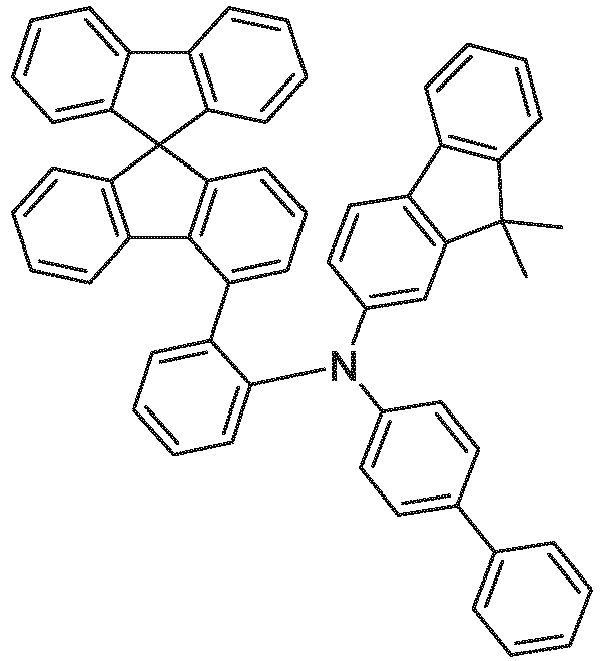
-1.0 -4.84 0.21 - As can be seen in Table 1, the physical properties are in the range suitable for organic electroluminescent devices of the present invention.
- In Table 2 are shown the chemical formulae and physical properties of the second organic compound and of an organic semiconductor layer consisting of the second organic compound.
Table 2: Chemical formulae and physical properties of the second organic compound and spontaneous orientation polarization (SOP) of an organic semiconductor layer consisting of the second organic compound Referred to as: Chemical formula SOP [mV/nm] Molecular weight [g/mol] LUMO [eV] HOMO [eV] Dipole Moment [Debye] E1 
35 585.69 -1.86 -5.69 1.95 E2 
34 585.69 -1.83 -5.70 0.58 E3 
52 740.89 -1.81 -5.74 0.54 E4 
40 690.83 -1.74 -5.62 2.10 E5 
3 3 614.74 -1.73 -5.68 1.89 E6 
23 614.74 -1.68 -5.70 2.11 E7 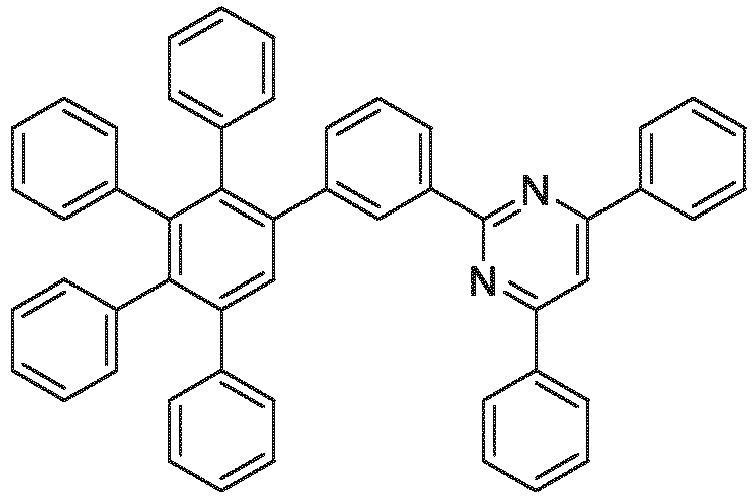
22 688.86 -1.63 -5.73 0.58 E8 
34 788.97 -1.78 -5.61 1.88 E9 
27 788.97 -1.75 -5.77 1.59 E10 
14 548.63 -1.81 -5.03 0.98 E11 
9 509.60 -1.87 -5.48 4.80 E12 
39 718.89 -1.86 -5.83 1.61 E13 
0 577.72 -1.84 -5.57 0.48 Comparative compound 1 (CC-1) 
-47 606.69 -1.67 -5.16 4.13 Comparative compound 2 (CC-2) 
0 1) 408.49 -0.75 -5.45 1.34 1) Noguchi et al., J. Soc. Inf. Display, 2021, 29, 29-37. - As can be seen in Table 2, the physical properties of the second organic compound are in the range suitable for organic electroluminescent devices of the present invention.
- Additionally, the spontaneous orientation polarization of an organic semiconductor layer consisting of the second organic compound is within the range suitable for organic electroluminescent devices of the present invention.
- In comparative compound 1 (CC-1), the spontaneous orientation polarization is -47 mV/nm.
- In comparative compound 2 (CC-2), the LUMO energy level is -0.75 eV.
- In Table 3 are shown the chemical formulae, LUMO and HOMO energy levels of a range of first organic p-dopants.
Table 3: Chemical formulas, LUMO and HOMO energy levels of first organic p-dopant Referred to as: Chemical formula LUMO [eV] HOMO [eV] K1 
-5.19 -7.82 K2 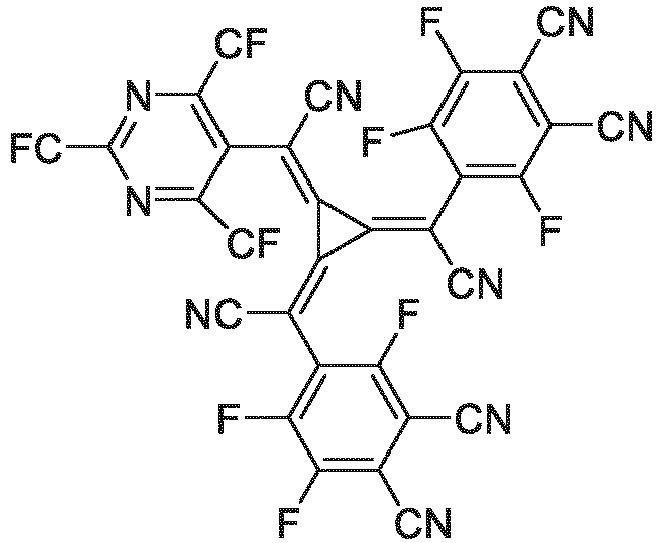
-5.44 -8.13 K3 
-4.82 -7.45 K4 
-5.00 -7.69 K5 
-5.22 -7.98 K8 
-5.10 -7.74 K6 
-5.07 -7.76 K7 
-5.21 -7.81 K10 
-5.31 -7.55 K11 
-5.24 -7.58 K12 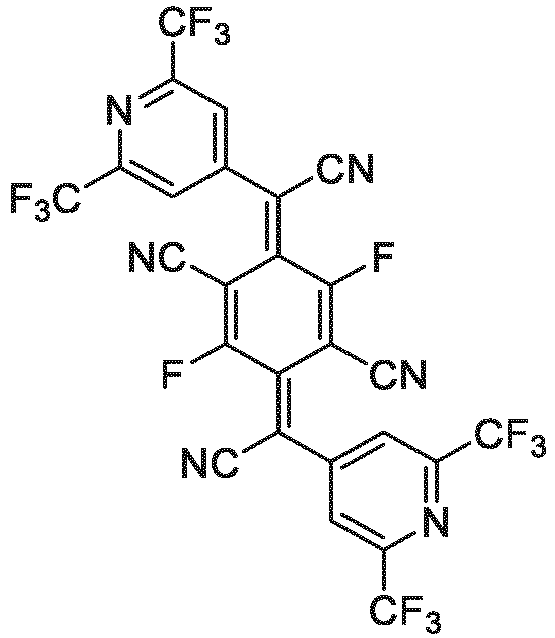
-5.20 -7.64 K13 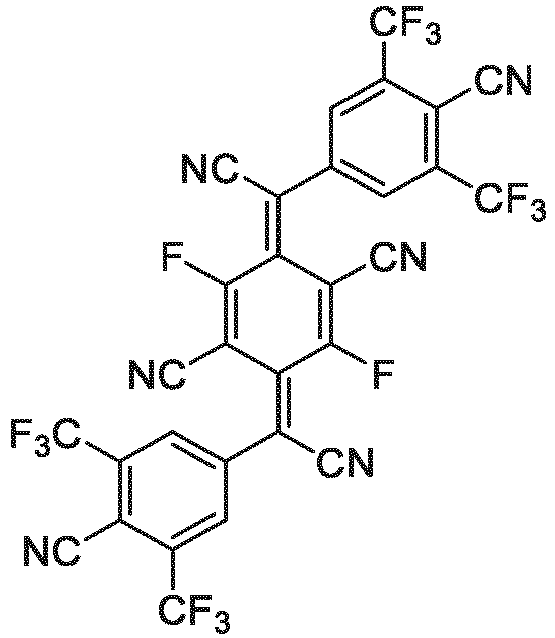
-5.25 -7.45 K14 
-5.28 -7.43 K15 
-5.32 -7.42 K16 
-5.35 -7.21 K17 
-4.99 -7.43 K18 
-5.07 -7.33 K19 
-5.15 -7.57 K20 
-5.22 -7.44 K23 
-5.31 -7.78 K24 
-5.38 -7.62 K25 
-5.16 -7.56 K26 
-5.22 -7.46 K21 
-5.07 -7.46 K22 
-5.14 -7.73 - As can be seen in Table 3, the HOMO and LUMO energy levels of the first organic p-dopant are in the range suitable for organic electroluminescent devices.
- In Table 4 are shown the compositions comprising a first organic compound, a second organic compound and a first organic p-dopant, wherein the following equations (a) and (b) are fulfilled:
- (a) 0.2 eV < Δ [LUMO energy level of the first organic compound - LUMO energy level of the second organic compound] < 3.5 eV; and
- (b) 0 eV < Δ [HOMO energy level of the first organic compound - LUMO energy level of the first organic p-dopant] < 1.5eV; and comparative compositions.
- In compositions 1-1 to 1-325, 2-1 to 2-300, 3-1 to 3-288, 4-1 to 4-312,the following equations (a) and (b) are fulfilled:
- (a) 0.2 eV < Δ [LUMO energy level of the first organic compound - LUMO energy level of the second organic compound] < 3.5 eV; and
- (b) 0 eV < Δ [HOMO energy level of the first organic compound - LUMO energy level of the first organic p-dopant] < 1.5eV.
- If the composition fulfils these criteria, particularly improved performance may be obtained of an organic electroluminescent device comprising the composition in the hole injection layer.
- In comparative composition 1-1, the equations (a) and (b) are fulfilled. However, the spontaneous orientation polarization of comparative compound 1 (CC-1) is -47 mV/nm, see Table 2.
- In comparative composition 1-2, the composition comprises two first organic compounds, namely formulae F18 and F3. The difference Δ [LUMO (first organic compound) - LUMO (second organic compound)] is -0.3 eV.
- In comparative composition 1-3, the difference Δ [LUMO energy level of the first organic compound - LUMO energy level of the second organic compound] is -0.15 eV.
- In comparative composition 1-4, the second organic compound is selected from HAT-CN (CAS Registry Number 105598-27-4). The LUMO of HAT-CN is -4.61 eV. The difference Δ [LUMO energy level of the first organic compound - LUMO energy level of the second organic compound] is 3.69 eV.
- In Table 5 are shown the data for organic electroluminescent devices comprising a hole injection layer of the present invention and comparative examples, wherein the thickness of the hole injection layer is 10 nm.
Table 5: Organic electroluminescent device comprising a hole injection layer having a thickness of 10 nm Referred to as: First organic compound in HIL Wt.-% First organic compound in HIL Second organic compound in HIL Wt.-% second organic compound in HIL First organic p-dopant in HIL wt.-% first organic pdopant in HIL Voltage rel. [%] at 15 mA/cm2 CEff/CIE-y rel. [%] at 15 mA/cm2 Rs rel. [%] Comparative example 1-1 F18 98 -- -- G1 2 100 100 100 Comparative example 1-2 -- -- E1 98 G1 2 202 84 19 Example 1-1 F18 88 E1 10 G1 2 99 100 147 Example 1-2 F18 78 E1 20 G1 2 99 99 184 Example 1-3 F18 68 E1 30 G1 2 98 101 115 Example 1-4 F18 68.5 E1 30 G1 1.5 98 99 132 Example 1-5 F18 69 E1 30 G1 1 99 99 179 Example 1-6 F18 78 E9 20 G1 2 99 100 133 Example 1-7 F18 78 E13 20 G1 2 100 100 237 Comparative example 1-3 F18 78 CC-1 20 G1 2 112 100 922 Comparative example 1-4 F18 78 F3 20 G1 2 100 98 75 Comparative example 1-5 F18 68 F3 30 G1 2 100 98 60 Comparative example 1-6 F18 68 CC-2 30 G1 2 99 101 44 - In comparative example 1-1, the hole injection layer comprises 98 wt.-% first organic compound F18 and 2 wt.-% first organic p-dopant G1. The hole injection layer is free of second organic compound. The voltage, CEff/CIE-y and Rs are defined as 100%.
In comparative example 12, the hole injection layer comprises 98 wt.-% second organic compound and 2 wt.-% first organic p-dopant G1. The hole injection layer is free of first organic compound. The voltage is increased, the CEff/CIE-y is reduced and the sheet resistance Rs is reduced compared to comparative example 1-1. A low sheet resistance may result in high conductivity of the hole injection layer. Thereby, neighbouring pixels in a display devices may light up if a current is applied to one pixel. This may result in reduced image quality of the display device. - In Example 1-1, the hole injection layer comprises 88 wt.-% first organic compound F18, 10 wt.-% second organic compound E1 and 2 wt.-% first organic p-dopant G1. The voltage is slightly reduced to 99%, the CEff/CIE-y is unchanged and the sheet resistance Rs is increased. Thereby, in a display device a current can be applied to selected pixels without current flowing to neighbouring pixels. As a result, improved image quality may be obtained, in particular in a display device.
- In Examples 1-2 to 1-5, the hole injection layer comprises a range of weight percentages of first organic compound, second organic compound and first organic p-dopant. As can be seen in Table 5, the voltage and CEff/CIE-y are unchanged or slightly improved relative to comparative example 1-1. However, the sheet resistance Rs is substantially increased relative to comparative example 1-1.
- In Example 1-6, the hole injection layer comprises 78 wt.-% first organic compound F18, 20 wt.-% second organic compound E9 and 2 wt.-% first organic p-dopant G1. As can be seen in Table 5, the voltage is slightly improved and CEff/CIE-y is unchanged relative to comparative example 1-1. However, the sheet resistance Rs is substantially increased relative to comparative example 1-1.
- In Example 1-7, the hole injection layer comprises 78 wt.-% first organic compound F18, 20 wt.-% second organic compound E13 and 2 wt.-% first organic p-dopant G1. As can be seen in Table 5, the voltage and CEff/CIE-y are unchanged relative to comparative example 1-1. However, the sheet resistance Rs is substantially increased relative to comparative example 1-1.
- In comparative example 1-3, the spontaneous orientation polarization of the second organic compound is -47 mV/nm, see Table 2. The voltage is increased to 112%, the CEff/CIE-y is unchanged and the sheet resistance Rs is substantially increased to 922 % relative to comparative example 1-1. Thereby, the hole injection layer is essentially non-conductive.
- In comparative example 1-4, the difference Δ [LUMO energy level of the first organic compound - LUMO energy level of the second organic compound] is -0.03 eV, see comparative composition 1-2 in Table 4. The voltage is unchanged, the CEff/CIE-y is reduced at 98% and the sheet resistance is reduced at 75% relative to comparative example 1-1. Thereby, the conductivity of the organic semiconductor layer and/or hole injection layer comprising the composition is increased relative to comparative example 1-1.
- In comparative example 1-5, the comparative composition 1-2 comprises a higher amount of second organic compound compared to comparative example 1-4. The voltage and CEff/CIE-y are unchanged compared to comparative example 1-4. The sheet resistance is even further reduced to 60% compared to comparative example 1-1.
- In comparative example 1-6, the hole injection layer comprises comparative composition 1-3. The difference Δ [LUMO energy level of the first organic compound - LUMO energy level of the second organic compound] is -0.17 eV, see comparative composition 1-3 in Table 4. The voltage is essentially unchanged at 99% and the efficiency is essentially unchanged at 101%. The sheet resistance Rs is substantially reduced to 44% relative to comparative example 1-1.
- In summary, surprisingly an improvement in sheet resistance Rs has been obtained without substantial detrimental effect on the voltage and/or efficiency.
- An increase in sheet resistance Rs may result in reduced conductivity of the hole injection layer. Thereby, selected pixels can be switched on in a display device without substantial current flowing to neighbouring pixels (so-called pixel crosstalk). As a result the colour purity and/or image quality of an organic electroluminescent device and/or display device may be improved, in particular of a display device.
- Additionally, a reduction in voltage and/or an increase in efficiency CEff/CIE-y may be obtained.
- A reduction in voltage and/or an increase in efficiency CEff/CIE-y may result in reduced power consumption of organic electroluminescent devices, in particular mobile devices.
- In Table 6 are shown the data for organic electroluminescent devices comprising a hole injection layer of the present invention and comparative examples, wherein the thickness of the hole injection layer is 10 nm. The hole injection layer comprises a different first organic p-dopant compared to Examples 1-1 to 1-7.
Table 6: Organic electroluminescent device comprising a hole injection layer having a thickness of 10 nm Referred to as: First organic compound in HIL wt.-% First organic compound in HIL Second organic compound in HIL wt.-% second organic compound in HIL First organic p-dopant in HIL Wt.-% first organic p-dopant in HIL Voltage rel. [%] at 15 mA/cm2 CEff/CIE-y rel. [%] at 15 mA/cm2 Rs rel. [%] Comparative example 2-1 F18 90 - - G4 10 100 100 100 Example 2-1 F18 80 E1 10 G4 10 100 100 234 Example 2-2 F18 65 E1 25 G4 10 99 100 268 Example 2-3 F18 80 E4 10 G4 10 100 101 208 Example 2-4 F18 65 E4 25 G4 10 100 100 141 - In comparative example 2-1, the hole injection layer comprises 98 wt.-% first organic compound F18 and 2 wt.-% first organic p-dopant G4. The hole injection layer is free of second organic compound. The voltage, CEff/CIE-y and Rs are defined as 100%.
- In Example 2-1, the hole injection layer comprises 80 wt.-% first organic compound F18, 10 wt.-% second organic compound E1 and 10 wt.-% first organic p-dopant G4. The voltage and CEff/CIE-y are unchanged. However, the sheet resistance Rs is substantially increased to 234 % relative to comparative example 2-1.
- In Example 2-2, the hole injection layer comprises 65 wt.-% first organic compound F18, 25 wt.-% second organic compound E1 and 10 wt.-% first organic p-dopant G4. The voltage is slightly reduced and the CEff/CIE-y is unchanged. The sheet resistance Rs is increased further to 268 % relative to comparative example 2-1.
- In Example 2-1, the hole injection layer comprises 80 wt.-% first organic compound F18, 10 wt.-% second organic compound E4 and 10 wt.-% first organic p-dopant G4. Example 2-1 differs from Example 2-1 in the second organic compound. The voltage is unchanged, the CEff/CIE-y is slightly improved and the sheet resistance Rs is substantially increased to 208 % relative to comparative example 2-1.
- In Example 2-4, the hole injection layer comprises 65 wt.-% first organic compound F18, 25 wt.-% second organic compound E4 and 10 wt.-% first organic p-dopant G4. The voltage and CEff/CIE-y are unchanged. However, the sheet resistance Rs is increased to 141 % relative to comparative example 2-1.
- In summary, improved performance of an organic electroluminescent device, in particular improved sheet resistance Rs, has been obtained for different second organic compounds and first organic p-dopant.
- The particular combinations of elements and features in the above detailed embodiments are exemplary only; the interchanging and substitution of these teachings with other teachings in this and the patents/applications incorporated by reference are also expressly contemplated. As those skilled in the art will recognize, variations, modifications, and other implementations of what is described herein can occur to those of ordinary skill in the art without departing from the spirit and the scope of the invention as claimed. Accordingly, the foregoing description is by way of example only and is not intended as limiting. In the claims, the word "comprising" does not exclude other elements or steps, and the indefinite article "a" or "an" does not exclude a plurality. The mere fact that certain measures are recited in mutually different dependent claims does not indicate that a combination of these measured cannot be used to advantage. The invention's scope is defined in the following claims and the equivalents thereto. Furthermore, reference signs used in the description and claims do not limit the scope of the invention as claimed.
the following equations (a) and (b) are fulfilled:
the hole injection layer is in direct contact with the anode layer.
wherein
optionally the second organic compound comprising ≥ 7 to ≤ 14 aromatic rings, if formed as a separated organic semiconductor layer, said separated organic semiconductor layer consisting of the second organic compound has a spontaneous orientation polarization in the range of ≥ 0 mV/nm to ≤ 150 mV/nm.
the substituents of Ar21, Ar22, Ar23 are selected the same or different from the group comprising H, D, F, C(-O)R22, CN, Si(R22)3, P(-O)(R22)2, OR22, S(-O)R22, S(-O)2R22, substituted or unsubstituted straight-chain alkyl having 1 to 20 carbon atoms, substituted or unsubstituted branched alkyl having 1 to 20 carbon atoms, substituted or unsubstituted cyclic alkyl having 3 to 20 carbon atoms, substituted or unsubstituted alkenyl or alkynyl groups having 2 to 20 carbon atoms, substituted or unsubstituted substituted or unsubstituted aromatic ring systems having 6 to 40 aromatic ring atoms, and substituted or unsubstituted heteroaromatic ring systems having 5 to 40 aromatic ring atoms, unsubstituted C6 to C18 aryl, unsubstituted C3 to C18 heteroaryl, a fused ring system comprising 2 to 6 unsubstituted 5- to 7-member rings and the rings are selected from the group comprising unsaturated 5- to 7-member ring of a heterocycle, 5- to 6-member of an aromatic heterocycle, unsaturated 5- to 7-member ring of a non-heterocycle, and 6-member ring of an aromatic non-heterocycle,
wherein R22 may be selected from H, D, straight-chain alkyl having 1 to 6 carbon atoms, branched alkyl having 1 to 6 carbon atoms, cyclic alkyl having 3 to 6 carbon atoms, alkenyl or alkynyl groups having 2 to 6 carbon atoms, C6 to C18 aryl or C3 to C18 heteroaryl.
wherein each of the substituted C6 to C19 aryl group or substituted C3 to C12 heteroaryl group is substituted with a substituent independently selected from halogen, F, CN, partially perfluorinated C1 to C12 alkyl, perfluorinated C1 to C12 alkyl, or CF3.
optionally the second organic compound comprising ≥ 7 to ≤ 14 aromatic rings, if formed as a separated organic semiconductor layer, said separated organic semiconductor layer consisting of the second organic compound has a spontaneous orientation polarization in the range of ≥ 0 mV/nm to ≤ 150 mV/nm.
| Referred to as: | First organic compound | LUMO of first organic compound [eV] | HOMO of first organic compound [eV] | Second organic compound | LUMO of second organic compound [eV] | First organic p-dopant | LUMO of first organic p-dopant | Δ [LUMO (first organic compound) - LUMO (second organic compound)] [eV] | Δ [HOMO (first organic compound) - LUMO (first organic p-dopant)] [eV] |
| Composition 1-1 | F18 | -0.92 | -4.73 | E1 | -1.86 | K1 | -5.19 | 0.94 | 0.46 |
| Composition 1-2 | F18 | -0.92 | -4.73 | E1 | -1.86 | K2 | -5.44 | 0.94 | 0.71 |
| Composition 1-3 | F18 | -0.92 | -4.73 | E1 | -1.86 | K3 | -4.82 | 0.94 | 0.09 |
| Composition 1-4 | F18 | -0.92 | -4.73 | E1 | -1.86 | K4 | -5 | 0.94 | 0.27 |
| Composition 1-5 | F18 | -0.92 | -4.73 | E1 | -1.86 | K5 | -5.22 | 0.94 | 0.49 |
| Composition 1-6 | F18 | -0.92 | -4.73 | E1 | -1.86 | K8 | -5.1 | 0.94 | 0.37 |
| Composition 1-7 | F18 | -0.92 | -4.73 | E1 | -1.86 | K6 | -5.07 | 0.94 | 0.34 |
| Composition 1-8 | F18 | -0.92 | -4.73 | E1 | -1.86 | K7 | -5.21 | 0.94 | 0.48 |
| Composition 1-9 | F18 | -0.92 | -4.73 | E1 | -1.86 | K10 | -5.31 | 0.94 | 0.58 |
| Composition 1-10 | F18 | -0.92 | -4.73 | E1 | -1.86 | K11 | -5.24 | 0.94 | 0.51 |
| Composition 1-11 | F18 | -0.92 | -4.73 | E1 | -1.86 | K12 | -5.2 | 0.94 | 0.47 |
| Composition 1-12 | F18 | -0.92 | -4.73 | E1 | -1.86 | K13 | -5.25 | 0.94 | 0.52 |
| Composition 1-13 | F18 | -0.92 | -4.73 | E1 | -1.86 | K14 | -5.28 | 0.94 | 0.55 |
| Composition 1-14 | F18 | -0.92 | -4.73 | E1 | -1.86 | K15 | -5.32 | 0.94 | 0.59 |
| Composition 1-15 | F18 | -0.92 | -4.73 | E1 | -1.86 | K16 | -5.35 | 0.94 | 0.62 |
| Composition 1-16 | F18 | -0.92 | -4.73 | E1 | -1.86 | K17 | -4.99 | 0.94 | 0.26 |
| Composition 1-17 | F18 | -0.92 | -4.73 | E1 | -1.86 | K18 | -5.07 | 0.94 | 0.34 |
| Composition 1-18 | F18 | -0.92 | -4.73 | E1 | -1.86 | K19 | -5.15 | 0.94 | 0.42 |
| Composition 1-19 | F18 | -0.92 | -4.73 | E1 | -1.86 | K20 | -5.22 | 0.94 | 0.49 |
| Composition 1-20 | F18 | -0.92 | -4.73 | E1 | -1.86 | K21 | -5.31 | 0.94 | 0.58 |
| Composition 1-21 | F18 | -0.92 | -4.73 | E1 | -1.86 | K24 | -5.38 | 0.94 | 0.65 |
| Composition 1-22 | F18 | -0.92 | -4.73 | E1 | -1.86 | K25 | -5.16 | 0.94 | 0.43 |
| Composition 1-23 | F18 | -0.92 | -4.73 | E1 | -1.86 | K26 | -5.22 | 0.94 | 0.49 |
| Composition 1-24 | F18 | -0.92 | -4.73 | E1 | -1.86 | K21 | -5.07 | 0.94 | 0.34 |
| Composition 1-25 | F18 | -0.92 | -4.73 | E1 | -1.86 | K22 | -5.14 | 0.94 | 0.41 |
| Composition 1-26 | F18 | -0.92 | -4.73 | E2 | -1.83 | K1 | -5.19 | 0.91 | 0.46 |
| Composition 1-27 | F18 | -0.92 | -4.73 | E2 | -1.83 | K2 | -5.44 | 0.91 | 0.71 |
| Composition 1-28 | F18 | -0.92 | -4.73 | E2 | -1.83 | K3 | -4.82 | 0.91 | 0.09 |
| Composition 1-29 | F18 | -0.92 | -4.73 | E2 | -1.83 | K4 | -5 | 0.91 | 0.27 |
| Composition 1-30 | F18 | -0.92 | -4.73 | E2 | -1.83 | K5 | -5.22 | 0.91 | 0.49 |
| Composition 1-31 | F18 | -0.92 | -4.73 | E2 | -1.83 | K8 | -5.1 | 0.91 | 0.37 |
| Composition 1-32 | F18 | -0.92 | -4.73 | E2 | -1.83 | K6 | -5.07 | 0.91 | 0.34 |
| Composition 1-33 | F18 | -0.92 | -4.73 | E2 | -1.83 | K7 | -5.21 | 0.91 | 0.48 |
| Composition 1-34 | F18 | -0.92 | -4.73 | E2 | -1.83 | K10 | -5.31 | 0.91 | 0.58 |
| Composition 1-35 | F18 | -0.92 | -4.73 | E2 | -1.83 | K11 | -5.24 | 0.91 | 0.51 |
| Composition 1-36 | F18 | -0.92 | -4.73 | E2 | -1.83 | K12 | -5.2 | 0.91 | 0.47 |
| Composition 1-37 | F18 | -0.92 | -4.73 | E2 | -1.83 | K13 | -5.25 | 0.91 | 0.52 |
| Composition 1-38 | F18 | -0.92 | -4.73 | E2 | -1.83 | K14 | -5.28 | 0.91 | 0.55 |
| Composition 1-39 | F18 | -0.92 | -4.73 | E2 | -1.83 | K15 | -5.32 | 0.91 | 0.59 |
| Composition 1-40 | F18 | -0.92 | -4.73 | E2 | -1.83 | K16 | -5.35 | 0.91 | 0.62 |
| Composition 1-41 | F18 | -0.92 | -4.73 | E2 | -1.83 | K17 | -4.99 | 0.91 | 0.26 |
| Composition 1-42 | F18 | -0.92 | -4.73 | E2 | -1.83 | K18 | -5.07 | 0.91 | 0.34 |
| Composition 1-43 | F18 | -0.92 | -4.73 | E2 | -1.83 | K19 | -5.15 | 0.91 | 0.42 |
| Composition 1-44 | F18 | -0.92 | -4.73 | E2 | -1.83 | K20 | -5.22 | 0.91 | 0.49 |
| Composition 1-45 | F18 | -0.92 | -4.73 | E2 | -1.83 | K21 | -5.31 | 0.91 | 0.58 |
| Composition 1-46 | F18 | -0.92 | -4.73 | E2 | -1.83 | K24 | -5.38 | 0.91 | 0.65 |
| Composition 1-47 | F18 | -0.92 | -4.73 | E2 | -1.83 | K25 | -5.16 | 0.91 | 0.43 |
| Composition 1-48 | F18 | -0.92 | -4.73 | E2 | -1.83 | K26 | -5.22 | 0.91 | 0.49 |
| Composition 1-49 | F18 | -0.92 | -4.73 | E2 | -1.83 | K21 | -5.07 | 0.91 | 0.34 |
| Composition 1-50 | F18 | -0.92 | -4.73 | E2 | -1.83 | K22 | -5.14 | 0.91 | 0.41 |
| Composition 1-51 | F18 | -0.92 | -4.73 | E12 | -1.86 | K1 | -5.19 | 0.94 | 0.46 |
| Composition 1-52 | F18 | -0.92 | -4.73 | E12 | -1.86 | K2 | -5.44 | 0.94 | 0.71 |
| Composition 1-53 | F18 | -0.92 | -4.73 | E12 | -1.86 | K3 | -4.82 | 0.94 | 0.09 |
| Composition 1-54 | F18 | -0.92 | -4.73 | E12 | -1.86 | K4 | -5 | 0.94 | 0.27 |
| Composition 1-55 | F18 | -0.92 | -4.73 | E12 | -1.86 | K5 | -5.22 | 0.94 | 0.49 |
| Composition 1-56 | F18 | -0.92 | -4.73 | E12 | -1.86 | K8 | -5.1 | 0.94 | 0.37 |
| Composition 1-57 | F18 | -0.92 | -4.73 | E12 | -1.86 | K6 | -5.07 | 0.94 | 0.34 |
| Composition 1-58 | F18 | -0.92 | -4.73 | E12 | -1.86 | K7 | -5.21 | 0.94 | 0.48 |
| Composition 1-59 | F18 | -0.92 | -4.73 | E12 | -1.86 | K10 | -5.31 | 0.94 | 0.58 |
| Composition 1-60 | F18 | -0.92 | -4.73 | E12 | -1.86 | K11 | -5.24 | 0.94 | 0.51 |
| Composition 1-61 | F18 | -0.92 | -4.73 | E12 | -1.86 | K12 | -5.2 | 0.94 | 0.47 |
| Composition 1-62 | F18 | -0.92 | -4.73 | E12 | -1.86 | K13 | -5.25 | 0.94 | 0.52 |
| Composition 1-63 | F18 | -0.92 | -4.73 | E12 | -1.86 | K14 | -5.28 | 0.94 | 0.55 |
| Composition 1-64 | F18 | -0.92 | -4.73 | E12 | -1.86 | K15 | -5.32 | 0.94 | 0.59 |
| Composition 1-65 | F18 | -0.92 | -4.73 | E12 | -1.86 | K16 | -5.35 | 0.94 | 0.62 |
| Composition 1-66 | F18 | -0.92 | -4.73 | E12 | -1.86 | K17 | -4.99 | 0.94 | 0.26 |
| Composition 1-67 | F18 | -0.92 | -4.73 | E12 | -1.86 | K18 | -5.07 | 0.94 | 0.34 |
| Composition 1-68 | F18 | -0.92 | -4.73 | E12 | -1.86 | K19 | -5.15 | 0.94 | 0.42 |
| Composition 1-69 | F18 | -0.92 | -4.73 | E12 | -1.86 | K20 | -5.22 | 0.94 | 0.49 |
| Composition 1-70 | F18 | -0.92 | -4.73 | E12 | -1.86 | K21 | -5.31 | 0.94 | 0.58 |
| Composition 1-71 | F18 | -0.92 | -4.73 | E12 | -1.86 | K24 | -5.38 | 0.94 | 0.65 |
| Composition 1-72 | F18 | -0.92 | -4.73 | E12 | -1.86 | K25 | -5.16 | 0.94 | 0.43 |
| Composition 1-73 | F18 | -0.92 | -4.73 | E12 | -1.86 | K26 | -5.22 | 0.94 | 0.49 |
| Composition 1-74 | F18 | -0.92 | -4.73 | E12 | -1.86 | K21 | -5.07 | 0.94 | 0.34 |
| Composition 1-75 | F18 | -0.92 | -4.73 | E12 | -1.86 | K22 | -5.14 | 0.94 | 0.41 |
| Composition 1-76 | F18 | -0.92 | -4.73 | E3 | -1.81 | K1 | -5.19 | 0.89 | 0.46 |
| Composition 1-77 | F18 | -0.92 | -4.73 | E3 | -1.81 | K2 | -5.44 | 0.89 | 0.71 |
| Composition 1-78 | F18 | -0.92 | -4.73 | E3 | -1.81 | K3 | -4.82 | 0.89 | 0.09 |
| Composition 1-79 | F18 | -0.92 | -4.73 | E3 | -1.81 | K4 | -5 | 0.89 | 0.27 |
| Composition 1-80 | F18 | -0.92 | -4.73 | E3 | -1.81 | K5 | -5.22 | 0.89 | 0.49 |
| Composition 1-81 | F18 | -0.92 | -4.73 | E3 | -1.81 | K8 | -5.1 | 0.89 | 0.37 |
| Composition 1-82 | F18 | -0.92 | -4.73 | E3 | -1.81 | K6 | -5.07 | 0.89 | 0.34 |
| Composition 1-83 | F18 | -0.92 | -4.73 | E3 | -1.81 | K7 | -5.21 | 0.89 | 0.48 |
| Composition 1-84 | F18 | -0.92 | -4.73 | E3 | -1.81 | K10 | -5.31 | 0.89 | 0.58 |
| Composition 1-85 | F18 | -0.92 | -4.73 | E3 | -1.81 | K11 | -5.24 | 0.89 | 0.51 |
| Composition 1-86 | F18 | -0.92 | -4.73 | E3 | -1.81 | K12 | -5.2 | 0.89 | 0.47 |
| Composition 1-87 | F18 | -0.92 | -4.73 | E3 | -1.81 | K13 | -5.25 | 0.89 | 0.52 |
| Composition 1-88 | F18 | -0.92 | -4.73 | E3 | -1.81 | K14 | -5.28 | 0.89 | 0.55 |
| Composition 1-89 | F18 | -0.92 | -4.73 | E3 | -1.81 | K15 | -5.32 | 0.89 | 0.59 |
| Composition 1-90 | F18 | -0.92 | -4.73 | E3 | -1.81 | K16 | -5.35 | 0.89 | 0.62 |
| Composition 1-91 | F18 | -0.92 | -4.73 | E3 | -1.81 | K17 | -4.99 | 0.89 | 0.26 |
| Composition 1-92 | F18 | -0.92 | -4.73 | E3 | -1.81 | K18 | -5.07 | 0.89 | 0.34 |
| Composition 1-93 | F18 | -0.92 | -4.73 | E3 | -1.81 | K19 | -5.15 | 0.89 | 0.42 |
| Composition 1-94 | F18 | -0.92 | -4.73 | E3 | -1.81 | K20 | -5.22 | 0.89 | 0.49 |
| Composition 1-95 | F18 | -0.92 | -4.73 | E3 | -1.81 | K21 | -5.31 | 0.89 | 0.58 |
| Composition 1-96 | F18 | -0.92 | -4.73 | E3 | -1.81 | K24 | -5.38 | 0.89 | 0.65 |
| Composition 1-97 | F18 | -0.92 | -4.73 | E3 | -1.81 | K25 | -5.16 | 0.89 | 0.43 |
| Composition 1-98 | F18 | -0.92 | -4.73 | E3 | -1.81 | K26 | -5.22 | 0.89 | 0.49 |
| Composition 1-99 | F18 | -0.92 | -4.73 | E3 | -1.81 | K21 | -5.07 | 0.89 | 0.34 |
| Composition 1-100 | F18 | -0.92 | -4.73 | E3 | -1.81 | K22 | -5.14 | 0.89 | 0.41 |
| Composition 1-101 | F18 | -0.92 | -4.73 | E4 | -1.74 | K1 | -5.19 | 0.82 | 0.46 |
| Composition 1-102 | F18 | -0.92 | -4.73 | E4 | -1.74 | K2 | -5.44 | 0.82 | 0.71 |
| Composition 1-103 | F18 | -0.92 | -4.73 | E4 | -1.74 | K3 | -4.82 | 0.82 | 0.09 |
| Composition 1-104 | F18 | -0.92 | -4.73 | E4 | -1.74 | K4 | -5 | 0.82 | 0.27 |
| Composition 1-105 | F18 | -0.92 | -4.73 | E4 | -1.74 | K5 | -5.22 | 0.82 | 0.49 |
| Composition 1-106 | F18 | -0.92 | -4.73 | E4 | -1.74 | K8 | -5.1 | 0.82 | 0.37 |
| Composition 1-107 | F18 | -0.92 | -4.73 | E4 | -1.74 | K6 | -5.07 | 0.82 | 0.34 |
| Composition 1-108 | F18 | -0.92 | -4.73 | E4 | -1.74 | K7 | -5.21 | 0.82 | 0.48 |
| Composition 1-109 | F18 | -0.92 | -4.73 | E4 | -1.74 | K10 | -5.31 | 0.82 | 0.58 |
| Composition 1-110 | F18 | -0.92 | -4.73 | E4 | -1.74 | K11 | -5.24 | 0.82 | 0.51 |
| Composition 1-111 | F18 | -0.92 | -4.73 | E4 | -1.74 | K12 | -5.2 | 0.82 | 0.47 |
| Composition 1-112 | F18 | -0.92 | -4.73 | E4 | -1.74 | K13 | -5.25 | 0.82 | 0.52 |
| Composition 1-113 | F18 | -0.92 | -4.73 | E4 | -1.74 | K14 | -5.28 | 0.82 | 0.55 |
| Composition 1-114 | F18 | -0.92 | -4.73 | E4 | -1.74 | K15 | -5.32 | 0.82 | 0.59 |
| Composition 1-115 | F18 | -0.92 | -4.73 | E4 | -1.74 | K16 | -5.35 | 0.82 | 0.62 |
| Composition 1-116 | F18 | -0.92 | -4.73 | E4 | -1.74 | K17 | -4.99 | 0.82 | 0.26 |
| Composition 1-117 | F18 | -0.92 | -4.73 | E4 | -1.74 | K18 | -5.07 | 0.82 | 0.34 |
| Composition 1-118 | F18 | -0.92 | -4.73 | E4 | -1.74 | K19 | -5.15 | 0.82 | 0.42 |
| Composition 1-119 | F18 | -0.92 | -4.73 | E4 | -1.74 | K20 | -5.22 | 0.82 | 0.49 |
| Composition 1-120 | F18 | -0.92 | -4.73 | E4 | -1.74 | K21 | -5.31 | 0.82 | 0.58 |
| Composition 1-121 | F18 | -0.92 | -4.73 | E4 | -1.74 | K24 | -5.38 | 0.82 | 0.65 |
| Composition 1-122 | F18 | -0.92 | -4.73 | E4 | -1.74 | K25 | -5.16 | 0.82 | 0.43 |
| Composition 1-123 | F18 | -0.92 | -4.73 | E4 | -1.74 | K26 | -5.22 | 0.82 | 0.49 |
| Composition 1-124 | F18 | -0.92 | -4.73 | E4 | -1.74 | K21 | -5.07 | 0.82 | 0.34 |
| Composition 1-125 | F18 | -0.92 | -4.73 | E4 | -1.74 | K22 | -5.14 | 0.82 | 0.41 |
| Composition 1-126 | F18 | -0.92 | -4.73 | E5 | -1.73 | K1 | -5.19 | 0.81 | 0.46 |
| Composition 1-127 | F18 | -0.92 | -4.73 | E5 | -1.73 | K2 | -5.44 | 0.81 | 0.71 |
| Composition 1-128 | F18 | -0.92 | -4.73 | E5 | -1.73 | K3 | -4.82 | 0.81 | 0.09 |
| Composition 1-129 | F18 | -0.92 | -4.73 | E5 | -1.73 | K4 | -5 | 0.81 | 0.27 |
| Composition 1-130 | F18 | -0.92 | -4.73 | E5 | -1.73 | K5 | -5.22 | 0.81 | 0.49 |
| Composition 1-131 | F18 | -0.92 | -4.73 | E5 | -1.73 | K8 | -5.1 | 0.81 | 0.37 |
| Composition 1-132 | F18 | -0.92 | -4.73 | E5 | -1.73 | K6 | -5.07 | 0.81 | 0.34 |
| Composition 1-133 | F18 | -0.92 | -4.73 | E5 | -1.73 | K7 | -5.21 | 0.81 | 0.48 |
| Composition 1-134 | F18 | -0.92 | -4.73 | E5 | -1.73 | K10 | -5.31 | 0.81 | 0.58 |
| Composition 1-135 | F18 | -0.92 | -4.73 | E5 | -1.73 | K11 | -5.24 | 0.81 | 0.51 |
| Composition 1-136 | F18 | -0.92 | -4.73 | E5 | -1.73 | K12 | -5.2 | 0.81 | 0.47 |
| Composition 1-137 | F18 | -0.92 | -4.73 | E5 | -1.73 | K13 | -5.25 | 0.81 | 0.52 |
| Composition 1-138 | F18 | -0.92 | -4.73 | E5 | -1.73 | K14 | -5.28 | 0.81 | 0.55 |
| Composition 1-139 | F18 | -0.92 | -4.73 | E5 | -1.73 | K15 | -5.32 | 0.81 | 0.59 |
| Composition 1-140 | F18 | -0.92 | -4.73 | E5 | -1.73 | K16 | -5.35 | 0.81 | 0.62 |
| Composition 1-141 | F18 | -0.92 | -4.73 | E5 | -1.73 | K17 | -4.99 | 0.81 | 0.26 |
| Composition 1-142 | F18 | -0.92 | -4.73 | E5 | -1.73 | K18 | -5.07 | 0.81 | 0.34 |
| Composition 1-143 | F18 | -0.92 | -4.73 | E5 | -1.73 | K19 | -5.15 | 0.81 | 0.42 |
| Composition 1-144 | F18 | -0.92 | -4.73 | E5 | -1.73 | K20 | -5.22 | 0.81 | 0.49 |
| Composition 1-145 | F18 | -0.92 | -4.73 | E5 | -1.73 | K21 | -5.31 | 0.81 | 0.58 |
| Composition 1-146 | F18 | -0.92 | -4.73 | E5 | -1.73 | K24 | -5.38 | 0.81 | 0.65 |
| Composition 1-147 | F18 | -0.92 | -4.73 | E5 | -1.73 | K25 | -5.16 | 0.81 | 0.43 |
| Composition 1-148 | F18 | -0.92 | -4.73 | E5 | -1.73 | K26 | -5.22 | 0.81 | 0.49 |
| Composition 1-149 | F18 | -0.92 | -4.73 | E5 | -1.73 | K21 | -5.07 | 0.81 | 0.34 |
| Composition 1-150 | F18 | -0.92 | -4.73 | E5 | -1.73 | K22 | -5.14 | 0.81 | 0.41 |
| Composition 1-151 | F18 | -0.92 | -4.73 | E6 | -1.68 | K1 | -5.19 | 0.76 | 0.46 |
| Composition 1-152 | F18 | -0.92 | -4.73 | E6 | -1.68 | K2 | -5.44 | 0.76 | 0.71 |
| Composition 1-153 | F18 | -0.92 | -4.73 | E6 | -1.68 | K3 | -4.82 | 0.76 | 0.09 |
| Composition 1-154 | F18 | -0.92 | -4.73 | E6 | -1.68 | K4 | -5 | 0.76 | 0.27 |
| Composition 1-155 | F18 | -0.92 | -4.73 | E6 | -1.68 | K5 | -5.22 | 0.76 | 0.49 |
| Composition 1-156 | F18 | -0.92 | -4.73 | E6 | -1.68 | K8 | -5.1 | 0.76 | 0.37 |
| Composition 1-157 | F18 | -0.92 | -4.73 | E6 | -1.68 | K6 | -5.07 | 0.76 | 0.34 |
| Composition 1-158 | F18 | -0.92 | -4.73 | E6 | -1.68 | K7 | -5.21 | 0.76 | 0.48 |
| Composition 1-159 | F18 | -0.92 | -4.73 | E6 | -1.68 | K10 | -5.31 | 0.76 | 0.58 |
| Composition 1-160 | F18 | -0.92 | -4.73 | E6 | -1.68 | K11 | -5.24 | 0.76 | 0.51 |
| Composition 1-161 | F18 | -0.92 | -4.73 | E6 | -1.68 | K12 | -5.2 | 0.76 | 0.47 |
| Composition 1-162 | F18 | -0.92 | -4.73 | E6 | -1.68 | K13 | -5.25 | 0.76 | 0.52 |
| Composition 1-163 | F18 | -0.92 | -4.73 | E6 | -1.68 | K14 | -5.28 | 0.76 | 0.55 |
| Composition 1-164 | F18 | -0.92 | -4.73 | E6 | -1.68 | K15 | -5.32 | 0.76 | 0.59 |
| Composition 1-165 | F18 | -0.92 | -4.73 | E6 | -1.68 | K16 | -5.35 | 0.76 | 0.62 |
| Composition 1-166 | F18 | -0.92 | -4.73 | E6 | -1.68 | K17 | -4.99 | 0.76 | 0.26 |
| Composition 1-167 | F18 | -0.92 | -4.73 | E6 | -1.68 | K18 | -5.07 | 0.76 | 0.34 |
| Composition 1-168 | F18 | -0.92 | -4.73 | E6 | -1.68 | K19 | -5.15 | 0.76 | 0.42 |
| Composition 1-169 | F18 | -0.92 | -4.73 | E6 | -1.68 | K20 | -5.22 | 0.76 | 0.49 |
| Composition 1-170 | F18 | -0.92 | -4.73 | E6 | -1.68 | K21 | -5.31 | 0.76 | 0.58 |
| Composition 1-171 | F18 | -0.92 | -4.73 | E6 | -1.68 | K24 | -5.38 | 0.76 | 0.65 |
| Composition 1-172 | F18 | -0.92 | -4.73 | E6 | -1.68 | K25 | -5.16 | 0.76 | 0.43 |
| Composition 1-173 | F18 | -0.92 | -4.73 | E6 | -1.68 | K26 | -5.22 | 0.76 | 0.49 |
| Composition 1-174 | F18 | -0.92 | -4.73 | E6 | -1.68 | K21 | -5.07 | 0.76 | 0.34 |
| Composition 1-175 | F18 | -0.92 | -4.73 | E6 | -1.68 | K22 | -5.14 | 0.76 | 0.41 |
| Composition 1-176 | F18 | -0.92 | -4.73 | E7 | -1.63 | K1 | -5.19 | 0.71 | 0.46 |
| Composition 1-177 | F18 | -0.92 | -4.73 | E7 | -1.63 | K2 | -5.44 | 0.71 | 0.71 |
| Composition 1-178 | F18 | -0.92 | -4.73 | E7 | -1.63 | K3 | -4.82 | 0.71 | 0.09 |
| Composition 1-179 | F18 | -0.92 | -4.73 | E7 | -1.63 | K4 | -5 | 0.71 | 0.27 |
| Composition 1-180 | F18 | -0.92 | -4.73 | E7 | -1.63 | K5 | -5.22 | 0.71 | 0.49 |
| Composition 1-181 | F18 | -0.92 | -4.73 | E7 | -1.63 | K8 | -5.1 | 0.71 | 0.37 |
| Composition 1-182 | F18 | -0.92 | -4.73 | E7 | -1.63 | K6 | -5.07 | 0.71 | 0.34 |
| Composition 1-183 | F18 | -0.92 | -4.73 | E7 | -1.63 | K7 | -5.21 | 0.71 | 0.48 |
| Composition 1-184 | F18 | -0.92 | -4.73 | E7 | -1.63 | K10 | -5.31 | 0.71 | 0.58 |
| Composition 1-185 | F18 | -0.92 | -4.73 | E7 | -1.63 | K11 | -5.24 | 0.71 | 0.51 |
| Composition 1-186 | F18 | -0.92 | -4.73 | E7 | -1.63 | K12 | -5.2 | 0.71 | 0.47 |
| Composition 1-187 | F18 | -0.92 | -4.73 | E7 | -1.63 | K13 | -5.25 | 0.71 | 0.52 |
| Composition 1-188 | F18 | -0.92 | -4.73 | E7 | -1.63 | K14 | -5.28 | 0.71 | 0.55 |
| Composition 1-189 | F18 | -0.92 | -4.73 | E7 | -1.63 | K15 | -5.32 | 0.71 | 0.59 |
| Composition 1-190 | F18 | -0.92 | -4.73 | E7 | -1.63 | K16 | -5.35 | 0.71 | 0.62 |
| Composition 1-191 | F18 | -0.92 | -4.73 | E7 | -1.63 | K17 | -4.99 | 0.71 | 0.26 |
| Composition 1-192 | F18 | -0.92 | -4.73 | E7 | -1.63 | K18 | -5.07 | 0.71 | 0.34 |
| Composition 1-193 | F18 | -0.92 | -4.73 | E7 | -1.63 | K19 | -5.15 | 0.71 | 0.42 |
| Composition 1-194 | F18 | -0.92 | -4.73 | E7 | -1.63 | K20 | -5.22 | 0.71 | 0.49 |
| Composition 1-195 | F18 | -0.92 | -4.73 | E7 | -1.63 | K21 | -5.31 | 0.71 | 0.58 |
| Composition 1-196 | F18 | -0.92 | -4.73 | E7 | -1.63 | K24 | -5.38 | 0.71 | 0.65 |
| Composition 1-197 | F18 | -0.92 | -4.73 | E7 | -1.63 | K25 | -5.16 | 0.71 | 0.43 |
| Composition 1-198 | F18 | -0.92 | -4.73 | E7 | -1.63 | K26 | -5.22 | 0.71 | 0.49 |
| Composition 1-199 | F18 | -0.92 | -4.73 | E7 | -1.63 | K21 | -5.07 | 0.71 | 0.34 |
| Composition 1-200 | F18 | -0.92 | -4.73 | E7 | -1.63 | K22 | -5.14 | 0.71 | 0.41 |
| Composition 1-201 | F18 | -0.92 | -4.73 | E8 | -1.78 | K1 | -5.19 | 0.86 | 0.46 |
| Composition 1-202 | F18 | -0.92 | -4.73 | E8 | -1.78 | K2 | -5.44 | 0.86 | 0.71 |
| Composition 1-203 | F18 | -0.92 | -4.73 | E8 | -1.78 | K3 | -4.82 | 0.86 | 0.09 |
| Composition 1-204 | F18 | -0.92 | -4.73 | E8 | -1.78 | K4 | -5 | 0.86 | 0.27 |
| Composition 1-205 | F18 | -0.92 | -4.73 | E8 | -1.78 | K5 | -5.22 | 0.86 | 0.49 |
| Composition 1-206 | F18 | -0.92 | -4.73 | E8 | -1.78 | K8 | -5.1 | 0.86 | 0.37 |
| Composition 1-207 | F18 | -0.92 | -4.73 | E8 | -1.78 | K6 | -5.07 | 0.86 | 0.34 |
| Composition 1-208 | F18 | -0.92 | -4.73 | E8 | -1.78 | K7 | -5.21 | 0.86 | 0.48 |
| Composition 1-209 | F18 | -0.92 | -4.73 | E8 | -1.78 | K10 | -5.31 | 0.86 | 0.58 |
| Composition 1-210 | F18 | -0.92 | -4.73 | E8 | -1.78 | K11 | -5.24 | 0.86 | 0.51 |
| Composition 1-211 | F18 | -0.92 | -4.73 | E8 | -1.78 | K12 | -5.2 | 0.86 | 0.47 |
| Composition 1-212 | F18 | -0.92 | -4.73 | E8 | -1.78 | K13 | -5.25 | 0.86 | 0.52 |
| Composition 1-213 | F18 | -0.92 | -4.73 | E8 | -1.78 | K14 | -5.28 | 0.86 | 0.55 |
| Composition 1-214 | F18 | -0.92 | -4.73 | E8 | -1.78 | K15 | -5.32 | 0.86 | 0.59 |
| Composition 1-215 | F18 | -0.92 | -4.73 | E8 | -1.78 | K16 | -5.35 | 0.86 | 0.62 |
| Composition 1-216 | F18 | -0.92 | -4.73 | E8 | -1.78 | K17 | -4.99 | 0.86 | 0.26 |
| Composition 1-217 | F18 | -0.92 | -4.73 | E8 | -1.78 | K18 | -5.07 | 0.86 | 0.34 |
| Composition 1-218 | F18 | -0.92 | -4.73 | E8 | -1.78 | K19 | -5.15 | 0.86 | 0.42 |
| Composition 1-219 | F18 | -0.92 | -4.73 | E8 | -1.78 | K20 | -5.22 | 0.86 | 0.49 |
| Composition 1-220 | F18 | -0.92 | -4.73 | E8 | -1.78 | K21 | -5.31 | 0.86 | 0.58 |
| Composition 1-221 | F18 | -0.92 | -4.73 | E8 | -1.78 | K24 | -5.38 | 0.86 | 0.65 |
| Composition 1-222 | F18 | -0.92 | -4.73 | E8 | -1.78 | K25 | -5.16 | 0.86 | 0.43 |
| Composition 1-223 | F18 | -0.92 | -4.73 | E8 | -1.78 | K26 | -5.22 | 0.86 | 0.49 |
| Composition 1-224 | F18 | -0.92 | -4.73 | E8 | -1.78 | K21 | -5.07 | 0.86 | 0.34 |
| Composition 1-225 | F18 | -0.92 | -4.73 | E8 | -1.78 | K22 | -5.14 | 0.86 | 0.41 |
| Composition 1-226 | F18 | -0.92 | -4.73 | E9 | -1.75 | K1 | -5.19 | 0.83 | 0.46 |
| Composition 1-227 | F18 | -0.92 | -4.73 | E9 | -1.75 | K2 | -5.44 | 0.83 | 0.71 |
| Composition 1-228 | F18 | -0.92 | -4.73 | E9 | -1.75 | K3 | -4.82 | 0.83 | 0.09 |
| Composition 1-229 | F18 | -0.92 | -4.73 | E9 | -1.75 | K4 | -5 | 0.83 | 0.27 |
| Composition 1-230 | F18 | -0.92 | -4.73 | E9 | -1.75 | K5 | -5.22 | 0.83 | 0.49 |
| Composition 1-231 | F18 | -0.92 | -4.73 | E9 | -1.75 | K8 | -5.1 | 0.83 | 0.37 |
| Composition 1-232 | F18 | -0.92 | -4.73 | E9 | -1.75 | K6 | -5.07 | 0.83 | 0.34 |
| Composition 1-233 | F18 | -0.92 | -4.73 | E9 | -1.75 | K7 | -5.21 | 0.83 | 0.48 |
| Composition 1-234 | F18 | -0.92 | -4.73 | E9 | -1.75 | K10 | -5.31 | 0.83 | 0.58 |
| Composition 1-235 | F18 | -0.92 | -4.73 | E9 | -1.75 | K11 | -5.24 | 0.83 | 0.51 |
| Composition 1-236 | F18 | -0.92 | -4.73 | E9 | -1.75 | K12 | -5.2 | 0.83 | 0.47 |
| Composition 1-237 | F18 | -0.92 | -4.73 | E9 | -1.75 | K13 | -5.25 | 0.83 | 0.52 |
| Composition 1-238 | F18 | -0.92 | -4.73 | E9 | -1.75 | K14 | -5.28 | 0.83 | 0.55 |
| Composition 1-239 | F18 | -0.92 | -4.73 | E9 | -1.75 | K15 | -5.32 | 0.83 | 0.59 |
| Composition 1-240 | F18 | -0.92 | -4.73 | E9 | -1.75 | K16 | -5.35 | 0.83 | 0.62 |
| Composition 1-241 | F18 | -0.92 | -4.73 | E9 | -1.75 | K17 | -4.99 | 0.83 | 0.26 |
| Composition 1-242 | F18 | -0.92 | -4.73 | E9 | -1.75 | K18 | -5.07 | 0.83 | 0.34 |
| Composition 1-243 | F18 | -0.92 | -4.73 | E9 | -1.75 | K19 | -5.15 | 0.83 | 0.42 |
| Composition 1-244 | F18 | -0.92 | -4.73 | E9 | -1.75 | K20 | -5.22 | 0.83 | 0.49 |
| Composition 1-245 | F18 | -0.92 | -4.73 | E9 | -1.75 | K21 | -5.31 | 0.83 | 0.58 |
| Composition 1-246 | F18 | -0.92 | -4.73 | E9 | -1.75 | K24 | -5.38 | 0.83 | 0.65 |
| Composition 1-247 | F18 | -0.92 | -4.73 | E9 | -1.75 | K25 | -5.16 | 0.83 | 0.43 |
| Composition 1-248 | F18 | -0.92 | -4.73 | E9 | -1.75 | K26 | -5.22 | 0.83 | 0.49 |
| Composition 1-249 | F18 | -0.92 | -4.73 | E9 | -1.75 | K21 | -5.07 | 0.83 | 0.34 |
| Composition 1-250 | F18 | -0.92 | -4.73 | E9 | -1.75 | K22 | -5.14 | 0.83 | 0.41 |
| Composition 1-251 | F18 | -0.92 | -4.73 | E10 | -1.81 | K1 | -5.19 | 0.89 | 0.46 |
| Composition 1-252 | F18 | -0.92 | -4.73 | E10 | -1.81 | K2 | -5.44 | 0.89 | 0.71 |
| Composition 1-253 | F18 | -0.92 | -4.73 | E10 | -1.81 | K3 | -4.82 | 0.89 | 0.09 |
| Composition 1-254 | F18 | -0.92 | -4.73 | E10 | -1.81 | K4 | -5 | 0.89 | 0.27 |
| Composition 1-255 | F18 | -0.92 | -4.73 | E10 | -1.81 | K5 | -5.22 | 0.89 | 0.49 |
| Composition 1-256 | F18 | -0.92 | -4.73 | E10 | -1.81 | K8 | -5.1 | 0.89 | 0.37 |
| Composition 1-257 | F18 | -0.92 | -4.73 | E10 | -1.81 | K6 | -5.07 | 0.89 | 0.34 |
| Composition 1-258 | F18 | -0.92 | -4.73 | E10 | -1.81 | K7 | -5.21 | 0.89 | 0.48 |
| Composition 1-259 | F18 | -0.92 | -4.73 | E10 | -1.81 | K10 | -5.31 | 0.89 | 0.58 |
| Composition 1-260 | F18 | -0.92 | -4.73 | E10 | -1.81 | K11 | -5.24 | 0.89 | 0.51 |
| Composition 1-261 | F18 | -0.92 | -4.73 | E10 | -1.81 | K12 | -5.2 | 0.89 | 0.47 |
| Composition 1-262 | F18 | -0.92 | -4.73 | E10 | -1.81 | K13 | -5.25 | 0.89 | 0.52 |
| Composition 1-263 | F18 | -0.92 | -4.73 | E10 | -1.81 | K14 | -5.28 | 0.89 | 0.55 |
| Composition 1-264 | F18 | -0.92 | -4.73 | E10 | -1.81 | K15 | -5.32 | 0.89 | 0.59 |
| Composition 1-265 | F18 | -0.92 | -4.73 | E10 | -1.81 | K16 | -5.35 | 0.89 | 0.62 |
| Composition 1-266 | F18 | -0.92 | -4.73 | E10 | -1.81 | K17 | -4.99 | 0.89 | 0.26 |
| Composition 1-267 | F18 | -0.92 | -4.73 | E10 | -1.81 | K18 | -5.07 | 0.89 | 0.34 |
| Composition 1-268 | F18 | -0.92 | -4.73 | E10 | -1.81 | K19 | -5.15 | 0.89 | 0.42 |
| Composition 1-269 | F18 | -0.92 | -4.73 | E10 | -1.81 | K20 | -5.22 | 0.89 | 0.49 |
| Composition 1-270 | F18 | -0.92 | -4.73 | E10 | -1.81 | K21 | -5.31 | 0.89 | 0.58 |
| Composition 1-271 | F18 | -0.92 | -4.73 | E10 | -1.81 | K24 | -5.38 | 0.89 | 0.65 |
| Composition 1-272 | F18 | -0.92 | -4.73 | E10 | -1.81 | K25 | -5.16 | 0.89 | 0.43 |
| Composition 1-273 | F18 | -0.92 | -4.73 | E10 | -1.81 | K26 | -5.22 | 0.89 | 0.49 |
| Composition 1-274 | F18 | -0.92 | -4.73 | E10 | -1.81 | K21 | -5.07 | 0.89 | 0.34 |
| Composition 1-275 | F18 | -0.92 | -4.73 | E10 | -1.81 | K22 | -5.14 | 0.89 | 0.41 |
| Composition 1-276 | F18 | -0.92 | -4.73 | E11 | -1.87 | K1 | -5.19 | 0.95 | 0.46 |
| Composition 1-277 | F18 | -0.92 | -4.73 | E11 | -1.87 | K2 | -5.44 | 0.95 | 0.71 |
| Composition 1-278 | F18 | -0.92 | -4.73 | E11 | -1.87 | K3 | -4.82 | 0.95 | 0.09 |
| Composition 1-279 | F18 | -0.92 | -4.73 | E11 | -1.87 | K4 | -5 | 0.95 | 0.27 |
| Composition 1-280 | F18 | -0.92 | -4.73 | E11 | -1.87 | K5 | -5.22 | 0.95 | 0.49 |
| Composition 1-281 | F18 | -0.92 | -4.73 | E11 | -1.87 | K8 | -5.1 | 0.95 | 0.37 |
| Composition 1-282 | F18 | -0.92 | -4.73 | E11 | -1.87 | K6 | -5.07 | 0.95 | 0.34 |
| Composition 1-283 | F18 | -0.92 | -4.73 | E11 | -1.87 | K7 | -5.21 | 0.95 | 0.48 |
| Composition 1-284 | F18 | -0.92 | -4.73 | E11 | -1.87 | K10 | -5.31 | 0.95 | 0.58 |
| Composition 1-285 | F18 | -0.92 | -4.73 | E11 | -1.87 | K11 | -5.24 | 0.95 | 0.51 |
| Composition 1-286 | F18 | -0.92 | -4.73 | E11 | -1.87 | K12 | -5.2 | 0.95 | 0.47 |
| Composition 1-287 | F18 | -0.92 | -4.73 | E11 | -1.87 | K13 | -5.25 | 0.95 | 0.52 |
| Composition 1-288 | F18 | -0.92 | -4.73 | E11 | -1.87 | K14 | -5.28 | 0.95 | 0.55 |
| Composition 1-289 | F18 | -0.92 | -4.73 | E11 | -1.87 | K15 | -5.32 | 0.95 | 0.59 |
| Composition 1-290 | F18 | -0.92 | -4.73 | E11 | -1.87 | K16 | -5.35 | 0.95 | 0.62 |
| Composition 1-291 | F18 | -0.92 | -4.73 | E11 | -1.87 | K17 | -4.99 | 0.95 | 0.26 |
| Composition 1-292 | F18 | -0.92 | -4.73 | E11 | -1.87 | K18 | -5.07 | 0.95 | 0.34 |
| Composition 1-293 | F18 | -0.92 | -4.73 | E11 | -1.87 | K19 | -5.15 | 0.95 | 0.42 |
| Composition 1-294 | F18 | -0.92 | -4.73 | E11 | -1.87 | K20 | -5.22 | 0.95 | 0.49 |
| Composition 1-295 | F18 | -0.92 | -4.73 | E11 | -1.87 | K21 | -5.31 | 0.95 | 0.58 |
| Composition 1-296 | F18 | -0.92 | -4.73 | E11 | -1.87 | K24 | -5.38 | 0.95 | 0.65 |
| Composition 1-297 | F18 | -0.92 | -4.73 | E11 | -1.87 | K25 | -5.16 | 0.95 | 0.43 |
| Composition 1-298 | F18 | -0.92 | -4.73 | E11 | -1.87 | K26 | -5.22 | 0.95 | 0.49 |
| Composition 1-299 | F18 | -0.92 | -4.73 | E11 | -1.87 | K21 | -5.07 | 0.95 | 0.34 |
| Composition 1-300 | F18 | -0.92 | -4.73 | E11 | -1.87 | K22 | -5.14 | 0.95 | 0.41 |
| Composition 1-301 | F18 | -0.92 | -4.73 | E13 | -1.84 | K1 | -5.19 | 0.92 | 0.46 |
| Composition 1-302 | F18 | -0.92 | -4.73 | E13 | -1.84 | K2 | -5.44 | 0.92 | 0.71 |
| Composition 1-303 | F18 | -0.92 | -4.73 | E13 | -1.84 | K3 | -4.82 | 0.92 | 0.09 |
| Composition 1-304 | F18 | -0.92 | -4.73 | E13 | -1.84 | K4 | -5 | 0.92 | 0.27 |
| Composition 1-305 | F18 | -0.92 | -4.73 | E13 | -1.84 | K5 | -5.22 | 0.92 | 0.49 |
| Composition 1-306 | F18 | -0.92 | -4.73 | E13 | -1.84 | K8 | -5.1 | 0.92 | 0.37 |
| Composition 1-307 | F18 | -0.92 | -4.73 | E13 | -1.84 | K6 | -5.07 | 0.92 | 0.34 |
| Composition 1-308 | F18 | -0.92 | -4.73 | E13 | -1.84 | K7 | -5.21 | 0.92 | 0.48 |
| Composition 1-309 | F18 | -0.92 | -4.73 | E13 | -1.84 | K10 | -5.31 | 0.92 | 0.58 |
| Composition 1-310 | F18 | -0.92 | -4.73 | E13 | -1.84 | K11 | -5.24 | 0.92 | 0.51 |
| Composition 1-311 | F18 | -0.92 | -4.73 | E13 | -1.84 | K12 | -5.2 | 0.92 | 0.47 |
| Composition 1-312 | F18 | -0.92 | -4.73 | E13 | -1.84 | K13 | -5.25 | 0.92 | 0.52 |
| Composition 1-313 | F18 | -0.92 | -4.73 | E13 | -1.84 | K14 | -5.28 | 0.92 | 0.55 |
| Composition 1-314 | F18 | -0.92 | -4.73 | E13 | -1.84 | K15 | -5.32 | 0.92 | 0.59 |
| Composition 1-315 | F18 | -0.92 | -4.73 | E13 | -1.84 | K16 | -5.35 | 0.92 | 0.62 |
| Composition 1-316 | F18 | -0.92 | -4.73 | E13 | -1.84 | K17 | -4.99 | 0.92 | 0.26 |
| Composition 1-317 | F18 | -0.92 | -4.73 | E13 | -1.84 | K18 | -5.07 | 0.92 | 0.34 |
| Composition 1-318 | F18 | -0.92 | -4.73 | E13 | -1.84 | K19 | -5.15 | 0.92 | 0.42 |
| Composition 1-319 | F18 | -0.92 | -4.73 | E13 | -1.84 | K20 | -5.22 | 0.92 | 0.49 |
| Composition 1-320 | F18 | -0.92 | -4.73 | E13 | -1.84 | K21 | -5.31 | 0.92 | 0.58 |
| Composition 1-321 | F18 | -0.92 | -4.73 | E13 | -1.84 | K24 | -5.38 | 0.92 | 0.65 |
| Composition 1-322 | F18 | -0.92 | -4.73 | E13 | -1.84 | K25 | -5.16 | 0.92 | 0.43 |
| Composition 1-323 | F18 | -0.92 | -4.73 | E13 | -1.84 | K26 | -5.22 | 0.92 | 0.49 |
| Composition 1-324 | F18 | -0.92 | -4.73 | E13 | -1.84 | K21 | -5.07 | 0.92 | 0.34 |
| Composition 1-325 | F18 | -0.92 | -4.73 | E13 | -1.84 | K22 | -5.14 | 0.92 | 0.41 |
| Composition 2-1 | F3 | -0.89 | -4.69 | E1 | -1.86 | K1 | -5.19 | 0.97 | 0.5 |
| Composition 2-2 | F3 | -0.89 | -4.69 | E1 | -1.86 | K2 | -5.44 | 0.97 | 0.75 |
| Composition 2-3 | F3 | -0.89 | -4.69 | E1 | -1.86 | K3 | -4.82 | 0.97 | 0.13 |
| Composition 2-4 | F3 | -0.89 | -4.69 | E1 | -1.86 | K4 | -5 | 0.97 | 0.31 |
| Composition 2-5 | F3 | -0.89 | -4.69 | E1 | -1.86 | K5 | -5.22 | 0.97 | 0.53 |
| Composition 2-6 | F3 | -0.89 | -4.69 | E1 | -1.86 | K8 | -5.1 | 0.97 | 0.41 |
| Composition 2-7 | F3 | -0.89 | -4.69 | E1 | -1.86 | K6 | -5.07 | 0.97 | 0.38 |
| Composition 2-8 | F3 | -0.89 | -4.69 | E1 | -1.86 | K7 | -5.21 | 0.97 | 0.52 |
| Composition 2-9 | F3 | -0.89 | -4.69 | E1 | -1.86 | K10 | -5.31 | 0.97 | 0.62 |
| Composition 2-10 | F3 | -0.89 | -4.69 | E1 | -1.86 | K11 | -5.24 | 0.97 | 0.55 |
| Composition 2-11 | F3 | -0.89 | -4.69 | E1 | -1.86 | K12 | -5.2 | 0.97 | 0.51 |
| Composition 2-12 | F3 | -0.89 | -4.69 | E1 | -1.86 | K13 | -5.25 | 0.97 | 0.56 |
| Composition 2-13 | F3 | -0.89 | -4.69 | E1 | -1.86 | K14 | -5.28 | 0.97 | 0.59 |
| Composition 2-14 | F3 | -0.89 | -4.69 | E1 | -1.86 | K15 | -5.32 | 0.97 | 0.63 |
| Composition 2-15 | F3 | -0.89 | -4.69 | E1 | -1.86 | K16 | -5.35 | 0.97 | 0.66 |
| Composition 2-16 | F3 | -0.89 | -4.69 | E1 | -1.86 | K17 | -4.99 | 0.97 | 0.3 |
| Composition 2-17 | F3 | -0.89 | -4.69 | E1 | -1.86 | K18 | -5.07 | 0.97 | 0.38 |
| Composition 2-18 | F3 | -0.89 | -4.69 | E1 | -1.86 | K19 | -5.15 | 0.97 | 0.46 |
| Composition 2-19 | F3 | -0.89 | -4.69 | E1 | -1.86 | K20 | -5.22 | 0.97 | 0.53 |
| Composition 2-20 | F3 | -0.89 | -4.69 | E1 | -1.86 | K21 | -5.31 | 0.97 | 0.62 |
| Composition 2-21 | F3 | -0.89 | -4.69 | E1 | -1.86 | K24 | -5.38 | 0.97 | 0.69 |
| Composition 2-22 | F3 | -0.89 | -4.69 | E1 | -1.86 | K25 | -5.16 | 0.97 | 0.47 |
| Composition 2-23 | F3 | -0.89 | -4.69 | E1 | -1.86 | K26 | -5.22 | 0.97 | 0.53 |
| Composition 2-24 | F3 | -0.89 | -4.69 | E1 | -1.86 | K21 | -5.07 | 0.97 | 0.38 |
| Composition 2-25 | F3 | -0.89 | -4.69 | E1 | -1.86 | K22 | -5.14 | 0.97 | 0.45 |
| Composition 2-26 | F3 | -0.89 | -4.69 | E2 | -1.83 | K1 | -5.19 | 0.94 | 0.5 |
| Composition 2-27 | F3 | -0.89 | -4.69 | E2 | -1.83 | K2 | -5.44 | 0.94 | 0.75 |
| Composition 2-28 | F3 | -0.89 | -4.69 | E2 | -1.83 | K3 | -4.82 | 0.94 | 0.13 |
| Composition 2-29 | F3 | -0.89 | -4.69 | E2 | -1.83 | K4 | -5 | 0.94 | 0.31 |
| Composition 2-30 | F3 | -0.89 | -4.69 | E2 | -1.83 | K5 | -5.22 | 0.94 | 0.53 |
| Composition 2-3 1 | F3 | -0.89 | -4.69 | E2 | -1.83 | K8 | -5.1 | 0.94 | 0.41 |
| Composition 2-32 | F3 | -0.89 | -4.69 | E2 | -1.83 | K6 | -5.07 | 0.94 | 0.38 |
| Composition 2-33 | F3 | -0.89 | -4.69 | E2 | -1.83 | K7 | -5.21 | 0.94 | 0.52 |
| Composition 2-34 | F3 | -0.89 | -4.69 | E2 | -1.83 | K10 | -5.31 | 0.94 | 0.62 |
| Composition 2-35 | F3 | -0.89 | -4.69 | E2 | -1.83 | K11 | -5.24 | 0.94 | 0.55 |
| Composition 2-36 | F3 | -0.89 | -4.69 | E2 | -1.83 | K12 | -5.2 | 0.94 | 0.51 |
| Composition 2-37 | F3 | -0.89 | -4.69 | E2 | -1.83 | K13 | -5.25 | 0.94 | 0.56 |
| Composition 2-38 | F3 | -0.89 | -4.69 | E2 | -1.83 | K14 | -5.28 | 0.94 | 0.59 |
| Composition 2-39 | F3 | -0.89 | -4.69 | E2 | -1.83 | K15 | -5.32 | 0.94 | 0.63 |
| Composition 2-40 | F3 | -0.89 | -4.69 | E2 | -1.83 | K16 | -5.35 | 0.94 | 0.66 |
| Composition 2-41 | F3 | -0.89 | -4.69 | E2 | -1.83 | K17 | -4.99 | 0.94 | 0.3 |
| Composition 2-42 | F3 | -0.89 | -4.69 | E2 | -1.83 | K18 | -5.07 | 0.94 | 0.38 |
| Composition 2-43 | F3 | -0.89 | -4.69 | E2 | -1.83 | K19 | -5.15 | 0.94 | 0.46 |
| Composition 2-44 | F3 | -0.89 | -4.69 | E2 | -1.83 | K20 | -5.22 | 0.94 | 0.53 |
| Composition 2-45 | F3 | -0.89 | -4.69 | E2 | -1.83 | K21 | -5.31 | 0.94 | 0.62 |
| Composition 2-46 | F3 | -0.89 | -4.69 | E2 | -1.83 | K24 | -5.38 | 0.94 | 0.69 |
| Composition 2-47 | F3 | -0.89 | -4.69 | E2 | -1.83 | K25 | -5.16 | 0.94 | 0.47 |
| Composition 2-48 | F3 | -0.89 | -4.69 | E2 | -1.83 | K26 | -5.22 | 0.94 | 0.53 |
| Composition 2-49 | F3 | -0.89 | -4.69 | E2 | -1.83 | K21 | -5.07 | 0.94 | 0.38 |
| Composition 2-50 | F3 | -0.89 | -4.69 | E2 | -1.83 | K22 | -5.14 | 0.94 | 0.45 |
| Composition 2-51 | F3 | -0.89 | -4.69 | E12 | -1.86 | K1 | -5.19 | 0.97 | 0.5 |
| Composition 2-52 | F3 | -0.89 | -4.69 | E12 | -1.86 | K2 | -5.44 | 0.97 | 0.75 |
| Composition 2-53 | F3 | -0.89 | -4.69 | E12 | -1.86 | K3 | -4.82 | 0.97 | 0.13 |
| Composition 2-54 | F3 | -0.89 | -4.69 | E12 | -1.86 | K4 | -5 | 0.97 | 0.31 |
| Composition 2-55 | F3 | -0.89 | -4.69 | E12 | -1.86 | K5 | -5.22 | 0.97 | 0.53 |
| Composition 2-56 | F3 | -0.89 | -4.69 | E12 | -1.86 | K8 | -5.1 | 0.97 | 0.41 |
| Composition 2-57 | F3 | -0.89 | -4.69 | E12 | -1.86 | K6 | -5.07 | 0.97 | 0.38 |
| Composition 2-58 | F3 | -0.89 | -4.69 | E12 | -1.86 | K7 | -5.21 | 0.97 | 0.52 |
| Composition 2-59 | F3 | -0.89 | -4.69 | E12 | -1.86 | K10 | -5.31 | 0.97 | 0.62 |
| Composition 2-60 | F3 | -0.89 | -4.69 | E12 | -1.86 | K1l | -5.24 | 0.97 | 0.55 |
| Composition 2-61 | F3 | -0.89 | -4.69 | E12 | -1.86 | K12 | -5.2 | 0.97 | 0.51 |
| Composition 2-62 | F3 | -0.89 | -4.69 | E12 | -1.86 | K13 | -5.25 | 0.97 | 0.56 |
| Composition 2-63 | F3 | -0.89 | -4.69 | E12 | -1.86 | K14 | -5.28 | 0.97 | 0.59 |
| Composition 2-64 | F3 | -0.89 | -4.69 | E12 | -1.86 | K15 | -5.32 | 0.97 | 0.63 |
| Composition 2-65 | F3 | -0.89 | -4.69 | E12 | -1.86 | K16 | -5.35 | 0.97 | 0.66 |
| Composition 2-66 | F3 | -0.89 | -4.69 | E12 | -1.86 | K17 | -4.99 | 0.97 | 0.3 |
| Composition 2-67 | F3 | -0.89 | -4.69 | E12 | -1.86 | K18 | -5.07 | 0.97 | 0.38 |
| Composition 2-68 | F3 | -0.89 | -4.69 | E12 | -1.86 | K19 | -5.15 | 0.97 | 0.46 |
| Composition 2-69 | F3 | -0.89 | -4.69 | E12 | -1.86 | K20 | -5.22 | 0.97 | 0.53 |
| Composition 2-70 | F3 | -0.89 | -4.69 | E12 | -1.86 | K21 | -5.31 | 0.97 | 0.62 |
| Composition 2-71 | F3 | -0.89 | -4.69 | E12 | -1.86 | K24 | -5.38 | 0.97 | 0.69 |
| Composition 2-72 | F3 | -0.89 | -4.69 | E12 | -1.86 | K25 | -5.16 | 0.97 | 0.47 |
| Composition 2-73 | F3 | -0.89 | -4.69 | E12 | -1.86 | K26 | -5.22 | 0.97 | 0.53 |
| Composition 2-74 | F3 | -0.89 | -4.69 | E12 | -1.86 | K21 | -5.07 | 0.97 | 0.38 |
| Composition 2-75 | F3 | -0.89 | -4.69 | E12 | -1.86 | K22 | -5.14 | 0.97 | 0.45 |
| Composition 2-76 | F3 | -0.89 | -4.69 | E3 | -1.81 | K1 | -5.19 | 0.92 | 0.5 |
| Composition 2-77 | F3 | -0.89 | -4.69 | E3 | -1.81 | K2 | -5.44 | 0.92 | 0.75 |
| Composition 2-78 | F3 | -0.89 | -4.69 | E3 | -1.81 | K3 | -4.82 | 0.92 | 0.13 |
| Composition 2-79 | F3 | -0.89 | -4.69 | E3 | -1.81 | K4 | -5 | 0.92 | 0.31 |
| Composition 2-80 | F3 | -0.89 | -4.69 | E3 | -1.81 | K5 | -5.22 | 0.92 | 0.53 |
| Composition 2-81 | F3 | -0.89 | -4.69 | E3 | -1.81 | K8 | -5.1 | 0.92 | 0.41 |
| Composition 2-82 | F3 | -0.89 | -4.69 | E3 | -1.81 | K6 | -5.07 | 0.92 | 0.38 |
| Composition 2-83 | F3 | -0.89 | -4.69 | E3 | -1.81 | K7 | -5.21 | 0.92 | 0.52 |
| Composition 2-84 | F3 | -0.89 | -4.69 | E3 | -1.81 | K10 | -5.31 | 0.92 | 0.62 |
| Composition 2-85 | F3 | -0.89 | -4.69 | E3 | -1.81 | K11 | -5.24 | 0.92 | 0.55 |
| Composition 2-86 | F3 | -0.89 | -4.69 | E3 | -1.81 | K12 | -5.2 | 0.92 | 0.51 |
| Composition 2-87 | F3 | -0.89 | -4.69 | E3 | -1.81 | K13 | -5.25 | 0.92 | 0.56 |
| Composition 2-88 | F3 | -0.89 | -4.69 | E3 | -1.81 | K14 | -5.28 | 0.92 | 0.59 |
| Composition 2-89 | F3 | -0.89 | -4.69 | E3 | -1.81 | K15 | -5.32 | 0.92 | 0.63 |
| Composition 2-90 | F3 | -0.89 | -4.69 | E3 | -1.81 | K16 | -5.35 | 0.92 | 0.66 |
| Composition 2-91 | F3 | -0.89 | -4.69 | E3 | -1.81 | K17 | -4.99 | 0.92 | 0.3 |
| Composition 2-92 | F3 | -0.89 | -4.69 | E3 | -1.81 | K18 | -5.07 | 0.92 | 0.38 |
| Composition 2-93 | F3 | -0.89 | -4.69 | E3 | -1.81 | K19 | -5.15 | 0.92 | 0.46 |
| Composition 2-94 | F3 | -0.89 | -4.69 | E3 | -1.81 | K20 | -5.22 | 0.92 | 0.53 |
| Composition 2-95 | F3 | -0.89 | -4.69 | E3 | -1.81 | K21 | -5.31 | 0.92 | 0.62 |
| Composition 2-96 | F3 | -0.89 | -4.69 | E3 | -1.81 | K24 | -5.38 | 0.92 | 0.69 |
| Composition 2-97 | F3 | -0.89 | -4.69 | E3 | -1.81 | K25 | -5.16 | 0.92 | 0.47 |
| Composition 2-98 | F3 | -0.89 | -4.69 | E3 | -1.81 | K26 | -5.22 | 0.92 | 0.53 |
| Composition 2-99 | F3 | -0.89 | -4.69 | E3 | -1.81 | K21 | -5.07 | 0.92 | 0.38 |
| Composition 2-100 | F3 | -0.89 | -4.69 | E3 | -1.81 | K22 | -5.14 | 0.92 | 0.45 |
| Composition 2-101 | F3 | -0.89 | -4.69 | E4 | -1.74 | K1 | -5.19 | 0.85 | 0.5 |
| Composition 2-102 | F3 | -0.89 | -4.69 | E4 | -1.74 | K2 | -5.44 | 0.85 | 0.75 |
| Composition 2-103 | F3 | -0.89 | -4.69 | E4 | -1.74 | K3 | -4.82 | 0.85 | 0.13 |
| Composition 2-104 | F3 | -0.89 | -4.69 | E4 | -1.74 | K4 | -5 | 0.85 | 0.31 |
| Composition 2-105 | F3 | -0.89 | -4.69 | E4 | -1.74 | K5 | -5.22 | 0.85 | 0.53 |
| Composition 2-106 | F3 | -0.89 | -4.69 | E4 | -1.74 | K8 | -5.1 | 0.85 | 0.41 |
| Composition 2-107 | F3 | -0.89 | -4.69 | E4 | -1.74 | K6 | -5.07 | 0.85 | 0.38 |
| Composition 2-108 | F3 | -0.89 | -4.69 | E4 | -1.74 | K7 | -5.21 | 0.85 | 0.52 |
| Composition 2-109 | F3 | -0.89 | -4.69 | E4 | -1.74 | K10 | -5.31 | 0.85 | 0.62 |
| Composition 2-110 | F3 | -0.89 | -4.69 | E4 | -1.74 | K11 | -5.24 | 0.85 | 0.55 |
| Composition 2-111 | F3 | -0.89 | -4.69 | E4 | -1.74 | K12 | -5.2 | 0.85 | 0.51 |
| Composition 2-112 | F3 | -0.89 | -4.69 | E4 | -1.74 | K13 | -5.25 | 0.85 | 0.56 |
| Composition 2-113 | F3 | -0.89 | -4.69 | E4 | -1.74 | K14 | -5.28 | 0.85 | 0.59 |
| Composition 2-114 | F3 | -0.89 | -4.69 | E4 | -1.74 | K15 | -5.32 | 0.85 | 0.63 |
| Composition 2-115 | F3 | -0.89 | -4.69 | E4 | -1.74 | K16 | -5.35 | 0.85 | 0.66 |
| Composition 2-116 | F3 | -0.89 | -4.69 | E4 | -1.74 | K17 | -4.99 | 0.85 | 0.3 |
| Composition 2-117 | F3 | -0.89 | -4.69 | E4 | -1.74 | K18 | -5.07 | 0.85 | 0.38 |
| Composition 2-118 | F3 | -0.89 | -4.69 | E4 | -1.74 | K19 | -5.15 | 0.85 | 0.46 |
| Composition 2-119 | F3 | -0.89 | -4.69 | E4 | -1.74 | K20 | -5.22 | 0.85 | 0.53 |
| Composition 2-120 | F3 | -0.89 | -4.69 | E4 | -1.74 | K21 | -5.31 | 0.85 | 0.62 |
| Composition 2-121 | F3 | -0.89 | -4.69 | E4 | -1.74 | K24 | -5.38 | 0.85 | 0.69 |
| Composition 2-122 | F3 | -0.89 | -4.69 | E4 | -1.74 | K25 | -5.16 | 0.85 | 0.47 |
| Composition 2-123 | F3 | -0.89 | -4.69 | E4 | -1.74 | K26 | -5.22 | 0.85 | 0.53 |
| Composition 2-124 | F3 | -0.89 | -4.69 | E4 | -1.74 | K21 | -5.07 | 0.85 | 0.38 |
| Composition 2-125 | F3 | -0.89 | -4.69 | E4 | -1.74 | K22 | -5.14 | 0.85 | 0.45 |
| Composition 2-126 | F3 | -0.89 | -4.69 | E5 | -1.73 | K1 | -5.19 | 0.84 | 0.5 |
| Composition 2-127 | F3 | -0.89 | -4.69 | E5 | -1.73 | K2 | -5.44 | 0.84 | 0.75 |
| Composition 2-128 | F3 | -0.89 | -4.69 | E5 | -1.73 | K3 | -4.82 | 0.84 | 0.13 |
| Composition 2-129 | F3 | -0.89 | -4.69 | E5 | -1.73 | K4 | -5 | 0.84 | 0.31 |
| Composition 2-130 | F3 | -0.89 | -4.69 | E5 | -1.73 | K5 | -5.22 | 0.84 | 0.53 |
| Composition 2-131 | F3 | -0.89 | -4.69 | E5 | -1.73 | K8 | -5.1 | 0.84 | 0.41 |
| Composition 2-132 | F3 | -0.89 | -4.69 | E5 | -1.73 | K6 | -5.07 | 0.84 | 0.38 |
| Composition 2-133 | F3 | -0.89 | -4.69 | E5 | -1.73 | K7 | -5.21 | 0.84 | 0.52 |
| Composition 2-134 | F3 | -0.89 | -4.69 | E5 | -1.73 | K10 | -5.31 | 0.84 | 0.62 |
| Composition 2-135 | F3 | -0.89 | -4.69 | E5 | -1.73 | K11 | -5.24 | 0.84 | 0.55 |
| Composition 2-136 | F3 | -0.89 | -4.69 | E5 | -1.73 | K12 | -5.2 | 0.84 | 0.51 |
| Composition 2-137 | F3 | -0.89 | -4.69 | E5 | -1.73 | K13 | -5.25 | 0.84 | 0.56 |
| Composition 2-138 | F3 | -0.89 | -4.69 | E5 | -1.73 | K14 | -5.28 | 0.84 | 0.59 |
| Composition 2-139 | F3 | -0.89 | -4.69 | E5 | -1.73 | K15 | -5.32 | 0.84 | 0.63 |
| Composition 2-140 | F3 | -0.89 | -4.69 | E5 | -1.73 | K16 | -5.35 | 0.84 | 0.66 |
| Composition 2-141 | F3 | -0.89 | -4.69 | E5 | -1.73 | K17 | -4.99 | 0.84 | 0.3 |
| Composition 2-142 | F3 | -0.89 | -4.69 | E5 | -1.73 | K18 | -5.07 | 0.84 | 0.38 |
| Composition 2-143 | F3 | -0.89 | -4.69 | E5 | -1.73 | K19 | -5.15 | 0.84 | 0.46 |
| Composition 2-144 | F3 | -0.89 | -4.69 | E5 | -1.73 | K20 | -5.22 | 0.84 | 0.53 |
| Composition 2-145 | F3 | -0.89 | -4.69 | E5 | -1.73 | K21 | -5.31 | 0.84 | 0.62 |
| Composition 2-146 | F3 | -0.89 | -4.69 | E5 | -1.73 | K24 | -5.38 | 0.84 | 0.69 |
| Composition 2-147 | F3 | -0.89 | -4.69 | E5 | -1.73 | K25 | -5.16 | 0.84 | 0.47 |
| Composition 2-148 | F3 | -0.89 | -4.69 | E5 | -1.73 | K26 | -5.22 | 0.84 | 0.53 |
| Composition 2-149 | F3 | -0.89 | -4.69 | E5 | -1.73 | K21 | -5.07 | 0.84 | 0.38 |
| Composition 2-150 | F3 | -0.89 | -4.69 | E5 | -1.73 | K22 | -5.14 | 0.84 | 0.45 |
| Composition 2-151 | F3 | -0.89 | -4.69 | E6 | -1.68 | K1 | -5.19 | 0.79 | 0.5 |
| Composition 2-152 | F3 | -0.89 | -4.69 | E6 | -1.68 | K2 | -5.44 | 0.79 | 0.75 |
| Composition 2-153 | F3 | -0.89 | -4.69 | E6 | -1.68 | K3 | -4.82 | 0.79 | 0.13 |
| Composition 2-154 | F3 | -0.89 | -4.69 | E6 | -1.68 | K4 | -5 | 0.79 | 0.31 |
| Composition 2-155 | F3 | -0.89 | -4.69 | E6 | -1.68 | K5 | -5.22 | 0.79 | 0.53 |
| Composition 2-156 | F3 | -0.89 | -4.69 | E6 | -1.68 | K8 | -5.1 | 0.79 | 0.41 |
| Composition 2-157 | F3 | -0.89 | -4.69 | E6 | -1.68 | K6 | -5.07 | 0.79 | 0.38 |
| Composition 2-158 | F3 | -0.89 | -4.69 | E6 | -1.68 | K7 | -5.21 | 0.79 | 0.52 |
| Composition 2-159 | F3 | -0.89 | -4.69 | E6 | -1.68 | K10 | -5.31 | 0.79 | 0.62 |
| Composition 2-160 | F3 | -0.89 | -4.69 | E6 | -1.68 | K11 | -5.24 | 0.79 | 0.55 |
| Composition 2-161 | F3 | -0.89 | -4.69 | E6 | -1.68 | K12 | -5.2 | 0.79 | 0.51 |
| Composition 2-162 | F3 | -0.89 | -4.69 | E6 | -1.68 | K13 | -5.25 | 0.79 | 0.56 |
| Composition 2-163 | F3 | -0.89 | -4.69 | E6 | -1.68 | K14 | -5.28 | 0.79 | 0.59 |
| Composition 2-164 | F3 | -0.89 | -4.69 | E6 | -1.68 | K15 | -5.32 | 0.79 | 0.63 |
| Composition 2-165 | F3 | -0.89 | -4.69 | E6 | -1.68 | K16 | -5.35 | 0.79 | 0.66 |
| Composition 2-166 | F3 | -0.89 | -4.69 | E6 | -1.68 | K17 | -4.99 | 0.79 | 0.3 |
| Composition 2-167 | F3 | -0.89 | -4.69 | E6 | -1.68 | K18 | -5.07 | 0.79 | 0.38 |
| Composition 2-168 | F3 | -0.89 | -4.69 | E6 | -1.68 | K19 | -5.15 | 0.79 | 0.46 |
| Composition 2-169 | F3 | -0.89 | -4.69 | E6 | -1.68 | K20 | -5.22 | 0.79 | 0.53 |
| Composition 2-170 | F3 | -0.89 | -4.69 | E6 | -1.68 | K21 | -5.31 | 0.79 | 0.62 |
| Composition 2-171 | F3 | -0.89 | -4.69 | E6 | -1.68 | K24 | -5.38 | 0.79 | 0.69 |
| Composition 2-172 | F3 | -0.89 | -4.69 | E6 | -1.68 | K25 | -5.16 | 0.79 | 0.47 |
| Composition 2-173 | F3 | -0.89 | -4.69 | E6 | -1.68 | K26 | -5.22 | 0.79 | 0.53 |
| Composition 2-174 | F3 | -0.89 | -4.69 | E6 | -1.68 | K21 | -5.07 | 0.79 | 0.38 |
| Composition 2-175 | F3 | -0.89 | -4.69 | E6 | -1.68 | K22 | -5.14 | 0.79 | 0.45 |
| Composition 2-176 | F3 | -0.89 | -4.69 | E7 | -1.63 | K1 | -5.19 | 0.74 | 0.5 |
| Composition 2-177 | F3 | -0.89 | -4.69 | E7 | -1.63 | K2 | -5.44 | 0.74 | 0.75 |
| Composition 2-178 | F3 | -0.89 | -4.69 | E7 | -1.63 | K3 | -4.82 | 0.74 | 0.13 |
| Composition 2-179 | F3 | -0.89 | -4.69 | E7 | -1.63 | K4 | -5 | 0.74 | 0.31 |
| Composition 2-180 | F3 | -0.89 | -4.69 | E7 | -1.63 | K5 | -5.22 | 0.74 | 0.53 |
| Composition 2-181 | F3 | -0.89 | -4.69 | E7 | -1.63 | K8 | -5.1 | 0.74 | 0.41 |
| Composition 2-182 | F3 | -0.89 | -4.69 | E7 | -1.63 | K6 | -5.07 | 0.74 | 0.38 |
| Composition 2-183 | F3 | -0.89 | -4.69 | E7 | -1.63 | K7 | -5.21 | 0.74 | 0.52 |
| Composition 2-184 | F3 | -0.89 | -4.69 | E7 | -1.63 | K10 | -5.31 | 0.74 | 0.62 |
| Composition 2-185 | F3 | -0.89 | -4.69 | E7 | -1.63 | K11 | -5.24 | 0.74 | 0.55 |
| Composition 2-186 | F3 | -0.89 | -4.69 | E7 | -1.63 | K12 | -5.2 | 0.74 | 0.51 |
| Composition 2-187 | F3 | -0.89 | -4.69 | E7 | -1.63 | K13 | -5.25 | 0.74 | 0.56 |
| Composition 2-188 | F3 | -0.89 | -4.69 | E7 | -1.63 | K14 | -5.28 | 0.74 | 0.59 |
| Composition 2-189 | F3 | -0.89 | -4.69 | E7 | -1.63 | K15 | -5.32 | 0.74 | 0.63 |
| Composition 2-190 | F3 | -0.89 | -4.69 | E7 | -1.63 | K16 | -5.35 | 0.74 | 0.66 |
| Composition 2-191 | F3 | -0.89 | -4.69 | E7 | -1.63 | K17 | -4.99 | 0.74 | 0.3 |
| Composition 2-192 | F3 | -0.89 | -4.69 | E7 | -1.63 | K18 | -5.07 | 0.74 | 0.38 |
| Composition 2-193 | F3 | -0.89 | -4.69 | E7 | -1.63 | K19 | -5.15 | 0.74 | 0.46 |
| Composition 2-194 | F3 | -0.89 | -4.69 | E7 | -1.63 | K20 | -5.22 | 0.74 | 0.53 |
| Composition 2-195 | F3 | -0.89 | -4.69 | E7 | -1.63 | K21 | -5.31 | 0.74 | 0.62 |
| Composition 2-196 | F3 | -0.89 | -4.69 | E7 | -1.63 | K24 | -5.38 | 0.74 | 0.69 |
| Composition 2-197 | F3 | -0.89 | -4.69 | E7 | -1.63 | K25 | -5.16 | 0.74 | 0.47 |
| Composition 2-198 | F3 | -0.89 | -4.69 | E7 | -1.63 | K26 | -5.22 | 0.74 | 0.53 |
| Composition 2-199 | F3 | -0.89 | -4.69 | E7 | -1.63 | K21 | -5.07 | 0.74 | 0.38 |
| Composition 2-200 | F3 | -0.89 | -4.69 | E7 | -1.63 | K22 | -5.14 | 0.74 | 0.45 |
| Composition 2-201 | F3 | -0.89 | -4.69 | E8 | -1.78 | K1 | -5.19 | 0.89 | 0.5 |
| Composition 2-202 | F3 | -0.89 | -4.69 | E8 | -1.78 | K2 | -5.44 | 0.89 | 0.75 |
| Composition 2-203 | F3 | -0.89 | -4.69 | E8 | -1.78 | K3 | -4.82 | 0.89 | 0.13 |
| Composition 2-204 | F3 | -0.89 | -4.69 | E8 | -1.78 | K4 | -5 | 0.89 | 0.31 |
| Composition 2-205 | F3 | -0.89 | -4.69 | E8 | -1.78 | K5 | -5.22 | 0.89 | 0.53 |
| Composition 2-206 | F3 | -0.89 | -4.69 | E8 | -1.78 | K8 | -5.1 | 0.89 | 0.41 |
| Composition 2-207 | F3 | -0.89 | -4.69 | E8 | -1.78 | K6 | -5.07 | 0.89 | 0.38 |
| Composition 2-208 | F3 | -0.89 | -4.69 | E8 | -1.78 | K7 | -5.21 | 0.89 | 0.52 |
| Composition 2-209 | F3 | -0.89 | -4.69 | E8 | -1.78 | K10 | -5.31 | 0.89 | 0.62 |
| Composition 2-210 | F3 | -0.89 | -4.69 | E8 | -1.78 | K11 | -5.24 | 0.89 | 0.55 |
| Composition 2-211 | F3 | -0.89 | -4.69 | E8 | -1.78 | K12 | -5.2 | 0.89 | 0.51 |
| Composition 2-212 | F3 | -0.89 | -4.69 | E8 | -1.78 | K13 | -5.25 | 0.89 | 0.56 |
| Composition 2-213 | F3 | -0.89 | -4.69 | E8 | -1.78 | K14 | -5.28 | 0.89 | 0.59 |
| Composition 2-214 | F3 | -0.89 | -4.69 | E8 | -1.78 | K15 | -5.32 | 0.89 | 0.63 |
| Composition 2-215 | F3 | -0.89 | -4.69 | E8 | -1.78 | K16 | -5.35 | 0.89 | 0.66 |
| Composition 2-216 | F3 | -0.89 | -4.69 | E8 | -1.78 | K17 | -4.99 | 0.89 | 0.3 |
| Composition 2-217 | F3 | -0.89 | -4.69 | E8 | -1.78 | K18 | -5.07 | 0.89 | 0.38 |
| Composition 2-218 | F3 | -0.89 | -4.69 | E8 | -1.78 | K19 | -5.15 | 0.89 | 0.46 |
| Composition 2-219 | F3 | -0.89 | -4.69 | E8 | -1.78 | K20 | -5.22 | 0.89 | 0.53 |
| Composition 2-220 | F3 | -0.89 | -4.69 | E8 | -1.78 | K21 | -5.31 | 0.89 | 0.62 |
| Composition 2-221 | F3 | -0.89 | -4.69 | E8 | -1.78 | K24 | -5.38 | 0.89 | 0.69 |
| Composition 2-222 | F3 | -0.89 | -4.69 | E8 | -1.78 | K25 | -5.16 | 0.89 | 0.47 |
| Composition 2-223 | F3 | -0.89 | -4.69 | E8 | -1.78 | K26 | -5.22 | 0.89 | 0.53 |
| Composition 2-224 | F3 | -0.89 | -4.69 | E8 | -1.78 | K21 | -5.07 | 0.89 | 0.38 |
| Composition 2-225 | F3 | -0.89 | -4.69 | E8 | -1.78 | K22 | -5.14 | 0.89 | 0.45 |
| Composition 2-226 | F3 | -0.89 | -4.69 | E9 | -1.75 | K1 | -5.19 | 0.86 | 0.5 |
| Composition 2-227 | F3 | -0.89 | -4.69 | E9 | -1.75 | K2 | -5.44 | 0.86 | 0.75 |
| Composition 2-228 | F3 | -0.89 | -4.69 | E9 | -1.75 | K3 | -4.82 | 0.86 | 0.13 |
| Composition 2-229 | F3 | -0.89 | -4.69 | E9 | -1.75 | K4 | -5 | 0.86 | 0.31 |
| Composition 2-230 | F3 | -0.89 | -4.69 | E9 | -1.75 | K5 | -5.22 | 0.86 | 0.53 |
| Composition 2-231 | F3 | -0.89 | -4.69 | E9 | -1.75 | K8 | -5.1 | 0.86 | 0.41 |
| Composition 2-232 | F3 | -0.89 | -4.69 | E9 | -1.75 | K6 | -5.07 | 0.86 | 0.38 |
| Composition 2-233 | F3 | -0.89 | -4.69 | E9 | -1.75 | K7 | -5.21 | 0.86 | 0.52 |
| Composition 2-234 | F3 | -0.89 | -4.69 | E9 | -1.75 | K10 | -5.31 | 0.86 | 0.62 |
| Composition 2-235 | F3 | -0.89 | -4.69 | E9 | -1.75 | K11 | -5.24 | 0.86 | 0.55 |
| Composition 2-236 | F3 | -0.89 | -4.69 | E9 | -1.75 | K12 | -5.2 | 0.86 | 0.51 |
| Composition 2-237 | F3 | -0.89 | -4.69 | E9 | -1.75 | K13 | -5.25 | 0.86 | 0.56 |
| Composition 2-238 | F3 | -0.89 | -4.69 | E9 | -1.75 | K14 | -5.28 | 0.86 | 0.59 |
| Composition 2-239 | F3 | -0.89 | -4.69 | E9 | -1.75 | K15 | -5.32 | 0.86 | 0.63 |
| Composition 2-240 | F3 | -0.89 | -4.69 | E9 | -1.75 | K16 | -5.35 | 0.86 | 0.66 |
| Composition 2-241 | F3 | -0.89 | -4.69 | E9 | -1.75 | K17 | -4.99 | 0.86 | 0.3 |
| Composition 2-242 | F3 | -0.89 | -4.69 | E9 | -1.75 | K18 | -5.07 | 0.86 | 0.38 |
| Composition 2-243 | F3 | -0.89 | -4.69 | E9 | -1.75 | K19 | -5.15 | 0.86 | 0.46 |
| Composition 2-244 | F3 | -0.89 | -4.69 | E9 | -1.75 | K20 | -5.22 | 0.86 | 0.53 |
| Composition 2-245 | F3 | -0.89 | -4.69 | E9 | -1.75 | K21 | -5.31 | 0.86 | 0.62 |
| Composition 2-246 | F3 | -0.89 | -4.69 | E9 | -1.75 | K24 | -5.38 | 0.86 | 0.69 |
| Composition 2-247 | F3 | -0.89 | -4.69 | E9 | -1.75 | K25 | -5.16 | 0.86 | 0.47 |
| Composition 2-248 | F3 | -0.89 | -4.69 | E9 | -1.75 | K26 | -5.22 | 0.86 | 0.53 |
| Composition 2-249 | F3 | -0.89 | -4.69 | E9 | -1.75 | K21 | -5.07 | 0.86 | 0.38 |
| Composition 2-250 | F3 | -0.89 | -4.69 | E9 | -1.75 | K22 | -5.14 | 0.86 | 0.45 |
| Composition 2-251 | F3 | -0.89 | -4.69 | E10 | -1.81 | K1 | -5.19 | 0.92 | 0.5 |
| Composition 2-252 | F3 | -0.89 | -4.69 | E10 | -1.81 | K2 | -5.44 | 0.92 | 0.75 |
| Composition 2-253 | F3 | -0.89 | -4.69 | E10 | -1.81 | K3 | -4.82 | 0.92 | 0.13 |
| Composition 2-254 | F3 | -0.89 | -4.69 | E10 | -1.81 | K4 | -5 | 0.92 | 0.31 |
| Composition 2-255 | F3 | -0.89 | -4.69 | E10 | -1.81 | K5 | -5.22 | 0.92 | 0.53 |
| Composition 2-256 | F3 | -0.89 | -4.69 | E10 | -1.81 | K8 | -5.1 | 0.92 | 0.41 |
| Composition 2-257 | F3 | -0.89 | -4.69 | E10 | -1.81 | K6 | -5.07 | 0.92 | 0.38 |
| Composition 2-258 | F3 | -0.89 | -4.69 | E10 | -1.81 | K7 | -5.21 | 0.92 | 0.52 |
| Composition 2-259 | F3 | -0.89 | -4.69 | E10 | -1.81 | K10 | -5.31 | 0.92 | 0.62 |
| Composition 2-260 | F3 | -0.89 | -4.69 | E10 | -1.81 | K11 | -5.24 | 0.92 | 0.55 |
| Composition 2-261 | F3 | -0.89 | -4.69 | E10 | -1.81 | K12 | -5.2 | 0.92 | 0.51 |
| Composition 2-262 | F3 | -0.89 | -4.69 | E10 | -1.81 | K13 | -5.25 | 0.92 | 0.56 |
| Composition 2-263 | F3 | -0.89 | -4.69 | E10 | -1.81 | K14 | -5.28 | 0.92 | 0.59 |
| Composition 2-264 | F3 | -0.89 | -4.69 | E10 | -1.81 | K15 | -5.32 | 0.92 | 0.63 |
| Composition 2-265 | F3 | -0.89 | -4.69 | E10 | -1.81 | K16 | -5.35 | 0.92 | 0.66 |
| Composition 2-266 | F3 | -0.89 | -4.69 | E10 | -1.81 | K17 | -4.99 | 0.92 | 0.3 |
| Composition 2-267 | F3 | -0.89 | -4.69 | E10 | -1.81 | K18 | -5.07 | 0.92 | 0.38 |
| Composition 2-268 | F3 | -0.89 | -4.69 | E10 | -1.81 | K19 | -5.15 | 0.92 | 0.46 |
| Composition 2-269 | F3 | -0.89 | -4.69 | E10 | -1.81 | K20 | -5.22 | 0.92 | 0.53 |
| Composition 2-270 | F3 | -0.89 | -4.69 | E10 | -1.81 | K21 | -5.31 | 0.92 | 0.62 |
| Composition 2-271 | F3 | -0.89 | -4.69 | E10 | -1.81 | K24 | -5.38 | 0.92 | 0.69 |
| Composition 2-272 | F3 | -0.89 | -4.69 | E10 | -1.81 | K25 | -5.16 | 0.92 | 0.47 |
| Composition 2-273 | F3 | -0.89 | -4.69 | E10 | -1.81 | K26 | -5.22 | 0.92 | 0.53 |
| Composition 2-274 | F3 | -0.89 | -4.69 | E10 | -1.81 | K21 | -5.07 | 0.92 | 0.38 |
| Composition 2-275 | F3 | -0.89 | -4.69 | E10 | -1.81 | K22 | -5.14 | 0.92 | 0.45 |
| Composition 2-276 | F3 | -0.89 | -4.69 | E11 | -1.87 | K1 | -5.19 | 0.98 | 0.5 |
| Composition 2-277 | F3 | -0.89 | -4.69 | E11 | -1.87 | K2 | -5.44 | 0.98 | 0.75 |
| Composition 2-278 | F3 | -0.89 | -4.69 | E11 | -1.87 | K3 | -4.82 | 0.98 | 0.13 |
| Composition 2-279 | F3 | -0.89 | -4.69 | E11 | -1.87 | K4 | -5 | 0.98 | 0.31 |
| Composition 2-280 | F3 | -0.89 | -4.69 | E11 | -1.87 | K5 | -5.22 | 0.98 | 0.53 |
| Composition 2-281 | F3 | -0.89 | -4.69 | E11 | -1.87 | K8 | -5.1 | 0.98 | 0.41 |
| Composition 2-282 | F3 | -0.89 | -4.69 | E11 | -1.87 | K6 | -5.07 | 0.98 | 0.38 |
| Composition 2-283 | F3 | -0.89 | -4.69 | E11 | -1.87 | K7 | -5.21 | 0.98 | 0.52 |
| Composition 2-284 | F3 | -0.89 | -4.69 | E11 | -1.87 | K10 | -5.31 | 0.98 | 0.62 |
| Composition 2-285 | F3 | -0.89 | -4.69 | E11 | -1.87 | K11 | -5.24 | 0.98 | 0.55 |
| Composition 2-286 | F3 | -0.89 | -4.69 | E11 | -1.87 | K12 | -5.2 | 0.98 | 0.51 |
| Composition 2-287 | F3 | -0.89 | -4.69 | E11 | -1.87 | K13 | -5.25 | 0.98 | 0.56 |
| Composition 2-288 | F3 | -0.89 | -4.69 | E11 | -1.87 | K14 | -5.28 | 0.98 | 0.59 |
| Composition 2-289 | F3 | -0.89 | -4.69 | E11 | -1.87 | K15 | -5.32 | 0.98 | 0.63 |
| Composition 2-290 | F3 | -0.89 | -4.69 | E11 | -1.87 | K16 | -5.35 | 0.98 | 0.66 |
| Composition 2-291 | F3 | -0.89 | -4.69 | E11 | -1.87 | K17 | -4.99 | 0.98 | 0.3 |
| Composition 2-292 | F3 | -0.89 | -4.69 | E11 | -1.87 | K18 | -5.07 | 0.98 | 0.38 |
| Composition 2-293 | F3 | -0.89 | -4.69 | E11 | -1.87 | K19 | -5.15 | 0.98 | 0.46 |
| Composition 2-294 | F3 | -0.89 | -4.69 | E11 | -1.87 | K20 | -5.22 | 0.98 | 0.53 |
| Composition 2-295 | F3 | -0.89 | -4.69 | E11 | -1.87 | K21 | -5.31 | 0.98 | 0.62 |
| Composition 2-296 | F3 | -0.89 | -4.69 | E11 | -1.87 | K24 | -5.38 | 0.98 | 0.69 |
| Composition 2-297 | F3 | -0.89 | -4.69 | E11 | -1.87 | K25 | -5.16 | 0.98 | 0.47 |
| Composition 2-298 | F3 | -0.89 | -4.69 | E11 | -1.87 | K26 | -5.22 | 0.98 | 0.53 |
| Composition 2-299 | F3 | -0.89 | -4.69 | E11 | -1.87 | K21 | -5.07 | 0.98 | 0.38 |
| Composition 2-300 | F3 | -0.89 | -4.69 | E11 | -1.87 | K22 | -5.14 | 0.98 | 0.45 |
| Composition 3-1 | F23 | -1 | -4.84 | E1 | -1.86 | K1 | -5.19 | 0.86 | 0.35 |
| Composition 3-2 | F23 | -1 | -4.84 | E1 | -1.86 | K2 | -5.44 | 0.86 | 0.6 |
| Composition 3-3 | F23 | -1 | -4.84 | E1 | -1.86 | K4 | -5 | 0.86 | 0.16 |
| Composition 3-4 | F23 | -1 | -4.84 | E1 | -1.86 | K5 | -5.22 | 0.86 | 0.38 |
| Composition 3-5 | F23 | -1 | -4.84 | E1 | -1.86 | K8 | -5.1 | 0.86 | 0.26 |
| Composition 3-6 | F23 | -1 | -4.84 | E1 | -1.86 | K6 | -5.07 | 0.86 | 0.23 |
| Composition 3-7 | F23 | -1 | -4.84 | E1 | -1.86 | K7 | -5.21 | 0.86 | 0.37 |
| Composition 3-8 | F23 | -1 | -4.84 | E1 | -1.86 | K10 | -5.31 | 0.86 | 0.47 |
| Composition 3-9 | F23 | -1 | -4.84 | E1 | -1.86 | K11 | -5.24 | 0.86 | 0.4 |
| Composition 3-10 | F23 | -1 | -4.84 | E1 | -1.86 | K12 | -5.2 | 0.86 | 0.36 |
| Composition 3-11 | F23 | -1 | -4.84 | E1 | -1.86 | K13 | -5.25 | 0.86 | 0.41 |
| Composition 3-12 | F23 | -1 | -4.84 | E1 | -1.86 | K14 | -5.28 | 0.86 | 0.44 |
| Composition 3-13 | F23 | -1 | -4.84 | E1 | -1.86 | K15 | -5.32 | 0.86 | 0.48 |
| Composition 3-14 | F23 | -1 | -4.84 | E1 | -1.86 | K16 | -5.35 | 0.86 | 0.51 |
| Composition 3-15 | F23 | -1 | -4.84 | E1 | -1.86 | K17 | -4.99 | 0.86 | 0.15 |
| Composition 3-16 | F23 | -1 | -4.84 | E1 | -1.86 | K18 | -5.07 | 0.86 | 0.23 |
| Composition 3-17 | F23 | -1 | -4.84 | E1 | -1.86 | K19 | -5.15 | 0.86 | 0.31 |
| Composition 3-18 | F23 | -1 | -4.84 | E1 | -1.86 | K20 | -5.22 | 0.86 | 0.38 |
| Composition 3-19 | F23 | -1 | -4.84 | E1 | -1.86 | K21 | -5.31 | 0.86 | 0.47 |
| Composition 3-20 | F23 | -1 | -4.84 | E1 | -1.86 | K24 | -5.38 | 0.86 | 0.54 |
| Composition 3-21 | F23 | -1 | -4.84 | E1 | -1.86 | K25 | -5.16 | 0.86 | 0.32 |
| Composition 3-22 | F23 | -1 | -4.84 | E1 | -1.86 | K26 | -5.22 | 0.86 | 0.38 |
| Composition 3-23 | F23 | -1 | -4.84 | E1 | -1.86 | K21 | -5.07 | 0.86 | 0.23 |
| Composition 3-24 | F23 | -1 | -4.84 | E1 | -1.86 | K22 | -5.14 | 0.86 | 0.3 |
| Composition 3-25 | F23 | -1 | -4.84 | E2 | -1.83 | K1 | -5.19 | 0.83 | 0.35 |
| Composition 3-26 | F23 | -1 | -4.84 | E2 | -1.83 | K2 | -5.44 | 0.83 | 0.6 |
| Composition 3-27 | F23 | -1 | -4.84 | E2 | -1.83 | K4 | -5 | 0.83 | 0.16 |
| Composition 3-28 | F23 | -1 | -4.84 | E2 | -1.83 | K5 | -5.22 | 0.83 | 0.38 |
| Composition 3-29 | F23 | -1 | -4.84 | E2 | -1.83 | K8 | -5.1 | 0.83 | 0.26 |
| Composition 3-30 | F23 | -1 | -4.84 | E2 | -1.83 | K6 | -5.07 | 0.83 | 0.23 |
| Composition 3-31 | F23 | -1 | -4.84 | E2 | -1.83 | K7 | -5.21 | 0.83 | 0.37 |
| Composition 3-32 | F23 | -1 | -4.84 | E2 | -1.83 | K10 | -5.31 | 0.83 | 0.47 |
| Composition 3-33 | F23 | -1 | -4.84 | E2 | -1.83 | K11 | -5.24 | 0.83 | 0.4 |
| Composition 3-34 | F23 | -1 | -4.84 | E2 | -1.83 | K12 | -5.2 | 0.83 | 0.36 |
| Composition 3-35 | F23 | -1 | -4.84 | E2 | -1.83 | K13 | -5.25 | 0.83 | 0.41 |
| Composition 3-36 | F23 | -1 | -4.84 | E2 | -1.83 | K14 | -5.28 | 0.83 | 0.44 |
| Composition 3-37 | F23 | -1 | -4.84 | E2 | -1.83 | K15 | -5.32 | 0.83 | 0.48 |
| Composition 3-38 | F23 | -1 | -4.84 | E2 | -1.83 | K16 | -5.35 | 0.83 | 0.51 |
| Composition 3-39 | F23 | -1 | -4.84 | E2 | -1.83 | K17 | -4.99 | 0.83 | 0.15 |
| Composition 3-40 | F23 | -1 | -4.84 | E2 | -1.83 | K18 | -5.07 | 0.83 | 0.23 |
| Composition 3-41 | F23 | -1 | -4.84 | E2 | -1.83 | K19 | -5.15 | 0.83 | 0.31 |
| Composition 3-42 | F23 | -1 | -4.84 | E2 | -1.83 | K20 | -5.22 | 0.83 | 0.38 |
| Composition 3-43 | F23 | -1 | -4.84 | E2 | -1.83 | K21 | -5.31 | 0.83 | 0.47 |
| Composition 3-44 | F23 | -1 | -4.84 | E2 | -1.83 | K24 | -5.38 | 0.83 | 0.54 |
| Composition 3-45 | F23 | -1 | -4.84 | E2 | -1.83 | K25 | -5.16 | 0.83 | 0.32 |
| Composition 3-46 | F23 | -1 | -4.84 | E2 | -1.83 | K26 | -5.22 | 0.83 | 0.38 |
| Composition 3-47 | F23 | -1 | -4.84 | E2 | -1.83 | K21 | -5.07 | 0.83 | 0.23 |
| Composition 3-48 | F23 | -1 | -4.84 | E2 | -1.83 | K22 | -5.14 | 0.83 | 0.3 |
| Composition 3-49 | F23 | -1 | -4.84 | E12 | -1.86 | K1 | -5.19 | 0.86 | 0.35 |
| Composition 3-50 | F23 | -1 | -4.84 | E12 | -1.86 | K2 | -5.44 | 0.86 | 0.6 |
| Composition 3-51 | F23 | -1 | -4.84 | E12 | -1.86 | K4 | -5 | 0.86 | 0.16 |
| Composition 3-52 | F23 | -1 | -4.84 | E12 | -1.86 | K5 | -5.22 | 0.86 | 0.38 |
| Composition 3-53 | F23 | -1 | -4.84 | E12 | -1.86 | K8 | -5.1 | 0.86 | 0.26 |
| Composition 3-54 | F23 | -1 | -4.84 | E12 | -1.86 | K6 | -5.07 | 0.86 | 0.23 |
| Composition 3-55 | F23 | -1 | -4.84 | E12 | -1.86 | K7 | -5.21 | 0.86 | 0.37 |
| Composition 3-56 | F23 | -1 | -4.84 | E12 | -1.86 | K10 | -5.31 | 0.86 | 0.47 |
| Composition 3-57 | F23 | -1 | -4.84 | E12 | -1.86 | K11 | -5.24 | 0.86 | 0.4 |
| Composition 3-58 | F23 | -1 | -4.84 | E12 | -1.86 | K12 | -5.2 | 0.86 | 0.36 |
| Composition 3-59 | F23 | -1 | -4.84 | E12 | -1.86 | K13 | -5.25 | 0.86 | 0.41 |
| Composition 3-60 | F23 | -1 | -4.84 | E12 | -1.86 | K14 | -5.28 | 0.86 | 0.44 |
| Composition 3-61 | F23 | -1 | -4.84 | E12 | -1.86 | K15 | -5.32 | 0.86 | 0.48 |
| Composition 3-62 | F23 | -1 | -4.84 | E12 | -1.86 | K16 | -5.35 | 0.86 | 0.51 |
| Composition 3-63 | F23 | -1 | -4.84 | E12 | -1.86 | K17 | -4.99 | 0.86 | 0.15 |
| Composition 3-64 | F23 | -1 | -4.84 | E12 | -1.86 | K18 | -5.07 | 0.86 | 0.23 |
| Composition 3-65 | F23 | -1 | -4.84 | E12 | -1.86 | K19 | -5.15 | 0.86 | 0.31 |
| Composition 3-66 | F23 | -1 | -4.84 | E12 | -1.86 | K20 | -5.22 | 0.86 | 0.38 |
| Composition 3-67 | F23 | -1 | -4.84 | E12 | -1.86 | K21 | -5.31 | 0.86 | 0.47 |
| Composition 3-68 | F23 | -1 | -4.84 | E12 | -1.86 | K24 | -5.38 | 0.86 | 0.54 |
| Composition 3-69 | F23 | -1 | -4.84 | E12 | -1.86 | K25 | -5.16 | 0.86 | 0.32 |
| Composition 3-70 | F23 | -1 | -4.84 | E12 | -1.86 | K26 | -5.22 | 0.86 | 0.38 |
| Composition 3-71 | F23 | -1 | -4.84 | E12 | -1.86 | K21 | -5.07 | 0.86 | 0.23 |
| Composition 3-72 | F23 | -1 | -4.84 | E12 | -1.86 | K22 | -5.14 | 0.86 | 0.3 |
| Composition 3-73 | F23 | -1 | -4.84 | E3 | -1.81 | K1 | -5.19 | 0.81 | 0.35 |
| Composition 3-74 | F23 | -1 | -4.84 | E3 | -1.81 | K2 | -5.44 | 0.81 | 0.6 |
| Composition 3-75 | F23 | -1 | -4.84 | E3 | -1.81 | K4 | -5 | 0.81 | 0.16 |
| Composition 3-76 | F23 | -1 | -4.84 | E3 | -1.81 | K5 | -5.22 | 0.81 | 0.38 |
| Composition 3-77 | F23 | -1 | -4.84 | E3 | -1.81 | K8 | -5.1 | 0.81 | 0.26 |
| Composition 3-78 | F23 | -1 | -4.84 | E3 | -1.81 | K6 | -5.07 | 0.81 | 0.23 |
| Composition 3-79 | F23 | -1 | -4.84 | E3 | -1.81 | K7 | -5.21 | 0.81 | 0.37 |
| Composition 3-80 | F23 | -1 | -4.84 | E3 | -1.81 | K10 | -5.31 | 0.81 | 0.47 |
| Composition 3-81 | F23 | -1 | -4.84 | E3 | -1.81 | K11 | -5.24 | 0.81 | 0.4 |
| Composition 3-82 | F23 | -1 | -4.84 | E3 | -1.81 | K12 | -5.2 | 0.81 | 0.36 |
| Composition 3-83 | F23 | -1 | -4.84 | E3 | -1.81 | K13 | -5.25 | 0.81 | 0.41 |
| Composition 3-84 | F23 | -1 | -4.84 | E3 | -1.81 | K14 | -5.28 | 0.81 | 0.44 |
| Composition 3-85 | F23 | -1 | -4.84 | E3 | -1.81 | K15 | -5.32 | 0.81 | 0.48 |
| Composition 3-86 | F23 | -1 | -4.84 | E3 | -1.81 | K16 | -5.35 | 0.81 | 0.51 |
| Composition 3-87 | F23 | -1 | -4.84 | E3 | -1.81 | K17 | -4.99 | 0.81 | 0.15 |
| Composition 3-88 | F23 | -1 | -4.84 | E3 | -1.81 | K18 | -5.07 | 0.81 | 0.23 |
| Composition 3-89 | F23 | -1 | -4.84 | E3 | -1.81 | K19 | -5.15 | 0.81 | 0.31 |
| Composition 3-90 | F23 | -1 | -4.84 | E3 | -1.81 | K20 | -5.22 | 0.81 | 0.38 |
| Composition 3-91 | F23 | -1 | -4.84 | E3 | -1.81 | K21 | -5.31 | 0.81 | 0.47 |
| Composition 3-92 | F23 | -1 | -4.84 | E3 | -1.81 | K24 | -5.38 | 0.81 | 0.54 |
| Composition 3-93 | F23 | -1 | -4.84 | E3 | -1.81 | K25 | -5.16 | 0.81 | 0.32 |
| Composition 3-94 | F23 | -1 | -4.84 | E3 | -1.81 | K26 | -5.22 | 0.81 | 0.38 |
| Composition 3-95 | F23 | -1 | -4.84 | E3 | -1.81 | K21 | -5.07 | 0.81 | 0.23 |
| Composition 3-96 | F23 | -1 | -4.84 | E3 | -1.81 | K22 | -5.14 | 0.81 | 0.3 |
| Composition 3-97 | F23 | -1 | -4.84 | E4 | -1.74 | K1 | -5.19 | 0.74 | 0.35 |
| Composition 3-98 | F23 | -1 | -4.84 | E4 | -1.74 | K2 | -5.44 | 0.74 | 0.6 |
| Composition 3-99 | F23 | -1 | -4.84 | E4 | -1.74 | K4 | -5 | 0.74 | 0.16 |
| Composition 3-100 | F23 | -1 | -4.84 | E4 | -1.74 | K5 | -5.22 | 0.74 | 0.38 |
| Composition 3-101 | F23 | -1 | -4.84 | E4 | -1.74 | K8 | -5.1 | 0.74 | 0.26 |
| Composition 3-102 | F23 | -1 | -4.84 | E4 | -1.74 | K6 | -5.07 | 0.74 | 0.23 |
| Composition 3-103 | F23 | -1 | -4.84 | E4 | -1.74 | K7 | -5.21 | 0.74 | 0.37 |
| Composition 3-104 | F23 | -1 | -4.84 | E4 | -1.74 | K10 | -5.31 | 0.74 | 0.47 |
| Composition 3-105 | F23 | -1 | -4.84 | E4 | -1.74 | K11 | -5.24 | 0.74 | 0.4 |
| Composition 3-106 | F23 | -1 | -4.84 | E4 | -1.74 | K12 | -5.2 | 0.74 | 0.36 |
| Composition 3-107 | F23 | -1 | -4.84 | E4 | -1.74 | K13 | -5.25 | 0.74 | 0.41 |
| Composition 3-108 | F23 | -1 | -4.84 | E4 | -1.74 | K14 | -5.28 | 0.74 | 0.44 |
| Composition 3-109 | F23 | -1 | -4.84 | E4 | -1.74 | K15 | -5.32 | 0.74 | 0.48 |
| Composition 3-110 | F23 | -1 | -4.84 | E4 | -1.74 | K16 | -5.35 | 0.74 | 0.51 |
| Composition 3-111 | F23 | -1 | -4.84 | E4 | -1.74 | K17 | -4.99 | 0.74 | 0.15 |
| Composition 3-112 | F23 | -1 | -4.84 | E4 | -1.74 | K18 | -5.07 | 0.74 | 0.23 |
| Composition 3-113 | F23 | -1 | -4.84 | E4 | -1.74 | K19 | -5.15 | 0.74 | 0.31 |
| Composition 3-114 | F23 | -1 | -4.84 | E4 | -1.74 | K20 | -5.22 | 0.74 | 0.38 |
| Composition 3-115 | F23 | -1 | -4.84 | E4 | -1.74 | K21 | -5.31 | 0.74 | 0.47 |
| Composition 3-116 | F23 | -1 | -4.84 | E4 | -1.74 | K24 | -5.38 | 0.74 | 0.54 |
| Composition 3-117 | F23 | -1 | -4.84 | E4 | -1.74 | K25 | -5.16 | 0.74 | 0.32 |
| Composition 3-118 | F23 | -1 | -4.84 | E4 | -1.74 | K26 | -5.22 | 0.74 | 0.38 |
| Composition 3-119 | F23 | -1 | -4.84 | E4 | -1.74 | K21 | -5.07 | 0.74 | 0.23 |
| Composition 3-120 | F23 | -1 | -4.84 | E4 | -1.74 | K22 | -5.14 | 0.74 | 0.3 |
| Composition 3-121 | F23 | -1 | -4.84 | E5 | -1.73 | K1 | -5.19 | 0.73 | 0.35 |
| Composition 3-122 | F23 | -1 | -4.84 | E5 | -1.73 | K2 | -5.44 | 0.73 | 0.6 |
| Composition 3-123 | F23 | -1 | -4.84 | E5 | -1.73 | K4 | -5 | 0.73 | 0.16 |
| Composition 3-124 | F23 | -1 | -4.84 | E5 | -1.73 | K5 | -5.22 | 0.73 | 0.38 |
| Composition 3-125 | F23 | -1 | -4.84 | E5 | -1.73 | K8 | -5.1 | 0.73 | 0.26 |
| Composition 3-126 | F23 | -1 | -4.84 | E5 | -1.73 | K6 | -5.07 | 0.73 | 0.23 |
| Composition 3-127 | F23 | -1 | -4.84 | E5 | -1.73 | K7 | -5.21 | 0.73 | 0.37 |
| Composition 3-128 | F23 | -1 | -4.84 | E5 | -1.73 | K10 | -5.31 | 0.73 | 0.47 |
| Composition 3-129 | F23 | -1 | -4.84 | E5 | -1.73 | K11 | -5.24 | 0.73 | 0.4 |
| Composition 3-130 | F23 | -1 | -4.84 | E5 | -1.73 | K12 | -5.2 | 0.73 | 0.36 |
| Composition 3-131 | F23 | -1 | -4.84 | E5 | -1.73 | K13 | -5.25 | 0.73 | 0.41 |
| Composition 3-132 | F23 | -1 | -4.84 | E5 | -1.73 | K14 | -5.28 | 0.73 | 0.44 |
| Composition 3-133 | F23 | -1 | -4.84 | E5 | -1.73 | K15 | -5.32 | 0.73 | 0.48 |
| Composition 3-134 | F23 | -1 | -4.84 | E5 | -1.73 | K16 | -5.35 | 0.73 | 0.51 |
| Composition 3-135 | F23 | -1 | -4.84 | E5 | -1.73 | K17 | -4.99 | 0.73 | 0.15 |
| Composition 3-136 | F23 | -1 | -4.84 | E5 | -1.73 | K18 | -5.07 | 0.73 | 0.23 |
| Composition 3-137 | F23 | -1 | -4.84 | E5 | -1.73 | K19 | -5.15 | 0.73 | 0.31 |
| Composition 3-138 | F23 | -1 | -4.84 | E5 | -1.73 | K20 | -5.22 | 0.73 | 0.38 |
| Composition 3-139 | F23 | -1 | -4.84 | E5 | -1.73 | K21 | -5.31 | 0.73 | 0.47 |
| Composition 3-140 | F23 | -1 | -4.84 | E5 | -1.73 | K24 | -5.38 | 0.73 | 0.54 |
| Composition 3-141 | F23 | -1 | -4.84 | E5 | -1.73 | K25 | -5.16 | 0.73 | 0.32 |
| Composition 3-142 | F23 | -1 | -4.84 | E5 | -1.73 | K26 | -5.22 | 0.73 | 0.38 |
| Composition 3-143 | F23 | -1 | -4.84 | E5 | -1.73 | K21 | -5.07 | 0.73 | 0.23 |
| Composition 3-144 | F23 | -1 | -4.84 | E5 | -1.73 | K22 | -5.14 | 0.73 | 0.3 |
| Composition 3-145 | F23 | -1 | -4.84 | E6 | -1.68 | K1 | -5.19 | 0.68 | 0.35 |
| Composition 3-146 | F23 | -1 | -4.84 | E6 | -1.68 | K2 | -5.44 | 0.68 | 0.6 |
| Composition 3-147 | F23 | -1 | -4.84 | E6 | -1.68 | K4 | -5 | 0.68 | 0.16 |
| Composition 3-148 | F23 | -1 | -4.84 | E6 | -1.68 | K5 | -5.22 | 0.68 | 0.38 |
| Composition 3-149 | F23 | -1 | -4.84 | E6 | -1.68 | K8 | -5.1 | 0.68 | 0.26 |
| Composition 3-150 | F23 | -1 | -4.84 | E6 | -1.68 | K6 | -5.07 | 0.68 | 0.23 |
| Composition 3-151 | F23 | -1 | -4.84 | E6 | -1.68 | K7 | -5.21 | 0.68 | 0.37 |
| Composition 3-152 | F23 | -1 | -4.84 | E6 | -1.68 | K10 | -5.31 | 0.68 | 0.47 |
| Composition 3-153 | F23 | -1 | -4.84 | E6 | -1.68 | K11 | -5.24 | 0.68 | 0.4 |
| Composition 3-154 | F23 | -1 | -4.84 | E6 | -1.68 | K12 | -5.2 | 0.68 | 0.36 |
| Composition 3-155 | F23 | -1 | -4.84 | E6 | -1.68 | K13 | -5.25 | 0.68 | 0.41 |
| Composition 3-156 | F23 | -1 | -4.84 | E6 | -1.68 | K14 | -5.28 | 0.68 | 0.44 |
| Composition 3-157 | F23 | -1 | -4.84 | E6 | -1.68 | K15 | -5.32 | 0.68 | 0.48 |
| Composition 3-158 | F23 | -1 | -4.84 | E6 | -1.68 | K16 | -5.35 | 0.68 | 0.51 |
| Composition 3-159 | F23 | -1 | -4.84 | E6 | -1.68 | K17 | -4.99 | 0.68 | 0.15 |
| Composition 3-160 | F23 | -1 | -4.84 | E6 | -1.68 | K18 | -5.07 | 0.68 | 0.23 |
| Composition 3-161 | F23 | -1 | -4.84 | E6 | -1.68 | K19 | -5.15 | 0.68 | 0.31 |
| Composition 3-162 | F23 | -1 | -4.84 | E6 | -1.68 | K20 | -5.22 | 0.68 | 0.38 |
| Composition 3-163 | F23 | -1 | -4.84 | E6 | -1.68 | K21 | -5.31 | 0.68 | 0.47 |
| Composition 3-164 | F23 | -1 | -4.84 | E6 | -1.68 | K24 | -5.38 | 0.68 | 0.54 |
| Composition 3-165 | F23 | -1 | -4.84 | E6 | -1.68 | K25 | -5.16 | 0.68 | 0.32 |
| Composition 3-166 | F23 | -1 | -4.84 | E6 | -1.68 | K26 | -5.22 | 0.68 | 0.38 |
| Composition 3-167 | F23 | -1 | -4.84 | E6 | -1.68 | K21 | -5.07 | 0.68 | 0.23 |
| Composition 3-168 | F23 | -1 | -4.84 | E6 | -1.68 | K22 | -5.14 | 0.68 | 0.3 |
| Composition 3-169 | F23 | -1 | -4.84 | E7 | -1.63 | K1 | -5.19 | 0.63 | 0.35 |
| Composition 3-170 | F23 | -1 | -4.84 | E7 | -1.63 | K2 | -5.44 | 0.63 | 0.6 |
| Composition 3-171 | F23 | -1 | -4.84 | E7 | -1.63 | K4 | -5 | 0.63 | 0.16 |
| Composition 3-172 | F23 | -1 | -4.84 | E7 | -1.63 | K5 | -5.22 | 0.63 | 0.38 |
| Composition 3-173 | F23 | -1 | -4.84 | E7 | -1.63 | K8 | -5.1 | 0.63 | 0.26 |
| Composition 3-174 | F23 | -1 | -4.84 | E7 | -1.63 | K6 | -5.07 | 0.63 | 0.23 |
| Composition 3-175 | F23 | -1 | -4.84 | E7 | -1.63 | K7 | -5.21 | 0.63 | 0.37 |
| Composition 3-176 | F23 | -1 | -4.84 | E7 | -1.63 | K10 | -5.31 | 0.63 | 0.47 |
| Composition 3-177 | F23 | -1 | -4.84 | E7 | -1.63 | K11 | -5.24 | 0.63 | 0.4 |
| Composition 3-178 | F23 | -1 | -4.84 | E7 | -1.63 | K12 | -5.2 | 0.63 | 0.36 |
| Composition 3-179 | F23 | -1 | -4.84 | E7 | -1.63 | K13 | -5.25 | 0.63 | 0.41 |
| Composition 3-180 | F23 | -1 | -4.84 | E7 | -1.63 | K14 | -5.28 | 0.63 | 0.44 |
| Composition 3-181 | F23 | -1 | -4.84 | E7 | -1.63 | K15 | -5.32 | 0.63 | 0.48 |
| Composition 3-182 | F23 | -1 | -4.84 | E7 | -1.63 | K16 | -5.35 | 0.63 | 0.51 |
| Composition 3-183 | F23 | -1 | -4.84 | E7 | -1.63 | K17 | -4.99 | 0.63 | 0.15 |
| Composition 3-184 | F23 | -1 | -4.84 | E7 | -1.63 | K18 | -5.07 | 0.63 | 0.23 |
| Composition 3-185 | F23 | -1 | -4.84 | E7 | -1.63 | K19 | -5.15 | 0.63 | 0.31 |
| Composition 3-186 | F23 | -1 | -4.84 | E7 | -1.63 | K20 | -5.22 | 0.63 | 0.38 |
| Composition 3-187 | F23 | -1 | -4.84 | E7 | -1.63 | K21 | -5.31 | 0.63 | 0.47 |
| Composition 3-188 | F23 | -1 | -4.84 | E7 | -1.63 | K24 | -5.38 | 0.63 | 0.54 |
| Composition 3-189 | F23 | -1 | -4.84 | E7 | -1.63 | K25 | -5.16 | 0.63 | 0.32 |
| Composition 3-190 | F23 | -1 | -4.84 | E7 | -1.63 | K26 | -5.22 | 0.63 | 0.38 |
| Composition 3-191 | F23 | -1 | -4.84 | E7 | -1.63 | K21 | -5.07 | 0.63 | 0.23 |
| Composition 3-192 | F23 | -1 | -4.84 | E7 | -1.63 | K22 | -5.14 | 0.63 | 0.3 |
| Composition 3-193 | F23 | -1 | -4.84 | E8 | -1.78 | K1 | -5.19 | 0.78 | 0.35 |
| Composition 3-194 | F23 | -1 | -4.84 | E8 | -1.78 | K2 | -5.44 | 0.78 | 0.6 |
| Composition 3-195 | F23 | -1 | -4.84 | E8 | -1.78 | K4 | -5 | 0.78 | 0.16 |
| Composition 3-196 | F23 | -1 | -4.84 | E8 | -1.78 | K5 | -5.22 | 0.78 | 0.38 |
| Composition 3-197 | F23 | -1 | -4.84 | E8 | -1.78 | K8 | -5.1 | 0.78 | 0.26 |
| Composition 3-198 | F23 | -1 | -4.84 | E8 | -1.78 | K6 | -5.07 | 0.78 | 0.23 |
| Composition 3-199 | F23 | -1 | -4.84 | E8 | -1.78 | K7 | -5.21 | 0.78 | 0.37 |
| Composition 3-200 | F23 | -1 | -4.84 | E8 | -1.78 | K10 | -5.31 | 0.78 | 0.47 |
| Composition 3-201 | F23 | -1 | -4.84 | E8 | -1.78 | K11 | -5.24 | 0.78 | 0.4 |
| Composition 3-202 | F23 | -1 | -4.84 | E8 | -1.78 | K12 | -5.2 | 0.78 | 0.36 |
| Composition 3-203 | F23 | -1 | -4.84 | E8 | -1.78 | K13 | -5.25 | 0.78 | 0.41 |
| Composition 3-204 | F23 | -1 | -4.84 | E8 | -1.78 | K14 | -5.28 | 0.78 | 0.44 |
| Composition 3-205 | F23 | -1 | -4.84 | E8 | -1.78 | K15 | -5.32 | 0.78 | 0.48 |
| Composition 3-206 | F23 | -1 | -4.84 | E8 | -1.78 | K16 | -5.35 | 0.78 | 0.51 |
| Composition 3-207 | F23 | -1 | -4.84 | E8 | -1.78 | K17 | -4.99 | 0.78 | 0.15 |
| Composition 3-208 | F23 | -1 | -4.84 | E8 | -1.78 | K18 | -5.07 | 0.78 | 0.23 |
| Composition 3-209 | F23 | -1 | -4.84 | E8 | -1.78 | K19 | -5.15 | 0.78 | 0.31 |
| Composition 3-210 | F23 | -1 | -4.84 | E8 | -1.78 | K20 | -5.22 | 0.78 | 0.38 |
| Composition 3-211 | F23 | -1 | -4.84 | E8 | -1.78 | K21 | -5.31 | 0.78 | 0.47 |
| Composition 3-212 | F23 | -1 | -4.84 | E8 | -1.78 | K24 | -5.38 | 0.78 | 0.54 |
| Composition 3-213 | F23 | -1 | -4.84 | E8 | -1.78 | K25 | -5.16 | 0.78 | 0.32 |
| Composition 3-214 | F23 | -1 | -4.84 | E8 | -1.78 | K26 | -5.22 | 0.78 | 0.38 |
| Composition 3-215 | F23 | -1 | -4.84 | E8 | -1.78 | K21 | -5.07 | 0.78 | 0.23 |
| Composition 3-216 | F23 | -1 | -4.84 | E8 | -1.78 | K22 | -5.14 | 0.78 | 0.3 |
| Composition 3-217 | F23 | -1 | -4.84 | E9 | -1.75 | K1 | -5.19 | 0.75 | 0.35 |
| Composition 3-218 | F23 | -1 | -4.84 | E9 | -1.75 | K2 | -5.44 | 0.75 | 0.6 |
| Composition 3-219 | F23 | -1 | -4.84 | E9 | -1.75 | K4 | -5 | 0.75 | 0.16 |
| Composition 3-220 | F23 | -1 | -4.84 | E9 | -1.75 | K5 | -5.22 | 0.75 | 0.38 |
| Composition 3-221 | F23 | -1 | -4.84 | E9 | -1.75 | K8 | -5.1 | 0.75 | 0.26 |
| Composition 3-222 | F23 | -1 | -4.84 | E9 | -1.75 | K6 | -5.07 | 0.75 | 0.23 |
| Composition 3-223 | F23 | -1 | -4.84 | E9 | -1.75 | K7 | -5.21 | 0.75 | 0.37 |
| Composition 3-224 | F23 | -1 | -4.84 | E9 | -1.75 | K10 | -5.31 | 0.75 | 0.47 |
| Composition 3-225 | F23 | -1 | -4.84 | E9 | -1.75 | K11 | -5.24 | 0.75 | 0.4 |
| Composition 3-226 | F23 | -1 | -4.84 | E9 | -1.75 | K12 | -5.2 | 0.75 | 0.36 |
| Composition 3-227 | F23 | -1 | -4.84 | E9 | -1.75 | K13 | -5.25 | 0.75 | 0.41 |
| Composition 3-228 | F23 | -1 | -4.84 | E9 | -1.75 | K14 | -5.28 | 0.75 | 0.44 |
| Composition 3-229 | F23 | -1 | -4.84 | E9 | -1.75 | K15 | -5.32 | 0.75 | 0.48 |
| Composition 3-230 | F23 | -1 | -4.84 | E9 | -1.75 | K16 | -5.35 | 0.75 | 0.51 |
| Composition 3-231 | F23 | -1 | -4.84 | E9 | -1.75 | K17 | -4.99 | 0.75 | 0.15 |
| Composition 3-232 | F23 | -1 | -4.84 | E9 | -1.75 | K18 | -5.07 | 0.75 | 0.23 |
| Composition 3-233 | F23 | -1 | -4.84 | E9 | -1.75 | K19 | -5.15 | 0.75 | 0.31 |
| Composition 3-234 | F23 | -1 | -4.84 | E9 | -1.75 | K20 | -5.22 | 0.75 | 0.38 |
| Composition 3-235 | F23 | -1 | -4.84 | E9 | -1.75 | K21 | -5.31 | 0.75 | 0.47 |
| Composition 3-236 | F23 | -1 | -4.84 | E9 | -1.75 | K24 | -5.38 | 0.75 | 0.54 |
| Composition 3-237 | F23 | -1 | -4.84 | E9 | -1.75 | K25 | -5.16 | 0.75 | 0.32 |
| Composition 3-238 | F23 | -1 | -4.84 | E9 | -1.75 | K26 | -5.22 | 0.75 | 0.38 |
| Composition 3-239 | F23 | -1 | -4.84 | E9 | -1.75 | K21 | -5.07 | 0.75 | 0.23 |
| Composition 3-240 | F23 | -1 | -4.84 | E9 | -1.75 | K22 | -5.14 | 0.75 | 0.3 |
| Composition 3-241 | F23 | -1 | -4.84 | E10 | -1.81 | K1 | -5.19 | 0.81 | 0.35 |
| Composition 3-242 | F23 | -1 | -4.84 | E10 | -1.81 | K2 | -5.44 | 0.81 | 0.6 |
| Composition 3-243 | F23 | -1 | -4.84 | E10 | -1.81 | K4 | -5 | 0.81 | 0.16 |
| Composition 3-244 | F23 | -1 | -4.84 | E10 | -1.81 | K5 | -5.22 | 0.81 | 0.38 |
| Composition 3-245 | F23 | -1 | -4.84 | E10 | -1.81 | K8 | -5.1 | 0.81 | 0.26 |
| Composition 3-246 | F23 | -1 | -4.84 | E10 | -1.81 | K6 | -5.07 | 0.81 | 0.23 |
| Composition 3-247 | F23 | -1 | -4.84 | E10 | -1.81 | K7 | -5.21 | 0.81 | 0.37 |
| Composition 3-248 | F23 | -1 | -4.84 | E10 | -1.81 | K10 | -5.31 | 0.81 | 0.47 |
| Composition 3-249 | F23 | -1 | -4.84 | E10 | -1.81 | K11 | -5.24 | 0.81 | 0.4 |
| Composition 3-250 | F23 | -1 | -4.84 | E10 | -1.81 | K12 | -5.2 | 0.81 | 0.36 |
| Composition 3-251 | F23 | -1 | -4.84 | E10 | -1.81 | K13 | -5.25 | 0.81 | 0.41 |
| Composition 3-252 | F23 | -1 | -4.84 | E10 | -1.81 | K14 | -5.28 | 0.81 | 0.44 |
| Composition 3-253 | F23 | -1 | -4.84 | E10 | -1.81 | K15 | -5.32 | 0.81 | 0.48 |
| Composition 3-254 | F23 | -1 | -4.84 | E10 | -1.81 | K16 | -5.35 | 0.81 | 0.51 |
| Composition 3-255 | F23 | -1 | -4.84 | E10 | -1.81 | K17 | -4.99 | 0.81 | 0.15 |
| Composition 3-256 | F23 | -1 | -4.84 | E10 | -1.81 | K18 | -5.07 | 0.81 | 0.23 |
| Composition 3-257 | F23 | -1 | -4.84 | E10 | -1.81 | K19 | -5.15 | 0.81 | 0.31 |
| Composition 3-258 | F23 | -1 | -4.84 | E10 | -1.81 | K20 | -5.22 | 0.81 | 0.38 |
| Composition 3-259 | F23 | -1 | -4.84 | E10 | -1.81 | K21 | -5.31 | 0.81 | 0.47 |
| Composition 3-260 | F23 | -1 | -4.84 | E10 | -1.81 | K24 | -5.38 | 0.81 | 0.54 |
| Composition 3-261 | F23 | -1 | -4.84 | E10 | -1.81 | K25 | -5.16 | 0.81 | 0.32 |
| Composition 3-262 | F23 | -1 | -4.84 | E10 | -1.81 | K26 | -5.22 | 0.81 | 0.38 |
| Composition 3-263 | F23 | -1 | -4.84 | E10 | -1.81 | K21 | -5.07 | 0.81 | 0.23 |
| Composition 3-264 | F23 | -1 | -4.84 | E10 | -1.81 | K22 | -5.14 | 0.81 | 0.3 |
| Composition 3-265 | F23 | -1 | -4.84 | E11 | -1.87 | K1 | -5.19 | 0.87 | 0.35 |
| Composition 3-266 | F23 | -1 | -4.84 | E11 | -1.87 | K2 | -5.44 | 0.87 | 0.6 |
| Composition 3-267 | F23 | -1 | -4.84 | E11 | -1.87 | K4 | -5 | 0.87 | 0.16 |
| Composition 3-268 | F23 | -1 | -4.84 | E11 | -1.87 | K5 | -5.22 | 0.87 | 0.38 |
| Composition 3-269 | F23 | -1 | -4.84 | E11 | -1.87 | K8 | -5.1 | 0.87 | 0.26 |
| Composition 3-270 | F23 | -1 | -4.84 | E11 | -1.87 | K6 | -5.07 | 0.87 | 0.23 |
| Composition 3-271 | F23 | -1 | -4.84 | E11 | -1.87 | K7 | -5.21 | 0.87 | 0.37 |
| Composition 3-272 | F23 | -1 | -4.84 | E11 | -1.87 | K10 | -5.31 | 0.87 | 0.47 |
| Composition 3-273 | F23 | -1 | -4.84 | E11 | -1.87 | K11 | -5.24 | 0.87 | 0.4 |
| Composition 3-274 | F23 | -1 | -4.84 | E11 | -1.87 | K12 | -5.2 | 0.87 | 0.36 |
| Composition 3-275 | F23 | -1 | -4.84 | E11 | -1.87 | K13 | -5.25 | 0.87 | 0.41 |
| Composition 3-276 | F23 | -1 | -4.84 | E11 | -1.87 | K14 | -5.28 | 0.87 | 0.44 |
| Composition 3-277 | F23 | -1 | -4.84 | E11 | -1.87 | K15 | -5.32 | 0.87 | 0.48 |
| Composition 3-278 | F23 | -1 | -4.84 | E11 | -1.87 | K16 | -5.35 | 0.87 | 0.51 |
| Composition 3-279 | F23 | -1 | -4.84 | E11 | -1.87 | K17 | -4.99 | 0.87 | 0.15 |
| Composition 3-280 | F23 | -1 | -4.84 | E11 | -1.87 | K18 | -5.07 | 0.87 | 0.23 |
| Composition 3-281 | F23 | -1 | -4.84 | E11 | -1.87 | K19 | -5.15 | 0.87 | 0.31 |
| Composition 3-282 | F23 | -1 | -4.84 | E11 | -1.87 | K20 | -5.22 | 0.87 | 0.38 |
| Composition 3-283 | F23 | -1 | -4.84 | E11 | -1.87 | K21 | -5.31 | 0.87 | 0.47 |
| Composition 3-284 | F23 | -1 | -4.84 | E11 | -1.87 | K24 | -5.38 | 0.87 | 0.54 |
| Composition 3-285 | F23 | -1 | -4.84 | E11 | -1.87 | K25 | -5.16 | 0.87 | 0.32 |
| Composition 3-286 | F23 | -1 | -4.84 | E11 | -1.87 | K26 | -5.22 | 0.87 | 0.38 |
| Composition 3-287 | F23 | -1 | -4.84 | E11 | -1.87 | K21 | -5.07 | 0.87 | 0.23 |
| Composition 3-288 | F23 | -1 | -4.84 | E11 | -1.87 | K22 | -5.14 | 0.87 | 0.3 |
| Composition 4-1 | F4 | -1.09 | -4.85 | E1 | -1.86 | K1 | -5.19 | 0.77 | 0.34 |
| Composition 4-2 | F4 | -1.09 | -4.85 | E1 | -1.86 | K2 | -5.44 | 0.77 | 0.59 |
| Composition 4-3 | F4 | -1.09 | -4.85 | E1 | -1.86 | K4 | -5 | 0.77 | 0.15 |
| Composition 4-4 | F4 | -1.09 | -4.85 | E1 | -1.86 | K5 | -5.22 | 0.77 | 0.37 |
| Composition 4-5 | F4 | -1.09 | -4.85 | E1 | -1.86 | K8 | -5.1 | 0.77 | 0.25 |
| Composition 4-6 | F4 | -1.09 | -4.85 | E1 | -1.86 | K6 | -5.07 | 0.77 | 0.22 |
| Composition 4-7 | F4 | -1.09 | -4.85 | E1 | -1.86 | K7 | -5.21 | 0.77 | 0.36 |
| Composition 4-8 | F4 | -1.09 | -4.85 | E1 | -1.86 | K10 | -5.31 | 0.77 | 0.46 |
| Composition 4-9 | F4 | -1.09 | -4.85 | E1 | -1.86 | K11 | -5.24 | 0.77 | 0.39 |
| Composition 4-10 | F4 | -1.09 | -4.85 | E1 | -1.86 | K12 | -5.2 | 0.77 | 0.35 |
| Composition 4-11 | F4 | -1.09 | -4.85 | E1 | -1.86 | K13 | -5.25 | 0.77 | 0.4 |
| Composition 4-12 | F4 | -1.09 | -4.85 | E1 | -1.86 | K14 | -5.28 | 0.77 | 0.43 |
| Composition 4-13 | F4 | -1.09 | -4.85 | E1 | -1.86 | K15 | -5.32 | 0.77 | 0.47 |
| Composition 4-14 | F4 | -1.09 | -4.85 | E1 | -1.86 | K16 | -5.35 | 0.77 | 0.5 |
| Composition 4-15 | F4 | -1.09 | -4.85 | E1 | -1.86 | K17 | -4.99 | 0.77 | 0.14 |
| Composition 4-16 | F4 | -1.09 | -4.85 | E1 | -1.86 | K18 | -5.07 | 0.77 | 0.22 |
| Composition 4-17 | F4 | -1.09 | -4.85 | E1 | -1.86 | K19 | -5.15 | 0.77 | 0.3 |
| Composition 4-18 | F4 | -1.09 | -4.85 | E1 | -1.86 | K20 | -5.22 | 0.77 | 0.37 |
| Composition 4-19 | F4 | -1.09 | -4.85 | E1 | -1.86 | K21 | -5.31 | 0.77 | 0.46 |
| Composition 4-20 | F4 | -1.09 | -4.85 | E1 | -1.86 | K24 | -5.38 | 0.77 | 0.53 |
| Composition 4-21 | F4 | -1.09 | -4.85 | E1 | -1.86 | K25 | -5.16 | 0.77 | 0.31 |
| Composition 4-22 | F4 | -1.09 | -4.85 | E1 | -1.86 | K26 | -5.22 | 0.77 | 0.37 |
| Composition 4-23 | F4 | -1.09 | -4.85 | E1 | -1.86 | K21 | -5.07 | 0.77 | 0.22 |
| Composition 4-24 | F4 | -1.09 | -4.85 | E1 | -1.86 | K22 | -5.14 | 0.77 | 0.29 |
| Composition 4-25 | F4 | -1.09 | -4.85 | E2 | -1.83 | K1 | -5.19 | 0.74 | 0.34 |
| Composition 4-26 | F4 | -1.09 | -4.85 | E2 | -1.83 | K2 | -5.44 | 0.74 | 0.59 |
| Composition 4-27 | F4 | -1.09 | -4.85 | E2 | -1.83 | K4 | -5 | 0.74 | 0.15 |
| Composition 4-28 | F4 | -1.09 | -4.85 | E2 | -1.83 | K5 | -5.22 | 0.74 | 0.37 |
| Composition 4-29 | F4 | -1.09 | -4.85 | E2 | -1.83 | K8 | -5.1 | 0.74 | 0.25 |
| Composition 4-30 | F4 | -1.09 | -4.85 | E2 | -1.83 | K6 | -5.07 | 0.74 | 0.22 |
| Composition 4-31 | F4 | -1.09 | -4.85 | E2 | -1.83 | K7 | -5.21 | 0.74 | 0.36 |
| Composition 4-32 | F4 | -1.09 | -4.85 | E2 | -1.83 | K10 | -5.31 | 0.74 | 0.46 |
| Composition 4-33 | F4 | -1.09 | -4.85 | E2 | -1.83 | K11 | -5.24 | 0.74 | 0.39 |
| Composition 4-34 | F4 | -1.09 | -4.85 | E2 | -1.83 | K12 | -5.2 | 0.74 | 0.35 |
| Composition 4-35 | F4 | -1.09 | -4.85 | E2 | -1.83 | K13 | -5.25 | 0.74 | 0.4 |
| Composition 4-36 | F4 | -1.09 | -4.85 | E2 | -1.83 | K14 | -5.28 | 0.74 | 0.43 |
| Composition 4-37 | F4 | -1.09 | -4.85 | E2 | -1.83 | K15 | -5.32 | 0.74 | 0.47 |
| Composition 4-38 | F4 | -1.09 | -4.85 | E2 | -1.83 | K16 | -5.35 | 0.74 | 0.5 |
| Composition 4-39 | F4 | -1.09 | -4.85 | E2 | -1.83 | K17 | -4.99 | 0.74 | 0.14 |
| Composition 4-40 | F4 | -1.09 | -4.85 | E2 | -1.83 | K18 | -5.07 | 0.74 | 0.22 |
| Composition 4-41 | F4 | -1.09 | -4.85 | E2 | -1.83 | K19 | -5.15 | 0.74 | 0.3 |
| Composition 4-42 | F4 | -1.09 | -4.85 | E2 | -1.83 | K20 | -5.22 | 0.74 | 0.37 |
| Composition 4-43 | F4 | -1.09 | -4.85 | E2 | -1.83 | K21 | -5.31 | 0.74 | 0.46 |
| Composition 4-44 | F4 | -1.09 | -4.85 | E2 | -1.83 | K24 | -5.38 | 0.74 | 0.53 |
| Composition 4-45 | F4 | -1.09 | -4.85 | E2 | -1.83 | K25 | -5.16 | 0.74 | 0.31 |
| Composition 4-46 | F4 | -1.09 | -4.85 | E2 | -1.83 | K26 | -5.22 | 0.74 | 0.37 |
| Composition 4-47 | F4 | -1.09 | -4.85 | E2 | -1.83 | K21 | -5.07 | 0.74 | 0.22 |
| Composition 4-48 | F4 | -1.09 | -4.85 | E2 | -1.83 | K22 | -5.14 | 0.74 | 0.29 |
| Composition 4-49 | F4 | -1.09 | -4.85 | E12 | -1.86 | K1 | -5.19 | 0.77 | 0.34 |
| Composition 4-50 | F4 | -1.09 | -4.85 | E12 | -1.86 | K2 | -5.44 | 0.77 | 0.59 |
| Composition 4-51 | F4 | -1.09 | -4.85 | E12 | -1.86 | K4 | -5 | 0.77 | 0.15 |
| Composition 4-52 | F4 | -1.09 | -4.85 | E12 | -1.86 | K5 | -5.22 | 0.77 | 0.37 |
| Composition 4-53 | F4 | -1.09 | -4.85 | E12 | -1.86 | K8 | -5.1 | 0.77 | 0.25 |
| Composition 4-54 | F4 | -1.09 | -4.85 | E12 | -1.86 | K6 | -5.07 | 0.77 | 0.22 |
| Composition 4-55 | F4 | -1.09 | -4.85 | E12 | -1.86 | K7 | -5.21 | 0.77 | 0.36 |
| Composition 4-56 | F4 | -1.09 | -4.85 | E12 | -1.86 | K10 | -5.31 | 0.77 | 0.46 |
| Composition 4-57 | F4 | -1.09 | -4.85 | E12 | -1.86 | K11 | -5.24 | 0.77 | 0.39 |
| Composition 4-58 | F4 | -1.09 | -4.85 | E12 | -1.86 | K12 | -5.2 | 0.77 | 0.35 |
| Composition 4-59 | F4 | -1.09 | -4.85 | E12 | -1.86 | K13 | -5.25 | 0.77 | 0.4 |
| Composition 4-60 | F4 | -1.09 | -4.85 | E12 | -1.86 | K14 | -5.28 | 0.77 | 0.43 |
| Composition 4-61 | F4 | -1.09 | -4.85 | E12 | -1.86 | K15 | -5.32 | 0.77 | 0.47 |
| Composition 4-62 | F4 | -1.09 | -4.85 | E12 | -1.86 | K16 | -5.35 | 0.77 | 0.5 |
| Composition 4-63 | F4 | -1.09 | -4.85 | E12 | -1.86 | K17 | -4.99 | 0.77 | 0.14 |
| Composition 4-64 | F4 | -1.09 | -4.85 | E12 | -1.86 | K18 | -5.07 | 0.77 | 0.22 |
| Composition 4-65 | F4 | -1.09 | -4.85 | E12 | -1.86 | K19 | -5.15 | 0.77 | 0.3 |
| Composition 4-66 | F4 | -1.09 | -4.85 | E12 | -1.86 | K20 | -5.22 | 0.77 | 0.37 |
| Composition 4-67 | F4 | -1.09 | -4.85 | E12 | -1.86 | K21 | -5.31 | 0.77 | 0.46 |
| Composition 4-68 | F4 | -1.09 | -4.85 | E12 | -1.86 | K24 | -5.38 | 0.77 | 0.53 |
| Composition 4-69 | F4 | -1.09 | -4.85 | E12 | -1.86 | K25 | -5.16 | 0.77 | 0.31 |
| Composition 4-70 | F4 | -1.09 | -4.85 | E12 | -1.86 | K26 | -5.22 | 0.77 | 0.37 |
| Composition 4-71 | F4 | -1.09 | -4.85 | E12 | -1.86 | K21 | -5.07 | 0.77 | 0.22 |
| Composition 4-72 | F4 | -1.09 | -4.85 | E12 | -1.86 | K22 | -5.14 | 0.77 | 0.29 |
| Composition 4-73 | F4 | -1.09 | -4.85 | E3 | -1.81 | K1 | -5.19 | 0.72 | 0.34 |
| Composition 4-74 | F4 | -1.09 | -4.85 | E3 | -1.81 | K2 | -5.44 | 0.72 | 0.59 |
| Composition 4-75 | F4 | -1.09 | -4.85 | E3 | -1.81 | K4 | -5 | 0.72 | 0.15 |
| Composition 4-76 | F4 | -1.09 | -4.85 | E3 | -1.81 | K5 | -5.22 | 0.72 | 0.37 |
| Composition 4-77 | F4 | -1.09 | -4.85 | E3 | -1.81 | K8 | -5.1 | 0.72 | 0.25 |
| Composition 4-78 | F4 | -1.09 | -4.85 | E3 | -1.81 | K6 | -5.07 | 0.72 | 0.22 |
| Composition 4-79 | F4 | -1.09 | -4.85 | E3 | -1.81 | K7 | -5.21 | 0.72 | 0.36 |
| Composition 4-80 | F4 | -1.09 | -4.85 | E3 | -1.81 | K10 | -5.31 | 0.72 | 0.46 |
| Composition 4-81 | F4 | -1.09 | -4.85 | E3 | -1.81 | K11 | -5.24 | 0.72 | 0.39 |
| Composition 4-82 | F4 | -1.09 | -4.85 | E3 | -1.81 | K12 | -5.2 | 0.72 | 0.35 |
| Composition 4-83 | F4 | -1.09 | -4.85 | E3 | -1.81 | K13 | -5.25 | 0.72 | 0.4 |
| Composition 4-84 | F4 | -1.09 | -4.85 | E3 | -1.81 | K14 | -5.28 | 0.72 | 0.43 |
| Composition 4-85 | F4 | -1.09 | -4.85 | E3 | -1.81 | K15 | -5.32 | 0.72 | 0.47 |
| Composition 4-86 | F4 | -1.09 | -4.85 | E3 | -1.81 | K16 | -5.35 | 0.72 | 0.5 |
| Composition 4-87 | F4 | -1.09 | -4.85 | E3 | -1.81 | K17 | -4.99 | 0.72 | 0.14 |
| Composition 4-88 | F4 | -1.09 | -4.85 | E3 | -1.81 | K18 | -5.07 | 0.72 | 0.22 |
| Composition 4-89 | F4 | -1.09 | -4.85 | E3 | -1.81 | K19 | -5.15 | 0.72 | 0.3 |
| Composition 4-90 | F4 | -1.09 | -4.85 | E3 | -1.81 | K20 | -5.22 | 0.72 | 0.37 |
| Composition 4-91 | F4 | -1.09 | -4.85 | E3 | -1.81 | K21 | -5.31 | 0.72 | 0.46 |
| Composition 4-92 | F4 | -1.09 | -4.85 | E3 | -1.81 | K24 | -5.38 | 0.72 | 0.53 |
| Composition 4-93 | F4 | -1.09 | -4.85 | E3 | -1.81 | K25 | -5.16 | 0.72 | 0.31 |
| Composition 4-94 | F4 | -1.09 | -4.85 | E3 | -1.81 | K26 | -5.22 | 0.72 | 0.37 |
| Composition 4-95 | F4 | -1.09 | -4.85 | E3 | -1.81 | K21 | -5.07 | 0.72 | 0.22 |
| Composition 4-96 | F4 | -1.09 | -4.85 | E3 | -1.81 | K22 | -5.14 | 0.72 | 0.29 |
| Composition 4-97 | F4 | -1.09 | -4.85 | E4 | -1.74 | K1 | -5.19 | 0.65 | 0.34 |
| Composition 4-98 | F4 | -1.09 | -4.85 | E4 | -1.74 | K2 | -5.44 | 0.65 | 0.59 |
| Composition 4-99 | F4 | -1.09 | -4.85 | E4 | -1.74 | K4 | -5 | 0.65 | 0.15 |
| Composition 4-100 | F4 | -1.09 | -4.85 | E4 | -1.74 | K5 | -5.22 | 0.65 | 0.37 |
| Composition 4-101 | F4 | -1.09 | -4.85 | E4 | -1.74 | K8 | -5.1 | 0.65 | 0.25 |
| Composition 4-102 | F4 | -1.09 | -4.85 | E4 | -1.74 | K6 | -5.07 | 0.65 | 0.22 |
| Composition 4-103 | F4 | -1.09 | -4.85 | E4 | -1.74 | K7 | -5.21 | 0.65 | 0.36 |
| Composition 4-104 | F4 | -1.09 | -4.85 | E4 | -1.74 | K10 | -5.31 | 0.65 | 0.46 |
| Composition 4-105 | F4 | -1.09 | -4.85 | E4 | -1.74 | K11 | -5.24 | 0.65 | 0.39 |
| Composition 4-106 | F4 | -1.09 | -4.85 | E4 | -1.74 | K12 | -5.2 | 0.65 | 0.35 |
| Composition 4-107 | F4 | -1.09 | -4.85 | E4 | -1.74 | K13 | -5.25 | 0.65 | 0.4 |
| Composition 4-108 | F4 | -1.09 | -4.85 | E4 | -1.74 | K14 | -5.28 | 0.65 | 0.43 |
| Composition 4-109 | F4 | -1.09 | -4.85 | E4 | -1.74 | K15 | -5.32 | 0.65 | 0.47 |
| Composition 4-110 | F4 | -1.09 | -4.85 | E4 | -1.74 | K16 | -5.35 | 0.65 | 0.5 |
| Composition 4-111 | F4 | -1.09 | -4.85 | E4 | -1.74 | K17 | -4.99 | 0.65 | 0.14 |
| Composition 4-112 | F4 | -1.09 | -4.85 | E4 | -1.74 | K18 | -5.07 | 0.65 | 0.22 |
| Composition 4-113 | F4 | -1.09 | -4.85 | E4 | -1.74 | K19 | -5.15 | 0.65 | 0.3 |
| Composition 4-114 | F4 | -1.09 | -4.85 | E4 | -1.74 | K20 | -5.22 | 0.65 | 0.37 |
| Composition 4-115 | F4 | -1.09 | -4.85 | E4 | -1.74 | K21 | -5.31 | 0.65 | 0.46 |
| Composition 4-116 | F4 | -1.09 | -4.85 | E4 | -1.74 | K24 | -5.38 | 0.65 | 0.53 |
| Composition 4-117 | F4 | -1.09 | -4.85 | E4 | -1.74 | K25 | -5.16 | 0.65 | 0.31 |
| Composition 4-118 | F4 | -1.09 | -4.85 | E4 | -1.74 | K26 | -5.22 | 0.65 | 0.37 |
| Composition 4-119 | F4 | -1.09 | -4.85 | E4 | -1.74 | K21 | -5.07 | 0.65 | 0.22 |
| Composition 4-120 | F4 | -1.09 | -4.85 | E4 | -1.74 | K22 | -5.14 | 0.65 | 0.29 |
| Composition 4-121 | F4 | -1.09 | -4.85 | E5 | -1.73 | K1 | -5.19 | 0.64 | 0.34 |
| Composition 4-122 | F4 | -1.09 | -4.85 | E5 | -1.73 | K2 | -5.44 | 0.64 | 0.59 |
| Composition 4-123 | F4 | -1.09 | -4.85 | E5 | -1.73 | K4 | -5 | 0.64 | 0.15 |
| Composition 4-124 | F4 | -1.09 | -4.85 | E5 | -1.73 | K5 | -5.22 | 0.64 | 0.37 |
| Composition 4-125 | F4 | -1.09 | -4.85 | E5 | -1.73 | K8 | -5.1 | 0.64 | 0.25 |
| Composition 4-126 | F4 | -1.09 | -4.85 | E5 | -1.73 | K6 | -5.07 | 0.64 | 0.22 |
| Composition 4-127 | F4 | -1.09 | -4.85 | E5 | -1.73 | K7 | -5.21 | 0.64 | 0.36 |
| Composition 4-128 | F4 | -1.09 | -4.85 | E5 | -1.73 | K10 | -5.31 | 0.64 | 0.46 |
| Composition 4-129 | F4 | -1.09 | -4.85 | E5 | -1.73 | K11 | -5.24 | 0.64 | 0.39 |
| Composition 4-130 | F4 | -1.09 | -4.85 | E5 | -1.73 | K12 | -5.2 | 0.64 | 0.35 |
| Composition 4-131 | F4 | -1.09 | -4.85 | E5 | -1.73 | K13 | -5.25 | 0.64 | 0.4 |
| Composition 4-132 | F4 | -1.09 | -4.85 | E5 | -1.73 | K14 | -5.28 | 0.64 | 0.43 |
| Composition 4-133 | F4 | -1.09 | -4.85 | E5 | -1.73 | K15 | -5.32 | 0.64 | 0.47 |
| Composition 4-134 | F4 | -1.09 | -4.85 | E5 | -1.73 | K16 | -5.35 | 0.64 | 0.5 |
| Composition 4-135 | F4 | -1.09 | -4.85 | E5 | -1.73 | K17 | -4.99 | 0.64 | 0.14 |
| Composition 4-136 | F4 | -1.09 | -4.85 | E5 | -1.73 | K18 | -5.07 | 0.64 | 0.22 |
| Composition 4-137 | F4 | -1.09 | -4.85 | E5 | -1.73 | K19 | -5.15 | 0.64 | 0.3 |
| Composition 4-138 | F4 | -1.09 | -4.85 | E5 | -1.73 | K20 | -5.22 | 0.64 | 0.37 |
| Composition 4-139 | F4 | -1.09 | -4.85 | E5 | -1.73 | K21 | -5.31 | 0.64 | 0.46 |
| Composition 4-140 | F4 | -1.09 | -4.85 | E5 | -1.73 | K24 | -5.38 | 0.64 | 0.53 |
| Composition 4-141 | F4 | -1.09 | -4.85 | E5 | -1.73 | K25 | -5.16 | 0.64 | 0.31 |
| Composition 4-142 | F4 | -1.09 | -4.85 | E5 | -1.73 | K26 | -5.22 | 0.64 | 0.37 |
| Composition 4-143 | F4 | -1.09 | -4.85 | E5 | -1.73 | K21 | -5.07 | 0.64 | 0.22 |
| Composition 4-144 | F4 | -1.09 | -4.85 | E5 | -1.73 | K22 | -5.14 | 0.64 | 0.29 |
| Composition 4-145 | F4 | -1.09 | -4.85 | E6 | -1.68 | K1 | -5.19 | 0.59 | 0.34 |
| Composition 4-146 | F4 | -1.09 | -4.85 | E6 | -1.68 | K2 | -5.44 | 0.59 | 0.59 |
| Composition 4-147 | F4 | -1.09 | -4.85 | E6 | -1.68 | K4 | -5 | 0.59 | 0.15 |
| Composition 4-148 | F4 | -1.09 | -4.85 | E6 | -1.68 | K5 | -5.22 | 0.59 | 0.37 |
| Composition 4-149 | F4 | -1.09 | -4.85 | E6 | -1.68 | K8 | -5.1 | 0.59 | 0.25 |
| Composition 4-150 | F4 | -1.09 | -4.85 | E6 | -1.68 | K6 | -5.07 | 0.59 | 0.22 |
| Composition 4-151 | F4 | -1.09 | -4.85 | E6 | -1.68 | K7 | -5.21 | 0.59 | 0.36 |
| Composition 4-152 | F4 | -1.09 | -4.85 | E6 | -1.68 | K10 | -5.31 | 0.59 | 0.46 |
| Composition 4-153 | F4 | -1.09 | -4.85 | E6 | -1.68 | K11 | -5.24 | 0.59 | 0.39 |
| Composition 4-154 | F4 | -1.09 | -4.85 | E6 | -1.68 | K12 | -5.2 | 0.59 | 0.35 |
| Composition 4-155 | F4 | -1.09 | -4.85 | E6 | -1.68 | K13 | -5.25 | 0.59 | 0.4 |
| Composition 4-156 | F4 | -1.09 | -4.85 | E6 | -1.68 | K14 | -5.28 | 0.59 | 0.43 |
| Composition 4-157 | F4 | -1.09 | -4.85 | E6 | -1.68 | K15 | -5.32 | 0.59 | 0.47 |
| Composition 4-158 | F4 | -1.09 | -4.85 | E6 | -1.68 | K16 | -5.35 | 0.59 | 0.5 |
| Composition 4-159 | F4 | -1.09 | -4.85 | E6 | -1.68 | K17 | -4.99 | 0.59 | 0.14 |
| Composition 4-160 | F4 | -1.09 | -4.85 | E6 | -1.68 | K18 | -5.07 | 0.59 | 0.22 |
| Composition 4-161 | F4 | -1.09 | -4.85 | E6 | -1.68 | K19 | -5.15 | 0.59 | 0.3 |
| Composition 4-162 | F4 | -1.09 | -4.85 | E6 | -1.68 | K20 | -5.22 | 0.59 | 0.37 |
| Composition 4-163 | F4 | -1.09 | -4.85 | E6 | -1.68 | K21 | -5.31 | 0.59 | 0.46 |
| Composition 4-164 | F4 | -1.09 | -4.85 | E6 | -1.68 | K24 | -5.38 | 0.59 | 0.53 |
| Composition 4-165 | F4 | -1.09 | -4.85 | E6 | -1.68 | K25 | -5.16 | 0.59 | 0.31 |
| Composition 4-166 | F4 | -1.09 | -4.85 | E6 | -1.68 | K26 | -5.22 | 0.59 | 0.37 |
| Composition 4-167 | F4 | -1.09 | -4.85 | E6 | -1.68 | K21 | -5.07 | 0.59 | 0.22 |
| Composition 4-168 | F4 | -1.09 | -4.85 | E6 | -1.68 | K22 | -5.14 | 0.59 | 0.29 |
| Composition 4-169 | F4 | -1.09 | -4.85 | E7 | -1.63 | K1 | -5.19 | 0.54 | 0.34 |
| Composition 4-170 | F4 | -1.09 | -4.85 | E7 | -1.63 | K2 | -5.44 | 0.54 | 0.59 |
| Composition 4-171 | F4 | -1.09 | -4.85 | E7 | -1.63 | K4 | -5 | 0.54 | 0.15 |
| Composition 4-172 | F4 | -1.09 | -4.85 | E7 | -1.63 | K5 | -5.22 | 0.54 | 0.37 |
| Composition 4-173 | F4 | -1.09 | -4.85 | E7 | -1.63 | K8 | -5.1 | 0.54 | 0.25 |
| Composition 4-174 | F4 | -1.09 | -4.85 | E7 | -1.63 | K6 | -5.07 | 0.54 | 0.22 |
| Composition 4-175 | F4 | -1.09 | -4.85 | E7 | -1.63 | K7 | -5.21 | 0.54 | 0.36 |
| Composition 4-176 | F4 | -1.09 | -4.85 | E7 | -1.63 | K10 | -5.31 | 0.54 | 0.46 |
| Composition 4-177 | F4 | -1.09 | -4.85 | E7 | -1.63 | K11 | -5.24 | 0.54 | 0.39 |
| Composition 4-178 | F4 | -1.09 | -4.85 | E7 | -1.63 | K12 | -5.2 | 0.54 | 0.35 |
| Composition 4-179 | F4 | -1.09 | -4.85 | E7 | -1.63 | K13 | -5.25 | 0.54 | 0.4 |
| Composition 4-180 | F4 | -1.09 | -4.85 | E7 | -1.63 | K14 | -5.28 | 0.54 | 0.43 |
| Composition 4-181 | F4 | -1.09 | -4.85 | E7 | -1.63 | K15 | -5.32 | 0.54 | 0.47 |
| Composition 4-182 | F4 | -1.09 | -4.85 | E7 | -1.63 | K16 | -5.35 | 0.54 | 0.5 |
| Composition 4-183 | F4 | -1.09 | -4.85 | E7 | -1.63 | K17 | -4.99 | 0.54 | 0.14 |
| Composition 4-184 | F4 | -1.09 | -4.85 | E7 | -1.63 | K18 | -5.07 | 0.54 | 0.22 |
| Composition 4-185 | F4 | -1.09 | -4.85 | E7 | -1.63 | K19 | -5.15 | 0.54 | 0.3 |
| Composition 4-186 | F4 | -1.09 | -4.85 | E7 | -1.63 | K20 | -5.22 | 0.54 | 0.37 |
| Composition 4-187 | F4 | -1.09 | -4.85 | E7 | -1.63 | K21 | -5.31 | 0.54 | 0.46 |
| Composition 4-188 | F4 | -1.09 | -4.85 | E7 | -1.63 | K24 | -5.38 | 0.54 | 0.53 |
| Composition 4-189 | F4 | -1.09 | -4.85 | E7 | -1.63 | K25 | -5.16 | 0.54 | 0.31 |
| Composition 4-190 | F4 | -1.09 | -4.85 | E7 | -1.63 | K26 | -5.22 | 0.54 | 0.37 |
| Composition 4-191 | F4 | -1.09 | -4.85 | E7 | -1.63 | K21 | -5.07 | 0.54 | 0.22 |
| Composition 4-192 | F4 | -1.09 | -4.85 | E7 | -1.63 | K22 | -5.14 | 0.54 | 0.29 |
| Composition 4-193 | F4 | -1.09 | -4.85 | E8 | -1.78 | K1 | -5.19 | 0.69 | 0.34 |
| Composition 4-194 | F4 | -1.09 | -4.85 | E8 | -1.78 | K2 | -5.44 | 0.69 | 0.59 |
| Composition 4-195 | F4 | -1.09 | -4.85 | E8 | -1.78 | K4 | -5 | 0.69 | 0.15 |
| Composition 4-196 | F4 | -1.09 | -4.85 | E8 | -1.78 | K5 | -5.22 | 0.69 | 0.37 |
| Composition 4-197 | F4 | -1.09 | -4.85 | E8 | -1.78 | K8 | -5.1 | 0.69 | 0.25 |
| Composition 4-198 | F4 | -1.09 | -4.85 | E8 | -1.78 | K6 | -5.07 | 0.69 | 0.22 |
| Composition 4-199 | F4 | -1.09 | -4.85 | E8 | -1.78 | K7 | -5.21 | 0.69 | 0.36 |
| Composition 4-200 | F4 | -1.09 | -4.85 | E8 | -1.78 | K10 | -5.31 | 0.69 | 0.46 |
| Composition 4-201 | F4 | -1.09 | -4.85 | E8 | -1.78 | K11 | -5.24 | 0.69 | 0.39 |
| Composition 4-202 | F4 | -1.09 | -4.85 | E8 | -1.78 | K12 | -5.2 | 0.69 | 0.35 |
| Composition 4-203 | F4 | -1.09 | -4.85 | E8 | -1.78 | K13 | -5.25 | 0.69 | 0.4 |
| Composition 4-204 | F4 | -1.09 | -4.85 | E8 | -1.78 | K14 | -5.28 | 0.69 | 0.43 |
| Composition 4-205 | F4 | -1.09 | -4.85 | E8 | -1.78 | K15 | -5.32 | 0.69 | 0.47 |
| Composition 4-206 | F4 | -1.09 | -4.85 | E8 | -1.78 | K16 | -5.35 | 0.69 | 0.5 |
| Composition 4-207 | F4 | -1.09 | -4.85 | E8 | -1.78 | K17 | -4.99 | 0.69 | 0.14 |
| Composition 4-208 | F4 | -1.09 | -4.85 | E8 | -1.78 | K18 | -5.07 | 0.69 | 0.22 |
| Composition 4-209 | F4 | -1.09 | -4.85 | E8 | -1.78 | K19 | -5.15 | 0.69 | 0.3 |
| Composition 4-210 | F4 | -1.09 | -4.85 | E8 | -1.78 | K20 | -5.22 | 0.69 | 0.37 |
| Composition 4-211 | F4 | -1.09 | -4.85 | E8 | -1.78 | K21 | -5.31 | 0.69 | 0.46 |
| Composition 4-212 | F4 | -1.09 | -4.85 | E8 | -1.78 | K24 | -5.38 | 0.69 | 0.53 |
| Composition 4-213 | F4 | -1.09 | -4.85 | E8 | -1.78 | K25 | -5.16 | 0.69 | 0.31 |
| Composition 4-214 | F4 | -1.09 | -4.85 | E8 | -1.78 | K26 | -5.22 | 0.69 | 0.37 |
| Composition 4-215 | F4 | -1.09 | -4.85 | E8 | -1.78 | K21 | -5.07 | 0.69 | 0.22 |
| Composition 4-216 | F4 | -1.09 | -4.85 | E8 | -1.78 | K22 | -5.14 | 0.69 | 0.29 |
| Composition 4-217 | F4 | -1.09 | -4.85 | E9 | -1.75 | K1 | -5.19 | 0.66 | 0.34 |
| Composition 4-218 | F4 | -1.09 | -4.85 | E9 | -1.75 | K2 | -5.44 | 0.66 | 0.59 |
| Composition 4-219 | F4 | -1.09 | -4.85 | E9 | -1.75 | K4 | -5 | 0.66 | 0.15 |
| Composition 4-220 | F4 | -1.09 | -4.85 | E9 | -1.75 | K5 | -5.22 | 0.66 | 0.37 |
| Composition 4-221 | F4 | -1.09 | -4.85 | E9 | -1.75 | K8 | -5.1 | 0.66 | 0.25 |
| Composition 4-222 | F4 | -1.09 | -4.85 | E9 | -1.75 | K6 | -5.07 | 0.66 | 0.22 |
| Composition 4-223 | F4 | -1.09 | -4.85 | E9 | -1.75 | K7 | -5.21 | 0.66 | 0.36 |
| Composition 4-224 | F4 | -1.09 | -4.85 | E9 | -1.75 | K10 | -5.31 | 0.66 | 0.46 |
| Composition 4-225 | F4 | -1.09 | -4.85 | E9 | -1.75 | K11 | -5.24 | 0.66 | 0.39 |
| Composition 4-226 | F4 | -1.09 | -4.85 | E9 | -1.75 | K12 | -5.2 | 0.66 | 0.35 |
| Composition 4-227 | F4 | -1.09 | -4.85 | E9 | -1.75 | K13 | -5.25 | 0.66 | 0.4 |
| Composition 4-228 | F4 | -1.09 | -4.85 | E9 | -1.75 | K14 | -5.28 | 0.66 | 0.43 |
| Composition 4-229 | F4 | -1.09 | -4.85 | E9 | -1.75 | K15 | -5.32 | 0.66 | 0.47 |
| Composition 4-230 | F4 | -1.09 | -4.85 | E9 | -1.75 | K16 | -5.35 | 0.66 | 0.5 |
| Composition 4-231 | F4 | -1.09 | -4.85 | E9 | -1.75 | K17 | -4.99 | 0.66 | 0.14 |
| Composition 4-232 | F4 | -1.09 | -4.85 | E9 | -1.75 | K18 | -5.07 | 0.66 | 0.22 |
| Composition 4-233 | F4 | -1.09 | -4.85 | E9 | -1.75 | K19 | -5.15 | 0.66 | 0.3 |
| Composition 4-234 | F4 | -1.09 | -4.85 | E9 | -1.75 | K20 | -5.22 | 0.66 | 0.37 |
| Composition 4-235 | F4 | -1.09 | -4.85 | E9 | -1.75 | K21 | -5.31 | 0.66 | 0.46 |
| Composition 4-236 | F4 | -1.09 | -4.85 | E9 | -1.75 | K24 | -5.38 | 0.66 | 0.53 |
| Composition 4-237 | F4 | -1.09 | -4.85 | E9 | -1.75 | K25 | -5.16 | 0.66 | 0.31 |
| Composition 4-238 | F4 | -1.09 | -4.85 | E9 | -1.75 | K26 | -5.22 | 0.66 | 0.37 |
| Composition 4-239 | F4 | -1.09 | -4.85 | E9 | -1.75 | K21 | -5.07 | 0.66 | 0.22 |
| Composition 4-240 | F4 | -1.09 | -4.85 | E9 | -1.75 | K22 | -5.14 | 0.66 | 0.29 |
| Composition 4-241 | F4 | -1.09 | -4.85 | E10 | -1.81 | K1 | -5.19 | 0.72 | 0.34 |
| Composition 4-242 | F4 | -1.09 | -4.85 | E10 | -1.81 | K2 | -5.44 | 0.72 | 0.59 |
| Composition 4-243 | F4 | -1.09 | -4.85 | E10 | -1.81 | K4 | -5 | 0.72 | 0.15 |
| Composition 4-244 | F4 | -1.09 | -4.85 | E10 | -1.81 | K5 | -5.22 | 0.72 | 0.37 |
| Composition 4-245 | F4 | -1.09 | -4.85 | E10 | -1.81 | K8 | -5.1 | 0.72 | 0.25 |
| Composition 4-246 | F4 | -1.09 | -4.85 | E10 | -1.81 | K6 | -5.07 | 0.72 | 0.22 |
| Composition 4-247 | F4 | -1.09 | -4.85 | E10 | -1.81 | K7 | -5.21 | 0.72 | 0.36 |
| Composition 4-248 | F4 | -1.09 | -4.85 | E10 | -1.81 | K10 | -5.31 | 0.72 | 0.46 |
| Composition 4-249 | F4 | -1.09 | -4.85 | E10 | -1.81 | K11 | -5.24 | 0.72 | 0.39 |
| Composition 4-250 | F4 | -1.09 | -4.85 | E10 | -1.81 | K12 | -5.2 | 0.72 | 0.35 |
| Composition 4-251 | F4 | -1.09 | -4.85 | E10 | -1.81 | K13 | -5.25 | 0.72 | 0.4 |
| Composition 4-252 | F4 | -1.09 | -4.85 | E10 | -1.81 | K14 | -5.28 | 0.72 | 0.43 |
| Composition 4-253 | F4 | -1.09 | -4.85 | E10 | -1.81 | K15 | -5.32 | 0.72 | 0.47 |
| Composition 4-254 | F4 | -1.09 | -4.85 | E10 | -1.81 | K16 | -5.35 | 0.72 | 0.5 |
| Composition 4-255 | F4 | -1.09 | -4.85 | E10 | -1.81 | K17 | -4.99 | 0.72 | 0.14 |
| Composition 4-256 | F4 | -1.09 | -4.85 | E10 | -1.81 | K18 | -5.07 | 0.72 | 0.22 |
| Composition 4-257 | F4 | -1.09 | -4.85 | E10 | -1.81 | K19 | -5.15 | 0.72 | 0.3 |
| Composition 4-258 | F4 | -1.09 | -4.85 | E10 | -1.81 | K20 | -5.22 | 0.72 | 0.37 |
| Composition 4-259 | F4 | -1.09 | -4.85 | E10 | -1.81 | K21 | -5.31 | 0.72 | 0.46 |
| Composition 4-260 | F4 | -1.09 | -4.85 | E10 | -1.81 | K24 | -5.38 | 0.72 | 0.53 |
| Composition 4-261 | F4 | -1.09 | -4.85 | E10 | -1.81 | K25 | -5.16 | 0.72 | 0.31 |
| Composition 4-262 | F4 | -1.09 | -4.85 | E10 | -1.81 | K26 | -5.22 | 0.72 | 0.37 |
| Composition 4-263 | F4 | -1.09 | -4.85 | E10 | -1.81 | K21 | -5.07 | 0.72 | 0.22 |
| Composition 4-264 | F4 | -1.09 | -4.85 | E10 | -1.81 | K22 | -5.14 | 0.72 | 0.29 |
| Composition 4-265 | F4 | -1.09 | -4.85 | E11 | -1.87 | K1 | -5.19 | 0.78 | 0.34 |
| Composition 4-266 | F4 | -1.09 | -4.85 | E11 | -1.87 | K2 | -5.44 | 0.78 | 0.59 |
| Composition 4-267 | F4 | -1.09 | -4.85 | E11 | -1.87 | K4 | -5 | 0.78 | 0.15 |
| Composition 4-268 | F4 | -1.09 | -4.85 | E11 | -1.87 | K5 | -5.22 | 0.78 | 0.37 |
| Composition 4-269 | F4 | -1.09 | -4.85 | E11 | -1.87 | K8 | -5.1 | 0.78 | 0.25 |
| Composition 4-270 | F4 | -1.09 | -4.85 | E11 | -1.87 | K6 | -5.07 | 0.78 | 0.22 |
| Composition 4-271 | F4 | -1.09 | -4.85 | E11 | -1.87 | K7 | -5.21 | 0.78 | 0.36 |
| Composition 4-272 | F4 | -1.09 | -4.85 | E11 | -1.87 | K10 | -5.31 | 0.78 | 0.46 |
| Composition 4-273 | F4 | -1.09 | -4.85 | E11 | -1.87 | K11 | -5.24 | 0.78 | 0.39 |
| Composition 4-274 | F4 | -1.09 | -4.85 | E11 | -1.87 | K12 | -5.2 | 0.78 | 0.35 |
| Composition 4-275 | F4 | -1.09 | -4.85 | E11 | -1.87 | K13 | -5.25 | 0.78 | 0.4 |
| Composition 4-276 | F4 | -1.09 | -4.85 | E11 | -1.87 | K14 | -5.28 | 0.78 | 0.43 |
| Composition 4-277 | F4 | -1.09 | -4.85 | E11 | -1.87 | K15 | -5.32 | 0.78 | 0.47 |
| Composition 4-278 | F4 | -1.09 | -4.85 | E11 | -1.87 | K16 | -5.35 | 0.78 | 0.5 |
| Composition 4-279 | F4 | -1.09 | -4.85 | E11 | -1.87 | K17 | -4.99 | 0.78 | 0.14 |
| Composition 4-280 | F4 | -1.09 | -4.85 | E11 | -1.87 | K18 | -5.07 | 0.78 | 0.22 |
| Composition 4-281 | F4 | -1.09 | -4.85 | E11 | -1.87 | K19 | -5.15 | 0.78 | 0.3 |
| Composition 4-282 | F4 | -1.09 | -4.85 | E11 | -1.87 | K20 | -5.22 | 0.78 | 0.37 |
| Composition 4-283 | F4 | -1.09 | -4.85 | E11 | -1.87 | K21 | -5.31 | 0.78 | 0.46 |
| Composition 4-284 | F4 | -1.09 | -4.85 | E11 | -1.87 | K24 | -5.38 | 0.78 | 0.53 |
| Composition 4-285 | F4 | -1.09 | -4.85 | E11 | -1.87 | K25 | -5.16 | 0.78 | 0.31 |
| Composition 4-286 | F4 | -1.09 | -4.85 | E11 | -1.87 | K26 | -5.22 | 0.78 | 0.37 |
| Composition 4-287 | F4 | -1.09 | -4.85 | E11 | -1.87 | K21 | -5.07 | 0.78 | 0.22 |
| Composition 4-288 | F4 | -1.09 | -4.85 | E11 | -1.87 | K22 | -5.14 | 0.78 | 0.29 |
| Composition 4-289 | F4 | -1.09 | -4.85 | E13 | -1.84 | K1 | -5.19 | 0.75 | 0.34 |
| Composition 4-290 | F4 | -1.09 | -4.85 | E13 | -1.84 | K2 | -5.44 | 0.75 | 0.59 |
| Composition 4-291 | F4 | -1.09 | -4.85 | E13 | -1.84 | K4 | -5 | 0.75 | 0.15 |
| Composition 4-292 | F4 | -1.09 | -4.85 | E13 | -1.84 | K5 | -5.22 | 0.75 | 0.37 |
| Composition 4-293 | F4 | -1.09 | -4.85 | E13 | -1.84 | K8 | -5.1 | 0.75 | 0.25 |
| Composition 4-294 | F4 | -1.09 | -4.85 | E13 | -1.84 | K6 | -5.07 | 0.75 | 0.22 |
| Composition 4-295 | F4 | -1.09 | -4.85 | E13 | -1.84 | K7 | -5.21 | 0.75 | 0.36 |
| Composition 4-296 | F4 | -1.09 | -4.85 | E13 | -1.84 | K10 | -5.31 | 0.75 | 0.46 |
| Composition 4-297 | F4 | -1.09 | -4.85 | E13 | -1.84 | K11 | -5.24 | 0.75 | 0.39 |
| Composition 4-298 | F4 | -1.09 | -4.85 | E13 | -1.84 | K12 | -5.2 | 0.75 | 0.35 |
| Composition 4-299 | F4 | -1.09 | -4.85 | E13 | -1.84 | K13 | -5.25 | 0.75 | 0.4 |
| Composition 4-300 | F4 | -1.09 | -4.85 | E13 | -1.84 | K14 | -5.28 | 0.75 | 0.43 |
| Composition 4-301 | F4 | -1.09 | -4.85 | E13 | -1.84 | K15 | -5.32 | 0.75 | 0.47 |
| Composition 4-302 | F4 | -1.09 | -4.85 | E13 | -1.84 | K16 | -5.35 | 0.75 | 0.5 |
| Composition 4-303 | F4 | -1.09 | -4.85 | E13 | -1.84 | K17 | -4.99 | 0.75 | 0.14 |
| Composition 4-304 | F4 | -1.09 | -4.85 | E13 | -1.84 | K18 | -5.07 | 0.75 | 0.22 |
| Composition 4-305 | F4 | -1.09 | -4.85 | E13 | -1.84 | K19 | -5.15 | 0.75 | 0.3 |
| Composition 4-306 | F4 | -1.09 | -4.85 | E13 | -1.84 | K20 | -5.22 | 0.75 | 0.37 |
| Composition 4-307 | F4 | -1.09 | -4.85 | E13 | -1.84 | K21 | -5.31 | 0.75 | 0.46 |
| Composition 4-308 | F4 | -1.09 | -4.85 | E13 | -1.84 | K24 | -5.38 | 0.75 | 0.53 |
| Composition 4-309 | F4 | -1.09 | -4.85 | E13 | -1.84 | K25 | -5.16 | 0.75 | 0.31 |
| Composition 4-310 | F4 | -1.09 | -4.85 | E13 | -1.84 | K26 | -5.22 | 0.75 | 0.37 |
| Composition 4-311 | F4 | -1.09 | -4.85 | E13 | -1.84 | K21 | -5.07 | 0.75 | 0.22 |
| Composition 4-312 | F4 | -1.09 | -4.85 | E13 | -1.84 | K22 | -5.14 | 0.75 | 0.29 |
| Comparative composition 1-1 | F18 | -0.92 | -4.73 | CC-1 | -1.67 | G1 | -5.19 | 0.75 | 0.46 |
| Comparative composition 1-2 | F18 | -0.92 | -4.73 | F3 | -0.89 | G1 | -5.19 | -0.03 | 0.46 |
| Comparative composition 1-3 | F18 | -0.92 | -4.73 | CC-2 | -0.75 | G1 | -5.19 | -0.17 | 0.46 |
| Comparative composition 1-4 | F18 | -0.92 | -4.73 | HAT-CN | -4.61 | G1 | -5.19 | 3.69 | 0.46 |
Claims (32)
- An organic electroluminescent device comprising an anode layer, a cathode layer, a first emission layer, and a hole injection layer,
the hole injection layer comprises a composition comprising:- a first organic compound comprising ≥ 7 to ≤ 14 aromatic rings and at least one triarylamine moiety; and- a second organic compound comprising ≥ 7 to ≤ 14 aromatic rings;
wherein the HOMO energy level of the second organic compound is in the range of ≤ -5 eV to ≥ -6.5 eV; and- a first organic p-dopant comprising at least three CN groups, and wherein the first organic p-dopant has a molecular weight of ≥ 400 g/mol, andwherein
the following equations (a) and (b) are fulfilled:(a) 0.2 eV < Δ [LUMO energy level of the first organic compound - LUMO energy level of the second organic compound] < 3.5 eV; and(b) 0 eV < Δ [HOMO energy level of the first organic compound - LUMO energy level of the first organic p-dopant] < 1.5eV;wherein
the hole injection layer is in direct contact with the anode layer. - The organic electroluminescent device according to claim 1, wherein an organic semiconductor layer comprising the second organic compound comprising ≥ 7 to ≤ 14 aromatic rings, if formed as a separated organic semiconductor layer, said separated organic semiconductor layer consisting of the second organic compound has a spontaneous orientation polarization in the range of ≥ 0 mV/nm to ≤ 150 mV/nm, preferably a spontaneous orientation polarization of ≥ 5 mV/nm, more preferred ≥ 10 mV/nm, most preferred ≥ 15 mV/nm, or a spontaneous orientation polarization of ≥ 8 mV/nm to ≤ 100 mV/nm, preferably ≥ 9 mV/nm and ≤ 80 mV/nm, more preferred ≥ 10 mV/nm to ≤ 70 mV/nm.
- The organic electroluminescent device according to claims 1 or 2, wherein the hole injection layer comprises a composition comprising- a first organic compound comprising ≥ 7 to ≤ 14 aromatic rings and at least one triarylamine moiety; and- a second organic compound comprising ≥ 7 to ≤ 14 aromatic rings, wherein the second organic compound comprises at least one substituted or unsubstituted C3 to C24 heteroaryl group, azine group, 5-membered N-heteroaryl group, 6-membered N-heteroaryl group, or 6-membered heteroaryl group comprising between 1 and 3 N atoms,
wherein the substituents of the at least one substituted or unsubstituted C3 to C24 heteroaryl group are selected from the group comprising H, D, F, C(-O)R22, CN, Si(R22)3, P(-O)(R22)2, OR22, S(-O)R22, S(-O)2R22, substituted or unsubstituted straight-chain alkyl having 1 to 20 carbon atoms, substituted or unsubstituted branched alkyl having 1 to 20 carbon atoms, substituted or unsubstituted cyclic alkyl having 3 to 20 carbon atoms, substituted or unsubstituted alkenyl or alkynyl groups having 2 to 20 carbon atoms, substituted or unsubstituted substituted or unsubstituted aromatic ring systems having 6 to 40 aromatic ring atoms, and substituted or unsubstituted heteroaromatic ring systems having 5 to 40 aromatic ring atoms, unsubstituted C6 to Cis aryl, unsubstituted C3 to C18 heteroaryl, a fused ring system comprising 2 to 6 unsubstituted 5- to 7-member rings and the rings are selected from the group comprising unsaturated 5- to 7-member ring of a heterocycle, 5- to 6-member of an aromatic heterocycle, unsaturated 5- to 7-member ring of a non-heterocycle, and 6-member ring of an aromatic non-heterocycle,
wherein R22 is selected from H, D, straight-chain alkyl having 1 to 6 carbon atoms, branched alkyl having 1 to 6 carbon atoms, cyclic alkyl having 3 to 6 carbon atoms, alkenyl or alkynyl groups having 2 to 6 carbon atoms, C6 to C18 aryl or C3 to C18 heteroaryl; and- a first organic p-dopant comprises at least three CN groups, wherein the first organic p-dopant comprises independently of each other at least two groups selected from C6 to C19 aryl group or C3 to C12 heteroaryl group, wherein each of the C6 to C19 aryl group or C3 to C12 heteroaryl group is substituted,wherein
wherein the one or more substituents are independently selected from halogen, F, CN, partially perfluorinated C1 to C12 alkyl, perfluorinated C1 to C12 alkyl, CF3;
optionally the second organic compound comprising ≥ 7 to ≤ 14 aromatic rings, if formed as a separated organic semiconductor layer, said separated organic semiconductor layer consisting of the second organic compound has a spontaneous orientation polarization in the range of ≥ 0 mV/nm to ≤ 150 mV/nm. - The organic electroluminescent device according to any of the preceding claims 1 to 3, wherein the composition of the hole injection layer consists of:- a first organic compound comprising ≥ 7 to ≤ 14 aromatic rings and at least one triarylamine moiety; and- a second organic compound comprising ≥ 7 to ≤ 14 aromatic rings; and- a first organic p-dopant comprising at least three CN groups, and wherein the first organic p-dopant has a molecular weight of ≥ 400 g/mol and ≤ 2000 g/mol.
- The organic electroluminescent device according to any of the preceding claims 1 to 4, wherein the LUMO energy level:- of the first organic compound is the range of ≥ -1.5 eV to ≤ -0.7 eV, preferably ≥ -1.3 eV to ≤ -0.8 eV, more preferably ≥ -1.2 eV to ≤ -0.85 eV; and/or- of the second organic compound is the range of ≥ -3 eV to ≤ -0.8 eV, preferably ≥ -3 eV to ≤ -1 eV, more preferably ≥ -2.5 eV to ≤ -1 eV, most preferably ≥ -2 eV to ≤ -1.5 eV.
- The organic electroluminescent device according to any of the preceding claims 1 to 5, wherein the dipole moment:- of the first organic compound is in the range of ≥ 0.2 Debye to ≤ 3 Debye, and preferably ≥ 0.25 Debye to ≤ 2.5 Debye, and/or- of the second organic compound is in the range of ≥ 0.2 Debye to ≤ 7 Debye, preferably ≥ 0.3 Debye to ≤ 6 Debye; more preferred ≥ 0.5 Debye to ≤ 5 Debye; alternatively ≥ 0.5 Debye to < 4.8 Debye.
- The organic electroluminescent device according to any of the preceding claims 1 to 6, wherein the first organic compound of the hole injection layer is selected from a compound of formula (Ia) or a compound of formula (Ib):
 T1, T2, T3, T4 and T5 are independently selected from a single bond, phenylene, biphenylene, terphenylene or naphthenylene, preferably a single bond or phenylene;T6 is phenylene, biphenylene, terphenylene or naphthenylene;Ar1, Ar2, Ar3, Ar4 and Ar5 are independently selected from substituted or unsubstituted C6 to C20 aryl, or substituted or unsubstituted C3 to C20 heteroarylene, substituted or unsubstituted biphenylene, substituted or unsubstituted fluorene, substituted 9-fluorene, substituted 9,9-fluorene, substituted or unsubstituted naphthalene, substituted or unsubstituted anthracene, substituted or unsubstituted phenanthrene, substituted or unsubstituted pyrene, substituted or unsubstituted perylene, substituted or unsubstituted triphenylene, substituted or unsubstituted tetracene, substituted or unsubstituted tetraphene, substituted or unsubstituted dibenzofurane, substituted or unsubstituted dibenzothiophene, substituted or unsubstituted xanthene, substituted or unsubstituted carbazole, substituted 9-phenylcarbazole, substituted or unsubstituted azepine, substituted or unsubstituted dibenzo[b,f]azepine, substituted or unsubstituted 9,9'-spirobi[fluorene], substituted or unsubstituted spiro[fluorene-9,9'-xanthene], or a substituted or unsubstituted aromatic fused ring system comprising at least three substituted or unsubstituted aromatic rings selected from the group comprising substituted or unsubstituted non-hetero, substituted or unsubstituted hetero 5-member rings, substituted or unsubstituted 6-member rings and/or substituted or unsubstituted 7-member rings, substituted or unsubstituted fluorene, or a fused ring system comprising 2 to 6 substituted or unsubstituted 5- to 7-member rings and the rings are selected from the group comprising (i) unsaturated 5- to 7-member ring of a heterocycle, (ii) 5- to 6-member of an aromatic heterocycle, (iii) unsaturated 5- to 7-member ring of a non-heterocycle, (iv) 6-member ring of an aromatic non-heterocycle;
wherein the substituents of Ar1, Ar2, Ar3, Ar4 and Ar5 are selected the same or different from the group comprising H, D, F, C(-O)R11, CN, Si(R11)3, P(-O)(R11)2, OR11, S(-O)R11, S(-O)2R11, substituted or unsubstituted straight-chain alkyl having 1 to 20 carbon atoms, substituted or unsubstituted branched alkyl having 1 to 20 carbon atoms, substituted or unsubstituted cyclic alkyl having 3 to 20 carbon atoms, substituted or unsubstituted alkenyl or alkynyl groups having 2 to 20 carbon atoms, substituted or unsubstituted substituted or unsubstituted aromatic ring systems having 6 to 40 aromatic ring atoms, and substituted or unsubstituted heteroaromatic ring systems having 5 to 40 aromatic ring atoms, unsubstituted C6 to C18 aryl, unsubstituted C3 to C18 heteroaryl, a fused ring system comprising 2 to 6 unsubstituted 5- to 7-member rings and the rings are selected from the group comprising unsaturated 5- to 7-member ring of a heterocycle, 5- to 6-member of an aromatic heterocycle, unsaturated 5- to 7-member ring of a non-heterocycle, and 6-member ring of an aromatic non-heterocycle,
wherein R11 is selected from H, D, straight-chain alkyl having 1 to 6 carbon atoms, branched alkyl having 1 to 6 carbon atoms, cyclic alkyl having 3 to 6 carbon atoms, alkenyl or alkynyl groups having 2 to 6 carbon atoms, C6 to C18 aryl or C3 to C18 heteroaryl. - The organic electroluminescent device according to claim 7, wherein the substituents of Ar1, Ar2, Ar3, Ar4 and Ar5 are selected the same or different from the group comprising H, straight-chain alkyl having 1 to 6 carbon atoms, branched alkyl having 1 to 6 carbon atoms, cyclic alkyl having 3 to 6 carbon atoms, alkenyl or alkynyl groups having 2 to 6 carbon atoms, C6 to C18 aryl, C3 to C18 heteroaryl, a fused ring system comprising 2 to 4 unsubstituted 5- to 7-member rings and the rings are selected from the group comprising unsaturated 5- to 7-member ring of a heterocycle, 5- to 6-member of an aromatic heterocycle, unsaturated 5- to 7-member ring of a non-heterocycle, and 6-member ring of an aromatic non-heterocycle; more preferred the substituents are selected the same or different from the group consisting of H, straight-chain alkyl having 1 to 4 carbon atoms, branched alkyl having 1 to 4 carbon atoms, cyclic alkyl having 3 to 4 carbon atoms and/or phenyl.
- The organic electroluminescent device according to claims 1 to 8 wherein Ar1, Ar2, Ar3, Ar4 and Ar5 are independently selected from formulae A1 to A16:


- The organic electroluminescent device according to any of the preceding claims 1 to 9, wherein the first organic compound of the hole injection layer is selected from formulae F 1 to F23:


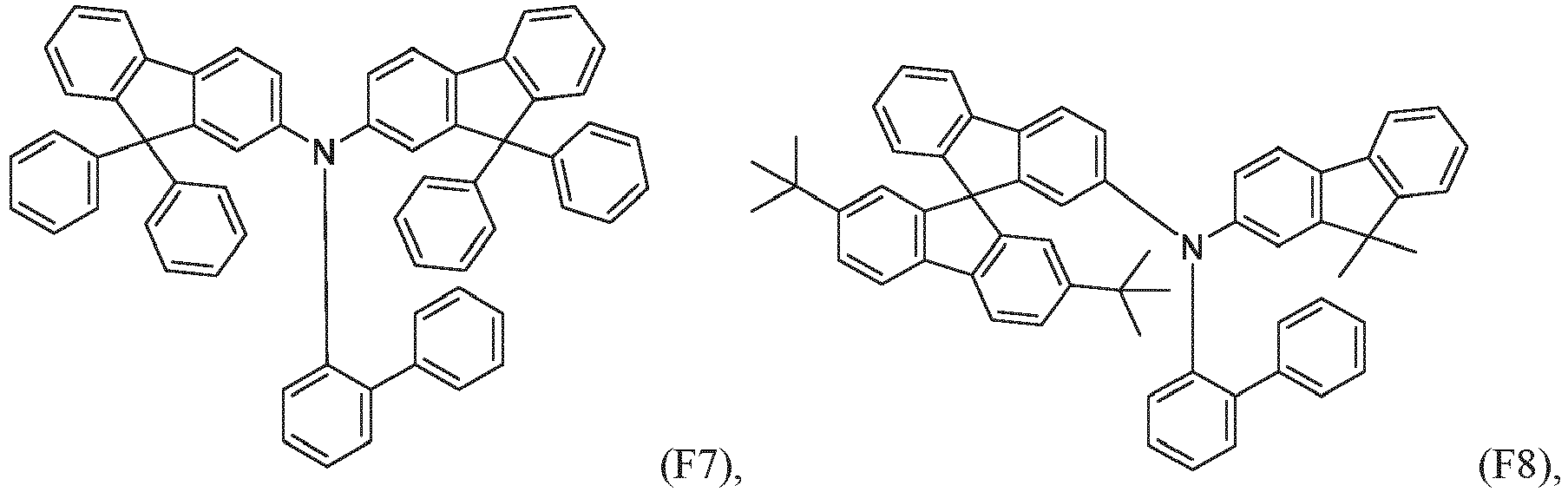


- The organic electroluminescent device according to any of the preceding claims 1 to 10, wherein the second organic compound of the hole injection layer comprises an azine group, preferably a triazine group, a pyrimidine group, a pyridine group, an acridine group, a dibenzoacridine group, a dibenzo[c,h]acridine group, a benzo[h]quinazoline group and/or a 3,8a-dihydroimidazo[1,5-a]pyridine group, more preferred a pyrimidine group, a pyridine group and/or an acridine group.
- The organic electroluminescent device according to any of the preceding claims 1 to 11, wherein the second organic compound of the hole injection layer comprises- at least one C2 to C24 N-heteroaryl or P=X group, with X being O, S or Se, with O being especially preferred; wherein the at least one C2 to C24 N-heteroaryl optional be selected from a compound comprising at least one azine group, preferably at least two azine groups, also preferred three azine groups; and/or- at least one group selected from the list consisting of pyridine, pyrimidine, triazine, imidazole, benzimidazole, benzooxazole, quinoline, quinoxaline, benzoquinoxaline, acridine, phenanthroline, benzoacridine, dibenzoacridine, imidazopyridine; and/or- at least 15 covalently bound atoms, preferably at least 20 covalently bound atoms, more preferably at least 25 covalently bound atoms, and most preferably at least 30 covalently bound atoms; and/or- a molecular weight Mw of ≥ 400 to ≤ 2000 g/mol, preferably a molecular weight Mw of ≥ 450 to ≤ 1500 g/mol, further preferred a molecular weight Mw of ≥ 500 to ≤ 1000 g/mol, further preferred a molecular weight Mw of ≥ 550 to ≤ 900 g/mol, in addition preferred a molecular weight Mw of ≥ 580 to ≤ 800 g/mol, also preferred a molecular weight Mw of ≥ 600 to ≤ 800 g/mol.
- The organic electroluminescent device according to any of the preceding claims 1 to 12, wherein the second organic compound of the hole injection layer is a compound of formula (II):
 T21 and T22 are independently selected from a single bond, phenylene, biphenylene, terphenylene or naphthenylene, preferably a single bond or phenylene;n and m is an integer independently selected from 1, 2 or 3, preferably 1 or 2;Ar21 is selected from substituted or unsubstituted C6 to C42 aryl, or substituted or unsubstituted C3 to C41 heteroarylene, substituted or unsubstituted fluorene, substituted 9-fluorene, substituted 9,9-fluorene, substituted or unsubstituted naphthalene, substituted or unsubstituted anthracene, substituted or unsubstituted phenanthrene, substituted or unsubstituted pyrene, substituted or unsubstituted perylene, substituted or unsubstituted triphenylene, substituted or unsubstituted tetracene, substituted or unsubstituted tetraphene, substituted or unsubstituted dibenzofurane, substituted or unsubstituted dibenzothiophene, substituted or unsubstituted xanthene, substituted or unsubstituted carbazole, substituted 9-phenylcarbazole, or a substituted or unsubstituted aromatic fused ring system comprising at least three substituted or unsubstituted aromatic rings selected from the group comprising substituted or unsubstituted non-hetero, substituted or unsubstituted hetero 5-member rings, substituted or unsubstituted 6-member rings and/or substituted or unsubstituted 7-member rings, substituted or unsubstituted fluorene, or a fused ring system comprising 2 to 6 substituted or unsubstituted 5- to 7-member rings and the rings are selected from the group comprising (i) unsaturated 5- to 7-member ring of a heterocycle, (ii) 5- to 6-member of an aromatic heterocycle, (iii) unsaturated 5- to 7-member ring of a non-heterocycle, (iv) 6-member ring of an aromatic non-heterocycle;Ar22 is selected from substituted or unsubstituted C6 to C20 aryl, or substituted or unsubstituted C3 to C20 heteroarylene, a single bond, phenylene, biphenylene, terphenylene or naphthenylene, preferably a single bond, phenylene or naphthalene, and preferably selected from a single bond, phenylene or naphthalene;Ar23 is selected from a substituted or unsubstituted C3 to C41 heteroarylene, a substituted or unsubstituted 5-membered or 6-membered heteroarylene comprising 2 or 3 N atoms, substituted or unsubstituted azine, pyridine, pyrimidine, triazine, imidazole, benzimidazole, benzooxazole, quinoline, quinoxaline, benzoquinoxaline, acridine, phenanthroline, benzoacridine, dibenzoacridine, imadzopyridine;wherein
the substituents of Ar21, Ar22, Ar23 are selected the same or different from the group comprising H, D, F, C(-O)R22, CN, Si(R22)3, P(-O)(R22)2, OR22, S(-O)R22, S(-O)2R22, substituted or unsubstituted straight-chain alkyl having 1 to 20 carbon atoms, substituted or unsubstituted branched alkyl having 1 to 20 carbon atoms, substituted or unsubstituted cyclic alkyl having 3 to 20 carbon atoms, substituted or unsubstituted alkenyl or alkynyl groups having 2 to 20 carbon atoms, substituted or unsubstituted substituted or unsubstituted aromatic ring systems having 6 to 40 aromatic ring atoms, and substituted or unsubstituted heteroaromatic ring systems having 5 to 40 aromatic ring atoms, unsubstituted C6 to C18 aryl, unsubstituted C3 to C18 heteroaryl, a fused ring system comprising 2 to 6 unsubstituted 5- to 7-member rings and the rings are selected from the group comprising unsaturated 5- to 7-member ring of a heterocycle, 5- to 6-member of an aromatic heterocycle, unsaturated 5- to 7-member ring of a non-heterocycle, and 6-member ring of an aromatic non-heterocycle,
wherein R22 is selected from H, D, straight-chain alkyl having 1 to 6 carbon atoms, branched alkyl having 1 to 6 carbon atoms, cyclic alkyl having 3 to 6 carbon atoms, alkenyl or alkynyl groups having 2 to 6 carbon atoms, C6 to C18 aryl or C3 to C18 heteroaryl. - The organic electroluminescent device according to claim 13, wherein Ar21 is selected from phenyl, naphthyl, biphenyl, phenanthrenyl or formulae C1 to C58:


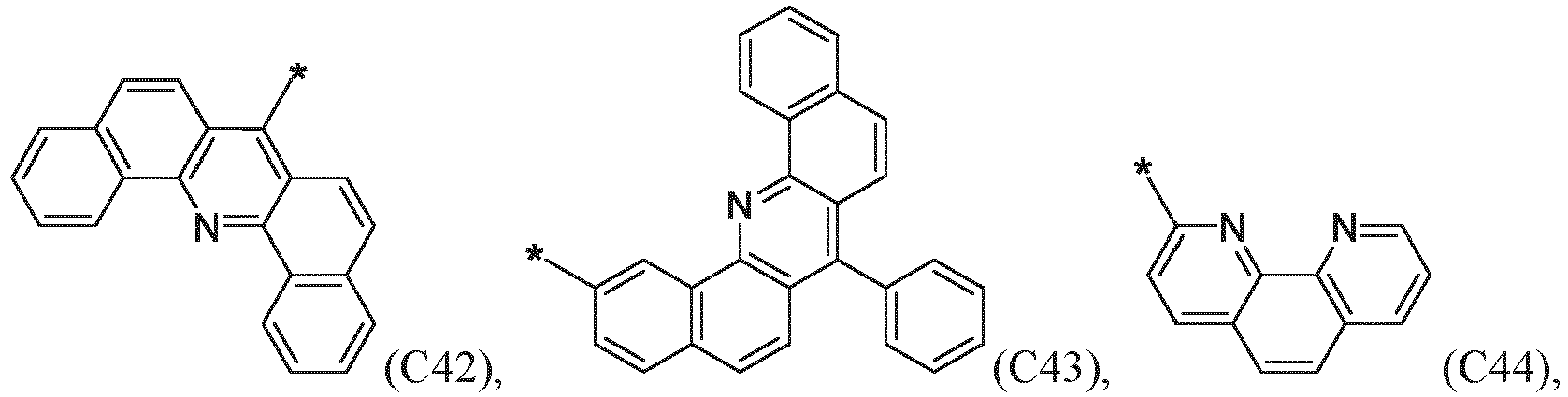


- The organic electroluminescent device according to claims 13 or 14, wherein
Ar23 is selected from formulae D1 to D43:


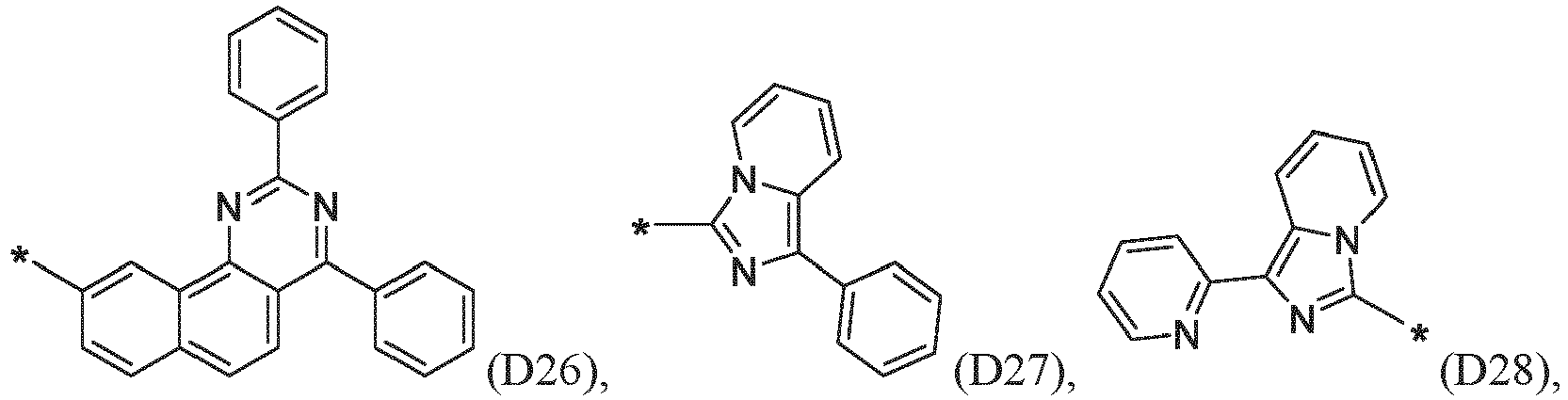


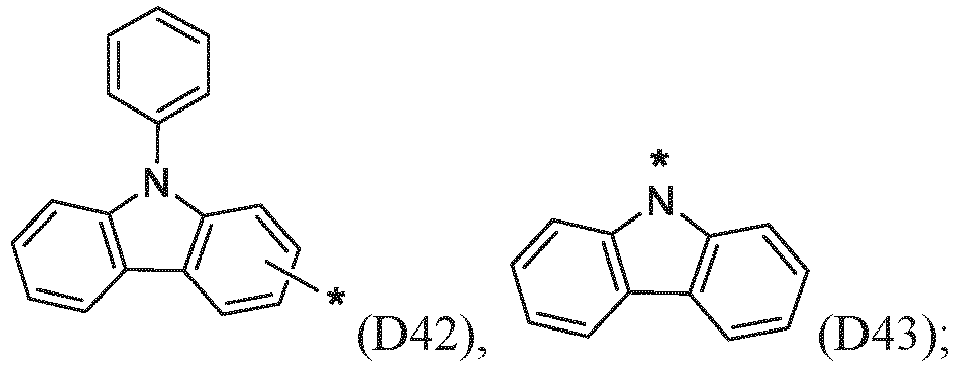
- The organic electroluminescent device according to any of the preceding claims 1 to 15, wherein the second organic compound of the hole injection layer is selected from formulae E1 to E13:
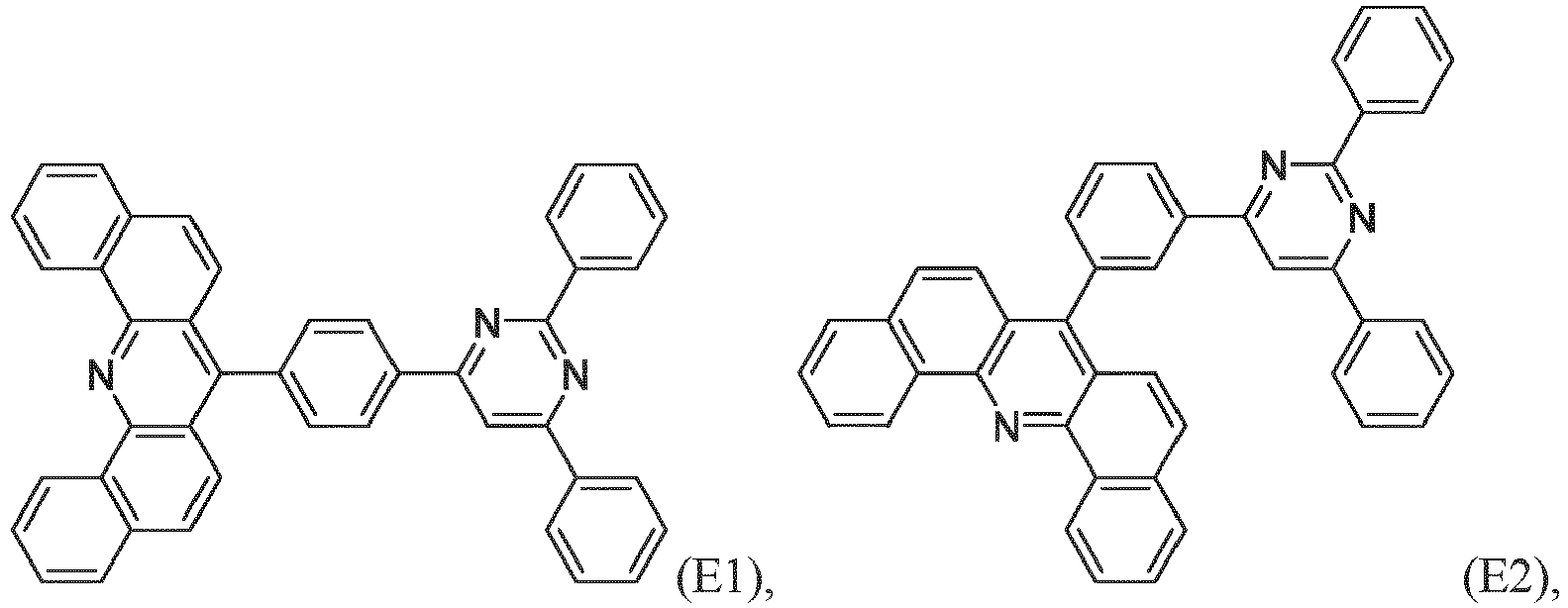


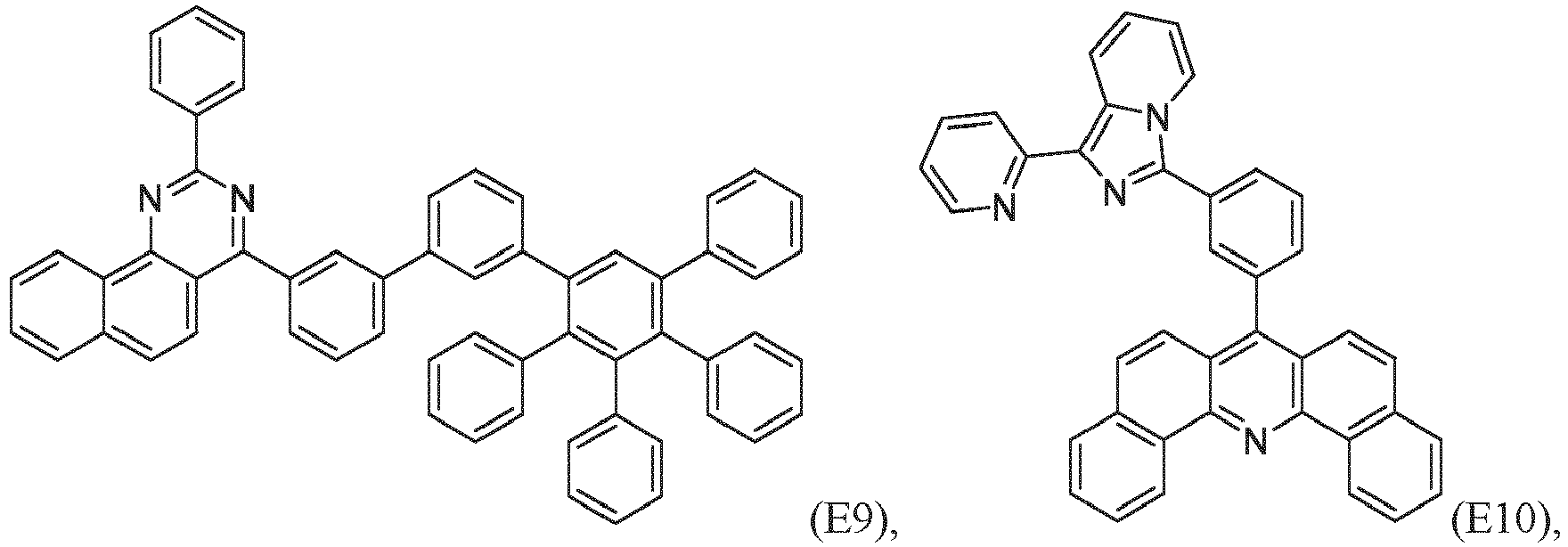


- The organic electroluminescent device according to any of the preceding claims 1 to 16, wherein the composition of the hole injection layer comprises:
≤ 90 wt.-% first organic compound, ≥ 5 wt.-% second organic compound, and ≥ 1 wt.-% first organic p-dopant, preferably ≤ 85 wt.-% first organic compound, ≥ 10 wt.-% second organic compound, and ≥ 1 wt.-% first organic p-dopant; more preferred ≤ 88 wt.-% first organic compound, ≥ 10 wt.-% second organic compound, and ≥ 2 wt.-% first organic p-dopant; or ≥ 55 to ≤ 90 wt.-% first organic compound, ≥ 10 to ≤ 35 wt.-% second organic compound and ≥ 1 to ≤ 10 wt.-% first organic p-dopant, preferably ≥ 60 to ≤ 90 wt.-% first organic compound, ≥ 10 to ≤ 30 wt.-% second organic compound and ≥ 1 to ≤ 10 wt.-% first organic p-dopant. - The organic electroluminescent device according to any of the preceding claims 1 to 17, wherein the HOMO energy level of the first organic p-dopant is selected in the range of ≥ -8.5 eV to ≤ -6.8 eV, preferably in the range of ≥ -8.2 eV to ≤ -7 eV.
- The organic electroluminescent device according to any of the preceding claims 1 to 18, wherein the first organic p-dopant comprises at least two groups selected independently from C6 to C19 aryl group or C3 to C12 heteroaryl group, wherein each of the C6 to C19 aryl group or C3 to C12 heteroaryl group is substituted,
wherein the one or more substituents are independently of each other selected from halogen, F, CN, partially perfluorinated C1 to C12 alkyl, perfluorinated C1 to C12 alkyl, CF3. - The organic electroluminescent device according to any of the preceding claims 1 to 19, wherein the first organic p-dopant is selected from a compound of formula (III):
 n is an integer including 0, 1, 2, 3, 4, 5 or 6, preferably 0, 2, or 4;m is an integer selected from 0 or 1;X1, X2 and X3 are independently selected from O, S, CR1aR2a, CR1bR2b, NR3a, NR3b or at least one of X1, X2, and X3 form a fused ring with A, and wherein each X3 is selected the same or different, preferably the same,R1a, R2a, R1b, and R2b are independently selected from an electron-withdrawing group, halogen, Cl, F, substituted or unsubstituted C1 to C8 alkyl, partially fluorinated C1 to C8 alkyl, perfluorinated C1 to C8 alkyl, CF3, substituted or unsubstituted C1 to C8 alkoxy, partially fluorinated C1 to C8 alkoxy, perfluorinated C1 to C8 alkoxy, OCF3, CN, isocyano, SCN, OCN, NO2, SF5, substituted or unsubstituted aryl, substituted or unsubstituted heteroaryl,wherein
the one or more substituents on R1a, R2a, R1b, and R2b are independently selected from D, an electron-withdrawing group, halogen, Cl, F, substituted or unsubstituted C1 to C8 alkyl, partially fluorinated C1 to C8 alkyl, perfluorinated C1 to C8 alkyl, CF3, substituted or unsubstituted C1 to C8 alkoxy, partially fluorinated C1 to C8 alkoxy, perfluorinated C1 to C alkoxy, OCF3, CN, isocyano, SCN, OCN, NO2, SF5, substituted or unsubstituted C6 to C30 aryl, and substituted or unsubstituted C6 to C30 heteroaryl;
wherein
the one or more substituents of C6 to C30 aryl, C6 to C30 heteroaryl, C1 to C8 alkyl, C1 to C8 alkoxy are independently selected from D, an electron-withdrawing group, halogen, Cl, F, CN, -NO2, isocyano, SCN, OCN, SF5, partially fluorinated C1 to C8 alkyl, perfluorinated C1 to C8 alkyl, partially fluorinated C1 to C8 alkoxy, perfluorinated C1 to C8 alkoxy;R3a and R3b is selected from an electron-withdrawing group, CN, partially fluorinated C1 to C6 alkyl, perfluorinated C1 to C6 alkyl, CF3, substituted or unsubstituted C6 to C30 aryl, or substituted or unsubstituted C3 to C30 heteroaryl,wherein
the one or more substituents on R3a and R3b are independently selected from D, an electron-withdrawing group, halogen, Cl, F, substituted or unsubstituted C1 to C8 alkyl, partially fluorinated C1 to C8 alkyl, perfluorinated C1 to C8 alkyl, CF3, substituted or unsubstituted C1 to C8 alkoxy, partially fluorinated C1 to C8 alkoxy, perfluorinated C1 to C8 alkoxy, OCF3, CN, isocyano, SCN, OCN, NO2, SF5, substituted or unsubstituted C6 to C30 aryl, and substituted or unsubstituted C6 to C30 heteroaryl;
wherein
the one or more substituents of C6 to C30 aryl, C6 to C30 heteroaryl, C1 to C8 alkyl, C1 to C8 alkoxy are independently selected from D, an electron-withdrawing group, halogen, Cl, F, CN, -NO2, isocyano, SCN, OCN, SF5, partially fluorinated C1 to C8 alkyl, perfluorinated C1 to C8 alkyl, partially fluorinated C1 to C8 alkoxy, perfluorinated C1 to C8 alkoxy;A is selected from substituted or unsubstituted C3 to C40 cyclohydrocarbon group, substituted or unsubstituted C3 to C40 cycloalkane group, substituted or unsubstituted C3 to C40 cycloalkane group containing one or more double-bonds, substituted or unsubstituted C3 to C40 cycloalkene group, substituted or unsubstituted C2 to C40 heterocycloalkane group, substituted or unsubstituted C2 to C40 heterocycloalkane group containing one or more double-bonds, substituted or unsubstituted C2 to C40 heterocycloalkene group, substituted or unsubstituted C6 to C40 aromatic group, substituted or unsubstituted C2 to C40 heteroaromatic group,wherein
the one or more substituents on A are independently selected from D, an electron-withdrawing group, halogen, Cl, F, substituted or unsubstituted C1 to C8 alkyl, partially fluorinated C1 to C8 alkyl, perfluorinated C1 to C8 alkyl, CF3, substituted or unsubstituted C1 to C8 alkoxy, partially fluorinated C1 to C8 alkoxy, perfluorinated C1 to C8 alkoxy, OCF3, CN, isocyano, SCN, OCN, NO2, SF5, substituted or unsubstituted C6 to C30 aryl, substituted or unsubstituted C2 to C30 heteroaryl,
wherein
the one or more substituents of C6 to C30 aryl, C6 to C30 heteroaryl, C1 to C8 alkyl, C1 to C8 alkoxy are independently selected from D, an electron-withdrawing group, halogen, Cl, F, CN, -NO2, isocyano, SCN, OCN, SF5, partially fluorinated C1 to C8 alkyl, perfluorinated C1 to C8 alkyl, partially fluorinated C1 to C8 alkoxy, perfluorinated C1 to C8 alkoxy;
and wherein
preferably the compound of formula (III) comprises at least two groups selected from substituted C6 to C19 aryl group or substituted C3 to C12 heteroaryl group,
wherein
each of the substituents of C6 to C19 aryl group or C3 to C12 heteroaryl group are independently of each other selected from halogen, F, CN, partially perfluorinated C1 to C12 alkyl, perfluorinated C1 to C12 alkyl, or CF3. - The organic electroluminescent device according to claim 20, wherein in formula (III) the X1, X2, and X3 are independently selected from CR1aR2a, CR1bR2b, NR3a, NR3b; and wherein each X3 is selected the same or is selected different.
- The organic electroluminescent device according to claims 20 or 21, wherein A of formula (III) is selected from a group of G1 to G72:


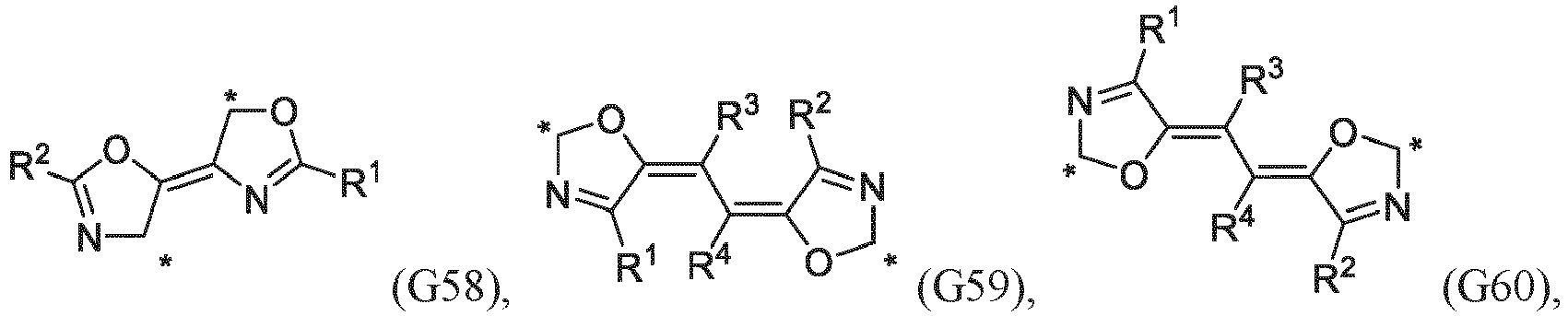


 R1, R2, R3, R4, R5, R6, R7 and R8 are independently selected from H, D, halogen, Cl, F, substituted or unsubstituted C1 to C6 alkyl, partially fluorinated C1 to C6 alkyl, perfluorinated C1 to C6 alkyl, CF3, substituted or unsubstituted C1 to C6 alkoxy, partially fluorinated C1 to C6 alkoxy, perfluorinated C1 to C6 alkoxy, OCF3, substituted or unsubstituted C6 to C30 aryloxy, partially fluorinated C6 to C30 aryloxy, perfluorinated C6 to C30 aryloxy, substituted or unsubstituted C6 to C30 aryl, substituted or unsubstituted C3 to C30 heteroaryl, CN, isocyano, SCN, OCN, NO2, SF5, wherein the substituents are selected from D, halogen, Cl, F, partially fluorinated C1 to C6 alkyl, perfluorinated C1 to C6 alkyl, CF3, partially fluorinated C1 to C6 alkoxy, perfluorinated C1 to C6 alkoxy, OCF3, CN, isocyano, SCN, OCN, NO2, SF5,B1 and B2 are independently of each other selected from N, CR5A', or CR6A', whereinCR5A' or CR6A' are each independently selected from other from H, D, F, a substituted or unsubstituted C6 to C12 aryl, a substituted or unsubstituted C1 to C12 heteroaryl with 1 to 4 heteroatoms one among O, N, S and Si, a substituted or unsubstituted C1 to C12 alkyl, a substituted or unsubstituted C1 to C12 alkoxy, a substituted or unsubstituted C1 to C12 ether group, CN, CF3, OCF3, halogen, Cl, F, Si(CH3)3, preferably at least one among R1 to R6 comprises CN,wherein
the one or more substituents on CR5A', or CR6A' are independently selected from each other from D, an electron-withdrawing group, halogen, Cl, F, substituted or unsubstituted C1 to C8 alkyl, partially fluorinated C1 to C8 alkyl, perfluorinated C1 to C8 alkyl, CF3, substituted or unsubstituted C1 to C8 alkoxy, partially fluorinated C1 to C8 alkoxy, perfluorinated C1 to C alkoxy, OCF3, CN, isocyano, SCN, OCN, NO2, SF5, substituted or unsubstituted C6 to C30 aryl, and substituted or unsubstituted C6 to C30 heteroaryl,
wherein the one or more substituents of C6 to C30 aryl, C6 to C30 heteroaryl, C1 to C8 alkyl, C1 to C8 alkoxy are independently selected from each other from D, an electron-withdrawing group, halogen, Cl, F, CN, -NO2, isocyano, SCN, OCN, SF5, partially fluorinated C1 to C8 alkyl, perfluorinated C1 to C8 alkyl, partially fluorinated C1 to C8 alkoxy, perfluorinated C1 to C8 alkoxy. - The organic electroluminescent device according to any of the preceding claims 1 to 22, wherein the first organic p-dopant is selected from a radialene compound of formula (IV):
 - A1 is independently selected from a group of formula (IVa):
 Ar1 is independently selected from substituted or unsubstituted aryl and substituted or unsubstituted heteroaryl, wherein for the case that Ar1 is substituted, one or more of the substituents are independently selected from the group consisting of D, an electron-withdrawing group, halogen, Cl, F, CN, -NO2, substituted or unsubstituted C1 to C8 alkyl, partially fluorinated C1 to C8 alkyl, perfluorinated C1 to C8 alkyl, substituted or unsubstituted C1 to C8 alkoxy, partially fluorinated C1 to C8 alkoxy, perfluorinated C1 to C8 alkoxy, substituted or unsubstituted C6 to C30 aryl, and substituted or unsubstituted C6 to C30 heteroaryl, and
wherein the one or more substituents of C6 to C30 aryl, C6 to C30 heteroaryl, C1 to C8 alkyl, C1 to C8 alkoxy are independently selected from D, an electron-withdrawing group, halogen, Cl, F, CN, -NO2, partially fluorinated C1 to C8 alkyl, perfluorinated C1 to C8 alkyl, partially fluorinated C1 to C8 alkoxy, perfluorinated C1 to C8 alkoxy;- A2 is independently selected from a group of formula (IVb): Ar2 is independently selected from substituted or unsubstituted aryl and substituted or unsubstituted heteroaryl, wherein for the case that Ar2 is substituted, one or more of the substituents are independently selected from the group consisting of D, an electron-withdrawing group, halogen, Cl, F, CN, -NO2, substituted or unsubstituted C1 to C8 alkyl, partially fluorinated C1 to C8 alkyl, perfluorinated C1 to C8 alkyl, substituted or unsubstituted C1 to C8 alkoxy, partially fluorinated C1 to C8 alkoxy, perfluorinated C1 to C8 alkoxy, substituted or unsubstituted C6 to C30 aryl, and substituted or unsubstituted C6 to C30 heteroaryl, and
wherein the one or more substituents of C6 to C30 aryl, C6 to C30 heteroaryl, C1 to C8 alkyl, C1 to C8 alkoxy are independently selected from D, an electron-withdrawing group, halogen, Cl, F, CN, -NO2, partially fluorinated C1 to C8 alkyl, perfluorinated C1 to C8 alkyl, partially fluorinated C1 to C8 alkoxy, perfluorinated C1 to C8 alkoxy,- A3 is independently selected from a group of formula (IVc)
Ar3 is independently selected from substituted or unsubstituted aryl and substituted or unsubstituted heteroaryl, wherein for the case that Ar3 is substituted, one or more of the substituents are independently selected from the group consisting of D, an electron-withdrawing group, halogen, Cl, F, CN, -NO2, substituted or unsubstituted C1 to C8 alkyl, partially fluorinated C1 to C8 alkyl, perfluorinated C1 to C8 alkyl, substituted or unsubstituted C1 to C8 alkoxy, partially fluorinated C1 to C8 alkoxy, perfluorinated C1 to C8 alkoxy, substituted or unsubstituted C6 to C30 aryl, and substituted or unsubstituted C6 to C30 heteroaryl, and
wherein the one or more substituents of C6 to C30 aryl, C6 to C30 heteroaryl, C1 to C8 alkyl, C1 to C8 alkoxy are independently selected from D, an electron-withdrawing group, halogen, Cl, F, CN, -NO2, partially fluorinated C1 to C8 alkyl, perfluorinated C1 to C8 alkyl, partially fluorinated C1 to C8 alkoxy, perfluorinated C1 to C8 alkoxy;
wherein
in A1, A2, A3 each R' is independently selected from substituted or unsubstituted C6 to C18 aryl, C3 to C18 heteroaryl, electron-withdrawing group, substituted or unsubstituted C1 to C8 alkyl, partially fluorinated C1 to C8 alkyl, perfluorinated C1 to C8 alkyl, halogen, F and CN; and
whereinpreferably the compound of formula (IV) comprises at least two groups selected from aryl C6 to C19 aryl groups, or C3 to C12 heteroaryl group, wherein each of the C6 to C19 aryl group or C3 to C12 heteroaryl group is substituted,wherein the one or more substituents are independently of each other selected from halogen, F, CN, partially perfluorinated C1 to C12 alkyl, perfluorinated C1 to C12 alkyl, CF3. - The organic electroluminescent device according to any of the preceding claims 1 to 23, wherein the first organic p-dopant has a quinoid structure.
- The organic electroluminescent device according to any of the preceding claims 1 to 24, wherein the first organic p-dopant comprises a quinoid structure, an indacenedione structure or is selected from a compound of formula (V):
 n is an integer including 0, 1, 2, 3, 4, 5 or 6, preferably 0, 2, or 4;m is an integer selected from 0 or 1;X1, X2 and X3 are independently selected from O, S, CR1aR2a, CR1bR2b, NR3a, NR3b or at least one of X1, X2, and X3 form a fused ring with A, and wherein each X3 is selected the same or different, preferably the same,R1a, R2a, R1b, and R2b are independently selected from an electron-withdrawing group, halogen, Cl, F, substituted or unsubstituted C1 to C8 alkyl, partially fluorinated C1 to C8 alkyl, perfluorinated C1 to C8 alkyl, CF3, substituted or unsubstituted C1 to C8 alkoxy, partially fluorinated C1 to C8 alkoxy, perfluorinated C1 to C8 alkoxy, OCF3, CN, isocyano, SCN, OCN, NO2, SF5, substituted or unsubstituted aryl, substituted or unsubstituted heteroaryl,
wherein the one or more substituents on R1a, R2a, R1b, and R2b are independently selected from D, an electron-withdrawing group, halogen, Cl, F, substituted or unsubstituted C1 to C8 alkyl, partially fluorinated C1 to C8 alkyl, perfluorinated C1 to C8 alkyl, CF3, substituted or unsubstituted C1 to C8 alkoxy, partially fluorinated C1 to C8 alkoxy, perfluorinated C1 to C alkoxy, OCF3, CN, isocyano, SCN, OCN, NO2, SF5, substituted or unsubstituted C6 to C30 aryl, and substituted or unsubstituted C6 to C30 heteroaryl;
wherein the one or more substituents of C6 to C30 aryl, C6 to C30 heteroaryl, C1 to C8 alkyl, C1 to C8 alkoxy are independently selected from D, an electron-withdrawing group, halogen, Cl, F, CN, -NO2, isocyano, SCN, OCN, SF5, partially fluorinated C1 to C8 alkyl, perfluorinated C1 to C8 alkyl, partially fluorinated C1 to C8 alkoxy, perfluorinated C1 to C8 alkoxy,R3a and R3b is selected from an electron-withdrawing group, CN, partially fluorinated C1 to C6 alkyl, perfluorinated C1 to C6 alkyl, CF3, substituted or unsubstituted C6 to C30 aryl, or substituted or unsubstituted C3 to C30 heteroaryl,
wherein the one or more substituents on R3a and R3b are independently selected from D, an electron-withdrawing group, halogen, Cl, F, substituted or unsubstituted C1 to C8 alkyl, partially fluorinated C1 to C8 alkyl, perfluorinated C1 to C8 alkyl, CF3, substituted or unsubstituted C1 to C8 alkoxy, partially fluorinated C1 to C8 alkoxy, perfluorinated C1 to C8 alkoxy, OCF3, CN, isocyano, SCN, OCN, NO2, SF5, substituted or unsubstituted C6 to C30 aryl, and substituted or unsubstituted C6 to C30 heteroaryl;
wherein the one or more substituents of C6 to C30 aryl, C6 to C30 heteroaryl, C1 to C8 alkyl, C1 to C8 alkoxy are independently selected from D, an electron-withdrawing group, halogen, Cl, F, CN, -NO2, isocyano, SCN, OCN, SF5, partially fluorinated C1 to C8 alkyl, perfluorinated C1 to C8 alkyl, partially fluorinated C1 to C8 alkoxy, perfluorinated C1 to C8 alkoxy;A is selected from substituted or unsubstituted C3 to C40 cycloalkane group containing at least one or more double-bonds, substituted or unsubstituted C3 to C40 cycloalkene group, substituted or unsubstituted C2 to C40 heterocycloalkane group, substituted or unsubstituted C2 to C40 heterocycloalkane group containing one or more double-bonds, substituted or unsubstituted C2 to C40 heterocycloalkene group, substituted or unsubstituted C6 to C40 aromatic group, substituted or unsubstituted C2 to C40 heteroaromatic group, wherein X1, X2, and/or X3 are conjugated to each other via a double-bond in A;
wherein the substituents on A, when present, are independently selected from D, an electron-withdrawing group, halogen, Cl, F, substituted or unsubstituted C1 to C8 alkyl, partially fluorinated C1 to C8 alkyl, perfluorinated C1 to C8 alkyl, CF3, substituted or unsubstituted C1 to C8 alkoxy, partially fluorinated C1 to C8 alkoxy, perfluorinated C1 to C8 alkoxy, OCF3, CN, isocyano, SCN, OCN, NO2, SF5, substituted or unsubstituted C6 to C30 aryl, substituted or unsubstituted C2 to C30 heteroaryl,
wherein the substituent of C6 to C30 aryl, C6 to C30 heteroaryl, C1 to C8 alkyl, C1 to C8 alkoxy are independently selected from D, an electron-withdrawing group, halogen, Cl, F, CN, -NO2, isocyano, SCN, OCN, SF5, partially fluorinated C1 to C8 alkyl, perfluorinated C1 to C8 alkyl, partially fluorinated C1 to C8 alkoxy, perfluorinated C1 to C8 alkoxy;and wherein
preferably the compound of formula (V) comprises at least two groups selected from substituted C6 to C19 aryl group or substituted C3 to C12 heteroaryl group,
wherein each of the substituted C6 to C19 aryl group or substituted C3 to C12 heteroaryl group is substituted with a substituent independently selected from halogen, F, CN, partially perfluorinated C1 to C12 alkyl, perfluorinated C1 to C12 alkyl, or CF3. - The organic electroluminescent device according to any of the preceding claims 1 to 25, wherein the first organic p-dopant is selected from a compound comprising a indacenedione structure, a radialene compound (IV), or a compound of formula (VIa) or (VIb):
 B1 and B2 are independently of each other selected from N, CR5A' or CR6A',
R1A', R2A', R3A', R4A', R5A', and R6A' are independently selected from each other from H, D, F, a substituted or unsubstituted C6 to C12 aryl, a substituted or unsubstituted C1 to C12 heteroaryl with 1 to 4 heteroatoms one among O, N, S and Si, a substituted or unsubstituted C1 to C12 alkyl, a substituted or unsubstituted C1 to C12 alkoxy, a substituted or unsubstituted C1 to C12 ether group, CN, CF3, OCF3, halogen, Cl, F, Si(CH3)3, preferably at least one among R1 to R6 comprises CN, wherein
the one or more substituents on CR5A', or CR6A' are independently selected from each other from D, an electron-withdrawing group, halogen, Cl, F, substituted or unsubstituted C1 to C8 alkyl, partially fluorinated C1 to C8 alkyl, perfluorinated C1 to C8 alkyl, CF3, substituted or unsubstituted C1 to C8 alkoxy, partially fluorinated C1 to C8 alkoxy, perfluorinated C1 to C alkoxy, OCF3, CN, isocyano, SCN, OCN, NO2, SF5, substituted or unsubstituted C6 to C30 aryl, and substituted or unsubstituted C6 to C30 heteroaryl, wherein
the one or more substituents of C6 to C30 aryl, C6 to C30 heteroaryl, C1 to C8 alkyl, C1 to C8 alkoxy are independently selected from each other from D, an electron-withdrawing group, halogen, Cl, F, CN, - NO2, isocyano, SCN, OCN, SF5, partially fluorinated C1 to C8 alkyl, perfluorinated C1 to C8 alkyl, partially fluorinated C1 to C8 alkoxy, perfluorinated C1 to C8 alkoxy;X1 and X2 are independently of each other selected from formula (VIc): A and B are independently of each other is selected from H, D, a substituted or unsubstituted C6 to C12 aryl, a substituted or unsubstituted C1 to C12 heteroaryl with 1 to 4 heteroatoms one among O, N, S and Si, a substituted or unsubstituted C1 to C12 alkyl, a substituted or unsubstituted C1 to C12 alkoxy, a substituted or unsubstituted C1 to C12 ether group, CN, CF3, OCF3, halogen, Cl, F, Si(CH3)3, preferably the compound of formula (VIa) or (VIb) comprises at least two groups selected from C6 to C19 aryl group or C3 to C12 heteroaryl group, wherein each of the C6 to C19 aryl group or C3 to C12 heteroaryl group is substituted, wherein
the one or more substituents are independently of each other selected from halogen, F, CN, partially perfluorinated C1 to C12 alkyl, perfluorinated C1 to C12 alkyl, CF3. - The organic electroluminescent device according to any of the preceding claims 1 to 26, wherein the first organic p-dopant is selected from formulae K 1 to K26:


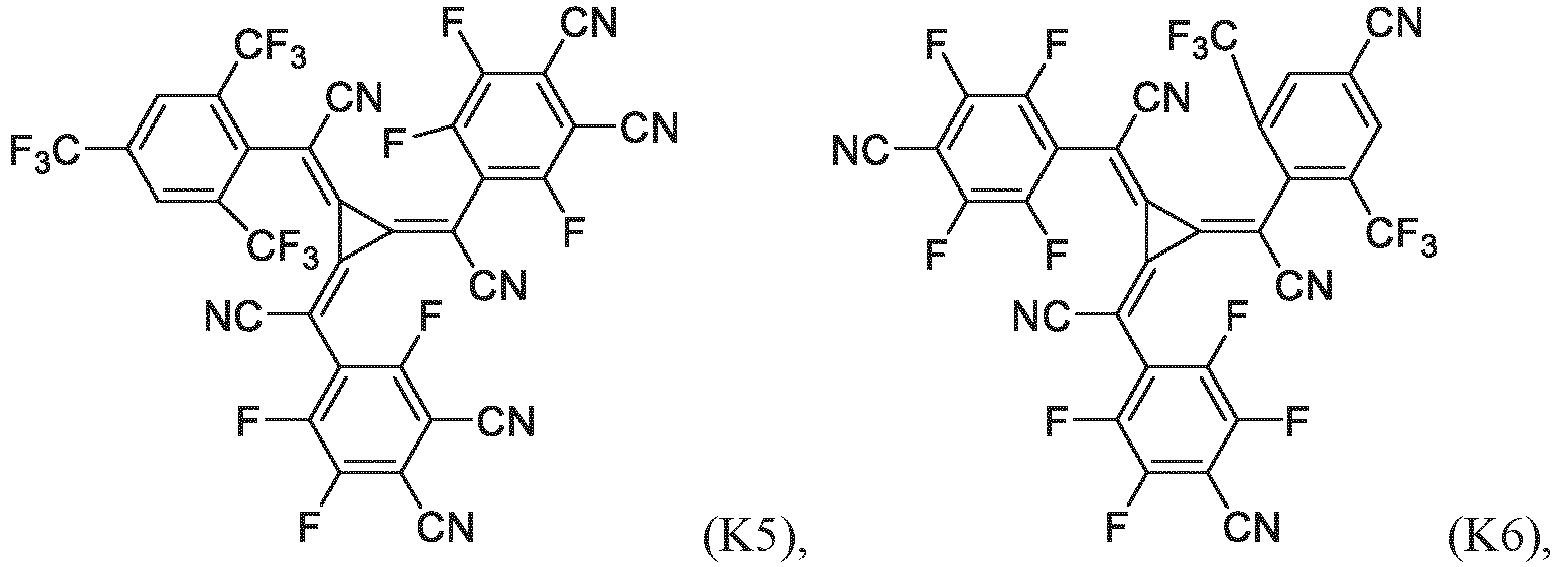


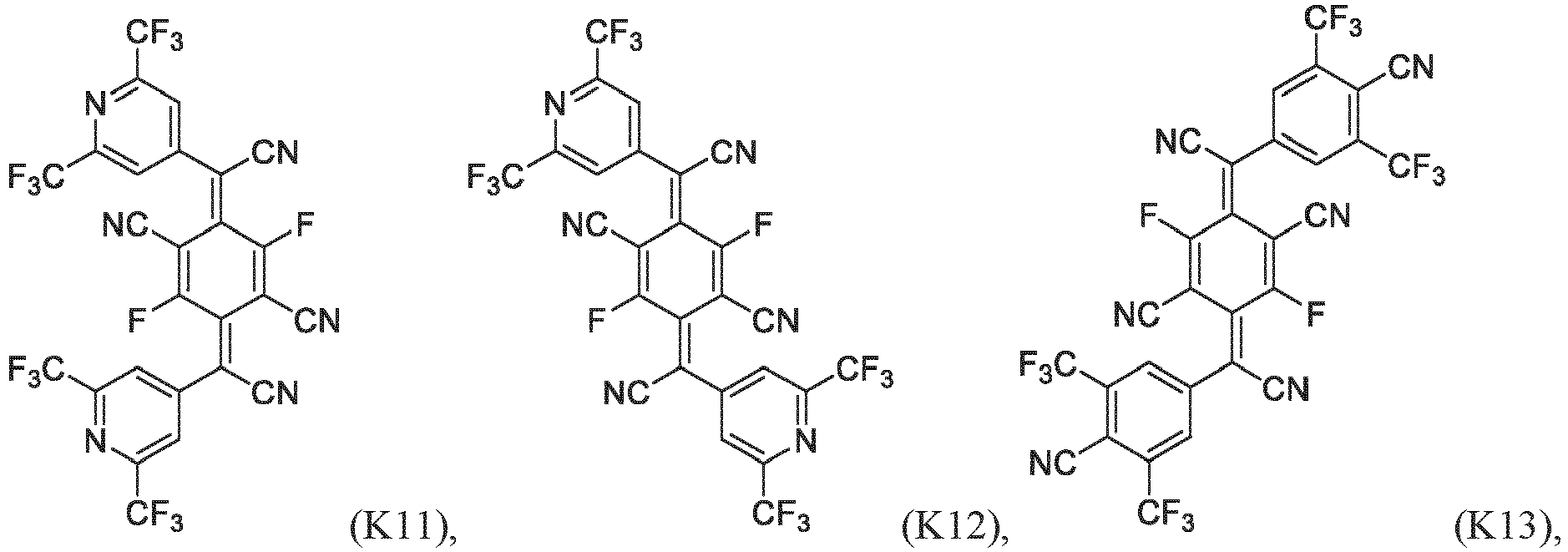


- The organic electroluminescent device according to any of the preceding claims 1 to 27, wherein the first emission layer comprises an organic emitter host compound and a light-emitting compound.
- The organic electroluminescent device according to any of the preceding claims 1 to 28, wherein the first emission layer comprises a light-emitting compound, wherein the light-emitting compound is selected from a compound of formula (X):
 Z1, Z2 and Z3 are the same as or different from each other, and are each independently selected from the group comprising a monocyclic to polycyclic aromatic hydrocarbon ring or monocyclic to polycyclic aromatic hetero ring;Ar31 and Ar32 are the same as or selected different from each other, and are each independently a substituted or unsubstituted alkyl group, a substituted or unsubstituted aryl group, or a substituted or unsubstituted heteroaryl group, or are bonded to an adjacent substituent to form a substituted or unsubstituted aromatic ring or a substituted or unsubstituted aliphatic ring;R31, R32 and R33 are the same as or different from each other, and are each independently selected from the group comprising hydrogen, deuterium, a substituted or unsubstituted alkyl group, a substituted or unsubstituted silyl group, a substituted or unsubstituted amine group, a substituted or unsubstituted aryl group, or a substituted or unsubstituted heteroaryl group, or adjacent substituents are bonded to each other to form a substituted or unsubstituted aromatic ring or a substituted or unsubstituted aliphatic ring,
wherein one or more substituents selected from the group consisting of deuterium, an alkyl group having 1 to 6 carbon atoms, an alkyl silyl group having 1 to 30 carbon atoms, an aryl silyl group having 6 to 50 carbon atoms, an alkylamine group having 1 to 30 carbon atoms, an alkylarylamine group having 1 to 50 carbon atoms, an arylamine group having 6 to 50 carbon atoms, an aryl group having 6 to 30 carbon atoms, and a heteroaryl group having 2 to 30 carbon atoms, or a substituent to which two or more substituents selected from the group are linked, or adjacent substituents are bonded to each other to form an aliphatic hydrocarbon ring having 3 to 60 carbon atoms, which is unsubstituted or substituted with the substituent;r31, r32 and r33 are each an integer from 0, 1, 2, 3 or 4, and when r31 to r33 are 2 or higher, substituents in the parenthesis are the same as or different from each other. - The organic electroluminescent device according to any of the preceding claims 1 to 29, wherein the first emission layer comprises an organic emitter host compound, wherein the organic emitter host compound comprises:- at least one condensed aromatic ring system consisting of 3 to 5 rings, and- 3 to 7 aromatic or heteroaromatic rings, wherein one or more sub-groups of the aromatic and/or heteroaromatic rings is condensed to form fused aromatic or heteroaromatic ring systems;wherein the molecular weight Mw of the organic emitter host compound is in the range of ≥ 400 to ≤ 2000 g/mol.
- The organic electroluminescent device according to any of the preceding claims 1 to 30, wherein the first emission layer comprises an organic emitter host compound, wherein the organic emitter host compound is selected from a compound of formula (XI):
 Ar41 and Ar42 are independently selected from substituted or unsubstituted C6 to C24 aryl, substituted or unsubstituted C3 to C24 heteroaryl;L41 and L42 are independently selected from a direct bond or substituted or unsubstituted C6 to C24 arylene, substituted or unsubstituted C3 to C24 heteroarylene;R41 to R41 are independently selected from H, D, substituted or unsubstituted C1 to C12 alkyl, substituted or unsubstituted C6 to C19 aryl, substituted or unsubstituted C3 to C12 heteroaryl;wherein
the substituents on Ar41, Ar42, L41, L42, R41 to R48 are independently selected from D, C6 to C10 aryl, C3 to C9 heteroaryl, C1 to C6 alkyl, C1 to C6 alkoxy, C3 to C6 branched alkyl, C3 to C6 cyclic alkyl, C3 to C6 branched alkoxy, C3 to C6 cyclic alkoxy, partially or perfluorinated C1 to C16 alkyl, partially or perfluorinated C1 to C16 alkoxy, partially or perdeuterated C1 to C6 alkyl, partially or perdeuterated C1 to C6 alkoxy, halogen, F or CN. - A display device comprising the organic electroluminescent device of any of the preceding claims 1 to 31, and preferably a display device comprising a substrate and several organic electroluminescent devices according to any of preceding claims 1 to 31, wherein the organic electroluminescent devices are formed on the substrate as adjacent pixels, wherein the hole injection layer is formed as a common hole injection layer on the adjacent pixels.
Priority Applications (2)
| Application Number | Priority Date | Filing Date | Title |
|---|---|---|---|
| EP23215922.8A EP4572587A1 (en) | 2023-12-12 | 2023-12-12 | Organic electroluminescent device and display device |
| PCT/EP2024/085251 WO2025125148A1 (en) | 2023-12-12 | 2024-12-09 | Organic electroluminescent device and display device |
Applications Claiming Priority (1)
| Application Number | Priority Date | Filing Date | Title |
|---|---|---|---|
| EP23215922.8A EP4572587A1 (en) | 2023-12-12 | 2023-12-12 | Organic electroluminescent device and display device |
Publications (1)
| Publication Number | Publication Date |
|---|---|
| EP4572587A1 true EP4572587A1 (en) | 2025-06-18 |
Family
ID=89222340
Family Applications (1)
| Application Number | Title | Priority Date | Filing Date |
|---|---|---|---|
| EP23215922.8A Pending EP4572587A1 (en) | 2023-12-12 | 2023-12-12 | Organic electroluminescent device and display device |
Country Status (2)
| Country | Link |
|---|---|
| EP (1) | EP4572587A1 (en) |
| WO (1) | WO2025125148A1 (en) |
Citations (3)
| Publication number | Priority date | Publication date | Assignee | Title |
|---|---|---|---|---|
| EP2722908A1 (en) | 2012-10-17 | 2014-04-23 | Novaled AG | Phosphorescent OLED and hole transporting materials for phosphorescent OLEDs |
| WO2021259789A1 (en) * | 2020-06-22 | 2021-12-30 | Novaled Gmbh | Organic electronic device comprising a compound of formula (1), display device comprising the organic electronic device as well as compounds of formula (1) for use in organic electronic devices |
| WO2023232972A1 (en) * | 2022-06-03 | 2023-12-07 | Novaled Gmbh | Organic electroluminescent device comprising a compound of formula (i) and a compound of formula (ii), and display device comprising the organic electroluminescent device |
-
2023
- 2023-12-12 EP EP23215922.8A patent/EP4572587A1/en active Pending
-
2024
- 2024-12-09 WO PCT/EP2024/085251 patent/WO2025125148A1/en active Pending
Patent Citations (3)
| Publication number | Priority date | Publication date | Assignee | Title |
|---|---|---|---|---|
| EP2722908A1 (en) | 2012-10-17 | 2014-04-23 | Novaled AG | Phosphorescent OLED and hole transporting materials for phosphorescent OLEDs |
| WO2021259789A1 (en) * | 2020-06-22 | 2021-12-30 | Novaled Gmbh | Organic electronic device comprising a compound of formula (1), display device comprising the organic electronic device as well as compounds of formula (1) for use in organic electronic devices |
| WO2023232972A1 (en) * | 2022-06-03 | 2023-12-07 | Novaled Gmbh | Organic electroluminescent device comprising a compound of formula (i) and a compound of formula (ii), and display device comprising the organic electroluminescent device |
Non-Patent Citations (6)
| Title |
|---|
| JUNG-HWAN PARK ET AL: "New Bipolar Green Host Materials Containing Benzimidazole-Carbazole Moiety in Phosphorescent OLEDs", BULLETIN OF THE KOREAN CHEMICAL SOCIETY, vol. 32, no. 3, 20 March 2011 (2011-03-20), pages 841 - 846, XP055191890, ISSN: 0253-2964, DOI: 10.5012/bkcs.2011.32.3.841 * |
| KROGER M ET AL: "P-type doping of organic wide band gap materials by transition metal oxides: A case-study on Molybdenum trioxide", ORGANIC ELECTRONICS, ELSEVIER, AMSTERDAM, NL, vol. 10, no. 5, 1 August 2009 (2009-08-01), pages 932 - 938, XP026235906, ISSN: 1566-1199, [retrieved on 20090510], DOI: 10.1016/J.ORGEL.2009.05.007 * |
| MARKUS GANTENBEIN ET AL: "New 4,4'-Bis(9-carbazolyl)-Biphenyl Derivatives with Locked Carbazole-Biphenyl Junctions: High-Triplet State Energy Materials", CHEMISTRY OF MATERIALS, vol. 27, no. 5, 10 March 2015 (2015-03-10), pages 1772 - 1779, XP055191916, ISSN: 0897-4756, DOI: 10.1021/cm5045754 * |
| NAMDAS EBINAZAR ET AL: "Simple color tuning of phosphorescent dendrimer light emitting diodes", APPLIED PHYSICS LETTERS, AMERICAN INSTITUTE OF PHYSICS, 2 HUNTINGTON QUADRANGLE, MELVILLE, NY 11747, vol. 86, no. 16, 11 April 2005 (2005-04-11), pages 161104 - 161104, XP012065079, ISSN: 0003-6951, DOI: 10.1063/1.1899256 * |
| TING ZHANG ET AL: "A CBP derivative as bipolar host for performance enhancement in phosphorescent organic light-emitting diodes", JOURNAL OF MATERIALS CHEMISTRY C, vol. 1, no. 4, 1 January 2013 (2013-01-01), pages 757 - 764, XP055191881, ISSN: 2050-7526, DOI: 10.1039/C2TC00305H * |
| YASUHIKO SHIROTAHIROSHI KAGEYAMA, CHEM. REV, vol. 107, 2007, pages 953 - 1010 |
Also Published As
| Publication number | Publication date |
|---|---|
| WO2025125148A1 (en) | 2025-06-19 |
Similar Documents
| Publication | Publication Date | Title |
|---|---|---|
| US12598911B2 (en) | Organic light-emitting element and composition for organic material layer thereof | |
| US20210257558A1 (en) | Compound For Organic Electronic Element, Organic Electronic Element Using Same, And Electronic Device Thereof | |
| US8178874B2 (en) | Metal complex compound and organic electroluminescent device using same | |
| US20170133602A1 (en) | Heterocyclic compound and organic light emitting element using same | |
| EP4303218A2 (en) | Benzo[b]naphtho[2,3-d]furanyl- or benzo[b]naphtho[2,3-d]thiophenyl-triazine compounds for organic electronic elements | |
| US11248008B2 (en) | Heterocyclic compound and organic light emitting element using same | |
| US11495747B2 (en) | Compound for organic electronic element, organic electronic element using the same, and an electronic device thereof | |
| CN100369896C (en) | Cyclic amine compound | |
| KR102768532B1 (en) | An organic electronic element comprising compound for organic electronic element and an electronic device thereof | |
| EP2277838A1 (en) | Glasses for substrate for magnetic recording medium, substrates for magnetic recording medium, magnetic recording media, and processes for producing these | |
| US11713333B2 (en) | Organometallic compound, organic light-emitting device including the same, and diagnostic composition including the organometallic compound | |
| TW202330506A (en) | Heterocyclic compound, organic light emitting device comprising same and composition for forming organic material layer | |
| KR20220152420A (en) | Organic light emitting device, heterocyclic compound, and composition for organic material layer of organic light emitting device | |
| TW201802083A (en) | Organic electric field light-emitting element | |
| US12454538B2 (en) | Stacked organic electroluminescent device | |
| EP4577025A1 (en) | Organic electroluminescent device and display device | |
| KR102783537B1 (en) | Organic optoelectronic device and display device | |
| US12319663B2 (en) | Alkene-containing amide compound and application thereof | |
| WO1999010317A1 (en) | Biarylalkylenecarbamic acid derivatives and bacteriocides for agricultural and horticultural use | |
| US20220281884A1 (en) | Heterocyclic compound and organic light-emitting device comprising same | |
| KR102938860B1 (en) | An organic electronic element comprising compound for organic electronic element and an electronic device thereof | |
| TW202426455A (en) | Compound, organic thin film, and photoelectric conversion element | |
| KR20250052126A (en) | Organic optoelectronic device and display device |
Legal Events
| Date | Code | Title | Description |
|---|---|---|---|
| PUAI | Public reference made under article 153(3) epc to a published international application that has entered the european phase |
Free format text: ORIGINAL CODE: 0009012 |
|
| STAA | Information on the status of an ep patent application or granted ep patent |
Free format text: STATUS: THE APPLICATION HAS BEEN PUBLISHED |
|
| AK | Designated contracting states |
Kind code of ref document: A1 Designated state(s): AL AT BE BG CH CY CZ DE DK EE ES FI FR GB GR HR HU IE IS IT LI LT LU LV MC ME MK MT NL NO PL PT RO RS SE SI SK SM TR |
|
| STAA | Information on the status of an ep patent application or granted ep patent |
Free format text: STATUS: REQUEST FOR EXAMINATION WAS MADE |
|
| 17P | Request for examination filed |
Effective date: 20251217 |