EP4572340A1 - Vehicle cabin simulation for audio tuning and testing - Google Patents
Vehicle cabin simulation for audio tuning and testing Download PDFInfo
- Publication number
- EP4572340A1 EP4572340A1 EP23215759.4A EP23215759A EP4572340A1 EP 4572340 A1 EP4572340 A1 EP 4572340A1 EP 23215759 A EP23215759 A EP 23215759A EP 4572340 A1 EP4572340 A1 EP 4572340A1
- Authority
- EP
- European Patent Office
- Prior art keywords
- vehicle
- audio stream
- cabin
- audio
- real
- Prior art date
- Legal status (The legal status is an assumption and is not a legal conclusion. Google has not performed a legal analysis and makes no representation as to the accuracy of the status listed.)
- Pending
Links
Images


Classifications
-
- H—ELECTRICITY
- H04—ELECTRIC COMMUNICATION TECHNIQUE
- H04S—STEREOPHONIC SYSTEMS
- H04S7/00—Indicating arrangements; Control arrangements, e.g. balance control
- H04S7/30—Control circuits for electronic adaptation of the sound field
- H04S7/305—Electronic adaptation of stereophonic audio signals to reverberation of the listening space
-
- H—ELECTRICITY
- H04—ELECTRIC COMMUNICATION TECHNIQUE
- H04S—STEREOPHONIC SYSTEMS
- H04S7/00—Indicating arrangements; Control arrangements, e.g. balance control
- H04S7/30—Control circuits for electronic adaptation of the sound field
- H04S7/301—Automatic calibration of stereophonic sound system, e.g. with test microphone
-
- H—ELECTRICITY
- H04—ELECTRIC COMMUNICATION TECHNIQUE
- H04R—LOUDSPEAKERS, MICROPHONES, GRAMOPHONE PICK-UPS OR LIKE ACOUSTIC ELECTROMECHANICAL TRANSDUCERS; ELECTRIC HEARING AIDS; PUBLIC ADDRESS SYSTEMS
- H04R29/00—Monitoring arrangements; Testing arrangements
- H04R29/001—Monitoring arrangements; Testing arrangements for loudspeakers
-
- H—ELECTRICITY
- H04—ELECTRIC COMMUNICATION TECHNIQUE
- H04S—STEREOPHONIC SYSTEMS
- H04S3/00—Systems employing more than two channels, e.g. quadraphonic
- H04S3/008—Systems employing more than two channels, e.g. quadraphonic in which the audio signals are in digital form, i.e. employing more than two discrete digital channels
-
- H—ELECTRICITY
- H04—ELECTRIC COMMUNICATION TECHNIQUE
- H04S—STEREOPHONIC SYSTEMS
- H04S7/00—Indicating arrangements; Control arrangements, e.g. balance control
- H04S7/30—Control circuits for electronic adaptation of the sound field
- H04S7/302—Electronic adaptation of stereophonic sound system to listener position or orientation
-
- H—ELECTRICITY
- H04—ELECTRIC COMMUNICATION TECHNIQUE
- H04R—LOUDSPEAKERS, MICROPHONES, GRAMOPHONE PICK-UPS OR LIKE ACOUSTIC ELECTROMECHANICAL TRANSDUCERS; ELECTRIC HEARING AIDS; PUBLIC ADDRESS SYSTEMS
- H04R2499/00—Aspects covered by H04R or H04S not otherwise provided for in their subgroups
- H04R2499/10—General applications
- H04R2499/13—Acoustic transducers and sound field adaptation in vehicles
-
- H—ELECTRICITY
- H04—ELECTRIC COMMUNICATION TECHNIQUE
- H04S—STEREOPHONIC SYSTEMS
- H04S2400/00—Details of stereophonic systems covered by H04S but not provided for in its groups
- H04S2400/01—Multi-channel, i.e. more than two input channels, sound reproduction with two speakers wherein the multi-channel information is substantially preserved
-
- H—ELECTRICITY
- H04—ELECTRIC COMMUNICATION TECHNIQUE
- H04S—STEREOPHONIC SYSTEMS
- H04S2400/00—Details of stereophonic systems covered by H04S but not provided for in its groups
- H04S2400/15—Aspects of sound capture and related signal processing for recording or reproduction
-
- H—ELECTRICITY
- H04—ELECTRIC COMMUNICATION TECHNIQUE
- H04S—STEREOPHONIC SYSTEMS
- H04S2420/00—Techniques used stereophonic systems covered by H04S but not provided for in its groups
- H04S2420/11—Application of ambisonics in stereophonic audio systems
Definitions
- the present disclosure relates to the field of tuning and testing audio systems in automobiles.
- Tuning and testing audio systems in a car cabin is known to be complex and time-consuming. Tools are available for remote sound tuning in automobiles, e.g. by simulating cabin impulse response a preliminary set of parameters can be defined which significantly shortens the time spent on actual in-car tuning. Yet, simulation of multichannel car audio systems is problematic.
- An alternative tool offers similar remote calibration opportunities, allowing pre-processing of input audio files to generate auralization output for all car speakers together, which can be listened to on headphones.
- This solution uses mono cabin impulse response measurements combined with generic HRTF (Head-Related Transfer Function) for auralization (i.e. simulated acoustic experience in a virtual space).
- HRTF Head-Related Transfer Function
- the present invention seeks to address shortcomings associated with known simulation solutions or at least provide an alternative approach of utility to those skilled in the field.
- a first aspect of the invention is outlined according to claim 1 of the appended claims.
- a method of simulating a vehicle cabin for audio tuning and testing including the steps of: recording, with a microphone (e.g. a set of microphones and encoding device), a 3D impulse response for each speaker within the cabin of a vehicle to be tuned; storing said impulse responses; at a location remote from the vehicle, playing back/sending (e.g. generating or acquiring/sourcing) a multichannel audio stream, performing real-time convolution processing on each channel of the audio stream based on the corresponding 3D impulse response; outputting an audio stream.
- a microphone e.g. a set of microphones and encoding device
- An example of a multi-channel/full-sphere surround sound format is Ambisonics, e.g. with a resulting signal stored in B-format.
- An example of a first order ambisonic microphone is a Zoom H3-VR recorder unit which comprises four spaced-apart microphones for capturing sound in multiple directions.
- an impulse response may be obtained by playback of a test tone (e.g. sine sweep) through each speaker of the vehicle cabin and capturing of same with suitable hardware.
- the at least one predetermined position comprises a driver position/head level.
- this may further comprise a plurality of predetermined positions corresponding to passenger positions.
- an accurate acoustical reproduction of a car cabin may be achieved on any sound system, or headphones, remote from the vehicle.
- Real-time multi-channel processing may be performed directly on target hardware, e.g. the vehicle's audio control unit, or a PC based application.
- the real-time processing is integrated with the vehicle's own onboard audio software/framework, e.g. which is ordinarily supplied to an OEM for adapting to different cabin settings and car configurations.
- Such a solution may span the entire audio software stack - including DSP (digital signal processing), audio management, control logic, and tuning and calibration functions.
- the output sound format (e.g. a universal immersive output format such as Ambisonic B-format) may be decoded at an end point audio system in real-time.
- a multi-speaker listening room where an experienced automotive audio tuning engineer can listen to an audio reference track (e.g. a familiar piece of music), augmented by the output sound format, and make adjustments to parameters thereof. The engineer is listening for sound imbalance and undesirable resonances, for subsequent elimination in playback.
- Adjustments made by the engineer may be stored in a suitable format to provide an output set of instructions for implementation in the real-world vehicle's onboard sound controller to optimize its speaker system.
- a separately tuned solution would typically be expected for each vehicle cabin specification and speaker system combination.
- the invention enables processing the 3D sound in real-time, allowing the engineer to experience the changes applied as he/she goes.
- the invention is applicable not just to car cabins but other vehicle spaces for creating an acoustic simulation thereof. Indeed, the core concept may be applied to acoustic reproduction, for the purpose of tuning and/or testing, of any space (enclosed or otherwise).
- Integration of this concept with an existing vehicle audio framework allows one to simulate and tune, in real-time, respective audio signals on a PC or hardware setup outside the vehicle.
- implementation of the solution described herein as an output block of the vehicle audio framework provides the opportunity of tuning other processing blocks, e.g. compressor, limiter, or third-party algorithms, and not only EQ, gains, and delays commonly adjusted by tuning engineers.
- other algorithms such as active noise cancelation and 3D effects can be tested with the proposed algorithm on any multichannel, reference audio system.
- Figure 1 schematically illustrates a measurement sequence.
- a measurement tool 11 application can be activated on a PC at step 12 where a speaker configuration is specified at 13 from a list of common options (or customised).
- the measurement tool 11 interacts with vehicle hardware 14 controlled by software configured for the vehicle model.
- the measurement tool initiates, via the vehicle hardware, a measurement signal (e.g. sine sweep) 15 for the purpose of measuring an impulse response of a first speaker.
- a recorder 16 e.g. ambisonics recorder device with a set of microphones
- the microphone set may be located at a first head position of a vehicle occupant, e.g. at a driver's seat.
- Step 19 indicates audio data processing of the captured signal from the cabin by the measurement tool 11 and calculating the impulse response, followed by an export function 20, i.e. the resultant impulse response is exported from the measurement tool, for later use in cabin simulation.
- the measurement sequence should be repeated for all cabin speakers as indicated by reference numeral 21.
- Each recording is typically a separate file, but all the sources can be recorded in unison and exported at once.
- the complete speaker set up can also be recorded according to the above sequence from alternative positions in the cabin, i.e. corresponding to other occupant locations.
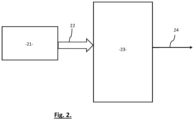
- Figure 2 illustrates a simplified explanation of how the resultant 3D impulse responses are utilised at a location remote from the subject vehicle.
- box 21 represents a multichannel audio endpoint (or "sink", e.g. endpoint where the signal from different audio sources is routed) with functional equivalence to the sound system and control software/platform from which vehicle audio is able to be played back.
- the wide arrow 22 represents a multichannel audio stream of a reference track routed to a cabin simulation functional block 23 (i.e. simulation sink) where convolution of every channel is processed with the corresponding 3D impulse response for specific speakers.
- the output 24 is, in the exemplary form described herein, a B-format audio stream.
- the output audio stream 24 may be played back in real time in a listening room (or on headphones) which effectively reproduces the acoustic space of the vehicle. Adjustments, commonly referred to as “tuning”, can then be made to the control software at box 21. Any capabilities of the vehicle sound system can be tested through the simulated space, enabling an accurate audition of all functions, without needing to be present at the test vehicle.
- Figure 3 illustrates an alternative representation of the process flow, particularly showing how the method enables integration with an existing vehicle sound system control platform.
- a vehicle sound system may comprise generic audio processing at box 26, which receives input audio signals 27, the playback 28 of which may be adjusted by tuning parameters 29.
- a cabin simulation block 30 configured according to input cabin measurement data 31 derived at Figure 1 , processes the audio stream output 32, i.e. in Ambisonics B-format, for communication to a decoder 33 and subsequent output audio stream 34 at a multi-speaker listening room (preferred) or via headphones.
- Tuning parameters and/or any 3D effects or functional processing capability of the platform may follow through the chain to be simulated for appraisal by an engineer.
- Revisions to the parameters are audible in real time for the engineer.
- tuning parameters When the audio experience has been optimised, i.e. tuning parameters have been determined, these can be stored in a suitable format for uploading to the sound system platform of the real-world vehicle.
- a plurality of optimisations may be stored for selection by an end user.
- the invention is embodied by a method and corresponding system for simulating a vehicle cabin for audio tuning and/or testing.
- the method may comprise obtaining, e.g. by recording, and storing a 3D impulse response corresponding to each speaker within the cabin of a vehicle to be simulated.
- a multichannel input audio stream may be obtained and sent, in real-time, and each channel is processed by any convolution processing according to the corresponding speaker to create a surround sound format audio stream.
- the audio stream e.g.
- Ambisonics format may be decoded and played back in a listening room (or via headphones) such that a tuning engineer may make adjustments in parameters of the input audio stream that carry through in real-time to the simulated environment listening experience.
- the parameters can be optimised and applied back to the sound system of the real-world vehicle.
Landscapes
- Engineering & Computer Science (AREA)
- Physics & Mathematics (AREA)
- Acoustics & Sound (AREA)
- Signal Processing (AREA)
- Multimedia (AREA)
- Health & Medical Sciences (AREA)
- General Health & Medical Sciences (AREA)
- Otolaryngology (AREA)
- Stereophonic System (AREA)
- Fittings On The Vehicle Exterior For Carrying Loads, And Devices For Holding Or Mounting Articles (AREA)
Abstract
A method and corresponding system for simulating a vehicle cabin for audio tuning and/or testing, comprises obtaining (17) and storing (20) a 3D impulse response corresponding to each speaker within the cabin of a vehicle to be simulated. At a location remote from the vehicle, a multichannel input audio stream (22) is generated and each channel is processed (23) by real-time convolution processing to create a surround sound format audio stream as an output. The audio stream output (24, 32), e.g. in Ambisonics format, may be decoded (33) and played back in a listening room such that a tuning engineer may make adjustments in parameters of the input audio stream (22, 28) that carry through in real-time to the simulated environment listening experience. In this way, the parameters can be optimised and applied back to the sound system of the real-world vehicle.
Description
- The present disclosure relates to the field of tuning and testing audio systems in automobiles. In particular, simulation of acoustic properties from within a vehicle cabin to enable configuration of a sound system for use in a real-world vehicle corresponding to the simulated vehicle cabin.
- Tuning and testing audio systems in a car cabin is known to be complex and time-consuming. Tools are available for remote sound tuning in automobiles, e.g. by simulating cabin impulse response a preliminary set of parameters can be defined which significantly shortens the time spent on actual in-car tuning. Yet, simulation of multichannel car audio systems is problematic.
- One known solution is based on offline adjustment of gains, equalization, and delays for particular speakers. However, there is no possibility to listen to a created preset outside of the car cabin, i.e. in a separate listening environment that is not the vehicle itself. This implementation will show only the influence of tuning parameters on impulse responses, which were measured earlier.
- An alternative tool offers similar remote calibration opportunities, allowing pre-processing of input audio files to generate auralization output for all car speakers together, which can be listened to on headphones. This solution uses mono cabin impulse response measurements combined with generic HRTF (Head-Related Transfer Function) for auralization (i.e. simulated acoustic experience in a virtual space).
- In light of the above, the present invention seeks to address shortcomings associated with known simulation solutions or at least provide an alternative approach of utility to those skilled in the field.
- A first aspect of the invention is outlined according to claim 1 of the appended claims. For example, a method of simulating a vehicle cabin for audio tuning and testing is described herein, including the steps of: recording, with a microphone (e.g. a set of microphones and encoding device), a 3D impulse response for each speaker within the cabin of a vehicle to be tuned; storing said impulse responses; at a location remote from the vehicle, playing back/sending (e.g. generating or acquiring/sourcing) a multichannel audio stream, performing real-time convolution processing on each channel of the audio stream based on the corresponding 3D impulse response; outputting an audio stream.
- An example of a multi-channel/full-sphere surround sound format is Ambisonics, e.g. with a resulting signal stored in B-format. An example of a first order ambisonic microphone is a Zoom H3-VR recorder unit which comprises four spaced-apart microphones for capturing sound in multiple directions. In the known way, an impulse response may be obtained by playback of a test tone (e.g. sine sweep) through each speaker of the vehicle cabin and capturing of same with suitable hardware.
- In an embodiment, the at least one predetermined position comprises a driver position/head level. However, this may further comprise a plurality of predetermined positions corresponding to passenger positions.
- In this way, an accurate acoustical reproduction of a car cabin may be achieved on any sound system, or headphones, remote from the vehicle. Real-time multi-channel processing may be performed directly on target hardware, e.g. the vehicle's audio control unit, or a PC based application.
- According to the disclosed method, it is possible to tune all audio blocks, not only gain, delay and equalisation. Furthermore, testing of complex audio algorithms is possible, e.g. ANC (active noise cancellation), 3D effects, etc.
- In embodiments, the real-time processing is integrated with the vehicle's own onboard audio software/framework, e.g. which is ordinarily supplied to an OEM for adapting to different cabin settings and car configurations. Such a solution may span the entire audio software stack - including DSP (digital signal processing), audio management, control logic, and tuning and calibration functions. By centralizing audio processing in a cockpit domain controller instead of in audio nodes, it is possible to fully integrate embedded real-time software and eliminate the need for an external unit for audio processing, leading to reduced cost. The system used for calibration according to the present disclosure can be a mock up (e.g. having the same processing blocks as the onboard system) or the real system itself.
- In embodiments, the output sound format (e.g. a universal immersive output format such as Ambisonic B-format) may be decoded at an end point audio system in real-time. For example, a multi-speaker listening room where an experienced automotive audio tuning engineer can listen to an audio reference track (e.g. a familiar piece of music), augmented by the output sound format, and make adjustments to parameters thereof. The engineer is listening for sound imbalance and undesirable resonances, for subsequent elimination in playback.
- Adjustments made by the engineer may be stored in a suitable format to provide an output set of instructions for implementation in the real-world vehicle's onboard sound controller to optimize its speaker system. A separately tuned solution would typically be expected for each vehicle cabin specification and speaker system combination. The invention enables processing the 3D sound in real-time, allowing the engineer to experience the changes applied as he/she goes.
- The invention is applicable not just to car cabins but other vehicle spaces for creating an acoustic simulation thereof. Indeed, the core concept may be applied to acoustic reproduction, for the purpose of tuning and/or testing, of any space (enclosed or otherwise).
- Illustrative embodiments will now be described with reference to the accompanying drawings in which:
-
Figure 1 schematically illustrates a measurement sequence; -
Figure 2 schematically illustrates a simplified process flow diagram; and -
Figure 3 schematically illustrates a more detailed process flow diagram. - The following description presents exemplary embodiments and, together with the drawings, serves to explain principles of the invention. However, the scope of the disclosure is not intended to be limited to the precise details of the embodiments or exact adherence with all features and/or method steps, since variations will be apparent to a skilled person and are deemed also to be covered by the description. Terms for components used herein should be given a broad interpretation that also encompasses equivalent functions and features. In some cases, several alternative terms (synonyms) for structural features have been provided but such terms are not intended to be exhaustive. Descriptive terms should also be given the broadest possible interpretation; e.g. the term "comprising" as used in this specification means "consisting at least in part of" such that interpreting each statement in this specification that includes the term "comprising", features other than that or those prefaced by the term may also be present. Related terms such as "comprise" and "comprises" are to be interpreted in the same manner.
- The description herein refers to embodiments with particular combinations of steps or features, however, it is envisaged that further combinations and cross-combinations of compatible steps or features between embodiments will be possible. Indeed, isolated features may function independently as an invention from other features and not necessarily require implementation as a complete combination.
- It will be understood that the illustrated embodiments show applications only for the purposes of explanation. In practice, the invention may be applied to many different configurations, where the embodiment is straightforward for those skilled in the art to implement.
- As alluded to in the background section above, real-time simulation of multichannel car audio systems according to existing methods is impossible or at least very limited. By contrast, through the use of 3D impulse response measurements and real-time convolution, the present disclosure enables reproduction of the measured audio system outside the vehicle, i.e. a virtual version of the vehicle cabin, on any multichannel speaker configuration (e.g. 5.1 system or headset). According to a practical implementation, in-cabin measurements can be carried out using an ambisonic microphone or recorder such as the Zoom® H3-VR.
- Integration of this concept with an existing vehicle audio framework (e.g. the applicant's Aptiv Sound Framework) allows one to simulate and tune, in real-time, respective audio signals on a PC or hardware setup outside the vehicle.
- Moreover, implementation of the solution described herein as an output block of the vehicle audio framework provides the opportunity of tuning other processing blocks, e.g. compressor, limiter, or third-party algorithms, and not only EQ, gains, and delays commonly adjusted by tuning engineers. Furthermore, other algorithms such as active noise cancelation and 3D effects can be tested with the proposed algorithm on any multichannel, reference audio system.
-
Figure 1 schematically illustrates a measurement sequence. For example, ameasurement tool 11 application can be activated on a PC atstep 12 where a speaker configuration is specified at 13 from a list of common options (or customised). - The
measurement tool 11 interacts withvehicle hardware 14 controlled by software configured for the vehicle model. The measurement tool initiates, via the vehicle hardware, a measurement signal (e.g. sine sweep) 15 for the purpose of measuring an impulse response of a first speaker. Simultaneously, a recorder 16 (e.g. ambisonics recorder device with a set of microphones) starts recording thesine sweep 17 and captures this audio data for, upon termination of the sine sweep,communication 18 back to themeasurement tool 11. - The microphone set may be located at a first head position of a vehicle occupant, e.g. at a driver's seat.
-
Step 19 indicates audio data processing of the captured signal from the cabin by themeasurement tool 11 and calculating the impulse response, followed by anexport function 20, i.e. the resultant impulse response is exported from the measurement tool, for later use in cabin simulation. - The measurement sequence should be repeated for all cabin speakers as indicated by
reference numeral 21. Each recording is typically a separate file, but all the sources can be recorded in unison and exported at once. - The complete speaker set up can also be recorded according to the above sequence from alternative positions in the cabin, i.e. corresponding to other occupant locations.
-
Figure 2 illustrates a simplified explanation of how the resultant 3D impulse responses are utilised at a location remote from the subject vehicle. For example,box 21 represents a multichannel audio endpoint (or "sink", e.g. endpoint where the signal from different audio sources is routed) with functional equivalence to the sound system and control software/platform from which vehicle audio is able to be played back. Thewide arrow 22 represents a multichannel audio stream of a reference track routed to a cabin simulation functional block 23 (i.e. simulation sink) where convolution of every channel is processed with the corresponding 3D impulse response for specific speakers. Theoutput 24 is, in the exemplary form described herein, a B-format audio stream. After decoding, theoutput audio stream 24 may be played back in real time in a listening room (or on headphones) which effectively reproduces the acoustic space of the vehicle. Adjustments, commonly referred to as "tuning", can then be made to the control software atbox 21. Any capabilities of the vehicle sound system can be tested through the simulated space, enabling an accurate audition of all functions, without needing to be present at the test vehicle. -
Figure 3 illustrates an alternative representation of the process flow, particularly showing how the method enables integration with an existing vehicle sound system control platform. - A vehicle sound system, indicated as "Aptiv™ Sound DSP Framework" 25, may comprise generic audio processing at
box 26, which receives input audio signals 27, theplayback 28 of which may be adjusted by tuningparameters 29. Within the DSP platform 25 acabin simulation block 30, configured according to inputcabin measurement data 31 derived atFigure 1 , processes theaudio stream output 32, i.e. in Ambisonics B-format, for communication to adecoder 33 and subsequentoutput audio stream 34 at a multi-speaker listening room (preferred) or via headphones. - Changes in the tuning parameters and/or any 3D effects or functional processing capability of the platform may follow through the chain to be simulated for appraisal by an engineer. Revisions to the parameters are audible in real time for the engineer. When the audio experience has been optimised, i.e. tuning parameters have been determined, these can be stored in a suitable format for uploading to the sound system platform of the real-world vehicle. A plurality of optimisations may be stored for selection by an end user.
- By way of summary, the invention is embodied by a method and corresponding system for simulating a vehicle cabin for audio tuning and/or testing. The method may comprise obtaining, e.g. by recording, and storing a 3D impulse response corresponding to each speaker within the cabin of a vehicle to be simulated. At a later time and remote from the vehicle, a multichannel input audio stream may be obtained and sent, in real-time, and each channel is processed by any convolution processing according to the corresponding speaker to create a surround sound format audio stream. The audio stream, e.g. in Ambisonics format, may be decoded and played back in a listening room (or via headphones) such that a tuning engineer may make adjustments in parameters of the input audio stream that carry through in real-time to the simulated environment listening experience. In this way, the parameters can be optimised and applied back to the sound system of the real-world vehicle.
Claims (14)
- A method of simulating a vehicle cabin for audio tuning and/or testing, including the steps of:obtaining and storing a 3D impulse response corresponding to each speaker within the cabin of a vehicle to be simulated;at a location remote from the vehicle, in real-time, applying convolution processing on each channel of a multichannel audio stream based on the corresponding 3D impulse response;outputting a surround sound format audio stream.
- The method of claim 1, further including decoding the surround sound format audio stream for playback.
- The method of claim 2, wherein playback is performed in a multi-channel listening room or headphones.
- The method of any preceding claim, wherein the input audio stream is generated by a vehicle sound system platform corresponding to that of the vehicle.
- The method of any preceding claim, including the step of adjusting the input audio stream according to at least one parameter affecting the audio, wherein adjustments of the at least one parameter are reproduced in real-time in the output audio stream.
- The method of claim 5, wherein the at least one parameter is selected from any of: gain, equalization, delay, compressor, limiter, active noise cancellation and 3D effects.
- The method of any preceding claim, wherein the obtaining step is performed by recording the 3D impulse response with a surround sound set of microphones.
- The method of any preceding claim, wherein the obtaining step is executed from at least one predetermined position within the cabin, and a set of impulse responses is stored according to a predetermined position.
- The method of claim 8, wherein the at least one predetermined position is the driver's position.
- A system for performing the method of simulating a vehicle cabin for audio tuning and/or testing according to any preceding claim, the system comprising:
vehicle sound system hardware for sending a multichannel input audio stream and applying the convolution processing thereon. - The system of claim 10, further comprising a decoder for decoding the surround sound format audio stream.
- The system of claim 11, wherein the decoder is configured for decoding an Ambisonics format.
- The system of claim 11 or 12, further comprising multi-channel listening room hardware or headphones for playback of the decoded surround sound format audio stream.
- A non-transitory computer readable medium including instructions which, when executed by one or more processors, implement or facilitate the method of any one of claims 1 to 8.
Priority Applications (3)
| Application Number | Priority Date | Filing Date | Title |
|---|---|---|---|
| EP23215759.4A EP4572340A1 (en) | 2023-12-12 | 2023-12-12 | Vehicle cabin simulation for audio tuning and testing |
| CN202410188108.1A CN120151759A (en) | 2023-12-12 | 2024-02-20 | Vehicle cabin simulation for audio tuning and testing |
| US18/599,806 US12627940B2 (en) | 2023-12-12 | 2024-03-08 | Vehicle cabin simulation for audio tuning and testing |
Applications Claiming Priority (1)
| Application Number | Priority Date | Filing Date | Title |
|---|---|---|---|
| EP23215759.4A EP4572340A1 (en) | 2023-12-12 | 2023-12-12 | Vehicle cabin simulation for audio tuning and testing |
Publications (1)
| Publication Number | Publication Date |
|---|---|
| EP4572340A1 true EP4572340A1 (en) | 2025-06-18 |
Family
ID=89190850
Family Applications (1)
| Application Number | Title | Priority Date | Filing Date |
|---|---|---|---|
| EP23215759.4A Pending EP4572340A1 (en) | 2023-12-12 | 2023-12-12 | Vehicle cabin simulation for audio tuning and testing |
Country Status (3)
| Country | Link |
|---|---|
| US (1) | US12627940B2 (en) |
| EP (1) | EP4572340A1 (en) |
| CN (1) | CN120151759A (en) |
Citations (1)
| Publication number | Priority date | Publication date | Assignee | Title |
|---|---|---|---|---|
| US20220240043A1 (en) * | 2021-01-26 | 2022-07-28 | EmbodyVR, Inc. | System and method to virtually mix and audition audio content for vehicles |
Family Cites Families (1)
| Publication number | Priority date | Publication date | Assignee | Title |
|---|---|---|---|---|
| DE102022117701A1 (en) * | 2022-07-15 | 2024-01-18 | Cariad Se | Method and processor circuit for reproducing an acoustic interior situation of a motor vehicle and computer-readable storage medium |
-
2023
- 2023-12-12 EP EP23215759.4A patent/EP4572340A1/en active Pending
-
2024
- 2024-02-20 CN CN202410188108.1A patent/CN120151759A/en active Pending
- 2024-03-08 US US18/599,806 patent/US12627940B2/en active Active
Patent Citations (1)
| Publication number | Priority date | Publication date | Assignee | Title |
|---|---|---|---|---|
| US20220240043A1 (en) * | 2021-01-26 | 2022-07-28 | EmbodyVR, Inc. | System and method to virtually mix and audition audio content for vehicles |
Non-Patent Citations (3)
| Title |
|---|
| FRANCESCO PIAZZA: "Evaluating different vehicle audio environments through a novel software-based system", 11 May 2004 (2004-05-11), XP093164584, Retrieved from the Internet <URL:https://www.aes.org/e-lib/browse.cfm?elib=12757> [retrieved on 20240521] * |
| KAPLANIS NEOFYTOS ET AL: "A Method for Perceptual Assessment of Automotive Audio Systems and Cabin Acoustics", CONFERENCE: 60TH INTERNATIONAL CONFERENCE: DREAMS (DEREVERBERATION AND REVERBERATION OF AUDIO, MUSIC, AND SPEECH); JANUARY 2016, AES, 60 EAST 42ND STREET, ROOM 2520 NEW YORK 10165-2520, USA, 27 January 2016 (2016-01-27), XP040680611 * |
| SAKARI TERVO ET AL: "Spatial Decomposition Method for Room Impulse Responses", JOURNAL OF THE AUDIO ENGINEERING SOCIETY, 1 January 2013 (2013-01-01), pages 17 - 28, XP055061958, Retrieved from the Internet <URL:http://www.aes.org/tmpFiles/elib/20130506/16664.pdf> [retrieved on 20130506] * |
Also Published As
| Publication number | Publication date |
|---|---|
| US20250193620A1 (en) | 2025-06-12 |
| US12627940B2 (en) | 2026-05-12 |
| CN120151759A (en) | 2025-06-13 |
Similar Documents
| Publication | Publication Date | Title |
|---|---|---|
| JP4780119B2 (en) | Head-related transfer function measurement method, head-related transfer function convolution method, and head-related transfer function convolution device | |
| CN102055425B (en) | Audio system phase equalizion | |
| US9554226B2 (en) | Headphone response measurement and equalization | |
| US10623857B2 (en) | Individual delay compensation for personal sound zones | |
| JP2023517720A (en) | Reverb rendering | |
| JP2023169348A5 (en) | ||
| JP6995777B2 (en) | Active monitoring headphones and their binaural method | |
| US9860641B2 (en) | Audio output device specific audio processing | |
| JP7208365B2 (en) | Apparatus and method for adapting virtual 3D audio into a real room | |
| US9100767B2 (en) | Converter and method for converting an audio signal | |
| MX2014008123A (en) | Audio precompensation controller design using a variable set of support loudspeakers. | |
| TW201611626A (en) | Method for determining filter coefficients of an audio precompensation controller for the compensation of an associated sound system, an apparatus therewith, system therewith, and computer program therefor | |
| JP2004526364A (en) | Method and system for simulating a three-dimensional acoustic environment | |
| EP3797528A1 (en) | Generating sound zones using variable span filters | |
| JP7061037B2 (en) | Sound field reproduction system, sound field reproduction method and sound field reproduction program | |
| JP2006517072A (en) | Method and apparatus for controlling playback unit using multi-channel signal | |
| CN116074728A (en) | Method for audio processing | |
| JP2008311718A (en) | Sound image localization controller, and sound image localization control program | |
| CN113784274A (en) | 3D audio system | |
| EP4507335A1 (en) | Crosstalk cancellation for reverberant acoustic fields | |
| Pinardi et al. | Direction specific analysis of psychoacoustics parameters inside car cockpit: A novel tool for NVH and sound quality | |
| US20230403527A1 (en) | System and method to virtually mix and audition audio content for vehicles | |
| US12627940B2 (en) | Vehicle cabin simulation for audio tuning and testing | |
| Palenda et al. | Setup for choir recordings in virtual churches | |
| CN117896666A (en) | Method for playback of audio data, electronic device and storage medium |
Legal Events
| Date | Code | Title | Description |
|---|---|---|---|
| PUAI | Public reference made under article 153(3) epc to a published international application that has entered the european phase |
Free format text: ORIGINAL CODE: 0009012 |
|
| STAA | Information on the status of an ep patent application or granted ep patent |
Free format text: STATUS: THE APPLICATION HAS BEEN PUBLISHED |
|
| AK | Designated contracting states |
Kind code of ref document: A1 Designated state(s): AL AT BE BG CH CY CZ DE DK EE ES FI FR GB GR HR HU IE IS IT LI LT LU LV MC ME MK MT NL NO PL PT RO RS SE SI SK SM TR |
|
| STAA | Information on the status of an ep patent application or granted ep patent |
Free format text: STATUS: REQUEST FOR EXAMINATION WAS MADE |
|
| 17P | Request for examination filed |
Effective date: 20251121 |