EP4572310A1 - Tunable hybrid neural video representations - Google Patents
Tunable hybrid neural video representations Download PDFInfo
- Publication number
- EP4572310A1 EP4572310A1 EP24211659.8A EP24211659A EP4572310A1 EP 4572310 A1 EP4572310 A1 EP 4572310A1 EP 24211659 A EP24211659 A EP 24211659A EP 4572310 A1 EP4572310 A1 EP 4572310A1
- Authority
- EP
- European Patent Office
- Prior art keywords
- frame
- video
- features
- video frames
- gop
- Prior art date
- Legal status (The legal status is an assumption and is not a legal conclusion. Google has not performed a legal analysis and makes no representation as to the accuracy of the status listed.)
- Pending
Links
Images


Classifications
-
- H—ELECTRICITY
- H04—ELECTRIC COMMUNICATION TECHNIQUE
- H04N—PICTORIAL COMMUNICATION, e.g. TELEVISION
- H04N19/00—Methods or arrangements for coding, decoding, compressing or decompressing digital video signals
- H04N19/10—Methods or arrangements for coding, decoding, compressing or decompressing digital video signals using adaptive coding
- H04N19/189—Methods or arrangements for coding, decoding, compressing or decompressing digital video signals using adaptive coding characterised by the adaptation method, adaptation tool or adaptation type used for the adaptive coding
-
- H—ELECTRICITY
- H04—ELECTRIC COMMUNICATION TECHNIQUE
- H04N—PICTORIAL COMMUNICATION, e.g. TELEVISION
- H04N19/00—Methods or arrangements for coding, decoding, compressing or decompressing digital video signals
- H04N19/10—Methods or arrangements for coding, decoding, compressing or decompressing digital video signals using adaptive coding
- H04N19/169—Methods or arrangements for coding, decoding, compressing or decompressing digital video signals using adaptive coding characterised by the coding unit, i.e. the structural portion or semantic portion of the video signal being the object or the subject of the adaptive coding
- H04N19/17—Methods or arrangements for coding, decoding, compressing or decompressing digital video signals using adaptive coding characterised by the coding unit, i.e. the structural portion or semantic portion of the video signal being the object or the subject of the adaptive coding the unit being an image region, e.g. an object
- H04N19/172—Methods or arrangements for coding, decoding, compressing or decompressing digital video signals using adaptive coding characterised by the coding unit, i.e. the structural portion or semantic portion of the video signal being the object or the subject of the adaptive coding the unit being an image region, e.g. an object the region being a picture, frame or field
-
- G—PHYSICS
- G06—COMPUTING OR CALCULATING; COUNTING
- G06N—COMPUTING ARRANGEMENTS BASED ON SPECIFIC COMPUTATIONAL MODELS
- G06N3/00—Computing arrangements based on biological models
- G06N3/02—Neural networks
- G06N3/04—Architecture, e.g. interconnection topology
- G06N3/045—Combinations of networks
-
- G—PHYSICS
- G06—COMPUTING OR CALCULATING; COUNTING
- G06N—COMPUTING ARRANGEMENTS BASED ON SPECIFIC COMPUTATIONAL MODELS
- G06N3/00—Computing arrangements based on biological models
- G06N3/02—Neural networks
- G06N3/04—Architecture, e.g. interconnection topology
- G06N3/0464—Convolutional networks [CNN, ConvNet]
-
- G—PHYSICS
- G06—COMPUTING OR CALCULATING; COUNTING
- G06N—COMPUTING ARRANGEMENTS BASED ON SPECIFIC COMPUTATIONAL MODELS
- G06N3/00—Computing arrangements based on biological models
- G06N3/02—Neural networks
- G06N3/08—Learning methods
- G06N3/084—Backpropagation, e.g. using gradient descent
-
- G—PHYSICS
- G06—COMPUTING OR CALCULATING; COUNTING
- G06N—COMPUTING ARRANGEMENTS BASED ON SPECIFIC COMPUTATIONAL MODELS
- G06N3/00—Computing arrangements based on biological models
- G06N3/02—Neural networks
- G06N3/08—Learning methods
- G06N3/088—Non-supervised learning, e.g. competitive learning
-
- G—PHYSICS
- G06—COMPUTING OR CALCULATING; COUNTING
- G06T—IMAGE DATA PROCESSING OR GENERATION, IN GENERAL
- G06T9/00—Image coding
- G06T9/002—Image coding using neural networks
-
- G—PHYSICS
- G06—COMPUTING OR CALCULATING; COUNTING
- G06T—IMAGE DATA PROCESSING OR GENERATION, IN GENERAL
- G06T9/00—Image coding
- G06T9/007—Transform coding, e.g. discrete cosine transform
-
- G—PHYSICS
- G06—COMPUTING OR CALCULATING; COUNTING
- G06V—IMAGE OR VIDEO RECOGNITION OR UNDERSTANDING
- G06V10/00—Arrangements for image or video recognition or understanding
- G06V10/70—Arrangements for image or video recognition or understanding using pattern recognition or machine learning
- G06V10/82—Arrangements for image or video recognition or understanding using pattern recognition or machine learning using neural networks
-
- G—PHYSICS
- G06—COMPUTING OR CALCULATING; COUNTING
- G06V—IMAGE OR VIDEO RECOGNITION OR UNDERSTANDING
- G06V20/00—Scenes; Scene-specific elements
- G06V20/40—Scenes; Scene-specific elements in video content
- G06V20/46—Extracting features or characteristics from the video content, e.g. video fingerprints, representative shots or key frames
-
- H—ELECTRICITY
- H04—ELECTRIC COMMUNICATION TECHNIQUE
- H04N—PICTORIAL COMMUNICATION, e.g. TELEVISION
- H04N19/00—Methods or arrangements for coding, decoding, compressing or decompressing digital video signals
- H04N19/10—Methods or arrangements for coding, decoding, compressing or decompressing digital video signals using adaptive coding
- H04N19/134—Methods or arrangements for coding, decoding, compressing or decompressing digital video signals using adaptive coding characterised by the element, parameter or criterion affecting or controlling the adaptive coding
- H04N19/136—Incoming video signal characteristics or properties
-
- H—ELECTRICITY
- H04—ELECTRIC COMMUNICATION TECHNIQUE
- H04N—PICTORIAL COMMUNICATION, e.g. TELEVISION
- H04N19/00—Methods or arrangements for coding, decoding, compressing or decompressing digital video signals
- H04N19/10—Methods or arrangements for coding, decoding, compressing or decompressing digital video signals using adaptive coding
- H04N19/169—Methods or arrangements for coding, decoding, compressing or decompressing digital video signals using adaptive coding characterised by the coding unit, i.e. the structural portion or semantic portion of the video signal being the object or the subject of the adaptive coding
- H04N19/177—Methods or arrangements for coding, decoding, compressing or decompressing digital video signals using adaptive coding characterised by the coding unit, i.e. the structural portion or semantic portion of the video signal being the object or the subject of the adaptive coding the unit being a group of pictures [GOP]
-
- H—ELECTRICITY
- H04—ELECTRIC COMMUNICATION TECHNIQUE
- H04N—PICTORIAL COMMUNICATION, e.g. TELEVISION
- H04N19/00—Methods or arrangements for coding, decoding, compressing or decompressing digital video signals
- H04N19/42—Methods or arrangements for coding, decoding, compressing or decompressing digital video signals characterised by implementation details or hardware specially adapted for video compression or decompression, e.g. dedicated software implementation
-
- H—ELECTRICITY
- H04—ELECTRIC COMMUNICATION TECHNIQUE
- H04N—PICTORIAL COMMUNICATION, e.g. TELEVISION
- H04N19/00—Methods or arrangements for coding, decoding, compressing or decompressing digital video signals
- H04N19/50—Methods or arrangements for coding, decoding, compressing or decompressing digital video signals using predictive coding
- H04N19/587—Methods or arrangements for coding, decoding, compressing or decompressing digital video signals using predictive coding involving temporal sub-sampling or interpolation, e.g. decimation or subsequent interpolation of pictures in a video sequence
-
- H—ELECTRICITY
- H04—ELECTRIC COMMUNICATION TECHNIQUE
- H04N—PICTORIAL COMMUNICATION, e.g. TELEVISION
- H04N19/00—Methods or arrangements for coding, decoding, compressing or decompressing digital video signals
- H04N19/50—Methods or arrangements for coding, decoding, compressing or decompressing digital video signals using predictive coding
- H04N19/59—Methods or arrangements for coding, decoding, compressing or decompressing digital video signals using predictive coding involving spatial sub-sampling or interpolation, e.g. alteration of picture size or resolution
-
- H—ELECTRICITY
- H04—ELECTRIC COMMUNICATION TECHNIQUE
- H04N—PICTORIAL COMMUNICATION, e.g. TELEVISION
- H04N19/00—Methods or arrangements for coding, decoding, compressing or decompressing digital video signals
- H04N19/60—Methods or arrangements for coding, decoding, compressing or decompressing digital video signals using transform coding
Definitions
- the present invention refers to a system and a method for tunable hybrid neural video representation.
- Video compression is a long-standing and difficult problem that has inspired much research.
- the main goal of video compression is to represent a digital video (typically a sequence of frames, each being represented by a two-dimensional (2-D) array of pixels, RGB or YUV colors) using the minimum amount of storage while concurrently minimizing loss of quality.
- 2-D two-dimensional
- Implicit neural representations have attracted significant research interest and have been applied to various domains, including video compression.
- INR-based approaches can match or surpass traditional standard video codecs such as Advanced Video Encoding (AVC, also referred to as H.264) and High Efficiency Video Encoding (HEVC) in compression performance.
- AVC Advanced Video Encoding
- HEVC High Efficiency Video Encoding
- these existing approaches to utilizing INRs for video compression only perform well in limited and sometimes highly constrained settings, such as being limited to specific model sizes, fixed aspect ratios, and relatively static video sequences, for instance.
- NeRV Neural Representations for Videos
- MLP Multi-Layer Perceptron
- E-NeRV Expedite NeRV
- AdaIN adaptive instance normalization
- Flow-Guided Frame-Wise NeRV improves performance on dynamic sequences by enforcing temporal consistency with a decoder that predicts both independent frames and a set of optical flow maps that are used to warp adjacent independent frames and combine them to provide a final output frame.
- a hybrid representation, HNeRV resembles an autoencoder during training, employing an encoder to extract content-specific embeddings. After training concludes, the video is represented by the parameters of the decoder and the per-frame embeddings.
- NeRV i.e., E-NeRV, FFNeRV and HNeRV
- E-NeRV i.e., E-NeRV, FFNeRV and HNeRV
- Conventional hybrid approaches show promise in the low bitrate regime but fail to scale to higher bitrates and are currently limited to video with an unusual 2:1 aspect ratio.
- a neural network-based video compression solution capable of encoding video frames efficiently across a range of use cases and parameters.
- Embodiments of the present invention are as follows: A system comprising: a tunable neural network-based video encoder configured to:
- the one or more GOP features of the first plurality of the plurality of video frames are identified using a multi-resolution feature grid of the tunable neural network-based video encoder.
- tunable neural network-based video encoder configured to:
- the latent feature comprises a weighted combination of the frame-specific embedding and the one or more GOP features.
- the system wherein at least one of a first weight applied to the frame-specific embedding or a second weight applied to the one or more GOP features is determined by the tunable neural network-based video encoder.
- the tunable neural network-based video encoder is trained using an optimized loss function including a distortion loss and an entropy loss.
- the distortion loss and the entropy loss are optimized jointly.
- the first video frame comprises a sub-sequence of the first plurality of the plurality of video frames
- the frame-specific embedding comprises a plurality of frame-specific embeddings corresponding respectively to each of the sub-sequence of the first plurality of the plurality of video frames
- the latent feature is one of a plurality of latent features each corresponding respectively to a compressed version of each of the sub-sequence of the first plurality of the plurality of video frames.
- a system comprising: a neural network-based video decoder configured to:
- the frame-specific embedding is generated based on a combination with one or more temporal features extracted from the first plurality of the plurality of video frames.
- the latent feature comprises a weighted combination of the frame-specific embedding and the one or more GOP features.
- the first video frame comprises a sub-sequence of the first plurality of the plurality of video frames
- the frame-specific embedding comprises a plurality of frame-specific embeddings corresponding respectively to each of the sub-sequence of the first plurality of the plurality of video frames
- the latent feature is one of a plurality of latent features each corresponding respectively to a compressed version of each of the sub-sequence of the first plurality of the plurality of video frames.
- a method for execution by a tunable neural network-based video encoder comprising:
- the one or more GOP features of the first plurality of the plurality of video frames are identified using a multi-resolution feature grid of the tunable neural network-based video encoder.
- the method further comprising:
- the latent feature comprises a weighted combination of the frame-specific embedding and the one or more GOP features.
- the method further comprising: determining at least one of a first weight applied to the frame-specific embedding or a second weight applied to the one or more GOP features.
- the tunable neural network-based video encoder is trained using an optimized loss function including a distortion loss and an entropy loss.
- the method wherein the distortion loss and the entropy loss are optimized jointly.
- the first video frame comprises a sub-sequence of the first plurality of the plurality of video frames
- the frame-specific embedding comprises a plurality of frame-specific embeddings corresponding respectively to each of the sub-sequence of the first plurality of the plurality of video frames
- the latent feature is one of a plurality of latent features each corresponding respectively to a compressed version of each of the sub-sequence of the first plurality of the plurality of video frames.
- T-NeRV tunable hybrid implicit neural representation
- AVC Advanced Video Encoding
- HEVC High Efficiency Encoding
- the tunable hybrid neural video representation solution disclosed herein may advantageously be implemented as automated or substantially automated systems and methods.
- the terms “automation,” “automated” and “automating” refer to systems and processes that do not require the participation of a human user, such as a human system operator or administrator. Although in some implementations the performance of the systems and methods disclosed herein may be monitored by a human system operator, that human involvement is optional. Thus, the methods described in the present application may be performed under the control of hardware processing components of the disclosed systems.
- the novel and inventive T-NeRV solution disclosed in the present application implements a video compression system including a tunable neural network-based video encoder that combines frame-specific embeddings with group of pictures specific (GOP-specific) features and upsamples them with a decoder based on optical flow.
- This novel and inventive combination of frame-specific and GOP-specific features provides a lever for content-specific fine-tuning. For example, larger frame embeddings, i.e., emphasizing frame-specific features, can extract more high-frequency information, improving performance on low-motion sequences. Conversely, more prominent GOP-specific features allow the T-NeRV model to extract more temporal context that the decoder can make use of to reconstruct frames in dynamic sequences.
- the T-NeRV solution disclosed in the present application jointly minimizes rate and distortion via quantization-aware and entropy-constrained training to capture embeddings as well.
- the present T-NeRV solution can make use of their redundancies to a higher degree than previous approaches.
- End-to-end training also enforces the present T-NeRV network to fine-tune itself to the target video content by spending more bits on the frame-specific embeddings or the GOP-specific features, automatically adjusting the tuning lever.
- the present T-NeRV solution contributes at least the following features to the present state-of-the-art: (i) a tunable hybrid video INR that combines frame-specific embeddings with GOP-specific features, thereby providing a lever for content-specific fine-tuning and (ii) extension of the information-theoretic INR compression framework to include embeddings, thereby making use of the significant redundancies within them. It is noted that the tuning of the model, as well as the balance of the combination of frame-specific embeddings with GOP-specific features is performed automatically during training and optimization of the T-NeRV model, although a system user can assert some control by defining the maximum size of the feature maps used. It is further noted that, when evaluated on the UVG dataset, the T-NeRV solution disclosed by the present application outperforms all previous video INRs on both video representation and video compression tasks.
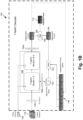
- Figure 1A shows a diagram depicting an exemplary architecture for T-NeRV encoder 110 of a video compression system, according to one implementation of the present concepts
- Figure 1B shows a diagram depicting an exemplary architecture for optical flow-based T-NeRV decoder 140 suitable for use with exemplary T-NeRV encoder 110, according to one implementation.
- T-NeRV encoder 110 includes large encoder 120, positional encoder (PE) 124, Multi-Layer Perceptron (MI,P) 126, multi-resolution feature grid 112, fusion block 127, and in some implementations may also include MLP 132. Also shown in Figure 1A are learned weights 106, spatial frame embedding 122, one or more temporal features 128 (hereinafter “temporal feature(s) 128”), one or more GOP-specific features 114 (hereinafter “GOP feature(s) 114”), frame-specific embedding 116 and optional temporal feature output 130.
- temporary feature(s) 128 hereinafter “temporal feature(s) 128”
- GOP-specific features 114 hereinafter “GOP feature(s) 114”
- frame-specific embedding 116 and optional temporal feature output 130.
- the T-NeRV network including T-NeRV encoder 110 and T-NeRV decoder 140 performs forward passes and backward passes, as known in the art, to optimize the network parameters.
- GOP feature(s) 114, frame specific embedding 116, i.e., a feature map or tensor representation of a video frame, latent feature 118 and optionally temporal feature output 130 are retained as part of the video state, while the remainder of the features shown in Figure 1A are discarded.
- Decoding input video frame 102 thus amounts to obtaining GOP feature(s) 114 from multi-resolution feature grid 112, and fusing them with frame-specific embeddings 116, using any suitable combination technique, such as concatenation or fusion for example, to obtain latent feature 118 ( z t ) of input video frame , which is passed through T-NeRV decoder 140.
- Frame-specific embedding 116 can serve as one of two components of latent feature 118.
- Frame-specific embedding 116 can be generated in two steps: First, large encoder 120 may extract spatial frame embedding 122, ê t , from input video frame 102, which may then be augmented with additional temporal feature(s) 128. This augmentation is a mathematical operation that combines spatial frame embedding 122 with temporal feature(s) 128 by concatenating them or, alternatively, combining them using any other mathematical technique, a neural network, or transformers, for example.
- large encoder 120 may be approximately one hundred times larger, i.e., include one hundred times more weights, than conventional encoders used in HNeRV networks because the encoder weights themselves will not be transmitted to the decoder.
- the spatial frame embedding 122 may be further augmented with temporal feature(s) 128.
- positional encoder (PE) 124 followed by multilayer perceptron (MLP) 126 may be utilized to provide temporal information, which may then be reshaped into temporal feature(s) 128 ( s t ⁇ R c E ⁇ h ⁇ w ) matching the dimension of spatial frame embedding, 122 ê t .
- the mechanism for combining spatial frame embedding 122 and temporal feature(s) 128 to provide frame-specific embedding 116 can be regarded as a per-frame masking operation on frame-specific embedding 116, allowing similar frames to obtain different embeddings.
- T-NeRV decoder 140 can make use of that information to decide which portions of the frame to reconstruct from the frame's own independent frame and for which portions to rely on inter-frame information.
- T-NeRV encoder 110 utilizes multi-resolution feature grid 112 to obtain GOP feature(s) 114, g t ⁇ R c G ⁇ h ⁇ w .
- frame index 104, t is used to index into the grids, selecting two features in the form of learned numbers or tensors that t lies within at every level of multi-resolution feature grid 112. A bilinear interpolation may be performed between these two features and the results from every level may be concatenated, fused or otherwise combined to obtain GOP feature(s) 114.
- T-NeRV allows features at different levels of multi-resolution feature grid 112 to vary in size with respect to the number of channels c i while maintaining their spatial dimensions ( h, w).
- This modification allows T-NeRV to advantageously regulate the amount of information that is captured for different GOP sizes. It is noted that this regulation by T-NeRV is occurs automatically during the optimization performed during the learning process.
- Latent feature 118 obtained from fusing GOP feature(s) 114 and frame-specific embedding 116 may be passed to T-NeRV decoder 140 along with temporal feature output 130, u t ⁇ R 128 , generated by MLP 132.
- T-NeRV decoder 140 may include three parts: Pre-block convolutional layer 142, series of T-NeRV blocks 150 (e.g., five T-NeRV blocks), and flow-based warping block 144.
- pre-block convolutional layer 142 includes a convolutional layer with a kernel that performs either channel expansion or channel reduction, i.e., tensor reshape operations known in the art, depending on the size of latent feature 118 and the dimension expected by the first of T-NeRV block 150.
- head layers i.e., output layers, 164a and 164b, optical flow maps 143, independent frame buffer 146, aggregated frame 148, independent frame 166, aggregation block 168 and predicted frame 170 corresponding to input video frame 102 in Figure 1A .
- T-NeRV decoder 140 may utilize series of T-NeRV blocks 150 to predict independent frame 166 and optical flow maps 143.
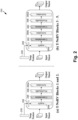
- Figure 2 schematically depicts series of T-NeRV blocks 250 suitable for use in T-NeRV decoder 140 in Figure 1B , according to one implementation.
- linear layer 252 extracts per-channel statistics, such as, for example, mean and variance, from temporal feature output 230 from T-NeRV encoder 110 that are used to shift the distribution of the input tensor via adaptive instance normalization (AdaIN) layer 254, thereby injecting temporal information into series of T-NeRV blocks.
- AdaIN adaptive instance normalization
- temporal feature output 230 and a series of T-NeRV blocks 250 correspond respectively in general to temporal feature output 130 and series of T-NeRV blocks 150, shown variously in Figures 1A and 1B . Consequently, temporal feature output 130 and series of T-NeRV blocks 150 may share any of the characteristics attributed to respective temporal feature output 230 and series of T-NeRV blocks 250 by the present disclosure, and vice versa.
- the first two T-NeRV blocks of series of T-NeRV blocks 150/250 include convolutional layer 256 (e.g., a 5 ⁇ 5 convolutional layer) with channel expansion and a subsequent PixelShuffle layer 258, which can perform spatial upsampling, and which may be followed by activation function 260a in the form of a Gaussian Error Linear Unit (GELU) activation function.
- convolutional layer 256 e.g., a 5 ⁇ 5 convolutional layer
- a subsequent PixelShuffle layer 258 which can perform spatial upsampling
- activation function 260a in the form of a Gaussian Error Linear Unit (GELU) activation function.
- GELU Gaussian Error Linear Unit
- T-NeRV decoder 140 allows T-NeRV decoder 140 to allocate more parameters to the later stages, aiding the reconstruction of high frequency details.
- this strategy renders the third T-NeRV block of series of T-NeRV blocks 150/250 the largest, which is advantageous given its dual use in upsampling and optical flow prediction.
- T-NeRV blocks three through five of series of T-NeRV blocks 150/250 employ two successive convolutional layers 262 (e.g., 3 ⁇ 3 convolutional layers) with the same total number of parameters and an additional activation 260b in between convolutional layers 262, resulting in the block architecture shown in panel (b) of Figure 2 .
- the higher parameter efficiency and the additional non-linearity further help T-NeRV decoder 140 to reconstruct high-frequency information.
- Flow-based warping block 144 serves as a flow-guided aggregation module for re-use of information from adjacent frames via optical flow.
- head layer 164a i.e., one or more output layers after the fifth T-NeRV block of series of T-NeRV blocks 150/250, outputs an independent frame 166, I t ⁇ R 3 ⁇ H ⁇ W , and two aggregation weights w I , w A ⁇ R H ⁇ W .
- a copy independent frame 166, I t is detached from the computation graph and stored in independent frame buffer 146.
- head layer 164b after the third T-NeRV block of series of T-NeRV blocks 150/250 predicts optical flow maps 143, M ( t , t + j ⁇ R 2 ⁇ H / 4 ⁇ W / 4 , and weight maps, w M t , t + j ⁇ R H / 4 ⁇ W / 4 , for every j in the aggregation window W .
- the optical flow maps and weight maps may then be bilinearly upsampled and normalized via a softmax function.
- L D + ⁇ R
- D denotes some distortion loss
- R represents the entropy of the INR parameters ⁇
- ⁇ establishes a trade-off between the two.
- Training an INR on loss L jointly has the desirable result of minimizing rate and distortion during training, allowing them to achieve compression by entropy-encoding the parameters ⁇ after training concludes.
- the T-NeRV network including T-NeRV encoder 110 and T-NeRV decoder 140 may be trained using an optimized loss function including a distortion loss and an entropy loss, where the distortion loss and the entropy loss may be optimized jointly.
- quantization aware training is performed, using the straight-through estimator (STE), as known in the art, to ensure differentiability.
- STE straight-through estimator
- Each layer is quantized independently using scale reparametrization with two trainable parameters.
- the entropy of each layer may then be estimated independently by fitting a small neural network to the weight distribution.
- each of the multiple feature grids included among multi-resolution feature grid 112, such as three feature grids for example, is treated as its own layer with its own quantization parameters.
- each feature grid is quantized and dequantized using the same scale reparametrization scheme before bilinearly interpolating two of its features. It is noted that adopting one entropy model per feature grid allows the T-NeRV network to determine the extent to which the features at each temporal frequency should be compressed.
- a single entropy model is adopted for all frame-specific embeddings 116, thereby encouraging the T-NeRV network to make use of redundancies between frames.
- This counterbalances the injection of temporal feature(s) 128 into frame-specific embeddings 116 discussed above, restricting the T-NeRV network to use such temporal information only when the gain in video quality outweighs the increase in entropy.
- the entropy loss is back propagated through the T-NeRV network, which encourages the T-NeRV network to learn features in its feature grids that exhibit low entropy.
- FIG. 3 shows flowchart 380 outlining an exemplary method for performing tunable hybrid neural video representation, according to one implementation. With respect to the method outlined in Figure 3 , it is noted that certain details and features have been left out of flowchart 380 in order not to obscure the discussion of the inventive features in the present application.
- the method outlined by flowchart 380 includes receiving, by T-NeRV encoder 110, a video sequence including multiple video frames such as input video frame 102 (action 381).
- input video frame 102 may be received by T-NeRV encoder 110 using large encoder 120 of T-NeRV encoder 110.
- large encoder 120 may be approximately one hundred times larger, i.e., include one hundred times more weights, than conventional encoders used in HNeRV networks.
- the method outlined by flowchart 380 further includes generating frame-specific embedding 116 of a first video frame (hereinafter "input video frame 102") of the video frames included in the video sequence received in action 381 (action 382).
- frame-specific embedding 116 can be generated in one or two steps: First, large encoder 120 extracts spatial frame embedding 122 from input video frame 102, which may then, in some use cases, serve as frame-specific embedding 116, or, in other use cases, may be augmented with additional temporal feature(s) 128.
- PE 124 followed by MLP 126 may be utilized to extract temporal information from frame index 104. That temporal information may be extracted from a subset of the video frames included in the video sequence received in action 381, where that subset of video frames of the video sequence includes input video frame 102. The temporal information output by MLP 126 may then be reshaped into temporal feature(s) 128, s t ⁇ R c E ⁇ h ⁇ w , matching the dimension of spatial frame embedding 122.
- Temporal feature(s) 128 may then be fused into spatial frame embedding 122 to obtain frame-specific embedding 116.
- frame-specific embedding 116 may be generated, in action 382, by T-NeRV encoder 110 using large encoder 120 to provide spatial frame embedding 122, and in some use cases, combining spatial frame embedding 122 with temporal feature(s) 128.
- the method outlined by flowchart 380 further includes identifying one or more GOP features of a subset of the video frames included in the video sequence received in action 381, where the subset of video frames includes input video frame 102 (action 383).
- GOP features may include I-frames (intra-coded pictures), P-frames (predicted pictures) and B-frames (bidirected pictures), for example, as well as the integers M and N , where M designates the number of frames between two anchor frames, i.e., the distance between an I-frame and a P-frame or the distance between two P-frames, and A designates the number of frames between two I-frames.
- subset of video frames from which one or more GOP features are identified in action 383 may be the same subset of video frames from which temporal feature(s) 128 are optionally extracted as part of action 382, or another subset of video frames of the video sequence received in action 381 that also includes input video frame 102.
- Action 383 may be performed by T-NeRV encoder 110, using multi-resolution feature grid 112 to obtain one or more GOP feature(s).
- frame index 104, t is used to index into the grids, selecting two features that frame index 104 lies within at every level of multi-resolution feature grid 112.
- a bilinear interpolation may be performed between these two features and the results from every level may be concatenated, fused or otherwise combined to obtain GOP feature(s) 114.
- T-NeRV allows features at different levels of multi-resolution feature grid 112 to vary in size with respect to the number of channels c i while maintaining their spatial dimensions (h, w). This modification allows T-NeRV to advantageously regulate the amount of information that is captured for different GOP sizes.
- the method outlined by flowchart 380 further includes combining frame-specific embedding 116 of input video frame 102 and GOP feature(s) 114 identified in action 383, by concatenating them or, alternatively, combining them using any other mathematical technique, a neural network, or transformers, for example, to provide latent feature 118 corresponding to a compressed version of input video frame 102 (action 384).
- T-NeRV encoder 110 is a tunable neural network-based video encoder configured to combine a frame-specific embedding 116 with group of GOP feature(s) using fusion block 127 to concatenate them or, alternatively, to combine them using any other mathematical technique, a neural network, or transformers, for example. That combination of frame-specific embedding 116 with GOP feature(s) 114 provides a lever for content-specific fine-tuning because emphasizing frame-specific embeddings 116 extracts more high-frequency information from video frames, thereby improving performance on low-motion sequences.
- GOP feature(s) 114 gives more prominence to GOP feature(s) 114 allows the T-NeRV model to extract more temporal context that decoder 140 can utilize to better reconstruct frames in dynamic sequences.
- this lever action, or balancing of the combination of frame-specific embeddings with GOP-specific features is performed automatically during training and optimization of the T-NeRV model, although a system user can assert some control by defining the maximum size of the feature maps used.
- latent feature 118 may be provided as a weighted or unweighted combination of frame-specific embedding 116 and GOP feature(s) 114 by T-NeRV encoder 110, in action 384.
- latent feature 118 is provided as a weighted combination of frame-specific embedding 116 and GOP feature(s) 114
- one or both of a first weight applied to frame-specific embedding 116 or a second weight applied to GOP feature(s) in that weighted combination may be determined by T-NeRV encoder 110, based for example, on whether the content depicted in the video sequence received in action 381 is primarily static or primarily dynamic.
- the method outlined by flowchart 380 may further include outputting latent feature 118 of input video frame 102 to a decoder, such as T-NeRV decoder 140, or, in other implementations, even another type of conventional NeRV-based decoder (action 385). It is noted that action 385 is optional, and in some implementations the method outlined by flowchart 380 may conclude with action 384 described above. Optional action 385, when performed, is performed by T-NeRV encoder 110, and, as discussed above, may also include providing temporal feature output 130 to the decoder.
- a decoder such as T-NeRV decoder 140
- action 385 is optional, and in some implementations the method outlined by flowchart 380 may conclude with action 384 described above.
- Optional action 385 when performed, is performed by T-NeRV encoder 110, and, as discussed above, may also include providing temporal feature output 130 to the decoder.
- actions 382, 383 and 384, or actions 382, 383, 384 and 385 are described above as being performed on a single video frame at a time, e.g., input video frame 102, in some implementations those actions can be performed on a segment (hereinafter "sub-sequence") of a video sequence.
- input video frame 102 may correspond to a sub-sequence of the subset of video frames identified in action 383
- frame-specific embedding 116 may include multiple frame-specific embeddings corresponding respectively to each video frame of the sub-sequence of the identified subset of video frames
- latent feature 118 may be multiple latent features each corresponding respectively to a compressed version of the video frames of the sub-sequence of the identified subset of video frames.
- those multiple latent features may be output to the decoder, in action 385, or may be stored for later decoding.
- the method outlined by flowchart 380 may conclude with action 385 described above.
- the method outlined by flowchart 380 may further include the actions of receiving, by T-NeRV decoder 140, latent feature 118 from T-NeRV encoder 110, and decoding, by T-NeRV decoder 140, latent feature 118 to provide predicted frame 170 as an uncompressed video frame corresponding to input video frame 102. It is noted that the decoding of latent feature 118 to provided predicted frame 170 may be performed by T-NeRV decoder in the manner described in detail above by reference to Figures 1B and 2 .
- actions 381, 382, 383 and 384, or actions 381, 382, 383, 384 and 385 may be performed in an automated process from which human participation may be omitted.
- the present application discloses systems and methods for performing tunable hybrid neural video representation that advance the state-of-the-art through at least the following contributions: (i) development of a T-NeRV encoder that combines frame-specific embeddings with GOP-specific features, thereby providing a lever for content-specific fine-tuning and (ii) extension of the information-theoretic INR compression framework to include embeddings, thereby advantageously making use of the significant redundancies within them.
- the T-NeRV solution disclosed by the present application outperforms all previous video INRs on both video representation and video compression tasks.
Landscapes
- Engineering & Computer Science (AREA)
- Multimedia (AREA)
- Physics & Mathematics (AREA)
- Theoretical Computer Science (AREA)
- Signal Processing (AREA)
- General Physics & Mathematics (AREA)
- Evolutionary Computation (AREA)
- Artificial Intelligence (AREA)
- General Health & Medical Sciences (AREA)
- Health & Medical Sciences (AREA)
- Software Systems (AREA)
- Computing Systems (AREA)
- Biophysics (AREA)
- Life Sciences & Earth Sciences (AREA)
- Biomedical Technology (AREA)
- Computational Linguistics (AREA)
- Data Mining & Analysis (AREA)
- Molecular Biology (AREA)
- General Engineering & Computer Science (AREA)
- Mathematical Physics (AREA)
- Databases & Information Systems (AREA)
- Medical Informatics (AREA)
- Computer Vision & Pattern Recognition (AREA)
- Discrete Mathematics (AREA)
- Compression Or Coding Systems Of Tv Signals (AREA)
Abstract
A system includes a tunable neural network-based video encoder configured to receive a video sequence including multiple video frames, generate a frame-specific embedding of a first video frame of the multiple video frames, and identify one or more group-of-pictures (GOP) features of a subset of the multiple video frames, the subset of the including the first video frame. The tunable neural network-based video encoder is further configured to combine the frame-specific embedding of the first video frame and the one or more GOP features of the first plurality of the plurality of video frames to provide a latent feature corresponding to a compressed version of the first video frame.
Description
- The present invention refers to a system and a method for tunable hybrid neural video representation.
- Video compression is a long-standing and difficult problem that has inspired much research. The main goal of video compression is to represent a digital video (typically a sequence of frames, each being represented by a two-dimensional (2-D) array of pixels, RGB or YUV colors) using the minimum amount of storage while concurrently minimizing loss of quality. Although many advances to traditional video codecs have been made in recent decades, the advent of deep learning has inspired many new approaches that surpass traditional video codecs.
- Implicit neural representations (INRs), for example, have attracted significant research interest and have been applied to various domains, including video compression. In addition to exhibiting desirable properties such as fast decoding and the ability of temporal interpolation, INR-based approaches can match or surpass traditional standard video codecs such as Advanced Video Encoding (AVC, also referred to as H.264) and High Efficiency Video Encoding (HEVC) in compression performance. However, these existing approaches to utilizing INRs for video compression only perform well in limited and sometimes highly constrained settings, such as being limited to specific model sizes, fixed aspect ratios, and relatively static video sequences, for instance.
- By way of background, early video INRs employed pixel-wise representations that mapped pixel indices to RGB colors but suffered from limited performance and poor decoding speeds. However, a frame-wise representation with Neural Representations for Videos (NeRV) has also been proposed. In NeRV, a Multi-Layer Perceptron (MLP) generates a temporal feature from a positionally-encoded frame index that is reshaped and upsampled. NeRV enables real-time decoding speed and significantly better reconstructions than previous video INRs. Inspired by works on generative adversarial networks (GANs), Expedite NeRV (E-NeRV) was developed, in which the featurizer used in traditional NeRV is decomposed into temporal and spatial contexts that are fused by a transformer network, and further injects temporal information into the decoder blocks via an adaptive instance normalization (AdaIN) layer.
- Flow-Guided Frame-Wise NeRV (FFNeRV) improves performance on dynamic sequences by enforcing temporal consistency with a decoder that predicts both independent frames and a set of optical flow maps that are used to warp adjacent independent frames and combine them to provide a final output frame. A hybrid representation, HNeRV, resembles an autoencoder during training, employing an encoder to extract content-specific embeddings. After training concludes, the video is represented by the parameters of the decoder and the per-frame embeddings. Although the existing variations on NeRV identified above, i.e., E-NeRV, FFNeRV and HNeRV, represent improvements over original NeRV, their usefulness is often confined to specific settings, for example succeeding with static sequences while faltering on high-motion content, or vice versa. Conventional hybrid approaches show promise in the low bitrate regime but fail to scale to higher bitrates and are currently limited to video with an unusual 2:1 aspect ratio. Thus, there is a need in the art for a neural network-based video compression solution capable of encoding video frames efficiently across a range of use cases and parameters.
- The invention is defined by the features of the independent claims. The dependent claims describe preferred embodiments.
- Embodiments of the present invention are as follows: A system comprising:
a tunable neural network-based video encoder configured to: - receive a video sequence including a plurality of video frames;
- generate a frame-specific embedding of a first video frame of the plurality of video frames;
- identify one or more group-of-pictures (GOP) features of a first plurality of the plurality of video frames, the first plurality of the plurality of video frames including the first video frame; and
- combine the frame-specific embedding of the first video frame and the one or more GOP features of the first plurality of the plurality of video frames to provide a latent feature corresponding to a compressed version of the first video frame.
- Preferably the system, wherein the one or more GOP features of the first plurality of the plurality of video frames are identified using a multi-resolution feature grid of the tunable neural network-based video encoder.
- Preferably the system, wherein tunable neural network-based video encoder configured to:
- extract, from the first plurality of the plurality of video frames, one or more temporal features of the first plurality of the plurality of video frames;
- wherein the frame-specific embedding is generated based on a combination with the one or more temporal features.
- Preferably the system, wherein the latent feature comprises a weighted combination of the frame-specific embedding and the one or more GOP features.
- Preferably the system, wherein at least one of a first weight applied to the frame-specific embedding or a second weight applied to the one or more GOP features is determined by the tunable neural network-based video encoder.
- Preferably the system, wherein the tunable neural network-based video encoder is trained using an optimized loss function including a distortion loss and an entropy loss.
- Preferably the system, wherein the distortion loss and the entropy loss are optimized jointly.
- Preferably the system, wherein the first video frame comprises a sub-sequence of the first plurality of the plurality of video frames, and wherein the frame-specific embedding comprises a plurality of frame-specific embeddings corresponding respectively to each of the sub-sequence of the first plurality of the plurality of video frames, and the latent feature is one of a plurality of latent features each corresponding respectively to a compressed version of each of the sub-sequence of the first plurality of the plurality of video frames.
- A system comprising:
a neural network-based video decoder configured to: - receive a latent feature corresponding to a compressed version of a first video frame of a first plurality of a plurality of video frames included in a video sequence, the latent feature being a combination of a frame-specific embedding of the first video frame with one or more group-of-pictures (GOP) features of the first plurality of the plurality of video frames; and
- decode the latent feature to provide an uncompressed video frame corresponding to the first video frame.
- Preferably the system, wherein the frame-specific embedding is generated based on a combination with one or more temporal features extracted from the first plurality of the plurality of video frames.
- Preferably the system, wherein the latent feature comprises a weighted combination of the frame-specific embedding and the one or more GOP features.
- Preferably the system, wherein the first video frame comprises a sub-sequence of the first plurality of the plurality of video frames, and wherein the frame-specific embedding comprises a plurality of frame-specific embeddings corresponding respectively to each of the sub-sequence of the first plurality of the plurality of video frames, and the latent feature is one of a plurality of latent features each corresponding respectively to a compressed version of each of the sub-sequence of the first plurality of the plurality of video frames.
- A method for execution by a tunable neural network-based video encoder, the method comprising:
- receiving a video sequence including a plurality of video frames;
- generating a frame-specific embedding of a first video frame of the plurality of video frames;
- identifying one or more group-of-pictures (GOP) features of a first plurality of the plurality of video frames, the first plurality of the plurality of video frames including the first video frame; and
- combining the frame-specific embedding of the first video frame and the one or more GOP features of the first plurality of the plurality of video frames to provide a latent feature corresponding to a compressed version of the first video frame.
- Preferably the method, wherein the one or more GOP features of the first plurality of the plurality of video frames are identified using a multi-resolution feature grid of the tunable neural network-based video encoder.
- Preferably the method, further comprising:
- extracting from the first plurality of the plurality of video frames one or more temporal features of the first plurality of the plurality of video frames;
- wherein the frame-specific embedding is generated based on a combination with the one or more temporal features.
- Preferably the method, wherein the latent feature comprises a weighted combination of the frame-specific embedding and the one or more GOP features.
- Preferably the method, further comprising:
determining at least one of a first weight applied to the frame-specific embedding or a second weight applied to the one or more GOP features. - Preferably the method, wherein the tunable neural network-based video encoder is trained using an optimized loss function including a distortion loss and an entropy loss.
- Preferably the method, wherein the distortion loss and the entropy loss are optimized jointly.
- Preferably the method, wherein the first video frame comprises a sub-sequence of the first plurality of the plurality of video frames, and wherein the frame-specific embedding comprises a plurality of frame-specific embeddings corresponding respectively to each of the sub-sequence of the first plurality of the plurality of video frames, and the latent feature is one of a plurality of latent features each corresponding respectively to a compressed version of each of the sub-sequence of the first plurality of the plurality of video frames.
-
-
Figure 1A shows a diagram depicting an exemplary architecture for a tunable hybrid implicit neural representations for video (T-NeRV) encoder of a video compression system, according to one implementation; -
Figure 1B shows a diagram depicting an exemplary architecture for an optical flow-based T-NeRV decoder suitable for use with the exemplary T-NeRV encoder shown inFigure 1A , according to one implementation; -
Figure 2 schematically depicts a series of T-NeRV blocks suitable for use in the T-NeRV decoder shown inFigure 1B , according to one implementation; and -
Figure 3 is a flowchart outlining a method for performing tunable hybrid neural video representation, according to one implementation. - The following description contains specific information pertaining to implementations in the present disclosure. One skilled in the art will recognize that the present disclosure may be implemented in a manner different from that specifically discussed herein. The drawings in the present application and their accompanying detailed description are directed to merely exemplary implementations. Unless noted otherwise, like or corresponding elements among the figures may be indicated by like or corresponding reference numerals. Moreover, the drawings and illustrations in the present application are generally not to scale, and are not intended to correspond to actual relative dimensions.
- The present application addresses and overcomes the deficiencies in the conventional art by using a tunable hybrid implicit neural representation (INR) for video (hereinafter "T-NeRV") solution that improves over existing techniques and advances the state-of-the-art based on the insight that traditional codecs, such as Advanced Video Encoding (AVC, also referred to as H.264) and High Efficiency Encoding (HEVC) for example, require both local and non-local information to encode frames efficiently. Moreover, the tunable hybrid neural video representation solution disclosed herein may advantageously be implemented as automated or substantially automated systems and methods.
- As used in the present application, the terms "automation," "automated" and "automating" refer to systems and processes that do not require the participation of a human user, such as a human system operator or administrator. Although in some implementations the performance of the systems and methods disclosed herein may be monitored by a human system operator, that human involvement is optional. Thus, the methods described in the present application may be performed under the control of hardware processing components of the disclosed systems.
- The novel and inventive T-NeRV solution disclosed in the present application implements a video compression system including a tunable neural network-based video encoder that combines frame-specific embeddings with group of pictures specific (GOP-specific) features and upsamples them with a decoder based on optical flow. This novel and inventive combination of frame-specific and GOP-specific features provides a lever for content-specific fine-tuning. For example, larger frame embeddings, i.e., emphasizing frame-specific features, can extract more high-frequency information, improving performance on low-motion sequences. Conversely, more prominent GOP-specific features allow the T-NeRV model to extract more temporal context that the decoder can make use of to reconstruct frames in dynamic sequences. For compression, the T-NeRV solution disclosed in the present application jointly minimizes rate and distortion via quantization-aware and entropy-constrained training to capture embeddings as well. By employing a single entropy model for all embeddings, the present T-NeRV solution can make use of their redundancies to a higher degree than previous approaches. End-to-end training also enforces the present T-NeRV network to fine-tune itself to the target video content by spending more bits on the frame-specific embeddings or the GOP-specific features, automatically adjusting the tuning lever.
- The present T-NeRV solution contributes at least the following features to the present state-of-the-art: (i) a tunable hybrid video INR that combines frame-specific embeddings with GOP-specific features, thereby providing a lever for content-specific fine-tuning and (ii) extension of the information-theoretic INR compression framework to include embeddings, thereby making use of the significant redundancies within them. It is noted that the tuning of the model, as well as the balance of the combination of frame-specific embeddings with GOP-specific features is performed automatically during training and optimization of the T-NeRV model, although a system user can assert some control by defining the maximum size of the feature maps used. It is further noted that, when evaluated on the UVG dataset, the T-NeRV solution disclosed by the present application outperforms all previous video INRs on both video representation and video compression tasks.
-
Figure 1A shows a diagram depicting an exemplary architecture for T-NeRV encoder 110 of a video compression system, according to one implementation of the present concepts, whileFigure 1B shows a diagram depicting an exemplary architecture for optical flow-based T-NeRV decoder 140 suitable for use with exemplary T-NeRV encoder 110, according to one implementation. T-NeRV encoder 110 is configured to generatelatent feature 118, i.e., zt ∈
ground truth frame 102, i.e.,
input video frame 102") and a normalizedframe index 104, t, from which T-NeRV decoder 140 reconstructs predictedframe 170, i.e., F̂t, shown inFigure 1B . It is noted that the aspect ratio oflatent feature 118 matches that ofinput video frame 102, i.e.
- As shown in
Figure 1A , T-NeRV encoder 110 includeslarge encoder 120, positional encoder (PE) 124, Multi-Layer Perceptron (MI,P) 126,multi-resolution feature grid 112,fusion block 127, and in some implementations may also includeMLP 132. Also shown inFigure 1A are learnedweights 106, spatial frame embedding 122, one or more temporal features 128 (hereinafter "temporal feature(s) 128"), one or more GOP-specific features 114 (hereinafter "GOP feature(s) 114"), frame-specific embedding 116 and optionaltemporal feature output 130. - During training, the T-NeRV network including T-
NeRV encoder 110 and T-NeRV decoder 140 performs forward passes and backward passes, as known in the art, to optimize the network parameters. Once training concludes, only GOP feature(s) 114, frame specific embedding 116, i.e., a feature map or tensor representation of a video frame,latent feature 118 and optionallytemporal feature output 130 are retained as part of the video state, while the remainder of the features shown inFigure 1A are discarded. Decodinginput video frame 102 thus amounts to obtaining GOP feature(s) 114 frommulti-resolution feature grid 112, and fusing them with frame-specific embeddings 116, using any suitable combination technique, such as concatenation or fusion for example, to obtain latent feature 118 (zt ) of input video frame , which is passed through T-NeRV decoder 140. - Frame-specific embedding 116,

latent feature 118. Frame-specific embedding 116 can be generated in two steps: First,large encoder 120 may extract spatial frame embedding 122, êt , frominput video frame 102, which may then be augmented with additional temporal feature(s) 128. This augmentation is a mathematical operation that combines spatial frame embedding 122 with temporal feature(s) 128 by concatenating them or, alternatively, combining them using any other mathematical technique, a neural network, or transformers, for example. Because the frame-specific embeddings themselves are transmitted to the decoder, all network blocks involved in generating them can be discarded after encoding. As a result,large encoder 120 may be approximately one hundred times larger, i.e., include one hundred times more weights, than conventional encoders used in HNeRV networks because the encoder weights themselves will not be transmitted to the decoder. - The spatial frame embedding 122 may be further augmented with temporal feature(s) 128. For example, positional encoder (PE) 124 followed by multilayer perceptron (MLP) 126 may be utilized to provide temporal information, which may then be reshaped into temporal feature(s) 128 (


weights 106 specific to each frame that modulates the extent to which temporal feature(s) 128, st , is/are included in frame-specific embedding 116. This lets the T-NeRV network decide on a per-frame basis whether and to what extent to incorporate temporal feature(s) 128 into frame-specific embedding 116. It is noted that the mechanism for combining spatial frame embedding 122 and temporal feature(s) 128 to provide frame-specific embedding 116 can be regarded as a per-frame masking operation on frame-specific embedding 116, allowing similar frames to obtain different embeddings. T-NeRV decoder 140 can make use of that information to decide which portions of the frame to reconstruct from the frame's own independent frame and for which portions to rely on inter-frame information. - T-
NeRV encoder 110 utilizesmulti-resolution feature grid 112 to obtain GOP feature(s) 114,
frame index 104, t, is used to index into the grids, selecting two features in the form of learned numbers or tensors that t lies within at every level ofmulti-resolution feature grid 112. A bilinear interpolation may be performed between these two features and the results from every level may be concatenated, fused or otherwise combined to obtain GOP feature(s) 114. It is noted that, in contrast to FFNeRV, T-NeRV allows features at different levels ofmulti-resolution feature grid 112 to vary in size with respect to the number of channels ci while maintaining their spatial dimensions (h, w). This modification allows T-NeRV to advantageously regulate the amount of information that is captured for different GOP sizes. It is noted that this regulation by T-NeRV is occurs automatically during the optimization performed during the learning process. -
Latent feature 118 obtained from fusing GOP feature(s) 114 and frame-specific embedding 116 may be passed to T-NeRV decoder 140 along withtemporal feature output 130,
MLP 132. According to the exemplary implementation shown inFigure 1B , T-NeRV decoder 140 may include three parts: Pre-blockconvolutional layer 142, series of T-NeRV blocks 150 (e.g., five T-NeRV blocks), and flow-basedwarping block 144. It is noted that pre-blockconvolutional layer 142 includes a convolutional layer with a kernel that performs either channel expansion or channel reduction, i.e., tensor reshape operations known in the art, depending on the size oflatent feature 118 and the dimension expected by the first of T-NeRV block 150. Also shown inFigure 1B are head layers, i.e., output layers, 164a and 164b, optical flow maps 143,independent frame buffer 146, aggregatedframe 148,independent frame 166,aggregation block 168 and predictedframe 170 corresponding to inputvideo frame 102 inFigure 1A . - T-
NeRV decoder 140 may utilize series of T-NeRV blocks 150 to predictindependent frame 166 and optical flow maps 143. Referring toFigure 2, Figure 2 schematically depicts series of T-NeRV blocks 250 suitable for use in T-NeRV decoder 140 inFigure 1B , according to one implementation. As shown inFigure 2 ,linear layer 252 extracts per-channel statistics, such as, for example, mean and variance, fromtemporal feature output 230 from T-NeRV encoder 110 that are used to shift the distribution of the input tensor via adaptive instance normalization (AdaIN)layer 254, thereby injecting temporal information into series of T-NeRV blocks. It is noted thattemporal feature output 230 and a series of T-NeRV blocks 250 correspond respectively in general totemporal feature output 130 and series of T-NeRV blocks 150, shown variously inFigures 1A and1B . Consequently,temporal feature output 130 and series of T-NeRV blocks 150 may share any of the characteristics attributed to respectivetemporal feature output 230 and series of T-NeRV blocks 250 by the present disclosure, and vice versa. - As further shown in
Figure 2 , in addition tolinear layer 252 andAdaIN layer 254, the first two T-NeRV blocks of series of T-NeRV blocks 150/250 include convolutional layer 256 (e.g., a 5 × 5 convolutional layer) with channel expansion and asubsequent PixelShuffle layer 258, which can perform spatial upsampling, and which may be followed byactivation function 260a in the form of a Gaussian Error Linear Unit (GELU) activation function. In some implementations, T-NeRV decoder 140 may utilize a low channel decrease factor, e.g., r = 1.2, and increasing kernel sizes. This approach allows T-NeRV decoder 140 to allocate more parameters to the later stages, aiding the reconstruction of high frequency details. In particular, this strategy renders the third T-NeRV block of series of T-NeRV blocks 150/250 the largest, which is advantageous given its dual use in upsampling and optical flow prediction. - It is noted that although HNeRV teaches kernel sizes ki = min{2i - 1, 5}, 5 × 5 convolutions are found to be both computationally expensive and parameter-inefficient. In further contrast to HNeRV, T-NeRV blocks three through five of series of T-
NeRV blocks 150/250 employ two successive convolutional layers 262 (e.g., 3 × 3 convolutional layers) with the same total number of parameters and anadditional activation 260b in betweenconvolutional layers 262, resulting in the block architecture shown in panel (b) ofFigure 2 . The higher parameter efficiency and the additional non-linearity further help T-NeRV decoder 140 to reconstruct high-frequency information. - Flow-based
warping block 144, inFigure 1B , serves as a flow-guided aggregation module for re-use of information from adjacent frames via optical flow. To that end,head layer 164a, i.e., one or more output layers after the fifth T-NeRV block of series of T-NeRV blocks 150/250, outputs anindependent frame 166,

independent frame 166, It, is detached from the computation graph and stored inindependent frame buffer 146. An aggregation window W, e.g., W = {-2, -1, 1, 2} may then be defined to make use of information from the previous and following two frames. During the forward pass offrame index 104, t, inFigure 1A ,head layer 164b after the third T-NeRV block of series of T-NeRV blocks 150/250 predicts optical flow maps 143, M(t, t +

warping block 144 to warp the corresponding adjacent independent frames It+j , and the results may be aggregated in a weighted manner to obtain aggregated frame 148 At as:
- Finally, predicted
frame 170 is obtained by combining aggregatedframe 148, At,, andindependent frame 166, It , in another weighted aggregation ataggregation block 168, i.e., predictedframe 170 F̂t = w, · It + wA · At. - With respect to training of the T-NeRV network including T-
NeRV encoder 110 and T-NeRV decoder 140, it is noted that INR compression may be modeled as a rate-distortion problem L = D + λR, where D denotes some distortion loss, R represents the entropy of the INR parameters θ, and λ establishes a trade-off between the two. Training an INR on loss L jointly has the desirable result of minimizing rate and distortion during training, allowing them to achieve compression by entropy-encoding the parameters θ after training concludes. Thus, the T-NeRV network including T-NeRV encoder 110 and T-NeRV decoder 140 may be trained using an optimized loss function including a distortion loss and an entropy loss, where the distortion loss and the entropy loss may be optimized jointly. - Moreover, because the training process described above requires a discrete set of symbols, such as the set of integersfor example, quantization aware training is performed, using the straight-through estimator (STE), as known in the art, to ensure differentiability. Each layer is quantized independently using scale reparametrization with two trainable parameters. The entropy of each layer may then be estimated independently by fitting a small neural network to the weight distribution.

- The same framework is then extended to handle parametric encodings, such as
multi-resolution feature grid 112 of T-NeRV encoder 110, as well embeddings. Each of the multiple feature grids included amongmulti-resolution feature grid 112, such as three feature grids for example, is treated as its own layer with its own quantization parameters. During a forward pass, each feature grid is quantized and dequantized using the same scale reparametrization scheme before bilinearly interpolating two of its features. It is noted that adopting one entropy model per feature grid allows the T-NeRV network to determine the extent to which the features at each temporal frequency should be compressed. - By contrast to the approach described above by reference to
multi-resolution feature grid 112, a single entropy model is adopted for all frame-specific embeddings 116, thereby encouraging the T-NeRV network to make use of redundancies between frames. This counterbalances the injection of temporal feature(s) 128 into frame-specific embeddings 116 discussed above, restricting the T-NeRV network to use such temporal information only when the gain in video quality outweighs the increase in entropy. Like the distortion loss, the entropy loss is back propagated through the T-NeRV network, which encourages the T-NeRV network to learn features in its feature grids that exhibit low entropy. - The functionality of T-
NeRV encoder 110, shown inFigure 1A , will be further described by reference toFigure 3. Figure 3 showsflowchart 380 outlining an exemplary method for performing tunable hybrid neural video representation, according to one implementation. With respect to the method outlined inFigure 3 , it is noted that certain details and features have been left out offlowchart 380 in order not to obscure the discussion of the inventive features in the present application. - Referring to
Figure 3 in combination withFigure 1A , the method outlined byflowchart 380 includes receiving, by T-NeRV encoder 110, a video sequence including multiple video frames such as input video frame 102 (action 381). As shown inFigure 1A ,input video frame 102, as well as the other video frames included in the video sequence received inaction 381, may be received by T-NeRV encoder 110 usinglarge encoder 120 of T-NeRV encoder 110. As noted above,large encoder 120 may be approximately one hundred times larger, i.e., include one hundred times more weights, than conventional encoders used in HNeRV networks. - Continuing to refer to
Figures 3 and1A in combination, the method outlined byflowchart 380 further includes generating frame-specific embedding 116 of a first video frame (hereinafter "input video frame 102") of the video frames included in the video sequence received in action 381 (action 382). As noted above, frame-specific embedding 116 can be generated in one or two steps: First,large encoder 120 extracts spatial frame embedding 122 frominput video frame 102, which may then, in some use cases, serve as frame-specific embedding 116, or, in other use cases, may be augmented with additional temporal feature(s) 128. - In implementations in which spatial frame embedding 122, êt , output by
large encoder 120 is further augmented with temporal feature(s) 128 to provide frame-specific embedding 116,PE 124 followed byMLP 126 may be utilized to extract temporal information fromframe index 104. That temporal information may be extracted from a subset of the video frames included in the video sequence received inaction 381, where that subset of video frames of the video sequence includesinput video frame 102. The temporal information output byMLP 126 may then be reshaped into temporal feature(s) 128,
action 382, by T-NeRV encoder 110 usinglarge encoder 120 to provide spatial frame embedding 122, and in some use cases, combining spatial frame embedding 122 with temporal feature(s) 128. - Continuing to refer to
Figures 3 and1A in combination, the method outlined byflowchart 380 further includes identifying one or more GOP features of a subset of the video frames included in the video sequence received inaction 381, where the subset of video frames includes input video frame 102 (action 383). Such GOP features may include I-frames (intra-coded pictures), P-frames (predicted pictures) and B-frames (bidirected pictures), for example, as well as the integers M and N, where M designates the number of frames between two anchor frames, i.e., the distance between an I-frame and a P-frame or the distance between two P-frames, and A designates the number of frames between two I-frames. It is noted that the subset of video frames from which one or more GOP features are identified inaction 383 may be the same subset of video frames from which temporal feature(s) 128 are optionally extracted as part ofaction 382, or another subset of video frames of the video sequence received inaction 381 that also includesinput video frame 102. -
Action 383 may be performed by T-NeRV encoder 110, usingmulti-resolution feature grid 112 to obtain one or more GOP feature(s). As noted above, during a forward pass,frame index 104, t, is used to index into the grids, selecting two features thatframe index 104 lies within at every level ofmulti-resolution feature grid 112. A bilinear interpolation may be performed between these two features and the results from every level may be concatenated, fused or otherwise combined to obtain GOP feature(s) 114. As further noted above, in contrast to FFNeRV, T-NeRV allows features at different levels ofmulti-resolution feature grid 112 to vary in size with respect to the number of channels ci while maintaining their spatial dimensions (h, w). This modification allows T-NeRV to advantageously regulate the amount of information that is captured for different GOP sizes. - Continuing to refer to
Figures 3 and1A in combination, the method outlined byflowchart 380 further includes combining frame-specific embedding 116 ofinput video frame 102 and GOP feature(s) 114 identified inaction 383, by concatenating them or, alternatively, combining them using any other mathematical technique, a neural network, or transformers, for example, to providelatent feature 118 corresponding to a compressed version of input video frame 102 (action 384). As noted above, T-NeRV encoder 110 is a tunable neural network-based video encoder configured to combine a frame-specific embedding 116 with group of GOP feature(s) usingfusion block 127 to concatenate them or, alternatively, to combine them using any other mathematical technique, a neural network, or transformers, for example. That combination of frame-specific embedding 116 with GOP feature(s) 114 provides a lever for content-specific fine-tuning because emphasizing frame-specific embeddings 116 extracts more high-frequency information from video frames, thereby improving performance on low-motion sequences. Conversely, giving more prominence to GOP feature(s) 114 allows the T-NeRV model to extract more temporal context that decoder 140 can utilize to better reconstruct frames in dynamic sequences. As noted above, this lever action, or balancing of the combination of frame-specific embeddings with GOP-specific features is performed automatically during training and optimization of the T-NeRV model, although a system user can assert some control by defining the maximum size of the feature maps used. - Thus,
latent feature 118 may be provided as a weighted or unweighted combination of frame-specific embedding 116 and GOP feature(s) 114 by T-NeRV encoder 110, inaction 384. Moreover, in some implementations in whichlatent feature 118 is provided as a weighted combination of frame-specific embedding 116 and GOP feature(s) 114, one or both of a first weight applied to frame-specific embedding 116 or a second weight applied to GOP feature(s) in that weighted combination may be determined by T-NeRV encoder 110, based for example, on whether the content depicted in the video sequence received inaction 381 is primarily static or primarily dynamic. - Referring to
Figures 1A ,1B and3 in combination, in some implementations, the method outlined byflowchart 380 may further include outputtinglatent feature 118 ofinput video frame 102 to a decoder, such as T-NeRV decoder 140, or, in other implementations, even another type of conventional NeRV-based decoder (action 385). It is noted thataction 385 is optional, and in some implementations the method outlined byflowchart 380 may conclude withaction 384 described above.Optional action 385, when performed, is performed by T-NeRV encoder 110, and, as discussed above, may also include providingtemporal feature output 130 to the decoder. - It is noted that although
actions actions input video frame 102, in some implementations those actions can be performed on a segment (hereinafter "sub-sequence") of a video sequence. That is to say, in some use cases,input video frame 102 may correspond to a sub-sequence of the subset of video frames identified inaction 383, frame-specific embedding 116 may include multiple frame-specific embeddings corresponding respectively to each video frame of the sub-sequence of the identified subset of video frames, andlatent feature 118 may be multiple latent features each corresponding respectively to a compressed version of the video frames of the sub-sequence of the identified subset of video frames. In implementations in whichlatent feature 118 corresponds to multiple latent features, those multiple latent features may be output to the decoder, inaction 385, or may be stored for later decoding. - In some implementations, the method outlined by
flowchart 380 may conclude withaction 385 described above. However, in implementations in which the video compression system including T-NeRV encoder 110 further includes T-NeRV decoder 140, the method outlined byflowchart 380 may further include the actions of receiving, by T-NeRV decoder 140,latent feature 118 from T-NeRV encoder 110, and decoding, by T-NeRV decoder 140,latent feature 118 to provide predictedframe 170 as an uncompressed video frame corresponding to inputvideo frame 102. It is noted that the decoding oflatent feature 118 to provided predictedframe 170 may be performed by T-NeRV decoder in the manner described in detail above by reference toFigures 1B and2 . - With respect to the method outlined by
flowchart 380 and described above, it is noted thatactions actions - Thus, the present application discloses systems and methods for performing tunable hybrid neural video representation that advance the state-of-the-art through at least the following contributions: (i) development of a T-NeRV encoder that combines frame-specific embeddings with GOP-specific features, thereby providing a lever for content-specific fine-tuning and (ii) extension of the information-theoretic INR compression framework to include embeddings, thereby advantageously making use of the significant redundancies within them. As noted above, when evaluated on the UVG dataset, the T-NeRV solution disclosed by the present application outperforms all previous video INRs on both video representation and video compression tasks.
- From the above description it is manifest that various techniques can be used for implementing the concepts described in the present application without departing from the scope of those concepts. Moreover, while the concepts have been described with specific reference to certain implementations, a person of ordinary skill in the art would recognize that changes can be made in form and detail without departing from the scope of those concepts. As such, the described implementations are to be considered in all respects as illustrative and not restrictive. It should also be understood that the present application is not limited to the particular implementations described herein, but many rearrangements, modifications, and substitutions are possible.
Claims (15)
- A system comprising:
a tunable neural network-based video encoder configured to:receive a video sequence including a plurality of video frames;generate a frame-specific embedding of a first video frame of the plurality of video frames;identify one or more group-of-pictures, GOP, features of a first plurality of the plurality of video frames, the first plurality of the plurality of video frames including the first video frame; andcombine the frame-specific embedding of the first video frame and the one or more GOP features of the first plurality of the plurality of video frames to provide a latent feature corresponding to a compressed version of the first video frame. - The system of claim 1, wherein the one or more GOP features of the first plurality of the plurality of video frames are identified using a multi-resolution feature grid of the tunable neural network-based video encoder.
- The system of claim 1 or 2, wherein tunable neural network-based video encoder configured to:extract, from the first plurality of the plurality of video frames, one or more temporal features of the first plurality of the plurality of video frames;wherein the frame-specific embedding is generated based on a combination with the one or more temporal features.
- The system of at least one of claims 1 to 3, wherein the latent feature comprises a weighted combination of the frame-specific embedding and the one or more GOP features.
- The system of claim 4, wherein at least one of a first weight applied to the frame-specific embedding or a second weight applied to the one or more GOP features is determined by the tunable neural network-based video encoder.
- The system of at least one of claims 1 to 5, wherein the tunable neural network-based video encoder is trained using an optimized loss function including a distortion loss and an entropy loss.
- The system of claim 6, wherein the distortion loss and the entropy loss are optimized jointly.
- A system comprising:a neural network-based video decoder configured to:
receive a latent feature corresponding to a compressed version of a first video frame of a first plurality of a plurality of video frames included in a video sequence, the latent feature being a combination of a frame-specific embedding of the first video frame with one or more group-of-pictures, GOP, features of the first plurality of the plurality of video frames; anddecode the latent feature to provide an uncompressed video frame corresponding to the first video frame. - The system of claim 8, wherein the frame-specific embedding is generated based on a combination with one or more temporal features extracted from the first plurality of the plurality of video frames.
- The system of claim 8 or 9, wherein the latent feature comprises a weighted combination of the frame-specific embedding and the one or more GOP features.
- The system of at least one of claims 1 to 7 or 8 to 10, wherein the first video frame comprises a sub-sequence of the first plurality of the plurality of video frames, and wherein the frame-specific embedding comprises a plurality of frame-specific embeddings corresponding respectively to each of the sub-sequence of the first plurality of the plurality of video frames, and the latent feature is one of a plurality of latent features each corresponding respectively to a compressed version of each of the sub-sequence of the first plurality of the plurality of video frames.
- A method for execution by a tunable neural network-based video encoder, especially by a system with a tunable neural network-based video encoder according to at least one of claims 1 to 7 or 11, the method comprising:receiving a video sequence including a plurality of video frames;generating a frame-specific embedding of a first video frame of the plurality of video frames;identifying one or more group-of-pictures (GOP) features of a first plurality of the plurality of video frames, the first plurality of the plurality of video frames including the first video frame; andcombining the frame-specific embedding of the first video frame and the one or more GOP features of the first plurality of the plurality of video frames to provide a latent feature corresponding to a compressed version of the first video frame.
- The method of claim 12, wherein the one or more GOP features of the first plurality of the plurality of video frames are identified using a multi-resolution feature grid of the tunable neural network-based video encoder.
- The method of claim 12 or 13, further comprising:extracting from the first plurality of the plurality of video frames one or more temporal features of the first plurality of the plurality of video frames;wherein the frame-specific embedding is generated based on a combination with the one or more temporal features.
- The method of at least one of claims 12 to 14, further comprising:
determining at least one of a first weight applied to the frame-specific embedding or a second weight applied to the one or more GOP features.
Applications Claiming Priority (2)
| Application Number | Priority Date | Filing Date | Title |
|---|---|---|---|
| US202363599972P | 2023-11-16 | 2023-11-16 | |
| US18/920,734 US12634488B2 (en) | 2024-10-18 | Tunable hybrid neural video representations |
Publications (1)
| Publication Number | Publication Date |
|---|---|
| EP4572310A1 true EP4572310A1 (en) | 2025-06-18 |
Family
ID=93460640
Family Applications (1)
| Application Number | Title | Priority Date | Filing Date |
|---|---|---|---|
| EP24211659.8A Pending EP4572310A1 (en) | 2023-11-16 | 2024-11-08 | Tunable hybrid neural video representations |
Country Status (3)
| Country | Link |
|---|---|
| EP (1) | EP4572310A1 (en) |
| JP (1) | JP7789159B2 (en) |
| CN (1) | CN120017841A (en) |
Family Cites Families (3)
| Publication number | Priority date | Publication date | Assignee | Title |
|---|---|---|---|---|
| US12206851B2 (en) | 2021-05-21 | 2025-01-21 | Qualcomm Incorporated | Implicit image and video compression using machine learning systems |
| EP4276694A1 (en) * | 2022-05-11 | 2023-11-15 | DeepMind Technologies Limited | Variable resolution variable frame rate video coding using neural networks |
| US20240163479A1 (en) * | 2022-11-10 | 2024-05-16 | Disney Enterprises, Inc, | Entropy-Constrained Neural Video Representations |
-
2024
- 2024-10-29 JP JP2024189864A patent/JP7789159B2/en active Active
- 2024-11-08 EP EP24211659.8A patent/EP4572310A1/en active Pending
- 2024-11-11 CN CN202411601081.0A patent/CN120017841A/en active Pending
Non-Patent Citations (4)
| Title |
|---|
| GOMES CARLOS ET AL: "Video Compression with Entropy-Constrained Neural Representations", 2023 IEEE/CVF CONFERENCE ON COMPUTER VISION AND PATTERN RECOGNITION (CVPR), IEEE, 17 June 2023 (2023-06-17), pages 18497 - 18506, XP034400935, [retrieved on 20230822], DOI: 10.1109/CVPR52729.2023.01774 * |
| HAO CHEN ET AL: "HNeRV: A Hybrid Neural Representation for Videos", ARXIV.ORG, CORNELL UNIVERSITY LIBRARY, 201 OLIN LIBRARY CORNELL UNIVERSITY ITHACA, NY 14853, 5 April 2023 (2023-04-05), XP091478080 * |
| JOO CHAN LEE ET AL: "FFNeRV: Flow-Guided Frame-Wise Neural Representations for Videos", ARXIV.ORG, CORNELL UNIVERSITY LIBRARY, 201 OLIN LIBRARY CORNELL UNIVERSITY ITHACA, NY 14853, 23 December 2022 (2022-12-23), XP091401693 * |
| SAETHRE JENS EIRIK ET AL: "Combining Frame and GOP Embeddings for Neural Video Representation", 2024 IEEE/CVF CONFERENCE ON COMPUTER VISION AND PATTERN RECOGNITION (CVPR), IEEE, 16 June 2024 (2024-06-16), pages 9253 - 9263, XP034697733, [retrieved on 20240916], DOI: 10.1109/CVPR52733.2024.00884 * |
Also Published As
| Publication number | Publication date |
|---|---|
| JP7789159B2 (en) | 2025-12-19 |
| JP2025082281A (en) | 2025-05-28 |
| US20250168367A1 (en) | 2025-05-22 |
| CN120017841A (en) | 2025-05-16 |
Similar Documents
| Publication | Publication Date | Title |
|---|---|---|
| Mentzer et al. | VCT: A video compression transformer | |
| Djelouah et al. | Neural inter-frame compression for video coding | |
| Yılmaz et al. | End-to-end rate-distortion optimized learned hierarchical bi-directional video compression | |
| CN115442618B (en) | Neural Network-Based Temporal-Spatial Adaptive Video Compression | |
| US11516478B2 (en) | Method and apparatus for coding machine vision data using prediction | |
| CN112929670B (en) | Adaptive chroma downsampling and color space conversion techniques | |
| US9071841B2 (en) | Video transcoding with dynamically modifiable spatial resolution | |
| CN114793282A (en) | Neural network based video compression with bit allocation | |
| WO2020012069A1 (en) | Video processing | |
| CA2961089A1 (en) | Hash-based encoder decisions for video coding | |
| JP7665776B2 (en) | Multidistribution Entropy Modeling of Latency Features in Image and Video Coding Using Neural Networks | |
| CN106060539A (en) | Video encoding method with low transmission bandwidth | |
| Chen et al. | Sparse-to-dense: High efficiency rate control for end-to-end scale-adaptive video coding | |
| CN119605167A (en) | Adaptive image and video compression method based on neural network | |
| Telili et al. | Benchmarking learning-based bitrate ladder prediction methods for adaptive video streaming | |
| Laude et al. | HEVC inter coding using deep recurrent neural networks and artificial reference pictures | |
| TW202416711A (en) | Hybrid inter-frame coding using an autoregressive model | |
| Maugey et al. | Side information estimation and new symmetric schemes for multi-view distributed video coding | |
| Jenab et al. | Content-adaptive resolution control to improve video coding efficiency | |
| US12634488B2 (en) | Tunable hybrid neural video representations | |
| Ling et al. | Free-gvc: Towards training-free extreme generative video compression with temporal coherence | |
| US20250168367A1 (en) | Tunable Hybrid Neural Video Representations | |
| Kirillov et al. | Hierarchical B-frame video coding for long group of pictures | |
| Guo et al. | Quality-progressive coding for high bit-rate background frames on surveillance videos | |
| US7953147B1 (en) | Iteration based method and/or apparatus for offline high quality encoding of multimedia content |
Legal Events
| Date | Code | Title | Description |
|---|---|---|---|
| PUAI | Public reference made under article 153(3) epc to a published international application that has entered the european phase |
Free format text: ORIGINAL CODE: 0009012 |
|
| STAA | Information on the status of an ep patent application or granted ep patent |
Free format text: STATUS: THE APPLICATION HAS BEEN PUBLISHED |
|
| AK | Designated contracting states |
Kind code of ref document: A1 Designated state(s): AL AT BE BG CH CY CZ DE DK EE ES FI FR GB GR HR HU IE IS IT LI LT LU LV MC ME MK MT NL NO PL PT RO RS SE SI SK SM TR |
|
| STAA | Information on the status of an ep patent application or granted ep patent |
Free format text: STATUS: REQUEST FOR EXAMINATION WAS MADE |
|
| 17P | Request for examination filed |
Effective date: 20251212 |