EP4572171A1 - Channel state information processing method and apparatus - Google Patents
Channel state information processing method and apparatus Download PDFInfo
- Publication number
- EP4572171A1 EP4572171A1 EP23851922.7A EP23851922A EP4572171A1 EP 4572171 A1 EP4572171 A1 EP 4572171A1 EP 23851922 A EP23851922 A EP 23851922A EP 4572171 A1 EP4572171 A1 EP 4572171A1
- Authority
- EP
- European Patent Office
- Prior art keywords
- state information
- channel state
- block
- subband
- transformation
- Prior art date
- Legal status (The legal status is an assumption and is not a legal conclusion. Google has not performed a legal analysis and makes no representation as to the accuracy of the status listed.)
- Pending
Links
Images





Classifications
-
- H—ELECTRICITY
- H04—ELECTRIC COMMUNICATION TECHNIQUE
- H04L—TRANSMISSION OF DIGITAL INFORMATION, e.g. TELEGRAPHIC COMMUNICATION
- H04L5/00—Arrangements affording multiple use of the transmission path
- H04L5/003—Arrangements for allocating sub-channels of the transmission path
- H04L5/0048—Allocation of pilot signals, i.e. of signals known to the receiver
-
- G—PHYSICS
- G06—COMPUTING OR CALCULATING; COUNTING
- G06N—COMPUTING ARRANGEMENTS BASED ON SPECIFIC COMPUTATIONAL MODELS
- G06N3/00—Computing arrangements based on biological models
- G06N3/02—Neural networks
- G06N3/04—Architecture, e.g. interconnection topology
- G06N3/045—Combinations of networks
-
- G—PHYSICS
- G06—COMPUTING OR CALCULATING; COUNTING
- G06N—COMPUTING ARRANGEMENTS BASED ON SPECIFIC COMPUTATIONAL MODELS
- G06N3/00—Computing arrangements based on biological models
- G06N3/02—Neural networks
- G06N3/08—Learning methods
-
- H—ELECTRICITY
- H04—ELECTRIC COMMUNICATION TECHNIQUE
- H04B—TRANSMISSION
- H04B7/00—Radio transmission systems, i.e. using radiation field
- H04B7/02—Diversity systems; Multi-antenna system, i.e. transmission or reception using multiple antennas
- H04B7/04—Diversity systems; Multi-antenna system, i.e. transmission or reception using multiple antennas using two or more spaced independent antennas
- H04B7/0413—MIMO systems
-
- H—ELECTRICITY
- H04—ELECTRIC COMMUNICATION TECHNIQUE
- H04B—TRANSMISSION
- H04B7/00—Radio transmission systems, i.e. using radiation field
- H04B7/02—Diversity systems; Multi-antenna system, i.e. transmission or reception using multiple antennas
- H04B7/04—Diversity systems; Multi-antenna system, i.e. transmission or reception using multiple antennas using two or more spaced independent antennas
- H04B7/0413—MIMO systems
- H04B7/0452—Multi-user MIMO systems
-
- H—ELECTRICITY
- H04—ELECTRIC COMMUNICATION TECHNIQUE
- H04B—TRANSMISSION
- H04B7/00—Radio transmission systems, i.e. using radiation field
- H04B7/02—Diversity systems; Multi-antenna system, i.e. transmission or reception using multiple antennas
- H04B7/04—Diversity systems; Multi-antenna system, i.e. transmission or reception using multiple antennas using two or more spaced independent antennas
- H04B7/06—Diversity systems; Multi-antenna system, i.e. transmission or reception using multiple antennas using two or more spaced independent antennas at the transmitting station
- H04B7/0613—Diversity systems; Multi-antenna system, i.e. transmission or reception using multiple antennas using two or more spaced independent antennas at the transmitting station using simultaneous transmission
- H04B7/0615—Diversity systems; Multi-antenna system, i.e. transmission or reception using multiple antennas using two or more spaced independent antennas at the transmitting station using simultaneous transmission of weighted versions of same signal
- H04B7/0619—Diversity systems; Multi-antenna system, i.e. transmission or reception using multiple antennas using two or more spaced independent antennas at the transmitting station using simultaneous transmission of weighted versions of same signal using feedback from receiving side
- H04B7/0621—Feedback content
- H04B7/0626—Channel coefficients, e.g. channel state information [CSI]
-
- H—ELECTRICITY
- H04—ELECTRIC COMMUNICATION TECHNIQUE
- H04B—TRANSMISSION
- H04B7/00—Radio transmission systems, i.e. using radiation field
- H04B7/02—Diversity systems; Multi-antenna system, i.e. transmission or reception using multiple antennas
- H04B7/04—Diversity systems; Multi-antenna system, i.e. transmission or reception using multiple antennas using two or more spaced independent antennas
- H04B7/06—Diversity systems; Multi-antenna system, i.e. transmission or reception using multiple antennas using two or more spaced independent antennas at the transmitting station
- H04B7/0613—Diversity systems; Multi-antenna system, i.e. transmission or reception using multiple antennas using two or more spaced independent antennas at the transmitting station using simultaneous transmission
- H04B7/0615—Diversity systems; Multi-antenna system, i.e. transmission or reception using multiple antennas using two or more spaced independent antennas at the transmitting station using simultaneous transmission of weighted versions of same signal
- H04B7/0619—Diversity systems; Multi-antenna system, i.e. transmission or reception using multiple antennas using two or more spaced independent antennas at the transmitting station using simultaneous transmission of weighted versions of same signal using feedback from receiving side
- H04B7/0658—Feedback reduction
Definitions
- the present application relates to the field of communications, and in particular, to methods and apparatuses for channel state information processing.
- an artificial intelligence (AI)-based channel state information (CSI) compression feedback solution usually designs an AI model under a given feedback overhead, a given number of multiple-input multiple-output (MIMO) layers, a given number of MIMO ports or a given number of subbands.
- AI artificial intelligence
- MIMO multiple-input multiple-output
- Embodiments of the present application provide methods and apparatuses for channel state information processing, to solve a problem in the related art that a large quantity of artificial intelligence (AI) models need to be deployed for channel state information processing, which causes that model training and deployment waste a large quantity of resources, and to reduce complexity of training an AI model and save deployment resources for the AI model.
- AI artificial intelligence
- An embodiment of the present application provides a method for channel state information processing, performed by a terminal, including:
- the channel state information expansion and enhancement block includes a downsampling block
- the channel state information expansion and enhancement block includes a pre-transformation block, where the pre-transformation block is cascaded at an input side of the encoder, and is used for performing at least one of the following:
- the channel state information expansion and enhancement block includes a subband filling block
- the downsampling block includes any one of the following configurations:
- an output dimension of the downsampling block is determined based on a type of the feedback overhead and a predetermined number of quantization bits.
- the pre-transformation block includes any one of the following configurations:
- the subband filling block is specifically used for:
- An embodiment of the present application further provides a method for channel state information processing, performed by a network device, including:
- the expanded and enhanced channel state information includes a compressed feedback overhead
- the channel state information restoration block includes an upsampling block, where the upsampling block is cascaded at an input side of the decoder, and is used for restoring the compressed feedback overhead to obtain a restored feedback overhead.
- the expanded and enhanced channel state information includes channel state information of different multiple-input multiple-output (MIMO) layers with unified probability distributions and dimensions and/or channel state information of different multiple-input multiple-output (MIMO) ports with unified probability distributions and dimensions; and the channel state information restoration block includes a transformation block, where the transformation block is cascaded at an output side of the decoder, and is used for performing at least one of the following:
- the expanded and enhanced channel state information includes channel state information subjected to subband filling; and the channel state information restoration block includes a subband clipping block, where the subband clipping block is cascaded at an output side of the decoder, and is used for clipping and/or combining the channel state information subjected to subband filling to obtain channel state information of an original number of subbands.
- the upsampling block includes any one of the following configurations:
- an input dimension of the upsampling block is determined based on a type of the feedback overhead and a predetermined number of quantization bits.
- the transformation block includes any one of the following configurations:
- the subband clipping block is specifically used for: clipping and/or combining subbands in a subband group which have been subjected to subband periodic cycle.
- An embodiment of the present application further provides a terminal, including a memory, a transceiver and a processor, where the memory is used for storing a computer program, the transceiver is used for receiving and transmitting data under control of the processor, and the processor is used for reading the computer program in the memory and performing the following operations:
- the channel state information expansion and enhancement block includes a downsampling block
- the channel state information expansion and enhancement block includes a pre-transformation block, where the pre-transformation block is cascaded at an input side of the encoder, and is used for performing at least one of the following:
- the channel state information expansion and enhancement block includes a subband filling block
- the downsampling block includes any one of the following configurations:
- an output dimension of the downsampling block is determined based on a type of the feedback overhead and a predetermined number of quantization bits.
- the pre-transformation block includes any one of the following configurations:
- the subband filling block is specifically used for:
- An embodiment of the present application further provides a network device, including a memory, a transceiver and a processor, where the memory is used for storing a computer program, the transceiver is used for receiving and transmitting data under control of the processor, and the processor is used for reading the computer program in the memory and performing the following operations:
- the expanded and enhanced channel state information includes a compressed feedback overhead
- the channel state information restoration block includes an upsampling block, where the upsampling block is cascaded at an input side of the decoder, and is used for restoring the compressed feedback overhead to obtain a restored feedback overhead.
- the expanded and enhanced channel state information includes channel state information of different multiple-input multiple-output (MIMO) layers with unified probability distributions and dimensions and/or channel state information of different multiple-input multiple-output (MIMO) ports with unified probability distributions and dimensions; and the channel state information restoration block includes a transformation block, where the transformation block is cascaded at an output side of the decoder, and is used for performing at least one of the following:
- the expanded and enhanced channel state information includes channel state information subjected to subband filling; and the channel state information restoration block includes a subband clipping block, where the subband clipping block is cascaded at an output side of the decoder, and is used for clipping and/or combining the channel state information subjected to subband filling to obtain channel state information of an original number of subbands.
- the upsampling block includes any one of the following configurations:
- an input dimension of the upsampling block is determined based on a type of the feedback overhead and a predetermined number of quantization bits.
- the transformation block includes any one of the following configurations:
- the subband clipping block is specifically used for: clipping and/or combining subbands in a subband group which have been subjected to subband periodic cycle.
- An embodiment of the present application further provides an apparatus for channel state information processing, for use in a terminal, including:
- An embodiment of the present application further provides an apparatus for channel state information processing, for use in a network device, including:
- An embodiment of the present application further provides a processor-readable storage medium, where the processor-readable storage medium stores a computer program, and the computer program is used to cause a processor to perform the methods described above.
- an AI model is expanded and enhanced by cascading the channel state information expansion and enhancement block at the input side and/or the output side of the encoder model.
- the AI model may be reused under different parameter configurations, thereby reducing complexity of training the AI model and saving deployment resources for the AI model.
- the term "and/or” describes a related relationship of associated objects, and indicates that there may be three kinds of relationships.
- a and/or B may represent that A exists alone, A and B exist simultaneously, and B exists alone.
- Character "/” generally indicates that the associated objects have an "or” relationship.
- the term “multiple” refers to two or more than two, and other quantifiers are similar.
- Embodiments of the present application provide methods and apparatuses for channel state information processing, to solve a problem in the related art that a large number of artificial intelligence (AI) models need to be deployed for channel state information processing, which causes that model training and deployment waste a large number of resources.
- AI artificial intelligence
- the methods and the apparatuses are based on the same application concept. Since principles of the methods and the apparatuses to solve the problem are similar, implementations of the apparatuses and the methods may be referred to each other, and repeated details will not be repeated.
- an artificial intelligence (AI)-based neural network model may be used for channel state information feedback.
- AI artificial intelligence
- the neural network model may use an encoder block of an auto encoder (AE) for compressing channel state information to reduce a feedback overhead, and then use a decoder block of the AE to recover channel state information.
- AE auto encoder
- An auto encoder is a neural network with same input and output, and is consisted of an encoder and a decoder.
- the encoder compresses input data into a latent space representation, and the decoder reconstructs input based on this representation.
- a structure of the auto encoder is as shown in FIG. 1 .
- the auto encoder solves a mapping relationship between f( ⁇ ) and g( ⁇ ) through back-propagation training to minimize a reconstruction error L(X ⁇ , X).
- the encoder block and the decoder block may be constructed using convolutional neural networks, fully connected neural networks, recurrent neural networks, etc. or a combination thereof.
- a dimension of output Z of the encoder is smaller than a dimension of input X of the encoder. The smaller the dimension of the output Z, the higher a compression rate, and accordingly, the greater an error of the decoder in recovering the channel state information.
- an AI model is usually design under a given feedback overhead, a given number of MIMO layer, a given number of MIMO ports or a given number of subbands.
- a terminal side inputs channel state information V to an AI encoder to obtain a compressed codeword C (an information length of the codeword C is much smaller than a length of the input V), then inputs the codeword C into a quantizer, inputs a quantized binary bit stream into a dequantizer to obtain the codeword C' with a quantization error, and finally inputs C' into the decoder block to obtain restored channel information V'.
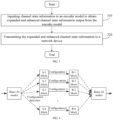
- FIG. 3 is a first schematic flowchart of a method for channel state information processing according to an embodiment of the present application.
- an embodiment of the present application provides a method for channel state information processing, which is performed by a terminal, such as a mobile phone. The method includes the following steps.
- Step 310 inputting channel state information to an encoder model to obtain expanded and enhanced channel state information output from the encoder model.
- Step 320 transmitting the expanded and enhanced channel state information to a network device.
- the encoder model includes an encoder and a channel state information expansion and enhancement block cascaded with the encoder.
- an AI model performing CSI compression feedback may be used as a basic AI model.
- An encoder of the basic AI model is deployed at the terminal to form an encoder model
- a decoder of the basic AI model is deployed at a network device to form the decoder model.
- multiple pairs of AI modules are cascaded to an inside of the basic AI model (an output side of the encoder, and an input side of the decoder) and/or an outside of the basic AI model (an input side of the encoder, and an output side of the decoder) to expand and enhance the basic AI model. Therefore, the basic AI model may be reused under different parameter configurations.
- the terminal may input the channel state information into the encoder model.
- the input side or the output side of the encoder is cascaded with a channel state information expansion and enhancement block, respectively.
- the channel state information expansion and enhancement block may expand and enhance the basic AI model in different ways.
- expanding and enhancing the basic AI model may include compressing the feedback overhead of the channel state information, adjusting probability distributions of channel state information of different MIMO layers and/or probability distributions of channel state information of different MIMO ports, filling in a number of subbands of the channel state information, etc.
- the terminal After performing the above the channel state information processing, the terminal would transmit the expanded and enhanced channel state information to the network device, so that the decoder model deployed at the network device may process the expanded and enhanced channel state information accordingly, such as restoring the compressed feedback overhead, restoring the probability distributions of the channel state information of different MIMO layers and/or the probability distributions of the channel state information of different MIMO ports with uniform probability distributions, clipping and/or combining the channel state information subjected to subband filling, etc.
- the decoder model deployed at the network device may process the expanded and enhanced channel state information accordingly, such as restoring the compressed feedback overhead, restoring the probability distributions of the channel state information of different MIMO layers and/or the probability distributions of the channel state information of different MIMO ports with uniform probability distributions, clipping and/or combining the channel state information subjected to subband filling, etc.
- the AI model is expanded and enhanced by cascading the channel state information expansion and enhancement block at the input side and/or the output side of the encoder model.
- the AI model may be reused under different parameter configurations, thereby reducing complexity of training the AI model and saving deployment resources for the AI model.
- the channel state information expansion and enhancement block includes a downsampling block
- an output of the encoder of the AI model and an input of the decoder of the AI model need to support multiple dimensions to achieve different feedback overheads.
- an output dimension of the encoder an input dimension of the decoder
- a basic AI model with a given feedback overhead may be trained.
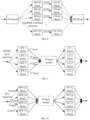
- At least one downsampling block A-k and upsampling block B-k pair may be cascaded at the inside of the basic AI model (the output side of the encoder and the input side of the decoder) to expand and enhance the feedback overhead, as shown in FIG. 4 Show.
- the expanded basic AI model has k branches, and each branch corresponds to a feedback overhead configuration.
- the downsampling block includes any one of the following configurations:
- the downsampling block A-k and the upsampling block B-k should not be designed to be too complex, and any one of the following configurations may be adopted:
- the basic AI model may be a CSI compression feedback AI model under a given feedback overhead.
- the downsampling block A-k and the upsampling block B-k further downsample and compress based on the basic AI model, to obtain a variety of lower Feedback overhead n payload,k ⁇
- the basic AI model may also be an AI transformation-inverse transformation pair without dimensional compression (that is, the output dimension of the encoder of the basic AI model is equal to the input dimension of the encoder of the basic AI model), and the dimension compression is completely performed through the downsampling block A-k and the upsampling block B-k.
- the CSI feedback overhead may be expanded and enhanced using the AI model by cascading the downsampling block at the output side of the encoder. Therefore, the AI model may be reused under different feedback overhead configurations, which may reduce the complexity of training the AI model training and save deployment resources for the AI model.
- the channel state information expansion and enhancement block includes a pre-transformation block, where the pre-transformation block is cascaded at an input side of the encoder, and is used for performing at least one of the following:
- the network parameter configuration is required to support different numbers of MIMO layers and different numbers of ports.
- the input and output of the basic AI model need to support multiple dimensions.
- input probability distributions of the basic AI model under different configurations must also be unified or close to each other, to make the basic AI model work at its best.
- CSI data probability distributions of different ports and CSI data probability distributions of different MIMO layers are inconsistent, and need to be transformed into a unified probability distribution.
- the pre-transformation block includes any one of the following configurations:
- the A-k pre-transformation/B-k transformation block pair functions as distribution transformation.
- the A-1/B-1 block is an identity transformation (an input being equal to an output)
- the basic AI model is an AI model suitable for layer 1
- the A-k pre-transformation/B-k transformation block pair may include any one of the following configurations:
- the A-k pre-transformation/B-k transformation block pair functions as probability distribution matching and dimension unification.
- CSI inputs of different ports are transformed to a unified number of ports.
- an A-1/B-1 block is an identity transformation (an input being equal to an output)
- the basic AI model is an AI model suitable for Port_Max
- the A-k pre-transformation/B-k transformation block pair may include any one of the following configurations:
- MIMO layers and/or MIMO ports may be expanded and enhanced using the AI model by cascading the pre-transformation block at the input side of the encoder. Therefore, the AI model may be reused at different MIMO layers, or under different port configurations, which may reduce the complexity of training the AI model training and save deployment resources for the AI model.
- the channel state information expansion and enhancement block includes a subband filling block
- the network parameter configuration is required to support different quantities N subband of subbands, and a number N subband,AI of subbands input by the basic AI module used for CSI compression feedback is usually given.
- N subband,AI of subbands input by the basic AI module used for CSI compression feedback.
- a subband filling block and a subband clipping block are cascaded outside the basic AI module (the input side of the encoder and the output side of the decoder).
- the subband filling block is specifically used for:
- the subband filling block and the subband clipping block After the subband filling block and the subband clipping block are cascaded outside the basic AI module (the input side of the encoder and the output side of the decoder), the subband filling block and the subband clipping block perform filling and clipping by adopting CSI taking N subband,AI subbands as a group of inputs, respectively.
- the CSI may be divided into N subband / N subband,AI groups. Each group is transmitted to a basic AI network to perform CSI compression feedback.
- the subband filling block and subband clipping block do not need to perform additional processing on the input.
- the subband filling block would performing periodic cycle padding on group members including N subband mod N subband,AI subbands into N subband,AI subbands, and then transmit them to the basic AI model.
- the subband clipping block would clip or combine the subbands on which periodic cycle filling is performed to obtain CSI with original N subband mod N subband,AI subbands.
- This operation may simulate frequency domain correlation to the greatest extent, thereby improving CSI compression feedback performance.
- the number of subbands may be expanded and enhanced using the AI model by cascading the subband filling block at the input side of the encoder. Therefore, the AI model may be reused under different feedback overhead configurations, which may reduce the complexity of training the AI model training and save deployment resources for the AI model.
- FIG. 7 is a second schematic flowchart of a method for channel state information processing according to an embodiment of the present application.
- an embodiment of the present application provides a method for channel state information processing, which is performed by a network device, such as a base station. The method includes the following steps.
- Step 710 receiving expanded and enhanced channel state information transmitted from a terminal.
- Step 720 inputting the expanded and enhanced channel state information to a decoder model to obtain restored channel state information output from the decoder model.
- the decoder model includes a decoder, and a channel state information restoration block cascaded with the decoder.
- an AI model performing CSI compression feedback may be used as a basic AI model.
- An encoder of the basic AI model is deployed at the terminal to form an encoder model
- a decoder of the basic AI model is deployed at a network device to form the decoder model.
- multiple pairs of AI modules are cascaded to an inside of the basic AI model (tan output side of the encoder, and an input side of the decoder) and/or an outside of the basic AI model (an input side of the encoder, and an output side of the decoder) to expand and enhance the basic AI model. Therefore, the basic AI model may be reused under different parameter configurations.
- the network device may receive the expanded and enhanced channel state information transmitted from the terminal.
- the terminal may input channel state information into the encoder model.
- the input side or the output side of the encoder is cascaded with a channel state information expansion and enhancement block.
- the channel state information expansion and enhancement block may expand and enhance the AI basic model in different ways.
- expanding and enhancing the basic AI model may include compressing the feedback overhead of the channel state information, adjusting probability distributions of channel state information of different MIMO layers and/or probability distributions of channel state information of different MIMO ports, filling in a number of subbands of the channel state information, etc.
- the terminal After performing the above channel state information processing, the terminal would transmit the expanded and enhanced channel state information to the network device.
- the network device After receiving the expanded and enhanced channel state information, the network device would input the expanded and enhanced channel state information into the decoder model, and restore the extended and enhanced channel state information based on the channel state information restoration block cascaded with the decoder, such as restoring the compressed feedback overhead, restoring the probability distributions of the channel state information of different MIMO layers and/or the probability distributions of the channel state information of different MIMO ports with uniform probability distributions, clipping and/or combining the channel state information subjected to subband filling, etc.
- the extended and enhanced channel state information is restored by cascading the channel state information restoration block at the input side and/or the output side of the decoder model.
- the AI model may be reused under different parameter configurations, thereby reducing complexity of training the AI model and saving deployment resources for the AI model.
- the expanded and enhanced channel state information includes a compressed feedback overhead
- the channel state information restoration block includes an upsampling block, where the upsampling block is cascaded at an input side of the decoder, and is used for restoring the compressed feedback overhead to obtain a restored feedback overhead.
- an output of the encoder of the AI model and an input of the decoder of the AI model need to support multiple dimensions to achieve different feedback overheads.
- an output dimension of the encoder an input dimension of the decoder
- a basic AI model with a given feedback overhead may be trained.
- At least one downsampling block A-k and upsampling block B-k pair may be cascaded at the inside of the basic AI model (the output side of the encoder and the input side of the decoder) to expand and enhance the feedback overhead, as shown in FIG. 4 Show.
- the expanded basic AI model has k branches, and each branch corresponds to a feedback overhead configuration.
- the upsampling block includes any one of the following configurations:
- the downsampling block A-k and the upsampling block B-k should not be designed to be too complex, and any one of the following configurations may be adopted:
- the basic AI model may be a CSI compression feedback AI model under a given feedback overhead.
- the downsampling block A-k and the upsampling block B-k further downsample and compress based on the basic AI model, to obtain multiple reduced feedback overheads n payload , k ⁇
- the basic AI model may also be a AI transformation-inverse transformation pair without dimensional compression (that is, the output dimension of the encoder of the basic AI model is equal to the input dimension of the encoder of the basic AI model), and the dimensional compression is completely performed through the downsampling block A-k and the upsampling block B-k.
- the CSI feedback overhead may be expanded and enhanced using the AI model by cascading the upsampling block at the input side of the decoder. Therefore, the AI model may be reused under different feedback overhead configurations, which may reduce the complexity of training the AI model training and save deployment resources for the AI model.
- the expanded and enhanced channel state information includes channel state information of different multiple-input multiple-output (MIMO) layers with unified probability distributions and dimensions and/or channel state information of different multiple-input multiple-output (MIMO) ports with unified probability distributions and dimensions; and the channel state information restoration block includes a transformation block, where the transformation block is cascaded at an output side of the decoder, and is used for performing at least one of the following:
- the network parameter configuration is required to support different numbers of MIMO layers and different numbers of ports.
- the input and output of the basic AI model need to support multiple dimensions.
- input probability distributions of the basic AI model under different configurations must also be unified or close to each other, to make the basic AI model work at its best.
- CSI data probability distributions of different ports and CSI data probability distributions of different MIMO layers are inconsistent, and need to be transformed into a unified probability distribution.
- the transformation block includes any one of the following configurations:
- the A-k pre-transformation/B-k transformation block pair functions as distribution transformation.
- the A-1/B-1 block is an identity transformation (an input being equal to an output)
- the basic AI model is an AI model suitable for layer 1
- the A-k pre-transformation/B-k transformation block pair may include any one of the following configurations:
- the A-k pre-transformation/B-k transformation block pair functions as probability distribution matching and dimension unification.
- CSI inputs of different ports are transformed to a unified number of ports.
- an A-1/B-1 block is an identity transformation (an input being equal to an output)
- the basic AI model is an AI model suitable for Port_Max
- the A-k pre-transformation/B-k transformation block pair may include any one of the following configurations:
- MIMO layers and/or MIMO ports may be expanded and enhanced using the AI model by cascading the pre-transformation block at the output side of the decoder. Therefore, the AI model may be reused at different MIMO layers, or under different port configurations, which may reduce the complexity of training the AI model training and save deployment resources for the AI model.
- the expanded and enhanced channel state information includes channel state information subjected to subband filling; and the channel state information restoration block includes a subband clipping block, where the subband clipping block is cascaded at an output side of the decoder, and is used for clipping and/or combining the channel state information subjected to subband filling to obtain channel state information of an original number of subbands.
- the network parameter configuration is required to support different quantities N subband of subbands, and a number N subband,AI of subbands input by the basic AI module used for CSI compression feedback is usually given.
- N subband,AI of subbands input by the basic AI module used for CSI compression feedback.
- a subband filling block and a subband clipping block are cascaded outside the basic AI module (the input side of the encoder and the output side of the decoder).
- the subband clipping block is specifically used for: clipping and/or combining subbands in a subband group which have been subjected to subband periodic cycle.
- the subband filling block and the subband clipping block After cascading the subband filling block and the subband clipping block outside the basic AI module (the input side of the encoder and the output side of the decoder), the subband filling block and the subband clipping block perform filling and clipping by adopting CSI taking N subband,AI subbands as a group of inputs, respectively.
- the CSI may be divided into N subband / N subband,AI groups. Each group is transmitted to a basic AI network to perform CSI compression feedback.
- the subband filling block and subband clipping block do not need to perform additional processing on the input.
- the subband filling block would performing periodic cycle padding on group members including N subband mod N subband,AI subbands into N subband,AI subbands, and then transmit them to the basic AI model.
- the subband clipping block would clip or combine the subbands on which periodic cycle filling is performed to obtain CSI of original N subband mod N subband,AI subbands.
- This operation may simulate frequency domain correlation to the greatest extent, thereby improving CSI compression feedback performance.
- the number of subbands may be expanded and enhanced using the AI model by cascading the subband clipping module at the output side of the decoder. Therefore, the AI model may be reused under different feedback overhead configurations, which may reduce the complexity of training the AI model training and save deployment resources for the AI model.
- Example 1 (a CSI compression feedback model with an expandable overhead):
- an EN block and a DE block are one pre-transformation-transformation pair.
- input and output dimensions of the EN block and the DE block are 12*64, and an input precoding matrix indicator (PMI) (precoder vector) corresponds to 12 subbands and 32 ports (a real part and an imaginary part are combined to be 64 dimensions).
- PMI precoding matrix indicator
- the trained EN block transforms the PMI into an implicit domain to facilitate downsampling compression, and the DE block transforms the data in the implicit domain back to a spatial frequency domain where the PMI locates.
- a DS-k block/US-k block is an upsampling-downsampling transformation pair implemented by a fully connected layer.
- the basic AI model (EN block + DE block) expands and enhances the feedback overhead.
- the terminal After the terminal receives a network configuration channel (which includes the feedback overhead, and a user equipment (UE) may also determine the feedback overhead by itself), the terminal selects a DS-k downsampling branch for CSI compression based on the feedback overhead. Similarly, the network device selects a corresponding US-k upsampling branch to perform CSI restoration based on the feedback overhead configured to the terminal or the feedback overhead reported from the terminal.
- a network configuration channel which includes the feedback overhead, and a user equipment (UE) may also determine the feedback overhead by itself
- the terminal selects a DS-k downsampling branch for CSI compression based on the feedback overhead.
- the network device selects a corresponding US-k upsampling branch to perform CSI restoration based on the feedback overhead configured to the terminal or the feedback overhead reported from the terminal.
- Example 2 (a CSI compression feedback model with an expandable MIMO layer):
- a basic AI model is an AE based on a transformer model, which is used for PMI compression and decompression on a feedback overhead of 12 subbands, 32 ports, layer 1, and 240 bits.
- the basic AI model may achieve MIMO multi-layer expansion.
- LPT-1 block and LT-1 block are all identity transformations where an input is equal to an output
- Example 3 (a CSI compression feedback model with an expandable MIMO port):
- an AI basic model is an AE, which is used for PMI compression and decompression on a feedback overhead of 12 subbands, 32 ports, layer 1, and 240 bits.
- a PPT-32 block/PT-32 block is an identity transformation where an input is equal to an output.
- a PMI with an input being N subband,AI ⁇ (k ⁇ 2) dimensions is transformed into a PMI being N subband,AI ⁇ (32 ⁇ 2) dimension, where k is an actual number of PMI ports.
- Example 4 (CSI compression feedback model with an expandable number of subbands):
- the basic AI model expands a number of subbands.
- subband index numbers are [1,2,3,4,3,2,1,2,3,4,3,2].
- the subband clipping block clips a corresponding cyclically filled PMI in the last group to obtain an original PMI.
- Example 5 (a CSI compression feedback model with an expandable number of subbands + ports + layers + feedback overhead):
- a basic AI network composed of an EN block and a DE block transforms and inversely transforms a PMI of 12 subbands, 32 ports, and layer 1.
- the feedback overhead expansion enhancement is performed by cascading a DS-k/US-k inside the basic AI network (an output side of an encoder and an input side of a decoder) through a fully connected layer.
- an LPT-k/LT-k is cascaded outside the basic AI network (an input side of an encoder, an output side of a decoder) to achieve 4-layer MIMO expansion.
- An LPT-1/LT-1 is an identity transformation
- a PPT-k/PT-k is further cascaded outside the basic AI network to achieve ⁇ 32, 24, 16, 12 ⁇ port expansion.
- a PPT-32/ PT-32 is an identity transformation
- subband periodic cycle filling block and subband backward filling block are cascaded outside the basic AI model, to expand and enhance the number of subbands.
- Example 6 (a CSI compression feedback model with an expandable number of subbands + ports + feedback overhead, that is, a layer-specified AI model):
- a basic AI model composed of an EN block and a DE block transforms and inversely transforms a PMI of 12 subbands, 32 ports, and layer 1.
- a DS-k/US-k is cascaded inside a basic AI network (an output side of an encoder, an output side of a decoder) to expand and enhance the feedback overhead through a fully connected layer.
- a PPT-k/PT-k is cascaded outside the basic AI model (an input side of an encoder, an output side of a decoder) to achieve ⁇ 32, 24, 16, 12 ⁇ port expansion.
- FIG. 13 is a schematic structural diagram of a terminal according to an embodiment of the present application. As shown in FIG. 13 , the terminal includes a memory 1320, a transceiver 1300, and a processor 1310.
- the memory 1320 is used for storing a computer program
- the transceiver 1300 is used for receiving and transmitting data under control of the processor 1310
- the processor 1310 is used for reading the computer program in the memory 1320 and performing the following operations:
- a bus architecture may include any number of interconnected buses and bridges, which are linked together through various circuits of one or more processors represented by the processor 1310 and one or more memories represented by the memory 1320.
- the bus architecture may also link together various other circuits, such as peripherals, voltage regulators, and power management circuits, etc., which are well known in the art, and therefore are not further described in the present application.
- a bus interface provides an interface.
- the transceiver 1300 may include multiple elements, i.e., including a transmitter and a receiver, units for providing communication with various other devices over transmission media including wireless channels, wired channels, fiber optic cables, and the like.
- a user interface 1330 may also be an interface capable of externally or internally connecting required devices, and the connected devices include but are not limited to a small keypad, a display, a speaker, a microphone, a joystick, and the like.
- the processor 1310 is responsible for managing the bus architecture and general processing, and the memory 1320 may store data used by the processor 1310 when performing operations.
- the processor 1310 may be a central processing unit (CPU), an application specific integrated circuit (ASIC), a field programmable gate array (FPGA), or a complex programmable logic device (CPLD), and the processor 1310 may also adopt a multi-core architecture.
- CPU central processing unit
- ASIC application specific integrated circuit
- FPGA field programmable gate array
- CPLD complex programmable logic device
- the processor 1310 calls a computer program stored in the memory to perform any methods provided by the embodiments of the present application based on the obtained executable instructions.
- the processor 1310 and the memory 1320 can also be arranged physically separately.
- the channel state information expansion and enhancement block includes a downsampling block
- the channel state information expansion and enhancement block includes a pre-transformation block, where the pre-transformation block is cascaded at an input side of the encoder, and is used for performing at least one of the following:
- the channel state information expansion and enhancement block includes a subband filling block
- the downsampling block includes any one of the following configurations:
- an output dimension of the downsampling block is determined based on a type of the feedback overhead and a predetermined number of quantization bits.
- the pre-transformation block includes any one of the following configurations:
- the subband filling block is specifically used for:
- the terminal provided by the embodiments of the present application may implement all the method steps in the method embodiments performed by the terminal and may achieve the same technical effect.
- the parts and beneficial effects of this embodiment that are the same as those of the method embodiments are not described in detail.
- FIG. 14 is a schematic structural diagram of a network device according to an embodiment of the present application. As shown in FIG. 14 , the network device includes a memory 1420, a transceiver 1400 and a processor 1410.
- the memory 1420 is used for storing a computer program
- the transceiver 1400 is used for receiving and transmitting data under control of the processor 1410
- the processor 1410 is used for reading the computer program in the memory 1420 and performing the following operations:
- the transceiver 1400 is used for receiving and transmitting data under the control of the processor 1410.
- a bus architecture may include any number of interconnected buses and bridges, which are linked together through various circuits of one or more processors represented by the processor 1410 and one or more memories represented by the memory 1420.
- the bus architecture may also link together various other circuits, such as peripherals, voltage regulators, and power management circuits, etc., which are well known in the art, and therefore are not further described in the present application.
- a bus interface provides an interface.
- the transceiver 1400 may include multiple elements, i.e., including a transmitter and a receiver, units for providing communication with various other devices over transmission media including wireless channels, wired channels, fiber optic cables, and the like.
- the processor 1410 is responsible for managing the bus architecture and general processing, and the memory 1420 may store data used by the processor 1410 when performing operations.
- the processor 1410 may be a central processing unit (CPU), an application specific integrated circuit (ASIC), a field programmable gate array (FPGA) or a complex programmable logic device (CPLD), and the processor 1410 may also adopt a multi-core architecture.
- CPU central processing unit
- ASIC application specific integrated circuit
- FPGA field programmable gate array
- CPLD complex programmable logic device
- the expanded and enhanced channel state information includes a compressed feedback overhead
- the channel state information restoration block includes an upsampling block, where the upsampling block is cascaded at an input side of the decoder, and is used for restoring the compressed feedback overhead to obtain a restored feedback overhead.
- the expanded and enhanced channel state information includes channel state information of different multiple-input multiple-output (MIMO) layers with unified probability distributions and dimensions and/or channel state information of different multiple-input multiple-output (MIMO) ports with unified probability distributions and dimensions; and the channel state information restoration block includes a transformation block, where the transformation block is cascaded at an output side of the decoder, and is used for performing at least one of the following:
- the expanded and enhanced channel state information includes channel state information subjected to subband filling; and the channel state information restoration block includes a subband clipping block, where the subband clipping block is cascaded at an output side of the decoder, and is used for clipping and/or combining the channel state information subjected to subband filling to obtain channel state information of an original number of subbands.
- the upsampling block includes any one of the following configurations:
- an input dimension of the upsampling block is determined based on a type of the feedback overhead and a predetermined number of quantization bits.
- the transformation block includes any one of the following configurations:
- the subband clipping block is specifically used for: clipping and/or combining subbands in a subband group which have been subjected to subband periodic cycle.
- the network device provided by the embodiments of the present application may implement all the method steps in the method embodiments performed by the network device and may achieve the same technical effect.
- the parts and beneficial effects of this embodiment that are the same as those of the method embodiments are not described in detail.
- FIG. 15 is a first structural schematic diagram of an apparatus for channel state information processing according to an embodiment of the present application. As shown in FIG. 15 , an embodiment of the present application further provides an apparatus for channel state information processing, which is for used in a terminal.
- the apparatus includes:
- the channel state information expansion and enhancement block includes a downsampling block
- the channel state information expansion and enhancement block includes a pre-transformation block, where the pre-transformation block is cascaded at an input side of the encoder, and is used for performing at least one of the following:
- the channel state information expansion and enhancement block includes a subband filling block
- the downsampling block includes any one of the following configurations:
- an output dimension of the downsampling block is determined based on a type of the feedback overhead and a predetermined number of quantization bits.
- the pre-transformation block includes any one of the following configurations:
- the subband filling block is specifically used for:
- FIG. 16 is a second structural schematic diagram of an apparatus for channel state information processing according to an embodiment of the present application. As shown in FIG. 16 , an embodiment of the present application further provides an apparatus for channel state information processing, which is for use in a network device.
- the apparatus includes:
- the expanded and enhanced channel state information includes a compressed feedback overhead
- the channel state information restoration block includes an upsampling block, where the upsampling block is cascaded at an input side of the decoder, and is used for restoring the compressed feedback overhead to obtain a restored feedback overhead.
- the expanded and enhanced channel state information includes channel state information of different multiple-input multiple-output (MIMO) layers with unified probability distributions and dimensions and/or channel state information of different multiple-input multiple-output (MIMO) ports with unified probability distributions and dimensions; and the channel state information restoration block includes a transformation block, where the transformation block is cascaded at an output side of the decoder, and is used for performing at least one of the following:
- the expanded and enhanced channel state information includes channel state information subjected to subband filling; and the channel state information restoration block includes a subband clipping block, where the subband clipping block is cascaded at an output side of the decoder, and is used for clipping and/or combining the channel state information subjected to subband filling to obtain channel state information of an original number of subbands.
- the upsampling block includes any one of the following configurations:
- an input dimension of the upsampling block is determined based on a type of the feedback overhead and a predetermined number of quantization bits.
- the transformation block includes any one of the following configurations:
- the subband clipping block is specifically used for: clipping and/or combining subbands in a subband group which have been subjected to subband periodic cycle.
- the division of units in the embodiments of the present application is schematic, and is only a logical function division, and there may be other division manners in actual implementation.
- the functional units in the various embodiments of the present application may be integrated into one processing unit, or each unit may exist alone physically, or two or more units may be integrated into one unit.
- the above-mentioned integrated unit may be implemented in the form of hardware or software functional unit.
- the integrated unit may be stored in a processor-readable storage medium.
- the solutions of the present application in essence or a part of the solutions that contributes to the prior art, or all or part of the solutions, may be embodied in the form of a software product, which is stored in a storage medium, including several instructions to cause a computer device (which may be a personal computer, server, or network device, etc.) or a processor to perform all or part of the steps of the methods described in the respective embodiments of the present application.
- the storage medium described above includes various media that may store program codes such as a U disk, a mobile hard disk, a read-only memory (ROM), a random access memory (RAM), a magnetic disk, or a compact disk.
- An embodiment of the present application further provides a processor-readable storage medium.
- the processor-readable storage medium stores a computer program.
- the computer program is used to cause a processor to perform the methods provided by the above embodiments, for example, including:
- the processor-readable storage medium may be any available medium or data storage device that may be accessed by the processor, including but not limited to, a magnetic storage (e.g., a floppy disk, a hard disk, a magnetic tape, a magneto-optical disk (MO), etc.), an optical memory (such as CD, DVD, BD, HVD, etc.), and a semiconductor memory (such as ROM, EPROM, EEPROM, a nonvolatile memory (NAND FLASH), a solid-state drive (SSD)), etc.
- a magnetic storage e.g., a floppy disk, a hard disk, a magnetic tape, a magneto-optical disk (MO), etc.
- an optical memory such as CD, DVD, BD, HVD, etc.
- semiconductor memory such as ROM, EPROM, EEPROM, a nonvolatile memory (NAND FLASH), a solid-state drive (SSD)
- the applicable systems may include a global system of mobile communication (GSM) system, a code division multiple access (CDMA) system, a wideband code division multiple access (WCDMA) general packet radio service (GPRS) system, a long term evolution (LTE) system, an LTE frequency division duplex (FDD) system, an LTE time division duplex (TDD) system, a long term evolution advanced (LTE-A) system, a universal mobile telecommunication system (UMTS), a worldwide interoperability for microwave access (WiMAX) system, a 5G new radio (NR) system, etc.
- GSM global system of mobile communication
- CDMA code division multiple access
- WCDMA wideband code division multiple access
- GPRS general packet radio service
- LTE long term evolution
- FDD LTE frequency division duplex
- TDD LTE time division duplex
- LTE-A long term evolution advanced
- UMTS universal mobile telecommunication system
- WiMAX worldwide interoperability for microwave access
- NR 5G new radio
- the terminal device involved in the embodiments of the present application may be a device that provides voice and/or data connectivity to a user, a handheld device with a wireless connection function, or other processing devices connected to a wireless modem.
- the names of terminal devices may also be different.
- the terminal device may be called a user equipment (UE).
- UE user equipment
- a wireless terminal device may communicate with one or more core networks (CN) via a radio access network (RAN).
- CN core networks
- RAN radio access network
- the wireless terminal device may be a mobile terminal device, such as a mobile phone (or a "cellular" phone) and a computer with a mobile terminal device.
- the wireless terminal device may also be referred to as a system, a subscriber unit, a subscriber station, a mobile station, a mobile, a remote station, an access point, a remote terminal device, an access terminal device, a user terminal device, a user agent, or a user device, which is not limited in the embodiments of the present application.
- the network device involved in the embodiments of the present application may be a base station.
- the base station may include multiple cells that provide services to a terminal.
- the base station may also be referred to as an access point, or may be a device in an access network that communicates with a wireless terminal device through one or more sectors on an air interface, or other names.
- the network device may be used to interchange received air frames with Internet Protocol (IP) packets, and serve as a router between the wireless terminal device and the rest of the access network, where the rest of the access network may include an IP communication network.
- IP Internet Protocol
- the network device may also coordinate the attribute management of the air interface.
- the network device involved in the embodiments of the present application may be a base transceiver station (BTS) in the global system for mobile communications (GSM) or code division multiple access (CDMA), or a network device (node B) in wide-band code division multiple access (WCDMA), or an evolutional network device (eNB or e-NodeB) in the long term evolution (LTE) system, a 5G base station (gNB) in the 5G network architecture (next generation system), or a home evolved node B (HeNB), a relay node, a home base station (femto), a pico base station (pico), etc., which is not limited in the embodiments of the present application.
- the network device may include a centralized unit (CU) node and a distributed unit (DU) node, and the centralized unit and the distributed unit may also be arranged geographically separately.
- Network devices and terminal devices may each use one or more antennas for multi-input multi-output (MIMO) transmission.
- the MIMO transmission may be single user MIMO (SU-MIMO) or multi user MIMO (MU-MIMO).
- MIMO transmission may be 2D-MIMO, 3D-MIMO, FD-MIMO or massive-MIMO, or may be diversity transmission, precoding transmission or beamforming transmission, etc.
- embodiments of the present application may be provided as a method, system, or computer program product. Accordingly, the present application may take the form of an entirely hardware embodiment, an entirely software embodiment, or an embodiment combining software and hardware aspects. Furthermore, the present application may take the form of a computer program product embodied on one or more computer-usable storage media having computer-usable program code embodied therein, including but not limited to disk storage, optical storage, and the like.
- processor-executable instructions may also be stored in a processor-readable memory capable of directing a computer or other programmable data processing apparatus to operate in a particular manner, and the instructions stored in the processor-readable memory may result in a manufacture including instruction means, the instruction means may perform the functions specified in one or more flows of the flowchart and/or one or more blocks of the block diagram.
- processor-executable instructions may also be loaded onto a computer or other programmable data processing device to cause a series of operational steps to be performed on the computer or other programmable device to produce a computer-implemented process and instructions performed on the computer or other programmable devices provide steps for performing the functions specified in one or more flows of the flowchart and/or one or more blocks of the block diagram.
Landscapes
- Engineering & Computer Science (AREA)
- Signal Processing (AREA)
- Computer Networks & Wireless Communication (AREA)
- Physics & Mathematics (AREA)
- Theoretical Computer Science (AREA)
- Data Mining & Analysis (AREA)
- Computing Systems (AREA)
- Biomedical Technology (AREA)
- Biophysics (AREA)
- Computational Linguistics (AREA)
- Life Sciences & Earth Sciences (AREA)
- Evolutionary Computation (AREA)
- General Health & Medical Sciences (AREA)
- Molecular Biology (AREA)
- Artificial Intelligence (AREA)
- General Engineering & Computer Science (AREA)
- General Physics & Mathematics (AREA)
- Mathematical Physics (AREA)
- Software Systems (AREA)
- Health & Medical Sciences (AREA)
- Compression, Expansion, Code Conversion, And Decoders (AREA)
- Communication Control (AREA)
Abstract
Description
- The present application claims priority to
Chinese patent application No. 202210969110.3 filed on August 12, 2022 - The present application relates to the field of communications, and in particular, to methods and apparatuses for channel state information processing.
- Currently, an artificial intelligence (AI)-based channel state information (CSI) compression feedback solution usually designs an AI model under a given feedback overhead, a given number of multiple-input multiple-output (MIMO) layers, a given number of MIMO ports or a given number of subbands.
- In case that multiple network configuration parameters exist, in a related solution, multiple sets of AI models need to be trained, which will increase a complexity of training the AI models and a storage overhead for the AI models. Taking 8 types of feedback overhead, 4 layers of MIMO, and 8 types of ports as an example, a network layer and a terminal need to train and deploy one AI model for 8×4×8=256 parameter configurations separately, which brings challenges for training models and storing models.
- Embodiments of the present application provide methods and apparatuses for channel state information processing, to solve a problem in the related art that a large quantity of artificial intelligence (AI) models need to be deployed for channel state information processing, which causes that model training and deployment waste a large quantity of resources, and to reduce complexity of training an AI model and save deployment resources for the AI model.
- An embodiment of the present application provides a method for channel state information processing, performed by a terminal, including:
- inputting channel state information to an encoder model to obtain expanded and enhanced channel state information output from the encoder model; and
- transmitting the expanded and enhanced channel state information to a network device,
- where the encoder model includes an encoder and a channel state information expansion and enhancement block cascaded with the encoder.
- In an embodiment, the channel state information expansion and enhancement block includes a downsampling block,
- where the downsampling block is cascaded at an output side of the encoder, and is used for compressing a feedback overhead of the channel state information to obtain a compressed feedback overhead,
- where the expanded and enhanced channel state information includes the compressed feedback overhead.
- In an embodiment, the channel state information expansion and enhancement block includes a pre-transformation block,
where the pre-transformation block is cascaded at an input side of the encoder, and is used for performing at least one of the following: - adjusting probability distributions of channel state information of different multiple-input multiple-output (MIMO) layers to obtain channel state information of different MIMO layers with a unified probability distribution and a unified dimension; or
- adjusting probability distributions and/or dimensions of channel state information of different multiple-input multiple-output (MIMO) ports to obtain channel state information of different MIMO ports with unified probability distributions and dimensions,
- where the expanded and enhanced channel state information includes the channel state information of different MIMO layers with unified probability distributions and dimensions and/or the channel state information of different MIMO ports with unified probability distributions and dimensions.
- In an embodiment, the channel state information expansion and enhancement block includes a subband filling block,
- where the subband filling block is cascaded at an input side of the encoder, and is used for filling a number of subbands of the channel state information to obtain channel state information subjected to subband filling,
- where the expanded and enhanced channel state information includes the channel state information subjected to subband filling.
- In an embodiment, the downsampling block includes any one of the following configurations:
- the downsampling block is a pooling layer;
- the downsampling block is a fully connected layer with an input dimension greater than an output dimension; or
- the downsampling block is a convolutional downsampling layer.
- In an embodiment, an output dimension of the downsampling block is determined based on a type of the feedback overhead and a predetermined number of quantization bits.
- In an embodiment, the pre-transformation block includes any one of the following configurations:
- the pre-transformation block is an identity transformation layer;
- the pre-transformation block adopts one fully connected layer in a spatial domain and a frequency domain respectively;
- the pre-transformation block adopts one 2-dimensional convolutional layer in a spatial domain and a frequency domain;
- the pre-transformation block adopts one fully connected layer in a combined dimension of a spatial domain and a frequency domain;
- the pre-transformation block adopts one 1-dimensional convolutional layer in a combined dimension of a spatial domain and a frequency domain;
- the pre-transformation block adopts one fully connected layer in a spatial domain; or
- the pre-transformation block adopts one 1-dimensional convolutional layer in a spatial domain.
- In an embodiment, the subband filling block is specifically used for:
- in case that a remainder of the number of the subbands of the channel state information divided by a number of subbands input from the encoder model is greater than 0, grouping the subbands of the channel state information based on the number of the input subbands of the encoder model; and
- performing periodic cycle filling on subbands in a target group where the number of the subbands of the channel state information is less than the number of the input subbands of the encoder model until the number of the subbands in the target group is equal to the number of the input subbands of the encoder model,
- where the periodic cycle filling includes: copying each subband in sequence based on a sorting order of each subband in the group.
- An embodiment of the present application further provides a method for channel state information processing, performed by a network device, including:
- receiving expanded and enhanced channel state information transmitted from a terminal; and
- inputting the expanded and enhanced channel state information to a decoder model to obtain restored channel state information output from the decoder model,
- where the decoder model includes a decoder, and a channel state information restoration block cascaded with the decoder.
- In an embodiment, the expanded and enhanced channel state information includes a compressed feedback overhead; and the channel state information restoration block includes an upsampling block,
where the upsampling block is cascaded at an input side of the decoder, and is used for restoring the compressed feedback overhead to obtain a restored feedback overhead. - In an embodiment, the expanded and enhanced channel state information includes channel state information of different multiple-input multiple-output (MIMO) layers with unified probability distributions and dimensions and/or channel state information of different multiple-input multiple-output (MIMO) ports with unified probability distributions and dimensions; and the channel state information restoration block includes a transformation block,
where the transformation block is cascaded at an output side of the decoder, and is used for performing at least one of the following: - performing probability distribution restoration on the channel state information of different MIMO layers with unified probability distributions and dimensions to obtain channel state information of different MIMO layers with an original probability distribution; or
- performing probability distribution and dimension restoration on the channel state information of different MIMO ports with unified probability distributions and dimensions to obtain channel state information of different MIMO ports with an original probability distribution and an original dimension.
- In an embodiment, the expanded and enhanced channel state information includes channel state information subjected to subband filling; and the channel state information restoration block includes a subband clipping block,
where the subband clipping block is cascaded at an output side of the decoder, and is used for clipping and/or combining the channel state information subjected to subband filling to obtain channel state information of an original number of subbands. - In an embodiment, the upsampling block includes any one of the following configurations:
- the upsampling block is a neighbor interpolation layer;
- the upsampling block is a fully connected layer with an input dimension smaller than an output dimension; or
- the upsampling block is a transposed convolutional upsampling layer.
- In an embodiment, an input dimension of the upsampling block is determined based on a type of the feedback overhead and a predetermined number of quantization bits.
- In an embodiment, the transformation block includes any one of the following configurations:
- the transformation block is an identity transformation layer;
- the transformation block adopts one fully connected layer in a spatial domain and a frequency domain respectively;
- the transformation block adopts one 2-dimensional transposed convolutional layer in a spatial domain and a frequency domain;
- the transformation block adopts one fully connected layer in a combined dimension of a spatial domain and a frequency domain;
- the transformation block adopts one 1-dimensional convolutional layer in a combined dimension of a spatial domain and a frequency domain;
- the transformation block adopts one fully connected layer in a spatial domain; or
- the transformation block adopts one 1-dimensional convolutional layer in a spatial domain.
- In an embodiment, the subband clipping block is specifically used for:
clipping and/or combining subbands in a subband group which have been subjected to subband periodic cycle. - An embodiment of the present application further provides a terminal, including a memory, a transceiver and a processor,
where the memory is used for storing a computer program, the transceiver is used for receiving and transmitting data under control of the processor, and the processor is used for reading the computer program in the memory and performing the following operations: - inputting channel state information to an encoder model to obtain expanded and enhanced channel state information output from the encoder model; and
- transmitting the expanded and enhanced channel state information to a network device,
- where the encoder model includes an encoder and a channel state information expansion and enhancement block cascaded with the encoder.
- In an embodiment, the channel state information expansion and enhancement block includes a downsampling block,
- where the downsampling block is cascaded at an output side of the encoder, and is used for compressing a feedback overhead of the channel state information to obtain a compressed feedback overhead,
- where the expanded and enhanced channel state information includes the compressed feedback overhead.
- In an embodiment, the channel state information expansion and enhancement block includes a pre-transformation block,
where the pre-transformation block is cascaded at an input side of the encoder, and is used for performing at least one of the following: - adjusting probability distributions of channel state information of different multiple-input multiple-output (MIMO) layers to obtain channel state information of different MIMO layers with a unified probability distribution and a unified dimension; or
- adjusting probability distributions and/or dimensions of channel state information of different multiple-input multiple-output (MIMO) ports to obtain channel state information of different MIMO ports with unified probability distributions and dimensions,
- where the expanded and enhanced channel state information includes the channel state information of different MIMO layers with unified probability distributions and dimensions and/or the channel state information of different MIMO ports with unified probability distributions and dimensions.
- In an embodiment, the channel state information expansion and enhancement block includes a subband filling block,
- where the subband filling block is cascaded at an input side of the encoder, and is used for filling a number of subbands of the channel state information to obtain channel state information subjected to subband filling,
- where the expanded and enhanced channel state information includes the channel state information subjected to subband filling.
- In an embodiment, the downsampling block includes any one of the following configurations:
- the downsampling block is a pooling layer;
- the downsampling block is a fully connected layer with an input dimension greater than an output dimension; or
- the downsampling block is a convolutional downsampling layer.
- In an embodiment, an output dimension of the downsampling block is determined based on a type of the feedback overhead and a predetermined number of quantization bits.
- In an embodiment, the pre-transformation block includes any one of the following configurations:
- the pre-transformation block is an identity transformation layer;
- the pre-transformation block adopts one fully connected layer in a spatial domain and a frequency domain respectively;
- the pre-transformation block adopts one 2-dimensional convolutional layer in a spatial domain and a frequency domain;
- the pre-transformation block adopts one fully connected layer in a combined dimension of a spatial domain and a frequency domain;
- the pre-transformation block adopts one 1-dimensional convolutional layer in a combined dimension of a spatial domain and a frequency domain;
- the pre-transformation block adopts one fully connected layer in a spatial domain; or
- the pre-transformation block adopts one 1-dimensional convolutional layer in a spatial domain.
- In an embodiment, the subband filling block is specifically used for:
- in case that a remainder of the number of the subbands of the channel state information divided by a number of subbands input from the encoder model is greater than 0, grouping the subbands of the channel state information based on the number of the input subbands of the encoder model; and
- performing periodic cycle filling on subbands in a target group where the number of the subbands of the channel state information is less than the number of the input subbands of the encoder model until the number of the subbands in the target group is equal to the number of the input subbands of the encoder model,
- where the periodic cycle filling includes: copying each subband in sequence based on a sorting order of each subband in the group.
- An embodiment of the present application further provides a network device, including a memory, a transceiver and a processor,
where the memory is used for storing a computer program, the transceiver is used for receiving and transmitting data under control of the processor, and the processor is used for reading the computer program in the memory and performing the following operations: - receiving expanded and enhanced channel state information transmitted from a terminal; and
- inputting the expanded and enhanced channel state information to a decoder model to obtain restored channel state information output from the decoder model,
- where the decoder model includes a decoder, and a channel state information restoration block cascaded with the decoder.
- In an embodiment, the expanded and enhanced channel state information includes a compressed feedback overhead; and the channel state information restoration block includes an upsampling block,
where the upsampling block is cascaded at an input side of the decoder, and is used for restoring the compressed feedback overhead to obtain a restored feedback overhead. - In an embodiment, the expanded and enhanced channel state information includes channel state information of different multiple-input multiple-output (MIMO) layers with unified probability distributions and dimensions and/or channel state information of different multiple-input multiple-output (MIMO) ports with unified probability distributions and dimensions; and the channel state information restoration block includes a transformation block,
where the transformation block is cascaded at an output side of the decoder, and is used for performing at least one of the following: - performing probability distribution restoration on the channel state information of different MIMO layers with unified probability distributions and dimensions to obtain channel state information of different MIMO layers with an original probability distribution; or
- performing probability distribution and dimension restoration on the channel state information of different MIMO ports with unified probability distributions and dimensions to obtain channel state information of different MIMO ports with an original probability distribution and an original dimension.
- In an embodiment, the expanded and enhanced channel state information includes channel state information subjected to subband filling; and the channel state information restoration block includes a subband clipping block,
where the subband clipping block is cascaded at an output side of the decoder, and is used for clipping and/or combining the channel state information subjected to subband filling to obtain channel state information of an original number of subbands. - In an embodiment, the upsampling block includes any one of the following configurations:
- the upsampling block is a neighbor interpolation layer;
- the upsampling block is a fully connected layer with an input dimension smaller than an output dimension; or
- the upsampling block is a transposed convolutional upsampling layer.
- In an embodiment, an input dimension of the upsampling block is determined based on a type of the feedback overhead and a predetermined number of quantization bits.
- In an embodiment, the transformation block includes any one of the following configurations:
- the transformation block is an identity transformation layer;
- the transformation block adopts one fully connected layer in a spatial domain and a frequency domain respectively;
- the transformation block adopts one 2-dimensional transposed convolutional layer in a spatial domain and a frequency domain;
- the transformation block adopts one fully connected layer in a combined dimension of a spatial domain and a frequency domain;
- the transformation block adopts one 1-dimensional convolutional layer in a combined dimension of a spatial domain and a frequency domain;
- the transformation block adopts one fully connected layer in a spatial domain; or
- the transformation block adopts one 1-dimensional convolutional layer in a spatial domain.
- In an embodiment, the subband clipping block is specifically used for:
clipping and/or combining subbands in a subband group which have been subjected to subband periodic cycle. - An embodiment of the present application further provides an apparatus for channel state information processing, for use in a terminal, including:
- an enhancing module, used for inputting channel state information to an encoder model to obtain expanded and enhanced channel state information output from the encoder model; and
- a transmitting module, used for transmitting the expanded and enhanced channel state information to a network device,
- where the encoder model includes an encoder and a channel state information expansion and enhancement block cascaded with the encoder.
- An embodiment of the present application further provides an apparatus for channel state information processing, for use in a network device, including:
- a receiving module, used for receiving expanded and enhanced channel state information transmitted from a terminal; and
- a restoring module, used for inputting the expanded and enhanced channel state information to a decoder model to obtain restored channel state information output from the decoder model,
- where the decoder model includes a decoder, and a channel state information restoration block cascaded with the decoder.
- An embodiment of the present application further provides a processor-readable storage medium, where the processor-readable storage medium stores a computer program, and the computer program is used to cause a processor to perform the methods described above.
- In the methods and apparatuses for channel state information processing provided by the embodiments of the present application, an AI model is expanded and enhanced by cascading the channel state information expansion and enhancement block at the input side and/or the output side of the encoder model. The AI model may be reused under different parameter configurations, thereby reducing complexity of training the AI model and saving deployment resources for the AI model.
- In order to illustrate the solutions in the embodiments of the present application or in the related art more clearly, the drawings used in the description of the embodiments or the related art are briefly described below. The drawings in the following description are only some embodiments of the present application, and other drawings may be obtained according to these drawings without any creative work for those skilled in the art.
-
FIG. 1 is a schematic structural diagram of an auto encoder in the related art; -
FIG. 2 is a schematic flowchart of an artificial intelligence (AI)-based channel state information compression feedback solution in the related art; -
FIG. 3 is a first schematic flowchart of a method for channel state information processing according to an embodiment of the present application; -
FIG. 4 is a schematic structural diagram of a downsampling block-upsampling block pair according to an embodiment of the present application; -
FIG. 5 is a schematic structural diagram of a pre-transformation block-transformation block pair according to an embodiment of the present application; -
FIG. 6 is a schematic structural diagram of cascading a subband filling block and a subband clipping block according to an embodiment of the present application; -
FIG. 7 is a second schematic flowchart of a method for channel state information processing according to an embodiment of the present application; -
FIG. 8 is a first structural diagram of an example of applying a method for channel state information processing according to an embodiment of the present application; -
FIG. 9 is a second structural diagram of an example of a method for channel state information processing according to an embodiment of the present application; -
FIG. 10 is a third structural diagram of an example of a method for channel state information processing according to an embodiment of the present application; -
FIG. 11 is a fourth structural diagram of an example of a method for channel state information processing according to an embodiment of the present application; -
FIG. 12 is a fifth structural diagram of an example of applying a method for channel state information processing according to an embodiment of the present application; -
FIG. 13 is a schematic structural diagram of a terminal according to an embodiment of the present application; -
FIG. 14 is a schematic structural diagram of a network device according to an embodiment of the present application; -
FIG. 15 is a first structural schematic diagram of an apparatus for channel state information processing according to an embodiment of the present application; and -
FIG. 16 is a second structural schematic diagram of an apparatus for channel state information processing according to an embodiment of the present application. - In the embodiments of the present application, the term "and/or" describes a related relationship of associated objects, and indicates that there may be three kinds of relationships. For example, A and/or B may represent that A exists alone, A and B exist simultaneously, and B exists alone. Character "/" generally indicates that the associated objects have an "or" relationship.
- In the embodiments of the present application, the term "multiple" refers to two or more than two, and other quantifiers are similar.
- Solutions of embodiments of the present application will be clearly and completely described in the following with reference to the accompanying drawings in the embodiments of the present application. These embodiments are only a part of the embodiments of the present application, and not all of the embodiments. All other embodiments obtained by those skilled in the art based on the embodiments of the present application without any creative work belong to the scope of the present application.
- Embodiments of the present application provide methods and apparatuses for channel state information processing, to solve a problem in the related art that a large number of artificial intelligence (AI) models need to be deployed for channel state information processing, which causes that model training and deployment waste a large number of resources.
- The methods and the apparatuses are based on the same application concept. Since principles of the methods and the apparatuses to solve the problem are similar, implementations of the apparatuses and the methods may be referred to each other, and repeated details will not be repeated.
- In order to fully understand solutions of the present application, the following content is introduced.
- In massive multiple-input multiple-output (MIMO) systems, an artificial intelligence (AI)-based neural network model may be used for channel state information feedback. By taking advantage of sparsity of channel state information in a spatial domain and a frequency domain, the neural network model may use an encoder block of an auto encoder (AE) for compressing channel state information to reduce a feedback overhead, and then use a decoder block of the AE to recover channel state information.
- An auto encoder is a neural network with same input and output, and is consisted of an encoder and a decoder. The encoder compresses input data into a latent space representation, and the decoder reconstructs input based on this representation. A structure of the auto encoder is as shown in
FIG. 1 . Input data X is first compressed into a coding feature Z = f(X) by the encoder, then the coding feature Z passes through the decoder, and X̂ = g(Z) = g(f(X)) is obtained, which aims to reconstruct the input data X. The auto encoder solves a mapping relationship between f(·) and g(·) through back-propagation training to minimize a reconstruction error L(X̂, X). The encoder block and the decoder block may be constructed using convolutional neural networks, fully connected neural networks, recurrent neural networks, etc. or a combination thereof. When the auto encoder is applied to a channel state information compression feedback, a dimension of output Z of the encoder is smaller than a dimension of input X of the encoder. The smaller the dimension of the output Z, the higher a compression rate, and accordingly, the greater an error of the decoder in recovering the channel state information. - Currently, in an AI-based channel state information compression feedback solution, an AI model is usually design under a given feedback overhead, a given number of MIMO layer, a given number of MIMO ports or a given number of subbands. As shown in
FIG. 2 , a terminal side inputs channel state information V to an AI encoder to obtain a compressed codeword C (an information length of the codeword C is much smaller than a length of the input V), then inputs the codeword C into a quantizer, inputs a quantized binary bit stream into a dequantizer to obtain the codeword C' with a quantization error, and finally inputs C' into the decoder block to obtain restored channel information V'. In case that multiple network configuration hyperparameters exists, in a traditional solution, multiple sets of AI models need to be trained, which will increase a complexity of training the AI models and a storage overhead for the AI models. Taking 8 types of feedback overhead, 4 layers of MIMO, and 8 types of ports as an example, a network layer and a terminal need to train and deploy one AI model for 8×4×8=256 parameter configurations separately, which brings challenges for training models and storing models. -
FIG. 3 is a first schematic flowchart of a method for channel state information processing according to an embodiment of the present application. As shown inFIG. 3 , an embodiment of the present application provides a method for channel state information processing, which is performed by a terminal, such as a mobile phone. The method includes the following steps. - Step 310: inputting channel state information to an encoder model to obtain expanded and enhanced channel state information output from the encoder model.
- Step 320: transmitting the expanded and enhanced channel state information to a network device.
- The encoder model includes an encoder and a channel state information expansion and enhancement block cascaded with the encoder.
- It should be noted that an AI model performing CSI compression feedback may be used as a basic AI model. An encoder of the basic AI model is deployed at the terminal to form an encoder model, and a decoder of the basic AI model is deployed at a network device to form the decoder model. At the same time, multiple pairs of AI modules are cascaded to an inside of the basic AI model (an output side of the encoder, and an input side of the decoder) and/or an outside of the basic AI model (an input side of the encoder, and an output side of the decoder) to expand and enhance the basic AI model. Therefore, the basic AI model may be reused under different parameter configurations.
- In
step 310, the terminal may input the channel state information into the encoder model. The input side or the output side of the encoder is cascaded with a channel state information expansion and enhancement block, respectively. The channel state information expansion and enhancement block may expand and enhance the basic AI model in different ways. - For example, expanding and enhancing the basic AI model may include compressing the feedback overhead of the channel state information, adjusting probability distributions of channel state information of different MIMO layers and/or probability distributions of channel state information of different MIMO ports, filling in a number of subbands of the channel state information, etc.
- After performing the above the channel state information processing, the terminal would transmit the expanded and enhanced channel state information to the network device, so that the decoder model deployed at the network device may process the expanded and enhanced channel state information accordingly, such as restoring the compressed feedback overhead, restoring the probability distributions of the channel state information of different MIMO layers and/or the probability distributions of the channel state information of different MIMO ports with uniform probability distributions, clipping and/or combining the channel state information subjected to subband filling, etc.
- In the method for channel state information processing provided by the embodiment of the present application, the AI model is expanded and enhanced by cascading the channel state information expansion and enhancement block at the input side and/or the output side of the encoder model. The AI model may be reused under different parameter configurations, thereby reducing complexity of training the AI model and saving deployment resources for the AI model.
- In an embodiment, the channel state information expansion and enhancement block includes a downsampling block,
- where the downsampling block is cascaded at an output side of the encoder, and is used for compressing a feedback overhead of the channel state information to obtain a compressed feedback overhead,
- where the expanded and enhanced channel state information includes the compressed feedback overhead.
- For the CSI compression feedback solution, a network parameter configuration is required to support different feedback overheads. In this case, an output of the encoder of the AI model and an input of the decoder of the AI model need to support multiple dimensions to achieve different feedback overheads. Under a condition of a given feedback overhead and a given quantization order, an output dimension of the encoder (an input dimension of the decoder) may be determined, and a basic AI model with a given feedback overhead may be trained.
- In order to achieve different feedback overheads, at least one downsampling block A-k and upsampling block B-k pair may be cascaded at the inside of the basic AI model (the output side of the encoder and the input side of the decoder) to expand and enhance the feedback overhead, as shown in
FIG. 4 Show. The expanded basic AI model has k branches, and each branch corresponds to a feedback overhead configuration. - In an embodiment, the downsampling block includes any one of the following configurations:
- the downsampling block is a pooling layer;
- the downsampling block is a fully connected layer with an input dimension greater than an output dimension; or
- the downsampling block is a convolutional downsampling layer.
- In order to reduce complexity, the downsampling block A-k and the upsampling block B-k should not be designed to be too complex, and any one of the following configurations may be adopted:
- configuration 1: A-k is a pooling layer, and B-k is a neighbor interpolation layer;
- configuration 2: A-k is a fully connected layer with an input dimension greater than an output dimension, and B-k is a fully connected layer with an input dimension smaller than an output dimension; or
- configuration 3: A-k is a convolutional downsampling layer (a convolutional layer with a sliding step larger than 1), and B-k is a transposed convolutional upsampling layer.
- An output dimension of A-k (the input dimension of B-k) is n k = n payload,k / q , where k=1,2,3, ..., q is a number of quantization bits, npayload, k is k feedback overheads configured by a network.
- Optionally, the basic AI model may be a CSI compression feedback AI model under a given feedback overhead. The downsampling block A-k and the upsampling block B-k further downsample and compress based on the basic AI model, to obtain a variety of lower Feedback overhead n payload,k·
- The basic AI model may also be an AI transformation-inverse transformation pair without dimensional compression (that is, the output dimension of the encoder of the basic AI model is equal to the input dimension of the encoder of the basic AI model), and the dimension compression is completely performed through the downsampling block A-k and the upsampling block B-k.
- In the method for channel state information processing provided by the embodiment of the present application, the CSI feedback overhead may be expanded and enhanced using the AI model by cascading the downsampling block at the output side of the encoder. Therefore, the AI model may be reused under different feedback overhead configurations, which may reduce the complexity of training the AI model training and save deployment resources for the AI model.
- In an embodiment, the channel state information expansion and enhancement block includes a pre-transformation block,
where the pre-transformation block is cascaded at an input side of the encoder, and is used for performing at least one of the following: - adjusting probability distributions of channel state information of different multiple-input multiple-output (MIMO) layers to obtain channel state information of different MIMO layers with a unified probability distribution and a unified dimension; or
- adjusting probability distributions and/or dimensions of channel state information of different multiple-input multiple-output (MIMO) ports to obtain channel state information of different MIMO ports with unified probability distributions and dimensions, where the expanded and enhanced channel state information includes the channel state information of different MIMO layers with unified probability distributions and dimensions and/or the channel state information of different MIMO ports with unified probability distributions and dimensions.
- For the CSI compression feedback solution, the network parameter configuration is required to support different numbers of MIMO layers and different numbers of ports. For different numbers of ports, the input and output of the basic AI model (encoder + decoder) need to support multiple dimensions. In addition, input probability distributions of the basic AI model under different configurations must also be unified or close to each other, to make the basic AI model work at its best. In other words, CSI data probability distributions of different ports and CSI data probability distributions of different MIMO layers are inconsistent, and need to be transformed into a unified probability distribution.
- As shown in
FIG. 5 , by cascading an A-k pre-transformation/B-k transformation block pair outside the basic AI model (the input side of the encoder and the output side of the decoder), input probability distributions and/or input dimensions are aligned under different configurations. - In an embodiment, the pre-transformation block includes any one of the following configurations:
- the pre-transformation block is an identity transformation layer;
- the pre-transformation block adopts one fully connected layer in a spatial domain and a frequency domain respectively;
- the pre-transformation block adopts one 2-dimensional convolutional layer in a spatial domain and a frequency domain;
- the pre-transformation block adopts one fully connected layer in a combined dimension of a spatial domain and a frequency domain;
- the pre-transformation block adopts one 1-dimensional convolutional layer in a combined dimension of a spatial domain and a frequency domain;
- the pre-transformation block adopts one fully connected layer in a spatial domain; or
- the pre-transformation block adopts one 1-dimensional convolutional layer in a spatial domain.
- For expansion and enhancement of the MIMO layer of the basic AI model, the A-k pre-transformation/B-k transformation block pair functions as distribution transformation.
- Specifically, the A-1/B-1 block is an identity transformation (an input being equal to an output), the basic AI model is an AI model suitable for
layer 1, A-k (where k=2, 3, 4...) makes a CSI probability distribution of layer k be close to a CSI probability distribution oflayer 1 through pre-transformation, and B-k transforms restored CSI of layer k back to an original distribution. - The A-k pre-transformation/B-k transformation block pair may include any one of the following configurations:
- a spatial domain-frequency domain two-dimensional linear transformation, that is, one fully connected layer is adopted respectively in a spatial domain and a frequency domain, or one 2-dimensional convolution/transposed convolution is adopted as a whole; or
- a spatial domain-frequency domain is stretched to 1 dimension, that is, one fully connected layer or 1-dimensional convolution is adopted.
- For expansion and enhancement of a port of the basic AI model, the A-k pre-transformation/B-k transformation block pair functions as probability distribution matching and dimension unification. CSI inputs of different ports are transformed to a unified number of ports.
- In particular, an A-1/B-1 block is an identity transformation (an input being equal to an output), the basic AI model is an AI model suitable for Port_Max, A-k (where k=2, 3, 4...) makes CSI of k ports (k<Port_Max) be transformed into CSI of a Port_Max port through pre-transformation, and B-k transforms restored CSI from Port_Max back to an original port k.
- The A-k pre-transformation/B-k transformation block pair may include any one of the following configurations:
- adopting one fully connected layer in a spatial domain; or
- adopting a 1-dimensional layer in a spatial domain.
- In the method for channel state information processing provided by the embodiment of the present application, MIMO layers and/or MIMO ports may be expanded and enhanced using the AI model by cascading the pre-transformation block at the input side of the encoder. Therefore, the AI model may be reused at different MIMO layers, or under different port configurations, which may reduce the complexity of training the AI model training and save deployment resources for the AI model.
- In an embodiment, the channel state information expansion and enhancement block includes a subband filling block,
- where the subband filling block is cascaded at an input side of the encoder, and is used for filling a number of subbands of the channel state information to obtain channel state information subjected to subband filling,
- where the expanded and enhanced channel state information includes the channel state information subjected to subband filling.
- For the CSI compression feedback solution, the network parameter configuration is required to support different quantities Nsubband of subbands, and a number Nsubband,AI of subbands input by the basic AI module used for CSI compression feedback is usually given. As shown in
FIG. 6 , in order to expand and enhance the number of subbands, in the embodiment of the present application, a subband filling block and a subband clipping block are cascaded outside the basic AI module (the input side of the encoder and the output side of the decoder). - In an embodiment, the subband filling block is specifically used for:
- in case that a remainder of the number of the subbands of the channel state information divided by a number of subbands input from the encoder model is greater than 0, grouping the subbands of the channel state information based on the number of the input subbands of the encoder model; and
- performing periodic cycle filling on subbands in a target group where the number of the subbands of the channel state information is less than the number of the input subbands of the encoder model until the number of the subbands in the target group is equal to the number of the input subbands of the encoder model,
- where the periodic cycle filling includes: copying each subband in sequence based on a sorting order of each subband in the group.
- After the subband filling block and the subband clipping block are cascaded outside the basic AI module (the input side of the encoder and the output side of the decoder), the subband filling block and the subband clipping block perform filling and clipping by adopting CSI taking Nsubband,AI subbands as a group of inputs, respectively.
- In case that 0 = Nsubband mod Nsubband,AI , the CSI may be divided into Nsubband/ Nsubband,AI groups. Each group is transmitted to a basic AI network to perform CSI compression feedback. The subband filling block and subband clipping block do not need to perform additional processing on the input.
- In case that 0 ≠ Nsubband mod Nsubband,AI , a number of subbands Nsubband mod Nsubband,AI of a last group of CSI subbands is lower than Nsubband,AI, the subband filling block would performing periodic cycle padding on group members including Nsubband mod Nsubband,AI subbands into Nsubband,AI subbands, and then transmit them to the basic AI model. The subband clipping block would clip or combine the subbands on which periodic cycle filling is performed to obtain CSI with original Nsubband mod Nsubband,AI subbands.
- Performing periodic cycle filling on group A = [A1A2A3, ... A K ] including K subbands to be group B including N subbands refers to that:

- This operation may simulate frequency domain correlation to the greatest extent, thereby improving CSI compression feedback performance.
- In the method for channel state information processing provided by the embodiment of the present application, the number of subbands may be expanded and enhanced using the AI model by cascading the subband filling block at the input side of the encoder. Therefore, the AI model may be reused under different feedback overhead configurations, which may reduce the complexity of training the AI model training and save deployment resources for the AI model.
-
FIG. 7 is a second schematic flowchart of a method for channel state information processing according to an embodiment of the present application. As shown inFIG. 7 , an embodiment of the present application provides a method for channel state information processing, which is performed by a network device, such as a base station. The method includes the following steps. - Step 710: receiving expanded and enhanced channel state information transmitted from a terminal.
- Step 720: inputting the expanded and enhanced channel state information to a decoder model to obtain restored channel state information output from the decoder model.
- The decoder model includes a decoder, and a channel state information restoration block cascaded with the decoder.
- It should be noted that an AI model performing CSI compression feedback may be used as a basic AI model. An encoder of the basic AI model is deployed at the terminal to form an encoder model, and a decoder of the basic AI model is deployed at a network device to form the decoder model. At the same time, multiple pairs of AI modules are cascaded to an inside of the basic AI model (tan output side of the encoder, and an input side of the decoder) and/or an outside of the basic AI model (an input side of the encoder, and an output side of the decoder) to expand and enhance the basic AI model. Therefore, the basic AI model may be reused under different parameter configurations.
- In
step 710, the network device may receive the expanded and enhanced channel state information transmitted from the terminal. - It should be noted that the terminal may input channel state information into the encoder model. The input side or the output side of the encoder is cascaded with a channel state information expansion and enhancement block. The channel state information expansion and enhancement block may expand and enhance the AI basic model in different ways.
- For example, expanding and enhancing the basic AI model may include compressing the feedback overhead of the channel state information, adjusting probability distributions of channel state information of different MIMO layers and/or probability distributions of channel state information of different MIMO ports, filling in a number of subbands of the channel state information, etc.
- After performing the above channel state information processing, the terminal would transmit the expanded and enhanced channel state information to the network device. After receiving the expanded and enhanced channel state information, the network device would input the expanded and enhanced channel state information into the decoder model, and restore the extended and enhanced channel state information based on the channel state information restoration block cascaded with the decoder, such as restoring the compressed feedback overhead, restoring the probability distributions of the channel state information of different MIMO layers and/or the probability distributions of the channel state information of different MIMO ports with uniform probability distributions, clipping and/or combining the channel state information subjected to subband filling, etc.
- In the method for channel state information processing provided by the embodiments of the present application, the extended and enhanced channel state information is restored by cascading the channel state information restoration block at the input side and/or the output side of the decoder model. The AI model may be reused under different parameter configurations, thereby reducing complexity of training the AI model and saving deployment resources for the AI model.
- In an embodiment, the expanded and enhanced channel state information includes a compressed feedback overhead; and the channel state information restoration block includes an upsampling block,
where the upsampling block is cascaded at an input side of the decoder, and is used for restoring the compressed feedback overhead to obtain a restored feedback overhead. - For the CSI compression feedback solution, a network parameter configuration is required to support different feedback overheads. In this case, an output of the encoder of the AI model and an input of the decoder of the AI model need to support multiple dimensions to achieve different feedback overheads. Under a condition of a given feedback overhead and a given quantization order, an output dimension of the encoder (an input dimension of the decoder) may be determined, and a basic AI model with a given feedback overhead may be trained.
- In order to achieve different feedback overheads, at least one downsampling block A-k and upsampling block B-k pair may be cascaded at the inside of the basic AI model (the output side of the encoder and the input side of the decoder) to expand and enhance the feedback overhead, as shown in
FIG. 4 Show. The expanded basic AI model has k branches, and each branch corresponds to a feedback overhead configuration. - In an embodiment, the upsampling block includes any one of the following configurations:
- the upsampling block is a neighbor interpolation layer;
- the upsampling block is a fully connected layer with an input dimension smaller than an output dimension; or
- the upsampling block is a transposed convolutional upsampling layer.
- In order to reduce complexity, the downsampling block A-k and the upsampling block B-k should not be designed to be too complex, and any one of the following configurations may be adopted:
- configuration 1: A-k is a pooling layer, and B-k is a neighbor interpolation layer;
- configuration 2: A-k is a fully connected layer with an input dimension greater than an output dimension, and B-k is a fully connected layer with an input dimension smaller than an output dimension; or
- configuration 3: A-k is a convolutional downsampling layer (a convolutional layer with a sliding step larger than 1), and B-k is a transposed convolutional upsampling layer.
- An output dimension of A-k (the input dimension of B-k) is n k = n payload,k / q , where k=1,2,3, ..., q is a number of quantization bits, npayload, k is k feedback overheads configured by a network.
- Optionally, the basic AI model may be a CSI compression feedback AI model under a given feedback overhead. The downsampling block A-k and the upsampling block B-k further downsample and compress based on the basic AI model, to obtain multiple reduced feedback overheads n payload,k ·
- The basic AI model may also be a AI transformation-inverse transformation pair without dimensional compression (that is, the output dimension of the encoder of the basic AI model is equal to the input dimension of the encoder of the basic AI model), and the dimensional compression is completely performed through the downsampling block A-k and the upsampling block B-k.
- In the method for channel state information processing provided by the embodiments of the present application, the CSI feedback overhead may be expanded and enhanced using the AI model by cascading the upsampling block at the input side of the decoder. Therefore, the AI model may be reused under different feedback overhead configurations, which may reduce the complexity of training the AI model training and save deployment resources for the AI model.
- In an embodiment, the expanded and enhanced channel state information includes channel state information of different multiple-input multiple-output (MIMO) layers with unified probability distributions and dimensions and/or channel state information of different multiple-input multiple-output (MIMO) ports with unified probability distributions and dimensions; and the channel state information restoration block includes a transformation block,
where the transformation block is cascaded at an output side of the decoder, and is used for performing at least one of the following: - performing probability distribution restoration on the channel state information of different MIMO layers with unified probability distributions and dimensions to obtain channel state information of different MIMO layers with an original probability distribution; or
- performing probability distribution and dimension restoration on the channel state information of different MIMO ports with unified probability distributions and dimensions to obtain channel state information of different MIMO ports with an original probability distribution and an original dimension.
- For the CSI compression feedback solution, the network parameter configuration is required to support different numbers of MIMO layers and different numbers of ports. For different numbers of ports, the input and output of the basic AI model (encoder + decoder) need to support multiple dimensions. In addition, input probability distributions of the basic AI model under different configurations must also be unified or close to each other, to make the basic AI model work at its best. In other words, CSI data probability distributions of different ports and CSI data probability distributions of different MIMO layers are inconsistent, and need to be transformed into a unified probability distribution.
- As shown in
FIG. 5 , by cascading an A-k pre-transformation/B-k transformation block pair outside the basic AI model (the input side of the encoder and the output side of the decoder), input probability distributions and/or input dimensions are aligned under different configurations. - In an embodiment, the transformation block includes any one of the following configurations:
- the transformation block is an identity transformation layer;
- the transformation block adopts one fully connected layer in a spatial domain and a frequency domain respectively;
- the transformation block adopts one 2-dimensional transposed convolutional layer in a spatial domain and a frequency domain;
- the transformation block adopts one fully connected layer in a combined dimension of a spatial domain and a frequency domain;
- the transformation block adopts one 1-dimensional convolutional layer in a combined dimension of a spatial domain and a frequency domain;
- the transformation block adopts one fully connected layer in a spatial domain; or
- the transformation block adopts one 1-dimensional convolutional layer in a spatial domain.
- For expansion and enhancement of the MIMO layer of the basic AI model, the A-k pre-transformation/B-k transformation block pair functions as distribution transformation.
- Specifically, the A-1/B-1 block is an identity transformation (an input being equal to an output), the basic AI model is an AI model suitable for
layer 1, A-k (where k=2, 3, 4...) makes a CSI probability distribution of layer k be close to a CSI probability distribution oflayer 1 through pre-transformation, and B-k transforms restored CSI of layer k back to an original distribution. - The A-k pre-transformation/B-k transformation block pair may include any one of the following configurations:
- a spatial domain-frequency domain two-dimensional linear transformation, that is, one fully connected layer is adopted respectively in a spatial domain and a frequency domain, or one 2-dimensional convolution/transposed convolution is adopted as a whole; or
- a spatial domain-frequency domain is stretched to 1 dimension, that is, one fully connected layer or 1-dimensional convolution is adopted.
- For expansion and enhancement of a port of the basic AI model, the A-k pre-transformation/B-k transformation block pair functions as probability distribution matching and dimension unification. CSI inputs of different ports are transformed to a unified number of ports.
- In particular, an A-1/B-1 block is an identity transformation (an input being equal to an output), the basic AI model is an AI model suitable for Port_Max, A-k (where k=2, 3, 4...) makes CSI of k ports (k<Port_Max) be transformed into CSI of a Port_Max port through pre-transformation, and B-k transforms restored CSI from Port_Max back to an original port k.
- The A-k pre-transformation/B-k transformation block pair may include any one of the following configurations:
- adopting one fully connected layer in a spatial domain; or
- adopting a 1-dimensional layer in a spatial domain.
- In the method for channel state information processing provided by the embodiment of the present application, MIMO layers and/or MIMO ports may be expanded and enhanced using the AI model by cascading the pre-transformation block at the output side of the decoder. Therefore, the AI model may be reused at different MIMO layers, or under different port configurations, which may reduce the complexity of training the AI model training and save deployment resources for the AI model.
- In an embodiment, the expanded and enhanced channel state information includes channel state information subjected to subband filling; and the channel state information restoration block includes a subband clipping block,
where the subband clipping block is cascaded at an output side of the decoder, and is used for clipping and/or combining the channel state information subjected to subband filling to obtain channel state information of an original number of subbands. - For the CSI compression feedback solution, the network parameter configuration is required to support different quantities N subband of subbands, and a number N subband,AI of subbands input by the basic AI module used for CSI compression feedback is usually given. As shown in
FIG. 6 , in order to expand and enhance the number of subbands, in the embodiment of the present application, a subband filling block and a subband clipping block are cascaded outside the basic AI module (the input side of the encoder and the output side of the decoder). - In an embodiment, the subband clipping block is specifically used for:
clipping and/or combining subbands in a subband group which have been subjected to subband periodic cycle. - After cascading the subband filling block and the subband clipping block outside the basic AI module (the input side of the encoder and the output side of the decoder), the subband filling block and the subband clipping block perform filling and clipping by adopting CSI taking Nsubband,AI subbands as a group of inputs, respectively.
- In case that 0 = Nsubband mod Nsubband,AI , the CSI may be divided into Nsubband/ Nsubband,AI groups. Each group is transmitted to a basic AI network to perform CSI compression feedback. The subband filling block and subband clipping block do not need to perform additional processing on the input.
- In case that 0 ≠ Nsubband mod Nsubband,AI , a number of subbands Nsubband mod Nsubband,AI of a last group of CSI subbands is lower than Nsubband,AI, the subband filling block would performing periodic cycle padding on group members including Nsubband mod Nsubband,AI subbands into Nsubband,AI subbands, and then transmit them to the basic AI model. The subband clipping block would clip or combine the subbands on which periodic cycle filling is performed to obtain CSI of original Nsubband mod Nsubband,AI subbands.
- Performing periodic cycle filling on group A = [A1A2A3, ... A K ] including K subbands to be group B including N subbands refers to that:

- This operation may simulate frequency domain correlation to the greatest extent, thereby improving CSI compression feedback performance.
- In the method for channel state information processing provided by the embodiments of the present application, the number of subbands may be expanded and enhanced using the AI model by cascading the subband clipping module at the output side of the decoder. Therefore, the AI model may be reused under different feedback overhead configurations, which may reduce the complexity of training the AI model training and save deployment resources for the AI model.
- The following introduces several examples of applying the method for channel state information processing provided by the embodiments of the present application.
- As shown in
FIG. 8 , an EN block and a DE block are one pre-transformation-transformation pair. By adopting a transformer model, input and output dimensions of the EN block and the DE block are 12*64, and an input precoding matrix indicator (PMI) (precoder vector) corresponds to 12 subbands and 32 ports (a real part and an imaginary part are combined to be 64 dimensions). The trained EN block transforms the PMI into an implicit domain to facilitate downsampling compression, and the DE block transforms the data in the implicit domain back to a spatial frequency domain where the PMI locates. A DS-k block/US-k block is an upsampling-downsampling transformation pair implemented by a fully connected layer. A 2-bit uniform quantizer is cascaded inside the US-k block, and a dequantizer is cascaded inside the DS-k block, where k represents values of a number of bits after quantization being k=20, 40, 60, ..., 320. By internally cascading multiple pairs of DS-k block/US-k block, the basic AI model (EN block + DE block) expands and enhances the feedback overhead. - After the terminal receives a network configuration channel (which includes the feedback overhead, and a user equipment (UE) may also determine the feedback overhead by itself), the terminal selects a DS-k downsampling branch for CSI compression based on the feedback overhead. Similarly, the network device selects a corresponding US-k upsampling branch to perform CSI restoration based on the feedback overhead configured to the terminal or the feedback overhead reported from the terminal.
- As shown in
FIG. 9 , a basic AI model is an AE based on a transformer model, which is used for PMI compression and decompression on a feedback overhead of 12 subbands, 32 ports,layer 1, and 240 bits. By cascading an LPT-k block-LT-k block pre-transformation-transformation pair outside the basic AI model (an input side of an encoder and an output side of a decoder), the basic AI model may achieve MIMO multi-layer expansion. LPT-1 block and LT-1 block are all identity transformations where an input is equal to an output, and LPT-k block/LT-k block (where k=2, 3, 4) is a 2-dimensional linear transformation of a spatial domain-frequency domain implemented through 2 fully connected layers. For a PMI corresponding to a k-th layer, a terminal selects a k-th branch for CSI compression, and a network device selects the k-th branch for CSI restoration. - As shown in
FIG. 10 , an AI basic model is an AE, which is used for PMI compression and decompression on a feedback overhead of 12 subbands, 32 ports,layer 1, and 240 bits. By cascading a PPT-k block/PT-k block at the outside, the basic AI model realizes MIMO multi-port expansion. A PPT-32 block/PT-32 block is an identity transformation where an input is equal to an output. The PPT-k block/PT-k block (where k=24, 16, 12) is a spatial linear transformation implemented by a fully connected layer. A PMI with an input being Nsubband,AI × (k × 2) dimensions is transformed into a PMI being N subband,AI × (32 × 2) dimension, where k is an actual number of PMI ports. - An AI basic model is an AE based on a transformer model, which is used for PMI compression and decompression on a feedback overhead of Nsubband,AI = 12 subbands, Nport = 32 ports,
layer 1, and 240 bits. By cascading a subband filling block and a subband clipping block outside the basic AI model (an input side of an encoder and an output side of a decoder), the basic AI model expands a number of subbands. The subband filling block divides a currently input PMI of Nsubband = 52 subbands in a way of 12 subbands being one group, and 5 groups are divided. For a last group being less than 12 subbands, 8 subbands are cyclically filled in a frequency domain to achieve an AI input of 12 subbands (after filling, subband index numbers are [1,2,3,4,3,2,1,2,3,4,3,2]). The subband clipping block clips a corresponding cyclically filled PMI in the last group to obtain an original PMI. - As shown in
FIG. 11 , a basic AI network composed of an EN block and a DE block transforms and inversely transforms a PMI of 12 subbands, 32 ports, andlayer 1. First, the feedback overhead expansion enhancement is performed by cascading a DS-k/US-k inside the basic AI network (an output side of an encoder and an input side of a decoder) through a fully connected layer. Then, an LPT-k/LT-k is cascaded outside the basic AI network (an input side of an encoder, an output side of a decoder) to achieve 4-layer MIMO expansion. An LPT-1/LT-1 is an identity transformation, the LPT-k/LT-k (k=2, 3, 4) is achieved by a two-dimensional linear transformation in a spatial domain and a frequency domain through a fully connected layer. A PPT-k/PT-k is further cascaded outside the basic AI network to achieve {32, 24, 16, 12} port expansion. A PPT-32/ PT-32 is an identity transformation, and a PPT-k/PT-k (where k=24, 16, 12) achieves a spatial linear transformation through a fully connected layer. Finally, subband periodic cycle filling block and subband backward filling block are cascaded outside the basic AI model, to expand and enhance the number of subbands. - As shown in
FIG. 12 , a basic AI model composed of an EN block and a DE block transforms and inversely transforms a PMI of 12 subbands, 32 ports, andlayer 1. First, a DS-k/US-k is cascaded inside a basic AI network (an output side of an encoder, an output side of a decoder) to expand and enhance the feedback overhead through a fully connected layer. Further a PPT-k/PT-k is cascaded outside the basic AI model (an input side of an encoder, an output side of a decoder) to achieve {32, 24, 16, 12} port expansion. A PPT-32/PT-32 is an identity transformation, and a PPT-k/PT-k (where k=24, 16, 12) achieves a spatial linearity transformation through a fully connected layer. Finally, a subband filling block and a subband clipping block are cascaded outside the basic AI model to expand and enhance the number of subbands, respectively. -
FIG. 13 is a schematic structural diagram of a terminal according to an embodiment of the present application. As shown inFIG. 13 , the terminal includes amemory 1320, atransceiver 1300, and aprocessor 1310. - The
memory 1320 is used for storing a computer program, thetransceiver 1300 is used for receiving and transmitting data under control of theprocessor 1310, and theprocessor 1310 is used for reading the computer program in thememory 1320 and performing the following operations: - inputting channel state information to an encoder model to obtain expanded and enhanced channel state information output from the encoder model; and
- transmitting the expanded and enhanced channel state information to a network device,
- where the encoder model includes an encoder and a channel state information expansion and enhancement block cascaded with the encoder.
- In
FIG. 13 , a bus architecture may include any number of interconnected buses and bridges, which are linked together through various circuits of one or more processors represented by theprocessor 1310 and one or more memories represented by thememory 1320. The bus architecture may also link together various other circuits, such as peripherals, voltage regulators, and power management circuits, etc., which are well known in the art, and therefore are not further described in the present application. A bus interface provides an interface. Thetransceiver 1300 may include multiple elements, i.e., including a transmitter and a receiver, units for providing communication with various other devices over transmission media including wireless channels, wired channels, fiber optic cables, and the like. For different user devices, auser interface 1330 may also be an interface capable of externally or internally connecting required devices, and the connected devices include but are not limited to a small keypad, a display, a speaker, a microphone, a joystick, and the like. - The
processor 1310 is responsible for managing the bus architecture and general processing, and thememory 1320 may store data used by theprocessor 1310 when performing operations. - In some embodiments, the
processor 1310 may be a central processing unit (CPU), an application specific integrated circuit (ASIC), a field programmable gate array (FPGA), or a complex programmable logic device (CPLD), and theprocessor 1310 may also adopt a multi-core architecture. - The
processor 1310 calls a computer program stored in the memory to perform any methods provided by the embodiments of the present application based on the obtained executable instructions. Theprocessor 1310 and thememory 1320 can also be arranged physically separately. - In an embodiment, the channel state information expansion and enhancement block includes a downsampling block,
- where the downsampling block is cascaded at an output side of the encoder, and is used for compressing a feedback overhead of the channel state information to obtain a compressed feedback overhead,
- where the expanded and enhanced channel state information includes the compressed feedback overhead.
- In an embodiment, the channel state information expansion and enhancement block includes a pre-transformation block,
where the pre-transformation block is cascaded at an input side of the encoder, and is used for performing at least one of the following: - adjusting probability distributions of channel state information of different multiple-input multiple-output (MIMO) layers to obtain channel state information of different MIMO layers with a unified probability distribution and a unified dimension; or
- adjusting probability distributions and/or dimensions of channel state information of different multiple-input multiple-output (MIMO) ports to obtain channel state information of different MIMO ports with unified probability distributions and dimensions,
- where the expanded and enhanced channel state information includes the channel state information of different MIMO layers with unified probability distributions and dimensions and/or the channel state information of different MIMO ports with unified probability distributions and dimensions.
- In an embodiment, the channel state information expansion and enhancement block includes a subband filling block,
- where the subband filling block is cascaded at an input side of the encoder, and is used for filling a number of subbands of the channel state information to obtain channel state information subjected to subband filling,
- where the expanded and enhanced channel state information includes the channel state information subjected to subband filling.
- In an embodiment, the downsampling block includes any one of the following configurations:
- the downsampling block is a pooling layer;
- the downsampling block is a fully connected layer with an input dimension greater than an output dimension; or
- the downsampling block is a convolutional downsampling layer.
- In an embodiment, an output dimension of the downsampling block is determined based on a type of the feedback overhead and a predetermined number of quantization bits.
- In an embodiment, the pre-transformation block includes any one of the following configurations:
- the pre-transformation block is an identity transformation layer;
- the pre-transformation block adopts one fully connected layer in a spatial domain and a frequency domain respectively;
- the pre-transformation block adopts one 2-dimensional convolutional layer in a spatial domain and a frequency domain;
- the pre-transformation block adopts one fully connected layer in a combined dimension of a spatial domain and a frequency domain;
- the pre-transformation block adopts one 1-dimensional convolutional layer in a combined dimension of a spatial domain and a frequency domain;
- the pre-transformation block adopts one fully connected layer in a spatial domain; or
- the pre-transformation block adopts one 1-dimensional convolutional layer in a spatial domain.
- In an embodiment, the subband filling block is specifically used for:
- in case that a remainder of the number of the subbands of the channel state information divided by a number of subbands input from the encoder model is greater than 0, grouping the subbands of the channel state information based on the number of the input subbands of the encoder model; and
- performing periodic cycle filling on subbands in a target group where the number of the subbands of the channel state information is less than the number of the input subbands of the encoder model until the number of the subbands in the target group is equal to the number of the input subbands of the encoder model,
- where the periodic cycle filling includes: copying each subband in sequence based on a sorting order of each subband in the group.
- It should be noted that the terminal provided by the embodiments of the present application may implement all the method steps in the method embodiments performed by the terminal and may achieve the same technical effect. The parts and beneficial effects of this embodiment that are the same as those of the method embodiments are not described in detail.
-
FIG. 14 is a schematic structural diagram of a network device according to an embodiment of the present application. As shown inFIG. 14 , the network device includes amemory 1420, atransceiver 1400 and aprocessor 1410. - The
memory 1420 is used for storing a computer program, thetransceiver 1400 is used for receiving and transmitting data under control of theprocessor 1410, and theprocessor 1410 is used for reading the computer program in thememory 1420 and performing the following operations: - receiving expanded and enhanced channel state information transmitted from a terminal; and
- inputting the expanded and enhanced channel state information to a decoder model to obtain restored channel state information output from the decoder model,
- where the decoder model includes a decoder, and a channel state information restoration block cascaded with the decoder.
- Specifically, the
transceiver 1400 is used for receiving and transmitting data under the control of theprocessor 1410. - In
FIG. 14 , a bus architecture may include any number of interconnected buses and bridges, which are linked together through various circuits of one or more processors represented by theprocessor 1410 and one or more memories represented by thememory 1420. The bus architecture may also link together various other circuits, such as peripherals, voltage regulators, and power management circuits, etc., which are well known in the art, and therefore are not further described in the present application. A bus interface provides an interface. Thetransceiver 1400 may include multiple elements, i.e., including a transmitter and a receiver, units for providing communication with various other devices over transmission media including wireless channels, wired channels, fiber optic cables, and the like. Theprocessor 1410 is responsible for managing the bus architecture and general processing, and thememory 1420 may store data used by theprocessor 1410 when performing operations. - The
processor 1410 may be a central processing unit (CPU), an application specific integrated circuit (ASIC), a field programmable gate array (FPGA) or a complex programmable logic device (CPLD), and theprocessor 1410 may also adopt a multi-core architecture. - In an embodiment, the expanded and enhanced channel state information includes a compressed feedback overhead; and the channel state information restoration block includes an upsampling block,
where the upsampling block is cascaded at an input side of the decoder, and is used for restoring the compressed feedback overhead to obtain a restored feedback overhead. - In an embodiment, the expanded and enhanced channel state information includes channel state information of different multiple-input multiple-output (MIMO) layers with unified probability distributions and dimensions and/or channel state information of different multiple-input multiple-output (MIMO) ports with unified probability distributions and dimensions; and the channel state information restoration block includes a transformation block,
where the transformation block is cascaded at an output side of the decoder, and is used for performing at least one of the following: - performing probability distribution restoration on the channel state information of different MIMO layers with unified probability distributions and dimensions to obtain channel state information of different MIMO layers with an original probability distribution; or
- performing probability distribution and dimension restoration on the channel state information of different MIMO ports with unified probability distributions and dimensions to obtain channel state information of different MIMO ports with an original probability distribution and an original dimension.
- In an embodiment, the expanded and enhanced channel state information includes channel state information subjected to subband filling; and the channel state information restoration block includes a subband clipping block,
where the subband clipping block is cascaded at an output side of the decoder, and is used for clipping and/or combining the channel state information subjected to subband filling to obtain channel state information of an original number of subbands. - In an embodiment, the upsampling block includes any one of the following configurations:
- the upsampling block is a neighbor interpolation layer;
- the upsampling block is a fully connected layer with an input dimension smaller than an output dimension; or
- the upsampling block is a transposed convolutional upsampling layer.
- In an embodiment, an input dimension of the upsampling block is determined based on a type of the feedback overhead and a predetermined number of quantization bits.
- In an embodiment, the transformation block includes any one of the following configurations:
- the transformation block is an identity transformation layer;
- the transformation block adopts one fully connected layer in a spatial domain and a frequency domain respectively;
- the transformation block adopts one 2-dimensional transposed convolutional layer in a spatial domain and a frequency domain;
- the transformation block adopts one fully connected layer in a combined dimension of a spatial domain and a frequency domain;
- the transformation block adopts one 1-dimensional convolutional layer in a combined dimension of a spatial domain and a frequency domain;
- the transformation block adopts one fully connected layer in a spatial domain; or
- the transformation block adopts one 1-dimensional convolutional layer in a spatial domain.
- In an embodiment, the subband clipping block is specifically used for:
clipping and/or combining subbands in a subband group which have been subjected to subband periodic cycle. - It should be noted here that the network device provided by the embodiments of the present application may implement all the method steps in the method embodiments performed by the network device and may achieve the same technical effect. The parts and beneficial effects of this embodiment that are the same as those of the method embodiments are not described in detail.
-
FIG. 15 is a first structural schematic diagram of an apparatus for channel state information processing according to an embodiment of the present application. As shown inFIG. 15 , an embodiment of the present application further provides an apparatus for channel state information processing, which is for used in a terminal. The apparatus includes: - an enhancing
module 1510, used for inputting channel state information to an encoder model to obtain expanded and enhanced channel state information output from the encoder model; and - a
transmitting module 1520, used for transmitting the expanded and enhanced channel state information to a network device, - where the encoder model includes an encoder and a channel state information expansion and enhancement block cascaded with the encoder.
- In an embodiment, the channel state information expansion and enhancement block includes a downsampling block,
- where the downsampling block is cascaded at an output side of the encoder, and is used for compressing a feedback overhead of the channel state information to obtain a compressed feedback overhead,
- where the expanded and enhanced channel state information includes the compressed feedback overhead.
- In an embodiment, the channel state information expansion and enhancement block includes a pre-transformation block,
where the pre-transformation block is cascaded at an input side of the encoder, and is used for performing at least one of the following: - adjusting probability distributions of channel state information of different multiple-input multiple-output (MIMO) layers to obtain channel state information of different MIMO layers with a unified probability distribution and a unified dimension; or
- adjusting probability distributions and/or dimensions of channel state information of different multiple-input multiple-output (MIMO) ports to obtain channel state information of different MIMO ports with unified probability distributions and dimensions,
- where the expanded and enhanced channel state information includes the channel state information of different MIMO layers with unified probability distributions and dimensions and/or the channel state information of different MIMO ports with unified probability distributions and dimensions.
- In an embodiment, the channel state information expansion and enhancement block includes a subband filling block,
- where the subband filling block is cascaded at an input side of the encoder, and is used for filling a number of subbands of the channel state information to obtain channel state information subjected to subband filling,
- where the expanded and enhanced channel state information includes the channel state information subjected to subband filling.
- In an embodiment, the downsampling block includes any one of the following configurations:
- the downsampling block is a pooling layer;
- the downsampling block is a fully connected layer with an input dimension greater than an output dimension; or
- the downsampling block is a convolutional downsampling layer.
- In an embodiment, an output dimension of the downsampling block is determined based on a type of the feedback overhead and a predetermined number of quantization bits.
- In an embodiment, the pre-transformation block includes any one of the following configurations:
- the pre-transformation block is an identity transformation layer;
- the pre-transformation block adopts one fully connected layer in a spatial domain and a frequency domain respectively;
- the pre-transformation block adopts one 2-dimensional convolutional layer in a spatial domain and a frequency domain;
- the pre-transformation block adopts one fully connected layer in a combined dimension of a spatial domain and a frequency domain;
- the pre-transformation block adopts one 1-dimensional convolutional layer in a combined dimension of a spatial domain and a frequency domain;
- the pre-transformation block adopts one fully connected layer in a spatial domain; or
- the pre-transformation block adopts one 1-dimensional convolutional layer in a spatial domain.
- In an embodiment, the subband filling block is specifically used for:
- in case that a remainder of the number of the subbands of the channel state information divided by a number of subbands input from the encoder model is greater than 0, grouping the subbands of the channel state information based on the number of the input subbands of the encoder model; and
- performing periodic cycle filling on subbands in a target group where the number of the subbands of the channel state information is less than the number of the input subbands of the encoder model until the number of the subbands in the target group is equal to the number of the input subbands of the encoder model,
- where the periodic cycle filling includes: copying each subband in sequence based on a sorting order of each subband in the group.
- It should be noted here that the above-mentioned apparatus provided by the embodiments of the present application may implement all the method steps in the method embodiments performed by a terminal and may achieve the same technical effect. The parts and beneficial effects of this embodiment that are the same as those of the method embodiments are not described in detail.
-
FIG. 16 is a second structural schematic diagram of an apparatus for channel state information processing according to an embodiment of the present application. As shown inFIG. 16 , an embodiment of the present application further provides an apparatus for channel state information processing, which is for use in a network device. The apparatus includes: - a
receiving module 1610, used for receiving expanded and enhanced channel state information transmitted from a terminal; and - a restoring
module 1620, used for inputting the expanded and enhanced channel state information to a decoder model to obtain restored channel state information output from the decoder model, - where the decoder model includes a decoder, and a channel state information restoration block cascaded with the decoder.
- In an embodiment, the expanded and enhanced channel state information includes a compressed feedback overhead; and the channel state information restoration block includes an upsampling block,
where the upsampling block is cascaded at an input side of the decoder, and is used for restoring the compressed feedback overhead to obtain a restored feedback overhead. - In an embodiment, the expanded and enhanced channel state information includes channel state information of different multiple-input multiple-output (MIMO) layers with unified probability distributions and dimensions and/or channel state information of different multiple-input multiple-output (MIMO) ports with unified probability distributions and dimensions; and the channel state information restoration block includes a transformation block,
where the transformation block is cascaded at an output side of the decoder, and is used for performing at least one of the following: - performing probability distribution restoration on the channel state information of different MIMO layers with unified probability distributions and dimensions to obtain channel state information of different MIMO layers with an original probability distribution; or
- performing probability distribution and dimension restoration on the channel state information of different MIMO ports with unified probability distributions and dimensions to obtain channel state information of different MIMO ports with an original probability distribution and an original dimension.
- In an embodiment, the expanded and enhanced channel state information includes channel state information subjected to subband filling; and the channel state information restoration block includes a subband clipping block,
where the subband clipping block is cascaded at an output side of the decoder, and is used for clipping and/or combining the channel state information subjected to subband filling to obtain channel state information of an original number of subbands. - In an embodiment, the upsampling block includes any one of the following configurations:
- the upsampling block is a neighbor interpolation layer;
- the upsampling block is a fully connected layer with an input dimension smaller than an output dimension; or
- the upsampling block is a transposed convolutional upsampling layer.
- In an embodiment, an input dimension of the upsampling block is determined based on a type of the feedback overhead and a predetermined number of quantization bits.
- In an embodiment, the transformation block includes any one of the following configurations:
- the transformation block is an identity transformation layer;
- the transformation block adopts one fully connected layer in a spatial domain and a frequency domain respectively;
- the transformation block adopts one 2-dimensional transposed convolutional layer in a spatial domain and a frequency domain;
- the transformation block adopts one fully connected layer in a combined dimension of a spatial domain and a frequency domain;
- the transformation block adopts one 1-dimensional convolutional layer in a combined dimension of a spatial domain and a frequency domain;
- the transformation block adopts one fully connected layer in a spatial domain; or
- the transformation block adopts one 1-dimensional convolutional layer in a spatial domain.
- In an embodiment, the subband clipping block is specifically used for:
clipping and/or combining subbands in a subband group which have been subjected to subband periodic cycle. - It should be noted here that the above-mentioned apparatus provided by the embodiments of the present application may implement all the method steps in the method embodiments performed by a network device and may achieve the same technical effect. The parts and beneficial effects of this embodiment that are the same as those of the method embodiments are not described in detail.
- It should be noted that, the division of units in the embodiments of the present application is schematic, and is only a logical function division, and there may be other division manners in actual implementation. In addition, the functional units in the various embodiments of the present application may be integrated into one processing unit, or each unit may exist alone physically, or two or more units may be integrated into one unit. The above-mentioned integrated unit may be implemented in the form of hardware or software functional unit.
- If the integrated unit is implemented in the form of a software functional unit and sold or used as an independent product, it may be stored in a processor-readable storage medium. Based on such understanding, the solutions of the present application in essence or a part of the solutions that contributes to the prior art, or all or part of the solutions, may be embodied in the form of a software product, which is stored in a storage medium, including several instructions to cause a computer device (which may be a personal computer, server, or network device, etc.) or a processor to perform all or part of the steps of the methods described in the respective embodiments of the present application. The storage medium described above includes various media that may store program codes such as a U disk, a mobile hard disk, a read-only memory (ROM), a random access memory (RAM), a magnetic disk, or a compact disk.
- An embodiment of the present application further provides a processor-readable storage medium. The processor-readable storage medium stores a computer program. The computer program is used to cause a processor to perform the methods provided by the above embodiments, for example, including:
- inputting channel state information to an encoder model to obtain expanded and enhanced channel state information output from the encoder model; and
- transmitting the expanded and enhanced channel state information to a network device,
- where the encoder model includes an encoder and a channel state information expansion and enhancement block cascaded with the encoder; or
- receiving expanded and enhanced channel state information transmitted from a terminal; and
- inputting the expanded and enhanced channel state information to a decoder model to obtain restored channel state information output from the decoder model,
- where the decoder model includes a decoder, and a channel state information restoration block cascaded with the decoder.
- The processor-readable storage medium may be any available medium or data storage device that may be accessed by the processor, including but not limited to, a magnetic storage (e.g., a floppy disk, a hard disk, a magnetic tape, a magneto-optical disk (MO), etc.), an optical memory (such as CD, DVD, BD, HVD, etc.), and a semiconductor memory (such as ROM, EPROM, EEPROM, a nonvolatile memory (NAND FLASH), a solid-state drive (SSD)), etc.
- The solutions provided by the embodiments of the present application may be applied to a variety of systems, especially 5G systems. For example, the applicable systems may include a global system of mobile communication (GSM) system, a code division multiple access (CDMA) system, a wideband code division multiple access (WCDMA) general packet radio service (GPRS) system, a long term evolution (LTE) system, an LTE frequency division duplex (FDD) system, an LTE time division duplex (TDD) system, a long term evolution advanced (LTE-A) system, a universal mobile telecommunication system (UMTS), a worldwide interoperability for microwave access (WiMAX) system, a 5G new radio (NR) system, etc. These systems include a terminal device and a network device. The system may further include a core network parts, such as an evolved packet system (EPS), a 5G system (5GS), etc.
- The terminal device involved in the embodiments of the present application may be a device that provides voice and/or data connectivity to a user, a handheld device with a wireless connection function, or other processing devices connected to a wireless modem. In different systems, the names of terminal devices may also be different. For example, in a 5G system, the terminal device may be called a user equipment (UE). A wireless terminal device may communicate with one or more core networks (CN) via a radio access network (RAN). The wireless terminal device may be a mobile terminal device, such as a mobile phone (or a "cellular" phone) and a computer with a mobile terminal device. For example, it may be a portable, pocket-sized, handheld, computer-built-in or vehicle-mounted mobile device that exchanges language and/or data with a radio access network. For example, they may be personal communication service (PCS) phones, cordless phones, session initiated protocol (SIP) phones, wireless local loop (WLL) stations, personal digital assistants (PDAs), and other devices. The wireless terminal device may also be referred to as a system, a subscriber unit, a subscriber station, a mobile station, a mobile, a remote station, an access point, a remote terminal device, an access terminal device, a user terminal device, a user agent, or a user device, which is not limited in the embodiments of the present application.
- The network device involved in the embodiments of the present application may be a base station. The base station may include multiple cells that provide services to a terminal. Depending on the specific application scenario, the base station may also be referred to as an access point, or may be a device in an access network that communicates with a wireless terminal device through one or more sectors on an air interface, or other names. The network device may be used to interchange received air frames with Internet Protocol (IP) packets, and serve as a router between the wireless terminal device and the rest of the access network, where the rest of the access network may include an IP communication network. The network device may also coordinate the attribute management of the air interface. For example, the network device involved in the embodiments of the present application may be a base transceiver station (BTS) in the global system for mobile communications (GSM) or code division multiple access (CDMA), or a network device (node B) in wide-band code division multiple access (WCDMA), or an evolutional network device (eNB or e-NodeB) in the long term evolution (LTE) system, a 5G base station (gNB) in the 5G network architecture (next generation system), or a home evolved node B (HeNB), a relay node, a home base station (femto), a pico base station (pico), etc., which is not limited in the embodiments of the present application. In some network structures, the network device may include a centralized unit (CU) node and a distributed unit (DU) node, and the centralized unit and the distributed unit may also be arranged geographically separately.
- Network devices and terminal devices may each use one or more antennas for multi-input multi-output (MIMO) transmission. The MIMO transmission may be single user MIMO (SU-MIMO) or multi user MIMO (MU-MIMO). Depending on the form and the number of antenna combinations, MIMO transmission may be 2D-MIMO, 3D-MIMO, FD-MIMO or massive-MIMO, or may be diversity transmission, precoding transmission or beamforming transmission, etc.
- As will be appreciated by those skilled in the art, embodiments of the present application may be provided as a method, system, or computer program product. Accordingly, the present application may take the form of an entirely hardware embodiment, an entirely software embodiment, or an embodiment combining software and hardware aspects. Furthermore, the present application may take the form of a computer program product embodied on one or more computer-usable storage media having computer-usable program code embodied therein, including but not limited to disk storage, optical storage, and the like.
- The present application is described with reference to flow charts and/or block diagrams of methods, apparatus (systems), and computer program products according to embodiments of the present application. It will be understood that each flow and/or block in the flow charts and/or block diagrams, and combinations thereof may be implemented by computer-executable instructions. These computer-executable instructions may be provided to processors of a general purpose computer, a special purpose computer, an embedded processor or other programmable data processing device to produce a machine and the instructions executed by the processor of the computer or other programmable data processing device form a means for performing the functions specified in one or more flows in a flowchart and/or one or more blocks of a block diagram.
- These processor-executable instructions may also be stored in a processor-readable memory capable of directing a computer or other programmable data processing apparatus to operate in a particular manner, and the instructions stored in the processor-readable memory may result in a manufacture including instruction means, the instruction means may perform the functions specified in one or more flows of the flowchart and/or one or more blocks of the block diagram.
- These processor-executable instructions may also be loaded onto a computer or other programmable data processing device to cause a series of operational steps to be performed on the computer or other programmable device to produce a computer-implemented process and instructions performed on the computer or other programmable devices provide steps for performing the functions specified in one or more flows of the flowchart and/or one or more blocks of the block diagram.
- It will be apparent to those skilled in the art that various modifications and variations may be made in the present application without departing from the scope of the present application. Thus, provided that these modifications and variations of the present application fall within the scope of the claims of the present application and their equivalents, the present application is also intended to cover such modifications and variations.
Claims (49)
- A method for channel state information processing, performed by a terminal, comprising:inputting channel state information to an encoder model to obtain expanded and enhanced channel state information output from the encoder model; andtransmitting the expanded and enhanced channel state information to a network device,wherein the encoder model comprises an encoder and a channel state information expansion and enhancement block cascaded with the encoder.
- The method of claim 1, wherein the channel state information expansion and enhancement block comprises a downsampling block,wherein the downsampling block is cascaded at an output side of the encoder, and is used for compressing a feedback overhead of the channel state information to obtain a compressed feedback overhead,wherein the expanded and enhanced channel state information comprises the compressed feedback overhead.
- The method of claim 1, wherein the channel state information expansion and enhancement block comprises a pre-transformation block,
wherein the pre-transformation block is cascaded at an input side of the encoder, and is used for performing at least one of the following:adjusting probability distributions of channel state information of different multiple-input multiple-output, MIMO, layers to obtain channel state information of different MIMO layers with a unified probability distribution and a unified dimension; oradjusting probability distributions and/or dimensions of channel state information of different multiple-input multiple-output, MIMO, ports to obtain channel state information of different MIMO ports with unified probability distributions and dimensions,wherein the expanded and enhanced channel state information comprises the channel state information of different MIMO layers with unified probability distributions and dimensions and/or the channel state information of different MIMO ports with unified probability distributions and dimensions. - The method of claim 1, wherein the channel state information expansion and enhancement block comprises a subband filling block,wherein the subband filling block is cascaded at an input side of the encoder, and is used for filling a number of subbands of the channel state information to obtain channel state information subjected to subband filling,wherein the expanded and enhanced channel state information comprises the channel state information subjected to subband filling.
- The method of claim 2, wherein the downsampling block comprises any one of the following configurations:the downsampling block is a pooling layer;the downsampling block is a fully connected layer with an input dimension greater than an output dimension; orthe downsampling block is a convolutional downsampling layer.
- The method of claim 5, wherein an output dimension of the downsampling block is determined based on a type of the feedback overhead and a predetermined number of quantization bits.
- The method of claim 3, wherein the pre-transformation block comprises any one of the following configurations:the pre-transformation block is an identity transformation layer;the pre-transformation block adopts one fully connected layer in a spatial domain and a frequency domain respectively;the pre-transformation block adopts one 2-dimensional convolutional layer in a spatial domain and a frequency domain;the pre-transformation block adopts one fully connected layer in a combined dimension of a spatial domain and a frequency domain;the pre-transformation block adopts one 1-dimensional convolutional layer in a combined dimension of a spatial domain and a frequency domain;the pre-transformation block adopts one fully connected layer in a spatial domain; orthe pre-transformation block adopts one 1-dimensional convolutional layer in a spatial domain.
- The method of claim 4, wherein the subband filling block is used for:in case that a remainder of the number of the subbands of the channel state information divided by a number of subbands input from the encoder model is greater than 0, grouping the subbands of the channel state information based on the number of the input subbands of the encoder model; andperforming periodic cycle filling on subbands in a target group where the number of the subbands of the channel state information is less than the number of the input subbands of the encoder model until the number of the subbands in the target group is equal to the number of the input subbands of the encoder model,wherein the periodic cycle filling comprises: copying each subband in sequence based on a sorting order of each subband in the group.
- A method for channel state information processing, performed by a network device, comprising:receiving expanded and enhanced channel state information transmitted from a terminal; andinputting the expanded and enhanced channel state information to a decoder model to obtain restored channel state information output from the decoder model,wherein the decoder model comprises a decoder, and a channel state information restoration block cascaded with the decoder.
- The method of claim 9, wherein the expanded and enhanced channel state information comprises a compressed feedback overhead; and the channel state information restoration block comprises an upsampling block,
wherein the upsampling block is cascaded at an input side of the decoder, and is used for restoring the compressed feedback overhead to obtain a restored feedback overhead. - The method of claim 9, wherein the expanded and enhanced channel state information comprises channel state information of different multiple-input multiple-output, MIMO, layers with unified probability distributions and dimensions and/or channel state information of different multiple-input multiple-output, MIMO, ports with unified probability distributions and dimensions; and the channel state information restoration block comprises a transformation block,
wherein the transformation block is cascaded at an output side of the decoder, and is used for performing at least one of the following:performing probability distribution restoration on the channel state information of different MIMO layers with unified probability distributions and dimensions to obtain channel state information of different MIMO layers with an original probability distribution; orperforming probability distribution and dimension restoration on the channel state information of different MIMO ports with unified probability distributions and dimensions to obtain channel state information of different MIMO ports with an original probability distribution and an original dimension. - The method of claim 9, wherein the expanded and enhanced channel state information comprises channel state information subjected to subband filling; and the channel state information restoration block comprises a subband clipping block,
wherein the subband clipping block is cascaded at an output side of the decoder, and is used for clipping and/or combining the channel state information subjected to subband filling to obtain channel state information of an original number of subbands. - The method of claim 10, wherein the upsampling block comprises any one of the following configurations:the upsampling block is a neighbor interpolation layer;the upsampling block is a fully connected layer with an input dimension smaller than an output dimension; orthe upsampling block is a transposed convolutional upsampling layer.
- The method of claim 13, wherein an input dimension of the upsampling block is determined based on a type of the feedback overhead and a predetermined number of quantization bits.
- The method of claim 11, wherein the transformation block comprises any one of the following configurations:the transformation block is an identity transformation layer;the transformation block adopts one fully connected layer in a spatial domain and a frequency domain respectively;the transformation block adopts one 2-dimensional transposed convolutional layer in a spatial domain and a frequency domain;the transformation block adopts one fully connected layer in a combined dimension of a spatial domain and a frequency domain;the transformation block adopts one 1-dimensional convolutional layer in a combined dimension of a spatial domain and a frequency domain;the transformation block adopts one fully connected layer in a spatial domain; orthe transformation block adopts one 1-dimensional convolutional layer in a spatial domain.
- The method of claim 12, wherein the subband clipping block is used for:
clipping and/or combining subbands in a subband group which have been subjected to subband periodic cycle. - A terminal, comprising a memory, a transceiver and a processor,
wherein the memory is used for storing a computer program, the transceiver is used for receiving and transmitting data under control of the processor, and the processor is used for reading the computer program in the memory and performing the following operations:inputting channel state information to an encoder model to obtain expanded and enhanced channel state information output from the encoder model; andtransmitting the expanded and enhanced channel state information to a network device,wherein the encoder model comprises an encoder and a channel state information expansion and enhancement block cascaded with the encoder. - The terminal of claim 17, wherein the channel state information expansion and enhancement block comprises a downsampling block,wherein the downsampling block is cascaded at an output side of the encoder, and is used for compressing a feedback overhead of the channel state information to obtain a compressed feedback overhead,wherein the expanded and enhanced channel state information comprises the compressed feedback overhead.
- The terminal of claim 17, wherein the channel state information expansion and enhancement block comprises a pre-transformation block,
wherein the pre-transformation block is cascaded at an input side of the encoder, and is used for performing at least one of the following:adjusting probability distributions of channel state information of different multiple-input multiple-output, MIMO, layers to obtain channel state information of different MIMO layers with a unified probability distribution and a unified dimension; oradjusting probability distributions and/or dimensions of channel state information of different multiple-input multiple-output, MIMO, ports to obtain channel state information of different MIMO ports with unified probability distributions and dimensions,wherein the expanded and enhanced channel state information comprises the channel state information of different MIMO layers with unified probability distributions and dimensions and/or the channel state information of different MIMO ports with unified probability distributions and dimensions. - The terminal of claim 17, wherein the channel state information expansion and enhancement block comprises a subband filling block,wherein the subband filling block is cascaded at an input side of the encoder, and is used for filling a number of subbands of the channel state information to obtain channel state information subjected to subband filling,wherein the expanded and enhanced channel state information comprises the channel state information subjected to subband filling.
- The terminal of claim 18, wherein the downsampling block comprises any one of the following configurations:the downsampling block is a pooling layer;the downsampling block is a fully connected layer with an input dimension greater than an output dimension; orthe downsampling block is a convolutional downsampling layer.
- The terminal of claim 21, wherein an output dimension of the downsampling block is determined based on a type of the feedback overhead and a predetermined number of quantization bits.
- The terminal of claim 19, wherein the pre-transformation block comprises any one of the following configurations:the pre-transformation block is an identity transformation layer;the pre-transformation block adopts one fully connected layer in a spatial domain and a frequency domain respectively;the pre-transformation block adopts one 2-dimensional convolutional layer in a spatial domain and a frequency domain;the pre-transformation block adopts one fully connected layer in a combined dimension of a spatial domain and a frequency domain;the pre-transformation block adopts one 1-dimensional convolutional layer in a combined dimension of a spatial domain and a frequency domain;the pre-transformation block adopts one fully connected layer in a spatial domain; orthe pre-transformation block adopts one 1-dimensional convolutional layer in a spatial domain.
- The terminal of claim 20, wherein the subband filling block is used for:in case that a remainder of the number of the subbands of the channel state information divided by a number of subbands input from the encoder model is greater than 0, grouping the subbands of the channel state information based on the number of the input subbands of the encoder model; andperforming periodic cycle filling on subbands in a target group where the number of the subbands of the channel state information is less than the number of the input subbands of the encoder model until the number of the subbands in the target group is equal to the number of the input subbands of the encoder model,wherein the periodic cycle filling comprises: copying each subband in sequence based on a sorting order of each subband in the group.
- A network device, comprising a memory, a transceiver and a processor,
wherein the memory is used for storing a computer program, the transceiver is used for receiving and transmitting data under control of the processor, and the processor is used for reading the computer program in the memory and performing the following operations:receiving expanded and enhanced channel state information transmitted from a terminal; andinputting the expanded and enhanced channel state information to a decoder model to obtain restored channel state information output from the decoder model,wherein the decoder model comprises a decoder, and a channel state information restoration block cascaded with the decoder. - The network device of claim 25, wherein the expanded and enhanced channel state information comprises a compressed feedback overhead; and the channel state information restoration block comprises an upsampling block,
wherein the upsampling block is cascaded at an input side of the decoder, and is used for restoring the compressed feedback overhead to obtain a restored feedback overhead. - The network device of claim 25, wherein the expanded and enhanced channel state information comprises channel state information of different multiple-input multiple-output, MIMO, layers with unified probability distributions and dimensions and/or channel state information of different multiple-input multiple-output, MIMO, ports with unified probability distributions and dimensions; and the channel state information restoration block comprises a transformation block,
wherein the transformation block is cascaded at an output side of the decoder, and is used for performing at least one of the following:performing probability distribution restoration on the channel state information of different MIMO layers with unified probability distributions and dimensions to obtain channel state information of different MIMO layers with an original probability distribution; orperforming probability distribution and dimension restoration on the channel state information of different MIMO ports with unified probability distributions and dimensions to obtain channel state information of different MIMO ports with an original probability distribution and an original dimension. - The network device of claim 25, wherein the expanded and enhanced channel state information comprises channel state information subjected to subband filling; and the channel state information restoration block comprises a subband clipping block,
wherein the subband clipping block is cascaded at an output side of the decoder, and is used for clipping and/or combining the channel state information subjected to subband filling to obtain channel state information of an original number of subbands. - The network device of claim 26, wherein the upsampling block comprises any one of the following configurations:the upsampling block is a neighbor interpolation layer;the upsampling block is a fully connected layer with an input dimension smaller than an output dimension; orthe upsampling block is a transposed convolutional upsampling layer.
- The network device of claim 29, wherein an input dimension of the upsampling block is determined based on a type of the feedback overhead and a predetermined number of quantization bits.
- The network device of claim 27, wherein the transformation block comprises any one of the following configurations:the transformation block is an identity transformation layer;the transformation block adopts one fully connected layer in a spatial domain and a frequency domain respectively;the transformation block adopts one 2-dimensional transposed convolutional layer in a spatial domain and a frequency domain;the transformation block adopts one fully connected layer in a combined dimension of a spatial domain and a frequency domain;the transformation block adopts one 1-dimensional convolutional layer in a combined dimension of a spatial domain and a frequency domain;the transformation block adopts one fully connected layer in a spatial domain; orthe transformation block adopts one 1-dimensional convolutional layer in a spatial domain.
- The method for channel state information processing of claim 28, wherein the subband clipping block is used for:
clipping and/or combining subbands in a subband group which have been subjected to subband periodic cycle. - An apparatus for channel state information processing, comprising:an enhancing module, used for inputting channel state information to an encoder model to obtain expanded and enhanced channel state information output from the encoder model; anda transmitting module, used for transmitting the expanded and enhanced channel state information to a network device,wherein the encoder model comprises an encoder and a channel state information expansion and enhancement block cascaded with the encoder.
- The apparatus of claim 33, wherein the channel state information expansion and enhancement block comprises a downsampling block,wherein the downsampling block is cascaded at an output side of the encoder, and is used for compressing a feedback overhead of the channel state information to obtain a compressed feedback overhead,wherein the expanded and enhanced channel state information comprises the compressed feedback overhead.
- The apparatus of claim 33, wherein the channel state information expansion and enhancement block comprises a pre-transformation block,
wherein the pre-transformation block is cascaded at an input side of the encoder, and is used for performing at least one of the following:adjusting probability distributions of channel state information of different multiple-input multiple-output, MIMO, layers to obtain channel state information of different MIMO layers with a unified probability distribution and a unified dimension; oradjusting probability distributions and/or dimensions of channel state information of different multiple-input multiple-output, MIMO, ports to obtain channel state information of different MIMO ports with unified probability distributions and dimensions,wherein the expanded and enhanced channel state information comprises the channel state information of different MIMO layers with unified probability distributions and dimensions and/or the channel state information of different MIMO ports with unified probability distributions and dimensions. - The apparatus of claim 33, wherein the channel state information expansion and enhancement block comprises a subband filling block,wherein the subband filling block is cascaded at an input side of the encoder, and is used for filling a number of subbands of the channel state information to obtain channel state information subjected to subband filling,wherein the expanded and enhanced channel state information comprises the channel state information subjected to subband filling.
- The apparatus of claim 34, wherein the downsampling block comprises any one of the following configurations:the downsampling block is a pooling layer;the downsampling block is a fully connected layer with an input dimension greater than an output dimension; orthe downsampling block is a convolutional downsampling layer.
- The apparatus of claim 37, wherein an output dimension of the downsampling block is determined based on a type of the feedback overhead and a predetermined number of quantization bits.
- The apparatus of claim 35, wherein the pre-transformation block comprises any one of the following configurations:the pre-transformation block is an identity transformation layer;the pre-transformation block adopts one fully connected layer in a spatial domain and a frequency domain respectively;the pre-transformation block adopts one 2-dimensional convolutional layer in a spatial domain and a frequency domain;the pre-transformation block adopts one fully connected layer in a combined dimension of a spatial domain and a frequency domain;the pre-transformation block adopts one 1-dimensional convolutional layer in a combined dimension of a spatial domain and a frequency domain;the pre-transformation block adopts one fully connected layer in a spatial domain; orthe pre-transformation block adopts one 1-dimensional convolutional layer in a spatial domain.
- The apparatus of claim 36, wherein the subband filling block is used for:in case that a remainder of the number of the subbands of the channel state information divided by a number of subbands input from the encoder model is greater than 0, grouping the subbands of the channel state information based on the number of the input subbands of the encoder model; andperforming periodic cycle filling on subbands in a target group where the number of the subbands of the channel state information is less than the number of the input subbands of the encoder model until the number of the subbands in the target group is equal to the number of the input subbands of the encoder model,wherein the periodic cycle filling comprises: copying each subband in sequence based on a sorting order of each subband in the group.
- An apparatus for channel state information processing, comprising:a receiving module, used for receiving expanded and enhanced channel state information transmitted from a terminal; anda restoring module, used for inputting the expanded and enhanced channel state information to a decoder model to obtain restored channel state information output from the decoder model,wherein the decoder model comprises a decoder, and a channel state information restoration block cascaded with the decoder.
- The apparatus of claim 41, wherein the expanded and enhanced channel state information comprises a compressed feedback overhead; and the channel state information restoration block comprises an upsampling block,
wherein the upsampling block is cascaded at an input side of the decoder, and is used for restoring the compressed feedback overhead to obtain a restored feedback overhead. - The apparatus of claim 41, wherein the expanded and enhanced channel state information comprises channel state information of different multiple-input multiple-output, MIMO, layers with unified probability distributions and dimensions and/or channel state information of different multiple-input multiple-output, MIMO, ports with unified probability distributions and dimensions; and the channel state information restoration block comprises a transformation block,
wherein the transformation block is cascaded at an output side of the decoder, and is used for performing at least one of the following:performing probability distribution restoration on the channel state information of different MIMO layers with unified probability distributions and dimensions to obtain channel state information of different MIMO layers with an original probability distribution; orperforming probability distribution and dimension restoration on the channel state information of different MIMO ports with unified probability distributions and dimensions to obtain channel state information of different MIMO ports with an original probability distribution and an original dimension. - The apparatus of claim 41, wherein the expanded and enhanced channel state information comprises channel state information subjected to subband filling; and the channel state information restoration block comprises a subband clipping block,
wherein the subband clipping block is cascaded at an output side of the decoder, and is used for clipping and/or combining the channel state information subjected to subband filling to obtain channel state information of an original number of subbands. - The apparatus of claim 42, wherein the upsampling block comprises any one of the following configurations:the upsampling block is a neighbor interpolation layer;the upsampling block is a fully connected layer with an input dimension smaller than an output dimension; orthe upsampling block is a transposed convolutional upsampling layer.
- The apparatus of claim 45, wherein an input dimension of the upsampling block is determined based on a type of the feedback overhead and a predetermined number of quantization bits.
- The apparatus of claim 43, wherein the transformation block comprises any one of the following configurations:the transformation block is an identity transformation layer;the transformation block adopts one fully connected layer in a spatial domain and a frequency domain respectively;the transformation block adopts one 2-dimensional transposed convolutional layer in a spatial domain and a frequency domain;the transformation block adopts one fully connected layer in a combined dimension of a spatial domain and a frequency domain;the transformation block adopts one 1-dimensional convolutional layer in a combined dimension of a spatial domain and a frequency domain;the transformation block adopts one fully connected layer in a spatial domain; orthe transformation block adopts one 1-dimensional convolutional layer in a spatial domain.
- The apparatus of claim 44, wherein the subband clipping block is used for:
clipping and/or combining subbands in a subband group which have been subjected to subband periodic cycle. - A processor-readable storage medium, wherein the processor-readable storage medium stores a computer program, and the computer program is used for causing a processor to perform the method of any one of claims 1 to 8, or to perform the method of any one of claims 9 to 16.
Applications Claiming Priority (2)
| Application Number | Priority Date | Filing Date | Title |
|---|---|---|---|
| CN202210969110.3A CN117674926A (en) | 2022-08-12 | 2022-08-12 | Channel state information processing method and device |
| PCT/CN2023/112162 WO2024032701A1 (en) | 2022-08-12 | 2023-08-10 | Channel state information processing method and apparatus |
Publications (2)
| Publication Number | Publication Date |
|---|---|
| EP4572171A1 true EP4572171A1 (en) | 2025-06-18 |
| EP4572171A4 EP4572171A4 (en) | 2026-01-07 |
Family
ID=89850947
Family Applications (1)
| Application Number | Title | Priority Date | Filing Date |
|---|---|---|---|
| EP23851922.7A Pending EP4572171A4 (en) | 2022-08-12 | 2023-08-10 | METHOD AND DEVICE FOR PROCESSING SEWER STATUS INFORMATION |
Country Status (5)
| Country | Link |
|---|---|
| US (1) | US20260051989A1 (en) |
| EP (1) | EP4572171A4 (en) |
| CN (1) | CN117674926A (en) |
| TW (1) | TWI856775B (en) |
| WO (1) | WO2024032701A1 (en) |
Cited By (1)
| Publication number | Priority date | Publication date | Assignee | Title |
|---|---|---|---|---|
| US12615189B2 (en) | 2024-09-18 | 2026-04-28 | Interdigital Patent Holdings, Inc. | Systems and methods for statistics based and topology based interoperable AI/ML model monitoring |
Families Citing this family (1)
| Publication number | Priority date | Publication date | Assignee | Title |
|---|---|---|---|---|
| CN121037899A (en) * | 2024-05-28 | 2025-11-28 | 华为技术有限公司 | Communication methods and devices |
Family Cites Families (10)
| Publication number | Priority date | Publication date | Assignee | Title |
|---|---|---|---|---|
| GB2576499A (en) * | 2018-08-15 | 2020-02-26 | Imperial College Sci Tech & Medicine | Joint source channel coding for noisy channels using neural networks |
| CN114070374B (en) * | 2018-11-02 | 2024-04-16 | 中兴通讯股份有限公司 | A CSI feedback and receiving method, device, and storage medium |
| CN109672464B (en) * | 2018-12-13 | 2021-09-03 | 西安电子科技大学 | FCFNN-based large-scale MIMO channel state information feedback method |
| CN110350958B (en) * | 2019-06-13 | 2021-03-16 | 东南大学 | CSI multi-time rate compression feedback method of large-scale MIMO based on neural network |
| WO2021108940A1 (en) * | 2019-12-01 | 2021-06-10 | Nokia Shanghai Bell Co., Ltd. | Channel state information feedback |
| US11936452B2 (en) * | 2020-02-28 | 2024-03-19 | Qualcomm Incorporated | Neural network based channel state information feedback |
| CN114501353B (en) * | 2020-10-23 | 2024-01-05 | 维沃移动通信有限公司 | Methods and communication equipment for sending and receiving communication information |
| CN113660058B (en) * | 2021-07-05 | 2024-01-23 | 广州大学 | A channel status information feedback method, device, electronic equipment and medium |
| CN114172765B (en) * | 2021-12-03 | 2023-07-07 | 中国信息通信研究院 | A wireless communication artificial intelligence channel estimation method and device |
| CN114884549A (en) * | 2022-05-06 | 2022-08-09 | 烟台中科网络技术研究所 | Large-scale MIMO channel state information feedback method based on deep learning |
-
2022
- 2022-08-12 CN CN202210969110.3A patent/CN117674926A/en active Pending
-
2023
- 2023-08-10 EP EP23851922.7A patent/EP4572171A4/en active Pending
- 2023-08-10 WO PCT/CN2023/112162 patent/WO2024032701A1/en not_active Ceased
- 2023-08-10 US US19/103,210 patent/US20260051989A1/en active Pending
- 2023-08-11 TW TW112130217A patent/TWI856775B/en active
Cited By (1)
| Publication number | Priority date | Publication date | Assignee | Title |
|---|---|---|---|---|
| US12615189B2 (en) | 2024-09-18 | 2026-04-28 | Interdigital Patent Holdings, Inc. | Systems and methods for statistics based and topology based interoperable AI/ML model monitoring |
Also Published As
| Publication number | Publication date |
|---|---|
| WO2024032701A1 (en) | 2024-02-15 |
| EP4572171A4 (en) | 2026-01-07 |
| US20260051989A1 (en) | 2026-02-19 |
| CN117674926A (en) | 2024-03-08 |
| TW202408195A (en) | 2024-02-16 |
| TWI856775B (en) | 2024-09-21 |
Similar Documents
| Publication | Publication Date | Title |
|---|---|---|
| US20250070910A1 (en) | Information processing method and apparatus, terminal, and network device | |
| US20260051989A1 (en) | Channel state information processing method and apparatus | |
| CN111314034A (en) | Enhanced frequency compression for overhead reduction of CSI reporting and usage | |
| US20230012043A1 (en) | Machine learning model training method, electronic device and storage medium | |
| WO2021237423A1 (en) | Channel state information transmission methods, electronic device, and storage medium | |
| CN114223158A (en) | A channel state information processing method, electronic device and storage medium | |
| CN117394950A (en) | Encoding method, device and storage medium | |
| WO2023104205A1 (en) | Feedback method, acquisition method, training method, terminal, base station, electronic device, and medium | |
| WO2023123429A1 (en) | Method and device for training channel information feedback model, apparatus, and storage medium | |
| WO2023179622A1 (en) | Channel state information processing method, terminal, base station, and medium | |
| WO2023202385A1 (en) | Information transmission method and apparatus, and storage medium | |
| WO2024026792A1 (en) | Communication method and apparatus, device, storage medium, chip, and program product | |
| JP7743634B2 (en) | Neural network operation method, device, and storage medium | |
| JP7772831B2 (en) | Codebook instruction method, device and storage medium | |
| US20250240075A1 (en) | Channel information feedback method, transmitting end device, and receiving end device | |
| WO2024207498A1 (en) | Channel state information feedback | |
| WO2024207339A1 (en) | Channel state information feedback enhancement with separated training | |
| US20240267183A1 (en) | Method and apparatus for channel state information feedback in communication system | |
| KR20240121644A (en) | Method and appratus for channel state information feedback in communication system | |
| EP4554105A1 (en) | Codebook transmission method, apparatus and storage medium | |
| WO2026066596A1 (en) | Csi feedback method, csi recovery method, device, and medium | |
| CN121508577A (en) | Channel status transmission and acquisition methods, devices, terminals and network equipment | |
| CN116366401A (en) | Neural network operation method, device and storage medium | |
| WO2025035429A1 (en) | Information transmission method and apparatus |
Legal Events
| Date | Code | Title | Description |
|---|---|---|---|
| STAA | Information on the status of an ep patent application or granted ep patent |
Free format text: STATUS: THE INTERNATIONAL PUBLICATION HAS BEEN MADE |
|
| PUAI | Public reference made under article 153(3) epc to a published international application that has entered the european phase |
Free format text: ORIGINAL CODE: 0009012 |
|
| STAA | Information on the status of an ep patent application or granted ep patent |
Free format text: STATUS: REQUEST FOR EXAMINATION WAS MADE |
|
| 17P | Request for examination filed |
Effective date: 20250304 |
|
| AK | Designated contracting states |
Kind code of ref document: A1 Designated state(s): AL AT BE BG CH CY CZ DE DK EE ES FI FR GB GR HR HU IE IS IT LI LT LU LV MC ME MK MT NL NO PL PT RO RS SE SI SK SM TR |
|
| RIC1 | Information provided on ipc code assigned before grant |
Ipc: H04B 7/06 20060101AFI20250919BHEP Ipc: G06N 3/045 20230101ALI20250919BHEP Ipc: H04B 7/0413 20170101ALI20250919BHEP |
|
| DAV | Request for validation of the european patent (deleted) | ||
| DAX | Request for extension of the european patent (deleted) | ||
| A4 | Supplementary search report drawn up and despatched |
Effective date: 20251208 |
|
| RIC1 | Information provided on ipc code assigned before grant |
Ipc: H04B 7/06 20060101AFI20251202BHEP Ipc: G06N 3/045 20230101ALI20251202BHEP Ipc: H04B 7/0413 20170101ALI20251202BHEP |