EP4572168A1 - Precoding and scheduling while minimizing age of incorrect information for multiple access systems - Google Patents

Precoding and scheduling while minimizing age of incorrect information for multiple access systems Download PDF

Info

Publication number
EP4572168A1
EP4572168A1 EP24218302.8A EP24218302A EP4572168A1 EP 4572168 A1 EP4572168 A1 EP 4572168A1 EP 24218302 A EP24218302 A EP 24218302A EP 4572168 A1 EP4572168 A1 EP 4572168A1
Authority
EP
European Patent Office
Prior art keywords
vector
transmitter
aoii
iteration
optimization problem
Prior art date
Legal status (The legal status is an assumption and is not a legal conclusion. Google has not performed a legal analysis and makes no representation as to the accuracy of the status listed.)
Pending
Application number
EP24218302.8A
Other languages
German (de)
French (fr)
Inventor
Onur Dizdar
Stephen Wang
Current Assignee (The listed assignees may be inaccurate. Google has not performed a legal analysis and makes no representation or warranty as to the accuracy of the list.)
Viavi Solutions Inc
Original Assignee
Viavi Solutions Inc
Priority date (The priority date is an assumption and is not a legal conclusion. Google has not performed a legal analysis and makes no representation as to the accuracy of the date listed.)
Filing date
Publication date
Application filed by Viavi Solutions Inc filed Critical Viavi Solutions Inc
Publication of EP4572168A1 publication Critical patent/EP4572168A1/en
Pending legal-status Critical Current

Links

Images

Classifications

    • HELECTRICITY
    • H04ELECTRIC COMMUNICATION TECHNIQUE
    • H04BTRANSMISSION
    • H04B7/00Radio transmission systems, i.e. using radiation field
    • H04B7/02Diversity systems; Multi-antenna system, i.e. transmission or reception using multiple antennas
    • H04B7/04Diversity systems; Multi-antenna system, i.e. transmission or reception using multiple antennas using two or more spaced independent antennas
    • H04B7/0413MIMO systems
    • H04B7/0456Selection of precoding matrices or codebooks, e.g. using matrices antenna weighting
    • HELECTRICITY
    • H04ELECTRIC COMMUNICATION TECHNIQUE
    • H04WWIRELESS COMMUNICATION NETWORKS
    • H04W24/00Supervisory, monitoring or testing arrangements
    • H04W24/02Arrangements for optimising operational condition

Definitions

  • a wireless network may include one or more network nodes that support communication for wireless communication devices, such as a user equipment (UE).
  • UE user equipment
  • a method comprising:
  • the convex optimization problem may be derived from a non-convex problem formulated to jointly obtain user scheduling, precoding, resource allocation, and power allocation schemes.
  • the AoII may be a metric in the objective function of the convex optimization problem to maximize a freshness of overall information to be transmitted, and the freshness of overall information may be maximized by minimizing the AoII.
  • the method may further comprise solving the convex optimization problem using interior-point techniques to obtain:
  • variables obtained in the previous iteration may be used in related constraints to solve the convex optimization problem using interior-point techniques, and the variables may be associated with a precoder matrix at iteration n, a vector of scheduling indicators at iteration n, a vector of auxiliary variables for a private stream signal-to-interference-plus-noise ratio, SINR, bound at iteration n, and a vector of auxiliary variables for a common stream interference-plus-noise, IN, upper bound at iteration n.
  • SINR signal-to-interference-plus-noise ratio
  • IN common stream interference-plus-noise
  • the RSMA may be associated with lower AoII as compared to space division multiple access, SDMA.
  • the method may further comprise updating an iteration number between iterations when using the iterative algorithm to solve the convex optimization problem.
  • a transmitter comprising:
  • the convex optimization problem may be derived from a non-convex problem formulated to jointly obtain user scheduling, precoding, resource allocation, and power allocation schemes.
  • the AoII may be a metric in the objective function of the convex optimization problem to maximize a freshness of overall information to be transmitted, and the freshness of overall information may be maximized by minimizing the AoII.
  • the one or more processors may be further configured to solve the convex optimization problem using interior-point techniques to obtain:
  • variables obtained in the previous iteration may be used in related constraints to solve the convex optimization problem using interior-point techniques, and the variables may be associated with a precoder matrix at iteration n , a vector of scheduling indicators at iteration n , a vector of auxiliary variables for a private stream signal-to-interference-plus-noise ratio, SINR, bound at iteration n , and a vector of auxiliary variables for a common stream interference-plus-noise, IN, upper bound at iteration n .
  • SINR signal-to-interference-plus-noise ratio
  • IN common stream interference-plus-noise
  • the RSMA may be associated with lower AoII as compared to space division multiple access, SDMA.
  • the one or more processors may be further configured to update an iteration number between iterations when using the iterative algorithm to solve the convex optimization problem.
  • a non-transitory computer-readable medium storing a set of instructions, the set of instructions comprising: one or more instructions that, when executed by one or more processors of a transmitter, cause the transmitter to perform the method set out above.
  • RSMA is an emerging multiple access technique for multi-antenna systems that relies on precoded rate-splitting at a transmitter and successive interference cancellation (SIC) at receivers (e.g., UEs).
  • RSMA may manage multi-receiver interference in a flexible and robust manner by partially decoding interference and partially treating the interference as noise.
  • RSMA may encapsulate and outperform existing multiple access schemes, such as space division multiple access (SDMA) and non-orthogonal multiple access (NOMA).
  • SDMA space division multiple access
  • NOMA non-orthogonal multiple access
  • Semantic communications may be used in order to address the requirements of next generation networks with the advancement of machine learning techniques. Semantic communications focuses on the communication problem beyond the "Technical Level", the fundamentals of which are laid out by Shannon, and aims to convey meaning or features of information instead of transmitting correct bits. Semantic communications is expected to change approaches for designing and measuring the performance of wireless networks, since the conventional design metrics and approaches fail to capture its potential and waste available resources. Consequently, new metrics may be considered to properly capture the needs of semantic networks, such as, AoII.
  • AoII may address the shortcomings of the metric age of information (AoI) (e.g., an end-to-end metric that captures a semantic property known as the timeliness of information) by capturing the effect of content and data freshness together.
  • AoII may capture not only the freshness of information but also the information content of transmitted packets.
  • AoII has been considered among the candidate metrics to be used for designing semantic-aware networks.
  • RSMA may be considered in the context of semantic communications or AoI-based metrics.
  • RSMA may be considered for joint communication and computation in semantic communication networks.
  • An optimization problem may be formulated to minimize the total energy consumption of the network under a latency constraint to find the optimal beamformers, transmit information accuracy, computation capacity, rate, and/or power allocation schemes for downlink transmission.
  • RSMA may perform with the smallest total communication and computation energy among the compared multiple access schemes, which may include SDMA, NOMA and frequency division multiple access (FDMA).
  • FDMA frequency division multiple access
  • the AoI performance of RSMA for a two-receiver single-antenna downlink communication system over an AoI minimization problem may be investigated to find the optimal power allocation policy. In this case, RSMA may achieve a better AoI-energy trade-off than NOMA and orthogonal multiple access (OMA) under the considered system model.
  • OMA orthogonal multiple access
  • RSMA may encapsulate and outperform existing multiple access schemes (e.g., SDMA and NOMA), so a design that minimizes AoII for multiple access systems using RSMA may be useful to improve an overall network performance.
  • existing multiple access schemes e.g., SDMA and NOMA
  • a downlink multi-receiver communication framework based on RSMA may be defined for semantic-aware networks.
  • An optimization problem such as an AoII minimization problem, may be formulated to obtain jointly an optimal receiver scheduling, precoding, resource allocation, and/or power allocation schemes, while minimizing AoII for multiple access systems.
  • the AoII minimization problem may be formulated to jointly find the optimal receiver scheduling, precoding scheme, and power allocation design for RSMA in the multi-antenna network with the arbitrary number of receivers.
  • the formulated AoII minimization problem may be non-convex and include conditional objective functions and constraints.
  • the metric AoII may be considered in the objective function of the formulated problem to maximize the freshness of the overall information to be transmitted.
  • Big-M techniques e.g., "Big M” refers to a large number associated with artificial variables, represented by the letter M
  • SCA successive convex approximation
  • AoII may be minimized for multiple access systems.
  • Such an approach using RSMA may result in a lower AoII than SDMA and other related techniques due to superior performance under multi-receiver interference, thereby improving an overall system performance.
  • Fig. 1 is a diagram of an example 100 associated with a transmission model of K-receiver 1-layer RSMA.
  • a single transmitter 102 with N antennas may perform downlink communications with K single-antenna receivers 104 (e.g., K single-antenna receivers).
  • K single-antenna receivers 104 e.g., K single-antenna receivers
  • a set of indexes associated with receivers may be denoted by .
  • Transmissions may be performed in a time-slotted framework and time may be assumed to be normalized to a slot duration, such that the slot duration is taken as 1 and each transmission occurs at a time instance t E N.
  • An information process X t,k , t E N, k ⁇ may be observed for each receiver at the transmitter 102, which may change over time.
  • Each receiver may have an estimate of the process X t,k at time instance t, denoted by X t , k ⁇ .
  • the aim of the transmitter 102 is to update the receivers about the changes in X t,k , e.g., keep X t , k ⁇ up-to-date. Accordingly, the transmitter 102 may decide to transmit to receiver- k at time instance t when the transmitter 102 observes a certain amount of change in X t,k .
  • the transmitter 102 may schedule a particular number of receivers for transmission.
  • the set of indexes for such receivers may be denoted as ⁇ .
  • the transmission to the scheduled receivers may start at time instance t and finish at t + 1.
  • receiver- k When receiver- k is able to successfully receive the update intended for receiver- k , receiver- k may update its estimate at t + 1.
  • receiver- k when receiver- k is able to decode its update successfully, receiver- k may transmit an acknowledgement (ACK) packet to the transmitter 102.
  • ACK acknowledgement
  • a transmission time for the ACK may be assumed to be negligible.
  • the transmitter 102 may drop the update X t,k and generate a new update X t +1, k .
  • Fig. 1 is provided as an example. Other examples may differ from what is described with regard to Fig. 1 .
  • RSMA may be considered for transmissions to scheduled receivers.
  • RSMA is a robust and flexible multiple-access technique for multi-antenna networks.
  • RSMA may involve performing message splitting at a transmitter by splitting receiver messages into common and private parts.
  • the common parts of the receiver messages may be combined and encoded into a common stream to be decoded by a plurality of receivers (e.g., all receivers), and the private parts of the receiver messages may be encoded into private streams.
  • a plurality of messages (e.g., all messages) may be superimposed in a non-orthogonal manner.
  • the message of receiver- k at time t and its common and private parts may be denoted as W k , W c,k and W p , k , respectively.
  • the subscript t may be dropped from the rate expressions for ease of notation.
  • the transmitter may combine W c,k , ⁇ k E , into a common message W c .
  • the common message W c and private messages W p , k may be independently encoded into streams s c and s k , respectively.
  • the transmitter may be assumed to have perfect channel state information at transmitter (CSIT) to calculate the precoders.
  • AWGN additive white Gaussian noise
  • the messages may be detected using a successive interference cancellation (SIC) algorithm.
  • SIC successive interference cancellation
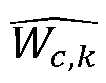
  • Each receiver may decode the common stream first to obtain a common message estimate W c ⁇ and extract its common message estimate W c , k ⁇ by treating the private streams for the plurality of receivers (e.g., all receivers) as noise.
  • the common stream may be reconstructed using W c ⁇ and subtracted from the received signal.
  • Each UE may decode its intended private message W p , k ⁇ by treating the private messages of other receivers as noise. Further, each receiver may combine the message estimates W c , k ⁇ and W p , k ⁇ to obtain its original message estimate W k ⁇ .
  • AoII may be considered to design a transmission framework based on RSMA.
  • AoII may be used as a metric to capture the needs of semantics-empowered communications.
  • AoII may address the shortcomings of AoI and error-based metrics in semantic communications by inferring the importance of data packets not only through their timestamps but also their content.
  • AoII may be used as one of the metrics to design and evaluate semantic-aware networks.
  • V t,k may be defined as the last time instant where receiver- k had sufficiently accurate information about the process X t,k .
  • f ( t ) may increasingly penalize the system as long as the mismatch between X t , k ⁇ and X t , k ⁇ lasts, and g X t , k X t , k ⁇ quantifies the gap between X t , k ⁇ and X t , k ⁇ 10 .
  • the f and g with 1 ⁇ . ⁇ function may be used to design systems where small mismatches are tolerated, while the ones with linear and square functions may be used to penalize any mismatch.
  • an AoII minimization problem may be formulated to jointly optimize receiver scheduling, power allocation and precoding for an RSMA-based semantic-aware system design, and an iterative algorithm may be defined to solve the formulated problem, as described further herein.
  • Fig. 2 is a diagram of an example 200 associated with precoding and scheduling while minimizing AoII for multiple access systems. As shown in Fig. 2 , example 200 includes a transmitter 102 and a receiver 104.
  • the transmitter 102 may determine that a difference between a total AoII obtained in a current iteration of an iterative algorithm and a total AoII in a previous iteration of the iterative algorithm satisfies a tolerance factor for algorithm convergence.
  • the tolerance factor for algorithm convergence may be predefined at the transmitter 102.
  • the transmitter 102 may be able to determine total AoII at different iterations, and the transmitter 102 may be able to determine when the difference in total AoII between consecutive iterations satisfies the tolerance factor for algorithm convergence.
  • the transmitter 102 may use, based on the difference satisfying the tolerance factor for algorithm convergence, the iterative algorithm to solve a convex optimization problem based on a plurality of iterations that continue until an objective function associated with AoII converges to within the tolerance factor for algorithm convergence.
  • the convex optimization problem may be derived from a non-convex problem formulated to jointly obtain user scheduling, precoding, resource allocation, and power allocation schemes.
  • the AoII may be a metric in the objective function of the convex optimization problem to maximize a freshness of overall information to be transmitted, and the freshness of overall information is maximized by minimizing the AoII.
  • the transmitter 102 may update an iteration number between iterations when using the iterative algorithm to solve the convex optimization problem.
  • the transmitter 102 may solve the convex optimization problem using interior-point techniques to obtain the precoder matrix, the vector of scheduling indicators, a vector of auxiliary variables for a private stream SINR lower bound, a vector of auxiliary variables for a private stream SINR upper bound, a vector of auxiliary variables for a common stream SINR lower bound, a vector of auxiliary variables for a private stream IN upper bound, and a vector of auxiliary variables for a common stream IN upper bound.
  • the transmitter 102 may use variables obtained in the previous iteration in related constraints to solve the convex optimization problem using interior-point techniques, and the variables may be associated with a precoder matrix at iteration n, a vector of scheduling indicators at iteration n, a vector of auxiliary variables for a private stream SINR bound at iteration n , and a vector of auxiliary variables for a common stream IN upper bound at iteration n .
  • the transmitter 102 may determine a precoder matrix and a vector of scheduling indicators from a solving of the convex optimization problem. In other words, by solving the convex optimization problem, the transmitter 102 may obtain the precoder matrix and the vector of scheduling indicators. The transmitter 102 may derive the precoder matrix and the vector of scheduling indicators by iteratively solving the convex optimization problem, where iterations the continue until the objective function converges within the tolerance factor for algorithm convergence.
  • the transmitter 102 may transmit, using a downlink multi-user communication framework based on RSMA in a semantic-aware network, one or more updates to one or more receivers 104 (e.g., UEs) based on the precoder matrix and the vector of scheduling indicators.
  • the RSMA may be associated with lower AoII as compared to SDMA, thereby improving an overall network performance.
  • a sample may be assumed to be taken at t for each receiver 104, and g X t , k X t , k ⁇ ⁇ 0 , ⁇ k ⁇ .
  • the transmitter 102 may aim to schedule the receivers 104 for transmission at t to minimize the AoII at time t + 1.
  • the objective and constraint (6b) may be conditional in the formulated problem.
  • a big-M technique may be used to convert the problem into a conventional form.
  • (6) may be converted into the following problem.
  • the constraints (7b)-(7e) may be non-convex, which makes the problem a non-convex optimization problem.
  • the constraint (7e) may be converted to a convex constraint by relaxing a binary requirement.
  • ⁇ K [ ⁇ 1 , ..., ⁇ K ]
  • ⁇ p [ ⁇ p ,1 , ... , ⁇ p,K ]
  • the constraint (8i) may be added for easy convergence after a binary constraint is relaxed.
  • First-order Taylor approximation may be applied to relax the constraints (8c), (8e), (8i) and obtain the following convex problem.
  • parameters with superscript [ n - 1] may represent variables to which the Taylor approximation is applied.
  • the iterative algorithm may be defined to obtain the precoder matrix and receiver scheduling (or user scheduling).
  • optimal variables obtained in a previous iteration e.g., P [n - 1] , z [n - 1] , ⁇ [n - 1] , ⁇ p [n - 1] , ⁇ c [n - 1] may be used in the related constraints to solve the convex problem using interior-point techniques.
  • An interior-point technique (or interior-point method) may be an algorithm for solving convex optimization problems. The iterations may continue until the objective function converges within a tolerance of ⁇ .
  • the iterative algorithm (Algorithm 1) may be defined in accordance with the following:
  • the definitions of the parameters updated at each iteration of the iterative algorithm are defined as follows.
  • the parameter P [n] may indicate a precoder matrix at iteration n .
  • the parameter z [n] may indicate a vector of scheduling indicators at iteration n .
  • the parameter ⁇ [n] may indicate a vector of auxiliary variables for private stream SINR upper bound at iteration n .
  • the parameter ⁇ p [n] may indicate a vector of auxiliary variables for private stream interference-plus-noise (IN) upper bound at iteration n .
  • the parameter ⁇ c [n] may indicate a vector of auxiliary variables for common stream IN upper bound at iteration n.
  • the parameter P * may indicate a precoder matrix obtained by solving the problem (9) using interior-point techniques.
  • the parameter z * may indicate a vector of scheduling indicators obtained by solving the problem (9) using interior-point techniques.
  • the parameter ⁇ * may indicate a vector of auxiliary variables for private stream SINR lower bound obtained by solving the problem (9) using interior-point techniques.
  • the parameter ⁇ * may indicate a vector of auxiliary variables for private stream SINR upper bound obtained by solving the problem (9) using interior-point techniques.
  • the parameter ⁇ * may indicate a vector of auxiliary variables for common stream SINR lower bound obtained by solving the problem (9) using interior-point techniques.
  • the parameter ⁇ p * may indicate a vector of auxiliary variables for private stream IN upper bound obtained by solving the problem (9) using interior-point techniques.
  • the parameter ⁇ c * may indicate a vector of auxiliary variables for common stream IN upper bound obtained by solving the problem (9) using interior-point techniques.
  • the parameter ⁇ may indicate a tolerance factor for algorithm convergence.
  • the rates in (10) may be calculated using the precoders obtained from the iterative algorithm.
  • the transmitter 102 may initialize a precoder matrix ( P [0] ), a vector of scheduling indicators ( z [0] ), a vector of auxiliary variables for a private stream SINR upper bound ( ⁇ [0] ), a vector of auxiliary variables for a private stream IN upper bound ( ⁇ p [0] ), and a vector of auxiliary variables for a common stream IN upper bound ( ⁇ c [0] ).
  • the transmitter 102 may solve the problem formulation in (9) using interior point techniques to obtain a total AoII ( ⁇ AoII ), the precoder matrix ( P *), the vector of scheduling indicators ( z *), the vector of auxiliary variables for the private stream SINR lower bound ( ⁇ *), the vector of auxiliary variables for the private stream SINR upper bound ( ⁇ *), the vector of auxiliary variables for the common stream SINR lower bound ( ⁇ *), the vector of auxiliary variables for the private stream IN upper bound ( ⁇ p *), and the vector of auxiliary variables for common stream IN upper bound ( ⁇ c *).
  • the transmitter 102 may solve the problem formulation in (9) using a precoder matrix at the previous iteration ( P [n-1] ), the vector of scheduling indicators at the previous iteration ( z [n-1] ), the vector of auxiliary variables for private stream SINR upper bound at the previous iteration ( ⁇ [n-1] ), the vector of auxiliary variables for private stream IN upper bound at the previous iteration ( ⁇ p [n - 1] ), and the vector of auxiliary variables for common stream IN upper bound at the previous iteration ( ⁇ c [n - 1] ). In some implementations, the transmitter 102 may update such values and update an iteration number.
  • the transmitter 102 may continue the iterations until the objective function converges within the tolerance of ⁇ , at which point the precoder matrix and the vector of scheduling indicators may be returned.
  • the transmitter 102 may use the iterative algorithm to obtain the precoder matrix and the receiver scheduling.
  • a convergence of the iterative algorithm may be guaranteed since the solution of (9) at iteration n is also a feasible solution at iteration n + 1. Therefore, the objective function is monotonically decreasing and is bounded below by zero.
  • a performance of the iterative algorithm may be analyzed and compared with that of SDMA.
  • SDMA may be a special case of RSMA when no power is allocated to a common stream s c and W k is encoded into s k .
  • RSMA may schedule both receivers 104 for larger I values than SDMA, especially in scenarios where the receivers 104 are spatially close. In such scenarios, canceling the multi-receiver interference becomes challenging, which affects the SINR of the interference-free streams, and thus limits the achievable rates. This results in SDMA failing to satisfy the rate requirements of one of the receivers 104 when I is increased above certain levels.
  • RSMA may achieve such performance by splitting the required rate between common and private streams and increasing the achievable rate of each receiver 104 using the common stream when using the private streams only is not enough to satisfy the rate requirements.
  • the performance of RSMA for downlink multi-receiver communications in semantic-aware networks may be evaluated.
  • the optimization problem may be formulated to design the optimal receiver scheduling, precoding, and power allocation schemes jointly.
  • the sum AoII may be considered as the objective function to minimize.
  • big-M and SCA may be applied to the formulated problem, and the iterative algorithm may be used to solve the formulated problem.
  • RSMA may achieve a lower AoII than SDMA owing to its superior performance under multi-receiver interference even under perfect CSIT.
  • Fig. 2 is provided as an example. Other examples may differ from what is described with regard to Fig. 2 .
  • the number and arrangement of devices shown in Fig. 2 are provided as an example. In practice, there may be additional devices, fewer devices, different devices, or differently arranged devices than those shown in Fig. 2 .
  • two or more devices shown in Fig. 2 may be implemented within a single device, or a single device shown in Fig. 2 may be implemented as multiple, distributed devices.
  • a set of devices (e.g., one or more devices) shown in Fig. 2 may perform one or more functions described as being performed by another set of devices shown in Fig. 2 .
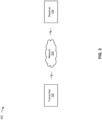
  • Fig. 3 is a diagram of an example environment 300 in which systems and/or methods described herein may be implemented.
  • environment 300 may include a transmitter 102, a receiver 104, and a network 302.
  • Devices of environment 300 may interconnect via wired connections, wireless connections, or a combination of wired and wireless connections.
  • the transmitter 102 may include one or more devices capable of receiving, processing, storing, routing, and/or providing information associated with precoding and scheduling while minimizing AoII for multiple access systems, as described elsewhere herein.
  • the transmitter 102 may be an aggregated network node, meaning that the aggregated network node is configured to utilize a radio protocol stack that is physically or logically integrated within a single radio access network (RAN) node (e.g., within a single device or unit).
  • RAN radio access network
  • the transmitter 102 may be a disaggregated network node (sometimes referred to as a disaggregated base station), meaning that the transmitter 102 is configured to utilize a protocol stack that is physically or logically distributed among two or more nodes (such as one or more central units (CUs), one or more distributed units (DUs), or one or more radio units (RUs)).
  • CUs central units
  • DUs distributed units
  • RUs radio units
  • the transmitter 102 may include, for example, a New Radio (NR) base station, a Long Term Evolution (LTE) base station, a Node B, an eNB (e.g., in Fourth Generation (4G)), a gNB (e.g., in Fifth Generation (5G)), an access point, a transmission reception point (TRP), a DU, an RU, a CU, a mobility element of a network, a core network node, a network element, a network equipment, and/or a RAN node.
  • NR New Radio
  • LTE Long Term Evolution
  • the receiver 104 may include one or more devices capable of receiving, generating, storing, processing, and/or providing information associated with precoding and scheduling while minimizing AoII for multiple access systems, as described elsewhere herein.
  • the receiver 104 may be a UE, which may include a communication device and/or a computing device.
  • the receiver 104 may include a wireless communication device, a mobile phone, a user equipment, a laptop computer, a tablet computer, a desktop computer, a gaming console, a set-top box, a wearable communication device (e.g., a smart wristwatch, a pair of smart eyeglasses, a head mounted display, or a virtual reality headset), or a similar type of device.
  • the network 302 may include one or more wired and/or wireless networks.
  • the network 302 may include a cellular network (e.g., a 5G network, a 4G network, an LTE network, a Third Generation (3G) network, a code division multiple access (CDMA) network, etc.), a public land mobile network (PLMN), a local area network (LAN), a wide area network (WAN), a metropolitan area network (MAN), a telephone network (e.g., the Public Switched Telephone Network (PSTN)), a private network, an ad hoc network, an intranet, the Internet, a fiber optic-based network, and/or a combination of these or other types of networks.
  • the network 302 may enable communication among the one or more devices of environment 300.
  • the number and arrangement of devices and networks shown in Fig. 3 are provided as an example. In practice, there may be additional devices and/or networks, fewer devices and/or networks, different devices and/or networks, or differently arranged devices and/or networks than those shown in Fig. 3 . Furthermore, two or more devices shown in Fig. 3 may be implemented within a single device, or a single device shown in Fig. 3 may be implemented as multiple, distributed devices. Additionally, or alternatively, a set of devices (e.g., one or more devices) of environment 300 may perform one or more functions described as being performed by another set of devices of environment 300.
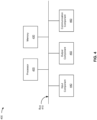
  • Fig. 4 is a diagram of example components of a device 400 associated with precoding and scheduling while minimizing AoII for multiple access systems.
  • the device 400 may correspond to a transmitter (e.g., transmitter 102).
  • the transmitter may include one or more devices 400 and/or one or more components of the device 400.
  • the device 400 may include a bus 410, a processor 420, a memory 430, an input component 440, an output component 450, and/or a communication component 460.
  • the bus 410 may include one or more components that enable wired and/or wireless communication among the components of the device 400.
  • the bus 410 may couple together two or more components of Fig. 4 , such as via operative coupling, communicative coupling, electronic coupling, and/or electric coupling.
  • the bus 410 may include an electrical connection (e.g., a wire, a trace, and/or a lead) and/or a wireless bus.
  • the processor 420 may include a central processing unit, a graphics processing unit, a microprocessor, a controller, a microcontroller, a digital signal processor, a field-programmable gate array, an application-specific integrated circuit, and/or another type of processing component.
  • the processor 420 may be implemented in hardware, firmware, or a combination of hardware and software.
  • the processor 420 may include one or more processors capable of being programmed to perform one or more operations or processes described elsewhere herein.
  • the memory 430 may include volatile and/or nonvolatile memory.
  • the memory 430 may include random access memory (RAM), read only memory (ROM), a hard disk drive, and/or another type of memory (e.g., a flash memory, a magnetic memory, and/or an optical memory).
  • the memory 430 may include internal memory (e.g., RAM, ROM, or a hard disk drive) and/or removable memory (e.g., removable via a universal serial bus connection).
  • the memory 430 may be a non-transitory computer-readable medium.
  • the memory 430 may store information, one or more instructions, and/or software (e.g., one or more software applications) related to the operation of the device 400.
  • the memory 430 may include one or more memories that are coupled (e.g., communicatively coupled) to one or more processors (e.g., processor 420), such as via the bus 410. Communicative coupling between a processor 420 and a memory 430 may enable the processor 420 to read and/or process information stored in the memory 430 and/or to store information in the memory 430.
  • processors e.g., processor 420
  • the input component 440 may enable the device 400 to receive input, such as user input and/or sensed input.
  • the input component 440 may include a touch screen, a keyboard, a keypad, a mouse, a button, a microphone, a switch, a sensor, a global positioning system sensor, a global navigation satellite system sensor, an accelerometer, a gyroscope, and/or an actuator.
  • the output component 450 may enable the device 400 to provide output, such as via a display, a speaker, and/or a light-emitting diode.
  • the communication component 460 may enable the device 400 to communicate with other devices via a wired connection and/or a wireless connection.
  • the communication component 460 may include a receiver, a transmitter, a transceiver, a modem, a network interface card, and/or an antenna.
  • the device 400 may perform one or more operations or processes described herein.
  • a non-transitory computer-readable medium e.g., memory 430
  • the processor 420 may execute the set of instructions to perform one or more operations or processes described herein.
  • execution of the set of instructions, by one or more processors 420 causes the one or more processors 420 and/or the device 400 to perform one or more operations or processes described herein.
  • hardwired circuitry may be used instead of or in combination with the instructions to perform one or more operations or processes described herein.
  • the processor 420 may be configured to perform one or more operations or processes described herein.
  • implementations described herein are not limited to any specific combination of hardware circuitry and software.
  • the number and arrangement of components shown in Fig. 4 are provided as an example.
  • the device 400 may include additional components, fewer components, different components, or differently arranged components than those shown in Fig. 4 .
  • a set of components (e.g., one or more components) of the device 400 may perform one or more functions described as being performed by another set of components of the device 400.
  • Fig. 5 is a flowchart of an example process 500 associated with precoding and scheduling while minimizing AoII for multiple access systems.
  • one or more process blocks of Fig. 5 may be performed by a transmitter (e.g., transmitter 102). Additionally, or alternatively, one or more process blocks of Fig. 5 may be performed by one or more components of device 400, such as processor 420, memory 430, input component 440, output component 450, and/or communication component 460.
  • process 500 may include determining, by the transmitter, that a difference between a total AoII obtained in a current iteration of an iterative algorithm and a total AoII in a previous iteration of the iterative algorithm satisfies a tolerance factor for algorithm convergence (block 510).
  • process 500 may include using, by the transmitter and based on the difference satisfying the tolerance factor for algorithm convergence, the iterative algorithm to solve a convex optimization problem based on a plurality of iterations that continue until an objective function associated with AoII converges to within the tolerance factor for algorithm convergence (block 520).
  • the convex optimization problem may be derived from a non-convex problem formulated to jointly obtain user scheduling, precoding, resource allocation, and power allocation schemes.
  • the AoII may be a metric in the objective function of the convex optimization problem to maximize a freshness of overall information to be transmitted, and the freshness of overall information is maximized by minimizing the AoII.
  • the transmitter may update an iteration number between iterations when using the iterative algorithm to solve the convex optimization problem.
  • the transmitter may solve the convex optimization problem using interior-point techniques to obtain the precoder matrix, the vector of scheduling indicators, a vector of auxiliary variables for a private stream SINR lower bound, a vector of auxiliary variables for a private stream SINR upper bound, a vector of auxiliary variables for a common stream SINR lower bound, a vector of auxiliary variables for a private stream IN upper bound, and a vector of auxiliary variables for a common stream IN upper bound.
  • variables obtained in the previous iteration may be used in related constraints to solve the convex optimization problem using interior-point techniques, and the variables may be associated with a precoder matrix at iteration n , a vector of scheduling indicators at iteration n , a vector of auxiliary variables for a private stream SINR bound at iteration n , and a vector of auxiliary variables for a common stream IN upper bound at iteration n .
  • process 500 may include determining, by the transmitter, a precoder matrix and a vector of scheduling indicators from a solving of the convex optimization problem (block 530). In other words, by solving the convex optimization problem, the transmitter may obtain the precoder matrix and the vector of scheduling indicators.
  • process 500 may include transmitting, by the transmitter and using a downlink multi-user communication framework based on RSMA in a semantic-aware network, one or more updates to one or more receivers based on the precoder matrix and the vector of scheduling indicators (block 540).
  • the RSMA may be associated with lower AoII as compared to space division multiple access (SDMA), thereby improving an overall network performance.
  • SDMA space division multiple access
  • process 500 may include additional blocks, fewer blocks, different blocks, or differently arranged blocks than those depicted in Fig. 5 . Additionally, or alternatively, two or more of the blocks of process 500 may be performed in parallel.
  • the term "component” is intended to be broadly construed as hardware, firmware, or a combination of hardware and software. It will be apparent that systems and/or methods described herein may be implemented in different forms of hardware, firmware, and/or a combination of hardware and software. The actual specialized control hardware or software code used to implement these systems and/or methods is not limiting of the implementations. Thus, the operation and behavior of the systems and/or methods are described herein without reference to specific software code - it being understood that software and hardware can be used to implement the systems and/or methods based on the description herein.
  • satisfying a threshold may, depending on the context, refer to a value being greater than the threshold, greater than or equal to the threshold, less than the threshold, less than or equal to the threshold, equal to the threshold, not equal to the threshold, or the like.
  • a, b, or c is intended to cover a, b, c, a-b, a-c, b-c, and a-b-c, as well as any combination with multiple of the same item.
  • processors or “one or more processors” (or another device or component, such as “a controller” or “one or more controllers”) is described or claimed (within a single claim or across multiple claims) as performing multiple operations or being configured to perform multiple operations, this language is intended to broadly cover a variety of processor architectures and environments.
  • first processor and “second processor” or other language that differentiates processors in the claims
  • this language is intended to cover a single processor performing or being configured to perform all of the operations, a group of processors collectively performing or being configured to perform all of the operations, a first processor performing or being configured to perform a first operation and a second processor performing or being configured to perform a second operation, or any combination of processors performing or being configured to perform the operations.
  • the terms “has,” “have,” “having,” or the like are intended to be open-ended terms. Further, the phrase “based on” is intended to mean “based, at least in part, on” unless explicitly stated otherwise. Also, as used herein, the term “or” is intended to be inclusive when used in a series and may be used interchangeably with “and/or,” unless explicitly stated otherwise (e.g., if used in combination with “either” or “only one of').

Landscapes

  • Engineering & Computer Science (AREA)
  • Computer Networks & Wireless Communication (AREA)
  • Signal Processing (AREA)
  • Mobile Radio Communication Systems (AREA)

Abstract

In some implementations, a transmitter may determine that a difference between a total age of incorrect information (AoII) obtained in a current iteration of an iterative algorithm and a total AoII in a previous iteration of the iterative algorithm satisfies a tolerance factor for algorithm convergence. The transmitter may use the iterative algorithm to solve a convex optimization problem based on a plurality of iterations that continue until an objective function associated with AoII converges to within the tolerance factor for algorithm convergence. The transmitter may determine a precoder matrix and a vector of scheduling indicators from a solving of the convex optimization problem. The transmitter may transmit, using a downlink multi-user communication framework based on rate-splitting multiple access (RSMA) in a semantic-aware network, one or more updates to one or more receivers based on the precoder matrix and the vector of scheduling indicators.

Description

    BACKGROUND
  • Wireless communication systems are widely deployed to provide various telecommunication services such as telephony, video, data, messaging, and broadcasts. A wireless network may include one or more network nodes that support communication for wireless communication devices, such as a user equipment (UE).
  • SUMMARY
  • According to an aspect, there is provided a method, comprising:
    • determining, by a transmitter, that a difference between a total age of incorrect information, AoII, obtained in a current iteration of an iterative algorithm and a total AoII in a previous iteration of the iterative algorithm satisfies a tolerance factor for algorithm convergence;
    • using, by the transmitter and based on the difference satisfying the tolerance factor for algorithm convergence, the iterative algorithm to solve a convex optimization problem based on a plurality of iterations that continue until an objective function associated with AoII converges to within the tolerance factor for algorithm convergence;
    • determining, by the transmitter, a precoder matrix and a vector of scheduling indicators from a solving of the convex optimization problem; and
    • transmitting, by the transmitter and using a downlink multi-user communication framework based on rate-splitting multiple access, RSMA, in a semantic-aware network, one or more updates to one or more receivers based on the precoder matrix and the vector of scheduling indicators.
  • The convex optimization problem may be derived from a non-convex problem formulated to jointly obtain user scheduling, precoding, resource allocation, and power allocation schemes.
  • The AoII may be a metric in the objective function of the convex optimization problem to maximize a freshness of overall information to be transmitted, and the freshness of overall information may be maximized by minimizing the AoII.
  • The method may further comprise solving the convex optimization problem using interior-point techniques to obtain:
    • the precoder matrix,
    • the vector of scheduling indicators,
    • a vector of auxiliary variables for a private stream signal-to-interference-plus-noise ratio, SINR, lower bound,
    • a vector of auxiliary variables for a private stream SINR upper bound,
    • a vector of auxiliary variables for a common stream SINR lower bound,
    • a vector of auxiliary variables for a private stream interference-plus-noise, IN, upper bound, and
    • a vector of auxiliary variables for a common stream IN upper bound.
  • At iteration n, where n is an integer, variables obtained in the previous iteration may be used in related constraints to solve the convex optimization problem using interior-point techniques, and the variables may be associated with a precoder matrix at iteration n, a vector of scheduling indicators at iteration n, a vector of auxiliary variables for a private stream signal-to-interference-plus-noise ratio, SINR, bound at iteration n, and a vector of auxiliary variables for a common stream interference-plus-noise, IN, upper bound at iteration n.
  • The RSMA may be associated with lower AoII as compared to space division multiple access, SDMA.
  • The method may further comprise updating an iteration number between iterations when using the iterative algorithm to solve the convex optimization problem.
  • According to another aspect, there is provided a transmitter, comprising:
    • one or more memories; and
    • one or more processors, communicatively coupled to the one or more memories, configured to:
      • determine that a difference between a total age of incorrect information, AoII, obtained in a current iteration of an iterative algorithm and a total AoII in a previous iteration of the iterative algorithm satisfies a tolerance factor for algorithm convergence;
      • use, based on the difference satisfying the tolerance factor for algorithm convergence, the iterative algorithm to solve a convex optimization problem based on a plurality of iterations that continue until an objective function associated with AoII converges to within the tolerance factor for algorithm convergence;
      • determine a precoder matrix and a vector of scheduling indicators from a solving of the convex optimization problem; and
      • transmit, using a downlink multi-user communication framework based on rate-splitting multiple access, RSMA, in a semantic-aware network, one or more updates to one or more receivers based on the precoder matrix and the vector of scheduling indicators.
  • The convex optimization problem may be derived from a non-convex problem formulated to jointly obtain user scheduling, precoding, resource allocation, and power allocation schemes.
  • The AoII may be a metric in the objective function of the convex optimization problem to maximize a freshness of overall information to be transmitted, and the freshness of overall information may be maximized by minimizing the AoII.
  • The one or more processors may be further configured to solve the convex optimization problem using interior-point techniques to obtain:
    • the precoder matrix,
    • the vector of scheduling indicators,
    • a vector of auxiliary variables for a private stream signal-to-interference-plus-noise ratio, SINR, lower bound,
    • a vector of auxiliary variables for a private stream SINR upper bound,
    • a vector of auxiliary variables for a common stream SINR lower bound,
    • a vector of auxiliary variables for a private stream interference-plus-noise, IN, upper bound, and
    • a vector of auxiliary variables for a common stream IN upper bound.
  • At iteration n, where n is an integer, variables obtained in the previous iteration may be used in related constraints to solve the convex optimization problem using interior-point techniques, and the variables may be associated with a precoder matrix at iteration n, a vector of scheduling indicators at iteration n, a vector of auxiliary variables for a private stream signal-to-interference-plus-noise ratio, SINR, bound at iteration n, and a vector of auxiliary variables for a common stream interference-plus-noise, IN, upper bound at iteration n.
  • The RSMA may be associated with lower AoII as compared to space division multiple access, SDMA.
  • The one or more processors may be further configured to update an iteration number between iterations when using the iterative algorithm to solve the convex optimization problem.
  • According to a further aspect, there is provided a non-transitory computer-readable medium storing a set of instructions, the set of instructions comprising:
    one or more instructions that, when executed by one or more processors of a transmitter, cause the transmitter to perform the method set out above.
  • BRIEF DESCRIPTION OF THE DRAWINGS
    • Fig. 1 is a diagram of an example associated with a transmission model of K-receiver 1-layer RSMA.
    • Fig. 2 is a diagram of an example associated with precoding and scheduling while minimizing AoII for multiple access systems.
    • Fig. 3 is a diagram of an example environment in which systems and/or methods described herein may be implemented.
    • Fig. 4 is a diagram of example components of one or more devices of Fig. 3.
    • Fig. 5 is a flowchart of an example process relating to precoding and scheduling while minimizing AoII for multiple access systems.
    DETAILED DESCRIPTION
  • The following detailed description of example implementations refers to the accompanying drawings. The same reference numbers in different drawings may identify the same or similar elements.
  • RSMA is an emerging multiple access technique for multi-antenna systems that relies on precoded rate-splitting at a transmitter and successive interference cancellation (SIC) at receivers (e.g., UEs). RSMA may manage multi-receiver interference in a flexible and robust manner by partially decoding interference and partially treating the interference as noise. RSMA may encapsulate and outperform existing multiple access schemes, such as space division multiple access (SDMA) and non-orthogonal multiple access (NOMA).
  • Semantic communications may be used in order to address the requirements of next generation networks with the advancement of machine learning techniques. Semantic communications focuses on the communication problem beyond the "Technical Level", the fundamentals of which are laid out by Shannon, and aims to convey meaning or features of information instead of transmitting correct bits. Semantic communications is expected to change approaches for designing and measuring the performance of wireless networks, since the conventional design metrics and approaches fail to capture its potential and waste available resources. Consequently, new metrics may be considered to properly capture the needs of semantic networks, such as, AoII. AoII may address the shortcomings of the metric age of information (AoI) (e.g., an end-to-end metric that captures a semantic property known as the timeliness of information) by capturing the effect of content and data freshness together. AoII may capture not only the freshness of information but also the information content of transmitted packets. AoII has been considered among the candidate metrics to be used for designing semantic-aware networks.
  • The usage of RSMA may be considered in the context of semantic communications or AoI-based metrics. For example, RSMA may be considered for joint communication and computation in semantic communication networks. An optimization problem may be formulated to minimize the total energy consumption of the network under a latency constraint to find the optimal beamformers, transmit information accuracy, computation capacity, rate, and/or power allocation schemes for downlink transmission. RSMA may perform with the smallest total communication and computation energy among the compared multiple access schemes, which may include SDMA, NOMA and frequency division multiple access (FDMA). As another example, the AoI performance of RSMA for a two-receiver single-antenna downlink communication system over an AoI minimization problem may be investigated to find the optimal power allocation policy. In this case, RSMA may achieve a better AoI-energy trade-off than NOMA and orthogonal multiple access (OMA) under the considered system model.
  • However, the usage of RSMA has not been considered in the context of semantic communications and AoII-based metrics. The usage of RSMA has not been considered to minimize AoII in a multi-antenna network with an arbitrary number of receivers. RSMA may encapsulate and outperform existing multiple access schemes (e.g., SDMA and NOMA), so a design that minimizes AoII for multiple access systems using RSMA may be useful to improve an overall network performance.
  • In some implementations, a downlink multi-receiver communication framework based on RSMA (e.g., an RSMA-based transmission scheme) may be defined for semantic-aware networks. An optimization problem, such as an AoII minimization problem, may be formulated to obtain jointly an optimal receiver scheduling, precoding, resource allocation, and/or power allocation schemes, while minimizing AoII for multiple access systems. The AoII minimization problem may be formulated to jointly find the optimal receiver scheduling, precoding scheme, and power allocation design for RSMA in the multi-antenna network with the arbitrary number of receivers. The formulated AoII minimization problem may be non-convex and include conditional objective functions and constraints. The metric AoII may be considered in the objective function of the formulated problem to maximize the freshness of the overall information to be transmitted. Big-M techniques (e.g., "Big M" refers to a large number associated with artificial variables, represented by the letter M) and successive convex approximation (SCA) techniques may be used to convert the resulting non-convex problem with conditional objective and constraints into a convex one, and an iterative algorithm may be defined to solve the convex problem.
  • In some implementations, by designing a downlink multi-receiver communication framework based on RSMA in semantic-aware networks, and by formulating an optimization problem to jointly obtain optimal receiver scheduling, power allocation, and precoding, AoII may be minimized for multiple access systems. Such an approach using RSMA may result in a lower AoII than SDMA and other related techniques due to superior performance under multi-receiver interference, thereby improving an overall system performance.
  • Fig. 1 is a diagram of an example 100 associated with a transmission model of K-receiver 1-layer RSMA.
  • In some implementations, in a system model, a single transmitter 102 with N antennas may perform downlink communications with K single-antenna receivers 104 (e.g., K single-antenna receivers). A set of indexes associated with receivers may be denoted by
    Figure imgb0001
    . Transmissions may be performed in a time-slotted framework and time may be assumed to be normalized to a slot duration, such that the slot duration is taken as 1 and each transmission occurs at a time instance t E N. An information process Xt,k, t E N, k
    Figure imgb0002
    , may be observed for each receiver at the transmitter 102, which may change over time. Each receiver may have an estimate of the process Xt,k at time instance t, denoted by X t , k ^
    Figure imgb0003
    . The aim of the transmitter 102 is to update the receivers about the changes in Xt,k, e.g., keep X t , k ^
    Figure imgb0004
    up-to-date. Accordingly, the transmitter 102 may decide to transmit to receiver-k at time instance t when the transmitter 102 observes a certain amount of change in Xt,k.
  • In some implementations, when the transmitter 102 decides to send updates at time instance t, the transmitter 102 may schedule a particular number of receivers for transmission. The set of indexes for such receivers may be denoted as
    Figure imgb0005
    Figure imgb0006
    . The transmission to the scheduled receivers may start at time instance t and finish at t + 1. When receiver-k is able to successfully receive the update intended for receiver-k, receiver-k may update its estimate at t + 1. The model X t ^ = X U t
    Figure imgb0007
    may be considered for the process estimate at receiver-k, where Ut is the timestamp of the last successfully received packet by a receiver at time t. In some implementations, when receiver-k is able to decode its update successfully, receiver-k may transmit an acknowledgement (ACK) packet to the transmitter 102. A transmission time for the ACK may be assumed to be negligible. When the ACK is not received at time instance t + 1 from receiver-k, the transmitter 102 may drop the update Xt,k and generate a new update X t+1, k.
  • As indicated above, Fig. 1 is provided as an example. Other examples may differ from what is described with regard to Fig. 1.
  • In some implementations, RSMA may be considered for transmissions to scheduled receivers. RSMA is a robust and flexible multiple-access technique for multi-antenna networks. RSMA may involve performing message splitting at a transmitter by splitting receiver messages into common and private parts. The common parts of the receiver messages may be combined and encoded into a common stream to be decoded by a plurality of receivers (e.g., all receivers), and the private parts of the receiver messages may be encoded into private streams. A plurality of messages (e.g., all messages) may be superimposed in a non-orthogonal manner.
  • In some implementations, the message of receiver-k at time t, and its common and private parts may be denoted as Wk, Wc,k and W p,k , respectively. The subscript t may be dropped from the rate expressions for ease of notation. The transmitter may combine Wc,k,k E
    Figure imgb0008
    , into a common message Wc . The common message Wc and private messages W p,k may be independently encoded into streams sc and sk , respectively. Linear precoding may be applied to a plurality of streams (e.g., all streams), and the precoders for the common stream and the private stream of receiver-k may be denoted as pc E Cnt and pk Cnt , respectively. Accordingly, a transmit signal may be expressed as: x = p c s c + k = 1 K p k s k .
    Figure imgb0009
  • In some implementations, the streams may have unit power, such that, E{ssH } = I for s = [sc, s 1, ..., sK ]. The transmitter may be assumed to have perfect channel state information at transmitter (CSIT) to calculate the precoders. The received signal at receiver-k may be represented as: y k = h k H x + z k , k K ,
    Figure imgb0010
    where h k CN is a channel vector and z k CN 0 σ n 2
    Figure imgb0011
    is an additive white Gaussian noise (AWGN) at receiver-k.
  • In some implementations, at a receiver (e.g., UE side), the messages may be detected using a successive interference cancellation (SIC) algorithm. Each receiver may decode the common stream first to obtain a common message estimate W c ^
    Figure imgb0012
    and extract its common message estimate W c , k ^
    Figure imgb0013
    by treating the private streams for the plurality of receivers (e.g., all receivers) as noise. The common stream may be reconstructed using W c ^
    Figure imgb0014
    and subtracted from the received signal. Each UE may decode its intended private message W p , k ^
    Figure imgb0015
    by treating the private messages of other receivers as noise. Further, each receiver may combine the message estimates W c , k ^
    Figure imgb0016
    and W p , k ^
    Figure imgb0017
    to obtain its original message estimate W k ^
    Figure imgb0018
    .
  • In some implementations, a signal-to-interference-plus-noise ratio (SINR) for the common and private streams at receiver-k may be expressed by: γ c , k = h k H p c 2 1 + i K h k H p i 2 , γ k = h k H p k 2 1 + i K , i k h k H p i 2 ,
    Figure imgb0019
    respectively. Accordingly, the achievable rates Rk = log2(1 + γ k ) and Rc,k = log2(1 + γ c,k ) bits/s/Hz may be defined. The common message should be decodable by the plurality of receivers (e.g., all receivers), and its achievable rate may be defined as R c = min k L t R c , k
    Figure imgb0020
    . Further, the common rate portion for receiver-k may be defined as ck , such that,
    Figure imgb0021
    ck = Rc.
  • In some implementations, AoII may be considered to design a transmission framework based on RSMA. AoII may be used as a metric to capture the needs of semantics-empowered communications. AoII may address the shortcomings of AoI and error-based metrics in semantic communications by inferring the importance of data packets not only through their timestamps but also their content. AoII may be used as one of the metrics to design and evaluate semantic-aware networks.
  • In some implementations, Vt,k may be defined as the last time instant where receiver-k had sufficiently accurate information about the process Xt,k. The AoII may be defined as: Δ Ao ΙΙ , k X t , k X t , k ^ t = f t × g X t , k X t , k ^ .
    Figure imgb0022
    In (4), f(t) may increasingly penalize the system as long as the mismatch between X t , k ^
    Figure imgb0023
    and X t , k ^
    Figure imgb0024
    lasts, and g X t , k X t , k ^
    Figure imgb0025
    quantifies the gap between X t , k ^
    Figure imgb0026
    and X t , k ^ 10
    Figure imgb0027
    . Some alternatives may be defined for f and g, such as: f lin t = t V t , k , f thr t = 1 t V t , k ζ ,
    Figure imgb0028
    and g sq X t , k X t , k ^ = X t , k X t , k ^ 2 , g thr X t , k X t , k ^ = 1 X t , k X t , k ^ c ,
    Figure imgb0029
    where ζ and c are predefined thresholds. The f and g with 1{. } function may be used to design systems where small mismatches are tolerated, while the ones with linear and square functions may be used to penalize any mismatch.
  • In some implementations, an AoII minimization problem may be formulated to jointly optimize receiver scheduling, power allocation and precoding for an RSMA-based semantic-aware system design, and an iterative algorithm may be defined to solve the formulated problem, as described further herein.
  • Fig. 2 is a diagram of an example 200 associated with precoding and scheduling while minimizing AoII for multiple access systems. As shown in Fig. 2, example 200 includes a transmitter 102 and a receiver 104.
  • As shown by reference number 202, the transmitter 102 may determine that a difference between a total AoII obtained in a current iteration of an iterative algorithm and a total AoII in a previous iteration of the iterative algorithm satisfies a tolerance factor for algorithm convergence. The tolerance factor for algorithm convergence may be predefined at the transmitter 102. The transmitter 102 may be able to determine total AoII at different iterations, and the transmitter 102 may be able to determine when the difference in total AoII between consecutive iterations satisfies the tolerance factor for algorithm convergence.
  • As shown by reference number 204, the transmitter 102 may use, based on the difference satisfying the tolerance factor for algorithm convergence, the iterative algorithm to solve a convex optimization problem based on a plurality of iterations that continue until an objective function associated with AoII converges to within the tolerance factor for algorithm convergence. The convex optimization problem may be derived from a non-convex problem formulated to jointly obtain user scheduling, precoding, resource allocation, and power allocation schemes. The AoII may be a metric in the objective function of the convex optimization problem to maximize a freshness of overall information to be transmitted, and the freshness of overall information is maximized by minimizing the AoII. The transmitter 102 may update an iteration number between iterations when using the iterative algorithm to solve the convex optimization problem.
  • In some implementations, the transmitter 102 may solve the convex optimization problem using interior-point techniques to obtain the precoder matrix, the vector of scheduling indicators, a vector of auxiliary variables for a private stream SINR lower bound, a vector of auxiliary variables for a private stream SINR upper bound, a vector of auxiliary variables for a common stream SINR lower bound, a vector of auxiliary variables for a private stream IN upper bound, and a vector of auxiliary variables for a common stream IN upper bound.
  • In some implementations, at iteration n, the transmitter 102 may use variables obtained in the previous iteration in related constraints to solve the convex optimization problem using interior-point techniques, and the variables may be associated with a precoder matrix at iteration n, a vector of scheduling indicators at iteration n, a vector of auxiliary variables for a private stream SINR bound at iteration n, and a vector of auxiliary variables for a common stream IN upper bound at iteration n.
  • As shown by reference number 206, the transmitter 102 may determine a precoder matrix and a vector of scheduling indicators from a solving of the convex optimization problem. In other words, by solving the convex optimization problem, the transmitter 102 may obtain the precoder matrix and the vector of scheduling indicators. The transmitter 102 may derive the precoder matrix and the vector of scheduling indicators by iteratively solving the convex optimization problem, where iterations the continue until the objective function converges within the tolerance factor for algorithm convergence.
  • As shown by reference number 208, the transmitter 102 may transmit, using a downlink multi-user communication framework based on RSMA in a semantic-aware network, one or more updates to one or more receivers 104 (e.g., UEs) based on the precoder matrix and the vector of scheduling indicators. The RSMA may be associated with lower AoII as compared to SDMA, thereby improving an overall network performance.
  • In some implementations, as part of a problem formulation and solution, a sample may be assumed to be taken at t for each receiver 104, and g X t , k X t , k ^ 0
    Figure imgb0030
    , ∀k ∈
    Figure imgb0031
    . The transmitter 102 may aim to schedule the receivers 104 for transmission at t to minimize the AoII at time t + 1. A slow process may be assumed for Xt,k , so that g X t + 1 , k X t + 1 , k ^ = 0
    Figure imgb0032
    when a transmission decision is given and the transmission decision is successful. Otherwise, the transmission decision may not affect the freshness of the update and even the successfully transmitted packets may become obsolete by the time the packets are received.
  • In some implementations, Ik may be defined as the rate required to successfully transmit the update Xt,k in an interval between t and t + 1 to achieve g X t + 1 , k X t + 1 , k ^ = 0
    Figure imgb0033
    . Since a time window of interest may be a single time duration (between t and t + 1), the subscript t may be dropped in It,k for ease of notation (similar as in the achievable rate expressions). An update may be successfully transmitted when the achievable rate at t for receiver-k is larger than a required rate, e.g., ck + Rk Ik . Since Xt,k is assumed to be a slow process, a successful transmission of the update for receiver-k may result in Δ Ao ΙΙ , k X t , k X t , k ^ t = 0 since g X t + 1 , k X t + 1 , k ^ = 0
    Figure imgb0034
    . Accordingly, AoII at t + 1 may be expressed as: Δ Ao ΙΙ , k X t + 1 , k , X t + 1 , k ^ , t + 1 = t + 1 V t + 1 , k g X t + 1 , k X t + 1 , k ^ , if c k + R k I k , 0 , otherwise .
    Figure imgb0035
  • In some implementations, defining
    Figure imgb0036
    = {k
    Figure imgb0037
    : ck + Rk Ik } as a set of scheduled receivers 104 and P = [p c , p 1, ..., p K ], the following optimization problem may be formulated to obtain the optimal scheduling, precoder, and power allocation scheme. min c , P k K Δ Ao ΙΙ , k X t + 1 , k , X ^ t + 1 , k , t + 1
    Figure imgb0038
    s . t . k K c k R c , l P , l L ,
    Figure imgb0039
    c 0 ,
    Figure imgb0040
    tr PP H P total .
    Figure imgb0041
  • In some implementations, the objective and constraint (6b) may be conditional in the formulated problem. A big-M technique may be used to convert the problem into a conventional form. The scheduling indicator vector z = [z 1, z 2, ..., zK ] with binary variables zk ∈ {0,1} may be defined to denote the case where receiver-k is not scheduled at time t, e.g., zk = 1 when k
    Figure imgb0042
    and zk = 0 otherwise. Then, (6) may be converted into the following problem. min c ,P ,z k K t + 1 V t + 1 , k g X t + 1 , k X ^ t + 1 , k z k
    Figure imgb0043
    s .t . I k c k R k Mz k , k K ,
    Figure imgb0044
    c k + R k I k M 1 z k , k K ,
    Figure imgb0045
    k K c k R c , k P + Mz k , k K ,
    Figure imgb0046
    z k 0 , 1 , k K , 6c , 6d .
    Figure imgb0047
  • In some implementations, the constraints (7b)-(7e) may be non-convex, which makes the problem a non-convex optimization problem. The constraint (7e) may be converted to a convex constraint by relaxing a binary requirement. The constraints (7b)-(7d) may be converted to convex constraints by applying SCA. Accordingly, the variables αk, βk, ωk, σp,k, σc,k and vectors α = [α 1, ... , αK ], β = [β 1 , ... , βK ], ω = [ω 1, ..., ωK ], σ p = [σ p,1 , ... , σp,K ], σ c = [σ c,1, ... , σc,K ] may be introduced to write: min c ,P ,z , α , β , ω σ p , σ e k K t + 1 V t + 1 , k g X t + 1 , k X ^ t + 1 , k z k
    Figure imgb0048
    s .t . I k c k log 1 + α k log 2 Mz k , k K ,
    Figure imgb0049
    c k + log 1 + β k log 2 I k M 1 z k , k K ,
    Figure imgb0050
    k K c k log 1 + ω k log 2 + Mz k , k K
    Figure imgb0051
    h k H p k 2 σ p , k α k , h k H p k 2 σ p , k β k , h k H p c 2 σ c , k ω k ,
    Figure imgb0052
    σ p , k 1 + i K , i k h k H p i 2 , k K ,
    Figure imgb0053
    σ c , k 1 + i K h k H p i 2 , k K ,
    Figure imgb0054
    0 z k 1 , k K ,
    Figure imgb0055
    k K z k = 0 , 6 c , 6 d .
    Figure imgb0056
  • In some implementations, the constraint (8i) may be added for easy convergence after a binary constraint is relaxed. First-order Taylor approximation may be applied to relax the constraints (8c), (8e), (8i) and obtain the following convex problem. min c , P , z α , β , ω σ p , σ c k K t + 1 V t + 1 , k g X t + 1 , k X ^ t + 1 , k z k
    Figure imgb0057
    s . t . c k + log 1 + β k n 1 log 2 + β k β k n 1 1 + β k n 1 log 2 I k M 1 z k , k K ,
    Figure imgb0058
    2 R p k n 1 H h k h k H p k σ p , k n 1 h k H p k n 1 2 σ p , k n 1 2 σ p , k α k ,
    Figure imgb0059
    2 R p k n 1 H h k h k H p k σ p , k n 1 h k H p k n 1 2 σ p , k n 1 2 σ p , k β k ,
    Figure imgb0060
    2 R p c n 1 H h k h k H p c σ c , k n 1 h k H p c n 1 2 σ c , k n 1 2 σ c , k ω k ,
    Figure imgb0061
    k K z k n 1 + k K z k z k n 1 l K , l k z l n 1 = 0 , 8 b , 8 d , 8 f , 8 g , 8 h , 6c , 6d ,
    Figure imgb0062
  • In some implementations, parameters with superscript [n - 1] may represent variables to which the Taylor approximation is applied. The iterative algorithm may be defined to obtain the precoder matrix and receiver scheduling (or user scheduling). At iteration n, optimal variables obtained in a previous iteration, e.g., P [n - 1], z [n - 1], β [n - 1], σ p [n - 1], σ c [n - 1] may be used in the related constraints to solve the convex problem using interior-point techniques. An interior-point technique (or interior-point method) may be an algorithm for solving convex optimization problems. The iterations may continue until the objective function converges within a tolerance of ε.
  • In some implementations, the iterative algorithm (Algorithm 1) may be defined in accordance with the following:
    Figure imgb0063
  • In some implementations, the definitions of the parameters updated at each iteration of the iterative algorithm are defined as follows. The parameter P [n] may indicate a precoder matrix at iteration n. The parameter z [n] may indicate a vector of scheduling indicators at iteration n. The parameter β [n] may indicate a vector of auxiliary variables for private stream SINR upper bound at iteration n. The parameter σ p [n] may indicate a vector of auxiliary variables for private stream interference-plus-noise (IN) upper bound at iteration n. The parameter σ c [n] may indicate a vector of auxiliary variables for common stream IN upper bound at iteration n. The parameter P* may indicate a precoder matrix obtained by solving the problem (9) using interior-point techniques. The parameter z* may indicate a vector of scheduling indicators obtained by solving the problem (9) using interior-point techniques. The parameter α * may indicate a vector of auxiliary variables for private stream SINR lower bound obtained by solving the problem (9) using interior-point techniques. The parameter β * may indicate a vector of auxiliary variables for private stream SINR upper bound obtained by solving the problem (9) using interior-point techniques. The parameter ω * may indicate a vector of auxiliary variables for common stream SINR lower bound obtained by solving the problem (9) using interior-point techniques. The parameter σ p * may indicate a vector of auxiliary variables for private stream IN upper bound obtained by solving the problem (9) using interior-point techniques. The parameter σ c * may indicate a vector of auxiliary variables for common stream IN upper bound obtained by solving the problem (9) using interior-point techniques. The parameter ε may indicate a tolerance factor for algorithm convergence.
  • In some implementations, an algorithm output z may contain the relaxed receiver scheduling indicators. Therefore, any type of algorithm may be used to obtain binary z variables, if required. A possible algorithm to obtain such variables is given as follows. z k = 1 , if z k = 1 or c k P + R k P I k , 0 , otherwise .
    Figure imgb0064
    The rates in (10) may be calculated using the precoders obtained from the iterative algorithm.
  • In some implementations, when using the iterative algorithm, the transmitter 102 may initialize a precoder matrix (P [0]), a vector of scheduling indicators (z [0]), a vector of auxiliary variables for a private stream SINR upper bound ( β [0]), a vector of auxiliary variables for a private stream IN upper bound ( σ p [0]), and a vector of auxiliary variables for a common stream IN upper bound ( σ c [0]).
  • In some implementations, during the usage of the iterative algorithm, while the difference between the total AoII in the current iteration and the total AoII in the previous iteration is above the tolerance factor for algorithm convergence, the transmitter 102 may solve the problem formulation in (9) using interior point techniques to obtain a total AoII (ΣΔAoII), the precoder matrix (P*), the vector of scheduling indicators (z*), the vector of auxiliary variables for the private stream SINR lower bound ( α *), the vector of auxiliary variables for the private stream SINR upper bound ( β *), the vector of auxiliary variables for the common stream SINR lower bound ( α *), the vector of auxiliary variables for the private stream IN upper bound ( σ p *), and the vector of auxiliary variables for common stream IN upper bound ( σ c *). Further, the transmitter 102 may solve the problem formulation in (9) using a precoder matrix at the previous iteration (P [n-1]), the vector of scheduling indicators at the previous iteration (z [n-1]), the vector of auxiliary variables for private stream SINR upper bound at the previous iteration ( β [n-1]), the vector of auxiliary variables for private stream IN upper bound at the previous iteration ( σ p [n - 1]), and the vector of auxiliary variables for common stream IN upper bound at the previous iteration ( σ c [n - 1]). In some implementations, the transmitter 102 may update such values and update an iteration number. The transmitter 102 may continue the iterations until the objective function converges within the tolerance of ε, at which point the precoder matrix and the vector of scheduling indicators may be returned. The transmitter 102 may use the iterative algorithm to obtain the precoder matrix and the receiver scheduling. A convergence of the iterative algorithm may be guaranteed since the solution of (9) at iteration n is also a feasible solution at iteration n + 1. Therefore, the objective function is monotonically decreasing and is bounded below by zero.
  • In some implementations, a performance of the iterative algorithm may be analyzed and compared with that of SDMA. SDMA may be a special case of RSMA when no power is allocated to a common stream sc and Wk is encoded into sk . RSMA may schedule both receivers 104 for larger I values than SDMA, especially in scenarios where the receivers 104 are spatially close. In such scenarios, canceling the multi-receiver interference becomes challenging, which affects the SINR of the interference-free streams, and thus limits the achievable rates. This results in SDMA failing to satisfy the rate requirements of one of the receivers 104 when I is increased above certain levels. RSMA may achieve such performance by splitting the required rate between common and private streams and increasing the achievable rate of each receiver 104 using the common stream when using the private streams only is not enough to satisfy the rate requirements.
  • In some implementations, the performance of RSMA for downlink multi-receiver communications in semantic-aware networks may be evaluated. The optimization problem may be formulated to design the optimal receiver scheduling, precoding, and power allocation schemes jointly. The sum AoII may be considered as the objective function to minimize. Further, big-M and SCA may be applied to the formulated problem, and the iterative algorithm may be used to solve the formulated problem. RSMA may achieve a lower AoII than SDMA owing to its superior performance under multi-receiver interference even under perfect CSIT.
  • As indicated above, Fig. 2 is provided as an example. Other examples may differ from what is described with regard to Fig. 2. The number and arrangement of devices shown in Fig. 2 are provided as an example. In practice, there may be additional devices, fewer devices, different devices, or differently arranged devices than those shown in Fig. 2. Furthermore, two or more devices shown in Fig. 2 may be implemented within a single device, or a single device shown in Fig. 2 may be implemented as multiple, distributed devices. Additionally, or alternatively, a set of devices (e.g., one or more devices) shown in Fig. 2 may perform one or more functions described as being performed by another set of devices shown in Fig. 2.
  • Fig. 3 is a diagram of an example environment 300 in which systems and/or methods described herein may be implemented. As shown in Fig. 3, environment 300 may include a transmitter 102, a receiver 104, and a network 302. Devices of environment 300 may interconnect via wired connections, wireless connections, or a combination of wired and wireless connections.
  • The transmitter 102 may include one or more devices capable of receiving, processing, storing, routing, and/or providing information associated with precoding and scheduling while minimizing AoII for multiple access systems, as described elsewhere herein. The transmitter 102 may be an aggregated network node, meaning that the aggregated network node is configured to utilize a radio protocol stack that is physically or logically integrated within a single radio access network (RAN) node (e.g., within a single device or unit). The transmitter 102 may be a disaggregated network node (sometimes referred to as a disaggregated base station), meaning that the transmitter 102 is configured to utilize a protocol stack that is physically or logically distributed among two or more nodes (such as one or more central units (CUs), one or more distributed units (DUs), or one or more radio units (RUs)). The transmitter 102 may include, for example, a New Radio (NR) base station, a Long Term Evolution (LTE) base station, a Node B, an eNB (e.g., in Fourth Generation (4G)), a gNB (e.g., in Fifth Generation (5G)), an access point, a transmission reception point (TRP), a DU, an RU, a CU, a mobility element of a network, a core network node, a network element, a network equipment, and/or a RAN node.
  • The receiver 104 may include one or more devices capable of receiving, generating, storing, processing, and/or providing information associated with precoding and scheduling while minimizing AoII for multiple access systems, as described elsewhere herein. The receiver 104 may be a UE, which may include a communication device and/or a computing device. For example, the receiver 104 may include a wireless communication device, a mobile phone, a user equipment, a laptop computer, a tablet computer, a desktop computer, a gaming console, a set-top box, a wearable communication device (e.g., a smart wristwatch, a pair of smart eyeglasses, a head mounted display, or a virtual reality headset), or a similar type of device.
  • The network 302 may include one or more wired and/or wireless networks. For example, the network 302 may include a cellular network (e.g., a 5G network, a 4G network, an LTE network, a Third Generation (3G) network, a code division multiple access (CDMA) network, etc.), a public land mobile network (PLMN), a local area network (LAN), a wide area network (WAN), a metropolitan area network (MAN), a telephone network (e.g., the Public Switched Telephone Network (PSTN)), a private network, an ad hoc network, an intranet, the Internet, a fiber optic-based network, and/or a combination of these or other types of networks. The network 302 may enable communication among the one or more devices of environment 300.
  • The number and arrangement of devices and networks shown in Fig. 3 are provided as an example. In practice, there may be additional devices and/or networks, fewer devices and/or networks, different devices and/or networks, or differently arranged devices and/or networks than those shown in Fig. 3. Furthermore, two or more devices shown in Fig. 3 may be implemented within a single device, or a single device shown in Fig. 3 may be implemented as multiple, distributed devices. Additionally, or alternatively, a set of devices (e.g., one or more devices) of environment 300 may perform one or more functions described as being performed by another set of devices of environment 300.
  • Fig. 4 is a diagram of example components of a device 400 associated with precoding and scheduling while minimizing AoII for multiple access systems. The device 400 may correspond to a transmitter (e.g., transmitter 102). In some implementations, the transmitter may include one or more devices 400 and/or one or more components of the device 400. As shown in Fig. 4, the device 400 may include a bus 410, a processor 420, a memory 430, an input component 440, an output component 450, and/or a communication component 460.
  • The bus 410 may include one or more components that enable wired and/or wireless communication among the components of the device 400. The bus 410 may couple together two or more components of Fig. 4, such as via operative coupling, communicative coupling, electronic coupling, and/or electric coupling. For example, the bus 410 may include an electrical connection (e.g., a wire, a trace, and/or a lead) and/or a wireless bus. The processor 420 may include a central processing unit, a graphics processing unit, a microprocessor, a controller, a microcontroller, a digital signal processor, a field-programmable gate array, an application-specific integrated circuit, and/or another type of processing component. The processor 420 may be implemented in hardware, firmware, or a combination of hardware and software. In some implementations, the processor 420 may include one or more processors capable of being programmed to perform one or more operations or processes described elsewhere herein.
  • The memory 430 may include volatile and/or nonvolatile memory. For example, the memory 430 may include random access memory (RAM), read only memory (ROM), a hard disk drive, and/or another type of memory (e.g., a flash memory, a magnetic memory, and/or an optical memory). The memory 430 may include internal memory (e.g., RAM, ROM, or a hard disk drive) and/or removable memory (e.g., removable via a universal serial bus connection). The memory 430 may be a non-transitory computer-readable medium. The memory 430 may store information, one or more instructions, and/or software (e.g., one or more software applications) related to the operation of the device 400. In some implementations, the memory 430 may include one or more memories that are coupled (e.g., communicatively coupled) to one or more processors (e.g., processor 420), such as via the bus 410. Communicative coupling between a processor 420 and a memory 430 may enable the processor 420 to read and/or process information stored in the memory 430 and/or to store information in the memory 430.
  • The input component 440 may enable the device 400 to receive input, such as user input and/or sensed input. For example, the input component 440 may include a touch screen, a keyboard, a keypad, a mouse, a button, a microphone, a switch, a sensor, a global positioning system sensor, a global navigation satellite system sensor, an accelerometer, a gyroscope, and/or an actuator. The output component 450 may enable the device 400 to provide output, such as via a display, a speaker, and/or a light-emitting diode. The communication component 460 may enable the device 400 to communicate with other devices via a wired connection and/or a wireless connection. For example, the communication component 460 may include a receiver, a transmitter, a transceiver, a modem, a network interface card, and/or an antenna.
  • The device 400 may perform one or more operations or processes described herein. For example, a non-transitory computer-readable medium (e.g., memory 430) may store a set of instructions (e.g., one or more instructions or code) for execution by the processor 420. The processor 420 may execute the set of instructions to perform one or more operations or processes described herein. In some implementations, execution of the set of instructions, by one or more processors 420, causes the one or more processors 420 and/or the device 400 to perform one or more operations or processes described herein. In some implementations, hardwired circuitry may be used instead of or in combination with the instructions to perform one or more operations or processes described herein. Additionally, or alternatively, the processor 420 may be configured to perform one or more operations or processes described herein. Thus, implementations described herein are not limited to any specific combination of hardware circuitry and software.
  • The number and arrangement of components shown in Fig. 4 are provided as an example. The device 400 may include additional components, fewer components, different components, or differently arranged components than those shown in Fig. 4. Additionally, or alternatively, a set of components (e.g., one or more components) of the device 400 may perform one or more functions described as being performed by another set of components of the device 400.
  • Fig. 5 is a flowchart of an example process 500 associated with precoding and scheduling while minimizing AoII for multiple access systems. In some implementations, one or more process blocks of Fig. 5 may be performed by a transmitter (e.g., transmitter 102). Additionally, or alternatively, one or more process blocks of Fig. 5 may be performed by one or more components of device 400, such as processor 420, memory 430, input component 440, output component 450, and/or communication component 460.
  • As shown in Fig. 5, process 500 may include determining, by the transmitter, that a difference between a total AoII obtained in a current iteration of an iterative algorithm and a total AoII in a previous iteration of the iterative algorithm satisfies a tolerance factor for algorithm convergence (block 510).
  • As shown in Fig. 5, process 500 may include using, by the transmitter and based on the difference satisfying the tolerance factor for algorithm convergence, the iterative algorithm to solve a convex optimization problem based on a plurality of iterations that continue until an objective function associated with AoII converges to within the tolerance factor for algorithm convergence (block 520). The convex optimization problem may be derived from a non-convex problem formulated to jointly obtain user scheduling, precoding, resource allocation, and power allocation schemes. The AoII may be a metric in the objective function of the convex optimization problem to maximize a freshness of overall information to be transmitted, and the freshness of overall information is maximized by minimizing the AoII. The transmitter may update an iteration number between iterations when using the iterative algorithm to solve the convex optimization problem.
  • In some implementations, the transmitter may solve the convex optimization problem using interior-point techniques to obtain the precoder matrix, the vector of scheduling indicators, a vector of auxiliary variables for a private stream SINR lower bound, a vector of auxiliary variables for a private stream SINR upper bound, a vector of auxiliary variables for a common stream SINR lower bound, a vector of auxiliary variables for a private stream IN upper bound, and a vector of auxiliary variables for a common stream IN upper bound.
  • In some implementations, at iteration n, variables obtained in the previous iteration may be used in related constraints to solve the convex optimization problem using interior-point techniques, and the variables may be associated with a precoder matrix at iteration n, a vector of scheduling indicators at iteration n, a vector of auxiliary variables for a private stream SINR bound at iteration n, and a vector of auxiliary variables for a common stream IN upper bound at iteration n.
  • As shown in Fig. 5, process 500 may include determining, by the transmitter, a precoder matrix and a vector of scheduling indicators from a solving of the convex optimization problem (block 530). In other words, by solving the convex optimization problem, the transmitter may obtain the precoder matrix and the vector of scheduling indicators.
  • As shown in Fig. 5, process 500 may include transmitting, by the transmitter and using a downlink multi-user communication framework based on RSMA in a semantic-aware network, one or more updates to one or more receivers based on the precoder matrix and the vector of scheduling indicators (block 540). The RSMA may be associated with lower AoII as compared to space division multiple access (SDMA), thereby improving an overall network performance.
  • Although Fig. 5 shows example blocks of process 500, in some implementations, process 500 may include additional blocks, fewer blocks, different blocks, or differently arranged blocks than those depicted in Fig. 5. Additionally, or alternatively, two or more of the blocks of process 500 may be performed in parallel.
  • The foregoing disclosure provides illustration and description, but is not intended to be exhaustive or to limit the implementations to the precise forms disclosed. Modifications and variations may be made in light of the above disclosure or may be acquired from practice of the implementations.
  • As used herein, the term "component" is intended to be broadly construed as hardware, firmware, or a combination of hardware and software. It will be apparent that systems and/or methods described herein may be implemented in different forms of hardware, firmware, and/or a combination of hardware and software. The actual specialized control hardware or software code used to implement these systems and/or methods is not limiting of the implementations. Thus, the operation and behavior of the systems and/or methods are described herein without reference to specific software code - it being understood that software and hardware can be used to implement the systems and/or methods based on the description herein.
  • As used herein, satisfying a threshold may, depending on the context, refer to a value being greater than the threshold, greater than or equal to the threshold, less than the threshold, less than or equal to the threshold, equal to the threshold, not equal to the threshold, or the like.
  • Even though particular combinations of features are recited in the claims and/or disclosed in the specification, these combinations are not intended to limit the disclosure of various implementations. In fact, many of these features may be combined in ways not specifically recited in the claims and/or disclosed in the specification. Although each dependent claim listed below may directly depend on only one claim, the disclosure of various implementations includes each dependent claim in combination with every other claim in the claim set. As used herein, a phrase referring to "at least one of' a list of items refers to any combination of those items, including single members. As an example, "at least one of: a, b, or c" is intended to cover a, b, c, a-b, a-c, b-c, and a-b-c, as well as any combination with multiple of the same item.
  • When "a processor" or "one or more processors" (or another device or component, such as "a controller" or "one or more controllers") is described or claimed (within a single claim or across multiple claims) as performing multiple operations or being configured to perform multiple operations, this language is intended to broadly cover a variety of processor architectures and environments. For example, unless explicitly claimed otherwise (e.g., via the use of "first processor" and "second processor" or other language that differentiates processors in the claims), this language is intended to cover a single processor performing or being configured to perform all of the operations, a group of processors collectively performing or being configured to perform all of the operations, a first processor performing or being configured to perform a first operation and a second processor performing or being configured to perform a second operation, or any combination of processors performing or being configured to perform the operations. For example, when a claim has the form "one or more processors configured to: perform X; perform Y; and perform Z," that claim should be interpreted to mean "one or more processors configured to perform X; one or more (possibly different) processors configured to perform Y; and one or more (also possibly different) processors configured to perform Z."
  • No element, act, or instruction used herein should be construed as critical or essential unless explicitly described as such. Also, as used herein, the articles "a" and "an" are intended to include one or more items, and may be used interchangeably with "one or more." Further, as used herein, the article "the" is intended to include one or more items referenced in connection with the article "the" and may be used interchangeably with "the one or more." Furthermore, as used herein, the term "set" is intended to include one or more items (e.g., related items, unrelated items, or a combination of related and unrelated items), and may be used interchangeably with "one or more." Where only one item is intended, the phrase "only one" or similar language is used. Also, as used herein, the terms "has," "have," "having," or the like are intended to be open-ended terms. Further, the phrase "based on" is intended to mean "based, at least in part, on" unless explicitly stated otherwise. Also, as used herein, the term "or" is intended to be inclusive when used in a series and may be used interchangeably with "and/or," unless explicitly stated otherwise (e.g., if used in combination with "either" or "only one of').
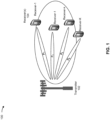
Claims (15)

  1. A method, comprising:
    determining, by a transmitter, that a difference between a total age of incorrect information, AoII, obtained in a current iteration of an iterative algorithm and a total AoII in a previous iteration of the iterative algorithm satisfies a tolerance factor for algorithm convergence;
    using, by the transmitter and based on the difference satisfying the tolerance factor for algorithm convergence, the iterative algorithm to solve a convex optimization problem based on a plurality of iterations that continue until an objective function associated with AoII converges to within the tolerance factor for algorithm convergence;
    determining, by the transmitter, a precoder matrix and a vector of scheduling indicators from a solving of the convex optimization problem; and
    transmitting, by the transmitter and using a downlink multi-user communication framework based on rate-splitting multiple access, RSMA, in a semantic-aware network, one or more updates to one or more receivers based on the precoder matrix and the vector of scheduling indicators.
  2. The method of claim 1, wherein the convex optimization problem is derived from a non-convex problem formulated to jointly obtain user scheduling, precoding, resource allocation, and power allocation schemes.
  3. The method of claim 1 or claim 2, wherein the AoII is a metric in the objective function of the convex optimization problem to maximize a freshness of overall information to be transmitted, and the freshness of overall information is maximized by minimizing the AoII.
  4. The method of any preceding claim, further comprising solving the convex optimization problem using interior-point techniques to obtain:
    the precoder matrix,
    the vector of scheduling indicators,
    a vector of auxiliary variables for a private stream signal-to-interference-plus-noise ratio, SINR, lower bound,
    a vector of auxiliary variables for a private stream SINR upper bound,
    a vector of auxiliary variables for a common stream SINR lower bound,
    a vector of auxiliary variables for a private stream interference-plus-noise, IN, upper bound, and
    a vector of auxiliary variables for a common stream IN upper bound.
  5. The method of any preceding claim, wherein at iteration n, where n is an integer, variables obtained in the previous iteration are used in related constraints to solve the convex optimization problem using interior-point techniques, and the variables are associated with a precoder matrix at iteration n, a vector of scheduling indicators at iteration n, a vector of auxiliary variables for a private stream signal-to-interference-plus-noise ratio, SINR, bound at iteration n, and a vector of auxiliary variables for a common stream interference-plus-noise, IN, upper bound at iteration n.
  6. The method of any preceding claim, wherein the RSMA is associated with lower AoII as compared to space division multiple access, SDMA.
  7. The method of any preceding claim, further comprising:
    updating an iteration number between iterations when using the iterative algorithm to solve the convex optimization problem.
  8. A transmitter, comprising:
    one or more memories; and
    one or more processors, communicatively coupled to the one or more memories, configured to:
    determine that a difference between a total age of incorrect information, AoII, obtained in a current iteration of an iterative algorithm and a total AoII in a previous iteration of the iterative algorithm satisfies a tolerance factor for algorithm convergence;
    use, based on the difference satisfying the tolerance factor for algorithm convergence, the iterative algorithm to solve a convex optimization problem based on a plurality of iterations that continue until an objective function associated with AoII converges to within the tolerance factor for algorithm convergence;
    determine a precoder matrix and a vector of scheduling indicators from a solving of the convex optimization problem; and
    transmit, using a downlink multi-user communication framework based on rate-splitting multiple access, RSMA, in a semantic-aware network, one or more updates to one or more receivers based on the precoder matrix and the vector of scheduling indicators.
  9. The transmitter of claim 8, wherein the convex optimization problem is derived from a non-convex problem formulated to jointly obtain user scheduling, precoding, resource allocation, and power allocation schemes.
  10. The transmitter of claim 8 or claim 9, wherein the AoII is a metric in the objective function of the convex optimization problem to maximize a freshness of overall information to be transmitted, and the freshness of overall information is maximized by minimizing the AoII.
  11. The transmitter of any of claims 8 to 10, wherein the one or more processors are further configured to solve the convex optimization problem using interior-point techniques to obtain:
    the precoder matrix,
    the vector of scheduling indicators,
    a vector of auxiliary variables for a private stream signal-to-interference-plus-noise ratio, SINR, lower bound,
    a vector of auxiliary variables for a private stream SINR upper bound,
    a vector of auxiliary variables for a common stream SINR lower bound,
    a vector of auxiliary variables for a private stream interference-plus-noise, IN, upper bound, and
    a vector of auxiliary variables for a common stream IN upper bound.
  12. The transmitter of any of claims 8 to 11, wherein at iteration n, where n is an integer, variables obtained in the previous iteration are used in related constraints to solve the convex optimization problem using interior-point techniques, and the variables are associated with a precoder matrix at iteration n, a vector of scheduling indicators at iteration n, a vector of auxiliary variables for a private stream signal-to-interference-plus-noise ratio, SINR, bound at iteration n, and a vector of auxiliary variables for a common stream interference-plus-noise, IN, upper bound at iteration n.
  13. The transmitter of any of claims 8 to 12, wherein the RSMA is associated with lower AoII as compared to space division multiple access, SDMA.
  14. The transmitter of any of claims 8 to 13, wherein the one or more processors are further configured to:
    update an iteration number between iterations when using the iterative algorithm to solve the convex optimization problem.
  15. A non-transitory computer-readable medium storing a set of instructions, the set of instructions comprising:
    one or more instructions that, when executed by one or more processors of a transmitter, cause the transmitter to perform the method of any of claims 1 to 7.
EP24218302.8A 2023-12-11 2024-12-09 Precoding and scheduling while minimizing age of incorrect information for multiple access systems Pending EP4572168A1 (en)

Applications Claiming Priority (1)

Application Number Priority Date Filing Date Title
US18/535,008 US20250192832A1 (en) 2023-12-11 2023-12-11 Precoding and scheduling while minimizing age of incorrect information for multiple access systems

Publications (1)

Publication Number Publication Date
EP4572168A1 true EP4572168A1 (en) 2025-06-18

Family

ID=93843314

Family Applications (1)

Application Number Title Priority Date Filing Date
EP24218302.8A Pending EP4572168A1 (en) 2023-12-11 2024-12-09 Precoding and scheduling while minimizing age of incorrect information for multiple access systems

Country Status (2)

Country Link
US (1) US20250192832A1 (en)
EP (1) EP4572168A1 (en)

Family Cites Families (2)

* Cited by examiner, † Cited by third party
Publication number Priority date Publication date Assignee Title
US9537550B2 (en) * 2012-11-06 2017-01-03 Kyocera Corporation Mobile communication system, user terminal, and processor
EP3142038B1 (en) * 2015-09-10 2019-01-23 Tata Consultancy Services Limited Authentication system and method

Non-Patent Citations (3)

* Cited by examiner, † Cited by third party
Title
CHEN JIANRUI ET AL: "Age of Incorrect Information in Semantic Communications for NOMA Aided XR Applications", IEEE JOURNAL OF SELECTED TOPICS IN SIGNAL PROCESSING, IEEE, US, vol. 17, no. 5, 2 June 2023 (2023-06-02), pages 1093 - 1105, XP011953248, ISSN: 1932-4553, [retrieved on 20230605], DOI: 10.1109/JSTSP.2023.3282836 *
CHENG YANYU ET AL: "Resource Allocation and Common Message Selection for Task-Oriented Semantic Information Transmission With RSMA", IEEE TRANSACTIONS ON WIRELESS COMMUNICATIONS, IEEE SERVICE CENTER, PISCATAWAY, NJ, US, vol. 23, no. 6, 31 October 2023 (2023-10-31), pages 5557 - 5570, XP011972543, ISSN: 1536-1276, [retrieved on 20231031], DOI: 10.1109/TWC.2023.3327127 *
MATTHIESEN BHO ET AL: "Globally Optimal Spectrum- and Energy-Efficient Beamforming for Rate Splitting Multiple Access", IEEE TRANSACTIONS ON SIGNAL PROCESSING, IEEE, USA, vol. 70, 12 October 2022 (2022-10-12), pages 5025 - 5040, XP011925724, ISSN: 1053-587X, [retrieved on 20221013], DOI: 10.1109/TSP.2022.3214376 *

Also Published As

Publication number Publication date
US20250192832A1 (en) 2025-06-12

Similar Documents

Publication Publication Date Title
JP5220859B2 (en) Multi-user precoding and scheduling method and base station for implementing the same
US9214995B2 (en) Joint transmission using interference alignment
EP2671333B1 (en) Mixed rank downlink compound multi-user interference alignment scheme
CN106664146A (en) Method and apparatus for multiple access in a wireless communication system
WO2014194283A1 (en) System and method for controlling multiple wireless access nodes
KR101576304B1 (en) Methods and apparatus for simultaneous estimation of frequency offset and channel response for mu-mimo ofdma
US20140010080A1 (en) Method for operating a wireless network, a wireless network and a device
US8902809B2 (en) Method and apparatus for handling data sending and receiving
EP4447564A1 (en) Precoder and resource allocation for rate-splitting multiple access in overloaded networks
Wang et al. On optimality of myopic policy for opportunistic access with nonidentical channels and imperfect sensing
CN115088233B (en) Eigenvector-based method and apparatus for MIMO equalizer design via a linear integer-forcing architecture
US10771122B1 (en) Methods and apparatus for discovering codeword decoding order in a serial interference cancellation (SIC) receiver using reinforcement learning
JP5990199B2 (en) Method for enhancing the quality of a signal received by at least one destination device of a plurality of destination devices
CN118250127B (en) Signal-to-interference-and-noise ratio determining method and device, electronic equipment and storage medium
EP4572168A1 (en) Precoding and scheduling while minimizing age of incorrect information for multiple access systems
CN116634475B (en) Information reporting, determination methods, devices, terminals, and network-side equipment
Yu et al. A fair resource allocation algorithm for data and energy integrated communication networks
Dao et al. Uplink non-orthogonal multiple access protocol in two-way relaying networks: realistic operation and performance analysis
KR20160034116A (en) Apparatus and method for cancelling interference in communication system supporting multiple user multiple-input multiple-output scheme
JP2014230281A (en) Beamforming vector calculation device, method and transmitter
CN118264289A (en) CSI feedback method, terminal and network side equipment based on AI model
US10211866B2 (en) Dual receive processing in wireless communications
WO2016082640A1 (en) Retransmission processing method and device for multi-user system
JP5937366B2 (en) Method and device for determining settings of a wireless communication network, and method and system for improving the quality of a signal received by a destination device of a wireless communication network
CN116366405B (en) Large-scale MIMO channel estimation method and base station for high mobility communication

Legal Events

Date Code Title Description
PUAI Public reference made under article 153(3) epc to a published international application that has entered the european phase

Free format text: ORIGINAL CODE: 0009012

STAA Information on the status of an ep patent application or granted ep patent

Free format text: STATUS: THE APPLICATION HAS BEEN PUBLISHED

AK Designated contracting states

Kind code of ref document: A1

Designated state(s): AL AT BE BG CH CY CZ DE DK EE ES FI FR GB GR HR HU IE IS IT LI LT LU LV MC ME MK MT NL NO PL PT RO RS SE SI SK SM TR

STAA Information on the status of an ep patent application or granted ep patent

Free format text: STATUS: REQUEST FOR EXAMINATION WAS MADE

17P Request for examination filed

Effective date: 20251119