EP4572057A2 - Systems and methods of power-voltage droop control for a direct current (dc) microgrid - Google Patents
Systems and methods of power-voltage droop control for a direct current (dc) microgrid Download PDFInfo
- Publication number
- EP4572057A2 EP4572057A2 EP24219421.5A EP24219421A EP4572057A2 EP 4572057 A2 EP4572057 A2 EP 4572057A2 EP 24219421 A EP24219421 A EP 24219421A EP 4572057 A2 EP4572057 A2 EP 4572057A2
- Authority
- EP
- European Patent Office
- Prior art keywords
- droop
- current
- power
- microgrid
- converter
- Prior art date
- Legal status (The legal status is an assumption and is not a legal conclusion. Google has not performed a legal analysis and makes no representation as to the accuracy of the status listed.)
- Pending
Links
Images





Classifications
-
- H—ELECTRICITY
- H02—GENERATION; CONVERSION OR DISTRIBUTION OF ELECTRIC POWER
- H02J—ELECTRIC POWER NETWORKS; CIRCUIT ARRANGEMENTS OR SYSTEMS FOR SUPPLYING OR DISTRIBUTING ELECTRIC POWER; SYSTEMS FOR STORING ELECTRIC ENERGY
- H02J1/00—Circuit arrangements for DC mains or DC distribution networks
- H02J1/10—Parallel operation of DC sources
- H02J1/12—Parallel operation of DC sources having power converters with further DC sources without power converters
-
- H—ELECTRICITY
- H02—GENERATION; CONVERSION OR DISTRIBUTION OF ELECTRIC POWER
- H02J—ELECTRIC POWER NETWORKS; CIRCUIT ARRANGEMENTS OR SYSTEMS FOR SUPPLYING OR DISTRIBUTING ELECTRIC POWER; SYSTEMS FOR STORING ELECTRIC ENERGY
- H02J1/00—Circuit arrangements for DC mains or DC distribution networks
-
- H—ELECTRICITY
- H02—GENERATION; CONVERSION OR DISTRIBUTION OF ELECTRIC POWER
- H02J—ELECTRIC POWER NETWORKS; CIRCUIT ARRANGEMENTS OR SYSTEMS FOR SUPPLYING OR DISTRIBUTING ELECTRIC POWER; SYSTEMS FOR STORING ELECTRIC ENERGY
- H02J1/00—Circuit arrangements for DC mains or DC distribution networks
- H02J1/10—Parallel operation of DC sources
- H02J1/102—Parallel operation of DC sources being switching converters
-
- H—ELECTRICITY
- H02—GENERATION; CONVERSION OR DISTRIBUTION OF ELECTRIC POWER
- H02J—ELECTRIC POWER NETWORKS; CIRCUIT ARRANGEMENTS OR SYSTEMS FOR SUPPLYING OR DISTRIBUTING ELECTRIC POWER; SYSTEMS FOR STORING ELECTRIC ENERGY
- H02J1/00—Circuit arrangements for DC mains or DC distribution networks
- H02J1/10—Parallel operation of DC sources
- H02J1/106—Parallel operation of DC sources for load balancing, symmetrisation, or sharing
-
- H—ELECTRICITY
- H02—GENERATION; CONVERSION OR DISTRIBUTION OF ELECTRIC POWER
- H02J—ELECTRIC POWER NETWORKS; CIRCUIT ARRANGEMENTS OR SYSTEMS FOR SUPPLYING OR DISTRIBUTING ELECTRIC POWER; SYSTEMS FOR STORING ELECTRIC ENERGY
- H02J1/00—Circuit arrangements for DC mains or DC distribution networks
- H02J1/14—Balancing load and power generation in DC networks
-
- H—ELECTRICITY
- H02—GENERATION; CONVERSION OR DISTRIBUTION OF ELECTRIC POWER
- H02M—APPARATUS FOR CONVERSION BETWEEN AC AND AC, BETWEEN AC AND DC, OR BETWEEN DC AND DC, AND FOR USE WITH MAINS OR SIMILAR POWER SUPPLY SYSTEMS; CONVERSION OF DC OR AC INPUT POWER INTO SURGE OUTPUT POWER; CONTROL OR REGULATION THEREOF
- H02M1/00—Details of apparatus for conversion
- H02M1/0003—Details of control, feedback or regulation circuits
- H02M1/0025—Arrangements for modifying reference values, feedback values or error values in the control loop of a converter
-
- H—ELECTRICITY
- H02—GENERATION; CONVERSION OR DISTRIBUTION OF ELECTRIC POWER
- H02M—APPARATUS FOR CONVERSION BETWEEN AC AND AC, BETWEEN AC AND DC, OR BETWEEN DC AND DC, AND FOR USE WITH MAINS OR SIMILAR POWER SUPPLY SYSTEMS; CONVERSION OF DC OR AC INPUT POWER INTO SURGE OUTPUT POWER; CONTROL OR REGULATION THEREOF
- H02M3/00—Conversion of DC power input into DC power output
- H02M3/02—Conversion of DC power input into DC power output without intermediate conversion into AC
- H02M3/04—Conversion of DC power input into DC power output without intermediate conversion into AC by static converters
- H02M3/10—Conversion of DC power input into DC power output without intermediate conversion into AC by static converters using discharge tubes with control electrode or semiconductor devices with control electrode
- H02M3/145—Conversion of DC power input into DC power output without intermediate conversion into AC by static converters using discharge tubes with control electrode or semiconductor devices with control electrode using devices of a triode or transistor type requiring continuous application of a control signal
- H02M3/155—Conversion of DC power input into DC power output without intermediate conversion into AC by static converters using discharge tubes with control electrode or semiconductor devices with control electrode using devices of a triode or transistor type requiring continuous application of a control signal using semiconductor devices only
- H02M3/156—Conversion of DC power input into DC power output without intermediate conversion into AC by static converters using discharge tubes with control electrode or semiconductor devices with control electrode using devices of a triode or transistor type requiring continuous application of a control signal using semiconductor devices only with automatic control of output voltage or current, e.g. switching regulators
-
- H—ELECTRICITY
- H02—GENERATION; CONVERSION OR DISTRIBUTION OF ELECTRIC POWER
- H02J—ELECTRIC POWER NETWORKS; CIRCUIT ARRANGEMENTS OR SYSTEMS FOR SUPPLYING OR DISTRIBUTING ELECTRIC POWER; SYSTEMS FOR STORING ELECTRIC ENERGY
- H02J2105/00—Networks for supplying or distributing electric power characterised by their spatial reach or by the load
- H02J2105/10—Local stationary networks having a local or delimited stationary reach
-
- Y—GENERAL TAGGING OF NEW TECHNOLOGICAL DEVELOPMENTS; GENERAL TAGGING OF CROSS-SECTIONAL TECHNOLOGIES SPANNING OVER SEVERAL SECTIONS OF THE IPC; TECHNICAL SUBJECTS COVERED BY FORMER USPC CROSS-REFERENCE ART COLLECTIONS [XRACs] AND DIGESTS
- Y02—TECHNOLOGIES OR APPLICATIONS FOR MITIGATION OR ADAPTATION AGAINST CLIMATE CHANGE
- Y02E—REDUCTION OF GREENHOUSE GAS [GHG] EMISSIONS, RELATED TO ENERGY GENERATION, TRANSMISSION OR DISTRIBUTION
- Y02E10/00—Energy generation through renewable energy sources
- Y02E10/50—Photovoltaic [PV] energy
- Y02E10/56—Power conversion systems, e.g. maximum power point trackers
-
- Y—GENERAL TAGGING OF NEW TECHNOLOGICAL DEVELOPMENTS; GENERAL TAGGING OF CROSS-SECTIONAL TECHNOLOGIES SPANNING OVER SEVERAL SECTIONS OF THE IPC; TECHNICAL SUBJECTS COVERED BY FORMER USPC CROSS-REFERENCE ART COLLECTIONS [XRACs] AND DIGESTS
- Y04—INFORMATION OR COMMUNICATION TECHNOLOGIES HAVING AN IMPACT ON OTHER TECHNOLOGY AREAS
- Y04S—SYSTEMS INTEGRATING TECHNOLOGIES RELATED TO POWER NETWORK OPERATION, COMMUNICATION OR INFORMATION TECHNOLOGIES FOR IMPROVING THE ELECTRICAL POWER GENERATION, TRANSMISSION, DISTRIBUTION, MANAGEMENT OR USAGE, i.e. SMART GRIDS
- Y04S10/00—Systems supporting electrical power generation, transmission or distribution
Definitions
- the field of the disclosure relates generally to microgrids, and more particularly, to systems and methods of control for a direct current (DC) microgrid.
- DC direct current
- a microgrid is a local electrical grid and may be operated in a grid-connected mode by being connected to the macrogrid and in an island mode by being disconnected from the macrogrid and functioning autonomously.
- the bus current of the microgrid is DC.
- One method of controlling the output of a DC microgrid is power-voltage (PV) droop control, which regulates the output DC side power as a function of the DC bus voltage of the microgrid.
- PV power-voltage
- a direct current (DC) microgrid in one aspect, includes a power converter, a power-voltage (PV) droop control loop electrically coupled with the power converter, and an inner current control loop of the power converter.
- the PV droop control loop is configured to receive measurements of a droop current quantity that is a current quantity other than a DC bus current of a DC microgrid.
- the droop current quantity is used to determine a droop power quantity selected as a power quantity in a PV relationship between the power quantity and a DC bus voltage of the DC microgrid in a PV droop control of the DC microgrid.
- the PV droop control loop is further configured to derive a current reference based on droop in the droop power quantity, the current reference corresponding to a control quantity of the inner current control loop of the power converter.
- the inner current control loop of the power converter is electrically coupled with the power converter and the PV droop control loop.
- the inner current control loop is configured to control operation of the power converter by deriving a measured current corresponding to the control quantity based on the measurements of the droop current quantity, directly comparing the current reference with the measured current, and generating switching signals of switches in the power converter based on the comparing.
- a method of PV droop control in a DC microgrid includes selecting a droop power quantity as a power quantity in a PV relationship between the power quantity and a DC bus voltage of a DC microgrid in a PV droop control of the DC microgrid.
- the droop power quantity is based on a droop current quantity that is a current quantity other than a DC bus current of the DC microgrid.
- the method also includes deriving a current reference based on droop in the droop power quantity, the current reference corresponding to a control quantity of an inner current control loop of a power converter.
- the method further includes deriving a measured current corresponding to the control quantity based on measurements of the droop current quantity.
- the method includes controlling operation of the power converter by in the inner current control loop, directly comparing the current reference with the measured current, and generating switching signals of switches in the power converter based on the comparing.
- the disclosure includes power-voltage (PV) droop control for a direct current (DC) microgrid.
- PV power-voltage
- DC direct current
- FIGs. 1A-1D show known methods of droop control in a DC microgrid.
- FIG. 1A is a schematic diagram of a known power-voltage (PV) droop control mechanism.
- Droop control is used to control power flow between converters, loads, and power sources in a microgrid.
- Droop control regulates the power sourced and consumed by converters, loads, and power sources in the microgrid as a function of the DC bus voltage of the microgrid.
- a DC bus voltage of a DC microgrid refers to the output voltage of the microgrid measured across the DC output bus of the microgrid.
- a DC bus current of a DC microgrid refers to the output current of the DC microgrid measured at the output bus of the microgrid.
- the droop in DC power output of power converters is proportional to the droop in voltage measured across the DC capacitance, and the output DC side power is regulated as a function of the DC bus voltage.
- the proportion in the PV relationship between the DC bus voltage and the DC side power is a droop gain k.
- DC side quantities are used as inputs and a DC current reference is generated.
- the known PV droop equation is given as Eqn. (1).
- P dc P dc 0 + V 0 ⁇ v k .
- V 0 is the DC voltage reference and the DC bus voltage when no load is connected to the DC bus.
- k is the droop gain or the inverse of the slope of the P-V line in the P-V droop characteristic plot 102.
- v is the DC bus voltage of the microgrid.
- the DC side current reference i dc ⁇ may be derived based on Eqn. (2) below.
- i dc ⁇ V 0 ⁇ v k ⁇ v .
- the DC bus voltage v is measured using a voltage sensor, and used to generate DC side current reference i dc ⁇ .
- PV droop control loop 103 is used to generate DC side current reference i dc ⁇ .
- the three-phase AC electrical quantities i a, b, c and e a, b, c of current i and voltage e may be converted to representation in a rotating reference frame of d-q axes to derive a d-axis current i d or a d-axis voltage v d .
- the d-q reference frame may be a synchronous reference frame with the d-axis of the frame aligned with the AC side voltage measured at the point of common coupling (PCC) of the AC/DC converter 104 with the AC grid (not shown) from which AC/DC converter 104 receives AC power.
- the generated AC current reference in Eqn. (3) is an indication of the power flow from the AC side to the DC microgrid.
- the AC current reference is provided to the AC-side current controller or inner current control loop 108 to generate the switching signals of the AC/DC converter.
- known PV droop controller 105 includes droop control loop 103 and an extra control loop 106.
- the extra control loop 106 is required to obtain the AC d-axis current reference i d ⁇ from the DC current reference i dc ⁇ .
- the extra PI control loop requires extra measurement of the DC side current i dc , which is typically not required in the control of an AC/DC converter.
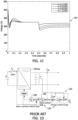
- FIG. 1C is a plot of the step response, showing the impact of a load step response on the DC bus voltage at various values of droop gain k .
- the step response has an overshoot. The overshoot may be mitigated through a PI controller design for small loads. For medium to large loads, the transient voltage drop may be excessive, de-stabilizing the DC microgrid.
- FIG. 1D shows a known PV droop control for a DC to DC (DC/DC) boost converter 104-bs.
- DC/DC boost converter the output voltage is greater than the input voltage.
- the error between the DC current reference i dc ⁇ and the measured DC current i dc are input into a PI controller 106 to generate an input inductor current reference i L ⁇ .
- the generated current reference i L ⁇ is an indication of the power flow from the input DC bus to the DC microgrid.
- the input inductor current reference i L ⁇ is given to the inner current control loop 108 of DC/DC converter 104-bs to generate the switching signals of the switches in converter 104-bs.
- the known PV droop control requires an extra control loop 106 to obtain input inductor current reference iL from the DC current reference i dc ⁇ .
- the extra control loop 106 may create stability issues in droop control and the extra pole created by the PI controller may lead to an underdamped step response.
- the extra control loop 106 requires extra measurement of the DC side current i dc , which is typically not required in the control of a DC/DC converter.
- the systems and methods disclosed herein address the problems described above in known droop control mechanisms.
- the extra control loop is eliminated, thereby increasing the speed of control and stability of the microgrid.
- An extra measurement of the DC side current i dc is also eliminated, thereby reducing the complexity of the system and cost in hardware and software for the extra sensor of the DC side bus current i dc .
- FIG. 2A is a schematic diagram of an example DC microgrid 200 implementing PV droop control mechanisms disclosed herein.
- microgrid 200 includes a power converter 202.
- Power converter 202 is a DC converter, which converts an AC power or a DC power to a DC power.
- Power converter 202 may be an AC/DC converter (see FIGs. 3A and 3E described later), a DC/DC boost converter (see FIG. 3C described later), and/or a DC/DC buck converter (see FIG. 3D described later).
- the output voltage is smaller than the input voltage.
- Microgrid 200 also includes an inner current control loop 204 electrically coupled with power converter 202 and configured to control operation of power converter 202.
- Inner current control loop 204 is configured to generate switch signals of switches in power converter 202 based on a control quantity such that the output power from power converter 202 meets desired specification, such as desired output voltage.
- DC microgrid 200 further includes a PV droop control loop 201 electrically coupled with power converter 202 and inner current control loop 204.
- PV droop control loop 201 may also be referred to as a PV droop controller.
- PV droop control loop 201 is configured to receive measurements of a droop current quantity that is a current quantity other than a DC bus current of DC microgrid 200. The droop current quantity is used to determine a droop power quantity selected as the power quantity in a PV relationship between the power quantity and the DC bus voltage of DC microgrid 200 in a PV droop control of DC microgrid 200.
- PV droop control loop 201 is also configured to derive a current reference based on droop in the droop power quantity, where the current reference corresponds to the control quantity of inner current control loop 204.
- the control in inner control loop 204 is generated by a direct comparison between the current reference and the measured current corresponding to the control quantity.
- the measured current corresponding to the control quantity may be derived based on the measurements of the droop current quantity.
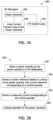
- FIG. 2B is a flow chart of an example method of PV droop control.
- method 250 includes selecting 252 a droop power quantity as the power quantity in the PV relationship between the power quantity and the DC bus voltage in the PV droop control of the DC microgrid.
- the droop power quantity is based on a droop current quantity that is a current quantity other than the DC bus current of the DC microgrid.
- the droop power quantity may be a fictitious power that is a product of multiplication of the droop current quantity and the DC bus voltage.
- the droop power quantity is a real power that is the input power to the power converter.
- the droop current quantity for the droop power quantity is not the DC bus current, a sensor for the DC bus current is not needed in the PV droop control, thereby simplifying the configuration and reducing costs associated with the hardware and software for the sensor.
- the droop current quantity is the control quantity or the same type of quantity as the control quantity in the inner current control loop of the power converter.
- the droop current quantity may be the input current of the converter
- the control quantity of the inner current control loop may be the d-axis input current of the power converter.
- both the droop current and the control quantity may be an input current of the power converter.
- the droop current quantity and the control quantity may both be the output current of the converter. Therefore, the sensor for the droop current quantity has already been included for the control of the power converter.
- method 250 also includes deriving 254 a current reference based on droop in the droop power quantity, where the current reference corresponds to a control quantity of an inner current control loop of the power converter. Therefore, the current reference may be directly provided to inner current control loop 204 for the control of power converter 202, thereby eliminating extra control loop 106 in the known droop control.
- method 250 further includes deriving 256 a measured current corresponding to the control quantity based on measurements of the droop current quantity. Because the droop current quantity is the same quantity or the same type of quantity as the control quantity, the measured current corresponding to the control quantity is the measurements of the droop current quantity or a different representation of measurements of the droop current quantity, and may be directly derived from the measurements of the droop current quantity. For example, for a DC/DC boost converter or a DC/DC buck converter, the control quantity and the droop current quantity are the same quantity, and the measured current corresponding to the control quantity is the measurements of the droop current quantity.
- the control quantity is the d-axis input current of the power converter while the droop current quantity is the input current in three phases.
- the d-axis input current is a d-q frame representation of the input current.
- the d-axis input current may be derived by converting the measured three-phase AC input current into representation in a rotating d-q reference frame.
- method 250 includes controlling 258 operation of the power converter by, in the inner current control loop of the power converter, directly comparing the current reference with the measured current, and generating switching signals of switches in the power converter based on the comparing.
- microgrids and methods disclosed herein are advantageous over known PV droop control in simplifying the hardware and software and increasing the stability of the microgrids and speed in the control of the power converters.
- FIGs. 3A-3D show example PV droop control mechanisms using a fictitious power P fic as the droop power quantity in the PV relationship.
- P fic is the multiplication of the DC bus voltage with inductor current of the converter as in Eqn. (5) below.
- P fic P fic 0 + V 0 ⁇ v k ′
- P fic v ⁇ i d / L .
- the converter inner current reference i ref ⁇ is directly generated from the DC side bus voltage as shown in Eqn. (6) below.
- i ref ⁇ V 0 ⁇ v k ′ ⁇ v .
- the current reference i ref ⁇ is different for different types of converters.
- current reference i ref ⁇ is the AC side d-axis current i d ⁇ (see FIG. 3A ).
- current reference i ref ⁇ is the DC side input current i L ⁇ .
- the output of PV droop control loop 201 acts as a reference input to the d-axis current control of the AC/DC converter 202-ac ( FIG. 3A ) or the input inductor control of DC/DC boost converter 202-bs ( FIG. 3C ).
- the PV droop regulates a fictitious or power-like quantity v ⁇ i d against the droop in the DC bus voltage and droop gain k'.
- Eqns. (8) and (9) below are derived by taking Eqn. (7) back into Eqn. (6).
- v d is the d-axis voltage at the input side of the converter. Because the converter loss is negligible at normal operating conditions, the difference ratio between the voltage droops in the PV droop Eqns. (1) and (9) is E d v v d V 0 . At normal operating conditions, the voltage droops in Eqns. (1) and (9) are approximately the same or the difference ratio E d v v d V 0 is close to 1 because the ratio E d V 0 between the no-load voltages of the AC and DC sides is approximately in reverse with the ratio v v d between nominal voltages of the DC and AC sides. If the loading level is higher, the difference between the voltage droops in Eqns.
- the PV droop control disclosed herein provides a better regulation than the known droop control, which is confirmed by the higher voltage level in FIG. 3B than in FIG. 1C .
- PV droop control regulates a fictitious or power-like quantity v ⁇ i L against the droop in the DC bus voltage and the droop gain k'.
- Equations (11) and (12) below are obtained by taking Eqn. (10) back into Eqn. (6).
- v in is the voltage at the input side of the converter 202. Because the converter loss is negligible at normal operating conditions, the difference ratio between the voltage droops in PV droop Eqns. (1) and (12) is E v v in V 0 . At normal operating conditions, the voltage droops in Eqns. (1) and (12) are approximately equal to one another, or the difference ratio is close to 1. At higher loading levels, the difference between voltage droops in Eqns. (1) and (12) is higher, or the difference ratio E d v v in V 0 becomes lower. The increase in the difference at higher loading levels indicate voltage regulation using the systems and methods disclosed herein is better than the known PV droop control, especially at heavy loading conditions.
- FIG. 3D shows one more example PV droop control mechanism using a fictitious power for other types of converters such as DC/DC buck converters 202-bk.
- the droop current quantity is the input current of converter 202-ac, 202-bs
- the droop current quantity is the output current of converter 202-bk.
- the inductor 304 is positioned at the output of DC/DC buck converter 202-bk.
- the inductor current reference is directly controlled by the output of PV droop control loop 201.
- PV droop control loop 201 using a fictitious power is advantageous over known PV droop controller 105.
- PV droop control loop 201 is less complex than the known PV droop controller 105 because an extra control loop 106 and an extra DC current measurement are eliminated in PV droop control loop 201.
- the elimination of the extra control loop also increases the control speed and stability by eliminating the control delay from the extra control loop 106.
- step response 306 of AC/DC converter 202-ac with droop control loop 201 is shown.
- Plots in FIG. 3B may be directly compared with plots in FIG. 1C , which shows step response 107 of AC/DC converter 104 with known droop controller 105, as the test conditions are made as identical as possible in generating the plots in the two figures.
- both known droop controller 105 and droop control loop 201 settle at a steady state DC voltage of 350 V after the initial start-up transient from zero voltage. At 0.5 seconds, a load step of 5 ohms is applied on the DC bus by closing a switch. Comparing FIG.
- PV droop control loop 201 is better at regulating DC bus voltage than known PV droop controller 105. Further, the voltage drop is lower using PV droop control disclosed herein than using known PV droop controller 105, when comparing the performance at equivalent droop gains as per Eqn. (4). With PV droop control loop 201, step response 306 of PV droop control loop 201 is overdamped (see FIG. 3B ) as compared to the underdamped step response of known PV droop controller (see FIG. 1C ).
- FIG. 3E shows one more example PV droop control mechanism.
- PV droop control loop 201-r shown in FIG. 3E uses real power in the PV relationship.
- a PV droop control that directly generates the AC side d-axis current reference i d ⁇ from the DC side bus voltage is provided as follows.
- i d ⁇ V 0 ⁇ v 3 k 2 ⁇ v d .
- v d is the d-axis voltage at the AC side.
- v d may be obtained from measured grid side voltage and AC side current.
- the PV droop control regulates the AC side real power 3 2 v d ⁇ i d against the droop in the DC bus voltage and droop gain k.
- the droop gain k is functionally the same as the droop gain in known PV droop control.
- the AC side power may be expressed as below.
- P ac P ac 0 + V 0 ⁇ v k
- P ac 3 2 E d i d .
- the PV droop control may be used to derive the AC side d-axis current reference i d ⁇ as below.
- i d ⁇ V 0 ⁇ v 3 k 2 ⁇ E d .
- the d-axis grid voltage, E d is mostly constant as the magnitude of the AC grid voltage is typically stable and the changing power flow primarily affects the voltage angle.
- the output of the PV droop control acts as a reference input to the d-axis current control of AC/DC converter 202-ac.
- FIG. 3E shows the block diagram of the PV droop control.
- the inner current control is kept the same as the conventional AD/DC rectifier and the droop control is changed with the grid side voltage E d being introduced to produce current reference i d ⁇ .
- the PV droop control shown in FIG. 3E uses the AC side input power to regulate the DC bus voltage.
- the AC/DC converters operate at high efficiencies, such as 99% or higher.
- the losses in the AC filter may be minimized via design.
- P ac ⁇ P dc applies in an AC/DC converter system.
- the PV droop control using the AC side power is advantageous over known PV droop control by eliminating an extra measurement of the DC bus current and an extra control loop 106, thereby simplifying the hardware and software and increasing the speed of dynamic response and the stability of the AC/DC converter.
- the PV droop control shown in FIG. 3E uses real power in the PV relationship.
- the input current and input voltage of AC/DC converter are measured.
- the AC voltage is noisier than the DC voltage as measured in the schemes shown in FIGs. 3A , 3C, and 3D because power converter 202 may injects switching harmonics into the AC side voltage and the capacitance on the AC side is relatively small.
- FIGs. 4A and 4B show that the PV droop control mechanisms disclosed herein may be used on multiple converters in a DC microgrid.
- Converters 202 may be connected in a ring configuration 402 ( FIG. 4A ). Alternatively or additionally, Converters 202 are connected in a distributed configuration 404 ( FIG. 4B ). Each converter 202 is electrically connected to a source or a load.
- FIG. 5 shows plots of impedance Z s ( s ) of the AC/DC converter 202-ac where the only difference between plots 502 and 504 is the type of the PV droop control being used.
- Plots 502 are the plots of magnitudes 502-m and phases 502-p of the impedance using known droop controller 105.
- Plots 504 are the plots of magnitudes 504-m and phases 504-p of the impedance using droop control loop 201.
- Impedance plots 502, 504 are aligned such that x- and y-axes of plots 502, 504 are identical, facilitating a direct visual comparison between the two plots 502, 504.
- PV droop in PV droop control loop 201 has a lower quality factor than the PV droop in known PV droop controller 105.
- Horizontal lines Z l 1 and Z l 2 represent two different loads that are applied at the DC terminals of AC/DC converter 202-ac. Z l 1 > Z l 2 , where the load l 2 has a higher power consumption than the load l 1.
- the power flow stability of the system may be determined by the Middlebrook criterion, where Z s s Z l s ⁇ 1 .
- is shown in plots 502-m and 504-m.
- is represented by two lines 506 in plots 502-m, 504-m.
- for all frequencies.
- load line for Z l 2 intersects the magnitude impedance plot 502. The differences indicate that PV droop control loop 201 is more stable than known PV droop controller 105, especially for a relatively large loads on the DC bus such as load 12.
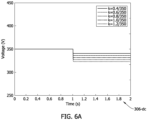
- a step response 306-dc ( FIG. 6A ) and impedance plots ( FIG. 6B ) of PV droop control loop 201 used in DC/DC boost converter 202-bs with fictious power in the PV relationship are provided.
- Step response 306-dc/dc and the impedance plot 504-dc/dc are similar to step response 306 shown in FIG. 3B and impedance plots 504 shown in FIG. 5 .
- the step response of PV droop control loop 201 is overdamped, and the PV droop control loop 201 is more stable than known PV droop controller 105.
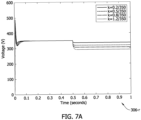
- a step response 306-r ( FIG. 7A ) and impedance plots ( FIG. 7B ) of PV droop loop 201 used in AC/DC converter 202-ac with real power in the PV relationship are provided.
- both known droop controller 105 and droop control loop 201 settle at a steady state DC voltage of 350 V after the initial start-up transient from zero voltage.
- a load step of 5 ohms is applied on the DC bus by closing a switch.
- PV droop control loop 201 is better at regulating DC bus voltage than known PV droop controller 105.
- FIG. 7B shows plots of impedance Z s ( s ) of the AC/DC converter 202-ac where the only difference between plots 502 and 504-r is the type of the PV droop controller being used.
- Plots 502 are the plots of magnitudes 502-m and phases 502-p of the impedance using known droop controller 105.
- Plots 504-r are the plots of magnitudes 504-r-m and phases 504-r-p of the impedance using droop control loop 201.
- Impedance plots 502, 504-r are aligned such that x- and y-axes of plots 502, 504-r are identical, facilitating a direct visual comparison between the two plots 502, 504-r.
- PV droop in PV droop control loop 201 has a lower quality factor than the PV droop in known PV droop controller 105.
- Horizontal lines Z l 1 and Z l 2 represent two different loads that are applied at the DC terminals of AC/DC converter 202-ac. Z l 1 > Z l 2 , where the load l 2 has a higher power consumption than the load 11.
- the power flow stability of the system may be determined by the Middlebrook criterion as expressed in Eqn. (20).
- is shown in plots 502-m and 504-r-m.
- is represented by two lines 506 in plots 502, 504-r.
- PV droop control loop 201 When PV droop control loop 201 is used,
- load line for Z l 2 intersects the magnitude impedance plot 502. The differences indicate PV droop controller 201 is more stable than known PV droop controller 105, especially for a relatively large loads on the DC bus such as load 12.
- PV droop control loop 201 may be implemented on a controller board using analog circuitry and operational amplifiers.
- the input voltage is scaled down using a resistor divider or a capacitive voltage divider to a desired low voltage suitable for use on controller boards.
- Eqn. (6) is implemented on the controller board using operational amplifiers by creating a subtractor circuit. Output of the subtractor is then given as a reference input to the DC microgrid converter's current control algorithm.
- PV droop control loop 201 may be implemented on a controller board inside a microcontroller or FPGA firmware.
- Input voltage is scaled down using a resistor divider or a capacitive voltage divider to a desired low voltage suitable for use on the controller board.
- the scaled down voltage is given to the analog to digital converter (ADC) connected to or being included in the microcontroller for use in the firmware as a variable.
- ADC analog to digital converter
- Eqn. (6) is implemented in the firmware numerically to calculate the converter inner loop current reference, which is then given to the DC microgrid converter's control algorithm.
- processor and “computer,” and related terms, e.g., "processing device,” “computing device,” and “controller” are not limited to just those integrated circuits referred to in the art as a computer, but broadly refers to a microcontroller, a microcomputer, an analog computer, a programmable logic controller (PLC), an application specific integrated circuit (ASIC), field programmable gate arrays (FPGA), and other programmable circuits, and these terms are used interchangeably herein.
- PLC programmable logic controller
- ASIC application specific integrated circuit
- FPGA field programmable gate arrays
- memory may include, but is not limited to, a computer-readable medium, such as a random-access memory (RAM), a computer-readable non-volatile medium, such as a flash memory.
- additional input channels may be, but are not limited to, computer peripherals associated with an operator interface such as a touchscreen, a mouse, and a keyboard.
- additional output channels may include, but not be limited to, an operator interface monitor or heads-up display.
- Such devices typically include a processor, processing device, or controller, such as a general purpose central processing unit (CPU), a graphics processing unit (GPU), a microcontroller, a reduced instruction set computer (RISC) processor, an ASIC, a programmable logic controller (PLC), a field programmable gate array (FPGA), a digital signal processing (DSP) device, and/or any other circuit or processing device capable of executing the functions described herein.
- the methods disclosed herein may be encoded as executable instructions embodied in a computer readable medium, including, without limitation, a storage device and/or a memory device. Such instructions, when executed by a processing device, cause the processing device to perform at least a portion of the methods disclosed herein.
- the above examples are not intended to limit in any way the definition and/or meaning of the term processor and processing device.
- the herein described DC microgrid may comprise a plurality of power converters.
- At least one technical effect of the systems and methods disclosed herein includes (a) a PV droop control without the extra measurement of the DC bus current of the microgrid; and (b) a PV droop control without an extra controller to generate a current reference in an inner current control loop of a converter.
- Example embodiments of systems and methods of PV droop control are described above in detail.
- the systems and methods are not limited to the specific embodiments described herein but, rather, components of the systems and/or operations of the methods may be utilized independently and separately from other components and/or operations described herein. Further, the described components and/or operations may also be defined in, or used in combination with, other systems, methods, and/or devices, and are not limited to practice with only the systems described herein.
Landscapes
- Engineering & Computer Science (AREA)
- Power Engineering (AREA)
- Dc-Dc Converters (AREA)
Abstract
Description
- The field of the disclosure relates generally to microgrids, and more particularly, to systems and methods of control for a direct current (DC) microgrid.
- A microgrid is a local electrical grid and may be operated in a grid-connected mode by being connected to the macrogrid and in an island mode by being disconnected from the macrogrid and functioning autonomously. In a DC microgrid, the bus current of the microgrid is DC. One method of controlling the output of a DC microgrid is power-voltage (PV) droop control, which regulates the output DC side power as a function of the DC bus voltage of the microgrid. Known systems and methods of PV droop control are disadvantaged in some aspects and improvements are desired.
- In one aspect, a direct current (DC) microgrid is provided. The microgrid includes a power converter, a power-voltage (PV) droop control loop electrically coupled with the power converter, and an inner current control loop of the power converter. The PV droop control loop is configured to receive measurements of a droop current quantity that is a current quantity other than a DC bus current of a DC microgrid. The droop current quantity is used to determine a droop power quantity selected as a power quantity in a PV relationship between the power quantity and a DC bus voltage of the DC microgrid in a PV droop control of the DC microgrid. The PV droop control loop is further configured to derive a current reference based on droop in the droop power quantity, the current reference corresponding to a control quantity of the inner current control loop of the power converter. The inner current control loop of the power converter is electrically coupled with the power converter and the PV droop control loop. The inner current control loop is configured to control operation of the power converter by deriving a measured current corresponding to the control quantity based on the measurements of the droop current quantity, directly comparing the current reference with the measured current, and generating switching signals of switches in the power converter based on the comparing.
- In another aspect, a method of PV droop control in a DC microgrid is provided. The method includes selecting a droop power quantity as a power quantity in a PV relationship between the power quantity and a DC bus voltage of a DC microgrid in a PV droop control of the DC microgrid. The droop power quantity is based on a droop current quantity that is a current quantity other than a DC bus current of the DC microgrid. The method also includes deriving a current reference based on droop in the droop power quantity, the current reference corresponding to a control quantity of an inner current control loop of a power converter. The method further includes deriving a measured current corresponding to the control quantity based on measurements of the droop current quantity. In addition, the method includes controlling operation of the power converter by in the inner current control loop, directly comparing the current reference with the measured current, and generating switching signals of switches in the power converter based on the comparing.
- These and other features, aspects, and advantages of the present disclosure will become better understood when the following detailed description is read with reference to the accompanying drawings in which like characters represent like parts throughout the drawings.
-
FIG. 1A shows a known power-voltage (PV) droop control mechanism. -
FIG. 1B shows the known PV droop control for an alternate current to direct current (AC/DC) converter. -
FIG. 1C shows a step response of the known PV droop control for the AC/DC converter shown inFIG. 1B . -
FIG. 1D shows the known PV droop control for a DC/DC boost converter. -
FIG. 2A is a schematic diagram of an example microgrid. -
FIG. 2B is a flow chart of a method of PV droop control. -
FIG. 3A is an example PV droop control for an AC/DC converter. -
FIG. 3B is a step response of the control for the AC/DC converter shown inFIG. 3A . -
FIG. 3C is an example PV droop control for a DC/DC boost converter. -
FIG. 3D is an example PV droop control for a DC/DC buck converter. -
FIG. 3E is another example PV droop control for an AC/DC converter. -
FIG. 4A shows an example microgrid including a plurality of converters. -
FIG. 4B shows another example microgrid including a plurality of converters. -
FIG. 5 is a comparison of impedance plots of the PV droop control shown inFIG. 3A with the known PV droop control shown inFIG. 1B . -
FIG. 6A is a step response of the PV droop control shown inFIG. 3C . -
FIG. 6B shows impedance plots of the PV droop control shown inFIG. 3C . -
FIG. 7A shows a step response of the PV droop control shown inFIG. 3E . -
FIG. 7B shows impedance plots of the PV droop control shown inFIG. 3E . - The disclosure includes power-voltage (PV) droop control for a direct current (DC) microgrid. Method aspects will be in part apparent and in part explicitly discussed in the following description.
-
FIGs. 1A-1D show known methods of droop control in a DC microgrid.FIG. 1A is a schematic diagram of a known power-voltage (PV) droop control mechanism. Droop control is used to control power flow between converters, loads, and power sources in a microgrid. Droop control regulates the power sourced and consumed by converters, loads, and power sources in the microgrid as a function of the DC bus voltage of the microgrid. As used herein, a DC bus voltage of a DC microgrid refers to the output voltage of the microgrid measured across the DC output bus of the microgrid. A DC bus current of a DC microgrid refers to the output current of the DC microgrid measured at the output bus of the microgrid. In a PV droop control, the droop in DC power output of power converters is proportional to the droop in voltage measured across the DC capacitance, and the output DC side power is regulated as a function of the DC bus voltage. The proportion in the PV relationship between the DC bus voltage and the DC side power is a droop gain k. In known PV droop control mechanisms (seeFIGs. 1B and1D ), DC side quantities are used as inputs and a DC current reference is generated. The known PV droop equation is given as Eqn. (1).
characteristic plot 102. v is the DC bus voltage of the microgrid. - The DC side current reference


droop control loop 103 is used to generate DC side current reference
- In the known PV droop control for an alternate current (AC) to direct current (DC) (AC/DC) converter or rectifier 104 (see
FIG. 1B ), the DC side current reference
extra control loop 106 such as a PI (proportional integral) controller to generate a d-axis current reference

- The three-phase AC electrical quantities ia, b, c and ea, b, c of current i and voltage e may be converted to representation in a rotating reference frame of d-q axes to derive a d-axis current id or a d-axis voltage vd . The d-q reference frame may be a synchronous reference frame with the d-axis of the frame aligned with the AC side voltage measured at the point of common coupling (PCC) of the AC/
DC converter 104 with the AC grid (not shown) from which AC/DC converter 104 receives AC power. The generated AC current reference in Eqn. (3) is an indication of the power flow from the AC side to the DC microgrid. The AC current reference is provided to the AC-side current controller or innercurrent control loop 108 to generate the switching signals of the AC/DC converter. - As shown in
FIG. 1B , knownPV droop controller 105 includesdroop control loop 103 and anextra control loop 106. Theextra control loop 106 is required to obtain the AC d-axis current reference

- The
additional control loop 106 also creates stability issues in droop control and the extra pole created bycontrol loop 106 leads to an underdamped step response.FIG. 1C is a plot of the step response, showing the impact of a load step response on the DC bus voltage at various values of droop gain k. The step response has an overshoot. The overshoot may be mitigated through a PI controller design for small loads. For medium to large loads, the transient voltage drop may be excessive, de-stabilizing the DC microgrid. -
FIG. 1D shows a known PV droop control for a DC to DC (DC/DC) boost converter 104-bs. In a boost converter, the output voltage is greater than the input voltage. In the known PV droop control for DC/DC boost converter 104-bs, the DC current reference
extra control loop 106 such as a PI controller to generate an input inductor current reference

- The error between the DC current reference

PI controller 106 to generate an input inductor current reference


current control loop 108 of DC/DC converter 104-bs to generate the switching signals of the switches in converter 104-bs. - As shown in
FIG. 1D , the known PV droop control requires anextra control loop 106 to obtain input inductor current reference iL from the DC current reference
DC converter 104, theextra control loop 106 may create stability issues in droop control and the extra pole created by the PI controller may lead to an underdamped step response. Further, theextra control loop 106 requires extra measurement of the DC side current idc , which is typically not required in the control of a DC/DC converter. - In contrast, the systems and methods disclosed herein address the problems described above in known droop control mechanisms. The extra control loop is eliminated, thereby increasing the speed of control and stability of the microgrid. An extra measurement of the DC side current idc is also eliminated, thereby reducing the complexity of the system and cost in hardware and software for the extra sensor of the DC side bus current idc .
-
FIG. 2A is a schematic diagram of an example DC microgrid 200 implementing PV droop control mechanisms disclosed herein. In the example embodiment,microgrid 200 includes apower converter 202.Power converter 202 is a DC converter, which converts an AC power or a DC power to a DC power.Power converter 202 may be an AC/DC converter (seeFIGs. 3A and3E described later), a DC/DC boost converter (seeFIG. 3C described later), and/or a DC/DC buck converter (seeFIG. 3D described later). In a buck converter, the output voltage is smaller than the input voltage.Microgrid 200 also includes an innercurrent control loop 204 electrically coupled withpower converter 202 and configured to control operation ofpower converter 202. As used herein, "electrically coupled" refers to two components being electrically connected directly or via electrical components between the two components, or receiving inputs from one of the two components to the other one of the two components directly or via components between the two components such as receiving digital inputs in firmware. Innercurrent control loop 204 is configured to generate switch signals of switches inpower converter 202 based on a control quantity such that the output power frompower converter 202 meets desired specification, such as desired output voltage. - In the example embodiment, DC microgrid 200 further includes a PV
droop control loop 201 electrically coupled withpower converter 202 and innercurrent control loop 204. PVdroop control loop 201 may also be referred to as a PV droop controller. PVdroop control loop 201 is configured to receive measurements of a droop current quantity that is a current quantity other than a DC bus current ofDC microgrid 200. The droop current quantity is used to determine a droop power quantity selected as the power quantity in a PV relationship between the power quantity and the DC bus voltage of DC microgrid 200 in a PV droop control ofDC microgrid 200. PVdroop control loop 201 is also configured to derive a current reference based on droop in the droop power quantity, where the current reference corresponds to the control quantity of innercurrent control loop 204. The control ininner control loop 204 is generated by a direct comparison between the current reference and the measured current corresponding to the control quantity. The measured current corresponding to the control quantity may be derived based on the measurements of the droop current quantity. -
FIG. 2B is a flow chart of an example method of PV droop control. In the example embodiment,method 250 includes selecting 252 a droop power quantity as the power quantity in the PV relationship between the power quantity and the DC bus voltage in the PV droop control of the DC microgrid. The droop power quantity is based on a droop current quantity that is a current quantity other than the DC bus current of the DC microgrid. The droop power quantity may be a fictitious power that is a product of multiplication of the droop current quantity and the DC bus voltage. In some embodiments, the droop power quantity is a real power that is the input power to the power converter. Because the droop current quantity for the droop power quantity is not the DC bus current, a sensor for the DC bus current is not needed in the PV droop control, thereby simplifying the configuration and reducing costs associated with the hardware and software for the sensor. Instead, the droop current quantity is the control quantity or the same type of quantity as the control quantity in the inner current control loop of the power converter. For example, for a AC/DC converter, the droop current quantity may be the input current of the converter, and the control quantity of the inner current control loop may be the d-axis input current of the power converter. For a DC/DC boost converter, both the droop current and the control quantity may be an input current of the power converter. For a DC/DC buck converter, the droop current quantity and the control quantity may both be the output current of the converter. Therefore, the sensor for the droop current quantity has already been included for the control of the power converter. - In the example embodiment,
method 250 also includes deriving 254 a current reference based on droop in the droop power quantity, where the current reference corresponds to a control quantity of an inner current control loop of the power converter. Therefore, the current reference may be directly provided to innercurrent control loop 204 for the control ofpower converter 202, thereby eliminatingextra control loop 106 in the known droop control. - In the example embodiment,
method 250 further includes deriving 256 a measured current corresponding to the control quantity based on measurements of the droop current quantity. Because the droop current quantity is the same quantity or the same type of quantity as the control quantity, the measured current corresponding to the control quantity is the measurements of the droop current quantity or a different representation of measurements of the droop current quantity, and may be directly derived from the measurements of the droop current quantity. For example, for a DC/DC boost converter or a DC/DC buck converter, the control quantity and the droop current quantity are the same quantity, and the measured current corresponding to the control quantity is the measurements of the droop current quantity. For a AC/DC converter, the control quantity is the d-axis input current of the power converter while the droop current quantity is the input current in three phases. The d-axis input current is a d-q frame representation of the input current. The d-axis input current may be derived by converting the measured three-phase AC input current into representation in a rotating d-q reference frame. - In the example embodiment, in addition,
method 250 includes controlling 258 operation of the power converter by, in the inner current control loop of the power converter, directly comparing the current reference with the measured current, and generating switching signals of switches in the power converter based on the comparing. - With the elimination of the extra sensor for the DC bus current and an extra control loop for generating a current reference for the control quantity in the inner current control loop, microgrids and methods disclosed herein are advantageous over known PV droop control in simplifying the hardware and software and increasing the stability of the microgrids and speed in the control of the power converters.
-
FIGs. 3A-3D show example PV droop control mechanisms using a fictitious power Pfic as the droop power quantity in the PV relationship. In the example embodiments, Pfic is the multiplication of the DC bus voltage with inductor current of the converter as in Eqn. (5) below.
- The converter inner current reference


- The current reference


FIG. 3A ). In a DC/DC boost converter, current reference

droop control loop 201 acts as a reference input to the d-axis current control of the AC/DC converter 202-ac (FIG. 3A ) or the input inductor control of DC/DC boost converter 202-bs (FIG. 3C ). - In the example embodiments, for AC/DC converter 202-ac, the PV droop regulates a fictitious or power-like quantity v × id against the droop in the DC bus voltage and droop gain k'. The droop gain k' is related to droop gain k in conventional PV droop control and the d-axis grid voltage Ed at no load condition as:

- Eqns. (8) and (9) below are derived by taking Eqn. (7) back into Eqn. (6).


- vd is the d-axis voltage at the input side of the converter. Because the converter loss is negligible at normal operating conditions, the difference ratio between the voltage droops in the PV droop Eqns. (1) and (9) is

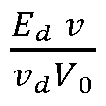


FIG. 3B than inFIG. 1C . - In the example embodiments, for a DC/DC boost converter (see
FIG. 3C ), PV droop control regulates a fictitious or power-like quantity v × iL against the droop in the DC bus voltage and the droop gain k'. The droop gain k' is related to the droop gain k of the conventional PV droop control and the input DC source voltage E at no load as:
- Equations (11) and (12) below are obtained by taking Eqn. (10) back into Eqn. (6).


- vin is the voltage at the input side of the
converter 202. Because the converter loss is negligible at normal operating conditions, the difference ratio between the voltage droops in PV droop Eqns. (1) and (12) is

- In some embodiments, droop gain k' is a variable that changes as a function of time. For example, k' = f(t). In other embodiments, droop gain k' is a variable that changes as a function of another variable. For example, k' = f(x), where x is another variable in the converter or in the DC microgrid.
-
FIG. 3D shows one more example PV droop control mechanism using a fictitious power for other types of converters such as DC/DC buck converters 202-bk. In the example embodiment, compared to the PV droop control shown inFIGs. 3A and3C , where the droop current quantity is the input current of converter 202-ac, 202-bs, the droop current quantity is the output current of converter 202-bk. Instead of the inductors being at the input of AC/DC converter 202-ac or DC/DC boost converter 202-bs, theinductor 304 is positioned at the output of DC/DC buck converter 202-bk. The inductor current reference is directly controlled by the output of PVdroop control loop 201. - The PV
droop control loop 201 using a fictitious power is advantageous over knownPV droop controller 105. PVdroop control loop 201 is less complex than the knownPV droop controller 105 because anextra control loop 106 and an extra DC current measurement are eliminated in PVdroop control loop 201. The elimination of the extra control loop also increases the control speed and stability by eliminating the control delay from theextra control loop 106. - Referring back to
FIG. 3B ,step response 306 of AC/DC converter 202-ac withdroop control loop 201 is shown. Plots inFIG. 3B may be directly compared with plots inFIG. 1C , which showsstep response 107 of AC/DC converter 104 with knowndroop controller 105, as the test conditions are made as identical as possible in generating the plots in the two figures. As shown inFIGs. 1C and3B , both knowndroop controller 105 and droopcontrol loop 201 settle at a steady state DC voltage of 350 V after the initial start-up transient from zero voltage. At 0.5 seconds, a load step of 5 ohms is applied on the DC bus by closing a switch. ComparingFIG. 3B withFIG. 1C , as discussed above, PVdroop control loop 201 is better at regulating DC bus voltage than knownPV droop controller 105. Further, the voltage drop is lower using PV droop control disclosed herein than using knownPV droop controller 105, when comparing the performance at equivalent droop gains as per Eqn. (4). With PVdroop control loop 201,step response 306 of PVdroop control loop 201 is overdamped (seeFIG. 3B ) as compared to the underdamped step response of known PV droop controller (seeFIG. 1C ). -
FIG. 3E shows one more example PV droop control mechanism. Compared to PVdroop control loop 201 shown inFIGs. 3A ,3C, and 3D , which uses fictious power in the PV relationship, PV droop control loop 201-r shown inFIG. 3E uses real power in the PV relationship. In the example embodiment, ignoring the converter loss, the DC side power may be represented by AC side power as follows.
- A PV droop control that directly generates the AC side d-axis current reference


real power 
- In the example embodiment, ignoring the loss between the AC grid and the converter, such as the line loss and converter filter loss, the AC side power may be expressed as below.

- The PV droop control may be used to derive the AC side d-axis current reference


- In the example embodiment, the output of the PV droop control acts as a reference input to the d-axis current control of AC/DC converter 202-ac.
FIG. 3E shows the block diagram of the PV droop control. The inner current control is kept the same as the conventional AD/DC rectifier and the droop control is changed with the grid side voltage Ed being introduced to produce current reference
- Compared to the known PV droop control shown in
FIGs. 1A, 1B , and1D , where the known PV droop control uses the DC side power to regulate the DC bus voltage, the PV droop control shown inFIG. 3E uses the AC side input power to regulate the DC bus voltage. The real power on the AC side is given as:
- When the synchronously rotating frame is aligned with vd, vq = 0 . The AC side real power equation of Eqn. (17) becomes as follows:

- The relationship between the AC-side real power and the DC output power may be written as below:

- Typically, the AC/DC converters operate at high efficiencies, such as 99% or higher. The losses in the AC filter may be minimized via design. Thus, Pac ≈ Pdc applies in an AC/DC converter system. The PV droop control using the AC side power, however, is advantageous over known PV droop control by eliminating an extra measurement of the DC bus current and an
extra control loop 106, thereby simplifying the hardware and software and increasing the speed of dynamic response and the stability of the AC/DC converter. - Compared to the PV droop controls shown in
FIGs. 3A ,3C, and 3D , which uses fictitious power in the PV relationship, the PV droop control shown inFIG. 3E uses real power in the PV relationship. When real power is used, the input current and input voltage of AC/DC converter are measured. The AC voltage is noisier than the DC voltage as measured in the schemes shown inFIGs. 3A ,3C, and 3D becausepower converter 202 may injects switching harmonics into the AC side voltage and the capacitance on the AC side is relatively small. When fictitious power is used, a DC voltage at the output side is measured instead, which has a much larger capacitance, such as one thousand times greater, than the capacitance on the AC side, and therefore is much less noisy than the AC voltage on the input side. Due to the noise, software and hardware for signal processing and filtering for the AC side voltage is needed if real power is used, increasing the complexity in the circuit design. -
FIGs. 4A and 4B show that the PV droop control mechanisms disclosed herein may be used on multiple converters in a DC microgrid.Converters 202 may be connected in a ring configuration 402 (FIG. 4A ). Alternatively or additionally,Converters 202 are connected in a distributed configuration 404 (FIG. 4B ). Eachconverter 202 is electrically connected to a source or a load. - The performance of
droop control loop 201 over knowndroop controller 105 for AC/DC converters is further analyzed by comparing impedance Bode plots.FIG. 5 shows plots of impedance Zs (s) of the AC/DC converter 202-ac where the only difference betweenplots Plots 502 are the plots of magnitudes 502-m and phases 502-p of the impedance using knowndroop controller 105.Plots 504 are the plots of magnitudes 504-m and phases 504-p of the impedance usingdroop control loop 201. Impedance plots 502, 504 are aligned such that x- and y-axes ofplots plots droop control loop 201 has a lower quality factor than the PV droop in knownPV droop controller 105. Horizontal lines Z l1 and Z l2 represent two different loads that are applied at the DC terminals of AC/DC converter 202-ac. Z l1 > Z l2, where the load l2 has a higher power consumption than the load l1. - The power flow stability of the system may be determined by the Middlebrook criterion, where

lines 506 in plots 502-m, 504-m. For system stability, when PVdroop control loop 201 is used, |Zs (s)| « |Zl (s)| for all frequencies. In contrast, when knownPV droop controller 105 is used, load line for Z l2 intersects themagnitude impedance plot 502. The differences indicate that PVdroop control loop 201 is more stable than knownPV droop controller 105, especially for a relatively large loads on the DC bus such as load 12. - A step response 306-dc (
FIG. 6A ) and impedance plots (FIG. 6B ) of PVdroop control loop 201 used in DC/DC boost converter 202-bs with fictious power in the PV relationship are provided. Step response 306-dc/dc and the impedance plot 504-dc/dc are similar tostep response 306 shown inFIG. 3B andimpedance plots 504 shown inFIG. 5 . The step response of PVdroop control loop 201 is overdamped, and the PVdroop control loop 201 is more stable than knownPV droop controller 105. - A step response 306-r (
FIG. 7A ) and impedance plots (FIG. 7B ) ofPV droop loop 201 used in AC/DC converter 202-ac with real power in the PV relationship are provided. As shown inFIGs. 1C and7A , both knowndroop controller 105 and droopcontrol loop 201 settle at a steady state DC voltage of 350 V after the initial start-up transient from zero voltage. At 0.5 seconds, a load step of 5 ohms is applied on the DC bus by closing a switch. ComparingFIG. 7A withFIG. 1C , PVdroop control loop 201 is better at regulating DC bus voltage than knownPV droop controller 105. - The performance of
droop control loop 201 using real power in the PV relationship over knowndroop controller 105 is further analyzed by comparing impedance Bode plots.FIG. 7B shows plots of impedance Zs (s) of the AC/DC converter 202-ac where the only difference betweenplots 502 and 504-r is the type of the PV droop controller being used.Plots 502 are the plots of magnitudes 502-m and phases 502-p of the impedance using knowndroop controller 105. Plots 504-r are the plots of magnitudes 504-r-m and phases 504-r-p of the impedance usingdroop control loop 201. Impedance plots 502, 504-r are aligned such that x- and y-axes ofplots 502, 504-r are identical, facilitating a direct visual comparison between the twoplots 502, 504-r. From the magnitude plots, PV droop in PVdroop control loop 201 has a lower quality factor than the PV droop in knownPV droop controller 105. Horizontal lines Z l1 and Z l2 represent two different loads that are applied at the DC terminals of AC/DC converter 202-ac. Z l1 > Z l2, where the load l2 has a higher power consumption than the load 11. - The power flow stability of the system may be determined by the Middlebrook criterion as expressed in Eqn. (20). The system impedance magnitude |Zs (s)| is shown in plots 502-m and 504-r-m. The load impedance magnitude |Zl (s)| is represented by two
lines 506 inplots 502, 504-r. When PVdroop control loop 201 is used, |Zs (s)| « |Zl (s)| for all frequencies. In contrast, when knownPV droop controller 105 is used, load line for Z l2 intersects themagnitude impedance plot 502. The differences indicatePV droop controller 201 is more stable than knownPV droop controller 105, especially for a relatively large loads on the DC bus such as load 12. - In some embodiments, PV
droop control loop 201 may be implemented on a controller board using analog circuitry and operational amplifiers. The input voltage is scaled down using a resistor divider or a capacitive voltage divider to a desired low voltage suitable for use on controller boards. Eqn. (6) is implemented on the controller board using operational amplifiers by creating a subtractor circuit. Output of the subtractor is then given as a reference input to the DC microgrid converter's current control algorithm. - In other embodiments, PV
droop control loop 201 may be implemented on a controller board inside a microcontroller or FPGA firmware. Input voltage is scaled down using a resistor divider or a capacitive voltage divider to a desired low voltage suitable for use on the controller board. The scaled down voltage is given to the analog to digital converter (ADC) connected to or being included in the microcontroller for use in the firmware as a variable. Eqn. (6) is implemented in the firmware numerically to calculate the converter inner loop current reference, which is then given to the DC microgrid converter's control algorithm. - As used herein, the terms "processor" and "computer," and related terms, e.g., "processing device," "computing device," and "controller" are not limited to just those integrated circuits referred to in the art as a computer, but broadly refers to a microcontroller, a microcomputer, an analog computer, a programmable logic controller (PLC), an application specific integrated circuit (ASIC), field programmable gate arrays (FPGA), and other programmable circuits, and these terms are used interchangeably herein. In the embodiments described herein, "memory" may include, but is not limited to, a computer-readable medium, such as a random-access memory (RAM), a computer-readable non-volatile medium, such as a flash memory. Alternatively, a floppy disk, a compact disc - read only memory (CD-ROM), a magneto-optical disk (MOD), and/or a digital versatile disc (DVD), and/or other optical media storage devices may also be used. Also, in the embodiments described herein, additional input channels may be, but are not limited to, computer peripherals associated with an operator interface such as a touchscreen, a mouse, and a keyboard. Alternatively, other computer peripherals may also be used that may include, for example, but not be limited to, a scanner. Furthermore, in the example embodiment, additional output channels may include, but not be limited to, an operator interface monitor or heads-up display. Some embodiments involve the use of one or more electronic or computing devices. Such devices typically include a processor, processing device, or controller, such as a general purpose central processing unit (CPU), a graphics processing unit (GPU), a microcontroller, a reduced instruction set computer (RISC) processor, an ASIC, a programmable logic controller (PLC), a field programmable gate array (FPGA), a digital signal processing (DSP) device, and/or any other circuit or processing device capable of executing the functions described herein. The methods disclosed herein may be encoded as executable instructions embodied in a computer readable medium, including, without limitation, a storage device and/or a memory device. Such instructions, when executed by a processing device, cause the processing device to perform at least a portion of the methods disclosed herein. The above examples are not intended to limit in any way the definition and/or meaning of the term processor and processing device. Furthermore, as mentioned herein, in some examples, the herein described DC microgrid may comprise a plurality of power converters.
- At least one technical effect of the systems and methods disclosed herein includes (a) a PV droop control without the extra measurement of the DC bus current of the microgrid; and (b) a PV droop control without an extra controller to generate a current reference in an inner current control loop of a converter.
- Example embodiments of systems and methods of PV droop control are described above in detail. The systems and methods are not limited to the specific embodiments described herein but, rather, components of the systems and/or operations of the methods may be utilized independently and separately from other components and/or operations described herein. Further, the described components and/or operations may also be defined in, or used in combination with, other systems, methods, and/or devices, and are not limited to practice with only the systems described herein.
- As used herein, an element or step recited in the singular and proceeded with the word "a" or "an" should be understood as not excluding plural elements or steps, unless such exclusion is explicitly recited. Furthermore, references to "example" or "one example" of the present disclosure are not intended to be interpreted as excluding the existence of additional examples that also incorporate the recited features. Further, to the extent that terms "includes," "including," "has," "contains," and variants thereof are used herein, such terms are intended to be inclusive in a manner similar to the term "comprises" as an open transition word without precluding any additional or other elements.
- Although specific features of various embodiments of the invention may be shown in some drawings and not in others, this is for convenience only. In accordance with the principles of the invention, any feature of a drawing may be referenced and/or claimed in combination with any feature of any other drawing.
- This written description uses examples to disclose the invention, including the best mode, and also to enable any person skilled in the art to practice the invention, including making and using any devices or systems and performing any incorporated methods. The patentable scope of the invention is defined by the claims, and may include other examples that occur to those skilled in the art. Such other examples are intended to be within the scope of the claims if they have structural elements that do not differ from the literal language of the claims, or if they include equivalent structural elements with insubstantial differences from the literal language of the claims.
Claims (15)
- A direct current (DC) microgrid (200) comprising:a power converter (202);a power-voltage (PV) droop control loop (201, 201-r) electrically coupled with the power converter, the PV droop control loop configured to:receive measurements of a droop current quantity that is a current quantity other than a DC bus current of a DC microgrid, wherein the droop current quantity is used to determine a droop power quantity selected as a power quantity in a PV relationship between the power quantity and a DC bus voltage of the DC microgrid in a PV droop control of the DC microgrid; andderive a current reference based on droop in the droop power quantity, the current reference corresponding to a control quantity of an inner current control loop (204) of the power converter;the inner current control loop of the power converter electrically coupled with the power converter and the PV droop control loop, the inner current control loop configured to control operation of the power converter by:deriving a measured current corresponding to the control quantity based on the measurements of the droop current quantity;directly comparing the current reference with the measured current; andgenerating switching signals of switches in the power converter based on the comparing.
- The DC microgrid of claim 1, wherein the droop power quantity is a fictitious power including a product of multiplication of the DC bus voltage and the droop current quantity.
- The DC microgrid of claim 2, wherein the droop current quantity is an input current of the power converter.
- The DC microgrid of claim 3, wherein the power converter is an alternate current (AC) to DC converter (202-ac) and/or a DC to DC boost converter (202-bs).
- The DC microgrid of any one of claims 2 to 4, wherein the power converter is a DC to DC buck converter (202-bk), and the droop current quantity is an output current of the power converter.
- The DC microgrid of any one of claims 2 to 5, wherein a droop gain of the PV droop control increases as a loading level of the DC microgrid increases; and/orwherein the droop gain of the PV droop control is a function of time; and/orwherein the droop gain of the PV droop control is a function of a variable in the power converter and/or in the DC microgrid.
- The DC microgrid of any one of claims 1 to 6, wherein the droop power quantity is an input power of the power converter.
- A method (250) of power-voltage (PV) droop control in a direct current (DC) microgrid (200), the method comprising:selecting (252) a droop power quantity as a power quantity in a PV relationship between the power quantity and a DC bus voltage of a DC microgrid (200) in a PV droop control of the DC microgrid, wherein the droop power quantity is based on a droop current quantity that is a current quantity other than a DC bus current of the DC microgrid;deriving (254) a current reference based on droop in the droop power quantity, the current reference corresponding to a control quantity of an inner current control loop (204) of a power converter (202);deriving (256) a measured current corresponding to the control quantity based on measurements of the droop current quantity; andcontrolling (258) operation of the power converter by:in the inner current control loop,directly comparing the current reference with the measured current; andgenerating switching signals of switches in the power converter based on the comparing.
- The method of claim 8, wherein selecting the droop power quantity further comprises selecting the droop power quantity as a fictitious power including a product of multiplication of the DC bus voltage and the droop current quantity.
- The method of claim 9, wherein the droop current quantity is an input current of the power converter.
- The method of claim 10, wherein the power converter is an alternate current (AC) to DC converter (202-ac) and/or a DC to DC boost converter (202-bs).
- The method of any one of claims 9 to 11, wherein the power converter is a DC to DC buck converter (202-bk), and the droop current quantity is an output current of the power converter.
- The method of any one of claims 9 to 12, further comprising selecting a droop gain of the PV droop control, wherein the droop gain increases as a loading level of the DC microgrid increases; and/orselecting the droop gain of the PV droop control as a function of time; and/orselecting a droop gain of the PV droop control as a function of a variable in the power converter and/or in the DC microgrid.
- The method of any one of claims 8 to 13, wherein the DC microgrid includes a plurality of power converters.
- The method of any one of claims 8 to 14, wherein selecting the droop power quantity further comprises selecting the droop power quantity as an input power of the power converter.
Applications Claiming Priority (1)
| Application Number | Priority Date | Filing Date | Title |
|---|---|---|---|
| US18/538,776 US20250202228A1 (en) | 2023-12-13 | 2023-12-13 | Systems and methods of power-voltage droop control for a direct current (dc) microgrid |
Publications (2)
| Publication Number | Publication Date |
|---|---|
| EP4572057A2 true EP4572057A2 (en) | 2025-06-18 |
| EP4572057A3 EP4572057A3 (en) | 2025-08-13 |
Family
ID=93923674
Family Applications (1)
| Application Number | Title | Priority Date | Filing Date |
|---|---|---|---|
| EP24219421.5A Pending EP4572057A3 (en) | 2023-12-13 | 2024-12-12 | Systems and methods of power-voltage droop control for a direct current (dc) microgrid |
Country Status (4)
| Country | Link |
|---|---|
| US (1) | US20250202228A1 (en) |
| EP (1) | EP4572057A3 (en) |
| KR (1) | KR20250091119A (en) |
| CN (1) | CN120150085A (en) |
Family Cites Families (5)
| Publication number | Priority date | Publication date | Assignee | Title |
|---|---|---|---|---|
| CN108512452B (en) * | 2018-03-15 | 2020-08-18 | 西安理工大学 | Control system and control method for current of direct-current micro-grid-connected converter |
| CN110649642B (en) * | 2019-09-29 | 2021-09-17 | 山东理工大学 | Voltage coordination control method for alternating current and direct current power distribution system and alternating current and direct current power distribution system |
| CN111327042B (en) * | 2020-03-27 | 2021-12-07 | 上海电力大学 | Direct-current micro-grid power and voltage adjusting method considering line impedance and local load |
| CN113708359B (en) * | 2020-05-21 | 2024-04-05 | 中车株洲电力机车研究所有限公司 | Bidirectional DCDC converter control method, system and related components |
| CN111864723B (en) * | 2020-07-21 | 2022-02-11 | 浙江大学 | A Novel DC Microgrid Group Topology and Its Distributed Power Cooperative Control Method |
-
2023
- 2023-12-13 US US18/538,776 patent/US20250202228A1/en active Pending
-
2024
- 2024-12-12 EP EP24219421.5A patent/EP4572057A3/en active Pending
- 2024-12-12 KR KR1020240184395A patent/KR20250091119A/en active Pending
- 2024-12-13 CN CN202411842629.0A patent/CN120150085A/en active Pending
Also Published As
| Publication number | Publication date |
|---|---|
| EP4572057A3 (en) | 2025-08-13 |
| KR20250091119A (en) | 2025-06-20 |
| US20250202228A1 (en) | 2025-06-19 |
| CN120150085A (en) | 2025-06-13 |
Similar Documents
| Publication | Publication Date | Title |
|---|---|---|
| US7684878B2 (en) | Programmable hardware element pre-regulator | |
| US8009450B2 (en) | Method and apparatus for phase current balance in active converter with unbalanced AC line voltage source | |
| He et al. | Hybrid voltage and current control approach for DG-grid interfacing converters with LCL filters | |
| US6472775B1 (en) | Method and system for eliminating certain harmonics in a distributed power system | |
| EP2634909A9 (en) | Method for controlling a grid-connected boost-buck full-bridge current-source inverter cascade for photovoltaic applications and device | |
| US11177660B2 (en) | System and method for power converter control for virtual impedance | |
| JP6059757B2 (en) | System voltage suppression control device and system voltage suppression control method | |
| JP2011142738A (en) | Power supply control system | |
| US20120112825A1 (en) | Modules for an active mains filter and active mains filter | |
| Bedetti et al. | Analytical design of flux-weakening voltage regulation loop in IPMSM drives | |
| CN106385197B (en) | A kind of independently operated output voltage control method of inverter and controller | |
| US7830683B2 (en) | Current control type converter | |
| KR20200001300A (en) | System for controlling grid-connected apparatus for distributed generation | |
| EP4572057A2 (en) | Systems and methods of power-voltage droop control for a direct current (dc) microgrid | |
| Zhuk et al. | Control of improved hybrid power line conditioner | |
| JP6219099B2 (en) | Power converter | |
| JP2014150681A (en) | Power converter and system interconnection system | |
| JP2010011613A (en) | Pwm converter device | |
| RU2381609C1 (en) | Method to control static stabilised dc voltage sources operating in parallel into common load | |
| Patel et al. | Improving performance of UPQC-DG for compensation of unbalanced loads | |
| EP4485788A1 (en) | Droop control method for parallel inverters | |
| Kong et al. | Enhanced three phase ac stationary frame PI current regulators | |
| Lim et al. | Indirect current control for seamless transfer of utility interactive inverter | |
| JP2006060961A (en) | Power converter | |
| Riaz | Comparison of converter control schemes for weak grids |
Legal Events
| Date | Code | Title | Description |
|---|---|---|---|
| PUAI | Public reference made under article 153(3) epc to a published international application that has entered the european phase |
Free format text: ORIGINAL CODE: 0009012 |
|
| STAA | Information on the status of an ep patent application or granted ep patent |
Free format text: STATUS: REQUEST FOR EXAMINATION WAS MADE |
|
| 17P | Request for examination filed |
Effective date: 20241212 |
|
| AK | Designated contracting states |
Kind code of ref document: A2 Designated state(s): AL AT BE BG CH CY CZ DE DK EE ES FI FR GB GR HR HU IE IS IT LI LT LU LV MC ME MK MT NL NO PL PT RO RS SE SI SK SM TR |
|
| PUAL | Search report despatched |
Free format text: ORIGINAL CODE: 0009013 |
|
| AK | Designated contracting states |
Kind code of ref document: A3 Designated state(s): AL AT BE BG CH CY CZ DE DK EE ES FI FR GB GR HR HU IE IS IT LI LT LU LV MC ME MK MT NL NO PL PT RO RS SE SI SK SM TR |
|
| RIC1 | Information provided on ipc code assigned before grant |
Ipc: H02J 1/10 20060101AFI20250709BHEP Ipc: H02M 3/156 20060101ALI20250709BHEP |