EP4571714A1 - Method and system for multi-stage testing (mst) calibration - Google Patents

Method and system for multi-stage testing (mst) calibration Download PDF

Info

Publication number
EP4571714A1
EP4571714A1 EP24216373.1A EP24216373A EP4571714A1 EP 4571714 A1 EP4571714 A1 EP 4571714A1 EP 24216373 A EP24216373 A EP 24216373A EP 4571714 A1 EP4571714 A1 EP 4571714A1
Authority
EP
European Patent Office
Prior art keywords
modules
difficulty level
average difficulty
mst
estimated
Prior art date
Legal status (The legal status is an assumption and is not a legal conclusion. Google has not performed a legal analysis and makes no representation as to the accuracy of the status listed.)
Pending
Application number
EP24216373.1A
Other languages
German (de)
French (fr)
Inventor
Gunter Maris
Timo Bechger
Gaurav Tandon
Viral Prakash Shah
Current Assignee (The listed assignees may be inaccurate. Google has not performed a legal analysis and makes no representation or warranty as to the accuracy of the list.)
Tata Consultancy Services Ltd
Original Assignee
Tata Consultancy Services Ltd
Priority date (The priority date is an assumption and is not a legal conclusion. Google has not performed a legal analysis and makes no representation as to the accuracy of the date listed.)
Filing date
Publication date
Application filed by Tata Consultancy Services Ltd filed Critical Tata Consultancy Services Ltd
Publication of EP4571714A1 publication Critical patent/EP4571714A1/en
Pending legal-status Critical Current

Links

Images

Classifications

    • GPHYSICS
    • G09EDUCATION; CRYPTOGRAPHY; DISPLAY; ADVERTISING; SEALS
    • G09BEDUCATIONAL OR DEMONSTRATION APPLIANCES; APPLIANCES FOR TEACHING, OR COMMUNICATING WITH, THE BLIND, DEAF OR MUTE; MODELS; PLANETARIA; GLOBES; MAPS; DIAGRAMS
    • G09B7/00Electrically-operated teaching apparatus or devices working with questions and answers
    • G09B7/06Electrically-operated teaching apparatus or devices working with questions and answers of the multiple-choice answer-type, i.e. where a given question is provided with a series of answers and a choice has to be made from the answers
    • G09B7/07Electrically-operated teaching apparatus or devices working with questions and answers of the multiple-choice answer-type, i.e. where a given question is provided with a series of answers and a choice has to be made from the answers providing for individual presentation of questions to a plurality of student stations
    • G09B7/077Electrically-operated teaching apparatus or devices working with questions and answers of the multiple-choice answer-type, i.e. where a given question is provided with a series of answers and a choice has to be made from the answers providing for individual presentation of questions to a plurality of student stations different stations being capable of presenting different questions simultaneously
    • GPHYSICS
    • G09EDUCATION; CRYPTOGRAPHY; DISPLAY; ADVERTISING; SEALS
    • G09BEDUCATIONAL OR DEMONSTRATION APPLIANCES; APPLIANCES FOR TEACHING, OR COMMUNICATING WITH, THE BLIND, DEAF OR MUTE; MODELS; PLANETARIA; GLOBES; MAPS; DIAGRAMS
    • G09B7/00Electrically-operated teaching apparatus or devices working with questions and answers
    • GPHYSICS
    • G09EDUCATION; CRYPTOGRAPHY; DISPLAY; ADVERTISING; SEALS
    • G09BEDUCATIONAL OR DEMONSTRATION APPLIANCES; APPLIANCES FOR TEACHING, OR COMMUNICATING WITH, THE BLIND, DEAF OR MUTE; MODELS; PLANETARIA; GLOBES; MAPS; DIAGRAMS
    • G09B7/00Electrically-operated teaching apparatus or devices working with questions and answers
    • G09B7/06Electrically-operated teaching apparatus or devices working with questions and answers of the multiple-choice answer-type, i.e. where a given question is provided with a series of answers and a choice has to be made from the answers
    • G09B7/08Electrically-operated teaching apparatus or devices working with questions and answers of the multiple-choice answer-type, i.e. where a given question is provided with a series of answers and a choice has to be made from the answers characterised by modifying the teaching program in response to a wrong answer, e.g. repeating the question or supplying further information

Definitions

  • the disclosure herein generally relates to multistage testing, and, more particularly, to method and system for multi-stage testing (MST) calibration.
  • MST multi-stage testing
  • Multi-Stage Testing is an adaptive testing approach used for assessment of examinees.
  • MST uses items selected in pre-assembled bunches, or modules, of varying difficulty.
  • MST has certain challenges/dis-advantages such as but not limited to it is necessary to know the difficulty of each item before testing, i.e., to have a calibrated item bank. This requires large-scale pre-testing under authentic testing conditions. From the different bunches or blocks of questions of varying difficulty levels, different blocks are picked and used to assess different candidates, wherein all users are given a common first block, and then based on accuracy of response of each user to the first block, subsequent blocks are selected and given to respective users. This means that the users who answered comparatively better to the first block of questions get comparatively more difficult set of questions in subsequent blocks.
  • This approach poses the challenge that different users/candidates end up getting assessed at different scales.
  • a processor implemented method includes obtaining a Multi-Stage Testing (MST) block as input, wherein the MST block comprises of a plurality of questions distributed across a plurality of modules. Further, the MST block is calibrated, wherein calibrating the MST block includes the following steps. Initially, an average difficulty level of each of the plurality of modules is estimating. Further, difference in the average difficulty level between each two modules from among the plurality of modules is estimated, wherein the estimated difference in the average difficulty level is identified as a shift factor. Further, the estimated average difficulty level of each of the plurality of modules is aligned to a common scale based on the shift factor.
  • MST Multi-Stage Testing
  • an extended Rasch model is used to estimate the average difficulty level of each of the plurality of modules and the difference in the average difficulty level between each two modules from among the plurality of modules.
  • the average difficulty level of each of the plurality of modules indicates a relative difficulty of a plurality of questions across the plurality of modules.
  • a system in yet another embodiment, includes one or more hardware processors, a communication interface, and a memory storing a plurality of instructions.
  • the plurality of instructions cause the one or more hardware processors to obtain a Multi-Stage Testing (MST) block as input, wherein the MST block comprises of a plurality of questions distributed across a plurality of modules.
  • the MST block is calibrated, wherein calibrating the MST block includes the following steps. Initially, an average difficulty level of each of the plurality of modules is estimating. Further, difference in the average difficulty level between each two modules from among the plurality of modules is estimated, wherein the estimated difference in the average difficulty level is identified as a shift factor. Further, the estimated average difficulty level of each of the plurality of modules is aligned to a common scale based on the shift factor.
  • the average difficulty level of each of the plurality of modules indicates a relative difficulty of a plurality of questions across the plurality of modules.
  • a non-transitory computer readable medium includes a plurality of instructions, which when executed, cause one or more hardware processors to obtain a Multi-Stage Testing (MST) block as input, wherein the MST block comprises of a plurality of questions distributed across a plurality of modules. Further, the MST block is calibrated, wherein calibrating the MST block includes the following steps. Initially, an average difficulty level of each of the plurality of modules is estimating. Further, difference in the average difficulty level between each two modules from among the plurality of modules is estimated, wherein the estimated difference in the average difficulty level is identified as a shift factor. Further, the estimated average difficulty level of each of the plurality of modules is aligned to a common scale based on the shift factor.
  • MST Multi-Stage Testing
  • non-transitory computer readable medium by aligning the estimated average difficulty level of each of the plurality of modules to the common scale, a plurality of users who took different combinations of the plurality of modules are assessed on the common scale.
  • an extended Rasch model is used to estimate the average difficulty level of each of the plurality of modules and the difference in the average difficulty level between each two modules from among the plurality of modules.
  • the average difficulty level of each of the plurality of modules indicates a relative difficulty of a plurality of questions across the plurality of modules.
  • a Multi-Stage Testing (MST) block is obtained as input, wherein the MST block comprises of a plurality of questions distributed across a plurality of modules. Further, the MST block is calibrated, wherein calibrating the MST block includes the following steps. Initially, an average difficulty level of each of the plurality of modules is estimating. Further, difference in the average difficulty level between each two modules from among the plurality of modules is estimated, wherein the estimated difference in the average difficulty level is identified as a shift factor. Further, the estimated average difficulty level of each of the plurality of modules is aligned to a common scale based on the shift factor.
  • MST Multi-Stage Testing
  • FIG. 1 illustrates an exemplary system for MST calibration, according to some embodiments of the present disclosure.
  • the system 100 includes or is otherwise in communication with hardware processors 102, at least one memory such as a memory 104, an I/O interface 112.
  • the hardware processors 102, memory 104, and the Input /Output (I/O) interface 112 may be coupled by a system bus such as a system bus 108 or a similar mechanism.
  • the hardware processors 102 can be one or more hardware processors.
  • the I/O interface 112 can facilitate multiple communications within a wide variety of networks and protocol types, including wired networks, for example, local area network (LAN), cable, etc., and wireless networks, such as Wireless LAN (WLAN), cellular, or satellite.
  • the I/O interface 112 may include one or more ports for connecting several computing systems with one another or to another server computer.
  • the I/O interface 112 may include one or more ports for connecting several devices to one another or to another server.
  • the one or more hardware processors 102 may be implemented as one or more microprocessors, microcomputers, microcontrollers, digital signal processors, central processing units, node machines, logic circuitries, and/or any devices that manipulate signals based on operational instructions.
  • the one or more hardware processors 102 is configured to fetch and execute computer-readable instructions stored in the memory 104.
  • the memory 104 may include any computer-readable medium known in the art including, for example, volatile memory, such as static random-access memory (SRAM) and dynamic random-access memory (DRAM), and/or non-volatile memory, such as read only memory (ROM), erasable programmable ROM, flash memories, hard disks, optical disks, and magnetic tapes.
  • volatile memory such as static random-access memory (SRAM) and dynamic random-access memory (DRAM)
  • non-volatile memory such as read only memory (ROM), erasable programmable ROM, flash memories, hard disks, optical disks, and magnetic tapes.
  • ROM read only memory
  • erasable programmable ROM erasable programmable ROM
  • flash memories hard disks
  • optical disks optical disks
  • magnetic tapes magnetic tapes
  • the plurality of modules 106 include programs or coded instructions that supplement applications or functions performed by the system 100 for executing different steps involved in the process of the MST calibration, being performed by the system 100.
  • the plurality of modules 106 can include routines, programs, objects, components, and data structures, which performs particular tasks or implement particular abstract data types.
  • the plurality of modules 106 may also be used as, signal processor(s), node machine(s), logic circuitries, and/or any other device or component that manipulates signals based on operational instructions.
  • the plurality of modules 106 can be used by hardware, by computer-readable instructions executed by the one or more hardware processors 102, or by a combination thereof.
  • the plurality of modules 106 can include various sub-modules (not shown).
  • the plurality of modules 106 may include computer-readable instructions that supplement applications or functions performed by the system 100 for the MST calibration.
  • the data repository (or repository) 110 may include a plurality of abstracted piece of code for refinement and data that is processed, received, or generated as a result of the execution of the plurality of modules in the module(s) 106.
  • the data repository 110 is shown internal to the system 100, it will be noted that, in alternate embodiments, the data repository 110 can also be implemented external to the system 100, where the data repository 110 may be stored within a database (repository 110) communicatively coupled to the system 100.
  • the data contained within such external database may be periodically updated. For example, new data may be added into the database (not shown in FIG. 1 ) and/or existing data may be modified and/or non-useful data may be deleted from the database.
  • the data may be stored in an external system, such as a Lightweight Directory Access Protocol (LDAP) directory and a Relational Database Management System (RDBMS). Functions of the components of the system 100 are now explained with reference to the steps in flow diagram in FIG. 2 .
  • LDAP Lightweight Directory Access Protocol
  • RDBMS Relational Database Management System
  • FIG. 2 is a flow diagram depicting steps involved in the process of MST calibration being performed by the system of FIG. 1 , according to some embodiments of the present disclosure.
  • the system 100 comprises one or more data storage devices or the memory 104 operatively coupled to the processor(s) 102 and is configured to store instructions for execution of steps of the method 200 by the processor(s) or one or more hardware processors 102.
  • the steps of the method 200 of the present disclosure will now be explained with reference to the components or blocks of the system 100 as depicted in FIG. 1 and the steps of flow diagram as depicted in FIG. 2 .
  • process steps, method steps, techniques or the like may be described in a sequential order, such processes, methods, and techniques may be configured to work in alternate orders. In other words, any sequence or order of steps that may be described does not necessarily indicate a requirement that the steps to be performed in that order.
  • the steps of processes described herein may be performed in any order practical. Further, some steps may be performed simultaneously.
  • the system 100 obtains a Multi-Stage Testing (MST) block as input, wherein the MST block comprises of a plurality of questions distributed across a plurality of modules.
  • MST Multi-Stage Testing
  • Each of the plurality of modules may have a unique set of questions, and hence difficulty level of the modules vary.
  • the system 100 calibrates the MST block.
  • the calibration of the MST block includes steps 204a through 204c.
  • the system 100 estimates an average difficulty level of each of the plurality of modules.
  • the average difficulty level of each of the plurality of modules indicates a relative difficulty of a plurality of questions across the plurality of modules.
  • the system 100 estimates difference in the average difficulty level between each two modules from among the plurality of modules.
  • the estimated difference in the average difficulty level is identified as a shift factor.
  • an extended Rasch model is used to estimate the average difficulty level of each of the plurality of modules and the difference in the average difficulty level between each two modules from among the plurality of modules.
  • index i is consistently used to refer to items and j to refer to categories.
  • a response in category j earns a respondent a ij points and the test score is the sum of the points earned on each of the items in the test.
  • Upper-case letters are used for random variables and lower-case letters are used for their realization. When there is no risk of confusion, lower case letters are used for both representations.
  • An examinee assessment project may include both linear and multi-stage tests.
  • the items are divided over the modules, which are mutually exclusive sets.
  • the modules are items that are always administered together.
  • a booklet is an ordered sequence of one or more modules where each module comes with a range of possible scores on this and previous modules.
  • a Nominal Response Model (NRM, Bock, 1972) was considered by the system 100 where the scoring parameters of the response categories are known integers.
  • the model is an extension of a one-parameter logistic model and encompasses the Rasch model and a partial credit model. It shares with these models that the test score is a sufficient statistic for student ability.
  • Module-wise calibration uses three properties of elementary symmetric functions.
  • the change-of-origin property describes the effect of a change in the origin of the item-category parameters. That is, if, for all i and j, ⁇ ij ⁇ ⁇ ij ⁇ ⁇ a ij ⁇ b ij ⁇ exp ⁇ a ij b ij ⁇ ⁇ s b ⁇ exp s ⁇ ⁇ s b .
  • a recurrence relation used in this approach provides a method to calculate the elementary symmetric functions of the modules, using a sum-algorithm by Andersen (1972) which was shown to be numerically stable by Verhelst, Glas, and van der Sluijs (1984).
  • the grouping property shows how the elementary symmetric functions of a booklet can be obtained from those of its modules. This proved to be essential in MST as it provides a way to calculate the elementary symmetric functions of a booklet while accounting for various routing rules, by respecting restrictions on the range of the module scores.
  • First factor in (6) is product of the conditional likelihoods of each of the modules and contains all information on the within-module relative difficulties of the items.
  • Second factor in (6) is the conditional distribution of the module scores and contains all information regarding the between-module difficulties. Module-wise calibration entails maximization of each factor separately.
  • the likelihood of the shift parameters is the distribution of module scores conditional on the total test scores.
  • the second-order derivatives evaluated at the final estimates, allow to obtain the standard errors of the estimates, through a standard statistical argument.
  • the standard error of a shift parameter is 1 over the square root of the second-order derivative.
  • the system 100 aligns the estimated average difficulty level of each of the plurality of modules to a common scale based on the shift factor. By aligning each of the plurality of modules to the common scale, a plurality of users who took different combinations of the plurality of modules are assessed on the common scale. Using a change-of-origin property, the system 100 obtains the item parameters across all modules on a common scale: for all items in module k the transformation ⁇ ij ⁇ ⁇ ij - ⁇ k a ij is used.
  • the embodiments of present disclosure herein address unresolved problem of MST calibration.
  • the embodiment thus provides a module-wise calibration approach for the MST calibration, in which value of a shift parameter is calculated.
  • the embodiments herein further provide a mechanism for aligning modules to a common scale, based on the estimated shift parameter.
  • Such computer-readable storage means contain program-code means for implementation of one or more steps of the method, when the program runs on a server or mobile device or any suitable programmable device.
  • the hardware device can be any kind of device which can be programmed including e.g., any kind of computer like a server or a personal computer, or the like, or any combination thereof.
  • the device may also include means which could be e.g., hardware means like e.g., an application-specific integrated circuit (ASIC), a field-programmable gate array (FPGA), or a combination of hardware and software means, e.g., an ASIC and an FPGA, or at least one microprocessor and at least one memory with software processing components located therein.
  • the means can include both hardware means and software means.
  • the method embodiments described herein could be implemented in hardware and software.
  • the device may also include software means. Alternatively, the embodiments may be implemented on different hardware devices, e.g., using a plurality of CPUs.
  • the embodiments herein can comprise hardware and software elements.
  • the embodiments that are implemented in software include but are not limited to, firmware, resident software, microcode, etc.
  • the functions performed by various components described herein may be implemented in other components or combinations of other components.
  • a computer-usable or computer readable medium can be any apparatus that can comprise, store, communicate, propagate, or transport the program for use by or in connection with the instruction execution system, apparatus, or device.
  • a computer-readable storage medium refers to any type of physical memory on which information or data readable by a processor may be stored.
  • a computer-readable storage medium may store instructions for execution by one or more processors, including instructions for causing the processor(s) to perform steps or stages consistent with the embodiments described herein.
  • the term "computer-readable medium” should be understood to include tangible items and exclude carrier waves and transient signals, i.e., be non-transitory. Examples include random access memory (RAM), read-only memory (ROM), volatile memory, nonvolatile memory, hard drives, CD ROMs, DVDs, flash drives, disks, and any other known physical storage media.

Landscapes

  • Engineering & Computer Science (AREA)
  • Theoretical Computer Science (AREA)
  • Business, Economics & Management (AREA)
  • Physics & Mathematics (AREA)
  • Educational Administration (AREA)
  • Educational Technology (AREA)
  • General Physics & Mathematics (AREA)
  • Management, Administration, Business Operations System, And Electronic Commerce (AREA)

Abstract

MST calibration is required to ensure that all examinees are assessed on a common scale. State of the art approaches have the disadvantages that they become computationally unstable and demanding or may have standard errors of estimated item parameters. Method and system in the embodiments disclosed herein provide a module-wise calibration approach in which a shift parameter value is estimated as difference in the average difficulty level between each two modules from among the plurality of modules. Further, based on the estimated value of the shift parameter, the estimated average difficulty level of each of the plurality of modules is aligned to a common scale. By aligning each of the plurality of modules to the common scale users who took different combinations of the plurality of modules are assessed on the common scale.

Description

    CROSS-REFERENCE TO RELATED APPLICATIONS AND PRIORITY
  • The present application claims priority to Indian application no. 202321085799, filed on December 15, 2023 .
  • TECHNICAL FIELD
  • The disclosure herein generally relates to multistage testing, and, more particularly, to method and system for multi-stage testing (MST) calibration.
  • BACKGROUND
  • Multi-Stage Testing (MST) is an adaptive testing approach used for assessment of examinees. MST uses items selected in pre-assembled bunches, or modules, of varying difficulty. However, MST has certain challenges/dis-advantages such as but not limited to it is necessary to know the difficulty of each item before testing, i.e., to have a calibrated item bank. This requires large-scale pre-testing under authentic testing conditions. From the different bunches or blocks of questions of varying difficulty levels, different blocks are picked and used to assess different candidates, wherein all users are given a common first block, and then based on accuracy of response of each user to the first block, subsequent blocks are selected and given to respective users. This means that the users who answered comparatively better to the first block of questions get comparatively more difficult set of questions in subsequent blocks. This approach poses the challenge that different users/candidates end up getting assessed at different scales.
  • In order to address this challenge, calibration is done during which different properties of the various questions given to the examinees are estimated, which in turn maybe considered while assessing performance of the examinees. An existing calibration approach is concurrent calibration, in which all the item parameters are estimated in one go. Difficulty of different blocks δ A, δ B and δ C are estimated subject to the constraint that their sum equals zero, aligning all item parameters are to a same scale and then the estimated ability parameters are compared across test forms. Disadvantage of this approach is that it becomes computationally unstable and demanding for large assessments. Alternative approaches in the literature, mean-mean linking and fixing item parameters, overcome these, but at the cost of significantly increasing the standard errors of estimated item parameters.
  • SUMMARY
  • Embodiments of the present disclosure present technological improvements as solutions to one or more of the above-mentioned technical problems recognized by the inventors in conventional systems. For example, in one embodiment, a processor implemented method is provided. The method includes obtaining a Multi-Stage Testing (MST) block as input, wherein the MST block comprises of a plurality of questions distributed across a plurality of modules. Further, the MST block is calibrated, wherein calibrating the MST block includes the following steps. Initially, an average difficulty level of each of the plurality of modules is estimating. Further, difference in the average difficulty level between each two modules from among the plurality of modules is estimated, wherein the estimated difference in the average difficulty level is identified as a shift factor. Further, the estimated average difficulty level of each of the plurality of modules is aligned to a common scale based on the shift factor.
  • In an embodiment of the method, by aligning the estimated average difficulty level of each of the plurality of modules to the common scale, a plurality of users who took different combinations of the plurality of modules are assessed on the common scale.
  • In another embodiment of the method, an extended Rasch model is used to estimate the average difficulty level of each of the plurality of modules and the difference in the average difficulty level between each two modules from among the plurality of modules.
  • In another embodiment of the method, the average difficulty level of each of the plurality of modules indicates a relative difficulty of a plurality of questions across the plurality of modules.
  • In yet another embodiment, a system is provided. The system includes one or more hardware processors, a communication interface, and a memory storing a plurality of instructions. The plurality of instructions cause the one or more hardware processors to obtain a Multi-Stage Testing (MST) block as input, wherein the MST block comprises of a plurality of questions distributed across a plurality of modules. Further, the MST block is calibrated, wherein calibrating the MST block includes the following steps. Initially, an average difficulty level of each of the plurality of modules is estimating. Further, difference in the average difficulty level between each two modules from among the plurality of modules is estimated, wherein the estimated difference in the average difficulty level is identified as a shift factor. Further, the estimated average difficulty level of each of the plurality of modules is aligned to a common scale based on the shift factor.
  • In yet an embodiment of the system, by aligning the estimated average difficulty level of each of the plurality of modules to the common scale, a plurality of users who took different combinations of the plurality of modules are assessed on the common scale.
  • In yet another embodiment of the system, an extended Rasch model is used to estimate the average difficulty level of each of the plurality of modules and the difference in the average difficulty level between each two modules from among the plurality of modules.
  • In yet another embodiment of the system, the average difficulty level of each of the plurality of modules indicates a relative difficulty of a plurality of questions across the plurality of modules.
  • In yet another aspect, a non-transitory computer readable medium is provided. The non-transitory computer readable medium includes a plurality of instructions, which when executed, cause one or more hardware processors to obtain a Multi-Stage Testing (MST) block as input, wherein the MST block comprises of a plurality of questions distributed across a plurality of modules. Further, the MST block is calibrated, wherein calibrating the MST block includes the following steps. Initially, an average difficulty level of each of the plurality of modules is estimating. Further, difference in the average difficulty level between each two modules from among the plurality of modules is estimated, wherein the estimated difference in the average difficulty level is identified as a shift factor. Further, the estimated average difficulty level of each of the plurality of modules is aligned to a common scale based on the shift factor.
  • In an embodiment of the non-transitory computer readable medium, by aligning the estimated average difficulty level of each of the plurality of modules to the common scale, a plurality of users who took different combinations of the plurality of modules are assessed on the common scale.
  • In another embodiment of the non-transitory computer readable medium, an extended Rasch model is used to estimate the average difficulty level of each of the plurality of modules and the difference in the average difficulty level between each two modules from among the plurality of modules.
  • In another embodiment of the non-transitory computer readable medium, the average difficulty level of each of the plurality of modules indicates a relative difficulty of a plurality of questions across the plurality of modules.
  • It is to be understood that both the foregoing general description and the following detailed description are exemplary and explanatory only and are not restrictive of the invention, as claimed.
  • BRIEF DESCRIPTION OF THE DRAWINGS
  • The accompanying drawings, which are incorporated in and constitute a part of this disclosure, illustrate exemplary embodiments and, together with the description, serve to explain the disclosed principles:
    • FIG. 1 illustrates an exemplary system for MST calibration, according to some embodiments of the present disclosure.
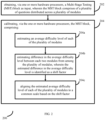
    • FIG. 2 is a flow diagram depicting steps involved in the process of MST calibration being performed by the system of FIG. 1, according to some embodiments of the present disclosure.
    DETAILED DESCRIPTION OF EMBODIMENTS
  • Exemplary embodiments are described with reference to the accompanying drawings. In the figures, the left-most digit(s) of a reference number identifies the figure in which the reference number first appears. Wherever convenient, the same reference numbers are used throughout the drawings to refer to the same or like parts. While examples and features of disclosed principles are described herein, modifications, adaptations, and other implementations are possible without departing from the scope of the disclosed embodiments.
  • In order to address the problem of different examinees getting assessed based on answers given to different set of questions in MST, calibration is done during which different properties of the various questions given to the examinees are estimated, which in turn maybe considered while assessing performance of the examinees. An existing calibration approach is concurrent calibration, in which all the item parameters are estimated in one go. Difficulty of different blocks δ A , δ B and δ C are estimated subject to the constraint that their sum equals zero, aligning all item parameters are to a same scale and then the estimated ability parameters are compared across test forms. Disadvantage of this approach is that it becomes computationally unstable and demanding for large assessments. Alternative approaches in the literature, mean-mean linking and fixing item parameters, overcome these, but at the cost of significantly increasing the standard errors of estimated item parameters.
  • In order to address these challenges, method and system disclosed herein use a calibration approach in which initially a Multi-Stage Testing (MST) block is obtained as input, wherein the MST block comprises of a plurality of questions distributed across a plurality of modules. Further, the MST block is calibrated, wherein calibrating the MST block includes the following steps. Initially, an average difficulty level of each of the plurality of modules is estimating. Further, difference in the average difficulty level between each two modules from among the plurality of modules is estimated, wherein the estimated difference in the average difficulty level is identified as a shift factor. Further, the estimated average difficulty level of each of the plurality of modules is aligned to a common scale based on the shift factor. By aligning each of the plurality of modules to the common scale, a plurality of users who took different combinations of the plurality of modules are assessed on the common scale. This approach of splitting the calibration in two stages has been found to be striking a balance between scalability and precision.
  • Referring now to the drawings, and more particularly to FIG. 1 through FIG. 2, where similar reference characters denote corresponding features consistently throughout the figures, there are shown preferred embodiments and these embodiments are described in the context of the following exemplary system and/or method.
  • FIG. 1 illustrates an exemplary system for MST calibration, according to some embodiments of the present disclosure. The system 100 includes or is otherwise in communication with hardware processors 102, at least one memory such as a memory 104, an I/O interface 112. The hardware processors 102, memory 104, and the Input /Output (I/O) interface 112 may be coupled by a system bus such as a system bus 108 or a similar mechanism. In an embodiment, the hardware processors 102 can be one or more hardware processors.
  • The I/O interface 112 may include a variety of software and hardware interfaces, for example, a web interface, a graphical user interface, and the like. The I/O interface 112 may include a variety of software and hardware interfaces, for example, interfaces for peripheral device(s), such as a keyboard, a mouse, an external memory, a printer and the like. Further, the I/O interface 112 may enable the system 100 to communicate with other devices, such as web servers, and external databases.
  • The I/O interface 112 can facilitate multiple communications within a wide variety of networks and protocol types, including wired networks, for example, local area network (LAN), cable, etc., and wireless networks, such as Wireless LAN (WLAN), cellular, or satellite. For the purpose, the I/O interface 112 may include one or more ports for connecting several computing systems with one another or to another server computer. The I/O interface 112 may include one or more ports for connecting several devices to one another or to another server.
  • The one or more hardware processors 102 may be implemented as one or more microprocessors, microcomputers, microcontrollers, digital signal processors, central processing units, node machines, logic circuitries, and/or any devices that manipulate signals based on operational instructions. Among other capabilities, the one or more hardware processors 102 is configured to fetch and execute computer-readable instructions stored in the memory 104.
  • The memory 104 may include any computer-readable medium known in the art including, for example, volatile memory, such as static random-access memory (SRAM) and dynamic random-access memory (DRAM), and/or non-volatile memory, such as read only memory (ROM), erasable programmable ROM, flash memories, hard disks, optical disks, and magnetic tapes. In an embodiment, the memory 104 includes a plurality of modules 106.
  • The plurality of modules 106 include programs or coded instructions that supplement applications or functions performed by the system 100 for executing different steps involved in the process of the MST calibration, being performed by the system 100. The plurality of modules 106, amongst other things, can include routines, programs, objects, components, and data structures, which performs particular tasks or implement particular abstract data types. The plurality of modules 106 may also be used as, signal processor(s), node machine(s), logic circuitries, and/or any other device or component that manipulates signals based on operational instructions. Further, the plurality of modules 106 can be used by hardware, by computer-readable instructions executed by the one or more hardware processors 102, or by a combination thereof. The plurality of modules 106 can include various sub-modules (not shown). The plurality of modules 106 may include computer-readable instructions that supplement applications or functions performed by the system 100 for the MST calibration.
  • The data repository (or repository) 110 may include a plurality of abstracted piece of code for refinement and data that is processed, received, or generated as a result of the execution of the plurality of modules in the module(s) 106.
  • Although the data repository 110 is shown internal to the system 100, it will be noted that, in alternate embodiments, the data repository 110 can also be implemented external to the system 100, where the data repository 110 may be stored within a database (repository 110) communicatively coupled to the system 100. The data contained within such external database may be periodically updated. For example, new data may be added into the database (not shown in FIG. 1) and/or existing data may be modified and/or non-useful data may be deleted from the database. In one example, the data may be stored in an external system, such as a Lightweight Directory Access Protocol (LDAP) directory and a Relational Database Management System (RDBMS). Functions of the components of the system 100 are now explained with reference to the steps in flow diagram in FIG. 2.
  • FIG. 2 is a flow diagram depicting steps involved in the process of MST calibration being performed by the system of FIG. 1, according to some embodiments of the present disclosure.
  • In an embodiment, the system 100 comprises one or more data storage devices or the memory 104 operatively coupled to the processor(s) 102 and is configured to store instructions for execution of steps of the method 200 by the processor(s) or one or more hardware processors 102. The steps of the method 200 of the present disclosure will now be explained with reference to the components or blocks of the system 100 as depicted in FIG. 1 and the steps of flow diagram as depicted in FIG. 2. Although process steps, method steps, techniques or the like may be described in a sequential order, such processes, methods, and techniques may be configured to work in alternate orders. In other words, any sequence or order of steps that may be described does not necessarily indicate a requirement that the steps to be performed in that order. The steps of processes described herein may be performed in any order practical. Further, some steps may be performed simultaneously.
  • At step 202 of method 200 in FIG. 2, the system 100 obtains a Multi-Stage Testing (MST) block as input, wherein the MST block comprises of a plurality of questions distributed across a plurality of modules. Each of the plurality of modules may have a unique set of questions, and hence difficulty level of the modules vary.
  • Further, at step 204 of the method 200, the system 100 calibrates the MST block. The calibration of the MST block includes steps 204a through 204c. At step 204a of the method 200, the system 100 estimates an average difficulty level of each of the plurality of modules. The average difficulty level of each of the plurality of modules indicates a relative difficulty of a plurality of questions across the plurality of modules.
  • Further, at step 206 of the method 200, the system 100 estimates difference in the average difficulty level between each two modules from among the plurality of modules. The estimated difference in the average difficulty level is identified as a shift factor.
  • In another embodiment of the method, an extended Rasch model is used to estimate the average difficulty level of each of the plurality of modules and the difference in the average difficulty level between each two modules from among the plurality of modules.
  • The extended Rasch model based estimation of average difficulty level between each two modules and for each of the plurality modules are described below:
  • a. Notations used
  • Let any response to item i (i.e., question) be scored into one of mi ≥ 1 categories indexed j = 0, ..., m i . Note that index i is consistently used to refer to items and j to refer to categories. A response in category j earns a respondent aij points and the test score is the sum of the points earned on each of the items in the test.
  • Each item response is associated with a discrete random variable, Xi where Xi = j denotes the event that a person's response was in category j. Upper-case letters are used for random variables and lower-case letters are used for their realization. When there is no risk of confusion, lower case letters are used for both representations.
  • yij is defined as a dummy-coded response to item i; that is, yij = 1 if a response in category j ∈ {0, ..., mi } is given to item i, and zero otherwise. Using the dummy-coded responses, the test score can then be written as: y + + = i j y ij a ij .
    Figure imgb0001
  • Note that the second sum runs over all categories of item i.
  • b. Test Design
  • An examinee assessment project may include both linear and multi-stage tests. The items are divided over the modules, which are mutually exclusive sets. The modules are items that are always administered together. A booklet is an ordered sequence of one or more modules where each module comes with a range of possible scores on this and previous modules.
  • Some notation is needed around the design of the test. We let
    Figure imgb0002
    refer to the k-th booklet, and
    Figure imgb0003
    to the h-th module. To avoid excessive notation, these symbols are used in different ways.
    • h
      Figure imgb0004
      is written when module h is in booklet k.
    • ρ ∈
      Figure imgb0005
      is written for persons p that have answered to the items in module h.
    c. Measurement Model
  • A Nominal Response Model (NRM, Bock, 1972) was considered by the system 100 where the scoring parameters of the response categories are known integers. The model is an extension of a one-parameter logistic model and encompasses the Rasch model and a partial credit model. It shares with these models that the test score is a sufficient statistic for student ability.
    Suppressing a person index, the manifest probabilities for a marginal NRM are: p y b ,a = 0 i j b ij t a ij y ij 1 + j b ij t a ij f t dt ,
    Figure imgb0006
    where t > 0 denotes student ability with density f, bij = exp(ij ) with δij the parameter of category j of item i, and aij the corresponding score.
  • Following the derivation of the extended Rasch model in Maris, Bechger and San-Martin (2015), the manifest probabilities are rewritten as: p y b λ a = i j b ij y ij γ y + + b γ y + + b λ y + + s γ s b λ s
    Figure imgb0007
  • These correspond to a marginal NRM if, and only if, the λs are moments of the ability distribution for a score of zero on all items. This is not required, and instead, an extended NRM is considered because no assumptions on the ability distribution are implied. First term in (2) is the conditional likelihood, p(y|y++, b, a), and CML estimates of the item-category parameters are equivalent to their maximum likelihood estimates under the extended model.
  • Elementary symmetric functions γs play an important role in subsequent steps, and are represented as: γ s b = y : y + + = s i j b ij y ij
    Figure imgb0008
    where the sum is overall response patterns leading to a test score s. γs (b) is defined to be zero for test scores that cannot occur, i.e., s<0 or s> M = Σi aimi .
  • J. Properties of elementary symmetric functions
  • The calibration approach used by the system 100, termed as Module-wise calibration, uses three properties of elementary symmetric functions.
    • Change-of-origin property. Let c denote a positive real constant. Suppose each entry bij of b is multiplied by caij - This is written as c a b. Then, γs (ca b) = csγs (b).
    • Recurrence relation. Let γ s k b
      Figure imgb0009
      denotes the ESF with the parameters of the first k items -with the order of the items arbitrary. The elementary symmetric functions with k and k-1 items, k = 2, ..., m, satisfy the following relation: γ s k b = γ s k 1 b + j = 1 m i γ s a kj k 1 b b kj ,
      Figure imgb0010
      where γ 0 1 b = 1
      Figure imgb0011
      and γ a 1 j 1 b = b ij , j = 0 , , m i
      Figure imgb0012
      .
      • Grouping Property. The elementary symmetric functions of a booklet are obtained from those calculated on each of the modules as: γ s b = h B s h = s h B γ s h b M h ,
        Figure imgb0013
        where the sum is over all combinations of the module scores leading to a booklet score s.
  • The change-of-origin property describes the effect of a change in the origin of the item-category parameters. That is, if, for all i and j, δ ij δ ij η a ij b ij exp η a ij b ij γ s b exp s η γ s b .
    Figure imgb0014
  • In the module-wise calibration, the values η needed to "shift" the parameters of each module onto a common scale is estimated.
  • A recurrence relation used in this approach provides a method to calculate the elementary symmetric functions of the modules, using a sum-algorithm by Andersen (1972) which was shown to be numerically stable by Verhelst, Glas, and van der Sluijs (1984).
  • The grouping property shows how the elementary symmetric functions of a booklet can be obtained from those of its modules. This proved to be essential in MST as it provides a way to calculate the elementary symmetric functions of a booklet while accounting for various routing rules, by respecting restrictions on the range of the module scores.
  • Then the module-wise calibration is performed as below:
    Conditional likelihood of a person taking a booklet B is written as: p x x + B = j B p x M j x + M j p x + B x + B
    Figure imgb0015
    where x + B = j B x + j
    Figure imgb0016
    , the sum of the module scores, and x + B = x + j
    Figure imgb0017
    , j
    Figure imgb0018
    is the vector of scores on each of the modules in booklet B.
  • First factor in (6) is product of the conditional likelihoods of each of the modules and contains all information on the within-module relative difficulties of the items. Second factor in (6) is the conditional distribution of the module scores and contains all information regarding the between-module difficulties.
    Module-wise calibration entails maximization of each factor separately.
    1. 1. Regular Conditional Maximum Likelihood (CML) is used to estimate the item parameters, b[j] , of each module in separate calibrations.
    2. 2. CML estimates of the shift parameters, η j , that bring the module parameters on a common scale, are determined keeping the relative within module difficulties at their estimated values.
  • The likelihood of the shift parameters is the distribution of module scores conditional on the total test scores. For an examinee making booklet B this is: p x + B x + B = j B γ x + j b j exp x + j η j s : h B s h = x + j B γ s j b j exp x + j η j
    Figure imgb0019
    (7) is a member of the exponential family of distributions, and follows that ML estimation entails finding the value of ηj such that its sufficient statistics Sj equals the conditional expectation under the model. That is, the estimation equations take the form: Find η j such that S j = E S j x +
    Figure imgb0020
    From the CML: S j = p M j x p + M j
    Figure imgb0021
    Which is the sum of module scores over all persons taking the module. This is rewritten as a sum across booklets, then any booklet that contains module j contributes: k n k s : h B s h = k S j n s n k
    Figure imgb0022
    where n k is the number of examinees with booklet score k, and ns the number of people with a combination of module scores s .
  • The estimation equations are then solved numerically. To this effect, first and second-order derivatives of the conditional log-likelihood are used.
    • The first-order derivatives are the conditional expectations of the sufficient statistics. The conditional expectations replacing the observed proportions ns /nk are found by the corresponding conditional probabilities under the model. Thus, it follows that any booklet that contains module j contributes a factor, k n k s : h B s h = k s j p X + B = s X + B = k
      Figure imgb0023
      to the first-order derivative with respect to ηj.
    • The second-order derivatives are the conditional covariances of the sufficient statistics. Any booklet that contains modules j and i contributes: k n k s : h B s h = k s j s i p X + B = s X + B = k
      Figure imgb0024
      to the second-order derivatives with respect to ηj and ηi .
  • The second-order derivatives, evaluated at the final estimates, allow to obtain the standard errors of the estimates, through a standard statistical argument. Specifically, the standard error of a shift parameter is 1 over the square root of the second-order derivative.
  • Further, at step 208 of the method 200, the system 100 aligns the estimated average difficulty level of each of the plurality of modules to a common scale based on the shift factor. By aligning each of the plurality of modules to the common scale, a plurality of users who took different combinations of the plurality of modules are assessed on the common scale. Using a change-of-origin property, the system 100 obtains the item parameters across all modules on a common scale: for all items in module k the transformation δij → δij - η ka ij is used.
  • The written description describes the subj ect matter herein to enable any person skilled in the art to make and use the embodiments. The scope of the subject matter embodiments is defined by the claims and may include other modifications that occur to those skilled in the art. Such other modifications are intended to be within the scope of the claims if they have similar elements that do not differ from the literal language of the claims or if they include equivalent elements with insubstantial differences from the literal language of the claims.
  • The embodiments of present disclosure herein address unresolved problem of MST calibration. The embodiment, thus provides a module-wise calibration approach for the MST calibration, in which value of a shift parameter is calculated. Moreover, the embodiments herein further provide a mechanism for aligning modules to a common scale, based on the estimated shift parameter.
  • It is to be understood that the scope of the protection is extended to such a program and in addition to a computer-readable means having a message therein; such computer-readable storage means contain program-code means for implementation of one or more steps of the method, when the program runs on a server or mobile device or any suitable programmable device. The hardware device can be any kind of device which can be programmed including e.g., any kind of computer like a server or a personal computer, or the like, or any combination thereof. The device may also include means which could be e.g., hardware means like e.g., an application-specific integrated circuit (ASIC), a field-programmable gate array (FPGA), or a combination of hardware and software means, e.g., an ASIC and an FPGA, or at least one microprocessor and at least one memory with software processing components located therein. Thus, the means can include both hardware means and software means. The method embodiments described herein could be implemented in hardware and software. The device may also include software means. Alternatively, the embodiments may be implemented on different hardware devices, e.g., using a plurality of CPUs.
  • The embodiments herein can comprise hardware and software elements. The embodiments that are implemented in software include but are not limited to, firmware, resident software, microcode, etc. The functions performed by various components described herein may be implemented in other components or combinations of other components. For the purposes of this description, a computer-usable or computer readable medium can be any apparatus that can comprise, store, communicate, propagate, or transport the program for use by or in connection with the instruction execution system, apparatus, or device.
  • The illustrated steps are set out to explain the exemplary embodiments shown, and it should be anticipated that ongoing technological development will change the manner in which particular functions are performed. These examples are presented herein for purposes of illustration, and not limitation. Further, the boundaries of the functional building blocks have been arbitrarily defined herein for the convenience of the description. Alternative boundaries can be defined so long as the specified functions and relationships thereof are appropriately performed. Alternatives (including equivalents, extensions, variations, deviations, etc., of those described herein) will be apparent to persons skilled in the relevant art(s) based on the teachings contained herein. Such alternatives fall within the scope of the disclosed embodiments. Also, the words "comprising," "having," "containing," and "including," and other similar forms are intended to be equivalent in meaning and be open ended in that an item or items following any one of these words is not meant to be an exhaustive listing of such item or items, or meant to be limited to only the listed item or items. It must also be noted that as used herein and in the appended claims, the singular forms "a," "an," and "the" include plural references unless the context clearly dictates otherwise.
  • Furthermore, one or more computer-readable storage media may be utilized in implementing embodiments consistent with the present disclosure. A computer-readable storage medium refers to any type of physical memory on which information or data readable by a processor may be stored. Thus, a computer-readable storage medium may store instructions for execution by one or more processors, including instructions for causing the processor(s) to perform steps or stages consistent with the embodiments described herein. The term "computer-readable medium" should be understood to include tangible items and exclude carrier waves and transient signals, i.e., be non-transitory. Examples include random access memory (RAM), read-only memory (ROM), volatile memory, nonvolatile memory, hard drives, CD ROMs, DVDs, flash drives, disks, and any other known physical storage media.
  • It is intended that the disclosure and examples be considered as exemplary only, with a true scope of disclosed embodiments being indicated by the following claims.

Claims (12)

  1. A processor implemented method (200), comprising:
    obtaining (202), via one or more hardware processors, a Multi-Stage Testing (MST) block as input, wherein the MST block comprises of a plurality of questions distributed across a plurality of modules; and
    calibrating (204), via the one or more hardware processors, the MST block, comprising:
    estimating (204a) an average difficulty level of each of the plurality of modules;
    estimating (204b) difference in the average difficulty level between each two modules from among the plurality of modules, wherein the estimated difference in the average difficulty level is identified as a shift factor; and
    aligning (204c) the estimated average difficulty level of each of the plurality of modules to a common scale based on the shift factor.
  2. The processor implemented method as claimed in claim 1, wherein by aligning the estimated average difficulty level of each of the plurality of modules to the common scale, a plurality of users who took different combinations of the plurality of modules are assessed on the common scale.
  3. The processor implemented method as claimed in claim 1, wherein an extended Rasch model is used to estimate the average difficulty level of each of the plurality of modules and the difference in the average difficulty level between each two blocks from among the plurality of blocks.
  4. The processor implemented method as claimed in claim 1, wherein the average difficulty level of each of the plurality of modules indicates a relative difficulty of a plurality of questions across the plurality of modules.
  5. A system (100), comprising:
    one or more hardware processors (102);
    a communication interface (112); and
    a memory (104) storing a plurality of instructions, wherein the plurality of instructions cause the one or more hardware processors to:
    obtain a Multi-Stage Testing (MST) block as input, wherein the MST block comprises of a plurality of questions distributed across a plurality of modules; and
    calibrate the MST block, by:
    estimating an average difficulty level of each of the plurality of modules;
    estimating difference in the average difficulty level between each two modules from among the plurality of modules, wherein the estimated difference in the average difficulty level is identified as a shift factor; and
    aligning the estimated average difficulty level of each of the plurality of modules to a common scale based on the shift factor.
  6. The system as claimed in claim 5, wherein by aligning the estimated average difficulty level of each of the plurality of modules to the common scale, the one or more hardware processors are configured to assess a plurality of users who took different combinations of the plurality of modules on the common scale.
  7. The system as claimed in claim 5, wherein the one or more hardware processors are configured to estimate the average difficulty level of each of the plurality of modules and the difference in the average difficulty level between each two blocks from among the plurality of blocks, using an extended Rasch model.
  8. The system as claimed in claim 5, wherein the average difficulty level of each of the plurality of modules indicates a relative difficulty of a plurality of questions across the plurality of modules.
  9. One or more non-transitory machine-readable information storage mediums comprising one or more instructions which when executed by one or more hardware processors cause:
    obtaining a Multi-Stage Testing (MST) block as input, wherein the MST block comprises of a plurality of questions distributed across a plurality of modules; and
    calibrating the MST block, comprising:
    estimating an average difficulty level of each of the plurality of modules;
    estimating difference in the average difficulty level between each two modules from among the plurality of modules, wherein the estimated difference in the average difficulty level is identified as a shift factor; and
    aligning the estimated average difficulty level of each of the plurality of modules to a common scale based on the shift factor.
  10. The one or more non-transitory machine-readable information storage mediums as claimed in claim 9, wherein by aligning the estimated average difficulty level of each of the plurality of modules to the common scale, a plurality of users who took different combinations of the plurality of modules are assessed on the common scale.
  11. The one or more non-transitory machine-readable information storage mediums as claimed in claim 9, wherein an extended Rasch model is used to estimate the average difficulty level of each of the plurality of modules and the difference in the average difficulty level between each two blocks from among the plurality of blocks.
  12. The one or more non-transitory machine-readable information storage mediums as claimed in claim 9, wherein the average difficulty level of each of the plurality of modules indicates a relative difficulty of a plurality of questions across the plurality of modules.
EP24216373.1A 2023-12-15 2024-11-29 Method and system for multi-stage testing (mst) calibration Pending EP4571714A1 (en)

Applications Claiming Priority (1)

Application Number Priority Date Filing Date Title
IN202321085799 2023-12-15

Publications (1)

Publication Number Publication Date
EP4571714A1 true EP4571714A1 (en) 2025-06-18

Family

ID=93742895

Family Applications (1)

Application Number Title Priority Date Filing Date
EP24216373.1A Pending EP4571714A1 (en) 2023-12-15 2024-11-29 Method and system for multi-stage testing (mst) calibration

Country Status (2)

Country Link
US (1) US20250201140A1 (en)
EP (1) EP4571714A1 (en)

Families Citing this family (1)

* Cited by examiner, † Cited by third party
Publication number Priority date Publication date Assignee Title
CN121433695A (en) * 2025-12-30 2026-01-30 百维金科(上海)信息科技有限公司 A dynamic calibration method and system for cross-terminal detection scoring offset

Family Cites Families (3)

* Cited by examiner, † Cited by third party
Publication number Priority date Publication date Assignee Title
US20140278686A1 (en) * 2013-03-15 2014-09-18 Desire2Learn Incorporated Method and system for automatic task time estimation and scheduling
US10885803B2 (en) * 2015-01-23 2021-01-05 Massachusetts Institute Of Technology System and method for real-time analysis and guidance of learning
US20160379510A1 (en) * 2015-06-29 2016-12-29 QuizFortune Limited System and method for adjusting the difficulty of a computer-implemented quiz

Non-Patent Citations (1)

* Cited by examiner, † Cited by third party
Title
PARTCHEV IVAILO ET AL: "dexter: An R Package to Manage and Analyze Test Data", FACULTY OF HUMANITIES AND SOCIAL SCIENCES, KUMAMOTO UNIVERSITY, KUMAMOTO 860-8555, JAPAN, vol. 5, no. 2, 28 April 2023 (2023-04-28), pages 350 - 375, XP093272187, ISSN: 2624-8611, Retrieved from the Internet <URL:https://www.mdpi.com/2624-8611/5/2/24/pdf> [retrieved on 20250423], DOI: 10.3390/psych5020024 *

Also Published As

Publication number Publication date
US20250201140A1 (en) 2025-06-19

Similar Documents

Publication Publication Date Title
Asparouhov et al. Multiple group alignment for exploratory and structural equation models
Magis et al. Computerized adaptive and multistage testing with R
Glas et al. A person fit test for IRT models for polytomous items
Foygel et al. Bayesian model choice and information criteria in sparse generalized linear models
Lerch et al. Simulation-based comparison of multivariate ensemble post-processing methods
Jia et al. A comparison of multiple imputation strategies to deal with missing nonnormal data in structural equation modeling
US20250201140A1 (en) Method and system for multi-stage testing (mst) calibration
CN114254615B (en) Method, device, electronic equipment and storage medium for winding
CN114692889A (en) Meta-feature training models for machine learning algorithms
Maydeu-Olivares et al. Item diagnostics in multivariate discrete data.
CN113516208A (en) Data auditing method and device, electronic equipment and storage medium
Zhang et al. Investigating structural model fit evaluation
EP3792787A1 (en) Method and system for test case generation for event based systems using graph path traversal
CN113157895B (en) Intelligent dialogue analysis method, system, computer equipment and storage medium
Shahrokhi et al. Conformal prediction sets for deep generative models via reduction to conformal regression
CN111858895A (en) Sequencing model determining method, sequencing device and electronic equipment
US20210326727A1 (en) Method and system for matched and balanced causal inference for multiple treatments
Rodrigues et al. The effects of additive outliers and measurement errors when testing for structural breaks in variance
Cruze et al. Comparison of likelihood methods for generalized linear mixed models with application to Quiet Supersonic Flights 2018 data
Sattler A comprehensive treatment of quadratic-form-based inference in repeated measures designs under diverse asymptotics
Niu et al. More efficient fully Bayesian adaptive testing with a revised proposal distribution
CN117194260A (en) Test message generation method, electronic equipment and storage medium
CN116957770A (en) Method and device for identifying financial fraud
Chen et al. Estimation of the latent mediated effect with ordinal data using the limited-information and Bayesian full-information approaches
Battauz Differential item functioning detection across multiple groups

Legal Events

Date Code Title Description
PUAI Public reference made under article 153(3) epc to a published international application that has entered the european phase

Free format text: ORIGINAL CODE: 0009012

STAA Information on the status of an ep patent application or granted ep patent

Free format text: STATUS: THE APPLICATION HAS BEEN PUBLISHED

AK Designated contracting states

Kind code of ref document: A1

Designated state(s): AL AT BE BG CH CY CZ DE DK EE ES FI FR GB GR HR HU IE IS IT LI LT LU LV MC ME MK MT NL NO PL PT RO RS SE SI SK SM TR

STAA Information on the status of an ep patent application or granted ep patent

Free format text: STATUS: REQUEST FOR EXAMINATION WAS MADE

17P Request for examination filed

Effective date: 20251217
