EP4571596A1 - Three-qubit gate and method for its realization - Google Patents
Three-qubit gate and method for its realization Download PDFInfo
- Publication number
- EP4571596A1 EP4571596A1 EP23215766.9A EP23215766A EP4571596A1 EP 4571596 A1 EP4571596 A1 EP 4571596A1 EP 23215766 A EP23215766 A EP 23215766A EP 4571596 A1 EP4571596 A1 EP 4571596A1
- Authority
- EP
- European Patent Office
- Prior art keywords
- qubits
- qubit
- coupler
- anyone
- gate
- Prior art date
- Legal status (The legal status is an assumption and is not a legal conclusion. Google has not performed a legal analysis and makes no representation as to the accuracy of the status listed.)
- Pending
Links
Images
Classifications
-
- G—PHYSICS
- G06—COMPUTING OR CALCULATING; COUNTING
- G06N—COMPUTING ARRANGEMENTS BASED ON SPECIFIC COMPUTATIONAL MODELS
- G06N10/00—Quantum computing, i.e. information processing based on quantum-mechanical phenomena
- G06N10/20—Models of quantum computing, e.g. quantum circuits or universal quantum computers
-
- G—PHYSICS
- G06—COMPUTING OR CALCULATING; COUNTING
- G06N—COMPUTING ARRANGEMENTS BASED ON SPECIFIC COMPUTATIONAL MODELS
- G06N10/00—Quantum computing, i.e. information processing based on quantum-mechanical phenomena
- G06N10/40—Physical realisations or architectures of quantum processors or components for manipulating qubits, e.g. qubit coupling or qubit control
Definitions
- the invention relates to a three-qubit gate and a method of its realization based on a quantum circuit structure with three qubits that pairwisely interact through couplers arranged therebetween.
- a prior art three-qubit gate such as Toffoli
- Toffoli is universal for reversible classical computation, enabling arbitrary Boolean operations over quantum registers. Together with the Hadamard gate, it forms a universal quantum gate set.
- Appending the Toffoli gate to a gate set consisting of CNOT and single-qubit gates is practically helpful for reducing the overhead of gate synthesis. For instance, both the overall gate count and the circuit depth can be reduced to a factor of O(log n) in Shor's algorithm, which factorizes n-bit integers.
- implementing a high-fidelity Toffoli gate is experimentally challenging; thus, the operation is usually realized by decomposing it into single- and two-qubit gates. This decomposition requires at least five two-qubit gates for fully connected qubits and eight for nearest-neighbour connected qubits, considerably reducing its fidelity.
- Toffoli also known as a controlled-controlled NOT gate into its constituent elements.
- H Toffoli ⁇ ⁇ 8 I 0 ⁇ Z 0 I 1 ⁇ Z 1 I 2 ⁇ X 2
- H Toffoli ⁇ ⁇ 8 I 0 ⁇ Z 0 I 1 ⁇ Z 1 I 2 ⁇ X 2
- the implementation of the Toffoli gate necessitates only two ZX gate akin to CNOT operations.
- leveraging ZZX interactions drastically reduces the number of CNOT gate to merely 2, thereby significantly reduces resources needed in the overall sequence length.
- a method of realizing a three-qubit gate comprises the steps of providing a circuit structure including first and second qubits acting as first and second control qubits, respectively, and a third qubit acting as a target qubit; providing a first coupler arranged between the first and second qubits; providing a second coupler arranged between the second and third qubits; providing a third coupler arranged between the first and third qubits; and controlling circuit parameters of the circuit structure so as to result in the total interaction to become mainly ZZX in the computational basis of the first, second and third qubits.
- a three-qubit gate comprises a circuit structure including first and second qubits acting as first and second control qubits, respectively and a third qubit acting as a target qubit; a first coupler arranged between the first and second qubits; a second coupler arranged between the second and third qubits; a third coupler arranged between the first and third qubits; and control means configured to control circuit parameters of the circuit structure so as to result in the total interaction to become mainly ZZX in the computational basis of the first, second and third qubits.
- the interaction is mainly ZZX.
- This is equally important than other three-qubit gates such as the Toffoli.
- a fast and high-fidelity ZZX gate may be realized with cross resonant gate between three qubits interacting with one another.
- the ZZX three-qubit gate of the invention similar to the Toffoli gate, entangles three qubits and single-qubit gates and can introduce a universal class of operators on two qubits. Practically, this gate can be made by applying a CR gate on pairwisely interacting qubits. At a certain domain of parameters, all Pauli interactions between qubits suppress to a small value, and the only strong interaction remains to be ZZX.
- the invention uses superconducting qubits with strong coupling strengths therebetween (indirect and direct) with appropriately adapted circuit parameters and microwave driving on a certain parameter.
- the qubits may be superconducting qubits, in particular transmons, and the couplers may be bus resonators that are each capacitively coupled to the respective qubits between which the coupler is arranged.
- + ⁇ i 1 3 ⁇ n q + 1 g qc i c i ⁇ c i ⁇
- H tot is the sum of H Q represented in equation (2) and H d represented in equation (3).
- C1,C2,T Block-diagonalizing H tot and rewriting it in terms of Pauli matrices with the computational basis
- Controlling circuit parameters of the circuit structure in accordance with the invention so to result in the total interaction to become mainly ZZX may be attained by maximizing the Pauli coefficient ⁇ ZZX of the ZZX interaction term in equation (5) while the Pauli coefficients of the remaining qubit interactions in equations (4) and (5) are suppressed or zeroed.
- ⁇ ZIX , ⁇ I2X , ⁇ IIX ⁇ can be suppressed.
- a specific example is a circuit with three transmons on a triangle coupled via three pairwise shared couplers. In the absence of driving, these qubits will carry some unwanted ZZ and ZZZ interactions. Adding a CR pulse not only changes ZZZ and ZZ values but also introduces other Pauli interaction terms. However, microwave phases and amplitudes can be tuned so that the total interaction left will be ZZX so that all other interactions are either zero or negligible in magnitude. Single qubit rotation like ZII or IZI can also be eliminated by echoing the CR pulse. In particular, ZZX can be as strong as 1.5 MHz, while other interactions are in the kHz domain.
- ZZX may be greater than the other Pauli interaction terms at least by a factor of 100, preferably by a factor of 500, and even more preferably by a factor of 1,000.
- reference symbol Q1 designates a first qubit acting as a control qubit
- reference symbol Q2 designates a second qubit acting as a second control qubit
- reference symbol Q3 designates a third qubit acting as a target qubit.
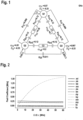
- a coupler C1 is arranged between qubit Q1 and qubit Q2 having one end thereof capacitively coupled to qubit Q1 with coupling strength g 1c1 and having the other end thereof capacitively coupled to qubit Q2 with coupling strength g 2c1 .
- a coupler C2 is arranged between qubits Q2 and Q3 having one end thereof capacitively coupled to qubit Q2 with coupling strength g 2c2 and having the other end thereof capacitively coupled to qubit Q3 with coupling strength g 3c2 .
- a coupler C3 is arranged between qubits Q1 and Q3 having one end thereof capacitively coupled to qubit Q1 with coupling strength g 1c3 and having the other end thereof capacitively coupled to qubit Q3 with coupling strength g 3c3 .
- qubits Q1, Q2, and Q3 are superconducting qubits, specifically transmons.
- Couplers C1, C2, and C3 are bus resonators.
- frequencies of bus resonators C1, C2, and C3 are indicated as ⁇ c1 , ⁇ c 2 , and ⁇ c 3 , respectively.
- Frequencies of qubits Q1, Q2, and Q3 are indicated as ⁇ 1 , ⁇ 2 , and ⁇ 3 , respectively.
- Anharmonicities of qubits Q1, Q2, and Q3 are indicated as ⁇ 1 , ⁇ 2 , and ⁇ 3 , respectively. Exemplary values of these parameters are also indicated in Figure 1 .
- Fig. 2 shows the strengths of the remaining interactions whose Pauli Coefficients have not been zeroed in accordance with the above, as a function of the driving amplitude ⁇ in formula (3).
Landscapes
- Engineering & Computer Science (AREA)
- General Physics & Mathematics (AREA)
- Theoretical Computer Science (AREA)
- Physics & Mathematics (AREA)
- Mathematical Analysis (AREA)
- Data Mining & Analysis (AREA)
- Evolutionary Computation (AREA)
- Condensed Matter Physics & Semiconductors (AREA)
- Computational Mathematics (AREA)
- Mathematical Optimization (AREA)
- Pure & Applied Mathematics (AREA)
- Computing Systems (AREA)
- General Engineering & Computer Science (AREA)
- Mathematical Physics (AREA)
- Software Systems (AREA)
- Artificial Intelligence (AREA)
- Superconductor Devices And Manufacturing Methods Thereof (AREA)
Abstract
The invention proposes a three-qubit gate with mainly ZZX interaction. The gate is fast and is of high fidelity.
Description
- The invention relates to a three-qubit gate and a method of its realization based on a quantum circuit structure with three qubits that pairwisely interact through couplers arranged therebetween.
- A prior art three-qubit gate, such as Toffoli, is universal for reversible classical computation, enabling arbitrary Boolean operations over quantum registers. Together with the Hadamard gate, it forms a universal quantum gate set. Appending the Toffoli gate to a gate set consisting of CNOT and single-qubit gates is practically helpful for reducing the overhead of gate synthesis. For instance, both the overall gate count and the circuit depth can be reduced to a factor of O(log n) in Shor's algorithm, which factorizes n-bit integers. However, implementing a high-fidelity Toffoli gate is experimentally challenging; thus, the operation is usually realized by decomposing it into single- and two-qubit gates. This decomposition requires at least five two-qubit gates for fully connected qubits and eight for nearest-neighbour connected qubits, considerably reducing its fidelity.
- State-of-the-art of three-qubit gates in superconducting qubits realizes the Toffoli gate by applying three microwave pulses of certain frequencies, amplitudes and phase differences on three qubits coupled on a chain. Theory and experiment show such a gate is made of several simultaneous two-qubit interactions that act between qubits so that overall it acts as an effective three-qubit gate.
- In the experiment, fidelity is not high, the gate length is long, and therefore the gate is not fast. Further, its realization is limited to one-dimensional linear chain-like interaction. So in 2d circuits such as surface code circuits, there are additional interaction terms in place. The difference in the strength of such interactions and the presence of such an imbalance in the strength of simultaneous two-qubit gates will make the realization of the Toffoli gate difficult.
- It is an object of the present invention to provide a new three-qubit gate and a method of its realization that avoids the above shortcomings of the state-of-the-art.
- The idea behind this innovation originates from the decomposition of a Toffoli gate, also known as a controlled-controlled NOT gate into its constituent elements. The associated Hamiltonian of a Toffoli gate, denoted as

- In accordance with the invention, a method of realizing a three-qubit gate comprises the steps of providing a circuit structure including first and second qubits acting as first and second control qubits, respectively, and a third qubit acting as a target qubit; providing a first coupler arranged between the first and second qubits; providing a second coupler arranged between the second and third qubits; providing a third coupler arranged between the first and third qubits; and controlling circuit parameters of the circuit structure so as to result in the total interaction to become mainly ZZX in the computational basis of the first, second and third qubits.
- According to another aspect of the invention, a three-qubit gate comprises a circuit structure including first and second qubits acting as first and second control qubits, respectively and a third qubit acting as a target qubit; a first coupler arranged between the first and second qubits; a second coupler arranged between the second and third qubits; a third coupler arranged between the first and third qubits; and control means configured to control circuit parameters of the circuit structure so as to result in the total interaction to become mainly ZZX in the computational basis of the first, second and third qubits.
- In the three-qubit gate of the invention the interaction is mainly ZZX. This is equally important than other three-qubit gates such as the Toffoli. Specifically, a fast and high-fidelity ZZX gate may be realized with cross resonant gate between three qubits interacting with one another. The ZZX three-qubit gate of the invention, similar to the Toffoli gate, entangles three qubits and single-qubit gates and can introduce a universal class of operators on two qubits. Practically, this gate can be made by applying a CR gate on pairwisely interacting qubits. At a certain domain of parameters, all Pauli interactions between qubits suppress to a small value, and the only strong interaction remains to be ZZX.
- In particular, the invention uses superconducting qubits with strong coupling strengths therebetween (indirect and direct) with appropriately adapted circuit parameters and microwave driving on a certain parameter.
- The qubits may be superconducting qubits, in particular transmons, and the couplers may be bus resonators that are each capacitively coupled to the respective qubits between which the coupler is arranged. In this, the Hamiltonian of the circuit structure in the multilevel basis may be written as

- Decoupling the resonators and rotating H using the rotating wave approximation (RWA) gives

- A CR-type driving Hamiltonian for adapting circuit parameters reads

- Htot is the sum of HQ represented in equation (2) and Hd represented in equation (3). Block-diagonalizing Htot and rewriting it in terms of Pauli matrices with the computational basis | C1,C2,T), wherein C1 denotes the first control qubit, C2 denotes the second control qubit and T denotes the target qubit, yields


- Here, ωd = -Tr[HdiaIIZ]/4 is the dressed frequency of the target qubit T.
- Controlling circuit parameters of the circuit structure in accordance with the invention so to result in the total interaction to become mainly ZZX may be attained by maximizing the Pauli coefficient αZZX of the ZZX interaction term in equation (5) while the Pauli coefficients of the remaining qubit interactions in equations (4) and (5) are suppressed or zeroed. In particular, tuning all driving phases ϕ1,2,3 in equation (3) to be either 0 or rr causes all y rotations to vanish. This results in

- Further, by choosing certain circuit parameters such as coupler frequencies and driving amplitude, {αZIX, αI2X, αIIX} can be suppressed.
- A specific example is a circuit with three transmons on a triangle coupled via three pairwise shared couplers. In the absence of driving, these qubits will carry some unwanted ZZ and ZZZ interactions. Adding a CR pulse not only changes ZZZ and ZZ values but also introduces other Pauli interaction terms. However, microwave phases and amplitudes can be tuned so that the total interaction left will be ZZX so that all other interactions are either zero or negligible in magnitude. Single qubit rotation like ZII or IZI can also be eliminated by echoing the CR pulse. In particular, ZZX can be as strong as 1.5 MHz, while other interactions are in the kHz domain.
- Specifically, ZZX may be greater than the other Pauli interaction terms at least by a factor of 100, preferably by a factor of 500, and even more preferably by a factor of 1,000.
- Advantageous embodiments of the invention will now be described, by way of example, with reference to the accompanying drawings in which
- Fig. 1
- shows an embodiment of the invention with three qubits connected in a triangular configuration;
- Fig. 2
- shows a diagram representing Pauli Coefficients of the configuration of
Fig. 1 as a function of driving amplitude; - In
Figure 1 , reference symbol Q1 designates a first qubit acting as a control qubit, reference symbol Q2 designates a second qubit acting as a second control qubit, and reference symbol Q3 designates a third qubit acting as a target qubit. A coupler C1 is arranged between qubit Q1 and qubit Q2 having one end thereof capacitively coupled to qubit Q1 with coupling strength g1c1 and having the other end thereof capacitively coupled to qubit Q2 with coupling strength g2c1. In addition to the indirect coupling via the coupler C1, there exists direct capacitive coupling between qubits Q1 and Q2 with coupling strength g12. Further, a coupler C2 is arranged between qubits Q2 and Q3 having one end thereof capacitively coupled to qubit Q2 with coupling strength g2c2 and having the other end thereof capacitively coupled to qubit Q3 with coupling strength g3c2. In addition to the indirect coupling via the coupler C2, there exists direct capacitive coupling between qubits Q2 and Q3 with coupling strength g23. Similarly, a coupler C3 is arranged between qubits Q1 and Q3 having one end thereof capacitively coupled to qubit Q1 with coupling strength g1c3 and having the other end thereof capacitively coupled to qubit Q3 with coupling strength g3c3. In addition to the indirect coupling via coupler C3, there exists direct capacitive coupling between qubits Q1 and Q3 with coupling strength g13. - In this embodiment, qubits Q1, Q2, and Q3 are superconducting qubits, specifically transmons. Couplers C1, C2, and C3 are bus resonators.
- In
Figure 1 , frequencies of bus resonators C1, C2, and C3 are indicated as ωc1, ω c2, and ωc3 , respectively. Frequencies of qubits Q1, Q2, and Q3 are indicated as ω1, ω2, and ω3, respectively. Anharmonicities of qubits Q1, Q2, and Q3 are indicated as δ1, δ2, and δ3, respectively. Exemplary values of these parameters are also indicated inFigure 1 . - The Hamiltonian description of the circuits of
Figure 1 has been set out above in formula (1) to (5). There are also indicated conditions for zeroing or suppressing part of the Pauli Coefficients in formula (4) and (5). With these conditions under which all driving phases ϕ1,2,3 in formula (3) are either 0 or π, the embodiment ofFig. 1 when choosing driving ratios A1 = 1, A2 = 0.05 and A3 = 0.003 to thereby totally eliminate IZX, the following Pauli Coefficients are obtained
-
Fig. 2 shows the strengths of the remaining interactions whose Pauli Coefficients have not been zeroed in accordance with the above, as a function of the driving amplitude Ω in formula (3). As can be seen fromFig. 2 , ZZX is the main contribution to the total interaction in a broad interval centered around Ω = 30 MHz.
Claims (13)
- Method of realizing a three-qubit gate comprising the steps of:providing a circuit structure including first (Q1) and second (Q2) qubits acting as first and second control qubits, respectively, and a third qubit (Q3) acting as a target qubit;providing a first coupler (C1) arranged between the first (Q1) and second qubits (Q2);providing a second coupler (C2) arranged between the second (Q2) and third qubits (Q3);providing a third coupler (C3) arranged between the first (Q1) and third qubits (Q3); andcontrolling circuit parameters of the circuit structure so as to result in the total interaction to become mainly ZZX in the computational basis of the first, second and third qubits.
- Method according to claim 1, wherein the qubits are superconducting qubits.
- Method according to anyone of the preceding claims, wherein the qubits are transmons.
- Method according to anyone of the preceding claims, wherein the couplers are bus resonators that are each capacitively coupled to the respective qubits between which the coupler is arranged.
- Method according to anyone of the preceding claims, wherein controlling of circuit parameters includes microwave driving on at least one of the parameters.
- Method according to anyone of the preceding claims, wherein controlling of circuit parameters includes tuning of microwave phase and/or amplitude of at least one driving pulse.
- Method according to anyone of the preceding claims, wherein ZZX is at least by a factor of 100, preferably by a factor of 500, even more preferably by a factor of 1,000 greater than other Pauli interaction terms.
- Three-qubit gate comprising:a circuit structure including first and second qubits acting as first and second control qubits, respectively and a third qubit acting as a target qubit;a first coupler arranged between the first and second qubits;a second coupler arranged between the second and third qubits;a third coupler arranged between the first and third qubits; andcontrol means configured to control circuit parameters of the circuit structure so as to result in the total interaction to become mainly ZZX in the computational basis of the first, second and third qubits.
- Three-qubit gate according to claim 8, wherein the qubits are superconducting qubits.
- Three-qubit gate according to anyone of the preceding claims, wherein the qubits are transmons.
- Three-qubit gate according to anyone of claims 8 to 10, wherein the couplers are bus resonators that are each capacitively coupled to the respective qubits between which the coupler is arranged.
- Three-qubit gate according to anyone of claims 8 to 11, wherein the control means is configured to apply microwave driving on at least one of the parameters.
- Three-qubit gate according to anyone of claims 8 to 12, wherein the control means is configured to tune phase and/or amplitude of at least one microwave driving pulse.
Priority Applications (1)
| Application Number | Priority Date | Filing Date | Title |
|---|---|---|---|
| EP23215766.9A EP4571596A1 (en) | 2023-12-12 | 2023-12-12 | Three-qubit gate and method for its realization |
Applications Claiming Priority (1)
| Application Number | Priority Date | Filing Date | Title |
|---|---|---|---|
| EP23215766.9A EP4571596A1 (en) | 2023-12-12 | 2023-12-12 | Three-qubit gate and method for its realization |
Publications (1)
| Publication Number | Publication Date |
|---|---|
| EP4571596A1 true EP4571596A1 (en) | 2025-06-18 |
Family
ID=89190764
Family Applications (1)
| Application Number | Title | Priority Date | Filing Date |
|---|---|---|---|
| EP23215766.9A Pending EP4571596A1 (en) | 2023-12-12 | 2023-12-12 | Three-qubit gate and method for its realization |
Country Status (1)
| Country | Link |
|---|---|
| EP (1) | EP4571596A1 (en) |
Citations (1)
| Publication number | Priority date | Publication date | Assignee | Title |
|---|---|---|---|---|
| WO2018164784A1 (en) * | 2017-03-10 | 2018-09-13 | Northrop Grumman Systems Corporation | Zzz coupler for superconducting qubits |
-
2023
- 2023-12-12 EP EP23215766.9A patent/EP4571596A1/en active Pending
Patent Citations (1)
| Publication number | Priority date | Publication date | Assignee | Title |
|---|---|---|---|---|
| WO2018164784A1 (en) * | 2017-03-10 | 2018-09-13 | Northrop Grumman Systems Corporation | Zzz coupler for superconducting qubits |
Non-Patent Citations (5)
| Title |
|---|
| BAKER ANEIRIN J ET AL: "Single shot i-Toffoli gate in dispersively coupled superconducting qubits", APPLIED PHYSICS LETTERS, AMERICAN INSTITUTE OF PHYSICS, 2 HUNTINGTON QUADRANGLE, MELVILLE, NY 11747, vol. 120, no. 5, 3 February 2022 (2022-02-03), XP012263277, ISSN: 0003-6951, [retrieved on 20220203], DOI: 10.1063/5.0077443 * |
| ILYA A SIMAKOV ET AL: "High-fidelity transmon coupler activated CCZ gate on fluxonium qubits", ARXIV.ORG, CORNELL UNIVERSITY LIBRARY, 201 OLIN LIBRARY CORNELL UNIVERSITY ITHACA, NY 14853, 29 August 2023 (2023-08-29), XP091600546 * |
| KIM YOSEP ET AL: "High-fidelity three-qubit iToffoli gate for fixed-frequency superconducting qubits", NATURE PHYSICS, NATURE PUBLISHING GROUP, LONDON, GB, vol. 18, no. 7, 2 May 2022 (2022-05-02), pages 783 - 788, XP037900468, ISSN: 1745-2473, [retrieved on 20220502], DOI: 10.1038/S41567-022-01590-3 * |
| TANAY ROY ET AL: "A programmable three-qubit superconducting processor with all-to-all connectivity", ARXIV.ORG, CORNELL UNIVERSITY LIBRARY, 201 OLIN LIBRARY CORNELL UNIVERSITY ITHACA, NY 14853, 3 September 2018 (2018-09-03), XP081685963, DOI: 10.1103/PHYSREVAPPLIED.14.014072 * |
| TIANQI CAI ET AL: "Perturbation impact of spectators and spurious qubit interactions on a cross-resonance gate in a tunable coupling superconducting circuit", ARXIV.ORG, CORNELL UNIVERSITY LIBRARY, 201 OLIN LIBRARY CORNELL UNIVERSITY ITHACA, NY 14853, 6 January 2021 (2021-01-06), XP081853234 * |
Similar Documents
| Publication | Publication Date | Title |
|---|---|---|
| CN113853620A (en) | Amplitude, frequency and phase modulation simultaneous entanglement gate of trapped ion quantum computer | |
| Wubs et al. | Landau–Zener transitions in qubits controlled by electromagnetic fields | |
| Calderon-Vargas et al. | Fast high-fidelity entangling gates for spin qubits in Si double quantum dots | |
| US20240062088A1 (en) | Quantum logic gate operation device, quantum logic gate operation method and a non-transitory computer-readable medium | |
| Warren et al. | Robust photon-mediated entangling gates between quantum dot spin qubits | |
| Tang et al. | Designing globally time-optimal entangling gates using geometric space curves | |
| Abdel-Aty et al. | Quantum information and entropy squeezing of a two-level atom with a non-linear medium | |
| Remizov et al. | Parametrically driven hybrid qubit-photon systems: Dissipation-induced quantum entanglement and photon production from vacuum | |
| Olsen et al. | Continuous variable tripartite entanglement from twin nonlinearities | |
| Dominguez et al. | Solving the Richardson equations close to the critical points | |
| US11301599B2 (en) | Systems and methods for the tunability of phase in quantum-like mechanical elastic systems | |
| Gong et al. | Antiresonance and bound states in the continuum in electron transport through parallel-coupled quantum-dot structures | |
| Feinstein et al. | Robustness of diabatic enhancement in quantum annealing | |
| WO2026011937A1 (en) | Method for preparing high-fidelity two-qubit gate | |
| Kyaw et al. | Parity-preserving light-matter system mediates effective two-body interactions | |
| Kanaar et al. | Non-adiabatic quantum control of quantum dot arrays with fixed exchange using Cartan decomposition | |
| Lopez-Pina et al. | Frequency analysis of the laser driven nonlinear dynamics of HCN | |
| Sun et al. | Decoherence mitigation for geometric quantum computation | |
| Wei et al. | Phase transition and dynamics of qubits in coupled-cavity arrays with nonlinear topological photonics | |
| Julius et al. | Squeezing over two octaves of frequency difference with second harmonic coupling | |
| JP4182655B2 (en) | Method and apparatus for generating light or electromagnetic wave | |
| Paganelli et al. | Optimized electron propagation on a quantum chain by a topological phase | |
| Oda | Path integral equivalence between super D-string and IIB superstring | |
| JP7079743B2 (en) | Arithmetic logic unit | |
| Kobayashi et al. | Dihedral hidden subgroup problem: A survey |
Legal Events
| Date | Code | Title | Description |
|---|---|---|---|
| PUAI | Public reference made under article 153(3) epc to a published international application that has entered the european phase |
Free format text: ORIGINAL CODE: 0009012 |
|
| STAA | Information on the status of an ep patent application or granted ep patent |
Free format text: STATUS: REQUEST FOR EXAMINATION WAS MADE |
|
| 17P | Request for examination filed |
Effective date: 20231212 |
|
| AK | Designated contracting states |
Kind code of ref document: A1 Designated state(s): AL AT BE BG CH CY CZ DE DK EE ES FI FR GB GR HR HU IE IS IT LI LT LU LV MC ME MK MT NL NO PL PT RO RS SE SI SK SM TR |