EP4570957A2 - Electrolyzer system and method of operating same with intermittent power sources - Google Patents
Electrolyzer system and method of operating same with intermittent power sources Download PDFInfo
- Publication number
- EP4570957A2 EP4570957A2 EP24219484.3A EP24219484A EP4570957A2 EP 4570957 A2 EP4570957 A2 EP 4570957A2 EP 24219484 A EP24219484 A EP 24219484A EP 4570957 A2 EP4570957 A2 EP 4570957A2
- Authority
- EP
- European Patent Office
- Prior art keywords
- electrolyzer
- power
- hydrogen
- energy storage
- threshold
- Prior art date
- Legal status (The legal status is an assumption and is not a legal conclusion. Google has not performed a legal analysis and makes no representation as to the accuracy of the status listed.)
- Pending
Links
Images







Classifications
-
- C—CHEMISTRY; METALLURGY
- C25—ELECTROLYTIC OR ELECTROPHORETIC PROCESSES; APPARATUS THEREFOR
- C25B—ELECTROLYTIC OR ELECTROPHORETIC PROCESSES FOR THE PRODUCTION OF COMPOUNDS OR NON-METALS; APPARATUS THEREFOR
- C25B15/00—Operating or servicing cells
- C25B15/02—Process control or regulation
- C25B15/023—Measuring, analysing or testing during electrolytic production
-
- C—CHEMISTRY; METALLURGY
- C25—ELECTROLYTIC OR ELECTROPHORETIC PROCESSES; APPARATUS THEREFOR
- C25B—ELECTROLYTIC OR ELECTROPHORETIC PROCESSES FOR THE PRODUCTION OF COMPOUNDS OR NON-METALS; APPARATUS THEREFOR
- C25B1/00—Electrolytic production of inorganic compounds or non-metals
- C25B1/01—Products
- C25B1/02—Hydrogen or oxygen
- C25B1/04—Hydrogen or oxygen by electrolysis of water
- C25B1/042—Hydrogen or oxygen by electrolysis of water by electrolysis of steam
-
- C—CHEMISTRY; METALLURGY
- C25—ELECTROLYTIC OR ELECTROPHORETIC PROCESSES; APPARATUS THEREFOR
- C25B—ELECTROLYTIC OR ELECTROPHORETIC PROCESSES FOR THE PRODUCTION OF COMPOUNDS OR NON-METALS; APPARATUS THEREFOR
- C25B11/00—Electrodes; Manufacture thereof not otherwise provided for
- C25B11/04—Electrodes; Manufacture thereof not otherwise provided for characterised by the material
- C25B11/042—Electrodes formed of a single material
- C25B11/047—Ceramics
-
- C—CHEMISTRY; METALLURGY
- C25—ELECTROLYTIC OR ELECTROPHORETIC PROCESSES; APPARATUS THEREFOR
- C25B—ELECTROLYTIC OR ELECTROPHORETIC PROCESSES FOR THE PRODUCTION OF COMPOUNDS OR NON-METALS; APPARATUS THEREFOR
- C25B15/00—Operating or servicing cells
- C25B15/02—Process control or regulation
-
- C—CHEMISTRY; METALLURGY
- C25—ELECTROLYTIC OR ELECTROPHORETIC PROCESSES; APPARATUS THEREFOR
- C25B—ELECTROLYTIC OR ELECTROPHORETIC PROCESSES FOR THE PRODUCTION OF COMPOUNDS OR NON-METALS; APPARATUS THEREFOR
- C25B15/00—Operating or servicing cells
- C25B15/02—Process control or regulation
- C25B15/021—Process control or regulation of heating or cooling
-
- C—CHEMISTRY; METALLURGY
- C25—ELECTROLYTIC OR ELECTROPHORETIC PROCESSES; APPARATUS THEREFOR
- C25B—ELECTROLYTIC OR ELECTROPHORETIC PROCESSES FOR THE PRODUCTION OF COMPOUNDS OR NON-METALS; APPARATUS THEREFOR
- C25B9/00—Cells or assemblies of cells; Constructional parts of cells; Assemblies of constructional parts, e.g. electrode-diaphragm assemblies; Process-related cell features
- C25B9/70—Assemblies comprising two or more cells
-
- H—ELECTRICITY
- H02—GENERATION; CONVERSION OR DISTRIBUTION OF ELECTRIC POWER
- H02J—ELECTRIC POWER NETWORKS; CIRCUIT ARRANGEMENTS OR SYSTEMS FOR SUPPLYING OR DISTRIBUTING ELECTRIC POWER; SYSTEMS FOR STORING ELECTRIC ENERGY
- H02J1/00—Circuit arrangements for DC mains or DC distribution networks
- H02J1/14—Balancing load and power generation in DC networks
-
- C—CHEMISTRY; METALLURGY
- C25—ELECTROLYTIC OR ELECTROPHORETIC PROCESSES; APPARATUS THEREFOR
- C25B—ELECTROLYTIC OR ELECTROPHORETIC PROCESSES FOR THE PRODUCTION OF COMPOUNDS OR NON-METALS; APPARATUS THEREFOR
- C25B15/00—Operating or servicing cells
-
- H—ELECTRICITY
- H02—GENERATION; CONVERSION OR DISTRIBUTION OF ELECTRIC POWER
- H02J—ELECTRIC POWER NETWORKS; CIRCUIT ARRANGEMENTS OR SYSTEMS FOR SUPPLYING OR DISTRIBUTING ELECTRIC POWER; SYSTEMS FOR STORING ELECTRIC ENERGY
- H02J2101/00—Supply or distribution of decentralised, dispersed or local electric power generation
- H02J2101/20—Dispersed power generation using renewable energy sources
- H02J2101/22—Solar energy
- H02J2101/24—Photovoltaics
Definitions
- the present invention is directed to electrolyzer systems and methods of operating the same with intermittent power sources, such as solar power sources.
- a cathode electrode is separated from an anode electrode by a solid oxide electrolyte.
- a SOEC solid oxide electrolyzer cell
- a positive potential is applied to the air side of the SOEC and oxygen ions are transported from the fuel (e.g., steam) side to the air side.
- the SOEC anode will be referred to as the air electrode
- the SOEC cathode will be referred to as the fuel electrode.
- water e.g., steam
- H 2 O + 2e - ⁇ O 2- + H 2 water
- O 2- ions are transported through the solid electrolyte, and then oxidized (e.g., by an air inlet stream) on the air side (O 2- to O 2 ) to produce molecular oxygen (e.g., oxygen enriched air).
- molecular oxygen e.g., oxygen enriched air
- a method operating an electrolyzer system includes producing hydrogen by electrolysis of steam in at least one electrolyzer cell stack of the electrolyzer system using power received from an intermittent power source, detecting a reduction in a level of power received from the intermittent power source below a first threshold, decreasing a rate of producing the hydrogen in response to the detected reduction in the level power below the first threshold, detecting a reduction in a level of power received from the intermittent power source below a second first threshold that is lower than the first threshold, and switching the electrolyzer system into a hot standby mode in which the electrolyzer system does not produce hydrogen and maintains the least one electrolyzer cell stack above a predetermined threshold temperature.
- a system includes an electrolyzer system comprising at least one electrolyzer cell stack configured to produce hydrogen by electrolysis of steam; an intermittent power source electrically connected to the electrolyzer system; an energy storage system electrically connected to the electrolyzer system; and a controller.
- the controller includes machine executable instructions that operate to: detect a reduction in a level of power received from the intermittent power source below a first threshold; decrease a rate of producing hydrogen in response to the detected reduction in the level power below the first threshold; detect a reduction in a level of power received from the intermittent power source below a second first threshold that is lower than the first threshold; and switch the electrolyzer system into a hot standby mode in which the electrolyzer system does not produce hydrogen and maintains the least one electrolyzer cell stack above a predetermined threshold temperature.
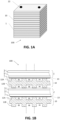
- FIG. 1A is a perspective view of an electrolyzer cell stack 100, such as a solid oxide electrolyzer cell (SOEC) stack
- FIG. 1B is a side cross-sectional view of a portion of the stack 100 of FIG. 1A
- the stack 100 includes multiple electrolyzer cells (e.g., SOECs) 1 that are separated by interconnects 10, which may also be referred to as gas flow separator plates or bipolar plates.
- Each electrolyzer cell 1 includes an air electrode 3, an electrolyte 5, such as a solid oxide electrolyte for a SOEC, and a fuel electrode 7.
- the stack 100 also includes internal fuel riser channels 22.
- the air electrode 3 may comprise an electrically conductive material, such as an electrically conductive perovskite material, such as lanthanum strontium manganite (LSM).
- an electrically conductive perovskite material such as lanthanum strontium manganite (LSM).
- LSM lanthanum strontium manganite
- Other conductive perovskites, such as LSCo, etc., or metals, such as Pt, may also be used.
- the electrolyte 5 may comprise a stabilized zirconia, such as scandia stabilized zirconia (SSZ) or yttria stabilized zirconia (YSZ), yttria-ceria-stabilized zirconia (YCSZ), ytterbia-ceria-scandia-stabilized zirconia (YbCSSZ), or blends thereof.
- SSZ scandia stabilized zirconia
- YSZ yttria stabilized zirconia
- YCSZ yttria-ceria-stabilized zirconia
- YbCSSZ ytterbia-ceria-scandia-stabilized zirconia
- scandia may be present in an amount equal to 9 to 11 mol %, such as 10 mol %
- ceria may present in amount greater than 0 and equal to or less than 3 mol %, for example 0.5 mol % to 2.5 mol %, such as 1 mol %
- ytterbia may be present in an amount greater than 0 and equal to or less than 2.5 mol %, for example 0.5 mol % to 2 mol %, such as 1 mol %, as disclosed in U.S. Pat. No. 8,580,456 , which is incorporated herein by reference.
- the electrolyte 5 may comprise another ionically conductive material, such as a doped ceria.
- the fuel electrode 7 may comprise a cermet comprising a nickel containing phase and a ceramic phase.
- the nickel containing phase may consist entirely of nickel in a reduced state.
- the ceramic phase may comprise a stabilized zirconia, such as yttria and/or scandia stabilized zirconia and/or a doped ceria, such as gadolinia, yttria and/or samaria doped ceria.
- the electrodes and the electrolyte may each comprise one or more sublayers of one or more of the above described materials.
- Each interconnect 10 electrically connects adjacent electrolyzer cells 1 in the stack 100.
- an interconnect 10 may electrically connect the fuel electrode 7 of one electrolyzer cell 1 to the air electrode 3 of an adjacent electrolyzer cell 1.
- FIG. 1B shows that the lower electrolyzer cell 1 is located between two interconnects 10.
- Each interconnect 10 may be made of or may contain electrically conductive material, such as a metal alloy (e.g., chromium-iron alloy) which has a similar coefficient of thermal expansion to that of the solid oxide electrolyte in the cells (e.g., a difference of 0-10%).
- the interconnects 10 may comprise a metal (e.g., a chromium-iron alloy, such as 4-6 weight percent iron, optionally 1 or less weight percent yttrium and balance chromium alloy).
- any other suitable conductive interconnect material such as stainless steel (e.g., ferritic stainless steel, SS446, SS430, etc.) or iron-chromium alloy (e.g., Crofer tm 22 APU alloy which contains 20 to 24 wt.% Cr, less than 1 wt.% Mn, Ti and La, and balance Fe, or ZMG tm 232L alloy which contains 21 to 23 wt.% Cr, 1 wt.% Mn and less than 1 wt.% Si, C, Ni, Al, Zr and La, and balance Fe) may be used.
- stainless steel e.g., ferritic stainless steel, SS446, SS430, etc.
- iron-chromium alloy e.g., Crofer tm 22 APU alloy which contains 20 to 24 wt.% Cr, less than 1 wt.% Mn, Ti and La, and balance Fe
- ZMG tm 232L alloy which contains 21 to 23 wt.% Cr, 1 wt
- Each interconnect 10 includes fuel ribs 12A that at least partially define fuel channels 8A, and air ribs 12B that at least partially define air channels 8B.
- the interconnect 10 may operate as a gas-fuel separator that separates a fuel, such as steam, flowing to the fuel electrode 7 of one electrolyzer cell 1 in the stack 100 from oxidant, such as air, flowing to the air electrode 3 of an adjacent electrolyzer cell 1 in the stack 100.
- oxidant such as air
- the air end plate or fuel end plate may comprise the same interconnect structure used throughout the stack.
- An optional conductive contact layer 13, such as a nickel mesh, may be located between the fuel electrode 7 and the fuel ribs 12.
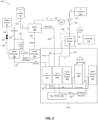
- FIG. 2 is schematic view of an electrolyzer system 200, according to various embodiments of the present disclosure.
- the system 200 may include one or more electrolyzer cell stacks 100 or columns, such as SOEC stacks or columns. Each column may include one or more electrolyzer cell stacks 100.
- the electrolyzer cell stack 100 includes multiple electrolyzer cells, such as SOECs, as described with respect to FIGS. 1A and 1B .
- the system 200 may also include a steam generator 104, a steam recuperator heat exchanger 108, an air recuperator heat exchanger 112, an air blower 118, a recycle blower 126, an outer column heater 350, an inner column heater 360, and a base heater 370.
- the system 200 may also optionally include at least one of an air pre-heater heat exchanger 54, a water preheater heat exchanger 102, a mixer 106, a hydrogen processor 120 and/or a hydrogen separator (e.g., splitter or valve) 122.
- an air pre-heater heat exchanger 54 e.g., a water preheater heat exchanger 102
- a mixer 106 e.g., a mixer 106
- a hydrogen processor 120 e.g., splitter or valve
- the system 200 may include a hotbox 300 that houses various components, such as the stack 100, the steam recuperator 108, the air recuperator 112, the outer column heater 350, the inner column heater 360 and/or the base heater 370.
- the hotbox 300 may include multiple stacks 100 or multiple columns of stacks 100.
- the water preheater 102 and the steam generator 104 may be located external to the hotbox 300, as shown in FIG. 2 .
- the water preheater 102 and/or the steam generator 104 may be located inside the hotbox 300.
- the SOEC system may have an external steam source, in which case the water preheater 102 and/or the steam generator 104 may be omitted.
- the stack 100 may be provided with steam (e.g., steam inlet stream) and electric power (e.g., current or voltage) from an external power source.
- the steam may be provided to the fuel electrodes 7 of the electrolyzer cells 1 of the stack 100, and the power source may apply a voltage between the fuel electrodes 7 and the air electrodes 3, in order to electrochemically split water (e.g., steam) molecules and generate hydrogen and oxygen.
- Air may also be provided to the air electrodes 3, in order to sweep the oxygen from the air electrodes 3.
- the stack 100 may output a hydrogen stream and an oxygen-rich exhaust stream, such as an oxygen-rich air stream ("oxygen exhaust stream").
- water may be provided to the system 200 from a water source 50.
- the water source 50 may include a municipal water supply (e.g., water pipe) and/or a water storage tank.
- the water may be deionized (DI) water that is deionized as much as is practical (e.g., ⁇ 0.1 ⁇ S/cm), in order to prevent and/or minimize scaling during vaporization.
- the water source 50 may include one or more deionization beds (e.g., downstream of the water pipe or tank).
- the water source 50 may provide the water to the system 200 via a water inlet conduit 250.
- the water inlet conduit 250 may include a water flow control device 251 such as a valve, a mass flow controller, a positive displacement pump, a water flow meter, or the like, in order to provide a desired water flow rate to the system 200.
- a water flow control device 251 such as a valve, a mass flow controller, a positive displacement pump, a water flow meter, or the like, in order to provide a desired water flow rate to the system 200.
- the water may be provided from the water source 50 to the water preheater 102 through the water inlet conduit 250.
- the water preheater 102 may be a heat exchanger configured to heat the water using heat recovered from the oxygen exhaust stream from the stack 100. Preheating the water may reduce the total power consumption of the system 200 per unit of hydrogen generated.
- the water preheater 102 may recover heat from the oxygen exhaust stream that may not be recoverable by the air recuperator 112, as discussed below.
- the water preheater 102 may heat the water to a temperature above 50 °C, such as a temperature of about 70 °C to 80 °C.
- the oxygen exhaust stream may be output from the water preheater 102 via conduit 205 at a temperature above 80 °C, such as above 100 °C, such as a temperature of about 120 °C to 140 °C.
- the water output from the water preheater 102 may be provided to the steam generator 104 through a water conduit 202.
- the steam generator 104 may be configured to heat the water to convert the water into steam.
- the steam generator 104 may include a heating element to vaporize the water and generate steam.
- the steam generator 104 may include an AC or DC resistance heating element or an induction heating element.
- the steam generator 104 may comprise a heat exchanger which is located inside the hotbox 300 and which is heated by one or more hot exhaust streams flowing through the hotbox 300.
- the steam generator 104 heats the water above 100 °C to generate steam, such as a temperature of about 120 °C to 145 °C.
- the steam generator 104 may include multiple zones/elements that may or may not be mechanically separate.
- the steam generator 104 may include a pre-boiler to heat the water up to or near to the boiling point.
- the steam generator 104 may also include a vaporizer configured to convert the pre-boiled water into steam.
- the steam generator 104 may also include a deaerator to provide a relatively small purge of steam to remove dissolved air from the water prior to bulk vaporization.
- the steam generator 104 may also include an optional superheater configured to further increase the temperature of the steam generated in the vaporizer.
- the steam generator 104 may include a demister pad located downstream of the heating element and/or upstream from the super heater. The demister pad may be configured to minimize entrainment of liquid water in the steam output from the steam generator 104 and/or provided to the superheater.
- the steam product is superheated, it will be less likely to condense downstream from the steam generator 104 due to heat loss. Avoidance of condensation is preferable, as condensed water is more likely to form slugs of water that may cause significant variation of the delivered mass flow rate with respect to time. It may also be beneficial to avoid excess superheating, in order to limit the total power consumption of the system 200.
- the steam may be superheated by an amount ranging from about 10 °C to about 100 °C.
- a small amount of liquid water may be periodically or continuously discharged from the steam generator 104 via a liquid discharge conduit 224.
- the discharged liquid water may include scale and/or other mineral impurities that may accumulate in the steam generator 104 while vaporizing water to generate steam. Therefore, this discharged liquid water is not desirable for being recycled into the water inlet stream from the water source 50.
- This liquid discharge may be mixed with the hot oxygen exhaust stream output from the water preheater 102 into an exhaust conduit 205. If the hot oxygen exhaust stream has a temperature above 100 °C, the liquid water discharge may be evaporated by the hot oxygen exhaust stream, such that no liquid water is required to be discharged from the system 200.
- the system 200 may optionally include a water pump 124 configured to pump and regulate the liquid water discharge in the liquid discharge conduit 224 output from the steam generator 104 into the exhaust conduit 205 from the water preheater 102.
- a flow regulator such as proportional solenoid valve, may be added to the liquid discharge conduit 224 in addition to the pump 124 to additionally regulate the flow of the liquid water discharge.
- Blowdown from the steam generator 104 may be beneficial for long term operation, as the water will likely contain some amount of mineralization after deionization.
- Typical liquid blowdown may be on the order of 1%.
- the blowdown may be continuous, or may be intermittent, e.g., ten times the steady state flow for 6 seconds out of every minute, five times the steady state flow for 1 minute out of every 5 minutes, etc.
- the need for a water discharge stream can be eliminated by pumping the blowdown into the hot oxygen exhaust. In this case, the pump 124 and liquid discharge conduit 224 may be omitted.
- the steam output from the steam generator 104 may be provided to the steam recuperator 108 via a steam conduit 204.
- the steam may be provided to the mixer 106 prior to being provided to the steam recuperator 108 via steam and hydrogen conduit 206.
- the steam may include small amounts of dissolved air and/or oxygen.
- the mixer 106 may be configured to mix the steam with hydrogen gas, in order to maintain a reducing environment in the stack 100, and in particular, at the fuel electrodes 7.
- the mixer 106 may be configured to mix the steam with hydrogen received from a hydrogen storage device (e.g., hydrogen storage vessel) 52 and/or with a portion of the hydrogen and steam recycle stream output from the stack 100.
- the hydrogen addition rate may be set to provide an amount of hydrogen that exceeds an amount of hydrogen needed to react with an amount of oxygen dissolved in the steam.
- the hydrogen addition rate may either be fixed or set to a constant water to hydrogen ratio. However, if the steam is formed using water that is fully deaerated, the mixer 106 and/or hydrogen addition into the steam may optionally be omitted.
- the hydrogen may be provided to the mixer 106 during system start-up and shutdown modes, and optionally during steady state operation modes.
- the hydrogen may be provided to the mixer 106 from the hydrogen storage device 52 via a stored hydrogen conduit 252.
- no external hydrogen is provided to the mixer 106 and the stack 100.
- the hydrogen flow from the hydrogen storage device 52 may be stopped (e.g., by shutting off an outlet valve from the hydrogen storage device (not shown)).
- a first portion of a hydrogen exhaust stream (e.g., the hydrogen and steam product steam) generated by the stack 100 is diverted to the mixer 106 through the hydrogen recycle conduit 226 by the recycle blower 126.
- the system 200 may include a hydrogen separator 122, such as a splitter and/or valve, configured to selectively divert a portion of the hydrogen exhaust stream flowing through the hydrogen product conduit 220 to the mixer 106 during the steady state mode operation.
- the mixed steam and hydrogen inlet stream is provided from the mixer 106 into a steam recuperator heat exchanger 108 via a steam and hydrogen conduit 206.
- the mixed steam and hydrogen inlet stream in conduit 206 may have a temperature above 100 °C, such as 120 °C to 140 °C.
- the mixed steam and hydrogen inlet stream is heated in the steam recuperator 108 by the hydrogen exhaust (i.e., the hydrogen and steam product stream) provided from the stack 100.
- the hydrogen exhaust may be provided from the stack 100 to the steam recuperator 108 via a hydrogen outlet conduit 210.
- the heated mixed steam and hydrogen inlet stream is provided from the steam recuperator heat exchanger 108 into the fuel side inlet of the stack 100 via the fuel inlet conduit 208.
- the mixed steam and hydrogen inlet stream in the fuel inlet conduit 208 may have a temperature above 500 °C, such as 550 °C to 600 °C.
- the hydrogen exhaust is output from the hotbox 300 (e.g., from the steam recuperator 108 and/or the optional air preheater 54) into the hydrogen product conduit 220 at a temperature of 150 °C to 250 °C.
- a second portion of the hydrogen exhaust that is not diverted by the hydrogen separator 122 into the mixer 106 continues through the hydrogen product conduit 220 into the hydrogen processor 120.
- the hydrogen exhaust may be compressed and/or purified in the hydrogen processor 120.
- the hydrogen processor 120 may include a high temperature hydrogen pump that operates at a temperature from about 120 °C to about 200 °C, in order to remove from about 70% to about 90% of the hydrogen from the hydrogen exhaust.
- the removed hydrogen is stored and/or provided for one or more end uses.
- the hydrogen processor 120 includes an electrochemical hydrogen pump, a liquid ring compressor, a diaphragm compressor or combination thereof.
- the hydrogen processor may include a series of electrochemical hydrogen pumps, which may be disposed in series and/or in parallel with respect to a flow direction of the hydrogen exhaust, in order to compress the hydrogen exhaust.
- the final product from compression may still contain traces of water.
- the hydrogen processor 120 may optionally include a dewatering device, such as a condenser, a temperature swing adsorption reactor or a pressure swing adsorption reactor, to remove this residual water, if necessary.
- the air recuperator heat exchanger 112 may be provided with ambient air by an air blower 118 via an air inlet conduit 218 and an optional preheated air conduit 254.
- the oxygen exhaust output from the stack 100 may be provided to the air recuperator 112 via an oxygen outlet conduit 222.
- the air recuperator 112 may be configured to heat the incoming air using heat extracted from the stack oxygen exhaust (i.e., the oxygen enriched air).
- the air inlet stream may be heated in the air recuperator 112 to a temperature above 500 °C, such as 550 °C to 600 °C.
- the heated air inlet stream is provided from the air recuperator 112 to the air inlet of the stack 100 via the stack air inlet conduit 212.
- the oxygen exhaust is output from the air recuperator 112 to the water preheater 102 via the oxygen exhaust conduit 228 at temperature above 200 °C, such as 250 °C to 350 °C.
- the oxygen exhaust is output from the water preheater 102 via the exhaust conduit 205 at temperature of at least 80 °C.
- the system 200 may include an optional air preheater heat exchanger 54 disposed outside or inside of the hotbox 300.
- the air preheater 54 may be configured to preheat the air inlet stream provided to the hotbox 300 by the air blower 118 via the air inlet conduit 218 using heat in the hydrogen exhaust (i.e., the hydrogen and steam product stream) from the stack 100.
- the air may be preheated in the air preheater to a temperature above 100 °C, such as 150 °C to 250 °C.
- the hydrogen exhaust stream may be provided from the steam recuperator 108 to the air preheater 54 via a hydrogen conduit 238.
- the system 200 may include a controller 125, such as a central processing unit, which is configured to control the operation of the system 200.
- the controller 125 may be wired or wirelessly connected to various elements of the system 200 to control the same.
- the controller 125 may control various process fluid and power flows in the system 200 by adjusting valve positions (e.g., opening and closing valves), blower speeds, and power converters (e.g., DC-DC converters).
- the controller 125 may be configured with various operating modes including energy saving modes. For example, various elements in system 200 may be switched off to preserve energy while maintaining the SOEC stack 100 at a relatively high temperature.
- the SOEC stack 100 may most efficiently generate hydrogen at an operating temperature ranging from about 700 °C to 900 °C, such as from about 725 °C to about 775 °C, or about 750 °C.
- an operating temperature ranging from about 700 °C to 900 °C, such as from about 725 °C to about 775 °C, or about 750 °C.
- fluids provided to the stack 100 may be heated by various components prior to being provided to the stack 100.
- the heaters 350, 360, 370 improve the temperature control of the system.
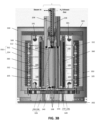
- FIGS. 3A and 3B are cross-sectional views showing air flow and steam and hydrogen flow in the hotbox 300 of the electrolyzer system 200 of FIG. 2 , according to various embodiments of the present disclosure.
- FIG. 3C is a top view showing aspects of heat transfer in the hotbox 300 of FIG. 2 , according to various embodiments of the present disclosure.
- the hotbox 300 may be disposed on an optional support base 302 and may include an optional cover plate 304.
- the support base 302 may comprise hollow rails which provide access for a forklift to raise and move the hotbox 300.
- the hotbox 300 includes a central column 320, the outer column heater 350, the inner column heater 360, and the base heater 370, which may be disposed in the hotbox 300.
- the central column 320 may protrude through an opening in the cover plate 304 of the hotbox 300.
- the central column 320 may include the steam recuperator 108 and the air recuperator 112.
- the air recuperator 112 may be located radially outward from and concentrically surround the steam recuperator 108. It is believed that this configuration may provide a high heat transfer efficiency.
- the air recuperator 112 may optionally be located radially inward from and be laterally surrounded by the steam recuperator 108 instead. Thus, both the steam recuperator 108 and the air recuperator 112 are located radially inward of the stacks 100 or cell columns 101.
- the central column 320 may also include an air conduit 322, an air exhaust conduit 324, a steam conduit 326 (see FIG. 3B ), and a product conduit 328 (see FIG. 3B ).
- the air conduit 322 comprises the combination of the preheated air conduit 254 and the stack air inlet conduit 212.
- the air exhaust conduit 324 comprises the combination of the oxygen outlet conduit 222 and the oxygen exhaust conduit 228.
- the steam conduit 326 comprises the combination of the steam and hydrogen conduit 206 and the fuel inlet conduit 208.
- the product conduit 328 comprises the combination of the hydrogen outlet conduit 210 and the hydrogen conduit 238.
- the cell columns 101 may each include one stack 100 or plural stacks 100 stacked over each other.
- the cell columns 101 surround the central column 320.
- the cell columns 101 may optionally include fuel manifolds 105 (e.g., steam splitter plates) disposed between the stacks 100.
- the manifolds 105 may be configured to provide steam to adjacent stacks 100 in the same column 101 and receive the hydrogen product output from adjacent stacks 100 in the same column 101.
- the manifolds 105 of each cell column 101 may be fluidly connected to riser conduits 332 configured to provide the steam to and collect the hydrogen exhaust from the cell columns 101.
- the riser conduits 332 may include steam riser conduits 332S configured to provide the steam inlet stream to the cell columns 101, and product riser conduits 332P configured to collect the hydrogen exhaust stream (i.e., the hydrogen product stream) output from the cell columns 101, as shown in FIG. 3C .
- each cell column 101 and/or stacks 100 may be internally manifolded for steam/hydrogen and externally manifolded for oxygen/air.
- the steam inlet stream may also include hydrogen
- the hydrogen product may also include unreacted steam.
- each cell column 101 may include only one stack 100 containing interconnects which are internally manifolded for steam/hydrogen delivery such that the manifolds 105 and riser conduits 332 may be omitted.
- the inner column heater 360 may be disposed between the central column 320 and the cell columns 101 (e.g., one or more stacks 100).
- an inner surface of the inner column heater 360 may face the steam recuperator 108 and the air recuperator 112, and an outer surface of the inner column heater 360 may face the stacks 100 or columns 101.
- the outer column heater 350 may surround the stacks 100 or columns 101.
- an inner surface of the outer column heater 350 may face the stacks 100.
- the stacks 100 or columns 101 are located radially inward from the outer column heater 350 and radially outward from the inner column heater 360.
- the steam recuperator 108 and the air recuperator 112 are located radially inward from the inner column heater 360.
- an incoming air inlet stream is provided through the air conduit 322 (e.g., through the preheated air conduit 254) to the top of the air recuperator 112.
- the air inlet stream may be heated while passing through the air recuperator 112, before exiting the bottom of the air recuperator 112.
- the air inlet stream may flow upward through the stack air inlet conduit 212 to the inner facing surfaces of the stacks 100 or columns 101.
- the inner column heater 360 may heat the air inlet stream in the stack air inlet conduit 212.
- the air inlet stream may enter the open inner surfaces of the stacks 100 or columns 101 that face the central column 320.
- the air inlet stream may flow to the surface of the SOEC air electrodes 3 in the stacks 100 or columns 101 via the air channels 8B in the interconnects 10 (see FIG. 1B ).
- Oxygen ions are generated from the steam inlet stream at the fuel electrodes 7 by a voltage applied to the stacks 100 and may pass through the SOEC electrolytes 5 and may recombine to form oxygen gas (O 2 ) at the air electrodes 3.
- the oxygen gas is swept away by the air inlet stream flowing through the air channels 8B in the stacks 100 or columns 101.
- the oxygen enriched air (e.g., oxygen/air exhaust) stream then exits outer surfaces of the stacks 100 or columns 101, flows downward through the oxygen outlet conduit 222 toward the bottom of the hotbox 300, and then flows into the bottom of the air recuperator 112.
- the outer column heater 350 may heat the oxygen enriched air in the oxygen outlet conduit 222.
- the air recuperator 112 extracts heat from the oxygen exhaust stream as it flows upward through the air recuperator 112, to heat the incoming air inlet stream.
- steam and/or a steam/hydrogen mixture is provided to the central column 320 and flows downward through the steam conduit 326 (e.g., through the steam and hydrogen conduit 206) to the steam recuperator 108.
- the steam recuperator 108 may be a heat exchanger configured to recover heat from the hydrogen exhaust stream output from the stacks 100 or columns 101. As such, the steam recuperator 108 may be configured to increase the efficiency of the system 200.
- the heated steam inlet stream may exit the bottom of the steam recuperator 108 and enter the distribution hub 340.
- the steam inlet stream may then flow through the fuel inlet conduits 208 to the corresponding riser conduits 332 (e.g., steam riser conduits 332S), which provide the steam inlet stream to the stacks 100 or columns 101.
- the steam and/or the steam/hydrogen mixture i.e., the steam inlet stream
- the steam and/or the steam/hydrogen mixture flows to the SOEC fuel electrodes 7 in the stacks 100 or columns 101 via the fuel channels 8A in the interconnects 10.
- the SOECs in the stacks 100 or columns 101 may convert at least a portion of the steam into hydrogen to generate a hydrogen exhaust stream (i.e., product stream) that may also comprise unreacted steam.
- the hydrogen exhaust stream may be output from the stacks 100 or columns 101 to the corresponding riser conduits 332 (e.g., product riser conduits 332P).
- the hydrogen exhaust stream may be provided from the product riser conduits 332P to the distribution hub 340 by the hydrogen outlet conduits 210, which may provide the hydrogen exhaust stream to the bottom of the steam recuperator 108.
- the hydrogen exhaust stream flowing through the hydrogen outlet conduits 210 is heated by the base heater 370 located adjacent to the distribution hub 340.
- the hydrogen exhaust stream may flow up through the steam recuperator 108, which may transfer heat from the hydrogen exhaust stream to the incoming steam inlet stream flowing therethrough in the opposite direction.
- the hydrogen exhaust stream may exit the top of the steam recuperator 108 and enter the hydrogen conduit 238 and then exit the central column 320.
- the temperature of the output steam inlet stream and/or air inlet stream may be less than a desired operating temperature of the stacks 100 or columns 101. Accordingly, the heaters 350, 360, 370 may be used to supplement that heating provided by the recuperators 108, 112.
- the heaters 350, 360, 370 may be configured to heat the air inlet stream, the steam/hydrogen stream (i.e., the steam inlet stream), the hydrogen exhaust stream and/or the oxygen enriched air stream (i.e., oxygen exhaust stream) such that the steam inlet stream and the air inlet stream are provided to the stacks 100 or columns 101 at temperatures as close as possible to the operating temperature of the stack, such as at temperatures ranging from about 700 °C to about 900 °C, such as from about 725 °C to about 850 °C, or about 750 °C. However, higher temperatures may also be used.
- the heaters 350, 360, 370 may include electric heating elements, such as resistive or inductive heating elements which may be embedded in thermal insulation layers.
- the heaters 350, 360, 370 may preferably comprise heating elements disposed in a ceramic fiber insulation material, in order to provide longer heater life.
- the outer column heater 350 may include one or more heating elements 352 embedded in a tubular insulation layer 354, which may be formed of ceramic fibers.
- the heaters 350, 360, 370 may include different heating zones in order to provide improved temperature control.
- the column heaters 350, 360 may have upper, middle, and lower zones, including independently controllable heating elements, in order to heat upper, middle, and lower portions of the stacks 100 at different temperatures, depending on the temperature requirements of different portions of the stacks 100.
- the outer column heater 350 may be disposed along the perimeter of the hotbox 300 and may be configured to radiate heat inward toward the central column 320 and the cell columns 101.
- the outer column heater 350 may be configured to radiate heat toward the outer surfaces of the stacks 100, columns 101 and/or the riser conduits 332.
- the outer column heater 350 may be configured to heat the stacks 100 or columns 101 and fluids flowing through the riser conduits 332.
- the base heater 370 may be configured to heat fluids flowing through the distribution hub 340.
- the base heater 370 may directly or indirectly heat the conduits 208 and 210 to heat the fluids flowing therethrough.
- the base heater 370 may be configured to heat a steam/hydrogen mixture (i.e., the steam inlet stream) flowing through the fuel inlet conduits 208 up to the stack operating temperature.
- the base heater 370 may also heat the hydrogen exhaust stream flowing through the hydrogen outlet conduits 210, in order to increase the amount of heat transferred to the steam inlet stream in the steam recuperator 108.
- the outer column heater 350 and/or base heater 370 may heat steam or steam/hydrogen mixture provided to the stacks 100 to a temperature ranging from about 700 °C to about 900 °C, such as 725 °C to 800 °C, or about 750 °C.
- the outer column heater 350 and/or base heater 370 may increase the temperature of the steam output from the steam recuperator 108 by an amount ranging from about 50 °C to about 300 °C, such as from about 75 °C to about 200 °C, or from about 100 °C to about 150 °C.
- the stacks 100 may be provided with steam or a steam-hydrogen mixture having a temperature that allows for efficient hydrogen generation.
- the inner column heater 360 may surround the central column 320, such that an outer surface of inner column heater 360 faces inner surfaces of the stacks 100 or columns 101 and an inner surface of the inner column heater 360 faces the central column 320 and/or the air recuperator 112.
- the inner column heater 360 may be configured to heat the stacks 100 or columns 101, for example, by radiating heat outward toward the inner surfaces of the stacks 100 or columns 101.
- the inner column heater 360 may also heat the air recuperator 112, in order to increase the temperature of the air inlet stream flowing along the outer surface of the air recuperator 112.
- the inner column heater 360 may be configured to heat the air inlet stream provided to the stacks 100 or columns 101, including air in the air recuperator 112 and/or the air inlet stream flowing through the hotbox 300, to a temperature ranging from about 700 °C to about 900 °C, such as 725 °C to 800 °C, or about 750 °C.
- the inner column heater 360 may be configured to increase the temperature of the air inlet stream output from the air recuperator 112 by an amount ranging from about 100 °C to about 400 °C, such as from about 150 °C to about 350 °C, or from about 250 °C to about 275 °C.
- the heaters 350, 360, 370 may be configured to heat the stacks 100 or columns 101, and/or steam inlet stream and air inlet stream provided to the stacks 100 or columns 101, to maintain a desired stack operating temperature and hydrogen production efficiency, without increasing a footprint and/or volume of the hotbox 300. Accordingly, the heaters 350, 360, 370 may beneficially allow for the use of relatively small recuperators 108, 112, while maintaining overall system space and hydrogen production efficiency.
- FIG. 4 is a schematic view of a portion of the system 200 of FIG. 2 operating in a standby mode, according to an embodiment.
- the hotbox 300 is shown schematically.
- the water flow control device 251 may comprise a valve (e.g., a shut-off valve or another type of valve) located on the water inlet conduit 250 or on the steam conduit 204.
- a product valve 221 e.g., a shut-off valve or another type of valve
- a hydrogen valve 253 e.g., a shut-off valve or another type of valve
- electrolyzer system 200 may have its input or output conditions interrupted at the boundary of a given electrolyzer module which includes the hotbox 300.
- the electrolyzer module may be switched to an isolated hot standby mode.
- the nickel mesh 13 and/or the nickel in the fuel electrode 7 can oxidize in certain situations. For instance, oxidation can occur due to the inflow of atmospheric air to the fuel electrode 7 and the nickel mesh 13 when hydrogen is not present, oxygen is present, there is no electrolysis power, and the temperature is above an activation threshold.
- the nickel oxidation forms nickel oxide which causes expansion of the fuel electrode 7 and the nickel mesh 13.
- the nickel oxide is reduced to nickel which causes contraction of the fuel electrode 7 and the nickel mesh 13. Repeated expansion and contraction cycles can cause damage to the fuel electrode 7 and the nickel mesh 13.
- the external hydrogen from the hydrogen storage device 52 may be supplied to the fuel electrode 7 during system shutdown to prevent nickel oxidation.
- this increases the cost of operating the electrolyzer system 200 because hydrogen can be expensive.
- restarting a SOEC system from room temperature may take a relatively long time, which increases system downtime.
- restarting the electrolyzer system 200 can be energy intensive including the electric power needed for heating process fluid flows and/or the stacks 100.
- hydrogen is provided to the fuel electrode 7 and the nickel mesh 13 of a SOEC stack 100 during an isolated hot standby mode to prevent nickel oxidation without using any external hydrogen from the hydrogen storage device 52.
- the isolated hot standby mode at least one of the heaters 350, 360 and/or 370 remains operational and the SOEC stack 100 or column 101 remains at an elevated temperature (e.g., above 400 °C).
- Hydrogen already present in the SOEC system conduits, fuel channels and riser channels is recycled to the fuel electrode 7 and the nickel mesh 13 of a SOEC stack 100 or column 101 located in the hotbox 300.
- the controller 125 may place the system 200 into isolated hot standby mode in response to a trigger condition.
- the trigger condition may include at least one of loss of steam or steam pressure, full hydrogen storage or process 120 downstream, maintenance on the hydrogen processor 120, power loss, a system restart request, or system maintenance.
- the recycle blower 126 recycles the steam and hydrogen product present in the various conduits (e.g., 238, 220, 226, 206), riser channels 22 and fuel channels 8A past the fuel electrodes 7 and the nickel meshes 13 in the SOEC stack 100 or column 101. Since the hydrogen and steam product cannot flow to the hydrogen processor 120 through the product conduit 220, all of the hydrogen present in the conduits and channels is repeatedly cycled past the fuel electrodes 7 and the nickel meshes 13.
- the direct current (DC) or voltage is not applied to the SOEC stack 100 during the isolated hot standby mode.
- the isolated hot standby mode may continue until there is insufficient hydrogen left in the recycled product stream.
- additional leaked air and/or electrochemically transported oxygen may oxidize the nickel in the fuel electrodes 7 and the nickel meshes 13.
- the isolated hot standby mode in which direct current or voltage is not applied to the SOEC stack 100 has a finite duration, and the SOEC system 200 is restarted to operate in a steady state mode before the end of the isolated hot standby mode.
- direct current or voltage i.e., electric power
- valves 251 and 221 are opened and the SOEC stack 100 receives external steam and generates the hydrogen containing product stream that is provided to the hydrogen processor 120.
- the direct current or voltage (i.e., electric power) is applied to the SOEC stack 100 either intermittently or continuously during the isolated hot standby mode to extend the duration of this mode before the SOEC system 200 is restarted.
- the isolated hot standby mode may be maintained so long as the stack temperatures remain within safe operating conditions to prevent nickel oxidation in the fuel electrodes.
- the SOEC stack 100 may operate in the isolated hot standby mode where oxygen slowly leaks to the fuel electrode and hydrogen is slowly depleted as the hydrogen and steam product is continuously recirculated over the fuel electrode. Once the hydrogen has been depleted to a level where the SOEC cells are in danger of damage (e.g., low-hydrogen threshold), the controller 125 may switch the electrolyzer system 200 from the isolated hot standby mode to an isolated electrolysis mode. In the isolated electrolysis mode, the controller 125 applies the direct current or voltage to the SOEC stack 100 to regenerate the hydrogen in the recycled product stream.
- the SOEC stack 100 is fluidly isolated from the hydrogen processor 120 in the isolated electrolyzer mode (i.e., the valves 221, 251 and 253 are closed), the steam in the recycled product stream is electrolyzed into hydrogen and oxygen, with the oxygen being transported across the electrolyte 5 from the fuel electrode 7 to the air electrode 3.
- the electrolysis increases the amount of hydrogen in the product stream which can react with the leaked oxygen if the direct current or voltage to the SOEC stack 100 is turned off.
- the controller 125 applies the direct current or voltage to the SOEC stack 100 intermittently, such that the SOEC stack 100 operates alternately in the isolated hot standby mode (in which no direct current or voltage is applied to the SOEC stack 100) and in the isolated electrolysis mode (in which the direct current or voltage is applied to the SOEC stack 100).
- the blowers 118, 126 continue to operate and the valves 221, 251, 253 are closed in both the isolated hot standby mode and in the isolated electrolysis mode.
- an alternative electrolyzer system 800 is illustrated in FIG. 8 .
- a method of operating an electrolyzer system includes operating the electrolyzer system in a steady state mode by providing steam, heat and electric power to at least one stack 100 of electrolyzer cells 1 to electrolyze the steam and generate a hydrogen containing product stream that is provided to a hydrogen processor 120.
- the method also includes operating the electrolyzer system (200, 800) in an isolated hot standby mode by stopping the provision of the steam to the at least one stack 100 of electrolyzer cells 1, stopping the provision of the hydrogen containing product stream to the hydrogen processor 120, recycling the hydrogen containing product stream through the at least one stack 100 of electrolyzer cells 1 while providing the heat to the at least one stack 100 of electrolyzer cells 1, and not providing external hydrogen from outside the electrolyzer system to the at least one stack 100 of electrolyzer cells 1.
- the step of providing the heat comprises heating the at least one stack 100 of electrolyzer cells 1 using at least one heater (350, 360, 370); and the step of recycling the hydrogen containing product stream comprises using a recycle blower 126 to recycle the hydrogen containing product stream from an outlet of the at least one stack 100 of electrolyzer cells 1 through a recycle conduit 226 to an inlet of the at least one stack 100 of electrolyzer cells 1.
- the method further comprises operating the electrolyzer system (200, 800) in a start-up mode by providing the external hydrogen from outside the electrolyzer system to the at least one stack 100 of electrolyzer cells 1.
- the external hydrogen is provided from a hydrogen storage device 52 to the at least one stack 100 of electrolyzer cells 1 through an open hydrogen valve 253 and a stored hydrogen conduit 252 during the start-up mode.
- the steam is provided to the at least one stack 100 of electrolyzer cells 1 through an open water control valve 251 and a steam conduit 204 from a steam source (e.g., the water source 50 and/or steam generator 104) during the steady state mode.
- the hydrogen containing product stream is provided from the at least one stack 100 of electrolyzer cells 1 to the hydrogen processor 120 through an open product valve 221 and a product conduit 220 during the steady state mode.
- the hydrogen valve 253, the water control valve 251 and the product valve 221 are closed in the isolated hot standby mode to fluidly isolate the at least one stack 100 of electrolyzer cells 1 from the hydrogen storage device 52, the steam source (50/204) and the hydrogen processor 120.
- the hydrogen valve 253 may be either open or closed during the steady state mode to optionally provide the external hydrogen to the at least one stack 100 of electrolyzer cells 1, as needed during the steady state mode.
- no external hydrogen is provided to the stack 100 during a voltage controlled start-up mode.
- the hydrogen valve 253 is closed, and the product valve 221 is open.
- External electric power e.g., external voltage
- the stack heaters heat the stack 100 from an initial temperature (e.g., room temperature) to a desired steady state temperature at which the system reaches the steady state operating mode.
- the water control valve 251 may be initially closed and then opened when the stack is sufficiently hot to accept the steam and electrolyze the steam as needed using the external electric power.
- no external hydrogen is provided to the stack during a voltage controlled shutdown mode.
- the voltage controlled shutdown mode may comprise a voltage controlled gradual cool down mode or a voltage controlled process stop mode.
- the external electric power e.g., external voltage
- the stack heaters are deactivated (i.e., turned off) so that they do not heat the stack 100
- the hydrogen valve 253 is closed and the product valve 221 is open.
- the hydrogen containing product is provided from the stack 100 and the hotbox 300 through the product valve 221 to the hydrogen product conduit 220.
- the water control valve 251 In the voltage controlled gradual cool down mode, the water control valve 251 is open, and steam is provided to the stack 100 through the open water control valve, such that hydrogen is generated using electrolysis from the steam during the gradual stack 100 cool down, before the system is turned off and all valves are closed once the system reaches the desired temperature (e.g., room temperature). In contrast, in the voltage controlled process stop mode, the water control valve 251 is closed, and no external steam is provided to the stack 100.
- metal e.g., nickel
- the electrolyzer system may also be operated in a voltage controlled shutdown mode by providing electric power to the at least one stack of electrolyzer cells 100, providing the hydrogen containing product stream to the hydrogen processor 120, recycling the hydrogen containing product stream through the at least one stack of electrolyzer cells 100 without providing the heat to the at least one stack of electrolyzer cells 100, and not providing external hydrogen from outside the electrolyzer system to the at least one stack of electrolyzer cells 100.
- the voltage controlled shutdown mode comprises a voltage controlled gradual cool down mode in which the steam is provided to at least one stack of electrolyzer cells 100.
- the voltage controlled shutdown mode comprises a voltage controlled process stop mode in which the steam is not provided to at least one stack of electrolyzer cells 100.
- FIG. 5 is a diagram showing a SOEC cell 1 of the SOEC stack 100 operating in the isolated hot standby mode.
- the power supply (e.g., DC/DC converter) 500 does not apply any DC or voltage between the air electrode and fuel electrode.
- the hydrogen and steam product stream circulate over the fuel electrode 7 and the oxygen enriched heated air recirculates over the air electrode 3.
- the hydrogen and steam product stream may be provided to the fuel electrode 7 via conduit 208, and is exhausted via conduit 210.
- the recycle blower 126 recirculates the entire hydrogen and steam product stream from conduit 210 back to conduit 208.
- the air is provided to the air electrode 3 via conduit 212 and is exhausted via conduit 222.
- FIG. 5 shows the electrochemical oxygen ion transport through the electrolyte 5 from the air electrode 3 to the fuel electrode 7 to convert the hydrogen at the fuel electrode 7 to steam in the isolated hot standby mode.
- a hydrogen detector e.g., a gas composition sensor
- the controller 125 may receive the detected hydrogen level and switch the SOEC stack 100 from the isolated hot standby mode to the isolated electrolysis mode to increase the hydrogen concentration in the recycled product stream.
- a low threshold e.g., a low-hydrogen threshold
- FIG. 6 is a diagram showing the SOEC cell 1 of the SOEC stack 100 operating in the isolated electrolysis mode.
- the power supply 500 applies a DC or voltage across the electrolyzer cell 1 that electrochemically separates the steam at the fuel electrode 7 into hydrogen and oxygen ions.
- the oxygen ions are transported across the electrolyte 5 from the fuel electrode 7 to the air electrode 3.
- the controller 125 may receive the detected hydrogen level and switch the SOEC stack 100 from the isolated electrolysis mode back to the isolated hot standby mode.
- This cycle may continue repeatedly and may be assisted by one or more heaters 350, 360 and/or 370 which remain on during both the isolated electrolysis mode and isolated hot standby mode to maintain sufficiently high operating temperatures when the electrolyzer module is isolated for multiple cycles. Hydrogen generation for the isolated electrolysis mode may require less electric power than that needed for net hydrogen production.
- FIG. 7 is a perspective view of an electrolyzer system 200 according to an embodiment of the present disclosure.
- the system 200 may comprise a modular system in which the system components are located in separate module cabinets 702a-702g, 714 and 716.
- the system 200 includes electrolyzer (i.e., hydrogen generation) modules 700 located in respective cabinets 702a-702g.
- Each electrolyzer module 700 located in a respective cabinet 702a-702g comprises a hotbox 300 and balance of plant components (e.g., valves, conduits, blowers, sensors, etc.).
- the hotbox 300 houses one or more electrolyzer cell stacks 100 or stack columns 101 and various heat exchangers and electrolyzer heaters that are described above with respect to FIG. 2 .
- the system also includes at least one power conditioning module 704 and at least one gas distribution module 706.
- a module cabinet 714 contains the power conditioning module 704 containing electrical components, such as a rectifier.
- the power conditioning module 704 may also include DC-DC converters.
- dedicated electrolyzer module 700 DC-DC converters may be located in each respective module cabinet 702a - 702g.
- the power conditioning components such as DC-DC converters, may be located in the cabinet 714 for the power conditioning module 704, in the cabinets 702a-702g for the electrolyzer modules 700, or in both the cabinet 714 for the power conditioning module 704 and in the cabinets 702a-702g for the electrolyzer modules 700.
- the module cabinet 716 contains a gas distribution module 706 including steam processing and control components for the electrolyzer system 200.
- the module cabinets 702a-702g, 714 and/or 716 are located on the same base 718.
- the cabinet 716 may be located on a separate base.
- the base 718 may comprise a concrete base and/or a skid containing passages for various fluid and electrical connections between the cabinets.
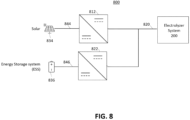
- FIG. 8 illustrates a circuit diagram of a system 800 including the electrolyzer system 200 and two or more power sources 834, 836 for powering the electrolyzer system 200.
- the electrolyzer system 200 includes at least one electrolyzer cell stack 100 (or column of stacks), and may include a plurality of electrolyzer cell stacks 100 (or columns of stacks) located in plural hotboxes 300, which are located in separate electrolyzer modules 700, as shown in FIG. 7 .
- the power sources include an intermittent power source 834 and an energy storage system (ESS) 836.
- ESS energy storage system
- the intermittent power source 834 may comprise a solar, wind, geothermal, tidal, or another intermittent power source.
- the solar intermittent power source may comprise a photovoltaic panel power source or a concentrated solar power source which concentrates solar power using mirrors and/or lenses onto a receiver, such as heat engine (e.g., steam turbine).
- the wind intermittent power source may comprise a wind turbine.
- the geothermal intermittent power source may comprise a geothermal power plant.
- the tidal intermittent power source may comprise a tidal generator which converts tidal water flows into electricity.
- the ESS 836 may comprise a battery, an ultracapacitor (i.e., supercapacitor), a mechanical (e.g., flywheel) ESS, a pumped hydro ESS or combination thereof.
- the intermittent power source 834 and the ESS 836 are electrically connected to the electrolyzer system 200 via their respective power converters 812, 822 and a common direct current (DC) power bus 820.
- the intermittent power source 834 is electrically connected to its power converter 812 via a first electrical bus 844
- the ESS 836 is electrically connected to its power converter 822 via a second electrical bus 846.
- the power converters 812, 822 may comprise DC-DC converters for DC power sources, such as a photovoltaic solar intermittent power source 834 and/or a battery ESS 836.
- the power converters 812 and/or 822 may also include AC-DC inverters.
- the power converters 812, 822 may be located in the power conditioning module 704, in the electrolyzer modules 700, in both modules 704 and 700, and/or outside the electrolyzer system 200 shown in FIG. 7 .
- the ESS 836 may be located in the power conditioning module 704 and/or outside the electrolyzer system 200 shown in FIG. 7 .
- the system 800 may comprise a grid isolated system, in which electric power from an electric power grid is not available.
- the system 800 may be located in a remote location in which a power grid is not available.
- the system 800 may be electrically connected to a power grid, but the electrolyzer system 200 is at least temporarily disconnected from the power grid and operates using only power from the intermittent power source 834 and/or the ESS 836 (e.g., due to grid outage and/or a brownout).
- the electrolyzer system 200 is not electrically connected to a power grid.
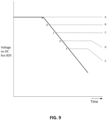
- FIG. 9 illustrates power curtailment of DC bus 820 voltage and various times where adjustments in the electrolyzer system 200 can be made to prevent its complete shutdown.
- a nominal DC voltage on the DC bus 820 may be indicated by level A.
- level A may indicate a rated hydrogen production voltage for the electrolyzer system 200 (e.g., voltage required for a predetermined steady-state mode hydrogen production level).
- a voltage reduction on the DC bus 820 to level B may cause the controller 125 of the electrolyzer system 200 to reduce voltage to the stack 100 to reduce the level of hydrogen production by electrolysis.
- a voltage reduction on the DC bus 820 to level C may cause the controller 125 of the electrolyzer system 200 to enter the hot standby operating mode by turning off power to the stack 100 and terminate hydrogen production by electrolysis, while maintaining power to the heaters and other electrolyzer system 200 components to prevent oxidation of nickel in the electrolyzer cell 1 fuel electrodes 7.
- a voltage reduction on the DC bus 820 to level D may cause the controller 125 of the electrolyzer system 200 to close off valves and turn off the heaters while preserving safety critical components. For example, the controller may initiate the isolated hot standby mode or begin a cooling process of the stack 100 to prepare for shutdown.
- a voltage reduction on the DC bus 820 to level E may cause the controller 125 of the electrolyzer system 200 to initiate a shutdown of the electrolyzer system 200.
- Various implementations may facilitate a priority of turning off or shutting down components of the electrolyzer system 200 by providing program instructions that correspond to power drop magnitude so that the controller 125 may respond to the power drop in a controlled manner to maintain the operation of the safety critical components as long as possible.
- the controller 125 may respond to the power drop in a controlled manner to maintain the operation of the safety critical components as long as possible.
- one or more of the DC/DC converters in the power conditioning module 704 and/or in the electrolyzer modules 700 may reduce the power to the stack 100 to reduce the load on the DC bus 820 in response to a determined current or power drop on the DC bus 820.
- the controller 125 may cycle from between level A and level D and back to level A (or level B) based on the power output from the intermittent power source 834 and/or the ESS 836 (if any stored energy remains in the ESS).
- the system 800 is operated to maintain the temperature of the stack 100 (or stack column) and reduce thermal cycling that impacts the lifespan of the stack during fluctuating power provided from the intermittent power source 834.
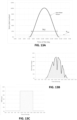
- the power output of a solar panel (i.e., photovoltaic) power generation plant is represented by graphs in FIG. 10A and FIG. 10B that illustrate percentage of peak power output over time from the solar power plant.
- the solar plant power output may vary throughout the day and becomes completely zero during nighttime due to the lack of sunlight.
- the solar plant power output may experience short drops (though long drops are also possible) from clouds, obstructions or other occlusions of the Sun (e.g., solar eclipse).
- electrolyzer systems 200 / 800 may operate more efficiently when input power and hydrogen production rates do not fluctuate (like the power curves in FIGS. 10 and 10B ).
- prioritization and controlled responses in response to power drops are used to reduce or prevent damage to the stack 100 and improve the lifespan of the SOEC 1 fuel electrodes 7 by avoiding oxidation of nickel in the fuel electrodes 7.
- prioritizing maximum hydrogen production by following the solar plant power output curve in FIG. 10B i.e., by increasing and decreasing hydrogen production rates as a function of available solar power
- the stack 100 temperature may fluctuate accordingly, which may lead to sharp stack 100 temperature drops and oxidation of nickel in the fuel electrodes.
- an electrolyzer system 200 may be configured in two different ways for a given size.
- the electrolyzer system 200 may be configured to utilize voltages close to an associated solar power plant rating, as shown in FIG. 11A . Since solar power is intermittent during the day and unavailable during the night, the electrolyzer system 200 capacity is rarely fully utilized, which means that the capital costs of the electrolyzer system 200 are much harder to recoup. As shown in FIG. 11A , the dark shaded area represents the underutilized portion of an electrolyzer system 200 on a 24-hour scale.
- the electrolyzer system 200 may still be considerably underutilized even with a 12-hour operating cycle, where the electrolyzer system 200 rating is configured to utilize the peak solar energy during the day.
- the available solar energy varies by time of year or season in many places on Earth, which may result in worse utilization metrics at other times in the year.
- the electrolyzer system 200 is configured for a lower rating that does not utilize peak solar capacity, which may result in a larger total utilization percentage over a 12-hour operating cycle.
- the solar power produced during mid-day is not utilized to produce hydrogen, and thus, some portion of the solar plant capacity is also underutilized.
- an electrolyzer system 200 may result in more thermal cycling and higher costs because the electrolyzer system 200 is overbuilt. Furthermore, where maximizing hydrogen production remains the primary operating goal of the lower rated system of the second comparative embodiment shown in FIG. 11C , similar damage to the stack may be incurred due to solar power fluctuations.
- the system 800 includes an electrolyzer system 200, an intermittent power source 834 and an additional ESS 836.
- the ESS 836 is electrically integrated with (i.e., electrically connected to) the electrolyzer system 200 and is configured to improve life-span and reliability of the electrolyzer system 200, while reducing the overall system 800 capital and operating costs.
- the ESS 836 may compensate for the power intermittency and unavailability issues of renewable intermittent power sources 834, such as solar power.
- renewable intermittent power sources 834 such as solar power.
- any other or additional intermittent power source 834 may also be used.
- the electrolyzer system 200 may be powered by a common DC bus 820 which is electrically connected to one or more intermittent power sources 834 as well as the ESS (e.g., battery) 836 power source.
- the DC/DC converter 822 that is electrically connected to the ESS 836 by the second bus 846 may be controlled based on the voltage requirements of the DC bus 820.
- the ESS 836 may fill gaps in power generation by the intermittent power source 834. The gaps may comprise the power drops shown in FIG. 10B .
- the controller 125 may be configured to plan a power (e.g., voltage) requirement for the electrolyzer system 200 based on the available energy (e.g., electric power) stored in the ESS 836. When sufficient power is not available to produce hydrogen product safely, the controller 125 may control the electrolyzer system 200 or a portion thereof to enter the above described hot standby mode instead of shutting down completely in order to avoid thermal cycling.
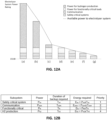
- FIG. 12A illustrates the power requirements for the electrolyzer system 200 with various exemplary setpoints for operation at different power levels.
- the setpoints of FIG. 12A may apply to one or more individual SOEC stacks 100, one or more individual SOEC stack columns or electrical segments (e.g., two or more columns electrically connected in parallel), an entire electrolyzer module 700 containing a hotbox 300 housing a plurality of stacks 100 or stack columns 101, plural electrolyzer modules 700, or the entire electrolyzer system 200 including all electrolyzer modules 700 therein.
- the power provided by the power sources 834, 836 to the electrolyzer system 200 may be used to generate (e.g., produce) hydrogen using electrolysis and to supply power to support subsystems.
- the support subsystems of the electrolyzer system 200 may be categorized according to function and priority to determine which support subsystem is provided with the limited power available from the power sources 834 and 836.
- the support subsystems include functionally critical electrical loads (e.g., subsystems), system communication subsystems (e.g., communication components which permit the controller 125 to communicate with a central control facility), and safety critical subsystems.
- Safety critical subsystems may operate in the electrolyzer system 200 to maintain safety of the electrolyzer system 200 by continuously monitoring components of the electrolyzer system 200 and taking appropriate safety actions based on detected events.
- the safety critical subsystems may include safety critical controllers (e.g., proportional-integral-derivative controllers), conduit monitoring components, such as pressure, temperature and/or electrical sensors, that provide data to the safety critical controllers, conduit control components such as valves, pumps, blowers, and electrical switchboard components.
- the power consumed by the safety critical subsystems, P sc may be very low ( ⁇ 0.01%, such as 0.001 to 0.005%) of the electrolyzer system 200 power rating.
- Some support subsystems may be categorized as communication subsystems.
- the communication subsystems in electrolyzer system 200 may operate to support safety critical subsystems in monitoring the electrolyzer system 200 and also to provide remote monitoring, logging, and control of the electrolyzer system 200.
- the communication subsystems may include wireless and/or wired data transmission and receiver systems which provide data to a central control facility and receive control instruction data from a central control facility. Similar to P sc , the power consumed by the communication subsystems, P com , may be very low ( ⁇ 0.01%, such as 0.001 to 0.005%) of the electrolyzer system 200 power rating.
- the functionally critical subsystems may include the systems that allow operation and prevent costly stack 100 damage and recovery times.
- functionally critical subsystems may include heaters, such as water system heaters used to heat steam conduits to avoid freezing of the steam conduits, and stack heaters used to heat the stacks 100 to elevated temperatures that prevent fuel electrode 7 nickel oxidation.
- the power consumed by functionally critical subsystems, P fc may be between 2-5% of the total electrolyzer system 200 power rating.
- Various other (e.g., remaining) support subsystems may be used only for hydrogen production or may only be needed during hydrogen production.
- These hydrogen production subsystems in the electrolyzer system 200 may include the stacks 100, other heaters (e.g., air heaters), steam production equipment, hydrogen post-processing equipment (e.g., hydrogen processor 120), the hydrogen storage vessel 52, and other components not required for safety or communication.
- the electrolyzer system 200 may operate at its full rated capacity as long as the intermittent power source 834 is able to deliver the sufficient power to the DC bus 820.
- the system power utilization is directed primarily to hydrogen production.
- more than 50%, such as 50 - 95% of the power drawn, for example 60 to 90% of the power drawn, by the electrolyzer system 200 is used to power the stacks 100 or stack columns to generate the hydrogen product by electrolysis.
- the remaining power drawn by the electrolyzer system 200 is used to supply power to the support subsystems which include the functionally critical electrical loads, the system communication (e.g., for the controller 125 to communicate with a central control facility) and the safety critical subsystems.
- the controller 125 adjusts the system 200 power draw to match the available power from the power sources 834, 836 while following a predefined set of rules and priorities.
- FIG. 12A illustrates exemplary predefined sets of rules and priorities based on the amount of power available to the electrolyzer system 200 from the power sources 834, 836.
- the first reduction in power usage may be at the stack 100 or column terminals that are used to power the stack or stack column to generate (i.e., produce) hydrogen.
- hydrogen production is reduced (e.g., hydrogen production continues, but at a lower rate than at setpoint (a)) while other support subsystems remain at full power.
- the production of hydrogen is reduced further.
- the production of hydrogen may be stopped and the electrolyzer system 200 or a portion thereof may enter the hot standby mode, and provide full required power to the support subsystems which include the functionally critical electrical loads, the system communication and the safety critical subsystems.
- the reduction in supplied power and hydrogen production to match the supplied power is not limited to discrete setpoints (a)-(d) and may include a continuous reduction in supplied stack 100 power that continuously deceases with a decreased in power provided by the power sources 834, 836 to the common DC bus 820, up to the setpoint (d).
- the electrolyzer system 200 may first curtail its hydrogen production rate while not disturbing power flow to other high priority support subsystems, including functionally critical, communication, and safety critical subsystems. This maintains the stack 100 at a temperature above the nickel oxidation temperature. If the solar power further decreases to a critical value at setpoint (d), then the electrolyzer system 200 may completely stop the hydrogen production and may enter the hot standby mode.
- the hot standby mode includes a state in which the electrolyzer system 200 does not produce any hydrogen product but supports the functionally critical, communication, and safety critical subsystems, as shown at setpoint (d), to maintain the stack 100 at a temperature above the nickel oxidation temperature.
- the hot standby mode may incorporate the support subsystems rated as priorities 1, 2, or 3 in FIG. 12B and the voltage requirement for full hot standby may be the sum total of the voltage requirements of those subsystems (e.g., functionally critical, communication, and safety critical).
- the electrolyzer system 200 may start curtailing power to its functionally critical subsystems first and then to communication subsystems and finally to the safety critical subsystems, as shown at setpoints 5(e), 5(f), and 5(g) in FIG. 12A.
- the power level provided by the power sources 834, 836 may support providing partial power to functionally critical subsystem loads, which may require a subset of the functionally critical subsystem loads to shut off.
- Setpoint (e) may correspond to the isolated hot standby mode or the electrolyzing hot standby mode where the stack 100 is isolated via one or more valves to conserve heat, as described above.
- controller 125 may follow next level priorities within the functionally critical subsystem loads (i.e., lowering the power supplied to one or more heaters to lower the temperature of one or more heaters to keep stacks 100 at less-than-ideal temperature) to minimize the depth of the thermal cycle to the stacks 100.
- the functionally critical subsystems may be shut off and a shutdown process may begin.
- communication subsystems may be shut off and a shutdown process may be completed such that only passive processes remain (e.g., cool down).
- only the safety critical subsystems may remain on. Since the safety critical subsystems consume very little power, they may be powered for a long time by the remaining power stored in the ESS 836, until the intermittent power source 834 begins to again produce power.
- the ESS 836 stores a finite amount of power and is recharged by power from the intermittent power source 834.
- the intermittent power source 834 is not available to provide power to the electrolyzer system 200
- the stored power from the ESS 836 is provided to the electrolyzer system 200 until the stored power is exhausted.
- the ESS 836 may provide power to the electrolyzer system 200 so that solar dropouts do not result in rapid reductions in power (e.g., voltage) to the electrolyzer system 200.
- the sizing of the ESS may be based on the estimated energy requirements of the electrolyzer system 200 subsystems and based on the duration of backup power from the ESS required for each subsystem, as illustrated in the table of FIG. 12B .
- each of the priority levels may be assigned a time period of operation powered by the ESS 836 before shifting to the next lower level. The sum of energy requirements for these time periods may correspond to an energy storage requirement in a day or week.
- the value of T hsb may be estimated by using a typical solar irradiation curve in a particular region in which the system 800 is located.
- T h2 is the duration of time where the amount of solar output is greater than power consumed by the electrolyzer system 200 operating in the hot standby mode.
- ESS power output may not be needed to maintain the hot standby mode.
- the energy for hot standby (E hsb ) may be based on the ideal curve on a clear sunny day. The solar power may drop below the hot standby level several times during the day during weather events (e.g., cloudy periods).
- the value of k hgb may be between 1 to 2 depending on the weather patterns in the location where the system 800 is located. If stored energy in the ESS 836 is exhausted by the electrolyzer system 200, then an alternative power source can be dispatched (e.g., a mobile or back up power generator source) to support hot standby mode operation of the electrolyzer system 200. Alternatively, the electrolyzer system 200 may be shut down if the alternative power source is not available.
- an alternative power source e.g., a mobile or back up power generator source
- FIGS. 13A and FIG. 13B are representative graphs of power outputs of a solar power plant on a clear sunny and on a cloudy day, respectively. The profile shown in FIG. 13B is more common compared to FIG. 13A . Therefore, the ESS smoothing may be configured to support solar profiles close to FIG. 13B.
- FIG. 13C illustrates an ideal power required for the electrolyzer system 200 to generate hydrogen during the day from sunrise to sunset.
- the energy required for water electrolysis may be characterized or calculated as the area under the step function of FIG. 13C such that the power sources 834 and 836 provide power sufficient for full rate operation of the electrolyzer system 200 to produce a rated amount of hydrogen product for a given time period.
- FIG. 14A shows the un-simplified profile 1402 of FIG. 13B .
- the expected solar curve may be defined as the ideal solar curve 1404 with a correction factor 1406 (K s_cloud ), as shown in FIG. 14A .
- the solar power plant and associated electrolyzer system 200 may be configured such that some portion of the day the solar power plant produces more power than the electrolyzer system's load power demand.
- This excess power generation from the solar intermittent power source 834 may be stored in the ESS 836.
- the stored energy in the ESS 836 may be retrieved and provided to the electrolyzer system 200 to meet its power demand.
- Stored and retrieved energy of the ESS 836 may be referred as charging and discharging energies.
- the amount of charging energy, E ESS_ch i.e., excess power from solar power plant
- E ESS_ch the amount of charging energy
- P solar the solar intermittent power source 834 power output
- the duration and power level of the electrolyzer system 200 operation may be adjusted to achieve a balance between E ESS_ch and E ESS_disch .
- the balance between E ESS_ch and E ESS_disch may be calculated according to a predetermined time period, such as a day or a week.
- the estimated discharge energy may include the K s_cloud adjustment.
- the adjusted amount of charging energy, E ESS_ch_adj may be estimated by integrating a positive area under P solar_adj - P SOEC curve.
- the full charge / discharge / usage round trip efficiencies of all system 800 components may impact the E ESS value, such that an inefficiency adjustment may be added to the ESS capacity requirement.
- the final values of K s_cloud , the duration of the electrolyzer system hot standby mode operation, T SOEC , and the ESS capacity, E ESS may be selected depending on various factors, such as weather patterns as well as capital and operational costs.
- the management of ESS charge and discharge during the operation of the electrolyzer system 200 may vary significantly from day to day.
- the energy management process for the electrolyzer system 200 may ensure that sufficient energy is left in the ESS for scheduled hot standby mode (e.g., at the end of every day after sunset), and adjust the start point of the hot standby mode based on intermittent power source 834 power generation capacity and remaining ESS 836 storage capacity.
- the controller 125 may reserve additional energy capacity in ESS 836 to cover the increase in hot standby mode duration, T hsb . For example, as shown in FIG.
- the dropouts in solar energy below the predicted solar curve (P solar ) may require a discharge from ESS 836 to prevent premature entry into the hot standby mode.
- the controller 125 may adjust the scheduled hot standby mode at the end of the day based on the remaining energy capacity of the ESS 836, such that less total power is provided from the ESS 836 during the hot standby mode.
- FIG. 16 illustrates a management process 1600 for adjusting charging/discharging and usage of energy from the ESS 836.
- Various components e.g., controller 125, power supply 500, DC/DC converters 812, 822, etc.
- the electrolyzer system 200 may include a controller 125 which may coordinate power usage of the electrolyzer system 200 based on monitoring information received from various sensors located in the system 800.
- the process 1600 may start at block 1601 which may be a scheduled start at the beginning of a day (e.g., at sunrise).
- the process 1600 may estimate energy (e.g., a product of power and time) required for the electrolyzer system 200 to generate hydrogen product using energy from the intermittent power source 834, such as a solar power plant, and supplemented by energy from the ESS 836, for an entire day or other predetermined period, until the electrolyzer system 200 enters the scheduled hot standby mode.
- energy e.g., a product of power and time
- the controller may estimate the time until the system is expected to return to the hot standby mode (i.e., duration between the current time and the scheduled hot standby mode entry time). This time may include the time remaining until sunset or until the solar power plant power is expected to begin being used for recharging the ESS 836 instead of or in addition to providing power to the electrolyzer system 200. The time may be based on an expected solar profile for the day or a number of daylight hours (e.g., time until sunset). For intermittent power sources 834 other than solar power plants, the expected time may be calculated based on expected characteristics of those intermittent power sources.
- the controller may estimate the remaining total energy available in the ESS 836 (i.e., E ess ).
- One or more sensors e.g., state of charge sensor in a battery or supercapacitor ESS
- a remaining energy in the ESS e.g., remaining charge based on voltage, current and a charge / discharge profile for a battery ESS.
- the controller may estimate the energy available from the ESS 836 that is available for hydrogen production in the electrolyzer system 200.
- the ESS energy available for hydrogen production, E ess_h2 E ess - E hsb_adjusted .
- the determination of the value of adjusted hot standby energy, E hsb_adjusted is described above.
- the controller may estimate the expected amount of adjusted charging energy, E ESS_ch_adj , and the expected amount of adjusted discharging energy, E ESS_disch_adj , by integrating respective positive and negative areas between P solar_adj and P SOEC curves, as described above.
- E net E ess_h2 - E ESS_disch_adj + E ESS_ch_adj .
- the net energy remaining in the ESS is the sum of the ESS energy available for hydrogen production and the expected adjusted amount of charging energy minus the expected adjusted amount of discharging energy.
- the process may proceed to block 1608 where the controller 125 may reduce at least one of the electrolyzer system 200 load demand (P SOEC ) and/or the duration of the hydrogen product generation (T h2 ) by the electrolyzer system 200.
- the controller 125 may evaluate various methods of reducing hydrogen production including reducing the time spent producing hydrogen and/or reducing the amount of power (e.g., reducing the DC bus 820 voltage) used for hydrogen production.
- the process returns to block 1605.
- the value of P solar may be retrieved from system memory, where P solar may be stored as a location based solar profile for the location of the system 800.
- the value of the correction factor 1406, K s_cloud may be determined using a predictive algorithm, as described above. The algorithm considers various factors available to it, such as weather prediction tools, analysis tools based on previous data, etc.
- the controller uses the determined value of P solar_adj in determining the expected amount of adjusted charging energy, E ESS_ch_adj , and the expected amount of adjusted discharging energy, E ESS_disch_adj , in block 1605.
- the hydrogen production may be estimated before the hot standby mode starts using prestored solar profile, a dynamic K s_cloud cloud correction factor 1406, and a planned electrolyzer system 200 load demand profile. If the controller determines that the planned electrolyzer system 200 load demand profile may result in zero or negative net energy remaining in the ESS 836, the controller may reduce the load demand during hydrogen production and/or duration of hydrogen production to ensure that positive net energy remains in the ESS 836 at the end of the hot standby mode (e.g., overnight) to avoid shutting down the electrolyzer system 200 until the sunlight is available again to power the solar power plant.
- the embodiments of the present disclosure reduce the total capital cost and operating cost of a remote or grid islanded electrolyzer system that is powered by a combination of a dedicated renewable intermittent power source, such as a solar power plant, and an ESS, by permitting the electrolyzer system to generate a hydrogen product at a relatively constant rate, as well as keeping the electrolyzer cell stacks at a required elevated temperature throughout the 24 hour day (i.e., during daytime and nighttime).
- the embodiments also provide an additional layer of safety and reliability by keeping safety critical subsystems and communication subsystems powered throughout the day even in case of reduced or no power provided form the renewable power source, by prioritizing energy stored in the ESS for powering the safety critical subsystems and the communication subsystems.
Landscapes
- Chemical & Material Sciences (AREA)
- Engineering & Computer Science (AREA)
- Metallurgy (AREA)
- Organic Chemistry (AREA)
- Chemical Kinetics & Catalysis (AREA)
- Electrochemistry (AREA)
- Materials Engineering (AREA)
- Automation & Control Theory (AREA)
- Inorganic Chemistry (AREA)
- Ceramic Engineering (AREA)
- Power Engineering (AREA)
- Analytical Chemistry (AREA)
- Electrolytic Production Of Non-Metals, Compounds, Apparatuses Therefor (AREA)
Abstract
Description
- The present invention is directed to electrolyzer systems and methods of operating the same with intermittent power sources, such as solar power sources.
- In a solid oxide electrolyzer cell (SOEC), a cathode electrode is separated from an anode electrode by a solid oxide electrolyte. When a SOEC is used to produce hydrogen through electrolysis, a positive potential is applied to the air side of the SOEC and oxygen ions are transported from the fuel (e.g., steam) side to the air side. Throughout this specification, the SOEC anode will be referred to as the air electrode, and the SOEC cathode will be referred to as the fuel electrode. During SOEC operation, water (e.g., steam) in the fuel stream is reduced (H2O + 2e-→O2- + H2) to form H2 gas and O2- ions, the O2- ions are transported through the solid electrolyte, and then oxidized (e.g., by an air inlet stream) on the air side (O2- to O2) to produce molecular oxygen (e.g., oxygen enriched air).
- According to various embodiments, a method operating an electrolyzer system includes producing hydrogen by electrolysis of steam in at least one electrolyzer cell stack of the electrolyzer system using power received from an intermittent power source, detecting a reduction in a level of power received from the intermittent power source below a first threshold, decreasing a rate of producing the hydrogen in response to the detected reduction in the level power below the first threshold, detecting a reduction in a level of power received from the intermittent power source below a second first threshold that is lower than the first threshold, and switching the electrolyzer system into a hot standby mode in which the electrolyzer system does not produce hydrogen and maintains the least one electrolyzer cell stack above a predetermined threshold temperature.
- According to various embodiments, a system includes an electrolyzer system comprising at least one electrolyzer cell stack configured to produce hydrogen by electrolysis of steam; an intermittent power source electrically connected to the electrolyzer system; an energy storage system electrically connected to the electrolyzer system; and a controller. The controller includes machine executable instructions that operate to: detect a reduction in a level of power received from the intermittent power source below a first threshold; decrease a rate of producing hydrogen in response to the detected reduction in the level power below the first threshold; detect a reduction in a level of power received from the intermittent power source below a second first threshold that is lower than the first threshold; and switch the electrolyzer system into a hot standby mode in which the electrolyzer system does not produce hydrogen and maintains the least one electrolyzer cell stack above a predetermined threshold temperature.
-
-
FIG. 1A is a perspective view of a solid oxide electrolyzer cell (SOEC) stack. -
FIG. 1B is a side cross-sectional view of a portion of the stack ofFIG. 1A . -
FIG. 2 is a schematic view of an electrolyzer system, according to various embodiments of the present disclosure. -
FIG. 3A is a cross-sectional view showing air flow in a hotbox of the electrolyzer system ofFIG. 2 , according to various embodiments of the present disclosure. -
FIG. 3B is a cross-sectional view showing steam and hydrogen flow in the hotbox of the electrolyzer system ofFIG. 2 , according to various embodiments of the present disclosure. -
FIG. 3C is a top view showing heat transfer in the hotbox ofFIG. 2 , according to various embodiments of the present disclosure. -
FIG. 4 is a component block diagram of a portion of the electrolyzer system ofFIG. 2 , according to various embodiments of the present disclosure. -
FIG. 5 is a diagram of an electrolyzer cell operating in an isolated hot standby mode, according to various embodiments of the present disclosure. -
FIG. 6 is a diagram of the electrolyzer cell ofFIG. 5 operating in an isolated electrolysis mode, according to various embodiments of the present disclosure. -
FIG. 7 is perspective view a modular electrolyzer system according to various embodiments of the present disclosure. -
FIG. 8 is a circuit diagram of a system including the electrolyzer system and two or more power sources for supplying power to the electrolyzer system. -
FIG. 9 is plot of voltage versus time illustrating various setpoints for electrolyzer system operation based on power availability according to various embodiments of the present disclosure. -
FIGS. 10A and 10B are graphs of various solar energy curves under various conditions. -
FIGS. 11A ,11B and 11C are graphs of solar energy availability for an electrolyzer system according to various comparative embodiments of the present disclosure. -
FIGS. 12A and12B comprise a bar graph and table that illustrate various power requirements and set points for an electrolyzer system according to various embodiments of the present disclosure. -
FIGS. 13A and 13B are graphs of various representations of solar energy curves according to various embodiments of the present disclosure, andFIG. 13C is a graph of power demand as a function of time of an electrolyzer system according to various embodiments of the present disclosure. -
FIGS. 14A and 14B illustrate graphs of various solar energy availability scenarios according to various embodiments of the present disclosure. -
FIG. 15 illustrates a graph of a solar energy availability scenario according to various embodiments of the present disclosure. -
FIG. 16 is a diagram of a method according to various embodiments of the present disclosure. -
FIG. 1A is a perspective view of anelectrolyzer cell stack 100, such as a solid oxide electrolyzer cell (SOEC) stack, andFIG. 1B is a side cross-sectional view of a portion of thestack 100 ofFIG. 1A . Referring toFIGS. 1A and 1B , thestack 100 includes multiple electrolyzer cells (e.g., SOECs) 1 that are separated byinterconnects 10, which may also be referred to as gas flow separator plates or bipolar plates. Eachelectrolyzer cell 1 includes anair electrode 3, anelectrolyte 5, such as a solid oxide electrolyte for a SOEC, and afuel electrode 7. Thestack 100 also includes internalfuel riser channels 22. - Various materials may be used for the
air electrode 3,electrolyte 5, andfuel electrode 7. For example, theair electrode 3 may comprise an electrically conductive material, such as an electrically conductive perovskite material, such as lanthanum strontium manganite (LSM). Other conductive perovskites, such as LSCo, etc., or metals, such as Pt, may also be used. Theelectrolyte 5 may comprise a stabilized zirconia, such as scandia stabilized zirconia (SSZ) or yttria stabilized zirconia (YSZ), yttria-ceria-stabilized zirconia (YCSZ), ytterbia-ceria-scandia-stabilized zirconia (YbCSSZ), or blends thereof. In YbCSSZ, scandia may be present in an amount equal to 9 to 11 mol %, such as 10 mol %, ceria may present in amount greater than 0 and equal to or less than 3 mol %, for example 0.5 mol % to 2.5 mol %, such as 1 mol %, and ytterbia may be present in an amount greater than 0 and equal to or less than 2.5 mol %, for example 0.5 mol % to 2 mol %, such as 1 mol %, as disclosed inU.S. Pat. No. 8,580,456 , which is incorporated herein by reference. Alternatively, theelectrolyte 5 may comprise another ionically conductive material, such as a doped ceria. Thefuel electrode 7 may comprise a cermet comprising a nickel containing phase and a ceramic phase. The nickel containing phase may consist entirely of nickel in a reduced state. The ceramic phase may comprise a stabilized zirconia, such as yttria and/or scandia stabilized zirconia and/or a doped ceria, such as gadolinia, yttria and/or samaria doped ceria. The electrodes and the electrolyte may each comprise one or more sublayers of one or more of the above described materials. - Each
interconnect 10 electrically connectsadjacent electrolyzer cells 1 in thestack 100. In particular, aninterconnect 10 may electrically connect thefuel electrode 7 of oneelectrolyzer cell 1 to theair electrode 3 of anadjacent electrolyzer cell 1.FIG. 1B shows that thelower electrolyzer cell 1 is located between twointerconnects 10. - Each
interconnect 10 may be made of or may contain electrically conductive material, such as a metal alloy (e.g., chromium-iron alloy) which has a similar coefficient of thermal expansion to that of the solid oxide electrolyte in the cells (e.g., a difference of 0-10%). For example, theinterconnects 10 may comprise a metal (e.g., a chromium-iron alloy, such as 4-6 weight percent iron, optionally 1 or less weight percent yttrium and balance chromium alloy). Alternatively, any other suitable conductive interconnect material, such as stainless steel (e.g., ferritic stainless steel, SS446, SS430, etc.) or iron-chromium alloy (e.g.,Crofer tm 22 APU alloy which contains 20 to 24 wt.% Cr, less than 1 wt.% Mn, Ti and La, and balance Fe, or ZMGtm 232L alloy which contains 21 to 23 wt.% Cr, 1 wt.% Mn and less than 1 wt.% Si, C, Ni, Al, Zr and La, and balance Fe) may be used. - Each
interconnect 10 includesfuel ribs 12A that at least partially definefuel channels 8A, andair ribs 12B that at least partially defineair channels 8B. Theinterconnect 10 may operate as a gas-fuel separator that separates a fuel, such as steam, flowing to thefuel electrode 7 of oneelectrolyzer cell 1 in thestack 100 from oxidant, such as air, flowing to theair electrode 3 of anadjacent electrolyzer cell 1 in thestack 100. At either end of thestack 100, there may be an air end plate or fuel end plate (not shown) for providing air or fuel, respectively, to the end electrode. Alternatively, the air end plate or fuel end plate may comprise the same interconnect structure used throughout the stack. An optionalconductive contact layer 13, such as a nickel mesh, may be located between thefuel electrode 7 and the fuel ribs 12. -
FIG. 2 is schematic view of anelectrolyzer system 200, according to various embodiments of the present disclosure. Referring toFIGS. 1A, 1B , and2 , thesystem 200 may include one or more electrolyzer cell stacks 100 or columns, such as SOEC stacks or columns. Each column may include one or more electrolyzer cell stacks 100. Theelectrolyzer cell stack 100 includes multiple electrolyzer cells, such as SOECs, as described with respect toFIGS. 1A and 1B . Thesystem 200 may also include asteam generator 104, a steamrecuperator heat exchanger 108, an airrecuperator heat exchanger 112, anair blower 118, arecycle blower 126, anouter column heater 350, aninner column heater 360, and abase heater 370. Thesystem 200 may also optionally include at least one of an airpre-heater heat exchanger 54, a waterpreheater heat exchanger 102, amixer 106, ahydrogen processor 120 and/or a hydrogen separator (e.g., splitter or valve) 122. - The
system 200 may include ahotbox 300 that houses various components, such as thestack 100, thesteam recuperator 108, theair recuperator 112, theouter column heater 350, theinner column heater 360 and/or thebase heater 370. In some embodiments, thehotbox 300 may includemultiple stacks 100 or multiple columns ofstacks 100. Thewater preheater 102 and thesteam generator 104 may be located external to thehotbox 300, as shown inFIG. 2 . Alternatively, thewater preheater 102 and/or thesteam generator 104 may be located inside thehotbox 300. In another alternative embodiment, the SOEC system may have an external steam source, in which case thewater preheater 102 and/or thesteam generator 104 may be omitted. - During operation, the
stack 100 may be provided with steam (e.g., steam inlet stream) and electric power (e.g., current or voltage) from an external power source. In particular, the steam may be provided to thefuel electrodes 7 of theelectrolyzer cells 1 of thestack 100, and the power source may apply a voltage between thefuel electrodes 7 and theair electrodes 3, in order to electrochemically split water (e.g., steam) molecules and generate hydrogen and oxygen. Air may also be provided to theair electrodes 3, in order to sweep the oxygen from theair electrodes 3. As such, thestack 100 may output a hydrogen stream and an oxygen-rich exhaust stream, such as an oxygen-rich air stream ("oxygen exhaust stream"). - In order to generate the steam, water may be provided to the
system 200 from awater source 50. Thewater source 50 may include a municipal water supply (e.g., water pipe) and/or a water storage tank. The water may be deionized (DI) water that is deionized as much as is practical (e.g., <0.1 µS/cm), in order to prevent and/or minimize scaling during vaporization. In some embodiments, thewater source 50 may include one or more deionization beds (e.g., downstream of the water pipe or tank). Thewater source 50 may provide the water to thesystem 200 via awater inlet conduit 250. In various embodiments, thewater inlet conduit 250 may include a waterflow control device 251 such as a valve, a mass flow controller, a positive displacement pump, a water flow meter, or the like, in order to provide a desired water flow rate to thesystem 200. - If the
system 200 includes thewater preheater 102, the water may be provided from thewater source 50 to thewater preheater 102 through thewater inlet conduit 250. Thewater preheater 102 may be a heat exchanger configured to heat the water using heat recovered from the oxygen exhaust stream from thestack 100. Preheating the water may reduce the total power consumption of thesystem 200 per unit of hydrogen generated. In particular, thewater preheater 102 may recover heat from the oxygen exhaust stream that may not be recoverable by theair recuperator 112, as discussed below. Thewater preheater 102 may heat the water to a temperature above 50 °C, such as a temperature of about 70 °C to 80 °C. The oxygen exhaust stream may be output from thewater preheater 102 viaconduit 205 at a temperature above 80 °C, such as above 100 °C, such as a temperature of about 120 °C to 140 °C. - The water output from the water preheater 102 (or from the
water source 50 if thewater preheater 102 is omitted) may be provided to thesteam generator 104 through awater conduit 202. Thesteam generator 104 may be configured to heat the water to convert the water into steam. Thesteam generator 104 may include a heating element to vaporize the water and generate steam. For example, thesteam generator 104 may include an AC or DC resistance heating element or an induction heating element. Alternatively, thesteam generator 104 may comprise a heat exchanger which is located inside thehotbox 300 and which is heated by one or more hot exhaust streams flowing through thehotbox 300. Thesteam generator 104 heats the water above 100 °C to generate steam, such as a temperature of about 120 °C to 145 °C. - The
steam generator 104 may include multiple zones/elements that may or may not be mechanically separate. For example, thesteam generator 104 may include a pre-boiler to heat the water up to or near to the boiling point. Thesteam generator 104 may also include a vaporizer configured to convert the pre-boiled water into steam. Thesteam generator 104 may also include a deaerator to provide a relatively small purge of steam to remove dissolved air from the water prior to bulk vaporization. Thesteam generator 104 may also include an optional superheater configured to further increase the temperature of the steam generated in the vaporizer. Thesteam generator 104 may include a demister pad located downstream of the heating element and/or upstream from the super heater. The demister pad may be configured to minimize entrainment of liquid water in the steam output from thesteam generator 104 and/or provided to the superheater. - If the steam product is superheated, it will be less likely to condense downstream from the
steam generator 104 due to heat loss. Avoidance of condensation is preferable, as condensed water is more likely to form slugs of water that may cause significant variation of the delivered mass flow rate with respect to time. It may also be beneficial to avoid excess superheating, in order to limit the total power consumption of thesystem 200. For example, the steam may be superheated by an amount ranging from about 10 °C to about 100 °C. - In some embodiments, a small amount of liquid water (e.g., from about 0.5% to about 2% of incoming water) may be periodically or continuously discharged from the
steam generator 104 via aliquid discharge conduit 224. In particular, the discharged liquid water may include scale and/or other mineral impurities that may accumulate in thesteam generator 104 while vaporizing water to generate steam. Therefore, this discharged liquid water is not desirable for being recycled into the water inlet stream from thewater source 50. This liquid discharge may be mixed with the hot oxygen exhaust stream output from thewater preheater 102 into anexhaust conduit 205. If the hot oxygen exhaust stream has a temperature above 100 °C, the liquid water discharge may be evaporated by the hot oxygen exhaust stream, such that no liquid water is required to be discharged from thesystem 200. Thesystem 200 may optionally include awater pump 124 configured to pump and regulate the liquid water discharge in theliquid discharge conduit 224 output from thesteam generator 104 into theexhaust conduit 205 from thewater preheater 102. Optionally, a flow regulator, such as proportional solenoid valve, may be added to theliquid discharge conduit 224 in addition to thepump 124 to additionally regulate the flow of the liquid water discharge. - Blowdown from the
steam generator 104 may be beneficial for long term operation, as the water will likely contain some amount of mineralization after deionization. Typical liquid blowdown may be on the order of 1%. The blowdown may be continuous, or may be intermittent, e.g., ten times the steady state flow for 6 seconds out of every minute, five times the steady state flow for 1 minute out of every 5 minutes, etc. The need for a water discharge stream can be eliminated by pumping the blowdown into the hot oxygen exhaust. In this case, thepump 124 andliquid discharge conduit 224 may be omitted. - The steam output from the
steam generator 104 may be provided to thesteam recuperator 108 via asteam conduit 204. However, if thesystem 200 includes theoptional mixer 106, the steam may be provided to themixer 106 prior to being provided to thesteam recuperator 108 via steam andhydrogen conduit 206. In particular, the steam may include small amounts of dissolved air and/or oxygen. Themixer 106 may be configured to mix the steam with hydrogen gas, in order to maintain a reducing environment in thestack 100, and in particular, at thefuel electrodes 7. - The
mixer 106 may be configured to mix the steam with hydrogen received from a hydrogen storage device (e.g., hydrogen storage vessel) 52 and/or with a portion of the hydrogen and steam recycle stream output from thestack 100. The hydrogen addition rate may be set to provide an amount of hydrogen that exceeds an amount of hydrogen needed to react with an amount of oxygen dissolved in the steam. The hydrogen addition rate may either be fixed or set to a constant water to hydrogen ratio. However, if the steam is formed using water that is fully deaerated, themixer 106 and/or hydrogen addition into the steam may optionally be omitted. - In some embodiments, the hydrogen may be provided to the
mixer 106 during system start-up and shutdown modes, and optionally during steady state operation modes. For example, during the start-up and shutdown modes (or other modes where thesystem 200 is not generating hydrogen, such as a fault mode), the hydrogen may be provided to themixer 106 from thehydrogen storage device 52 via a storedhydrogen conduit 252. In an alternative embodiment described below, in voltage controlled start-up, shutdown and process stop modes, no external hydrogen is provided to themixer 106 and thestack 100. - During the steady state operating mode, the hydrogen flow from the
hydrogen storage device 52 may be stopped (e.g., by shutting off an outlet valve from the hydrogen storage device (not shown)). A first portion of a hydrogen exhaust stream (e.g., the hydrogen and steam product steam) generated by thestack 100 is diverted to themixer 106 through thehydrogen recycle conduit 226 by therecycle blower 126. In particular, thesystem 200 may include ahydrogen separator 122, such as a splitter and/or valve, configured to selectively divert a portion of the hydrogen exhaust stream flowing through thehydrogen product conduit 220 to themixer 106 during the steady state mode operation. - The mixed steam and hydrogen inlet stream is provided from the
mixer 106 into a steamrecuperator heat exchanger 108 via a steam andhydrogen conduit 206. The mixed steam and hydrogen inlet stream inconduit 206 may have a temperature above 100 °C, such as 120 °C to 140 °C. The mixed steam and hydrogen inlet stream is heated in thesteam recuperator 108 by the hydrogen exhaust (i.e., the hydrogen and steam product stream) provided from thestack 100. The hydrogen exhaust may be provided from thestack 100 to thesteam recuperator 108 via ahydrogen outlet conduit 210. The heated mixed steam and hydrogen inlet stream is provided from the steamrecuperator heat exchanger 108 into the fuel side inlet of thestack 100 via thefuel inlet conduit 208. The mixed steam and hydrogen inlet stream in thefuel inlet conduit 208 may have a temperature above 500 °C, such as 550 °C to 600 °C. - The hydrogen exhaust is output from the hotbox 300 (e.g., from the
steam recuperator 108 and/or the optional air preheater 54) into thehydrogen product conduit 220 at a temperature of 150 °C to 250 °C. A second portion of the hydrogen exhaust that is not diverted by thehydrogen separator 122 into themixer 106 continues through thehydrogen product conduit 220 into thehydrogen processor 120. The hydrogen exhaust may be compressed and/or purified in thehydrogen processor 120. Thehydrogen processor 120 may include a high temperature hydrogen pump that operates at a temperature from about 120 °C to about 200 °C, in order to remove from about 70% to about 90% of the hydrogen from the hydrogen exhaust. The removed hydrogen is stored and/or provided for one or more end uses. In one embodiment, thehydrogen processor 120 includes an electrochemical hydrogen pump, a liquid ring compressor, a diaphragm compressor or combination thereof. For example, the hydrogen processor may include a series of electrochemical hydrogen pumps, which may be disposed in series and/or in parallel with respect to a flow direction of the hydrogen exhaust, in order to compress the hydrogen exhaust. The final product from compression may still contain traces of water. As such, thehydrogen processor 120 may optionally include a dewatering device, such as a condenser, a temperature swing adsorption reactor or a pressure swing adsorption reactor, to remove this residual water, if necessary. - The air
recuperator heat exchanger 112 may be provided with ambient air by anair blower 118 via anair inlet conduit 218 and an optionalpreheated air conduit 254. The oxygen exhaust output from thestack 100 may be provided to theair recuperator 112 via anoxygen outlet conduit 222. Theair recuperator 112 may be configured to heat the incoming air using heat extracted from the stack oxygen exhaust (i.e., the oxygen enriched air). The air inlet stream may be heated in theair recuperator 112 to a temperature above 500 °C, such as 550 °C to 600 °C. The heated air inlet stream is provided from theair recuperator 112 to the air inlet of thestack 100 via the stackair inlet conduit 212. The oxygen exhaust is output from theair recuperator 112 to thewater preheater 102 via theoxygen exhaust conduit 228 at temperature above 200 °C, such as 250 °C to 350 °C. The oxygen exhaust is output from thewater preheater 102 via theexhaust conduit 205 at temperature of at least 80 °C. - According to various embodiments, the
system 200 may include an optional airpreheater heat exchanger 54 disposed outside or inside of thehotbox 300. In particular, theair preheater 54 may be configured to preheat the air inlet stream provided to thehotbox 300 by theair blower 118 via theair inlet conduit 218 using heat in the hydrogen exhaust (i.e., the hydrogen and steam product stream) from thestack 100. The air may be preheated in the air preheater to a temperature above 100 °C, such as 150 °C to 250 °C. The hydrogen exhaust stream may be provided from thesteam recuperator 108 to theair preheater 54 via ahydrogen conduit 238. - According to various embodiments, the
system 200 may include acontroller 125, such as a central processing unit, which is configured to control the operation of thesystem 200. For example, thecontroller 125 may be wired or wirelessly connected to various elements of thesystem 200 to control the same. Thecontroller 125 may control various process fluid and power flows in thesystem 200 by adjusting valve positions (e.g., opening and closing valves), blower speeds, and power converters (e.g., DC-DC converters). Thecontroller 125 may be configured with various operating modes including energy saving modes. For example, various elements insystem 200 may be switched off to preserve energy while maintaining theSOEC stack 100 at a relatively high temperature. - According to various embodiments, the
SOEC stack 100 may most efficiently generate hydrogen at an operating temperature ranging from about 700 °C to 900 °C, such as from about 725 °C to about 775 °C, or about 750 °C. In order to maintain the stack operating temperature, fluids provided to thestack 100 may be heated by various components prior to being provided to thestack 100. Theheaters -
FIGS. 3A and3B are cross-sectional views showing air flow and steam and hydrogen flow in thehotbox 300 of theelectrolyzer system 200 ofFIG. 2 , according to various embodiments of the present disclosure.FIG. 3C is a top view showing aspects of heat transfer in thehotbox 300 ofFIG. 2 , according to various embodiments of the present disclosure. - Referring to
FIGS. 3A-3C , thehotbox 300 may be disposed on anoptional support base 302 and may include anoptional cover plate 304. Thesupport base 302 may comprise hollow rails which provide access for a forklift to raise and move thehotbox 300. Thehotbox 300 includes acentral column 320, theouter column heater 350, theinner column heater 360, and thebase heater 370, which may be disposed in thehotbox 300. In particular, thecentral column 320 may protrude through an opening in thecover plate 304 of thehotbox 300. - The
central column 320 may include thesteam recuperator 108 and theair recuperator 112. In various embodiments, theair recuperator 112 may be located radially outward from and concentrically surround thesteam recuperator 108. It is believed that this configuration may provide a high heat transfer efficiency. However, in an alternative embodiment, theair recuperator 112 may optionally be located radially inward from and be laterally surrounded by thesteam recuperator 108 instead. Thus, both thesteam recuperator 108 and theair recuperator 112 are located radially inward of thestacks 100 orcell columns 101. Thecentral column 320 may also include anair conduit 322, anair exhaust conduit 324, a steam conduit 326 (seeFIG. 3B ), and a product conduit 328 (seeFIG. 3B ). Theair conduit 322 comprises the combination of thepreheated air conduit 254 and the stackair inlet conduit 212. Theair exhaust conduit 324 comprises the combination of theoxygen outlet conduit 222 and theoxygen exhaust conduit 228. Thesteam conduit 326 comprises the combination of the steam andhydrogen conduit 206 and thefuel inlet conduit 208. Theproduct conduit 328 comprises the combination of thehydrogen outlet conduit 210 and thehydrogen conduit 238. - The
cell columns 101 may each include onestack 100 orplural stacks 100 stacked over each other. Thecell columns 101 surround thecentral column 320. Thecell columns 101 may optionally include fuel manifolds 105 (e.g., steam splitter plates) disposed between thestacks 100. Themanifolds 105 may be configured to provide steam toadjacent stacks 100 in thesame column 101 and receive the hydrogen product output fromadjacent stacks 100 in thesame column 101. Themanifolds 105 of eachcell column 101 may be fluidly connected toriser conduits 332 configured to provide the steam to and collect the hydrogen exhaust from thecell columns 101. Theriser conduits 332 may includesteam riser conduits 332S configured to provide the steam inlet stream to thecell columns 101, andproduct riser conduits 332P configured to collect the hydrogen exhaust stream (i.e., the hydrogen product stream) output from thecell columns 101, as shown inFIG. 3C . - Thus, the
cell columns 101 and/orstacks 100 may be internally manifolded for steam/hydrogen and externally manifolded for oxygen/air. As noted above, the steam inlet stream may also include hydrogen, and the hydrogen product may also include unreacted steam. Alternatively, eachcell column 101 may include only onestack 100 containing interconnects which are internally manifolded for steam/hydrogen delivery such that themanifolds 105 andriser conduits 332 may be omitted. - The
inner column heater 360 may be disposed between thecentral column 320 and the cell columns 101 (e.g., one or more stacks 100). In particular, an inner surface of theinner column heater 360 may face thesteam recuperator 108 and theair recuperator 112, and an outer surface of theinner column heater 360 may face thestacks 100 orcolumns 101. Theouter column heater 350 may surround thestacks 100 orcolumns 101. In particular, an inner surface of theouter column heater 350 may face thestacks 100. Thus, thestacks 100 orcolumns 101 are located radially inward from theouter column heater 350 and radially outward from theinner column heater 360. Thesteam recuperator 108 and theair recuperator 112 are located radially inward from theinner column heater 360. - As shown in
FIG. 3A , in operation, an incoming air inlet stream is provided through the air conduit 322 (e.g., through the preheated air conduit 254) to the top of theair recuperator 112. The air inlet stream may be heated while passing through theair recuperator 112, before exiting the bottom of theair recuperator 112. After exiting theair recuperator 112, the air inlet stream may flow upward through the stackair inlet conduit 212 to the inner facing surfaces of thestacks 100 orcolumns 101. Theinner column heater 360 may heat the air inlet stream in the stackair inlet conduit 212. The air inlet stream may enter the open inner surfaces of thestacks 100 orcolumns 101 that face thecentral column 320. The air inlet stream may flow to the surface of theSOEC air electrodes 3 in thestacks 100 orcolumns 101 via theair channels 8B in the interconnects 10 (seeFIG. 1B ). Oxygen ions are generated from the steam inlet stream at thefuel electrodes 7 by a voltage applied to thestacks 100 and may pass through theSOEC electrolytes 5 and may recombine to form oxygen gas (O2) at theair electrodes 3. The oxygen gas is swept away by the air inlet stream flowing through theair channels 8B in thestacks 100 orcolumns 101. The oxygen enriched air (e.g., oxygen/air exhaust) stream then exits outer surfaces of thestacks 100 orcolumns 101, flows downward through theoxygen outlet conduit 222 toward the bottom of thehotbox 300, and then flows into the bottom of theair recuperator 112. Theouter column heater 350 may heat the oxygen enriched air in theoxygen outlet conduit 222. Theair recuperator 112 extracts heat from the oxygen exhaust stream as it flows upward through theair recuperator 112, to heat the incoming air inlet stream. - As shown in
FIG. 3B , in operation, steam and/or a steam/hydrogen mixture is provided to thecentral column 320 and flows downward through the steam conduit 326 (e.g., through the steam and hydrogen conduit 206) to thesteam recuperator 108. Thesteam recuperator 108 may be a heat exchanger configured to recover heat from the hydrogen exhaust stream output from thestacks 100 orcolumns 101. As such, thesteam recuperator 108 may be configured to increase the efficiency of thesystem 200. - The heated steam inlet stream may exit the bottom of the
steam recuperator 108 and enter thedistribution hub 340. The steam inlet stream may then flow through thefuel inlet conduits 208 to the corresponding riser conduits 332 (e.g.,steam riser conduits 332S), which provide the steam inlet stream to thestacks 100 orcolumns 101. The steam and/or the steam/hydrogen mixture (i.e., the steam inlet stream) flowing through thefuel inlet conduits 208 is heated by thebase heater 370 located adjacent to thedistribution hub 340. The steam and/or the steam/hydrogen mixture flows to theSOEC fuel electrodes 7 in thestacks 100 orcolumns 101 via thefuel channels 8A in theinterconnects 10. The SOECs in thestacks 100 orcolumns 101 may convert at least a portion of the steam into hydrogen to generate a hydrogen exhaust stream (i.e., product stream) that may also comprise unreacted steam. The hydrogen exhaust stream may be output from thestacks 100 orcolumns 101 to the corresponding riser conduits 332 (e.g.,product riser conduits 332P). The hydrogen exhaust stream may be provided from theproduct riser conduits 332P to thedistribution hub 340 by thehydrogen outlet conduits 210, which may provide the hydrogen exhaust stream to the bottom of thesteam recuperator 108. The hydrogen exhaust stream flowing through thehydrogen outlet conduits 210 is heated by thebase heater 370 located adjacent to thedistribution hub 340. The hydrogen exhaust stream may flow up through thesteam recuperator 108, which may transfer heat from the hydrogen exhaust stream to the incoming steam inlet stream flowing therethrough in the opposite direction. The hydrogen exhaust stream may exit the top of thesteam recuperator 108 and enter thehydrogen conduit 238 and then exit thecentral column 320. - In various embodiments, in order for the
recuperators hotbox 300, the temperature of the output steam inlet stream and/or air inlet stream may be less than a desired operating temperature of thestacks 100 orcolumns 101. Accordingly, theheaters recuperators - For example, the
heaters stacks 100 orcolumns 101 at temperatures as close as possible to the operating temperature of the stack, such as at temperatures ranging from about 700 °C to about 900 °C, such as from about 725 °C to about 850 °C, or about 750 °C. However, higher temperatures may also be used. - In various embodiments, the
heaters heaters FIG. 3B , theouter column heater 350 may include one ormore heating elements 352 embedded in atubular insulation layer 354, which may be formed of ceramic fibers. - In some embodiments, the
heaters column heaters stacks 100 at different temperatures, depending on the temperature requirements of different portions of thestacks 100. - In various embodiments, the
outer column heater 350 may be disposed along the perimeter of thehotbox 300 and may be configured to radiate heat inward toward thecentral column 320 and thecell columns 101. For example, theouter column heater 350 may be configured to radiate heat toward the outer surfaces of thestacks 100,columns 101 and/or theriser conduits 332. Accordingly, theouter column heater 350 may be configured to heat thestacks 100 orcolumns 101 and fluids flowing through theriser conduits 332. Thebase heater 370 may be configured to heat fluids flowing through thedistribution hub 340. For example, thebase heater 370 may directly or indirectly heat theconduits base heater 370 may be configured to heat a steam/hydrogen mixture (i.e., the steam inlet stream) flowing through thefuel inlet conduits 208 up to the stack operating temperature. In some embodiments, thebase heater 370 may also heat the hydrogen exhaust stream flowing through thehydrogen outlet conduits 210, in order to increase the amount of heat transferred to the steam inlet stream in thesteam recuperator 108. - For example, depending on the health of the
stacks 100, the water utilization rate of thestacks 100, and the air flow rate to thestacks 100, theouter column heater 350 and/orbase heater 370 may heat steam or steam/hydrogen mixture provided to thestacks 100 to a temperature ranging from about 700 °C to about 900 °C, such as 725 °C to 800 °C, or about 750 °C. In some embodiments, theouter column heater 350 and/orbase heater 370 may increase the temperature of the steam output from thesteam recuperator 108 by an amount ranging from about 50 °C to about 300 °C, such as from about 75 °C to about 200 °C, or from about 100 °C to about 150 °C. Accordingly, thestacks 100 may be provided with steam or a steam-hydrogen mixture having a temperature that allows for efficient hydrogen generation. - The
inner column heater 360 may surround thecentral column 320, such that an outer surface ofinner column heater 360 faces inner surfaces of thestacks 100 orcolumns 101 and an inner surface of theinner column heater 360 faces thecentral column 320 and/or theair recuperator 112. Theinner column heater 360 may be configured to heat thestacks 100 orcolumns 101, for example, by radiating heat outward toward the inner surfaces of thestacks 100 orcolumns 101. Theinner column heater 360 may also heat theair recuperator 112, in order to increase the temperature of the air inlet stream flowing along the outer surface of theair recuperator 112. - In some embodiments, the
inner column heater 360 may be configured to heat the air inlet stream provided to thestacks 100 orcolumns 101, including air in theair recuperator 112 and/or the air inlet stream flowing through thehotbox 300, to a temperature ranging from about 700 °C to about 900 °C, such as 725 °C to 800 °C, or about 750 °C. For example, theinner column heater 360 may be configured to increase the temperature of the air inlet stream output from theair recuperator 112 by an amount ranging from about 100 °C to about 400 °C, such as from about 150 °C to about 350 °C, or from about 250 °C to about 275 °C. - Accordingly, the
heaters stacks 100 orcolumns 101, and/or steam inlet stream and air inlet stream provided to thestacks 100 orcolumns 101, to maintain a desired stack operating temperature and hydrogen production efficiency, without increasing a footprint and/or volume of thehotbox 300. Accordingly, theheaters small recuperators -
FIG. 4 is a schematic view of a portion of thesystem 200 ofFIG. 2 operating in a standby mode, according to an embodiment. Thehotbox 300 is shown schematically. In this embodiment, the waterflow control device 251 may comprise a valve (e.g., a shut-off valve or another type of valve) located on thewater inlet conduit 250 or on thesteam conduit 204. In addition, a product valve 221 (e.g., a shut-off valve or another type of valve) is located on thehydrogen product conduit 220 downstream of the hydrogen separator (e.g., splitter) 122, and a hydrogen valve 253 (e.g., a shut-off valve or another type of valve) is located on the storedhydrogen conduit 252 or in thehydrogen storage device 52. - Many operational situations may warrant the
electrolyzer system 200 to have its input or output conditions interrupted at the boundary of a given electrolyzer module which includes thehotbox 300. When a given electrolyzer module orhotbox 300 needs to be taken out of the steady state hydrogen production mode, the electrolyzer module may be switched to an isolated hot standby mode. - For the
SOEC stack 100 shown inFIGS. 1A and 1B , thenickel mesh 13 and/or the nickel in the fuel electrode 7 (i.e., cathode) can oxidize in certain situations. For instance, oxidation can occur due to the inflow of atmospheric air to thefuel electrode 7 and thenickel mesh 13 when hydrogen is not present, oxygen is present, there is no electrolysis power, and the temperature is above an activation threshold. The nickel oxidation forms nickel oxide which causes expansion of thefuel electrode 7 and thenickel mesh 13. When the system is restarted and hydrogen flow to thefuel electrode 7 resumes, the nickel oxide is reduced to nickel which causes contraction of thefuel electrode 7 and thenickel mesh 13. Repeated expansion and contraction cycles can cause damage to thefuel electrode 7 and thenickel mesh 13. - The external hydrogen from the
hydrogen storage device 52 may be supplied to thefuel electrode 7 during system shutdown to prevent nickel oxidation. However, this increases the cost of operating theelectrolyzer system 200 because hydrogen can be expensive. Furthermore, restarting a SOEC system from room temperature may take a relatively long time, which increases system downtime. In addition, restarting theelectrolyzer system 200 can be energy intensive including the electric power needed for heating process fluid flows and/or thestacks 100. - In various embodiments, hydrogen is provided to the
fuel electrode 7 and thenickel mesh 13 of aSOEC stack 100 during an isolated hot standby mode to prevent nickel oxidation without using any external hydrogen from thehydrogen storage device 52. In the isolated hot standby mode, at least one of theheaters SOEC stack 100 orcolumn 101 remains at an elevated temperature (e.g., above 400 °C). Hydrogen already present in the SOEC system conduits, fuel channels and riser channels is recycled to thefuel electrode 7 and thenickel mesh 13 of aSOEC stack 100 orcolumn 101 located in thehotbox 300. Thecontroller 125 may place thesystem 200 into isolated hot standby mode in response to a trigger condition. The trigger condition may include at least one of loss of steam or steam pressure, full hydrogen storage orprocess 120 downstream, maintenance on thehydrogen processor 120, power loss, a system restart request, or system maintenance. - As shown in
FIG. 4 , during the isolated hot standby mode, waterflow control valve 251, theproduct valve 221 and thehydrogen valve 253 are all closed, while theair blower 118 and therecycle blower 126 remain operational. Therecycle blower 126 recycles the steam and hydrogen product present in the various conduits (e.g., 238, 220, 226, 206),riser channels 22 andfuel channels 8A past thefuel electrodes 7 and the nickel meshes 13 in theSOEC stack 100 orcolumn 101. Since the hydrogen and steam product cannot flow to thehydrogen processor 120 through theproduct conduit 220, all of the hydrogen present in the conduits and channels is repeatedly cycled past thefuel electrodes 7 and the nickel meshes 13. - Even if atmospheric air leaks to the fuel side of the
SOEC stack 100 and/or oxygen is electrochemically transported through theelectrolyte 5 from theair electrode 3 to thefuel electrode 7 of theSOEC 1 during the isolated hot standby mode, the oxygen reacts with hydrogen in the recycled product stream to form steam. Thus, the leaked air and/or electrochemically transported oxygen do not significantly oxidize the nickel in thefuel electrodes 7 and the nickel meshes 13, which reduces damage to theSOEC stack 100 components. - In the descriptions of various embodiments going forward, references are made to
SOEC stack 100. It is understood that such references are equally applicable to embodiments utilizingSOEC column 101 as anSOEC column 101 including one or more SEOC stacks 100. - In one embodiment, the direct current (DC) or voltage (i.e., electric power) is not applied to the
SOEC stack 100 during the isolated hot standby mode. The isolated hot standby mode may continue until there is insufficient hydrogen left in the recycled product stream. In other words, once a significant portion of the hydrogen reacts with the oxygen to form steam, additional leaked air and/or electrochemically transported oxygen may oxidize the nickel in thefuel electrodes 7 and the nickel meshes 13. Thus, the isolated hot standby mode in which direct current or voltage is not applied to theSOEC stack 100 has a finite duration, and theSOEC system 200 is restarted to operate in a steady state mode before the end of the isolated hot standby mode. Once thesystem 200 is restarted, direct current or voltage (i.e., electric power) is reapplied to theSOEC stack 100, andvalves SOEC stack 100 receives external steam and generates the hydrogen containing product stream that is provided to thehydrogen processor 120. - In other embodiments, the direct current or voltage (i.e., electric power) is applied to the
SOEC stack 100 either intermittently or continuously during the isolated hot standby mode to extend the duration of this mode before theSOEC system 200 is restarted. The isolated hot standby mode may be maintained so long as the stack temperatures remain within safe operating conditions to prevent nickel oxidation in the fuel electrodes. - The
SOEC stack 100 may operate in the isolated hot standby mode where oxygen slowly leaks to the fuel electrode and hydrogen is slowly depleted as the hydrogen and steam product is continuously recirculated over the fuel electrode. Once the hydrogen has been depleted to a level where the SOEC cells are in danger of damage (e.g., low-hydrogen threshold), thecontroller 125 may switch theelectrolyzer system 200 from the isolated hot standby mode to an isolated electrolysis mode. In the isolated electrolysis mode, thecontroller 125 applies the direct current or voltage to theSOEC stack 100 to regenerate the hydrogen in the recycled product stream. - Because the
SOEC stack 100 is fluidly isolated from thehydrogen processor 120 in the isolated electrolyzer mode (i.e., thevalves electrolyte 5 from thefuel electrode 7 to theair electrode 3. The electrolysis increases the amount of hydrogen in the product stream which can react with the leaked oxygen if the direct current or voltage to theSOEC stack 100 is turned off. In this embodiment, thecontroller 125 applies the direct current or voltage to theSOEC stack 100 intermittently, such that theSOEC stack 100 operates alternately in the isolated hot standby mode (in which no direct current or voltage is applied to the SOEC stack 100) and in the isolated electrolysis mode (in which the direct current or voltage is applied to the SOEC stack 100). Theblowers valves - In another embodiment described below, an
alternative electrolyzer system 800 is illustrated inFIG. 8 . Thus, in various embodiments, a method of operating an electrolyzer system (200, 800) includes operating the electrolyzer system in a steady state mode by providing steam, heat and electric power to at least onestack 100 ofelectrolyzer cells 1 to electrolyze the steam and generate a hydrogen containing product stream that is provided to ahydrogen processor 120. The method also includes operating the electrolyzer system (200, 800) in an isolated hot standby mode by stopping the provision of the steam to the at least onestack 100 ofelectrolyzer cells 1, stopping the provision of the hydrogen containing product stream to thehydrogen processor 120, recycling the hydrogen containing product stream through the at least onestack 100 ofelectrolyzer cells 1 while providing the heat to the at least onestack 100 ofelectrolyzer cells 1, and not providing external hydrogen from outside the electrolyzer system to the at least onestack 100 ofelectrolyzer cells 1. - In one embodiment, the step of providing the heat comprises heating the at least one
stack 100 ofelectrolyzer cells 1 using at least one heater (350, 360, 370); and the step of recycling the hydrogen containing product stream comprises using arecycle blower 126 to recycle the hydrogen containing product stream from an outlet of the at least onestack 100 ofelectrolyzer cells 1 through arecycle conduit 226 to an inlet of the at least onestack 100 ofelectrolyzer cells 1. - In one embodiment, the method further comprises operating the electrolyzer system (200, 800) in a start-up mode by providing the external hydrogen from outside the electrolyzer system to the at least one
stack 100 ofelectrolyzer cells 1. The external hydrogen is provided from ahydrogen storage device 52 to the at least onestack 100 ofelectrolyzer cells 1 through anopen hydrogen valve 253 and a storedhydrogen conduit 252 during the start-up mode. The steam is provided to the at least onestack 100 ofelectrolyzer cells 1 through an openwater control valve 251 and asteam conduit 204 from a steam source (e.g., thewater source 50 and/or steam generator 104) during the steady state mode. The hydrogen containing product stream is provided from the at least onestack 100 ofelectrolyzer cells 1 to thehydrogen processor 120 through anopen product valve 221 and aproduct conduit 220 during the steady state mode. In one embodiment, thehydrogen valve 253, thewater control valve 251 and theproduct valve 221 are closed in the isolated hot standby mode to fluidly isolate the at least onestack 100 ofelectrolyzer cells 1 from thehydrogen storage device 52, the steam source (50/204) and thehydrogen processor 120. Thehydrogen valve 253 may be either open or closed during the steady state mode to optionally provide the external hydrogen to the at least onestack 100 ofelectrolyzer cells 1, as needed during the steady state mode. - In an alternative embodiment, no external hydrogen is provided to the
stack 100 during a voltage controlled start-up mode. In the voltage controlled start-up mode, thehydrogen valve 253 is closed, and theproduct valve 221 is open. External electric power (e.g., external voltage) is applied to thestack 100 and stack heaters are activated to heat thestack 100. The stack heaters heat thestack 100 from an initial temperature (e.g., room temperature) to a desired steady state temperature at which the system reaches the steady state operating mode. Thewater control valve 251 may be initially closed and then opened when the stack is sufficiently hot to accept the steam and electrolyze the steam as needed using the external electric power. - In another alternative embodiment, no external hydrogen is provided to the stack during a voltage controlled shutdown mode. The voltage controlled shutdown mode may comprise a voltage controlled gradual cool down mode or a voltage controlled process stop mode. In both the voltage controlled gradual cool down mode and the voltage controlled process stop mode, the external electric power (e.g., external voltage) is applied to the
stack 100, the stack heaters are deactivated (i.e., turned off) so that they do not heat thestack 100, thehydrogen valve 253 is closed and theproduct valve 221 is open. Thus, the hydrogen containing product is provided from thestack 100 and thehotbox 300 through theproduct valve 221 to thehydrogen product conduit 220. - In the voltage controlled gradual cool down mode, the
water control valve 251 is open, and steam is provided to thestack 100 through the open water control valve, such that hydrogen is generated using electrolysis from the steam during thegradual stack 100 cool down, before the system is turned off and all valves are closed once the system reaches the desired temperature (e.g., room temperature). In contrast, in the voltage controlled process stop mode, thewater control valve 251 is closed, and no external steam is provided to thestack 100. This maintainsstack 100 health despite thestack 100 not being fully operational to avoid maintaining thestack 100 in potentially oxidizing conditions while thestack 100 cools, which may oxidize metal (e.g., nickel) in cermet fuel electrodes of the cells in thestack 100, which may cause the fuel electrodes to change their volume and cause cracks in the cells. - Thus, in some embodiments, the electrolyzer system may also be operated in a voltage controlled shutdown mode by providing electric power to the at least one stack of
electrolyzer cells 100, providing the hydrogen containing product stream to thehydrogen processor 120, recycling the hydrogen containing product stream through the at least one stack ofelectrolyzer cells 100 without providing the heat to the at least one stack ofelectrolyzer cells 100, and not providing external hydrogen from outside the electrolyzer system to the at least one stack ofelectrolyzer cells 100. In one embodiment, the voltage controlled shutdown mode comprises a voltage controlled gradual cool down mode in which the steam is provided to at least one stack ofelectrolyzer cells 100. In another embodiment, the voltage controlled shutdown mode comprises a voltage controlled process stop mode in which the steam is not provided to at least one stack ofelectrolyzer cells 100. -
FIG. 5 is a diagram showing aSOEC cell 1 of theSOEC stack 100 operating in the isolated hot standby mode. The power supply (e.g., DC/DC converter) 500 does not apply any DC or voltage between the air electrode and fuel electrode. The hydrogen and steam product stream circulate over thefuel electrode 7 and the oxygen enriched heated air recirculates over theair electrode 3. In the isolated hot standby mode, the hydrogen and steam product stream may be provided to thefuel electrode 7 viaconduit 208, and is exhausted viaconduit 210. Therecycle blower 126 recirculates the entire hydrogen and steam product stream fromconduit 210 back toconduit 208. The air is provided to theair electrode 3 viaconduit 212 and is exhausted viaconduit 222.FIG. 5 shows the electrochemical oxygen ion transport through theelectrolyte 5 from theair electrode 3 to thefuel electrode 7 to convert the hydrogen at thefuel electrode 7 to steam in the isolated hot standby mode. - In one embodiment, a hydrogen detector (e.g., a gas composition sensor) 510 in data communication with the
controller 125, and located in any of theconduits detector 510 detects that the hydrogen level in the recycled product stream is below a low threshold (e.g., a low-hydrogen threshold), thecontroller 125 may receive the detected hydrogen level and switch theSOEC stack 100 from the isolated hot standby mode to the isolated electrolysis mode to increase the hydrogen concentration in the recycled product stream. -
FIG. 6 is a diagram showing theSOEC cell 1 of theSOEC stack 100 operating in the isolated electrolysis mode. In this mode, thepower supply 500 applies a DC or voltage across theelectrolyzer cell 1 that electrochemically separates the steam at thefuel electrode 7 into hydrogen and oxygen ions. The oxygen ions are transported across theelectrolyte 5 from thefuel electrode 7 to theair electrode 3. When thedetector 510 detects that the hydrogen level in the recycled product stream is above a high hydrogen threshold, thecontroller 125 may receive the detected hydrogen level and switch theSOEC stack 100 from the isolated electrolysis mode back to the isolated hot standby mode. - This cycle may continue repeatedly and may be assisted by one or
more heaters -
FIG. 7 is a perspective view of anelectrolyzer system 200 according to an embodiment of the present disclosure. Thesystem 200 may comprise a modular system in which the system components are located inseparate module cabinets 702a-702g, 714 and 716. Thesystem 200 includes electrolyzer (i.e., hydrogen generation)modules 700 located inrespective cabinets 702a-702g. Eachelectrolyzer module 700 located in arespective cabinet 702a-702g comprises ahotbox 300 and balance of plant components (e.g., valves, conduits, blowers, sensors, etc.). Thehotbox 300 houses one or more electrolyzer cell stacks 100 or stackcolumns 101 and various heat exchangers and electrolyzer heaters that are described above with respect toFIG. 2 . - The system also includes at least one
power conditioning module 704 and at least onegas distribution module 706. Amodule cabinet 714 contains thepower conditioning module 704 containing electrical components, such as a rectifier. Thepower conditioning module 704 may also include DC-DC converters. Alternatively,dedicated electrolyzer module 700 DC-DC converters may be located in eachrespective module cabinet 702a - 702g. Thus, the power conditioning components, such as DC-DC converters, may be located in thecabinet 714 for thepower conditioning module 704, in thecabinets 702a-702g for theelectrolyzer modules 700, or in both thecabinet 714 for thepower conditioning module 704 and in thecabinets 702a-702g for theelectrolyzer modules 700. Themodule cabinet 716 contains agas distribution module 706 including steam processing and control components for theelectrolyzer system 200. In one embodiment, themodule cabinets 702a-702g, 714 and/or 716 are located on thesame base 718. Alternatively, thecabinet 716 may be located on a separate base. The base 718 may comprise a concrete base and/or a skid containing passages for various fluid and electrical connections between the cabinets. -
FIG. 8 illustrates a circuit diagram of asystem 800 including theelectrolyzer system 200 and two ormore power sources electrolyzer system 200. Theelectrolyzer system 200 includes at least one electrolyzer cell stack 100 (or column of stacks), and may include a plurality of electrolyzer cell stacks 100 (or columns of stacks) located inplural hotboxes 300, which are located inseparate electrolyzer modules 700, as shown inFIG. 7 . The power sources include anintermittent power source 834 and an energy storage system (ESS) 836. - The
intermittent power source 834 may comprise a solar, wind, geothermal, tidal, or another intermittent power source. For example, the solar intermittent power source may comprise a photovoltaic panel power source or a concentrated solar power source which concentrates solar power using mirrors and/or lenses onto a receiver, such as heat engine (e.g., steam turbine). The wind intermittent power source may comprise a wind turbine. The geothermal intermittent power source may comprise a geothermal power plant. The tidal intermittent power source may comprise a tidal generator which converts tidal water flows into electricity. TheESS 836 may comprise a battery, an ultracapacitor (i.e., supercapacitor), a mechanical (e.g., flywheel) ESS, a pumped hydro ESS or combination thereof. - The
intermittent power source 834 and theESS 836 are electrically connected to theelectrolyzer system 200 via theirrespective power converters power bus 820. Theintermittent power source 834 is electrically connected to itspower converter 812 via a firstelectrical bus 844, and theESS 836 is electrically connected to itspower converter 822 via a secondelectrical bus 846. Thepower converters intermittent power source 834 and/or abattery ESS 836. For alternating current (AC) power sources, such as a wind turbineintermittent power source 834 and/or aflywheel ESS 836, thepower converters 812 and/or 822 may also include AC-DC inverters. Thepower converters power conditioning module 704, in theelectrolyzer modules 700, in bothmodules electrolyzer system 200 shown inFIG. 7 . TheESS 836 may be located in thepower conditioning module 704 and/or outside theelectrolyzer system 200 shown inFIG. 7 . - In one embodiment, the
system 800 may comprise a grid isolated system, in which electric power from an electric power grid is not available. For example, thesystem 800 may be located in a remote location in which a power grid is not available. In another example, thesystem 800 may be electrically connected to a power grid, but theelectrolyzer system 200 is at least temporarily disconnected from the power grid and operates using only power from theintermittent power source 834 and/or the ESS 836 (e.g., due to grid outage and/or a brownout). Thus, in this embodiment, theelectrolyzer system 200 is not electrically connected to a power grid. -
FIG. 9 illustrates power curtailment ofDC bus 820 voltage and various times where adjustments in theelectrolyzer system 200 can be made to prevent its complete shutdown. A nominal DC voltage on theDC bus 820 may be indicated by level A. For example, level A may indicate a rated hydrogen production voltage for the electrolyzer system 200 (e.g., voltage required for a predetermined steady-state mode hydrogen production level). A voltage reduction on theDC bus 820 to level B may cause thecontroller 125 of theelectrolyzer system 200 to reduce voltage to thestack 100 to reduce the level of hydrogen production by electrolysis. - A voltage reduction on the
DC bus 820 to level C may cause thecontroller 125 of theelectrolyzer system 200 to enter the hot standby operating mode by turning off power to thestack 100 and terminate hydrogen production by electrolysis, while maintaining power to the heaters andother electrolyzer system 200 components to prevent oxidation of nickel in theelectrolyzer cell 1fuel electrodes 7. - A voltage reduction on the
DC bus 820 to level D may cause thecontroller 125 of theelectrolyzer system 200 to close off valves and turn off the heaters while preserving safety critical components. For example, the controller may initiate the isolated hot standby mode or begin a cooling process of thestack 100 to prepare for shutdown. A voltage reduction on theDC bus 820 to level E may cause thecontroller 125 of theelectrolyzer system 200 to initiate a shutdown of theelectrolyzer system 200. - Various implementations may facilitate a priority of turning off or shutting down components of the
electrolyzer system 200 by providing program instructions that correspond to power drop magnitude so that thecontroller 125 may respond to the power drop in a controlled manner to maintain the operation of the safety critical components as long as possible. When the voltage on theDC bus 820 is dropping due to a mismatch between the voltage supply and the load voltage demand, one or more of the DC/DC converters in thepower conditioning module 704 and/or in theelectrolyzer modules 700 may reduce the power to thestack 100 to reduce the load on theDC bus 820 in response to a determined current or power drop on theDC bus 820. If available voltage continues to drop on theDC bus 820, then power to thestack 100 may be reduced further, which may include a shutdown process of theelectrolyzer system 200. Where theintermittent power source 834 is the primary power source for theelectrolyzer system 200, thecontroller 125 may cycle from between level A and level D and back to level A (or level B) based on the power output from theintermittent power source 834 and/or the ESS 836 (if any stored energy remains in the ESS). - In various embodiments, the
system 800 is operated to maintain the temperature of the stack 100 (or stack column) and reduce thermal cycling that impacts the lifespan of the stack during fluctuating power provided from theintermittent power source 834. - For example, the power output of a solar panel (i.e., photovoltaic) power generation plant ("solar power plant") is represented by graphs in
FIG. 10A and FIG. 10B that illustrate percentage of peak power output over time from the solar power plant. As shown inFIG. 10A , the solar plant power output may vary throughout the day and becomes completely zero during nighttime due to the lack of sunlight. As shown inFIG. 10B , the solar plant power output may experience short drops (though long drops are also possible) from clouds, obstructions or other occlusions of the Sun (e.g., solar eclipse). However, in contrast to the power curves illustrated inFIGS. 10A and 10B ,electrolyzer systems 200 / 800 may operate more efficiently when input power and hydrogen production rates do not fluctuate (like the power curves inFIGS. 10 and 10B ). - As described above, prioritization and controlled responses in response to power drops are used to reduce or prevent damage to the
stack 100 and improve the lifespan of theSOEC 1fuel electrodes 7 by avoiding oxidation of nickel in thefuel electrodes 7. For example, prioritizing maximum hydrogen production by following the solar plant power output curve inFIG. 10B (i.e., by increasing and decreasing hydrogen production rates as a function of available solar power) at the expense ofstack 100 temperature for even short periods may result in damage to thefuel electrodes 7 due to oxidation of nickel to nickel oxide and subsequent reduction of the nickel oxide to nickel when hydrogen production resumes or increases. In other words, if the hydrogen production rate follows the solar power availability, thestack 100 temperature may fluctuate accordingly, which may lead tosharp stack 100 temperature drops and oxidation of nickel in the fuel electrodes. - Where hydrogen production rates do follow available power from the solar power plant, the
SOEC stack 100 may be turned off completely every night. This approach comes with several major disadvantages, including higher cost and lower reliability. For example, anelectrolyzer system 200 may be configured in two different ways for a given size. - In a first comparative embodiment, the
electrolyzer system 200 may be configured to utilize voltages close to an associated solar power plant rating, as shown inFIG. 11A . Since solar power is intermittent during the day and unavailable during the night, theelectrolyzer system 200 capacity is rarely fully utilized, which means that the capital costs of theelectrolyzer system 200 are much harder to recoup. As shown inFIG. 11A , the dark shaded area represents the underutilized portion of anelectrolyzer system 200 on a 24-hour scale. - As shown in
FIG. 11B , theelectrolyzer system 200 may still be considerably underutilized even with a 12-hour operating cycle, where theelectrolyzer system 200 rating is configured to utilize the peak solar energy during the day. In addition to daily variations and weather-related variations to solar energy capacity, the available solar energy varies by time of year or season in many places on Earth, which may result in worse utilization metrics at other times in the year. - In a second comparative embodiment shown in
FIG. 11C , theelectrolyzer system 200 is configured for a lower rating that does not utilize peak solar capacity, which may result in a larger total utilization percentage over a 12-hour operating cycle. However, as shown inFIG. 11C , the solar power produced during mid-day (gray striped area) is not utilized to produce hydrogen, and thus, some portion of the solar plant capacity is also underutilized. - In summary, configuring an
electrolyzer system 200 to operate at peak solar capacity, as in the first comparative embodiment, may result in more thermal cycling and higher costs because theelectrolyzer system 200 is overbuilt. Furthermore, where maximizing hydrogen production remains the primary operating goal of the lower rated system of the second comparative embodiment shown inFIG. 11C , similar damage to the stack may be incurred due to solar power fluctuations. - Accordingly, operating the
electrolyzer system 200 according to the comparative embodiments using only solar energy (or other intermittent energy sources) to provide electric power may result in waste and lower lifespan for theelectrolyzer system 200. Likewise, turning on and off theentire electrolyzer system 200 every day may increase wear and tear on thestacks 100 which in turn impacts the reliability of the system and impacts the lifespan of thestacks 100. - In order to address the costly tradeoff between
electrolyzer system 200 power rating and solar capacity waste, thesystem 800 includes anelectrolyzer system 200, anintermittent power source 834 and anadditional ESS 836. TheESS 836 is electrically integrated with (i.e., electrically connected to) theelectrolyzer system 200 and is configured to improve life-span and reliability of theelectrolyzer system 200, while reducing theoverall system 800 capital and operating costs. TheESS 836 may compensate for the power intermittency and unavailability issues of renewableintermittent power sources 834, such as solar power. Various embodiments are described below using a solar power plant as theintermittent power source 834. However, in other embodiments, any other or additionalintermittent power source 834 may also be used. - As illustrated in
FIG. 8 , theelectrolyzer system 200 may be powered by acommon DC bus 820 which is electrically connected to one or moreintermittent power sources 834 as well as the ESS (e.g., battery) 836 power source. The DC/DC converter 822 that is electrically connected to theESS 836 by thesecond bus 846 may be controlled based on the voltage requirements of theDC bus 820. TheESS 836 may fill gaps in power generation by theintermittent power source 834. The gaps may comprise the power drops shown inFIG. 10B . Thecontroller 125 may be configured to plan a power (e.g., voltage) requirement for theelectrolyzer system 200 based on the available energy (e.g., electric power) stored in theESS 836. When sufficient power is not available to produce hydrogen product safely, thecontroller 125 may control theelectrolyzer system 200 or a portion thereof to enter the above described hot standby mode instead of shutting down completely in order to avoid thermal cycling. -
FIG. 12A illustrates the power requirements for theelectrolyzer system 200 with various exemplary setpoints for operation at different power levels. The setpoints ofFIG. 12A may apply to one or more individual SOEC stacks 100, one or more individual SOEC stack columns or electrical segments (e.g., two or more columns electrically connected in parallel), anentire electrolyzer module 700 containing ahotbox 300 housing a plurality ofstacks 100 or stackcolumns 101,plural electrolyzer modules 700, or theentire electrolyzer system 200 including allelectrolyzer modules 700 therein. - The power provided by the
power sources electrolyzer system 200 may be used to generate (e.g., produce) hydrogen using electrolysis and to supply power to support subsystems. The support subsystems of theelectrolyzer system 200 may be categorized according to function and priority to determine which support subsystem is provided with the limited power available from thepower sources controller 125 to communicate with a central control facility), and safety critical subsystems. - Specifically, some support subsystems may be categorized as safety critical. Safety critical subsystems may operate in the
electrolyzer system 200 to maintain safety of theelectrolyzer system 200 by continuously monitoring components of theelectrolyzer system 200 and taking appropriate safety actions based on detected events. The safety critical subsystems may include safety critical controllers (e.g., proportional-integral-derivative controllers), conduit monitoring components, such as pressure, temperature and/or electrical sensors, that provide data to the safety critical controllers, conduit control components such as valves, pumps, blowers, and electrical switchboard components. The power consumed by the safety critical subsystems, Psc may be very low (<0.01%, such as 0.001 to 0.005%) of theelectrolyzer system 200 power rating. - Some support subsystems may be categorized as communication subsystems. The communication subsystems in
electrolyzer system 200 may operate to support safety critical subsystems in monitoring theelectrolyzer system 200 and also to provide remote monitoring, logging, and control of theelectrolyzer system 200. The communication subsystems may include wireless and/or wired data transmission and receiver systems which provide data to a central control facility and receive control instruction data from a central control facility. Similar to Psc, the power consumed by the communication subsystems, Pcom, may be very low (<0.01%, such as 0.001 to 0.005%) of theelectrolyzer system 200 power rating. - Some support subsystems may be categorized as functionally critical subsystems. The functionally critical subsystems may include the systems that allow operation and prevent
costly stack 100 damage and recovery times. For example, functionally critical subsystems may include heaters, such as water system heaters used to heat steam conduits to avoid freezing of the steam conduits, and stack heaters used to heat thestacks 100 to elevated temperatures that preventfuel electrode 7 nickel oxidation. The power consumed by functionally critical subsystems, Pfc, may be between 2-5% of thetotal electrolyzer system 200 power rating. - Various other (e.g., remaining) support subsystems may be used only for hydrogen production or may only be needed during hydrogen production. These hydrogen production subsystems in the
electrolyzer system 200 may include thestacks 100, other heaters (e.g., air heaters), steam production equipment, hydrogen post-processing equipment (e.g., hydrogen processor 120), thehydrogen storage vessel 52, and other components not required for safety or communication. - As shown in
FIG. 12A , theelectrolyzer system 200 may operate at its full rated capacity as long as theintermittent power source 834 is able to deliver the sufficient power to theDC bus 820. At a full power utilization of the electrolyzer system 200 (i.e., at or near the electrolyzer system's rating) at setpoint (a), the system power utilization is directed primarily to hydrogen production. In other words, more than 50%, such as 50 - 95% of the power drawn, for example 60 to 90% of the power drawn, by theelectrolyzer system 200 is used to power thestacks 100 or stack columns to generate the hydrogen product by electrolysis. The remaining power drawn by theelectrolyzer system 200 is used to supply power to the support subsystems which include the functionally critical electrical loads, the system communication (e.g., for thecontroller 125 to communicate with a central control facility) and the safety critical subsystems. - In case the
electrolyzer system 200 does not receive sufficient power to meet its power rating which is used produce the hydrogen product at its rated production capacity, thecontroller 125 then adjusts thesystem 200 power draw to match the available power from thepower sources FIG. 12A illustrates exemplary predefined sets of rules and priorities based on the amount of power available to theelectrolyzer system 200 from thepower sources - Specifically, as power level supplied to the
electrolyzer system 200 from thepower sources common DC bus 820 decreases, the first reduction in power usage may be at thestack 100 or column terminals that are used to power the stack or stack column to generate (i.e., produce) hydrogen. As shown inFIG. 12A , at setpoint (b), hydrogen production is reduced (e.g., hydrogen production continues, but at a lower rate than at setpoint (a)) while other support subsystems remain at full power. - At setpoint (c), with a further reduction of the power on the
common DC bus 820, the production of hydrogen is reduced further. At setpoint (d) with a further reduction of the power on thecommon DC bus 820, the production of hydrogen may be stopped and theelectrolyzer system 200 or a portion thereof may enter the hot standby mode, and provide full required power to the support subsystems which include the functionally critical electrical loads, the system communication and the safety critical subsystems. The reduction in supplied power and hydrogen production to match the supplied power is not limited to discrete setpoints (a)-(d) and may include a continuous reduction in suppliedstack 100 power that continuously deceases with a decreased in power provided by thepower sources common DC bus 820, up to the setpoint (d). - In summary, referring to setpoints (b) to (d) in
FIG. 12A , when the power output from theintermittent power source 834 drops due to any reason (such as a cloud passing over the solar power plant or partial failure of the solar power plant), theelectrolyzer system 200 may first curtail its hydrogen production rate while not disturbing power flow to other high priority support subsystems, including functionally critical, communication, and safety critical subsystems. This maintains thestack 100 at a temperature above the nickel oxidation temperature. If the solar power further decreases to a critical value at setpoint (d), then theelectrolyzer system 200 may completely stop the hydrogen production and may enter the hot standby mode. - The hot standby mode includes a state in which the
electrolyzer system 200 does not produce any hydrogen product but supports the functionally critical, communication, and safety critical subsystems, as shown at setpoint (d), to maintain thestack 100 at a temperature above the nickel oxidation temperature. The power required by theelectrolyzer system 200 during the hot standby mode comprises Phot_sb = Psc+Pcom+Ptc. The hot standby mode may incorporate the support subsystems rated aspriorities FIG. 12B and the voltage requirement for full hot standby may be the sum total of the voltage requirements of those subsystems (e.g., functionally critical, communication, and safety critical). Below this power level (e.g., setpoint (d)), based on available power to theelectrolyzer system 200, theelectrolyzer system 200 may start curtailing power to its functionally critical subsystems first and then to communication subsystems and finally to the safety critical subsystems, as shown at setpoints 5(e), 5(f), and 5(g) inFIG. 12A. - For example, at setpoint (e), the power level provided by the
power sources stack 100 is isolated via one or more valves to conserve heat, as described above. At a power level below that of setpoint (e),controller 125 may follow next level priorities within the functionally critical subsystem loads (i.e., lowering the power supplied to one or more heaters to lower the temperature of one or more heaters to keepstacks 100 at less-than-ideal temperature) to minimize the depth of the thermal cycle to thestacks 100. At setpoint (f), the functionally critical subsystems may be shut off and a shutdown process may begin. At setpoint (g), communication subsystems may be shut off and a shutdown process may be completed such that only passive processes remain (e.g., cool down). At setpoint (g), only the safety critical subsystems may remain on. Since the safety critical subsystems consume very little power, they may be powered for a long time by the remaining power stored in theESS 836, until theintermittent power source 834 begins to again produce power. - The
ESS 836 stores a finite amount of power and is recharged by power from theintermittent power source 834. In case theintermittent power source 834 is not available to provide power to theelectrolyzer system 200, the stored power from theESS 836 is provided to theelectrolyzer system 200 until the stored power is exhausted. For example, in the case a solarintermittent power source 834 is used, theESS 836 may provide power to theelectrolyzer system 200 so that solar dropouts do not result in rapid reductions in power (e.g., voltage) to theelectrolyzer system 200. The sizing of the ESS may be based on the estimated energy requirements of theelectrolyzer system 200 subsystems and based on the duration of backup power from the ESS required for each subsystem, as illustrated in the table ofFIG. 12B . For example, each of the priority levels may be assigned a time period of operation powered by theESS 836 before shifting to the next lower level. The sum of energy requirements for these time periods may correspond to an energy storage requirement in a day or week. - The hot standby power requirement can be expressed as Phsb = Psc + Pcom + Pfc and similarly the time hot standby duration can be expressed as Thsb = Tsc + Tcom + Tfc. The energy required for maintaining the hot-standby mode over a period of time is: Ehsb = Phsb x Thsb. The value of Thsb may be estimated by using a typical solar irradiation curve in a particular region in which the
system 800 is located. - As shown in
FIG. 13A , Th2 is the duration of time where the amount of solar output is greater than power consumed by theelectrolyzer system 200 operating in the hot standby mode. With regard toFIG. 13A , Thsb is equal to 24 hours less the value of Th2 (i.e., Thsb = 24 - Th2). During Th2, ESS power output may not be needed to maintain the hot standby mode. The energy for hot standby (Ehsb) may be based on the ideal curve on a clear sunny day. The solar power may drop below the hot standby level several times during the day during weather events (e.g., cloudy periods). An additional margin may be added to theESS 836 to cover these unforeseen weather events. The adjusted hot standby energy may be represented as Ehsb_adjusted = khsb x (Ehsb), where khsb is an adjustment factor. - The value of khgb may be between 1 to 2 depending on the weather patterns in the location where the
system 800 is located. If stored energy in theESS 836 is exhausted by theelectrolyzer system 200, then an alternative power source can be dispatched (e.g., a mobile or back up power generator source) to support hot standby mode operation of theelectrolyzer system 200. Alternatively, theelectrolyzer system 200 may be shut down if the alternative power source is not available. - The energy required for solar smoothing may include power needed to maintain hydrogen production or maintain the ability to quickly return to hydrogen production.
FIGS. 13A and FIG. 13B are representative graphs of power outputs of a solar power plant on a clear sunny and on a cloudy day, respectively. The profile shown inFIG. 13B is more common compared toFIG. 13A . Therefore, the ESS smoothing may be configured to support solar profiles close toFIG. 13B. FIG. 13C illustrates an ideal power required for theelectrolyzer system 200 to generate hydrogen during the day from sunrise to sunset. The energy required for water electrolysis may be characterized or calculated as the area under the step function ofFIG. 13C such that thepower sources electrolyzer system 200 to produce a rated amount of hydrogen product for a given time period. -
FIG. 14A shows theun-simplified profile 1402 ofFIG. 13B . To simplify theprofile 1402, the expected solar curve may be defined as the idealsolar curve 1404 with a correction factor 1406 (Ks_cloud), as shown inFIG. 14A . The correction factor 1406 (Ks_cloud) may be between 0 to 1 based on the weather conditions and other parameters, where Ks_cloud = 1 represents a clear sunny day, and Ks_cloud = 0 represents thesolar power plant 834 being down for the entire day. The solar power plant and associatedelectrolyzer system 200 may be configured such that some portion of the day the solar power plant produces more power than the electrolyzer system's load power demand. This excess power generation from the solarintermittent power source 834 may be stored in theESS 836. When solar power drops below theelectrolyzer system 200 rating or another operational setpoint shown inFIG. 12A. , then the stored energy in theESS 836 may be retrieved and provided to theelectrolyzer system 200 to meet its power demand. Stored and retrieved energy of theESS 836 may be referred as charging and discharging energies. - In an ideal example case, the amount of charging energy, EESS_ch (i.e., excess power from solar power plant), may be estimated by integrating the positive area between Psolar - PSOEC curves (inner lined gray area in
FIG. 14B ), where Psolar is the solarintermittent power source 834 power output, and PSOEC is theelectrolyzer system 200 load demand. Similarly, the amount of discharging energy, EESS_disch (i.e., power deficit from the solar power plant), may be estimated by integrating negative area between the Psolar - PSOEC curves (outer gray hatched areas inFIG. 14B ). Since the amount of discharge energy cannot be more than the charge energy, the duration and power level of theelectrolyzer system 200 operation may be adjusted to achieve a balance between EESS_ch and EESS_disch. The balance between EESS_ch and EESS_disch may be calculated according to a predetermined time period, such as a day or a week. - In another example case illustrated in
FIG. 15 , the estimated discharge energy may include the Ks_cloud adjustment. The adjusted solarintermittent power source 834 power output, Psolar_adj, equals the product of Psolar and Ks_cloud (i.e., Psolar_adj = Psolar*Ks_cloud). Therefore, the adjusted amount of discharging energy, EESS_disch_adj may be estimated by integrating a negative area under Psolar_adj - PSOEC curve. The adjusted amount of charging energy, EESS_ch_adj may be estimated by integrating a positive area under Psolar_adj - PSOEC curve. The total capacity of theESS 836 is EESS = EESS_disch_adj + Ehsb_adjusted. - The full charge / discharge / usage round trip efficiencies of all
system 800 components (i.e., theelectrolyzer system 200, the solarintermittent power source 834 and the ESS 836) may impact the EESS value, such that an inefficiency adjustment may be added to the ESS capacity requirement. The final values of Ks_cloud, the duration of the electrolyzer system hot standby mode operation, TSOEC, and the ESS capacity, EESS, may be selected depending on various factors, such as weather patterns as well as capital and operational costs. - The management of ESS charge and discharge during the operation of the
electrolyzer system 200 may vary significantly from day to day. The energy management process for theelectrolyzer system 200 may ensure that sufficient energy is left in the ESS for scheduled hot standby mode (e.g., at the end of every day after sunset), and adjust the start point of the hot standby mode based onintermittent power source 834 power generation capacity and remainingESS 836 storage capacity. During a particularly cloudy weather day (i.e., when the amount of sunshine is either zero or significantly below average for the specific location), thecontroller 125 may reserve additional energy capacity inESS 836 to cover the increase in hot standby mode duration, Thsb. For example, as shown inFIG. 15 , the dropouts in solar energy below the predicted solar curve (Psolar) may require a discharge fromESS 836 to prevent premature entry into the hot standby mode. As a result of the early discharge from theESS 836, thecontroller 125 may adjust the scheduled hot standby mode at the end of the day based on the remaining energy capacity of theESS 836, such that less total power is provided from theESS 836 during the hot standby mode. -
FIG. 16 illustrates amanagement process 1600 for adjusting charging/discharging and usage of energy from theESS 836. Various components (e.g.,controller 125,power supply 500, DC/DC converters process 1600 by executing machine readable and computer executable instructions. Theelectrolyzer system 200 may include acontroller 125 which may coordinate power usage of theelectrolyzer system 200 based on monitoring information received from various sensors located in thesystem 800. - The
process 1600 may start atblock 1601 which may be a scheduled start at the beginning of a day (e.g., at sunrise). Theprocess 1600 may estimate energy (e.g., a product of power and time) required for theelectrolyzer system 200 to generate hydrogen product using energy from theintermittent power source 834, such as a solar power plant, and supplemented by energy from theESS 836, for an entire day or other predetermined period, until theelectrolyzer system 200 enters the scheduled hot standby mode. - In
block 1602, the controller may estimate the time until the system is expected to return to the hot standby mode (i.e., duration between the current time and the scheduled hot standby mode entry time). This time may include the time remaining until sunset or until the solar power plant power is expected to begin being used for recharging theESS 836 instead of or in addition to providing power to theelectrolyzer system 200. The time may be based on an expected solar profile for the day or a number of daylight hours (e.g., time until sunset). Forintermittent power sources 834 other than solar power plants, the expected time may be calculated based on expected characteristics of those intermittent power sources. - In
block 1603, the controller may estimate the remaining total energy available in the ESS 836 (i.e., Eess). One or more sensors (e.g., state of charge sensor in a battery or supercapacitor ESS) may determine a remaining energy in the ESS (e.g., remaining charge based on voltage, current and a charge / discharge profile for a battery ESS). - In
block 1604, the controller may estimate the energy available from theESS 836 that is available for hydrogen production in theelectrolyzer system 200. The ESS energy available for hydrogen production, Eess_h2 = Eess - Ehsb_adjusted. The determination of the value of adjusted hot standby energy, Ehsb_adjusted, is described above. - In
block 1605, the controller may estimate the expected amount of adjusted charging energy, EESS_ch_adj, and the expected amount of adjusted discharging energy, EESS_disch_adj, by integrating respective positive and negative areas between Psolar_adj and PSOEC curves, as described above. - In
block 1606, the controller may estimate the net energy remaining in the ESS, Enet, for the using the following formula: Enet = Eess_h2 - EESS_disch_adj + EESS_ch_adj. In other words, the net energy remaining in the ESS is the sum of the ESS energy available for hydrogen production and the expected adjusted amount of charging energy minus the expected adjusted amount of discharging energy. - In
block 1607, the controller may determine whether the net energy remaining in the ESS is greater than zero (i.e., if Enet > 0). If the net energy remaining is positive (i.e., greater than zero), such that the determination = YES, the process may return to thestart 1601 or to block 1602 or another part of the process described herein. - If the net energy is remaining is not greater than zero (i.e., is negative or equal to zero), such that the determination = NO, the process may proceed to block 1608 where the
controller 125 may reduce at least one of theelectrolyzer system 200 load demand (PSOEC) and/or the duration of the hydrogen product generation (Th2) by theelectrolyzer system 200. In other words, thecontroller 125 may evaluate various methods of reducing hydrogen production including reducing the time spent producing hydrogen and/or reducing the amount of power (e.g., reducing theDC bus 820 voltage) used for hydrogen production. After the reduction in PSOEC and/or th2, the process returns to block 1605. - In
block 1609, the value of Psolar may be retrieved from system memory, where Psolar may be stored as a location based solar profile for the location of thesystem 800. Inblock 1610, the value of thecorrection factor 1406, Ks_cloud, may be determined using a predictive algorithm, as described above. The algorithm considers various factors available to it, such as weather prediction tools, analysis tools based on previous data, etc. - In
block 1611, thecontroller 125 determines the adjusted solarintermittent power source 834 power output, Psolar_adj, from a product of the solarintermittent power source 834 power output, Psolar, and thecorrection factor 1406, Ks_cloud (i.e., Psolar_adj = Psolar*Ks_cloud). The controller uses the determined value of Psolar_adj in determining the expected amount of adjusted charging energy, EESS_ch_adj, and the expected amount of adjusted discharging energy, EESS_disch_adj, inblock 1605. - As a result of
process 1600, the hydrogen production may be estimated before the hot standby mode starts using prestored solar profile, a dynamic Ks_cloudcloud correction factor 1406, and aplanned electrolyzer system 200 load demand profile. If the controller determines that theplanned electrolyzer system 200 load demand profile may result in zero or negative net energy remaining in theESS 836, the controller may reduce the load demand during hydrogen production and/or duration of hydrogen production to ensure that positive net energy remains in theESS 836 at the end of the hot standby mode (e.g., overnight) to avoid shutting down theelectrolyzer system 200 until the sunlight is available again to power the solar power plant. - The embodiments of the present disclosure reduce the total capital cost and operating cost of a remote or grid islanded electrolyzer system that is powered by a combination of a dedicated renewable intermittent power source, such as a solar power plant, and an ESS, by permitting the electrolyzer system to generate a hydrogen product at a relatively constant rate, as well as keeping the electrolyzer cell stacks at a required elevated temperature throughout the 24 hour day (i.e., during daytime and nighttime). The embodiments also provide an additional layer of safety and reliability by keeping safety critical subsystems and communication subsystems powered throughout the day even in case of reduced or no power provided form the renewable power source, by prioritizing energy stored in the ESS for powering the safety critical subsystems and the communication subsystems.
- The preceding description of the disclosed aspects is provided to enable any person skilled in the art to make or use the present invention. Various modifications to these aspects will be readily apparent to those skilled in the art, and the generic principles defined herein may be applied to other aspects without departing from the scope of the invention. Thus, the present invention is not intended to be limited to the aspects shown herein but is to be accorded the widest scope consistent with the principles and novel features disclosed herein.
- The invention also refers to the following embodiments, wherein the term "claim" means "embodiment":
- 1. A method operating an electrolyzer system, comprising:
- producing hydrogen by electrolysis of steam in at least one electrolyzer cell stack of the electrolyzer system using power received from an intermittent power source;
- detecting a reduction in a level of power received from the intermittent power source below a first threshold;
- decreasing a rate of producing the hydrogen in response to the detected reduction in the level power below the first threshold;
- detecting a reduction in a level of power received from the intermittent power source below a second first threshold that is lower than the first threshold; and
- switching the electrolyzer system into a hot standby mode in which the electrolyzer system does not produce the hydrogen and maintains the least one electrolyzer cell stack above a predetermined threshold temperature.
- 2. The method of 1, wherein the electrolyzer system maintains the least one electrolyzer cell stack above the predetermined threshold temperature during the hot standby mode using power from an energy storage system.
- 3. The method of
claim 2, further comprising charging the energy storage system using the power received from an intermittent power source. - 4. The method of
claim 2, wherein:- the intermittent power source comprises at least one of solar, wind, geothermal or tidal power sources; and
- the electrolyzer system is not electrically connected to a power grid.
- 5. The method of
claim 2, wherein:- the at least one electrolyzer cell stack comprises a solid oxide electrolyzer cell stack containing solid oxide electrolyzer cells comprising a solid oxide electrolyte, an air electrode, and a fuel electrode comprising a nickel containing cermet; and
- the predetermined threshold temperature comprises a nickel oxidation temperature.
- 6. The method of
claim 2, further comprising estimating an energy required for the electrolyzer system to generate the hydrogen using energy from the intermittent power source and from the energy storage system for a predetermined period until the electrolyzer system enters the hot standby mode. - 7. The method of claim 6, wherein:
- the intermittent power source comprises a solar power plant;
- the predetermined period is a 24 hour day; and
- the step of estimating the energy required for the electrolyzer system to generate the hydrogen uses a prestored solar profile, a dynamic cloud correction factor, and a planned electrolyzer system load demand profile.
- 8. The method of
claim 7, further comprising:- determining if the planned electrolyzer system load demand profile would result in zero or negative net energy remaining in the energy storage system at an end of the hot standby mode; and
- if it is determined that the planned electrolyzer system load demand profile would result in the zero or negative net energy remaining in the energy storage system at the end of the hot standby mode, reducing at least one of a planned load demand during the step of producing hydrogen production or a planned duration of the step of producing hydrogen production such that a positive net energy would remain in the energy storage system at the end of the hot standby mode.
- 9. The method of
claim 2, wherein:- power from the energy storage system is used to operate support subsystems during the hot standby mode; and
- the support subsystems comprise functionally critical subsystems, communication subsystems and safety critical subsystems.
- 10. The method of claim 9, further comprising:
- detecting a reduction in a level of power received from the energy storage system below a third threshold that is lower than the second threshold;
- turning off power to the functionally critical subsystems, while providing power from the energy storage system to the communication subsystems and the safety critical subsystems, in response to detecting the reduction in the level of power received from the energy storage system below the third threshold;
- detecting a reduction in a level of power received from the energy storage system below a fourth threshold that is lower than the third threshold; and
- turning off power to the communication subsystems, while providing power from the energy storage system to the safety critical subsystems, in response to detecting the reduction in the level of power received from the energy storage system below the fourth threshold.
- 11. A system, comprising:
- an electrolyzer system comprising at least one electrolyzer cell stack configured to produce hydrogen by electrolysis of steam;
- an intermittent power source electrically connected to the electrolyzer system;
- an energy storage system electrically connected to the electrolyzer system; and
- a controller including machine executable instructions that operate to:
- detect a reduction in a level of power received from the intermittent power source below a first threshold;
- decrease a rate of producing the hydrogen in response to the detected reduction in the level power below the first threshold;
- detect a reduction in a level of power received from the intermittent power source below a second first threshold that is lower than the first threshold; and
- switch the electrolyzer system into a hot standby mode in which the electrolyzer system does not produce the hydrogen and maintains the least one electrolyzer cell stack above a predetermined threshold temperature.
- 12. The system of claim 11, wherein the electrolyzer system is configured to maintain the least one electrolyzer cell stack above the predetermined threshold temperature during the hot standby mode using power from the energy storage system.
- 13. The system of claim 12, wherein the intermittent power source is electrically connected to the energy storage system to charge the energy storage system.
- 14. The system of claim 12, wherein:
- the intermittent power source comprises at least one of solar, wind, geothermal or tidal power sources; and
- the electrolyzer system is not electrically connected to a power grid.
- 15. The system of claim 12, wherein:
- the at least one electrolyzer cell stack comprises a solid oxide electrolyzer cell stack containing solid oxide electrolyzer cells comprising a solid oxide electrolyte, an air electrode, and a fuel electrode comprising a nickel containing cermet; and
- the predetermined threshold temperature comprises a nickel oxidation temperature.
- 16. The system of claim 12, wherein the controller is further configured to estimate an energy required for the electrolyzer system to generate the hydrogen using energy from the intermittent power source and from the energy storage system for a predetermined period until the electrolyzer system enters the hot standby mode.
- 17. The system of claim 16, wherein:
- the intermittent power source comprises a solar power plant;
- the predetermined period is a 24 hour day; and
- the controller is further configured to use a prestored solar profile, a dynamic cloud correction factor, and a planned electrolyzer system load demand profile to estimate the energy required for the electrolyzer system to generate the hydrogen.
- 18. The system of claim 17, wherein the controller is further configured to:
- determine if the planned electrolyzer system load demand profile would result in zero or negative net energy remaining in the energy storage system at an end of the hot standby mode; and
- reduce at least one of a planned load demand during the step of producing hydrogen production or a planned duration of the step of producing hydrogen production such that a positive net energy would remain in the energy storage system at the end of the hot standby mode, if it is determined that the planned electrolyzer system load demand profile would result in the zero or negative net energy remaining in the energy storage system at the end of the hot standby mode.
- 19. The system of claim 12, wherein:
- the controller is configured to direct power from the energy storage system to operate support subsystems during the hot standby mode; and
- the support subsystems comprise functionally critical subsystems, communication subsystems and safety critical subsystems.
- 20. The system of claim 19, wherein the controller is further configured to:
- detect a reduction in a level of power received from the energy storage system below a third threshold that is lower than the second threshold;
- turn off power to the functionally critical subsystems, while power from the energy storage system is provided to the communication subsystems and the safety critical subsystems, in response to detecting the reduction in the level of power received from the energy storage system below the third threshold;
- detect a reduction in a level of power received from the energy storage system below a fourth threshold that is lower than the third threshold; and
- turn off power to the communication subsystems, while power from the energy storage system is provided to the safety critical subsystems, in response to detecting the reduction in the level of power received from the energy storage system below the fourth threshold.
Claims (15)
- A method operating an electrolyzer system, comprising:producing hydrogen by electrolysis of steam in at least one electrolyzer cell stack of the electrolyzer system using power received from an intermittent power source;detecting a reduction in a level of power received from the intermittent power source below a first threshold;decreasing a rate of producing the hydrogen in response to the detected reduction in the level power below the first threshold;detecting a reduction in a level of power received from the intermittent power source below a second first threshold that is lower than the first threshold; andswitching the electrolyzer system into a hot standby mode in which the electrolyzer system does not produce the hydrogen and maintains the least one electrolyzer cell stack above a predetermined threshold temperature.
- The method of 1, wherein the electrolyzer system maintains the least one electrolyzer cell stack above the predetermined threshold temperature during the hot standby mode using power from an energy storage system.
- The method of claim 2, further comprising charging the energy storage system using the power received from an intermittent power source.
- The method of claim 2, wherein:the intermittent power source comprises at least one of solar, wind, geothermal or tidal power sources; andthe electrolyzer system is not electrically connected to a power grid.
- The method of claim 2, wherein:the at least one electrolyzer cell stack comprises a solid oxide electrolyzer cell stack containing solid oxide electrolyzer cells comprising a solid oxide electrolyte, an air electrode, and a fuel electrode comprising a nickel containing cermet; andthe predetermined threshold temperature comprises a nickel oxidation temperature.
- The method of claim 2, further comprising estimating an energy required for the electrolyzer system to generate the hydrogen using energy from the intermittent power source and from the energy storage system for a predetermined period until the electrolyzer system enters the hot standby mode.
- The method of claim 6, wherein:the intermittent power source comprises a solar power plant;the predetermined period is a 24 hour day;the step of estimating the energy required for the electrolyzer system to generate the hydrogen uses a prestored solar profile, a dynamic cloud correction factor, and a planned electrolyzer system load demand profile; andfurther comprising:determining if the planned electrolyzer system load demand profile would result in zero or negative net energy remaining in the energy storage system at an end of the hot standby mode; andif it is determined that the planned electrolyzer system load demand profile would result in the zero or negative net energy remaining in the energy storage system at the end of the hot standby mode, reducing at least one of a planned load demand during the step of producing hydrogen production or a planned duration of the step of producing hydrogen production such that a positive net energy would remain in the energy storage system at the end of the hot standby mode.
- The method of claim 2, wherein:power from the energy storage system is used to operate support subsystems during the hot standby mode;the support subsystems comprise functionally critical subsystems, communication subsystems and safety critical subsystems; andfurther comprising:detecting a reduction in a level of power received from the energy storage system below a third threshold that is lower than the second threshold;turning off power to the functionally critical subsystems, while providing power from the energy storage system to the communication subsystems and the safety critical subsystems, in response to detecting the reduction in the level of power received from the energy storage system below the third threshold;detecting a reduction in a level of power received from the energy storage system below a fourth threshold that is lower than the third threshold; andturning off power to the communication subsystems, while providing power from the energy storage system to the safety critical subsystems, in response to detecting the reduction in the level of power received from the energy storage system below the fourth threshold.
- A system, comprising:an electrolyzer system comprising at least one electrolyzer cell stack configured to produce hydrogen by electrolysis of steam;an intermittent power source electrically connected to the electrolyzer system;an energy storage system electrically connected to the electrolyzer system; anda controller including machine executable instructions that operate to:detect a reduction in a level of power received from the intermittent power source below a first threshold;decrease a rate of producing the hydrogen in response to the detected reduction in the level power below the first threshold;detect a reduction in a level of power received from the intermittent power source below a second first threshold that is lower than the first threshold; andswitch the electrolyzer system into a hot standby mode in which the electrolyzer system does not produce the hydrogen and maintains the least one electrolyzer cell stack above a predetermined threshold temperature.
- The system of claim 9, wherein the electrolyzer system is configured to maintain the least one electrolyzer cell stack above the predetermined threshold temperature during the hot standby mode using power from the energy storage system.
- The system of claim 10, wherein the intermittent power source is electrically connected to the energy storage system to charge the energy storage system.
- The system of claim 10, wherein:the intermittent power source comprises at least one of solar, wind, geothermal or tidal power sources; andthe electrolyzer system is not electrically connected to a power grid.
- The system of claim 10, wherein:the at least one electrolyzer cell stack comprises a solid oxide electrolyzer cell stack containing solid oxide electrolyzer cells comprising a solid oxide electrolyte, an air electrode, and a fuel electrode comprising a nickel containing cermet; andthe predetermined threshold temperature comprises a nickel oxidation temperature.
- The system of claim 10, wherein:the controller is further configured to estimate an energy required for the electrolyzer system to generate the hydrogen using energy from the intermittent power source and from the energy storage system for a predetermined period until the electrolyzer system enters the hot standby mode;the intermittent power source comprises a solar power plant;the predetermined period is a 24 hour day;the controller is further configured to use a prestored solar profile, a dynamic cloud correction factor, and a planned electrolyzer system load demand profile to estimate the energy required for the electrolyzer system to generate the hydrogen; andthe controller is further configured to:determine if the planned electrolyzer system load demand profile would result in zero or negative net energy remaining in the energy storage system at an end of the hot standby mode; andreduce at least one of a planned load demand during the step of producing hydrogen production or a planned duration of the step of producing hydrogen production such that a positive net energy would remain in the energy storage system at the end of the hot standby mode, if it is determined that the planned electrolyzer system load demand profile would result in the zero or negative net energy remaining in the energy storage system at the end of the hot standby mode.
- The system of claim 10, wherein:the controller is configured to direct power from the energy storage system to operate support subsystems during the hot standby mode;the support subsystems comprise functionally critical subsystems, communication subsystems and safety critical subsystems; andthe controller is further configured to:detect a reduction in a level of power received from the energy storage system below a third threshold that is lower than the second threshold;turn off power to the functionally critical subsystems, while power from the energy storage system is provided to the communication subsystems and the safety critical subsystems, in response to detecting the reduction in the level of power received from the energy storage system below the third threshold;detect a reduction in a level of power received from the energy storage system below a fourth threshold that is lower than the third threshold; andturn off power to the communication subsystems, while power from the energy storage system is provided to the safety critical subsystems, in response to detecting the reduction in the level of power received from the energy storage system below the fourth threshold.
Applications Claiming Priority (1)
| Application Number | Priority Date | Filing Date | Title |
|---|---|---|---|
| US202363609542P | 2023-12-13 | 2023-12-13 |
Publications (2)
| Publication Number | Publication Date |
|---|---|
| EP4570957A2 true EP4570957A2 (en) | 2025-06-18 |
| EP4570957A3 EP4570957A3 (en) | 2025-11-12 |
Family
ID=93923134
Family Applications (1)
| Application Number | Title | Priority Date | Filing Date |
|---|---|---|---|
| EP24219484.3A Pending EP4570957A3 (en) | 2023-12-13 | 2024-12-12 | Electrolyzer system and method of operating same with intermittent power sources |
Country Status (2)
| Country | Link |
|---|---|
| US (1) | US20250198028A1 (en) |
| EP (1) | EP4570957A3 (en) |
Citations (1)
| Publication number | Priority date | Publication date | Assignee | Title |
|---|---|---|---|---|
| US8580456B2 (en) | 2010-01-26 | 2013-11-12 | Bloom Energy Corporation | Phase stable doped zirconia electrolyte compositions with low degradation |
Family Cites Families (2)
| Publication number | Priority date | Publication date | Assignee | Title |
|---|---|---|---|---|
| CN112953021B (en) * | 2021-02-23 | 2024-10-18 | 阳光氢能科技有限公司 | A renewable energy hydrogen production system and control method thereof |
| CN116180145A (en) * | 2023-03-01 | 2023-05-30 | 阳光电源股份有限公司 | A control method of an electrolyzer and a hydrogen production system |
-
2024
- 2024-12-12 US US18/978,280 patent/US20250198028A1/en active Pending
- 2024-12-12 EP EP24219484.3A patent/EP4570957A3/en active Pending
Patent Citations (1)
| Publication number | Priority date | Publication date | Assignee | Title |
|---|---|---|---|---|
| US8580456B2 (en) | 2010-01-26 | 2013-11-12 | Bloom Energy Corporation | Phase stable doped zirconia electrolyte compositions with low degradation |
Also Published As
| Publication number | Publication date |
|---|---|
| EP4570957A3 (en) | 2025-11-12 |
| US20250198028A1 (en) | 2025-06-19 |
Similar Documents
| Publication | Publication Date | Title |
|---|---|---|
| US10770742B2 (en) | Electrical power distribution system and method for a grid-tied reversible solid oxide fuel cell system | |
| US20200006942A1 (en) | Water Production Employing a Hydrogen Cycle | |
| US10144641B2 (en) | System and method for high pressure, passive condensing of water from hydrogen in a reversible solid oxide fuel cell system | |
| CN112135928A (en) | Hydrogen system | |
| JP2023072661A (en) | Electrolyzer system having steam generator, and operation method thereof | |
| BR112014017065A2 (en) | WATER VAPOR ELECTROLYSIS INSTALLATION AND PROCESS | |
| US9979203B2 (en) | Power supply system using a fuel cell, controller for the same and control method | |
| Morin et al. | Evaluation of performance improvement by model predictive control in a renewable energy system with hydrogen storage | |
| ZA200307951B (en) | Device for emergency power supply to auxiliary components of a nuclear power plant and use method. | |
| JP2004120903A (en) | Power supply | |
| EP4195438A1 (en) | Partial load shedding for achieving full regenerative supply of electric loads | |
| CN115912413A (en) | Electronic equipment, off-grid wind power photovoltaic hydrogen production system and control method thereof | |
| CN105811443A (en) | Peak shaving and valley filling power supply system and method based on methanol water reforming hydrogen production power generation system | |
| Yang et al. | Adaptive operation strategy for wind-hydrogen systems integrating alkaline and proton exchange membrane electrolyzers | |
| EP4570957A2 (en) | Electrolyzer system and method of operating same with intermittent power sources | |
| KR100807875B1 (en) | Fuel Cell Cogeneration System | |
| EP4280325A1 (en) | Proton-conducting soec and oxygen ion-conducting sofc joint apparatus | |
| EP4416813B1 (en) | Partial load shedding for achieving full regenerative supply of electric loads | |
| US12080837B2 (en) | Power management control | |
| JP2025030402A (en) | Water electrolysis system and water electrolysis system control device | |
| US20260078513A1 (en) | Electrolyzer system and method of operating same in standby mode | |
| Leung et al. | Control of solid oxide fuel cells: An overview | |
| EP4560050A1 (en) | Electrolyzer power conditioning system and method of controlling the same | |
| EP4734318A1 (en) | Hybrid power plant without emissions of carbon and nitrogen oxides | |
| EP4653579A1 (en) | Hydrogen production system and method for operating hydrogen production system |
Legal Events
| Date | Code | Title | Description |
|---|---|---|---|
| PUAI | Public reference made under article 153(3) epc to a published international application that has entered the european phase |
Free format text: ORIGINAL CODE: 0009012 |
|
| STAA | Information on the status of an ep patent application or granted ep patent |
Free format text: STATUS: THE APPLICATION HAS BEEN PUBLISHED |
|
| AK | Designated contracting states |
Kind code of ref document: A2 Designated state(s): AL AT BE BG CH CY CZ DE DK EE ES FI FR GB GR HR HU IE IS IT LI LT LU LV MC ME MK MT NL NO PL PT RO RS SE SI SK SM TR |
|
| PUAL | Search report despatched |
Free format text: ORIGINAL CODE: 0009013 |
|
| AK | Designated contracting states |
Kind code of ref document: A3 Designated state(s): AL AT BE BG CH CY CZ DE DK EE ES FI FR GB GR HR HU IE IS IT LI LT LU LV MC ME MK MT NL NO PL PT RO RS SE SI SK SM TR |
|
| RIC1 | Information provided on ipc code assigned before grant |
Ipc: C25B 1/042 20210101AFI20251009BHEP Ipc: C25B 11/051 20210101ALI20251009BHEP Ipc: C25B 13/07 20210101ALI20251009BHEP Ipc: C25B 15/02 20210101ALI20251009BHEP Ipc: C25B 15/021 20210101ALI20251009BHEP Ipc: C25B 15/00 20060101ALN20251009BHEP |