EP4570935A1 - Aluminum alloy sheet for can lid - Google Patents
Aluminum alloy sheet for can lid Download PDFInfo
- Publication number
- EP4570935A1 EP4570935A1 EP24792662.9A EP24792662A EP4570935A1 EP 4570935 A1 EP4570935 A1 EP 4570935A1 EP 24792662 A EP24792662 A EP 24792662A EP 4570935 A1 EP4570935 A1 EP 4570935A1
- Authority
- EP
- European Patent Office
- Prior art keywords
- mass
- less
- aluminum alloy
- content
- sheet
- Prior art date
- Legal status (The legal status is an assumption and is not a legal conclusion. Google has not performed a legal analysis and makes no representation as to the accuracy of the status listed.)
- Pending
Links
Images
Classifications
-
- C—CHEMISTRY; METALLURGY
- C22—METALLURGY; FERROUS OR NON-FERROUS ALLOYS; TREATMENT OF ALLOYS OR NON-FERROUS METALS
- C22C—ALLOYS
- C22C21/00—Alloys based on aluminium
- C22C21/06—Alloys based on aluminium with magnesium as the next major constituent
- C22C21/08—Alloys based on aluminium with magnesium as the next major constituent with silicon
-
- C—CHEMISTRY; METALLURGY
- C22—METALLURGY; FERROUS OR NON-FERROUS ALLOYS; TREATMENT OF ALLOYS OR NON-FERROUS METALS
- C22F—CHANGING THE PHYSICAL STRUCTURE OF NON-FERROUS METALS AND NON-FERROUS ALLOYS
- C22F1/00—Changing the physical structure of non-ferrous metals or alloys by heat treatment or by hot or cold working
- C22F1/04—Changing the physical structure of non-ferrous metals or alloys by heat treatment or by hot or cold working of aluminium or alloys based thereon
- C22F1/047—Changing the physical structure of non-ferrous metals or alloys by heat treatment or by hot or cold working of aluminium or alloys based thereon of alloys with magnesium as the next major constituent
Definitions
- the present disclosure relates to an aluminum alloy sheet for a can lid.
- Production of the primary aluminum requires a large amount of electricity in its refining process, which leads to large CO 2 emissions.
- reducing an amount of blending the primary aluminum and increasing a closed recycling rate lead to reduction of CO 2 emissions in production of the aluminum alloy sheet.
- CO 2 emissions can be reduced to approximately one-thirtieth when aluminum scraps are re-melted for casting compared to a case where the primary aluminum is produced.
- an amount of aluminum alloy sheets produced for beverage cans, which are widely used around the world, is very large.
- further improvement in the closed recycling rate has great significance in reducing the burden on the environment.
- a can lid made of 5182 aluminum alloy (AA5182 alloy) has lower upper compositional limits of Si, Fe, Cu, Mn, and the like than those of a can body made of 3104 aluminum alloy (AA3104 alloy). Thus, it is difficult to blend scraps derived from can stock containing the 3104 aluminum alloy.
- an aluminum alloy sheet for a can lid is adjusted to include a composition of the 5182 aluminum alloy by using a large amount of primary metal compared to an aluminum alloy sheet for a can body, resulting in a lower recycling rate.
- the alloy for a can lid is changed to an alloy having a composition in which more 3104 aluminum alloy can be blended, the usage rate of the primary metal for a can lid can be greatly reduced.
- Patent Documents 1 to 5 disclose aluminum alloy sheets for can lids excellent in recyclability and each having a composition relatively closer to that of the 3104 aluminum alloy.
- Problems in making an alloy for a can lid similar in composition to the 3104 aluminum alloy include reduction in a buckling pressure (pressure resistance) of the can lid and toughness of a material.
- the buckling pressure of the can lid is an internal pressure value when the can lid bulges (buckles) under a pressure inside the can, which is a resistance value when the internal pressure of the can accidentally increases due to changes in the external environment.
- high buckling pressure is required.
- the buckling pressure increases as the strength of the material increases and the sheet thickness increases.
- the buckling pressure thereof is greatly reduced, and it is highly possible that the lid bulges and the content leaks when the internal pressure of the can is unexpectedly increased. If the sheet thickness is greatly increased to improve the buckling pressure, the weight and cost of the lid are increased.
- the toughness of a material affects the formability and the opening property of a lid. If the toughness of the materials is low, a molding crack may occur especially in a rivet part and a countersink part of the lid. In addition, when the internal pressure of the can is unexpectedly increased, a crack may occur in a score part, and it is highly possible that the content of the can leaks. In particular, these cracks occur along a rolling direction of the alloy sheet. Thus, toughness is required against tensile stress and bending stress in a direction perpendicular to the rolling direction.
- the conventional aluminum alloy sheets for can lids each having a composition relatively close to the composition of the 3104 aluminum alloy do not satisfy either or both of the above two problems: the strength of the material (that is, buckling pressure of the lid) and the toughness of the material (that is, formability and opening property).
- One aspect of the present disclosure is an aluminum alloy sheet for a can lid, the sheet comprising: a silicon (Si) content of 0.20 mass % or more and 0.47 mass % or less; an iron (Fe) content of 0.30 mass % or more and 0.59 mass % or less; a copper (Cu) content of 0.11 mass % or more and 0.40 mass % or less; a manganese (Mn) content of 0.70 mass % or more and 0.98 mass % or less, and a magnesium (Mg) content of 1.1 mass % or more and 3.7 mass % or less, and a balance consisting of or including aluminum (Al) and inevitable impurities, wherein, in each of 0°, 45°, and 90° directions to a rolling direction of the alloy sheet, a minimum evaluation value S min , which is a minimum value among evaluation values S calculated by a following formula (1) using a 0.2% yield strength ⁇ 0.2 , a tensile strength ⁇ B , and an average value ⁇ f
- An aluminum alloy sheet for a can lid of the present disclosure (hereinafter, also simply referred to as “alloy sheet”) comprises aluminum (Al), silicon (Si), iron (Fe), copper (Cu), manganese (Mn), and magnesium (Mg).
- the lower limit of Si content is 0.20 mass %, and preferably, 0.30 mass %. If the Si content is less than 0.20 mass %, an amount of Si precipitation by processing heat during cold rolling, which is conducted after hot rolling and solution heat treatment, may decrease and the strength of the alloy sheet may be insufficient.
- the average value of Si component specified for 3104 aluminum alloy according to JIS-H-4000:2014 is 0.30 mass %.
- Si content 0.30 mass % or more, a larger amount of scraps of 3104 aluminum alloy can be blended.
- the upper limit of the Si content is 0.47 mass %, and preferably 0.39 mass %, and more preferably, 0.35 mass %. If the Si content is more than 0.47 mass %, more Mg 2 Si particles are formed, and the toughness of the alloy sheet decreases.
- the lower limit of Fe content is 0.30 mass %, and preferably, 0.40 mass %.
- the average value of Fe component specified for 3104 aluminum alloy is 0.40 mass %. Thus, by setting the Fe content to 0.40 mass % or more, a larger amount of scraps of 3104 aluminum alloy can be blended.
- the upper limit of the Fe content is 0.59 mass %. If the Fe content is more than 0.59 mass %, more Al-Fe-Mn base or Al-Fe-Mn-Si base intermetallic compounds (that is, second phase particles) are formed. As a result, a crack propagation path is generated, and the toughness of the alloy sheet decreases.
- the lower limit of Cu content is 0.11 mass %, and preferably 0.15 mass %, and more preferably 0.20 mass %. If the Cu content is less than 0.11 mass %, there is insufficient Cu to enhance the strength by solid solution or precipitation, and the strength of the alloy sheet decreases. The strength of the alloy sheet significantly increases by precipitating Cu in the process of the cold rolling after the hot rolling and the solution heat treatment.
- the average value of Cu component specified for 3104 aluminum alloy is 0.15 mass %. Thus, by setting the Cu content to 0.15 mass % or more, a larger amount of scraps of 3104 aluminum alloy can be blended.
- the upper limit of the Cu content is 0.40 mass %, and preferably 0.25 mass %. If the Cu content is more than 0.40 mass %, the toughness of the alloy sheet decreases.
- the lower limit of Mn content is 0.70 mass %, and preferably 0.75 mass %. If the Mn content is less than 0.70 mass %, there is insufficient Mn to enhance the strength by solid solution or precipitation, and the average strength of the alloy sheet decreases.
- the average value of Mn component specified for 3104 aluminum alloy is 1.1 mass %, and the average value of the Mn component specified for 5182 aluminum alloy is 0.35 mass %.
- Mn content 0.75 mass % or more, a larger amount of scraps of 3104 aluminum alloy can be blended compared to the conventional 5182 aluminum alloy.
- the upper limit of the Mn content is 0.98 mass %, and preferably, 0.90 mass %. If the Mn content is more than 0.98 mass %, more Al-Fe-Mn base or Al-Fe-Mn-Si base intermetallic compounds (that is, second phase particles) are formed. As a result, a crack propagation path is generated, and the toughness of the alloy sheet is reduced.
- the lower limit of Mg content is 1.1 mass %, and preferably 1.4 mass %. If the Mg content is less than 1.1 mass %, there is insufficient Mg to enhance the strength by solid solution, and the average strength of the alloy sheet decreases. The strength of the alloy sheet significantly increases by precipitating Mg in the process of the cold rolling after the hot rolling and the solution heat treatment.
- the upper limit of the Mg content is 3.7 mass %, and preferably 3.1 mass %.
- the average value of Mg component specified for 3104 aluminum alloy is 1.05 mass %, and the average value of the Mg component specified for 5182 aluminum alloy is 4.5 mass %.
- the Mg content is set to 3.7 mass % or less, it is possible to use a larger amount of scraps of 3104 aluminum alloy and to reduce the amount of blending additional Mg-containing raw material.
- the alloy sheet may comprise titanium (Ti).
- the upper limit of Ti content is preferably 0.10 mass %. If Ti is contained, an ingot structure of the alloy sheet is refined.
- the alloy sheet may also comprise zinc (Zn).
- the upper limit of Zn content is preferably 0.25 mass %.
- the alloy sheet may comprise chromium (Cr).
- the upper limit of Cr content is preferably 0.10 mass %.
- the alloy sheet may comprise inevitable impurities to the extent that the performance of the alloy sheet is not significantly impaired. That is, the alloy sheet contains Si, Fe, Cu, Mn, Mg, Ti, Zn and Cr in the above-mentioned respective ranges, and a balance consists of or includes aluminum and inevitable impurities. The upper limit of the total amount of the inevitable impurities is preferably 0.15 mass %. The balance may contain substances other than aluminum and the inevitable impurities.
- a rolled aluminum alloy sheet has material anisotropy, and the strength shows different values in 0°, 45°, and 90° directions to a rolling direction of the alloy sheet.
- deformation begins in the direction with the least strength.
- S ⁇ fm / ⁇ 0.2 / ⁇ B
- a buckling pressure value of a lid made of aluminum alloy has a strong positive correlation with a value V obtained from the following formula (2) that is empirically expressed by the minimum evaluation value S min and sheet thickness t of the aluminum alloy sheet.
- V t 2.27 ⁇ S min
- the minimum evaluation value S min of the alloy sheet is preferably 360 MPa or more.
- the buckling pressure of the lid can be further increased.
- the minimum evaluation value S min exceeds 410 MPa, the material strength becomes excessively high and the toughness of the material decreases. That is, shear bands are more likely to occur on the materials due to tensile stress and bending stress during forming, and forming breakage is likely to occur.
- the minimum evaluation value S min is 410 MPa or less, it is possible to achieve both the strength of the material (that is, buckling pressure of the lid) and the toughness of the material (that is, formability and opening property).
- the 0.2% yield strength ⁇ 0.2 and the tensile strength ⁇ B in the formula (1) are measured by a method specified in JIS-Z-2241:2011.
- the sheet thickness t is measured, for example, with a micro gauge.
- the toughness of the aluminum alloy sheet affects the formability of a lid and a force (i.e. an opening force) required to open a score part.
- a cyclic bending test is one of the evaluation indices of the toughness of an aluminum alloy sheet.
- the cyclic bending test is performed by the following procedure. For example, a test piece cut into a strip with 12.5 mm in width and 200 mm in length is arranged so that a bending ridge line is parallel to a rolling direction D of the alloy sheet. Both ends of this test piece are fixed with chucks, and the test piece is tensioned with a load of 200 N.
- a jig having a bending radius R 2.0 mm is placed at a position 150 mm in a longitudinal direction of the test piece from the end of the test piece fixed with a stationary chuck, and with the jig as a fulcrum, the other chuck is rotated 90° to the left and the right, thereby the test piece is bent repeatedly. The number of bending is measured until the test piece breaks.
- N N 0 + ⁇ / 90
- a normalized number of cyclic bending N s is obtained by the following formula (4) based on a sheet thickness of 0.235 mm.
- t a sheet thickness of the test piece.
- N s N ⁇ t / 0.235
- the aluminum alloy sheet of the present disclosure has the normalized number of cyclic bending N s of 18 or more.
- the toughness is affected by strength and distribution of second phase particles. That is, as the strength is higher and the density of the second phase particles is higher, the toughness decreases. In particular, if the Mg content and the Si content are increased, Mg 2 Si particles are easily formed. As a result, the Mg 2 Si particles may become a starting point or a propagation path of a crack, and affect the decrease in toughness.
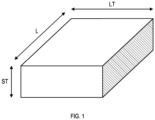
- a ratio of a total area in the L-ST cross section of the Mg 2 Si particles each having an area of 0.3 ⁇ m 2 or more is 0.2% or less.
- “L” indicates a longitudinal direction
- “ST” indicates a sheet thickness direction
- “LT” indicates the width direction of the alloy sheet.
- the ratio of the area of the Mg 2 Si particles can be measured by the following method, for example. First, a measurement sample is cut, and a surface to be measured (i.e., the L-ST cross section) is mechanically polished to a mirror finish. Then, the polished surface (i.e., the L-ST cross-section) is observed using a scanning electron microscope (SEM), and 10 fields of view are obtained in a central region of the sheet thickness.
- the accelerating voltage of the SEM is set to 15 kV, the magnification of the SEM is set to 1000 times and a range of one field of view is set to 0.012 mm 2 , and imaging is performed. Then, a COMPO image (a backscattered electron composition image) is obtained.
- the obtained COMPO image is analyzed by image analysis software "ImageJ". Specifically, the most frequent brightness value of the image in 256 shades is used as a background brightness, and particles with brightness of less than a value obtained by subtracting 30 from the most frequent brightness value is determined to be the Mg 2 Si particles.
- a total area of particles each having an area of 0.3 ⁇ m 2 or more is calculated. Then, the obtained value is divided by an imaged area of the 10 fields of view (i.e., an imaged total area). Thereby, the ratio of the total area of the Mg 2 Si particles each having the area of 0.3 ⁇ m 2 or more in the L-ST cross-section is calculated.
- the Mg 2 Si particles that become a starting point and a propagation path of a crack and affect the decrease in toughness are re-solutionized in the process of the homogeneous heat treatment of the ingot.
- a solidus temperature is higher than a solid solutionizing temperature of Mg 2 Si, and it is further preferable that a difference between the solidus temperature and the solid solutionizing temperature of Mg 2 Si is 30°C or more.
- the crystallization temperature of the primary crystal that is, Al 6 (Mn, Fe)
- the crystallization temperature of the primary crystal is lower than the solidification start temperature of aluminum.
- the solid solutionizing temperature of Mg 2 Si herein indicates the highest temperature at which Mg 2 Si can exist in the equilibrium diagram, and is the lowest temperature at which a liquid phase can exist.
- the solidification start temperature of aluminum indicates the highest temperature at which solid Al can exist in the equilibrium diagram, and the crystallization temperature of the primary crystal is the highest temperature at which Al 6 (Mn, Fe) can exist.
- the solid solutionizing temperature of Mg 2 Si, the solidus temperature, the solidification start temperature of aluminum and the crystallization temperature of the primary crystal can be obtained from the equilibrium diagram of the aluminum alloy calculated using a thermodynamics calculation software.
- the solid solutionizing temperature of Mg 2 Si, the solidus temperature, the solidification start temperature of aluminum and the crystallization temperature of the primary crystal are uniquely determined by the composition of the aluminum alloy.
- the method for calculating these boundary temperatures from the alloy composition includes calculating thermodynamic quantities required for respective calculations using the CALPHAD method.
- thermodynamic calculations for multi-component alloy can be performed using a commercially available system software (for example, "JMatPro” developed by Sente Software Ltd.) which includes a thermodynamic database required for the calculations, an interface, and a phase diagram creation function.
- JMatPro developed by Sente Software Ltd.
- the solid solutionizing temperature of Mg 2 Si is lower than the solidus temperature, and the crystallization temperature of the primary crystal is lower than the solidification start temperature of Al.
- Mg 2 Si is re-solutionized, and the Mg 2 Si particles that become a starting point and a propagation path of a crack, and affect the decrease in toughness can be reduced.
- cold rolling reduction materials with low cold rolling reduction
- a material in which annealing is performed on a rolled sheet during cold rolling using a continuous annealing line (CAL) so that the final cold rolling reduction (that is, cold rolling reduction after annealing) is reduced has high toughness.
- CAL continuous annealing line
- the higher the cold rolling reduction the greater the 0.2% yield strength ⁇ 0.2_90° in the 90° direction to the rolling direction compared to the 0.2% yield strength ⁇ 0.2_0° in the 0° direction to the rolling direction.
- a difference in the 0.2% yield strength between the 0° direction to the rolling direction and the 90° direction to the rolling direction that is, the strength anisotropy, can be associated with the cold rolling reduction of the material.
- a value D obtained by subtracting the 0.2% yield strength ⁇ 0.2_90° in the 90° direction to the rolling direction from the 0.2% yield strength ⁇ 0.2_0° in the 0° direction to the rolling direction, using the formula (5), is -13 MPa or more and 13 MPa or less.
- D ⁇ 0.2 _ 0 ° ⁇ ⁇ 0.2 _ 90 °
- the metallographic meaning of the strength anisotropy obtained by subtracting the 0.2% yield strength ⁇ 0.2_90° in the 90° direction to the rolling direction from the 0.2% yield strength ⁇ 0.2_0° in the 0° direction to the rolling direction can be explained as follows.
- the material after hot rolling or annealing is in a recrystallized state, and has high degree of integration of isotropic Cube orientation. From here, by plastic deformation due to cold rolling, Cube orientation transforms into a rolling texture having anisotropy in the rolling direction. Moreover, the higher the cold rolling reduction, the more elongated the crystal grains in the rolling direction. Thus, while diameters of the crystal grains along the 0° direction to the rolling direction increase, the change in diameters of the crystal grains along the 90° direction to the rolling direction decreases compared to that in the 0° direction to the rolling direction.
- the resistance ⁇ has different values. This is because the degree of integration of the rolling texture having anisotropy in the rolling direction increases as the cold rolling reduction increases, causing changes in resistance to the crystal grain boundary sliding depending on the tensile direction.
- the crystal grains are elongated and the diameters increase as the cold rolling reduction increases in the 0° direction to the rolling direction, the change in the crystal grain diameter with respect to the cold rolling reduction is relatively small in the 90° direction to the rolling direction. Accumulation of these effects results in strength anisotropy with respect to the increase in the cold rolling reduction.
- the aluminum alloy sheet of the present disclosure can be produced, for example, by the following procedure. First, an aluminum alloy having a composition same as that of the aluminum alloy sheet of the present disclosure is subjected to a semi-continuous casting (i.e. Direct Chill (DC) casting) in a normal manner to produce an ingot.
- a semi-continuous casting i.e. Direct Chill (DC) casting
- the temperature in the homogenizing treatment is preferably, for example, 470°C or higher and 620°C or lower.
- the duration of the homogenizing treatment is preferably, for example, one hour or longer and 20 hours or shorter.
- the temperature in the homogenizing treatment is 400°C or higher, segregation in the ingot structure can be easily resolved. Furthermore, if the temperature in the homogenizing treatment is 450°C or higher, the Mg 2 Si particles are re-solutionized, and the strength and toughness of the alloy sheet can be improved. Moreover, if the temperature in the homogenizing treatment is 470°C or higher, and more preferably the solid solutionizing temperature of Mg 2 Si or higher, re-solutionization of the Mg 2 Si particles is promoted and the strength and toughness of the alloy sheet can be further improved. On the other hand, if the temperature in the homogenizing treatment is 620°C or lower, local melting of the aluminum alloy is less likely to occur.
- the duration of the homogenizing treatment is one hour or longer, the temperature of the entire slab becomes uniform, segregation of the ingot structure is easily resolved, and the Mg 2 Si particles can be easily re-solutionized.
- the hot rolling process comprises a rough rolling process and a finish rolling process.
- the ingot is processed into a plate material having a thickness of approximately several tens of millimeters by reverse rolling.
- the finish rolling process the thickness of the plate material is reduced to approximately several millimeters by, for example, tandem rolling or the like, and the plate material is coiled to form a hot-rolled coil.
- a total rolling reduction in the finish rolling is high, a recrystallization texture is formed after coiling, and an integration degree of isotropic Cube orientation can be increased. If a coiling temperature in the finish rolling is high, the recrystallization texture is formed after coiling, and the integration degree of Cube orientation can be increased.
- the sheet material is subjected to cold rolling.
- the hot-rolled coil is rolled until a product sheet thickness is achieved.
- the cold rolling may be either single cold rolling or tandem cold rolling. In the single cold rolling, the rolling is preferably divided into several times and performed in two or more rolling passes.
- the solution heat treatment is performed on the coil during the cold rolling, and Mg and the like are re-solutionized. Thereby, while increasing the strength of the material, it is possible to reduce the final cold rolling reduction and obtain an alloy sheet with reduced material anisotropy.
- a continuous annealing line (CAL) is used to perform a heat treatment (i.e. annealing) at a target peak metal temperature of 440°C or higher followed by forced cooling such as air-cooling, whereby the strength of the alloy sheet can be effectively increased.
- CAL continuous annealing line
- a cold rolling reduction is preferably 80% or more.
- the strength of the alloy sheet can be increased.
- the cold rolling reduction is preferably 92% or less.
- the cold rolling reduction after the solution heat treatment is preferably 50% or more.
- the strength of the alloy sheet can be increased even if the cold rolling reduction is low.
- the cold rolling reduction is preferably 80% or less.
- the cold rolling reduction R (%) is obtained by the following formula (7), where "t 0 " is a sheet thickness (mm) of a sheet after the hot rolling or solution heat treatment, and "t 1 " is a product sheet thickness (mm) after the cold rolling.
- R t 0 ⁇ t 1 / t 0 ⁇ 100
- the product sheet thickness can be selected as appropriate so that a desired buckling pressure is obtained. As shown in the above-described formula (2), the buckling pressure increases as the sheet thicknesses increases.
- the product sheet thickness can be selected in accordance with the value V of the formula (2).
- the value V is preferably 13.0 or more, and more preferably 14.0 or more. As described above, with the aluminum alloy sheet of the present disclosure, it is possible to avoid increasing the sheet thickness to maintain the buckling pressure high.
- the coil that has been cold-rolled to have a product sheet thickness is precoated on a coating line or the like.
- the surface(s) of the cold-rolled coil is subjected to degreasing, cleaning, and chemical conversion treatment, followed by paint coating and paint baking treatment.
- a chemical solution such as a chromate based solution and a zirconium based solution is used.
- the paint to be used may include an epoxy based paint and a polyester based paint. These can be selected according to applications.
- the coil is heated at a peak metal temperature (PMT) of 220C° or higher and 270C° or lower for approximately 30 seconds or shorter. At this time, the recovery of the material is inhibited at lower PMT, and thus, high strength of the alloy sheet can be maintained.
- PMT peak metal temperature
- both the high strength and high toughness of the aluminum alloy sheet can be achieved while blending scrap materials derived from can stock. That is, a certain amount of scraps derived from 3104 aluminum alloy for a can body can be blended, thereby reducing the usage rate of the primary metal and the amount of CO 2 emissions. Furthermore, it is possible to obtain a highly formable aluminum alloy sheet for a can lid that can be used for positive pressure can lids in which high buckling pressure is required.
- the present disclosure also includes various forms other than the aluminum alloy sheet of the above-described embodiment, such as a member comprising this aluminum alloy sheet and a production method of this aluminum alloy sheet.
- a function of a single component in the aforementioned embodiments may be distributed to a plurality of components, and functions of a plurality of components may be achieved by a single component.
- a part of the configuration of each of the aforementioned embodiments may be omitted.
- At least one part of the configuration of the aforementioned embodiments may be added to or replaced with the configuration of another embodiment or other embodiments of the aforementioned embodiments. All the modes that are encompassed in the technical idea defined by the language in the claims are embodiments of the present disclosure.
- ingots each comprising components (mass %) specified by alloy numbers 1 to 9 shown in Table 3 and a balance consisting of aluminum and inevitable impurities were produced by a semi-continuous casting method.
- Each ingot includes 0.10 mass % or less of Ti, 0.25 mass % or less of Zn, 0.10 mass % or less of Cr, and 0.15 mass % or less of inevitable impurities.
- each ingot was scalped. Then, the ingot was placed in the furnace, and subjected to homogenizing treatment. The temperature of the homogenizing treatment is shown in Table 1. After the homogenizing treatment, the ingot was removed from the furnace and hot rolling was immediately started to thereby obtain a rolled sheet.
- the hot-rolled sheet was cold-rolled without being annealed.
- the target cold rolling reduction in the cold rolling is shown in Table 1.
- the product sheet thickness of the aluminum alloy sheets of S1 to S17 (i.e. "t 1 " in formula (7)) after the cold rolling is within a range of approximately 0.235 ⁇ 0.03 mm.
- the aluminum alloy sheets of S1 to S17 were each milled to form three test pieces No. 5 specified in JIS-Z-2241:2011. Longitudinal directions of the three test pieces extend in respective directions forming angles of 0°, 45°and 90° to the rolling direction.
- test pieces were subjected to a tensile test according to JIS-Z-2241:2011, and 0.2% yield strength and tensile strength were measured.
- Tables 1 and 2 show the measurement results of the 0.2% yield strength ⁇ 0.2 and the tensile strength ⁇ B , and the average values ⁇ fm of the 0.2% yield strength and the tensile strength.
- evaluation values S were calculated from the measurement results of the respective tensile tests in the 0° direction, 45° direction, and 90° direction to the rolling direction and the formula (1).
- Table 2 shows a minimum evaluation value S min , which is the minimum value of these evaluation values S.
- Table 3 shows the solid solutionizing temperature of Mg 2 Si, the solidus temperature, the solidification start temperature of aluminum and the crystallization temperature of the primary crystal (that is, Al 6 (Mn, Fe)), calculated based on the components (mass %) specified by the alloy numbers 1 to 9.
- Each boundary temperature was calculated based on the equilibrium diagram obtained based on the five main components (Si, Fe, Cu, Mn, and Mg) using "JMatPro".
- the effects of Ti, Zn, Cr and the inevitable impurities are not taken into consideration.
- the aluminum alloy sheet marked " ⁇ 50" means that 50 mass % or more of 3104 aluminum alloy can be blended in the sheet.
- the possible blending ratio of the scraps of 3104 aluminum alloy is determined based on Table 4.
- Table 4 shows the correspondence between the blending ratio of 3104 aluminum alloy and 5182 aluminum alloy and the average values of the components.
- the first line of Table 4 shows the average values of the components of 3104 aluminum alloy, and the second line shows the average values of the components of 5182 aluminum alloy.
- the average value of Si is 0.20 mass %
- the average value of Fe is 0.29 mass %
- the average value of Cu is 0.11 mass %
- the average value of Mn is 0.7 mass %
- the average value of Mg is 2.8 mass %.
- the ratios of the respective components in the aluminum alloy sheets are equal to or more than the above-described values of Si, Fe, Cu, Mn, and Mg, these sheets have 50 mass % or more of the possible blending ratio of 3104 aluminum alloy sheet.
- the blending ratio of 3104 aluminum alloy increases, the contents of Si, Fe, Cu and Mn increase, and the content of Mg decreases.
- 50 mass % or more of the scraps of 3104 aluminum alloy can be blended.
- the aluminum alloy sheets of S1 to S15 have higher strength (that is, S min ) than the aluminum alloy sheet of S16.
- S min strength
- the Mg content was low compared to the 5182 aluminum alloy for conventional can lids shown in S17, but the equivalent strength was achieved.
- the cold rolling reduction has decreased through the intermediate annealing process.
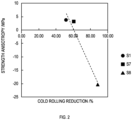
- the alloy sheets of S1 to S7 have less strength anisotropy compared to the alloy sheets of S8 to S13 with the cold rolling reduction exceeding 80%.
- the strength anisotropy is associated with the cold rolling reduction.
- both high strength and high toughness that is, high number of cyclic bending are achieved compared to the alloy sheets of S8 to S13 with the cold rolling reduction exceeding 80%.
- the strength anisotropy has a negative correlation with the cold rolling reduction.
- an absolute value of the strength anisotropy is considered to be maximum at the cold rolling reduction of 80% in the negative direction.
- the strength anisotropy at the cold rolling reduction of 80% is estimated to be -13 MPa, and thus it is said that the lower limit of the strength anisotropy is -13 MPa.
- the absolute value of the strength anisotropy is considered to be maximum at the cold rolling reduction of 50% in the positive direction. From the trend in FIG. 2 , the strength anisotropy at the cold rolling reduction of 50% is estimated to be 7 MPa. On the other hand, referring to the strength anisotropy of the alloy sheets of S3, S5, and so on, it can be seen that some variation in strength anisotropy is unavoidable. Thus, the appropriate strength anisotropy at the cold rolling reduction of 50% is considered to be around 13 MPa.
Landscapes
- Chemical & Material Sciences (AREA)
- Engineering & Computer Science (AREA)
- Materials Engineering (AREA)
- Mechanical Engineering (AREA)
- Metallurgy (AREA)
- Organic Chemistry (AREA)
- Physics & Mathematics (AREA)
- Thermal Sciences (AREA)
- Crystallography & Structural Chemistry (AREA)
- Metal Rolling (AREA)
Abstract

Description
- This international application claims the benefit of
Japanese Patent Application No. 2023-067145 filed on April 17, 2023 - The present disclosure relates to an aluminum alloy sheet for a can lid.
- In recent years, there has been a demand for an aluminum alloy sheet that emits less CO2 during its manufacturing process due to growing environmental awareness. A major and indirect cause of CO2 emissions in the manufacturing process of aluminum is to blend primary aluminum in a casting process.
- Production of the primary aluminum requires a large amount of electricity in its refining process, which leads to large CO2 emissions. Thus, reducing an amount of blending the primary aluminum and increasing a closed recycling rate lead to reduction of CO2 emissions in production of the aluminum alloy sheet.
- In general, it is said that CO2 emissions can be reduced to approximately one-thirtieth when aluminum scraps are re-melted for casting compared to a case where the primary aluminum is produced. In particular, an amount of aluminum alloy sheets produced for beverage cans, which are widely used around the world, is very large. Thus, further improvement in the closed recycling rate has great significance in reducing the burden on the environment.
- Among those alloy sheets, a can lid made of 5182 aluminum alloy (AA5182 alloy) has lower upper compositional limits of Si, Fe, Cu, Mn, and the like than those of a can body made of 3104 aluminum alloy (AA3104 alloy). Thus, it is difficult to blend scraps derived from can stock containing the 3104 aluminum alloy.
- For example, when can scraps (UBC: Used Beverage Can) collected from around the city are blended as they are, the resultant contains more components contained in the 3104 aluminum alloy due to a weight ratio between a can body and a can lid. Thus, the upper compositional limits for the 5182 aluminum alloy are easily exceeded. As a result, it is necessary to dilute the resultant composition with primary metal.
- Thus, an aluminum alloy sheet for a can lid is adjusted to include a composition of the 5182 aluminum alloy by using a large amount of primary metal compared to an aluminum alloy sheet for a can body, resulting in a lower recycling rate. Thus, by changing the alloy for a can lid to an alloy having a composition in which more 3104 aluminum alloy can be blended, the usage rate of the primary metal for a can lid can be greatly reduced.
- Patent Documents 1 to 5 disclose aluminum alloy sheets for can lids excellent in recyclability and each having a composition relatively closer to that of the 3104 aluminum alloy.
-
- Patent Document 1:
Japanese Unexamined Patent Application Publication No. 2001-73106 - Patent Document 2:
Japanese Unexamined Patent Application Publication No. H9-070925 - Patent Document 3:
Japanese Unexamined Patent Application Publication No. H11-269594 - Patent Document 4:
Japanese Unexamined Patent Application Publication No. 2000-160273 - Patent Document 5:
Japanese Unexamined Patent Application Publication No. 2016-160511 - Problems in making an alloy for a can lid similar in composition to the 3104 aluminum alloy include reduction in a buckling pressure (pressure resistance) of the can lid and toughness of a material. The buckling pressure of the can lid is an internal pressure value when the can lid bulges (buckles) under a pressure inside the can, which is a resistance value when the internal pressure of the can accidentally increases due to changes in the external environment.
- Especially for positive pressure cans used for beer and carbonated beverage, high buckling pressure is required. In general, the buckling pressure increases as the strength of the material increases and the sheet thickness increases. For this reason, high-strength 5182 aluminum alloy that is high in Mg, which is a component that contributes to increased strength, is used for lids of the positive pressure cans.
- In contrast, if the conventional 3104 aluminum alloy is used for a can lid, the buckling pressure thereof is greatly reduced, and it is highly possible that the lid bulges and the content leaks when the internal pressure of the can is unexpectedly increased. If the sheet thickness is greatly increased to improve the buckling pressure, the weight and cost of the lid are increased.
- Moreover, the toughness of a material affects the formability and the opening property of a lid. If the toughness of the materials is low, a molding crack may occur especially in a rivet part and a countersink part of the lid. In addition, when the internal pressure of the can is unexpectedly increased, a crack may occur in a score part, and it is highly possible that the content of the can leaks. In particular, these cracks occur along a rolling direction of the alloy sheet. Thus, toughness is required against tensile stress and bending stress in a direction perpendicular to the rolling direction.
- However, the conventional aluminum alloy sheets for can lids each having a composition relatively close to the composition of the 3104 aluminum alloy do not satisfy either or both of the above two problems: the strength of the material (that is, buckling pressure of the lid) and the toughness of the material (that is, formability and opening property).
- In one aspect of the present disclosure, it is desirable to be able to provide an aluminum alloy sheet for a can lid that achieves both high strength and high toughness while blending scrap materials derived from can stock.
- One aspect of the present disclosure is an aluminum alloy sheet for a can lid, the sheet comprising: a silicon (Si) content of 0.20 mass % or more and 0.47 mass % or less; an iron (Fe) content of 0.30 mass % or more and 0.59 mass % or less; a copper (Cu) content of 0.11 mass % or more and 0.40 mass % or less; a manganese (Mn) content of 0.70 mass % or more and 0.98 mass % or less, and a magnesium (Mg) content of 1.1 mass % or more and 3.7 mass % or less, and a balance consisting of or including aluminum (Al) and inevitable impurities, wherein, in each of 0°, 45°, and 90° directions to a rolling direction of the alloy sheet, a minimum evaluation value Smin, which is a minimum value among evaluation values S calculated by a following formula (1) using a 0.2% yield strength σ0.2, a tensile strength σB, and an average value σfm of the 0.2% yield strength and the tensile strength, is 330 MPa or more and 410 MPa or less.

- With this configuration, it is possible to achieve the high strength and high toughness of the aluminum alloy sheet while blending scrap materials derived from can stock. That is, a certain amount of scraps derived from 3104 aluminum alloy for a can body can be blended, thereby reducing the usage rate of the primary metal and the amount of CO2 emissions. Furthermore, it is possible to obtain a highly formable aluminum alloy sheet for a can lid that can be used for positive pressure can lids which require high buckling pressure.
-
-
FIG. 1 is an explanatory view of an L-ST cross-section. -
FIG. 2 is graph showing an example relationship between cold rolling reduction and strength anisotropy. - Hereinafter, an embodiment to which the present disclosure is applied is described with reference to the drawings.
- An aluminum alloy sheet for a can lid of the present disclosure (hereinafter, also simply referred to as "alloy sheet") comprises aluminum (Al), silicon (Si), iron (Fe), copper (Cu), manganese (Mn), and magnesium (Mg).
- The lower limit of Si content is 0.20 mass %, and preferably, 0.30 mass %. If the Si content is less than 0.20 mass %, an amount of Si precipitation by processing heat during cold rolling, which is conducted after hot rolling and solution heat treatment, may decrease and the strength of the alloy sheet may be insufficient.
- The average value of Si component specified for 3104 aluminum alloy according to JIS-H-4000:2014 is 0.30 mass %. Thus, by setting the Si content to 0.30 mass % or more, a larger amount of scraps of 3104 aluminum alloy can be blended.
- The upper limit of the Si content is 0.47 mass %, and preferably 0.39 mass %, and more preferably, 0.35 mass %. If the Si content is more than 0.47 mass %, more Mg2Si particles are formed, and the toughness of the alloy sheet decreases.
- The lower limit of Fe content is 0.30 mass %, and preferably, 0.40 mass %. The average value of Fe component specified for 3104 aluminum alloy is 0.40 mass %. Thus, by setting the Fe content to 0.40 mass % or more, a larger amount of scraps of 3104 aluminum alloy can be blended.
- The upper limit of the Fe content is 0.59 mass %. If the Fe content is more than 0.59 mass %, more Al-Fe-Mn base or Al-Fe-Mn-Si base intermetallic compounds (that is, second phase particles) are formed. As a result, a crack propagation path is generated, and the toughness of the alloy sheet decreases.
- The lower limit of Cu content is 0.11 mass %, and preferably 0.15 mass %, and more preferably 0.20 mass %. If the Cu content is less than 0.11 mass %, there is insufficient Cu to enhance the strength by solid solution or precipitation, and the strength of the alloy sheet decreases. The strength of the alloy sheet significantly increases by precipitating Cu in the process of the cold rolling after the hot rolling and the solution heat treatment.
- The average value of Cu component specified for 3104 aluminum alloy is 0.15 mass %. Thus, by setting the Cu content to 0.15 mass % or more, a larger amount of scraps of 3104 aluminum alloy can be blended.
- The upper limit of the Cu content is 0.40 mass %, and preferably 0.25 mass %. If the Cu content is more than 0.40 mass %, the toughness of the alloy sheet decreases.
- The lower limit of Mn content is 0.70 mass %, and preferably 0.75 mass %. If the Mn content is less than 0.70 mass %, there is insufficient Mn to enhance the strength by solid solution or precipitation, and the average strength of the alloy sheet decreases.
- The average value of Mn component specified for 3104 aluminum alloy is 1.1 mass %, and the average value of the Mn component specified for 5182 aluminum alloy is 0.35 mass %. Thus, by setting the Mn content to 0.75 mass % or more, a larger amount of scraps of 3104 aluminum alloy can be blended compared to the conventional 5182 aluminum alloy.
- The upper limit of the Mn content is 0.98 mass %, and preferably, 0.90 mass %. If the Mn content is more than 0.98 mass %, more Al-Fe-Mn base or Al-Fe-Mn-Si base intermetallic compounds (that is, second phase particles) are formed. As a result, a crack propagation path is generated, and the toughness of the alloy sheet is reduced.
- The lower limit of Mg content is 1.1 mass %, and preferably 1.4 mass %. If the Mg content is less than 1.1 mass %, there is insufficient Mg to enhance the strength by solid solution, and the average strength of the alloy sheet decreases. The strength of the alloy sheet significantly increases by precipitating Mg in the process of the cold rolling after the hot rolling and the solution heat treatment.
- The upper limit of the Mg content is 3.7 mass %, and preferably 3.1 mass %. The average value of Mg component specified for 3104 aluminum alloy is 1.05 mass %, and the average value of the Mg component specified for 5182 aluminum alloy is 4.5 mass %. Thus, by setting the Mg content to 3.7 mass % or less, it is possible to use a larger amount of scraps of 3104 aluminum alloy and to reduce the amount of blending additional Mg-containing raw material.
- The alloy sheet may comprise titanium (Ti). The upper limit of Ti content is preferably 0.10 mass %. If Ti is contained, an ingot structure of the alloy sheet is refined. The alloy sheet may also comprise zinc (Zn). The upper limit of Zn content is preferably 0.25 mass %. Furthermore, the alloy sheet may comprise chromium (Cr). The upper limit of Cr content is preferably 0.10 mass %.
- The alloy sheet may comprise inevitable impurities to the extent that the performance of the alloy sheet is not significantly impaired. That is, the alloy sheet contains Si, Fe, Cu, Mn, Mg, Ti, Zn and Cr in the above-mentioned respective ranges, and a balance consists of or includes aluminum and inevitable impurities. The upper limit of the total amount of the inevitable impurities is preferably 0.15 mass %. The balance may contain substances other than aluminum and the inevitable impurities.
- A rolled aluminum alloy sheet has material anisotropy, and the strength shows different values in 0°, 45°, and 90° directions to a rolling direction of the alloy sheet. When an internal pressure of the can has increased, deformation begins in the direction with the least strength.
- Thus, in the alloy sheet of the present disclosure, in each of the 0°, 45°, and 90° directions to the rolling direction, a minimum evaluation value Smin (= min(S0°, S45°, S90°)), which is a minimum value among evaluation values S (S0°, S45°, and S90°) calculated by the following formula (1) using a 0.2% yield strength σ0.2, a tensile strength σB, and an average value σfm of the 0.2% yield strength and the tensile strength, is 330 MPa or more and 410 MPa or less.

- A buckling pressure value of a lid made of aluminum alloy has a strong positive correlation with a value V obtained from the following formula (2) that is empirically expressed by the minimum evaluation value Smin and sheet thickness t of the aluminum alloy sheet.

- Thus, by setting the minimum evaluation value Smin of the alloy sheet to 330 MPa or more, it is possible to form a lid having a sufficient buckling pressure without increasing the sheet thickness. Furthermore, the minimum evaluation value Smin is preferably 360 MPa or more. By setting the minimum evaluation value Smin to 360 MPa or more, the buckling pressure of the lid can be further increased.
- If the minimum evaluation value Smin exceeds 410 MPa, the material strength becomes excessively high and the toughness of the material decreases. That is, shear bands are more likely to occur on the materials due to tensile stress and bending stress during forming, and forming breakage is likely to occur. By setting the minimum evaluation value Smin to 410 MPa or less, it is possible to achieve both the strength of the material (that is, buckling pressure of the lid) and the toughness of the material (that is, formability and opening property).
- The 0.2% yield strength σ0.2 and the tensile strength σB in the formula (1) are measured by a method specified in JIS-Z-2241:2011. The sheet thickness t is measured, for example, with a micro gauge.
- It is known that the toughness of the aluminum alloy sheet affects the formability of a lid and a force (i.e. an opening force) required to open a score part.
- A cyclic bending test is one of the evaluation indices of the toughness of an aluminum alloy sheet. For aluminum alloy sheets having the same sheet thickness, the higher the number of cyclic bending is, the more excellent in toughness the alloy sheet is.
- The cyclic bending test is performed by the following procedure. For example, a test piece cut into a strip with 12.5 mm in width and 200 mm in length is arranged so that a bending ridge line is parallel to a rolling direction D of the alloy sheet. Both ends of this test piece are fixed with chucks, and the test piece is tensioned with a load of 200 N.
- In this state, a jig having a bending radius R 2.0 mm is placed at a position 150 mm in a longitudinal direction of the test piece from the end of the test piece fixed with a stationary chuck, and with the jig as a fulcrum, the other chuck is rotated 90° to the left and the right, thereby the test piece is bent repeatedly. The number of bending is measured until the test piece breaks.
- As for the number of bending, each of an operation of bending the test piece 90° to the left or the right and an operation of returning to its original position is counted as one. If the test piece breaks during the test, the angle θ thereof is read (0° to 90°), and the number of cyclic bending N is calculated by the following formula (3). In the formula (3), "N0" is a total of the number of operations of bending the test piece 90° to the left or the right and the number of operations of returning from the 90° bent position to its original 0° position until the test piece breaks.

- Since an evaluation of the cyclic bending is unfavorable as the sheet thickness increases, it is necessary to correct the number of cyclic bending N using a reference sheet thickness to carry out the evaluation. Thus, a normalized number of cyclic bending Ns is obtained by the following formula (4) based on a sheet thickness of 0.235 mm. Here, "t" (mm) is a sheet thickness of the test piece.

- It is preferable that the aluminum alloy sheet of the present disclosure has the normalized number of cyclic bending Ns of 18 or more.
- The toughness is affected by strength and distribution of second phase particles. That is, as the strength is higher and the density of the second phase particles is higher, the toughness decreases. In particular, if the Mg content and the Si content are increased, Mg2Si particles are easily formed. As a result, the Mg2Si particles may become a starting point or a propagation path of a crack, and affect the decrease in toughness.
- In the aluminum alloy sheet of the present disclosure, it is preferable that, in an L-ST cross section of a central part in a width direction of the alloy sheet shown by diagonal lines in
FIG. 1 , a ratio of a total area in the L-ST cross section of the Mg2Si particles each having an area of 0.3 µm2 or more is 0.2% or less. InFIG. 1 , "L" indicates a longitudinal direction, "ST" indicates a sheet thickness direction, and "LT" indicates the width direction of the alloy sheet. - The ratio of the area of the Mg2Si particles can be measured by the following method, for example. First, a measurement sample is cut, and a surface to be measured (i.e., the L-ST cross section) is mechanically polished to a mirror finish. Then, the polished surface (i.e., the L-ST cross-section) is observed using a scanning electron microscope (SEM), and 10 fields of view are obtained in a central region of the sheet thickness. The accelerating voltage of the SEM is set to 15 kV, the magnification of the SEM is set to 1000 times and a range of one field of view is set to 0.012 mm2, and imaging is performed. Then, a COMPO image (a backscattered electron composition image) is obtained.
- The obtained COMPO image is analyzed by image analysis software "ImageJ". Specifically, the most frequent brightness value of the image in 256 shades is used as a background brightness, and particles with brightness of less than a value obtained by subtracting 30 from the most frequent brightness value is determined to be the Mg2Si particles.
- In the determined Mg2Si particles, a total area of particles each having an area of 0.3 µm2 or more is calculated. Then, the obtained value is divided by an imaged area of the 10 fields of view (i.e., an imaged total area). Thereby, the ratio of the total area of the Mg2Si particles each having the area of 0.3 µm2 or more in the L-ST cross-section is calculated.
- In the alloy sheet of the present disclosure, in order to increase the toughness of the material, it is preferable that the Mg2Si particles that become a starting point and a propagation path of a crack and affect the decrease in toughness are re-solutionized in the process of the homogeneous heat treatment of the ingot.
- In order to re-solutionize Mg2Si while avoiding local melting of the aluminum matrix, it is preferable that a solidus temperature is higher than a solid solutionizing temperature of Mg2Si, and it is further preferable that a difference between the solidus temperature and the solid solutionizing temperature of Mg2Si is 30°C or more.
- In a material having a crystallization temperature of Al6 (Mn, Fe) higher than the solidification start temperature of aluminum, Al6 (Mn, Fe) is generated as coarse crystals during casting, which leads to molding defects such as a pinhole. Thus, it is preferable that the crystallization temperature of the primary crystal (that is, Al6 (Mn, Fe)) is lower than the solidification start temperature of aluminum.
- The solid solutionizing temperature of Mg2Si herein indicates the highest temperature at which Mg2Si can exist in the equilibrium diagram, and is the lowest temperature at which a liquid phase can exist. In addition, the solidification start temperature of aluminum indicates the highest temperature at which solid Al can exist in the equilibrium diagram, and the crystallization temperature of the primary crystal is the highest temperature at which Al6 (Mn, Fe) can exist.
- The solid solutionizing temperature of Mg2Si, the solidus temperature, the solidification start temperature of aluminum and the crystallization temperature of the primary crystal can be obtained from the equilibrium diagram of the aluminum alloy calculated using a thermodynamics calculation software.
- The solid solutionizing temperature of Mg2Si, the solidus temperature, the solidification start temperature of aluminum and the crystallization temperature of the primary crystal are uniquely determined by the composition of the aluminum alloy. The method for calculating these boundary temperatures from the alloy composition includes calculating thermodynamic quantities required for respective calculations using the CALPHAD method.
- Such thermodynamic calculations for multi-component alloy can be performed using a commercially available system software (for example, "JMatPro" developed by Sente Software Ltd.) which includes a thermodynamic database required for the calculations, an interface, and a phase diagram creation function.
- In the aluminum alloy sheet of the present disclosure, the solid solutionizing temperature of Mg2Si is lower than the solidus temperature, and the crystallization temperature of the primary crystal is lower than the solidification start temperature of Al. Thus, without generating coarse crystals during casting, it is possible to avoid performance degradation caused by coarse crystals.
- In addition, by performing the homogeneous heat treatment at the solidus temperature or below and at the solid solutionizing temperature of Mg2Si or above, Mg2Si is re-solutionized, and the Mg2Si particles that become a starting point and a propagation path of a crack, and affect the decrease in toughness can be reduced.
- It is known that materials with low cold rolling reduction (hereinafter, abbreviated as cold rolling reduction) have high toughness. For example, a material in which annealing is performed on a rolled sheet during cold rolling using a continuous annealing line (CAL) so that the final cold rolling reduction (that is, cold rolling reduction after annealing) is reduced has high toughness.
- In addition, the higher the cold rolling reduction, the greater the 0.2% yield strength σ0.2_90° in the 90° direction to the rolling direction compared to the 0.2% yield strength σ0.2_0° in the 0° direction to the rolling direction. Thus, a difference in the 0.2% yield strength between the 0° direction to the rolling direction and the 90° direction to the rolling direction, that is, the strength anisotropy, can be associated with the cold rolling reduction of the material.
- In the alloy sheet of the present disclosure, it is preferable that a value D obtained by subtracting the 0.2% yield strength σ0.2_90° in the 90° direction to the rolling direction from the 0.2% yield strength σ0.2_0° in the 0° direction to the rolling direction, using the formula (5), is -13 MPa or more and 13 MPa or less.

- The metallographic meaning of the strength anisotropy obtained by subtracting the 0.2% yield strength σ0.2_90° in the 90° direction to the rolling direction from the 0.2% yield strength σ0.2_0° in the 0° direction to the rolling direction can be explained as follows.
- The material after hot rolling or annealing is in a recrystallized state, and has high degree of integration of isotropic Cube orientation. From here, by plastic deformation due to cold rolling, Cube orientation transforms into a rolling texture having anisotropy in the rolling direction. Moreover, the higher the cold rolling reduction, the more elongated the crystal grains in the rolling direction. Thus, while diameters of the crystal grains along the 0° direction to the rolling direction increase, the change in diameters of the crystal grains along the 90° direction to the rolling direction decreases compared to that in the 0° direction to the rolling direction.
- Referring to the Hall-Petch equation, a relationship between the texture changes caused by the rolling and the 0.2% yield strength σ0.2 shows a relationship in the formula (6). In the formula (6), "κ" is a resistance to crystal grain boundary sliding, and "d" is a crystal grain diameter.

- For the tension in the 0° direction to the rolling direction or the 90° direction to the rolling direction, the resistance κ has different values. This is because the degree of integration of the rolling texture having anisotropy in the rolling direction increases as the cold rolling reduction increases, causing changes in resistance to the crystal grain boundary sliding depending on the tensile direction.
- Furthermore, while the crystal grains are elongated and the diameters increase as the cold rolling reduction increases in the 0° direction to the rolling direction, the change in the crystal grain diameter with respect to the cold rolling reduction is relatively small in the 90° direction to the rolling direction. Accumulation of these effects results in strength anisotropy with respect to the increase in the cold rolling reduction.
- The aluminum alloy sheet of the present disclosure can be produced, for example, by the following procedure. First, an aluminum alloy having a composition same as that of the aluminum alloy sheet of the present disclosure is subjected to a semi-continuous casting (i.e. Direct Chill (DC) casting) in a normal manner to produce an ingot.
- Then, four surfaces, except for the front and back end surfaces, of the ingot are scalped. After that, the ingot is placed in a soaking furnace, and a homogenizing treatment is performed. The temperature in the homogenizing treatment is preferably, for example, 470°C or higher and 620°C or lower. The duration of the homogenizing treatment is preferably, for example, one hour or longer and 20 hours or shorter.
- If the temperature in the homogenizing treatment is 400°C or higher, segregation in the ingot structure can be easily resolved. Furthermore, if the temperature in the homogenizing treatment is 450°C or higher, the Mg2Si particles are re-solutionized, and the strength and toughness of the alloy sheet can be improved. Moreover, if the temperature in the homogenizing treatment is 470°C or higher, and more preferably the solid solutionizing temperature of Mg2Si or higher, re-solutionization of the Mg2Si particles is promoted and the strength and toughness of the alloy sheet can be further improved. On the other hand, if the temperature in the homogenizing treatment is 620°C or lower, local melting of the aluminum alloy is less likely to occur.
- If the duration of the homogenizing treatment is one hour or longer, the temperature of the entire slab becomes uniform, segregation of the ingot structure is easily resolved, and the Mg2Si particles can be easily re-solutionized. The longer the duration of the homogenizing treatment is, the more Mg2Si particles can be re-solutionized. However, if the duration of the homogenizing treatment is longer than 20 hours, the effect of the homogenizing treatment is saturated.
- After the homogenizing treatment, the ingot is subjected to hot rolling. The hot rolling process comprises a rough rolling process and a finish rolling process. In the rough rolling process, the ingot is processed into a plate material having a thickness of approximately several tens of millimeters by reverse rolling. In the finish rolling process, the thickness of the plate material is reduced to approximately several millimeters by, for example, tandem rolling or the like, and the plate material is coiled to form a hot-rolled coil.
- If a total rolling reduction in the finish rolling is high, a recrystallization texture is formed after coiling, and an integration degree of isotropic Cube orientation can be increased. If a coiling temperature in the finish rolling is high, the recrystallization texture is formed after coiling, and the integration degree of Cube orientation can be increased.
- After the hot rolling, the sheet material is subjected to cold rolling. In the cold rolling, the hot-rolled coil is rolled until a product sheet thickness is achieved. The cold rolling may be either single cold rolling or tandem cold rolling. In the single cold rolling, the rolling is preferably divided into several times and performed in two or more rolling passes.
- The solution heat treatment is performed on the coil during the cold rolling, and Mg and the like are re-solutionized. Thereby, while increasing the strength of the material, it is possible to reduce the final cold rolling reduction and obtain an alloy sheet with reduced material anisotropy. For example, a continuous annealing line (CAL) is used to perform a heat treatment (i.e. annealing) at a target peak metal temperature of 440°C or higher followed by forced cooling such as air-cooling, whereby the strength of the alloy sheet can be effectively increased.
- By setting a finish temperature at 120°C or higher in intermediate passes other than the final pass of the cold rolling, Si, Cu and Mg are finely precipitated and age-hardening occurs, making it possible to increase the strength of the alloy sheet. When the finish temperature is set at 130°C or higher, the strength of the alloy sheet can be further increased.
- If the solution heat treatment is not performed during the cold rolling, a cold rolling reduction is preferably 80% or more. When the cold rolling reduction is 80% or more, the strength of the alloy sheet can be increased. The lower the cold rolling reduction is, the more isotropic Cube orientation remains. Thus, the cold rolling reduction is preferably 92% or less.
- If the solution heat treatment is performed during the cold rolling, the cold rolling reduction after the solution heat treatment (i.e., annealing ) is preferably 50% or more. By re-solutionizing Mg and the like by the solution heat treatment, the strength of the alloy sheet can be increased even if the cold rolling reduction is low. The lower the cold rolling reduction is, the more isotropic Cube orientation remains. Thus, the cold rolling reduction is preferably 80% or less.
- The cold rolling reduction R (%) is obtained by the following formula (7), where "t0" is a sheet thickness (mm) of a sheet after the hot rolling or solution heat treatment, and "t1" is a product sheet thickness (mm) after the cold rolling.

- The product sheet thickness can be selected as appropriate so that a desired buckling pressure is obtained. As shown in the above-described formula (2), the buckling pressure increases as the sheet thicknesses increases. The product sheet thickness can be selected in accordance with the value V of the formula (2). The value V is preferably 13.0 or more, and more preferably 14.0 or more. As described above, with the aluminum alloy sheet of the present disclosure, it is possible to avoid increasing the sheet thickness to maintain the buckling pressure high.
- The coil that has been cold-rolled to have a product sheet thickness is precoated on a coating line or the like. The surface(s) of the cold-rolled coil is subjected to degreasing, cleaning, and chemical conversion treatment, followed by paint coating and paint baking treatment.
- In the chemical conversion treatment, a chemical solution such as a chromate based solution and a zirconium based solution is used. Examples of the paint to be used may include an epoxy based paint and a polyester based paint. These can be selected according to applications. In the paint baking treatment, the coil is heated at a peak metal temperature (PMT) of 220C° or higher and 270C° or lower for approximately 30 seconds or shorter. At this time, the recovery of the material is inhibited at lower PMT, and thus, high strength of the alloy sheet can be maintained.
- According to the embodiment detailed above, the following effects can be obtained.
- (1a) Both the high strength and high toughness of the aluminum alloy sheet can be achieved while blending scrap materials derived from can stock. That is, a certain amount of scraps derived from 3104 aluminum alloy for a can body can be blended, thereby reducing the usage rate of the primary metal and the amount of CO2 emissions. Furthermore, it is possible to obtain a highly formable aluminum alloy sheet for a can lid that can be used for positive pressure can lids in which high buckling pressure is required.
- The embodiment of the present disclosure has been described; however, it is needless to say that the present disclosure is not limited to the above-described embodiment, and that the present disclosure can take various forms.
- (2a) The present disclosure also includes various forms other than the aluminum alloy sheet of the above-described embodiment, such as a member comprising this aluminum alloy sheet and a production method of this aluminum alloy sheet.
- (2b) A function of a single component in the aforementioned embodiments may be distributed to a plurality of components, and functions of a plurality of components may be achieved by a single component. A part of the configuration of each of the aforementioned embodiments may be omitted. At least one part of the configuration of the aforementioned embodiments may be added to or replaced with the configuration of another embodiment or other embodiments of the aforementioned embodiments. All the modes that are encompassed in the technical idea defined by the language in the claims are embodiments of the present disclosure.
- Hereinafter, some tests conducted to confirm the effects of the present disclosure and the evaluation results thereof are described.
- As examples and comparative examples, aluminum alloy sheets of S1 to S17 shown in Table 1 and Table 2 were produced. Hereinafter, specific production procedures are described.
- First, ingots each comprising components (mass %) specified by alloy numbers 1 to 9 shown in Table 3 and a balance consisting of aluminum and inevitable impurities were produced by a semi-continuous casting method. Each ingot includes 0.10 mass % or less of Ti, 0.25 mass % or less of Zn, 0.10 mass % or less of Cr, and 0.15 mass % or less of inevitable impurities.
- Next, the four surfaces, except for the front and back end surfaces, of each ingot were scalped. Then, the ingot was placed in the furnace, and subjected to homogenizing treatment. The temperature of the homogenizing treatment is shown in Table 1. After the homogenizing treatment, the ingot was removed from the furnace and hot rolling was immediately started to thereby obtain a rolled sheet.
- Moreover, for the aluminum alloy sheets of S1 to S7, S14, S15 and S17, cold rolling was performed on the hot-rolled sheet until a CAL sheet thickness shown in Table 1 is achieved. Then, annealing was performed on the rolled sheet having the CAL sheet thickness in a continuous annealing line (CAL). The CAL temperature during annealing is shown in Table 1. After annealing, the rolled sheet was cooled to the room temperature by air-cooling. After cooling, cold rolling was again performed on the rolled sheet. The target cold rolling reduction in the cold rolling after annealing is shown in Table 1.
- For the aluminum alloy sheets of S8 to S13 and S16, the hot-rolled sheet was cold-rolled without being annealed. The target cold rolling reduction in the cold rolling is shown in Table 1.
- The product sheet thickness of the aluminum alloy sheets of S1 to S17 (i.e. "t1" in formula (7)) after the cold rolling is within a range of approximately 0.235 ± 0.03 mm.
- In the aluminum alloy sheets of S1 to S17, after the cold rolling, a paint was applied to a sheet surface, and paint baking treatment was performed for approximately 30 seconds. The peak metal temperature (PMT) at the time of the paint baking is shown in Table 1. After the paint baking, the aluminum alloy sheets of S1 to S17 were obtained. Also, for the aluminum alloy sheets of S1 to S17, the sheet thickness (i.e., product sheet thickness) measured with a micro gauge is shown in Table 1.
[Table 1] Example Alloy No. Homogenizing Treatment Temperature CAL Sheet Thickness CAL Temperature Cold Rolling Reduction PMT Sheet Thickness 0° Direction to Rolling Direction 45° Direction to Rolling Direction σ0.2 σB σfm σ0.2 σB σfm °C mm °C % °C mm MPa MPa MPa MPa MPa MPa S1 1 580 0.49 520 52.0 260 0.233 294 341 317 289 344 316 S2 2 580 0.49 520 52.0 260 0.238 298 344 321 288 343 315 S3 3 580 0.49 520 52.0 260 0.226 308 354 331 286 344 315 S4 4 580 0.49 520 52.0 260 0.234 296 343 320 292 348 320 S5 5 580 0.49 520 52.0 260 0.234 305 355 330 297 354 325 S6 6 580 0.49 520 52.0 260 0.237 300 353 327 293 353 323 S7 1 580 0.60 520 60.8 260 0.226 321 365 343 308 360 334 S8 1 580 - - 88.3 260 0.230 292 328 310 300 331 315 S9 2 580 - - 88.3 260 0.239 292 331 311 295 327 311 S10 3 580 - - 88.3 260 0.234 290 329 310 295 328 311 S11 4 580 - - 88.3 260 0.236 293 332 312 297 331 314 S12 5 580 - - 88.3 260 0.234 302 343 322 307 341 324 S13 6 580 - - 88.3 260 0.234 303 344 323 308 343 325 S14 7 550 2.00 520 88.3 260 0.237 346 374 360 346 379 363 S15 7 520 2.00 520 88.3 260 0.237 331 359 345 332 365 349 S16 8 600 - - 87.0 260 0.236 250 279 264 262 285 274 S17 9 490 0.70 440 66.4 270 0.234 306 374 340 289 364 326 [Table 2] Example Alloy No. 90° Direction to Rolling Direction Smin Mg2Si Area Ratio Number of Cyclic Bending Normalized Number of Cyclic Bending Strength Anisotropy 3104 Possible Blending Ratio σ0.2 σB σfm σfm/ (σ0.2/σB) MPa MPa MPa MPa % Number of Times Number of Times MPa mass % S1 1 290 345 318 368 0.012 22.9 22.7 4 ≧50 S2 2 291 349 320 370 0.011 22.8 23.1 7 ≧50 S3 3 301 359 330 379 0.007 22.2 21.3 8 ≧50 S4 4 292 351 321 371 0.007 22.1 22.0 4 ≧50 S5 5 295 357 326 384 0.133 20.9 20.8 10 ≧50 S6 6 299 361 330 384 0.031 20.4 20.5 1 ≧50 S7 1 318 368 343 390 0.012 20.8 20.0 3 ≧50 S8 1 312 344 328 348 0.012 20.5 20.1 -20 ≧50 S9 2 309 345 327 345 0.011 19.5 19.8 -17 ≧50 S10 3 311 348 329 347 0.007 19.8 19.7 -21 ≧50 S11 4 313 348 330 350 0.007 20.7 20.8 -20 ≧50 S12 5 325 359 342 360 0.133 19.1 19.0 -24 ≧50 S13 6 321 359 340 363 0.031 21.2 21.1 -18 ≧50 S14 7 359 394 377 389 0.014 14.6 14.7 -13 ≧50 S15 7 348 382 365 374 0.672 12.2 12.3 -17 ≧50 S16 8 270 296 283 295 0.000 21.2 21.4 -21 ≧50 S17 9 296 373 335 411 0.400 28.2 28.1 10 50< [Table 3] Alloy No. Si Fe Cu Mn Mg Solidus Temperature Mg2Si Solid Solution Temperature Al Solidification Start Temperature Primary Crystal Crystallization Temperature mass % °C °C °C °C 1 0.35 0.46 0.22 0.84 2.7 596 554 642 640 2 0.33 0.44 0.21 0.82 2.4 601 539 643 640 3 0.27 0.45 0.21 0.83 2.4 603 492 643 641 4 0.21 0.46 0.21 0.82 2.5 603 487 644 641 5 0.33 0.45 0.21 0.82 2.8 594 553 641 639 6 0.27 0.45 0.21 0.81 2.8 596 513 642 639 7 0.32 0.43 0.22 0.80 2.6 598 544 643 639 8 0.33 0.45 0.22 1.00 1.2 623 419 649 647 9 0.10 0.23 0.09 0.33 4.5 576 578 636 617 - The aluminum alloy sheets of S1 to S17 were each milled to form three test pieces No. 5 specified in JIS-Z-2241:2011. Longitudinal directions of the three test pieces extend in respective directions forming angles of 0°, 45°and 90° to the rolling direction.
- These test pieces were subjected to a tensile test according to JIS-Z-2241:2011, and 0.2% yield strength and tensile strength were measured. Tables 1 and 2 show the measurement results of the 0.2% yield strength σ0.2 and the tensile strength σB, and the average values σfm of the 0.2% yield strength and the tensile strength.
- In addition, three evaluation values S were calculated from the measurement results of the respective tensile tests in the 0° direction, 45° direction, and 90° direction to the rolling direction and the formula (1). Table 2 shows a minimum evaluation value Smin, which is the minimum value of these evaluation values S.
- In each of the aluminum alloy sheets of S1 to S17, the ratio of the total area (area ratio) of the Mg2Si particles each having an area of 0.3µm2 or more in the L-ST cross section was calculated by the measurement method described in the embodiment. The measurement results are shown in Table 2.
- In each of the aluminum alloy sheets of S1 to S17, the number of cyclic bending and the normalized number of cyclic bending were calculated by the measurement method and formulas (3) and (4) described in the embodiment. The results are shown in Table 2.
- In each of the aluminum alloy sheets of S1 to S17, the strength anisotropy (i.e., value D) was calculated by the formula (5) described in the embodiment. The results are shown in Table 2.
- Table 3 shows the solid solutionizing temperature of Mg2Si, the solidus temperature, the solidification start temperature of aluminum and the crystallization temperature of the primary crystal (that is, Al6 (Mn, Fe)), calculated based on the components (mass %) specified by the alloy numbers 1 to 9.
- Each boundary temperature was calculated based on the equilibrium diagram obtained based on the five main components (Si, Fe, Cu, Mn, and Mg) using "JMatPro". Here, the effects of Ti, Zn, Cr and the inevitable impurities are not taken into consideration.
- With respect to the composition of each of the aluminum alloy sheets of S1 to S17, it was determined whether the possible blending ratio of the scraps of 3104 aluminum alloy was 50 mass % or more. The results are shown in Table 2.
- In Table 2, the aluminum alloy sheet marked "≥ 50" means that 50 mass % or more of 3104 aluminum alloy can be blended in the sheet. The possible blending ratio of the scraps of 3104 aluminum alloy is determined based on Table 4.
- Table 4 shows the correspondence between the blending ratio of 3104 aluminum alloy and 5182 aluminum alloy and the average values of the components. The first line of Table 4 shows the average values of the components of 3104 aluminum alloy, and the second line shows the average values of the components of 5182 aluminum alloy.
- For example, if the blending ratio of 3104 aluminum alloy is 50 mass %, the average value of Si is 0.20 mass %, the average value of Fe is 0.29 mass %, the average value of Cu is 0.11 mass %, the average value of Mn is 0.7 mass %, and the average value of Mg is 2.8 mass %.
- Therefore, when the ratios of the respective components in the aluminum alloy sheets are equal to or more than the above-described values of Si, Fe, Cu, Mn, and Mg, these sheets have 50 mass % or more of the possible blending ratio of 3104 aluminum alloy sheet. As the blending ratio of 3104 aluminum alloy increases, the contents of Si, Fe, Cu and Mn increase, and the content of Mg decreases. In the aluminum alloy sheets of S1 to S10, 50 mass % or more of the scraps of 3104 aluminum alloy can be blended.
[Table 4] Alloy Si Fe Cu Mn Mg 3104 0.30 0.40 0.15 1.10 1.05 5182 0.10 0.18 0.08 0.35 4.50 3104 Blending Ratio Si Fe Cu Mn Mg 5% 0.11 0.19 0.08 0.4 4.3 10% 0.12 0.20 0.08 0.4 4.2 15% 0.13 0.21 0.09 0.5 4.0 20% 0.14 0.22 0.09 0.5 3.8 25% 0.15 0.23 0.09 0.5 3.6 30% 0.16 0.24 0.10 0.6 3.5 35% 0.17 0.25 0.10 0.6 3.3 40% 0.18 0.27 0.11 0.7 3.1 45% 0.19 0.28 0.11 0.7 2.9 50% 0.20 0.29 0.11 0.7 2.8 55% 0.21 0.30 0.12 0.8 2.6 60% 0.22 0.31 0.12 0.8 2.4 65% 0.23 0.32 0.12 0.8 2.3 70% 0.24 0.33 0.13 0.9 2.1 75% 0.25 0.34 0.13 0.9 1.9 80% 0.26 0.36 0.14 1.0 1.7 85% 0.27 0.37 0.14 1.0 1.6 90% 0.28 0.38 0.14 1.0 1.4 95% 0.29 0.39 0.15 1.1 1.2 100% 0.30 0.40 0.15 1.1 1.1 - The aluminum alloy sheets of S1 to S15 have higher strength (that is, Smin) than the aluminum alloy sheet of S16. In particular, in the aluminum alloy sheets of S1 to S7 and S14 to S15, the Mg content was low compared to the 5182 aluminum alloy for conventional can lids shown in S17, but the equivalent strength was achieved.
- In general, there is a trend in which, as the material strength increases, the number of cyclic bending, that is, toughness decreases. However, even though the aluminum alloy sheet of S14, which was subjected to the homogenizing treatment at high temperature to re-solutionize Mg2Si, has the same alloy components and equivalent strength, the number of cyclic bending is high compared to the alloy sheet of S15 with the insufficiently re-solutionized Mg2Si. In other words, the alloy sheet of S14 achieves both high toughness and high strength.
- In the alloy sheets of S1 to S7, the cold rolling reduction has decreased through the intermediate annealing process. Thus, the alloy sheets of S1 to S7 have less strength anisotropy compared to the alloy sheets of S8 to S13 with the cold rolling reduction exceeding 80%. In other words, it can be seen that the strength anisotropy is associated with the cold rolling reduction. In the alloy sheets of S1 to S7 with the reduced cold rolling reduction through the intermediate annealing process, both high strength and high toughness (that is, high number of cyclic bending) are achieved compared to the alloy sheets of S8 to S13 with the cold rolling reduction exceeding 80%.
- As shown in
FIG. 2 , when the alloy sheets of S1, S7 and S8 with the same alloy components and different cold rolling reductions are compared, the strength anisotropy has a negative correlation with the cold rolling reduction. In a highly tough material with the cold rolling reduction reduced to 50% or more and 80% or less through intermediate annealing and the like, an absolute value of the strength anisotropy is considered to be maximum at the cold rolling reduction of 80% in the negative direction. Here, from the trend inFIG. 2 , the strength anisotropy at the cold rolling reduction of 80% is estimated to be -13 MPa, and thus it is said that the lower limit of the strength anisotropy is -13 MPa. - Similarly, the absolute value of the strength anisotropy is considered to be maximum at the cold rolling reduction of 50% in the positive direction. From the trend in
FIG. 2 , the strength anisotropy at the cold rolling reduction of 50% is estimated to be 7 MPa. On the other hand, referring to the strength anisotropy of the alloy sheets of S3, S5, and so on, it can be seen that some variation in strength anisotropy is unavoidable. Thus, the appropriate strength anisotropy at the cold rolling reduction of 50% is considered to be around 13 MPa.
Claims (4)
- An aluminum alloy sheet for a can lid, the sheet comprising:a silicon (Si) content of 0.20 mass % or more and 0.47 mass % or less;an iron (Fe) content of 0.30 mass % or more and 0.59 mass % or less;a copper (Cu) content of 0.11 mass % or more and 0.40 mass % or less;a manganese (Mn) content of 0.70 mass % or more and 0.98 mass % or less;a magnesium (Mg) content of 1.1 mass % or more and 3.7 mass % or less; anda balance consisting of or including aluminum (Al) and inevitable impurities,wherein, in each of 0°, 45°, and 90° directions to a rolling direction of the alloy sheet, a minimum evaluation value Smin, which is a minimum value among evaluation values S calculated by a following formula (1) using a 0.2% yield strength σ0.2, a tensile strength σB, and an average value σfm of the 0.2% yield strength and the tensile strength, is 330 MPa or more and 410 MPa or less.

- The aluminum alloy sheet for a can lid according to claim 1, the sheet comprising:a silicon (Si) content of 0.20 mass % or more and 0.39 mass % or less;a manganese (Mn) content of 0.75 mass % or more and 0.98 mass % or less; anda magnesium (Mg) content of 1.4 mass % or more and 3.1 mass % or less, whereina difference in temperature between a solidus temperature and a solid solutionizing temperature of Mg2Si is 30°C or more,a crystallization temperature of primary crystal is lower than a solidification start temperature of aluminum,in an L-ST cross section of a central part in a width direction of the alloy sheet, a ratio of a total area in the L-ST cross section of Mg2Si particles each having an area of 0.3 µm2 or more is 0.2% or less, andthe minimum evaluation value Smin is 360 MPa or more and 410 MPa or less.
- The aluminum alloy sheet for a can lid according to claim 1 or 2, wherein a value obtained by subtracting a 0.2% yield strength σ0.2_90° in the 90° direction to the rolling direction from a 0.2% yield strength σ0.2_0° in the 0° direction to the rolling direction is -13 MPa or more and 13 MPa or less.
- The aluminum alloy sheet for a can lid according to claim 1 or 2,
wherein a bending operation is an operation of bending 90° a test piece cut into a strip with 12.5 mm in width and 200 mm in length and then returning to a 0° position, a number of cyclic bending N is a number of times of the bending operation until the test piece breaks when the bending operation is repeatedly performed in a direction of a bending ridge line parallel to the rolling direction, and a normalized number of cyclic bending Ns obtained by normalizing the number of cyclic bending N by a sheet thickness t and a following formula (2) is 18 or more.
Applications Claiming Priority (2)
| Application Number | Priority Date | Filing Date | Title |
|---|---|---|---|
| JP2023067145A JP7473707B1 (en) | 2023-04-17 | 2023-04-17 | Aluminum alloy plate for can lids |
| PCT/JP2024/015113 WO2024219388A1 (en) | 2023-04-17 | 2024-04-16 | Aluminum alloy sheet for can lid |
Publications (2)
| Publication Number | Publication Date |
|---|---|
| EP4570935A1 true EP4570935A1 (en) | 2025-06-18 |
| EP4570935A4 EP4570935A4 (en) | 2025-10-01 |
Family
ID=90735681
Family Applications (1)
| Application Number | Title | Priority Date | Filing Date |
|---|---|---|---|
| EP24792662.9A Pending EP4570935A4 (en) | 2023-04-17 | 2024-04-16 | ALUMINUM ALLOY SHEET FOR CAN LID |
Country Status (4)
| Country | Link |
|---|---|
| US (1) | US20260009110A1 (en) |
| EP (1) | EP4570935A4 (en) |
| JP (1) | JP7473707B1 (en) |
| WO (1) | WO2024219388A1 (en) |
Families Citing this family (4)
| Publication number | Priority date | Publication date | Assignee | Title |
|---|---|---|---|---|
| WO2025142252A1 (en) * | 2023-12-28 | 2025-07-03 | 株式会社Uacj | Uncoated aluminum alloy sheet for can lids |
| WO2025169925A1 (en) * | 2024-02-06 | 2025-08-14 | 東洋製罐株式会社 | Aluminum alloy-made can lid and aluminum alloy sheet for can lid |
| WO2026095010A1 (en) * | 2024-10-31 | 2026-05-07 | 株式会社Uacj | Aluminum alloy sheet for can lids |
| WO2026095012A1 (en) * | 2024-10-31 | 2026-05-07 | 株式会社Uacj | Aluminum alloy sheet for can lids |
Family Cites Families (12)
| Publication number | Priority date | Publication date | Assignee | Title |
|---|---|---|---|---|
| JPH01269594A (en) | 1988-04-21 | 1989-10-27 | Fuji Photo Film Co Ltd | Plate surface protective agent for planographic plate |
| JP3523692B2 (en) * | 1994-08-23 | 2004-04-26 | 住友軽金属工業株式会社 | Can lid material excellent in bending workability and its manufacturing method |
| JP3059083B2 (en) | 1995-09-01 | 2000-07-04 | スカイアルミニウム株式会社 | Aluminum alloy laminate for can lid suitable for recycling and method for producing the same |
| JP3411840B2 (en) | 1998-11-27 | 2003-06-03 | 住友軽金属工業株式会社 | Aluminum alloy plate for can end |
| JP4077997B2 (en) | 1999-09-03 | 2008-04-23 | 古河スカイ株式会社 | Manufacturing method of aluminum alloy hard plate for can lid |
| JP2002180173A (en) * | 2000-12-11 | 2002-06-26 | Mitsubishi Alum Co Ltd | Resin-coated aluminum alloy plate for end part |
| JP6058050B2 (en) | 2015-03-04 | 2017-01-11 | 株式会社神戸製鋼所 | Aluminum alloy plate for negative pressure can lid |
| CN105568085A (en) * | 2015-12-21 | 2016-05-11 | 山东南山铝业股份有限公司 | 3104 Aluminum alloy can lid material and production method thereof |
| PL3601626T3 (en) * | 2017-03-23 | 2022-07-18 | Novelis, Inc. | Casting recycled aluminum scrap |
| FR3122666B1 (en) * | 2021-05-04 | 2024-06-21 | Constellium Neuf Brisach | 5xxx ALUMINUM SHEETS FOR CAN MANUFACTURING |
| JPWO2023095859A1 (en) * | 2021-11-25 | 2023-06-01 | ||
| JP7652730B2 (en) * | 2022-03-09 | 2025-03-27 | 株式会社Uacj | Aluminum alloy plate for can lids |
-
2023
- 2023-04-17 JP JP2023067145A patent/JP7473707B1/en active Active
-
2024
- 2024-04-16 US US19/104,012 patent/US20260009110A1/en active Pending
- 2024-04-16 EP EP24792662.9A patent/EP4570935A4/en active Pending
- 2024-04-16 WO PCT/JP2024/015113 patent/WO2024219388A1/en not_active Ceased
Also Published As
| Publication number | Publication date |
|---|---|
| JP7473707B1 (en) | 2024-04-23 |
| EP4570935A4 (en) | 2025-10-01 |
| JP2024153327A (en) | 2024-10-29 |
| US20260009110A1 (en) | 2026-01-08 |
| WO2024219388A1 (en) | 2024-10-24 |
Similar Documents
| Publication | Publication Date | Title |
|---|---|---|
| EP4394068A1 (en) | Aluminum alloy plate for can lid | |
| US20260009110A1 (en) | Aluminum alloy sheet for can lid | |
| EP4570937A1 (en) | Aluminum alloy plate for can lid | |
| EP4570936A1 (en) | Aluminum alloy sheet for can lid | |
| EP4610388A1 (en) | Method for manufacturing aluminum alloy sheet for can lid | |
| EP4570938A1 (en) | Aluminum alloy sheet for tab | |
| EP4582575A1 (en) | Aluminum alloy sheet for tabs | |
| WO2025142690A1 (en) | Uncoated aluminum alloy sheet for can lids | |
| JP2025105155A (en) | Unpainted aluminum alloy sheet for can lid | |
| JP2025105154A (en) | Unpainted aluminum alloy plate for can lids | |
| JP2025105153A (en) | Unpainted aluminum alloy plate for can lids |
Legal Events
| Date | Code | Title | Description |
|---|---|---|---|
| STAA | Information on the status of an ep patent application or granted ep patent |
Free format text: STATUS: THE INTERNATIONAL PUBLICATION HAS BEEN MADE |
|
| PUAI | Public reference made under article 153(3) epc to a published international application that has entered the european phase |
Free format text: ORIGINAL CODE: 0009012 |
|
| STAA | Information on the status of an ep patent application or granted ep patent |
Free format text: STATUS: REQUEST FOR EXAMINATION WAS MADE |
|
| 17P | Request for examination filed |
Effective date: 20250311 |
|
| AK | Designated contracting states |
Kind code of ref document: A1 Designated state(s): AL AT BE BG CH CY CZ DE DK EE ES FI FR GB GR HR HU IE IS IT LI LT LU LV MC ME MK MT NL NO PL PT RO RS SE SI SK SM TR |
|
| A4 | Supplementary search report drawn up and despatched |
Effective date: 20250901 |
|
| RIC1 | Information provided on ipc code assigned before grant |
Ipc: C22C 21/06 20060101AFI20250826BHEP Ipc: C22F 1/00 20060101ALI20250826BHEP Ipc: C22F 1/047 20060101ALI20250826BHEP Ipc: C22C 21/08 20060101ALI20250826BHEP |