EP4570887A1 - Refrigerating machine oil, working fluid composition, and refrigerant dissolution viscosity modifier - Google Patents
Refrigerating machine oil, working fluid composition, and refrigerant dissolution viscosity modifier Download PDFInfo
- Publication number
- EP4570887A1 EP4570887A1 EP23860420.1A EP23860420A EP4570887A1 EP 4570887 A1 EP4570887 A1 EP 4570887A1 EP 23860420 A EP23860420 A EP 23860420A EP 4570887 A1 EP4570887 A1 EP 4570887A1
- Authority
- EP
- European Patent Office
- Prior art keywords
- refrigerant
- refrigerating machine
- mass
- polymer
- acid
- Prior art date
- Legal status (The legal status is an assumption and is not a legal conclusion. Google has not performed a legal analysis and makes no representation as to the accuracy of the status listed.)
- Pending
Links
Images

Classifications
-
- C—CHEMISTRY; METALLURGY
- C09—DYES; PAINTS; POLISHES; NATURAL RESINS; ADHESIVES; COMPOSITIONS NOT OTHERWISE PROVIDED FOR; APPLICATIONS OF MATERIALS NOT OTHERWISE PROVIDED FOR
- C09K—MATERIALS FOR MISCELLANEOUS APPLICATIONS, NOT PROVIDED FOR ELSEWHERE
- C09K5/00—Heat-transfer, heat-exchange or heat-storage materials, e.g. refrigerants; Materials for the production of heat or cold by chemical reactions other than by combustion
- C09K5/02—Materials undergoing a change of physical state when used
- C09K5/04—Materials undergoing a change of physical state when used the change of state being from liquid to vapour or vice versa
- C09K5/041—Materials undergoing a change of physical state when used the change of state being from liquid to vapour or vice versa for compression-type refrigeration systems
- C09K5/042—Materials undergoing a change of physical state when used the change of state being from liquid to vapour or vice versa for compression-type refrigeration systems comprising compounds containing carbon and hydrogen only
-
- C—CHEMISTRY; METALLURGY
- C09—DYES; PAINTS; POLISHES; NATURAL RESINS; ADHESIVES; COMPOSITIONS NOT OTHERWISE PROVIDED FOR; APPLICATIONS OF MATERIALS NOT OTHERWISE PROVIDED FOR
- C09K—MATERIALS FOR MISCELLANEOUS APPLICATIONS, NOT PROVIDED FOR ELSEWHERE
- C09K5/00—Heat-transfer, heat-exchange or heat-storage materials, e.g. refrigerants; Materials for the production of heat or cold by chemical reactions other than by combustion
- C09K5/02—Materials undergoing a change of physical state when used
- C09K5/04—Materials undergoing a change of physical state when used the change of state being from liquid to vapour or vice versa
-
- C—CHEMISTRY; METALLURGY
- C10—PETROLEUM, GAS OR COKE INDUSTRIES; TECHNICAL GASES CONTAINING CARBON MONOXIDE; FUELS; LUBRICANTS; PEAT
- C10M—LUBRICATING COMPOSITIONS; USE OF CHEMICAL SUBSTANCES EITHER ALONE OR AS LUBRICATING INGREDIENTS IN A LUBRICATING COMPOSITION
- C10M145/00—Lubricating compositions characterised by the additive being a macromolecular compound containing oxygen
- C10M145/02—Macromolecular compounds obtained by reactions only involving carbon-to-carbon unsaturated bonds
- C10M145/10—Macromolecular compounds obtained by reactions only involving carbon-to-carbon unsaturated bonds containing monomers having an unsaturated radical bound to a carboxyl radical, e.g. acrylate
- C10M145/12—Macromolecular compounds obtained by reactions only involving carbon-to-carbon unsaturated bonds containing monomers having an unsaturated radical bound to a carboxyl radical, e.g. acrylate monocarboxylic
- C10M145/14—Acrylate; Methacrylate
-
- C—CHEMISTRY; METALLURGY
- C10—PETROLEUM, GAS OR COKE INDUSTRIES; TECHNICAL GASES CONTAINING CARBON MONOXIDE; FUELS; LUBRICANTS; PEAT
- C10M—LUBRICATING COMPOSITIONS; USE OF CHEMICAL SUBSTANCES EITHER ALONE OR AS LUBRICATING INGREDIENTS IN A LUBRICATING COMPOSITION
- C10M171/00—Lubricating compositions characterised by purely physical criteria, e.g. containing as base-material, thickener or additive, ingredients which are characterised exclusively by their numerically specified physical properties, i.e. containing ingredients which are physically well-defined but for which the chemical nature is either unspecified or only very vaguely indicated
- C10M171/008—Lubricant compositions compatible with refrigerants
-
- C—CHEMISTRY; METALLURGY
- C10—PETROLEUM, GAS OR COKE INDUSTRIES; TECHNICAL GASES CONTAINING CARBON MONOXIDE; FUELS; LUBRICANTS; PEAT
- C10M—LUBRICATING COMPOSITIONS; USE OF CHEMICAL SUBSTANCES EITHER ALONE OR AS LUBRICATING INGREDIENTS IN A LUBRICATING COMPOSITION
- C10M2203/00—Organic non-macromolecular hydrocarbon compounds and hydrocarbon fractions as ingredients in lubricant compositions
- C10M2203/10—Petroleum or coal fractions, e.g. tars, solvents, bitumen
- C10M2203/102—Aliphatic fractions
- C10M2203/1025—Aliphatic fractions used as base material
-
- C—CHEMISTRY; METALLURGY
- C10—PETROLEUM, GAS OR COKE INDUSTRIES; TECHNICAL GASES CONTAINING CARBON MONOXIDE; FUELS; LUBRICANTS; PEAT
- C10M—LUBRICATING COMPOSITIONS; USE OF CHEMICAL SUBSTANCES EITHER ALONE OR AS LUBRICATING INGREDIENTS IN A LUBRICATING COMPOSITION
- C10M2205/00—Organic macromolecular hydrocarbon compounds or fractions, whether or not modified by oxidation as ingredients in lubricant compositions
- C10M2205/02—Organic macromolecular hydrocarbon compounds or fractions, whether or not modified by oxidation as ingredients in lubricant compositions containing acyclic monomers
- C10M2205/028—Organic macromolecular hydrocarbon compounds or fractions, whether or not modified by oxidation as ingredients in lubricant compositions containing acyclic monomers containing aliphatic monomers having more than four carbon atoms
- C10M2205/0285—Organic macromolecular hydrocarbon compounds or fractions, whether or not modified by oxidation as ingredients in lubricant compositions containing acyclic monomers containing aliphatic monomers having more than four carbon atoms used as base material
-
- C—CHEMISTRY; METALLURGY
- C10—PETROLEUM, GAS OR COKE INDUSTRIES; TECHNICAL GASES CONTAINING CARBON MONOXIDE; FUELS; LUBRICANTS; PEAT
- C10M—LUBRICATING COMPOSITIONS; USE OF CHEMICAL SUBSTANCES EITHER ALONE OR AS LUBRICATING INGREDIENTS IN A LUBRICATING COMPOSITION
- C10M2207/00—Organic non-macromolecular hydrocarbon compounds containing hydrogen, carbon and oxygen as ingredients in lubricant compositions
- C10M2207/28—Esters
- C10M2207/283—Esters of polyhydroxy compounds
- C10M2207/2835—Esters of polyhydroxy compounds used as base material
-
- C—CHEMISTRY; METALLURGY
- C10—PETROLEUM, GAS OR COKE INDUSTRIES; TECHNICAL GASES CONTAINING CARBON MONOXIDE; FUELS; LUBRICANTS; PEAT
- C10M—LUBRICATING COMPOSITIONS; USE OF CHEMICAL SUBSTANCES EITHER ALONE OR AS LUBRICATING INGREDIENTS IN A LUBRICATING COMPOSITION
- C10M2209/00—Organic macromolecular compounds containing oxygen as ingredients in lubricant compositions
- C10M2209/02—Macromolecular compounds obtained by reactions only involving carbon-to-carbon unsaturated bonds
- C10M2209/08—Macromolecular compounds obtained by reactions only involving carbon-to-carbon unsaturated bonds containing monomers having an unsaturated radical bound to a carboxyl radical, e.g. acrylate type
- C10M2209/084—Acrylate; Methacrylate
-
- C—CHEMISTRY; METALLURGY
- C10—PETROLEUM, GAS OR COKE INDUSTRIES; TECHNICAL GASES CONTAINING CARBON MONOXIDE; FUELS; LUBRICANTS; PEAT
- C10N—INDEXING SCHEME ASSOCIATED WITH SUBCLASS C10M RELATING TO LUBRICATING COMPOSITIONS
- C10N2020/00—Specified physical or chemical properties or characteristics, i.e. function, of component of lubricating compositions
- C10N2020/09—Characteristics associated with water
- C10N2020/097—Refrigerants
- C10N2020/103—Containing Hydrocarbons
-
- C—CHEMISTRY; METALLURGY
- C10—PETROLEUM, GAS OR COKE INDUSTRIES; TECHNICAL GASES CONTAINING CARBON MONOXIDE; FUELS; LUBRICANTS; PEAT
- C10N—INDEXING SCHEME ASSOCIATED WITH SUBCLASS C10M RELATING TO LUBRICATING COMPOSITIONS
- C10N2030/00—Specified physical or chemical properties which is improved by the additive characterising the lubricating composition, e.g. multifunctional additives
- C10N2030/02—Pour-point; Viscosity index
-
- C—CHEMISTRY; METALLURGY
- C10—PETROLEUM, GAS OR COKE INDUSTRIES; TECHNICAL GASES CONTAINING CARBON MONOXIDE; FUELS; LUBRICANTS; PEAT
- C10N—INDEXING SCHEME ASSOCIATED WITH SUBCLASS C10M RELATING TO LUBRICATING COMPOSITIONS
- C10N2040/00—Specified use or application for which the lubricating composition is intended
- C10N2040/30—Refrigerators lubricants or compressors lubricants
Definitions
- the present invention relates to a refrigerating machine oil, a working fluid composition, and a refrigerant dissolution viscosity improver.
- Refrigerating machines such as refrigerators, car air conditioners, room air conditioners, and vending machines are equipped with compressors for circulating refrigerants within the refrigeration cycle. These compressors are filled with refrigerating machine oil to lubricate sliding members.
- Various properties are required for refrigerating machine oil, and suitable base oils and additives are selected according to these properties.
- Patent Literature 1 discloses a refrigerating machine oil containing a base oil and a specific polymer in an amount of 40% by mass or less based on the total amount of the refrigerating machine oil, which exhibits excellent lubricity (particularly antiwear properties) and oil return properties.
- Patent Literature 1 International Publication No. WO 2017/179687
- One aspect of the present invention aims to improve viscosity index of a refrigerating machine oil.
- the present inventors have found that viscosity index of a refrigerating machine oil can be improved by adding a specific (meth)acrylate-based polymer.
- the present invention includes the following aspects:
- the viscosity index of the refrigerating machine oil can be improved.
- the viscosity characteristics of the refrigerating machine oil can be improved.
- the refrigerating machine oil with excellent viscosity characteristics and refrigerant compatibility can be provided.
- the refrigerating machine oil with the high refrigerant dissolution viscosity can be provided.
- the refrigerant dissolution viscosity improver for a working fluid composition can be provided.
- FIG. 1 is a schematic diagram showing one embodiment of a refrigerating machine.
- One embodiment of the present invention is a refrigerating machine oil containing a base oil and a specific polymer (a (meth)acrylate-based polymer described later).
- Examples of the base oil includes a hydrocarbon oil and an oxygen-containing oil.
- Examples of the hydrocarbon oil include a mineral oil and a synthetic hydrocarbon oil.
- Examples of the oxygen-containing oil include an ester, an ether, a carbonate, a ketone, a silicone, and a polysiloxane.
- the mineral oil examples include a paraffinic mineral oil and a naphthenic mineral oil which are obtained by refining a lubricating oil fraction obtained by an atmospheric distillation and a vacuum distillation of a crude oil through a method such as a solvent extraction, a solvent refining, a hydrogenation refining, a hydrogenation cracking, a solvent dewaxing, a hydrogenation dewaxing, a clay treatment, and a sulfuric acid washing.
- the mineral oil is preferably a hydrogenation cracked mineral oil.
- the mineral oil is preferably a paraffinic mineral oil.
- the synthetic hydrocarbon oil examples include an alkylbenzene, an alkylnaphthalene, a poly- ⁇ -olefin (PAO), a hydrogenated product of a poly- ⁇ -olefins (PAO), a wax isomerized oil, a polybutene, and an ethylene- ⁇ -olefin copolymer.
- the base oil preferably contains at least one selected from a mineral oil and a wax isomerized oil, as they tend to suppress the dissolution amount of a refrigerant containing a hydrocarbon such as R290 and easily increase the refrigerant dissolution viscosity.
- the kinematic viscosity at 40°C of the hydrocarbon oil may be 3 mm 2 /s or higher, 5 mm 2 /s or higher, 7 mm 2 /s or higher, or 10 mm 2 /s or higher, and may be 400 mm 2 /s or lower, 100 mm 2 /s or lower, 50 mm 2 /s or lower, or 30 mm 2 /s or lower.
- the kinematic viscosity at 40°C of the hydrocarbon oil may be 25 mm 2 /s or lower, 20 mm 2 /s or lower, 15 mm 2 /s or lower, or 13 mm 2 /s or lower from the viewpoint of obtaining a higher viscosity index improvement effect by adding the (meth)acrylate-based polymer.
- the kinematic viscosity at 100°C of the hydrocarbon oil may be 1 mm 2 /s or higher, 1.5 mm 2 /s or higher, 2 mm 2 /s or higher, or 2.5 mm 2 /s or higher, and may be 100 mm 2 /s or lower, 50 mm 2 /s or lower, 30 mm 2 /s or lower, or 10 mm 2 /s or lower.
- the viscosity index of the hydrocarbon oil may be 0 or higher, 50 or higher, 80 or higher, 100 or higher, or 105 or higher, and may be 200 or lower, 150 or lower, 130 or lower, or 115 or lower.
- the kinematic viscosity and viscosity index in this specification refer to the kinematic viscosity and viscosity index measured in accordance with JIS K2283:2000.
- ester examples include an aromatic ester, a dibasic acid ester, a polyol ester, a complex ester, a carbonate ester, and a mixture thereof.
- the ester is preferably at least one selected from a polyol ester and a complex ester, and more preferably a polyol ester.
- the ester as the base oil does not include the (meth)acrylate-based polymer described later.
- the polyol ester is an ester of a polyhydric alcohol and a carboxylic acid.
- the polyhydric alcohol may be a polyhydric alcohol having 2 to 6 hydroxyl groups.
- the number of carbon atoms in the polyhydric alcohol may be 4 or more or 5 or more, and 12 or less or 10 or less.
- the polyhydric alcohol is preferably at least one selected from the group consisting of neopentyl glycol, trimethylol ethane, trimethylol propane, trimethylol butane, di-(trimethylol propane), tri-(trimethylol propane), pentaerythritol, and dipentaerythritol, and more preferably at least one selected from the group consisting of neopentyl glycol, trimethylol propane, pentaerythritol, and dipentaerythritol.
- the carboxylic acid may be a monocarboxylic acid or a polycarboxylic acid, preferably a monocarboxylic acid, and more preferably a monocarboxylic aliphatic acid (fatty acid).
- the fatty acid may be a saturated fatty acid or an unsaturated fatty acid.
- the number of carbon atoms in the carboxylic acid (fatty acid) may be 4 or more, 5 or more, 8 or more, 10 or more, 12 or more, or 14 or more, and 20 or less, 18 or less, 16 or less, 14 or less, 10 or less, or 9 or less.
- fatty acid examples include butanoic acid, pentanoic acid, hexanoic acid, heptanoic acid, octanoic acid, nonanoic acid, decanoic acid, undecanoic acid, dodecanoic acid, tridecanoic acid, tetradecanoic acid, pentadecanoic acid, hexadecanoic acid, hexadecenoic acid, heptadecanoic acid, octadecanoic acid, octadecenoic acid, nonadecanoic acid, and eicosanoic acid.
- These fatty acids may be linear or branched.
- the base oil may contain an ester of neopentyl glycol or trimethylol propane and a fatty acid having 4 to 10 carbon atoms.
- the fatty acid is preferably a linear or branched saturated fatty acid.
- the ester of neopentyl glycol and a fatty acid having 4 to 10 carbon atoms the number of carbon atoms in the fatty acid may be 4 to 9, 5 to 9, 6 to 9, 7 to 9, or 8 to 9, and may be 8, and the fatty acid may be branched.
- the ester of trimethylol propane and a fatty acid having 4 to 10 carbon atoms the number of carbon atoms in the fatty acid may be 5 to 10, 6 to 10, 7 to 10, or 8 to 10, and the fatty acid may be linear.
- the base oil may contain an ester of neopentyl glycol or trimethylol propane and a fatty acid having 10 to 20 carbon atoms, preferably an ester of trimethylol propane and a fatty acid having 10 to 20 carbon atoms.
- the refrigerant dissolution viscosity can be more effectively improved without significantly increasing the kinematic viscosity at 40°C of the refrigerating machine oil by adding the (meth)acrylate-based polymer.
- the fatty acid having 10 to 20 carbon atoms preferably contains an unsaturated fatty acid having 14 to 20 carbon atoms, more preferably contains oleic acid.
- the base oil may contain an ester of pentaerythritol and a fatty acid having 4 to 9 carbon atoms.
- the fatty acid is preferably a saturated fatty acid.
- the fatty acid is preferably a fatty acid having a branch at the ⁇ -position and/or ⁇ -position, more preferably selected from the group consisting of 2-methylpropanoic acid, 2-methylbutanoic acid, 2-methylpentanoic acid, 2-methylhexanoic acid, 2-ethylpentanoic acid, 2-methylheptanoic acid, 2-ethylhexanoic acid, 3,5,5-trimethylhexanoic acid, and 2-ethylhexadecanoic acid, and further preferably selected from the group consisting of 2-ethylhexanoic acid and 3,5,5-trimethylhexanoic acid.
- the complex ester is preferably an ester synthesized from at least one selected from a polyhydric alcohol having 2 to 4 hydroxyl groups, at least one selected from a polybasic acid having 6 to 12 carbon atoms, at least one selected from a monohydric alcohol having 4 to 18 carbon atoms, and at least one selected from a monocarboxylic fatty acid having 2 to 12 carbon atoms.
- polyhydric alcohol having 2 to 4 hydroxyl groups examples include neopentyl glycol, trimethylol propane, and pentaerythritol.
- the polyhydric alcohol constituting the complex ester preferably further contains a dihydric alcohol having 2 to 10 carbon atoms other than neopentyl glycol, in addition to the polyhydric alcohol having 2 to 4 hydroxyl groups.
- dihydric alcohol having 2 to 10 carbon atoms other than neopentyl glycol include ethylene glycol, propanediol, butanediol, pentanediol, hexanediol, 2-methyl-1,3-propanediol, 3-methyl-1,5-pentanediol, and 2,2-diethyl-1,3-pentanediol.
- polybasic acid having 6 to 12 carbon atoms examples include adipic acid, pimelic acid, suberic acid, azelaic acid, sebacic acid, phthalic acid, and trimellitic acid.
- Examples of the monohydric alcohol having 4 to 18 carbon atoms include aliphatic alcohols such as butanol, pentanol, hexanol, heptanol, octanol, nonanol, decanol, dodecanol, and oleyl alcohol. These monohydric alcohols may be linear or branched.
- Examples of the monocarboxylic fatty acid having 2 to 12 carbon atoms include acetic acid, propanoic acid, butanoic acid, pentanoic acid, hexanoic acid, heptanoic acid, octanoic acid, nonanoic acid, decanoic acid, and dodecanoic acid. These monohydric fatty acids may be linear or branched.
- the kinematic viscosity at 40°C of the ester may be 3 mm 2 /s or higher, 5 mm 2 /s or higher, 7 mm 2 /s or higher, or 10 mm 2 /s or higher, and may be 500 mm 2 /s or lower, 300 mm 2 /s or lower, or 100 mm 2 /s or lower.
- the kinematic viscosity at 100°C of the ester may be 1 mm 2 /s or higher, 1.5 mm 2 /s or higher, or 2 mm 2 /s or higher, and may be 100 mm 2 /s or lower, 50 mm 2 /s or lower, or 10 mm 2 /s or lower.
- the viscosity index of the ester may be 10 or higher, 30 or higher, or 50 or higher, and may be 250 or lower, 200 or lower, or 150 or lower.
- the kinematic viscosity at 40°C of the ester of neopentyl glycol or trimethylol propane and a fatty acid having 4 to 10 carbon atoms may be 3 mm 2 /s or higher, 5 mm 2 /s or higher, or 7 mm 2 /s or higher, and may be 30 mm 2 /s or lower, 25 mm 2 /s or lower, 20 mm 2 /s or lower, 15 mm 2 /s or lower, or 10 mm 2 /s or lower.
- the kinematic viscosity at 100°C of the ester may be 1 mm 2 /s or higher, 1.5 mm 2 /s or higher, or 2 mm 2 /s or higher, and may be 10 mm 2 /s or lower, 5 mm 2 /s or lower, or 3 mm 2 /s or lower.
- the viscosity index of the ester may be 10 or higher, 30 or higher, or 40 or higher, and may be 160 or lower, 140 or lower, 120 or lower, 100 or lower, 80 or lower, 70 or lower, or 60 or lower.
- the kinematic viscosity at 40°C of the ester of neopentyl glycol or trimethylol propane and a fatty acid having 10 to 20 carbon atoms may be 10 mm 2 /s or higher, 15 mm 2 /s or higher, or 20 mm 2 /s or higher, and may be 60 mm 2 /s or lower, 55 mm 2 /s or lower, or 50 mm 2 /s or lower.
- the kinematic viscosity at 100°C of the ester may be 3 mm 2 /s or higher, 4 mm 2 /s or higher, or 5 mm 2 /s or higher, and may be 20 mm 2 /s or lower, 15 mm 2 /s or lower, or 10 mm 2 /s or lower.
- the viscosity index of the ester may be 100 or higher, 150 or higher, or 170 or higher, and may be 300 or lower, 250 or lower, or 220 or lower.
- the kinematic viscosity at 40°C of the ester of pentaerythritol and a fatty acid having 4 to 9 carbon atoms may be 30 mm 2 /s or higher, 40 mm 2 /s or higher, or 50 mm 2 /s or higher, and may be 100 mm 2 /s or lower, 80 mm 2 /s or lower, or 75 mm 2 /s or lower.
- the kinematic viscosity at 100°C of the ester may be 3 mm 2 /s or higher, 4 mm 2 /s or higher, or 5 mm 2 /s or higher, and may be 20 mm 2 /s or lower, 15 mm 2 /s or lower, or 10 mm 2 /s or lower.
- the viscosity index of the ester may be 50 or higher, 70 or higher, or 80 or higher, and may be 150 or lower, 120 or lower, or 100 or lower.
- the ether examples include a polyvinyl ether, a polyalkylene glycol, a polyphenyl ether, and a perfluoro ether.
- the ether is preferably selected from a polyvinyl ether and a polyalkylene glycol, more preferably a polyvinyl ether.
- the base oil preferably contains at least one selected from the group consisting of the hydrocarbon oil, the ester, and the ether, more preferably at least one selected from the group consisting of the mineral oil, the synthetic hydrocarbon oil, the ester of neopentyl glycol or trimethylol propane and a fatty acid having 4 to 10 carbon atoms, the ester of neopentyl glycol or trimethylol propane and a fatty acid having 10 to 20 carbon atoms, and esters of pentaerythritol and a fatty acid having 4 to 9 carbon atoms.
- the base oil preferably contains at least one selected from the group consisting of the mineral oil, the synthetic hydrocarbon oil, the ester of neopentyl glycol or trimethylol propane and a fatty acid having 4 to 10 carbon atoms, and the ester of pentaerythritol and a fatty acid having 4 to 9 carbon atoms, more preferably at least one selected from the group consisting of the mineral oil, the synthetic hydrocarbon oil, and the ester of neopentyl glycol or trimethylol propane and a fatty acid having 4 to 10 carbon atoms, and even more preferably at least one selected from the group consisting of the mineral oil and the ester of neopentyl glycol or trimethylol propane and a fatty acid having 4 to 10 carbon atoms.
- the kinematic viscosity at 40°C of the base oil may be 3 mm 2 /s or higher, 4 mm 2 /s or higher, or 5 mm 2 /s or higher, and may be 500 mm 2 /s or lower, 400 mm 2 /s or lower, or 300 mm 2 /s or lower.
- the kinematic viscosity at 100°C of the base oil may be 1 mm 2 /s or higher, 1.5 mm 2 /s or higher, or 2 mm 2 /s or higher, and may be 100 mm 2 /s or lower, 50 mm 2 /s or lower, or 10 mm 2 /s or lower.
- the viscosity index of the base oil may be 10 or higher, 30 or higher, or 50 or higher, and may be 250 or lower, 200 or lower, or 150 or lower.
- the content of the base oil may be 50% by mass or more, 60% by mass or more, 70% by mass or more, 80% by mass or more, or 90% by mass or more, based on the total amount of the refrigerating machine oil.
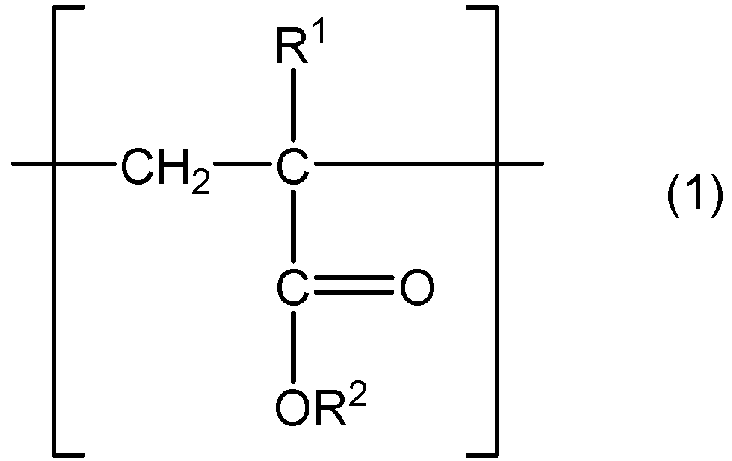
- the refrigerating machine oil contains, in addition to the base oil, a polymer (hereinafter also referred to as a "(meth)acrylate-based polymer”) containing a structural unit represented by the following formula (1):
- R 1 represents a hydrogen atom or a methyl group, preferably a methyl group
- R 2 represents an alkyl group or a group in which part of an alkyl group is substituted (hereinafter also referred to as a "substituted alkyl group").
- the alkyl group represented by R 2 may be linear or branched.
- the number of carbon atoms in the alkyl group may be 1 or more and 20 or less.
- the substituted alkyl group may have, for example, a group containing at least one selected from a nitrogen atom and an oxygen atom.
- the group containing a nitrogen atom may be an amino group.
- the group containing an oxygen atom may be an ether group.
- the (meth)acrylate-based polymer contains one or more, preferably two or more of the structural units represented by the formula (1).
- the (meth)acrylate-based polymer preferably contains at least one first structural unit wherein R 2 is a methyl group and at least one second structural unit wherein R 2 is an alkyl group having 10 or more carbon atoms.
- the (meth)acrylate-based polymer may contain two or more of the second structural units.
- the number of carbon atoms in the alkyl group represented by R 2 in the second structural unit may be 11 or more, 12 or more, or 13 or more, and 40 or less, 30 or less, 20 or less, 19 or less, or 18 or less.
- the alkyl group having 10 or more carbon atoms represented by R 2 in the second structural unit may be linear or branched.
- the alkyl group may have a methyl group or an ethyl group as a branch.
- the branched alkyl group having an ethyl group may be an alkyl group represented by the following formula (2a): wherein x represents an integer of 5 or more.
- the alkyl group may be an alkyl group represented by the following formula (2b): wherein y and z each independently represent an integer of 0 or more such that y + z is 6 or more.
- the (meth)acrylate-based polymer may contain at least one first structural unit wherein R 2 is a methyl group, at least one second structural unit wherein R 2 is an alkyl group having 10 or more carbon atoms, and at least one third structural unit wherein R 2 is an alkyl group having 2 to 9 carbon atoms.
- the alkyl group having 2 to 9 carbon atoms is preferably a linear or branched alkyl group having 4 to 8 carbon atoms, more preferably a branched alkyl group having 6 or 8 carbon atoms.
- the average number of carbon atoms in the group represented by R 2 (hereinafter also referred to as "average carbon number") is 4 to 18.
- the lower limit of the average carbon number may be 4.5 or more, 5 or more, 5.5 or more, or 6 or more.
- the upper limit of the average carbon number may be 17 or less, 16 or less, 15 or less, 14 or less, 13 or less, 12 or less, 11 or less, 10 or less, or 9.5 or less.
- the (meth)acrylate-based polymer tends to exhibit good compatibility with refrigerating machine oils having slightly lower polarity and a hydrocarbon refrigerant, and tends to have a high viscosity index improvement effect. Furthermore, the (meth)acrylate-based polymer tends to have a high refrigerant dissolution viscosity improvement effect on working fluid compositions containing such refrigerating machine oils and refrigerants, and is useful as a refrigerant dissolution viscosity improver.
- the average number of carbon atoms in the group represented by R 2 in the (meth)acrylate-based polymer is determined by analyzing the structure of the (meth)acrylate-based polymer using 13 C-NMR analysis ( 1 H-gated decoupling method) to determine the proportion of groups represented by R 2 (e.g., a methyl group, a long-chain alkyl group, a branched alkyl group, an amino group, etc.), and calculating the average number of carbon atoms from the obtained proportions and the number of carbon atoms in each group.
- 13 C-NMR analysis 1 H-gated decoupling method
- the (meth)acrylate-based polymer may be a homopolymer composed of a single structural unit represented by the formula (1), a copolymer composed of two or more structural units represented by the formula (1), or a copolymer composed of a structural unit represented by the formula (1) and another structural unit.
- the content of the structural unit represented by the formula (1) in the (meth)acrylate-based polymer may be 50% by mole or more, 60% by mole or more, 70% by mole or more, 80% by mole or more, or 90% by mole or more, and may be 100% by mole, based on the total amount of the structural units constituting the (meth)acrylate-based polymer.
- the weight-average molecular weight (Mw) of the (meth)acrylate-based polymer may be 500 or more, 1,000 or more, 5,000 or more, 10,000 or more, 30,000 or more, or 40,000 or more, and may be 100,000 or less, 80,000 or less, or 60,000 or less. In another embodiment, the weight-average molecular weight (Mw) of the (meth)acrylate-based polymer may be more than 100,000, 120,000 or more, 150,000 or more, or 200,000 or more, and may be 1,000,000 or less, 800,000 or less, 600,000 or less, 500,000 or less, or 400,000 or less.
- the weight-average molecular weight (Mw) of the (meth)acrylate-based polymer means Mw (polystyrene (standard sample) equivalent) obtained by GPC analysis.
- Mw polystyrene (standard sample) equivalent) obtained by GPC analysis.
- the Mw is measured, for example, as follows.
- a solution is prepared by diluting the (meth)acrylate-based polymer to a concentration of 1% by mass.
- the solution is subjected to analysis using a GPC apparatus (Waters Alliance 2695).
- a column suitable for the molecular weight of the (meth)acrylate-based polymer to be analyzed and a solvent flow rate of 1 ml/min analysis is carried out using a refractive index detector.
- the relationship between the column retention time and the molecular weight is separately obtained using polystyrene whose molecular weight is known as a standard, and a calibration curve is prepared in advance. The molecular weight is determined from the obtained retention time based on the calibration curve.
- the content of the (meth)acrylate-based polymer may be 1% by mass or more, 3% by mass or more, 5% by mass or more, 10% by mass or more, 15% by mass or more, or 20% by mass or more, and may be 50% by mass or less, 40% by mass or less, 35% by mass or less, or 30% by mass or less, based on the total amount of the refrigerating machine oil.
- the refrigerating machine oil may further contain an additional additive.
- additional additive include an acid scavenger, an antioxidant, an extreme pressure agent, an oiliness agent, a defoaming agent, a metal deactivator, an antiwear agent, a viscosity index improver, a pour point depressant, and a detergent-dispersant.
- the total content of these additives may be 0.1% by mass or more, 1% by mass or more, or 2% by mass or more, and may be 10% by mass or less, 5% by mass or less, or 3% by mass or less, based on the total amount of the refrigerating machine oil.
- the kinematic viscosity at 40°C of the refrigerating machine oil may be 5 mm 2 /s or higher, 10 mm 2 /s or higher, 20 mm 2 /s or higher, 30 mm 2 /s or higher, or 40 mm 2 /s or higher, and may be 500 mm 2 /s or lower, 400 mm 2 /s or lower, 300 mm 2 /s or lower, 200 mm 2 /s or lower, 100 mm 2 /s or lower, or 90 mm 2 /s or lower.
- the kinematic viscosity at 100°C of the refrigerating machine oil may be 1 mm 2 /s or higher, 2 mm 2 /s or higher, or 3 mm 2 /s or higher, and may be 100 mm 2 /s or lower, 50 mm 2 /s or lower, or 40 mm 2 /s or lower.
- the viscosity index of the refrigerating machine oil may be 80 or higher, 100 or higher, 150 or higher, 200 or higher, or 220 or higher, and may be 500 or lower, 400 or lower, or 300 or lower.
- FIG. 1 is a schematic diagram showing one embodiment of a refrigerating machine.
- the refrigerating machine 10 contains a refrigerant circulation system 6 in which a compressor (refrigerant compressor) 1, a condenser (gas cooler) 2, an expansion mechanism 3 (capillary, expansion valve, etc.), and an evaporator (heat exchanger) 4 are sequentially connected by a flow path 5.
- the refrigerant circulation system 6 contains a refrigerating machine oil and a refrigerant.
- the refrigerant circulation system 6 may further contain an accumulator 7 between the evaporator 4 and the compressor 1 (on the side of the compressor 1) to suppress and prevent liquid refrigerant from directly flowing into the compressor 1.
- Examples of such a refrigerating machine 10 include an air conditioner for an automobile, a dehumidifier, a refrigerator, a refrigerated warehouse, a vending machine, a showcase, a cooling device in a chemical plant, a residential air conditioner, a package air conditioner, and a heat pump for a water heater.
- the refrigerant circulation system 6 first, the high-temperature (usually 70 to 120°C) refrigerant discharged from the compressor 1 into the flow path 5 becomes a high-density fluid (supercritical fluid, etc.) in the condenser 2. Subsequently, the refrigerant is liquefied by passing through the narrow flow path of the expansion mechanism 3, and further vaporized in the evaporator 4 to become low-temperature (usually -40 to 0°C). The cooling by the refrigerating machine 10 utilizes the phenomenon that the refrigerant absorbs heat from the surroundings when it vaporizes in the evaporator 4.
- a high-density fluid supercritical fluid, etc.
- the compressor 1 a small amount of refrigerant and a large amount of refrigerating machine oil coexist under high-temperature (usually 70 to 120°C) conditions.
- the refrigerant discharged from the compressor 1 into the flow path 5 is in a gaseous state and contains a small amount (usually 1 to 10% by volume) of refrigerating machine oil as a mist, and a small amount of refrigerant is dissolved in this misty refrigerating machine oil (point a in FIG. 1 ).
- the gaseous refrigerant is compressed to become a high-density fluid, and a large amount of refrigerant and a small amount of refrigerating machine oil coexist under relatively high-temperature (usually 40 to 80°C) conditions (point b in FIG. 1 ). Furthermore, the mixture of a large amount of refrigerant and a small amount of refrigerating machine oil is sequentially sent to the expansion mechanism 3 and the evaporator 4, where it rapidly becomes low-temperature (usually -40 to 0°C) (points c and d in FIG. 1 ), and is returned to the compressor 1.
- Another embodiment of the present invention can be said to be a working fluid composition containing the above refrigerating machine oil and a refrigerant.
- the refrigerant dissolution viscosity of the working fluid composition can be improved by using the above (meth)acrylate-based polymer.
- another embodiment of the present invention can be said to be a refrigerant dissolution viscosity improver for a working fluid composition containing a refrigerating machine oil and a refrigerant, the refrigerant dissolution viscosity improver containing the above (meth)acrylate-based polymer.
- the refrigerant examples include a saturated hydrofluorocarbon (also called HFC), an unsaturated hydrofluorocarbon (also called HFO), a hydrocarbon, a fluorinated ether, bis(trifluoromethyl) sulfide, trifluoroiodomethane, ammonia, and carbon dioxide.
- HFC saturated hydrofluorocarbon
- HFO unsaturated hydrofluorocarbon
- hydrocarbon a fluorinated ether
- bis(trifluoromethyl) sulfide bis(trifluoromethyl) sulfide
- trifluoroiodomethane ammonia
- carbon dioxide examples include a saturated hydrofluorocarbon (also called HFC), an unsaturated hydrofluorocarbon (also called HFO), a hydrocarbon, a fluorinated ether, bis(trifluoromethyl) sulfide, trifluoroiodomethane, ammonia, and carbon dioxide.
- the refrigerant may be a single
- the refrigerant preferably contains a hydrocarbon.
- the content of the hydrocarbon may be 50% by mass or more, 60% by mass or more, 70% by mass or more, 80% by mass or more, 90% by mass or more, or 95% by mass or more, based on the total amount of the refrigerant.
- the refrigerant may consist of a hydrocarbon.
- saturated hydrofluorocarbon examples include a saturated hydrofluorocarbon having 1 to 3 carbon atoms, more preferably 1 to 2 carbon atoms.
- saturated hydrofluorocarbon examples include difluoromethane (R32), trifluoromethane (R23), pentafluoroethane (R125), 1,1,2,2-tetrafluoroethane (R134), 1,1,1,2-tetrafluoroethane (R134a), 1,1,1-trifluoroethane (R143a), 1,1-difluoroethane (R152a), fluoroethane (R161), 1,1,1,2,3,3,3-heptafluoropropane (R227ea), 1,1,1,2,3,3-hexafluoropropane (R236ea), 1,1,1,3,3,3-hexafluoropropane (R236fa), 1,1,1,3,3-pentafluoropropane (R245fa), and 1,1,1,1,
- the unsaturated hydrofluorocarbon examples include an unsaturated hydrofluorocarbon having 2 to 4 carbon atoms, having at least one carbon-carbon double bond, and containing fluorine and hydrogen.
- the unsaturated hydrofluorocarbon is preferably a fluoropropene, more preferably a fluoropropene having 3 to 5 fluorine atoms.
- the unsaturated hydrofluorocarbon examples include 1,2,3,3,3-pentaf luoropropene (HFO-1225ye), 1,3,3,3-tetrafluoropropene (HFO-1234ze), 2,3,3,3-tetrafluoropropene (HFO-1234yf), 1,2,3,3-tetrafluoropropene (HFO-1234ye), and 3,3,3-trifluoropropene (HFO-1243zf).
- the unsaturated hydrofluorocarbon is preferably at least one selected from HFO-1225ye, HFO-1234ze, and HFO-1234yf.
- the unsaturated hydrofluorocarbon may also be a fluoroethylene having 1 to 4 fluorine atoms, preferably 1,1,2,3-trifluoroethylene.
- the hydrocarbon is preferably a hydrocarbon having 1 to 5 carbon atoms, more preferably a hydrocarbon having 2 to 4 carbon atoms.
- Examples of the hydrocarbon include methane, ethylene, ethane, propylene, propane (R290), cyclopropane, n-butane, isobutane, cyclobutane, methylcyclopropane, 2-methylbutane, and n-pentane.
- the hydrocarbon is preferably at least one selected from the group consisting of propane, n-butane, isobutane, and 2-methylbutane.
- the low-temperature side two-phase separation temperature of the refrigerating machine oil and the refrigerant may be, for example, 10°C or lower, preferably 0°C or lower, more preferably -20°C or lower, and -30°C or lower when the oil rate (amount of refrigerating machine oil (g) / total amount of refrigerating machine oil and refrigerant (g) ⁇ 100) (% by mass) is 20% by mass.
- the refrigerant exhibiting such a low-temperature side two-phase separation temperature may be a refrigerant containing the above hydrocarbons, preferably a refrigerant containing propane or isobutane.
- the content of the refrigerating machine oil in the working fluid composition may be 1 part by mass or more, preferably 2 parts by mass or more, and 500 parts by mass or less, preferably 400 parts by mass or less, based on 100 parts by mass of the refrigerant.
- refrigerating machine oils having the compositions (% by mass) shown in Tables 1 to 9 were prepared. In all of these refrigerating machine oils, the base oil and the (meth)acrylate-based polymer were dissolved with each other.
- the refrigerant compatibility of the refrigerating machine oils in the Examples was evaluated in accordance with the "Test method for compatibility with refrigerant" of JIS K2211: 2009. Specifically, 4 g of the refrigerating machine oil was mixed with 16 g of R290, which is a refrigerant containing a hydrocarbon, and it was observed whether the refrigerating machine oil and the refrigerant were dissolved with each other at 0°C. The case where the refrigerating machine oil and the refrigerant were dissolved with each other was evaluated as "compatible,” and the case where the refrigerating machine oil and the refrigerant were separated into two layers was evaluated as "separated.” The results are shown in Tables 1 to 9.
- Example 1 2 3 4 5 6 7 Composition (% by mass) Base oill Balance Balance Balance Balance Balance Balance Polymer 1 10 5 - - - - - Polymer 2 - - 20 10 5 - - Polymer 3 - - - - - 10 5 Properties Kinematic viscosity (mm 2 /s) 40°C 24.7 21.6 60.5 32.5 24.7 29.3 23.7 100°C 5.5 4.8 13.1 7.5 5.6 6.2 5.1 Viscosity index 167 146 224 210 179 166 149 Refrigerant compatibility Compatible Compatible Compatible Compatible Compatible Compatible Compatible
- Example 8 9 10 11 12 13 14 Composition (% by mass) Base oil2 Balance Balance Balance Balance Balance Polymer 2 30 40 - - - - - Polymer 4 - - 10 20 40 - - Polymer 5 - - - - - 10 20 Properties Kinematic viscosity (mm 2 /s) 40°C 89.2 193.2 20.0
- the refrigerating machine oils in the Examples shown in Tables 10 to 13 were measured for refrigerant dissolution viscosity, refrigerant ratio (refrigerant dissolution amount), and two-phase separation temperature according to the following procedures.
- the refrigerating machine oils in the Reference Examples shown in Tables 10 to 13 were also measured in the same manner. The results are shown in Tables 10 to 13.
- the refrigerant R290
- the temperature and pressure inside the pressure-resistant container were adjusted to 80°C and an absolute pressure of 2.8 MPa, respectively, to prepare a working fluid composition consisting of refrigerating machine oil and refrigerant. If the predetermined conditions were not met, the filling amount of the refrigerating machine oil was appropriately adjusted. Under these conditions, the absolute viscosity (mPa ⁇ s) of the working fluid composition was measured using a vibrating viscometer.
- the refrigerant dissolution viscosity R-Vis (mm 2 /s) of the working fluid composition was determined as P/Dw, where P is the measured absolute viscosity (mPa ⁇ s) and Dw is the density of the working fluid composition (g/cm 3 ).
- the low-temperature side two-phase separation temperature was measured when the oil rate (amount of refrigerating machine oil (g) / total amount of refrigerating machine oil and refrigerant (g) ⁇ 100) (% by mass) was 20% by mass. Specifically, the low-temperature side two-phase separation temperature was measured using 20 g of refrigerating machine oil and 80 g of refrigerant (R290).
- Example 21 Example 23
- Example 24 Example 25 Reference Example 3 Composition of refrigerating machine oil (% by mass) Base oil 3 Balance Balance Balance Balance 100 Polymer 1 10 - - - - Polymer 2 - 10 5 - - Polymer 3 - - - 10 - Properties of refrigerating machine oil Kinematic viscosity (mm 2 /s) 40°C 62.4 84.9 62.8 69.6 47.6 100°C 12.4 16.6 12.6 13.3 9.6 Viscosity index 201 212 204 197 191 Properties of working fluid Refrigerant dissolution viscosity (mm 2 /s) 1.9 2.5 2.0 2.1 1.7 Refrigerant ratio (% by mass) 29.6 29.6 29.1 28.5 27.8 Two-phase separation temperature (°C) -39 -42 -42 -40 -42 [Table 11] Example 21 Example 23
- Example 24 Example 25 Reference Example 3 Composition of refrigerating machine oil (% by mass) Base oil 3 Balance Balance Balance Balance 100 Poly
Landscapes
- Chemical & Material Sciences (AREA)
- Chemical Kinetics & Catalysis (AREA)
- Organic Chemistry (AREA)
- Engineering & Computer Science (AREA)
- General Chemical & Material Sciences (AREA)
- Oil, Petroleum & Natural Gas (AREA)
- Physics & Mathematics (AREA)
- Combustion & Propulsion (AREA)
- Thermal Sciences (AREA)
- Materials Engineering (AREA)
- Lubricants (AREA)
Abstract

Description
- The present invention relates to a refrigerating machine oil, a working fluid composition, and a refrigerant dissolution viscosity improver.
- Refrigerating machines such as refrigerators, car air conditioners, room air conditioners, and vending machines are equipped with compressors for circulating refrigerants within the refrigeration cycle. These compressors are filled with refrigerating machine oil to lubricate sliding members. Various properties are required for refrigerating machine oil, and suitable base oils and additives are selected according to these properties. For example,
Patent Literature 1 discloses a refrigerating machine oil containing a base oil and a specific polymer in an amount of 40% by mass or less based on the total amount of the refrigerating machine oil, which exhibits excellent lubricity (particularly antiwear properties) and oil return properties. - Patent Literature 1: International Publication No.
WO 2017/179687 - According to the studies by the present inventors, there is room for further improvement in properties other than lubricity (particularly antiwear property) and oil return property of the refrigerating machine oil described in
Patent Literature 1. - One aspect of the present invention aims to improve viscosity index of a refrigerating machine oil.
- The present inventors have found that viscosity index of a refrigerating machine oil can be improved by adding a specific (meth)acrylate-based polymer.
- The present invention includes the following aspects:
- [1] A refrigerating machine oil containing: a base oil; and a polymer containing a structural unit represented by the following formula (1):
- [2] The refrigerating machine oil according to [1], being used with a refrigerant containing a hydrocarbon.
- [3] A working fluid composition containing the refrigerating machine oil according to [1]; and a refrigerant.
- [4] The working fluid composition according to [3], wherein the refrigerant contains a hydrocarbon.
- [5] A refrigerant dissolution viscosity improver for a working fluid composition containing a refrigerating machine oil and a refrigerant, the refrigerant dissolution viscosity improver containing a polymer containing a structural unit represented by the following formula (1):

- [6] The refrigerant dissolution viscosity improver according to [5], wherein the refrigerant contains a hydrocarbon.
- According to one aspect of the present invention, the viscosity index of the refrigerating machine oil can be improved. According to another aspect of the present invention, the viscosity characteristics of the refrigerating machine oil can be improved. According to another aspect of the present invention, the refrigerating machine oil with excellent viscosity characteristics and refrigerant compatibility can be provided. According to another aspect of the present invention, the refrigerating machine oil with the high refrigerant dissolution viscosity can be provided. According to another aspect of the present invention, the refrigerant dissolution viscosity improver for a working fluid composition can be provided.
-
FIG. 1 is a schematic diagram showing one embodiment of a refrigerating machine. - One embodiment of the present invention is a refrigerating machine oil containing a base oil and a specific polymer (a (meth)acrylate-based polymer described later).
- Examples of the base oil includes a hydrocarbon oil and an oxygen-containing oil. Examples of the hydrocarbon oil include a mineral oil and a synthetic hydrocarbon oil. Examples of the oxygen-containing oil include an ester, an ether, a carbonate, a ketone, a silicone, and a polysiloxane.
- Examples of the mineral oil include a paraffinic mineral oil and a naphthenic mineral oil which are obtained by refining a lubricating oil fraction obtained by an atmospheric distillation and a vacuum distillation of a crude oil through a method such as a solvent extraction, a solvent refining, a hydrogenation refining, a hydrogenation cracking, a solvent dewaxing, a hydrogenation dewaxing, a clay treatment, and a sulfuric acid washing. The mineral oil is preferably a hydrogenation cracked mineral oil. The mineral oil is preferably a paraffinic mineral oil. Examples of the synthetic hydrocarbon oil include an alkylbenzene, an alkylnaphthalene, a poly-α-olefin (PAO), a hydrogenated product of a poly-α-olefins (PAO), a wax isomerized oil, a polybutene, and an ethylene-α-olefin copolymer. Among these, the base oil preferably contains at least one selected from a mineral oil and a wax isomerized oil, as they tend to suppress the dissolution amount of a refrigerant containing a hydrocarbon such as R290 and easily increase the refrigerant dissolution viscosity.
- The kinematic viscosity at 40°C of the hydrocarbon oil may be 3 mm2/s or higher, 5 mm2/s or higher, 7 mm2/s or higher, or 10 mm2/s or higher, and may be 400 mm2/s or lower, 100 mm2/s or lower, 50 mm2/s or lower, or 30 mm2/s or lower. The kinematic viscosity at 40°C of the hydrocarbon oil may be 25 mm2/s or lower, 20 mm2/s or lower, 15 mm2/s or lower, or 13 mm2/s or lower from the viewpoint of obtaining a higher viscosity index improvement effect by adding the (meth)acrylate-based polymer. The kinematic viscosity at 100°C of the hydrocarbon oil may be 1 mm2/s or higher, 1.5 mm2/s or higher, 2 mm2/s or higher, or 2.5 mm2/s or higher, and may be 100 mm2/s or lower, 50 mm2/s or lower, 30 mm2/s or lower, or 10 mm2/s or lower. The viscosity index of the hydrocarbon oil may be 0 or higher, 50 or higher, 80 or higher, 100 or higher, or 105 or higher, and may be 200 or lower, 150 or lower, 130 or lower, or 115 or lower. The kinematic viscosity and viscosity index in this specification refer to the kinematic viscosity and viscosity index measured in accordance with JIS K2283:2000.
- Examples of the ester include an aromatic ester, a dibasic acid ester, a polyol ester, a complex ester, a carbonate ester, and a mixture thereof. The ester is preferably at least one selected from a polyol ester and a complex ester, and more preferably a polyol ester. The ester as the base oil does not include the (meth)acrylate-based polymer described later.
- The polyol ester is an ester of a polyhydric alcohol and a carboxylic acid. The polyhydric alcohol may be a polyhydric alcohol having 2 to 6 hydroxyl groups. The number of carbon atoms in the polyhydric alcohol may be 4 or more or 5 or more, and 12 or less or 10 or less. The polyhydric alcohol is preferably at least one selected from the group consisting of neopentyl glycol, trimethylol ethane, trimethylol propane, trimethylol butane, di-(trimethylol propane), tri-(trimethylol propane), pentaerythritol, and dipentaerythritol, and more preferably at least one selected from the group consisting of neopentyl glycol, trimethylol propane, pentaerythritol, and dipentaerythritol.
- The carboxylic acid may be a monocarboxylic acid or a polycarboxylic acid, preferably a monocarboxylic acid, and more preferably a monocarboxylic aliphatic acid (fatty acid). The fatty acid may be a saturated fatty acid or an unsaturated fatty acid. The number of carbon atoms in the carboxylic acid (fatty acid) may be 4 or more, 5 or more, 8 or more, 10 or more, 12 or more, or 14 or more, and 20 or less, 18 or less, 16 or less, 14 or less, 10 or less, or 9 or less.
- Specific examples of the fatty acid include butanoic acid, pentanoic acid, hexanoic acid, heptanoic acid, octanoic acid, nonanoic acid, decanoic acid, undecanoic acid, dodecanoic acid, tridecanoic acid, tetradecanoic acid, pentadecanoic acid, hexadecanoic acid, hexadecenoic acid, heptadecanoic acid, octadecanoic acid, octadecenoic acid, nonadecanoic acid, and eicosanoic acid. These fatty acids may be linear or branched.
- In one embodiment, the base oil may contain an ester of neopentyl glycol or trimethylol propane and a fatty acid having 4 to 10 carbon atoms. In this case, a higher viscosity index improvement effect can be obtained by adding the (meth)acrylate-based polymer. The fatty acid is preferably a linear or branched saturated fatty acid. In the ester of neopentyl glycol and a fatty acid having 4 to 10 carbon atoms, the number of carbon atoms in the fatty acid may be 4 to 9, 5 to 9, 6 to 9, 7 to 9, or 8 to 9, and may be 8, and the fatty acid may be branched. In the ester of trimethylol propane and a fatty acid having 4 to 10 carbon atoms, the number of carbon atoms in the fatty acid may be 5 to 10, 6 to 10, 7 to 10, or 8 to 10, and the fatty acid may be linear.
- In one embodiment, the base oil may contain an ester of neopentyl glycol or trimethylol propane and a fatty acid having 10 to 20 carbon atoms, preferably an ester of trimethylol propane and a fatty acid having 10 to 20 carbon atoms. In this case, the refrigerant dissolution viscosity can be more effectively improved without significantly increasing the kinematic viscosity at 40°C of the refrigerating machine oil by adding the (meth)acrylate-based polymer. The fatty acid having 10 to 20 carbon atoms preferably contains an unsaturated fatty acid having 14 to 20 carbon atoms, more preferably contains oleic acid.
- In one embodiment, the base oil may contain an ester of pentaerythritol and a fatty acid having 4 to 9 carbon atoms. The fatty acid is preferably a saturated fatty acid. The fatty acid is preferably a fatty acid having a branch at the α-position and/or β-position, more preferably selected from the group consisting of 2-methylpropanoic acid, 2-methylbutanoic acid, 2-methylpentanoic acid, 2-methylhexanoic acid, 2-ethylpentanoic acid, 2-methylheptanoic acid, 2-ethylhexanoic acid, 3,5,5-trimethylhexanoic acid, and 2-ethylhexadecanoic acid, and further preferably selected from the group consisting of 2-ethylhexanoic acid and 3,5,5-trimethylhexanoic acid.
- The complex ester is preferably an ester synthesized from at least one selected from a polyhydric alcohol having 2 to 4 hydroxyl groups, at least one selected from a polybasic acid having 6 to 12 carbon atoms, at least one selected from a monohydric alcohol having 4 to 18 carbon atoms, and at least one selected from a monocarboxylic fatty acid having 2 to 12 carbon atoms.
- Examples of the polyhydric alcohol having 2 to 4 hydroxyl groups include neopentyl glycol, trimethylol propane, and pentaerythritol.
- The polyhydric alcohol constituting the complex ester preferably further contains a dihydric alcohol having 2 to 10 carbon atoms other than neopentyl glycol, in addition to the polyhydric alcohol having 2 to 4 hydroxyl groups. Examples of the dihydric alcohol having 2 to 10 carbon atoms other than neopentyl glycol include ethylene glycol, propanediol, butanediol, pentanediol, hexanediol, 2-methyl-1,3-propanediol, 3-methyl-1,5-pentanediol, and 2,2-diethyl-1,3-pentanediol.
- Examples of the polybasic acid having 6 to 12 carbon atoms include adipic acid, pimelic acid, suberic acid, azelaic acid, sebacic acid, phthalic acid, and trimellitic acid.
- Examples of the monohydric alcohol having 4 to 18 carbon atoms include aliphatic alcohols such as butanol, pentanol, hexanol, heptanol, octanol, nonanol, decanol, dodecanol, and oleyl alcohol. These monohydric alcohols may be linear or branched.
- Examples of the monocarboxylic fatty acid having 2 to 12 carbon atoms include acetic acid, propanoic acid, butanoic acid, pentanoic acid, hexanoic acid, heptanoic acid, octanoic acid, nonanoic acid, decanoic acid, and dodecanoic acid. These monohydric fatty acids may be linear or branched.
- The kinematic viscosity at 40°C of the ester may be 3 mm2/s or higher, 5 mm2/s or higher, 7 mm2/s or higher, or 10 mm2/s or higher, and may be 500 mm2/s or lower, 300 mm2/s or lower, or 100 mm2/s or lower. The kinematic viscosity at 100°C of the ester may be 1 mm2/s or higher, 1.5 mm2/s or higher, or 2 mm2/s or higher, and may be 100 mm2/s or lower, 50 mm2/s or lower, or 10 mm2/s or lower. The viscosity index of the ester may be 10 or higher, 30 or higher, or 50 or higher, and may be 250 or lower, 200 or lower, or 150 or lower.
- The kinematic viscosity at 40°C of the ester of neopentyl glycol or trimethylol propane and a fatty acid having 4 to 10 carbon atoms may be 3 mm2/s or higher, 5 mm2/s or higher, or 7 mm2/s or higher, and may be 30 mm2/s or lower, 25 mm2/s or lower, 20 mm2/s or lower, 15 mm2/s or lower, or 10 mm2/s or lower. The kinematic viscosity at 100°C of the ester may be 1 mm2/s or higher, 1.5 mm2/s or higher, or 2 mm2/s or higher, and may be 10 mm2/s or lower, 5 mm2/s or lower, or 3 mm2/s or lower. The viscosity index of the ester may be 10 or higher, 30 or higher, or 40 or higher, and may be 160 or lower, 140 or lower, 120 or lower, 100 or lower, 80 or lower, 70 or lower, or 60 or lower.
- The kinematic viscosity at 40°C of the ester of neopentyl glycol or trimethylol propane and a fatty acid having 10 to 20 carbon atoms may be 10 mm2/s or higher, 15 mm2/s or higher, or 20 mm2/s or higher, and may be 60 mm2/s or lower, 55 mm2/s or lower, or 50 mm2/s or lower. The kinematic viscosity at 100°C of the ester may be 3 mm2/s or higher, 4 mm2/s or higher, or 5 mm2/s or higher, and may be 20 mm2/s or lower, 15 mm2/s or lower, or 10 mm2/s or lower. The viscosity index of the ester may be 100 or higher, 150 or higher, or 170 or higher, and may be 300 or lower, 250 or lower, or 220 or lower.
- The kinematic viscosity at 40°C of the ester of pentaerythritol and a fatty acid having 4 to 9 carbon atoms may be 30 mm2/s or higher, 40 mm2/s or higher, or 50 mm2/s or higher, and may be 100 mm2/s or lower, 80 mm2/s or lower, or 75 mm2/s or lower. The kinematic viscosity at 100°C of the ester may be 3 mm2/s or higher, 4 mm2/s or higher, or 5 mm2/s or higher, and may be 20 mm2/s or lower, 15 mm2/s or lower, or 10 mm2/s or lower. The viscosity index of the ester may be 50 or higher, 70 or higher, or 80 or higher, and may be 150 or lower, 120 or lower, or 100 or lower.
- Examples of the ether include a polyvinyl ether, a polyalkylene glycol, a polyphenyl ether, and a perfluoro ether. The ether is preferably selected from a polyvinyl ether and a polyalkylene glycol, more preferably a polyvinyl ether.
- The base oil preferably contains at least one selected from the group consisting of the hydrocarbon oil, the ester, and the ether, more preferably at least one selected from the group consisting of the mineral oil, the synthetic hydrocarbon oil, the ester of neopentyl glycol or trimethylol propane and a fatty acid having 4 to 10 carbon atoms, the ester of neopentyl glycol or trimethylol propane and a fatty acid having 10 to 20 carbon atoms, and esters of pentaerythritol and a fatty acid having 4 to 9 carbon atoms. From the viewpoint of obtaining a higher viscosity index improvement effect by adding the (meth)acrylate-based polymer, the base oil preferably contains at least one selected from the group consisting of the mineral oil, the synthetic hydrocarbon oil, the ester of neopentyl glycol or trimethylol propane and a fatty acid having 4 to 10 carbon atoms, and the ester of pentaerythritol and a fatty acid having 4 to 9 carbon atoms, more preferably at least one selected from the group consisting of the mineral oil, the synthetic hydrocarbon oil, and the ester of neopentyl glycol or trimethylol propane and a fatty acid having 4 to 10 carbon atoms, and even more preferably at least one selected from the group consisting of the mineral oil and the ester of neopentyl glycol or trimethylol propane and a fatty acid having 4 to 10 carbon atoms.
- The kinematic viscosity at 40°C of the base oil may be 3 mm2/s or higher, 4 mm2/s or higher, or 5 mm2/s or higher, and may be 500 mm2/s or lower, 400 mm2/s or lower, or 300 mm2/s or lower. The kinematic viscosity at 100°C of the base oil may be 1 mm2/s or higher, 1.5 mm2/s or higher, or 2 mm2/s or higher, and may be 100 mm2/s or lower, 50 mm2/s or lower, or 10 mm2/s or lower. The viscosity index of the base oil may be 10 or higher, 30 or higher, or 50 or higher, and may be 250 or lower, 200 or lower, or 150 or lower.
- The content of the base oil may be 50% by mass or more, 60% by mass or more, 70% by mass or more, 80% by mass or more, or 90% by mass or more, based on the total amount of the refrigerating machine oil.
- The refrigerating machine oil contains, in addition to the base oil, a polymer (hereinafter also referred to as a "(meth)acrylate-based polymer") containing a structural unit represented by the following formula (1):

- In the formula, R1 represents a hydrogen atom or a methyl group, preferably a methyl group, and R2 represents an alkyl group or a group in which part of an alkyl group is substituted (hereinafter also referred to as a "substituted alkyl group").
- The alkyl group represented by R2 may be linear or branched. The number of carbon atoms in the alkyl group may be 1 or more and 20 or less. The substituted alkyl group may have, for example, a group containing at least one selected from a nitrogen atom and an oxygen atom. The group containing a nitrogen atom may be an amino group. The group containing an oxygen atom may be an ether group.
- The (meth)acrylate-based polymer contains one or more, preferably two or more of the structural units represented by the formula (1). The (meth)acrylate-based polymer preferably contains at least one first structural unit wherein R2 is a methyl group and at least one second structural unit wherein R2 is an alkyl group having 10 or more carbon atoms. The (meth)acrylate-based polymer may contain two or more of the second structural units. The number of carbon atoms in the alkyl group represented by R2 in the second structural unit may be 11 or more, 12 or more, or 13 or more, and 40 or less, 30 or less, 20 or less, 19 or less, or 18 or less.
- The alkyl group having 10 or more carbon atoms represented by R2 in the second structural unit may be linear or branched. When the alkyl group is branched, the alkyl group may have a methyl group or an ethyl group as a branch. The branched alkyl group having an ethyl group may be an alkyl group represented by the following formula (2a):

- When the alkyl group having 10 or more carbon atoms represented by R2 in the second structural unit is branched, the alkyl group may be an alkyl group represented by the following formula (2b):

- The (meth)acrylate-based polymer may contain at least one first structural unit wherein R2 is a methyl group, at least one second structural unit wherein R2 is an alkyl group having 10 or more carbon atoms, and at least one third structural unit wherein R2 is an alkyl group having 2 to 9 carbon atoms. The alkyl group having 2 to 9 carbon atoms is preferably a linear or branched alkyl group having 4 to 8 carbon atoms, more preferably a branched alkyl group having 6 or 8 carbon atoms.
- In the (meth)acrylate-based polymer, the average number of carbon atoms in the group represented by R2 (hereinafter also referred to as "average carbon number") is 4 to 18. The lower limit of the average carbon number may be 4.5 or more, 5 or more, 5.5 or more, or 6 or more. The upper limit of the average carbon number may be 17 or less, 16 or less, 15 or less, 14 or less, 13 or less, 12 or less, 11 or less, 10 or less, or 9.5 or less. When the average number of carbon atoms in the group represented by R2 is 4 or more, the (meth)acrylate-based polymer tends to exhibit good compatibility with refrigerating machine oils having slightly lower polarity and a hydrocarbon refrigerant, and tends to have a high viscosity index improvement effect. Furthermore, the (meth)acrylate-based polymer tends to have a high refrigerant dissolution viscosity improvement effect on working fluid compositions containing such refrigerating machine oils and refrigerants, and is useful as a refrigerant dissolution viscosity improver.
- The average number of carbon atoms in the group represented by R2 in the (meth)acrylate-based polymer is determined by analyzing the structure of the (meth)acrylate-based polymer using 13C-NMR analysis (1H-gated decoupling method) to determine the proportion of groups represented by R2 (e.g., a methyl group, a long-chain alkyl group, a branched alkyl group, an amino group, etc.), and calculating the average number of carbon atoms from the obtained proportions and the number of carbon atoms in each group.
- The (meth)acrylate-based polymer may be a homopolymer composed of a single structural unit represented by the formula (1), a copolymer composed of two or more structural units represented by the formula (1), or a copolymer composed of a structural unit represented by the formula (1) and another structural unit. The content of the structural unit represented by the formula (1) in the (meth)acrylate-based polymer may be 50% by mole or more, 60% by mole or more, 70% by mole or more, 80% by mole or more, or 90% by mole or more, and may be 100% by mole, based on the total amount of the structural units constituting the (meth)acrylate-based polymer.
- The weight-average molecular weight (Mw) of the (meth)acrylate-based polymer may be 500 or more, 1,000 or more, 5,000 or more, 10,000 or more, 30,000 or more, or 40,000 or more, and may be 100,000 or less, 80,000 or less, or 60,000 or less. In another embodiment, the weight-average molecular weight (Mw) of the (meth)acrylate-based polymer may be more than 100,000, 120,000 or more, 150,000 or more, or 200,000 or more, and may be 1,000,000 or less, 800,000 or less, 600,000 or less, 500,000 or less, or 400,000 or less.
- The weight-average molecular weight (Mw) of the (meth)acrylate-based polymer means Mw (polystyrene (standard sample) equivalent) obtained by GPC analysis. The Mw is measured, for example, as follows.
- Using tetrahydrofuran as a solvent, a solution is prepared by diluting the (meth)acrylate-based polymer to a concentration of 1% by mass. The solution is subjected to analysis using a GPC apparatus (Waters Alliance 2695). Using a column suitable for the molecular weight of the (meth)acrylate-based polymer to be analyzed and a solvent flow rate of 1 ml/min, analysis is carried out using a refractive index detector. The relationship between the column retention time and the molecular weight is separately obtained using polystyrene whose molecular weight is known as a standard, and a calibration curve is prepared in advance. The molecular weight is determined from the obtained retention time based on the calibration curve.
- The content of the (meth)acrylate-based polymer may be 1% by mass or more, 3% by mass or more, 5% by mass or more, 10% by mass or more, 15% by mass or more, or 20% by mass or more, and may be 50% by mass or less, 40% by mass or less, 35% by mass or less, or 30% by mass or less, based on the total amount of the refrigerating machine oil.
- The refrigerating machine oil may further contain an additional additive. Examples of the additional additive include an acid scavenger, an antioxidant, an extreme pressure agent, an oiliness agent, a defoaming agent, a metal deactivator, an antiwear agent, a viscosity index improver, a pour point depressant, and a detergent-dispersant. The total content of these additives may be 0.1% by mass or more, 1% by mass or more, or 2% by mass or more, and may be 10% by mass or less, 5% by mass or less, or 3% by mass or less, based on the total amount of the refrigerating machine oil.
- The kinematic viscosity at 40°C of the refrigerating machine oil may be 5 mm2/s or higher, 10 mm2/s or higher, 20 mm2/s or higher, 30 mm2/s or higher, or 40 mm2/s or higher, and may be 500 mm2/s or lower, 400 mm2/s or lower, 300 mm2/s or lower, 200 mm2/s or lower, 100 mm2/s or lower, or 90 mm2/s or lower. The kinematic viscosity at 100°C of the refrigerating machine oil may be 1 mm2/s or higher, 2 mm2/s or higher, or 3 mm2/s or higher, and may be 100 mm2/s or lower, 50 mm2/s or lower, or 40 mm2/s or lower. The viscosity index of the refrigerating machine oil may be 80 or higher, 100 or higher, 150 or higher, 200 or higher, or 220 or higher, and may be 500 or lower, 400 or lower, or 300 or lower.
- The refrigerating machine oil is used with a refrigerant in a refrigerating machine.
FIG. 1 is a schematic diagram showing one embodiment of a refrigerating machine. As shown inFIG. 1 , the refrigeratingmachine 10 contains arefrigerant circulation system 6 in which a compressor (refrigerant compressor) 1, a condenser (gas cooler) 2, an expansion mechanism 3 (capillary, expansion valve, etc.), and an evaporator (heat exchanger) 4 are sequentially connected by aflow path 5. Therefrigerant circulation system 6 contains a refrigerating machine oil and a refrigerant. Therefrigerant circulation system 6 may further contain anaccumulator 7 between theevaporator 4 and the compressor 1 (on the side of the compressor 1) to suppress and prevent liquid refrigerant from directly flowing into thecompressor 1. - Examples of such a refrigerating
machine 10 include an air conditioner for an automobile, a dehumidifier, a refrigerator, a refrigerated warehouse, a vending machine, a showcase, a cooling device in a chemical plant, a residential air conditioner, a package air conditioner, and a heat pump for a water heater. - In the
refrigerant circulation system 6, first, the high-temperature (usually 70 to 120°C) refrigerant discharged from thecompressor 1 into theflow path 5 becomes a high-density fluid (supercritical fluid, etc.) in thecondenser 2. Subsequently, the refrigerant is liquefied by passing through the narrow flow path of theexpansion mechanism 3, and further vaporized in theevaporator 4 to become low-temperature (usually -40 to 0°C). The cooling by the refrigeratingmachine 10 utilizes the phenomenon that the refrigerant absorbs heat from the surroundings when it vaporizes in theevaporator 4. - In the
compressor 1, a small amount of refrigerant and a large amount of refrigerating machine oil coexist under high-temperature (usually 70 to 120°C) conditions. The refrigerant discharged from thecompressor 1 into theflow path 5 is in a gaseous state and contains a small amount (usually 1 to 10% by volume) of refrigerating machine oil as a mist, and a small amount of refrigerant is dissolved in this misty refrigerating machine oil (point a inFIG. 1 ). - In the
condenser 2, the gaseous refrigerant is compressed to become a high-density fluid, and a large amount of refrigerant and a small amount of refrigerating machine oil coexist under relatively high-temperature (usually 40 to 80°C) conditions (point b inFIG. 1 ). Furthermore, the mixture of a large amount of refrigerant and a small amount of refrigerating machine oil is sequentially sent to theexpansion mechanism 3 and theevaporator 4, where it rapidly becomes low-temperature (usually -40 to 0°C) (points c and d inFIG. 1 ), and is returned to thecompressor 1. - Another embodiment of the present invention can be said to be a working fluid composition containing the above refrigerating machine oil and a refrigerant. The refrigerant dissolution viscosity of the working fluid composition can be improved by using the above (meth)acrylate-based polymer. That is, another embodiment of the present invention can be said to be a refrigerant dissolution viscosity improver for a working fluid composition containing a refrigerating machine oil and a refrigerant, the refrigerant dissolution viscosity improver containing the above (meth)acrylate-based polymer.
- Examples of the refrigerant include a saturated hydrofluorocarbon (also called HFC), an unsaturated hydrofluorocarbon (also called HFO), a hydrocarbon, a fluorinated ether, bis(trifluoromethyl) sulfide, trifluoroiodomethane, ammonia, and carbon dioxide. The refrigerant may be a single refrigerant of these refrigerants or a mixed refrigerant of two or more.
- The refrigerant preferably contains a hydrocarbon. The content of the hydrocarbon may be 50% by mass or more, 60% by mass or more, 70% by mass or more, 80% by mass or more, 90% by mass or more, or 95% by mass or more, based on the total amount of the refrigerant. The refrigerant may consist of a hydrocarbon.
- Examples of the saturated hydrofluorocarbon include a saturated hydrofluorocarbon having 1 to 3 carbon atoms, more preferably 1 to 2 carbon atoms. Examples of the saturated hydrofluorocarbon include difluoromethane (R32), trifluoromethane (R23), pentafluoroethane (R125), 1,1,2,2-tetrafluoroethane (R134), 1,1,1,2-tetrafluoroethane (R134a), 1,1,1-trifluoroethane (R143a), 1,1-difluoroethane (R152a), fluoroethane (R161), 1,1,1,2,3,3,3-heptafluoropropane (R227ea), 1,1,1,2,3,3-hexafluoropropane (R236ea), 1,1,1,3,3,3-hexafluoropropane (R236fa), 1,1,1,3,3-pentafluoropropane (R245fa), and 1,1,1,3,3-pentafluorobutane (R365mfc).
- Preferred examples of the saturated hydrofluorocarbon include R32 alone; R23 alone; R134a alone; R125 alone; a mixture of R134a/R32 = 60 to 80% by mass/40 to 20% by mass; a mixture of R32/R125 = 40 to 70% by mass/60 to 30% by mass; a mixture of R125/R143a = 40 to 60% by mass/60 to 40% by mass; a mixture of R134a/R32/R125 = 60% by mass/30% by mass/10% by mass; a mixture of R134a/R32/R125 = 40 to 70% by mass/15 to 35% by mass/5 to 40% by mass; a mixture of R125/R134a/R143a = 35 to 55% by mass/1 to 15% by mass/40 to 60% by mass. More specific examples include a mixture of R134a/R32 = 70/30% by mass; a mixture of R32/R125 = 60/40% by mass; a mixture of R32/R125 = 50/50% by mass (R410A); a mixture of R32/R125 = 45/55% by mass (R410B); a mixture of R125/R143a = 50/50% by mass (R507C); a mixture of R32/R125/R134a = 30/10/60% by mass; a mixture of R32/R125/R134a = 23/25/52% by mass (R407C); a mixture of R32/R125/R134a = 25/15/60% by mass (R407E); a mixture of R125/R134a/R143a = 44/4/52% by mass (R404A).
- Examples of the unsaturated hydrofluorocarbon include an unsaturated hydrofluorocarbon having 2 to 4 carbon atoms, having at least one carbon-carbon double bond, and containing fluorine and hydrogen. The unsaturated hydrofluorocarbon is preferably a fluoropropene, more preferably a fluoropropene having 3 to 5 fluorine atoms. Examples of the unsaturated hydrofluorocarbon include 1,2,3,3,3-pentaf luoropropene (HFO-1225ye), 1,3,3,3-tetrafluoropropene (HFO-1234ze), 2,3,3,3-tetrafluoropropene (HFO-1234yf), 1,2,3,3-tetrafluoropropene (HFO-1234ye), and 3,3,3-trifluoropropene (HFO-1243zf). The unsaturated hydrofluorocarbon is preferably at least one selected from HFO-1225ye, HFO-1234ze, and HFO-1234yf. The unsaturated hydrofluorocarbon may also be a fluoroethylene having 1 to 4 fluorine atoms, preferably 1,1,2,3-trifluoroethylene.
- The hydrocarbon is preferably a hydrocarbon having 1 to 5 carbon atoms, more preferably a hydrocarbon having 2 to 4 carbon atoms. Examples of the hydrocarbon include methane, ethylene, ethane, propylene, propane (R290), cyclopropane, n-butane, isobutane, cyclobutane, methylcyclopropane, 2-methylbutane, and n-pentane. The hydrocarbon is preferably at least one selected from the group consisting of propane, n-butane, isobutane, and 2-methylbutane.
- The low-temperature side two-phase separation temperature of the refrigerating machine oil and the refrigerant may be, for example, 10°C or lower, preferably 0°C or lower, more preferably -20°C or lower, and -30°C or lower when the oil rate (amount of refrigerating machine oil (g) / total amount of refrigerating machine oil and refrigerant (g) × 100) (% by mass) is 20% by mass. The refrigerant exhibiting such a low-temperature side two-phase separation temperature may be a refrigerant containing the above hydrocarbons, preferably a refrigerant containing propane or isobutane.
- The content of the refrigerating machine oil in the working fluid composition may be 1 part by mass or more, preferably 2 parts by mass or more, and 500 parts by mass or less, preferably 400 parts by mass or less, based on 100 parts by mass of the refrigerant.
- Hereinafter, the present invention will be described more specifically based on Examples, but the present invention is not limited to these Examples.
- Using the base oils and (meth)acrylate-based polymers shown below, refrigerating machine oils having the compositions (% by mass) shown in Tables 1 to 9 were prepared. In all of these refrigerating machine oils, the base oil and the (meth)acrylate-based polymer were dissolved with each other.
-
- Base oil 1: Hydrogenated cracked mineral oil (kinematic viscosity at 40°C: 19.4 mm2/s, kinematic viscosity at 100°C: 4.2 mm2/s, viscosity index: 126)
- Base oil 2: Hydrogenated cracked mineral oil (kinematic viscosity at 40°C: 11.7 mm2/s, kinematic viscosity at 100°C: 3.0 mm2/s, viscosity index: 106)
- Base oil 3: Ester of trimethylolpropane and oleic acid (kinematic viscosity at 40°C: 47.6 mm2/s, kinematic viscosity at 100°C: 9.6 mm2/s, viscosity index: 191)
- Base oil 4: Ester of neopentyl glycol and 2-ethylhexanoic acid (kinematic viscosity at 40°C: 7.4 mm2/s, kinematic viscosity at 100°C: 2.0 mm2/s, viscosity index: 52)
- Base oil 5: Ester of pentaerythritol and 2-ethylhexanoic acid/3,5,5-trimethylhexanoic acid (molar ratio: 50/50) (kinematic viscosity at 40°C: 68.4 mm2/s, kinematic viscosity at 100°C: 8.4 mm2/s, viscosity index: 90) Base oil 6: Wax isomerized oil (kinematic viscosity at 40°C: 15.7 mm2/s, kinematic viscosity at 100°C: 3.8 mm2/s, viscosity index: 143)
- Base oil 7: Hydrogenated product of poly-α-olefin (kinematic viscosity at 40°C: 18.4 mm2/s, kinematic viscosity at 100°C: 4.1 mm2/s, viscosity index: 124)
- Base oil 8: Hydrogenated product of poly-α-olefin (kinematic viscosity at 40°C: 29.8 mm2/s, kinematic viscosity at 100°C: 5.8 mm2/s, viscosity index: 143)
- Base oil 9: Ester of trimethylolpropane and n-octanoic acid/n-decanoic acid (kinematic viscosity at 40°C: 20.5 mm2/s, kinematic viscosity at 100°C: 4.5 mm2/s, viscosity index: 137)
- Base oil 10: Ester of neopentyl glycol and oleic acid (kinematic viscosity at 40°C: 24.4 mm2/s, kinematic viscosity at 100°C: 5.9 mm2/s, viscosity index: 204)
- Base oil 11: Hydrogenated refined mineral oil (kinematic viscosity at 40°C: 96.3 mm2/s, kinematic viscosity at 100°C: 8.6 mm2/s, viscosity index: 36)
- Base oil 12: Alkylbenzene (kinematic viscosity at 40°C: 19.3 mm2/s, kinematic viscosity at 100°C: 3.7 mm2/s, viscosity index: 48)
-
- Polymer 1: (Meth)acrylate-based polymer (composition of R2 in formula (1) (molar ratio): methyl group (71) / linear alkyl groups having 10 or more carbon atoms (19) / branched alkyl groups having 10 or more carbon atoms (10), average carbon number of R2: 6.4, Mw: 21,000)
- Polymer 2: (Meth)acrylate-based polymer (composition of R2 in formula (1) (molar ratio): methyl group (30) / linear alkyl groups having 10 or more carbon atoms (70) (average carbon number: 13), average carbon number of R2: 9.4, Mw: 50,000)
- Polymer 3: (Meth)acrylate-based polymer (composition of R2 in the formula (1) (molar ratio): linear alkyl groups having 10 or more carbon atoms (54) / branched alkyl groups having 10 or more carbon atoms (46) (including branched alkyl group having an ethyl group (9)), average carbon number of R2: 14.9, Mw: 8,000)
- Polymer 4: (Meth)acrylate-based polymer (composition of R2 in formula (1) (molar ratio): methyl group (22) / linear alkyl groups having 10 or more carbon atoms (66) / N,N-dimethylethylamino group (2) / N,N-diethylethylamino group (10), average carbon number of R2: 8.7, Mw: 47,000)
- Polymer 5: (Meth)acrylate-based polymer (composition of R2 in formula (1) (molar ratio): methyl group (70) / linear alkyl groups having 10 or more carbon atoms (17) / branched alkyl groups having 10 or more carbon atoms (13), average carbon number of R2: 6.7, Mw: 80,000)
- Polymer 6: (Meth)acrylate-based polymer (composition of R2 in formula (1) (molar ratio): methyl group (38) / linear alkyl groups having 10 or more carbon atoms (50) / branched alkyl groups having 10 or more carbon atoms (5) / 2-methylpentyl group (5) / 2-ethylhexyl group (2), average carbon number of R2: 7.9, Mw: 230,000)
- Polymer 7: (Meth)acrylate-based polymer (composition of R2 in formula (1) (molar ratio): methyl group (40) / linear alkyl groups having 10 or more carbon atoms (51) / branched alkyl groups having 10 or more carbon atoms (5) / 2-methylpentyl group (3) / 2-ethylhexyl group (1), average carbon number of R2: 8.4, Mw: 420,000)
- The kinematic viscosity at 40°C and 100°C, and the viscosity index of the refrigerating machine oils in the Examples were measured in accordance with JIS K2283: 2000. The results are shown in Tables 1 to 9.
- The refrigerant compatibility of the refrigerating machine oils in the Examples was evaluated in accordance with the "Test method for compatibility with refrigerant" of JIS K2211: 2009. Specifically, 4 g of the refrigerating machine oil was mixed with 16 g of R290, which is a refrigerant containing a hydrocarbon, and it was observed whether the refrigerating machine oil and the refrigerant were dissolved with each other at 0°C. The case where the refrigerating machine oil and the refrigerant were dissolved with each other was evaluated as "compatible," and the case where the refrigerating machine oil and the refrigerant were separated into two layers was evaluated as "separated." The results are shown in Tables 1 to 9.
[Table 1] Example 1 2 3 4 5 6 7 Composition (% by mass) Base oill Balance Balance Balance Balance Balance Balance Balance Polymer 1 10 5 - - - - - Polymer 2 - - 20 10 5 - - Polymer 3 - - - - - 10 5 Properties Kinematic viscosity (mm2/s) 40°C 24.7 21.6 60.5 32.5 24.7 29.3 23.7 100°C 5.5 4.8 13.1 7.5 5.6 6.2 5.1 Viscosity index 167 146 224 210 179 166 149 Refrigerant compatibility Compatible Compatible Compatible Compatible Compatible Compatible Compatible [Table 2] Example 8 9 10 11 12 13 14 Composition (% by mass) Base oil2 Balance Balance Balance Balance Balance Balance Balance Polymer 2 30 40 - - - - - Polymer 4 - - 10 20 40 - - Polymer 5 - - - - - 10 20 Properties Kinematic viscosity (mm2/s) 40°C 89.2 193.2 20.0 35.3 117.3 15.3 21.6 100°C 18.4 31.8 5.3 9.1 23.9 4.3 6.5 Viscosity index 227 210 221 254 236 205 285 Refrigerant compatibility Compatible Compatible Compatible Compatible Compatible Compatible Compatible [Table 3] Example 15 16 17 18 19 20 Composition (% by mass) Base oil2 Balance Balance Balance Balance Balance Balance Polymer 6 5 10 20 - - - Polymer 7 - - - 5 10 20 Properties Kinematic viscosity (mm2/s) 40°C 16.9 24.4 54.7 17.3 25.1 52.9 100°C 4.9 7.5 16.0 5.1 8.2 17.5 Viscosity index 241 308 309 261 334 348 Refrigerant compatibility Compatible Compatible Compatible Compatible Compatible Compatible [Table 4] Example 21 22 23 24 25 26 Composition (% by mass) Base oil3 Balance Balance Balance Balance Balance Balance Polymer 1 10 5 - - - - Polymer 2 - - 10 5 - - Polymer 3 - - - - 10 5 Properties Kinematic viscosity (mm2/s) 40°C 62.4 54.0 84.9 62.8 69.6 56.9 100°C 12.4 10.9 16.6 12.6 13.3 11.3 Viscosity index 201 198 212 204 197 196 Refrigerant compatibility Compatible Compatible Compatible Compatible Compatible Compatible [Table 5] Example 27 28 29 30 31 32 33 34 Composition (% by mass) Base oil4 Balance Balance Balance Balance Balance Balance Balance Balance Polymer 1 10 5 - - - - - - Polymer 2 - - 10 5 - - - - Polymer 3 - - - - 10 5 - - Polymer 4 - - - - - - 5 10 Properties Kinematic viscosity (mm2/s) 40°C 12.4 9.6 17.6 11.6 13.2 9.9 11.0 16.1 100°C 3.3 2.6 4.6 3.1 3.4 2.6 3.0 4.3 Viscosity index 134 99 198 139 135 100 136 194 Refrigerant compatibility Compatible Compatible Compatible Compatible Compatible Compatible Compatible Compatible [Table 6] Example 35 36 37 38 39 40 Composition (% by mass) Base oil4 Balance Balance Balance Balance Balance Balance Polymer 5 5 10 - - - - Polymer 6 - - 5 10 - - Polymer 7 - - - - 5 10 Properties Kinematic viscosity (mm2/s) 40°C 10.4 14.5 15.2 26.8 15.9 28.4 100°C 2.9 4.0 4.2 7.4 4.5 8.1 Viscosity index 133 193 203 266 220 283 Refrigerant compatibility Compatible Compatible Compatible Compatible Compatible Compatible [Table 7] Example 41 42 43 44 45 46 Composition (% by mass) Base oil5 Balance Balance Balance Balance Balance Balance Polymer 2 5 10 15 20 30 40 Properties Kinematic viscosity (mm2/s) 40°C 93.4 127.3 172.7 233.0 428.9 910.0 100°C 11.7 15.9 21.4 28.2 44.3 75.9 Viscosity index 114 133 147 158 159 160 Refrigerant compatibility Compatible Compatible Compatible Compatible Compatible Compatible [Table 8] Example 47 48 49 50 51 52 Composition (% by mass) Base oil6 Balance Balance - - - - Base oil7 - - Balance Balance - - Base oil8 - - - - Balance Balance Polymer 2 10 20 10 20 10 20 Properties Kinematic viscosity (mm2/s) 40°C 26.1 48.1 29.2 54.2 46.2 83.4 100°C 6.7 11.5 6.9 12.0 9.4 15.7 Viscosity index 233 244 213 224 193 201 Refrigerant compatibility Compatible Compatible Compatible Compatible Compatible Compatible [Table 9] Example 53 54 55 56 57 Composition (% by mass) Base oil9 Balance Balance Balance - - Base oil10 - - - Balance Balance Polymer 2 10 15 20 10 20 Properties Kinematic viscosity (mm2/s) 40°C 42.0 59.1 83.4 49.6 92.5 100°C 9.0 12.3 16.7 11.6 20.0 Viscosity index 205 212 217 236 242 Refrigerant compatibility Compatible Compatible Compatible Compatible Compatible - The refrigerating machine oils in the Examples shown in Tables 10 to 13 were measured for refrigerant dissolution viscosity, refrigerant ratio (refrigerant dissolution amount), and two-phase separation temperature according to the following procedures. For reference, the refrigerating machine oils in the Reference Examples shown in Tables 10 to 13 were also measured in the same manner. The results are shown in Tables 10 to 13.
- First, a pressure-resistant container (volume V = 400 cm3) equipped with a vibrating viscometer, thermometer, and pressure gauge was filled with 100 g of refrigerating machine oil. After vacuum degassing the inside of the pressure-resistant container, the refrigerant (R290) was filled, and the temperature and pressure inside the pressure-resistant container were adjusted to 80°C and an absolute pressure of 2.8 MPa, respectively, to prepare a working fluid composition consisting of refrigerating machine oil and refrigerant. If the predetermined conditions were not met, the filling amount of the refrigerating machine oil was appropriately adjusted. Under these conditions, the absolute viscosity (mPa·s) of the working fluid composition was measured using a vibrating viscometer. The refrigerant dissolution viscosity R-Vis (mm2/s) of the working fluid composition was determined as P/Dw, where P is the measured absolute viscosity (mPa·s) and Dw is the density of the working fluid composition (g/cm3). The density Dw (g/cm3) of the working fluid composition was calculated by the following formula:

- Dw: Density of the working fluid composition (g/cm3)
- Rf: Amount of refrigerant filled into the pressure-resistant container (g)
- Vv: Volume of the refrigerant vapor part in the pressure-resistant container (cm3) (= volume of the pressure-resistant container V - volume of the working fluid composition Vmix)
- Dv: Density of the refrigerant vapor (g/cm3)
- Of: Amount of refrigerating machine oil filled into the pressure-resistant container (g)
- Vmix: Volume of the working fluid composition (cm3)
- The refrigerant ratio S (% by mass) in the working fluid composition was calculated by the following formula under the same conditions as the measurement of the refrigerant dissolution viscosity:

- S: Refrigerant ratio (% by mass) in the working fluid composition
- Rf: Amount of refrigerant filled into the pressure-resistant container (g)
- Vv: Volume of the refrigerant vapor part in the pressure-resistant container (cm3) (= volume of the pressure-resistant container V - volume of the working fluid composition Vmix)
- Dv: Density of the refrigerant vapor (g/cm3)
- Of: Amount of refrigerating machine oil filled into the pressure-resistant container (g)
- The low-temperature side two-phase separation temperature was measured when the oil rate (amount of refrigerating machine oil (g) / total amount of refrigerating machine oil and refrigerant (g) × 100) (% by mass) was 20% by mass. Specifically, the low-temperature side two-phase separation temperature was measured using 20 g of refrigerating machine oil and 80 g of refrigerant (R290).
[Table 10] Example 21 Example 23 Example 24 Example 25 Reference Example 3 Composition of refrigerating machine oil (% by mass) Base oil 3 Balance Balance Balance Balance 100 Polymer 1 10 - - - - Polymer 2 - 10 5 - - Polymer 3 - - - 10 - Properties of refrigerating machine oil Kinematic viscosity (mm2/s) 40°C 62.4 84.9 62.8 69.6 47.6 100°C 12.4 16.6 12.6 13.3 9.6 Viscosity index 201 212 204 197 191 Properties of working fluid Refrigerant dissolution viscosity (mm2/s) 1.9 2.5 2.0 2.1 1.7 Refrigerant ratio (% by mass) 29.6 29.6 29.1 28.5 27.8 Two-phase separation temperature (°C) -39 -42 -42 -40 -42 [Table 11] Example 21 Example 23 Example 24 Example 25 Reference Example 3 Composition of refrigerating machine oil (% by mass) Base oil 3 Balance Balance Balance Balance 100 Polymer 1 10 - - - - Polymer 2 - 10 5 - - Polymer 3 - - - 10 - Properties of refrigerating machine oil Kinematic viscosity (mm2/s) 40°C 62.4 84.9 62.8 69.6 47.6 100°C 12.4 16.6 12.6 13.3 9.6 Viscosity index 201 212 204 197 191 Properties of working fluid Refrigerant dissolution viscosity (mm2/s) 1.9 2.5 2.0 2.1 1.7 Refrigerant ratio (% by mass) 29.6 29.6 29.1 28.5 27.8 Two-phase separation temperature (°C) -39 -42 -42 -40 -42 [Table 12] Example 41 Example 42 Example 43 Example 44 Reference Example 4 Composition of refrigerating machine oil (% by mass) Base oil 5 Balance Balance Balance Balance 100 Polymer 2 5 10 15 20 - Properties of refrigerating machine oil Kinematic viscosity (mm2/s) 40°C 93.4 127.3 172.7 233.0 68.4 100°C 11.7 15.9 21.4 28.2 8.4 Viscosity index 114 133 147 158 90 Properties of working fluid Refrigerant dissolution viscosity (mm2/s) 0.8 1.0 1.2 1.4 0.7 Refrigerant ratio (% by mass) 33.7 34.5 35.3 36.1 36.6 Two-phase separation temperature (°C) <-60 <-60 <-60 <-60 <-60 [Table 13] Example 50 Reference Example 5 Example 53 Example 54 Reference Example 6 Reference Example 7 Reference Example 8 Composition of refrigerating machine oil (% by mass) Base oil 7 Balance 100 - - - - - Base oil 9 - - Balance Balance 100 - - Base oil 11 - - - - - 100 - Base oil 12 - - - - - - Balance Polymer 2 20 - 10 15 - - - Comparative polymer - - - - - - 30 Properties of refrigerating machine oil Kinematic viscosity (mm2/s) 40°C 54.2 18.4 42.0 59.1 20.5 96.3 53.9 100°C 12.0 4.1 9.0 12.3 4.5 8.6 8.3 Viscosity index 224 124 205 212 137 36 127 Properties of working fluid Refrigerant dissolution viscosity (mm2/s) 0.75 <0.4 1.05 1.21 0.7 0.57 0.49 Refrigerant ratio (% by mass) 49.2 - 36.2 35.0 36.4 40.0 45.0 Two-phase separation temperature (°C) <-60 <-60 <-60 <-60 <-60 <-60 <-60 - 1: compressor, 2: condenser, 3: expansion mechanism, 4: evaporator, 5: flow path, 6: refrigerant circulation system, 7: accumulator, 10: refrigerating machine.
Claims (6)
- A refrigerating machine oil comprising:a base oil; anda polymer comprising a structural unit represented by the following formula (1):
 wherein the group represented by R2 in the polymer has an average number of carbon atoms of 4 to 18.
 - The refrigerating machine oil according to claim 1, being used with a refrigerant comprising a hydrocarbon.
- A working fluid composition comprising:the refrigerating machine oil according to claim 1; anda refrigerant.
- The working fluid composition according to claim 3, wherein the refrigerant comprises a hydrocarbon.
- A refrigerant dissolution viscosity improver for a working fluid composition comprising a refrigerating machine oil and a refrigerant, the refrigerant dissolution viscosity improver comprising a polymer comprising a structural unit represented by the following formula (1):

wherein the group represented by R2 in the polymer has an average number of carbon atoms of 4 to 18. - The refrigerant dissolution viscosity improver according to claim 5, wherein the refrigerant comprises a hydrocarbon.
Applications Claiming Priority (2)
| Application Number | Priority Date | Filing Date | Title |
|---|---|---|---|
| JP2022138272 | 2022-08-31 | ||
| PCT/JP2023/031557 WO2024048658A1 (en) | 2022-08-31 | 2023-08-30 | Refrigerating machine oil, working fluid composition, and refrigerant dissolution viscosity modifier |
Publications (2)
| Publication Number | Publication Date |
|---|---|
| EP4570887A1 true EP4570887A1 (en) | 2025-06-18 |
| EP4570887A4 EP4570887A4 (en) | 2025-11-19 |
Family
ID=90099755
Family Applications (1)
| Application Number | Title | Priority Date | Filing Date |
|---|---|---|---|
| EP23860420.1A Pending EP4570887A4 (en) | 2022-08-31 | 2023-08-30 | Refrigeration machine oil, working fluid composition and refrigerant dissolving viscosity modifier |
Country Status (5)
| Country | Link |
|---|---|
| EP (1) | EP4570887A4 (en) |
| JP (1) | JPWO2024048658A1 (en) |
| KR (1) | KR20250049380A (en) |
| CN (1) | CN119744293A (en) |
| WO (1) | WO2024048658A1 (en) |
Family Cites Families (6)
| Publication number | Priority date | Publication date | Assignee | Title |
|---|---|---|---|---|
| US8623235B2 (en) * | 2008-02-29 | 2014-01-07 | Arkema Inc. | Block copolymer oil return agents |
| CN104178253B (en) * | 2013-05-22 | 2017-06-30 | 中国石油化工股份有限公司 | Polymethacrylate viscosity index improver, its preparation method and lubricant oil composite |
| US10913918B2 (en) * | 2016-04-14 | 2021-02-09 | Eneos Corporation | Refrigerating machine oil |
| JPWO2018074584A1 (en) * | 2016-10-20 | 2019-08-29 | Jxtgエネルギー株式会社 | Refrigerator oil and working fluid composition for refrigerator |
| US11643612B2 (en) * | 2016-12-22 | 2023-05-09 | The Lubrizol Corporation | Fluorinated polyacrylate antifoam components for lubricating compositions |
| EP4134416B1 (en) * | 2020-04-30 | 2025-08-27 | ENEOS Corporation | Refrigerator oil, and working fluid composition for refrigerator |
-
2023
- 2023-08-30 EP EP23860420.1A patent/EP4570887A4/en active Pending
- 2023-08-30 CN CN202380061229.3A patent/CN119744293A/en active Pending
- 2023-08-30 WO PCT/JP2023/031557 patent/WO2024048658A1/en not_active Ceased
- 2023-08-30 KR KR1020257008144A patent/KR20250049380A/en active Pending
- 2023-08-30 JP JP2024544334A patent/JPWO2024048658A1/ja active Pending
Also Published As
| Publication number | Publication date |
|---|---|
| KR20250049380A (en) | 2025-04-11 |
| CN119744293A (en) | 2025-04-01 |
| JPWO2024048658A1 (en) | 2024-03-07 |
| WO2024048658A1 (en) | 2024-03-07 |
| EP4570887A4 (en) | 2025-11-19 |
Similar Documents
| Publication | Publication Date | Title |
|---|---|---|
| CN104508094B (en) | Lube base oil, refrigerator oil and working fluid composition for refrigerating machine | |
| JP5214151B2 (en) | Refrigerating machine oil for hydrocarbon refrigerant and refrigerating machine system using the same | |
| CN104837966B (en) | Working fluid composition for refrigerating machine | |
| CN105189714B (en) | Working fluid composition for refrigerator | |
| JPWO2018052088A1 (en) | Refrigerator oil and working fluid composition for refrigerator | |
| JP7488929B2 (en) | Refrigeration oil | |
| JP6736050B2 (en) | Antiwear additive, refrigerator oil and working fluid composition for refrigerator | |
| US11384271B2 (en) | Refrigerator, refrigerator oil, working fluid composition for refrigerator | |
| JP2016190893A (en) | Refrigerator lubricating oil and mixed composition for refrigerator | |
| EP4180508B1 (en) | Use of a composition for a refrigerating machine oil, and working fluid composition for a refrigerating machine oil | |
| WO2024048658A1 (en) | Refrigerating machine oil, working fluid composition, and refrigerant dissolution viscosity modifier | |
| CN115109630B (en) | Refrigerator oil composition used in cooperation with difluoromethane refrigerant and application thereof |
Legal Events
| Date | Code | Title | Description |
|---|---|---|---|
| STAA | Information on the status of an ep patent application or granted ep patent |
Free format text: STATUS: THE INTERNATIONAL PUBLICATION HAS BEEN MADE |
|
| PUAI | Public reference made under article 153(3) epc to a published international application that has entered the european phase |
Free format text: ORIGINAL CODE: 0009012 |
|
| STAA | Information on the status of an ep patent application or granted ep patent |
Free format text: STATUS: REQUEST FOR EXAMINATION WAS MADE |
|
| 17P | Request for examination filed |
Effective date: 20250311 |
|
| AK | Designated contracting states |
Kind code of ref document: A1 Designated state(s): AL AT BE BG CH CY CZ DE DK EE ES FI FR GB GR HR HU IE IS IT LI LT LU LV MC ME MK MT NL NO PL PT RO RS SE SI SK SM TR |
|
| A4 | Supplementary search report drawn up and despatched |
Effective date: 20251021 |
|
| RIC1 | Information provided on ipc code assigned before grant |
Ipc: C10M 145/14 20060101AFI20251015BHEP Ipc: C09K 5/04 20060101ALI20251015BHEP Ipc: C10N 30/00 20060101ALI20251015BHEP Ipc: C10N 40/30 20060101ALI20251015BHEP Ipc: C10M 171/00 20060101ALI20251015BHEP Ipc: C10N 20/00 20060101ALI20251015BHEP Ipc: C10N 30/02 20060101ALI20251015BHEP |
|
| DAV | Request for validation of the european patent (deleted) | ||
| DAX | Request for extension of the european patent (deleted) | ||
| TPAC | Observations filed by third parties |
Free format text: ORIGINAL CODE: EPIDOSNTIPA |