EP4570805A1 - Tricyclic compounds and medical use thereof - Google Patents
Tricyclic compounds and medical use thereof Download PDFInfo
- Publication number
- EP4570805A1 EP4570805A1 EP23851967.2A EP23851967A EP4570805A1 EP 4570805 A1 EP4570805 A1 EP 4570805A1 EP 23851967 A EP23851967 A EP 23851967A EP 4570805 A1 EP4570805 A1 EP 4570805A1
- Authority
- EP
- European Patent Office
- Prior art keywords
- alkylene
- group
- membered
- alkyl
- deuterium
- Prior art date
- Legal status (The legal status is an assumption and is not a legal conclusion. Google has not performed a legal analysis and makes no representation as to the accuracy of the status listed.)
- Pending
Links
Classifications
-
- A—HUMAN NECESSITIES
- A61—MEDICAL OR VETERINARY SCIENCE; HYGIENE
- A61K—PREPARATIONS FOR MEDICAL, DENTAL OR TOILETRY PURPOSES
- A61K31/00—Medicinal preparations containing organic active ingredients
- A61K31/33—Heterocyclic compounds
- A61K31/395—Heterocyclic compounds having nitrogen as a ring hetero atom, e.g. guanethidine or rifamycins
- A61K31/495—Heterocyclic compounds having nitrogen as a ring hetero atom, e.g. guanethidine or rifamycins having six-membered rings with two or more nitrogen atoms as the only ring heteroatoms, e.g. piperazine or tetrazines
- A61K31/4985—Pyrazines or piperazines ortho- or peri-condensed with heterocyclic ring systems
-
- A—HUMAN NECESSITIES
- A61—MEDICAL OR VETERINARY SCIENCE; HYGIENE
- A61P—SPECIFIC THERAPEUTIC ACTIVITY OF CHEMICAL COMPOUNDS OR MEDICINAL PREPARATIONS
- A61P35/00—Antineoplastic agents
-
- A—HUMAN NECESSITIES
- A61—MEDICAL OR VETERINARY SCIENCE; HYGIENE
- A61K—PREPARATIONS FOR MEDICAL, DENTAL OR TOILETRY PURPOSES
- A61K31/00—Medicinal preparations containing organic active ingredients
- A61K31/33—Heterocyclic compounds
- A61K31/395—Heterocyclic compounds having nitrogen as a ring hetero atom, e.g. guanethidine or rifamycins
- A61K31/535—Heterocyclic compounds having nitrogen as a ring hetero atom, e.g. guanethidine or rifamycins having six-membered rings with at least one nitrogen and one oxygen as the ring hetero atoms, e.g. 1,2-oxazines
- A61K31/5365—Heterocyclic compounds having nitrogen as a ring hetero atom, e.g. guanethidine or rifamycins having six-membered rings with at least one nitrogen and one oxygen as the ring hetero atoms, e.g. 1,2-oxazines ortho- or peri-condensed with heterocyclic ring systems
-
- A—HUMAN NECESSITIES
- A61—MEDICAL OR VETERINARY SCIENCE; HYGIENE
- A61K—PREPARATIONS FOR MEDICAL, DENTAL OR TOILETRY PURPOSES
- A61K31/00—Medicinal preparations containing organic active ingredients
- A61K31/33—Heterocyclic compounds
- A61K31/395—Heterocyclic compounds having nitrogen as a ring hetero atom, e.g. guanethidine or rifamycins
- A61K31/55—Heterocyclic compounds having nitrogen as a ring hetero atom, e.g. guanethidine or rifamycins having seven-membered rings, e.g. azelastine, pentylenetetrazole
- A61K31/551—Heterocyclic compounds having nitrogen as a ring hetero atom, e.g. guanethidine or rifamycins having seven-membered rings, e.g. azelastine, pentylenetetrazole having two nitrogen atoms, e.g. dilazep
-
- A—HUMAN NECESSITIES
- A61—MEDICAL OR VETERINARY SCIENCE; HYGIENE
- A61K—PREPARATIONS FOR MEDICAL, DENTAL OR TOILETRY PURPOSES
- A61K31/00—Medicinal preparations containing organic active ingredients
- A61K31/33—Heterocyclic compounds
- A61K31/395—Heterocyclic compounds having nitrogen as a ring hetero atom, e.g. guanethidine or rifamycins
- A61K31/55—Heterocyclic compounds having nitrogen as a ring hetero atom, e.g. guanethidine or rifamycins having seven-membered rings, e.g. azelastine, pentylenetetrazole
- A61K31/553—Heterocyclic compounds having nitrogen as a ring hetero atom, e.g. guanethidine or rifamycins having seven-membered rings, e.g. azelastine, pentylenetetrazole having at least one nitrogen and one oxygen as ring hetero atoms, e.g. loxapine, staurosporine
-
- C—CHEMISTRY; METALLURGY
- C07—ORGANIC CHEMISTRY
- C07D—HETEROCYCLIC COMPOUNDS
- C07D471/00—Heterocyclic compounds containing nitrogen atoms as the only ring hetero atoms in the condensed system, at least one ring being a six-membered ring with one nitrogen atom, not provided for by groups C07D451/00 - C07D463/00
- C07D471/12—Heterocyclic compounds containing nitrogen atoms as the only ring hetero atoms in the condensed system, at least one ring being a six-membered ring with one nitrogen atom, not provided for by groups C07D451/00 - C07D463/00 in which the condensed system contains three hetero rings
- C07D471/16—Peri-condensed systems
-
- C—CHEMISTRY; METALLURGY
- C07—ORGANIC CHEMISTRY
- C07D—HETEROCYCLIC COMPOUNDS
- C07D491/00—Heterocyclic compounds containing in the condensed ring system both one or more rings having oxygen atoms as the only ring hetero atoms and one or more rings having nitrogen atoms as the only ring hetero atoms, not provided for by groups C07D451/00 - C07D459/00, C07D463/00, C07D477/00 or C07D489/00
- C07D491/12—Heterocyclic compounds containing in the condensed ring system both one or more rings having oxygen atoms as the only ring hetero atoms and one or more rings having nitrogen atoms as the only ring hetero atoms, not provided for by groups C07D451/00 - C07D459/00, C07D463/00, C07D477/00 or C07D489/00 in which the condensed system contains three hetero rings
- C07D491/16—Peri-condensed systems
-
- C—CHEMISTRY; METALLURGY
- C07—ORGANIC CHEMISTRY
- C07D—HETEROCYCLIC COMPOUNDS
- C07D498/00—Heterocyclic compounds containing in the condensed system at least one hetero ring having nitrogen and oxygen atoms as the only ring hetero atoms
- C07D498/12—Heterocyclic compounds containing in the condensed system at least one hetero ring having nitrogen and oxygen atoms as the only ring hetero atoms in which the condensed system contains three hetero rings
- C07D498/16—Peri-condensed systems
-
- C—CHEMISTRY; METALLURGY
- C07—ORGANIC CHEMISTRY
- C07D—HETEROCYCLIC COMPOUNDS
- C07D519/00—Heterocyclic compounds containing more than one system of two or more relevant hetero rings condensed among themselves or condensed with a common carbocyclic ring system not provided for in groups C07D453/00 or C07D455/00
Definitions
- the present application claims 1) the priority and benefit to the Chinese Patent Application No. 202210967635.3 filed with China National Intellectual Property Administration on August 12, 2022 , 2) the priority and benefit to the Chinese Patent Application No. 202310200012.8 filed with China National Intellectual Property Administration on January 16, 2023 , 3) the priority and benefit to the Chinese Patent Application 202310103403.8 filed with China National Intellectual Property Administration on February 8, 2023 , 4) the priority and benefit to the Chinese Patent Application No. 202310264699.1 filed with China National Intellectual Property Administration on March 17, 2023 , 5) the priority and benefit to the Chinese Patent Application No. 202310948052.0 filed with China National Intellectual Property Administration on July 28, 2023 , and 6) the priority and benefit to the Chinese Patent Application No. 202310991185.6 filed with China National Intellectual Property Administration on August 7, 2023 , the contents of which are incorporated herein by reference in their entireties.
- the present disclosure relates to a tricyclic compound, a preparation method therefor, a pharmaceutical composition comprising the compound, and use thereof in the treatment of cancers.
- the Ras gene is an important proto-oncogene, named after its discovery in the rat sarcoma virus.
- the Ras protein it encodes is localized on the inner side of the cell membrane. This protein has the ability to bind to GTP/GDP and, with the assistance of GTPase activating protein (GAP), can hydrolyze GTP.
- GAP GTPase activating protein
- the Ras protein controls the "on” and "off” states in signal transduction processes involving growth factors and cytokines, playing an important role in cellular processes such as proliferation, differentiation, senescence, and apoptosis ( Bos J. L. et al., Cell, 2007, 129(5): 865-877 ).
- the human Ras gene family has three members: Harvey rat sarcoma viral oncogene homolog (HRas), neuroblastoma rat sarcoma viral oncogene homolog (NRas), and Kirsten rat sarcoma viral oncogene homolog ( Kras ), with Kras being primarily expressed in the intestine, lung, and thymus ( Rajalingam K. et al., Biochim Biophys Acta, 2007, 1773(8): 1177-1195 ).
- HRas Harvey rat sarcoma viral oncogene homolog
- NRas neuroblastoma rat sarcoma viral oncogene homolog
- Kras Kirsten rat sarcoma viral oncogene homolog
- Kras e.g., Kras G12D
- Kras G12D has become an attractive anti-cancer target.
- the present disclosure relates to a compound of formula (I), a stereoisomer thereof, a tautomer thereof, a deuterated compound thereof, or a pharmaceutically acceptable salt thereof, wherein
- R x is selected from deuterium.
- R x is selected from the group consisting of halogen, -OH, -NH 2 , -CN, C 1-3 alkyl, C 1-3 alkoxy, C 1-3 alkylthio, C 1-3 alkylamino, di-C 1-3 alkylamino, C 1-3 haloalkyl, C 1-3 haloalkoxy, C 1-3 haloalkylthio, C 1-3 haloalkylamino, and di-C 1-3 haloalkylamino.
- R x is selected from the group consisting of halogen, -OH, -NH 2 , -CN, C 1-6 alkyl, C 1-6 alkoxy, C 1-6 alkylthio, C 1-6 alkylamino, di-C 1-6 alkylamino, C 1-6 haloalkyl, and C 1-6 haloalkoxy.
- R x is selected from the group consisting of halogen, -OH, -NH 2 , -CN, C 1-3 alkyl, C 1-3 alkoxy, C 1-3 alkylthio, C 1-3 alkylamino, di-C 1-3 alkylamino, C 1-3 haloalkyl, and C 1-3 haloalkoxy.
- R x is selected from the group consisting of F, Cl, Br, -OH, -NH 2 , -CN, C 1-3 alkyl, C 1-3 alkoxy, C 1-3 haloalkyl, and C 1-3 haloalkoxy.
- R x is selected from the group consisting of F, Cl, Br, -OH, -NH 2 , -CN, methyl, ethyl, isopropyl, methoxy, ethoxy, isopropoxy, trifluoromethyl, and trifluoromethoxy.
- X is selected from the group consisting of -N-, -CH-, -C(C 1-6 alkyl)-, and -C(C 1-6 haloalkyl)-.
- X is selected from the group consisting of -N-, -CH-, -C(C 1-3 alkyl)-, and -C(C 1-3 haloalkyl)-.
- X is selected from -N-.
- L 1 is selected from the group consisting of -O-, -S-, and the following groups optionally substituted with one or more R 1 : -NH-, C 1-5 alkylene, C 1-4 heteroalkylene, C 2-5 alkenylene, and C 2-4 heteroalkenylene.
- L 1 is selected from the group consisting of -O- and the following groups optionally substituted with one or more R 1 : -NH-, C 2-4 alkylene, C 1-3 heteroalkylene, C 2-4 alkenylene, and C 1-3 heteroalkenylene.
- L 1 is selected from the group consisting of -O- and the following groups optionally substituted with one or more R 1 : -NH-, C 2-4 alkylene, C 1-3 heteroalkylene, C 2-4 alkenylene, and C 2-3 heteroalkenylene.
- L 1 is selected from the group consisting of -O- and the following groups optionally substituted with one or more R 1 : -NH-, C 2-4 alkylene, and C 1-3 heteroalkylene.
- L 1 is selected from the group consisting of -O- and the following groups optionally substituted with one or more R 1 : -NH-, -CH 2 CH 2 -, -(CH 2 ) 3 -, -(CH 2 ) 4 -, -OCH 2 -, -CH 2 O-, -OCH 2 CH 2 -, -CH 2 OCH 2 -, -CH 2 CH 2 O-, -O(CH 2 ) 3 -, -CH 2 OCH 2 CH 2 -, -CH 2 CH 2 OCH 2 -, -CH 2 CH 2 CH 2 O-, -NHCH 2 -, -NHCH 2 CH 2 -, -CH 2 NHCH 2 -, -CH 2 CH 2 NH-, -NH(CH 2 ) 3 -, -CH 2 NHCH 2 CH 2 -, -CH 2 CH 2 NHCH 2 -, and -CH 2 CH 2 CH 2 NH-.
- L 1 is selected from the group consisting of -O- and the following groups optionally substituted with one or more R 1 : -NH-, -CH 2 CH 2 -, -(CH 2 ) 3 -, -(CH 2 ) 4 -, -OCH 2 -, -OCH 2 CH 2 -, -O(CH 2 ) 3 -, -NHCH 2 -, -NHCH 2 CH 2 -, and -NH(CH 2 ) 3 -,
- L 1 is selected from the group consisting of -O-, -NH-, -N(C 1-3 alkyl)-, and the following groups optionally substituted with one or more R 1 : -CH 2 CH 2 -, -(CH 2 ) 3 -, -(CH 2 ) 4 -, -OCH 2 -, -OCH 2 CH 2 -, -O(CH 2 ) 3 -, -NHCH 2 -, -NHCH 2 CH 2 -, and -NH(CH 2 ) 3 -.
- L 1 is selected from the group consisting of -O-, -NH-, -N(CH 3 )-, and the following groups optionally substituted with one or more R 1 : -CH 2 CH 2 -, -(CH 2 ) 3 -, -(CH 2 ) 4 -, -OCH 2 -, -OCH 2 CH 2 -, -O(CH 2 ) 3 -, -NHCH 2 -, -NHCH 2 CH 2 -, and -NH(CH 2 ) 3 -.
- L 1 is selected from the group consisting of the following groups optionally substituted with one or more R 1 : -(CH 2 ) 3 -, -OCH 2 CH 2 -, and -NHCH 2 CH 2 -.
- L 1 is selected from -OCH 2 CH 2 - optionally substituted with one or more R 1 .
- each R 1 may further be selected from deuterium.
- each R 1 is independently selected from the group consisting of oxo, halogen, -OH, -NH 2 , -CN, C 1-3 alkyl, C 1-3 alkoxy, C 1-3 alkylthio, C 1-3 alkylamino, di-C 1-3 alkylamino, C 1-3 haloalkyl, C 1-3 haloalkoxy, C 1-3 haloalkylthio, C 1-3 haloalkylamino, and di-C 1-3 haloalkylamino.
- each R 1 is independently selected from the group consisting of oxo, halogen, -OH, -NH 2 , -CN, C 1-6 alkyl, C 1-6 alkoxy, C 1-6 alkylthio, C 1-6 alkylamino, di-C 1-6 alkylamino, C 1-6 haloalkyl, and C 1-6 haloalkoxy.
- each R 1 is independently selected from the group consisting of oxo, halogen, -OH, -NH 2 , -CN, C 1-3 alkyl, C 1-3 alkoxy, C 1-3 alkylthio, C 1-3 alkylamino, di-C 1-3 alkylamino, C 1-3 haloalkyl, and C 1-3 haloalkoxy.
- each R 1 is independently selected from the group consisting of F, Cl, Br, -OH, oxo, -NH 2 , -CN, C 1-3 alkyl, C 1-3 alkoxy, C 1-3 haloalkyl, and C 1-3 haloalkoxy.
- each R 1 is independently selected from the group consisting of F, Cl, Br, -OH, oxo, -NH 2 , -CN, methyl, ethyl, isopropyl, methoxy, ethoxy, isopropoxy, trifluoromethyl, and trifluoromethoxy. In some embodiments, each R 1 is independently selected from -CH 2 F.
- each R 1 is independently selected from the group consisting of methyl, ethyl, isopropyl, trifluoromethyl, and -CH 2 F.
- R 2 is selected from deuterium.
- R 2 is selected from the group consisting of H, deuterium, halogen, -OH, -NH 2 , -CN, and the following groups optionally substituted with one or more R 2a : C 1-6 alkyl, C 1-6 heteroalkyl, 3- to 10-membered cycloalkyl-L 2 -, 4- to 10-membered heterocyclyl-L 2 -, 6- to 10-membered aryl-L 2 -, and 5- to 10-membered heteroaryl-L 2 -.
- R 2 is selected from the group consisting of H, halogen, -OH, -NH 2 , -CN, and the following groups optionally substituted with one or more R 2a : C 1-6 alkyl, C 1-6 heteroalkyl, 3- to 10-membered cycloalkyl-L 2 -, 4- to 10-membered heterocyclyl-L 2 -, 6- to 10-membered aryl-L 2 -, and 5- to 10-membered heteroaryl-L 2 -.
- R 2 is selected from the group consisting of H, halogen, -OH, -NH 2 , -CN, and the following groups optionally substituted with one or more R 2a : C 1-4 alkyl, C 1-4 heteroalkyl, 3- to 10-membered cycloalkyl-L 2 -, 4- to 10-membered heterocyclyl-L 2 -, phenyl-L 2 -, naphthyl-L 2 -, 5- to 6-membered heteroaryl-L 2 -, and benzo 5- to 6-membered heteroaryl-L 2 -.
- R 2 is selected from the group consisting of H, F, Cl, Br, -OH, -NH 2 , -CN, and the following groups optionally substituted with one or more R 2a : C 1-4 alkyl, C 1-4 heteroalkyl, 3- to 8-membered cycloalkyl-L 2 -, 4- to 8-membered heterocyclyl-L 2 -, phenyl-L 2 -, naphthyl-L 2 -, 5- to 6-membered heteroaryl-L 2 -, benzo 5- to 6-membered heterocyclyl-L 2 -, and benzo 5- to 6-membered heteroaryl-L 2 -.
- R 2 is selected from 5- to 6-membered heteroaryl-fused 5- to 6-membered cycloalkenyl-L 2 - optionally substituted with one or more R 2a .
- R 2 is selected from the group consisting of H, deuterium, F, Cl, Br, -OH, -NH 2 , -CN, and the following groups optionally substituted with one or more R 2a : C 1-4 alkyl, C 1-4 heteroalkyl, 3- to 8-membered cycloalkyl-L 2 -, 4- to 8-membered heterocycloalkyl-L 2 -, phenyl-L 2 -, naphthyl-L 2 -, 5- to 6-membered heteroaryl-L 2 -, benzo 5- to 6-membered heterocyclyl-L 2 -, benzo 5- to 6-membered heteroaryl-L 2 -, and 5- to 6-membered heteroaryl-fused 5- to 6-membered cycloalkenyl-L 2 -.
- R 2 is selected from the group consisting of H, F, Cl, Br, -OH, -NH 2 , -CN, and the following groups optionally substituted with one or more R 2a : C 1-4 alkyl, C 1-4 heteroalkyl, 3- to 8-membered cycloalkyl-L 2 -, 4- to 8-membered heterocycloalkyl-L 2 -, phenyl-L 2 -, naphthyl-L 2 -, 5- to 6-membered heteroaryl-L 2 -, benzo 5- to 6-membered heterocyclyl-L 2 -, and benzo 5- to 6-membered heteroaryl-L 2 -.
- R 2 is selected from 5- to 6-membered heteroaryl-fused 5- to 6-membered cycloalkenyl-L 2 - optionally substituted with one or more R 2a .
- R 2 is selected from the group consisting of the following groups optionally substituted with one or more R 2a : C 1-4 alkyl, 3- to 8-membered cycloalkyl-L 2 -, 4- to 8-membered heterocyclyl-L 2 -, phenyl-L 2 -, and 5- to 6-membered heteroaryl-L 2 -.
- R 2 is selected from the group consisting of the following groups optionally substituted with one or more R 2a : C 1-4 alkyl and 5- to 6-membered heteroaryl-L 2 -.
- L 2 is selected from the group consisting of a single bond, -O-, -S-, -NH-, -N(C 1-6 alkyl)-, C 1-6 alkylene, C 1-6 heteroalkylene, C 2-6 alkenylene, and C 2-6 heteroalkenylene.
- L 2 is selected from the group consisting of a single bond, -O-, -S-, -NH-, -N(C 1-6 alkyl)-, C 1-6 alkylene, and C 1-6 heteroalkylene.
- L 2 is selected from the group consisting of a single bond, -O-, -NH-, -N(C 1-3 alkyl)-, C 1-4 alkylene, and C 1-4 heteroalkylene.
- L 2 is selected from the group consisting of a single bond, -O-, -NH-, -N(C 1-3 alkyl)-, C 1-4 alkylene, -O-C 1-4 alkylene, and -NH-C 1-4 alkylene.
- L 2 is selected from the group consisting of a single bond and methylene.
- L 2 is selected from -CH(CH 3 )-.
- R 2 is selected from the group consisting of H, deuterium, F, Cl, Br, -OH, -NH 2 , -CN, and the following groups optionally substituted with one or more R 2a : methyl, ethyl, n-propyl, isopropyl, tert -butyl, n-butyl, isobutyl, sec-butyl, C 1-4 heteroalkyl, cyclopropanyl, cyclobutanyl, cyclopentanyl, oxetanyl, azetidinyl, pyrrolidinyl, piperidinyl, and pyrazolyl.
- R 2 is selected from the group consisting of H, F, Cl, Br, -OH, -NH 2 , -CN, and the following groups optionally substituted with one or more R 2a : methyl, ethyl, n-propyl, isopropyl, C 1-4 heteroalkyl, cyclopropanyl, cyclobutanyl, cyclopentanyl, oxetanyl, azetidinyl, pyrrolidinyl, piperidinyl, In some embodiments, R 2 is selected from tert -butyl optionally substituted with one or more R 2a . In some embodiments, R 2 is selected from the group consisting of the following groups optionally substituted with one or more R 2a : n-butyl, isobutyl, sec-butyl, and pyrazolyl.
- R 2 is selected from the group consisting of the following groups optionally substituted with one or more R 2a : methyl, ethyl, n -propyl, isopropyl, tert- butyl , n -butyl, isobutyl, sec -butyl, cyclopropanyl, and
- R 2 is selected from optionally substituted with one or more R 2a .
- the position of R 2a substitution is a carbon atom or a nitrogen atom in R 2 .
- the position of R 2a substitution is a carbon atom in R 2 .
- R 2a is independently selected from the group consisting of deuterium, halogen, -OH, oxo, -NH 2 , -CN, -C(O)NR 2c R 2d , -NR 2c C(O)R 2d , -NHC(O)NR 2c R 2d , -NR 2c C(O)OR 2d , -OC(O)R 2d , -C(O)OR 2d , -OC(O)OR 2d , -OC(O)NR 2c R 2d , -SO 2 R 2d , -NHSO 2 R 2d , -C 1-3 alkylene C(O)NR 2c R 2d , -C 1-3 alkylene NR 2c C(O)R 2d , -C 1-3 alkylene NHC(O)NR 2c R 2d , -C 1-3 alkylene NR 2c C(O)OR 2d , -C 1-3 1-3 alky
- R 2a may further be selected from deuterium.
- R 2a is independently selected from the group consisting of halogen, -OH, oxo, -NH 2 , -CN, -C(O)NR 2c R 2d , -NR 2c C(O)R 2d , -NHC(O)NR 2c R 2d , -NR 2c C(O)OR 2d , -OC(O)R 2d , -C(O)OR 2d , -OC(O)OR 2d , -OC(O)NR 2c R 2d , -SO 2 R 2d , -NHSO 2 R 2d , -C 1-3 alkylene C(O)NR 2c R 2d , -C 1-3 alkylene NR 2c C(O)R 2d , -C 1-3 alkylene NHC(O)NR 2c R 2d , -C 1-3 alkylene NR 2c C(O)OR 2d , -C 1-3 alkylene
- R 2a is independently selected from the group consisting of halogen, -OH, oxo, -NH 2 , -CN, -C(O)NR 2c R 2d , -NR 2c C(O)R 2d , -NHC(O)NR 2c R 2d , -NR 2c C(O)OR 2d , -OC(O)R 2d , -C(O)OR 2d , -OC(O)OR 2d , -OC(O)NR 2c R 2d , -C 1-3 alkylene C(O)NR 2c R 2d , -C 1-3 alkylene NR 2c C(O)R 2d , -C 1-3 alkylene NHC(O)NR 2c R 2d , -C 1-3 alkylene NR 2c C(O)OR 2d , -C 1-3 alkylene OC(O)R 2d , -C 1-3 alkylene C(O)OR 2
- R 2a is independently selected from the group consisting of halogen, -OH, oxo, -NH 2 , -CN, -C(O)NR 2c R 2d , -NR 2c C(O)R 2d , -OC(O)R 2d , -C(O)OR 2d , -C 1-3 alkylene C(O)NR 2c R 2d , -C 1-3 alkylene NR 2c C(O)R 2d , -C 1-3 alkylene OC(O)R 2d , -C 1-3 alkylene C(O)OR 2d , and the following groups optionally substituted with one or more R 2b : C 1-4 alkyl, C 1-4 alkoxy, C 1-4 alkylamino, di-C 1-4 alkylamino, 3- to 6-membered cycloalkyl, 4- to 7-membered heterocyclyl, phenyl, 5- to 6-membered heteroary
- R 2a is independently selected from the group consisting of halogen, -OH, oxo, -NH 2 , -CN, -C(O)NR 2c R 2d , -NR 2c C(O)R 2d , -OC(O)R 2d , -C(O)OR 2d , and the following groups optionally substituted with one or more R 2b : C 1-4 alkyl, C 1-4 alkoxy, C 1-4 alkylamino, di-C 1-4 alkylamino, 3- to 6-membered cycloalkyl, 4- to 7-membered heterocycloalkyl, phenyl, 5- to 6-membered heteroaryl, 3- to 6-membered cycloalkyl C 1-3 alkylene, 4- to 7-membered heterocycloalkyl C 1-3 alkylene, phenyl C 1-3 alkylene, and 5- to 6-membered heteroaryl C 1-3 alkylene.
- R 2a is independently selected from the group consisting of F, Cl, Br, -OH, oxo, -NH 2 , -CN, -C(O)NR 2c R 2d , -NR 2c C(O)R 2d , -OC(O)R 2d , -C(O)OR 2d , and the following groups optionally substituted with one or more R 2b : methyl, ethyl, isopropyl, methoxy, ethoxy, isopropoxy, methylamino, ethylamino, isopropylamino, dimethylamino, diethylamino, 3- to 6-membered cycloalkyl, 4- to 7-membered heterocycloalkyl, phenyl, 5- to 6-membered heteroaryl, 3- to 6-membered cycloalkyl C 1-3 alkylene, 4- to 7-membered heterocycloalkyl C 1-3 alkylene,
- R 2a is independently selected from the group consisting of deuterium, F, -OH, -NH 2 , methyl, methylamino, dimethylamino, and cyclopropanyl.
- R 2a is independently selected from the group consisting of F, -OH, -NH 2 , methyl, methylamino, dimethylamino, and cyclopropanyl.
- R 2a is independently selected from the group consisting of -NH 2 , methyl, methylamino, and cyclopropanyl.
- R 2a is independently selected from the group consisting of F, -OH, and dimethylamino.
- R 2a is independently selected from the group consisting of F, -NH 2 , and methyl. In some embodiments, R 2a is independently selected from the group consisting of -NH 2 and methyl. In some embodiments, R 2a is independently selected from -NH 2 .
- R 2c is independently selected from the group consisting of H, deuterium, and C 1-3 alkyl.
- R 2c may further be selected from deuterium.
- R 2c is independently selected from the group consisting of H and C 1-3 alkyl.
- R 2c is independently selected from the group consisting of H and methyl.
- R 2d is independently selected from the group consisting of H, deuterium, and the following groups optionally substituted with one or more R 2e : C 1-6 alkyl, C 1-6 heteroalkyl, 3- to 10-membered cycloalkyl, 3-to 10-membered heterocyclyl, 6- to 10-membered aryl, 5- to 10-membered heteroaryl, 3- to 10-membered cycloalkyl C 1-3 alkylene, 3- to 10-membered heterocyclyl C 1-3 alkylene, 6- to 10-membered aryl C 1-3 alkylene, and 5- to 10-membered heteroaryl C 1-3 alkylene.
- R 2d may further be selected from deuterium.
- R 2d is independently selected from the group consisting of H and the following groups optionally substituted with one or more R 2e : C 1-6 alkyl, C 1-6 heteroalkyl, 3- to 10-membered cycloalkyl, 3- to 10-membered heterocyclyl, 6- to 10-membered aryl, 5- to 10-membered heteroaryl, 3- to 10-membered cycloalkyl C 1-3 alkylene, 3- to 10-membered heterocyclyl C 1-3 alkylene, 6- to 10-membered aryl C 1-3 alkylene, and 5- to 10-membered heteroaryl C 1-3 alkylene.
- R 2d is independently selected from the group consisting of H and the following groups optionally substituted with one or more R 2e : C 1-6 alkyl, C 1-6 heteroalkyl, 3- to 10-membered cycloalkyl, 3- to 10-membered heterocyclyl, 6- to 10-membered aryl, 5- to 10-membered heteroaryl, 3- to 10-membered cycloalkyl C 1-3 alkylene, 5- to 10-membered heterocyclyl C 1-3 alkylene, 6- to 10-membered aryl C 1-3 alkylene, and 5- to 10-membered heteroaryl C 1-3 alkylene.
- R 2d is independently selected from the group consisting of H and the following groups optionally substituted with one or more R 2e : C 1-4 alkyl, C 1-4 heteroalkyl, 3- to 8-membered cycloalkyl, 3- to 8-membered heterocyclyl, 6- to 10-membered aryl, 5- to 10-membered heteroaryl, 3- to 8-membered cycloalkyl C 1-3 alkylene, 3- to 8-membered heterocyclyl C 1-3 alkylene, 6- to 10-membered aryl C 1-3 alkylene, and 5- to 10-membered heteroaryl C 1-3 alkylene.
- R 2d is independently selected from the group consisting of H and the following groups optionally substituted with one or more R 2e : C 1-3 alkyl, C 1-3 heteroalkyl, 3- to 8-membered cycloalkyl, 3- to 8-membered heterocycloalkyl, phenyl, 5- to 6-membered heteroaryl, 3- to 8-membered cycloalkyl C 1-3 alkylene, 3- to 8-membered heterocycloalkyl C 1-3 alkylene, phenyl C 1-3 alkylene, and 5- to 6-membered heteroaryl C 1-3 alkylene.
- R 2e is independently selected from the group consisting of deuterium, -F, -Cl, -Br, -OH, oxo, -NH 2 , -CN, methyl, ethyl, methoxy, ethoxy, trifluoromethyl, and trifluoromethoxy.
- R 2e may further be selected from deuterium.
- R 2e is independently selected from the group consisting of -F, -Cl, -Br, -OH, oxo, -NH 2 , -CN, methyl, ethyl, methoxy, ethoxy, trifluoromethyl, and trifluoromethoxy.
- R 2e is independently selected from the group consisting of -F, -Cl, -OH, oxo, -NH 2 , methyl, methoxy, trifluoromethyl, and trifluoromethoxy.
- R 2b is independently selected from the group consisting of deuterium, -F, -Cl, -Br, -OH, -NH 2 , -CN, methyl, ethyl, isopropyl, methoxy, ethoxy, methylamino, ethylamino, dimethylamino, diethylamino, trifluoromethyl, and trifluoromethoxy.
- R 2b may further be selected from deuterium.
- R 2b is independently selected from the group consisting of -F, -Cl, -Br, -OH, -NH 2 , -CN, methyl, ethyl, isopropyl, methoxy, ethoxy, methylamino, ethylamino, dimethylamino, diethylamino, trifluoromethyl, and trifluoromethoxy.
- R 2b is independently selected from the group consisting of -F, -Cl, -OH, -NH 2 , methyl, methoxy, methylamino, dimethylamino, trifluoromethyl, and trifluoromethoxy.
- R 2 is selected from the group consisting of H, deuterium, methyl, ethyl, isopropyl, tert- butyl , trifluoromethyl, cyclopropanyl, cyclobutanyl, cyclopentanyl,
- R 2 is selected from the group consisting of H, methyl, ethyl, isopropyl, trifluoromethyl, cyclopropanyl, cyclobutanyl, cyclopentanyl, In some embodiments, R 2 is selected from tert-butyl. In some embodiments, R 2 is selected from the group consisting of In some embodiments, R 2 is selected from the group consisting of In some embodiments, R 2 is selected from the group consisting of
- R 2 is selected from the group consisting of H and C 1-4 alkyl, the C 1-4 alkyl optionally substituted with one or more R 2a .
- R 2 is selected from the group consisting of H, methyl, trifluoromethyl, and
- R 2 is selected from the group consisting of H, methyl, ethyl, isopropyl, tert- butyl , trifluoromethyl,
- R 2 is selected from the group consisting of H, methyl, ethyl, isopropyl, tert- butyl , trifluoromethyl,
- R 2 is selected from the group consisting of and
- R 2 is selected from the group consisting of isopropyl, tert- butyl , cyclopropanyl, and
- L 1 is selected from the group consisting of -O-, -S-, -NH-, and -N(C 1-6 alkyl)-
- R 2 is not selected from the group consisting of halogen, -OH, -NH 2 , and -CN, and L 2 is not selected from the group consisting of -O-, -S-, -NH-, and -N(C 1-6 alkyl)-.
- Z is selected from the group consisting of a single bond, -S-, -O-, and the following groups optionally substituted with one or more R z : -NH- and -N(C 1-6 alkyl)-.
- each R z is independently selected from the group consisting of deuterium, oxo, halogen, -OH, -NH 2 , -CN, C 1-3 alkyl, C 1-3 alkoxy, C 1-3 alkylthio, C 1-3 alkylamino, di-C 1-3 alkylamino, C 1-3 haloalkyl, C 1-3 haloalkoxy, C 1-3 haloalkylthio, C 1-3 haloalkylamino, and di-C 1-3 haloalkylamino.
- R z may further be selected from deuterium.
- each R z is independently selected from the group consisting of oxo, halogen, -OH, -NH 2 , -CN, C 1-3 alkyl, C 1-3 alkoxy, C 1-3 alkylthio, C 1-3 alkylamino, di-C 1-3 alkylamino, C 1-3 haloalkyl, C 1-3 haloalkoxy, C 1-3 haloalkylthio, C 1-3 haloalkylamino, and di-C 1-3 haloalkylamino.
- each R z is independently selected from the group consisting of oxo, halogen, -OH, -NH 2 , -CN, C 1-6 alkyl, C 1-6 alkoxy, C 1-6 alkylthio, C 1-6 alkylamino, di-C 1-6 alkylamino, C 1-6 haloalkyl, and C 1-6 haloalkoxy.
- each R z is independently selected from the group consisting of oxo, halogen, -OH, -NH 2 , -CN, C 1-3 alkyl, C 1-3 alkoxy, C 1-3 alkylthio, C 1-3 alkylamino, di-C 1-3 alkylamino, C 1-3 haloalkyl, and C 1-3 haloalkoxy.
- each R z is independently selected from the group consisting of F, Cl, Br, -OH, oxo, -NH 2 , -CN, C 1-3 alkyl, C 1-3 alkoxy, C 1-3 haloalkyl, and C 1-3 haloalkoxy.
- each R z is independently selected from the group consisting of deuterium, F, Cl, Br, -OH, oxo, -NH 2 , -CN, methyl, ethyl, isopropyl, methoxy, ethoxy, isopropoxy, trifluoromethyl, and trifluoromethoxy.
- each R z is independently selected from the group consisting of F, Cl, Br, -OH, oxo, -NH 2 , -CN, methyl, ethyl, isopropyl, methoxy, ethoxy, isopropoxy, trifluoromethyl, and trifluoromethoxy.
- Z is selected from the group consisting of a single bond, -S-, -O-, -NH-, and -N(C 1-12 alkyl)-.
- Z is selected from the group consisting of a single bond, -S-, -O-, -NH-, and -N(C 1-6 alkyl)-.
- Z is selected from the group consisting of a single bond, -S-, -O-, -NH-, and -N(C 1-3 alkyl)-.
- Z is selected from the group consisting of a single bond, -O-, and -N(C 1-3 alkyl)-.
- Z is selected from the group consisting of a single bond, -O-, and -N(CH 3 )-.
- Z is selected from -O-.
- Z is selected from the group consisting of a single bond, -O-, -NH-, and -N(CH 3 )-.
- R 3 is selected from the group consisting of H, deuterium, and the following groups optionally substituted with one or more R 3a : C 1-6 alkyl, 3- to 10-membered cycloalkyl, 3- to 10-membered heterocyclyl, 6- to 10-membered aryl, 5- to 10-membered heteroaryl, 3- to 10-membered cycloalkyl C 1-4 alkylene, 3- to 10-membered heterocyclyl C 1-4 alkylene, 6- to 10-membered aryl C 1-4 alkylene, and 5- to 10-membered heteroaryl C 1-4 alkylene.
- R 3 is selected from the group consisting of the following groups optionally substituted with one or more R 3a : 3- to 10-membered heterocyclyl and 3- to 10-membered heterocyclyl C 1-4 alkylene. In some embodiments, R 3 is selected from the group consisting of the following groups optionally substituted with one or more R 3a : 4- to 10-membered heterocycloalkyl and 4- to 10-membered heterocycloalkyl C 1-4 alkylene.
- R 3 is selected from deuterium.
- R 3 is selected from the group consisting of H and the following groups optionally substituted with one or more R 3a : C 1-6 alkyl, 3- to 10-membered cycloalkyl, 3- to 10-membered heterocyclyl, 6- to 10-membered aryl, 5- to 10-membered heteroaryl, 3- to 10-membered cycloalkyl C 1-4 alkylene, 3- to 10-membered heterocyclyl C 1-4 alkylene, 6- to 10-membered aryl C 1-4 alkylene, and 5- to 10-membered heteroaryl C 1-4 alkylene.
- R 3 is selected from the group consisting of H and the following groups optionally substituted with one or more R 3a : C 1-4 alkyl, 4- to 10-membered cycloalkyl, 4- to 10-membered heterocyclyl, phenyl, 5- to 6-membered heteroaryl, 4- to 10-membered cycloalkyl C 1-3 alkylene, 4- to 10-membered heterocyclyl C 1-3 alkylene, phenyl C 1-3 alkylene, and 5- to 6-membered heteroaryl C 1-3 alkylene.
- R 3 is selected from the group consisting of the following groups optionally substituted with one or more R 3a : 3-membered cycloalkyl and 3-membered cycloalkyl C 1-3 alkylene.
- R 3 is selected from the group consisting of the following groups optionally substituted with one or more R 3a : 4- to 10-membered and 4- to 9-membered and 4- to 8-membered and 5- to 9-membered heterocyclyl C 1-3 alkylene. In some embodiments, R 3 is selected from the group consisting of the following groups optionally substituted with one or more R 3a : 4- to 10-membered and 4- to 9-membered and 4- to 8-membered and 5- to 9-membered heterocyclyl.
- R 3 is selected from 9-membered heterocyclyl C 1-3 alkylene optionally substituted with one or more R 3a . In some embodiments, R 3 is selected from 9-membered heterocyclyl optionally substituted with one or more R 3a .
- R 3 is selected from the group consisting of H and the following groups optionally substituted with one or more R 3a : C 1-4 alkyl, 4- to 8-membered cycloalkyl, 4- to 8-membered heterocyclyl, phenyl, 5- to 6-membered heteroaryl, 4- to 8-membered cycloalkyl C 1-3 alkylene, 4- to 8-membered heterocyclyl C 1-3 alkylene, phenyl C 1-3 alkylene, and 5- to 6-membered heteroaryl C 1-3 alkylene.
- R 3 is selected from the group consisting of the following groups optionally substituted with one or more R 3a : 3-membered cycloalkyl and 3-membered cycloalkyl C 1-3 alkylene.
- R 3 is selected from the group consisting of H and the following groups optionally substituted with one or more R 3a : C 1-4 alkyl, 4- to 8-membered cycloalkyl, 4- to 8-membered heterocyclyl, 4- to 8-membered cycloalkyl C 1-3 alkylene, and 4- to 8-membered heterocyclyl C 1-3 alkylene.
- R 3 is selected from the group consisting of the following groups optionally substituted with one or more R 3a : 3-membered cycloalkyl and 3-membered cycloalkyl C 1-3 alkylene.
- R 3 is selected from 5- to 6-membered heteroaryl C 1-3 alkylene optionally substituted with one or more R 3a .
- R 3 is selected from the group consisting of H and the following groups optionally substituted with one or more R 3a : C 1-4 alkyl, 4- to 8-membered heterocyclyl, 4- to 8-membered cycloalkyl C 1-3 alkylene, and 4- to 8-membered heterocyclyl C 1-3 alkylene.
- R 3 is selected from 3-membered cycloalkyl C 1-3 alkylene optionally substituted with one or more R 3a .
- R 3 is selected from 5- to 6-membered heteroaryl C 1-3 alkylene optionally substituted with one or more R 3a .
- the heterocyclyl is selected from heterocycloalkyl. In some embodiments, the heterocyclyl is selected from partially unsaturated heterocyclyl.
- the 3- to 12-membered heterocyclyl is selected from the group consisting of 3- to 12-membered heterocycloalkyl and benzo 4- to 6-membered heterocyclyl.
- the 3- to 12-membered heterocyclyl C 1-6 alkylene is selected from the group consisting of 3- to 12-membered heterocycloalkyl C 1-6 alkylene and benzo 4- to 6-membered heterocyclyl C 1-6 alkylene.
- the 3- to 10-membered heterocyclyl is selected from the group consisting of 3- to 10-membered heterocycloalkyl and benzo 4- to 6-membered heterocyclyl.
- the 3- to 10-membered heterocyclyl C 1-4 alkylene is selected from the group consisting of 3- to 10-membered heterocycloalkyl C 1-4 alkylene and benzo 4- to 6-membered heterocyclyl C 1-4 alkylene.
- the 4- to 10-membered heterocyclyl is selected from the group consisting of 4- to 10-membered heterocycloalkyl and benzo 4- to 6-membered heterocyclyl.
- the 4- to 10-membered heterocyclyl C 1-6 alkylene is selected from the group consisting of 4- to 10-membered heterocycloalkyl C 1-6 alkylene and benzo 4- to 6-membered heterocyclyl C 1-6 alkylene.
- the 4- to 10-membered heterocyclyl C 1-3 alkylene is selected from the group consisting of 4- to 10-membered heterocycloalkyl C 1-3 alkylene and benzo 4- to 6-membered heterocyclyl C 1-3 alkylene.
- the 4- to 10-membered and 4- to 9-membered and 4- to 8-membered and 5- to 9-membered heterocyclyl C 1-3 alkylene groups are selected from the group consisting of 4- to 10-membered and 4- to 9-membered and 4- to 8-membered and 5- to 9-membered heterocycloalkyl C 1-3 alkylene groups.
- the 4- to 10-membered and 4- to 9-membered and 4- to 8-membered and 5- to 9-membered heterocyclyl groups are selected from the group consisting of 4- to 10-membered and 4- to 9-membered and 4- to 8-membered and 5- to 9-membered heterocycloalkyl groups.
- the 4- to 8-membered heterocyclyl is selected from 4- to 8-membered heterocycloalkyl.
- the 4- to 8-membered heterocyclyl C 1-6 alkylene is selected from 4- to 8-membered heterocycloalkyl C 1-6 alkylene.
- the 4- to 8-membered heterocyclyl C 1-3 alkylene is selected from 4- to 8-membered heterocycloalkyl C 1-3 alkylene.
- R 3 is selected from the group consisting of H and the following groups optionally substituted with one or more R 3a : C 1-4 alkyl, 4- to 8-membered heterocycloalkyl, 4- to 8-membered cycloalkyl C 1-3 alkylene, and 4- to 8-membered heterocycloalkyl C 1-3 alkylene.
- R 3 is selected from 3-membered cycloalkyl C 1-3 alkylene optionally substituted with one or more R 3a .
- R 3 is selected from 5- to 6-membered heteroaryl C 1-3 alkylene optionally substituted with one or more R 3a .
- R 3 is selected from the group consisting of H, deuterium, and the following groups optionally substituted with one or more R 3a : methyl, ethyl, propyl, butyl, cyclobutyl, cyclopentyl, cyclohexyl, azetidinyl, tetrahydropyrrolyl, morpholinyl, piperidinyl, piperazinyl, hexahydro-1H-pyrrolizinyl, cyclobutyl C 1-3 alkylene, cyclopentyl C 1-3 alkylene, cyclohexyl C 1-3 alkylene, azetidinyl C 1-3 alkylene, tetrahydropyrrolyl C 1-3 alkylene, morpholinyl C 1-3 alkylene, piperidinyl C 1-3 alkylene, piperazinyl C 1-3 alkylene, hexahydro-1H-pyrrolizinyl C
- R 3 is selected from the group consisting of H and the following groups optionally substituted with one or more R 3a : methyl, ethyl, propyl, butyl, cyclobutyl, cyclopentyl, cyclohexyl, azetidinyl, tetrahydropyrrolyl, morpholinyl, piperidinyl, piperazinyl, hexahydro-1H-pyrrolizinyl, cyclobutyl C 1-3 alkylene, cyclopentyl C 1-3 alkylene, cyclohexyl C 1-3 alkylene, azetidinyl C 1-3 alkylene, tetrahydropyrrolyl C 1-3 alkylene, morpholinyl C 1-3 alkylene, piperidinyl C 1-3 alkylene, piperazinyl C 1-3 alkylene, and hexahydro-1 H -pyrrolizinyl C 1-3 al
- R 3 is selected from the group consisting of the following groups optionally substituted with one or more R 3a : hexahydro-1 H- pyrrolo[2,1- c ][1,4]oxazinyl, hexahydro-1 H -pyrrolo[2,1- c ][1,4]oxazinyl C 1-3 alkylene, 5-azaspiro[2.4]heptanyl, and 5-azaspiro[2.4]heptanyl C 1-3 alkylene.
- R 3 is selected from the group consisting of the following groups optionally substituted with one or more R 3a : cyclopropyl and cyclopropyl C 1-3 alkylene.
- R 3 is selected from the group consisting of H and the following groups optionally substituted with one or more R 3a : n -propyl, isopropyl, n -butyl, isobutyl, sec -butyl, tert- butyl , and imidazolyl C 1-3 alkylene.
- R 3 is selected from the group consisting of the following groups optionally substituted with one or more R 3a : methyl, piperidinyl, cyclopentyl C 1-3 alkylene, tetrahydropyrrolyl C 1-3 alkylene, and hexahydro-1 H -pyrrolizinyl C 1-3 alkylene.
- R 3 is selected from the group consisting of the following groups optionally substituted with one or more R 3a : hexahydro-1 H -pyrrolo[2,1- c ][1,4]oxazinyl C 1-3 alkylene and 5-azaspiro[2.4]heptanyl C 1-3 alkylene.
- R 3 is selected from cyclopropyl C 1-3 alkylene optionally substituted with one or more R 3a .
- R 3 is selected from the group consisting of H and the following groups optionally substituted with one or more R 3a : ethyl, n -propyl, isopropyl, n -butyl, isobutyl, sec -butyl, tert- butyl , morpholinyl C 1-3 alkylene, imidazolyl C 1-3 alkylene, tetrahydropyrrolyl, piperazinyl C 1-3 alkylene, azetidinyl C 1-3 alkylene, piperidinyl C 1-3 alkylene, azetidinyl, cyclobutyl, cyclohexyl, cyclobutyl C 1-3 alkylene, and piperazinyl.
- R 3 is selected from the group consisting of H, deuterium, and the following groups optionally substituted with one or more R 3a : methyl, ethyl, n -propyl, isopropyl, n -butyl, isobutyl, sec -butyl, and
- R 3 is selected from the group consisting of the following groups optionally substituted with one or more R 3a : In some embodiments, R 3 is selected from optionally substituted with one or more R 3a . In some embodiments, R 3 is selected from the group consisting of H and the following groups optionally substituted with one or more R 3a : methyl, ethyl, n -propyl, isopropyl, n -butyl, isobutyl, sec -butyl,
- R 3 is selected from hexahydro-1 H -pyrrolizinyl C 1-3 alkylene optionally substituted with one or more R 3a .
- the position of R 3a substitution is a cyclic moiety and/or an alkylene moiety in R 3 . In some embodiments, the position of R 3a substitution is a cyclic moiety in R 3 . In some embodiments, the position of R 3a substitution is an alkylene moiety in R 3 .
- R 3a is independently selected from the group consisting of deuterium, halogen, -OH, oxo, -NH 2 , -CN, -C(O)NR 3c R 3d , -NR 3c C(O)R 3d , -NHC(O)NR 3c R 3d , -NR 3c C(O)OR 3d , -OC(O)R 3d , -C(O)OR 3d , -OC(O)OR 3d , -OC(O)NR 3c R 3d , -SO 2 R 3d , -NHSO 2 R 3d , -C 1-3 alkylene C(O)NR 3c R 3d , -C 1-3 alkylene NR 3c C(O)R 3d , -C 1-3 alkylene NHC(O)NR 3c R 3d , -C 1-3 alkylene NR 3c C(O)OR 3d , -C 1-3 1-3 alky
- R 3a may further be independently selected from deuterium.
- R 3a is independently selected from the group consisting of halogen, -OH, oxo, -NH 2 , -CN, -C(O)NR 3c R 3d , -NR 3c C(O)R 3d , -NHC(O)NR 3c R 3d , -NR 3c C(O)OR 3d , -OC(O)R 3d , -C(O)OR 3d , -OC(O)OR 3d , -OC(O)NR 3c R 3d , -SO 2 R 3d , -NHSO 2 R 3d , -C 1-3 alkylene C(O)NR 3c R 3d , -C 1-3 alkylene NR 3c C(O)R 3d , -C 1-3 alkylene NHC(O)NR 3c R 3d , -C 1-3 alkylene NR 3c C(O)OR 3d , -C 1-3 alkylene
- R 3a is independently selected from the group consisting of halogen, -OH, oxo, -NH 2 , -CN, -NR 3c C(O)R 3d , -OC(O)NR 3c R 3d , -C 1-3 alkylene NR 3c C(O)R 3d , -C 1-3 alkylene NHC(O)NR 3c R 3d , -C 1-3 alkylene NR 3c C(O)OR 3d , -C 1-3 alkylene OC(O)R 3d , -C 1-3 alkylene OC(O)NR 3c R 3d , -C 1-3 alkylene OSO 2 R 3d , -C 1-3 alkylene NHSO 2 R 3d , and the following groups optionally substituted with one or more R 3b : C 1-4 alkyl, C 1-4 alkoxy, C 1-4 alkylamino, phenyl, benzyl, pyrazo
- R 3a is independently selected from morpholinomethyl optionally substituted with one or more R 3b .
- R 3a may further be independently selected from deuterium.
- R 3a is independently selected from the group consisting of deuterium, F, Cl, Br, -OH, oxo, -NH 2 , -CN, -NR 3c C(O)R 3d , -OC(O)NR 3c R 3d , -C 1-3 alkylene NR 3c C(O)R 3d , -C 1-3 alkylene NHC(O)NR 3c R 3d , -C 1-3 alkylene NR 3c C(O)OR 3d , -C 1-3 alkylene OC(O)R 3d , -C 1-3 alkylene OC(O)NR 3c R 3d , -C 1-3 alkylene OSO 2 R 3d , -C 1-3 alkylene NHSO 2 R 3d , and the following groups optionally substituted with one or more R 3b : methyl, ethyl, methoxy, ethoxy, methylamino, ethylamin
- R 3a is independently selected from the group consisting of F, Cl, Br, -OH, oxo, -NH 2 , -CN, -NR 3c C(O)R 3d , -OC(O)NR 3c R 3d , -C 1-3 alkylene NR 3c C(O)R 3d , -C 1-3 alkylene NHC(O)NR 3c R 3d , -C 1-3 alkylene NR 3c C(O)OR 3d , -C 1-3 alkylene OC(O)R 3d , -C 1-3 alkylene OC(O)NR 3c R 3d , -C 1-3 alkylene OSO 2 R 3d , -C 1-3 alkylene NHSO 2 R 3d , and the following groups optionally substituted with one or more R 3b : methyl, ethyl, methoxy, ethoxy, methylamino, ethylamino, phen
- R 3a is independently selected from the group consisting of F, -C 1-3 alkylene OC(O)R 3d , -C 1-3 alkylene OC(O)NR 3c R 3d , methyl, and methoxy.
- R 3a is independently selected from In some embodiments, R 3a is independently selected from the group consisting of deuterium, -NH 2 , dimethylamino, and dimethylaminomethylene.
- R 3c is independently selected from the group consisting of H, deuterium, and methyl.
- R 3c may further be independently selected from deuterium.
- R 3c is independently selected from the group consisting of H and methyl.
- R 3c is independently selected from H.
- R 3d is independently selected from the group consisting of H, deuterium, and the following groups optionally substituted with one or more R 3e : C 1-6 alkyl, C 1-6 heteroalkyl, 3- to 10-membered cycloalkyl, 5-to 10-membered heterocyclyl, 6- to 10-membered aryl, 5- to 10-membered heteroaryl, 3- to 10-membered cycloalkyl C 1-3 alkylene, 5- to 10-membered heterocyclyl C 1-3 alkylene, 6- to 10-membered aryl C 1-3 alkylene, and 5- to 10-membered heteroaryl C 1-3 alkylene.
- R 3d may further be independently selected from deuterium.
- R 3d is independently selected from the group consisting of H and the following groups optionally substituted with one or more R 3e : C 1-6 alkyl, C 1-6 heteroalkyl, 3- to 10-membered cycloalkyl, 5- to 10-membered heterocyclyl, 6- to 10-membered aryl, 5- to 10-membered heteroaryl, 3- to 10-membered cycloalkyl C 1-3 alkylene, 5- to 10-membered heterocyclyl C 1-3 alkylene, 6- to 10-membered aryl C 1-3 alkylene, and 5- to 10-membered heteroaryl C 1-3 alkylene.
- R 3d is independently selected from the group consisting of H and the following groups optionally substituted with one or more R 3e : C 1-12 alkyl, C 1-12 heteroalkyl, 3- to 12-membered cycloalkyl, 3- to 12-membered heterocycloalkyl, 6- to 10-membered aryl, 6- to 10-membered aryl C 1-6 alkylene, 5- to 10-membered heteroaryl, and 5- to 10-membered heteroaryl C 1-6 alkylene.
- R 3d is independently selected from the group consisting of H and the following groups optionally substituted with one or more R 3e : C 1-6 alkyl, C 1-6 heteroalkyl, 4- to 8-membered heterocycloalkyl, phenyl, phenyl C 1-3 alkylene, 5- to 6-membered heteroaryl, and 5- to 6-membered heteroaryl C 1-3 alkylene.
- R 3d is independently selected from the group consisting of H and the following groups optionally substituted with one or more R 3e : C 1-4 alkyl, C 1-4 alkoxy C 1-3 alkylene, phenyl, benzyl, pyrazolyl, pyridinyl, azetidinyl, tetrahydropyrrolyl, piperidinyl, piperazinyl, and morpholinyl.
- R 3d is independently selected from the group consisting of H and the following groups optionally substituted with one or more R 3e : C 1-4 alkyl, C 1-4 alkoxy C 1-3 alkylene, azetidinyl, tetrahydropyrrolyl, piperidinyl, piperazinyl, and morpholinyl.
- R 3d is independently selected from the group consisting of H, C 1-4 alkyl, and the following groups optionally substituted with one or more R 3e : tetrahydropyrrolyl, piperidinyl, and morpholinyl.
- R 3d is independently selected from the group consisting of H, methyl, and the following groups optionally substituted with one or more R 3e : tetrahydropyrrolyl, piperidinyl, and morpholinyl.
- R 3d is independently selected from the group consisting of H, deuterium, methyl, tetrahydropyrrolyl, piperidinyl, and morpholinyl.
- R 3d is independently selected from the group consisting of H, methyl, tetrahydropyrrolyl, piperidinyl, and morpholinyl.
- R 3e is independently selected from the group consisting of deuterium, -F, -Cl, -Br, -OH, oxo, methyl, ethyl, trifluoromethyl, and difluoromethyl.
- R 3e may further be selected from deuterium.
- R 3e is independently selected from the group consisting of -F, -Cl, -Br, -OH, oxo, methyl, ethyl, trifluoromethyl, and difluoromethyl.
- R 3e is independently selected from the group consisting of -F, -Cl, -OH, oxo, methyl, and trifluoromethyl.
- R 3b is independently selected from the group consisting of deuterium, -F, -Cl, -Br, -OH, oxo, -NH 2 , -CN, methyl, ethyl, isopropyl, methoxy, ethoxy, methylamino, ethylamino, dimethylamino, and diethylamino.
- R 3b may further be independently selected from deuterium.
- R 3b is independently selected from the group consisting of -F, -Cl, -Br, -OH, oxo, -NH 2 , -CN, methyl, ethyl, isopropyl, methoxy, ethoxy, methylamino, ethylamino, dimethylamino, and diethylamino.
- R 3b is independently selected from the group consisting of -F, -Cl, -NH 2 , methyl, methoxy, methylamino, and dimethylamino.
- R 3 is selected from the group consisting of H, deuterium, methyl, and
- R 3 is selected from the group consisting of In some embodiments, R 3 is selected from the group consisting of and In some embodiments, R 3 is selected from the group consisting of and In some embodiments, R 3 is selected from the group consisting of In some embodiments, R 3 is selected from the group consisting of In some embodiments, R 3 is selected from
- R 3 is selected from the group consisting of H and methyl. In some embodiments, R 3 is selected from the group consisting of and
- R 4 is selected from the group consisting of H, deuterium, halogen, -CN, C 1-6 alkyl, C 1-6 alkoxy, C 1-6 haloalkyl, C 1-6 haloalkoxy, 3- to 12-membered cycloalkyl, 3- to 12-membered heterocyclyl, 6- to 10-membered aryl, and 5- to 10-membered heteroaryl.
- R 4 is selected from deuterium.
- R 4 is selected from the group consisting of H, halogen, -CN, C 1-6 alkyl, C 1-6 alkoxy, C 1-6 haloalkyl, C 1-6 haloalkoxy, 3- to 12-membered cycloalkyl, 3- to 12-membered heterocyclyl, 6- to 10-membered aryl, and 5- to 10-membered heteroaryl.
- R 4 is selected from the group consisting of H, halogen, -CN, C 1-4 alkyl, C 1-4 alkoxy, C 1-4 haloalkyl, C 1-4 haloalkoxy, 3- to 6-membered cycloalkyl, 5- to 6-membered heterocyclyl, phenyl, and 5- to 6-membered heteroaryl.
- R 4 is selected from the group consisting of H, halogen, -CN, C 1-4 alkyl, C 1-4 alkoxy, C 1-4 haloalkyl, and C 1-4 haloalkoxy.
- R 4 is selected from the group consisting of H, -F, -Cl, -Br, -CN, C 1-2 alkyl, C 1-2 alkoxy, C 1-2 haloalkyl, and C 1-2 haloalkoxy.
- R 4 is selected from the group consisting of H, -F, -Cl, -Br, C 1-2 alkyl, C 1-2 alkoxy, and C 1-2 fluoroalkyl.
- R 4 is selected from the group consisting of H, deuterium, -F, -Cl, -Br, methyl, methoxy, difluoromethyl, and trifluoromethyl.
- R 4 is selected from the group consisting of H, -F, -Cl, -Br, methyl, methoxy, difluoromethyl, and trifluoromethyl.
- R 4 is selected from the group consisting of H, -F, -Cl, and methyl.
- R 4 is selected from the group consisting of H, -F, and -Cl.
- ring A is selected from the group consisting of the following groups optionally substituted with one or more R 5 : 3- to 6-membered cycloalkyl, 5- to 10-membered heterocyclyl, 6- to 10-membered aryl, and 5- to 10-membered heteroaryl.
- ring A is selected from the group consisting of the following groups optionally substituted with one or more R 5 : 6- to 10-membered aryl, benzo 4- to 6-membered cycloalkenyl, benzo 4- to 6-membered heterocyclyl, and 5- to 10-membered heteroaryl.
- ring A is selected from the group consisting of the following groups optionally substituted with one or more R 5 : phenyl, naphthyl, benzocyclohexenyl, benzocyclopentenyl, pyrrolyl, pyrazolyl, imidazolyl, furanyl, oxazolyl, isoxazolyl, thienyl, thiazolyl, isothiazolyl, pyranyl, pyridinyl, pyridazinyl, pyrimidinyl, pyrazinyl, indolyl, benzopyrazolyl, benzimidazolyl, benzothiazolyl, quinolyl, isoquinolyl, benzopyrimidinyl, benzothienyl, pyridopyrazolyl, and pyridopyrrolyl.
- ring A is selected from the group consisting of the following groups optionally substituted with one or more R 5 : phenyl, naphthyl, benzocyclohexenyl, benzocyclopentenyl, pyrrolyl, pyrazolyl, imidazolyl, furanyl, oxazolyl, isoxazolyl, thienyl, thiazolyl, isothiazolyl, pyranyl, pyridinyl, pyridazinyl, pyrimidinyl, pyrazinyl, indolyl, benzopyrazolyl, benzimidazolyl, benzothiazolyl, quinolyl, isoquinolyl, and benzopyrimidinyl.
- ring A is selected from benzothienyl optionally substituted with one or more R 5 . In some embodiments, ring A is selected from the group consisting of the following groups optionally substituted with one or more R 5 : pyridopyrazolyl and pyridopyrrolyl.
- ring A is selected from the group consisting of the following groups optionally substituted with one or more R 5 : phenyl, naphthyl, benzocyclohexenyl, benzocyclopentenyl, pyridinyl, indolyl, benzopyrazolyl, benzimidazolyl, benzothiazolyl, quinolyl, and isoquinolyl.
- ring A is selected from benzothienyl optionally substituted with one or more R 5 .
- ring A is selected from the group consisting of the following groups optionally substituted with one or more R 5 : pyrazolyl, pyridopyrazolyl, and pyridopyrrolyl.
- ring A is selected from the group consisting of the following groups optionally substituted with one or more R 5 : phenyl, naphthyl, pyridinyl, benzothiazolyl, and benzothienyl. In some embodiments, ring A is selected from isoquinolyl optionally substituted with one or more R 5 . In some embodiments, ring A is selected from the group consisting of the following groups optionally substituted with one or more R 5 : benzopyrazolyl, pyrazolyl, pyridopyrazolyl, pyridopyrrolyl, quinolyl, indolyl, and benzimidazolyl.
- ring A is selected from the group consisting of the following groups optionally substituted with one or more R 5 : phenyl, naphthyl, and pyridinyl. In some embodiments, ring A is selected from isoquinolyl optionally substituted with one or more R 5 . In some embodiments, ring A is selected from the group consisting of the following groups optionally substituted with one or more R 5 : benzopyrazolyl, benzothiazolyl, pyrazolyl, pyridopyrazolyl, pyridopyrrolyl, quinolyl, indolyl, and benzimidazolyl.
- ring A is selected from the group consisting of the following groups optionally substituted with one or more R 5 : phenyl and naphthyl.
- each R 5 is independently selected from the group consisting of deuterium, halogen, -CN, -OH, -NH 2 , and the following groups optionally substituted with one or more R 5a : C 1-6 alkyl, C 2-6 alkenyl, C 2-6 alkynyl, C 1-6 alkoxy, C 1-6 alkylamino, di-C 1-6 alkylamino, C 1-6 alkylthio, 3- to 12-membered cycloalkyl, 6- to 10-membered aryl, 5- to 10-membered heteroaryl, and 3- to 12-membered heterocyclyl.
- each R 5 may further be selected from deuterium.
- each R 5 is independently selected from the group consisting of halogen, -CN, -OH, -NH 2 , and the following groups optionally substituted with one or more R 5a : C 1-6 alkyl, C 2-6 alkenyl, C 2-6 alkynyl, C 1-6 alkoxy, C 1-6 alkylamino, di-C 1-6 alkylamino, C 1-6 alkylthio, 3- to 12-membered cycloalkyl, 6- to 10-membered aryl, 5- to 10-membered heteroaryl, and 3- to 12-membered heterocyclyl.
- each R 5 is independently selected from the group consisting of -F, -Cl, -Br, -CN, -OH, -NH 2 , and the following groups optionally substituted with one or more R 5a : methyl, ethyl, isopropyl, ethenyl, ethynyl, methoxy, methylamino, dimethylamino, methylthio, 3- to 6-membered cycloalkyl, and 3- to 6-membered heterocyclyl.
- each R 5 is independently selected from propynyl optionally substituted with one or more R 5a
- each R 5 is independently selected from the group consisting of -F, -Cl, -OH, -NH 2 , and the following groups optionally substituted with one or more R 5a : methyl, ethyl, isopropyl, ethenyl, ethynyl, methoxy, methylthio, and cyclopropanyl.
- each R 5 is independently selected from -CN.
- each R 5 is independently selected from propynyl optionally substituted with one or more R 5a
- each R 5 is independently selected from the group consisting of -F, -Cl, -OH, -NH 2 , methyl, ethyl, isopropyl, ethenyl, ethynyl, trifluoromethyl, hydroxymethylene, methoxy, trifluoromethoxy, methylamino, dimethylamino, methylthio, trifluoromethylthio, and cyclopropanyl optionally substituted with -F, -Cl, -Br, or methyl.
- each R 5 is independently selected from -CN.
- each R 5 is independently selected from propynyl.
- each R 5 is independently selected from the group consisting of deuterium, -F, -Cl, -OH, -NH 2 , methyl, ethyl, isopropyl, ethynyl, trifluoromethyl, trifluoromethoxy, methylthio, cyclopropanyl substituted with methyl, -CN, methoxy, propynyl, and dimethylamino.
- each R 5 is independently selected from the group consisting of -F, -Cl, -OH, -NH 2 , methyl, ethyl, isopropyl, ethynyl, trifluoromethyl, trifluoromethoxy, methylthio, and cyclopropanyl substituted with methyl.
- each R 5 is independently selected from -CN.
- each R 5 is independently selected from methoxy.
- each R 5 is independently selected from propynyl.
- each R 5 is independently selected from dimethylamino.
- R 5a is independently selected from the group consisting of deuterium, -F, -Cl, -Br, -OH, oxo, -NH 2 , -CN, methyl, ethyl, isopropyl, methoxy, ethoxy, methylamino, ethylamino, dimethylamino, and diethylamino.
- R 5a may further be selected from deuterium.
- R 5a is independently selected from the group consisting of -F, -Cl, -Br, -OH, oxo, -NH 2 , -CN, methyl, ethyl, isopropyl, methoxy, ethoxy, methylamino, ethylamino, dimethylamino, and diethylamino.
- R 5a is independently selected from the group consisting of -F, -Cl, -Br, -NH 2 , methyl, methoxy, methylamino, and dimethylamino.
- R 5a is independently selected from the group consisting of -F, -Cl, -Br, and methyl.
- ring A is selected from the group consisting of and
- ring A is selected from the group consisting of In some embodiments, ring A is selected from In some embodiments, ring A is selected from the group consisting of In some embodiments, ring A is selected from the group consisting of In some embodiments, ring A is selected from the group consisting of
- C 1-12 is selected from the group consisting of C 1-10 , C 1-8 , C 1-6 , C 1-4 , C 1-3 , and C 1-2 .
- the C 1-6 alkyl is selected from the group consisting of C 1-4 alkyl, C 1-3 alkyl, and C 1-2 alkyl.
- the C 1-6 alkylene is selected from the group consisting of C 1-4 alkylene, C 1-3 alkylene, and C 1-2 alkylene.
- the halogen is selected from the group consisting of F, Cl, Br, and I.
- the halo is selected from the group consisting of fluoro, chloro, and bromo. In some embodiments, the halo is selected from the group consisting of fluoro and chloro. In some embodiments, the halo is selected from fluoro.
- the one or more is selected from the group consisting of 1, 2, 3, 4, 5, and 6. In some embodiments, the one or more is selected from the group consisting of 1, 2, 3, 4, and 5. In some embodiments, the one or more is selected from the group consisting of 1, 2, 3, and 4. In some embodiments, the one or more is selected from the group consisting of 1, 2, and 3.
- the 3- to 12-membered is selected from the group consisting of 3- to 10-membered, 3- to 6-membered, 5- to 6-membered, 5- to 8-membered, and 5- to 10-membered.
- the heteroalkylene comprises 1 or 2 heteroatoms selected from the group consisting of N, O, and S.
- the heteroalkylene comprises 1 or 2 heteroatoms selected from the group consisting of N and O.
- the heteroalkylene comprises 1 N atom and 1 O atom.
- the heteroalkylene comprises 1 N atom.
- the heteroalkylene comprises 1 O atom.
- the heterocycloalkyl comprises 1 or 2 heteroatoms selected from the group consisting of N and O.
- the heterocycloalkyl comprises 1 N atom.
- the heterocycloalkyl comprises 1 O atom.
- the heterocycloalkyl comprises 1 N atom and 1 O atom.
- the heterocyclyl or heteroaryl comprises 1 or 2 heteroatoms selected from the group consisting of N, O, and S.
- the heterocyclyl or heteroaryl comprises 1 or 2 N atoms.
- the heterocyclyl or heteroaryl comprises 1 N atom and 1 O atom.
- the heterocyclyl or heteroaryl comprises 1 N atom and 1 S atom.
- the heterocyclyl or heterocycloalkyl includes a monocyclic ring, a spiro ring, a fused ring, and a bridged ring. In some embodiments, the heterocycloalkyl includes a monocyclic ring and a spiro ring. In some embodiments, the heterocyclyl or heterocycloalkyl includes a monocyclic ring and a bridged ring.
- the present disclosure relates to a compound of formula (II-1) or formula (II-2) or formula (III) or formula (III-a) or formula (III-b) or formula (III-c) or formula (IV) or formula (IV-a) or formula (IV-b) or formula (IV-c), a stereoisomer thereof, a tautomer thereof, a deuterated compound thereof, or a pharmaceutically acceptable salt thereof, wherein, L 1 , R 1 , R 2 , R 3 , R 4 , Z, and ring A moieties are as defined above; n is selected from the group consisting of 0, 1, 2, 3, 4, and 5.
- n is selected from the group consisting of 0, 1, 2, and 3.
- the present disclosure encompasses the variables defined above and embodiments thereof, as well as any combination thereof.
- the "one or more" in the present disclosure may refer to an integer ranging from one to ten.
- “one or more” refers to one, two, three, four, five, six, seven, eight, nine, or ten; or “one or more” refers to one, two, three, four, five, or six; or “one or more” refers to one, two, or three.
- the present disclosure further relates to the following compounds, stereoisomers thereof, tautomers thereof, deuterated compounds thereof, or pharmaceutically acceptable salts thereof:
- the present disclosure further relates to the following compounds, stereoisomers thereof, tautomers thereof, deuterated compounds thereof, or pharmaceutically acceptable salts thereof:
- the present disclosure further relates to the following compounds, stereoisomers thereof, tautomers thereof, deuterated compounds thereof, or pharmaceutically acceptable salts thereof:
- the present disclosure relates to a pharmaceutical composition
- a pharmaceutical composition comprising the compound of formula (I) or formula (II-1) or formula (II-2) or formula (III) or formula (III-a) or formula (III-b) or formula (III-c) or formula (IV) or formula (IV-a) or formula (IV-b) or formula (IV-c), the stereoisomer thereof, the tautomer thereof, the deuterated compound thereof, or the pharmaceutically acceptable salt thereof of the present disclosure.
- the pharmaceutical composition of the present disclosure further comprises a pharmaceutically acceptable excipient.
- the present disclosure relates to a method for treating a disease in a mammal, comprising administering to a mammal, preferably a human, in need thereof a therapeutically effective amount of the compound of formula (I) or formula (II-1) or formula (II-2) or formula (III) or formula (III-a) or formula (III-b) or formula (III-c) or formula (IV) or formula (IV-a) or formula (IV-b) or formula (IV-c), the stereoisomer thereof, the tautomer thereof, the deuterated compound thereof, or the pharmaceutically acceptable salt thereof, or the pharmaceutical composition of the present disclosure.
- the present disclosure relates to use of the compound of formula (I) or formula (II-1) or formula (II-2) or formula (III) or formula (III-a) or formula (III-b) or formula (III-c) or formula (IV) or formula (IV-a) or formula (IV-b) or formula (IV-c), the stereoisomer thereof, the tautomer thereof, the deuterated compound thereof, or the pharmaceutically acceptable salt thereof, or the pharmaceutical composition of the present disclosure in the manufacture of a medicament for treating a disease.
- the present disclosure relates to use of the compound of formula (I) or formula (II-1) or formula (II-2) or formula (III) or formula (III-a) or formula (III-b) or formula (III-c) or formula (IV) or formula (IV-a) or formula (IV-b) or formula (IV-c), the stereoisomer thereof, the tautomer thereof, the deuterated compound thereof, or the pharmaceutically acceptable salt thereof, or the pharmaceutical composition of the present disclosure in treating a disease.
- the present disclosure relates to the compound of formula (I) or formula (II-1) or formula (II-2) or formula (III) or formula (III-a) or formula (III-b) or formula (III-c) or formula (IV) or formula (IV-a) or formula (IV-b) or formula (IV-c), the stereoisomer thereof, the deuterated compound thereof, the tautomer thereof, or the pharmaceutically acceptable salt thereof, or the pharmaceutical composition of the present disclosure for use in treating a disease.
- the disease is preferably a Kras-associated disease.
- the present disclosure relates to a method for treating a Kras-associated disease in a mammal, comprising administering to a mammal, preferably a human, in need thereof a therapeutically effective amount of the compound of formula (I) or formula (II-1) or formula (II-2) or formula (III) or formula (III-a) or formula (III-b) or formula (III-c) or formula (IV) or formula (IV-a) or formula (IV-b) or formula (IV-c), the stereoisomer thereof, the tautomer thereof, the deuterated compound thereof, or the pharmaceutically acceptable salt thereof, or the pharmaceutical composition of the present disclosure.
- the present disclosure relates to use of the compound of formula (I) or formula (II-1) or formula (II-2) or formula (III) or formula (III-a) or formula (III-b) or formula (III-c) or formula (IV) or formula (IV-a) or formula (IV-b) or formula (IV-c), the stereoisomer thereof, the tautomer thereof, the deuterated compound thereof, or the pharmaceutically acceptable salt thereof, or the pharmaceutical composition of the present disclosure in the manufacture of a medicament for treating a Kras-associated disease.
- the present disclosure relates to use of the compound of formula (I) or formula (II-1) or formula (II-2) or formula (III) or formula (III-a) or formula (III-b) or formula (III-c) or formula (IV) or formula (IV-a) or formula (IV-b) or formula (IV-c), the stereoisomer thereof, the tautomer thereof, the deuterated compound thereof, or the pharmaceutically acceptable salt thereof, or the pharmaceutical composition of the present disclosure in treating a Kras-associated disease.
- the present disclosure relates to the compound of formula (I) or formula (II-1) or formula (II-2) or formula (III) or formula (III-a) or formula (III-b) or formula (III-c) or formula (IV) or formula (IV-a) or formula (IV-b) or formula (IV-c), the stereoisomer thereof, the deuterated compound thereof, the tautomer thereof, or the pharmaceutically acceptable salt thereof, or the pharmaceutical composition of the present disclosure for use in treating a Kras-associated disease.
- the Kras-associated disease is preferably a Kras-mutated cancer. In some embodiments of the present disclosure, the Kras-associated disease is selected from a cancer (e.g., pancreatic cancer).
- the Kras-associated disease is preferably a Kras G12D -associated disease.
- the Kras G12D -associated disease is preferably a Kras G12D -mutated cancer.
- the Kras G12D -associated disease is selected from a cancer (e.g., pancreatic cancer).
- the Kras-associated disease is preferably a Kras G12V -associated disease.
- the Kras G12V -associated disease is preferably a Kras G12V -mutated cancer.
- the Kras G12V -associated disease is selected from a cancer (e.g., pancreatic cancer).
- the compounds of the present disclosure have high Kras inhibitory activity (e.g., Kras G12D and/or Kras G12V nucleotide exchange inhibitory activity), inhibitory activity for cell proliferation (e.g., AsPc-1 cells and/or Capan-1 cells) and inhibitory activity for in vivo tumor (e.g., an Aspc-1 human pancreatic cancer cell NOD-SCID mouse subcutaneous xenograft tumor model). Additionally, the compounds demonstrate good druggability in the studies of in vivo and in vitro pharmacokinetics, bioavailability, and/or pharmacodynamics.
- Kras inhibitory activity e.g., Kras G12D and/or Kras G12V nucleotide exchange inhibitory activity
- inhibitory activity for cell proliferation e.g., AsPc-1 cells and/or Capan-1 cells
- inhibitory activity for in vivo tumor e.g., an Aspc-1 human pancreatic cancer cell NOD-SCID mouse subcutaneous xenograf
- substituted means that any one or more hydrogen atoms on a specific atom are substituted with substituents, as long as the valence of the specific atom is normal and the resulting compound is stable.
- Non-limiting examples of the "substituent" described herein include hydroxy, sulfydryl, halogen, amino, nitro, nitroso, cyano, an azide group, a sulfoxide group, a sulfone group, a sulfonamide group, carboxy, a carboxaldehyde group, an imine group, alkyl, halo-alkyl, cycloalkyl, halo-cycloalkyl, alkenyl, halo-alkenyl, cycloalkenyl, halo-cycloalkenyl, alkynyl, halo-alkynyl, cycloalkynyl, halo-cycloalkynyl, heteroalkyl, halo-heteroalkyl, alkoxy, alkylthio, aryl, aryloxy, arylthio, arylalkyl, arylalkoxy, ary
- substituted means that a particular atom or group can be replaced with another atom or group as specified.
- 1 or 2 or 3 of the -CH 2 - in -CH 2 CH 2 CH 2 - may be replaced with O, S, or NH to give -O-CH 2 -CH 2 -, -O-CH 2 -, -CH 2 -O-CH 2 -, -CH 2 -O-, -CH 2 -CH 2 -O-, -O-, or the like.
- ethyl "optionally" substituted with halogen means that the ethyl may be unsubstituted (CH 2 CH 3 ), monosubstituted (e.g., CH 2 CH 2 F), polysubstituted (e.g., CHFCH 2 F and CH 2 CHF 2 ), or fully substituted (CF 2 CF 3 ). It can be understood by those skilled in the art that for any groups comprising one or more substituents, no substitutions or substitution modes that are impossible to spatially exist and/or synthesize will be introduced.
- C m-n used herein means that the moiety has an integer number of carbon atoms in the given range.
- C 1-6 means that the group may have 1 carbon atom, 2 carbon atoms, 3 carbon atoms, 4 carbon atoms, 5 carbon atoms, or 6 carbon atoms.
- variable e.g., R
- the definition of the variable in each case is independent. Therefore, for example, if a group is substituted with 2 R, the definition of each R is independent.
- connecting group When the number of connecting groups is 0, for example, -(CH 2 ) 0 -, it means that the connecting group is a covalent bond.
- variable When a variable is selected from a covalent bond, it means that the two groups which it connects are directly connected. For example, in A-L-Z, when L represents a covalent bond, it means that the structure is actually A-Z. When the direction for connection of the listed connecting group is not specified, the direction for connection is arbitrary. For example, in A-L-Z, when the connecting group L is -M-W-, it means that the structure may be A-M-W-Z or A-W-M-Z.
- a structural unit represents that substitution may occur in any one position on cyclohexyl or cyclohexadienyl.
- halo or halogen refers to fluorine, chlorine, bromine, and iodine.
- hydroxy refers to an -OH group.
- cyano refers to a -CN group.
- sulfydryl refers to an -SH group.
- amino refers to an -NH 2 group.
- nitro refers to an -NO 2 group.
- alkylene refers to saturated linear or branched divalent hydrocarbyl with a general formula of C n H 2n and usually has 1 to 12, 1 to 8, 1 to 6, 1 to 4, 1 to 3, or 1 to 2 carbon atoms.
- C 1-6 alkylene refers to alkylene comprising 1 to 6 carbon atoms.
- Non-limiting examples of alkylene include, but are not limited to, methylene (-CH 2 -), ethylene (-CH 2 CH 2 -), propylene (-CH 2 CH 2 CH 2 - or -CH 2 CH(CH 3 )-), butylene (-CH 2 CH 2 CH 2 CH 2 -, -CH 2 CH(CH 3 )CH 2 -, or -CH 2 CH 2 CH(CH 3 )-), and the like.
- the alkylene is optionally substituted with one or more substituents selected from the group consisting of the following substituents: oxo, hydroxy, amino, nitro, halogen, cyano, alkenyl, alkynyl, alkoxy, haloalkoxy, alkylamino, dialkylamino, haloalkylamino, halodialkylamino, cycloalkyl, cycloalkyloxy, heterocyclyl, heterocyclyloxy, heterocycloalkyl, heterocycloalkyloxy, heteroaryl, heteroaryloxy, aryl, and aryloxy.
- substituents selected from the group consisting of the following substituents: oxo, hydroxy, amino, nitro, halogen, cyano, alkenyl, alkynyl, alkoxy, haloalkoxy, alkylamino, dialkylamino, haloalkylamino, halodialkylamino,
- heteroalkylene refers to alkylene in which one or more carbon atoms (and the hydrogen atoms to which they are connected) are each independently replaced with the same or different heteroatom groups. Unless otherwise indicated, the heteroalkylene comprises 1, 2, or 3 heteroatom groups, non-limiting examples of which include O, S, N, and NH, and usually has 1 to 12, 1 to 8, 1 to 6, 1 to 4, 1 to 3, or 1 to 2 carbon atoms.
- C 1-6 heteroalkylene refers to heteroalkylene comprising 1 to 6 carbon atoms and 1-3 heteroatom groups.
- the heteroatom group can be placed in any position (e.g., internal or terminal position) on the heteroalkylene, including a position where the alkylene is connected to the rest of the molecule. Usually, where more than one heteroatom group is present, the heteroatoms are not adjacent to each other.
- Non-limiting examples of heteroalkylene include, but are not limited to, -OCH 2 -, -OCH 2 CH 2 -, -OCH 2 CH 2 CH 2 -, -CH 2 OCH 2 -, -OCH 2 O-, -OCH 2 CH 2 O-, -OCH 2 OCH 2 CH 2 -, -SCH 2 -, -SCH 2 CH 2 -, -SCH 2 CH 2 CH 2 -, -CH 2 SCH 2 -, -SCH 2 S-, -SCH 2 CH 2 S-, -SCH 2 SCH 2 CH 2 -, -NHCH 2 -, -NHCH 2 CH 2 -, -NHCH 2 CH 2 CH 2 -, -CH 2 NHCH 2 -, -N(CH 3 )CH 2 -, -CH 2 N(CH 3 )-, -OCH 2 NH-, -OCH 2 CH 2 NH-, -OCH 2 CH 2 NH-, -OCH
- the heteroalkylene is optionally substituted with one or more substituents selected from the group consisting of the following substituents: oxo, hydroxy, amino, nitro, halogen, cyano, alkenyl, alkynyl, alkoxy, haloalkoxy, alkylamino, dialkylamino, haloalkylamino, halodialkylamino, cycloalkyl, cycloalkyloxy, heterocyclyl, heterocyclyloxy, heterocycloalkyl, heterocycloalkyloxy, heteroaryl, heteroaryloxy, aryl, and aryloxy.
- substituents selected from the group consisting of the following substituents: oxo, hydroxy, amino, nitro, halogen, cyano, alkenyl, alkynyl, alkoxy, haloalkoxy, alkylamino, dialkylamino, haloalkylamino, halodialkylamino,
- alkyl refers to saturated hydrocarbyl with a general formula of C n H 2n+1 and usually has 1 to 12, 1 to 8, 1 to 6, 1 to 4, 1 to 3, or 1 to 2 carbon atoms.
- the alkyl may be linear or branched and usually has 1 to 12, 1 to 8, 1 to 6, 1 to 4, or 1 to 3 carbon atoms.
- C 1-6 alkyl refers to alkyl comprising 1 to 6 carbon atoms (e.g., methyl, ethyl, n -propyl, isopropyl, n -butyl, isobutyl, sec -butyl, tert -butyl , n -pentyl, 1-methylbutyl, 2-methylbutyl, 3-methylbutyl, neopentyl, hexyl, and 2-methylpentyl).
- 1 to 6 carbon atoms e.g., methyl, ethyl, n -propyl, isopropyl, n -butyl, isobutyl, sec -butyl, tert -butyl , n -pentyl, 1-methylbutyl, 2-methylbutyl, 3-methylbutyl, neopentyl, hexyl, and 2-methylpentyl).
- the alkyl is optionally substituted with one or more substituents selected from the group consisting of the following substituents: oxo, hydroxy, amino, nitro, halogen, cyano, alkenyl, alkynyl, alkoxy, haloalkoxy, alkylamino, dialkylamino, haloalkylamino, halodialkylamino, cycloalkyl, cycloalkyloxy, heterocyclyl, heterocyclyloxy, heterocycloalkyl, heterocycloalkyloxy, heteroaryl, heteroaryloxy, aryl, and aryloxy.
- substituents selected from the group consisting of the following substituents: oxo, hydroxy, amino, nitro, halogen, cyano, alkenyl, alkynyl, alkoxy, haloalkoxy, alkylamino, dialkylamino, haloalkylamino, halodialkylamino,
- alkyl moiety i.e., alkyl
- alkyl alkoxy, alkylamino, dialkylamino, alkylsulfonyl, and alkylthio
- heteroalkyl refers to alkyl in which one or more carbon atoms (and the hydrogen atoms to which they are connected) are each independently replaced with the same or different heteroatom groups.
- the heteroalkyl comprises 1, 2, or 3 heteroatom groups, non-limiting examples of which include O, S, N, and NH, and usually has 1 to 12, 1 to 8, 1 to 6, 1 to 4, 1 to 3, or 1 to 2 carbon atoms.
- C 1-6 heteroalkyl refers to heteroalkyl comprising 1 to 6 carbon atoms and 1-3 heteroatom groups.
- the heteroatom group can be placed in any position (e.g., internal or terminal position) on the heteroalkyl, including a position where the heteroalkyl is connected to the rest of the molecule. Usually, where more than one heteroatom group is present, the heteroatom groups are not adjacent to each other.
- Exemplary heteroalkyl includes, but is not limited to, alkoxy, alkoxyalkylene, alkylamino, alkylaminoalkylene, dialkylamino, dialkylaminoalkylene, and the like.
- the heteroalkyl is optionally substituted with one or more substituents selected from the group consisting of the following substituents: oxo, hydroxy, amino, nitro, halogen, cyano, alkenyl, alkynyl, alkoxy, haloalkoxy, alkylamino, dialkylamino, haloalkylamino, halodialkylamino, cycloalkyl, cycloalkyloxy, heterocyclyl, heterocyclyloxy, heterocycloalkyl, heterocycloalkyloxy, heteroaryl, heteroaryloxy, aryl, and aryloxy.
- substituents selected from the group consisting of the following substituents: oxo, hydroxy, amino, nitro, halogen, cyano, alkenyl, alkynyl, alkoxy, haloalkoxy, alkylamino, dialkylamino, haloalkylamino, halodialkylamino,
- alkoxy refers to -O-alkyl and usually has 1 to 12, 1 to 8, 1 to 6, 1 to 4, 1 to 3, or 1 to 2 carbon atoms.
- the alkyl moiety is optionally substituted with one or more substituents selected from the group consisting of the following substituents: oxo, hydroxy, amino, nitro, halogen, cyano, alkenyl, alkynyl, alkoxy, haloalkoxy, alkylamino, dialkylamino, haloalkylamino, halodialkylamino, cycloalkyl, cycloalkyloxy, heterocyclyl, heterocyclyloxy, heterocycloalkyl, heterocycloalkyloxy, heteroaryl, heteroaryloxy, aryl, and aryloxy.
- alkylamino refers to -NH-alkyl and usually has 1 to 12, 1 to 8, 1 to 6, 1 to 4, 1 to 3, or 1 to 2 carbon atoms.
- the alkyl moiety is optionally substituted with one or more substituents selected from the group consisting of the following substituents: oxo, hydroxy, amino, nitro, halogen, cyano, alkenyl, alkynyl, alkoxy, haloalkoxy, alkylamino, dialkylamino, haloalkylamino, halodialkylamino, cycloalkyl, cycloalkyloxy, heterocyclyl, heterocyclyloxy, heterocycloalkyl, heterocycloalkyloxy, heteroaryl, heteroaryloxy, aryl, and aryloxy.
- dialkylamino refers to -N(alkyl) 2 and usually has 1 to 12, 1 to 8, 1 to 6, 1 to 4, 1 to 3, or 1 to 2 carbon atoms.
- the alkyl moiety is optionally substituted with one or more substituents selected from the group consisting of the following substituents: oxo, hydroxy, amino, nitro, halogen, cyano, alkenyl, alkynyl, alkoxy, haloalkoxy, alkylamino, dialkylamino, haloalkylamino, halodialkylamino, cycloalkyl, cycloalkyloxy, heterocyclyl, heterocyclyloxy, heterocycloalkyl, heterocycloalkyloxy, heteroaryl, heteroaryloxy, aryl, and aryloxy.
- alkylsulfonyl refers to -SO 2 -alkyl and usually has 1 to 12, 1 to 8, 1 to 6, 1 to 4, 1 to 3, or 1 to 2 carbon atoms.
- the alkyl moiety is optionally substituted with one or more substituents selected from the group consisting of the following substituents: oxo, hydroxy, amino, nitro, halogen, cyano, alkenyl, alkynyl, alkoxy, haloalkoxy, alkylamino, dialkylamino, haloalkylamino, halodialkylamino, cycloalkyl, cycloalkyloxy, heterocyclyl, heterocyclyloxy, heterocycloalkyl, heterocycloalkyloxy, heteroaryl, heteroaryloxy, aryl, and aryloxy.
- alkylthio refers to -S-alkyl and usually has 1 to 12, 1 to 8, 1 to 6, 1 to 4, 1 to 3, or 1 to 2 carbon atoms.
- the alkyl moiety is optionally substituted with one or more substituents selected from the group consisting of the following substituents: oxo, hydroxy, amino, nitro, halogen, cyano, alkenyl, alkynyl, alkoxy, haloalkoxy, alkylamino, dialkylamino, haloalkylamino, halodialkylamino, cycloalkyl, cycloalkyloxy, heterocyclyl, heterocyclyloxy, heterocycloalkyl, heterocycloalkyloxy, heteroaryl, heteroaryloxy, aryl, and aryloxy.
- alkenyl refers to linear or branched unsaturated aliphatic hydrocarbyl consisting of carbon atoms and hydrogen atoms and having at least one double bond, and usually has 2 to 12, 2 to 8, 2 to 6, 2 to 4, or 2 to 3 carbon atoms.
- Non-limiting examples of the alkenyl include, but are not limited to, ethenyl, 1-propenyl, 2-propenyl, 1-butenyl, isobutenyl, 1,3-butadienyl, and the like.
- the alkenyl is optionally substituted with one or more substituents selected from the group consisting of the following substituents: oxo, hydroxy, amino, nitro, halogen, cyano, alkynyl, alkoxy, haloalkoxy, alkylamino, dialkylamino, haloalkylamino, halodialkylamino, cycloalkyl, cycloalkyloxy, heterocyclyl, heterocyclyloxy, heterocycloalkyl, heterocycloalkyloxy, heteroaryl, heteroaryloxy, aryl, and aryloxy.
- substituents selected from the group consisting of the following substituents: oxo, hydroxy, amino, nitro, halogen, cyano, alkynyl, alkoxy, haloalkoxy, alkylamino, dialkylamino, haloalkylamino, halodialkylamino, cycloalkyl, cyclo
- alkenylene refers to a divalent form of alkenyl.
- the alkenylene usually has 2 to 12, 2 to 8, 2 to 6, 2 to 4, or 2 to 3 carbon atoms.
- Non-limiting examples of the alkenylene include, but are not limited to, ethenylene, 1-propenylidene, 2-propenylidene, 1-butenylidene, isobutenylidene, 1,3-butadienylene, and the like.
- the alkenylene is optionally substituted with one or more substituents selected from the group consisting of the following substituents: oxo, hydroxy, amino, nitro, halogen, cyano, alkynyl, alkoxy, haloalkoxy, alkylamino, dialkylamino, haloalkylamino, halodialkylamino, cycloalkyl, cycloalkyloxy, heterocyclyl, heterocyclyloxy, heterocycloalkyl, heterocycloalkyloxy, heteroaryl, heteroaryloxy, aryl, and aryloxy.
- substituents selected from the group consisting of the following substituents: oxo, hydroxy, amino, nitro, halogen, cyano, alkynyl, alkoxy, haloalkoxy, alkylamino, dialkylamino, haloalkylamino, halodialkylamino, cycloalkyl, cyclo
- heteroalkenyl refers to alkenyl in which one or more carbon atoms (and the hydrogen atoms to which they are connected) are each independently replaced with the same or different heteroatom groups. Unless otherwise indicated, the heteroalkenyl comprises 1, 2, or 3 heteroatom groups, non-limiting examples of which include O, S, N, and NH, and usually has 1 to 12, 1 to 8, 1 to 6, 1 to 4, 1 to 3, 2 to 12, 2 to 8, 2 to 6, 2 to 4, or 2 to 3 carbon atoms.
- C 1-4 heteroalkenyl refers to heteroalkenyl comprising 1 to 4 carbon atoms and 1-3 heteroatom groups.
- the heteroatom group can be placed in any position (e.g., internal or terminal position) on the heteroalkenyl, including a position where the heteroalkenyl is connected to the rest of the molecule. Usually, where more than one heteroatom group is present, the heteroatom groups are not adjacent to each other.
- the double bond in the heteroalkenyl is a carbon-carbon double bond.
- the heteroalkenyl is optionally substituted with one or more substituents selected from the group consisting of the following substituents: oxo, hydroxy, amino, nitro, halogen, cyano, alkenyl, alkynyl, alkoxy, haloalkoxy, alkylamino, dialkylamino, haloalkylamino, halodialkylamino, cycloalkyl, cycloalkyloxy, heterocyclyl, heterocyclyloxy, heterocycloalkyl, heterocycloalkyloxy, heteroaryl, heteroaryloxy, aryl, and aryloxy.
- heteroalkenylene refers to a divalent form of heteroalkenyl. Unless otherwise indicated, the heteroalkenylene comprises 1, 2, or 3 heteroatom groups, non-limiting examples of which include O, S, N, and NH, and usually has 1 to 12, 1 to 8, 1 to 6, 1 to 4, 1 to 3, 2 to 12, 2 to 8, 2 to 6, 2 to 4, or 2 to 3 carbon atoms.
- C 1-4 heteroalkenylene refers to heteroalkenylene comprising 1 to 4 carbon atoms and 1-3 heteroatom groups.
- the heteroatom group can be placed in any position (e.g., internal or terminal position) on the heteroalkenylene, including a position where the heteroalkenylene is connected to the rest of the molecule.
- the double bond in the heteroalkenylene is a carbon-carbon double bond.
- the heteroalkenylene is optionally substituted with one or more substituents selected from the group consisting of the following substituents: oxo, hydroxy, amino, nitro, halogen, cyano, alkenyl, alkynyl, alkoxy, haloalkoxy, alkylamino, dialkylamino, haloalkylamino, halodialkylamino, cycloalkyl, cycloalkyloxy, heterocyclyl, heterocyclyloxy, heterocycloalkyl, heterocycloalkyloxy, heteroaryl, heteroaryloxy, aryl, and aryloxy.
- alkynyl refers to linear or branched unsaturated aliphatic hydrocarbyl consisting of carbon atoms and hydrogen atoms and having at least one triple bond, and usually has 2 to 12, 2 to 8, 2 to 6, 2 to 4, or 2 to 3 carbon atoms.
- Non-limiting examples of the alkynyl include, but are not limited to, ethynyl (-C ⁇ CH), 1-propynyl (-C ⁇ C-CH 3 ), 2-propynyl (-CH 2 -C ⁇ CH), 1,3-butadiynyl (-C ⁇ C-C ⁇ CH), and the like.
- the alkynyl is optionally substituted with one or more substituents selected from the group consisting of the following substituents: oxo, hydroxy, amino, nitro, halogen, cyano, alkenyl, alkoxy, haloalkoxy, alkylamino, dialkylamino, haloalkylamino, halodialkylamino, cycloalkyl, cycloalkyloxy, heterocyclyl, heterocyclyloxy, heterocycloalkyl, heterocycloalkyloxy, heteroaryl, heteroaryloxy, aryl, and aryloxy.
- substituents selected from the group consisting of the following substituents: oxo, hydroxy, amino, nitro, halogen, cyano, alkenyl, alkoxy, haloalkoxy, alkylamino, dialkylamino, haloalkylamino, halodialkylamino, cycloalkyl, cycloal
- cycloalkyl refers to a carbocyclic ring that is fully saturated and may exist as a monocyclic ring, a bridged ring, or a spiro ring. Unless otherwise indicated, the carbocyclic ring is usually a 3- to 10-membered ring, a 4- to 8-membered ring, a 5- to 8-membered ring, or a 5- to 6-membered ring.
- Non-limiting examples of cycloalkyl include, but are not limited to, cyclopropanyl, cyclobutanyl, cyclopentanyl, cyclohexanyl, norbornyl (bicyclo[2.2.1]heptyl), bicyclo[2.2.2]octyl, adamantyl, and the like.
- the cycloalkyl is optionally substituted with one or more substituents selected from the group consisting of the following substituents: oxo, hydroxy, amino, nitro, halogen, cyano, alkyl, alkenyl, alkynyl, alkoxy, haloalkoxy, alkylamino, dialkylamino, haloalkylamino, halodialkylamino, carboxy, -C(O)O-alkyl, -OC(O)-alkyl, -C(O)NH 2 , -C(O)NH-alkyl, -C(O)N(alkyl) 2 , -NHC(O)-alkyl, -C(O)-alkyl, -S(O)-alkyl, -S(O) 2 -alkyl, -S(O) 2 NH 2 , -S(O) 2 NH-alkyl, -S(O) 2 N(
- cycloalkenyl refers to a non-aromatic carbocyclic ring that is not fully saturated, has at least one double bond, and may exist as a monocyclic ring, a bridged ring, or a spiro ring. Unless otherwise indicated, the carbocyclic ring is usually a 3- to 10-membered ring, a 4- to 8-membered ring, a 5- to 8-membered ring, or a 5- to 6-membered ring.
- Non-limiting examples of cycloalkenyl include, but are not limited to, cyclopentenyl, cyclopentadienyl, cyclohexenyl, cyclohexadienyl, cycloheptenyl, cycloheptadienyl, and the like.
- the cycloalkenyl is optionally substituted with one or more substituents selected from the group consisting of the following substituents: oxo, hydroxy, amino, nitro, halogen, cyano, alkyl, alkenyl, alkynyl, alkoxy, haloalkoxy, alkylamino, dialkylamino, haloalkylamino, halodialkylamino, carboxy, -C(O)O-alkyl, -OC(O)-alkyl, -C(O)NH 2 , -C(O)NH-alkyl, -C(O)N(alkyl) 2 , -NHC(O)-alkyl, -C(O)-alkyl, -S(O)-alkyl, -S(O) 2 -alkyl, -S(O) 2 NH 2 , -S(O) 2 NH-alkyl, -S(O) 2
- heterocyclyl refers to a fully saturated or partially unsaturated (but not a fully unsaturated heteroaromatic group) non-aromatic ring that may exist as a monocyclic ring, a bridged ring, a fused ring, or a spiro ring.
- the heterocyclic ring is usually a 3- to 12-membered, 3- to 10-membered, 4- to 8-membered, 5- to 8-membered, 5- to 6-membered, 3- to 7-membered, or 4- to 6-membered ring comprising 1 to 3 heteroatoms (preferably 1 or 2 heteroatoms) independently selected from the group consisting of sulfur, oxygen, nitrogen, phosphorus, silicon, and/or boron.
- heterocyclyl include, but are not limited to, oxiranyl, tetrahydrofuranyl, dihydrofuranyl, pyrrolidinyl, N-methylpyrrolidinyl, dihydropyrrolyl, piperidinyl, piperazinyl, pyrazolidinyl, 4H-pyranyl, morpholinyl, thiomorpholinyl, tetrahydrothienyl, and the like.
- the heterocyclyl is optionally substituted with one or more substituents selected from the group consisting of the following substituents: oxo, hydroxy, amino, nitro, halogen, cyano, alkyl, alkenyl, alkynyl, alkoxy, haloalkoxy, alkylamino, dialkylamino, haloalkylamino, halodialkylamino, carboxy, -C(O)O-alkyl, -OC(O)-alkyl, -C(O)NH 2 , -C(O)NH-alkyl, -C(O)N(alkyl) 2 , -NHC(O)-alkyl, -C(O)-alkyl, -S(O)-alkyl, -S(O) 2 -alkyl, -S(O) 2 NH 2 , -S(O) 2 NH-alkyl, -S(O) 2 N(alky
- heterocycloalkyl refers to a cyclic group that is fully saturated and may exist as a monocyclic ring, a bridged ring, or a spiro ring.
- the heterocyclic ring is usually a 3- to 12-membered, 3-to 10-membered, 4- to 8-membered, 5- to 8-membered, 5- to 6-membered, 3- to 7-membered, or 4- to 6-membered ring comprising 1 to 3 heteroatoms (preferably 1 or 2 heteroatoms) independently selected from the group consisting of sulfur, oxygen, nitrogen, phosphorus, silicon, and/or boron.
- 3-membered heterocycloalkyl examples include, but are not limited to, oxiranyl, thiiranyl, and aziranyl; non-limiting examples of 4-membered heterocycloalkyl include, but are not limited to, azetidinyl, oxetanyl, and thietanyl; examples of 5-membered heterocycloalkyl include, but are not limited to, tetrahydrofuranyl, tetrahydrothienyl, pyrrolidinyl, isoxazolidinyl, oxazolidinyl, isothiazolidinyl, thiazolidinyl, imidazolidinyl, and tetrahydropyrazolyl; examples of 6-membered heterocycloalkyl include, but are not limited to, piperidinyl, tetrahydropyranyl, tetrahydrothiopyranyl, morpholinyl, piperazinyl, 1,4-o
- the heterocycloalkyl is optionally substituted with one or more substituents selected from the group consisting of the following substituents: oxo, hydroxy, amino, nitro, halogen, cyano, alkyl, alkenyl, alkynyl, alkoxy, haloalkoxy, alkylamino, dialkylamino, haloalkylamino, halodialkylamino, carboxy, -C(O)O-alkyl, -OC(O)-alkyl, -C(O)NH 2 , -C(O)NH-alkyl, -C(O)N(alkyl) 2 , -NHC(O)-alkyl, -C(O)-alkyl, -S(O)-alkyl, -S(O) 2 -alkyl, -S(O) 2 NH 2 , -S(O) 2 NH-alkyl, -S(O) 2 N(
- aryl refers to an all-carbon aromatic monocyclic or fused polycyclic group having a conjugated ⁇ -electron system.
- aryl may have 6-20 carbon atoms, 6-14 carbon atoms, or 6-12 carbon atoms.
- Non-limiting examples of aryl include, but are not limited to, phenyl, naphthyl, anthryl, and the like.
- the aryl is optionally substituted with one or more substituents selected from the group consisting of the following substituents: hydroxy, amino, nitro, halogen, cyano, alkyl, alkenyl, alkynyl, alkoxy, haloalkoxy, alkylamino, dialkylamino, haloalkylamino, halodialkylamino, carboxy, -C(O)O-alkyl, -OC(O)-alkyl, -C(O)NH 2 , -C(O)NH-alkyl, -C(O)N(alkyl) 2 , -NHC(O)-alkyl, -C(O)-alkyl, -S(O)-alkyl, -S(O) 2 -alkyl, -S(O) 2 NH 2 , -S(O) 2 NH-alkyl, -S(O) 2 N(alkyl) 2 ,
- heteroaryl refers to an aromatic monocyclic or fused polycyclic system comprising at least one ring atom selected from the group consisting of N, O, and S, with the remaining ring atoms being C, and usually has a 5- to 14-membered, 5- to 12-membered, 5- to 10-membered, 5- to 8-membered, 5- to 7-membered, or 5- to 6-membered ring.
- heteroaryl has a single 4- to 8-membered ring, in particular a 5- to 6-membered ring, or has fused polycyclic rings comprising 5 to 14 ring atoms, in particular 5 to 10 ring atoms.
- heteroaryl include, but are not limited to, pyrrolyl, furanyl, thienyl, imidazolyl, oxazolyl, pyrazolyl, pyridinyl, pyrimidinyl, pyrazinyl, quinolyl, isoquinolyl, tetrazolyl, triazolyl, triazinyl, benzofuranyl, benzothienyl, indolyl, isoindolyl, and the like.
- the heteroaryl is optionally substituted with one or more substituents selected from the group consisting of the following substituents: hydroxy, amino, nitro, halogen, cyano, alkyl, alkenyl, alkynyl, alkoxy, haloalkoxy, alkylamino, dialkylamino, haloalkylamino, halodialkylamino, carboxy, -C(O)O-alkyl, -OC(O)-alkyl, -C(O)NH 2 , -C(O)NH-alkyl, -C(O)N(alkyl) 2 , -NHC(O)-alkyl, -C(O)-alkyl, -S(O)-alkyl, -S(O) 2 -alkyl, -S(O) 2 NH 2 , -S(O) 2 NH-alkyl, -S(O) 2 N(alkyl) 2 ,
- the group -L 1 - in the present disclosure is optionally correspondingly connected to the lower group and the right group that are connected to this group in the general formula in a left-to-right reading order, e.g., when -L 1 - is -OCH 2 CH 2 -, the structure corresponds to
- treat refers to administering the compound or formulation described herein to ameliorate or eliminate a disease or one or more symptoms associated with the disease, and includes:
- prevent means administering the compound or formulation described herein to prevent a disease or one or more symptoms associated with the disease, and includes preventing the occurrence of the disease or disease state in a mammal, particularly when such a mammal is predisposed to the disease state but has not yet been diagnosed with it.
- terapéuticaally effective amount refers to an amount of the compound of the present disclosure for (i) treating or preventing a specific disease, condition, or disorder; (ii) relieving, ameliorating, or eliminating one or more symptoms of a specific disease, condition, or disorder, or (iii) preventing or delaying onset of one or more symptoms of the specific disease, condition, or disorder described herein.
- the amount of the compound of the present disclosure composing the “therapeutically effective amount” varies dependently on the compound, the disease state and its severity, the administration regimen, and the age of the mammal to be treated, but can be determined routinely by those skilled in the art in accordance with their knowledge and the present disclosure.
- pharmaceutically acceptable is used herein for those compounds, materials, compositions, and/or dosage forms that are, within the scope of sound medical judgment, suitable for use in contact with the tissues of human beings and animals without excessive toxicity, irritation, allergic response, or other problems or complications, and commensurate with a reasonable benefit/risk ratio.
- a pharmaceutically acceptable salt may be a metal salt, an ammonium salt, a salt formed with an organic base, a salt formed with an inorganic acid, a salt formed with an organic acid, and a salt formed with a basic or acidic amino acid.
- pharmaceutical composition refers to a mixture consisting of one or more of the compounds or the salts thereof of the present disclosure and a pharmaceutically acceptable excipient.
- the pharmaceutical composition is intended to facilitate the administration of the compound of the present disclosure to an organism.
- pharmaceutically acceptable excipient refers to those that do not have a significant irritating effect on an organism and do not impair the biological activity and properties of the active compound. Suitable excipients are well known to those skilled in the art, such as carbohydrate, wax, water-soluble and/or water-swellable polymers, hydrophilic or hydrophobic material, gelatin, oil, solvent, and water.
- tautomer or "tautomeric form” refers to structural isomers of different energies that can interconvert via a low energy barrier.
- a proton tautomer also referred to as prototropic tautomer
- proton transfer such as keto-enol isomerization and imine-enamine isomerization.
- a specific example of a proton tautomer is an imidazole moiety where a proton can transfer between two ring nitrogen atoms.
- a valence tautomer includes the interconversion via recombination of some bonding electrons.
- the present disclosure also includes isotopically labeled compounds of the present disclosure, which are identical to those recited herein but have one or more atoms replaced with an atom having an atomic mass or mass number different from the atomic mass or mass number usually found in nature.
- isotopes that can be incorporated into the compounds of the present disclosure include isotopes of hydrogen, carbon, nitrogen, oxygen, phosphorus, sulfur, fluorine, iodine, and chlorine, such as 2 H, 3 H, 11 C, 13 C, 14 C, 13 N, 15 N, 15 O, 17 O, 18 O, 31 P, 32 P, 35 S, 18 F, 123 I, 125 I, and 36 Cl.
- Certain isotopically labeled compounds of the present disclosure can be used to analyze compounds and/or substrate tissue distribution.
- Tritiated (i.e., 3 H) and carbon-14 (i.e., 14 C) isotopes are particularly preferred for their ease of preparation and detectability.
- Positron emitting isotopes such as 15 O, 13 N, 11 C, and 18 F, can be used in positron emission tomography (PET) studies to determine substrate occupancy.
- the isotopically labeled compounds of the present disclosure can generally be prepared by following procedures analogous to those disclosed in the schemes and/or examples below while substituting a non-isotopically labeled reagent with an isotopically-labeled reagent.
- substitution with heavier isotopes such as deuterium may provide certain therapeutic advantages (e.g., increased in vivo half-life or reduced dose) resulting from greater metabolic stability and hence may be preferred in some circumstances in which deuterium substitution may be partial or complete, where partial deuterium substitution refers to substitution of at least one hydrogen with at least one deuterium.
- the compounds of the present disclosure can be asymmetrical, for example, has one or more stereoisomers.
- stereoisomers are included, for example, enantiomers and diastereoisomers.
- the compounds comprising asymmetric carbon atoms of the present disclosure can be isolated in an optically active pure form or in a racemic form.
- the optically active pure form may be separated from a racemic mixture or may be synthesized using a chiral raw material or a chiral reagent.
- Non-limiting examples of stereoisomers include, but are not limited to:
- the compounds of the present disclosure may have one or more atropisomers, which, unless otherwise stated, refers to optically active isomers resulting from the hindrance of free rotation between single bonds.
- the compounds comprising a chiral axis of the present disclosure can be isolated in a racemic form.
- the atropisomers of the compounds may be isolated in an optically active pure form.
- the pharmaceutical composition of the present disclosure can be prepared by combining the compound of the present disclosure with a suitable pharmaceutically acceptable excipient, and can be formulated, for example, into a solid, semisolid, liquid, or gaseous formulation such as tablet, pill, capsule, powder, granule, ointment, emulsion, suspension, suppository, injection, inhalant, gel, microsphere, and aerosol.
- a suitable pharmaceutically acceptable excipient such as tablet, pill, capsule, powder, granule, ointment, emulsion, suspension, suppository, injection, inhalant, gel, microsphere, and aerosol.
- Typical routes of administration of the compound or the pharmaceutically acceptable salt thereof or the pharmaceutical composition thereof of the present disclosure include, but are not limited to, oral, rectal, topical, inhalational, parenteral, sublingual, intravaginal, intranasal, intraocular, intraperitoneal, intramuscular, subcutaneous, and intravenous administration.
- composition of the present disclosure can be manufactured using methods well known in the art, such as conventional mixing, dissolving, granulating, dragee-making, levigating, emulsifying, and lyophilizing.
- the pharmaceutical composition is in an oral form.
- the pharmaceutical composition can be formulated by mixing the active compounds with pharmaceutically acceptable excipients well known in the art. These excipients enable the compounds of the present disclosure to be formulated into tablets, pills, pastilles, dragees, capsules, gels, slurries, suspensions, etc. for oral administration to a patient.
- a solid oral composition can be prepared by conventional mixing, filling, or tableting. For example, it can be obtained by the following method: mixing the active compounds with solid excipients, optionally grinding the resulting mixture, adding additional suitable excipients if desired, and processing the mixture into granules to get the core parts of tablets or dragees.
- suitable excipients include, but are not limited to: binders, diluents, disintegrants, lubricants, glidants, sweeteners, flavoring agents, and the like.
- the pharmaceutical composition may also be suitable for parenteral administration, such as a sterile solution, a suspension, or a lyophilized product in a suitable unit dosage form.
- the daily dose is 0.01 mg/kg of body weight to 200 mg/kg of body weight.
- the compounds of the present disclosure can be prepared using a variety of synthetic methods well known to those skilled in the art, including the specific embodiments listed below, embodiments formed by combinations thereof with other chemical synthetic methods, and equivalents thereof known to those skilled in the art.
- the preferred embodiments include, but are not limited to, the examples of the present disclosure.
- the compound of formula (III) of the present disclosure may be prepared by those skilled in the art of organic synthesis via route 1, wherein, PG is independently selected from the group consisting of suitable commonly used protecting groups, such as tert-butoxycarbonyl; R 2 , R 3 , R 4 , Z, and ring A moieties are as defined above.
- Each of the products from the reactions of the route described above may be obtained by conventional separation techniques including, but not limited to, filtration, distillation, crystallization, chromatography, and the like.
- the starting materials may be self-synthesized or purchased from commercial establishments (such as, but not limited to, Adrich or Sigma). These materials can be characterized using conventional means, such as physical constants and spectral data.
- the compounds described herein can be synthesized as a single isomer or a mixture of isomers.
- TsOH represents p -toluenesulfonic acid
- DMF represents N,N- dimethylformamide
- Boc represents tert- butoxycarbonyl
- TIPS triisopropylsilyl
- MOM represents methoxymethyl
- DMSO represents dimethyl sulfoxide
- TBS represents tert -butyldimethyl
- DIPEA represents diisopropylethylamine
- THF represents tetrahydrofuran
- PMB represents p -methoxybenzyl
- FA represents formic acid.
- compound 5 was prepared by replacing 2-iodopropane with tert -butyl(2-iodoethoxy)dimethylsilane in step 1.
- LC-MS: m/z 592.27 (M + H) + .
- compound 6 was prepared by replacing 2-iodopropane with (iodomethyl)cyclopropane in step 1.
- LC-MS: m/z 602.29 (M + H) + .
- compound 8 was prepared by replacing 2-iodopropane with 2-iodo-1,1,1-trifluoroethane in step 1.
- LC-MS: m/z 630.29 (M + H) + .
- compound 12 was prepared by replacing 11a with tert -butyl ((1 S ,3 S )-3-aminocyclopentyl)carbamate in step 1.
- LC-MS: m/z 631.38 (M + H) + .
- compound 13 was prepared by replacing 11a with tert -butyl ( R )-(1-aminopropan-2-yl)carbamate in step 1.
- LC-MS: m/z 605.37 (M + H) + .
- compound 14 was prepared by replacing 11a with tert-butyl ( S )-(1-aminopropan-2-yl)carbamate in step 1.
- LC-MS: m/z 605.37 (M + H) + .
- compound 15 was prepared by replacing 11a with (1 S ,3 R )-3-aminocyclopentanol hydrochloride in step 1.
- LC-MS: m/z 632.32 (M + H) + .
- compound 16 was prepared by replacing 11a with tert-butyl ((1 S ,2 S )-2-aminocyclopropyl)carbamate in step 1.
- LC-MS: m/z 603.23 (M + H) + .
- compound 17 was prepared by replacing 11a with tert-butyl (3-aminocyclobutyl)carbamate in step 1.
- LC-MS: m/z 617.33 (M + H) + .
- compound 19 was prepared by replacing 11a with 3-amino-1-( tert -butoxycarbonyl)pyrrolidine in step 1.
- LC-MS: m/z 617.45 (M + H) + .
- reaction solution was purified by preparative liquid phase chromatography (YMC ODS 10 ⁇ m 50 ⁇ 250 chromatographic column; acetonitrile-30 mM aqueous ammonium acetate solution (gradient elution of 10%-50%/0-60 min) and then desalted (YMC ODS 10 ⁇ m 50 ⁇ 250 chromatographic column; acetonitrile-0.1% formic acid water (gradient elution of 10%-10%-20%-90%/0-15-16-60 min)) and purified to give compound 29.
- YMC ODS 10 ⁇ m 50 ⁇ 250 chromatographic column acetonitrile-30 mM aqueous ammonium acetate solution (gradient elution of 10%-50%/0-60 min) and then desalted (YMC ODS 10 ⁇ m 50 ⁇ 250 chromatographic column; acetonitrile-0.1% formic acid water (gradient elution of 10%-10%-20%-90%/0-15-16-60 min)) and purified to
- Compound 32j was sequentially purified by preparative liquid phase chromatography (YMC Cellulose-SC 10 ⁇ m 30 ⁇ 250 chromatographic column; ethanol-n-hexane (gradient elution of 40%-100%/0-30 min) to give compound 32 (Rt 13.1 min, 61 mg) and compound 33 (Rt 15.6 min, 58 mg).
- the retention time in chiral chromatographic column of compound 32 is short compared to that of compound 33, and the retention time in chiral chromatographic column of compound 33 is long compared to that of compound 32.
- Compound 34 was sequentially purified by preparative liquid phase chromatography (YMC Cellulose-SC 10 ⁇ m 30 ⁇ 250 chromatographic column; ethanol- n -hexane (gradient elution of 30%-100%/0-40 min)) to give compound 35 (Rt 16.2 min, 44 mg) and compound 36 (Rt 22.3 min, 57 mg).
- the retention time in chiral chromatographic column of compound 35 is short compared to that of compound 36, and the retention time in chiral chromatographic column of compound 36 is long compared to that of compound 35.
- compound 37 was prepared by replacing 2-( tert -butyldimethylsilyloxy)ethanamine with DL-alaninol in step 3.
- LC-MS: m/z 682.42 (M + H) + .
- compound 38 was prepared by replacing 2-( tert -butyldimethylsilyloxy)ethanamine with L-alaninol in step 3.
- LC-MS: m/z 682.42 (M + H) + .
- the retention time in chiral chromatographic column of compound 39 is short compared to that of compound 40, and the retention time in chiral chromatographic column of compound 40 is long compared to that of compound 39.
- compound 41 was prepared by replacing 2-( tert- butyldimethylsilyloxy)ethanamine with D-alaninol in step 3.
- LC-MS: m/z 682.42 (M + H) + .
- the retention time in chiral chromatographic column of compound 42 is short compared to that of compound 43, and the retention time in chiral chromatographic column of compound 43 is long compared to that of compound 42.
- the retention time in chiral chromatographic column of compound 45 is short compared to that of compound 46, and the retention time in chiral chromatographic column of compound 46 is long compared to that of compound 45.
- compound 47a was prepared by replacing 2-( tert -butyldimethylsilyloxy)ethanamine with L-alaninol in step 3.
- LC-MS: m/z 532.20 (M + H) + .
- the retention time in chiral chromatographic column of compound 47 is short compared to that of compound 48, and the retention time in chiral chromatographic column of compound 48 is long compared to that of compound 47.
- compound 50 was prepared by replacing iodoethane with 1,1-difluoro-2-iodoethane in step 2.
- LC-MS: m/z 626.30 (M + H) + .
- compound 51 was prepared by replacing ((2 R ,7a S )-2-fluorotetrahydro-1 H -pyrrolizin-7a(5 H )-yl)methanol with ((2 R ,7a S )-2-fluorotetrahydro-1 H -pyrrolizin-7a(5 H )-yl)methane- d 2 -ol in step 7.
- LC-MS: m/z 670.38 (M + H) + .
- compound 52 was prepared by replacing ((2-fluoro-8-(4,4,5,5-tetramethyl-1,3,2-dioxaborolan-2-yl)naphthalen-1-yl)ethynyl)triisopropylsilane with 6-fluoro-4-(4,4,5,5-tetramethyl-1,3,2-dioxaborolan-2-yl)-5-((triisopropylsilyl)ethynyl)naphthalen-2-amine in step 1.
- LC-MS: m/z 681.32 (M + H) + .
- the retention time in chiral chromatographic column of compound 53 is short compared to that of compound 54, and the retention time in chiral chromatographic column of compound 54 is long compared to that of compound 53.
- compound 55a was prepared by replacing ((2-fluoro-8-(4,4,5,5-tetramethyl-1,3,2-dioxaborolan-2-yl)naphthalen-1-yl)ethynyl)triisopropylsilane with (3-methyl-2-(trifluoromethyl)phenyl)boronic acid in step 1.
- the retention time in chiral chromatographic column of compound 55 is short compared to that of compound 56, and the retention time in chiral chromatographic column of compound 56 is long compared to that of compound 55.
- Example 57 and Example 58
- compound 57a was prepared by replacing ((2-fluoro-8-(4,4,5,5-tetramethyl-1,3,2-dioxaborolan-2-yl)naphthalen-1-yl)ethynyl)triisopropylsilane with 2-(dimethylamino)phenylboronic acid pinacol ester in step 1.
- Compound 57a was sequentially purified by preparative liquid phase chromatography (YMC C18 10 ⁇ m 50 ⁇ 250 chromatographic column; acetonitrile-0.1% ammonium hydroxide (gradient elution of 50%-90%/0-60 min)) to give compound 57 (Rt 49 min) and compound 58 (Rt 52 min).
- the retention time in chiral chromatographic column of compound 57 is short compared to that of compound 58, and the retention time in chiral chromatographic column of compound 58 is long compared to that of compound 57.
- compound 59a was prepared by replacing ((2-fluoro-8-(4,4,5,5-tetramethyl-1,3,2-dioxaborolan-2-yl)naphthalen-1-yl)ethynyl)triisopropylsilane with 1-naphthylboronic acid in step 1.
- the retention time in chiral chromatographic column of compound 59 is short compared to that of compound 60, and the retention time in chiral chromatographic column of compound 60 is long compared to that of compound 59.
- compound 61a was prepared by replacing ((2-fluoro-8-(4,4,5,5-tetramethyl-1,3,2-dioxaborolan-2-yl)naphthalen-1-yl)ethynyl)triisopropylsilane with 2-(trifluoromethyl)phenylboronic acid in step 1.
- the retention time in chiral chromatographic column of compound 61 is short compared to that of compound 62, and the retention time in chiral chromatographic column of compound 62 is long compared to that of compound 61.
- compound 63a was prepared by replacing ((2-fluoro-8-(4,4,5,5-tetramethyl-1,3,2-dioxaborolan-2-yl)naphthalen-1-yl)ethynyl)triisopropylsilane with 3-chloro-5-(4,4,5,5-tetramethyl-1,3,2-dioxaborolan-2-yl)-4-(trifluoromethyl)aniline in step 1.
- the retention time in chiral chromatographic column of compound 63 is short compared to that of compound 64, and the retention time in chiral chromatographic column of compound 64 is long compared to that of compound 63.
- compound 65a was prepared by replacing 2-( tert -butyldimethylsilyloxy)ethanamine with L-alaninol in step 3.
- LC-MS: m/z 661.33 (M + H) + .
- the retention time in chiral chromatographic column of compound 65 is short compared to that of compound 66, and the retention time in chiral chromatographic column of compound 66 is long compared to that of compound 65.
- compound 67a was prepared by replacing methanol with N -methyl- L -prolinol in step 2.
- the retention time in chiral chromatographic column of compound 67 is short compared to that of compound 68, and the retention time in chiral chromatographic column of compound 68 is long compared to that of compound 67.
- compound 69a was prepared by replacing methanol with (1-(morpholinomethyl)cyclopropyl)methanol in step 2.
- the retention time in chiral chromatographic column of compound 69 is short compared to that of compound 70, and the retention time in chiral chromatographic column of compound 70 is long compared to that of compound 69.
- compound 71a was prepared by replacing methanol with ((2 R ,7a S )-2-fluorotetrahydro-1 H -pyrrolizin-7a(5 H )-yl)methane- d 2 -ol in step 2.
- the retention time in chiral chromatographic column of compound 71 is short compared to that of compound 72, and the retention time in chiral chromatographic column of compound 72 is long compared to that of compound 71.
- Example 73 and Example 74
- compound 73a was prepared by replacing methanol with (2S)-2-methoxy-1-propanol in step 2.
- the retention time in chiral chromatographic column of compound 73 is short compared to that of compound 74, and the retention time in chiral chromatographic column of compound 74 is long compared to that of compound 73.
- compound 75a was prepared by replacing methanol with ( R )-2-methoxy-1-propanol in step 2.
- the retention time in chiral chromatographic column of compound 75 is short compared to that of compound 76, and the retention time in chiral chromatographic column of compound 76 is long compared to that of compound 75.
- compound 77a was prepared by replacing methanol with 2-methoxy-2-methylpropan-1-ol in step 2.
- the retention time in chiral chromatographic column of compound 77 is short compared to that of compound 78, and the retention time in chiral chromatographic column of compound 77 is long compared to that of compound 78.
- compound 79a was prepared by replacing methanol with 3-dimethylamino-1-propanol in step 2.
- the retention time in chiral chromatographic column of compound 79 is short compared to that of compound 80, and the retention time in chiral chromatographic column of compound 80 is long compared to that of compound 79.
- compound 81a was prepared by replacing ((2-fluoro-8-(4,4,5,5-tetramethyl-1,3,2-dioxaborolan-2-yl)naphthalen-1-yl)ethynyl)triisopropylsilane with tert -butyl (3-cyano-7-fluoro-4-(4,4,5,5-tetramethyl-1,3,2-dioxaborolan-2-yl)benzo[ b ]thiophen-2-yl)carbamate in step 1.
- LC-MS: m/z 788.41 (M + H) + .
- the retention time in chiral chromatographic column of compound 82 is short compared to that of compound 83, and the retention time in chiral chromatographic column of compound 83 is long compared to that of compound 82.
- compound 84a was prepared by replacing ((2-fluoro-8-(4,4,5,5-tetramethyl-1,3,2-dioxaborolan-2-yl)naphthalen-1-yl)ethynyl)triisopropylsilane with 6-fluoro-5-methyl-4-(4,4,5,5-tetramethyl-1,3,2-dioxaborolan-2-yl)-2-(triphenylmethyl)-2 H -indazole (synthesized with reference to WO2022173032A1 ) in step 1.
- LC-MS: m/z 888.60 (M + H) + .
- the retention time in chiral chromatographic column of compound 85 is short compared to that of compound 86, and the retention time in chiral chromatographic column of compound 86 is long compared to that of compound 85.
- the retention time in chiral chromatographic column of compound 87 is short compared to that of compound 88, and the retention time in chiral chromatographic column of compound 88 is long compared to that of compound 87.
- 89a (420 mg) was dispersed in trifluoroacetic acid (10 mL), and the mixture was cooled to 0 °C. Methanesulfonic acid (1 mL) was added dropwise, and the resulting mixture was allowed to be stirred for reaction at room temperature for 2 h. After the reaction was completed, the reaction solution was concentrated under reduced pressure until no liquid flowed out. The residue was dissolved in dichloromethane (10 mL), and the pH of the system was adjusted to alkalinity with a saturated sodium bicarbonate solution under an ice bath. Water (50 mL) and dichloromethane (50 mL) were added, the mixture was stirred, and the phases were separated.
- the retention time in chiral chromatographic column of compound 89 is short compared to that of compound 90, and the retention time in chiral chromatographic column of compound 90 is long compared to that of compound 89.
- compound 91a was prepared by replacing methanol with (R)-(4-methylmorpholin-3-yl)methanol in step 2.
- the retention time in chiral chromatographic column of compound 91 is short compared to that of compound 92, and the retention time in chiral chromatographic column of compound 92 is long compared to that of compound 91.
- Example 93 Example 94
- compound 93a was prepared by replacing methanol with 1-methyl-1 H -imidazole-2-methanol in step 2.
- the retention time in chiral chromatographic column of compound 93 is short compared to that of compound 94, and the retention time in chiral chromatographic column of compound 94 is long compared to that of compound 93.
- compound 95a was prepared by replacing methanol with N,N- dimethylethanolamine in step 2.
- the retention time in chiral chromatographic column of compound 95 is short compared to that of compound 96, and the retention time in chiral chromatographic column of compound 96 is long compared to that of compound 95.
- Example 97 and Example 98
- compound 97a was prepared by replacing methanol with (hexahydro-1 H -pyrrolizin-7a-yl)methanol in step 2.
- the retention time in chiral chromatographic column of compound 97 is short compared to that of compound 98, and the retention time in chiral chromatographic column of compound 98 is long compared to that of compound 97.
- compound 99a was prepared by replacing methanol with 1-( tert -butoxycarbonylamino)cyclopropylmethanol in step 2.
- the retention time in chiral chromatographic column of compound 99 is short compared to that of compound 100, and the retention time in chiral chromatographic column of compound 100 is long compared to that of compound 99.
- Example 101 Example 101 and Example 102
- compound 101a was prepared by replacing methanol with (R)-(1-methylpyrrolidin-3-yl)methanol in step 2.
- the retention time in chiral chromatographic column of compound 101 is short compared to that of compound 102, and the retention time in chiral chromatographic column of compound 102 is long compared to that of compound 101.
- Example 103 and Example 104
- compound 103a was prepared by replacing methanol with (3 S )-1-methylpyrrolidin-3-ol in step 2.
- the retention time in chiral chromatographic column of compound 103 is short compared to that of compound 104, and the retention time in chiral chromatographic column of compound 104 is long compared to that of compound 103.
- Example 105 Example 105 and Example 106
- compound 105a was prepared by replacing methanol with ((2S,4S)-4-fluoro-1-methylpyrrolidin-2-yl)methanol in step 2.
- the retention time in chiral chromatographic column of compound 105 is short compared to that of compound 106, and the retention time in chiral chromatographic column of compound 106 is long compared to that of compound 105.
- Example 107 and Example 108
- compound 107a was prepared by replacing methanol with ( S )-1-(( S )-1-methylpyrrolidin-2-yl)ethanol in step 2.
- the retention time in chiral chromatographic column of compound 107 is short compared to that of compound 108, and the retention time in chiral chromatographic column of compound 108 is long compared to that of compound 107.
- compound 109a was prepared by replacing methanol with ( S )-(1,4-dimethylpiperazin-2-yl)methanol in step 2.
- the retention time in chiral chromatographic column of compound 109 is short compared to that of compound 110, and the retention time in chiral chromatographic column of compound 110 is long compared to that of compound 109.
- compound 111a was prepared by replacing methanol with ( S )-2-(dimethylamino)propanol in step 2.
- the retention time in chiral chromatographic column of compound 111 is short compared to that of compound 112, and the retention time in chiral chromatographic column of compound 112 is long compared to that of compound 111.
- Example 113 and Example 114
- compound 113a was prepared by replacing methanol with ((2 R ,7a S )-2-fluorotetrahydro-1 H -pyrrolizin-7a(5 H )-yl)methane-d 2 -ol in step 2 and replacing 10g with ((2-fluoro-8-(4,4,5,5-tetramethyl-1,3,2-dioxaborolan-2-yl)naphthalen-1-yl)ethynyl)triisopropylsilane in step 4.
- the retention time in chiral chromatographic column of compound 113 is short compared to that of compound 114, and the retention time in chiral chromatographic column of compound 114 is long compared to that of compound 113.
- compound 115 was prepared by replacing ((2-fluoro-8-(4,4,5,5-tetramethyl-1,3,2-dioxaborolan-2-yl)naphthalen-1-yl)ethynyl)triisopropylsilane with 2-(8-chloronaphthalen-1-yl)-4,4,5,5-tetramethyl-1,3,2-dioxaborolane in step 1.
- LC-MS: m/z 658.32 (M + H) + .
- compound 116a was prepared by replacing ((2-fluoro-8-(4,4,5,5-tetramethyl-1,3,2-dioxaborolan-2-yl)naphthalen-1-yl)ethynyl)triisopropylsilane with (2-amino-7-fluorobenzo[ d ]thiazol-4-yl)boronic acid in step 1.
- the retention time in chiral chromatographic column of compound 116 is short compared to that of compound 117, and the retention time in chiral chromatographic column of compound 117 is long compared to that of compound 116.
- compound 118a was prepared by replacing ((2-fluoro-8-(4,4,5,5-tetramethyl-1,3,2-dioxaborolan-2-yl)naphthalen-1-yl)ethynyl)triisopropylsilane with 4-(4,4,5,5-tetramethyl-1,3,2-dioxaborolan-2-yl)naphthalen-2-ol in step 1.
- the retention time in chiral chromatographic column of compound 118 is short compared to that of compound 119, and the retention time in chiral chromatographic column of compound 119 is long compared to that of compound 118.
- compound 120a was prepared by replacing ((2-fluoro-8-(4,4,5,5-tetramethyl-1,3,2-dioxaborolan-2-yl)naphthalen-1-yl)ethynyl)triisopropylsilane with 2-(7,8-difluoronaphthalen-1-yl)-4,4,5,5-tetramethyl-1,3,2-dioxaborolane in step 1.
- the retention time in chiral chromatographic column of compound 120 is short compared to that of compound 121, and the retention time in chiral chromatographic column of compound 121 is long compared to that of compound 120.
- Example 122 and Example 123
- compound 123 was prepared by replacing compound 47 with compound 48.
- LC-MS: m/z 670.38 (M + H) + .
- compound 124a was prepared by replacing ((2-fluoro-8-(4,4,5,5-tetramethyl-1,3,2-dioxaborolan-2-yl)naphthalen-1-yl)ethynyl)triisopropylsilane with 2-(8-chloro-7-fluoronaphthalen-1-yl)-4,4,5,5-tetramethyl-1,3,2-dioxaborolane in step 1.
- Example 126 and Example 127
- compound 126a was prepared by replacing ((2-fluoro-8-(4,4,5,5-tetramethyl-1,3,2-dioxaborolan-2-yl)naphthalen-1-yl)ethynyl)triisopropylsilane with (2-(dimethylamino)-3-fluorophenyl)boronic acid in step 1.
- compound 128a was prepared by replacing ((2-fluoro-8-(4,4,5,5-tetramethyl-1,3,2-dioxaborolan-2-yl)naphthalen-1-yl)ethynyl)triisopropylsilane with (2-(dimethylamino)-3-methylphenyl)boronic acid in step 1.
- the retention time in chiral chromatographic column of compound 128 is short compared to that of compound 129, and the retention time in chiral chromatographic column of compound 129 is long compared to that of compound 128.
- compound 130a was prepared by replacing ((2-fluoro-8-(4,4,5,5-tetramethyl-1,3,2-dioxaborolan-2-yl)naphthalen-1-yl)ethynyl)triisopropylsilane with triisopropyl((8-(4,4,5,5-tetramethyl-1,3,2-dioxaborolan-2-yl)naphthalen-1-yl)ethynyl)silane in step 1.
- the retention time in chiral chromatographic column of compound 130 is short compared to that of compound 131, and the retention time in chiral chromatographic column of compound 131 is long compared to that of compound 130.
- Example 132 and Example 133
- compound 132a was prepared by replacing methanol with 3-(1-pyrrolidinyl)-1-propanol in step 2.
- the retention time in chiral chromatographic column of compound 133 is short compared to that of compound 132, and the retention time in chiral chromatographic column of compound 132 is long compared to that of compound 133.
- Example 134 and Example 135
- compound 134a was prepared by replacing methanol with 2-(azetidin-1-yl)ethanol in step 2.
- the retention time in chiral chromatographic column of compound 134 is short compared to that of compound 135, and the retention time in chiral chromatographic column of compound 135 is long compared to that of compound 134.
- Example 136 Example 137
- compound 136a was prepared by replacing methanol with 2-morpholinoethanol in step 2.
- the retention time in chiral chromatographic column of compound 136 is short compared to that of compound 137, and the retention time in chiral chromatographic column of compound 137 is long compared to that of compound 136.
- Example 138 and Example 139
- compound 138a was prepared by replacing methanol with 1-(2-hydroxyethyl)pyrrolidine in step 2.
- the retention time in chiral chromatographic column of compound 138 is short compared to that of compound 139, and the retention time in chiral chromatographic column of compound 139 is long compared to that of compound 138.
- compound 140a was prepared by replacing methanol with 1- tert -butoxycarbonyl-4-(3-hydroxypropyl)piperazine in step 2.
- the retention time in chiral chromatographic column of compound 140 is short compared to that of compound 141, and the retention time in chiral chromatographic column of compound 141 is long compared to that of compound 140.
- Example 142 and Example 143
- compound 142a was prepared by replacing methanol with 1-piperidinepropanol in step 2.
- the retention time in chiral chromatographic column of compound 142 is short compared to that of compound 143, and the retention time in chiral chromatographic column of compound 143 is long compared to that of compound 142.
- compound 144a was prepared by replacing methanol with 3-(dimethylamino)-2-methyl-1-propanol in step 2.
- the retention time in chiral chromatographic column of compound 144 is short compared to that of compound 145, and the retention time in chiral chromatographic column of compound 145 is long compared to that of compound 144.
- compound 146a was prepared by replacing methanol with ((2 S ,4 R )-4-fluoro-1-methylpyrrolidin-2-yl)methanol in step 2.
Landscapes
- Chemical & Material Sciences (AREA)
- Organic Chemistry (AREA)
- Health & Medical Sciences (AREA)
- Public Health (AREA)
- Medicinal Chemistry (AREA)
- Veterinary Medicine (AREA)
- Pharmacology & Pharmacy (AREA)
- Life Sciences & Earth Sciences (AREA)
- Animal Behavior & Ethology (AREA)
- General Health & Medical Sciences (AREA)
- Epidemiology (AREA)
- Chemical Kinetics & Catalysis (AREA)
- Nuclear Medicine, Radiotherapy & Molecular Imaging (AREA)
- General Chemical & Material Sciences (AREA)
- Pharmaceuticals Containing Other Organic And Inorganic Compounds (AREA)
Abstract
Description
- The present application claims 1) the priority and benefit to the
Chinese Patent Application No. 202210967635.3 filed with China National Intellectual Property Administration on August 12, 2022 Chinese Patent Application No. 202310200012.8 filed with China National Intellectual Property Administration on January 16, 2023 Chinese Patent Application 202310103403.8 filed with China National Intellectual Property Administration on February 8, 2023 Chinese Patent Application No. 202310264699.1 filed with China National Intellectual Property Administration on March 17, 2023 Chinese Patent Application No. 202310948052.0 filed with China National Intellectual Property Administration on July 28, 2023 Chinese Patent Application No. 202310991185.6 filed with China National Intellectual Property Administration on August 7, 2023 - The present disclosure relates to a tricyclic compound, a preparation method therefor, a pharmaceutical composition comprising the compound, and use thereof in the treatment of cancers.
- The Ras gene is an important proto-oncogene, named after its discovery in the rat sarcoma virus. The Ras protein it encodes is localized on the inner side of the cell membrane. This protein has the ability to bind to GTP/GDP and, with the assistance of GTPase activating protein (GAP), can hydrolyze GTP. By interconverting between its active (GTP-bound) and inactive (GDP-bound) conformations, the Ras protein controls the "on" and "off" states in signal transduction processes involving growth factors and cytokines, playing an important role in cellular processes such as proliferation, differentiation, senescence, and apoptosis (Bos J. L. et al., Cell, 2007, 129(5): 865-877). The human Ras gene family has three members: Harvey rat sarcoma viral oncogene homolog (HRas), neuroblastoma rat sarcoma viral oncogene homolog (NRas), and Kirsten rat sarcoma viral oncogene homolog (Kras), with Kras being primarily expressed in the intestine, lung, and thymus (Rajalingam K. et al., Biochim Biophys Acta, 2007, 1773(8): 1177-1195).
- Studies have shown that Ras gene mutations are present in over 30% of human tumors, with Kras mutations accounting for about 86% of these cases (Riely G. J. et al., Proc Am Thorac Soc, 2009, 6(2): 201-205). For Kras mutations, mutations of glycine at position 12 (G12) account for about 80%, and the G12D mutation (where glycine at position 12 is mutated to aspartic acid) is the primary mutation form of G12 mutations (Prior I. A. et al., Cancer Res, 2012, 72(10): 2457-2467). G12 mutations reduce the catalytic activity of GAP, ultimately leading to the sustained activation of Ras, which makes Ras unable to effectively regulate cell signal transduction, thereby promoting the occurrence and development of tumors.
- Currently, Kras (e.g., KrasG12D) has become an attractive anti-cancer target.
- The present disclosure relates to a compound of formula (I), a stereoisomer thereof, a tautomer thereof, a deuterated compound thereof, or a pharmaceutically acceptable salt thereof,

- X is selected from the group consisting of -N- and -CH-, the -CH- optionally substituted with Rx;
- Rx is selected from the group consisting of deuterium, halogen, -OH, -NH2, -CN, C1-6 alkyl, C1-6 alkoxy, C1-6 alkylthio, C1-6 alkylamino, di-C1-6 alkylamino, C1-6 haloalkyl, C1-6 haloalkoxy, C1-6 haloalkylthio, C1-6 haloalkylamino, and di-C1-6 haloalkylamino;
- L1 is selected from the group consisting of -O-, -S-, and the following groups optionally substituted with one or more R1: -NH-, C1-5 alkylene, C1-4 heteroalkylene, C2-5 alkenylene, and C1-4 heteroalkenylene;
- each R1 is independently selected from the group consisting of deuterium, oxo, halogen, -OH, -NH2, -CN, C1-6 alkyl, C1-6 alkoxy, C1-6 alkylthio, C1-6 alkylamino, di-C1-6 alkylamino, C1-6 haloalkyl, C1-6 haloalkoxy, C1-6 haloalkylthio, C1-6 haloalkylamino, and di-C1-6 haloalkylamino;
- R2 is selected from the group consisting of H, deuterium, halogen, -OH, -NH2, -CN, and the following groups optionally substituted with one or more R2a: C1-12 alkyl, C1-12 heteroalkyl, 3- to 12-membered cycloalkyl-L2-, 4- to 12-membered heterocyclyl-L2-, 6- to 10-membered aryl-L2-, and 5- to 10-membered heteroaryl-L2-;
- L2 is selected from the group consisting of a single bond, -O-, -S-, -NH-, -N(C1-6 alkyl)-, C1-6 alkylene, C1-6 heteroalkylene, C2-6 alkenylene, and C1-6 heteroalkenylene;
- each R2a is independently selected from the group consisting of deuterium, halogen, -OH, oxo, -NH2, -CN, -C(O)NR2cR2d, -NR2cC(O)R2d, -NHC(O)NR2cR2d, -NR2cC(O)OR2d, -OC(O)R2d, -C(O)OR2d, -OC(O)OR2d, -OC(O)NR2cR2d, -SO2R2d, -NHSO2R2d, -C1-6 alkylene C(O)NR2cR2d, -C1-6 alkylene NR2cC(O)R2d, -C1-6 alkylene NHC(O)NR2cR2d, -C1-6 alkylene NR2cC(O)OR2d, -C1-6 alkylene OC(O)R2d, -C1-6 alkylene C(O)OR2d, -C1-6 alkylene OC(O)NR2cR2d, -C1-6 alkylene SO2R2d, -C1-6 alkylene OSO2R2d, -C1-6 alkylene NHSO2R2d, and the following groups optionally substituted with one or more R2b: C1-6 alkyl, C1-6 alkoxy, C1-6 alkylamino, di-C1-6 alkylamino, 3- to 12-membered cycloalkyl, 3- to 12-membered heterocyclyl, 6- to 10-membered aryl, 5- to 10-membered heteroaryl, 3- to 12-membered cycloalkyl C1-6 alkylene, 3- to 12-membered heterocyclyl C1-6 alkylene, 6- to 10-membered aryl C1-6 alkylene, and 5- to 10-membered heteroaryl C1-6 alkylene;
- R2c is independently selected from the group consisting of H, deuterium, and C1-6 alkyl;
- R2d is independently selected from the group consisting of H, deuterium, and the following groups optionally substituted with one or more R2e: C1-6 alkyl, C1-6 heteroalkyl, 3- to 12-membered cycloalkyl, 3- to 12-membered heterocyclyl, 6- to 10-membered aryl, 5- to 10-membered heteroaryl, 3- to 12-membered cycloalkyl C1-6 alkylene, 3- to 12-membered heterocyclyl C1-6 alkylene, 6- to 10-membered aryl C1-6 alkylene, and 5- to 10-membered heteroaryl C1-6 alkylene;
- each R2e is independently selected from the group consisting of deuterium, halogen, -OH, oxo, -NH2, -CN, C14 alkyl, C1-4 alkoxy, C1-4 haloalkyl, and C1-4 haloalkoxy;
- each R2b is independently selected from the group consisting of deuterium, halogen, -OH, -NH2, -CN, C1-4 alkyl, C1-4 alkoxy, C1-4 alkylamino, di-C1-4 alkylamino, C1-4 haloalkyl, and C1-4 haloalkoxy;
- Z is selected from the group consisting of a single bond, -S-, -O-, and the following groups optionally substituted with one or more Rz: -NH- and -N(C1-12 alkyl)-;
- each Rz is independently selected from the group consisting of deuterium, oxo, halogen, -OH, -NH2, -CN, C1-6 alkyl, C1-6 alkoxy, C1-6 alkylthio, C1-6 alkylamino, di-C1-6 alkylamino, C1-6 haloalkyl, C1-6 haloalkoxy, C1-6 haloalkylthio, C1-6 haloalkylamino, and di-C1-6 haloalkylamino;
- R3 is selected from the group consisting of H, deuterium, and the following groups optionally substituted with one or more R3a: C1-12 alkyl, 3- to 12-membered cycloalkyl, 3- to 12-membered heterocyclyl, 6- to 10-membered aryl, 5- to 10-membered heteroaryl, 3- to 12-membered cycloalkyl C1-6 alkylene, 3- to 12-membered heterocyclyl C1-6 alkylene, 6- to 10-membered aryl C1-6 alkylene, and 5- to 10-membered heteroaryl C1-6 alkylene;
- each R3a is independently selected from the group consisting of deuterium, halogen, -OH, oxo, -NH2, -CN, -C(O)NR3cR3d, -NR3cC(O)R3d, -NHC(O)NR3cR3d, -NR3cC(O)OR3d, -OC(O)R3d, -C(O)OR3d, -OC(O)OR3d, -OC(O)NR3cR3d, -SO2R3d, -NHSO2R3d, -C1-6 alkylene C(O)NR3cR3d, -C1-6 alkylene NR3cC(O)R3d, -C1-6 alkylene NHC(O)NR3cR3a, -C1-6 alkylene NR3cC(O)OR3d, -C1-6 alkylene OC(O)R3d, -C1-6 alkylene C(O)OR3d, -C1-6 alkylene OC(O)NR3cR3d, -C1-6 alkylene SO2R3d, -C1-6 alkylene OSO2R3d, -C1-6 alkylene NHSO2R3d, and the following groups optionally substituted with one or more R3b: =NH, =CH2, =N(C1-6 alkyl), =CH(C1-6 alkyl), =C(C1-6 alkyl)2, C1-6 alkyl, C1-6 alkoxy, C1-6 alkylamino, 3- to 12-membered cycloalkyl, 3- to 12-membered heterocyclyl, 6- to 10-membered aryl, 5- to 10-membered heteroaryl, 3- to 12-membered cycloalkyl C1-6 alkylene, 3- to 12-membered heterocyclyl C1-6 alkylene, 6- to 10-membered aryl C1-6 alkylene, and 5- to 10-membered heteroaryl C1-6 alkylene;
- R3c is independently selected from the group consisting of H, deuterium, and C1-6 alkyl;
- R3d is independently selected from the group consisting of H, deuterium, and the following groups optionally substituted with one or more R3e: C1-12 alkyl, C1-12 heteroalkyl, 3- to 12-membered cycloalkyl, 3- to 12-membered heterocyclyl, 6- to 10-membered aryl, 5- to 10-membered heteroaryl, 3- to 12-membered cycloalkyl C1-6 alkylene, 3- to 12-membered heterocyclyl C1-6 alkylene, 6- to 10-membered aryl C1-6 alkylene, and 5- to 10-membered heteroaryl C1-6 alkylene;
- each R3b is independently selected from the group consisting of deuterium, halogen, -OH, oxo, -NH2, -CN, C1-4 alkyl, C1-4 alkoxy, C1-4 alkylamino, and di-C1-4 alkylamino;
- each R3e is independently selected from the group consisting of deuterium, halogen, -OH, formyl, oxo, C1-4 alkyl, and C1-4 haloalkyl;
- R4 is selected from the group consisting of H, deuterium, halogen, -CN, C1-12 alkyl, C1-12 alkoxy, C1-12 haloalkyl, C1-12 haloalkoxy, 3- to 12-membered cycloalkyl, 3- to 12-membered heterocyclyl, 6- to 10-membered aryl, and 5-to 10-membered heteroaryl;
- ring A is selected from the group consisting of the following groups optionally substituted with one or more R5: 3-to 12-membered cycloalkyl, 3- to 12-membered heterocyclyl, 6- to 10-membered aryl, and 5- to 10-membered heteroaryl;
- each R5 is independently selected from the group consisting of deuterium, halogen, -CN, -OH, -NH2, and the following groups optionally substituted with one or more R5a: C1-12 alkyl, C2-12 alkenyl, C2-12 alkynyl, C1-12 alkoxy, C1-12 alkylamino, di-C1-12 alkylamino, C1-12 alkylthio, 3- to 12-membered cycloalkyl, 6- to 10-membered aryl, 5-to 10-membered heteroaryl, and 3- to 12-membered heterocyclyl;
- each R5a is independently selected from the group consisting of deuterium, halogen, -OH, oxo, -NH2, -CN, C1-4 alkyl, C1-4 alkoxy, C1-4 alkylamino, and di-C1-4 alkylamino;
- each L1, L2, R1, R2, R2a, R2b , R2c, R2d, R2e, R3, R3a, R3b, R3c, R3d , R3e, R4, R5, R5a, Rx, or Rz is independently optionally substituted with one or more substituents.
- In some embodiments, provided is the compound of formula (I), the stereoisomer thereof, the tautomer thereof, or the pharmaceutically acceptable salt thereof,
wherein, - X is selected from the group consisting of -N- and -CH-, the -CH- optionally substituted with Rx;
- Rx is selected from the group consisting of halogen, -OH, -NH2, -CN, C1-6 alkyl, C1-6 alkoxy, C1-6 alkylthio, C1-6 alkylamino, di-C1-6 alkylamino, C1-6 haloalkyl, C1-6 haloalkoxy, C1-6 haloalkylthio, C1-6 haloalkylamino, and di-C1-6 haloalkylamino;
- L1 is selected from the group consisting of -O-, -S-, and the following groups optionally substituted with one or more R1: -NH-, C1-5 alkylene, C1-4 heteroalkylene, C2-5 alkenylene, and C1-4 heteroalkenylene;
- each R1 is independently selected from the group consisting of oxo, halogen, -OH, -NH2, -CN, C1-6 alkyl, C1-6 alkoxy, C1-6 alkylthio, C1-6 alkylamino, di-C1-6 alkylamino, C1-6 haloalkyl, C1-6 haloalkoxy, C1-6 haloalkylthio, C1-6 haloalkylamino, and di-C1-6 haloalkylamino;
- R2 is selected from the group consisting of H, halogen, -OH, -NH2, -CN, and the following groups optionally substituted with one or more R2a: C1-12 alkyl, C1-12 heteroalkyl, 3- to 12-membered cycloalkyl-L2-, 4- to 12-membered heterocyclyl-L2-, 6- to 10-membered aryl-L2-, and 5- to 10-membered heteroaryl-L2-;
- L2 is selected from the group consisting of a single bond, -O-, -S-, -NH-, -N(C1-6 alkyl)-, C1-6 alkylene, C1-6 heteroalkylene, C2-6 alkenylene, and C1-6 heteroalkenylene;
- each R2a is independently selected from the group consisting of halogen, -OH, oxo, -NH2, -CN, -C(O)NR2cR2d, -NR2cC(O)R2d, -NHC(O)NR2cR2d, -NR2cC(O)OR2d, -OC(O)R2d, -C(O)OR2d, -OC(O)OR2d, -OC(O)NR2cR2d, -SO2R2d, -NHSO2R2d, -C1-6 alkylene C(O)NR2cR2d, -C1-6 alkylene NR2cC(O)R2d, -C1-6 alkylene NHC(O)NR2cR2d, -C1-6 alkylene NR2cC(O)OR2d, -C1-6 alkylene OC(O)R2d, -C1-6 alkylene C(O)OR2d, -C1-6 alkylene OC(O)NR2cR2d, -C1-6 alkylene SO2R2d, -C1-6 alkylene OSO2R2d, -C1-6 alkylene NHSO2R2d, and the following groups optionally substituted with one or more R2b: C1-6 alkyl, C1-6 alkoxy, C1-6 alkylamino, di-C1-6 alkylamino, 3- to 12-membered cycloalkyl, 3- to 12-membered heterocyclyl, 6- to 10-membered aryl, 5- to 10-membered heteroaryl, 3- to 12-membered cycloalkyl C1-6 alkylene, 3- to 12-membered heterocyclyl C1-6 alkylene, 6- to 10-membered aryl C1-6 alkylene, and 5- to 10-membered heteroaryl C1-6 alkylene;
- R2c is independently selected from the group consisting of H and C1-6 alkyl;
- R2d is independently selected from the group consisting of H and the following groups optionally substituted with one or more R2e: C1-6 alkyl, C1-6 heteroalkyl, 3- to 12-membered cycloalkyl, 3- to 12-membered heterocyclyl, 6- to 10-membered aryl, 5- to 10-membered heteroaryl, 3- to 12-membered cycloalkyl C1-6 alkylene, 3- to 12-membered heterocyclyl C1-6 alkylene, 6- to 10-membered aryl C1-6 alkylene, and 5- to 10-membered heteroaryl C1-6 alkylene;
- each R2e is independently selected from the group consisting of halogen, -OH, oxo, -NH2, -CN, C1-4 alkyl, C1-4 alkoxy, C1-4 haloalkyl, and C1-4 haloalkoxy;
- each R2b is independently selected from the group consisting of halogen, -OH, -NH2, -CN, C1-4 alkyl, C1-4 alkoxy, C1-4 alkylamino, di-C1-4 alkylamino, C1-4 haloalkyl, and C1-4 haloalkoxy;
- Z is selected from the group consisting of a single bond, -S-, -O-, and the following groups optionally substituted with one or more Rz: -NH- and -N(C1-12 alkyl)-;
- each Rz is independently selected from the group consisting of oxo, halogen, -OH, -NH2, -CN, C1-6 alkyl, C1-6 alkoxy, C1-6 alkylthio, C1-6 alkylamino, di-C1-6 alkylamino, C1-6 haloalkyl, C1-6 haloalkoxy, C1-6 haloalkylthio, C1-6 haloalkylamino, and di-C1-6 haloalkylamino;
- R3 is selected from the group consisting of H and the following groups optionally substituted with one or more R3a: C1-12 alkyl, 3- to 12-membered cycloalkyl, 3- to 12-membered heterocyclyl, 6- to 10-membered aryl, 5- to 10-membered heteroaryl, 3- to 12-membered cycloalkyl C1-6 alkylene, 3- to 12-membered heterocyclyl C1-6 alkylene, 6- to 10-membered aryl C1-6 alkylene, and 5- to 10-membered heteroaryl C1-6 alkylene;
- each R3a is independently selected from the group consisting of halogen, -OH, oxo, -NH2, -CN, -C(O)NR3cR3d, -NR3cC(O)R3d, -NHC(O)NR3cR3d, -NR3cC(O)OR3d, -OC(O)R3d, -C(O)OR3d, -OC(O)OR3d, -OC(O)NR3cR3d, -SO2R3d, -NHSO2R3d, -C1-6 alkylene C(O)NR3cR3a, -C1-6 alkylene NR3cC(O)R3d, -C1-6 alkylene NHC(O)NR3cR3d, -C16 alkylene NR3cC(O)OR3d, -C1-6 alkylene OC(O)R3d, -C1-6 alkylene C(O)OR3d, -C1-6 alkylene OC(O)NR3cR3d, -C1-6 alkylene SO2R3d, -C1-6 alkylene OSO2R3d, -C1-6 alkylene NHSO2R3d, and the following groups optionally substituted with one or more R3b: =NH, =CH2, =N(C1-6 alkyl), =CH(C1-6 alkyl), =C(C1-6 alkyl)2, C1-6 alkyl, C1-6 alkoxy, C1-6 alkylamino, 3- to 12-membered cycloalkyl, 3- to 12-membered heterocyclyl, 6- to 10-membered aryl, 5- to 10-membered heteroaryl, 3- to 12-membered cycloalkyl C1-6 alkylene, 3- to 12-membered heterocyclyl C1-6 alkylene, 6- to 10-membered aryl C1-6 alkylene, and 5- to 10-membered heteroaryl C1-6 alkylene;
- R3c is independently selected from the group consisting of H and C1-6 alkyl;
- R3d is independently selected from the group consisting of H and the following groups optionally substituted with one or more R3e: C1-12 alkyl, C1-12 heteroalkyl, 3- to 12-membered cycloalkyl, 3- to 12-membered heterocyclyl, 6-to 10-membered aryl, 5- to 10-membered heteroaryl, 3- to 12-membered cycloalkyl C1-6 alkylene, 3- to 12-membered heterocyclyl C1-6 alkylene, 6- to 10-membered aryl C1-6 alkylene, and 5- to 10-membered heteroaryl C1-6 alkylene;
- each R3b is independently selected from the group consisting of halogen, -OH, oxo, -NH2, -CN, C1-4 alkyl, C1-4 alkoxy, C1-4 alkylamino, and di-C1-4 alkylamino;
- each R3e is independently selected from the group consisting of halogen, -OH, formyl, oxo, C1-4 alkyl, and C1-4 haloalkyl;
- R4 is selected from the group consisting of H, halogen, -CN, C1-12 alkyl, C1-12 alkoxy, C1-12 haloalkyl, C1-12 haloalkoxy, 3- to 12-membered cycloalkyl, 3- to 12-membered heterocyclyl, 6- to 10-membered aryl, and 5- to 10-membered heteroaryl;
- ring A is selected from the group consisting of the following groups optionally substituted with one or more R5: 3-to 12-membered cycloalkyl, 3- to 12-membered heterocyclyl, 6- to 10-membered aryl, and 5- to 10-membered heteroaryl;
- each R5 is independently selected from the group consisting of halogen, -CN, -OH, -NH2, and the following groups optionally substituted with one or more R5a: C1-12 alkyl, C2-12 alkenyl, C2-12 alkynyl, C1-12 alkoxy, C1-12 alkylamino, di-C1-12 alkylamino, C1-12 alkylthio, 3- to 12-membered cycloalkyl, 6- to 10-membered aryl, 5- to 10-membered heteroaryl, and 3- to 12-membered heterocyclyl;
- each R5a is independently selected from the group consisting of halogen, -OH, oxo, -NH2, -CN, C1-4 alkyl, C1-4 alkoxy, C1-4 alkylamino, and di-C1-4 alkylamino;
- each L1, L2, R1, R2, R2a, R2b , R2c, R2d, R2e, R3, R3a, R3b, R3c, R3d , R3e, R4, R5, R5a, Rx, or Rz is independently optionally substituted with one or more substituents.
- In some embodiments, provided is the compound of formula (I), the stereoisomer thereof, the tautomer thereof, or the pharmaceutically acceptable salt thereof,
wherein, - X is selected from the group consisting of -N- and -CH-, the -CH- optionally substituted with Rx;
- Rx is selected from the group consisting of halogen, -OH, -NH2, -CN, C1-6 alkyl, C1-6 alkoxy, C1-6 alkylthio, C1-6 alkylamino, di-C1-6 alkylamino, C1-6 haloalkyl, C1-6 haloalkoxy, C1-6 haloalkylthio, C1-6 haloalkylamino, and di-C1-6 haloalkylamino;
- L1 is selected from the group consisting of -O-, -S-, and the following groups optionally substituted with one or more R1: -NH-, C1-5 alkylene, C1-4 heteroalkylene, C2-5 alkenylene, and C1-4 heteroalkenylene;
- each R1 is independently selected from the group consisting of oxo, halogen, -OH, -NH2, -CN, C1-6 alkyl, C1-6 alkoxy, C1-6 alkylthio, C1-6 alkylamino, di-C1-6 alkylamino, C1-6 haloalkyl, C1-6 haloalkoxy, C1-6 haloalkylthio, C1-6 haloalkylamino, and di-C1-6 haloalkylamino;
- R2 is selected from the group consisting of H, halogen, -OH, -NH2, -CN, and the following groups optionally substituted with one or more R2a: C1-12 alkyl, C1-12 heteroalkyl, 3- to 12-membered cycloalkyl-L2-, 4- to 12-membered heterocyclyl-L2-, 6- to 10-membered aryl-L2-, and 5- to 10-membered heteroaryl-L2-;
- L2 is selected from the group consisting of a single bond, -O-, -S-, -NH-, -N(C1-6 alkyl)-, C1-6 alkylene, C1-6 heteroalkylene, C2-6 alkenylene, and C1-6 heteroalkenylene;
- each R2a is independently selected from the group consisting of halogen, -OH, oxo, -NH2, -CN, -C(O)NR2cR2d, -NR2cC(O)R2d, -NHC(O)NR2cR2d, -NR2cC(O)OR2d, -OC(O)R2d, -C(O)OR2d, -OC(O)OR2d, -OC(O)NR2cR2d, -SO2R2d, -NHSO2R2d, -C1-6 alkylene C(O)NR2cR2d, -C1-6 alkylene NR2cC(O)R2d, -C1-6 alkylene NHC(O)NR2cR2d, -C1-6 alkylene NR2cC(O)OR2d, -C1-6 alkylene OC(O)R2d, -C1-6 alkylene C(O)OR2d, -C1-6 alkylene OC(O)NR2cR2d, -C1-6 alkylene SO2R2d, -C1-6 alkylene OSO2R2d, -C1-6 alkylene NHSO2R2d, and the following groups optionally substituted with one or more R2b: C1-6 alkyl, C1-6 alkoxy, C1-6 alkylamino, di-C1-6 alkylamino, 3- to 12-membered cycloalkyl, 3- to 12-membered heterocyclyl, 6- to 10-membered aryl, 5- to 10-membered heteroaryl, 3- to 12-membered cycloalkyl C1-6 alkylene, 3- to 12-membered heterocyclyl C1-6 alkylene, 6- to 10-membered aryl C1-6 alkylene, and 5- to 10-membered heteroaryl C1-6 alkylene;
- R2c is independently selected from the group consisting of H and C1-6 alkyl;
- R2d is independently selected from the group consisting of H and the following groups optionally substituted with one or more R2e: C1-6 alkyl, C1-6 heteroalkyl, 3- to 12-membered cycloalkyl, 3- to 12-membered heterocyclyl, 6- to 10-membered aryl, 5- to 10-membered heteroaryl, 3- to 12-membered cycloalkyl C1-6 alkylene, 3- to 12-membered heterocyclyl C1-6 alkylene, 6- to 10-membered aryl C1-6 alkylene, and 5- to 10-membered heteroaryl C1-6 alkylene;
- each R2e is independently selected from the group consisting of halogen, -OH, oxo, -NH2, -CN, C1-4 alkyl, C1-4 alkoxy, C1-4 haloalkyl, and C1-4 haloalkoxy;
- each R2b is independently selected from the group consisting of halogen, -OH, -NH2, -CN, C1-4 alkyl, C1-4 alkoxy, C1-4 alkylamino, di-C1-4 alkylamino, C1-4 haloalkyl, and C1-4 haloalkoxy;
- Z is selected from the group consisting of a single bond, -S-, -O-, and the following groups optionally substituted with one or more Rz: -NH- and -N(C1-12 alkyl)-;
- each Rz is independently selected from the group consisting of oxo, halogen, -OH, -NH2, -CN, C1-6 alkyl, C1-6 alkoxy, C1-6 alkylthio, C1-6 alkylamino, di-C1-6 alkylamino, C1-6 haloalkyl, C1-6 haloalkoxy, C1-6 haloalkylthio, C1-6 haloalkylamino, and di-C1-6 haloalkylamino;
- R3 is selected from the group consisting of H and the following groups optionally substituted with one or more R3a: C1-12 alkyl, 3- to 12-membered cycloalkyl, 3- to 12-membered heterocyclyl, 6- to 10-membered aryl, 5- to 10-membered heteroaryl, 3- to 12-membered cycloalkyl C1-6 alkylene, 3- to 12-membered heterocyclyl C1-6 alkylene, 6- to 10-membered aryl C1-6 alkylene, and 5- to 10-membered heteroaryl C1-6 alkylene;
- each R3a is independently selected from the group consisting of halogen, -OH, oxo, -NH2, -CN, -C(O)NR3cR3d, -NR3cC(O)R3d, -NHC(O)NR3cR3d, -NR3cC(O)OR3d, -OC(O)R3d, -C(O)OR3d, -OC(O)OR3d, -OC(O)NR3cR3d, -SO2R3d, -NHSO2R3d, -C1-6 alkylene C(O)NR3cR3a, -C1-6 alkylene NR3cC(O)R3d, -C1-6 alkylene NHC(O)NR3cR3d, -C1-6 alkylene NR3cC(O)OR3d, -C1-6 alkylene OC(O)R3d, -C1-6 alkylene C(O)OR3d, -C1-6 alkylene OC(O)NR3cR3d, -C1-6 alkylene SO2R3d, -C1-6 alkylene OSO2R3d, -C1-6 alkylene NHSO2R3d, and the following groups optionally substituted with one or more R3b: C1-6 alkyl, C1-6 alkoxy, C1-6 alkylamino, 3- to 12-membered cycloalkyl, 3- to 12-membered heterocyclyl, 6- to 10-membered aryl, 5- to 10-membered heteroaryl, 3- to 12-membered cycloalkyl C1-6 alkylene, 3- to 12-membered heterocyclyl C1-6 alkylene, 6- to 10-membered aryl C1-6 alkylene, and 5- to 10-membered heteroaryl C1-6 alkylene;
- R3c is independently selected from the group consisting of H and C1-6 alkyl;
- R3d is independently selected from the group consisting of H and the following groups optionally substituted with one or more R3e: C1-12 alkyl, C1-12 heteroalkyl, 3- to 12-membered cycloalkyl, 3- to 12-membered heterocyclyl, 6-to 10-membered aryl, 5- to 10-membered heteroaryl, 3- to 12-membered cycloalkyl C1-6 alkylene, 3- to 12-membered heterocyclyl C1-6 alkylene, 6- to 10-membered aryl C1-6 alkylene, and 5- to 10-membered heteroaryl C1-6 alkylene;
- each R3b is independently selected from the group consisting of halogen, -OH, -NH2, -CN, C1-4 alkyl, C1-4 alkoxy, C1-4 alkylamino, and di-C1-4 alkylamino;
- each R3e is independently selected from the group consisting of halogen, -OH, formyl, oxo, C1-4 alkyl, and C1-4 haloalkyl;
- R4 is selected from the group consisting of H, halogen, -CN, C1-12 alkyl, C1-12 alkoxy, C1-12 haloalkyl, C1-12 haloalkoxy, 3- to 12-membered cycloalkyl, 3- to 12-membered heterocyclyl, 6- to 10-membered aryl, and 5- to 10-membered heteroaryl;
- ring A is selected from the group consisting of the following groups optionally substituted with one or more R5: 3-to 12-membered cycloalkyl, 3- to 12-membered heterocyclyl, 6- to 10-membered aryl, and 5- to 10-membered heteroaryl;
- each R5 is independently selected from the group consisting of halogen, -CN, -OH, -NH2, and the following groups optionally substituted with one or more R5a: C1-12 alkyl, C2-12 alkenyl, C2-12 alkynyl, C1-12 alkoxy, C1-12 alkylamino, di-C1-12 alkylamino, C1-12 alkylthio, 3- to 12-membered cycloalkyl, 6- to 10-membered aryl, 5- to 10-membered heteroaryl, and 3- to 12-membered heterocyclyl;
- each R5a is independently selected from the group consisting of halogen, -OH, -NH2, -CN, C1-4 alkyl, C1-4 alkoxy, C1-4 alkylamino, and di-C1-4 alkylamino;
- each L1, L2, R1, R2, R2a, R2b , R2c, R2d, R2e, R3, R3a, R3b, R3c, R3d , R3e, R4, R5, R5a, Rx, or Rz is independently optionally substituted with one or more substituents.
- In some embodiments, Rx is selected from deuterium.
- In some embodiments, Rx is selected from the group consisting of halogen, -OH, -NH2, -CN, C1-3 alkyl, C1-3 alkoxy, C1-3 alkylthio, C1-3 alkylamino, di-C1-3 alkylamino, C1-3 haloalkyl, C1-3 haloalkoxy, C1-3 haloalkylthio, C1-3 haloalkylamino, and di-C1-3 haloalkylamino.
- In some embodiments, Rx is selected from the group consisting of halogen, -OH, -NH2, -CN, C1-6 alkyl, C1-6 alkoxy, C1-6 alkylthio, C1-6 alkylamino, di-C1-6 alkylamino, C1-6 haloalkyl, and C1-6 haloalkoxy.
- In some embodiments, Rx is selected from the group consisting of halogen, -OH, -NH2, -CN, C1-3 alkyl, C1-3 alkoxy, C1-3 alkylthio, C1-3 alkylamino, di-C1-3 alkylamino, C1-3 haloalkyl, and C1-3 haloalkoxy.
- In some embodiments, Rx is selected from the group consisting of F, Cl, Br, -OH, -NH2, -CN, C1-3 alkyl, C1-3 alkoxy, C1-3 haloalkyl, and C1-3 haloalkoxy.
- In some embodiments, Rx is selected from the group consisting of F, Cl, Br, -OH, -NH2, -CN, methyl, ethyl, isopropyl, methoxy, ethoxy, isopropoxy, trifluoromethyl, and trifluoromethoxy.
- In some embodiments, X is selected from the group consisting of -N-, -CH-, -C(C1-6 alkyl)-, and -C(C1-6 haloalkyl)-.
- In some embodiments, X is selected from the group consisting of -N-, -CH-, -C(C1-3 alkyl)-, and -C(C1-3 haloalkyl)-.
- In some embodiments, X is selected from -N-.
- In some embodiments, L1 is selected from the group consisting of -O-, -S-, and the following groups optionally substituted with one or more R1: -NH-, C1-5 alkylene, C1-4 heteroalkylene, C2-5 alkenylene, and C2-4 heteroalkenylene.
- In some embodiments, L1 is selected from the group consisting of -O- and the following groups optionally substituted with one or more R1: -NH-, C2-4 alkylene, C1-3 heteroalkylene, C2-4 alkenylene, and C1-3 heteroalkenylene.
- In some embodiments, L1 is selected from the group consisting of -O- and the following groups optionally substituted with one or more R1: -NH-, C2-4 alkylene, C1-3 heteroalkylene, C2-4 alkenylene, and C2-3 heteroalkenylene.
- In some embodiments, L1 is selected from the group consisting of -O- and the following groups optionally substituted with one or more R1: -NH-, C2-4 alkylene, and C1-3 heteroalkylene.
- In some embodiments, L1 is selected from the group consisting of -O- and the following groups optionally substituted with one or more R1: -NH-, -CH2CH2-, -(CH2)3-, -(CH2)4-, -OCH2-, -CH2O-, -OCH2CH2-, -CH2OCH2-, -CH2CH2O-, -O(CH2)3-, -CH2OCH2CH2-, -CH2CH2OCH2-, -CH2CH2CH2O-, -NHCH2-, -NHCH2CH2-, -CH2NHCH2-, -CH2CH2NH-, -NH(CH2)3-, -CH2NHCH2CH2-, -CH2CH2NHCH2-, and -CH2CH2CH2NH-.
- In some embodiments, L1 is selected from the group consisting of -O- and the following groups optionally substituted with one or more R1: -NH-, -CH2CH2-, -(CH2)3-, -(CH2)4-, -OCH2-, -OCH2CH2-, -O(CH2)3-, -NHCH2-, -NHCH2CH2-, and -NH(CH2)3-,
- In some embodiments, L1 is selected from the group consisting of -O-, -NH-, -N(C1-3 alkyl)-, and the following groups optionally substituted with one or more R1: -CH2CH2-, -(CH2)3-, -(CH2)4-, -OCH2-, -OCH2CH2-, -O(CH2)3-, -NHCH2-, -NHCH2CH2-, and -NH(CH2)3-.
- In some embodiments, L1 is selected from the group consisting of -O-, -NH-, -N(CH3)-, and the following groups optionally substituted with one or more R1: -CH2CH2-, -(CH2)3-, -(CH2)4-, -OCH2-, -OCH2CH2-, -O(CH2)3-, -NHCH2-, -NHCH2CH2-, and -NH(CH2)3-.
- In some embodiments, L1 is selected from the group consisting of the following groups optionally substituted with one or more R1: -(CH2)3-, -OCH2CH2-, and -NHCH2CH2-.
- In some embodiments, L1 is selected from -OCH2CH2- optionally substituted with one or more R1.
- In some embodiments, each R1 may further be selected from deuterium.
- In some embodiments, each R1 is independently selected from the group consisting of oxo, halogen, -OH, -NH2, -CN, C1-3 alkyl, C1-3 alkoxy, C1-3 alkylthio, C1-3 alkylamino, di-C1-3 alkylamino, C1-3 haloalkyl, C1-3 haloalkoxy, C1-3 haloalkylthio, C1-3 haloalkylamino, and di-C1-3 haloalkylamino.
- In some embodiments, each R1 is independently selected from the group consisting of oxo, halogen, -OH, -NH2, -CN, C1-6 alkyl, C1-6 alkoxy, C1-6 alkylthio, C1-6 alkylamino, di-C1-6 alkylamino, C1-6 haloalkyl, and C1-6 haloalkoxy.
- In some embodiments, each R1 is independently selected from the group consisting of oxo, halogen, -OH, -NH2, -CN, C1-3 alkyl, C1-3 alkoxy, C1-3 alkylthio, C1-3 alkylamino, di-C1-3 alkylamino, C1-3 haloalkyl, and C1-3 haloalkoxy.
- In some embodiments, each R1 is independently selected from the group consisting of F, Cl, Br, -OH, oxo, -NH2, -CN, C1-3 alkyl, C1-3 alkoxy, C1-3 haloalkyl, and C1-3 haloalkoxy.
- In some embodiments, each R1 is independently selected from the group consisting of F, Cl, Br, -OH, oxo, -NH2, -CN, methyl, ethyl, isopropyl, methoxy, ethoxy, isopropoxy, trifluoromethyl, and trifluoromethoxy. In some embodiments, each R1 is independently selected from -CH2F.
- In some embodiments, each R1 is independently selected from the group consisting of methyl, ethyl, isopropyl, trifluoromethyl, and -CH2F.
- In some embodiments, R2 is selected from deuterium.
- In some embodiments, R2 is selected from the group consisting of H, deuterium, halogen, -OH, -NH2, -CN, and the following groups optionally substituted with one or more R2a: C1-6 alkyl, C1-6 heteroalkyl, 3- to 10-membered cycloalkyl-L2-, 4- to 10-membered heterocyclyl-L2-, 6- to 10-membered aryl-L2-, and 5- to 10-membered heteroaryl-L2-.
- In some embodiments, R2 is selected from the group consisting of H, halogen, -OH, -NH2, -CN, and the following groups optionally substituted with one or more R2a: C1-6 alkyl, C1-6 heteroalkyl, 3- to 10-membered cycloalkyl-L2-, 4- to 10-membered heterocyclyl-L2-, 6- to 10-membered aryl-L2-, and 5- to 10-membered heteroaryl-L2-.
- In some embodiments, R2 is selected from the group consisting of H, halogen, -OH, -NH2, -CN, and the following groups optionally substituted with one or more R2a: C1-4 alkyl, C1-4 heteroalkyl, 3- to 10-membered cycloalkyl-L2-, 4- to 10-membered heterocyclyl-L2-, phenyl-L2-, naphthyl-L2-, 5- to 6-membered heteroaryl-L2-, and benzo 5- to 6-membered heteroaryl-L2-.
- In some embodiments, R2 is selected from the group consisting of H, F, Cl, Br, -OH, -NH2, -CN, and the following groups optionally substituted with one or more R2a: C1-4 alkyl, C1-4 heteroalkyl, 3- to 8-membered cycloalkyl-L2-, 4- to 8-membered heterocyclyl-L2-, phenyl-L2-, naphthyl-L2-, 5- to 6-membered heteroaryl-L2-, benzo 5- to 6-membered heterocyclyl-L2-, and benzo 5- to 6-membered heteroaryl-L2-. In some embodiments, R2 is selected from 5- to 6-membered heteroaryl-fused 5- to 6-membered cycloalkenyl-L2- optionally substituted with one or more R2a.
- In some embodiments, R2 is selected from the group consisting of H, deuterium, F, Cl, Br, -OH, -NH2, -CN, and the following groups optionally substituted with one or more R2a: C1-4 alkyl, C1-4 heteroalkyl, 3- to 8-membered cycloalkyl-L2-, 4- to 8-membered heterocycloalkyl-L2-, phenyl-L2-, naphthyl-L2-, 5- to 6-membered heteroaryl-L2-, benzo 5- to 6-membered heterocyclyl-L2-, benzo 5- to 6-membered heteroaryl-L2-, and 5- to 6-membered heteroaryl-fused 5- to 6-membered cycloalkenyl-L2-.
- In some embodiments, R2 is selected from the group consisting of H, F, Cl, Br, -OH, -NH2, -CN, and the following groups optionally substituted with one or more R2a: C1-4 alkyl, C1-4 heteroalkyl, 3- to 8-membered cycloalkyl-L2-, 4- to 8-membered heterocycloalkyl-L2-, phenyl-L2-, naphthyl-L2-, 5- to 6-membered heteroaryl-L2-, benzo 5- to 6-membered heterocyclyl-L2-, and benzo 5- to 6-membered heteroaryl-L2-. In some embodiments, R2 is selected from 5- to 6-membered heteroaryl-fused 5- to 6-membered cycloalkenyl-L2- optionally substituted with one or more R2a.
- In some embodiments, R2 is selected from the group consisting of the following groups optionally substituted with one or more R2a: C1-4 alkyl, 3- to 8-membered cycloalkyl-L2-, 4- to 8-membered heterocyclyl-L2-, phenyl-L2-, and 5- to 6-membered heteroaryl-L2-. In some embodiments, R2 is selected from the group consisting of the following groups optionally substituted with one or more R2a: C1-4 alkyl and 5- to 6-membered heteroaryl-L2-.
- In some embodiments, L2 is selected from the group consisting of a single bond, -O-, -S-, -NH-, -N(C1-6 alkyl)-, C1-6 alkylene, C1-6 heteroalkylene, C2-6 alkenylene, and C2-6 heteroalkenylene.
- In some embodiments, L2 is selected from the group consisting of a single bond, -O-, -S-, -NH-, -N(C1-6 alkyl)-, C1-6 alkylene, and C1-6 heteroalkylene.
- In some embodiments, L2 is selected from the group consisting of a single bond, -O-, -NH-, -N(C1-3 alkyl)-, C1-4 alkylene, and C1-4 heteroalkylene.
- In some embodiments, L2 is selected from the group consisting of a single bond, -O-, -NH-, -N(C1-3 alkyl)-, C1-4 alkylene, -O-C1-4 alkylene, and -NH-C1-4 alkylene.
- In some embodiments, L2 is selected from the group consisting of a single bond and methylene.
- In some embodiments, L2 is selected from -CH(CH3)-.
- In some embodiments, R2 is selected from the group consisting of H, deuterium, F, Cl, Br, -OH, -NH2, -CN, and the following groups optionally substituted with one or more R2a: methyl, ethyl, n-propyl, isopropyl, tert-butyl, n-butyl, isobutyl, sec-butyl, C1-4 heteroalkyl, cyclopropanyl, cyclobutanyl, cyclopentanyl,


- In some embodiments, R2 is selected from the group consisting of the following groups optionally substituted with one or more R2a: methyl, ethyl, n-propyl, isopropyl, tert-butyl, n-butyl, isobutyl, sec-butyl, cyclopropanyl,


- In some embodiments, R2 is selected from

- In some embodiments, the position of R2a substitution is a carbon atom or a nitrogen atom in R2.
- In some embodiments, the position of R2a substitution is a carbon atom in R2.
- In some embodiments, R2a is independently selected from the group consisting of deuterium, halogen, -OH, oxo, -NH2, -CN, -C(O)NR2cR2d, -NR2cC(O)R2d, -NHC(O)NR2cR 2d, -NR2cC(O)OR2d, -OC(O)R2d, -C(O)OR2d, -OC(O)OR2d, -OC(O)NR2cR2d, -SO2R2d, -NHSO2R2d, -C1-3 alkylene C(O)NR2cR2d, -C1-3 alkylene NR2cC(O)R2d, -C1-3 alkylene NHC(O)NR2cR2d, -C1-3 alkylene NR2cC(O)OR2d, -C1-3 alkylene OC(O)R2d, -C1-3 alkylene C(O)OR2d, -C1-3 alkylene OC(O)NR2cR2d, -C1-3 alkylene SO2R2d, -C1-3 alkylene OSO2R2d, -C1-3 alkylene NHSO2R2d, and the following groups optionally substituted with one or more R2b: C1-4 alkyl, C1-4 alkoxy, C1-4 alkylamino, di-C1-4 alkylamino, 3- to 6-membered cycloalkyl, 4- to 7-membered heterocyclyl, phenyl, 5- to 6-membered heteroaryl, 3- to 6-membered cycloalkyl C1-3 alkylene, 4- to 7-membered heterocyclyl C1-3 alkylene, phenyl C1-3 alkylene, and 5- to 6-membered heteroaryl C1-3 alkylene.
- In some embodiments, R2a may further be selected from deuterium.
- In some embodiments, R2a is independently selected from the group consisting of halogen, -OH, oxo, -NH2, -CN, -C(O)NR2cR2d, -NR2cC(O)R2d, -NHC(O)NR2cR2d, -NR2cC(O)OR2d, -OC(O)R2d, -C(O)OR2d, -OC(O)OR2d, -OC(O)NR2cR2d, -SO2R2d, -NHSO2R2d, -C1-3 alkylene C(O)NR2cR2d, -C1-3 alkylene NR2cC(O)R2d, -C1-3 alkylene NHC(O)NR2cR2d, -C1-3 alkylene NR2cC(O)OR2d, -C1-3 alkylene OC(O)R2d, -C1-3 alkylene C(O)OR2d, -C1-3 alkylene OC(O)NR2cR2d, -C1-3 alkylene SO2R2d, -C1-3 alkylene OSO2R2d, -C1-3 alkylene NHSO2R2d, and the following groups optionally substituted with one or more R2b: C1-4 alkyl, C1-4 alkoxy, C1-4 alkylamino, di-C1-4 alkylamino, 3- to 6-membered cycloalkyl, 4- to 7-membered heterocyclyl, phenyl, 5- to 6-membered heteroaryl, 3- to 6-membered cycloalkyl C1-3 alkylene, 4- to 7-membered heterocyclyl C1-3 alkylene, phenyl C1-3 alkylene, and 5- to 6-membered heteroaryl C1-3 alkylene.
- In some embodiments, R2a is independently selected from the group consisting of halogen, -OH, oxo, -NH2, -CN, -C(O)NR2cR2d, -NR2cC(O)R2d, -NHC(O)NR2cR2d, -NR2cC(O)OR2d, -OC(O)R2d, -C(O)OR2d, -OC(O)OR2d, -OC(O)NR2cR2d, -C1-3 alkylene C(O)NR2cR2d, -C1-3 alkylene NR2cC(O)R2d, -C1-3 alkylene NHC(O)NR2cR2d, -C1-3 alkylene NR2cC(O)OR2d, -C1-3 alkylene OC(O)R2d, -C1-3 alkylene C(O)OR2d, -C1-3 alkylene OC(O)NR2cR2d, and the following groups optionally substituted with one or more R2b: C1-4 alkyl, C1-4 alkoxy, C1-4 alkylamino, di-C1-4 alkylamino, 3- to 6-membered cycloalkyl, 4- to 7-membered heterocyclyl, phenyl, 5- to 6-membered heteroaryl, 3- to 6-membered cycloalkyl C1-3 alkylene, 4- to 7-membered heterocyclyl C1-3 alkylene, phenyl C1-3 alkylene, and 5- to 6-membered heteroaryl C1-3 alkylene.
- In some embodiments, R2a is independently selected from the group consisting of halogen, -OH, oxo, -NH2, -CN, -C(O)NR2cR2d, -NR2cC(O)R2d, -OC(O)R2d, -C(O)OR2d, -C1-3 alkylene C(O)NR2cR2d, -C1-3 alkylene NR2cC(O)R2d, -C1-3 alkylene OC(O)R2d, -C1-3 alkylene C(O)OR2d, and the following groups optionally substituted with one or more R2b: C1-4 alkyl, C1-4 alkoxy, C1-4 alkylamino, di-C1-4 alkylamino, 3- to 6-membered cycloalkyl, 4- to 7-membered heterocyclyl, phenyl, 5- to 6-membered heteroaryl, 3- to 6-membered cycloalkyl C1-3 alkylene, 4- to 7-membered heterocyclyl C1-3 alkylene, phenyl C1-3 alkylene, and 5- to 6-membered heteroaryl C1-3 alkylene.
- In some embodiments, R2a is independently selected from the group consisting of halogen, -OH, oxo, -NH2, -CN, -C(O)NR2cR2d, -NR2cC(O)R2d, -OC(O)R2d, -C(O)OR2d, and the following groups optionally substituted with one or more R2b: C1-4 alkyl, C1-4 alkoxy, C1-4 alkylamino, di-C1-4 alkylamino, 3- to 6-membered cycloalkyl, 4- to 7-membered heterocycloalkyl, phenyl, 5- to 6-membered heteroaryl, 3- to 6-membered cycloalkyl C1-3 alkylene, 4- to 7-membered heterocycloalkyl C1-3 alkylene, phenyl C1-3 alkylene, and 5- to 6-membered heteroaryl C1-3 alkylene.
- In some embodiments, R2a is independently selected from the group consisting of F, Cl, Br, -OH, oxo, -NH2, -CN, -C(O)NR2cR2d, -NR2cC(O)R2d, -OC(O)R2d, -C(O)OR2d, and the following groups optionally substituted with one or more R2b: methyl, ethyl, isopropyl, methoxy, ethoxy, isopropoxy, methylamino, ethylamino, isopropylamino, dimethylamino, diethylamino, 3- to 6-membered cycloalkyl, 4- to 7-membered heterocycloalkyl, phenyl, 5- to 6-membered heteroaryl, 3- to 6-membered cycloalkyl C1-3 alkylene, 4- to 7-membered heterocycloalkyl C1-3 alkylene, phenyl C1-3 alkylene, and 5- to 6-membered heteroaryl C1-3 alkylene.
- In some embodiments, R2a is independently selected from the group consisting of deuterium, F, -OH, -NH2, methyl, methylamino, dimethylamino, and cyclopropanyl.
- In some embodiments, R2a is independently selected from the group consisting of F, -OH, -NH2, methyl, methylamino, dimethylamino, and cyclopropanyl.
- In some embodiments, R2a is independently selected from the group consisting of -NH2, methyl, methylamino, and cyclopropanyl.
- In some embodiments, R2a is independently selected from the group consisting of F, -OH, and dimethylamino.
- In some embodiments, R2a is independently selected from the group consisting of F, -NH2, and methyl. In some embodiments, R2a is independently selected from the group consisting of -NH2 and methyl. In some embodiments, R2a is independently selected from -NH2.
- In some embodiments, R2c is independently selected from the group consisting of H, deuterium, and C1-3 alkyl.
- In some embodiments, R2c may further be selected from deuterium.
- In some embodiments, R2c is independently selected from the group consisting of H and C1-3 alkyl.
- In some embodiments, R2c is independently selected from the group consisting of H and methyl.
- In some embodiments, R2d is independently selected from the group consisting of H, deuterium, and the following groups optionally substituted with one or more R2e: C1-6 alkyl, C1-6 heteroalkyl, 3- to 10-membered cycloalkyl, 3-to 10-membered heterocyclyl, 6- to 10-membered aryl, 5- to 10-membered heteroaryl, 3- to 10-membered cycloalkyl C1-3 alkylene, 3- to 10-membered heterocyclyl C1-3 alkylene, 6- to 10-membered aryl C1-3 alkylene, and 5- to 10-membered heteroaryl C1-3 alkylene.
- In some embodiments, R2d may further be selected from deuterium.
- In some embodiments, R2d is independently selected from the group consisting of H and the following groups optionally substituted with one or more R2e: C1-6 alkyl, C1-6 heteroalkyl, 3- to 10-membered cycloalkyl, 3- to 10-membered heterocyclyl, 6- to 10-membered aryl, 5- to 10-membered heteroaryl, 3- to 10-membered cycloalkyl C1-3 alkylene, 3- to 10-membered heterocyclyl C1-3 alkylene, 6- to 10-membered aryl C1-3 alkylene, and 5- to 10-membered heteroaryl C1-3 alkylene.
- In some embodiments, R2d is independently selected from the group consisting of H and the following groups optionally substituted with one or more R2e: C1-6 alkyl, C1-6 heteroalkyl, 3- to 10-membered cycloalkyl, 3- to 10-membered heterocyclyl, 6- to 10-membered aryl, 5- to 10-membered heteroaryl, 3- to 10-membered cycloalkyl C1-3 alkylene, 5- to 10-membered heterocyclyl C1-3 alkylene, 6- to 10-membered aryl C1-3 alkylene, and 5- to 10-membered heteroaryl C1-3 alkylene.
- In some embodiments, R2d is independently selected from the group consisting of H and the following groups optionally substituted with one or more R2e: C1-4 alkyl, C1-4 heteroalkyl, 3- to 8-membered cycloalkyl, 3- to 8-membered heterocyclyl, 6- to 10-membered aryl, 5- to 10-membered heteroaryl, 3- to 8-membered cycloalkyl C1-3 alkylene, 3- to 8-membered heterocyclyl C1-3 alkylene, 6- to 10-membered aryl C1-3 alkylene, and 5- to 10-membered heteroaryl C1-3 alkylene.
- In some embodiments, R2d is independently selected from the group consisting of H and the following groups optionally substituted with one or more R2e: C1-3 alkyl, C1-3 heteroalkyl, 3- to 8-membered cycloalkyl, 3- to 8-membered heterocycloalkyl, phenyl, 5- to 6-membered heteroaryl, 3- to 8-membered cycloalkyl C1-3 alkylene, 3- to 8-membered heterocycloalkyl C1-3 alkylene, phenyl C1-3 alkylene, and 5- to 6-membered heteroaryl C1-3 alkylene.
- In some embodiments, R2e is independently selected from the group consisting of deuterium, -F, -Cl, -Br, -OH, oxo, -NH2, -CN, methyl, ethyl, methoxy, ethoxy, trifluoromethyl, and trifluoromethoxy.
- In some embodiments, R2e may further be selected from deuterium.
- In some embodiments, R2e is independently selected from the group consisting of -F, -Cl, -Br, -OH, oxo, -NH2, -CN, methyl, ethyl, methoxy, ethoxy, trifluoromethyl, and trifluoromethoxy.
- In some embodiments, R2e is independently selected from the group consisting of -F, -Cl, -OH, oxo, -NH2, methyl, methoxy, trifluoromethyl, and trifluoromethoxy.
- In some embodiments, R2b is independently selected from the group consisting of deuterium, -F, -Cl, -Br, -OH, -NH2, -CN, methyl, ethyl, isopropyl, methoxy, ethoxy, methylamino, ethylamino, dimethylamino, diethylamino, trifluoromethyl, and trifluoromethoxy.
- In some embodiments, R2b may further be selected from deuterium.
- In some embodiments, R2b is independently selected from the group consisting of -F, -Cl, -Br, -OH, -NH2, -CN, methyl, ethyl, isopropyl, methoxy, ethoxy, methylamino, ethylamino, dimethylamino, diethylamino, trifluoromethyl, and trifluoromethoxy.
- In some embodiments, R2b is independently selected from the group consisting of -F, -Cl, -OH, -NH2, methyl, methoxy, methylamino, dimethylamino, trifluoromethyl, and trifluoromethoxy.
- In some embodiments, R2 is selected from the group consisting of H, deuterium, methyl, ethyl, isopropyl, tert-butyl, trifluoromethyl, cyclopropanyl, cyclobutanyl, cyclopentanyl,
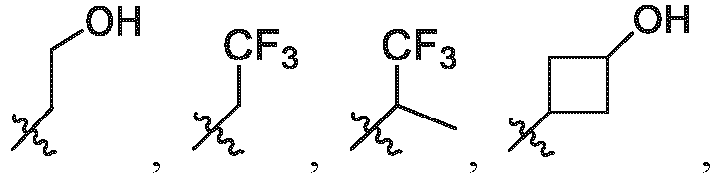


- In some embodiments, R2 is selected from the group consisting of H, methyl, ethyl, isopropyl, trifluoromethyl, cyclopropanyl, cyclobutanyl, cyclopentanyl,




- In some embodiments, R2 is selected from the group consisting of H and C1-4 alkyl, the C1-4 alkyl optionally substituted with one or more R2a.
- In some embodiments, R2 is selected from the group consisting of H, methyl, trifluoromethyl,


- In some embodiments, R2 is selected from the group consisting of H, methyl, ethyl, isopropyl, tert-butyl, trifluoromethyl,

- In some embodiments, R2 is selected from the group consisting of H, methyl, ethyl, isopropyl, tert-butyl, trifluoromethyl,


- In some embodiments, R2 is selected from the group consisting of


- In some embodiments, R2 is selected from the group consisting of isopropyl, tert-butyl, cyclopropanyl, and

- In some embodiments, when X is selected from -N-, L1 is selected from the group consisting of -O-, -S-, -NH-, and -N(C1-6 alkyl)-, R2 is not selected from the group consisting of halogen, -OH, -NH2, and -CN, and L2 is not selected from the group consisting of -O-, -S-, -NH-, and -N(C1-6 alkyl)-.
- In some embodiments, Z is selected from the group consisting of a single bond, -S-, -O-, and the following groups optionally substituted with one or more Rz: -NH- and -N(C1-6 alkyl)-.
- In some embodiments, each Rz is independently selected from the group consisting of deuterium, oxo, halogen, -OH, -NH2, -CN, C1-3 alkyl, C1-3 alkoxy, C1-3 alkylthio, C1-3 alkylamino, di-C1-3 alkylamino, C1-3 haloalkyl, C1-3 haloalkoxy, C1-3 haloalkylthio, C1-3 haloalkylamino, and di-C1-3 haloalkylamino.
- In some embodiments, Rz may further be selected from deuterium.
- In some embodiments, each Rz is independently selected from the group consisting of oxo, halogen, -OH, -NH2, -CN, C1-3 alkyl, C1-3 alkoxy, C1-3 alkylthio, C1-3 alkylamino, di-C1-3 alkylamino, C1-3 haloalkyl, C1-3 haloalkoxy, C1-3 haloalkylthio, C1-3 haloalkylamino, and di-C1-3 haloalkylamino.
- In some embodiments, each Rz is independently selected from the group consisting of oxo, halogen, -OH, -NH2, -CN, C1-6 alkyl, C1-6 alkoxy, C1-6 alkylthio, C1-6 alkylamino, di-C1-6 alkylamino, C1-6 haloalkyl, and C1-6 haloalkoxy.
- In some embodiments, each Rz is independently selected from the group consisting of oxo, halogen, -OH, -NH2, -CN, C1-3 alkyl, C1-3 alkoxy, C1-3 alkylthio, C1-3 alkylamino, di-C1-3 alkylamino, C1-3 haloalkyl, and C1-3 haloalkoxy.
- In some embodiments, each Rz is independently selected from the group consisting of F, Cl, Br, -OH, oxo, -NH2, -CN, C1-3 alkyl, C1-3 alkoxy, C1-3 haloalkyl, and C1-3 haloalkoxy.
- In some embodiments, each Rz is independently selected from the group consisting of deuterium, F, Cl, Br, -OH, oxo, -NH2, -CN, methyl, ethyl, isopropyl, methoxy, ethoxy, isopropoxy, trifluoromethyl, and trifluoromethoxy.
- In some embodiments, each Rz is independently selected from the group consisting of F, Cl, Br, -OH, oxo, -NH2, -CN, methyl, ethyl, isopropyl, methoxy, ethoxy, isopropoxy, trifluoromethyl, and trifluoromethoxy.
- In some embodiments, Z is selected from the group consisting of a single bond, -S-, -O-, -NH-, and -N(C1-12 alkyl)-.
- In some embodiments, Z is selected from the group consisting of a single bond, -S-, -O-, -NH-, and -N(C1-6 alkyl)-.
- In some embodiments, Z is selected from the group consisting of a single bond, -S-, -O-, -NH-, and -N(C1-3 alkyl)-.
- In some embodiments, Z is selected from the group consisting of a single bond, -O-, and -N(C1-3 alkyl)-.
- In some embodiments, Z is selected from the group consisting of a single bond, -O-, and -N(CH3)-.
- In some embodiments, Z is selected from -O-.
- In some embodiments, Z is selected from the group consisting of a single bond, -O-, -NH-, and -N(CH3)-.
- In some embodiments, R3 is selected from the group consisting of H, deuterium, and the following groups optionally substituted with one or more R3a: C1-6 alkyl, 3- to 10-membered cycloalkyl, 3- to 10-membered heterocyclyl, 6- to 10-membered aryl, 5- to 10-membered heteroaryl, 3- to 10-membered cycloalkyl C1-4 alkylene, 3- to 10-membered heterocyclyl C1-4 alkylene, 6- to 10-membered aryl C1-4 alkylene, and 5- to 10-membered heteroaryl C1-4 alkylene.
- In some embodiments, R3 is selected from the group consisting of the following groups optionally substituted with one or more R3a: 3- to 10-membered heterocyclyl and 3- to 10-membered heterocyclyl C1-4 alkylene. In some embodiments, R3 is selected from the group consisting of the following groups optionally substituted with one or more R3a: 4- to 10-membered heterocycloalkyl and 4- to 10-membered heterocycloalkyl C1-4 alkylene.
- In some embodiments, R3 is selected from deuterium.
- In some embodiments, R3 is selected from the group consisting of H and the following groups optionally substituted with one or more R3a: C1-6 alkyl, 3- to 10-membered cycloalkyl, 3- to 10-membered heterocyclyl, 6- to 10-membered aryl, 5- to 10-membered heteroaryl, 3- to 10-membered cycloalkyl C1-4 alkylene, 3- to 10-membered heterocyclyl C1-4 alkylene, 6- to 10-membered aryl C1-4 alkylene, and 5- to 10-membered heteroaryl C1-4 alkylene.
- In some embodiments, R3 is selected from the group consisting of H and the following groups optionally substituted with one or more R3a: C1-4 alkyl, 4- to 10-membered cycloalkyl, 4- to 10-membered heterocyclyl, phenyl, 5- to 6-membered heteroaryl, 4- to 10-membered cycloalkyl C1-3 alkylene, 4- to 10-membered heterocyclyl C1-3 alkylene, phenyl C1-3 alkylene, and 5- to 6-membered heteroaryl C1-3 alkylene. In some embodiments, R3 is selected from the group consisting of the following groups optionally substituted with one or more R3a: 3-membered cycloalkyl and 3-membered cycloalkyl C1-3 alkylene.
- In some embodiments, R3 is selected from the group consisting of the following groups optionally substituted with one or more R3a: 4- to 10-membered and 4- to 9-membered and 4- to 8-membered and 5- to 9-membered heterocyclyl C1-3 alkylene. In some embodiments, R3 is selected from the group consisting of the following groups optionally substituted with one or more R3a: 4- to 10-membered and 4- to 9-membered and 4- to 8-membered and 5- to 9-membered heterocyclyl.
- In some embodiments, R3 is selected from 9-membered heterocyclyl C1-3 alkylene optionally substituted with one or more R3a. In some embodiments, R3 is selected from 9-membered heterocyclyl optionally substituted with one or more R3a.
- In some embodiments, R3 is selected from the group consisting of H and the following groups optionally substituted with one or more R3a: C1-4 alkyl, 4- to 8-membered cycloalkyl, 4- to 8-membered heterocyclyl, phenyl, 5- to 6-membered heteroaryl, 4- to 8-membered cycloalkyl C1-3 alkylene, 4- to 8-membered heterocyclyl C1-3 alkylene, phenyl C1-3 alkylene, and 5- to 6-membered heteroaryl C1-3 alkylene. In some embodiments, R3 is selected from the group consisting of the following groups optionally substituted with one or more R3a: 3-membered cycloalkyl and 3-membered cycloalkyl C1-3 alkylene.
- In some embodiments, R3 is selected from the group consisting of H and the following groups optionally substituted with one or more R3a: C1-4 alkyl, 4- to 8-membered cycloalkyl, 4- to 8-membered heterocyclyl, 4- to 8-membered cycloalkyl C1-3 alkylene, and 4- to 8-membered heterocyclyl C1-3 alkylene. In some embodiments, R3 is selected from the group consisting of the following groups optionally substituted with one or more R3a: 3-membered cycloalkyl and 3-membered cycloalkyl C1-3 alkylene. In some embodiments, R3 is selected from 5- to 6-membered heteroaryl C1-3 alkylene optionally substituted with one or more R3a.
- In some embodiments, R3 is selected from the group consisting of H and the following groups optionally substituted with one or more R3a: C1-4 alkyl, 4- to 8-membered heterocyclyl, 4- to 8-membered cycloalkyl C1-3 alkylene, and 4- to 8-membered heterocyclyl C1-3 alkylene. In some embodiments, R3 is selected from 3-membered cycloalkyl C1-3 alkylene optionally substituted with one or more R3a. In some embodiments, R3 is selected from 5- to 6-membered heteroaryl C1-3 alkylene optionally substituted with one or more R3a.
- In some embodiments, the heterocyclyl is selected from heterocycloalkyl. In some embodiments, the heterocyclyl is selected from partially unsaturated heterocyclyl.
- In some embodiments, the 3- to 12-membered heterocyclyl is selected from the group consisting of 3- to 12-membered heterocycloalkyl and benzo 4- to 6-membered heterocyclyl. In some embodiments, the 3- to 12-membered heterocyclyl C1-6 alkylene is selected from the group consisting of 3- to 12-membered heterocycloalkyl C1-6 alkylene and benzo 4- to 6-membered heterocyclyl C1-6 alkylene.
- In some embodiments, the 3- to 10-membered heterocyclyl is selected from the group consisting of 3- to 10-membered heterocycloalkyl and benzo 4- to 6-membered heterocyclyl. In some embodiments, the 3- to 10-membered heterocyclyl C1-4 alkylene is selected from the group consisting of 3- to 10-membered heterocycloalkyl C1-4 alkylene and benzo 4- to 6-membered heterocyclyl C1-4 alkylene.
- In some embodiments, the 4- to 10-membered heterocyclyl is selected from the group consisting of 4- to 10-membered heterocycloalkyl and benzo 4- to 6-membered heterocyclyl. In some embodiments, the 4- to 10-membered heterocyclyl C1-6 alkylene is selected from the group consisting of 4- to 10-membered heterocycloalkyl C1-6 alkylene and benzo 4- to 6-membered heterocyclyl C1-6 alkylene. In some embodiments, the 4- to 10-membered heterocyclyl C1-3 alkylene is selected from the group consisting of 4- to 10-membered heterocycloalkyl C1-3 alkylene and benzo 4- to 6-membered heterocyclyl C1-3 alkylene.
- In some embodiments, the 4- to 10-membered and 4- to 9-membered and 4- to 8-membered and 5- to 9-membered heterocyclyl C1-3 alkylene groups are selected from the group consisting of 4- to 10-membered and 4- to 9-membered and 4- to 8-membered and 5- to 9-membered heterocycloalkyl C1-3 alkylene groups. In some embodiments, the 4- to 10-membered and 4- to 9-membered and 4- to 8-membered and 5- to 9-membered heterocyclyl groups are selected from the group consisting of 4- to 10-membered and 4- to 9-membered and 4- to 8-membered and 5- to 9-membered heterocycloalkyl groups.
- In some embodiments, the 4- to 8-membered heterocyclyl is selected from 4- to 8-membered heterocycloalkyl. In some embodiments, the 4- to 8-membered heterocyclyl C1-6 alkylene is selected from 4- to 8-membered heterocycloalkyl C1-6 alkylene. In some embodiments, the 4- to 8-membered heterocyclyl C1-3 alkylene is selected from 4- to 8-membered heterocycloalkyl C1-3 alkylene.
- In some embodiments, R3 is selected from the group consisting of H and the following groups optionally substituted with one or more R3a: C1-4 alkyl, 4- to 8-membered heterocycloalkyl, 4- to 8-membered cycloalkyl C1-3 alkylene, and 4- to 8-membered heterocycloalkyl C1-3 alkylene. In some embodiments, R3 is selected from 3-membered cycloalkyl C1-3 alkylene optionally substituted with one or more R3a. In some embodiments, R3 is selected from 5- to 6-membered heteroaryl C1-3 alkylene optionally substituted with one or more R3a.
- In some embodiments, R3 is selected from the group consisting of H, deuterium, and the following groups optionally substituted with one or more R3a: methyl, ethyl, propyl, butyl, cyclobutyl, cyclopentyl, cyclohexyl, azetidinyl, tetrahydropyrrolyl, morpholinyl, piperidinyl, piperazinyl, hexahydro-1H-pyrrolizinyl, cyclobutyl C1-3 alkylene, cyclopentyl C1-3 alkylene, cyclohexyl C1-3 alkylene, azetidinyl C1-3 alkylene, tetrahydropyrrolyl C1-3 alkylene, morpholinyl C1-3 alkylene, piperidinyl C1-3 alkylene, piperazinyl C1-3 alkylene, hexahydro-1H-pyrrolizinyl C1-3 alkylene, hexahydro-1H-pyrrolo[2,1-c][1,4]oxazinyl, hexahydro-1H-pyrrolo[2,1-c][1,4]oxazinyl C1-3 alkylene, 5-azaspiro[2.4]heptanyl, 5-azaspiro[2.4]heptanyl C1-3 alkylene, cyclopropyl, cyclopropyl C1-3 alkylene, n-propyl, isopropyl, n-butyl, isobutyl, sec-butyl, tert-butyl, and imidazolyl C1-3 alkylene.
- In some embodiments, R3 is selected from the group consisting of H and the following groups optionally substituted with one or more R3a: methyl, ethyl, propyl, butyl, cyclobutyl, cyclopentyl, cyclohexyl, azetidinyl, tetrahydropyrrolyl, morpholinyl, piperidinyl, piperazinyl, hexahydro-1H-pyrrolizinyl, cyclobutyl C1-3 alkylene, cyclopentyl C1-3 alkylene, cyclohexyl C1-3 alkylene, azetidinyl C1-3 alkylene, tetrahydropyrrolyl C1-3 alkylene, morpholinyl C1-3 alkylene, piperidinyl C1-3 alkylene, piperazinyl C1-3 alkylene, and hexahydro-1H-pyrrolizinyl C1-3 alkylene. In some embodiments, R3 is selected from the group consisting of the following groups optionally substituted with one or more R3a: hexahydro-1H-pyrrolo[2,1-c][1,4]oxazinyl, hexahydro-1H-pyrrolo[2,1-c][1,4]oxazinyl C1-3 alkylene, 5-azaspiro[2.4]heptanyl, and 5-azaspiro[2.4]heptanyl C1-3 alkylene. In some embodiments, R3 is selected from the group consisting of the following groups optionally substituted with one or more R3a: cyclopropyl and cyclopropyl C1-3 alkylene. In some embodiments, R3 is selected from the group consisting of H and the following groups optionally substituted with one or more R3a: n-propyl, isopropyl, n-butyl, isobutyl, sec-butyl, tert-butyl, and imidazolyl C1-3 alkylene.
- In some embodiments, R3 is selected from the group consisting of the following groups optionally substituted with one or more R3a: methyl, piperidinyl, cyclopentyl C1-3 alkylene, tetrahydropyrrolyl C1-3 alkylene, and hexahydro-1H-pyrrolizinyl C1-3 alkylene. In some embodiments, R3 is selected from the group consisting of the following groups optionally substituted with one or more R3a: hexahydro-1H-pyrrolo[2,1-c][1,4]oxazinyl C1-3 alkylene and 5-azaspiro[2.4]heptanyl C1-3 alkylene. In some embodiments, R3 is selected from cyclopropyl C1-3 alkylene optionally substituted with one or more R3a. In some embodiments, R3 is selected from the group consisting of H and the following groups optionally substituted with one or more R3a: ethyl, n-propyl, isopropyl, n-butyl, isobutyl, sec-butyl, tert-butyl, morpholinyl C1-3 alkylene, imidazolyl C1-3 alkylene, tetrahydropyrrolyl, piperazinyl C1-3 alkylene, azetidinyl C1-3 alkylene, piperidinyl C1-3 alkylene, azetidinyl, cyclobutyl, cyclohexyl, cyclobutyl C1-3 alkylene, and piperazinyl.
- In some embodiments, R3 is selected from the group consisting of H, deuterium, and the following groups optionally substituted with one or more R3a:
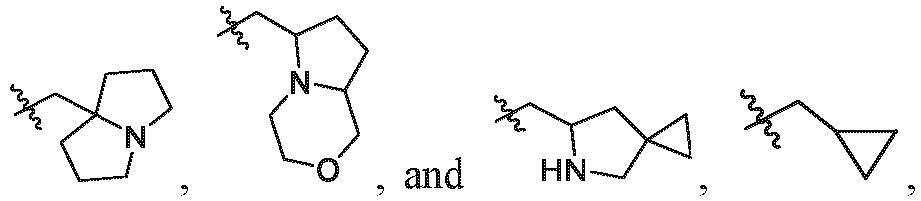


- In some embodiments, R3 is selected from the group consisting of the following groups optionally substituted with one or more R3a:


- In some embodiments, R3 is selected from hexahydro-1H-pyrrolizinyl C1-3 alkylene optionally substituted with one or more R3a.
- In some embodiments, the position of R3a substitution is a cyclic moiety and/or an alkylene moiety in R3. In some embodiments, the position of R3a substitution is a cyclic moiety in R3. In some embodiments, the position of R3a substitution is an alkylene moiety in R3.
- In some embodiments, R3a is independently selected from the group consisting of deuterium, halogen, -OH, oxo, -NH2, -CN, -C(O)NR3cR3d, -NR3cC(O)R3d, -NHC(O)NR3cR3d, -NR3cC(O)OR3d, -OC(O)R3d, -C(O)OR3d, -OC(O)OR3d, -OC(O)NR3cR3d, -SO2R3d, -NHSO2R3d, -C1-3 alkylene C(O)NR3cR3d, -C1-3 alkylene NR3cC(O)R3d, -C1-3 alkylene NHC(O)NR3cR3d, -C1-3 alkylene NR3cC(O)OR3d, -C1-3 alkylene OC(O)R3d, -C1-3 alkylene C(O)OR3d, -C1-3 alkylene OC(O)NR3cR3d, -C1-3 alkylene SO2R3d, -C1-3 alkylene OSO2R3d, -C1-3 alkylene NHSO2R3d, and the following groups optionally substituted with one or more R3b: C1-4 alkyl, C1-4 alkoxy, C1-4 alkylamino, 3- to 6-membered cycloalkyl, 4- to 7-membered heterocyclyl, phenyl, 4- to 7-membered heterocyclyl C1-3 alkylene, 5-to 6-membered heteroaryl, 3- to 6-membered cycloalkyl C1-3 alkylene, phenyl C1-3 alkylene, 5- to 6-membered heteroaryl C1-3 alkylene, =NH, =CH2, =N(C1-4 alkyl), =CH(C1-4 alkyl), and =C(C1-4 alkyl)2.
- In some embodiments, R3a may further be independently selected from deuterium.
- In some embodiments, R3a is independently selected from the group consisting of halogen, -OH, oxo, -NH2, -CN, -C(O)NR3cR3d, -NR3cC(O)R3d, -NHC(O)NR3cR3d, -NR3cC(O)OR3d, -OC(O)R3d, -C(O)OR3d, -OC(O)OR3d, -OC(O)NR3cR3d, -SO2R3d, -NHSO2R3d, -C1-3 alkylene C(O)NR3cR3d, -C1-3 alkylene NR3cC(O)R3d, -C1-3 alkylene NHC(O)NR3cR3d, -C1-3 alkylene NR3cC(O)OR3d, -C1-3 alkylene OC(O)R3d, -C1-3 alkylene C(O)OR3d, -C1-3 alkylene OC(O)NR3cR3d, -C1-3 alkylene SO2R3d, -C1-3 alkylene OSO2R3d, -C1-3 alkylene NHSO2R3d, and the following groups optionally substituted with one or more R3b: C1-4 alkyl, C1-4 alkoxy, C1-4 alkylamino, 3- to 6-membered cycloalkyl, 4- to 7-membered heterocyclyl, phenyl, 4- to 7-membered heterocyclyl C1-3 alkylene, 5-to 6-membered heteroaryl, 3- to 6-membered cycloalkyl C1-3 alkylene, phenyl C1-3 alkylene, and 5- to 6-membered heteroaryl C1-3 alkylene. In some embodiments, R3a is independently selected from the group consisting of the following groups optionally substituted with one or more R3b: =NH, =CH2, =N(C1-4 alkyl), =CH(C1-4 alkyl), and =C(C1-4 alkyl)2.
- In some embodiments, R3a is independently selected from the group consisting of halogen, -OH, oxo, -NH2, -CN, -NR3cC(O)R3d, -OC(O)NR3cR3d, -C1-3 alkylene NR3cC(O)R3d, -C1-3 alkylene NHC(O)NR3cR3d, -C1-3 alkylene NR3cC(O)OR3d, -C1-3 alkylene OC(O)R3d, -C1-3 alkylene OC(O)NR3cR3d, -C1-3 alkylene OSO2R3d, -C1-3 alkylene NHSO2R3d, and the following groups optionally substituted with one or more R3b: C1-4 alkyl, C1-4 alkoxy, C1-4 alkylamino, phenyl, benzyl, pyrazolyl, pyrazolylmethyl, tetrahydropyrrolylmethyl, and oxazolidinoneylmethyl. In some embodiments, R3a is independently selected from the group consisting of the following groups optionally substituted with one or more R3b: =NH, =CH2, =N(C1-4 alkyl), and =CH(C1-4 alkyl). In some embodiments, R3a is independently selected from morpholinomethyl optionally substituted with one or more R3b. In some embodiments, R3a may further be independently selected from deuterium.
- In some embodiments, R3a is independently selected from the group consisting of deuterium, F, Cl, Br, -OH, oxo, -NH2, -CN, -NR3cC(O)R3d, -OC(O)NR3cR3d, -C1-3 alkylene NR3cC(O)R3d, -C1-3 alkylene NHC(O)NR3cR3d, -C1-3 alkylene NR3cC(O)OR3d, -C1-3 alkylene OC(O)R3d, -C1-3 alkylene OC(O)NR3cR3d, -C1-3 alkylene OSO2R3d, -C1-3 alkylene NHSO2R3d, and the following groups optionally substituted with one or more R3b: methyl, ethyl, methoxy, ethoxy, methylamino, ethylamino, phenyl, benzyl, pyrazolylmethyl, oxazolidinoneylmethyl, =NH, =CH2, and

- In some embodiments, R3a is independently selected from the group consisting of F, Cl, Br, -OH, oxo, -NH2, -CN, -NR3cC(O)R3d, -OC(O)NR3cR3d, -C1-3 alkylene NR3cC(O)R3d, -C1-3 alkylene NHC(O)NR3cR3d, -C1-3 alkylene NR3cC(O)OR3d, -C1-3 alkylene OC(O)R3d, -C1-3 alkylene OC(O)NR3cR3d, -C1-3 alkylene OSO2R3d, -C1-3 alkylene NHSO2R3d, and the following groups optionally substituted with one or more R3b: methyl, ethyl, methoxy, ethoxy, methylamino, ethylamino, phenyl, benzyl, pyrazolylmethyl, and oxazolidinoneylmethyl. In some embodiments, R3a is independently selected from the group consisting of the following groups optionally substituted with one or more R3b: =NH and =CH2. In some embodiments, R3a is independently selected from

- In some embodiments, R3a is independently selected from =CH2 optionally substituted with one or more R3b.
- In some embodiments, R3a is independently selected from the group consisting of F, -C1-3 alkylene OC(O)R3d, -C1-3 alkylene OC(O)NR3cR3d, methyl, methoxy, =CH2, =CH2 substituted with halogen,

- In some embodiments, R3a is independently selected from the group consisting of F, -C1-3 alkylene OC(O)R3d, -C1-3 alkylene OC(O)NR3cR3d, methyl, and methoxy. In some embodiments, R3a is independently selected from the group consisting of =CH2 and =CH2 substituted with halogen. In some embodiments, R3a is independently selected from

- In some embodiments, R3a is independently selected from the group consisting of F, -CH2OC(O)R3d, -CH2OC(O)NR3cR3d, methyl, methoxy, =CH2, =CHF, =CF2,

- In some embodiments, R3a is independently selected from the group consisting of F, -CH2OC(O)R3d, -CH2OC(O)NR3cR3d, methyl, and methoxy. In some embodiments, R3a is independently selected from the group consisting of =CH2, =CHF, and =CF2. In some embodiments, R3a is independently selected from

- In some embodiments, R3c is independently selected from the group consisting of H, deuterium, and methyl.
- In some embodiments, R3c may further be independently selected from deuterium.
- In some embodiments, R3c is independently selected from the group consisting of H and methyl.
- In some embodiments, R3c is independently selected from H.
- In some embodiments, R3d is independently selected from the group consisting of H, deuterium, and the following groups optionally substituted with one or more R3e: C1-6 alkyl, C1-6 heteroalkyl, 3- to 10-membered cycloalkyl, 5-to 10-membered heterocyclyl, 6- to 10-membered aryl, 5- to 10-membered heteroaryl, 3- to 10-membered cycloalkyl C1-3 alkylene, 5- to 10-membered heterocyclyl C1-3 alkylene, 6- to 10-membered aryl C1-3 alkylene, and 5- to 10-membered heteroaryl C1-3 alkylene.
- In some embodiments, R3d may further be independently selected from deuterium.
- In some embodiments, R3d is independently selected from the group consisting of H and the following groups optionally substituted with one or more R3e: C1-6 alkyl, C1-6 heteroalkyl, 3- to 10-membered cycloalkyl, 5- to 10-membered heterocyclyl, 6- to 10-membered aryl, 5- to 10-membered heteroaryl, 3- to 10-membered cycloalkyl C1-3 alkylene, 5- to 10-membered heterocyclyl C1-3 alkylene, 6- to 10-membered aryl C1-3 alkylene, and 5- to 10-membered heteroaryl C1-3 alkylene.
- In some embodiments, R3d is independently selected from the group consisting of H and the following groups optionally substituted with one or more R3e: C1-12 alkyl, C1-12 heteroalkyl, 3- to 12-membered cycloalkyl, 3- to 12-membered heterocycloalkyl, 6- to 10-membered aryl, 6- to 10-membered aryl C1-6 alkylene, 5- to 10-membered heteroaryl, and 5- to 10-membered heteroaryl C1-6 alkylene.
- In some embodiments, R3d is independently selected from the group consisting of H and the following groups optionally substituted with one or more R3e: C1-6 alkyl, C1-6 heteroalkyl, 4- to 8-membered heterocycloalkyl, phenyl, phenyl C1-3 alkylene, 5- to 6-membered heteroaryl, and 5- to 6-membered heteroaryl C1-3 alkylene.
- In some embodiments, R3d is independently selected from the group consisting of H and the following groups optionally substituted with one or more R3e: C1-4 alkyl, C1-4 alkoxy C1-3 alkylene, phenyl, benzyl, pyrazolyl, pyridinyl, azetidinyl, tetrahydropyrrolyl, piperidinyl, piperazinyl, and morpholinyl.
- In some embodiments, R3d is independently selected from the group consisting of H and the following groups optionally substituted with one or more R3e: C1-4 alkyl, C1-4 alkoxy C1-3 alkylene, azetidinyl, tetrahydropyrrolyl, piperidinyl, piperazinyl, and morpholinyl.
- In some embodiments, R3d is independently selected from the group consisting of H, C1-4 alkyl, and the following groups optionally substituted with one or more R3e: tetrahydropyrrolyl, piperidinyl, and morpholinyl.
- In some embodiments, R3d is independently selected from the group consisting of H, methyl, and the following groups optionally substituted with one or more R3e: tetrahydropyrrolyl, piperidinyl, and morpholinyl.
- In some embodiments, R3d is independently selected from the group consisting of H, deuterium, methyl, tetrahydropyrrolyl, piperidinyl, and morpholinyl.
- In some embodiments, R3d is independently selected from the group consisting of H, methyl, tetrahydropyrrolyl, piperidinyl, and morpholinyl.
- In some embodiments, R3e is independently selected from the group consisting of deuterium, -F, -Cl, -Br, -OH, oxo, methyl, ethyl, trifluoromethyl, and difluoromethyl.
- In some embodiments, R3e may further be selected from deuterium.
- In some embodiments, R3e is independently selected from the group consisting of -F, -Cl, -Br, -OH, oxo, methyl, ethyl, trifluoromethyl, and difluoromethyl.
- In some embodiments, R3e is independently selected from the group consisting of -F, -Cl, -OH, oxo, methyl, and trifluoromethyl.
- In some embodiments, R3b is independently selected from the group consisting of deuterium, -F, -Cl, -Br, -OH, oxo, -NH2, -CN, methyl, ethyl, isopropyl, methoxy, ethoxy, methylamino, ethylamino, dimethylamino, and diethylamino.
- In some embodiments, R3b may further be independently selected from deuterium.
- In some embodiments, R3b is independently selected from the group consisting of -F, -Cl, -Br, -OH, oxo, -NH2, -CN, methyl, ethyl, isopropyl, methoxy, ethoxy, methylamino, ethylamino, dimethylamino, and diethylamino.
- In some embodiments, R3b is independently selected from the group consisting of -F, -Cl, -NH2, methyl, methoxy, methylamino, and dimethylamino.
- In some embodiments, R3 is selected from the group consisting of H, deuterium, methyl,





- In some embodiments, R3 is selected from the group consisting of





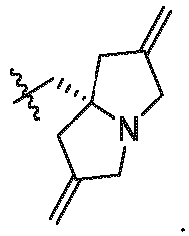


- In some embodiments, R3 is selected from the group consisting of H and methyl. In some embodiments, R3 is selected from the group consisting of


- In some embodiments, R4 is selected from the group consisting of H, deuterium, halogen, -CN, C1-6 alkyl, C1-6 alkoxy, C1-6 haloalkyl, C1-6 haloalkoxy, 3- to 12-membered cycloalkyl, 3- to 12-membered heterocyclyl, 6- to 10-membered aryl, and 5- to 10-membered heteroaryl.
- In some embodiments, R4 is selected from deuterium.
- In some embodiments, R4 is selected from the group consisting of H, halogen, -CN, C1-6 alkyl, C1-6 alkoxy, C1-6 haloalkyl, C1-6 haloalkoxy, 3- to 12-membered cycloalkyl, 3- to 12-membered heterocyclyl, 6- to 10-membered aryl, and 5- to 10-membered heteroaryl.
- In some embodiments, R4 is selected from the group consisting of H, halogen, -CN, C1-4 alkyl, C1-4 alkoxy, C1-4 haloalkyl, C1-4 haloalkoxy, 3- to 6-membered cycloalkyl, 5- to 6-membered heterocyclyl, phenyl, and 5- to 6-membered heteroaryl.
- In some embodiments, R4 is selected from the group consisting of H, halogen, -CN, C1-4 alkyl, C1-4 alkoxy, C1-4 haloalkyl, and C1-4 haloalkoxy.
- In some embodiments, R4 is selected from the group consisting of H, -F, -Cl, -Br, -CN, C1-2 alkyl, C1-2 alkoxy, C1-2 haloalkyl, and C1-2 haloalkoxy.
- In some embodiments, R4 is selected from the group consisting of H, -F, -Cl, -Br, C1-2 alkyl, C1-2 alkoxy, and C1-2 fluoroalkyl.
- In some embodiments, R4 is selected from the group consisting of H, deuterium, -F, -Cl, -Br, methyl, methoxy, difluoromethyl, and trifluoromethyl.
- In some embodiments, R4 is selected from the group consisting of H, -F, -Cl, -Br, methyl, methoxy, difluoromethyl, and trifluoromethyl.
- In some embodiments, R4 is selected from the group consisting of H, -F, -Cl, and methyl.
- In some embodiments, R4 is selected from the group consisting of H, -F, and -Cl.
- In some embodiments, ring A is selected from the group consisting of the following groups optionally substituted with one or more R5: 3- to 6-membered cycloalkyl, 5- to 10-membered heterocyclyl, 6- to 10-membered aryl, and 5- to 10-membered heteroaryl.
- In some embodiments, ring A is selected from the group consisting of the following groups optionally substituted with one or more R5: 6- to 10-membered aryl, benzo 4- to 6-membered cycloalkenyl, benzo 4- to 6-membered heterocyclyl, and 5- to 10-membered heteroaryl.
- In some embodiments, ring A is selected from the group consisting of the following groups optionally substituted with one or more R5: phenyl, naphthyl, benzocyclohexenyl, benzocyclopentenyl, pyrrolyl, pyrazolyl, imidazolyl, furanyl, oxazolyl, isoxazolyl, thienyl, thiazolyl, isothiazolyl, pyranyl, pyridinyl, pyridazinyl, pyrimidinyl, pyrazinyl, indolyl, benzopyrazolyl, benzimidazolyl, benzothiazolyl, quinolyl, isoquinolyl, benzopyrimidinyl, benzothienyl, pyridopyrazolyl, and pyridopyrrolyl.
- In some embodiments, ring A is selected from the group consisting of the following groups optionally substituted with one or more R5: phenyl, naphthyl, benzocyclohexenyl, benzocyclopentenyl, pyrrolyl, pyrazolyl, imidazolyl, furanyl, oxazolyl, isoxazolyl, thienyl, thiazolyl, isothiazolyl, pyranyl, pyridinyl, pyridazinyl, pyrimidinyl, pyrazinyl, indolyl, benzopyrazolyl, benzimidazolyl, benzothiazolyl, quinolyl, isoquinolyl, and benzopyrimidinyl. In some embodiments, ring A is selected from benzothienyl optionally substituted with one or more R5. In some embodiments, ring A is selected from the group consisting of the following groups optionally substituted with one or more R5: pyridopyrazolyl and pyridopyrrolyl.
- In some embodiments, ring A is selected from the group consisting of the following groups optionally substituted with one or more R5: phenyl, naphthyl, benzocyclohexenyl, benzocyclopentenyl, pyridinyl, indolyl, benzopyrazolyl, benzimidazolyl, benzothiazolyl, quinolyl, and isoquinolyl. In some embodiments, ring A is selected from benzothienyl optionally substituted with one or more R5. In some embodiments, ring A is selected from the group consisting of the following groups optionally substituted with one or more R5: pyrazolyl, pyridopyrazolyl, and pyridopyrrolyl.
- In some embodiments, ring A is selected from the group consisting of the following groups optionally substituted with one or more R5: phenyl, naphthyl, pyridinyl, benzothiazolyl, and benzothienyl. In some embodiments, ring A is selected from isoquinolyl optionally substituted with one or more R5. In some embodiments, ring A is selected from the group consisting of the following groups optionally substituted with one or more R5: benzopyrazolyl, pyrazolyl, pyridopyrazolyl, pyridopyrrolyl, quinolyl, indolyl, and benzimidazolyl.
- In some embodiments, ring A is selected from the group consisting of the following groups optionally substituted with one or more R5: phenyl, naphthyl, and pyridinyl. In some embodiments, ring A is selected from isoquinolyl optionally substituted with one or more R5. In some embodiments, ring A is selected from the group consisting of the following groups optionally substituted with one or more R5: benzopyrazolyl, benzothiazolyl, pyrazolyl, pyridopyrazolyl, pyridopyrrolyl, quinolyl, indolyl, and benzimidazolyl.
- In some embodiments, ring A is selected from the group consisting of the following groups optionally substituted with one or more R5: phenyl and naphthyl.
- In some embodiments, each R5 is independently selected from the group consisting of deuterium, halogen, -CN, -OH, -NH2, and the following groups optionally substituted with one or more R5a: C1-6 alkyl, C2-6 alkenyl, C2-6 alkynyl, C1-6 alkoxy, C1-6 alkylamino, di-C1-6 alkylamino, C1-6 alkylthio, 3- to 12-membered cycloalkyl, 6- to 10-membered aryl, 5- to 10-membered heteroaryl, and 3- to 12-membered heterocyclyl.
- In some embodiments, each R5 may further be selected from deuterium.
- In some embodiments, each R5 is independently selected from the group consisting of halogen, -CN, -OH, -NH2, and the following groups optionally substituted with one or more R5a: C1-6 alkyl, C2-6 alkenyl, C2-6 alkynyl, C1-6 alkoxy, C1-6 alkylamino, di-C1-6 alkylamino, C1-6 alkylthio, 3- to 12-membered cycloalkyl, 6- to 10-membered aryl, 5- to 10-membered heteroaryl, and 3- to 12-membered heterocyclyl.
- In some embodiments, each R5 is independently selected from the group consisting of -F, -Cl, -Br, -CN, -OH, -NH2, and the following groups optionally substituted with one or more R5a: methyl, ethyl, isopropyl, ethenyl, ethynyl, methoxy, methylamino, dimethylamino, methylthio, 3- to 6-membered cycloalkyl, and 3- to 6-membered heterocyclyl. In some embodiments, each R5 is independently selected from propynyl optionally substituted with one or more R5a
- In some embodiments, each R5 is independently selected from the group consisting of -F, -Cl, -OH, -NH2, and the following groups optionally substituted with one or more R5a: methyl, ethyl, isopropyl, ethenyl, ethynyl, methoxy, methylthio, and cyclopropanyl. In some embodiments, each R5 is independently selected from -CN. In some embodiments, each R5 is independently selected from propynyl optionally substituted with one or more R5a
- In some embodiments, each R5 is independently selected from the group consisting of -F, -Cl, -OH, -NH2, methyl, ethyl, isopropyl, ethenyl, ethynyl, trifluoromethyl, hydroxymethylene, methoxy, trifluoromethoxy, methylamino, dimethylamino, methylthio, trifluoromethylthio, and cyclopropanyl optionally substituted with -F, -Cl, -Br, or methyl. In some embodiments, each R5 is independently selected from -CN. In some embodiments, each R5 is independently selected from propynyl.
- In some embodiments, each R5 is independently selected from the group consisting of deuterium, -F, -Cl, -OH, -NH2, methyl, ethyl, isopropyl, ethynyl, trifluoromethyl, trifluoromethoxy, methylthio, cyclopropanyl substituted with methyl, -CN, methoxy, propynyl, and dimethylamino.
- In some embodiments, each R5 is independently selected from the group consisting of -F, -Cl, -OH, -NH2, methyl, ethyl, isopropyl, ethynyl, trifluoromethyl, trifluoromethoxy, methylthio, and cyclopropanyl substituted with methyl. In some embodiments, each R5 is independently selected from -CN. In some embodiments, each R5 is independently selected from methoxy. In some embodiments, each R5 is independently selected from propynyl. In some embodiments, each R5 is independently selected from dimethylamino.
- In some embodiments, R5a is independently selected from the group consisting of deuterium, -F, -Cl, -Br, -OH, oxo, -NH2, -CN, methyl, ethyl, isopropyl, methoxy, ethoxy, methylamino, ethylamino, dimethylamino, and diethylamino.
- In some embodiments, R5a may further be selected from deuterium.
- In some embodiments, R5a is independently selected from the group consisting of -F, -Cl, -Br, -OH, oxo, -NH2, -CN, methyl, ethyl, isopropyl, methoxy, ethoxy, methylamino, ethylamino, dimethylamino, and diethylamino.
- In some embodiments, R5a is independently selected from the group consisting of -F, -Cl, -Br, -NH2, methyl, methoxy, methylamino, and dimethylamino.
- In some embodiments, R5a is independently selected from the group consisting of -F, -Cl, -Br, and methyl.
- In some embodiments, ring A is selected from the group consisting of





- In some embodiments, ring A is selected from the group consisting of


- In some embodiments, C1-12 is selected from the group consisting of C1-10, C1-8, C1-6, C1-4, C1-3, and C1-2.
- In some embodiments, the C1-6 alkyl is selected from the group consisting of C1-4 alkyl, C1-3 alkyl, and C1-2 alkyl. In some embodiments, the C1-6 alkylene is selected from the group consisting of C1-4 alkylene, C1-3 alkylene, and C1-2 alkylene.
- In some embodiments, the halogen is selected from the group consisting of F, Cl, Br, and I.
- In some embodiments, the halo is selected from the group consisting of fluoro, chloro, and bromo. In some embodiments, the halo is selected from the group consisting of fluoro and chloro. In some embodiments, the halo is selected from fluoro.
- In some embodiments, the one or more is selected from the group consisting of 1, 2, 3, 4, 5, and 6. In some embodiments, the one or more is selected from the group consisting of 1, 2, 3, 4, and 5. In some embodiments, the one or more is selected from the group consisting of 1, 2, 3, and 4. In some embodiments, the one or more is selected from the group consisting of 1, 2, and 3.
- In some embodiments, the 3- to 12-membered is selected from the group consisting of 3- to 10-membered, 3- to 6-membered, 5- to 6-membered, 5- to 8-membered, and 5- to 10-membered.
- In some embodiments, the heteroalkylene comprises 1 or 2 heteroatoms selected from the group consisting of N, O, and S.
- In some embodiments, the heteroalkylene comprises 1 or 2 heteroatoms selected from the group consisting of N and O.
- In some embodiments, the heteroalkylene comprises 1 N atom and 1 O atom.
- In some embodiments, the heteroalkylene comprises 1 N atom.
- In some embodiments, the heteroalkylene comprises 1 O atom.
- In some embodiments, the heterocycloalkyl comprises 1 or 2 heteroatoms selected from the group consisting of N and O.
- In some embodiments, the heterocycloalkyl comprises 1 N atom.
- In some embodiments, the heterocycloalkyl comprises 1 O atom.
- In some embodiments, the heterocycloalkyl comprises 1 N atom and 1 O atom.
- In some embodiments, the heterocyclyl or heteroaryl comprises 1 or 2 heteroatoms selected from the group consisting of N, O, and S.
- In some embodiments, the heterocyclyl or heteroaryl comprises 1 or 2 N atoms.
- In some embodiments, the heterocyclyl or heteroaryl comprises 1 N atom and 1 O atom.
- In some embodiments, the heterocyclyl or heteroaryl comprises 1 N atom and 1 S atom.
- In some embodiments, the heterocyclyl or heterocycloalkyl includes a monocyclic ring, a spiro ring, a fused ring, and a bridged ring. In some embodiments, the heterocycloalkyl includes a monocyclic ring and a spiro ring. In some embodiments, the heterocyclyl or heterocycloalkyl includes a monocyclic ring and a bridged ring.
- In some embodiments,
- X is selected from the group consisting of -N-, -CH-, and -C(C1-3 alkyl)-;
- L1 is selected from the group consisting of -S-, -O-, -NH-, -N(C1-3 alkyl)-, and the following groups optionally substituted with one or more R1: C1-4 alkylene and C1-4 heteroalkylene;
- each R1 is independently selected from the group consisting of deuterium, oxo, halogen, -OH, -NH2, -CN, C1-3 alkyl, C1-3 alkoxy, C1-3 alkylthio, C1-3 alkylamino, di-C1-3 alkylamino, C1-3 haloalkyl, C1-3 haloalkoxy, C1-3 haloalkylthio, C1-3 haloalkylamino, and di-C1-3 haloalkylamino;
- R2 is selected from the group consisting of H, deuterium, halogen, -OH, -NH2, -CN, and the following groups optionally substituted with one or more R2a: C1-6 alkyl, C1-6 heteroalkyl, 3- to 10-membered cycloalkyl-L2-, 4- to 10-membered heterocycloalkyl-L2-, 6- to 10-membered aryl-L2-, benzo 4- to 6-membered heterocyclyl-L2-, and 5-to 10-membered heteroaryl-L2-;
- L2 is selected from the group consisting of a single bond, -O-, -S-, -NH-, -N(C1-6 alkyl)-, C1-6 alkylene, C1-6 heteroalkylene, C2-6 alkenylene, and C1-6 heteroalkenylene;
- each R2a is independently selected from the group consisting of deuterium, halogen, -OH, oxo, -NH2, -CN, -C(O)NR2cR2d, -NR2cC(O)R2d, -NHC(O)NR2cR2d, -NR2cC(O)OR2d, -OC(O)R2d, -C(O)OR2d, -OC(O)OR2d, -OC(O)NR2cR2d, -SO2R2d, -NHSO2R2d, -C1-6 alkylene C(O)NR2cR2d, -C1-6 alkylene NR2cC(O)R2d, -C1-6 alkylene NHC(O)NR2cR2d, -C1-6 alkylene NR2cC(O)OR2d, -C1-6 alkylene OC(O)R2d, -C1-6 alkylene C(O)OR2d, -C1-6 alkylene OC(O)NR2cR2d, -C1-6 alkylene SO2R2d, -C1-6 alkylene OSO2R2d, -C1-6 alkylene NHSO2R2d, and the following groups optionally substituted with one or more R2b: C1-6 alkyl, C1-6 alkoxy, C1-6 alkylamino, di-C1-6 alkylamino, 3- to 12-membered cycloalkyl, 3- to 12-membered heterocyclyl, 6- to 10-membered aryl, 5- to 10-membered heteroaryl, 3- to 12-membered cycloalkyl C1-6 alkylene, 3- to 12-membered heterocyclyl C1-6 alkylene, 6- to 10-membered aryl C1-6 alkylene, and 5- to 10-membered heteroaryl C1-6 alkylene;
- R2c is independently selected from the group consisting of H, deuterium, and C1-6 alkyl;
- R2d is independently selected from the group consisting of H, deuterium, and the following groups optionally substituted with one or more R2e: C1-6 alkyl, C1-6 heteroalkyl, 3- to 12-membered cycloalkyl, 3- to 12-membered heterocyclyl, 6- to 10-membered aryl, 5- to 10-membered heteroaryl, 3- to 12-membered cycloalkyl C1-6 alkylene, 3- to 12-membered heterocyclyl C1-6 alkylene, 6- to 10-membered aryl C1-6 alkylene, and 5- to 10-membered heteroaryl C1-6 alkylene;
- each R2e is independently selected from the group consisting of deuterium, halogen, -OH, oxo, -NH2, -CN, C1-4 alkyl, C1-4 alkoxy, C1-4 haloalkyl, and C1-4 haloalkoxy;
- each R2b is independently selected from the group consisting of deuterium, halogen, -OH, -NH2, -CN, C1-4 alkyl, C1-4 alkoxy, C1-4 alkylamino, di-C1-4 alkylamino, C1-4 haloalkyl, and C1-4 haloalkoxy;
- Z is selected from the group consisting of a single bond, -S-, -O-, -NH-, and -N(C1-3 alkyl)-;
- R3 is selected from the group consisting of H, deuterium, and the following groups optionally substituted with one or more R3a: C1-6 alkyl, 3- to 10-membered cycloalkyl, 4- to 10-membered heterocycloalkyl, 6- to 10-membered aryl, benzo 4- to 6-membered heterocyclyl, 5- to 10-membered heteroaryl, 3- to 10-membered cycloalkyl C1-3 alkylene, 4- to 10-membered heterocycloalkyl C1-3 alkylene, 6- to 10-membered aryl C1-3 alkylene, benzo 4- to 6-membered heterocyclyl C1-3 alkylene, and 5- to 10-membered heteroaryl C1-3 alkylene;
- each R3a is independently selected from the group consisting of deuterium, halogen, -OH, oxo, -NH2, -CN, -C(O)NR3cR3d, -NR3cC(O)R3d, -NHC(O)NR3cR3d, -NR3cC(O)OR3d, -OC(O)R3d, -C(O)OR3d, -OC(O)OR3d, -OC(O)NR3cR3d, -SO2R3d, -NHSO2R3d, -C1-3 alkylene C(O)NR3cR3d, -C1-3 alkylene NR3cC(O)R3d, -C1-3 alkylene NHC(O)NR3cR3d, -C1-3 alkylene NR3cC(O)OR3d, -C1-3 alkylene OC(O)R3d, -C1-3 alkylene C(O)OR3d, -C1-3 alkylene OC(O)NR3cR3d, -C1-3 alkylene SO2R3d, -C1-3 alkylene OSO2R3d, -C1-3 alkylene NHSO2R3d, and the following groups optionally substituted with one or more R3b: C1-4 alkyl, C1-4 alkoxy, C1-4 alkylamino, phenyl, 5-to 6-membered heteroaryl, phenyl C1-3 alkylene, 5- to 6-membered heteroaryl C1-3 alkylene, and 4- to 7-membered heterocycloalkyl C1-3 alkylene optionally substituted with oxo;
- R3c is independently selected from the group consisting of H, deuterium, and C1-6 alkyl;
- R3d is independently selected from the group consisting of H, deuterium, C1-6 alkyl, C1-6 alkoxy C1-3 alkylene, and the following groups optionally substituted with one or more R3e: phenyl, phenyl C1-3 alkylene, 5- to 6-membered heteroaryl, and 4- to 8-membered heterocycloalkyl;
- each R3b is independently selected from the group consisting of deuterium, halogen, -OH, oxo, -NH2, -CN, C1-4 alkyl, C1-4 alkoxy, C1-4 alkylamino, and di-C1-4 alkylamino;
- each R3e is independently selected from the group consisting of deuterium, halogen, -OH, formyl, oxo, C1-4 alkyl, and C1-4 haloalkyl;
- R4 is selected from the group consisting of H, deuterium, halogen, -CN, C1-4 alkyl, C1-4 alkoxy, C1-4 haloalkyl, and C1-4 haloalkoxy;
- ring A is selected from the group consisting of the following groups optionally substituted with one or more R5: 6-to 10-membered aryl, benzo 4- to 6-membered cycloalkenyl, benzo 4- to 6-membered heterocyclyl, and 5- to 10-membered heteroaryl;
- each R5 is independently selected from the group consisting of deuterium, halogen, -CN, -OH, -NH2, C1-6 alkyl, C2-6 alkenyl, C2-6 alkynyl, C1-6 haloalkyl, hydroxy C1-6 alkylene, C1-6 alkoxy, C1-6 haloalkoxy, C1-6 alkylamino, di-C1-6 alkylamino, C1-6 alkylthio, C1-6 haloalkylthio, and 3- to 7-membered cycloalkyl optionally substituted with halogen or C1-3 alkyl.
- In some embodiments,
- X is selected from the group consisting of -N-, -CH-, and -C(C1-3 alkyl)-;
- L1 is selected from the group consisting of -S-, -O-, -NH-, -N(C1-3 alkyl)-, and the following groups optionally substituted with one or more R1: C1-4 alkylene and C1-4 heteroalkylene;
- each R1 is independently selected from the group consisting of oxo, halogen, -OH, -NH2, -CN, C1-3 alkyl, C1-3 alkoxy, C1-3 alkylthio, C1-3 alkylamino, di-C1-3 alkylamino, C1-3 haloalkyl, C1-3 haloalkoxy, C1-3 haloalkylthio, C1-3 haloalkylamino, and di-C1-3 haloalkylamino;
- R2 is selected from the group consisting of H, halogen, -OH, -NH2, -CN, and the following groups optionally substituted with one or more R2a: C1-6 alkyl, C1-6 heteroalkyl, 3- to 10-membered cycloalkyl-L2-, 4- to 10-membered heterocycloalkyl-L2-, 6- to 10-membered aryl-L2-, benzo 4- to 6-membered heterocyclyl-L2-, and 5-to 10-membered heteroaryl-L2-;
- L2 is selected from the group consisting of a single bond, -O-, -S-, -NH-, -N(C1-6 alkyl)-, C1-6 alkylene, C1-6 heteroalkylene, C2-6 alkenylene, and C1-6 heteroalkenylene;
- each R2a is independently selected from the group consisting of halogen, -OH, oxo, -NH2, -CN, -C(O)NR2cR2d, -NR2cC(O)R2d, -NHC(O)NR2cR2d, -NR2cC(O)OR2d, -OC(O)R2d, -C(O)OR2d, -OC(O)OR2d, -OC(O)NR2cR2d, -SO2R2d, -NHSO2R2d, -C1-6 alkylene C(O)NR2cR2d, -C1-6 alkylene NR2cC(O)R2d, -C1-6 alkylene NHC(O)NR2cR2d, -C1-6 alkylene NR2cC(O)OR2d, -C1-6 alkylene OC(O)R2d, -C1-6 alkylene C(O)OR2d, -C1-6 alkylene OC(O)NR2cR2d, -C1-6 alkylene SO2R2d, -C1-6 alkylene OSO2R2d, -C1-6 alkylene NHSO2R2d, and the following groups optionally substituted with one or more R2b: C1-6 alkyl, C1-6 alkoxy, C1-6 alkylamino, di-C1-6 alkylamino, 3- to 12-membered cycloalkyl, 3- to 12-membered heterocyclyl, 6- to 10-membered aryl, 5- to 10-membered heteroaryl, 3- to 12-membered cycloalkyl C1-6 alkylene, 3- to 12-membered heterocyclyl C1-6 alkylene, 6- to 10-membered aryl C1-6 alkylene, and 5- to 10-membered heteroaryl C1-6 alkylene;
- R2c is independently selected from the group consisting of H and C1-6 alkyl;
- R2d is independently selected from the group consisting of H and the following groups optionally substituted with one or more R2e: C1-6 alkyl, C1-6 heteroalkyl, 3- to 12-membered cycloalkyl, 3- to 12-membered heterocyclyl, 6- to 10-membered aryl, 5- to 10-membered heteroaryl, 3- to 12-membered cycloalkyl C1-6 alkylene, 3- to 12-membered heterocyclyl C1-6 alkylene, 6- to 10-membered aryl C1-6 alkylene, and 5- to 10-membered heteroaryl C1-6 alkylene;
- each R2e is independently selected from the group consisting of halogen, -OH, oxo, -NH2, -CN, C1-4 alkyl, C1-4 alkoxy, C1-4 haloalkyl, and C1-4 haloalkoxy;
- each R2b is independently selected from the group consisting of halogen, -OH, -NH2, -CN, C1-4 alkyl, C1-4 alkoxy, C1-4 alkylamino, di-C1-4 alkylamino, C1-4 haloalkyl, and C1-4 haloalkoxy;
- Z is selected from the group consisting of a single bond, -S-, -O-, -NH-, and -N(C1-3 alkyl)-;
- R3 is selected from the group consisting of H and the following groups optionally substituted with one or more R3a: C1-6 alkyl, 3- to 10-membered cycloalkyl, 4- to 10-membered heterocycloalkyl, 6- to 10-membered aryl, benzo 4- to 6-membered heterocyclyl, 5- to 10-membered heteroaryl, 3- to 10-membered cycloalkyl C1-3 alkylene, 4- to 10-membered heterocycloalkyl C1-3 alkylene, 6- to 10-membered aryl C1-3 alkylene, benzo 4- to 6-membered heterocyclyl C1-3 alkylene, and 5- to 10-membered heteroaryl C1-3 alkylene;
- each R3a is independently selected from the group consisting of halogen, -OH, oxo, -NH2, -CN, -C(O)NR3cR3a, -NR3cC(O)R3d, -NHC(O)NR3cR3d, -NR3cC(O)OR3d, -OC(O)R3d, -C(O)OR3d, -OC(O)OR3d, -OC(O)NR3cR3d, -SO2R3d, -NHSO2R3d, -C1-3 alkylene C(O)NR3cR3d, -C1-3 alkylene NR3cC(O)R3d, -C1-3 alkylene NHC(O)NR3cR3d, -C1-3 alkylene NR3cC(O)OR3d, -C1-3 alkylene OC(O)R3d, -C1-3 alkylene C(O)OR3d, -C1-3 alkylene OC(O)NR3cR3d, -C1-3 alkylene SO2R3d, -C1-3 alkylene OSO2R3d, -C1-3 alkylene NHSO2R3d, and the following groups optionally substituted with one or more R3b: C1-4 alkyl, C1-4 alkoxy, C1-4 alkylamino, phenyl, 5- to 6-membered heteroaryl, phenyl C1-3 alkylene, 5- to 6-membered heteroaryl C1-3 alkylene, and 4- to 7-membered heterocycloalkyl C1-3 alkylene optionally substituted with oxo;
- R3c is independently selected from the group consisting of H and C1-6 alkyl;
- R3d is independently selected from the group consisting of H, C1-6 alkyl, C1-6 alkoxy C1-3 alkylene, and the following groups optionally substituted with one or more R3e: phenyl, phenyl C1-3 alkylene, 5- to 6-membered heteroaryl, and 4- to 8-membered heterocycloalkyl;
- each R3b is independently selected from the group consisting of halogen, -OH, oxo, -NH2, -CN, C1-4 alkyl, C1-4 alkoxy, C1-4 alkylamino, and di-C1-4 alkylamino;
- each R3e is independently selected from the group consisting of halogen, -OH, formyl, oxo, C1-4 alkyl, and C1-4 haloalkyl;
- R4 is selected from the group consisting of H, halogen, -CN, C1-4 alkyl, C1-4 alkoxy, C1-4 haloalkyl, and C1-4 haloalkoxy;
- ring A is selected from the group consisting of the following groups optionally substituted with one or more R5: 6-to 10-membered aryl, benzo 4- to 6-membered cycloalkenyl, benzo 4- to 6-membered heterocyclyl, and 5- to 10-membered heteroaryl;
- each R5 is independently selected from the group consisting of halogen, -CN, -OH, -NH2, C1-6 alkyl, C2-6 alkenyl, C2-6 alkynyl, C1-6 haloalkyl, hydroxy C1-6 alkylene, C1-6 alkoxy, C1-6 haloalkoxy, C1-6 alkylamino, di-C1-6 alkylamino, C1-6 alkylthio, C1-6 haloalkylthio, and 3- to 7-membered cycloalkyl optionally substituted with halogen or C1-3 alkyl.
- In some embodiments, R3a is independently selected from the group consisting of the following groups optionally substituted with one or more R3b: =NH, =CH2, =N(C1-4 alkyl), =CH(C1-4 alkyl), and =C(C1-4 alkyl)2.
- The present disclosure relates to a compound of formula (II-1) or formula (II-2) or formula (III) or formula (III-a) or formula (III-b) or formula (III-c) or formula (IV) or formula (IV-a) or formula (IV-b) or formula (IV-c), a stereoisomer thereof, a tautomer thereof, a deuterated compound thereof, or a pharmaceutically acceptable salt thereof,

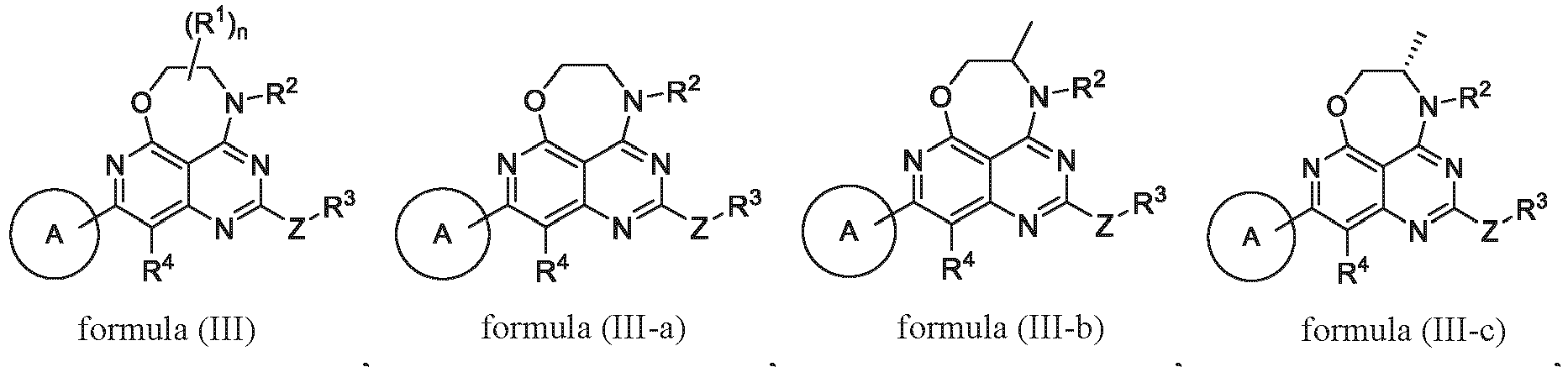

- In some embodiments, n is selected from the group consisting of 0, 1, 2, and 3.
- In some embodiments, the present disclosure encompasses the variables defined above and embodiments thereof, as well as any combination thereof.
- In some embodiments, the "one or more" in the present disclosure may refer to an integer ranging from one to ten. For example, "one or more" refers to one, two, three, four, five, six, seven, eight, nine, or ten; or "one or more" refers to one, two, three, four, five, or six; or "one or more" refers to one, two, or three.
- The present disclosure further relates to the following compounds, stereoisomers thereof, tautomers thereof, deuterated compounds thereof, or pharmaceutically acceptable salts thereof:













- The present disclosure further relates to the following compounds, stereoisomers thereof, tautomers thereof, deuterated compounds thereof, or pharmaceutically acceptable salts thereof:

























- The present disclosure further relates to the following compounds, stereoisomers thereof, tautomers thereof, deuterated compounds thereof, or pharmaceutically acceptable salts thereof:





























- In another aspect, the present disclosure relates to a pharmaceutical composition comprising the compound of formula (I) or formula (II-1) or formula (II-2) or formula (III) or formula (III-a) or formula (III-b) or formula (III-c) or formula (IV) or formula (IV-a) or formula (IV-b) or formula (IV-c), the stereoisomer thereof, the tautomer thereof, the deuterated compound thereof, or the pharmaceutically acceptable salt thereof of the present disclosure. In some embodiments, the pharmaceutical composition of the present disclosure further comprises a pharmaceutically acceptable excipient.
- In another aspect, the present disclosure relates to a method for treating a disease in a mammal, comprising administering to a mammal, preferably a human, in need thereof a therapeutically effective amount of the compound of formula (I) or formula (II-1) or formula (II-2) or formula (III) or formula (III-a) or formula (III-b) or formula (III-c) or formula (IV) or formula (IV-a) or formula (IV-b) or formula (IV-c), the stereoisomer thereof, the tautomer thereof, the deuterated compound thereof, or the pharmaceutically acceptable salt thereof, or the pharmaceutical composition of the present disclosure.
- In another aspect, the present disclosure relates to use of the compound of formula (I) or formula (II-1) or formula (II-2) or formula (III) or formula (III-a) or formula (III-b) or formula (III-c) or formula (IV) or formula (IV-a) or formula (IV-b) or formula (IV-c), the stereoisomer thereof, the tautomer thereof, the deuterated compound thereof, or the pharmaceutically acceptable salt thereof, or the pharmaceutical composition of the present disclosure in the manufacture of a medicament for treating a disease.
- In another aspect, the present disclosure relates to use of the compound of formula (I) or formula (II-1) or formula (II-2) or formula (III) or formula (III-a) or formula (III-b) or formula (III-c) or formula (IV) or formula (IV-a) or formula (IV-b) or formula (IV-c), the stereoisomer thereof, the tautomer thereof, the deuterated compound thereof, or the pharmaceutically acceptable salt thereof, or the pharmaceutical composition of the present disclosure in treating a disease.
- In another aspect, the present disclosure relates to the compound of formula (I) or formula (II-1) or formula (II-2) or formula (III) or formula (III-a) or formula (III-b) or formula (III-c) or formula (IV) or formula (IV-a) or formula (IV-b) or formula (IV-c), the stereoisomer thereof, the deuterated compound thereof, the tautomer thereof, or the pharmaceutically acceptable salt thereof, or the pharmaceutical composition of the present disclosure for use in treating a disease.
- In some embodiments of the present disclosure, the disease is preferably a Kras-associated disease.
- In another aspect, the present disclosure relates to a method for treating a Kras-associated disease in a mammal, comprising administering to a mammal, preferably a human, in need thereof a therapeutically effective amount of the compound of formula (I) or formula (II-1) or formula (II-2) or formula (III) or formula (III-a) or formula (III-b) or formula (III-c) or formula (IV) or formula (IV-a) or formula (IV-b) or formula (IV-c), the stereoisomer thereof, the tautomer thereof, the deuterated compound thereof, or the pharmaceutically acceptable salt thereof, or the pharmaceutical composition of the present disclosure.
- In another aspect, the present disclosure relates to use of the compound of formula (I) or formula (II-1) or formula (II-2) or formula (III) or formula (III-a) or formula (III-b) or formula (III-c) or formula (IV) or formula (IV-a) or formula (IV-b) or formula (IV-c), the stereoisomer thereof, the tautomer thereof, the deuterated compound thereof, or the pharmaceutically acceptable salt thereof, or the pharmaceutical composition of the present disclosure in the manufacture of a medicament for treating a Kras-associated disease.
- In another aspect, the present disclosure relates to use of the compound of formula (I) or formula (II-1) or formula (II-2) or formula (III) or formula (III-a) or formula (III-b) or formula (III-c) or formula (IV) or formula (IV-a) or formula (IV-b) or formula (IV-c), the stereoisomer thereof, the tautomer thereof, the deuterated compound thereof, or the pharmaceutically acceptable salt thereof, or the pharmaceutical composition of the present disclosure in treating a Kras-associated disease.
- In another aspect, the present disclosure relates to the compound of formula (I) or formula (II-1) or formula (II-2) or formula (III) or formula (III-a) or formula (III-b) or formula (III-c) or formula (IV) or formula (IV-a) or formula (IV-b) or formula (IV-c), the stereoisomer thereof, the deuterated compound thereof, the tautomer thereof, or the pharmaceutically acceptable salt thereof, or the pharmaceutical composition of the present disclosure for use in treating a Kras-associated disease.
- In some embodiments of the present disclosure, the Kras-associated disease is preferably a Kras-mutated cancer. In some embodiments of the present disclosure, the Kras-associated disease is selected from a cancer (e.g., pancreatic cancer).
- In some embodiments of the present disclosure, the Kras-associated disease is preferably a Kras G12D-associated disease.
- In some embodiments of the present disclosure, the Kras G12D-associated disease is preferably a Kras G12D-mutated cancer.
- In some embodiments of the present disclosure, the Kras G12D-associated disease is selected from a cancer (e.g., pancreatic cancer).
- In some embodiments of the present disclosure, the Kras-associated disease is preferably a Kras G12V-associated disease.
- In some embodiments of the present disclosure, the Kras G12V-associated disease is preferably a Kras G12V-mutated cancer.
- In some embodiments of the present disclosure, the Kras G12V-associated disease is selected from a cancer (e.g., pancreatic cancer).
- The compounds of the present disclosure have high Kras inhibitory activity (e.g., Kras G12D and/or Kras G12V nucleotide exchange inhibitory activity), inhibitory activity for cell proliferation (e.g., AsPc-1 cells and/or Capan-1 cells) and inhibitory activity for in vivo tumor (e.g., an Aspc-1 human pancreatic cancer cell NOD-SCID mouse subcutaneous xenograft tumor model). Additionally, the compounds demonstrate good druggability in the studies of in vivo and in vitro pharmacokinetics, bioavailability, and/or pharmacodynamics.
- Unless otherwise stated, the following terms used in the present disclosure shall have the following meanings. A certain term, unless otherwise specifically defined, should not be considered uncertain or unclear, but construed according to its common meaning in the art. When referring to a trade name, it is intended to refer to its corresponding commercial product or its active ingredient.
- The term "substituted" means that any one or more hydrogen atoms on a specific atom are substituted with substituents, as long as the valence of the specific atom is normal and the resulting compound is stable. When the substituent is oxo (i.e., =O), it means that two hydrogen atoms are substituted, and oxo is not possible in an aromatic group.
- Non-limiting examples of the "substituent" described herein include hydroxy, sulfydryl, halogen, amino, nitro, nitroso, cyano, an azide group, a sulfoxide group, a sulfone group, a sulfonamide group, carboxy, a carboxaldehyde group, an imine group, alkyl, halo-alkyl, cycloalkyl, halo-cycloalkyl, alkenyl, halo-alkenyl, cycloalkenyl, halo-cycloalkenyl, alkynyl, halo-alkynyl, cycloalkynyl, halo-cycloalkynyl, heteroalkyl, halo-heteroalkyl, alkoxy, alkylthio, aryl, aryloxy, arylthio, arylalkyl, arylalkoxy, arylalkylthio, heteroaryl, heteroaryloxy, heteroarylthio, heteroarylalkyl, heteroarylalkoxy, heteroarylalkylthio, heterocyclyl, heterocyclyloxy, heterocyclylthio, heterocyclylalkylene, heterocyclylalkoxy, heterocyclylalkylthio, acyl, acyloxy, a carbamate group, an amido group, ureido, an epoxy group, an ester group, and the like, wherein the groups are optionally substituted with one or more substituents selected from the group consisting of the following substituents: oxo, hydroxy, amino, nitro, halogen, cyano, alkyl, alkenyl, alkynyl, alkoxy, haloalkoxy, alkylamino, dialkylamino, haloalkylamino, halodialkylamino, carboxy, -C(O)O-alkyl, -OC(O)-alkyl, -C(O)NH2, -C(O)NH-alkyl, -C(O)N(alkyl)2, -NHC(O)-alkyl, -C(O)-alkyl, -S(O)-alkyl, -S(O)2-alkyl, -S(O)2NH2, -S(O)2NH-alkyl, -S(O)2N(alkyl)2, cycloalkyl, cycloalkylalkylene, cycloalkyloxy, heterocyclyl, heterocyclylalkylene, heterocyclyloxy, heterocycloalkyl, heterocycloalkylalkylene, heterocycloalkyloxy, heteroaryl, heteroarylalkylene, heteroaryloxy, aryl, arylalkylene, and aryloxy.
- The term "replaced" means that a particular atom or group can be replaced with another atom or group as specified. For example, 1 or 2 or 3 of the -CH2- in -CH2CH2CH2- may be replaced with O, S, or NH to give -O-CH2-CH2-, -O-CH2-, -CH2-O-CH2-, -CH2-O-, -CH2-CH2-O-, -O-, or the like.
- The term "optional" or "optionally" means that the subsequently described event or circumstance may or may not occur. The description includes instances where the event or circumstance occurs and instances where it does not. For example, ethyl "optionally" substituted with halogen means that the ethyl may be unsubstituted (CH2CH3), monosubstituted (e.g., CH2CH2F), polysubstituted (e.g., CHFCH2F and CH2CHF2), or fully substituted (CF2CF3). It can be understood by those skilled in the art that for any groups comprising one or more substituents, no substitutions or substitution modes that are impossible to spatially exist and/or synthesize will be introduced.
- Cm-n used herein means that the moiety has an integer number of carbon atoms in the given range. For example, "C1-6" means that the group may have 1 carbon atom, 2 carbon atoms, 3 carbon atoms, 4 carbon atoms, 5 carbon atoms, or 6 carbon atoms.
- When any variable (e.g., R) occurs once or more times in the constitution or structure of a compound, the definition of the variable in each case is independent. Therefore, for example, if a group is substituted with 2 R, the definition of each R is independent.
- When the number of connecting groups is 0, for example, -(CH2)0-, it means that the connecting group is a covalent bond.
- When a variable is selected from a covalent bond, it means that the two groups which it connects are directly connected. For example, in A-L-Z, when L represents a covalent bond, it means that the structure is actually A-Z. When the direction for connection of the listed connecting group is not specified, the direction for connection is arbitrary. For example, in A-L-Z, when the connecting group L is -M-W-, it means that the structure may be A-M-W-Z or A-W-M-Z.
- When a bond of a substituent is cross-connected to two atoms on a ring, the substituent can be bonded to any atom on the ring. For example, a structural unit

- The term "halo" or "halogen" refers to fluorine, chlorine, bromine, and iodine.
- The term "hydroxy" refers to an -OH group.
- The term "cyano" refers to a -CN group.
- The term "sulfydryl" refers to an -SH group.
- The term "amino" refers to an -NH2 group.
- The term "nitro" refers to an -NO2 group.
- The term "alkylene" refers to saturated linear or branched divalent hydrocarbyl with a general formula of CnH2n and usually has 1 to 12, 1 to 8, 1 to 6, 1 to 4, 1 to 3, or 1 to 2 carbon atoms. For example, the term "C1-6 alkylene" refers to alkylene comprising 1 to 6 carbon atoms. Non-limiting examples of alkylene include, but are not limited to, methylene (-CH2-), ethylene (-CH2CH2-), propylene (-CH2CH2CH2- or -CH2CH(CH3)-), butylene (-CH2CH2CH2CH2-, -CH2CH(CH3)CH2-, or -CH2CH2CH(CH3)-), and the like. The alkylene is optionally substituted with one or more substituents selected from the group consisting of the following substituents: oxo, hydroxy, amino, nitro, halogen, cyano, alkenyl, alkynyl, alkoxy, haloalkoxy, alkylamino, dialkylamino, haloalkylamino, halodialkylamino, cycloalkyl, cycloalkyloxy, heterocyclyl, heterocyclyloxy, heterocycloalkyl, heterocycloalkyloxy, heteroaryl, heteroaryloxy, aryl, and aryloxy.
- The term "heteroalkylene" refers to alkylene in which one or more carbon atoms (and the hydrogen atoms to which they are connected) are each independently replaced with the same or different heteroatom groups. Unless otherwise indicated, the heteroalkylene comprises 1, 2, or 3 heteroatom groups, non-limiting examples of which include O, S, N, and NH, and usually has 1 to 12, 1 to 8, 1 to 6, 1 to 4, 1 to 3, or 1 to 2 carbon atoms. For example, the term "C1-6 heteroalkylene" refers to heteroalkylene comprising 1 to 6 carbon atoms and 1-3 heteroatom groups. The heteroatom group can be placed in any position (e.g., internal or terminal position) on the heteroalkylene, including a position where the alkylene is connected to the rest of the molecule. Usually, where more than one heteroatom group is present, the heteroatoms are not adjacent to each other. Non-limiting examples of heteroalkylene include, but are not limited to, -OCH2-, -OCH2CH2-, -OCH2CH2CH2-, -CH2OCH2-, -OCH2O-, -OCH2CH2O-, -OCH2OCH2CH2-, -SCH2-, -SCH2CH2-, -SCH2CH2CH2-, -CH2SCH2-, -SCH2S-, -SCH2CH2S-, -SCH2SCH2CH2-, -NHCH2-, -NHCH2CH2-, -NHCH2CH2CH2-, -CH2NHCH2-, -N(CH3)CH2-, -CH2N(CH3)-, -OCH2NH-, -OCH2CH2NH-, -OCH2NHCH2CH2-, -OCH2N(CH3)CH2-, and the like. The heteroalkylene is optionally substituted with one or more substituents selected from the group consisting of the following substituents: oxo, hydroxy, amino, nitro, halogen, cyano, alkenyl, alkynyl, alkoxy, haloalkoxy, alkylamino, dialkylamino, haloalkylamino, halodialkylamino, cycloalkyl, cycloalkyloxy, heterocyclyl, heterocyclyloxy, heterocycloalkyl, heterocycloalkyloxy, heteroaryl, heteroaryloxy, aryl, and aryloxy.
- The term "alkyl" refers to saturated hydrocarbyl with a general formula of CnH2n+1 and usually has 1 to 12, 1 to 8, 1 to 6, 1 to 4, 1 to 3, or 1 to 2 carbon atoms. The alkyl may be linear or branched and usually has 1 to 12, 1 to 8, 1 to 6, 1 to 4, or 1 to 3 carbon atoms. For example, the term "C1-6 alkyl" refers to alkyl comprising 1 to 6 carbon atoms (e.g., methyl, ethyl, n-propyl, isopropyl, n-butyl, isobutyl, sec-butyl, tert-butyl, n-pentyl, 1-methylbutyl, 2-methylbutyl, 3-methylbutyl, neopentyl, hexyl, and 2-methylpentyl). The alkyl is optionally substituted with one or more substituents selected from the group consisting of the following substituents: oxo, hydroxy, amino, nitro, halogen, cyano, alkenyl, alkynyl, alkoxy, haloalkoxy, alkylamino, dialkylamino, haloalkylamino, halodialkylamino, cycloalkyl, cycloalkyloxy, heterocyclyl, heterocyclyloxy, heterocycloalkyl, heterocycloalkyloxy, heteroaryl, heteroaryloxy, aryl, and aryloxy. Similarly, the alkyl moiety (i.e., alkyl) of alkoxy, alkylamino, dialkylamino, alkylsulfonyl, and alkylthio has the same definition as those described above. The term "heteroalkyl" refers to alkyl in which one or more carbon atoms (and the hydrogen atoms to which they are connected) are each independently replaced with the same or different heteroatom groups. Unless otherwise indicated, the heteroalkyl comprises 1, 2, or 3 heteroatom groups, non-limiting examples of which include O, S, N, and NH, and usually has 1 to 12, 1 to 8, 1 to 6, 1 to 4, 1 to 3, or 1 to 2 carbon atoms. For example, the term "C1-6 heteroalkyl" refers to heteroalkyl comprising 1 to 6 carbon atoms and 1-3 heteroatom groups. The heteroatom group can be placed in any position (e.g., internal or terminal position) on the heteroalkyl, including a position where the heteroalkyl is connected to the rest of the molecule. Usually, where more than one heteroatom group is present, the heteroatom groups are not adjacent to each other. Exemplary heteroalkyl includes, but is not limited to, alkoxy, alkoxyalkylene, alkylamino, alkylaminoalkylene, dialkylamino, dialkylaminoalkylene, and the like. The heteroalkyl is optionally substituted with one or more substituents selected from the group consisting of the following substituents: oxo, hydroxy, amino, nitro, halogen, cyano, alkenyl, alkynyl, alkoxy, haloalkoxy, alkylamino, dialkylamino, haloalkylamino, halodialkylamino, cycloalkyl, cycloalkyloxy, heterocyclyl, heterocyclyloxy, heterocycloalkyl, heterocycloalkyloxy, heteroaryl, heteroaryloxy, aryl, and aryloxy.
- The term "alkoxy" refers to -O-alkyl and usually has 1 to 12, 1 to 8, 1 to 6, 1 to 4, 1 to 3, or 1 to 2 carbon atoms. The alkyl moiety is optionally substituted with one or more substituents selected from the group consisting of the following substituents: oxo, hydroxy, amino, nitro, halogen, cyano, alkenyl, alkynyl, alkoxy, haloalkoxy, alkylamino, dialkylamino, haloalkylamino, halodialkylamino, cycloalkyl, cycloalkyloxy, heterocyclyl, heterocyclyloxy, heterocycloalkyl, heterocycloalkyloxy, heteroaryl, heteroaryloxy, aryl, and aryloxy.
- The term "alkylamino" refers to -NH-alkyl and usually has 1 to 12, 1 to 8, 1 to 6, 1 to 4, 1 to 3, or 1 to 2 carbon atoms. The alkyl moiety is optionally substituted with one or more substituents selected from the group consisting of the following substituents: oxo, hydroxy, amino, nitro, halogen, cyano, alkenyl, alkynyl, alkoxy, haloalkoxy, alkylamino, dialkylamino, haloalkylamino, halodialkylamino, cycloalkyl, cycloalkyloxy, heterocyclyl, heterocyclyloxy, heterocycloalkyl, heterocycloalkyloxy, heteroaryl, heteroaryloxy, aryl, and aryloxy.
- The term "dialkylamino" refers to -N(alkyl)2 and usually has 1 to 12, 1 to 8, 1 to 6, 1 to 4, 1 to 3, or 1 to 2 carbon atoms. The alkyl moiety is optionally substituted with one or more substituents selected from the group consisting of the following substituents: oxo, hydroxy, amino, nitro, halogen, cyano, alkenyl, alkynyl, alkoxy, haloalkoxy, alkylamino, dialkylamino, haloalkylamino, halodialkylamino, cycloalkyl, cycloalkyloxy, heterocyclyl, heterocyclyloxy, heterocycloalkyl, heterocycloalkyloxy, heteroaryl, heteroaryloxy, aryl, and aryloxy.
- The term "alkylsulfonyl" refers to -SO2-alkyl and usually has 1 to 12, 1 to 8, 1 to 6, 1 to 4, 1 to 3, or 1 to 2 carbon atoms. The alkyl moiety is optionally substituted with one or more substituents selected from the group consisting of the following substituents: oxo, hydroxy, amino, nitro, halogen, cyano, alkenyl, alkynyl, alkoxy, haloalkoxy, alkylamino, dialkylamino, haloalkylamino, halodialkylamino, cycloalkyl, cycloalkyloxy, heterocyclyl, heterocyclyloxy, heterocycloalkyl, heterocycloalkyloxy, heteroaryl, heteroaryloxy, aryl, and aryloxy.
- The term "alkylthio" refers to -S-alkyl and usually has 1 to 12, 1 to 8, 1 to 6, 1 to 4, 1 to 3, or 1 to 2 carbon atoms. The alkyl moiety is optionally substituted with one or more substituents selected from the group consisting of the following substituents: oxo, hydroxy, amino, nitro, halogen, cyano, alkenyl, alkynyl, alkoxy, haloalkoxy, alkylamino, dialkylamino, haloalkylamino, halodialkylamino, cycloalkyl, cycloalkyloxy, heterocyclyl, heterocyclyloxy, heterocycloalkyl, heterocycloalkyloxy, heteroaryl, heteroaryloxy, aryl, and aryloxy.
- The term "alkenyl" refers to linear or branched unsaturated aliphatic hydrocarbyl consisting of carbon atoms and hydrogen atoms and having at least one double bond, and usually has 2 to 12, 2 to 8, 2 to 6, 2 to 4, or 2 to 3 carbon atoms. Non-limiting examples of the alkenyl include, but are not limited to, ethenyl, 1-propenyl, 2-propenyl, 1-butenyl, isobutenyl, 1,3-butadienyl, and the like. The alkenyl is optionally substituted with one or more substituents selected from the group consisting of the following substituents: oxo, hydroxy, amino, nitro, halogen, cyano, alkynyl, alkoxy, haloalkoxy, alkylamino, dialkylamino, haloalkylamino, halodialkylamino, cycloalkyl, cycloalkyloxy, heterocyclyl, heterocyclyloxy, heterocycloalkyl, heterocycloalkyloxy, heteroaryl, heteroaryloxy, aryl, and aryloxy.
- The term "alkenylene" refers to a divalent form of alkenyl. The alkenylene usually has 2 to 12, 2 to 8, 2 to 6, 2 to 4, or 2 to 3 carbon atoms. Non-limiting examples of the alkenylene include, but are not limited to, ethenylene, 1-propenylidene, 2-propenylidene, 1-butenylidene, isobutenylidene, 1,3-butadienylene, and the like. The alkenylene is optionally substituted with one or more substituents selected from the group consisting of the following substituents: oxo, hydroxy, amino, nitro, halogen, cyano, alkynyl, alkoxy, haloalkoxy, alkylamino, dialkylamino, haloalkylamino, halodialkylamino, cycloalkyl, cycloalkyloxy, heterocyclyl, heterocyclyloxy, heterocycloalkyl, heterocycloalkyloxy, heteroaryl, heteroaryloxy, aryl, and aryloxy.
- The term "heteroalkenyl" refers to alkenyl in which one or more carbon atoms (and the hydrogen atoms to which they are connected) are each independently replaced with the same or different heteroatom groups. Unless otherwise indicated, the heteroalkenyl comprises 1, 2, or 3 heteroatom groups, non-limiting examples of which include O, S, N, and NH, and usually has 1 to 12, 1 to 8, 1 to 6, 1 to 4, 1 to 3, 2 to 12, 2 to 8, 2 to 6, 2 to 4, or 2 to 3 carbon atoms. For example, the term "C1-4 heteroalkenyl" refers to heteroalkenyl comprising 1 to 4 carbon atoms and 1-3 heteroatom groups. The heteroatom group can be placed in any position (e.g., internal or terminal position) on the heteroalkenyl, including a position where the heteroalkenyl is connected to the rest of the molecule. Usually, where more than one heteroatom group is present, the heteroatom groups are not adjacent to each other. Exemplary heteroalkenyl includes, but is not limited to, CH2=N-, alkenyl-O-, alkenyl-NH-, alkenyl-S-, alkenyl-O-alkylene-, alkyl-O-alkenylene-, alkenyl-NH-alkylene-, alkyl-NH-alkenylene-, alkenyl-S-alkylene-, alkyl-S-alkenylene-, alkenyl-CH=N-, alkenyl-N=CH-, alkyl-CH=N-alkenylene-, alkenyl-CH=N-alkylene-, and alkyl-NH-alkenylene-O-. In some embodiments, the double bond in the heteroalkenyl is a carbon-carbon double bond. The heteroalkenyl is optionally substituted with one or more substituents selected from the group consisting of the following substituents: oxo, hydroxy, amino, nitro, halogen, cyano, alkenyl, alkynyl, alkoxy, haloalkoxy, alkylamino, dialkylamino, haloalkylamino, halodialkylamino, cycloalkyl, cycloalkyloxy, heterocyclyl, heterocyclyloxy, heterocycloalkyl, heterocycloalkyloxy, heteroaryl, heteroaryloxy, aryl, and aryloxy.
- The term "heteroalkenylene" refers to a divalent form of heteroalkenyl. Unless otherwise indicated, the heteroalkenylene comprises 1, 2, or 3 heteroatom groups, non-limiting examples of which include O, S, N, and NH, and usually has 1 to 12, 1 to 8, 1 to 6, 1 to 4, 1 to 3, 2 to 12, 2 to 8, 2 to 6, 2 to 4, or 2 to 3 carbon atoms. For example, the term "C1-4 heteroalkenylene" refers to heteroalkenylene comprising 1 to 4 carbon atoms and 1-3 heteroatom groups. The heteroatom group can be placed in any position (e.g., internal or terminal position) on the heteroalkenylene, including a position where the heteroalkenylene is connected to the rest of the molecule. Usually, where more than one heteroatom group is present, the heteroatom groups are not adjacent to each other. Exemplary heteroalkenylene includes, but is not limited to, -alkenylene-O-, -alkenylene-NH-, -alkenylene-S-, -alkenylene-O-alkylene-, -alkylene-O-alkenylene-, -alkenylene-NH-alkylene-, -alkylene-NH-alkenylene-, -alkenylene-S-alkylene-, -alkylene-S-alkenylene-, -alkenylene-CH=N-, -alkenylene-N=CH-, -alkylene-CH=N-alkenylene-, -alkenylene-CH=N-alkylene-, and -alkylene-NH-alkenylene-O-. In some embodiments, the double bond in the heteroalkenylene is a carbon-carbon double bond. The heteroalkenylene is optionally substituted with one or more substituents selected from the group consisting of the following substituents: oxo, hydroxy, amino, nitro, halogen, cyano, alkenyl, alkynyl, alkoxy, haloalkoxy, alkylamino, dialkylamino, haloalkylamino, halodialkylamino, cycloalkyl, cycloalkyloxy, heterocyclyl, heterocyclyloxy, heterocycloalkyl, heterocycloalkyloxy, heteroaryl, heteroaryloxy, aryl, and aryloxy.
- The term "alkynyl" refers to linear or branched unsaturated aliphatic hydrocarbyl consisting of carbon atoms and hydrogen atoms and having at least one triple bond, and usually has 2 to 12, 2 to 8, 2 to 6, 2 to 4, or 2 to 3 carbon atoms. Non-limiting examples of the alkynyl include, but are not limited to, ethynyl (-C≡CH), 1-propynyl (-C≡C-CH3), 2-propynyl (-CH2-C≡CH), 1,3-butadiynyl (-C≡C-C≡CH), and the like. The alkynyl is optionally substituted with one or more substituents selected from the group consisting of the following substituents: oxo, hydroxy, amino, nitro, halogen, cyano, alkenyl, alkoxy, haloalkoxy, alkylamino, dialkylamino, haloalkylamino, halodialkylamino, cycloalkyl, cycloalkyloxy, heterocyclyl, heterocyclyloxy, heterocycloalkyl, heterocycloalkyloxy, heteroaryl, heteroaryloxy, aryl, and aryloxy.
- The term "cycloalkyl" refers to a carbocyclic ring that is fully saturated and may exist as a monocyclic ring, a bridged ring, or a spiro ring. Unless otherwise indicated, the carbocyclic ring is usually a 3- to 10-membered ring, a 4- to 8-membered ring, a 5- to 8-membered ring, or a 5- to 6-membered ring. Non-limiting examples of cycloalkyl include, but are not limited to, cyclopropanyl, cyclobutanyl, cyclopentanyl, cyclohexanyl, norbornyl (bicyclo[2.2.1]heptyl), bicyclo[2.2.2]octyl, adamantyl, and the like. The cycloalkyl is optionally substituted with one or more substituents selected from the group consisting of the following substituents: oxo, hydroxy, amino, nitro, halogen, cyano, alkyl, alkenyl, alkynyl, alkoxy, haloalkoxy, alkylamino, dialkylamino, haloalkylamino, halodialkylamino, carboxy, -C(O)O-alkyl, -OC(O)-alkyl, -C(O)NH2, -C(O)NH-alkyl, -C(O)N(alkyl)2, -NHC(O)-alkyl, -C(O)-alkyl, -S(O)-alkyl, -S(O)2-alkyl, -S(O)2NH2, -S(O)2NH-alkyl, -S(O)2N(alkyl)2, cycloalkyl, cycloalkylalkylene, cycloalkyloxy, heterocyclyl, heterocyclylalkylene, heterocyclyloxy, heterocycloalkyl, heterocycloalkylalkylene, heterocycloalkyloxy, heteroaryl, heteroarylalkylene, heteroaryloxy, aryl, arylalkylene, and aryloxy.
- The term "cycloalkenyl" refers to a non-aromatic carbocyclic ring that is not fully saturated, has at least one double bond, and may exist as a monocyclic ring, a bridged ring, or a spiro ring. Unless otherwise indicated, the carbocyclic ring is usually a 3- to 10-membered ring, a 4- to 8-membered ring, a 5- to 8-membered ring, or a 5- to 6-membered ring. Non-limiting examples of cycloalkenyl include, but are not limited to, cyclopentenyl, cyclopentadienyl, cyclohexenyl, cyclohexadienyl, cycloheptenyl, cycloheptadienyl, and the like. The cycloalkenyl is optionally substituted with one or more substituents selected from the group consisting of the following substituents: oxo, hydroxy, amino, nitro, halogen, cyano, alkyl, alkenyl, alkynyl, alkoxy, haloalkoxy, alkylamino, dialkylamino, haloalkylamino, halodialkylamino, carboxy, -C(O)O-alkyl, -OC(O)-alkyl, -C(O)NH2, -C(O)NH-alkyl, -C(O)N(alkyl)2, -NHC(O)-alkyl, -C(O)-alkyl, -S(O)-alkyl, -S(O)2-alkyl, -S(O)2NH2, -S(O)2NH-alkyl, -S(O)2N(alkyl)2, cycloalkyl, cycloalkylalkylene, cycloalkyloxy, heterocyclyl, heterocyclylalkylene, heterocyclyloxy, heterocycloalkyl, heterocycloalkylalkylene, heterocycloalkyloxy, heteroaryl, heteroarylalkylene, heteroaryloxy, aryl, arylalkylene, and aryloxy.
- The term "heterocyclyl" refers to a fully saturated or partially unsaturated (but not a fully unsaturated heteroaromatic group) non-aromatic ring that may exist as a monocyclic ring, a bridged ring, a fused ring, or a spiro ring. Unless otherwise indicated, the heterocyclic ring is usually a 3- to 12-membered, 3- to 10-membered, 4- to 8-membered, 5- to 8-membered, 5- to 6-membered, 3- to 7-membered, or 4- to 6-membered ring comprising 1 to 3 heteroatoms (preferably 1 or 2 heteroatoms) independently selected from the group consisting of sulfur, oxygen, nitrogen, phosphorus, silicon, and/or boron. Non-limiting examples of heterocyclyl include, but are not limited to, oxiranyl, tetrahydrofuranyl, dihydrofuranyl, pyrrolidinyl, N-methylpyrrolidinyl, dihydropyrrolyl, piperidinyl, piperazinyl, pyrazolidinyl, 4H-pyranyl, morpholinyl, thiomorpholinyl, tetrahydrothienyl, and the like. The heterocyclyl is optionally substituted with one or more substituents selected from the group consisting of the following substituents: oxo, hydroxy, amino, nitro, halogen, cyano, alkyl, alkenyl, alkynyl, alkoxy, haloalkoxy, alkylamino, dialkylamino, haloalkylamino, halodialkylamino, carboxy, -C(O)O-alkyl, -OC(O)-alkyl, -C(O)NH2, -C(O)NH-alkyl, -C(O)N(alkyl)2, -NHC(O)-alkyl, -C(O)-alkyl, -S(O)-alkyl, -S(O)2-alkyl, -S(O)2NH2, -S(O)2NH-alkyl, -S(O)2N(alkyl)2, cycloalkyl, cycloalkylalkylene, cycloalkyloxy, heterocyclyl, heterocyclylalkylene, heterocyclyloxy, heterocycloalkyl, heterocycloalkylalkylene, heterocycloalkyloxy, heteroaryl, heteroarylalkylene, heteroaryloxy, aryl, arylalkylene, and aryloxy.
- The term "heterocycloalkyl" refers to a cyclic group that is fully saturated and may exist as a monocyclic ring, a bridged ring, or a spiro ring. Unless otherwise indicated, the heterocyclic ring is usually a 3- to 12-membered, 3-to 10-membered, 4- to 8-membered, 5- to 8-membered, 5- to 6-membered, 3- to 7-membered, or 4- to 6-membered ring comprising 1 to 3 heteroatoms (preferably 1 or 2 heteroatoms) independently selected from the group consisting of sulfur, oxygen, nitrogen, phosphorus, silicon, and/or boron. Examples of 3-membered heterocycloalkyl include, but are not limited to, oxiranyl, thiiranyl, and aziranyl; non-limiting examples of 4-membered heterocycloalkyl include, but are not limited to, azetidinyl, oxetanyl, and thietanyl; examples of 5-membered heterocycloalkyl include, but are not limited to, tetrahydrofuranyl, tetrahydrothienyl, pyrrolidinyl, isoxazolidinyl, oxazolidinyl, isothiazolidinyl, thiazolidinyl, imidazolidinyl, and tetrahydropyrazolyl; examples of 6-membered heterocycloalkyl include, but are not limited to, piperidinyl, tetrahydropyranyl, tetrahydrothiopyranyl, morpholinyl, piperazinyl, 1,4-oxathianyl, 1,4-dioxanyl, thiomorpholinyl, 1,3-dithianyl, and 1,4-dithianyl; examples of 7-membered heterocycloalkyl include, but are not limited to, azepanyl, oxepanyl, and thiepanyl. The heterocycloalkyl is optionally substituted with one or more substituents selected from the group consisting of the following substituents: oxo, hydroxy, amino, nitro, halogen, cyano, alkyl, alkenyl, alkynyl, alkoxy, haloalkoxy, alkylamino, dialkylamino, haloalkylamino, halodialkylamino, carboxy, -C(O)O-alkyl, -OC(O)-alkyl, -C(O)NH2, -C(O)NH-alkyl, -C(O)N(alkyl)2, -NHC(O)-alkyl, -C(O)-alkyl, -S(O)-alkyl, -S(O)2-alkyl, -S(O)2NH2, -S(O)2NH-alkyl, -S(O)2N(alkyl)2, cycloalkyl, cycloalkylalkylene, cycloalkyloxy, heterocyclyl, heterocyclylalkylene, heterocyclyloxy, heterocycloalkyl, heterocycloalkylalkylene, heterocycloalkyloxy, heteroaryl, heteroarylalkylene, heteroaryloxy, aryl, arylalkylene, and aryloxy.
- The term "aryl" refers to an all-carbon aromatic monocyclic or fused polycyclic group having a conjugated π-electron system. For example, aryl may have 6-20 carbon atoms, 6-14 carbon atoms, or 6-12 carbon atoms. Non-limiting examples of aryl include, but are not limited to, phenyl, naphthyl, anthryl, and the like. The aryl is optionally substituted with one or more substituents selected from the group consisting of the following substituents: hydroxy, amino, nitro, halogen, cyano, alkyl, alkenyl, alkynyl, alkoxy, haloalkoxy, alkylamino, dialkylamino, haloalkylamino, halodialkylamino, carboxy, -C(O)O-alkyl, -OC(O)-alkyl, -C(O)NH2, -C(O)NH-alkyl, -C(O)N(alkyl)2, -NHC(O)-alkyl, -C(O)-alkyl, -S(O)-alkyl, -S(O)2-alkyl, -S(O)2NH2, -S(O)2NH-alkyl, -S(O)2N(alkyl)2, cycloalkyl, cycloalkylalkylene, cycloalkyloxy, heterocyclyl, heterocyclylalkylene, heterocyclyloxy, heterocycloalkyl, heterocycloalkylalkylene, heterocycloalkyloxy, heteroaryl, heteroarylalkylene, heteroaryloxy, aryl, arylalkylene, and aryloxy.
- The term "heteroaryl" refers to an aromatic monocyclic or fused polycyclic system comprising at least one ring atom selected from the group consisting of N, O, and S, with the remaining ring atoms being C, and usually has a 5- to 14-membered, 5- to 12-membered, 5- to 10-membered, 5- to 8-membered, 5- to 7-membered, or 5- to 6-membered ring. Preferably, heteroaryl has a single 4- to 8-membered ring, in particular a 5- to 6-membered ring, or has fused polycyclic rings comprising 5 to 14 ring atoms, in particular 5 to 10 ring atoms. Non-limiting examples of heteroaryl include, but are not limited to, pyrrolyl, furanyl, thienyl, imidazolyl, oxazolyl, pyrazolyl, pyridinyl, pyrimidinyl, pyrazinyl, quinolyl, isoquinolyl, tetrazolyl, triazolyl, triazinyl, benzofuranyl, benzothienyl, indolyl, isoindolyl, and the like. The heteroaryl is optionally substituted with one or more substituents selected from the group consisting of the following substituents: hydroxy, amino, nitro, halogen, cyano, alkyl, alkenyl, alkynyl, alkoxy, haloalkoxy, alkylamino, dialkylamino, haloalkylamino, halodialkylamino, carboxy, -C(O)O-alkyl, -OC(O)-alkyl, -C(O)NH2, -C(O)NH-alkyl, -C(O)N(alkyl)2, -NHC(O)-alkyl, -C(O)-alkyl, -S(O)-alkyl, -S(O)2-alkyl, -S(O)2NH2, -S(O)2NH-alkyl, -S(O)2N(alkyl)2, cycloalkyl, cycloalkylalkylene, cycloalkyloxy, heterocyclyl, heterocyclylalkylene, heterocyclyloxy, heterocycloalkyl, heterocycloalkylalkylene, heterocycloalkyloxy, heteroaryl, heteroarylalkylene, heteroaryloxy, aryl, arylalkylene, and aryloxy.
- The group -L1- in the present disclosure is optionally correspondingly connected to the lower group and the right group that are connected to this group in the general formula in a left-to-right reading order, e.g., when -L1- is -OCH2CH2-, the structure


- The term "treat", "treating", or "treatment" refers to administering the compound or formulation described herein to ameliorate or eliminate a disease or one or more symptoms associated with the disease, and includes:
- (i) inhibiting a disease or disease state, i.e., arresting its progression; and
- (ii) alleviating a disease or disease state, i.e., causing its regression.
- The term "prevent", "preventing", or "prevention" means administering the compound or formulation described herein to prevent a disease or one or more symptoms associated with the disease, and includes preventing the occurrence of the disease or disease state in a mammal, particularly when such a mammal is predisposed to the disease state but has not yet been diagnosed with it.
- The term "therapeutically effective amount" refers to an amount of the compound of the present disclosure for (i) treating or preventing a specific disease, condition, or disorder; (ii) relieving, ameliorating, or eliminating one or more symptoms of a specific disease, condition, or disorder, or (iii) preventing or delaying onset of one or more symptoms of the specific disease, condition, or disorder described herein. The amount of the compound of the present disclosure composing the "therapeutically effective amount" varies dependently on the compound, the disease state and its severity, the administration regimen, and the age of the mammal to be treated, but can be determined routinely by those skilled in the art in accordance with their knowledge and the present disclosure.
- The term "pharmaceutically acceptable" is used herein for those compounds, materials, compositions, and/or dosage forms that are, within the scope of sound medical judgment, suitable for use in contact with the tissues of human beings and animals without excessive toxicity, irritation, allergic response, or other problems or complications, and commensurate with a reasonable benefit/risk ratio.
- A pharmaceutically acceptable salt, for example, may be a metal salt, an ammonium salt, a salt formed with an organic base, a salt formed with an inorganic acid, a salt formed with an organic acid, and a salt formed with a basic or acidic amino acid.
- The term "pharmaceutical composition" refers to a mixture consisting of one or more of the compounds or the salts thereof of the present disclosure and a pharmaceutically acceptable excipient. The pharmaceutical composition is intended to facilitate the administration of the compound of the present disclosure to an organism.
- The term "pharmaceutically acceptable excipient" refers to those that do not have a significant irritating effect on an organism and do not impair the biological activity and properties of the active compound. Suitable excipients are well known to those skilled in the art, such as carbohydrate, wax, water-soluble and/or water-swellable polymers, hydrophilic or hydrophobic material, gelatin, oil, solvent, and water.
- The word "comprise" and variations thereof such as "comprises" or "comprising" will be understood in an open, non-exclusive sense, i.e., "including but not limited to".
- The compounds and intermediates of the present disclosure may also exist in different tautomeric forms, and all such forms are included within the scope of the present disclosure. The term "tautomer" or "tautomeric form" refers to structural isomers of different energies that can interconvert via a low energy barrier. For example, a proton tautomer (also referred to as prototropic tautomer) includes interconversion via proton transfer, such as keto-enol isomerization and imine-enamine isomerization. A specific example of a proton tautomer is an imidazole moiety where a proton can transfer between two ring nitrogen atoms. A valence tautomer includes the interconversion via recombination of some bonding electrons.
- The present disclosure also includes isotopically labeled compounds of the present disclosure, which are identical to those recited herein but have one or more atoms replaced with an atom having an atomic mass or mass number different from the atomic mass or mass number usually found in nature. Examples of isotopes that can be incorporated into the compounds of the present disclosure include isotopes of hydrogen, carbon, nitrogen, oxygen, phosphorus, sulfur, fluorine, iodine, and chlorine, such as 2H, 3H, 11C, 13C, 14C, 13N, 15N, 15O, 17O, 18O, 31P, 32P, 35S, 18F, 123I, 125I, and 36Cl.
- Certain isotopically labeled compounds of the present disclosure (e.g., those labeled with 3H and 14C) can be used to analyze compounds and/or substrate tissue distribution. Tritiated (i.e., 3H) and carbon-14 (i.e., 14C) isotopes are particularly preferred for their ease of preparation and detectability. Positron emitting isotopes, such as 15O, 13N, 11C, and 18F, can be used in positron emission tomography (PET) studies to determine substrate occupancy. The isotopically labeled compounds of the present disclosure can generally be prepared by following procedures analogous to those disclosed in the schemes and/or examples below while substituting a non-isotopically labeled reagent with an isotopically-labeled reagent.
- Furthermore, substitution with heavier isotopes such as deuterium (i.e., 2H) may provide certain therapeutic advantages (e.g., increased in vivo half-life or reduced dose) resulting from greater metabolic stability and hence may be preferred in some circumstances in which deuterium substitution may be partial or complete, where partial deuterium substitution refers to substitution of at least one hydrogen with at least one deuterium.
- The compounds of the present disclosure can be asymmetrical, for example, has one or more stereoisomers.
- Unless otherwise stated, all stereoisomers are included, for example, enantiomers and diastereoisomers. The compounds comprising asymmetric carbon atoms of the present disclosure can be isolated in an optically active pure form or in a racemic form. The optically active pure form may be separated from a racemic mixture or may be synthesized using a chiral raw material or a chiral reagent. Non-limiting examples of stereoisomers include, but are not limited to:

- The compounds of the present disclosure may have one or more atropisomers, which, unless otherwise stated, refers to optically active isomers resulting from the hindrance of free rotation between single bonds. The compounds comprising a chiral axis of the present disclosure can be isolated in a racemic form. When the energy barrier for the single bond free rotation of the compounds comprising a chiral axis of the present disclosure is sufficiently high, the atropisomers of the compounds may be isolated in an optically active pure form.
- The pharmaceutical composition of the present disclosure can be prepared by combining the compound of the present disclosure with a suitable pharmaceutically acceptable excipient, and can be formulated, for example, into a solid, semisolid, liquid, or gaseous formulation such as tablet, pill, capsule, powder, granule, ointment, emulsion, suspension, suppository, injection, inhalant, gel, microsphere, and aerosol.
- Typical routes of administration of the compound or the pharmaceutically acceptable salt thereof or the pharmaceutical composition thereof of the present disclosure include, but are not limited to, oral, rectal, topical, inhalational, parenteral, sublingual, intravaginal, intranasal, intraocular, intraperitoneal, intramuscular, subcutaneous, and intravenous administration.
- The pharmaceutical composition of the present disclosure can be manufactured using methods well known in the art, such as conventional mixing, dissolving, granulating, dragee-making, levigating, emulsifying, and lyophilizing.
- In some embodiments, the pharmaceutical composition is in an oral form. For oral administration, the pharmaceutical composition can be formulated by mixing the active compounds with pharmaceutically acceptable excipients well known in the art. These excipients enable the compounds of the present disclosure to be formulated into tablets, pills, pastilles, dragees, capsules, gels, slurries, suspensions, etc. for oral administration to a patient.
- A solid oral composition can be prepared by conventional mixing, filling, or tableting. For example, it can be obtained by the following method: mixing the active compounds with solid excipients, optionally grinding the resulting mixture, adding additional suitable excipients if desired, and processing the mixture into granules to get the core parts of tablets or dragees. Suitable excipients include, but are not limited to: binders, diluents, disintegrants, lubricants, glidants, sweeteners, flavoring agents, and the like.
- The pharmaceutical composition may also be suitable for parenteral administration, such as a sterile solution, a suspension, or a lyophilized product in a suitable unit dosage form.
- In all administration methods of the compound of general formula I described herein, the daily dose is 0.01 mg/kg of body weight to 200 mg/kg of body weight. The compounds of the present disclosure can be prepared using a variety of synthetic methods well known to those skilled in the art, including the specific embodiments listed below, embodiments formed by combinations thereof with other chemical synthetic methods, and equivalents thereof known to those skilled in the art. The preferred embodiments include, but are not limited to, the examples of the present disclosure.
- The chemical reactions of the specific embodiments of the present disclosure are conducted in a proper solvent that must be suitable for the chemical changes in the present disclosure and the reagents and materials required. In order to acquire the compounds of the present disclosure, it is sometimes necessary for those skilled in the art to modify or select a synthesis procedure or a reaction process based on the existing embodiments.
- The compound of formula (III) of the present disclosure may be prepared by those skilled in the art of organic synthesis via route 1, wherein, PG is independently selected from the group consisting of suitable commonly used protecting groups, such as tert-butoxycarbonyl; R2, R3, R4, Z, and ring A moieties are as defined above.

- Each of the products from the reactions of the route described above may be obtained by conventional separation techniques including, but not limited to, filtration, distillation, crystallization, chromatography, and the like. The starting materials may be self-synthesized or purchased from commercial establishments (such as, but not limited to, Adrich or Sigma). These materials can be characterized using conventional means, such as physical constants and spectral data. The compounds described herein can be synthesized as a single isomer or a mixture of isomers. The following abbreviations are used in the present disclosure:
TsOH represents p-toluenesulfonic acid; DMF represents N,N-dimethylformamide; Boc represents tert-butoxycarbonyl; TIPS represents triisopropylsilyl; MOM represents methoxymethyl; DMSO represents dimethyl sulfoxide; TBS represents tert-butyldimethyl; DIPEA represents diisopropylethylamine; THF represents tetrahydrofuran; PMB represents p-methoxybenzyl; FA represents formic acid. - The commercially available compounds are under the supplier's catalog names.
- For clarity, the present disclosure is further described with the following examples, which are, however, not intended to limit the scope of the present disclosure. The present disclosure has been described in detail herein and specific embodiments have also been disclosed, it will be apparent to those skilled in the art that various changes and modifications can be made to the embodiments without departing from the spirit and scope of the present disclosure.
- All the reagents used in the present disclosure are commercially available and can be used without further purification.
-


- Compound SM1 (50 g), 1-chloromethyl-4-fluoro-1,4-diazoniabicyclo[2.2.2]octane bis(tetrafluoroborate) (119.5 g), methanol (450 mL), and H2O (90 mL) were added to a reaction flask, and after being uniformly stirred, the mixture was heated to 45 °C, stirred for reaction for 24 h, and filtered. The filtrate was concentrated under reduced pressure and purified by column chromatography (petroleum ether:ethyl acetate = 50:1 to 8:1) to give compound 1a. LC-MS: m/z = 181.01 (M + H)+
- Compound 1a (60 g), N-iodosuccinimide (90 g), TsOH·H2O (3.2 g), and acetonitrile (600 mL) were added to a reaction flask, and after being uniformly stirred, the mixture was heated to 70 °C and stirred for reaction for 4 h. The reaction solution was concentrated to dryness under reduced pressure, and 1 L of ethyl acetate was added to the residue for dissolution. The mixture was washed with a sodium thiosulfate solution, a sodium bicarbonate solution, and brine, respectively, and the organic phase was dried over anhydrous sodium sulfate and filtered. The filtrate was concentrated under reduced pressure to give compound 1b. LC-MS: m/z = 306.84 (M + H)+
- Compound 1b (100 g), CuCN (45 g), and DMF (1000 mL) were added to a reaction flask, and after being uniformly stirred, the mixture was heated to 100 °C and stirred for reaction for 12 h. The reaction solution was cooled to room temperature and then filtered, and the filtrate was concentrated to dryness under reduced pressure. 1 L of ethyl acetate was added to the residue, and the mixture was stirred and filtered. The filtrate was washed with ammonium hydroxide and brine, respectively, and the organic phase was dried over anhydrous sodium sulfate and filtered. The filtrate was concentrated under reduced pressure to give compound 1c. LC-MS: m/z = 206.07 (M + H)+
- NaOH (19.4 g) and H2O (270 mL) were added to a reaction flask. After complete dissolution with stirring, compound 1c (25 g) was added, and the mixture was heated to 80 °C and stirred for reaction for 10 h. The reaction solution was cooled to room temperature, and concentrated hydrochloric acid was added dropwise under an ice bath to adjust the pH to acidity. A large amount of solid was precipitated, and the mixture was filtered. The filter cake was dried under reduced pressure to give compound 1d. LC-MS: m/z = 225.07 (M + H)+
- Compound 1d (10.7 g) and thionyl chloride (100 mL) were added to a reaction flask, and after being uniformly stirred, the mixture was heated to 50 °C and stirred for reaction. After the reaction was completed, the reaction solution was concentrated to dryness under reduced pressure. Acetone (90 mL) was added, and the mixture was stirred for complete dissolution and then added dropwise to an ammonium thiocyanate solution (10.84 g/150 mL). The resulting mixture was stirred at room temperature overnight. The reaction solution was concentrated under reduced pressure and purified by column chromatography (methanol:dichloromethane = 1:50 to 1:10) to give compound 1e. LC-MS: m/z = 264.16 (M - H)-
- Compound 1e (9.3 g), methanol (300 mL), and an aqueous sodium hydroxide solution (2.8 g/30 mL) were added to a reaction flask. After the mixture was uniformly stirred, iodomethane (9.9 g) was added, and the resulting mixture was stirred at room temperature for 6 h. The pH of the reaction solution was adjusted to neutrality, and the reaction solution was concentrated to dryness under reduced pressure and then purified by column chromatography (ethyl acetate:petroleum ether = 1:20 to 1:2) to give compound 1f. LC-MS: m/z = 279.97 (M + H)+
- N-Boc-ethanolamine (13.7 g), lithium hydride (0.68 g), and DMF (21 mL) were added to a reaction flask. After 30 min of reaction at room temperature, compound 1f (2.8 g) and DMF (70 mL) were added, and after being uniformly stirred, the mixture was heated to 60 °C and stirred for reaction for 4 h, followed by the addition of 1 L of water to adjust the pH to neutrality and filtration. The filter cake was purified by column chromatography (ethyl acetate:petroleum ether = 1:10 to 1:3) to give compound 1g. LC-MS: m/z = 305.03 (M + H - Boc + H)+
- Compound 1g (12.3 g) and a solution of hydrogen chloride in ethyl acetate (123 mL) were added to a reaction flask, and after being uniformly stirred, the mixture reacted at room temperature overnight and then was filtered. The filter cake was dried under reduced pressure to give compound 1h. LC-MS: m/z = 305.03 (M + H)+
- Compound 1h (6.8 g), benzotriazole-1-yl-oxytripyrrolidinophosphonium hexafluorophosphate (12.5 g), triethylamine (10.1 g), and 1,4-dioxane (680 mL) were added to a reaction flask, and after being uniformly stirred in an ice-water bath, the mixture was stirred at room temperature for 4 h. After the reaction was completed, the reaction solution was concentrated to dryness under reduced pressure and purified by column chromatography (ethyl acetate:petroleum ether = 1:10 to 1:2) to give compound 1i. LC-MS: m/z = 287.03 (M + H)+
- Compound 1i (524 mg), ((2-fluoro-6-(methoxymethoxy)-8-(4,4,5,5-tetramethyl-1,3,2-dioxaborolan-2-yl)naphthalen-1-yl)ethynyl)triisopro pylsilane (2.33 g), chloro[4-(di-tert-butylphosphino)-N,N-dimethylaniline-2-(2'-aminobiphenyl)]palladium(II) (210 mg), tripotassium phosphate (1160 mg), 1,4-dioxane (100 mL), and purified water (20 mL) were added to a reaction flask, and after being purged with nitrogen three times, the mixture was uniformly stirred at room temperature and heated to 90 °C for reaction for 10 h. After the reaction was completed, the reaction solution was filtered, and the filtrate was concentrated to dryness under reduced pressure and purified by column chromatography (ethyl acetate:petroleum ether = 1:10 to 1:2) to give compound 1j. LC-MS: m/z = 637.36 (M + H)+
- Compound 1j (1010 mg), m-chloroperoxybenzoic acid (800 mg), and dichloromethane (200 mL) were added to a reaction flask, and after being uniformly stirred in an ice-water bath, the mixture reacted at room temperature for 1 h. After the reaction was completed, an aqueous sodium thiosulfate (10%) solution (100 mL) was added to the reaction flask. The resulting mixture was stirred, and the phases were separated. The organic phase was collected, concentrated to dryness under reduced pressure, and purified by column chromatography (methanol:dichloromethane = 1:500 to 1:100) to give compound 1k. LC-MS: m/z = 669.37 (M + H)+
- Compound 1k (360 mg), ((2R,7aS)-2-fluorotetrahydro-1H-pyrrolizin-7a(5H)-yl)methanol (420 mg), a solution of lithium bis(trimethylsilyl)amide (1 N) in tetrahydrofuran (2.7 mL), and tetrahydrofuran (150 mL) were added to a reaction flask, and after being uniformly stirred in an ice-water bath, the mixture reacted at room temperature overnight. After the reaction was completed, a saturated aqueous ammonium chloride solution (100 mL) was added to the reaction system. The mixture was stirred, and the phases were separated. The organic phase was collected, concentrated to dryness under reduced pressure, and purified by column chromatography (methanol:dichloromethane = 1:200 to 1:50) to give compound 1l. LC-MS: m/z = 748.44 (M + H)+
- Compound 1l (150 mg), cesium fluoride (302 mg), and DMF (15 mL) were added to a reaction flask, and the mixture was stirred for reaction at room temperature for 2 h. 100 mL of water and 100 mL of ethyl acetate were added to the reaction solution, the resulting mixture was stirred, and the phases were separated. The organic phase was collected, concentrated to dryness under reduced pressure, and purified by column chromatography (methanol:dichloromethane = 1:200 to 1:50) to give compound 1m. LC-MS: m/z = 592.26 (M + H)+
- Compound 1m (133 mg) and ethyl acetate (20 mL) were added to a reaction flask, and the reaction system was stirred at 0 °C to 5 °C for 5 min. Then, a solution of hydrogen chloride in ethyl acetate (2 mL) was added dropwise to the reaction system for reaction at 0 °C to 5 °C for 1 h. After the reaction was completed, the reaction solution was concentrated to dryness under reduced pressure, purified by preparative liquid phase chromatography (YMC C18 10 µm 30 × 250 chromatographic column; acetonitrile-30 mM ammonium acetate (gradient elution of 5%-5%-60%/0-5-60 min), and then desalted and purified by preparative liquid phase chromatography (YMC C18 10 µm 30 × 250 chromatographic column; acetonitrile-0.1% formic acid (gradient elution of 10%-10%-70%/0-5-60 min) to give compound 1 (35 mg, Rt = 36.4 min). LC-MS: m/z = 548.24 (M + H)+ 1H NMR (500 MHz, d-DMSO) δ 9.190 (s, 1H), 7.966-7.936 (m,1H), 7.451 (t, 1H), 7.367 (d, 1H), 7.157 (d, 1H), 5.288 (d, 1H), 4.495 (t, 2H), 4.122-4.023 (m, 3H), 3.703 (t, 2H), 3.163-3.066 (m, 3H), 2.891-2.831 (m, 1H), 2.171-2.063 (m, 2H), 2.031-1.962(m, 1H), 1.910-1.766(m, 3H).
-

- Compound 1l (150 mg), 2-(dimethylamino)ethyl iodide hydroiodide (196 mg), cesium carbonate (455 mg), and acetone (15 mL) were added to a reaction flask, and after being uniformly stirred at room temperature, the mixture was heated to 60 °C for reaction for 6 h, cooled to room temperature, and filtered. The filtrate was concentrated to dryness under reduced pressure and purified by column chromatography (methanol:dichloromethane = 1:200 to 1:50) to give compound 2a. LC-MS: m/z = 819.52 (M + H)+
- Compound 2a (164 mg), cesium fluoride (302 mg), and DMF (15 mL) were added to a reaction flask, and the mixture was stirred for reaction at room temperature for 2 h. 100 mL of water and 100 mL of ethyl acetate were added to the reaction solution, the resulting mixture was stirred, and the phases were separated. The organic phase was collected, concentrated to dryness under reduced pressure, and purified by column chromatography (methanol:dichloromethane = 1:200 to 1:50) to give compound 2b. LC-MS: m/z = 663.35 (M + H)+
- Compound 2b (133 mg) and ethyl acetate (20 mL) were added to a reaction flask, and the reaction system was stirred at 0 °C to 5 °C for 5 min. Then, a solution of hydrogen chloride in ethyl acetate (2 mL) was added dropwise to the reaction system for reaction at 0 °C to 5 °C for 1 h. After the reaction was completed, the reaction solution was concentrated to dryness under reduced pressure, purified by preparative liquid phase chromatography (YMC C18 10 µm 30 × 250 chromatographic column; acetonitrile-30 mM ammonium acetate (gradient elution of 5%-5%-60%/0-5-60 min), and then purified by preparative liquid phase chromatography (YMC C18 10 µm 30 × 250 chromatographic column; acetonitrile-0.1% formic acid (gradient elution of 10%-10%-70%/0-5-60 min) to give compound 2 (8 mg, Rt = 33.3 min). LC-MS: m/z = 619.29 (M + H)+
-


- 1j (318 mg), iodoethane (775 mg), and potassium carbonate (207 mg) were dispersed in acetone (30 mL), and the mixture was heated to 60 °C and stirred for reaction for 6 h. The reaction solution was cooled to room temperature and filtered, and the filtrate was concentrated until no liquid flowed out to give compound 3a. LC-MS: m/z = 665.35 (M + H)+.
- 3a (190 mg) was dispersed in dichloromethane (19 mL), and the mixture was cooled to 0 °C to 5 °C. m-Chloroperoxybenzoic acid (145 mg) was added, and the resulting mixture was stirred for 1 h with the temperature maintained. After the reaction was completed, a 10% sodium thiosulfate solution (200 mL) was added to the reaction solution, and the mixture was extracted with dichloromethane (100 mL × 2). The organic phases were combined, washed with 5% brine (100 mL), dried over anhydrous sodium sulfate, and filtered. The filtrate was concentrated until no liquid flowed out and purified by column chromatography (methanol:dichloromethane = 1:500 to 1:100) to give compound 3b. LC-MS: m/z = 697.35 (M + H)+.
- 3b (195 mg) and ((2R,7aS)-2-fluorotetrahydro-1H-pyrrolizin-7a(5H)-yl)methanol (218 mg) were dispersed in tetrahydrofuran (20 mL). Under a nitrogen atmosphere, the mixture was cooled to 0 °C, and a solution of lithium bis(trimethylsilyl)amide in tetrahydrofuran (1 N, 1.4 mL) was added dropwise. The resulting mixture was stirred for 30 min with the temperature maintained and then was allowed to be stirred at room temperature overnight. A saturated ammonium chloride solution (100 mL) was added to the reaction system, and the mixture was extracted with dichloromethane (50 mL × 2). The organic phases were combined, washed with 5% brine (100 mL), dried over anhydrous sodium sulfate, and filtered. The filtrate was concentrated until no liquid flowed out and purified by column chromatography (methanol:dichloromethane = 1:200 to 1:50) to give compound 3c. LC-MS: m/z = 776.45 (M + H)+.
- 3c (170 mg) and cesium fluoride (320 mg) were dispersed in DMF (17 mL), and the mixture was stirred for reaction at room temperature for 2 h. Water (200 mL) and ethyl acetate (200 mL) were added to the reaction solution, the mixture was stirred, and the phases were separated. The organic phase was washed with 5% brine (100 mL × 4), dried over anhydrous sodium sulfate, and filtered. The filtrate was concentrated until no liquid flowed out to give compound 3d. LC-MS: m/z = 620.31 (M + H)+.
- 3d (130 mg) was dispersed in ethyl acetate (10 mL), and the reaction system was cooled to 0 °C to 5 °C and stirred for 5 min. A solution of hydrogen chloride in ethyl acetate (4 N, 1 mL) was added dropwise to the reaction system, and the resulting mixture reacted for 1 h with the temperature maintained. After the reaction was completed, the reaction solution was concentrated to dryness under reduced pressure and purified by column chromatography (methanol:dichloromethane = 1:20) to give compound 3. LC-MS: m/z = 576.29 (M + H)+.
- 1H-NMR (500 MHz, DMSO-d6 ), δ: 10.16 (br, 1H), 7.95 (dd, 1H), 7.45 (t, 1H), 7.36 (d, 1H), 7.14 (d, 1H), 5.28 (d, 1H), 4.52 (t, 2H), 4.14-3.89 (m, 6H), 3.82-3.75 (m, 1H), 3.13-3.00 (m, 3H), 2.87-2.81 (m, 1H), 2.14-1.97 (m, 3H), 1.88-1.74(m, 3H), 1.25(t, 3H).
-

- 1j (318 mg), 2-iodopropane (850 mg), and cesium carbonate (488 mg) were dispersed in acetone (32 mL), and the mixture was heated to 60 °C and stirred for reaction for 6 h. The reaction solution was cooled to room temperature and filtered, and the filtrate was concentrated until no liquid flowed out and purified by column chromatography (methanol:dichloromethane = 1:500) to give compound 4a. LC-MS: m/z = 679.38 (M + H)+.
- 4a (270 mg) was dispersed in dichloromethane (27 mL), and the mixture was cooled to 0 °C to 5 °C. m-Chloroperoxybenzoic acid (200 mg) was added, and the resulting mixture was stirred for 1 h with the temperature maintained. After the reaction was completed, a 10% sodium thiosulfate solution (200 mL) was added to the reaction solution, and the mixture was extracted with dichloromethane (100 mL × 2). The organic phases were combined, washed with 5% brine (100 mL), dried over anhydrous sodium sulfate, and filtered. The filtrate was concentrated until no liquid flowed out and purified by column chromatography (methanol:dichloromethane = 1:500 to 1:100) to give compound 4b. LC-MS: m/z = 711.42 (M + H)+.
- 4b (300 mg) and ((2R,7aS)-2-fluorotetrahydro-1H-pyrrolizin-7a(5H)-yl)methanol (318 mg) were dispersed in tetrahydrofuran (30 mL). Under a nitrogen atmosphere, the mixture was cooled to 0 °C, and a solution of lithium bis(trimethylsilyl)amide in tetrahydrofuran (1 N, 2 mL) was added dropwise. The resulting mixture was stirred for 30 min with the temperature maintained and then was allowed to be stirred at room temperature for 1 h. A saturated ammonium chloride solution (100 mL) was added to the reaction system, and the mixture was extracted with ethyl acetate (80 mL × 2). The organic phases were combined, washed with 5% brine (100 mL), dried over anhydrous sodium sulfate, and filtered. The filtrate was concentrated until no liquid flowed out and purified by column chromatography (methanol:dichloromethane = 1:200 to 1:50) to give compound 4c. LC-MS: m/z = 790.48 (M + H)+.
- 4c (252 mg) and cesium fluoride (482 mg) were dispersed in DMF (25 mL), and the mixture was stirred for reaction at room temperature for 2 h. Water (200 mL) and ethyl acetate (200 mL) were added to the reaction solution, the mixture was stirred, and the phases were separated. The organic phase was washed with saturated brine (100 mL × 4), dried over anhydrous sodium sulfate, and filtered. The filtrate was concentrated until no liquid flowed out to give compound 4d. LC-MS: m/z = 634.37 (M + H)+.
- 4d (203 mg) was dispersed in ethyl acetate (10 mL), and the reaction system was cooled to 0 °C to 5 °C and stirred for 5 min. A solution of hydrogen chloride in ethyl acetate (4 N, 1 mL) was added dropwise to the reaction system, and the resulting mixture was stirred for reaction for 1 h with the temperature maintained. After the reaction was completed, the reaction solution was concentrated to dryness under reduced pressure and purified by preparative liquid phase chromatography (YMC ODS 10 µm 50 × 250 chromatographic column; acetonitrile-0.1% aqueous formic acid solution (gradient elution of 20%-50%/0-60 min) to give compound 4. LC-MS: m/z = 590.28 (M + H)+.
1H-NMR (500 MHz, DMSO-d6 ), δ: 7.95 (dd, 1H), 7.45 (t, 1H), 7.37 (s, 1H), 7.14 (s, 1H), 5.44-5.38 (m, 1H), 5.28 (d, 1H), 4.54-4.46 (m, 2H), 4.15-3.72 (m, 6H), 3.13-3.05 (m, 3H), 2.87-2.83 (m, 1H), 2.14-1.97 (m, 3H), 1.88-1.74(m, 3H), 1.25(t, 6H) -

- Referring to the preparation of compound 4 in Example 4, compound 5 was prepared by replacing 2-iodopropane with tert-butyl(2-iodoethoxy)dimethylsilane in step 1. LC-MS: m/z = 592.27 (M + H)+.
-

- Referring to the preparation of compound 4 in Example 4, compound 6 was prepared by replacing 2-iodopropane with (iodomethyl)cyclopropane in step 1. LC-MS: m/z = 602.29 (M + H)+.
-

- Referring to the preparation of compound 4 in Example 4, compound 7 was prepared by replacing 2-iodopropane with iodocyclopentane in step 1. LC-MS: m/z = 616.36 (M + H)+.
-

- Referring to the preparation of compound 4 in Example 4, compound 8 was prepared by replacing 2-iodopropane with 2-iodo-1,1,1-trifluoroethane in step 1. LC-MS: m/z = 630.29 (M + H)+.
-


- 1i (287 mg), iodomethane (1410 mg), and potassium carbonate (414 mg) were dispersed in acetone (50 mL), and the mixture was heated to 60 °C and stirred for reaction for 6 h. The reaction solution was cooled to room temperature and filtered, and the filtrate was concentrated until no liquid flowed out and purified by column chromatography (ethyl acetate:petroleum ether = 1:10 to 1:2) to give compound 9a. LC-MS: m/z = 301.03 (M + H)+.
- 9a (301 mg), ((2-fluoro-6-(methoxymethoxy)-8-(4,4,5,5-tetramethyl-1,3,2-dioxaborolan-2-yl)naphthalen-1-yl)ethynyl)triisopro pylsilane (1.28 g), chloro[4-(di-tert-butylphosphino)-N,N-dimethylaniline-2-(2'-aminobiphenyl)]palladium(II) (115 mg), potassium phosphate (636 mg), and water (6 mL) were dispersed in 1,4-dioxane (30 mL), and under a nitrogen atmosphere, the mixture was heated to 90 °C and stirred for reaction for 10 h. The reaction solution was cooled to room temperature and filtered, and the filtrate was concentrated to dryness under reduced pressure and purified by column chromatography (ethyl acetate:petroleum ether = 1:10 to 1:2) to give compound 9b. LC-MS: m/z = 651.35 (M + H)+.
- 9b (415 mg) was dispersed in dichloromethane (80 mL), and the mixture was cooled to 0 °C to 5 °C. m-Chloroperoxybenzoic acid (320 mg) was added, and the resulting mixture was stirred for 1 h with the temperature maintained. After the reaction was completed, a 10% sodium thiosulfate solution (200 mL) was added to the reaction solution, and the mixture was extracted with dichloromethane (100 mL × 2). The organic phases were combined, washed with 5% brine (100 mL), dried over anhydrous sodium sulfate, and filtered. The filtrate was concentrated until no liquid flowed out and purified by column chromatography (methanol:dichloromethane = 1:500 to 1:100) to give compound 9c. LC-MS: m/z = 683.47 (M + H)+.
- 9c (437 mg) and ((2R,7aS)-2-fluorotetrahydro-1H-pyrrolizin-7a(5H)-yl)methanol (511 mg) were dispersed in tetrahydrofuran (80 mL). Under a nitrogen atmosphere, the mixture was cooled to 0 °C, and a solution of lithium bis(trimethylsilyl)amide in tetrahydrofuran (1 N, 3.3 mL) was added dropwise. The resulting mixture was stirred for 30 min with the temperature maintained and then was allowed to be stirred at room temperature overnight. A saturated ammonium chloride solution (100 mL) was added to the reaction system, and the mixture was extracted with dichloromethane (50 mL × 2). The organic phases were combined, washed with 5% brine (100 mL), dried over anhydrous sodium sulfate, and filtered. The filtrate was concentrated until no liquid flowed out and purified by column chromatography (methanol:dichloromethane = 1:200 to 1:50) to give compound 9d. LC-MS: m/z = 762.57 (M + H)+.
- 9d (360 mg) and cesium fluoride (710 mg) were dispersed in DMF (36 mL), and the mixture was stirred for reaction at room temperature for 2 h. Water (200 mL) and ethyl acetate (200 mL) were added to the reaction solution, the mixture was stirred, and the phases were separated. The organic phase was washed with 5% brine (100 mL × 4), dried over anhydrous sodium sulfate, and filtered. The filtrate was concentrated until no liquid flowed out to give compound 9e. LC-MS: m/z = 606.32 (M + H)+.
- 9e (121 mg) was dispersed in ethyl acetate (20 mL), and the reaction system was cooled to 0 °C to 5 °C and stirred for 5 min. A solution of hydrogen chloride in ethyl acetate (4 N, 2 mL) was added dropwise to the reaction system, and the resulting mixture reacted for 1 h with the temperature maintained. After the reaction was completed, the reaction solution was concentrated to dryness under reduced pressure and purified by column chromatography (methanol:dichloromethane = 1:20) to give compound 9. LC-MS: m/z = 562.26 (M + H)+.
-


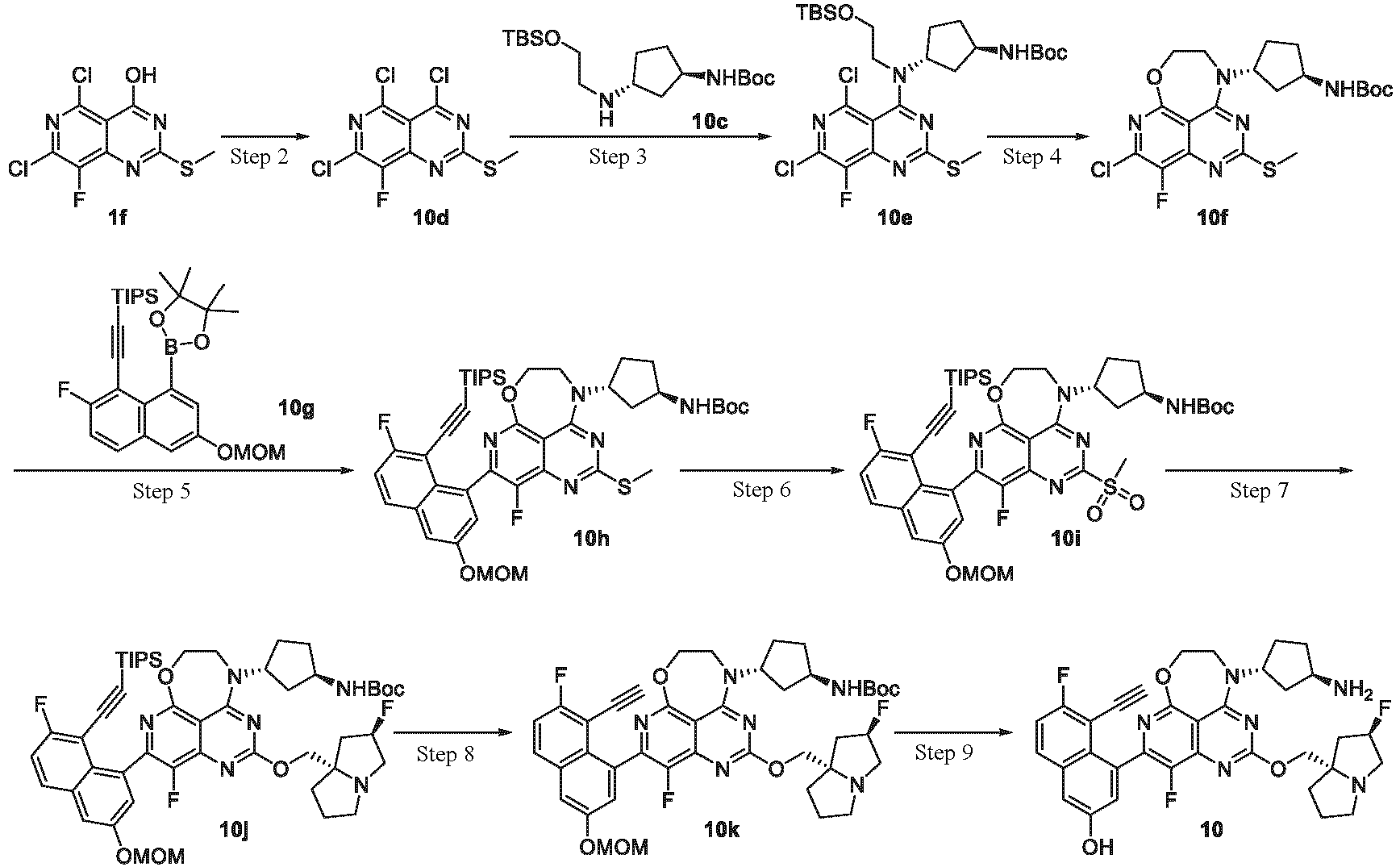
- 10a (1.15 g), 10b (1 g), and potassium carbonate (2.05 g) were dispersed in DMF (10 mL), and the mixture was stirred for reaction at room temperature for 12 h. Water (50 mL) and ethyl acetate (50 mL) were added to the reaction solution, the mixture was stirred, and the phases were separated. The aqueous phase was extracted with ethyl acetate (50 mL × 2), and the organic phases were combined, washed with 5% brine (50 mL × 3), dried over anhydrous sodium sulfate, and filtered. The filtrate was concentrated until no liquid flowed out to give compound 10c. LC-MS: m/z = 359.37 (M + H)+.
- 1f (5 g) was dispersed in acetonitrile (100 mL), and DIPEA (13.8 g) and POCl3 (8.19 g) were added sequentially. Under a nitrogen atmosphere, the mixture was heated to 80 °C and stirred for reaction for 2 h. After the reaction was completed, the reaction solution was cooled to room temperature and poured into ice water (500 mL), and the mixture was stirred for crystallization for 30 min and filtered. The filter cake was dried under vacuum at 55 °C for 6 h to give compound 10d.
- 10d (1.6 g) was dispersed in THF (10 mL), and 10c (1.6 g) and DIPEA (2.3 g) were added sequentially. The mixture was stirred for reaction at room temperature for 1 h. After the reaction was completed, the reaction solution was concentrated under reduced pressure and purified by column chromatography (methanol:dichloromethane = 1:100 to 1:20) to give compound 10e. LC-MS: m/z = 620.32 (M + H)+.
- 10e (1.1 g) and cesium fluoride (5.4 g) were dispersed in DMF (10 mL), and the mixture was heated to 60 °C and stirred for reaction for 3 h. After the reaction was completed, water (100 mL) and ethyl acetate (100 mL) were added to the reaction solution, the mixture was stirred, and the phases were separated. The organic phase was washed with 10% brine (100 mL × 2), dried over anhydrous sodium sulfate, and filtered. The filtrate was concentrated until no liquid flowed out and purified by column chromatography (methanol:dichloromethane = 1:100 to 1:10) to give compound 10f. LC-MS: m/z = 470.24 (M + H)+.
- 10f (0.8 g), 10g (1.7 g), chloro[4-(di-tert-butylphosphino)-N ,N-dimethylaniline-2-(2'-aminobiphenyl) palladium (II) (0.2 g), potassium phosphate (1 g), and water (6.4 mL) were dispersed in 1,4-dioxane (32 mL), and under a nitrogen atmosphere, the mixture was heated to 90 °C and stirred for reaction for 2 h. The reaction solution was cooled to room temperature and filtered, and the filtrate was concentrated to dryness under reduced pressure and purified by column chromatography (ethyl acetate:petroleum ether = 1:10 to 1:1) to give compound 10h. LC-MS: m/z = 820.74 (M + H)+.
- 10h (550 mg) was dispersed in dichloromethane (50 mL), and the mixture was cooled to 0 °C to 5 °C. m-Chloroperoxybenzoic acid (290 mg) was added, and the resulting mixture was stirred for 1 h with the temperature maintained. After the reaction was completed, a 10% sodium thiosulfate solution (200 mL) was added to the reaction solution, and the mixture was extracted with dichloromethane (100 mL × 2). The organic phases were combined, washed with 5% brine (100 mL), dried over anhydrous sodium sulfate, and filtered. The filtrate was concentrated until no liquid flowed out and purified by column chromatography (methanol:dichloromethane = 1:500 to 1:100) to give compound 10i. LC-MS: m/z = 852.47 (M + H)+.
- 10i (400 mg) and ((2R,7aS)-2-fluorotetrahydro-1H-pyrrolizin-7a(5H)-yl)methanol (220 mg) were dispersed in tetrahydrofuran (5 mL). The mixture was cooled to 0 °C, and a solution of lithium bis(trimethylsilyl)amide in tetrahydrofuran (1 N, 1.2 mL) was added dropwise. The resulting mixture was stirred for 30 min with the temperature maintained. After the reaction was completed, a saturated ammonium chloride solution (100 mL) was added to the reaction system, and the mixture was extracted with ethyl acetate (80 mL × 2). The organic phases were combined, washed with 5% brine (100 mL), dried over anhydrous sodium sulfate, and filtered. The filtrate was concentrated until no liquid flowed out and purified by column chromatography (methanol:dichloromethane = 1:200 to 1:50) to give compound 10j. LC-MS: m/z = 931.60 (M + H)+.
- 10j (600 mg) and cesium fluoride (2.16 g) were dispersed in DMF (12 mL), and the mixture was stirred for reaction at room temperature for 2 h. Water (200 mL) and ethyl acetate (200 mL) were added to the reaction solution, the mixture was stirred, and the phases were separated. The organic phase was washed with 5% brine (100 mL × 4), dried over anhydrous sodium sulfate, and filtered. The filtrate was concentrated until no liquid flowed out to give compound 10k. LC-MS: m/z = 775.48 (M + H)+.
- 10k (500 mg) was dispersed in dichloromethane (10 mL), and the reaction system was cooled to 0 °C to 5 °C. A solution of hydrogen chloride in 1,4-dioxane (4 N, 2 mL) was added dropwise to the reaction system, and the resulting mixture reacted for 1 h with the temperature maintained. After the reaction was completed, the reaction solution was concentrated to dryness under reduced pressure and purified by preparative liquid phase chromatography (YMC ODS 10 µm 50 × 250 chromatographic column; acetonitrile-0.1% aqueous formic acid solution (gradient elution of 10%-40%/0-60 min) to give compound 10. LC-MS: m/z = 631.39 (M + H)+.
-


- 11a (0.57 g), 10b (2.29 g), and potassium carbonate (4.42 g) were dispersed in DMF (60 mL), and the mixture was stirred for reaction at room temperature for 12 h. Water (50 mL) and ethyl acetate (50 mL) were added to the reaction solution, the mixture was stirred, and the phases were separated. The aqueous phase was extracted with ethyl acetate (50 mL × 2), and the organic phases were combined, washed with 5% brine (50 mL × 3), dried over anhydrous sodium sulfate, and filtered. The filtrate was concentrated until no liquid flowed out to give compound 11b. LC-MS: m/z = 216.23 (M + H)+.
- 10d (0.6 g) was dispersed in acetonitrile (60 mL), and 11b (1.86 g) and DIPEA (1.03 g) were added sequentially. The mixture was stirred for reaction at room temperature for 1 h. After the reaction was completed, the reaction solution was concentrated under reduced pressure and purified by column chromatography (methanol:dichloromethane = 1:100 to 1:20) to give compound 11c. LC-MS: m/z = 477.18 (M + H)+.
- 11c (628 mg) and cesium fluoride (2 g) were dispersed in DMF (63 mL), and the mixture was heated to 60 °C and stirred for reaction for 3 h. After the reaction was completed, water (200 mL) and ethyl acetate (200 mL) were added to the reaction solution, the mixture was stirred, and the phases were separated. The organic phase was washed with 10% brine (100 mL × 2), dried over anhydrous sodium sulfate, and filtered. The filtrate was concentrated until no liquid flowed out and purified by column chromatography (methanol:dichloromethane = 1:100 to 1:10) to give compound 11d. LC-MS: m/z = 327.12 (M + H)+.
- 11d (378 mg), 10g (1.2 g), chloro[4-(di-tert-butylphosphino)-N,N-dimethylaniline-2-(2'-aminobiphenyl) palladium (II) (132 mg), potassium phosphate (735 mg), and water (8 mL) were dispersed in 1,4-dioxane (40 mL), and under a nitrogen atmosphere, the mixture was heated to 90 °C and stirred for reaction for 2 h. The reaction solution was cooled to room temperature and filtered, and the filtrate was concentrated to dryness under reduced pressure and purified by column chromatography (ethyl acetate:petroleum ether = 1:10 to 1:1) to give compound 11e. LC-MS: m/z = 677.29 (M + H)+.
- 11e (540 mg) was dispersed in dichloromethane (54 mL), and the mixture was cooled to 0 °C to 5 °C. m-Chloroperoxybenzoic acid (400 mg) was added, and the resulting mixture was stirred for 1 h with the temperature maintained. After the reaction was completed, a 10% sodium thiosulfate solution (200 mL) was added to the reaction solution, and the mixture was extracted with dichloromethane (100 mL × 2). The organic phases were combined, washed with 5% brine (100 mL), dried over anhydrous sodium sulfate, and filtered. The filtrate was concentrated until no liquid flowed out and purified by column chromatography (methanol:dichloromethane = 1:500 to 1:100) to give compound 11f. LC-MS: m/z = 709.32 (M + H)+.
- 11f (600 mg) and ((2R,7aS)-2-fluorotetrahydro-1H-pyrrolizin-7a(5H)-yl)methanol (636 mg) were dispersed in tetrahydrofuran (60 mL). The mixture was cooled to 0 °C, and a solution of lithium bis(trimethylsilyl)amide in tetrahydrofuran (1 N, 4 mL) was added dropwise. The resulting mixture was stirred for 30 min with the temperature maintained. After the reaction was completed, a saturated ammonium chloride solution (100 mL) was added to the reaction system, and the mixture was extracted with ethyl acetate (100 mL × 2). The organic phases were combined, washed with 5% brine (100 mL), dried over anhydrous sodium sulfate, and filtered. The filtrate was concentrated until no liquid flowed out and purified by column chromatography (methanol:dichloromethane = 1:500 to 1:100) to give compound 11g. LC-MS: m/z = 788.44 (M + H)+.
- 11g (330 mg) and cesium fluoride (634 mg) were dispersed in DMF (33 mL), and the mixture was stirred for reaction at room temperature for 3 h. Water (100 mL) and ethyl acetate (100 mL) were added to the reaction solution, the mixture was stirred, and the phases were separated. The organic phase was washed with 5% brine (80 mL × 4), dried over anhydrous sodium sulfate, and filtered. The filtrate was concentrated until no liquid flowed out to give compound 11h. LC-MS: m/z = 632.32 (M + H)+.
- 11h (260 mg) was dispersed in ethyl acetate (10 mL), and the reaction system was cooled to 0 °C to 5 °C. A solution of hydrogen chloride in ethyl acetate (4 N, 1 mL) was added dropwise to the reaction system, and the resulting mixture reacted for 1 h with the temperature maintained. After the reaction was completed, the reaction solution was concentrated to dryness under reduced pressure and purified by column chromatography (methanol:dichloromethane = 1:20) to give compound 11. LC-MS: m/z = 588.28 (M + H)+.
-

- Referring to the preparation of compound 11 in Example 11, compound 12 was prepared by replacing 11a with tert-butyl ((1S,3S)-3-aminocyclopentyl)carbamate in step 1. LC-MS: m/z = 631.38 (M + H)+.
-

- Referring to the preparation of compound 11 in Example 11, compound 13 was prepared by replacing 11a with tert-butyl (R)-(1-aminopropan-2-yl)carbamate in step 1. LC-MS: m/z = 605.37 (M + H)+.
-

- Referring to the preparation of compound 11 in Example 11, compound 14 was prepared by replacing 11a with tert-butyl (S)-(1-aminopropan-2-yl)carbamate in step 1. LC-MS: m/z = 605.37 (M + H)+.
-

- Referring to the preparation of compound 11 in Example 11, compound 15 was prepared by replacing 11a with (1S,3R)-3-aminocyclopentanol hydrochloride in step 1. LC-MS: m/z = 632.32 (M + H)+.
-

- Referring to the preparation of compound 11 in Example 11, compound 16 was prepared by replacing 11a with tert-butyl ((1S,2S)-2-aminocyclopropyl)carbamate in step 1. LC-MS: m/z = 603.23 (M + H)+.
-

- Referring to the preparation of compound 11 in Example 11, compound 17 was prepared by replacing 11a with tert-butyl (3-aminocyclobutyl)carbamate in step 1. LC-MS: m/z = 617.33 (M + H)+.
-

- Referring to the preparation of compound 11 in Example 11, compound 18 was prepared by replacing 11a with 4-amino-1-tert-butoxycarbonylpiperidine in step 1. LC-MS: m/z = 631.38 (M + H)+.
-

- Referring to the preparation of compound 11 in Example 11, compound 19 was prepared by replacing 11a with 3-amino-1-(tert-butoxycarbonyl)pyrrolidine in step 1. LC-MS: m/z = 617.45 (M + H)+.
-


- 10d (1 g) was dispersed in tetrahydrofuran (20 mL), and DIPEA (1.73 g) and 20a (2.8 g) were added sequentially. The mixture was stirred for reaction at room temperature for 1 h. After the reaction was completed, the reaction solution was concentrated under reduced pressure and purified by column chromatography (ethyl acetate:petroleum ether = 1:100 to 1:20) to give compound 20b. LC-MS: m/z = 580.17 (M + H)+.
- 20b (2.62 g) and cesium fluoride (10.33 g) were dispersed in DMF (63 mL), and the mixture was stirred for reaction at room temperature for 3 h. After the reaction was completed, water (200 mL) and ethyl acetate (200 mL) were added to the reaction solution, the mixture was stirred, and the phases were separated. The organic phase was washed with 10% brine (100 mL × 2), dried over anhydrous sodium sulfate, and filtered. The filtrate was concentrated until no liquid flowed out and purified by column chromatography (ethyl acetate:petroleum ether = 1:50 to 1:10) to give compound 20c. LC-MS: m/z = 430.11 (M + H)+.
- 20c (451 mg) was dispersed in dichloromethane (22.5 mL), and the mixture was cooled to 0 °C to 5 °C. m-Chloroperoxybenzoic acid (907 mg) was added, and the resulting mixture was stirred for 1 h with the temperature maintained. After the reaction was completed, a 10% sodium thiosulfate solution (50 mL) was added to the reaction solution, and the mixture was extracted with dichloromethane (80 mL × 2). The organic phases were combined, washed with 5% brine (100 mL), dried over anhydrous sodium sulfate, and filtered. The filtrate was concentrated until no liquid flowed out and purified by column chromatography (ethyl acetate:petroleum ether = 1:50 to 1:10) to give compound 20d. LC-MS: m/z = 462.10 (M + H)+.
- 20d (350 mg) and ((2R,7aS)-2-fluorotetrahydro-1H-pyrrolizin-7a(5H)-yl)methanol (604 mg) were dispersed in tetrahydrofuran (9 mL). The mixture was cooled to 0 °C, and a solution of lithium bis(trimethylsilyl)amide in tetrahydrofuran (1 N, 3 mL) was added dropwise. The resulting mixture was stirred for 30 min with the temperature maintained. After the reaction was completed, a saturated ammonium chloride solution (100 mL) was added to the reaction system, and the mixture was extracted with ethyl acetate (100 mL × 2). The organic phases were combined, washed with 5% brine (100 mL), dried over anhydrous sodium sulfate, and filtered. The filtrate was concentrated until no liquid flowed out and purified by column chromatography (methanol:dichloromethane = 1:100 to 1:30) to give compound 20e. LC-MS: m/z = 541.21 (M + H)+.
- 20e (170 mg), 10g (322 mg), methanesulfonato(2-dicyclohexylphosphino-2',4',6'-tri-i-propyl-1,1'-biphenyl)(2'-methylamino-1,1'-biphenyl-2-yl) palladium(II) (50 mg), potassium phosphate (200 mg), and water (1.4 mL) were dispersed in 1,4-dioxane (6.8 mL), and under a nitrogen atmosphere, the mixture was heated to 90 °C and stirred for reaction for 5 h. The reaction solution was cooled to room temperature and filtered, and the filtrate was concentrated to dryness under reduced pressure and purified by column chromatography (methanol:dichloromethane = 1:100 to 1:30) to give compound 20f. LC-MS: m/z = 891.44 (M + H)+.
- 20f (100 mg) and cesium fluoride (171 mg) were dispersed in DMF (2.5 mL), and the mixture was stirred for reaction at room temperature for 1 h. After the reaction was completed, water (50 mL) was added to the reaction solution, and the mixture was extracted with ethyl acetate (80 mL × 2). The organic phases were combined, washed with 5% brine (80 mL × 3), dried over anhydrous sodium sulfate, and filtered, and the filtrate was concentrated until no liquid flowed out to give compound 20g. LC-MS: m/z = 735.31 (M + H)+.
- 20g (100 mg) was dispersed in dichloromethane (10 mL), and the reaction system was cooled to 0 °C to 5 °C. A solution of hydrogen chloride in 1,4-dioxane (4 N, 2 mL) was added dropwise to the reaction system, and the resulting mixture reacted for 0.5 h with the temperature maintained. After the reaction was completed, the reaction solution was concentrated to dryness under reduced pressure and purified by preparative liquid phase chromatography (YMC ODS 10 µm 50 × 250 chromatographic column; acetonitrile-0.1% aqueous formic acid solution (gradient elution of 5%-35%/0-60 min) to give compound 20. LC-MS: m/z = 591.23 (M + H)+.
-
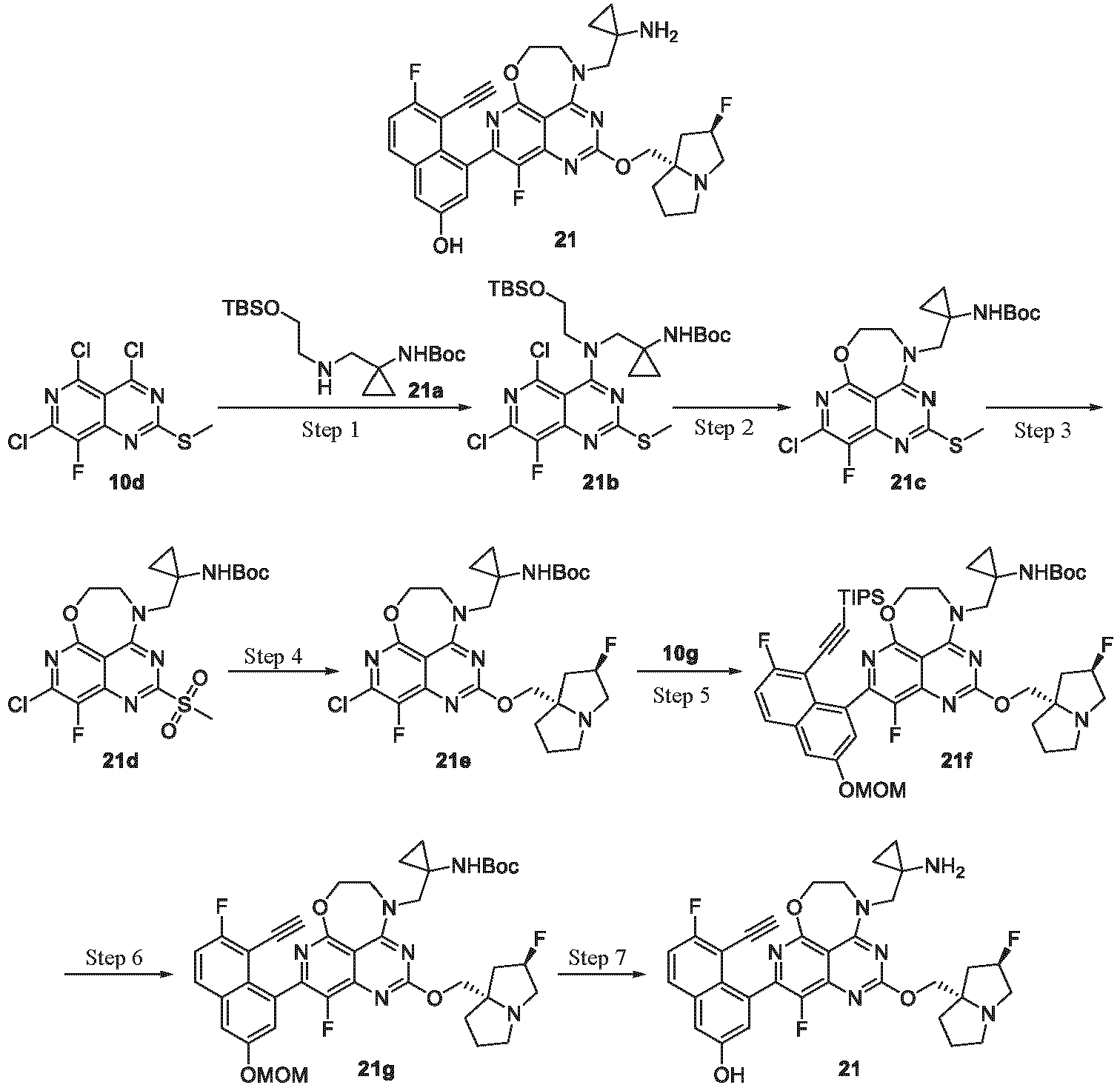
- 10d (835 mg) was dispersed in tetrahydrofuran (20 mL), and DIPEA (1.08 g) and 21a (1.45 g) were added sequentially. The mixture was stirred for reaction at room temperature for 1 h. After the reaction was completed, the reaction solution was concentrated under reduced pressure and purified by column chromatography (ethyl acetate:petroleum ether = 1:100 to 1:20) to give compound 21b. LC-MS: m/z = 606.19 (M + H)+.
- 21b (1.49 g) and cesium fluoride (3.75 g) were dispersed in DMF (50 mL), and the mixture was stirred for reaction at room temperature for 3 h. After the reaction was completed, water (100 mL) and ethyl acetate (200 mL) were added to the reaction solution, the mixture was stirred, and the phases were separated. The organic phase was washed with 10% brine (100 mL × 2), dried over anhydrous sodium sulfate, and filtered. The filtrate was concentrated until no liquid flowed out and purified by column chromatography (ethyl acetate:petroleum ether = 1:50 to 1:10) to give compound 21c. LC-MS: m/z = 456.13 (M + H)+.
- 21c (848 mg) was dispersed in dichloromethane (45 mL), and the mixture was cooled to 0 °C to 5 °C. m-Chloroperoxybenzoic acid (1.89 g) was added, and the resulting mixture was stirred for 1 h with the temperature maintained. After the reaction was completed, a 10% sodium thiosulfate solution (50 mL) was added to the reaction solution, and the mixture was extracted with dichloromethane (80 mL × 2). The organic phases were combined, washed with 5% brine (100 mL), dried over anhydrous sodium sulfate, and filtered. The filtrate was concentrated until no liquid flowed out to give compound 21d. LC-MS: m/z = 488.12 (M + H)+.
- 21d (670 mg) and ((2R,7aS)-2-fluorotetrahydro-1H-pyrrolizin-7a(5H)-yl)methanol (1093 mg) were dispersed in tetrahydrofuran (20 mL). The mixture was cooled to 0 °C, and a solution of lithium bis(trimethylsilyl)amide in tetrahydrofuran (1 N, 5.5 mL) was added dropwise. The resulting mixture was stirred for 30 min with the temperature maintained. After the reaction was completed, a saturated ammonium chloride solution (100 mL) was added to the reaction system, and the mixture was extracted with ethyl acetate (100 mL × 2). The organic phases were combined, washed with 5% brine (100 mL), dried over anhydrous sodium sulfate, and filtered. The filtrate was concentrated until no liquid flowed out and purified by column chromatography (methanol:dichloromethane = 1:100 to 1:30) to give compound 21e. LC-MS: m/z = 567.23 (M + H)+.
- 21e (700 mg), 10g (2214 mg), chloro[4-(di-tert-butylphosphino)-N,N-dimethylaniline-2-(2'-aminobiphenyl)]palladium(II) (142 mg), potassium phosphate (786 mg), and water (5.6 mL) were dispersed in 1,4-dioxane (28 mL), and under a nitrogen atmosphere, the mixture was heated to 90 °C and stirred for reaction for 5 h. The reaction solution was cooled to room temperature and filtered, and the filtrate was concentrated to dryness under reduced pressure and purified by column chromatography (methanol:dichloromethane = 1:100 to 1:30) to give compound 21f. LC-MS: m/z = 917.46 (M + H)+.
- 21f (892 mg) and cesium fluoride (1.5 g) were dispersed in DMF (25 mL), and the mixture was stirred for reaction at room temperature for 1 h. After the reaction was completed, water (50 mL) was added to the reaction solution, and the mixture was extracted with ethyl acetate (80 mL × 2). The organic phases were combined, washed with 5% brine (80 mL × 3), dried over anhydrous sodium sulfate, and filtered, and the filtrate was concentrated until no liquid flowed out to give compound 21g. LC-MS: m/z = 761.33 (M + H)+.
- 21g (100 mg) was dispersed in dichloromethane (10 mL), and the reaction system was cooled to 0 °C to 5 °C. A solution of hydrogen chloride in 1,4-dioxane (4 N, 2 mL) was added dropwise to the reaction system, and the resulting mixture reacted for 0.5 h with the temperature maintained. After the reaction was completed, the reaction solution was concentrated to dryness under reduced pressure and purified by preparative liquid phase chromatography (YMC ODS 10 µm 50 × 250 chromatographic column; acetonitrile-0.1% aqueous formic acid solution (gradient elution of 5%-35%/0-60 min) to give compound 21. LC-MS: m/z = 617.25 (M + H)+.
-


- 21 (324 mg) was dispersed in methanol (15 mL), and an aqueous formaldehyde solution (1.58 g, 40%) and sodium triacetoxyborohydride (446 mg) were added sequentially. The mixture was stirred for reaction at room temperature for 1 h. After the reaction was completed, the reaction solution was concentrated to dryness under reduced pressure and purified by preparative liquid phase chromatography (YMC ODS 10 µm 50 × 250 chromatographic column; acetonitrile-0.1% ammonium hydroxide solution (gradient elution of 20%-60%/0-60 min) to give compound 22. LC-MS: m/z = 645.28 (M + H)+.
-

- Referring to the preparation of compound 22 in Example 22, compound 23 was prepared by replacing compound 21 with compound 12. LC-MS: m/z = 659.39 (M + H)+.
-

- Referring to the preparation of compound 22 in Example 22, compound 24 was prepared by replacing compound 21 with compound 13. LC-MS: m/z = 633.36 (M + H)+.
-

- Referring to the preparation of compound 22 in Example 22, compound 25 was prepared by replacing compound 21 with compound 14. LC-MS: m/z = 633.36 (M + H)+.
-

- Referring to the preparation of compound 22 in Example 22, compound 26 was prepared by replacing compound 21 with compound 17. LC-MS: m/z = 645.32 (M + H)+.
-

- Referring to the preparation of compound 22 in Example 22, compound 27 was prepared by replacing compound 21 with compound 18. LC-MS: m/z = 645.27 (M + H)+.
-

- Referring to the preparation of compound 22 in Example 22, compound 28 was prepared by replacing compound 21 with compound 19. LC-MS: m/z = 631.30 (M + H)+.
-


- 21 (455 mg) was dispersed in hexafluoroisopropanol (4.5 mL), and iodomethane (105 mg) was slowly added dropwise. The mixture was stirred for reaction at room temperature for 18 h. After the reaction was completed, the reaction solution was purified by preparative liquid phase chromatography (YMC ODS 10 µm 50 × 250 chromatographic column; acetonitrile-30 mM aqueous ammonium acetate solution (gradient elution of 10%-50%/0-60 min) and then desalted (YMC ODS 10 µm 50 × 250 chromatographic column; acetonitrile-0.1% formic acid water (gradient elution of 10%-10%-20%-90%/0-15-16-60 min)) and purified to give compound 29.
- LC-MS: m/z = 631.26 (M + H)+.
-


- 10h (200 mg) was dispersed in DMF (5 mL), and the mixture was cooled to 0 °C to 5 °C. NaH (50 mg, 60%) and iodomethane (350 mg) were added, and the resulting mixture was stirred for reaction for 4 h with the temperature maintained. After the reaction was completed, a saturated ammonium chloride solution (30 mL) was added to the reaction system, and the mixture was extracted with ethyl acetate (50 mL × 2). The organic phases were combined, washed with 5% brine (100 mL), dried over anhydrous sodium sulfate, and filtered. The filtrate was concentrated until no liquid flowed out and purified by column chromatography (methanol:dichloromethane = 1:500 to 1:100) to give compound 30a. LC-MS: m/z = 834.55 (M + H)+.
- 30a (200 mg) was dispersed in dichloromethane (2 mL), and the mixture was cooled to 0 °C to 5 °C. m-Chloroperoxybenzoic acid (103 mg) was added, and the resulting mixture was stirred for 1 h with the temperature maintained. After the reaction was completed, a 10% sodium thiosulfate solution (50 mL) was added to the reaction solution, and the mixture was extracted with dichloromethane (80 mL × 2). The organic phases were combined, washed with 5% brine (100 mL), dried over anhydrous sodium sulfate, and filtered. The filtrate was concentrated until no liquid flowed out to give compound 30b. LC-MS: m/z = 866.52 (M + H)+.
- 30b (200 mg) and ((2R,7aS)-2-fluorotetrahydro-1H-pyrrolizin-7a(5H)-yl)methanol (112 mg) were dispersed in tetrahydrofuran (5 mL). The mixture was cooled to 0 °C, and a solution of lithium bis(trimethylsilyl)amide in tetrahydrofuran (1 N, 0.6 mL) was added dropwise. The resulting mixture was allowed to be stirred for reaction at room temperature overnight. After the reaction was completed, a saturated ammonium chloride solution (100 mL) was added to the reaction system, and the mixture was extracted with ethyl acetate (100 mL × 2). The organic phases were combined, washed with 5% brine (100 mL), dried over anhydrous sodium sulfate, and filtered. The filtrate was concentrated until no liquid flowed out to give compound 30c. LC-MS: m/z = 945.62 (M + H)+.
- 30c (390 mg) and cesium fluoride (1.25 g) were dispersed in DMF (15 mL), and the mixture was stirred for reaction at room temperature for 2 h. After the reaction was completed, water (50 mL) was added to the reaction solution, and the mixture was extracted with ethyl acetate (80 mL × 2). The organic phases were combined, washed with 5% brine (80 mL × 3), dried over anhydrous sodium sulfate, and filtered, and the filtrate was concentrated until no liquid flowed out to give compound 30d. LC-MS: m/z = 789.40 (M + H)+.
- 30d (250 mg) was dispersed in dichloromethane (2.5 mL), and the reaction system was cooled to 0 °C to 5 °C. A solution of hydrogen chloride in 1,4-dioxane (4 N, 2.5 mL) was added dropwise to the reaction system, and the resulting mixture reacted for 0.5 h with the temperature maintained. After the reaction was completed, the reaction solution was concentrated to dryness under reduced pressure and purified by preparative liquid phase chromatography (YMC AQ C18 50 × 250 chromatographic column; acetonitrile-0.05% acetic acid (gradient elution of 10%-70%/0-60 min) to give compound 30. LC-MS: m/z = 645.32 (M + H)+.
-

- Referring to the preparation method of compound 11 in Example 11, compound 31 was prepared by replacing 11a with tert-butylamine in step 1. LC-MS: m/z = 604.30 (M + H)+.
- 1H-NMR (500 MHz, DMSO-d6 ), δ: 7.96 (dd, J = 9.2 Hz, J = 6.0 Hz, 1H), 7.46 (t, J = 9.0 Hz, 1H), 7.37 (d, J = 2.4 Hz, 1H), 7.15 (d, J = 2.4 Hz, 1H), 5.30 (d, J = 54.0 Hz, 1H), 4.61-4.50 (m, 2H), 4.17 (d, J = 3.3 Hz, 1H), 4.16-4.06 (m, 2H), 4.01-3.95 (m, 1H), 3.75-3.68 (m, 1H), 3.16-3.07 (m, 3H), 2.89-2.84 (m, 1H), 2.17-1.99 (m, 3H), 1.90-1.76(m, 3H), 1.65(s, 9H).
-
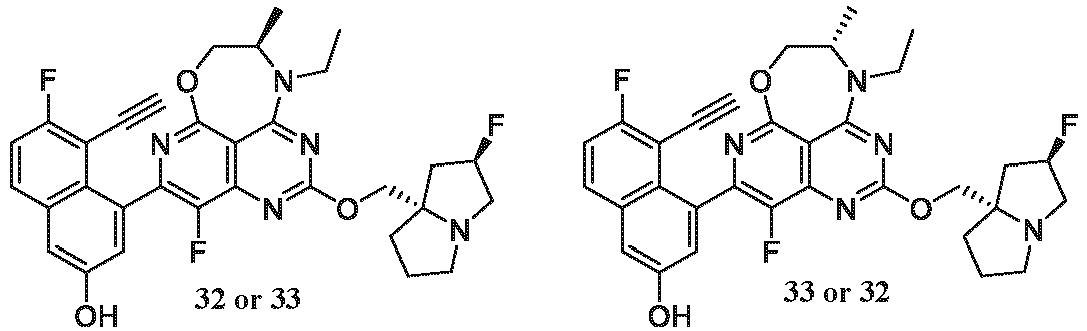

- 32a (2 g) and imidazole (5.4 g) were dispersed in DMF (40 mL), and the mixture was stirred at room temperature for 30 min. tert-Butyldimethylsilyl chloride (6 g) was added, and the resulting mixture was stirred for reaction for another 12 h. Water (100 mL) and ethyl acetate (150 mL) were added to the reaction solution, the mixture was stirred, and the phases were separated. The aqueous phase was extracted with ethyl acetate (100 mL × 2), and the organic phases were combined, washed with 5% brine (100 mL × 2), dried over anhydrous sodium sulfate, and filtered. The filtrate was concentrated until no liquid flowed out to give compound 32b. LC-MS: m/z = 190.16 (M + H)+.
- 32b (2 g) was dispersed in DMF (200 mL). At room temperature, iodoethane (1.47 g) was added dropwise, and the mixture was stirred for reaction for 12 h. Water (200 mL) and ethyl acetate (250 mL) were added to the reaction solution, the mixture was stirred, and the phases were separated. The aqueous phase was extracted with ethyl acetate (100 mL × 2), and the organic phases were combined, washed with 5% brine (150 mL × 2), dried over anhydrous sodium sulfate, and filtered. The filtrate was concentrated until no liquid flowed out to give compound 32c. LC-MS: m/z = 218.19 (M + H)+.
- 10d (530 mg) was dispersed in tetrahydrofuran (20 mL), and DIPEA (923 mg) and 32c (774 mg) were slowly added sequentially. The mixture was stirred for reaction at room temperature for 1 h. After the reaction was completed, the reaction solution was concentrated under reduced pressure and purified by column chromatography (ethyl acetate:petroleum ether = 1:100 to 1:20) to give compound 32d. LC-MS: m/z = 479.13 (M + H)+.
- 32d (532 mg) and cesium fluoride (2029 mg) were dispersed in DMF (22 mL), and the mixture was heated to 80 °C and stirred for reaction for 3 h. After the reaction was completed, water (100 mL) and ethyl acetate (100 mL) were added to the reaction solution, the mixture was stirred, and the phases were separated. The organic phase was washed with 10% brine (80 mL × 2), dried over anhydrous sodium sulfate, and filtered. The filtrate was concentrated until no liquid flowed out and purified by column chromatography (ethyl acetate:petroleum ether = 1:50 to 1:5) to give compound 32e. LC-MS: m/z = 329.06 (M + H)+.
- 32e (172 mg), 10g (938 mg), chloro[4-(di-tert-butylphosphino)-N,N-dimethylaniline-2-(2'-aminobiphenyl)]palladium(II) (60.2 mg), potassium phosphate (333 mg), and water (1.72 mL) were dispersed in 1,4-dioxane (8.6 mL), and under a nitrogen atmosphere, the mixture was heated to 90 °C and stirred for reaction for 5 h. The reaction solution was cooled to room temperature and filtered, and the filtrate was concentrated to dryness under reduced pressure and purified by column chromatography (methanol:dichloromethane = 1:100 to 1:30) to give compound 32f. LC-MS: m/z = 679.29 (M + H)+.
- 32f (275 mg) was dispersed in dichloromethane (15 mL), and the mixture was cooled to 0 °C to 5 °C. m-Chloroperoxybenzoic acid (85%, 412 mg) was added, and the resulting mixture was stirred for 1 h with the temperature maintained. After the reaction was completed, a 10% sodium thiosulfate solution (100 mL) was added to the reaction solution, and the mixture was extracted with dichloromethane (100 mL × 2). The organic phases were combined, washed with 5% brine (100 mL), dried over anhydrous sodium sulfate, and filtered. The filtrate was concentrated until no liquid flowed out to give compound 32g. LC-MS: m/z = 711.28 (M + H)+.
- 32g (245 mg) and ((2R,7aS)-2-fluorotetrahydro-1H-pyrrolizin-7a(5H)-yl)methanol (275 mg) were dispersed in tetrahydrofuran (8 mL). The mixture was cooled to 0 °C, and a solution of lithium bis(trimethylsilyl)amide in tetrahydrofuran (1 N, 1.4 mL) was added dropwise. The resulting mixture was stirred for 30 min with the temperature maintained. After the reaction was completed, a saturated ammonium chloride solution (50 mL) was added to the reaction system, and the mixture was extracted with ethyl acetate (80 mL × 2). The organic phases were combined, washed with 5% brine (80 mL), dried over anhydrous sodium sulfate, and filtered. The filtrate was concentrated until no liquid flowed out to give compound 32h. LC-MS: m/z = 790.40 (M + H)+.
- 32h (285 mg) and cesium fluoride (550 mg) were dispersed in DMF (10 mL), and the mixture was stirred for reaction at room temperature for 2 h. Water (50 mL) and ethyl acetate (80 mL) were added to the reaction solution, the mixture was stirred, and the phases were separated. The aqueous phase was extracted with ethyl acetate (50 mL × 2), and the organic phases were combined, washed with 5% brine (100 mL × 2), dried over anhydrous sodium sulfate, and filtered. The filtrate was concentrated until no liquid flowed out to give compound 32i. LC-MS: m/z = 634.26 (M + H)+.
- 32i (280 mg) was dispersed in dichloromethane (20 mL), and the reaction system was cooled to 0 °C to 5 °C. A solution of hydrogen chloride in 1,4-dioxane (4 N, 4 mL) was added dropwise to the reaction system, and the resulting mixture reacted for 1 h with the temperature maintained. After the reaction was completed, the reaction solution was concentrated to dryness under reduced pressure and purified by preparative liquid phase chromatography (YMC ODS 10 µm 50 × 250 chromatographic column; acetonitrile-0.1% FA (gradient elution of 10%-40%/0-60 min) to give compound 32j. LC-MS: m/z = 590.24 (M + H)+.
- Compound 32j was sequentially purified by preparative liquid phase chromatography (YMC Cellulose-SC 10 µm 30 × 250 chromatographic column; ethanol-n-hexane (gradient elution of 40%-100%/0-30 min) to give compound 32 (Rt 13.1 min, 61 mg) and compound 33 (Rt 15.6 min, 58 mg).
- Compound 32: LC-MS: m/z = 590.24 (M + H)+.
- 1H-NMR (500 MHz, DMSO-d6 ), δ: 7.96-7.95 (m, 1H), 7.48-7.43 (m, 1H), 7.37 (d, J = 2.2 Hz, 1H), 7.20-7.11 (m, 1H), 5.28 (d, J = 53.6 Hz, 1H), 4.58-4.51 (m, 1H), 4.35-4.31 (m, 1H), 4.19-4.00 (m, 5H), 3.55-3.47 (m, 1H), 3.12-3.02 (m, 3H), 2.86-2.81 (m, 1H), 2.14-1.97 (m, 3H), 1.88-1.73(m, 3H), 1.31-1.27 (m, 6H).
- Compound 33: LC-MS: m/z = 590.24 (M + H)+.
- 1H-NMR (500 MHz, DMSO-d6 ), δ: 10.11 (s, 1H), 7.95 (dd, J = 9.0 Hz, J = 6.0 Hz, 1H), 7.48-7.43 (m, 1H), 7.37-7.36 (m, 1H), 7.20-7.11 (m, 1H), 5.28 (d, J = 53.8 Hz, 1H), 4.58-4.51 (m, 1H), 4.34 (d, J = 12.9 Hz, 1H), 4.19-4.00 (m, 5H), 3.55-3.47 (m, 1H), 3.13-3.02 (m, 3H), 2.87-2.81 (m, 1H), 2.14-1.96 (m, 3H), 1.88-1.73(m, 3H), 1.31-1.26 (m, 6H).
- The retention time in chiral chromatographic column of compound 32 is short compared to that of compound 33, and the retention time in chiral chromatographic column of compound 33 is long compared to that of compound 32.
-


- 34a (7.25 g) and p-methoxybenzyl chloride (26.3 g) were dispersed in DMF (80 mL), and sodium hydride (60%, 5.9 g) was added under stirring at room temperature. The mixture was stirred for reaction for 2 h. After the reaction was completed, an ammonium chloride solution (20 mL) was added to quench the reaction, and water (100 mL) and ethyl acetate (150 mL) were added. The mixture was stirred, and the phases were separated. The aqueous phase was extracted with ethyl acetate (100 mL × 2), and the organic phases were combined, washed with 5% brine (100 mL × 2), dried over anhydrous sodium sulfate, and filtered. The filtrate was concentrated until no liquid flowed out and purified by column chromatography (ethyl acetate:petroleum ether = 1:100 to 1:10) to give compound 34b. LC-MS: m/z = 413.16 (M + H)+.
- 34b (1.25 g), bis(diphenylphosphino)palladium(II) dichloride (0.21 g), and tributyl(1-ethoxyvinyl)tin (3.1 mL) were dispersed in DMF (10 mL), and under a nitrogen atmosphere, the mixture was heated to 80 °C and stirred for reaction for 8 h. After the reaction was completed, the reaction solution was cooled to room temperature, and the pH was adjusted to acidity with diluted hydrochloric acid. Water (100 mL) and ethyl acetate (100 mL) were added, the mixture was stirred, and the phases were separated. The aqueous phase was extracted with ethyl acetate (100 mL × 2), and the organic phases were combined, washed once with a 10% sodium bicarbonate solution (100 mL) and once with 5% brine (100 mL), dried over anhydrous sodium sulfate, and filtered. The filtrate was concentrated until no liquid flowed out and purified by column chromatography (ethyl acetate:petroleum ether = 1:50 to 1:5) to give compound 34c. LC-MS: m/z = 377.26 (M + H)+.
- 34c (0.7 g), 2-(tert-butyldimethylsilyloxy)ethanamine (1.12 g), and titanium tetraisopropanolate (1.2 mL) were dispersed in methanol (14 mL), and the mixture was heated to 80 °C and stirred for reaction for 6 h. The reaction solution was cooled to 0 °C, and sodium borohydride (240 mg) was added. The resulting mixture was allowed to be stirred for reaction at room temperature for 4 h. After the reaction was completed, the reaction solution was filtered by diatomite, and the filtrate was concentrated until no liquid flowed out and purified by column chromatography (ethyl acetate:petroleum ether = 1:20 to 1:2) to give compound 34d. LC-MS: m/z = 536.39 (M + H)+.
- 10d (800 mg), 34d (980 mg), and DIPEA (580 mg) were dispersed in tetrahydrofuran (20 mL), and the mixture was stirred for reaction at room temperature for 1.5 h. After the reaction was completed, the reaction solution was concentrated under reduced pressure and purified by column chromatography (ethyl acetate:petroleum ether = 1:100 to 1:10) to give compound 34e. LC-MS: m/z = 797.65 (M + H)+.
- 34e (809 mg) and cesium fluoride (1.6 g) were dispersed in DMF (16 mL), and the mixture was heated to 60 °C and stirred for reaction for 2 h. After the reaction was completed, water (100 mL) and ethyl acetate (100 mL) were added to the reaction solution, the mixture was stirred, and the phases were separated. The aqueous phase was extracted with ethyl acetate (100 mL × 2), and the organic phase was washed with 10% brine (100 mL × 2), dried over anhydrous sodium sulfate, and filtered. The filtrate was concentrated until no liquid flowed out to give compound 34f. LC-MS: m/z = 647.28 (M + H)+.
- 34f (650 mg) was dispersed in dichloromethane (30 mL), and the mixture was cooled to 0 °C to 5 °C. m-Chloroperoxybenzoic acid (85%, 860 mg) was added, and the resulting mixture was stirred for 1 h with the temperature maintained. After the reaction was completed, a 10% sodium thiosulfate solution (100 mL) was added to the reaction solution, and the mixture was extracted with dichloromethane (100 mL × 2). The organic phases were combined, washed with 5% brine (100 mL), dried over anhydrous sodium sulfate, and filtered. The filtrate was concentrated until no liquid flowed out to give compound 34g. LC-MS: m/z = 679.27 (M + H)+.
- 34g (725 mg) and ((2R,7aS)-2-fluorotetrahydro-1H-pyrrolizin-7a(5H)-yl)methanol (850 mg) were dispersed in tetrahydrofuran (15 mL). The mixture was cooled to 0 °C, and a solution of lithium bis(trimethylsilyl)amide in tetrahydrofuran (1 N, 4.3 mL) was added dropwise. The resulting mixture was stirred for 1 h with the temperature maintained. After the reaction was completed, a saturated ammonium chloride solution (20 mL) was added to the reaction system to quench the reaction, and water (50 mL) and ethyl acetate (80 mL) were added. The mixture was stirred, and the phases were separated. Extraction was performed with ethyl acetate (80 mL × 2), and the organic phases were combined, washed with 5% brine (80 mL), dried over anhydrous sodium sulfate, and filtered. The filtrate was concentrated until no liquid flowed out and purified by column chromatography (methanol:dichloromethane = 1:100 to 1:20) to give compound 34h. LC-MS: m/z = 758.33 (M + H)+.
- 34h (200 mg) was dispersed in trifluoroacetic acid (10 mL), and the mixture was cooled to 0 °C. Methanesulfonic acid (1 mL) was added dropwise, and the resulting mixture was allowed to be stirred for reaction at room temperature for 2 h. After the reaction was completed, the reaction solution was concentrated under reduced pressure until no liquid flowed out. The residue was dissolved in dichloromethane (10 mL), and the pH of the system was adjusted to alkalinity with a saturated sodium bicarbonate solution under an ice bath. Water (50 mL) and dichloromethane (50 mL) were added, the mixture was stirred, and the phases were separated. Extraction was performed with dichloromethane (50 mL × 2), and the organic phases were combined, washed with 5% brine (100 mL), dried over anhydrous sodium sulfate, and filtered. The filtrate was concentrated until no liquid flowed out to give compound 34i. LC-MS: m/z = 518.21 (M + H)+.
- 34i (166 mg), 10g (327 mg), chloro[4-(di-tert-butylphosphino)-N,N-dimethylaniline-2-(2'-aminobiphenyl)]palladium(II) (37 mg), potassium phosphate (198 mg), and water (2.4 mL) were dispersed in 1,4-dioxane (12 mL), and under a nitrogen atmosphere, the mixture was heated to 90 °C and stirred for reaction for 1 h. The reaction solution was cooled to room temperature and filtered, and the filtrate was concentrated to dryness under reduced pressure and purified by column chromatography (methanol:dichloromethane = 1:100 to 1:15) to give compound 34j. LC-MS: m/z = 868.91 (M + H)+.
- 34j (175 mg) and cesium fluoride (306 mg) were dispersed in DMF (10 mL), and the mixture was stirred for reaction at room temperature for 2 h. Water (50 mL) and ethyl acetate (80 mL) were added to the reaction solution, the mixture was stirred, and the phases were separated. The aqueous phase was extracted with ethyl acetate (50 mL × 2), and the organic phases were combined, washed with 5% brine (80 mL × 3), dried over anhydrous sodium sulfate, and filtered. The filtrate was concentrated until no liquid flowed out to give compound 34k. LC-MS: m/z = 712.50 (M + H)+.
- 34k (168 mg) was dispersed in dichloromethane (10 mL), and the reaction system was cooled to 0 °C to 5 °C. A solution of hydrogen chloride in 1,4-dioxane (4 N, 2 mL) was added dropwise to the reaction system, and the resulting mixture was stirred for reaction for 1 h with the temperature maintained. After the reaction was completed, the reaction solution was concentrated to dryness under reduced pressure and purified by preparative liquid phase chromatography (YMC ODS 10 µm 30 × 250 chromatographic column; acetonitrile-0.1% FA (gradient elution of 5%-5%/0-60 min)) to give compound 34. LC-MS: m/z = 668.42 (M + H)+.
-

- Compound 34 was sequentially purified by preparative liquid phase chromatography (YMC Cellulose-SC 10 µm 30 × 250 chromatographic column; ethanol-n-hexane (gradient elution of 30%-100%/0-40 min)) to give compound 35 (Rt 16.2 min, 44 mg) and compound 36 (Rt 22.3 min, 57 mg).
- Compound 35: LC-MS: m/z = 668.40 (M + H)+.
- 1H-NMR (500 MHz, DMSO-d6 ), δ: 10.15 (br, 1H), 7.99-7.94 (m, 2H), 7.65 (d, J = 6.2 Hz, 1H), 7.45 (t, J = 8.6 Hz, 1H), 7.37 (s, 1H), 7.14 (s, 1H), 6.68 (s, 1H), 6.34 (dd, J = 29.2 Hz, J = 5.6 Hz, 1H), 5.79 (s, 1H), 5.72 (s, 1H), 5.30 (d, J = 54.6 Hz, 1H), 4.47-4.16 (m, 3H), 4.11-3.96 (m, 2H), 3.80-3.65 (m, 1H), 3.47-3.41 (m, 1H), 3.14-3.03 (m, 3H), 2.86-2.81 (m, 1H), 2.18-1.99 (m, 3H), 1.88-1.75(m, 3H), 1.62-1.58 (m, 3H).
- Compound 36: LC-MS: m/z = 668.41 (M + H)+.
- 1H-NMR (500 MHz, DMSO-d6 ), δ: 10.15 (br, 1H), 7.99-7.94 (m, 2H), 7.65 (d, J = 7.4 Hz, 1H), 7.46 (t, J = 8.6 Hz, 1H), 7.37 (s, 1H), 7.15 (s, 1H), 6.68 (t, J = 5.6 Hz, 1H), 6.39-6.29 (m, 1H), 5.80 (s, 1H), 5.72 (s, 1H), 5.30 (d, J = 53.8 Hz, 1H), 4.46-4.21 (m, 2H), 4.16-3.97 (m, 3H), 3.80-3.65 (m, 1H), 3.47-3.42 (m, 1H), 3.16-3.05 (m, 3H), 2.88-2.82 (m, 1H), 2.20-2.02 (m, 3H), 1.91-1.78(m, 3H), 1.60 (t, J = 6.2 Hz, 3H).
- The retention time in chiral chromatographic column of compound 35 is short compared to that of compound 36, and the retention time in chiral chromatographic column of compound 36 is long compared to that of compound 35.
-

- Referring to the preparation of compound 34 in Example 34, compound 37 was prepared by replacing 2-(tert-butyldimethylsilyloxy)ethanamine with DL-alaninol in step 3. LC-MS: m/z = 682.42 (M + H)+.
-
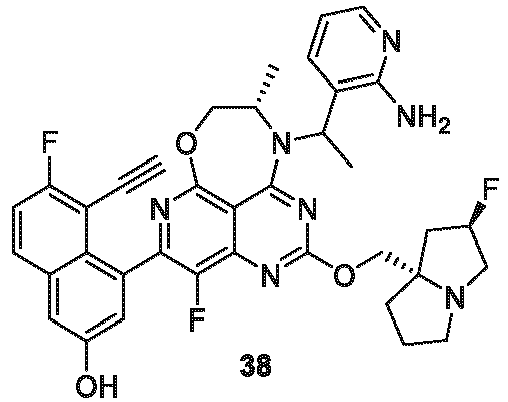
- Referring to the preparation of compound 34 in Example 34, compound 38 was prepared by replacing 2-(tert-butyldimethylsilyloxy)ethanamine with L-alaninol in step 3. LC-MS: m/z = 682.42 (M + H)+.
-

- Compound 38 was sequentially purified by liquid phase chromatography (CHIRALPAK ID 5.0 µm 4.6 × 250 mm; n-hexane-0.1% ethanolamine/ethanol (50%/isocratic elution for 20 min)) to give compound 39 (Rt 11.6 min, LC-MS: m/z = 682.42 (M + H)+) and compound 40 (Rt 14.9 min, LC-MS: m/z = 682.42 (M + H)+).
- Compound 39: 1H-NMR (500 MHz, DMSO-d6 ), δ: 10.30-9.97 (m, 1H), 8.15-7.85 (m, 2H), 7.83-7.60 (m, 1H), 7.59-7.30 (m, 2H), 7.28-7.04 (m, 1H), 6.83-6.37 (m, 2H), 5.78-5.44 (m, 2H), 5.43-5.15 (m, 1H), 4.64-4.41 (m, 1H), 4.38-3.72 (m, 5H), 3.21-2.94 (m, 3H), 2.93-2.76 (m, 1H), 2.27-1.96 (m, 3H), 1.95-1.71 (m, 3H), 1.70-1.52 (m, 3H), 0.74-0.44 (m, 3H).
- Compound 40: 1H-NMR (500 MHz, DMSO-d6 ), δ: 10.30-9.97 (m, 1H), 8.10-7.86 (m, 2H), 7.73 (d, J = 7.2 Hz, 1H), 7.56-7.42 (m, 1H), 7.41-7.30 (m, 1H), 7.25-7.08 (m, 1H), 6.82-6.62 (m, 1H), 6.60-6.36 (m, 1H), 5.82-5.53 (m, 2H), 5.43-5.15 (m, 1H), 4.46-4.26 (m, 1H), 4.25-4.15 (m, 1H), 4.14-4.00 (m, 2H), 3.98-3.79 (m, 2H), 3.21-2.98 (m, 3H), 2.92-2.76 (m, 1H), 2.23-1.95 (m, 3H), 1.93-1.73 (m, 3H), 1.72-1.58 (m, 3H), 1.28-1.17 (m, 3H).
- The retention time in chiral chromatographic column of compound 39 is short compared to that of compound 40, and the retention time in chiral chromatographic column of compound 40 is long compared to that of compound 39.
-

- Referring to the preparation of compound 34 in Example 34, compound 41 was prepared by replacing 2-(tert-butyldimethylsilyloxy)ethanamine with D-alaninol in step 3. LC-MS: m/z = 682.42 (M + H)+.
-

- Compound 41 was sequentially purified by liquid phase chromatography (CHIRALPAK ID 5.0 µm 4.6 × 250 mm; n-hexane-0.1% ethanolamine/ethanol (50%/isocratic elution for 20 min)) to give compound 42 (Rt 13.7 min, LC-MS: m/z = 682.42 (M + H)+) and compound 43 (Rt 16.6 min, LC-MS: m/z = 682.42 (M + H)+).
- Compound 42: 1H-NMR (500 MHz, DMSO-d6 ), δ: 10.16(br, 1H), 8.10-7.90 (m, 2H), 7.71 (d, J = 7.4 Hz, 1H), 7.52-7.42 (m, 1H), 7.41-7.32 (m, 1H), 7.26-7.07 (m, 1H), 6.79-6.64 (m, 1H), 6.63-6.41 (m, 1H), 5.80-5.46 (m, 2H), 5.42-5.14 (m, 1H), 4.69-4.43 (m, 1H), 4.37-4.15 (m, 2H), 4.14-3.75 (m, 3H), 3.20-3.00 (m, 3H), 2.90-2.78 (m, 1H), 2.22-1.96 (m, 3H), 1.93-1.73 (m, 3H), 1.69-1.55 (m, 3H), 0.72-0.49 (m, 3H).
- Compound 43: 1H-NMR (500 MHz, DMSO-d6 ), δ: 10.15(br, 1H), 8.10-7.89 (m, 2H), 7.73 (d, J = 7.4 Hz, 1H), 7.56-7.43 (m, 1H), 7.38 (d, J = 2.4 Hz, 1H), 7.26-7.10 (m, 1H), 6.78-6.63 (m, 1H), 6.61-6.38 (m, 1H), 5.79-5.56 (m, 2H), 5.42-5.18 (m, 1H), 4.44-4.26 (m, 1H), 4.21-3.79 (m, 5H), 3.20-2.99 (m, 3H), 2.90-2.77 (m, 1H), 2.22-1.97 (m, 3H), 1.94-1.73 (m, 3H), 1.72-1.57 (m, 3H), 1.27-1.17 (m, 3H).
- The retention time in chiral chromatographic column of compound 42 is short compared to that of compound 43, and the retention time in chiral chromatographic column of compound 43 is long compared to that of compound 42.
-

- Referring to the preparation of compound 32j in Example 32, compound 44 was prepared by replacing iodoethane with iodocyclopropane in step 2. LC-MS: m/z = 602.22 (M + H)+.
-

- Compound 44 was sequentially purified by preparative liquid phase chromatography (YMC Cellulose-SC 10 µm 30 × 250 chromatographic column; ethanol-n-hexane (gradient elution of 20%-80%/0-40 min)) to give compound 45 (Rt 15.1 min, LC-MS: m/z = 602.22 (M + H)+) and compound 46 (Rt 22.6 min, LC-MS: m/z = 602.22 (M + H)+).
- The retention time in chiral chromatographic column of compound 45 is short compared to that of compound 46, and the retention time in chiral chromatographic column of compound 46 is long compared to that of compound 45.
-

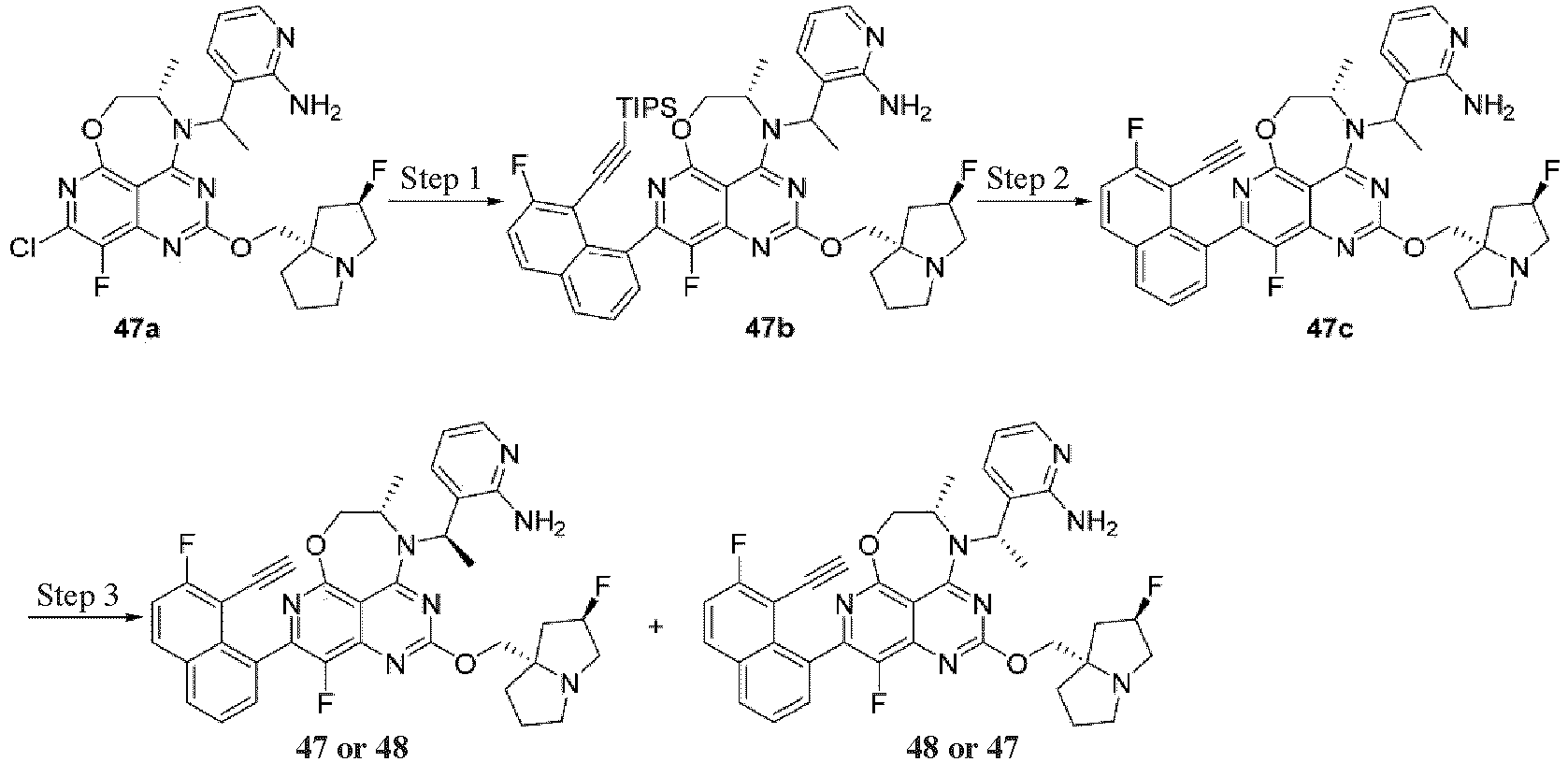
- Referring to the preparation of compound 34i in Example 34, compound 47a was prepared by replacing 2-(tert-butyldimethylsilyloxy)ethanamine with L-alaninol in step 3. LC-MS: m/z = 532.20 (M + H)+.
- 47a (160 mg), ((2-fluoro-8-(4,4,5,5-tetramethyl-1,3,2-dioxaborolan-2-yl)naphthalen-1-yl)ethynyl)triisopropylsilane (271 mg), chloro[4-(di-tert-butylphosphino)-N,N-dimethylaniline-2-(2'-aminobiphenyl)]palladium(II) (35 mg), potassium phosphate (190 mg), and water (3 mL) were dispersed in 1,4-dioxane (15 mL), and under a nitrogen atmosphere, the mixture was heated to 90 °C and stirred for reaction for 2 h. The reaction solution was cooled to room temperature and filtered, and the filtrate was concentrated to dryness under reduced pressure and purified by column chromatography (ethyl acetate:petroleum ether = 1:10 to 1:2) to give compound 47b. LC-MS: m/z = 822.77 (M + H)+.
- 47b (157 mg) and cesium fluoride (300 mg) were dispersed in DMF (16 mL), and the mixture was stirred for reaction at room temperature for 2 h. Water (200 mL) and ethyl acetate (200 mL) were added to the reaction solution, the mixture was stirred, and the phases were separated. The organic phase was washed with 5% brine (100 mL × 4), dried over anhydrous sodium sulfate, and filtered. The filtrate was concentrated until no liquid flowed out to give compound 47c. LC-MS: m/z = 666.40 (M + H)+.
- Compound 47c was sequentially purified by preparative liquid phase chromatography (YMC Cellulose-SB 10 µm 30 × 250 chromatographic column; ethanol-n-hexane (gradient elution of 10%-90%/0-40 min)) to give compound 47 (Rt 16.3 min, LC-MS: m/z = 666.40 (M + H)+) and compound 48 (Rt 18.4 min, LC-MS: m/z = 666.40 (M + H)+).
- The retention time in chiral chromatographic column of compound 47 is short compared to that of compound 48, and the retention time in chiral chromatographic column of compound 48 is long compared to that of compound 47.
-

- Referring to the preparation of compound 32j in Example 32, compound 49 was prepared by replacing iodoethane with 2-iodopropane in step 2. LC-MS: m/z = 604.34 (M + H)+.
-

- Referring to the preparation of compound 32j in Example 32, compound 50 was prepared by replacing iodoethane with 1,1-difluoro-2-iodoethane in step 2. LC-MS: m/z = 626.30 (M + H)+.
-

- Referring to the preparation of compound 34 in Example 34, compound 51 was prepared by replacing ((2R,7aS)-2-fluorotetrahydro-1H-pyrrolizin-7a(5H)-yl)methanol with ((2R,7aS)-2-fluorotetrahydro-1H-pyrrolizin-7a(5H)-yl)methane-d 2-ol in step 7. LC-MS: m/z = 670.38 (M + H)+.
-

- Referring to the preparation of compound 47c in Example 47, compound 52 was prepared by replacing ((2-fluoro-8-(4,4,5,5-tetramethyl-1,3,2-dioxaborolan-2-yl)naphthalen-1-yl)ethynyl)triisopropylsilane with 6-fluoro-4-(4,4,5,5-tetramethyl-1,3,2-dioxaborolan-2-yl)-5-((triisopropylsilyl)ethynyl)naphthalen-2-amine in step 1. LC-MS: m/z = 681.32 (M + H)+.
-

- Compound 52 was sequentially purified by preparative liquid phase chromatography (YMC C18 10 µm 50 × 250 chromatographic column; acetonitrile-0.1% ammonium hydroxide (gradient elution of 60%-90%/0-60 min)) to give compound 53 (Rt 22 min, LC-MS: m/z = 681.32 (M + H)+) and compound 54 (Rt 25 min, LC-MS: m/z = 681.34 (M + H)+).
- The retention time in chiral chromatographic column of compound 53 is short compared to that of compound 54, and the retention time in chiral chromatographic column of compound 54 is long compared to that of compound 53.
-


- Referring to the preparation of compound 47b in Example 47, compound 55a was prepared by replacing ((2-fluoro-8-(4,4,5,5-tetramethyl-1,3,2-dioxaborolan-2-yl)naphthalen-1-yl)ethynyl)triisopropylsilane with (3-methyl-2-(trifluoromethyl)phenyl)boronic acid in step 1.
- Compound 55a was sequentially purified by preparative liquid phase chromatography (YMC C18 10 µm 50 × 250 chromatographic column; acetonitrile-0.1% ammonium hydroxide (gradient elution of 60%-90%/0-60 min)) to give compound 55 (Rt 25 min, LC-MS: m/z = 656.28 (M + H)+) and compound 56 (Rt 28 min, LC-MS: m/z = 656.28 (M + H)+).
- Compound 55: 1H-NMR (500 MHz, DMSO-d6 ), δ: 7.99 (dd, J = 4.8 Hz, J = 1.6 Hz, 1H), 7.69 (d, J = 7.6, 1H), 7.67-7.60 (m, 1H), 7.57 (d, J = 7.6 Hz, 1H), 7.30 (br, 1H), 6.69 (dd, J = 7.4 Hz, J = 5.0 Hz, 1H), 6.52 (q, J = 6.6 Hz, 1H), 5.60 (s, 2H), 5.38-5.19 (m, 1H), 4.52 (dd, J = 12.6 Hz, J = 5.2 Hz, 1H), 4.38-4.25 (m, 1H), 4.13 (s, 2H), 4.06-3.98 (m, 1H), 3.14-2.98 (m, 3H), 2.87-2.79 (m, 1H), 2.57-2.53 (m, 3H), 2.17-1.95 (m, 3H), 1.89-1.74 (m, 3H), 1.60 (d, J = 6.8 Hz, 3H), 0.54 (d, J = 6.8 Hz, 3H).
- Compound 56: 1H-NMR (500 MHz, DMSO-d6), δ: 7.99 (dd, J = 4.8 Hz, J = 1.5 Hz, 1H), 7.72 (d, J = 7.6 Hz, 1H), 7.64 (t, J = 7.6 Hz, 1H), 7.57 (d, J = 7.6 Hz, 1H), 7.31 (br, 1H), 6.70 (dd, J = 7.4 Hz, J = 4.9 Hz, 1H), 6.45 (q, J = 6.6 Hz, 1H), 5.60 (s, 2H), 5.38-5.20 (m, 1H), 4.35 (dd, J = 12.4 Hz, J = 5.6 Hz, 1H), 4.20 (d, J = 10.4 Hz, 1H), 4.09-4.00 (m, 1H), 3.95-3.84 (m, 2H), 3.13-2.98 (m, 3H), 2.87-2.77 (m, 1H), 2.57-2.53 (m, 3H), 2.17-1.96 (m, 3H), 1.90-1.72 (m, 3H), 1.62 (d, J = 6.9 Hz, 3H), 1.17 (d, J = 6.5 Hz, 3H).
- The retention time in chiral chromatographic column of compound 55 is short compared to that of compound 56, and the retention time in chiral chromatographic column of compound 56 is long compared to that of compound 55.
-


- Referring to the preparation of compound 47b in Example 47, compound 57a was prepared by replacing ((2-fluoro-8-(4,4,5,5-tetramethyl-1,3,2-dioxaborolan-2-yl)naphthalen-1-yl)ethynyl)triisopropylsilane with 2-(dimethylamino)phenylboronic acid pinacol ester in step 1.
- Compound 57a was sequentially purified by preparative liquid phase chromatography (YMC C18 10 µm 50 × 250 chromatographic column; acetonitrile-0.1% ammonium hydroxide (gradient elution of 50%-90%/0-60 min)) to give compound 57 (Rt 49 min) and compound 58 (Rt 52 min).
- Compound 57: LC-MS: m/z = 617.41 (M + H)+.
- 1H-NMR (500 MHz, DMSO-d6 ), δ: 7.99 (s, 1H), 7.69 (d, J = 6.8 Hz, 1H), 7.36 (t, J = 7.0 Hz, 1H), 7.24 (d, J = 7.0 Hz, 1H), 7.09 (d, J = 8.0 Hz, 1H), 6.99 (t, J = 7.0 Hz, 1H), 6.72-6.65 (m, 1H), 6.57-6.49 (m, 1H), 5.64 (s, 2H), 5.42-5.17 (m, 1H), 4.57-4.47 (m, 1H), 4.29 (d, J = 12.4 Hz, 1H), 4.14 (s, 2H), 4.06-3.97 (m, 1H), 3.16-3.00 (m, 3H), 2.89-2.79 (m, 1H), 2.53 (s, 6H), 2.21-1.98 (m, 3H), 1.91-1.74 (m, 3H), 1.59 (d, J = 5.8 Hz, 3H) , 0.55 (d, J= 6.2 Hz, 3H).
- Compound 58: LC-MS: m/z = 617.38 (M + H)+.
- 1H-NMR (500 MHz, DMSO-d6 ), δ: 8.00 (s, 1H), 7.72 (d, J = 5.8 Hz, 1H), 7.41-7.30 (m, 1H), 7.25 (d, J = 5.8 Hz, 1H), 7.16-7.04 (m, 1H), 7.03-6.94 (m, 1H), 6.75-6.64 (m, 1H), 6.54-6.41 (m, 1H), 5.62 (s, 2H), 5.42-5.17 (m, 1H), 4.41-4.27 (m, 1H), 4.20 (d, J = 9.6 Hz, 1H), 4.06 (d, J = 9.8 Hz, 1H), 3.90 (d, J = 10.2 Hz, 2H), 3.16-2.99 (m, 3H), 2.89-2.77 (m, 1H), 2.54 (s, 6H), 2.21-1.95 (m, 3H), 1.91-1.71 (m, 3H), 1.70-1.53 (m, 3H) , 1.27-1.10 (m, 3H).
- The retention time in chiral chromatographic column of compound 57 is short compared to that of compound 58, and the retention time in chiral chromatographic column of compound 58 is long compared to that of compound 57.
-


- Referring to the preparation of compound 47b in Example 47, compound 59a was prepared by replacing ((2-fluoro-8-(4,4,5,5-tetramethyl-1,3,2-dioxaborolan-2-yl)naphthalen-1-yl)ethynyl)triisopropylsilane with 1-naphthylboronic acid in step 1.
- Compound 59a was sequentially purified by preparative liquid phase chromatography (YMC C18 10 µm 50 × 250 chromatographic column; acetonitrile-0.1% ammonium hydroxide (gradient elution of 60%-90%/0-60 min)) to give compound 59 (Rt 49 min, LC-MS: m/z = 624.40 (M + H)+) and compound 60 (Rt 55 min, LC-MS: m/z = 624.37 (M + H)+).
- The retention time in chiral chromatographic column of compound 59 is short compared to that of compound 60, and the retention time in chiral chromatographic column of compound 60 is long compared to that of compound 59.
-


- Referring to the preparation of compound 47b in Example 47, compound 61a was prepared by replacing ((2-fluoro-8-(4,4,5,5-tetramethyl-1,3,2-dioxaborolan-2-yl)naphthalen-1-yl)ethynyl)triisopropylsilane with 2-(trifluoromethyl)phenylboronic acid in step 1.
- Compound 61a was sequentially purified by preparative liquid phase chromatography (YMC C18 10 µm 50 × 250 chromatographic column; acetonitrile-0.1% ammonium hydroxide (gradient elution of 60%-90%/0-60 min)) to give compound 61 (Rt 35 min, LC-MS: m/z = 642.34 (M + H)+) and compound 62 (Rt 40 min, LC-MS: m/z = 642.34 (M + H)+).
- Compound 61: 1H-NMR (500 MHz, DMSO-d6 ), δ: 7.99 (d, J = 4.2 Hz, 1H), 7.89 (d, J = 7.8, 1H), 7.80 (t, J = 7.4 Hz, 1H), 7.77-7.66 (m, 2H), 7.57 (d, J = 7.4 Hz, 1H), 6.74-6.64 (m, 1H), 6.58-6.46 (m, 1H), 5.59 (s, 2H), 5.38-5.19 (m, 1H), 4.58-4.48 (m, 1H), 4.37-4.27 (m, 1H), 4.14 (s, 2H), 4.08-3.97 (m, 1H), 3.16-2.99 (m, 3H), 2.88-2.77 (m, 1H), 2.20-1.97 (m, 3H), 1.91-1.72 (m, 3H), 1.60 (d, J = 6.6 Hz, 3H), 0.54 (d, J = 6.6 Hz, 3H).
- Compound 62: 1H-NMR (500 MHz, DMSO-d6 ), δ: 7.99 (dd, J = 4.8 Hz, J = 1.6 Hz, 1H), 7.89 (d, J = 7.8 Hz, 1H), 7.81 (t, J = 7.4 Hz, 1H), 7.76-7.69 (m, 2H), 7.58 (d, J = 7.6 Hz, 1H), 6.70 (dd, J = 7.4 Hz, J = 5.0 Hz, 1H), 6.45 (q, J = 7.0 Hz, 1H), 5.60 (s, 2H), 5.38-5.20 (m, 1H), 4.35 (dd, J = 12.6 Hz, J = 5.6 Hz, 1H), 4.23-4.17 (m, 1H), 4.09-4.03 (m, 1H), 3.95-3.84 (m, 2H), 3.13-2.99 (m, 3H), 2.87-2.74 (m, 1H), 2.20-1.96 (m, 3H), 1.89-1.72 (m, 3H), 1.62 (d, J = 6.8 Hz, 3H), 1.17 (d, J = 6.8 Hz, 3H).
- The retention time in chiral chromatographic column of compound 61 is short compared to that of compound 62, and the retention time in chiral chromatographic column of compound 62 is long compared to that of compound 61.
-


- Referring to the preparation of compound 47b in Example 47, compound 63a was prepared by replacing ((2-fluoro-8-(4,4,5,5-tetramethyl-1,3,2-dioxaborolan-2-yl)naphthalen-1-yl)ethynyl)triisopropylsilane with 3-chloro-5-(4,4,5,5-tetramethyl-1,3,2-dioxaborolan-2-yl)-4-(trifluoromethyl)aniline in step 1.
- Compound 63a was sequentially purified by preparative liquid phase chromatography (YMC C18 10 µm 50 × 250 chromatographic column; acetonitrile-0.1% ammonium hydroxide (gradient elution of 60%-90%/0-60 min)) to give compound 63 (Rt 24 min, LC-MS: m/z = 691.23 (M + H)+) and compound 64 (Rt 27 min, LC-MS: m/z = 691.23 (M + H)+).
- Compound 63: 1H-NMR (500 MHz, DMSO-d6 ), δ: 8.02-7.95 (m, 1H), 7.69 (d, J = 7.4 Hz, 1H), 6.89-6.83 (m, 1H), 6.69 (dd, J = 7.4 Hz, J= 5.0 Hz, 1H), 6.57-6.38 (m, 2H), 6.37-6.19 (m, 2H), 5.59 (s, 2H), 5.38-5.19 (m, 1H), 4.56-4.47 (m, 1H), 4.36-4.25 (m, 1H), 4.13 (s, 2H), 4.06-3.98 (m, 1H), 3.14-3.00 (m, 3H), 2.87-2.79 (m, 1H), 2.19-1.97 (m, 3H), 1.89-1.74 (m, 3H), 1.59 (d, J = 6.8 Hz, 3H), 0.53 (d, J = 6.8 Hz, 3H).
- Compound 64: 1H-NMR (500 MHz, DMSO-d6 ), δ: 8.02-7.96 (m, 1H), 7.76-7.67 (m, 1H), 6.86 (d, J = 1.9 Hz, 1H), 6.70 (dd, J = 7.4 Hz, J = 4.9 Hz, 1H), 6.56-6.38 (m, 2H), 6.30 (br, 2H), 5.60 (s, 2H), 5.38-5.20 (m, 1H), 4.38-4.31 (m, 1H), 4.23-4.16 (m, 1H), 4.09-4.02 m, 1H), 3.98-3.85 (m, 2H), 3.13-3.00 (m, 3H), 2.86-2.79 (m, 1H), 2.19-1.97 (m, 3H), 1.89-1.72 (m, 3H), 1.62 (d, J = 6.8 Hz, 3H), 1.16 (d, J = 6.8 Hz, 3H).
- The retention time in chiral chromatographic column of compound 63 is short compared to that of compound 64, and the retention time in chiral chromatographic column of compound 64 is long compared to that of compound 63.
-


- Referring to the preparation of compound 34f in Example 34, compound 65a was prepared by replacing 2-(tert-butyldimethylsilyloxy)ethanamine with L-alaninol in step 3. LC-MS: m/z = 661.33 (M + H)+.
- 65a (1.5 g) was dispersed in dichloromethane (30 mL), and the mixture was cooled to 0 °C to 5 °C. m-Chloroperoxybenzoic acid (80%, 1.82 g) was added, and the resulting mixture was stirred for 1 h with the temperature maintained. After the reaction was completed, a 10% sodium thiosulfate solution (100 mL) was added to the reaction solution, and the mixture was extracted with dichloromethane (100 mL × 2). The organic phases were combined, washed with 5% brine (100 mL), dried over anhydrous sodium sulfate, and filtered. The filtrate was concentrated until no liquid flowed out to give compound 65b. LC-MS: m/z = 693.31 (M + H)+.
- 65b (600 mg) and methanol (83 mg) were dispersed in tetrahydrofuran (10 mL). The mixture was cooled to 0 °C, and a solution of lithium bis(trimethylsilyl)amide in tetrahydrofuran (1 N, 2.6 mL) was added dropwise. The resulting mixture was stirred for 1 h with the temperature maintained. After the reaction was completed, a saturated ammonium chloride solution (20 mL) was added to the reaction system to quench the reaction, and water (50 mL) and ethyl acetate (80 mL) were added. The mixture was stirred, and the phases were separated. Extraction was performed with ethyl acetate (80 mL × 2), and the organic phases were combined, washed with 5% brine (80 mL), dried over anhydrous sodium sulfate, and filtered. The filtrate was concentrated until no liquid flowed out and purified by column chromatography (methanol:dichloromethane = 1:150 to 1:50) to give compound 65c. LC-MS: m/z = 645.31 (M + H)+.
- 65c (500 mg) was dispersed in trifluoroacetic acid (10 mL), and the mixture was cooled to 0 °C. Methanesulfonic acid (1 mL) was added dropwise, and the resulting mixture was allowed to be stirred for reaction at room temperature for 2 h. After the reaction was completed, the reaction solution was concentrated under reduced pressure until no liquid flowed out. The residue was dissolved in dichloromethane (10 mL), and the pH of the system was adjusted to alkalinity with a saturated sodium bicarbonate solution under an ice bath. Water (50 mL) and dichloromethane (50 mL) were added, the mixture was stirred, and the phases were separated. Extraction was performed with dichloromethane (50 mL × 2), and the organic phases were combined, washed with saturated brine (100 mL), dried over anhydrous sodium sulfate, and filtered. The filtrate was concentrated until no liquid flowed out to give compound 65d. LC-MS: m/z = 405.24 (M + H)+.
- 65d (450 mg), 10g (1.14 g), chloro[4-(di-tert-butylphosphino)-N,N-dimethylaniline-2-(2'-aminobiphenyl)]palladium(II) (128 mg), potassium phosphate (706 mg), and water (4 mL) were dispersed in 1,4-dioxane (20 mL), and under a nitrogen atmosphere, the mixture was heated to 90 °C and stirred for reaction for 3 h. The reaction solution was cooled to room temperature and filtered, and the filtrate was concentrated to dryness under reduced pressure and purified by column chromatography (methanol:dichloromethane = 1:200 to 1:100) to give compound 65e. LC-MS: m/z = 755.40 (M + H)+.
- 65e (550 mg) and cesium fluoride (1.66 g) were dispersed in DMF (20 mL), and the mixture was stirred for reaction at room temperature for 2 h. Water (50 mL) and ethyl acetate (80 mL) were added to the reaction solution, the mixture was stirred, and the phases were separated. The aqueous phase was extracted with ethyl acetate (50 mL × 2), and the organic phases were combined, washed with 5% brine (80 mL × 3), dried over anhydrous sodium sulfate, and filtered. The filtrate was concentrated until no liquid flowed out to give compound 65f. LC-MS: m/z = 599.33 (M + H)+.
- 65f (438 mg) was dispersed in dichloromethane (5 mL), and the reaction system was cooled to 0 °C to 5 °C. A solution of hydrogen chloride in 1,4-dioxane (4 N, 1 mL) was added dropwise to the reaction system, and the resulting mixture was stirred for reaction for 1 h with the temperature maintained. After the reaction was completed, the reaction solution was concentrated under reduced pressure until no liquid flowed out to give compound 65g. LC-MS: m/z = 555.25 (M + H)+.
- Compound 65g was sequentially purified by preparative liquid phase chromatography (YMC C18 10 µm 50 × 250 chromatographic column; acetonitrile-0.1% ammonium hydroxide (gradient elution of 40%-70%/0-60 min)) to give compound 65 (Rt 28 min, LC-MS: m/z = 555.25 (M + H)+) and compound 66 (Rt 32 min, LC-MS: m/z = 555.24 (M + H)+).
- Compound 65: 1H-NMR (500 MHz, DMSO-d6 ), δ: 10.16 (br, 1H), 8.06-7.89 (m, 2H), 7.71 (d, J = 7.4 Hz, 1H), 7.50-7.42 (m, 1H), 7.40-7.33 (m, 1H), 7.24-7.09 (m, 1H), 6.75-6.65 (m, 1H), 6.64-6.45 (m, 1H), 5.67-5.48 (m, 2H), 4.59-4.46 (m, 1H), 4.32-4.17 (m, 1H), 4.10-3.77 (m, 5H), 1.68-1.54 (m, 3H), 0.67-0.52 (m, 3H).
- Compound 66: 1H-NMR (500 MHz, DMSO-d6 ), δ: 10.13 (br, 1H), 8.03-7.92 (m, 2H), 7.77-7.70 (m, 1H), 7.49-7.42 (m, 1H), 7.37 (d, J = 2.5 Hz, 1H), 7.22-7.12 (m, 1H), 6.73-6.66 (m, 1H), 6.58-6.43 (m, 1H), 5.72-5.57 (m, 2H), 4.41-4.27 (m, 1H), 4.10-3.79 (m, 6H), 1.70-1.59 (m, 3H), 1.27-1.18 (m, 3H).
- The retention time in chiral chromatographic column of compound 65 is short compared to that of compound 66, and the retention time in chiral chromatographic column of compound 66 is long compared to that of compound 65.
-


- Referring to the preparation of compound 65g in Example 65, compound 67a was prepared by replacing methanol with N-methyl-L-prolinol in step 2.
- Compound 67a was sequentially purified by preparative liquid phase chromatography (YMC TA C18 10 µm 30 × 250 chromatographic column; acetonitrile-0.05% aqueous trifluoroacetic acid solution (gradient elution of 10%-65%/0-60 min)) to give compound 67 (Rt 23.1 min, LC-MS: m/z = 638.37 (M + H)+) and compound 68 (Rt 24.4 min, LC-MS: m/z = 638.37 (M + H)+).
- The retention time in chiral chromatographic column of compound 67 is short compared to that of compound 68, and the retention time in chiral chromatographic column of compound 68 is long compared to that of compound 67.
-


- Referring to the preparation of compound 65g in Example 65, compound 69a was prepared by replacing methanol with (1-(morpholinomethyl)cyclopropyl)methanol in step 2.
- Compound 69a was sequentially purified by preparative liquid phase chromatography (YMC TA C18 10 µm 30 × 250 chromatographic column; acetonitrile-0.05% aqueous trifluoroacetic acid solution (gradient elution of 10%-60%/0-60 min)) to give compound 69 (Rt 24.6 min, LC-MS: m/z = 694.40 (M + H)+) and compound 70 (Rt 26.5 min, LC-MS: m/z = 694.38 (M + H)+).
- Compound 69: 1H-NMR (500 MHz, DMSO-d6 ), δ: 10.50-9.46 (m, 1H), 8.28-8.20 (m, 1H), 8.15 (d, J = 6.2 Hz, 1H), 8.02-7.94 (m, 1H), 7.85-7.56 (m, 2H), 7.51-7.43 (m, 1H), 7.41-7.36 (m, 1H), 7.22-7.04 (m, 2H), 6.63-6.47 (m, 1H), 4.64-4.42 (m, 3H), 4.36-3.91 (m, 6H), 3.83-3.56 (m, 4H), 3.43-3.02 (m, 3H), 1.77-1.60 (m, 3H), 0.98-0.62 (m, 7H).
- Compound 70: 1H-NMR (500 MHz, DMSO-d6 ), δ: 10.16-10.08 (m, 1H), 8.03-7.92 (m, 2H), 7.72 (d, J = 7.4 Hz, 1H), 7.50-7.42 (m, 1H), 7.37 (d, J = 2.5 Hz, 1H), 7.21-7.10 (m, 1H), 6.75-6.65 (m, 1H), 6.56-6.37 (m, 1H), 5.77-5.62 (m, 2H), 4.43-4.21 (m, 3H), 4.10-3.82 (m, 3H), 3.70-3.44 (m, 4H), 2.47-2.26 (m, 2H), 1.70-1.58 (m, 3H), 1.38-1.14 (m, 7H), 0.72-0.61 (m, 2H), 0.53-0.33 (m, 2H).
- The retention time in chiral chromatographic column of compound 69 is short compared to that of compound 70, and the retention time in chiral chromatographic column of compound 70 is long compared to that of compound 69.
-
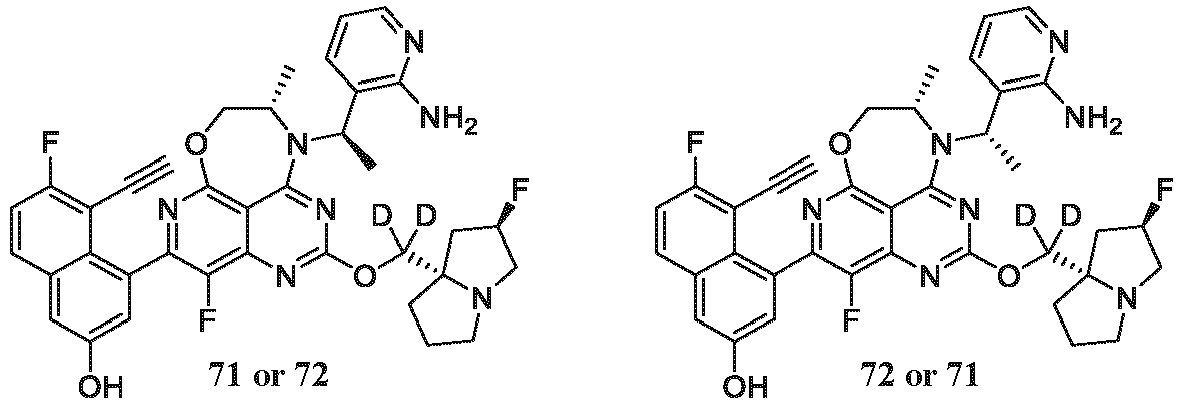

- Referring to the preparation of compound 65g in Example 65, compound 71a was prepared by replacing methanol with ((2R,7aS)-2-fluorotetrahydro-1H-pyrrolizin-7a(5H)-yl)methane-d 2-ol in step 2.
- Compound 71a was sequentially purified by preparative liquid phase chromatography (YMC C18 10 µm 50 × 250 chromatographic column; acetonitrile-0.1% ammonium hydroxide (gradient elution of 40%-80%/0-60 min)) to give compound 71 (Rt 40 min, LC-MS: m/z = 684.36 (M + H)+) and compound 72 (Rt 43 min, LC-MS: m/z = 684.37 (M + H)+).
- Compound 71: 1H-NMR (500 MHz, DMSO-d6 ), δ: 10.36-9.87 (m, 1H), 8.19-7.83 (m, 2H), 7.81-7.59 (m, 1H), 7.57-7.29 (m, 2H), 7.28-7.02 (m, 1H), 6.89-6.33 (m, 2H), 5.81-5.45 (m, 2H), 5.44-5.09 (m, 1H), 4.72-3.70 (m, 4H), 3.20-2.70 (m, 3H), 2.34-1.46 (m, 10H), 0.85-0.41 (m, 3H).
- Compound 72: 1H-NMR (500 MHz, DMSO-d6 ), δ: 10.23-10.11 (m, 1H), 8.06-7.91 (m, 2H), 7.74 (d, J = 7.4 Hz, 1H), 7.51-7.43 (m, 1H), 7.38 (d, J = 2.4 Hz, 1H), 7.23-7.11 (m, 1H), 6.76-6.67 (m, 1H), 6.54-6.37 (m, 1H), 5.87-5.62 (m, 2H), 5.61-5.37 (m, 1H), 4.50-4.31 (m, 1H), 4.14-3.83 (m, 3H), 3.79-2.96 (m, 4H), 2.47-2.15 (m,3H), 2.14-1.87 (m, 3H), 1.76-1.57 (m, 3H), 1.33-1.15 (m, 3H).
- The retention time in chiral chromatographic column of compound 71 is short compared to that of compound 72, and the retention time in chiral chromatographic column of compound 72 is long compared to that of compound 71.
-


- Referring to the preparation of compound 65g in Example 65, compound 73a was prepared by replacing methanol with (2S)-2-methoxy-1-propanol in step 2.
- Compound 73a was sequentially purified by preparative liquid phase chromatography (YMC TA C18 10 µm 30 × 250 chromatographic column; acetonitrile-0.05% aqueous trifluoroacetic acid solution (gradient elution of 20%-80%/0-40 min)) to give compound 73 (Rt 27.1 min, LC-MS: m/z = 613.31 (M + H)+) and compound 74 (Rt 29.3 min, LC-MS: m/z = 613.27 (M + H)+).
- The retention time in chiral chromatographic column of compound 73 is short compared to that of compound 74, and the retention time in chiral chromatographic column of compound 74 is long compared to that of compound 73.
-


- Referring to the preparation of compound 65g in Example 65, compound 75a was prepared by replacing methanol with (R)-2-methoxy-1-propanol in step 2.
- Compound 75a was sequentially purified by preparative liquid phase chromatography (YMC C18 10 µm 50 × 250 chromatographic column; acetonitrile-0.1% ammonium hydroxide (gradient elution of 40%-70%/0-60 min)) to give compound 75 (Rt 28 min, LC-MS: m/z = 613.33 (M + H)+) and compound 76 (Rt 31 min, LC-MS: m/z = 613.33 (M + H)+).
- Compound 75: 1H-NMR (500 MHz, DMSO-d6 ), δ: 10.19 (br, 1H), 8.05-7.91 (m, 2H), 7.71 (d, J = 7.0 Hz, 1H), 7.51-7.42 (m, 1H), 7.41-7.35 (m, 1H), 7.27-7.11 (m, 1H), 6.76-6.66 (m, 1H), 6.62-6.44 (m, 1H), 5.67-5.47 (m, 2H), 4.60-4.46 (m, 1H), 4.44-4.34 (m, 2H), 4.33-4.21 (m, 1H), 4.12-3.78 (m, 2H), 3.79-3.70 (m, 1H), 3.34 (s, 3H), 1.72-1.55 (m, 3H), 1.29-1.14 (m, 3H), 0.67-0.63 (m, 3H).
- Compound 76: 1H-NMR (500 MHz, DMSO-d6 ), δ: 10.20 (br, 1H), 8.09-7.89 (m, 2H), 7.74 (d, J = 7.4 Hz, 1H), 7.53-7.42 (m, 1H), 7.39 (d, J = 2.4 Hz, 1H), 7.26-7.14 (m, 1H), 6.77-6.65 (m, 1H), 6.62-6.41 (m, 1H), 5.78-5.52 (m, 2H), 4.46-4.28 (m, 3H), 4.14-3.83 (m, 3H), 3.79-3.68 (m, 1H), 3.33 (s, 3H), 1.75-1.58 (m, 3H), 1.32-1.14 (m, 6H).
- The retention time in chiral chromatographic column of compound 75 is short compared to that of compound 76, and the retention time in chiral chromatographic column of compound 76 is long compared to that of compound 75.
-


- Referring to the preparation of compound 65g in Example 65, compound 77a was prepared by replacing methanol with 2-methoxy-2-methylpropan-1-ol in step 2.
- Compound 77a was purified by preparative liquid phase chromatography (YMC C18 10 µm 50 × 250 chromatographic column; acetonitrile-30 mM ammonium acetate (gradient elution of 50%-80%/0-60 min)) and desalted with acetonitrile/0.1% formic acid to sequentially give compound 77 (Rt 21 min, LC-MS: m/z = 627.32 (M + H)+) and compound 78 (Rt 24 min, LC-MS: m/z = 627.33 (M + H)+).
- Compound 77: 1H-NMR (500 MHz, DMSO-d6 ), δ: 8.08-7.90 (m, 2H), 7.71 (d, J = 6.9 Hz, 1H), 7.54-7.32 (m, 2H), 7.27-7.09 (m, 1H), 6.78-6.41 (m, 2H), 5.72-5.48 (m, 2H), 4.63-4.43 (m, 1H), 4.39-3.76 (m, 6H), 3.19 (s, 3H), 1.73-1.51 (m, 3H), 1.31-1.18 (m, 6H), 0.70-0.48 (m, 3H).
- Compound 78: 1H-NMR (500 MHz, DMSO-d6 ), δ: 8.08-7.90 (m, 2H), 7.74 (d, J = 7.0 Hz, 1H), 7.54-7.33 (m, 2H), 7.28-7.10 (m, 1H), 6.84-6.64 (m, 1H), 6.63-6.39 (m, 1H), 5.80-5.50 (m, 2H), 4.45-3.80 (m, 7H), 3.20 (s, 3H), 1.77-1.59 (m, 3H), 1.33-1.18 (m, 9H).
- The retention time in chiral chromatographic column of compound 77 is short compared to that of compound 78, and the retention time in chiral chromatographic column of compound 77 is long compared to that of compound 78.
-
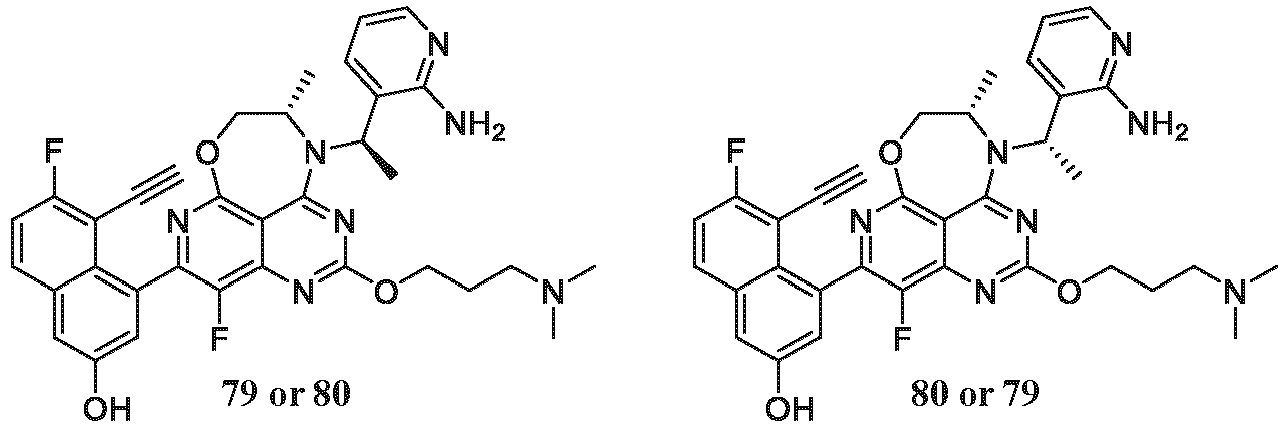

- Referring to the preparation of compound 65g in Example 65, compound 79a was prepared by replacing methanol with 3-dimethylamino-1-propanol in step 2.
- Compound 79a was sequentially purified by preparative liquid phase chromatography (YMC C18 10 µm 50 × 250 chromatographic column; acetonitrile-0.1% ammonium hydroxide (gradient elution of 50%-80%/0-60 min)) to give compound 79 (Rt 32 min, LC-MS: m/z = 626.36 (M + H)+) and compound 80 (Rt 36 min, LC-MS: m/z = 626.36 (M + H)+).
- Compound 79: 1H-NMR (500 MHz, DMSO-d6 ), δ: 10.18 (br, 1H), 8.07-7.88 (m, 2H), 7.71 (d, J = 7.4 Hz, 1H), 7.51-7.42 (m, 1H), 7.41-7.34 (m, 1H), 7.26-7.10 (m, 1H), 6.77-6.67 (m, 1H), 6.61-6.43 (m, 1H), 5.66-5.45 (m, 2H), 4.62-4.38 (m, 3H), 4.34-4.18 (m, 1H), 4.12-3.77 (m, 2H), 2.42-2.33 (m, 2H), 2.22-2.10 (m, 6H), 1.96-1.87 (m, 2H), 1.69-1.53 (m, 3H), 0.71-0.50 (m, 3H).
- Compound 80: 1H-NMR (500 MHz, DMSO-d6 ), δ: 10.17 (br, 1H), 8.07-7.90 (m, 2H), 7.73 (d, J = 7.4 Hz, 1H), 7.52-7.42 (m, 1H), 7.38 (d, J = 2.5 Hz, 1H), 7.24-7.13 (m, 1H), 6.77-6.63 (m, 1H), 6.58-6.40 (m, 1H), 5.75-5.51 (m, 2H), 4.49-4.25 (m, 3H), 4.13-3.80 (m, 3H), 2.45-2.35 (m, 2H), 2.17 (s, 6H), 1.97-1.85 (m, 2H), 1.70-1.58 (m, 3H), 1.27-1.17 (m, 3H).
- The retention time in chiral chromatographic column of compound 79 is short compared to that of compound 80, and the retention time in chiral chromatographic column of compound 80 is long compared to that of compound 79.
-


- Referring to the preparation of compound 47b in Example 47, compound 81a was prepared by replacing ((2-fluoro-8-(4,4,5,5-tetramethyl-1,3,2-dioxaborolan-2-yl)naphthalen-1-yl)ethynyl)triisopropylsilane with tert-butyl (3-cyano-7-fluoro-4-(4,4,5,5-tetramethyl-1,3,2-dioxaborolan-2-yl)benzo[b]thiophen-2-yl)carbamate in step 1. LC-MS: m/z = 788.41 (M + H)+.
- 81a (430 mg) was dispersed in dichloromethane (10 mL), and the mixture was cooled to 0 °C to 5 °C. Trifluoroacetic acid (4 mL) was added, and the resulting mixture was stirred for reaction for 2 h with the temperature maintained. After the reaction was completed, the reaction solution was concentrated under reduced pressure until no liquid flowed out. The residue was dissolved in dichloromethane (10 mL), and the pH of the system was adjusted to alkalinity with a saturated sodium bicarbonate solution under an ice bath. Water (50 mL) and dichloromethane (50 mL) were added, the mixture was stirred, and the phases were separated. Extraction was performed with dichloromethane (50 mL × 2), and the organic phases were combined, washed with saturated brine (100 mL), dried over anhydrous sodium sulfate, and filtered. The filtrate was concentrated until no liquid flowed out to give compound 81. LC-MS: m/z = 688.30 (M + H)+.
-

- Compound 81 was sequentially purified by preparative liquid phase chromatography (YMC C18 10 µm 50 × 250 chromatographic column; acetonitrile-0.1% ammonium hydroxide (gradient elution of 70%-90%/0-60 min)) to give compound 82 (Rt 23 min, LC-MS: m/z = 688.35 (M + H)+) and compound 83 (Rt 24 min, LC-MS: m/z = 688.30 (M + H)+).
- The retention time in chiral chromatographic column of compound 82 is short compared to that of compound 83, and the retention time in chiral chromatographic column of compound 83 is long compared to that of compound 82.
-


- Referring to the preparation of compound 47b in Example 47, compound 84a was prepared by replacing ((2-fluoro-8-(4,4,5,5-tetramethyl-1,3,2-dioxaborolan-2-yl)naphthalen-1-yl)ethynyl)triisopropylsilane with 6-fluoro-5-methyl-4-(4,4,5,5-tetramethyl-1,3,2-dioxaborolan-2-yl)-2-(triphenylmethyl)-2H-indazole (synthesized with reference to
WO2022173032A1 ) in step 1. LC-MS: m/z = 888.60 (M + H)+. - 84a (200 mg) was dispersed in methanol (10 mL). At room temperature, p-toluenesulfonic acid (10 mg) was added dropwise, and the mixture was stirred for reaction for 1 h. After the reaction was completed, the reaction solution was purified by preparative liquid phase chromatography (YMC C18 10 µm 50 × 250 chromatographic column: acetonitrile-0.1% ammonium hydroxide (gradient elution of 50%-90%/0-60 min)) to give compound 84. LC-MS: m/z = 646.48 (M + H)+.
-

- Compound 84 was sequentially purified by preparative liquid phase chromatography (YMC C18 10 µm 50 × 250 chromatographic column; acetonitrile-0.1% ammonium hydroxide (gradient elution of 50%-90%/0-60 min)) to give compound 85 (Rt 43 min, LC-MS: m/z = 646.48 (M + H)+) and compound 86 (Rt 47 min, LC-MS: m/z = 646.48 (M + H)+).
- Compound 85: 1H-NMR (500 MHz, DMSO-d6 ), δ: 13.18 (br, 1H), 8.00 (s, 1H), 7.86-7.60 (m, 2H), 7.56-7.33 (m, 1H), 6.88-6.40 (m, 2H), 5.83-5.48 (m, 2H), 5.46-5.15 (m, 1H), 4.68-4.47 (m, 1H), 4.46-3.90 (m, 4H), 3.19-2.97 (m, 3H), 2.92-2.73 (m, 1H), 2.31-1.95 (m, 6H), 1.94-1.72 (m, 3H), 1.71-1.50 (m, 3H), 0.77-0.48 (m, 3H).
- Compound 86: 1H-NMR (500 MHz, DMSO-d6 ), δ: 13.18 (br, 1H), 8.09-7.95 (m, 1H), 7.87-7.66 (m, 2H), 7.54-7.40 (m, 1H), 6.80-6.68 (m, 1H), 6.58-6.43 (m, 1H), 5.80-5.49 (m, 2H), 5.44-5.17 (m, 1H), 4.46-4.33 (m, 1H), 4.30-4.19 (m, 1H), 4.14-4.03 (m, 1H), 4.02-3.85 (m, 2H), 3.16-2.99 (m, 3H), 2.91-2.77 (m, 1H), 2.26-1.94 (m, 6H), 1.92-1.73 (m, 3H), 1.72-1.56 (m, 3H), 1.33-1.15 (m, 3H).
- The retention time in chiral chromatographic column of compound 85 is short compared to that of compound 86, and the retention time in chiral chromatographic column of compound 86 is long compared to that of compound 85.
-


- Referring to the preparation of compound 65d in Example 65, compound 87a was prepared by replacing methanol with N-methyl-L-prolinol in step 2. LC-MS: m/z = 488.23 (M + H)+.
- 87a (132 mg), ((2-fluoro-8-(4,4,5,5-tetramethyl-1,3,2-dioxaborolan-2-yl)naphthalen-1-yl)ethynyl)triisopropylsilane (244 mg), chloro[4-(di-tert-butylphosphino)-N,N-dimethylaniline-2-(2'-aminobiphenyl)]palladium(II) (31 mg), potassium phosphate (171 mg), and water (3 mL) were dispersed in 1,4-dioxane (15 mL), and under a nitrogen atmosphere, the mixture was heated to 90 °C and stirred for reaction for 2 h. The reaction solution was cooled to room temperature and filtered, and the filtrate was concentrated to dryness under reduced pressure and purified by column chromatography (ethyl acetate:petroleum ether = 1:10 to 1:2) to give compound 87b. LC-MS: m/z = 778.59 (M + H)+.
- 87b (130 mg) and cesium fluoride (253 mg) were dispersed in DMF (13 mL), and the mixture was stirred for reaction at room temperature for 2 h. Water (50 mL) and ethyl acetate (80 mL) were added to the reaction solution, the mixture was stirred, and the phases were separated. The aqueous phase was extracted with ethyl acetate (50 mL × 2), and the organic phases were combined, washed with 5% brine (80 mL × 3), dried over anhydrous sodium sulfate, and filtered. The filtrate was concentrated until no liquid flowed out to give compound 87c. LC-MS: m/z = 622.37 (M + H)+.
- Compound 87c was sequentially purified by preparative liquid phase chromatography (YMC C18 10 µm 50 × 250 chromatographic column; acetonitrile-0.1% ammonium hydroxide (gradient elution of 50%-80%/0-60 min)) to give compound 87 (Rt 32 min, LC-MS: m/z = 622.37 (M + H)+) and compound 88 (Rt 35 min, LC-MS: m/z = 622.37 (M + H)+).
- Compound 87: 1H-NMR (500 MHz, DMSO-d6 ), δ: 8.27-8.12 (m, 2H), 8.05-7.95 (m, 1H), 7.78-7.50 (m, 4H), 6.75-6.65 (m, 1H), 6.61-6.43 (m, 1H), 5.69-5.44 (m, 2H), 4.61-4.38 (m, 2H), 4.34-3.81 (m, 4H), 3.04-2.92 (m, 1H), 2.72-2.58 (m, 1H), 2.38 (s, 3H), 2.28-2.16 (m, 1H), 2.05-1.91 (m, 1H), 1.79-1.54 (m, 6H), 0.70-0.48 (m, 3H).
- Compound 88: 1H-NMR (500 MHz, DMSO-d6 ), δ: 8.44-8.09 (m, 2H), 7.99 (s, 1H), 7.89-7.36 (m, 4H), 6.87-6.40 (m, 2H), 5.64 (s, 2H), 4.70-3.66 (m, 6H), 3.07-2.86 (m, 1H), 2.73-2.56 (m, 1H), 2.37 (s, 3H), 2.28-2.12 (m, 1H), 2.08-1.89 (m, 1H), 1.83-1.52 (m, 6H), 1.36-1.01 (m, 3H).
- The retention time in chiral chromatographic column of compound 87 is short compared to that of compound 88, and the retention time in chiral chromatographic column of compound 88 is long compared to that of compound 87.
-


- 65b (600 mg) and ethanol (10 mL) were dispersed in dichloromethane (10 mL), and the mixture was cooled to 0 °C. Sodium borohydride (65 mg) was added slowly, and the resulting mixture was allowed to be stirred for reaction at room temperature for 1 h. After the reaction was completed, a saturated ammonium chloride solution (20 mL) was added to the reaction system to quench the reaction, and water (50 mL) and ethyl acetate (80 mL) were added. The mixture was stirred, and the phases were separated. Extraction was performed with ethyl acetate (80 mL × 2), and the organic phases were combined, washed with 5% brine (80 mL), dried over anhydrous sodium sulfate, and filtered. The filtrate was concentrated until no liquid flowed out to give compound 89a. LC-MS: m/z = 615.30 (M + H)+.
- 89a (420 mg) was dispersed in trifluoroacetic acid (10 mL), and the mixture was cooled to 0 °C. Methanesulfonic acid (1 mL) was added dropwise, and the resulting mixture was allowed to be stirred for reaction at room temperature for 2 h. After the reaction was completed, the reaction solution was concentrated under reduced pressure until no liquid flowed out. The residue was dissolved in dichloromethane (10 mL), and the pH of the system was adjusted to alkalinity with a saturated sodium bicarbonate solution under an ice bath. Water (50 mL) and dichloromethane (50 mL) were added, the mixture was stirred, and the phases were separated. Extraction was performed with dichloromethane (50 mL × 2), and the organic phases were combined, washed with saturated brine (100 mL), dried over anhydrous sodium sulfate, and filtered. The filtrate was concentrated until no liquid flowed out to give compound 89b. LC-MS: m/z = 375.25 (M + H)+.
- 89b (180 mg), 10g (492 mg), chloro[4-(di-tert-butylphosphino)-N,N-dimethylaniline-2-(2'-aminobiphenyl)]palladium(II) (55 mg), potassium phosphate (305 mg), and water (3 mL) were dispersed in 1,4-dioxane (15 mL), and under a nitrogen atmosphere, the mixture was heated to 90 °C and stirred for reaction for 3 h. The reaction solution was cooled to room temperature and filtered, and the filtrate was concentrated to dryness under reduced pressure and purified by column chromatography (methanol:dichloromethane = 1:200 to 1:100) to give compound 89c. LC-MS: m/z = 725.35 (M + H)+.
- 89c (220 mg) and cesium fluoride (592 mg) were dispersed in DMF (5 mL), and the mixture was stirred for reaction at room temperature for 2 h. Water (50 mL) and ethyl acetate (80 mL) were added to the reaction solution, the mixture was stirred, and the phases were separated. The aqueous phase was extracted with ethyl acetate (50 mL × 2), and the organic phases were combined, washed with 5% brine (80 mL × 3), dried over anhydrous sodium sulfate, and filtered. The filtrate was concentrated until no liquid flowed out to give compound 89d. LC-MS: m/z = 569.25 (M + H)+.
- 89d (220 mg) was dispersed in dichloromethane (5 mL), and the reaction system was cooled to 0 °C to 5 °C. A solution of hydrogen chloride in 1,4-dioxane (4 N, 1 mL) was added dropwise to the reaction system, and the resulting mixture was stirred for reaction for 1 h with the temperature maintained. After the reaction was completed, the reaction solution was concentrated under reduced pressure until no liquid flowed out to give compound 89e. LC-MS: m/z = 525.20 (M + H)+.
- Compound 89e was sequentially purified by preparative liquid phase chromatography (YMC C18 10 µm 50 × 250 chromatographic column; acetonitrile-0.1% ammonium hydroxide (gradient elution of 55%-85%/0-60 min)) to give compound 89 (Rt 21 min, LC-MS: m/z = 525.20 (M + H)+) and compound 90 (Rt 24 min, LC-MS: m/z = 525.22 (M + H)+).
- Compound 89: 1H-NMR (500 MHz, DMSO-d6 ), δ: 10.24-10.00 (m, 1H), 8.77-8.71 (m, 1H), 8.03-7.94 (m, 2H), 7.76-7.70 (m, 1H), 7.50-7.43 (m, 1H), 7.41-7.36 (m, 1H), 7.25-7.13 (m, 1H), 6.74-6.60 (m, 2H), 5.64-5.45 (m, 2H), 4.60-4.50 (m, 1H), 4.39-4.24 (m, 1H), 4.12-4.04 (m, 1H), 4.03-3.81(m, 1H), 1.69-1.55 (m, 3H), 0.67-0.52 (m, 3H).
- Compound 90: 1H-NMR (500 MHz, DMSO-d6 ), δ: 10.13 (br, 1H), 8.73 (s, 2H), 8.04-7.93 (m, 2H), 7.79-7.72 (m, 1H), 7.50-7.42 (m, 1H), 7.38 (d, J = 2.5 Hz, 1H), 7.24-7.14 (m, 1H), 6.75-6.60 (m, 2H), 5.70-5.58 (m, 1H), 4.43-4.29 (m, 1H), 4.06-3.80 (m, 3H), 1.72-1.59 (m, 3H), 1.28-1.16 (m, 3H).
- The retention time in chiral chromatographic column of compound 89 is short compared to that of compound 90, and the retention time in chiral chromatographic column of compound 90 is long compared to that of compound 89.
-


- Referring to the preparation of compound 65g in Example 65, compound 91a was prepared by replacing methanol with (R)-(4-methylmorpholin-3-yl)methanol in step 2.
- Compound 91a was sequentially purified by preparative liquid phase chromatography (YMC C18 10 µm 50 × 250 chromatographic column; acetonitrile-0.1% ammonium hydroxide (gradient elution of 40%-70%/0-60 min)) to give compound 91 (Rt 28 min, LC-MS: m/z = 654.34 (M + H)+) and compound 92 (Rt 30 min, LC-MS: m/z = 654.35 (M + H)+).
- The retention time in chiral chromatographic column of compound 91 is short compared to that of compound 92, and the retention time in chiral chromatographic column of compound 92 is long compared to that of compound 91.
-


- Referring to the preparation of compound 65g in Example 65, compound 93a was prepared by replacing methanol with 1-methyl-1H-imidazole-2-methanol in step 2.
- Compound 93a was sequentially purified by preparative liquid phase chromatography (YMC C18 10 µm 50 × 250 chromatographic column; acetonitrile-0.1% ammonium hydroxide (gradient elution of 35%-65%/0-60 min)) to give compound 93 (Rt 26 min, LC-MS: m/z = 635.35 (M + H)+) and compound 94 (Rt 30 min, LC-MS: m/z = 635.33 (M + H)+).
- The retention time in chiral chromatographic column of compound 93 is short compared to that of compound 94, and the retention time in chiral chromatographic column of compound 94 is long compared to that of compound 93.
-


- Referring to the preparation of compound 65g in Example 65, compound 95a was prepared by replacing methanol with N,N-dimethylethanolamine in step 2.
- Compound 95a was sequentially purified by preparative liquid phase chromatography (YMC C18 10 µm 50 × 250 chromatographic column; acetonitrile-0.1% ammonium hydroxide (gradient elution of 40%-70%/0-60 min)) to give compound 95 (Rt 25 min, LC-MS: m/z = 612.34 (M + H)+) and compound 96 (Rt 28 min, LC-MS: m/z = 612.34 (M + H)+).
- The retention time in chiral chromatographic column of compound 95 is short compared to that of compound 96, and the retention time in chiral chromatographic column of compound 96 is long compared to that of compound 95.
-


- Referring to the preparation of compound 65g in Example 65, compound 97a was prepared by replacing methanol with (hexahydro-1H-pyrrolizin-7a-yl)methanol in step 2.
- Compound 97a was sequentially purified by preparative liquid phase chromatography (YMC C18 10 µm 50 × 250 chromatographic column; acetonitrile-0.1% ammonium hydroxide (gradient elution of 50%-70%-90%/0-20-60 min)) to give compound 97 (Rt 33 min, LC-MS: m/z = 664.36 (M + H)+) and compound 98 (Rt 36 min, LC-MS: m/z = 664.36 (M + H)+).
- The retention time in chiral chromatographic column of compound 97 is short compared to that of compound 98, and the retention time in chiral chromatographic column of compound 98 is long compared to that of compound 97.
-


- Referring to the preparation of compound 65g in Example 65, compound 99a was prepared by replacing methanol with 1-(tert-butoxycarbonylamino)cyclopropylmethanol in step 2.
- Compound 99a was sequentially purified by preparative liquid phase chromatography (YMC C18 10 µm 50 × 250 chromatographic column; acetonitrile-0.1% ammonium hydroxide (gradient elution of 40%-90%/0-60 min)) to give compound 99 (Rt 34 min, LC-MS: m/z = 610.32 (M + H)+) and compound 100 (Rt 39 min, LC-MS: m/z = 610.32 (M + H)+).
- The retention time in chiral chromatographic column of compound 99 is short compared to that of compound 100, and the retention time in chiral chromatographic column of compound 100 is long compared to that of compound 99.
-


- Referring to the preparation of compound 65g in Example 65, compound 101a was prepared by replacing methanol with (R)-(1-methylpyrrolidin-3-yl)methanol in step 2.
- Compound 101a was sequentially purified by preparative liquid phase chromatography (YMC C18 10 µm 50 × 250 chromatographic column; methanol-0.1% ammonium hydroxide (gradient elution of 40%-70%/0-60 min)) to give compound 101 (Rt 54 min, LC-MS: m/z = 638.37 (M + H)+) and compound 102 (Rt 58 min, LC-MS: m/z = 638.40 (M + H)+).
- The retention time in chiral chromatographic column of compound 101 is short compared to that of compound 102, and the retention time in chiral chromatographic column of compound 102 is long compared to that of compound 101.
-


- Referring to the preparation of compound 65g in Example 65, compound 103a was prepared by replacing methanol with (3S)-1-methylpyrrolidin-3-ol in step 2.
- Compound 103a was sequentially purified by preparative liquid phase chromatography (YMC TA C18 10 µm 30 × 250 chromatographic column; methanol-0.1% aqueous ammonium hydroxide solution (gradient elution of 40%-100%/0-60 min)) to give compound 103 (Rt 28.0 min, LC-MS: m/z = 624.36 (M + H)+) and compound 104 (Rt 29.9 min, LC-MS: m/z = 624.36 (M + H)+).
- The retention time in chiral chromatographic column of compound 103 is short compared to that of compound 104, and the retention time in chiral chromatographic column of compound 104 is long compared to that of compound 103.
-

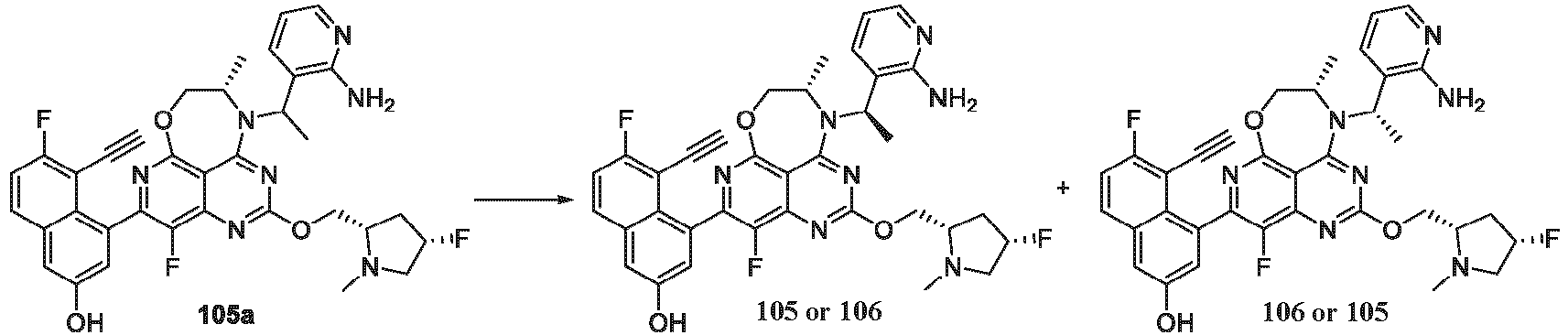
- Referring to the preparation of compound 65g in Example 65, compound 105a was prepared by replacing methanol with ((2S,4S)-4-fluoro-1-methylpyrrolidin-2-yl)methanol in step 2.
- Compound 105a was sequentially purified by preparative liquid phase chromatography (YMC TA C18 10 µm 50 × 250 chromatographic column; methanol-0.1% aqueous ammonium hydroxide solution (gradient elution of 40%-70%/0-60 min)) to give compound 105 (Rt 37.2 min, LC-MS: m/z = 656.33 (M + H)+) and compound 106 (Rt 47.1 min, LC-MS: m/z = 656.33 (M + H)+).
- The retention time in chiral chromatographic column of compound 105 is short compared to that of compound 106, and the retention time in chiral chromatographic column of compound 106 is long compared to that of compound 105.
-


- Referring to the preparation of compound 65g in Example 65, compound 107a was prepared by replacing methanol with (S)-1-((S)-1-methylpyrrolidin-2-yl)ethanol in step 2.
- Compound 107a was sequentially purified by preparative liquid phase chromatography (YMC TA C18 10 µm 30 × 250 chromatographic column; methanol-0.1% aqueous ammonium hydroxide solution (gradient elution of 40%-100%/0-60 min)) to give compound 107 (Rt 31.8 min, LC-MS: m/z = 652.36 (M + H)+) and compound 108 (Rt 34.8 min, LC-MS: m/z = 652.36 (M + H)+).
- The retention time in chiral chromatographic column of compound 107 is short compared to that of compound 108, and the retention time in chiral chromatographic column of compound 108 is long compared to that of compound 107.
-


- Referring to the preparation of compound 65g in Example 65, compound 109a was prepared by replacing methanol with (S)-(1,4-dimethylpiperazin-2-yl)methanol in step 2.
- Compound 109a was sequentially purified by preparative liquid phase chromatography (YMC TA C18 10 µm 50 × 250 chromatographic column; methanol-0.1% aqueous ammonium hydroxide solution (gradient elution of 40%-90%/0-60 min)) to give compound 109 (Rt 32.4 min, LC-MS: m/z = 667.35 (M + H)+) and compound 110 (Rt 37.1 min, LC-MS: m/z = 667.35 (M + H)+).
- The retention time in chiral chromatographic column of compound 109 is short compared to that of compound 110, and the retention time in chiral chromatographic column of compound 110 is long compared to that of compound 109.
-


- Referring to the preparation of compound 65g in Example 65, compound 111a was prepared by replacing methanol with (S)-2-(dimethylamino)propanol in step 2.
- Compound 111a was sequentially purified by preparative liquid phase chromatography (YMC TA C18 10 µm 30 × 250 chromatographic column; methanol-0.1% aqueous ammonium hydroxide solution (gradient elution of 40%-100%/0-60 min)) to give compound 111 (Rt 25.0 min, LC-MS: m/z = 626.43 (M + H)+) and compound 112 (Rt 27.1 min, LC-MS: m/z = 626.43 (M + H)+).
- Compound 111: 1H-NMR (500 MHz, DMSO-d6 ), δ: 8.07-7.91 (m, 2H), 7.71 (d, J = 7.4 Hz, 1H), 7.50-7.41 (m, 1H), 7.40-7.34 (m, 1H), 7.25-7.10 (m, 1H), 6.75-6.67 (m, 1H), 6.60-6.44 (m, 1H), 5.64-5.47 (m, 2H), 4.60-4.43 (m, 2H), 4.35-3.76 (m, 5H), 3.02-2.93 (m, 1H), 2.24 (s, 6H), 1.68-1.57 (m, 3H), 1.09-1.00 (m, 3H), 0.66-0.52 (m, 3H).
- Compound 112: 1H-NMR (500 MHz, DMSO-d6 ), δ: 8.06-7.88 (m, 2H), 7.78-7.69 (m, 1H), 7.50-7.42 (m, 1H), 7.37 (d, J= 2.5 Hz, 1H), 7.23-7.12 (m, 1H), 6.75-6.67 (m, 1H), 6.59-6.41 (m, 1H), 5.71-5.55 (m, 2H), 4.55-4.17 (m, 3H), 4.11-3.81 (m, 4H), 3.01-2.91 (m, 1H), 2.24 (s, 6H), 1.70-1.60 (m, 3H), 1.26-1.21 (m, 3H), 1.07-1.00 (m, 3H).
- The retention time in chiral chromatographic column of compound 111 is short compared to that of compound 112, and the retention time in chiral chromatographic column of compound 112 is long compared to that of compound 111.
-


- Referring to the preparation of compound 65f in Example 65, compound 113a was prepared by replacing methanol with ((2R,7aS)-2-fluorotetrahydro-1H-pyrrolizin-7a(5H)-yl)methane-d2-ol in step 2 and replacing 10g with ((2-fluoro-8-(4,4,5,5-tetramethyl-1,3,2-dioxaborolan-2-yl)naphthalen-1-yl)ethynyl)triisopropylsilane in step 4.
- Compound 113a was sequentially purified by preparative liquid phase chromatography (YMC TA C18 10 µm 50 × 250 chromatographic column; methanol-0.1% aqueous ammonium hydroxide solution (gradient elution of 60%-90%/0-60 min)) to give compound 113 (Rt 35.1 min, LC-MS: m/z = 668.39 (M + H)+) and compound 114 (Rt 37.1 min, LC-MS: m/z = 668.35 (M + H)+).
- Compound 113: 1H-NMR (500 MHz, DMSO-d6 ), δ: 8.39-8.12 (m, 2H), 8.09-7.92 (m, 1H), 7.81-7.51 (m, 4H), 6.80-6.64 (m, 1H), 6.62-6.38 (m, 1H), 5.73-5.52 (m, 2H), 5.43-5.16 (m, 1H), 4.69-4.42 (m, 1H), 4.38-4.20 (m, 1H), 4.19-3.84 (m, 2H), 3.16-2.96 (m, 3H), 2.92-2.76 (m, 1H), 2.25-1.96 (m, 3H), 1.92-1.71 (m, 3H), 1.70-1.53 (m, 3H), 0.71-0.47 (m, 3H).
- Compound 114: 1H-NMR (500 MHz, DMSO-d6 ), δ: 8.32-8.09 (m, 2H), 8.08-7.94 (m, 1H), 7.82-7.50 (m, 4H), 6.80-6.63 (m, 1H), 6.62-6.35 (m, 1H), 5.83-5.53 (m, 2H), 5.45-5.17 (m, 1H), 4.44-4.27 (m, 1H), 4.21-3.78 (m, 3H), 3.18-2.99 (m, 3H), 2.92-2.75 (m, 1H), 2.22-1.96 (m, 3H), 1.92-1.72 (m, 3H), 1.72-1.57 (m, 3H), 1.32-1.15 (m, 3H).
- The retention time in chiral chromatographic column of compound 113 is short compared to that of compound 114, and the retention time in chiral chromatographic column of compound 114 is long compared to that of compound 113.
-

- Referring to the preparation of compound 47b in Example 47, compound 115 was prepared by replacing ((2-fluoro-8-(4,4,5,5-tetramethyl-1,3,2-dioxaborolan-2-yl)naphthalen-1-yl)ethynyl)triisopropylsilane with 2-(8-chloronaphthalen-1-yl)-4,4,5,5-tetramethyl-1,3,2-dioxaborolane in step 1. LC-MS: m/z = 658.32 (M + H)+.
-


- Referring to the preparation of compound 47b in Example 47, compound 116a was prepared by replacing ((2-fluoro-8-(4,4,5,5-tetramethyl-1,3,2-dioxaborolan-2-yl)naphthalen-1-yl)ethynyl)triisopropylsilane with (2-amino-7-fluorobenzo[d]thiazol-4-yl)boronic acid in step 1.
- Compound 116a was sequentially purified by preparative liquid phase chromatography (YMC C18 10 µm 50 × 250 chromatographic column; acetonitrile-0.1% ammonium hydroxide (gradient elution of 50%-70%-90%/0-20-60 min)) to give compound 116 (Rt 41 min, LC-MS: m/z = 664.34 (M + H)+) and compound 117 (Rt 44 min, LC-MS: m/z = 664.33 (M + H)+).
- The retention time in chiral chromatographic column of compound 116 is short compared to that of compound 117, and the retention time in chiral chromatographic column of compound 117 is long compared to that of compound 116.
-


- Referring to the preparation of compound 47b in Example 47, compound 118a was prepared by replacing ((2-fluoro-8-(4,4,5,5-tetramethyl-1,3,2-dioxaborolan-2-yl)naphthalen-1-yl)ethynyl)triisopropylsilane with 4-(4,4,5,5-tetramethyl-1,3,2-dioxaborolan-2-yl)naphthalen-2-ol in step 1.
- Compound 118a was sequentially purified by preparative liquid phase chromatography (YMC C18 10 µm 50 × 250 chromatographic column; acetonitrile-0.1% ammonium hydroxide (gradient elution of 50%-70%-90%/0-20-60 min)) to give compound 118 (Rt 34 min, LC-MS: m/z = 640.40 (M + H)+) and compound 119 (Rt 39 min, LC-MS: m/z = 640.41 (M + H)+).
- The retention time in chiral chromatographic column of compound 118 is short compared to that of compound 119, and the retention time in chiral chromatographic column of compound 119 is long compared to that of compound 118.
-


- Referring to the preparation of compound 47b in Example 47, compound 120a was prepared by replacing ((2-fluoro-8-(4,4,5,5-tetramethyl-1,3,2-dioxaborolan-2-yl)naphthalen-1-yl)ethynyl)triisopropylsilane with 2-(7,8-difluoronaphthalen-1-yl)-4,4,5,5-tetramethyl-1,3,2-dioxaborolane in step 1.
- Compound 120a was sequentially purified by preparative liquid phase chromatography (YMC C18 10 µm 50 × 250 chromatographic column; acetonitrile-0.1% ammonium hydroxide (gradient elution of 50%-70%-90%/0-20-60 min)) to give compound 120 (Rt 43 min, LC-MS: m/z = 660.35 (M + H)+) and compound 121 (Rt 47 min, LC-MS: m/z = 660.35 (M + H)+).
- Compound 120: 1H-NMR (500 MHz, DMSO-d6 ), δ: 8.31-8.11 (m, 1H), 8.10-7.90 (m, 2H), 7.90-7.43 (m, 4H), 6.98-6.34 (m, 2H), 5.88-5.50 (m, 2H), 5.46-5.15 (m, 1H), 4.81-3.86 (m, 5H), 3.24-2.74 (m, 4H), 2.26-1.51 (m, 9H), 0.78-0.40 (m, 3H).
- Compound 121: 1H-NMR (500 MHz, DMSO-d6 ), δ: 8.30-7.90 (m, 3H), 7.89-7.44 (m, 4H), 6.79-6.42 (m, 2H), 5.76-5.50 (m, 2H), 5.44-5.16 (m, 1H), 4.49-3.84 (m, 5H), 3.20-2.73 (m,4H), 2.27-1.54 (m, 9H), 1.36-1.11 (m, 3H).
- The retention time in chiral chromatographic column of compound 120 is short compared to that of compound 121, and the retention time in chiral chromatographic column of compound 121 is long compared to that of compound 120.
-

- Compound 47 (30 mg) and Pd/C (10%, 24 mg) were dispersed in methanol (6 mL), and the mixture was purged with hydrogen three times and stirred for reaction at room temperature overnight under a hydrogen atmosphere. After the reaction was completed, filtration was performed, and the reaction solution was purified by preparative liquid phase chromatography (YMC C18 10 µm 50 × 250 chromatographic column: acetonitrile-0.1% aqueous formic acid solution (gradient elution of 5%-35%/0-60 min)) to give compound 122. LC-MS: m/z = 670.38 (M + H)+.
- Referring to the preparation of compound 122, compound 123 was prepared by replacing compound 47 with compound 48. LC-MS: m/z = 670.38 (M + H)+.
- All chiral carbon atom configurations of compound 122 are identical to those of compound 47. All chiral carbon atom configurations of compound 123 are identical to those of compound 48.
-


- Referring to the preparation of compound 47b in Example 47, compound 124a was prepared by replacing ((2-fluoro-8-(4,4,5,5-tetramethyl-1,3,2-dioxaborolan-2-yl)naphthalen-1-yl)ethynyl)triisopropylsilane with 2-(8-chloro-7-fluoronaphthalen-1-yl)-4,4,5,5-tetramethyl-1,3,2-dioxaborolane in step 1.
- Compound 124a was purified by preparative liquid phase chromatography (YMC-TA-C18, 10 µm, 50 × 250 chromatographic column; methanol-0.1% aqueous ammonium hydroxide solution (gradient elution of 40%-100%/0-50 min)) to give compound 125 (Rt 39 min, LC-MS: m/z = 676.30 (M + H)+) and purified by preparative liquid phase chromatography (YMC-TA-C18, 10 µm, 50 × 250 chromatographic column; methanol-0.1% aqueous ammonium hydroxide solution (gradient elution of 50%-100%/0-40 min)) to give compound 124 (Rt 28 min, LC-MS: m/z = 676.32 (M + H)+).
-


- Referring to the preparation of compound 47b in Example 47, compound 126a was prepared by replacing ((2-fluoro-8-(4,4,5,5-tetramethyl-1,3,2-dioxaborolan-2-yl)naphthalen-1-yl)ethynyl)triisopropylsilane with (2-(dimethylamino)-3-fluorophenyl)boronic acid in step 1.
- Compound 126a was purified by preparative liquid phase chromatography (YMC-AQ-C18, 10 µm, 50 × 250 chromatographic column; acetonitrile-0.1% aqueous TFA solution (gradient elution of 10%-70%/0-60 min)) to give compound 126 (Rt 22 min, LC-MS: m/z = 635.40 (M + H)+) and purified by preparative liquid phase chromatography (YMC-AQ-C18, 10 µm, 50 × 250 chromatographic column; methanol-0.1% aqueous TFA solution (gradient elution of 10%-70%/0-60 min)) to give compound 127 (Rt 43 min, LC-MS: m/z = 635.40 (M + H)+).
-


- Referring to the preparation of compound 47b in Example 47, compound 128a was prepared by replacing ((2-fluoro-8-(4,4,5,5-tetramethyl-1,3,2-dioxaborolan-2-yl)naphthalen-1-yl)ethynyl)triisopropylsilane with (2-(dimethylamino)-3-methylphenyl)boronic acid in step 1.
- Compound 128a was sequentially purified by preparative liquid phase chromatography (YMC TA C18 10 µm 30 × 250 chromatographic column; methanol-0.1% aqueous ammonium hydroxide solution (gradient elution of 40%-100%/0-60 min)) to give compound 128 (Rt 29.5 min, LC-MS: m/z = 631.45 (M + H)+) and compound 129 (Rt 33.4 min, LC-MS: m/z = 631.46 (M + H)+).
- The retention time in chiral chromatographic column of compound 128 is short compared to that of compound 129, and the retention time in chiral chromatographic column of compound 129 is long compared to that of compound 128.
-


- Referring to the preparation of compound 47c in Example 47, compound 130a was prepared by replacing ((2-fluoro-8-(4,4,5,5-tetramethyl-1,3,2-dioxaborolan-2-yl)naphthalen-1-yl)ethynyl)triisopropylsilane with triisopropyl((8-(4,4,5,5-tetramethyl-1,3,2-dioxaborolan-2-yl)naphthalen-1-yl)ethynyl)silane in step 1.
- Compound 130a was sequentially purified by preparative liquid phase chromatography (YMC TA C18 10 µm 30 × 250 chromatographic column; methanol-0.1% aqueous formic acid solution (gradient elution of 20%-80%/0-60 min)) to give compound 130 (Rt 16.9 min, LC-MS: m/z = 648.36 (M + H)+) and compound 131 (Rt 18.0 min, LC-MS: m/z = 648.36 (M + H)+).
- The retention time in chiral chromatographic column of compound 130 is short compared to that of compound 131, and the retention time in chiral chromatographic column of compound 131 is long compared to that of compound 130.
-


- Referring to the preparation of compound 65g in Example 65, compound 132a was prepared by replacing methanol with 3-(1-pyrrolidinyl)-1-propanol in step 2.
- Compound 132a was purified by preparative liquid phase chromatography (Novasep C18 250 × 50 mm,10 µm chromatographic column; methanol-0.1% aqueous ammonium hydroxide solution (gradient elution of 40%-90%/0-60 min)) and then purified by preparative liquid phase chromatography (Novasep C18 250 × 50 mm,10 µm chromatographic column; acetonitrile-0.1% aqueous acetic acid solution (gradient elution of 15%-45%/0-60 min)) to give compound 132 (Rt 40 min, LC-MS: m/z = 652.37 (M + H)+) and compound 133 (Rt 38 min, LC-MS: m/z = 652.36 (M + H)+).
- The retention time in chiral chromatographic column of compound 133 is short compared to that of compound 132, and the retention time in chiral chromatographic column of compound 132 is long compared to that of compound 133.
-
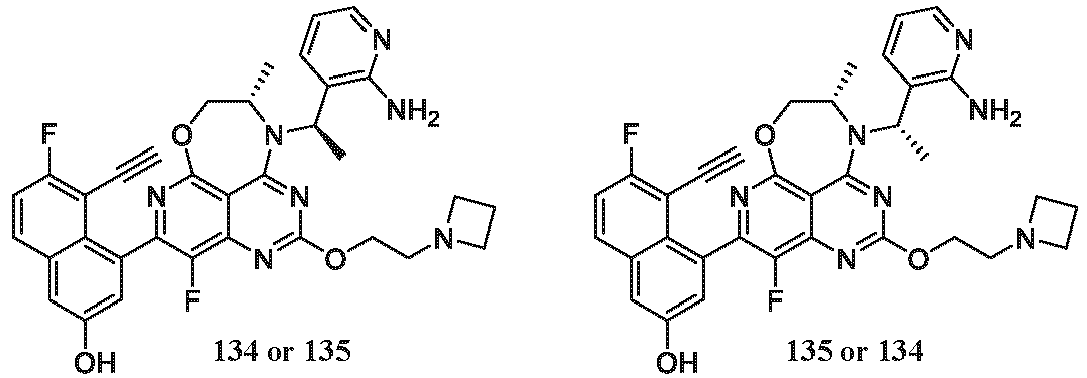

- Referring to the preparation of compound 65g in Example 65, compound 134a was prepared by replacing methanol with 2-(azetidin-1-yl)ethanol in step 2.
- Compound 134a was sequentially purified by preparative liquid phase chromatography (YMC TA C18 10 µm 50 × 250 chromatographic column; methanol-0.1% aqueous ammonium hydroxide solution (gradient elution of 40%-60%-90%/0-15-60 min)) to give compound 134 (Rt 31.56 min, LC-MS: m/z = 624.33 (M + H)+) and compound 135 (Rt 35.48 min, LC-MS: m/z = 624.33 (M + H)+).
- The retention time in chiral chromatographic column of compound 134 is short compared to that of compound 135, and the retention time in chiral chromatographic column of compound 135 is long compared to that of compound 134.
-
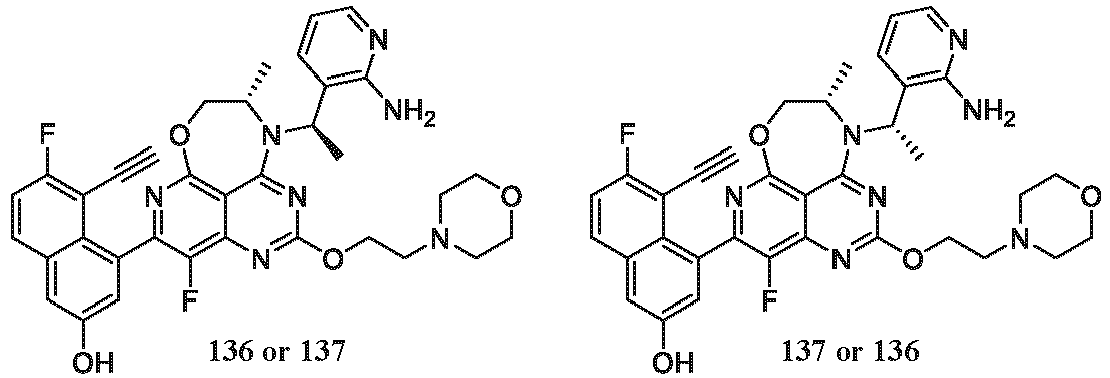

- Referring to the preparation of compound 65g in Example 65, compound 136a was prepared by replacing methanol with 2-morpholinoethanol in step 2.
- Compound 136a was sequentially purified by preparative liquid phase chromatography (YMC TA C18 10 µm 30 × 250 chromatographic column; methanol-0.1% aqueous ammonium hydroxide solution (gradient elution of 30%-90%/0-60 min)) to give compound 136 (Rt 29 min, LC-MS: m/z = 654.34 (M + H)+) and compound 137 (Rt 33 min, LC-MS: m/z = 654.34 (M + H)+).
- The retention time in chiral chromatographic column of compound 136 is short compared to that of compound 137, and the retention time in chiral chromatographic column of compound 137 is long compared to that of compound 136.
-


- Referring to the preparation of compound 65g in Example 65, compound 138a was prepared by replacing methanol with 1-(2-hydroxyethyl)pyrrolidine in step 2.
- Compound 138a was sequentially purified by preparative liquid phase chromatography (YMC TA C18 10 µm 50 × 250 chromatographic column; methanol-0.1% aqueous ammonium hydroxide solution (gradient elution of 50%-80%/0-60 min)) to give compound 138 (Rt 26.21 min, LC-MS: m/z = 638.38 (M + H)+) and compound 139 (Rt 38.27 min, LC-MS: m/z = 638.39 (M + H)+).
- The retention time in chiral chromatographic column of compound 138 is short compared to that of compound 139, and the retention time in chiral chromatographic column of compound 139 is long compared to that of compound 138.
-


- Referring to the preparation of compound 65g in Example 65, compound 140a was prepared by replacing methanol with 1-tert-butoxycarbonyl-4-(3-hydroxypropyl)piperazine in step 2.
- Compound 140a was sequentially purified by preparative liquid phase chromatography (YMC TA C18 10 µm 50 × 250 chromatographic column; methanol-0.1% aqueous ammonium hydroxide solution (gradient elution of 35%-65%-65%/0-60-70 min)) to give compound 140 (Rt 56.35 min, LC-MS: m/z = 667.38 (M + H)+) and compound 141 (Rt 62.30 min, LC-MS: m/z = 667.36 (M + H)+).
- The retention time in chiral chromatographic column of compound 140 is short compared to that of compound 141, and the retention time in chiral chromatographic column of compound 141 is long compared to that of compound 140.
-


- Referring to the preparation of compound 65g in Example 65, compound 142a was prepared by replacing methanol with 1-piperidinepropanol in step 2.
- Compound 142a was sequentially purified by preparative liquid phase chromatography (Novasep C18 250 × 50 mm,10 µm chromatographic column; methanol-0.1% aqueous ammonium hydroxide solution (gradient elution of 45%-85%/0-60 min)) and then by preparative liquid phase chromatography (Novasep C18 250 × 50 mm,10 µm chromatographic column; acetonitrile-0.1% aqueous acetic acid solution (gradient elution of 15%-45%/0-60 min)) to give compound 142 (Rt 28 min, LC-MS: m/z = 666.38 (M + H)+) and compound 143 (Rt 29 min, LC-MS: m/z = 666.40 (M + H)+).
- The retention time in chiral chromatographic column of compound 142 is short compared to that of compound 143, and the retention time in chiral chromatographic column of compound 143 is long compared to that of compound 142.
-


- Referring to the preparation of compound 65g in Example 65, compound 144a was prepared by replacing methanol with 3-(dimethylamino)-2-methyl-1-propanol in step 2.
- Compound 144a was sequentially purified by preparative liquid phase chromatography (YMC TA C18 10 µm 30 × 250 chromatographic column; methanol-0.1% aqueous ammonium hydroxide solution (gradient elution of 40%-70%/0-60 min)) to give compound 144 (Rt 36.54 min, LC-MS: m/z = 640.38 (M + H)+) and compound 145 (Rt 47.57 min, LC-MS: m/z = 640.38 (M + H)+).
- The retention time in chiral chromatographic column of compound 144 is short compared to that of compound 145, and the retention time in chiral chromatographic column of compound 145 is long compared to that of compound 144.
-


- Referring to the preparation of compound 65g in Example 65, compound 146a was prepared by replacing methanol with ((2S,4R)-4-fluoro-1-methylpyrrolidin-2-yl)methanol in step 2.
- Compound 146a was sequentially purified by preparative liquid phase chromatography (YMC TA C18 10 µm 30 × 250 chromatographic column; methanol-0.1% aqueous ammonium hydroxide solution (gradient elution of 40%-70%/0-60 min)) to give compound 146 (Rt 35.37 min, LC-MS: m/z = 656.32 (M + H)+) and compound 147 (Rt 42.08 min, LC-MS: m/z = 656.33 (M + H)+).
- The retention time in chiral chromatographic column of compound 146 is short compared to that of compound 147, and the retention time in chiral chromatographic column of compound 147 is long compared to that of compound 146.
-


- Referring to the preparation of compound 65g in Example 65, compound 148a was prepared by replacing methanol with (S)-(4,4-difluoro-1-methylpyrrolidin-2-yl)methanol in step 2.
- Compound 148a was sequentially purified by preparative liquid phase chromatography (YMC TA C18 10 µm 30 × 250 chromatographic column; methanol-0.1% aqueous ammonium hydroxide solution (gradient elution of 40%-70%/0-60 min)) to give compound 148 (Rt 30.18 min, LC-MS: m/z = 674.32 (M + H)+) and compound 149 (Rt 49.50 min, LC-MS: m/z = 674.32 (M + H)+).
- The retention time in chiral chromatographic column of compound 148 is short compared to that of compound 149, and the retention time in chiral chromatographic column of compound 149 is long compared to that of compound 148.
-
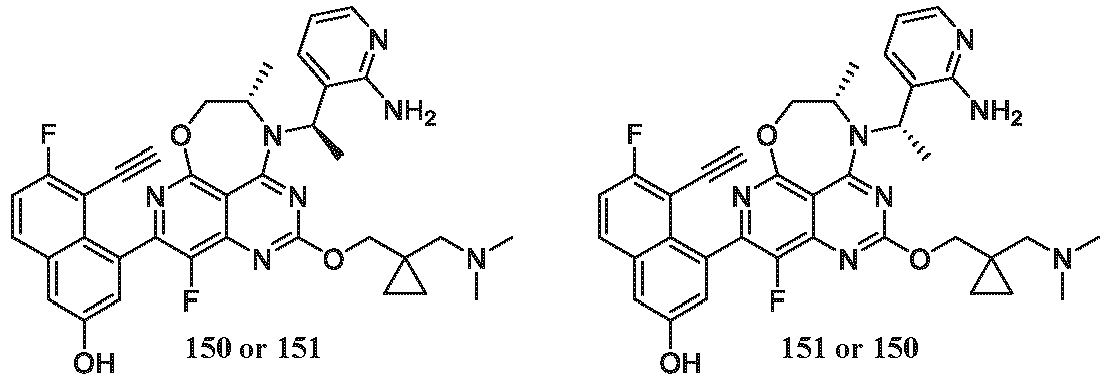

- Referring to the preparation of compound 65g in Example 65, compound 150a was prepared by replacing methanol with (1-((dimethylamino)methyl)cyclopropyl)methanol in step 2.
- Compound 150a was sequentially purified by preparative liquid phase chromatography (YMC TA C18 10 µm 30 × 250 chromatographic column; methanol-0.1% aqueous ammonium hydroxide solution (gradient elution of 40%-100%/0-60 min)) to give compound 150 (Rt 37 min, LC-MS: m/z = 652.36 (M + H)+) and compound 151 (Rt 38 min, LC-MS: m/z = 652.34 (M + H)+).
- The retention time in chiral chromatographic column of compound 150 is short compared to that of compound 151, and the retention time in chiral chromatographic column of compound 151 is long compared to that of compound 150.
-


- Referring to the preparation of compound 65g in Example 65, compound 152a was prepared by replacing methanol with (R)-2-(dimethylamino)propanol in step 2.
- Compound 152a was sequentially purified by preparative liquid phase chromatography (YMC TA C18 10 µm 30 × 250 chromatographic column; methanol-0.1% aqueous formic acid solution (gradient elution of 20%-80%/0-60 min)) to give compound 152 (Rt 13.9 min, LC-MS: m/z = 626.33 (M + H)+) and compound 153 (Rt 16.7 min, LC-MS: m/z = 626.33 (M + H)+).
- The retention time in chiral chromatographic column of compound 152 is short compared to that of compound 153, and the retention time in chiral chromatographic column of compound 153 is long compared to that of compound 152.
-


- Referring to the preparation of compound 65g in Example 65, compound 154a was prepared by replacing methanol with 3-(4-morpholinyl)-1-propanol in step 2.
- Compound 154a was sequentially purified by preparative liquid phase chromatography (YMC TA C18 10 µm 30 × 250 chromatographic column; methanol-0.1% aqueous formic acid solution (gradient elution of 20%-80%/0-60 min)) to give compound 154 (Rt 13.8 min, LC-MS: m/z = 668.34 (M + H)+) and compound 155 (Rt 15.4 min, LC-MS: m/z = 668.32 (M + H)+).
- The retention time in chiral chromatographic column of compound 154 is short compared to that of compound 155, and the retention time in chiral chromatographic column of compound 155 is long compared to that of compound 154.
-


- Referring to the preparation of compound 65g in Example 65, compound 156a was prepared by replacing methanol with N,N,3-trimethylazetidin-3-amine dihydrochloride in step 2.
- Compound 156a was sequentially purified by preparative liquid phase chromatography (YMC TA C18 10 µm 30 × 250 chromatographic column; methanol-0.1% aqueous acetic acid solution (gradient elution of 5%-45%/0-80 min)) to give compound 156 (Rt 55.26 min, LC-MS: m/z = 637.38 (M + H)+) and compound 157 (Rt 63.01 min, LC-MS: m/z = 637.39 (M + H)+).
- The retention time in chiral chromatographic column of compound 156 is short compared to that of compound 157, and the retention time in chiral chromatographic column of compound 157 is long compared to that of compound 156.
-


- Referring to the preparation of compound 87b in Example 87, compound 158a was prepared by replacing ((2-fluoro-8-(4,4,5,5-tetramethyl-1,3,2-dioxaborolan-2-yl)naphthalen-1-yl)ethynyl)triisopropylsilane with tert-butyl (3-cyano-7-fluoro-4-(4,4,5,5-tetramethyl-1,3,2-dioxaborolan-2-yl)benzo[b]thiophen-2-yl)carbamate in step 1.
- Compound 158a was sequentially purified by preparative liquid phase chromatography (YMC TA C18 10 µm 30 × 250 chromatographic column; methanol-0.1% aqueous acetic acid solution (gradient elution of 10%-45%/0-80 min)) to give compound 158 (Rt 54.7 min, LC-MS: m/z = 644.34 (M + H)+) and compound 159 (Rt 59.37 min, LC-MS: m/z = 644.36 (M + H)+).
- The retention time in chiral chromatographic column of compound 158 is short compared to that of compound 159, and the retention time in chiral chromatographic column of compound 159 is long compared to that of compound 158.
-


- Referring to the preparation of compound 87b in Example 87, compound 160a was prepared by replacing ((2-fluoro-8-(4,4,5,5-tetramethyl-1,3,2-dioxaborolan-2-yl)naphthalen-1-yl)ethynyl)triisopropylsilane with (3-methyl-2-(trifluoromethyl)phenyl)boronic acid in step 1.
- Compound 160a was sequentially purified by preparative liquid phase chromatography (Novasep C18 250 × 50 mm, 10µm chromatographic column; methanol-0.1% aqueous acetic acid solution (gradient elution of 20%-50%/0-60 min)) to give compound 160 (Rt 45 min, LC-MS: m/z = 612.34 (M + H)+) and compound 161 (Rt 48 min, LC-MS: m/z = 612.33 (M + H)+).
- The retention time in chiral chromatographic column of compound 160 is short compared to that of compound 161, and the retention time in chiral chromatographic column of compound 161 is long compared to that of compound 160.
-


- Referring to the preparation of compound 87b in Example 87, compound 162a was prepared by replacing ((2-fluoro-8-(4,4,5,5-tetramethyl-1,3,2-dioxaborolan-2-yl)naphthalen-1-yl)ethynyl)triisopropylsilane with 3-chloro-5-(4,4,5,5-tetramethyl-1,3,2-dioxaborolan-2-yl)-4-(trifluoromethyl)aniline in step 1.
- Compound 162a was sequentially purified by preparative liquid phase chromatography (YMC TA C18 10 µm 30 × 250 chromatographic column; methanol-0.1% aqueous ammonium hydroxide solution (gradient elution of 50%-70%-100%/0-20-60 min)) to give compound 162 (Rt 36.12 min, LC-MS: m/z = 647.27 (M + H)+) and compound 163 (Rt 39.01 min, LC-MS: m/z = 647.27 (M + H)+).
- The retention time in chiral chromatographic column of compound 162 is short compared to that of compound 163, and the retention time in chiral chromatographic column of compound 163 is long compared to that of compound 162.
-


- Referring to the preparation of compound 65f in Example 65, compound 164a was prepared by replacing methanol with (hexahydro-1H-pyrrolizin-7a-yl)methanol in step 2 and replacing 10g with 6-fluoro-4-(4,4,5,5-tetramethyl-1,3,2-dioxaborolan-2-yl)-5-((triisopropylsilyl)ethynyl)naphthalen-2-amine in step 4.
- Compound 164a was sequentially purified by preparative liquid phase chromatography (YMC-AQ-C18, 10 µm, 50 × 250 chromatographic column; methanol-0.1% aqueous acetic acid solution (gradient elution of 10%-70%/0-60 min)) to give compound 164 (Rt 27.34 min, LC-MS: m/z = 663.37 (M + H)+) and compound 165 (Rt 32.16 min, LC-MS: m/z = 663.38 (M + H)+).
- The retention time in chiral chromatographic column of compound 164 is short compared to that of compound 165, and the retention time in chiral chromatographic column of compound 165 is long compared to that of compound 164.
-


- Referring to the preparation of compound 65g in Example 65, compound 166a was prepared by replacing methanol with 2-piperidinoethanol in step 2.
- Compound 166a was sequentially purified by preparative liquid phase chromatography (YMC TA C18 10 µm 50 × 250 chromatographic column; methanol-0.1% aqueous ammonium hydroxide solution (gradient elution of 40%-60%-90%/0-15-60 min)) to give compound 166 (Rt 34.34 min, LC-MS: m/z = 652.35 (M + H)+) and compound 167 (Rt 38.08 min, LC-MS: m/z = 652.36 (M + H)+).
- The retention time in chiral chromatographic column of compound 166 is short compared to that of compound 167, and the retention time in chiral chromatographic column of compound 167 is long compared to that of compound 166.
-


- Referring to the preparation of compound 65g in Example 65, compound 168a was prepared by replacing methanol with 1-(2-hydroxyethyl)-4-methylpiperazine in step 2.
- Compound 168a was sequentially purified by preparative liquid phase chromatography (YMC TA C18 10 µm 50 × 250 chromatographic column; methanol-0.1% aqueous ammonium hydroxide solution (gradient elution of 40%-60%-90%/0-15-60 min)) to give compound 168 (Rt 28.56 min, LC-MS: m/z = 667.37 (M + H)+) and compound 169 (Rt 32.12 min, LC-MS: m/z = 667.37 (M + H)+).
- The retention time in chiral chromatographic column of compound 168 is short compared to that of compound 169, and the retention time in chiral chromatographic column of compound 169 is long compared to that of compound 168.
-


- Referring to the preparation of compound 65g in Example 65, compound 170a was prepared by replacing methanol with 1-(3-hydroxypropyl)-4-methylpiperazine in step 2.
- Compound 170a was sequentially purified by preparative liquid phase chromatography (YMC TA C18 10 µm 50 × 250 chromatographic column; methanol-0.1% aqueous ammonium hydroxide solution (gradient elution of 40%-60%-90%/0-15-60 min)) to give compound 170 (Rt 27.54 min, LC-MS: m/z = 681.39 (M + H)+) and compound 171 (Rt 31.58 min, LC-MS: m/z = 681.37 (M + H)+).
- The retention time in chiral chromatographic column of compound 170 is short compared to that of compound 171, and the retention time in chiral chromatographic column of compound 171 is long compared to that of compound 170.
-


- Referring to the preparation of compound 65g in Example 65, compound 172a was prepared by replacing methanol with 2-(3-fluoroazetidin-1-yl)ethanol in step 2.
- Compound 172a was sequentially purified by preparative liquid phase chromatography (YMC TA C18 10 µm 50 × 250 chromatographic column; methanol-0.1% aqueous ammonium hydroxide solution (gradient elution of 40%-60%-90%/0-15-60 min)) to give compound 172 (Rt 24.14 min, LC-MS: m/z = 642.34 (M + H)+) and compound 173 (Rt 28.07 min, LC-MS: m/z = 642.35 (M + H)+).
- The retention time in chiral chromatographic column of compound 172 is short compared to that of compound 173, and the retention time in chiral chromatographic column of compound 173 is long compared to that of compound 172.
-
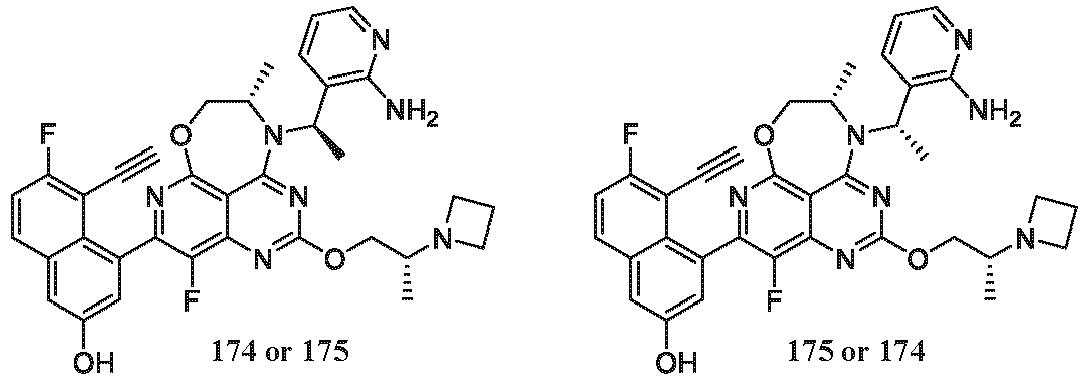

- Referring to the preparation of compound 65g in Example 65, compound 174a was prepared by replacing methanol with (R)-2-(azetidin-1-yl)propanol in step 2.
- Compound 174a was sequentially purified by preparative liquid phase chromatography (YMC TA C18 10 µm 50 × 250 chromatographic column; methanol-0.1% aqueous ammonium hydroxide solution (gradient elution of 40%-60%-90%/0-15-60 min)) to give compound 174 (Rt 33.57 min, LC-MS: m/z = 638.38 (M + H)+) and compound 175 (Rt 37.53 min, LC-MS: m/z = 638.26 (M + H)+).
- The retention time in chiral chromatographic column of compound 174 is short compared to that of compound 175, and the retention time in chiral chromatographic column of compound 175 is long compared to that of compound 174.
-


- Referring to the preparation of compound 65g in Example 65, compound 176a was prepared by replacing methanol with (S,Z)-(2-(fluoromethylene)tetrahydro-1H-pyrrolizin-7a(5H)-yl)methanol in step 2.
- Compound 176a was sequentially purified by preparative liquid phase chromatography (YMC TA C18 10 µm 50 × 250 chromatographic column; methanol-0.1% aqueous acetic acid solution (gradient elution of 30%-90%/0-60 min)) to give compound 176 (Rt 19.34 min, LC-MS: m/z = 694.36 (M + H)+) and compound 177 (Rt 24.16 min, LC-MS: m/z = 694.35 (M + H)+).
- The retention time in chiral chromatographic column of compound 176 is short compared to that of compound 177, and the retention time in chiral chromatographic column of compound 177 is long compared to that of compound 176.
-


- Referring to the preparation of compound 65g in Example 65, compound 178a was prepared by replacing methanol with (S)-(2-methylenetetrahydro-1H-pyrrolizin-7a(5H)-yl)methanol in step 2.
- Compound 178a was sequentially purified by preparative liquid phase chromatography (YMC TA C18 10 µm 50 × 250 chromatographic column; methanol-0.1% aqueous acetic acid solution (gradient elution of 20%-80%/0-60 min)) to give compound 178 (Rt 26.35 min, LC-MS: m/z = 676.30 (M + H)+) and compound 179 (Rt 34.01 min, LC-MS: m/z = 676.32 (M + H)+).
- The retention time in chiral chromatographic column of compound 178 is short compared to that of compound 179, and the retention time in chiral chromatographic column of compound 179 is long compared to that of compound 178.
- The following compounds were prepared by reference to the route 1 and examples 1-179 of the present application:
Example LC-MS: m/z (M + H)+ (compound No.) 
652.28 (180) 652.28 (181) 652.28 (182) 180 181 or 182 182 or 181 
640.28 (183) 640.28 (184) 640.28 (185) 183 184 or 185 185 or 184 
626.27 (186) 626.27 (187) 626.27 (188) 186 187 or 188 188 or 187 
639.25 (189) 639.25 (190) 639.25 (191) 189 190 or 191 191 or 190 
640.28 (192) 640.28 (193) 640.28 (194) 192 193 or 194 194 or 193 
625.28 (195) 625.28 (196) 625.28 (197) 195 196 or 197 197 or 196 
639.30 (198) 639.30 (199) 639.30 (200) 198 199 or 200 200 or 199 
639.30 (201) 639.30 (202) 639.30 (203) 201 202 or 203 203 or 202 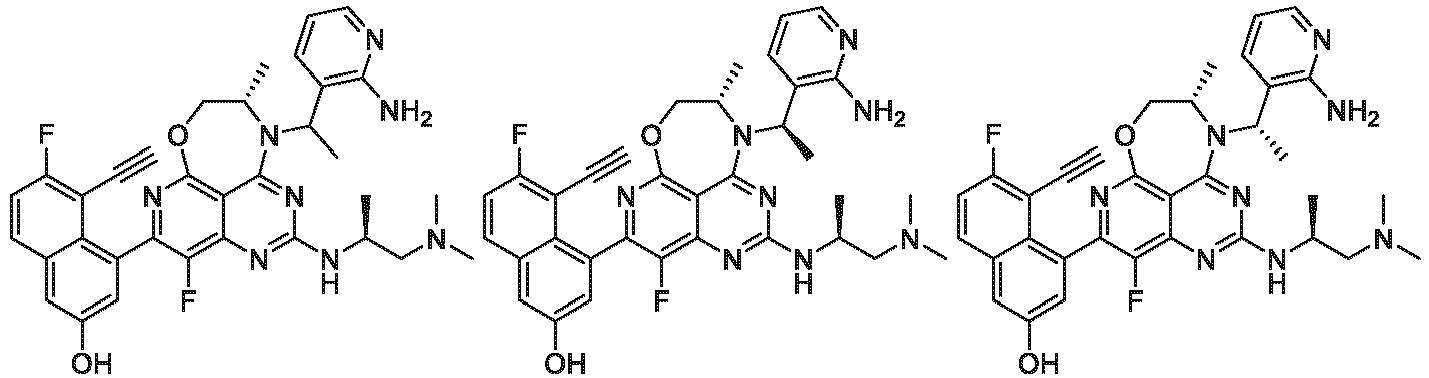
625.28 (204) 625.28 (205) 625.28 (206) 204 205 or 206 206 or 205 
639.30 (207) 639.30 (208) 639.30 (209) 207 208 or 209 209 or 208 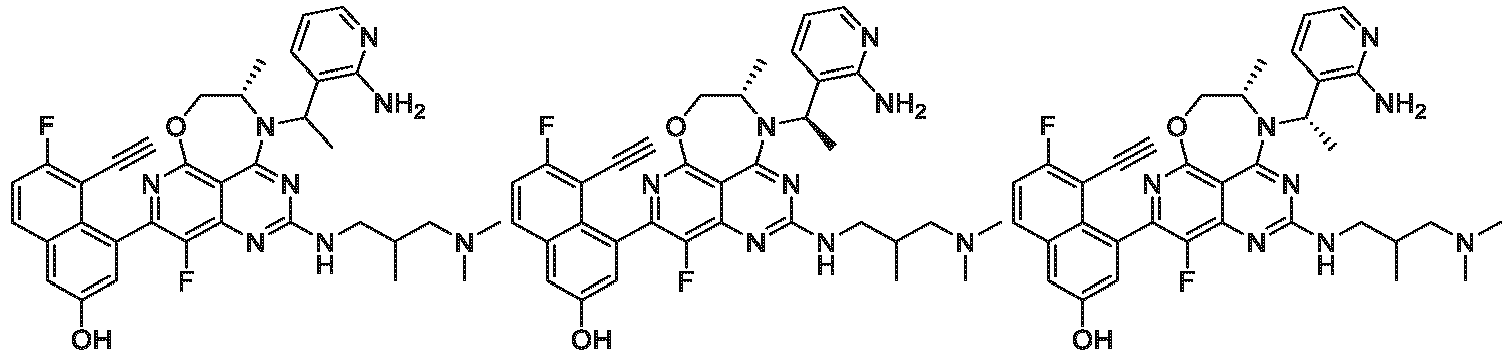
639.30 (210) 639.30 (211) 639.30 (212) 210 211 or 212 212 or 211 
637.28 (213) 637.28 (214) 637.28 (215) 213 214 or 215 215 or 214 
665.32 (216) 665.32 (217) 665.32 (218) 216 217 or 218 218 or 217 
638.27 (219) 638.27 (220) 638.27 (221) 219 220 or 221 221 or 220 
668.28 (222) 668.28 (223) 668.28 (224) 222 223 or 224 224 or 223 
651.30 (225) 651.30 (226) 651.30 (227) 225 226 or 227 227 or 226 
666.31 (228) 666.31 (229) 666.31 (230) 228 229 or 230 230 or 229 
651.30 (231) 651.30 (232) 651.30 (233) 231 232 or 233 233 or 232 
623.27 (234) 623.27 (235) 623.27 (236) 234 235 or 236 236 or 235 
667.30 (237) 667.30 (238) 667.30 (239) 237 238 or 239 239 or 238 
637.28 (240) 637.28 (241) 637.28 (242) 240 241 or 242 242 or 241 
666.31 (243) 666.31 (244) 666.31 (245) 243 244 or 245 245 or 244 
681.31 (246) 681.31 (247) 681.31 (248) 246 247 or 248 248 or 247 
665.32 (249) 665.32 (250) 665.32 (251) 249 250 or 251 251 or 250 
680.33 (252) 680.33 (253) 680.33 (254) 252 253 or 254 254 or 253 
666.31 (255) 666.31 (256) 666.31 (257) 255 256 or 257 257 or 256 
667.30 (258) 667.30 (259) 667.30 (260) 258 259 or 260 260 or 259 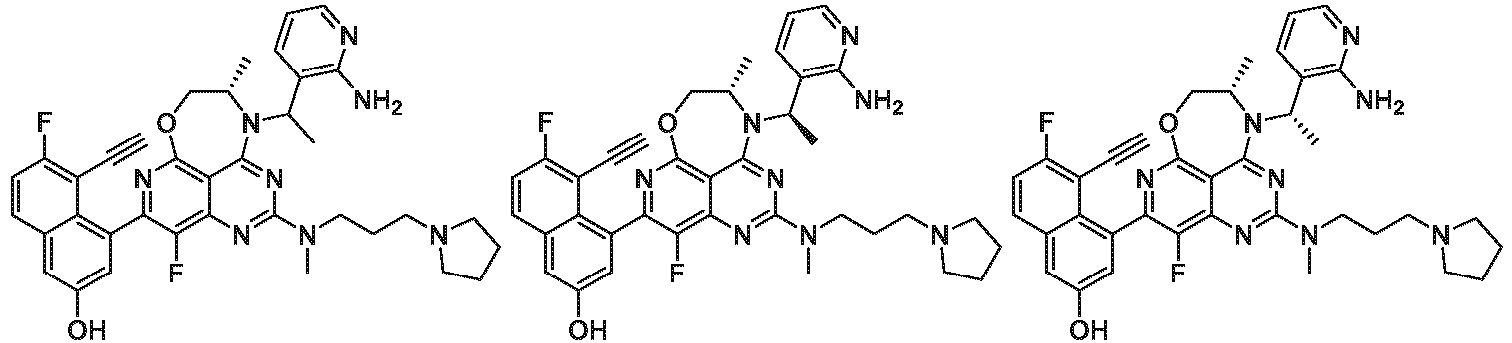
665.32 (261) 665.32 (262) 665.32 (263) 261 262 or 263 263 or 262 
564.26 (264) 564.26 (265) 564.26 (266) 264 265 or 266 266 or 265 
615.28 (267) 615.28 (268) 615.28 (269) 267 268 or 269 269 or 268 
614.28 (270) 614.28 (271) 614.28 (272) 270 271 or 272 272 or 271 
525.14 (273) 525.14 (274) 525.14 (275) 273 274 or 275 275 or 274 
502.14 (276) 502.14 (277) 502.14 (278) 276 277 or 278 278 or 277 
532.19 (279) 532.19 (280) 532.19 (281) 279 280 or 281 281 or 280 
671.29 (282) 671.29 (283) 671.29 (284) 282 283 or 284 284 or 283 
675.26 (285) 675.26 (286) 675.26 (287) 285 286 or 287 287 or 286 
625.28 (288) 625.28 (289) 625.28 (290) 288 289 or 290 290 or 289 
651.28 (291) 651.28 (292) 651.28 (293) 291 292 or 293 293 or 292 
657.27 (294) 657.27 (295) 657.27 (296) 294 295 or 296 296 or 295 
641.24 (297) 641.24 (298) 641.24 (299) 297 298 or 299 299 or 298 
686.23 (300) 686.23 (301) 686.23 (302) 300 301 or 302 302 or 301 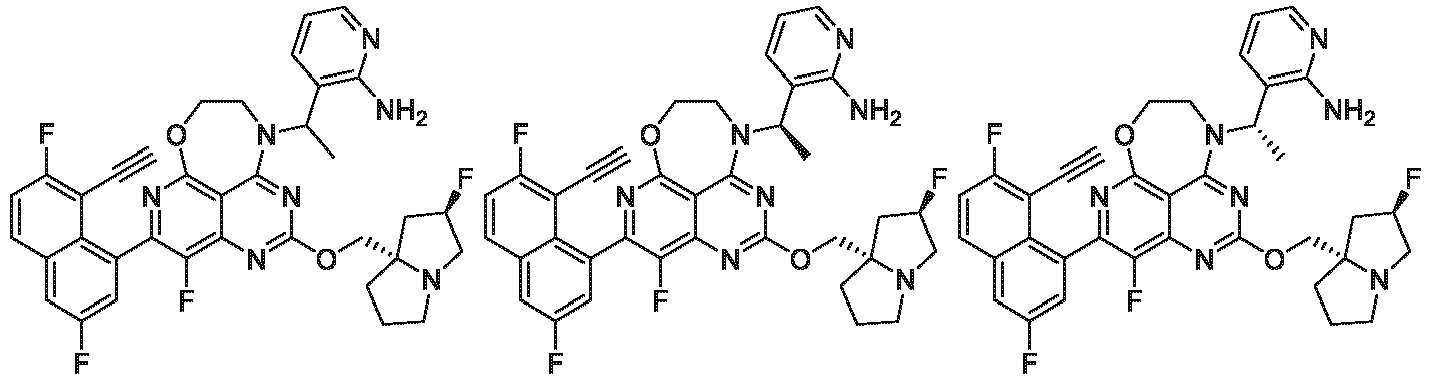
670.25 (303) 670.25 (304) 670.25 (305) 303 304 or 305 305 or 304 
652.26 (306) 652.26 (307) 652.26 (308) 306 307 or 308 308 or 307 
637.28 (309) 637.28 (310) 637.28 (311) 309 310 or 311 311 or 310 
628.28 (312) 628.28 (313) 628.28 (314) 312 313 or 314 314 or 313 
648.21 (315) 648.21 (316) 648.21 (317) 315 316 or 317 317 or 316 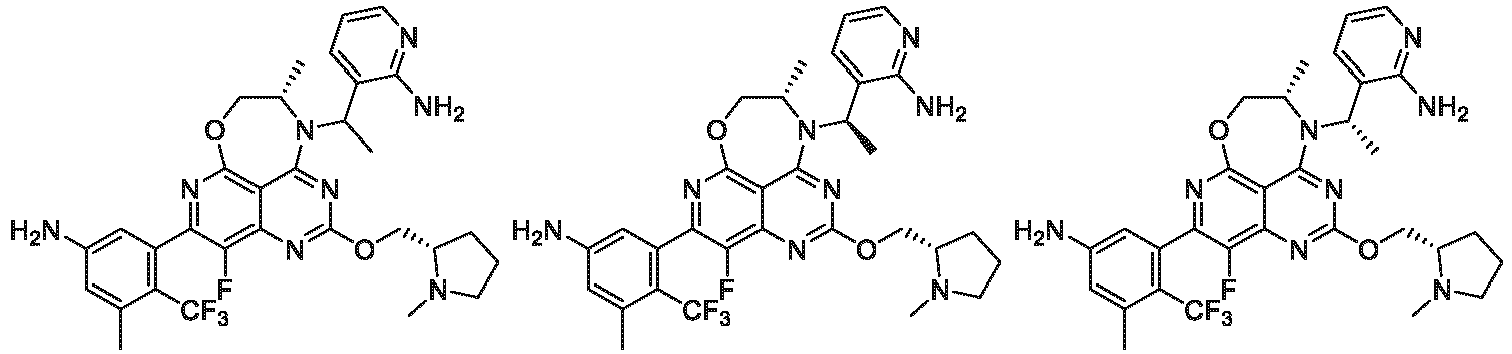
627.28 (318) 627.28 (319) 627.28 (320) 318 319 or 320 320 or 319 
514.20 (321) 514.20 (322) 514.20 (323) 321 322 or 323 323 or 322 
515.19 (324) 515.19 (325) 515.19 (326) 324 325 or 326 326 or 325 
524.20 (327) 524.20 (328) 524.20 (329) 327 328 or 329 329 or 328 
515.18 (330) 515.18 (331) 515.18 (332) 330 331 or 332 332 or 331 
518.17 (333) 518.17 (334) 518.17 (335) 333 334 or 335 335 or 334 
527.18 (336) 527.18 (337) 527.18 (338) 336 337 or 338 338 or 337 
489.20 (339) 489.20 (340) 489.20 (341) 339 340 or 341 341 or 340 
534.14 (342) 534.14 (343) 534.14 (344) 342 343 or 344 344 or 343 
670.25 (345) 670.25 (346) 670.25 (347) 345 346 or 347 347 or 346 
689.28 (348) 689.28 (349) 689.28 (350) 348 349 or 350 350 or 349 
672.28 (351) 672.28 (352) 672.28 (353) 351 352 or 353 353 or 352 
682.29 (354) 682.29 (355) 682.29 (356) 354 355 or 356 356 or 355 
682.29 (357) 682.29 (358) 682.29 (359) 357 358 or 359 359 or 358 
613.28 (360) 613.28 (361) 613.28 (362) 360 361 or 362 362 or 361 
681.29 (363) 681.29 (364) 681.29 (365) 363 364 or 365 365 or 364 
666.28 (366) 666.28 (367) 666.28 (368) 366 367 or 368 368 or 367 
662.30 (369) 662.30 (370) 662.30 (371) 369 370 or 371 371 or 370 
663.30 (372) 663.30 (373) 663.30 (374) 372 373 or 374 374 or 373 
663.30 (375) 663.30 (376) 663.30 (377) 375 376 or 377 377 or 376 
685.27 (378) 685.27 (379) 685.27 (380) 378 379 or 380 380 or 379 
685.27 (381) 685.27 (382) 685.27 (383) 381 382 or 383 383 or 382 
681.29 (384) 681.29 (385) 681.29 (386) 384 385 or 386 386 or 385 
684.27 (387) 684.27 (388) 684.27 (389) 387 388 or 389 389 or 388 
621.29 (390) 621.29 (391) 621.29 (392) 390 391 or 392 392 or 391 
658.19 (393) 658.19 (394) 658.19 (395) 393 394 or 395 395 or 394 
614.28 (396) 614.28 (397) 614.28 (398) 396 397 or 398 398 or 397 
603.30 (399) 603.30 (400) 603.30 (401) 399 400 or 401 401 or 400 
614.28 (402) 614.28 (403) 614.28 (404) 402 403 or 404 404 or 403 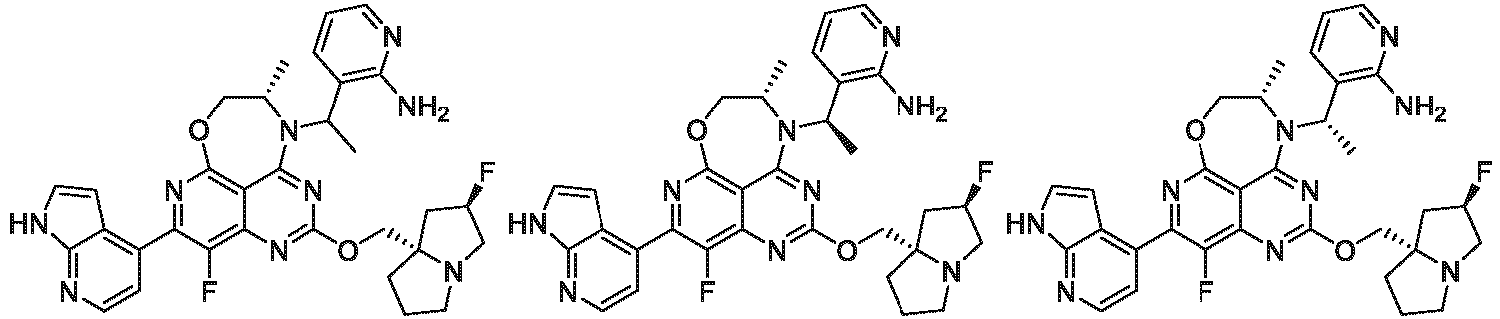
614.28 (405) 614.28 (406) 614.28 (407) 405 406 or 407 407 or 406 
700.27 (408) 700.27 (409) 700.27 (410) 408 409 or 410 410 or 409 
708.29 (411) 708.29 (412) 708.29 (413) 411 412 or 413 413 or 412 
696.29 (414) 696.29 (415) 696.29 (416) 414 415 or 416 416 or 415 
708.29 (417) 708.29 (418) 708.29 (419) 417 418 or 419 419 or 418 
499.19 (420) 499.19 (421) 499.19 (422) 420 421 or 422 422 or 421 
623.27 (423) 623.27 (424) 623.27 (425) 423 424 or 425 425 or 424 -
- 1. Reagents: His-KRAS G12D (1-169); SOS1cat (564-1049); GDP (purchased from Sigma); Anti-6HIS-Cryptate (purchased from Cisbio); EDA-GTP-DY-647P1 (purchased from Jena Bioscience)
-
2.
Buffer preparation:
- 1) assay buffer: HEPES pH 7.4, NaCl, MgCl2, DTT, BSA, and Igepal;
- 2) KRAS G12D working solution: A KRAS G12D working solution containing 100 nM His-KRAS G12D and 2 nM Anti-6HIS-Cryptate was prepared using the assay buffer;
- 3) SOS1cat working solution: An SOS1cat working solution containing 20 nM SOS1cat and 200 nM EDA-GTP-DY-647P1 was prepared using the assay buffer;
- 4) blank control working solution: A blank control solution containing 2 nM Anti-6HIS-Cryptate was prepared using the assay buffer.
- 3. Testing procedure:
The entire experimental process was completed at room temperature. Using a black clear-bottom 384-well plate, 5 µL of KRAS G12D working solution was added to each well for the experimental and negative groups, while 5 µL of blank control working solution was added to each well for the blank group. The plate was incubated at room temperature for 10 min. Then, the compounds (at an initial concentration of 100 µM, 8 concentration gradients by 1:2 serial dilution) were added to the experimental groups using an ultra microsyringe and incubated at room temperature for 30 min. Finally, 5 µL of SOS1cat working solution was added to each well, and after incubation at room temperature for 15 min, signal values were detected at 665 nm/620 nm using a PerkinElmer Envision HTS multi-label plate reader. The inhibition rate was calculated by the following formula: inhibition rate (%) = (mean value of negative control group - mean value of experimental group)/(mean value of negative control group - mean value of blank group) × 100%. The curves were fitted using the four-parameter logistic model with the logarithm of the compound concentration as the abscissa and the inhibition rate as the ordinate, and IC 50 values were calculated. - AsPc-1 cells in a well-growing state were collected into a centrifuge tube, adjusted to a cell density of 3 × 10⁴ cells/mL, and inoculated onto a 96-well plate (100 µL/well). The compounds were added using a nanoliter pipettor such that the final concentrations of the compounds were 5000 nM-0.31 nM (the addition was performed in duplicate). Meanwhile, a control was set. After 72 h of incubation in the cell incubator, the assay reagent CCK-8 (manufacturer: Dojindo Laboratories; 10 µL/well) was added. After 3 h of incubation in the cell incubator, the absorbance was measured at 450 nm on a PerkinElmer Envision microplate reader. A four-parameter analysis was performed, a dose-response curve was fitted, and IC50 was calculated.
- Capan-1 cells in a well-growing state were collected into a centrifuge tube, adjusted to a cell density of 1.5 × 10⁴ cells/mL, and inoculated onto a 96-well plate (100 µL/well). The compounds were added using a nanoliter pipettor such that the final concentrations of the compounds were 20000 nM-9.1 nM (the addition was performed in duplicate). Meanwhile, a control was set. After 5 days of incubation in the cell incubator, the assay reagent CCK-8 (manufacturer: Dojindo Laboratories, Beijing; 10 µL/well) was added. After 4 h of incubation in the cell incubator, the absorbance was measured at 450 nm on a PerkinElmer Envision microplate reader. A four-parameter analysis was performed, a dose-response curve was fitted, and IC50 was calculated.
- The above testing results for the part of the compounds of the present disclosure are shown in Table 1.
Table 1. Testing results for part of compounds Compound Nucleotide exchange inhibitory activity IC50 (nM) Inhibitory activity IC50 for AsPc-1 cell proliferation (nM) Inhibitory activity IC50 for Capan-1 cell proliferation (nM) Example 1 A Example 2 A Example 3 B B Example 4 A c B Example 6 A Example 7 A Example 8 A c B Example 9 A Example 10 c Example 13 A Example 14 A Example 15 A Example 16 A Example 17 A Example 22 A Example 23 B Example 24 A Example 25 A Example 26 B Example 31 B B Example 32 A A Example 34 A A Example 36 A A Example 38 A A Example 39 A A Example 40 A A Example 41 A Example 45 A Example 47 A A Example 48 A Example 49 A Example 50 A Example 51 A A Example 53 A A Example 54 A A Example 55 A Example 57 A Example 59 A Example 61 A Example 63 A Example 64 A Example 65 A Example 67 A A Example 69 A A Example 70 A Example 71 A A Example 72 A Example 73 A Example 75 A Example 77 A Example 79 A Example 81 A Example 82 A Example 85 A Example 87 A Example 88 A Example 89 A Example 91 A Example 92 A Example 93 A Example 95 A Example 97 A A Example 99 A Example 101 A Example 103 A Example 105 A A Example 107 A Example 109 A Example 111 A Example 113 A A Example 114 A A Example 115 A A Example 116 A Example 118 A A Example 120 A Example 122 A A Example 124 A A Example 126 A Example 128 A Example 130 A A Example 131 A Example 132 A Example 134 A Example 136 A Example 138 A A Example 140 A Example 142 A Example 144 A Example 146 A A Example 147 A Example 148 A A Example 150 A A Example 152 A Example 154 A Example 156 A A Example 158 A Example 160 A Example 162 A Example 164 A Example 166 A Example 168 A Example 170 A Example 172 A A Example 174 A Example 176 A A Example 177 A A Example 178 A Note: A represents IC50 ≤ 100 nM;
B represents 100 nM < IC50 ≤ 500 nM;
C represents 500 nM < IC50 ≤ 999 nM;
- represents the IC50 value not detected. - Liver microsome incubation samples (species: human, monkey, rat, and mouse) were prepared by mixing a PBS buffer (pH 7.4), a liver microsome solution (0.5 mg/mL), a test compound, and an NADPH + MgCl2 solution and incubated at 37 °C and 300 rpm for 1 h. Zero-hour samples were prepared by mixing a PBS buffer (pH 7.4), a liver microsome solution (0.5 mg/mL), and a test compound. An acetonitrile solution containing an internal standard was added to the samples, and the supernatants were prepared by protein precipitation, diluted, and then assayed by LC/MS/MS. The results are shown in Table 2.
Table 2. Results for in vitro liver microsomal metabolic stability Compound The remaining amount % (T = 60 min) (0.5 mg/mL) Human liver microsome Mouse liver microsome Example 79 >60 Example 95 >60 Example 97 >40 Example 101 >60 Example 103 >60 Example 107 >40 Example 111 >60 Example 134 >60 Example 140 >60 Example 162 >40 - ICR mice weighing 20 g to 24 g were randomized into groups with 9 mice in each group after 3 to 5 days of acclimatization, and intragastric administration of the experimental compounds was performed at a dose of 10 mg/kg.
- The test animals (ICR mice) were fasted for 12 h before administration and fed 4 h after administration, and were given free access to water before, after, and during the experiment.
- After intragastric administration, about 0.1 mL of blood was collected via the orbital sinus at 0.25 h (15 min), 0.5 h (30 min), 1 h, 2 h, 4 h, 6 h, 8 h, and 10 h (each mouse was subjected to blood collection at 3 to 4 time points, with 3 mice per time point). Following anticoagulation with EDTA-K2, the blood samples were transferred to a centrifuge within 30 min and then centrifuged at 4000 rpm for 10 min at 4 °C to separate the plasma. All the plasma samples were collected and immediately stored at -20 °C for testing.
- 20 µL of the plasma sample to be tested and the standard curve sample were pipetted, and 400 µL of acetonitrile solution containing an internal standard (20 ng/mL) was added. The mixture was shaken and mixed well for 10 min, and centrifuged at 13000 rpm for 10 min. 50 µL of the supernatant was taken and diluted with 100 µL of ultrapure water. After being mixed well, 0.5 µL of the resulting sample was subjected to LC/MS/MS, and a chromatogram was recorded.
- Oral exposure of the compounds of the present disclosure was evaluated by in vivo pharmacokinetic experiments in mice. The experimental results are shown in Table 3.
Table 3 PK parameter Compound 85 IG Compound 87 IG Compound 162 IG Dose 10 mg/kg AUC(0-t h) (ng*h/mL) 197 266 156 a AUC(0-∞) (ng*h/mL) 214 309 / MRT(0-t) (h) 3.40 4.93 / t1/2(h) 2.77 3.66 / Tmax (h) 0.25 0.25 1.00 Cmax (ng/mL) 50.2 49.0 38.4 a gavage parameters were fitted to 6 h. - SD rats weighing 180 g to 220 g were randomized into 3 groups with 3 rats in each group after 3 to 5 days of acclimatization, and intragastric administration of the compounds was performed at a dose of 10 mg/kg.
- The test animals (SD rats) were fasted for 12 h before administration and fed 4 h after administration, and were given free access to water before, after, and during the experiment.
- After intragastric administration, about 0.2 mL of blood was collected via the orbital sinus at 0 min, 15 min, 30 min, 1 h, 2 h, 4 h, 6 h, 8 h, 10 h, and 24 h. Following anticoagulation with EDTA-K2, the blood samples were transferred to a centrifuge within 30 min and then centrifuged at 4000 rpm for 10 min at 4 °C to separate the plasma. All the plasma samples were collected and immediately stored at -20 °C for testing.
- 50 µL of the plasma sample to be tested and the standard curve sample were pipetted, and 300 µL of acetonitrile solution containing an internal standard (20 mg/mL diazepam) was added. The mixture was shaken and mixed well for 5 min, and centrifuged at 13000 rpm for 10 min. 75 µL of the supernatant was taken and diluted with 75 µL of ultrapure water. After being mixed well, 2 µL of the resulting sample was subjected to LC/MS/MS, and a chromatogram was recorded.
- SPF female NOD-SCID mice (source: Jiangsu Huachuang Sino Pharmaceutical Technology Co., Ltd.) were inoculated subcutaneously at the right axilla with Aspc-1 human pancreatic cancer cells at 1 × 10⁷ cells/mouse. When the mean tumor volume reached about 200 mm3, the animals were grouped.
- The day of grouping was defined as day 0, and intraperitoneal injection was started on day 1 and performed once a day. The tumor volume was measured 2-3 times a week, and meanwhile, the mice were weighed and the data were recorded; the general behavior of the mice was observed and recorded every day. After the experiment was completed, the tumors were removed, weighed, and photographed.
- The detection index and the calculation formulas are as follows:
- tumor volume TV (mm3) = 1/2 × (a × b2), where a represents the long diameter of the tumor, and b represents the short diameter of the tumor;
- relative tumor volume RTV = TVt/TV0, where TV0 represents the tumor volume on day 0, and TVt represents the tumor volume at each measurement;
- relative tumor proliferation rate T/C (%) = (TRTV/CRTV) × 100%, where TRTV represents RTV of the treatment group, and CRTV represents RTV of the vehicle control group;
- tumor growth inhibition rate TGI (%) = (1 - TW/TW0) × 100%; where TW represents the tumor weight of the treatment group, and TW0 represents the tumor weight of the vehicle control group;
- weight change rate WCR (%) = (Wtt - Wt0)/Wt0 × 100%, where Wt0 represents the body weight of the mouse on day 0, and Wtt represents the body weight of the mouse at each measurement.
Claims (14)
- A compound of formula (I), a stereoisomer thereof, a tautomer thereof, a deuterated compound thereof, or a pharmaceutically acceptable salt thereof,
 X is selected from the group consisting of -N- and -CH-, the -CH- optionally substituted with Rx;Rx is selected from the group consisting of deuterium, halogen, -OH, -NH2, -CN, C1-6 alkyl, C1-6 alkoxy, C1-6 alkylthio, C1-6 alkylamino, di-C1-6 alkylamino, C1-6 haloalkyl, C1-6 haloalkoxy, C1-6 haloalkylthio, C1-6 haloalkylamino, and di-C1-6 haloalkylamino;L1 is selected from the group consisting of -O-, -S-, and the following groups optionally substituted with one or more R1: -NH-, C1-5 alkylene, C1-4 heteroalkylene, C2-5 alkenylene, and C1-4 heteroalkenylene;each R1 is independently selected from the group consisting of deuterium, oxo, halogen, -OH, -NH2, -CN, C1-6 alkyl, C1-6 alkoxy, C1-6 alkylthio, C1-6 alkylamino, di-C1-6 alkylamino, C1-6 haloalkyl, C1-6 haloalkoxy, C1-6 haloalkylthio, C1-6 haloalkylamino, and di-C1-6 haloalkylamino;R2 is selected from the group consisting of H, deuterium, halogen, -OH, -NH2, -CN, and the following groups optionally substituted with one or more R2a: C1-12 alkyl, C1-12 heteroalkyl, 3- to 12-membered cycloalkyl-L2-, 4- to 12-membered heterocyclyl-L2-, 6- to 10-membered aryl-L2-, and 5- to 10-membered heteroaryl-L2-;L2 is selected from the group consisting of a single bond, -O-, -S-, -NH-, -N(C1-6 alkyl)-, C1-6 alkylene, C1-6 heteroalkylene, C2-6 alkenylene, and C1-6 heteroalkenylene;each R2a is independently selected from the group consisting of deuterium, halogen, -OH, oxo, -NH2, -CN, -C(O)NR2cR2d, -NR2cC(O)R2d, -NHC(O)NR2cR2d, -NR2cC(O)OR2d, -OC(O)R2d, -C(O)OR2d, -OC(O)OR2d, -OC(O)NR2cR2d, -SO2R2d, -NHSO2R2d, -C1-6 alkylene C(O)NR2cR2d, -C1-6 alkylene NR2cC(O)R2d, -C1-6 alkylene NHC(O)NR2cR2d, -C1-6 alkylene NR2cC(O)OR2d, -C1-6 alkylene OC(O)R2d, -C1-6 alkylene C(O)OR2d, -C1-6 alkylene OC(O)NR2cR2d, -C1-6 alkylene SO2R2d, -C1-6 alkylene OSO2R2d, -C1-6 alkylene NHSO2R2d, and the following groups optionally substituted with one or more R2b: C1-6 alkyl, C1-6 alkoxy, C1-6 alkylamino, di-C1-6 alkylamino, 3- to 12-membered cycloalkyl, 3- to 12-membered heterocyclyl, 6- to 10-membered aryl, 5- to 10-membered heteroaryl, 3- to 12-membered cycloalkyl C1-6 alkylene, 3- to 12-membered heterocyclyl C1-6 alkylene, 6- to 10-membered aryl C1-6 alkylene, and 5- to 10-membered heteroaryl C1-6 alkylene;R2c is independently selected from the group consisting of H, deuterium, and C1-6 alkyl;R2d is independently selected from the group consisting of H, deuterium, and the following groups optionally substituted with one or more R2e: C1-6 alkyl, C1-6 heteroalkyl, 3- to 12-membered cycloalkyl, 3- to 12-membered heterocyclyl, 6- to 10-membered aryl, 5- to 10-membered heteroaryl, 3- to 12-membered cycloalkyl C1-6 alkylene, 3- to 12-membered heterocyclyl C1-6 alkylene, 6- to 10-membered aryl C1-6 alkylene, and 5- to 10-membered heteroaryl C1-6 alkylene;each R2e is independently selected from the group consisting of deuterium, halogen, -OH, oxo, -NH2, -CN, C1-4 alkyl, C1-4 alkoxy, C1-4 haloalkyl, and C1-4 haloalkoxy;each R2b is independently selected from the group consisting of deuterium, halogen, -OH, -NH2, -CN, C1-4 alkyl, C1-4 alkoxy, C1-4 alkylamino, di-C1-4 alkylamino, C1-4 haloalkyl, and C1-4 haloalkoxy;Z is selected from the group consisting of a single bond, -S-, -O-, and the following groups optionally substituted with one or more Rz: -NH- and -N(C1-12 alkyl)-;each Rz is independently selected from the group consisting of deuterium, oxo, halogen, -OH, -NH2, -CN, C1-6 alkyl, C1-6 alkoxy, C1-6 alkylthio, C1-6 alkylamino, di-C1-6 alkylamino, C1-6 haloalkyl, C1-6 haloalkoxy, C1-6 haloalkylthio, C1-6 haloalkylamino, and di-C1-6 haloalkylamino;R3 is selected from the group consisting of H, deuterium, and the following groups optionally substituted with one or more R3a: C1-12 alkyl, 3- to 12-membered cycloalkyl, 3- to 12-membered heterocyclyl, 6- to 10-membered aryl, 5- to 10-membered heteroaryl, 3- to 12-membered cycloalkyl C1-6 alkylene, 3- to 12-membered heterocyclyl C1-6 alkylene, 6- to 10-membered aryl C1-6 alkylene, and 5- to 10-membered heteroaryl C1-6 alkylene;each R3a is independently selected from the group consisting of deuterium, halogen, -OH, oxo, -NH2, -CN, -C(O)NR3cR3d, -NR3cC(O)R3d, -NHC(O)NR3cR3d, -NR3cC(O)OR3d, -OC(O)R3d, -C(O)OR3d, -OC(O)OR3d, -OC(O)NR3cR3d, -SO2R3d, -NHSO2R3d, -C1-6 alkylene C(O)NR3cR3d, -C1-6 alkylene NR3cC(O)R3d, -C1-6 alkylene NHC(O)NR3cR3d, -C1-6 alkylene NR3cC(O)OR3d, -C1-6 alkylene OC(O)R3d, -C1-6 alkylene C(O)OR3d, -C1-6 alkylene OC(O)NR3cR3d, -C1-6 alkylene SO2R3d, -C1-6 alkylene OSO2R3d, -C1-6 alkylene NHSO2R3d, and the following groups optionally substituted with one or more R3b: =NH, =CH2, =N(C1-6 alkyl), =CH(C1-6 alkyl), =C(C1-6 alkyl)2, C1-6 alkyl, C1-6 alkoxy, C1-6 alkylamino, 3- to 12-membered cycloalkyl, 3- to 12-membered heterocyclyl, 6- to 10-membered aryl, 5- to 10-membered heteroaryl, 3- to 12-membered cycloalkyl C1-6 alkylene, 3- to 12-membered heterocyclyl C1-6 alkylene, 6- to 10-membered aryl C1-6 alkylene, and 5- to 10-membered heteroaryl C1-6 alkylene;R3c is independently selected from the group consisting of H, deuterium, and C1-6 alkyl;R3d is independently selected from the group consisting of H, deuterium, and the following groups optionally substituted with one or more R3e: C1-12 alkyl, C1-12 heteroalkyl, 3- to 12-membered cycloalkyl, 3- to 12-membered heterocyclyl, 6- to 10-membered aryl, 5- to 10-membered heteroaryl, 3- to 12-membered cycloalkyl C1-6 alkylene, 3- to 12-membered heterocyclyl C1-6 alkylene, 6- to 10-membered aryl C1-6 alkylene, and 5- to 10-membered heteroaryl C1-6 alkylene;each R3b is independently selected from the group consisting of deuterium, halogen, -OH, oxo, -NH2, -CN, C1-4 alkyl, C1-4 alkoxy, C1-4 alkylamino, and di-C1-4 alkylamino;each R3e is independently selected from the group consisting of deuterium, halogen, -OH, formyl, oxo, C1-4 alkyl, and C1-4 haloalkyl;R4 is selected from the group consisting of H, deuterium, halogen, -CN, C1-12 alkyl, C1-12 alkoxy, C1-12 haloalkyl, C1-12 haloalkoxy, 3- to 12-membered cycloalkyl, 3- to 12-membered heterocyclyl, 6- to 10-membered aryl, and 5-to 10-membered heteroaryl;ring A is selected from the group consisting of the following groups optionally substituted with one or more R5: 3-to 12-membered cycloalkyl, 3- to 12-membered heterocyclyl, 6- to 10-membered aryl, and 5- to 10-membered heteroaryl;each R5 is independently selected from the group consisting of deuterium, halogen, -CN, -OH, -NH2, and the following groups optionally substituted with one or more R5a: C1-12 alkyl, C2-12 alkenyl, C2-12 alkynyl, C1-12 alkoxy, C1-12 alkylamino, di-C1-12 alkylamino, C1-12 alkylthio, 3- to 12-membered cycloalkyl, 6- to 10-membered aryl, 5-to 10-membered heteroaryl, and 3- to 12-membered heterocyclyl;each R5a is independently selected from the group consisting of deuterium, halogen, -OH, oxo, -NH2, -CN, C1-4 alkyl, C1-4 alkoxy, C1-4 alkylamino, and di-C1-4 alkylamino;each L1, L2, R1, R2, R2a, R2b, R2c, R2d, R2e, R3, R3a, R3b, R3c, R3d, R3e, R4, R5, R5a, Rx, or Rz is independently optionally substituted with one or more substituents.
 - The compound of formula (I), the stereoisomer thereof, the tautomer thereof, the deuterated compound thereof, or the pharmaceutically acceptable salt thereof according to claim 1, wherein Rx is selected from the group consisting of deuterium, halogen, -OH, -NH2, -CN, C1-3 alkyl, C1-3 alkoxy, C1-3 alkylthio, C1-3 alkylamino, di-C1-3 alkylamino, C1-3 haloalkyl, C1-3 haloalkoxy, C1-3 haloalkylthio, C1-3 haloalkylamino, and di-C1-3 haloalkylamino;or Rx is selected from the group consisting of deuterium, halogen, -OH, -NH2, -CN, C1-6 alkyl, C1-6 alkoxy, C1-6 alkylthio, C1-6 alkylamino, di-C1-6 alkylamino, C1-6 haloalkyl, and C1-6 haloalkoxy;or Rx is selected from the group consisting of deuterium, halogen, -OH, -NH2, -CN, C1-3 alkyl, C1-3 alkoxy, C1-3 alkylthio, C1-3 alkylamino, di-C1-3 alkylamino, C1-3 haloalkyl, and C1-3 haloalkoxy;or Rx is selected from the group consisting of deuterium, F, Cl, Br, -OH, -NH2, -CN, C1-3 alkyl, C1-3 alkoxy, C1-3 haloalkyl, and C1-3 haloalkoxy;or Rx is selected from the group consisting of deuterium, F, Cl, Br, -OH, -NH2, -CN, methyl, ethyl, isopropyl, methoxy, ethoxy, isopropoxy, trifluoromethyl, and trifluoromethoxy;or X is selected from the group consisting of -N-, -CH-, -C(C1-6 alkyl)-, and -C(C1-6 haloalkyl)-;or X is selected from the group consisting of -N-, -CH-, -C(C1-3 alkyl)-, and -C(C1-3 haloalkyl)-;or X is selected from -N-.
- The compound of formula (I), the stereoisomer thereof, the tautomer thereof, the deuterated compound thereof, or the pharmaceutically acceptable salt thereof according to claim 1 or 2, wherein L1 is selected from the group consisting of -O-, -S-, and the following groups optionally substituted with one or more R1: -NH-, C1-5 alkylene, C1-4 heteroalkylene, C2-5 alkenylene, and C2-4 heteroalkenylene;or L1 is selected from the group consisting of -O- and the following groups optionally substituted with one or more R1: -NH-, C2-4 alkylene, C1-3 heteroalkylene, C2-4 alkenylene, and C1-3 heteroalkenylene;or L1 is selected from the group consisting of -O- and the following groups optionally substituted with one or more R1: -NH-, C2-4 alkylene, C1-3 heteroalkylene, C2-4 alkenylene, and C2-3 heteroalkenylene;or L1 is selected from the group consisting of -O- and the following groups optionally substituted with one or more R1: -NH-, C2-4 alkylene, and C1-3 heteroalkylene;or L1 is selected from the group consisting of -O- and the following groups optionally substituted with one or more R1: -NH-, -CH2CH2-, -(CH2)3-, -(CH2)4-, -OCH2-, -CH2O-, -OCH2CH2-, -CH2OCH2-, -CH2CH2O-, -O(CH2)3-, -CH2OCH2CH2-, -CH2CH2OCH2-, -CH2CH2CH2O-, -NHCH2-, -NHCH2CH2-, -CH2NHCH2-, -CH2CH2NH-, -NH(CH2)3-, -CH2NHCH2CH2-, -CH2CH2NHCH2-, and -CH2CH2CH2NH-;or L1 is selected from the group consisting of -O- and the following groups optionally substituted with one or more R1: -NH-, -CH2CH2-, -(CH2)3-, -(CH2)4-, -OCH2-, -OCH2CH2-, -O(CH2)3-, -NHCH2-, -NHCH2CH2-, and -NH(CH2)3-;or L1 is selected from the group consisting of -O-, -NH-, -N(C1-3 alkyl)-, and the following groups optionally substituted with one or more R1: -CH2CH2-, -(CH2)3-, -(CH2)4-, -OCH2-, -OCH2CH2-, -O(CH2)3-, -NHCH2-, -NHCH2CH2-, and -NH(CH2)3-;or L1 is selected from the group consisting of -O-, -NH-, -N(CH3)-, and the following groups optionally substituted with one or more R1: -CH2CH2-, -(CH2)3-, -(CH2)4-, -OCH2-, -OCH2CH2-, -O(CH2)3-, -NHCH2-, -NHCH2CH2-, and -NH(CH2)3-;or L1 is selected from the group consisting of the following groups optionally substituted with one or more R1: -(CH2)3-, -OCH2CH2-, and -NHCH2CH2-;or L1 is selected from -OCH2CH2- optionally substituted with one or more R1.
- The compound of formula (I), the stereoisomer thereof, the tautomer thereof, the deuterated compound thereof, or the pharmaceutically acceptable salt thereof according to any one of claims 1-3, wherein each R1 is independently selected from the group consisting of deuterium, oxo, halogen, -OH, -NH2, -CN, C1-3 alkyl, C1-3 alkoxy, C1-3 alkylthio, C1-3 alkylamino, di-C1-3 alkylamino, C1-3 haloalkyl, C1-3 haloalkoxy, C1-3 haloalkylthio, C1-3 haloalkylamino, and di-C1-3 haloalkylamino;or each R1 is independently selected from the group consisting of deuterium, oxo, halogen, -OH, -NH2, -CN, C1-6 alkyl, C1-6 alkoxy, C1-6 alkylthio, C1-6 alkylamino, di-C1-6 alkylamino, C1-6 haloalkyl, and C1-6 haloalkoxy;or each R1 is independently selected from the group consisting of deuterium, oxo, halogen, -OH, -NH2, -CN, C1-3 alkyl, C1-3 alkoxy, C1-3 alkylthio, C1-3 alkylamino, di-C1-3 alkylamino, C1-3 haloalkyl, and C1-3 haloalkoxy;or each R1 is independently selected from the group consisting of deuterium, F, Cl, Br, -OH, oxo, -NH2, -CN, C1-3 alkyl, C1-3 alkoxy, C1-3 haloalkyl, and C1-3 haloalkoxy;or each R1 is independently selected from the group consisting of deuterium, F, Cl, Br, -OH, oxo, -NH2, -CN, methyl, ethyl, isopropyl, methoxy, ethoxy, isopropoxy, trifluoromethyl, trifluoromethoxy, and -CH2F;or each R1 is independently selected from the group consisting of deuterium, methyl, ethyl, isopropyl, trifluoromethyl, and -CH2F.
- The compound of formula (I), the stereoisomer thereof, the tautomer thereof, the deuterated compound thereof, or the pharmaceutically acceptable salt thereof according to any one of claims 1-4, wherein R2 is selected from the group consisting of H, deuterium, halogen, -OH, -NH2, -CN, and the following groups optionally substituted with one or more R2a: C1-6 alkyl, C1-6 heteroalkyl, 3- to 10-membered cycloalkyl-L2-, 4- to 10-membered heterocyclyl-L2-, 6- to 10-membered aryl-L2-, and 5- to 10-membered heteroaryl-L2-;or R2 is selected from the group consisting of H, deuterium, halogen, -OH, -NH2, -CN, and the following groups optionally substituted with one or more R2a: C1-4 alkyl, C1-4 heteroalkyl, 3- to 10-membered cycloalkyl-L2-, 4- to 10-membered heterocyclyl-L2-, phenyl-L2-, naphthyl-L2-, 5- to 6-membered heteroaryl-L2-, and benzo 5- to 6-membered heteroaryl-L2-;or R2 is selected from the group consisting of H, deuterium, F, Cl, Br, -OH, -NH2, -CN, and the following groups optionally substituted with one or more R2a: C1-4 alkyl, C1-4 heteroalkyl, 3- to 8-membered cycloalkyl-L2-, 4- to 8-membered heterocyclyl-L2-, phenyl-L2-, naphthyl-L2-, 5- to 6-membered heteroaryl-L2-, benzo 5- to 6-membered heterocyclyl-L2-, benzo 5- to 6-membered heteroaryl-L2-, and 5- to 6-membered heteroaryl-fused 5-to 6-membered cycloalkenyl-L2-;or R2 is selected from the group consisting of H, deuterium, F, Cl, Br, -OH, -NH2, -CN, and the following groups optionally substituted with one or more R2a: C1-4 alkyl, C1-4 heteroalkyl, 3- to 8-membered cycloalkyl-L2-, 4- to 8-membered heterocycloalkyl-L2-, phenyl-L2-, naphthyl-L2-, 5- to 6-membered heteroaryl-L2-, benzo 5- to 6-membered heterocyclyl-L2-, benzo 5- to 6-membered heteroaryl-L2-, and 5- to 6-membered heteroaryl-fused 5-to 6-membered cycloalkenyl-L2-;or R2 is selected from the group consisting of H, deuterium, F, Cl, Br, -OH, -NH2, -CN, and the following groups optionally substituted with one or more R2a: methyl, ethyl, n-propyl, isopropyl, n-butyl, isobutyl, sec-butyl, tert-butyl, C1-4 heteroalkyl, cyclopropanyl, cyclobutanyl, cyclopentanyl,

 or R2 is selected from the group consisting of H, deuterium, methyl, ethyl, isopropyl, tert-butyl, trifluoromethyl, cyclopropanyl, cyclobutanyl, cyclopentanyl,


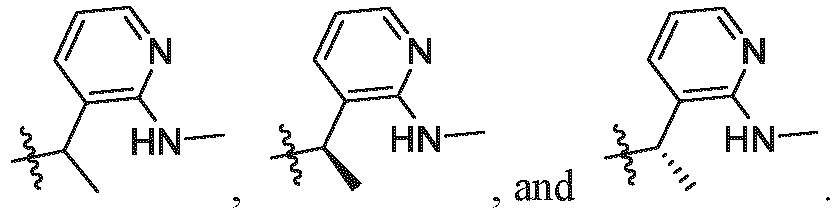
- The compound of formula (I), the stereoisomer thereof, the tautomer thereof, the deuterated compound thereof, or the pharmaceutically acceptable salt thereof according to any one of claims 1-5, wherein Z is selected from the group consisting of a single bond, -S-, -O-, and the following groups optionally substituted with one or more Rz: -NH- and -N(C1-6 alkyl)-;or Z is selected from the group consisting of a single bond, -S-, -O-, -NH-, and -N(C1-12 alkyl)-;or Z is selected from the group consisting of a single bond, -S-, -O-, -NH-, and -N(C1-6 alkyl)-;or Z is selected from the group consisting of a single bond, -S-, -O-, -NH-, and -N(C1-3 alkyl)-;or Z is selected from the group consisting of a single bond, -O-, and -N(C1-3 alkyl)-;or Z is selected from the group consisting of a single bond, -O-, -NH-, and -N(CH3)-;or Z is selected from the group consisting of a single bond, -O-, and -N(CH3)-;or Z is selected from -O-.
- The compound of formula (I), the stereoisomer thereof, the tautomer thereof, the deuterated compound thereof, or the pharmaceutically acceptable salt thereof according to any one of claims 1-6, wherein R3 is selected from the group consisting of H, deuterium, and the following groups optionally substituted with one or more R3a: C1-6 alkyl, 3- to 10-membered cycloalkyl, 3- to 10-membered heterocyclyl, 6- to 10-membered aryl, 5- to 10-membered heteroaryl, 3- to 10-membered cycloalkyl C1-4 alkylene, 3- to 10-membered heterocyclyl C1-4 alkylene, 6- to 10-membered aryl C1-4 alkylene, and 5- to 10-membered heteroaryl C1-4 alkylene;or R3 is selected from the group consisting of H, deuterium, and the following groups optionally substituted with one or more R3a: C1-4 alkyl, 3- to 10-membered cycloalkyl, 4- to 10-membered heterocyclyl, phenyl, 5- to 6-membered heteroaryl, 3- to 10-membered cycloalkyl C1-3 alkylene, 4- to 10-membered heterocyclyl C1-3 alkylene, phenyl C1-3 alkylene, and 5- to 6-membered heteroaryl C1-3 alkylene;or R3 is selected from the group consisting of H, deuterium, and the following groups optionally substituted with one or more R3a: C1-4 alkyl, 3- to 8-membered cycloalkyl, 4- to 8-membered heterocyclyl, phenyl, 5- to 6-membered heteroaryl, 3- to 8-membered cycloalkyl C1-3 alkylene, 4- to 8-membered heterocyclyl C1-3 alkylene, phenyl C1-3 alkylene, and 5- to 6-membered heteroaryl C1-3 alkylene;or R3 is selected from the group consisting of H, deuterium, and the following groups optionally substituted with one or more R3a: C1-4 alkyl, 3- to 8-membered cycloalkyl, 4- to 8-membered heterocyclyl, 3- to 8-membered cycloalkyl C1-3 alkylene, 4- to 8-membered heterocyclyl C1-3 alkylene, and 5- to 6-membered heteroaryl C1-3 alkylene;or R3 is selected from the group consisting of H, deuterium, and the following groups optionally substituted with one or more R3a: C1-4 alkyl, 4- to 8-membered heterocyclyl, 3- to 8-membered cycloalkyl C1-3 alkylene, 4- to 8-membered heterocyclyl C1-3 alkylene, and 5- to 6-membered heteroaryl C1-3 alkylene;or R3 is selected from the group consisting of H, deuterium, and the following groups optionally substituted with one or more R3a: C1-4 alkyl, 4- to 8-membered heterocycloalkyl, 3- to 8-membered cycloalkyl C1-3 alkylene, 4- to 8-membered heterocycloalkyl C1-3 alkylene, and 5- to 6-membered heteroaryl C1-3 alkylene;or R3 is selected from the group consisting of H, deuterium, and the following groups optionally substituted with one or more R3a: methyl, ethyl, propyl, butyl, cyclopropyl, cyclobutyl, cyclopentyl, cyclohexyl, azetidinyl, tetrahydropyrrolyl, morpholinyl, piperidinyl, piperazinyl, hexahydro-1H-pyrrolizinyl, cyclopropyl C1-3 alkylene, cyclobutyl C1-3 alkylene, cyclopentyl C1-3 alkylene, cyclohexyl C1-3 alkylene, azetidinyl C1-3 alkylene, tetrahydropyrrolyl C1-3 alkylene, morpholinyl C1-3 alkylene, piperidinyl C1-3 alkylene, piperazinyl C1-3 alkylene, hexahydro-1H-pyrrolizinyl C1-3 alkylene, hexahydro-1H-pyrrolo[2,1-c][1,4]oxazinyl, hexahydro-1H-pyrrolo[2,1-c][1,4]oxazinyl C1-3 alkylene, 5-azaspiro[2.4]heptanyl, 5-azaspiro[2.4]heptanyl C1-3 alkylene, n-propyl, isopropyl, n-butyl, isobutyl, sec-butyl, tert-butyl, and imidazolyl C1-3 alkylene;or R3 is selected from the group consisting of H, deuterium, and the following groups optionally substituted with one or more R3a: methyl, piperidinyl, cyclopropyl C1-3 alkylene, cyclopentyl C1-3 alkylene, tetrahydropyrrolyl C1-3 alkylene, hexahydro-1H-pyrrolizinyl C1-3 alkylene, hexahydro-1H-pyrrolo[2,1-c][1,4]oxazinyl C1-3 alkylene, 5-azaspiro[2.4]heptanyl C1-3 alkylene, ethyl, n-propyl, isopropyl, n-butyl, isobutyl, sec-butyl, tert-butyl, morpholinyl C1-3 alkylene, imidazolyl C1-3 alkylene, tetrahydropyrrolyl, piperazinyl C1-3 alkylene, azetidinyl C1-3 alkylene, piperidinyl C1-3 alkylene, azetidinyl, cyclobutyl, cyclohexyl, cyclobutyl C1-3 alkylene, and piperazinyl; or R3 is selected from the group consisting of H, deuterium, and the following groups optionally substituted with one or more R3a:


 or R3 is selected from the group consisting of H, deuterium, methyl,










- The compound of formula (I), the stereoisomer thereof, the tautomer thereof, the deuterated compound thereof, or the pharmaceutically acceptable salt thereof according to any one of claims 1-7, wherein R4 is selected from the group consisting of H, deuterium, halogen, -CN, C1-6 alkyl, C1-6 alkoxy, C1-6 haloalkyl, C1-6 haloalkoxy, 3- to 12-membered cycloalkyl, 3- to 12-membered heterocyclyl, 6- to 10-membered aryl, and 5- to 10-membered heteroaryl;or R4 is selected from the group consisting of H, deuterium, halogen, -CN, C1-4 alkyl, C1-4 alkoxy, C1-4 haloalkyl, C1-4 haloalkoxy, 3- to 6-membered cycloalkyl, 5- to 6-membered heterocyclyl, phenyl, and 5- to 6-membered heteroaryl;or R4 is selected from the group consisting of H, deuterium, halogen, -CN, C1-4 alkyl, C1-4 alkoxy, C1-4 haloalkyl, and C1-4 haloalkoxy;or R4 is selected from the group consisting of H, deuterium, -F, -Cl, -Br, -CN, C1-2 alkyl, C1-2 alkoxy, C1-2 haloalkyl, and C1-2 haloalkoxy;or R4 is selected from the group consisting of H, deuterium, -F, -Cl, -Br, C1-2 alkyl, C1-2 alkoxy, and C1-2 fluoroalkyl;or R4 is selected from the group consisting of H, deuterium, -F, -Cl, -Br, methyl, methoxy, difluoromethyl, and trifluoromethyl;or R4 is selected from the group consisting of H, deuterium, -F, -Cl, and methyl;or R4 is selected from the group consisting of H, deuterium, -F, and -Cl.
- The compound of formula (I), the stereoisomer thereof, the tautomer thereof, the deuterated compound thereof, or the pharmaceutically acceptable salt thereof according to any one of claims 1-8, wherein ring A is selected from the group consisting of the following groups optionally substituted with one or more R5: 3- to 6-membered cycloalkyl, 5- to 10-membered heterocyclyl, 6- to 10-membered aryl, and 5- to 10-membered heteroaryl;
or ring A is selected from the group consisting of the following groups optionally substituted with one or more R5: 6- to 10-membered aryl, benzo 4- to 6-membered cycloalkenyl, benzo 4- to 6-membered heterocyclyl, and 5- to 10-membered heteroaryl;or ring A is selected from the group consisting of the following groups optionally substituted with one or more R5: phenyl, naphthyl, benzocyclohexenyl, benzocyclopentenyl, pyrrolyl, pyrazolyl, imidazolyl, furanyl, oxazolyl, isoxazolyl, thienyl, thiazolyl, isothiazolyl, pyranyl, pyridinyl, pyridazinyl, pyrimidinyl, pyrazinyl, indolyl, benzopyrazolyl, benzimidazolyl, benzothiazolyl, quinolyl, isoquinolyl, benzopyrimidinyl, benzothienyl, pyridopyrazolyl, and pyridopyrrolyl;or ring A is selected from the group consisting of the following groups optionally substituted with one or more R5: phenyl, naphthyl, benzocyclohexenyl, benzocyclopentenyl, pyridinyl, indolyl, benzopyrazolyl, benzimidazolyl, benzothiazolyl, quinolyl, isoquinolyl, benzothienyl, pyrazolyl, pyridopyrazolyl, and pyridopyrrolyl;or ring A is selected from the group consisting of the following groups optionally substituted with one or more R5: phenyl, naphthyl, pyridinyl, benzothiazolyl, benzothienyl, isoquinolyl, benzopyrazolyl, pyrazolyl, pyridopyrazolyl, pyridopyrrolyl, quinolyl, indolyl, and benzimidazolyl;or ring A is selected from the group consisting of the following groups optionally substituted with one or more R5: phenyl, naphthyl, pyridinyl, isoquinolyl, benzopyrazolyl, benzothiazolyl, pyrazolyl, pyridopyrazolyl, pyridopyrrolyl, quinolyl, indolyl, and benzimidazolyl;or ring A is selected from the group consisting of


- The compound of formula (I), the stereoisomer thereof, the tautomer thereof, the deuterated compound thereof, or the pharmaceutically acceptable salt thereof according to any one of claims 1-9, wherein each R5 is independently selected from the group consisting of deuterium, halogen, -CN, -OH, -NH2, and the following groups optionally substituted with one or more R5a: C1-6 alkyl, C2-6 alkenyl, C2-6 alkynyl, C1-6 alkoxy, C1-6 alkylamino, di-C1-6 alkylamino, C1-6 alkylthio, 3- to 12-membered cycloalkyl, 6- to 10-membered aryl, 5- to 10-membered heteroaryl, and 3- to 12-membered heterocyclyl;or each R5 is independently selected from the group consisting of deuterium, -F, -Cl, -Br, -CN, -OH, -NH2, and the following groups optionally substituted with one or more R5a: methyl, ethyl, isopropyl, ethenyl, ethynyl, propynyl, methoxy, methylamino, dimethylamino, methylthio, 3- to 6-membered cycloalkyl, and 3- to 6-membered heterocyclyl;or each R5 is independently selected from the group consisting of deuterium, -F, -Cl, -CN, -OH, -NH2, and the following groups optionally substituted with one or more R5a: methyl, ethyl, isopropyl, ethenyl, ethynyl, propynyl, methoxy, methylthio, and cyclopropanyl;or each R5 is independently selected from the group consisting of deuterium, -F, -Cl, -CN, -OH, -NH2, methyl, ethyl, isopropyl, ethenyl, ethynyl, propynyl, trifluoromethyl, hydroxymethylene, methoxy, trifluoromethoxy, methylamino, dimethylamino, methylthio, trifluoromethylthio, and cyclopropanyl optionally substituted with -F, -Cl, -Br, or methyl;or each R5 is independently selected from the group consisting of deuterium, -F, -Cl, -CN, -OH, -NH2, methyl, ethyl, isopropyl, ethynyl, propynyl, trifluoromethyl, methoxy, trifluoromethoxy, methylthio, and cyclopropanyl substituted with methyl.
- The compound of formula (I), the stereoisomer thereof, the tautomer thereof, the deuterated compound thereof, or the pharmaceutically acceptable salt thereof according to any one of claims 1-10, wherein the compound of formula (I), the stereoisomer thereof, the tautomer thereof, the deuterated compound thereof, or the pharmaceutically acceptable salt thereof is selected from the group consisting of a compound of formula (II-1) or formula (II-2) or formula (III) or formula (III-a) or formula (III-b) or formula (III-c) or formula (IV) or formula (IV-a) or formula (IV-b) or formula (IV-c), a stereoisomer thereof, a tautomer thereof, a deuterated compound thereof, and a pharmaceutically acceptable salt thereof,


- The compound of formula (I), the stereoisomer thereof, the tautomer thereof, the deuterated compound thereof, or the pharmaceutically acceptable salt thereof according to any one of claims 1-11, wherein the compound of formula (I), the stereoisomer thereof, the tautomer thereof, the deuterated compound thereof, or the pharmaceutically acceptable salt thereof is selected from the group consisting of:













































































- A pharmaceutical composition, comprising the compound of formula (I), the stereoisomer thereof, the tautomer thereof, the deuterated compound thereof, or the pharmaceutically acceptable salt thereof according to any one of claims 1-12, and optionally further comprising a pharmaceutically acceptable excipient.
- Use of the compound of formula (I), the stereoisomer thereof, the tautomer thereof, the deuterated compound thereof, or the pharmaceutically acceptable salt thereof according to any one of claims 1-12, or the pharmaceutical composition according to claim 13 in the manufacture of a medicament for treating a disease.
Applications Claiming Priority (7)
| Application Number | Priority Date | Filing Date | Title |
|---|---|---|---|
| CN202210967635 | 2022-08-12 | ||
| CN202310200012 | 2023-01-16 | ||
| CN202310103403 | 2023-02-08 | ||
| CN202310264699 | 2023-03-17 | ||
| CN202310948052 | 2023-07-28 | ||
| CN202310991185 | 2023-08-07 | ||
| PCT/CN2023/112440 WO2024032747A1 (en) | 2022-08-12 | 2023-08-11 | Tricyclic compounds and medical use thereof |
Publications (1)
| Publication Number | Publication Date |
|---|---|
| EP4570805A1 true EP4570805A1 (en) | 2025-06-18 |
Family
ID=89851015
Family Applications (1)
| Application Number | Title | Priority Date | Filing Date |
|---|---|---|---|
| EP23851967.2A Pending EP4570805A1 (en) | 2022-08-12 | 2023-08-11 | Tricyclic compounds and medical use thereof |
Country Status (9)
| Country | Link |
|---|---|
| EP (1) | EP4570805A1 (en) |
| JP (1) | JP2025527298A (en) |
| KR (1) | KR20250047778A (en) |
| CN (2) | CN121319012A (en) |
| AU (1) | AU2023321005A1 (en) |
| IL (1) | IL318830A (en) |
| MX (1) | MX2025001700A (en) |
| TW (1) | TW202408512A (en) |
| WO (1) | WO2024032747A1 (en) |
Families Citing this family (30)
| Publication number | Priority date | Publication date | Assignee | Title |
|---|---|---|---|---|
| EP4489738A4 (en) | 2022-03-11 | 2026-03-18 | Kumquat Biosciences Inc | HETEROCYCLICAL COMPOUNDS AND USES OF THEM |
| KR20250060956A (en) | 2022-08-05 | 2025-05-07 | 컴쿼트 바이오사이언시즈 인크. | Heterocyclic compounds and their uses |
| AU2024241633A1 (en) | 2023-03-30 | 2025-11-06 | Revolution Medicines, Inc. | Compositions for inducing ras gtp hydrolysis and uses thereof |
| WO2024218686A1 (en) * | 2023-04-20 | 2024-10-24 | Pfizer Inc. | Pyrido[4,3-d]pyrimidine compounds |
| CN121712509A (en) | 2023-05-04 | 2026-03-20 | 锐新医药公司 | Combination therapy for RAS related diseases or conditions |
| TW202509040A (en) * | 2023-05-16 | 2025-03-01 | 大陸商和記黃埔醫藥(上海)有限公司 | Tricyclic compounds and uses thereof |
| AU2024285370A1 (en) | 2023-06-06 | 2026-01-08 | Kumquat Biosciences Inc. | Substituted heterocycles and uses thereof |
| WO2025007000A1 (en) * | 2023-06-30 | 2025-01-02 | Kumquat Biosciences Inc. | Substituted condensed tricyclic amine compounds and uses thereof as ras inhibitors |
| TW202504599A (en) | 2023-06-30 | 2025-02-01 | 美商必治妥美雅史谷比公司 | Kras inhibitors |
| US20250049810A1 (en) | 2023-08-07 | 2025-02-13 | Revolution Medicines, Inc. | Methods of treating a ras protein-related disease or disorder |
| IL327306A (en) | 2023-10-12 | 2026-05-01 | Revolution Medicines Inc | Macrocyclic ras inhibitors |
| WO2025130912A1 (en) * | 2023-12-19 | 2025-06-26 | 正大天晴药业集团股份有限公司 | Fused tricyclic compound and medical use thereof |
| WO2025167948A1 (en) * | 2024-02-06 | 2025-08-14 | 上海齐鲁制药研究中心有限公司 | Pyrimidine macrocyclic kras inhibitor |
| WO2025171296A1 (en) | 2024-02-09 | 2025-08-14 | Revolution Medicines, Inc. | Ras inhibitors |
| WO2025228390A1 (en) * | 2024-04-30 | 2025-11-06 | Hutchmed Limited | A hydrophilic linker, antibody drug conjugate and use thereof |
| WO2025228384A1 (en) * | 2024-04-30 | 2025-11-06 | Hutchmed Limited | Antibody-drug conjugates and use thereof |
| WO2025228381A1 (en) * | 2024-04-30 | 2025-11-06 | Hutchmed Limited | Antibody-drug conjugate and use thereof |
| WO2025240847A1 (en) | 2024-05-17 | 2025-11-20 | Revolution Medicines, Inc. | Ras inhibitors |
| WO2025255438A1 (en) | 2024-06-07 | 2025-12-11 | Revolution Medicines, Inc. | Methods of treating a ras protein-related disease or disorder |
| WO2025265060A1 (en) | 2024-06-21 | 2025-12-26 | Revolution Medicines, Inc. | Therapeutic compositions and methods for managing treatment-related effects |
| WO2026006747A1 (en) | 2024-06-28 | 2026-01-02 | Revolution Medicines, Inc. | Ras inhibitors |
| WO2026015790A1 (en) | 2024-07-12 | 2026-01-15 | Revolution Medicines, Inc. | Methods of treating a ras related disease or disorder |
| WO2026015825A1 (en) | 2024-07-12 | 2026-01-15 | Revolution Medicines, Inc. | Use of ras inhibitor for treating pancreatic cancer |
| WO2026015801A1 (en) | 2024-07-12 | 2026-01-15 | Revolution Medicines, Inc. | Methods of treating a ras related disease or disorder |
| WO2026015796A1 (en) | 2024-07-12 | 2026-01-15 | Revolution Medicines, Inc. | Methods of treating a ras related disease or disorder |
| WO2026050446A1 (en) | 2024-08-29 | 2026-03-05 | Revolution Medicines, Inc. | Ras inhibitors |
| WO2026072904A2 (en) | 2024-09-26 | 2026-04-02 | Revolution Medicines, Inc. | Compositions and methods for treating lung cancer |
| WO2026090116A2 (en) | 2024-10-21 | 2026-04-30 | Revolution Medicines, Inc. | Ras inhibitors |
| WO2026090245A1 (en) | 2024-10-22 | 2026-04-30 | Revolution Medicines, Inc. | Use of ras inhibitors for treating cancer |
| US20260108528A1 (en) | 2024-10-22 | 2026-04-23 | Revolution Medicines, Inc. | Methods of treating a ras protein-related disease or disorder |
Family Cites Families (6)
| Publication number | Priority date | Publication date | Assignee | Title |
|---|---|---|---|---|
| CN112778284B (en) * | 2019-11-01 | 2022-04-05 | 四川海思科制药有限公司 | Pyrimido-cyclic derivative and application thereof in medicine |
| CN113135924B (en) * | 2020-01-19 | 2024-04-26 | 广东东阳光药业股份有限公司 | Pyrimidine derivatives and their application in medicine |
| CN116848120B (en) | 2021-02-15 | 2026-02-13 | 安斯泰来制药株式会社 | Quinazoline compounds used to induce the degradation of G12D mutant KRAS protein |
| EP4408851A4 (en) * | 2021-09-27 | 2025-09-17 | Jacobio Pharmaceuticals Co Ltd | POLYCYCLIC FUSED RING DERIVATIVES AND THEIR USE |
| CN116199703A (en) * | 2021-12-01 | 2023-06-02 | 江苏恒瑞医药股份有限公司 | Fused tetracyclic heterocyclic compound, preparation method thereof and application thereof in medicine |
| EP4489738A4 (en) * | 2022-03-11 | 2026-03-18 | Kumquat Biosciences Inc | HETEROCYCLICAL COMPOUNDS AND USES OF THEM |
-
2023
- 2023-08-11 EP EP23851967.2A patent/EP4570805A1/en active Pending
- 2023-08-11 CN CN202511775921.XA patent/CN121319012A/en active Pending
- 2023-08-11 CN CN202380056280.5A patent/CN119604511A/en active Pending
- 2023-08-11 AU AU2023321005A patent/AU2023321005A1/en active Pending
- 2023-08-11 WO PCT/CN2023/112440 patent/WO2024032747A1/en not_active Ceased
- 2023-08-11 IL IL318830A patent/IL318830A/en unknown
- 2023-08-11 KR KR1020257007064A patent/KR20250047778A/en active Pending
- 2023-08-11 JP JP2025506180A patent/JP2025527298A/en active Pending
- 2023-08-11 TW TW112130263A patent/TW202408512A/en unknown
-
2025
- 2025-02-10 MX MX2025001700A patent/MX2025001700A/en unknown
Also Published As
| Publication number | Publication date |
|---|---|
| CN119604511A (en) | 2025-03-11 |
| JP2025527298A (en) | 2025-08-20 |
| WO2024032747A1 (en) | 2024-02-15 |
| TW202408512A (en) | 2024-03-01 |
| KR20250047778A (en) | 2025-04-04 |
| AU2023321005A1 (en) | 2025-03-20 |
| CN121319012A (en) | 2026-01-13 |
| IL318830A (en) | 2025-04-01 |
| MX2025001700A (en) | 2025-03-07 |
Similar Documents
| Publication | Publication Date | Title |
|---|---|---|
| IL318830A (en) | Tricyclic compounds and medical use thereof | |
| CN112689638B (en) | Cyclopropylamine compound serving as LSD1 inhibitor and application thereof | |
| CN114502561B (en) | LSD1 inhibitor | |
| EP4122925A1 (en) | Proteolysis regulator and method for using same | |
| EP4148056A1 (en) | Sos1 inhibitor containing phosphorus | |
| AU2022271549A1 (en) | Sulfoximine-containing atr inhibitor compound | |
| CN114616232A (en) | Azepadinopyrimidine derivatives and medical application thereof | |
| CN116917286B (en) | 6-Carbamate substituted heteroaromatic ring derivatives | |
| WO2024067744A1 (en) | Heterocyclic substituted quinazoline, preparation method therefor, and use thereof | |
| EP3848367A1 (en) | Tricyclic compounds acting on crbn proteins | |
| EP4289827A1 (en) | Fused ring derivatives containing 1,4-oxazepane | |
| KR20210086680A (en) | Trifluoromethyl-substituted sulfonamides as BCL-2-selective inhibitors | |
| EP4737455A1 (en) | Compound containing multi-fused ring structure | |
| EP4434992A1 (en) | Fused imide derivative | |
| EP3978494A1 (en) | Methyl- and trifluoromethyl-containing disubstituted sulfonamide selective bcl-2 inhibitor | |
| US20240199571A1 (en) | Thiophene compound and application thereof | |
| EP4628483A1 (en) | Dihydrophthalazine-containing compound | |
| CN119431406A (en) | Tricyclic compounds and their medical uses | |
| HK40128576A (en) | Tricyclic compounds and medical use thereof | |
| TW202525796A (en) | Compound for EGFR protein degradation and use thereof | |
| WO2021129841A1 (en) | Compound used as ret kinase inhibitor and application thereof | |
| EP4617272A1 (en) | Fused bicyclic compound | |
| CN118871434A (en) | Crystalline form of 3-(5-(2-hydroxy-2-methylpropoxy)-6-methylpyrazin-2-yl)-1H-indole-7-carbonitrile | |
| CN121652157A (en) | Parallel ring compound and medical application thereof | |
| EP4442690A1 (en) | Compound containing cycloalkyl or haloalkyl |
Legal Events
| Date | Code | Title | Description |
|---|---|---|---|
| STAA | Information on the status of an ep patent application or granted ep patent |
Free format text: STATUS: THE INTERNATIONAL PUBLICATION HAS BEEN MADE |
|
| PUAI | Public reference made under article 153(3) epc to a published international application that has entered the european phase |
Free format text: ORIGINAL CODE: 0009012 |
|
| STAA | Information on the status of an ep patent application or granted ep patent |
Free format text: STATUS: REQUEST FOR EXAMINATION WAS MADE |
|
| 17P | Request for examination filed |
Effective date: 20250303 |
|
| AK | Designated contracting states |
Kind code of ref document: A1 Designated state(s): AL AT BE BG CH CY CZ DE DK EE ES FI FR GB GR HR HU IE IS IT LI LT LU LV MC ME MK MT NL NO PL PT RO RS SE SI SK SM TR |
|
| DAV | Request for validation of the european patent (deleted) | ||
| DAX | Request for extension of the european patent (deleted) | ||
| REG | Reference to a national code |
Ref country code: HK Ref legal event code: DE Ref document number: 40128576 Country of ref document: HK |