EP4570702A1 - Container for mixable medicinal and/or nutritional products - Google Patents
Container for mixable medicinal and/or nutritional products Download PDFInfo
- Publication number
- EP4570702A1 EP4570702A1 EP23216950.8A EP23216950A EP4570702A1 EP 4570702 A1 EP4570702 A1 EP 4570702A1 EP 23216950 A EP23216950 A EP 23216950A EP 4570702 A1 EP4570702 A1 EP 4570702A1
- Authority
- EP
- European Patent Office
- Prior art keywords
- container
- arc segment
- flexible film
- seam
- radius
- Prior art date
- Legal status (The legal status is an assumption and is not a legal conclusion. Google has not performed a legal analysis and makes no representation as to the accuracy of the status listed.)
- Pending
Links
Images

Classifications
-
- B—PERFORMING OPERATIONS; TRANSPORTING
- B65—CONVEYING; PACKING; STORING; HANDLING THIN OR FILAMENTARY MATERIAL
- B65D—CONTAINERS FOR STORAGE OR TRANSPORT OF ARTICLES OR MATERIALS, e.g. BAGS, BARRELS, BOTTLES, BOXES, CANS, CARTONS, CRATES, DRUMS, JARS, TANKS, HOPPERS, FORWARDING CONTAINERS; ACCESSORIES, CLOSURES, OR FITTINGS THEREFOR; PACKAGING ELEMENTS; PACKAGES
- B65D81/00—Containers, packaging elements, or packages, for contents presenting particular transport or storage problems, or adapted to be used for non-packaging purposes after removal of contents
- B65D81/32—Containers, packaging elements, or packages, for contents presenting particular transport or storage problems, or adapted to be used for non-packaging purposes after removal of contents for packaging two or more different materials which must be maintained separate prior to use in admixture
- B65D81/3261—Flexible containers having several compartments
- B65D81/3266—Flexible containers having several compartments separated by a common rupturable seal, a clip or other removable fastening device
-
- A—HUMAN NECESSITIES
- A61—MEDICAL OR VETERINARY SCIENCE; HYGIENE
- A61J—CONTAINERS SPECIALLY ADAPTED FOR MEDICAL OR PHARMACEUTICAL PURPOSES; DEVICES OR METHODS SPECIALLY ADAPTED FOR BRINGING PHARMACEUTICAL PRODUCTS INTO PARTICULAR PHYSICAL OR ADMINISTERING FORMS; DEVICES FOR ADMINISTERING FOOD OR MEDICINES ORALLY; BABY COMFORTERS; DEVICES FOR RECEIVING SPITTLE
- A61J1/00—Containers specially adapted for medical or pharmaceutical purposes
- A61J1/05—Containers specially adapted for medical or pharmaceutical purposes for collecting, storing or administering blood, plasma or medical fluids ; Infusion or perfusion containers
- A61J1/10—Bag-type containers
-
- A—HUMAN NECESSITIES
- A61—MEDICAL OR VETERINARY SCIENCE; HYGIENE
- A61J—CONTAINERS SPECIALLY ADAPTED FOR MEDICAL OR PHARMACEUTICAL PURPOSES; DEVICES OR METHODS SPECIALLY ADAPTED FOR BRINGING PHARMACEUTICAL PRODUCTS INTO PARTICULAR PHYSICAL OR ADMINISTERING FORMS; DEVICES FOR ADMINISTERING FOOD OR MEDICINES ORALLY; BABY COMFORTERS; DEVICES FOR RECEIVING SPITTLE
- A61J1/00—Containers specially adapted for medical or pharmaceutical purposes
- A61J1/14—Details; Accessories therefor
- A61J1/20—Arrangements for transferring or mixing fluids, e.g. from vial to syringe
- A61J1/2003—Accessories used in combination with means for transfer or mixing of fluids, e.g. for activating fluid flow, separating fluids, filtering fluid or venting
- A61J1/202—Separating means
- A61J1/2024—Separating means having peelable seals
-
- A—HUMAN NECESSITIES
- A61—MEDICAL OR VETERINARY SCIENCE; HYGIENE
- A61J—CONTAINERS SPECIALLY ADAPTED FOR MEDICAL OR PHARMACEUTICAL PURPOSES; DEVICES OR METHODS SPECIALLY ADAPTED FOR BRINGING PHARMACEUTICAL PRODUCTS INTO PARTICULAR PHYSICAL OR ADMINISTERING FORMS; DEVICES FOR ADMINISTERING FOOD OR MEDICINES ORALLY; BABY COMFORTERS; DEVICES FOR RECEIVING SPITTLE
- A61J1/00—Containers specially adapted for medical or pharmaceutical purposes
- A61J1/14—Details; Accessories therefor
- A61J1/20—Arrangements for transferring or mixing fluids, e.g. from vial to syringe
- A61J1/2093—Containers having several compartments for products to be mixed
Definitions
- the invention is directed to a container for mixable medicinal and/or nutritional products.
- the container comprises a first flexible film and a second flexible film, wherein the first flexible film and the second flexible film are located on top of each other.
- a product space is delimited by the mutually opposite sides of the first flexible film and the second flexible film and by a first, permanent seam locally connecting the first flexible film and the second flexible film.
- the product space is subdivided into at least two product chambers by at least a second, rupturable seam locally connecting the first flexible film and the second flexible film.
- containers Due to the fact that such containers are essentially made of flexible films, the containers are flexible to a certain degree. Therefore, such containers may also be called bags.
- the containers or bags are used to deliver medicinal and/or nutritional products to a patient.
- a container having at least two product chambers is used if at least two medicinal and/or nutritional products are to be delivered to the patient and if at least one of these at least two medicinal and/or nutritional products negatively impacts the respective other one of these at least two medicinal and/or nutritional products if provided in the same chamber.
- the negative impact may lead to a reduced storage life of at least one of the at least two medicinal and/or nutritional products. It is also possible that the negative impact leads to a reduction in quality of at least one of the at least two medicinal and/or nutritional products.
- the at least two medicinal and/or nutritional products are stored in separate chambers of the same container.
- the chambers are separated by at least a rupturable seam.
- the rupturable seam is at least partially broken or ruptured and the at least two medicinal and/or nutritional products are mixed.
- the rupturable seam needs to fulfill two contradictory requirements.
- the rupturable seam needs to be stable and robust during transportation and storage of the container.
- the rupturable seam needs to be ruptured with little resistance in order to be able to comfortably mix the at least two medicinal and/or nutritional products.
- the container suffers from conflicting objectives.
- a container with a rupturable seam shall be provided, wherein the rupturable seam is both stable and easily rupturable.
- the problem is solved by a container for mixable medicinal and/or nutritional products.
- the container comprises a first flexible film and a second flexible film, wherein the first flexible film and the second flexible film are located on top of each other.
- a product space is delimited by the mutually opposite sides of the first flexible film and the second flexible film and by a first, permanent seam locally connecting the first flexible film and the second flexible film.
- the product space is subdivided into at least two product chambers by at least a second, rupturable seam locally connecting the first flexible film and the second flexible film.
- the second seam comprises an opening zone for facilitating rupturing of the second seam.
- the opening zone comprises at least three arc segments arranged in alternating orientations such that the at least three arc segments form a wave-shape.
- a first arc segment of the at least three arc segments is arranged between a second arc segment and a third arc segment of the at least three arc segments.
- a radius of the first arc segment is smaller than a radius of the second arc segment and smaller than a radius of the third arc segment.
- the opening zone of the second seam is stable and robust. Especially, the seam as such may have the same characteristics in the opening zone and in the remaining portions of the seam. Consequently, in case each of the at least two product chambers are filled with a medicinal and/or nutritional product, these products may be kept separate from one another. At the same time, the opening zone facilitates rupturing of the second seam.
- rupturing the second seam is only necessary if the at least two product chambers are filled with a medicinal and/or nutritional product.
- the second seam is ruptured by increasing pressure in one of the product chambers adjacent to the second seam.
- a user may push or hit on the respective chamber and, thus, the medicinal and/or nutritional product located inside the chamber.
- a user may roll a portion of the container in order to increase the pressure in one of the product chambers.
- the user first rolls a portion of the container in order to increase the pressure in one of the product chambers and subsequently pushes on this chamber.
- the form of the opening zone with the three arc segments forming a wave shape and the first arc segment having the smallest radius has the effect that a mechanical tension acting on the second seam as a result of the increased pressure in the chamber has a local peak in or adjacent to the first arc segment. Consequently, the second seam may be ruptured in a simple and reliable manner.
- the user rolls or pushes a portion of the container, e.g. starting from a hanger side the medicinal and/or nutritional product may be pushed towards the opening zone thereby creating a localized swelling of the container, i.e. the rolled or pushed chamber, adjacent to the opening zone.
- the swelling and the pressured medicinal and/or nutritional product inside the chamber are oriented such that they tend to move the first flexible film and a second flexible film away from one another. This may be done until each of the first flexible film and the second flexible film are locally oriented at an angle close to 90° with respect to a plane defined by the first, permanent seam. Due to the comparatively small radius, this is especially the case adjacent to the first arc segment. Further pressurizing the medicinal and/or nutritional product, e.g. by further rolling, pushing or hitting the respective chamber, has the effect that the pressure prevailing in the medicinal and/or nutritional product induces additional mechanical stress in the first flexible film and the second flexible film forcing the films to move further away from one another.
- the bond between the films starts to break or open.
- the first flexible film and the second flexible film are separating. This is often described as peeling off of the first flexible film away from the second flexible film and/or vice versa.
- the comparatively small radius of the first arc segment allows the locally adjacent segments of the first flexible film and the second flexible film to reach an orientation at an angle close to 90° with respect to a plane defined by the first seam. This creates a local force peak supporting the opening of the adjacent chamber, i.e. supporting the local separation of the first flexible film away from the second flexible film and/or vice versa.
- an opening zone comprising three arc segments forming a wave-shape either has one wave trough and two wave crests or has two wave crests and one wave trough. This may depend on the perspective. In any case, the radii of the arc segments may be measured at the respective wave crest or wave trough.
- a rupturable seam is called a peelable seam. This is due to the fact that such a seam is ruptured by peeling it after the first flexible film and the second flexible film have been separated at a starting point of the rupturable seam.
- the container comprises at least three product chambers, wherein the second, rupturable seam is located between a lowest product chamber and a product chamber adj acent to the lowest product chamber.
- one of the at least three product chamber is configured to contain a product rich in glucose
- one of the at least three product chambers is configured to contain a product rich in lipids
- one of the at least three product chambers is configured to contain a product rich in amino acids.
- the lowest product chamber may be determined if the container is in a state of use.
- the container may be hung on a stand.
- containers often comprise a hanging interface arranged at one end of the container and/or in the middle of the container.
- One or more ports for withdrawing the medicinal and/or nutritional products from the container are usually arranged at a second end of the container which is located opposite the first end of the container. Consequently, the lowest chamber may as well be identified as the chamber adjacent to the ports. In known containers, rupturing the rupturable seam between the lowest product chamber and an adjacent product chamber is more difficult than rupturing rupturable seams at other locations. Consequently, providing the opening zone adjacent to the lowest product chamber facilitates the use of the container.
- the opening zone may form a corner portion of one of the at least two product chambers.
- a user of the container In a state in which the product chambers of the container are filled, it is comparatively easy for a user of the container to accumulate the product located in one of the chambers in a corner portion thereof. Based thereon, the pressure in the corner portion may be easily increased. Combining this effect with the effect of the opening zone facilitates the use of the content in a particular manner.
- the corner portion extends over an angle of 50° to 130°, preferably of 75° to 115°. In an example, the corner portion extends over 90°. In another example, the corner portion extends over more than 90°. In a further example, the corner portion may extend over less than 90°. In this context, the angle over which the corner portion extends is measured between portions of the seam delimiting the corner. It has been found that such an extension of a corner portion is particularly suitable for being used in combination with the opening zone. Consequently, the rupturable seam may be ruptured with particular ease.
- the opening zone may comprise at least one straight segment and/or curved segment arranged between two of the at least three arc segments.
- a curved segment is to be distinguished from the at least three arc segments in that a radius of the curved segment is at least ten times the radius of the arc segment having the larges radius.
- the radius of the second arc segment and the radius of the third arc segment may be equal or different.
- the opening zone is structurally simple. This also facilitates the production of the container.
- the different radii may be used in order to fine-tune the rupturing characteristics of the second seam. As before, the radii are measured in the wave crest or wave trough.
- the radius of the first arc segment is 50% or less than the smaller one of the radius of the second arc segment and the radius of the third arc segment. Consequently, the radius of the first arc segment is comparatively small. This helps creating a peak of mechanical tension in or adjacent to the first arc segment.
- the radius of the first arc segment may be 5mm to 15mm. In an example, the radius of the first arc segment is 10 mm. It has been found that such radii are well-suitable for containers for medicinal and/or nutritional products.
- the radius of the second arc segment and/or the radius of the third arc segment may be 15 mm to 40 mm, preferably 20 mm to 30 mm. In an example, the radius of the second arc segment and/or the radius of the third arc segment is 25 mm. It has been found that such radii are well-suitable for containers for medicinal and/or nutritional products.
- the opening zone is inclined. This means that in a position of use of the container, e.g. if the container is hung on a stand, the opening zone is neither oriented vertically nor horizontally.
- an inclined opening zone is neither parallel nor perpendicular to this direction. The inclined orientation of the opening zone facilitates rupturing of the second seam in the opening zone by pressurizing the product located in an adjacent product chamber.
- the opening zone may be inclined by 20° to 50° with respect to a horizontal direction.
- the opening zone is inclined by 30° to 40°.
- the horizontal direction may be either defined if the container is in a use state, e.g. hung on a stand. Additionally or alternatively, the horizontal direction may be defined as a direction being perpendicular to a direction extending from a hanger interface and a port side of the container. It has been found that an inclination of 20° to 50° with respect to the horizontal direction allows for particularly comfortable handling of the container.
- the first arc segment forms a wave crest oriented towards an interior of one of the at least two product chambers and towards a support side of the container.
- the support side of the container is formed by the side having a hanger interface.
- the support side of the container is arranged opposite a port side of the container. This orientation helps creating a tension peak in the first arc segment.
- the wave crest may be arranged within a distance of 20 mm to 40 mm from a lower boundary of one of the at least two product chambers.
- the distance is 20 mm to 30 mm, e.g. 24 mm or 25 mm.
- the lower boundary may be formed by the second seam.
- the lower boundary is oriented horizontally. This distance facilitates the accumulation of product adjacent to the wave crest. Consequently, creating a tension peak in the first arc segment is facilitated.
- the wave crest may be arranged within a distance of 24 mm to 60 mm from a lateral boundary of one of the at least two product chambers. In an example, the distance is 34 mm. In another example, this distance is 44 mm.
- the lateral boundary may be formed by the second seam or the first seam. In an example, the lateral boundary is oriented vertically. This distance facilitates the accumulation of product adjacent to the wave crest. Consequently, creating a tension peak in the first arc segment is facilitated.
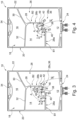
- Figure 1 shows a container 10 for mixable medicinal and/or nutritional products according to a first embodiment.
- the container comprises three product chambers 12, 14, 16.
- the container 10 comprises a first flexible film 18 and the second flexible film 20 which are located on top of each other.
- the first flexible film 18 and the second flexible film 20 are locally connected by a first, permanent seam 22 extending along a boundary of the first flexible film 18 and the second flexible film 20.
- the first seam 22 is circumferentially closed except for an insert 24 comprising ports.
- the ports are configured to withdraw the mixable medicinal and/or nutritional products from the container 10.
- a product space 26 is essentially delimited by the mutually opposite sides of the first flexible film 18 and the second flexible film 20 and by the first, permanent seam 22.
- the first flexible film 18 and the second flexible film 20 are made from plastics material.
- the product space 26 is subdivided by a second, rupturable seam 28, a third, rupturable seam 30, and a fourth, permanent seam 32.
- Each of these seams locally connects the first flexible film 18 and the second flexible film 20.
- a rupturable seam differs from a permanent seam in that the rupturable seam is configured to be ruptured in order to mix products provided in different product chambers 12, 14, 16. From a mechanical perspective, the mechanical connection of the first flexible film 18 and the second flexible film 20 is configured to support higher loads in a permanent seam as compared to a rupturable seam.
- the product chamber 12 is delimited by the first seam 22 the second seam 28 and the third seam 30.
- the product chamber 14 is delimited by the first seam 22, the second seam 28 and the fourth seam 32.
- the product chamber 16 is delimited by the first seam 22, the third seam 30 and the fourth seam 32.
- the container 10 comprises an insert 24 with ports.
- the insert 24 is provided at a first end of the container 10.
- a hanger interface 34 is provided at an opposite end of the container 10.
- the hanger interface 34 is configured to interact with a stand on which the container 10 may be hung.
- a direction extending from the hanger interface 34 to the insert 24 with the ports is substantially oriented vertically.
- the product chamber 12 is the lowest or lower product chamber.
- the product chamber 16 is the highest or upper product chamber.
- the product chamber 14 is a middle product chamber.
- the product chamber 12 may be referred to as a lowest or lower product chamber
- the product chamber 16 may be referred to as a highest or upper product chamber
- the product chamber 14 may be referred to as a middle product chamber even in a situation in which the container 10 is not hung on a stand.
- the second seam 28 has a first segment 28a delimiting the product chamber 14 on a lower side. Moreover, the second seam 28 has a second segment 28b delimiting the product chamber 14 on a lateral side. The lateral side is arranged opposite the side of the product chamber 14 being delimited by the first seam 22.
- the second seam 28 has a corner portion 28c interconnecting the first segment 28a and the second segment 28b.
- the corner portion 28c is formed as an opening zone 36.
- the opening zone 36 facilitates rupturing of the second seam, i.e. providing a connection between the product chamber 12 and the product chamber 14 such that products provided in the product chamber 14 and the product chamber 12 may be mixed.
- the opening zone 36 comprises a total of three arc segments and one straight segment.
- the opening zone 36 comprises a first arc segment 38 being oriented towards the interior of the product chamber 14.
- the first arc segment 38 is connected to the first segment 28a of the second seam 28 by a second arc segment 40.
- the second arc segment 40 is oriented towards the interior of the product chamber 12. Consequently, the first arc segment 38 and the second act segment 40 are oriented in opposite orientations.
- a third arc segment 42 and a straight segment 44 are provided.
- the third arc segment 42 is connected to the first arc segment 38 via the straight segment 44. More precisely, the third arc segment 42 and the straight segment 44 are arranged on a side of the first arc segment 38 opposite to the second arc segment 40.
- the third arc segment 42 is oriented towards the product chamber 12. Thus, also the third arc segment 42 is oriented in a direction opposite to the orientation of the first arc segment 38.
- the orientations of the arc segments 38, 40, 42 are alternating when following the second seam 28. Consequently, the opening zone 36 has the form of a wave.
- the first arc segment 38 forms a wave crest 46 oriented towards an interior of the product chamber 14 and towards a support side of the container 10, i.e. to the side where the hanger interface 34 is provided.
- the wave crest 46 is oriented towards an upper left side.
- the second arc segment 42 tangentially merges into the first segment 28a of the second seam 28 and the third arc segment 42 tangentially merges into the second segment 28b of the second seam 28.
- tangentially merging means that a tangent of each of the merging segments has the same orientation at the point of contact.
- the first arc segment 38 has a radius R1 of 10 mm.
- the second arc segment 40 has a radius R2 of 25 mm and the third arc segment 42 has a radius R3 which is 25 mm.
- the radius R2 and the radius R3 are the same.
- the radius R1 of the first arc segment 38 is smaller than the radius R2 of the second act segment 40 and smaller than the radius R3 of the third arc segment 42.
- the radius R1 of the first arc segment 38 is even less than 50% than the radius R2 of the second arc segment 40 and the radius R3 of the third arc segment 42.
- the straight segment 44 has a length LS of 5 mm in the present example.
- the wave crest 46 is arranged at a distance D1 of 24 mm from a lower boundary B1 of the product chamber 14.
- the lower boundary B1 corresponds to the first segment 28a.
- the wave crest 46 is arranged at a distance D2 of 34 mm from a lateral boundary B2 of the product chamber 14.
- the lateral boundary B2 is formed by the second segment 28b.
- the opening zone 36 is in inclined by 36° with respect to a horizontal direction (cf. dash-dot-line).
- the horizontal direction is oriented perpendicular to a direction which extends from the hanger interface 34 towards the insert 24.
- a medicinal and/or nutritional product may be provided in each of the product chamber 12, 14, 16. Before administering the medicinal and/or nutritional products to a patient, the products need to be mixed.
- the container 10 may be rolled up starting from the side where the hanger interface 34 is arranged.
- the product in the product chamber 16 may be pressurized leading to rupturing of the third seam 30.
- the product in chamber 14 may be subject to pressure.
- the second seam 28 may be ruptured. This rupturing is initiated by the opening zone 36 since the geometry of the opening zone has the effect that a tension peak is created in the area of the first arc segment 38 thereby leading to the fact that this portion of the second seam 28 ruptures first.
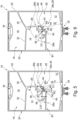
- FIG. 2 shows a second embodiment of the container 10.
- Figure 2 shows a second embodiment of the container 10.
- the container 10 of Figure 2 differs from the container 10 of Figure 1 in that the length LS of the straight segment 44 is 15 mm instead of 5 mm. This has an effect on the inclination of the opening zone 36 which is 29° in the example of Figure 2 .
- this has the effect that the distance D2 between the wave crest 46 and the lateral boundary B2 which is formed by the second segment 28b of the second seam 28 increases to 44 mm.
- FIG 3 shows a third embodiment of the container 10.
- Figure 3 shows a third embodiment of the container 10.
- first arc segment 38 and the third arc segment 42 are connected by a curved segment 48 instead of a straight segment 44 as in the previous examples.
- the curved segment has a radius RC of 100 mm and a length LC of 13.6 mm.
- the curved segment 48 is tangentially connected to both the first arc segment 38 and the third arc segment 42.
- an end of the curved segment 48 which is located adjacent to the first arc segment 38 extends at an angle of 8.3° with respect to a horizontal direction.
- the curved segment 48 forms a depression 49 with respect to the wave crest 46 which has a depth T of 1.1 mm.
- the distance D2 between the wave crest 46 and the lateral boundary B2 is the same as the embodiment of Figure 2 .
- the distance D1 between the wave crest 46 and the lower boundary B1 is the same as in the example of Figure 2 .
- FIG. 4 shows a fourth embodiment of the container 10.
- the container 10 shows a fourth embodiment of the container 10.
- the differences with respect to the above embodiments will be explained. Apart from that, reference is made to the above explanations.
- the first arc segment 38 is directly connected to the third arc segment 42.
- the first arc segment 38 and the third arc segment 42 merge tangentially into one another.
- an end of the third arc segment 42 which is located adjacent to the first arc segment 38 extends at an angle of 31° with respect to a horizontal direction.
- first arc segment 38 and the third arc segment 42 form a depression 49 with respect to the wave crest 46 which has a depth T of 4,2 mm.
- FIG. 5 shows a fifth embodiment of the container 10.
- the fifth embodiment is a variant of the third embodiment (cf. Figure 3 ).
- the horizontal extension of the curved segment 48 has been reduced to 4,8 mm.
- the distance D2 between the wave crest 46 and the lateral boundary B2 is 34 mm only.
- the depth T of the depression 49 is reduced to 0.1 mm.
- FIG. 6 shows a sixth embodiment of the container 10. In the following, only the differences with respect to the above embodiments will be explained. Apart from that, reference is made to the above explanations.
- the embodiment of Figure 6 is a variant of the embodiment of Figure 4 .
- the distance D2 between the wave crest 46 and the lateral boundary B2 is reduced to 34 mm.
- the depth T of the depression 49 amounts to 0.4 mm only.
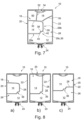
- FIG. 7 shows a seventh embodiment of the container 10. In the following, only the differences with respect to the above embodiments will be explained. Apart from that, reference is made to the above explanations.
- the container 10 comprises a total of four product chambers. This is due to the fact that, based on the embodiments of Figures 1 to 6 , the upper chamber 16 has been subdivided into two product chambers 16, 50 by a fifth rupturable seam 52.
- the fifth seam 52 is substantially straight.
- the second seam 28 may be designed in accordance with any one of the embodiments of Figures 1 to 6 .
- the fifth seam 52 is slightly curved instead of being straight. This means that the fifth seam 52 has a radius which equals or exceeds 20 times the largest one of the remaining radii of the seams delimiting the chambers.
- Figure 8 shows three further embodiments of the container 10.
- the containers 10 of Figure 8 comprise two product chambers 12, 14 only.
- the product chambers 12, 14 are separated by the second seam 28 which comprises an opening zone 36. It is noted that in any of the embodiments of Figure 8 , any opening zone as explained in connection with Figures 1 to 6 may be used.
- container 10 may be created based on any one of the embodiments of Figures 1 to 6 by simply eliminating the third rupturable seam.
Landscapes
- Health & Medical Sciences (AREA)
- Public Health (AREA)
- Pharmacology & Pharmacy (AREA)
- Life Sciences & Earth Sciences (AREA)
- Animal Behavior & Ethology (AREA)
- General Health & Medical Sciences (AREA)
- Veterinary Medicine (AREA)
- Hematology (AREA)
- Physics & Mathematics (AREA)
- Fluid Mechanics (AREA)
- Engineering & Computer Science (AREA)
- Mechanical Engineering (AREA)
- Medical Preparation Storing Or Oral Administration Devices (AREA)
Abstract
A container (10) for mixable medicinal and/or nutritional products is presented. The container (10) comprises a first flexible film (18) and a second flexible film (20) being located on top of each other. A product space (26) is delimited by the mutually opposite sides of the first flexible film (18) and the second flexible film (20) and by a first, permanent seam (22) locally connecting the first flexible film (18) and the second flexible film (20). Moreover, the product space (26) is subdivided into at least two product chambers (12, 14, 16) by at least a second, rupturable seam (28) locally connecting the first flexible film (18) and the second flexible film (20). The second seam (28) comprises an opening zone (36) for facilitating rupturing of the second seam (28). The opening zone (36) comprises at least three arc segments (38, 40, 42) arranged in alternating orientations such that the at least three arc segments (38, 40, 42) form a wave-shape. A first arc segment (38) of the at least three arc segments (38, 40, 42) is arranged between a second arc segment (40) and a third arc segment (42) of the at least three arc segments (38, 40, 42). A radius (R1) of the first arc segment (38) is smaller than a radius (R2) of the second arc segment (40) and smaller than a radius (R3) of the third arc segment (42).
Description
- The invention is directed to a container for mixable medicinal and/or nutritional products. The container comprises a first flexible film and a second flexible film, wherein the first flexible film and the second flexible film are located on top of each other. A product space is delimited by the mutually opposite sides of the first flexible film and the second flexible film and by a first, permanent seam locally connecting the first flexible film and the second flexible film. Moreover, the product space is subdivided into at least two product chambers by at least a second, rupturable seam locally connecting the first flexible film and the second flexible film.
- Due to the fact that such containers are essentially made of flexible films, the containers are flexible to a certain degree. Therefore, such containers may also be called bags. The containers or bags are used to deliver medicinal and/or nutritional products to a patient.
- In this context, a container having at least two product chambers is used if at least two medicinal and/or nutritional products are to be delivered to the patient and if at least one of these at least two medicinal and/or nutritional products negatively impacts the respective other one of these at least two medicinal and/or nutritional products if provided in the same chamber. The negative impact may lead to a reduced storage life of at least one of the at least two medicinal and/or nutritional products. It is also possible that the negative impact leads to a reduction in quality of at least one of the at least two medicinal and/or nutritional products.
- In order to prevent such effects, the at least two medicinal and/or nutritional products are stored in separate chambers of the same container. The chambers are separated by at least a rupturable seam. Just before administering the at least two medicinal and/or nutritional products to the patient, the rupturable seam is at least partially broken or ruptured and the at least two medicinal and/or nutritional products are mixed.
- Thus, in such a container, the rupturable seam needs to fulfill two contradictory requirements. First, the rupturable seam needs to be stable and robust during transportation and storage of the container. However, when preparing the use of the container, i.e. when preparing the at least two medicinal and/or nutritional products to be administered to a patient, the rupturable seam needs to be ruptured with little resistance in order to be able to comfortably mix the at least two medicinal and/or nutritional products. Thus, the container suffers from conflicting objectives.
- The problem to be solved by the present invention is to mitigate these conflicting objectives. In other words, a container with a rupturable seam shall be provided, wherein the rupturable seam is both stable and easily rupturable.
- The problem is solved by a container for mixable medicinal and/or nutritional products. The container comprises a first flexible film and a second flexible film, wherein the first flexible film and the second flexible film are located on top of each other. A product space is delimited by the mutually opposite sides of the first flexible film and the second flexible film and by a first, permanent seam locally connecting the first flexible film and the second flexible film. Moreover, the product space is subdivided into at least two product chambers by at least a second, rupturable seam locally connecting the first flexible film and the second flexible film. Furthermore, the second seam comprises an opening zone for facilitating rupturing of the second seam. The opening zone comprises at least three arc segments arranged in alternating orientations such that the at least three arc segments form a wave-shape. A first arc segment of the at least three arc segments is arranged between a second arc segment and a third arc segment of the at least three arc segments. A radius of the first arc segment is smaller than a radius of the second arc segment and smaller than a radius of the third arc segment. The opening zone of the second seam is stable and robust. Especially, the seam as such may have the same characteristics in the opening zone and in the remaining portions of the seam. Consequently, in case each of the at least two product chambers are filled with a medicinal and/or nutritional product, these products may be kept separate from one another. At the same time, the opening zone facilitates rupturing of the second seam. It is noted that rupturing the second seam is only necessary if the at least two product chambers are filled with a medicinal and/or nutritional product. In such a case, the second seam is ruptured by increasing pressure in one of the product chambers adjacent to the second seam. To this end, a user may push or hit on the respective chamber and, thus, the medicinal and/or nutritional product located inside the chamber. Additionally or alternatively, a user may roll a portion of the container in order to increase the pressure in one of the product chambers. According to an example, the user first rolls a portion of the container in order to increase the pressure in one of the product chambers and subsequently pushes on this chamber. The form of the opening zone with the three arc segments forming a wave shape and the first arc segment having the smallest radius has the effect that a mechanical tension acting on the second seam as a result of the increased pressure in the chamber has a local peak in or adjacent to the first arc segment. Consequently, the second seam may be ruptured in a simple and reliable manner. In more detail, if the user rolls or pushes a portion of the container, e.g. starting from a hanger side, the medicinal and/or nutritional product may be pushed towards the opening zone thereby creating a localized swelling of the container, i.e. the rolled or pushed chamber, adjacent to the opening zone. The swelling and the pressured medicinal and/or nutritional product inside the chamber are oriented such that they tend to move the first flexible film and a second flexible film away from one another. This may be done until each of the first flexible film and the second flexible film are locally oriented at an angle close to 90° with respect to a plane defined by the first, permanent seam. Due to the comparatively small radius, this is especially the case adjacent to the first arc segment. Further pressurizing the medicinal and/or nutritional product, e.g. by further rolling, pushing or hitting the respective chamber, has the effect that the pressure prevailing in the medicinal and/or nutritional product induces additional mechanical stress in the first flexible film and the second flexible film forcing the films to move further away from one another. In case the sum of the mechanical stress becomes higher than an opening force of the rupturable seam, the bond between the films starts to break or open. This means that the first flexible film and the second flexible film are separating. This is often described as peeling off of the first flexible film away from the second flexible film and/or vice versa. In this context, the comparatively small radius of the first arc segment allows the locally adjacent segments of the first flexible film and the second flexible film to reach an orientation at an angle close to 90° with respect to a plane defined by the first seam. This creates a local force peak supporting the opening of the adjacent chamber, i.e. supporting the local separation of the first flexible film away from the second flexible film and/or vice versa. In more general terms, the smaller the radius of the first arc segment, the closer to 90° is the angle of the first flexible film and the second flexible film with respect to a plane defined by the first seam and the higher is the local force peak. Due to this behavior, the first arc segment may be called a geometric hook point.
- It is noted that an opening zone comprising three arc segments forming a wave-shape either has one wave trough and two wave crests or has two wave crests and one wave trough. This may depend on the perspective. In any case, the radii of the arc segments may be measured at the respective wave crest or wave trough.
- It is further noted that sometimes a rupturable seam is called a peelable seam. This is due to the fact that such a seam is ruptured by peeling it after the first flexible film and the second flexible film have been separated at a starting point of the rupturable seam.
- According to an embodiment, the container comprises at least three product chambers, wherein the second, rupturable seam is located between a lowest product chamber and a product chamber adj acent to the lowest product chamber. In an example, one of the at least three product chamber is configured to contain a product rich in glucose, one of the at least three product chambers is configured to contain a product rich in lipids and one of the at least three product chambers is configured to contain a product rich in amino acids. In this context, the lowest product chamber may be determined if the container is in a state of use. In this context, the container may be hung on a stand. To this end, containers often comprise a hanging interface arranged at one end of the container and/or in the middle of the container. One or more ports for withdrawing the medicinal and/or nutritional products from the container are usually arranged at a second end of the container which is located opposite the first end of the container. Consequently, the lowest chamber may as well be identified as the chamber adjacent to the ports. In known containers, rupturing the rupturable seam between the lowest product chamber and an adjacent product chamber is more difficult than rupturing rupturable seams at other locations. Consequently, providing the opening zone adjacent to the lowest product chamber facilitates the use of the container.
- The opening zone may form a corner portion of one of the at least two product chambers. In a state in which the product chambers of the container are filled, it is comparatively easy for a user of the container to accumulate the product located in one of the chambers in a corner portion thereof. Based thereon, the pressure in the corner portion may be easily increased. Combining this effect with the effect of the opening zone facilitates the use of the content in a particular manner.
- According to an example, the corner portion extends over an angle of 50° to 130°, preferably of 75° to 115°. In an example, the corner portion extends over 90°. In another example, the corner portion extends over more than 90°. In a further example, the corner portion may extend over less than 90°. In this context, the angle over which the corner portion extends is measured between portions of the seam delimiting the corner. It has been found that such an extension of a corner portion is particularly suitable for being used in combination with the opening zone. Consequently, the rupturable seam may be ruptured with particular ease.
- According to a variant, the opening zone may comprise at least one straight segment and/or curved segment arranged between two of the at least three arc segments. In this context, a curved segment is to be distinguished from the at least three arc segments in that a radius of the curved segment is at least ten times the radius of the arc segment having the larges radius. Using such a straight or curved segment, the space for accumulating a medicinal and/or nutritional product in the surroundings of the opening zone may be increased. This further facilitates applying mechanical pressure on the opening zone.
- The radius of the second arc segment and the radius of the third arc segment may be equal or different. In case the radius of the second arc segment and the radius of the third arc segment are equal, the opening zone is structurally simple. This also facilitates the production of the container. In case the radius of the second arc segment and the radius of the third arc segment are different, the different radii may be used in order to fine-tune the rupturing characteristics of the second seam. As before, the radii are measured in the wave crest or wave trough.
- In an example, the radius of the first arc segment is 50% or less than the smaller one of the radius of the second arc segment and the radius of the third arc segment. Consequently, the radius of the first arc segment is comparatively small. This helps creating a peak of mechanical tension in or adjacent to the first arc segment.
- The radius of the first arc segment may be 5mm to 15mm. In an example, the radius of the first arc segment is 10 mm. It has been found that such radii are well-suitable for containers for medicinal and/or nutritional products.
- The radius of the second arc segment and/or the radius of the third arc segment may be 15 mm to 40 mm, preferably 20 mm to 30 mm. In an example, the radius of the second arc segment and/or the radius of the third arc segment is 25 mm. It has been found that such radii are well-suitable for containers for medicinal and/or nutritional products.
- In a variant, the opening zone is inclined. This means that in a position of use of the container, e.g. if the container is hung on a stand, the opening zone is neither oriented vertically nor horizontally. When considering a direction extending from a hanger interface to a port side of the container, an inclined opening zone is neither parallel nor perpendicular to this direction. The inclined orientation of the opening zone facilitates rupturing of the second seam in the opening zone by pressurizing the product located in an adjacent product chamber.
- The opening zone may be inclined by 20° to 50° with respect to a horizontal direction. In an example, the opening zone is inclined by 30° to 40°. Also in this context, the horizontal direction may be either defined if the container is in a use state, e.g. hung on a stand. Additionally or alternatively, the horizontal direction may be defined as a direction being perpendicular to a direction extending from a hanger interface and a port side of the container. It has been found that an inclination of 20° to 50° with respect to the horizontal direction allows for particularly comfortable handling of the container.
- According to an embodiment, the first arc segment forms a wave crest oriented towards an interior of one of the at least two product chambers and towards a support side of the container. The support side of the container is formed by the side having a hanger interface. In other words, the support side of the container is arranged opposite a port side of the container. This orientation helps creating a tension peak in the first arc segment.
- The wave crest may be arranged within a distance of 20 mm to 40 mm from a lower boundary of one of the at least two product chambers. In an example, the distance is 20 mm to 30 mm, e.g. 24 mm or 25 mm. The lower boundary may be formed by the second seam. In an example, the lower boundary is oriented horizontally. This distance facilitates the accumulation of product adjacent to the wave crest. Consequently, creating a tension peak in the first arc segment is facilitated.
- The wave crest may be arranged within a distance of 24 mm to 60 mm from a lateral boundary of one of the at least two product chambers. In an example, the distance is 34 mm. In another example, this distance is 44 mm. The lateral boundary may be formed by the second seam or the first seam. In an example, the lateral boundary is oriented vertically. This distance facilitates the accumulation of product adjacent to the wave crest. Consequently, creating a tension peak in the first arc segment is facilitated.
- Examples of the invention will be described in the following with reference to the drawings.
- Figures 1 to 6
- show different embodiments of a container according to the present invention, wherein the containers of all embodiments have three product chambers,
- Figure 7
- shows another embodiment of a container according to the present invention, wherein the container has four product chambers, and
- Figure 8
- shows three further embodiments of containers according to the present invention, wherein each of the containers has two product chambers.
- The Figures are merely schematic representations and serve only to illustrate examples of the disclosure. Identical or equivalent elements are in principle provided with the same reference signs.
-
Figure 1 shows acontainer 10 for mixable medicinal and/or nutritional products according to a first embodiment. The container comprises threeproduct chambers - In more detail, the
container 10 comprises a firstflexible film 18 and the secondflexible film 20 which are located on top of each other. - The first
flexible film 18 and the secondflexible film 20 are locally connected by a first,permanent seam 22 extending along a boundary of the firstflexible film 18 and the secondflexible film 20. - The
first seam 22 is circumferentially closed except for aninsert 24 comprising ports. The ports are configured to withdraw the mixable medicinal and/or nutritional products from thecontainer 10. - Consequently, a
product space 26 is essentially delimited by the mutually opposite sides of the firstflexible film 18 and the secondflexible film 20 and by the first,permanent seam 22. - In the present example, the first
flexible film 18 and the secondflexible film 20 are made from plastics material. - In order to form the
product chambers product space 26 is subdivided by a second,rupturable seam 28, a third,rupturable seam 30, and a fourth,permanent seam 32. Each of these seams locally connects the firstflexible film 18 and the secondflexible film 20. - A rupturable seam differs from a permanent seam in that the rupturable seam is configured to be ruptured in order to mix products provided in
different product chambers flexible film 18 and the secondflexible film 20 is configured to support higher loads in a permanent seam as compared to a rupturable seam. - In the present example, the
product chamber 12 is delimited by thefirst seam 22 thesecond seam 28 and thethird seam 30. - The
product chamber 14 is delimited by thefirst seam 22, thesecond seam 28 and thefourth seam 32. - The
product chamber 16 is delimited by thefirst seam 22, thethird seam 30 and thefourth seam 32. - As has been mentioned before, the
container 10 comprises aninsert 24 with ports. Theinsert 24 is provided at a first end of thecontainer 10. At an opposite end of thecontainer 10, ahanger interface 34 is provided. Thehanger interface 34 is configured to interact with a stand on which thecontainer 10 may be hung. - Consequently, if the
container 10 is hung on a stand, a direction extending from thehanger interface 34 to theinsert 24 with the ports is substantially oriented vertically. - In such a configuration, the
product chamber 12 is the lowest or lower product chamber. Theproduct chamber 16 is the highest or upper product chamber. Theproduct chamber 14 is a middle product chamber. - Due to the fact that for the functioning of the
container 10, theinsert 24 with the ports always needs to be provided at a lower side, theproduct chamber 12 may be referred to as a lowest or lower product chamber, theproduct chamber 16 may be referred to as a highest or upper product chamber and theproduct chamber 14 may be referred to as a middle product chamber even in a situation in which thecontainer 10 is not hung on a stand. - Coming back to the second,
rupturable seam 28. Thesecond seam 28 has afirst segment 28a delimiting theproduct chamber 14 on a lower side. Moreover, thesecond seam 28 has asecond segment 28b delimiting theproduct chamber 14 on a lateral side. The lateral side is arranged opposite the side of theproduct chamber 14 being delimited by thefirst seam 22. - Moreover, the
second seam 28 has acorner portion 28c interconnecting thefirst segment 28a and thesecond segment 28b. The present example, thecorner portion 28c extends over an angle A of approximately 90°. - In the example shown in
figure 1 , thecorner portion 28c is formed as anopening zone 36. Theopening zone 36 facilitates rupturing of the second seam, i.e. providing a connection between theproduct chamber 12 and theproduct chamber 14 such that products provided in theproduct chamber 14 and theproduct chamber 12 may be mixed. - In the example of
Figure 1 , theopening zone 36 comprises a total of three arc segments and one straight segment. - In more detail, the
opening zone 36 comprises afirst arc segment 38 being oriented towards the interior of theproduct chamber 14. Thefirst arc segment 38 is connected to thefirst segment 28a of thesecond seam 28 by asecond arc segment 40. Thesecond arc segment 40 is oriented towards the interior of theproduct chamber 12. Consequently, thefirst arc segment 38 and thesecond act segment 40 are oriented in opposite orientations. - Additionally, a
third arc segment 42 and astraight segment 44 are provided. - The
third arc segment 42 is connected to thefirst arc segment 38 via thestraight segment 44. More precisely, thethird arc segment 42 and thestraight segment 44 are arranged on a side of thefirst arc segment 38 opposite to thesecond arc segment 40. - The
third arc segment 42 is oriented towards theproduct chamber 12. Thus, also thethird arc segment 42 is oriented in a direction opposite to the orientation of thefirst arc segment 38. - When considering the
first arc segment 38, thesecond act segment 40 and thethird arc segment 42 together, the orientations of thearc segments second seam 28. Consequently, theopening zone 36 has the form of a wave. - Thereby, the
first arc segment 38 forms awave crest 46 oriented towards an interior of theproduct chamber 14 and towards a support side of thecontainer 10, i.e. to the side where thehanger interface 34 is provided. In the representation ofFigure 1 , thewave crest 46 is oriented towards an upper left side. - In the present example, the
second arc segment 42 tangentially merges into thefirst segment 28a of thesecond seam 28 and thethird arc segment 42 tangentially merges into thesecond segment 28b of thesecond seam 28. In this context, tangentially merging means that a tangent of each of the merging segments has the same orientation at the point of contact. - In the present example, the
first arc segment 38 has a radius R1 of 10 mm. Thesecond arc segment 40 has a radius R2 of 25 mm and thethird arc segment 42 has a radius R3 which is 25 mm. Thus, the radius R2 and the radius R3 are the same. - Consequently, the radius R1 of the
first arc segment 38 is smaller than the radius R2 of thesecond act segment 40 and smaller than the radius R3 of thethird arc segment 42. In the present example, the radius R1 of thefirst arc segment 38 is even less than 50% than the radius R2 of thesecond arc segment 40 and the radius R3 of thethird arc segment 42. - The
straight segment 44 has a length LS of 5 mm in the present example. - These measures have the effect that the
wave crest 46 is arranged at a distance D1 of 24 mm from a lower boundary B1 of theproduct chamber 14. In this case the lower boundary B1 corresponds to thefirst segment 28a. - Moreover, the
wave crest 46 is arranged at a distance D2 of 34 mm from a lateral boundary B2 of theproduct chamber 14. In the present example, the lateral boundary B2 is formed by thesecond segment 28b. - Furthermore, the
opening zone 36 is in inclined by 36° with respect to a horizontal direction (cf. dash-dot-line). In the present example, the horizontal direction is oriented perpendicular to a direction which extends from thehanger interface 34 towards theinsert 24. - It is noted that even though in the example of
Figure 1 , thesecond seam 28 with theopening zone 36 is located between thelowest product chamber 12 and amiddle product chamber 14 being adjacent to thelower product chamber 12, it is of course also possible to provide theopening zone 36 in other locations of thecontainer 10. - Consequently, when using the
container 10 ofFigure 1 , a medicinal and/or nutritional product may be provided in each of theproduct chamber - To this end, the
container 10 may be rolled up starting from the side where thehanger interface 34 is arranged. In doing so, the product in theproduct chamber 16 may be pressurized leading to rupturing of thethird seam 30. Subsequently, if the rolling is continued, the product inchamber 14 may be subject to pressure. As a consequence thereof, thesecond seam 28 may be ruptured. This rupturing is initiated by theopening zone 36 since the geometry of the opening zone has the effect that a tension peak is created in the area of thefirst arc segment 38 thereby leading to the fact that this portion of thesecond seam 28 ruptures first. -
Figure 2 shows a second embodiment of thecontainer 10. In the following, only the differences with respect to the embodiment ofFigure 1 will be explained. Apart from that, reference is made to the above explanations. - The
container 10 ofFigure 2 differs from thecontainer 10 ofFigure 1 in that the length LS of thestraight segment 44 is 15 mm instead of 5 mm. This has an effect on the inclination of theopening zone 36 which is 29° in the example ofFigure 2 . - Moreover, this has the effect that the distance D2 between the
wave crest 46 and the lateral boundary B2 which is formed by thesecond segment 28b of thesecond seam 28 increases to 44 mm. -
Figure 3 shows a third embodiment of thecontainer 10. In the following, only the differences with respect to the embodiments ofFigures 1 and 2 will be explained. Apart from that, reference is made to the above explanations. - In this embodiment, the
first arc segment 38 and thethird arc segment 42 are connected by acurved segment 48 instead of astraight segment 44 as in the previous examples. - The curved segment has a radius RC of 100 mm and a length LC of 13.6 mm.
- The
curved segment 48 is tangentially connected to both thefirst arc segment 38 and thethird arc segment 42. In this context, an end of thecurved segment 48 which is located adjacent to thefirst arc segment 38 extends at an angle of 8.3° with respect to a horizontal direction. - Thus, the
curved segment 48 forms adepression 49 with respect to thewave crest 46 which has a depth T of 1.1 mm. - The distance D2 between the
wave crest 46 and the lateral boundary B2 is the same as the embodiment ofFigure 2 . Similarly, the distance D1 between thewave crest 46 and the lower boundary B1 is the same as in the example ofFigure 2 . -
Figure 4 shows a fourth embodiment of thecontainer 10. In the following, only the differences with respect to the above embodiments will be explained. Apart from that, reference is made to the above explanations. - In the embodiment of
Figure 4 , thefirst arc segment 38 is directly connected to thethird arc segment 42. - The
first arc segment 38 and thethird arc segment 42 merge tangentially into one another. In this context, an end of thethird arc segment 42 which is located adjacent to thefirst arc segment 38 extends at an angle of 31° with respect to a horizontal direction. - Thus, the
first arc segment 38 and thethird arc segment 42 form adepression 49 with respect to thewave crest 46 which has a depth T of 4,2 mm. -
Figure 5 shows a fifth embodiment of thecontainer 10. In the following, only the differences with respect to the above embodiments will be explained. Apart from that, reference is made to the above explanations. - The fifth embodiment is a variant of the third embodiment (cf.
Figure 3 ). In the fifth embodiment, the horizontal extension of thecurved segment 48 has been reduced to 4,8 mm. - Consequently, the distance D2 between the
wave crest 46 and the lateral boundary B2 is 34 mm only. - As a further consequence of the shortening of the horizontal extension, the depth T of the
depression 49 is reduced to 0.1 mm. -
Figure 6 shows a sixth embodiment of thecontainer 10. In the following, only the differences with respect to the above embodiments will be explained. Apart from that, reference is made to the above explanations. - The embodiment of
Figure 6 is a variant of the embodiment ofFigure 4 . - However, in the embodiment of
Figure 6 , the distance D2 between thewave crest 46 and the lateral boundary B2 is reduced to 34 mm. - Consequently, in the embodiment of
Figure 6 , the depth T of thedepression 49 amounts to 0.4 mm only. -
Figure 7 shows a seventh embodiment of thecontainer 10. In the following, only the differences with respect to the above embodiments will be explained. Apart from that, reference is made to the above explanations. - In the seventh embodiment, the
container 10 comprises a total of four product chambers. This is due to the fact that, based on the embodiments ofFigures 1 to 6 , theupper chamber 16 has been subdivided into twoproduct chambers rupturable seam 52. - The
fifth seam 52 is substantially straight. - In the embodiment of
Figure 7 , thesecond seam 28 may be designed in accordance with any one of the embodiments ofFigures 1 to 6 . - It is noted that according to a variant of the seventh embodiment, the
fifth seam 52 is slightly curved instead of being straight. This means that thefifth seam 52 has a radius which equals or exceeds 20 times the largest one of the remaining radii of the seams delimiting the chambers. -
Figure 8 shows three further embodiments of thecontainer 10. In contrast to the embodiments as explained before, thecontainers 10 ofFigure 8 comprise twoproduct chambers - The
product chambers second seam 28 which comprises anopening zone 36. It is noted that in any of the embodiments ofFigure 8 , any opening zone as explained in connection withFigures 1 to 6 may be used. - It is further noted that additional embodiments of the
container 10 may be created based on any one of the embodiments ofFigures 1 to 6 by simply eliminating the third rupturable seam. -
- 10
- container
- 12
- product chamber
- 14
- product chamber
- 16
- product chamber
- 18
- first flexible film
- 20
- second flexible film
- 22
- first, permanent seam
- 24
- insert with ports
- 26
- product space
- 28
- second, rupturable seam
- 28a
- first segment
- 28b
- second segment
- 28c
- corner portion
- 30
- third, rupturable seam
- 32
- fourth, permanent seam
- 34
- hanger interface
- 36
- opening zone
- 38
- first arc segment
- 40
- second arc segment
- 42
- third arc segment
- 44
- straight segment
- 46
- wave crest
- 48
- curved segment
- 49
- depression
- 50
- product chamber
- 52
- fifth, rupturable seam
- A
- angle of the corner portion
-
B 1 - lower boundary
- B2
- lateral boundary
- D1
- distance between wave crest and lower boundary
- D2
- distance between wave crest and lateral boundary
- LC
- length of curved segment
- LS
- length of straight segment
- R1
- radius of the first arc segment
- R2
- radius of the second arc segment
- R3
- radius of the third arc segment
- RC
- radius of curved segment
- T
- depth of depression
Claims (14)
- A container (10) for mixable medicinal and/or nutritional products, comprising a first flexible film (18) and a second flexible film (20), the first flexible film (18) and the second flexible film (20) being located on top of each other,wherein a product space (26) is delimited by the mutually opposite sides of the first flexible film (18) and the second flexible film (20) and by a first, permanent seam (22) locally connecting the first flexible film (18) and the second flexible film (20), wherein the product space (26) is subdivided into at least two product chambers (12, 14, 16, 50) by at least a second, rupturable seam (28) locally connecting the first flexible film (18) and the second flexible film (20),wherein the second seam (28) comprises an opening zone (36) for facilitating rupturing of the second seam (28), the opening zone (36) comprising at least three arc segments (38, 40, 42) arranged in alternating orientations such that the at least three arc segments (38, 40, 42) form a wave-shape, wherein a first arc segment (38) of the at least three arc segments (38, 40, 42) is arranged between a second arc segment (40) and a third arc segment (42) of the at least three arc segments (38, 40, 42), andwherein a radius (R1) of the first arc segment (38) is smaller than a radius (R2) of the second arc segment (40) and smaller than a radius (R3) of the third arc segment (42).
- The container (10) of claim 1, comprising at least three product chambers (12, 14, 16, 50), wherein the second, rupturable seam (28) is located between a lowest product chamber (12) and a product chamber (14) adjacent to the lowest product chamber (12).
- The container (10) of any one of the preceding claims, wherein the opening zone (36) forms a corner portion (28c) of one of the at least two product chambers (12, 14, 16, 50).
- The container (10) of claim 3, wherein the corner portion (28c) extends over an angle (A) of 50° to 130°, preferably 75° to 115°.
- The container (10) of any one of the preceding claims, wherein the opening zone (36) comprises at least one straight segment (44) and/or at least one curved segment (48) arranged between two of the at least three arc segments (38, 40, 42).
- The container (10) of any one of the preceding claims, wherein the radius (R2) of the second arc segment (40) and the radius (R3) of the third arc segment (42) are equal or different.
- The container (10) of any one of the preceding claims, wherein the radius (R1) of the first arc segment (38) is 50% or less than the smaller one of the radius (R2) of the second arc segment (40) and the radius (R3) of the third arc segment (42).
- The container (10) of any one of the preceding claims, wherein the radius (R1) of the first arc segment (38) is 5mm to 15mm.
- The container (10) of any one of the preceding claims, wherein the radius (R2) of the second arc segment (40) and/or the radius (R3) of the third arc segment (42) is 15 mm to 40 mm, preferably 20 mm to 30 mm.
- The container (10) of any one of the preceding claims, wherein the opening zone (36) is inclined.
- The container (10) of claim 10, wherein the opening zone (36) is inclined by 20° to 50° with respect to a horizontal direction.
- The container (10) of any one of the preceding claims, wherein the first arc segment (38) forms a wave crest (46) oriented towards an interior of one of the at least two product chambers (12, 14, 16, 50) and towards a support side of the container (10).
- The container (10) of claim 12 wherein the wave crest (46) is arranged within a distance (D1) of 20 mm to 40 mm from a lower boundary (B1) of the one of the at least two product chambers (12, 14, 16, 50).
- The container (10) of claim 12 or 13 wherein the wave crest (46) is arranged within a distance (D2) of 24 mm to 60 mm from a lateral boundary (B2) of the one of the at least two product chambers (12, 14, 16, 50).
Priority Applications (2)
| Application Number | Priority Date | Filing Date | Title |
|---|---|---|---|
| EP23216950.8A EP4570702A1 (en) | 2023-12-15 | 2023-12-15 | Container for mixable medicinal and/or nutritional products |
| PCT/IB2024/062653 WO2025126152A1 (en) | 2023-12-15 | 2024-12-13 | Container for mixable medicinal and/or nutritional products |
Applications Claiming Priority (1)
| Application Number | Priority Date | Filing Date | Title |
|---|---|---|---|
| EP23216950.8A EP4570702A1 (en) | 2023-12-15 | 2023-12-15 | Container for mixable medicinal and/or nutritional products |
Publications (1)
| Publication Number | Publication Date |
|---|---|
| EP4570702A1 true EP4570702A1 (en) | 2025-06-18 |
Family
ID=89223211
Family Applications (1)
| Application Number | Title | Priority Date | Filing Date |
|---|---|---|---|
| EP23216950.8A Pending EP4570702A1 (en) | 2023-12-15 | 2023-12-15 | Container for mixable medicinal and/or nutritional products |
Country Status (2)
| Country | Link |
|---|---|
| EP (1) | EP4570702A1 (en) |
| WO (1) | WO2025126152A1 (en) |
Citations (4)
| Publication number | Priority date | Publication date | Assignee | Title |
|---|---|---|---|---|
| WO2006010411A1 (en) * | 2004-07-29 | 2006-02-02 | Fresenius Kabi Deutschland Gmbh | Medical container with improved peelable seal |
| WO2007130904A1 (en) * | 2006-05-01 | 2007-11-15 | Baxter International Inc. | Multiple chamber container with mistake proof administration system |
| CH701906A1 (en) * | 2009-09-18 | 2011-03-31 | Elag Verpackungen Ag | Packaging bag e.g. two-chamber bag, for accommodating e.g. fluid product, has joining seams between foil sections, where one of seams to be teared is formed as strip comprising oscillatory characteristics |
| EP4056202A1 (en) * | 2021-03-09 | 2022-09-14 | Qianxun Everything (Shenzhen) Technology Co., Ltd. | Pet cleaning kit |
-
2023
- 2023-12-15 EP EP23216950.8A patent/EP4570702A1/en active Pending
-
2024
- 2024-12-13 WO PCT/IB2024/062653 patent/WO2025126152A1/en active Pending
Patent Citations (4)
| Publication number | Priority date | Publication date | Assignee | Title |
|---|---|---|---|---|
| WO2006010411A1 (en) * | 2004-07-29 | 2006-02-02 | Fresenius Kabi Deutschland Gmbh | Medical container with improved peelable seal |
| WO2007130904A1 (en) * | 2006-05-01 | 2007-11-15 | Baxter International Inc. | Multiple chamber container with mistake proof administration system |
| CH701906A1 (en) * | 2009-09-18 | 2011-03-31 | Elag Verpackungen Ag | Packaging bag e.g. two-chamber bag, for accommodating e.g. fluid product, has joining seams between foil sections, where one of seams to be teared is formed as strip comprising oscillatory characteristics |
| EP4056202A1 (en) * | 2021-03-09 | 2022-09-14 | Qianxun Everything (Shenzhen) Technology Co., Ltd. | Pet cleaning kit |
Also Published As
| Publication number | Publication date |
|---|---|
| WO2025126152A1 (en) | 2025-06-19 |
Similar Documents
| Publication | Publication Date | Title |
|---|---|---|
| CN104334467B (en) | Flexible container with outlet | |
| EP3340959B1 (en) | Collapsible bottle | |
| EP2702976A1 (en) | Container for administering medication | |
| WO2025126152A1 (en) | Container for mixable medicinal and/or nutritional products | |
| JP5897908B2 (en) | Drug press-through pack package | |
| EP2568950B1 (en) | Handling | |
| EP4620450A1 (en) | Multi-chamber bag for a medicinal and/or nutritional product | |
| JP7634330B2 (en) | Medication container | |
| US5632738A (en) | Plastic blow container for medical fluids | |
| JP5781280B2 (en) | Medical container filled with chemicals | |
| JP7342842B2 (en) | pressurized bag | |
| CN214190819U (en) | Aluminum foil packaging box | |
| JP6082208B2 (en) | Inner bag for drum can, inner bag unit and filling method | |
| CN115443166A (en) | Plungers for medical syringes and medical syringes with plungers | |
| CN220641000U (en) | Polyvinyl chloride medicinal packaging hard sheet | |
| NO340644B1 (en) | Fill Pump Centering Support | |
| AU2022266599B2 (en) | Medicament container | |
| JPH03267064A (en) | Plastic blow container for liquid medicine | |
| JP2019043568A (en) | Fluid discharger and packaging bag | |
| JP5363788B2 (en) | Multi-chamber container | |
| HK40087854A (en) | Plunger head for a medical syringe and medical syringe with a plunger head | |
| KR20110001675A (en) | Conveyor of Pharmaceutical Packaging Equipment | |
| KR20260058896A (en) | dual chamber system | |
| JP2022176222A (en) | Filling needle and filling device provided with the same, soft container | |
| JP4867849B2 (en) | Plastic blow molded infusion container |
Legal Events
| Date | Code | Title | Description |
|---|---|---|---|
| PUAI | Public reference made under article 153(3) epc to a published international application that has entered the european phase |
Free format text: ORIGINAL CODE: 0009012 |
|
| STAA | Information on the status of an ep patent application or granted ep patent |
Free format text: STATUS: THE APPLICATION HAS BEEN PUBLISHED |
|
| AK | Designated contracting states |
Kind code of ref document: A1 Designated state(s): AL AT BE BG CH CY CZ DE DK EE ES FI FR GB GR HR HU IE IS IT LI LT LU LV MC ME MK MT NL NO PL PT RO RS SE SI SK SM TR |
|
| STAA | Information on the status of an ep patent application or granted ep patent |
Free format text: STATUS: REQUEST FOR EXAMINATION WAS MADE |
|
| 17P | Request for examination filed |
Effective date: 20251216 |