EP4570552A1 - In-vehicle infotainment system - Google Patents
In-vehicle infotainment system Download PDFInfo
- Publication number
- EP4570552A1 EP4570552A1 EP23215847.7A EP23215847A EP4570552A1 EP 4570552 A1 EP4570552 A1 EP 4570552A1 EP 23215847 A EP23215847 A EP 23215847A EP 4570552 A1 EP4570552 A1 EP 4570552A1
- Authority
- EP
- European Patent Office
- Prior art keywords
- vehicle
- occupants
- controller unit
- sensor
- infotainment system
- Prior art date
- Legal status (The legal status is an assumption and is not a legal conclusion. Google has not performed a legal analysis and makes no representation as to the accuracy of the status listed.)
- Pending
Links
Images
Classifications
-
- B—PERFORMING OPERATIONS; TRANSPORTING
- B60—VEHICLES IN GENERAL
- B60K—ARRANGEMENT OR MOUNTING OF PROPULSION UNITS OR OF TRANSMISSIONS IN VEHICLES; ARRANGEMENT OR MOUNTING OF PLURAL DIVERSE PRIME-MOVERS IN VEHICLES; AUXILIARY DRIVES FOR VEHICLES; INSTRUMENTATION OR DASHBOARDS FOR VEHICLES; ARRANGEMENTS IN CONNECTION WITH COOLING, AIR INTAKE, GAS EXHAUST OR FUEL SUPPLY OF PROPULSION UNITS IN VEHICLES
- B60K35/00—Instruments specially adapted for vehicles; Arrangement of instruments in or on vehicles
- B60K35/10—Input arrangements, i.e. from user to vehicle, associated with vehicle functions or specially adapted therefor
-
- G—PHYSICS
- G06—COMPUTING OR CALCULATING; COUNTING
- G06V—IMAGE OR VIDEO RECOGNITION OR UNDERSTANDING
- G06V20/00—Scenes; Scene-specific elements
- G06V20/50—Context or environment of the image
- G06V20/59—Context or environment of the image inside of a vehicle, e.g. relating to seat occupancy, driver state or inner lighting conditions
-
- B—PERFORMING OPERATIONS; TRANSPORTING
- B60—VEHICLES IN GENERAL
- B60K—ARRANGEMENT OR MOUNTING OF PROPULSION UNITS OR OF TRANSMISSIONS IN VEHICLES; ARRANGEMENT OR MOUNTING OF PLURAL DIVERSE PRIME-MOVERS IN VEHICLES; AUXILIARY DRIVES FOR VEHICLES; INSTRUMENTATION OR DASHBOARDS FOR VEHICLES; ARRANGEMENTS IN CONNECTION WITH COOLING, AIR INTAKE, GAS EXHAUST OR FUEL SUPPLY OF PROPULSION UNITS IN VEHICLES
- B60K2360/00—Indexing scheme associated with groups B60K35/00 or B60K37/00 relating to details of instruments or dashboards
- B60K2360/146—Instrument input by gesture
-
- B—PERFORMING OPERATIONS; TRANSPORTING
- B60—VEHICLES IN GENERAL
- B60K—ARRANGEMENT OR MOUNTING OF PROPULSION UNITS OR OF TRANSMISSIONS IN VEHICLES; ARRANGEMENT OR MOUNTING OF PLURAL DIVERSE PRIME-MOVERS IN VEHICLES; AUXILIARY DRIVES FOR VEHICLES; INSTRUMENTATION OR DASHBOARDS FOR VEHICLES; ARRANGEMENTS IN CONNECTION WITH COOLING, AIR INTAKE, GAS EXHAUST OR FUEL SUPPLY OF PROPULSION UNITS IN VEHICLES
- B60K2360/00—Indexing scheme associated with groups B60K35/00 or B60K37/00 relating to details of instruments or dashboards
- B60K2360/16—Type of output information
- B60K2360/164—Infotainment
-
- B—PERFORMING OPERATIONS; TRANSPORTING
- B60—VEHICLES IN GENERAL
- B60K—ARRANGEMENT OR MOUNTING OF PROPULSION UNITS OR OF TRANSMISSIONS IN VEHICLES; ARRANGEMENT OR MOUNTING OF PLURAL DIVERSE PRIME-MOVERS IN VEHICLES; AUXILIARY DRIVES FOR VEHICLES; INSTRUMENTATION OR DASHBOARDS FOR VEHICLES; ARRANGEMENTS IN CONNECTION WITH COOLING, AIR INTAKE, GAS EXHAUST OR FUEL SUPPLY OF PROPULSION UNITS IN VEHICLES
- B60K2360/00—Indexing scheme associated with groups B60K35/00 or B60K37/00 relating to details of instruments or dashboards
- B60K2360/18—Information management
- B60K2360/182—Distributing information between displays
-
- B—PERFORMING OPERATIONS; TRANSPORTING
- B60—VEHICLES IN GENERAL
- B60K—ARRANGEMENT OR MOUNTING OF PROPULSION UNITS OR OF TRANSMISSIONS IN VEHICLES; ARRANGEMENT OR MOUNTING OF PLURAL DIVERSE PRIME-MOVERS IN VEHICLES; AUXILIARY DRIVES FOR VEHICLES; INSTRUMENTATION OR DASHBOARDS FOR VEHICLES; ARRANGEMENTS IN CONNECTION WITH COOLING, AIR INTAKE, GAS EXHAUST OR FUEL SUPPLY OF PROPULSION UNITS IN VEHICLES
- B60K2360/00—Indexing scheme associated with groups B60K35/00 or B60K37/00 relating to details of instruments or dashboards
- B60K2360/18—Information management
- B60K2360/195—Blocking or enabling display functions
-
- B—PERFORMING OPERATIONS; TRANSPORTING
- B60—VEHICLES IN GENERAL
- B60K—ARRANGEMENT OR MOUNTING OF PROPULSION UNITS OR OF TRANSMISSIONS IN VEHICLES; ARRANGEMENT OR MOUNTING OF PLURAL DIVERSE PRIME-MOVERS IN VEHICLES; AUXILIARY DRIVES FOR VEHICLES; INSTRUMENTATION OR DASHBOARDS FOR VEHICLES; ARRANGEMENTS IN CONNECTION WITH COOLING, AIR INTAKE, GAS EXHAUST OR FUEL SUPPLY OF PROPULSION UNITS IN VEHICLES
- B60K2360/00—Indexing scheme associated with groups B60K35/00 or B60K37/00 relating to details of instruments or dashboards
- B60K2360/741—Instruments adapted for user detection
-
- G—PHYSICS
- G06—COMPUTING OR CALCULATING; COUNTING
- G06F—ELECTRIC DIGITAL DATA PROCESSING
- G06F3/00—Input arrangements for transferring data to be processed into a form capable of being handled by the computer; Output arrangements for transferring data from processing unit to output unit, e.g. interface arrangements
- G06F3/01—Input arrangements or combined input and output arrangements for interaction between user and computer
- G06F3/017—Gesture based interaction, e.g. based on a set of recognized hand gestures
Definitions
- the disclosure relates to an in-vehicle infotainment system and related method.
- the in-vehicle infotainment system and related method according to the various embodiments described herein are able to identify multiple occupants of a vehicle, and control different displays associated with different occupants of the vehicle separately.
- personal content associated with an occupant that has been identified can be loaded on a display associated with a seat the identified occupant is seated on. This can be done with only few different hardware components and, therefore, at comparably low costs.
- An in-vehicle infotainment system includes a sensor configured to detect a plurality of occupants of a vehicle, a controller unit, and a plurality of displays, each display of the plurality of displays being associated with a different one of a plurality of seats of the vehicle, wherein the sensor is configured to provide sensor data concerning one or more occupants to the controller unit, the controller unit is configured, based on the sensor data, to identify the one or more detected occupants, and the controller unit is further configured, in response to identifying one or more occupants of the vehicle, for each of the one or more identified occupants, load personal content associated with the identified occupant on a display associated with a seat the identified occupant is seated on.
- a method includes providing sensor data captured by means of a sensor concerning one or more occupants of a vehicle to a controller unit, wherein the sensor is configured to detect a plurality of occupants of a vehicle, based on the sensor data, identifying one or more occupants of the vehicle by means of the controller unit, and in response to identifying one or more occupants of the vehicle, for each of the one or more identified occupants, loading personal content associated with the identified occupant on a display associated with a seat the identified occupant is seated on.
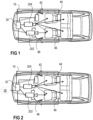
- FIG. 1 schematically illustrates an in-vehicle infotainment system according to embodiments of the disclosure.
- the in-vehicle infotainment system comprises a sensor 204 configured to detect a plurality of occupants of the vehicle 10, a controller unit 30, and a plurality of displays 42, 44, 46.
- Each display of the plurality of displays 42, 44, 46 is associated with a different one of a plurality of seats of the vehicle 10. That is, for example, a first display 42 may be arranged in or on a dashboard of the vehicle 10, in front of a front passenger seat. It is also possible that the first display 42 is implemented as a head-up display. That is, content may be projected on the windscreen in front of the front passenger of the vehicle 10.
- a second display 44 e.g., may be arranged at the back of the front passenger seat, in front of a first one of a plurality of rear passenger seats
- a third display 46 e.g., may be arranged at the back of a driver's seat, in front of a second one of the plurality of rear passenger seats. That is, each of a plurality of occupants of the vehicle 10 may watch media content on a display arranged in front of the seat they are seated on.
- the three displays 42, 44, 46 illustrated in Figures 1 and 2 are only examples. Any number of displays may be arranged at any suitable positions within a vehicle 10.
- the sensor 204 is configured to provide sensor data concerning one or more occupants to the controller unit 30.
- the controller unit 30, based on the sensor data, is configured to identify the one or more detected occupants, and the controller unit 30 is further configured, in response to identifying one or more occupants of the vehicle 10, for each of the one or more identified occupants, load personal content associated with the identified occupant on a display associated with a seat the identified occupant is seated on. That is, different occupants of a vehicle 10 can be presented with different media content. For example, each occupant of a plurality of occupants of the vehicle 10 can watch a different movie on a display 42, 44, 46 arranged in front of the seat the respective occupant is seated on. As the different occupants are identified, personal content associated with the respective occupant can be loaded on the respective display 42, 44, 46.
- the controller unit 30 may be in communication with a cloud or streaming service 50, and may be configured to retrieve personal content for an identified occupant from the cloud or streaming service 50.
- a first occupant may have a personal account at a first streaming service.
- the controller unit 30 may automatically log in to the personal account of the first occupant at the first streaming service. The first occupant may then watch movies available to them on the first streaming service.
- a second occupant of the vehicle may have a personal account at the first or at a second streaming service.
- the controller unit 30 may automatically log in to the personal account of the second occupant at the first or at a second streaming service. The second occupant may then watch movies available to them on the first or second streaming service. This similarly applies to other occupants of the vehicle 10.
- the in-vehicle infotainment system only comprises a single sensor 204 which is able to detect a plurality of occupants of the vehicle 10, the required hardware is kept at a minimum.
- the sensor 204 may be a camera, for example.
- the camera may have a field of view of at least 40°, or at least 90° up to 140° or even more.
- the camera is arranged in a dashboard of the vehicle 10, e.g., centrally in a dashboard of the vehicle 10, at a position between the driver's seat and a front passenger seat.
- the camera arranged in the dashboard may be directed towards a passenger compartment of the vehicle 10 and may cover at least a front passenger seat, and one or more rear passenger seats.
- the field of view of the camera may be constant or may be variable. It is even possible that the camera is moveable. In this way, even if its field of view is comparably small, the camera may be variably directed towards any desired specific seat within the vehicle 10.
- the camera may be configured to capture one or more images, and transmit the one or more images to the controller unit 30.
- the controller unit 30 may be configured to identify one or more occupants of the vehicle 10 in the one or more images, e.g., by means of suitable face or eye recognition techniques. A face or eyes recognized in one or more of the images captured by the camera may be compared to faces or eyes previously stored in the controller unit 30, for example.
- Personal data such as, e.g., login data for personal accounts, may be stored for each occupant that has previously undergone a registration process. During a registration process, the face or eyes of a user may be captured and stored by the controller unit 30, and personal data (e.g., login data) may be linked with the stored face or eyes.
- the senor 204 could be or could include any other kind of sensor instead which is able to detect and allow identification of a plurality of occupants of the vehicle 10.
- the sensor 204 alternatively may be a microphone, and different occupants of the vehicle 10 may be identified by means of speech recognition instead of face or eye recognition. That is, a sample of speech of a registered occupant may be stored by the controller unit 30. An occupant, when seated in the vehicle 10, may then provide another sample of speech which may be compared to the stored samples. If a match is identified, the respective personal data may be loaded on the respective display 42, 44, 46, similar to what has been described above. If the sensor 204 is or comprises a microphone, an occupant may be required to provide a spoken indication on which seat they are currently seated in the vehicle 10, as this may be difficult to be determined automatically by means of a microphone.
- the senor 204 may be further configured to capture and detect gestures made by the one or more detected occupants of the vehicle 10, and provide sensor data concerning detected gestures to the controller unit 30.
- the controller unit 30, based on the sensor data concerning detected gestures, may be further configured to interpret the detected gestures, and perform one or more actions based on the detected gestures.
- Specific gestures may be defined which, when detected and interpreted, cause specific actions to be performed by the controller unit 30. For example, a first gesture, when performed by an occupant, captured by the sensor 204, and identified by the controller unit 30, may cause the in-vehicle infotainment system to present different content on the display 42, 44, 46 associated with the respective occupant.
- an occupant may switch between different contents by merely making a specific gesture.
- Such actions are merely examples. Any other actions may generally be performed by the controller unit 30, if a certain defined gesture has been detected and identified.
- the in-vehicle infotainment system may include or may be coupled to an additional sensor 202 configured to detect a driver of the vehicle 10.
- the additional sensor 202 may be configured to provide sensor data concerning the detected driver to the controller unit 30, similar to what has been described with the sensor 204 and one or more occupants of the vehicle 10 above.
- the controller unit 30 may be configured, based on the sensor data, to identify the detected driver. It is generally possible that personalized video content is provided to a driver of the vehicle 10 on a display 48 (e.g., main infotainment display or cluster display) once they have been identified.
- a display 48 e.g., main infotainment display or cluster display
- SAE level 3 autonomous driving mode
- presenting video content even to the driver of a vehicle 10 may be possible.
- presenting video content to a driver manually driving the vehicle 10 may be hazardous, as it may distract the driver.
- loading a personal profile for a driver of the vehicle 10 in response to identifying the driver therefore, may comprise presenting audio content to the driver. Such audio content may be retrieved from a personal account of the driver with a streaming service 50, for example. Any other action may generally be performed by the in-vehicle infotainment system in response to identifying a driver.
- the in-vehicle infotainment system may be arranged in a vehicle 10.
- the sensor 204 of the in-vehicle infotainment system may be a camera.
- a camera may be arranged in a dashboard of the vehicle 10, for example.
- a camera may be arranged in any other suitable position allowing an adequate view on the passenger compartment of the vehicle 10, e.g., attached or close to a rear view mirror, in a roof liner, etc.
- a field of view of the camera may be directed towards a passenger compartment of the vehicle 10 and may cover at least a front passenger seat, and one or more rear passenger seats. This is indicated by means of arrows in Figures 1 and 2 .
- the field of view of the camera may also be directed towards a driver's seat of the vehicle 10 (indicated by means of a dashed arrow in Figures 1 and 2 ).
- a driver of the vehicle 10 may also be identified by means of sensor data provided by the camera.
- a driver can also be identified by means of a separate sensor 202.
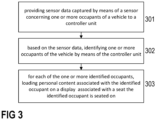
- a method according to embodiments of the disclosure comprises providing sensor data captured by means of a sensor 204 concerning one or more detected occupants to a controller unit 30, wherein the sensor 204 is configured to detect a plurality of occupants of a vehicle 10 (step 301), based on the sensor data, identifying one or more occupants of the vehicle 10 by means of the controller unit 30 (step 302), and, in response to identifying one or more occupants of the vehicle 10, for each of the one or more identified occupants, loading personal content associated with the identified occupant on a display 42, 44, 46 associated with a seat the identified occupant is seated on (step 303).
Landscapes
- Engineering & Computer Science (AREA)
- Physics & Mathematics (AREA)
- General Physics & Mathematics (AREA)
- Multimedia (AREA)
- Theoretical Computer Science (AREA)
- Chemical & Material Sciences (AREA)
- Combustion & Propulsion (AREA)
- Transportation (AREA)
- Mechanical Engineering (AREA)
- Fittings On The Vehicle Exterior For Carrying Loads, And Devices For Holding Or Mounting Articles (AREA)
Abstract
An in-vehicle infotainment system comprises a sensor configured to detect a plurality of occupants of a vehicle, a controller unit, and a plurality of displays, each display of the plurality of displays being associated with a different one of a plurality of seats of the vehicle, wherein the sensor is configured to provide sensor data concerning one or more occupants to the controller unit, the controller unit is configured, based on the sensor data, to identify the one or more detected occupants, and the controller unit is further configured, in response to identifying one or more occupants of the vehicle, for each of the one or more identified occupants, load personal content associated with the identified occupant on a display associated with a seat the identified occupant is seated on.
Description
- The disclosure relates to an in-vehicle infotainment system and related method.
- Many in-vehicle infotainment systems today provide individual displays for different occupants of a vehicle. Each display can be controlled individually according to the likes of the respective occupants. It may even be possible to load individual user profiles on the different displays. This, however, requires specific user input when user profiles are not automatically loaded. Automatically loading respective user profiles generally requires a great amount of hardware and cabling within a vehicle in order to perform user identification
- There is a need for an in-vehicle infotainment system and a method that increase driver and occupant comfort at low costs.
- The in-vehicle infotainment system and related method according to the various embodiments described herein are able to identify multiple occupants of a vehicle, and control different displays associated with different occupants of the vehicle separately. In particular, personal content associated with an occupant that has been identified can be loaded on a display associated with a seat the identified occupant is seated on. This can be done with only few different hardware components and, therefore, at comparably low costs.
- An in-vehicle infotainment system includes a sensor configured to detect a plurality of occupants of a vehicle, a controller unit, and a plurality of displays, each display of the plurality of displays being associated with a different one of a plurality of seats of the vehicle, wherein the sensor is configured to provide sensor data concerning one or more occupants to the controller unit, the controller unit is configured, based on the sensor data, to identify the one or more detected occupants, and the controller unit is further configured, in response to identifying one or more occupants of the vehicle, for each of the one or more identified occupants, load personal content associated with the identified occupant on a display associated with a seat the identified occupant is seated on.
- A method includes providing sensor data captured by means of a sensor concerning one or more occupants of a vehicle to a controller unit, wherein the sensor is configured to detect a plurality of occupants of a vehicle, based on the sensor data, identifying one or more occupants of the vehicle by means of the controller unit, and in response to identifying one or more occupants of the vehicle, for each of the one or more identified occupants, loading personal content associated with the identified occupant on a display associated with a seat the identified occupant is seated on.
- Other systems, features and advantages of the disclosure will be or will become apparent to one with skill in the art upon examination of the following detailed description and figures. It is intended that all such additional systems, methods, features and advantages included within this description be within the scope of the invention and be protected by the following claims.
- The arrangements and methods may be better understood with reference to the following description and drawings. The components in the figures are not necessarily to scale, emphasis instead being placed upon illustrating the principles of the invention. Moreover, in the figures, the same reference numerals designate the same components throughout the different views.
-
Figure 1 schematically illustrates an in-vehicle infotainment system according to embodiments of the disclosure. -
Figure 2 schematically illustrates an in-vehicle infotainment system according to further embodiments of the disclosure. -
Figure 3 schematically illustrates, in a flow diagram, a method according to embodiments of the disclosure. -
Figure 1 schematically illustrates an in-vehicle infotainment system according to embodiments of the disclosure. The in-vehicle infotainment system comprises asensor 204 configured to detect a plurality of occupants of thevehicle 10, acontroller unit 30, and a plurality ofdisplays displays vehicle 10. That is, for example, afirst display 42 may be arranged in or on a dashboard of thevehicle 10, in front of a front passenger seat. It is also possible that thefirst display 42 is implemented as a head-up display. That is, content may be projected on the windscreen in front of the front passenger of thevehicle 10. Asecond display 44, e.g., may be arranged at the back of the front passenger seat, in front of a first one of a plurality of rear passenger seats, and athird display 46, e.g., may be arranged at the back of a driver's seat, in front of a second one of the plurality of rear passenger seats. That is, each of a plurality of occupants of thevehicle 10 may watch media content on a display arranged in front of the seat they are seated on. The three displays 42, 44, 46 illustrated inFigures 1 and 2 , however, are only examples. Any number of displays may be arranged at any suitable positions within avehicle 10. - The
sensor 204 is configured to provide sensor data concerning one or more occupants to thecontroller unit 30. Thecontroller unit 30, based on the sensor data, is configured to identify the one or more detected occupants, and thecontroller unit 30 is further configured, in response to identifying one or more occupants of thevehicle 10, for each of the one or more identified occupants, load personal content associated with the identified occupant on a display associated with a seat the identified occupant is seated on. That is, different occupants of avehicle 10 can be presented with different media content. For example, each occupant of a plurality of occupants of thevehicle 10 can watch a different movie on adisplay respective display - Referring to
Figure 2 , thecontroller unit 30 may be in communication with a cloud orstreaming service 50, and may be configured to retrieve personal content for an identified occupant from the cloud orstreaming service 50. For example, a first occupant may have a personal account at a first streaming service. Once the first occupant has been identified by thecontroller unit 30 based on the sensor data, thecontroller unit 30 may automatically log in to the personal account of the first occupant at the first streaming service. The first occupant may then watch movies available to them on the first streaming service. A second occupant of the vehicle may have a personal account at the first or at a second streaming service. Once the second occupant has been identified by thecontroller unit 30 based on the sensor data, thecontroller unit 30 may automatically log in to the personal account of the second occupant at the first or at a second streaming service. The second occupant may then watch movies available to them on the first or second streaming service. This similarly applies to other occupants of thevehicle 10. - As the in-vehicle infotainment system only comprises a
single sensor 204 which is able to detect a plurality of occupants of thevehicle 10, the required hardware is kept at a minimum. Thesensor 204 may be a camera, for example. The camera may have a field of view of at least 40°, or at least 90° up to 140° or even more. According to one example, the camera is arranged in a dashboard of thevehicle 10, e.g., centrally in a dashboard of thevehicle 10, at a position between the driver's seat and a front passenger seat. The camera arranged in the dashboard may be directed towards a passenger compartment of thevehicle 10 and may cover at least a front passenger seat, and one or more rear passenger seats. In this way, a single camera can be used to identify a plurality of occupants of thevehicle 10. The field of view of the camera may be constant or may be variable. It is even possible that the camera is moveable. In this way, even if its field of view is comparably small, the camera may be variably directed towards any desired specific seat within thevehicle 10. - The camera may be configured to capture one or more images, and transmit the one or more images to the
controller unit 30. Thecontroller unit 30 may be configured to identify one or more occupants of thevehicle 10 in the one or more images, e.g., by means of suitable face or eye recognition techniques. A face or eyes recognized in one or more of the images captured by the camera may be compared to faces or eyes previously stored in thecontroller unit 30, for example. Personal data such as, e.g., login data for personal accounts, may be stored for each occupant that has previously undergone a registration process. During a registration process, the face or eyes of a user may be captured and stored by thecontroller unit 30, and personal data (e.g., login data) may be linked with the stored face or eyes. For occupants that are not known to the controller unit 30 (i.e. that are not registered users), personal content may not be automatically loaded on arespective display vehicle 10 an identified occupant is seated. This can be easily derived from a position of the occupant's face in the respective image(s). - Instead of a camera, the
sensor 204 could be or could include any other kind of sensor instead which is able to detect and allow identification of a plurality of occupants of thevehicle 10. For example, thesensor 204 alternatively may be a microphone, and different occupants of thevehicle 10 may be identified by means of speech recognition instead of face or eye recognition. That is, a sample of speech of a registered occupant may be stored by thecontroller unit 30. An occupant, when seated in thevehicle 10, may then provide another sample of speech which may be compared to the stored samples. If a match is identified, the respective personal data may be loaded on therespective display sensor 204 is or comprises a microphone, an occupant may be required to provide a spoken indication on which seat they are currently seated in thevehicle 10, as this may be difficult to be determined automatically by means of a microphone. - In addition to detecting one or more occupants of a
vehicle 10, thesensor 204 may be further configured to capture and detect gestures made by the one or more detected occupants of thevehicle 10, and provide sensor data concerning detected gestures to thecontroller unit 30. Thecontroller unit 30, based on the sensor data concerning detected gestures, may be further configured to interpret the detected gestures, and perform one or more actions based on the detected gestures. Specific gestures may be defined which, when detected and interpreted, cause specific actions to be performed by thecontroller unit 30. For example, a first gesture, when performed by an occupant, captured by thesensor 204, and identified by thecontroller unit 30, may cause the in-vehicle infotainment system to present different content on thedisplay display display display controller unit 30, if a certain defined gesture has been detected and identified. - It is generally possible that not only occupants of the
vehicle 10, but also a driver of thevehicle 10 is identified by means of the sensor data provided by thesensor 204. Many vehicles today, however, comprise additional sensors. Such additional sensors may be configured to provide sensor data concerning a driver of thevehicle 10. Additional sensors may be included in any kind of driver assistance systems, e.g., driver monitoring systems. That is, the in-vehicle infotainment system may include or may be coupled to anadditional sensor 202 configured to detect a driver of thevehicle 10. Theadditional sensor 202 may be configured to provide sensor data concerning the detected driver to thecontroller unit 30, similar to what has been described with thesensor 204 and one or more occupants of thevehicle 10 above. Thecontroller unit 30 may be configured, based on the sensor data, to identify the detected driver. It is generally possible that personalized video content is provided to a driver of thevehicle 10 on a display 48 (e.g., main infotainment display or cluster display) once they have been identified. When thevehicle 10 is in an autonomous driving mode (e.g., SAE level 3 or higher), for example, presenting video content even to the driver of avehicle 10 may be possible. However, presenting video content to a driver manually driving thevehicle 10 may be hazardous, as it may distract the driver. Alternatively or additionally, loading a personal profile for a driver of thevehicle 10 in response to identifying the driver, therefore, may comprise presenting audio content to the driver. Such audio content may be retrieved from a personal account of the driver with astreaming service 50, for example. Any other action may generally be performed by the in-vehicle infotainment system in response to identifying a driver. - The in-vehicle infotainment system according to embodiments of the disclosure may be arranged in a
vehicle 10. As has been described above, thesensor 204 of the in-vehicle infotainment system may be a camera. A camera may be arranged in a dashboard of thevehicle 10, for example. Alternatively, a camera may be arranged in any other suitable position allowing an adequate view on the passenger compartment of thevehicle 10, e.g., attached or close to a rear view mirror, in a roof liner, etc. A field of view of the camera may be directed towards a passenger compartment of thevehicle 10 and may cover at least a front passenger seat, and one or more rear passenger seats. This is indicated by means of arrows inFigures 1 and 2 . Optionally, the field of view of the camera may also be directed towards a driver's seat of the vehicle 10 (indicated by means of a dashed arrow inFigures 1 and 2 ). In this way, a driver of thevehicle 10 may also be identified by means of sensor data provided by the camera. A driver, however, can also be identified by means of aseparate sensor 202. - Referring to
Figure 3 , a method according to embodiments of the disclosure is schematically illustrated by means of a flow diagram. A method according to embodiments of the disclosure comprises providing sensor data captured by means of asensor 204 concerning one or more detected occupants to acontroller unit 30, wherein thesensor 204 is configured to detect a plurality of occupants of a vehicle 10 (step 301), based on the sensor data, identifying one or more occupants of thevehicle 10 by means of the controller unit 30 (step 302), and, in response to identifying one or more occupants of thevehicle 10, for each of the one or more identified occupants, loading personal content associated with the identified occupant on adisplay - It may be understood, that the illustrated systems and methods are merely examples. While various embodiments of the invention have been described, it will be apparent to those of ordinary skill in the art that many more embodiments and implementations are possible within the scope of the invention. In particular, the skilled person will recognize the interchangeability of various features from different embodiments. Although these techniques and systems have been disclosed in the context of certain embodiments and examples, it will be understood that these techniques and systems may be extended beyond the specifically disclosed embodiments to other embodiments and/or uses and obvious modifications thereof. Accordingly, the invention is not to be restricted except in light of the attached claims and their equivalents.
- The description of embodiments has been presented for purposes of illustration and description. Suitable modifications and variations to the embodiments may be performed in light of the above description or may be acquired from practicing the methods. The described arrangements are exemplary in nature, and may include additional elements and/or omit elements. As used in this application, an element recited in the singular and proceeded with the word "a" or "an" should be understood as not excluding plural of said elements, unless such exclusion is stated. Furthermore, references to "one embodiment" or "one example" of the present disclosure are not intended to be interpreted as excluding the existence of additional embodiments that also incorporate the recited features. The terms "first," "second," and "third," etc. are used merely as labels, and are not intended to impose numerical requirements or a particular positional order on their objects. The subject matter of the present disclosure includes all novel and non-obvious combinations and sub-combinations of the various systems and configurations, and other features, functions, and/or properties disclosed. The following claims particularly point out subject matter from the above disclosure that is regarded as novel and non-obvious.
Claims (13)
- An in-vehicle infotainment system comprisinga sensor (204) configured to detect a plurality of occupants of a vehicle (10);a controller unit (30); anda plurality of displays (42, 44, 46), each display of the plurality of displays (42, 44, 46) being associated with a different one of a plurality of seats of the vehicle (10), whereinthe sensor (204) is configured to provide sensor data concerning one or more occupants to the controller unit (30),the controller unit (30) is configured, based on the sensor data, to identify the one or more detected occupants, andthe controller unit (30) is further configured, in response to identifying one or more occupants of the vehicle (10), for each of the one or more identified occupants, load personal content associated with the identified occupant on a display associated with a seat the identified occupant is seated on.
- The in-vehicle infotainment system of claim 1, wherein the sensor (204) is a camera.
- The in-vehicle infotainment system of claim 2, wherein the camera has a field of view of at least 40°.
- The in-vehicle infotainment system of claim 2 or 3, wherein identifying the one or more occupants comprises detecting a face or eyes of one or more occupants in one or more images captured by the camera by means of face or eye recognition techniques.
- The in-vehicle infotainment system of claim 4, wherein identifying the one or more occupants further comprises comparing a face or eyes detected in one or more of the images to faces or eyes previously stored in the controller unit (30).
- The in-vehicle infotainment system of any of the preceding claims, wherein the controller unit (30) is in communication with a cloud or streaming service (50), and is configured to retrieve personal content for an identified occupant from the cloud or streaming service (50).
- The in-vehicle infotainment system of any of the preceding claims, whereinthe sensor (204) is further configured to detect gestures made by the one or more detected occupants of the vehicle (10), and provide sensor data concerning detected gestures to the controller unit (30), andthe controller unit (30), based on the sensor data concerning detected gestures, is further configured to interpret the detected gestures, and perform one or more actions based on the detected gestures.
- The in-vehicle infotainment system of claim 7, wherein the one or more actions comprise at least one of changing a content presented on a display (42, 44, 46), increasing or decreasing a volume associated with content presented on a display, increasing or decreasing a brightness of content presented on a display (42, 44, 46), and turning off a display (42, 44, 46).
- The in-vehicle infotainment system of any of the preceding claims, further comprising an additional sensor (202) configured to detect a driver of the vehicle (10), whereinthe additional sensor (202) is configured to provide sensor data concerning a driver to the controller unit (30),the controller unit (30) is configured, based on the sensor data, to identify the driver.
- A vehicle (10) comprising the in-vehicle infotainment system of any of claims 1 to 9.
- The vehicle (10) of claim 10, wherein the sensor (204) is a camera arranged in a dashboard of the vehicle (10).
- The vehicle (10) of claim 11, wherein a field of view of the camera is directed towards a passenger compartment of the vehicle (10) and covers at least a front passenger seat, and one or more rear passenger seats.
- A method comprising,providing sensor data captured by means of a sensor (204) concerning one or more occupants of a vehicle (10) to a controller unit (30), wherein the sensor (204) is configured to detect a plurality of occupants of a vehicle (10);based on the sensor data, identifying one or more occupants of the vehicle (10) by means of the controller unit (30), andin response to identifying one or more occupants of the vehicle (10), for each of the one or more identified occupants, loading personal content associated with the identified occupant on a display (42, 44, 46) associated with a seat the identified occupant is seated on.
Priority Applications (1)
| Application Number | Priority Date | Filing Date | Title |
|---|---|---|---|
| EP23215847.7A EP4570552A1 (en) | 2023-12-12 | 2023-12-12 | In-vehicle infotainment system |
Applications Claiming Priority (1)
| Application Number | Priority Date | Filing Date | Title |
|---|---|---|---|
| EP23215847.7A EP4570552A1 (en) | 2023-12-12 | 2023-12-12 | In-vehicle infotainment system |
Publications (1)
| Publication Number | Publication Date |
|---|---|
| EP4570552A1 true EP4570552A1 (en) | 2025-06-18 |
Family
ID=89190663
Family Applications (1)
| Application Number | Title | Priority Date | Filing Date |
|---|---|---|---|
| EP23215847.7A Pending EP4570552A1 (en) | 2023-12-12 | 2023-12-12 | In-vehicle infotainment system |
Country Status (1)
| Country | Link |
|---|---|
| EP (1) | EP4570552A1 (en) |
Citations (1)
| Publication number | Priority date | Publication date | Assignee | Title |
|---|---|---|---|---|
| US20200139812A1 (en) * | 2018-11-06 | 2020-05-07 | Honda Motor Co., Ltd. | Display system in a vehicle and a method for control thereof |
-
2023
- 2023-12-12 EP EP23215847.7A patent/EP4570552A1/en active Pending
Patent Citations (1)
| Publication number | Priority date | Publication date | Assignee | Title |
|---|---|---|---|---|
| US20200139812A1 (en) * | 2018-11-06 | 2020-05-07 | Honda Motor Co., Ltd. | Display system in a vehicle and a method for control thereof |
Similar Documents
| Publication | Publication Date | Title |
|---|---|---|
| US9942522B2 (en) | In-vehicle camera system | |
| US9517776B2 (en) | Systems, methods, and apparatus for controlling devices based on a detected gaze | |
| CN207015165U (en) | A system for personalization of an information panel in a driving device | |
| US20180357040A1 (en) | In-vehicle infotainment with multi-modal interface | |
| US20200213560A1 (en) | System and method for a dynamic human machine interface for video conferencing in a vehicle | |
| CN115195643B (en) | Control method, device and equipment of cockpit entertainment system | |
| US11126391B2 (en) | Contextual and aware button-free screen articulation | |
| US20160358604A1 (en) | Method for recognizing a voice context for a voice control function, method for ascertaining a voice control signal for a voice control function, and apparatus for executing the method | |
| CN110696613A (en) | Passenger head-up displays for vehicles | |
| WO2019068254A1 (en) | A display system and method for a vehicle | |
| CN112513708B (en) | Apparatus and method for use with a vehicle | |
| CN105522970B (en) | How to choose the adjustment mirror | |
| US11623520B2 (en) | Information providing device | |
| US20190339535A1 (en) | Automatic eye box adjustment | |
| US20160140760A1 (en) | Adapting a display on a transparent electronic display | |
| US20230365137A1 (en) | Method for operating a motor vehicle, and motor vehicle | |
| JP2017090614A (en) | Voice recognition control system | |
| EP3201728A1 (en) | System and method for controlling a piece of equipment of a motor vehicle | |
| US12139074B2 (en) | System and method for providing a desired view for a vehicle occupant | |
| WO2023122283A1 (en) | Voice assistant optimization dependent on vehicle occupancy | |
| GB2525039A (en) | An audio-visual communications system integrated into a vehicle | |
| CN112441010A (en) | System and method for reducing anxiety of vehicle occupants | |
| US20220415318A1 (en) | Voice assistant activation system with context determination based on multimodal data | |
| CN110297576A (en) | A kind of information display method, device and vehicle | |
| US20160014548A1 (en) | Method And System For Integrating Wearable Glasses To Vehicle |
Legal Events
| Date | Code | Title | Description |
|---|---|---|---|
| PUAI | Public reference made under article 153(3) epc to a published international application that has entered the european phase |
Free format text: ORIGINAL CODE: 0009012 |
|
| STAA | Information on the status of an ep patent application or granted ep patent |
Free format text: STATUS: THE APPLICATION HAS BEEN PUBLISHED |
|
| AK | Designated contracting states |
Kind code of ref document: A1 Designated state(s): AL AT BE BG CH CY CZ DE DK EE ES FI FR GB GR HR HU IE IS IT LI LT LU LV MC ME MK MT NL NO PL PT RO RS SE SI SK SM TR |
|
| STAA | Information on the status of an ep patent application or granted ep patent |
Free format text: STATUS: THE APPLICATION IS DEEMED TO BE WITHDRAWN |