EP4570189A1 - Depression symptom determination device, determination model generation device, and training data generation method - Google Patents
Depression symptom determination device, determination model generation device, and training data generation method Download PDFInfo
- Publication number
- EP4570189A1 EP4570189A1 EP23943949.0A EP23943949A EP4570189A1 EP 4570189 A1 EP4570189 A1 EP 4570189A1 EP 23943949 A EP23943949 A EP 23943949A EP 4570189 A1 EP4570189 A1 EP 4570189A1
- Authority
- EP
- European Patent Office
- Prior art keywords
- subject
- depressive
- depression
- condition
- manic
- Prior art date
- Legal status (The legal status is an assumption and is not a legal conclusion. Google has not performed a legal analysis and makes no representation as to the accuracy of the status listed.)
- Pending
Links
Images




Classifications
-
- G—PHYSICS
- G16—INFORMATION AND COMMUNICATION TECHNOLOGY [ICT] SPECIALLY ADAPTED FOR SPECIFIC APPLICATION FIELDS
- G16H—HEALTHCARE INFORMATICS, i.e. INFORMATION AND COMMUNICATION TECHNOLOGY [ICT] SPECIALLY ADAPTED FOR THE HANDLING OR PROCESSING OF MEDICAL OR HEALTHCARE DATA
- G16H50/00—ICT specially adapted for medical diagnosis, medical simulation or medical data mining; ICT specially adapted for detecting, monitoring or modelling epidemics or pandemics
- G16H50/20—ICT specially adapted for medical diagnosis, medical simulation or medical data mining; ICT specially adapted for detecting, monitoring or modelling epidemics or pandemics for computer-aided diagnosis, e.g. based on medical expert systems
-
- A—HUMAN NECESSITIES
- A61—MEDICAL OR VETERINARY SCIENCE; HYGIENE
- A61B—DIAGNOSIS; SURGERY; IDENTIFICATION
- A61B5/00—Measuring for diagnostic purposes; Identification of persons
- A61B5/16—Devices for psychotechnics; Testing reaction times ; Devices for evaluating the psychological state
- A61B5/165—Evaluating the state of mind, e.g. depression, anxiety
-
- A—HUMAN NECESSITIES
- A61—MEDICAL OR VETERINARY SCIENCE; HYGIENE
- A61B—DIAGNOSIS; SURGERY; IDENTIFICATION
- A61B5/00—Measuring for diagnostic purposes; Identification of persons
- A61B5/72—Signal processing specially adapted for physiological signals or for diagnostic purposes
- A61B5/7235—Details of waveform analysis
- A61B5/7264—Classification of physiological signals or data, e.g. using neural networks, statistical classifiers, expert systems or fuzzy systems
- A61B5/7267—Classification of physiological signals or data, e.g. using neural networks, statistical classifiers, expert systems or fuzzy systems involving training the classification device
-
- G—PHYSICS
- G06—COMPUTING OR CALCULATING; COUNTING
- G06N—COMPUTING ARRANGEMENTS BASED ON SPECIFIC COMPUTATIONAL MODELS
- G06N20/00—Machine learning
-
- G—PHYSICS
- G16—INFORMATION AND COMMUNICATION TECHNOLOGY [ICT] SPECIALLY ADAPTED FOR SPECIFIC APPLICATION FIELDS
- G16H—HEALTHCARE INFORMATICS, i.e. INFORMATION AND COMMUNICATION TECHNOLOGY [ICT] SPECIALLY ADAPTED FOR THE HANDLING OR PROCESSING OF MEDICAL OR HEALTHCARE DATA
- G16H10/00—ICT specially adapted for the handling or processing of patient-related medical or healthcare data
- G16H10/60—ICT specially adapted for the handling or processing of patient-related medical or healthcare data for patient-specific data, e.g. for electronic patient records
-
- G—PHYSICS
- G16—INFORMATION AND COMMUNICATION TECHNOLOGY [ICT] SPECIALLY ADAPTED FOR SPECIFIC APPLICATION FIELDS
- G16H—HEALTHCARE INFORMATICS, i.e. INFORMATION AND COMMUNICATION TECHNOLOGY [ICT] SPECIALLY ADAPTED FOR THE HANDLING OR PROCESSING OF MEDICAL OR HEALTHCARE DATA
- G16H20/00—ICT specially adapted for therapies or health-improving plans, e.g. for handling prescriptions, for steering therapy or for monitoring patient compliance
- G16H20/70—ICT specially adapted for therapies or health-improving plans, e.g. for handling prescriptions, for steering therapy or for monitoring patient compliance relating to mental therapies, e.g. psychological therapy or autogenous training
-
- G—PHYSICS
- G16—INFORMATION AND COMMUNICATION TECHNOLOGY [ICT] SPECIALLY ADAPTED FOR SPECIFIC APPLICATION FIELDS
- G16H—HEALTHCARE INFORMATICS, i.e. INFORMATION AND COMMUNICATION TECHNOLOGY [ICT] SPECIALLY ADAPTED FOR THE HANDLING OR PROCESSING OF MEDICAL OR HEALTHCARE DATA
- G16H50/00—ICT specially adapted for medical diagnosis, medical simulation or medical data mining; ICT specially adapted for detecting, monitoring or modelling epidemics or pandemics
- G16H50/30—ICT specially adapted for medical diagnosis, medical simulation or medical data mining; ICT specially adapted for detecting, monitoring or modelling epidemics or pandemics for calculating health indices; for individual health risk assessment
-
- G—PHYSICS
- G16—INFORMATION AND COMMUNICATION TECHNOLOGY [ICT] SPECIALLY ADAPTED FOR SPECIFIC APPLICATION FIELDS
- G16H—HEALTHCARE INFORMATICS, i.e. INFORMATION AND COMMUNICATION TECHNOLOGY [ICT] SPECIALLY ADAPTED FOR THE HANDLING OR PROCESSING OF MEDICAL OR HEALTHCARE DATA
- G16H50/00—ICT specially adapted for medical diagnosis, medical simulation or medical data mining; ICT specially adapted for detecting, monitoring or modelling epidemics or pandemics
- G16H50/50—ICT specially adapted for medical diagnosis, medical simulation or medical data mining; ICT specially adapted for detecting, monitoring or modelling epidemics or pandemics for simulation or modelling of medical disorders
-
- G—PHYSICS
- G16—INFORMATION AND COMMUNICATION TECHNOLOGY [ICT] SPECIALLY ADAPTED FOR SPECIFIC APPLICATION FIELDS
- G16H—HEALTHCARE INFORMATICS, i.e. INFORMATION AND COMMUNICATION TECHNOLOGY [ICT] SPECIALLY ADAPTED FOR THE HANDLING OR PROCESSING OF MEDICAL OR HEALTHCARE DATA
- G16H50/00—ICT specially adapted for medical diagnosis, medical simulation or medical data mining; ICT specially adapted for detecting, monitoring or modelling epidemics or pandemics
- G16H50/70—ICT specially adapted for medical diagnosis, medical simulation or medical data mining; ICT specially adapted for detecting, monitoring or modelling epidemics or pandemics for mining of medical data, e.g. analysing previous cases of other patients
Definitions
- the present invention relates to a depressive symptom determination apparatus, a determination model generation apparatus, and a method of generating training data, and particularly relates to an apparatus for determining a depressive symptom of a person using a machine-trained determination model, an apparatus for generating the determination model, and a method of generating training data used in machine learning.
- Patent Literature 1 discloses that an estimation model is trained by machine learning in which a plurality of types of feature quantities extracted from biometric data of each subject is used as input vectors, and using teacher data in which evaluation of presence/absence of a depressive state by an expert such as a doctor for each subject is used as a label.
- Patent Literature 1 shows that the Hamilton Depression Scale (HAMD), which is a common diagnostic index for depression, is used to diagnose depression by a doctor, and that a cutoff value for an evaluation value based on HAMD-17 is set at 7 points, and when a total score exceeds 7 points, it is determined that depression has developed.
- HAMD Hamilton Depression Scale
- HAMD-17 an expert such as a doctor asks questions for 17 items to evaluate a degree based on answers obtained from a subject, and a diagnosis is performed so that the degree is normal when a total value of a score (hereinafter referred to as HAMD score) of 3 to 5 points for each item is 0 to 7 points, the degree is mild when the total value is 8 to 13 points, the degree is moderate when the total value is 14 to 18 points, the degree is severe when the total value is 19 to 22 points, and the degree is extremely severe when the total value is 23 points or more.
- HAMD score a score
- Patent Literature 1 describes, with reference to FIGS. 4 to 6 , that there is a high correlation between a result of estimation of presence/absence or severity of a depressive state using the estimation model and a result of a diagnosis by a doctor using HAMD-17.
- the invention has been made to solve such a problem, and an object of the invention is to make it possible to determine, using a machine-trained determination model, that a subject has a depressive symptom, not only for a subject having a high score on a depression evaluation scale, but also for a subject having a low score on the depression evaluation scale.
- a depressive symptom of a subject is determined by inputting a feature vector computed based on a feature quantity of a conversation conducted by a determination target subject to a machine-trained determination model.
- the determination model is machine-trained using, as training data, a feature vector of a plurality of subjects satisfying a predetermined extraction condition and exclusion condition with regard to the depressive symptom.
- the extraction condition is a condition for extracting a subject whose predetermined depression evaluation scale score is greater than or equal to a depression threshold among subjects diagnosed with depression, and a subject not diagnosed with either manic-depressive or depression
- the exclusion condition is a condition for excluding a subject diagnosed with manic-depressive and a subject whose predetermined manic-depressive evaluation scale score is greater than or equal to a manic-depressive threshold.
- a depressive symptom of a determination target subject can be determined by a determination model machine-trained without being affected by a feature vector of a subject whose depression evaluation scale score becomes greater than or equal to a depression threshold when a manic-depressive disorder is temporarily in a depressive state or a subject whose depression evaluation scale score becomes less than the depression threshold when the manic-depressive disorder is temporarily in a manic state. For this reason, based on a conversation feature in a state of having a non-transient depressive symptom as a characteristic of a person rather than a conversation feature in a state in which a depressive symptom merely temporarily appears, it is possible to determine a depressive symptom of a subject having the former conversation feature.
- FIG. 1 is a block diagram illustrating a functional configuration example of a depressive symptom determination apparatus 1 according to this embodiment.
- the depressive symptom determination apparatus 1 of this embodiment includes, as a functional configuration, a determination target data input unit 11, a feature vector computation unit 12, and a depressive symptom determination unit 13.
- a determination model storage unit 14 is connected to the depressive symptom determination apparatus 1 of this embodiment as a storage medium.
- the functional blocks 11 to 13 can be configured by any of hardware, a DSP (Digital Signal Processor), and software.
- the functional blocks 11 to 13 are realized by an operation of a program stored in a storage medium such as a RAM, a ROM, a hard disk, or a semiconductor memory under the control of a microcomputer including a CPU, a RAM, a ROM, etc.
- a GPU Graphics Processing Unit
- FPGA Field Programmable Gate Array
- ASIC Application Specific Integrated Circuit
- the determination target data input unit 11 inputs, as determination target data, m pieces of conversation data each representing content of a conversation that m subjects (m being any integer greater than or equal to 1) who are determination targets of a depressive symptom conducts.
- m being any integer greater than or equal to 1
- character data of a text representing content of the conversation is input as the determination target data.
- the determination target data input unit 11 replaces voice data of a series of conversations between a doctor and a subject whose depressive symptom is unknown with character data, extracts character data of a speech part of the subject from the data, and inputs the character data as determination target data.
- the conversations between the subject and the doctor take place as a medical interview, and last, for example, 5 to 10 minutes.
- a conversation in which the doctor asks the subject a question and the subject answers the question is repeatedly performed.
- the conversation at this time is recorded using a microphone, and voice data of the conversation is converted into character data by manual transcription or using automatic voice recognition technology.
- a plurality of speech parts by the subject and the doctor is included in the series of conversations.
- character data of the plurality of speech parts is collectively treated as one text. That is, for one conversation (series of dialogue) of one subject, in general, a text including two or more sentences separated by periods is defined as one text. This means that, when the determination target data input unit 11 inputs determination target data of m subjects, m texts are input.
- the feature vector computation unit 12 computes a feature quantity of conversation data input by the determination target data input unit 11 and converts the feature quantity into a vector, thereby obtaining a feature vector.
- text character data
- the feature vector computation unit 12 computes a feature quantity of the text and converts the feature quantity into a vector.
- Calculation content for conversion into a vector is any calculation content. However, for example, the feature vector can be computed using a method illustrated in FIG. 2 .
- Fig. 2 is a block diagram illustrating a specific functional configuration example of the feature vector computation unit 12.
- the feature vector computation unit 12 includes a word extraction unit 121, a vector computation unit 122 and an index value vector computation unit 123 as functional configurations.
- the vector computation unit 122 includes a text vector computation unit 122a and a word vector computation unit 122b as more specific functional configurations.
- the word extraction unit 121 analyzes m texts input as determination target data by the determination target data input unit 11 and extracts n words (n is an arbitrary integer of 2 or more) from the m texts.
- n words is an arbitrary integer of 2 or more
- the word extraction unit 121 may extract morphemes of all parts of speech divided by the morphological analysis as words, or may extract only morphemes of a specific part of speech as words.
- the word extraction unit 121 does not extract the plurality of the same words, and extracts only one. That is, the n words extracted by the word extraction unit 121 refer to n types of words.
- the word extraction unit 121 may measure a frequency at which the same word is extracted from m texts, and extract n (n types of) words in descending order of occurrence frequencies, or n (n types of) words each having an occurrence frequency greater than or equal to a threshold.
- the vector computation unit 122 computes m text vectors and n word vectors from the m texts and the n words.
- the text vector computation unit 122a converts each of the m texts to be analyzed by the word extraction unit 121 into a q-dimensional vector (q is an arbitrary integer of 2 or more) according to a predetermined rule, thereby computing the m text vectors including q axis components.
- the word vector computation unit 122b converts each of the n words extracted by the word extraction unit 121 into a q-dimensional vector according to a predetermined rule, thereby computing the n word vectors including q axis components.
- a text vector and a word vector are computed as follows.
- a set S ⁇ d ⁇ D, w ⁇ W> including the m texts and the n words is considered.
- d i ) shown in the following Equation (1) is calculated with respect to an arbitrary word w j and an arbitrary text d i .
- d i ) is a value that can be computed in accordance with a probability p disclosed in, a thesis "'Distributed Representations of Sentences and Documents' by Quoc Le and Tomas Mikolov, Google Inc ; Proceedings of the 31st International Conference on Machine Learning Held in Bejing, China on 22-24 June 2014 " describing evaluation of a text or a document using a paragraph vector.
- This thesis states that, for example, when there are three words “the”, “cat”, and “sat”, "on” is predicted as a fourth word, and a computation formula of the prediction probability p is described.
- wt - k, ..., wt + k) described in the thesis is a correct answer probability when another word wt is predicted from a plurality of words wt - k, ..., wt + k.
- d i ) shown in Equation (1) used in the present embodiment represents a correct answer probability that one word w j of n words is predicted from one text d i of m texts. Predicting one word w j from one text d i means that, specifically, when a certain text d i appears, a possibility of including the word w j in the text d i is predicted.
- the inner product value of the word vector w j ⁇ and the text vector d i ⁇ can be regarded as a scalar value when the word vector w j ⁇ is projected in a direction of the text vector d i ⁇ , that is, a component value in the direction of the text vector d i ⁇ included in the word vector w j ⁇ , which can be considered to represent a degree at which the word w j contributes to the text d i .
- Equation (1) is symmetrical with respect to d i and w j , a probability P(d i
- an inner product value of the text vector d i ⁇ and the word vector w j ⁇ may be regarded as a scalar value obtained when the text vector d i ⁇ is projected in a direction of the word vector w j ⁇ , that is, a component value of the text vector d i ⁇ in the direction of the word vector w j ⁇ . This can be considered as representing a degree to which the text d i contributes to the word w j .
- the exponential function value may not be used. Any calculation formula using the inner product value of the word vector w ⁇ and the text vector d ⁇ may be used.
- the probability may be obtained from the ratio of the inner product values itself (Performing predetermined calculation for causing the inner product value to be a positive value at all times (for example, inner product value + 1) is included.).
- the vector computation unit 122 computes the text vector d i ⁇ and the word vector w j ⁇ that maximize a value L of the sum of the probability P(w j
- d i ) computed by Equation (1) for all combinations of the m texts and the n words, and compute the text vector d i ⁇ and the word vector w j ⁇ that maximize a target variable L using the sum thereof as the target variable L. [Equation 2] L ⁇ d ⁇ D ⁇ w ⁇ W # w d p w d
- the vector computation unit 122 converts each of the m texts d i into a q-dimensional vector to compute the m texts vectors d i ⁇ including the q axis components, and converts each of the n words into a q-dimensional vector to compute the n word vectors w j ⁇ including the q axis components, which corresponds to computing the text vector d i ⁇ and the word vector w j ⁇ that maximize the target variable L by making q axis directions variable.
- the index value vector computation unit 123 computes each of the inner products of the m text vectors d i ⁇ and the n word vectors w j ⁇ computed by the vector computation unit 122, thereby computing m ⁇ n relationship index values reflecting the relationship between the m texts d i and the n words w j .
- the index value vector computation unit 123 obtains the product of a text matrix D having the respective q axis components (d 11 to d mq ) of the m text vectors d i ⁇ as respective elements and a word matrix W having the respective q axis components (w 11 to w nq ) of the n word vectors w j ⁇ as respective elements, thereby computing an index value matrix DW having m ⁇ n relationship index values as elements.
- W t is the transposed matrix of the word matrix.
- an element dw 12 in the first row and the second column is a value indicating a degree at which the word w 2 contributes to a text d 1 .
- each row of the index value matrix DW can be used to evaluate the similarity of a text, and each column can be used to evaluate the similarity of a word.
- FIG. 3 is a diagram for describing a text index value group (index value vector). As illustrated in FIG. 3 , for example, in the case of a first text d 1 , n relationship index values dw 11 to dw 1n , included in a first row of the index value matrix DW correspond to a text index value group. Similarly, in the case of a second text d 2 , n relationship index values dw 21 to dw 2n included in a second row of the index value matrix DW correspond thereto. Then, this description is similarly applied up to a text index value group (n relationship index values dw m1 to dw mn ) related to an mth text d m .
- a text vector computed by the text vector computation unit 122a may be used as a feature vector.
- the depressive symptom determination unit 13 determines a depressive symptom of a subject by inputting a feature vector computed by the feature vector computation unit 12 to a machine-trained determination model stored in the determination model storage unit 14.
- This determination model is a model that classifies a determination target subject using two values, that is, whether the subject is a depressed patient or a healthy person, and is a model that receives input of a feature vector and outputs an evaluation value indicating presence/absence of a depressive symptom.
- this determination model can be generated by ensemble learning such as XGBoost, which is a method of gradient boosting.
- XGBoost is a method of gradient boosting.
- the form of the determination model is not limited thereto.
- other tree models such as a decision tree, a regression tree, and a random forest may be used.
- a neural network model, a clustering model, etc. may be used.
- the determination model of this embodiment is machine-trained using, as training data, feature vectors of a plurality of subjects satisfying a predetermined extraction condition and an exclusion condition related to a depressive symptom.
- the extraction condition is a condition for extracting a subject whose predetermined depression evaluation scale score is greater than or equal to a depression threshold among subjects diagnosed with depression by a doctor, and a subject not diagnosed with either manic-depressive or depression.
- the exclusion condition is a condition for excluding a subject diagnosed with manic-depressive by a doctor and a subject whose predetermined manic-depressive evaluation scale score is greater than or equal to a manic-depressive threshold.
- the Hamilton Depression Scale (HAMD-17) is used as an example of a depression evaluation scale.
- a person having a HAMD score of 7 points or less is diagnosed with a healthy person, and a person having a HAMD score of 8 points or more is diagnosed with a depressed patient (including mild, moderate, severe, and extremely severe).
- the depression threshold of the extraction condition is set to 8 points, and a subject whose HAMD score is 8 points or more and a subject not diagnosed with either manic-depressive or depression are extracted.
- the Young Mania Rating Scale (YMRS) is used as an example of a manic-depressive evaluation scale.
- the YMRS is an evaluation scale based on a clinical interview and having 11 items including elation and increased activity.
- the manic-depressive threshold of the exclusion condition is set to 8 points, and training data is constructed by excluding a subject whose total value of a score for each item (hereinafter referred to as YMRS score) is 8 points or more and a subject diagnosed with manic-depressive by a doctor.
- the determination model is machine-trained using a feature vector computed from conversation data of each subject, with a subject diagnosed with depression as a positive example and a subject not diagnosed with depression as a negative example among subjects satisfying the above-mentioned extraction condition and exclusion condition.
- FIG. 4 is a block diagram illustrating a functional configuration example of a determination model generation apparatus 2 according to this embodiment.
- the determination model generation apparatus 2 of this embodiment includes, as a functional configuration, a learning target data input unit 21, a feature vector computation unit 22, and a determination model generation unit 23.
- a determination model storage unit 24 and a learning target data storage unit 25 are connected as storage media to the determination model generation apparatus 2 of this embodiment.
- the functional blocks 21 to 23 can be configured by any of hardware, a DSP, and software.
- the functional blocks 21 to 23 are realized by an operation of a program stored in a storage medium such as a RAM, a ROM, a hard disk, or a semiconductor memory under the control of a microcomputer including a CPU, a RAM, a ROM, etc.
- a microcomputer including a CPU, a RAM, a ROM, etc.
- a GPU, an FPGA, an ASIC, a DSP, etc. may be used.
- the learning target data input unit 21 inputs, as learning target data, a plurality of pieces of conversation data each representing content of conversations that a plurality of subjects (hereinafter, referred to as condition-applicable subjects) satisfying a predetermined extraction condition and exclusion condition with respect to a depressive symptom conducts.
- condition-applicable subjects a plurality of pieces of conversation data each representing content of conversations that a plurality of subjects (hereinafter, referred to as condition-applicable subjects) satisfying a predetermined extraction condition and exclusion condition with respect to a depressive symptom conducts.
- character data of a text representing content of a conversation is input as learning target data.
- Processing content for the learning target data input unit 21 to input conversation data of the plurality of subjects as text is similar to that of the determination target data input unit 11 illustrated in FIG. 1 .
- a difference from the determination target data input unit 11 is that the learning target data input unit 21 inputs conversation data related to a condition-applicable subject as learning target data.
- the learning target data storage unit 25 stores conversation data of a condition-applicable subject (which may be voice data of conversation or text data converted from voice data into text).
- the learning target data input unit 21 inputs learning target data by reading the conversation data of the condition-applicable subject from the learning target data storage unit 25.
- voice data is stored in the learning target data storage unit 25
- the learning target data input unit 21 replaces the voice data of the conversation read from the learning target data storage unit 25 with character data, and uses this data as learning target data.
- the learning target data stored in the learning target data storage unit 25 is generated by a learning target data generation apparatus 3 having a function of a learning target data generation unit 31, for example, as illustrated in FIG. 5 .
- a conversation data storage unit 32 stores, in addition to the conversation data of the condition-applicable subject, conversation data (which may be voice data of the conversation or text data converted from voice data into text) of a subject not satisfying the predetermined extraction condition and exclusion condition (hereinafter referred to as a condition-non-applicable subject).
- the conversation data storage unit 32 stores information necessary for determining whether or not the predetermined extraction condition and exclusion condition are satisfied in association with the conversation data.
- the information necessary for determining whether or not the conditions are satisfied is information indicating whether or not a subject is diagnosed with depression or manic-depressive by the doctor, and a HAMD score and a YMRS score of the subject.
- the HAMD score and the YMRS score are obtained by performing evaluation when the conversation data is recorded.
- the learning target data generation unit 31 generates learning target data by extracting conversation data of a condition-applicable subject from the conversation data storage unit 32 based on information stored in the conversation data storage unit 32 in association with the conversation data, and stores the generated learning target data in the learning target data storage unit 25.
- the learning target data generation unit 31 labels conversation data of a subject diagnosed with depression with a positive example while labeling conversation data of a subject not diagnosed with depression with a negative example among conversation data of extracted condition-applicable subjects.
- the learning target data generation unit 31 may store voice data read from the conversation data storage unit 32 as learning target data in the learning target data storage unit 25, or may replace the voice data read from the conversation data storage unit 32 with character data and store the character data as learning target data in the learning target data storage unit 25.
- a method of generating the learning target data is not limited thereto.
- a conversation may be recorded only for a subject satisfying the predetermined extraction condition and exclusion condition, and conversation data obtained thereby may be stored in the learning target data storage unit 25 as learning target data.
- the function of the learning target data generation unit 31 may be comprised by the learning target data input unit 21.
- the learning target data input unit 21 has both functions of generating and inputting learning target data. That is, the learning target data input unit 21 generates learning target data by extracting (inputting) conversation data of a condition-applicable subject from conversation data of a plurality of subjects stored in the conversation data storage unit 32.
- the feature vector computation unit 22 obtains a feature vector by computing feature quantities of a plurality of pieces of conversation data input by the learning target data input unit 21 and converting the feature quantities into a vector.
- text character data
- the feature vector computation unit 22 computes a feature quantity of the text and converts the feature quantity into a vector. Processing content for conversion into a vector is similar to that of the feature vector computation unit 12 illustrated in FIG. 1 .
- the feature vector computed by the feature vector computation unit 22 is used as training data when a determination model is machine-trained.
- training data generation unit is composed of the learning target data generation unit 31, the learning target data input unit 21, and the feature vector computation unit 22.
- the determination model generation unit 23 performs machine learning using a feature vector computed by the feature vector computation unit 22 as training data, thereby generating a determination model for determining a depressive symptom of the subject based on the feature vector.
- machine learning is performed using, as training data, a feature vector computed from learning target data generated based on conversation data of a condition-applicable subject.
- the determination model generation unit 23 performs machine learning using, as a positive example, a feature vector generated from conversation data labeled with a positive example (conversation data of a subject diagnosed with depression) and using, as a negative example, a feature vector generated from conversation data labeled with a negative example (conversation data of a subject not diagnosed with depression) among pieces of conversation data of condition-applicable subjects.
- the determination model generation unit 23 causes the determination model storage unit 24 to store a determination model generated by machine learning.
- the determination model stored in the determination model storage unit 24 is stored in the determination model storage unit 14 illustrated in FIG. 1 .
- the determination model storage unit 24 illustrated in FIG. 4 may be the same as the determination model storage unit 14 illustrated in FIG. 1 .
- the depressive symptom determination apparatus 1 and the determination model generation apparatus 2 are separately configured has been described above, a part may be shared.
- the feature vector computation units 12 and 22 may be shared.
- training data is constructed by excluding a subject whose YMRS score is 8 or more and a subject diagnosed with manic-depressive by a doctor, and machine learning of the determination model is performed using the training data constructed in this way.
- the determination model machine-trained using such training data can be regarded as a determination model machine-trained without being affected by conversation data of a subject whose HAMD score is 8 or more when manic-depressive disorder is temporarily in a depressive state and a subject whose HAMD score is less than 8 when manic-depressive disorder is temporarily in a manic state.
- the determination model configured in this way is used to determine a depressive symptom of a determination target subject. For this reason, based on a conversation feature in a state of having a non-transient depressive symptom as a characteristic of a person rather than a conversation feature in a state in which a depressive symptom merely temporarily appears, it is possible to determine a depressive symptom of a subject having the former conversation feature.
- the training data is generated using the extraction condition that limits subjects to those having a HAMD score of 8 or more, it is possible to determine that a subject has a non-transient depressive symptom based on a conversation feature of the subject for a subject whose HAMD score is less than 8 points in addition to a subject whose HAMD score is 8 points or more.
- trait anxiety refers to nature coming from personality of a person and having a tendency to become anxious and does not change much depending on the situation.
- state anxiety refers to a temporary anxiety reaction to a specific time, scene, event, or object.
- the determination model of this embodiment is particularly effective in determining presence/absence of depressive symptoms caused by trait anxiety.
- a subject diagnosed with manic-depressive and a subject whose predetermined manic-depressive evaluation scale score is greater than or equal to the manic-depressive threshold are used as the exclusion condition.
- a subject whose depression evaluation scale score is greater than or equal to a second depression threshold greater than the depression threshold may be further added to the exclusion condition.
- a condition for excluding a subject whose HAMD score is 19 points or more (patient with severely or extremely severe depressed) may be further added.
- the inventors confirmed that a feature vector computed from conversation data of a subject whose HAMD score is 19 points or more is significantly different from a feature vector computed from conversation data of a subject whose HAMD score is 18 points or less. Therefore, as a result of generating training data by excluding conversation data of the subject whose HAMD score is 19 points or more and performing machine learning of a determination model based thereon, it was confirmed that accuracy of determining a depressive symptom for the subject whose HAMD score is 18 points or less was improved.
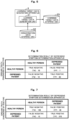
- FIG. 6 is a diagram illustrating a result of determining a depressive symptom using conversation data of a depressed patient whose HAMD score is 8 points or more and conversation data of a healthy person as determination targets by using the depressive symptom determination apparatus 1 of this embodiment.
- this figure illustrates a result of performing determination by a determination model machine-trained based on training data generated by adding a condition that a subject whose HAMD score is 19 points or more is excluded (this description is similarly applied to FIG. 7 and FIG. 8 illustrated below).
- FIG. 7 and FIG. 8 illustrated below As illustrated in FIG.
- the numbers of false negatives (FN) and false positives (FP) are significantly small when compared to the numbers of true negatives (TN) and true positives (TP), with an accuracy rate of 90%, a recall rate of 89.25%, and a precision rate of 92.22%.
- FIG. 7 is a diagram illustrating a result of determining a depressive symptom using conversation data of a depressed patient whose HAMD score is 7 points or less and conversation data of a healthy person as determination targets by using the depressive symptom determination apparatus 1 of this embodiment.
- the numbers of false negatives (FN) and false positives (FP) are significantly small when compared to the numbers of true negatives (TN) and true positives (TP), with an accuracy rate of 88.52%, a recall rate of 96.43%, and a precision rate of 87.38%.
- a depressive symptom can be determined with high accuracy.
- a determination model was generated by machine learning using, as training data, a feature vector of a subject extracted by replacing the extraction condition that "the HAMD score is 8 points or more" with "the HAMD score is 7 points or less".
- a determination model is machine-trained using, as a positive example, a feature vector of a subject whose HAMD score is 7 points or less
- a determination model capable of determining with high accuracy a depressive symptom of the subject whose HAMD score is 7 points or less is generated.
- FIG. 8 is a diagram illustrating feature quantities focused on by the determination model of this embodiment ( FIG. 8(a) on the left side) and feature quantities focused on by a determination model generated as a comparative example ( FIG. 8(b) on the right side).
- the feature quantity illustrated here is an element of a feature vector computed by the feature vector computation unit 12.
- FIG. 8 illustrates a result of computing a known Shap value as an index value indicating how an element of a feature vector affected determination of a depressive symptom.
- feature quantities focused on when determining a depressive symptom by the determination model of this embodiment are common to many of feature quantities focused on when determining a depressive symptom by the determination model of the comparative example (common feature quantities are underlined). From a result of computing this Shap value, it can be inferred that a depressive symptom of a depressed patient whose HAMD score is 7 points or less can be determined with high accuracy even in the determination model generated by the determination model generation apparatus 2 of this embodiment.
- the determination model is generated as a model that determines a depressive symptom by inputting a plurality of feature vectors for a single subject.
- the feature vector is not limited thereto.
- the feature vector is a vector having, as elements, a plurality of feature quantities representing features of content or voice of a conversation conducted by a subject.
- the feature vector may be generated by extracting a plurality of types of acoustic features (a prosodic feature such as pause duration, pitch, or an energy measurement value, a voice phonetic feature such as a fundamental frequency, a formant frequency, or an average Hibert envelope, various cepstrum coefficients, etc.) from conversation voice.
- a prosodic feature such as pause duration, pitch, or an energy measurement value
- a voice phonetic feature such as a fundamental frequency, a formant frequency, or an average Hibert envelope, various cepstrum coefficients, etc.
- the invention is not limited thereto.
- 14 points of the HAMD score (a minimum value determined as moderate) may be used.
- 8 points of the YMRS score is used as the manic-depressive threshold of the exclusion condition.
- the invention is not limited thereto.
- HAMD-17 Hamilton Depression Scale
- YMRS Young Mania Rating Scale
- the invention is not limited thereto.
- the Hamilton Anxiety Scale (HAMA) the CPRG Depression Rating Scale (CPRG-D), the inventory of Depressive Symptomatology (IDS), etc.
- BDRS Bipolar Depression Rating Scale
- CPRG-M the CPRG Mania Rating Scale
- MADS Manic Diagnostic and Severity Scale
- the depressive symptom determination apparatus 1 includes the feature vector computation unit 12.
- the feature vector computation unit 12 may be provided in an apparatus other than the depressive symptom determination apparatus 1, and a feature vector generated by the other apparatus may be input to the depressive symptom determination apparatus 1.
- the feature vector computation unit 22 may be provided in an apparatus other than the determination model generation apparatus 2, and a feature vector generated by the other apparatus may be input to the determination model generation apparatus 2.
- a feature vector generated by the other apparatus may be input to the determination model generation apparatus 2.
- FIG. 9 it is possible to employ a configuration including a training data generation apparatus 4 illustrated in FIG. 9(a) and a determination model generation apparatus 2' illustrated in FIG. 9(b) .
- the training data generation apparatus 4 includes, as a functional configuration, a learning target data generation unit 31 and the feature vector computation unit 22. Functions thereof are the same as those illustrated in FIG. 4 and FIG. 5 .
- the feature vector computation unit 22 stores a computed feature vector as training data in the training data storage unit 41.
- a training data generation unit is composed of the learning target data generation unit 31 and the feature vector computation unit 22.
- the determination model generation apparatus 2' includes, as a functional configuration, a training data input unit 42 and a determination model generation unit 23.
- a function of the determination model generation unit 23 is the same as that illustrated in FIG. 4 .
- the training data input unit 42 inputs training data (feature vector) stored in the training data storage unit 41.
- the determination model generation unit 23 generates a determination model by performing machine learning using the training data input by the training data input unit 42.
Landscapes
- Engineering & Computer Science (AREA)
- Health & Medical Sciences (AREA)
- Medical Informatics (AREA)
- Public Health (AREA)
- Biomedical Technology (AREA)
- General Health & Medical Sciences (AREA)
- Data Mining & Analysis (AREA)
- Pathology (AREA)
- Primary Health Care (AREA)
- Epidemiology (AREA)
- Life Sciences & Earth Sciences (AREA)
- Databases & Information Systems (AREA)
- Physics & Mathematics (AREA)
- Psychiatry (AREA)
- Artificial Intelligence (AREA)
- Theoretical Computer Science (AREA)
- Software Systems (AREA)
- Computer Vision & Pattern Recognition (AREA)
- Mathematical Physics (AREA)
- Evolutionary Computation (AREA)
- Social Psychology (AREA)
- Developmental Disabilities (AREA)
- Biophysics (AREA)
- Hospice & Palliative Care (AREA)
- Veterinary Medicine (AREA)
- Heart & Thoracic Surgery (AREA)
- Molecular Biology (AREA)
- Surgery (AREA)
- Animal Behavior & Ethology (AREA)
- Psychology (AREA)
- Child & Adolescent Psychology (AREA)
- General Physics & Mathematics (AREA)
- General Engineering & Computer Science (AREA)
- Computing Systems (AREA)
- Educational Technology (AREA)
- Fuzzy Systems (AREA)
- Physiology (AREA)
- Signal Processing (AREA)
- Medical Treatment And Welfare Office Work (AREA)
- Machine Translation (AREA)
Abstract
Description
- The present invention relates to a depressive symptom determination apparatus, a determination model generation apparatus, and a method of generating training data, and particularly relates to an apparatus for determining a depressive symptom of a person using a machine-trained determination model, an apparatus for generating the determination model, and a method of generating training data used in machine learning.
- Conventionally, there has been a known technology for estimating presence/absence or severity of a depressive state by an estimation model trained using teacher data (for example, see Patent Literature 1:
WO2020/122227 ). ThisPatent Literature 1 discloses that an estimation model is trained by machine learning in which a plurality of types of feature quantities extracted from biometric data of each subject is used as input vectors, and using teacher data in which evaluation of presence/absence of a depressive state by an expert such as a doctor for each subject is used as a label. - In addition,
Patent Literature 1 shows that the Hamilton Depression Scale (HAMD), which is a common diagnostic index for depression, is used to diagnose depression by a doctor, and that a cutoff value for an evaluation value based on HAMD-17 is set at 7 points, and when a total score exceeds 7 points, it is determined that depression has developed. In HAMD-17, an expert such as a doctor asks questions for 17 items to evaluate a degree based on answers obtained from a subject, and a diagnosis is performed so that the degree is normal when a total value of a score (hereinafter referred to as HAMD score) of 3 to 5 points for each item is 0 to 7 points, the degree is mild when the total value is 8 to 13 points, the degree is moderate when the total value is 14 to 18 points, the degree is severe when the total value is 19 to 22 points, and the degree is extremely severe when the total value is 23 points or more. - In the technology described in
Patent Literature 1, by configuring the estimation model to estimate the HAMD score, it is possible to distinguish between a healthy person whose estimated value of the HAMD score is 7 or less and a depressed patient whose estimated value is 8 or more, or to estimate severity of the depressed patient.Patent Literature 1 describes, with reference toFIGS. 4 to 6 , that there is a high correlation between a result of estimation of presence/absence or severity of a depressive state using the estimation model and a result of a diagnosis by a doctor using HAMD-17. - However, even though a subject actually having a depressive symptom may have a HAMD score of 7 points or less. Nevertheless, there has been a problem in that, there is a possibility that such a subject may be determined as a healthy person in the estimation model described in
Patent Literature 1. A reason therefor is that data of a subject for whom a result of a diagnosis by a doctor using HAMD-17 is 7 points or less is labeled as a "healthy person", and machine learning of the estimation model is performed. - The invention has been made to solve such a problem, and an object of the invention is to make it possible to determine, using a machine-trained determination model, that a subject has a depressive symptom, not only for a subject having a high score on a depression evaluation scale, but also for a subject having a low score on the depression evaluation scale.
- To solve the above-mentioned problem, in the invention, a depressive symptom of a subject is determined by inputting a feature vector computed based on a feature quantity of a conversation conducted by a determination target subject to a machine-trained determination model. The determination model is machine-trained using, as training data, a feature vector of a plurality of subjects satisfying a predetermined extraction condition and exclusion condition with regard to the depressive symptom. Here, the extraction condition is a condition for extracting a subject whose predetermined depression evaluation scale score is greater than or equal to a depression threshold among subjects diagnosed with depression, and a subject not diagnosed with either manic-depressive or depression, and the exclusion condition is a condition for excluding a subject diagnosed with manic-depressive and a subject whose predetermined manic-depressive evaluation scale score is greater than or equal to a manic-depressive threshold.
- According to the invention configured as described above, a depressive symptom of a determination target subject can be determined by a determination model machine-trained without being affected by a feature vector of a subject whose depression evaluation scale score becomes greater than or equal to a depression threshold when a manic-depressive disorder is temporarily in a depressive state or a subject whose depression evaluation scale score becomes less than the depression threshold when the manic-depressive disorder is temporarily in a manic state. For this reason, based on a conversation feature in a state of having a non-transient depressive symptom as a characteristic of a person rather than a conversation feature in a state in which a depressive symptom merely temporarily appears, it is possible to determine a depressive symptom of a subject having the former conversation feature. In this way, for the subject whose depression evaluation scale score is less than the depression threshold in addition to the subject whose depression evaluation scale score is greater than or equal to the depression threshold, it is possible to determine that a subject has a non-transient depressive symptom based on a conversation feature of the subject.
-
- [
FIG. 1] FIG. 1 is a block diagram illustrating a functional configuration example of a depressive symptom determination apparatus according to this embodiment. - [
FIG. 2] FIG. 2 is a block diagram illustrating a specific functional configuration example of a feature vector computation unit according to this embodiment. - [
FIG. 3] FIG. 3 is a diagram for describing a text index value group computed by an index value vector computation unit of this embodiment. - [
FIG. 4] FIG. 4 is a block diagram illustrating a functional configuration example of a determination model generation apparatus according to this embodiment. - [
FIG. 5] FIG. 5 is a block diagram illustrating a functional configuration example of a learning target data generation apparatus according to this embodiment. - [
FIG. 6] FIG. 6 is a diagram illustrating a result of determining a depressive symptom using the depressive symptom determination apparatus of this embodiment. - [
FIG. 7] FIG. 7 is a diagram illustrating a result of determining a depressive symptom using the depressive symptom determination apparatus of this embodiment. - [
FIG. 8] FIG. 8 is a diagram illustrating feature quantities focused on by a determination model of this embodiment and feature quantities focused on by a determination model generated as a comparative example. - [
FIG. 9] FIG. 9 is block diagrams illustrating functional configuration examples of a training data generation apparatus and the determination model generation apparatus according to this embodiment. - Hereinafter, an embodiment of the invention will be described with reference to the drawings.
FIG. 1 is a block diagram illustrating a functional configuration example of a depressivesymptom determination apparatus 1 according to this embodiment. As illustrated inFIG. 1 , the depressivesymptom determination apparatus 1 of this embodiment includes, as a functional configuration, a determination targetdata input unit 11, a featurevector computation unit 12, and a depressivesymptom determination unit 13. In addition, a determinationmodel storage unit 14 is connected to the depressivesymptom determination apparatus 1 of this embodiment as a storage medium. - The
functional blocks 11 to 13 can be configured by any of hardware, a DSP (Digital Signal Processor), and software. For example, thefunctional blocks 11 to 13 are realized by an operation of a program stored in a storage medium such as a RAM, a ROM, a hard disk, or a semiconductor memory under the control of a microcomputer including a CPU, a RAM, a ROM, etc. Instead of or in addition to the CPU, a GPU (Graphics Processing Unit), an FPGA (Field Programmable Gate Array), an ASIC (Application Specific Integrated Circuit), a DSP, etc. may be used. - The determination target
data input unit 11 inputs, as determination target data, m pieces of conversation data each representing content of a conversation that m subjects (m being any integer greater than or equal to 1) who are determination targets of a depressive symptom conducts. In this embodiment, as an example of conversation data, character data of a text representing content of the conversation is input as the determination target data. - For example, the determination target
data input unit 11 replaces voice data of a series of conversations between a doctor and a subject whose depressive symptom is unknown with character data, extracts character data of a speech part of the subject from the data, and inputs the character data as determination target data. - The conversations between the subject and the doctor take place as a medical interview, and last, for example, 5 to 10 minutes. In other words, a conversation in which the doctor asks the subject a question and the subject answers the question is repeatedly performed. The conversation at this time is recorded using a microphone, and voice data of the conversation is converted into character data by manual transcription or using automatic voice recognition technology.
- Here, when a plurality of exchanges is made between the subject and the doctor, a plurality of speech parts by the subject and the doctor is included in the series of conversations. In this embodiment, as an example, character data of the plurality of speech parts is collectively treated as one text. That is, for one conversation (series of dialogue) of one subject, in general, a text including two or more sentences separated by periods is defined as one text. This means that, when the determination target
data input unit 11 inputs determination target data of m subjects, m texts are input. - The feature
vector computation unit 12 computes a feature quantity of conversation data input by the determination targetdata input unit 11 and converts the feature quantity into a vector, thereby obtaining a feature vector. When text (character data) representing content of a conversation is used as an example of conversation data, the featurevector computation unit 12 computes a feature quantity of the text and converts the feature quantity into a vector. Calculation content for conversion into a vector is any calculation content. However, for example, the feature vector can be computed using a method illustrated inFIG. 2 . -
Fig. 2 is a block diagram illustrating a specific functional configuration example of the featurevector computation unit 12. As illustrated inFig. 2 , the featurevector computation unit 12 includes aword extraction unit 121, avector computation unit 122 and an index valuevector computation unit 123 as functional configurations. Thevector computation unit 122 includes a textvector computation unit 122a and a wordvector computation unit 122b as more specific functional configurations. - The
word extraction unit 121 analyzes m texts input as determination target data by the determination targetdata input unit 11 and extracts n words (n is an arbitrary integer of 2 or more) from the m texts. As a method of analyzing texts, for example, a known morphological analysis can be used. Theword extraction unit 121 may extract morphemes of all parts of speech divided by the morphological analysis as words, or may extract only morphemes of a specific part of speech as words. - Note that the same word may be included in the m texts a plurality of times. In this case, the
word extraction unit 121 does not extract the plurality of the same words, and extracts only one. That is, the n words extracted by theword extraction unit 121 refer to n types of words. Here, theword extraction unit 121 may measure a frequency at which the same word is extracted from m texts, and extract n (n types of) words in descending order of occurrence frequencies, or n (n types of) words each having an occurrence frequency greater than or equal to a threshold. - The
vector computation unit 122 computes m text vectors and n word vectors from the m texts and the n words. Here, the textvector computation unit 122a converts each of the m texts to be analyzed by theword extraction unit 121 into a q-dimensional vector (q is an arbitrary integer of 2 or more) according to a predetermined rule, thereby computing the m text vectors including q axis components. In addition, the wordvector computation unit 122b converts each of the n words extracted by theword extraction unit 121 into a q-dimensional vector according to a predetermined rule, thereby computing the n word vectors including q axis components. - In the present embodiment, as an example, a text vector and a word vector are computed as follows. Now, a set S = <d ∈ D, w ∈ W> including the m texts and the n words is considered. Here, a text vector di→ and a word vector wj→ (hereinafter, the symbol "→" indicates a vector) are associated with each text di (i = 1, 2, ..., m) and each word wj (j = 1, 2, ..., n), respectively. Then, a probability P(wj|di) shown in the following Equation (1) is calculated with respect to an arbitrary word wj and an arbitrary text di.
[Equation 1]
- Note that the probability P(wj|di) is a value that can be computed in accordance with a probability p disclosed in, a thesis "'Distributed Representations of Sentences and Documents' by Quoc Le and Tomas Mikolov, Google Inc; Proceedings of the 31st International Conference on Machine Learning Held in Bejing, China on 22-24 June 2014" describing evaluation of a text or a document using a paragraph vector. This thesis states that, for example, when there are three words "the", "cat", and "sat", "on" is predicted as a fourth word, and a computation formula of the prediction probability p is described. The probability p(wt|wt - k, ..., wt + k) described in the thesis is a correct answer probability when another word wt is predicted from a plurality of words wt - k, ..., wt + k.
- Meanwhile, the probability P(wj|di) shown in Equation (1) used in the present embodiment represents a correct answer probability that one word wj of n words is predicted from one text di of m texts. Predicting one word wj from one text di means that, specifically, when a certain text di appears, a possibility of including the word wj in the text di is predicted.
- In Equation (1), an exponential function value is used, where e is the base and the inner product of the word vector w→ and the text vector d→ is the exponent. Then, a ratio of an exponential function value calculated from a combination of a text di and a word wj to be predicted to the sum of n exponential function values calculated from each combination of the text di and n words wk (k = 1, 2, ..., n) is calculated as a correct answer probability that one word wj is expected from one text di.
- Here, the inner product value of the word vector wj→ and the text vector di→ can be regarded as a scalar value when the word vector wj→is projected in a direction of the text vector di→, that is, a component value in the direction of the text vector di→ included in the word vector wj→, which can be considered to represent a degree at which the word wj contributes to the text di. Therefore, obtaining the ratio of the exponential function value calculated for one word Wj to the sum of the exponential function values calculated for n words wk (k = 1, 2, ..., n) using the exponential function value calculated using the inner product corresponds to obtaining the correct answer probability that one word wj of n words is predicted from one text di.
- Note that since Equation (1) is symmetrical with respect to di and wj, a probability P(di|wj) that one text di of m texts is predicted from one word wj of n words may be calculated. Predicting one text di from one word wj means that, when a certain word wj appears, a possibility of including the word wj in the text di is predicted. In this case, an inner product value of the text vector di→ and the word vector wj→ may be regarded as a scalar value obtained when the text vector di→ is projected in a direction of the word vector wj→, that is, a component value of the text vector di→ in the direction of the word vector wj→. This can be considered as representing a degree to which the text di contributes to the word wj.
- Note that here, a calculation example using the exponential function value using the inner product value of the word vector w→ and the text vector d→ as an exponent has been described. However, the exponential function value may not be used. Any calculation formula using the inner product value of the word vector w→ and the text vector d→ may be used. For example, the probability may be obtained from the ratio of the inner product values itself (Performing predetermined calculation for causing the inner product value to be a positive value at all times (for example, inner product value + 1) is included.).
- Next, the
vector computation unit 122 computes the text vector di→ and the word vector wj→ that maximize a value L of the sum of the probability P(wj|di) computed by Equation (1) for all the set S as shown in the following Equation (2). That is, the textvector computation unit 122a and the wordvector computation unit 122b compute the probability P(wj|di) computed by Equation (1) for all combinations of the m texts and the n words, and compute the text vector di→ and the word vector wj→ that maximize a target variable L using the sum thereof as the target variable L.
[Equation 2]
- Maximizing the total value L of the probability P (wj | di) computed for all the combinations of the m texts and the n words corresponds to maximizing the correct answer probability that a certain word wj (j = 1, 2, ..., n) is predicted from a certain text di (i = 1, 2, ..., m). That is, the
vector computation unit 122 can be considered to compute the text vector di→ and the word vector wj→that maximize the correct answer probability. - As described above, in the present embodiment, the
vector computation unit 122 converts each of the m texts di into a q-dimensional vector to compute the m texts vectors di→ including the q axis components, and converts each of the n words into a q-dimensional vector to compute the n word vectors wj→ including the q axis components, which corresponds to computing the text vector di→ and the word vector wj→ that maximize the target variable L by making q axis directions variable. - The index value
vector computation unit 123 computes each of the inner products of the m text vectors di→ and the n word vectors wj→ computed by thevector computation unit 122, thereby computing m × n relationship index values reflecting the relationship between the m texts di and the n words wj. In the present embodiment, as shown in the following Equation (3), the index valuevector computation unit 123 obtains the product of a text matrix D having the respective q axis components (d11 to dmq) of the m text vectors di→ as respective elements and a word matrix W having the respective q axis components (w11 to wnq) of the n word vectors wj→ as respective elements, thereby computing an index value matrix DW having m × n relationship index values as elements. Here, Wt is the transposed matrix of the word matrix.
[Equation 3]
- Each element dwij (i = 1, 2, ..., m, j = 1, 2, ..., n) of the index value matrix DW computed in this manner may indicate which word contributes to which text and to what extent. For example, an element dw12 in the first row and the second column is a value indicating a degree at which the word w2 contributes to a text d1. In this way, each row of the index value matrix DW can be used to evaluate the similarity of a text, and each column can be used to evaluate the similarity of a word.
- The index value
vector computation unit 123 uses the index value matrix DW (m × n relationship index values) computed as in Equation (3) to specify a text index value group including n relationship index values dwij (j = 1, 2, ..., n) for one text di as an index value vector. Then, the specified index value vector of the text di is output as a feature vector of the text di, that is, a feature vector of conversation data of a subject i. -
FIG. 3 is a diagram for describing a text index value group (index value vector). As illustrated inFIG. 3 , for example, in the case of a first text d1, n relationship index values dw11 to dw1n, included in a first row of the index value matrix DW correspond to a text index value group. Similarly, in the case of a second text d2, n relationship index values dw21 to dw2n included in a second row of the index value matrix DW correspond thereto. Then, this description is similarly applied up to a text index value group (n relationship index values dwm1 to dwmn) related to an mth text dm. - Note that, here, as illustrated in
FIG. 3 , even though an example of constructing a feature vector by a text index value group of each column in the index value matrix DW has been described, the invention is not limited thereto. For example, a text vector computed by the textvector computation unit 122a may be used as a feature vector. - A description will be given by returning to
FIG. 1 . The depressivesymptom determination unit 13 determines a depressive symptom of a subject by inputting a feature vector computed by the featurevector computation unit 12 to a machine-trained determination model stored in the determinationmodel storage unit 14. This determination model is a model that classifies a determination target subject using two values, that is, whether the subject is a depressed patient or a healthy person, and is a model that receives input of a feature vector and outputs an evaluation value indicating presence/absence of a depressive symptom. - For example, this determination model can be generated by ensemble learning such as XGBoost, which is a method of gradient boosting. Note that the form of the determination model is not limited thereto. For example, other tree models such as a decision tree, a regression tree, and a random forest may be used. Alternatively, a neural network model, a clustering model, etc. may be used.
- The determination model of this embodiment is machine-trained using, as training data, feature vectors of a plurality of subjects satisfying a predetermined extraction condition and an exclusion condition related to a depressive symptom. The extraction condition is a condition for extracting a subject whose predetermined depression evaluation scale score is greater than or equal to a depression threshold among subjects diagnosed with depression by a doctor, and a subject not diagnosed with either manic-depressive or depression. The exclusion condition is a condition for excluding a subject diagnosed with manic-depressive by a doctor and a subject whose predetermined manic-depressive evaluation scale score is greater than or equal to a manic-depressive threshold.
- In this embodiment, the Hamilton Depression Scale (HAMD-17) is used as an example of a depression evaluation scale. As described above, in general, in HAMD-17, a person having a HAMD score of 7 points or less is diagnosed with a healthy person, and a person having a HAMD score of 8 points or more is diagnosed with a depressed patient (including mild, moderate, severe, and extremely severe). In this embodiment, according thereto, the depression threshold of the extraction condition is set to 8 points, and a subject whose HAMD score is 8 points or more and a subject not diagnosed with either manic-depressive or depression are extracted.
- Further, in this embodiment, the Young Mania Rating Scale (YMRS) is used as an example of a manic-depressive evaluation scale. The YMRS is an evaluation scale based on a clinical interview and having 11 items including elation and increased activity. In this embodiment, the manic-depressive threshold of the exclusion condition is set to 8 points, and training data is constructed by excluding a subject whose total value of a score for each item (hereinafter referred to as YMRS score) is 8 points or more and a subject diagnosed with manic-depressive by a doctor.
- In this embodiment, the determination model is machine-trained using a feature vector computed from conversation data of each subject, with a subject diagnosed with depression as a positive example and a subject not diagnosed with depression as a negative example among subjects satisfying the above-mentioned extraction condition and exclusion condition.
-
FIG. 4 is a block diagram illustrating a functional configuration example of a determinationmodel generation apparatus 2 according to this embodiment. As illustrated inFIG. 4 , the determinationmodel generation apparatus 2 of this embodiment includes, as a functional configuration, a learning targetdata input unit 21, a featurevector computation unit 22, and a determinationmodel generation unit 23. In addition, a determinationmodel storage unit 24 and a learning targetdata storage unit 25 are connected as storage media to the determinationmodel generation apparatus 2 of this embodiment. - The functional blocks 21 to 23 can be configured by any of hardware, a DSP, and software. For example, the
functional blocks 21 to 23 are realized by an operation of a program stored in a storage medium such as a RAM, a ROM, a hard disk, or a semiconductor memory under the control of a microcomputer including a CPU, a RAM, a ROM, etc. Instead of or in addition to the CPU, a GPU, an FPGA, an ASIC, a DSP, etc. may be used. - The learning target
data input unit 21 inputs, as learning target data, a plurality of pieces of conversation data each representing content of conversations that a plurality of subjects (hereinafter, referred to as condition-applicable subjects) satisfying a predetermined extraction condition and exclusion condition with respect to a depressive symptom conducts. In this embodiment, as an example of conversation data, character data of a text representing content of a conversation is input as learning target data. - Processing content for the learning target
data input unit 21 to input conversation data of the plurality of subjects as text is similar to that of the determination targetdata input unit 11 illustrated inFIG. 1 . A difference from the determination targetdata input unit 11 is that the learning targetdata input unit 21 inputs conversation data related to a condition-applicable subject as learning target data. - For example, the learning target
data storage unit 25 stores conversation data of a condition-applicable subject (which may be voice data of conversation or text data converted from voice data into text). The learning targetdata input unit 21 inputs learning target data by reading the conversation data of the condition-applicable subject from the learning targetdata storage unit 25. Here, when voice data is stored in the learning targetdata storage unit 25, the learning targetdata input unit 21 replaces the voice data of the conversation read from the learning targetdata storage unit 25 with character data, and uses this data as learning target data. - In this example, the learning target data stored in the learning target
data storage unit 25 is generated by a learning targetdata generation apparatus 3 having a function of a learning targetdata generation unit 31, for example, as illustrated inFIG. 5 . In an example illustrated inFIG. 5 , a conversationdata storage unit 32 stores, in addition to the conversation data of the condition-applicable subject, conversation data (which may be voice data of the conversation or text data converted from voice data into text) of a subject not satisfying the predetermined extraction condition and exclusion condition (hereinafter referred to as a condition-non-applicable subject). In addition, the conversationdata storage unit 32 stores information necessary for determining whether or not the predetermined extraction condition and exclusion condition are satisfied in association with the conversation data. The information necessary for determining whether or not the conditions are satisfied is information indicating whether or not a subject is diagnosed with depression or manic-depressive by the doctor, and a HAMD score and a YMRS score of the subject. The HAMD score and the YMRS score are obtained by performing evaluation when the conversation data is recorded. - The learning target
data generation unit 31 generates learning target data by extracting conversation data of a condition-applicable subject from the conversationdata storage unit 32 based on information stored in the conversationdata storage unit 32 in association with the conversation data, and stores the generated learning target data in the learning targetdata storage unit 25. Here, the learning targetdata generation unit 31 labels conversation data of a subject diagnosed with depression with a positive example while labeling conversation data of a subject not diagnosed with depression with a negative example among conversation data of extracted condition-applicable subjects. - Note that, when the conversation data stored in the conversation
data storage unit 32 is voice data, the learning targetdata generation unit 31 may store voice data read from the conversationdata storage unit 32 as learning target data in the learning targetdata storage unit 25, or may replace the voice data read from the conversationdata storage unit 32 with character data and store the character data as learning target data in the learning targetdata storage unit 25. - Note that a method of generating the learning target data is not limited thereto. For example, a conversation may be recorded only for a subject satisfying the predetermined extraction condition and exclusion condition, and conversation data obtained thereby may be stored in the learning target
data storage unit 25 as learning target data. - The function of the learning target
data generation unit 31 may be comprised by the learning targetdata input unit 21. In this case, the learning targetdata input unit 21 has both functions of generating and inputting learning target data. That is, the learning targetdata input unit 21 generates learning target data by extracting (inputting) conversation data of a condition-applicable subject from conversation data of a plurality of subjects stored in the conversationdata storage unit 32. - Returning to
FIG. 4 , the featurevector computation unit 22 obtains a feature vector by computing feature quantities of a plurality of pieces of conversation data input by the learning targetdata input unit 21 and converting the feature quantities into a vector. When text (character data) representing content of a conversation is used as an example of conversation data, the featurevector computation unit 22 computes a feature quantity of the text and converts the feature quantity into a vector. Processing content for conversion into a vector is similar to that of the featurevector computation unit 12 illustrated inFIG. 1 . The feature vector computed by the featurevector computation unit 22 is used as training data when a determination model is machine-trained. - Note that a method of generating training data in the claims is realized by processing of the learning target
data generation unit 31, the learning targetdata input unit 21, and the featurevector computation unit 22. That is, training data generation unit is composed of the learning targetdata generation unit 31, the learning targetdata input unit 21, and the featurevector computation unit 22. - The determination
model generation unit 23 performs machine learning using a feature vector computed by the featurevector computation unit 22 as training data, thereby generating a determination model for determining a depressive symptom of the subject based on the feature vector. As described above, in this embodiment, machine learning is performed using, as training data, a feature vector computed from learning target data generated based on conversation data of a condition-applicable subject. - Here, the determination
model generation unit 23 performs machine learning using, as a positive example, a feature vector generated from conversation data labeled with a positive example (conversation data of a subject diagnosed with depression) and using, as a negative example, a feature vector generated from conversation data labeled with a negative example (conversation data of a subject not diagnosed with depression) among pieces of conversation data of condition-applicable subjects. - Then, the determination
model generation unit 23 causes the determinationmodel storage unit 24 to store a determination model generated by machine learning. The determination model stored in the determinationmodel storage unit 24 is stored in the determinationmodel storage unit 14 illustrated inFIG. 1 . Note that the determinationmodel storage unit 24 illustrated inFIG. 4 may be the same as the determinationmodel storage unit 14 illustrated inFIG. 1 . - Even though an example in which the depressive
symptom determination apparatus 1 and the determinationmodel generation apparatus 2 are separately configured has been described above, a part may be shared. For example, the featurevector computation units - As described above, in this embodiment, training data is constructed by excluding a subject whose YMRS score is 8 or more and a subject diagnosed with manic-depressive by a doctor, and machine learning of the determination model is performed using the training data constructed in this way. The determination model machine-trained using such training data can be regarded as a determination model machine-trained without being affected by conversation data of a subject whose HAMD score is 8 or more when manic-depressive disorder is temporarily in a depressive state and a subject whose HAMD score is less than 8 when manic-depressive disorder is temporarily in a manic state.
- In this embodiment, the determination model configured in this way is used to determine a depressive symptom of a determination target subject. For this reason, based on a conversation feature in a state of having a non-transient depressive symptom as a characteristic of a person rather than a conversation feature in a state in which a depressive symptom merely temporarily appears, it is possible to determine a depressive symptom of a subject having the former conversation feature. In this way, even though the training data is generated using the extraction condition that limits subjects to those having a HAMD score of 8 or more, it is possible to determine that a subject has a non-transient depressive symptom based on a conversation feature of the subject for a subject whose HAMD score is less than 8 points in addition to a subject whose HAMD score is 8 points or more.
- In general, it is considered that there are two types of anxiety related to a depressive symptom. One type is trait anxiety and the other type is state anxiety. Trait anxiety refers to nature coming from personality of a person and having a tendency to become anxious and does not change much depending on the situation. On the other hand, state anxiety refers to a temporary anxiety reaction to a specific time, scene, event, or object. The determination model of this embodiment is particularly effective in determining presence/absence of depressive symptoms caused by trait anxiety.
- Note that, in the above embodiment, an example in which two subjects, namely, a subject diagnosed with manic-depressive and a subject whose predetermined manic-depressive evaluation scale score is greater than or equal to the manic-depressive threshold are used as the exclusion condition has been described. In contrast to this, a subject whose depression evaluation scale score is greater than or equal to a second depression threshold greater than the depression threshold may be further added to the exclusion condition. For example, a condition for excluding a subject whose HAMD score is 19 points or more (patient with severely or extremely severe depressed) may be further added.
- The inventors confirmed that a feature vector computed from conversation data of a subject whose HAMD score is 19 points or more is significantly different from a feature vector computed from conversation data of a subject whose HAMD score is 18 points or less. Therefore, as a result of generating training data by excluding conversation data of the subject whose HAMD score is 19 points or more and performing machine learning of a determination model based thereon, it was confirmed that accuracy of determining a depressive symptom for the subject whose HAMD score is 18 points or less was improved.
-
FIG. 6 is a diagram illustrating a result of determining a depressive symptom using conversation data of a depressed patient whose HAMD score is 8 points or more and conversation data of a healthy person as determination targets by using the depressivesymptom determination apparatus 1 of this embodiment. Here, this figure illustrates a result of performing determination by a determination model machine-trained based on training data generated by adding a condition that a subject whose HAMD score is 19 points or more is excluded (this description is similarly applied toFIG. 7 andFIG. 8 illustrated below). As illustrated inFIG. 6 , the numbers of false negatives (FN) and false positives (FP) are significantly small when compared to the numbers of true negatives (TN) and true positives (TP), with an accuracy rate of 90%, a recall rate of 89.25%, and a precision rate of 92.22%. -
FIG. 7 is a diagram illustrating a result of determining a depressive symptom using conversation data of a depressed patient whose HAMD score is 7 points or less and conversation data of a healthy person as determination targets by using the depressivesymptom determination apparatus 1 of this embodiment. As illustrated inFIG. 7 , the numbers of false negatives (FN) and false positives (FP) are significantly small when compared to the numbers of true negatives (TN) and true positives (TP), with an accuracy rate of 88.52%, a recall rate of 96.43%, and a precision rate of 87.38%. As such, even for the depressed patient whose HAMD score is 7 points or less, a depressive symptom can be determined with high accuracy. - Here, in order to confirm that a depressive symptom also can be determined with high accuracy for the depressed patient whose HAMD score is 7 points or less, as a comparative example for a determination model machine-trained using a feature vector of a conversation by a subject satisfying the above-mentioned extraction condition and exclusion condition, a determination model was generated by machine learning using, as training data, a feature vector of a subject extracted by replacing the extraction condition that "the HAMD score is 8 points or more" with "the HAMD score is 7 points or less". As such, when a determination model is machine-trained using, as a positive example, a feature vector of a subject whose HAMD score is 7 points or less, a determination model capable of determining with high accuracy a depressive symptom of the subject whose HAMD score is 7 points or less is generated.
-
FIG. 8 is a diagram illustrating feature quantities focused on by the determination model of this embodiment (FIG. 8(a) on the left side) and feature quantities focused on by a determination model generated as a comparative example (FIG. 8(b) on the right side). The feature quantity illustrated here is an element of a feature vector computed by the featurevector computation unit 12.FIG. 8 illustrates a result of computing a known Shap value as an index value indicating how an element of a feature vector affected determination of a depressive symptom. - As can be seen by comparing
FIG. 8(a) and FIG. 8(b) , feature quantities focused on when determining a depressive symptom by the determination model of this embodiment are common to many of feature quantities focused on when determining a depressive symptom by the determination model of the comparative example (common feature quantities are underlined). From a result of computing this Shap value, it can be inferred that a depressive symptom of a depressed patient whose HAMD score is 7 points or less can be determined with high accuracy even in the determination model generated by the determinationmodel generation apparatus 2 of this embodiment. - Note that, in the embodiment, an example in which character data of a plurality of speech parts included in a single conversation of one subject is collectively defined as one text has been described. However, character data of a plurality of speech parts may be treated as a plurality of texts. In this case, the determination model is generated as a model that determines a depressive symptom by inputting a plurality of feature vectors for a single subject.
- In addition, in the embodiment, an example in which a text representing content of a conversation is used as an example of conversation data, and the text index value group illustrated in
FIG. 3 is used as a feature vector has been described. However, the feature vector is not limited thereto. In other words, it is sufficient that the feature vector is a vector having, as elements, a plurality of feature quantities representing features of content or voice of a conversation conducted by a subject. For example, the feature vector may be generated by extracting a plurality of types of acoustic features (a prosodic feature such as pause duration, pitch, or an energy measurement value, a voice phonetic feature such as a fundamental frequency, a formant frequency, or an average Hibert envelope, various cepstrum coefficients, etc.) from conversation voice. - Further, in the embodiment, as described above, an example in which 8 points of the HAMD score (a minimum value determined as mild) is used as the depression threshold of the extraction condition has been described. However, the invention is not limited thereto. For example, 14 points of the HAMD score (a minimum value determined as moderate) may be used. Further, in the embodiment, an example in which 8 points of the YMRS score is used as the manic-depressive threshold of the exclusion condition has been described. However, the invention is not limited thereto.
- Further, in the embodiment, a description has been given of an example in which the Hamilton Depression Scale (HAMD-17) is used as an example of the depression evaluation scale, and the Young Mania Rating Scale (YMRS) is used as an example of the manic-depressive evaluation scale. However, the invention is not limited thereto. For example, the Hamilton Anxiety Scale (HAMA), the CPRG Depression Rating Scale (CPRG-D), the inventory of Depressive Symptomatology (IDS), etc. may be used instead of HAMD-17. Further, the Bipolar Depression Rating Scale (BDRS), the CPRG Mania Rating Scale (CPRG-M), the Manic Diagnostic and Severity Scale (MADS), etc. may be used instead of YMRS.
- Further, in the embodiment, a description has been given of an example in which the depressive
symptom determination apparatus 1 includes the featurevector computation unit 12. However, the invention is not limited thereto. For example, the featurevector computation unit 12 may be provided in an apparatus other than the depressivesymptom determination apparatus 1, and a feature vector generated by the other apparatus may be input to the depressivesymptom determination apparatus 1. - Similarly, the feature
vector computation unit 22 may be provided in an apparatus other than the determinationmodel generation apparatus 2, and a feature vector generated by the other apparatus may be input to the determinationmodel generation apparatus 2. For example, as illustrated inFIG. 9 , it is possible to employ a configuration including a trainingdata generation apparatus 4 illustrated inFIG. 9(a) and a determination model generation apparatus 2' illustrated inFIG. 9(b) . - As illustrated in
FIG. 9(a) , the trainingdata generation apparatus 4 includes, as a functional configuration, a learning targetdata generation unit 31 and the featurevector computation unit 22. Functions thereof are the same as those illustrated inFIG. 4 andFIG. 5 . The featurevector computation unit 22 stores a computed feature vector as training data in the trainingdata storage unit 41. In this case, a training data generation unit is composed of the learning targetdata generation unit 31 and the featurevector computation unit 22. - As illustrated in
FIG. 9(b) , the determination model generation apparatus 2' includes, as a functional configuration, a trainingdata input unit 42 and a determinationmodel generation unit 23. A function of the determinationmodel generation unit 23 is the same as that illustrated inFIG. 4 . The trainingdata input unit 42 inputs training data (feature vector) stored in the trainingdata storage unit 41. The determinationmodel generation unit 23 generates a determination model by performing machine learning using the training data input by the trainingdata input unit 42. - In addition, all the embodiments are merely examples of embodiment in carrying out the invention, and the technical scope of the invention should not be construed in a limited manner by the embodiments. That is, the invention can be implemented in various forms without departing from a gist or a main feature thereof.
-
- 1: depressive symptom determination apparatus
- 2, 2': determination model generation apparatus
- 3: learning target data generation apparatus
- 4: training data generation apparatus
- 11: determination target data input unit
- 12: feature vector computation unit
- 13: depressive symptom determination unit
- 14: determination model storage unit
- 21: learning target data input unit
- 22: feature vector computation unit
- 23: determination model generation unit
- 24: determination model storage unit
- 25: learning target data storage unit
- 31: learning target data generation unit
- 32: conversation data storage unit
- 41: training data storage unit
- 42: training data input unit
- 121: word extraction unit
- 122: vector computation unit
- 122a: text vector computation unit
- 122b: word vector computation unit
- 123: index value vector computation unit
Claims (8)
- A depressive symptom determination apparatus characterized by comprising:a depressive symptom determination unit configured to determine a depressive symptom of a subject by inputting a feature vector computed based on a feature quantity of a conversation conducted by the subject as a determination target to a machine-trained determination model,whereinthe determination model is machine-trained using, as training data, the feature vector for a plurality of subjects satisfying a predetermined extraction condition and exclusion condition related to a depressive symptom,the extraction condition is a condition for extracting a subject whose predetermined depression evaluation scale score is greater than or equal to a depression threshold among subjects diagnosed with depression, and a subject not diagnosed with either manic-depressive or depression, andthe exclusion condition is a condition for excluding a subject diagnosed with manic-depressive and a subject whose predetermined manic-depressive evaluation scale score is greater than or equal to a manic-depressive threshold.
- The depressive symptom determination apparatus according to claim 1, characterized in that the exclusion condition is a condition for further excluding a subject whose depression evaluation scale score is greater than or equal to a second depression threshold greater than the depression threshold.
- A determination model generation apparatus characterized by comprising:a determination model generation unit configured to perform machine learning using a feature vector computed based on a feature quantity of a conversation conducted by a plurality of subjects satisfying a predetermined extraction condition and exclusion condition with regard to a depressive symptom, thereby generating a determination model for determining a depressive symptom of the subject based on the feature vector,whereinthe extraction condition is a condition for extracting a subject whose predetermined depression evaluation scale score is greater than or equal to a depression threshold among subjects diagnosed with depression, and a subject not diagnosed with either manic-depressive or depression, andthe exclusion condition is a condition for excluding a subject diagnosed with manic-depressive and a subject whose predetermined manic-depressive evaluation scale score is greater than or equal to a manic-depressive threshold.
- The determination model generation apparatus according to claim 3, characterized in that the exclusion condition is a condition for further excluding a subject whose depression evaluation scale score is greater than or equal to a second depression threshold greater than the depression threshold.
- The determination model generation apparatus according to claim 3 or 4, characterized in that the determination model generation unit performs machine learning using the feature vector of each subject by using a subject diagnosed with depression as a positive example and using a subject not diagnosed with depression as a negative example among subjects satisfying the extraction condition and the exclusion condition.
- A method of generating training data used when machine-training a determination model configured to determine a depressive symptom of a subject, the method characterized by comprising a step of:generating, by a training data generation unit of a computer, the training data by extracting a plurality of pieces of conversation data each representing content of a conversation conducted by a plurality of subjects satisfying a predetermined extraction condition and exclusion condition set with regard to the depressive symptom,whereinthe extraction condition is a condition for extracting a subject whose predetermined depression evaluation scale score is greater than or equal to a depression threshold among subjects diagnosed with depression, and a subject not diagnosed with either manic-depressive or depression, andthe exclusion condition is a condition for excluding a subject diagnosed with manic-depressive and a subject whose predetermined manic-depressive evaluation scale score is greater than or equal to a manic-depressive threshold.
- The method of generating training data according to claim 6, characterized in that the exclusion condition is a condition for further excluding a subject whose depression evaluation scale score is greater than or equal to a second depression threshold greater than the depression threshold.
- The method of generating training data according to claim 6 or 7, characterized in that the training data is configured by labeling a subject diagnosed with depression with a positive example and labeling a subject not diagnosed with depression with a negative example among subjects satisfying a predetermined extraction condition and exclusion condition.
Applications Claiming Priority (1)
| Application Number | Priority Date | Filing Date | Title |
|---|---|---|---|
| PCT/JP2023/025678 WO2025013233A1 (en) | 2023-07-12 | 2023-07-12 | Depression symptom determination device, determination model generation device, and training data generation method |
Publications (2)
| Publication Number | Publication Date |
|---|---|
| EP4570189A1 true EP4570189A1 (en) | 2025-06-18 |
| EP4570189A4 EP4570189A4 (en) | 2026-05-27 |
Family
ID=94214900
Family Applications (1)
| Application Number | Title | Priority Date | Filing Date |
|---|---|---|---|
| EP23943949.0A Pending EP4570189A4 (en) | 2023-07-12 | 2023-07-12 | DEVICE FOR DETERMINING DEPRESSION SYMPTOMS, DEVICE FOR GENERATING A DETERMINATION MODEL AND METHOD FOR GENERATING TRAINING DATA |
Country Status (5)
| Country | Link |
|---|---|
| US (1) | US20260134993A1 (en) |
| EP (1) | EP4570189A4 (en) |
| JP (1) | JP7807764B2 (en) |
| KR (1) | KR20250065382A (en) |
| WO (1) | WO2025013233A1 (en) |
Family Cites Families (9)
| Publication number | Priority date | Publication date | Assignee | Title |
|---|---|---|---|---|
| US20080312513A1 (en) * | 2005-03-21 | 2008-12-18 | Ely Simon | Neurosurgical Candidate Selection Tool |
| US20120208712A1 (en) * | 2010-07-29 | 2012-08-16 | The University Of Pittsburgh - Of The Commonwealth System Of Higher Education | Sirtuin 5 polymorphisms and neurological diseases |
| US10068670B2 (en) * | 2012-08-16 | 2018-09-04 | Ginger.io, Inc. | Method for modeling behavior and depression state |
| US10812424B1 (en) * | 2018-02-05 | 2020-10-20 | Beacon Tech Inc. | System and method for quantifying mental health within a group chat application |
| EP3821815A4 (en) | 2018-07-13 | 2021-12-29 | Life Science Institute, Inc. | Mental/nervous system disorder estimation system, estimation program, and estimation method |
| US11633103B1 (en) * | 2018-08-10 | 2023-04-25 | ClearCare, Inc. | Automatic in-home senior care system augmented with internet of things technologies |
| JP6733891B2 (en) * | 2018-09-12 | 2020-08-05 | 株式会社Fronteo | Dementia prediction device, prediction model generation device, and dementia prediction program |
| WO2020122227A1 (en) | 2018-12-14 | 2020-06-18 | 学校法人慶應義塾 | Device and method for inferring depressive state and program for same |
| CN111241817A (en) * | 2020-01-20 | 2020-06-05 | 首都医科大学 | Text-based depression identification method |
-
2023
- 2023-07-12 JP JP2024562187A patent/JP7807764B2/en active Active
- 2023-07-12 WO PCT/JP2023/025678 patent/WO2025013233A1/en not_active Ceased
- 2023-07-12 KR KR1020257011144A patent/KR20250065382A/en active Pending
- 2023-07-12 EP EP23943949.0A patent/EP4570189A4/en active Pending
- 2023-07-12 US US19/121,154 patent/US20260134993A1/en active Pending
Also Published As
| Publication number | Publication date |
|---|---|
| JP7807764B2 (en) | 2026-01-28 |
| KR20250065382A (en) | 2025-05-12 |
| US20260134993A1 (en) | 2026-05-14 |
| EP4570189A4 (en) | 2026-05-27 |
| WO2025013233A1 (en) | 2025-01-16 |
| JPWO2025013233A1 (en) | 2025-01-16 |
Similar Documents
| Publication | Publication Date | Title |
|---|---|---|
| EP3835972B1 (en) | Cognitive impairment prediction device, prediction model generation device, and program for cognitive impairment prediction | |
| JP7566939B2 (en) | Selecting Audio Features to Build a Model to Detect Medical Conditions | |
| Martinc et al. | Tackling the ADReSS challenge: a multimodal approach to the automated recognition of Alzheimer’s dementia | |
| US12541654B2 (en) | Text classifier for answer identification, background knowledge representation generator and training device therefor, and computer program | |
| US20120221339A1 (en) | Method, apparatus for synthesizing speech and acoustic model training method for speech synthesis | |
| US20130132082A1 (en) | Systems and Methods for Concurrent Signal Recognition | |
| Ablimit et al. | Exploring dementia detection from speech: Cross corpus analysis | |
| Tank et al. | Depression detection and analysis using large language models on textual and audio-visual modalities | |
| JP2020190585A (en) | Automatic dialogue device, automatic dialogue method, and program | |
| Seneviratne et al. | Multimodal depression severity score prediction using articulatory coordination features and hierarchical attention based text embeddings | |
| EP4570190A1 (en) | Depression symptom determination device, determination model generation device, and learning data generation method | |
| US20260134993A1 (en) | Depressive symptom determination apparatus, determination model generation apparatus, and method of generating training data | |
| Niemelä et al. | Classification of dementia from spoken speech using feature selection and the bag of acoustic words model | |
| Hossain et al. | Improving speech emotion recognition and classification accuracy using hybrid CNN-LSTM-KNN model | |
| Botelho et al. | Tackling cognitive impairment detection from speech: A submission to the process challenge | |
| JP2021032920A (en) | Paralanguage information estimators, learning devices, their methods, and programs | |
| US12394406B2 (en) | Paralinguistic information estimation model learning apparatus, paralinguistic information estimation apparatus, and program | |
| Deb | Multitask audio analysis for emotion, gender, and speaker recognition in Bangla speech comparing features and models | |
| Fu et al. | Composite feature extraction for speech emotion recognition | |
| Manikandan et al. | Speaker identification analysis for SGMM with k-means and fuzzy C-means clustering using SVM statistical technique | |
| Niemelä et al. | Identification of Cognitive Decline from Spoken Language through Feature Selection and the Bag of Acoustic Words Model | |
| Esfar-E-Alam et al. | Multimodal emotion recognition using heterogeneous ensemble techniques | |
| Swathi et al. | Emotion recognition using Bayesian learning from a multi-label data corpus | |
| Dalal et al. | Emotion recognition in Arabic speech signal | |
| Jaishankar et al. | A novel dilated Bi-LSTM framework for depression detection from speech signals through feature fusion |
Legal Events
| Date | Code | Title | Description |
|---|---|---|---|
| STAA | Information on the status of an ep patent application or granted ep patent |
Free format text: STATUS: UNKNOWN |
|
| STAA | Information on the status of an ep patent application or granted ep patent |
Free format text: STATUS: THE INTERNATIONAL PUBLICATION HAS BEEN MADE |
|
| PUAI | Public reference made under article 153(3) epc to a published international application that has entered the european phase |
Free format text: ORIGINAL CODE: 0009012 |
|
| STAA | Information on the status of an ep patent application or granted ep patent |
Free format text: STATUS: REQUEST FOR EXAMINATION WAS MADE |
|
| 17P | Request for examination filed |
Effective date: 20250313 |
|
| AK | Designated contracting states |
Kind code of ref document: A1 Designated state(s): AL AT BE BG CH CY CZ DE DK EE ES FI FR GB GR HR HU IE IS IT LI LT LU LV MC ME MK MT NL NO PL PT RO RS SE SI SK SM TR |
|
| REG | Reference to a national code |
Ref country code: DE Ref legal event code: R079 Free format text: PREVIOUS MAIN CLASS: A61B0010000000 Ipc: G16H0020700000 |
|
| A4 | Supplementary search report drawn up and despatched |
Effective date: 20260423 |
|
| RIC1 | Information provided on ipc code assigned before grant |
Ipc: G16H 20/70 20180101AFI20260417BHEP Ipc: G16H 50/20 20180101ALI20260417BHEP Ipc: G16H 50/30 20180101ALI20260417BHEP Ipc: G16H 50/70 20180101ALI20260417BHEP Ipc: A61B 5/00 20060101ALI20260417BHEP Ipc: A61B 5/16 20060101ALI20260417BHEP |