EP4570117A1 - Suitcase protection device with advertising support - Google Patents
Suitcase protection device with advertising support Download PDFInfo
- Publication number
- EP4570117A1 EP4570117A1 EP23772910.8A EP23772910A EP4570117A1 EP 4570117 A1 EP4570117 A1 EP 4570117A1 EP 23772910 A EP23772910 A EP 23772910A EP 4570117 A1 EP4570117 A1 EP 4570117A1
- Authority
- EP
- European Patent Office
- Prior art keywords
- suitcase
- lid
- faces
- cardboard
- cover
- Prior art date
- Legal status (The legal status is an assumption and is not a legal conclusion. Google has not performed a legal analysis and makes no representation as to the accuracy of the status listed.)
- Granted
Links
Images


Classifications
-
- A—HUMAN NECESSITIES
- A45—HAND OR TRAVELLING ARTICLES
- A45C—PURSES; LUGGAGE; HAND CARRIED BAGS
- A45C13/00—Details; Accessories
- A45C13/002—Protective covers
-
- A—HUMAN NECESSITIES
- A45—HAND OR TRAVELLING ARTICLES
- A45C—PURSES; LUGGAGE; HAND CARRIED BAGS
- A45C13/00—Details; Accessories
- A45C13/08—Decorative devices for handbags or purses
Definitions
- the present invention refers to a luggage protection device, especially conceived for use in airports, bus stations, train stations, hotels and other passenger transport and transit interchanges, which, in addition to its simplicity of use and manufacture, provides a very suitable advertising support for the use it is intended to provide.
- the document EP2174564A1 describes a device for protecting a suitcase consisting of a highly elastic, waterproof, and abrasion-resistant cover having at least one opening for the introduction of the suitcase equipped with customizable tamper-proof seals.
- the cover is smaller than the dimensions of the suitcase to fit over it due to its elasticity.
- this cover is made of polyamide or polyurethane, which are not easily recyclable materials and can be harmful to the environment.
- the luggage protector described in the document WO2022074279A1 which describes a protective packaging for suitcases comprising a cardboard packaging characterized in that it is constituted from the development of a die-cut cardboard sheet, in which is defined a major sector, rectangular, horizontally elongated, which by means of vertical folding lines determine the two major and minor faces of a rectangular prismatic package, a prism formed by fixing a tongue associated laterally to one of the major faces and which is fixed by adhesive to the free minor face, forming a folding rectangular prism.
- the present invention provides a protective device which is materialized with a cellulosic material, preferably any cardboard or paper of a sufficient grammage for its handling, which in addition to protecting the suitcase against bumps or scratches, allows to evidence any undue manipulation of the suitcase and can be used as an advertising support.
- the invention is intended to provide a protective element which, at the same time as being an advertising support, once placed around the suitcase, can be used in a conventional manner, leaving the telescopic handle and its wheels operative, with an ecological and environmentally friendly structure.
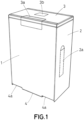
- FIG.1 shows the suitcase protector device and advertising support object of the present invention, in a first practical realization.
- FIG.2 shows the development of the device according to the second embodiment of the invention.
- FIG.3 shows different views (A-B) of the second practical realization of the suitcase protector device according to the present invention.
- the device is configured as a rectangular device which, in a vertical position, comprises a front face (1) and a rear face (1a) with a larger surface area than the left (2) and right (21) side faces.
- the device of the invention is constituted from a die-cut sheet of a cellulosic material, preferably cardboard, defining a majority and rectangular sector, elongated horizontally which, by means of vertical folding lines, determine the larger faces, i.e., the front (1) and rear (11) faces, as well as the two smaller faces, i.e. the left (21) and right (2) side faces.
- the indications "front”, “rear”, “left” and “right” refer to the part of the suitcase (M) where said face would be located in position of use. That is, the front face (1) of the protector would be located at the front of the case (M) and so on.
- the assembly is made of a cellulosic material.
- the preferred material is cardboard, although any paper with a grammage that allows configuring the protective device as described above can be used.
- the fundamental advantage of using cellulosic material, in addition to being environmentally friendly and allowing easy recycling, is that it is an easily printable material, so that the protective device, in itself, is a personalized advertising medium.
- the front (1) and back (11), as well as the left (21) and right (2) sides provide a suitable surface for, for example, stickers with personalized motifs or safety instructions to ensure that the device has not been tampered with.
- the protective device is shown in position of use in a first practical embodiment, i.e., with a suitcase inserted inside it, and which may incorporate, inside the device, protective elements, such as wrapping paper, bubble wrap, or other elements capable of fixing and protecting the suitcase inside.
- protective elements such as wrapping paper, bubble wrap, or other elements capable of fixing and protecting the suitcase inside.
- This arrangement in the form of a rectangular box or prism, is closed at the top (3) and bottom (4) by lids which, in the case of the bottom lid (4), include weakened areas (4a) so that, if the case has wheels (R), they can be easily opened manually by the user or operator.
- weakened areas 4a
- weakened zones are provided, but logically, if the case had only two, it would only be necessary to open those two zones and not all four.
- the upper lid (3) also includes a weakened area (3a) that can be opened by the user or operator to extract the retractable handle of the suitcase.
- a second upper weakened area (3b) is provided for the extraction of the upper fixed handle of the case.
- the protective device of the invention an ecological, recyclable and environmentally friendly product is obtained, which completely eliminates the use of plastics. In addition, it is easier and less time-consuming to handle than plastic packaging or elastic sleeves.
- An additional advantage is that it improves the stability of the luggage in the cargo hold, since it homogenizes the volumetry of the load.
- the cargo would be distributed in a completely standardized manner by size, such as large suitcases (over 80 cm high), medium suitcases (between 69 and 75 cm high) and small suitcases (generally 55 cm high).
- the device of the invention would have, in addition, the advantage that any oversized device could be used in a suitcase of a smaller size, simply by filling the inside of the protective device with, for example, paper, further improving the protection of the interior and making it difficult to tamper with it without permission.
- the level of protection against shocks and scratches is higher than in devices known in the state of the art. On the other hand, it offers a means of inviolability that would immediately reveal any tampering. Finally, it offers a surface configured as an advertising support.
- the first practical realization shown in FIG.1 involves a higher consumption of material (cardboard) since the weakened areas, in general, must be discarded.
- the upper lid (3) and the lower lid (4) are modified with respect to the first realization, the weakened areas disappearing, but with a surface area notably smaller than the surface area of the larger faces (1,11) from which they emanate.
- the top cover (3) is configured as a folded flange, of a width less than that of the larger faces (1,11) and emanating from the upper central part of the front face (1) to fold over, and fit on, the upper side of the suitcase (M) thanks to a plurality of folding lines (31) transverse to the top cover (3). Once folded, the top lid (3) is attached to the inner side of the rear face (11).
- top cover (3) is dimensionally enabled for passage under an upper handle of the suitcase (M) and for passage between the bars of the retractable handle of the suitcase (M).
- the bottom cover (4) is configured as a folded flange, of a width less than that of the larger faces (1,11) and emanating from the lower central part of the rear face (11) to fold over, and fit on, the bottom side of the suitcase (M) thanks to a plurality of folding lines (41) transverse to the bottom cover (4).
- the bottom cover (4) is attached to the inner side of the front face (1) enabling two spaces dimensionally suitable for the passage and use of the wheels (R) of the suitcase (M).
- the prism formed by the larger (1,11) and lateral faces (2,21) is not a pure rectangular prism, as in the first realization or in other documents of the state of the art, but thanks to a plurality of vertical folding lines (P) allows a perfect fit on the suitcase (M) adopting the prism essentially the same external shape as the suitcase (M), which reduces the cardboard necessary for its manufacture.
- the prism is completed through the attachment of a flange or tab (5) laterally associated to one of the larger faces, in this embodiment, to the front face (1) and which is adhered to the left lateral face (21).
- a vertical tear line (6) which is configured to disengage the locking tab (5) from the side face on which it is adhered, so that, in order to remove the suitcase (M), said tear line must be broken, evidencing its manipulation.
Landscapes
- Purses, Travelling Bags, Baskets, Or Suitcases (AREA)
- Packaging Of Machine Parts And Wound Products (AREA)
- Telephone Function (AREA)
Abstract
Description
- The present invention refers to a luggage protection device, especially conceived for use in airports, bus stations, train stations, hotels and other passenger transport and transit interchanges, which, in addition to its simplicity of use and manufacture, provides a very suitable advertising support for the use it is intended to provide.
- It is well known that when traveling on airplanes, buses and even trains, if the suitcases exceed a certain volume, they must be stored in the cargo holds or in receptacles separate from the passenger, which allows the suitcases to be improperly handled, resulting in bumps or scratches, and even the theft of belongings contained in the suitcase itself.
- To alleviate this problem, packing services are well known in which the suitcase is rolled up with a large number of wraps and a transparent plastic film. The removal of the film is therefore a significant waste of time that usually discourages any opportunists, as well as revealing any tampering maneuvers, e.g., for the introduction of illegal substances. However, the plastic used is a polluting element. In addition, unpacking the suitcase for its rightful owner is also a tedious task.
- To avoid the use of plastics, the document
EP2174564A1 describes a device for protecting a suitcase consisting of a highly elastic, waterproof, and abrasion-resistant cover having at least one opening for the introduction of the suitcase equipped with customizable tamper-proof seals. The cover is smaller than the dimensions of the suitcase to fit over it due to its elasticity. However, this cover is made of polyamide or polyurethane, which are not easily recyclable materials and can be harmful to the environment. - It is also known the luggage protector described in the document
WO2022074279A1 which describes a protective packaging for suitcases comprising a cardboard packaging characterized in that it is constituted from the development of a die-cut cardboard sheet, in which is defined a major sector, rectangular, horizontally elongated, which by means of vertical folding lines determine the two major and minor faces of a rectangular prismatic package, a prism formed by fixing a tongue associated laterally to one of the major faces and which is fixed by adhesive to the free minor face, forming a folding rectangular prism. - It is an object of the present invention to solve the problems indicated in the present state of the art. More specifically, the present invention provides a protective device which is materialized with a cellulosic material, preferably any cardboard or paper of a sufficient grammage for its handling, which in addition to protecting the suitcase against bumps or scratches, allows to evidence any undue manipulation of the suitcase and can be used as an advertising support. In other words, the invention is intended to provide a protective element which, at the same time as being an advertising support, once placed around the suitcase, can be used in a conventional manner, leaving the telescopic handle and its wheels operative, with an ecological and environmentally friendly structure. These objects are achieved with the packaging of
claim 1. Particular embodiments of the present invention are indicated in the dependent claims. - Throughout the description and the claims, the word "comprises" and variants thereof are not intended to exclude other technical features, additives, components or steps. To those skilled in the art, other objects, advantages and features of the invention will be apparent in part from the invention and in part from the practice of the invention. The following examples and drawings are provided by way of illustration and are not intended to restrict the present invention. Furthermore, the invention covers all possible combinations of particular and preferred embodiments indicated herein.
- The following is a very brief description of a series of drawings which help to better understand the invention, and which relate expressly to an embodiment of said invention, which is illustrated as a non-limiting example thereof.
-
FIG.1 shows the suitcase protector device and advertising support object of the present invention, in a first practical realization.FIG.2 shows the development of the device according to the second embodiment of the invention.FIG.3 shows different views (A-B) of the second practical realization of the suitcase protector device according to the present invention. - In both practical embodiments of the invention, the device is configured as a rectangular device which, in a vertical position, comprises a front face (1) and a rear face (1a) with a larger surface area than the left (2) and right (21) side faces. That is to say, the device of the invention is constituted from a die-cut sheet of a cellulosic material, preferably cardboard, defining a majority and rectangular sector, elongated horizontally which, by means of vertical folding lines, determine the larger faces, i.e., the front (1) and rear (11) faces, as well as the two smaller faces, i.e. the left (21) and right (2) side faces. In the present description, the indications "front", "rear", "left" and "right" refer to the part of the suitcase (M) where said face would be located in position of use. That is, the front face (1) of the protector would be located at the front of the case (M) and so on.
- In both practical embodiments, the assembly is made of a cellulosic material. The preferred material is cardboard, although any paper with a grammage that allows configuring the protective device as described above can be used. The fundamental advantage of using cellulosic material, in addition to being environmentally friendly and allowing easy recycling, is that it is an easily printable material, so that the protective device, in itself, is a personalized advertising medium. On the other hand, the front (1) and back (11), as well as the left (21) and right (2) sides, provide a suitable surface for, for example, stickers with personalized motifs or safety instructions to ensure that the device has not been tampered with.
- In
FIG.1 , the protective device is shown in position of use in a first practical embodiment, i.e., with a suitcase inserted inside it, and which may incorporate, inside the device, protective elements, such as wrapping paper, bubble wrap, or other elements capable of fixing and protecting the suitcase inside. - This arrangement, in the form of a rectangular box or prism, is closed at the top (3) and bottom (4) by lids which, in the case of the bottom lid (4), include weakened areas (4a) so that, if the case has wheels (R), they can be easily opened manually by the user or operator. Four weakened zones are provided, but logically, if the case had only two, it would only be necessary to open those two zones and not all four. One of the obvious advantages of this structure is precisely its versatility.
- On the other hand, the upper lid (3) also includes a weakened area (3a) that can be opened by the user or operator to extract the retractable handle of the suitcase. In the event that the case does not have such a handle, a second upper weakened area (3b) is provided for the extraction of the upper fixed handle of the case. It only remains to point out, finally, that the sides (2,21) are susceptible of incorporating weakened zones (2a) in their middle zone, which would allow a window for the passage of the corresponding side handle of manual grip that some suitcases incorporate. With this structure, an ecological, sustainable and very simple to manufacture and operate protective device is achieved.
- Thanks to the protective device of the invention, an ecological, recyclable and environmentally friendly product is obtained, which completely eliminates the use of plastics. In addition, it is easier and less time-consuming to handle than plastic packaging or elastic sleeves.
- An additional advantage is that it improves the stability of the luggage in the cargo hold, since it homogenizes the volumetry of the load. For example, in an ideal situation with all suitcases protected by the device of the invention, the cargo would be distributed in a completely standardized manner by size, such as large suitcases (over 80 cm high), medium suitcases (between 69 and 75 cm high) and small suitcases (generally 55 cm high).
- Logically, the device of the invention would have, in addition, the advantage that any oversized device could be used in a suitcase of a smaller size, simply by filling the inside of the protective device with, for example, paper, further improving the protection of the interior and making it difficult to tamper with it without permission.
- The level of protection against shocks and scratches is higher than in devices known in the state of the art. On the other hand, it offers a means of inviolability that would immediately reveal any tampering. Finally, it offers a surface configured as an advertising support.
- However, the first practical realization shown in
FIG.1 involves a higher consumption of material (cardboard) since the weakened areas, in general, must be discarded. However, in order to reduce the consumption of material, in the second practical realization of the invention shown inFIG.2 the upper lid (3) and the lower lid (4) are modified with respect to the first realization, the weakened areas disappearing, but with a surface area notably smaller than the surface area of the larger faces (1,11) from which they emanate. - Thus, the top cover (3) is configured as a folded flange, of a width less than that of the larger faces (1,11) and emanating from the upper central part of the front face (1) to fold over, and fit on, the upper side of the suitcase (M) thanks to a plurality of folding lines (31) transverse to the top cover (3). Once folded, the top lid (3) is attached to the inner side of the rear face (11).
- It is also necessary to indicate that the top cover (3) is dimensionally enabled for passage under an upper handle of the suitcase (M) and for passage between the bars of the retractable handle of the suitcase (M).
- Similarly, the bottom cover (4) is configured as a folded flange, of a width less than that of the larger faces (1,11) and emanating from the lower central part of the rear face (11) to fold over, and fit on, the bottom side of the suitcase (M) thanks to a plurality of folding lines (41) transverse to the bottom cover (4). Once folded, the bottom cover (4) is attached to the inner side of the front face (1) enabling two spaces dimensionally suitable for the passage and use of the wheels (R) of the suitcase (M).
- Moreover, in this practical realization, the prism formed by the larger (1,11) and lateral faces (2,21) is not a pure rectangular prism, as in the first realization or in other documents of the state of the art, but thanks to a plurality of vertical folding lines (P) allows a perfect fit on the suitcase (M) adopting the prism essentially the same external shape as the suitcase (M), which reduces the cardboard necessary for its manufacture.
- The prism is completed through the attachment of a flange or tab (5) laterally associated to one of the larger faces, in this embodiment, to the front face (1) and which is adhered to the left lateral face (21). Next to this locking tab (5) is located a vertical tear line (6) which is configured to disengage the locking tab (5) from the side face on which it is adhered, so that, in order to remove the suitcase (M), said tear line must be broken, evidencing its manipulation.
- The level of protection against knocks and scratches is the same as in known prior art devices, particularly the one described in
WO2022/074279 (A1), but with a significantly lower material consumption (cardboard). On the other hand, it offers means of inviolability that would immediately evidence tampering. Finally, it offers a surface configured as an advertising support.
Claims (5)
- A protective device for suitcases (M) with advertising support which is configured as a development of a sheet of a die-cut cellulosic material defining a majority sector, horizontally elongated which, by means of vertical folding lines (P) determine two major faces, front (1) and rear (11), and two side faces, right (2) and left (21) characterized in that it comprises a top cover (3) and a bottom cover (4) which are configured, each of them, as a single folded flange; and wherein the top lid (3) and bottom lid (4) respectively emanate from the upper central portion of the front face (1) or the rear face (11) to fold over, and fit on, the top or bottom side of the suitcase (M) respectively.
- The device according to claim 1 wherein the lower lid (4) comprises some weakened areas (4a) capable of providing a window for the passage of two or more wheels of a suitcase contained therein; and wherein the upper lid (3) also comprises a first weakened area (3a) capable of a window configured to extract a retractable handle of the suitcase contained therein, and a second upper weakened area (3b), to be able to extract a fixed upper handle of the suitcase contained inside the device.
- The device according to claim 1 wherein the top cover (3) and the bottom cover (4) are of a width less than that of the major faces (1-11) and comprise a plurality of transverse fold lines (31,41).
- The device according to any one of the preceding claims which is made entirely of cardboard.
- The device according to claim 4 wherein the cardboard is decorated.
Applications Claiming Priority (2)
| Application Number | Priority Date | Filing Date | Title |
|---|---|---|---|
| ES202231344U ES1295037Y (en) | 2022-08-11 | 2022-08-11 | Protective device for suitcases with advertising support |
| PCT/ES2023/070514 WO2024033560A1 (en) | 2022-08-11 | 2023-08-11 | Suitcase protection device with advertising support |
Publications (3)
| Publication Number | Publication Date |
|---|---|
| EP4570117A1 true EP4570117A1 (en) | 2025-06-18 |
| EP4570117B1 EP4570117B1 (en) | 2025-10-15 |
| EP4570117C0 EP4570117C0 (en) | 2025-10-15 |
Family
ID=83598254
Family Applications (1)
| Application Number | Title | Priority Date | Filing Date |
|---|---|---|---|
| EP23772910.8A Active EP4570117B1 (en) | 2022-08-11 | 2023-08-11 | Suitcase protection device with advertising support |
Country Status (7)
| Country | Link |
|---|---|
| EP (1) | EP4570117B1 (en) |
| CN (1) | CN119997840A (en) |
| AR (1) | AR130187A1 (en) |
| CO (1) | CO2025003063A2 (en) |
| CR (1) | CR20250082A (en) |
| ES (1) | ES1295037Y (en) |
| WO (1) | WO2024033560A1 (en) |
Family Cites Families (3)
| Publication number | Priority date | Publication date | Assignee | Title |
|---|---|---|---|---|
| ES2292371B1 (en) | 2007-08-02 | 2009-03-16 | Emilio Layrana Fernandez | DEVICE TO PROTECT A SUITCASE. |
| US20160066669A1 (en) * | 2014-03-06 | 2016-03-10 | Richard Lien | Luggage Cover |
| ES1261252Y (en) | 2020-10-09 | 2021-05-17 | Smurfit Kappa Espana Sa | Protective packing for suitcases. |
-
2022
- 2022-08-11 ES ES202231344U patent/ES1295037Y/en not_active Expired - Fee Related
-
2023
- 2023-08-11 AR ARP230102128A patent/AR130187A1/en unknown
- 2023-08-11 WO PCT/ES2023/070514 patent/WO2024033560A1/en not_active Ceased
- 2023-08-11 EP EP23772910.8A patent/EP4570117B1/en active Active
- 2023-08-11 CR CR20250082A patent/CR20250082A/en unknown
- 2023-08-11 CN CN202380070595.5A patent/CN119997840A/en active Pending
-
2025
- 2025-03-10 CO CONC2025/0003063A patent/CO2025003063A2/en unknown
Also Published As
| Publication number | Publication date |
|---|---|
| WO2024033560A1 (en) | 2024-02-15 |
| CN119997840A (en) | 2025-05-13 |
| AR130187A1 (en) | 2024-11-13 |
| ES1295037U (en) | 2022-10-17 |
| EP4570117B1 (en) | 2025-10-15 |
| CO2025003063A2 (en) | 2025-06-16 |
| CR20250082A (en) | 2025-08-14 |
| ES1295037Y (en) | 2023-01-11 |
| EP4570117C0 (en) | 2025-10-15 |
Similar Documents
| Publication | Publication Date | Title |
|---|---|---|
| US6050415A (en) | Packaging | |
| CA3059896C (en) | Locking packaging container | |
| US7051876B2 (en) | Pilfer-resistant packaging with criss-cross grain pattern | |
| US7383953B2 (en) | Shipping container and method for using the same | |
| US11247826B2 (en) | Wrap around container | |
| SE421607B (en) | PACKAGING INCLUDING A CONTAINER PART PREFERRED BY TRANSPARENT MATERIAL | |
| EP3564146B1 (en) | Bag made of paper material for archiving/placing articles and method for archiving/placing an article in said bag | |
| US20120180434A1 (en) | Tamper-evident bag for protecting luggage, allowing inspection and reclosure, and methods | |
| EP4570117B1 (en) | Suitcase protection device with advertising support | |
| US20110042263A1 (en) | Transport container for transport of bicycle frames | |
| GB2516938A (en) | Box | |
| ES2904930T3 (en) | Carton box, starter piece for it and packing with crush pocket | |
| KR102822682B1 (en) | Travel Bag Protective Packaging | |
| KR20190085618A (en) | A packing box | |
| EP3795491B1 (en) | Bag made of paper material for archiving articles and method for archiving an article in said bag | |
| US20170081101A1 (en) | Electronic device secure package | |
| WO2013037018A1 (en) | Protective layer for travel bags | |
| RU2846613C1 (en) | Protective package for suitcases | |
| HK40082858B (en) | Protective packaging for suitcases | |
| GB2500781A (en) | A reusable box including label closure | |
| HK40082858A (en) | Protective packaging for suitcases | |
| WO2007049976A1 (en) | Tamper evident luggage tag |
Legal Events
| Date | Code | Title | Description |
|---|---|---|---|
| STAA | Information on the status of an ep patent application or granted ep patent |
Free format text: STATUS: UNKNOWN |
|
| STAA | Information on the status of an ep patent application or granted ep patent |
Free format text: STATUS: THE INTERNATIONAL PUBLICATION HAS BEEN MADE |
|
| GRAP | Despatch of communication of intention to grant a patent |
Free format text: ORIGINAL CODE: EPIDOSNIGR1 |
|
| STAA | Information on the status of an ep patent application or granted ep patent |
Free format text: STATUS: GRANT OF PATENT IS INTENDED |
|
| PUAI | Public reference made under article 153(3) epc to a published international application that has entered the european phase |
Free format text: ORIGINAL CODE: 0009012 |
|
| 17P | Request for examination filed |
Effective date: 20250311 |
|
| AK | Designated contracting states |
Kind code of ref document: A1 Designated state(s): AL AT BE BG CH CY CZ DE DK EE ES FI FR GB GR HR HU IE IS IT LI LT LU LV MC ME MK MT NL NO PL PT RO RS SE SI SK SM TR |
|
| GRAS | Grant fee paid |
Free format text: ORIGINAL CODE: EPIDOSNIGR3 |
|
| GRAA | (expected) grant |
Free format text: ORIGINAL CODE: 0009210 |
|
| STAA | Information on the status of an ep patent application or granted ep patent |
Free format text: STATUS: THE PATENT HAS BEEN GRANTED |
|
| AK | Designated contracting states |
Kind code of ref document: B1 Designated state(s): AL AT BE BG CH CY CZ DE DK EE ES FI FR GB GR HR HU IE IS IT LI LT LU LV MC ME MK MT NL NO PL PT RO RS SE SI SK SM TR |
|
| DAV | Request for validation of the european patent (deleted) | ||
| DAX | Request for extension of the european patent (deleted) | ||
| REG | Reference to a national code |
Ref country code: GB Ref legal event code: FG4D Ref country code: CH Ref legal event code: F10 Free format text: ST27 STATUS EVENT CODE: U-0-0-F10-F00 (AS PROVIDED BY THE NATIONAL OFFICE) Effective date: 20251015 |
|
| REG | Reference to a national code |
Ref country code: IE Ref legal event code: FG4D |
|
| REG | Reference to a national code |
Ref country code: DE Ref legal event code: R096 Ref document number: 602023007606 Country of ref document: DE |
|
| U01 | Request for unitary effect filed |
Effective date: 20251116 |
|
| U07 | Unitary effect registered |
Designated state(s): AT BE BG DE DK EE FI FR IT LT LU LV MT NL PT RO SE SI Effective date: 20251120 |
|
| PG25 | Lapsed in a contracting state [announced via postgrant information from national office to epo] |
Ref country code: ES Free format text: LAPSE BECAUSE OF FAILURE TO SUBMIT A TRANSLATION OF THE DESCRIPTION OR TO PAY THE FEE WITHIN THE PRESCRIBED TIME-LIMIT Effective date: 20251015 |
|
| PG25 | Lapsed in a contracting state [announced via postgrant information from national office to epo] |
Ref country code: NO Free format text: LAPSE BECAUSE OF FAILURE TO SUBMIT A TRANSLATION OF THE DESCRIPTION OR TO PAY THE FEE WITHIN THE PRESCRIBED TIME-LIMIT Effective date: 20260115 |
|
| PG25 | Lapsed in a contracting state [announced via postgrant information from national office to epo] |
Ref country code: HR Free format text: LAPSE BECAUSE OF FAILURE TO SUBMIT A TRANSLATION OF THE DESCRIPTION OR TO PAY THE FEE WITHIN THE PRESCRIBED TIME-LIMIT Effective date: 20251015 |
|
| PG25 | Lapsed in a contracting state [announced via postgrant information from national office to epo] |
Ref country code: RS Free format text: LAPSE BECAUSE OF FAILURE TO SUBMIT A TRANSLATION OF THE DESCRIPTION OR TO PAY THE FEE WITHIN THE PRESCRIBED TIME-LIMIT Effective date: 20260115 |
|
| PG25 | Lapsed in a contracting state [announced via postgrant information from national office to epo] |
Ref country code: IS Free format text: LAPSE BECAUSE OF FAILURE TO SUBMIT A TRANSLATION OF THE DESCRIPTION OR TO PAY THE FEE WITHIN THE PRESCRIBED TIME-LIMIT Effective date: 20260215 |
|
| PG25 | Lapsed in a contracting state [announced via postgrant information from national office to epo] |
Ref country code: PL Free format text: LAPSE BECAUSE OF FAILURE TO SUBMIT A TRANSLATION OF THE DESCRIPTION OR TO PAY THE FEE WITHIN THE PRESCRIBED TIME-LIMIT Effective date: 20251015 |