EP4568280A1 - Enhanced exterior sound performance in vehicles - Google Patents
Enhanced exterior sound performance in vehicles Download PDFInfo
- Publication number
- EP4568280A1 EP4568280A1 EP23214398.2A EP23214398A EP4568280A1 EP 4568280 A1 EP4568280 A1 EP 4568280A1 EP 23214398 A EP23214398 A EP 23214398A EP 4568280 A1 EP4568280 A1 EP 4568280A1
- Authority
- EP
- European Patent Office
- Prior art keywords
- speaker
- vehicle
- data
- output
- another
- Prior art date
- Legal status (The legal status is an assumption and is not a legal conclusion. Google has not performed a legal analysis and makes no representation as to the accuracy of the status listed.)
- Pending
Links
Images


Classifications
-
- H—ELECTRICITY
- H04—ELECTRIC COMMUNICATION TECHNIQUE
- H04S—STEREOPHONIC SYSTEMS
- H04S7/00—Indicating arrangements; Control arrangements, e.g. balance control
- H04S7/30—Control circuits for electronic adaptation of the sound field
- H04S7/302—Electronic adaptation of stereophonic sound system to listener position or orientation
-
- H—ELECTRICITY
- H04—ELECTRIC COMMUNICATION TECHNIQUE
- H04R—LOUDSPEAKERS, MICROPHONES, GRAMOPHONE PICK-UPS OR LIKE ACOUSTIC ELECTROMECHANICAL TRANSDUCERS; ELECTRIC HEARING AIDS; PUBLIC ADDRESS SYSTEMS
- H04R1/00—Details of transducers, loudspeakers or microphones
- H04R1/20—Arrangements for obtaining desired frequency or directional characteristics
- H04R1/22—Arrangements for obtaining desired frequency or directional characteristics for obtaining desired frequency characteristic only
- H04R1/26—Spatial arrangements of separate transducers responsive to two or more frequency ranges
-
- H—ELECTRICITY
- H04—ELECTRIC COMMUNICATION TECHNIQUE
- H04R—LOUDSPEAKERS, MICROPHONES, GRAMOPHONE PICK-UPS OR LIKE ACOUSTIC ELECTROMECHANICAL TRANSDUCERS; ELECTRIC HEARING AIDS; PUBLIC ADDRESS SYSTEMS
- H04R1/00—Details of transducers, loudspeakers or microphones
- H04R1/20—Arrangements for obtaining desired frequency or directional characteristics
- H04R1/32—Arrangements for obtaining desired frequency or directional characteristics for obtaining desired directional characteristic only
- H04R1/40—Arrangements for obtaining desired frequency or directional characteristics for obtaining desired directional characteristic only by combining a number of identical transducers
- H04R1/403—Arrangements for obtaining desired frequency or directional characteristics for obtaining desired directional characteristic only by combining a number of identical transducers loud-speakers
-
- H—ELECTRICITY
- H04—ELECTRIC COMMUNICATION TECHNIQUE
- H04R—LOUDSPEAKERS, MICROPHONES, GRAMOPHONE PICK-UPS OR LIKE ACOUSTIC ELECTROMECHANICAL TRANSDUCERS; ELECTRIC HEARING AIDS; PUBLIC ADDRESS SYSTEMS
- H04R2499/00—Aspects covered by H04R or H04S not otherwise provided for in their subgroups
- H04R2499/10—General applications
- H04R2499/13—Acoustic transducers and sound field adaptation in vehicles
-
- H—ELECTRICITY
- H04—ELECTRIC COMMUNICATION TECHNIQUE
- H04R—LOUDSPEAKERS, MICROPHONES, GRAMOPHONE PICK-UPS OR LIKE ACOUSTIC ELECTROMECHANICAL TRANSDUCERS; ELECTRIC HEARING AIDS; PUBLIC ADDRESS SYSTEMS
- H04R3/00—Circuits for transducers
- H04R3/12—Circuits for transducers for distributing signals to two or more loudspeakers
-
- H—ELECTRICITY
- H04—ELECTRIC COMMUNICATION TECHNIQUE
- H04R—LOUDSPEAKERS, MICROPHONES, GRAMOPHONE PICK-UPS OR LIKE ACOUSTIC ELECTROMECHANICAL TRANSDUCERS; ELECTRIC HEARING AIDS; PUBLIC ADDRESS SYSTEMS
- H04R5/00—Stereophonic arrangements
- H04R5/02—Spatial or constructional arrangements of loudspeakers
Definitions
- the current disclosure relates to a method for playing audio.
- the disclosure relates further to a vehicle audio system for playing audio and to a vehicle comprising such an apparatus.
- the disclosure relates to a method, by a vehicle audio system, for playing audio, the method comprising receiving data for being output through at least an internal speaker mounted inside the vehicle and at least another speaker, wherein the at least another speaker comprises one of an external speaker mounted on an outside of the vehicle and another internal speaker mounted inside the vehicle, receiving first data comprising an indication that a target listening area is outside the vehicle, processing the data based on the first data; and controlling the at least internal speaker and the at least another speaker to output the processed data, wherein the data is processed such that a frequency response of an output of the at least external speaker and/or a frequency response of an output of the at least another speaker is adjusted for audio playing outside the vehicle.
- the internal speakers and/or external speakers of the vehicle can be used for music playback outside the vehicle.
- This is achieved with customized tunings so that the transfer function of the sound of the internal and/or external speakers is adapted for music playback on the outside of the vehicle, thereby allowing to use the internal speakers for outside playing with improved sound quality even with all the doors of the vehicle closed.
- the vehicle audio system can be used for playing audio outside the vehicle.
- the data may be processed such that the output of the at least internal speaker and the output of the at least another speaker are synchronized in time. This improves the quality of the audio when the processed data is output by the at least internal speaker and the at least another speaker even when both speakers are located in different parts of the vehicle such that the distance from each of them to the outside listening area also differs.
- the data may be processed such that a frequency range of a combination of the output of the at least one internal speaker and the output of the at least another speaker is broader than a frequency range of the output of the at least another speaker.
- Different speakers have different frequency ranges. For instance, external speakers tend to have a narrow frequency range.
- the data may be processed to compensate for non-linearities in the output of the at least internal speaker. This allows to compensate for non-linearities in the transfer function between the internal speakers and the outside listening position.
- the data may be processed by applying to the data at least one of a frequency dependent amplitude, phase and time adjustment. This might be done using suitable filters.
- the first data may indicate that the target listening area comprises at least one among a plurality of listening areas around the vehicle, and wherein the data is processed for playing sound in the indicated target listening area. In this way, the data is processed for increasing quality in the listening area.
- the vehicle audio system may comprise a user interface such as a screen, voice interface or any other suitable user interface allowing a user to select the target listening area around the vehicle such that, based on the targeted listening area, the vehicle audio system will process the data in a determined way.
- the vehicle audio system may determine the first data indicating the target listening area in any other suitable way.
- the data may be processed based on prestored data comprising a plurality of filters; and wherein each of the plurality of filters is generated by measuring, during a calibration phase, a transfer function of each of the at least internal speaker and the at least another speaker at different positions around the vehicle. For instance, individual transfer functions from each speaker, internal and external, to the different target listening areas outside the vehicle may be measured during the calibration phase by placing microphones at the plurality of listening areas. The measured transfer functions will show the performance of each speaker for each listening area. Based on that, adjusted transfer functions for each listening area can be created which combine adjusted versions of the different transfer functions, which are then stored in the vehicle audio system and applied when audio is played back. In this way, several tuning profiles are provided to optimize the music playback to different zones around the vehicle.
- the at least another speaker may be the external speaker mounted on the outside of the vehicle.
- the disclosure relates further to a vehicle audio system
- a controller configured to receive data to be output through at least an external speaker mounted on an outside of a vehicle and at least another speaker, wherein the at least another speaker comprises one of an external speaker mounted on an outside of the vehicle and another internal speaker mounted inside the vehicle; receive first data comprising an indication that a target listening area is outside the vehicle; process the data based on the first data; and control the at least external speaker and the at least another speaker to output the processed data; wherein the data is processed such that a frequency response of an output of the at least external speaker and/or a frequency response of an output of the at least another speaker is adjusted for audio playing outside the vehicle.
- the disclosure further relates to a vehicle comprising a vehicle audio system.
- FIG. 1A illustrates a block diagram of a vehicle audio system 102 according to the disclosure.
- the vehicle audio system 102 may comprise a head unit 104, an amplifier 106, an antenna 108, and a plurality of speakers 110.
- the head unit 104 or the amplifier 106 may comprise a digital signal processing unit 104 comprising a memory.
- the vehicle audio system 102 may transmit and receive information through the antenna 110 may via Bluetooth, through a wireless communication network, for example, a 4G network, and/or using any other suitable communication technology.
- One of the plurality of speakers 110 of the vehicle audio system may be an internal speaker mounted inside of a vehicle wherein the vehicle audio system 102 is also installed.
- the plurality of speakers may comprise an external speaker mounted on the outside of the vehicle.
- the plurality of speakers may receive data wherein the data may have been previously processed by the digital signal processing unit to be played by the plurality of speakers.
- Figure 2 illustrates a flowchart schematically depicting a method for playing audio according to the disclosure.
- the method of Figure 2 may be performed by the vehicle audio system 102 of Figure 1A .
- the vehicle audio system 102 receives data for being output through an internal speaker mounted inside the vehicle and at least another speaker.
- internal speaker mounted inside the vehicle it is understood any speaker mounted on the vehicle in such a way that can output sound directly inside of the vehicle.
- the data maybe any kind of data that can be output by a speaker.
- the another speaker may be an external speaker mounted on an outside of the vehicle or another internal speaker mounted inside the vehicle.
- external speaker mounted on the outside of the vehicle it is understood any speaker mounted on the vehicle in such a way that can output sound directly outside of the vehicle.
- the external speaker may be integrated in the vehicle with the purpose to emit as much sound as possible to the surroundings of the vehicle and as little as possible inside the cabin through either sound or structure born vibration. This may be achieved by placing the external speaker on structurally decoupled parts in a housing with a membrane of the external speaker pointing towards openings in the bumpers or under shield towards the exterior.
- the vehicle audio system may comprise any number of internal and/or external speakers.
- Figure 1B shows schematically a vehicle comprising a vehicle audio system according to the disclosure wherein the vehicle audio system can output audio through one or more internal speakers 100 mounted in different locations inside a cabin of the vehicle and through one or more external speakers 200 mounted on the outside structure of the vehicle at different locations.
- the method of Figure 2 can be used with any combination of speakers located in any part of the vehicle.
- the speakers 100 and 200 may be mounted in any of the doors, in the trunk, in the floor beneath the front and rear seat, in the footwell area, in the cowl area (under the windshield wipers), under the dashboard, on the outside of the firewall lower A-pillar area playing into the cabin of the vehicle, etc...
- the external speakers 200 may be mounted for instance in either or both areas behind front and/or rear bumpers, on the under shield, on the crash-box or subframe, behind the front grill, in the front engine compartment.
- the vehicle audio system 102 receives first data comprising an indication that a target listening area is outside the vehicle.
- the indication may be received may be received from a user interface such a touch screen, a voice user interface or any other kind of user interface.
- a user may provide an input through the user interface indicating that the target listening area is outside or identifying the target listening area.
- the user interface may provide a list of possible listening areas and the user may select one of the listening areas as the target listening area via a voice command or a touch input.
- the user may provide the input indication that the target listening area is outside the vehicle by an external device in communication with the vehicle audio system 102 such as a phone or any other electronic device.
- the vehicle audio system 102 may receive the first data comprising an indication that a target listening area is outside the vehicle in any other way.
- step 206 the vehicle audio system 102 process the data based on the first data such that a frequency response of an output of the at least external speaker and/or a frequency response of an output of the at least another speaker is adjusted for audio playing outside the vehicle.
- the processing of the data may include that the data is delayed before being sent to the internal speaker or to the another speaker such that the outputs of the speakers are synchronized in time.
- the data may be processed by filters that will introduce a suitable delay.
- the data may be also processed such that a frequency range of a combination of the output of the at least one internal speaker and the output of the at least another speaker is broader than a frequency range of the output of the at least another speaker.
- the data may be processed to compensate for non-linearities in the output of the at least one internal speaker. This allows to compensate for non-linearities in the transfer function between the internal speakers and the outside listening position.
- the data may be processed by applying to the data at least one of a frequency dependent amplitude, phase and time adjustment. This might be done using suitable filters.
- step 208 the vehicle audio system 102 controls the at least internal speaker and the at least another speaker to output the processed data.
- the data in step 206 may also be processed based on prestored data.
- the prestored data may be located in a memory vehicle audio system 102, in an external database that can be accessed by the vehicle audio system 102 or in any other suitable storage place.
- the prestored data may comprise a plurality of filters.
- the plurality of filters may have been generated during a calibration phase.
- a transfer function of each of the speakers at different positions around the vehicle may be measured. For instance, individual transfer functions from each speaker, internal and external, to the different listening areas outside the vehicle may be measured during the calibration phase by placing microphones at those listening areas.
- the measured transfer functions will show the performance of each speaker for each listening area. Based on that, adjusted transfer functions for each listening area can be created which combine adjusted versions of the different transfer functions. Filters may be generated based on each of the created transfer functions and stored in a place accessible by the vehicle audio system to be applied to process the data to be output.
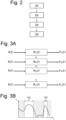
- Figure 3A-3D and 4A-4B illustrate an example of how to generate a new transfer function for a listening area based on transfer functions measured during a calibration phase for a number n of speakers according to the disclosure.
- each of the n speakers will output sound at different times and a microphone located in the listening area outside the vehicle will receive the output sound from each of the n speakers.
- X(f) is a frequency representation of the signal to be output by each of the n speakers
- Y k (f) is a frequency representation of the signal received at the microphone for the k speaker
- Figures 3B-3D respectively show Y 1 (f), Y 2 (f) and Y 3 (f).
- each of the n speakers might have a very different frequency response. Some of the n speakers will behave better in certain frequency ranges than others of the n speakers.
- the transfer function H k (f) can be adjusted by selecting the best frequency range for the corresponding k speaker.
- the best frequency range may be selected as the frequency range which has the best transmission to the outside of the vehicle such that, for a given input voltage, maximum output may be achieved, which mau be determined by the sensitivity of the speaker installation.
- the best frequency range may be selected as a frequency range with higher amplitudes than other frequencies.
- the frequency ranges of several speakers may be selected in such a way that they complement each other as much as possible. For instance, in Figure 3B , the frequency ranges 302 may be selected for the first speaker. In Figure 3C , the frequency ranges 304 may be selected for the second speaker. And in Figure 3C , the frequencies above frequency 306 may be selected for the third speaker.
- This operation of selecting the best frequency ranges may be performed for all the n speakers to created adjusted transfer functions H' k (f) by taking only the selected parts of each transfer function.
- Filters corresponding to H(f) may be created then and stored associated to the corresponding listening area. This calibration operation may be performed for several listening areas such that a different set of filters is stored for each of these listening areas and, when one of those areas is the target listening area, the vehicle audio system 102 will process the data using the corresponding stored set of filters.
- processors e.g., one or more microprocessors including central processing units (CPU)
- memory which may include stored operating system software, firmware and/or application software executable by the processor(s) for controlling operation thereof and/or for performing the particular algorithms represented by the various functions and/or operations described herein, including interaction between and/or cooperation with each other as well as transmitters and receivers.
- processors may be included in a single ASIC (Application-Specific Integrated Circuitry), or several processors and various digital hardware may be distributed among several separate components, whether individually packaged or assembled into a SoC (System-on-a-Chip).
- ASIC Application-Specific Integrated Circuitry
- SoC System-on-a-Chip
- the systems, methods and components described, and/or any other arrangement, unit, system, device or module described herein may for instance be implemented in one or several arbitrary nodes comprised in the host vehicle and/or one or more separate devices.
- a node may comprise an electronic control unit (ECU) or any suitable electronic device, which may be a main or central node.
- ECU electronice control unit
- the these may further comprise or be arranged or configured to cooperate with any type of storage device or storage arrangement known in the art, which may for example be used for storing input or output data associated with the functions and/or operations described herein.
- the systems, components and methods described herein may further comprise any computer hardware and software and/or electrical hardware known in the art configured to enable communication therebetween.
Landscapes
- Health & Medical Sciences (AREA)
- Otolaryngology (AREA)
- Physics & Mathematics (AREA)
- Engineering & Computer Science (AREA)
- Acoustics & Sound (AREA)
- Signal Processing (AREA)
- Fittings On The Vehicle Exterior For Carrying Loads, And Devices For Holding Or Mounting Articles (AREA)
Abstract
A method, by a vehicle audio system, for playing audio comprising receiving data for being output through at least an internal speaker mounted inside the vehicle and at least another speaker, wherein the at least another speaker comprises one of an external speaker mounted on an outside of the vehicle and another internal speaker mounted inside the vehicle, receiving first data comprising an indication that a target listening area is outside the vehicle, processing the data based on the first data; and controlling the at least internal speaker and the at least another speaker to output the processed data, wherein the data is processed such that a frequency response of an output of the at least external speaker and/or a frequency response of an output of the at least another speaker is adjusted for audio playing outside the vehicle.

Description
- The current disclosure relates to a method for playing audio. The disclosure relates further to a vehicle audio system for playing audio and to a vehicle comprising such an apparatus.
- When playing audio using a vehicle audio system comprising internal speakers, there is considerable sound leakage to the outside of the vehicle. However, the quality of the audio outside of the vehicle is not good because the tuning of the vehicle audio system is optimized for playback inside the vehicle. If the vehicle audio system also comprises external speakers mounted on the vehicle, playback of audio through the external speaker usually also does not sound good because external speakers of vehicles tend to have a very limited dynamic and frequency range.
- The disclosure relates to a method, by a vehicle audio system, for playing audio, the method comprising receiving data for being output through at least an internal speaker mounted inside the vehicle and at least another speaker, wherein the at least another speaker comprises one of an external speaker mounted on an outside of the vehicle and another internal speaker mounted inside the vehicle, receiving first data comprising an indication that a target listening area is outside the vehicle, processing the data based on the first data; and controlling the at least internal speaker and the at least another speaker to output the processed data, wherein the data is processed such that a frequency response of an output of the at least external speaker and/or a frequency response of an output of the at least another speaker is adjusted for audio playing outside the vehicle.
- In this way, the internal speakers and/or external speakers of the vehicle can be used for music playback outside the vehicle. This is achieved with customized tunings so that the transfer function of the sound of the internal and/or external speakers is adapted for music playback on the outside of the vehicle, thereby allowing to use the internal speakers for outside playing with improved sound quality even with all the doors of the vehicle closed. By applying a dedicated filter tuning for exterior playback, the vehicle audio system can be used for playing audio outside the vehicle.
- The data may be processed such that the output of the at least internal speaker and the output of the at least another speaker are synchronized in time. This improves the quality of the audio when the processed data is output by the at least internal speaker and the at least another speaker even when both speakers are located in different parts of the vehicle such that the distance from each of them to the outside listening area also differs.
- The data may be processed such that a frequency range of a combination of the output of the at least one internal speaker and the output of the at least another speaker is broader than a frequency range of the output of the at least another speaker. Different speakers have different frequency ranges. For instance, external speakers tend to have a narrow frequency range. By processing the data such that a frequency range of a combined output of the different speakers is broader than the individual frequency range of the speakers, a broader frequency range for the combined output of the speakers can be achieved.
- The data may be processed to compensate for non-linearities in the output of the at least internal speaker. This allows to compensate for non-linearities in the transfer function between the internal speakers and the outside listening position.
- The data may be processed by applying to the data at least one of a frequency dependent amplitude, phase and time adjustment. This might be done using suitable filters.
- The first data may indicate that the target listening area comprises at least one among a plurality of listening areas around the vehicle, and wherein the data is processed for playing sound in the indicated target listening area. In this way, the data is processed for increasing quality in the listening area. The vehicle audio system may comprise a user interface such as a screen, voice interface or any other suitable user interface allowing a user to select the target listening area around the vehicle such that, based on the targeted listening area, the vehicle audio system will process the data in a determined way. The vehicle audio system may determine the first data indicating the target listening area in any other suitable way.
- The data may be processed based on prestored data comprising a plurality of filters; and wherein each of the plurality of filters is generated by measuring, during a calibration phase, a transfer function of each of the at least internal speaker and the at least another speaker at different positions around the vehicle. For instance, individual transfer functions from each speaker, internal and external, to the different target listening areas outside the vehicle may be measured during the calibration phase by placing microphones at the plurality of listening areas. The measured transfer functions will show the performance of each speaker for each listening area. Based on that, adjusted transfer functions for each listening area can be created which combine adjusted versions of the different transfer functions, which are then stored in the vehicle audio system and applied when audio is played back. In this way, several tuning profiles are provided to optimize the music playback to different zones around the vehicle.
- The at least another speaker may be the external speaker mounted on the outside of the vehicle.
- The disclosure relates further to a vehicle audio system comprising a controller configured to receive data to be output through at least an external speaker mounted on an outside of a vehicle and at least another speaker, wherein the at least another speaker comprises one of an external speaker mounted on an outside of the vehicle and another internal speaker mounted inside the vehicle; receive first data comprising an indication that a target listening area is outside the vehicle; process the data based on the first data; and control the at least external speaker and the at least another speaker to output the processed data; wherein the data is processed such that a frequency response of an output of the at least external speaker and/or a frequency response of an output of the at least another speaker is adjusted for audio playing outside the vehicle.
- The disclosure further relates to a vehicle comprising a vehicle audio system.
-
-
Figure 1A illustrates a block diagram of a vehicle audio system according to the disclosure. -
Figure 1B illustrates a vehicle comprising the vehicle audio system ofFigure 1A . -
Figure 2 illustrates a flowchart schematically depicting a method for playing audio according to the disclosure. -
Figure 3A-3D and4A-4B illustrate an example of how to generate a new transfer function based on transfer functions for several speakers according to the disclosure. -
Figure 1A illustrates a block diagram of avehicle audio system 102 according to the disclosure. Thevehicle audio system 102 may comprise ahead unit 104, anamplifier 106, anantenna 108, and a plurality ofspeakers 110. Thehead unit 104 or theamplifier 106 may comprise a digitalsignal processing unit 104 comprising a memory. Thevehicle audio system 102 may transmit and receive information through theantenna 110 may via Bluetooth, through a wireless communication network, for example, a 4G network, and/or using any other suitable communication technology. One of the plurality ofspeakers 110 of the vehicle audio system may be an internal speaker mounted inside of a vehicle wherein thevehicle audio system 102 is also installed. Optionally, the plurality of speakers may comprise an external speaker mounted on the outside of the vehicle. The plurality of speakers may receive data wherein the data may have been previously processed by the digital signal processing unit to be played by the plurality of speakers. -
Figure 2 illustrates a flowchart schematically depicting a method for playing audio according to the disclosure. The method ofFigure 2 may be performed by thevehicle audio system 102 ofFigure 1A . - In
step 202 of the method, thevehicle audio system 102 receives data for being output through an internal speaker mounted inside the vehicle and at least another speaker. By internal speaker mounted inside the vehicle it is understood any speaker mounted on the vehicle in such a way that can output sound directly inside of the vehicle. The data maybe any kind of data that can be output by a speaker. The another speaker may be an external speaker mounted on an outside of the vehicle or another internal speaker mounted inside the vehicle. By external speaker mounted on the outside of the vehicle it is understood any speaker mounted on the vehicle in such a way that can output sound directly outside of the vehicle. The external speaker may be integrated in the vehicle with the purpose to emit as much sound as possible to the surroundings of the vehicle and as little as possible inside the cabin through either sound or structure born vibration. This may be achieved by placing the external speaker on structurally decoupled parts in a housing with a membrane of the external speaker pointing towards openings in the bumpers or under shield towards the exterior. The vehicle audio system may comprise any number of internal and/or external speakers. -
Figure 1B shows schematically a vehicle comprising a vehicle audio system according to the disclosure wherein the vehicle audio system can output audio through one or moreinternal speakers 100 mounted in different locations inside a cabin of the vehicle and through one or moreexternal speakers 200 mounted on the outside structure of the vehicle at different locations. This is a non-limiting example and the method ofFigure 2 can be used with any combination of speakers located in any part of the vehicle. For instance, thespeakers external speakers 200 may be mounted for instance in either or both areas behind front and/or rear bumpers, on the under shield, on the crash-box or subframe, behind the front grill, in the front engine compartment. - In
step 204 of the method ofFigure 2 , thevehicle audio system 102 receives first data comprising an indication that a target listening area is outside the vehicle. The indication may be received may be received from a user interface such a touch screen, a voice user interface or any other kind of user interface. A user may provide an input through the user interface indicating that the target listening area is outside or identifying the target listening area. For instance, the user interface may provide a list of possible listening areas and the user may select one of the listening areas as the target listening area via a voice command or a touch input. Alternatively, the user may provide the input indication that the target listening area is outside the vehicle by an external device in communication with thevehicle audio system 102 such as a phone or any other electronic device. Thevehicle audio system 102 may receive the first data comprising an indication that a target listening area is outside the vehicle in any other way. - In
step 206, thevehicle audio system 102 process the data based on the first data such that a frequency response of an output of the at least external speaker and/or a frequency response of an output of the at least another speaker is adjusted for audio playing outside the vehicle. - The processing of the data may include that the data is delayed before being sent to the internal speaker or to the another speaker such that the outputs of the speakers are synchronized in time. The data may be processed by filters that will introduce a suitable delay. The data may be also processed such that a frequency range of a combination of the output of the at least one internal speaker and the output of the at least another speaker is broader than a frequency range of the output of the at least another speaker. The data may be processed to compensate for non-linearities in the output of the at least one internal speaker. This allows to compensate for non-linearities in the transfer function between the internal speakers and the outside listening position. The data may be processed by applying to the data at least one of a frequency dependent amplitude, phase and time adjustment. This might be done using suitable filters.
- In
step 208, thevehicle audio system 102 controls the at least internal speaker and the at least another speaker to output the processed data. - The data in
step 206 may also be processed based on prestored data. The prestored data may be located in a memoryvehicle audio system 102, in an external database that can be accessed by thevehicle audio system 102 or in any other suitable storage place. The prestored data may comprise a plurality of filters. The plurality of filters may have been generated during a calibration phase. During said calibration phase, a transfer function of each of the speakers at different positions around the vehicle may be measured. For instance, individual transfer functions from each speaker, internal and external, to the different listening areas outside the vehicle may be measured during the calibration phase by placing microphones at those listening areas. The measured transfer functions will show the performance of each speaker for each listening area. Based on that, adjusted transfer functions for each listening area can be created which combine adjusted versions of the different transfer functions. Filters may be generated based on each of the created transfer functions and stored in a place accessible by the vehicle audio system to be applied to process the data to be output. -
Figure 3A-3D and4A-4B illustrate an example of how to generate a new transfer function for a listening area based on transfer functions measured during a calibration phase for a number n of speakers according to the disclosure. During the calibration phase, each of the n speakers will output sound at different times and a microphone located in the listening area outside the vehicle will receive the output sound from each of the n speakers. InFigure 3A , X(f) is a frequency representation of the signal to be output by each of the n speakers, Yk(f) is a frequency representation of the signal received at the microphone for the k speaker and Hk(f) represents the transfer function for the k speaker wherein Hk(f) = Yk(f)/ Xk(f) and k = 1, ..., n.Figures 3B-3D respectively show Y1(f), Y2(f) and Y3(f). As it can be appreciated fromFigures 3B-3D , each of the n speakers might have a very different frequency response. Some of the n speakers will behave better in certain frequency ranges than others of the n speakers. The transfer function Hk(f) can be adjusted by selecting the best frequency range for the corresponding k speaker. The best frequency range may be selected as the frequency range which has the best transmission to the outside of the vehicle such that, for a given input voltage, maximum output may be achieved, which mau be determined by the sensitivity of the speaker installation. The best frequency range may be selected as a frequency range with higher amplitudes than other frequencies. Furthermore, the frequency ranges of several speakers may be selected in such a way that they complement each other as much as possible. For instance, inFigure 3B , the frequency ranges 302 may be selected for the first speaker. InFigure 3C , the frequency ranges 304 may be selected for the second speaker. And inFigure 3C , the frequencies abovefrequency 306 may be selected for the third speaker. This operation of selecting the best frequency ranges may be performed for all the n speakers to created adjusted transfer functions H'k(f) by taking only the selected parts of each transfer function. A new transfer function H(f) may be created by combining all the adjusted transfer functions H'k(f). For instance, H(f) may be equal to
Figures 4A and 4B , by combining the adjusted transfer functions having the best frequency response, the output Y(f) resulting from the outputs of the n speakers has a broader frequency response than the outputs of the individual speakers. Filters corresponding to H(f) may be created then and stored associated to the corresponding listening area. This calibration operation may be performed for several listening areas such that a different set of filters is stored for each of these listening areas and, when one of those areas is the target listening area, thevehicle audio system 102 will process the data using the corresponding stored set of filters. - Those skilled in the art will appreciate that the methods, systems and components described herein may comprise, in whole or in part, a combination of analog and digital circuits and/or one or more appropriately programmed processors (e.g., one or more microprocessors including central processing units (CPU)) and associated memory, which may include stored operating system software, firmware and/or application software executable by the processor(s) for controlling operation thereof and/or for performing the particular algorithms represented by the various functions and/or operations described herein, including interaction between and/or cooperation with each other as well as transmitters and receivers. One or more of such processors, as well as other digital hardware, may be included in a single ASIC (Application-Specific Integrated Circuitry), or several processors and various digital hardware may be distributed among several separate components, whether individually packaged or assembled into a SoC (System-on-a-Chip).
- Furthermore, the systems, methods and components described, and/or any other arrangement, unit, system, device or module described herein may for instance be implemented in one or several arbitrary nodes comprised in the host vehicle and/or one or more separate devices. In that regard, such a node may comprise an electronic control unit (ECU) or any suitable electronic device, which may be a main or central node. It should also be noted that the these may further comprise or be arranged or configured to cooperate with any type of storage device or storage arrangement known in the art, which may for example be used for storing input or output data associated with the functions and/or operations described herein. The systems, components and methods described herein may further comprise any computer hardware and software and/or electrical hardware known in the art configured to enable communication therebetween.
- While the disclosure has been described with reference to exemplary embodiments, it will be understood by those skilled in the art that various changes may be made and equivalents may be substituted for elements thereof without departing from the scope of the disclosure. In addition, many modifications may be made to adapt a particular situation or material to the teachings of the disclosure without departing from the essential scope thereof. Therefore, it is intended that the disclosure not be limited to the particular embodiments disclosed, but that the disclosure will include all embodiments falling within the scope of the appended claims.
Claims (15)
- A method, by a vehicle audio system (102), for playing audio comprising:Receiving (202) data for being output through at least an internal speaker (100) mounted inside the vehicle and at least another speaker, wherein the at least another speaker comprises one of an external speaker (200) mounted on an outside of the vehicle andanother internal speaker mounted inside the vehicle;receiving (204) first data comprising an indication that a target listening area is outside the vehicle;processing (206) the data based on the first data; andcontrolling (208) the at least internal speaker and the at least another speaker to output the processed data;wherein the data is processed such that a frequency response of an output of the at least external speaker and/or a frequency response of an output of the at least another speaker is adjusted for audio playing outside the vehicle.
- The method according to claim 1, wherein the data is processed such that the output of the at least internal speaker (100) and the output of the at least another speaker are synchronized in time.
- The method according to any of the previous claims, wherein the data is processed (206) such that a frequency range of a combination of the output of the at least one internal speaker (100) and the output of the at least another speaker is broader than a frequency range of the output of the at least another speaker.
- The method according to any of the previous claims, wherein the data is processed (206) to compensate for non-linearities in the output of the at least internal speaker (100).
- The method according to any of the previous claims, wherein the data is processed (206) by applying to the data at least one of a frequency dependent amplitude, phase and time adjustment.
- The method according to any of the previous claims, wherein the first data indicates that the target listening area comprises at least one among a plurality of listening areas around the vehicle, and wherein the data is processed (206) for playing sound in the indicated target listening area.
- The method according to any of the previous claims, wherein the data is processed (206) based on prestored data comprising a plurality of filters; and wherein each of the plurality of filters is generated by measuring, during a calibration phase, a transfer function of each of the at least internal speaker (100) and the at least another speaker at different positions around the vehicle.
- The method according to any of the previous claims, wherein the at least another speaker is the external speaker (200) mounted on the outside of the vehicle.
- A vehicle audio system (102) comprising:
a controller configured to:receive (202) data to be output through at least an external speaker mounted on an outside of a vehicle and at least another speaker, wherein the at least another speaker comprises one of an external speaker mounted on an outside of the vehicle and another internal speaker mounted inside the vehicle;receive (204) first data comprising an indication that a target listening area is outside the vehicle;process (206) the data based on the first data; andcontrol (208) the at least external speaker and the at least another speaker to output the processed data;wherein the data is processed such that a frequency response of an output of the at least external speaker and/or a frequency response of an output of the at least another speaker is adjusted for audio playing outside the vehicle. - The vehicle audio system (102) according to claim 9, wherein the data is processed (206) such that the output of the at least internal speaker (100) and the output of the at least another speaker are synchronized in time.
- The vehicle audio system (102) according to any of claims 9 and 10, wherein the data is processed (206) such that a frequency range of a combination of the output of the at least one internal speaker (100) and the output of the at least another speaker is broader than a frequency range of the output of the at least another speaker.
- The vehicle audio system (102) according to any of claims 9-11, wherein the data is processed (206) to compensate for non-linearities in the output of the at least internal speaker (100).
- The vehicle audio system (102) according to any of claims 9-12, wherein the at least another speaker is the external speaker (200) mounted on the outside of the vehicle.
- The vehicle audio system (102) according to any of claims 9-13, further comprising the at least internal speaker (100) and the at least another speaker (200).
- A vehicle comprising the vehicle audio system (102) according to any of claims 9-14.
Priority Applications (1)
| Application Number | Priority Date | Filing Date | Title |
|---|---|---|---|
| EP23214398.2A EP4568280A1 (en) | 2023-12-05 | 2023-12-05 | Enhanced exterior sound performance in vehicles |
Applications Claiming Priority (1)
| Application Number | Priority Date | Filing Date | Title |
|---|---|---|---|
| EP23214398.2A EP4568280A1 (en) | 2023-12-05 | 2023-12-05 | Enhanced exterior sound performance in vehicles |
Publications (1)
| Publication Number | Publication Date |
|---|---|
| EP4568280A1 true EP4568280A1 (en) | 2025-06-11 |
Family
ID=89119515
Family Applications (1)
| Application Number | Title | Priority Date | Filing Date |
|---|---|---|---|
| EP23214398.2A Pending EP4568280A1 (en) | 2023-12-05 | 2023-12-05 | Enhanced exterior sound performance in vehicles |
Country Status (1)
| Country | Link |
|---|---|
| EP (1) | EP4568280A1 (en) |
Citations (2)
| Publication number | Priority date | Publication date | Assignee | Title |
|---|---|---|---|---|
| CN115691456A (en) * | 2021-07-21 | 2023-02-03 | 比亚迪股份有限公司 | Car audio playing method, device, multimedia host and storage medium |
| WO2023045080A1 (en) * | 2021-09-22 | 2023-03-30 | 博泰车联网科技(上海)股份有限公司 | Method and device for controlling vehicle-mounted external loudspeakers, and vehicle-mounted external loudspeakers |
-
2023
- 2023-12-05 EP EP23214398.2A patent/EP4568280A1/en active Pending
Patent Citations (2)
| Publication number | Priority date | Publication date | Assignee | Title |
|---|---|---|---|---|
| CN115691456A (en) * | 2021-07-21 | 2023-02-03 | 比亚迪股份有限公司 | Car audio playing method, device, multimedia host and storage medium |
| WO2023045080A1 (en) * | 2021-09-22 | 2023-03-30 | 博泰车联网科技(上海)股份有限公司 | Method and device for controlling vehicle-mounted external loudspeakers, and vehicle-mounted external loudspeakers |
Similar Documents
| Publication | Publication Date | Title |
|---|---|---|
| US11862139B2 (en) | Method and system for creating a plurality of sound zones within an acoustic cavity | |
| JP5313549B2 (en) | Acoustic information providing system and in-vehicle acoustic device | |
| JPH10307592A (en) | Data distributing system for on-vehicle audio device | |
| JP2001517005A (en) | Method and apparatus for reproducing a stereo audio signal | |
| US11950090B2 (en) | In-car adaptive sound quality output method, device, storage medium and car audio system | |
| US10902839B2 (en) | Apparatus and method for privacy enhancement | |
| JP6870078B2 (en) | Noise estimation for dynamic sound adjustment | |
| US12294841B2 (en) | Audio playing method, on-board audio system, and storage medium | |
| CN102224674A (en) | Noise modifying overhead audio system | |
| US20240371352A1 (en) | Active noise control apparatus for a vehicle and a control method therefor | |
| US20070036364A1 (en) | Sound field compensating apparatus and sound field compensating method | |
| US6386039B1 (en) | Method and apparatus for determining the acoustic spatial characteristics particularly of a vehicle occupant compartment in a motor vehicle | |
| EP4568281A1 (en) | Enhanced sound performance | |
| CN111667845B (en) | Signal processing device and signal processing method | |
| US11200023B2 (en) | Override for OEM audio signal equalizer | |
| CN115214503A (en) | In-vehicle sound control method and device and automobile | |
| CN114400020A (en) | Method, device and equipment for testing vehicle-mounted audio system and storage medium | |
| JP2020098230A (en) | Sound reproducing device and sound reproduction method | |
| US20180084356A1 (en) | Speak-microphone system validating equipment | |
| US20250016500A1 (en) | Sound system | |
| JPH069298U (en) | Digital sound processor automatic adjuster | |
| KR20240158523A (en) | Method and Apparatus for Controlling Audio Volume of Vehicle based on Sound Loudness of Each Seat | |
| EP4207802B1 (en) | Sound collection loudspeaker apparatus, method and program for the same | |
| GB2560884A (en) | Apparatus and method for privacy enhancement | |
| JPH06161468A (en) | Noise canceller and in-vehicle audio system |
Legal Events
| Date | Code | Title | Description |
|---|---|---|---|
| PUAI | Public reference made under article 153(3) epc to a published international application that has entered the european phase |
Free format text: ORIGINAL CODE: 0009012 |
|
| STAA | Information on the status of an ep patent application or granted ep patent |
Free format text: STATUS: THE APPLICATION HAS BEEN PUBLISHED |
|
| AK | Designated contracting states |
Kind code of ref document: A1 Designated state(s): AL AT BE BG CH CY CZ DE DK EE ES FI FR GB GR HR HU IE IS IT LI LT LU LV MC ME MK MT NL NO PL PT RO RS SE SI SK SM TR |
|
| STAA | Information on the status of an ep patent application or granted ep patent |
Free format text: STATUS: REQUEST FOR EXAMINATION WAS MADE |
|
| 17P | Request for examination filed |
Effective date: 20251211 |