EP4568043A1 - A control system and a method for controlling direct voltage converters - Google Patents
A control system and a method for controlling direct voltage converters Download PDFInfo
- Publication number
- EP4568043A1 EP4568043A1 EP23215072.2A EP23215072A EP4568043A1 EP 4568043 A1 EP4568043 A1 EP 4568043A1 EP 23215072 A EP23215072 A EP 23215072A EP 4568043 A1 EP4568043 A1 EP 4568043A1
- Authority
- EP
- European Patent Office
- Prior art keywords
- direct voltage
- value
- ess
- direct
- ref
- Prior art date
- Legal status (The legal status is an assumption and is not a legal conclusion. Google has not performed a legal analysis and makes no representation as to the accuracy of the status listed.)
- Pending
Links
Images



Classifications
-
- H—ELECTRICITY
- H02—GENERATION; CONVERSION OR DISTRIBUTION OF ELECTRIC POWER
- H02J—ELECTRIC POWER NETWORKS; CIRCUIT ARRANGEMENTS OR SYSTEMS FOR SUPPLYING OR DISTRIBUTING ELECTRIC POWER; SYSTEMS FOR STORING ELECTRIC ENERGY
- H02J1/00—Circuit arrangements for DC mains or DC distribution networks
- H02J1/10—Parallel operation of DC sources
- H02J1/102—Parallel operation of DC sources being switching converters
-
- H—ELECTRICITY
- H02—GENERATION; CONVERSION OR DISTRIBUTION OF ELECTRIC POWER
- H02J—ELECTRIC POWER NETWORKS; CIRCUIT ARRANGEMENTS OR SYSTEMS FOR SUPPLYING OR DISTRIBUTING ELECTRIC POWER; SYSTEMS FOR STORING ELECTRIC ENERGY
- H02J1/00—Circuit arrangements for DC mains or DC distribution networks
- H02J1/10—Parallel operation of DC sources
- H02J1/106—Parallel operation of DC sources for load balancing, symmetrisation, or sharing
-
- H—ELECTRICITY
- H02—GENERATION; CONVERSION OR DISTRIBUTION OF ELECTRIC POWER
- H02J—ELECTRIC POWER NETWORKS; CIRCUIT ARRANGEMENTS OR SYSTEMS FOR SUPPLYING OR DISTRIBUTING ELECTRIC POWER; SYSTEMS FOR STORING ELECTRIC ENERGY
- H02J7/00—Circuit arrangements for charging or discharging batteries or for supplying loads from batteries
- H02J7/50—Circuit arrangements for charging or discharging batteries or for supplying loads from batteries acting upon multiple batteries simultaneously or sequentially
-
- H—ELECTRICITY
- H02—GENERATION; CONVERSION OR DISTRIBUTION OF ELECTRIC POWER
- H02J—ELECTRIC POWER NETWORKS; CIRCUIT ARRANGEMENTS OR SYSTEMS FOR SUPPLYING OR DISTRIBUTING ELECTRIC POWER; SYSTEMS FOR STORING ELECTRIC ENERGY
- H02J7/00—Circuit arrangements for charging or discharging batteries or for supplying loads from batteries
- H02J7/855—Circuit arrangements for charging or discharging batteries or for supplying loads from batteries with circuits adapted for supplying loads from the battery
-
- H—ELECTRICITY
- H02—GENERATION; CONVERSION OR DISTRIBUTION OF ELECTRIC POWER
- H02J—ELECTRIC POWER NETWORKS; CIRCUIT ARRANGEMENTS OR SYSTEMS FOR SUPPLYING OR DISTRIBUTING ELECTRIC POWER; SYSTEMS FOR STORING ELECTRIC ENERGY
- H02J7/00—Circuit arrangements for charging or discharging batteries or for supplying loads from batteries
- H02J7/90—Regulation of charging or discharging current or voltage
- H02J7/933—Regulation of charging or discharging current or voltage the cycle being controlled or terminated in response to electric parameters
-
- H—ELECTRICITY
- H02—GENERATION; CONVERSION OR DISTRIBUTION OF ELECTRIC POWER
- H02M—APPARATUS FOR CONVERSION BETWEEN AC AND AC, BETWEEN AC AND DC, OR BETWEEN DC AND DC, AND FOR USE WITH MAINS OR SIMILAR POWER SUPPLY SYSTEMS; CONVERSION OF DC OR AC INPUT POWER INTO SURGE OUTPUT POWER; CONTROL OR REGULATION THEREOF
- H02M1/00—Details of apparatus for conversion
- H02M1/0003—Details of control, feedback or regulation circuits
- H02M1/0016—Control circuits providing compensation of output voltage deviations using feedforward of disturbance parameters
- H02M1/0022—Control circuits providing compensation of output voltage deviations using feedforward of disturbance parameters the disturbance parameters being input voltage fluctuations
-
- H—ELECTRICITY
- H02—GENERATION; CONVERSION OR DISTRIBUTION OF ELECTRIC POWER
- H02M—APPARATUS FOR CONVERSION BETWEEN AC AND AC, BETWEEN AC AND DC, OR BETWEEN DC AND DC, AND FOR USE WITH MAINS OR SIMILAR POWER SUPPLY SYSTEMS; CONVERSION OF DC OR AC INPUT POWER INTO SURGE OUTPUT POWER; CONTROL OR REGULATION THEREOF
- H02M1/00—Details of apparatus for conversion
- H02M1/0003—Details of control, feedback or regulation circuits
- H02M1/0025—Arrangements for modifying reference values, feedback values or error values in the control loop of a converter
-
- H—ELECTRICITY
- H02—GENERATION; CONVERSION OR DISTRIBUTION OF ELECTRIC POWER
- H02M—APPARATUS FOR CONVERSION BETWEEN AC AND AC, BETWEEN AC AND DC, OR BETWEEN DC AND DC, AND FOR USE WITH MAINS OR SIMILAR POWER SUPPLY SYSTEMS; CONVERSION OF DC OR AC INPUT POWER INTO SURGE OUTPUT POWER; CONTROL OR REGULATION THEREOF
- H02M1/00—Details of apparatus for conversion
- H02M1/0067—Converter structures employing plural converter units, other than for parallel operation of the units on a single load
- H02M1/007—Plural converter units in cascade
Definitions
- the disclosure relates generally to control of direct voltage converters which constitute a part of an energy storage system. More particularly, the disclosure relates to a control system and to a method for controlling direct voltage converters connected to energy storages such as battery units. Furthermore, the disclosure relates to a direct voltage converter. Furthermore, the disclosure relates to a computer program for controlling direct voltage converters connected to energy storages.
- a direct current "DC" system comprises energy storages, such as battery units, and direct voltage converters configured to convert direct voltage of each energy storage into desired direct voltage of the DC system.
- charging of the energy storages can be carried out with the aid of the above-mentioned direct voltage converters so that each direct voltage converter converts direct voltage of an energy source providing charging energy into direct voltage suitable for charging the corresponding energy storage.
- This approach requires that the above-mentioned direct voltage converters are capable of transferring energy in two directions, i.e. to the energy storages and from the energy storages.
- power transfer capacities of the direct voltage converters may limit the charging power and thereby increase a time needed for the charging.
- the energy storages can be charged simultaneously from a direct voltage source so that the energy storages are charged directly, i.e. without energy storage -specific voltage conversions, from a common direct voltage bus or the like.
- a new control system for controlling direct voltage converters whose first direct voltage terminals are connected to energy storages, such as battery units.
- a control system comprises a data processing system configured to:
- correction value in addition to the actual and reference values of the direct voltage of the second direct voltage terminal of each direct voltage converter drives the direct voltages of the energy storages to a same value. This, in turn, makes it possible to charge the energy storages simultaneously from a common direct voltage bus or the like without energy storage -specific voltage conversions.
- a new electric power system that comprises:
- the electric power system can be for example an electric power system of a ship or another vessel, or an electric power system of a vehicle or a mobile working machine.
- a method for controlling direct voltage converters whose first direct voltage terminals are connected to energy storages comprises:
- a computer program for controlling direct voltage converters whose first direct voltage terminals are connected to energy storages comprises computer executable instructions for controlling a programmable processing system to:
- the computer program product comprises a non-volatile computer readable medium, e.g. a compact disc "CD”, encoded with a computer program according to the invention.
- a non-volatile computer readable medium e.g. a compact disc "CD”
- FIG. 1a illustrates an electric power system according to an exemplifying and non-limiting embodiment.
- the electric power system comprises direct voltage converters whose first direct voltage terminals are connected to energy storages, such as battery units.
- energy storages such as battery units.
- three of the direct voltage converters are denoted with references 101, 102, and 103 and three of the energy storages are denoted with references 110, 111, and 112.
- the first direct voltage terminal of the direct voltage converter 101 is denoted with a reference 104.
- each of the direct voltage converters is configured to transfer electric energy from the respective energy storage to a direct current "DC" load.
- Each of the direct voltage converters comprises a converter stage configured to convert direct voltage V ESS_1 , ..., or V ESS_N of the respective energy storage into direct voltage of a second direct voltage terminal of the direct voltage converter.
- the second direct voltage terminal of the direct voltage converter 101 is denoted with a reference 109.
- the second direct voltage terminals of the direct voltage converters are connected to each other and thus the second direct voltage terminals of the direct voltage converters have the same voltage U DC .
- the converter stage of each of the direct voltage converters can be e.g. step-down and/or step-up forward or flyback converter stage implemented with controllable semiconductor components such as e.g. insulated gate bipolar transistors "IGBT” or gate turn off “GTO” thyristors, and with one or more inductive elements, one or more capacitive elements, and possibly with diodes.
- Each of the direct voltage converters comprises a driver stage configured to control the controllable semiconductor components of the converter stage to convert the direct voltage V ESS_1 , ..., or V ESS_N of the respective energy storage into the direct voltage U DC .
- the driver stage of the direct voltage converter 101 is denoted with a reference 118.
- the electric power system comprises a control system according to an exemplifying and non-limiting embodiment.
- the control system comprises a data processing system configured to control power transfer of each of the direct voltage converters.
- the data processing system is constituted by data processors of the direct voltage converters.
- the data processors of the direct voltage converters 101, 102, and 103 are denoted with references 105, 106, and 107.
- the data processors of the direct voltage converters are communicatively connected to each other via a data transfer network 120 that can be e.g. a field bus.
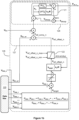
- Figure 1b illustrates a functional block diagram of a part of the control system that determines a power reference P ref_n for the direct voltage converter 102 which is the n th one of the direct voltage converters of the electric power system.
- the functionality that is inside a block 126 can be implemented with the data processor 106. Without limiting the generality, the considerations below can be limited to the data processor 106 only, because the data processors of the other direct voltage converters can be configured to implement the same functionality for determining the power references P ref_1 , ..., P ref_n-1 , P ref_n+1 , ..., and P ref_N for the other direct voltage converters.
- the data processor 106 comprises a first data interface RX configured to receive, from the data transfer network 120, first data indicative of direct voltages V ESS_1 , ..., V ESS_n-1 , V ESS_n+1 , ..., and V ESS_N of the first direct voltage terminals of the other direct voltage converters of the electric power system, i.e. the direct voltages of the energy storages connected to the other direct voltage converters. Furthermore, the data processor 106 comprises a second data interface TX configured to transmit second data indicative of the direct voltage V ESS_n of the first direct voltage terminal of the direct voltage converter 102 to the other direct voltage converters via the data transfer network 120.
- the data processor 106 is configured to compute a target value V target as a linear combination of the values of the direct voltages V ESS_1 , V ESS_2 , ..., and V ESS_N .
- each energy storage can be expressed e.g. in kilowatt-hours "kWh”.
- the target value V target can be an arithmetic average of the values of the direct voltages V ESS_1 , ..., VESS_N.
- the data processor 106 is configured to form a correction value V ref_offset_n based on a difference V target -V Ess_n between the target value V target and the value of the direct voltage V ESS_n .
- a positive value of the difference V target - V ESS_n i.e. V ESS_n ⁇ V target
- a negative value of the difference V target - V ESS_n i.e. V ESS_n > V target
- the power balancing between the direct voltage converters and thereby the power balancing between the energy storages is adjusted so that the direct voltages V ESS_1 , ..., V ESS_N of the direct voltage converters are driven to a same value.
- the data processor 106 is configured to form the correction value V ref_offset_n as a time integral of an auxiliary variable a n that is dependent on the above-mentioned difference V target - V ESS_n .
- the time integral is multiplied with a correction coefficient k corr that can be for example in the range from 0.01 to 0.1, e.g. 0.05.
- the data processor 106 is configured to form the auxiliary variable a n so that the auxiliary variable a n is the above-mentioned difference V target - V ESS_n if the absolute value of the difference exceeds a predetermined limit, and otherwise the auxiliary variable a n is zero.
- the difference V target - V ESS_n does not affect the power reference P ref_n .
- the data processor 106 is configured to limit the correction value V ref_offset_n to be at least a predetermined lower limit value V ref_offset_n_min and at most a predetermined upper limit value V ref_offset_n_max .
- the limitation of the correction value ⁇ f droo,corr is depicted with a limiter block 122.
- the data processor 106 is advantageously configured to implement an anti-windup functionality that prevents the absolute value of the time integral of the auxiliary variable a n from increasing in response to a situation in which the correction value V ref_offset_n reaches the above-mentioned upper limit value V ref_offset_n_max or the above-mentioned lower limit value V ref_offset_n_min .
- the data processor 106 is configured to constitute a proportional and integrative "PI" controller 121 configured to form the power reference P ref_n based on an error variable e n dependent on a difference U DC_ref - (U DC + V ref_offset_n ) between the reference value U DC_ref and a sum of the correction value V ref_offset_n and the actual value of the direct voltage U DC .
- PI proportional and integrative
- the data processor 106 is configured to form a voltage droop value V droop based on a time integral term I term of the proportional and integrative controller 121.
- the data processor 106 is configured to change the error variable e n by the voltage droop value V droop so that the voltage droop value V droop decreases the power reference P ref_n when the time integral term I tem increases the power reference P ref_n .
- the drooping coefficient k droop that can be for example in the range from 0.01 to 0.1, e.g. 0.05.
- the data processor 106 is configured to constitute a current controller configured to control current of the direct voltage converter 102 to drive the power transfer of the direct voltage converter 102 towards the power reference P ref_n .
- the current controller is not shown in figure 1b .
- the control system illustrated in figure 1b can be deemed to have two control loops.
- An inner control loop for controlling the power transfer based on the actual and reference values of the direct voltage U DC
- an outer control loop for supplying the correction value V ref_offset_n to the inner control loop to drive the direct voltages V ESS_1 , ..., V ESS_N to a same value.
- each of the data processors of the direct voltage converters can be based on one or more analogue circuits, one or more digital processing circuits, or a combination thereof.
- Each digital processing circuit can be a programmable processor circuit provided with appropriate software, a dedicated hardware processor such as for example an application specific integrated circuit "ASIC”, or a configurable hardware processor such as for example a field programmable gate array "FPGA”.
- the data processor may comprise one or more memory circuits each of which can be for example a random-access memory "RAM" circuit.
- the exemplifying electric power system illustrated in figure 1a comprises a switching system suitable for connecting each of the energy storages 110-112 to a direct voltage bus 116 for charging the energy storages from a DC charging power source 119 so that flow paths of energy from the DC charging power source 119 to the energy storages are free from the direct voltage converters 101-103.
- the energy storages are connected in parallel with each other when being connected to the direct voltage bus 116.
- the switching system for charging the energy storages 110-112 comprises switch units three of which are denoted with references 110, 111, and 112 in figure 1a .
- Each of the energy storages comprises advantageously a limiting resistor for limiting current peaks at a beginning of a charging period and a switch arrangement for bypassing the limiting resistor.
- the limiting resistors of the energy storages are not shown in figure 1a .
- the DC charging power source 119 can be for example an onshore combined charging system "CCS" charger for charging on-board battery systems of ships and/or other vessels.
- FIG 1a has a distributed architecture so that the data processing system is implemented with the data processors of the direct voltage converters, such as the data processors 105-107.
- Figure 2 illustrates an electric power system that comprises a control system according to another exemplifying and non-limiting embodiment.
- the electric power system comprises direct voltage converters three of which are denoted with references 201, 202, and 203.
- each of the power converters is configured to transfer electric power from an energy storage to a direct current "DC" load.
- three of the energy storages are denoted with references 210, 211, and 212.
- the control system comprises a data processing system configured to determine power references P ref_1 , ..., P ref_N for the direct voltage converters.
- a part of the data processing system has a centralized architecture so that the data processing system comprises a data processor 208 that is configured to determine the correction values V ref_offset_1 , ..., V ref_offset_N for all the direct voltage converters.
- control system comprises a data transfer network 220 configured to transfer the correction values V ref_offset_1 , ..., V ref_offset_N from the data processor 208 to the respective direct voltage converters, to transfer data indicative of the reference value U DC_ref to the direct voltage converters, and to transfer data indicative of the direct voltages V ESS_1 , ..., V ESS_N from the direct voltage converters to the data processor 208.
- the data processor 208 can be configured to determine the correction values V ref_offset_1 , ..., V ref_offset_N for example in the way illustrated in figure 1b .
- control system comprises data processors of the direct voltage converters so that the functionality that is inside a block 127 in figure 1b is implemented with the data processors of the direct voltage converters.
- three of the data processors of the direct voltage converters are denoted with references 205, 206, and 207. It is also possible that only the controller 121 and the voltage drooping, i.e. the functionalities that are inside a block 128 in figure 1b , are implemented with the data processors of the direct voltage converters. In this exemplifying case, differences V ref_comp_1 - U DC , ...., V ref_comp_N - U DC are transferred from the data processor 208 to the appropriate direct voltage converters.
- control systems according to exemplifying and non-limiting embodiments can be implemented according to various implementation architectures.
- the implementation of the data processor 208 shown in figure 2 can be based on one or more analogue circuits, one or more digital processing circuits, or a combination thereof.
- Each digital processing circuit can be a programmable processor circuit provided with appropriate software, a dedicated hardware processor such as for example an application specific integrated circuit "ASIC”, or a configurable hardware processor such as for example a field programmable gate array "FPGA”.
- the data processor 208 may comprise one or more memory circuits each of which can be for example a random-access memory "RAM" circuit.
- the exemplifying electric power system illustrated in figure 2 comprises a switching system suitable for connecting each of the energy storages 210-212 to a direct voltage bus 216 for charging the energy storages from a DC charging power source 219 so that flow paths of energy from the DC charging power source 219 to the energy storages are free from the direct voltage converters 201-203.
- the energy storages are connected in parallel with each other when being connected to the direct voltage bus 216.
- the switching system for charging the energy storages 210-212 comprises switch units three of which are denoted with references 210, 211, and 212 in figure 1a .
- Each of the energy storages comprises advantageously a limiting resistor for limiting current peaks at a beginning of a charging period and a switch arrangement for bypassing the limiting resistor.
- the limiting resistors of the energy storages are not shown in figure 2 .
- the DC charging power source 219 can be for example an onshore combined charging system "CCS" charger for charging on-board battery systems of ships and/or other vessels.
- Figure 3 shows a flowchart of a method according to an exemplifying and non-limiting embodiment for controlling direct voltage converters whose first direct voltage terminals are connected to energy storages.
- the method comprises the following actions:
- the target value V target is computed as an arithmetic average of the values of the direct voltages V ESS_1 , ..., V ESS_N of the first direct voltage terminals of the direct voltage converters.
- a method comprises forming, for each of the direct voltage converters, the correction value V ref_offset_n based on an auxiliary variable a n dependent on a difference V target - V ESS_n between the target value V target and the value of the direct voltage V ESS_n of the first direct voltage terminal of the direct voltage converter under consideration.
- a method comprises forming the auxiliary variable a n so that the auxiliary variable a n is the difference V target - V ESS_n between the target value V target and the value of the direct voltage V ESS_n of the first direct voltage terminal of the direct voltage converter if the absolute value of the difference exceeds a predetermined limit, and otherwise the auxiliary variable a n is zero.
- a method according to an exemplifying and non-limiting embodiment comprises forming, for each of the direct voltage converters, the correction value V ref_offset_n based on a time integral of the auxiliary variable a n .
- a method according to an exemplifying and non-limiting embodiment comprises limiting the time integral of the auxiliary variable a n to be at most a predetermined upper limit value and at least a predetermined lower limit value.
- a method comprises controlling the power transfer of each of the direct voltage converters with a proportional and integrative "PI" controller that controls the power transfer of the direct voltage converter based on an error variable e n dependent on a difference U DC_ref - (U DC + V ref_offset_n ) between the reference value U DC_ref and a sum of the correction value V ref_offset_n and the actual value of the direct voltage U DC of the second direct voltage terminal of the direct voltage converter.
- PI proportional and integrative
- a method comprises forming a voltage droop value V droop based on a time integral term I term of the above-mentioned proportional and integrative controller, and to change the error variable e n by the voltage droop value V droop so that the voltage droop value V droop decreases the power transfer from the first direct voltage terminal to the second direct voltage terminal when the time integral term contributes the power transfer from the first direct voltage terminal to the second direct voltage terminal.
- a method comprises forming, for each of the direct voltage converters, a power reference P ref based on the reference value U DC_ref , the actual value of the direct voltage U DC of the second direct voltage terminal, and the correction value V ref_offset_n , and to control current of the direct voltage converter to drive the power transfer of the direct voltage converter to the power reference P ref .
- a computer program according to an exemplifying and non-limiting embodiment comprises computer executable instructions for controlling a programmable data processing system to carry out actions related to a method according to any of the above-described exemplifying and non-limiting embodiments.
- a computer program comprises software modules for controlling direct voltage converters whose first direct voltage terminals are connected to energy storages.
- the software modules comprise computer executable instructions for controlling a programmable data processing system to:
- the software modules can be for example subroutines or functions implemented with programming tools suitable for the programmable data processing system.
- a computer readable medium e.g. a compact disc "CD”
- a non-volatile computer readable medium according to an exemplifying and non-limiting embodiment is encoded with a computer program according to an exemplifying embodiment of invention.
- a signal according to an exemplifying and non-limiting embodiment is encoded to carry information defining a computer program according to an exemplifying embodiment of invention.
Landscapes
- Engineering & Computer Science (AREA)
- Power Engineering (AREA)
- Dc-Dc Converters (AREA)
- Charge And Discharge Circuits For Batteries Or The Like (AREA)
Abstract
A control system for controlling direct voltage converters whose first direct voltage terminals are connected to energy storages comprises a data processing system (105-107) configured to compute a target value (Vtarget) as a linear combination of direct voltages (VESS_1, ... , VESS_N) of the first direct voltage terminals of the direct voltage converters, to form, for each direct voltage converter, a correction value (Vref_offset_n) based on the target value (Vtarget) and the direct voltage (VESS_n) of the first direct voltage terminal of the direct voltage converter, and to control power of each direct voltage converter based on: a reference value (UDC_ref) of direct voltage of a second direct voltage terminal of the direct voltage converter, the direct voltage (UDC) of the second direct voltage terminal, and the correction value of the direct voltage converter to drive the direct voltages of the first direct voltage terminals of the direct voltage converters to a same value.
Description
- The disclosure relates generally to control of direct voltage converters which constitute a part of an energy storage system. More particularly, the disclosure relates to a control system and to a method for controlling direct voltage converters connected to energy storages such as battery units. Furthermore, the disclosure relates to a direct voltage converter. Furthermore, the disclosure relates to a computer program for controlling direct voltage converters connected to energy storages.
- In many cases, a direct current "DC" system comprises energy storages, such as battery units, and direct voltage converters configured to convert direct voltage of each energy storage into desired direct voltage of the DC system. In some DC systems, charging of the energy storages can be carried out with the aid of the above-mentioned direct voltage converters so that each direct voltage converter converts direct voltage of an energy source providing charging energy into direct voltage suitable for charging the corresponding energy storage. This approach, however, requires that the above-mentioned direct voltage converters are capable of transferring energy in two directions, i.e. to the energy storages and from the energy storages. Furthermore, power transfer capacities of the direct voltage converters may limit the charging power and thereby increase a time needed for the charging. Yet furthermore, energy losses taking place in the direct voltage converters reduce the efficiency of the charging. Therefore, in many cases, it is desirable that the energy storages can be charged simultaneously from a direct voltage source so that the energy storages are charged directly, i.e. without energy storage -specific voltage conversions, from a common direct voltage bus or the like.
- The above-mentioned charging from a common direct voltage bus or the like is however not free from challenges because direct voltages of the energy storages must be equal to each other to enable simultaneous charging from the common direct voltage bus or the like without energy storage -specific voltage conversions. Therefore, there is a need to control the direct voltage converters during use of the DC system so that the direct voltages of the energy storages are kept equal to each other while keeping the direct voltage of the DC system at a desired value.
- The following presents a simplified summary to provide a basic understanding of some aspects of various invention embodiments. The summary is not an extensive overview of the invention. It is neither intended to identify key or critical elements of the invention nor to delineate the scope of the invention. The following summary merely presents some concepts of the invention in a simplified form as a prelude to a more detailed description of exemplifying embodiments.
- In accordance with the invention, there is provided a new control system for controlling direct voltage converters whose first direct voltage terminals are connected to energy storages, such as battery units.
- A control system according to the invention comprises a data processing system configured to:
- compute a target value as a linear combination of values of direct voltages of the first direct voltage terminals of the direct voltage converters,
- form, for each of the direct voltage converters, a correction value based on the target value and the value of the direct voltage of the first direct voltage terminal of the direct voltage converter, and
- control power transfer of each of the direct voltage converters based on: i) a reference value of direct voltage of a second direct voltage terminal of the direct voltage converter, ii) an actual value of the direct voltage of the second direct voltage terminal of the direct voltage converter, and iii) the correction value of the direct voltage converter to drive the direct voltages of the first direct voltage terminals of the direct voltage converters to a same value.
- The use of the correction value in addition to the actual and reference values of the direct voltage of the second direct voltage terminal of each direct voltage converter drives the direct voltages of the energy storages to a same value. This, in turn, makes it possible to charge the energy storages simultaneously from a common direct voltage bus or the like without energy storage -specific voltage conversions.
- In accordance with the invention, there is also provided a new electric power system that comprises:
- energy storages,
- direct voltage converters whose first direct voltage terminals are connected to the energy storages, and
- a control system according to the invention and configured to control power transfer of each of the direct voltage converters to drive direct voltages of the first direct voltage terminals of the direct voltage converters to a same value.
- The electric power system can be for example an electric power system of a ship or another vessel, or an electric power system of a vehicle or a mobile working machine.
- In accordance with the invention, there is also provided a new direct voltage converter that comprises:
- a first direct voltage terminal, a second direct voltage terminal, and a converter stage between first and second direct voltage terminals,
- a driver stage configured to control the converter stage, and
- a data processor configured to:
- receive, from a data transfer network, first data indicative of one or more direct voltages related to one or more other direct voltage converters,
- transmit, to the data transfer network, second data indicative of direct voltage of the first direct voltage terminal,
- compute a target value as a linear combination of the value of the direct voltage of the first direct voltage terminal and one or more values of the one or more direct voltages indicated by the second data, and
- form a correction value based on the target value and the value of the direct voltage of the first direct voltage terminal, and
- control power transfer of the converter stage based on: i) a reference value of direct voltage of the second direct voltage terminal, an actual value of the direct voltage of the second direct voltage terminal, and the correction value to drive the direct voltage of the first direct voltage terminal and the one or more direct voltages indicated by the second data to a same value.
- In accordance with the invention, there is also provided a new method for controlling direct voltage converters whose first direct voltage terminals are connected to energy storages. A method according to the invention comprises:
- computing a target value as a linear combination of values of direct voltages of the first direct voltage terminals of the direct voltage converters,
- forming, for each of the direct voltage converters, a correction value based on the target value and the value of the direct voltage of the first direct voltage terminal of the direct voltage converter, and
- controlling power transfer of each of the direct voltage converters based on: i) a reference value of direct voltage of a second direct voltage terminal of the direct voltage converter, ii) an actual value of the direct voltage of the second direct voltage terminal of the direct voltage converter, and iii) the correction value of the direct voltage converter to drive the direct voltages of the first direct voltage terminals of the direct voltage converters to a same value.
- In accordance with the invention, there is also provided a new computer program for controlling direct voltage converters whose first direct voltage terminals are connected to energy storages. A computer program according to the invention comprises computer executable instructions for controlling a programmable processing system to:
- compute a target value as a linear combination of values of direct voltages of the first direct voltage terminals of the direct voltage converters,
- form, for each of the direct voltage converters, a correction value based on the target value and the value of the direct voltage of the first direct voltage terminal of the direct voltage converter, and
- control power transfer of each of the direct voltage converters based on: i) a reference value of direct voltage of a second direct voltage terminal of the direct voltage converter, ii) an actual value of the direct voltage of the second direct voltage terminal of the direct voltage converter, and iii) the correction value of the direct voltage converter to drive the direct voltages of the first direct voltage terminals of the direct voltage converters to a same value.
- In accordance with the invention, there is also provided a new computer program product. The computer program product comprises a non-volatile computer readable medium, e.g. a compact disc "CD", encoded with a computer program according to the invention.
- Various exemplifying and non-limiting embodiments are described in accompanied dependent claims.
- Various exemplifying and non-limiting embodiments both as to constructions and to methods of operation, together with additional objects and advantages thereof, will be best understood from the following description of specific exemplifying and non-limiting embodiments when read in conjunction with the accompanying drawings.
- The verbs "to comprise" and "to include" are used in this document as open limitations that neither exclude nor require the existence of un-recited features.
- The features recited in dependent claims are mutually freely combinable unless otherwise explicitly stated.
- Furthermore, it is to be understood that the use of "a" or "an", i.e. a singular form, throughout this document does not exclude a plurality.
- Exemplifying and non-limiting embodiments and their advantages are explained in greater detail below in the sense of examples and with reference to the accompanying drawings, in which:
-
figure 1a illustrates an electric power system that comprises a control system according to an exemplifying and non-limiting embodiment for controlling direct voltage converters of the electric power system, -
figure 1b illustrates a functional block diagram of a part of the control system configured to control nth one of the direct voltage converters of the electric power system illustrated infigure 1a , -
figure 2 illustrates an electric power system that comprises a control system according to an exemplifying and non-limiting embodiment for controlling direct voltage converters of the electric power system, and -
figure 3 shows a flowchart of a method according to an exemplifying and non-limiting embodiment for controlling direct voltage converters whose first direct voltage terminals are connected to energy storages. - The specific examples provided in the description below should not be construed as limiting the scope and/or the applicability of the accompanied claims. Lists and groups of examples provided in the description are not exhaustive unless otherwise explicitly stated.
-
Figure 1a illustrates an electric power system according to an exemplifying and non-limiting embodiment. The electric power system comprises direct voltage converters whose first direct voltage terminals are connected to energy storages, such as battery units. Infigure 1a , three of the direct voltage converters are denoted withreferences references direct voltage converter 101 is denoted with areference 104. In this exemplifying case, each of the direct voltage converters is configured to transfer electric energy from the respective energy storage to a direct current "DC" load. - Each of the direct voltage converters comprises a converter stage configured to convert direct voltage VESS_1, ..., or VESS_N of the respective energy storage into direct voltage of a second direct voltage terminal of the direct voltage converter. In
figure 1a , the second direct voltage terminal of thedirect voltage converter 101 is denoted with areference 109. In the exemplifying electric power system illustrated infigure 1a , the second direct voltage terminals of the direct voltage converters are connected to each other and thus the second direct voltage terminals of the direct voltage converters have the same voltage UDC. The converter stage of each of the direct voltage converters can be e.g. step-down and/or step-up forward or flyback converter stage implemented with controllable semiconductor components such as e.g. insulated gate bipolar transistors "IGBT" or gate turn off "GTO" thyristors, and with one or more inductive elements, one or more capacitive elements, and possibly with diodes. - Each of the direct voltage converters comprises a driver stage configured to control the controllable semiconductor components of the converter stage to convert the direct voltage VESS_1, ..., or VESS_N of the respective energy storage into the direct voltage UDC. In
figure 1a , the driver stage of thedirect voltage converter 101 is denoted with areference 118. - The electric power system comprises a control system according to an exemplifying and non-limiting embodiment. The control system comprises a data processing system configured to control power transfer of each of the direct voltage converters. In the exemplifying electric power system illustrated in
figure 1a , the data processing system is constituted by data processors of the direct voltage converters. Infigure 1a , the data processors of thedirect voltage converters references data transfer network 120 that can be e.g. a field bus. -
Figure 1b illustrates a functional block diagram of a part of the control system that determines a power reference Pref_n for thedirect voltage converter 102 which is the nth one of the direct voltage converters of the electric power system. The functionality that is inside ablock 126 can be implemented with thedata processor 106. Without limiting the generality, the considerations below can be limited to thedata processor 106 only, because the data processors of the other direct voltage converters can be configured to implement the same functionality for determining the power references Pref_1, ..., Pref_n-1, Pref_n+1, ..., and Pref_N for the other direct voltage converters. - The
data processor 106 comprises a first data interface RX configured to receive, from thedata transfer network 120, first data indicative of direct voltages VESS_1, ..., VESS_n-1, VESS_n+1, ..., and VESS_N of the first direct voltage terminals of the other direct voltage converters of the electric power system, i.e. the direct voltages of the energy storages connected to the other direct voltage converters. Furthermore, thedata processor 106 comprises a second data interface TX configured to transmit second data indicative of the direct voltage VESS_n of the first direct voltage terminal of thedirect voltage converter 102 to the other direct voltage converters via thedata transfer network 120. - The
data processor 106 is configured to compute a target value Vtarget as a linear combination of the values of the direct voltages VESS_1, VESS_2, ..., and VESS_N. In the exemplifying case illustrated infigure 1b , thedata processor 106 is configured to compute the target value (Vtarget) according to the following formula:
- The
data processor 106 is configured to form a correction value Vref_offset_n based on a difference Vtarget -VEss_n between the target value Vtarget and the value of the direct voltage VESS_n. As indicated byfigure 1b , a positive value of the difference Vtarget - VESS_n, i.e. VESS_n < Vtarget, tends to decrease the power reference Pref_n, whereas a negative value of the difference Vtarget - VESS_n, i.e. VESS_n > Vtarget, tends to increase the power reference Pref_n. Therefore, the power balancing between the direct voltage converters and thereby the power balancing between the energy storages is adjusted so that the direct voltages VESS_1, ..., VESS_N of the direct voltage converters are driven to a same value. - In a control system according to an exemplifying and non-limiting embodiment, the
data processor 106 is configured to form the correction value Vref_offset_n as a time integral of an auxiliary variable an that is dependent on the above-mentioned difference Vtarget - VESS_n. In the exemplifying case illustrated infigure 1b , the time integral is multiplied with a correction coefficient kcorr that can be for example in the range from 0.01 to 0.1, e.g. 0.05. - In a control system according to an exemplifying and non-limiting embodiment, the
data processor 106 is configured to form the auxiliary variable an so that the auxiliary variable an is the above-mentioned difference Vtarget - VESS_n if the absolute value of the difference exceeds a predetermined limit, and otherwise the auxiliary variable an is zero. Thus, there is a dead zone on which the difference Vtarget - VESS_n does not affect the power reference Pref_n. - In a control system according to an exemplifying and non-limiting embodiment, the
data processor 106 is configured to limit the correction value Vref_offset_n to be at least a predetermined lower limit value Vref_offset_n_min and at most a predetermined upper limit value Vref_offset_n_max. Infigure 1b , the limitation of the correction value Δfdroo,corr is depicted with alimiter block 122. Thedata processor 106 is advantageously configured to implement an anti-windup functionality that prevents the absolute value of the time integral of the auxiliary variable an from increasing in response to a situation in which the correction value Vref_offset_n reaches the above-mentioned upper limit value Vref_offset_n_max or the above-mentioned lower limit value Vref_offset_n_min. - In a control system according to an exemplifying and non-limiting embodiment, the
data processor 106 is configured to constitute a proportional and integrative "PI"controller 121 configured to form the power reference Pref_n based on an error variable en dependent on a difference UDC_ref - (UDC + Vref_offset_n) between the reference value UDC_ref and a sum of the correction value Vref_offset_n and the actual value of the direct voltage UDC. - In a control system according to an exemplifying and non-limiting embodiment, the
data processor 106 is configured to form a voltage droop value Vdroop based on a time integral term Iterm of the proportional andintegrative controller 121. Thedata processor 106 is configured to change the error variable en by the voltage droop value Vdroop so that the voltage droop value Vdroop decreases the power reference Pref_n when the time integral term Item increases the power reference Pref_n. The drooping coefficient kdroop that can be for example in the range from 0.01 to 0.1, e.g. 0.05. - In a control system according to an exemplifying and non-limiting embodiment, the
data processor 106 is configured to constitute a current controller configured to control current of thedirect voltage converter 102 to drive the power transfer of thedirect voltage converter 102 towards the power reference Pref_n. The current controller is not shown infigure 1b . - The control system illustrated in
figure 1b can be deemed to have two control loops. An inner control loop for controlling the power transfer based on the actual and reference values of the direct voltage UDC, and an outer control loop for supplying the correction value Vref_offset_n to the inner control loop to drive the direct voltages VESS_1, ..., VESS_N to a same value. - The implementation of each of the data processors of the direct voltage converters, e.g. the data processors 105-107, can be based on one or more analogue circuits, one or more digital processing circuits, or a combination thereof. Each digital processing circuit can be a programmable processor circuit provided with appropriate software, a dedicated hardware processor such as for example an application specific integrated circuit "ASIC", or a configurable hardware processor such as for example a field programmable gate array "FPGA". Furthermore, the data processor may comprise one or more memory circuits each of which can be for example a random-access memory "RAM" circuit.
- The exemplifying electric power system illustrated in
figure 1a comprises a switching system suitable for connecting each of the energy storages 110-112 to adirect voltage bus 116 for charging the energy storages from a DC chargingpower source 119 so that flow paths of energy from the DC chargingpower source 119 to the energy storages are free from the direct voltage converters 101-103. In this exemplifying case, the energy storages are connected in parallel with each other when being connected to thedirect voltage bus 116. The switching system for charging the energy storages 110-112 comprises switch units three of which are denoted withreferences figure 1a . Each of the energy storages comprises advantageously a limiting resistor for limiting current peaks at a beginning of a charging period and a switch arrangement for bypassing the limiting resistor. The limiting resistors of the energy storages are not shown infigure 1a . The DC chargingpower source 119 can be for example an onshore combined charging system "CCS" charger for charging on-board battery systems of ships and/or other vessels. - The exemplifying control system illustrated in
figure 1a has a distributed architecture so that the data processing system is implemented with the data processors of the direct voltage converters, such as the data processors 105-107.Figure 2 illustrates an electric power system that comprises a control system according to another exemplifying and non-limiting embodiment. The electric power system comprises direct voltage converters three of which are denoted withreferences figure 2 , three of the energy storages are denoted withreferences data processor 208 that is configured to determine the correction values Vref_offset_1, ..., Vref_offset_N for all the direct voltage converters. Furthermore, the control system comprises adata transfer network 220 configured to transfer the correction values Vref_offset_1, ..., Vref_offset_N from thedata processor 208 to the respective direct voltage converters, to transfer data indicative of the reference value UDC_ref to the direct voltage converters, and to transfer data indicative of the direct voltages VESS_1, ..., VESS_N from the direct voltage converters to thedata processor 208. Thedata processor 208 can be configured to determine the correction values Vref_offset_1, ..., Vref_offset_N for example in the way illustrated infigure 1b . Furthermore, the control system comprises data processors of the direct voltage converters so that the functionality that is inside ablock 127 infigure 1b is implemented with the data processors of the direct voltage converters. Infigure 2 , three of the data processors of the direct voltage converters are denoted withreferences controller 121 and the voltage drooping, i.e. the functionalities that are inside ablock 128 infigure 1b , are implemented with the data processors of the direct voltage converters. In this exemplifying case, differences Vref_comp_1 - UDC, ...., Vref_comp_N - UDC are transferred from thedata processor 208 to the appropriate direct voltage converters. As shown by the above-presented examples, control systems according to exemplifying and non-limiting embodiments can be implemented according to various implementation architectures. - The implementation of the
data processor 208 shown infigure 2 can be based on one or more analogue circuits, one or more digital processing circuits, or a combination thereof. Each digital processing circuit can be a programmable processor circuit provided with appropriate software, a dedicated hardware processor such as for example an application specific integrated circuit "ASIC", or a configurable hardware processor such as for example a field programmable gate array "FPGA". Furthermore, thedata processor 208 may comprise one or more memory circuits each of which can be for example a random-access memory "RAM" circuit. - The exemplifying electric power system illustrated in
figure 2 comprises a switching system suitable for connecting each of the energy storages 210-212 to adirect voltage bus 216 for charging the energy storages from a DC chargingpower source 219 so that flow paths of energy from the DC chargingpower source 219 to the energy storages are free from the direct voltage converters 201-203. In this exemplifying case, the energy storages are connected in parallel with each other when being connected to thedirect voltage bus 216. The switching system for charging the energy storages 210-212 comprises switch units three of which are denoted withreferences figure 1a . Each of the energy storages comprises advantageously a limiting resistor for limiting current peaks at a beginning of a charging period and a switch arrangement for bypassing the limiting resistor. The limiting resistors of the energy storages are not shown infigure 2 . The DC chargingpower source 219 can be for example an onshore combined charging system "CCS" charger for charging on-board battery systems of ships and/or other vessels. -
Figure 3 shows a flowchart of a method according to an exemplifying and non-limiting embodiment for controlling direct voltage converters whose first direct voltage terminals are connected to energy storages. The method comprises the following actions: - action 301: computing a target value Vtarget as a linear combination of values of direct voltages VESS_1, ..., VESS_N of the first direct voltage terminals of the direct voltage converters,
- action 302: forming, for each of the direct voltage converters, a correction value Vref_offset_n based on the target value and the value of the direct voltage of the first direct voltage terminal of the direct voltage converter, and
- action 303: controlling power transfer of each of the direct voltage converters based on: i) a reference value UDC_ref of direct voltage of a second direct voltage terminal of the direct voltage converter, ii) an actual value of the direct voltage UDC of the second direct voltage terminal of the direct voltage converter, and iii) the correction value Vref_offset_n of the direct voltage converter to drive the direct voltages of the first direct voltage terminals of the direct voltage converters to a same value.
- In a method according to an exemplifying and non-limiting embodiment, the target value Vtarget is computed as an arithmetic average of the values of the direct voltages VESS_1, ..., VESS_N of the first direct voltage terminals of the direct voltage converters.
- In a method according to an exemplifying and non-limiting embodiment, the target value Vtarget is computed according to the following formula:

- A method according to an exemplifying and non-limiting embodiment comprises forming, for each of the direct voltage converters, the correction value Vref_offset_n based on an auxiliary variable an dependent on a difference Vtarget - VESS_n between the target value Vtarget and the value of the direct voltage VESS_n of the first direct voltage terminal of the direct voltage converter under consideration.
- A method according to an exemplifying and non-limiting embodiment comprises forming the auxiliary variable an so that the auxiliary variable an is the difference Vtarget - VESS_n between the target value Vtarget and the value of the direct voltage VESS_n of the first direct voltage terminal of the direct voltage converter if the absolute value of the difference exceeds a predetermined limit, and otherwise the auxiliary variable an is zero.
- A method according to an exemplifying and non-limiting embodiment comprises forming, for each of the direct voltage converters, the correction value Vref_offset_n based on a time integral of the auxiliary variable an. A method according to an exemplifying and non-limiting embodiment comprises limiting the time integral of the auxiliary variable an to be at most a predetermined upper limit value and at least a predetermined lower limit value.
- A method according to an exemplifying and non-limiting embodiment comprises controlling the power transfer of each of the direct voltage converters with a proportional and integrative "PI" controller that controls the power transfer of the direct voltage converter based on an error variable en dependent on a difference UDC_ref - (UDC + Vref_offset_n) between the reference value UDC_ref and a sum of the correction value Vref_offset_n and the actual value of the direct voltage UDC of the second direct voltage terminal of the direct voltage converter.
- A method according to an exemplifying and non-limiting embodiment comprises forming a voltage droop value Vdroop based on a time integral term Iterm of the above-mentioned proportional and integrative controller, and to change the error variable en by the voltage droop value Vdroop so that the voltage droop value Vdroop decreases the power transfer from the first direct voltage terminal to the second direct voltage terminal when the time integral term contributes the power transfer from the first direct voltage terminal to the second direct voltage terminal.
- A method according to an exemplifying and non-limiting embodiment comprises forming, for each of the direct voltage converters, a power reference Pref based on the reference value UDC_ref, the actual value of the direct voltage UDC of the second direct voltage terminal, and the correction value Vref_offset_n, and to control current of the direct voltage converter to drive the power transfer of the direct voltage converter to the power reference Pref.
- A computer program according to an exemplifying and non-limiting embodiment comprises computer executable instructions for controlling a programmable data processing system to carry out actions related to a method according to any of the above-described exemplifying and non-limiting embodiments.
- A computer program according to an exemplifying and non-limiting embodiment comprises software modules for controlling direct voltage converters whose first direct voltage terminals are connected to energy storages. The software modules comprise computer executable instructions for controlling a programmable data processing system to:
- compute a target value as a linear combination of values of direct voltages of the first direct voltage terminals of the direct voltage converters,
- form, for each of the direct voltage converters, a correction value based on the target value and the value of the direct voltage of the first direct voltage terminal of the direct voltage converter, and
- control power transfer of each of the direct voltage converters based on: i) a reference value of direct voltage of a second direct voltage terminal of the direct voltage converter, ii) an actual value of the direct voltage of the second direct voltage terminal of the direct voltage converter, and iii) the correction value of the direct voltage converter to drive the direct voltages of the first direct voltage terminals of the direct voltage converters to a same value.
- The software modules can be for example subroutines or functions implemented with programming tools suitable for the programmable data processing system.
- A computer program product according to an exemplifying and non-limiting embodiment comprises a computer readable medium, e.g. a compact disc "CD", encoded with a computer program according to an exemplifying embodiment of invention.
- A non-volatile computer readable medium according to an exemplifying and non-limiting embodiment is encoded with a computer program according to an exemplifying embodiment of invention.
- A signal according to an exemplifying and non-limiting embodiment is encoded to carry information defining a computer program according to an exemplifying embodiment of invention.
- The specific examples provided in the description given above should not be construed as limiting the scope and/or the applicability of the appended claims. Lists and groups of examples provided in the description given above are not exhaustive unless otherwise explicitly stated.
Claims (18)
- A control system for controlling direct voltage converters (101-103, 201-203) whose first direct voltage terminals (104, 204) are connected to energy storages, the control system comprising a data processing system (105-107, 205-208) configured to control power transfer of each of the direct voltage converters based on at least a reference value (UDC_ref) of direct voltage (UDC) of a second direct voltage terminal (109, 209) of the direct voltage converter and a value of the direct voltage (UDC) of the second direct voltage terminal of the direct voltage converter, characterized in that the data processing system is configured to:- compute a target value (Vtarget) as a linear combination of values of direct voltages (VESS_1, ..., VESS_N) of the first direct voltage terminals of the direct voltage converters, and- form, for each of the direct voltage converters, a correction value (Vref_offset_n) based on the target value (Vtarget) and the value of the direct voltage (VESS_n) of the first direct voltage terminal of the direct voltage converter,wherein the data processing system is configured to control the power transfer of each of the direct voltage converters based on: the reference value (UDC_ref), the value of the direct voltage (UDC) of the second direct voltage terminal, and the correction value (Vref_offset_n) of the direct voltage converter to drive the direct voltages (VESS_1, ..., VESS_N) of the first direct voltage terminals of the direct voltage converters to a same value.
- A control system according to claim 1, wherein the data processing system is configured to compute the target value (Vtarget) as an arithmetic average of the values of the direct voltages (VESS_1, ..., VESS_N) of the first direct voltage terminals of the direct voltage converters.
- A control device according to claim 1, wherein the data processing system is configured to compute the target value (Vtarget) according to a following formula:

- A control system according to any one of claims 1-3, wherein the data processing system is configured to form, for each of the direct voltage converters, the correction value (Vref_offset_n) based on an auxiliary variable (an) dependent on a difference (Vtarget - VESS_N) between the target value (Vtarget) and the value of the direct voltage (VESS_n) of the first direct voltage terminal of the direct voltage converter.
- A control system according to claim 4, wherein the data processing system is configured to form the auxiliary variable (an) so that the auxiliary variable (an) is the difference (Vtarget - VESS_N) between the target value (Vtarget) and the value of the direct voltage (VESS_n) of the first direct voltage terminal of the direct voltage converter if an absolute value of the difference exceeds a predetermined limit, and otherwise the auxiliary variable (an) is zero.
- A control system according to claim 4 or 5, wherein the data processing system is configured to form, for each of the direct voltage converters, the correction value (Vref_offset_n) based on a time integral of the auxiliary variable (an).
- A control system according to claim 6, wherein the data processing system is configured to limit the time integral of the auxiliary variable (an) to be at most a predetermined upper limit value and at least a predetermined lower limit value.
- A control system according to any one of claims 1-7, wherein the data processing system is configured to constitute, for each of the direct voltage converters, a proportional and integrative controller configured to control the power transfer of the direct voltage converter based on an error variable (en) dependent on a difference (UDC_ref - (UDC + Vref_offset_n)) between the reference value (UDC_ref) and a sum of the correction value (Vref_offset_n) and the value of the direct voltage (UDC) of the second direct voltage terminal of the direct voltage converter.
- A control system according to claim 8, wherein the data processing system is configured to form a voltage droop value (Vdroop) based on a time integral term of the proportional and integrative controller, and to change the error variable (en) by the voltage droop value (Vdroop), the voltage droop value (Vdroop) decreasing the power transfer from the first direct voltage terminal to the second direct voltage terminal when the time integral term contributes the power transfer from the first direct voltage terminal to the second direct voltage terminal.
- A control system according to any one of claims 1-9, wherein the data processing system is configured to form, for each of the direct voltage converters, a power reference (Pref) based on the reference value (UDC_ref), the value of the direct voltage (UDC) of the second direct voltage terminal, and the correction value (Vref_offset_n), and to control current of the direct voltage converter to drive the power transfer of the direct voltage converter towards the power reference.
- An electric power system comprising:- energy storages (110-112, 210-212),- direct voltage converters (101-103, 201-203) whose first direct voltage terminals are connected to the energy storages, and- a control system according to any one of claims 1-10 and configured to control power transfer of each of the direct voltage converters to drive direct voltages (VESS_1, ..., VESS_N) of the first direct voltage terminals of the direct voltage converters to a same value.
- An electric power system according to claim 11, wherein second direct voltage terminals of the direct voltage converters are connected to each other and thus the second direct voltage terminals of the direct voltage converters have a same voltage.
- An electric power system according to claim 11 or 12, wherein the electric power system comprises a switching system (113-115, 213-215) suitable for connecting each of the energy storages (110-112, 210-212) to a direct voltage bus (116, 216) for charging the energy storages so that flow paths of energy from the direct voltage bus to the energy storages are free from the direct voltage converters.
- An electric power system according to claim 13, wherein the switching system (113-115, 213-215) is suitable for connecting the energy storages to the direct voltage bus for charging the energy storages so that the energy storages are parallel connected when being connected to the direct voltage bus (116, 216).
- A direct voltage converter (101) comprising:- a first direct voltage terminal (104), a second direct voltage terminal (109), and a converter stage (117) between first and second direct voltage terminals,- a driver stage (118) configured to control the converter stage, and- a data processor (105) configured to control power transfer of the converter stage based on at least a reference value (UDC_ref) of direct voltage (UDC) of the second direct voltage terminal and a value of the direct voltage (UDC) of the second direct voltage terminal,characterized in that the data processor is configured to:- receive, from a data transfer network, first data indicative of one or more direct voltages (VESS_2, ..., VESS_N) related to one or more other direct voltage converters,- transmit, to the data transfer network, second data indicative of direct voltage (VESS_1) of the first direct voltage terminal,- compute a target value (Vtarget) as a linear combination of the value of the direct voltage (VESS_1) of the first direct voltage terminal and one or more values of the one or more direct voltages (VESS_2, ..., VESS_N) indicated by the second data, and- form a correction value (Vref_offset_1) based on the target value (Vtarget) and the direct voltage (VESS_1) of the first direct voltage terminal,wherein the data processor is configured to control the power transfer of the converter stage based on: the reference value (UDC_ref), the value of the direct voltage (UDC) of the second direct voltage terminal, and the correction value (Vref_offset_n) to drive the direct voltage (VESS_1) of the first direct voltage terminal and the one or more direct voltages (VESS_2, ..., VESS_N) indicated by the second data to a same value.
- A method for controlling direct voltage converters whose first direct voltage terminals are connected to energy storages, the method comprising:- controlling (303) power transfer of each of the direct voltage converters based on at least a reference value (UDC_ref) of direct voltage (UDC) of a second direct voltage terminal of the direct voltage converter and a value of the direct voltage (UDC) of the second direct voltage terminal of the direct voltage converter,characterized in that the method comprises:- computing (301) a target value (Vtarget) as a linear combination of values of direct voltages (VESS_1, ..., VESS_N) of the first direct voltage terminals of the direct voltage converters, and- forming (302), for each of the direct voltage converters, a correction value (Vref_offset_n) based on the target value (Vtarget) and the value of the direct voltage (VESS_n) of the first direct voltage terminal of the direct voltage converter,wherein the power transfer of each of the direct voltage converters is controlled (303) based on: the reference value (UDC_ref), the value of the direct voltage (UDC) of the second direct voltage terminal, and the correction value (Vref_offset_n) of the direct voltage converter to drive the direct voltages (VESS_1, ..., VESS_N) of the first direct voltage terminals of the direct voltage converters to a same value.
- A computer program for controlling direct voltage converters whose first direct voltage terminals are connected to energy storages, the computer program comprising computer executable instructions for controlling a programmable data processing system to:- control power transfer of each of the direct voltage converters based on at least a reference value (UDC_ref) of direct voltage (UDC) of a second direct voltage terminal of the direct voltage converter and a value of the direct voltage (UDC) of the second direct voltage terminal of the direct voltage converter,characterized in that the computer program comprises computer executable instructions for controlling the programmable data processing system to:- compute a target value (Vtarget) as a linear combination of values of direct voltages (VESS_1, ..., VESS_N) of the first direct voltage terminals of the direct voltage converters, and- form, for each of the direct voltage converters, a correction value (Vref_offset_n) based on the target value (Vtarget) and the value of the direct voltage (VESS_n) of the first direct voltage terminal of the direct voltage converter,wherein the computer executable instructions for controlling the programmable data processing system to control the power transfer of each of the direct voltage converters comprises computer executable instructions for controlling the programmable data processing system to control the power transfer of each of the direct voltage converters based on: the reference value (UDC_ref), the value of the direct voltage (UDC) of the second direct voltage terminal, and the correction value (Vref_offset_n) of the direct voltage converter to drive the direct voltages (VESS_1, ..., VESS_N) of the first direct voltage terminals of the direct voltage converters to a same value.
- A non-volatile computer readable medium encoded with a computer program according to claim 17.
Priority Applications (2)
| Application Number | Priority Date | Filing Date | Title |
|---|---|---|---|
| EP23215072.2A EP4568043A1 (en) | 2023-12-07 | 2023-12-07 | A control system and a method for controlling direct voltage converters |
| PCT/EP2024/084546 WO2025119919A1 (en) | 2023-12-07 | 2024-12-03 | A control system and a method for controlling direct voltage converters |
Applications Claiming Priority (1)
| Application Number | Priority Date | Filing Date | Title |
|---|---|---|---|
| EP23215072.2A EP4568043A1 (en) | 2023-12-07 | 2023-12-07 | A control system and a method for controlling direct voltage converters |
Publications (1)
| Publication Number | Publication Date |
|---|---|
| EP4568043A1 true EP4568043A1 (en) | 2025-06-11 |
Family
ID=89121486
Family Applications (1)
| Application Number | Title | Priority Date | Filing Date |
|---|---|---|---|
| EP23215072.2A Pending EP4568043A1 (en) | 2023-12-07 | 2023-12-07 | A control system and a method for controlling direct voltage converters |
Country Status (2)
| Country | Link |
|---|---|
| EP (1) | EP4568043A1 (en) |
| WO (1) | WO2025119919A1 (en) |
Citations (3)
| Publication number | Priority date | Publication date | Assignee | Title |
|---|---|---|---|---|
| US20090273235A1 (en) * | 2006-04-24 | 2009-11-05 | Toyota Jidosha Kabushiki Kaisha | Power Supply System and Vehicle |
| EP2159897A1 (en) * | 2007-06-15 | 2010-03-03 | Toyota Jidosha Kabushiki Kaisha | Power supply system, vehicle having same, and charge/discharge control method |
| EP4254769A1 (en) * | 2022-03-31 | 2023-10-04 | Danfoss Editron Oy | A method and a control system for controlling parallel connected power converters |
-
2023
- 2023-12-07 EP EP23215072.2A patent/EP4568043A1/en active Pending
-
2024
- 2024-12-03 WO PCT/EP2024/084546 patent/WO2025119919A1/en active Pending
Patent Citations (3)
| Publication number | Priority date | Publication date | Assignee | Title |
|---|---|---|---|---|
| US20090273235A1 (en) * | 2006-04-24 | 2009-11-05 | Toyota Jidosha Kabushiki Kaisha | Power Supply System and Vehicle |
| EP2159897A1 (en) * | 2007-06-15 | 2010-03-03 | Toyota Jidosha Kabushiki Kaisha | Power supply system, vehicle having same, and charge/discharge control method |
| EP4254769A1 (en) * | 2022-03-31 | 2023-10-04 | Danfoss Editron Oy | A method and a control system for controlling parallel connected power converters |
Also Published As
| Publication number | Publication date |
|---|---|
| WO2025119919A1 (en) | 2025-06-12 |
Similar Documents
| Publication | Publication Date | Title |
|---|---|---|
| EP3625883B1 (en) | Dc/dc converter and control thereof | |
| KR101025896B1 (en) | Power supply system, vehicle using the same, power supply system control method, and computer-readable recording medium containing program for causing computer to execute the method | |
| US11362596B2 (en) | System and method for operating a system | |
| US12485797B2 (en) | Power battery voltage regulation circuit and system, and control method and control apparatus therefor | |
| US9849789B2 (en) | Power supply system | |
| US8981712B2 (en) | Converter and submodule of a converter for charging or discharging an energy store | |
| CN105518984B (en) | Power-supply system | |
| EP3339083A1 (en) | Power supply system for electric vehicle | |
| EP3648276B1 (en) | Control of dc voltage distribution system | |
| JP5945936B2 (en) | Charger | |
| JP2019068592A (en) | Electric power conversion device | |
| US20160028229A1 (en) | Power supply system | |
| JP2016111886A (en) | Power supply system of vehicle | |
| EP4568043A1 (en) | A control system and a method for controlling direct voltage converters | |
| CN113381458A (en) | Method and control device for controlling a power converter | |
| CN117734476A (en) | Vehicle charging using multiple drive systems | |
| US10003193B2 (en) | Power supply system | |
| EP4415205A1 (en) | Power battery voltage regulation system, and control method and control apparatus therefor | |
| EP3461678A1 (en) | Control of distribution of power between first and second propulsion motor for an electric vehicle | |
| CN118489206A (en) | Method and control system for controlling power converters connected in parallel | |
| JP2023152322A (en) | Charging device and charging method | |
| US12194871B2 (en) | Vehicular control system with constant power output | |
| JP2016119167A (en) | Power source system | |
| US20220393614A1 (en) | Power supply system and moving body | |
| US11364811B1 (en) | Powering electric vehicle accessory devices from back EMF generated by an electric motor |
Legal Events
| Date | Code | Title | Description |
|---|---|---|---|
| PUAI | Public reference made under article 153(3) epc to a published international application that has entered the european phase |
Free format text: ORIGINAL CODE: 0009012 |
|
| STAA | Information on the status of an ep patent application or granted ep patent |
Free format text: STATUS: THE APPLICATION HAS BEEN PUBLISHED |
|
| AK | Designated contracting states |
Kind code of ref document: A1 Designated state(s): AL AT BE BG CH CY CZ DE DK EE ES FI FR GB GR HR HU IE IS IT LI LT LU LV MC ME MK MT NL NO PL PT RO RS SE SI SK SM TR |
|
| STAA | Information on the status of an ep patent application or granted ep patent |
Free format text: STATUS: REQUEST FOR EXAMINATION WAS MADE |
|
| 17P | Request for examination filed |
Effective date: 20251204 |