EP4567376A1 - Sensor, method for manufacturing sensor, and information processing method - Google Patents
Sensor, method for manufacturing sensor, and information processing method Download PDFInfo
- Publication number
- EP4567376A1 EP4567376A1 EP23849733.3A EP23849733A EP4567376A1 EP 4567376 A1 EP4567376 A1 EP 4567376A1 EP 23849733 A EP23849733 A EP 23849733A EP 4567376 A1 EP4567376 A1 EP 4567376A1
- Authority
- EP
- European Patent Office
- Prior art keywords
- light
- sensor
- physical quantities
- light ray
- receiving
- Prior art date
- Legal status (The legal status is an assumption and is not a legal conclusion. Google has not performed a legal analysis and makes no representation as to the accuracy of the status listed.)
- Pending
Links
Images


Classifications
-
- G—PHYSICS
- G01—MEASURING; TESTING
- G01B—MEASURING LENGTH, THICKNESS OR SIMILAR LINEAR DIMENSIONS; MEASURING ANGLES; MEASURING AREAS; MEASURING IRREGULARITIES OF SURFACES OR CONTOURS
- G01B11/00—Measuring arrangements characterised by the use of optical techniques
- G01B11/02—Measuring arrangements characterised by the use of optical techniques for measuring length, width or thickness
- G01B11/026—Measuring arrangements characterised by the use of optical techniques for measuring length, width or thickness by measuring distance between sensor and object
-
- G—PHYSICS
- G01—MEASURING; TESTING
- G01B—MEASURING LENGTH, THICKNESS OR SIMILAR LINEAR DIMENSIONS; MEASURING ANGLES; MEASURING AREAS; MEASURING IRREGULARITIES OF SURFACES OR CONTOURS
- G01B11/00—Measuring arrangements characterised by the use of optical techniques
-
- G—PHYSICS
- G01—MEASURING; TESTING
- G01B—MEASURING LENGTH, THICKNESS OR SIMILAR LINEAR DIMENSIONS; MEASURING ANGLES; MEASURING AREAS; MEASURING IRREGULARITIES OF SURFACES OR CONTOURS
- G01B11/00—Measuring arrangements characterised by the use of optical techniques
- G01B11/26—Measuring arrangements characterised by the use of optical techniques for measuring angles or tapers; for testing the alignment of axes
-
- G—PHYSICS
- G01—MEASURING; TESTING
- G01C—MEASURING DISTANCES, LEVELS OR BEARINGS; SURVEYING; NAVIGATION; GYROSCOPIC INSTRUMENTS; PHOTOGRAMMETRY OR VIDEOGRAMMETRY
- G01C3/00—Measuring distances in line of sight; Optical rangefinders
- G01C3/02—Details
-
- G—PHYSICS
- G01—MEASURING; TESTING
- G01S—RADIO DIRECTION-FINDING; RADIO NAVIGATION; DETERMINING DISTANCE OR VELOCITY BY USE OF RADIO WAVES; LOCATING OR PRESENCE-DETECTING BY USE OF THE REFLECTION OR RERADIATION OF RADIO WAVES; ANALOGOUS ARRANGEMENTS USING OTHER WAVES
- G01S17/00—Systems using the reflection or reradiation of electromagnetic waves other than radio waves, e.g. lidar systems
- G01S17/02—Systems using the reflection of electromagnetic waves other than radio waves
- G01S17/06—Systems determining position data of a target
- G01S17/08—Systems determining position data of a target for measuring distance only
-
- G—PHYSICS
- G01—MEASURING; TESTING
- G01S—RADIO DIRECTION-FINDING; RADIO NAVIGATION; DETERMINING DISTANCE OR VELOCITY BY USE OF RADIO WAVES; LOCATING OR PRESENCE-DETECTING BY USE OF THE REFLECTION OR RERADIATION OF RADIO WAVES; ANALOGOUS ARRANGEMENTS USING OTHER WAVES
- G01S7/00—Details of systems according to groups G01S13/00, G01S15/00, G01S17/00
- G01S7/48—Details of systems according to groups G01S13/00, G01S15/00, G01S17/00 of systems according to group G01S17/00
- G01S7/4808—Evaluating distance, position or velocity data
-
- G—PHYSICS
- G01—MEASURING; TESTING
- G01S—RADIO DIRECTION-FINDING; RADIO NAVIGATION; DETERMINING DISTANCE OR VELOCITY BY USE OF RADIO WAVES; LOCATING OR PRESENCE-DETECTING BY USE OF THE REFLECTION OR RERADIATION OF RADIO WAVES; ANALOGOUS ARRANGEMENTS USING OTHER WAVES
- G01S7/00—Details of systems according to groups G01S13/00, G01S15/00, G01S17/00
- G01S7/48—Details of systems according to groups G01S13/00, G01S15/00, G01S17/00 of systems according to group G01S17/00
- G01S7/481—Constructional features, e.g. arrangements of optical elements
- G01S7/4811—Constructional features, e.g. arrangements of optical elements common to transmitter and receiver
-
- G—PHYSICS
- G01—MEASURING; TESTING
- G01S—RADIO DIRECTION-FINDING; RADIO NAVIGATION; DETERMINING DISTANCE OR VELOCITY BY USE OF RADIO WAVES; LOCATING OR PRESENCE-DETECTING BY USE OF THE REFLECTION OR RERADIATION OF RADIO WAVES; ANALOGOUS ARRANGEMENTS USING OTHER WAVES
- G01S7/00—Details of systems according to groups G01S13/00, G01S15/00, G01S17/00
- G01S7/48—Details of systems according to groups G01S13/00, G01S15/00, G01S17/00 of systems according to group G01S17/00
- G01S7/481—Constructional features, e.g. arrangements of optical elements
- G01S7/4811—Constructional features, e.g. arrangements of optical elements common to transmitter and receiver
- G01S7/4813—Housing arrangements
-
- G—PHYSICS
- G01—MEASURING; TESTING
- G01S—RADIO DIRECTION-FINDING; RADIO NAVIGATION; DETERMINING DISTANCE OR VELOCITY BY USE OF RADIO WAVES; LOCATING OR PRESENCE-DETECTING BY USE OF THE REFLECTION OR RERADIATION OF RADIO WAVES; ANALOGOUS ARRANGEMENTS USING OTHER WAVES
- G01S7/00—Details of systems according to groups G01S13/00, G01S15/00, G01S17/00
- G01S7/48—Details of systems according to groups G01S13/00, G01S15/00, G01S17/00 of systems according to group G01S17/00
- G01S7/481—Constructional features, e.g. arrangements of optical elements
- G01S7/4814—Constructional features, e.g. arrangements of optical elements of transmitters alone
- G01S7/4815—Constructional features, e.g. arrangements of optical elements of transmitters alone using multiple transmitters
-
- G—PHYSICS
- G06—COMPUTING OR CALCULATING; COUNTING
- G06N—COMPUTING ARRANGEMENTS BASED ON SPECIFIC COMPUTATIONAL MODELS
- G06N20/00—Machine learning
-
- G—PHYSICS
- G06—COMPUTING OR CALCULATING; COUNTING
- G06N—COMPUTING ARRANGEMENTS BASED ON SPECIFIC COMPUTATIONAL MODELS
- G06N3/00—Computing arrangements based on biological models
- G06N3/02—Neural networks
- G06N3/08—Learning methods
-
- H—ELECTRICITY
- H10—SEMICONDUCTOR DEVICES; ELECTRIC SOLID-STATE DEVICES NOT OTHERWISE PROVIDED FOR
- H10F—INORGANIC SEMICONDUCTOR DEVICES SENSITIVE TO INFRARED RADIATION, LIGHT, ELECTROMAGNETIC RADIATION OF SHORTER WAVELENGTH OR CORPUSCULAR RADIATION
- H10F55/00—Radiation-sensitive semiconductor devices covered by groups H10F10/00, H10F19/00 or H10F30/00 being structurally associated with electric light sources and electrically or optically coupled thereto
-
- H—ELECTRICITY
- H10—SEMICONDUCTOR DEVICES; ELECTRIC SOLID-STATE DEVICES NOT OTHERWISE PROVIDED FOR
- H10F—INORGANIC SEMICONDUCTOR DEVICES SENSITIVE TO INFRARED RADIATION, LIGHT, ELECTROMAGNETIC RADIATION OF SHORTER WAVELENGTH OR CORPUSCULAR RADIATION
- H10F55/00—Radiation-sensitive semiconductor devices covered by groups H10F10/00, H10F19/00 or H10F30/00 being structurally associated with electric light sources and electrically or optically coupled thereto
- H10F55/20—Radiation-sensitive semiconductor devices covered by groups H10F10/00, H10F19/00 or H10F30/00 being structurally associated with electric light sources and electrically or optically coupled thereto wherein the electric light source controls the radiation-sensitive semiconductor devices, e.g. optocouplers
Definitions
- the present disclosure relates to a sensor, a method for producing a sensor and an information processing method.
- Patent Literature 1 discloses a sensor.
- This sensor includes a substrate, multiple light-emitting elements, a light-receiving element, and a synchronous detection circuit.
- the light-emitting elements are disposed in different positions on the substrate and are configured to emit a light ray using mutually orthogonal first and second modulation signals.
- the light-receiving element is disposed inside the substrate and is configured to receive an external light ray through a pinhole and to generate a photocurrent.
- the synchronous detection circuit is configured to detect the phase of a specific component of the photocurrent.
- the specific component is a component originating from a composite reflected light ray emitted from the light-emitting elements and reflected from an object, and the phase is expressed as a function of the distance to the object.
- Patent Literature 1 Japanese Unexamined Patent Application Publication No. 2020-190552
- the present disclosure provides a sensor with a simpler structure and high accuracy.
- One aspect of the present disclosure provides a sensor for determining an object.
- This sensor includes multiple light-emitting elements and at least one of light-receiving element(s).
- the light-emitting elements are disposed in different positions on a substrate.
- the light-receiving element is disposed on the substrate.
- the light-receiving element receives one of reflected light rays originating from the light-emitting elements as a main light ray and receives a reflected light ray other than the main light ray as a crosstalk light ray so as to be able to distinguish the crosstalk light ray from the main light ray.
- the reflected light rays are light rays emitted from the light-emitting elements and reflected from the object.
- the sensor determines spatial physical quantities related to the reference plane of the sensor and the object on the basis of the distinguishably received main light ray and crosstalk light ray.
- a program to implement software that appears in the present embodiment may be provided as a computer-readable non-transitory storage medium or may be provided by downloading it from an external server, or the program may be provided such that it is run on an external computer and its functions are implemented on a client terminal (so-called cloud computing).
- unit in the present embodiment includes, for example, a combination of hardware resources implemented by a circuit in a broad sense and software information processing that can be specifically implemented by the hardware resources.
- Various types of information handled in the present embodiment are represented by, for example, the physical values of signal values representing voltages or currents, high or low signal values as binary bit sets consisting of 0s or 1s, or quantum superpositions (so-called qubits) and can be communicated and subjected to a calculation on a circuit in a broad sense.
- circuit in a broad sense refers to a circuit implemented by combining at least a circuit, circuitry, a processor, memory, and the like appropriately. That is, the term “circuit in a broad sense” includes an application-specific integrated circuit (ASIC), a programmable logic device (e.g., a simple programmable logic device (SPLD), a complex programmable logic device (CPLD), a field programmable gate array (FPGA)), and the like.
- ASIC application-specific integrated circuit
- SPLD simple programmable logic device
- CPLD complex programmable logic device
- FPGA field programmable gate array
- the sensor 1 is a sensor for determining an object Ob. More specifically, the sensor 1 is configured to determine spatial physical quantities related to the reference plane of the sensor 1 and the object Ob.
- the spatial physical quantities here include at least the distance d between the reference plane and the object Ob and the angles ⁇ and ⁇ of the object Ob with respect to the reference plane (parameters representing a three-dimensional posture).
- the distance d is a close range. For example, the distance is 50 mm or less.
- the distance is 50, 49, 48, 47, 46, 45, 44, 43, 42, 41, 40, 39, 38, 37, 36, 35, 34, 33, 32, 31, 30, 29, 28, 27, 26, 25, 24, 23, 22, 21, 20, 19, 18, 17, 16, 15, 14, 13, 12, 11, 10, 9, 8, 7, 6, 5, 4, 3, 2, 1, or 0 mm and may be in the range between any two of the values illustrated above.
- the sensor 1 thus configured is able to determine the distance d to the object Ob and the angles ⁇ and ⁇ and can be used in various scenes such as picking or inspection of objects.
- the sensor 1 thus configured is also able to accurately grasp the object Ob located at a very short distance.
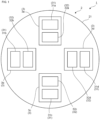
- FIG. 1 is a plan view of the sensor 1 according to the present embodiment that mainly shows an overview of the configuration of a detection unit 2.
- FIG. 2 is a block diagram of the sensor 1 according to the present embodiment that mainly shows an overview of the configuration of an information processing unit 4. As shown in FIGS. 1 and 2 , the sensor 1 mainly includes the detection unit 2 and information processing unit 4.
- the substrate 21 constitutes the housing of the sensor 1.
- the substrate 21 has, for example, an approximately circular shape and is formed as a flat plate.
- the substrate 21 is made of, for example, a material that is black and lackluster and has low reflectivity.
- the substrate 21 has the light-receiving/emitting blocks 3 thereon.
- the multiple light-receiving/emitting blocks 3 are disposed on the substrate 21.
- a light-emitting element(s) 31 and a light-receiving element(s) 32 are disposed in each light-receiving/emitting block 3.
- one light-emitting element 31 and one light-receiving element 32 are disposed in one light-receiving/emitting block 3.
- the light-receiving element 32 and the corresponding light-emitting element 31 are adjacent to each other to form the light-receiving/emitting block 3.
- the multiple light-receiving/emitting blocks 3 are disposed on the substrate 21.
- the number of light-emitting elements 31 is preferably 2 to 30, more preferably 2 to 10, and most preferably 2 to 4. Specifically, for example, the number of light-emitting elements 31 may be 2, 3, 4, 5, 6, 7, 8, 9, 10, 11, 12, 13, 14, 15, 16, 17, 18, 19, 20, 21, 22, 23, 24, 25, 26, 27, 28, 29, or 30 and may be in the range between any two of the numbers illustrated above.
- the number of light-receiving/emitting blocks 3 is preferably two or more, more preferably three or more. In the present embodiment, four light-receiving/emitting blocks 3a, 3b, 3c, and 3d are provided. As shown in FIG. 1 , more preferably, the light-receiving/emitting blocks 3 are disposed annularly and at equal intervals on the substrate 21. In other words, the light-receiving/emitting blocks 3 are disposed symmetrically with respect to the substrate 21.
- a light-emitting element 31a and a light-receiving element 32a are disposed in the light-receiving/emitting block 3a
- a light-emitting element 31b and a light-receiving element 32b are disposed in the light-receiving/emitting block 3b
- a light-emitting element 31c and a light-receiving element 32c are disposed in the light-receiving/emitting block 3c
- a light-emitting element 31d and a light-receiving element 32d are disposed in the light-receiving/emitting block 3d.
- Such a configuration makes photocurrents J (an example of electrical physical quantities) based on the multiple light-receiving elements 32 symmetrical and further increases the accuracy of the sensor 1.
- the light-receiving elements 32 are the same in number as the light-emitting elements 31 and are associated with the light-emitting elements 31 one-to-one.
- Such a configuration allows the sensor 1 to obtain the photocurrents J based on the multiple light-receiving elements 32 and further increases the accuracy of the sensor 1.
- the photocurrents J will be described later.
- the light-emitting elements 31 are disposed in different positions on the substrate 21.
- the light-emitting elements 31 only have to be elements that apply a diffuse light ray to the object Ob.
- the light-emitting elements 31 are light emitting diodes (LED) and, preferably, infrared LEDs that emit an infrared light ray that is invisible to humans and harmless to human bodies.
- the light-emitting elements 31 are not limited to infrared LEDs and may be red LEDs, green LEDs, or blue LEDs.
- the light-receiving elements 32 are disposed on the substrate 21.
- the light-receiving elements 32 are elements that detect received light rays and in turn generate photocurrents J, which are an example of electrical physical quantities.
- the light-receiving elements 32 are configured to output photocurrents J corresponding to the illuminance of received light rays.
- the illuminance of the light rays and the photocurrents J have linear characteristics.
- Major examples of the light-receiving elements 32 include phototubes, photomultiplier tubes, phototransistors using the internal photoelectric effect of semiconductors, photodiodes, avalanche photodiodes, photoconductive cells, image sensors, and the like.
- the light-receiving elements 32 are photodiodes with wide directivity, or phototransistors obtained by combining such photodiodes and amplifiers.
- Each light-receiving element 32 receives, as a main light ray, a reflected light ray L emitted from a light-emitting element 31 belonging to the same light-receiving/emitting block 3 and reflected from the object Ob.
- the light-receiving element 32 also receives, as crosstalk light rays, reflected light rays L emitted from light-emitting elements 31 belonging to adjacent light-receiving/emitting blocks 3 and reflected from the object Ob.
- the light-receiving element 32a receives, as a main light ray, a reflected light ray L originating from the light-emitting element 31a and receives, as crosstalk light rays, reflected light rays L originating from the light-emitting elements 31b and 31d.
- the light-receiving elements 32 are each configured to receive one of the reflected light rays L originating from the light-emitting elements 31 as a main light ray as well as receive the reflected light rays L other than the main light ray as crosstalk light rays so as to be able to distinguish the crosstalk light rays from the main light ray and to generate photocurrents J (an example of electrical physical quantities) corresponding to the reflected light rays L.
- the reflected light rays L here are light rays emitted from the light-emitting elements 31 and reflected from the object Ob.
- the spatial physical quantities related to the reference plane of the sensor 1 and the object Ob are determined on the basis of the photocurrents J based on the main light rays and crosstalk light rays received distinguishably as described above. This will be described in more detail later.
- the AI input unit 22 inputs the values of the photocurrents J or calculated values based on the photocurrents J as input parameters to a trained model 5 stored in the storage unit 42 of the information processing unit 4 (to be discussed later). That is, the AI input unit 22 serves as a conductor from the light-receiving elements 32 of the detection unit 2 to the information processing unit 4. The photocurrents J outputted from the light-receiving elements 32 are inputted to the trained model 5 stored in the storage unit 42 through the AI input unit 22 and a communication unit 41 (to be discussed later).
- the information processing unit 4 is a processing circuit configured to control the operation of the sensor 1, for example, a microcontroller.
- the information processing unit 4 includes the communication unit 41, the storage unit 42, and a processor 43. These components are electrically connected through a communication bus 40 in the information processing unit 4. The respective components will be further described.
- the communication unit 41 is configured to transmit various electrical signals from the information processing unit 4 to external components.
- the communication unit 41 is also configured to receive various electrical signals from the external components to the information processing unit 4.
- the communication unit 41 receives the photocurrents J outputted from the AI input unit 22 of the detection unit 2.
- the communication unit 41 outputs spatial physical quantities estimated based on the trained model 5.
- the communication unit 41 has a network communication function.
- various information can be communicated between the sensor 1 and external devices through a network such as the Internet.
- the storage unit 42 is storing various information defined by the foregoing description.
- the storage unit 42 can be implemented, for example, as a storage device such as a solid-state drive (SSD) that stores various programs or the like related to the sensor 1 executed by the processor 43, or as memory such as random access memory (RAM) that stores temporarily required information (arguments, arrays, etc.) related to program calculations.
- the storage unit 42 is storing various programs, variables, and the like related to the sensor 1 executed by the processor 43. Particularly, in the present embodiment, the storage unit 42 is storing the trained model 5.
- the processor 43 is, for example, a central processing unit (CPU) (not shown).
- the processor 43 implements various functions related to the sensor 1 by reading a predetermined program stored in the storage unit 42. That is, when the processor 43, which is an example of hardware, specifically performs information processing using the software stored in the storage unit 42, functional units of the processor 43 are implemented. These will be described in more detail in the next section. Note that the processor 43 does not have to be a single processor and function-specific multiple processors 43 may be provided. Or, a combination of these may be used.
- the sensor 1 thus configured is singly able to determine the spatial physical quantities of the object Ob without using a separate computer or the like.
- FIG. 3 is a block diagram showing functions implemented by the processor 43 or the like of the sensor 1.
- the processor 43 includes an acquisition unit 431, a conversion unit 432, an input processing unit 433, and an output unit 434 as functional units.
- the acquisition unit 431 is configured to acquire, as an acquisition step, various information received from the outside through the communication unit 41 or previously stored in the storage 42. For example, the acquisition unit 431 acquires the photocurrents J outputted from the light-receiving elements 32.
- the conversion unit 432 is configured to convert, as a conversion step, the various information acquired by the acquisition unit 431 by performing a predetermined calculation on the information.
- the conversion unit 432 may convert information by performing a predetermined calculation on the values of the multiple photocurrents J acquired by the acquisition unit 431.
- the input processing unit 433 is configured to input, as an input processing step, input parameters to the trained model 5 stored in the storage unit 42.
- the output unit 434 is configured to output, as an output step, various information. Specifically, the output unit 434 may output spatial physical quantities estimated based on the trained model 5, for example, the distance d and the angles ⁇ and ⁇ .
- the trained model 5 stored in the storage unit 42 will be described in this section.
- the trained model 5 is a model previously machine-trained with the relationships between the spatial physical quantities related to the reference plane of the sensor 1 and the object Ob and the values of the photocurrents J or the calculated values.
- the trained model 5 is trained with the relationships between the values of the photocurrents J or the predetermined calculated values and the spatial physical quantities related to the object Ob and the reference plane of the sensor 1.
- the object Ob include an object Ob made of a mirror-reflective material, an object Ob made of a diffuse-reflective white material, an object Ob consisting of a green, hard PVC board, an object Ob consisting of a yellow, hard PVC board, an object Ob consisting of a blue, hard PVC board, an object Ob consisting of an aluminum board, an object Ob consisting of a rough-finished aluminum board, an object Ob consisting of a wire mesh, an object Ob consisting of a leather product, and the like.
- the sensor 1 thus configured is able to make a robust determination even with respect to an object Ob with respect to which it has been difficult to make a determination, such as an object Ob with a mirror surface, a transparent object Ob, or an object Ob with an uneven surface.
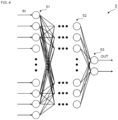
- FIG. 4 is a schematic diagram showing the configuration of the neural network of the trained model 5.
- the trained model 5 includes an input layer 51, an intermediate layer 52 consisting of at least one layer, and an output layer 53.
- the input layer 51 receives input of, as input signals, the values of the photocurrents J outputted from the light-receiving elements 32 or calculated values obtained by performing a predetermined calculation on the photocurrents J. While FIG. 4 shows at least eight input terminals (hollow circles in the figure) as the input layer 51, this is only illustrative and is not limiting.
- the intermediate layer 52 is a layer in which the neural network performs main processing and may consist of any number of layers. Multiple neurons (hollow circles in the figure) in each layer are coupled to multiple neurons in the next layer. For example, one neuron in the first layer of the intermediate layer 52 receives weighted (loaded) input from each terminal in the input layer 51 and transmits the weighted calculation result to each neuron in the second layer of the intermediate layer 52. Then, one neuron in the second layer of the intermediate layer 52 receives the weighted input from each neuron in the first layer of the intermediate layer 52 and transmits the weighted calculation result to each neuron in the third layer of the intermediate layer 52. Such a process is sequentially performed in accordance with the number of layers of the intermediate layer 52.
- the output layer 53 is a layer that outputs the output results of the trained model 5. While two output terminals (hollow circles in the figure) are illustrated as the output layer 53 in FIG. 4 , this is only illustrative and is not limiting.
- the trained model 5 outputs the distance d and the angles ⁇ and ⁇ as the spatial physical quantities related to the reference plane of the sensor 1 and the object Ob. That is, in relation to the trained model 5, the processor 43 of the information processing unit 4 is configured to input the values of the photocurrents J or calculated values as input parameters to the trained model 5 and to determine the spatial physical quantities on the basis of the output results from the trained model 5.
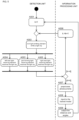
- FIG. 5 is an activity diagram showing the flow of the process of determining the object Ob using the sensor 1.
- FIGS. 6A to 6D are schematic diagrams showing the timings at which each light-emitting element 31 emits a light ray and the aspect in which light-receiving elements 32 receive the light ray.
- the light-emitting elements 31 emit a light ray in the order of FIGS. 6A, 6B, 6C and 6D .
- the flow of the determination process will be described below with reference to this activity diagram.
- the sensor 1 includes the four light-receiving/emitting blocks 3, and the light-emitting elements 31 of the light-receiving/emitting blocks 3 emit a light ray at different timings.
- the light-receiving elements 32 are able to easily distinguish the reflected light rays L originating from the light-emitting elements 31 from each other.
- k 1 (activity A001)
- the first light-emitting element 31 for example, the light-emitting element 31a shown in FIG. 6A emits a light ray (activity A002).
- the light ray emitted from the light-emitting element 31a is reflected from the object Ob, and the resulting reflected light rays L enter multiple light-receiving elements 32.
- the light-receiving element 32a receives the reflected light ray L originating from the light-emitting element 31a as a main light ray (activity A003).
- the light-receiving element 32a is a light-receiving element 32 forming a pair with the light-emitting element 31a and is located in the light-receiving/emitting block 3a, which is the same light-receiving/emitting block as that of the light-emitting element 31a.
- the light-receiving element 32b receives the reflected light ray L originating from the light-emitting element 31a as a crosstalk light ray (activity A004).
- the light-receiving element 32b is a light-receiving element 32 disposed in the light-receiving/emitting block 3b located on the left next to the light-receiving/emitting block 3a in which the light-emitting element 31a is disposed.
- the light-receiving element 32d receives the reflected light ray L originating from the light-emitting element 31a as a crosstalk light ray (activity A005).
- the light-receiving element 32d is a light-receiving element 32 disposed in the light-receiving/emitting block 3d located next to the right side of the light-receiving/emitting block 3a in which the light-emitting element 31a is disposed. Then, the light-receiving elements 32a, 32b, and 32d output photocurrents J corresponding to the reflected light rays L received. Then, the acquisition unit 431 of the information processing unit 4 acquires the photocurrents J.
- each light-receiving element 32 receives the reflected light ray L originating from the corresponding light-emitting element 31 as a main light ray and receives the reflected light rays L other than the main light ray as crosstalk light rays so as to be able to distinguish the crosstalk light rays from the main light ray.
- the light-receiving element 32b receives the reflected light ray L originating from the light-emitting element 31b as a main light ray (activity A003).
- the light-receiving element 32c receives the reflected light ray L originating from the light-emitting element 31b as a crosstalk light ray (activity A004).
- the light-receiving element 32a receives the reflected light ray L originating from the light-emitting element 31b as a crosstalk light ray (activity A005).
- the light-receiving elements 32b, 32c, and 32a output photocurrents J corresponding to the reflected light rays L received.
- the acquisition unit 431 of the information processing unit 4 acquires the photocurrents J.
- the light-receiving element 32c receives the reflected light ray L originating from the light-emitting element 31c as a main light ray (activity A003).
- the light-receiving element 32d receives the reflected light ray L originating from the light-emitting element 31c as a crosstalk light ray (activity A004).
- the light-receiving element 32b receives the reflected light ray L originating from the light-emitting element 31c as a crosstalk light ray (activity A005).
- the light-receiving elements 32c, 32d, and 32b output photocurrents J corresponding to the reflected light rays L received.
- the acquisition unit 431 of the information processing unit 4 acquires the photocurrents J.
- the light emitted from the light-emitting element 31d is reflected from the object Ob, and the reflected light rays L enter multiple light-receiving elements 32.
- the light-receiving element 32d receives the reflected light ray L originating from the light-emitting element 31d as a main light ray (activity A003).
- the light-receiving element 32a receives the reflected light ray L originating from the light-emitting element 31d as a crosstalk light ray (activity A004).
- the light-receiving element 32c receives the reflected light ray L originating from the light-emitting element 31d as a crosstalk light ray (activity A005).
- the light-receiving elements 32d, 32a, and 32c output photocurrents J corresponding to the reflected light rays L received.
- the acquisition unit 431 of the information processing unit 4 acquires the photocurrents J.
- the four-time light emission leads to the acquisition of the 12 channels of photocurrents J.
- the conversion unit 432 of the information processing unit 4 performs preprocessing of converting the photocurrents J acquired by the acquisition unit 431 into predetermined calculated values (activity A007).
- the predetermined calculated values may be any values as long as they are values obtained by performing a calculation on the photocurrents J.
- the number of channels of these calculated values may be the same as or smaller than the number (for example, 12) of channels of the photocurrents J.
- the input processing unit 433 of the information processing unit 4 inputs the calculated values obtained in activity A007 as input parameters to the trained model 5 (activity A008).
- the output unit 434 of the information processing unit 4 outputs the spatial physical quantities estimated by the trained model 5 and, in the present embodiment, the distance d and the angles ⁇ and ⁇ (activity A009).
- the above process is continuously performed as long as the sensor 1 is operating.
- the distance d and the angles ⁇ and ⁇ are sequentially determined in accordance with the operating frequency of the sensor 1.
- the time from the light emission of the first light-emitting element 31 until the distance d and the angles ⁇ and ⁇ are determined by estimation is preferably 100 ms or less, more preferably 10 ms or less, even more preferably 1 ms or less, still more preferably 0.7 ms or less.
- the time until the determination may be 100, 95, 90, 85, 80, 75, 70, 65, 60, 55, 50, 45, 40, 35, 30, 25, 20, 15, 10, 9, 8, 7, 6, 5, 4, 3, 2, 1, 0.9, 0.8, 0.7, 0.6, 0.5, 0.4, 0.3, 0.2, or 0.1 milliseconds and may be in the range between any two of the values illustrated above. That is, the time from the light emission of the k-th light-emitting element 31 to the light emission of the (k+1)-th light-emitting element 31 is preferably 1/4 or less of the above determination time.
- the time from the light emission of the k-th light-emitting element 31 to the light emission of the (k+1)-th light-emitting element 31 is preferably equal to or less than a time obtained by dividing "the time from the light emission of the first light-emitting element 31 until the distance d and the angles ⁇ and ⁇ are determined by estimation" by "the number of light-emitting elements 31".
- the sensor 1 is a sensor for determining the object Ob;
- the sensor 1 includes the multiple light-emitting elements 31, the light-receiving element(s) 32, and the AI input unit 22;
- the light-emitting elements 31 are disposed in different positions on the substrate 21;
- the light-receiving element(s) 32 is disposed on the substrate 21;
- the light-receiving element(s) 32 is configured to receive one of the reflected light rays L originating from the light-emitting elements 31 as a main light ray and to receive the reflected light ray(s) L other than the main light ray as a crosstalk light ray(s) so as to be able to distinguish the crosstalk light ray(s) from the main light ray;
- the reflected light rays L are light rays emitted from the light-emitting elements 31 and reflected from the object Ob; and the sensor 1 determines the spatial physical quantities related to the reference plane of the sensor 1 and the object Ob on
- this information processing method includes an acquisition step of acquiring the photocurrents J (an example of electrical physical quantities) outputted from the light-receiving elements 32, an input processing step of inputting the values of the photocurrents J or calculated values based on the photocurrents J as input parameters to the trained model 5, the trained model 5 being a model previously machine-trained with the relationships between the spatial physical quantities related to the reference plane of the sensor 1 and the object Ob and the values of the photocurrents J or the calculated values, and an output step of outputting the spatial physical quantities by estimation on the basis of the trained model 5.
- the photocurrents J an example of electrical physical quantities
- a sensor with a simpler structure and high accuracy is realized.
- the reflected light ray L related to the associated light-emitting element and light-receiving element such as the light-emitting element 31a and the light-receiving element 32a but also the crosstalk light rays, which have been considered as disturbances, as input parameters for determination, more multilateral information is obtained, resulting in an increase in determination accuracy.
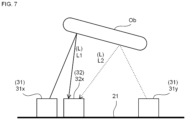
- FIG. 7 is a schematic front view showing the configuration of a sensor 1 according to a modification.
- the sensor 1 according to the modification includes two light-emitting elements 31x, 31y and one light-receiving element 32x as minimum components.
- a light ray emitted from the light-emitting element 31x is reflected from an object Ob, and the reflected light ray L1 (an example of a main light ray) is received by the light-receiving element 32x.
- a light ray emitted from the light-emitting element 31y is reflected from the object Ob, and the reflected light ray L2 (an example of a crosstalk light ray) is received by the light-receiving element 32x.
- the sensor 1 thus configured is also able to determine the distance d and the angle ⁇ (an angle in one direction) by estimation using a trained model 5 that has previously been machine-trained.
- the light-emitting elements 31 and light-receiving elements 32 are included in the light-receiving/emitting blocks 3 one-on-one and the light-receiving/emitting blocks 3 are disposed annularly and at equal intervals on the substrate 21 is illustrated in the above embodiment, the light-emitting elements 31 and light-receiving element 32 may be disposed on the substrate 21 with no regularity. In such a case also, the distance d and the angles ⁇ and ⁇ are determined by estimation by preparing the trained model 5 that has previously been machine-trained.
- the sensor 1 may include the detection unit 2 alone and a computer (not shown) connected to the detection unit 2 may output determination results.
- the trained model 5 be stored in a storage unit (not shown) included in the computer (not shown) and a processor (not shown) perform an input process to the trained model 5.
- the sensor 1 and the computer (not shown) may be connected in any manner and may be directly connected using a conductor, or the sensor 1 may be provided with a wireless communication function so that the sensor 1 and the computer (not shown) can be connected through wireless communication.
- one computer (not shown) may correspond to multiple sensors 1.
- the above sensor 1 may be produced using a predetermined production method.
- this production method includes the step of disposing the multiple light-emitting elements 31 and at least one of light-receiving element(s) 32 on the substrate 21.
- this production method may include disposing the multiple light-emitting elements 31 and then the light-receiving element 32 on the substrate 21 and then connecting the output of the light-receiving element 32 and the information processing unit 4 such as a microcontroller. According to such a method, a sensor with a simpler structure and high accuracy is produced.
- the light-emitting elements 31 emit light rays at different timings so that the resulting photocurrents J are distinguished from each other.
- the light-emitting elements 31 may blink at different frequencies or emit light rays of different wavelengths so that the resulting photocurrents J are distinguished from each other.
- light-receiving elements 32 adjacent in the left-right direction may receive a crosstalk light ray. That is, light-receiving elements 32 that receive a crosstalk light ray may be freely positioned in accordance with the number of light-receiving/emitting blocks 3.
- the trained model 5 may be a one-dimensional convolutional network or a two-dimensional convolutional network in place of the neural network.
- the electrical physical quantities generated by the light-receiving elements 32 are not limited to the photocurrents J and may be, for example, voltages.
Landscapes
- Engineering & Computer Science (AREA)
- Physics & Mathematics (AREA)
- General Physics & Mathematics (AREA)
- Remote Sensing (AREA)
- Radar, Positioning & Navigation (AREA)
- Computer Networks & Wireless Communication (AREA)
- Theoretical Computer Science (AREA)
- Software Systems (AREA)
- Electromagnetism (AREA)
- Data Mining & Analysis (AREA)
- Evolutionary Computation (AREA)
- Artificial Intelligence (AREA)
- Computing Systems (AREA)
- General Engineering & Computer Science (AREA)
- Mathematical Physics (AREA)
- Medical Informatics (AREA)
- Computer Vision & Pattern Recognition (AREA)
- Molecular Biology (AREA)
- Biomedical Technology (AREA)
- Biophysics (AREA)
- Life Sciences & Earth Sciences (AREA)
- Health & Medical Sciences (AREA)
- General Health & Medical Sciences (AREA)
- Computational Linguistics (AREA)
- Length Measuring Devices By Optical Means (AREA)
- Geophysics And Detection Of Objects (AREA)
- Investigating Or Analysing Materials By Optical Means (AREA)
- Measurement Of Optical Distance (AREA)
- Photo Coupler, Interrupter, Optical-To-Optical Conversion Devices (AREA)
Abstract


Description
- The present disclosure relates to a sensor, a method for producing a sensor and an information processing method. BACKGROUND ART
-
Patent Literature 1 discloses a sensor. This sensor includes a substrate, multiple light-emitting elements, a light-receiving element, and a synchronous detection circuit. The light-emitting elements are disposed in different positions on the substrate and are configured to emit a light ray using mutually orthogonal first and second modulation signals. The light-receiving element is disposed inside the substrate and is configured to receive an external light ray through a pinhole and to generate a photocurrent. The synchronous detection circuit is configured to detect the phase of a specific component of the photocurrent. The specific component is a component originating from a composite reflected light ray emitted from the light-emitting elements and reflected from an object, and the phase is expressed as a function of the distance to the object. Citation List - [Patent Literature 1]
Japanese Unexamined Patent Application Publication No. 2020-190552 - On the other hand, there is a need for a sensor capable of grasping spatial physical quantities such as the distance with a simpler structure than the prior art disclosed in
Patent Literature 1 and with high accuracy. - In view of the above circumstances, the present disclosure provides a sensor with a simpler structure and high accuracy. Solution to Problem
- One aspect of the present disclosure provides a sensor for determining an object. This sensor includes multiple light-emitting elements and at least one of light-receiving element(s). The light-emitting elements are disposed in different positions on a substrate. The light-receiving element is disposed on the substrate. The light-receiving element receives one of reflected light rays originating from the light-emitting elements as a main light ray and receives a reflected light ray other than the main light ray as a crosstalk light ray so as to be able to distinguish the crosstalk light ray from the main light ray. The reflected light rays are light rays emitted from the light-emitting elements and reflected from the object. The sensor determines spatial physical quantities related to the reference plane of the sensor and the object on the basis of the distinguishably received main light ray and crosstalk light ray.
- According to the present disclosure, a sensor with a simpler structure and high accuracy is realized.
-
-
FIG. 1 is a plan view of asensor 1 according to the present embodiment that mainly shows an overview of the configuration of adetection unit 2. -
FIG. 2 is a block diagram of thesensor 1 according to the present embodiment that mainly shows an overview of the configuration of aninformation processing unit 4. -
FIG. 3 is a block diagram showing functions implemented by aprocessor 43 or the like of thesensor 1. -
FIG. 4 is a schematic diagram showing the configuration of the neural network of a trainedmodel 5. -
FIG. 5 is an activity diagram showing the flow of a process of determining an object Ob using thesensor 1. -
FIGS. 6A to 6D are schematic diagrams showing the timings at which the light-emittingelements 31 emit a light ray and the aspect in which light-receiving elements 32 receive the light ray, and the light-emitting elements 31 emit a light ray in the order ofFIG. 6A, FIG. 6B, FIG. 6C and FIG. 6D . -
FIG. 7 is a schematic front view showing the configuration of asensor 1 according to a modification. Description of Embodiments - Now, an embodiment of the present disclosure will be described with reference to the drawings. Various features described in the embodiment below can be combined with each other.
- A program to implement software that appears in the present embodiment may be provided as a computer-readable non-transitory storage medium or may be provided by downloading it from an external server, or the program may be provided such that it is run on an external computer and its functions are implemented on a client terminal (so-called cloud computing).
- The term "unit" in the present embodiment includes, for example, a combination of hardware resources implemented by a circuit in a broad sense and software information processing that can be specifically implemented by the hardware resources. Various types of information handled in the present embodiment are represented by, for example, the physical values of signal values representing voltages or currents, high or low signal values as binary bit sets consisting of 0s or 1s, or quantum superpositions (so-called qubits) and can be communicated and subjected to a calculation on a circuit in a broad sense.
- The term "circuit in a broad sense" refers to a circuit implemented by combining at least a circuit, circuitry, a processor, memory, and the like appropriately.
That is, the term "circuit in a broad sense" includes an application-specific integrated circuit (ASIC), a programmable logic device (e.g., a simple programmable logic device (SPLD), a complex programmable logic device (CPLD), a field programmable gate array (FPGA)), and the like. - The hardware configuration of a
sensor 1 according to the present embodiment will be described in this section. Thesensor 1 is a sensor for determining an object Ob. More specifically, thesensor 1 is configured to determine spatial physical quantities related to the reference plane of thesensor 1 and the object Ob. Preferably, the spatial physical quantities here include at least the distance d between the reference plane and the object Ob and the angles θ and φ of the object Ob with respect to the reference plane (parameters representing a three-dimensional posture). Particularly preferably, the distance d is a close range. For example, the distance is 50 mm or less. Specifically, for example, the distance is 50, 49, 48, 47, 46, 45, 44, 43, 42, 41, 40, 39, 38, 37, 36, 35, 34, 33, 32, 31, 30, 29, 28, 27, 26, 25, 24, 23, 22, 21, 20, 19, 18, 17, 16, 15, 14, 13, 12, 11, 10, 9, 8, 7, 6, 5, 4, 3, 2, 1, or 0 mm and may be in the range between any two of the values illustrated above. Thesensor 1 thus configured is able to determine the distance d to the object Ob and the angles θ and φ and can be used in various scenes such as picking or inspection of objects. _
Thesensor 1 thus configured is also able to accurately grasp the object Ob located at a very short distance. -
FIG. 1 is a plan view of thesensor 1 according to the present embodiment that mainly shows an overview of the configuration of adetection unit 2.FIG. 2 is a block diagram of thesensor 1 according to the present embodiment that mainly shows an overview of the configuration of aninformation processing unit 4. As shown inFIGS. 1 and2 , thesensor 1 mainly includes thedetection unit 2 andinformation processing unit 4. - First, the
detection unit 2 will be described. As shown inFIGS. 1 and2 , thedetection unit 2 includes asubstrate 21, multiple light-receiving/emitting blocks 3 disposed on thesubstrate 21, and anAI input unit 22 connected to theinformation processing unit 4. The respective components will be further described below. - The
substrate 21 constitutes the housing of thesensor 1. In the present embodiment, thesubstrate 21 has, for example, an approximately circular shape and is formed as a flat plate. However, this is only illustrative and is not limiting. Preferably, thesubstrate 21 is made of, for example, a material that is black and lackluster and has low reflectivity. Thesubstrate 21 has the light-receiving/emittingblocks 3 thereon. - As shown in
FIG. 1 , the multiple light-receiving/emittingblocks 3 are disposed on thesubstrate 21. A light-emitting element(s) 31 and a light-receiving element(s) 32 are disposed in each light-receiving/emittingblock 3. In the present embodiment, one light-emittingelement 31 and one light-receivingelement 32 are disposed in one light-receiving/emittingblock 3. In other words, the light-receivingelement 32 and the corresponding light-emittingelement 31 are adjacent to each other to form the light-receiving/emittingblock 3. The multiple light-receiving/emittingblocks 3 are disposed on thesubstrate 21. - The number of light-emitting
elements 31 is preferably 2 to 30, more preferably 2 to 10, and most preferably 2 to 4. Specifically, for example, the number of light-emittingelements 31 may be 2, 3, 4, 5, 6, 7, 8, 9, 10, 11, 12, 13, 14, 15, 16, 17, 18, 19, 20, 21, 22, 23, 24, 25, 26, 27, 28, 29, or 30 and may be in the range between any two of the numbers illustrated above. - The number of light-receiving/emitting
blocks 3 is preferably two or more, more preferably three or more. In the present embodiment, four light-receiving/emittingblocks FIG. 1 , more preferably, the light-receiving/emittingblocks 3 are disposed annularly and at equal intervals on thesubstrate 21. In other words, the light-receiving/emittingblocks 3 are disposed symmetrically with respect to thesubstrate 21. Specifically, a light-emittingelement 31a and a light-receivingelement 32a are disposed in the light-receiving/emittingblock 3a, a light-emittingelement 31b and a light-receivingelement 32b are disposed in the light-receiving/emittingblock 3b, a light-emittingelement 31c and a light-receivingelement 32c are disposed in the light-receiving/emittingblock 3c, and a light-emittingelement 31d and a light-receivingelement 32d are disposed in the light-receiving/emittingblock 3d. Such a configuration makes photocurrents J (an example of electrical physical quantities) based on the multiple light-receivingelements 32 symmetrical and further increases the accuracy of thesensor 1. In other words, the light-receivingelements 32 are the same in number as the light-emittingelements 31 and are associated with the light-emittingelements 31 one-to-one. Such a configuration allows thesensor 1 to obtain the photocurrents J based on the multiple light-receivingelements 32 and further increases the accuracy of thesensor 1. The photocurrents J will be described later. - As shown in
FIG. 1 , the light-emittingelements 31 are disposed in different positions on thesubstrate 21. The light-emittingelements 31 only have to be elements that apply a diffuse light ray to the object Ob. For example, the light-emittingelements 31 are light emitting diodes (LED) and, preferably, infrared LEDs that emit an infrared light ray that is invisible to humans and harmless to human bodies. Of course, the light-emittingelements 31 are not limited to infrared LEDs and may be red LEDs, green LEDs, or blue LEDs. By connecting the positive side of a power supply (not shown) to the anode side of the light-emittingelements 31 that are light emitting diodes as described above, currents flow, resulting in application of diffuse light rays of a specific frequency to the object Ob. - As shown in
FIG. 1 , the light-receivingelements 32 are disposed on thesubstrate 21. The light-receivingelements 32 are elements that detect received light rays and in turn generate photocurrents J, which are an example of electrical physical quantities. In other words, the light-receivingelements 32 are configured to output photocurrents J corresponding to the illuminance of received light rays. Preferably, the illuminance of the light rays and the photocurrents J have linear characteristics. Major examples of the light-receivingelements 32 include phototubes, photomultiplier tubes, phototransistors using the internal photoelectric effect of semiconductors, photodiodes, avalanche photodiodes, photoconductive cells, image sensors, and the like. Preferably, the light-receivingelements 32 are photodiodes with wide directivity, or phototransistors obtained by combining such photodiodes and amplifiers. - Each light-receiving
element 32 receives, as a main light ray, a reflected light ray L emitted from a light-emittingelement 31 belonging to the same light-receiving/emittingblock 3 and reflected from the object Ob. The light-receivingelement 32 also receives, as crosstalk light rays, reflected light rays L emitted from light-emittingelements 31 belonging to adjacent light-receiving/emittingblocks 3 and reflected from the object Ob. For example, the light-receivingelement 32a receives, as a main light ray, a reflected light ray L originating from the light-emittingelement 31a and receives, as crosstalk light rays, reflected light rays L originating from the light-emittingelements elements 32 are each configured to receive one of the reflected light rays L originating from the light-emittingelements 31 as a main light ray as well as receive the reflected light rays L other than the main light ray as crosstalk light rays so as to be able to distinguish the crosstalk light rays from the main light ray and to generate photocurrents J (an example of electrical physical quantities) corresponding to the reflected light rays L. The reflected light rays L here are light rays emitted from the light-emittingelements 31 and reflected from the object Ob. The spatial physical quantities related to the reference plane of thesensor 1 and the object Ob are determined on the basis of the photocurrents J based on the main light rays and crosstalk light rays received distinguishably as described above. This will be described in more detail later. - The
AI input unit 22 inputs the values of the photocurrents J or calculated values based on the photocurrents J as input parameters to a trainedmodel 5 stored in thestorage unit 42 of the information processing unit 4 (to be discussed later). That is, theAI input unit 22 serves as a conductor from the light-receivingelements 32 of thedetection unit 2 to theinformation processing unit 4. The photocurrents J outputted from the light-receivingelements 32 are inputted to the trainedmodel 5 stored in thestorage unit 42 through theAI input unit 22 and a communication unit 41 (to be discussed later). - Next, the
information processing unit 4 will be described. Theinformation processing unit 4 is a processing circuit configured to control the operation of thesensor 1, for example, a microcontroller. Theinformation processing unit 4 includes thecommunication unit 41, thestorage unit 42, and aprocessor 43. These components are electrically connected through acommunication bus 40 in theinformation processing unit 4. The respective components will be further described. - The
communication unit 41 is configured to transmit various electrical signals from theinformation processing unit 4 to external components. Thecommunication unit 41 is also configured to receive various electrical signals from the external components to theinformation processing unit 4. Specifically, thecommunication unit 41 receives the photocurrents J outputted from theAI input unit 22 of thedetection unit 2. Thecommunication unit 41 outputs spatial physical quantities estimated based on the trainedmodel 5. Preferably, thecommunication unit 41 has a network communication function. Thus, various information can be communicated between thesensor 1 and external devices through a network such as the Internet. - The
storage unit 42 is storing various information defined by the foregoing description. Thestorage unit 42 can be implemented, for example, as a storage device such as a solid-state drive (SSD) that stores various programs or the like related to thesensor 1 executed by theprocessor 43, or as memory such as random access memory (RAM) that stores temporarily required information (arguments, arrays, etc.) related to program calculations. Thestorage unit 42 is storing various programs, variables, and the like related to thesensor 1 executed by theprocessor 43. Particularly, in the present embodiment, thestorage unit 42 is storing the trainedmodel 5. - The
processor 43 is, for example, a central processing unit (CPU) (not shown). Theprocessor 43 implements various functions related to thesensor 1 by reading a predetermined program stored in thestorage unit 42. That is, when theprocessor 43, which is an example of hardware, specifically performs information processing using the software stored in thestorage unit 42, functional units of theprocessor 43 are implemented. These will be described in more detail in the next section. Note that theprocessor 43 does not have to be a single processor and function-specificmultiple processors 43 may be provided. Or, a combination of these may be used. - The
sensor 1 thus configured is singly able to determine the spatial physical quantities of the object Ob without using a separate computer or the like. - The functional configuration of the present embodiment will be described in this section. As described above, when the
processor 43, which is an example of hardware, specifically performs information processing using the software stored in thestorage unit 42, the functional units of theprocessor 43 are implemented. -
FIG. 3 is a block diagram showing functions implemented by theprocessor 43 or the like of thesensor 1. Specifically, theprocessor 43 includes anacquisition unit 431, aconversion unit 432, aninput processing unit 433, and anoutput unit 434 as functional units. - The
acquisition unit 431 is configured to acquire, as an acquisition step, various information received from the outside through thecommunication unit 41 or previously stored in thestorage 42. For example, theacquisition unit 431 acquires the photocurrents J outputted from the light-receivingelements 32. - The
conversion unit 432 is configured to convert, as a conversion step, the various information acquired by theacquisition unit 431 by performing a predetermined calculation on the information. For example, theconversion unit 432 may convert information by performing a predetermined calculation on the values of the multiple photocurrents J acquired by theacquisition unit 431. - The
input processing unit 433 is configured to input, as an input processing step, input parameters to the trainedmodel 5 stored in thestorage unit 42. - The
output unit 434 is configured to output, as an output step, various information. Specifically, theoutput unit 434 may output spatial physical quantities estimated based on the trainedmodel 5, for example, the distance d and the angles θ and φ. - The trained
model 5 stored in thestorage unit 42 will be described in this section. The trainedmodel 5 is a model previously machine-trained with the relationships between the spatial physical quantities related to the reference plane of thesensor 1 and the object Ob and the values of the photocurrents J or the calculated values. Preferably, with respect to the material of each object Ob, the trainedmodel 5 is trained with the relationships between the values of the photocurrents J or the predetermined calculated values and the spatial physical quantities related to the object Ob and the reference plane of thesensor 1. Specific examples of the object Ob include an object Ob made of a mirror-reflective material, an object Ob made of a diffuse-reflective white material, an object Ob consisting of a green, hard PVC board, an object Ob consisting of a yellow, hard PVC board, an object Ob consisting of a blue, hard PVC board, an object Ob consisting of an aluminum board, an object Ob consisting of a rough-finished aluminum board, an object Ob consisting of a wire mesh, an object Ob consisting of a leather product, and the like. Thesensor 1 thus configured is able to make a robust determination even with respect to an object Ob with respect to which it has been difficult to make a determination, such as an object Ob with a mirror surface, a transparent object Ob, or an object Ob with an uneven surface. -
FIG. 4 is a schematic diagram showing the configuration of the neural network of the trainedmodel 5. As shown inFIG. 4 , the trainedmodel 5 includes aninput layer 51, anintermediate layer 52 consisting of at least one layer, and anoutput layer 53. - The
input layer 51 receives input of, as input signals, the values of the photocurrents J outputted from the light-receivingelements 32 or calculated values obtained by performing a predetermined calculation on the photocurrents J. WhileFIG. 4 shows at least eight input terminals (hollow circles in the figure) as theinput layer 51, this is only illustrative and is not limiting. - The
intermediate layer 52 is a layer in which the neural network performs main processing and may consist of any number of layers. Multiple neurons (hollow circles in the figure) in each layer are coupled to multiple neurons in the next layer. For example, one neuron in the first layer of theintermediate layer 52 receives weighted (loaded) input from each terminal in theinput layer 51 and transmits the weighted calculation result to each neuron in the second layer of theintermediate layer 52. Then, one neuron in the second layer of theintermediate layer 52 receives the weighted input from each neuron in the first layer of theintermediate layer 52 and transmits the weighted calculation result to each neuron in the third layer of theintermediate layer 52. Such a process is sequentially performed in accordance with the number of layers of theintermediate layer 52. - The
output layer 53 is a layer that outputs the output results of the trainedmodel 5. While two output terminals (hollow circles in the figure) are illustrated as theoutput layer 53 inFIG. 4 , this is only illustrative and is not limiting. Preferably, the trainedmodel 5 outputs the distance d and the angles θ and φ as the spatial physical quantities related to the reference plane of thesensor 1 and the object Ob. That is, in relation to the trainedmodel 5, theprocessor 43 of theinformation processing unit 4 is configured to input the values of the photocurrents J or calculated values as input parameters to the trainedmodel 5 and to determine the spatial physical quantities on the basis of the output results from the trainedmodel 5. - The flow of a process of determining the object Ob using the
sensor 1 will be described in this section.FIG. 5 is an activity diagram showing the flow of the process of determining the object Ob using thesensor 1.FIGS. 6A to 6D are schematic diagrams showing the timings at which each light-emittingelement 31 emits a light ray and the aspect in which light-receivingelements 32 receive the light ray. The light-emittingelements 31 emit a light ray in the order ofFIGS. 6A, 6B, 6C and 6D . The flow of the determination process will be described below with reference to this activity diagram. - In the present embodiment, the
sensor 1 includes the four light-receiving/emittingblocks 3, and the light-emittingelements 31 of the light-receiving/emittingblocks 3 emit a light ray at different timings. According to such a configuration, the light-receivingelements 32 are able to easily distinguish the reflected light rays L originating from the light-emittingelements 31 from each other. The light emission of the "k-the (k = 1, 2, 3, 4) light-emittingelement 31 will be sequentially described below. That is, the light-emittingelements element 31, for example, the light-emittingelement 31a shown inFIG. 6A emits a light ray (activity A002). - Then, the light ray emitted from the light-emitting
element 31a is reflected from the object Ob, and the resulting reflected light rays L enter multiple light-receivingelements 32. Specifically, the light-receivingelement 32a receives the reflected light ray L originating from the light-emittingelement 31a as a main light ray (activity A003). The light-receivingelement 32a is a light-receivingelement 32 forming a pair with the light-emittingelement 31a and is located in the light-receiving/emittingblock 3a, which is the same light-receiving/emitting block as that of the light-emittingelement 31a. The light-receivingelement 32b receives the reflected light ray L originating from the light-emittingelement 31a as a crosstalk light ray (activity A004). Note that the light-receivingelement 32b is a light-receivingelement 32 disposed in the light-receiving/emittingblock 3b located on the left next to the light-receiving/emittingblock 3a in which the light-emittingelement 31a is disposed. The light-receivingelement 32d receives the reflected light ray L originating from the light-emittingelement 31a as a crosstalk light ray (activity A005). Note that the light-receivingelement 32d is a light-receivingelement 32 disposed in the light-receiving/emittingblock 3d located next to the right side of the light-receiving/emittingblock 3a in which the light-emittingelement 31a is disposed. Then, the light-receivingelements acquisition unit 431 of theinformation processing unit 4 acquires the photocurrents J. In other words, each light-receivingelement 32 receives the reflected light ray L originating from the corresponding light-emittingelement 31 as a main light ray and receives the reflected light rays L other than the main light ray as crosstalk light rays so as to be able to distinguish the crosstalk light rays from the main light ray. - Then, since k<4, the value of k is incremented (activity A006) and the second light-emitting
element 31, for example, the light-emittingelement 31b shown inFIG. 6B emits a light ray (activity A002). - Then, the light ray emitted from the light-emitting
element 31b is reflected from the object Ob, and the reflected light rays L enter multiple light-receivingelements 32. Specifically, the light-receivingelement 32b receives the reflected light ray L originating from the light-emittingelement 31b as a main light ray (activity A003). The light-receivingelement 32c receives the reflected light ray L originating from the light-emittingelement 31b as a crosstalk light ray (activity A004). The light-receivingelement 32a receives the reflected light ray L originating from the light-emittingelement 31b as a crosstalk light ray (activity A005). Then, the light-receivingelements acquisition unit 431 of theinformation processing unit 4 acquires the photocurrents J. - Then, since k < 4, the value of k is incremented (activity A006) and the third light-emitting
element 31, for example, the light-emittingelement 31c shown inFIG. 6B emits a light ray (activity A002). - Then, the light ray emitted from the light-emitting
element 31c is reflected from the object Ob, and the reflected light rays L enter multiple light-receivingelements 32. Specifically, the light-receivingelement 32c receives the reflected light ray L originating from the light-emittingelement 31c as a main light ray (activity A003). The light-receivingelement 32d receives the reflected light ray L originating from the light-emittingelement 31c as a crosstalk light ray (activity A004). The light-receivingelement 32b receives the reflected light ray L originating from the light-emittingelement 31c as a crosstalk light ray (activity A005). Then, the light-receivingelements acquisition unit 431 of theinformation processing unit 4 acquires the photocurrents J. - Then, since k<4, the value of k is incremented (activity A006) and the fourth light-emitting
element 31, for example, the light-emittingelement 31d shown inFIG. 6D emits a light ray (activity A002). - Then, the light emitted from the light-emitting
element 31d is reflected from the object Ob, and the reflected light rays L enter multiple light-receivingelements 32. Specifically, the light-receivingelement 32d receives the reflected light ray L originating from the light-emittingelement 31d as a main light ray (activity A003). The light-receivingelement 32a receives the reflected light ray L originating from the light-emittingelement 31d as a crosstalk light ray (activity A004). The light-receivingelement 32c receives the reflected light ray L originating from the light-emittingelement 31d as a crosstalk light ray (activity A005). Then, the light-receivingelements acquisition unit 431 of theinformation processing unit 4 acquires the photocurrents J. As seen above, the four-time light emission leads to the acquisition of the 12 channels of photocurrents J. - Since k is 4 this time, activities A007 to A009 are performed.
Specifically, first, theconversion unit 432 of theinformation processing unit 4 performs preprocessing of converting the photocurrents J acquired by theacquisition unit 431 into predetermined calculated values (activity A007). The predetermined calculated values may be any values as long as they are values obtained by performing a calculation on the photocurrents J. The number of channels of these calculated values may be the same as or smaller than the number (for example, 12) of channels of the photocurrents J. - Then, the
input processing unit 433 of theinformation processing unit 4 inputs the calculated values obtained in activity A007 as input parameters to the trained model 5 (activity A008). - Finally, the
output unit 434 of theinformation processing unit 4 outputs the spatial physical quantities estimated by the trainedmodel 5 and, in the present embodiment, the distance d and the angles θ and φ (activity A009). The above process is continuously performed as long as thesensor 1 is operating. Thus, the distance d and the angles θ and φ are sequentially determined in accordance with the operating frequency of thesensor 1. The time from the light emission of the first light-emittingelement 31 until the distance d and the angles θ and φ are determined by estimation is preferably 100 ms or less, more preferably 10 ms or less, even more preferably 1 ms or less, still more preferably 0.7 ms or less. Specifically, for example, the time until the determination may be 100, 95, 90, 85, 80, 75, 70, 65, 60, 55, 50, 45, 40, 35, 30, 25, 20, 15, 10, 9, 8, 7, 6, 5, 4, 3, 2, 1, 0.9, 0.8, 0.7, 0.6, 0.5, 0.4, 0.3, 0.2, or 0.1 milliseconds and may be in the range between any two of the values illustrated above. That is, the time from the light emission of the k-th light-emittingelement 31 to the light emission of the (k+1)-th light-emittingelement 31 is preferably 1/4 or less of the above determination time. More generally, the time from the light emission of the k-th light-emittingelement 31 to the light emission of the (k+1)-th light-emittingelement 31 is preferably equal to or less than a time obtained by dividing "the time from the light emission of the first light-emittingelement 31 until the distance d and the angles θ and φ are determined by estimation" by "the number of light-emittingelements 31". - The above is summarized as follows: the
sensor 1 according to the present embodiment is a sensor for determining the object Ob; thesensor 1 includes the multiple light-emittingelements 31, the light-receiving element(s) 32, and theAI input unit 22; the light-emittingelements 31 are disposed in different positions on thesubstrate 21; the light-receiving element(s) 32 is disposed on thesubstrate 21; the light-receiving element(s) 32 is configured to receive one of the reflected light rays L originating from the light-emittingelements 31 as a main light ray and to receive the reflected light ray(s) L other than the main light ray as a crosstalk light ray(s) so as to be able to distinguish the crosstalk light ray(s) from the main light ray; the reflected light rays L are light rays emitted from the light-emittingelements 31 and reflected from the object Ob; and thesensor 1 determines the spatial physical quantities related to the reference plane of thesensor 1 and the object Ob on the basis of the distinguishably received main light ray and crosstalk light ray(s). - According to another aspect, this information processing method includes an acquisition step of acquiring the photocurrents J (an example of electrical physical quantities) outputted from the light-receiving
elements 32, an input processing step of inputting the values of the photocurrents J or calculated values based on the photocurrents J as input parameters to the trainedmodel 5, the trainedmodel 5 being a model previously machine-trained with the relationships between the spatial physical quantities related to the reference plane of thesensor 1 and the object Ob and the values of the photocurrents J or the calculated values, and an output step of outputting the spatial physical quantities by estimation on the basis of the trainedmodel 5. - According to such a configuration, a sensor with a simpler structure and high accuracy is realized. In particular, by using not only the reflected light ray L related to the associated light-emitting element and light-receiving element such as the light-emitting
element 31a and the light-receivingelement 32a but also the crosstalk light rays, which have been considered as disturbances, as input parameters for determination, more multilateral information is obtained, resulting in an increase in determination accuracy. - Further creativity may be applied to the
sensor 1 according to the present embodiment. - The light-emitting
elements 31 and light-receivingelements 32 do not have to be disposed one-on-one.FIG. 7 is a schematic front view showing the configuration of asensor 1 according to a modification. Thesensor 1 according to the modification includes two light-emittingelements element 32x as minimum components. A light ray emitted from the light-emittingelement 31x is reflected from an object Ob, and the reflected light ray L1 (an example of a main light ray) is received by the light-receivingelement 32x. A light ray emitted from the light-emittingelement 31y is reflected from the object Ob, and the reflected light ray L2 (an example of a crosstalk light ray) is received by the light-receivingelement 32x. Thesensor 1 thus configured is also able to determine the distance d and the angle θ (an angle in one direction) by estimation using a trainedmodel 5 that has previously been machine-trained. - While the case in which the light-emitting
elements 31 and light-receivingelements 32 are included in the light-receiving/emittingblocks 3 one-on-one and the light-receiving/emittingblocks 3 are disposed annularly and at equal intervals on thesubstrate 21 is illustrated in the above embodiment, the light-emittingelements 31 and light-receivingelement 32 may be disposed on thesubstrate 21 with no regularity. In such a case also, the distance d and the angles θ and φ are determined by estimation by preparing the trainedmodel 5 that has previously been machine-trained. - While the
sensor 1 has been described as including thedetection unit 2 andinformation processing unit 4, thesensor 1 may include thedetection unit 2 alone and a computer (not shown) connected to thedetection unit 2 may output determination results. In such a case, it is preferable that the trainedmodel 5 be stored in a storage unit (not shown) included in the computer (not shown) and a processor (not shown) perform an input process to the trainedmodel 5. Thesensor 1 and the computer (not shown) may be connected in any manner and may be directly connected using a conductor, or thesensor 1 may be provided with a wireless communication function so that thesensor 1 and the computer (not shown) can be connected through wireless communication. In such a case, one computer (not shown) may correspond tomultiple sensors 1. - The
above sensor 1 may be produced using a predetermined production method. Preferably, this production method includes the step of disposing the multiple light-emittingelements 31 and at least one of light-receiving element(s) 32 on thesubstrate 21. For example, this production method may include disposing the multiple light-emittingelements 31 and then the light-receivingelement 32 on thesubstrate 21 and then connecting the output of the light-receivingelement 32 and theinformation processing unit 4 such as a microcontroller. According to such a method, a sensor with a simpler structure and high accuracy is produced. - In the above embodiment, the light-emitting
elements 31 emit light rays at different timings so that the resulting photocurrents J are distinguished from each other. However, instead of the different timings, the light-emittingelements 31 may blink at different frequencies or emit light rays of different wavelengths so that the resulting photocurrents J are distinguished from each other. - Not only the light-receiving
elements 32 adjacent in the left-right direction but also the opposite light-receivingelement 32 may receive a crosstalk light ray. That is, light-receivingelements 32 that receive a crosstalk light ray may be freely positioned in accordance with the number of light-receiving/emittingblocks 3. - The trained
model 5 may be a one-dimensional convolutional network or a two-dimensional convolutional network in place of the neural network. - The electrical physical quantities generated by the light-receiving
elements 32 are not limited to the photocurrents J and may be, for example, voltages. - The present disclosure may be provided in aspects below.
- (1) A sensor for determining an object, comprising: a plurality of light-emitting elements disposed in different positions on a substrate; and at least one of light-receiving element(s) disposed on the substrate, configured to: receive, as a main light ray, one of reflected light rays originating from the light-emitting elements, and receive, as a crosstalk light ray distinguishable from the main light ray, a reflected light ray other than the main light ray, wherein the reflected light rays are light rays emitted from the light-emitting elements and reflected from the object; wherein the sensor determines spatial physical quantities related to a reference plane of the sensor and the object on the basis of the distinguishably received main light ray and crosstalk light ray.
- (2) The sensor according to (1), wherein the spatial physical quantities include at least a distance between the reference plane and the object and an angle of the object with respect to the reference plane.
- (3) The sensor according to (2), wherein the distance is 50 mm or less.
- (4) The sensor according to any one of (1) to (3), wherein the light-receiving elements are equal in number to to the light-emitting elements and are associated with the light-emitting elements one-to-one, and are configured to receive, as the main light ray, the reflected light ray originating from the associated light-emitting elements and to receive, as the crosstalk light ray, the reflected light ray other than the main light ray so as to be able to distinguish the crosstalk light ray from the main light ray.
- (5) The sensor according to (4), wherein: the light-receiving element and the associated light-emitting elements are adjacent to each other to form a plurality of light-receiving/emitting blocks, and the light-receiving/emitting blocks are disposed on the substrate.
- (6) The sensor according to (5), wherein the light-receiving/emitting blocks are disposed annularly and at equal intervals on the substrate.
- (7) The sensor according to any one of (1) to (6), wherein the number of the light-emitting elements is 2 to 4.
- (8) The sensor according to any one of (1) to (7), wherein the light-emitting elements emit a light ray at different timings.
- (9) The sensor according to any one of (1) to (8), wherein: the light-receiving element is configured to generate electrical physical quantities corresponding to the reflected light rays, and the sensor determines the spatial physical quantities related to the reference plane of the sensor and the object on the basis of the electrical physical quantities based on the distinguishably received main light ray and crosstalk light ray.
- (10) The sensor according to (9), further comprising an AI input unit configured to input values of the electrical physical quantities or calculated values based on the electrical physical quantities as input parameters to a trained model, the trained model being a model previously machine-trained with relationships between the spatial physical quantities related to the reference plane of the sensor and the object and the values of the electrical physical quantities or the calculated values.
- (11) The sensor according to (10), further comprising: a storage unit storing the trained model, and a processor configured to input the values of the electrical physical quantities or the calculated values as the input parameters to the trained model and to determine the spatial physical quantities on the basis of output results from the trained model.
- (12) The sensor according to any one of (1) to (11), wherein the light-receiving element is a light-receiving element having wide directivity.
- (13) A method for producing a sensor, comprising a step of disposing a plurality of light-emitting elements and at least one of light-receiving element(s), wherein the sensor is the sensor described in any one of
claims 1 to 12. - (14) An information processing method comprising: an acquisition step of acquiring electrical physical quantities outputted from a light-receiving element; an input processing step of inputting values of the electrical physical quantities or calculated values based on the electrical physical quantities as input parameters to a trained model, the trained model being a model previously machine-trained with relationships between spatial physical quantities related to a reference plane of a sensor and an object and the values of the electrical physical quantities or the calculated values; and an output step of outputting the spatial physical quantities by estimation on the basis of the trained model.
- Of course, the present disclosure is not limited thereto.
- Finally, while the various embodiments according to the present disclosure have been described above, the embodiments are only illustrative and are not intended to limit the scope of the disclosure. The novel embodiments can be carried out in other various aspects, and various omissions, replacements, or changes can be made thereto without departing from the gist of the disclosure. The embodiments and modifications thereof are included in the scope and gist of the present disclosure, as well as included in the scope of the disclosure set forth in the claims and equivalents thereof.
-
- 1: sensor
- 2: detection unit
- 21: substrate
- 22: AI input unit
- 3: light-receiving/emitting block
- 3a: light-receiving/emitting block
- 3b: light-receiving/emitting block
- 3c: light-receiving/emitting block
- 3d: light-receiving/emitting block
- 31: light-emitting element
- 31a: light-emitting element
- 31b: light-emitting element
- 31c: light-emitting element
- 31d: light-emitting element
- 31x: light-emitting element
- 31y: light-emitting element
- 32: light-receiving element
- 32a: light-receiving element
- 32b: light-receiving element
- 32c: light-receiving element
- 32d: light-receiving element
- 32x: light-receiving element
- 4: information processing unit
- 40: communication bus
- 41: communication unit
- 42: storage unit
- 43: processor
- 431: acquisition unit
- 432: conversion unit
- 433: input processing unit
- 434 output unit
- 5: trained model
- 51: input layer
- 52: intermediate layer
- 53: output layer
- J: photocurrent
- L: reflected light
- L1: reflected light
- L2: reflected light
- Ob: object
- d: distance
- θ: angle
- φ: angle
Claims (14)
- A sensor for determining an object, comprising:a plurality of light-emitting elements disposed in different positions on a substrate; andat least one of light-receiving element(s) disposed on the substrate, configured to:receive, as a main light ray, one of reflected light rays originating from the light-emitting elements, andreceive, as a crosstalk light ray distinguishable from the main light ray, a reflected light ray other than the main light ray, wherein the reflected light rays are light rays emitted from the light-emitting elements and reflected from the object;wherein the sensor determines spatial physical quantities related to a reference plane of the sensor and the object on the basis of the distinguishably received main light ray and crosstalk light ray.
- The sensor according to claim 1, wherein the spatial physical quantities include at least a distance between the reference plane and the object and an angle of the object with respect to the reference plane.
- The sensor according to claim 2, wherein the distance is 50 mm or less.
- The sensor according to any one of claims 1 to 3, wherein
the light-receiving elementsare equal in number to to the light-emitting elements and are associated with the light-emitting elements one-to-one, andare configured to receive, as the main light ray, the reflected light ray originating from the associated light-emitting elements and to receive, as the crosstalk light ray, the reflected light ray other than the main light ray so as to be able to distinguish the crosstalk light ray from the main light ray. - The sensor according to claim 4, wherein:the light-receiving element and the associated light-emitting elements are adjacent to each other to form a plurality of light-receiving/emitting blocks, andthe light-receiving/emitting blocks are disposed on the substrate.
- The sensor according to claim 5, wherein the light-receiving/emitting blocks are disposed annularly and at equal intervals on the substrate.
- The sensor according to any one of claims 1 to 6, wherein the number of the light-emitting elements is 2 to 4.
- The sensor according to any one of claims 1 to 7, wherein the light-emitting elements emit a light ray at different timings.
- The sensor according to any one of claims 1 to 8, wherein:the light-receiving element is configured to generate electrical physical quantities corresponding to the reflected light rays, andthe sensor determines the spatial physical quantities related to the reference plane of the sensor and the object on the basis of the electrical physical quantities based on the distinguishably received main light ray and crosstalk light ray.
- The sensor according to claim 9, further comprising an AI input unit configured to input values of the electrical physical quantities or calculated values based on the electrical physical quantities as input parameters to a trained model, the trained model being a model previously machine-trained with relationships between the spatial physical quantities related to the reference plane of the sensor and the object and the values of the electrical physical quantities or the calculated values.
- The sensor according to claim 10, further comprising:a storage unit storing the trained model, anda processor configured to input the values of the electrical physical quantities or the calculated values as the input parameters to the trained model and to determine the spatial physical quantities on the basis of output results from the trained model.
- The sensor according to any one of claims 1 to 11, wherein the light-receiving element is a light-receiving element having wide directivity.
- A method for producing a sensor, comprising a step of disposing a plurality of light-emitting elements and at least one of light-receiving element(s), wherein the sensor is the sensor described in any one of claims 1 to 12.
- An information processing method comprising:an acquisition step of acquiring electrical physical quantities outputted from a light-receiving element;an input processing step of inputting values of the electrical physical quantities or calculated values based on the electrical physical quantities as input parameters to a trained model, the trained model being a model previously machine-trained with relationships between spatial physical quantities related to a reference plane of a sensor and an object and the values of the electrical physical quantities or the calculated values; andan output step of outputting the spatial physical quantities by estimation on the basis of the trained model.
Applications Claiming Priority (2)
| Application Number | Priority Date | Filing Date | Title |
|---|---|---|---|
| JP2022124366A JP2024021506A (en) | 2022-08-03 | 2022-08-03 | Sensor, sensor manufacturing method, and information processing method |
| PCT/JP2023/019693 WO2024029172A1 (en) | 2022-08-03 | 2023-05-26 | Sensor, method for manufacturing sensor, and information processing method |
Publications (2)
| Publication Number | Publication Date |
|---|---|
| EP4567376A1 true EP4567376A1 (en) | 2025-06-11 |
| EP4567376A4 EP4567376A4 (en) | 2026-02-11 |
Family
ID=89849164
Family Applications (1)
| Application Number | Title | Priority Date | Filing Date |
|---|---|---|---|
| EP23849733.3A Pending EP4567376A4 (en) | 2022-08-03 | 2023-05-26 | SENSOR, METHOD FOR MANUFACTURING A SENSOR AND INFORMATION PROCESSING METHOD |
Country Status (6)
| Country | Link |
|---|---|
| US (1) | US20260056291A1 (en) |
| EP (1) | EP4567376A4 (en) |
| JP (1) | JP2024021506A (en) |
| KR (1) | KR20250043546A (en) |
| CN (1) | CN119604740A (en) |
| WO (1) | WO2024029172A1 (en) |
Family Cites Families (8)
| Publication number | Priority date | Publication date | Assignee | Title |
|---|---|---|---|---|
| JP4016526B2 (en) * | 1998-09-08 | 2007-12-05 | 富士ゼロックス株式会社 | 3D object identification device |
| JP2008058162A (en) * | 2006-08-31 | 2008-03-13 | Myu-Loon:Kk | Angle display device |
| US8866064B2 (en) * | 2011-07-26 | 2014-10-21 | Avago Technologies General Ip (Singapore) Pte. Ltd. | Multi-directional proximity sensor |
| JP2018092489A (en) * | 2016-12-06 | 2018-06-14 | オムロン株式会社 | Classification apparatus, classification method and program |
| EP3686630A1 (en) * | 2019-01-25 | 2020-07-29 | IDT Inc. | Proximity sensor, particularly for mobile devices like smartphones, tablets or the like |
| JP2020190552A (en) | 2019-05-14 | 2020-11-26 | 国立大学法人 東京大学 | Proximity sensor |
| JP7150278B2 (en) * | 2019-06-07 | 2022-10-11 | 国立大学法人 東京大学 | Array type proximity sensor |
| CN113640770B (en) * | 2020-04-27 | 2022-08-16 | 北京一径科技有限公司 | Anti-crosstalk repetition frequency dynamic switching method and device, processing equipment and storage medium |
-
2022
- 2022-08-03 JP JP2022124366A patent/JP2024021506A/en active Pending
-
2023
- 2023-05-26 WO PCT/JP2023/019693 patent/WO2024029172A1/en not_active Ceased
- 2023-05-26 KR KR1020257006992A patent/KR20250043546A/en active Pending
- 2023-05-26 US US19/100,156 patent/US20260056291A1/en active Pending
- 2023-05-26 EP EP23849733.3A patent/EP4567376A4/en active Pending
- 2023-05-26 CN CN202380056576.7A patent/CN119604740A/en active Pending
Also Published As
| Publication number | Publication date |
|---|---|
| KR20250043546A (en) | 2025-03-28 |
| CN119604740A (en) | 2025-03-11 |
| US20260056291A1 (en) | 2026-02-26 |
| JP2024021506A (en) | 2024-02-16 |
| WO2024029172A1 (en) | 2024-02-08 |
| EP4567376A4 (en) | 2026-02-11 |
Similar Documents
| Publication | Publication Date | Title |
|---|---|---|
| CN107656284B (en) | Distance measuring device and distance measuring method | |
| WO2021009280A1 (en) | Spectrometer device | |
| KR20190114386A (en) | Sensor For detecting Bio-Information | |
| JP2018511793A (en) | Detector for optical detection of at least one object | |
| JP2009150791A (en) | Photometric device for illuminant | |
| CN105046325A (en) | Circuit simulating biological neural network based on similar MOS luminescent devices | |
| US11473968B2 (en) | Electronic devices with light sensor system having polarized light source and light detector to detect reflected light used to determine reflectivity of an object | |
| CN113574409B (en) | Analysis unit, time-of-flight imaging device and method | |
| EP4567376A1 (en) | Sensor, method for manufacturing sensor, and information processing method | |
| JP2020201072A (en) | Array type proximity sensor | |
| US11947041B2 (en) | Coded optical transmission for optical detection | |
| Perera et al. | ML-Aided 2D indoor positioning using energy harvesters and optical detectors for self powered light-based IoT sensors | |
| CN103645197B (en) | The detection method of chip defect | |
| Paulino et al. | Human activity recognition with a 6.5 ghz reconfigurable intelligent surface for wi-fi 6e | |
| Pal et al. | 3D point cloud generation from 2D depth camera images using successive triangulation | |
| Lee et al. | Spectral Analysis on Color Detection Sharpness of Animal Vision toward Polychromatic Vision System | |
| EP4157068A1 (en) | Temperature detection system | |
| Jeeva et al. | Study of inter-integrated circuit color sensor with microcontroller | |
| TWI823256B (en) | Light color coordinate estimation system and deep learning method thereof | |
| Edmonds et al. | Generation of high-density hyperspectral point clouds of crops with robotic multi-camera planning | |
| Aravinth et al. | Machine learning based Detection of Zinc Mineralization North India using Hyperspectral Image Processing | |
| EP4582228A1 (en) | End effector, end effector control device, and method for controlling gripper | |
| Farian et al. | A bio-inspired aer temporal tri-color differentiator | |
| KR102862102B1 (en) | Sensor device and method for processing data thereof | |
| JP7818824B2 (en) | Manufacturing method of measuring device |
Legal Events
| Date | Code | Title | Description |
|---|---|---|---|
| STAA | Information on the status of an ep patent application or granted ep patent |
Free format text: STATUS: THE INTERNATIONAL PUBLICATION HAS BEEN MADE |
|
| PUAI | Public reference made under article 153(3) epc to a published international application that has entered the european phase |
Free format text: ORIGINAL CODE: 0009012 |
|
| STAA | Information on the status of an ep patent application or granted ep patent |
Free format text: STATUS: REQUEST FOR EXAMINATION WAS MADE |
|
| 17P | Request for examination filed |
Effective date: 20250220 |
|
| AK | Designated contracting states |
Kind code of ref document: A1 Designated state(s): AL AT BE BG CH CY CZ DE DK EE ES FI FR GB GR HR HU IE IS IT LI LT LU LV MC ME MK MT NL NO PL PT RO RS SE SI SK SM TR |
|
| DAV | Request for validation of the european patent (deleted) | ||
| DAX | Request for extension of the european patent (deleted) | ||
| RIC1 | Information provided on ipc code assigned before grant |
Ipc: G01C 3/06 20060101AFI20251008BHEP Ipc: G01S 7/481 20060101ALI20251008BHEP Ipc: G01S 17/08 20060101ALI20251008BHEP Ipc: G01B 11/02 20060101ALI20251008BHEP Ipc: G01B 11/00 20060101ALI20251008BHEP Ipc: G01B 11/26 20060101ALI20251008BHEP Ipc: H10F 55/00 20250101ALI20251008BHEP Ipc: G01C 3/02 20060101ALI20251008BHEP |
|
| A4 | Supplementary search report drawn up and despatched |
Effective date: 20260112 |
|
| RIC1 | Information provided on ipc code assigned before grant |
Ipc: G01C 3/06 20060101AFI20260105BHEP Ipc: G01S 7/481 20060101ALI20260105BHEP Ipc: G01S 17/08 20060101ALI20260105BHEP Ipc: G01B 11/02 20060101ALI20260105BHEP Ipc: G01B 11/00 20060101ALI20260105BHEP Ipc: G01B 11/26 20060101ALI20260105BHEP Ipc: H10F 55/00 20250101ALI20260105BHEP Ipc: G01C 3/02 20060101ALI20260105BHEP |