EP4567222A1 - Computer-implemented method for providing control data for controlling at least one robot component configured to assemble and/or disassemble a scaffolding structure - Google Patents
Computer-implemented method for providing control data for controlling at least one robot component configured to assemble and/or disassemble a scaffolding structure Download PDFInfo
- Publication number
- EP4567222A1 EP4567222A1 EP23214031.9A EP23214031A EP4567222A1 EP 4567222 A1 EP4567222 A1 EP 4567222A1 EP 23214031 A EP23214031 A EP 23214031A EP 4567222 A1 EP4567222 A1 EP 4567222A1
- Authority
- EP
- European Patent Office
- Prior art keywords
- scaffolding
- component
- data
- robot
- components
- Prior art date
- Legal status (The legal status is an assumption and is not a legal conclusion. Google has not performed a legal analysis and makes no representation as to the accuracy of the status listed.)
- Pending
Links
Images


Classifications
-
- E—FIXED CONSTRUCTIONS
- E04—BUILDING
- E04G—SCAFFOLDING; FORMS; SHUTTERING; BUILDING IMPLEMENTS OR AIDS, OR THEIR USE; HANDLING BUILDING MATERIALS ON THE SITE; REPAIRING, BREAKING-UP OR OTHER WORK ON EXISTING BUILDINGS
- E04G5/00—Component parts or accessories for scaffolds
- E04G5/007—Devices and methods for erecting scaffolds, e.g. automatic scaffold erectors
-
- E—FIXED CONSTRUCTIONS
- E04—BUILDING
- E04G—SCAFFOLDING; FORMS; SHUTTERING; BUILDING IMPLEMENTS OR AIDS, OR THEIR USE; HANDLING BUILDING MATERIALS ON THE SITE; REPAIRING, BREAKING-UP OR OTHER WORK ON EXISTING BUILDINGS
- E04G1/00—Scaffolds primarily resting on the ground
- E04G1/02—Scaffolds primarily resting on the ground composed essentially of members elongated in one dimension [1D] only, e.g. poles, lattice masts, with or without end portions of special form, connected together by any means
-
- E—FIXED CONSTRUCTIONS
- E04—BUILDING
- E04G—SCAFFOLDING; FORMS; SHUTTERING; BUILDING IMPLEMENTS OR AIDS, OR THEIR USE; HANDLING BUILDING MATERIALS ON THE SITE; REPAIRING, BREAKING-UP OR OTHER WORK ON EXISTING BUILDINGS
- E04G21/00—Preparing, conveying, or working-up building materials or building elements in situ; Other devices or measures for constructional work
- E04G21/02—Conveying or working-up concrete or similar masses able to be heaped or cast
- E04G21/04—Devices for both conveying and distributing
-
- E—FIXED CONSTRUCTIONS
- E04—BUILDING
- E04G—SCAFFOLDING; FORMS; SHUTTERING; BUILDING IMPLEMENTS OR AIDS, OR THEIR USE; HANDLING BUILDING MATERIALS ON THE SITE; REPAIRING, BREAKING-UP OR OTHER WORK ON EXISTING BUILDINGS
- E04G23/00—Working measures on existing buildings
- E04G23/02—Repairing, e.g. filling cracks; Restoring; Altering; Enlarging
- E04G23/0203—Arrangements for filling cracks or cavities in building constructions
-
- E—FIXED CONSTRUCTIONS
- E04—BUILDING
- E04G—SCAFFOLDING; FORMS; SHUTTERING; BUILDING IMPLEMENTS OR AIDS, OR THEIR USE; HANDLING BUILDING MATERIALS ON THE SITE; REPAIRING, BREAKING-UP OR OTHER WORK ON EXISTING BUILDINGS
- E04G7/00—Connections between parts of the scaffold
- E04G7/30—Scaffolding bars or members with non-detachably fixed coupling elements
- E04G7/301—Scaffolding bars or members with non-detachably fixed coupling elements for connecting bars or members which are parallel or in end-to-end relation
-
- E—FIXED CONSTRUCTIONS
- E04—BUILDING
- E04G—SCAFFOLDING; FORMS; SHUTTERING; BUILDING IMPLEMENTS OR AIDS, OR THEIR USE; HANDLING BUILDING MATERIALS ON THE SITE; REPAIRING, BREAKING-UP OR OTHER WORK ON EXISTING BUILDINGS
- E04G7/00—Connections between parts of the scaffold
- E04G7/30—Scaffolding bars or members with non-detachably fixed coupling elements
- E04G7/302—Scaffolding bars or members with non-detachably fixed coupling elements for connecting crossing or intersecting bars or members
- E04G7/306—Scaffolding bars or members with non-detachably fixed coupling elements for connecting crossing or intersecting bars or members the added coupling elements are fixed at several bars or members to connect
- E04G7/307—Scaffolding bars or members with non-detachably fixed coupling elements for connecting crossing or intersecting bars or members the added coupling elements are fixed at several bars or members to connect with tying means for connecting the bars or members
-
- E—FIXED CONSTRUCTIONS
- E04—BUILDING
- E04G—SCAFFOLDING; FORMS; SHUTTERING; BUILDING IMPLEMENTS OR AIDS, OR THEIR USE; HANDLING BUILDING MATERIALS ON THE SITE; REPAIRING, BREAKING-UP OR OTHER WORK ON EXISTING BUILDINGS
- E04G7/00—Connections between parts of the scaffold
- E04G7/30—Scaffolding bars or members with non-detachably fixed coupling elements
- E04G7/32—Scaffolding bars or members with non-detachably fixed coupling elements with coupling elements using wedges
-
- E—FIXED CONSTRUCTIONS
- E04—BUILDING
- E04D—ROOF COVERINGS; SKY-LIGHTS; GUTTERS; ROOF-WORKING TOOLS
- E04D15/00—Apparatus or tools for roof working
- E04D15/07—Apparatus or tools for roof working for handling roofing or sealing material in bulk form
-
- E—FIXED CONSTRUCTIONS
- E04—BUILDING
- E04G—SCAFFOLDING; FORMS; SHUTTERING; BUILDING IMPLEMENTS OR AIDS, OR THEIR USE; HANDLING BUILDING MATERIALS ON THE SITE; REPAIRING, BREAKING-UP OR OTHER WORK ON EXISTING BUILDINGS
- E04G5/00—Component parts or accessories for scaffolds
- E04G2005/008—Hoisting devices specially adapted as part of a scaffold system
Definitions
- the present disclosure relates to a computer-implemented method for providing control data for controlling at least one robot component configured to assemble and/or disassemble a scaffolding structure and/or a part of a scaffolding structure, a system for providing control data for controlling at least one robot component configured to assemble and/or disassemble a scaffolding structure and/or a part of a scaffolding structure, a corresponding computer program element and a use of at least one robot component, scaffolding data, sensor data, state data of a scaffolding component and/or control model in such computer-implemented method or system.
- the present disclosure generally relates to the field of assembling or disassembling a scaffolding structure or a part of such a scaffolding structure.
- Scaffolds/scaffold structures are building structures of variable length, width and height that are usually used for a limited period of time. They are assembled from different scaffold components, wherein to increase the height and/or width of a scaffold structure, vertical scaffold components and/or horizontal scaffold components and/or spatial scaffold components are connected to each other.
- the connection is made, among other things, via connection elements, so-called scaffold nodes (e.g. provided by rosette elements), through which they are connected to each other.
- a computer-implemented method for providing control data for controlling at least one robot component configured to assemble and/or disassemble a scaffolding structure and/or a part of a scaffolding structure comprising the following steps:
- a further aspect of the present disclosure relates to a system for providing control data for controlling at least one robot component configured to assemble and/or disassemble a scaffolding structure and/or a part of a scaffolding structure, comprising:
- a further aspect of the present disclosure relates to a system for providing control data for controlling at least one robot component configured to assemble and/or disassemble a scaffolding structure and/or a part of a scaffolding structure, comprising:
- a further aspect of the present disclosure relates to an apparatus for providing control data for controlling at least one robot component configured to assemble and/or disassemble a scaffolding structure and/or a part of a scaffolding structure, the apparatus comprising: one or more computing nodes; and one or more computer-readable media having thereon computer-executable instructions that are structured such that, when executed by the one or more computing nodes, cause the apparatus to perform the following steps:
- a further aspect of the present disclosure relates to a computer program element with instructions, which, when executed on computing devices of a computing environment, is configured to carry out the steps of the computer-implemented method for providing control data in a system for providing control data and/or in an apparatus a computer-implemented method for providing control data.
- a further aspect of the present disclosure relates to a use of at least one robot component, scaffolding data, sensor data, component state data of a scaffolding component, robot state data of at least one robot component and/or a control model (e.g. a control model comprising at least one trained algorithm), in a computer-implemented method for providing control data, in a system for providing control data and/or in an apparatus for providing control data.
- a control model e.g. a control model comprising at least one trained algorithm
- a further aspect of the present disclosure relates to a computer-readable storage medium, in particular non-transient storage medium, comprising instructions which, when executed by a computer, cause the computer to carry out the computer-implemented method for providing control data as described herein.
- a further aspect of the present disclosure relates to a method for assembling or disassembling a scaffolding structure and/or a part of a scaffolding structure, comprising the following steps:
- the present disclosure allows a simplified assembly and disassembly of scaffolding structures.
- the present disclosure allows an assembly or disassembly of scaffolding structures in a less labor-intensive manner by providing and subsequently using control data for robot components configured to assemble and/or disassemble a scaffolding structure and/or a part of a scaffolding structure.
- the present disclosure provides the basis for a robotic solution for automatic or at least partially automatic assembly and disassembly of scaffolding structures.
- the present disclosure may further provide the basis for machine-human collaboration during the assembly or disassembly of scaffolding structures.
- the present disclosure also provides the possibility of using a plurality of mobile robot components, e.g. mobile robot platforms, which may be equipped with different components, sensors and/or tools, for assembling and disassembling scaffolds.
- robot component includes any mobile and/or stationary robot components suitable for assisting in the assembly or disassembly of a scaffolding structure/scaffold component.
- this term encompasses robot components that are suitable for holding scaffold components, grasping scaffold components, inserting/mounting scaffold components into the scaffolding structure, removing scaffold components from the scaffolding structure, and/or transporting scaffolding components.
- the present disclosure also includes embodiments in which a robot component may only perform transportation tasks and, for example, transports scaffolding components to their respective assembly location in the scaffolding structure where they are assembled, e.g. by a human operator.
- robot components may be provided specialized for the transport and storage of scaffolding components.
- the robot component may be provided with different exchangeable means, which allows flexible use of a robot component.
- a robot component may be designed as a mobile robot platform comprising or connected to one or more process heads with one or more movable arms.
- a process head may be provided, for example, as an arm-like unit equipped with an optionally exchangeable tool, such as a gripper.
- a dual arm robot carrying out assembly/disassembly actions in a human-like manner, e.g.
- the robot component may comprise one or more exchangeable process heads, wherein every process head may comprise a specific set of sensors or provide a specific functionality.
- a mobility of such a robot component may be provided, for example, by using a wheel-based movement unit, wherein the present disclosure is not limited thereto.
- the robot component may move on a deck component of the scaffolding structure and/or be designed to move on certain scaffold components, such as horizontal elements/components of the scaffolding structure.
- certain scaffold components such as horizontal elements/components of the scaffolding structure.
- guide means for example a magnetic strip, for the robot component on and/or on certain scaffold components.
- the mobility of such a robot component may be limited only to one level of a scaffolding structure.
- the robot component may use a lift/transport component to reach another level of the scaffolding structure.
- the mobile robot platform itself may comprise a scissor lift unit allowing the mobile robot platform to reach another level of the scaffolding structure.
- the control data may include instructions also for such tasks.
- robot components or process heads can be provided that perform construction operations on a scaffolding structure. Such construction operations can be, for example: drilling, renovation work, application of insulation layers, transportation of tools and materials, installation or removal of construction elements, sensing of construction objects and environment conditions, execution of robot-supported construction processes, i.e. to modify the construction object or environment, or construction elements, etc.
- scaffolding structure as used herein is to be understood broadly in the present case and refers to any scaffold or parts thereof that can be provided by means of individual scaffolding components that are to be connected in order to build the scaffold structure or parts thereof.
- This term encompasses any working platforms, facade scaffolds, load-bearing scaffolds for assembly work or formwork work, but is not limited thereto.
- the present disclosure not only refers to the "entire” assembly or disassembly of a scaffolding structure, but also includes the "partial” assembly or disassembly of a scaffolding structure.
- this term also encompasses simultaneous assembly and disassembly of different areas of the scaffold structure.
- the present disclosure also encompasses embodiments in which only one or more specific components are assembled or disassembled by the robot component.
- the scaffolding structure may comprise the following components as scaffold components:
- scaffolding data as used herein is to be understood broadly in the present case, wherein the scaffolding data at least comprise structural information indicating where a scaffolding component of the scaffolding structure is or should be positioned in the scaffolding structure.
- the scaffolding data includes the mounting positions of the respective scaffolding components in the scaffolding structure.
- the scaffolding data may refer to all scaffolding components, to some scaffolding components or to specific scaffolding components of the scaffolding structure.
- the scaffolding data may refer to vertical standard components, horizontal ledger components, diagonal brace components, deck components and/or lift/transport components.
- the scaffolding data is not limited thereto.
- the scaffolding data may represent the current state of the scaffolding structure and/or the scaffolding components, the scaffolding data may comprise or may be provided as Digital Twin (DT) of the scaffold structure and/or the scaffold components.
- the scaffolding data may comprise further information with respect to the scaffolding components.
- the scaffolding data may further comprise at least one of the following entries:
- Digital Twin is to be understood broadly here and includes any digital representation of the object mentioned here from the real world in the digital world.
- sensor data as used herein is to be understood broadly in the present case and comprises information about the state of a scaffold component as component state data and about the state of a robot component as robot state data.
- the sensor data may be acquired via a wide variety of sensors. These sensors may, for example, be arranged on or at a robot component, in the scaffolding structure, on or in a scaffolding component and/or remote to the scaffolding structure.
- the sensors may also be stationary or mobile.
- fixed sensor units e.g. camera units
- one or more sensor units may be attached to mobile drones.
- the following sensors may be used to acquire/provide the sensor data:
- component state data as used herein is to be understood broadly in the present case and refers to sensor data with respect to the scaffolding components.
- the component state data may include, for example, the actual position of a scaffold component to be dismounted or mounted, the actual position of a lift/transport component, etc.
- the component state data of a scaffolding component may comprise at least one of the following entries:
- certain entries of the scaffolding data may also be included in the component state data additionally or alternatively.
- the geometry data of a scaffolding component, the weight data of a scaffolding component, the weight distribution data of a scaffolding component, the center of gravity data of a scaffolding component, etc. may be included in the component state data.
- the specific allocation of this additional data is not significant, since both the component state data, as part of the sensor data, and the scaffolding data are used as input data for the control model.
- robot state data as used herein is to be understood broadly in the present case and refers to sensor data with respect to the robot components.
- the robot state data may include, at least one of the following entries:
- control model as used herein is to be understood broadly in the present case and encompasses known conventional force-feedback methods for controlling robot components.
- the control model may comprise at least one trained algorithm, wherein the term “trained algorithm” or “trained control model” as used herein is to be understood broadly in the present case.
- the algorithm may be a machine learning algorithm.
- the algorithm may comprise decision trees, naive bayes classifications, nearest neighbors, neural networks, convolutional or recurrent neural networks, transformers, generative adversarial networks, support vector machines, linear regression, logistic regression, random forest, gradient boosting algorithms and/or a diffusion model.
- Such an algorithm in particular machine learning algorithm, is termed “intelligent” because it is capable of being “trained.”
- the algorithm may be trained using records of training data.
- a record of training data comprises training input data and corresponding training output data.
- training data may, for example be sensor data training sets, the sets may comprise reference sensor data and at least one control data/output for controlling a robot component.
- the training output data of a record of training data is the result that is expected to be produced by the algorithm when being given the training input data of the same record of training data as input.
- the deviation between this expected result and the actual result produced by the algorithm is observed and rated by means of a "loss function". This loss function may be used as feedback for adjusting the parameters of the internal processing chain of the algorithm.
- the parameters may be adjusted with the optimization goal of minimizing the values of the loss function that result when all training input data are fed into the algorithm and the outcome is compared with the corresponding training output data.
- the result of this training is that given a relatively small number of records of training data as "ground truth", the algorithm is enabled to perform its job well for a number of records of input data that is higher by many orders of magnitude.
- the control model may comprise several or even a large number of different control routines/sub-models, for example a trained algorithm for controlling the movement of the robot component in the scaffolding system, a force feedback control routine for gripping a scaffolding component, etc. It is also possible to use mixed control routines that combine different control approaches.
- control data as used herein is to be understood broadly in the present case and comprises any data structure/information structure that is suitable for controlling a robot component, for example in digital form and/or in analog form.
- data as used herein is to be understood broadly in the present case and represents any kind of data.
- Data may be single numbers/numerical values, a plurality of a numbers/numerical values, a plurality of a numbers/numerical values being arranged within a list, 2 dimensional maps or 3 dimensional maps, but are not limited thereto.
- providing is to be understood broadly in the present case and represents any providing, receiving, querying, measuring, calculating, determining, transmitting of data, but is not limited thereto.
- Data may be provided by a user via a user interface, depicted/shown to a user by a display, and/or received from other devices, queried from other devices, measured other devices, calculated by other device, determined by other devices and/or transmitted by other devices.
- the scaffolding data may comprise entries relating to at least one of the following scaffolding components:
- the scaffolding data may further comprise at least one of the following entries:
- the at least one robot component may comprise a lower part configured as mobile robot platform and an upper part comprising at least one process head, which is preferably an exchangeable process head, configured to mount and/or dismount at least one scaffolding component.
- a mobile robot platform may allow for traversing and climbing in a scaffolding structure.
- the mobile robot platform may comprise a wheel-based movement unit allowing a movement on a level of the scaffolding structure.
- the robot component i.e. the lower mobile robot platform, may move on a deck component of the scaffolding structure and/or be designed to move on certain scaffold components, such as horizontal components, e.g. horizontal beams, of the scaffolding structure.
- the mobile robot platform may comprise a scissor lift unit.
- the at least one robot component may be a mobile robot platform comprising a wheel-based movement unit and one or two process heads.
- the robot component is a dual arm robot for carrying out assembly actions in a human-like manner, e.g. both hands are sharing the load, and one hand guides one end of a scaffolding component for the actual assembly action, while the other hand follows with compensating and supportive motions on the other end of the scaffolding component.
- the at least one robot component may be a mobile robot platform comprising storage means configured to store at least one scaffolding component.
- the computer-implemented method may further comprise: providing control data for at least two robot components, wherein the robot components are configured to perform different tasks when assembling or disassembling the scaffolding structure and/or the part of a scaffolding structure.
- At least one of the tasks is a transport task of at least one scaffolding component, wherein the transport task preferably relates to a transport from a storage location of the scaffolding component to an assembly location of the scaffolding component or from a disassembly location to a storage location.
- the sensor data may be provided by at least one of the following sensors:
- the sensor data may further comprise environmental data.
- actual and/or future weather data may be taken into account here to determine whether or not certain tasks may be carried out due to weather conditions.
- limit values for wind speeds, precipitation amounts, outside temperatures, etc. may be taken into account here.
- the component state data of a scaffolding component may comprise at least one of the following entries:
- the robot state data of the robot component may include, at least one of the following entries:
- control model may comprise at least one trained algorithm, wherein the training data for the control model comprises labeled sensor data.
- control model may comprise model components that are individually trained to a mounting operation and/or dismounting operation of a specific scaffolding component.
- the trained control model may comprise predetermined movement patterns for specific scaffolding components, wherein the trained control model may be further configured to adapt these predetermined movement patterns based on the provided sensor data.
- control data for at least one robot component may be configured for human-machine collaboration comprising predetermined movement patterns, wherein the trained control model may be further configured to adapt these predetermined movement patterns based on the provided sensor data.
- the trained control model may be further adapted to provide a confirmation request when a predetermined task has been completed, and wherein after providing a confirmation request, the robot component is set on hold until a confirmation response has been provided, preferably by means of a human input interface.
- the confirmation response may also be provided by a confirmation model using sensor data as input data for issuing a confirmation response.
- the trained control model may be further adapted to provide an assisting request when a predetermined task is to be performed requiring a predefined human interaction, and wherein after providing an assisting request, the robot component is set on hold until the predefined human interaction has been performed.
- the trained control model may be further adapted to provide an error stop of the at least one robot component when the sensor data indicates that at least one of the entries of the state data and/or the sensor data is outside or within a predefined value range.
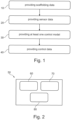
- Figure 1 illustrates a flow diagram of a computer-implemented method for providing control data for controlling at least one robot component configured to assemble and/or disassemble a scaffolding structure and/or a part of a scaffolding structure according to an embodiment of the present disclosure.
- scaffolding data are provided, wherein the scaffolding data at least comprise structural information indicating where a scaffolding component of the scaffolding structure is or should be positioned in the scaffolding structure.
- the scaffolding structure may be a working platform, a facade scaffold, a load-bearing scaffolds, etc. (cf. Figure 4 ).
- the scaffolding data may refer to all scaffolding components, to some scaffolding components or to specific scaffolding components of the scaffolding structure.
- the scaffolding data may refer to vertical standard components (cf. Figures 5 ), horizontal ledger components (cf. Figures 6 ), diagonal brace components, deck components and/or lift/transport components.
- the scaffolding data may comprise or may be provided as Digital Twin (DT) of the scaffold structure and/or the scaffold components.
- the Digital Twin not only refers to the scaffolding structure, but encompasses also the robot components, the human operator(s) and the environment around the scaffolding structure, e.g. the building behind the scaffolding structure, crane, etc.
- sensor data are provided, wherein the sensor data at least comprise component state data of a scaffolding component to be mounted for assembling or to be dismounted for disassembling the scaffolding structure, and robot state data of the at least one robot component.
- the sensor data may be acquired via a wide variety of sensors. These sensors may, for example, be arranged on or at a robot component, in the scaffolding structure, on or in a scaffolding component and/or remote to the scaffolding structure.
- the sensor data may be acquired and processed in real-time.
- the component state data refers to and/or is update according to sensor data with respect to a scaffolding component.
- the component state data may include, for example, the actual position of a scaffold component to be dismounted or mounted, the actual position of a lift/transport component, etc.
- the component state data of a scaffolding component may comprise at least one of the following entries:
- the robot state data refers to sensor data with respect to the robot components.
- the robot state data may include, at least one of the following entries:
- control model configured to provide control data for the at least one robot component based on the scaffolding data and the sensor data.
- the control model encompasses conventional methods for controlling robot components, e.g. force-feedback methods, but also control models comprising trained algorithms. For example, for different tasks, respectively trained algorithms may be used, e.g. a trained algorithm may be used for the movement of the robot component, holding specific scaffold components, grasping scaffold components, inserting/mounting scaffold components into the scaffolding structure, removing scaffold components from the scaffolding structure, and/or transporting scaffolding components, etc.
- control data for the at least one robot component utilizing the control model are provided, wherein at least the scaffolding data and sensor data are used as input data for the control model.
- These control data may be used to assign to the robot component, for example, a transport task, an arrangement of a component, a removal of a component, and the like.
- Figure 2 illustrates a system 50 for providing control data for controlling at least one robot component configured to assemble and/or disassemble a scaffolding structure and/or a part of a scaffolding structure according to an embodiment of the present disclosure.
- the system 50 is comprising a processing circuitry 60, a storage medium 70 and a data interface 70, wherein the data interface 70 is configured to receive the input data for the control model including the scaffolding data and the sensor data.
- the storage medium 70 comprises a computer program that comprises instructions which when the program is executed, cause the processing circuitry 60 to carry out the computer-implemented method for providing control data for controlling at least one robot component as disclosed herein.
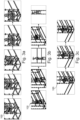
- FIGS 3 illustrate an example of a robot component 100 and its potential movement options in a scaffolding structure.
- the robot component 100 may comprise a lower and an upper part.
- the upper part may act as a universal base for robotic parts, e.g. one or more robot arms, process heads, sensor units, payload, etc.
- the upper part may be lifted from the lower part by means of a scissor lift.
- the lower part may be provided as a universal mobile platform for robot components 100.
- the scissor lift may carry the upper part which can be rotated, so that robot parts mounted on the upper part can be reoriented.
- the upper part may also be equipped with four clamps to firmly connect the upper part to scaffolding components, e.g. ledger components, in the scaffolding structure.
- the lower part may have the shape of a box, e.g. having a width of approximately 650 mm, a length of approximately 650 mm and a height of approximately 500 mm, hosting the drives for the scissor lift and the slewing ring as well as controllers of the robot parts mounted on the upper part.
- the lower part may feature three parallel axles with wheels specifically shaped for running on the rectangular profiles of the ledger components.
- the drives for the wheels may be located in the lower part, with a special capability to pull each axle individually up- and inwards into the lower part.
- the actuated features of the upper and the lower part of the mobile robot platform is able to provide the motions traversal, climbing and turning.
- Traversal may be implemented by driving with six or more wheels on the ledger components. This motion may be interrupted by the vertical standard components and connected crossing ledger components. As shown Figures 3a , for six wheels, the robot component 100 may get around vertical standard components by briefly pulling in and then pushing out again one axis one after another, while keeping contact and moving on the ledger component with the remaining wheels.
- Climbing of the robot component 100 may be implemented as shown in Figures 3b .
- the upper part may be lifted to the second next level of the scaffolding structure, e.g. to the next horizontal elements, where the clamps may be connected with the ledger components. Then all axes may be pulled in, so that the lower part may be hanging from the upper part.
- Activating the scissor lift may now allow to raise the lower part over the next level of the scaffolding structure, where the wheels may be pushed out to provide contact with the ledger components again. Releasing the clamps of the upper part may yield the initial configuration again, but now one level higher.
- Turning of the robot component 100 may be implemented based on lifting and reorienting the lower part by actuating the slewing ring when the upper part is fixed as shown in Figures 3c .
- Figure 4 illustrates a scaffolding structure 200, which is assembled using robot components 100.
- multiple/different robot components 100 may be used for assembly and disassembly of a scaffold structure and/or for other construction operations, like drilling, renovation work, application of insulation layers, transportation of tools and materials, installation or removal of construction elements, sensing of construction objects and environment conditions, execution of robot-supported construction processes, i.e. to modify the construction object or environment, or construction elements, etc.
- the right robot component 100 comprises a process head configured to perform a painting task.
- the present disclosure is not limited to any particular number and/or types of robot components.
- one of the robot components may be used for transport tasks, wherein another robot component 100 may handing over a scaffolding component to a human operator.
- the left robot component 100 comprises an upper part with a dual arm unit equipped with a tool, here grippers.
- the dual arm robot carrying out assembly/disassembly actions in a human-like manner, e.g. both arms may share the load, and one arm guides one end of a scaffolding component for the actual assembly action, while the other arm follows with compensating and supportive motions on the other end of the scaffolding component.
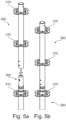
- Figures 5 show two vertical standard components 300 comprising at least one connection node 310, here in form of a rosette element 310.
- the connection node 310 is configured for having further components of the scaffolding structure mounted thereon.
- the rosette element 310 comprises openings into which connection means of other scaffolding components may be inserted and held.
- the vertical standard components 300 should be connected to each other by a robot component 100 so that they are arranged on another, as shown in Figure 5b .
- the shown lower vertical standard component 300 has already been placed in the intended position, e.g. onto a further vertical standard component 300 (not shown).
- the shown upper vertical standard component 300 may be positioned onto the lower vertical standard component 300 by the robot component 100 comprising the following steps:
- Figures 6 show the connected vertical standard components 300 of Figures 5 and a horizontal ledger component 400.
- the horizontal ledger component 400 comprises a further connection means 410, which may be inserted into and hold by the openings of the rosette element 310.
- the horizontal ledger component 400 is being spaced apart from the rosette element 310
- the connection means 410 has been inserted into one of the openings of the rosette element 310.
- the vertical standard components 300 have already been placed in the shown position.
- the horizontal ledger component 400 may be connected to the rosette element 310 by the robot component 100 comprising the following steps:
- the computer program element might therefore be stored on a computing unit of a computing device, which might also be part of an embodiment.
- This computing unit may be configured to perform or induce performing of the steps of the method described above. Moreover, it may be configured to operate the components of the above-described system.
- the computing unit can be configured to operate automatically and/or to execute the orders of a user.
- the computing unit may include a data processor.
- a computer program may be loaded into a working memory of a data processor.
- the data processor may thus be equipped to carry out the method according to one of the preceding embodiments.
- This exemplary embodiment of the present disclosure covers both, a computer program that right from the beginning uses the present disclosure and computer program that by means of an update turns an existing program into a program that uses the present disclosure.
- the computer program element might be able to provide all necessary steps to fulfill the procedure of an exemplary embodiment of the method as described above.
- a computer readable medium such as a CD-ROM, USB stick, a downloadable executable or the like, is presented wherein the computer readable medium has a computer program element stored on it which computer program element is described by the preceding section.
- a computer program may be stored and/or distributed on a suitable medium, such as an optical storage medium or a solid-state medium supplied together with or as part of other hardware, but may also be distributed in other forms, such as via the internet or other wired or wireless telecommunication systems.
- the computer program may also be presented over a network like the World Wide Web and can be downloaded into the working memory of a data processor from such a network.
- a medium for making a computer program element available for downloading is provided, which computer program element is arranged to perform a method according to one of the previously described embodiments of the present disclosure.
- determining also includes “estimating, calculating, initiating or causing to determine”
- generating also includes “initiating or causing to generate”
- providing also includes “initiating or causing to determine, generate, select, send, query or receive”.
Landscapes
- Engineering & Computer Science (AREA)
- Architecture (AREA)
- Mechanical Engineering (AREA)
- Civil Engineering (AREA)
- Structural Engineering (AREA)
- Chemical & Material Sciences (AREA)
- Chemical Kinetics & Catalysis (AREA)
- Electrochemistry (AREA)
- Manipulator (AREA)
Abstract
Description
- The present disclosure relates to a computer-implemented method for providing control data for controlling at least one robot component configured to assemble and/or disassemble a scaffolding structure and/or a part of a scaffolding structure, a system for providing control data for controlling at least one robot component configured to assemble and/or disassemble a scaffolding structure and/or a part of a scaffolding structure, a corresponding computer program element and a use of at least one robot component, scaffolding data, sensor data, state data of a scaffolding component and/or control model in such computer-implemented method or system.
- The present disclosure generally relates to the field of assembling or disassembling a scaffolding structure or a part of such a scaffolding structure. Scaffolds/scaffold structures are building structures of variable length, width and height that are usually used for a limited period of time. They are assembled from different scaffold components, wherein to increase the height and/or width of a scaffold structure, vertical scaffold components and/or horizontal scaffold components and/or spatial scaffold components are connected to each other. The connection is made, among other things, via connection elements, so-called scaffold nodes (e.g. provided by rosette elements), through which they are connected to each other.
- In this context, it has become apparent that there is a further need to simplify the assembly and disassembly of scaffolds. In particular, it has become apparent that there is a further need to make the assembly and disassembly of scaffolds less labor-intensive.
- It is therefore an object of the present disclosure to simplify the assembly and disassembly of scaffolds. In particular, it is the object of the present disclosure to make the assembly and disassembly of scaffolds less labor-intensive.
- These and other objects, which become apparent upon reading the following description, are solved by the subject matters of the independent claims. The dependent claims refer to preferred embodiments of the present disclosure.
- In one aspect of the present disclosure, a computer-implemented method for providing control data for controlling at least one robot component configured to assemble and/or disassemble a scaffolding structure and/or a part of a scaffolding structure is disclosed, wherein the computer-implemented method comprising the following steps:
- providing scaffolding data comprising at least structural information indicating where a scaffolding component of the scaffolding structure is or should be positioned in the scaffolding structure;
- providing sensor data at least comprising: scaffolding component state data of a scaffolding component to be mounted for assembling or to be dismounted for disassembling the scaffolding structure, and robot state data of the at least one robot component;
- providing at least one control model configured to provide control data for the at least one robot component based on the scaffolding data and the sensor data;
- providing control data for the at least one robot component utilizing the control model, wherein at least the scaffolding data and sensor data are used as input data for the control model.
- A further aspect of the present disclosure relates to a system for providing control data for controlling at least one robot component configured to assemble and/or disassemble a scaffolding structure and/or a part of a scaffolding structure, comprising:
- a processing circuitry;
- a storage medium; and
- a data interface;
- wherein the storage medium comprises a computer program that comprises instructions which when the program is executed, cause the processing circuitry to carry out the computer-implemented method for providing control data as disclosed herein;
- wherein the data interface is configured to receive input data for the control model including the scaffolding data and the sensor data.
- A further aspect of the present disclosure relates to a system for providing control data for controlling at least one robot component configured to assemble and/or disassemble a scaffolding structure and/or a part of a scaffolding structure, comprising:
- a first providing unit configured to provide scaffolding data comprising at least structural information indicating where a scaffolding component of the scaffolding structure is or should be positioned in the scaffolding structure;
- a second providing unit configured to provide sensor data at least comprising: scaffolding component state data of a scaffolding component to be mounted for assembling or to be dismounted for disassembling the scaffolding structure, and robot state data of the at least one robot component;
- a third providing unit configured to provide at least one control model configured to provide control data for the at least one robot component based on the scaffolding data and the sensor data;
- a fourth providing unit configured to provide control data for the at least one robot component utilizing the control model, wherein at least the scaffolding data and sensor data are used as input data for the control model.
- A further aspect of the present disclosure relates to an apparatus for providing control data for controlling at least one robot component configured to assemble and/or disassemble a scaffolding structure and/or a part of a scaffolding structure, the apparatus comprising: one or more computing nodes; and one or more computer-readable media having thereon computer-executable instructions that are structured such that, when executed by the one or more computing nodes, cause the apparatus to perform the following steps:
- providing scaffolding data comprising at least structural information indicating where a scaffolding component of the scaffolding structure is positioned in the scaffolding structure;
- providing sensor data at least comprising: component state data of a scaffolding component to be mounted for assembling or to be dismounted for disassembling the scaffolding structure, and robot state data of the at least one robot component;
- providing at least one control model configured to provide control data for the at least one robot component based on the scaffolding data and the sensor data;
- providing control data for the at least one robot component utilizing the control model, wherein at least the scaffolding data and sensor data are used as input data for the control model.
- A further aspect of the present disclosure relates to a robot component configured to build up a scaffolding structure and/or a part of a scaffolding structure, wherein the control data for the robot component is at least partially provided according to the computer-implemented method for providing control data as disclosed herein.
- A further aspect of the present disclosure relates to a computer program element with instructions, which, when executed on computing devices of a computing environment, is configured to carry out the steps of the computer-implemented method for providing control data in a system for providing control data and/or in an apparatus a computer-implemented method for providing control data.
- A further aspect of the present disclosure relates to a use of at least one robot component, scaffolding data, sensor data, component state data of a scaffolding component, robot state data of at least one robot component and/or a control model (e.g. a control model comprising at least one trained algorithm), in a computer-implemented method for providing control data, in a system for providing control data and/or in an apparatus for providing control data.
- A further aspect of the present disclosure relates to a computer-readable storage medium, in particular non-transient storage medium, comprising instructions which, when executed by a computer, cause the computer to carry out the computer-implemented method for providing control data as described herein.
- A further aspect of the present disclosure relates to a method for assembling or disassembling a scaffolding structure and/or a part of a scaffolding structure, comprising the following steps:
- providing scaffolding components required for assembling the scaffolding structure and/or the part of the scaffolding structure;
- providing at least one robot component configured to assemble and/or disassemble the scaffolding structure and/or the part of the scaffolding structure;
- assembling or disassembling the scaffolding structure and/or the part of the scaffolding structure by controlling the at least one robot component by control data provided according the computer-implemented method for providing control data as disclosed herein.
- This and embodiments described herein relate to the methods, the systems, the apparatuses, the computer program element, the computer-readable storage medium, the use lined out above and vice versa. Advantageously, the benefits provided by any of the embodiments and examples equally apply to all other embodiments and examples and vice versa.
- The present disclosure allows a simplified assembly and disassembly of scaffolding structures. In particular, the present disclosure allows an assembly or disassembly of scaffolding structures in a less labor-intensive manner by providing and subsequently using control data for robot components configured to assemble and/or disassemble a scaffolding structure and/or a part of a scaffolding structure.
- In other words, by providing control data for at least one robot component, the present disclosure provides the basis for a robotic solution for automatic or at least partially automatic assembly and disassembly of scaffolding structures. The present disclosure may further provide the basis for machine-human collaboration during the assembly or disassembly of scaffolding structures. The present disclosure also provides the possibility of using a plurality of mobile robot components, e.g. mobile robot platforms, which may be equipped with different components, sensors and/or tools, for assembling and disassembling scaffolds.
- The term "robot component" as used herein is to be understood broadly in the present case. In particular, the term robot component includes any mobile and/or stationary robot components suitable for assisting in the assembly or disassembly of a scaffolding structure/scaffold component. In particular, this term encompasses robot components that are suitable for holding scaffold components, grasping scaffold components, inserting/mounting scaffold components into the scaffolding structure, removing scaffold components from the scaffolding structure, and/or transporting scaffolding components. The present disclosure also includes embodiments in which a robot component may only perform transportation tasks and, for example, transports scaffolding components to their respective assembly location in the scaffolding structure where they are assembled, e.g. by a human operator. There is also the possibility of providing function-specific robot components that perform specific functions during assembly and disassembly of a scaffolding structure. For example, robot components may be provided specialized for the transport and storage of scaffolding components. Also, the robot component may be provided with different exchangeable means, which allows flexible use of a robot component. For example, a robot component may be designed as a mobile robot platform comprising or connected to one or more process heads with one or more movable arms. A process head may be provided, for example, as an arm-like unit equipped with an optionally exchangeable tool, such as a gripper. There is the possibility to provide a dual arm robot carrying out assembly/disassembly actions in a human-like manner, e.g. both arms are sharing the load, and one arm guides one end of a scaffolding component for the actual assembly action, while the other arm follows with compensating and supportive motions on the other end of the scaffolding component. In an example, the robot component may comprise one or more exchangeable process heads, wherein every process head may comprise a specific set of sensors or provide a specific functionality.
- A mobility of such a robot component may be provided, for example, by using a wheel-based movement unit, wherein the present disclosure is not limited thereto. The robot component may move on a deck component of the scaffolding structure and/or be designed to move on certain scaffold components, such as horizontal elements/components of the scaffolding structure. In addition, it is possible for the robot component to move on or in guide rails. Furthermore, it is possible to provide guide means, for example a magnetic strip, for the robot component on and/or on certain scaffold components.
- The mobility of such a robot component may be limited only to one level of a scaffolding structure. In an example, the robot component may use a lift/transport component to reach another level of the scaffolding structure. In an example, the mobile robot platform itself may comprise a scissor lift unit allowing the mobile robot platform to reach another level of the scaffolding structure.
- In addition to the process heads/robot components required for assembling the scaffolding structure, there is also the possibility that process heads are provided that are intended for certain other tasks, beyond assembly/disassembly of scaffolding structures. In one example, the control data may include instructions also for such tasks. In other words, robot components or process heads can be provided that perform construction operations on a scaffolding structure. Such construction operations can be, for example: drilling, renovation work, application of insulation layers, transportation of tools and materials, installation or removal of construction elements, sensing of construction objects and environment conditions, execution of robot-supported construction processes, i.e. to modify the construction object or environment, or construction elements, etc.
- The term "scaffolding structure" as used herein is to be understood broadly in the present case and refers to any scaffold or parts thereof that can be provided by means of individual scaffolding components that are to be connected in order to build the scaffold structure or parts thereof. This term encompasses any working platforms, facade scaffolds, load-bearing scaffolds for assembly work or formwork work, but is not limited thereto. In this context, it is further noted that the present disclosure not only refers to the "entire" assembly or disassembly of a scaffolding structure, but also includes the "partial" assembly or disassembly of a scaffolding structure. In addition, this term also encompasses simultaneous assembly and disassembly of different areas of the scaffold structure. For example, the present disclosure also encompasses embodiments in which only one or more specific components are assembled or disassembled by the robot component. In an example, the scaffolding structure may comprise the following components as scaffold components:
- vertical standard components comprising at least one connection node, preferably in form of a rosette element, wherein the connection node is configured for having further components of the scaffolding structure mounted thereon;
- a horizontal ledger component comprising at least one first connection means configured to be mounted to the at least one connection node of the vertical standard component;
- a diagonal brace component comprising at least one second connection means configured to be mounted to the at least one connection node of the vertical standard component;
- a deck component comprising at least one third connection means configured to be mounted to the at least one connection node and/or the horizontal ledger component, wherein the deck component preferably further comprises at least one locking means configured to lock the deck component in a mounting position;
- a lift and/or transport component/system configured to house at least one robot component and transport the robot component between levels of the scaffolding structure; and/or
- a lift and/or transport component/system configured to transport scaffolding components between levels of the scaffolding structure.
- The term "scaffolding data" as used herein is to be understood broadly in the present case, wherein the scaffolding data at least comprise structural information indicating where a scaffolding component of the scaffolding structure is or should be positioned in the scaffolding structure. In other words, the scaffolding data includes the mounting positions of the respective scaffolding components in the scaffolding structure. The scaffolding data may refer to all scaffolding components, to some scaffolding components or to specific scaffolding components of the scaffolding structure. For example, the scaffolding data may refer to vertical standard components, horizontal ledger components, diagonal brace components, deck components and/or lift/transport components. However, the scaffolding data is not limited thereto.
- The scaffolding data may represent the current state of the scaffolding structure and/or the scaffolding components, the scaffolding data may comprise or may be provided as Digital Twin (DT) of the scaffold structure and/or the scaffold components. The scaffolding data may comprise further information with respect to the scaffolding components. For example, the scaffolding data may further comprise at least one of the following entries:
- geometry data of at least one of the scaffolding components;
- weight data of at least one of the scaffolding components;
- weight distribution data of at least one of the scaffolding components;
- center of gravity data of at least one of the scaffolding components; and/or
- position and/or orientation data of at least one of the scaffolding components based on a relative coordinate system, wherein the position and/or orientation data relates to a position and/or an orientation of at least one of the scaffolding components in the scaffolding structure.
- In addition, there is also the possibility to provide a Digital Twin not only for the scaffolding structure, but also for the robot components, operator and the environment, e.g. the building behind the scaffolding structure, crane, etc. The term Digital Twin is to be understood broadly here and includes any digital representation of the object mentioned here from the real world in the digital world.
- The term "sensor data" as used herein is to be understood broadly in the present case and comprises information about the state of a scaffold component as component state data and about the state of a robot component as robot state data. The sensor data may be acquired via a wide variety of sensors. These sensors may, for example, be arranged on or at a robot component, in the scaffolding structure, on or in a scaffolding component and/or remote to the scaffolding structure. The sensors may also be stationary or mobile. For example, fixed sensor units (e.g. camera units) may be provided at different positions in the scaffolding structure, wherein one or more sensor units may be attached to mobile drones.
- For example, the following sensors may be used to acquire/provide the sensor data:
- a camera unit;
- a force-feedback sensor; and/or
- a weight sensor;
- a Lidar sensor;
- a distance sensor;
- a radar sensor;
- a laser scanner;
- an inertial measurement unit (IMU) comprising accelerometers, gyroscopes and/or magnetometers;
- a temperature sensor;
- a barometer; and/or
- an encoder.
- The term "component state data" as used herein is to be understood broadly in the present case and refers to sensor data with respect to the scaffolding components. The component state data may include, for example, the actual position of a scaffold component to be dismounted or mounted, the actual position of a lift/transport component, etc. For example, the component state data of a scaffolding component may comprise at least one of the following entries:
- position/location of a scaffolding component;
- orientation of a scaffolding component in three dimensions;
- state of connection means of a scaffolding component;
- orientation of connecting means of a scaffolding component;
- state of locking means of a scaffolding component;
- orientation of locking means of a scaffolding component;
- state of defects of scaffolding components;
- state of a lift/transport component; and/or
- content of a lift/transport component.
- It is also possible to assign a unique scaffolding component identifier to a scaffolding component and assign the component state data to it. It is also possible to display or represent the component state data using a Digital Twin of the scaffolding component.
- In this context, it is to be noted that certain entries of the scaffolding data may also be included in the component state data additionally or alternatively. In particular, the geometry data of a scaffolding component, the weight data of a scaffolding component, the weight distribution data of a scaffolding component, the center of gravity data of a scaffolding component, etc. may be included in the component state data. The specific allocation of this additional data is not significant, since both the component state data, as part of the sensor data, and the scaffolding data are used as input data for the control model.
- The term "robot state data" as used herein is to be understood broadly in the present case and refers to sensor data with respect to the robot components. The robot state data may include, at least one of the following entries:
- position/location of a robot component;
- orientation of a robot component in three dimensions;
- tool loading of a robot component;
- battery charge level of a battery of a robot component;
- forces acting on a scaffolding component by a robot component;
- torques acting on a scaffolding component by a robot component; and/or
- state of grasping means by a robot component.
- The term "control model" as used herein is to be understood broadly in the present case and encompasses known conventional force-feedback methods for controlling robot components. In an example, the control model may comprise at least one trained algorithm, wherein the term "trained algorithm" or "trained control model" as used herein is to be understood broadly in the present case. The algorithm may be a machine learning algorithm. The algorithm may comprise decision trees, naive bayes classifications, nearest neighbors, neural networks, convolutional or recurrent neural networks, transformers, generative adversarial networks, support vector machines, linear regression, logistic regression, random forest, gradient boosting algorithms and/or a diffusion model. Such an algorithm, in particular machine learning algorithm, is termed "intelligent" because it is capable of being "trained." The algorithm may be trained using records of training data. A record of training data comprises training input data and corresponding training output data. In the context of the present disclosure, training data may, for example be sensor data training sets, the sets may comprise reference sensor data and at least one control data/output for controlling a robot component. The training output data of a record of training data is the result that is expected to be produced by the algorithm when being given the training input data of the same record of training data as input. The deviation between this expected result and the actual result produced by the algorithm is observed and rated by means of a "loss function". This loss function may be used as feedback for adjusting the parameters of the internal processing chain of the algorithm. For example, the parameters may be adjusted with the optimization goal of minimizing the values of the loss function that result when all training input data are fed into the algorithm and the outcome is compared with the corresponding training output data. The result of this training is that given a relatively small number of records of training data as "ground truth", the algorithm is enabled to perform its job well for a number of records of input data that is higher by many orders of magnitude. Notably, the control model may comprise several or even a large number of different control routines/sub-models, for example a trained algorithm for controlling the movement of the robot component in the scaffolding system, a force feedback control routine for gripping a scaffolding component, etc. It is also possible to use mixed control routines that combine different control approaches.
- The term "control data" as used herein is to be understood broadly in the present case and comprises any data structure/information structure that is suitable for controlling a robot component, for example in digital form and/or in analog form.
- The term "data" as used herein is to be understood broadly in the present case and represents any kind of data. Data may be single numbers/numerical values, a plurality of a numbers/numerical values, a plurality of a numbers/numerical values being arranged within a list, 2 dimensional maps or 3 dimensional maps, but are not limited thereto.
- The term "providing" as used herein is to be understood broadly in the present case and represents any providing, receiving, querying, measuring, calculating, determining, transmitting of data, but is not limited thereto. Data may be provided by a user via a user interface, depicted/shown to a user by a display, and/or received from other devices, queried from other devices, measured other devices, calculated by other device, determined by other devices and/or transmitted by other devices.
- In an embodiment of the computer-implemented method, the scaffolding data may comprise entries relating to at least one of the following scaffolding components:
- a vertical standard component comprising at least one connection node, preferably in form of a rosette element, wherein the connection node is configured for having further components of the scaffolding structure mounted thereon;
- a horizontal ledger component comprising at least one first connection means configured to be mounted to the at least one connection node of the vertical standard component;
- a diagonal brace component comprising at least one second connection means configured to be mounted to the at least one connection node of the vertical standard component;
- a deck component comprising at least one third connection means configured to be mounted to the at least one connection node and/or the horizontal ledger component, wherein the deck component preferably further comprises at least one locking means configured to lock the deck component in a mounting position;
- a lift/transport component configured to house at least one robot component and transport the robot component between levels of the scaffolding structure; and/or
- a lift/transport component configured to transport scaffolding components between levels of the scaffolding structure.
- In an embodiment of the computer-implemented method, the scaffolding data may further comprise at least one of the following entries:
- geometry data of at least one of the scaffolding components;
- weight data of at least one of the scaffolding components;
- weight distribution data of at least one of the scaffolding components;
- center of gravity data of at least one of the scaffolding components; and/or
- position and/or orientation data of at least one of the scaffolding components based on a relative coordinate system, wherein the position and/or orientation data relates to a position and/or an orientation of at least one of the scaffolding components in the scaffolding structure.
- In this respect, it is to be noted that the further entries of the scaffolding data may also be included in the component state data and vice versa, entries of the components state data may also be included in the scaffolding data.
- In an embodiment of the computer-implemented method, the at least one robot component may comprise a lower part configured as mobile robot platform and an upper part comprising at least one process head, which is preferably an exchangeable process head, configured to mount and/or dismount at least one scaffolding component. A mobile robot platform may allow for traversing and climbing in a scaffolding structure. In this respect, the mobile robot platform may comprise a wheel-based movement unit allowing a movement on a level of the scaffolding structure. The robot component, i.e. the lower mobile robot platform, may move on a deck component of the scaffolding structure and/or be designed to move on certain scaffold components, such as horizontal components, e.g. horizontal beams, of the scaffolding structure. Moreover, for providing a movement between the levels of the scaffolding structure, the mobile robot platform may comprise a scissor lift unit.
- In an embodiment of the computer-implemented method, the at least one robot component may be a mobile robot platform comprising a wheel-based movement unit and one or two process heads. In an example, the robot component is a dual arm robot for carrying out assembly actions in a human-like manner, e.g. both hands are sharing the load, and one hand guides one end of a scaffolding component for the actual assembly action, while the other hand follows with compensating and supportive motions on the other end of the scaffolding component.
- In an embodiment of the computer-implemented method, the at least one robot component may be a mobile robot platform comprising storage means configured to store at least one scaffolding component.
- In an embodiment of the computer-implemented method, the computer-implemented method may further comprise:
providing control data for at least two robot components, wherein the robot components are configured to perform different tasks when assembling or disassembling the scaffolding structure and/or the part of a scaffolding structure. - In an embodiment of the computer-implemented method, at least one of the tasks is a transport task of at least one scaffolding component, wherein the transport task preferably relates to a transport from a storage location of the scaffolding component to an assembly location of the scaffolding component or from a disassembly location to a storage location.
- In an embodiment of the computer-implemented method, the sensor data may be provided by at least one of the following sensors:
- a camera unit;
- a force-feedback sensor; and/or
- a weight sensor;
- a Lidar sensor;
- a distance sensor;
- a radar sensor;
- a laser scanner;
- an inertial measurement unit (IMU) comprising accelerometers, gyroscopes and/or magnetometers;
- a temperature sensor;
- a barometer; and/or
- an encoder.
- In an embodiment of the computer-implemented method, the sensor data may further comprise environmental data. For example, actual and/or future weather data may be taken into account here to determine whether or not certain tasks may be carried out due to weather conditions. For example, limit values for wind speeds, precipitation amounts, outside temperatures, etc. may be taken into account here.
- In an embodiment of the computer-implemented method, the component state data of a scaffolding component may comprise at least one of the following entries:
- position/location of a scaffolding component;
- orientation of a scaffolding component in three dimensions;
- state of connection means of a scaffolding component;
- orientation of connecting means of a scaffolding component;
- state of locking means of a scaffolding component;
- orientation of locking means of a scaffolding component;
- state of defects of scaffolding components;
- state of a lift/transport component; and/or
- content of a lift/transport component.
- In an embodiment of the computer-implemented method, the robot state data of the robot component may include, at least one of the following entries:
- position/location of a robot component;
- orientation of a robot component in three dimensions;
- tool loading of a robot component;
- battery charge level of a battery of a robot component;
- forces acting on a scaffolding component by a robot component;
- torques acting on a scaffolding component by a robot component; and/or
- state of grasping means by a robot component.
- In an embodiment of the computer-implemented method, the control model may comprise at least one trained algorithm, wherein the training data for the control model comprises labeled sensor data.
- In an embodiment of the computer-implemented method, the control model may comprise model components that are individually trained to a mounting operation and/or dismounting operation of a specific scaffolding component.
- In an embodiment of the computer-implemented method, the trained control model may comprise predetermined movement patterns for specific scaffolding components, wherein the trained control model may be further configured to adapt these predetermined movement patterns based on the provided sensor data.
- In an embodiment of the computer-implemented method, the control data for at least one robot component may be configured for human-machine collaboration comprising predetermined movement patterns, wherein the trained control model may be further configured to adapt these predetermined movement patterns based on the provided sensor data.
- In an embodiment of the computer-implemented method, the trained control model may be further adapted to provide a confirmation request when a predetermined task has been completed, and wherein after providing a confirmation request, the robot component is set on hold until a confirmation response has been provided, preferably by means of a human input interface. However, the confirmation response may also be provided by a confirmation model using sensor data as input data for issuing a confirmation response.
- In an embodiment of the computer-implemented method, the trained control model may be further adapted to provide an assisting request when a predetermined task is to be performed requiring a predefined human interaction, and wherein after providing an assisting request, the robot component is set on hold until the predefined human interaction has been performed.
- In an embodiment of the computer-implemented method, the trained control model may be further adapted to provide an error stop of the at least one robot component when the sensor data indicates that at least one of the entries of the state data and/or the sensor data is outside or within a predefined value range.
- In the following particularly preferred embodiments are disclosed, which may be combined with the above-disclosed methods, systems, apparatuses, devices and/or use cases. The embodiments described herein may be combined unless specifically noted otherwise. Features and advantages described with respect to one aspect of the disclosure may be applied to other aspects of the disclosure.
- In the following, the present disclosure is further described with reference to the enclosed figures:
- Figure 1
- illustrates a flow diagram of a computer-implemented method for providing control data for controlling at least one robot component configured to assemble and/or disassemble a scaffolding structure and/or a part of a scaffolding structure according to an embodiment of the present disclosure;
- Figure 2
- illustrates a system for providing control data for controlling at least one robot component configured to assemble and/or disassemble a scaffolding structure and/or a part of a scaffolding structure according to an embodiment of the present disclosure; and
- Figures 3
- illustrate an example of a mobile robot platform and its potential movement options in a scaffolding structure;
- Figure 4
- illustrates a scaffolding structure, which is assembled using at least one of the mobile robot platforms shown in
Figures 3 ; - Figures 5
- illustrate two vertical standard components of a scaffolding structure; and
- Figures 6
- illustrate a horizontal ledger component configured to be mounted to the vertical standard components shown in
Figure 5 . - The following embodiments are mere examples for implementing the method, the system, the apparatus, or application device disclosed herein and shall not be considered limiting.
-
Figure 1 illustrates a flow diagram of a computer-implemented method for providing control data for controlling at least one robot component configured to assemble and/or disassemble a scaffolding structure and/or a part of a scaffolding structure according to an embodiment of the present disclosure. - In a
first step 10, scaffolding data are provided, wherein the scaffolding data at least comprise structural information indicating where a scaffolding component of the scaffolding structure is or should be positioned in the scaffolding structure. The scaffolding structure may be a working platform, a facade scaffold, a load-bearing scaffolds, etc. (cf.Figure 4 ). The scaffolding data may refer to all scaffolding components, to some scaffolding components or to specific scaffolding components of the scaffolding structure. For example, the scaffolding data may refer to vertical standard components (cf.Figures 5 ), horizontal ledger components (cf.Figures 6 ), diagonal brace components, deck components and/or lift/transport components. The scaffolding data may comprise or may be provided as Digital Twin (DT) of the scaffold structure and/or the scaffold components. In an example, the Digital Twin not only refers to the scaffolding structure, but encompasses also the robot components, the human operator(s) and the environment around the scaffolding structure, e.g. the building behind the scaffolding structure, crane, etc. - In a
second step 20, sensor data are provided, wherein the sensor data at least comprise component state data of a scaffolding component to be mounted for assembling or to be dismounted for disassembling the scaffolding structure, and robot state data of the at least one robot component. The sensor data may be acquired via a wide variety of sensors. These sensors may, for example, be arranged on or at a robot component, in the scaffolding structure, on or in a scaffolding component and/or remote to the scaffolding structure. The sensor data may be acquired and processed in real-time. - The component state data refers to and/or is update according to sensor data with respect to a scaffolding component. The component state data may include, for example, the actual position of a scaffold component to be dismounted or mounted, the actual position of a lift/transport component, etc. For example, the component state data of a scaffolding component may comprise at least one of the following entries:
- position/location of a scaffolding component;
- orientation of a scaffolding component in three dimensions;
- state of connection means of a scaffolding component;
- orientation of connecting means of a scaffolding component;
- state of locking means of a scaffolding component;
- orientation of locking means of a scaffolding component;
- state of defects of scaffolding components;
- state of a lift/transport component; and/or
- content of a lift/transport component.
- The robot state data refers to sensor data with respect to the robot components. The robot state data may include, at least one of the following entries:
- position/location of a robot component;
- orientation of a robot component in three dimensions;
- tool loading of a robot component;
- battery charge level of a battery of a robot component;
- forces acting on a scaffolding component by a robot component;
- torques acting on a scaffolding component by a robot component; and/or
- state of grasping means by a robot component.
- In a
third step 30, at least one control model configured to provide control data for the at least one robot component based on the scaffolding data and the sensor data is provided. The control model encompasses conventional methods for controlling robot components, e.g. force-feedback methods, but also control models comprising trained algorithms. For example, for different tasks, respectively trained algorithms may be used, e.g. a trained algorithm may be used for the movement of the robot component, holding specific scaffold components, grasping scaffold components, inserting/mounting scaffold components into the scaffolding structure, removing scaffold components from the scaffolding structure, and/or transporting scaffolding components, etc. - In a
fourth step 40, control data for the at least one robot component utilizing the control model are provided, wherein at least the scaffolding data and sensor data are used as input data for the control model. These control data may be used to assign to the robot component, for example, a transport task, an arrangement of a component, a removal of a component, and the like. -
Figure 2 illustrates asystem 50 for providing control data for controlling at least one robot component configured to assemble and/or disassemble a scaffolding structure and/or a part of a scaffolding structure according to an embodiment of the present disclosure. Thesystem 50 is comprising aprocessing circuitry 60, astorage medium 70 and adata interface 70, wherein thedata interface 70 is configured to receive the input data for the control model including the scaffolding data and the sensor data. Thestorage medium 70 comprises a computer program that comprises instructions which when the program is executed, cause theprocessing circuitry 60 to carry out the computer-implemented method for providing control data for controlling at least one robot component as disclosed herein. -
Figures 3 illustrate an example of arobot component 100 and its potential movement options in a scaffolding structure. Therobot component 100 may comprise a lower and an upper part. The upper part may act as a universal base for robotic parts, e.g. one or more robot arms, process heads, sensor units, payload, etc. The upper part may be lifted from the lower part by means of a scissor lift. The lower part may be provided as a universal mobile platform forrobot components 100. - In addition, by means of a slewing ring, e.g. a strong, slow revolute joint, the scissor lift may carry the upper part which can be rotated, so that robot parts mounted on the upper part can be reoriented. The upper part may also be equipped with four clamps to firmly connect the upper part to scaffolding components, e.g. ledger components, in the scaffolding structure. The lower part may have the shape of a box, e.g. having a width of approximately 650 mm, a length of approximately 650 mm and a height of approximately 500 mm, hosting the drives for the scissor lift and the slewing ring as well as controllers of the robot parts mounted on the upper part.
- At the bottom, the lower part may feature three parallel axles with wheels specifically shaped for running on the rectangular profiles of the ledger components. The drives for the wheels may be located in the lower part, with a special capability to pull each axle individually up- and inwards into the lower part.
- In coordination, the actuated features of the upper and the lower part of the mobile robot platform is able to provide the motions traversal, climbing and turning.
- Traversal may be implemented by driving with six or more wheels on the ledger components. This motion may be interrupted by the vertical standard components and connected crossing ledger components. As shown
Figures 3a , for six wheels, therobot component 100 may get around vertical standard components by briefly pulling in and then pushing out again one axis one after another, while keeping contact and moving on the ledger component with the remaining wheels. - Climbing of the
robot component 100 may be implemented as shown inFigures 3b . The upper part may be lifted to the second next level of the scaffolding structure, e.g. to the next horizontal elements, where the clamps may be connected with the ledger components. Then all axes may be pulled in, so that the lower part may be hanging from the upper part. Activating the scissor lift may now allow to raise the lower part over the next level of the scaffolding structure, where the wheels may be pushed out to provide contact with the ledger components again. Releasing the clamps of the upper part may yield the initial configuration again, but now one level higher. - Turning of the
robot component 100 may be implemented based on lifting and reorienting the lower part by actuating the slewing ring when the upper part is fixed as shown inFigures 3c . -
Figure 4 illustrates ascaffolding structure 200, which is assembled usingrobot components 100. As shown inFigure 4 , multiple/different robot components 100 may be used for assembly and disassembly of a scaffold structure and/or for other construction operations, like drilling, renovation work, application of insulation layers, transportation of tools and materials, installation or removal of construction elements, sensing of construction objects and environment conditions, execution of robot-supported construction processes, i.e. to modify the construction object or environment, or construction elements, etc., wherein inFigure 4 , as an example, theright robot component 100 comprises a process head configured to perform a painting task. Notably, the present disclosure is not limited to any particular number and/or types of robot components. As also shown inFigure 4 , there is further the possibility of a human-machine collaboration. For example, one of the robot components may be used for transport tasks, wherein anotherrobot component 100 may handing over a scaffolding component to a human operator. In the shown example, theleft robot component 100 comprises an upper part with a dual arm unit equipped with a tool, here grippers. In such case, it is possibility that the dual arm robot carrying out assembly/disassembly actions in a human-like manner, e.g. both arms may share the load, and one arm guides one end of a scaffolding component for the actual assembly action, while the other arm follows with compensating and supportive motions on the other end of the scaffolding component. -
Figures 5 show two verticalstandard components 300 comprising at least oneconnection node 310, here in form of arosette element 310. Theconnection node 310 is configured for having further components of the scaffolding structure mounted thereon. Here, for example, therosette element 310 comprises openings into which connection means of other scaffolding components may be inserted and held. - As shown in
Figure 5a , the verticalstandard components 300, initially being spaced apart, should be connected to each other by arobot component 100 so that they are arranged on another, as shown inFigure 5b . In this example, the shown lower verticalstandard component 300 has already been placed in the intended position, e.g. onto a further vertical standard component 300 (not shown). The shown upper verticalstandard component 300 may be positioned onto the lower verticalstandard component 300 by therobot component 100 comprising the following steps: - emptying at least one grasping tool of a process head of the
robot component 100; - moving the
robot component 100 to a pick-up position for the verticalstandard component 300, e.g. moving to a lift/transport component providing scaffolding components to the different levels of the scaffolding structure; - picking up a or a specific vertical
standard component 300 by means of the at least one grasping tool; - moving the
robot component 100 to the installation position for the verticalstandard component 300, e.g. based on pre-programmed motions/movements, which may be adapted online, e.g. based on visual sensor data; - inserting one end of the upper vertical
standard component 300 in the already mounted/placed counterpart of the lower verticalstandard component 300; - releasing the upper vertical
standard component 300 by opening the grasping tool(s) of the process head(s) of therobot component 100; - confirming/checking a correct positioning of the upper vertical
standard component 300, e.g. by using visual sensor data. -
Figures 6 show the connected verticalstandard components 300 ofFigures 5 and ahorizontal ledger component 400. Thehorizontal ledger component 400 comprises a further connection means 410, which may be inserted into and hold by the openings of therosette element 310. InFigure 6a , thehorizontal ledger component 400 is being spaced apart from therosette element 310, inFigure 6b , the connection means 410 has been inserted into one of the openings of therosette element 310. In this example, the verticalstandard components 300 have already been placed in the shown position. Thehorizontal ledger component 400 may be connected to therosette element 310 by therobot component 100 comprising the following steps: - emptying at least one grasping tool of a process head of the
robot component 100; - moving the
robot component 100 to a pick-up position for thehorizontal ledger component 400, e.g. moving to a lift/transport component providing scaffolding components to the different levels of the scaffolding structure; - picking up a or a specific
horizontal ledger component 400 by means of the at least one grasping tool; - moving the
robot component 100 to the installation position for thehorizontal ledger component 400, e.g. based on pre-programmed motions/movements, which may be adapted online, e.g. based on visual sensor data; - inserting the connection means 410 at a first end of the
horizontal ledger component 400 in the already mounted/placedrosette element 310 of a first verticalstandard component 300, based on pre-programmed motions, which are adapted online at least based on visual sensor data; - inserting the connection means 410 at a second end (not shown) of the
horizontal ledger component 400 in arosette element 310 of a second vertical standard component 300 (not shown), based on pre-programmed motions, which are adapted online at least based on visual sensor data; - releasing the
horizontal ledger component 400 by opening the grasping tool(s) of the process head(s) of therobot component 100; - confirming/checking a correct positioning of the
horizontal ledger component 400, e.g. by using visual sensor data. - Aspects of the present disclosure relate to computer program elements configured to carry out steps of the methods described above. The computer program element might therefore be stored on a computing unit of a computing device, which might also be part of an embodiment. This computing unit may be configured to perform or induce performing of the steps of the method described above. Moreover, it may be configured to operate the components of the above-described system. The computing unit can be configured to operate automatically and/or to execute the orders of a user. The computing unit may include a data processor. A computer program may be loaded into a working memory of a data processor. The data processor may thus be equipped to carry out the method according to one of the preceding embodiments. This exemplary embodiment of the present disclosure covers both, a computer program that right from the beginning uses the present disclosure and computer program that by means of an update turns an existing program into a program that uses the present disclosure. Moreover, the computer program element might be able to provide all necessary steps to fulfill the procedure of an exemplary embodiment of the method as described above. According to a further exemplary embodiment of the present disclosure, a computer readable medium, such as a CD-ROM, USB stick, a downloadable executable or the like, is presented wherein the computer readable medium has a computer program element stored on it which computer program element is described by the preceding section. A computer program may be stored and/or distributed on a suitable medium, such as an optical storage medium or a solid-state medium supplied together with or as part of other hardware, but may also be distributed in other forms, such as via the internet or other wired or wireless telecommunication systems. However, the computer program may also be presented over a network like the World Wide Web and can be downloaded into the working memory of a data processor from such a network. According to a further exemplary embodiment of the present disclosure, a medium for making a computer program element available for downloading is provided, which computer program element is arranged to perform a method according to one of the previously described embodiments of the present disclosure.
- The present disclosure has been described in conjunction with a preferred embodiment as examples as well. However, other variations can be understood and effected by those persons skilled in the art and practicing the claimed invention, from the studies of the drawings, this disclosure and the claims. Notably, in particular, the any steps presented can be performed in any order, i.e. the present invention is not limited to a specific order of these steps. Moreover, it is also not required that the different steps are performed at a certain place or at one node of a distributed system, i.e. each of the steps may be performed at a different node using different equipment/data processing units.
- As used herein "determining" also includes "estimating, calculating, initiating or causing to determine", "generating" also includes "initiating or causing to generate" and "providing" also includes "initiating or causing to determine, generate, select, send, query or receive".
- In the claims as well as in the description the word "comprising" does not exclude other elements or steps and the indefinite article "a" or "an" does not exclude a plurality. A single element or other unit may fulfill the functions of several entities or items recited in the claims. The mere fact that certain measures are recited in the mutual different dependent claims does not indicate that a combination of these measures cannot be used in an advantageous implementation.
-
- 10
- step providing scaffolding data
- 20
- step providing sensor data
- 30
- step providing control model
- 40
- step providing control data
- 50
- system for providing control data
- 60
- processing circuit
- 70
- storage medium
- 80
- data interface
- 100
- robot component
- 200
- scaffolding structure
- 300
- vertical standard component
- 310
- connection node/rosette element
- 400
- horizontal ledger component
- 410
- connection means
Claims (15)
- Computer-implemented method for providing control data for controlling at least one robot component configured to assemble and/or disassemble a scaffolding structure and/or a part of a scaffolding structure, comprising the following steps:providing (10) scaffolding data comprising at least structural information indicating where a scaffolding component of the scaffolding structure is positioned in the scaffolding structure;providing (20) sensor data at least comprising:
component state data of a scaffolding component to be mounted for assembling or to be dismounted for disassembling the scaffolding structure, and robot state data of the at least one robot component;providing (30) at least one control model configured to provide control data for the at least one robot component based on the scaffolding data and the sensor data;providing (40) control data for the at least one robot component utilizing the control model, wherein at least the scaffolding data and sensor data are used as input data for the control model. - Computer-implemented method according to claim 1, wherein the scaffolding data comprises entries relating to at least one of the following scaffolding components:• a vertical standard component comprising at least one connection node, preferably in form of a rosette element, wherein the connection node is configured for having further components of the scaffolding structure mounted thereon;• a horizontal ledger component comprising at least one first connection means configured to be mounted to the at least one connection node of the vertical standard component;• a diagonal brace component comprising at least one second connection means configured to be mounted to the at least one connection node of the vertical standard component;• a deck component comprising at least one third connection means configured to be mounted to the at least one connection node and/or the horizontal ledger component, wherein the deck component preferably further comprises at least one locking means configured to lock the deck component in a mounting position;• a lift/transport component configured to house at least one robot component and transport the robot component between levels of the scaffolding structure; and/or• a lift/transport component configured to transport scaffolding components between levels of the scaffolding structure.
- Computer-implemented method according to claim 2, wherein the scaffolding data further comprises at least one of the following entries:• geometry data of at least one of the scaffolding components;• weight data of at least one of the scaffolding components;• weight distribution data of at least one of the scaffolding components;• center of gravity data of at least one of the scaffolding components; and/or• position and/or orientation data of at least one of the scaffolding components based on a relative coordinate system, wherein the position and/or orientation data relates to a position and/or an orientation of at least one of the scaffolding components in the scaffolding structure.
- Computer-implemented method according to any one of the preceding claims, wherein the at least one robot component comprises a lower part configured as a mobile robot platform and an upper part comprising at least one process head, which is preferably an exchangeable process head, configured to mount and/or dismount at least one scaffolding component.
- Computer-implemented method according to any one of the preceding claims, further comprising:
providing control data for at least two robot components, wherein the robot components are configured to perform different tasks when assembling or disassembling the scaffolding structure and/or the part of a scaffolding structure, wherein at least one of the tasks is preferably a transport task of at least one scaffolding component, wherein the transport task preferably relates to a transport from a storage location of the scaffolding component to an assembly location of the scaffolding component or from a disassembly location to a storage location. - Computer-implemented method according to any one of the preceding claims, wherein the sensor data are provided by at least one of the following sensors:• a camera unit;• a force-feedback sensor; and/or• a weight sensor;• a Lidar sensor;• a distance sensor;• a radar sensor;• a laser scanner;• an inertial measurement unit (IMU) comprising accelerometers, gyroscopes and/or magnetometers;• a temperature sensor;• a barometer; and/or• an encoder.
- Computer-implemented method according to any one of the preceding claims, wherein the component state data of a scaffolding component comprises at least one of the following entries:• position/location of a scaffolding component;• orientation of a scaffolding component in three dimensions;• state of connection means of a scaffolding component;• orientation of connecting means of a scaffolding component;• state of locking means of a scaffolding component;• orientation of locking means of a scaffolding component;• state of defects of scaffolding components;• state of a lift/transport component; and/or• content of a lift/transport component.
- Computer-implemented method according to any one of the preceding claims, wherein the control model is a trained control model comprising at least one trained algorithm, wherein the training data for the trained control model comprises labeled sensor data.
- Computer-implemented method according to claim 8, wherein the trained control model comprises model components that are individually trained to a mounting operation and/or dismounting operation of a specific scaffolding component.
- Computer-implemented method according to claim 8 or claim 9, wherein the trained control model comprises predetermined movement patterns for specific scaffolding components, wherein the trained control model is further configured to adapt these predetermined movement patterns based on the provided sensor data.
- Computer-implemented method according to any one of the preceding claims, wherein the control model is further adapted to provide a confirmation request when a predetermined task has been completed, and wherein after providing a confirmation request, the robot component is set on hold until a confirmation response has been provided, preferably by means of a human input interface.
- Computer-implemented method according to any one of the preceding claims, wherein the control model is further adapted to provide an assisting request when a predetermined task is to be performed requiring a predefined human interaction, and wherein after providing an assisting request, the robot component is set on hold until the predefined human interaction has been performed.
- System (50) for providing control data for controlling at least one robot component configured to assemble and/or disassemble a scaffolding structure and/or a part of a scaffolding structure, comprising:a processing circuitry (60);a storage medium (70); anda data interface (80);wherein the storage medium (70) comprises a computer program that comprises instructions which when the program is executed, cause the processing circuitry (60) to carry out the method according to any one of claims 1 to 12;wherein the data interface (80) is configured to receive input data for the control model including the scaffolding data and the sensor data.
- Computer program element with instructions, which, when executed on computing devices of a computing environment, is configured to carry out the steps of the computer-implemented method according to any one of the claims 1 to 12 in a system according to claim 13.
- Use of at least one robot component, scaffolding data, sensor data, component state data, robot state data and/or control model in a computer-implemented method according to any one of the claims 1 to 12 and/or in a system according to claim 13.
Priority Applications (2)
| Application Number | Priority Date | Filing Date | Title |
|---|---|---|---|
| EP23214031.9A EP4567222A1 (en) | 2023-12-04 | 2023-12-04 | Computer-implemented method for providing control data for controlling at least one robot component configured to assemble and/or disassemble a scaffolding structure |
| PCT/EP2024/084739 WO2025120007A1 (en) | 2023-12-04 | 2024-12-04 | Computer-implemented method for providing control data for controlling at least one robot component configured to perform a construction task or a part of a construction task, in particular to assemble and/or disassemble a scaffolding structure |
Applications Claiming Priority (1)
| Application Number | Priority Date | Filing Date | Title |
|---|---|---|---|
| EP23214031.9A EP4567222A1 (en) | 2023-12-04 | 2023-12-04 | Computer-implemented method for providing control data for controlling at least one robot component configured to assemble and/or disassemble a scaffolding structure |
Publications (1)
| Publication Number | Publication Date |
|---|---|
| EP4567222A1 true EP4567222A1 (en) | 2025-06-11 |
Family
ID=89076173
Family Applications (1)
| Application Number | Title | Priority Date | Filing Date |
|---|---|---|---|
| EP23214031.9A Pending EP4567222A1 (en) | 2023-12-04 | 2023-12-04 | Computer-implemented method for providing control data for controlling at least one robot component configured to assemble and/or disassemble a scaffolding structure |
Country Status (2)
| Country | Link |
|---|---|
| EP (1) | EP4567222A1 (en) |
| WO (1) | WO2025120007A1 (en) |
Citations (5)
| Publication number | Priority date | Publication date | Assignee | Title |
|---|---|---|---|---|
| WO2012006693A1 (en) * | 2010-07-16 | 2012-01-19 | Keersmaekers Marc | Lift unit for ascending and descending a scaffold |
| CN207892211U (en) * | 2018-01-23 | 2018-09-21 | 宋曙峰 | A kind of architectural engineering installment inside and outside room holder |
| CN112681715B (en) * | 2020-12-21 | 2022-03-01 | 滨州学院 | A scaffolding installation robot |
| JP7050286B2 (en) * | 2018-02-27 | 2022-04-08 | 株式会社産業工学エンジニアリング | Scaffolding assembly equipment and method |
| WO2022166178A1 (en) * | 2021-08-28 | 2022-08-11 | 王芝香 | Scaffold mounting and dismounting robot |
Family Cites Families (5)
| Publication number | Priority date | Publication date | Assignee | Title |
|---|---|---|---|---|
| US8644964B2 (en) * | 2012-05-03 | 2014-02-04 | Deere & Company | Method and system for controlling movement of an end effector on a machine |
| WO2020141371A1 (en) * | 2018-12-31 | 2020-07-09 | Shiva Bhisne | Robotic three-dimensional printer |
| CN109629846B (en) * | 2019-01-16 | 2023-08-18 | 中国地质大学(武汉) | Self-generating multifunctional robot for detecting and repairing concrete cracks |
| CN116446675B (en) * | 2023-03-10 | 2024-01-30 | 广东旭晟建设工程有限公司 | Early concrete defect repairing equipment based on infrared equipment and operation method thereof |
| CN117144820A (en) * | 2023-08-25 | 2023-12-01 | 华南农业大学 | A method for rapid repair and reinforcement of column-type concrete structures |
-
2023
- 2023-12-04 EP EP23214031.9A patent/EP4567222A1/en active Pending
-
2024
- 2024-12-04 WO PCT/EP2024/084739 patent/WO2025120007A1/en active Pending
Patent Citations (5)
| Publication number | Priority date | Publication date | Assignee | Title |
|---|---|---|---|---|
| WO2012006693A1 (en) * | 2010-07-16 | 2012-01-19 | Keersmaekers Marc | Lift unit for ascending and descending a scaffold |
| CN207892211U (en) * | 2018-01-23 | 2018-09-21 | 宋曙峰 | A kind of architectural engineering installment inside and outside room holder |
| JP7050286B2 (en) * | 2018-02-27 | 2022-04-08 | 株式会社産業工学エンジニアリング | Scaffolding assembly equipment and method |
| CN112681715B (en) * | 2020-12-21 | 2022-03-01 | 滨州学院 | A scaffolding installation robot |
| WO2022166178A1 (en) * | 2021-08-28 | 2022-08-11 | 王芝香 | Scaffold mounting and dismounting robot |
Non-Patent Citations (1)
| Title |
|---|
| SCAFFMAG.COM: "NASA's Valkyrie Robot Can Erect Scaffolding", 30 July 2019 (2019-07-30), XP093138967, Retrieved from the Internet <URL:https://www.youtube.com/watch?v=j1CgTzQSYyo> [retrieved on 20240307] * |
Also Published As
| Publication number | Publication date |
|---|---|
| WO2025120007A1 (en) | 2025-06-12 |
Similar Documents
| Publication | Publication Date | Title |
|---|---|---|
| JP7069110B2 (en) | Assessment of robot grip | |
| dos Santos et al. | Autonomous construction of multiple structures using learning automata: Description and experimental validation | |
| Mitterberger et al. | Tie a knot: human–robot cooperative workflow for assembling wooden structures using rope joints | |
| Luk et al. | Intelligent legged climbing service robot for remote maintenance applications in hazardous environments | |
| US8166727B2 (en) | Automated brick laying system for constructing a building from a plurality of bricks | |
| JP2021104900A (en) | Robot system with adjustment mechanism and method for operating robot system | |
| CN109397265A (en) | A kind of joint type industrial robot dragging teaching method based on kinetic model | |
| Warszawski et al. | Robotics in building construction | |
| JP4671628B2 (en) | Robot apparatus control system and control method | |
| Liang et al. | RAS: a robotic assembly system for steel structure erection and assembly | |
| CN115533916B (en) | A method, system, device and medium for identifying load mass at the end of a robotic arm | |
| CN118544363B (en) | Multi-mobile robot cooperative transportation control method based on self-adaptive impedance | |
| Helm et al. | In-situ robotic fabrication: advanced digital manufacturing beyond the laboratory | |
| Yu et al. | Development of the curtain wall installation robot: Performance and efficiency tests at a construction site | |
| JP2012056753A (en) | Construction monitoring system | |
| CN102539185A (en) | Selenographic gravity simulation system for ground traveling tests of exploration rover | |
| CN111421554A (en) | Mechanical arm intelligent control system, method and device based on edge calculation | |
| Xie et al. | Vision-guided autonomous drone construction system for standardized bricklaying | |
| Ambrosino et al. | Control of a multirobot bricklaying system | |
| CN115592664A (en) | A method and system for identifying the end load of an industrial robot | |
| CN113033027B (en) | Gait control method and device for intelligent robot, storage medium and electronic device | |
| WO2025120007A1 (en) | Computer-implemented method for providing control data for controlling at least one robot component configured to perform a construction task or a part of a construction task, in particular to assemble and/or disassemble a scaffolding structure | |
| US11237819B2 (en) | Program transfer system performing machine learning for preceding robotic work data and robot system having the program transfer system | |
| Wos et al. | Develop and implement a masonry algorithm control in a bricklaying robot | |
| CN119690065A (en) | Cooperative control method, system, device and medium for parallel action of multiple mobile platforms |
Legal Events
| Date | Code | Title | Description |
|---|---|---|---|
| PUAI | Public reference made under article 153(3) epc to a published international application that has entered the european phase |
Free format text: ORIGINAL CODE: 0009012 |
|
| STAA | Information on the status of an ep patent application or granted ep patent |
Free format text: STATUS: THE APPLICATION HAS BEEN PUBLISHED |
|
| AK | Designated contracting states |
Kind code of ref document: A1 Designated state(s): AL AT BE BG CH CY CZ DE DK EE ES FI FR GB GR HR HU IE IS IT LI LT LU LV MC ME MK MT NL NO PL PT RO RS SE SI SK SM TR |
|
| STAA | Information on the status of an ep patent application or granted ep patent |
Free format text: STATUS: REQUEST FOR EXAMINATION WAS MADE |
|
| 17P | Request for examination filed |
Effective date: 20251209 |
|
| REG | Reference to a national code |
Ref country code: DE Ref legal event code: R079 Free format text: PREVIOUS MAIN CLASS: E04G0005000000 Ipc: E04G0001020000 |
|
| GRAP | Despatch of communication of intention to grant a patent |
Free format text: ORIGINAL CODE: EPIDOSNIGR1 |
|
| STAA | Information on the status of an ep patent application or granted ep patent |
Free format text: STATUS: GRANT OF PATENT IS INTENDED |
|
| RIC1 | Information provided on ipc code assigned before grant |
Ipc: E04G 1/02 20060101AFI20260522BHEP Ipc: E04G 5/00 20060101ALI20260522BHEP Ipc: E04G 7/30 20060101ALI20260522BHEP Ipc: E04G 7/32 20060101ALI20260522BHEP Ipc: E04D 15/07 20060101ALI20260522BHEP Ipc: E04G 21/04 20060101ALI20260522BHEP Ipc: E04G 23/02 20060101ALI20260522BHEP |
|
| INTG | Intention to grant announced |
Effective date: 20260608 |
|
| RAP3 | Party data changed (applicant data changed or rights of an application transferred) |
Owner name: RHEINISCH-WESTFAELISCHE TECHNISCHEHOCHSCHULE AACHEN Owner name: JOZEF STEFAN INSTITUTE Owner name: KATHOLIEKE UNIVERSITEIT LEUVEN Owner name: SYDDANSK UNIVERSITET Owner name: UC LIMBURG VZW |