EP4567034A1 - Novel heterocyclyl-phenyl-methylamine derivative, preparation method therefor, and use thereof for prevention, alleviation, or treatment of multiple sclerosis - Google Patents
Novel heterocyclyl-phenyl-methylamine derivative, preparation method therefor, and use thereof for prevention, alleviation, or treatment of multiple sclerosis Download PDFInfo
- Publication number
- EP4567034A1 EP4567034A1 EP22954093.5A EP22954093A EP4567034A1 EP 4567034 A1 EP4567034 A1 EP 4567034A1 EP 22954093 A EP22954093 A EP 22954093A EP 4567034 A1 EP4567034 A1 EP 4567034A1
- Authority
- EP
- European Patent Office
- Prior art keywords
- azetidine
- benzyl
- carboxylate
- selenazole
- ring
- Prior art date
- Legal status (The legal status is an assumption and is not a legal conclusion. Google has not performed a legal analysis and makes no representation as to the accuracy of the status listed.)
- Pending
Links
Images


Classifications
-
- C—CHEMISTRY; METALLURGY
- C07—ORGANIC CHEMISTRY
- C07D—HETEROCYCLIC COMPOUNDS
- C07D421/00—Heterocyclic compounds containing two or more hetero rings, at least one ring having selenium, tellurium, or halogen atoms as ring hetero atoms
- C07D421/02—Heterocyclic compounds containing two or more hetero rings, at least one ring having selenium, tellurium, or halogen atoms as ring hetero atoms containing two hetero rings
- C07D421/10—Heterocyclic compounds containing two or more hetero rings, at least one ring having selenium, tellurium, or halogen atoms as ring hetero atoms containing two hetero rings linked by a carbon chain containing aromatic rings
-
- A—HUMAN NECESSITIES
- A23—FOODS OR FOODSTUFFS; TREATMENT THEREOF, NOT COVERED BY OTHER CLASSES
- A23K—FODDER
- A23K20/00—Accessory food factors for animal feeding-stuffs
- A23K20/10—Organic substances
- A23K20/116—Heterocyclic compounds
- A23K20/137—Heterocyclic compounds containing two hetero atoms, of which at least one is nitrogen
-
- A—HUMAN NECESSITIES
- A23—FOODS OR FOODSTUFFS; TREATMENT THEREOF, NOT COVERED BY OTHER CLASSES
- A23L—FOODS, FOODSTUFFS OR NON-ALCOHOLIC BEVERAGES, NOT OTHERWISE PROVIDED FOR; PREPARATION OR TREATMENT THEREOF
- A23L33/00—Modifying nutritive qualities of foods; Dietetic products; Preparation or treatment thereof
- A23L33/10—Modifying nutritive qualities of foods; Dietetic products; Preparation or treatment thereof using additives
-
- A—HUMAN NECESSITIES
- A61—MEDICAL OR VETERINARY SCIENCE; HYGIENE
- A61K—PREPARATIONS FOR MEDICAL, DENTAL OR TOILETRY PURPOSES
- A61K31/00—Medicinal preparations containing organic active ingredients
- A61K31/33—Heterocyclic compounds
- A61K31/395—Heterocyclic compounds having nitrogen as a ring hetero atom, e.g. guanethidine or rifamycins
- A61K31/41—Heterocyclic compounds having nitrogen as a ring hetero atom, e.g. guanethidine or rifamycins having five-membered rings with two or more ring hetero atoms, at least one of which being nitrogen, e.g. tetrazole
-
- A—HUMAN NECESSITIES
- A61—MEDICAL OR VETERINARY SCIENCE; HYGIENE
- A61K—PREPARATIONS FOR MEDICAL, DENTAL OR TOILETRY PURPOSES
- A61K31/00—Medicinal preparations containing organic active ingredients
- A61K31/33—Heterocyclic compounds
- A61K31/395—Heterocyclic compounds having nitrogen as a ring hetero atom, e.g. guanethidine or rifamycins
- A61K31/41—Heterocyclic compounds having nitrogen as a ring hetero atom, e.g. guanethidine or rifamycins having five-membered rings with two or more ring hetero atoms, at least one of which being nitrogen, e.g. tetrazole
- A61K31/42—Oxazoles
- A61K31/422—Oxazoles not condensed and containing further heterocyclic rings
-
- A—HUMAN NECESSITIES
- A61—MEDICAL OR VETERINARY SCIENCE; HYGIENE
- A61P—SPECIFIC THERAPEUTIC ACTIVITY OF CHEMICAL COMPOUNDS OR MEDICINAL PREPARATIONS
- A61P25/00—Drugs for disorders of the nervous system
-
- A—HUMAN NECESSITIES
- A61—MEDICAL OR VETERINARY SCIENCE; HYGIENE
- A61P—SPECIFIC THERAPEUTIC ACTIVITY OF CHEMICAL COMPOUNDS OR MEDICINAL PREPARATIONS
- A61P37/00—Drugs for immunological or allergic disorders
-
- C—CHEMISTRY; METALLURGY
- C07—ORGANIC CHEMISTRY
- C07D—HETEROCYCLIC COMPOUNDS
- C07D293/00—Heterocyclic compounds containing rings having nitrogen and selenium or nitrogen and tellurium, with or without oxygen or sulfur atoms, as the ring hetero atoms
- C07D293/02—Heterocyclic compounds containing rings having nitrogen and selenium or nitrogen and tellurium, with or without oxygen or sulfur atoms, as the ring hetero atoms not condensed with other rings
- C07D293/04—Five-membered rings
- C07D293/06—Selenazoles; Hydrogenated selenazoles
-
- C—CHEMISTRY; METALLURGY
- C07—ORGANIC CHEMISTRY
- C07D—HETEROCYCLIC COMPOUNDS
- C07D413/00—Heterocyclic compounds containing two or more hetero rings, at least one ring having nitrogen and oxygen atoms as the only ring hetero atoms
- C07D413/02—Heterocyclic compounds containing two or more hetero rings, at least one ring having nitrogen and oxygen atoms as the only ring hetero atoms containing two hetero rings
- C07D413/10—Heterocyclic compounds containing two or more hetero rings, at least one ring having nitrogen and oxygen atoms as the only ring hetero atoms containing two hetero rings linked by a carbon chain containing aromatic rings
-
- C—CHEMISTRY; METALLURGY
- C07—ORGANIC CHEMISTRY
- C07D—HETEROCYCLIC COMPOUNDS
- C07D413/00—Heterocyclic compounds containing two or more hetero rings, at least one ring having nitrogen and oxygen atoms as the only ring hetero atoms
- C07D413/14—Heterocyclic compounds containing two or more hetero rings, at least one ring having nitrogen and oxygen atoms as the only ring hetero atoms containing three or more hetero rings
-
- C—CHEMISTRY; METALLURGY
- C07—ORGANIC CHEMISTRY
- C07D—HETEROCYCLIC COMPOUNDS
- C07D421/00—Heterocyclic compounds containing two or more hetero rings, at least one ring having selenium, tellurium, or halogen atoms as ring hetero atoms
- C07D421/14—Heterocyclic compounds containing two or more hetero rings, at least one ring having selenium, tellurium, or halogen atoms as ring hetero atoms containing three or more hetero rings
Definitions
- the present disclosure relates to a series of novel heterocyclyl-phenyl-methylamine derivatives, a preparation method thereof, and use thereof for prevention, alleviation, or treatment of multiple sclerosis.
- MS Multiple sclerosis
- CNS central nervous system
- the main symptoms of multiple sclerosis include sensory and motor paralysis, optic nerve inflammation, Lhermitte's symptom, double vision, Uhthoff's sign, etc. The symptoms improve and worsen repeatedly. Accumulated nerve damage causes the disease to become more severe, and in some cases, this can lead to a chronic disease.
- Autoreactive CD4 + T cells migrate from the blood to the central nervous system, react with myelin, and become activated. Substances secreted by CD4 + T cells induce inflammation and prompt macrophages and B cells to enter the central nervous system.
- Autoreactive CD8 + T cells which destroy cells containing antigenic determinants, also migrate from the blood to the central nervous system and reactivate, replicating and proliferating independently. Macrophages and microglia in the central nervous system secrete BAFF (B cell activating factor belonging to the TNF family), thereby activating B cells.
- BAFF B cell activating factor belonging to the TNF family
- Multiple sclerosis caused by an autoimmune response is linked to macrophages that destroy myelin and produce pro-inflammatory cytokines that phagocytose and destroy myelin marked with antibodies and complement.
- Novartis' FTY720 Currently, Novartis' FTY720 (fingolimod) is widely used as a therapeutic agent for multiple sclerosis.
- bradycardia one of the most significant side effects, highlighting the necessity for the development of a treatment with fewer side effects or none at all. It has been reported that these side effects are due to the activation of the S1P3 receptor, and thus, new therapeutic agents are being developed with a focus on activating S1P1 and S1P5 without activating the S1P3 receptor.
- Novartis' BAF312 which was approved by the FDA in 2019, was highly anticipated as a therapeutic agent that showed excellent activity against S1P1 and S1P5 without activating S1P3, yet bradycardia, a side effect of FTY720, still occurred.
- the mechanism of these drugs is to down-regulate S1P1 present in lymphocyte immune cells by treatment with S1P1 agonists which prevents them from entering the central nervous system.
- S1P1 agonists which prevents them from entering the central nervous system.
- the S1P1 receptors form colonies, enter cells through endocytosis, and then internalize and degrade, producing an inhibitory effect.
- the present inventors have conducted extensive research to discover novel small-molecule compounds that exhibit excellent activity as sphingosine-1-phosphate receptor (S1P 1 ) agonists with few side effects, and as a result, they have confirmed that a series of heterocyclyl-phenyl-methylamine derivatives and salts thereof not only significantly decreases the blood lymphocyte count, but also effectively delays or significantly recovers the onset of symptoms of motor dysfunction in EAE mice, a multiple sclerosis animal model, thereby completing the present disclosure.
- S1P 1 sphingosine-1-phosphate receptor
- An object of the present disclosure is to provide a series of novel heterocyclyl-phenyl-methylamine derivatives or pharmaceutically acceptable salts thereof.
- Another object of the present disclosure is to provide a method for preparing the heterocyclyl-phenyl-methylamine derivatives or pharmaceutically acceptable salts thereof.
- Still another object of the present disclosure is to provide a pharmaceutical composition for preventing or treating multiple sclerosis (MS), comprising the heterocyclyl-phenyl-methylamine derivatives or pharmaceutically acceptable salts thereof, as an active ingredient.
- MS multiple sclerosis
- Still another object of the present disclosure is to provide a method for preventing or treating multiple sclerosis, comprising administering the pharmaceutical composition to a subject in need thereof.
- Still another object of the present disclosure is to provide a food composition for preventing or alleviating multiple sclerosis, comprising the heterocyclyl-phenyl-methylamine derivatives or food-acceptable salts thereof, as an active ingredient.
- Still another object of the present disclosure is to provide a feed composition for preventing or alleviating multiple sclerosis, comprising the heterocyclyl-phenyl-methylamine derivatives or feed-acceptable salts thereof, as an active ingredient
- the heterocyclyl-phenyl-methylamine derivatives of the present disclosure can regulate receptor internalization and blood lymphocyte count through their agonist activity for the S1P1 receptor, and further suppress the loss of reflexes and paralysis, which are symptoms caused by multiple sclerosis, while exhibiting excellent effects in reducing blood inflammatory cells, and therefore can be usefully used for the prevention or treatment of multiple sclerosis.
- a first aspect of the present disclosure to achieve the objects above provides a compound represented by Formula 1 below or a pharmaceutically acceptable salt thereof:
- the compound of the present disclosure may be represented by any one of Formulae 2 to 4 below, but is not limited thereto:
- Ring 2 may be phenyl or pyridinyl, but is not limited thereto.
- R 1 may be none, cyano, bromo, chloro, hydroxy, ethyl, propyl, tert-butyl, methoxy, ethoxy, isopropoxy, chloromethyl, or trifluoromethyl, but is not limited thereto.
- R 1 may be any one or two or more substituents identical or different from each other selected from the substituents described above, but is not limited thereto.
- R 2 may be hydrogen
- R 3 may be ethoxycarbonylmethyl, methoxycarbonylethyl, sodium carboxymethyl, or sodium carboxyethyl, but is not limited thereto.
- R 2 and R 3 may be connected to each other to form azetidinyl, pyrrolidinyl, or piperidinyl, which is unsubstituted or substituted with one or more selected from the group consisting of carboxy, methoxycarbonyl, ethoxycarbonyl, tert-butoxycarbonyl, and sodium carboxy including the nitrogen to which the R 2 and R 3 are attached, but is not limited thereto.
- the compound may be any organic compound that is organic or organic compound.
- the compound may be any organic compound.
- the compound of the present disclosure may exist in the form of a pharmaceutically acceptable salt.
- acid addition salts formed by pharmaceutically acceptable free acids may be useful.
- pharmaceutically acceptable salt refers to any organic or inorganic addition salt of the compound, which has a concentration for exhibiting an effective action, is relatively nontoxic and unharmful to patients, and the adverse effects resulting from the salt do not deteriorate the advantageous effects of the compound represented by Formula 1.
- Acid addition salts may be prepared by a conventional method, for example, by dissolving the compound in an excess amount of aqueous acid solution, followed by precipitating the salt in a water-miscible organic solvent, e . g ., methanol, ethanol, acetone, or acetonitrile.
- a water-miscible organic solvent e . g ., methanol, ethanol, acetone, or acetonitrile.
- An equimolar amount of a compound and an acid or alcohol in water e . g ., glycol monomethylether
- the mixture may be dried by evaporation, or the precipitated salt may be subjected to suction filtration.
- organic acids and inorganic acids may be used as a free acid.
- the inorganic acids may include hydrochloric acid, phosphoric acid, sulfuric acid, nitric acid, tartaric acid, etc .; organic carbonic acids such as methanesulfonic acid, p-toluenesulfonic acid, acetic acid, trifluoroacetic acid, maleic acid, succinic acid, oxalic acid, benzoic acid, tartaric acid, fumaric acid, mandelic acid, propionic acid, citric acid, lactic acid, glycolic acid, gluconic acid, galacturonic acid, glutamic acid, glutaric acid, glucuronic acid, aspartic acid, ascorbic acid, carbonic acid, vanillic acid, hydroiodic acid, etc., but are not limited thereto.
- a pharmaceutically acceptable metal salt may be prepared using a base.
- An alkali metal salt or alkali earth metal salt may be prepared, for example, by dissolving a compound in an excess amount of an alkali metal hydroxide or alkali earth metal hydroxide solution, filtering a non-dissolved compound salt obtained therefrom, and evaporating the filtrate, followed by drying.
- examples of a pharmaceutically acceptable metal salt to be prepared may include sodium, potassium, or calcium salts, but are not limited thereto.
- a corresponding silver salt may be prepared by reacting an alkali metal or alkali earth metal salt with an appropriate silver salt ( e . g ., silver nitrate), but the preparation method is not limited thereto.
- the pharmaceutically acceptable salt of the compound of the present disclosure may include salts of an acidic or basic group that can be present in the compound of Formula 1, unless indicated otherwise.
- the pharmaceutically acceptable salt may include sodium, calcium, or potassium salts of a hydroxyl group, etc.
- other pharmaceutically acceptable salts of an amino group may include hydrobromide, sulfate, hydrogen sulfate, phosphate, hydrogen phosphate, dihydrogen phosphate, acetate, succinate, citrate, tartrate, lactate, mandelate, methanesulfonate (mesylate), p-toluenesulfonate (tosylate), etc., and they can be prepared by a preparation method known in the art.
- any salt of heterocyclyl-phenyl-methylamine derivative compounds which exhibits the same pharmacological activity as the heterocyclyl-phenyl-methylamine derivative compounds can be used without limitation.
- the compound represented by Formula 1 includes not only pharmaceutically acceptable salts thereof, but also solvates such as hydrates that can be prepared therefrom, and all possible stereoisomers, without limitation.
- the solvate and stereoisomer of the compound represented by Formula 1 may be prepared from the compound represented by Formula 1 using common methods known in the art.
- the compound represented by Formula 1 according to the present disclosure may be prepared either in a crystalline form or in a non-crystalline form, and when the compound is prepared in a crystalline form, it may be optionally hydrated or solvated.
- the compound represented by Formula 1 may not only include a stoichiometric hydrate, but also include compounds containing various amounts of water.
- the solvate of the compound represented by Formula 1 according to the present disclosure includes both stoichiometric solvates and non-stoichiometric solvates.
- a second aspect of the present disclosure provides a method for preparing the compound of any one of claims 1 to 7, or a pharmaceutically acceptable salt thereof, comprising: aminating an aldehyde group of a compound represented by Formula 5 below:
- the compound of Formula 5 may be prepared by:
- a compound represented by Formula 2 and a precursor compound of Formula 3 may be obtained, but is not limited thereto.
- a precursor compound including a hydroxymethyl group instead of a formyl group on the phenyl ring of Formula 3 may be obtained, which can be converted into a compound of Formula 3 by additionally performing Step e of oxidizing the hydroxy group on the phenyl ring after Step d.
- the reaction of Step e may be performed using pyridinium chlorochromate (PCC), but is not limited thereto.
- the compound of Formula 5 may be prepared by:
- a compound represented by Formula 4 may be obtained, but is not limited thereto.
- the specific preparation method is merely an example, and the scope of the present disclosure is not limited thereto, and related reactions known in the art may be performed as described or by appropriate modification. Furthermore, the reactants of each step may be purchased commercially or synthesized by a known method, but are not limited thereto. Additionally, the preparation method of the present disclosure can optionally comprise a separation and/or purification step after each step in order to increase the purity and/or yield of the product, but is not limited thereto.
- a third aspect of the present disclosure provides a pharmaceutical composition for preventing or treating multiple sclerosis (MS), comprising the compound of the first aspect or a pharmaceutically acceptable salt thereof, as an active ingredient.
- MS multiple sclerosis
- a fourth aspect of the present disclosure provides a method for preventing or treating multiple sclerosis, comprising administering the pharmaceutical composition of the third aspect to a subject in need thereof.
- the method of the present disclosure for preventing or treating multiple sclerosis may be performed together with rehabilitation, but is not limited thereto.
- MS multiple sclerosis
- nystagmus eye movement disorders
- sensory symptoms e . g ., numbness, tingling, throbbing in the skin
- weakness convulsion, ataxia, bladder disorders, cognitive disorders, emotional disorders, and seizure disorders.
- Multiple sclerosis can take various forms, from relapsing forms that appear as isolated attacks to progressive forms which accumulate over time. Symptoms may completely disappear between attacks, but permanent neurological problems may still remain, and in particular, disease progression may be accompanied.
- the underlying mechanism of multiple sclerosis is known to be destruction by the immune system or errors in myelin-producing cells, but genetic factors and environmental factors such as triggers by viral infections have been suggested as causes thereof, and there is no known cure.
- the pharmaceutical composition of the present disclosure may comprise the compound in the form of a sodium salt, but is not limited thereto.
- the compound represented by Formula 1 which is an effective ingredient of the pharmaceutical composition of the present disclosure, may act as a sphingosine-1-phosphate receptor (S1P 1 ) modulator.
- S1P 1 sphingosine-1-phosphate receptor
- sphingosine-1-phosphate receptor refers to a type of G protein-coupled receptor that is the target of the lipid signalling molecule sphingosine-1-phosphate (S1P), is one of five subtypes divided into S1P 1 , S1P 2 , S1P 3 , S1P 4 , and S1P 5 , and is the first member of the S1P receptor family to be cloned from endothelial cells in 1990. These subtypes are expressed in a wide variety of tissues, with each subtype exhibiting a different cell specificity, although they are found at their highest density on leukocytes.
- S1P 1 are expressed ubiquitously, and their known agonist includes fingolimod, which is mainly used in the treatment of multiple sclerosis as an immunomodulator.
- the pharmaceutical composition comprising the compound of the present disclosure can act as an S1P1 agonist and thereby alleviate clinical symptoms at the same level as fingolimod and/or delay the onset thereof in a multiple sclerosis animal model, and thus can be used as a substitute for fingolimod in the prevention and/or treatment of multiple sclerosis.
- composition of the present disclosure can alleviate autoimmune reactions by decreasing the blood lymphocyte count.
- composition of the present disclosure can alleviate symptoms of stiffness or paralysis, as well as delay the onset of these symptoms of multiple sclerosis.
- prevention refers to all actions to inhibit or delay the occurrence, spread, or recurrence of multiple sclerosis by the administration of the pharmaceutical composition of the present disclosure
- treatment refers to all actions that improve or beneficially change the symptoms of the above disease by the administration of the pharmaceutical composition of the present disclosure.
- the treatment may achieve the reduction or alleviation of signs of multiple sclerosis, a reduction of the severity of the disease, a delay or slowing of the disease, palliation or stabilization of the disease condition, and other advantageous results, but is not limited thereto.
- the term "subject” refers to any animal comprising monkeys, cows, horses, sheep, pigs, chickens, turkeys, quails, cats, dogs, mice, rats, rabbits, or guinea pigs in addition to humans, which have developed or may develop multiple sclerosis, as a subject suspected of having multiple sclerosis, and the subject disease may be effectively prevented or treated by administering the pharmaceutical composition of the present disclosure to the subject.
- the pharmaceutical composition of the present disclosure can exhibit synergistic effects when administered in combination with a conventional therapeutic agent.
- the term "administration" refers to providing a predetermined substance to a patient by any suitable method, and the administration route of the composition of the present disclosure may be achieved through any general route as long as it can reach target tissues.
- the composition may be administered through intraperitoneal administration, intravenous administration, intramuscular administration, subcutaneous administration, intradermal administration, oral administration, topical administration, intranasal administration, intrapulmonary administration, or rectal administration, but the administration route is not limited thereto.
- the pharmaceutical composition of the present disclosure may be administered by any device capable of delivering an active substance to a target cell.
- Preferred administration routes and formulations include intravenous injection drugs, subcutaneous injection drugs, intradermal injection drugs, intramuscular injection drugs, dropwise injection drugs, etc.
- the injection drugs may be prepared using an aqueous solvent such as a physiological saline solution, Ringer's solution, etc., or a non-aqueous solvent such as vegetable oils, higher fatty acid esters ( e . g ., ethyl oleate, etc.), and alcohols ( e . g ., ethanol, benzyl alcohol, propylene glycol, glycerin, etc.), and may include a pharmaceutical carrier such as a stabilizer for preventing denaturation ( e .
- an aqueous solvent such as a physiological saline solution, Ringer's solution, etc.
- a non-aqueous solvent such as vegetable oils, higher fatty acid esters ( e . g ., ethyl oleate, etc.), and alcohols ( e . g ., ethanol, benzyl alcohol, propylene glycol, glycerin, etc.)
- a pharmaceutical carrier such as
- ascorbic acid sodium bisulfite, sodium pyrosulfite, BHA, tocopherol, EDTA, etc.
- an emulsifier e.g., ascorbic acid, sodium bisulfite, sodium pyrosulfite, BHA, tocopherol, EDTA, etc.
- an emulsifier e.g., ascorbic acid, sodium bisulfite, sodium pyrosulfite, BHA, tocopherol, EDTA, etc.
- a buffer for pH control e.g., ascorbic acid, sodium bisulfite, sodium pyrosulfite, BHA, tocopherol, EDTA, etc.
- a preservative for inhibiting microbial growth e.g., phenylmercuric nitrate, thiomersal, benzalkonium chloride, phenol, cresol, benzyl alcohol, etc.
- composition of the present disclosure may further comprise a pharmaceutically acceptable carrier, a diluent, or an excipient, may be formulated and used in various forms including oral formulations such as powders, granules, tablets, capsules, suspensions, emulsions, syrups, aerosols, etc., and injection drugs of sterile injection solutions, etc. according to a general method for each purpose of use, and may be administered orally, or through various routes including intravenous, intraperitoneal, subcutaneous, rectal, topical administrations, etc.
- the suitable carrier, excipient, or diluent that can be included in the composition may include lactose, dextrose, sucrose, sorbitol, mannitol, xylitol, erythritol, maltitol, starch, acacia rubber, alginate, gelatin, calcium phosphate, calcium silicate, cellulose, methylcellulose, microcrystalline cellulose, polyvinylpyrrolidone, water, methylhydroxybenzoate, propyl hydroxybenzoate, talc, magnesium stearate, and mineral oil.
- the composition of the present disclosure may further include a filler, an anti-aggregating agent, a lubricant, a wetting agent, a flavoring agent, an emulsifier, a preservative, etc.
- Solid preparations for oral administration include tablets, pills, powders, granules, capsules, etc., and such a solid preparation is formulated by mixing one or more excipients, such as starch, calcium carbonate, sucrose, lactose, gelatin, etc. with the composition. Further, in addition to a simple excipient, a lubricant such as magnesium stearate or talc may be used.
- excipients such as starch, calcium carbonate, sucrose, lactose, gelatin, etc.
- a lubricant such as magnesium stearate or talc may be used.
- Liquid preparations for oral administration include a suspension, a solution for internal use, an emulsion, a syrup, etc., and may include various excipients, such as a wetting agent, a sweetening agent, a fragrance, a preservative, etc., in addition to water and liquid paraffin, which are commonly used as a simple diluent.
- Preparations for parenteral administration include an aqueous solvent, a non-aqueous solvent, a suspension agent, an emulsifier, a lyophilized preparation, and a suppository, which are sterilized.
- a non-aqueous solvent or the suspension agent propylene glycol, polyethylene glycol, vegetable oil such as olive oil, injectable ester such as ethyl oleate, etc.
- injection drugs may include conventional additives such as a solubilizing agent, an isotonic agent, a suspension agent, an emulsifier, a stabilizing agent, a preservative, etc.
- the formulation may be prepared by a conventional mixing, granulating, or coating method, and may contain an active ingredient in an amount of about 0.1 wt % to 75 wt %, preferably about 0.1 wt % to 50 wt %.
- the unit formulation for a mammal weighing about 50 kg to 70 kg contains about 10 mg to 200 mg of an active ingredient.
- composition of the present disclosure is administered in a pharmaceutically effective amount.
- pharmaceutically effective amount refers to an amount sufficient to treat a disease at a reasonable benefit/risk ratio applicable to medical treatment and does not cause side effects, whereas the level of the effective amount may be determined depending on the patient's health status, type of disease, severity, activity of the drug, sensitivity to the drug, administration method, administration time, administration route, excretion rate, treatment period, and factors including drugs used in combination or concurrently, and other factors well known in the medical field.
- the composition of the present disclosure may be administered as an individual therapeutic agent or administered in combination with other therapeutic agents, may be administered sequentially or simultaneously with a conventional therapeutic agent, and may be administered in a single dose or multiple doses. It is important to administer an amount that can achieve the maximum effect with a minimum amount without adverse effects in consideration of all of the above factors, which may be easily determined by those skilled in the art.
- the administration dose may increase or decrease depending on administration route, disease severity, sex, weight, age, etc.
- the administration dose does not limit the scope of the present disclosure in any way.
- the preferred administration dose of the compound of the present disclosure varies depending on the condition and weight of a patient, the degree of disease, the form of drug, and the route and duration of administration, but may be appropriately selected by those skilled in the art. However, for a desired effect, the compound of the present disclosure may be administered in an amount of 0.0001 mg/kg to 100 mg/kg (body weight), preferably, 0.001 mg/kg to 100 mg/kg (body weight) per day. The compound may be administered once a day or in a divided dose through an oral or parenteral route.
- composition for preventing or treating multiple sclerosis of the present disclosure may be prepared in a pharmaceutical formulation by any conventional method known in the art to provide rapid, sustained or delayed release of the active ingredient after the administration thereof to a mammal.
- the active ingredient may be mixed or diluted with a carrier, or encapsulated in a carrier in the form of a container.
- the pharmaceutical composition of the present disclosure may further comprise a pharmaceutically acceptable carrier, a diluent, or an excipient, and may be formulated and used in various forms including oral formulations such as powders, granules, tablets, capsules, suspensions, emulsions, syrups, aerosols, etc., and injection drugs of sterile injection solutions, etc. according to a general method for each purpose of use, and may be administered orally, or through various routes including intravenous, intraperitoneal, subcutaneous, rectal, topical administrations, etc.
- the suitable carrier, excipient, or diluent that can be included in the composition may include lactose, dextrose, sucrose, sorbitol, mannitol, xylitol, erythritol, maltitol, starch, acacia rubber, alginate, gelatin, calcium phosphate, calcium silicate, cellulose, methylcellulose, microcrystalline cellulose, polyvinylpyrrolidone, water, methylhydroxybenzoate, propyl hydroxybenzoate, talc, magnesium stearate, and mineral oil.
- the composition of the present disclosure may further include a filler, an anti-aggregating agent, a lubricant, a wetting agent, a flavoring agent, an emulsifier, a preservative, etc.
- Solid preparations for oral administration include tablets, pills, powders, granules, capsules, etc., and such a solid preparation is formulated by mixing one or more excipients, such as starch, calcium carbonate, sucrose, lactose, gelatin, etc. with the composition. Further, in addition to a simple excipient, a lubricant such as magnesium stearate or talc may be used.
- excipients such as starch, calcium carbonate, sucrose, lactose, gelatin, etc.
- a lubricant such as magnesium stearate or talc may be used.
- Liquid preparations for oral administration include a suspension, a solution for internal use, an emulsion, a syrup, etc., and may include various excipients, such as a wetting agent, a sweetening agent, a fragrance, a preservative, etc., in addition to water and liquid paraffin, which are commonly used as a simple diluent.
- Preparations for parenteral administration include an aqueous solvent, a non-aqueous solvent, a suspension agent, an emulsifier, a lyophilized preparation, and a suppository, which are sterilized.
- a non-aqueous solvent or the suspension agent propylene glycol, polyethylene glycol, vegetable oil such as olive oil, injectable ester such as ethyl oleate, etc.
- injection drugs may include conventional additives such as a solubilizing agent, an isotonic agent, a suspension agent, an emulsifier, a stabilizing agent, a preservative, etc.
- the formulation may be prepared by a conventional mixing, granulating, or coating method, and may contain an active ingredient in an amount of about 0.1 wt % to 75 wt %, preferably about 0.1 wt % to 50 wt %.
- the unit formulation for a mammal weighing about 50 kg to 70 kg contains about 10 mg to 200 mg of an active ingredient.
- composition of the present disclosure is administered in a pharmaceutically effective amount.
- pharmaceutically effective amount refers to an amount sufficient to treat a disease at a reasonable benefit/risk ratio applicable to medical treatment and does not cause side effects, whereas the level of the effective amount may be determined depending on the patient's health status, type of disease, severity, activity of the drug, sensitivity to the drug, administration method, administration time, administration route, excretion rate, treatment period, and factors including drugs used in combination or concurrently, and other factors well known in the medical field.
- the preferred administration dose of the compound of the present disclosure varies depending on the condition and weight of a patient, the degree of disease, the form of drug, and the route and duration of administration, but may be appropriately selected by those skilled in the art. However, for a desired effect, the compound of the present disclosure may be administered in an amount of 0.0001 mg/kg to 100 mg/kg (body weight), preferably, 0.001 mg/kg to 100 mg/kg (body weight) per day. The compound may be administered once a day or in a divided dose through an oral or parenteral route.
- the administration dose may increase or decrease depending on administration route, disease severity, sex, weight, age, etc.
- the administration dose does not limit the scope of the present disclosure in any way.
- the pharmaceutical composition of the present disclosure may be used alone or in combination with surgical operation, hormone therapy, drug therapy, and a method of using a biological response regulator.
- the pharmaceutical composition according to the present disclosure may be administered in combination with one or more additional drugs which are conventionally used in the treatment of multiple sclerosis.
- the pharmaceutical composition according to the present disclosure When the pharmaceutical composition according to the present disclosure is administered for the purpose of treating multiple sclerosis, the pharmaceutical composition may be administered in combination with one or more components and/or drugs effective in the treatment or prevention of multiple sclerosis.
- the compound of the present disclosure or a pharmaceutically acceptable salt thereof in combination with the one or more additional drugs may be each administered concurrently, sequentially, or in reverse order. Additionally, these may be administered in a combination of suitable effective amounts, or may be administered concurrently, sequentially, or in reverse order after storage in separate containers.
- a fifth aspect of the present disclosure provides a food composition for preventing or alleviating multiple sclerosis, comprising the compound of the first aspect or a food-acceptable salt thereof, as an active ingredient.
- food-acceptable salt may be defined in the same manner as the pharmaceutically acceptable salt.
- the term “alleviation” refers to all actions to improve or beneficially change the symptoms of a subject suspected of having or suffering from a subject disease by using a composition including the compound of Formula 1 or a food-acceptable salt thereof.
- the food composition according to the present disclosure may include a formulation such as pills, powders, granules, infusions, tablets, capsules, or liquids, etc.
- Foods to which the composition of the present disclosure can be added may include, for example, various kinds of foods such as beverages, chewing gums, teas, vitamin complexes, health supplement food, etc.
- Essential ingredients that can be included in the food composition of the present disclosure may include any other ingredients without limitation, in addition to the compound of Formula 1 or a food-acceptable salt thereof, and may contain various herbal medicine extracts, food supplement additives, or natural carbohydrates, etc. as additional ingredients, like common foods.
- the food supplement additive may include a conventional food supplement additive used in the art, for example, flavoring agents, savoring agents, coloring agents, fillers, stabilizers, etc.
- Examples of the natural carbohydrate may include common saccharides such as monosaccharides (e . g ., glucose, fructose, etc .); disaccharides ( e . g ., maltose, sucrose, etc .); and polysaccharides ( e . g ., dextrin, cyclodextrin, etc.), and sugar alcohols such as xylitol, sorbitol, erythritol, etc.
- natural flavoring agents e . g ., rebaudioside A, glycyrrhizine, etc.
- synthetic flavoring agents saccharides
- saccharides such as monosaccharides (e . g ., glucose, fructose, etc .); disaccharides ( e . g ., maltose, sucrose, etc .); and polysaccharides ( e . g ., dextrin, cyclo
- the food composition of the present disclosure may contain various nutritional supplements, vitamins, minerals (electrolytes), savoring agents including synthetic savoring agents, natural savoring agents, etc., coloring agents, and fillers (cheese, chocolate, etc.), pectic acid and salts thereof, alginic acid and salts thereof, organic acids, protective colloidal thickeners, pH adjusting agents, stabilizers, preservatives, glycerin, alcohols, carbonating agents used in carbonated drinks, etc.
- the food composition of the present disclosure may contain natural fruit juices and fruit flesh for the preparation of fruit juices and vegetable drinks. These ingredients may be used independently or in combination.
- the food composition includes health functional foods and health supplement foods, etc.
- the health functional food which is the same term as food for special health use (FoSHU), is a food prepared and/or processed using raw materials or ingredients with functional properties useful to the human body, and refers to a food having high medicinal and medical effects, which is processed to efficiently exhibit biologically modulating functions as well as to supply nutrients.
- the term "functional” refers to obtaining a useful effect for health purposes such as regulating nutrients or physiological action for the structure and function of the human body.
- foods including ingredients useful to the human body, of which function and safety have been recognized by the Ministry of Food and Drug Safety are called health functional foods. Foods that have not been approved by the Ministry of Food and Drug Safety but are considered to have beneficial effects on the human body are classified as health (supplement) foods.
- the food of the present disclosure may be prepared by methods commonly used in the art, and may be prepared by adding raw materials and ingredients commonly added in the art during preparation. In addition, the food may also be prepared in any formulation without limitation, as long as the formulation is recognized as a food.
- the food composition of the present disclosure may be prepared in various types of formulations. Unlike general drugs, the food composition uses a food as a raw material, and thus has an advantage in that there are no side effects, etc. which may be caused by long-term intake of a drug, and has excellent portability.
- a sixth aspect of the present disclosure provides a feed composition for preventing or alleviating multiple sclerosis, comprising the compound of the first aspect or a feed-acceptable salt thereof, as an active ingredient.
- feed-acceptable salt may be defined in the same manner as the pharmaceutically acceptable salt.
- feed refers to any appropriate natural or artificial diet, single meal, etc. for animals to eat, ingest, and digest, or an element of the single meal.
- the type of the feed is not particularly limited, but any feed conventionally used in the technical field of known art can be used.
- Non-limiting examples of the feed include vegetable feeds, such as grains, nuts, food processed by-products, millet, fibers, pharmaceutical by-products, fats, starches, gourds, or grain by-products, etc .; and animal feeds, such as proteins, inorganic substances, fats, minerals, single-cell proteins, animal planktons, or food, etc . These may be used alone or in combination of two or more thereof.
- the feed of the present disclosure may include a powder feed, a solid feed, a moist pellet feed, a dry pellet feed, an extruder pellet (EP) feed, a raw feed, etc., but is not limited thereto.
- the feed composition of the present disclosure may include binders, emulsifiers, preservatives, etc. which can be added to prevent quality deterioration.
- the feed composition may include a feed additive.
- the feed additive may include amino acids, vitamins, enzymes, flavoring agents, non-protein nitrogen compounds, silicates, buffers, extracts, oligosaccharides, etc. which are added to a feed to increase utility.
- the feed additive may further include a feed mixture(s), etc., but is not limited thereto.
- two S1P 1 overexpressing cell lines were used, which enables to measure the degree of internalization of the receptor through ⁇ -arrestin that occurs after GPCR activation.
- a cell line that measures the degree of ⁇ -arrestin recruitment to the intracellular end of the receptor after S1P 1 receptor activation and a cell line that measures the degree of endosome formation by internalization that occurs after S1P 1 receptor activation were used, and all of the cell lines above and the materials used in the exemplary embodiments below were purchased from DiscoverX of Eurofins.
- the S1P 1 receptor activity of the compounds of the present disclosure was verified according to the method provided by each manufacturer, and the degree of luminescence according to the treatment concentration of the compounds was measured to calculate the EC 50 value, which is the concentration showing half of its activity.
- the cell lines were dispensed at a density of 1.0 ⁇ 10 4 cells/well in an assay medium and cultured in an incubator for one day, and then the cells were lysed, and luminescence was measured by adding luminescent substrates.
- the two calculated EC 50 values are shown in Table 1 below.
- Compounds 13, 62, 64, and 66 which showed excellent activity, were additionally used in the subsequent Experimental Examples.
- 5-week-old male rats (rat, wister, 160-180 g) were acclimated in a temperature- and humidity-controlled breeding room, and the four selected compounds were dissolved in 5% DMSO and 10% Kolliphor HS15 aqueous solution and orally administered at a dose of 10 mg/kg.
- Blood was collected from the tail vein with a syringe during inhalation anesthesia with 4% isoflurane and transferred to an EDTA-coated tube.
- the lymphocyte count was measured from the collected blood using an automatic blood counter.
- rats administered with fingolimod, a known S1P 1 receptor modulator were used as a positive control group.
- the lymphocyte count over time after compound administration was expressed as a percentage (%) based on the lymphocyte count of the rat before compound administration.
- the positive control group fingolimod-administered group
- the group administered with the compounds of the Examples within 5 hours after drug administration induced a decrease in the lymphocyte count by 50% or less. This indicates that when the compounds of the present disclosure are orally administered to normal rats, a decrease in the blood lymphocyte count can be induced.
- EAE experimental autoimmune encephalomyelitis
- MOG myelin oligodendrocyte glycoprotein
- the compounds of the present disclosure were dissolved in 5% DMSO and 10% Kolliphor HS15 aqueous solutions and orally administered daily at doses of 0.3, 3, or 10 mg/kg.
- the negative control group was prepared by orally administering the same amount of vehicle daily
- the positive control group was prepared by orally administering fingolimod daily at a dose of 3 mg/kg, with the same composition as the compound of the present disclosure.
- the symptoms of the animal models of the negative control group, positive control group, and experimental group prepared as described above were evaluated and scored by applying the following criteria:
- FIGS. 2A and 2G As a result of evaluating the efficacy of the drug using the aforementioned symptom criteria, as shown in FIGS. 2A and 2G , in the case of the negative control group that was not treated with the drug, the symptoms of multiple sclerosis became more severe over time, whereas when the compounds of the present invention were orally administered, the daily symptoms were alleviated or improved, and the symptom severity of the total degree of symptoms accumulated over the test period ( FIG. 2B ) and the maximum degree of symptom development ( FIG. 2C ) was alleviated in a concentration-dependent manner. Additionally, as shown in FIGS.
- the compounds of the present disclosure improve the neurological clinical symptom criteria of the disease in an EAE animal model induced by the MOG peptide, indicating that the compounds of the present disclosure can be effectively used for the prevention or treatment of neurological autoimmune diseases, particularly multiple sclerosis.
Landscapes
- Chemical & Material Sciences (AREA)
- Organic Chemistry (AREA)
- Health & Medical Sciences (AREA)
- Life Sciences & Earth Sciences (AREA)
- Medicinal Chemistry (AREA)
- Pharmacology & Pharmacy (AREA)
- Animal Behavior & Ethology (AREA)
- General Health & Medical Sciences (AREA)
- Public Health (AREA)
- Veterinary Medicine (AREA)
- Engineering & Computer Science (AREA)
- Polymers & Plastics (AREA)
- Food Science & Technology (AREA)
- General Chemical & Material Sciences (AREA)
- Nuclear Medicine, Radiotherapy & Molecular Imaging (AREA)
- Epidemiology (AREA)
- Bioinformatics & Cheminformatics (AREA)
- Chemical Kinetics & Catalysis (AREA)
- Immunology (AREA)
- Zoology (AREA)
- Animal Husbandry (AREA)
- Biomedical Technology (AREA)
- Neurology (AREA)
- Neurosurgery (AREA)
- Mycology (AREA)
- Nutrition Science (AREA)
- Pharmaceuticals Containing Other Organic And Inorganic Compounds (AREA)
- Plural Heterocyclic Compounds (AREA)
Abstract
The present disclosure relates to a series of novel heterocyclyl-phenyl-methylamine derivatives, a preparation method thereof, and use thereof for prevention, alleviation, or treatment of multiple sclerosis.
Description
- The present disclosure relates to a series of novel heterocyclyl-phenyl-methylamine derivatives, a preparation method thereof, and use thereof for prevention, alleviation, or treatment of multiple sclerosis.
- Multiple sclerosis (MS) can occur at any age; however, it is especially common between the ages of 20 and 40. Multiple sclerosis was first described in 1868 by Jean-Martin Charcot, and is twice as common in women as in men. Additionally, it is more common in European Caucasians than in Asians or people of African descent. In addition, some patients develop the disease due to genes inherited from their parents. In modern society, the disease is increasing not only in Western countries but also in Asian countries due to westernized diets. Multiple sclerosis can cause lesions to appear in various parts of the central nervous system (CNS). However, they mainly appear in the brain, spinal cord, white matter, and optic nerves. They show different neurological abnormalities depending on where the lesions appear. Even among patients with the same type of multiple sclerosis, symptoms may vary for each person. It is a chronic inflammatory and demyelinating central nervous system autoimmune disease associated with immune factors such as antibodies and complement, usually caused by inflammatory demyelination. Demyelination occurs when the myelin sheath of the nerve is damaged by immune cells (T cells). In particular, scarring forms and sclerosis begins. When the portion of the myelin sheath that transmits signals is damaged and demyelination occurs, the rate of signal transmission becomes much slower than in individuals without lesions. Even if the myelin sheath reforms as the wound heals, the reaction rate of the nerve endings does not return to the original state, tending to be slow.
There are several types of symptoms in patients with multiple sclerosis. The most common type is relapsing-remitting multiple sclerosis. The main symptoms of multiple sclerosis include sensory and motor paralysis, optic nerve inflammation, Lhermitte's symptom, double vision, Uhthoff's sign, etc. The symptoms improve and worsen repeatedly. Accumulated nerve damage causes the disease to become more severe, and in some cases, this can lead to a chronic disease. Autoreactive CD4 + T cells migrate from the blood to the central nervous system, react with myelin, and become activated. Substances secreted by CD4 + T cells induce inflammation and prompt macrophages and B cells to enter the central nervous system. Autoreactive CD8 + T cells, which destroy cells containing antigenic determinants, also migrate from the blood to the central nervous system and reactivate, replicating and proliferating independently. Macrophages and microglia in the central nervous system secrete BAFF (B cell activating factor belonging to the TNF family), thereby activating B cells. Multiple sclerosis caused by an autoimmune response is linked to macrophages that destroy myelin and produce pro-inflammatory cytokines that phagocytose and destroy myelin marked with antibodies and complement. Currently, Novartis' FTY720 (fingolimod) is widely used as a therapeutic agent for multiple sclerosis. However, it causes bradycardia, one of the most significant side effects, highlighting the necessity for the development of a treatment with fewer side effects or none at all. It has been reported that these side effects are due to the activation of the S1P3 receptor, and thus, new therapeutic agents are being developed with a focus on activating S1P1 and S1P5 without activating the S1P3 receptor. Novartis' BAF312, which was approved by the FDA in 2019, was highly anticipated as a therapeutic agent that showed excellent activity against S1P1 and S1P5 without activating S1P3, yet bradycardia, a side effect of FTY720, still occurred. The mechanism of these drugs is to down-regulate S1P1 present in lymphocyte immune cells by treatment with S1P1 agonists which prevents them from entering the central nervous system. In particular, the S1P1 receptors form colonies, enter cells through endocytosis, and then internalize and degrade, producing an inhibitory effect. Thus, there is an urgent need to develop drugs and/or treatment technologies that have no or few side effects and produce excellent therapeutic effects. - The present inventors have conducted extensive research to discover novel small-molecule compounds that exhibit excellent activity as sphingosine-1-phosphate receptor (S1P1) agonists with few side effects, and as a result, they have confirmed that a series of heterocyclyl-phenyl-methylamine derivatives and salts thereof not only significantly decreases the blood lymphocyte count, but also effectively delays or significantly recovers the onset of symptoms of motor dysfunction in EAE mice, a multiple sclerosis animal model, thereby completing the present disclosure.
- An object of the present disclosure is to provide a series of novel heterocyclyl-phenyl-methylamine derivatives or pharmaceutically acceptable salts thereof.
- Another object of the present disclosure is to provide a method for preparing the heterocyclyl-phenyl-methylamine derivatives or pharmaceutically acceptable salts thereof.
- Still another object of the present disclosure is to provide a pharmaceutical composition for preventing or treating multiple sclerosis (MS), comprising the heterocyclyl-phenyl-methylamine derivatives or pharmaceutically acceptable salts thereof, as an active ingredient.
- Still another object of the present disclosure is to provide a method for preventing or treating multiple sclerosis, comprising administering the pharmaceutical composition to a subject in need thereof.
- Still another object of the present disclosure is to provide a food composition for preventing or alleviating multiple sclerosis, comprising the heterocyclyl-phenyl-methylamine derivatives or food-acceptable salts thereof, as an active ingredient.
- Still another object of the present disclosure is to provide a feed composition for preventing or alleviating multiple sclerosis, comprising the heterocyclyl-phenyl-methylamine derivatives or feed-acceptable salts thereof, as an active ingredient
- The heterocyclyl-phenyl-methylamine derivatives of the present disclosure can regulate receptor internalization and blood lymphocyte count through their agonist activity for the S1P1 receptor, and further suppress the loss of reflexes and paralysis, which are symptoms caused by multiple sclerosis, while exhibiting excellent effects in reducing blood inflammatory cells, and therefore can be usefully used for the prevention or treatment of multiple sclerosis.
-
-
FIG. 1 is a diagram showing the change in the peripheral blood lymphocyte count over time in normal rats administeredCompounds FIGS. 1A and 1B show the change in the blood lymphocyte count over time after oral administration ofCompounds FIG. 1C shows the lymphocyte count measured 6 hours after oral administration of the vehicle or drug, expressed as a percentage based on the vehicle-administered negative control group. -
FIG. 2 is a diagram showing the preparation of a multiple sclerosis rodent model, an outline of drug administration, and the alleviation of symptoms of multiple sclerosis due to administration of the compounds of the present disclosure in a multiple sclerosis rodent model.FIG. 2A shows the change in the daily clinical symptom index (numericalization of the degree of paralysis of the tail and legs).FIGS. 2B and 2C show the area under the graph of each group fromFIG. 2A. FIG. 2D shows the change in daily body weight of each group, andFIG. 2E shows the degree of change in body weight on the last day of the test in each group based on the start date of induction of the experimental animal model.FIG. 2F shows the time and rate at which multiple sclerosis symptoms appear in each group.FIG. 2G shows the preparation of a multiple sclerosis animal model, an outline of drug administration, and the daily clinical symptom index for administration ofCompound 13, and FIG. 2H shows the time and rate at which multiple sclerosis symptoms appear in each group. - The present disclosure will be described in detail as follows. Meanwhile, each description and embodiment disclosed in this disclosure may also be applied to other descriptions and embodiments. That is, all combinations of various elements disclosed in this disclosure fall within the scope of the present disclosure. Further, the scope of the present disclosure is not limited by the specific description described below.
- Additionally, those of ordinary skill in the art may be able to recognize or confirm, using only conventional experimentation, many equivalents to the particular aspects of the invention described herein. Furthermore, it is also intended that these equivalents be included in the present disclosure.
- Further, throughout the whole specification, when a certain portion "includes" or "comprises" a certain component, this indicates that other components are not excluded and may be further included unless explicitly described to the contrary.
- Hereinbelow, the present disclosure will be described in detail.
- A first aspect of the present disclosure to achieve the objects above provides a compound represented by
Formula 1 below or a pharmaceutically acceptable salt thereof:
- In the
Formula 1, -
Ring 1 is selenazolenyl or isoxazolenyl; -
Ring 2 is C6-10 aryl or 5 to 10-membered heteroaryl; - R1 is one or more substituents identical or different from each other selected from the group consisting of hydrogen, cyano, halo(gen), hydroxy, C1-6 alkyl, C1-6 alkoxy, and C1-6 haloalkyl;
- R2 and R3 are each independently hydrogen, C1-6 alkoxycarbonyl-C1-6 alkyl, or sodium carboxy-C1-6 alkyl; or
- R2 and R3 are connected to each other to form an unsubstituted or substituted 3 to 10-membered heterocyclyl including the nitrogen to which the R2 and R3 are attached.
- For example, the compound of the present disclosure may be represented by any one of
Formulae 2 to 4 below, but is not limited thereto:


- For example, in the
Formulae 1 to 4,Ring 2 may be phenyl or pyridinyl, but is not limited thereto. - For example, in the
Formulae 1 to 4, R1 may be none, cyano, bromo, chloro, hydroxy, ethyl, propyl, tert-butyl, methoxy, ethoxy, isopropoxy, chloromethyl, or trifluoromethyl, but is not limited thereto. Specifically, R1 may be any one or two or more substituents identical or different from each other selected from the substituents described above, but is not limited thereto. - For example, in the
Formulae 1 to 4, R2 may be hydrogen, and R3 may be ethoxycarbonylmethyl, methoxycarbonylethyl, sodium carboxymethyl, or sodium carboxyethyl, but is not limited thereto. - Alternatively, in the
Formulae 1 to 4, R2 and R3 may be connected to each other to form azetidinyl, pyrrolidinyl, or piperidinyl, which is unsubstituted or substituted with one or more selected from the group consisting of carboxy, methoxycarbonyl, ethoxycarbonyl, tert-butoxycarbonyl, and sodium carboxy including the nitrogen to which the R2 and R3 are attached, but is not limited thereto. - Specifically, the compound may be
- 1. Methyl 1-(4-(2-(4-tert-butylphenyl)-1,3-selenazole-5-yl)benzyl)azetidine-3-carboxylate;
- 2. Sodium 1-(4-(2-(4-tert-butylphenyl)-1,3-selenazole-5-yl)benzyl)azetidine-3-carboxylate;
- 3. Ethyl 1-(4-(2-(4-tert-butylphenyl)-1,3-selenazole-5-yl)benzyl)azetidine-3-carboxylate;
- 4. Tert-butyl 1-(4-(2-(4-tert-butylphenyl)-1,3-selenazole-5-yl)benzyl)azetidine-3-carboxylate;
- 5. Methyl 1-(4-(2-(3-isocyano-4-isopropoxyphenyl)-1,3-selenazole-5-yl)benzyl)azetidine-3-carboxylate;
- 6. Sodium 1-(4-(2-(3-isocyano-4-isopropoxyphenyl)-1,3-selenazole-5-yl)benzyl)azetidine-3-carboxylate;
- 7. Ethyl 1-(4-(2-(3-cyano-4-isopropoxyphenyl)-1,3-selenazole-5-yl)benzyl)azetidine-3-carboxylate;
- 8. Tert-butyl 1-(4-(2-(3-cyano-4-isopropoxyphenyl)-1,3-selenazole-5-yl)benzyl)azetidine-3-carboxylate;
- 9. Methyl 1-(4-(2-(4-isopropoxy-3-(trifluoromethyl)phenyl)-1,3-selenazole-5-yl)benzyl)azetidine-3-carboxylate;
- 10. 1-(4-(2-(4-isopropoxy-3-(trifluoromethyl)phenyl)-1,3-selenazole-5-yl)benzyl)azetidine-3-carboxylic acid;
- 11. Ethyl 1-(4-(2-(4-isopropoxy-3-(trifluoromethyl)phenyl)-1,3-selenazole-5-yl)benzyl)azetidine-3-carboxylate;
- 12. Methyl 1-(4-(2-(3-chloro-4-isopropoxyphenyl)-1,3-selenazole-5-yl)benzyl)azetidine-3-carboxylate;
- 13. Sodium 1-(4-(2-(3-chloro-4-isopropoxyphenyl)-1,3-selenazole-5-yl)benzyl)azetidine-3-carboxylate;
- 14. Methyl 1-(4-(2-(3-chloro-4-ethoxyphenyl)-1,3-selenazole-5-yl)benzyl)azetidine-3-carboxylate;
- 15. Sodium 1-(4-(2-(3-chloro-4-ethoxyphenyl)-1,3-selenazole-5-yl)benzyl)azetidine-3-carboxylate;
- 16. Methyl 1-(4-(2-(4-methoxyphenyl)-1,3-selenazole-5-yl)benzyl)azetidine-3-carboxylate;
- 17. 1-(4-(2-(4-methoxyphenyl)-1,3-selenazole-5-yl)benzyl)azetidine-3-carboxylic acid;
- 18. Methyl 1-(4-(2-(4-isopropoxyphenyl)-1,3-selenazole-5-yl)benzyl)azetidine-3-carboxylate;
- 19. 1-(4-(2-(4-isopropoxyphenyl)-1,3-selenazole-5-yl)benzyl)azetidine-3-carboxylic acid;
- 20. Ethyl 1-(4-(2-(4-isopropoxyphenyl)-1,3-selenazole-5-yl)benzyl)azetidine-3-carboxylate;
- 21. Methyl 1-(4-(2-(3-isopropoxyphenyl)-1,3-selenazole-5-yl)benzyl)azetidine-3-carboxylate;
- 22. 1-(4-(2-(3-isopropoxyphenyl)-1,3-selenazole-5-yl)benzyl)azetidine-3-carboxylic acid;
- 23. Methyl 1-(4-(2-(2-isopropoxyphenyl)-1,3-selenazole-5-yl)benzyl)azetidine-3-carboxylate;
- 24. 1-(4-(2-(2-isopropoxyphenyl)-1,3-selenazole-5-yl)benzyl)azetidine-3-carboxylic acid;
- 25. Ethyl 1-(4-(2-(2-isopropoxyphenyl)-1,3-selenazole-5-yl)benzyl)azetidine-3-carboxylate;
- 26. Methyl 1-(4-(2-(pyridine-2-yl)-1,3-selenazole-5-yl)benzyl)azetidine-3-carboxylate;
- 27. Sodium 1-(4-(2-(pyridine-2-yl)-1,3-selenazole-5-yl)benzyl)azetidine-3-carboxylate;
- 28. Methyl 1-(4-(2-(pyridine-3-yl)-1,3-selenazole-5-yl)benzyl)azetidine-3-carboxylate;
- 29. Sodium 1-(4-(2-(pyridine-3-yl)-1,3-selenazole-5-yl)benzyl)azetidine-3-carboxylate;
- 30. Methyl 1-(4-(2-(4-tert-butylphenyl)-1,3-selenazole-5-yl)benzyl)pyrrolidine-3-carboxylate;
- 31. Sodium 1-(4-(2-(4-tert-butylphenyl)-1,3-selenazole-5-yl)benzyl)pyrrolidine-3-carboxylate;
- 32. Methyl 1-(4-(2-(4-tert-butylphenyl)-1,3-selenazole-5-yl)benzyl)piperidine-4-carboxylate;
- 33. Methyl 1-(4-(2-(3-chloro-4-isopropoxyphenyl)-1,3-selenazole-5-yl)benzyl)pyrrolidine-3-carboxylate;
- 34. Sodium 1-(4-(2-(3-chloro-4-isopropoxyphenyl)-1,3-selenazole-5-yl)benzyl)pyrrolidine-3-carboxylate;
- 35. Ethyl 2-(4-(2-(3-chloro-4-isopropoxyphenyl)-1,3-selenazole-5-yl)benzylamino)acetate;
- 36. Sodium 2-(4-(2-(3-chloro-4- isopropoxyphenyl)-1,3-selenazole-5-yl)benzylamino)acetate;
- 37. Methyl 3-(4-(2-(3-chloro-4-isopropoxyphenyl)-1,3-selenazole-5-yl)benzylamino)propanoate;
- 38. Sodium 3-(4-(2-(3-chloro-4-isopropoxyphenyl)-1,3-selenazole-5-yl)benzylamino)propanoate;
- 39. Methyl 1-(4-(5-(4-tert-butylphenyl)-1,3-selenazole-2-yl)benzyl)azetidine-3-carboxylate;
- 40. Sodium 1-(4-(5-(4-tert-butylphenyl)-1,3-selenazole-2-yl)benzyl)azetidine-3-carboxylate;
- 41. Methyl 1-(4-(5-(3-chloro-4-isopropoxyphenyl)-1,3-selenazole-2-yl)benzyl)azetidine-3-carboxylate;
- 42. Sodium 1-(4-(5-(3-chloro-4-isopropoxyphenyl)-1,3-selenazole-2-yl)benzyl)azetidine-3-carboxylate;
- 43. Methyl 1-(4-(5-phenyl-4,5-dihydroisoxazole-3-yl)benzyl)azetidine-3-carboxylate;
- 44. 1-(4-(5-phenyl-4,5-dihydroisoxazole-3-yl)benzyl)azetidine-3-carboxylic acid;
- 45. Methyl 1-(4-(5-(2-bromophenyl)-4,5-dihydroisoxazole-3-yl)benzyl)azetidine-3-carboxylate;
- 46. 1-(4-(5-(2-bromophenyl)-4,5-dihydroisoxazole-3-yl)benzyl)azetidine-3-carboxylic acid;
- 47. Methyl 1-(4-(5-(3-bromophenyl)-4,5-dihydroisoxazole-3-yl)benzyl)azetidine-3-carboxylate;
- 48. 1-(4-(5-(3-bromophenyl)-4,5-dihydroisoxazole-3-yl)benzyl)azetidine-3-carboxylic acid;
- 49. Methyl 1-(4-(5-(4-bromophenyl)-4,5-dihydroisoxazole-3-yl)benzyl)azetidine-3-carboxylate;
- 50. 1-(4-(5-(4-bromophenyl)-4,5-dihydroisoxazole-3-yl)benzyl)azetidine-3-carboxylic acid;
- 51. 1-(4-(5-(4-hydroxyphenyl)-4,5-dihydroisoxazole-3-yl)benzyl)azetidine-3-carboxylic acid;
- 52. Methyl 1-(4-(5-(4-(chloromethyl)phenyl)-4,5-dihydroisoxazole-3-yl)benzyl)azetidine-3-carboxylate;
- 53. Sodium 1-(4-(5-(4-(chloromethyl)phenyl)-4,5-dihydroisoxazole-3-yl)benzyl)azetidine-3-carboxylate;
- 54. Methyl 1-(4-(5-(4-ethylphenyl)-4,5-dihydroisoxazole-3-yl)benzyl)azetidine-3-carboxylate;
- 55. Sodium 1-(4-(5-(4-ethylphenyl)-4,5-dihydroisoxazole-3-yl)benzyl)azetidine-3-carboxylate;
- 56. Sodium 1-(4-(5-(4-propylphenyl)-4,5-dihydroisoxazole-3-yl)benzyl)azetidine-3-carboxylate;
- 57. Methyl 1-(4-(5-(4-tert-butylphenyl)-4,5-dihydroisoxazole-3-yl)benzyl)azetidine-3-carboxylate;
- 58. Sodium 1-(4-(5-(4-tert-butylphenyl)-4,5-dihydroisoxazole-3-yl)benzyl)azetidine-3-carboxylate;
- 59. Methyl 1-(4-(5-(3-cyano-4-isopropoxyphenyl)-4,5-dihydroisoxazole-3-yl)benzyl)azetidine-3-carboxylate;
- 60. 1-(4-(5-(3-cyano-4-isopropoxyphenyl)-4,5-dihydroisoxazole-3-yl)benzyl)azetidine-3-carboxylic acid;
- 61. Methyl 1-(4-(5-(3-chloro-4-ethoxyphenyl)-4,5-dihydroisoxazole-3-yl)benzyl)azetidine-3-carboxylate;
- 62. Sodium 1-(4-(5-(3-chloro-4-ethoxyphenyl)-4,5-dihydroisoxazole-3-yl)benzyl)azetidine-3-carboxylate;
- 63. Methyl 1-(4-(5-(3-chloro-4-isopropoxyphenyl)-4,5-dihydroisoxazole-3-yl)benzyl)azetidine-3-carboxylate;
- 64. Sodium 1-(4-(5-(3-chloro-4-isopropoxyphenyl)-4,5-dihydroisoxazole-3-yl)benzyl)azetidine-3-carboxylate;
- 65. Methyl 1-(4-(5-(4-isopropoxy-3-(trifluoromethyl)phenyl)-4,5-dihydroisoxazole-3-yl)benzyl)azetidine-3-carboxylate;
- 66. Sodium 1-(4-(5-(4-isopropoxy-3-(trifluoromethyl)phenyl)-4,5-dihydroisoxazole-3-yl)benzyl)azetidine-3-carboxylate;
- 67. Methyl 1-(4-(5-(pyridine-2-yl)-4,5-dihydroisoxazole-3-yl)benzyl)azetidine-3-carboxylate;
- 68. Sodium 1-(4-(5-(pyridine-2-yl)-4,5-dihydroisoxazole-3-yl)benzyl)azetidine-3-carboxylate;
- 69. Methyl 1-(4-(5-(3-chloro-4-isopropoxyphenyl)-4,5-dihydroisoxazole-3-yl)benzyl)pyrrolidine-3-carboxylate;
- 70. Sodium 1-(4-(5-(3-chloro-4-isopropoxyphenyl)-4,5-dihydroisoxazole-3-yl)benzyl)pyrrolidine-3-carboxylate; or
- 71. Sodium 1-(4-(5-(3-chloro-4-isopropoxyphenyl)-4,5-dihydroisoxazole-3-yl)benzyl)piperidine-4-carboxylate, but is not limited thereto.
- The compound of the present disclosure may exist in the form of a pharmaceutically acceptable salt. For the salt, acid addition salts formed by pharmaceutically acceptable free acids may be useful. As used herein, the term "pharmaceutically acceptable salt" refers to any organic or inorganic addition salt of the compound, which has a concentration for exhibiting an effective action, is relatively nontoxic and unharmful to patients, and the adverse effects resulting from the salt do not deteriorate the advantageous effects of the compound represented by
Formula 1. - Acid addition salts may be prepared by a conventional method, for example, by dissolving the compound in an excess amount of aqueous acid solution, followed by precipitating the salt in a water-miscible organic solvent, e.g., methanol, ethanol, acetone, or acetonitrile. An equimolar amount of a compound and an acid or alcohol in water (e.g., glycol monomethylether) may be heated and then the mixture may be dried by evaporation, or the precipitated salt may be subjected to suction filtration.
- In particular, organic acids and inorganic acids may be used as a free acid. Examples of the inorganic acids may include hydrochloric acid, phosphoric acid, sulfuric acid, nitric acid, tartaric acid, etc.; organic carbonic acids such as methanesulfonic acid, p-toluenesulfonic acid, acetic acid, trifluoroacetic acid, maleic acid, succinic acid, oxalic acid, benzoic acid, tartaric acid, fumaric acid, mandelic acid, propionic acid, citric acid, lactic acid, glycolic acid, gluconic acid, galacturonic acid, glutamic acid, glutaric acid, glucuronic acid, aspartic acid, ascorbic acid, carbonic acid, vanillic acid, hydroiodic acid, etc., but are not limited thereto.
- Additionally, a pharmaceutically acceptable metal salt may be prepared using a base. An alkali metal salt or alkali earth metal salt may be prepared, for example, by dissolving a compound in an excess amount of an alkali metal hydroxide or alkali earth metal hydroxide solution, filtering a non-dissolved compound salt obtained therefrom, and evaporating the filtrate, followed by drying. In particular, examples of a pharmaceutically acceptable metal salt to be prepared may include sodium, potassium, or calcium salts, but are not limited thereto. Additionally, a corresponding silver salt may be prepared by reacting an alkali metal or alkali earth metal salt with an appropriate silver salt (e.g., silver nitrate), but the preparation method is not limited thereto.
- The pharmaceutically acceptable salt of the compound of the present disclosure may include salts of an acidic or basic group that can be present in the compound of
Formula 1, unless indicated otherwise. For example, the pharmaceutically acceptable salt may include sodium, calcium, or potassium salts of a hydroxyl group, etc., and other pharmaceutically acceptable salts of an amino group may include hydrobromide, sulfate, hydrogen sulfate, phosphate, hydrogen phosphate, dihydrogen phosphate, acetate, succinate, citrate, tartrate, lactate, mandelate, methanesulfonate (mesylate), p-toluenesulfonate (tosylate), etc., and they can be prepared by a preparation method known in the art. - As a salt of the heterocyclyl-phenyl-methylamine derivative compounds, which are pharmaceutically acceptable salts, any salt of heterocyclyl-phenyl-methylamine derivative compounds which exhibits the same pharmacological activity as the heterocyclyl-phenyl-methylamine derivative compounds can be used without limitation.
- Additionally, the compound represented by
Formula 1 according to the present disclosure includes not only pharmaceutically acceptable salts thereof, but also solvates such as hydrates that can be prepared therefrom, and all possible stereoisomers, without limitation. The solvate and stereoisomer of the compound represented byFormula 1 may be prepared from the compound represented byFormula 1 using common methods known in the art. - Further, the compound represented by
Formula 1 according to the present disclosure may be prepared either in a crystalline form or in a non-crystalline form, and when the compound is prepared in a crystalline form, it may be optionally hydrated or solvated. In the present disclosure, the compound represented byFormula 1 may not only include a stoichiometric hydrate, but also include compounds containing various amounts of water. The solvate of the compound represented byFormula 1 according to the present disclosure includes both stoichiometric solvates and non-stoichiometric solvates. - A second aspect of the present disclosure provides a method for preparing the compound of any one of
claims 1 to 7, or a pharmaceutically acceptable salt thereof, comprising: aminating an aldehyde group of a compound represented byFormula 5 below:
- In the
Formula 1, -
Ring 1 is selenazolenyl or isoxazolenyl; -
Ring 2 is C6-10 aryl or 5 to 10-membered heteroaryl; and - R1 is one or more substituents identical or different from each other selected from the group consisting of hydrogen, cyano, halo(gen), hydroxy, C1-6 alkyl, C1-6 alkoxy, and C1-6 haloalkyl.
- For example, the compound of
Formula 5 may be prepared by: - Step a of reacting R1-Ring 2-nitrile or 4-(hydroxymethyl)benzonitrile with selenium and carbon monoxide to produce R1-Ring 2-substituted selenoamide or 4-hydroxybenzoselenamide;
- Step b of reacting the product of Step a with 2-bromo-1,1-diethoxyethane and p-toluenesulfonic acid to form a 1,3-selenazole ring in which
Ring 2 is substituted atcarbon 5 or phenyl is substituted atcarbon 2; - Step c of halogenating the
unsubstituted carbon 2 orcarbon 5 of the 1,3-selenazole ring of the product of Step b; and - Step d of reacting the product of Step c with 4-formylphenylboronic acid or R1-Ring 2-boronic acid to introduce an additional substituent at the
halogenated carbon 2 orcarbon 5, but is not limited thereto. - For example, through the series of reactions above, a compound represented by
Formula 2 and a precursor compound ofFormula 3 may be obtained, but is not limited thereto. - When 4-(hydroxymethyl)benzonitrile is reacted according to the above-described series of processes as a reactant, a precursor compound including a hydroxymethyl group instead of a formyl group on the phenyl ring of
Formula 3 may be obtained, which can be converted into a compound ofFormula 3 by additionally performing Step e of oxidizing the hydroxy group on the phenyl ring after Step d. In particular, the reaction of Step e may be performed using pyridinium chlorochromate (PCC), but is not limited thereto. - For example, the compound of
Formula 5 may be prepared by: - Step a' of reacting N-hydroxy-4-(hydroxymethyl)benzimidoyl chloride with triethylamine to remove hydrochloric acid;
- Step b' of reacting the product of Step a' with ethenyl-substituted R1-
Ring 2 to produce (4-(5-(R1-Ring 2)-4,5-dihydroisoxazole-3-yl)phenyl)methanol; and - Step c' of oxidizing the hydroxyl group on the phenyl ring of the product of Step b', but is not limited thereto.
- For example, through the series of reactions above, a compound represented by
Formula 4 may be obtained, but is not limited thereto. - The specific preparation method is merely an example, and the scope of the present disclosure is not limited thereto, and related reactions known in the art may be performed as described or by appropriate modification. Furthermore, the reactants of each step may be purchased commercially or synthesized by a known method, but are not limited thereto. Additionally, the preparation method of the present disclosure can optionally comprise a separation and/or purification step after each step in order to increase the purity and/or yield of the product, but is not limited thereto.
- A third aspect of the present disclosure provides a pharmaceutical composition for preventing or treating multiple sclerosis (MS), comprising the compound of the first aspect or a pharmaceutically acceptable salt thereof, as an active ingredient.
- A fourth aspect of the present disclosure provides a method for preventing or treating multiple sclerosis, comprising administering the pharmaceutical composition of the third aspect to a subject in need thereof.
- The method of the present disclosure for preventing or treating multiple sclerosis may be performed together with rehabilitation, but is not limited thereto.
- The terms "the compound of the first aspect" and "pharmaceutically acceptable salt" are as described above.
- As used herein, the term "multiple sclerosis (MS)" refers to a demyelinating disease caused by damage to the myelin, the insulating covers that protect nerve cells in the brain and spinal cord. This damage impairs the ability to transmit signals in parts of the nervous system, leading to a wide range of signs and symptoms, including physical, mental, and sometimes psychiatric problems. Specific clinical manifestations may include vision loss, eye movement disorders (e.g., nystagmus), sensory symptoms (e.g., numbness, tingling, throbbing in the skin), weakness, convulsion, ataxia, bladder disorders, cognitive disorders, emotional disorders, and seizure disorders. Multiple sclerosis can take various forms, from relapsing forms that appear as isolated attacks to progressive forms which accumulate over time. Symptoms may completely disappear between attacks, but permanent neurological problems may still remain, and in particular, disease progression may be accompanied. The underlying mechanism of multiple sclerosis is known to be destruction by the immune system or errors in myelin-producing cells, but genetic factors and environmental factors such as triggers by viral infections have been suggested as causes thereof, and there is no known cure.
- For example, the pharmaceutical composition of the present disclosure may comprise the compound in the form of a sodium salt, but is not limited thereto.
- For example, the compound represented by
Formula 1, which is an effective ingredient of the pharmaceutical composition of the present disclosure, may act as a sphingosine-1-phosphate receptor (S1P1) modulator. - As used herein, the term "sphingosine-1-phosphate receptor (S1P1)" refers to a type of G protein-coupled receptor that is the target of the lipid signalling molecule sphingosine-1-phosphate (S1P), is one of five subtypes divided into S1P1, S1P2, S1P3, S1P4, and S1P5, and is the first member of the S1P receptor family to be cloned from endothelial cells in 1990. These subtypes are expressed in a wide variety of tissues, with each subtype exhibiting a different cell specificity, although they are found at their highest density on leukocytes. It is known that S1P1 are expressed ubiquitously, and their known agonist includes fingolimod, which is mainly used in the treatment of multiple sclerosis as an immunomodulator. The pharmaceutical composition comprising the compound of the present disclosure can act as an S1P1 agonist and thereby alleviate clinical symptoms at the same level as fingolimod and/or delay the onset thereof in a multiple sclerosis animal model, and thus can be used as a substitute for fingolimod in the prevention and/or treatment of multiple sclerosis.
- Further, the pharmaceutical composition of the present disclosure can alleviate autoimmune reactions by decreasing the blood lymphocyte count.
- Additionally, the pharmaceutical composition of the present disclosure can alleviate symptoms of stiffness or paralysis, as well as delay the onset of these symptoms of multiple sclerosis.
- As used herein, the term "prevention" refers to all actions to inhibit or delay the occurrence, spread, or recurrence of multiple sclerosis by the administration of the pharmaceutical composition of the present disclosure, and the term "treatment" refers to all actions that improve or beneficially change the symptoms of the above disease by the administration of the pharmaceutical composition of the present disclosure.
- In a specific embodiment of the present disclosure, the treatment may achieve the reduction or alleviation of signs of multiple sclerosis, a reduction of the severity of the disease, a delay or slowing of the disease, palliation or stabilization of the disease condition, and other advantageous results, but is not limited thereto.
- As used herein, the term "subject" refers to any animal comprising monkeys, cows, horses, sheep, pigs, chickens, turkeys, quails, cats, dogs, mice, rats, rabbits, or guinea pigs in addition to humans, which have developed or may develop multiple sclerosis, as a subject suspected of having multiple sclerosis, and the subject disease may be effectively prevented or treated by administering the pharmaceutical composition of the present disclosure to the subject. In addition, the pharmaceutical composition of the present disclosure can exhibit synergistic effects when administered in combination with a conventional therapeutic agent.
- As used herein, the term "administration" refers to providing a predetermined substance to a patient by any suitable method, and the administration route of the composition of the present disclosure may be achieved through any general route as long as it can reach target tissues. The composition may be administered through intraperitoneal administration, intravenous administration, intramuscular administration, subcutaneous administration, intradermal administration, oral administration, topical administration, intranasal administration, intrapulmonary administration, or rectal administration, but the administration route is not limited thereto. Additionally, the pharmaceutical composition of the present disclosure may be administered by any device capable of delivering an active substance to a target cell. Preferred administration routes and formulations include intravenous injection drugs, subcutaneous injection drugs, intradermal injection drugs, intramuscular injection drugs, dropwise injection drugs, etc. The injection drugs may be prepared using an aqueous solvent such as a physiological saline solution, Ringer's solution, etc., or a non-aqueous solvent such as vegetable oils, higher fatty acid esters (e.g., ethyl oleate, etc.), and alcohols (e.g., ethanol, benzyl alcohol, propylene glycol, glycerin, etc.), and may include a pharmaceutical carrier such as a stabilizer for preventing denaturation (e.g., ascorbic acid, sodium bisulfite, sodium pyrosulfite, BHA, tocopherol, EDTA, etc.), an emulsifier, a buffer for pH control, a preservative for inhibiting microbial growth (e.g., phenylmercuric nitrate, thiomersal, benzalkonium chloride, phenol, cresol, benzyl alcohol, etc.).
- For example, the composition of the present disclosure may further comprise a pharmaceutically acceptable carrier, a diluent, or an excipient, may be formulated and used in various forms including oral formulations such as powders, granules, tablets, capsules, suspensions, emulsions, syrups, aerosols, etc., and injection drugs of sterile injection solutions, etc. according to a general method for each purpose of use, and may be administered orally, or through various routes including intravenous, intraperitoneal, subcutaneous, rectal, topical administrations, etc. Examples of the suitable carrier, excipient, or diluent that can be included in the composition may include lactose, dextrose, sucrose, sorbitol, mannitol, xylitol, erythritol, maltitol, starch, acacia rubber, alginate, gelatin, calcium phosphate, calcium silicate, cellulose, methylcellulose, microcrystalline cellulose, polyvinylpyrrolidone, water, methylhydroxybenzoate, propyl hydroxybenzoate, talc, magnesium stearate, and mineral oil. Further, the composition of the present disclosure may further include a filler, an anti-aggregating agent, a lubricant, a wetting agent, a flavoring agent, an emulsifier, a preservative, etc.
- Solid preparations for oral administration include tablets, pills, powders, granules, capsules, etc., and such a solid preparation is formulated by mixing one or more excipients, such as starch, calcium carbonate, sucrose, lactose, gelatin, etc. with the composition. Further, in addition to a simple excipient, a lubricant such as magnesium stearate or talc may be used.
- Liquid preparations for oral administration include a suspension, a solution for internal use, an emulsion, a syrup, etc., and may include various excipients, such as a wetting agent, a sweetening agent, a fragrance, a preservative, etc., in addition to water and liquid paraffin, which are commonly used as a simple diluent.
- Preparations for parenteral administration include an aqueous solvent, a non-aqueous solvent, a suspension agent, an emulsifier, a lyophilized preparation, and a suppository, which are sterilized. As the non-aqueous solvent or the suspension agent, propylene glycol, polyethylene glycol, vegetable oil such as olive oil, injectable ester such as ethyl oleate, etc., may be used. As a base of the suppository, witepsol, macrogol, twin 61, cacao butter, laurin butter, glycerogelatin, etc. may be used. Meanwhile, injection drugs may include conventional additives such as a solubilizing agent, an isotonic agent, a suspension agent, an emulsifier, a stabilizing agent, a preservative, etc.
- The formulation may be prepared by a conventional mixing, granulating, or coating method, and may contain an active ingredient in an amount of about 0.1 wt % to 75 wt %, preferably about 0.1 wt % to 50 wt %. The unit formulation for a mammal weighing about 50 kg to 70 kg contains about 10 mg to 200 mg of an active ingredient.
- In particular, the composition of the present disclosure is administered in a pharmaceutically effective amount. As used herein, the term "pharmaceutically effective amount" refers to an amount sufficient to treat a disease at a reasonable benefit/risk ratio applicable to medical treatment and does not cause side effects, whereas the level of the effective amount may be determined depending on the patient's health status, type of disease, severity, activity of the drug, sensitivity to the drug, administration method, administration time, administration route, excretion rate, treatment period, and factors including drugs used in combination or concurrently, and other factors well known in the medical field. The composition of the present disclosure may be administered as an individual therapeutic agent or administered in combination with other therapeutic agents, may be administered sequentially or simultaneously with a conventional therapeutic agent, and may be administered in a single dose or multiple doses. It is important to administer an amount that can achieve the maximum effect with a minimum amount without adverse effects in consideration of all of the above factors, which may be easily determined by those skilled in the art.
- For example, since the administration dose may increase or decrease depending on administration route, disease severity, sex, weight, age, etc., the administration dose does not limit the scope of the present disclosure in any way.
- The preferred administration dose of the compound of the present disclosure varies depending on the condition and weight of a patient, the degree of disease, the form of drug, and the route and duration of administration, but may be appropriately selected by those skilled in the art. However, for a desired effect, the compound of the present disclosure may be administered in an amount of 0.0001 mg/kg to 100 mg/kg (body weight), preferably, 0.001 mg/kg to 100 mg/kg (body weight) per day. The compound may be administered once a day or in a divided dose through an oral or parenteral route.
- The composition for preventing or treating multiple sclerosis of the present disclosure may be prepared in a pharmaceutical formulation by any conventional method known in the art to provide rapid, sustained or delayed release of the active ingredient after the administration thereof to a mammal. In the preparation of the formulation, the active ingredient may be mixed or diluted with a carrier, or encapsulated in a carrier in the form of a container.
- Accordingly, the pharmaceutical composition of the present disclosure may further comprise a pharmaceutically acceptable carrier, a diluent, or an excipient, and may be formulated and used in various forms including oral formulations such as powders, granules, tablets, capsules, suspensions, emulsions, syrups, aerosols, etc., and injection drugs of sterile injection solutions, etc. according to a general method for each purpose of use, and may be administered orally, or through various routes including intravenous, intraperitoneal, subcutaneous, rectal, topical administrations, etc. Examples of the suitable carrier, excipient, or diluent that can be included in the composition may include lactose, dextrose, sucrose, sorbitol, mannitol, xylitol, erythritol, maltitol, starch, acacia rubber, alginate, gelatin, calcium phosphate, calcium silicate, cellulose, methylcellulose, microcrystalline cellulose, polyvinylpyrrolidone, water, methylhydroxybenzoate, propyl hydroxybenzoate, talc, magnesium stearate, and mineral oil. Further, the composition of the present disclosure may further include a filler, an anti-aggregating agent, a lubricant, a wetting agent, a flavoring agent, an emulsifier, a preservative, etc.
- Solid preparations for oral administration include tablets, pills, powders, granules, capsules, etc., and such a solid preparation is formulated by mixing one or more excipients, such as starch, calcium carbonate, sucrose, lactose, gelatin, etc. with the composition. Further, in addition to a simple excipient, a lubricant such as magnesium stearate or talc may be used.
- Liquid preparations for oral administration include a suspension, a solution for internal use, an emulsion, a syrup, etc., and may include various excipients, such as a wetting agent, a sweetening agent, a fragrance, a preservative, etc., in addition to water and liquid paraffin, which are commonly used as a simple diluent.
- Preparations for parenteral administration include an aqueous solvent, a non-aqueous solvent, a suspension agent, an emulsifier, a lyophilized preparation, and a suppository, which are sterilized. As the non-aqueous solvent or the suspension agent, propylene glycol, polyethylene glycol, vegetable oil such as olive oil, injectable ester such as ethyl oleate, etc., may be used. As a base of the suppository, witepsol, macrogol, twin 61, cacao butter, laurin butter, glycerogelatin, etc. may be used. Meanwhile, injection drugs may include conventional additives such as a solubilizing agent, an isotonic agent, a suspension agent, an emulsifier, a stabilizing agent, a preservative, etc.
- The formulation may be prepared by a conventional mixing, granulating, or coating method, and may contain an active ingredient in an amount of about 0.1 wt % to 75 wt %, preferably about 0.1 wt % to 50 wt %. The unit formulation for a mammal weighing about 50 kg to 70 kg contains about 10 mg to 200 mg of an active ingredient.
- In particular, the composition of the present disclosure is administered in a pharmaceutically effective amount. As used herein, the term "pharmaceutically effective amount" refers to an amount sufficient to treat a disease at a reasonable benefit/risk ratio applicable to medical treatment and does not cause side effects, whereas the level of the effective amount may be determined depending on the patient's health status, type of disease, severity, activity of the drug, sensitivity to the drug, administration method, administration time, administration route, excretion rate, treatment period, and factors including drugs used in combination or concurrently, and other factors well known in the medical field.
- The preferred administration dose of the compound of the present disclosure varies depending on the condition and weight of a patient, the degree of disease, the form of drug, and the route and duration of administration, but may be appropriately selected by those skilled in the art. However, for a desired effect, the compound of the present disclosure may be administered in an amount of 0.0001 mg/kg to 100 mg/kg (body weight), preferably, 0.001 mg/kg to 100 mg/kg (body weight) per day. The compound may be administered once a day or in a divided dose through an oral or parenteral route.
- For example, since the administration dose may increase or decrease depending on administration route, disease severity, sex, weight, age, etc., the administration dose does not limit the scope of the present disclosure in any way.
- For the prevention or treatment of multiple sclerosis, the pharmaceutical composition of the present disclosure may be used alone or in combination with surgical operation, hormone therapy, drug therapy, and a method of using a biological response regulator. For the purpose of the present disclosure, the pharmaceutical composition according to the present disclosure may be administered in combination with one or more additional drugs which are conventionally used in the treatment of multiple sclerosis.
- When the pharmaceutical composition according to the present disclosure is administered for the purpose of treating multiple sclerosis, the pharmaceutical composition may be administered in combination with one or more components and/or drugs effective in the treatment or prevention of multiple sclerosis. In particular, it is important to administer an amount that can achieve the maximum effect with a minimum amount without adverse effects in consideration of all of the above factors, which may be easily determined by those skilled in the art.
- Specifically, the compound of the present disclosure or a pharmaceutically acceptable salt thereof in combination with the one or more additional drugs may be each administered concurrently, sequentially, or in reverse order. Additionally, these may be administered in a combination of suitable effective amounts, or may be administered concurrently, sequentially, or in reverse order after storage in separate containers.
- A fifth aspect of the present disclosure provides a food composition for preventing or alleviating multiple sclerosis, comprising the compound of the first aspect or a food-acceptable salt thereof, as an active ingredient.
- The "multiple sclerosis" and "prevention" are as described above.
- Further, the term "food-acceptable salt" may be defined in the same manner as the pharmaceutically acceptable salt.
- As used herein, the term "alleviation" refers to all actions to improve or beneficially change the symptoms of a subject suspected of having or suffering from a subject disease by using a composition including the compound of
Formula 1 or a food-acceptable salt thereof. - The food composition according to the present disclosure may include a formulation such as pills, powders, granules, infusions, tablets, capsules, or liquids, etc. Foods to which the composition of the present disclosure can be added may include, for example, various kinds of foods such as beverages, chewing gums, teas, vitamin complexes, health supplement food, etc.
- Essential ingredients that can be included in the food composition of the present disclosure may include any other ingredients without limitation, in addition to the compound of
Formula 1 or a food-acceptable salt thereof, and may contain various herbal medicine extracts, food supplement additives, or natural carbohydrates, etc. as additional ingredients, like common foods. - Additionally, the food supplement additive may include a conventional food supplement additive used in the art, for example, flavoring agents, savoring agents, coloring agents, fillers, stabilizers, etc.
- Examples of the natural carbohydrate may include common saccharides such as monosaccharides (e.g., glucose, fructose, etc.); disaccharides (e.g., maltose, sucrose, etc.); and polysaccharides (e.g., dextrin, cyclodextrin, etc.), and sugar alcohols such as xylitol, sorbitol, erythritol, etc. In addition to those described above, as flavoring agents, natural flavoring agents (e.g., rebaudioside A, glycyrrhizine, etc.) and synthetic flavoring agents (saccharin, aspartame, etc.) may be effectively used.
- Additionally, the food composition of the present disclosure may contain various nutritional supplements, vitamins, minerals (electrolytes), savoring agents including synthetic savoring agents, natural savoring agents, etc., coloring agents, and fillers (cheese, chocolate, etc.), pectic acid and salts thereof, alginic acid and salts thereof, organic acids, protective colloidal thickeners, pH adjusting agents, stabilizers, preservatives, glycerin, alcohols, carbonating agents used in carbonated drinks, etc. In addition, the food composition of the present disclosure may contain natural fruit juices and fruit flesh for the preparation of fruit juices and vegetable drinks. These ingredients may be used independently or in combination.
- In the present disclosure, the food composition includes health functional foods and health supplement foods, etc.
- The health functional food, which is the same term as food for special health use (FoSHU), is a food prepared and/or processed using raw materials or ingredients with functional properties useful to the human body, and refers to a food having high medicinal and medical effects, which is processed to efficiently exhibit biologically modulating functions as well as to supply nutrients. In particular, the term "functional" refers to obtaining a useful effect for health purposes such as regulating nutrients or physiological action for the structure and function of the human body. As described above, foods including ingredients useful to the human body, of which function and safety have been recognized by the Ministry of Food and Drug Safety, are called health functional foods. Foods that have not been approved by the Ministry of Food and Drug Safety but are considered to have beneficial effects on the human body are classified as health (supplement) foods. The food of the present disclosure may be prepared by methods commonly used in the art, and may be prepared by adding raw materials and ingredients commonly added in the art during preparation. In addition, the food may also be prepared in any formulation without limitation, as long as the formulation is recognized as a food. The food composition of the present disclosure may be prepared in various types of formulations. Unlike general drugs, the food composition uses a food as a raw material, and thus has an advantage in that there are no side effects, etc. which may be caused by long-term intake of a drug, and has excellent portability.
- A sixth aspect of the present disclosure provides a feed composition for preventing or alleviating multiple sclerosis, comprising the compound of the first aspect or a feed-acceptable salt thereof, as an active ingredient.
- The "multiple sclerosis", "prevention", and "alleviation" are as described above.
- Further, the term "feed-acceptable salt" may be defined in the same manner as the pharmaceutically acceptable salt.
- As used herein, the term "feed" refers to any appropriate natural or artificial diet, single meal, etc. for animals to eat, ingest, and digest, or an element of the single meal.
- The type of the feed is not particularly limited, but any feed conventionally used in the technical field of known art can be used. Non-limiting examples of the feed include vegetable feeds, such as grains, nuts, food processed by-products, millet, fibers, pharmaceutical by-products, fats, starches, gourds, or grain by-products, etc.; and animal feeds, such as proteins, inorganic substances, fats, minerals, single-cell proteins, animal planktons, or food, etc. These may be used alone or in combination of two or more thereof.
- The feed of the present disclosure may include a powder feed, a solid feed, a moist pellet feed, a dry pellet feed, an extruder pellet (EP) feed, a raw feed, etc., but is not limited thereto.
- The feed composition of the present disclosure may include binders, emulsifiers, preservatives, etc. which can be added to prevent quality deterioration. The feed composition may include a feed additive. The feed additive may include amino acids, vitamins, enzymes, flavoring agents, non-protein nitrogen compounds, silicates, buffers, extracts, oligosaccharides, etc. which are added to a feed to increase utility. In addition, the feed additive may further include a feed mixture(s), etc., but is not limited thereto.
- Hereinafter, the present disclosure will be described in more detail through exemplary embodiments. However, these exemplary embodiments are for illustrative purposes only and are not intended to limit the scope of the present disclosure.
-

-

-

-
Compounds 1 to 71 were synthesized according to the Reaction Schemes of Examples 1 to 3 above. The information on names, structural formulas, 1H NMR, etc. of the obtained compounds are summarized below. -

- Yellow solid;
- Yield: 43%;
- 1H NMR (CDCl3, 400 MHz) δ 7.94 (s, selenazole ring-H), 7.81-7.83 (m, 2 ArH), 7.43-7.50 (m, 4 ArH), 7.26-7.30 (m, 2 ArH), 3.71 (s, COOCH 3), 3.62 (s, NCH 2), 3.52-3.55 (m, 2 azetidine ring-H), 3.33-3.35 (m, 3 azetidine ring-H), 1.35 (s, Ar(CH 3)3);
- 13C NMR (CDCl3, 100 MHz) δ 173.92 (NCSe), 173.54 (C(O)), 153.67, 145.40, 139.57, 137.87, 133.77, 132.68, 129.16, 127.35, 126.59, 125.99 (ArC), 62.98 (NCH2), 56.84 (azetidine ring-C), 51.97 (COOCH3), 34.93 (C(CH3)3), 33.97 (azetidine ring-C), 31.17 (C(CH3)3).
-

- Whild solid;
- Yield: 82%;
- 1H NMR (CD3OD, 400 MHz) δ 8.14 (s, selenazole ring-H), 7.88 (d, J = 8.4 Hz, 2 ArH), 7.78 (d, J = 8.2 Hz, 2 ArH), 7.55-7.57 (m, 4 ArH), 4.45 (s, NCH 2), 4.32-4.33 (m, 4 azetidine ring-H), 3.59-3.67 (m, 1 azetidine ring-H), 1.39 (s, Ar(CH 3)3);
- 13C NMR (CD3OD, 100 MHz) δ 175.45 (NCSe), 174.18 (C(O)), 154.20, 144.41, 139.97, 135.08, 133.22, 130.53, 130.03, 127.62, 126.30, 125.86 (ArC), 57.73 (NCH2), 56.40 (azetidine ring-C), 34.43 (C(CH3)3), 33.81 (azetidine ring-C), 30.09 (C(CH3)3).
-

- Yellow solid;
- Yield: 25%;
- 1H NMR (CDCl3, 400 MHz) δ 7.93 (s, selenazole ring-H), 7.82 (d, J = 8.5 Hz, 2 ArH), 7.49 (d, J = 8.1 Hz, 2 ArH), 7.44 (d, J = 8.5 Hz, 2 ArH), 7.29 (d, J = 8.2 Hz, 2ArH), 4.15 (q, 7.1 Hz, CH 2CH3), 3.63 (s, NCH 2), 3.55 (br s, 2 azetidine ring-H), 3.32-3.33 (m, 3 azetidine ring-H), 1.34 (s, Ar(CH 3)3), 1.26 (t, J = 7.1 Hz, CH2CH 3);
- 13C NMR (CDCl3, 100 MHz) δ 173.93 (NCSe), 173.11 (C(O)), 153.68, 145.40, 139.57, 137.79, 133.77, 132.68, 129.17, 127.35, 126.58, 125.99 (ArC), 62.98 (NCH2), 60.82 (CH2CH3), 56.84 (azetidine ring-C), 34.93, 34.11, 31.17 (C(CH3)3), 14.19 (CH2 CH3).
-

- Ivory solid;
- Yield: 75%;
- 1H NMR (CDCl3, 400 MHz) δ 7.96 (s, selenazole ring-H), 7.85 (d, J = 8.3 Hz, 2 ArH), 7.46-7.53 (m, 4 ArH), 7.32 (d, J = 8.0 Hz, 2 ArH), 3.66 (s, NCH 2), 3.54-3.59 (m, 2 azetidine ring-H), 3.27-3.33 (m, 3 azetidine ring-H), 1.47 (s, COOC(CH 3)3), 1.37 (s, Ar(CH 3)3);
- 13C NMR (CDCl3, 100 MHz) δ 173.92 (NCSe), 172.41 (C(O)), 153.66, 145.40, 139.56, 137.81, 133.77, 132.68, 129.21, 127.34, 126.59, 125.99 (ArC), 80.81, 62.90 (NCH2), 56.78 (azetidine ring-C), 34.99, 34.92 (azetidine ring-C), 31.17 (COOC(CH 3)3), 29.71 (COOC(CH3)3), 1.37 (s, Ar(CH3)3).
-

- Yellow oil;
- Yield: 72%;
- 1H NMR (CDCl3, 400 MHz) δ 8.08 (s, selenazole ring-H), 8.07-8.02 (m, 1 ArH), 7.92 (s, 1 ArH), 7.49 (d, J = 8.1 Hz, 2 ArH), 7.33 (d, J = 7.8 Hz, 2 ArH), 7.01 (d, J = 8.9 Hz, 1 ArH), 4.72 (sept, J = 6.0 Hz, OCH(CH3)2), 3.73 (s, COOCH 3), 3.66 (br s, NCH 2), 3.58 (br s, 2 azetidine ring-H), 3.37 (br s, 3 azetidine ring-H), 1.60 (d, J = 5.9 Hz, OCH(CH 3)2 );
- 13C NMR (CDCl3, 100 MHz) δ 173.30 (NCSe), 170.86 (C(O)), 161.01, 146.21, 139.69, 137.40, 132.52, 132.28, 132.21, 129.42, 129.35, 127.49, 15.91, 113.79, 103.63 (ArC), 72.39, 62.58 (NCH2), 56.69 (azetidine ring-C), 52.11 (OCH3), 33.83 (azetidine ring-C), 21.82 (OCH(CH3)2).
-

- Yellow solid;
- Yield: 97%;
- 1H NMR (CD3OD, 400 MHz) δ 8.10-8.06 (m, 3 ArH), 7.70 (d, J = 8.1 Hz, 2 ArH), 7.55 (d, J = 8.2 Hz, 2 ArH), 7.25 (d, J =8.8 Hz, 1 ArH), 4.82-4.88 (m, OCH(CH3)2), 4.46 (s, 2 NCH 2), 4.28-4.39 (m, 4 azetidine ring-H), 3.63-3.71 (m, 1 azetidine ring-H), 1.42 (d, J = 6.0 Hz, OCH(CH 3)2);
- 13C NMR (CD3OD, 100 MHz) δ 172.90 (NCSe), 172.10 (C(O)), 161.19, 145.13, 140.20, 134.87, 132.72, 131.47, 130.72, 129.83, 128.88, 127.63 (ArC), 115.31, 114.08, 102.82, 72.28 (OCH(CH3)2), 57.53 (NCH2), 55.71 (azetidine ring-C), 32.92 (azetidine ring-C), 20.70 (OCH(CH3)2).
-

- Ivory oil;
- Yield: 70%;
- 1H NMR (CDCl3, 400 MHz) δ 8.01-8.07 (m, 2 ArH), 7.92 (s, selenazole ring H), 7.52 (d, J = 8.4 Hz, 2 ArH), 7.43 (d, J = 8.0 Hz, 2 ArH), 7.01 (d, J = 8.7 Hz, 1 ArH), 4.71-4.74 (m, OCH(CH3)2), 4.19 (q, J = 7.2 Hz, COOCH 2CH3), 3.87-3.91 (m, 2 azetidine ring, NCH 2), 3.46-3.57 (m, 3 azetidine ring H), 1.42 (d, J = 6.0 Hz, OCH(CH 3)2), 1.27 (t, J = 7.2 Hz, COOCH2CH 3);
- 13C NMR (CDCl3, 100 MHz) δ 172.23 (NCSe), 171.30 (C(O)), 161.06, 155.96, 145.83, 139.84, 132.29, 132.25, 129.88, 129.35, 127.70, 115.86, 113.75, 103.66, 72.40 (COOCH2CH3), 61.42 (NCH2), 55.95 (azetidine ring-C), 33.45 (azetidine ring-C), 21.81 (OCH(CH3)2), 14.14 (COOCH2 CH3).
-

- Ivory oil;
- Yield: 70%;
- 1H NMR (CDCl3, 400 MHz) δ 8.04-8.10 (m, 2 ArH), 7.94 (s, selenazole ring H), 7.53 (d, J = 8.0 Hz, 2 ArH), 7.39 (d, J = 7.5 Hz, 2 ArH), 7.04 (d, J = 8.9 Hz, 1 ArH), 4.72-4.78 (m, OCH(CH3)2), 3.57-3.85 (m, 2 azetidine ring, NCH 2), 3.23-3.33 (m, 3 azetidine ring H), 1.46-1.48 (m, C(CH 3)3, OCH(CH 3)2);
- 13C NMR (CDCl3, 100 MHz) δ 172.90 (NCSe), 171.58 (C(O)), 140.04, 132.24, 129.39, 128.42, 127.48, 120.18, 119.45, 115.94, 113.81, 103.62 (ArC), 72.42, 62.79, 56.95, 34.75, 28.06 (OCH(CH3)2, 21.83 (C(CH3)3).
-

- Yellow solid;
- Yield: 68%;
- 1H NMR (CDCl3, 400 MHz) δ 8.10-8.12 (m, 1 ArH), 8.01 (d, J = 8.6 Hz, 1 ArH), 7.94 (s, selenazole ring-H), 7.51 (d, J = 8.2 Hz, 2 ArH), 7.33 (d, J = 8.2 Hz, 2 ArH), 7.06 (d, J = 8.7 Hz, ArH), 4.71-4.77 (m, OCH(CH3)2), 3.81 (s, COOCH 3), 3.74 (s, NCH 2), 3.58-3.66 (m, 2 azetidine ring H), 3.55-3.57 (m, 3 azetidine ring-H), 1.42 (d, J = 6.04 Hz, OCH(CH 3)2);
- 13C NMR (CDCl3, 100 MHz) δ 173.53 (NCSe), 172.00 (C(O)), 157.53, 145.80, 139.54, 138.10, 132.46, 131.27, 129.19, 128.56, 127.37, 125.95, 125.88, 125.07 (ArC), 121.46, 121.05, 120.64, 120.23 (q, J C-F = 41 Hz), 114.39, (ArC), 62.98 (NCH2), 56.88, 51.97, 33.99 (azetidine ring-C), 21.83 (OCH(CH3)2).
-

- Yellow solid;
- Yield: 59%;
- 1H NMR (CD3OD, 400 MHz) δ 8.05 (d, J = 2.04, 1 ArH), 8.01 (s, selenazole ring-H), 7.94 (dd, J = 2.0, 8.7 Hz, 1 ArH), 7.63 (d, J = 8.1 Hz, 2 ArH), 7.54 (d, J = 8.0 Hz, 2 ArH), 7.19 (d, J = 8.8 Hz, 1 ArH), 4.74-4.97 (m, OCH(CH3)2), 4.43 (s, 2 NCH 2), 4.23-4.35 (m, 4 azetidine ring-H), 3.54-3.63 (m, 1 azetidine ring-H), 1.35 (d, J = 6.0 Hz, OCH(CH 3)2);
- 13C NMR (CD3OD, 100 MHz) δ 174.53 (NCSe), 173.00 (C(O)), 157.67, 144.74, 140.06, 134.73, 131.98, 130.72, 130.03, 127.88, 127.49, 124.66, 124.60 (Ar C), 127.38, 124.55, 121.98, 119.27 (q, J C-F = 283.0 Hz), 120.12, 119.81, 119.50, 119.20(q, J C-F = 30.0 Hz), 114.58 (ArC), 71.54 (OCH(CH3)2), 57.41 (NCH2), 56.03 (azetidine ring-C), 33.79 (azetidine ring-C), 20.73 (OCH(CH3)2).
-

- Ivory oil;
- Yield: 70%;
- 1H NMR (CDCl3, 400 MHz) δ 8.11 (d, J = 2.0 Hz, 1 ArH), 8.01 (dd, J = 2.0, 8.6 Hz, 1 ArH), 7.95 (s, selenazole ring H), 7.53 (d, J = 8.1 Hz, 2 ArH), 7.38 (d, J = 8.0 Hz, 2 ArH), 7.07 (d, J = 8.8 Hz, 1 ArH), 4.71-4.77 (m, OCH(CH3)2), 4.21 (q, J = 7.1 Hz, COOCH 2CH3), 3.56-3.88 (m, 2 azetidine ring, NCH 2), 3.41-3.47 (m, 3 azetidine ring H), 1.43 (d, J = 6.0 Hz, OCH(CH 3)2), 1.30 (t, J = 7.2 Hz, COOCH2CH 3);
- 13C NMR (CDCl3, 100 MHz) δ 172.78 (NCSe), 172.16 (C(O)), 162.86, 157.56, 151.32, 145.59, 143.33, 139.67, 133.91, 133.39, 132.87, 131.30, (q, J C-F = 208.3 Hz), 129.46, 128.50, 127.48, 126.01, 125.95, 125.88, 125.84 (q, J C-F = 18.2 Hz) 114.38 (ArC), 71.73 (COOCH2CH3), 61.06 (NCH2), 56.51 (azetidine ring-C), 33.86 (azetidine ring-C), 21.83 (OCH(CH3)2), 14.18 (COOCH2 CH3).
-

- Yellow solid;
- Yield: 47%;
- 1H NMR (CD3OD, 400 MHz) δ 8.00 (s, selenazole ring-H), 7.95 (d, J = 2.2 Hz, ArH), 7.78 (dd, J = 2.2, 8.6 Hz, 2 ArH), 7.58-7.60 (m, 2 ArH), 7.35 (d, J = 8.2 Hz, 2ArH), 7.17 (d, J = 8.8 Hz, 1 ArH), 4.73-4.79 (m, OCH(CH3)2), 3.77 (s, COOCH 3), 3.73 (s, NCH 2), 3.53-3.66 (m, 2 azetidine ring H), 3.33-3.44 (m, 3 azetidine ring-H), 1.40 (d, J = 6.0 Hz, OCH(CH 3)2);
- 13C NMR (CD3OD, 100 MHz) δ 173.42 (NCSe), 172.50 (C(O)), 155.32, 145.66, 139.01, 137.36, 132.48, 129.40, 129.35, 127.70, 126.90, 126.44, 124.08, 114.92 (ArC), 71.69 (OCH(CH3)2), 62.12 (NCH2), 56.11, 51.12, 33.54 (azetidine ring-C), 20.81 (OCH(CH3)2).
-

- Whild solid;
- Yield: 92%;
- 1H NMR (CD3OD, 400 MHz) δ 8.22 (s, selenazole ring-H), 7.96 (d, J = 2.1 Hz, 1 ArH), 7.83 (dd, J = 2.1, 8.6 Hz, 1 ArH), 7.63-7.67 (m, 2 ArH), 7.41-7.46 (m, 2 ArH), 7.29 (d, J = 8.8 Hz, 1 ArH), 4.76-4.82 (m, OCH(CH3)2), 3.98 (s, NCH 2), 3.77-3.83 (m, 2 azetidine ring H), 3.65-3.68 (m, 2 azetidine ring-H), 3.34-3.38 (m, azetidine ring-H), 1.34 (d, J = 6.0 Hz, OCH(CH 3)2);
- 13C NMR (CD3OD, 100 MHz) δ 173.49 (NCSe), 171.46 (C(O)), 155.11, 145.48, 140.86, 133.19, 133.15, 130.53, 129.61, 127.93, 127.61, 127.44, 123.51, 116.01 (ArC), 71.94 (OCH(CH3)2), 59.69, 55.88, 33.35 (azetidine ring-C), 22.19 (OCH(CH3)2).
-

- Yellow solid;
- Yield: 55%;
- 1H NMR (CDCl3, 400 MHz) δ 7.95 (d, J = 1.7 Hz, 1 ArH), 7.92 (s, selenazole ring H), 7.49 (d, J = 8.0 Hz, 1 ArH), 7.49 (d, J = 8.0 Hz, 1 ArH), 7.31 (d, J = 7.6 Hz, 2 ArH), 6.95 (d, J = 8.6 Hz, 1 ArH), 4.17 (q, J = 6.9 Hz, OCH 2CH3), 3.73 (s, COOCH 3), 3.65 (s, NCH 2), 3.56-3.57 (m, 2 azetidine ring H), 3.35-3.36 (m, 3 azetidine ring H), 1.51 (t, J = 6.8 Hz, OCH2CH 3);
- 13C NMR (CDCl3, 100 MHz) δ 173.52 (NCSe), 171.97 (C(O)), 155.97, 145.63, 139.48, 137.94, 132.51, 129.93, 129.19, 128.46, 127.34, 126.34, 123.49, 113.06 (ArC), 64.92 (OCH2CH3), 62.94 (NCH2), 56.84 (azetidine ring-C), 52.00, 33.97 (azetidine ring-C), 14.64 (OCH2 CH3).
-

- Whild solid;
- Yield: 90%;
- 1H NMR (CD3OD, 400 MHz) δ 8.01 (s, selenazole ring-H), 7.96 (d, J = 2.2 Hz, 1 ArH), 7.80 (dd, J = 2.2, 8.6 Hz, 1 ArH), 7.56 (d, J = 8.1 Hz, 2 ArH), 7.37 (d, J = 8.2 Hz, 2 ArH), 7.15 (d, J = 8.7 Hz, 1 ArH), 4.19 (q, J = 6.9 Hz, OCH 2CH3), 3.73 (s, NCH 2), 3.59-3.67 (m, 2 azetidine ring H), 3.36-3.40 (m, 2 azetidine ring-H), 3.21-3.32 (m, 1 azetidine ring-H), 1.48 (t, J = 7.0 Hz, OCH2CH 3);
- 13C NMR (CD3OD, 100 MHz) δ 179.46 (NCSe), 172.45 (C(O)), 156.19, 145.74, 138.95, 137.61, 132.37, 129.44, 127.47, 126.85, 126.59, 123.06, 113.16 (ArC), 64.66, 62.30 (OCH2CH3), 57.61, 36.51 (azetidine ring-C), 13.54 (OCH2 CH3).
-

- Yellow solid;
- Yield: 55%;
- 1H NMR (CDCl3, 400 MHz) δ 7.93 (s, selenazole ring-H), 7.86 (dd, J = 2.0, 6.8 Hz, 2 ArH), 7.51 (d, J = 8.1 Hz, 2 ArH), 7.32 (d, J = 8.1 Hz, 2 ArH), 6.97 (dd, J = 6.88 Hz, 2 ArH), 3.89 (s, OCH 3), 3.74 (s, COOCH 3), 3.65 (s, NCH 2), 3.55-3.60 (m, 2 azetidine ring H), 3.33-3.41 (m, 3 azetidine ring-H);
- 13C NMR (CDCl3, 100 MHz) δ 173.60 (NCSe), 173.54 (C(O)), 161.33, 144.83, 139.40, 137.81, 132.72, 129.49, 129.13, 128.30, 127.29, 114.37 (ArC), 63.00 (NCH2), 56.86 (azetidine ring-C), 55.44(OCH3), 51.98 (azetidine ring-C), 33.98 (azetidine ring-C).
-

- Ivory solid;
- Yield: 78%;
- 1H NMR (CD3OD, 400 MHz) δ 8.08 (s, selenazole ring- H), 7.89 (dd, J = 1.9, 6.8 Hz, 2 ArH), 7.75 (d, J = 8.2 Hz, 2 ArH), 7.53 (d, J = 8.2 Hz, 1 ArH), 7.03-7.06 (m, 2 ArH), 4.75 (s, 2 NCH 2), 4.26-4.28 (m, 4 azetidine ring-H), 3.89 (s, OCH 3), 3.50-3.59 (m, 1 azetidine ring-H);
- 13C NMR (CD3OD, 100 MHz) δ 161.65, 140.91, 134.20, 131.42, 130.40, 129.23, 127.77, 127.32, 126.60, 115.21, 56.22, 54.61, 46.58, 29.06.
-

- Yellow solid;
- Yield: 31%;
- 1H NMR (CDCl3, 400 MHz) δ 7.91 (s, selenazole ring-H), 7.83 (d, J = 8.7 Hz, 2 ArH), 7.49 (d, J = 8.1 Hz, 2 ArH), 7.30 (d, J = 8.0 Hz, 2 ArH), 6.93 (d, J = 8.7 Hz, 1 ArH), 4.62 (sept, J = 6.0 Hz, OCH(CH3)2), 3.72 (s, COOCH 3), 3.63 (s, NCH 2), 3.55-3.56 (m, 2 azetidine ring-H), 3.35-3.39 (m, 3 azetidine ring-H), 1.37 (d, J = 6.0 Hz, OCH(CH 3)2);
- 13C NMR (CDCl3, 100 MHz) δ 173.65 (NCSe), 173.53 (C(O)), 159.74, 144.67, 139.38, 137.79, 132.72, 129.12, 128.31, 115.97 (ArC), 70.04, 62.99 (NCH2), 56.86 (azetidine ring-C), 51.96 (OCH3), 33.98 (azetidine ring-C), 21.99 (OCH(CH3)2).
-

- Yellow solid;
- Yield: 94%;
- 1H NMR (CD3OD, 400 MHz) δ 8.07 (s, selenazole ring-H), 7.86 (d, J = 8.8 Hz, 2 ArH), 7.45 (d, J = 8.2 Hz, 2 ArH), 7.57 (d, J = 8.2 Hz, 2 ArH), 7.01 (d, J = 8.84 Hz, 2 ArH), 4.69-4.75 (m, OCH(CH3)2), 4.48 (s, 2 NCH 2), 4.33-4.42 (m, 4 azetidine ring-H), 3.73-3.79 (m, 1 azetidine ring-H), 1.37 (d, J = 6.0 Hz, OCH(CH 3)2);
- 13C NMR (DMSO-d 6, 100 MHz) δ 173.34 (NCSe), 172.92 (C(O)), 159.97, 144.21, 140.97, 133.83, 130.88, 128.72, 127.62, 116.49 (ArC), 72.28, 55.46 (NCH2), 33.00 (azetidine ring-C), 20.21 (OCH(CH3)2).
-

- Ivory oil;
- Yield: 70%;
- 1H NMR (CDCl3, 400 MHz) δ 7.92 (s, selenazole ring H), 7.84 (d, J = 8.7 Hz, 2 ArH), 7.51 (d, J = 8.1 Hz, 2 ArH), 7.34 (d, J = 8.0 Hz, 2 ArH), 6.94 (d, J = 8.8 Hz, 2 ArH), 4.64 (sept, J = 6.0 Hz, OCH(CH3)2), 4.20 (q, J = 7.1 Hz, COOCH 2CH3), 3.84 (s, NCH 2), 3.63-3.69 (m, 2 azetidine ring H), 3.37-3.39 (m, 3 azetidine ring H), 1.39 (d, J = 6.0 Hz, OCH(CH 3)2), 1.27 (t, J = 7.1 Hz, COOCH2CH 3);
- 13C NMR (CDCl3, 100 MHz) δ 173.78 (NCSe), 173.04 (C(O)), 159.78, 144.60, 139.45, 129.24, 129.14, 128.33, 127.34, 116.01 (ArC), 70.09 (COOCH2CH3), 60.91 (NCH2), 56.72 (azetidine ring-C), 34.02 (azetidine ring-C), 21.99 (OCH(CH3)2), 14.19 (COOCH2 CH3).
-

- Yellow solid;
- Yield: 56%;
- 1H NMR (CDCl3, 400 MHz) δ 7.97 (s, selenazole ring-H), 7.53-4.48 (m, 3 ArH), 7.45 (d, J = 7.68 Hz, 1 ArH), 7.32-7.36 (m, 3 ArH), 6.97-7.00 (m, 1 ArH), 4.65-4.71 (m, CH(CH3)2), 3.74 (s, COOCH 3), 3.65 (s, NCH 2), 3.57 (br s, 2 azetidine ring-H), 3.36-3.38 (m, 3 azetidine ring-H), 1.40 (d, J = 6.0 Hz, CH(CH 3)2);
- 13C NMR (CDCl3, 100 MHz) δ 173.76 (NCSe), 173.54 (C(O)), 158.39, 146.01, 139.55, 138.07, 137.67, 132.56, 130.06, 129.15, 127.38, 119.44, 118.10, 113.39 (ArC), 70.15, 63.00 (NCH2), 56.88 (azetidine ring-C), 51.97, 33.99 (azetidine ring-C), 22.05 (CH(CH3)2).
-

- Yellow solid;
- Yield: 25%;
- 1H NMR (CD3OD, 400 MHz) δ 8.14 (s, selenazole ring-H), 7.77 (d, J = 8.2 Hz, 2 ArH), 7.56 (d, J = 8.2 Hz, 2 ArH), 7.47 (d, J = 8.5 Hz, 2 ArH), 7.38 (t, J = 7.8 Hz, 1 ArH), 7.05-7.07 (m, ArH), 4.68-4.74 (m, OCH(CH3)2), 4.46 (s, 2 NCH 2), 4.31-4.39 (m, 4 azetidine ring-H), 3.68-3.74 (m, 1 azetidine ring-H), 1.37 (d, J = 6.0 Hz, OCH(CH 3)2);
- 13C NMR (CD3OD, 100 MHz) δ 175.25 (NCSe), 172.14 (C(O)), 158.55, 144.93, 140.06, 137.08, 135.11, 130.66, 130.03, 129.65, 127.69, 127.19, 119.14, 117.98, 113.08 (ArC), 69.91, 57.60, 55.56, 32.52 (azetidine ring-C), 20.21 (OCH(CH3)2).
-

- Transparent oil;
- Yield: 33%;
- 1H NMR (CDCl3, 400 MHz) δ 8.44 (dd, J = 1.6, 7.8 Hz, 2 ArH), 8.08 (s, selenazole ring-H), 7.56 (d, J = 8.1 Hz, 2 ArH), 7.37-7.41 (m, ArH), 7.32 (d, J = 8.1 Hz, 2 ArH), 7.04-7.09 (m, 2 ArH), 4.85-4.95 (m, OCH(CH3)2), 3.73 (s, COOCH 3), 3.65 (s, NCH 2), 3.56-3.57 (m, 2 azetidine ring H), 3.35-3.39 (m, 3 azetidine ring-H), 1.56 (d, J = 6.0 Hz, CH(CH 3)2);
- 13C NMR (CDCl3, 100 MHz) δ 173.59 (NCSe), 165.86 (C(O)), 154.28, 145.55, 141.24, 138.18, 137.43, 133.34, 130.44, 129.11, 127.30, 125.55, 120.71, 113.06 (ArC), 71.63, 63.08 (NCH2), 56.86 (azetidine ring-C), 51.98, 34.01 (azetidine ring-C), 22.36 (CH(CH3)2).
-

- Yellow solid;
- Yield: 98%;
- 1H NMR (CD3OD, 400 MHz) δ 8.34 (dd, J = 1.6, 7.9 Hz, 2 ArH), 8.19 (s, selenazole ring-H), 7.78 (d, J = 8.2 Hz, 2 ArH), 7.55 (d, J = 8.2 Hz, 2 ArH), 7.49 (m, 1 ArH), 7.25 (d, J = 8.3 Hz, 1 ArH), 7.09 (t, J = 7.24 Hz, 1 ArH), 5.01-5.07 (m, OCH(CH3)2), 4.45 (s, 2 NCH 2), 4.32-4.37 (m, 4 azetidine ring-H), 3.63-3.69 (m, 1 azetidine ring-H), 1.57 (d, J = 6.0 Hz, OCH(CH 3)2);
- 13C NMR (CD3OD, 100 MHz) δ 172.84 (NCSe), 167.14 (C(O)), 154.52, 144.27, 138.45, 135.86, 131.00, 130.55, 129.23, 127.54, 126.57, 124.71, 120.39, 113.32 (ArC), 71.79, 57.74, 55.86, 32.97 (azetidine ring-C), 21.18 (OCH(CH3)2).
-

- Ivory oil;
- Yield: 70%;
- 1H NMR (CDCl3, 400 MHz) δ 8.43 (dd, J = 1.4, 7.7 Hz, 1 ArH), 8.09 (s, selenazole ring H), 7.58-7.60 (m, 2 ArH), 7.38-7.44 (m, 2 ArH), 7.05-7.10 (m, 1 ArH), 4.87-4.96 (m, OCH(CH3)2), 4.23 (q, J = 7.1 Hz, COOCH 2CH3), 3.75-3.89 (m, NCH 2), 3.57-3.68 (m, 3 azetidine ring H), 3.43-3.49 (m, 1 azetidine ring H), 1.57 (d, J = 6.0 Hz, OCH(CH 3)2), 1.31 (t, J = 7.1 Hz, COOCH2CH 3);
- 13C NMR (CDCl3, 100 MHz) δ 180.76 (NCSe), 168.76 (C(O)), 165.98, 161.15, 154.31, 138.36, 130.49, 129.45, 127.46, 127.32, 125.53, 120.73, 113.06 (ArC), 71.67 (COOCH2CH3), 62.21, 61.11 (NCH2), 56.35 (azetidine ring-C), 33.79 (azetidine ring-C), 29.56, 22.36 (OCH(CH3)2), 14.17 (COOCH2 CH3).
-

- Whild solid;
- Yield: 50%;
- 1H NMR (CDCl3, 400 MHz) δ 8.61-8.63 (m, 1 ArH), 8.14 (d, J = 7.6 Hz, 1 ArH), 8.07 (s, 1 ArH), 7.80 (t, J = 7.3 Hz, 1 ArH), 7.56 (d, J = 7.6 Hz, 2 ArH), 7.36 (d, J = 8.0 Hz, 3 ArH), 3.72-3.74 (m, COOCH 3, NCH 2), 3.66 (br s, 2 azetidine ring-H), 3.42 (br s, 3 azetidine ring-H);
- 13C NMR (CDCl3, 100 MHz) δ 175.79, 173.27, 153.37, 149.68, 148.06, 140.46, 136.97, 133.27, 129.34, 127.51, 124.51, 118.43 (ArC), 62.51 (NCH2), 56.60 (azetidine ring-C), 52.07 (COOCH3), 33.79 (azetidine ring-C).
-

- Whild solid;
- Yield: 54%;
- 1H NMR (CD3OD, 400 MHz) δ 8.58 (d, J = 4.4 Hz, 1 ArH), 8.12-8.16 (m, 2 ArH), 7.90-7.94 (m, 1 ArH), 7.64 (d, J = 8.2 Hz, 2 ArH), 7.46-7.47 (m, 1 ArH), 7.45-7.38 (m, 2 ArH), 3.68 (s, NCH 2), 3.56-3.60 (m, 2 azetidine ring-H), 3.37-3.41 (m, 2 azetidine ring-H), 3.21-3.25 (m, 1 ArH);
- 13C NMR (CD3OD, 100 MHz) δ 179.57, 179.08, 175.60, 152.85, 149.57, 148.22, 139.96, 137.82 ,137.28, 132.61, 129.48, 126.97, 124.80, 118.06 (ArC), 62.31 (NCH2), 57.59 (azetidine ring-C), 36.50 (azetidine ring-C).
-

- Whild solid;
- Yield: 50%;
- 1H NMR (CD3OD, 400 MHz) δ 9.10 (s, pyridine-H), 8.62-8.64 (m, 1 ArH), 8.32-8.35 (m, 1 ArH), 8.14 (s, 1 ArH), 7.63 (d, J = 8.1 Hz, 2 ArH), 7.54-5.57 (m, 1 ArH), 7.38 (d, J = 8.1 Hz, 2 ArH), 3.73 (s, COOCH 3), 3.69 (s, NCH 2), 3.56-3.59 (m, 2 azetidine ring-H), 3.34-3.38 (m, 3 azetidine ring-H);
- 13C NMR (CD3OD, 100 MHz) δ 174.78, 171.12, 151.35, 149.04, 147.94, 141.13, 139.04, 135.84, 134.00, 136.61, 130.81, 128.52, 125.74 (ArC), 63.42 (NCH2), 57.52 (azetidine ring-C), 52.53 (COOCH3), 34.93 (azetidine ring-C).
-
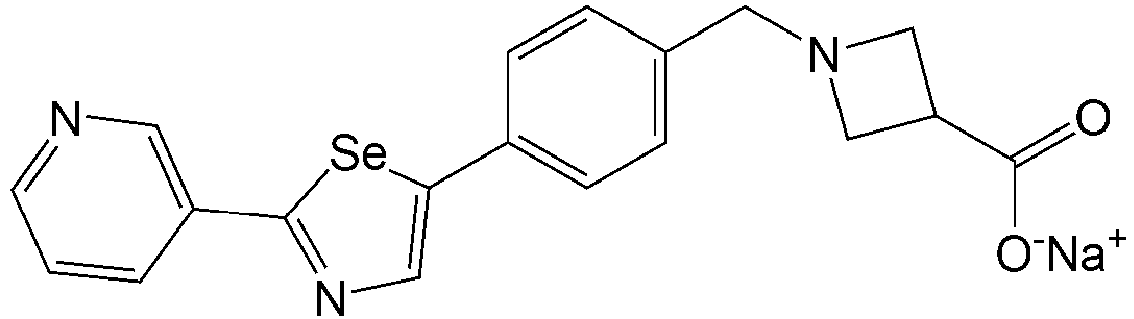
- Whild solid;
- Yield: 95%;
- 1H NMR (CD3OD, 400 MHz) δ 9.09 (s, pyridine-H), 8.61-8.62 (m, 1 ArH), 8.31-8.34 (m, 1 ArH), 8.13 (s, 1 ArH), 7.62 (d, J = 8.1 Hz, 2 ArH), 7.53-7.56 (m, 1 ArH), 7.37 (d, J = 8.1 Hz, 2 ArH), 3.65 (s, NCH 2), 3.52-3.56 (m, 2 azetidine ring-H), 3.33-3.37 (m, 2 azetidine ring-H), 3.16-3.22 (m, 1 ArH);
- 13C NMR (CD3OD, 100 MHz) δ 179.62, 179.19, 169.88, 149.97, 147.84, 146.43, 139.62, 137.98, 134.60, 132.57, 132.03, 129.57, 127.10, 124.47 (ArC), 62.21 (NCH2), 57.54 (azetidine ring-C), 36.46 (azetidine ring-C).
-

- Yellow solid;
- Yield: 52%;
- 1H NMR (CDCl3, 400 MHz) δ 7.97 (s, selenazole ring-H), 7.87 (d, J = 8.4 Hz, 2 ArH), 7.47-7.54 (m, 4 ArH), 7.37 (d, J = 8.0 Hz, 2 ArH), 3.71 (s, COOCH 3), 3.66 (s, NCH 2), 3.04-3.10 (m, 1 pyrrolidine ring-H), 2.90-2.94 (m, 1 pyrrolidine ring-H), 2.67-2.76 (m, 2 pyrrolidine ring-H), 2.55-2.59 (m, 1 pyrrolidien ring-H), 2.11-2.17 (m, 2 pyrrolidine ring-H), 1.38 (s, Ar(CH 3)3);
- 13C NMR (CDCl3, 100 MHz) δ 175.47 (NCSe), 173.85 (C(O)), 153.65, 145.51, 139.53, 139.19, 133.53, 129.42,127.26, 126.60, 126.00 (ArC), 59.64 (NCH2), 56.67, 53.76, 51.90, 41.99, 34.93, 31.19 (Ar(CH3)3), 27.69.
-

- Whild solid;
- Yield: 95%;
- 1H NMR (CD3OD, 400 MHz) δ 8.01 (s, 1 selenazole ring-H), 7.83 (dd, J = 1.6, 6.7 Hz, 2 ArH), 7.58 (d, J = 8.2 Hz, 2 ArH), 7.49-7.51 (m, 2 ArH), 7.40 (d, J = 8.2 Hz, 2 ArH), 3.65 (d, J = 5.2 Hz, NCH 2), 2.93-3.04 (m, 2 pyrrolidine ring-H), 2.80-2.82 (m, 1 pyrrolidine ring-H), 2.62-2.66 (m, pyrrolidine ring-H), 2.48-2.55 (m, pyrrolidine ring-H), 2.04-2.12 (m, 2 pyrrolidine ring-H), 1.36 (s, Ar(CH 3)3);
- 13C NMR (CD3OD, 100 MHz) δ 181.62 (NCSe), 174.47 (C(O)), 153.86, 145.71, 138.88, 13871, 133.33, 132.32, 129.87, 126.77, 126.23, 125.81 (ArC), 59.64 (NCH2), 57.72, 53.75, 45.16, 34.41, 30.16 (C(CH3)3), 28.24.
-

- Whild solid;
- Yield: 12%;
- 1H NMR (CDCl3, 400 MHz) δ 7.98 (s, selenazole ring-H), 7.86 (d, J = 8.4 Hz, 2 ArH), 7.47-7.55 (m, 4 ArH), 7.38-7.39 (m, 2 ArH), 3.71 (s, COOCH 3), 3.55 (s, NCH 2), 2.89-2.91 (m, 2 piperidine ring-H), 2.34 (br s, 1 piperidine ring-H), 2.12-2.20 (m, 2 piperidine ring-H),1.83-1.91 (m, 4 piperidine ring-H), 1.60 (s, Ar(CH 3)3);
- 13C NMR (CDCl3, 100 MHz) δ 175.64 (NCSe), 173.87 (C(O)), 153.67, 145.51, 139.50, 133.77, 132.52, 129.71, 127.18, 126.58, 125.99 (ArC), 62.76 (NCH2), 52.90, 51.63, 50.98, 41.02, 34.93, 31.16 (Ar(CH3)3), 28.27, 27.14.
-

- Yellow solid;
- Yield: 47%;
- 1H NMR (CDCl3, 400 MHz) δ 7.92-7.89 (m, 1 ArH), 7.88 (s, 1 ArH), 7.68 (dd, J = 2.1, 8.6 Hz, 1 ArH), 7.45 (d, J = 8.0 Hz, 2 ArH), 7.32 (d, J = 8.0 Hz, ArH), 6.63 (d, J = 8.6 Hz, 1 ArH), 4.61 (sept, J = 6.0 Hz, OCH(CH3)2), 3.66 (s, COOCH 3), 3.61 (d, J = 3.6 Hz, NCH 2), 2.99-3.05 (m, 1 pyrrolidine ring H), 2.84-2.89 (m, 1 pyrrolidine ring-H), 2.54-2.70 (m, 2 pyrrolidine ring-H), 2.50-2.52 (m, 1 pyrrolidine ring-H), 2.06-2.12 (m, 2 pyrrolidine ring-H), 1.38 (d, J = 6.0 Hz, OCH(CH 3)2);
- 13C NMR (CDCl3, 100 MHz) δ 175.44 (NCSe), 171.86 (C(O)), 155.17, 145.74, 139.42, 139.28, 132.32, 129.96, 129.43, 128.58, 127.22, 126.21, 124.63,115.12 (ArC), 72.11 (OCH(CH3)2), 59.60 (NCH2), 56.65, 53.76, 51.89, 41.97, 27.69 (pyrrolidine ring-C), 21.99 (OCH(CH3)2).
-

- Whild solid;
- Yield: 93%;
- 1H NMR (CD3OD, 400 MHz) δ 8.02 (s, selenazole ring-H), 7.97 (d, J = 2.2 Hz, 1 ArH), 7.80 (dd, J = 2.2, 8.6 Hz, 1 ArH), 7.60 (d, J = 8.1 Hz, 2 ArH), 7.43 (d, J = 8.1 Hz, 2 ArH), 7.18 (d, J = 8.8 Hz, 1 ArH), 4.75 (sept, J = 6.0 Hz, OCH(CH3)2), 3.64-3.72 (m, NCH 2), 3.03-3.08 (m, 1 pyrrolidine ring H), 2.91-2.99 (m, 1 pyrrolidine ring-H), 2.79-2.88 (m, 1 pyrrolidine ring-H), 2.60-2.65 (m, 1 pyrrolidine ring-H), 2.50-2.54 (m, 1 pyrrolidine ring-H), 2.06-2.13 (m, 2 pyrrolidine ring-H), 1.38 (d, J = 6.0 Hz, OCH(CH 3)2);
- 13C NMR (CD3OD, 100 MHz) δ 181.67 (NCSe), 172.16 (C(O)), 155.18, 145.75, 138.93, 138.63, 132.18, 129.83, 129.56, 129.34, 127.59, 126.71, 126.55, 124.02, 114.80 (ArC), 71.66 (OCH(CH3)2), 59.70 (NCH2), 57.76, 53.78, 45.13, 28.30 (pyrrolidine ring-C), 20.97 (OCH(CH3)2).
-
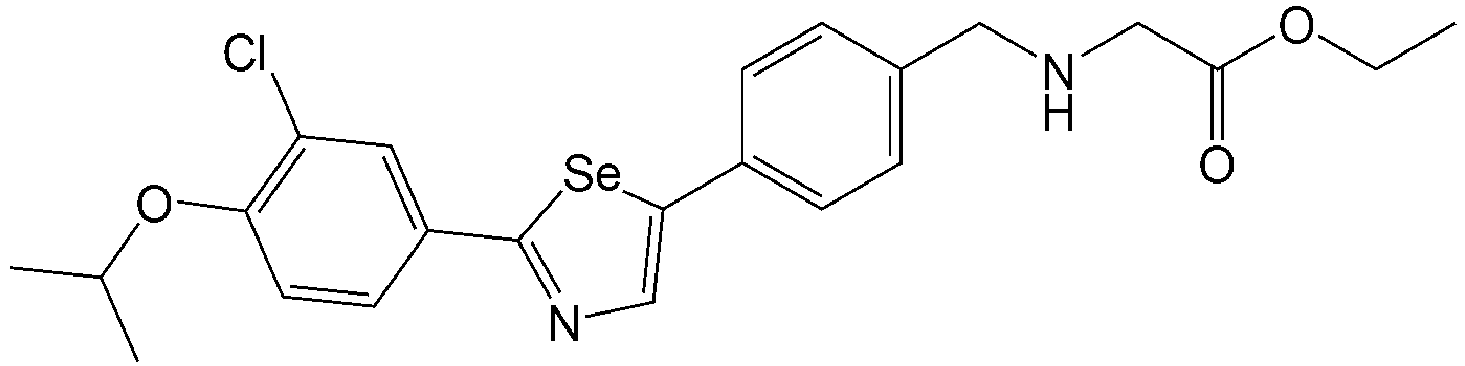
- Ivory solid;
- Yield: 31%;
- 1H NMR (CDCl3, 400 MHz) δ 7.90-7.93 (m, selenazole ring-H, 1 ArH), 7.71 (dd, J = 2.2 Hz, 8.6 Hz, 2 ArH), 7.49 (d, J = 8.1 Hz, 2 ArH), 7.35 (d, J = 8.1 Hz, 2 ArH), 6.96 (d, J = 8.7 Hz, 1 ArH), 4.63 (sept, J = 6.0 Hz, OCH(CH3)2), 4.19 (q, J = 7.1 Hz, OCH 2CH3), 3.82 (s, NCH 2Ar), 3.41 (s, COCH 2NH), 1.40 (d, J = 6.0 Hz, OCH(CH 3)2) 1.27 (t, J = 7.1 Hz, OCH2CH 3);
- 13C NMR (CDCl3, 100 MHz) δ 172.39 (NCSe), 172.02 (C(O)), 155.21, 145.63, 139.85, 139.49, 132.52, 129.97, 129.00, 128.66, 127.40, 126.18, 124.67, 115.17 (ArC), 72.15 (OCH(CH3)2), 60.84 (NCH2Ar), 52.85, 50.06, 21.99 (OCH(CH3)2), 14.25 (OCH2 CH3).
-

- Whild solid;
- Yield: 90%;
- 1H NMR (CD3OD, 400 MHz) δ 8.01 (s, selenazole ring-H), 7.96 (s, 1 ArH), 7.79 (d, J = 7.2 Hz, 1 ArH), 7.60 (d, J = 7.7 Hz, 2 ArH), 7.43 (d, J = 7.8 Hz, 2 ArH), 7.17 (d, J = 8.6 Hz, 1 ArH), 4.75 (sept, J = 6.2 Hz, OCH(CH3)2), 3.78 (s, NCH 2Ar), 3.20 (s, COCH 2NH), 1.40 (d, J = 6.0 Hz, OCH(CH 3)2) 1.27 (t, J = 7.1 Hz, OCH2CH 3);
- 13C NMR (CDCl3, 100 MHz) δ 177.26 (NCSe), 172.49 (C(O)), 155.28, 145.90, 139.77, 138.83, 132.11, 129.37, 129.13, 127.65, 126.90, 126.49, 124.07, 114.99 (ArC), 71.77 (OCH(CH3)2), 52.37 51.92, 20.85 (OCH(CH3)2).
-

- Yellow solid;
- Yield: 41%;
- 1H NMR (CDCl3, 400 MHz) δ 7.91 (d, J = 2.2 Hz, 1 ArH), 7.88 (s, selenazole ring-H), 7.69 (dd, J = 2.2 Hz, 8.6 Hz, 1 ArH), 7.47 (d, J = 8.1 Hz, 2 ArH), 7.33 (d, J = 8.1 Hz, 2 ArH), 6.94 (d, J = 8.7 Hz, 1 ArH), 4.61 (sept, J = 6.0 Hz, OCH(CH3)2), 3.83 (s, NCH 2Ar), 3.67 (s, COOCH 3), 2.89 (t, J = 6.4 Hz, NHCH 2CH2COOCH3), 2.54 (t, J = 6.4 Hz, NHCH 2CH2COOCH3), 1.39 (d, J = 6.0 Hz, OCH(CH 3)2);
- 13C NMR (CDCl3, 100 MHz) δ 173.18 (NCSe), 171.91 (C(O)), 155.18, 145.71, 140.40, 139.43, 132.32, 129.96, 128.81, 128.61, 127.35, 127.15, 126.20, 124.64, 115.14 (ArC), 72.13 (OCH(CH3)2), 53.27 (NCH2Ar), 51.66, 44.39, 34.49, 21.99 (OCH(CH3)2).
-

- Ivory solid;
- Yield: 65%;
- 1H NMR (CD3OD, 400 MHz) δ 8.09 (s, selenazole ring-H), 7.98 (d, J = 2.2 Hz, 1 ArH), 7.83-7.81 (dd, J = 2.3 Hz, 8.6 Hz, 1 ArH), 7.74 (d, J = 8.2 Hz, 2 ArH), 7.55 (d, J = 8.1 Hz, 2 ArH), 7.19 (d, J = 8.7 Hz, 1 ArH), 4.78 (sept, J = 6.0 Hz, OCH(CH3)2), 4.22 (s, NCH 2Ar), 3.14-3.20 (m, NHCH 2CH2COOCH3), 2.52 (t, J = 6.4 Hz, NHCH2CH 2COOH), 1.41 (d, J = 6.0 Hz, OCH(CH 3)2);
- 13C NMR (CD3OD, 100 MHz) δ 173.18 (NCSe), 171.91 (C(O)), 155.18, 145.71, 140.40, 139.43, 132.32, 129.96, 128.81, 128.61, 127.35, 127.15, 126.20, 124.64, 115.14 (ArC), 72.13 (OCH(CH3)2), 53.27 (NCH2Ar), 51.66, 44.39, 34.49, 21.99 (OCH(CH3)2).
-

- Ivory solid;
- Yield: 65%;
- 1H NMR (CD3OD, 400 MHz) δ 8.09 (s, selenazole ring-H), 7.98 (d, J = 2.2 Hz, 1 ArH), 7.83-7.81 (dd, J = 2.3 Hz, 8.6 Hz, 1 ArH), 7.74 (d, J = 8.2 Hz, 2 ArH), 7.55 (d, J = 8.1 Hz, 2 ArH), 7.19 (d, J = 8.7 Hz, 1 ArH), 4.78 (sept, J = 6.0 Hz, OCH(CH3)2), 4.22 (s, NCH 2Ar), 3.14-3.20 (m, NHCH 2CH2COOCH3), 2.52 (t, J = 6.4 Hz, NHCH2CH 2COOH), 1.41 (d, J = 6.0 Hz, OCH(CH 3)2);
- 13C NMR (CD3OD, 100 MHz) δ 173.18 (NCSe), 171.91 (C(O)), 155.18, 145.71, 140.40, 139.43, 132.32, 129.96, 128.81, 128.61, 127.35, 127.15, 126.20, 124.64, 115.14 (ArC), 72.13 (OCH(CH3)2), 53.27 (NCH2Ar), 51.66, 44.39, 34.49, 21.99 (OCH(CH3)2).
-

- Whild solid;
- Yield: 87%;
- 1H NMR (CD3OD, 400 MHz) δ 8.03 (s, 1 selenazole ring-H), 7.91 (d, J = 8.2 Hz, 2 ArH), 7.58 (d, J = 8.4 Hz, 2 ArH), 7.44-7.49 (m, 4 ArH), 3.80 (s, NCH 2), 3.66-3.70 (m, 2 azetidine ring-H), 3.48-3.52 (m, 2 azetidine ring-H), 3.25-3.32 (m, 1 azetidine ring-H), 1.37 (s, Ar(CH 3)3);
- 13C NMR (CD3OD, 100 MHz) δ 179.00 (NCSe), 151.65, 138.67, 135.34, 133.19, 130.41, 129.44, 128.51, 126.62, 126.48, 125.80, 123.76 (ArC), 57.58 (NCH2), 36.36, 34.15, 34.00, 30.35 (C(CH3)3), 22.81.
-

- Yellow solid;
- Yield: 41%;
- 1H NMR (CDCl3, 400 MHz) δ 7.85 (s, selenazole ring-H), 7.82 (d, J = 8.2 Hz, 2 ArH), 7.56 (d, J = 2.2 Hz, 1 ArH), 7.33-7.38 (m, 3 ArH), 6.95 (d, J = 8.6 Hz, 1 ArH), 4.61-4.58 (m, OCH(CH3)2), 3.79 (s, COOCH 3), 3.71 (s, NCH 2), 3.54-3.56 (m, 2 azetidine ring H), 3.33-3.37 (m, 3 azetidine ring-H), 1.40 (d, J = 6.0 Hz, OCH(CH 3)2);
- 13C NMR (CDCl3, 100 MHz) δ 173.52 (NCSe), 172.49 (C(O)), 153.71, 144.46, 140.08, 139.37, 135.33,132.84, 129.10, 127.20, 126.86, 126.60, 124.79, 115.97 (ArC), 72.32 (OCH(CH3)2), 63.04 (NCH2), 56.89, 51.99, 33.99 (azetidine ring-C), 22.01 (OCH(CH3)2).
-

- Whild solid;
- Yield: 90%;
- 1H NMR (DMSO-d 6, 400 MHz) δ 7.65 (d, J = 8.2 Hz, 2 ArH), 7.28-7.41 (m, 7 ArH), 5.70-5.75 (m, 1 isoxazoline ring-H), 3.75-3.80 (m, 1 isoxazoline ring-H), 3.73 (s, COOCH 3), 3.69 (s, NCH 2), 3.64 (br, 2 azetidine ring-H), 3.30-3.36 (m, 3 azetidine ring-H, 1 isoxazoline ring-H);
- 13C NMR (CDCl3, 100 MHz) δ 173.49 (C(O)), 155.94 (isoxazoline ring-C), 140.97, 139.96, 128.79, 128.77, 128.37, 128.22, 126.84, 125.88 (ArC), 82.53 (isoxazoline ring-C), 62.99 (NCH2), 56.86 (azetidine ring-C), 51.99 (COOCH3), 43.21 (isoxazoline ring-C), 33.96 (azetidine ring-C).
-

- Transparent oil;
- Yield: 57%;
- 1H NMR (CDCl3, 400 MHz) δ 7.65 (d, J = 8.2 Hz, 2 ArH), 7.28-7.41 (m, 7 ArH), 5.70-5.75 (m, 1 isoxazoline ring-H), 3.75-3.80 (m, 1 isoxazoline ring-H), 3.73 (s, COOCH 3), 3.69 (s, NCH 2), 3.64 (br, 2 azetidine ring-H), 3.30-3.36 (m, 3 azetidine ring-H, 1 isoxazoline ring-H);
- 13C NMR (CDCl3, 100 MHz) δ 173.49 (C(O)), 155.94 (isoxazoline ring-C), 140.97, 139.96, 128.79, 128.77, 128.37, 128.22, 126.84, 125.88 (ArC), 82.53 (isoxazoline ring-C), 62.99 (NCH2), 56.86 (azetidine ring-C), 51.99 (COOCH3), 43.21 (isoxazoline ring-C), 33.96 (azetidine ring-C);
- HPLC purity: 3.3 min, 96.0%;
- HRMS (M + H)+ (ESI+) 351.1707 [M + H]+ (calcd for C21H22N2O3H+ 351.1709).
-

- Whild solid;
- Yield: 97%;
- 1H NMR (DMSO-d 6, 400 MHz) δ 12.62 (br, COOH), 7.75 (d, J = 8.2 Hz, 2 ArH), 7.65 (d, J = 8.2 Hz, 2 ArH), 7.36-7.40 (m, 4 ArH), 7.31-7.35 (m, 1 ArH), 5.73-5.77 (m, 1 isoxazoline ring-H), 4.40 (s, NCH 2), 4.04-4.12 (m, 4 azetidine ring H), 3.85-3.92 (m, 1 isoxazoline ring-H), 3.63-3.67 (m, 1 azetidine ring-H), 3.40-3.44 (m, 1 isoxazoline ring-H);
- 13C NMR (DMSO-d 6, 100 MHz) δ 171.96 (C(O)), 156.62 (isoxazoline ring-C), 141.26, 133.09, 131.02, 130.39, 129.12, 128.63, 127.47, 126.67 (ArC), 82.73 (isoxazoline ring-C), 56.74 (NCH2), 54.58 (azetidine ring-C), 42.48 (isoxazoline ring-C), 32.51 (azetidine ring-C);
- HPLC purity: 3.6 min, 96.8%;
- HRMS (M + H)+ (ESI+) 337.1551 [M + H]+ (calcd for C20H21N3O3H+ 337.1552).
-

- Transparent oil;
- Yield: 28%;
- 1H NMR (CDCl3, 400 MHz) δ 7.64 (d, J = 8.4 Hz, 2 ArH), 7.55-7.59 (m, 2 ArH), 7.29-7.35 (m, 3 ArH), 7.15-7.20 (m, 1 ArH), 5.96-6.01 (m, 1 isoxazoline ring-H), 3.93-4.00 (m, 1 isoxazoline ring-H), 3.72 (s, COOC isoxazoline ring-H), 3.93-4.00 (m, 1 isoxazoline ring-H), 3.72 (s, COOCH 3), 3.71 (s, NCH 2), 3.52-3.64 (m, 2 azetidine ring-H), 3.33-3.36 (m, 3 azetidine ring-H), 3.17-3.23 (m, 1 isoxazoline ring-H);
- 13C NMR (CDCl3, 100 MHz) δ 173.48 (C(O)), 155.84 (isoxazoline ring-C), 140.65, 140.17, 132.74, 129.36, 128.75, 128.09, 127.83, 127.43, 126.88, 120.84 (ArC), 81.42 (isoxazoline ring-C), 63.00 (NCH2), 56.86 (azetidine ring-C), 51.97 (COOCH3), 42.98 (isoxazoline ring-C), 33.96 (azetidine ring-C);
- HPLC purity: 5.09 min, 97.9%;
- HRMS (M + H)+ (ESI+) 429.0817 [M + H]+ (calcd for C21H21BrN2O3H+ 429.0814).
-

- Whild solid;
- Yield: 60%;
- 1H NMR (DMSO-d 6, 400 MHz) δ 7.78 (d, J = 8.0 Hz, 2 ArH), 7.69 (d, J = 8.0 Hz, 1 ArH), 7.58 (d, J = 8.4 Hz, 2 ArH), 7.45-7.46 (m, 2 ArH), 7.28-7.32 (m, 1 ArH), 5.93-5.98 (m, 1 isoxazoline ring-H), 4.40 (s, NCH 2), 4.12-4.14 (m, 4 azetidine ring-H), 4.01-4.05 (m, 1 isoxazoline ring-H), 3.59-3.64 (m, 1 azetidine ring-H), 3.34-3.37 (m, 1 isoxazoline ring-H);
- 13C NMR (DMSO-d 6, 100 MHz) δ 181.85, 177.21, 156.43 (isoxazoline ring-C), 140.43, 133.36, 130.99, 130.50, 130.21, 128.64, 127.69, 127.53, 121.38 (ArC), 86.90 (isoxazoline ring-C), 81.74, 56.97 (NCH2), 55.04 (azetidine ring-C), 42.34 (isoxazoline ring-C), 32.52 (azetidine ring-C);
- HPLC purity: 4.6 min, 99.3%;
- HRMS (M + H)+ (ESI+) 415.0659 [M + H]+ (calcd for C20H19BrN2O3H+ 415.0657).
-

- Transparent oil;
- Yield: 35%;
- 1H NMR (CDCl3, 400 MHz) δ 7.62 (d, J = 8.4 Hz, 2 ArH), 7.53 (s, 1 ArH), 7.42 (d, J = 7.6 Hz, 1 ArH), 7.29-7.32 (m, 3ArH), 7.20-7.24 (m, 1 ArH), 5.65-5.69 (m, 1 isoxazoline ring-H), 3.73-3.80 (m, 1 isoxazoline ring-H), 3.70 (s, COOCH 3), 3.62 (s, NCH 2), 3.50-3.55 (m, 2 azetidine ring-H), 3.25-3.35 (m, 3 azetidine ring-H, 1 isoxazoline ring-H);
- 13C NMR (CDCl3, 100 MHz) δ 173.47 (C(O)), 155.87 (isoxazoline ring-C), 143.39, 140.23, 131.23, 130.37, 128.85, 128.78, 128.00, 126.86, 124.43, 122.80 (ArC), 81.50 (isoxazoline ring-C), 62.97 (NCH2), 56.86 (azetidine ring-C), 51.97 (COOCH3), 43.27 (isoxazoline ring-C), 33.96 (azetidine ring-C);
- HPLC purity: 4.7 min, 98.2%;
- HRMS (M + H)+ (ESI+) 429.0816 [M + H]+ (calcd for C21H21BrN2O3H+ 429.0814).
-

- Whild solid;
- Yield: 96%;
- 1H NMR (DMSO-d 6, 400 MHz) δ 7.75 (d, J = 8.0 Hz, 2 ArH), 7.66 (d, J = 8.0 Hz, 2 ArH), 7.59 (s, 1 ArH), 7.54 (d, J = 8.8 Hz, 1 ArH), 7.34-7.42 (m, 2 ArH), 5.76-5.81 (m, 1 isoxazoline ring-H), 4.42 (s, NCH 2), 4.08-4.12 (m, 5 azetidine ring-H), 3.86-3.93 (m, 1 isoxazoline ring-H), 3.43-3.49 (m, 1 isoxazoline ring-H);
- 13C NMR (DMSO-d 6, 100 MHz) δ 171.03 (C(O)), 156.72 (isoxazoline ring-C), 144.11, 139.56, 132.05, 131.40, 131.03, 130.19, 129.31, 127.55, 125.66, 122.31 (ArC), 81.71 (isoxazoline ring-C), 54.43 (NCH2), 52.75 (azetidine ring-C), 42.54 (isoxazoline ring-C), 32.28 (azetidine ring-C);
- HPLC purity: 5.1 min, 98.6%;
- HRMS (M + H)+ (ESI+) 415.0662 [M + H]+ (calcd for C20H19BrN2O3H+ 415.0657).
-

- Whild solid;
- Yield: 16%;
- 1H NMR (CDCl3, 400 MHz) δ 7.64 (d, J = 8.4 Hz, 2 ArH), 7.49-7.53 (m, 2 ArH), 7.36 (d, J = 10.0 Hz, 2 ArH), 7.29-7.32 (m, 2 ArH), 5.67-5.72 (m, 1 isoxazoline ring-H), 3.77-3.82 (m, 1 isoxazoline ring-H), 3.75 (s, COOCH 3), 3.68 (s, NCH 2), 3.52-3.65 (m, 2 azetidine ring-H), 3.26-3.39 (m, 3 azetidine ring-H, 1 isoxazoline ring-H);
- 13C NMR (CDCl3, 100 MHz) δ 173.52 (C(O)), 155.91 (isoxazoline ring-C), 140.19, 140.05, 131.87, 128.80, 128.08, 127.56, 126.85, 122.11 (ArC), 81.75 (isoxazoline ring-C), 62.99 (NCH2), 56.87 (azetidine ring-C), 52.00 (COOCH3), 43.22 (isoxazoline ring-C), 33.96 (azetidine ring-C);
- HPLC purity: 9.1 min, 98.3%;
- HRMS (M + H)+ (ESI+) 429.0817 [M + H]+ (calcd for C21H21BrN2O3H+ 429.0814).
-

- Whild solid;
- Yield: 58%;
- 1H NMR (DMSO-d 6, 400 MHz) δ 7.58-7.63 (m, 4 ArH), 7.32-7.37 (m, 4 ArH), 5.69-5.74 (m, 1 isoxazoline ring-H), 3.81-3.96 (m, 1 isoxazoline ring-H), 3.50 (s, NCH 2), 3.22-3.26 (m, 2 azetidine ring-H, 1 isoxazoline ring-H), 3.04-3.07 (m, 2 azetidine ring-H), 2.74-2.78 (m, 1 azetidine ring-H);
- 13C NMR (CD3OD, 100 MHz) δ 178.90 (C(O)), 156.47, 140.34, 131.50, 129.45, 129.08, 127.64, 126.81, 121.59 (ArC, isoxazoline ring-C), 81.97, 57.12, 42.37, 35.83, 22.75;
- HPLC purity: 4.8 min, 99.1%;
- HRMS (M + H)+ (ESI+) 415.0659 [M + H]+ (calcd for C20H19BrN2O3H+ 415.0657).
-

- Whild solid;
- Yield: 66%;
- 1H NMR (DMSO-d 6, 400 MHz) δ 9.66 (s, COOH), 7.66 (d, J = 8.2 Hz, 2 ArH), 7.41 (d, J = 8.0 Hz, 2 ArH), 7.19 (d, J = 8.6 Hz, 2 ArH), 6.78 (d, J = 8.5 Hz, 2 ArH), 5.60 (t, J = 10.4 Hz, 1 isoxazoline ring-H), 3.73-3.80 (m, 3H), 3.55 (br, NCH 2), 3.40 (br, 1H), 3.30-3.37 (m, 3H);
- 13C NMR (DMSO-d 6, 100 MHz) δ 158.00, 156.79, 131.03, 129.59, 129.15, 128.65, 128.24, 127.12, 115.79 (ArC, isoxazoline ring-C), 82.75 (isoxazoline ring-C), 56.29 (NCH2), 49.74 (azetidine ring-C), 42.09 (isoxazoline ring-C), 33.69 (azetidine ring-C);
- HPLC purity: 1.9 min, 98.6%;
- HRMS (M + H)+ (ESI+) 353.1500 [M + H]+ (calcd for C20H20N2O4H+ 353.1501).
-

- Transparent oil;
- Yield: 23%;
- 1H NMR (CDCl3, 400 MHz) δ 7.64 (d, J = 8.4 Hz, 2 ArH), 7.37-7.41 (m, 4 ArH), 7.33 (d, J = 8.0 Hz, 2 ArH), 5.71-5.75 (m, 1 isoxazoline ring-H), 4.58 (s, ArCH 2Cl), 3.75-3.81 (m, 1 isoxazoline ring-H), 3.73 (s, COOCH 3), 3.65 (s, NCH 2), 3.53-3.56 (m, 2 azetidine ring-H), 3.28-3.36 (m, 2 azetidine ring-H, 1 isoxazoline ring-H);
- 13C NMR (CDCl3, 100 MHz) δ 173.49 (C(O)), 155.94 (isoxazoline ring-C), 141.28, 140.10, 137.47, 129.02, 128.79, 128.20, 126.84, 126.26 (ArC), 82.06 (isoxazoline ring-C), 62.97 (NCH2), 56.86 (azetidine ring-C), 51.99 (COOCH3), 45.82 (ArCH2Cl), 43.21 (isoxazoline ring-C), 33.96 (azetidine ring-C);
- HPLC purity: 10.1 min, 96.9%;
- HRMS (M + H)+ (ESI+) 399.1480 [M + H]+ (calcd for C22H23ClN2O3H+ 399.1475).
-

- Whild solid;
- Yield: 45%;
- 1H NMR (DMSO-d 6, 400 MHz) δ 7.63 (d, J = 8.2 Hz, 2 ArH), 7.39-7.47 (m, 4 ArH), 7.32 (d, J = 8.2 Hz, 2 ArH), 5.70-5.75 (m, 1 isoxazoline ring-H), 4.77 (s, CH 2Cl), 3.83-3.90 (1 isoxazoline ring-H), 3.49 (s, NCH 2), 3.40-3.42 (m, 1 isoxazoline ring-H), 3.17-3.25 (m, 2 azetidine ring-H), 3.02-3.06 (m, 2 azetidine ring-H), 2.67-2.73 (m, 1 azetidine ring-H);
- 13C NMR (DMSO-d 6, 100 MHz) δ 172.43 (C(O)), 156.75 (isoxazoline ring-C), 141.47, 140.02, 139.01, 129.48, 129.36, 128.48, 127.04, 126.63 (ArC), 82.32 (isoxazoline ring-C), 57.76 (NCH2), 53.12, 52.18, 46.75, 43.86, 42.51;
- HPLC purity: 5.6 min, 98.1%;
- HRMS (M + H)+ (ESI+) 385.1320 [M + H]+ (calcd for C21H21ClN2O3H+ 385.1319).
-

- Whild solid;
- Yield: 46%;
- 1H NMR (CDCl3, 400 MHz) δ 7.63 (d, J = 8.2 Hz, 2 ArH), 7.29-7.32 (m, 4 ArH), 7.19 (d, J = 8.0 Hz, 2 ArH), 5.69 (dd, J = 4.2, 10.8 Hz, 1 isoxazoline ring-H), 3.72-3.76 (m, 1 isoxazoline ring-H), 3.70 (s, COOCH 3), 3.62 (s, NCH 2), 3.50-3.55 (m, 2 azetidine ring-H), 3.29-3.35 (m, 3 azetidine ring-H, 1 isoxazoline ring-H), 2.64 (q, J = 7.6 Hz, CH 2CH3), 1.22 (t, J = 7.6 Hz, CH2CH 3);
- 13C NMR (CDCl3, 100 MHz) δ 173.52 (C(O)), 155.98 (isoxazoline ring-C), 144.43, 139.96, 138.11, 128.76, 128.47, 128.24, 126.82, 125.98 (ArC), 82.57 (isoxazoline ring-C), 63.05 (NCH2), 56.89 (azetidine ring-C), 51.98 (COOCH3), 43.08 (isoxazoline ring-C), 33.99 (azetidine ring-C), 28.58 (CH2CH3), 15.57 (CH2 CH3);
- HPLC purity: 4.5 min, 98.4%;
- HRMS (M + H)+ (ESI+) 379.2021 [M + H]+ (calcd for C23H26N2O3H+ 379.2022).
-

- Whild solid;
- Yield: 100%;
- 1H NMR (CD3OD, 400 MHz) δ 7.67 (d, J = 8.2 Hz, 2 ArH), 7.37 (d, J = 8.2 Hz, 2 ArH), 7.30 (d, J = 8.1 Hz, 2 ArH), 7.21 (d, J = 8.0 Hz, 2 ArH), 5.68 (dd, J = 8.8, 10.7 Hz, 1 isoxazoline ring-H), 3.82 (dd, J = 10.8, 17.0 Hz, 1 isoxazoline ring-H), 3.66 (s, NCH 2), 3.53 (t, J = 8.0 Hz, 2 azetidine ring-H), 3.32-3.37 (m, 2 azetidine ring-H, 1 isoxazoline ring-H), 3.18-3.24 (m, 1 azetidine ring-H), 2.63 (q, J = 7.6 Hz, alkyl chain-CH 2), 1.82 (t, J = 7.6 Hz, alkyl chain-CH 3);
- 13C NMR (CD3OD, 100 MHz) δ 179.57 (C(O)), 156.75 (isoxazoline ring-C), 144.32, 139.64, 139.64, 138.11, 128.97, 127.82, 126.54, 125.81 (ArC), 82.71 (isoxazoline ring-C), 62.45 (NCH2), 57.69 (azetidine ring-C), 42.28 (isoxazoline ring-C), 36.54 (azetidine ring-C), 28.16 (CH2CH3), 14.75 (CH2 CH3);
- HPLC purity: 5.0 min, 97.8%;
- HRMS (M + H)+ (ESI+) 365.1864 [M + H]+ (calcd for C22H24N2O3H+ 365.1865).
-

- Whild solid;
- Yield: 112%;
- 1H NMR (CD3OD, 400 MHz) δ 7.67 (d, J = 8.3 Hz, 2 ArH), 7.37 (d, J = 8.3 Hz, 2 ArH), 7.29 (d, J = 8.1 Hz, 2 ArH), 7.19 (d, J = 8.1 Hz, 2 ArH), 5.67 (dd, J = 8.8, 10.7 Hz, 1 isoxazoline ring-H), 3.82 (dd, J = 10.8, 17.0 Hz, 1 isoxazoline ring-H), 3.65 (s, NCH 2), 3.53 (t, J = 8.1 Hz, 2 azetidine ring-H), 3.32-3.37 (m, 2 azetidine ring-H, 1 isoxazoline ring-H), 3.18-3.22 (m, 1 azetidine ring-H), 2.58 (t, J = 7.8 Hz, alkyl chain-CH 2), 1.59-1.65 (m, alkyl chain-CH 2), 0.92 (t, J = 7.3 Hz, alkyl chain-CH 3);
- 13C NMR (CD3OD, 100 MHz) δ 179.55 (C(O)), 156.77 (isoxazoline ring-C), 142.65, 139.66, 138.16, 128.98, 128.46, 126.54, 125.73 (ArC), 82.74 (isoxazoline ring-C), 62.47 (NCH2) 57.67 (azetidine ring-C), 42.38 (isoxazoline ring-C), 37.32 (alkyl chain-CH2), 36.54 (azetidine ring-C), 24.31 (alkyl chain-CH2), 12.67 (alkyl chain-CH3);
- HPLC purity: 5.8 min, 99.3%;
- HRMS (M + H)+ (ESI+) 379.2021 [M + H]+ (calcd for C23H26N2O3H+ 379.2022).
-

- Whild solid;
- Yield: 45%;
- 1H NMR (DMSO-d 6, 400 MHz) δ 7.64 (d, J = 7.9 Hz, 2 ArH), 7.39 (d, J = 8.2 Hz, 2 ArH), 7.32 (dd, J = 3.4, 8.3 Hz, 4 ArH), 5.71 (dd, J = 8.3, 10.9 Hz, 1 isoxazoline ring-H), 3.68-3.79 (m, 1 isoxazoline ring-H, COOCH 3), 3.63 (s, NCH 2), 3.57-3.60 (m, 1 azetidine ring-H, 1 isoxazoline ring-H), 3.39-3.42 (m, 2 azetidine ring-H), 3.21-3.36 (m, 2 azetidine ring-H), 1.28 (s, C(CH 3)3);
- 13C NMR (DMSO-d 6, 75 MHz) δ 173.33 (C(O)), 162.33, 156.74, 151.04, 138.32, 132.53, 129.58, 127.14, 126.39, 125.81 (ArC, isoxazoline ring-C), 82.31 (isoxazoline ring-C), 56.52 (azetidine ring-C), 52.19 (COOCH3), 49.06 (azetidine ring-C), 42.45 (isoxazoline ring-C), 34.74 (C(CH3)3), 33.61 (azetidine ring-C), 31.55 (C(CH3)3);
- HPLC purity: 9.8 min, 95.5%;
- HRMS (M + H)+ (ESI+) 407.2336 [M + H]+ (calcd for C25H30N2O3H+ 407.2335).
-

- Whild solid;
- Yield: 96%;
- 1H NMR (DMSO-d 6, 400 MHz) δ 7.63 (d, J = 8.2 Hz, 2 ArH), 7.41 (d, J = 8.3 Hz, 2 ArH), 7.30-7.33 (m, 4 ArH), 5.65-5.69 (m, 1 isoxazoline ring-H), 3.78-3.85 (m, 1 isoxazoline ring-H), 3.50 (s, NCH 2), 3.36-3.40 (m, 1H), 3.25 (t, J = 7.6 Hz, 2H), 3.06 (t, J = 7.0 Hz, 2H), 2.74 (t, J = 7.7 Hz, 1H), 1.27 (s, C(CH 3)3);
- 13C NMR (DMSO-d 6, 100 MHz) δ 176.87 (C(O)), 156.79 (isoxazoline ring-C), 151.01, 141.80, 138.36, 128.97, 128.16, 126.98, 126.43, 125.82 (ArC), 82.12 (isoxazoline ring-C), 63.26 (NCH2), 58.85, 37.35, 34.76, 31.57 (C(CH3)3);
- HPLC purity: 6.0 min, 99.3%;
- HRMS (M + H)+ (ESI+) 393.2176 [M + H]+ (calcd for C24H28N2O3H+ 393.2178).
-

- Transparent oil;
- Yield: 54%;
- 1H NMR (CDCl3, 400 MHz) δ 7.63 (d, J = 8.2 Hz, 2 ArH), 7.52-7.56 (m, 2 ArH), 7.33 (d, J = 8.2 Hz, 2 ArH), 6.96 (d, J = 8.7 Hz, 1 ArH), 5.65-5.70 (m, 1 isoxazoline ring-H), 4.65 (sept, J = 6.0 Hz, OCH(CH3)2), 3.70-3.81 (m, 1 isoxazoline ring-H), 3.65 (s, COOCH 3), 3.54 (s, NCH 2), 3.31-3.37 (m, 2 azetidine ring-H), 3.24-3.30 (m, 3 azetidine ring-H, 1 isoxazoline ring-H), 1.41 (d, J = 6.0 Hz, OCH(CH 3)2);
- 13C NMR (CDCl3, 100 MHz) δ 173.48 (C(O)), 159.77, 155.99 (isoxazoline ring-C), 140.32, 133.33, 131.87, 131.40, 128.81, 127.93, 126.85, 116.32, 114.04 (ArC), 103.12, 81.09 (isoxazoline ring-C), 72.08 (OCH(CH3)2), 62.97 (NCH2), 56.86 (azetidine ring-C), 51.97 (COOCH3), 43.02 (isoxazoline ring-C), 33.95 (azetidine ring-C), 21.79 (OCH(CH3)2);
- HPLC purity: 4.3 min, 98.0%;
- HRMS (M + H)+ (ESI+) 434.2080 [M + H]+ (calcd for C25H27N3O4H+ 434.2080).
-

- Whild solid;
- Yield: 64%;
- 1H NMR (CD3OD, 400 MHz) δ 7.84 (d, J = 8.3 Hz, 2 ArH), 7.64-7.67 (m, 2 ArH), 7.56 (d, J = 8.3 Hz, 2 ArH), 7.21-7.23 (m, 1 ArH), 5.74-5.79 (m, 1 isoxazoline ring-H), 4.76-4.91 (m, OCH(CH3)2), 4.47 (s, NCH 2), 4.28-4.36 (m, 4 azetidine ring-H), 3.85-3.92 (m, 1 isoxazoline ring-H), 3.61-3.69 (m, 1 azetidine ring-H), 3.32-3.44 (m, 1 isoxazoline ring-H), 1.40 (d, J = 6.0 Hz, OCH(CH 3)2);
- 13C NMR (CD3OD, 100 MHz) δ 173.04 (C(O)), 159.77, 156.27, 133.44, 132.29, 131.73, 131.15, 130.89, 130.20, 127.38, 115.84, 114.13 (ArC, isoxazoline ring-C), 102.23, 81.64 (isoxazoline ring-C), 71.85 (OCH(CH3)2), 57.65 (NCH2), 55.92 (azetidine ring-C), 41.91 (isoxazoline ring-C), 32.99 (azetidine ring-C), 20.67 (OCH(CH3)2);
- HPLC purity: 8.9 min, 96.0%;
- HRMS (M + H)+ (ESI+) 420.1924 [M + H]+ (calcd for C24H25N3O4H+ 420.1923).
-

- Whild solid;
- Yield: 83%;
- 1H NMR (CDCl3, 400 MHz) δ 7.62 (d, J = 8.2 Hz, 2 ArH), 7.38 (d, J = 2.1 Hz, 1 ArH), 7.31 (d, J = 8.2 Hz, 2 ArH), 7.21 (dd, J = 2.1, 8.4 Hz, 1 ArH), 6.89 (d, J = 8.5 Hz, 1 ArH), 5.63 (dd, J = 8.2, 10.8 Hz, 1 isoxazoline ring-H), 4.09 (q, J = 6.9 Hz, OCH 2CH3), 3.68-3.75 (m, 1 isoxazoline ring-H), 3.69 (s, COOCH 3), 3.62 (s, NCH 2), 3.50-3.53 (m, 2 azetidine ring-H), 3.24-3.34 (m, 3 azetidine ring-H, 1 isoxazoline ring-H), 1.45 (t, J = 7.0 Hz, OCH2CH 3-);
- 13C NMR (CDCl3, 100 MHz) δ 173.51 (C(O)), 155.96 (isoxazoline ring-C), 154.37, 140.09, 133.82, 128.79, 127.93, 126.84, 125.35, 123.17, 113.39 (ArC), 81.67 (isoxazoline ring-C), 64.86 (NCH2), 63.02 (OCH2CH3), 56.87 (azetidine ring-C), 51.98 (COOCH3), 43.05 (isoxazoline ring-C), 33.96 (azetidine ring-C), 14.66 (OCH2 CH3);
- HPLC purity: 4.7 min, 98.5%;
- HRMS (M + H)+ (ESI+) 429.1581 [M + H]+ (calcd for C23H25ClN2O4H+ 429.1581).
-

- Yellow solid;
- Yield: 86%;
- 1H NMR (CD3OD, 400 MHz) δ 7.67 (d, J = 8.2 Hz, 2 ArH), 7.37-7.40 (m, 3 ArH), 7.28 (dd, J = 2.1, 8.5 Hz, 1 ArH), 7.05 (d, J = 8.5 Hz, 1 ArH), 5.65 (dd, J = 8.6, 10.7 Hz, 1 isoxazoline ring-H), 4.11 (q, J = 6.9 Hz, OCH 2CH3), 3.83 (dd, J = 10.8, 18.2 Hz, 1 isoxazoline ring-H), 3.67 (s, NCH 2), 3.55 (t, J = 8.0 Hz, 2 azetidine ring-H), 3.34-3.38 (m, 2 azetidine ring-H, 1 isoxazoline ring-H), 3.19-3.25 (m, 1 azetidine ring-H), 1.42 (t, J = 6.9 Hz, OCH2CH 3-);
- 13C NMR (CD3OD, 100 MHz) δ 179.50 (C(O)), 157.55, 154.16, 133.82, 129.46, 128.15, 127.54, 126.93, 125.76, 122.41, 113.82 (ArC, isoxazoline ring-C), 81.79 (isoxazoline ring-C), 64.99 (NCH2), 61.45 (OCH2CH3), 57.27 (azetidine ring-C), 42.35 (isoxazoline ring-C), 36.09 (azetidine ring-C), 13.74 (OCH2 CH3);
- HPLC purity: 5.1 min, 95.9%;
- HRMS (M + H)+ (ESI+) 415.1424 [M + H]+ (calcd for C22H23ClN2O4H+ 415.1425).
-

- Yellow oil;
- Yield: 44%;
- 1H NMR (CDCl3, 400 MHz) δ 7.61 (d, J = 8.1 Hz, 2 ArH), 7.37 (d, J = 2.0 Hz, 1 ArH), 7.30 (d, J = 8.0 Hz, 2 ArH), 7.19 (dd, J = 2.0, 8.4 Hz, 1 ArH), 6.91 (d, J = 8.4 Hz, 1 ArH), 5.61 (dd, J = 8.2, 10.8 Hz, 1 isoxazoline ring-H), 4.51-4.57 (m, OCH(CH3-)2), 3.72 (dd, J = 10.9, 16.7 Hz, 1 isoxazoline ring-H), 3.69 (s, COOCH 3), 3.63 (s, NCH 2), 3.52-3.54 (m, 2 azetidine ring-H), 3.26-3.36 (m, 1 isoxazoline ring-H, 3 azetidine ring-H), 1.35 (d, J = 6.0 Hz, OCH(CH 3-)2);
- 13C NMR (CDCl3, 100 MHz) δ 173.49 (C(O)), 156.01 (isoxazoline ring-C), 153.54, 140.09, 134.06, 128.78, 128.21, 128.05, 126.82, 125.27, 124.45, 115.97 (ArC), 81.66 (isoxazoline ring-C), 72.19 (OCH(CH3-)2), 62.98 (NCH2), 56.85 (azetidine ring-C), 51.96 (COOCH3), 42.98 (isoxazoline ring-C), 33.95 (azetidine ring-C), 21.99 (OCH(CH3-)2);
- HPLC purity: 5.3 min, 97.5%;
- HRMS (M + H)+ (ESI+) 443.1740 [M + H]+ (calcd for C24H27ClN2O4H+ 443.1738).
-
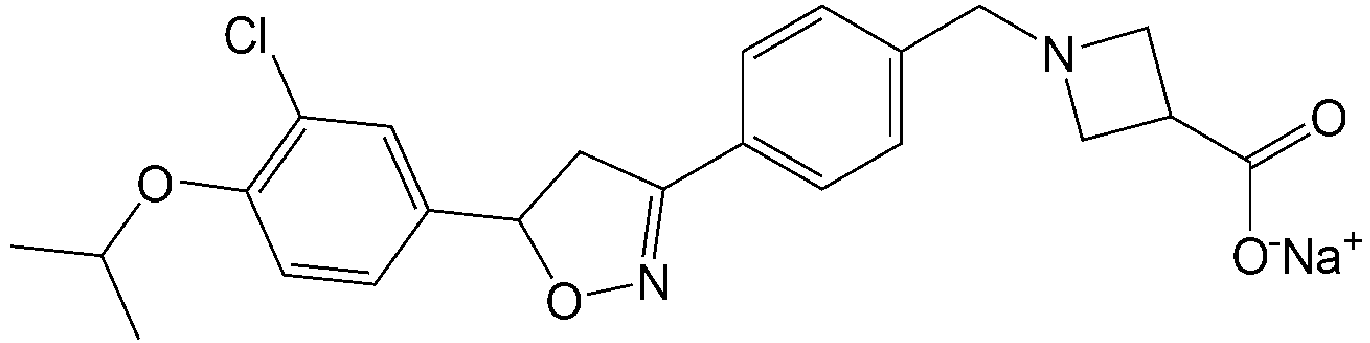
- Whild solid;
- Yield: 98%;
- 1H NMR (CD3OD, 400 MHz) δ 7.69 (d, J = 8.1 Hz, 2 ArH), 7.38-7.42 (m, 3 ArH), 7.28 (dd, J = 2.1, 8.4 Hz, 1 ArH), 7.07 (d, J = 8.5 Hz, 1 ArH), 5.66 (dd, J = 8.5, 10.6 Hz, 1 isoxazoline ring-H), 4.61-4.89 (m, OCH(CH3-)2), 3.84 (dd, J = 10.8, 17.0 Hz, 1 isoxazoline ring-H), 3.67 (s, NCH 2), 3.54 (t, J = 8.0 Hz, 2 azetidine ring-H), 3.32-3.40 (m, 1 isoxazoline ring-H, 2 azetidine ring-H), 3.20-3.26 (m, 1 azetidine ring-H), 1.35 (d, J = 6.0 Hz, OCH(CH 3-)2);
- 13C NMR (CD3OD, 100 MHz) δ 179.60 (C(O)), 156.79 (isoxazoline ring-C), 153.42, 139.76, 134.15, 128.98, 128.29, 127.75, 126.57, 125.33, 123.78, 115.65 (ArC), 81.77 (isoxazoline ring-C), 71.68 (OCH(CH3-)2), 62.48 (NCH2), 57.69 (azetidine ring-C), 42.29 (isoxazoline ring-C), 36.54 (azetidine ring-C), 20.91 (OCH(CH3-)2);
- HPLC purity: 5.7 min, 98.1%;
- HRMS (M + H)+ (ESI+) 429.1582 [M + H]+ (calcd for C23H25ClN2O4H+ 429.1581).
-

- Transparent oil;
- Yield: 35%;
- 1H NMR (CDCl3, 400 MHz) δ 7.62 (d, J = 8.0 Hz, 2ArH), 7.54 (s, 1 ArH), 7.48 (d, J = 8.5 Hz, 1 ArH), 7.31 (d, J = 8.0 Hz, 2 ArH), 6.98 (d, J = 8.6 Hz, 1 ArH), 5.68 (dd, J = 8.7, 10.5 Hz, 1 isoxazoline ring-H), 4.60-4.63 (m, OCH(CH3-)2), 3.74-3.77 (m, 1 isoxazoline ring-H), 3.73 (s, COOCH 3), 3.69 (s, NCH 2), 3.61-3.63 (m, 2 azetidine ring-H), 3.25-3.32 (m, 1 isoxazoline ring-H, 3 azetidine ring-H), 1.33 (d, J = 6.0 Hz, OCH(CH 3-)2);
- 13C NMR (CDCl3, 100 MHz) δ 173.49 (C(O)), 156.02 (isoxazoline ring-C), 140.19, 132.11, 130.69, 128.79, 128.16, 126.83 (ArC), 125.05 (q, J C-F = 4.9 Hz), 123.48 (q, J C-F = 270.8 Hz), 120.02 (q, J C-F = 30.5 Hz), 114.57 (ArC), 81.75 (isoxazoline ring-C), 71.42 (OCH(CH3-)2), 63.00 (NCH2), 56.87 (azetidine ring-C), 51.95 (COOCH3), 43.04 (isoxazoline ring-C), 33.96 (azetidine ring-C), 21.79 (OCH(CH3-)2);
- HPLC purity: 5.1 min, 99.4%;
- HRMS (M + H)+ (ESI+) 477.2006 [M + H]+ (calcd for C25H27F3N2O4H+ 477.2001).
-

- Whild solid;
- Yield: 92%;
- 1H NMR (CD3OD, 400 MHz) δ 7.71 (d, J = 8.1 Hz, 2 ArH), 7.55-7.57 (m, 2 ArH), 7.43 (d, J = 8.1 Hz, 2 ArH), 7.18 (d, J = 8.3 Hz, 1 ArH), 5.72 (dd, J = 8.7, 10.6 Hz, 1 isoxazoline ring-H), 4.74 (sept, J = 6.0 Hz, OCH(CH3-)2), 3.93 (s, NCH 2), 3.37-3.88 (m, 1 isoxazoline ring-H, 2 azetidine ring-H), 3.63-3.68 (m, 2 azetidine ring-H), 3.24-3.38 (m, 1 isoxazoline ring-H, 1 azetidine ring-H), 1.32 (d, J = 6.0 Hz, OCH(CH 3-)2);
- 13C NMR (CD3OD, 100 MHz) δ 178.16 (C(O)), 156.63, 155.95, 136.92, 132.37, 130.95, 129.44, 129.19 (ArC, isoxazoline ring-C), 124.55 (q, J C-F = 5.3 Hz), 123.65 (q, J C-F = 270.0 Hz), 119.76, 119.45, 119.15, 118.85 (q, J C-F = 30.3 Hz), 114.55 (ArC), 81.93 (isoxazoline ring-C), 71.03 (OCH(CH3-)2), 60.55 (NCH2), 57.24, 42.22, 35.80, 20.74 (OCH(CH3-)2);
- HPLC purity: 3.8 min, 100%;
- HRMS (M + H)+ (ESI+) 463.1848 [M + H]+ (calcd for C24H25F3N2O4H+ 463.1845).
-

- Transparent oil;
- Yield: 46%;
- 1H NMR (CDCl3, 400 MHz) δ 8.57 (d, J = 4.1 Hz, 1 ArH), 7.70 (td, J = 1.7, 7.6 Hz, 1 ArH), 7.64 (d, J = 8.2 Hz, 2 ArH), 7.56 (d, J = 7.8 Hz, 1 ArH), 7.31 (d, J = 8.2 Hz, 2 ArH), 7.20-7.23, (m, 1 ArH), 5.81-5.85 (m, 1 isoxazoline ring-H), 3.78-3.85 (m, 1 isoxazoline ring-H), 3.66-3.74 (m, COOCH 3, 1 isoxazoline ring-H), 3.62 (s, NCH 2), 3.49-3.55 (m, 2 azetidine ring-H), 3.30-3.36 (m, 3 azetidine ring-H);
- 13C NMR (CDCl3, 100 MHz) δ 173.45 (C(O)), 159.93, 156.31, 149.36, 140.00, 136.96, 128.74, 128.16, 126.93, 122.91, 120.57 (ArC, isoxazoline ring-C), 82.40 (isoxazoline ring-C), 62.95 (NCH2), 56.81 (azetidine ring-C), 51.96 (COOCH3), 41.48 (isoxazoline ring-C), 33.92 (azetidine ring-C);
- HPLC purity: 5.1 min, 98.8%;
- HRMS (M + H)+ (ESI+) 352.1661 [M + H]+ (calcd for C20H21N3O3H+ 352.1661).
-

- Yellow oil;
- Yield: 53%;
- 1H NMR (CD3OD, 400 MHz) δ 8.90 (d, J = 5.6 Hz, 1 ArH), 8.69-8.73 (m, 1 ArH), 8.23 (d, J = 8.0 Hz, 1 ArH), 8.10 (d, J = 6.8 Hz, 1 ArH), 7.84 (d, J = 8.0 Hz, 2 ArH), 7.66-7.71, (m, 2 ArH), 6.29-6.34 (m, 1 isoxazoline ring-H), 4.20-4.61 (m, 7H), 3.37-3.89 (m, 2H), 3.32-3.33 (m, 1H);
- 13C NMR (CD3OD, 100 MHz) δ 171.98, 171.47, 156.73, 154.70, 147.33, 141.82, 132.25 (d, J = 21.8 Hz), 130.55 (d, J = 8.2 Hz), 129.73, 127.73, 126.62, 124.85 (ArC, isoxazoline ring-C), 78.14 (isoxazoline ring-C), 57.26 (d, J = 22.8 Hz, NCH2), 55.27 (d, J = 25.6 Hz, azetidine ring-C), 41.89 (isoxazoline ring-C), 32.26 (azetidine ring-C);
- HPLC purity: 5.1 min, 95.3%;
- HRMS (M + H)+ (ESI+) 338.1503 [M + H]+ (calcd for C19H19N3O3H+ 338.1505).
-

- Yellow oil;
- Yield: 53%;
- 1H NMR (CDCl3, 400 MHz) δ 7.63 (d, J = 8.1 Hz, 2 ArH), 7.35-7.39 (m, 3 ArH), 7.21 (dd, J = 2.1, 8.4 Hz, 1 ArH), 6.92 (d, J = 8.5 Hz, 1 ArH), 5.63 (dd, J = 8.2, 10.8 Hz, 1 isoxazoline ring-H), 4.52-4.55 (m, OCH(CH3-)2), 3.73 (dd, J = 10.9, 16.6 Hz, 1 isoxazoline ring-H), 3.67 (s, OCH 3), 3.65 (d, J = 4.0 Hz, NCH 2), 3.30 (dd, J = 8.2, 16.6 Hz, 1 isoxazoling ring-H), 3.01-3.05 (m, 1 pyrrolidine ring-H), 2.87 (t, J = 9.0 Hz, 1 pyrrolidine ring-H), 2.64-2.68 (m, 2 pyrrolidine ring-H), 2.54 (q, J = 7.6 Hz, 1 pyrrolidine ring-H), 2.08-2.12 (m, 2 pyrrolidine ring-H), 1.36 (d, J = 6.0 Hz, OCH(CH 3)2);
- 13C NMR (CDCl3, 100 MHz) δ 175.43 (C(O)), 156.01, 153.59, 141.27, 134.11, 129.09, 128.14, 128.09, 126.77, 125.24, 124.56, 116.02 (ArC, isoxazoline ring-C), 81.66 (isoxazoline ring-C), 72.25 (OCH(CH3-)2), 59.67 (NCH2), 56.63, 53.75 (pyrrolidine ring-C), 51.92 (OCH3), 43.07 (pyrrolidine ring-C), 41.97 (isoxazoline ring-C), 27.69 (pyrrolidine ring-C), 22.01 (OCH(CH3-)2);
- HPLC purity: 5.3 min, 98.7%;
- HRMS (M + H)+ (ESI+) 457.1895 [M + H]+ (calcd for C25H29ClN2O4H+ 457.1894).
-

- Yellow solid;
- Yield: 100%;
- 1H NMR (CD3OD, 400 MHz) δ 7.66 (d, J = 8.0 Hz, 2 ArH), 7.38-7.42 (m, 3 ArH), 7.25 (dd, J = 1.5, 8.4 Hz, 1 ArH), 7.04 (d, J = 8.5 Hz, 1 ArH), 5.63 (t, J = 10.2 Hz, 1 isoxazoline ring-H), 5.61-5.65 (m, OCH(CH3-)2), 3.80 (dd, J = 10.8, 17.0 Hz, 1 isoxazoline ring-H), 3.61-3.69 (m, NCH 2), 3.31-3.36 (m, 1 isoxazoline ring-H), 2.89-2.99 (m, 2 pyrrolidine ring-H), 2.72-2.77 (m, 1 pyrrolidine ring-H), 2.61 (t, J = 8.0 Hz, 1 pyrrolidine ring-H), 2.49 (q, J = 8.2 Hz, 1 pyrrolidine ring-H), 2.00-2.09 (m, 2 pyrrolidine ring-H), 1.31 (d, J = 6.0 Hz, OCH(CH 3-)2);
- 13C NMR (CD3OD, 100 MHz) δ 181.64 (C(O)), 156.81, 153.42, 140.79, 134.16, 129.43, 128.19, 127.75, 126.48, 125.35, 123.78, 115.66 (ArC, isoxazoline ring-C), 81.75 (isoxazoline ring-C), 71.69 (OCH(CH3-)2), 59.73 (NCH2), 57.75, 53.78, 45.15 (pyrrolidine ring-C), 42.32 (isoxazoline ring-C), 28.26 (pyrrolidine ring-C), 20.93 (OCH(CH3-)2);
- HPLC purity: 5.3 min, 98.7%;
- HRMS (M + H)+ (ESI+) 443.1741 [M + H]+ (calcd for C24H27ClN2O4H+ 443.1738).
-
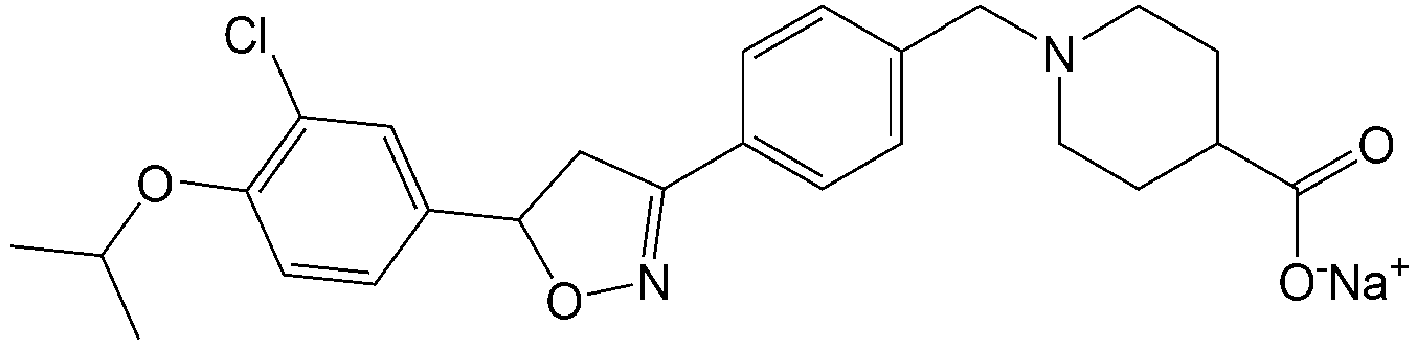
- Whild solid;
- Yield: 99%;
- 1H NMR (CD3OD, 400 MHz) δ 7.69 (d, J = 8.2 Hz, 2 ArH), 7.40-7.44 (m, 3 ArH), 7.28 (dd, J = 2.1, 8.4 Hz, 1 ArH), 7.08 (d, J = 8.5 Hz, 1 ArH), 5.66 (dd, J = 8.6, 10.6 Hz, 1 isoxazoline ring-H), 4.60-4.67 (m, OCH(CH3-)2), 3.84 (dd, J = 10.8, 17.0 Hz, 1 isoxazoline ring-H), 3.61 (s, NCH 2), 3.35-3.40 (m, 1 isoxazoline ring-H), 2.92 (d, J = 11.6 Hz, 2 piperidine ring-H), 2.10-2.20 (m, 3 piperidine ring-H), 1.86 (s, 2 piperidine ring-H), 1.73-1.80 (m, 2 piperidine ring-H), 1.33 (d, J = 6.0 Hz, OCH(CH 3-)2);
- 13C NMR (CD3OD, 100 MHz) δ 207.53 (C(O)), 156.81 (isoxazoline ring-C), 153.57, 141.36, 134.28, 129.94, 127.75, 126.45, 125.29, 123.79, 115.65, 113.63 (ArC), 81.81 (isoxazoline ring-C), 71.67 (OCH(CH3-)2), 62.15 (NCH2), 53.05 (piperidine ring-C), 42.29 (isoxazoline ring-C), 28.62 (piperidine ring-C), 20.86 (OCH(CH3-)2);
- HPLC purity: 4.9 min, 98.3%;
- HRMS (M + H)+ (ESI+) 457.1896 [M + H]+ (calcd for C25H29ClN2O4H+ 457.1894).
- In order to confirm the effect on S1P1 activity of
Compounds 1 to 71 synthesized according to the above Examples 1 to 3, an in vitro assay was performed using a cell-based evaluation system, and the results are shown in Table 1. - In order to analyze the efficacy of functional antagonists, two S1P1 overexpressing cell lines were used, which enables to measure the degree of internalization of the receptor through β-arrestin that occurs after GPCR activation. A cell line that measures the degree of β-arrestin recruitment to the intracellular end of the receptor after S1P1 receptor activation and a cell line that measures the degree of endosome formation by internalization that occurs after S1P1 receptor activation were used, and all of the cell lines above and the materials used in the exemplary embodiments below were purchased from DiscoverX of Eurofins.
- The S1P1 receptor activity of the compounds of the present disclosure was verified according to the method provided by each manufacturer, and the degree of luminescence according to the treatment concentration of the compounds was measured to calculate the EC50 value, which is the concentration showing half of its activity. Specifically, the cell lines were dispensed at a density of 1.0×10⁴ cells/well in an assay medium and cultured in an incubator for one day, and then the cells were lysed, and luminescence was measured by adding luminescent substrates. The two calculated EC50 values are shown in Table 1 below. Among the 71 compounds, Compounds 13, 62, 64, and 66, which showed excellent activity, were additionally used in the subsequent Experimental Examples.
[Table 1] Comp ound β-arrestin EC50 (nM) Internalization EC50 (nM) Comp ound β-arrestin EC50 (nM) Internalization EC50 (nM) 1 11.1 173.1 37 7.88 13.5 2 2.12 2.20 38 0.58 0.14 3 23.6 116.5 39 39.2 159.6 4 70.1 141.35 40 10.6 23.1 5 3.64 0.87 41 0.90 9.52 6 0.37 0.065 42 0.81 0.37 7 1.17 4.33 43 > 1,000 > 1,000 8 29.9 33.1 44 > 1,000 > 1,000 9 1.82 1.59 45 > 1,000 > 1,000 10 0.45 0.36 46 > 1,000 > 1,000 11 1.49 12.6 47 > 1,000 > 1,000 12 1.41 1.48 48 > 1,000 > 1,000 13 0.22 0.049 49 > 1,000 > 1,000 14 1.13 4.91 50 567±16.4 414±5.80 15 0.54 0.27 51 > 1,000 > 1,000 16 48.53 139.5 52 > 1,000 > 1,000 17 25.85 81.3 53 > 1,000 > 1,000 18 3.24 9.26 54 > 1,000 > ±1,000 19 1.14 0.97 55 542±20.1 973±24.3 20 3.05 118.7 56 25.9±0.20 30.5±1.23 21 503 378.6 57 > 1,000 286±4.78 22 8.59 97.35 58 34.6±0.27 112±8.69 23 > 1,000 > 1,000 59 95.7±3.96 346±6.92 24 > 1,000 > 1,000 60 18.1±0.14 34.6±0.31 25 252.5 346.7 61 100±0.50 122±4.80 26 > 1,000 > 1,000 62 20.4±0.67 16.8±0.46 27 > 1,000 > 1,000 63 23.1±0.69 45.3±3.24 28 > 1,000 > 1,000 64 7.03±0.09 11.8±0.28 29 635.1 378.6 65 86.6±1.05 38.5±0.81 30 8.50 205.4 66 5.57±0.09 5.09±0.08 31 2.59 4.21 67 392±5.42 594±14.9 32 580.4 518.6 68 346±6.08 237±6.13 33 1.79 11.9 69 74.4±1.93 146±5.38 34 1.08 0.58 70 11.1±0.13 14.3±0.44 35 21.05 11.5 71 111±2.74 80.6±3.04 36 2.03 2.62 - In order to confirm the effect of administration of the four compounds selected from Experimental Example 1, Compounds 13, 62, 64, and 66, on the decrease in the blood lymphocyte count in rodents in vivo, blood was collected before and after compound administration, and the decrease in the blood lymphocyte count over time was measured using an automatic blood counter, and the results are shown in
FIG. 1 . - Specifically, 5-week-old male rats (rat, wister, 160-180 g) were acclimated in a temperature- and humidity-controlled breeding room, and the four selected compounds were dissolved in 5% DMSO and 10% Kolliphor HS15 aqueous solution and orally administered at a dose of 10 mg/kg. Blood was collected from the tail vein with a syringe during inhalation anesthesia with 4% isoflurane and transferred to an EDTA-coated tube. The lymphocyte count was measured from the collected blood using an automatic blood counter. As a positive control group, rats administered with fingolimod, a known S1P1 receptor modulator, were used.
- As shown in
FIG. 1 , the lymphocyte count over time after compound administration was expressed as a percentage (%) based on the lymphocyte count of the rat before compound administration. As in the positive control group, fingolimod-administered group, it was confirmed that the group administered with the compounds of the Examples within 5 hours after drug administration induced a decrease in the lymphocyte count by 50% or less. This indicates that when the compounds of the present disclosure are orally administered to normal rats, a decrease in the blood lymphocyte count can be induced. - In order to confirm the effect of administration of the four compounds selected from the Experimental Example 1, Compounds 13, 62, 64, and 66, on the alleviation of symptoms in a multiple sclerosis animal model, the four compounds were orally administered to a MOG35-55 peptide-induced multiple sclerosis model, and the changes in the clinical symptoms of stiffness and paralysis were specified and the results are shown in
FIG. 2 . - A rodent model of experimental autoimmune encephalomyelitis (EAE) induced by myelin oligodendrocyte glycoprotein (MOG), which is most widely used in multiple sclerosis research, was prepared.
- Specifically, 10-week-old C57BL6/J male mice were acclimated in a temperature- and humidity-controlled breeding room and then subcutaneously injected with a thoroughly stirred mixture of MOG35-55 peptide and complete Freund's adjuvant (CFA). Additionally, pertussis toxin dissolved in PBS was injected intraperitoneally on
Day 0 andDay 1. The timeline of the preparation of the multiple sclerosis animal model of MOG-induced EAE and the outline of drug administration are shown in the upper part of the graphs ofFIGS. 2A and 2G . - The compounds of the present disclosure were dissolved in 5% DMSO and 10% Kolliphor HS15 aqueous solutions and orally administered daily at doses of 0.3, 3, or 10 mg/kg. The negative control group was prepared by orally administering the same amount of vehicle daily, and the positive control group was prepared by orally administering fingolimod daily at a dose of 3 mg/kg, with the same composition as the compound of the present disclosure. The symptoms of the animal models of the negative control group, positive control group, and experimental group prepared as described above were evaluated and scored by applying the following criteria:
- 0: No abnormality,
- 0.5: Loss of tension in tail,
- 1.0: Loss of reflexes in tail,
- 2.0: Loss of reflexes in tail and sensory abnormalities in one leg,
- 3.0: Sensory abnormalities and paralysis in one leg,
- 3.5: Paralysis of both hind legs,
- 4.0: Paralysis of forelegs and hind legs,
- 5.0: Moribund or dead.
- As a result of evaluating the efficacy of the drug using the aforementioned symptom criteria, as shown in
FIGS. 2A and 2G , in the case of the negative control group that was not treated with the drug, the symptoms of multiple sclerosis became more severe over time, whereas when the compounds of the present invention were orally administered, the daily symptoms were alleviated or improved, and the symptom severity of the total degree of symptoms accumulated over the test period (FIG. 2B ) and the maximum degree of symptom development (FIG. 2C ) was alleviated in a concentration-dependent manner. Additionally, as shown inFIGS. 2D and 2E , respectively, regarding the change in daily body weight and the rate of final body weight change, the severity of the disease was lowered when the compounds of the present invention were administered, which significantly reduced the loss of body weight by reducing the overall inflammatory response and food intake restriction due to paralysis. Furthermore, as shown inFIGS. 2F and 2H, it was confirmed that when the compound of the present disclosure was administered, the onset of symptoms was delayed or suppressed. - In summary, it was confirmed that the compounds of the present disclosure improve the neurological clinical symptom criteria of the disease in an EAE animal model induced by the MOG peptide, indicating that the compounds of the present disclosure can be effectively used for the prevention or treatment of neurological autoimmune diseases, particularly multiple sclerosis.
- Based on the above description, it will be understood by those skilled in the art that the present disclosure may be implemented in a different specific form without changing the technical spirit or essential characteristics thereof. In this regard, it should be understood that the above embodiments are not limitative, but illustrative in all aspects. The scope of the present disclosure is defined by the appended claims rather than by the preceding description, and therefore all changes and modifications that fall within metes and bounds of the claims, or equivalents of such metes and bounds are therefore intended to be embraced by the claims.
Claims (18)
- A compound represented by Formula 1 below or a pharmaceutically acceptable salt thereof:
 Ring 1 is selenazolenyl or isoxazolenyl;Ring 2 is C6-10 aryl or 5 to 10-membered heteroaryl;R1 is one or more substituents identical or different from each other selected from the group consisting of hydrogen, cyano, halo(gen), hydroxy, C1-6 alkyl, C1-6 alkoxy, and C1-6 haloalkyl;R2 and R3 are each independently hydrogen, C1-6 alkoxycarbonyl-C1-6 alkyl, or sodium carboxy-C1-6 alkyl; orR2 and R3 are connected to each other to form an unsubstituted or substituted 3 to 10-membered heterocyclyl including the nitrogen to which the R2 and R3 are attached.
 - The compound or a pharmaceutically acceptable salt thereof of claim 1, which is represented by any one of Formulae 2 to 4 below:

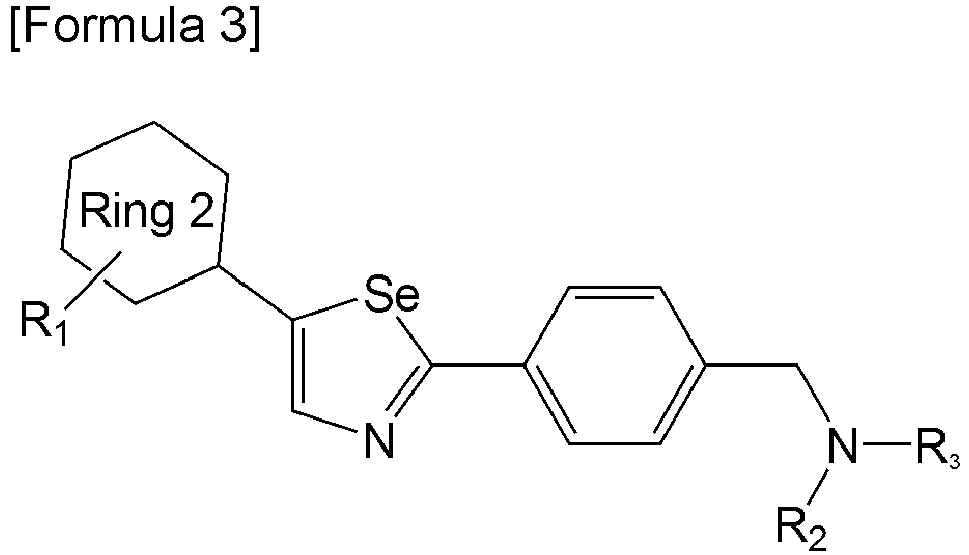

- The compound or a pharmaceutically acceptable salt thereof of claim 1, wherein
Ring 2 is phenyl or pyridinyl. - The compound or a pharmaceutically acceptable salt thereof of claim 1, wherein
R1 is none, cyano, bromo, chloro, hydroxy, ethyl, propyl, tert-butyl, methoxy, ethoxy, isopropoxy, chloromethyl, or trifluoromethyl. - The compound or a pharmaceutically acceptable salt thereof of claim 1, wherein
R2 is hydrogen, and R3 is ethoxycarbonylmethyl, methoxycarbonylethyl, sodium carboxymethyl, or sodium carboxyethyl. - The compound or a pharmaceutically acceptable salt thereof of claim 1, wherein
R2 and R3 are connected to each other to form azetidinyl, pyrrolidinyl, or piperidinyl, which is unsubstituted or substituted with one or more selected from the group consisting of carboxy, methoxycarbonyl, ethoxycarbonyl, tert-butoxycarbonyl, and sodium carboxy including the nitrogen to which the R2 and R3 are attached. - The compound or a pharmaceutically acceptable salt thereof of claim 1, wherein the compound is1. Methyl 1-(4-(2-(4-tert-butylphenyl)-1,3-selenazole-5-yl)benzyl)azetidine-3-carboxylate;2. Sodium 1-(4-(2-(4-tert-butylphenyl)-1,3-selenazole-5-yl)benzyl)azetidine-3-carboxylate;3. Ethyl 1-(4-(2-(4-tert-butylphenyl)-1,3-selenazole-5-yl)benzyl)azetidine-3-carboxylate;4. Tert-butyl 1-(4-(2-(4-tert-butylphenyl)-1,3-selenazole-5-yl)benzyl)azetidine-3-carboxylate;5. Methyl 1-(4-(2-(3-isocyano-4-isopropoxyphenyl)-1,3-selenazole-5-yl)benzyl)azetidine-3-carboxylate;6. Sodium 1-(4-(2-(3-isocyano-4-isopropoxyphenyl)-1,3-selenazole-5-yl)benzyl)azetidine-3-carboxylate;7. Ethyl 1-(4-(2-(3-cyano-4-isopropoxyphenyl)-1,3-selenazole-5-yl)benzyl)azetidine-3-carboxylate;8. Tert-butyl 1-(4-(2-(3-cyano-4-isopropoxyphenyl)-1,3-selenazole-5-yl)benzyl)azetidine-3-carboxylate;9. Methyl 1-(4-(2-(4-isopropoxy-3-(trifluoromethyl)phenyl)-1,3-selenazole-5-yl)benzyl)azetidine-3-carboxylate;10. 1-(4-(2-(4-isopropoxy-3-(trifluoromethyl)phenyl)-1,3-selenazole-5-yl)benzyl)azetidine-3-carboxylic acid;11. Ethyl 1-(4-(2-(4-isopropoxy-3-(trifluoromethyl)phenyl)-1,3-selenazole-5-yl)benzyl)azetidine-3-carboxylate;12. Methyl 1-(4-(2-(3-chloro-4-isopropoxyphenyl)-1,3-selenazole-5-yl)benzyl)azetidine-3-carboxylate;13. Sodium 1-(4-(2-(3-chloro-4-isopropoxyphenyl)-1,3-selenazole-5-yl)benzyl)azetidine-3-carboxylate;14. Methyl 1-(4-(2-(3-chloro-4-ethoxyphenyl)-1,3-selenazole-5-yl)benzyl)azetidine-3-carboxylate;15. Sodium 1-(4-(2-(3-chloro-4-ethoxyphenyl)-1,3-selenazole-5-yl)benzyl)azetidine-3-carboxylate;16. Methyl 1-(4-(2-(4-methoxyphenyl)-1,3-selenazole-5-yl)benzyl)azetidine-3-carboxylate;17. 1-(4-(2-(4-methoxyphenyl)-1,3-selenazole-5-yl)benzyl)azetidine-3-carboxylic acid;18. Methyl 1-(4-(2-(4-isopropoxyphenyl)-1,3-selenazole-5-yl)benzyl)azetidine-3-carboxylate;19. 1-(4-(2-(4-isopropoxyphenyl)-1,3-selenazole-5-yl)benzyl)azetidine-3-carboxylic acid;20. Ethyl 1-(4-(2-(4-isopropoxyphenyl)-1,3-selenazole-5-yl)benzyl)azetidine-3-carboxylate;21. Methyl 1-(4-(2-(3-isopropoxyphenyl)-1,3-selenazole-5-yl)benzyl)azetidine-3-carboxylate;22. 1-(4-(2-(3-isopropoxyphenyl)-1,3-selenazole-5-yl)benzyl)azetidine-3-carboxylic acid;23. Methyl 1-(4-(2-(2-isopropoxyphenyl)-1,3-selenazole-5-yl)benzyl)azetidine-3-carboxylate;24. 1-(4-(2-(2-isopropoxyphenyl)-1,3-selenazole-5-yl)benzyl)azetidine-3-carboxylic acid;25. Ethyl 1-(4-(2-(2-isopropoxyphenyl)-1,3-selenazole-5-yl)benzyl)azetidine-3-carboxylate;26. Methyl 1-(4-(2-(pyridine-2-yl)-1,3-selenazole-5-yl)benzyl)azetidine-3-carboxylate;27. Sodium 1-(4-(2-(pyridine-2-yl)-1,3-selenazole-5-yl)benzyl)azetidine-3-carboxylate;28. Methyl 1-(4-(2-(pyridine-3-yl)-1,3-selenazole-5-yl)benzyl)azetidine-3-carboxylate;29. Sodium 1-(4-(2-(pyridine-3-yl)-1,3-selenazole-5-yl)benzyl)azetidine-3-carboxylate;30. Methyl 1-(4-(2-(4-tert-butylphenyl)-1,3-selenazole-5-yl)benzyl)pyrrolidine-3-carboxylate;31. Sodium 1-(4-(2-(4-tert-butylphenyl)-1,3-selenazole-5-yl)benzyl)pyrrolidine-3-carboxylate;32. Methyl 1-(4-(2-(4-tert-butylphenyl)-1,3-selenazole-5-yl)benzyl)piperidine-4-carboxylate;33. Methyl 1-(4-(2-(3-chloro-4-isopropoxyphenyl)-1,3-selenazole-5-yl)benzyl)pyrrolidine-3-carboxylate;34. Sodium 1-(4-(2-(3-chloro-4-isopropoxyphenyl)-1,3-selenazole-5-yl)benzyl)pyrrolidine-3-carboxylate;35. Ethyl 2-(4-(2-(3-chloro-4-isopropoxyphenyl)-1,3-selenazole-5-yl)benzylamino)acetate;36. Sodium 2-(4-(2-(3-chloro-4- isopropoxyphenyl)-1,3-selenazole-5-yl)benzylamino)acetate;37. Methyl 3-(4-(2-(3-chloro-4-isopropoxyphenyl)-1,3-selenazole-5-yl)benzylamino)propanoate;38. Sodium 3-(4-(2-(3-chloro-4-isopropoxyphenyl)-1,3-selenazole-5-yl)benzylamino)propanoate;39. Methyl 1-(4-(5-(4-tert-butylphenyl)-1,3-selenazole-2-yl)benzyl)azetidine-3-carboxylate;40. Sodium 1-(4-(5-(4-tert-butylphenyl)-1,3-selenazole-2-yl)benzyl)azetidine-3-carboxylate;41. Methyl 1-(4-(5-(3-chloro-4-isopropoxyphenyl)-1,3-selenazole-2-yl)benzyl)azetidine-3-carboxylate;42. Sodium 1-(4-(5-(3-chloro-4-isopropoxyphenyl)-1,3-selenazole-2-yl)benzyl)azetidine-3-carboxylate;43. Methyl 1-(4-(5-phenyl-4,5-dihydroisoxazole-3-yl)benzyl)azetidine-3-carboxylate;44. 1-(4-(5-phenyl-4,5-dihydroisoxazole-3-yl)benzyl)azetidine-3-carboxylic acid;45. Methyl 1-(4-(5-(2-bromophenyl)-4,5-dihydroisoxazole-3-yl)benzyl)azetidine-3-carboxylate;46. 1-(4-(5-(2-bromophenyl)-4,5-dihydroisoxazole-3-yl)benzyl)azetidine-3-carboxylic acid;47. Methyl 1-(4-(5-(3-bromophenyl)-4,5-dihydroisoxazole-3-yl)benzyl)azetidine-3-carboxylate;48. 1-(4-(5-(3-bromophenyl)-4,5-dihydroisoxazole-3-yl)benzyl)azetidine-3-carboxylic acid;49. Methyl 1-(4-(5-(4-bromophenyl)-4,5-dihydroisoxazole-3-yl)benzyl)azetidine-3-carboxylate;50. 1-(4-(5-(4-bromophenyl)-4,5-dihydroisoxazole-3-yl)benzyl)azetidine-3-carboxylic acid;51. 1-(4-(5-(4-hydroxyphenyl)-4,5-dihydroisoxazole-3-yl)benzyl)azetidine-3-carboxylic acid;52. Methyl 1-(4-(5-(4-(chloromethyl)phenyl)-4,5-dihydroisoxazole-3-yl)benzyl)azetidine-3-carboxylate;53. Sodium 1-(4-(5-(4-(chloromethyl)phenyl)-4,5-dihydroisoxazole-3-yl)benzyl)azetidine-3-carboxylate;54. Methyl 1-(4-(5-(4-ethylphenyl)-4,5-dihydroisoxazole-3-yl)benzyl)azetidine-3-carboxylate;55. Sodium 1-(4-(5-(4-ethylphenyl)-4,5-dihydroisoxazole-3-yl)benzyl)azetidine-3-carboxylate;56. Sodium 1-(4-(5-(4-propylphenyl)-4,5-dihydroisoxazole-3-yl)benzyl)azetidine-3-carboxylate;57. Methyl 1-(4-(5-(4-tert-butylphenyl)-4,5-dihydroisoxazole-3-yl)benzyl)azetidine-3-carboxylate;58. Sodium 1-(4-(5-(4-tert-butylphenyl)-4,5-dihydroisoxazole-3-yl)benzyl)azetidine-3-carboxylate;59. Methyl 1-(4-(5-(3-cyano-4-isopropoxyphenyl)-4,5-dihydroisoxazole-3-yl)benzyl)azetidine-3-carboxylate;60. 1-(4-(5-(3-cyano-4-isopropoxyphenyl)-4,5-dihydroisoxazole-3-yl)benzyl)azetidine-3-carboxylic acid;61. Methyl 1-(4-(5-(3-chloro-4-ethoxyphenyl)-4,5-dihydroisoxazole-3-yl)benzyl)azetidine-3-carboxylate;62. Sodium 1-(4-(5-(3-chloro-4-ethoxyphenyl)-4,5-dihydroisoxazole-3-yl)benzyl)azetidine-3-carboxylate;63. Methyl 1-(4-(5-(3-chloro-4-isopropoxyphenyl)-4,5-dihydroisoxazole-3-yl)benzyl)azetidine-3-carboxylate;64. Sodium 1-(4-(5-(3-chloro-4-isopropoxyphenyl)-4,5-dihydroisoxazole-3-yl)benzyl)azetidine-3-carboxylate;65. Methyl 1-(4-(5-(4-isopropoxy-3-(trifluoromethyl)phenyl)-4,5-dihydroisoxazole-3-yl)benzyl)azetidine-3-carboxylate;66. Sodium 1-(4-(5-(4-isopropoxy-3-(trifluoromethyl)phenyl)-4,5-dihydroisoxazole-3-yl)benzyl)azetidine-3-carboxylate;67. Methyl 1-(4-(5-(pyridine-2-yl)-4,5-dihydroisoxazole-3-yl)benzyl)azetidine-3-carboxylate;68. Sodium 1-(4-(5-(pyridine-2-yl)-4,5-dihydroisoxazole-3-yl)benzyl)azetidine-3-carboxylate;69. Methyl 1-(4-(5-(3-chloro-4-isopropoxyphenyl)-4,5-dihydroisoxazole-3-yl)benzyl)pyrrolidine-3-carboxylate;70. Sodium 1-(4-(5-(3-chloro-4-isopropoxyphenyl)-4,5-dihydroisoxazole-3-yl)benzyl)pyrrolidine-3-carboxylate; or71. Sodium 1-(4-(5-(3-chloro-4-isopropoxyphenyl)-4,5-dihydroisoxazole-3-yl)benzyl)piperidine-4-carboxylate.
- A method for preparing the compound of any one of claims 1 to 7, and a pharmaceutically acceptable salt thereof, comprising: aminating an aldehyde group of a compound represented by Formula 5 below:
 Ring 1 is selenazolenyl or isoxazolenyl;Ring 2 is C6-10 aryl or 5 to 10-membered heteroaryl; andR1 is one or more substituents identical or different from each other selected from the group consisting of hydrogen, cyano, halo(gen), hydroxy, C1-6 alkyl, C1-6 alkoxy, and C1-6 haloalkyl.
 - The method of claim 8, wherein the compound of Formula 5 is prepared by:Step a of reacting R1-Ring 2-nitrile or 4-(hydroxymethyl)benzonitrile with selenium and carbon monoxide to produce R1-Ring 2-substituted selenoamide or 4-hydroxybenzoselenamide;Step b of reacting the product of Step a with 2-bromo-1,1-diethoxyethane and p-toluenesulfonic acid to form a 1,3-selenazole ring in which Ring 2 is substituted at carbon 5 or phenyl is substituted at carbon 2;Step c of halogenating the unsubstituted carbon 2 or carbon 5 of the 1,3-selenazole ring of the product of Step b; andStep d of reacting the product of Step c with 4-formylphenylboronic acid or R1-Ring 2-boronic acid to introduce an additional substituent at the halogenated carbon 2 or carbon 5.
- The method of claim 8, wherein the compound of Formula 5 is prepared by:Step a' of reacting N-hydroxy-4-(hydroxymethyl)benzimidoyl chloride with triethylamine to remove hydrochloric acid;Step b' of reacting the product of Step a' with ethenyl-substituted R1-Ring 2 to produce (4-(5-(R1-Ring 2)-4,5-dihydroisoxazole-3-yl)phenyl)methanol; andStep c' of oxidizing the hydroxyl group on the phenyl ring of the product of Step b'.
- A pharmaceutical composition for preventing or treating multiple sclerosis (MS), comprising the compound of any one of claims 1 to 7 or a pharmaceutically acceptable salt thereof, as an active ingredient.
- The pharmaceutical composition of claim 11, wherein the compound is contained in the form of its sodium salt.
- The pharmaceutical composition of claim 11, wherein the compound acts as a sphingosine-1-phosphate receptor (S1P1) modulator.
- The pharmaceutical composition of claim 11, which decreases the blood lymphocyte count.
- The pharmaceutical composition of claim 11, which alleviates symptoms of stiffness or paralysis.
- The pharmaceutical composition of claim 11, which delays the onset of symptoms of multiple sclerosis.
- A food composition for preventing or alleviating multiple sclerosis, comprising the compound of any one of claims 1 to 7 or a food-acceptable salt thereof, as an active ingredient.
- A feed composition for preventing or alleviating multiple sclerosis, comprising the compound of any one of claims 1 to 7 or feed-acceptable salt thereof, as an active ingredient.
Applications Claiming Priority (1)
| Application Number | Priority Date | Filing Date | Title |
|---|---|---|---|
| PCT/KR2022/011333 WO2024029638A1 (en) | 2022-08-01 | 2022-08-01 | Novel heterocyclyl-phenyl-methylamine derivative, preparation method therefor, and use thereof for prevention, alleviation, or treatment of multiple sclerosis |
Publications (1)
| Publication Number | Publication Date |
|---|---|
| EP4567034A1 true EP4567034A1 (en) | 2025-06-11 |
Family
ID=89849522
Family Applications (1)
| Application Number | Title | Priority Date | Filing Date |
|---|---|---|---|
| EP22954093.5A Pending EP4567034A1 (en) | 2022-08-01 | 2022-08-01 | Novel heterocyclyl-phenyl-methylamine derivative, preparation method therefor, and use thereof for prevention, alleviation, or treatment of multiple sclerosis |
Country Status (4)
| Country | Link |
|---|---|
| EP (1) | EP4567034A1 (en) |
| JP (1) | JP2025525896A (en) |
| CN (1) | CN119968367A (en) |
| WO (1) | WO2024029638A1 (en) |
Family Cites Families (13)
| Publication number | Priority date | Publication date | Assignee | Title |
|---|---|---|---|---|
| DE19904389A1 (en) * | 1999-02-04 | 2000-08-10 | Bayer Ag | Use of substituted isoxazolecarboxylic acids and derivatives and new substances |
| JP2008545767A (en) * | 2005-06-08 | 2008-12-18 | ノバルティス アクチエンゲゼルシャフト | Polycyclic oxadiazoles or isoxazoles and their use as SIP receptor ligands |
| GB0601744D0 (en) * | 2006-01-27 | 2006-03-08 | Novartis Ag | Organic compounds |
| US20100087491A1 (en) * | 2006-09-29 | 2010-04-08 | Rainer Albert | Polycyclic compounds |
| CN101562977A (en) * | 2006-12-15 | 2009-10-21 | 艾博特公司 | Novel oxadiazole compounds |
| US8822502B2 (en) * | 2008-08-22 | 2014-09-02 | Syngenta Crop Protection Llc | Insecticidal compounds |
| WO2010065760A1 (en) * | 2008-12-04 | 2010-06-10 | Exelixis, Inc. | Imidazo [1,2a] pyridine derivatives, their use as s1p1 agonists and methods for their production |
| US8318783B2 (en) * | 2010-04-27 | 2012-11-27 | Allergan, Inc. | 3-(4-((1H-imidazol-1-yl)methyl)phenyl)-5-aryl-1,2,4-oxadiazole derivatives as sphingosine-1 phosphate receptors modulators |
| EP2511275A1 (en) * | 2011-04-12 | 2012-10-17 | Bioprojet | Novel piperidinyl monocarboxylic acids as S1P1 receptor agonists |
| WO2013094761A1 (en) * | 2011-12-23 | 2013-06-27 | Meiji Seikaファルマ株式会社 | Novel s1p receptor modulator |
| SI2958913T1 (en) * | 2013-02-20 | 2018-12-31 | Lg Chem, Ltd. | Sphingosine-1-phosphate receptor agonists, methods of preparing the same, and pharmaceutical compositions containing the same as an active agent |
| US20220324880A1 (en) * | 2019-06-10 | 2022-10-13 | Kymara Therapeutics, Inc. | Smarca inhibitors and uses thereof |
| KR102614653B1 (en) * | 2021-06-09 | 2023-12-20 | 한국과학기술연구원 | Novel heterocyclyl-phenyl-methylamine derivatives, preparation method thereof, and use thereof for preventing, improving, or treating multiple sclerosis |
-
2022
- 2022-08-01 WO PCT/KR2022/011333 patent/WO2024029638A1/en not_active Ceased
- 2022-08-01 EP EP22954093.5A patent/EP4567034A1/en active Pending
- 2022-08-01 CN CN202280100514.7A patent/CN119968367A/en active Pending
- 2022-08-01 JP JP2025505905A patent/JP2025525896A/en active Pending
Also Published As
| Publication number | Publication date |
|---|---|
| WO2024029638A1 (en) | 2024-02-08 |
| JP2025525896A (en) | 2025-08-07 |
| CN119968367A (en) | 2025-05-09 |
Similar Documents
| Publication | Publication Date | Title |
|---|---|---|
| US12582653B2 (en) | Method for treating idiopathic pulmonary fibrosis | |
| US8143288B2 (en) | Inhibitors of HCV replication | |
| US9346821B2 (en) | Heterocyclic carboxylic acid ester derivative | |
| US12485108B2 (en) | Method for treating fatty liver disease and/or steatohepatitis | |
| US10174040B2 (en) | Pyrrolopyrimidine compound or salt thereof and compositions containing the pyrrolopyrimidine compound or salt thereof | |
| KR20140095105A (en) | Compositions and methods for treating colitis | |
| CA3075705A1 (en) | Beta-hydroxy heterocyclic amines and their use in the treatment of hyperglycaemia | |
| KR19980081621A (en) | NK-1 Receptor Antagonist to Treat Symptoms of Irritable Bowel Syndrome | |
| US20090042883A1 (en) | Antitumor agent | |
| US12310955B2 (en) | Cyclic amide compounds for rabies treatment and method thereof | |
| KR102614653B1 (en) | Novel heterocyclyl-phenyl-methylamine derivatives, preparation method thereof, and use thereof for preventing, improving, or treating multiple sclerosis | |
| JP2023517613A (en) | Pharmaceutical composition for prevention or treatment of non-alcoholic steatohepatitis | |
| KR102538048B1 (en) | Pharmaceutical composition for the prevention or treatment of diabetes and associated metabolic diseases thereof | |
| EP1084704B1 (en) | Remedies for spinocerebellar ataxia and compositions for treating spinocerebellar ataxia | |
| CN119968367A (en) | Novel heterocyclic phenylmethylamine derivative, preparation method and use thereof in preventing, alleviating or treating multiple sclerosis | |
| CA2598491A1 (en) | Diastereoisomers of 4-hydroxyisoleucine and uses thereof | |
| JP2711939B2 (en) | Lysine salt of 6-chloro-5-fluoro-3- (2-thenoyl) -2-oxindole-1-carboxamide | |
| US12473276B2 (en) | Compound having neuroprotective effect, preparation method therefor and use thereof | |
| CA3167630C (en) | Pharmaceutical composition comprising a gpr119 agonist and a hypoglycemic agent for prevention or treatment of diabetes and metobolic diseases associated therewith | |
| KR102409345B1 (en) | Nlrp3 inflammasome inhibitor and uses thereof | |
| HK40075147A (en) | Pharmaceutical composition for prevention or treatment of diabetes and metabolic diseases associated therewith | |
| WO2003006024A1 (en) | Medicine containing pyrimidine derivative | |
| HK40058942A (en) | Method for treating fatty liver disease and/or steatohepatitis | |
| HK40075146A (en) | Pharmaceutical composition for prevention or treatment of nonalcoholic steatohepatitis | |
| HK40064686A (en) | Method for treating idiopathic pulmonary fibrosis |
Legal Events
| Date | Code | Title | Description |
|---|---|---|---|
| STAA | Information on the status of an ep patent application or granted ep patent |
Free format text: STATUS: THE INTERNATIONAL PUBLICATION HAS BEEN MADE |
|
| PUAI | Public reference made under article 153(3) epc to a published international application that has entered the european phase |
Free format text: ORIGINAL CODE: 0009012 |
|
| STAA | Information on the status of an ep patent application or granted ep patent |
Free format text: STATUS: REQUEST FOR EXAMINATION WAS MADE |
|
| 17P | Request for examination filed |
Effective date: 20250228 |
|
| AK | Designated contracting states |
Kind code of ref document: A1 Designated state(s): AL AT BE BG CH CY CZ DE DK EE ES FI FR GB GR HR HU IE IS IT LI LT LU LV MC MK MT NL NO PL PT RO RS SE SI SK SM TR |
|
| RAP1 | Party data changed (applicant data changed or rights of an application transferred) |
Owner name: CUREVERSE INCORPORATED |
|
| DAV | Request for validation of the european patent (deleted) | ||
| DAX | Request for extension of the european patent (deleted) |