EP4566899A1 - A computer system and a computer-implemented method for brake temperature estimation for a heavy-duty vehicle - Google Patents
A computer system and a computer-implemented method for brake temperature estimation for a heavy-duty vehicle Download PDFInfo
- Publication number
- EP4566899A1 EP4566899A1 EP23215173.8A EP23215173A EP4566899A1 EP 4566899 A1 EP4566899 A1 EP 4566899A1 EP 23215173 A EP23215173 A EP 23215173A EP 4566899 A1 EP4566899 A1 EP 4566899A1
- Authority
- EP
- European Patent Office
- Prior art keywords
- heavy
- data
- duty vehicle
- brake
- processing circuitry
- Prior art date
- Legal status (The legal status is an assumption and is not a legal conclusion. Google has not performed a legal analysis and makes no representation as to the accuracy of the status listed.)
- Pending
Links
Images


Classifications
-
- B—PERFORMING OPERATIONS; TRANSPORTING
- B60—VEHICLES IN GENERAL
- B60T—VEHICLE BRAKE CONTROL SYSTEMS OR PARTS THEREOF; BRAKE CONTROL SYSTEMS OR PARTS THEREOF, IN GENERAL; ARRANGEMENT OF BRAKING ELEMENTS ON VEHICLES IN GENERAL; PORTABLE DEVICES FOR PREVENTING UNWANTED MOVEMENT OF VEHICLES; VEHICLE MODIFICATIONS TO FACILITATE COOLING OF BRAKES
- B60T17/00—Component parts, details, or accessories of power brake systems not covered by groups B60T8/00, B60T13/00 or B60T15/00, or presenting other characteristic features
- B60T17/18—Safety devices; Monitoring
- B60T17/22—Devices for monitoring or checking brake systems; Signal devices
-
- F—MECHANICAL ENGINEERING; LIGHTING; HEATING; WEAPONS; BLASTING
- F16—ENGINEERING ELEMENTS AND UNITS; GENERAL MEASURES FOR PRODUCING AND MAINTAINING EFFECTIVE FUNCTIONING OF MACHINES OR INSTALLATIONS; THERMAL INSULATION IN GENERAL
- F16D—COUPLINGS FOR TRANSMITTING ROTATION; CLUTCHES; BRAKES
- F16D66/00—Arrangements for monitoring working conditions, e.g. wear, temperature
-
- B—PERFORMING OPERATIONS; TRANSPORTING
- B60—VEHICLES IN GENERAL
- B60T—VEHICLE BRAKE CONTROL SYSTEMS OR PARTS THEREOF; BRAKE CONTROL SYSTEMS OR PARTS THEREOF, IN GENERAL; ARRANGEMENT OF BRAKING ELEMENTS ON VEHICLES IN GENERAL; PORTABLE DEVICES FOR PREVENTING UNWANTED MOVEMENT OF VEHICLES; VEHICLE MODIFICATIONS TO FACILITATE COOLING OF BRAKES
- B60T8/00—Arrangements for adjusting wheel-braking force to meet varying vehicular or ground-surface conditions, e.g. limiting or varying distribution of braking force
- B60T8/17—Using electrical or electronic regulation means to control braking
- B60T8/171—Detecting parameters used in the regulation; Measuring values used in the regulation
-
- B—PERFORMING OPERATIONS; TRANSPORTING
- B60—VEHICLES IN GENERAL
- B60T—VEHICLE BRAKE CONTROL SYSTEMS OR PARTS THEREOF; BRAKE CONTROL SYSTEMS OR PARTS THEREOF, IN GENERAL; ARRANGEMENT OF BRAKING ELEMENTS ON VEHICLES IN GENERAL; PORTABLE DEVICES FOR PREVENTING UNWANTED MOVEMENT OF VEHICLES; VEHICLE MODIFICATIONS TO FACILITATE COOLING OF BRAKES
- B60T8/00—Arrangements for adjusting wheel-braking force to meet varying vehicular or ground-surface conditions, e.g. limiting or varying distribution of braking force
- B60T8/17—Using electrical or electronic regulation means to control braking
- B60T8/172—Determining control parameters used in the regulation, e.g. by calculations involving measured or detected parameters
-
- F—MECHANICAL ENGINEERING; LIGHTING; HEATING; WEAPONS; BLASTING
- F16—ENGINEERING ELEMENTS AND UNITS; GENERAL MEASURES FOR PRODUCING AND MAINTAINING EFFECTIVE FUNCTIONING OF MACHINES OR INSTALLATIONS; THERMAL INSULATION IN GENERAL
- F16D—COUPLINGS FOR TRANSMITTING ROTATION; CLUTCHES; BRAKES
- F16D66/00—Arrangements for monitoring working conditions, e.g. wear, temperature
- F16D2066/001—Temperature
-
- F—MECHANICAL ENGINEERING; LIGHTING; HEATING; WEAPONS; BLASTING
- F16—ENGINEERING ELEMENTS AND UNITS; GENERAL MEASURES FOR PRODUCING AND MAINTAINING EFFECTIVE FUNCTIONING OF MACHINES OR INSTALLATIONS; THERMAL INSULATION IN GENERAL
- F16D—COUPLINGS FOR TRANSMITTING ROTATION; CLUTCHES; BRAKES
- F16D66/00—Arrangements for monitoring working conditions, e.g. wear, temperature
- F16D2066/006—Arrangements for monitoring working conditions, e.g. wear, temperature without direct measurement of the quantity monitored, e.g. wear or temperature calculated form force and duration of braking
Definitions
- the disclosure relates generally to temperature estimation.
- the disclosure relates to a computer system and a computer-implemented method for brake temperature estimation for a heavy-duty vehicle.
- the disclosure can be applied to heavy-duty vehicles, such as trucks, buses, and construction equipment, among other vehicle types.
- heavy-duty vehicles such as trucks, buses, and construction equipment, among other vehicle types.
- Brake temperature estimation may be used by several functions in a vehicle. Examples of such functions include brake fading warning, brake performance warning, adaptive cruise control, downhill cruise control, etc.
- brake temperature estimation typically assumes a fixed cooling rate of the brakes. Although this may generally work well for passenger cars, which have usually a fixed geometry, it does not work as well for heavy-duty vehicles such as trucks, which may have different chassis configurations, such as different number of wheel axles, different wheelbase, liftable axles, etc.
- the actual cooling rate of the brakes for heavy-duty vehicles therefore often differs considerably from the assumed fixed value. Thus, it would be desirable to provide an improved brake temperature estimation with respect to heavy-duty vehicles.
- a computer system for brake temperature estimation for a heavy-duty vehicle comprising processing circuitry configured to:
- the estimation of the brake temperature performed by the processing circuitry may include accessing, by the processing circuitry, a database containing empirically determined brake temperature data.
- a technical benefit may include that brake temperature data may be collected in a controlled manner through empirical tests, and such data may then conveniently be used in a real brake estimation implementation.
- the empirically determined brake temperature data may be acquired by running different trucks under different conditions. For instance, tests may be made for a 4x2 truck (four axle ends, of which two are driven), 6x2 truck, 8x4 truck, etc, wherein actual temperature sensors are fitted to the brake to measure the brake temperature.
- the trucks may be driven at different speeds, in different ambient temperatures, be subjected to different brake forces, and with different geometrical attributes, such as a lift axle being in a raised or a lowered condition.
- the different parameter combinations and the resulting brake temperature measured by the fitted temperature sensors may conveniently be stored in a database, such as a look-up table.
- the processing circuitry may, based on the received brake chamber pressure data, vehicle speed data, ambient temperature data and wheel axle data, access the look-up table to see which brake temperature corresponds to the actual combination of parameters that the received data represent. If the specific parameter combination is not present in the look-up table, the processing circuitry may suitably identify nearest neighboring values or make any suitable interpolation to estimate the current brake temperature.
- said geometrical attributes may include information about the position and/or an orientational state of one or more wheel axles relative to a chassis of the heavy-duty vehicle.
- a technical benefit may include that by taking into account the position of a wheel axle and/or its orientational state a more accurate brake temperature estimation may be made. For instance, in the case of a truck having a liftable pusher axle in front of a rear driven axle, the presence of the pusher axle in front of the rear driven axle will affect the air flow to the brakes of the rear driven axle, and will thus have influence on the cooling effect on those brakes. Furthermore, the air flow will be different if the pusher axle is in a lowered rolling condition or in a raised condition. By having access to information about such geometrical attributes, the brake temperature estimation may be made more accurate. The inclusions of an orientational state of a lift axle for brake temperature estimation is at least partly reflected in the below example.
- said orientational state may be one of a raised condition or a lowered condition of a lift axle, such as a secondary front axle, pusher axle, or tag axle.
- a lift axle will affect the airflow to structures behind the lift axle in different ways depending on if the lift axle is in a raised condition or in a lowered condition.
- the cooling effect on brakes located behind the lift axle may also be differently affected depending on the current condition of the lift axle.
- said wheel axle data may include information about the number of wheel axles of the heavy-duty vehicle.
- a technical benefit may include that information about number of wheel axles may allow for a more accurate estimation of the brake temperature for some of the brakes of the heavy-duty vehicle. For instance, the air flow reaching a brake at a rear axle may differ depending on the number of wheel axles that are provided in front of the rear axle.
- said wheel axle data may include information about a separating distance between at least two wheel axles.
- a technical benefit may include that information about such a separating distance may allow for a more accurate estimation of the brake temperature. For instance, larger separating distance may affect the airflow differently than a smaller separating distance.
- said wheel axle data include information about the wheelbase of the heavy-duty vehicle. Analogously to what has been explained different wheel base lengths may affect the cooling effect on rear brakes differently. Thus, including such information may allow for a more accurate estimation of the brake temperature.
- the processing circuitry may be further configured to receive dimensional data, the dimensional data including information on:
- said dimensional data may include at least one of:
- said brake temperature may be estimated for brakes of a first driven axle of the heavy-duty vehicle, in particular the first non-steered driven axle of the heavy-duty vehicle.
- a technical benefit may include that, since the first driven axle, is commonly a rear axle provided behind at least a front axle, there are various structural features (including the front axle) that may affect the airflow to the brakes of the first driven axle. In other words, the possible variations between different individual trucks may be much larger when it comes to structures that affect the brake temperature at a first driven axle (normally a rear axle) compared to structures that affect the brake temperature at a first non-driven axle (normally a front axle).
- the brake temperature may be estimated for brakes of another axle, such as a first non-driven axle of the heavy-duty vehicle, in particular a first steered non-driven axle of the heavy-duty vehicle.
- a first non-driven axle of the heavy-duty vehicle in particular a first steered non-driven axle of the heavy-duty vehicle.
- features such as the presence and dimension of a front underrun protection and brake dust shield at the front axle, may have substantial effect on the brake temperature of the brakes at a first non-driven axle (normally a front axle).
- a vehicle comprising the computer system of the first aspect, including any examples thereof.
- the second aspect of the disclosure may seek to solve the same problem and provide the same technical benefit as the first aspect, including any example thereof.
- a computer-implemented method for brake temperature estimation for a heavy-duty vehicle comprising:
- said act of estimating a brake temperature further may comprise accessing a database containing empirically determined brake temperature data.
- said geometrical attributes may include information about the position and/or an orientational state of one or more wheel axles relative to a chassis of the heavy-duty vehicle.
- said orientational state may be one of a raised condition or a lowered condition of a lift axle, such as a secondary front axle, pusher axle, or tag axle.
- said wheel axle data may include information about the number of wheel axles of the heavy-duty vehicle.
- said wheel axle data may include information about a separating distance between at least two wheel axles.
- said wheel axle data include information about the wheelbase of the heavy-duty vehicle.
- the method may further comprise receiving dimensional data, the dimensional data including information on:
- said dimensional data may include at least one of:
- said brake temperature may be estimated for brakes of a first driven axle of the heavy-duty vehicle, in particular the first non-steered driven axle of the heavy-duty vehicle.
- a computer program product comprising program code for performing, when executed by the processing circuitry, the method of the third aspect, including any examples thereof.
- the fourth aspect of the disclosure may seek to solve the same problem and provide the same technical benefit as the first aspect, including any example thereof.
- a non-transitory computer-readable storage medium comprising instructions, which when executed by the processing circuitry, cause the processing circuitry to perform the method of the third aspect, including any examples thereof.
- the fifth aspect of the disclosure may seek to solve the same problem and provide the same technical benefit as the first aspect, including any example thereof.
- the processing circuitry may be configured to receive input information from a rain sensor of the vehicle.
- a rain sensor is normally used for wiper control, but may in some examples also be used to provide input to the processing circuitry to temper the estimation to lower values corresponding to wet road and water slashing.
- FIG. 1 illustrates schematically a heavy-duty vehicle 1 according to at least one example of the disclosure.
- the heavy-duty vehicle 1 is an 8x2 truck (i.e. eight axle ends of which two are driven).
- the teachings of this disclosure may be implemented for other chassis configurations as well.
- the heavy-duty vehicle may be an 8x4 truck, 6x2 truck, a bus, etc.
- the heavy-duty vehicle 1 is provided with two liftable axles, a pusher axle 2 and a tag axle 4.
- the heavy-duty vehicle 1 may have no liftable axles.
- the heavy-duty vehicle may be provided with a liftable secondary front axle.
- the teachings of this disclosure may be implemented for a large variety of chassis and axle configurations.
- the heavy-duty vehicle 1 is illustrated as comprising an internal combustion engine (ICE) providing propulsion to the vehicle. Air enters through an air intake 6 and moves vertically down an air duct 8. The air may flow to an air cleaner and then to the internal combustion engine system which comprises the internal combustion engine. It should, however, be understood that the teachings of this disclosure may be implemented for heavy-duty vehicles being propelled by other means, such as battery electric vehicles (BEV), fuel cell electric vehicles, hybrids, etc.
- BEV battery electric vehicles
- the illustrated heavy-duty vehicle 1 comprises a cabin 10 in which a driver may operate the heavy-duty vehicle 1. However, it should be understood that the teachings in this disclosure may also be implemented in an autonomous (self-driving) heavy-duty vehicle.
- the heavy-duty vehicle 1 may suitably be provided with a computer system which includes a processing circuitry which may take into account such vehicle geometries when estimating the brake temperature.
- a processing circuitry which may take into account such vehicle geometries when estimating the brake temperature.
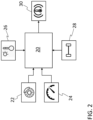
- FIG. 2 illustrates schematically, in accordance with at least one example of this disclosure, an operation of a processing circuitry 20 which may form part of a computer system for brake temperature estimation for a heavy-duty vehicle.
- the heavy-duty vehicle may for example be the heavy-duty vehicle 1 shown in FIG. 1 or any other suitable heavy-duty vehicle.
- the processing circuitry 20 is configured to receive brake chamber pressure data 22 indicative of a determined pressure in brake chambers of the heavy-duty vehicle.
- brake chamber pressure data 22 may be provided by pressure sensors.
- pressure sensors that are used for other purposes, such as for providing input to ABS (Anti-lock Braking System), EBS (Electronic Brake System), etc. may suitably also be used for providing input to the processing circuitry 20 for brake temperature estimation.
- the processing circuity 20 is also configured to receive vehicle speed data 24 indicative of the current speed of the heavy-duty vehicle.
- vehicle speed data 24 may be provided by a speedometer or tachometer.
- the processing circuitry 20 is further configured to receive ambient temperature data 26 indicative of a determined ambient temperature at the heavy-duty vehicle.
- ambient temperature data 26 may be provided by a temperature sensor.
- the processing circuitry 20 is further configured to receive wheel axle data 28 which include information about geometrical attributes of one or more wheel axles of the heavy-duty vehicle, which geometrical attributes affect the airflow to the brakes.
- wheel axle data 28 may, for example, be stored in an electronic memory which is accessible to the processing circuitry 20.
- geometrical attributes such as wheel base and other dimensions related to the chassis may suitably be stored in such an electronic memory.
- Other type of wheel axle data 28, such as variable data may be provided by sensors or switches. For instance, a sensor or switch may be used for determining if a lift axle is in a raised or lowered condition.
- the processing circuitry 20 is configured to estimate a brake temperature and may suitably output this as brake temperature estimation data 30.
- the actual usage of the output brake temperature estimation data 30 from the processing circuitry 20 does not form part of this disclosure.
- the brake temperature estimation data 30 may, for example, be used in various functions in a vehicle, such as brake fading warning, brake performance warning, adaptive cruise control, downhill cruise control, etc.
- temperature sensors which are not used in subsequent normal operation of the vehicle, may during the empirical tests be fitted to the brake system to measure the actual brake temperature.
- a brake temperature value will be provided in the look-up table.
- the processing circuity 20 may suitably use interpolation to estimate values between stored values. This may significantly reduce the size of the look-up table while still providing sufficiently accurate results.
- Other ways to reduce the size may include a multi-resolution approach in which different levels of detail are provided in the look-up table. For common regions of the parameter space (or where high temperatures may be expected), a finer resolution may be used, whereas for other regions of the parameter space, a coarser resolution may be used.
- the received wheel axle data 28 include information about geometrical attributes of one or more wheel axles of the heavy-duty vehicle, which geometrical attributes affect the airflow to the brakes, and thus affects the heat dissipation from the brakes.
- Said geometrical attributes may, for example, include information about the position and/or orientational state of one or more wheel axles relative to the chassis of the heavy-duty vehicle.
- Such an orientational state may, for instance, be one of a raised condition or a lowered condition of a lift axle, such as a secondary front axle, pusher axle or tag axle.
- the wheel axle data 28 may include information about a separating distance between at least two wheel axles.
- the wheel axle data 28 may include information about the wheelbase of the heavy-duty vehicle.
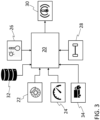
- FIG. 3 illustrates schematically, in accordance with at least some other examples of this disclosure, an operation of the processing circuitry 20 of FIG. 2 .
- the processing circuitry 20 may have access to a database 32 containing empirically determined brake temperature data.
- the database 32 may, for example, be or include a look-up table as discussed above.
- the estimation of the brake temperature performed by the processing circuitry 20 includes accessing, by the processing circuitry 20, the database 32 containing empirically determined brake temperature data.
- FIG. 3 also illustrates that the processing circuitry 20 may be configured to receive dimensional data 34 which may affect the airflow to the brakes.
- the dimensional data 34 may include information on the ride height of the chassis, and/or dimensions of protecting and/or shielding structures which are provided at the chassis and/or at a wheel axle of the heavy-duty vehicle.
- the brake temperature estimation performed by the processing circuitry 20 may thus further take the received dimensional data 34 into account.
- the processing circuitry 20 may be configured to receive input information from a rain sensor of the vehicle to temper the estimation to lower values corresponding to wet road and water slashing.
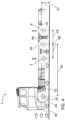
- FIG. 4 illustrates schematically the heavy-duty vehicle 1 of FIG. 1 , wherein some features of the heavy-duty vehicle 1, which may be relevant for brake temperature estimation, are exemplified.
- a heavy-duty vehicle may comprise a front underrun protection 40.
- the dimensional data 34 referred to in FIG. 3 may include a dimension of such a front underrun protection 40. The dimension will affect the airflow that passes by the front underrun protection.
- the dimensional data may include a dimension of a side underrun protection 42, a dimension of a brake dust shield 44, a dimension of wheel caps 46, and/or a dimension of tyre size.
- the dimensional data may further include information on the ride height 47 of the chassis.
- the wheel axle data may include the presence of a pusher axle 2 and whether it is lifted or rolling; or the presence of a tag axle 4 and whether it is lifted or rolling.
- other examples of wheel axle data may include axle spread 48, 49 (e.g. among rear axle group) and/or a wheelbase 50 of the heavy-duty vehicle 1. This latter kind of wheel axle data, having fixed values may suitably be accessible by the processing circuity from an electronic memory.
- the two illustrated axle spreads 48, 49 are of the same length, however, in other examples, the axle spreads 48, 49 may be of two different lengths.
- the brake temperature may be estimated by the processing circuitry for brakes of any axle.
- the brake temperature may be estimated for brakes of a first driven axle 16 of the heavy-duty vehicle, in particular a first non-steered driven axle of the heavy-duty vehicle (which in the illustrated example is a rear axle).
- a first driven axle 16 of the heavy-duty vehicle in particular a first non-steered driven axle of the heavy-duty vehicle (which in the illustrated example is a rear axle).
- FIG. 4 there are numerous flow-affecting geometrical attributes located forwardly of that driven axle 16.
- the brake temperature estimation according of this disclosure may have a relatively larger impact on accuracy with respect to the rearwardly located driven axle 16, as compared to the impact on accuracy with respect the front steered axle 14.
- FIG. 5 is a schematic illustration of a computer-implemented method 100, in accordance with at least one example of the present disclosure. More specifically, FIG. 5 illustrates a computer-implemented method 100 for brake temperature estimation for a heavy-duty vehicle, comprising:
- the estimating S5 of the brake temperature may further comprise accessing a database containing empirically determined brake temperature data, such as previously discussed herein.
- FIG. 6 is a schematic diagram of an exemplary computer system for implementing examples disclosed herein, according to an example.
- FIG. 6 is a schematic diagram of a computer system 600 for implementing examples disclosed herein.
- the computer system 600 is adapted to execute instructions from a computer-readable medium to perform these and/or any of the functions or processing described herein.
- the computer system 600 may be connected (e.g., networked) to other machines in a LAN (Local Area Network), LIN (Local Interconnect Network), automotive network communication protocol (e.g., FlexRay), an intranet, an extranet, or the Internet. While only a single device is illustrated, the computer system 600 may include any collection of devices that individually or jointly execute a set (or multiple sets) of instructions to perform any one or more of the methodologies discussed herein.
- any reference in the disclosure and/or claims to a computer system, computing system, computer device, computing device, control system, control unit, electronic control unit (ECU), processor device, processing circuitry, etc. includes reference to one or more such devices to individually or jointly execute a set (or multiple sets) of instructions to perform any one or more of the methodologies discussed herein.
- control system may include a single control unit or a plurality of control units connected or otherwise communicatively coupled to each other, such that any performed function may be distributed between the control units as desired.
- such devices may communicate with each other or other devices by various system architectures, such as directly or via a Controller Area Network (CAN) bus, etc.
- CAN Controller Area Network
- the computer system 600 may comprise at least one computing device or electronic device capable of including firmware, hardware, and/or executing software instructions to implement the functionality described herein.
- the computer system 600 may include processing circuitry 602 (e.g., processing circuitry including one or more processor devices or control units), a memory 604, and a system bus 606.
- the processing circuitry 602 may, for example, correspond to the processing circuitry 20 discussed in relation to FIG. 2 .
- the computer system 600 may include at least one computing device having the processing circuitry 602.
- the system bus 606 provides an interface for system components including, but not limited to, the memory 604 and the processing circuitry 602.
- the processing circuitry 602 may include any number of hardware components for conducting data or signal processing or for executing computer code stored in memory 604.
- the processing circuitry 602 may, for example, include a general-purpose processor, an application specific processor, a Digital Signal Processor (DSP), an Application Specific Integrated Circuit (ASIC), a Field Programmable Gate Array (FPGA), a circuit containing processing components, a group of distributed processing components, a group of distributed computers configured for processing, or other programmable logic device, discrete gate or transistor logic, discrete hardware components, or any combination thereof designed to perform the functions described herein.
- the processing circuitry 602 may further include computer executable code that controls operation of the programmable device.
- the system bus 606 may be any of several types of bus structures that may further interconnect to a memory bus (with or without a memory controller), a peripheral bus, and/or a local bus using any of a variety of bus architectures.
- the memory 604 may be one or more devices for storing data and/or computer code for completing or facilitating methods described herein.
- the memory 604 may include database components, object code components, script components, or other types of information structure for supporting the various activities herein. Any distributed or local memory device may be utilized with the systems and methods of this description.
- the memory 604 may be communicably connected to the processing circuitry 602 (e.g., via a circuit or any other wired, wireless, or network connection) and may include computer code for executing one or more processes described herein.
- the memory 604 may include non-volatile memory 608 (e.g., read-only memory (ROM), erasable programmable read-only memory (EPROM), electrically erasable programmable read-only memory (EEPROM), etc.), and volatile memory 610 (e.g., random-access memory (RAM)), or any other medium which can be used to carry or store desired program code in the form of machine-executable instructions or data structures and which can be accessed by a computer or other machine with processing circuitry 602.
- a basic input/output system (BIOS) 612 may be stored in the non-volatile memory 608 and can include the basic routines that help to transfer information between elements within the computer system 600.
- BIOS basic input/output system
- the computer system 600 may further include or be coupled to a non-transitory computer-readable storage medium such as the storage device 614, which may comprise, for example, an internal or external hard disk drive (HDD) (e.g., enhanced integrated drive electronics (EIDE) or serial advanced technology attachment (SATA)), HDD (e.g., EIDE or SATA) for storage, flash memory, or the like.
- HDD enhanced integrated drive electronics
- SATA serial advanced technology attachment
- the storage device 614 and other drives associated with computer-readable media and computer-usable media may provide non-volatile storage of data, data structures, computer-executable instructions, and the like.
- Computer-code which is hard or soft coded may be provided in the form of one or more modules.
- the module(s) can be implemented as software and/or hard-coded in circuitry to implement the functionality described herein in whole or in part.
- the modules may be stored in the storage device 614 and/or in the volatile memory 610, which may include an operating system 616 and/or one or more program modules 618.
- All or a portion of the examples disclosed herein may be implemented as a computer program 620 stored on a transitory or non-transitory computer-usable or computer-readable storage medium (e.g., single medium or multiple media), such as the storage device 614, which includes complex programming instructions (e.g., complex computer-readable program code) to cause the processing circuitry 602 to carry out actions described herein.
- the computer-readable program code of the computer program 620 can comprise software instructions for implementing the functionality of the examples described herein when executed by the processing circuitry 602.
- the storage device 614 may be a computer program product (e.g., readable storage medium) storing the computer program 620 thereon, where at least a portion of a computer program 620 may be loadable (e.g., into a processor) for implementing the functionality of the examples described herein when executed by the processing circuitry 602.
- the processing circuitry 602 may serve as a controller or control system for the computer system 600 that is to implement the functionality described herein.
- the computer system 600 may include an input device interface 622 configured to receive input and selections to be communicated to the computer system 600 when executing instructions, such as from a keyboard, mouse, touch-sensitive surface, etc. Such input devices may be connected to the processing circuitry 602 through the input device interface 622 coupled to the system bus 606 but can be connected through other interfaces, such as a parallel port, an Institute of Electrical and Electronic Engineers (IEEE) 1394 serial port, a Universal Serial Bus (USB) port, an IR interface, and the like.
- the computer system 600 may include an output device interface 624 configured to forward output, such as to a display, a video display unit (e.g., a liquid crystal display (LCD) or a cathode ray tube (CRT)).
- the computer system 600 may include a communications interface 626 suitable for communicating with a network as appropriate or desired.
- Example 1 A computer system for brake temperature estimation for a heavy-duty vehicle, the computer system comprising processing circuitry configured to:
- Example 2 The computer system of example 1, wherein the estimation of the brake temperature performed by the processing circuitry includes accessing, by the processing circuitry, a database containing empirically determined brake temperature data.
- Example 3 The computer system of any one of examples 1-2, wherein said geometrical attributes include information about the position and/or an orientational state of one or more wheel axles relative to a chassis of the heavy-duty vehicle.
- Example 4 The computer system of example 3, wherein said orientational state is one of a raised condition or a lowered condition of a lift axle, such as a secondary front axle, pusher axle, or tag axle.
- a lift axle such as a secondary front axle, pusher axle, or tag axle.
- Example 5 The computer system of any one of examples 1-4, wherein said wheel axle data include information about the number of wheel axles of the heavy-duty vehicle.
- Example 6 The computer system of any one of examples 1-5, wherein said wheel axle data include information about a separating distance between at least two wheel axles.
- Example 7 The computer system of any one of examples 1-6, wherein said wheel axle data include information about the wheelbase of the heavy-duty vehicle.
- Example 8 The computer system of any one of examples 1-7, wherein the processing circuitry is further configured to receive dimensional data, the dimensional data including information on:
- Example 9 The computer system of example 8, wherein said dimensional data include at least one of:
- Example 10 The computer system of any one of examples 1-9, wherein said brake temperature is estimated for brakes of a first driven axle of the heavy-duty vehicle, in particular a first non-steered driven axle of the heavy-duty vehicle.
- Example 11 A vehicle comprising the computer system of any of examples 1-10.
- Example 12 A computer-implemented method for brake temperature estimation for a heavy-duty vehicle, comprising:
- Example 13 The method of example 12, wherein said act of estimating a brake temperature further comprises accessing a database containing empirically determined brake temperature data.
- Example 14 A computer program product comprising program code for performing, when executed by the processing circuitry, the method of any of examples 12-13.
- Example 15 A non-transitory computer-readable storage medium comprising instructions, which when executed by the processing circuitry, cause the processing circuitry to perform the method of any of examples 12-13.
- Example 16 The method of any one of examples 12-13, wherein said geometrical attributes include information about the position and/or an orientational state of one or more wheel axles relative to a chassis of the heavy-duty vehicle.
- Example 17 The method of example 16, wherein said orientational state is one of a raised condition or a lowered condition of a lift axle, such as a secondary front axle, pusher axle, or tag axle.
- Example 18 The method of any of examples 12-13 or 16-17, wherein said wheel axle data include information about the number of wheel axles of the heavy-duty vehicle.
- Example 19 The method of any of examples 12-13 or 16-18, wherein said wheel axle data include information about a separating distance between at least two wheel axles.
- Example 20 The method of any one of examples 12-13 or 16-19, wherein said wheel axle data include information about the wheelbase of the heavy-duty vehicle.
- Example 21 The method of any one of examples 12-13 or 16-20, wherein the processing circuitry is further configured to receive dimensional data, the dimensional data including information on:
- Example 22 The method of example 21, wherein said dimensional data include at least one of:
- Example 23 The method of any one of examples 12-13 or 16-22, wherein said brake temperature is estimated for brakes of a first driven axle of the heavy-duty vehicle, in particular a first non-steered driven axle of the heavy-duty vehicle.
- Relative terms such as “below” or “above” or “upper” or “lower” or “horizontal” or “vertical” may be used herein to describe a relationship of one element to another element as illustrated in the Figures. It will be understood that these terms and those discussed above are intended to encompass different orientations of the device in addition to the orientation depicted in the Figures. It will be understood that when an element is referred to as being “connected” or “coupled” to another element, it can be directly connected or coupled to the other element, or intervening elements may be present. In contrast, when an element is referred to as being “directly connected” or “directly coupled” to another element, there are no intervening elements present.
Landscapes
- Engineering & Computer Science (AREA)
- Mechanical Engineering (AREA)
- Transportation (AREA)
- General Engineering & Computer Science (AREA)
- Valves And Accessory Devices For Braking Systems (AREA)
- Regulating Braking Force (AREA)
Abstract
Description
- The disclosure relates generally to temperature estimation. In particular aspects, the disclosure relates to a computer system and a computer-implemented method for brake temperature estimation for a heavy-duty vehicle. The disclosure can be applied to heavy-duty vehicles, such as trucks, buses, and construction equipment, among other vehicle types. Although the disclosure may be described with respect to a particular vehicle, the disclosure is not restricted to any particular vehicle.
- Brake temperature estimation may be used by several functions in a vehicle. Examples of such functions include brake fading warning, brake performance warning, adaptive cruise control, downhill cruise control, etc. Currently used methods for brake temperature estimation typically assumes a fixed cooling rate of the brakes. Although this may generally work well for passenger cars, which have usually a fixed geometry, it does not work as well for heavy-duty vehicles such as trucks, which may have different chassis configurations, such as different number of wheel axles, different wheelbase, liftable axles, etc. The actual cooling rate of the brakes for heavy-duty vehicles therefore often differs considerably from the assumed fixed value. Thus, it would be desirable to provide an improved brake temperature estimation with respect to heavy-duty vehicles.
- According to a first aspect of the disclosure, there is provided a computer system for brake temperature estimation for a heavy-duty vehicle, the computer system comprising processing circuitry configured to:
- receive brake chamber pressure data indicative of a determined pressure in brake chambers of the heavy-duty vehicle,
- receive vehicle speed data indicative of the current speed of the heavy-duty vehicle,
- receive ambient temperature data indicative of a determined ambient temperature at the heavy-duty vehicle,
- receive wheel axle data which include information about geometrical attributes of one or more wheel axles of the heavy duty vehicle, which geometrical attributes affect the airflow to the brakes, and
- estimate a brake temperature based on said received brake chamber pressure data, said vehicle speed data, said ambient temperature data and said wheel axle data. The first aspect of the disclosure may seek to solve the problem of more accurately estimate a brake temperature for different heavy-duty vehicle configurations. A technical benefit may include that, by not only taking into account the brake chamber pressure (which relates to the magnitude of the braking and thus heat generation), the vehicle speed (which relates to the flow rate of air passing through the brakes and thus heat dissipation) and the ambient temperature, but by also taking into account geometrical airflow-affecting attributes of a wheel axle, a more accurate estimation is possible. In particular, since the processing circuitry may already have information on said wheel axle data, it may readily use this information as input together with the other parameters (brake chamber pressure, vehicle speed and ambient temperature) in order to estimate the brake temperature. The processing circuitry may suitably also estimate a trend of heat build-up at the brakes and heat exchange with the environment and/or components surrounding the brakes.
- Optionally in some examples, including in at least one preferred example, the estimation of the brake temperature performed by the processing circuitry may include accessing, by the processing circuitry, a database containing empirically determined brake temperature data. A technical benefit may include that brake temperature data may be collected in a controlled manner through empirical tests, and such data may then conveniently be used in a real brake estimation implementation. For instance, the empirically determined brake temperature data may be acquired by running different trucks under different conditions. For instance, tests may be made for a 4x2 truck (four axle ends, of which two are driven), 6x2 truck, 8x4 truck, etc, wherein actual temperature sensors are fitted to the brake to measure the brake temperature. The trucks may be driven at different speeds, in different ambient temperatures, be subjected to different brake forces, and with different geometrical attributes, such as a lift axle being in a raised or a lowered condition. The different parameter combinations and the resulting brake temperature measured by the fitted temperature sensors may conveniently be stored in a database, such as a look-up table. Thus, when the teachings of this disclosure are implemented in a real driving situation for a heavy-duty vehicle, the processing circuitry may, based on the received brake chamber pressure data, vehicle speed data, ambient temperature data and wheel axle data, access the look-up table to see which brake temperature corresponds to the actual combination of parameters that the received data represent. If the specific parameter combination is not present in the look-up table, the processing circuitry may suitably identify nearest neighboring values or make any suitable interpolation to estimate the current brake temperature.
- Optionally in some examples, including in at least one preferred example, said geometrical attributes may include information about the position and/or an orientational state of one or more wheel axles relative to a chassis of the heavy-duty vehicle. A technical benefit may include that by taking into account the position of a wheel axle and/or its orientational state a more accurate brake temperature estimation may be made. For instance, in the case of a truck having a liftable pusher axle in front of a rear driven axle, the presence of the pusher axle in front of the rear driven axle will affect the air flow to the brakes of the rear driven axle, and will thus have influence on the cooling effect on those brakes. Furthermore, the air flow will be different if the pusher axle is in a lowered rolling condition or in a raised condition. By having access to information about such geometrical attributes, the brake temperature estimation may be made more accurate. The inclusions of an orientational state of a lift axle for brake temperature estimation is at least partly reflected in the below example.
- Thus, optionally in some examples, including in at least one preferred example, said orientational state may be one of a raised condition or a lowered condition of a lift axle, such as a secondary front axle, pusher axle, or tag axle. As explained previously, a lift axle will affect the airflow to structures behind the lift axle in different ways depending on if the lift axle is in a raised condition or in a lowered condition. Thus, the cooling effect on brakes located behind the lift axle may also be differently affected depending on the current condition of the lift axle. Thus, by having information about the current condition (raised or lowered) of the lift axle, it is possible to make a more accurate estimation of the brake temperature.
- Optionally in some examples, including in at least one preferred example, said wheel axle data may include information about the number of wheel axles of the heavy-duty vehicle. A technical benefit may include that information about number of wheel axles may allow for a more accurate estimation of the brake temperature for some of the brakes of the heavy-duty vehicle. For instance, the air flow reaching a brake at a rear axle may differ depending on the number of wheel axles that are provided in front of the rear axle.
- Optionally in some examples, including in at least one preferred example, said wheel axle data may include information about a separating distance between at least two wheel axles. A technical benefit may include that information about such a separating distance may allow for a more accurate estimation of the brake temperature. For instance, larger separating distance may affect the airflow differently than a smaller separating distance.
- Optionally in some examples, including in at least one preferred example, said wheel axle data include information about the wheelbase of the heavy-duty vehicle. Analogously to what has been explained different wheel base lengths may affect the cooling effect on rear brakes differently. Thus, including such information may allow for a more accurate estimation of the brake temperature.
- Optionally in some examples, including in at least one preferred example, the processing circuitry may be further configured to receive dimensional data, the dimensional data including information on:
- the ride height of the chassis, and/or
- dimensions of protecting and/or shielding structures which are provided at the chassis and/or at a wheel axle of the heavy-duty vehicle,
- Optionally in some examples, including in at least one preferred example, said dimensional data may include at least one of:
- a dimension of a front underrun protection,
- a dimension of a side underrun protection,
- a dimension of a brake dust shield,
- a dimension of wheel caps,
- a dimension of tyre size.
- Optionally in some examples, including in at least one preferred example, said brake temperature may be estimated for brakes of a first driven axle of the heavy-duty vehicle, in particular the first non-steered driven axle of the heavy-duty vehicle. A technical benefit may include that, since the first driven axle, is commonly a rear axle provided behind at least a front axle, there are various structural features (including the front axle) that may affect the airflow to the brakes of the first driven axle. In other words, the possible variations between different individual trucks may be much larger when it comes to structures that affect the brake temperature at a first driven axle (normally a rear axle) compared to structures that affect the brake temperature at a first non-driven axle (normally a front axle). Therefore, implementing the teachings of this disclosure for estimating the brake temperature of brakes at a first driven axle may result in a considerable improvement with respect to estimation accuracy as compared to traditional estimations available in the prior art. It should, however, be understood that in some examples, the brake temperature may be estimated for brakes of another axle, such as a first non-driven axle of the heavy-duty vehicle, in particular a first steered non-driven axle of the heavy-duty vehicle. For instance, features such as the presence and dimension of a front underrun protection and brake dust shield at the front axle, may have substantial effect on the brake temperature of the brakes at a first non-driven axle (normally a front axle).
- According to a second aspect of the disclosure, there is provided a vehicle comprising the computer system of the first aspect, including any examples thereof. The second aspect of the disclosure may seek to solve the same problem and provide the same technical benefit as the first aspect, including any example thereof.
- According to a third aspect of the disclosure, there is provided a computer-implemented method for brake temperature estimation for a heavy-duty vehicle, comprising:
- receiving, by processing circuity, brake chamber pressure data indicative of a determined pressure in brake chambers of the heavy-duty vehicle,
- receiving, by the processing circuitry, vehicle speed data indicative of the current speed of the heavy-duty vehicle,
- receiving, by the processing circuitry, ambient temperature data indicative of a determined ambient temperature at the heavy-duty vehicle,
- receiving, by the processing circuitry, wheel axle data which include information about geometrical attributes of one or more wheel axles of the heavy duty vehicle, which geometrical attributes affect the airflow to the brakes, and
- estimating, by the processing circuitry, a brake temperature based on said received brake chamber pressure data, said vehicle speed data, said ambient temperature data and said wheel axle data.
- Various examples of the method of the third aspect are listed herein below. The technical benefits of the various examples are largely analogous to the corresponding examples of the first aspect.
- Optionally in some examples, including in at least one preferred example, said act of estimating a brake temperature further may comprise accessing a database containing empirically determined brake temperature data.
- Optionally in some examples, including in at least one preferred example, said geometrical attributes may include information about the position and/or an orientational state of one or more wheel axles relative to a chassis of the heavy-duty vehicle.
- Optionally in some examples, including in at least one preferred example, said orientational state may be one of a raised condition or a lowered condition of a lift axle, such as a secondary front axle, pusher axle, or tag axle.
- Optionally in some examples, including in at least one preferred example, said wheel axle data may include information about the number of wheel axles of the heavy-duty vehicle.
- Optionally in some examples, including in at least one preferred example, said wheel axle data may include information about a separating distance between at least two wheel axles.
- Optionally in some examples, including in at least one preferred example, said wheel axle data include information about the wheelbase of the heavy-duty vehicle.
- Optionally in some examples, including in at least one preferred example, the method may further comprise receiving dimensional data, the dimensional data including information on:
- the ride height of the chassis, and/or
- dimensions of protecting and/or shielding structures which are provided at the chassis and/or at a wheel axle of the heavy-duty vehicle,
- Optionally in some examples, including in at least one preferred example, said dimensional data may include at least one of:
- a dimension of a front underrun protection,
- a dimension of a side underrun protection,
- a dimension of a brake dust shield,
- a dimension of wheel caps,
- a dimension of tyre size.
- Optionally in some examples, including in at least one preferred example, said brake temperature may be estimated for brakes of a first driven axle of the heavy-duty vehicle, in particular the first non-steered driven axle of the heavy-duty vehicle.
- According to a fourth aspect of the disclosure, there is provided a computer program product comprising program code for performing, when executed by the processing circuitry, the method of the third aspect, including any examples thereof. The fourth aspect of the disclosure may seek to solve the same problem and provide the same technical benefit as the first aspect, including any example thereof.
- According to a fifth aspect of the disclosure, there is provided a non-transitory computer-readable storage medium comprising instructions, which when executed by the processing circuitry, cause the processing circuitry to perform the method of the third aspect, including any examples thereof. The fifth aspect of the disclosure may seek to solve the same problem and provide the same technical benefit as the first aspect, including any example thereof.
- Optionally in some examples, including in at least one preferred example, of any one of the above-mentioned aspects, the processing circuitry may be configured to receive input information from a rain sensor of the vehicle. Such a rain sensor is normally used for wiper control, but may in some examples also be used to provide input to the processing circuitry to temper the estimation to lower values corresponding to wet road and water slashing.
- The disclosed aspects, examples (including any preferred examples), and/or accompanying claims may be suitably combined with each other as would be apparent to anyone of ordinary skill in the art. Additional features and advantages are disclosed in the following description, claims, and drawings, and in part will be readily apparent therefrom to those skilled in the art or recognized by practicing the disclosure as described herein.
- There are also disclosed herein computer systems, control units, code modules, computer-implemented methods, computer readable media, and computer program products associated with the above discussed technical benefits.
- Examples are described in more detail below with reference to the appended drawings.
-
FIG. 1 illustrates schematically a heavy-duty vehicle according to at least one example of the disclosure. -
FIG. 2 illustrates schematically, in accordance with at least one example of this disclosure, an operation of a processing circuitry which may form part of a computer system for brake temperature estimation for a heavy-duty vehicle. -
FIG. 3 illustrates schematically, in accordance with at least some other examples of this disclosure, an operation of the processing circuitry ofFIG. 2 . -
FIG. 4 illustrates schematically the heavy-duty vehicle ofFIG. 1 , wherein some features of the heavy-duty vehicle, which may be relevant for brake temperature estimation, are exemplified. -
FIG. 5 is a schematic illustration of a computer-implemented method, in accordance with at least one example of the present disclosure. -
FIG. 6 is a schematic diagram of an exemplary computer system for implementing examples disclosed herein, according to an example. - The detailed description set forth below provides information and examples of the disclosed technology with sufficient detail to enable those skilled in the art to practice the disclosure.
- Currently used methods for brake temperature estimation typically assumes a fixed cooling rate of the brakes. Although this may generally work well for passenger cars, which have usually a fixed geometry, it does not work as well for heavy-duty vehicles such as trucks, which may have different chassis configurations, such as different number of wheel axles, different wheelbase, liftable axles, etc. The actual cooling rate of the brakes for heavy-duty vehicles therefore often differs considerably from the assumed fixed value. The computer system and the computer-implemented method of this disclosure solves this problem by also taking into account wheel axle data which include information about airflow-affecting geometrical attributes of one or more wheel axles of the heavy-duty vehicle. Hereby, distinction may be made between different chassis configurations, and a more accurate estimation may be made for individual vehicles.
-
FIG. 1 illustrates schematically a heavy-duty vehicle 1 according to at least one example of the disclosure. In this illustrated example, the heavy-duty vehicle 1 is an 8x2 truck (i.e. eight axle ends of which two are driven). However, the teachings of this disclosure may be implemented for other chassis configurations as well. For instance, the heavy-duty vehicle, may be an 8x4 truck, 6x2 truck, a bus, etc. In the present example, the heavy-duty vehicle 1 is provided with two liftable axles, apusher axle 2 and atag axle 4. However, in other examples, the heavy-duty vehicle 1 may have no liftable axles. In other examples, the heavy-duty vehicle may be provided with a liftable secondary front axle. Thus, it should be understood that the teachings of this disclosure may be implemented for a large variety of chassis and axle configurations. - In
FIG. 1 the heavy-duty vehicle 1 is illustrated as comprising an internal combustion engine (ICE) providing propulsion to the vehicle. Air enters through anair intake 6 and moves vertically down an air duct 8. The air may flow to an air cleaner and then to the internal combustion engine system which comprises the internal combustion engine. It should, however, be understood that the teachings of this disclosure may be implemented for heavy-duty vehicles being propelled by other means, such as battery electric vehicles (BEV), fuel cell electric vehicles, hybrids, etc. The illustrated heavy-duty vehicle 1 comprises acabin 10 in which a driver may operate the heavy-duty vehicle 1. However, it should be understood that the teachings in this disclosure may also be implemented in an autonomous (self-driving) heavy-duty vehicle. - As illustrated by the rightwards pointing arrows in
FIG. 1 , when the heavy-duty vehicle 1 is driven along a road (towards left in the drawing), there will be an airflow from the front towards the rear of thevehicle 1. Some of the air will pass along thechassis 12 and pass by various structures, including thewheel axles tag axles 2, 4) being in a raised condition presents less obstruction to the airflow than when it is in a lowered condition. Thus, vehicle geometries may affect the actual cooling effect that the airflow provides to different brakes. Therefore, in accordance with the present disclosure, the heavy-duty vehicle 1 may suitably be provided with a computer system which includes a processing circuitry which may take into account such vehicle geometries when estimating the brake temperature. An example of the operation of such a processing circuitry will now be discussed in relation toFIG. 2 . -
FIG. 2 illustrates schematically, in accordance with at least one example of this disclosure, an operation of aprocessing circuitry 20 which may form part of a computer system for brake temperature estimation for a heavy-duty vehicle. The heavy-duty vehicle may for example be the heavy-duty vehicle 1 shown inFIG. 1 or any other suitable heavy-duty vehicle. - As illustrated in
FIG. 2 , theprocessing circuitry 20 is configured to receive brakechamber pressure data 22 indicative of a determined pressure in brake chambers of the heavy-duty vehicle. For instance, such brakechamber pressure data 22 may be provided by pressure sensors. In at least some examples, pressure sensors that are used for other purposes, such as for providing input to ABS (Anti-lock Braking System), EBS (Electronic Brake System), etc. may suitably also be used for providing input to theprocessing circuitry 20 for brake temperature estimation. - The
processing circuity 20 is also configured to receivevehicle speed data 24 indicative of the current speed of the heavy-duty vehicle. For instance, suchvehicle speed data 24 may be provided by a speedometer or tachometer. - The
processing circuitry 20 is further configured to receiveambient temperature data 26 indicative of a determined ambient temperature at the heavy-duty vehicle. For instance, suchambient temperature data 26 may be provided by a temperature sensor. - The
processing circuitry 20 is further configured to receivewheel axle data 28 which include information about geometrical attributes of one or more wheel axles of the heavy-duty vehicle, which geometrical attributes affect the airflow to the brakes. Suchwheel axle data 28 may, for example, be stored in an electronic memory which is accessible to theprocessing circuitry 20. For instance, geometrical attributes such as wheel base and other dimensions related to the chassis may suitably be stored in such an electronic memory. Other type ofwheel axle data 28, such as variable data, may be provided by sensors or switches. For instance, a sensor or switch may be used for determining if a lift axle is in a raised or lowered condition. - Based on the received brake
chamber pressure data 22, thevehicle speed data 24, theambient temperature data 26 and thewheel axle data 28, theprocessing circuitry 20 is configured to estimate a brake temperature and may suitably output this as braketemperature estimation data 30. The actual usage of the output braketemperature estimation data 30 from theprocessing circuitry 20 does not form part of this disclosure. However, just to give some examples, the braketemperature estimation data 30 may, for example, be used in various functions in a vehicle, such as brake fading warning, brake performance warning, adaptive cruise control, downhill cruise control, etc. - The actual estimation may suitably be performed by the
processing circuitry 20 by accessing a look-up table, in which brake temperature values are stored and retrievable with a particular input. The look-up table may be populated based on empirical tests, with different input combinations. Thus, the empirical tests may include different brake chamber pressures, different vehicle speeds, different ambient temperature, and different geometrical attributes of heavy-duty vehicles. Under normal operation of vehicles, temperature sensors are not considered suitable for being fitted to the brakes. Reasons for this includes cost and durability. It is a tough area for a temperature sensor to be placed in, and for more durable solutions the costs increase. Also, fitting temperature sensors to a brake disk or pad is complicated since those parts need to be replaced on the aftermarket. However, for empirical tests, temperature sensors may advantageously be used. Thus, temperature sensors, which are not used in subsequent normal operation of the vehicle, may during the empirical tests be fitted to the brake system to measure the actual brake temperature. Thus, for each input combination, a brake temperature value will be provided in the look-up table. Rather than providing data for all possible combinations, theprocessing circuity 20 may suitably use interpolation to estimate values between stored values. This may significantly reduce the size of the look-up table while still providing sufficiently accurate results. Other ways to reduce the size may include a multi-resolution approach in which different levels of detail are provided in the look-up table. For common regions of the parameter space (or where high temperatures may be expected), a finer resolution may be used, whereas for other regions of the parameter space, a coarser resolution may be used. - As mentioned above, the received
wheel axle data 28 include information about geometrical attributes of one or more wheel axles of the heavy-duty vehicle, which geometrical attributes affect the airflow to the brakes, and thus affects the heat dissipation from the brakes. Said geometrical attributes may, for example, include information about the position and/or orientational state of one or more wheel axles relative to the chassis of the heavy-duty vehicle. Such an orientational state may, for instance, be one of a raised condition or a lowered condition of a lift axle, such as a secondary front axle, pusher axle or tag axle. Furthermore, thewheel axle data 28 may include information about a separating distance between at least two wheel axles. For instance, thewheel axle data 28 may include information about the wheelbase of the heavy-duty vehicle. -
FIG. 3 illustrates schematically, in accordance with at least some other examples of this disclosure, an operation of theprocessing circuitry 20 ofFIG. 2 . As illustrated inFIG. 3 theprocessing circuitry 20 may have access to adatabase 32 containing empirically determined brake temperature data. Thedatabase 32 may, for example, be or include a look-up table as discussed above. Thus, in at least some examples of this disclosure, the estimation of the brake temperature performed by theprocessing circuitry 20 includes accessing, by theprocessing circuitry 20, thedatabase 32 containing empirically determined brake temperature data. -
FIG. 3 also illustrates that theprocessing circuitry 20 may be configured to receivedimensional data 34 which may affect the airflow to the brakes. Thedimensional data 34 may include information on the ride height of the chassis, and/or dimensions of protecting and/or shielding structures which are provided at the chassis and/or at a wheel axle of the heavy-duty vehicle. The brake temperature estimation performed by theprocessing circuitry 20 may thus further take the receiveddimensional data 34 into account. Some examples of structures that may be used as basis for saiddimensional data 34 will be discussed in relation toFIG. 4 . Also, some examples related towheel axle data 28 will be discussed in relation toFIG. 4 . - In addition to the various input devices communicating with and information received by the
processing circuity 20 inFIG. 3 , there may be other examples in which other or additional input devices may be included to provide information to theprocessing circuity 20 for the brake temperature estimation. For instance, in at least some examples, theprocessing circuitry 20 may be configured to receive input information from a rain sensor of the vehicle to temper the estimation to lower values corresponding to wet road and water slashing. -
FIG. 4 illustrates schematically the heavy-duty vehicle 1 ofFIG. 1 , wherein some features of the heavy-duty vehicle 1, which may be relevant for brake temperature estimation, are exemplified.
As illustrated inFIG. 4 , a heavy-duty vehicle may comprise afront underrun protection 40. Thedimensional data 34 referred to inFIG. 3 may include a dimension of such afront underrun protection 40. The dimension will affect the airflow that passes by the front underrun protection. Similarly, the dimensional data may include a dimension of aside underrun protection 42, a dimension of a brake dust shield 44, a dimension of wheel caps 46, and/or a dimension of tyre size. Similarly, the dimensional data may further include information on theride height 47 of the chassis. - With respect to the
wheel axle data 28 referred to inFIGS. 2 and3 , as illustrated with the vertical double-arrows inFIG. 4 , the wheel axle data may include the presence of apusher axle 2 and whether it is lifted or rolling; or the presence of atag axle 4 and whether it is lifted or rolling. As indicated inFIG. 4 , other examples of wheel axle data may include axle spread 48, 49 (e.g. among rear axle group) and/or awheelbase 50 of the heavy-duty vehicle 1. This latter kind of wheel axle data, having fixed values may suitably be accessible by the processing circuity from an electronic memory. InFIG. 4 the two illustrated axle spreads 48, 49 are of the same length, however, in other examples, the axle spreads 48, 49 may be of two different lengths. - The brake temperature may be estimated by the processing circuitry for brakes of any axle. For example, the brake temperature may be estimated for brakes of a first driven
axle 16 of the heavy-duty vehicle, in particular a first non-steered driven axle of the heavy-duty vehicle (which in the illustrated example is a rear axle). As illustrated inFIG. 4 there are numerous flow-affecting geometrical attributes located forwardly of that drivenaxle 16. Indeed, in comparison there are fewer flow-affecting geometrical attributes located forwardly of the front steeredaxle 14. Therefore, the brake temperature estimation according of this disclosure may have a relatively larger impact on accuracy with respect to the rearwardly located drivenaxle 16, as compared to the impact on accuracy with respect the front steeredaxle 14. -
FIG. 5 is a schematic illustration of a computer-implementedmethod 100, in accordance with at least one example of the present disclosure. More specifically,FIG. 5 illustrates a computer-implementedmethod 100 for brake temperature estimation for a heavy-duty vehicle, comprising: - receiving S1, by processing circuity, brake chamber pressure data indicative of a determined pressure in brake chambers of the heavy-duty vehicle,
- receiving S2, by the processing circuitry, vehicle speed data indicative of the current speed of the heavy-duty vehicle,
- receiving S3, by the processing circuitry, ambient temperature data indicative of a determined ambient temperature at the heavy-duty vehicle,
- receiving S4, by the processing circuitry, wheel axle data which include information about geometrical attributes of one or more wheel axles of the heavy duty vehicle, which geometrical attributes affect the airflow to the brakes, and
- estimating S5, by the processing circuitry, a brake temperature based on said received brake chamber pressure data, said vehicle speed data, said ambient temperature data and said wheel axle data.
- The estimating S5 of the brake temperature may further comprise accessing a database containing empirically determined brake temperature data, such as previously discussed herein.
-
FIG. 6 is a schematic diagram of an exemplary computer system for implementing examples disclosed herein, according to an example. -
FIG. 6 is a schematic diagram of acomputer system 600 for implementing examples disclosed herein. Thecomputer system 600 is adapted to execute instructions from a computer-readable medium to perform these and/or any of the functions or processing described herein. Thecomputer system 600 may be connected (e.g., networked) to other machines in a LAN (Local Area Network), LIN (Local Interconnect Network), automotive network communication protocol (e.g., FlexRay), an intranet, an extranet, or the Internet. While only a single device is illustrated, thecomputer system 600 may include any collection of devices that individually or jointly execute a set (or multiple sets) of instructions to perform any one or more of the methodologies discussed herein. Accordingly, any reference in the disclosure and/or claims to a computer system, computing system, computer device, computing device, control system, control unit, electronic control unit (ECU), processor device, processing circuitry, etc., includes reference to one or more such devices to individually or jointly execute a set (or multiple sets) of instructions to perform any one or more of the methodologies discussed herein. For example, control system may include a single control unit or a plurality of control units connected or otherwise communicatively coupled to each other, such that any performed function may be distributed between the control units as desired. Further, such devices may communicate with each other or other devices by various system architectures, such as directly or via a Controller Area Network (CAN) bus, etc. - The
computer system 600 may comprise at least one computing device or electronic device capable of including firmware, hardware, and/or executing software instructions to implement the functionality described herein. Thecomputer system 600 may include processing circuitry 602 (e.g., processing circuitry including one or more processor devices or control units), amemory 604, and asystem bus 606. Theprocessing circuitry 602 may, for example, correspond to theprocessing circuitry 20 discussed in relation toFIG. 2 . Thecomputer system 600 may include at least one computing device having theprocessing circuitry 602. Thesystem bus 606 provides an interface for system components including, but not limited to, thememory 604 and theprocessing circuitry 602. Theprocessing circuitry 602 may include any number of hardware components for conducting data or signal processing or for executing computer code stored inmemory 604. Theprocessing circuitry 602 may, for example, include a general-purpose processor, an application specific processor, a Digital Signal Processor (DSP), an Application Specific Integrated Circuit (ASIC), a Field Programmable Gate Array (FPGA), a circuit containing processing components, a group of distributed processing components, a group of distributed computers configured for processing, or other programmable logic device, discrete gate or transistor logic, discrete hardware components, or any combination thereof designed to perform the functions described herein. Theprocessing circuitry 602 may further include computer executable code that controls operation of the programmable device. - The
system bus 606 may be any of several types of bus structures that may further interconnect to a memory bus (with or without a memory controller), a peripheral bus, and/or a local bus using any of a variety of bus architectures. Thememory 604 may be one or more devices for storing data and/or computer code for completing or facilitating methods described herein. Thememory 604 may include database components, object code components, script components, or other types of information structure for supporting the various activities herein. Any distributed or local memory device may be utilized with the systems and methods of this description. Thememory 604 may be communicably connected to the processing circuitry 602 (e.g., via a circuit or any other wired, wireless, or network connection) and may include computer code for executing one or more processes described herein. Thememory 604 may include non-volatile memory 608 (e.g., read-only memory (ROM), erasable programmable read-only memory (EPROM), electrically erasable programmable read-only memory (EEPROM), etc.), and volatile memory 610 (e.g., random-access memory (RAM)), or any other medium which can be used to carry or store desired program code in the form of machine-executable instructions or data structures and which can be accessed by a computer or other machine withprocessing circuitry 602. A basic input/output system (BIOS) 612 may be stored in thenon-volatile memory 608 and can include the basic routines that help to transfer information between elements within thecomputer system 600. - The
computer system 600 may further include or be coupled to a non-transitory computer-readable storage medium such as thestorage device 614, which may comprise, for example, an internal or external hard disk drive (HDD) (e.g., enhanced integrated drive electronics (EIDE) or serial advanced technology attachment (SATA)), HDD (e.g., EIDE or SATA) for storage, flash memory, or the like. Thestorage device 614 and other drives associated with computer-readable media and computer-usable media may provide non-volatile storage of data, data structures, computer-executable instructions, and the like. - Computer-code which is hard or soft coded may be provided in the form of one or more modules. The module(s) can be implemented as software and/or hard-coded in circuitry to implement the functionality described herein in whole or in part. The modules may be stored in the
storage device 614 and/or in thevolatile memory 610, which may include anoperating system 616 and/or one ormore program modules 618. All or a portion of the examples disclosed herein may be implemented as acomputer program 620 stored on a transitory or non-transitory computer-usable or computer-readable storage medium (e.g., single medium or multiple media), such as thestorage device 614, which includes complex programming instructions (e.g., complex computer-readable program code) to cause theprocessing circuitry 602 to carry out actions described herein. Thus, the computer-readable program code of thecomputer program 620 can comprise software instructions for implementing the functionality of the examples described herein when executed by theprocessing circuitry 602. In some examples, thestorage device 614 may be a computer program product (e.g., readable storage medium) storing thecomputer program 620 thereon, where at least a portion of acomputer program 620 may be loadable (e.g., into a processor) for implementing the functionality of the examples described herein when executed by theprocessing circuitry 602. Theprocessing circuitry 602 may serve as a controller or control system for thecomputer system 600 that is to implement the functionality described herein. - The
computer system 600 may include aninput device interface 622 configured to receive input and selections to be communicated to thecomputer system 600 when executing instructions, such as from a keyboard, mouse, touch-sensitive surface, etc. Such input devices may be connected to theprocessing circuitry 602 through theinput device interface 622 coupled to thesystem bus 606 but can be connected through other interfaces, such as a parallel port, an Institute of Electrical and Electronic Engineers (IEEE) 1394 serial port, a Universal Serial Bus (USB) port, an IR interface, and the like. Thecomputer system 600 may include anoutput device interface 624 configured to forward output, such as to a display, a video display unit (e.g., a liquid crystal display (LCD) or a cathode ray tube (CRT)). Thecomputer system 600 may include acommunications interface 626 suitable for communicating with a network as appropriate or desired. - The operational actions described in any of the exemplary aspects herein are described to provide examples and discussion. The actions may be performed by hardware components, may be embodied in machine-executable instructions to cause a processor to perform the actions, or may be performed by a combination of hardware and software. Although a specific order of method actions may be shown or described, the order of the actions may differ. In addition, two or more actions may be performed concurrently or with partial concurrence.
- Example 1: A computer system for brake temperature estimation for a heavy-duty vehicle, the computer system comprising processing circuitry configured to:
- receive brake chamber pressure data indicative of a determined pressure in brake chambers of the heavy-duty vehicle,
- receive vehicle speed data indicative of the current speed of the heavy-duty vehicle,
- receive ambient temperature data indicative of a determined ambient temperature at the heavy-duty vehicle,
- receive wheel axle data which include information about geometrical attributes of one or more wheel axles of the heavy-duty vehicle, which geometrical attributes affect the airflow to the brakes, and
- estimate a brake temperature based on said received brake chamber pressure data, said vehicle speed data, said ambient temperature data and said wheel axle data.
- Example 2: The computer system of example 1, wherein the estimation of the brake temperature performed by the processing circuitry includes accessing, by the processing circuitry, a database containing empirically determined brake temperature data.
- Example 3: The computer system of any one of examples 1-2, wherein said geometrical attributes include information about the position and/or an orientational state of one or more wheel axles relative to a chassis of the heavy-duty vehicle.
- Example 4: The computer system of example 3, wherein said orientational state is one of a raised condition or a lowered condition of a lift axle, such as a secondary front axle, pusher axle, or tag axle.
- Example 5: The computer system of any one of examples 1-4, wherein said wheel axle data include information about the number of wheel axles of the heavy-duty vehicle.
- Example 6: The computer system of any one of examples 1-5, wherein said wheel axle data include information about a separating distance between at least two wheel axles.
- Example 7: The computer system of any one of examples 1-6, wherein said wheel axle data include information about the wheelbase of the heavy-duty vehicle.
- Example 8: The computer system of any one of examples 1-7, wherein the processing circuitry is further configured to receive dimensional data, the dimensional data including information on:
- the ride height of the chassis, and/
- dimensions of protecting and/or shielding structures which are provided at the chassis and/or at a wheel axle of the heavy-duty vehicle,
- Example 9: The computer system of example 8, wherein said dimensional data include at least one of:
- a dimension of a front underrun protection,
- a dimension of a side underrun protection,
- a dimension of a brake dust shield,
- a dimension of wheel caps
- a dimension of tyre size.
- Example 10: The computer system of any one of examples 1-9, wherein said brake temperature is estimated for brakes of a first driven axle of the heavy-duty vehicle, in particular a first non-steered driven axle of the heavy-duty vehicle.
- Example 11: A vehicle comprising the computer system of any of examples 1-10.
- Example 12: A computer-implemented method for brake temperature estimation for a heavy-duty vehicle, comprising:
- receiving, by processing circuity, brake chamber pressure data indicative of a determined pressure in brake chambers of the heavy-duty vehicle,
- receiving, by the processing circuitry, vehicle speed data indicative of the current speed of the heavy-duty vehicle,
- receiving, by the processing circuitry, ambient temperature data indicative of a determined ambient temperature at the heavy-duty vehicle,
- receiving, by the processing circuitry, wheel axle data which include information about geometrical attributes of one or more wheel axles of the heavy duty vehicle, which geometrical attributes affect the airflow to the brakes, and
- estimating, by the processing circuitry, a brake temperature based on said received brake chamber pressure data, said vehicle speed data, said ambient temperature data and said wheel axle data.
- Example 13: The method of example 12, wherein said act of estimating a brake temperature further comprises accessing a database containing empirically determined brake temperature data.
- Example 14: A computer program product comprising program code for performing, when executed by the processing circuitry, the method of any of examples 12-13.
- Example 15: A non-transitory computer-readable storage medium comprising instructions, which when executed by the processing circuitry, cause the processing circuitry to perform the method of any of examples 12-13.
- Example 16: The method of any one of examples 12-13, wherein said geometrical attributes include information about the position and/or an orientational state of one or more wheel axles relative to a chassis of the heavy-duty vehicle.
- Example 17: The method of example 16, wherein said orientational state is one of a raised condition or a lowered condition of a lift axle, such as a secondary front axle, pusher axle, or tag axle.
- Example 18: The method of any of examples 12-13 or 16-17, wherein said wheel axle data include information about the number of wheel axles of the heavy-duty vehicle.
- Example 19: The method of any of examples 12-13 or 16-18, wherein said wheel axle data include information about a separating distance between at least two wheel axles.
- Example 20: The method of any one of examples 12-13 or 16-19, wherein said wheel axle data include information about the wheelbase of the heavy-duty vehicle.
- Example 21: The method of any one of examples 12-13 or 16-20, wherein the processing circuitry is further configured to receive dimensional data, the dimensional data including information on:
- the ride height of the chassis, and/
- dimensions of protecting and/or shielding structures which are provided at the chassis and/or at a wheel axle of the heavy-duty vehicle,
- Example 22: The method of example 21, wherein said dimensional data include at least one of:
- a dimension of a front underrun protection,
- a dimension of a side underrun protection,
- a dimension of a brake dust shield,
- a dimension of wheel caps,
- a dimension of tyre size.
- Example 23: The method of any one of examples 12-13 or 16-22, wherein said brake temperature is estimated for brakes of a first driven axle of the heavy-duty vehicle, in particular a first non-steered driven axle of the heavy-duty vehicle.
- The terminology used herein is for the purpose of describing particular aspects only and is not intended to be limiting of the disclosure. As used herein, the singular forms "a," "an," and "the" are intended to include the plural forms as well, unless the context clearly indicates otherwise. As used herein, the term "and/or" includes any and all combinations of one or more of the associated listed items. It will be further understood that the terms "comprises," "comprising," "includes," and/or "including" when used herein specify the presence of stated features, integers, actions, steps, operations, elements, and/or components, but do not preclude the presence or addition of one or more other features, integers, actions, steps, operations, elements, components, and/or groups thereof.
- It will be understood that, although the terms first, second, etc., may be used herein to describe various elements, these elements should not be limited by these terms. These terms are only used to distinguish one element from another. For example, a first element could be termed a second element, and, similarly, a second element could be termed a first element without departing from the scope of the present disclosure.
- Relative terms such as "below" or "above" or "upper" or "lower" or "horizontal" or "vertical" may be used herein to describe a relationship of one element to another element as illustrated in the Figures. It will be understood that these terms and those discussed above are intended to encompass different orientations of the device in addition to the orientation depicted in the Figures. It will be understood that when an element is referred to as being "connected" or "coupled" to another element, it can be directly connected or coupled to the other element, or intervening elements may be present. In contrast, when an element is referred to as being "directly connected" or "directly coupled" to another element, there are no intervening elements present.
- Unless otherwise defined, all terms (including technical and scientific terms) used herein have the same meaning as commonly understood by one of ordinary skill in the art to which this disclosure belongs. It will be further understood that terms used herein should be interpreted as having a meaning consistent with their meaning in the context of this specification and the relevant art and will not be interpreted in an idealized or overly formal sense unless expressly so defined herein.
- It is to be understood that the present disclosure is not limited to the aspects described above and illustrated in the drawings; rather, the skilled person will recognize that many changes and modifications may be made within the scope of the present disclosure and appended claims. In the drawings and specification, there have been disclosed aspects for purposes of illustration only and not for purposes of limitation, the scope of the disclosure being set forth in the following claims.
A technical benefit may include that, in addition to the geometrical attributes of the wheel axle, other chassis-related structures may also affect the airflow to the brakes, such as the ride height of the chassis and protecting/shielding structures. Thus, by also taking into account such dimension data, an even more accurate estimation may be made. It should be understood that in case the estimation is performed using empirically stored data, then such empirically stored data may suitably be populated by measured brake temperature data, which are related to different dimensional data, in combination with the previously discussed various different parameters.
Claims (15)
- A computer system for brake temperature estimation for a heavy-duty vehicle, the computer system comprising processing circuitry configured to:- receive brake chamber pressure data indicative of a determined pressure in brake chambers of the heavy-duty vehicle,- receive vehicle speed data indicative of the current speed of the heavy-duty vehicle,- receive ambient temperature data indicative of a determined ambient temperature at the heavy-duty vehicle,- receive wheel axle data which include information about geometrical attributes of one or more wheel axles of the heavy-duty vehicle, which geometrical attributes affect the airflow to the brakes, and- estimate a brake temperature based on said received brake chamber pressure data, said vehicle speed data, said ambient temperature data and said wheel axle data.
- The computer system of claim 1, wherein the estimation of the brake temperature performed by the processing circuitry includes accessing, by the processing circuitry, a database containing empirically determined brake temperature data.
- The computer system of any one of claims 1-2, wherein said geometrical attributes include information about the position and/or an orientational state of one or more wheel axles relative to a chassis of the heavy-duty vehicle.
- The computer system of claim 3, wherein said orientational state is one of a raised condition or a lowered condition of a lift axle, such as a secondary front axle, pusher axle, or tag axle.
- The computer system of any one of claims 1-4, wherein said wheel axle data include information about the number of wheel axles of the heavy-duty vehicle.
- The computer system of any one of claims 1-5, wherein said wheel axle data include information about a separating distance between at least two wheel axles.
- The computer system of any one of claims 1-6, wherein said wheel axle data include information about the wheelbase of the heavy-duty vehicle.
- The computer system of any one of claims 1-7, wherein the processing circuitry is further configured to receive dimensional data, the dimensional data including information on:- the ride height of the chassis, and/- dimensions of protecting and/or shielding structures which are provided at the chassis and/or at a wheel axle of the heavy-duty vehicle,wherein the estimation performed by the processing circuitry further comprises estimating the brake temperature also based on the received dimensional data.
- The computer system of claim 8, wherein said dimensional data include at least one ofa dimension of a front underrun protection,a dimension of a side underrun protection,a dimension of a brake dust shield,a dimension of wheel caps,a dimension of tyre size.
- The computer system of any one of claims 1-9, wherein said brake temperature is estimated for brakes of a first driven axle of the heavy-duty vehicle, in particular a first non-steered driven axle of the heavy-duty vehicle.
- A vehicle comprising the computer system of any of claims 1-10.
- A computer-implemented method for brake temperature estimation for a heavy-duty vehicle, comprising:- receiving, by processing circuity, brake chamber pressure data indicative of a determined pressure in brake chambers of the heavy-duty vehicle,- receiving, by the processing circuitry, vehicle speed data indicative of the current speed of the heavy-duty vehicle,- receiving, by the processing circuitry, ambient temperature data indicative of a determined ambient temperature at the heavy-duty vehicle,- receiving, by the processing circuitry, wheel axle data which include information about geometrical attributes of one or more wheel axles of the heavy duty vehicle, which geometrical attributes affect the airflow to the brakes, and- estimating, by the processing circuitry, a brake temperature based on said received brake chamber pressure data, said vehicle speed data, said ambient temperature data and said wheel axle data.
- The method of claim 12, wherein said act of estimating a brake temperature further comprises accessing a database containing empirically determined brake temperature data.
- A computer program product comprising program code for performing, when executed by the processing circuitry, the method of any of claims 12-13.
- A non-transitory computer-readable storage medium comprising instructions, which when executed by the processing circuitry, cause the processing circuitry to perform the method of any of claims 12-13.
Priority Applications (2)
| Application Number | Priority Date | Filing Date | Title |
|---|---|---|---|
| EP23215173.8A EP4566899A1 (en) | 2023-12-08 | 2023-12-08 | A computer system and a computer-implemented method for brake temperature estimation for a heavy-duty vehicle |
| US18/938,006 US20250189006A1 (en) | 2023-12-08 | 2024-11-05 | Computer system and a computer-implemented method for brake temperature estimation for a heavy-duty vehicle |
Applications Claiming Priority (1)
| Application Number | Priority Date | Filing Date | Title |
|---|---|---|---|
| EP23215173.8A EP4566899A1 (en) | 2023-12-08 | 2023-12-08 | A computer system and a computer-implemented method for brake temperature estimation for a heavy-duty vehicle |
Publications (1)
| Publication Number | Publication Date |
|---|---|
| EP4566899A1 true EP4566899A1 (en) | 2025-06-11 |
Family
ID=89164551
Family Applications (1)
| Application Number | Title | Priority Date | Filing Date |
|---|---|---|---|
| EP23215173.8A Pending EP4566899A1 (en) | 2023-12-08 | 2023-12-08 | A computer system and a computer-implemented method for brake temperature estimation for a heavy-duty vehicle |
Country Status (2)
| Country | Link |
|---|---|
| US (1) | US20250189006A1 (en) |
| EP (1) | EP4566899A1 (en) |
Citations (3)
| Publication number | Priority date | Publication date | Assignee | Title |
|---|---|---|---|---|
| US20030081650A1 (en) * | 2001-10-26 | 2003-05-01 | Lee Kwangjin Michael | Method and apparatus for estimating vehicle brake rotor temperature |
| KR101843765B1 (en) * | 2013-05-02 | 2018-03-30 | 주식회사 만도 | Electronic contorl brake system and control method of thereof |
| CN111775687A (en) * | 2020-07-08 | 2020-10-16 | 清华大学 | Integrated multifunctional electric wheel assembly, electric drive traveling device and control method thereof |
-
2023
- 2023-12-08 EP EP23215173.8A patent/EP4566899A1/en active Pending
-
2024
- 2024-11-05 US US18/938,006 patent/US20250189006A1/en active Pending
Patent Citations (3)
| Publication number | Priority date | Publication date | Assignee | Title |
|---|---|---|---|---|
| US20030081650A1 (en) * | 2001-10-26 | 2003-05-01 | Lee Kwangjin Michael | Method and apparatus for estimating vehicle brake rotor temperature |
| KR101843765B1 (en) * | 2013-05-02 | 2018-03-30 | 주식회사 만도 | Electronic contorl brake system and control method of thereof |
| CN111775687A (en) * | 2020-07-08 | 2020-10-16 | 清华大学 | Integrated multifunctional electric wheel assembly, electric drive traveling device and control method thereof |
Also Published As
| Publication number | Publication date |
|---|---|
| US20250189006A1 (en) | 2025-06-12 |
Similar Documents
| Publication | Publication Date | Title |
|---|---|---|
| CN108629363B (en) | Method and system for vehicle tire analysis using a vehicle-mounted camera | |
| CN103366416A (en) | Vehicle data collecting and transmitting device | |
| US11891063B2 (en) | Safe following distance estimation system and estimation method thereof | |
| CN105416294A (en) | Heavy-duty combination vehicle parameter estimation method | |
| US20170254897A1 (en) | Systems and methods for remote monitoring with radar | |
| CN116142195A (en) | Vehicle control method, device, vehicle and storage medium | |
| US20250189006A1 (en) | Computer system and a computer-implemented method for brake temperature estimation for a heavy-duty vehicle | |
| CN118876980B (en) | Vehicle control system and vehicle | |
| US20250296573A1 (en) | Methods and systems for estimating lateral adhesion of vehicle tires | |
| US8072319B2 (en) | System and method for identifying a spare wheel | |
| CN106064630A (en) | For calculating the method and system of vehicle reference value | |
| US20240001931A1 (en) | State estimation device, state estimation method, and storage medium | |
| CN116424109B (en) | Sliding torque control method and device under deceleration strip working condition and new energy automobile | |
| CN203376790U (en) | Vehicle data acquiring and sending device | |
| CN108287931A (en) | Method for optimizing Car Electronic Control system security parameter | |
| CN118082440A (en) | Vehicle air suspension height control method and device, storage medium and electronic equipment | |
| EP4516612B1 (en) | Handling an axle configuration of a vehicle | |
| EP4617129A1 (en) | Handling a tire pressure hazard | |
| US20260061977A1 (en) | Computer system for a vehicle, vehicle, method to adjust a brake pressure, computer program and non-transitory computer-readable storage medium | |
| US11479073B2 (en) | Vehicle body roll reduction | |
| US20250148834A1 (en) | Gas leakage detection in a vehicle tire | |
| EP4686623A1 (en) | A control unit and a method for determining the number of trailers in a tractor-trailer combination based on power consumption | |
| EP4342748A1 (en) | Method for controlling braking of vehicle | |
| EP4574464A1 (en) | Tyre wear determination | |
| CN115303273B (en) | A method for correcting the position of a following vehicle and related equipment |
Legal Events
| Date | Code | Title | Description |
|---|---|---|---|
| PUAI | Public reference made under article 153(3) epc to a published international application that has entered the european phase |
Free format text: ORIGINAL CODE: 0009012 |
|
| STAA | Information on the status of an ep patent application or granted ep patent |
Free format text: STATUS: THE APPLICATION HAS BEEN PUBLISHED |
|
| AK | Designated contracting states |
Kind code of ref document: A1 Designated state(s): AL AT BE BG CH CY CZ DE DK EE ES FI FR GB GR HR HU IE IS IT LI LT LU LV MC ME MK MT NL NO PL PT RO RS SE SI SK SM TR |
|
| STAA | Information on the status of an ep patent application or granted ep patent |
Free format text: STATUS: REQUEST FOR EXAMINATION WAS MADE |
|
| 17P | Request for examination filed |
Effective date: 20251024 |
|
| STAA | Information on the status of an ep patent application or granted ep patent |
Free format text: STATUS: EXAMINATION IS IN PROGRESS |
|
| 17Q | First examination report despatched |
Effective date: 20260130 |
|
| GRAP | Despatch of communication of intention to grant a patent |
Free format text: ORIGINAL CODE: EPIDOSNIGR1 |
|
| STAA | Information on the status of an ep patent application or granted ep patent |
Free format text: STATUS: GRANT OF PATENT IS INTENDED |