EP4564490A1 - Electrochemical cell device, module, and module housing device - Google Patents
Electrochemical cell device, module, and module housing device Download PDFInfo
- Publication number
- EP4564490A1 EP4564490A1 EP23860391.4A EP23860391A EP4564490A1 EP 4564490 A1 EP4564490 A1 EP 4564490A1 EP 23860391 A EP23860391 A EP 23860391A EP 4564490 A1 EP4564490 A1 EP 4564490A1
- Authority
- EP
- European Patent Office
- Prior art keywords
- cell
- module
- fixing material
- electrochemical cell
- element portion
- Prior art date
- Legal status (The legal status is an assumption and is not a legal conclusion. Google has not performed a legal analysis and makes no representation as to the accuracy of the status listed.)
- Pending
Links
Images



Classifications
-
- H—ELECTRICITY
- H01—ELECTRIC ELEMENTS
- H01M—PROCESSES OR MEANS, e.g. BATTERIES, FOR THE DIRECT CONVERSION OF CHEMICAL ENERGY INTO ELECTRICAL ENERGY
- H01M8/00—Fuel cells; Manufacture thereof
- H01M8/24—Grouping of fuel cells, e.g. stacking of fuel cells
- H01M8/2465—Details of groupings of fuel cells
- H01M8/247—Arrangements for tightening a stack, for accommodation of a stack in a tank or for assembling different tanks
- H01M8/2475—Enclosures, casings or containers of fuel cell stacks
-
- H—ELECTRICITY
- H01—ELECTRIC ELEMENTS
- H01M—PROCESSES OR MEANS, e.g. BATTERIES, FOR THE DIRECT CONVERSION OF CHEMICAL ENERGY INTO ELECTRICAL ENERGY
- H01M8/00—Fuel cells; Manufacture thereof
- H01M8/02—Details
- H01M8/0202—Collectors; Separators, e.g. bipolar separators; Interconnectors
- H01M8/0204—Non-porous and characterised by the material
- H01M8/0206—Metals or alloys
-
- H—ELECTRICITY
- H01—ELECTRIC ELEMENTS
- H01M—PROCESSES OR MEANS, e.g. BATTERIES, FOR THE DIRECT CONVERSION OF CHEMICAL ENERGY INTO ELECTRICAL ENERGY
- H01M8/00—Fuel cells; Manufacture thereof
- H01M8/02—Details
- H01M8/0271—Sealing or supporting means around electrodes, matrices or membranes
-
- H—ELECTRICITY
- H01—ELECTRIC ELEMENTS
- H01M—PROCESSES OR MEANS, e.g. BATTERIES, FOR THE DIRECT CONVERSION OF CHEMICAL ENERGY INTO ELECTRICAL ENERGY
- H01M8/00—Fuel cells; Manufacture thereof
- H01M8/02—Details
- H01M8/0271—Sealing or supporting means around electrodes, matrices or membranes
- H01M8/0273—Sealing or supporting means around electrodes, matrices or membranes with sealing or supporting means in the form of a frame
-
- H—ELECTRICITY
- H01—ELECTRIC ELEMENTS
- H01M—PROCESSES OR MEANS, e.g. BATTERIES, FOR THE DIRECT CONVERSION OF CHEMICAL ENERGY INTO ELECTRICAL ENERGY
- H01M8/00—Fuel cells; Manufacture thereof
- H01M8/10—Fuel cells with solid electrolytes
- H01M8/12—Fuel cells with solid electrolytes operating at high temperature, e.g. with stabilised ZrO2 electrolyte
- H01M8/1213—Fuel cells with solid electrolytes operating at high temperature, e.g. with stabilised ZrO2 electrolyte characterised by the electrode/electrolyte combination or the supporting material
-
- H—ELECTRICITY
- H01—ELECTRIC ELEMENTS
- H01M—PROCESSES OR MEANS, e.g. BATTERIES, FOR THE DIRECT CONVERSION OF CHEMICAL ENERGY INTO ELECTRICAL ENERGY
- H01M8/00—Fuel cells; Manufacture thereof
- H01M8/24—Grouping of fuel cells, e.g. stacking of fuel cells
- H01M8/241—Grouping of fuel cells, e.g. stacking of fuel cells with solid or matrix-supported electrolytes
- H01M8/2425—High-temperature cells with solid electrolytes
- H01M8/2432—Grouping of unit cells of planar configuration
-
- H—ELECTRICITY
- H01—ELECTRIC ELEMENTS
- H01M—PROCESSES OR MEANS, e.g. BATTERIES, FOR THE DIRECT CONVERSION OF CHEMICAL ENERGY INTO ELECTRICAL ENERGY
- H01M8/00—Fuel cells; Manufacture thereof
- H01M8/24—Grouping of fuel cells, e.g. stacking of fuel cells
- H01M8/2465—Details of groupings of fuel cells
-
- H—ELECTRICITY
- H01—ELECTRIC ELEMENTS
- H01M—PROCESSES OR MEANS, e.g. BATTERIES, FOR THE DIRECT CONVERSION OF CHEMICAL ENERGY INTO ELECTRICAL ENERGY
- H01M8/00—Fuel cells; Manufacture thereof
- H01M8/10—Fuel cells with solid electrolytes
- H01M8/12—Fuel cells with solid electrolytes operating at high temperature, e.g. with stabilised ZrO2 electrolyte
- H01M2008/1293—Fuel cells with solid oxide electrolytes
-
- H—ELECTRICITY
- H01—ELECTRIC ELEMENTS
- H01M—PROCESSES OR MEANS, e.g. BATTERIES, FOR THE DIRECT CONVERSION OF CHEMICAL ENERGY INTO ELECTRICAL ENERGY
- H01M8/00—Fuel cells; Manufacture thereof
- H01M8/24—Grouping of fuel cells, e.g. stacking of fuel cells
- H01M8/2465—Details of groupings of fuel cells
- H01M8/247—Arrangements for tightening a stack, for accommodation of a stack in a tank or for assembling different tanks
-
- Y—GENERAL TAGGING OF NEW TECHNOLOGICAL DEVELOPMENTS; GENERAL TAGGING OF CROSS-SECTIONAL TECHNOLOGIES SPANNING OVER SEVERAL SECTIONS OF THE IPC; TECHNICAL SUBJECTS COVERED BY FORMER USPC CROSS-REFERENCE ART COLLECTIONS [XRACs] AND DIGESTS
- Y02—TECHNOLOGIES OR APPLICATIONS FOR MITIGATION OR ADAPTATION AGAINST CLIMATE CHANGE
- Y02E—REDUCTION OF GREENHOUSE GAS [GHG] EMISSIONS, RELATED TO ENERGY GENERATION, TRANSMISSION OR DISTRIBUTION
- Y02E60/00—Enabling technologies; Technologies with a potential or indirect contribution to GHG emissions mitigation
- Y02E60/10—Energy storage using batteries
-
- Y—GENERAL TAGGING OF NEW TECHNOLOGICAL DEVELOPMENTS; GENERAL TAGGING OF CROSS-SECTIONAL TECHNOLOGIES SPANNING OVER SEVERAL SECTIONS OF THE IPC; TECHNICAL SUBJECTS COVERED BY FORMER USPC CROSS-REFERENCE ART COLLECTIONS [XRACs] AND DIGESTS
- Y02—TECHNOLOGIES OR APPLICATIONS FOR MITIGATION OR ADAPTATION AGAINST CLIMATE CHANGE
- Y02E—REDUCTION OF GREENHOUSE GAS [GHG] EMISSIONS, RELATED TO ENERGY GENERATION, TRANSMISSION OR DISTRIBUTION
- Y02E60/00—Enabling technologies; Technologies with a potential or indirect contribution to GHG emissions mitigation
- Y02E60/30—Hydrogen technology
- Y02E60/50—Fuel cells
Definitions
- the present disclosure relates to an electrochemical cell device, a module, and a module housing device.
- a fuel cell is a type of electrochemical cell capable of obtaining electrical power by using a fuel gas such as a hydrogen-containing gas and an oxygen-containing gas such as air.
- Patent Document 1 JP 2015-35417 A
- An electrochemical cell device includes a plurality of electrochemical cells arranged in a first direction, and including a first cell and a second cell.
- Each of the plurality of electrochemical cells includes an element portion, a support body, and a fixing material.
- the support body supports the element portion.
- the fixing material fixes the element portion and the support body.
- the first cell is different from the second cell in a position of the fixing material when viewed in a plan view in the first direction.
- a module of the present disclosure includes the electrochemical cell device described above and a storage container housing the electrochemical cell device.
- a module housing device of the present disclosure includes the module described above, an auxiliary device that operates the module, and an external case housing the module and the auxiliary device.
- the electrochemical cell device may include a cell stack including a plurality of electrochemical cells.
- the electrochemical cell device including the plurality of electrochemical cells is simply referred to as a cell stack device.
- FIG. 1 is a cross-sectional view illustrating an example of the electrochemical cell according to the first embodiment.
- FIG. 2 is an enlarged view of a region A illustrated in FIG. 1 . Note that in FIG. 1 and FIG. 2 , a part of configurations of the electrochemical cell is exaggerated and a part thereof is omitted.
- the electrochemical cell may be simply referred to as a cell.
- an electrochemical cell device 10 includes a plurality of cells 1 and end plates 16 and 17.
- the plurality of cells 1 are arranged in a Z axis direction as a first direction.
- the end plate 16 is located at the end portion of the electrochemical cell device 10 on the positive side in the Z axis direction
- the end plate 17 is located at the end portion of the electrochemical cell device 10 on the negative side in the Z axis direction.
- the end plates 16 and 17 press and fix the plurality of cells 1 in the layering direction.
- the electrochemical cell device 10 according to the present embodiment is a flat plate-type cell stack device in which the plurality of flat plate-type cells 1 are layered. Note that FIG. 1 illustrates the electrochemical cell device 10 in which six cells 1 are layered, but the number of cells 1 is not limited to this.
- the cell 1 includes a first current collector 2, an element portion 3, a second current collector 9, a sealing material 11, a fixing material 13, and a support body 18.
- the first current collector 2 is located on the negative side in the Z axis direction of the element portion 3.
- the first current collector 2 includes a gas-flow passage 2a through which a fuel gas flows.
- the first current collector 2 allows the gas flowing in the gas-flow passage 2a to permeate to a fuel electrode 5.
- the first current collector 2 has electrical conductivity and collects electricity generated in the element portion 3 to an interconnector 4.
- the material of the first current collector 2 includes, for example, an iron group metal component and an inorganic oxide.
- the iron group metal component may be nickel (Ni) and/or NiO.
- the inorganic oxide may be, for example, a specific rare earth element oxide.
- the rare earth element oxide may contain, for example, one or more rare earth elements selected from Sc, Y, La, Nd, Sm, Gd, Dy, and Yb.
- the material of the first current collector 2 may be, for example, a metal or an alloy.
- ferritic stainless steel containing chromium has electrical conductivity and is less likely to decrease in strength even when it comes into contact with a fuel gas such as a hydrogen-containing gas.
- the second current collector 9 is located on the positive side in the Z axis direction of the element portion 3.
- the second current collector 9 may have gas permeability.
- the second current collector 9 may include a gas-flow passage through which a gas flows.
- the material of the second current collector 9 may be, for example, a metal or an alloy.
- ferritic stainless steel containing chromium has electrical conductivity and is not easily oxidized even when it comes into contact with an oxygen-containing gas such as air.
- the second current collector 9 may include a base member and a coating layer of an electrically conductive oxide that covers a surface of the base member.
- the element portion 3 includes the fuel electrode 5, a solid electrolyte layer 6, an intermediate layer 7, and an air electrode 8.
- the solid electrolyte layer 6 is an electrolyte and delivers ions between the fuel electrode 5 and the air electrode 8. At the same time, the solid electrolyte layer 6 has gas blocking properties, and makes leakage of the fuel gas and the oxygen-containing gas less likely to occur.
- the material of the solid electrolyte layer 6 may be, for example, ZrO 2 in which 3 mole% to 15 mole% of a rare earth element oxide is in solid solution.
- the rare earth element oxide may contain, for example, one or more rare earth elements selected from Sc, Y, La, Nd, Sm, Gd, Dy, and Yb.
- the solid electrolyte layer 6 may contain, for example, ZrO 2 in which Yb, Sc, or Gd is in solid solution, CeO 2 in which La, Nd, or Yb is in solid solution, BaZrO 3 in which Sc or Yb is in solid solution, or BaCeO 3 in which Sc or Yb is in solid solution.
- the fuel electrode 5 in a plan view in the Z axis direction may have the same size as the solid electrolyte layer 6.
- the fuel electrode 5 may be larger or smaller than the solid electrolyte layer 6.
- the air electrode 8 is an example of a second electrode connected to the second current collector 9.
- the air electrode 8 has gas permeability.
- the open porosity of the air electrode 8 may be, for example, in the range of 20% to 50%, particularly in the range of 30% to 50%.
- the open porosity of the air electrode 8 may also be referred to as the porosity of the air electrode 8.
- the material of the air electrode 8 is not particularly limited, as long as the material is one generally used for the air electrode.
- the material of the air electrode 8 may be, for example, an electrically conductive ceramic such as a so-called ABO 3 type perovskite oxide.
- the material of the air electrode 8 may be, for example, a composite oxide in which strontium (Sr) and lanthanum (La) coexist at the A site.
- a composite oxide examples include La x Sr 1-x Co y Fe 1-y O 3 , La x Sr 1-x MnO 3 , La x Sr 1-x FeO 3 , and La x Sr 1-x CoO 3 .
- x satisfies 0 ⁇ x ⁇ 1
- y satisfies 0 ⁇ y ⁇ 1.
- the intermediate layer 7 functions as a diffusion suppression layer.
- strontium (Sr) contained in the air electrode 8 diffuses into the solid electrolyte layer 6, a resistance layer of SrZrO 3 is formed in the solid electrolyte layer 6.
- the intermediate layer 7 makes it difficult for Sr to diffuse, thereby making it difficult for SrZrO 3 to be formed in the solid electrolyte layer 6.
- the material of the intermediate layer 7 is not particularly limited as long as the material is not likely to cause the diffusion of elements between the air electrode 8 and the solid electrolyte layer 6 in general.
- the material of the intermediate layer 7 may contain, for example, cerium oxide (CeO 2 ) in which rare earth elements other than cerium (Ce) are in solid solution.
- CeO 2 cerium oxide
- rare earth elements for example, gadolinium (Gd), samarium (Sm), or the like may be used.
- the element portion 3 need not include the intermediate layer 7.
- the interconnector 4 is interposed between adjacent cells 1 among the plurality of cells 1.
- the interconnector 4 is located between the adjacent cells 1.
- the interconnector 4 electrically connects in series the first current collector 2 of one of the adjacent cells 1 to the second current collector 9 of the other of the adjacent cells 1.
- the interconnector 4 is dense, and makes the leakage of the fuel gas flowing through the gas-flow passage 2a included in the first current collector 2, and leakage of the oxygen-containing gas flowing outside the first current collector 2 less likely to occur.
- the interconnector 4 may have a relative density of 93% or more; particularly 95% or more.
- a metal, an alloy such as stainless steel, or the like may be used as the material of the interconnector 4.
- ferritic stainless steel containing chromium has electrical conductivity, and is unlikely to be reduced and also unlikely to be oxidized even when it comes into contact with a fuel gas such as a hydrogen-containing gas and an oxygen-containing gas such as air.
- interconnector 4 may be integrated with the first current collector 2 or the second current collector 9, or the first current collector 2 or the second current collector 9 may also serve as the interconnector 4.
- the materials of the first current collector 2, the interconnector 4, and the second current collector 9 may be the same or different from each other.
- the sealing material 11 is located between the solid electrolyte layer 6 and the support body 18.
- an electrically conductive brazing material such as silver solder may be used as the material of the sealing material 11.
- amorphous glass or crystalline glass, having low electrical conductivity may be used as the material of the sealing material 11.
- the sealing material 11 may contain, for example, an insulating oxide having thermal resistance, such as forsterite.
- the sealing material 11 increases the adhesiveness between the solid electrolyte layer 6 and the support body 18, thereby making it possible to enhance the durability of the electrochemical cell device 10. Note that the cell 1 need not include the sealing material 11.
- the fixing material 13 fixes the element portion 3 and the support body 18.
- the fixing material 13 may be made using a material having low electrical conductivity like glass.
- amorphous glass or the like may be used, and especially, crystallized glass or the like may be used.
- any one selected from the group consisting of SiO 2 -CaO-based, MgO-B 2 O 3 -based, La 2 O 3 -B 2 O 3 -MgO-based, La 2 O 3 -B 2 O 3 -ZnO-based, and SiO 2 -CaO-ZnO-based materials may be used, or, in particular, an SiO 2 -MgO-based material may be used.
- the fixing material 13 may be or need not be located between the element portion 3 and the support body 18. The larger the contact area between the element portion 3 and the support body 18, the more firmly the fixing material 13 can fix the element portion 3 and the support body 18.
- the support body 18 supports the element portion 3.
- the support body 18 may be, for example, a plate-like metal member extending along the XY plane.
- the support body 18 has an opening 18e that penetrates in the thickness direction (Z axis direction).
- the opening 18e is covered with the fixing material 13.
- the support body 18 may be, for example, a separator that separates the fuel gas atmosphere and the oxygen-containing gas atmosphere in the cell 1.
- both end portions in an X axis direction and a Y axis direction are likely to have a lower temperature than the central portion in the X axis direction and the Y axis direction. For this reason, in the element portions 3 close to both end portions in the X axis direction and the Y axis direction, there is a concern that the power generation capability is lowered as compared with the element portions 3 located in the central portion in the X axis direction and the Y axis direction and the cell performance of the cell 1 as a whole is lowered.
- the power generation capability can be improved by, for example, making the positions of the fixing materials 13 located in the respective cells 1 different from each other.
- the fixing materials 13 are different in position when viewed in a plan view in the first direction (Z axis direction).
- FIG. 3 is a plan view illustrating an example of a layout of a fixing material according to the first embodiment. Note that in FIG. 3 , for example, some components such as the interconnector 4 and the support body 18 are not illustrated.
- a fixing material 131 included in a cell 1a as the first cell and a fixing material 132 included in a cell 1b as the second cell are different in position when viewed in a plan view in the first direction (Z axis direction).
- “are different in position when viewed in a plan view in the first direction (Z axis direction)" means that a part or all of the fixing material 131 and the fixing material 132 do not overlap in a plan view in the first direction (Z axis direction).
- the area ratio of a portion where the fixing material 131 and the fixing material 132 do not overlap is 1% or more.
- the distance between a center P of the element portion 3 and the fixing material 13 when viewed in a plan view in the first direction (Z axis direction) may be larger in the cell 1a than in the cell 1b.
- the portion where the fixing material 131 and the fixing material 132 do not overlap in a plan view may be located in the entire area around the center P of the element portion 3 as illustrated in FIG. 3 , for example.
- the portion where the fixing material 131 and the fixing material 132 do not overlap in a plan view may be located in at least one arbitrary direction from the center P of the element portion 3, and the fixing material 131 and the fixing material 132 may overlap in the other directions.
- the power generation capability is improved.
- a factor is presumably as follows.
- heat of the cell 1b in which the flowing volume of the oxygen-containing gas is small and heat dissipation is difficult is easily transferred to the cell 1a in which the flowing volume of the oxygen-containing gas is large and heat dissipation is easy.
- the heat dissipation in the central portion of the cell 1 in the X axis direction and the Y axis direction is improved.
- the temperatures of both end portions in the X axis direction and the Y axis direction increase, and the power generation capability of the cell 1 as a whole is improved.
- FIG. 1 and FIG. 2 show an example in which the fixing materials 131 and the fixing materials 132 are alternately positioned, the present invention is not limited to this example.
- at least one of the fixing materials 13 included in the plurality of cells 1 may be the fixing material 131 or the fixing material 132.
- the cells 1 including the fixing material 131 or the cells 1 including the fixing material 132 may be arranged.
- FIG. 1 and FIG. 2 illustrate an example in which the distances between the center P of the element portion 3 and the fixing material 13 in a plan view are different from each other in the X axis direction and the Y axis direction, but the present invention is not limited thereto.
- the distance between the center P of the element portion 3 and the fixing material 131 and the distance between the center P of the element portion 3 and the fixing material 132 in a plan view may be different only in the X axis direction and may be the same in the Y axis direction.
- FIG. 4 is a cross-sectional view illustrating an example of the electrochemical cell device according to the first embodiment.
- the center of gravity of the inner contour of the fixing material 131 in a plan view may be shifted from the center of gravity of the inner contour of the fixing material 132.
- a site where the distance between the fixing material 131 and the center P of the element portion 3 in the cell 1a is large and a site where the distance between the fixing material 132 and the center P of the element portion 3 in the cell 1b is small overlap each other.
- heat of the site of the cell 1b where heat dissipation is difficult is easily transferred to the site of the cell 1a where heat dissipation is easy, and the power generation capability of the cell 1 as a whole is improved.
- both end portions in the Z axis direction are likely to have a lower temperature than the central portion in the Z axis direction. For this reason, the power generation capability of the element portions 3 included in the cells 1 located at both end portions in the Z axis direction is lowered as compared with the element portions 3 included in the cells 1 located at the central portion in the Z axis direction, and there has been a concern that the power generation capability of the electrochemical cell device 10 as a whole is lowered.
- the power generation capability can be improved.
- FIG. 5 is a cross-sectional view illustrating an example of an electrochemical cell device according to a second embodiment.
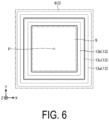
- FIG. 6 is a plan view illustrating an example of a layout of a fixing material according to the second embodiment.
- the electrochemical cell device 10 may include fixing materials 13a to 13c.
- the cells 1 located at the central portion in the first direction each include the fixing material 13a.
- the cells 1 located at both end portions in the first direction each include the fixing material 13b.
- the cell 1 located between the cell 1 including the fixing material 13a and the cell 1 including the fixing material 13b includes the fixing material 13c.
- the distance between the center P of the element portion 3 and the fixing material 13a is larger than the distance between the center P of the element portion 3 and the fixing material 13b.
- the distance between the center P of the element portion 3 and the fixing material 13c is smaller than the distance between the center P of the element portion 3 and the fixing material 13a, and larger than the distance between the center P of the element portion 3 and the fixing material 13b.
- FIG. 5 and FIG. 6 show an example in which in a plan view, the distance between the center P of the element portion 3 and the fixing material 13c is smaller than the distance between the center P of the element portion 3 and the fixing material 13a and larger than the distance between the center P of the element portion 3 and the fixing material 13b, but the present invention is not limited to this example.
- the distance between the center P of the element portion 3 and the fixing material 13c may be larger than the distance between the center P of the element portion 3 and the fixing material 13a, or may be smaller than the distance between the center P of the element portion 3 and the fixing material 13b.
- FIG. 7 is a cross-sectional view illustrating an example of an electrochemical cell device according to a third embodiment.
- the electrochemical cell device 10 illustrated in FIG. 7 is different from the electrochemical cell device 10 according to each of the embodiments described above in that the cross-sectional shape along the ZX plane and the cross-sectional shape along the YZ plane are different from each other.
- the cross-sectional shape along the YZ plane may be the same as that of the electrochemical cell device 10 according to the second embodiment.
- the power generation capability of the cells 1 as a whole and the power generation capability of the electrochemical cell device 10 as a whole are improved.
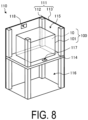
- FIG. 8 is an exploded perspective view illustrating an example of a module housing device according to an embodiment.
- a module housing device 110 according to the present embodiment includes an external case 111, a module 100, and an auxiliary device (not illustrated).
- the module 100 includes a storage container 101, and the electrochemical cell device 10 housed in the storage container 101.
- a reformer (not illustrated) may be disposed above the electrochemical cell device 10. Such a reformer generates a fuel gas by reforming a raw fuel such as natural gas or kerosene and supplies the fuel gas to the cell 1.
- the module 100 houses the electrochemical cell device 10 with the improved power generation capability. This configuration makes it possible to provide the module 100 with the improved power generation capability.
- the auxiliary device operates the module 100.
- the module 100 and the auxiliary device are housed in the external case 111. Note that in FIG. 8 , the configuration is partially omitted.
- the external case 111 of the module housing device 110 includes a support 112 and an external plate 113.
- a dividing plate 114 vertically partitions the interior of the external case 111.
- the space above the dividing plate 114 in the external case 111 is a module housing chamber 115 housing the module 100.
- the space below the dividing plate 114 in the external case 111 is an auxiliary device housing chamber 116 housing the auxiliary device that operates the module 100. Note that in FIG. 8 , the auxiliary device housed in the auxiliary device housing chamber 116 is omitted.
- the dividing plate 114 is provided with an air circulation hole 117 for causing air in the auxiliary device housing chamber 116 to flow to the module housing chamber 115 side.
- the external plate 113 for forming the module housing chamber 115 is provided with an exhaust hole 118 for discharging air inside the module housing chamber 115.
- the module 100 with the improved performance is provided in the module housing chamber 115.
- This configuration makes it possible to provide the module housing device 110 with the improved performance.
- Electrochemical cell devices according to other embodiments will be described.
- a fuel cell, a fuel cell stack device, a fuel cell module, and a fuel cell device have been illustrated as examples of the "electrochemical cell,” the “electrochemical cell device,” the “module,” and the “module housing device.”
- these may be an electrolytic cell, an electrolytic cell stack device, an electrolytic module, and an electrolytic device, respectively.
- the electrolytic cell includes a first electrode and a second electrode and decomposes water vapor into hydrogen and oxygen or decomposes carbon dioxide into carbon monoxide and oxygen by being supplied with electric power.
- the electrolyte material may be a hydroxide ion conductor.
- the electrolytic cell, electrolytic cell stack device, electrolytic module, and electrolytic device discussed above can have electrolytic performance.
- an electrochemical cell device includes a plurality of electrochemical cells arranged in a first direction, and including a first cell and a second cell.
- Each of the plurality of electrochemical cells includes an element portion, a support body supporting the element portion, and a fixing material fixing the element portion and the support body.
- the first cell is different from the second cell in a position of the fixing material when viewed in a plan view in the first direction.
- the first cell has a distance between the center of the element portion and the fixing material when viewed in the plan view in the first direction may be larger than the second cell.
- the first cell may be located at a central portion in the first direction, and the second cell may be located at an end portion in the first direction.
- the module according to an embodiment includes the electrochemical cell device according to any one of (1) to (3), and a storage container housing the electrochemical cell device.
- the module housing device includes the module according to (4), an auxiliary device configured to operate the module, and an external case housing the module and the auxiliary device.
Landscapes
- Life Sciences & Earth Sciences (AREA)
- Engineering & Computer Science (AREA)
- Manufacturing & Machinery (AREA)
- Sustainable Development (AREA)
- Sustainable Energy (AREA)
- Chemical & Material Sciences (AREA)
- Chemical Kinetics & Catalysis (AREA)
- Electrochemistry (AREA)
- General Chemical & Material Sciences (AREA)
- Fuel Cell (AREA)
Abstract
Description
- The present disclosure relates to an electrochemical cell device, a module, and a module housing device.
- In recent years, various fuel cell stack devices, each including a plurality of fuel cells, have been proposed as next-generation energy. A fuel cell is a type of electrochemical cell capable of obtaining electrical power by using a fuel gas such as a hydrogen-containing gas and an oxygen-containing gas such as air.
- Patent Document 1:
JP 2015-35417 A - An electrochemical cell device according to an aspect of an embodiment includes a plurality of electrochemical cells arranged in a first direction, and including a first cell and a second cell. Each of the plurality of electrochemical cells includes an element portion, a support body, and a fixing material. The support body supports the element portion. The fixing material fixes the element portion and the support body. The first cell is different from the second cell in a position of the fixing material when viewed in a plan view in the first direction.
- A module of the present disclosure includes the electrochemical cell device described above and a storage container housing the electrochemical cell device.
- A module housing device of the present disclosure includes the module described above, an auxiliary device that operates the module, and an external case housing the module and the auxiliary device.
-
-
FIG. 1 is a cross-sectional view illustrating an example of an electrochemical cell device according to a first embodiment. -
FIG. 2 is an enlarged view of a region A illustrated inFIG. 1 . -
FIG. 3 is a plan view illustrating an example of a layout of a fixing material according to the first embodiment. -
FIG. 4 is a cross-sectional view illustrating an example of the electrochemical cell device according to the first embodiment. -
FIG. 5 is a cross-sectional view illustrating an example of an electrochemical cell device according to a second embodiment. -
FIG. 6 is a plan view illustrating an example of a layout of a fixing material according to the second embodiment. -
FIG. 7 is a cross-sectional view illustrating an example of an electrochemical cell device according to a third embodiment. -
FIG. 8 is an exploded perspective view illustrating an example of a module housing device according to an embodiment. - In the above-described fuel cell stack device, for example, a variation in temperature occurs during power generation in some cases, and there is room for improvement in battery performance.
- It is expected to provide an electrochemical cell device, a module, and a module housing device having improved performance.
- Embodiments of an electrochemical cell device, a module, and a module housing device disclosed in the present application will be described below in detail with reference to the accompanying drawings. Note that the disclosure is not limited by the following embodiments.
- The drawings are schematic and the dimensional relationships between elements, the proportions of the elements, and the like may differ from the actual ones. There may be differences between the drawings in the dimensional relationships, proportions, and the like.
- First, with reference to
FIG. 1 to FIG. 3 , an example of a solid oxide fuel cell will be described as an electrochemical cell according to a first embodiment. The electrochemical cell device may include a cell stack including a plurality of electrochemical cells. The electrochemical cell device including the plurality of electrochemical cells is simply referred to as a cell stack device. -
FIG. 1 is a cross-sectional view illustrating an example of the electrochemical cell according to the first embodiment.FIG. 2 is an enlarged view of a region A illustrated inFIG. 1 . Note that inFIG. 1 andFIG. 2 , a part of configurations of the electrochemical cell is exaggerated and a part thereof is omitted. Hereinafter, the electrochemical cell may be simply referred to as a cell. - As illustrated in
FIG. 1 , anelectrochemical cell device 10 includes a plurality ofcells 1 andend plates cells 1 are arranged in a Z axis direction as a first direction. Theend plate 16 is located at the end portion of theelectrochemical cell device 10 on the positive side in the Z axis direction, and theend plate 17 is located at the end portion of theelectrochemical cell device 10 on the negative side in the Z axis direction. Theend plates cells 1 in the layering direction. Theelectrochemical cell device 10 according to the present embodiment is a flat plate-type cell stack device in which the plurality of flat plate-type cells 1 are layered. Note thatFIG. 1 illustrates theelectrochemical cell device 10 in which sixcells 1 are layered, but the number ofcells 1 is not limited to this. - The
cell 1 includes a firstcurrent collector 2, anelement portion 3, a secondcurrent collector 9, asealing material 11, afixing material 13, and asupport body 18. - The first
current collector 2 is located on the negative side in the Z axis direction of theelement portion 3. The firstcurrent collector 2 includes a gas-flow passage 2a through which a fuel gas flows. The firstcurrent collector 2 allows the gas flowing in the gas-flow passage 2a to permeate to afuel electrode 5. The firstcurrent collector 2 has electrical conductivity and collects electricity generated in theelement portion 3 to aninterconnector 4. - The material of the first
current collector 2 includes, for example, an iron group metal component and an inorganic oxide. For example, the iron group metal component may be nickel (Ni) and/or NiO. The inorganic oxide may be, for example, a specific rare earth element oxide. The rare earth element oxide may contain, for example, one or more rare earth elements selected from Sc, Y, La, Nd, Sm, Gd, Dy, and Yb. The material of the firstcurrent collector 2 may be, for example, a metal or an alloy. For example, ferritic stainless steel containing chromium has electrical conductivity and is less likely to decrease in strength even when it comes into contact with a fuel gas such as a hydrogen-containing gas. - The second
current collector 9 is located on the positive side in the Z axis direction of theelement portion 3. The secondcurrent collector 9 may have gas permeability. The secondcurrent collector 9 may include a gas-flow passage through which a gas flows. The material of the secondcurrent collector 9 may be, for example, a metal or an alloy. For example, ferritic stainless steel containing chromium has electrical conductivity and is not easily oxidized even when it comes into contact with an oxygen-containing gas such as air. The secondcurrent collector 9 may include a base member and a coating layer of an electrically conductive oxide that covers a surface of the base member. - The
element portion 3 includes thefuel electrode 5, asolid electrolyte layer 6, anintermediate layer 7, and anair electrode 8. - The
fuel electrode 5 is an example of a first electrode connected to the firstcurrent collector 2. As the material of thefuel electrode 5, a commonly known material may be used. As thefuel electrode 5, any of porous electrically conductive ceramics, for example, ceramics containing ZrO2 in which a calcium oxide, a magnesium oxide, or a rare earth element oxide is in solid solution, and Ni and/or NiO may be used. This rare earth element oxide may contain a plurality of rare earth elements selected from, for example, Sc, Y, La, Nd, Sm, Gd, Dy, and Yb. Hereinafter, ZrO2 in which a calcium oxide, a magnesium oxide, or a rare earth element oxide is in solid solution may be referred to as stabilized zirconia. Stabilized zirconia may also include partially stabilized zirconia. - The
solid electrolyte layer 6 is an electrolyte and delivers ions between thefuel electrode 5 and theair electrode 8. At the same time, thesolid electrolyte layer 6 has gas blocking properties, and makes leakage of the fuel gas and the oxygen-containing gas less likely to occur. - The material of the
solid electrolyte layer 6 may be, for example, ZrO2 in which 3 mole% to 15 mole% of a rare earth element oxide is in solid solution. The rare earth element oxide may contain, for example, one or more rare earth elements selected from Sc, Y, La, Nd, Sm, Gd, Dy, and Yb. Thesolid electrolyte layer 6 may contain, for example, ZrO2 in which Yb, Sc, or Gd is in solid solution, CeO2 in which La, Nd, or Yb is in solid solution, BaZrO3 in which Sc or Yb is in solid solution, or BaCeO3 in which Sc or Yb is in solid solution. - As illustrated in
FIG. 2 , thefuel electrode 5 in a plan view in the Z axis direction may have the same size as thesolid electrolyte layer 6. Thefuel electrode 5 may be larger or smaller than thesolid electrolyte layer 6. - The
air electrode 8 is an example of a second electrode connected to the secondcurrent collector 9. Theair electrode 8 has gas permeability. The open porosity of theair electrode 8 may be, for example, in the range of 20% to 50%, particularly in the range of 30% to 50%. The open porosity of theair electrode 8 may also be referred to as the porosity of theair electrode 8. - The material of the
air electrode 8 is not particularly limited, as long as the material is one generally used for the air electrode. The material of theair electrode 8 may be, for example, an electrically conductive ceramic such as a so-called ABO3 type perovskite oxide. - The material of the
air electrode 8 may be, for example, a composite oxide in which strontium (Sr) and lanthanum (La) coexist at the A site. Examples of such a composite oxide include LaxSr1-xCoyFe1-yO3, LaxSr1-xMnO3, LaxSr1-xFeO3, and LaxSr1-xCoO3. Here, x satisfies 0 < x < 1, and y satisfies 0 < y < 1. - The
intermediate layer 7 functions as a diffusion suppression layer. When strontium (Sr) contained in theair electrode 8 diffuses into thesolid electrolyte layer 6, a resistance layer of SrZrO3 is formed in thesolid electrolyte layer 6. Theintermediate layer 7 makes it difficult for Sr to diffuse, thereby making it difficult for SrZrO3 to be formed in thesolid electrolyte layer 6. - The material of the
intermediate layer 7 is not particularly limited as long as the material is not likely to cause the diffusion of elements between theair electrode 8 and thesolid electrolyte layer 6 in general. The material of theintermediate layer 7 may contain, for example, cerium oxide (CeO2) in which rare earth elements other than cerium (Ce) are in solid solution. As such rare earth elements, for example, gadolinium (Gd), samarium (Sm), or the like may be used. Note that theelement portion 3 need not include theintermediate layer 7. - The
interconnector 4 is interposed betweenadjacent cells 1 among the plurality ofcells 1. Theinterconnector 4 is located between theadjacent cells 1. Theinterconnector 4 electrically connects in series the firstcurrent collector 2 of one of theadjacent cells 1 to the secondcurrent collector 9 of the other of theadjacent cells 1. - The
interconnector 4 is dense, and makes the leakage of the fuel gas flowing through the gas-flow passage 2a included in the firstcurrent collector 2, and leakage of the oxygen-containing gas flowing outside the firstcurrent collector 2 less likely to occur. Theinterconnector 4 may have a relative density of 93% or more; particularly 95% or more. - A metal, an alloy such as stainless steel, or the like may be used as the material of the
interconnector 4. For example, ferritic stainless steel containing chromium has electrical conductivity, and is unlikely to be reduced and also unlikely to be oxidized even when it comes into contact with a fuel gas such as a hydrogen-containing gas and an oxygen-containing gas such as air. - Note that the
interconnector 4 may be integrated with the firstcurrent collector 2 or the secondcurrent collector 9, or the firstcurrent collector 2 or the secondcurrent collector 9 may also serve as theinterconnector 4. The materials of the firstcurrent collector 2, theinterconnector 4, and the secondcurrent collector 9 may be the same or different from each other. - The sealing
material 11 is located between thesolid electrolyte layer 6 and thesupport body 18. For example, an electrically conductive brazing material such as silver solder may be used as the material of the sealingmaterial 11. For example, amorphous glass or crystalline glass, having low electrical conductivity, may be used as the material of the sealingmaterial 11. The sealingmaterial 11 may contain, for example, an insulating oxide having thermal resistance, such as forsterite. Thus, the sealingmaterial 11 increases the adhesiveness between thesolid electrolyte layer 6 and thesupport body 18, thereby making it possible to enhance the durability of theelectrochemical cell device 10. Note that thecell 1 need not include the sealingmaterial 11. - The fixing
material 13 fixes theelement portion 3 and thesupport body 18. The fixingmaterial 13 may be made using a material having low electrical conductivity like glass. As the specific materials of the fixingmaterial 13, amorphous glass or the like may be used, and especially, crystallized glass or the like may be used. - As the crystallized glass, for example, any one selected from the group consisting of SiO2-CaO-based, MgO-B2O3-based, La2O3-B2O3-MgO-based, La2O3-B2O3-ZnO-based, and SiO2-CaO-ZnO-based materials may be used, or, in particular, an SiO2-MgO-based material may be used.
- Note that when the sealing
material 11 is not provided between theelement portion 3 and thesupport body 18, the fixingmaterial 13 may be or need not be located between theelement portion 3 and thesupport body 18. The larger the contact area between theelement portion 3 and thesupport body 18, the more firmly the fixingmaterial 13 can fix theelement portion 3 and thesupport body 18. - The
support body 18 supports theelement portion 3. Thesupport body 18 may be, for example, a plate-like metal member extending along the XY plane. Thesupport body 18 has anopening 18e that penetrates in the thickness direction (Z axis direction). Theopening 18e is covered with the fixingmaterial 13. Thesupport body 18 may be, for example, a separator that separates the fuel gas atmosphere and the oxygen-containing gas atmosphere in thecell 1. - In each of the
cells 1 included in theelectrochemical cell device 10, both end portions in an X axis direction and a Y axis direction are likely to have a lower temperature than the central portion in the X axis direction and the Y axis direction. For this reason, in theelement portions 3 close to both end portions in the X axis direction and the Y axis direction, there is a concern that the power generation capability is lowered as compared with theelement portions 3 located in the central portion in the X axis direction and the Y axis direction and the cell performance of thecell 1 as a whole is lowered. - In the present embodiment, the power generation capability can be improved by, for example, making the positions of the fixing
materials 13 located in therespective cells 1 different from each other. In the present embodiment, the fixingmaterials 13 are different in position when viewed in a plan view in the first direction (Z axis direction). -
FIG. 3 is a plan view illustrating an example of a layout of a fixing material according to the first embodiment. Note that inFIG. 3 , for example, some components such as theinterconnector 4 and thesupport body 18 are not illustrated. - As illustrated in
FIG. 2 and FIG. 3 , a fixingmaterial 131 included in acell 1a as the first cell and a fixingmaterial 132 included in acell 1b as the second cell are different in position when viewed in a plan view in the first direction (Z axis direction). Here, "are different in position when viewed in a plan view in the first direction (Z axis direction)" means that a part or all of the fixingmaterial 131 and the fixingmaterial 132 do not overlap in a plan view in the first direction (Z axis direction). More specifically, in a portion where the fixingmaterial 131 or the fixingmaterial 132 is located in a plan view in the first direction (Z axis direction), the area ratio of a portion where the fixingmaterial 131 and the fixingmaterial 132 do not overlap is 1% or more. As illustrated inFIG. 2 and FIG. 3 , the distance between a center P of theelement portion 3 and the fixingmaterial 13 when viewed in a plan view in the first direction (Z axis direction) may be larger in thecell 1a than in thecell 1b. The portion where the fixingmaterial 131 and the fixingmaterial 132 do not overlap in a plan view may be located in the entire area around the center P of theelement portion 3 as illustrated inFIG. 3 , for example. The portion where the fixingmaterial 131 and the fixingmaterial 132 do not overlap in a plan view may be located in at least one arbitrary direction from the center P of theelement portion 3, and the fixingmaterial 131 and the fixingmaterial 132 may overlap in the other directions. - As described above, by making the positions of the fixing
materials 13 when thecell 1a and thecell 1b are each viewed in a plan view different from each other, the power generation capability is improved. A factor is presumably as follows. By making the positions of the fixingmaterials 13 when viewed in a plan view in the first direction (Z axis direction) different from each other, heat of thecell 1b in which the flowing volume of the oxygen-containing gas is small and heat dissipation is difficult is easily transferred to thecell 1a in which the flowing volume of the oxygen-containing gas is large and heat dissipation is easy. Thus, the heat dissipation in the central portion of thecell 1 in the X axis direction and the Y axis direction is improved. As a result, the temperatures of both end portions in the X axis direction and the Y axis direction increase, and the power generation capability of thecell 1 as a whole is improved. - Note that although
FIG. 1 andFIG. 2 show an example in which the fixingmaterials 131 and the fixingmaterials 132 are alternately positioned, the present invention is not limited to this example. For example, at least one of the fixingmaterials 13 included in the plurality ofcells 1 may be the fixingmaterial 131 or the fixingmaterial 132. Thecells 1 including the fixingmaterial 131 or thecells 1 including the fixingmaterial 132 may be arranged. -
FIG. 1 andFIG. 2 illustrate an example in which the distances between the center P of theelement portion 3 and the fixingmaterial 13 in a plan view are different from each other in the X axis direction and the Y axis direction, but the present invention is not limited thereto. For example, the distance between the center P of theelement portion 3 and the fixingmaterial 131 and the distance between the center P of theelement portion 3 and the fixingmaterial 132 in a plan view may be different only in the X axis direction and may be the same in the Y axis direction. -
FIG. 4 is a cross-sectional view illustrating an example of the electrochemical cell device according to the first embodiment. As illustrated inFIG. 4 , the center of gravity of the inner contour of the fixingmaterial 131 in a plan view may be shifted from the center of gravity of the inner contour of the fixingmaterial 132. In this case, a site where the distance between the fixingmaterial 131 and the center P of theelement portion 3 in thecell 1a is large and a site where the distance between the fixingmaterial 132 and the center P of theelement portion 3 in thecell 1b is small overlap each other. As such, heat of the site of thecell 1b where heat dissipation is difficult is easily transferred to the site of thecell 1a where heat dissipation is easy, and the power generation capability of thecell 1 as a whole is improved. - In each of the
cells 1 layered in the Z axis direction (first direction), both end portions in the Z axis direction are likely to have a lower temperature than the central portion in the Z axis direction. For this reason, the power generation capability of theelement portions 3 included in thecells 1 located at both end portions in the Z axis direction is lowered as compared with theelement portions 3 included in thecells 1 located at the central portion in the Z axis direction, and there has been a concern that the power generation capability of theelectrochemical cell device 10 as a whole is lowered. - In the present embodiment, for example, by making the positions of the fixing
materials 13 included in thecells 1 located at both end portions in the Z axis direction and the positions of the fixingmaterials 13 included in thecells 1 located at the central portion in the Z axis direction different from each other, the power generation capability can be improved. -
FIG. 5 is a cross-sectional view illustrating an example of an electrochemical cell device according to a second embodiment.FIG. 6 is a plan view illustrating an example of a layout of a fixing material according to the second embodiment. - As illustrated in
FIG. 5 , theelectrochemical cell device 10 may include fixingmaterials 13a to 13c. Among the plurality ofcells 1 arranged in the Z axis direction (first direction), thecells 1 located at the central portion in the first direction each include the fixingmaterial 13a. Thecells 1 located at both end portions in the first direction each include the fixingmaterial 13b. Thecell 1 located between thecell 1 including the fixingmaterial 13a and thecell 1 including the fixingmaterial 13b includes the fixingmaterial 13c. - In a plan view in the first direction, the distance between the center P of the
element portion 3 and the fixingmaterial 13a is larger than the distance between the center P of theelement portion 3 and the fixingmaterial 13b. In a plan view in the first direction, the distance between the center P of theelement portion 3 and the fixingmaterial 13c is smaller than the distance between the center P of theelement portion 3 and the fixingmaterial 13a, and larger than the distance between the center P of theelement portion 3 and the fixingmaterial 13b. - As described above, by making the distances between the center P of the
element portion 3 and the fixingmaterials 13 in a plan view different from each other, power generation capability is improved. A factor is presumably as follows. By making the positions of the fixingmaterials 13 different from each other in a plan view in the first direction (Z axis direction), heat is easily dissipated at a site where the flowing volume of the oxygen-containing gas is large in thecell 1 located at the central portion in the Z axis direction. Thus, the heat dissipation performance inside theelectrochemical cell device 10 is improved. As a result, the temperature of thecells 1 located at both end portions in the Z axis direction increases, and the power generation capability is improved. - Note that
FIG. 5 andFIG. 6 show an example in which in a plan view, the distance between the center P of theelement portion 3 and the fixingmaterial 13c is smaller than the distance between the center P of theelement portion 3 and the fixingmaterial 13a and larger than the distance between the center P of theelement portion 3 and the fixingmaterial 13b, but the present invention is not limited to this example. For example, in a plan view, the distance between the center P of theelement portion 3 and the fixingmaterial 13c may be larger than the distance between the center P of theelement portion 3 and the fixingmaterial 13a, or may be smaller than the distance between the center P of theelement portion 3 and the fixingmaterial 13b. -
FIG. 7 is a cross-sectional view illustrating an example of an electrochemical cell device according to a third embodiment. Theelectrochemical cell device 10 illustrated inFIG. 7 is different from theelectrochemical cell device 10 according to each of the embodiments described above in that the cross-sectional shape along the ZX plane and the cross-sectional shape along the YZ plane are different from each other. - Specifically, in the
electrochemical cell device 10 according to the first embodiment, the cross-sectional shape along the YZ plane may be the same as that of theelectrochemical cell device 10 according to the second embodiment. As described above, by making the positions of the fixingmaterials 13 included in therespective cells 1 different from each other, the power generation capability of thecells 1 as a whole and the power generation capability of theelectrochemical cell device 10 as a whole are improved. - Descriptions of a module and a module housing device using the
electrochemical cell device 10 according to the above-described embodiments will now be given with reference toFIG. 8 . -
FIG. 8 is an exploded perspective view illustrating an example of a module housing device according to an embodiment. Amodule housing device 110 according to the present embodiment includes anexternal case 111, amodule 100, and an auxiliary device (not illustrated). - The
module 100 includes astorage container 101, and theelectrochemical cell device 10 housed in thestorage container 101. A reformer (not illustrated) may be disposed above theelectrochemical cell device 10. Such a reformer generates a fuel gas by reforming a raw fuel such as natural gas or kerosene and supplies the fuel gas to thecell 1. - As described above, the
module 100 houses theelectrochemical cell device 10 with the improved power generation capability. This configuration makes it possible to provide themodule 100 with the improved power generation capability. - The auxiliary device operates the
module 100. Themodule 100 and the auxiliary device are housed in theexternal case 111. Note that inFIG. 8 , the configuration is partially omitted. - The
external case 111 of themodule housing device 110 includes asupport 112 and anexternal plate 113. A dividingplate 114 vertically partitions the interior of theexternal case 111. The space above the dividingplate 114 in theexternal case 111 is amodule housing chamber 115 housing themodule 100. The space below the dividingplate 114 in theexternal case 111 is an auxiliarydevice housing chamber 116 housing the auxiliary device that operates themodule 100. Note that inFIG. 8 , the auxiliary device housed in the auxiliarydevice housing chamber 116 is omitted. - The dividing
plate 114 is provided with anair circulation hole 117 for causing air in the auxiliarydevice housing chamber 116 to flow to themodule housing chamber 115 side. Theexternal plate 113 for forming themodule housing chamber 115 is provided with anexhaust hole 118 for discharging air inside themodule housing chamber 115. - In the
module housing device 110, as described above, themodule 100 with the improved performance is provided in themodule housing chamber 115. This configuration makes it possible to provide themodule housing device 110 with the improved performance. - Electrochemical cell devices according to other embodiments will be described.
- In the embodiments described above, a fuel cell, a fuel cell stack device, a fuel cell module, and a fuel cell device have been illustrated as examples of the "electrochemical cell," the "electrochemical cell device," the "module," and the "module housing device." However, as other examples, these may be an electrolytic cell, an electrolytic cell stack device, an electrolytic module, and an electrolytic device, respectively. The electrolytic cell includes a first electrode and a second electrode and decomposes water vapor into hydrogen and oxygen or decomposes carbon dioxide into carbon monoxide and oxygen by being supplied with electric power. Although an oxide ion conductor or a hydrogen ion conductor is illustrated as an example of the electrolyte material of the electrochemical cell in each of the above embodiments, the electrolyte material may be a hydroxide ion conductor. The electrolytic cell, electrolytic cell stack device, electrolytic module, and electrolytic device discussed above can have electrolytic performance.
- While the present disclosure has been described in detail, the present disclosure is not limited to the aforementioned embodiments, and various changes, improvements, and the like can be made without departing from the gist of the present disclosure.
- As described above, (1) an electrochemical cell device according to an embodiment includes a plurality of electrochemical cells arranged in a first direction, and including a first cell and a second cell. Each of the plurality of electrochemical cells includes an element portion, a support body supporting the element portion, and a fixing material fixing the element portion and the support body. The first cell is different from the second cell in a position of the fixing material when viewed in a plan view in the first direction.
- (2) In the electrochemical cell device according to (1), the first cell has a distance between the center of the element portion and the fixing material when viewed in the plan view in the first direction may be larger than the second cell.
- (3) In the electrochemical cell device according to (1) or (2), the first cell may be located at a central portion in the first direction, and the second cell may be located at an end portion in the first direction.
- (4) The module according to an embodiment includes the electrochemical cell device according to any one of (1) to (3), and a storage container housing the electrochemical cell device.
- (5) The module housing device according to an embodiment includes the module according to (4), an auxiliary device configured to operate the module, and an external case housing the module and the auxiliary device.
- Note that the embodiments disclosed herein shall be deemed to be exemplary in all respects and not restrictive. The aforementioned embodiments can be embodied in a variety of forms. The aforementioned embodiments may be omitted, replaced, or changed in various forms without departing from the scope of the appended claims and the purpose thereof.
-
- 1 Cell
- 3 Element portion
- 5 Fuel electrode
- 6 Solid electrolyte layer
- 7 Intermediate layer
- 8 Air electrode
- 10 Electrochemical cell device
- 13 Fixing material
- 18 Support body
- 100 Module
- 110 Module housing device
Claims (5)
- An electrochemical cell device comprising:a plurality of electrochemical cells arranged in a first direction, and comprising a first cell and a second cell,wherein each of the plurality of electrochemical cells comprises:an element portion;a support body supporting the element portion; anda fixing material fixing the element portion and the support body, andthe first cell is different from the second cell in a position of the fixing material when viewed in a plan view in the first direction.
- The electrochemical cell device according to claim 1, wherein the first cell has a distance between a center of the element portion and the fixing material when viewed in the plan view in the first direction is larger than the second cell.
- The electrochemical cell device according to claim 1 or 2, whereinthe first cell is located at a central portion in the first direction, andthe second cell is located at an end portion in the first direction.
- A module comprising:the electrochemical cell device according to any one of claims 1 to 3; anda storage container housing the electrochemical cell device.
- A module housing device comprising:the module according to claim 4;an auxiliary device configured to operate the module; andan external case housing the module and the auxiliary device.
Applications Claiming Priority (2)
| Application Number | Priority Date | Filing Date | Title |
|---|---|---|---|
| JP2022137713 | 2022-08-31 | ||
| PCT/JP2023/031419 WO2024048629A1 (en) | 2022-08-31 | 2023-08-30 | Electrochemical cell device, module, and module housing device |
Publications (2)
| Publication Number | Publication Date |
|---|---|
| EP4564490A1 true EP4564490A1 (en) | 2025-06-04 |
| EP4564490A4 EP4564490A4 (en) | 2026-03-11 |
Family
ID=90099685
Family Applications (1)
| Application Number | Title | Priority Date | Filing Date |
|---|---|---|---|
| EP23860391.4A Pending EP4564490A4 (en) | 2022-08-31 | 2023-08-30 | Electrochemical cell device, module and module housing device |
Country Status (5)
| Country | Link |
|---|---|
| US (1) | US20260011765A1 (en) |
| EP (1) | EP4564490A4 (en) |
| JP (1) | JPWO2024048629A1 (en) |
| CN (1) | CN119698707A (en) |
| WO (1) | WO2024048629A1 (en) |
Family Cites Families (12)
| Publication number | Priority date | Publication date | Assignee | Title |
|---|---|---|---|---|
| JPH0845534A (en) * | 1994-07-28 | 1996-02-16 | Fujikura Ltd | Gas seal structure of flat solid oxide fuel cell |
| US6803136B2 (en) * | 2000-04-10 | 2004-10-12 | Hybrid Power Generation Systems, Llc | Stacking and manifolding of unitized solid oxide fuel cells |
| JP2010040174A (en) * | 2008-07-31 | 2010-02-18 | Sharp Corp | Fuel cell stack |
| JP5662613B1 (en) | 2013-07-10 | 2015-02-04 | 日本碍子株式会社 | Fuel cell stack structure |
| JP6153068B2 (en) * | 2013-07-12 | 2017-06-28 | Toto株式会社 | Solid oxide fuel cell device |
| JP6283233B2 (en) * | 2014-02-19 | 2018-02-21 | 日本特殊陶業株式会社 | Fuel cell |
| JP6401115B2 (en) * | 2015-05-27 | 2018-10-03 | 京セラ株式会社 | Cell stack device, module and module housing device |
| JP6159868B1 (en) * | 2016-02-16 | 2017-07-05 | 日本碍子株式会社 | Fuel cell stack |
| JP6868051B2 (en) * | 2018-06-29 | 2021-05-12 | 森村Sofcテクノロジー株式会社 | Electrochemical reaction unit and electrochemical reaction cell stack |
| JP7250910B2 (en) * | 2019-04-24 | 2023-04-03 | 京セラ株式会社 | Cells, cell stack equipment, modules and module housing equipment |
| US20250279455A1 (en) * | 2021-12-28 | 2025-09-04 | Kyocera Corporation | Electrochemical cell device, module, and module housing device |
| EP4435906A4 (en) * | 2021-12-28 | 2025-09-24 | Kyocera Corp | ELECTROCHEMICAL CELL DEVICE, MODULE AND MODULE HOUSING |
-
2023
- 2023-08-30 CN CN202380060469.1A patent/CN119698707A/en active Pending
- 2023-08-30 US US19/106,434 patent/US20260011765A1/en active Pending
- 2023-08-30 WO PCT/JP2023/031419 patent/WO2024048629A1/en not_active Ceased
- 2023-08-30 JP JP2024544318A patent/JPWO2024048629A1/ja active Pending
- 2023-08-30 EP EP23860391.4A patent/EP4564490A4/en active Pending
Also Published As
| Publication number | Publication date |
|---|---|
| WO2024048629A1 (en) | 2024-03-07 |
| JPWO2024048629A1 (en) | 2024-03-07 |
| CN119698707A (en) | 2025-03-25 |
| EP4564490A4 (en) | 2026-03-11 |
| US20260011765A1 (en) | 2026-01-08 |
Similar Documents
| Publication | Publication Date | Title |
|---|---|---|
| EP4525107A1 (en) | Electrochemical cell, electrochemical cell device, module, and module accommodating device | |
| US20240387849A1 (en) | Electrochemical cell, electrochemical cell device, module and module housing device | |
| US20240322193A1 (en) | Electrochemical cell, electrochemical cell device, module, and module housing device | |
| US20230387422A1 (en) | Cell, cell stack device, module, and module housing device | |
| US20250279455A1 (en) | Electrochemical cell device, module, and module housing device | |
| US20250309481A1 (en) | Electrically conductive member, electrochemical cell device, module, and module housing device | |
| US20250105422A1 (en) | Electrochemical cell device, module, and module housing device | |
| EP4564490A1 (en) | Electrochemical cell device, module, and module housing device | |
| US20260038860A1 (en) | Electrochemical cell, electrochemical cell device, module, and module housing device | |
| US20250118785A1 (en) | Electrochemical cell, electrochemical cell device, module and module housing device | |
| US20250246691A1 (en) | Electrochemical cell, electrochemical cell device, module, and module housing device | |
| EP4597649A1 (en) | Electrochemical cell, electrochemical cell device, module, and module-accommodating device | |
| EP4715914A1 (en) | Solid electrolyte layer, electrochemical cell, electrochemical cell device, module, and module storage device | |
| US20250167274A1 (en) | Solid electrolyte layer, electrochemical cell, electrochemical cell device, module, and module housing device | |
| EP4708415A1 (en) | Electroconductive member, electrochemical cell device, module, and module accommodation device | |
| US20260038849A1 (en) | Conductive member, electrochemical cell device, module, and module housing device | |
| US20250385275A1 (en) | Electrically conductive member, electrochemical cell, electrochemical cell device, module, and module housing device | |
| EP4621891A1 (en) | Electrochemical cell, electrochemical cell device, module, and module-accommodating device | |
| US20250105311A1 (en) | Electrically conductive member, electrochemical cell, electrochemical cell device, module, and module housing device | |
| WO2025183149A1 (en) | Electrochemical cell, electrochemical cell device, module, and module storage device | |
| WO2026029158A1 (en) | Electrochemical cell, electrochemical cell device, module, and module storage device | |
| WO2024117052A1 (en) | Composite member, electrochemical cell, electrochemical cell device, module, and module storage device | |
| JP2024048859A (en) | Electrochemical cell device, module and module housing device | |
| WO2026071253A1 (en) | Metal member, electrochemical cell device, module, and module housing apparatus | |
| WO2025206231A1 (en) | Electrochemical cell, electrochemical cell device, module, and module storage device |
Legal Events
| Date | Code | Title | Description |
|---|---|---|---|
| STAA | Information on the status of an ep patent application or granted ep patent |
Free format text: STATUS: THE INTERNATIONAL PUBLICATION HAS BEEN MADE |
|
| PUAI | Public reference made under article 153(3) epc to a published international application that has entered the european phase |
Free format text: ORIGINAL CODE: 0009012 |
|
| STAA | Information on the status of an ep patent application or granted ep patent |
Free format text: STATUS: REQUEST FOR EXAMINATION WAS MADE |
|
| 17P | Request for examination filed |
Effective date: 20250225 |
|
| AK | Designated contracting states |
Kind code of ref document: A1 Designated state(s): AL AT BE BG CH CY CZ DE DK EE ES FI FR GB GR HR HU IE IS IT LI LT LU LV MC ME MK MT NL NO PL PT RO RS SE SI SK SM TR |
|
| DAV | Request for validation of the european patent (deleted) | ||
| DAX | Request for extension of the european patent (deleted) | ||
| A4 | Supplementary search report drawn up and despatched |
Effective date: 20260209 |
|
| RIC1 | Information provided on ipc code assigned before grant |
Ipc: H01M 8/2465 20160101AFI20260203BHEP Ipc: H01M 8/0273 20160101ALI20260203BHEP Ipc: H01M 8/12 20160101ALI20260203BHEP Ipc: H01M 8/2432 20160101ALI20260203BHEP |