EP4564274A1 - Information processing method and apparatus, and electronic device and storage medium - Google Patents
Information processing method and apparatus, and electronic device and storage medium Download PDFInfo
- Publication number
- EP4564274A1 EP4564274A1 EP23856654.1A EP23856654A EP4564274A1 EP 4564274 A1 EP4564274 A1 EP 4564274A1 EP 23856654 A EP23856654 A EP 23856654A EP 4564274 A1 EP4564274 A1 EP 4564274A1
- Authority
- EP
- European Patent Office
- Prior art keywords
- user
- association
- list
- users
- current
- Prior art date
- Legal status (The legal status is an assumption and is not a legal conclusion. Google has not performed a legal analysis and makes no representation as to the accuracy of the status listed.)
- Pending
Links
Images




Classifications
-
- G—PHYSICS
- G06—COMPUTING OR CALCULATING; COUNTING
- G06F—ELECTRIC DIGITAL DATA PROCESSING
- G06F16/00—Information retrieval; Database structures therefor; File system structures therefor
- G06F16/90—Details of database functions independent of the retrieved data types
- G06F16/95—Retrieval from the web
- G06F16/953—Querying, e.g. by the use of web search engines
- G06F16/9536—Search customisation based on social or collaborative filtering
-
- G—PHYSICS
- G06—COMPUTING OR CALCULATING; COUNTING
- G06F—ELECTRIC DIGITAL DATA PROCESSING
- G06F3/00—Input arrangements for transferring data to be processed into a form capable of being handled by the computer; Output arrangements for transferring data from processing unit to output unit, e.g. interface arrangements
- G06F3/01—Input arrangements or combined input and output arrangements for interaction between user and computer
- G06F3/048—Interaction techniques based on graphical user interfaces [GUI]
- G06F3/0481—Interaction techniques based on graphical user interfaces [GUI] based on specific properties of the displayed interaction object or a metaphor-based environment, e.g. interaction with desktop elements like windows or icons, or assisted by a cursor's changing behaviour or appearance
- G06F3/0482—Interaction with lists of selectable items, e.g. menus
-
- G—PHYSICS
- G06—COMPUTING OR CALCULATING; COUNTING
- G06F—ELECTRIC DIGITAL DATA PROCESSING
- G06F3/00—Input arrangements for transferring data to be processed into a form capable of being handled by the computer; Output arrangements for transferring data from processing unit to output unit, e.g. interface arrangements
- G06F3/01—Input arrangements or combined input and output arrangements for interaction between user and computer
- G06F3/048—Interaction techniques based on graphical user interfaces [GUI]
- G06F3/0484—Interaction techniques based on graphical user interfaces [GUI] for the control of specific functions or operations, e.g. selecting or manipulating an object, an image or a displayed text element, setting a parameter value or selecting a range
- G06F3/04847—Interaction techniques to control parameter settings, e.g. interaction with sliders or dials
-
- G—PHYSICS
- G06—COMPUTING OR CALCULATING; COUNTING
- G06F—ELECTRIC DIGITAL DATA PROCESSING
- G06F9/00—Arrangements for program control, e.g. control units
- G06F9/06—Arrangements for program control, e.g. control units using stored programs, i.e. using an internal store of processing equipment to receive or retain programs
- G06F9/44—Arrangements for executing specific programs
- G06F9/451—Execution arrangements for user interfaces
-
- G—PHYSICS
- G06—COMPUTING OR CALCULATING; COUNTING
- G06Q—INFORMATION AND COMMUNICATION TECHNOLOGY [ICT] SPECIALLY ADAPTED FOR ADMINISTRATIVE, COMMERCIAL, FINANCIAL, MANAGERIAL OR SUPERVISORY PURPOSES; SYSTEMS OR METHODS SPECIALLY ADAPTED FOR ADMINISTRATIVE, COMMERCIAL, FINANCIAL, MANAGERIAL OR SUPERVISORY PURPOSES, NOT OTHERWISE PROVIDED FOR
- G06Q10/00—Administration; Management
- G06Q10/40—Business processes related to social networking or social networking services
-
- G—PHYSICS
- G06—COMPUTING OR CALCULATING; COUNTING
- G06Q—INFORMATION AND COMMUNICATION TECHNOLOGY [ICT] SPECIALLY ADAPTED FOR ADMINISTRATIVE, COMMERCIAL, FINANCIAL, MANAGERIAL OR SUPERVISORY PURPOSES; SYSTEMS OR METHODS SPECIALLY ADAPTED FOR ADMINISTRATIVE, COMMERCIAL, FINANCIAL, MANAGERIAL OR SUPERVISORY PURPOSES, NOT OTHERWISE PROVIDED FOR
- G06Q10/00—Administration; Management
- G06Q10/40—Business processes related to social networking or social networking services
- G06Q10/42—Determination of affinities or common interests between users
Definitions
- Embodiments of the present disclosure relate to information processing technologies, for example, an information processing method and apparatus, an electronic device, and a storage medium.
- a corresponding user may be pushed to the current user, and the pushing manner in the related art mainly screens out a user associated with the user attribute of the current user from large quantities of users and then pushes the user to the current user.
- the above-described manner has the disadvantages that a calculation amount is relatively large and the corresponding calculation cost is relatively high. For example, the effect of a real-time push cannot be achieved due to the large calculation amount.
- the present disclosure provides an information processing method and apparatus, an electronic device, and a storage medium, so that a second user associated with the current user may be conveniently determined in real time and displayed on a display interface, and the effect of convenience and reliability in determining the second user is improved.
- an embodiment of the present disclosure provides an information processing method.
- the method includes that: in response to a trigger instruction from a current user for a first user in an association user list, the association user list is dynamically updated and the updated association user list is displayed; where the association user list corresponds to the current user, and the step in which the association user list is dynamically updated includes that at least one second user is determined according to the first user and the association user list is updated based on the at least one second user; where the at least one second user is associated with the first user.
- an embodiment of the present disclosure further provides an information processing apparatus.
- the apparatus includes an association list update module.
- the association list update module is configured to dynamically update the association user list and display the updated association user list, in response to a trigger instruction from a current user for a first user in an association user list, where the association user list corresponds to the current user, and the association list update module is configured to dynamically update the association user list and display the updated association user list in the manner that at least one second user is determined according to the first user and the association user list is updated based on the at least one second user; where the at least one second user is associated with the first user.
- an embodiment of the present application further provides an electronic device.
- the electronic device includes at least one processor and a storage apparatus.
- the storage apparatus is configured to store at least one program.
- the at least one program when executed by the at least one processor, causes the at least one processor to implement the information processing method described in any one of the embodiments of the present disclosure.
- an embodiment of the present application further provides a storage medium including a computer-executable instruction, where the computer-executable instruction is configured to, when executed by a computer processor, perform the information processing method described in any one of the embodiments of the present disclosure.
- first and second are merely used for distinguishing different apparatuses, modules, or units, and are not used for limiting the order or interdependence of functions performed by such apparatuses, modules, or units.
- prompt information is sent to the user to explicitly prompt the user that an operation requested by the user may require the acquisition and use of personal information of the user, so that the user may autonomously select whether to provide the personal information to software or hardware such as an electronic device, an application program, a server, or a storage medium performing operations of the technical solutions of the present disclosure according to the prompt information.
- the manner in which the prompt information is sent to the user in response to receiving the active request of the user may be, for example, a pop-up window manner, and the prompt information may be presented in text in a pop-up window.
- the pop-up window may also carry a selection control for the user to select "agree” or "disagree” to provide the personal information to the electronic device.
- an application scenario may be exemplarily illustrated.
- the technical solutions of the embodiments of the present disclosure may be applied in an arbitrary scenario where a user requires to be recommended, for example, in a process of browsing contents published by other users based on a relevant application program or application software, a particular user is determined to be followed based on a trigger instruction of the user, an association relationship between association users of the particular user and the current user is determined based on information about the association users, and an association user of the particular user is recommended for the current user, whereby a recommended user list is generated, and the recommended user list is displayed on a display interface.
- the embodiments of the present disclosure are suitable for use in an arbitrary scenario where a user requires to be recommended, for example, a scenario of user recommendation on a social platform, the method may be performed by an information processing apparatus, the apparatus may be implemented in a form of at least one of software and hardware, optionally, the apparatus may be implemented by an electronic device, and the electronic device may be a mobile terminal, a personal computer (PC) side, a server, or the like. Implementations of the embodiments of the present disclosure may be performed by a service side or by a client side, or by the service side and the client side in cooperation.
- the information processing method in the embodiments of the present disclosure may be as follows:
- the association user list in response to a trigger instruction from a current user for a first user in an association user list, the association user list is dynamically updated and displayed, where the association user list corresponds to the current user, the step in which the association user list is dynamically updated includes that at least one second user is determined according to the first user and the association user list is updated based on the at least one second user; where the at least one second user is associated with the first user.
- the apparatus performing the information processing method provided in the embodiments of the present disclosure may be integrated in application software supporting a user recommendation function
- the software may be installed in the electronic device, and in an embodiment, the electronic device may be a mobile terminal, a PC side, or the like.
- the application software may be any type of social software, which is not repeatedly described here, as long as it has the function of following a user.
- the application software may also be a specially developed application program, i.e., software that enables the follow function between users, or the application software is integrated in a corresponding page, and the user may follow other users through the page integrated on the PC side.
- a control for triggering the follow function may be developed in advance, when it is detected that a user triggers this control, a follow trigger instruction is responded to enable the user currently operating the software to follow other users, and the follow control may be a "follow" key or an "accept” key.
- All users registered with an account on the social platform may be the current user, and the number of current users may be more than one, and one of the multiple users may be exemplified and used as the above-mentioned current user for clarity in describing the technical solutions provided in the embodiments of the present disclosure.
- an association user list interface may be entered, and at this time, a list presented on a page of the device may be the association user list.
- a user in the association user list interface at this time is the first user, i.e., the first user is a user on the association list interface of the current user, and the first user may be a user determined by using a correlation algorithm, in whom the current user is interested and which the current user wants to follow.
- users in the association user list are dynamically updated, and the users presented in the association user list may be adjusted or added. For example, an original user presentation position in the list may be adjusted; alternatively, the user may be newly added, and display positions of all users in the entire list are adjusted.
- the second user may be determined based on the first user, and the second user is a user co-associated with the current user and the first user.
- the second user is determined according to the first user followed by the current user, and the users presented in the association user list are adjusted based on trigger information of the current user, for example, the original presentation position of the first user in the list may be adjusted, or a second user may be added and display positions of all users in the entire list are adjusted.
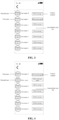
- the association user list interface displays multiple recommendation users, as shown in FIG. 1 .
- first user 1 and first users 2 to 7 in whom the current user is interested and wants to follow are users contained in the association user list interface and are determined according to the algorithm.
- the current user A triggers a "follow/accept" control corresponding to the first user 3, it represents that the current user A has followed the first user 3, and the second user is further determined according to the first user 3.
- the first user 3 may move to a position of the first row, that is, in the first row in the association user list, the position of the second user in the association user list immediately follows the display position of the first user, and multiple other first users move one row down, respectively, referring to FIG. 2 .
- the second user determined according to the first user may be one or multiple second users. If the current user A triggers the "follow/accept" control corresponding to the first user 3, and one second user B is determined according to the first user 3, a display position of the second user B in the association user list may be located below and immediately after the first user 3, as shown in FIG. 2 .
- the second user B may be located above the first user 3, referring to FIG. 3 .
- the association user list display positions of other users originally displayed in the association user list except the first user 3 are sequentially moved downwards. If multiple users have an association relationship with the first user 3 and the current user A, i.e., user C, user D, and user E, display positions of the multiple second users in the association user list may be used as "more relevant users" as a whole and located at a display position next to the first user on the display page of the association user list, referring to FIG. 4 .
- the "more relevant users” as a whole may also be located at a display position previous to the first user in the association user list, and after a "more relevant users" key is triggered, multiple determined second users may be presented.
- user C, user D, and user E may also be respectively located at the display position next to the first user in the association user list as display information of the recommendation user, referring to FIG. 5 .
- the method further includes that the association user list corresponding to the current user is determined based on a server recommendation model and the current user attribute of the current user.
- the server recommendation model refers to a pre-trained model that may be deployed in the server side so as to determine to-be-followed users or to-be-followed-back users associated with the current user at an initial stage.
- the current user attribute may be feature data of the current user, for example, the feature data may be operation behavior data, including browsing behavior data and viewing movie data, or the feature data may be other data corresponding to operation behaviors used for characterizing a user feature.
- the benefits of this arrangement include the following: some first users associated with the user may be screened out from a large amount of data, and the comprehensiveness of determined users in the association user list is improved.
- the step in which the association user list is dynamically updated and displayed further includes the following: a follow control corresponding to the first user is updated from first display information to second display information; and a display position of the first user in the association user list is updated.
- the second display information is preset and different from the first display information.
- the first display information may characterize that the current user does not follow the first user.
- the follow control is triggered, the first display information is updated to the second display information, a process of updating the display information characterizes that the current user has followed the first user, and the display position of the first user in the association user list is updated while the display information is updated.
- the process of updating the first display information to the second display information may be achieved by changing the color of the follow control such as the "follow/accept” control, exemplarily, when the current user A triggers the application program and enters into the association user list, each first user in the association user list is provided with a corresponding "follow/accept” control, referring to FIG. 6 , the first display information of the "follow/accept” control may be set to pink, which is left diagonally lined, the follow control is filled in a first filling manner, it represents that the current user A has not followed the first user 3 at this time; referring to FIG.
- the follow/accept control such as the "follow/accept" control
- the step in which the display position of the first user in the association user list is updated includes that the first user is displayed at the top position of all first users in the association user list, or that the first user is removed from the association user list. All first users include the first user.
- the first user at this time is in a followed state.
- the display position of the first user in the association user list may be updated in two manners, the first manner is that the followed first user is still displayed in the association user list, and the second manner is that the first user that has been followed is directly removed from the association user list.
- the position where the followed first user is located may be located at any display position in the association user list, for example, a position of the first row in the association user list, or a position of the second row in the association user list, or a position of another row in the association user list.
- the follow control corresponding to the first user is triggered, the followed first user originally located at any display position at the current display page of the association user list is set to the top as the first display position at the current display page.
- the benefits of this arrangement are as follows: after the current user has followed the first user, the position of the first user is set to the top of the display list, and the display position of the followed first user is more obvious for the current user.
- the first user that has been followed is directly removed from the association user list, since the first user at this time has become a user followed by the current user, it is not necessary to perform the follow operation again, and it may not be displayed in the association user list;
- the benefits of this arrangement are as follows, the presentation space of the association user list is saved, more association users can be recommended, and utilization of the association user list is improved.
- the association user list in response to the trigger instruction of the follow control corresponding to the first user in the association user list, the association user list is dynamically updated and the updated association user list is displayed, where the association user list corresponds to the current user, and the step in which the association user list is dynamically updated includes that at least one second user is determined according to the first user and the association user list is updated based on the at least one second user.
- the relatively large calculation amount, the relatively high calculation cost and the relatively poor real-time performance because the user associated with the current user needs to be determined from mass data in the related art can be avoided, thus the technical effect of improving the real-time performance in determining the second user on the basis of reducing the calculation amount is achieved.
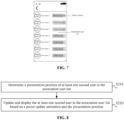
- FIG. 8 is a schematic flowchart of an information processing method according to an embodiment of the present disclosure, on the basis of the foregoing embodiments, after the current user triggers the follow control corresponding to the first user in the association user list, a generated display position of the second user in the association user list is described in detail, and embodiments thereof may be made to the technical solution of this embodiment.
- Technical terms identical or corresponding to those of the above-described embodiments are not repeated here.
- a presentation position of at least one second user in the association user list is determined.
- a position where the first user is located may be any presentation position at the current presentation page of recommendation users, for example, the position where the first user is located may be the first presentation position of the current association user list, or may be the second presentation position of the current association user list, or may be other presentation positions of the current association user list.
- the first presentation position is a position of the first row
- the second presentation position is a position of the second row
- other presentation positions respectively correspond to positions of other rows in a presentation page of the association user list.
- the presentation position is preset in the association user list.
- the preset presentation position refers to a preset presentation position, that is, the presentation position of the second user is preset to a display position of a row immediately next to the followed first user, or a display position of a row immediately previous to the followed first user. In this manner, since the presentation position of the second user is preset, when the user uses this function multiple times, which users are the latest recommended association users can be quickly identified.
- the preset presentation position may be set to the top presentation position in the association user list; or the preset presentation position may be set to a display position next to the display position of the followed first user in the association user list; where the position number of the preset presentation position corresponds to the number of the at least one second user.
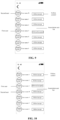
- the current user triggers a follow control corresponding to a first user in the association user list, if the follow control corresponding to the first user 3 shown in FIG. 1 is triggered, the first user 3 is located at a position of the third row in the current presentation page of the association user list, and the presentation position of the second user determined by the first user may be located at a position of the first row in the entire association user list, referring to FIG. 9 .
- the second user B is the second user determined according to the followed first user.
- the preset presentation position is a display position next to the display position of the first user in the association user list, referring to FIG. 10 .
- the second user B is the second user determined according to the followed first user.
- the number of preset presentation positions corresponds to the number of second users, for example, the number of second users is 3, so the number of preset presentation positions is also 3.
- the at least one second user is updated and immediately displayed in the association user list based on a preset update animation and the presentation position.
- the preset update animation is a preset display animation for updating the association user list
- the preset update animation may include a fade-in animation, a fly-in animation, a refresh page animation, and the like. This process of updating the second user determined according to the first user into the association user list is visual, and the second user may be inserted into the association user list through the preset update animation.
- the determined second user is inserted into the association user list, for example, three second users are determined, these three second users may be presented in the sight of the current user in a manner of flying into the playing animation, respectively, alternatively, the three second users may be presented in the sight of the current user through an application auto-refresh interface.
- the benefits of this arrangement are in that the current user can visually observe which recommended users are newly promoted, the vision of the current user is impacted through the animation effect, and the prompt effect on the current user is enhanced.
- the position where the first user is located may be any display position in the association user list, for example, the position where the first user is located may be the position of the first row in the association user list, or the position of the second row in the association user list, or the position of other rows in the association user list.
- the display position of the followed first user in the association user list is updated while the first display information is updated to the second display information.
- the first user is displayed at the top position of all first users in the association user list. That is, when the follow control is triggered, the first user at any display position in the current association user list is set to the top as the first display position on the current display page.
- the benefits of this arrangement include that after the current user has followed the first user, the position of the first user in the association user list is set to the top, and the display position of the first user is more conspicuous for the current user.
- the current user when it is detected that the current user triggers the follow control corresponding to the first user, at least one second user commonly associated with the followed first user and the current user is determined, and the at least one second user is displayed in the association user list to which the followed first user belongs, so that the relatively large calculation amount, the relatively high calculation cost and the relatively poor real-time performance caused by the user associated with the current user determined from mass data in the related art can be avoided, and thus the technical effect of improving the real-time performance in determining the second user on the basis of reducing the calculation amount is achieved.
- FIG. 11 is a schematic flowchart of an information processing method according to an embodiment of the present disclosure, on the basis of the foregoing embodiments, how to determine the second user according to the followed first user after the current user triggers the follow control to follow the first user is described in detail, and embodiments thereof may be made to the technical solution of this embodiment.
- Technical terms identical or corresponding to those of the above-described embodiments are not repeated here.
- the method includes the steps described below.
- a second user associated with the current user is determined from a first user list corresponding to the first user.
- the first user list includes a following user list and a followed user list.
- the following user list refers to a list of users followed by the first user
- the followed user list refers to a list of users following the first user, in other words, a fan list of the first user.
- the manner in which the second user associated with the current user is determined from the first user list corresponding to the first user may include a variety of manners, and how to determine the second user is described as follows.
- the second user is determined from the first user list corresponding to the first user by a preset common number threshold, which mainly includes the steps described below:
- to-be-selected users in the first user list corresponding to the first user are acquired; for each to-be-selected user, the number of target common users between the current to-be-selected user and the current user is determined; and the second user is determined from the to-be-selected users according to the number of target common users and a preset common number threshold.
- the to-be-selected users may be users followed by the first user, fan users of the first user, and friends of the first user.
- the number of target common users is the number of the same users followed by the current user and the to-be-selected user.
- the preset common number threshold is a preset number value, assuming that the preset common number threshold is 3, for each to-be-selected user, the number of target common users between the to-be-selected user and the current user is determined, it is determined whether the number of target common users is greater than or equal to 3, if the number of target common users is greater than or equal to 3, the to-be-selected user may be retained as the second user, and if the number of target common users is less than 3, it represents that the number of target common users between the to-be-selected user and the current user is less than 3, the to-be-selected user may be discarded to be excluded from the range of the second user.
- the first user followed by the current user may be determined at this time, users followed by the followed first user, fan users of the followed first user, and friends of the followed first user are further acquired, all above users related to the followed first user are used as to-be-selected users, and these to-be-selected users are used as a candidate pool of the second user.
- the number of users commonly followed by each to-be-selected user and the current user is calculated respectively, if the number of the same users followed by a to-be-selected user and the current user is greater than or equal to the preset common number threshold, the current to-be-selected user is used as the second user, and if the number of the same users followed by the current to-be-selected user and the current user is less than the preset common number threshold, the current to-be-selected user is not used as the second user.
- all users associated with the first user 3 are 100 to-be-selected users in total, and then the number of the same users followed by each to-be-selected user and the current user is calculated respectively. If to-be-selected users have the number of the same users followed by each to-be-selected user and the current user A larger than or equal to the preset common number threshold of 3 are determined as to-be-selected user C, to-be-selected user D and to-be-selected user E, the to-be-selected user C, the to-be-selected user D and the to-be-selected user E are used as the second users.
- the advantage of determining the second user based on the above manner includes that from the mass data, the candidate pool corresponding to the current user is decreased, and the time-sensitivity of determining the second user associated with the current user is improved.
- the preset common number threshold is a value that may be set in advance, when the set value of the preset common number threshold is relatively small, the situation where an effective number of second users cannot be determined due to a too-large number of second users may occur, so that the preset common number threshold should be set to a value that may be adjusted according to actual situations.
- the second user may be determined by adjusting the preset common number threshold, and optionally, in response to the number of second users reaching the preset number threshold, the preset common number threshold is adjusted to determine the adjusted second user based on the adjusted preset common number threshold.
- the preset common number threshold may be adjusted, for example, incrementing by 1 each time, i.e., the preset common number threshold is adjusted from the original 1 to 2, and at this time, if the number of to-be-selected second users still reaches the preset number threshold, the preset common number threshold is adjusted to 3, and at this time, if the number of to-be-selected second users still reaches the preset number threshold, the preset common number threshold is adjusted to 4 until the current number of to-be-selected second users determined based on the adjusted preset common number threshold is within the range of the preset number threshold, after the preset common number threshold is adjusted.
- the benefits of this arrangement include that a limited number of second users may be determined, and the corresponding second users may be presented without affecting the user to trigger
- Manner two the second user is determined according to a similarity or the number of common users between each to-be-selected user in the predetermined first user list and the current user.
- the first user list includes all to-be-selected second users.
- the similarity characterizes an association degree between each to-be-selected second user and the current user, and the number of common users refers to the number of users co-followed by the current user and each to-be-selected second user.
- the similarity or the number of common users may be used as evaluation attributes for determining whether a to-be-selected second user may be used as the second user, a certain condition may be set in advance with respect to both evaluation attributes, respectively, and when the similarity or the number of common users satisfies the corresponding condition, the to-be-selected second user may be determined as the second user.
- the similarity between each to-be-selected second user in the association user list and the current user may be determined by similarities of feature 1, feature 2, and feature 3 of the user, and the value of the similarity may be determined by calculating a Pearson correlation coefficient, a cosine similarity, or a modified cosine similarity of such feature between the current user and the to-be-selected user.
- the similarity between users may also be used in combination with the number of common users to determine the second user. The benefits of this arrangement are that the similarity between users can be quantified so that the degree of the similarity between users can be distinguished, and thus the second user can be determined from multiple aspects.
- manner one and manner two of determining the second user are two parallel manners, and there is no sequential order in the implementation process.
- the at least one second user is displayed in the association user list to which the first user belongs.
- the second user associated with the current user may be determined based on the first user list corresponding to the followed first user so that the second user associated with the current user can be effectively determined under the condition of reducing the candidate pool, and the technical effect of determining the second user in real time is achieved.
- FIG. 12 is a schematic flowchart of an information processing method according to an embodiment of the present disclosure, on the basis of the foregoing embodiments, when there are multiple second users, a presentation order of the multiple second users in the association user list may be determined according to the association attribute of the users, and embodiments thereof may be made to the technical solution of this embodiment.
- Technical terms identical or corresponding to those of the above-described embodiments are not repeated here.
- the method includes the steps described below.
- a presentation order of the at least one second user in the preset presentation position is determined based on an association attribute of each second user and the current user.
- association attributes between different second users and the current user are different, and the presentation of the users in the association user list is sequential, at this time, the presentation order of the multiple second users needs to be determined.
- the association degrees between different second users and the current user are different, the association between each second user and the current user may be ranked quantitatively, and the presentation order of the second users in the preset presentation position may be determined according to the magnitude of the value of the association attribute.
- user feature data of the current user and user feature data of the current second user are processed based on a pre-trained prediction model to obtain the association attribute between the second user and the current user; and the presentation order of at least one second user is determined based on the association attribute of the second user.
- the prediction model is pre-trained, and the similarity between two users may be quantified through the prediction model.
- the association attribute is the similarity between the second user in the association user list and the current user and may be determined according to the similarities of feature data 1, feature data 2, and feature data 3 of the users, where feature data 1, feature data 2, feature data 3 may each obtain one association attribute, a quantized value of each association attribute may be determined by calculating the Pearson correlation coefficient, the cosine similarity, or the modified cosine similarity between the association attribute of the current user and the association attribute of the second user.
- the benefits of this arrangement include that the presentation order of the second users in the association user list is determined according to the overall association degree between each second user and the current user, and the second users are displayed according to the presentation order, thus the conversion rate of the second user is improved.
- a similarity calculation is performed on feature data, such as feature data 1, feature data 2, and feature data 3, between the current user and the current second user based on the prediction model obtained by pre-training in advance.
- Each association attribute may be subjected to a similarity quantization calculation, and a weight value is assigned to the similarity of each association attribute.
- an overall ranking of the feature data between the current user and the second users is obtained by summing a product of the similarity of each association attribute and the corresponding weight value, and the presentation order of the second users is determined based on the ranking. That is, a second user with a high overall similarity of the feature data between the current user and the second user is arranged in an upper position, and all second users are sequentially arranged according to the ranking of the similarity.
- the second user associated with current user A includes user C, user D, and user E
- the feature data between the current user A and the second user includes feature data 1, feature data 2, and feature data 3.
- a similarity between the current user A and the second user C is determined to be 0.5
- a similarity between the current user A and the second user D is determined to be 0.6
- a similarity between the current user A and the second user E is determined to be 0.7.
- the above similarities are ranked sequentially based on the magnitude of the similarity, and the presentation order of second users in the association user list is as follows: the first presentation position is the user E, the second presentation position is the user D, and the third presentation location is the user C.
- a second user corresponding to the preset number threshold is determined from the at least one second user according to the association attribute.
- the preset common number threshold between the current user and the second user is 5
- 10 users are screened out as the second users, and the preset number threshold is set to 3, that is, only 3 users in the 10 users may be displayed as the second users in the association user list.
- the users may be sequentially ranked according to the similarity of the association attribute, and users with the top three values of the similarity of the association attributes between the current user and the second users are selected as the second users.
- the benefits of this arrangement include the following: the second users are determined in the similarity quantization manner so that the association between the determined second users and the current user is relatively high, whereby the technical effect of improving the following degree of the second users is improved.
- the at least one second user when it is detected that the current user triggers the follow control corresponding to the first user, the at least one second user is determined, and the second user associated with the current user is determined from the first user list corresponding to the followed first user.
- the presentation order of the at least one second user in the association user list is further determined to present the at least one second user in the association user list based on the presentation order.
- the display position of the first user in the association user list is acquired, and the at least one second user is inserted at a display position next to the display position of the first user and the inserted at least one second user is displayed, so that not only the second user is determined, but also the presentation order of the second user in the display interface is adjusted according to the association degree between the second user and the current user, whereby the technical effect of improving the following degree of the second users is improved.
- FIG. 13 is a schematic flowchart of an information processing method according to an embodiment of the present disclosure, on the basis of the foregoing embodiments, when the second user is determined and the association user list is updated, and the first users originally located in the association user list are updated simultaneously. Embodiments thereof may be made to the technical solution of this embodiment, and technical terms identical or corresponding to those of the above-described embodiments are not repeated here.
- the method includes the steps described below.
- association user list in response to a trigger instruction for a first user in an association user list, the association user list is dynamically updated and the updated association user list is displayed.
- the real-time information may change an association attribute between the current user and all other users, including other non-followed users originally located in the association user list. Since the association attribute between the current user and other non-followed users is changed, to improve the following degree of the users, the presentation order of multiple first users in the association user list is determined according to the magnitude of the changed association attribute.
- the real-time data can be effectively utilized to determine the presentation order of the first users in the association user list, whereby the following degree of the current user for the first users is improved.
- the association user list in response to the trigger instruction for the first user in the association user list, the association user list is dynamically updated and displayed, and the presentation order of multiple first users in the association user list is updated in the association user list.
- the real-time data can be effectively utilized to determine the presentation order of the first users in the association user list, thus the following degree of the current user for the first users is improved.
- FIG. 14 is a schematic structural diagram of an information processing apparatus according to an embodiment of the present disclosure, as shown in FIG. 14 , the apparatus includes an association list update module 610.
- the association list update module 610 is configured to, in response to a trigger instruction from a current user for a first user in an association user list, dynamically update the association user list and display the updated association user list.
- the association list update module 610 includes a second user position determination sub-module and a second user display sub-module.
- the second user position determination sub-module is configured to determine a presentation position of the at least one second user in the association user list.
- the second user position determination sub-module includes a presentation position preset unit configured to determine a preset presentation position.
- the presentation position preset unit includes a top position determination sub-unit and a next display position determination sub-unit.
- the top position determination sub-unit is configured to set the preset presentation position to the top presentation position in the association user list.
- the next display position determination sub-unit is configured to set the preset presentation position to a display position next to a display position of the followed first user in the association user list.
- the second user display sub-module is configured to update and immediately display the at least one second user in the association user list based on a preset update animation and the presentation position.
- the second user position determination sub-module further includes a presentation order determination sub-module, for example, the presentation order determination sub-module is configured to determine a presentation order of the second users in the preset presentation position based on an association attribute of each second user and the current user.
- the association list update module 610 includes a display information update sub-module.
- the display information update sub-module is configured to update a follow control corresponding to the followed first user from first display information to second display information and update a display position of the followed first user in the association user list.
- the display information update sub-module further includes a top position display unit and a first user removing unit.
- the top position display unit is configured to display the followed first user at the top position of the association user list.
- the first user removing unit is configured to remove the followed first user from the association user list.
- the association list update module 610 includes a second user determination sub-module.
- the second user determination sub-module is configured to determine, from a first user list corresponding to the followed first user, a second user associated with the current user.
- the second user determination sub-module further includes a to-be-selected user acquisition unit, a common user determination unit, and a second user determination unit.
- the to-be-selected user acquisition unit is configured to acquire to-be-selected users in the first user list corresponding to the followed first user.
- the common user determination unit is configured to, for each to-be-selected user, determine the number of target common users between the current to-be-selected user and the current user.
- the second user determination unit is configured to determine, according to the number of target common users and a preset common number threshold, the second user associated with the current user from the to-be-selected users.
- the second user determination unit further includes a number threshold adjustment unit.
- the number threshold adjustment unit is configured to, when the number of second users reaches a preset number threshold, adjust the preset common number threshold to determine the second user associated with the current user based on the adjusted preset common number threshold.
- the second user determination unit is configured to determine the second user associated with the current user according to a predetermined similarity or a number of common users between each to-be-selected user in the first user list and the current user.
- the presentation order determination sub-module further includes an association attribute determination unit and a presentation order determination unit.
- the association attribute determination unit is configured to, for a second user, process user feature data of the current user and user feature data of the second user based on a pre-trained prediction model to obtain the association attribute between the second user and the current user.
- the presentation order determination unit is configured to determine the presentation order of the at least one second user based on the association attribute of each second user.
- the second user determination unit is configured to, in response to the user number of second users reaching a preset number threshold, determine a second user corresponding to the preset number threshold from the at least one second user according to the association attribute.
- the association list update module 610 includes a first user update sub-module.
- the first user update sub-module is configured to update, in the association user list, the presentation order of multiple first users in the association user list.
- the association list update module 610 includes an association user list determination sub-module.
- the association user list determination sub-module is configured to determine the association user list corresponding to the current user based on a server recommendation model and the current user attribute of the current user.
- a second user associated with both the first user and the current user is determined, and at least one second user is displayed in an association user list to which the first user belongs, so that the relatively large calculation amount, the relatively high calculation cost and the relatively poor real-time performance because the user associated with the current user needs to be determined from mass data in the related art are avoided, and thus the technical effect of improving the real-time performance in determining the second user on the basis of reducing the calculation amount is achieved.
- the information processing apparatus provided in the embodiments of the present disclosure may execute the information processing method provided in any of the embodiments of the present disclosure, and possess the corresponding functional modules and effects for performing the method.
- FIG. 15 is a schematic structural diagram of an electronic device according to an embodiment of the present disclosure.
- FIG. 15 shows a structural schematic diagram of the electronic device 700 (such as a terminal device or a server in FIG. 15 ) suitable for implementing the embodiments of the present disclosure.
- the terminal device in the embodiments of the present disclosure may include, but is not limited to, a mobile terminal such as a mobile phone, a laptop computer, a digital broadcast receiver, a personal digital assistant (PDA), a tablet computer (PAD), a portable media player (PMP), an in-vehicle terminal (such as, an in-vehicle navigation terminal), and a fixed terminal such as a digital television (TV), and a desktop computer.
- PDA personal digital assistant
- PAD tablet computer
- PMP portable media player
- TV digital television
- the electronic device shown in FIG. 15 is merely an example and should not pose any limitation on the scope of use and function of the embodiments of the present disclosure.
- the electronic device 700 may include a processor 701 (such as, a central processing unit, and a graphics processor), the processor may perform various appropriate actions and processing according to a program stored in a read-only memory (ROM) 702 or a program loaded from a storage apparatus 708 into a random access memory (RAM) 703. Various programs and data required for the operations of the electronic device 700 are also stored in the RAM 703.
- the processor 701, the ROM 702 and the RAM 703 are connected to one another via a bus 704.
- An input/output (I/O) interface 705 is also connected to the bus 704.
- the following apparatuses may be connected to the I/O interface 705: an input apparatus 706 such as a touch screen, a touchpad, a keyboard, a mouse, a camera, a microphone, an accelerometer, and a gyroscope; an output apparatus 707 such as a liquid crystal display (LCD), a speaker, and a vibrator; the storage apparatus 708 such as a magnetic tape, and a hard disk; and a communication apparatus 709.
- the communication apparatus 709 may allow the electronic device 700 to communicate with other devices in a wireless or wired manner to exchange data.
- FIG. 15 shows the electronic device 700 having various apparatuses, it should be understood that it is not required to implement or include all the shown apparatuses. More or fewer apparatuses may alternatively be implemented or included.
- the process described above with reference to the flowcharts may be implemented as a computer software program.
- the embodiments of the present disclosure include a computer program product including a computer program carried on a non-transitory computer-readable medium, and the computer program includes a program code for performing the method shown in the flowcharts.
- the computer program may be downloaded and installed from the network through the communication apparatus 709, or may be installed from the storage apparatus 708, or may be installed from the ROM 702.
- the processor 701 the above-described functions defined in the method of the embodiments of the present disclosure are executed.
- the electronic device provided in the embodiments of the present disclosure belongs to the same concept as the information processing method provided in the above-described embodiments, the technical details, which are not elaborated in this embodiment, may be referred to the above-described embodiments, and this embodiment has the same effects as the above-described embodiments.
- An embodiment of the present disclosure provides a computer-readable storage medium.
- a computer program is stored on the computer storage medium.
- the program when executed by a processor, implements the information processing method provided in the above-described embodiments.
- the above-described computer-readable storage medium of the present disclosure may be a computer-readable signal medium, or a computer-readable storage medium, or any combination of the computer-readable signal medium and the computer-readable storage medium.
- the computer-readable storage medium may be, for example, but not limited to, an electronic, magnetic, optical, electromagnetic, infrared, or semiconductor system, apparatus, or device, or any combination thereof.
- the computer-readable storage media may include, but are not limited to, electrical connections with at least one wire, a portable computer magnetic disk, a hard disk, a random access memory (RAM), a read-only memory (ROM), an erasable programmable read-only memory (EPROM or a flash), an optical fiber, a portable and compact disc read-only memory (CD-ROM), an optical storage device, a magnetic storage device, or any suitable combination thereof.
- the computer-readable storage medium may be any tangible medium that contains or stores a program, the program may be used by or in combination with an instruction execution system, apparatus, or device.
- the computer-readable signal medium may include a data signal that is contained in a baseband or propagated as a part of a carrier wave, and the data signal carries a computer-readable program code.
- a propagated data signal may take many forms, including but not limited to an electromagnetic signal, an optical signal, or any suitable combination thereof.
- the computer-readable signal medium may also be any computer-readable medium other than the computer-readable storage medium, and the computer-readable signal medium may send, propagate, or transmit a program for being used by or in combination with the instruction execution system, apparatus, or device.
- the program code contained in the computer-readable medium may be transmitted by using any appropriate medium, including but not limited to an electric wire, an optical cable, a radio frequency (RF), etc., or any suitable combination thereof.
- RF radio frequency
- the client side and the server may communicate by using any currently known or future developed network protocol, such as a hyper text transfer protocol (HTTP), and may interconnect with any form or medium of digital data communication (such as a communication network).
- HTTP hyper text transfer protocol
- An example of the communication network includes a local area network ("LAN”), a wide area network (“WAN”), an Internet network (such as the Internet), an end-to-end network (such as an ad hoc end-to-end network), and any network currently known or developed in the future.
- the computer-readable storage medium described above may be included in the electronic device described above; and the computer-readable medium described above may also exist separately and not fit into the electronic device.
- the computer-readable storage medium carries at least one program, the at least one program, when executed by the electronic device, causes the electronic device to implement the following: in response to a trigger instruction from a current user for a first user in an association user list, dynamically updating the association user list and displaying the updated association user list, where the association user list corresponds to the current user, and the electronic device is caused to implement dynamically updating the association user list in the manner of determining at least one second user according to the first user, and updating the association user list based on the at least one second user.
- Computer program codes for performing the operations of the present application may be written in at least one programming language or combinations thereof, the described programming languages include, but are not limited to, an object-oriented programming language-such as Java, Smalltalk, C++, and further include a conventional procedural programming language-such as a "C" language or similar programming language.
- the program code may be executed in the following manners: executed entirely on a user's computer, executed partly on the user's computer, executed as an independent software package, executed partly on the user's computer and partly on a remote computer, or executed entirely on the remote computer or a server.
- the remote computer may be connected to the user's computer through any kind of network, including a local area network (LAN) or a wide area network (WAN), or may be connected to an external computer (for example, connected to the external computer through an internet provided by an Internet service provider).
- LAN local area network
- WAN wide area network
- an external computer for example, connected to the external computer through an internet provided by an Internet service provider.
- each block in the flowchart or block diagram may represent a module, a program segment, or a part of codes, which includes at least one executable instruction for implementing a specified logical function.
- the functions noted in the blocks may occur out of the order noted in the drawings. For example, two blocks shown in succession may, in fact, be executed substantially concurrently, or the two blocks may sometimes be executed in a reverse order, which depends upon the involved functionality.
- each block of the block diagram and the flowchart, and combinations of blocks of the block diagram and the flowchart may be implemented by a dedicated hardware-based system that performs a specified function or operation, or by a combination of dedicated hardware and a computer instruction.
- the units described in the embodiments of the present disclosure may be implemented by software or hardware.
- the name of the unit does not constitute a limitation on the unit itself.
- the first acquisition unit may also be described as "a unit acquiring at least two internet protocol addresses”.
- exemplary types of hardware logic components include a field programmable gate array (FPGA), an application specific integrated circuit (ASIC), application specific standard parts (ASSPs), a system on chip (SOC), a complex programmable logic device (CPLD), and the like.
- FPGA field programmable gate array
- ASIC application specific integrated circuit
- ASSPs application specific standard parts
- SOC system on chip
- CPLD complex programmable logic device
- a machine-readable storage medium may be a tangible medium that may contain or store a program available for an instruction execution system, apparatus or device or a program used in conjunction with an instruction execution system, apparatus or device.
- the machine-readable storage medium may be a machine-readable signal medium or a machine-readable storage medium.
- the machine-readable storage medium may include, but is not limited to, an electronic, magnetic, optical, electromagnetic, infrared, or semiconductor system, apparatus, or device, or any appropriate combination of the foregoing.
- machine-readable storage medium may include an electrical connection based on at least one wire, a portable computer diskette, a hard disk, a random access memory (RAM), a read-only memory (ROM), an erasable programmable read-only memory (EPROM) or a flash memory, an optical fiber, a portable compact disc read-only memory (CD-ROM), an optical storage device, a magnetic storage device, or any appropriate combination of the foregoing.
- RAM random access memory
- ROM read-only memory
- EPROM erasable programmable read-only memory
- flash memory an optical fiber
- CD-ROM portable compact disc read-only memory
- CD-ROM compact disc read-only memory
- magnetic storage device or any appropriate combination of the foregoing.
- example one provides an information processing method, and the method includes the following: in response to a trigger instruction from a current user for a first user in an association user list, the association user list is dynamically updated and the updated association user list is displayed; where the association user list corresponds to the current user, and the step in which the association user list is dynamically updated includes at least one second user is determined according to the first user, and the association user list is updated based on the at least one second user, where the at least one second user is associated with the first user.
- example two provides an information processing method, and the method further includes the following: a presentation position of the at least one second user in the association user list is determined; and the at least one second user is updated and immediately displayed in the association user list based on a preset update animation and the presentation position.
- example three provides an information processing method, and the method includes the following: a follow control corresponding to the followed first user is updated from first display information to second display information; and a display position of the followed first user in the association user list is updated.
- example four provides an information processing method, and the method further includes the following: the followed first user is displayed at the top position of the association user list; or the followed first user is removed from the association user list.
- example five provides an information processing method, and the method further includes that the presentation position is a preset presentation position in the association user list.
- example six provides an information processing method, and the method further includes the following: the preset presentation position is a display position next to a display position of the followed first user in the association user list; where the position number of the preset presentation position corresponds to the number of the at least one second user.
- sample seven provides an information processing method, and the method further includes that a presentation order of second users in the preset presentation position is determined based on an association attribute of the multiple second users and the current user.
- sample eight provides an information processing method, and the method further includes that a second user associated with the current user is determined from a first user list corresponding to the followed first user.
- sample nine provides an information processing method, and the method further includes the following: to-be-selected users in the first user list corresponding to the followed first user are acquired; for a to-be-selected user, the number of target common users between the to-be-selected user and the current user is determined; and the second user associated with the current user is determined from the to-be-selected users according to the number of target common users and a preset common number threshold.
- example ten provides an information processing method, and the method further includes that, in response to the number of second users reaching a preset number threshold, the preset common number threshold is adjusted to determine the second user associated with the current user based on the adjusted preset common number threshold.
- sample eleven provides an information processing method, and the method further includes that the second user associated with the current user is determined according to a predetermined similarity between a to-be-selected user in the first user list and the current user.
- sample twelve provides an information processing method, and the method further includes the following: for each second user, user feature data of the current user and user feature data of the current second user are processed based on a pre-trained prediction model to obtain the association attribute between each second user and the current user; and the presentation order of the at least one second user is determined based on the association attribute of each second user.
- sample thirteen provides an information processing method, and the method further includes that, in response to the user number of second users reaching a preset number threshold, a second user corresponding to the preset number threshold is determined from the at least one second user according to the association attribute.
- example fourteen provides an information processing method, and the method further includes that a presentation order of multiple first users in the association user list is updated in the association user list.
- example fifteen provides an information processing method, and the method further includes that the association user list corresponding to the current user is determined based on a server recommendation model and a current user attribute of the current user.
- example sixteen provides an information processing apparatus, the apparatus includes an association list update module, the association list update module is configured to, in response to a trigger instruction from a current user for a first user in an association user list, dynamically update the association user list and display the updated association user list, where the association user list corresponds to the current user, and the association list update module is configured to dynamically update the association user list in the manner of determining at least one second user according to the first user and updating the association user list based on the at least one second user.
- the technical solutions provided in the embodiments of the present application enable real-time determination and display of a second user associated with the current user, achieving the effect of improving the timeliness and convenience of determining the second user.
Landscapes
- Engineering & Computer Science (AREA)
- Theoretical Computer Science (AREA)
- General Engineering & Computer Science (AREA)
- Physics & Mathematics (AREA)
- General Physics & Mathematics (AREA)
- Software Systems (AREA)
- Human Computer Interaction (AREA)
- Business, Economics & Management (AREA)
- Marketing (AREA)
- Quality & Reliability (AREA)
- Operations Research (AREA)
- General Business, Economics & Management (AREA)
- Human Resources & Organizations (AREA)
- Entrepreneurship & Innovation (AREA)
- Strategic Management (AREA)
- Tourism & Hospitality (AREA)
- Economics (AREA)
- Databases & Information Systems (AREA)
- Data Mining & Analysis (AREA)
- User Interface Of Digital Computer (AREA)
- Computing Systems (AREA)
- Stored Programmes (AREA)
Abstract
Description
- This application claims priority to
Chinese patent application No. 202211035812.0 filed with the China National Intellectual Property Administration (CNIPA) on Aug. 26, 2022 - Embodiments of the present disclosure relate to information processing technologies, for example, an information processing method and apparatus, an electronic device, and a storage medium.
- With the development of network technologies, more and more application programs have entered the life of users, for example, a series of entertainment platforms on which users may publish information and pay attention to other users are very popular with the users.
- To improve the use experience of users, a corresponding user may be pushed to the current user, and the pushing manner in the related art mainly screens out a user associated with the user attribute of the current user from large quantities of users and then pushes the user to the current user.
- The above-described manner has the disadvantages that a calculation amount is relatively large and the corresponding calculation cost is relatively high. For example, the effect of a real-time push cannot be achieved due to the large calculation amount.
- The present disclosure provides an information processing method and apparatus, an electronic device, and a storage medium, so that a second user associated with the current user may be conveniently determined in real time and displayed on a display interface, and the effect of convenience and reliability in determining the second user is improved.
- In a first aspect, an embodiment of the present disclosure provides an information processing method. The method includes that: in response to a trigger instruction from a current user for a first user in an association user list, the association user list is dynamically updated and the updated association user list is displayed; where the association user list corresponds to the current user, and the step in which the association user list is dynamically updated includes that at least one second user is determined according to the first user and the association user list is updated based on the at least one second user; where the at least one second user is associated with the first user.
- In a second aspect, an embodiment of the present disclosure further provides an information processing apparatus. The apparatus includes an association list update module. The association list update module is configured to dynamically update the association user list and display the updated association user list, in response to a trigger instruction from a current user for a first user in an association user list, where the association user list corresponds to the current user, and the association list update module is configured to dynamically update the association user list and display the updated association user list in the manner that at least one second user is determined according to the first user and the association user list is updated based on the at least one second user; where the at least one second user is associated with the first user.
- In a third aspect, an embodiment of the present application further provides an electronic device. The electronic device includes at least one processor and a storage apparatus. The storage apparatus is configured to store at least one program. The at least one program, when executed by the at least one processor, causes the at least one processor to implement the information processing method described in any one of the embodiments of the present disclosure.
- In a fourth aspect, an embodiment of the present application further provides a storage medium including a computer-executable instruction, where the computer-executable instruction is configured to, when executed by a computer processor, perform the information processing method described in any one of the embodiments of the present disclosure.
-
-
FIG. 1 is a display page corresponding to a current user according to an embodiment of the present disclosure; -
FIG. 2 is a schematic diagram of a corresponding display page after a current user triggers a follow control according to an embodiment of the present disclosure; -
FIG. 3 is a schematic diagram of an interface on which a second user is presented in an association user list according to an embodiment of the present disclosure; -
FIG. 4 is a schematic diagram of an interface on which a second user is presented in an association user list according to an embodiment of the present disclosure; -
FIG. 5 is a schematic diagram of an interface on which a second user is presented in an association user list according to an embodiment of the present disclosure; -
FIG. 6 is a schematic diagram of a display page of first display information according to an embodiment of the present disclosure; -
FIG. 7 is a schematic diagram of a display page of second display information according to an embodiment of the present disclosure; -
FIG. 8 is a schematic flowchart of an information processing method according to an embodiment of the present disclosure; -
FIG. 9 is a schematic diagram of an interface on which a second user is presented in an association user list according to an embodiment of the present disclosure; -
FIG. 10 is a schematic diagram of an interface on which a second user is presented in an association user list according to an embodiment of the present disclosure; -
FIG. 11 is a schematic flowchart of an information processing method according to an embodiment of the present disclosure; -
FIG. 12 is a schematic flowchart of an information processing method according to an embodiment of the present disclosure; -
FIG. 13 is a schematic flowchart of an information processing method according to an embodiment of the present disclosure; -
FIG. 14 is a schematic structural diagram of an information processing apparatus according to an embodiment of the present disclosure; and -
FIG. 15 is a schematic structural diagram of an electronic device according to an embodiment of the present disclosure. - The term "include" and variations thereof as used herein are intended to be open-ended, i.e., "including but not limited to". The term "based on" is "based at least in part on". The term "an embodiment" means "at least one embodiment"; the term "another embodiment" means "at least one further embodiment"; the term "some embodiments" means "at least some embodiments". Relevant definitions for other terms will be given in the following description.
- It should be noted that the concepts referred to in the present disclosure such as "first" and "second" are merely used for distinguishing different apparatuses, modules, or units, and are not used for limiting the order or interdependence of functions performed by such apparatuses, modules, or units.
- It should be noted that modifications referred to in the present disclosure such as "a" or "multiple" are intended to be illustrative rather than limiting, it should be understood by those skilled in the art that the term "at least one" will be used unless the context clearly indicates otherwise.
- The names of messages or information interacted between multiple apparatuses in the embodiments of the present disclosure are for illustrative purposes only and are not used for limiting the scope of such messages or information.
- It should be understood that before the technical solutions disclosed in the embodiments of the present disclosure are used, users should be informed and authorized as to the type of personal information, scope of use, context of use, etc., to which the present disclosure relates in an appropriate manner in compliance with relevant laws and regulations.
- For example, in response to receiving an active request of a user, prompt information is sent to the user to explicitly prompt the user that an operation requested by the user may require the acquisition and use of personal information of the user, so that the user may autonomously select whether to provide the personal information to software or hardware such as an electronic device, an application program, a server, or a storage medium performing operations of the technical solutions of the present disclosure according to the prompt information.
- As an alternative but non-limiting implementation, the manner in which the prompt information is sent to the user in response to receiving the active request of the user may be, for example, a pop-up window manner, and the prompt information may be presented in text in a pop-up window. Moreover, the pop-up window may also carry a selection control for the user to select "agree" or "disagree" to provide the personal information to the electronic device.
- It should be understood that the above process of notifying and acquiring user authorization is merely illustrative and does not constitute the limitation on the implementation of the present disclosure, and that other manners of satisfying the relevant laws and regulations may also be applied to implementations of the present disclosure.
- It should be understood that the data (including, but not limited to, the data itself, the acquisition or use of the data) to which the technical solutions relate should comply with the requirements of the respective laws and regulations and relevant regulations.
- Before the technical solutions are introduced, an application scenario may be exemplarily illustrated. The technical solutions of the embodiments of the present disclosure may be applied in an arbitrary scenario where a user requires to be recommended, for example, in a process of browsing contents published by other users based on a relevant application program or application software, a particular user is determined to be followed based on a trigger instruction of the user, an association relationship between association users of the particular user and the current user is determined based on information about the association users, and an association user of the particular user is recommended for the current user, whereby a recommended user list is generated, and the recommended user list is displayed on a display interface.
- The embodiments of the present disclosure are suitable for use in an arbitrary scenario where a user requires to be recommended, for example, a scenario of user recommendation on a social platform, the method may be performed by an information processing apparatus, the apparatus may be implemented in a form of at least one of software and hardware, optionally, the apparatus may be implemented by an electronic device, and the electronic device may be a mobile terminal, a personal computer (PC) side, a server, or the like. Implementations of the embodiments of the present disclosure may be performed by a service side or by a client side, or by the service side and the client side in cooperation. The information processing method in the embodiments of the present disclosure may be as follows:
- in response to a trigger instruction from a current user for a first user in an association user list, the association user list is dynamically updated and displayed, where the association user list corresponds to the current user, the step in which the association user list is dynamically updated includes that at least one second user is determined according to the first user and the association user list is updated based on the at least one second user; where the at least one second user is associated with the first user.
- It should be noted that the apparatus performing the information processing method provided in the embodiments of the present disclosure may be integrated in application software supporting a user recommendation function, the software may be installed in the electronic device, and in an embodiment, the electronic device may be a mobile terminal, a PC side, or the like. The application software may be any type of social software, which is not repeatedly described here, as long as it has the function of following a user. The application software may also be a specially developed application program, i.e., software that enables the follow function between users, or the application software is integrated in a corresponding page, and the user may follow other users through the page integrated on the PC side.
- According to this embodiment, in the application software or application program supporting the function of following other users, a control for triggering the follow function may be developed in advance, when it is detected that a user triggers this control, a follow trigger instruction is responded to enable the user currently operating the software to follow other users, and the follow control may be a "follow" key or an "accept" key.
- All users registered with an account on the social platform may be the current user, and the number of current users may be more than one, and one of the multiple users may be exemplified and used as the above-mentioned current user for clarity in describing the technical solutions provided in the embodiments of the present disclosure. When the current user triggers the application program and clicks on a follow control, an association user list interface may be entered, and at this time, a list presented on a page of the device may be the association user list. A user in the association user list interface at this time is the first user, i.e., the first user is a user on the association list interface of the current user, and the first user may be a user determined by using a correlation algorithm, in whom the current user is interested and which the current user wants to follow. When an object currently triggered is in the association user list, users in the association user list are dynamically updated, and the users presented in the association user list may be adjusted or added. For example, an original user presentation position in the list may be adjusted; alternatively, the user may be newly added, and display positions of all users in the entire list are adjusted. The second user may be determined based on the first user, and the second user is a user co-associated with the current user and the first user.
- In this embodiment, after the current user triggers a follow control to follow the first user, how to determine the second user according to the first user will be explained in detail.
- In an actual application process, when the current user triggers the application program and enters an association user list interface, multiple first users in whom the current user is interested and that the current user wants to follow are contained in the association user list interface and are determined according to an algorithm. A follow control corresponding to each first user immediately follows behind the first user, referring to
FIG. 1 . A user may trigger the follow control corresponding to the first user, and the content corresponding to the follow control may be "follow/accept". When it is detected that the user triggers the follow control corresponding to a first user, it represents that the current user has followed the first user corresponding to the current follow control, further, the second user is determined according to the first user followed by the current user, and the users presented in the association user list are adjusted based on trigger information of the current user, for example, the original presentation position of the first user in the list may be adjusted, or a second user may be added and display positions of all users in the entire list are adjusted. - Exemplarily, when the current user A triggers the application program and enters the association user list interface, the association user list interface displays multiple recommendation users, as shown in
FIG. 1 . InFIG. 1 ,first user 1 andfirst users 2 to 7 in whom the current user is interested and wants to follow are users contained in the association user list interface and are determined according to the algorithm. When the current user A triggers a "follow/accept" control corresponding to thefirst user 3, it represents that the current user A has followed thefirst user 3, and the second user is further determined according to thefirst user 3. Assuming that thefirst user 3 is located at a position of the third row in the current display page of the association user list, at this time, thefirst user 3 may move to a position of the first row, that is, in the first row in the association user list, the position of the second user in the association user list immediately follows the display position of the first user, and multiple other first users move one row down, respectively, referring toFIG. 2 . The second user determined according to the first user may be one or multiple second users. If the current user A triggers the "follow/accept" control corresponding to thefirst user 3, and one second user B is determined according to thefirst user 3, a display position of the second user B in the association user list may be located below and immediately after thefirst user 3, as shown inFIG. 2 . Alternatively, the second user B may be located above thefirst user 3, referring toFIG. 3 . In the association user list display positions of other users originally displayed in the association user list except thefirst user 3 are sequentially moved downwards. If multiple users have an association relationship with thefirst user 3 and the current user A, i.e., user C, user D, and user E, display positions of the multiple second users in the association user list may be used as "more relevant users" as a whole and located at a display position next to the first user on the display page of the association user list, referring toFIG. 4 . The "more relevant users" as a whole may also be located at a display position previous to the first user in the association user list, and after a "more relevant users" key is triggered, multiple determined second users may be presented. In addition, user C, user D, and user E may also be respectively located at the display position next to the first user in the association user list as display information of the recommendation user, referring toFIG. 5 . - Alternatively, before the trigger instruction of the follow control corresponding to the first user in the association user list is responded, the method further includes that the association user list corresponding to the current user is determined based on a server recommendation model and the current user attribute of the current user.
- In this embodiment, the server recommendation model refers to a pre-trained model that may be deployed in the server side so as to determine to-be-followed users or to-be-followed-back users associated with the current user at an initial stage. The current user attribute may be feature data of the current user, for example, the feature data may be operation behavior data, including browsing behavior data and viewing movie data, or the feature data may be other data corresponding to operation behaviors used for characterizing a user feature. Since the determination of the association user list corresponding to each user in the initial stage requires to be performed in combination with integrity data, the computation amount is relatively high at this time, and requirements on the real-time performance are not high, so that users of the association user list in the initial stage may be determined based on the server recommendation model, the benefits of this arrangement include the following: some first users associated with the user may be screened out from a large amount of data, and the comprehensiveness of determined users in the association user list is improved.
- In an embodiment, the step in which the association user list is dynamically updated and displayed further includes the following: a follow control corresponding to the first user is updated from first display information to second display information; and a display position of the first user in the association user list is updated.
- The second display information is preset and different from the first display information. The first display information may characterize that the current user does not follow the first user. When the follow control is triggered, the first display information is updated to the second display information, a process of updating the display information characterizes that the current user has followed the first user, and the display position of the first user in the association user list is updated while the display information is updated.
- In an actual application, the process of updating the first display information to the second display information may be achieved by changing the color of the follow control such as the "follow/accept" control, exemplarily, when the current user A triggers the application program and enters into the association user list, each first user in the association user list is provided with a corresponding "follow/accept" control, referring to
FIG. 6 , the first display information of the "follow/accept" control may be set to pink, which is left diagonally lined, the follow control is filled in a first filling manner, it represents that the current user A has not followed thefirst user 3 at this time; referring toFIG. 7 , when the current user A triggers the "follow/accept" control of thefirst user 3, the "follow/accept" control turns to green, which is right diagonally lined, the follow control is filled in a second filling manner, this process represents that the current user A has followed thefirst user 3. The first filling manner is different from the second filling manner. The benefits of this arrangement include the following: after the current user clicks the follow control, the user may clearly know whether the first user has been followed, and the current user can know the followed users in real time. - For example, the step in which the display position of the first user in the association user list is updated includes that the first user is displayed at the top position of all first users in the association user list, or that the first user is removed from the association user list. All first users include the first user.
- In this embodiment, when the current user triggers the follow control corresponding to the first user in the association user list, the first user at this time is in a followed state. The display position of the first user in the association user list may be updated in two manners, the first manner is that the followed first user is still displayed in the association user list, and the second manner is that the first user that has been followed is directly removed from the association user list.
- In the first manner, since the position where the followed first user is located may be located at any display position in the association user list, for example, a position of the first row in the association user list, or a position of the second row in the association user list, or a position of another row in the association user list. When the follow control corresponding to the first user is triggered, the followed first user originally located at any display position at the current display page of the association user list is set to the top as the first display position at the current display page. The benefits of this arrangement are as follows: after the current user has followed the first user, the position of the first user is set to the top of the display list, and the display position of the followed first user is more obvious for the current user. In the second manner, the first user that has been followed is directly removed from the association user list, since the first user at this time has become a user followed by the current user, it is not necessary to perform the follow operation again, and it may not be displayed in the association user list; the benefits of this arrangement are as follows, the presentation space of the association user list is saved, more association users can be recommended, and utilization of the association user list is improved.
- According to the technical solutions of the embodiments of the present disclosure, in response to the trigger instruction of the follow control corresponding to the first user in the association user list, the association user list is dynamically updated and the updated association user list is displayed, where the association user list corresponds to the current user, and the step in which the association user list is dynamically updated includes that at least one second user is determined according to the first user and the association user list is updated based on the at least one second user. In this manner, the relatively large calculation amount, the relatively high calculation cost and the relatively poor real-time performance because the user associated with the current user needs to be determined from mass data in the related art can be avoided, thus the technical effect of improving the real-time performance in determining the second user on the basis of reducing the calculation amount is achieved.
-
FIG. 8 is a schematic flowchart of an information processing method according to an embodiment of the present disclosure, on the basis of the foregoing embodiments, after the current user triggers the follow control corresponding to the first user in the association user list, a generated display position of the second user in the association user list is described in detail, and embodiments thereof may be made to the technical solution of this embodiment. Technical terms identical or corresponding to those of the above-described embodiments are not repeated here. - In S210, a presentation position of at least one second user in the association user list is determined.
- In this embodiment, in a presentation page of the association user list of the current user, a position where the first user is located may be any presentation position at the current presentation page of recommendation users, for example, the position where the first user is located may be the first presentation position of the current association user list, or may be the second presentation position of the current association user list, or may be other presentation positions of the current association user list. In the order of rows in the association user list, the first presentation position is a position of the first row, the second presentation position is a position of the second row, and other presentation positions respectively correspond to positions of other rows in a presentation page of the association user list. When the current user triggers a follow control corresponding to the first user, other second users having an association relationship with the followed first user are determined, some of these other second users have a certain association relationship with the current user at the same time and are used as recommended users, and then other second users that have the association relationship with both the followed first user and the current user are presented in the presentation page of the association user list. At this time, no matter where the followed first user is originally located in which display position on the current presentation page of the recommendation users, the position of the second user in the association user list immediately follows the presentation position of the followed first user.
- Optionally, the presentation position is preset in the association user list. The preset presentation position refers to a preset presentation position, that is, the presentation position of the second user is preset to a display position of a row immediately next to the followed first user, or a display position of a row immediately previous to the followed first user. In this manner, since the presentation position of the second user is preset, when the user uses this function multiple times, which users are the latest recommended association users can be quickly identified.
- Among numerous options of the preset presentation position, the preset presentation position may be set to the top presentation position in the association user list; or the preset presentation position may be set to a display position next to the display position of the followed first user in the association user list; where the position number of the preset presentation position corresponds to the number of the at least one second user.
- In this embodiment, the current user triggers a follow control corresponding to a first user in the association user list, if the follow control corresponding to the
first user 3 shown inFIG. 1 is triggered, thefirst user 3 is located at a position of the third row in the current presentation page of the association user list, and the presentation position of the second user determined by the first user may be located at a position of the first row in the entire association user list, referring toFIG. 9 . InFIG. 9 , the second user B is the second user determined according to the followed first user. The preset presentation position is a display position next to the display position of the first user in the association user list, referring toFIG. 10 . InFIG. 10 , the second user B is the second user determined according to the followed first user. In addition, the number of preset presentation positions corresponds to the number of second users, for example, the number of second users is 3, so the number of preset presentation positions is also 3. - In S220, the at least one second user is updated and immediately displayed in the association user list based on a preset update animation and the presentation position.
- In this embodiment, the preset update animation is a preset display animation for updating the association user list, and the preset update animation may include a fade-in animation, a fly-in animation, a refresh page animation, and the like. This process of updating the second user determined according to the first user into the association user list is visual, and the second user may be inserted into the association user list through the preset update animation. When the follow control corresponding to the first user in the association user list is triggered, and the second user has been determined according to the followed first user, the determined second user is inserted into the association user list, for example, three second users are determined, these three second users may be presented in the sight of the current user in a manner of flying into the playing animation, respectively, alternatively, the three second users may be presented in the sight of the current user through an application auto-refresh interface. The benefits of this arrangement are in that the current user can visually observe which recommended users are newly promoted, the vision of the current user is impacted through the animation effect, and the prompt effect on the current user is enhanced.
- Since the position where the first user is located may be any display position in the association user list, for example, the position where the first user is located may be the position of the first row in the association user list, or the position of the second row in the association user list, or the position of other rows in the association user list. When the follow control is triggered, the display position of the followed first user in the association user list is updated while the first display information is updated to the second display information. Optionally, the first user is displayed at the top position of all first users in the association user list. That is, when the follow control is triggered, the first user at any display position in the current association user list is set to the top as the first display position on the current display page. The benefits of this arrangement include that after the current user has followed the first user, the position of the first user in the association user list is set to the top, and the display position of the first user is more conspicuous for the current user.
- According to the technical solutions of the embodiments of the present disclosure, when it is detected that the current user triggers the follow control corresponding to the first user, at least one second user commonly associated with the followed first user and the current user is determined, and the at least one second user is displayed in the association user list to which the followed first user belongs, so that the relatively large calculation amount, the relatively high calculation cost and the relatively poor real-time performance caused by the user associated with the current user determined from mass data in the related art can be avoided, and thus the technical effect of improving the real-time performance in determining the second user on the basis of reducing the calculation amount is achieved.
-
FIG. 11 is a schematic flowchart of an information processing method according to an embodiment of the present disclosure, on the basis of the foregoing embodiments, how to determine the second user according to the followed first user after the current user triggers the follow control to follow the first user is described in detail, and embodiments thereof may be made to the technical solution of this embodiment. Technical terms identical or corresponding to those of the above-described embodiments are not repeated here. - As shown in
FIG. 11 , the method includes the steps described below. - In S310, when it is detected that the current user triggers the follow control corresponding to the first user, a second user associated with the current user is determined from a first user list corresponding to the first user.
- The first user list includes a following user list and a followed user list. The following user list refers to a list of users followed by the first user, and the followed user list refers to a list of users following the first user, in other words, a fan list of the first user.
- In this embodiment, the manner in which the second user associated with the current user is determined from the first user list corresponding to the first user may include a variety of manners, and how to determine the second user is described as follows.
- Manner one: the second user is determined from the first user list corresponding to the first user by a preset common number threshold, which mainly includes the steps described below:
- to-be-selected users in the first user list corresponding to the first user are acquired; for each to-be-selected user, the number of target common users between the current to-be-selected user and the current user is determined; and the second user is determined from the to-be-selected users according to the number of target common users and a preset common number threshold.
- The to-be-selected users may be users followed by the first user, fan users of the first user, and friends of the first user. The number of target common users is the number of the same users followed by the current user and the to-be-selected user. The preset common number threshold is a preset number value, assuming that the preset common number threshold is 3, for each to-be-selected user, the number of target common users between the to-be-selected user and the current user is determined, it is determined whether the number of target common users is greater than or equal to 3, if the number of target common users is greater than or equal to 3, the to-be-selected user may be retained as the second user, and if the number of target common users is less than 3, it represents that the number of target common users between the to-be-selected user and the current user is less than 3, the to-be-selected user may be discarded to be excluded from the range of the second user.
- In an actual application, when the current user triggers the follow control corresponding to the first user, the first user followed by the current user may be determined at this time, users followed by the followed first user, fan users of the followed first user, and friends of the followed first user are further acquired, all above users related to the followed first user are used as to-be-selected users, and these to-be-selected users are used as a candidate pool of the second user. Then the number of users commonly followed by each to-be-selected user and the current user is calculated respectively, if the number of the same users followed by a to-be-selected user and the current user is greater than or equal to the preset common number threshold, the current to-be-selected user is used as the second user, and if the number of the same users followed by the current to-be-selected user and the current user is less than the preset common number threshold, the current to-be-selected user is not used as the second user.
- Exemplarily, when the current user A triggers the follow control corresponding to the
first user 3, all users associated with thefirst user 3 are 100 to-be-selected users in total, and then the number of the same users followed by each to-be-selected user and the current user is calculated respectively. If to-be-selected users have the number of the same users followed by each to-be-selected user and the current user A larger than or equal to the preset common number threshold of 3 are determined as to-be-selected user C, to-be-selected user D and to-be-selected user E, the to-be-selected user C, the to-be-selected user D and the to-be-selected user E are used as the second users. - It should be noted that the advantage of determining the second user based on the above manner includes that from the mass data, the candidate pool corresponding to the current user is decreased, and the time-sensitivity of determining the second user associated with the current user is improved.
- On the basis of the foregoing embodiments, the preset common number threshold is a value that may be set in advance, when the set value of the preset common number threshold is relatively small, the situation where an effective number of second users cannot be determined due to a too-large number of second users may occur, so that the preset common number threshold should be set to a value that may be adjusted according to actual situations.
- Based on this, the second user may be determined by adjusting the preset common number threshold, and optionally, in response to the number of second users reaching the preset number threshold, the preset common number threshold is adjusted to determine the adjusted second user based on the adjusted preset common number threshold.
- When the number of second users determined according to the preset common number threshold is larger than this preset number threshold, it is necessary to adjust the preset common number threshold adaptively. Exemplarily, when the number of to-be-selected second users reaches the preset common number threshold, the preset common number threshold may be adjusted, for example, incrementing by 1 each time, i.e., the preset common number threshold is adjusted from the original 1 to 2, and at this time, if the number of to-be-selected second users still reaches the preset number threshold, the preset common number threshold is adjusted to 3, and at this time, if the number of to-be-selected second users still reaches the preset number threshold, the preset common number threshold is adjusted to 4 until the current number of to-be-selected second users determined based on the adjusted preset common number threshold is within the range of the preset number threshold, after the preset common number threshold is adjusted. The benefits of this arrangement include that a limited number of second users may be determined, and the corresponding second users may be presented without affecting the user to trigger and follow the original first user, whereby the light popularization rate of the second user is achieved.
- Manner two: the second user is determined according to a similarity or the number of common users between each to-be-selected user in the predetermined first user list and the current user.
- The first user list includes all to-be-selected second users. The similarity characterizes an association degree between each to-be-selected second user and the current user, and the number of common users refers to the number of users co-followed by the current user and each to-be-selected second user. The similarity or the number of common users may be used as evaluation attributes for determining whether a to-be-selected second user may be used as the second user, a certain condition may be set in advance with respect to both evaluation attributes, respectively, and when the similarity or the number of common users satisfies the corresponding condition, the to-be-selected second user may be determined as the second user.
- In an actual application, the similarity between each to-be-selected second user in the association user list and the current user may be determined by similarities of
feature 1,feature 2, and feature 3 of the user, and the value of the similarity may be determined by calculating a Pearson correlation coefficient, a cosine similarity, or a modified cosine similarity of such feature between the current user and the to-be-selected user. Meanwhile, the similarity between users may also be used in combination with the number of common users to determine the second user. The benefits of this arrangement are that the similarity between users can be quantified so that the degree of the similarity between users can be distinguished, and thus the second user can be determined from multiple aspects. - It should be noted that manner one and manner two of determining the second user are two parallel manners, and there is no sequential order in the implementation process.
- In S320, the at least one second user is displayed in the association user list to which the first user belongs.
- According to the technical solutions of the embodiments of the present disclosure, the second user associated with the current user may be determined based on the first user list corresponding to the followed first user so that the second user associated with the current user can be effectively determined under the condition of reducing the candidate pool, and the technical effect of determining the second user in real time is achieved.
-
FIG. 12 is a schematic flowchart of an information processing method according to an embodiment of the present disclosure, on the basis of the foregoing embodiments, when there are multiple second users, a presentation order of the multiple second users in the association user list may be determined according to the association attribute of the users, and embodiments thereof may be made to the technical solution of this embodiment. Technical terms identical or corresponding to those of the above-described embodiments are not repeated here. - As shown in
FIG. 12 , the method includes the steps described below. - In S410, in response to a trigger instruction of a following corresponding to a first user in an association user list, at least one second user is determined according to the first user.
- In S420, a presentation order of the at least one second user in the preset presentation position is determined based on an association attribute of each second user and the current user.
- In this embodiment, when the number of second users determined according to the similarity or the number of common users is greater than 1, association attributes between different second users and the current user are different, and the presentation of the users in the association user list is sequential, at this time, the presentation order of the multiple second users needs to be determined. In an actual application, the association degrees between different second users and the current user are different, the association between each second user and the current user may be ranked quantitatively, and the presentation order of the second users in the preset presentation position may be determined according to the magnitude of the value of the association attribute.
- Optionally, for a second user, user feature data of the current user and user feature data of the current second user are processed based on a pre-trained prediction model to obtain the association attribute between the second user and the current user; and the presentation order of at least one second user is determined based on the association attribute of the second user.
- The prediction model is pre-trained, and the similarity between two users may be quantified through the prediction model. The association attribute is the similarity between the second user in the association user list and the current user and may be determined according to the similarities of
feature data 1, featuredata 2, andfeature data 3 of the users, wherefeature data 1, featuredata 2, featuredata 3 may each obtain one association attribute, a quantized value of each association attribute may be determined by calculating the Pearson correlation coefficient, the cosine similarity, or the modified cosine similarity between the association attribute of the current user and the association attribute of the second user. The benefits of this arrangement include that the presentation order of the second users in the association user list is determined according to the overall association degree between each second user and the current user, and the second users are displayed according to the presentation order, thus the conversion rate of the second user is improved. - In an actual application, for each second user, a similarity calculation is performed on feature data, such as
feature data 1, featuredata 2, andfeature data 3, between the current user and the current second user based on the prediction model obtained by pre-training in advance. Each association attribute may be subjected to a similarity quantization calculation, and a weight value is assigned to the similarity of each association attribute. Finally, an overall ranking of the feature data between the current user and the second users is obtained by summing a product of the similarity of each association attribute and the corresponding weight value, and the presentation order of the second users is determined based on the ranking. That is, a second user with a high overall similarity of the feature data between the current user and the second user is arranged in an upper position, and all second users are sequentially arranged according to the ranking of the similarity. - Exemplarily, the second user associated with current user A includes user C, user D, and user E, the feature data between the current user A and the second user includes
feature data 1, featuredata 2, andfeature data 3. Assuming that, based on the feature data, a similarity between the current user A and the second user C is determined to be 0.5, a similarity between the current user A and the second user D is determined to be 0.6, and a similarity between the current user A and the second user E is determined to be 0.7. The above similarities are ranked sequentially based on the magnitude of the similarity, and the presentation order of second users in the association user list is as follows: the first presentation position is the user E, the second presentation position is the user D, and the third presentation location is the user C. - Optionally, in response to the user number of second users reaching a preset number threshold, a second user corresponding to the preset number threshold is determined from the at least one second user according to the association attribute.
- In an actual application, if the preset common number threshold between the current user and the second user is 5, 10 users are screened out as the second users, and the preset number threshold is set to 3, that is, only 3 users in the 10 users may be displayed as the second users in the association user list. At this time, the users may be sequentially ranked according to the similarity of the association attribute, and users with the top three values of the similarity of the association attributes between the current user and the second users are selected as the second users. The benefits of this arrangement include the following: the second users are determined in the similarity quantization manner so that the association between the determined second users and the current user is relatively high, whereby the technical effect of improving the following degree of the second users is improved.
- According to the technical solutions of the embodiments of the present disclosure, when it is detected that the current user triggers the follow control corresponding to the first user, the at least one second user is determined, and the second user associated with the current user is determined from the first user list corresponding to the followed first user. The presentation order of the at least one second user in the association user list is further determined to present the at least one second user in the association user list based on the presentation order. Subsequently, the display position of the first user in the association user list is acquired, and the at least one second user is inserted at a display position next to the display position of the first user and the inserted at least one second user is displayed, so that not only the second user is determined, but also the presentation order of the second user in the display interface is adjusted according to the association degree between the second user and the current user, whereby the technical effect of improving the following degree of the second users is improved.
-
FIG. 13 is a schematic flowchart of an information processing method according to an embodiment of the present disclosure, on the basis of the foregoing embodiments, when the second user is determined and the association user list is updated, and the first users originally located in the association user list are updated simultaneously. Embodiments thereof may be made to the technical solution of this embodiment, and technical terms identical or corresponding to those of the above-described embodiments are not repeated here. - As shown in
Figure 13 , the method includes the steps described below. - In S510, in response to a trigger instruction for a first user in an association user list, the association user list is dynamically updated and the updated association user list is displayed.
- In S520, a presentation order of multiple first users in the association user list is updated in the association user list.
- In this embodiment, when the current user triggers the first user in the association user list, and at this time, the followed users of the current user are updated, and affinities between the first users in the association user list and the current user may change, so a display order of the first users in the association user list may be updated according to the relationship of changed affinities.
- For example, when the current user triggers the follow control of a first user, there is one possibility that the current user has followed this first user, however, the second user is not generated, and since the current user follows the first user, the real-time information may change an association attribute between the current user and all other users, including other non-followed users originally located in the association user list. Since the association attribute between the current user and other non-followed users is changed, to improve the following degree of the users, the presentation order of multiple first users in the association user list is determined according to the magnitude of the changed association attribute. The benefits of this arrangement are as follows: the real-time data can be effectively utilized to determine the presentation order of the first users in the association user list, whereby the following degree of the current user for the first users is improved.
- According to the technical solutions of the embodiment of the present disclosure, in response to the trigger instruction for the first user in the association user list, the association user list is dynamically updated and displayed, and the presentation order of multiple first users in the association user list is updated in the association user list. In this manner, the real-time data can be effectively utilized to determine the presentation order of the first users in the association user list, thus the following degree of the current user for the first users is improved.
-
FIG. 14 is a schematic structural diagram of an information processing apparatus according to an embodiment of the present disclosure, as shown inFIG. 14 , the apparatus includes an associationlist update module 610. - The association
list update module 610 is configured to, in response to a trigger instruction from a current user for a first user in an association user list, dynamically update the association user list and display the updated association user list. - On the basis of the above technical solutions, the association
list update module 610 includes a second user position determination sub-module and a second user display sub-module. - The second user position determination sub-module is configured to determine a presentation position of the at least one second user in the association user list.
- The second user position determination sub-module includes a presentation position preset unit configured to determine a preset presentation position.
- The presentation position preset unit includes a top position determination sub-unit and a next display position determination sub-unit.
- The top position determination sub-unit is configured to set the preset presentation position to the top presentation position in the association user list.
- The next display position determination sub-unit is configured to set the preset presentation position to a display position next to a display position of the followed first user in the association user list.
- The second user display sub-module is configured to update and immediately display the at least one second user in the association user list based on a preset update animation and the presentation position.
- The second user position determination sub-module further includes a presentation order determination sub-module, for example, the presentation order determination sub-module is configured to determine a presentation order of the second users in the preset presentation position based on an association attribute of each second user and the current user.
- On the basis of the above technical solutions, the association
list update module 610 includes a display information update sub-module. - The display information update sub-module is configured to update a follow control corresponding to the followed first user from first display information to second display information and update a display position of the followed first user in the association user list.
- On the basis of the above technical solutions, the display information update sub-module further includes a top position display unit and a first user removing unit.
- The top position display unit is configured to display the followed first user at the top position of the association user list.
- The first user removing unit is configured to remove the followed first user from the association user list.
- On the basis of the above technical solutions, the association
list update module 610 includes a second user determination sub-module. The second user determination sub-module is configured to determine, from a first user list corresponding to the followed first user, a second user associated with the current user. - On the basis of the above technical solutions, the second user determination sub-module further includes a to-be-selected user acquisition unit, a common user determination unit, and a second user determination unit.
- The to-be-selected user acquisition unit is configured to acquire to-be-selected users in the first user list corresponding to the followed first user.
- The common user determination unit is configured to, for each to-be-selected user, determine the number of target common users between the current to-be-selected user and the current user.
- The second user determination unit is configured to determine, according to the number of target common users and a preset common number threshold, the second user associated with the current user from the to-be-selected users.
- On the basis of the above technical solutions, the second user determination unit further includes a number threshold adjustment unit. The number threshold adjustment unit is configured to, when the number of second users reaches a preset number threshold, adjust the preset common number threshold to determine the second user associated with the current user based on the adjusted preset common number threshold.
- On the basis of the above technical solutions, the second user determination unit is configured to determine the second user associated with the current user according to a predetermined similarity or a number of common users between each to-be-selected user in the first user list and the current user.
- On the basis of the above technical solutions, the presentation order determination sub-module further includes an association attribute determination unit and a presentation order determination unit.
- The association attribute determination unit is configured to, for a second user, process user feature data of the current user and user feature data of the second user based on a pre-trained prediction model to obtain the association attribute between the second user and the current user.
- The presentation order determination unit is configured to determine the presentation order of the at least one second user based on the association attribute of each second user.
- On the basis of the above technical solutions, the second user determination unit is configured to, in response to the user number of second users reaching a preset number threshold, determine a second user corresponding to the preset number threshold from the at least one second user according to the association attribute.
- On the basis of the above technical solutions, the association
list update module 610 includes a first user update sub-module. The first user update sub-module is configured to update, in the association user list, the presentation order of multiple first users in the association user list. - On the basis of the above technical solutions, the association
list update module 610 includes an association user list determination sub-module. The association user list determination sub-module is configured to determine the association user list corresponding to the current user based on a server recommendation model and the current user attribute of the current user. - According to the technical solutions of the embodiments of the present disclosure, when it is detected that the current user triggers the follow control corresponding to the first user, a second user associated with both the first user and the current user is determined, and at least one second user is displayed in an association user list to which the first user belongs, so that the relatively large calculation amount, the relatively high calculation cost and the relatively poor real-time performance because the user associated with the current user needs to be determined from mass data in the related art are avoided, and thus the technical effect of improving the real-time performance in determining the second user on the basis of reducing the calculation amount is achieved.
- The information processing apparatus provided in the embodiments of the present disclosure may execute the information processing method provided in any of the embodiments of the present disclosure, and possess the corresponding functional modules and effects for performing the method.
- It should be noted that the multiple units and modules included in the above-described apparatus are only divided according to the functional logic and are not limited to the above-described division, as long as the corresponding functions may be implemented; in addition, names of the respective functional units are merely used to facilitate distinguishing from each other and are not intended to limit the scope of protection of the embodiments of the present disclosure.
-
FIG. 15 is a schematic structural diagram of an electronic device according to an embodiment of the present disclosure. Referring toFIG. 15, FIG. 15 shows a structural schematic diagram of the electronic device 700 (such as a terminal device or a server inFIG. 15 ) suitable for implementing the embodiments of the present disclosure. The terminal device in the embodiments of the present disclosure may include, but is not limited to, a mobile terminal such as a mobile phone, a laptop computer, a digital broadcast receiver, a personal digital assistant (PDA), a tablet computer (PAD), a portable media player (PMP), an in-vehicle terminal (such as, an in-vehicle navigation terminal), and a fixed terminal such as a digital television (TV), and a desktop computer. The electronic device shown inFIG. 15 is merely an example and should not pose any limitation on the scope of use and function of the embodiments of the present disclosure. - As shown in
FIG. 15 , theelectronic device 700 may include a processor 701 (such as, a central processing unit, and a graphics processor), the processor may perform various appropriate actions and processing according to a program stored in a read-only memory (ROM) 702 or a program loaded from astorage apparatus 708 into a random access memory (RAM) 703. Various programs and data required for the operations of theelectronic device 700 are also stored in theRAM 703. Theprocessor 701, theROM 702 and theRAM 703 are connected to one another via abus 704. An input/output (I/O)interface 705 is also connected to thebus 704. - In general, the following apparatuses may be connected to the I/O interface 705: an
input apparatus 706 such as a touch screen, a touchpad, a keyboard, a mouse, a camera, a microphone, an accelerometer, and a gyroscope; anoutput apparatus 707 such as a liquid crystal display (LCD), a speaker, and a vibrator; thestorage apparatus 708 such as a magnetic tape, and a hard disk; and acommunication apparatus 709. Thecommunication apparatus 709 may allow theelectronic device 700 to communicate with other devices in a wireless or wired manner to exchange data. AlthoughFIG. 15 shows theelectronic device 700 having various apparatuses, it should be understood that it is not required to implement or include all the shown apparatuses. More or fewer apparatuses may alternatively be implemented or included. - In particular, according to the embodiments of the present disclosure, the process described above with reference to the flowcharts may be implemented as a computer software program. For example, the embodiments of the present disclosure include a computer program product including a computer program carried on a non-transitory computer-readable medium, and the computer program includes a program code for performing the method shown in the flowcharts. In such an embodiment, the computer program may be downloaded and installed from the network through the
communication apparatus 709, or may be installed from thestorage apparatus 708, or may be installed from theROM 702. When the computer program is executed by theprocessor 701, the above-described functions defined in the method of the embodiments of the present disclosure are executed. - The electronic device provided in the embodiments of the present disclosure belongs to the same concept as the information processing method provided in the above-described embodiments, the technical details, which are not elaborated in this embodiment, may be referred to the above-described embodiments, and this embodiment has the same effects as the above-described embodiments.
- An embodiment of the present disclosure provides a computer-readable storage medium. A computer program is stored on the computer storage medium. The program, when executed by a processor, implements the information processing method provided in the above-described embodiments.
- It should be noted that the above-described computer-readable storage medium of the present disclosure may be a computer-readable signal medium, or a computer-readable storage medium, or any combination of the computer-readable signal medium and the computer-readable storage medium. The computer-readable storage medium may be, for example, but not limited to, an electronic, magnetic, optical, electromagnetic, infrared, or semiconductor system, apparatus, or device, or any combination thereof. More examples of the computer-readable storage media may include, but are not limited to, electrical connections with at least one wire, a portable computer magnetic disk, a hard disk, a random access memory (RAM), a read-only memory (ROM), an erasable programmable read-only memory (EPROM or a flash), an optical fiber, a portable and compact disc read-only memory (CD-ROM), an optical storage device, a magnetic storage device, or any suitable combination thereof. In the present disclosure, the computer-readable storage medium may be any tangible medium that contains or stores a program, the program may be used by or in combination with an instruction execution system, apparatus, or device. In the present disclosure, the computer-readable signal medium may include a data signal that is contained in a baseband or propagated as a part of a carrier wave, and the data signal carries a computer-readable program code. Such a propagated data signal may take many forms, including but not limited to an electromagnetic signal, an optical signal, or any suitable combination thereof. The computer-readable signal medium may also be any computer-readable medium other than the computer-readable storage medium, and the computer-readable signal medium may send, propagate, or transmit a program for being used by or in combination with the instruction execution system, apparatus, or device. The program code contained in the computer-readable medium may be transmitted by using any appropriate medium, including but not limited to an electric wire, an optical cable, a radio frequency (RF), etc., or any suitable combination thereof.
- In some embodiments, the client side and the server may communicate by using any currently known or future developed network protocol, such as a hyper text transfer protocol (HTTP), and may interconnect with any form or medium of digital data communication (such as a communication network). An example of the communication network includes a local area network ("LAN"), a wide area network ("WAN"), an Internet network (such as the Internet), an end-to-end network (such as an ad hoc end-to-end network), and any network currently known or developed in the future.
- The computer-readable storage medium described above may be included in the electronic device described above; and the computer-readable medium described above may also exist separately and not fit into the electronic device.
- The computer-readable storage medium carries at least one program, the at least one program, when executed by the electronic device, causes the electronic device to implement the following: in response to a trigger instruction from a current user for a first user in an association user list, dynamically updating the association user list and displaying the updated association user list, where the association user list corresponds to the current user, and the electronic device is caused to implement dynamically updating the association user list in the manner of determining at least one second user according to the first user, and updating the association user list based on the at least one second user.
- Computer program codes for performing the operations of the present application may be written in at least one programming language or combinations thereof, the described programming languages include, but are not limited to, an object-oriented programming language-such as Java, Smalltalk, C++, and further include a conventional procedural programming language-such as a "C" language or similar programming language. The program code may be executed in the following manners: executed entirely on a user's computer, executed partly on the user's computer, executed as an independent software package, executed partly on the user's computer and partly on a remote computer, or executed entirely on the remote computer or a server. In a case where the remote computer is involved, the remote computer may be connected to the user's computer through any kind of network, including a local area network (LAN) or a wide area network (WAN), or may be connected to an external computer (for example, connected to the external computer through an internet provided by an Internet service provider).
- The flowchart and block diagram in the drawings illustrate the architecture, functionality, and operation of possible implementations of the system, the method and the computer program product according to various embodiments of the present disclosure. In this regard, each block in the flowchart or block diagram may represent a module, a program segment, or a part of codes, which includes at least one executable instruction for implementing a specified logical function. It should also be noted that, in some alternative implementations, the functions noted in the blocks may occur out of the order noted in the drawings. For example, two blocks shown in succession may, in fact, be executed substantially concurrently, or the two blocks may sometimes be executed in a reverse order, which depends upon the involved functionality. It should also be noted that each block of the block diagram and the flowchart, and combinations of blocks of the block diagram and the flowchart, may be implemented by a dedicated hardware-based system that performs a specified function or operation, or by a combination of dedicated hardware and a computer instruction.
- The units described in the embodiments of the present disclosure may be implemented by software or hardware. The name of the unit does not constitute a limitation on the unit itself. For example, the first acquisition unit may also be described as "a unit acquiring at least two internet protocol addresses".
- The functions described above herein may be performed at least in part by at least one hardware logic component. For example, without limitation, exemplary types of hardware logic components that may be used include a field programmable gate array (FPGA), an application specific integrated circuit (ASIC), application specific standard parts (ASSPs), a system on chip (SOC), a complex programmable logic device (CPLD), and the like.
- In the context of the present disclosure, a machine-readable storage medium may be a tangible medium that may contain or store a program available for an instruction execution system, apparatus or device or a program used in conjunction with an instruction execution system, apparatus or device. The machine-readable storage medium may be a machine-readable signal medium or a machine-readable storage medium. The machine-readable storage medium may include, but is not limited to, an electronic, magnetic, optical, electromagnetic, infrared, or semiconductor system, apparatus, or device, or any appropriate combination of the foregoing. More examples of the machine-readable storage medium may include an electrical connection based on at least one wire, a portable computer diskette, a hard disk, a random access memory (RAM), a read-only memory (ROM), an erasable programmable read-only memory (EPROM) or a flash memory, an optical fiber, a portable compact disc read-only memory (CD-ROM), an optical storage device, a magnetic storage device, or any appropriate combination of the foregoing.
- According to one or more embodiments of the present disclosure, [example one] provides an information processing method, and the method includes the following: in response to a trigger instruction from a current user for a first user in an association user list, the association user list is dynamically updated and the updated association user list is displayed; where the association user list corresponds to the current user, and the step in which the association user list is dynamically updated includes at least one second user is determined according to the first user, and the association user list is updated based on the at least one second user, where the at least one second user is associated with the first user.
- According to one or more embodiments of the present disclosure, [example two] provides an information processing method, and the method further includes the following: a presentation position of the at least one second user in the association user list is determined; and the at least one second user is updated and immediately displayed in the association user list based on a preset update animation and the presentation position.
- According to one or more embodiments of the present disclosure, [example three] provides an information processing method, and the method includes the following: a follow control corresponding to the followed first user is updated from first display information to second display information; and a display position of the followed first user in the association user list is updated.
- According to one or more embodiments of the present disclosure, [example four] provides an information processing method, and the method further includes the following: the followed first user is displayed at the top position of the association user list; or the followed first user is removed from the association user list.
- According to one or more embodiments of the present disclosure, [example five] provides an information processing method, and the method further includes that the presentation position is a preset presentation position in the association user list.
- According to one or more embodiments of the present disclosure, [example six] provides an information processing method, and the method further includes the following: the preset presentation position is a display position next to a display position of the followed first user in the association user list; where the position number of the preset presentation position corresponds to the number of the at least one second user.
- According to one or more embodiments of the present disclosure, [example seven] provides an information processing method, and the method further includes that a presentation order of second users in the preset presentation position is determined based on an association attribute of the multiple second users and the current user.
- According to one or more embodiments of the present disclosure, [example eight] provides an information processing method, and the method further includes that a second user associated with the current user is determined from a first user list corresponding to the followed first user.
- According to one or more embodiments of the present disclosure, [example nine] provides an information processing method, and the method further includes the following: to-be-selected users in the first user list corresponding to the followed first user are acquired; for a to-be-selected user, the number of target common users between the to-be-selected user and the current user is determined; and the second user associated with the current user is determined from the to-be-selected users according to the number of target common users and a preset common number threshold.
- According to one or more embodiments of the present disclosure, [example ten] provides an information processing method, and the method further includes that, in response to the number of second users reaching a preset number threshold, the preset common number threshold is adjusted to determine the second user associated with the current user based on the adjusted preset common number threshold.
- According to one or more embodiments of the present disclosure, [example eleven] provides an information processing method, and the method further includes that the second user associated with the current user is determined according to a predetermined similarity between a to-be-selected user in the first user list and the current user.
- According to one or more embodiments of the present disclosure, [example twelve] provides an information processing method, and the method further includes the following: for each second user, user feature data of the current user and user feature data of the current second user are processed based on a pre-trained prediction model to obtain the association attribute between each second user and the current user; and the presentation order of the at least one second user is determined based on the association attribute of each second user.
- According to one or more embodiments of the present disclosure, [example thirteen] provides an information processing method, and the method further includes that, in response to the user number of second users reaching a preset number threshold, a second user corresponding to the preset number threshold is determined from the at least one second user according to the association attribute.
- According to one or more embodiments of the present disclosure, [example fourteen] provides an information processing method, and the method further includes that a presentation order of multiple first users in the association user list is updated in the association user list.
- According to one or more embodiments of the present disclosure, [example fifteen] provides an information processing method, and the method further includes that the association user list corresponding to the current user is determined based on a server recommendation model and a current user attribute of the current user.
- According to one or more embodiments of the present disclosure, [example sixteen] provides an information processing apparatus, the apparatus includes an association list update module, the association list update module is configured to, in response to a trigger instruction from a current user for a first user in an association user list, dynamically update the association user list and display the updated association user list, where the association user list corresponds to the current user, and the association list update module is configured to dynamically update the association user list in the manner of determining at least one second user according to the first user and updating the association user list based on the at least one second user.
- The technical solutions provided in the embodiments of the present application enable real-time determination and display of a second user associated with the current user, achieving the effect of improving the timeliness and convenience of determining the second user.
Claims (18)
- An information processing method, comprising:in response to a trigger instruction from a current user for a first user in an association user list, dynamically updating the association user list and displaying the updated association user list; wherein the association user list corresponds to the current user, and dynamically updating the association user list comprises: determining at least one second user according to the first user, and updating the association user list based on the at least one second user;wherein the at least one second user is associated with the first user.
- The method of claim 1, wherein dynamically updating the association user list and displaying the updated association user list comprises:determining a presentation position of the at least one second user in the association user list; andupdating and immediately displaying the at least one second user in the association user list based on a preset update animation and the presentation position.
- The method of claim 1, wherein dynamically updating the association user list and displaying the updated association user list comprises:updating a follow control corresponding to the first user from first display information to second display information; andupdating a display position of the first user in the association user list.
- The method of claim 3, wherein updating the display position of the first user in the association user list comprises:displaying the first user at a top position of all first users in the association user list, wherein the all first users comprise the first user; orremoving the first user from the association user list.
- The method of claim 2, wherein the presentation position is a preset presentation position in the association user list.
- The method of claim 5, wherein the preset presentation position is a top presentation position in the association user list; or the preset presentation position is a display position next to a display position of the first user in the association user list;
wherein a position number of the preset presentation position corresponds to a number of the at least one second user. - The method of claim 6, wherein the at least one second user comprises a plurality of second users, and the method further comprises:
determining, based on an association attribute of each of the plurality of second users and the current user, a presentation order of the plurality of second users in the preset presentation position. - The method of claim 1, wherein determining the at least one second user according to the first user comprises:determining, from a first user list corresponding to the first user, a second user associated with the current user;wherein the first user list comprises a following user list and a followed user list.
- The method of claim 8, wherein determining, from the first user list corresponding to the first user, the second user associated with the current user comprises:acquiring to-be-selected users in the first user list corresponding to the first user;for each of the to-be-selected users, determining a number of target common users between the respective to-be-selected user and the current user; anddetermining, according to a preset common number threshold and the number of target common users corresponding to each of the to-be-selected users, the second user from the to-be-selected users.
- The method of claim 9, further comprising:
in response to a number of the at least one second user reaching a preset number threshold, adjusting the preset common number threshold to determine the adjusted second user based on the adjusted preset common number threshold. - The method of claim 9, wherein determining, from the first user list corresponding to the first user, the second user associated with the current user comprises:
determining the second user according to a predetermined similarity between each of the to-be-selected users in the first user list and the current user. - The method of claim 7, wherein determining, based on the association attribute of each of the plurality of second users and the current user, the presentation order of the plurality of second users in the preset presentation position comprises:for each of the plurality of second users, processing user feature data of the current user and user feature data of the respective second user based on a pre-trained prediction model to obtain the association attribute between each of the plurality of second users and the current user; anddetermining the presentation order of the plurality of second users based on the association attribute between each of the plurality of second users and the current user.
- The method of claim 12, further comprising:
in response to a user number of the plurality of second users reaching a preset number threshold, determining, from the plurality of second users, a second user corresponding to the preset number threshold according to the association attribute. - The method of claim 1, wherein updating the association user list comprises:
updating, in the association user list, a presentation order of all first users in the association user list. - The method of claim 1, wherein before the trigger instruction of a follow control corresponding to the first user in the association user list is responded, the method further comprises:
determining the association user list corresponding to the current user based on a server recommendation model and a current user attribute of the current user. - An information processing apparatus, comprising:
an association list update module (610) configured to, in response to a trigger operation by a current user on a first user in an association user list, dynamically update the association user list to display the updated association user list, wherein the association user list corresponds to the current user, and the association list update module is configured to dynamically update the association user list in the manner of determining at least one second user according to the first user and updating the association user list based on the at least one second user; and the at least one second user is associated with the first user. - An electronic device, comprising:at least one processor;a storage apparatus, which is configured to store at least one program;wherein the at least one program, when executed by the at least one processor, causes the at least one processor to implement the information processing method of any one of claims 1 to 15.
- A storage medium comprising a computer-executable instruction, wherein the computer-executable instruction is configured to, when executed by a computer processor, implement the information processing method of any one of claims 1 to 15.
Applications Claiming Priority (2)
| Application Number | Priority Date | Filing Date | Title |
|---|---|---|---|
| CN202211035812.0A CN117707389A (en) | 2022-08-26 | 2022-08-26 | Information processing method, device, electronic equipment and storage medium |
| PCT/CN2023/114434 WO2024041566A1 (en) | 2022-08-26 | 2023-08-23 | Information processing method and apparatus, and electronic device and storage medium |
Publications (2)
| Publication Number | Publication Date |
|---|---|
| EP4564274A1 true EP4564274A1 (en) | 2025-06-04 |
| EP4564274A4 EP4564274A4 (en) | 2025-06-04 |
Family
ID=89999345
Family Applications (1)
| Application Number | Title | Priority Date | Filing Date |
|---|---|---|---|
| EP23856654.1A Pending EP4564274A4 (en) | 2022-08-26 | 2023-08-23 | INFORMATION PROCESSING METHOD AND APPARATUS, ELECTRONIC DEVICE AND STORAGE MEDIUM |
Country Status (5)
| Country | Link |
|---|---|
| US (1) | US12596465B2 (en) |
| EP (1) | EP4564274A4 (en) |
| JP (1) | JP7764661B2 (en) |
| CN (1) | CN117707389A (en) |
| WO (1) | WO2024041566A1 (en) |
Family Cites Families (20)
| Publication number | Priority date | Publication date | Assignee | Title |
|---|---|---|---|---|
| JP2001313745A (en) * | 2000-04-27 | 2001-11-09 | Canon Inc | Electronic device, list display method, and storage medium |
| US7899862B2 (en) * | 2002-11-18 | 2011-03-01 | Aol Inc. | Dynamic identification of other users to an online user |
| US8166061B2 (en) * | 2006-01-10 | 2012-04-24 | Aol Inc. | Searching recent content publication activity |
| US20130103758A1 (en) * | 2011-10-19 | 2013-04-25 | c/o Facebook, Inc. | Filtering and ranking recommended users on a social networking system |
| US9275419B1 (en) * | 2012-04-30 | 2016-03-01 | Google Inc. | Method for building, expanding or complementing a social graph based on contact information |
| CN102929539B (en) * | 2012-10-18 | 2015-09-30 | 东莞宇龙通信科技有限公司 | The disposal route of terminal and terminal data |
| EP2793115A1 (en) * | 2013-04-18 | 2014-10-22 | Océ-Technologies B.V. | Method of animating changes in a list |
| US20150058751A1 (en) * | 2013-08-23 | 2015-02-26 | Facebook, Inc. | Facepile Integrated Communications |
| US9798832B1 (en) * | 2014-03-31 | 2017-10-24 | Facebook, Inc. | Dynamic ranking of user cards |
| CN107111648A (en) * | 2015-01-09 | 2017-08-29 | 索尼公司 | Information processing system, information processor, control method and program |
| CN106033296A (en) * | 2015-03-09 | 2016-10-19 | 阿里巴巴集团控股有限公司 | A contact search method and device |
| CN105187237B (en) * | 2015-08-12 | 2018-09-11 | 百度在线网络技术(北京)有限公司 | The method and apparatus for searching associated user identifier |
| CN105843465A (en) * | 2016-02-19 | 2016-08-10 | 乐视移动智能信息技术(北京)有限公司 | Author following method, terminal, server and system |
| CN108353019B (en) * | 2016-11-03 | 2021-06-22 | 华为技术有限公司 | Method, terminal and server for associating users |
| US20190052720A1 (en) * | 2017-08-08 | 2019-02-14 | Linkedln Corporation | Dynamic candidate pool retrieval and ranking |
| CN109558465A (en) * | 2018-11-22 | 2019-04-02 | 北京酷我科技有限公司 | Relationship management method and system in a kind of social intercourse system between user |
| JP6902133B2 (en) * | 2019-06-19 | 2021-07-14 | グリー株式会社 | Video distribution system, information processing method and computer program |
| CN110807157A (en) * | 2019-10-31 | 2020-02-18 | 广州市网星信息技术有限公司 | Friend data pulling method, device, client, server and storage medium |
| CN111814067B (en) * | 2020-06-30 | 2024-03-15 | 北京百度网讯科技有限公司 | Friend recommendation method, device, equipment and storage medium |
| CN113886725A (en) * | 2021-10-12 | 2022-01-04 | 北京达佳互联信息技术有限公司 | User-recommended method, apparatus, device, storage medium and program |
-
2022
- 2022-08-26 CN CN202211035812.0A patent/CN117707389A/en active Pending
-
2023
- 2023-08-23 EP EP23856654.1A patent/EP4564274A4/en active Pending
- 2023-08-23 WO PCT/CN2023/114434 patent/WO2024041566A1/en not_active Ceased
- 2023-08-23 JP JP2025512121A patent/JP7764661B2/en active Active
- 2023-08-25 US US18/456,171 patent/US12596465B2/en active Active
Also Published As
| Publication number | Publication date |
|---|---|
| US12596465B2 (en) | 2026-04-07 |
| JP7764661B2 (en) | 2025-11-05 |
| EP4564274A4 (en) | 2025-06-04 |
| WO2024041566A1 (en) | 2024-02-29 |
| JP2025531706A (en) | 2025-09-25 |
| CN117707389A (en) | 2024-03-15 |
| US20240069690A1 (en) | 2024-02-29 |
Similar Documents
| Publication | Publication Date | Title |
|---|---|---|
| US12219185B2 (en) | Interface loading method, terminal device, server and storage medium | |
| CN110619099B (en) | Comment content display method, device, equipment and storage medium | |
| JP2025525523A (en) | Resource processing method, device, equipment, storage medium, and computer program | |
| CN110674400B (en) | Sorting method, sorting device, electronic equipment and computer-readable storage medium | |
| US12626471B2 (en) | Control method of virtual object, control apparatus, device, and medium | |
| US20240040185A1 (en) | Task processing method, device, and storage medium | |
| CN114053697A (en) | Cloud game interaction method and device, readable medium and electronic equipment | |
| US20250021353A1 (en) | Object processing method, electronic device, and medium | |
| CN108062401B (en) | Application recommendation method and device and storage medium | |
| EP4579559A1 (en) | Method for information recommendation, apparatus, electronic device, and storage medium | |
| CN110457106B (en) | Information display method, device, equipment and storage medium | |
| US12596465B2 (en) | Information processing method, electronic device, and storage medium | |
| US20240205480A1 (en) | Livestreaming data processing method, apparatus and device | |
| EP4645121A1 (en) | Information display method and apparatus, device, and medium | |
| CN112328340B (en) | Model process display method, device, electronic device and storage medium | |
| US20250251889A1 (en) | Content display method, readable medium, and electronic device | |
| US20260099561A1 (en) | Information presentation method, medium, and electronic device | |
| US12596512B2 (en) | Content rendering method and apparatus, readable medium, and electronic device | |
| CN112036818B (en) | Interaction method and device based on training object array diagram, medium and electronic equipment | |
| US20260119009A1 (en) | Page display method, apparatus, readable medium, electronic device, and program product | |
| EP4579410A1 (en) | Content display method and apparatus, readable medium, and electronic device | |
| CN112235333B (en) | Function package management method, device, equipment and storage medium | |
| CN118200635A (en) | Multimedia resource display method, device, medium, electronic device and program product | |
| WO2025025891A1 (en) | Object processing method and apparatus, electronic device and storage medium | |
| CN120595974A (en) | A media resource processing method, device, equipment and storage medium |
Legal Events
| Date | Code | Title | Description |
|---|---|---|---|
| STAA | Information on the status of an ep patent application or granted ep patent |
Free format text: STATUS: THE INTERNATIONAL PUBLICATION HAS BEEN MADE |
|
| PUAI | Public reference made under article 153(3) epc to a published international application that has entered the european phase |
Free format text: ORIGINAL CODE: 0009012 |
|
| STAA | Information on the status of an ep patent application or granted ep patent |
Free format text: STATUS: REQUEST FOR EXAMINATION WAS MADE |
|
| 17P | Request for examination filed |
Effective date: 20250225 |
|
| A4 | Supplementary search report drawn up and despatched |
Effective date: 20250325 |
|
| AK | Designated contracting states |
Kind code of ref document: A1 Designated state(s): AL AT BE BG CH CY CZ DE DK EE ES FI FR GB GR HR HU IE IS IT LI LT LU LV MC ME MK MT NL NO PL PT RO RS SE SI SK SM TR |
|
| DAV | Request for validation of the european patent (deleted) | ||
| DAX | Request for extension of the european patent (deleted) | ||
| STAA | Information on the status of an ep patent application or granted ep patent |
Free format text: STATUS: EXAMINATION IS IN PROGRESS |
|
| 17Q | First examination report despatched |
Effective date: 20260120 |