EP4564064A1 - Stable convergence least squares migration inversion method and apparatus - Google Patents
Stable convergence least squares migration inversion method and apparatus Download PDFInfo
- Publication number
- EP4564064A1 EP4564064A1 EP23899952.8A EP23899952A EP4564064A1 EP 4564064 A1 EP4564064 A1 EP 4564064A1 EP 23899952 A EP23899952 A EP 23899952A EP 4564064 A1 EP4564064 A1 EP 4564064A1
- Authority
- EP
- European Patent Office
- Prior art keywords
- migration
- inversion
- denotes
- seismic
- data
- Prior art date
- Legal status (The legal status is an assumption and is not a legal conclusion. Google has not performed a legal analysis and makes no representation as to the accuracy of the status listed.)
- Pending
Links
Images





Classifications
-
- G—PHYSICS
- G01—MEASURING; TESTING
- G01V—GEOPHYSICS; GRAVITATIONAL MEASUREMENTS; DETECTING MASSES OR OBJECTS; TAGS
- G01V1/00—Seismology; Seismic or acoustic prospecting or detecting
- G01V1/28—Processing seismic data, e.g. for interpretation or for event detection
-
- G—PHYSICS
- G01—MEASURING; TESTING
- G01V—GEOPHYSICS; GRAVITATIONAL MEASUREMENTS; DETECTING MASSES OR OBJECTS; TAGS
- G01V1/00—Seismology; Seismic or acoustic prospecting or detecting
- G01V1/28—Processing seismic data, e.g. for interpretation or for event detection
- G01V1/282—Application of seismic models, synthetic seismograms
-
- G—PHYSICS
- G01—MEASURING; TESTING
- G01V—GEOPHYSICS; GRAVITATIONAL MEASUREMENTS; DETECTING MASSES OR OBJECTS; TAGS
- G01V1/00—Seismology; Seismic or acoustic prospecting or detecting
- G01V1/28—Processing seismic data, e.g. for interpretation or for event detection
- G01V1/30—Analysis
-
- G—PHYSICS
- G01—MEASURING; TESTING
- G01V—GEOPHYSICS; GRAVITATIONAL MEASUREMENTS; DETECTING MASSES OR OBJECTS; TAGS
- G01V1/00—Seismology; Seismic or acoustic prospecting or detecting
- G01V1/28—Processing seismic data, e.g. for interpretation or for event detection
- G01V1/30—Analysis
- G01V1/301—Analysis for determining seismic cross-sections or geostructures
-
- G—PHYSICS
- G01—MEASURING; TESTING
- G01V—GEOPHYSICS; GRAVITATIONAL MEASUREMENTS; DETECTING MASSES OR OBJECTS; TAGS
- G01V1/00—Seismology; Seismic or acoustic prospecting or detecting
- G01V1/28—Processing seismic data, e.g. for interpretation or for event detection
- G01V1/36—Effecting static or dynamic corrections on records, e.g. correcting spread; Correlating seismic signals; Eliminating effects of unwanted energy
- G01V1/362—Effecting static or dynamic corrections; Stacking
-
- G—PHYSICS
- G06—COMPUTING OR CALCULATING; COUNTING
- G06F—ELECTRIC DIGITAL DATA PROCESSING
- G06F17/00—Digital computing or data processing equipment or methods, specially adapted for specific functions
- G06F17/10—Complex mathematical operations
-
- G—PHYSICS
- G01—MEASURING; TESTING
- G01V—GEOPHYSICS; GRAVITATIONAL MEASUREMENTS; DETECTING MASSES OR OBJECTS; TAGS
- G01V2210/00—Details of seismic processing or analysis
- G01V2210/50—Corrections or adjustments related to wave propagation
- G01V2210/51—Migration
- G01V2210/512—Pre-stack
-
- G—PHYSICS
- G01—MEASURING; TESTING
- G01V—GEOPHYSICS; GRAVITATIONAL MEASUREMENTS; DETECTING MASSES OR OBJECTS; TAGS
- G01V2210/00—Details of seismic processing or analysis
- G01V2210/60—Analysis
- G01V2210/61—Analysis by combining or comparing a seismic data set with other data
- G01V2210/614—Synthetically generated data
-
- G—PHYSICS
- G01—MEASURING; TESTING
- G01V—GEOPHYSICS; GRAVITATIONAL MEASUREMENTS; DETECTING MASSES OR OBJECTS; TAGS
- G01V2210/00—Details of seismic processing or analysis
- G01V2210/60—Analysis
- G01V2210/63—Seismic attributes, e.g. amplitude, polarity, instant phase
-
- G—PHYSICS
- G01—MEASURING; TESTING
- G01V—GEOPHYSICS; GRAVITATIONAL MEASUREMENTS; DETECTING MASSES OR OBJECTS; TAGS
- G01V2210/00—Details of seismic processing or analysis
- G01V2210/60—Analysis
- G01V2210/67—Wave propagation modeling
- G01V2210/679—Reverse-time modeling or coalescence modelling, i.e. starting from receivers
Definitions
- the disclosure relates to the technical field of seismic data depth domain migration imaging, in particular to a method for least-squares migration inversion converging stably, an apparatus for least-squares migration inversion converging stably, a machine-readable storage medium, and a processor.
- the least-squares depth migration based on inversion is to reduce an error difference between forward data and observation data through continuous iterations, and is a process of eliminating false migration and uneven observation illumination in migration profiles and finding an optimal migration profile.
- This migration profile as a reflection coefficient, a seismic record synthesized through demigration is closest to a real seismic record.
- the inverse migration can be simulated by the Kirchhoff method based on ray path integration, or the one-way wave or two-way wave method based on solving of a wave equation.
- An objective of examples of the disclosure is to provide a method and apparatus for least-squares migration inversion converging stably, which improve convergence and stability of the inversion.
- a first aspect of the disclosure provides a method for least-squares migration inversion converging stably.
- the method includes:
- the obtaining seismic observation data comprises:
- the obtaining, by using an adjoint state method, a gradient field of the inversion comprises:
- the method further comprising: establishing the amplitude calibration operator; wherein the establishing the amplitude calibration operator comprises:
- a second aspect of the disclosure provides an apparatus for least-squares migration inversion converging stably.
- the apparatus includes:
- a third aspect of the disclosure provides a processor.
- the processor is configured to execute the method for least-squares migration inversion converging stably described above.
- a fourth aspect of the disclosure provides a machine-readable storage medium.
- the machine-readable storage medium stores an instruction, where the instruction causes a processor to be configured to execute the method for least-squares migration inversion converging stably described above when executed by the processor.
- the disclosure provides the method and apparatus for least-squares migration inversion converging stably.
- the method satisfies dot product test conditions of a forward operator and an inverse operator of a least-squares iteration algorithm, makes a least-squares objective function converge, and improves the convergence and the stability of the inversion.
- the method has a small computation amount, a small storage capacity, low cost, high efficiency, and better adaptability to field data with merely one time of computation required.
- the example of the disclosure provides a method and an apparatus for predicting a service life of an old well to be converted into a water injection well, an electronic device and a computer-readable storage medium.
- the device may be specifically integrated into a computer device, and the electronic device may be a terminal, a server, etc.
- the terminal may be a mobile phone, a portable android device, an intelligent Bluetooth device, a notebook computer, a personal computer (PC), etc.
- the server may be a single server or a server cluster composed of a plurality of servers.
- the apparatus may also be integrated into a plurality of electronic devices.
- the apparatus may be integrated into a plurality of servers, and the method of the disclosure is implemented by the plurality of servers.
- the server may be alternatively implemented as the terminal.
- a method for least-squares migration inversion converging stably according to the disclosure may be applied to an application environment shown in FIG. 1 .
- the terminal 102 communicates with the server 104 through the network.
- the terminal 102 may be, but is not limited to, various personal computers, notebook computers, smart phones, portable android devices, and portable wearable devices.
- the server 104 may be implemented by an independent server or the server cluster composed of the plurality of servers.
- FIG. 2 illustratively shows a schematic flowchart of a method for least-squares migration inversion converging stably according to an example of the disclosure.
- a method for least-squares migration inversion converging stably is provided. This example is mainly described with this method applied to the terminal 102 (or the server 104) in the FIG. 1 .
- the method includes: Step 1, seismic observation data are obtained.
- FIG. 9 illustratively shows a speed model according to an example of the disclosure.
- an observation system is designed based on the Marmousi speed model. Shot gather seismic data, that is, initial seismic observation data of least-squares migration, are obtained through forward modeling. Then the initial seismic observation data are processed to remove noise and environmental interference, to obtain seismic observation data d .
- Step 2 a migration profile is obtained by performing pre-stack depth migration on the seismic observation data.
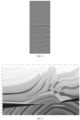
- FIG. 5 illustratively shows a demigration profile of a second iteration according to an example of the disclosure.
- a symbol "°” denotes a Hadamard product, and denotes division of a corresponding element of m mig 1 by a corresponding element of m mig 2 .
- S ( x ) calibrates spatial amplitude changes introduced by the demigration operator and a migration operator under conditions of a determined field observation system and a determined speed model for a work area.
- Step 3 demigration synthesized seismic data are obtained by performing demigration on the migration profile.
- FIG. 7 illustratively shows a demigration profile of a 20 th iteration according to an example of the disclosure.
- Step 4 a dot product is computed based on the seismic observation data and the demigration synthesized seismic data.
- d ⁇ i denotes i th data in the seismic observation data
- d ⁇ i denotes i th data in the demigration synthesized seismic data
- D denotes the dot product
- Step 5 an inner product of the migration profile is determined.
- M denotes the inner product
- m mig denotes the migration profile
- Step 6 amplitude regularized seismic data are obtained by performing, based on the dot product and the inner product, amplitude regularization on the demigration synthesized seismic data.
- d ⁇ i denotes the demigration synthesized seismic data
- M denotes the inner product
- D denotes the dot product
- Step 7 a residual value of seismic data is obtained by performing matching subtraction on the seismic observation data and the amplitude regularized seismic data.
- FIG. 6 illustratively shows a data residual of a first iteration.
- FIG. 8 illustratively shows a data residual of a 20 th iteration.
- Step 8 a gradient field of the inversion is obtained by using an adjoint state method based on the residual value of the seismic data and on the basis of least-squares reverse-time migration.
- the gradient field is obtained by applying the migration operator to the residual value of the seismic data obtained in step 7, and the gradient field denotes an update direction of the inversion.
- the gradient field ⁇ f(m) is obtained by using the adjoint state method.
- This link includes forward continuation and backward continuation.
- the forward continuation is the demigration operator F
- the backward continuation is the migration operator F T
- g denotes a source wavelet
- w denotes a reflection wavefield
- u and v denotes the forward continuation wavefield and the backward continuation wavefield
- ⁇ denotes a Laplace operator (a second-order differential operator)
- x denotes a coordinate of a discrete point in a two-dimensional space or a three-dimensional space
- m(x) denotes a reflection coefficient corresponding to the discrete point in the two-dimensional or the three-dimensional space
- T denotes total duration of a seismic record
- t denotes time.
- ⁇ f ( m ) that is, the gradient field of the inversion, may be obtained through summation of u and v .
- Step 9 a processed gradient field is obtained by performing, by using an amplitude calibration operator, amplitude calibration on the gradient field of the inversion.
- FIG. 10 illustratively shows an amplitude calibration operator of a gradient field according to an example of the disclosure.
- a processed gradient field is obtained by multiplying the amplitude calibration operator S ( x ) obtained in step 2 by a numerical value at a corresponding point of the gradient field ⁇ f ( m ).
- Step 10 an update step is computed by an inversion method based on the processed gradient field, and a reflection coefficient is updated until the inversion converges.
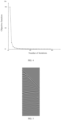
- FIG. 4 illustratively shows an inversion convergence curve of an objective function according to an example of the disclosure.
- an abscissa denotes a number of iterations
- an ordinate denotes a value of the objective function
- the value decreases and tends to be flat, indicating that the inversion converges. It can be seen from the figure that the objective function decreases along with an increase in the number of iterations and tends to converge gradually.
- the inversion convergence of the objective function needs to determine whether the residual value in step 7 is less than a set threshold. If the residual value in step 7 is less than the set threshold, the seismic migration profile is output. If the residual value in step 7 is greater than or equal to the set threshold, return to step 3, iteration on a migration profile result is implemented continuously until the residual value is less than the set threshold, and then the migration profile is output.
- FIG. 11 illustratively shows a reflection coefficient model according to an example of the disclosure.
- FIG. 12 illustratively shows a conventional reverse-time migration image.
- FIG. 13 illustratively shows a least-squares reverse-time migration result according to an example of the disclosure.
- the traditional technology has high requirements on a migration operator and the demigration operator in the inversion process, and the inversion will not converge unless the operators pass the dot test.
- the method of this example solves the problem that the least-squares migration technology is difficult to converge stably in a case of actual data, reduces a requirement for passing the dot test, improves the convergence of the inversion, and improves practicality of the technology.
- FIG. 2 is a schematic flowchart of a method for least-squares migration inversion converging stably according to an example. It should be understood that although steps in the flowchart of FIG. 2 are shown in sequence as indicated by arrows, these steps are not necessarily executed in sequence as indicated by the arrows. Unless explicitly stated in this text, execution of these steps is not strictly limited in sequence, and these steps can be executed in another sequence. In addition, at least some steps in FIG. 2 may include a plurality of sub-steps or a plurality of stages. These sub-steps or stages are not necessarily executed at the same moment, and may alternatively be executed at different moments. An execution sequence of these sub-steps or stages is not necessarily sequential, and these sub-steps or stages may be executed by turns or alternately with the other steps or at least some sub-steps or stages of the other steps.
- the apparatus for least-squares migration inversion converging stably includes an obtainment module 21, a pre-stack depth migration module 22, a demigration module 23, a first computation module 24, a second computation module 25, an amplitude regularization module 26, a residual computation module 27, a gradient field computation module 28, a calibration module 29 and an inversion update module 30.
- the obtainment module 21 is configured to obtain seismic observation data.
- the pre-stack depth migration module 22 is configured to obtain a migration profile by performing pre-stack depth migration on the seismic observation data.
- the demigration module 23 is configured to obtain demigration synthesized seismic data by performing demigration on the migration profile.
- the first computation module 24 is configured to compute a dot product based on the seismic observation data and the demigration synthesized seismic data.
- the second computation module 25 is configured to determine an inner product of the migration profile.
- the amplitude regularization module 26 is configured to obtain amplitude regularized seismic data by performing, based on the dot product and the inner product, amplitude regularization on the demigration synthesized seismic data.
- the residual computation module 27 is configured to obtain a residual value of seismic data by performing matching subtraction on the seismic observation data and the amplitude regularized seismic data.
- the gradient field computation module 28 is configured to obtain, by using an adjoint state method, a gradient field of the inversion based on the residual value of the seismic data and on the basis of least-squares reverse-time migration.
- the calibration module 29 is configured to obtain a processed gradient field by performing, by using an amplitude calibration operator, amplitude calibration on the gradient field of the inversion.
- the inversion update module 30 is configured to compute an update step by using an inversion method based on the processed gradient field, and update a reflection coefficient until the inversion converges.
- the apparatus for least-squares migration inversion converging stably includes a processor and a memory.
- the obtainment module 21, the pre-stack depth migration module 22, the demigration module 23, the first computation module 24, the second computation module 25, the amplitude regularization module 26, the residual computation module 27, the gradient field computation module 28, the calibration module 29 and the inversion update module 30 are all stored in the memory as program units, and the processor executes the above program modules stored in the memory to implement a corresponding function.
- the processor contains a core, and the core invokes a corresponding program unit in the memory.
- One or more cores may be set, and the method for least-squares migration inversion converging stably may be implemented by adjusting parameters of the cores.
- the memory may include a non-permanent memory, a random access memory (RAM) and/or a nonvolatile memory such as a read-only memory (ROM) or a flash RAM in the computer readable medium, and the memory includes at least one storage chip.
- RAM random access memory
- ROM read-only memory
- flash RAM flash RAM
- the example of the disclosure provides a storage medium.
- the storage medium stores a program, and the program implements the method for least-squares migration inversion converging stably when executed by a processor.
- a computer device is provided.
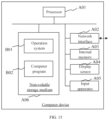
- the computer device may be a terminal, and its internal structure diagram may be shown in FIG. 15 .
- the computer device includes a processor A01, a network interface A02, a display screen A04, an input device A05 and a memory (not shown in the figure) that are connected through a system bus.
- the processor A01 of the computer device is configured to provide computing and control capacities.
- the memory of the computer device includes an internal memory A03 and a nonvolatile storage medium A06.
- the nonvolatile storage medium A06 stores an operation system B01 and a computer program B02.
- the internal memory A03 provides an environment for operation of the operation system B01 and the computer program B02 in the nonvolatile storage medium A06.
- the network interface A02 of the computer device is configured to communicate with an external terminal through networking.
- the computer program implements the method for least-squares migration inversion converging stably when executed by the processor A01.
- the display screen A04 of the computer device may be a liquid crystal display screen or an electronic ink display screen.
- the input device A05 of the computer device may be a touch layer covering the display screen, or may be a button, a trackball or a touch pad arranged on a shell of the computer device, or may be an external keyboard, touch pad or mouse.
- FIG. 15 is merely a block diagram of some structure related to the solution of the disclosure, and does not constitute limitation to the computer device to which the solution of the disclosure is applied.
- the specific computer device may include more or less components than those shown in the figure, or combine some components, or have different component arrangements.
- the apparatus for least-squares migration inversion converging stably may be implemented as a computer program.
- the computer program may be run on the computer device as shown in FIG. 15 .
- the memory of the computer device may store the program modules that make up the apparatus for least-squares migration inversion converging stably, which are, for example, the obtainment module 21, the pre-stack depth migration module 22, the demigration module 23, the first computation module 24, the second computation module 25, the amplitude regularization module 26, the residual computation module 27, the gradient field computation module 28, the calibration module 29 and the inversion update module 30 that are shown in FIG. 14 .
- the computer program composed of the program modules causes the processor to execute steps in the method for least-squares migration inversion converging stably of the examples of the disclosure described in this description.
- the computer device shown in FIG. 15 may executes step 1 through the obtainment module 21 of the apparatus for least-squares migration inversion converging stably as shown in FIG. 14 , executes step 2 through the pre-stack depth migration module 22, executes step 3 through the demigration module 23, executes step 4 through the first computation module 24, executes step 5 through the second computation module 25, executes step 6 through the amplitude regularization module 26, executes step 7 through the residual computation module 27, executes step 8 through the gradient field computation module 28, executes step 9 through the calibration module 29 and executes step 10 through the inversion update module 30.
- the example of the disclosure provides a device.
- the device includes a processor, a memory, and a program that is stored on the memory and runnable on the processor.
- the processor executes:
- the step that seismic observation data are obtained includes: initial seismic observation data are obtained by a forward modeling method.
- the seismic observation data re obtained by performing preprocessing on the initial seismic observation data; where the preprocessing includes noise removal and environmental interference removal.
- m mig denotes a migration image
- an objective of the least-squares inversion is to optimize m
- an error between simulated data of the demigration and actual observation data is minimized to the greatest extent.
- An adopted measure is a least-squares error
- min f ( m ) denotes a minimum value of the objective function
- F denotes a demigration operator
- d denotes the seismic data
- m denotes a reflection coefficient model
- the step that a gradient field of the inversion is obtained by using an adjoint state method includes:
- g denotes a source wavelet
- w denotes a reflection wavefield
- u denotes the forward continuation wavefield
- v denotes the backward continuation wavefield
- ⁇ denotes a Laplace operator (a second-order differential operator)
- x denotes a coordinate of a discrete point in a two-dimensional space or a three-dimensional space
- m(x) denotes a reflection coefficient corresponding to the discrete point in the two-dimensional or the three-dimensional space
- T denotes total duration of a seismic record
- t denotes time.
- F denotes the demigration operator
- F T denotes the migration operator
- d denotes the seismic data
- m denotes a reflection coefficient model.
- a left side of the equation denotes a dot product of the seismic data obtained by the demigration and input seismic data
- a right side of the formula denotes a dot product of the reflection coefficient and the migration image.
- the adjoint operator is defined by the dot product test in a mathematical form.
- energy of an entire system is required not to be increased or decreased after first demigration and first migration. This requirement is actually harsh.
- many factors that affect an amplitude of the result such as the source wavelet, boundary absorption, frequency-wave number domain transformation and filtering exist, and may make the program fail the dot product test.
- the method of the example of the disclosure can satisfy dot product test conditions of the forward operator and the inverse operator of the least-squares iteration algorithm, makes the least-squares objective function converge, and improves the convergence and the stability of the inversion.
- the method of the example of the disclosure has a small computation amount, a small storage capacity, low cost, high efficiency, and better adaptability to field data with merely one time of computation required.
- the method further includes: the amplitude calibration operator is established.
- the step that the amplitude calibration operator is established includes:
- a symbol "°” denotes a Hadamard product, and denotes division of a corresponding element of m mig 1 by a corresponding element of m mig 2 ; and S ( x ) calibrates spatial amplitude changes introduced by the demigration operator and a migration operator under conditions of a determined field observation system and a determined speed model for a work area.
- M denotes the inner product
- m mig denotes the migration profile
- d ⁇ i denotes i th data in the seismic observation data
- d ⁇ i denotes i th data in the demigration synthesized seismic data
- D denotes the dot product
- d ⁇ i denotes the demigration synthesized seismic data
- M denotes the inner product
- D denotes the dot product
- the examples of the disclosure may be provided as methods, systems, or computer program products.
- the disclosure may take the form of an entire hardware example, an entire software example, or an example combining software and hardware.
- the disclosure may take the form of a computer program product implemented on one or more computer usable storage media (including but not limited to disk memories, compact disc read-only memories (CD-ROMs), and optical memories) including computer usable program codes.
- each flow and/or block in the flowchart and/or block diagram and a combination of the flow and/or block in the flowchart and/or block diagram can be implemented by computer program instructions.
- These computer program instructions may be provided for a processor of a general-purpose computer, a special-purpose computer, an embedded processing machine, or other programmable data processing device to produce a machine, such that instructions executed by the processor of the computer or another programmable data processing device generate an apparatus used for implementing a function specified in one or more flows of the flowchart and/or one or more blocks of the block diagram.
- These computer program instructions may also be stored in a computer-readable memory that may guide the computer or another programmable data processing device to operate in a specific mode, such that the instructions stored in the computer-readable memory produce an article of manufacture including an instruction apparatus, and the instruction apparatus implements the function specified in one or more flows of the flowchart and/or one or more blocks in the block diagram.
- These computer program instructions may also be loaded onto the computer or another programmable data processing device, such that a series of operation steps are executed on the computer or another programmable device to generate computer-implemented processing, and instructions executed on the computer or another programmable device provide steps for implementing the function specified in the one or more flows of the flowchart and/or one or more blocks in the block diagram.
- a computer device includes one or more central processing units (CPUs), an input/output interface, a network interface, and a memory.
- CPUs central processing units
- input/output interface input/output interface
- network interface network interface
- memory a memory
- the memory may include a non-permanent memory, a random access memory (RAM) and/or a nonvolatile memory in the computer-readable medium, such as a read-only memory (ROM) or a flash RAM.
- RAM random access memory
- ROM read-only memory
- flash RAM flash random access memory
- the computer-readable medium includes permanent or non-permanent, removable or non-removable media, and may store information by any method or technology.
- Information may be a computer-readable instruction, a data structure, a program module or other data.
- Examples of a computer storage medium include, but are not limited to, a phase-change random access memory (PRAM), a static random access memory (SRAM), a dynamic random access memory (DRAM), other types of random access memories (RAMs), a read-only memory (ROM), an electrically erasable programmable read-only memory (EEPROM), a flash memory or other memory technologies, a compact disc read-only memory (CD-ROM), a digital versatile disc (DVD) or other optical storages, a cassette tape, tape or disk storage or other magnetic storage devices, or any other non-transmission media that may be used to store information capable of being accessed by a computing device.
- the computer-readable medium does not include transitory media, such as modulated data signals and carrier waves.
Landscapes
- Engineering & Computer Science (AREA)
- Physics & Mathematics (AREA)
- Remote Sensing (AREA)
- Life Sciences & Earth Sciences (AREA)
- General Physics & Mathematics (AREA)
- Acoustics & Sound (AREA)
- Environmental & Geological Engineering (AREA)
- Geology (AREA)
- General Life Sciences & Earth Sciences (AREA)
- Geophysics (AREA)
- Mathematical Physics (AREA)
- Data Mining & Analysis (AREA)
- Theoretical Computer Science (AREA)
- Computational Mathematics (AREA)
- Mathematical Analysis (AREA)
- Mathematical Optimization (AREA)
- Algebra (AREA)
- Pure & Applied Mathematics (AREA)
- Databases & Information Systems (AREA)
- Software Systems (AREA)
- General Engineering & Computer Science (AREA)
- Geophysics And Detection Of Objects (AREA)
Abstract
Description
- The disclosure relates to the technical field of seismic data depth domain migration imaging, in particular to a method for least-squares migration inversion converging stably, an apparatus for least-squares migration inversion converging stably, a machine-readable storage medium, and a processor.
- One important purpose of seismic data processing is to obtain high-quality images in depth domain through depth migration. The least-squares depth migration based on inversion is to reduce an error difference between forward data and observation data through continuous iterations, and is a process of eliminating false migration and uneven observation illumination in migration profiles and finding an optimal migration profile. With this migration profile as a reflection coefficient, a seismic record synthesized through demigration is closest to a real seismic record. The inverse migration can be simulated by the Kirchhoff method based on ray path integration, or the one-way wave or two-way wave method based on solving of a wave equation.
- In the prior art, a dot-test method is used to test a demigration operator and its self-adjoint operator, and the inversion process can converge only if an adjoint operator passes the test. The traditional technology has high requirements on a migration operator and the demigration operator in the inversion process, and the inversion will not converge unless the operators pass the dot-test. As a result, stable convergence is difficult in the prior art.
- An objective of examples of the disclosure is to provide a method and apparatus for least-squares migration inversion converging stably, which improve convergence and stability of the inversion.
- In order to achieve the objective described above, a first aspect of the disclosure provides a method for least-squares migration inversion converging stably. The method includes:
- obtaining seismic observation data;
- obtaining a migration profile by performing pre-stack depth migration on the seismic observation data;
- obtaining demigration synthesized seismic data by performing demigration on the migration profile;
- computing a dot product based on the seismic observation data and the demigration synthesized seismic data;
- determining an inner product of the migration profile;
- obtaining amplitude regularized seismic data by performing, based on the dot product and the inner product, amplitude regularization on the demigration synthesized seismic data;
- obtaining a residual value of seismic data by performing matching subtraction on the seismic observation data and the amplitude regularized seismic data;
- obtaining, by using an adjoint state method, a gradient field of the inversion based on the residual value of the seismic data and on the basis of least-squares reverse-time migration;
- obtaining a processed gradient field by performing, by using an amplitude calibration operator, amplitude calibration on the gradient field of the inversion; and
- computing an update step by using an inversion method based on the processed gradient field, and updating a reflection coefficient until the inversion converges.
- In an example of the disclosure, the obtaining seismic observation data comprises:
- obtaining initial seismic observation data by a forward modeling method; and
- obtaining the seismic observation data by performing preprocessing on the initial seismic observation data; wherein the preprocessing comprises noise removal and environmental interference removal.
- In an example of the disclosure, the least-squares reverse-time migration is an imaging algorithm based on the inversion, and an objective function of the inversion is as follows:

- In an example of the disclosure, the obtaining, by using an adjoint state method, a gradient field of the inversion comprises:
- computing a forward continuation wavefield u and a backward continuation wavefield v ; and
- computing the gradient field ∇f(m) of the inversion based on the forward continuation wavefield u and the backward continuation wavefield v .
- In an example of the disclosure, the forward continuation wavefield u and the backward continuation wavefield v are computed by formulas (2)-(4) as follows:
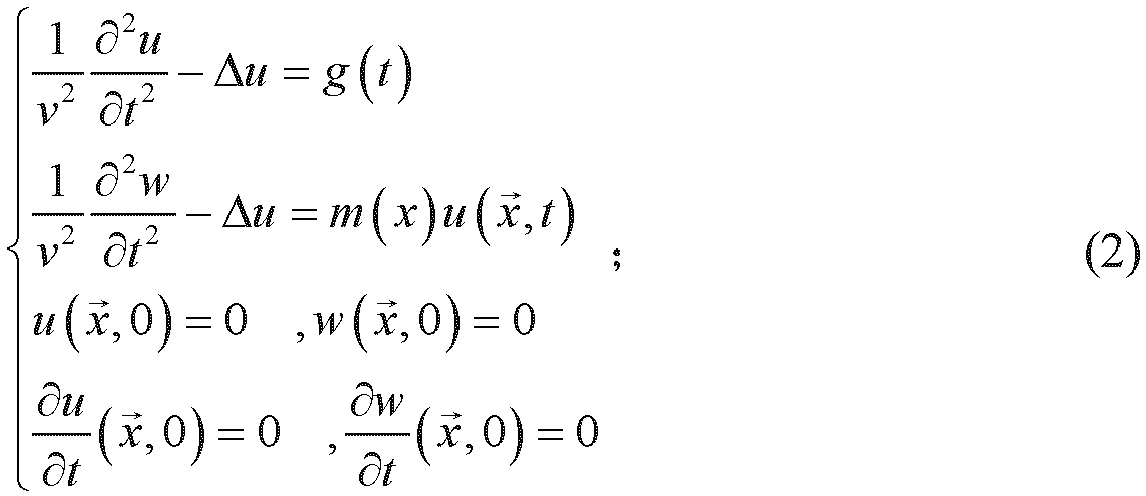


x denotes a coordinate of a discrete point in a two-dimensional space or a three-dimensional space, m(x) denotes a reflection coefficient corresponding to the discrete point in the two-dimensional or the three-dimensional space, T denotes total duration of a seismic record, and t denotes time. - In an example of the disclosure, the method further comprising: establishing the amplitude calibration operator; wherein
the establishing the amplitude calibration operator comprises: - obtaining a first migration result mmig 1 = FT d by performing first pre-stack depth migration on the seismic observation data d;
- obtaining a first demigration synthesized seismic data d̂ 1 = F(mmig 1) by performing demigration on the first migration result mmig 1 = FT d ;
- obtaining a second migration
result 
- establishing the amplitude calibration operator S(
x ) based on the first migration result mmlg 1 = FT d and the second migration result
- In an example of the disclosure, the amplitude calibration operator S (
x ) is established based on the first migration result mmig 1 = FT d and the second migrationresult 

x ) calibrates spatial amplitude changes introduced by the demigration operator and a migration operator under conditions of a determined field observation system and a determined speed model for a work area. - In an example of the disclosure, the inner product of the migration profile is determined by a formula (6) as follows:

- In an example of the disclosure, the dot product is computed based on the seismic observation data and the demigration synthesized seismic data by a formula (7) as follows:

- In an example of the disclosure, the amplitude regularized seismic data are obtained by performing, based on the dot product and the inner product, the amplitude regularization on the demigration synthesized seismic data by a formula (8) as follows:

- A second aspect of the disclosure provides an apparatus for least-squares migration inversion converging stably. The apparatus includes:
- an obtainment module configured to obtain seismic observation data;
- a pre-stack depth migration module configured to obtain a migration profile by performing pre-stack depth migration on the seismic observation data;
- a demigration module configured to obtain demigration synthesized seismic data by performing demigration on the migration profile;
- a first computation module configured to compute a dot product based on the seismic observation data and the demigration synthesized seismic data;
- a second computation module configured to determine an inner product of the migration profile;
- an amplitude regularization module configured to obtain amplitude regularized seismic data by performing, based on the dot product and the inner product, amplitude regularization on the demigration synthesized seismic data;
- a residual computation module configured to obtain a residual value of seismic data by performing matching subtraction on the seismic observation data and the amplitude regularized seismic data;
- a gradient field computation module configured to obtain, by using an adjoint state method, a gradient field of the inversion based on the residual value of the seismic data and on the basis of least-squares reverse-time migration;
- a calibration module configured to obtain a processed gradient field by performing, by using an amplitude calibration operator, amplitude calibration on the gradient field of the inversion; and
- an inversion update module configured to compute an update step by using an inversion method based on the processed gradient field, and update a reflection coefficient until the inversion converges.
- A third aspect of the disclosure provides a processor. The processor is configured to execute the method for least-squares migration inversion converging stably described above.
- A fourth aspect of the disclosure provides a machine-readable storage medium. The machine-readable storage medium stores an instruction, where the instruction causes a processor to be configured to execute the method for least-squares migration inversion converging stably described above when executed by the processor.
- Compared with the prior art, the technical solution of the disclosure has the following beneficial effects:
The disclosure provides the method and apparatus for least-squares migration inversion converging stably. The method satisfies dot product test conditions of a forward operator and an inverse operator of a least-squares iteration algorithm, makes a least-squares objective function converge, and improves the convergence and the stability of the inversion. The method has a small computation amount, a small storage capacity, low cost, high efficiency, and better adaptability to field data with merely one time of computation required. - Other features and advantages of the examples of the disclosure will be described in detail in the following specific embodiments.
- The accompanying drawings are used for providing further understanding of the examples of the disclosure as a constituent part of the description, serve to explain the examples of the disclosure together with following specific embodiments, but do not constitute limitation to the examples of the disclosure. In the figures:
The accompanying drawings are used for providing further understanding of the examples of the disclosure as a constituent part of the description, serve to explain the examples of the disclosure together with following specific embodiments, but do not constitute limitation to the examples of the disclosure. In the figures: -
FIG. 1 illustratively shows a schematic diagram of an application environment of a method for least-squares migration inversion converging stably according to an example of the disclosure; -
FIG. 2 illustratively shows a schematic flowchart of a method for least-squares migration inversion converging stably according to an example of the disclosure; -
FIG. 3 illustratively show a flowchart of implementing an algorithm according to an example of the disclosure; -
FIG. 4 illustratively shows an inversion convergence curve of an objective function according to an example of the disclosure; -
FIG. 5 illustratively shows demigration data of a second iteration according to an example of the disclosure; -
FIG. 6 illustratively shows a data residual of a first iteration according to an example of the disclosure; -
FIG. 7 illustratively shows demigration data of a 20th iteration according to an example of the disclosure; -
FIG. 8 illustratively shows a data residual of a 20th iteration according to an example of the disclosure; -
FIG. 9 illustratively shows a speed model according to an example of the disclosure; -
FIG. 10 illustratively shows an amplitude calibration operator of a gradient field according to an example of the disclosure; -
FIG. 11 illustratively shows a reflection coefficient model according to an example of the disclosure; -
FIG. 12 illustratively shows a conventional reverse-time migration image; -
FIG. 13 illustratively shows a least-squares reverse-time migration result according to an example of the disclosure; -
FIG. 14 illustratively shows a structural block diagram of an apparatus for least-squares migration inversion converging stably according to an example of the disclosure; and -
FIG. 15 illustratively shows an internal structural diagram of a computer device according to an example of the disclosure. - The specific embodiments of the examples of the disclosure are described in detail below with reference to accompanying drawings. It should be understood that the specific embodiments described herein are merely used to describe and explain the examples of the disclosure, rather than limit the examples of the disclosure.
- The terms "first", "second", etc. in the disclosure are used to distinguish different objects, rather than to describe a specific sequence. In addition, the terms "comprise", "include" and their any form of variation are intended to cover non-exclusive inclusions.
- The example of the disclosure provides a method and an apparatus for predicting a service life of an old well to be converted into a water injection well, an electronic device and a computer-readable storage medium.
- The device may be specifically integrated into a computer device, and the electronic device may be a terminal, a server, etc. The terminal may be a mobile phone, a portable android device, an intelligent Bluetooth device, a notebook computer, a personal computer (PC), etc. The server may be a single server or a server cluster composed of a plurality of servers.
- In some examples, the apparatus may also be integrated into a plurality of electronic devices. For example, the apparatus may be integrated into a plurality of servers, and the method of the disclosure is implemented by the plurality of servers.
- In some examples, the server may be alternatively implemented as the terminal.
- The detailed description will be provided separately below. It should be noted that serial numbers of the following examples are not used as limitation to a preference sequence of the examples.
- A method for least-squares migration inversion converging stably according to the disclosure may be applied to an application environment shown in
FIG. 1 . The terminal 102 communicates with theserver 104 through the network. The terminal 102 may be, but is not limited to, various personal computers, notebook computers, smart phones, portable android devices, and portable wearable devices. Theserver 104 may be implemented by an independent server or the server cluster composed of the plurality of servers. -
FIG. 2 illustratively shows a schematic flowchart of a method for least-squares migration inversion converging stably according to an example of the disclosure. As shown inFIG. 2 , in an example of the disclosure, a method for least-squares migration inversion converging stably is provided. This example is mainly described with this method applied to the terminal 102 (or the server 104) in theFIG. 1 . The method includes:
Step 1, seismic observation data are obtained. -
FIG. 9 illustratively shows a speed model according to an example of the disclosure. In this example, an observation system is designed based on the Marmousi speed model. Shot gather seismic data, that is, initial seismic observation data of least-squares migration, are obtained through forward modeling. Then the initial seismic observation data are processed to remove noise and environmental interference, to obtain seismic observation data d . -
Step 2, a migration profile is obtained by performing pre-stack depth migration on the seismic observation data. - In this example, a first migration result mmig 1 = FT d, that is, a first migration profile, is obtained by performing first pre-stack depth migration on the seismic observation data d. Then, simulated data d̂ 1 = F(mmig 1) is obtained by performing demigration with mmig 1 as a reflection coefficient. Then a second migration
result 
FIG. 5 illustratively shows a demigration profile of a second iteration according to an example of the disclosure. - In this example, the method further includes: an amplitude calibration operator S(
x ) is established based on the first migration result mmig 1 = FT d and the second migrationresult 

- In the formula, a symbol "°" denotes a Hadamard product, and denotes division of a corresponding element of mmig 1 by a corresponding element of mmig 2 . And S(
x ) calibrates spatial amplitude changes introduced by the demigration operator and a migration operator under conditions of a determined field observation system and a determined speed model for a work area. -
Step 3, demigration synthesized seismic data are obtained by performing demigration on the migration profile. - In this example, an inversion iteration is started, and the simulated data d̂i = F(mmig i ) , that is, the demigration synthesized seismic data, are obtained by performing the demigration with an ith migration result mmig i as the reflection coefficient.
FIG. 7 illustratively shows a demigration profile of a 20th iteration according to an example of the disclosure. -
Step 4, a dot product is computed based on the seismic observation data and the demigration synthesized seismic data. - In this example, the dot product is computed based on the seismic observation data and the demigration synthesized seismic data by a formula (7) as follows:

- In the formula, d̂i denotes i th data in the seismic observation data, d̂i denotes i th data in the demigration synthesized seismic data, and D denotes the dot product.
-
Step 5, an inner product of the migration profile is determined. - In this example, the inner product of the migration profile is obtained by a formula (6) as follows:

- In the formula, M denotes the inner product, and mmig denotes the migration profile.
-
Step 6, amplitude regularized seismic data are obtained by performing, based on the dot product and the inner product, amplitude regularization on the demigration synthesized seismic data. - In this example, the amplitude regularized seismic data are obtained by performing, based on the dot product and the inner product, the amplitude regularization on the demigration synthesized seismic data by a formula (8) as follows:

- In the formula, d̂i denotes the demigration synthesized seismic data, M denotes the inner product, and D denotes the dot product.
-
Step 7, a residual value of seismic data is obtained by performing matching subtraction on the seismic observation data and the amplitude regularized seismic data. - In this example,
FIG. 6 illustratively shows a data residual of a first iteration.FIG. 8 illustratively shows a data residual of a 20th iteration. - Step 8, a gradient field of the inversion is obtained by using an adjoint state method based on the residual value of the seismic data and on the basis of least-squares reverse-time migration.
- In this example, the gradient field is obtained by applying the migration operator to the residual value of the seismic data obtained in
step 7, and the gradient field denotes an update direction of the inversion. - The gradient field ∇f(m) is obtained by using the adjoint state method. This link includes forward continuation and backward continuation. The forward continuation is the demigration operator F, and the backward continuation is the migration operator FT , and an input of the backward continuation is dresidual = d̂ - d, wherein d̂ = F(m). An expression may be as follows:


- In the formula, g denotes a source wavelet, w denotes a reflection wavefield, u and v denotes the forward continuation wavefield and the backward continuation wavefield, Δ denotes a Laplace operator (a second-order differential operator),
x denotes a coordinate of a discrete point in a two-dimensional space or a three-dimensional space, m(x) denotes a reflection coefficient corresponding to the discrete point in the two-dimensional or the three-dimensional space, T denotes total duration of a seismic record, and t denotes time. And ∇f(m), that is, the gradient field of the inversion, may be obtained through summation of u and v. -
Step 9, a processed gradient field is obtained by performing, by using an amplitude calibration operator, amplitude calibration on the gradient field of the inversion. -
FIG. 10 illustratively shows an amplitude calibration operator of a gradient field according to an example of the disclosure. In this example, a processed gradient field is obtained by multiplying the amplitude calibration operator S(x ) obtained instep 2 by a numerical value at a corresponding point of the gradient field ∇f(m). -
Step 10, an update step is computed by an inversion method based on the processed gradient field, and a reflection coefficient is updated until the inversion converges. -
FIG. 4 illustratively shows an inversion convergence curve of an objective function according to an example of the disclosure. As shown inFIG. 4 , an abscissa denotes a number of iterations, and an ordinate denotes a value of the objective function, and the value decreases and tends to be flat, indicating that the inversion converges. It can be seen from the figure that the objective function decreases along with an increase in the number of iterations and tends to converge gradually. - In this example, as shown in
FIG. 3 , the inversion convergence of the objective function needs to determine whether the residual value instep 7 is less than a set threshold. If the residual value instep 7 is less than the set threshold, the seismic migration profile is output. If the residual value instep 7 is greater than or equal to the set threshold, return tostep 3, iteration on a migration profile result is implemented continuously until the residual value is less than the set threshold, and then the migration profile is output. -
FIG. 11 illustratively shows a reflection coefficient model according to an example of the disclosure.FIG. 12 illustratively shows a conventional reverse-time migration image.FIG. 13 illustratively shows a least-squares reverse-time migration result according to an example of the disclosure. - The traditional technology has high requirements on a migration operator and the demigration operator in the inversion process, and the inversion will not converge unless the operators pass the dot test. The method of this example solves the problem that the least-squares migration technology is difficult to converge stably in a case of actual data, reduces a requirement for passing the dot test, improves the convergence of the inversion, and improves practicality of the technology.
-
FIG. 2 is a schematic flowchart of a method for least-squares migration inversion converging stably according to an example. It should be understood that although steps in the flowchart ofFIG. 2 are shown in sequence as indicated by arrows, these steps are not necessarily executed in sequence as indicated by the arrows. Unless explicitly stated in this text, execution of these steps is not strictly limited in sequence, and these steps can be executed in another sequence. In addition, at least some steps inFIG. 2 may include a plurality of sub-steps or a plurality of stages. These sub-steps or stages are not necessarily executed at the same moment, and may alternatively be executed at different moments. An execution sequence of these sub-steps or stages is not necessarily sequential, and these sub-steps or stages may be executed by turns or alternately with the other steps or at least some sub-steps or stages of the other steps. - In an example, as shown in
FIG. 14 , the apparatus for least-squares migration inversion converging stably is provided. The apparatus for least-squares migration inversion converging stably includes anobtainment module 21, a pre-stackdepth migration module 22, ademigration module 23, afirst computation module 24, asecond computation module 25, anamplitude regularization module 26, aresidual computation module 27, a gradientfield computation module 28, acalibration module 29 and aninversion update module 30. - The
obtainment module 21 is configured to obtain seismic observation data. - The pre-stack
depth migration module 22 is configured to obtain a migration profile by performing pre-stack depth migration on the seismic observation data. - The
demigration module 23 is configured to obtain demigration synthesized seismic data by performing demigration on the migration profile. - The
first computation module 24 is configured to compute a dot product based on the seismic observation data and the demigration synthesized seismic data. - The
second computation module 25 is configured to determine an inner product of the migration profile. - The
amplitude regularization module 26 is configured to obtain amplitude regularized seismic data by performing, based on the dot product and the inner product, amplitude regularization on the demigration synthesized seismic data. - The
residual computation module 27 is configured to obtain a residual value of seismic data by performing matching subtraction on the seismic observation data and the amplitude regularized seismic data. - The gradient
field computation module 28 is configured to obtain, by using an adjoint state method, a gradient field of the inversion based on the residual value of the seismic data and on the basis of least-squares reverse-time migration. - The
calibration module 29 is configured to obtain a processed gradient field by performing, by using an amplitude calibration operator, amplitude calibration on the gradient field of the inversion. - The
inversion update module 30 is configured to compute an update step by using an inversion method based on the processed gradient field, and update a reflection coefficient until the inversion converges. - The apparatus for least-squares migration inversion converging stably includes a processor and a memory. The
obtainment module 21, the pre-stackdepth migration module 22, thedemigration module 23, thefirst computation module 24, thesecond computation module 25, theamplitude regularization module 26, theresidual computation module 27, the gradientfield computation module 28, thecalibration module 29 and theinversion update module 30 are all stored in the memory as program units, and the processor executes the above program modules stored in the memory to implement a corresponding function. - The processor contains a core, and the core invokes a corresponding program unit in the memory. One or more cores may be set, and the method for least-squares migration inversion converging stably may be implemented by adjusting parameters of the cores.
- The memory may include a non-permanent memory, a random access memory (RAM) and/or a nonvolatile memory such as a read-only memory (ROM) or a flash RAM in the computer readable medium, and the memory includes at least one storage chip.
- The example of the disclosure provides a storage medium. The storage medium stores a program, and the program implements the method for least-squares migration inversion converging stably when executed by a processor.
- In an example, a computer device is provided. The computer device may be a terminal, and its internal structure diagram may be shown in
FIG. 15 . The computer device includes a processor A01, a network interface A02, a display screen A04, an input device A05 and a memory (not shown in the figure) that are connected through a system bus. The processor A01 of the computer device is configured to provide computing and control capacities. The memory of the computer device includes an internal memory A03 and a nonvolatile storage medium A06. The nonvolatile storage medium A06 stores an operation system B01 and a computer program B02. The internal memory A03 provides an environment for operation of the operation system B01 and the computer program B02 in the nonvolatile storage medium A06. The network interface A02 of the computer device is configured to communicate with an external terminal through networking. The computer program implements the method for least-squares migration inversion converging stably when executed by the processor A01. The display screen A04 of the computer device may be a liquid crystal display screen or an electronic ink display screen. The input device A05 of the computer device may be a touch layer covering the display screen, or may be a button, a trackball or a touch pad arranged on a shell of the computer device, or may be an external keyboard, touch pad or mouse. - It can be understood by those skilled in the art that the structure shown in
FIG. 15 is merely a block diagram of some structure related to the solution of the disclosure, and does not constitute limitation to the computer device to which the solution of the disclosure is applied. The specific computer device may include more or less components than those shown in the figure, or combine some components, or have different component arrangements. - In an example, the apparatus for least-squares migration inversion converging stably according to the disclosure may be implemented as a computer program. The computer program may be run on the computer device as shown in
FIG. 15 . The memory of the computer device may store the program modules that make up the apparatus for least-squares migration inversion converging stably, which are, for example, theobtainment module 21, the pre-stackdepth migration module 22, thedemigration module 23, thefirst computation module 24, thesecond computation module 25, theamplitude regularization module 26, theresidual computation module 27, the gradientfield computation module 28, thecalibration module 29 and theinversion update module 30 that are shown inFIG. 14 . The computer program composed of the program modules causes the processor to execute steps in the method for least-squares migration inversion converging stably of the examples of the disclosure described in this description. - The computer device shown in
FIG. 15 may executes step 1 through theobtainment module 21 of the apparatus for least-squares migration inversion converging stably as shown inFIG. 14 , executesstep 2 through the pre-stackdepth migration module 22, executesstep 3 through thedemigration module 23, executesstep 4 through thefirst computation module 24, executesstep 5 through thesecond computation module 25, executesstep 6 through theamplitude regularization module 26, executesstep 7 through theresidual computation module 27, executes step 8 through the gradientfield computation module 28, executesstep 9 through thecalibration module 29 and executesstep 10 through theinversion update module 30. - The example of the disclosure provides a device. The device includes a processor, a memory, and a program that is stored on the memory and runnable on the processor. When executing the program, the processor implements:
-
Step 1, seismic observation data are obtained. -
Step 2, a migration profile is obtained by performing pre-stack depth migration on the seismic observation data. -
Step 3, demigration synthesized seismic data are obtained by performing demigration on the migration profile. -
Step 4, a dot product is computed based on the seismic observation data and the demigration synthesized seismic data. -
Step 5, an inner product of the migration profile is determined. -
Step 6, amplitude regularized seismic data are obtained by performing, based on the dot product and the inner product, amplitude regularization on the demigration synthesized seismic data. -
Step 7, a residual value of seismic data is obtained by performing matching subtraction on the seismic observation data and the amplitude regularized seismic data. - Step 8, a gradient field of the inversion is obtained by using an adjoint state method based on the residual value of the seismic data and on the basis of least-squares reverse-time migration.
-
Step 9, a processed gradient field is obtained by performing, by using an amplitude calibration operator, amplitude calibration on the gradient field of the inversion. -
Step 10, an update step is computed by an inversion method based on the processed gradient field, and a reflection coefficient is updated until the inversion converges. - In an example, the step that seismic observation data are obtained includes: initial seismic observation data are obtained by a forward modeling method. The seismic observation data re obtained by performing preprocessing on the initial seismic observation data; where the preprocessing includes noise removal and environmental interference removal.
- In an example, the least-squares reverse-time migration is an imaging algorithm based on the inversion, and an objective function of the inversion is as follows:

- The migration operator is an adjoint operator of the demigration operator: mmig = FT d. In the formula, mmig denotes a migration image, an objective of the least-squares inversion is to optimize m , and an error between simulated data of the demigration and actual observation data is minimized to the greatest extent. An adopted measure is a least-squares error, and the objective function of the inversion is to obtain min f(m):

- In the formula, min f(m) denotes a minimum value of the objective function, F denotes a demigration operator, d denotes the seismic data, and m denotes a reflection coefficient model.
- In an example, the step that a gradient field of the inversion is obtained by using an adjoint state method includes:
- a forward continuation wavefield u and a backward continuation wavefield v are computed; and
- the gradient field ∇f(m) of the inversion is computed based on the forward continuation wavefield u and the backward continuation wavefield v .
- In an example, the forward continuation wavefield u and the backward continuation wavefield v are computed by formulas (2)-(4) as follows:
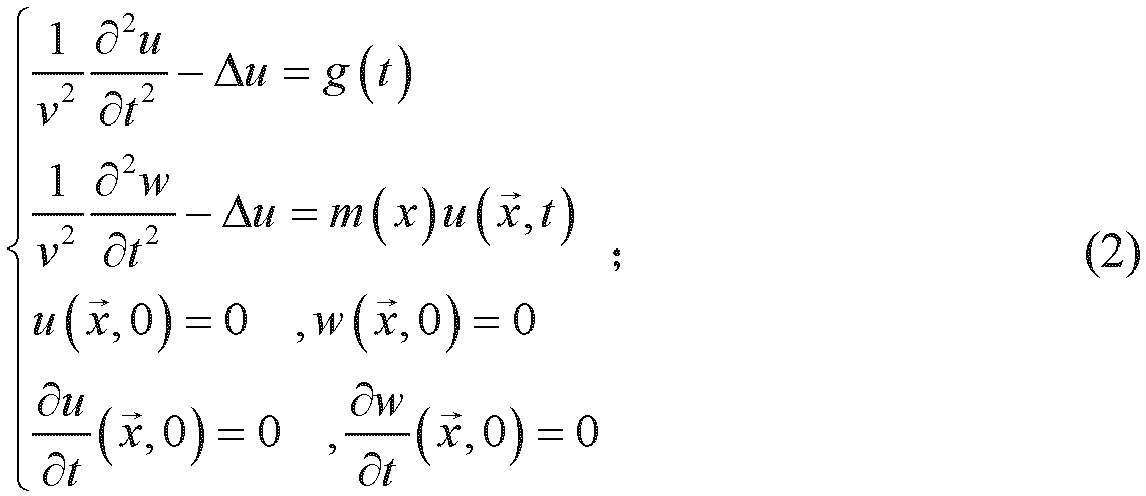


- In the formula, g denotes a source wavelet, w denotes a reflection wavefield, u denotes the forward continuation wavefield, v denotes the backward continuation wavefield, Δ denotes a Laplace operator (a second-order differential operator),
x denotes a coordinate of a discrete point in a two-dimensional space or a three-dimensional space, m(x) denotes a reflection coefficient corresponding to the discrete point in the two-dimensional or the three-dimensional space, T denotes total duration of a seismic record, and t denotes time. - In an example, the method further includes: strictness 〈Fm, d〉 = 〈m, FT d〉 of the self-adjoint operator is inspected by using the dot product test. In the formula, F denotes the demigration operator, FT denotes the migration operator, d denotes the seismic data, and m denotes a reflection coefficient model. A left side of the equation denotes a dot product of the seismic data obtained by the demigration and input seismic data, and a right side of the formula denotes a dot product of the reflection coefficient and the migration image. Whether the dot product test of the positive operator and the inverse operator of the algorithm is passed is a necessary condition for the convergence of the least-squares objective function.
- The adjoint operator is defined by the dot product test in a mathematical form. In physics, for the least-squares migration, energy of an entire system is required not to be increased or decreased after first demigration and first migration. This requirement is actually harsh. For implementing a computer algorithm, many factors that affect an amplitude of the result, such as the source wavelet, boundary absorption, frequency-wave number domain transformation and filtering exist, and may make the program fail the dot product test.
- The method of the example of the disclosure can satisfy dot product test conditions of the forward operator and the inverse operator of the least-squares iteration algorithm, makes the least-squares objective function converge, and improves the convergence and the stability of the inversion. The method of the example of the disclosure has a small computation amount, a small storage capacity, low cost, high efficiency, and better adaptability to field data with merely one time of computation required.
- In an example, the method further includes: the amplitude calibration operator is established. The step that the amplitude calibration operator is established includes:
- a first migration result mmig 1 = FT d is obtained by performing first pre-stack depth migration on the seismic observation data d;
- a first demigration synthesized seismic data d̂ 1 = F (mmig 1) are obtained by performing demigration on the first migration result mmig 1 = FT d ;
- a second migration
result 
- the amplitude calibration operator S(
x ) is established based on the first migration result mmig 1 = FT d and the second migrationresult 
- In an example, the step that the amplitude calibration operator S(
x ) is established based on the first migration result mmig 1 = FT d and the second migrationresult 

- In the formula, a symbol "°" denotes a Hadamard product, and denotes division of a corresponding element of mmig 1 by a corresponding element of mmig 2 ; and S(
x ) calibrates spatial amplitude changes introduced by the demigration operator and a migration operator under conditions of a determined field observation system and a determined speed model for a work area. - In an example, an inner product of the migration profile is determined by a formula (6) as follows:

- In the formula, M denotes the inner product, and mmig denotes the migration profile.
- In an example, the dot product is computed based on the seismic observation data and the demigration synthesized seismic data by a formula (7) as follows:

- In the formula, d̂i denotes i th data in the seismic observation data, d̂i denotes i th data in the demigration synthesized seismic data, and D denotes the dot product.
- In an example, the amplitude regularized seismic data are obtained by performing, based on the dot product and the inner product, the amplitude regularization on the demigration synthesized seismic data by a formula (8) as follows:

- In the formula, d̂i denotes the demigration synthesized seismic data, M denotes the inner product, and D denotes the dot product.
- Those skilled in the art should understand that the examples of the disclosure may be provided as methods, systems, or computer program products. Thus, the disclosure may take the form of an entire hardware example, an entire software example, or an example combining software and hardware. Moreover, the disclosure may take the form of a computer program product implemented on one or more computer usable storage media (including but not limited to disk memories, compact disc read-only memories (CD-ROMs), and optical memories) including computer usable program codes.
- The disclosure is described with reference to the flowchart and/or the block diagram of the method, the device (system), and the computer program product according to the example of the disclosure. It should be understood that each flow and/or block in the flowchart and/or block diagram and a combination of the flow and/or block in the flowchart and/or block diagram can be implemented by computer program instructions. These computer program instructions may be provided for a processor of a general-purpose computer, a special-purpose computer, an embedded processing machine, or other programmable data processing device to produce a machine, such that instructions executed by the processor of the computer or another programmable data processing device generate an apparatus used for implementing a function specified in one or more flows of the flowchart and/or one or more blocks of the block diagram.
- These computer program instructions may also be stored in a computer-readable memory that may guide the computer or another programmable data processing device to operate in a specific mode, such that the instructions stored in the computer-readable memory produce an article of manufacture including an instruction apparatus, and the instruction apparatus implements the function specified in one or more flows of the flowchart and/or one or more blocks in the block diagram.
- These computer program instructions may also be loaded onto the computer or another programmable data processing device, such that a series of operation steps are executed on the computer or another programmable device to generate computer-implemented processing, and instructions executed on the computer or another programmable device provide steps for implementing the function specified in the one or more flows of the flowchart and/or one or more blocks in the block diagram.
- In a typical configuration, a computer device includes one or more central processing units (CPUs), an input/output interface, a network interface, and a memory.
- The memory may include a non-permanent memory, a random access memory (RAM) and/or a nonvolatile memory in the computer-readable medium, such as a read-only memory (ROM) or a flash RAM. The memory is an instance of the computer-readable medium.
- The computer-readable medium includes permanent or non-permanent, removable or non-removable media, and may store information by any method or technology. Information may be a computer-readable instruction, a data structure, a program module or other data. Examples of a computer storage medium include, but are not limited to, a phase-change random access memory (PRAM), a static random access memory (SRAM), a dynamic random access memory (DRAM), other types of random access memories (RAMs), a read-only memory (ROM), an electrically erasable programmable read-only memory (EEPROM), a flash memory or other memory technologies, a compact disc read-only memory (CD-ROM), a digital versatile disc (DVD) or other optical storages, a cassette tape, tape or disk storage or other magnetic storage devices, or any other non-transmission media that may be used to store information capable of being accessed by a computing device. According to the definitions herein, the computer-readable medium does not include transitory media, such as modulated data signals and carrier waves.
- It should also be noted that the terms "comprise" and "include" or their any other variants intend to cover non-exclusive inclusions, such that a process, a method, a product or a device including a series of elements includes those elements, further includes other elements not listed clearly, or further includes an element inherent to the process, the method, the product or the device. In a case of no more limitation, an element limited by the phrase "comprise a..."or "include a..." does not exclude another identical element existing in the process, the method, the product or the device including the element.
- The examples described above are merely examples of the disclosure and are not used to limit the disclosure. It is apparent to a person of ordinary skill in the art that various modifications and changes can be made to the disclosure. Any modification, equivalent substitution, improvement, etc. made within the spirit and principles of the disclosure should fall within the scope of the claims of the disclosure.
Claims (13)
- A method for least-squares migration inversion converging stably, comprising:obtaining seismic observation data;obtaining a migration profile by performing pre-stack depth migration on the seismic observation data;obtaining demigration synthesized seismic data by performing demigration on the migration profile;computing a dot product based on the seismic observation data and the demigration synthesized seismic data;determining an inner product of the migration profile;obtaining amplitude regularized seismic data by performing, based on the dot product and the inner product, amplitude regularization on the demigration synthesized seismic data;obtaining a residual value of seismic data by performing matching subtraction on the seismic observation data and the amplitude regularized seismic data;obtaining, by using an adjoint state method, a gradient field of the inversion based on the residual value of the seismic data and on the basis of least-squares reverse-time migration;obtaining a processed gradient field by performing, by using an amplitude calibration operator, amplitude calibration on the gradient field of the inversion; andcomputing an update step by using an inversion method based on the processed gradient field, and updating a reflection coefficient until the inversion converges.
- The method according to claim 1, wherein the obtaining seismic observation data comprises:obtaining initial seismic observation data by a forward modeling method; andobtaining the seismic observation data by performing preprocessing on the initial seismic observation data; wherein the preprocessing comprises noise removal and environmental interference removal.
- The method according to claim 1, wherein the least-squares reverse-time migration is an imaging algorithm based on the inversion, and an objective function of the inversion is as follows:

- The method according to claim 1, wherein the obtaining, by using an adjoint state method, a gradient field of the inversion comprises:computing a forward continuation wavefield u and a backward continuation wavefield v ; andcomputing the gradient field ∇f(m) of the inversion based on the forward continuation wavefield u and the backward continuation wavefield v .
- The method according to claim 4, wherein the forward continuation wavefield u and the backward continuation wavefield v are computed by formulas (2)-(4) as follows:


x denotes a coordinate of a discrete point in a two-dimensional space or a three-dimensional space, m(x) denotes a reflection coefficient corresponding to the discrete point in the two-dimensional or the three-dimensional space, T denotes total duration of a seismic record, and t denotes time. - The method according to claim 1, further comprising: establishing the amplitude calibration operator; wherein
the establishing the amplitude calibration operator comprises:obtaining a first migration result mmig 1 = FT d by performing first pre-stack depth migration on the seismic observation data d ;obtaining a first demigration synthesized seismic data d̂ 1 = F(mmig 1) by performing demigration on the first migration result mmig 1 = FT d ;obtaining a second migration result establishing the amplitude calibration operator S(
x ) based on the first migration result mmig 1 = FT d and the second migration result
- The method according to claim 6, wherein the amplitude calibration operator S(
x ) is established based on the first migration result mmig 1 = FT d and the second migration result

x ) calibrates spatial amplitude changes introduced by the demigration operator and a migration operator under conditions of a determined field observation system and a determined speed model for a work area. - The method according to claim 1, wherein the inner product of the migration profile is determined by a formula (6) as follows:

- The method according to claim 8, wherein the dot product is computed based on the seismic observation data and the demigration synthesized seismic data by a formula (7) as follows:

- The method according to claim 9, wherein the amplitude regularized seismic data are obtained by performing, based on the dot product and the inner product, the amplitude regularization on the demigration synthesized seismic data by a formula (8) as follows:

- An apparatus for least-squares migration inversion converging stably, comprising:an obtainment module configured to obtain seismic observation data;a pre-stack depth migration module configured to obtain a migration profile by performing pre-stack depth migration on the seismic observation data;a demigration module configured to obtain demigration synthesized seismic data by performing demigration on the migration profile;a first computation module configured to compute a dot product based on the seismic observation data and the demigration synthesized seismic data;a second computation module configured to determine an inner product of the migration profile;an amplitude regularization module configured to obtain amplitude regularized seismic data by performing, based on the dot product and the inner product, amplitude regularization on the demigration synthesized seismic data;a residual computation module configured to obtain a residual value of seismic data by performing matching subtraction on the seismic observation data and the amplitude regularized seismic data;a gradient field computation module configured to obtain, by using an adjoint state method, a gradient field of the inversion based on the residual value of the seismic data and on the basis of least-squares reverse-time migration;a calibration module configured to obtain a processed gradient field by performing, by using an amplitude calibration operator, amplitude calibration on the gradient field of the inversion; andan inversion update module configured to compute an update step by using an inversion method based on the processed gradient field, and update a reflection coefficient until the inversion converges.
- A processor, configured to execute the method for least-squares migration inversion converging stably according to any one of claims 1 to 10.
- A machine-readable storage medium, storing an instruction, wherein the instruction causes a processor to be configured to execute the method for least-squares migration inversion converging stably according to any one of claims 1 to 10 when executed by the processor.
Applications Claiming Priority (2)
| Application Number | Priority Date | Filing Date | Title |
|---|---|---|---|
| CN202211567081.4A CN118151225A (en) | 2022-12-07 | 2022-12-07 | Stable convergence least squares migration inversion method and device |
| PCT/CN2023/136386 WO2024120376A1 (en) | 2022-12-07 | 2023-12-05 | Stable convergence least squares migration inversion method and apparatus |
Publications (2)
| Publication Number | Publication Date |
|---|---|
| EP4564064A1 true EP4564064A1 (en) | 2025-06-04 |
| EP4564064A4 EP4564064A4 (en) | 2025-12-10 |
Family
ID=91295506
Family Applications (1)
| Application Number | Title | Priority Date | Filing Date |
|---|---|---|---|
| EP23899952.8A Pending EP4564064A4 (en) | 2022-12-07 | 2023-12-05 | MIGRATION INVERSION PROCESS AND DEVICE WITH STABLE SMALL SQUARE DEVIATION CONVERGENCE |
Country Status (3)
| Country | Link |
|---|---|
| EP (1) | EP4564064A4 (en) |
| CN (1) | CN118151225A (en) |
| WO (1) | WO2024120376A1 (en) |
Families Citing this family (2)
| Publication number | Priority date | Publication date | Assignee | Title |
|---|---|---|---|---|
| CN119087527A (en) * | 2024-11-08 | 2024-12-06 | 山东省煤田地质规划勘察研究院 | Method and device for magnetic field offset imaging |
| CN121028199B (en) * | 2025-10-29 | 2026-02-10 | 中国海洋大学 | VTI medium least square reverse time migration method and system suitable for Adam gradient optimization algorithm |
Family Cites Families (6)
| Publication number | Priority date | Publication date | Assignee | Title |
|---|---|---|---|---|
| WO2012031152A1 (en) * | 2010-09-03 | 2012-03-08 | Digimarc Corporation | Signal processors and methods for estimating transformations between signals |
| US10088588B2 (en) * | 2013-04-03 | 2018-10-02 | Cgg Services Sas | Device and method for stable least-squares reverse time migration |
| CN107783190B (en) * | 2017-10-18 | 2019-06-11 | 中国石油大学(北京) | A Least Squares Inverse Time Migration Gradient Update Method |
| CN108333628B (en) * | 2018-01-17 | 2019-09-03 | 中国石油大学(华东) | Elastic Wave Least Squares Reverse Time Migration Method Based on Regularization Constraint |
| CN108845355A (en) * | 2018-09-26 | 2018-11-20 | 中国矿业大学(北京) | Seismic migration imaging method and device |
| US11733413B2 (en) * | 2021-04-30 | 2023-08-22 | Saudi Arabian Oil Company | Method and system for super resolution least-squares reverse time migration |
-
2022
- 2022-12-07 CN CN202211567081.4A patent/CN118151225A/en active Pending
-
2023
- 2023-12-05 WO PCT/CN2023/136386 patent/WO2024120376A1/en not_active Ceased
- 2023-12-05 EP EP23899952.8A patent/EP4564064A4/en active Pending
Also Published As
| Publication number | Publication date |
|---|---|
| EP4564064A4 (en) | 2025-12-10 |
| CN118151225A (en) | 2024-06-07 |
| WO2024120376A1 (en) | 2024-06-13 |
Similar Documents
| Publication | Publication Date | Title |
|---|---|---|
| CN106772583B (en) | A kind of earthquake diffracted wave separation method and device | |
| Li et al. | Fast randomized full-waveform inversion with compressive sensing | |
| US11686870B2 (en) | Interpretive-guided velocity modeling seismic imaging method and system, medium and device | |
| CA2816492C (en) | System and method for seismic imaging with reduced computational cost | |
| CN105137486A (en) | Elastic wave reverse-time migration imaging method and apparatus in anisotropic media | |
| Alzahrani et al. | Seismic velocity model building using neural networks: Training data design and learning generalization | |
| CN110988991A (en) | A kind of elastic parameter inversion method, device and system | |
| WO2024120376A1 (en) | Stable convergence least squares migration inversion method and apparatus | |
| Zhu et al. | Seismic data reconstruction based on attention U-Net and transfer learning | |
| Zhang et al. | Automatic velocity analysis using interpretable multimode neural networks | |
| Yan et al. | Seismic spatially variant noise suppression method in the Tarim Basin based on FFDNet and transfer learning | |
| CN113985480B (en) | An AVO inversion method and device based on angle correction | |
| US20240210587A1 (en) | A starting model independent full waveform inversion system, method, and computer-program product for subsurface velocity estimation | |
| Moon et al. | Stochastic seismic acoustic impedance inversion via a Markov-chain Monte Carlo method using a single GPU card | |
| Wang et al. | Total variation regularized self-supervised Bayesian deep learning for seismic random noise attenuation | |
| Cao et al. | Acoustic wave simulation in strongly heterogeneous models using a discontinuous Galerkin method | |
| US10310116B2 (en) | Method for determining a stacked model describing architectural elements | |
| Eslaminia et al. | Improved least-squares migration through double-sweeping solver | |
| CN118938314A (en) | A seismic data processing method, device, electronic equipment and storage medium | |
| CN112698388A (en) | Method and apparatus for processing seismic data | |
| CN119126211B (en) | Geophysical inversion method and system based on multiple constraints | |
| CN119179113B (en) | A method and device for jointly suppressing free surface multiple waves and ghost waves | |
| CN117950045A (en) | Method, device, equipment and medium for improving density and velocity inversion accuracy | |
| Yang et al. | A TransUnet Model Integrating Amplitude Consistency Correction and Missing‐Data Masking for Seismic Data Reconstruction | |
| CN114002741B (en) | Pre-stack depth migration method and device and computer readable storage medium |
Legal Events
| Date | Code | Title | Description |
|---|---|---|---|
| STAA | Information on the status of an ep patent application or granted ep patent |
Free format text: STATUS: THE INTERNATIONAL PUBLICATION HAS BEEN MADE |
|
| PUAI | Public reference made under article 153(3) epc to a published international application that has entered the european phase |
Free format text: ORIGINAL CODE: 0009012 |
|
| STAA | Information on the status of an ep patent application or granted ep patent |
Free format text: STATUS: REQUEST FOR EXAMINATION WAS MADE |
|
| 17P | Request for examination filed |
Effective date: 20250226 |
|
| AK | Designated contracting states |
Kind code of ref document: A1 Designated state(s): AL AT BE BG CH CY CZ DE DK EE ES FI FR GB GR HR HU IE IS IT LI LT LU LV MC ME MK MT NL NO PL PT RO RS SE SI SK SM TR |
|
| A4 | Supplementary search report drawn up and despatched |
Effective date: 20251112 |
|
| RIC1 | Information provided on ipc code assigned before grant |
Ipc: G01V 1/28 20060101AFI20251106BHEP Ipc: G01V 1/30 20060101ALI20251106BHEP Ipc: G01V 1/36 20060101ALI20251106BHEP Ipc: G06F 17/10 20060101ALI20251106BHEP |
|
| DAV | Request for validation of the european patent (deleted) | ||
| DAX | Request for extension of the european patent (deleted) |