EP4564030A1 - Method and apparatus for estimating capacity of battery cell, and server and storage medium - Google Patents
Method and apparatus for estimating capacity of battery cell, and server and storage medium Download PDFInfo
- Publication number
- EP4564030A1 EP4564030A1 EP23939225.1A EP23939225A EP4564030A1 EP 4564030 A1 EP4564030 A1 EP 4564030A1 EP 23939225 A EP23939225 A EP 23939225A EP 4564030 A1 EP4564030 A1 EP 4564030A1
- Authority
- EP
- European Patent Office
- Prior art keywords
- charging
- charging voltage
- capacity
- battery cell
- voltage curve
- Prior art date
- Legal status (The legal status is an assumption and is not a legal conclusion. Google has not performed a legal analysis and makes no representation as to the accuracy of the status listed.)
- Pending
Links
Images



Classifications
-
- G—PHYSICS
- G01—MEASURING; TESTING
- G01R—MEASURING ELECTRIC VARIABLES; MEASURING MAGNETIC VARIABLES
- G01R31/00—Arrangements for testing electric properties; Arrangements for locating electric faults; Arrangements for electrical testing characterised by what is being tested not provided for elsewhere
- G01R31/36—Arrangements for testing, measuring or monitoring the electrical condition of accumulators or electric batteries, e.g. capacity or state of charge [SoC]
- G01R31/389—Measuring internal impedance, internal conductance or related variables
-
- G—PHYSICS
- G01—MEASURING; TESTING
- G01R—MEASURING ELECTRIC VARIABLES; MEASURING MAGNETIC VARIABLES
- G01R31/00—Arrangements for testing electric properties; Arrangements for locating electric faults; Arrangements for electrical testing characterised by what is being tested not provided for elsewhere
- G01R31/36—Arrangements for testing, measuring or monitoring the electrical condition of accumulators or electric batteries, e.g. capacity or state of charge [SoC]
-
- G—PHYSICS
- G01—MEASURING; TESTING
- G01R—MEASURING ELECTRIC VARIABLES; MEASURING MAGNETIC VARIABLES
- G01R31/00—Arrangements for testing electric properties; Arrangements for locating electric faults; Arrangements for electrical testing characterised by what is being tested not provided for elsewhere
- G01R31/36—Arrangements for testing, measuring or monitoring the electrical condition of accumulators or electric batteries, e.g. capacity or state of charge [SoC]
- G01R31/3644—Constructional arrangements
- G01R31/3648—Constructional arrangements comprising digital calculation means, e.g. for performing an algorithm
-
- G—PHYSICS
- G01—MEASURING; TESTING
- G01R—MEASURING ELECTRIC VARIABLES; MEASURING MAGNETIC VARIABLES
- G01R31/00—Arrangements for testing electric properties; Arrangements for locating electric faults; Arrangements for electrical testing characterised by what is being tested not provided for elsewhere
- G01R31/36—Arrangements for testing, measuring or monitoring the electrical condition of accumulators or electric batteries, e.g. capacity or state of charge [SoC]
- G01R31/367—Software therefor, e.g. for battery testing using modelling or look-up tables
-
- G—PHYSICS
- G01—MEASURING; TESTING
- G01R—MEASURING ELECTRIC VARIABLES; MEASURING MAGNETIC VARIABLES
- G01R31/00—Arrangements for testing electric properties; Arrangements for locating electric faults; Arrangements for electrical testing characterised by what is being tested not provided for elsewhere
- G01R31/36—Arrangements for testing, measuring or monitoring the electrical condition of accumulators or electric batteries, e.g. capacity or state of charge [SoC]
- G01R31/385—Arrangements for measuring battery or accumulator variables
- G01R31/387—Determining ampere-hour charge capacity or SoC
- G01R31/388—Determining ampere-hour charge capacity or SoC involving voltage measurements
-
- G—PHYSICS
- G01—MEASURING; TESTING
- G01R—MEASURING ELECTRIC VARIABLES; MEASURING MAGNETIC VARIABLES
- G01R31/00—Arrangements for testing electric properties; Arrangements for locating electric faults; Arrangements for electrical testing characterised by what is being tested not provided for elsewhere
- G01R31/36—Arrangements for testing, measuring or monitoring the electrical condition of accumulators or electric batteries, e.g. capacity or state of charge [SoC]
- G01R31/396—Acquisition or processing of data for testing or for monitoring individual cells or groups of cells within a battery
-
- H—ELECTRICITY
- H02—GENERATION; CONVERSION OR DISTRIBUTION OF ELECTRIC POWER
- H02J—ELECTRIC POWER NETWORKS; CIRCUIT ARRANGEMENTS OR SYSTEMS FOR SUPPLYING OR DISTRIBUTING ELECTRIC POWER; SYSTEMS FOR STORING ELECTRIC ENERGY
- H02J7/00—Circuit arrangements for charging or discharging batteries or for supplying loads from batteries
- H02J7/80—Circuit arrangements for charging or discharging batteries or for supplying loads from batteries including monitoring or indicating arrangements
- H02J7/82—Control of state of charge [SOC]
Definitions
- the present disclosure relates to the field of battery management system technologies, and particularly, to a method and device for estimating a capacity of a battery cell, a server, and a storage medium.
- a battery pack generally contains dozens or even hundreds of battery cells.
- a capacity of the battery pack is determined by a capacity of each battery cell. Accurately calculating the capacity of each battery cell can not only acquire a capacity fade condition of each battery cell during use but also enable calculation of a current capacity of the battery pack based on a capacity of the battery cell calculated in real time and further accurate calculation of SOH (State of Health) of a battery.
- the battery pack is controlled through a highest voltage and a lowest voltage of the battery cell during charging/discharging, when the capacity and a SOC (State of charge) of each battery cell in the battery pack are inconsistent, it is impossible to acquire the capacity of each battery cell by simple charging and discharging.
- SOC State of charge
- a total capacity of the battery cell is calculated by using a correspondence ⁇ V ⁇ Q between voltage and capacity during constant current charging (discharging).
- this method is effective for a battery system such as Nickel Manganese Cobalt, NMC (a ternary material), but not for a lithium iron phosphate (LiFePO4, LFP) battery system.
- a voltage curve of the LFP battery system is extremely flat, which makes a correspondence ⁇ V ⁇ Q within a voltage plateau region keenly sensitive. A slight change in voltage may cause a significant change in capacity, resulting in a large error in the estimation of the capacity.
- the present disclosure provides a method and device for estimating a capacity of a battery cell, a server, and a storage medium to solve problems that a method for calculating a capacity of a battery cell is affected by a battery system and calculation accuracy is lower in the related art.
- a method for estimating a capacity of a battery cell is provided according to embodiments in a first aspect of the present disclosure.
- the method is applied in a server.
- the method includes: acquiring actual charging data of the battery cell within one or more SOC intervals; generating, based on the actual charging data within each of the one or more SOC intervals, an actual charging voltage curve of a corresponding SOC interval, querying a pre-established voltage feature database with each of the one or more SOC intervals as an index, and outputting a reference charging voltage curve of each of the one or more SOC intervals; and calculating an actual capacity of the battery cell based on the actual charging voltage curve and the reference charging voltage curve of each of the one or more SOC intervals.
- the actual capacity of the battery cell can be accurately calculated by comparing the actual charging voltage curve of the battery cell with the corresponding reference charging voltage curve. Since a pre-calibrated standard reference charging voltage curve is used, the actual capacity of the battery cell can be accurately obtained through the comparison, based on the voltage curve, avoiding an influence of the battery system on the estimation result, which is effectively applicable to a plurality of battery systems.
- the estimation method according to the embodiments of the present disclosure can be deployed in the server, and calculation efficiency is improved by using computing resources of the server.
- the calculating the actual capacity of the battery cell based on the actual charging voltage curve and the reference charging voltage curve of each of the one or more SOC intervals includes: calculating a root-mean-square error of the battery cell based on the actual charging voltage curve and the reference charging voltage curve of each of the one or more SOC intervals, and determining an objective function based on the root-mean-square error; and finding, by using a least squares method, an optimal solution to the objective function to obtain the actual capacity of the battery cell.
- the root-mean-square error can be calculated by using the actual charging voltage curve and the reference charging voltage curve and the objective function is determined by using the root-mean-square error; and the actual capacity of the battery cell is calculated by using the least squares method for the optimal solution.
- the calculating the root-mean-square error of the battery cell based on the actual charging voltage curve and the reference charging voltage curve of each of the one or more SOC intervals includes: dividing a total charging time period of a reference battery cell into different charging stages; adding an interval identifier to a SOC interval corresponding to each of the different charging stages, and establishing a mathematical expression among SOC interval, SOC, and capacity based on the interval identifier; and extracting the actual charging voltage curve and the corresponding reference charging voltage curve by using the mathematical expression, and calculating the root-mean-square error of the battery cell based on respective mathematical expressions of the actual charging voltage curve and the reference charging voltage curve of each of the one or more SOC intervals.
- the total charging time period of the reference battery cell can be divided into the different charging stages; the interval identifiers are set for the SOC intervals of the different charging stages; the mathematical expressions of the different SOC intervals are established; the actual charging voltage curve and the corresponding reference charging voltage curve are further extracted by using the mathematical expressions; and the root-mean-square error is calculated based on the respective mathematical expressions of the actual charging voltage curve and the reference charging voltage curve of each SOC interval.
- the method further includes, prior to the querying the pre-established voltage feature database: constructing a charging test matrix of temperature and charging current; acquiring, based on the charging test matrix, charging voltage curves at different charging temperatures and/or different charging rates, performing interpolation on the charging voltage curves at the different temperatures and/or the different charging rates to obtain a plurality of reference charging voltage curves; and constructing the voltage feature database based on each of the one or more SOC intervals and a corresponding one of the plurality of reference charging voltage curves.
- the charging test matrix can be constructed from the two dimensions of the temperature and the charging current; the interpolation is performed on the charging voltage curves at the different charging temperatures and the different charging rates that are obtained by means of the charging matrix, to obtain the plurality of reference charging voltage curves; and the voltage feature database is constructed by using the plurality of reference charging voltage curves and the SOC intervals to facilitate subsequent lookup of the corresponding reference charging voltage curves based on the SOC intervals.
- the performing the interpolation on the charging voltage curves at the different temperatures and/or the different charging rates to obtain the plurality of reference charging voltage curves includes: calculating a maximum charging capacity corresponding to all the charging voltage curves at the different rates; determining, based on the maximum charging capacity, a step size of a capacity interval corresponding to each of all the charging voltage curves, and dividing the capacity interval into a plurality of grids based on the step size; and calculating a first constant based on a voltage of each of the plurality of grids, acquiring, based on the first constant, a charging voltage at an arbitrary charging current, and generating the plurality of reference charging voltage curves based on the charging voltage at the arbitrary charging current.
- the interpolation can be performed on the charging voltage curves at the different charging rates, and the reference charging voltage curve corresponding to the charging voltage at the arbitrary charging current is calculated with a formula.
- the performing the interpolation on the charging voltage curves at the different temperatures and/or the different charging rates to obtain the plurality of reference charging voltage curves further includes: calculating a maximum charging capacity corresponding to all the charging voltage curves at the different temperatures; determining, based on the maximum charging capacity, a step size of a capacity interval corresponding to each of all the charging voltage curves, and dividing the capacity interval into a plurality of grids based on the step size; and calculating a second constant based on a voltage of each of the plurality of grids, acquiring, based on the second constant, a voltage curve at an arbitrary temperature, and obtaining the plurality of reference charging voltage curves based on the voltage curve at the arbitrary temperature.
- the interpolation can be performed on the charging voltage curves at the different temperatures, and the reference charging voltage curve corresponding to the voltage curve at the arbitrary temperature is calculated with a formula.
- the acquiring, based on the charging test matrix, the charging voltage curves at the different charging temperatures and/or the different charging rates includes: at a predetermined temperature, performing constant current discharging with a first predetermined current until a predetermined cut-off voltage is reached, switching to a second predetermined current to perform the constant current discharging until the predetermined cut-off voltage is reached, standing for a first predetermined duration, performing the constant current charging with a third predetermined current until the predetermined cut-off voltage is reached, and recording a charging voltage curve at a current temperature and/or a current charging rate; and standing for a second predetermined duration, performing the constant current discharging with a fourth predetermined current until the predetermined cut-off voltage is reached, switching to a fifth predetermined current to perform the constant current discharging until the predetermined cut-off voltage is reached, standing for a third predetermined duration, and re-performing a charging test at other charging rates and/or other charging temperatures.
- the charging voltage curves at the different charging temperatures and/or the different charging rates can be acquired based on the charging test matrix to facilitate subsequent acquisition of the reference charging voltage curve based on the charging voltage curve.
- a method for estimating a capacity of a battery cell is provided according to embodiments in a second aspect of the present disclosure.
- the method is applied in a server.
- the method includes: constructing a charging test matrix of temperature and charging current; acquiring, based on the charging test matrix, charging voltage curves at different charging temperatures and/or different charging rates, performing interpolation on the charging voltage curves at the different temperatures and/or the different charging rates to obtain a reference charging voltage curve of each SOC interval; and constructing a voltage feature database based on the reference charging voltage curve of each SOC interval, querying the reference charging voltage curve of each SOC interval by using the voltage feature database, and calculating an actual capacity of the battery cell based on an actual charging voltage curve and the reference charging voltage curve of each SOC interval.
- a device for estimating a capacity of a battery cell is provided according to embodiments in a third aspect of the present disclosure.
- the device is applied in a server.
- the device includes: acquiring actual charging data of the battery cell within one or more SOC intervals; generating, based on the actual charging data within each of the one or more SOC intervals, an actual charging voltage curve of a corresponding SOC interval, querying a pre-established voltage feature database with each of the one or more SOC intervals as an index, and outputting a reference charging voltage curve of each of the one or more SOC intervals; and calculating an actual capacity of the battery cell based on the actual charging voltage curve and the reference charging voltage curve of each of the one or more SOC intervals.
- the first calculation module is further configured to: calculate a root-mean-square error of the battery cell based on the actual charging voltage curve and the reference charging voltage curve of each of the one or more SOC intervals, and determine an objective function based on the root-mean-square error; and find, by using a least squares method, an optimal solution to the objective function to obtain the actual capacity of the battery cell.
- the first calculation module is further configured to: divide a total charging time period of a reference battery cell into different charging stages; add an interval identifier to a SOC interval corresponding to each of the different charging stages, and establish a mathematical expression among SOC interval, SOC, and capacity based on the interval identifier; and extract the actual charging voltage curve and the corresponding reference charging voltage curve by using the mathematical expression, and calculate the root-mean-square error of the battery cell based on respective mathematical expressions of the actual charging voltage curve and the reference charging voltage curve of each of the one or more SOC intervals.
- the device further includes a processing module.
- the processing module is configured to: prior to the querying the pre-established voltage feature database, construct a charging test matrix of temperature and charging current; acquire, based on the charging test matrix, charging voltage curves at different charging temperatures and/or different charging rates, and perform interpolation on the charging voltage curves at the different temperatures and/or the different charging rates to obtain a plurality of reference charging voltage curves; and construct the voltage feature database based on each of the one or more SOC intervals and a corresponding one of the plurality of reference charging voltage curves.
- the processing module is further configured to: calculate a maximum charging capacity corresponding to all the charging voltage curves at the different rates; determine, based on the maximum charging capacity, a step size of a capacity interval corresponding to each of all the charging voltage curves, and divide the capacity interval into a plurality of grids based on the step size; and calculate a first constant based on a voltage of each of the plurality of grids, acquire, based on the first constant, a charging voltage at an arbitrary charging current, and generate the plurality of reference charging voltage curves based on the charging voltage at the arbitrary charging current.
- the processing module is further configured to: calculate a maximum charging capacity corresponding to all the charging voltage curves at the different temperatures; determine, based on the maximum charging capacity, a step size of a capacity interval corresponding to each of all the charging voltage curves, and divide the capacity interval into a plurality of grids based on the step size; and calculate a second constant based on a voltage of each of the plurality of grids, acquire, based on the second constant, a voltage curve at an arbitrary temperature, and obtain the plurality of reference charging voltage curves based on the voltage curve at the arbitrary temperature.
- the processing module is further configured to: at a predetermined temperature, perform constant current discharging with a first predetermined current until a predetermined cut-off voltage is reached, switch to a second predetermined current to perform the constant current discharging until the predetermined cut-off voltage is reached, stand for a first predetermined duration, perform the constant current charging with a third predetermined current until the predetermined cut-off voltage is reached, and record a charging voltage curve at a current temperature and/or a current charging rate; and stand for a second predetermined duration, perform the constant current discharging with a fourth predetermined current until the predetermined cut-off voltage is reached, switch to a fifth predetermined current to perform the constant current discharging until the predetermined cut-off voltage is reached, stand for a third predetermined duration, and re-perform a charging test at other charging rates and/or other charging temperatures.
- a device for estimating a capacity of a battery cell is provided according to embodiments in a fourth aspect of the present disclosure.
- the device is applied in a server.
- the device includes a construction module, an interpolation module, and a second calculation module.
- the construction module is configured to construct a charging test matrix of temperature and charging current.
- the interpolation module is configured to acquire, based on the charging test matrix, charging voltage curves at different charging temperatures and/or different charging rates, and perform interpolation on the charging voltage curves at the different temperatures and/or the different charging rates to obtain a reference charging voltage curve of each SOC interval.
- the second calculation module is configured to construct a voltage feature database based on the reference charging voltage curve of each SOC interval, query the reference charging voltage curve of each SOC interval by using the voltage feature database, and calculate an actual capacity of the battery cell based on an actual charging voltage curve and the reference charging voltage curve of each SOC interval.
- a server is provided according to embodiments in a fifth aspect of the present disclosure.
- the server includes a memory, a processor, and a computer program stored in the memory and executable by the processor.
- the processor is configured to execute the computer program to implement the method for estimating the capacity of the battery cell as described in the above embodiments.
- a computer-readable storage medium is provided according to embodiments in a sixth aspect of the present disclosure.
- the medium has a computer program stored thereon.
- the computer program is configured to be executed by a processor to implement the method for estimating the capacity of the battery cell as described in the above embodiments.
- a method and device for estimating a capacity of a battery cell, a server, and a storage medium will be described below with reference to the accompanying drawings.
- the present disclosure provides a method for estimating a capacity of a battery cell. In this method, an actual capacity of the battery cell is accurately calculated by comparing an actual charging voltage curve of the battery cell with a corresponding reference charging voltage curve.
- the technical problems in the related art such as the method for calculating the capacity of the battery cell is affected by the battery system and the calculation accuracy is lower, are solved.
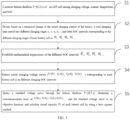
- FIG. 1 is a flowchart of a method for estimating a capacity of a battery cell according to an embodiment of the present disclosure.
- the method for estimating the capacity of the battery cell is applied in a server and the method includes operations at steps S101 to S103.
- step S101 acquire actual charging data of the battery cell within one or more SOC intervals.
- the battery cell can be any battery cell, for example, a battery cell in an LFP battery pack, a battery cell of a nickel-metal hydride battery, a battery cell of a lithium battery, etc.
- step S102 generate an actual charging voltage curve of a corresponding SOC interval based on the actual charging data within each of the one or more SOC intervals, query a pre-established voltage feature database with each of the one or more SOC intervals as an index, and output a reference charging voltage curve of each of the one or more SOC intervals.
- the voltage feature database stores a relationship between the SOC interval and the reference charging voltage curve (i.e., a standard charging voltage curve).
- a specific establishment method will be described in the following embodiments, and details thereof will not be repeated herein.
- the actual charging voltage curve of the corresponding SOC interval can be generated based on the actual charging data of the battery cell within each SOC interval; the reference charging voltage curve corresponding to each SOC interval is queried in the pre-established voltage feature database; and a required value is subsequently calculated based on the actual charging voltage curve and the reference charging voltage curve.
- the method further includes, prior to the querying the pre-established voltage feature database: constructing a charging test matrix of temperature and charging current; acquiring, based on the charging test matrix, charging voltage curves at different charging temperatures and/or different charging rates, performing interpolation on the charging voltage curves at the different temperatures and/or the different charging rates to obtain a plurality of reference charging voltage curves; and constructing the voltage feature database based on each of the one or more SOC intervals and a corresponding one of the plurality of reference charging voltage curves.
- the charging test matrix can be constructed from the two dimensions of the temperature and the charging current, as shown in Table 1. Then, the charging voltage curves at the different temperatures and the different charging rates are acquired based on the charging test matrix, and the interpolation is performed on the charging voltage curves at the different temperatures and the different charging rates to obtain the reference charging voltage curves. Finally, the voltage feature database is constructed based on each SOC interval and the corresponding reference charging voltage curve. Table 1 is a charging test matrix table.
- the acquiring, based on the charging test matrix, the charging voltage curves at the different charging temperatures and/or the different charging rates includes: at a predetermined temperature, performing constant current discharging with a first predetermined current until a predetermined cut-off voltage is reached, switching to a second predetermined current to perform the constant current discharging until the predetermined cut-off voltage is reached, standing for a first predetermined duration, performing the constant current charging with a third predetermined current until the predetermined cut-off voltage is reached, and recording a charging voltage curve at a current temperature and/or a current charging rate; and standing for a second predetermined duration, performing the constant current discharging with a fourth predetermined current until the predetermined cut-off voltage is reached, switching to a fifth predetermined current to perform the constant current discharging until the predetermined cut-off voltage is reached, standing for a third predetermined duration, and re-performing a charging test at other charging rates and/or other charging temperatures.
- the predetermined temperature can be set based on a specific situation, which is a charging and discharging process under a thermostatic condition.
- the first predetermined current, the second predetermined current, the third predetermined current, the fourth predetermined current, and the fifth predetermined current can be set based on a specific situation.
- the first predetermined duration, the second predetermined duration and the third predetermined duration can be set based on a specific situation, which is not limited herein.
- Charging temperature T 1 and charging rate I 15 are taken as an example, a method for acquiring the reference charging voltage curve is as follows.
- the performing the interpolation on the charging voltage curves at the different temperatures and/or the different charging rates to obtain the plurality of reference charging voltage curves includes: calculating a maximum charging capacity corresponding to all the charging voltage curves at the different rates; determining, based on the maximum charging capacity, a step size of a capacity interval corresponding to each of all the charging voltage curves, and dividing the capacity interval into a plurality of grids based on the step size; and calculating a first constant based on a voltage of each of the plurality of grids, acquiring, based on the first constant, a charging voltage at an arbitrary charging current, and generating the plurality of reference charging voltage curves based on the charging voltage at the arbitrary charging current.
- an interpolation method is as follows.
- a maximum charging capacity Q max corresponding to all charging voltage curves at different rates is calculated, and a capacity interval corresponding to all the charging curves is divided into 100 grids with a step size of Q max /100.
- the above linear equation is solved for k and b, and the charging voltage value at any charging current can be obtained based on k, b.
- the performing the interpolation on the charging voltage curves at the different temperatures and/or the different charging rates to obtain the plurality of reference charging voltage curves includes: calculating a maximum charging capacity corresponding to all the charging voltage curves at the different temperatures; determining, based on the maximum charging capacity, a step size of a capacity interval corresponding to each of all the charging voltage curves, and dividing the capacity interval into a plurality of grids based on the step size; and calculating a second constant based on a voltage of each of the plurality of grids, acquiring, based on the second constant, a voltage curve at an arbitrary temperature, and obtaining the plurality of reference charging voltage curves based on the voltage curve at the arbitrary temperature.
- a charging voltage curve at charging rate I 11 is taken as an example, a plurality of reference charging voltage curves at an arbitrary temperature is acquired by the following method.
- a maximum charging capacity Q max corresponding to all charging voltage curves at different temperatures is calculated, and a capacity interval corresponding to all the charging curves is divided into 100 grids with a step size of Q max /100.
- V ae c / T ,
- the equation (2) is solved to obtain a and c, and a voltage curve at the arbitrary temperature can be acquired through a and c.
- step S103 calculate an actual capacity of the battery cell based on the actual charging voltage curve and the reference charging voltage curve of each of the one or more SOC intervals.
- the reference charging voltage curve corresponding to each SOC interval is queried in the pre-established voltage feature database, and the actual capacity of the battery cell is calculated by using the actual charging voltage curve and the reference charging voltage curve.
- a specific calculation method is described as follows.
- the calculating the actual capacity of the battery cell based on the actual charging voltage curve and the reference charging voltage curve of each of the one or more SOC intervals includes: calculating a root-mean-square error of the battery cell based on the actual charging voltage curve and the reference charging voltage curve of each of the one or more SOC intervals, and determining an objective function based on the root-mean-square error; and finding, by using a least squares method, an optimal solution to the objective function to obtain the actual capacity of the battery cell.
- the calculating the root-mean-square error of the battery cell based on the actual charging voltage curve and the reference charging voltage curve of each of the one or more SOC intervals includes: dividing a total charging time period of a reference battery cell into different charging stages; adding an interval identifier to a SOC interval corresponding to each of the different charging stages, and establishing a mathematical expression among SOC interval, SOC, and capacity based on the interval identifier; and extracting the actual charging voltage curve and the corresponding reference charging voltage curve by using the mathematical expression, and calculating the root-mean-square error of the battery cell based on respective mathematical expressions of the actual charging voltage curve and the reference charging voltage curve of each of the one or more SOC intervals.
- the total charging time period can be divided into the different charging stages based on a numerical change of an actual charging current of the reference battery cell; a SOC interval corresponding to each charging stage of the battery cell is identified, and the mathematical expression among the SOC interval, SOC, and capacity is established based on the interval identifier; the respective mathematical expressions of the corresponding actual charging voltage curve and the corresponding reference charging voltage curve of the SOC interval of the battery cell are extracted based on the mathematical expression to calculate the root-mean-square error of the battery cell; and the objective function is determined by means of the root-mean-square error, and the optimal solution to the objective function is found by using the least squares method to obtain the actual capacity of the battery cell.
- an entire charging process is divided into several intervals.
- Time point t 1 is in a first charging stage, a charging SOC interval corresponding to the first charging stage is recorded as ⁇ 1 .
- Time point t 2 is in a second charging stage, and a charging voltage has tended to be stable at the time point t 2 .
- Time point t 3 is a time point when a second stage charging process is about to end, and a charging SOC interval corresponding to the time period from the time point t 2 to the time point t 3 is recorded as ⁇ 2 .
- Time point t 4 is in a third charging stage, and a charging voltage curve has tended to be stable at the time point t 4 .
- Time point t 5 is a time point when a third stage charging process is about to end, and a charging SOC interval corresponding to the time period from the time point t 4 to the time point t 5 is recorded as ⁇ 3 .
- Time interval division and corresponding SOC interval division in other stage charging processes are similar to this, recorded as t 6 , t 7 , ⁇ 4 ; t 8 , t 9 , ⁇ 5 ..., respectively, as shown in FIG. 2 .
- Actual charging voltage curves corresponding to different SOC intervals in a total charging voltage curve are extracted based on the interval identifiers and interval expressions. As shown in FIG. 2 , actual charging voltage curves corresponding to different charging stages are extracted and recorded as V 1 i ⁇ 1 i , V 2 i ⁇ 2 i , V 3 i ⁇ 3 i , V 4 i ⁇ 4 i ... respectively.
- a reference charging voltage curve (V (I, T,x)) in the voltage feature database is queried, root-mean-square error of the actual charging voltage curve ( V 1 i ⁇ 1 i , V 2 i ⁇ 2 i , V 3 i ⁇ 3 i , V 4 i ⁇ 4 i , ... ) and the reference charging voltage curve of each battery cell is calculated, and an actual capacity Q 0 i of each battery cell is calculated based on the least squares method.
- K 1 , K 2 , K 3 , K 4 ... represent weights for optimization in each charging stage, respectively.
- the method includes specific steps at S1 to S5.
- a charging test matrix is constructed from two dimensions of temperature and charging current, as shown in Table 2.
- Table 2 is an example table of a charging test matrix. Table 2 Temperature -20°C -10°C 0°C 10°C 25°C 35°C 45°C Charging current 0.05C 0.05C 0.05C 0.05C 0.05C 0.05C 0.05C 0.1C 0.1C 0.1C 0.1C 0.1C 0.1C 0.2C 0.2C 0.3C 0.5C 0.5C 0.3C 0.3C 0.3C 0.3C 0.3C 0.5C 1C 1C 0.5C 0.4C 0.4C 0.4C 0.4C 1C 2C 2C 1C
- a charging temperature of 25°C and a charging rate of 1C are taken as an example.
- a method for acquiring a reference charging voltage curve is as follows.
- a maximum charging capacity Q max 100Ah corresponding to all charging voltage curves at different rates is calculated, a capacity interval corresponding to all the charging curves is divided into 100 grids with a step size of 1Ah. In each grid, formula (1) is satisfied.
- the linear equation (1) is solved to acquire k and b, and a charging voltage at an arbitrary charging current can be acquired based on k and b.
- a charging voltage curve at a charging rate of 0.1C is taken as an example, a feature database of a temperature dimension can be acquired by the following method.
- a maximum charging capacity Q max 98Ah corresponding to all charging voltage curves at different temperatures is calculated, and a capacity interval corresponding to all the charging curves is divided into 100 grids with a step size of 0.98Ah. In each grid, formula (2) is satisfied. The equation (2) is solved to acquire a and c. A voltage curve at an arbitrary temperature can be acquired based on a and c.
- step S2 divide, based on a numerical change of the actual charging current of the battery, a total charging time period into different charging stages t 1 , t 2 , t 3 , t 4 ..., and SOC intervals corresponding to the different charging stages of each battery cell are labeled as ⁇ 1 i , ⁇ 2 i , ⁇ 3 i , ⁇ 4 i
- FIG. 4 is an actual charging curve of battery cell i in a certain model of an LFP battery pack, and an entire charging process is divided into 7 SOC intervals.
- a charging time period corresponding to ⁇ 1 i is [0 t 1 ]
- a charging time period corresponding to ⁇ 2 i is [ t 2 t 3 ]
- a charging time period corresponding to ⁇ 3 i is [ t 4 t 5 ]
- a charging time period corresponding to ⁇ 4 i is [ t 6 t 7 ]
- a charging time period corresponding to ⁇ 5 i is [ t 8 t 9 ]
- a charging time period corresponding to ⁇ 6 i is [ t 10 t 11 ]
- a charging time period corresponding to ⁇ 7 i is [ t 12 t 13 ].
- Table 3 shows time periods corresponding to different divided charging process. Table 3 t 1 t 2 t 3 t 4 t 5 t 6 t 7 t 8 t 9 t 10 t 11 t 12 t 13 0.03 0.11 0.29 0.31 0.42 0.45 0.5 0.53 0.61 0.63 0.72 0.74 0.83
- step S3 establish interval expressions of the different SOC intervals ⁇ 1 i , ⁇ 2 i , ⁇ 3 i , ⁇ 4 i ... .
- a temperature standard capacity of the selected LFP battery cell is 90 Ah.
- a SOC i.e. initial SOC
- a capacity thereof is recorded as Q 0 i
- expressions of the different SOC intervals are represented as: ⁇ 1 i ⁇ x 0 i , x 0 i + 0.026 , ⁇ 2 i ⁇ x 0 i + 0.1 , x 0 i + 0.26 , ⁇ 3 i ⁇ x 0 i + 0.28 , x 0 i + 0.37 , ⁇ 4 i ⁇ x 0 i + 0.4 , x 0 i + 0.44 , ⁇ 5 i ⁇ x 0 i + 0.47 , x 0 i + 0.54 , ⁇ 6 i ⁇ x 0 i + 0.56 , x
- step S4 extract corresponding actual charging voltage curves of each battery cell (i) in different charging SOC intervals.
- the actual charging voltage curves corresponding to the different charging stages are extracted and recorded as V 1 i ⁇ 1 i , V 2 i ⁇ 2 i , V 3 i ⁇ 3 i , V 4 i ⁇ 4 i , V 5 i ⁇ 5 i , V 6 i ⁇ 6 i , V 7 i ⁇ 7 i , respectively.
- step S5 query a standard voltage curve through the feature database; determine a root-mean-square error of V 1 i ⁇ 1 i , V 2 i ⁇ 2 i , V 3 i ⁇ 3 i , V 4 i ⁇ 4 i , ... and the standard voltage curve as an objective function; and calculate Q 0 i and an initial SOC of each battery cell by using a least squares method.
- Reference charging voltage curve (V(I,T,x)) in the voltage feature database is queried based on temperatures and currents of the different charging stages in the actual charging process; a root-mean-square error of the actual charging voltage curve ( V 1 i ⁇ 1 i , V 2 i ⁇ 2 i , V 3 i ⁇ 3 i , V 4 i ⁇ 4 i , ... ) and the reference charging voltage curve of each battery cell is calculated; and actual capacity Q 0 i of each battery cell is calculated by using the least squares method.
- K 1 , K 2 , K 3 , K 4 , K 5 , K 6 , K 7 represent weights for optimization in each charging stage, respectively.
- the actual capacity Q 0 i of each battery cell is calculated as shown in Table 4.
- Table 4 shows a capacity of each battery cell in the LFP battery pack.
- Battery cell number 16 17 18 19 20 21 22 23 24 25 26 27 28 29 30 Capacit y/Ah 89.
- the actual capacity of the battery cell can be accurately calculated by comparing the actual charging voltage curve of the battery cell with the corresponding reference charging voltage curve of the battery cell. Since the pre-calibrated standard reference charging voltage curve is used, the actual capacity of the battery cell can be accurately obtained through the comparison based on the voltage curve, avoiding an influence of the battery system on the estimation result, which is effectively applicable to a plurality of battery systems.
- the estimation method according to the embodiments of the present disclosure can be deployed in the server, and calculation efficiency is improved by using computing resources of the server.
- the root-mean-square error can be calculated by using the actual charging voltage curve and the reference charging voltage curve, and the objective function is determined by using the root-mean-square error; and the actual capacity of the battery cell is calculated by using the least squares method for the optimal solution.
- the total charging time period of the reference battery cell can be divided into the different charging stages.
- the interval identifiers are set for the SOC intervals of the different charging stages.
- the mathematical expressions of the different SOC intervals are established.
- the actual charging voltage curve and the corresponding reference charging voltage curve are further extracted by using the mathematical expressions.
- the root-mean-square error is calculated based on the respective mathematical expressions of the actual charging voltage curve and the reference charging voltage curve of each SOC interval.
- the charging test matrix can be constructed from the two dimensions of the temperature and the charging current.
- the interpolation is performed on the charging voltage curves at the different charging temperatures and the different charging rates that are obtained by means of the charging matrix to obtain the plurality of reference charging voltage curves.
- the voltage feature database is constructed by using the plurality of reference charging voltage curves and the SOC intervals to facilitate the subsequent lookup of the corresponding reference charging voltage curves based on the SOC intervals.
- the interpolation can be performed on the charging voltage curves at the different charging rates, and the reference charging voltage curve corresponding to the charging voltage at the arbitrary charging current is calculated with the formula.
- the interpolation can be performed on the charging voltage curves at the different temperatures, and the reference charging voltage curve corresponding to the voltage curve at the arbitrary temperature is calculated with the formula.
- FIG. 5 is another flowchart of a method for estimating a capacity of a battery cell according to an embodiment of the present disclosure.
- the method for estimating the capacity of the battery cell is applied in a server and includes operations at steps S201 to S203.
- step S201 a charging test matrix of temperature and charging current is constructed.
- step S202 charging voltage curves at different charging temperatures and/or different charging rates are acquired based on the charging test matrix, and interpolation is performed on the charging voltage curves at the different temperatures and/or the different charging rates to obtain a reference charging voltage curve of each SOC interval.
- the charging voltage curves at the different charging temperatures and the different charging rates are acquired based on the charging test matrix, and then the interpolation is performed to obtain the reference charging voltage curve of each SOC interval.
- the interpolation method has been described in the above embodiments, and details thereof will not be described herein.
- step S203 a voltage feature database is constructed based on the reference charging voltage curve of each SOC interval, the reference charging voltage curve of each SOC interval is queried by using the voltage feature database, and an actual capacity of the battery cell is calculated based on an actual charging voltage curve and the reference charging voltage curve of each SOC interval.
- the voltage feature database stores the relationship between the SOC interval and the reference charging voltage curve, and the reference charging voltage curve corresponding to the SOC interval can be queried by using the voltage feature database.
- the reference charging voltage curve of each SOC interval can be queried by using the voltage feature database, the actual capacity and the initial SOC of the battery cell are calculated based on the actual charging voltage curve and the corresponding reference charging voltage curve of each SOC interval, and the corresponding actual SOC of the battery cell during the charging process is calculated by using the actual capacity and the initial SOC.
- the specific calculation method has been described in the above embodiments, and details thereof will not be described herein.
- the charging test matrix is constructed from the two dimensions of the temperature and the charging current; the charging voltage curves at the different charging temperatures and the different charging rates are acquired; the interpolation is performed on the charging voltage curves to obtain the reference charging voltage curves; the actual capacity of the battery cell is calculated based on the actual charging voltage curve and the reference charging voltage curve of the battery cell within each SOC interval; and the calculation method is deployed on the server, which is not affected by the battery system and can accurately calculate the capacity of each battery cell in the battery pack.
- FIG. 6 is a block diagram of a device for estimating a capacity of a battery cell according to an embodiment of the present disclosure.
- a device 10 for estimating a capacity of a battery cell includes an acquisition module 101, an output module 102, and a first calculation module 103.
- the acquisition module 101 is configured to acquire actual charging data of the battery cell within one or more SOC intervals.
- the output module 102 is configured to generate, based on the actual charging data within each of one or more SOC intervals, an actual charging voltage curve of a corresponding SOC interval, generate actual charging voltage curves corresponding to the SOC intervals based on the actual charging data, query a pre-established voltage feature database with each of the one or more SOC intervals as an index, and output a reference charging voltage curve of each of the one or more SOC interval curves.
- the first calculation module 103 is configured to calculate an actual capacity of the battery cell based on the actual charging voltage curve and the reference charging voltage curve of each of one or more SOC intervals.
- the first calculation module 103 is further configured to: calculate a root-mean-square error of the battery cell based on the actual charging voltage curve and the reference charging voltage curve of each of the one or more SOC intervals, and determine an objective function based on the root-mean-square error; and find, by using a least squares method, an optimal solution to the objective function to obtain the actual capacity of the battery cell.
- the first calculation module 103 is further configured to: calculate a root-mean-square error of the battery cell based on the actual charging voltage curve and the reference charging voltage curve of each of the one or more SOC intervals, and determine an objective function based on the root-mean-square error; and find, by using a least squares method, an optimal solution to the objective function to obtain the actual capacity of the battery cell.
- the device 10 of the present disclosure further includes a processing module.
- the processing module is configured to: prior to the querying the pre-established voltage feature database, construct a charging test matrix of temperature and charging current; acquire, based on the charging test matrix, charging voltage curves at different charging temperatures and/or different charging rates, and perform interpolation on the charging voltage curves at the different temperatures and/or the different charging rates to obtain a plurality of reference charging voltage curves; and construct the voltage feature database based on each of the one or more SOC intervals and a corresponding one of the plurality of reference charging voltage curves.
- the processing module is further configured to: calculate a maximum charging capacity corresponding to all the charging voltage curves at the different rates; determine, based on the maximum charging capacity, a step size of a capacity interval corresponding to each of all the charging voltage curves, and divide the capacity interval into a plurality of grids based on the step size; and calculate a first constant based on a voltage of each of the plurality of grids, acquire, based on the first constant, a charging voltage at an arbitrary charging current, and generate the plurality of reference charging voltage curves based on the charging voltage at the arbitrary charging current.
- the processing module is further configured to: calculate a maximum charging capacity corresponding to all the charging voltage curves at the different temperatures; determine, based on the maximum charging capacity, a step size of a capacity interval corresponding to each of all the charging voltage curves, and divide the capacity interval into a plurality of grids based on the step size; and calculate a second constant based on a voltage of each of the plurality of grids, acquire, based on the second constant, a voltage curve at an arbitrary temperature, and obtain the plurality of reference charging voltage curves based on the voltage curve at the arbitrary temperature.
- the processing module is further configured to: at a predetermined temperature, perform constant current discharging with a first predetermined current until a predetermined cut-off voltage is reached, switch to a second predetermined current to perform the constant current discharging until the predetermined cut-off voltage is reached, stand for a first predetermined duration, perform the constant current charging with a third predetermined current until the predetermined cut-off voltage is reached, and record a charging voltage curve at a current temperature and/or a current charging rate; and stand for a second predetermined duration, perform the constant current discharging with a fourth predetermined current until the predetermined cut-off voltage is reached, switch to a fifth predetermined current to perform the constant current discharging until the predetermined cut-off voltage is reached, stand for a third predetermined duration, and re-perform a charging test at other charging rates and/or other charging temperatures.
- the actual capacity of the battery cell can be accurately calculated by comparing the actual charging voltage curve of the battery cell with the corresponding reference charging voltage curve of the battery cell. Since the pre-calibrated standard reference charging voltage curve is used, the actual capacity of the battery cell can be accurately obtained through the comparison based on the voltage curve, avoiding an influence of the battery system on the estimation result, which is effectively applicable to a plurality of battery systems.
- the estimation method according to the embodiments of the present disclosure can be deployed in the server, and calculation efficiency is improved by using computing resources of the server.
- the root-mean-square error can be calculated by using the actual charging voltage curve and the reference charging voltage curve, and the objective function is determined by using the root-mean-square error; and the actual capacity of the battery cell is calculated by using the least squares method for the optimal solution.
- the total charging time period of the reference battery cell can be divided into the different charging stages.
- the interval identifiers are set for the SOC intervals of the different charging stages.
- the mathematical expressions of the different SOC intervals are established.
- the actual charging voltage curve and the corresponding reference charging voltage curve are further extracted by using the mathematical expressions.
- the root-mean-square error is calculated based on the respective mathematical expressions of the actual charging voltage curve and the reference charging voltage curve of each SOC interval.
- the charging test matrix can be constructed from the two dimensions of the temperature and the charging current.
- the interpolation is performed on the charging voltage curves at the different charging temperatures and the different charging rates that are obtained by means of the charging matrix to obtain the plurality of reference charging voltage curves.
- the voltage feature database is constructed by using the plurality of reference charging voltage curves and the SOC intervals to facilitate the subsequent lookup of the corresponding reference charging voltage curves based on the SOC intervals.
- the interpolation can be performed on the charging voltage curves at the different charging rates, and the reference charging voltage curve corresponding to the charging voltage at the arbitrary charging current is calculated with the formula.
- the interpolation can be performed on the charging voltage curves at the different temperatures, and the reference charging voltage curve corresponding to the voltage curve at the arbitrary temperature is calculated with the formula.
- FIG. 7 is a block diagram of a device for estimating a capacity of a battery cell according to another embodiment of the present disclosure.
- a device 20 for estimating a capacity of a battery cell is applied in a server.
- the device 20 includes a construction module 201, an interpolation module 202, and a second calculation module 203.
- the construction module 201 is configured to construct a charging test matrix of temperature and charging current.
- the interpolation module 202 is configured to acquire, based on the charging test matrix, charging voltage curves at different charging temperatures and/or different charging rates, and perform interpolation on the charging voltage curves at the different temperatures and/or the different charging rates to obtain a reference charging voltage curve of each SOC interval.
- the second calculation module 203 is configured to construct a voltage feature database based on the reference charging voltage curve of each SOC interval, query the reference charging voltage curve of each SOC interval by using the voltage feature database, and calculate an actual capacity of the battery cell based on an actual charging voltage curve and the reference charging voltage curve of each SOC interval.
- the charging test matrix is constructed from the two dimensions of the temperature and the charging current; the charging voltage curves at the different charging temperatures and the different charging rates are acquired; the interpolation is performed on the charging voltage curves to obtain the reference charging voltage curves; the actual capacity of the battery cell is calculated based on the actual charging voltage curve and the reference charging voltage curve of the battery cell within each SOC interval; and the calculation method is deployed on the server, which is not affected by the battery system and can accurately calculate the capacity of each battery cell in the battery pack.
- FIG. 8 is a schematic diagram of a structure of a server according to an embodiment of the present disclosure.
- the server may include a memory 801, a processor 802, and a computer program stored in the memory 801 and executable by the processor 802.
- the processor 802 when executing the program, implements the method for estimating the capacity of the battery cell in the above embodiments described above.
- the server further includes a communication interface 803.
- the communication interface 803 stores communication between the memory 801 and the processor 802.
- the memory 801 stores a computer program executable by the processor 802.
- the memory 801 may include a high-speed RAM (Random Access Memory), and may also include a nonvolatile memory, such as at least one disk memory.
- the communication interface 803, the memory 801, and the processor 802 can be connected to each other via a bus and communicate with each other.
- the bus can be an ISA (Industry Standard Architecture) bus, a PCI (Peripheral Component) bus, or an EISA (Extended Industry Standard Architecture) bus, etc.
- the bus can be divided into an address bus, a data bus, a control bus, etc. For ease of representation, only one thick line is used in FIG. 8 , but it does not mean that there is only one bus or one type of bus.
- the memory 801, the processor 802, and the communication interface 803 are integrated on a chip, the memory 801, the processor 802, and the communication interface 803 can communicate with each other via an internal interface.
- the processor 802 can be a CPU (Central Processing Unit), or an ASIC (Application Specific Integrated Circuit), or one or more integrated circuits configured to implement the embodiments of the present disclosure.
- CPU Central Processing Unit
- ASIC Application Specific Integrated Circuit
- Embodiments of the present disclosure also provide a computer-readable storage medium.
- the medium has a computer program stored thereon.
- the program when executed by a processor, implements the method for estimating the capacity of the battery cell as described above.
- first and second are used herein for purposes of description and are not intended to indicate or imply relative importance, or to implicitly show the number of technical features indicated.
- the feature defined with “first” and “second” may explicitly or implicitly comprise one or more this feature.
- N means at least two, for example, two or three, unless specified otherwise.
- Any process or method described in a flow chart or described herein in other ways may be understood to include one or more modules, segments or portions of codes of executable instructions for achieving specific logical functions or steps in the process, and the scope of a preferred embodiment of the present disclosure includes other implementations.
- Functions may be executed in a different order from the illustrated or discussed order, and may be executed, depending on functions involved, substantially in parallel with each or in a reverse order, which should be understood by those skilled in the art of the embodiments of the present disclosure.
- N steps or methods may be realized by the software or firmware stored in the memory and executed by the appropriate instruction execution system.
- the steps or methods may be realized by one or a combination of the following techniques known in the art: a discrete logic circuit having a logic gate circuit for realizing a logic function of a data signal, an application-specific integrated circuit having an appropriate combination logic gate circuit, a programmable gate array, a field programmable gate array, etc.
Landscapes
- Physics & Mathematics (AREA)
- General Physics & Mathematics (AREA)
- Engineering & Computer Science (AREA)
- Power Engineering (AREA)
- Secondary Cells (AREA)
- Charge And Discharge Circuits For Batteries Or The Like (AREA)
Abstract
Description
- This application is submitted based on and claims priority to
Chinese Patent Application No. 202310640090.X, filed on May 31, 2023 - The present disclosure relates to the field of battery management system technologies, and particularly, to a method and device for estimating a capacity of a battery cell, a server, and a storage medium.
- A battery pack generally contains dozens or even hundreds of battery cells. A capacity of the battery pack is determined by a capacity of each battery cell. Accurately calculating the capacity of each battery cell can not only acquire a capacity fade condition of each battery cell during use but also enable calculation of a current capacity of the battery pack based on a capacity of the battery cell calculated in real time and further accurate calculation of SOH (State of Health) of a battery.
- Since the battery pack is controlled through a highest voltage and a lowest voltage of the battery cell during charging/discharging, when the capacity and a SOC (State of charge) of each battery cell in the battery pack are inconsistent, it is impossible to acquire the capacity of each battery cell by simple charging and discharging.
- In the related art, a total capacity of the battery cell is calculated by using a correspondence ΔV~ΔQ between voltage and capacity during constant current charging (discharging). However, this method is effective for a battery system such as Nickel Manganese Cobalt, NMC (a ternary material), but not for a lithium iron phosphate (LiFePO4, LFP) battery system. A voltage curve of the LFP battery system is extremely flat, which makes a correspondence ΔV~ΔQ within a voltage plateau region keenly sensitive. A slight change in voltage may cause a significant change in capacity, resulting in a large error in the estimation of the capacity.
- The present disclosure provides a method and device for estimating a capacity of a battery cell, a server, and a storage medium to solve problems that a method for calculating a capacity of a battery cell is affected by a battery system and calculation accuracy is lower in the related art.
- A method for estimating a capacity of a battery cell is provided according to embodiments in a first aspect of the present disclosure. The method is applied in a server. The method includes: acquiring actual charging data of the battery cell within one or more SOC intervals; generating, based on the actual charging data within each of the one or more SOC intervals, an actual charging voltage curve of a corresponding SOC interval, querying a pre-established voltage feature database with each of the one or more SOC intervals as an index, and outputting a reference charging voltage curve of each of the one or more SOC intervals; and calculating an actual capacity of the battery cell based on the actual charging voltage curve and the reference charging voltage curve of each of the one or more SOC intervals.
- According to the above technical means, in the embodiments of the present disclosure, the actual capacity of the battery cell can be accurately calculated by comparing the actual charging voltage curve of the battery cell with the corresponding reference charging voltage curve. Since a pre-calibrated standard reference charging voltage curve is used, the actual capacity of the battery cell can be accurately obtained through the comparison, based on the voltage curve, avoiding an influence of the battery system on the estimation result, which is effectively applicable to a plurality of battery systems. At the same time, the estimation method according to the embodiments of the present disclosure can be deployed in the server, and calculation efficiency is improved by using computing resources of the server.
- Optionally, the calculating the actual capacity of the battery cell based on the actual charging voltage curve and the reference charging voltage curve of each of the one or more SOC intervals includes: calculating a root-mean-square error of the battery cell based on the actual charging voltage curve and the reference charging voltage curve of each of the one or more SOC intervals, and determining an objective function based on the root-mean-square error; and finding, by using a least squares method, an optimal solution to the objective function to obtain the actual capacity of the battery cell.
- According to the above technical means, in the embodiments of the present disclosure, the root-mean-square error can be calculated by using the actual charging voltage curve and the reference charging voltage curve and the objective function is determined by using the root-mean-square error; and the actual capacity of the battery cell is calculated by using the least squares method for the optimal solution.
- Optionally, the calculating the root-mean-square error of the battery cell based on the actual charging voltage curve and the reference charging voltage curve of each of the one or more SOC intervals includes: dividing a total charging time period of a reference battery cell into different charging stages; adding an interval identifier to a SOC interval corresponding to each of the different charging stages, and establishing a mathematical expression among SOC interval, SOC, and capacity based on the interval identifier; and extracting the actual charging voltage curve and the corresponding reference charging voltage curve by using the mathematical expression, and calculating the root-mean-square error of the battery cell based on respective mathematical expressions of the actual charging voltage curve and the reference charging voltage curve of each of the one or more SOC intervals.
- According to the above technical means, in the embodiments of the present disclosure, the total charging time period of the reference battery cell can be divided into the different charging stages; the interval identifiers are set for the SOC intervals of the different charging stages; the mathematical expressions of the different SOC intervals are established; the actual charging voltage curve and the corresponding reference charging voltage curve are further extracted by using the mathematical expressions; and the root-mean-square error is calculated based on the respective mathematical expressions of the actual charging voltage curve and the reference charging voltage curve of each SOC interval.
- Optionally, the method further includes, prior to the querying the pre-established voltage feature database: constructing a charging test matrix of temperature and charging current; acquiring, based on the charging test matrix, charging voltage curves at different charging temperatures and/or different charging rates, performing interpolation on the charging voltage curves at the different temperatures and/or the different charging rates to obtain a plurality of reference charging voltage curves; and constructing the voltage feature database based on each of the one or more SOC intervals and a corresponding one of the plurality of reference charging voltage curves.
- According to the above technical means, in the embodiments of the present disclosure, the charging test matrix can be constructed from the two dimensions of the temperature and the charging current; the interpolation is performed on the charging voltage curves at the different charging temperatures and the different charging rates that are obtained by means of the charging matrix, to obtain the plurality of reference charging voltage curves; and the voltage feature database is constructed by using the plurality of reference charging voltage curves and the SOC intervals to facilitate subsequent lookup of the corresponding reference charging voltage curves based on the SOC intervals.
- Optionally, the performing the interpolation on the charging voltage curves at the different temperatures and/or the different charging rates to obtain the plurality of reference charging voltage curves includes: calculating a maximum charging capacity corresponding to all the charging voltage curves at the different rates; determining, based on the maximum charging capacity, a step size of a capacity interval corresponding to each of all the charging voltage curves, and dividing the capacity interval into a plurality of grids based on the step size; and calculating a first constant based on a voltage of each of the plurality of grids, acquiring, based on the first constant, a charging voltage at an arbitrary charging current, and generating the plurality of reference charging voltage curves based on the charging voltage at the arbitrary charging current.
- According to the above technical means, in the embodiments of the present disclosure, the interpolation can be performed on the charging voltage curves at the different charging rates, and the reference charging voltage curve corresponding to the charging voltage at the arbitrary charging current is calculated with a formula.
- Optionally, the performing the interpolation on the charging voltage curves at the different temperatures and/or the different charging rates to obtain the plurality of reference charging voltage curves further includes: calculating a maximum charging capacity corresponding to all the charging voltage curves at the different temperatures; determining, based on the maximum charging capacity, a step size of a capacity interval corresponding to each of all the charging voltage curves, and dividing the capacity interval into a plurality of grids based on the step size; and calculating a second constant based on a voltage of each of the plurality of grids, acquiring, based on the second constant, a voltage curve at an arbitrary temperature, and obtaining the plurality of reference charging voltage curves based on the voltage curve at the arbitrary temperature.
- According to the above technical means, in the embodiments of the present disclosure, the interpolation can be performed on the charging voltage curves at the different temperatures, and the reference charging voltage curve corresponding to the voltage curve at the arbitrary temperature is calculated with a formula.
- Optionally, the acquiring, based on the charging test matrix, the charging voltage curves at the different charging temperatures and/or the different charging rates includes: at a predetermined temperature, performing constant current discharging with a first predetermined current until a predetermined cut-off voltage is reached, switching to a second predetermined current to perform the constant current discharging until the predetermined cut-off voltage is reached, standing for a first predetermined duration, performing the constant current charging with a third predetermined current until the predetermined cut-off voltage is reached, and recording a charging voltage curve at a current temperature and/or a current charging rate; and standing for a second predetermined duration, performing the constant current discharging with a fourth predetermined current until the predetermined cut-off voltage is reached, switching to a fifth predetermined current to perform the constant current discharging until the predetermined cut-off voltage is reached, standing for a third predetermined duration, and re-performing a charging test at other charging rates and/or other charging temperatures.
- According to the above technical means, in the embodiments of the present disclosure, the charging voltage curves at the different charging temperatures and/or the different charging rates can be acquired based on the charging test matrix to facilitate subsequent acquisition of the reference charging voltage curve based on the charging voltage curve.
- A method for estimating a capacity of a battery cell is provided according to embodiments in a second aspect of the present disclosure. The method is applied in a server. The method includes: constructing a charging test matrix of temperature and charging current; acquiring, based on the charging test matrix, charging voltage curves at different charging temperatures and/or different charging rates, performing interpolation on the charging voltage curves at the different temperatures and/or the different charging rates to obtain a reference charging voltage curve of each SOC interval; and constructing a voltage feature database based on the reference charging voltage curve of each SOC interval, querying the reference charging voltage curve of each SOC interval by using the voltage feature database, and calculating an actual capacity of the battery cell based on an actual charging voltage curve and the reference charging voltage curve of each SOC interval.
- A device for estimating a capacity of a battery cell is provided according to embodiments in a third aspect of the present disclosure. The device is applied in a server. The device includes: acquiring actual charging data of the battery cell within one or more SOC intervals; generating, based on the actual charging data within each of the one or more SOC intervals, an actual charging voltage curve of a corresponding SOC interval, querying a pre-established voltage feature database with each of the one or more SOC intervals as an index, and outputting a reference charging voltage curve of each of the one or more SOC intervals; and calculating an actual capacity of the battery cell based on the actual charging voltage curve and the reference charging voltage curve of each of the one or more SOC intervals.
- Optionally, the first calculation module is further configured to: calculate a root-mean-square error of the battery cell based on the actual charging voltage curve and the reference charging voltage curve of each of the one or more SOC intervals, and determine an objective function based on the root-mean-square error; and find, by using a least squares method, an optimal solution to the objective function to obtain the actual capacity of the battery cell.
- Optionally, the first calculation module is further configured to: divide a total charging time period of a reference battery cell into different charging stages; add an interval identifier to a SOC interval corresponding to each of the different charging stages, and establish a mathematical expression among SOC interval, SOC, and capacity based on the interval identifier; and extract the actual charging voltage curve and the corresponding reference charging voltage curve by using the mathematical expression, and calculate the root-mean-square error of the battery cell based on respective mathematical expressions of the actual charging voltage curve and the reference charging voltage curve of each of the one or more SOC intervals.
- Optionally, the device further includes a processing module. The processing module is configured to: prior to the querying the pre-established voltage feature database, construct a charging test matrix of temperature and charging current; acquire, based on the charging test matrix, charging voltage curves at different charging temperatures and/or different charging rates, and perform interpolation on the charging voltage curves at the different temperatures and/or the different charging rates to obtain a plurality of reference charging voltage curves; and construct the voltage feature database based on each of the one or more SOC intervals and a corresponding one of the plurality of reference charging voltage curves.
- Optionally, the processing module is further configured to: calculate a maximum charging capacity corresponding to all the charging voltage curves at the different rates; determine, based on the maximum charging capacity, a step size of a capacity interval corresponding to each of all the charging voltage curves, and divide the capacity interval into a plurality of grids based on the step size; and calculate a first constant based on a voltage of each of the plurality of grids, acquire, based on the first constant, a charging voltage at an arbitrary charging current, and generate the plurality of reference charging voltage curves based on the charging voltage at the arbitrary charging current.
- Optionally, the processing module is further configured to: calculate a maximum charging capacity corresponding to all the charging voltage curves at the different temperatures; determine, based on the maximum charging capacity, a step size of a capacity interval corresponding to each of all the charging voltage curves, and divide the capacity interval into a plurality of grids based on the step size; and calculate a second constant based on a voltage of each of the plurality of grids, acquire, based on the second constant, a voltage curve at an arbitrary temperature, and obtain the plurality of reference charging voltage curves based on the voltage curve at the arbitrary temperature.
- Optionally, the processing module is further configured to: at a predetermined temperature, perform constant current discharging with a first predetermined current until a predetermined cut-off voltage is reached, switch to a second predetermined current to perform the constant current discharging until the predetermined cut-off voltage is reached, stand for a first predetermined duration, perform the constant current charging with a third predetermined current until the predetermined cut-off voltage is reached, and record a charging voltage curve at a current temperature and/or a current charging rate; and stand for a second predetermined duration, perform the constant current discharging with a fourth predetermined current until the predetermined cut-off voltage is reached, switch to a fifth predetermined current to perform the constant current discharging until the predetermined cut-off voltage is reached, stand for a third predetermined duration, and re-perform a charging test at other charging rates and/or other charging temperatures.
- A device for estimating a capacity of a battery cell is provided according to embodiments in a fourth aspect of the present disclosure. The device is applied in a server. The device includes a construction module, an interpolation module, and a second calculation module. The construction module is configured to construct a charging test matrix of temperature and charging current. The interpolation module is configured to acquire, based on the charging test matrix, charging voltage curves at different charging temperatures and/or different charging rates, and perform interpolation on the charging voltage curves at the different temperatures and/or the different charging rates to obtain a reference charging voltage curve of each SOC interval. The second calculation module is configured to construct a voltage feature database based on the reference charging voltage curve of each SOC interval, query the reference charging voltage curve of each SOC interval by using the voltage feature database, and calculate an actual capacity of the battery cell based on an actual charging voltage curve and the reference charging voltage curve of each SOC interval.
- A server is provided according to embodiments in a fifth aspect of the present disclosure. The server includes a memory, a processor, and a computer program stored in the memory and executable by the processor. The processor is configured to execute the computer program to implement the method for estimating the capacity of the battery cell as described in the above embodiments.
- A computer-readable storage medium is provided according to embodiments in a sixth aspect of the present disclosure. The medium has a computer program stored thereon. The computer program is configured to be executed by a processor to implement the method for estimating the capacity of the battery cell as described in the above embodiments.
- Therefore, the present disclosure has at least the following beneficial effects.
- (1) In the embodiments of the present disclosure, the actual capacity of the battery cell can be accurately calculated by comparing the actual charging voltage curve of the battery cell with the corresponding reference charging voltage curve. Since a pre-calibrated standard reference charging voltage curve is used, the actual capacity of the battery cell can be accurately obtained by the comparison based on the voltage curve, avoiding an influence of the battery system on the estimation result, which is effectively applicable to a plurality of battery systems. At the same time, the estimation method according to the embodiments of the present disclosure can be deployed in the server, and calculation efficiency is improved by using computing resources of the server.
- (2) In the embodiments of the present disclosure, the root-mean-square error can be calculated by using the actual charging voltage curve and the reference charging voltage curve, and the objective function is determined by using the root-mean-square error; and the actual capacity of the battery cell is calculated by using the least squares method for the optimal solution.
- (3) In the embodiments of the present disclosure, the total charging time period of the reference battery cell can be divided into the different charging stages; the interval identifiers is set for the SOC intervals of the different charging stages; the mathematical expressions of the different SOC intervals are established; the actual charging voltage curve and the corresponding reference charging voltage curve are further extracted by using the mathematical expressions; and the root-mean-square error is calculated based on the respective mathematical expressions of the actual charging voltage curve and the reference charging voltage curve of each SOC interval.
- (4) In the embodiments of the present disclosure, the charging test matrix can be constructed from the two dimensions of the temperature and the charging current; the interpolation is performed on the charging voltage curves at the different charging temperatures and the different charging rates that are obtained by means of the charging matrix, to obtain the plurality of reference charging voltage curves; and the voltage feature database is constructed by using the plurality of reference charging voltage curves and the SOC intervals to facilitate subsequent lookup of the corresponding reference charging voltage curves based on the SOC intervals.
- (5) In the embodiments of the present disclosure, the interpolation can be performed on the charging voltage curves at the different charging rates, and the reference charging voltage curve corresponding to the charging voltage at the arbitrary charging current is calculated with a formula.
- (6) In the embodiments of the present disclosure, the interpolation can be performed on the charging voltage curves at the different temperatures, and the reference charging voltage curve corresponding to the voltage curve at the arbitrary temperature is calculated with a formula.
- (7) In the embodiments of the present disclosure, the charging voltage curves at the different charging temperatures and/or the different charging rates can be acquired based on the charging test matrix to facilitate subsequent acquisition of the reference charging voltage curve based on the charging voltage curve.
- Therefore, the technical problems in the related art, such as the method for calculating the capacity of the battery cell is affected by the battery system and the calculation accuracy is lower, are solved.
- Additional aspects and advantages of the present disclosure will be provided at least in part in the following description, or will become apparent in part from the following description, or can be learned from the practice of the present disclosure.
- These and other aspects and advantages of the present disclosure will become apparent and more readily appreciated from the following descriptions made with reference to the accompanying drawings.
-
FIG. 1 is a flowchart of a method for estimating a capacity of a battery cell according to an embodiment of the present disclosure. -
FIG. 2 is a schematic diagram of charging interval division and interval identifiers according to an embodiment of the present disclosure. -
FIG. 3 is a flowchart of a method for estimating a capacity of a battery cell according to an embodiment of the present disclosure. -
FIG. 4 is a schematic diagram of charging interval division and interval identifiers of any battery cell in an LFP battery pack provided according to an embodiment of the present disclosure. -
FIG. 5 is a flowchart of a method for estimating a capacity of a battery cell according to another embodiment of the present disclosure. -
FIG. 6 is an example diagram of a device for estimating a capacity of a battery cell according to an embodiment of the present disclosure. -
FIG. 7 is an example diagram of a device for estimating a capacity of a battery cell according to another embodiment of the present disclosure. -
FIG. 8 is a schematic diagram of a structure of a server according to an embodiment of the present disclosure. - Embodiments of the present disclosure are described in detail below, examples of which are illustrated in the accompanying drawings, where the same or similar reference numerals throughout represent the same or similar elements or elements with the same or similar functions. The embodiments described below with reference to the accompanying drawings are illustrative only, and are intended to explain rather than limit the present disclosure.
- A method and device for estimating a capacity of a battery cell, a server, and a storage medium according to embodiments of the present disclosure will be described below with reference to the accompanying drawings. In view of the problem mentioned in the above background technology, where the method in which the total capacity of the battery cell is calculated by using the correspondence ΔV~ΔQ between the voltage and the capacity during the constant current charging (discharging) in the related art, is effective for the battery system such as the NMC but not applicable to the LFP battery system, leading to the large error in the estimation of the capacity, the present disclosure provides a method for estimating a capacity of a battery cell. In this method, an actual capacity of the battery cell is accurately calculated by comparing an actual charging voltage curve of the battery cell with a corresponding reference charging voltage curve. Since a pre-calibrated standard reference charging voltage curve is used, the actual capacity of the battery cell can be accurately obtained through the comparison, based on the voltage curve, avoiding an influence of the battery system on the estimation result, which is effectively applicable to a plurality of battery systems. Therefore, the technical problems in the related art, such as the method for calculating the capacity of the battery cell is affected by the battery system and the calculation accuracy is lower, are solved.
- Specifically,
FIG. 1 is a flowchart of a method for estimating a capacity of a battery cell according to an embodiment of the present disclosure. - As shown in
FIG. 1 , the method for estimating the capacity of the battery cell is applied in a server and the method includes operations at steps S101 to S103. - In step S101, acquire actual charging data of the battery cell within one or more SOC intervals.
- The battery cell can be any battery cell, for example, a battery cell in an LFP battery pack, a battery cell of a nickel-metal hydride battery, a battery cell of a lithium battery, etc.
- In step S102, generate an actual charging voltage curve of a corresponding SOC interval based on the actual charging data within each of the one or more SOC intervals, query a pre-established voltage feature database with each of the one or more SOC intervals as an index, and output a reference charging voltage curve of each of the one or more SOC intervals.
- The voltage feature database stores a relationship between the SOC interval and the reference charging voltage curve (i.e., a standard charging voltage curve). A specific establishment method will be described in the following embodiments, and details thereof will not be repeated herein.
- It can be understood that in the embodiment of the present disclosure, the actual charging voltage curve of the corresponding SOC interval can be generated based on the actual charging data of the battery cell within each SOC interval; the reference charging voltage curve corresponding to each SOC interval is queried in the pre-established voltage feature database; and a required value is subsequently calculated based on the actual charging voltage curve and the reference charging voltage curve.
- In an embodiment of the present disclosure, the method further includes, prior to the querying the pre-established voltage feature database: constructing a charging test matrix of temperature and charging current; acquiring, based on the charging test matrix, charging voltage curves at different charging temperatures and/or different charging rates, performing interpolation on the charging voltage curves at the different temperatures and/or the different charging rates to obtain a plurality of reference charging voltage curves; and constructing the voltage feature database based on each of the one or more SOC intervals and a corresponding one of the plurality of reference charging voltage curves.
- It can be understood that in the embodiment of the present disclosure, the charging test matrix can be constructed from the two dimensions of the temperature and the charging current, as shown in Table 1. Then, the charging voltage curves at the different temperatures and the different charging rates are acquired based on the charging test matrix, and the interpolation is performed on the charging voltage curves at the different temperatures and the different charging rates to obtain the reference charging voltage curves. Finally, the voltage feature database is constructed based on each SOC interval and the corresponding reference charging voltage curve. Table 1 is a charging test matrix table.
Table 1 Temperature T1 T2 T3 T4 T5 T6 T7 Charging current I11 I12 I13 I14 I15 I16 I17 I21 I22 I23 I24 I25 I26 I27 I31 I32 I33 I34 I35 I36 I37 I41 I42 I43 I44 I45 I46 I47 I51 I52 I53 I54 I55 I56 I57 - Further, in an embodiment of the present disclosure, the acquiring, based on the charging test matrix, the charging voltage curves at the different charging temperatures and/or the different charging rates includes: at a predetermined temperature, performing constant current discharging with a first predetermined current until a predetermined cut-off voltage is reached, switching to a second predetermined current to perform the constant current discharging until the predetermined cut-off voltage is reached, standing for a first predetermined duration, performing the constant current charging with a third predetermined current until the predetermined cut-off voltage is reached, and recording a charging voltage curve at a current temperature and/or a current charging rate; and standing for a second predetermined duration, performing the constant current discharging with a fourth predetermined current until the predetermined cut-off voltage is reached, switching to a fifth predetermined current to perform the constant current discharging until the predetermined cut-off voltage is reached, standing for a third predetermined duration, and re-performing a charging test at other charging rates and/or other charging temperatures.
- The predetermined temperature can be set based on a specific situation, which is a charging and discharging process under a thermostatic condition. The first predetermined current, the second predetermined current, the third predetermined current, the fourth predetermined current, and the fifth predetermined current can be set based on a specific situation. The first predetermined duration, the second predetermined duration and the third predetermined duration can be set based on a specific situation, which is not limited herein.
- Charging temperature T1 and charging rate I15 are taken as an example, a method for acquiring the reference charging voltage curve is as follows.
- 1. Constant current discharging is performed at 0.3C until a predetermined cut-off voltage is reached, the constant current discharging is continuously performed by switching to 0.05C until the predetermined cut-off voltage is reached, stand for 0.5 hours, constant current charging is performed at I15 until a cut-off voltage is reached, and a voltage curve is recorded.
- 2. Stand for 0.5 hours, the constant current discharging is performed at 0.3C until the cut-off voltage is reached, the constant current discharging is continuously performed by switching to 0.05C until the cut-off voltage is reached, and stand for 0.5 hours. After the charging at I15 is completed, charging tests at other rates are restarted.
- In an embodiment of the present disclosure, the performing the interpolation on the charging voltage curves at the different temperatures and/or the different charging rates to obtain the plurality of reference charging voltage curves includes: calculating a maximum charging capacity corresponding to all the charging voltage curves at the different rates; determining, based on the maximum charging capacity, a step size of a capacity interval corresponding to each of all the charging voltage curves, and dividing the capacity interval into a plurality of grids based on the step size; and calculating a first constant based on a voltage of each of the plurality of grids, acquiring, based on the first constant, a charging voltage at an arbitrary charging current, and generating the plurality of reference charging voltage curves based on the charging voltage at the arbitrary charging current.
- Specifically, in an embodiment of the present disclosure, after the voltage curves at the different temperatures and the different charging rates are acquired, the interpolation processing is performed. Charging voltage curves at temperature T1 and at different rates is taken as an example, an interpolation method is as follows.
- A maximum charging capacity Qmax corresponding to all charging voltage curves at different rates is calculated, and a capacity interval corresponding to all the charging curves is divided into 100 grids with a step size of Qmax /100. In each grid, the following formula is satisfied:

where A= (kb), B=(I 1)T, V represents a voltage in the grid. The above linear equation is solved for k and b, and the charging voltage value at any charging current can be obtained based on k, b. - In an embodiment of the present disclosure, the performing the interpolation on the charging voltage curves at the different temperatures and/or the different charging rates to obtain the plurality of reference charging voltage curves includes: calculating a maximum charging capacity corresponding to all the charging voltage curves at the different temperatures; determining, based on the maximum charging capacity, a step size of a capacity interval corresponding to each of all the charging voltage curves, and dividing the capacity interval into a plurality of grids based on the step size; and calculating a second constant based on a voltage of each of the plurality of grids, acquiring, based on the second constant, a voltage curve at an arbitrary temperature, and obtaining the plurality of reference charging voltage curves based on the voltage curve at the arbitrary temperature.
- Specifically, a charging voltage curve at charging rate I11 is taken as an example, a plurality of reference charging voltage curves at an arbitrary temperature is acquired by the following method.
- A maximum charging capacity Qmax corresponding to all charging voltage curves at different temperatures is calculated, and a capacity interval corresponding to all the charging curves is divided into 100 grids with a step size of Qmax/100. In each grid, the following formula is satisfied:
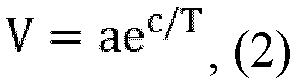
- The equation (2) is solved to obtain a and c, and a voltage curve at the arbitrary temperature can be acquired through a and c.
- In step S103, calculate an actual capacity of the battery cell based on the actual charging voltage curve and the reference charging voltage curve of each of the one or more SOC intervals.
- It can be understood that in the embodiments of the present disclosure, the reference charging voltage curve corresponding to each SOC interval is queried in the pre-established voltage feature database, and the actual capacity of the battery cell is calculated by using the actual charging voltage curve and the reference charging voltage curve. A specific calculation method is described as follows.
- In an embodiment of the present disclosure, the calculating the actual capacity of the battery cell based on the actual charging voltage curve and the reference charging voltage curve of each of the one or more SOC intervals includes: calculating a root-mean-square error of the battery cell based on the actual charging voltage curve and the reference charging voltage curve of each of the one or more SOC intervals, and determining an objective function based on the root-mean-square error; and finding, by using a least squares method, an optimal solution to the objective function to obtain the actual capacity of the battery cell.
- The calculating the root-mean-square error of the battery cell based on the actual charging voltage curve and the reference charging voltage curve of each of the one or more SOC intervals includes: dividing a total charging time period of a reference battery cell into different charging stages; adding an interval identifier to a SOC interval corresponding to each of the different charging stages, and establishing a mathematical expression among SOC interval, SOC, and capacity based on the interval identifier; and extracting the actual charging voltage curve and the corresponding reference charging voltage curve by using the mathematical expression, and calculating the root-mean-square error of the battery cell based on respective mathematical expressions of the actual charging voltage curve and the reference charging voltage curve of each of the one or more SOC intervals.
- It can be understood that in the embodiments of the present disclosure, the total charging time period can be divided into the different charging stages based on a numerical change of an actual charging current of the reference battery cell; a SOC interval corresponding to each charging stage of the battery cell is identified, and the mathematical expression among the SOC interval, SOC, and capacity is established based on the interval identifier; the respective mathematical expressions of the corresponding actual charging voltage curve and the corresponding reference charging voltage curve of the SOC interval of the battery cell are extracted based on the mathematical expression to calculate the root-mean-square error of the battery cell; and the objective function is determined by means of the root-mean-square error, and the optimal solution to the objective function is found by using the least squares method to obtain the actual capacity of the battery cell.
- Specifically, in an embodiment of the present disclosure, an entire charging process is divided into several intervals. Time point t 1 is in a first charging stage, a charging SOC interval corresponding to the first charging stage is recorded as θ 1. Time point t 2 is in a second charging stage, and a charging voltage has tended to be stable at the time point t 2. Time point t 3 is a time point when a second stage charging process is about to end, and a charging SOC interval corresponding to the time period from the time point t 2 to the time point t 3 is recorded as θ 2. Time point t 4 is in a third charging stage, and a charging voltage curve has tended to be stable at the time point t 4. Time point t 5 is a time point when a third stage charging process is about to end, and a charging SOC interval corresponding to the time period from the time point t 4 to the time point t 5 is recorded as θ 3. Time interval division and corresponding SOC interval division in other stage charging processes are similar to this, recorded as t 6, t 7, θ 4; t 8, t 9, θ 5..., respectively, as shown in
FIG. 2 . - Interval expressions of different SOC charging intervals θ 1, θ 2, θ 3, θ 4 ... are established, a SOC of a battery cell numbered i at a start time point of charging is recorded as


- Actual charging voltage curves corresponding to different SOC intervals in a total charging voltage curve are extracted based on the interval identifiers and interval expressions. As shown in
FIG. 2 , actual charging voltage curves corresponding to different charging stages are extracted and recorded as
- Further, after the actual charging voltage curves are acquired, based on temperatures and currents of the different charging stages in the actual charging process, a reference charging voltage curve (V (I, T,x)) in the voltage feature database is queried, root-mean-square error of the actual charging voltage curve (



Where K 1, K 2, K 3, K 4... represent weights for optimization in each charging stage, respectively. - A specific example will be described below to illustrate a method for estimating a SOC of a battery cell according to embodiments of the present disclosure. As shown in
FIG. 3 , the method includes specific steps at S1 to S5. - At step S1, construct feature database V=f(I,T,x) of an LFP battery cell about charging voltage, current, temperature, and SOC, that is, construct a feature database of a standard charging voltage curve (reference charging voltage curve) of the LFP battery cell.
- Based on a performance parameter table of a certain LFP battery cell, a charging test matrix is constructed from two dimensions of temperature and charging current, as shown in Table 2. Table 2 is an example table of a charging test matrix.
Table 2 Temperature -20°C -10° C 0° C 10°C 25°C 35°C 45°C Charging current 0.05C 0.05C 0.05C 0.05C 0.05C 0.05C 0.05C 0.1C 0.1C 0.1C 0.1C 0.1C 0.1C 0.1C 0.2C 0.2C 0.2C 0.3C 0.5C 0.5C 0.3C 0.3C 0.3C 0.3C 0.5C 1C 1C 0.5C 0.4C 0.4C 0.4C 1C 2C 2C 1C - A charging temperature of 25°C and a charging rate of 1C are taken as an example. A method for acquiring a reference charging voltage curve is as follows.
- A. Constant current discharging is performed at 0.3C until a predetermined cut-off voltage is reached, the constant current discharging is continuously performed by switching to 0.05C until the predetermined cut-off voltage is reached, stand for 0.5 hours, constant current charging is performed at 1C until a cut-off voltage is reached, and a voltage curve is recorded.
- B. Stand for 0.5 hours, the constant current discharging is performed at 0.3C until the cut-off voltage is reached, the constant current discharging is continuously performed by switching to 0.05C until the cut-off voltage is reached, and stand for 0.5 hours.
- C. After the charging at 1C is completed, charging tests at other rates are restarted.
- After voltage curves at different temperatures and different charging rates are acquired, interpolation is performed to construct the voltage feature database. Charging voltage curves at a temperature of 25°C and at different rates are taken as an example. An interpolation method is as follows.
- A maximum charging capacity Qmax=100Ah corresponding to all charging voltage curves at different rates is calculated, a capacity interval corresponding to all the charging curves is divided into 100 grids with a step size of 1Ah. In each grid, formula (1) is satisfied. The linear equation (1) is solved to acquire k and b, and a charging voltage at an arbitrary charging current can be acquired based on k and b.
- A charging voltage curve at a charging rate of 0.1C is taken as an example, a feature database of a temperature dimension can be acquired by the following method.
- A maximum charging capacity Qmax =98Ah corresponding to all charging voltage curves at different temperatures is calculated, and a capacity interval corresponding to all the charging curves is divided into 100 grids with a step size of 0.98Ah. In each grid, formula (2) is satisfied. The equation (2) is solved to acquire a and c. A voltage curve at an arbitrary temperature can be acquired based on a and c.
- At step S2, divide, based on a numerical change of the actual charging current of the battery, a total charging time period into different charging stages t 1, t 2, t 3, t 4..., and SOC intervals corresponding to the different charging stages of each battery cell are labeled as

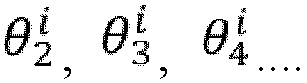
-
FIG. 4 is an actual charging curve of battery cell i in a certain model of an LFP battery pack, and an entire charging process is divided into 7 SOC intervals. A charging time period corresponding to


Table 3 t1 t2 t3 t4 t5 t6 t7 t8 t9 t10 t11 t12 t13 0.03 0.11 0.29 0.31 0.42 0.45 0.5 0.53 0.61 0.63 0.72 0.74 0.83 - At step S3, establish interval expressions of the different SOC intervals


- A temperature standard capacity of the selected LFP battery cell is 90 Ah. At a start time point of charging of a battery cell numbered i, a SOC (i.e. initial SOC) of the battery cell i is recorded as


- At step S4, extract corresponding actual charging voltage curves of each battery cell (i) in different charging SOC intervals.
- As shown in
FIG. 4 , the actual charging voltage curves corresponding to the different charging stages are extracted and recorded as

- At step S5, query a standard voltage curve through the feature database; determine a root-mean-square error of


- Reference charging voltage curve (V(I,T,x)) in the voltage feature database is queried based on temperatures and currents of the different charging stages in the actual charging process; a root-mean-square error of the actual charging voltage curve (


- Where K 1, K 2, K 3, K 4, K 5, K 6, K 7 represent weights for optimization in each charging stage, respectively. The actual capacity

Table 4 Battery cell number 1 2 3 4 5 6 7 8 9 10 11 12 13 14 15 Capacit y/Ah 89. 15 89. 6 89. 45 89 90. 03 88. 95 89. 3 89. 25 89. 23 88. 23 88. 75 90. 25 88. 91 89. 5 89. 62 Battery cell number 16 17 18 19 20 21 22 23 24 25 26 27 28 29 30 Capacit y/Ah 89. 3 89. 32 89. 62 89. 41 89. 25 89. 63 89. 74 89. 54 89. 52 89. 1 89. 36 89 89. 44 89. 25 89. 21 Battery cell number 31 32 33 34 35 36 37 38 39 40 41 42 43 44 45 Capacit y/Ah 89. 66 89. 85 89. 75 89. 94 89. 69 90. 2 90. 12 89. 05 88. 98 87. 6 88. 65 88. 78 89. 63 88. 76 88. 65 Battery cell number 46 47 48 49 50 51 52 53 54 55 56 57 58 59 60 Capacit y/Ah 89. 33 89. 65 89. 32 89. 62 89. 41 89. 25 90. 12 89. 05 88. 98 88. 75 90. 12 90. 25 89. 74 89. 54 89. 52 Battery cell number 61 62 63 64 65 66 67 68 69 70 71 72 73 74 75 Capacit y/Ah 89. 64 89. 25 89. 63 89 89. 44 89. 25 89. 21 89. 41 89. 25 90. 12 89. 05 88. 98 88. 5 87. 96 88. 96 Battery cell number 76 77 78 79 80 81 82 83 84 85 86 87 88 89 90 Capacit y/Ah 88. 65 88. 78 89. 63 89. 69 90. 2 90. 12 89. 05 89. 75 89. 94 89. 74 89. 54 89. 52 88. 75 90. 12 88. 91 Battery cell number 91 92 93 94 95 96 97 98 99 100 101 102 103 104 Capacit y/Ah 89. 41 89. 25 90. 12 89. 05 89. 62 89. 41 89. 25 88. 98 88. 75 89. 32 89. 62 89. 41 89. 25 89. 66 - In the method for estimating the capacity of the battery cell according to the embodiments of the present disclosure, the actual capacity of the battery cell can be accurately calculated by comparing the actual charging voltage curve of the battery cell with the corresponding reference charging voltage curve of the battery cell. Since the pre-calibrated standard reference charging voltage curve is used, the actual capacity of the battery cell can be accurately obtained through the comparison based on the voltage curve, avoiding an influence of the battery system on the estimation result, which is effectively applicable to a plurality of battery systems. At the same time, the estimation method according to the embodiments of the present disclosure can be deployed in the server, and calculation efficiency is improved by using computing resources of the server. The root-mean-square error can be calculated by using the actual charging voltage curve and the reference charging voltage curve, and the objective function is determined by using the root-mean-square error; and the actual capacity of the battery cell is calculated by using the least squares method for the optimal solution. The total charging time period of the reference battery cell can be divided into the different charging stages. The interval identifiers are set for the SOC intervals of the different charging stages. The mathematical expressions of the different SOC intervals are established. The actual charging voltage curve and the corresponding reference charging voltage curve are further extracted by using the mathematical expressions. The root-mean-square error is calculated based on the respective mathematical expressions of the actual charging voltage curve and the reference charging voltage curve of each SOC interval. The charging test matrix can be constructed from the two dimensions of the temperature and the charging current. The interpolation is performed on the charging voltage curves at the different charging temperatures and the different charging rates that are obtained by means of the charging matrix to obtain the plurality of reference charging voltage curves. The voltage feature database is constructed by using the plurality of reference charging voltage curves and the SOC intervals to facilitate the subsequent lookup of the corresponding reference charging voltage curves based on the SOC intervals. The interpolation can be performed on the charging voltage curves at the different charging rates, and the reference charging voltage curve corresponding to the charging voltage at the arbitrary charging current is calculated with the formula. The interpolation can be performed on the charging voltage curves at the different temperatures, and the reference charging voltage curve corresponding to the voltage curve at the arbitrary temperature is calculated with the formula.
-
FIG. 5 is another flowchart of a method for estimating a capacity of a battery cell according to an embodiment of the present disclosure. - As shown in
FIG. 5 , the method for estimating the capacity of the battery cell is applied in a server and includes operations at steps S201 to S203. - In step S201, a charging test matrix of temperature and charging current is constructed.
- A method for constructing the charging test matrix has been described in the above embodiments, and details thereof will not be described herein.
- At step S202, charging voltage curves at different charging temperatures and/or different charging rates are acquired based on the charging test matrix, and interpolation is performed on the charging voltage curves at the different temperatures and/or the different charging rates to obtain a reference charging voltage curve of each SOC interval.
- It can be understood that in the embodiment of the present disclosure, the charging voltage curves at the different charging temperatures and the different charging rates are acquired based on the charging test matrix, and then the interpolation is performed to obtain the reference charging voltage curve of each SOC interval. The interpolation method has been described in the above embodiments, and details thereof will not be described herein.
- In step S203, a voltage feature database is constructed based on the reference charging voltage curve of each SOC interval, the reference charging voltage curve of each SOC interval is queried by using the voltage feature database, and an actual capacity of the battery cell is calculated based on an actual charging voltage curve and the reference charging voltage curve of each SOC interval.
- The voltage feature database stores the relationship between the SOC interval and the reference charging voltage curve, and the reference charging voltage curve corresponding to the SOC interval can be queried by using the voltage feature database.
- It can be understood that in the embodiment of the present disclosure, the reference charging voltage curve of each SOC interval can be queried by using the voltage feature database, the actual capacity and the initial SOC of the battery cell are calculated based on the actual charging voltage curve and the corresponding reference charging voltage curve of each SOC interval, and the corresponding actual SOC of the battery cell during the charging process is calculated by using the actual capacity and the initial SOC. The specific calculation method has been described in the above embodiments, and details thereof will not be described herein.
- In the method for estimating the capacity of the battery cell according to the embodiments of the present disclosure, the charging test matrix is constructed from the two dimensions of the temperature and the charging current; the charging voltage curves at the different charging temperatures and the different charging rates are acquired; the interpolation is performed on the charging voltage curves to obtain the reference charging voltage curves; the actual capacity of the battery cell is calculated based on the actual charging voltage curve and the reference charging voltage curve of the battery cell within each SOC interval; and the calculation method is deployed on the server, which is not affected by the battery system and can accurately calculate the capacity of each battery cell in the battery pack.
- Next, a device for estimating a capacity of a battery cell according to an embodiment of the present disclosure will be described with reference to the accompanying drawings.
-
FIG. 6 is a block diagram of a device for estimating a capacity of a battery cell according to an embodiment of the present disclosure. - As shown in
FIG. 6 , adevice 10 for estimating a capacity of a battery cell includes anacquisition module 101, anoutput module 102, and afirst calculation module 103. - The
acquisition module 101 is configured to acquire actual charging data of the battery cell within one or more SOC intervals. - The
output module 102 is configured to generate, based on the actual charging data within each of one or more SOC intervals, an actual charging voltage curve of a corresponding SOC interval, generate actual charging voltage curves corresponding to the SOC intervals based on the actual charging data, query a pre-established voltage feature database with each of the one or more SOC intervals as an index, and output a reference charging voltage curve of each of the one or more SOC interval curves. Thefirst calculation module 103 is configured to calculate an actual capacity of the battery cell based on the actual charging voltage curve and the reference charging voltage curve of each of one or more SOC intervals. - In an embodiment of the present disclosure, the
first calculation module 103 is further configured to: calculate a root-mean-square error of the battery cell based on the actual charging voltage curve and the reference charging voltage curve of each of the one or more SOC intervals, and determine an objective function based on the root-mean-square error; and find, by using a least squares method, an optimal solution to the objective function to obtain the actual capacity of the battery cell. - In an embodiment of the present disclosure, the
first calculation module 103 is further configured to: calculate a root-mean-square error of the battery cell based on the actual charging voltage curve and the reference charging voltage curve of each of the one or more SOC intervals, and determine an objective function based on the root-mean-square error; and find, by using a least squares method, an optimal solution to the objective function to obtain the actual capacity of the battery cell. - In an embodiment of the present disclosure, the
device 10 of the present disclosure further includes a processing module. - The processing module is configured to: prior to the querying the pre-established voltage feature database, construct a charging test matrix of temperature and charging current; acquire, based on the charging test matrix, charging voltage curves at different charging temperatures and/or different charging rates, and perform interpolation on the charging voltage curves at the different temperatures and/or the different charging rates to obtain a plurality of reference charging voltage curves; and construct the voltage feature database based on each of the one or more SOC intervals and a corresponding one of the plurality of reference charging voltage curves.
- In an embodiment of the present disclosure, the processing module is further configured to: calculate a maximum charging capacity corresponding to all the charging voltage curves at the different rates; determine, based on the maximum charging capacity, a step size of a capacity interval corresponding to each of all the charging voltage curves, and divide the capacity interval into a plurality of grids based on the step size; and calculate a first constant based on a voltage of each of the plurality of grids, acquire, based on the first constant, a charging voltage at an arbitrary charging current, and generate the plurality of reference charging voltage curves based on the charging voltage at the arbitrary charging current.
- In an embodiment of the present disclosure, the processing module is further configured to: calculate a maximum charging capacity corresponding to all the charging voltage curves at the different temperatures; determine, based on the maximum charging capacity, a step size of a capacity interval corresponding to each of all the charging voltage curves, and divide the capacity interval into a plurality of grids based on the step size; and calculate a second constant based on a voltage of each of the plurality of grids, acquire, based on the second constant, a voltage curve at an arbitrary temperature, and obtain the plurality of reference charging voltage curves based on the voltage curve at the arbitrary temperature.
- In an embodiment of the present disclosure, the processing module is further configured to: at a predetermined temperature, perform constant current discharging with a first predetermined current until a predetermined cut-off voltage is reached, switch to a second predetermined current to perform the constant current discharging until the predetermined cut-off voltage is reached, stand for a first predetermined duration, perform the constant current charging with a third predetermined current until the predetermined cut-off voltage is reached, and record a charging voltage curve at a current temperature and/or a current charging rate; and stand for a second predetermined duration, perform the constant current discharging with a fourth predetermined current until the predetermined cut-off voltage is reached, switch to a fifth predetermined current to perform the constant current discharging until the predetermined cut-off voltage is reached, stand for a third predetermined duration, and re-perform a charging test at other charging rates and/or other charging temperatures.
- It should be noted that the above illustration of the embodiments of the method for estimating the capacity of the battery cell is also applicable to the embodiment of the device for estimating the capacity of the battery cell, and details thereof will not be described herein.
- In the device for estimating the capacity of the battery cell according to the embodiments of the present disclosure, the actual capacity of the battery cell can be accurately calculated by comparing the actual charging voltage curve of the battery cell with the corresponding reference charging voltage curve of the battery cell. Since the pre-calibrated standard reference charging voltage curve is used, the actual capacity of the battery cell can be accurately obtained through the comparison based on the voltage curve, avoiding an influence of the battery system on the estimation result, which is effectively applicable to a plurality of battery systems. At the same time, the estimation method according to the embodiments of the present disclosure can be deployed in the server, and calculation efficiency is improved by using computing resources of the server. The root-mean-square error can be calculated by using the actual charging voltage curve and the reference charging voltage curve, and the objective function is determined by using the root-mean-square error; and the actual capacity of the battery cell is calculated by using the least squares method for the optimal solution. The total charging time period of the reference battery cell can be divided into the different charging stages. The interval identifiers are set for the SOC intervals of the different charging stages. The mathematical expressions of the different SOC intervals are established. The actual charging voltage curve and the corresponding reference charging voltage curve are further extracted by using the mathematical expressions. The root-mean-square error is calculated based on the respective mathematical expressions of the actual charging voltage curve and the reference charging voltage curve of each SOC interval. The charging test matrix can be constructed from the two dimensions of the temperature and the charging current. The interpolation is performed on the charging voltage curves at the different charging temperatures and the different charging rates that are obtained by means of the charging matrix to obtain the plurality of reference charging voltage curves. The voltage feature database is constructed by using the plurality of reference charging voltage curves and the SOC intervals to facilitate the subsequent lookup of the corresponding reference charging voltage curves based on the SOC intervals. The interpolation can be performed on the charging voltage curves at the different charging rates, and the reference charging voltage curve corresponding to the charging voltage at the arbitrary charging current is calculated with the formula. The interpolation can be performed on the charging voltage curves at the different temperatures, and the reference charging voltage curve corresponding to the voltage curve at the arbitrary temperature is calculated with the formula.
-
FIG. 7 is a block diagram of a device for estimating a capacity of a battery cell according to another embodiment of the present disclosure. - As shown in
FIG. 7 , adevice 20 for estimating a capacity of a battery cell is applied in a server. Thedevice 20 includes aconstruction module 201, aninterpolation module 202, and asecond calculation module 203. - The
construction module 201 is configured to construct a charging test matrix of temperature and charging current. Theinterpolation module 202 is configured to acquire, based on the charging test matrix, charging voltage curves at different charging temperatures and/or different charging rates, and perform interpolation on the charging voltage curves at the different temperatures and/or the different charging rates to obtain a reference charging voltage curve of each SOC interval. Thesecond calculation module 203 is configured to construct a voltage feature database based on the reference charging voltage curve of each SOC interval, query the reference charging voltage curve of each SOC interval by using the voltage feature database, and calculate an actual capacity of the battery cell based on an actual charging voltage curve and the reference charging voltage curve of each SOC interval. - It should be noted that the above illustration of the embodiments of the method for estimating the capacity of the battery cell is also applicable to the embodiment of the device for estimating the capacity of the battery cell, and details thereof will not be described herein.
- It should be noted that the above illustration of the embodiments of the method for estimating the capacity of the battery cell is also applicable to the embodiment of the device for estimating the capacity of the battery cell, and details thereof will not be described herein.
- In the device for estimating the capacity of the battery cell according to the embodiments of the present disclosure, the charging test matrix is constructed from the two dimensions of the temperature and the charging current; the charging voltage curves at the different charging temperatures and the different charging rates are acquired; the interpolation is performed on the charging voltage curves to obtain the reference charging voltage curves; the actual capacity of the battery cell is calculated based on the actual charging voltage curve and the reference charging voltage curve of the battery cell within each SOC interval; and the calculation method is deployed on the server, which is not affected by the battery system and can accurately calculate the capacity of each battery cell in the battery pack.
-
FIG. 8 is a schematic diagram of a structure of a server according to an embodiment of the present disclosure. The server may include amemory 801, aprocessor 802, and a computer program stored in thememory 801 and executable by theprocessor 802. Theprocessor 802, when executing the program, implements the method for estimating the capacity of the battery cell in the above embodiments described above. - Further, the server further includes a
communication interface 803. Thecommunication interface 803 stores communication between thememory 801 and theprocessor 802. Thememory 801 stores a computer program executable by theprocessor 802. Thememory 801 may include a high-speed RAM (Random Access Memory), and may also include a nonvolatile memory, such as at least one disk memory. - If the
memory 801, theprocessor 802, and thecommunication interface 803 are implemented independently, thecommunication interface 803, thememory 801, and theprocessor 802 can be connected to each other via a bus and communicate with each other. The bus can be an ISA (Industry Standard Architecture) bus, a PCI (Peripheral Component) bus, or an EISA (Extended Industry Standard Architecture) bus, etc. The bus can be divided into an address bus, a data bus, a control bus, etc. For ease of representation, only one thick line is used inFIG. 8 , but it does not mean that there is only one bus or one type of bus. - Optionally, in a specific implementation, if the
memory 801, theprocessor 802, and thecommunication interface 803 are integrated on a chip, thememory 801, theprocessor 802, and thecommunication interface 803 can communicate with each other via an internal interface. - The
processor 802 can be a CPU (Central Processing Unit), or an ASIC (Application Specific Integrated Circuit), or one or more integrated circuits configured to implement the embodiments of the present disclosure. - Embodiments of the present disclosure also provide a computer-readable storage medium. The medium has a computer program stored thereon. The program, when executed by a processor, implements the method for estimating the capacity of the battery cell as described above.
- Reference throughout this specification to "an embodiment", "some embodiments", "an example", "a specific example", or "some examples" means that a particular feature, structure, material, or characteristic described in connection with the embodiment or example is included in at least one embodiment or example of the present disclosure. The appearances of the above phrases in various places throughout this specification are not necessarily referring to the same embodiment or example of the present disclosure. Furthermore, the particular features, structures, materials, or characteristics may be combined in any suitable manner in one or N embodiments or examples. In addition, different embodiments or examples and features of different embodiments or examples described in the specification may be combined by those skilled in the art without mutual contradiction.
- In addition, the terms such as "first" and "second" are used herein for purposes of description and are not intended to indicate or imply relative importance, or to implicitly show the number of technical features indicated. Thus, the feature defined with "first" and "second" may explicitly or implicitly comprise one or more this feature. In the description of the present disclosure, "N" means at least two, for example, two or three, unless specified otherwise.
- Any process or method described in a flow chart or described herein in other ways may be understood to include one or more modules, segments or portions of codes of executable instructions for achieving specific logical functions or steps in the process, and the scope of a preferred embodiment of the present disclosure includes other implementations. Functions may be executed in a different order from the illustrated or discussed order, and may be executed, depending on functions involved, substantially in parallel with each or in a reverse order, which should be understood by those skilled in the art of the embodiments of the present disclosure.
- It should be understood that each part of the present disclosure may be realized by the hardware, software, firmware or their combination. In the above embodiments, N steps or methods may be realized by the software or firmware stored in the memory and executed by the appropriate instruction execution system. For example, if it is realized by the hardware, likewise in another embodiment, the steps or methods may be realized by one or a combination of the following techniques known in the art: a discrete logic circuit having a logic gate circuit for realizing a logic function of a data signal, an application-specific integrated circuit having an appropriate combination logic gate circuit, a programmable gate array, a field programmable gate array, etc.
- It would be understood by those skilled in the art that all or a part of the steps carried by the method in the above-mentioned embodiments may be completed by relevant hardware instructed by a program. The program may be stored in a computer readable storage medium. When the program is executed, one or a combination of the steps of the method in the above-mentioned embodiments may be implemented.
Claims (12)
- A method for estimating a capacity of a battery cell, the method being applied in a server, and the method comprising:acquiring actual charging data of the battery cell within one or more Stage of Charge, SOC, intervals;generating, based on the actual charging data within each of the one or more SOC intervals, an actual charging voltage curve of a corresponding SOC interval, querying a pre-established voltage feature database with each of the one or more SOC intervals as an index, and outputting a reference charging voltage curve of each of the one or more SOC intervals; andcalculating an actual capacity of the battery cell based on the actual charging voltage curve and the reference charging voltage curve of each of the one or more SOC intervals.
- The method for estimating the capacity of the battery cell according to claim 1, wherein said calculating the actual capacity of the battery cell based on the actual charging voltage curve and the reference charging voltage curve of each of the one or more SOC intervals comprises:calculating a root-mean-square error of the battery cell based on the actual charging voltage curve and the reference charging voltage curve of each of the one or more SOC intervals, and determining an objective function based on the root-mean-square error; andfinding, by using a least squares method, an optimal solution to the objective function to obtain the actual capacity of the battery cell.
- The method for estimating the capacity of the battery cell according to claim 2, wherein said calculating the root-mean-square error of the battery cell based on the actual charging voltage curve and the reference charging voltage curve of each of the one or more SOC intervals comprises:dividing a total charging time period of a reference battery cell into different charging stages;adding an interval identifier to a SOC interval corresponding to each of the different charging stages, and establishing a mathematical expression among SOC interval, SOC, and capacity based on the interval identifier; andextracting the actual charging voltage curve and the corresponding reference charging voltage curve by using the mathematical expression, and calculating the root-mean-square error of the battery cell based on respective mathematical expressions of the actual charging voltage curve and the reference charging voltage curve of each of the one or more SOC intervals.
- The method for estimating the capacity of the battery cell according to claim 1, further comprising, prior to said querying the pre-established voltage feature database:constructing a charging test matrix of temperature and charging current;acquiring, based on the charging test matrix, charging voltage curves at different charging temperatures and/or different charging rates, performing interpolation on the charging voltage curves at the different temperatures and/or the different charging rates to obtain a plurality of reference charging voltage curves; andconstructing the voltage feature database based on each of the one or more SOC intervals and a corresponding one of the plurality of reference charging voltage curves.
- The method for estimating the capacity of the battery cell according to claim 4, wherein said performing the interpolation on the charging voltage curves at the different temperatures and/or the different charging rates to obtain the plurality of reference charging voltage curves comprises:calculating a maximum charging capacity corresponding to all the charging voltage curves at the different rates;determining, based on the maximum charging capacity, a step size of a capacity interval corresponding to each of all the charging voltage curves, and dividing the capacity interval into a plurality of grids based on the step size; andcalculating a first constant based on a voltage of each of the plurality of grids, acquiring, based on the first constant, a charging voltage at an arbitrary charging current, and generating the plurality of reference charging voltage curves based on the charging voltage at the arbitrary charging current.
- The method for estimating the capacity of the battery cell according to claim 4, wherein said performing the interpolation on the charging voltage curves at the different temperatures and/or the different charging rates to obtain the plurality of reference charging voltage curves comprises:calculating a maximum charging capacity corresponding to all the charging voltage curves at the different temperatures;determining, based on the maximum charging capacity, a step size of a capacity interval corresponding to each of all the charging voltage curves, and dividing the capacity interval into a plurality of grids based on the step size; andcalculating a second constant based on a voltage of each of the plurality of grids, acquiring, based on the second constant, a voltage curve at an arbitrary temperature, and obtaining the plurality of reference charging voltage curves based on the voltage curve at the arbitrary temperature.
- The method for estimating the capacity of the battery cell according to claim 4, wherein said acquiring, based on the charging test matrix, the charging voltage curves at the different charging temperatures and/or the different charging rates comprises:at a predetermined temperature, performing constant current discharging with a first predetermined current until a predetermined cut-off voltage is reached, switching to a second predetermined current to perform the constant current discharging until the predetermined cut-off voltage is reached, standing for a first predetermined duration, performing the constant current charging with a third predetermined current until the predetermined cut-off voltage is reached, and recording a charging voltage curve at a current temperature and/or a current charging rate; andstanding for a second predetermined duration, performing the constant current discharging with a fourth predetermined current until the predetermined cut-off voltage is reached, switching to a fifth predetermined current to perform the constant current discharging until the predetermined cut-off voltage is reached, standing for a third predetermined duration, and re-performing a charging test at other charging rates and/or other charging temperatures.
- A method for estimating a capacity of a battery cell, the method being applied in a server, and the method comprising:constructing a charging test matrix of temperature and charging current;acquiring, based on the charging test matrix, charging voltage curves at different charging temperatures and/or different charging rates, performing interpolation on the charging voltage curves at the different temperatures and/or the different charging rates to obtain a reference charging voltage curve of each SOC interval; andconstructing a voltage feature database based on the reference charging voltage curve of each SOC interval, querying the reference charging voltage curve of each SOC interval by using the voltage feature database, and calculating an actual capacity of the battery cell based on an actual charging voltage curve and the reference charging voltage curve of each SOC interval.
- A device for estimating a capacity of a battery cell, the device being applied in a server, and the device comprising:an acquisition module configured to acquire actual charging data of the battery cell within one or more SOC intervals;an output module configured to generate, based on the actual charging data within each of one or more SOC intervals, an actual charging voltage curve of a corresponding SOC interval, generate actual charging voltage curves corresponding to the SOC intervals based on the actual charging data, query a pre-established voltage feature database with each of the one or more SOC intervals as an index, and output a reference charging voltage curve of each of the one or more SOC intervals; anda first calculation module configured to calculate an actual capacity of the battery cell based on the actual charging voltage curve and the reference charging voltage curve of each of one or more SOC intervals.
- A device for estimating a capacity of a battery cell, the device being applied in a server, and the device comprising:a construction module configured to construct a charging test matrix of temperature and charging current;an interpolation module configured to acquire, based on the charging test matrix, charging voltage curves at different charging temperatures and/or different charging rates, and perform interpolation on the charging voltage curves at the different temperatures and/or the different charging rates to obtain a reference charging voltage curve of each SOC interval; anda second calculation module configured to construct a voltage feature database based on the reference charging voltage curve of each SOC interval, query the reference charging voltage curve of each SOC interval by using the voltage feature database, and calculate an actual capacity of the battery cell based on an actual charging voltage curve and the reference charging voltage curve of each SOC interval.
- A server, comprising:a memory;a processor; anda computer program stored in the memory and executable by the processor,wherein the processor is configured to execute the computer program to implement the method for estimating the capacity of the battery cell according to any one of claims 1 to 8.
- A computer-readable storage medium, having a computer program stored thereon,
wherein the computer program is configured to be executed by a processor to implement the method for estimating the capacity of the battery cell according to any one of claims 1 to 8.
Applications Claiming Priority (2)
| Application Number | Priority Date | Filing Date | Title |
|---|---|---|---|
| CN202310640090.XA CN116430242B (en) | 2023-05-31 | 2023-05-31 | Battery cell capacity estimation method, device, server and storage medium |
| PCT/CN2023/123733 WO2024244252A1 (en) | 2023-05-31 | 2023-10-10 | Method and apparatus for estimating capacity of battery cell, and server and storage medium |
Publications (2)
| Publication Number | Publication Date |
|---|---|
| EP4564030A1 true EP4564030A1 (en) | 2025-06-04 |
| EP4564030A4 EP4564030A4 (en) | 2026-01-14 |
Family
ID=87081740
Family Applications (1)
| Application Number | Title | Priority Date | Filing Date |
|---|---|---|---|
| EP23939225.1A Pending EP4564030A4 (en) | 2023-05-31 | 2023-10-10 | METHOD AND DEVICE FOR ESTIMATING THE CAPACITY OF A BATTERY CELL, AS WELL AS SERVER AND STORAGE MEDIUM |
Country Status (3)
| Country | Link |
|---|---|
| EP (1) | EP4564030A4 (en) |
| CN (1) | CN116430242B (en) |
| WO (1) | WO2024244252A1 (en) |
Families Citing this family (4)
| Publication number | Priority date | Publication date | Assignee | Title |
|---|---|---|---|---|
| CN116430243B (en) * | 2023-05-31 | 2025-10-14 | 深蓝汽车科技有限公司 | Battery cell SOC estimation method, device, server and storage medium |
| CN116430242B (en) * | 2023-05-31 | 2025-07-11 | 深蓝汽车科技有限公司 | Battery cell capacity estimation method, device, server and storage medium |
| CN116859246B (en) * | 2023-07-25 | 2024-05-07 | 上海思格源智能科技有限公司 | A method and system for automatically identifying battery cells |
| CN119902082B (en) * | 2024-12-30 | 2025-10-17 | 重庆理工大学 | Dynamic prediction method of power battery charging curve based on deviation adjustment |
Family Cites Families (18)
| Publication number | Priority date | Publication date | Assignee | Title |
|---|---|---|---|---|
| KR20140073627A (en) * | 2012-11-30 | 2014-06-17 | 주식회사 포스코아이씨티 | Apparatus and Method for Managing Battery |
| CN103399278B (en) * | 2013-07-31 | 2016-03-23 | 清华大学 | The capacity of battery cell and the method for estimation of state-of-charge |
| CN110927605B (en) * | 2017-04-18 | 2021-02-23 | 华为技术有限公司 | Method and device for estimating battery state of health |
| KR101930646B1 (en) * | 2017-11-22 | 2019-03-11 | 주식회사 포스코아이씨티 | Apparatus and Method for Estimating Capacity of Battery Using Second Order Differential Voltage Curve |
| CN112305433B (en) * | 2020-03-30 | 2023-01-13 | 宁德时代新能源科技股份有限公司 | Method, apparatus, device and medium for estimating battery performance parameters |
| CN111463861A (en) * | 2020-04-10 | 2020-07-28 | 东莞龙升电子有限公司 | Method, device, computer equipment and storage medium for controlling charger switch |
| KR102867900B1 (en) * | 2020-08-20 | 2025-10-01 | 주식회사 엘지에너지솔루션 | Battery management system, battery management method, battery pakc, and electric vehicle |
| CN114609523B (en) * | 2020-12-07 | 2026-04-17 | 中车时代电动汽车股份有限公司 | An online method for detecting battery capacity, an electronic device, and a storage medium. |
| JP2023042959A (en) * | 2021-09-15 | 2023-03-28 | オムロン株式会社 | Battery capacity estimation device, charging plan generation device, discharging plan generation device, and battery capacity estimation method |
| CN114243808B (en) * | 2021-11-02 | 2025-05-13 | 北京新能源汽车股份有限公司 | Electric vehicle charging method, device, vehicle and storage medium |
| CN116184222B (en) * | 2021-11-26 | 2025-01-14 | 比亚迪股份有限公司 | Method, apparatus and computer storage medium for estimating battery capacity |
| CN114624600A (en) * | 2022-01-20 | 2022-06-14 | 浙江零跑科技股份有限公司 | Power battery cell capacity difference calculation method and computer readable storage medium |
| CN115166559B (en) * | 2022-06-23 | 2025-10-10 | 力神(青岛)新能源有限公司 | A method for estimating SOH of power batteries |
| CN115616421B (en) * | 2022-09-26 | 2024-08-13 | 深蓝汽车科技有限公司 | A battery health status estimation method, system, device and medium |
| CN115856696B (en) * | 2022-12-01 | 2026-04-14 | 章鱼博士智能技术(上海)有限公司 | Method for detecting short circuit in power battery, electronic device and storage medium |
| CN116106768B (en) * | 2022-12-30 | 2025-12-12 | 珠海冠宇电源有限公司 | Methods, controllers, devices, systems, and equipment for correcting the state of charge (SOC) of a battery at the end of discharge. |
| CN116430242B (en) * | 2023-05-31 | 2025-07-11 | 深蓝汽车科技有限公司 | Battery cell capacity estimation method, device, server and storage medium |
| CN116430243B (en) * | 2023-05-31 | 2025-10-14 | 深蓝汽车科技有限公司 | Battery cell SOC estimation method, device, server and storage medium |
-
2023
- 2023-05-31 CN CN202310640090.XA patent/CN116430242B/en active Active
- 2023-10-10 WO PCT/CN2023/123733 patent/WO2024244252A1/en not_active Ceased
- 2023-10-10 EP EP23939225.1A patent/EP4564030A4/en active Pending
Also Published As
| Publication number | Publication date |
|---|---|
| CN116430242B (en) | 2025-07-11 |
| EP4564030A4 (en) | 2026-01-14 |
| CN116430242A (en) | 2023-07-14 |
| WO2024244252A1 (en) | 2024-12-05 |
Similar Documents
| Publication | Publication Date | Title |
|---|---|---|
| EP4564030A1 (en) | Method and apparatus for estimating capacity of battery cell, and server and storage medium | |
| KR102951707B1 (en) | Apparatus and method for estimating state of health of battery | |
| US11835587B2 (en) | Method for determining full-charge capacity of battery pack, method for determining state of health of battery pack, system, and apparatus | |
| CN114065552A (en) | Method and device for quantitatively analyzing battery performance and electronic equipment | |
| EP4564028A1 (en) | Estimation method and apparatus for soc of battery cell, and server and storage medium | |
| CN111537885B (en) | A multi-time-scale short-circuit resistance estimation method for series-connected battery packs | |
| EP4564029A1 (en) | Battery cell soc estimation method, device, server, and storage medium | |
| WO2020259096A1 (en) | Method, device and system for estimating state of power of battery, and storage medium | |
| CN112213659B (en) | Battery capacity correction method and test system | |
| US11300628B2 (en) | Method of determining an aging difference of a plurality of battery cells connected in parallel of a battery pack and related battery diagnosing system | |
| CN108233464B (en) | A method and system for active balancing of battery packs | |
| CN113608128B (en) | State of charge estimation method, computer device and computer storage medium | |
| CN114895205B (en) | Battery model parameter acquisition method and device, computer equipment and storage medium | |
| CN114336884A (en) | Multi-time scale state-of-charge and capacity based equalization strategy | |
| CN117970158B (en) | Method for determining battery health status, vehicle and storage medium | |
| CN114264969A (en) | Method and device for evaluating self-discharge performance of battery cell | |
| CN109407005B (en) | Dynamic and static correction method for residual electric quantity of energy storage battery | |
| CN114184969A (en) | Method and device for testing reversible self-discharge capacity loss of battery cell | |
| CN114966453B (en) | Method and related device for obtaining remaining available energy of lithium battery | |
| CN111033930B (en) | Method for estimating state of charge of battery and battery pack and battery management system using the same | |
| CN115113049A (en) | Method for determining initial value of battery SOC and related device | |
| KR20220144253A (en) | Method for simulating using two-branches equivalent circuit model | |
| CN117452224A (en) | Battery SOC calibration method, device and energy storage system | |
| CN119165378B (en) | Method and device for detecting consistency of battery cells, electronic equipment and storage medium | |
| CN115128470B (en) | Battery pack energy efficiency estimation method and device and electronic equipment |
Legal Events
| Date | Code | Title | Description |
|---|---|---|---|
| STAA | Information on the status of an ep patent application or granted ep patent |
Free format text: STATUS: THE INTERNATIONAL PUBLICATION HAS BEEN MADE |
|
| PUAI | Public reference made under article 153(3) epc to a published international application that has entered the european phase |
Free format text: ORIGINAL CODE: 0009012 |
|
| STAA | Information on the status of an ep patent application or granted ep patent |
Free format text: STATUS: REQUEST FOR EXAMINATION WAS MADE |
|
| 17P | Request for examination filed |
Effective date: 20250225 |
|
| AK | Designated contracting states |
Kind code of ref document: A1 Designated state(s): AL AT BE BG CH CY CZ DE DK EE ES FI FR GB GR HR HU IE IS IT LI LT LU LV MC ME MK MT NL NO PL PT RO RS SE SI SK SM TR |
|
| A4 | Supplementary search report drawn up and despatched |
Effective date: 20251215 |
|
| RIC1 | Information provided on ipc code assigned before grant |
Ipc: G01R 31/367 20190101AFI20251209BHEP Ipc: G01R 31/36 20200101ALI20251209BHEP Ipc: G01R 31/396 20190101ALI20251209BHEP Ipc: G01R 31/388 20190101ALI20251209BHEP Ipc: G01R 31/389 20190101ALI20251209BHEP Ipc: H02J 7/00 20060101ALI20251209BHEP |