EP4563994A1 - Device, hydroxide ion concentration measurement apparatus comprising said device, and method for measuring hydroxide ion concentration using said device - Google Patents
Device, hydroxide ion concentration measurement apparatus comprising said device, and method for measuring hydroxide ion concentration using said device Download PDFInfo
- Publication number
- EP4563994A1 EP4563994A1 EP23846368.1A EP23846368A EP4563994A1 EP 4563994 A1 EP4563994 A1 EP 4563994A1 EP 23846368 A EP23846368 A EP 23846368A EP 4563994 A1 EP4563994 A1 EP 4563994A1
- Authority
- EP
- European Patent Office
- Prior art keywords
- layer
- semiconductor layer
- concentration
- hydroxide
- layered double
- Prior art date
- Legal status (The legal status is an assumption and is not a legal conclusion. Google has not performed a legal analysis and makes no representation as to the accuracy of the status listed.)
- Pending
Links
Images
Classifications
-
- G—PHYSICS
- G01—MEASURING; TESTING
- G01N—INVESTIGATING OR ANALYSING MATERIALS BY DETERMINING THEIR CHEMICAL OR PHYSICAL PROPERTIES
- G01N27/00—Investigating or analysing materials by the use of electric, electrochemical, or magnetic means
- G01N27/26—Investigating or analysing materials by the use of electric, electrochemical, or magnetic means by investigating electrochemical variables; by using electrolysis or electrophoresis
- G01N27/403—Cells and electrode assemblies
- G01N27/414—Ion-sensitive or chemical field-effect transistors, i.e. ISFETS or CHEMFETS
-
- G—PHYSICS
- G01—MEASURING; TESTING
- G01N—INVESTIGATING OR ANALYSING MATERIALS BY DETERMINING THEIR CHEMICAL OR PHYSICAL PROPERTIES
- G01N27/00—Investigating or analysing materials by the use of electric, electrochemical, or magnetic means
- G01N27/26—Investigating or analysing materials by the use of electric, electrochemical, or magnetic means by investigating electrochemical variables; by using electrolysis or electrophoresis
- G01N27/403—Cells and electrode assemblies
- G01N27/414—Ion-sensitive or chemical field-effect transistors, i.e. ISFETS or CHEMFETS
- G01N27/4146—Ion-sensitive or chemical field-effect transistors, i.e. ISFETS or CHEMFETS involving nanosized elements, e.g. nanotubes, nanowires
-
- G—PHYSICS
- G01—MEASURING; TESTING
- G01N—INVESTIGATING OR ANALYSING MATERIALS BY DETERMINING THEIR CHEMICAL OR PHYSICAL PROPERTIES
- G01N33/00—Investigating or analysing materials by specific methods not covered by groups G01N1/00 - G01N31/00
- G01N33/18—Water
- G01N33/182—Specific anions in water
Definitions
- the present invention relates to a device in which the ease of flowing of a current changes in correspondence with a concentration of hydroxide ion (OH - ), and more specifically, to a measurement apparatus and a measurement method for measuring the concentration of hydroxide ion (OH - ) of a test subject based on such a change in conductivity.
- a hydroxide ion (OH - ) is one of basic and important substances in various fields including material chemistry and life science. A chemical reaction, a chemical equilibrium, and an electrochemical phenomena cannot be understood without considering the presence and chemical behavior of hydroxide ions.
- Patent Literature 1 discloses that hydroxide ions in a solution are separated by chromatography, and the concentration of the hydroxide ions is measured by using an electrical conductivity method or a light absorbance method.
- Patent Literature 1 JP 2002-5916 A
- the concentration of hydroxide ions can be measured with high accuracy, but in order to accurately perform the titration, it is difficult to easily and accurately measure the concentration of hydroxide ions because it requires skill to perform the titration.
- the concentration of hydrogen ions can be measured by a potential difference between a glass electrode and a comparison electrode, and the concentration of hydroxide ions can be measured on the basis of the concentration of hydrogen ions, and thus the concentration of hydroxide ions can be easily and quickly measured, but the accuracy is not high.
- Patent Literature 1 in the method for separating hydroxide ions by the chromatograph disclosed in Patent Literature 1, although the measurement accuracy is high, it is essential to create a separation column, and it is necessary to select a separation column depending on a type of a solvent and a pH range, and there are also problems, for example, that cracking and others are likely to occur in the separation column and care is required for handling, that the chromatograph is expensive, and that measurement cannot be easily performed.
- an object of the present invention is to provide an apparatus and a method for measuring a concentration of hydroxide ions which are capable of easily and quickly measuring the concentration of hydroxide ions with high accuracy and measuring the concentration of hydroxide ions at a relatively low cost.
- another object of the present invention is to provide a device that can be used in an apparatus and a method for measuring the concentration of hydroxide ions as described above and has a conductivity that varies depending on the concentration of hydroxide ions.
- the present invention has been made to solve the problems in the related art as described above, and the device of the present invention, the hydroxide ion measurement apparatus including the device, and the method for measuring the concentration of hydroxide ions by using the device include those configured as follows.
- the present invention it is possible to easily and quickly measure the concentration of hydroxide ions in a solution that is a subject with high accuracy by using a device in which the conductivity varies in correspondence with the concentration of hydroxide ions (OH - ) .
- an apparatus and a method for measuring a concentration of hydroxide ions it is possible to measure a concentration of hydroxide ions in, for example, river water, sea water, purified water, washing water, industrial waste water, and others as an ion-containing liquid which is a test subject, and for example, it is possible to constantly monitor the water quality thereof, and it is possible to contribute to universal and equal access of safe and inexpensive drinking water.
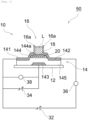
- Fig. 1 is a schematic view illustrating a configuration of a hydroxide ion concentration measurement apparatus according to the present embodiment.
- a hydroxide ion concentration measurement apparatus 50 of the present embodiment includes a device 10 including an insulating substrate 12, at least one insulating composite layer 14, and a liquid storage portion 16 capable of holding an ion-containing liquid.
- the device 10 configured as described below can also be, for example, a semiconductor element such as a field effect transistor (FET) or a metal-oxide semiconductor field effect transistor (MOSFET).
- FET field effect transistor
- MOSFET metal-oxide semiconductor field effect transistor
- the insulating substrate 12 is, for example, a substrate formed from an insulating material such as glass or ceramics.
- the insulating composite layer 14 includes a pair of electrodes (a first electrode 141 and a second electrode 142) and a semiconductor layer 144 in contact with the pair of electrodes 141 and 142.
- a layered double hydroxide layer 18 is provided between the insulating composite layer 14 and the liquid storage portion 16.
- the layered double hydroxide layer 18 is in contact with an ion-containing liquid L held in the liquid storage portion 16 and conducts hydroxide ions (OH - ) contained in the ion-containing liquid L.
- the OH - ion conductivity of the layered double hydroxide layer 18 in the present embodiment is 1 ⁇ 10 -5 S/cm or more, more preferably 1 ⁇ 10 -4 S/cm or more, still more preferably 5.0 ⁇ 10 -4 S/cm or more, and most preferably 1 ⁇ 10 -3 S/cm or more.
- An upper limit value of the OH - ion conductivity of the layered double hydroxide layer 18 is not particularly limited, but is generally 1.0 ⁇ 10 S/cm.
- a protective layer 20 is provided between the layered double hydroxide layer 18 and the semiconductor layer 144, and the layered double hydroxide layer 18 and the electrodes 141 and 142 are electrically insulated from each other by, for example, a partition portion 16a of the liquid storage portion 16.
- the layered double hydroxide layer 18 preferably contains at least one of pyreneboronic acid, 1-pyrenebutyric acid N-hydroxysuccinimide ester, and a general formula of the layered double hydroxide layer 18 is [M II 1-x M' III x (OH) 2 ] x+ where M II is selected from the group consisting of Ca 2+ , Mg 2+ , Mn 2+ , Fe 2+ , Co 2+ , Ni 2+ , Cu 2+ , Zn 2+ , and 2Li + , and M III is selected from the group consisting of Al 3+ , Mn 3+ , Fe 3+ , Co 3+ , Cr 3+ , and Ni 3+ .
- the semiconductor layer 144 preferably has a field-effect mobility of 20 cm 2 /Vs or more, particularly 60 cm 2 /Vs or more.
- the semiconductor layer 144 can contain at least one of oxygen, sulfur, nitrogen, boron, and carbon. In addition, the semiconductor layer 144 preferably further contains at least one of indium, zinc, tin, and a Group 13 element.
- the semiconductor layer 144 can contain at least one of graphene, carbon nanotube, boron nitride, metal dichalcogenide, or phospholene.
- indium-zinc-oxide such as Ta-IZO can be used as the semiconductor layer 144.
- the thickness of the semiconductor layer 144 is preferably 0.5 ⁇ m or less, more preferably 0.1 ⁇ m or less, and particularly preferably 0.05 ⁇ m or less.
- a lower limit value of the thickness of the semiconductor layer 144 is not particularly specified, but is generally 0.005 ⁇ m or more.
- a surface 144a of the semiconductor layer 144 on the layered double hydroxide layer 18 side is preferably as smooth as possible.
- the surface 144a of the semiconductor layer 144 is not smooth, for example, a gap is generated between the surface and the protective layer 20, or the protective layer 20 is discontinuously formed, and thus adhesion between the semiconductor layer 144 and the layered double hydroxide layer 18 deteriorates, and a current flows only in a part of the surface 144a of the semiconductor layer 144. For this reason, the measurement accuracy decreases or the operation becomes unstable.
- a maximum height Sz of the surface 144a of the semiconductor layer 144 is preferably 0.05 ⁇ m or less, more preferably 0.01 ⁇ m or less, and most preferably 0.003 ⁇ m or less.
- a lower limit value of the maximum height Sz is not particularly specified, but is generally 0.0005 ⁇ m or more.
- an arithmetic mean height Sa of the surface 144a of the semiconductor layer 144 on the layered double hydroxide layer 18 side is preferably 0.03 ⁇ m or less, more preferably 0.005 ⁇ m or less, and most preferably 0.002 ⁇ m or less.
- the lower limit value of the arithmetic mean height Sa is not particularly specified, but is generally 0.0002 ⁇ m or more.
- the maximum height Sz and the arithmetic mean height Sa are parameters of surface roughness defined by ISO25178, and such parameters can be measured by, for example, a 3D surface roughness profile analyzer (NexView manufactured by Zygo Corporation). Note that, the measurement conditions in this case are preferably performed according to the following.
- Measurement is performed under conditions of an objective lens of 50 times, a zoom lens of 20 times, and a measurement range of 89 ⁇ m ⁇ 87 ⁇ m in accordance with ISO25178.
- a roughness curve in a range of 3 ⁇ m ⁇ 3 ⁇ m is extracted from an obtained three-dimensional surface shape, the roughness curve is corrected under the following correction conditions by an analysis program "Mx" attached to a 3D surface roughness shape measuring device, and the maximum height Sz and the arithmetic mean height Sa are calculated.
- the protective layer 20 is provided to protect the semiconductor layer 144 from the ion-containing liquid L.
- the semiconductor layer 144 can be prevented from, for example, being corroded, and the durability and reliability of the semiconductor layer 144 can be improved.
- a material of the protective layer 20 a known material can be applied as long as the material has insulating properties, and a material having corrosion resistance is preferable.
- Ta 2 O 5 , Si 3 N 4 , SiO 2 , and others are used, and the thickness is preferably from 0.01 ⁇ m to 0.5 ⁇ m, and more preferably from 0.03 ⁇ m to 0.2 ⁇ m.
- the insulating composite layer 14 further includes a third electrode 143.
- the pair of electrodes 141 and 142 and the semiconductor layer 144 includes an insulating layer 145 between these and the third electrode 143.
- the material of the insulating layer 145 a known material can be applied as long as the material can be electrically insulated, and for example, various ceramics and resins can be used, and the thickness is preferably from 0.01 ⁇ m to 0.5 ⁇ m, and more preferably from 0.03 ⁇ m to 0.2 ⁇ m.
- the measurement apparatus 50 of the present embodiment includes a variable voltage source 32 for applying a voltage between the first electrode 141 and the second electrode 142, a variable voltage source 34 for applying a voltage between the first electrode 141 and the third electrode 143, an ammeter 36 for measuring a current value between the first electrode 141 and the second electrode 142, and a voltmeter 38 for measuring a voltage value between the first electrode 141 and the third electrode 143.
- a predetermined voltage for example, a voltage of approximately 1 V to 10 V is applied between the first electrode 141 and the second electrode 142 by the variable voltage source 32 in a state in which the ion-containing liquid L that is a subject is stored in the liquid storage portion 16, a voltage to be applied between the first electrode 141 and the third electrode 143 is gradually increased by the variable voltage source 34, and a voltage value (V TH ) between the first electrode 141 and the third electrode 143 when a current that flows between the first electrode 141 and the second electrode 142 and detected by the ammeter 36 reaches a predetermined current value is measured by the voltmeter 38.
- V TH voltage value
- the concentration of OH - ions of the subject that is the ion-containing liquid L whose the concentration of OH - ions is unknown can be measured.
- a current value (I DS ) of a current flowing between the first electrode 141 and the second electrode 142, that is, through the semiconductor layer 144 can be measured by the ammeter 36 in a state in which a predetermined voltage, for example, a voltage of approximately 1 V is applied between the first electrode 141 and the second electrode 142 by the variable voltage source 32.
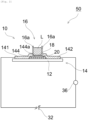
- Fig. 2 is a schematic view illustrating a configuration of a hydroxide ion concentration measurement apparatus according to another embodiment.
- a hydroxide ion concentration measurement apparatus 50 shown in Fig. 2 basically has the same configuration as the hydroxide ion concentration measurement apparatus 50 shown in Fig. 1 , and the same components are denoted by the same reference numerals, and the detailed description thereof will be omitted.
- the device 10 does not include the third electrode 143 and the insulating layer 145.
- the current value (I DS ) of the current flowing between the first electrode 141 and the second electrode 142, that is, through the semiconductor layer 144 is measured by the ammeter 36 in a state where a predetermined voltage smaller than the voltage value V TH is applied between the first electrode 141 and the second electrode 142 by the variable voltage source 32, and the concentration of OH - ions in the ion-containing liquid L that is a subject whose the concentration of OH - ions is unknown can be measured by using the calibration curve of the current value I DS and the ion-containing liquid L whose the concentration of OH - ions is known.
Landscapes
- Chemical & Material Sciences (AREA)
- Health & Medical Sciences (AREA)
- Life Sciences & Earth Sciences (AREA)
- Engineering & Computer Science (AREA)
- Pathology (AREA)
- Immunology (AREA)
- Physics & Mathematics (AREA)
- Analytical Chemistry (AREA)
- Biochemistry (AREA)
- General Health & Medical Sciences (AREA)
- General Physics & Mathematics (AREA)
- Microelectronics & Electronic Packaging (AREA)
- Molecular Biology (AREA)
- Chemical Kinetics & Catalysis (AREA)
- Electrochemistry (AREA)
- Medicinal Chemistry (AREA)
- Food Science & Technology (AREA)
- Nanotechnology (AREA)
- Investigating Or Analyzing Materials By The Use Of Electric Means (AREA)
Abstract
Description
- The present invention relates to a device in which the ease of flowing of a current changes in correspondence with a concentration of hydroxide ion (OH-), and more specifically, to a measurement apparatus and a measurement method for measuring the concentration of hydroxide ion (OH-) of a test subject based on such a change in conductivity.
- A hydroxide ion (OH-) is one of basic and important substances in various fields including material chemistry and life science. A chemical reaction, a chemical equilibrium, and an electrochemical phenomena cannot be understood without considering the presence and chemical behavior of hydroxide ions.
- As a method for measuring the concentration of such hydroxide ions, a pH titration method, a method using a pH meter, and others are conventionally known.
- In addition, Patent Literature 1 discloses that hydroxide ions in a solution are separated by chromatography, and the concentration of the hydroxide ions is measured by using an electrical conductivity method or a light absorbance method.
- Patent Literature 1:
JP 2002-5916 A - In the pH titration method, the concentration of hydroxide ions can be measured with high accuracy, but in order to accurately perform the titration, it is difficult to easily and accurately measure the concentration of hydroxide ions because it requires skill to perform the titration.
- In the pH meter, the concentration of hydrogen ions can be measured by a potential difference between a glass electrode and a comparison electrode, and the concentration of hydroxide ions can be measured on the basis of the concentration of hydrogen ions, and thus the concentration of hydroxide ions can be easily and quickly measured, but the accuracy is not high.
- In addition, in the method for separating hydroxide ions by the chromatograph disclosed in Patent Literature 1, although the measurement accuracy is high, it is essential to create a separation column, and it is necessary to select a separation column depending on a type of a solvent and a pH range, and there are also problems, for example, that cracking and others are likely to occur in the separation column and care is required for handling, that the chromatograph is expensive, and that measurement cannot be easily performed.
- In consideration of such a current situation, an object of the present invention is to provide an apparatus and a method for measuring a concentration of hydroxide ions which are capable of easily and quickly measuring the concentration of hydroxide ions with high accuracy and measuring the concentration of hydroxide ions at a relatively low cost.
- In addition, another object of the present invention is to provide a device that can be used in an apparatus and a method for measuring the concentration of hydroxide ions as described above and has a conductivity that varies depending on the concentration of hydroxide ions.
- The present invention has been made to solve the problems in the related art as described above, and the device of the present invention, the hydroxide ion measurement apparatus including the device, and the method for measuring the concentration of hydroxide ions by using the device include those configured as follows.
-
- [1] A device including an insulating substrate; at least one insulating composite layer; and a liquid storage portion capable of holding an ion-containing liquid, wherein
- the insulating composite layer includes a pair of electrodes and a semiconductor layer in contact with the pair of electrodes, and
- a layered double hydroxide layer having an OH- ion conductivity of 1 × 10⁻⁵ S/cm or more is provided between the insulating composite layer and the liquid storage portion.
- [2] The device according to [1], wherein the insulating composite layer further includes a third electrode, and an insulating layer is provided between the pair of electrodes and the semiconductor layer, and the third electrode.
- [3] The device according to [1] or [2], wherein field-effect mobility of the semiconductor layer is 20 cm2/Vs or more.
- [4] The device according to any one of [1] to [3], wherein the semiconductor layer contains at least one of oxygen, sulfur, nitrogen, boron, and carbon.
- [5] The device according to [4], wherein the semiconductor layer contains at least one of indium, zinc, tin, and a Group 13 element.
- [6] The device according to any one of [1] to [5], wherein the semiconductor layer includes at least one of graphene, carbon nanotube, boron nitride, metal dichalcogenide, and phospholene.
- [7] The device according to any one of [1] to [6], wherein
- the layered double hydroxide layer contains at least one of pyreneboronic acid, 1-pyrenebutyric acid N-hydroxysuccinimide ester, and
- a general formula of the layered double hydroxide layer is [MII 1-xM'III x(OH)2]x+ where MII is selected from the group consisting of Ca2+, Mg2+, Mn2+, Fe2+, Co2+, Ni2+, Cu2+, Zn2+, and 2Li+, and MIII is selected from the group consisting of Al3+, Mn3+, Fe3+, Co3+, Cr3+, and Ni3+.
- [8] The device according to any one of [1] to [7], further including a protective layer between the layered double hydroxide layer and the semiconductor layer.
- [9] The device according to any one of [1] to [8], wherein a thickness of the semiconductor layer is 0.5 µm or less.
- [10] The device according to any one of [1] to [9], wherein a maximum height Sz of a surface of the semiconductor layer on the layered double hydroxide layer side is 0.05 µm or less.
- [11] The device according to any one of [1] to [10], wherein an arithmetic mean height Sa of a surface of the semiconductor layer on the layered double hydroxide layer side is 0.03 µm or less.
- [12] A hydroxide ion concentration measurement apparatus, including the device according to any one of [1] to [11].
- [13] A method for measuring a concentration of hydroxide ions by using the device according to any one of [1] to [11].
- [14] The method for measuring a concentration of hydroxide ions according to [13], wherein the concentration of hydroxide ions in any one of river water, sea water, purified water, washing water, and industrial waste water is measured.
- According to the present invention, it is possible to easily and quickly measure the concentration of hydroxide ions in a solution that is a subject with high accuracy by using a device in which the conductivity varies in correspondence with the concentration of hydroxide ions (OH-) .
-
-
Fig. 1 is a schematic view illustrating a configuration of a hydroxide ion concentration measurement apparatus in the present embodiment. -
Fig. 2 is a schematic view illustrating a configuration of a hydroxide ion concentration measurement apparatus according to another embodiment. - Hereinafter, embodiments (examples) of the present invention will be described in more detail with reference to the drawings.
- Note that, in an apparatus and a method for measuring a concentration of hydroxide ions according to the present invention, it is possible to measure a concentration of hydroxide ions in, for example, river water, sea water, purified water, washing water, industrial waste water, and others as an ion-containing liquid which is a test subject, and for example, it is possible to constantly monitor the water quality thereof, and it is possible to contribute to universal and equal access of safe and inexpensive drinking water.
-
Fig. 1 is a schematic view illustrating a configuration of a hydroxide ion concentration measurement apparatus according to the present embodiment. - As shown in
Fig. 1 , a hydroxide ionconcentration measurement apparatus 50 of the present embodiment includes adevice 10 including aninsulating substrate 12, at least one insulatingcomposite layer 14, and aliquid storage portion 16 capable of holding an ion-containing liquid. Note that, thedevice 10 configured as described below can also be, for example, a semiconductor element such as a field effect transistor (FET) or a metal-oxide semiconductor field effect transistor (MOSFET). - The
insulating substrate 12 is, for example, a substrate formed from an insulating material such as glass or ceramics. - The
insulating composite layer 14 includes a pair of electrodes (afirst electrode 141 and a second electrode 142) and asemiconductor layer 144 in contact with the pair ofelectrodes - In addition, a layered
double hydroxide layer 18 is provided between theinsulating composite layer 14 and theliquid storage portion 16. The layereddouble hydroxide layer 18 is in contact with an ion-containing liquid L held in theliquid storage portion 16 and conducts hydroxide ions (OH-) contained in the ion-containing liquid L. The OH- ion conductivity of the layereddouble hydroxide layer 18 in the present embodiment is 1 × 10⁻⁵ S/cm or more, more preferably 1 × 10⁻⁴ S/cm or more, still more preferably 5.0 × 10⁻⁴ S/cm or more, and most preferably 1 × 10⁻³ S/cm or more. An upper limit value of the OH- ion conductivity of the layereddouble hydroxide layer 18 is not particularly limited, but is generally 1.0 × 10 S/cm. - In addition, a
protective layer 20 is provided between the layereddouble hydroxide layer 18 and thesemiconductor layer 144, and the layereddouble hydroxide layer 18 and theelectrodes partition portion 16a of theliquid storage portion 16. - In addition, the layered
double hydroxide layer 18 preferably contains at least one of pyreneboronic acid, 1-pyrenebutyric acid N-hydroxysuccinimide ester, and
a general formula of the layereddouble hydroxide layer 18 is [MII 1-xM'III x(OH)2]x+ where MII is selected from the group consisting of Ca2+, Mg2+, Mn2+, Fe2+, Co2+, Ni2+, Cu2+, Zn2+, and 2Li+, and MIII is selected from the group consisting of Al3+, Mn3+, Fe3+, Co3+, Cr3+, and Ni3+. - In addition, the
semiconductor layer 144 preferably has a field-effect mobility of 20 cm2/Vs or more, particularly 60 cm2/Vs or more. - The
semiconductor layer 144 can contain at least one of oxygen, sulfur, nitrogen, boron, and carbon. In addition, thesemiconductor layer 144 preferably further contains at least one of indium, zinc, tin, and a Group 13 element. - The
semiconductor layer 144 can contain at least one of graphene, carbon nanotube, boron nitride, metal dichalcogenide, or phospholene. - More specifically, indium-zinc-oxide (IZO) such as Ta-IZO can be used as the
semiconductor layer 144. - In addition, the smaller the thickness of the
semiconductor layer 144, the larger a variation in conductivity of a surface layer, and thus, as described later, a variation in moving charges becomes larger, and measurement accuracy is improved. The thickness of thesemiconductor layer 144 is preferably 0.5 µm or less, more preferably 0.1 µm or less, and particularly preferably 0.05 µm or less. A lower limit value of the thickness of thesemiconductor layer 144 is not particularly specified, but is generally 0.005 µm or more. - A
surface 144a of thesemiconductor layer 144 on the layereddouble hydroxide layer 18 side is preferably as smooth as possible. When thesurface 144a of thesemiconductor layer 144 is not smooth, for example, a gap is generated between the surface and theprotective layer 20, or theprotective layer 20 is discontinuously formed, and thus adhesion between thesemiconductor layer 144 and the layereddouble hydroxide layer 18 deteriorates, and a current flows only in a part of thesurface 144a of thesemiconductor layer 144. For this reason, the measurement accuracy decreases or the operation becomes unstable. - Specifically, a maximum height Sz of the
surface 144a of thesemiconductor layer 144 is preferably 0.05 µm or less, more preferably 0.01 µm or less, and most preferably 0.003 µm or less. A lower limit value of the maximum height Sz is not particularly specified, but is generally 0.0005 µm or more. In addition, an arithmetic mean height Sa of thesurface 144a of thesemiconductor layer 144 on the layereddouble hydroxide layer 18 side is preferably 0.03 µm or less, more preferably 0.005 µm or less, and most preferably 0.002 µm or less. The lower limit value of the arithmetic mean height Sa is not particularly specified, but is generally 0.0002 µm or more. - Here, the maximum height Sz and the arithmetic mean height Sa are parameters of surface roughness defined by ISO25178, and such parameters can be measured by, for example, a 3D surface roughness profile analyzer (NexView manufactured by Zygo Corporation). Note that, the measurement conditions in this case are preferably performed according to the following.
- Measurement is performed under conditions of an objective lens of 50 times, a zoom lens of 20 times, and a measurement range of 89 µm × 87 µm in accordance with ISO25178. A roughness curve in a range of 3 µm × 3 µm is extracted from an obtained three-dimensional surface shape, the roughness curve is corrected under the following correction conditions by an analysis program "Mx" attached to a 3D surface roughness shape measuring device, and the maximum height Sz and the arithmetic mean height Sa are calculated.
-
- Remove: Form Remove
- Filter Type: Spline
- Filter: Low Pass
- Type: Gaussian Spline Auto
- In addition, the
protective layer 20 is provided to protect thesemiconductor layer 144 from the ion-containing liquid L. By providing theprotective layer 20, thesemiconductor layer 144 can be prevented from, for example, being corroded, and the durability and reliability of thesemiconductor layer 144 can be improved. As a material of theprotective layer 20, a known material can be applied as long as the material has insulating properties, and a material having corrosion resistance is preferable. For example, Ta2O5, Si3N4, SiO2, and others are used, and the thickness is preferably from 0.01 µm to 0.5 µm, and more preferably from 0.03 µm to 0.2 µm. - In addition, in the present embodiment, the insulating
composite layer 14 further includes athird electrode 143. As such a configuration, by applying a voltage from thethird electrode 143, the current flowing between thefirst electrode 141 and thesecond electrode 142 can be increased, and the measurement accuracy can be enhanced. In addition, the pair ofelectrodes semiconductor layer 144 includes an insulatinglayer 145 between these and thethird electrode 143. As the material of the insulatinglayer 145, a known material can be applied as long as the material can be electrically insulated, and for example, various ceramics and resins can be used, and the thickness is preferably from 0.01 µm to 0.5 µm, and more preferably from 0.03 µm to 0.2 µm. - In addition, the
measurement apparatus 50 of the present embodiment includes avariable voltage source 32 for applying a voltage between thefirst electrode 141 and thesecond electrode 142, avariable voltage source 34 for applying a voltage between thefirst electrode 141 and thethird electrode 143, anammeter 36 for measuring a current value between thefirst electrode 141 and thesecond electrode 142, and avoltmeter 38 for measuring a voltage value between thefirst electrode 141 and thethird electrode 143. - In the
device 10 of the present embodiment configured as described above, the ease of flow of the current in thesemiconductor layer 144 varies in correspondence with the concentration of the OH- ion in the ion-containing liquid L held in theliquid storage portion 16. Specifically, as the amount of OH- conducting through the layereddouble hydroxide layer 18 increases, a current easily flows through thesemiconductor layer 144. - Therefore, in the
measurement apparatus 50 of the present embodiment, a predetermined voltage, for example, a voltage of approximately 1 V to 10 V is applied between thefirst electrode 141 and thesecond electrode 142 by thevariable voltage source 32 in a state in which the ion-containing liquid L that is a subject is stored in theliquid storage portion 16, a voltage to be applied between thefirst electrode 141 and thethird electrode 143 is gradually increased by thevariable voltage source 34, and a voltage value (VTH) between thefirst electrode 141 and thethird electrode 143 when a current that flows between thefirst electrode 141 and thesecond electrode 142 and detected by theammeter 36 reaches a predetermined current value is measured by thevoltmeter 38. - By creating a correspondence with the voltage value VTH as a calibration curve for the ion-containing liquid L whose the concentration of OH- ions is known, the concentration of OH- ions of the subject that is the ion-containing liquid L whose the concentration of OH- ions is unknown can be measured.
- In addition, in the
measurement apparatus 50 of the present embodiment, in a state in which the ion-containing liquid L that is a subject is stored in theliquid storage portion 16, a current value (IDS) of a current flowing between thefirst electrode 141 and thesecond electrode 142, that is, through thesemiconductor layer 144 can be measured by theammeter 36 in a state in which a predetermined voltage, for example, a voltage of approximately 1 V is applied between thefirst electrode 141 and thesecond electrode 142 by thevariable voltage source 32. - By preparing a calibration curve of the current value IDS and the ion-containing liquid L whose the concentration of OH- ions is known in advance, it is possible to measure the concentration of OH- ions of the ion-containing liquid L whose the concentration OH- ions is unknown.
-
Fig. 2 is a schematic view illustrating a configuration of a hydroxide ion concentration measurement apparatus according to another embodiment. - A hydroxide ion
concentration measurement apparatus 50 shown inFig. 2 basically has the same configuration as the hydroxide ionconcentration measurement apparatus 50 shown inFig. 1 , and the same components are denoted by the same reference numerals, and the detailed description thereof will be omitted. - In the hydroxide ion
concentration measurement apparatus 50 of the present embodiment, thedevice 10 does not include thethird electrode 143 and the insulatinglayer 145. - Even in the case of such a configuration, in a state in which the ion-containing liquid L that is a subject is stored in the
liquid storage portion 16, the current value (IDS) of the current flowing between thefirst electrode 141 and thesecond electrode 142, that is, through thesemiconductor layer 144 is measured by theammeter 36 in a state where a predetermined voltage smaller than the voltage value VTH is applied between thefirst electrode 141 and thesecond electrode 142 by thevariable voltage source 32, and the concentration of OH- ions in the ion-containing liquid L that is a subject whose the concentration of OH- ions is unknown can be measured by using the calibration curve of the current value IDS and the ion-containing liquid L whose the concentration of OH- ions is known. - Although the preferred embodiments of the present invention have been described above, the present invention is not limited thereto, and various modifications can be made without departing from the object of the present invention.
-
- 10
- Device
- 12
- Insulating substrate
- 14
- Insulating composite layer
- 141
- First electrode
- 142
- Second electrode
- 143
- Third electrode
- 144
- Semiconductor layer
- 144a
- Surface
- 145
- Insulating layer
- 16
- Liquid storage portion
- 16a
- Partition portion
- 18
- Layered double hydroxide layer
- 20
- Protective layer
- 32
- Variable voltage source
- 34
- Variable voltage source
- 36
- Ammeter
- 38
- Voltmeter
- 50
- Measurement apparatus
- L
- Ion-containing liquid
Claims (14)
- A device comprising: an insulating substrate; at least one insulating composite layer; and a liquid storage portion capable of holding an ion-containing liquid, whereinthe insulating composite layer includes a pair of electrodes and a semiconductor layer in contact with the pair of electrodes, anda layered double hydroxide layer having an OH- ion conductivity of 1 × 10⁻⁵ S/cm or more is provided between the insulating composite layer and the liquid storage portion.
- The device according to claim 1, whereinthe insulating composite layer further includes a third electrode, andan insulating layer is provided between the pair of electrodes and the semiconductor layer, and the third electrode.
- The device according to claim 1, wherein field-effect mobility of the semiconductor layer is 20 cm2/Vs or more.
- The device according to claim 1, wherein the semiconductor layer contains at least one of oxygen, sulfur, nitrogen, boron, and carbon.
- The device of claim 4, wherein the semiconductor layer contains at least one of indium, zinc, tin, and a Group 13 element.
- The device of claim 4, wherein the semiconductor layer includes at least one of graphene, carbon nanotube, boron nitride, metal dichalcogenide, and phospholene.
- The device according to claim 1, whereinthe layered double hydroxide layer contains at least one of pyreneboronic acid, 1-pyrenebutyric acid N-hydroxysuccinimide ester, anda general formula of the layered double hydroxide layer is [MII 1-xM'III x(OH)2]x+ where MII is selected from the group consisting of Ca2+, Mg2+, Mn2+, Fe2+, Co2+, Ni2+, Cu2+, Zn2+, and 2Li+, and M'III is selected from the group consisting of Al3+, Mn3+, Fe3+, Co3+, Cr3+, and Ni3+.
- The device of claim 1, further comprising a protective layer between the layered double hydroxide layer and the semiconductor layer.
- The device according to claim 1, wherein a thickness of the semiconductor layer is 0.5 µm or less.
- The device according to claim 1, wherein a maximum height Sz of a surface of the semiconductor layer on the layered double hydroxide layer side is 0.05 µm or less.
- The device according to claim 1, wherein an arithmetic mean height Sa of a surface of the semiconductor layer on the layered double hydroxide layer side is 0.03 µm or less.
- A hydroxide ion concentration measurement apparatus, comprising the device according to any one of claims 1 to 11.
- A method for measuring a concentration of hydroxide ions by using the device according to any one of claims 1 to 11.
- The method for measuring a concentration of hydroxide ions according to claim 13, wherein the concentration of hydroxide ions in any one of river water, sea water, purified water, washing water, and industrial waste water is measured.
Applications Claiming Priority (2)
| Application Number | Priority Date | Filing Date | Title |
|---|---|---|---|
| JP2022121592 | 2022-07-29 | ||
| PCT/JP2023/026642 WO2024024637A1 (en) | 2022-07-29 | 2023-07-20 | Device, hydroxide ion concentration measurement apparatus comprising said device, and method for measuring hydroxide ion concentration using said device |
Publications (2)
| Publication Number | Publication Date |
|---|---|
| EP4563994A1 true EP4563994A1 (en) | 2025-06-04 |
| EP4563994A4 EP4563994A4 (en) | 2025-10-08 |
Family
ID=89706456
Family Applications (1)
| Application Number | Title | Priority Date | Filing Date |
|---|---|---|---|
| EP23846368.1A Pending EP4563994A4 (en) | 2022-07-29 | 2023-07-20 | Device, hydroxide ion concentration measuring device comprising this device and method for measuring the hydroxide ion concentration using this device |
Country Status (6)
| Country | Link |
|---|---|
| US (1) | US20260016444A1 (en) |
| EP (1) | EP4563994A4 (en) |
| JP (1) | JP7849483B2 (en) |
| CN (1) | CN119563107A (en) |
| TW (1) | TW202419864A (en) |
| WO (1) | WO2024024637A1 (en) |
Families Citing this family (3)
| Publication number | Priority date | Publication date | Assignee | Title |
|---|---|---|---|---|
| CN121464342A (en) * | 2023-07-20 | 2026-02-03 | 三井金属株式会社 | Device, concentration measuring apparatus provided with the device, and concentration measuring method using the device |
| WO2025142975A1 (en) * | 2023-12-28 | 2025-07-03 | 三井金属鉱業株式会社 | Device, and concentration measurement apparatus including same and concentration measurement method using same |
| WO2025169976A1 (en) * | 2024-02-08 | 2025-08-14 | 三井金属鉱業株式会社 | Device, concentration measurement apparatus provided with same, and concentration measurement method using same |
Family Cites Families (5)
| Publication number | Priority date | Publication date | Assignee | Title |
|---|---|---|---|---|
| JP3839641B2 (en) | 2000-06-20 | 2006-11-01 | 独立行政法人科学技術振興機構 | Hydroxide ion separation and analysis method and ion chromatography apparatus |
| JP5263073B2 (en) | 2009-08-21 | 2013-08-14 | 株式会社リコー | Electrochemical sensor element |
| JP5903872B2 (en) | 2011-12-19 | 2016-04-13 | 大日本印刷株式会社 | Transistor type sensor and method for manufacturing transistor type sensor |
| JP6941202B1 (en) | 2020-03-30 | 2021-09-29 | 日本碍子株式会社 | Membrane electrode assembly and electrochemical cell |
| CN114113244B (en) | 2021-11-10 | 2024-09-03 | 清华大学 | A biochemical sensor with dual-channel detection |
-
2023
- 2023-07-20 EP EP23846368.1A patent/EP4563994A4/en active Pending
- 2023-07-20 CN CN202380054254.9A patent/CN119563107A/en active Pending
- 2023-07-20 WO PCT/JP2023/026642 patent/WO2024024637A1/en not_active Ceased
- 2023-07-20 US US18/995,552 patent/US20260016444A1/en active Pending
- 2023-07-20 JP JP2024537651A patent/JP7849483B2/en active Active
- 2023-07-25 TW TW112127766A patent/TW202419864A/en unknown
Also Published As
| Publication number | Publication date |
|---|---|
| EP4563994A4 (en) | 2025-10-08 |
| WO2024024637A1 (en) | 2024-02-01 |
| US20260016444A1 (en) | 2026-01-15 |
| JPWO2024024637A1 (en) | 2024-02-01 |
| JP7849483B2 (en) | 2026-04-21 |
| CN119563107A (en) | 2025-03-04 |
| TW202419864A (en) | 2024-05-16 |
Similar Documents
| Publication | Publication Date | Title |
|---|---|---|
| US20260016444A1 (en) | Device, hydroxide ion concentration measurement apparatus provided with same, and method for measuring concentration of hydroxide ion by using same | |
| US9217722B2 (en) | Multi-electrode chemiresistor | |
| Jagner et al. | Derivative potentiometric stripping analysis with a thin film of mercury on a glassy carbon electrode | |
| US7678253B2 (en) | Atmospheric corrosion sensor | |
| Howlett et al. | The effect of potential bias on the formation of ionic liquid generated surface films on Mg alloys | |
| Aziz et al. | Electrochemical investigation of metal oxide conducting electrodes for direct detection of sulfide | |
| US8394247B2 (en) | Anion concentration measuring device and anion concentration measuring element | |
| Li et al. | A novel pH potentiometric sensor based on electrochemically synthesized polybisphenol A films at an ITO electrode | |
| WO2016032314A1 (en) | An egfet phosphate sensor device | |
| CN109557162B (en) | Sensing device and ion detection method | |
| Toniolo et al. | An Ionic‐Liquid Based Probe for the Sequential Preconcentration from Headspace and Direct Voltammetric Detection of Phenols in Wastewaters | |
| Xu et al. | Development and performance of an all-solid-stated pH sensor based on modified membranes | |
| Khair et al. | A voltammetric sensor based on iodine-coated platinum electrode for determination of iron in blood serum | |
| CN121464342A (en) | Device, concentration measuring apparatus provided with the device, and concentration measuring method using the device | |
| Arshak et al. | Drop-coated polyaniline composite conductimetric pH sensors | |
| CN1554943A (en) | A method for simultaneous detection of multiple heavy metal elements | |
| O'Riordan et al. | Electrochemical Detection of free-chlorine in water samples facilitated by in-situ ph control using interdigitated microelectrodes | |
| Wyantuti et al. | Anodic stripping voltammetry with pencil graphite electrode for determination of chromium (III) | |
| TW202601109A (en) | Device, concentration measuring apparatus including the same, and concentration measuring method using the same | |
| KR20150012072A (en) | Hydrogen peroxide detection sensor and method for fabricating the working electrode of the same | |
| Kurek et al. | Cathodic reduction of acids in dimethylformamide on platinum | |
| JP7705114B2 (en) | Solid-state semiconductor ion sensor | |
| Harvey et al. | Boron‐Doped Diamond Dual‐Plate Deep‐Microtrench Device for Generator‐Collector Sulfide Sensing | |
| KR102915571B1 (en) | A multifunctional sensors for detecting various water pollution factors | |
| Kiss | Amperometric responses of volatile organic amines in air by using 5-sulpho-salicylic acid modified narrow-gap electrochemical cell |
Legal Events
| Date | Code | Title | Description |
|---|---|---|---|
| STAA | Information on the status of an ep patent application or granted ep patent |
Free format text: STATUS: THE INTERNATIONAL PUBLICATION HAS BEEN MADE |
|
| PUAI | Public reference made under article 153(3) epc to a published international application that has entered the european phase |
Free format text: ORIGINAL CODE: 0009012 |
|
| STAA | Information on the status of an ep patent application or granted ep patent |
Free format text: STATUS: REQUEST FOR EXAMINATION WAS MADE |
|
| 17P | Request for examination filed |
Effective date: 20250225 |
|
| AK | Designated contracting states |
Kind code of ref document: A1 Designated state(s): AL AT BE BG CH CY CZ DE DK EE ES FI FR GB GR HR HU IE IS IT LI LT LU LV MC ME MK MT NL NO PL PT RO RS SE SI SK SM TR |
|
| A4 | Supplementary search report drawn up and despatched |
Effective date: 20250909 |
|
| RIC1 | Information provided on ipc code assigned before grant |
Ipc: G01N 27/414 20060101AFI20250903BHEP |
|
| DAV | Request for validation of the european patent (deleted) | ||
| DAX | Request for extension of the european patent (deleted) | ||
| RAP3 | Party data changed (applicant data changed or rights of an application transferred) |
Owner name: MITSUI KINZOKU COMPANY, LIMITED |