EP4563941A1 - Information processing apparatus, information processing method, and program - Google Patents
Information processing apparatus, information processing method, and program Download PDFInfo
- Publication number
- EP4563941A1 EP4563941A1 EP23872231.8A EP23872231A EP4563941A1 EP 4563941 A1 EP4563941 A1 EP 4563941A1 EP 23872231 A EP23872231 A EP 23872231A EP 4563941 A1 EP4563941 A1 EP 4563941A1
- Authority
- EP
- European Patent Office
- Prior art keywords
- mobile body
- person
- captured image
- input instruction
- instruction sentence
- Prior art date
- Legal status (The legal status is an assumption and is not a legal conclusion. Google has not performed a legal analysis and makes no representation as to the accuracy of the status listed.)
- Pending
Links
Images




Classifications
-
- G—PHYSICS
- G01—MEASURING; TESTING
- G01C—MEASURING DISTANCES, LEVELS OR BEARINGS; SURVEYING; NAVIGATION; GYROSCOPIC INSTRUMENTS; PHOTOGRAMMETRY OR VIDEOGRAMMETRY
- G01C11/00—Photogrammetry or videogrammetry, e.g. stereogrammetry; Photographic surveying
- G01C11/04—Interpretation of pictures
-
- G—PHYSICS
- G01—MEASURING; TESTING
- G01C—MEASURING DISTANCES, LEVELS OR BEARINGS; SURVEYING; NAVIGATION; GYROSCOPIC INSTRUMENTS; PHOTOGRAMMETRY OR VIDEOGRAMMETRY
- G01C21/00—Navigation; Navigational instruments not provided for in groups G01C1/00 - G01C19/00
- G01C21/26—Navigation; Navigational instruments not provided for in groups G01C1/00 - G01C19/00 specially adapted for navigation in a road network
- G01C21/34—Route searching; Route guidance
- G01C21/36—Input/output arrangements for on-board computers
- G01C21/3626—Details of the output of route guidance instructions
- G01C21/3647—Guidance involving output of stored or live camera images or video streams
-
- G—PHYSICS
- G06—COMPUTING OR CALCULATING; COUNTING
- G06F—ELECTRIC DIGITAL DATA PROCESSING
- G06F18/00—Pattern recognition
- G06F18/20—Analysing
- G06F18/29—Graphical models, e.g. Bayesian networks
- G06F18/295—Markov models or related models, e.g. semi-Markov models; Markov random fields; Networks embedding Markov models
-
- G—PHYSICS
- G06—COMPUTING OR CALCULATING; COUNTING
- G06F—ELECTRIC DIGITAL DATA PROCESSING
- G06F3/00—Input arrangements for transferring data to be processed into a form capable of being handled by the computer; Output arrangements for transferring data from processing unit to output unit, e.g. interface arrangements
- G06F3/01—Input arrangements or combined input and output arrangements for interaction between user and computer
- G06F3/011—Arrangements for interaction with the human body, e.g. for user immersion in virtual reality
- G06F3/013—Eye tracking input arrangements
-
- G—PHYSICS
- G06—COMPUTING OR CALCULATING; COUNTING
- G06F—ELECTRIC DIGITAL DATA PROCESSING
- G06F3/00—Input arrangements for transferring data to be processed into a form capable of being handled by the computer; Output arrangements for transferring data from processing unit to output unit, e.g. interface arrangements
- G06F3/01—Input arrangements or combined input and output arrangements for interaction between user and computer
- G06F3/017—Gesture based interaction, e.g. based on a set of recognized hand gestures
-
- G—PHYSICS
- G06—COMPUTING OR CALCULATING; COUNTING
- G06F—ELECTRIC DIGITAL DATA PROCESSING
- G06F3/00—Input arrangements for transferring data to be processed into a form capable of being handled by the computer; Output arrangements for transferring data from processing unit to output unit, e.g. interface arrangements
- G06F3/16—Sound input; Sound output
- G06F3/167—Audio in a user interface, e.g. using voice commands for navigating, audio feedback
-
- G—PHYSICS
- G06—COMPUTING OR CALCULATING; COUNTING
- G06N—COMPUTING ARRANGEMENTS BASED ON SPECIFIC COMPUTATIONAL MODELS
- G06N20/00—Machine learning
-
- G—PHYSICS
- G06—COMPUTING OR CALCULATING; COUNTING
- G06N—COMPUTING ARRANGEMENTS BASED ON SPECIFIC COMPUTATIONAL MODELS
- G06N3/00—Computing arrangements based on biological models
- G06N3/02—Neural networks
- G06N3/08—Learning methods
-
- G—PHYSICS
- G06—COMPUTING OR CALCULATING; COUNTING
- G06N—COMPUTING ARRANGEMENTS BASED ON SPECIFIC COMPUTATIONAL MODELS
- G06N5/00—Computing arrangements using knowledge-based models
- G06N5/02—Knowledge representation; Symbolic representation
- G06N5/022—Knowledge engineering; Knowledge acquisition
-
- G—PHYSICS
- G06—COMPUTING OR CALCULATING; COUNTING
- G06N—COMPUTING ARRANGEMENTS BASED ON SPECIFIC COMPUTATIONAL MODELS
- G06N7/00—Computing arrangements based on specific mathematical models
- G06N7/01—Probabilistic graphical models, e.g. probabilistic networks
-
- G—PHYSICS
- G06—COMPUTING OR CALCULATING; COUNTING
- G06T—IMAGE DATA PROCESSING OR GENERATION, IN GENERAL
- G06T7/00—Image analysis
- G06T7/70—Determining position or orientation of objects or cameras
-
- G—PHYSICS
- G06—COMPUTING OR CALCULATING; COUNTING
- G06V—IMAGE OR VIDEO RECOGNITION OR UNDERSTANDING
- G06V10/00—Arrangements for image or video recognition or understanding
- G06V10/70—Arrangements for image or video recognition or understanding using pattern recognition or machine learning
- G06V10/82—Arrangements for image or video recognition or understanding using pattern recognition or machine learning using neural networks
-
- G—PHYSICS
- G06—COMPUTING OR CALCULATING; COUNTING
- G06V—IMAGE OR VIDEO RECOGNITION OR UNDERSTANDING
- G06V10/00—Arrangements for image or video recognition or understanding
- G06V10/70—Arrangements for image or video recognition or understanding using pattern recognition or machine learning
- G06V10/84—Arrangements for image or video recognition or understanding using pattern recognition or machine learning using probabilistic graphical models from image or video features, e.g. Markov models or Bayesian networks
- G06V10/85—Markov-related models; Markov random fields
-
- G—PHYSICS
- G06—COMPUTING OR CALCULATING; COUNTING
- G06V—IMAGE OR VIDEO RECOGNITION OR UNDERSTANDING
- G06V20/00—Scenes; Scene-specific elements
- G06V20/50—Context or environment of the image
- G06V20/56—Context or environment of the image exterior to a vehicle by using sensors mounted on the vehicle
- G06V20/58—Recognition of moving objects or obstacles, e.g. vehicles or pedestrians; Recognition of traffic objects, e.g. traffic signs, traffic lights or roads
-
- G—PHYSICS
- G06—COMPUTING OR CALCULATING; COUNTING
- G06V—IMAGE OR VIDEO RECOGNITION OR UNDERSTANDING
- G06V40/00—Recognition of biometric, human-related or animal-related patterns in image or video data
- G06V40/20—Movements or behaviour, e.g. gesture recognition
-
- G—PHYSICS
- G06—COMPUTING OR CALCULATING; COUNTING
- G06V—IMAGE OR VIDEO RECOGNITION OR UNDERSTANDING
- G06V40/00—Recognition of biometric, human-related or animal-related patterns in image or video data
- G06V40/20—Movements or behaviour, e.g. gesture recognition
- G06V40/28—Recognition of hand or arm movements, e.g. recognition of deaf sign language
-
- G—PHYSICS
- G08—SIGNALLING
- G08G—TRAFFIC CONTROL SYSTEMS
- G08G1/00—Traffic control systems for road vehicles
- G08G1/09—Arrangements for giving variable traffic instructions
- G08G1/0962—Arrangements for giving variable traffic instructions having an indicator mounted inside the vehicle, e.g. giving voice messages
- G08G1/0968—Systems involving transmission of navigation instructions to the vehicle
- G08G1/096833—Systems involving transmission of navigation instructions to the vehicle where different aspects are considered when computing the route
- G08G1/096838—Systems involving transmission of navigation instructions to the vehicle where different aspects are considered when computing the route where the user preferences are taken into account or the user selects one route out of a plurality
-
- G—PHYSICS
- G08—SIGNALLING
- G08G—TRAFFIC CONTROL SYSTEMS
- G08G1/00—Traffic control systems for road vehicles
- G08G1/09—Arrangements for giving variable traffic instructions
- G08G1/0962—Arrangements for giving variable traffic instructions having an indicator mounted inside the vehicle, e.g. giving voice messages
- G08G1/0968—Systems involving transmission of navigation instructions to the vehicle
- G08G1/096833—Systems involving transmission of navigation instructions to the vehicle where different aspects are considered when computing the route
- G08G1/096844—Systems involving transmission of navigation instructions to the vehicle where different aspects are considered when computing the route where the complete route is dynamically recomputed based on new data
-
- G—PHYSICS
- G08—SIGNALLING
- G08G—TRAFFIC CONTROL SYSTEMS
- G08G1/00—Traffic control systems for road vehicles
- G08G1/09—Arrangements for giving variable traffic instructions
- G08G1/0962—Arrangements for giving variable traffic instructions having an indicator mounted inside the vehicle, e.g. giving voice messages
- G08G1/0968—Systems involving transmission of navigation instructions to the vehicle
- G08G1/096833—Systems involving transmission of navigation instructions to the vehicle where different aspects are considered when computing the route
- G08G1/09685—Systems involving transmission of navigation instructions to the vehicle where different aspects are considered when computing the route where the complete route is computed only once and not updated
-
- G—PHYSICS
- G08—SIGNALLING
- G08G—TRAFFIC CONTROL SYSTEMS
- G08G1/00—Traffic control systems for road vehicles
- G08G1/09—Arrangements for giving variable traffic instructions
- G08G1/0962—Arrangements for giving variable traffic instructions having an indicator mounted inside the vehicle, e.g. giving voice messages
- G08G1/0968—Systems involving transmission of navigation instructions to the vehicle
- G08G1/096855—Systems involving transmission of navigation instructions to the vehicle where the output is provided in a suitable form to the driver
- G08G1/096872—Systems involving transmission of navigation instructions to the vehicle where the output is provided in a suitable form to the driver where instructions are given per voice
-
- G—PHYSICS
- G08—SIGNALLING
- G08G—TRAFFIC CONTROL SYSTEMS
- G08G1/00—Traffic control systems for road vehicles
- G08G1/09—Arrangements for giving variable traffic instructions
- G08G1/0962—Arrangements for giving variable traffic instructions having an indicator mounted inside the vehicle, e.g. giving voice messages
- G08G1/0968—Systems involving transmission of navigation instructions to the vehicle
- G08G1/096877—Systems involving transmission of navigation instructions to the vehicle where the input to the navigation device is provided by a suitable I/O arrangement
-
- G—PHYSICS
- G08—SIGNALLING
- G08G—TRAFFIC CONTROL SYSTEMS
- G08G1/00—Traffic control systems for road vehicles
- G08G1/09—Arrangements for giving variable traffic instructions
- G08G1/0962—Arrangements for giving variable traffic instructions having an indicator mounted inside the vehicle, e.g. giving voice messages
- G08G1/0968—Systems involving transmission of navigation instructions to the vehicle
- G08G1/096877—Systems involving transmission of navigation instructions to the vehicle where the input to the navigation device is provided by a suitable I/O arrangement
- G08G1/096888—Systems involving transmission of navigation instructions to the vehicle where the input to the navigation device is provided by a suitable I/O arrangement where input information is obtained using learning systems, e.g. history databases
-
- G—PHYSICS
- G08—SIGNALLING
- G08G—TRAFFIC CONTROL SYSTEMS
- G08G1/00—Traffic control systems for road vehicles
- G08G1/20—Monitoring the location of vehicles belonging to a group, e.g. fleet of vehicles, countable or determined number of vehicles
- G08G1/202—Dispatching vehicles on the basis of a location, e.g. taxi dispatching
-
- G—PHYSICS
- G06—COMPUTING OR CALCULATING; COUNTING
- G06F—ELECTRIC DIGITAL DATA PROCESSING
- G06F2203/00—Indexing scheme relating to G06F3/00 - G06F3/048
- G06F2203/038—Indexing scheme relating to G06F3/038
- G06F2203/0381—Multimodal input, i.e. interface arrangements enabling the user to issue commands by simultaneous use of input devices of different nature, e.g. voice plus gesture on digitizer
-
- G—PHYSICS
- G06—COMPUTING OR CALCULATING; COUNTING
- G06T—IMAGE DATA PROCESSING OR GENERATION, IN GENERAL
- G06T2207/00—Indexing scheme for image analysis or image enhancement
- G06T2207/20—Special algorithmic details
- G06T2207/20072—Graph-based image processing
-
- G—PHYSICS
- G06—COMPUTING OR CALCULATING; COUNTING
- G06T—IMAGE DATA PROCESSING OR GENERATION, IN GENERAL
- G06T2207/00—Indexing scheme for image analysis or image enhancement
- G06T2207/20—Special algorithmic details
- G06T2207/20076—Probabilistic image processing
-
- G—PHYSICS
- G06—COMPUTING OR CALCULATING; COUNTING
- G06T—IMAGE DATA PROCESSING OR GENERATION, IN GENERAL
- G06T2207/00—Indexing scheme for image analysis or image enhancement
- G06T2207/30—Subject of image; Context of image processing
- G06T2207/30248—Vehicle exterior or interior
- G06T2207/30252—Vehicle exterior; Vicinity of vehicle
-
- G—PHYSICS
- G08—SIGNALLING
- G08G—TRAFFIC CONTROL SYSTEMS
- G08G1/00—Traffic control systems for road vehicles
- G08G1/09—Arrangements for giving variable traffic instructions
- G08G1/0962—Arrangements for giving variable traffic instructions having an indicator mounted inside the vehicle, e.g. giving voice messages
- G08G1/0968—Systems involving transmission of navigation instructions to the vehicle
- G08G1/096805—Systems involving transmission of navigation instructions to the vehicle where the transmitted instructions are used to compute a route
- G08G1/096827—Systems involving transmission of navigation instructions to the vehicle where the transmitted instructions are used to compute a route where the route is computed onboard
Definitions
- the present invention relates to an information processing apparatus, an information processing method, and a program.
- Patent Document 1 describes a technology for detecting an emergency vehicle included in image data by inputting audio data and the image data into an artificial neural network such as a deep neural network (DNN).
- DNN deep neural network
- Patent Document 1 Japanese Unexamined Patent Application, First Publication No. 2022-96601
- Non-Patent Document 1 describes a neural state machine that converts multimodal raw information obtained by a sensor into a conceptual expression in a common abstract space and performs inference on a graph (a scene graph) in which these conceptual expressions are structured.
- the neural state machine is superior to the technology described in Patent Document 1 in that processing content on the graph is transparent and it does not require a large amount of data for the processing.
- the technology described in Non-Patent Document 1 does not provide a means to resolve ambiguity that arises in the inference without utilizing modalities such as a line of sight or a gesture of a person.
- the information processing apparatus is mounted on a mobile body.
- the mobile body moves on both a roadway and a predetermined area different from the roadway.
- the mobile body may be referred to as micromobility.
- An electric kickboard is a type of micromobility.
- the predetermined area is, for example, a sidewalk.
- the predetermined area may be a part or all of a road side, a bicycle lane, a public open space, and the like, or may include all of a sidewalk, a road side, a bicycle lane, a public open space, and the like.
- the information processing apparatus identifies an object indicated by a person on the basis of a captured image of surroundings of the mobile body, an input instruction sentence input by a person associated with the mobile body, and a gesture made by the person.
- the person associated with the mobile body is described as an occupant who is on board the mobile body, but the present invention is not limited to such a configuration, and may be a person who inputs an instruction sentence outside the mobile body (for example, to indicate a waiting place of the mobile body after getting off).
- FIG. 1 is a diagram which shows an example of a configuration of a mobile body 1 and a control apparatus 100 according to an embodiment.
- the mobile body 1 is equipped with, for example, an external detection device 10, a mobile body sensor 12, an operator 14, an internal camera 16, a positioning apparatus 18, an HMI 20, a mode changeover switch 22, a moving mechanism 30, a drive apparatus 40, an external notification apparatus 50, a storage apparatus 70, and a control apparatus 100.
- an external detection device 10 a mobile body sensor 12, an operator 14, an internal camera 16, a positioning apparatus 18, an HMI 20, a mode changeover switch 22, a moving mechanism 30, a drive apparatus 40, an external notification apparatus 50, a storage apparatus 70, and a control apparatus 100.
- the mobile body is not limited to a vehicle, but may include a small mobility device that travels alongside a walking user to carry luggage or lead a person, and may also include other mobile bodies capable of autonomous movement (such as walking robots).
- the external detection device 10 is a device whose detection range is a traveling direction of the mobile body 1.
- the external detection device 10 includes an external camera, a radar device, a light detection and ranging (LIDAR), a sensor fusion device, and the like.
- the external detection device 10 outputs information indicating a result of the detection (an image, a position of an object, or the like) to the control apparatus 100.
- the external detection device 10 outputs a captured image of surroundings of the mobile body 1, captured by the external camera, to the control apparatus 100.
- the mobile body sensor 12 includes, for example, a speed sensor, an acceleration sensor, a yaw rate (angular speed) sensor, an orientation sensor, an operation amount detection sensor attached to the operator 14, and the like.
- the operator 14 includes, for example, an operator for instructing acceleration or deceleration (for example, an accelerator pedal or a brake pedal) and an operator for instructing steering (for example, a steering wheel).
- the mobile body sensor 12 may include an accelerator opening sensor, a brake depression amount sensor, a steering torque sensor, and the like.
- the mobile body 1 may also include, as the operator 14, an operator of a type other than described above (for example, a non-annular rotating operator, a joystick, a button, or the like).
- the internal camera 16 captures an image of at least the head of the occupant of the mobile body 1 from the front.
- the internal camera 16 is a digital camera that uses an imaging element such as a charge coupled device (CCD) or a complementary metal oxide semiconductor (CMOS).
- CCD charge coupled device
- CMOS complementary metal oxide semiconductor
- the internal camera 16 outputs the captured image to the control apparatus 100.
- the positioning apparatus 18 is an apparatus that measures a position of the mobile body 1.
- the positioning apparatus 18 is, for example, a global navigation satellite system (GNSS) receiver, and identifies the position of the mobile body 1 on the basis of a signal received from a GNSS satellite, and outputs position information.
- the position information of the mobile body 1 may be estimated based on a position of a Wi-Fi base station to which a communication device which will be described below is connected.
- GNSS global navigation satellite system
- the HMI 20 includes a display device, a speaker, a touch panel, keys, and the like.
- the occupant of the mobile body 1 sets a destination of the mobile body 1 via, for example, the HMI 20, and the control unit 150, which will be described below, causes the mobile body 1 to travel to the set destination.
- the HMI 20 includes a voice input device such as a microphone, and the occupant of the mobile body 1 speaks an instruction sentence instructing a stopping position of the mobile body 1 to input it to the voice input device.
- the HMI 20 analyzes a voice of the input instruction sentence to convert it into text, and outputs it to the control apparatus 100.
- the HMI 20 may receive an instruction sentence input as text by the occupant via, for example, a touch panel, and output the received instruction sentence to the control apparatus 100.
- the mode changeover switch 22 is a switch operated by the occupant.
- the mode changeover switch 22 may be a mechanical switch or a graphical user interface (GUI) switch set on a touch panel of the HMI 20.
- the mode changeover switch 22 receives, for example, an operation of switching a driving mode to one of the following modes: Mode A: an assist mode in which one of a steering operation and an acceleration or deceleration control is performed by the occupant and the other is performed automatically (there may be a mode A-1 in which the steering operation is performed by the occupant and the acceleration or deceleration control is performed automatically, and a mode A-2 in which the acceleration or deceleration operation is performed by the occupant and steering control is performed automatically), Mode B: a manual driving mode in which the steering operation and the acceleration or deceleration operation are performed by the occupant, and Mode C: an automatic driving mode in which the operation control and the acceleration or deceleration control are performed automatically.
- Mode A an assist mode in which one of a steering operation and an acceleration or
- the drive apparatus 40 outputs force to the moving mechanism 30 to move the mobile body 1.
- the drive apparatus 40 includes a motor that drives the drive wheels, a battery that stores power to be supplied to the motor, and a steering device that adjusts a steering angle of steering wheels.
- the drive apparatus 40 may also include an internal combustion engine or a fuel cell as a driving force output device or a power generation device.
- the drive apparatus 40 may further include a brake device that utilizes frictional force or air resistance.
- the external notification apparatus 50 is, for example, a lamp, a display device, a speaker, or the like, provided on an outer plate of the mobile body 1 to notify information to the outside of the mobile body 1.
- the external notification apparatus 50 operates differently when the mobile body 1 is moving on a sidewalk and when it is moving on a roadway.
- the external notification apparatus 50 is controlled to emit a lamp when the mobile body 1 is moving on a sidewalk and not to emit a lamp when the mobile body 1 is moving on a roadway.
- a light color of this lamp is preferably a color specified by law.
- the external notification apparatus 50 may be controlled so that the lamp emits green light when the mobile body 1 is moving on a sidewalk and emits blue light when the mobile body 1 is moving on a roadway.
- the external notification apparatus 50 is a display device
- the external notification apparatus 50 displays in text or graphics a fact that the mobile body 1 is "traveling on a sidewalk" when the mobile body 1 is traveling on a sidewalk.
- FIG. 2 is a perspective view of the mobile body 1 seen from above.
- FW is a steering wheel
- RW is a driving wheel
- SD is a steering device
- MT is a motor
- BT is a battery.
- the steering device SD, the motor MT, and the battery BT are included in the drive apparatus 40.
- AP is an accelerator pedal
- BP is a brake pedal
- WH is a steering wheel
- SP is a speaker
- MC is a microphone.
- the mobile body 1 shown in FIG. 2 is a one-seater mobile body, and the occupant P is seated in the driver's seat DS and wearing a seat belt SB.
- An arrow D1 is the traveling direction (a speed vector) of the mobile body 1.
- the external detection device 10 is provided near a front end of the mobile body 1, the internal camera 16 is provided at a position where it can capture an image of the head of the occupant P from in front of the occupant P, and the mode changeover switch 22 is provided in a boss of the steering wheel WH.
- the external notification apparatus 50 is provided, as a display device, near the front end of the mobile body 1.
- the storage apparatus 70 is, for example, a non-transient storage apparatus such as a hard disk drive (HDD), a flash memory, or a random access memory (RAM). Navigation map information 72 and the like are stored in the storage apparatus 70.
- the storage apparatus 70 is shown outside a frame of the control apparatus 100, but the storage apparatus 70 may be included in the control apparatus 100.
- the storage apparatus 70 may be provided on a server (not shown).
- the navigation map information 72 is stored in advance in the storage apparatus 70, and is map information including, for example, information on a center of a road including a roadway and a sidewalk, information on a road boundary, or the like.
- the navigation map information 72 further includes information on facilities and buildings in contact with the road boundary (such as a name, an address, an area, and the like).
- the control apparatus 100 includes, for example, an acquisition unit 110, an extraction unit 120, a generation unit 130, an identification unit 140, and a control unit 150.
- the acquisition unit 110, the extraction unit 120, the generation unit 130, the identification unit 140, and the control unit 150 are realized by, for example, a hardware processor such as a central processing unit (CPU) executing a program (software) 74.
- CPU central processing unit
- Some or all of these components may be realized by hardware (a circuit unit; including circuitry) such as large scale integration (LSI), an application specific integrated circuit (ASIC), a field-programmable gate array (FPGA), or a graphics processing unit (GPU), or may be realized by software and hardware in cooperation.
- LSI large scale integration
- ASIC application specific integrated circuit
- FPGA field-programmable gate array
- GPU graphics processing unit
- the program may be stored in the storage apparatus 70 in advance, or may be stored in a removable storage medium (non-transient storage medium) such as a DVD or CD-ROM and may be installed in the storage apparatus 70 by the storage medium being mounted in a drive device.
- a combination of the acquisition unit 110, the extraction unit 120, the generation unit 130, and the identification unit 140 is an example of the "information processing apparatus.”
- the acquisition unit 110 acquires a captured image IM obtained by an external camera, which is the external detection device 10, capturing an image of the surroundings of the mobile body 1.
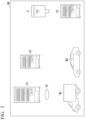
- FIG. 3 is a diagram which shows an example of the captured image IM captured by an external camera.
- FIG. 3 shows, as an example, a situation in which the captured image IM captured by the external camera includes vehicles M1 and M2, vending machines V1, V2, and V3, and a postbox P.
- a vending machine V1 is a red vending machine
- vending machines V2 and V3 are blue vending machines.
- the acquisition unit 110 acquires an instruction sentence that indicates a target position to be reached by the mobile body 1, input by the occupant of the mobile body 1 via a voice input device that is the HMI 20. For example, in a case of a situation shown in the captured image IM of FIG. 3 , the occupant instructs the mobile body 1 to reach a target position TP in front of a vending machine V1 by inputting an instruction sentence such as "stop at a red vending machine behind the truck.”
- the acquisition unit 110 acquires an image showing a gesture made by the occupant, captured by the internal camera 16, as gesture information.
- the acquired gesture information is used for processing by the generation unit 130, which will be described below.
- the extraction unit 120 performs first predetermined processing on the input instruction sentence to extract one or more instructions (reasoning instructions) contained in the input instruction sentence.
- FIG. 4 is a diagram for describing an overview of the first predetermined processing executed by the extraction unit 120. More specifically, the extraction unit 120 performs dependency parsing (dependency parser) and entity classification (entity classifier) on the input instruction sentence as the first predetermined processing. For example, as shown in a left part of FIG.
- the extraction unit 120 analyzes, as dependency parsing, the instruction sentence "Stop at the red vending machine behind the truck,” to determine that "the” is a determiner (det) that modifies “truck,” " " is a case marker (case) of “truck,” “behind” is a noun modifier (nmod) that modifies “truck,” and “red” is a clause modifier (acl) that modifies "vending machine.”
- This dependency parsing may be performed using a known method.
- the extraction unit 120 classifies attributes of each morpheme in the instruction sentence as entity classification. For example, as shown in a right part of FIG. 4 , the extraction unit 120 classifies "the” in the instruction sentence "stop at the red vending machine behind the truck” as a demonstrative, classifies “truck” as an object, classifies “behind” as a relation, classifies “red” as a color, and classifies "vending machine” as an object.
- the extraction unit 120 links and stores the dependency relationships between morphemes as a result of dependency parsing and the attributes of each morpheme as a result of entity classification. An upper left part of FIG.
- the generation unit 130 performs second predetermined processing on the gesture information acquired by the acquisition unit 110 to generate an estimated distribution for a position indicated by a gesture of the occupant.
- FIG. 5 is a diagram for describing an overview of the second predetermined processing executed by the generation unit 130.
- the generation unit 130 sets key points to two of parts of the body of the occupant P.
- FIG. 5 shows, as an example, a situation in which the eyes and wrist of the occupant P are set as key points KP1 and KP2, respectively.
- the generation unit 130 estimates an intersection IS where an indication line L extending toward the wrist by connecting the eye KP1 and the wrist KP2 intersects with a ground surface as a position indicated by the gesture of the occupant P, and generates an estimated distribution of the gesture position as a probability distribution with the intersection point IS as the maximum value.
- Probability distribution to be generated may be any type of distribution, such as a normal distribution.
- the generation unit 130 may select any key points, but it is preferable that one of the points is the eye, because the occupant P can accurately specify the position through the line of sight. It is desirable that the other point be a part that is easy to identify from an image and may be, for example, the wrist, fingertips, a tip or center of the fist, or the like. Furthermore, when the operator is indicating a destination, the face may be facing a direction of the destination, and the eyes may not be captured by the internal camera 16. In such a case, the eye position may be estimated and identified. When a direction of the face can be identified, an eye position can be estimated. Note that the estimation of the eye position may also be performed using a machine learning model.
- the generation unit 130 semantically extracts objects contained in the captured image IM captured by the external camera, and generates a probabilistic scene graph in which a probability that the occupant P indicates a corresponding object is assigned to each extracted object. For example, in a case of FIG. 3 , the generation unit 130 extracts vehicles M1 and M2, vending machines V1, V2, and V3, and postbox P. This extraction processing can reduce a load of subsequent processing compared to a method of processing raw data such as deep neural network (DNN). More specifically, the generation of the probabilistic scene graph may be executed using the method described in Non-Patent Document 1.
- An initial value of a probability assigned to each object contained in the generated probabilistic scene graph may be uniform (that is, 1/(the number of objects contained in the probabilistic scene graph)), or the generation unit 130 may set a different initial value for each object.
- the generation unit 130 may use an estimated distribution for a gesture position to set a different initial value depending on the position of each object. More specifically, the generation unit 130 may set a higher initial value as an object is closer to the detected intersection IS, and set a lower initial value as an object is farther from the intersection IS. For example, in the case of FIG.
- the generation unit 130 is an example of a "first generation unit” and a "second generation unit.”
- the identification unit 140 uses one or more instructions extracted by the extraction unit 120 to sequentially update the probability of each object contained in the probabilistic scene graph, thereby identifying an object indicated by the occupant.
- FIG. 6 is a diagram for describing the update processing of the probabilistic scene graph executed by the identification unit 140.
- the identification unit 140 sequentially extracts one or more instructions extracted by the extraction unit 120, and updates the probabilistic scene graph so that the probability of an object of the probabilistic scene graph corresponding to the extracted instruction becomes higher. For example, in a case of FIG. 6 , the identification unit 140 extracts "truck” and "the,” and updates the probability values of the vehicles M1 and M2 so that they become higher.
- the identification unit 140 extracts "behind” and transitions from the vehicle M1 to the vending machine V1 and transitions from the vehicle M2 to the vending machine V2 in the probabilistic scene graph.
- the identification unit 140 extracts "vending machine” and “red” to identify the vending machine V1 as a vending machine having the attribute "red,” and updates the probability value of the vending machine V1 so that it becomes higher.
- the probabilities attached to the objects in the probabilistic scene graph are sequentially updated, and an object with the maximum probability value is finally identified as the object indicated by the occupant P.
- the identification unit 140 can finally identify the vending machine V1 with the maximum probability value as the object indicated by the occupant P.
- these updates of the probabilistic scene graph may be executed using the method described in Non-Patent Document 1.
- the identification unit 140 uses the probabilistic scene graph to finally identify an object with the maximum probability value as the object indicated by the occupant P.
- the identification unit 140 calculates an entropy of a probability distribution calculated for each object in the probabilistic scene graph, and when the calculated entropy is large (equal to or greater than a threshold value), it can determine that the object indicated by the occupant P cannot be identified as a single object. In such cases, a prior art has been finally unable to identify the object indicated by the occupant P.
- a question sentence is generated to identify one of the plurality of candidates, and the question sentence is inquired to the occupant, and a response is received from the occupant, thereby finally identifying the object indicated by the occupant P.
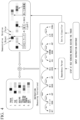
- FIG. 7 is a diagram for describing processing for generating a question sentence executed by the identification unit 140.
- FIG. 7 shows a case where the occupant inputs "Stop at the vending machine behind the truck" as an instruction sentence, and as a result of update processing of the probabilistic scene graph by the identification unit 140, the vending machine V1 behind the vehicle M1 and the vending machine V2 behind the vehicle M2 are identified as objects with the same probability value (or objects whose difference in probability value is within a threshold value).
- the identification unit 140 generates a question for identifying one of the identified objects. For example, a question sentence may be generated to directly identify the plurality of objects, such as "Which vending machine?,” or a question sentence may be generated to indirectly identify the plurality of objects, such as "Which truck?” (that is, when the trucks are identified as one, the vending machine can be identified by combining it with a noun modifier "behind").
- the identification unit 140 may collate attributes (for example, color) of the plurality of object candidates and generate a question sentence for attributes having different values.
- attributes for example, color
- the vending machine V1 has a color attribute of "red”
- the vending machine V2 does not have a color attribute for identification, so the identification unit 140 may generate a question such as "Is a color of a vending machine red?” on the basis of a difference in the color attribute.
- the identification unit 140 transmits the generated question sentence to the HMI 20, receives an answer input by the occupant on the HMI 20, and finally identifies an object indicated by the occupant P on the basis of the received answer. For example, the identification unit 140 may also receive a gesture by the occupant P again, and finally identify an object closest to a direction of the received gesture as the object indicated by the occupant P. In this manner, even if there are a plurality of candidates for the indicated object due to the update processing of the probabilistic scene graph, the indicated object can be uniquely identified by generating a question sentence for the occupant P.
- the control unit 150 drives the drive apparatus 40 of the mobile body 1 with the object identified by the identification unit 140 as a target position to cause the mobile body 1 to travel to the target position.
- FIG. 8 is a flowchart which shows an example of the flow of the processing executed by the control apparatus 100.
- the processing according to this flowchart is executed in response to an input of an instruction sentence and a gesture by the occupant while the mobile body 1 is traveling.
- the acquisition unit 110 acquires a captured image IM, an input instruction sentence, and gesture information (step S100).
- the generation unit 130 extracts one or more instructions from the input instruction sentence acquired by the acquisition unit 110, and generates an estimated distribution for a position where the occupant P has made the instruction based on the gesture information (step S102).
- the generation unit 130 generates a probabilistic scene graph based on the captured image IM, and sets an initial probability of the probabilistic scene graph on the basis of the estimated distribution (step S104).
- the identification unit 140 updates a probability of the probabilistic scene graph on the basis of one or more instructions (step S106).
- the identification unit 140 determines whether a single object has been identified as a result of updating the probabilistic scene graph (step S108). When it is determined that a single object has been identified, the control unit 150 causes the mobile body 1 to travel with the identified object as the target position (step S110). On the other hand, when it is determined that the single object has not been identified, the identification unit 140 generates a question sentence for identifying the single object to make an inquiry, and identifies the single object (step S112). After that, the identification unit 140 transitions the processing to step S110. As a result, processing related to this flowchart ends.
- the information processing apparatus is mounted on the mobile body 1 and is utilized for traveling.
- the present invention is not limited to such a configuration, and more generally, the information processing apparatus identifies the indicated object on the basis of at least the captured image, the input instruction sentence, and the gesture information, and when there are a plurality of candidates for the indicated object, generates an additional question sentence to make an inquiry, thereby finally identifying the single object.
- the information processing apparatus according to the present invention can be utilized to identify an object instructed by a user in a virtual reality (VR) space.
- VR virtual reality
- a captured image, an input instruction sentence, and gesture information are acquired, and an object indicated by the occupant is identified on the basis of a probabilistic scene graph generated from the captured image, instructions extracted from the input instruction sentence, and an estimated distribution generated based on the gesture information.
- a question sentence for identifying a single object is generated to make an inquiry to the occupant.
- modalities such as a line of sight and a gesture of a person, and resolve ambiguity that arises during an inference process.
- An information processing apparatus includes a storage medium configured to store computer-readable instructions, and a processor connected to the storage medium, in which the processor executes the computer-readable instructions to acquire a captured image of surroundings of a mobile body captured by a camera mounted on the mobile body, an input instruction sentence input by an occupant of the mobile body, and gesture information related to a gesture made by the occupant, extract one or more instructions included in the input instruction sentence by performing first predetermined processing on the input instruction sentence, generate an estimated distribution for a position indicated by the occupant by performing second predetermined processing on the gesture information, generate a probabilistic scene graph from the captured image, in which a probability is assigned to each object contained in the captured image, and identify an object indicated by the occupant in the captured image on the basis of the one or more instructions, the estimated distribution, and the probabilistic scene graph.
Landscapes
- Engineering & Computer Science (AREA)
- Physics & Mathematics (AREA)
- General Physics & Mathematics (AREA)
- Theoretical Computer Science (AREA)
- Radar, Positioning & Navigation (AREA)
- Remote Sensing (AREA)
- General Engineering & Computer Science (AREA)
- Software Systems (AREA)
- Evolutionary Computation (AREA)
- Multimedia (AREA)
- Mathematical Physics (AREA)
- Computer Vision & Pattern Recognition (AREA)
- Artificial Intelligence (AREA)
- Health & Medical Sciences (AREA)
- Computing Systems (AREA)
- Data Mining & Analysis (AREA)
- General Health & Medical Sciences (AREA)
- Human Computer Interaction (AREA)
- Medical Informatics (AREA)
- Databases & Information Systems (AREA)
- Computational Linguistics (AREA)
- Life Sciences & Earth Sciences (AREA)
- Automation & Control Theory (AREA)
- Social Psychology (AREA)
- Probability & Statistics with Applications (AREA)
- Psychiatry (AREA)
- Biophysics (AREA)
- Mathematical Optimization (AREA)
- Pure & Applied Mathematics (AREA)
- Mathematical Analysis (AREA)
- Audiology, Speech & Language Pathology (AREA)
- Computational Mathematics (AREA)
- Algebra (AREA)
- Molecular Biology (AREA)
- Bioinformatics & Cheminformatics (AREA)
- Bioinformatics & Computational Biology (AREA)
- Evolutionary Biology (AREA)
- Biomedical Technology (AREA)
- Image Analysis (AREA)
- User Interface Of Digital Computer (AREA)
Abstract
Description
- The present invention relates to an information processing apparatus, an information processing method, and a program.
- Conventionally, there is known a technology for identifying an object in an image in response to a multimodal input including the image. For example,
Patent Document 1 describes a technology for detecting an emergency vehicle included in image data by inputting audio data and the image data into an artificial neural network such as a deep neural network (DNN). - Patent Document 1:
Japanese Unexamined Patent Application, First Publication No. 2022-96601 - Non Patent Document 1: Drew A. Hudson, Christopher D. Manning, "Learning by Abstraction: The Neural State Machine," NeurIPS, pages 5901-5914. (2019)
- However, when multimodal input is processed using, for example, a method such as a DNN as in the technology described in
Patent Document 1, the processing performed inside a model is a black box, and it is difficult to grasp the actual situation. In other words, with these methods, it is not clear whether a relationship between different types of information (video, sound, text, and the like) is properly learned. Furthermore, methods such as a DNN often require a large amount of data for learning, and it may be very costly to realize the function. - Furthermore, Non-Patent
Document 1 describes a neural state machine that converts multimodal raw information obtained by a sensor into a conceptual expression in a common abstract space and performs inference on a graph (a scene graph) in which these conceptual expressions are structured. The neural state machine is superior to the technology described inPatent Document 1 in that processing content on the graph is transparent and it does not require a large amount of data for the processing. However, the technology described in Non-PatentDocument 1 does not provide a means to resolve ambiguity that arises in the inference without utilizing modalities such as a line of sight or a gesture of a person. - The present invention has been made in consideration of the circumstances described above, and one of its objectives is to provide an information processing apparatus, an information processing method, and a program that can utilize modalities such as a line of sight and a gesture of a person, and resolve ambiguity that arises during an inference process.
- The information processing apparatus, information processing method, and program of the present invention employ the following configuration.
- (1): An information processing apparatus according to one aspect of the present invention includes an acquisition unit configured to acquire a captured image of surroundings of a mobile body captured by a camera mounted on the mobile body, an input instruction sentence input by a person of the mobile body, and gesture information related to a gesture made by the person, an extraction unit configured to extract one or more instructions included in the input instruction sentence by performing first predetermined processing on the input instruction sentence, a first generation unit configured to generate an estimated distribution for a position indicated by the person by performing second predetermined processing on the gesture information, a second generation unit configured to generate a probabilistic scene graph from the captured image, in which a probability is assigned to each object contained in the captured image, and an identification unit configured to identify an object indicated by the person in the captured image on the basis of the one or more instructions, the estimated distribution, and the probabilistic scene graph.
- (2): In the aspect of (1) described above, the first predetermined processing may be processing of performing at least dependency parsing and attribute classification on the input instruction sentence.
- (3): In the aspect of (1) described above, the second predetermined processing may be processing of generating the estimated distribution on the basis of key points of the person included in the gesture information.
- (4): In the aspect of any one of (1) to (3) described above, the identification unit may identify the object by sequentially updating the probability of each object contained in the probabilistic scene graph using the one or more extracted instructions.
- (5): In the aspect of (4) described above, the second generation unit may set an initial value of the probability assigned to each object contained in the probabilistic scene graph on the basis of the estimated distribution.
- (6): In the aspect of (4) described above, the identification unit may generate a question for identifying one of a plurality of objects when the plurality of objects have been identified by the update.
- (7): An information processing method according to another aspect of the present invention includes, by a computer, acquiring a captured image of surroundings of a mobile body captured by a camera mounted on the mobile body, an input instruction sentence input by a person of the mobile body, and gesture information related to a gesture made by the person, extracting one or more instructions included in the input instruction sentence by performing first predetermined processing on the input instruction sentence, generating an estimated distribution for a position indicated by the person by performing second predetermined processing on the gesture information, generating a probabilistic scene graph from the captured image, in which a probability is assigned to each object contained in the captured image, and identifying an object indicated by the person in the captured image on the basis of the one or more instructions, the estimated distribution, and the probabilistic scene graph.
- (8): A program according to still another aspect of the present invention causes a computer to execute acquiring a captured image of surroundings of a mobile body captured by a camera mounted on the mobile body, an input instruction sentence input by a person of the mobile body, and gesture information related to a gesture made by the person, extracting one or more instructions included in the input instruction sentence by performing first predetermined processing on the input instruction sentence, generating an estimated distribution for a position indicated by the person by performing second predetermined processing on the gesture information, generating a probabilistic scene graph from the captured image, in which a probability is assigned to each object contained in the captured image, and identifying an object indicated by the person in the captured image on the basis of the one or more instructions, the estimated distribution, and the probabilistic scene graph.
- According to the aspects of (1) to (8), it is possible to utilize modalities such as a line of sight and a gesture of a person, and resolve ambiguity that arises during an inference process.
-
- [
FIG. 1 ] A diagram which shows an example of a configuration of amobile body 1 and acontrol apparatus 100 according to an embodiment. - [
FIG. 2 ] A see-through view of themobile body 1, seen from above. - [
FIG. 3 ] A diagram which shows an example of a captured image IM captured by an external camera. - [
FIG. 4 ] A diagram for describing an overview of first predetermined processing performed by anextraction unit 120. - [
FIG. 5 ] A diagram for describing an overview of second predetermined processing performed by ageneration unit 130. - [
FIG. 6 ] A diagram for describing update processing of a probabilistic scene graph, performed by anidentification unit 140. - [
FIG. 7 ] A diagram for describing generation processing of a question sentence, performed by theidentification unit 140. - [
FIG. 8 ] A flowchart which shows an example of a flow of processing executed by thecontrol apparatus 100. - Hereinafter, with reference to the drawings, an embodiment of an information processing apparatus, an information processing method, and a program of the present invention will be described. The information processing apparatus is mounted on a mobile body. The mobile body moves on both a roadway and a predetermined area different from the roadway. The mobile body may be referred to as micromobility. An electric kickboard is a type of micromobility. The predetermined area is, for example, a sidewalk. The predetermined area may be a part or all of a road side, a bicycle lane, a public open space, and the like, or may include all of a sidewalk, a road side, a bicycle lane, a public open space, and the like. As described below, the information processing apparatus according to the present embodiment identifies an object indicated by a person on the basis of a captured image of surroundings of the mobile body, an input instruction sentence input by a person associated with the mobile body, and a gesture made by the person. In the following description, the person associated with the mobile body is described as an occupant who is on board the mobile body, but the present invention is not limited to such a configuration, and may be a person who inputs an instruction sentence outside the mobile body (for example, to indicate a waiting place of the mobile body after getting off).
-
FIG. 1 is a diagram which shows an example of a configuration of amobile body 1 and acontrol apparatus 100 according to an embodiment. Themobile body 1 is equipped with, for example, anexternal detection device 10, amobile body sensor 12, anoperator 14, aninternal camera 16, apositioning apparatus 18, anHMI 20, amode changeover switch 22, amoving mechanism 30, adrive apparatus 40, anexternal notification apparatus 50, astorage apparatus 70, and acontrol apparatus 100. Note that some of these constituents that are not essential for realizing functions of the present invention may also be omitted. The mobile body is not limited to a vehicle, but may include a small mobility device that travels alongside a walking user to carry luggage or lead a person, and may also include other mobile bodies capable of autonomous movement (such as walking robots). - The
external detection device 10 is a device whose detection range is a traveling direction of themobile body 1. Theexternal detection device 10 includes an external camera, a radar device, a light detection and ranging (LIDAR), a sensor fusion device, and the like. Theexternal detection device 10 outputs information indicating a result of the detection (an image, a position of an object, or the like) to thecontrol apparatus 100. In particular, in the present embodiment, theexternal detection device 10 outputs a captured image of surroundings of themobile body 1, captured by the external camera, to thecontrol apparatus 100. - The
mobile body sensor 12 includes, for example, a speed sensor, an acceleration sensor, a yaw rate (angular speed) sensor, an orientation sensor, an operation amount detection sensor attached to theoperator 14, and the like. Theoperator 14 includes, for example, an operator for instructing acceleration or deceleration (for example, an accelerator pedal or a brake pedal) and an operator for instructing steering (for example, a steering wheel). In this case, themobile body sensor 12 may include an accelerator opening sensor, a brake depression amount sensor, a steering torque sensor, and the like. Themobile body 1 may also include, as theoperator 14, an operator of a type other than described above (for example, a non-annular rotating operator, a joystick, a button, or the like). - The
internal camera 16 captures an image of at least the head of the occupant of themobile body 1 from the front. Theinternal camera 16 is a digital camera that uses an imaging element such as a charge coupled device (CCD) or a complementary metal oxide semiconductor (CMOS). Theinternal camera 16 outputs the captured image to thecontrol apparatus 100. - The
positioning apparatus 18 is an apparatus that measures a position of themobile body 1. Thepositioning apparatus 18 is, for example, a global navigation satellite system (GNSS) receiver, and identifies the position of themobile body 1 on the basis of a signal received from a GNSS satellite, and outputs position information. The position information of themobile body 1 may be estimated based on a position of a Wi-Fi base station to which a communication device which will be described below is connected. - The
HMI 20 includes a display device, a speaker, a touch panel, keys, and the like. The occupant of themobile body 1 sets a destination of themobile body 1 via, for example, theHMI 20, and thecontrol unit 150, which will be described below, causes themobile body 1 to travel to the set destination. In particular, in the present embodiment, theHMI 20 includes a voice input device such as a microphone, and the occupant of themobile body 1 speaks an instruction sentence instructing a stopping position of themobile body 1 to input it to the voice input device. TheHMI 20 analyzes a voice of the input instruction sentence to convert it into text, and outputs it to thecontrol apparatus 100. Alternatively, theHMI 20 may receive an instruction sentence input as text by the occupant via, for example, a touch panel, and output the received instruction sentence to thecontrol apparatus 100. - The
mode changeover switch 22 is a switch operated by the occupant. Themode changeover switch 22 may be a mechanical switch or a graphical user interface (GUI) switch set on a touch panel of theHMI 20. Themode changeover switch 22 receives, for example, an operation of switching a driving mode to one of the following modes: Mode A: an assist mode in which one of a steering operation and an acceleration or deceleration control is performed by the occupant and the other is performed automatically (there may be a mode A-1 in which the steering operation is performed by the occupant and the acceleration or deceleration control is performed automatically, and a mode A-2 in which the acceleration or deceleration operation is performed by the occupant and steering control is performed automatically), Mode B: a manual driving mode in which the steering operation and the acceleration or deceleration operation are performed by the occupant, and Mode C: an automatic driving mode in which the operation control and the acceleration or deceleration control are performed automatically. - The moving
mechanism 30 is a mechanism for moving themobile body 1 on a road. The movingmechanism 30 is, for example, a group of wheels including steering wheels and driving wheels. In addition, the movingmechanism 30 may be legs for walking on multiple legs. - The
drive apparatus 40 outputs force to the movingmechanism 30 to move themobile body 1. For example, thedrive apparatus 40 includes a motor that drives the drive wheels, a battery that stores power to be supplied to the motor, and a steering device that adjusts a steering angle of steering wheels. Thedrive apparatus 40 may also include an internal combustion engine or a fuel cell as a driving force output device or a power generation device. In addition, thedrive apparatus 40 may further include a brake device that utilizes frictional force or air resistance. - The
external notification apparatus 50 is, for example, a lamp, a display device, a speaker, or the like, provided on an outer plate of themobile body 1 to notify information to the outside of themobile body 1. Theexternal notification apparatus 50 operates differently when themobile body 1 is moving on a sidewalk and when it is moving on a roadway. For example, theexternal notification apparatus 50 is controlled to emit a lamp when themobile body 1 is moving on a sidewalk and not to emit a lamp when themobile body 1 is moving on a roadway. A light color of this lamp is preferably a color specified by law. Theexternal notification apparatus 50 may be controlled so that the lamp emits green light when themobile body 1 is moving on a sidewalk and emits blue light when themobile body 1 is moving on a roadway. When theexternal notification apparatus 50 is a display device, theexternal notification apparatus 50 displays in text or graphics a fact that themobile body 1 is "traveling on a sidewalk" when themobile body 1 is traveling on a sidewalk. -
FIG. 2 is a perspective view of themobile body 1 seen from above. InFIG. 2 , FW is a steering wheel, RW is a driving wheel, SD is a steering device, MT is a motor, and BT is a battery. The steering device SD, the motor MT, and the battery BT are included in thedrive apparatus 40. Additionally, AP is an accelerator pedal, BP is a brake pedal, WH is a steering wheel, SP is a speaker, and MC is a microphone. Themobile body 1 shown inFIG. 2 is a one-seater mobile body, and the occupant P is seated in the driver's seat DS and wearing a seat belt SB. An arrow D1 is the traveling direction (a speed vector) of themobile body 1. Theexternal detection device 10 is provided near a front end of themobile body 1, theinternal camera 16 is provided at a position where it can capture an image of the head of the occupant P from in front of the occupant P, and themode changeover switch 22 is provided in a boss of the steering wheel WH. Theexternal notification apparatus 50 is provided, as a display device, near the front end of themobile body 1. - Returning to
FIG. 1 , thestorage apparatus 70 is, for example, a non-transient storage apparatus such as a hard disk drive (HDD), a flash memory, or a random access memory (RAM).Navigation map information 72 and the like are stored in thestorage apparatus 70. InFIG. 1 , thestorage apparatus 70 is shown outside a frame of thecontrol apparatus 100, but thestorage apparatus 70 may be included in thecontrol apparatus 100. In addition, thestorage apparatus 70 may be provided on a server (not shown). - The
navigation map information 72 is stored in advance in thestorage apparatus 70, and is map information including, for example, information on a center of a road including a roadway and a sidewalk, information on a road boundary, or the like. Thenavigation map information 72 further includes information on facilities and buildings in contact with the road boundary (such as a name, an address, an area, and the like). - The
control apparatus 100 includes, for example, anacquisition unit 110, anextraction unit 120, ageneration unit 130, anidentification unit 140, and acontrol unit 150. Theacquisition unit 110, theextraction unit 120, thegeneration unit 130, theidentification unit 140, and thecontrol unit 150 are realized by, for example, a hardware processor such as a central processing unit (CPU) executing a program (software) 74. Some or all of these components may be realized by hardware (a circuit unit; including circuitry) such as large scale integration (LSI), an application specific integrated circuit (ASIC), a field-programmable gate array (FPGA), or a graphics processing unit (GPU), or may be realized by software and hardware in cooperation. The program may be stored in thestorage apparatus 70 in advance, or may be stored in a removable storage medium (non-transient storage medium) such as a DVD or CD-ROM and may be installed in thestorage apparatus 70 by the storage medium being mounted in a drive device. A combination of theacquisition unit 110, theextraction unit 120, thegeneration unit 130, and theidentification unit 140 is an example of the "information processing apparatus." - The
acquisition unit 110 acquires a captured image IM obtained by an external camera, which is theexternal detection device 10, capturing an image of the surroundings of themobile body 1.FIG. 3 is a diagram which shows an example of the captured image IM captured by an external camera.FIG. 3 shows, as an example, a situation in which the captured image IM captured by the external camera includes vehicles M1 and M2, vending machines V1, V2, and V3, and a postbox P. For convenience of description, in the captured image IM, a vending machine V1 is a red vending machine, and vending machines V2 and V3 are blue vending machines. - Furthermore, the
acquisition unit 110 acquires an instruction sentence that indicates a target position to be reached by themobile body 1, input by the occupant of themobile body 1 via a voice input device that is theHMI 20. For example, in a case of a situation shown in the captured image IM ofFIG. 3 , the occupant instructs themobile body 1 to reach a target position TP in front of a vending machine V1 by inputting an instruction sentence such as "stop at a red vending machine behind the truck." - Furthermore, the
acquisition unit 110 acquires an image showing a gesture made by the occupant, captured by theinternal camera 16, as gesture information. The acquired gesture information is used for processing by thegeneration unit 130, which will be described below. - The
extraction unit 120 performs first predetermined processing on the input instruction sentence to extract one or more instructions (reasoning instructions) contained in the input instruction sentence.FIG. 4 is a diagram for describing an overview of the first predetermined processing executed by theextraction unit 120. More specifically, theextraction unit 120 performs dependency parsing (dependency parser) and entity classification (entity classifier) on the input instruction sentence as the first predetermined processing. For example, as shown in a left part ofFIG. 4 , theextraction unit 120 analyzes, as dependency parsing, the instruction sentence "Stop at the red vending machine behind the truck," to determine that "the" is a determiner (det) that modifies "truck," "" is a case marker (case) of "truck," "behind" is a noun modifier (nmod) that modifies "truck," and "red" is a clause modifier (acl) that modifies "vending machine." This dependency parsing may be performed using a known method.
- At the same time, the
extraction unit 120 classifies attributes of each morpheme in the instruction sentence as entity classification. For example, as shown in a right part ofFIG. 4 , theextraction unit 120 classifies "the" in the instruction sentence "stop at the red vending machine behind the truck" as a demonstrative, classifies "truck" as an object, classifies "behind" as a relation, classifies "red" as a color, and classifies "vending machine" as an object. Theextraction unit 120 links and stores the dependency relationships between morphemes as a result of dependency parsing and the attributes of each morpheme as a result of entity classification. An upper left part ofFIG. 4 shows that each morpheme (truck, the, behind, vending machine, red) is stored as one or more instructions (reasoning instructions) by linking the dependency relationships with the attributes. More specifically, these one or more instructions may be derived and stored using the method described inNon-Patent Document 1. - The
generation unit 130 performs second predetermined processing on the gesture information acquired by theacquisition unit 110 to generate an estimated distribution for a position indicated by a gesture of the occupant.FIG. 5 is a diagram for describing an overview of the second predetermined processing executed by thegeneration unit 130. First, thegeneration unit 130 sets key points to two of parts of the body of the occupant P.FIG. 5 shows, as an example, a situation in which the eyes and wrist of the occupant P are set as key points KP1 and KP2, respectively. Thegeneration unit 130 estimates an intersection IS where an indication line L extending toward the wrist by connecting the eye KP1 and the wrist KP2 intersects with a ground surface as a position indicated by the gesture of the occupant P, and generates an estimated distribution of the gesture position as a probability distribution with the intersection point IS as the maximum value. Probability distribution to be generated may be any type of distribution, such as a normal distribution. - Note that the
generation unit 130 may select any key points, but it is preferable that one of the points is the eye, because the occupant P can accurately specify the position through the line of sight. It is desirable that the other point be a part that is easy to identify from an image and may be, for example, the wrist, fingertips, a tip or center of the fist, or the like. Furthermore, when the operator is indicating a destination, the face may be facing a direction of the destination, and the eyes may not be captured by theinternal camera 16. In such a case, the eye position may be estimated and identified. When a direction of the face can be identified, an eye position can be estimated. Note that the estimation of the eye position may also be performed using a machine learning model. - Furthermore, the
generation unit 130 semantically extracts objects contained in the captured image IM captured by the external camera, and generates a probabilistic scene graph in which a probability that the occupant P indicates a corresponding object is assigned to each extracted object. For example, in a case ofFIG. 3 , thegeneration unit 130 extracts vehicles M1 and M2, vending machines V1, V2, and V3, and postbox P. This extraction processing can reduce a load of subsequent processing compared to a method of processing raw data such as deep neural network (DNN). More specifically, the generation of the probabilistic scene graph may be executed using the method described inNon-Patent Document 1. - An initial value of a probability assigned to each object contained in the generated probabilistic scene graph may be uniform (that is, 1/(the number of objects contained in the probabilistic scene graph)), or the
generation unit 130 may set a different initial value for each object. For example, thegeneration unit 130 may use an estimated distribution for a gesture position to set a different initial value depending on the position of each object. More specifically, thegeneration unit 130 may set a higher initial value as an object is closer to the detected intersection IS, and set a lower initial value as an object is farther from the intersection IS. For example, in the case ofFIG. 3 , when the occupant P makes a gesture toward a vending machine V1, the highest initial value may be assigned to the vending machine V1, while the lowest initial value may be assigned to a vending machine V3, which is located the farthest from the vending machine V1. Thegeneration unit 130 is an example of a "first generation unit" and a "second generation unit." - The
identification unit 140 uses one or more instructions extracted by theextraction unit 120 to sequentially update the probability of each object contained in the probabilistic scene graph, thereby identifying an object indicated by the occupant.FIG. 6 is a diagram for describing the update processing of the probabilistic scene graph executed by theidentification unit 140. Theidentification unit 140 sequentially extracts one or more instructions extracted by theextraction unit 120, and updates the probabilistic scene graph so that the probability of an object of the probabilistic scene graph corresponding to the extracted instruction becomes higher. For example, in a case ofFIG. 6 , theidentification unit 140 extracts "truck" and "the," and updates the probability values of the vehicles M1 and M2 so that they become higher. Next, theidentification unit 140 extracts "behind" and transitions from the vehicle M1 to the vending machine V1 and transitions from the vehicle M2 to the vending machine V2 in the probabilistic scene graph. Next, theidentification unit 140 extracts "vending machine" and "red" to identify the vending machine V1 as a vending machine having the attribute "red," and updates the probability value of the vending machine V1 so that it becomes higher. In this manner, the probabilities attached to the objects in the probabilistic scene graph are sequentially updated, and an object with the maximum probability value is finally identified as the object indicated by the occupant P. In the case ofFIG. 6 , theidentification unit 140 can finally identify the vending machine V1 with the maximum probability value as the object indicated by the occupant P. In more detail, these updates of the probabilistic scene graph may be executed using the method described inNon-Patent Document 1. - In this manner, the
identification unit 140 uses the probabilistic scene graph to finally identify an object with the maximum probability value as the object indicated by the occupant P. However, in some cases, there may be a plurality of objects with the maximum probability value, or a difference in probability value between an object with the maximum probability value and an object with the second largest probability value may be small, making it impossible to identify a single object. More generally, theidentification unit 140 calculates an entropy of a probability distribution calculated for each object in the probabilistic scene graph, and when the calculated entropy is large (equal to or greater than a threshold value), it can determine that the object indicated by the occupant P cannot be identified as a single object. In such cases, a prior art has been finally unable to identify the object indicated by the occupant P. On the other hand, in the present invention, when there are a plurality of candidates for the object indicated by the occupant P as a result of update processing of the probabilistic scene graph, a question sentence is generated to identify one of the plurality of candidates, and the question sentence is inquired to the occupant, and a response is received from the occupant, thereby finally identifying the object indicated by the occupant P. -
FIG. 7 is a diagram for describing processing for generating a question sentence executed by theidentification unit 140. As an example,FIG. 7 shows a case where the occupant inputs "Stop at the vending machine behind the truck" as an instruction sentence, and as a result of update processing of the probabilistic scene graph by theidentification unit 140, the vending machine V1 behind the vehicle M1 and the vending machine V2 behind the vehicle M2 are identified as objects with the same probability value (or objects whose difference in probability value is within a threshold value). - In such a case, the
identification unit 140 generates a question for identifying one of the identified objects. For example, a question sentence may be generated to directly identify the plurality of objects, such as "Which vending machine?," or a question sentence may be generated to indirectly identify the plurality of objects, such as "Which truck?" (that is, when the trucks are identified as one, the vending machine can be identified by combining it with a noun modifier "behind"). - Furthermore, for example, the
identification unit 140 may collate attributes (for example, color) of the plurality of object candidates and generate a question sentence for attributes having different values. In a case ofFIG. 7 , the vending machine V1 has a color attribute of "red," while the vending machine V2 does not have a color attribute for identification, so theidentification unit 140 may generate a question such as "Is a color of a vending machine red?" on the basis of a difference in the color attribute. - The
identification unit 140 transmits the generated question sentence to theHMI 20, receives an answer input by the occupant on theHMI 20, and finally identifies an object indicated by the occupant P on the basis of the received answer. For example, theidentification unit 140 may also receive a gesture by the occupant P again, and finally identify an object closest to a direction of the received gesture as the object indicated by the occupant P. In this manner, even if there are a plurality of candidates for the indicated object due to the update processing of the probabilistic scene graph, the indicated object can be uniquely identified by generating a question sentence for the occupant P. - The
control unit 150 drives thedrive apparatus 40 of themobile body 1 with the object identified by theidentification unit 140 as a target position to cause themobile body 1 to travel to the target position. - Next, referring to
FIG. 8 , a flow of processing executed by thecontrol apparatus 100 according to the present embodiment will be described.FIG. 8 is a flowchart which shows an example of the flow of the processing executed by thecontrol apparatus 100. The processing according to this flowchart is executed in response to an input of an instruction sentence and a gesture by the occupant while themobile body 1 is traveling. - First, the
acquisition unit 110 acquires a captured image IM, an input instruction sentence, and gesture information (step S100). Next, thegeneration unit 130 extracts one or more instructions from the input instruction sentence acquired by theacquisition unit 110, and generates an estimated distribution for a position where the occupant P has made the instruction based on the gesture information (step S102). - Next, the
generation unit 130 generates a probabilistic scene graph based on the captured image IM, and sets an initial probability of the probabilistic scene graph on the basis of the estimated distribution (step S104). Next, theidentification unit 140 updates a probability of the probabilistic scene graph on the basis of one or more instructions (step S106). - Next, the
identification unit 140 determines whether a single object has been identified as a result of updating the probabilistic scene graph (step S108). When it is determined that a single object has been identified, thecontrol unit 150 causes themobile body 1 to travel with the identified object as the target position (step S110). On the other hand, when it is determined that the single object has not been identified, theidentification unit 140 generates a question sentence for identifying the single object to make an inquiry, and identifies the single object (step S112). After that, theidentification unit 140 transitions the processing to step S110. As a result, processing related to this flowchart ends. - In the embodiment described above, as an example, it is described that the information processing apparatus is mounted on the
mobile body 1 and is utilized for traveling. However, the present invention is not limited to such a configuration, and more generally, the information processing apparatus identifies the indicated object on the basis of at least the captured image, the input instruction sentence, and the gesture information, and when there are a plurality of candidates for the indicated object, generates an additional question sentence to make an inquiry, thereby finally identifying the single object. For example, the information processing apparatus according to the present invention can be utilized to identify an object instructed by a user in a virtual reality (VR) space. - According to the present embodiment described above, a captured image, an input instruction sentence, and gesture information are acquired, and an object indicated by the occupant is identified on the basis of a probabilistic scene graph generated from the captured image, instructions extracted from the input instruction sentence, and an estimated distribution generated based on the gesture information. When there are a plurality of candidates for the object instructed by the occupant, a question sentence for identifying a single object is generated to make an inquiry to the occupant. As a result, it is possible to utilize modalities such as a line of sight and a gesture of a person, and resolve ambiguity that arises during an inference process.
- The embodiment described above can be expressed as follows.
- An information processing apparatus includes a storage medium configured to store computer-readable instructions, and a processor connected to the storage medium, in which the processor executes the computer-readable instructions to acquire a captured image of surroundings of a mobile body captured by a camera mounted on the mobile body, an input instruction sentence input by an occupant of the mobile body, and gesture information related to a gesture made by the occupant, extract one or more instructions included in the input instruction sentence by performing first predetermined processing on the input instruction sentence, generate an estimated distribution for a position indicated by the occupant by performing second predetermined processing on the gesture information, generate a probabilistic scene graph from the captured image, in which a probability is assigned to each object contained in the captured image, and identify an object indicated by the occupant in the captured image on the basis of the one or more instructions, the estimated distribution, and the probabilistic scene graph.
- Although the present invention has been described above using an embodiment, the present invention is not limited to such an embodiment, and various modifications and substitutions can be made within a range not departing from the gist of the present invention.
-
- 10 External detection device
- 12 Mobile body sensor
- 14 Operator
- 16 Internal camera
- 18 Positioning apparatus
- 20 HMI
- 22 Mode changeover switch
- 30 Moving mechanism
- 40 Drive apparatus
- 50 External notification apparatus
- 70 Storage apparatus
- 72 Navigation map information
- 100 Control apparatus
- 110 Acquisition unit
- 120 Extraction unit
- 130 Generation unit
- 140 Identification unit
- 150 Control unit
Claims (8)
- An information processing apparatus comprising:an acquisition unit configured to acquire a captured image of surroundings of a mobile body captured by a camera mounted on the mobile body, an input instruction sentence input by a person of the mobile body, and gesture information related to a gesture made by the person;an extraction unit configured to extract one or more instructions included in the input instruction sentence by performing first predetermined processing on the input instruction sentence;a first generation unit configured to generate an estimated distribution for a position indicated by the person by performing second predetermined processing on the gesture information;a second generation unit configured to generate a probabilistic scene graph from the captured image, in which a probability is assigned to each object contained in the captured image; andan identification unit configured to identify an object indicated by the person in the captured image on the basis of the one or more instructions, the estimated distribution, and the probabilistic scene graph.
- The information processing apparatus according to claim 1,
wherein the first predetermined processing is processing of performing at least dependency parsing and attribute classification on the input instruction sentence. - The information processing apparatus according to claim 1,
wherein the second predetermined processing is processing of generating the estimated distribution on the basis of key points of the person included in the gesture information. - The information processing apparatus according to any one of claims 1 to 3,
wherein the identification unit identifies the object by sequentially updating the probability of each object contained in the probabilistic scene graph using the one or more extracted instructions. - The information processing apparatus according to claim 4,
wherein the second generation unit sets an initial value of the probability assigned to each object contained in the probabilistic scene graph on the basis of the estimated distribution. - The information processing apparatus according to claim 4,
wherein the identification unit generates a question for identifying one of a plurality of objects when the plurality of objects have been identified by the update. - An information processing method comprising:by a computer,acquiring a captured image of surroundings of a mobile body captured by a camera mounted on the mobile body, an input instruction sentence input by a person of the mobile body, and gesture information related to a gesture made by the person;extracting one or more instructions included in the input instruction sentence by performing first predetermined processing on the input instruction sentence;generating an estimated distribution for a position indicated by the person by performing second predetermined processing on the gesture information;generating a probabilistic scene graph from the captured image, in which a probability is assigned to each object contained in the captured image; andidentifying an object indicated by the person in the captured image on the basis of the one or more instructions, the estimated distribution, and the probabilistic scene graph.
- A program that causes a computer to execute:acquiring a captured image of surroundings of a mobile body captured by a camera mounted on the mobile body, an input instruction sentence input by a person of the mobile body, and gesture information related to a gesture made by the person;extracting one or more instructions included in the input instruction sentence by performing first predetermined processing on the input instruction sentence;generating an estimated distribution for a position indicated by the person by performing second predetermined processing on the gesture information;generating a probabilistic scene graph from the captured image, in which a probability is assigned to each object contained in the captured image; andidentifying an object indicated by the person in the captured image on the basis of the one or more instructions, the estimated distribution, and the probabilistic scene graph.
Applications Claiming Priority (2)
| Application Number | Priority Date | Filing Date | Title |
|---|---|---|---|
| JP2022153456 | 2022-09-27 | ||
| PCT/JP2023/034642 WO2024071006A1 (en) | 2022-09-27 | 2023-09-25 | Information processing apparatus, information processing method, and program |
Publications (2)
| Publication Number | Publication Date |
|---|---|
| EP4563941A1 true EP4563941A1 (en) | 2025-06-04 |
| EP4563941A4 EP4563941A4 (en) | 2025-10-29 |
Family
ID=90477805
Family Applications (1)
| Application Number | Title | Priority Date | Filing Date |
|---|---|---|---|
| EP23872231.8A Pending EP4563941A4 (en) | 2022-09-27 | 2023-09-25 | INFORMATION PROCESSING DEVICE, INFORMATION PROCESSING METHOD AND PROGRAM |
Country Status (4)
| Country | Link |
|---|---|
| EP (1) | EP4563941A4 (en) |
| JP (1) | JP7858803B2 (en) |
| CN (1) | CN119731511A (en) |
| WO (1) | WO2024071006A1 (en) |
Families Citing this family (1)
| Publication number | Priority date | Publication date | Assignee | Title |
|---|---|---|---|---|
| US20260120443A1 (en) * | 2024-10-31 | 2026-04-30 | Aurora Operations, Inc. | Perception System for Autonomous Vehicles |
Family Cites Families (4)
| Publication number | Priority date | Publication date | Assignee | Title |
|---|---|---|---|---|
| JP2013250747A (en) | 2012-05-31 | 2013-12-12 | Sharp Corp | Self-travelling electronic apparatus |
| JP2017228080A (en) | 2016-06-22 | 2017-12-28 | ソニー株式会社 | Information processing apparatus, information processing method, and program |
| US11126257B2 (en) | 2018-04-17 | 2021-09-21 | Toyota Research Institute, Inc. | System and method for detecting human gaze and gesture in unconstrained environments |
| US20210103747A1 (en) | 2020-12-17 | 2021-04-08 | Hassnaa Moustafa | Audio-visual and cooperative recognition of vehicles |
-
2023
- 2023-09-25 CN CN202380058940.3A patent/CN119731511A/en active Pending
- 2023-09-25 JP JP2024549350A patent/JP7858803B2/en active Active
- 2023-09-25 WO PCT/JP2023/034642 patent/WO2024071006A1/en not_active Ceased
- 2023-09-25 EP EP23872231.8A patent/EP4563941A4/en active Pending
Also Published As
| Publication number | Publication date |
|---|---|
| EP4563941A4 (en) | 2025-10-29 |
| JPWO2024071006A1 (en) | 2024-04-04 |
| CN119731511A (en) | 2025-03-28 |
| WO2024071006A1 (en) | 2024-04-04 |
| JP7858803B2 (en) | 2026-05-14 |
Similar Documents
| Publication | Publication Date | Title |
|---|---|---|
| US11915492B2 (en) | Traffic light recognition method and apparatus | |
| CN107924632B (en) | Information processing apparatus, information processing method, and program | |
| US10812739B2 (en) | Image processing device, image processing method, and image processing system | |
| US12361717B2 (en) | Mobile object control device, mobile object control method, training device, training method, generation device, and storage medium | |
| US12573212B2 (en) | Information processing device, information processing method, and program | |
| CN114802258B (en) | Vehicle control method, device, storage medium and vehicle | |
| CN114973178B (en) | Model training method, object recognition device, vehicle and storage medium | |
| CN114708723A (en) | Trajectory prediction method and apparatus | |
| US20230410486A1 (en) | Information processing apparatus, information processing method, and program | |
| WO2023230740A1 (en) | Abnormal driving behavior identification method and device and vehicle | |
| CN115214713B (en) | Mobile body control device, mobile body control method, and storage medium | |
| WO2021193103A1 (en) | Information processing device, information processing method, and program | |
| JP7858803B2 (en) | Information processing device, information processing method, and program | |
| CN116710971A (en) | Object recognition method and time-of-flight object recognition circuit | |
| CN117063217A (en) | Mobile body control device, mobile body control method and storage medium | |
| KR102192146B1 (en) | Vehicle control device and vehicle control method | |
| EP4502983B1 (en) | Control device for mobile body, control method for mobile body, and storage medium | |
| US12633137B2 (en) | Moving body control device, moving body control method, and storage medium using trained models adapted for multiple types of roads | |
| US12394208B2 (en) | Mobile object control device, mobile object control method, and storage medium | |
| JP7802194B2 (en) | Information processing device, information processing method, and program | |
| US20240071103A1 (en) | Image recognition device, image recognition method, and program | |
| JP7760043B2 (en) | MOBILE BODY CONTROL DEVICE, MOBILE BODY CONTROL METHOD, AND STORAGE MEDIUM | |
| WO2024225024A1 (en) | Information processing device, information processing method, and program | |
| WO2025228092A1 (en) | Parking space detection method and device | |
| CN120039268A (en) | Information processing method and related equipment |
Legal Events
| Date | Code | Title | Description |
|---|---|---|---|
| STAA | Information on the status of an ep patent application or granted ep patent |
Free format text: STATUS: THE INTERNATIONAL PUBLICATION HAS BEEN MADE |
|
| PUAI | Public reference made under article 153(3) epc to a published international application that has entered the european phase |
Free format text: ORIGINAL CODE: 0009012 |
|
| STAA | Information on the status of an ep patent application or granted ep patent |
Free format text: STATUS: REQUEST FOR EXAMINATION WAS MADE |
|
| 17P | Request for examination filed |
Effective date: 20250225 |
|
| AK | Designated contracting states |
Kind code of ref document: A1 Designated state(s): AL AT BE BG CH CY CZ DE DK EE ES FI FR GB GR HR HU IE IS IT LI LT LU LV MC ME MK MT NL NO PL PT RO RS SE SI SK SM TR |
|
| RAP3 | Party data changed (applicant data changed or rights of an application transferred) |
Owner name: HONDA MOTOR CO., LTD. |
|
| A4 | Supplementary search report drawn up and despatched |
Effective date: 20251001 |
|
| RIC1 | Information provided on ipc code assigned before grant |
Ipc: G01C 21/26 20060101AFI20250925BHEP Ipc: G06F 3/01 20060101ALI20250925BHEP Ipc: G06F 3/16 20060101ALI20250925BHEP Ipc: G06T 7/20 20170101ALI20250925BHEP Ipc: G08G 1/00 20060101ALI20250925BHEP Ipc: G06V 10/82 20220101ALI20250925BHEP Ipc: G06T 7/70 20170101ALI20250925BHEP Ipc: G06F 18/20 20230101ALI20250925BHEP Ipc: G01C 21/36 20060101ALI20250925BHEP Ipc: G06V 10/84 20220101ALI20250925BHEP Ipc: G06V 40/20 20220101ALI20250925BHEP Ipc: G06V 20/58 20220101ALI20250925BHEP Ipc: G01C 11/04 20060101ALI20250925BHEP |
|
| DAV | Request for validation of the european patent (deleted) | ||
| DAX | Request for extension of the european patent (deleted) |