EP4563647A1 - Non-black conductive polytetrafluoroethylene composition and molded body - Google Patents
Non-black conductive polytetrafluoroethylene composition and molded body Download PDFInfo
- Publication number
- EP4563647A1 EP4563647A1 EP23846418.4A EP23846418A EP4563647A1 EP 4563647 A1 EP4563647 A1 EP 4563647A1 EP 23846418 A EP23846418 A EP 23846418A EP 4563647 A1 EP4563647 A1 EP 4563647A1
- Authority
- EP
- European Patent Office
- Prior art keywords
- black conductive
- black
- ptfe
- composition
- group
- Prior art date
- Legal status (The legal status is an assumption and is not a legal conclusion. Google has not performed a legal analysis and makes no representation as to the accuracy of the status listed.)
- Pending
Links
Classifications
-
- C—CHEMISTRY; METALLURGY
- C08—ORGANIC MACROMOLECULAR COMPOUNDS; THEIR PREPARATION OR CHEMICAL WORKING-UP; COMPOSITIONS BASED THEREON
- C08K—Use of inorganic or non-macromolecular organic substances as compounding ingredients
- C08K3/00—Use of inorganic substances as compounding ingredients
- C08K3/18—Oxygen-containing compounds, e.g. metal carbonyls
- C08K3/20—Oxides; Hydroxides
- C08K3/22—Oxides; Hydroxides of metals
-
- C—CHEMISTRY; METALLURGY
- C08—ORGANIC MACROMOLECULAR COMPOUNDS; THEIR PREPARATION OR CHEMICAL WORKING-UP; COMPOSITIONS BASED THEREON
- C08K—Use of inorganic or non-macromolecular organic substances as compounding ingredients
- C08K3/00—Use of inorganic substances as compounding ingredients
- C08K3/18—Oxygen-containing compounds, e.g. metal carbonyls
- C08K3/20—Oxides; Hydroxides
- C08K3/22—Oxides; Hydroxides of metals
- C08K2003/2231—Oxides; Hydroxides of metals of tin
-
- C—CHEMISTRY; METALLURGY
- C08—ORGANIC MACROMOLECULAR COMPOUNDS; THEIR PREPARATION OR CHEMICAL WORKING-UP; COMPOSITIONS BASED THEREON
- C08K—Use of inorganic or non-macromolecular organic substances as compounding ingredients
- C08K2201/00—Specific properties of additives
- C08K2201/001—Conductive additives
Definitions
- the disclosure relates to non-black conductive polytetrafluoroethylene compositions and molded articles.
- Adding a conductive filler is a known technique to impart conductivity to fluororesin.
- Patent Literature 1 discloses a white conductive fluororesin composition containing melt processible fluororesin and zinc oxide powder.
- Patent Literature 1 JP 2013-136675 A
- the disclosure aims to provide a polytetrafluoroethylene composition and a molded article that are non-black and have excellent conductivity.
- the disclosure (1) relates to a non-black conductive polytetrafluoroethylene composition containing: polytetrafluoroethylene; and a non-black conductive filler containing at least one selected from the group consisting of antimony-doped tin oxide and phosphorus-doped tin oxide.
- the disclosure (2) relates to the non-black conductive polytetrafluoroethylene composition according to the disclosure (1), wherein the non-black conductive polytetrafluoroethylene composition has a volume resistivity of 1.0 ⁇ 10 3 to 1.0 ⁇ 10 7 ⁇ cm.
- the disclosure (3) relates to the non-black conductive polytetrafluoroethylene composition according to the disclosure (1) or (2), wherein the non-black conductive filler is contained in an amount of 10 to 40% by mass of the composition.
- the disclosure (4) relates to a molded article obtainable by molding the non-black conductive polytetrafluoroethylene composition according to any one of the disclosures (1) to (3).
- the disclosure (5) relates to the molded article according to the disclosure (4), which is a sealing material.
- the disclosure can provide a polytetrafluoroethylene composition and a molded article that are non-black and that have excellent conductivity.
- the disclosure relates to a non-black conductive polytetrafluoroethylene composition containing: polytetrafluoroethylene (PTFE); and a non-black conductive filler containing at least one selected from the group consisting of antimony-doped tin oxide and phosphorus-doped tin oxide (hereinafter also referred to as the composition of the disclosure).
- PTFE polytetrafluoroethylene
- a non-black conductive filler containing at least one selected from the group consisting of antimony-doped tin oxide and phosphorus-doped tin oxide hereinafter also referred to as the composition of the disclosure.
- composition of the disclosure contains a specific non-black conductive filler and thus is non-black and has excellent design.
- the composition of the disclosure also has excellent conductivity.
- the PTFE may be a high molecular weight PTFE.
- the PTFE preferably has a standard specific gravity (SSG) of 2.130 to 2.280.
- the standard specific gravity is more preferably 2.135 or higher, while more preferably 2.230 or lower, still more preferably 2.200 or lower.
- the standard specific gravity is measured by the water displacement method in conformity with ASTM D792 using a sample molded in conformity with ASTM D4894.
- the PTFE preferably has non-melt secondary processibility.
- the non-melt secondary processibility refers to a property of a polymer that prevents the measurement of melt flow rate at temperatures higher than the melting point in conformity with ASTM D1238 and D2116, in other words, a property that prevents easy flow of the polymer even within a melting point range.
- the PTFE preferably has a melting point of 324°C to 360°C.
- the melting point is a value determined as the temperature corresponding to the maximum value on a heat-of-fusion curve at a temperature-increasing rate of 10°C/min using a differential scanning calorimeter (DSC).
- DSC differential scanning calorimeter
- the PTFE may be a homopolymer of TFE or may be a modified PTFE containing a polymerized unit based on TFE (TFE unit) and a polymerized unit based on a modifying monomer (modifying monomer unit).
- TFE unit TFE unit
- modifying monomer unit modifying monomer unit
- the modified PTFE may contain 99.0% by mass or more of a TFE unit and 1.0% by mass or less of a modifying monomer unit.
- the modified PTFE may consist of a TFE unit and a modifying monomer unit.
- the modified PTFE preferably contains the modifying monomer unit in an amount of 0.00001 to 1.0% by mass of all polymerized units.
- the lower limit of the amount of the modifying monomer unit is more preferably 0.0001% by mass, still more preferably 0.001% by mass, further preferably 0.005% by mass, further more preferably 0.010% by mass.
- the upper limit of the amount of the modifying monomer unit is more preferably 0.90% by mass, still more preferably 0.50% by mass, further preferably 0.40% by mass, further more preferably 0.30% by mass, still further more preferably 0.20% by mass, particularly preferably 0.15% by mass, more particularly preferably 0.10% by mass.
- the modifying monomer unit herein means a moiety that is part of the molecular structure of PTFE and is derived from a modifying monomer.
- the amounts of the above polymerized units can be calculated by any appropriate combination of NMR, FT-IR, elemental analysis, and X-ray fluorescence analysis in accordance with the types of the monomers.
- the modifying monomer may be any monomer copolymerizable with TFE, and examples thereof include: perfluoroolefins such as hexafluoropropylene (HFP); hydrogen-containing fluoroolefins such as trifluoroethylene and vinylidene fluoride (VDF); perhaloolefins such as chlorotrifluoroethylene; perfluorovinyl ether; perfluoroallyl ether; (perfluoroalkyl)ethylene; and ethylene.
- HFP hexafluoropropylene
- VDF vinylidene fluoride
- perhaloolefins such as chlorotrifluoroethylene
- perfluorovinyl ether perfluoroallyl ether
- (perfluoroalkyl)ethylene and ethylene.
- One modifying monomer may be used or a plurality of modifying monomers may be used.
- Rf is a perfluoroorganic group.
- the "perfluoroorganic group” herein means an organic group in which all hydrogen atoms bonded to any carbon atom are replaced by fluorine atoms.
- the perfluoroorganic group may contain ether oxygen.
- perfluorovinyl ether is a perfluoro(alkyl vinyl ether) (PAVE) represented by the formula (A) wherein Rf is a C1-C10 perfluoroalkyl group.
- the perfluoroalkyl group preferably has a carbon number of 1 to 5.
- Examples of the perfluoroalkyl group in the PAVE include a perfluoromethyl group, a perfluoroethyl group, a perfluoropropyl group, a perfluorobutyl group, a perfluoropentyl group, and a perfluorohexyl group.
- perfluorovinyl ether examples include: those represented by the formula (A) wherein Rf is a C4-C9 perfluoro(alkoxyalkyl) group; those represented by the formula (A) wherein Rf is a group represented by the following formula: wherein m is 0 or an integer of 1 to 4; and those represented by the formula (A) wherein Rf is a group represented by the following formula: wherein n is an integer of 1 to 4.
- PFAE perfluoroalkylethylene
- PFBE perfluorobutylethylene
- PFhexyl perfluorohexyl
- Rf 1 is preferably a C1-C10 perfluoroalkyl group or a C1-C10 perfluoroalkoxyalkyl group.
- the PTFE is preferably in the form of particles and preferably has an average particle size of 1 to 2000 ⁇ m.
- the average particle size is more preferably 1000 ⁇ m or smaller, still more preferably 700 ⁇ m or smaller, while more preferably 10 ⁇ m or greater, still more preferably 15 ⁇ m or greater. Too large an average particle size may cause a difficulty in molding the PTFE or mixing the PTFE with filler, while too small an average particle size may cause poor fluidity of the PTFE composition.
- the average particle size is defined as the particle size corresponding to 50% of the cumulative volume in the particle size distribution determined using a laser diffraction particle size distribution analyzer at a dispersive pressure of 3.0 bar without cascade impaction.
- the laser diffraction particle size distribution analyzer may be HELOS & RODOS available from Jeol Ltd.
- the PTFE is preferably a PTFE molding powder.
- the PTFE molding powder is a powder obtainable by suspensionpolymerizing TFE.
- the suspension polymerization can be performed by a known method. For example, without or with a limited amount of a fluorine-containing anionic surfactant, a polymerization initiator is dispersed in an aqueous medium and monomers required to form the PTFE are polymerized therein, whereby suspension-polymerized PTFE particles can be isolated directly.
- the PTFE molding powder may be one obtained by a known method of granulating the particles obtained by polymerization.
- the amount of the PTFE is preferably 60 to 90% by mass, more preferably 70 to 90% by mass, still more preferably 70 to 85% by mass of the composition.
- the non-black conductive filler in the composition of the disclosure includes at least one selected from the group consisting of antimony-doped tin oxide and phosphorus-doped tin oxide.
- any of these specific non-black conductive fillers can provide a PTFE composition that is non-black and has excellent conductivity even without zinc oxide.
- a small amount of the non-black conductive filler can provide excellent conductivity, reducing deterioration of the tensile strength at break and the tensile elongation at break.
- the non-black conductive filler may consist of at least one selected from the group consisting of antimony-doped tin oxide and phosphorus-doped tin oxide, or may be one including base particles coated with at least one selected from the group consisting of antimony-doped tin oxide and phosphorus-doped tin oxide.
- the non-black conductive filler is preferably free from zinc oxide.
- examples of the base particles include talc, mica, glass flakes, SiO 2 flakes, TiO 2 flakes, and Al 2 O 3 flakes. Preferred among these are talc and mica.
- the amount of the coating is preferably 20 to 40% by mass of the total amount of the coating and the base particles.
- the non-black conductive filler is preferably at least one selected from the group consisting of (a) antimony-doped tin oxide particles; (b) particles including base particles of at least one selected from the group consisting of talc and mica coated with antimony-doped tin oxide; and (c) phosphorus-doped tin oxide particles.
- a) antimony-doped tin oxide particles particles including base particles of at least one selected from the group consisting of talc and mica coated with antimony-doped tin oxide
- phosphorus-doped tin oxide particles phosphorus-doped tin oxide particles.
- more preferred is at least one selected from the group consisting of (a) antimony-doped tin oxide particles and (b) particles including base particles of at least one selected from the group consisting of talc and mica coated with antimony-doped tin oxide.
- the non-black conductive filler preferably has an average particle size of 1 to 100 ⁇ m, more preferably 1 to 30 ⁇ m, still more preferably 1 to 10 ⁇ m.
- the average particle size is defined as the particle size corresponding to 50% of the cumulative volume in the particle size distribution determined using a laser diffraction particle size distribution analyzer at a dispersive pressure of 3.0 bar without cascade impaction.
- the laser diffraction particle size distribution analyzer may be HELOS & RODOS available from Jeol Ltd.
- the amount of the non-black conductive filler is preferably 10 to 40% by mass, more preferably 10 to 30% by mass, still more preferably 15 to 30% by mass of the composition.
- composition of the disclosure may consist of the PTFE and the non-black conductive filler, or may further contain a different component as appropriate.
- the different component added may be a combination of a variety of additives such as metal, inorganic or organic reinforcing filler, a compatibilizer, a lubricant (carbon fluoride, carbon graphite, molybdenum disulfide), and a stabilizer.
- additives such as metal, inorganic or organic reinforcing filler, a compatibilizer, a lubricant (carbon fluoride, carbon graphite, molybdenum disulfide), and a stabilizer.
- composition of the disclosure is obtainable by mixing the PTFE and the non-black conductive filler as well as a different component added as appropriate using a mixer such as a V-shaped blender, a tumbler mixer, a Henschel mixer, a ball mixer, or a lödige mixer.
- a mixer such as a V-shaped blender, a tumbler mixer, a Henschel mixer, a ball mixer, or a lödige mixer.
- the composition of the disclosure has conductivity.
- the volume resistivity is preferably 1.0 ⁇ 10 3 to 1.0 ⁇ 10 7 ⁇ cm, more preferably 1.0 ⁇ 10 3 to 6.0 ⁇ 10 6 ⁇ cm, still more preferably 1.0 ⁇ 10 3 to 2.0 ⁇ 10 6 ⁇ cm, particularly preferably 1.0 ⁇ 10 4 to 2.0 ⁇ 10 6 ⁇ cm.
- the volume resistivity is determined by the following method.
- the composition is pressure-molded at a molding pressure of 50 MPa and fired at 370°C, whereby a cylindrical molded article (outer diameter: 12 mm, height: 40 mm) is obtained.
- composition of the disclosure can be suitably used as a molding material.
- the disclosure also relates to a molded article obtainable by molding the composition of the disclosure.
- the molded article is non-black and thus has excellent design.
- the molded article also has excellent conductivity.
- the molded article of the disclosure also has good tensile strength at break and good tensile elongation at break.
- Examples of methods of molding the composition of the disclosure include, but are not limited to, compression molding, ram extrusion molding, and isostatic molding. Preferred among these is compression molding.
- the molded article of the disclosure may have any shape such as a sheet shape, a film shape, a ring shape, a rod shape, a pipe shape, or a fibrous shape.
- the molded article of the disclosure is expected to expand into applications, including sealing materials such as gaskets and packings, rollers and tubes of OA equipment, sanitary pipes for foods and chemicals, and inner linings for tanks.
- sealing materials such as gaskets and packings.
- the physical properties were determined by the following methods.
- the average particle size was defined as the particle size corresponding to 50% of the cumulative volume in the particle size distribution determined using a laser diffraction particle size distribution analyzer (HELOS & RODOS, available from Jeol Ltd.) at a dispersive pressure of 3.0 bar without cascade impaction.
- HELOS & RODOS laser diffraction particle size distribution analyzer
- the melting point was determined as the temperature corresponding to the maximum value on a heat-of-fusion curve at a temperature-increasing rate of 10°C/min using a differential scanning calorimeter (DSC).
- a PTFE composition was pressure-molded at a molding pressure of 50 MPa and fired at 370°C, whereby a cylindrical molded article (outer diameter: 12 mm, height: 40 mm) was obtained.
- PTFE compositions were obtained as in Comparative Example 1 except that the type and amount of the conductive filler fed were changed as shown in Table 1.
Landscapes
- Chemical & Material Sciences (AREA)
- Health & Medical Sciences (AREA)
- Chemical Kinetics & Catalysis (AREA)
- Medicinal Chemistry (AREA)
- Polymers & Plastics (AREA)
- Organic Chemistry (AREA)
- Compositions Of Macromolecular Compounds (AREA)
Abstract
Description
- The disclosure relates to non-black conductive polytetrafluoroethylene compositions and molded articles.
- Adding a conductive filler is a known technique to impart conductivity to fluororesin.
- Patent Literature 1 discloses a white conductive fluororesin composition containing melt processible fluororesin and zinc oxide powder.
- Patent Literature 1:
JP 2013-136675 A - The disclosure aims to provide a polytetrafluoroethylene composition and a molded article that are non-black and have excellent conductivity.
- The disclosure (1) relates to a non-black conductive polytetrafluoroethylene composition containing: polytetrafluoroethylene; and a non-black conductive filler containing at least one selected from the group consisting of antimony-doped tin oxide and phosphorus-doped tin oxide.
- The disclosure (2) relates to the non-black conductive polytetrafluoroethylene composition according to the disclosure (1), wherein the non-black conductive polytetrafluoroethylene composition has a volume resistivity of 1.0 × 10³ to 1.0 × 10⁷ Ω·cm.
- The disclosure (3) relates to the non-black conductive polytetrafluoroethylene composition according to the disclosure (1) or (2), wherein the non-black conductive filler is contained in an amount of 10 to 40% by mass of the composition.
- The disclosure (4) relates to a molded article obtainable by molding the non-black conductive polytetrafluoroethylene composition according to any one of the disclosures (1) to (3).
- The disclosure (5) relates to the molded article according to the disclosure (4), which is a sealing material.
- The disclosure can provide a polytetrafluoroethylene composition and a molded article that are non-black and that have excellent conductivity.
- The disclosure is described in detail below.
- The disclosure relates to a non-black conductive polytetrafluoroethylene composition containing: polytetrafluoroethylene (PTFE); and a non-black conductive filler containing at least one selected from the group consisting of antimony-doped tin oxide and phosphorus-doped tin oxide (hereinafter also referred to as the composition of the disclosure).
- Conventional conductive filler commonly added to PTFE is carbon black, which is black in color, and has difficulty in providing non-black molded articles. The composition of the disclosure contains a specific non-black conductive filler and thus is non-black and has excellent design. The composition of the disclosure also has excellent conductivity.
- The PTFE may be a high molecular weight PTFE.
- The PTFE preferably has a standard specific gravity (SSG) of 2.130 to 2.280. The standard specific gravity is more preferably 2.135 or higher, while more preferably 2.230 or lower, still more preferably 2.200 or lower. The standard specific gravity is measured by the water displacement method in conformity with ASTM D792 using a sample molded in conformity with ASTM D4894.
- The term "high molecular weight" for PTFE means that the standard specific gravity falls within the above range.
- The PTFE preferably has non-melt secondary processibility. The non-melt secondary processibility refers to a property of a polymer that prevents the measurement of melt flow rate at temperatures higher than the melting point in conformity with ASTM D1238 and D2116, in other words, a property that prevents easy flow of the polymer even within a melting point range.
- The PTFE preferably has a melting point of 324°C to 360°C. The melting point is a value determined as the temperature corresponding to the maximum value on a heat-of-fusion curve at a temperature-increasing rate of 10°C/min using a differential scanning calorimeter (DSC).
- The PTFE may be a homopolymer of TFE or may be a modified PTFE containing a polymerized unit based on TFE (TFE unit) and a polymerized unit based on a modifying monomer (modifying monomer unit). The modified PTFE may contain 99.0% by mass or more of a TFE unit and 1.0% by mass or less of a modifying monomer unit. The modified PTFE may consist of a TFE unit and a modifying monomer unit.
- The modified PTFE preferably contains the modifying monomer unit in an amount of 0.00001 to 1.0% by mass of all polymerized units. The lower limit of the amount of the modifying monomer unit is more preferably 0.0001% by mass, still more preferably 0.001% by mass, further preferably 0.005% by mass, further more preferably 0.010% by mass. The upper limit of the amount of the modifying monomer unit is more preferably 0.90% by mass, still more preferably 0.50% by mass, further preferably 0.40% by mass, further more preferably 0.30% by mass, still further more preferably 0.20% by mass, particularly preferably 0.15% by mass, more particularly preferably 0.10% by mass.
- The modifying monomer unit herein means a moiety that is part of the molecular structure of PTFE and is derived from a modifying monomer.
- The amounts of the above polymerized units can be calculated by any appropriate combination of NMR, FT-IR, elemental analysis, and X-ray fluorescence analysis in accordance with the types of the monomers.
- The modifying monomer may be any monomer copolymerizable with TFE, and examples thereof include: perfluoroolefins such as hexafluoropropylene (HFP); hydrogen-containing fluoroolefins such as trifluoroethylene and vinylidene fluoride (VDF); perhaloolefins such as chlorotrifluoroethylene; perfluorovinyl ether; perfluoroallyl ether; (perfluoroalkyl)ethylene; and ethylene. One modifying monomer may be used or a plurality of modifying monomers may be used.
- Examples of the perfluorovinyl ether include, but are not limited to, unsaturated perfluoro compounds represented by the following formula (A):
CF2=CF-ORf (A)
wherein Rf is a perfluoroorganic group. The "perfluoroorganic group" herein means an organic group in which all hydrogen atoms bonded to any carbon atom are replaced by fluorine atoms. The perfluoroorganic group may contain ether oxygen. - An example of the perfluorovinyl ether is a perfluoro(alkyl vinyl ether) (PAVE) represented by the formula (A) wherein Rf is a C1-C10 perfluoroalkyl group. The perfluoroalkyl group preferably has a carbon number of 1 to 5.
- Examples of the perfluoroalkyl group in the PAVE include a perfluoromethyl group, a perfluoroethyl group, a perfluoropropyl group, a perfluorobutyl group, a perfluoropentyl group, and a perfluorohexyl group.
- Examples of the perfluorovinyl ether also include: those represented by the formula (A) wherein Rf is a C4-C9 perfluoro(alkoxyalkyl) group; those represented by the formula (A) wherein Rf is a group represented by the following formula:

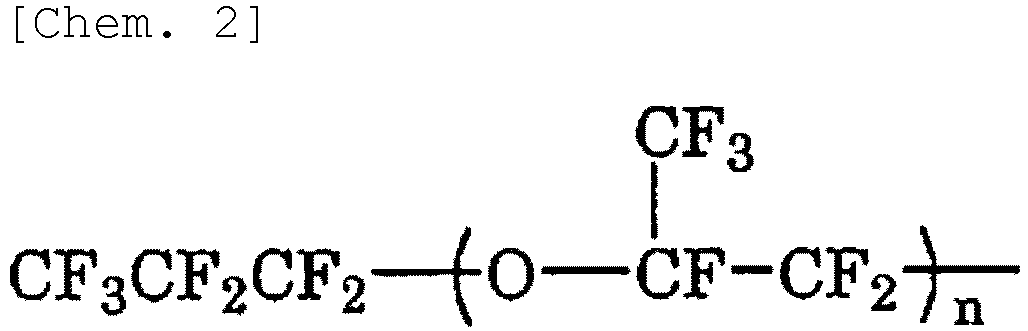
- Examples of the (perfluoroalkyl)ethylene (PFAE) include, but are not limited to, (perfluorobutyl)ethylene (PFBE) and (perfluorohexyl)ethylene.
- Examples of the perfluoroallyl ether include fluoromonomers represented by the following formula (B):
CF2=CF-CF2-ORf1 (B)
wherein Rf1 is a perfluoroorganic group. - Rf1 is preferably a C1-C10 perfluoroalkyl group or a C1-C10 perfluoroalkoxyalkyl group. The perfluoroallyl ether preferably includes at least one selected from the group consisting of CF2=CF-CF2-O-CF3, CF2=CF-CF2-O-C2F5, CF2=CF-CF2-O-C3F7, and CF2=CF-CF2-O-C4F9, more preferably includes at least one selected from the group consisting of CF2=CF-CF2-O-C2F5, CF2=CF-CF2-O-C3F7, and CF2=CF-CF2-O-C4F9, and is still more preferably CF2=CF-CF2-O-CF2CF2CF3.
- The PTFE is preferably in the form of particles and preferably has an average particle size of 1 to 2000 µm. The average particle size is more preferably 1000 µm or smaller, still more preferably 700 µm or smaller, while more preferably 10 µm or greater, still more preferably 15 µm or greater. Too large an average particle size may cause a difficulty in molding the PTFE or mixing the PTFE with filler, while too small an average particle size may cause poor fluidity of the PTFE composition.
- The average particle size is defined as the particle size corresponding to 50% of the cumulative volume in the particle size distribution determined using a laser diffraction particle size distribution analyzer at a dispersive pressure of 3.0 bar without cascade impaction. The laser diffraction particle size distribution analyzer may be HELOS & RODOS available from Jeol Ltd.
- The PTFE is preferably a PTFE molding powder. The PTFE molding powder is a powder obtainable by suspensionpolymerizing TFE. The suspension polymerization can be performed by a known method. For example, without or with a limited amount of a fluorine-containing anionic surfactant, a polymerization initiator is dispersed in an aqueous medium and monomers required to form the PTFE are polymerized therein, whereby suspension-polymerized PTFE particles can be isolated directly.
- The PTFE molding powder may be one obtained by a known method of granulating the particles obtained by polymerization.
- In the composition of the disclosure, the amount of the PTFE is preferably 60 to 90% by mass, more preferably 70 to 90% by mass, still more preferably 70 to 85% by mass of the composition.
- The non-black conductive filler in the composition of the disclosure includes at least one selected from the group consisting of antimony-doped tin oxide and phosphorus-doped tin oxide.
- Using any of these specific non-black conductive fillers can provide a PTFE composition that is non-black and has excellent conductivity even without zinc oxide.
- A small amount of the non-black conductive filler can provide excellent conductivity, reducing deterioration of the tensile strength at break and the tensile elongation at break.
- The non-black conductive filler may consist of at least one selected from the group consisting of antimony-doped tin oxide and phosphorus-doped tin oxide, or may be one including base particles coated with at least one selected from the group consisting of antimony-doped tin oxide and phosphorus-doped tin oxide.
- The non-black conductive filler is preferably free from zinc oxide.
- In an embodiment where the coating is formed from at least one selected from the group consisting of antimony-doped tin oxide and phosphorus-doped tin oxide, examples of the base particles include talc, mica, glass flakes, SiO2 flakes, TiO2 flakes, and Al2O3 flakes. Preferred among these are talc and mica.
- In an embodiment where the coating is formed from at least one selected from the group consisting of antimony-doped tin oxide and phosphorus-doped tin oxide, the amount of the coating is preferably 20 to 40% by mass of the total amount of the coating and the base particles.
- The non-black conductive filler is preferably at least one selected from the group consisting of (a) antimony-doped tin oxide particles; (b) particles including base particles of at least one selected from the group consisting of talc and mica coated with antimony-doped tin oxide; and (c) phosphorus-doped tin oxide particles. To achieve much better conductivity, more preferred is at least one selected from the group consisting of (a) antimony-doped tin oxide particles and (b) particles including base particles of at least one selected from the group consisting of talc and mica coated with antimony-doped tin oxide.
- The non-black conductive filler preferably has an average particle size of 1 to 100 µm, more preferably 1 to 30 µm, still more preferably 1 to 10 µm.
- The average particle size is defined as the particle size corresponding to 50% of the cumulative volume in the particle size distribution determined using a laser diffraction particle size distribution analyzer at a dispersive pressure of 3.0 bar without cascade impaction. The laser diffraction particle size distribution analyzer may be HELOS & RODOS available from Jeol Ltd.
- In the composition of the disclosure, the amount of the non-black conductive filler is preferably 10 to 40% by mass, more preferably 10 to 30% by mass, still more preferably 15 to 30% by mass of the composition.
- The composition of the disclosure may consist of the PTFE and the non-black conductive filler, or may further contain a different component as appropriate.
- The different component added may be a combination of a variety of additives such as metal, inorganic or organic reinforcing filler, a compatibilizer, a lubricant (carbon fluoride, carbon graphite, molybdenum disulfide), and a stabilizer.
- The composition of the disclosure is obtainable by mixing the PTFE and the non-black conductive filler as well as a different component added as appropriate using a mixer such as a V-shaped blender, a tumbler mixer, a Henschel mixer, a ball mixer, or a lödige mixer.
- The composition of the disclosure has conductivity. To achieve much better conductivity, the volume resistivity is preferably 1.0 × 10³ to 1.0 × 10⁷ Ω·cm, more preferably 1.0 × 10³ to 6.0 × 10⁶ Ω·cm, still more preferably 1.0 × 10³ to 2.0 × 10⁶ Ω·cm, particularly preferably 1.0 × 10⁴ to 2.0 × 10⁶ Ω·cm.
- The volume resistivity is determined by the following method.
- The composition is pressure-molded at a molding pressure of 50 MPa and fired at 370°C, whereby a cylindrical molded article (outer diameter: 12 mm, height: 40 mm) is obtained. The direct current resistance of this molded article is measured using a digital multimeter (HT26, available from HT Italia), and the volume resistivity (Ω·cm) is calculated by the following formula:
Volume resistivity (Ω·cm) = measured value (Ω) × cross-sectional area of cylinder (cm2)/height of cylinder (cm) - The composition of the disclosure can be suitably used as a molding material. The disclosure also relates to a molded article obtainable by molding the composition of the disclosure.
- The molded article is non-black and thus has excellent design. The molded article also has excellent conductivity.
- The molded article of the disclosure also has good tensile strength at break and good tensile elongation at break.
- Examples of methods of molding the composition of the disclosure include, but are not limited to, compression molding, ram extrusion molding, and isostatic molding. Preferred among these is compression molding.
- The molded article of the disclosure may have any shape such as a sheet shape, a film shape, a ring shape, a rod shape, a pipe shape, or a fibrous shape.
- The molded article of the disclosure is expected to expand into applications, including sealing materials such as gaskets and packings, rollers and tubes of OA equipment, sanitary pipes for foods and chemicals, and inner linings for tanks.
- Preferred among these are sealing materials such as gaskets and packings.
- The disclosure is more specifically described hereinbelow with reference to examples, but the disclosure is not limited to these examples.
- The following materials were used in the examples and the comparative examples.
-
- PTFE 1: Polyflon M-18F, Daikin Industries, Ltd., TFE homopolymer, standard specific gravity (SSG): 2.164, melting point: 345°C, average particle size: 20 µm
-
- Carbon black
- Non-black conductive filler (1): zinc oxide
- Non-black conductive filler (2): antimony-doped tin oxide (average particle size: 5 µm)
- Non-black conductive filler (3): phosphorus-doped tin oxide (average particle size: 4 µm)
- The physical properties were determined by the following methods.
- The average particle size was defined as the particle size corresponding to 50% of the cumulative volume in the particle size distribution determined using a laser diffraction particle size distribution analyzer (HELOS & RODOS, available from Jeol Ltd.) at a dispersive pressure of 3.0 bar without cascade impaction.
- The melting point was determined as the temperature corresponding to the maximum value on a heat-of-fusion curve at a temperature-increasing rate of 10°C/min using a differential scanning calorimeter (DSC).
- A PTFE composition was pressure-molded at a molding pressure of 50 MPa and fired at 370°C, whereby a cylindrical molded article (outer diameter: 12 mm, height: 40 mm) was obtained. The direct current resistance of this molded article was measured using a digital multimeter (HT26, available from HT Italia), and the volume resistivity (Ω·cm) was calculated by the following formula:
Volume resistivity (Ω·cm) = measured value (Ω) × cross-sectional area of cylinder (cm2)/height of cylinder (cm) - These parameters were measured in conformity with ASTM D4745.
- The polytetrafluoroethylene resin powder (PTFE 1 described above), 97 parts by mass, obtained by suspension polymerization was mixed with Carbon black listed above, 3 parts by mass, using a Henschel mixer, whereby a PTFE composition was obtained.
- PTFE compositions were obtained as in Comparative Example 1 except that the type and amount of the conductive filler fed were changed as shown in Table 1.
- Table 1 shows the results.
-
[Table 1] PTFE Conductive filler Evaluation Type Amount (mass%) Type Amount (mass%) Color Volume resistivity (Ω·cm) Tensile strength at break (MPa) Tensile elongation at break (%) Comparative Example 1 PTFE1 97 Carbon black 3 Black 2.80E+04 30 320 Comparative Example 2 PTFE1 80 Non-black conductive filler (1) 20 Non-black O.L. 26 288 Comparative Example 3 PTFE1 70 Non-black conductive filler (1) 30 Non-black 3.20E+06 21 243 Comparative Example 4 PTFE1 60 Non-black conductive filler (1) 40 Non-black 4.90E+05 13 150 Example 1 PTFE1 85 Non-black conductive filler (2) 15 Non-black 9.20E+05 24 281 Example 2 PTFE1 80 Non-black conductive filler (2) 20 Non-black 1.20E+05 18 289 Example 3 PTFE1 70 Non-black conductive filler (2) 30 Non-black 1.60E+04 9 77 Example 4 PTFE1 60 Non-black conductive filler (2) 40 Non-black 7.00E+03 5 26 Example 5 PTFE1 70 Non-black conductive filler (3) 30 Non-black 1.90E+06 13 140
Claims (5)
- A non-black conductive polytetrafluoroethylene composition comprising:polytetrafluoroethylene; anda non-black conductive filler containing at least one selected from the group consisting of antimony-doped tin oxide and phosphorus-doped tin oxide.
- The non-black conductive polytetrafluoroethylene composition according to claim 1,
wherein the non-black conductive
polytetrafluoroethylene composition has a volume resistivity of 1.0 × 10³ to 1.0 × 10⁷ Ω·cm. - The non-black conductive polytetrafluoroethylene composition according to claim 1 or 2,
wherein the non-black conductive filler is contained in an amount of 10 to 40% by mass of the composition. - A molded article obtainable by molding the non-black conductive polytetrafluoroethylene composition according to any one of claims 1 to 3.
- The molded article according to claim 4, which is a sealing material.
Applications Claiming Priority (2)
| Application Number | Priority Date | Filing Date | Title |
|---|---|---|---|
| JP2022121952 | 2022-07-29 | ||
| PCT/JP2023/026875 WO2024024688A1 (en) | 2022-07-29 | 2023-07-21 | Non-black conductive polytetrafluoroethylene composition and molded body |
Publications (2)
| Publication Number | Publication Date |
|---|---|
| EP4563647A1 true EP4563647A1 (en) | 2025-06-04 |
| EP4563647A4 EP4563647A4 (en) | 2026-07-08 |
Family
ID=89706506
Family Applications (1)
| Application Number | Title | Priority Date | Filing Date |
|---|---|---|---|
| EP23846418.4A Pending EP4563647A4 (en) | 2022-07-29 | 2023-07-21 | NON-BLACK CONDUCTIVITY POLYTETRAFLUORETHYLENE COMPOSITION AND MOLDED BODY |
Country Status (5)
| Country | Link |
|---|---|
| EP (1) | EP4563647A4 (en) |
| JP (1) | JP7577800B2 (en) |
| CN (1) | CN120092047A (en) |
| TW (1) | TW202413523A (en) |
| WO (1) | WO2024024688A1 (en) |
Family Cites Families (6)
| Publication number | Priority date | Publication date | Assignee | Title |
|---|---|---|---|---|
| JPS63215745A (en) * | 1987-03-04 | 1988-09-08 | Toshiba Silicone Co Ltd | Pressure-sensitive electroconductive elastomer composition |
| US8971781B2 (en) * | 2008-06-09 | 2015-03-03 | Sumitomo Electric Industries, Ltd. | Roller for image-forming apparatus and process for producing the same |
| WO2012104006A1 (en) * | 2011-02-03 | 2012-08-09 | Merck Patent Gmbh | Laser-markable and laser-weldable polymers |
| JP2013136675A (en) | 2011-12-28 | 2013-07-11 | Du Pont Mitsui Fluorochem Co Ltd | Conductive fluororesin composition and molded product thereof |
| JP6188517B2 (en) * | 2013-09-27 | 2017-08-30 | 積水化成品工業株式会社 | COMPOSITE PARTICLE, PROCESS FOR PRODUCING THE SAME, AND FILM |
| EP3628644B1 (en) * | 2018-09-25 | 2025-11-12 | Guarniflon S.P.A. | Filler and polymeric compositions containing same |
-
2023
- 2023-07-21 CN CN202380055414.1A patent/CN120092047A/en active Pending
- 2023-07-21 EP EP23846418.4A patent/EP4563647A4/en active Pending
- 2023-07-21 WO PCT/JP2023/026875 patent/WO2024024688A1/en not_active Ceased
- 2023-07-21 JP JP2023119357A patent/JP7577800B2/en active Active
- 2023-07-25 TW TW112127765A patent/TW202413523A/en unknown
Also Published As
| Publication number | Publication date |
|---|---|
| EP4563647A4 (en) | 2026-07-08 |
| CN120092047A (en) | 2025-06-03 |
| TW202413523A (en) | 2024-04-01 |
| WO2024024688A1 (en) | 2024-02-01 |
| JP2024019053A (en) | 2024-02-08 |
| JP7577800B2 (en) | 2024-11-05 |
Similar Documents
| Publication | Publication Date | Title |
|---|---|---|
| US11623984B2 (en) | Melt processible fluororesin composition and injection molded article formed from same | |
| EP0395895B1 (en) | Melt processable tfe copolymers | |
| US6649699B2 (en) | Fluoropolymer compositions with improved gas impermeability | |
| EP1842863B1 (en) | Ethylene/tetrafluorethylene copolymer composition | |
| EP0656832B1 (en) | Plasticized fluoropolymers | |
| EP3222664B1 (en) | Polytetrafluoroethylene composition | |
| JP2021514015A (en) | Fluoropolymers, fluoropolymer compositions, and fluoropolymer dispersions | |
| US7671123B2 (en) | Fluororesin aqueous dispersion with polyoxyalkylene ester surfactant | |
| US20130161873A1 (en) | Tetrafluoroethylene copolymer composition for injection molding | |
| EP2058341A1 (en) | Process for producing melt-moldable tetrafluoroethylene copolymer | |
| EP1838760B1 (en) | Fluoropolymer molding process and fluoropolymer molded product | |
| JPH01306219A (en) | Molding method for polytetrafluoroethylene including filler | |
| ZA200508620B (en) | Melt-processible thermoplastic fluoropolymers having improved processing characteristics and method of producing same | |
| JP7307387B2 (en) | COMPOSITION, CIRCUIT BOARD, AND METHOD FOR MANUFACTURING COMPOSITION | |
| US20240182742A1 (en) | Composition for coating and coated article | |
| EP3828233A1 (en) | Resin composition and molded article | |
| JP5051517B2 (en) | Ethylene / tetrafluoroethylene copolymer composition | |
| WO1993023470A1 (en) | Resin composition for sliding part | |
| JP7577800B2 (en) | NON-BLACK CONDUCTIVE POLYTETRAFLUOROETHYLENE COMPOSITION AND MOLDED BODY | |
| TW202302750A (en) | Fluorine resin composition and molded body | |
| US12215219B2 (en) | Resin composition, molded article, and automatic transmission | |
| US12291624B2 (en) | Polytetrafluoroethylene composition | |
| CN1878833A (en) | Melt processible copolymer composition | |
| WO2015009989A1 (en) | Mixtures, articles having low coefficients of friction, methods of making these, and methods of using these |
Legal Events
| Date | Code | Title | Description |
|---|---|---|---|
| STAA | Information on the status of an ep patent application or granted ep patent |
Free format text: STATUS: THE INTERNATIONAL PUBLICATION HAS BEEN MADE |
|
| PUAI | Public reference made under article 153(3) epc to a published international application that has entered the european phase |
Free format text: ORIGINAL CODE: 0009012 |
|
| STAA | Information on the status of an ep patent application or granted ep patent |
Free format text: STATUS: REQUEST FOR EXAMINATION WAS MADE |
|
| 17P | Request for examination filed |
Effective date: 20250228 |
|
| AK | Designated contracting states |
Kind code of ref document: A1 Designated state(s): AL AT BE BG CH CY CZ DE DK EE ES FI FR GB GR HR HU IE IS IT LI LT LU LV MC ME MK MT NL NO PL PT RO RS SE SI SK SM TR |
|
| DAV | Request for validation of the european patent (deleted) | ||
| DAX | Request for extension of the european patent (deleted) | ||
| REG | Reference to a national code |
Ref country code: DE Ref legal event code: R079 Free format text: PREVIOUS MAIN CLASS: C08L0027180000 Ipc: C08K0003220000 |
|
| A4 | Supplementary search report drawn up and despatched |
Effective date: 20260609 |
|
| RIC1 | Information provided on ipc code assigned before grant |
Ipc: C08K 3/22 20060101AFI20260602BHEP Ipc: C08L 27/18 20060101ALI20260602BHEP |