EP4563535A1 - Method for producing nickel sulfate - Google Patents
Method for producing nickel sulfate Download PDFInfo
- Publication number
- EP4563535A1 EP4563535A1 EP23855026.3A EP23855026A EP4563535A1 EP 4563535 A1 EP4563535 A1 EP 4563535A1 EP 23855026 A EP23855026 A EP 23855026A EP 4563535 A1 EP4563535 A1 EP 4563535A1
- Authority
- EP
- European Patent Office
- Prior art keywords
- nickel
- leachate
- producing
- nickel sulfate
- raw material
- Prior art date
- Legal status (The legal status is an assumption and is not a legal conclusion. Google has not performed a legal analysis and makes no representation as to the accuracy of the status listed.)
- Pending
Links
Images

Classifications
-
- C—CHEMISTRY; METALLURGY
- C01—INORGANIC CHEMISTRY
- C01G—COMPOUNDS CONTAINING METALS NOT COVERED BY SUBCLASSES C01D OR C01F
- C01G53/00—Compounds of nickel
- C01G53/10—Sulfates
-
- C—CHEMISTRY; METALLURGY
- C01—INORGANIC CHEMISTRY
- C01F—COMPOUNDS OF THE METALS BERYLLIUM, MAGNESIUM, ALUMINIUM, CALCIUM, STRONTIUM, BARIUM, RADIUM, THORIUM, OR OF THE RARE-EARTH METALS
- C01F11/00—Compounds of calcium, strontium, or barium
- C01F11/20—Halides
- C01F11/22—Fluorides
-
- C—CHEMISTRY; METALLURGY
- C01—INORGANIC CHEMISTRY
- C01F—COMPOUNDS OF THE METALS BERYLLIUM, MAGNESIUM, ALUMINIUM, CALCIUM, STRONTIUM, BARIUM, RADIUM, THORIUM, OR OF THE RARE-EARTH METALS
- C01F5/00—Compounds of magnesium
- C01F5/26—Magnesium halides
- C01F5/28—Fluorides
-
- C—CHEMISTRY; METALLURGY
- C01—INORGANIC CHEMISTRY
- C01F—COMPOUNDS OF THE METALS BERYLLIUM, MAGNESIUM, ALUMINIUM, CALCIUM, STRONTIUM, BARIUM, RADIUM, THORIUM, OR OF THE RARE-EARTH METALS
- C01F7/00—Compounds of aluminium
- C01F7/02—Aluminium oxide; Aluminium hydroxide; Aluminates
- C01F7/34—Preparation of aluminium hydroxide by precipitation from solutions containing aluminium salts
-
- C—CHEMISTRY; METALLURGY
- C01—INORGANIC CHEMISTRY
- C01G—COMPOUNDS CONTAINING METALS NOT COVERED BY SUBCLASSES C01D OR C01F
- C01G49/00—Compounds of iron
- C01G49/02—Oxides; Hydroxides
-
- C—CHEMISTRY; METALLURGY
- C01—INORGANIC CHEMISTRY
- C01G—COMPOUNDS CONTAINING METALS NOT COVERED BY SUBCLASSES C01D OR C01F
- C01G51/00—Compounds of cobalt
- C01G51/10—Sulfates
-
- C—CHEMISTRY; METALLURGY
- C01—INORGANIC CHEMISTRY
- C01G—COMPOUNDS CONTAINING METALS NOT COVERED BY SUBCLASSES C01D OR C01F
- C01G53/00—Compounds of nickel
- C01G53/01—Preparation or separation involving a liquid-liquid extraction, an adsorption or an ion-exchange
-
- C—CHEMISTRY; METALLURGY
- C01—INORGANIC CHEMISTRY
- C01G—COMPOUNDS CONTAINING METALS NOT COVERED BY SUBCLASSES C01D OR C01F
- C01G9/00—Compounds of zinc
- C01G9/08—Sulfides
-
- C—CHEMISTRY; METALLURGY
- C22—METALLURGY; FERROUS OR NON-FERROUS ALLOYS; TREATMENT OF ALLOYS OR NON-FERROUS METALS
- C22B—PRODUCTION AND REFINING OF METALS; PRETREATMENT OF RAW MATERIALS
- C22B19/00—Obtaining zinc or zinc oxide
- C22B19/20—Obtaining zinc otherwise than by distilling
- C22B19/22—Obtaining zinc otherwise than by distilling with leaching with acids
-
- C—CHEMISTRY; METALLURGY
- C22—METALLURGY; FERROUS OR NON-FERROUS ALLOYS; TREATMENT OF ALLOYS OR NON-FERROUS METALS
- C22B—PRODUCTION AND REFINING OF METALS; PRETREATMENT OF RAW MATERIALS
- C22B23/00—Obtaining nickel or cobalt
- C22B23/04—Obtaining nickel or cobalt by wet processes
- C22B23/0407—Leaching processes
- C22B23/0415—Leaching processes with acids or salt solutions except ammonium salts solutions
- C22B23/043—Sulfurated acids or salts thereof
-
- C—CHEMISTRY; METALLURGY
- C22—METALLURGY; FERROUS OR NON-FERROUS ALLOYS; TREATMENT OF ALLOYS OR NON-FERROUS METALS
- C22B—PRODUCTION AND REFINING OF METALS; PRETREATMENT OF RAW MATERIALS
- C22B23/00—Obtaining nickel or cobalt
- C22B23/04—Obtaining nickel or cobalt by wet processes
- C22B23/0453—Treatment or purification of solutions, e.g. obtained by leaching
- C22B23/0461—Treatment or purification of solutions, e.g. obtained by leaching by chemical methods
-
- C—CHEMISTRY; METALLURGY
- C22—METALLURGY; FERROUS OR NON-FERROUS ALLOYS; TREATMENT OF ALLOYS OR NON-FERROUS METALS
- C22B—PRODUCTION AND REFINING OF METALS; PRETREATMENT OF RAW MATERIALS
- C22B3/00—Extraction of metal compounds from ores or concentrates by wet processes
-
- C—CHEMISTRY; METALLURGY
- C22—METALLURGY; FERROUS OR NON-FERROUS ALLOYS; TREATMENT OF ALLOYS OR NON-FERROUS METALS
- C22B—PRODUCTION AND REFINING OF METALS; PRETREATMENT OF RAW MATERIALS
- C22B3/00—Extraction of metal compounds from ores or concentrates by wet processes
- C22B3/04—Extraction of metal compounds from ores or concentrates by wet processes by leaching
- C22B3/06—Extraction of metal compounds from ores or concentrates by wet processes by leaching in inorganic acid solutions, e.g. with acids generated in situ; in inorganic salt solutions other than ammonium salt solutions
- C22B3/08—Sulfuric acid, other sulfurated acids or salts thereof
-
- C—CHEMISTRY; METALLURGY
- C22—METALLURGY; FERROUS OR NON-FERROUS ALLOYS; TREATMENT OF ALLOYS OR NON-FERROUS METALS
- C22B—PRODUCTION AND REFINING OF METALS; PRETREATMENT OF RAW MATERIALS
- C22B3/00—Extraction of metal compounds from ores or concentrates by wet processes
- C22B3/20—Treatment or purification of solutions, e.g. obtained by leaching
- C22B3/44—Treatment or purification of solutions, e.g. obtained by leaching by chemical processes
-
- C—CHEMISTRY; METALLURGY
- C01—INORGANIC CHEMISTRY
- C01P—INDEXING SCHEME RELATING TO STRUCTURAL AND PHYSICAL ASPECTS OF SOLID INORGANIC COMPOUNDS
- C01P2006/00—Physical properties of inorganic compounds
- C01P2006/80—Compositional purity
-
- H—ELECTRICITY
- H01—ELECTRIC ELEMENTS
- H01M—PROCESSES OR MEANS, e.g. BATTERIES, FOR THE DIRECT CONVERSION OF CHEMICAL ENERGY INTO ELECTRICAL ENERGY
- H01M10/00—Secondary cells; Manufacture thereof
- H01M10/54—Reclaiming serviceable parts of waste accumulators
-
- Y—GENERAL TAGGING OF NEW TECHNOLOGICAL DEVELOPMENTS; GENERAL TAGGING OF CROSS-SECTIONAL TECHNOLOGIES SPANNING OVER SEVERAL SECTIONS OF THE IPC; TECHNICAL SUBJECTS COVERED BY FORMER USPC CROSS-REFERENCE ART COLLECTIONS [XRACs] AND DIGESTS
- Y02—TECHNOLOGIES OR APPLICATIONS FOR MITIGATION OR ADAPTATION AGAINST CLIMATE CHANGE
- Y02P—CLIMATE CHANGE MITIGATION TECHNOLOGIES IN THE PRODUCTION OR PROCESSING OF GOODS
- Y02P10/00—Technologies related to metal processing
- Y02P10/20—Recycling
Definitions
- the embodiments of the present disclosure relate to a method for producing nickel sulfate, and more specifically, to a method for producing nickel sulfate from a raw material containing nickel.
- Nickel is used in various fields such as an alloy for a magnet, filament, and the like, plating for corrosion prevention, a catalyst, adhesive carbide, a cathode material for a secondary battery and the like.
- nickel is actively used as a transition metal included in a cathode active material of a lithium secondary battery.
- nickel may be recovered in the form of nickel sulfate by leaching a waste cathode active material in a strong acid, and the recovered nickel sulfate may be used to manufacture the cathode active material again.
- transition metals such as manganese and iron may be included as impurities in the recovered nickel sulfate.
- an amount of unnecessary by-products produced may be increased due to sodium hydroxide used during extraction of nickel.
- Korean Patent Registration No. 10-1623930 discloses a process for leaching Ni, Co and Mn from a cathode material of a waste lithium ion battery.
- An embodiment of the present disclosure provides a method for producing nickel sulfate with improved productivity and purity.
- a nickel-containing raw material may be prepared.
- a first leachate in which nickel is selectively leached from the nickel-containing raw material using an oxidant, may be produced.
- a second leachate may be produced by separating a residual metal from the first leachate.
- Nickel sulfate may be obtained from the second leachate.
- the nickel-containing raw material may include nickel (Ni)-mixed hydroxide precipitate (MHP).
- the Ni-MHP may further contain cobalt and manganese.
- only nickel in producing the first leachate, only nickel may be leached among nickel, cobalt and manganese included in the Ni-MHP.
- the oxidant may include metal persulfate.
- producing the first leachate may be performed under a condition of pH 2 or more using an acidic solution including the oxidant.
- At least one of calcium and magnesium may be precipitated using a fluoride precipitant.
- zinc in separating the residual metal to produce the second leachate, zinc may be precipitated or zinc may be extracted.
- the precipitating of zinc may be performed using a sulfide precipitant.
- the extracting of zinc may be performed using a phosphoric acid-based extractant.
- the nickel-containing raw material may be washed before producing the first leachate.
- calcium or magnesium contained in the nickel-containing raw material may be partially removed through washing the nickel-containing raw material.
- the washing of the nickel-containing raw material may be performed using water of 40°C to 100°C.
- the nickel sulfate may be crystallized into nickel sulfate hydrate.
- nickel may be selectively extracted by inputting an acid solution and a metal salt oxidant to a nickel-containing mixed hydroxide precipitate. Accordingly, cobalt, manganese, and the like may be removed as residues, and an amount of acid solution and hydroxide used for separately extracting cobalt and manganese may be reduced.
- Embodiments of the present disclosure provide a method for producing nickel sulfate from a raw material containing nickel.
- embodiments of the present disclosure may include a method for refining nickel from a nickel-containing product.
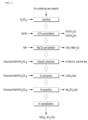
- FIG. 1 is a schematic flowchart for describing a method for producing nickel sulfate according to embodiments of the present disclosure.
- a nickel (Ni)-containing raw material may be prepared (e.g., process S10).
- the nickel-containing raw material may be nickel (Ni)-mixed hydroxide precipitate (MHP) derived from ore.
- MHP nickel-mixed hydroxide precipitate
- the nickel-containing raw material may include a byproduct of wet refining of Ni oxide ore.
- the Ni-MHP may further include additional metals such as calcium (Ca), magnesium (Mg), cobalt (Co), manganese (Mn), aluminum (Al), iron (Fe), zinc (Zn), and the like other than nickel.
- the nickel-containing raw material may be collected from electrical/chemical products which contain nickel, such as a waste battery.
- the nickel-containing raw material may be washed (e.g., process S15).
- the nickel-containing raw material may be subjected to a water washing treatment.
- the washing may be performed using water of 40°C or higher (e.g., 40°C to 100°C), or 60°C or higher (e.g., 60°C to 100°C). In one embodiment, the washing may be performed using water of 60°C to 80°C.
- Ca and/or Mg may be washed and partially removed from the nickel-containing raw material.
- Mg components e.g., MgSO 4
- Ca components e.g., CaSO 4
- a ratio of a weight of water used in the washing process to a weight of the nickel-containing raw material may be 2 to 5, or 2.5 to 5. Within the above ratio range, a nickel-containing raw material in a slurry state for the subsequent process may be easily prepared, and partial removal of Ca and Mg may be substantially implemented.
- nickel may be leached from the nickel-containing raw material using an oxidant having selectivity to nickel when selectively extracting the same.
- the oxidant may include metal persulfate.
- the oxidant may include sodium persulfate (Na 2 S 2 O 8 ).
- a sulfuric acid solution may be supplied to the nickel-containing raw material together with the oxidant to selectively leach nickel, thereby obtaining a first leachate.
- solid-state residues may be produced.
- the residue may include Co, Mn, Al, Fe, and the like.
- the residues may be removed or separated through a first solid-liquid separation (e.g., process S25) to produce the first leachate from which Co, Mn, Al, and Fe are at least partially removed.
- a first solid-liquid separation e.g., process S25
- the first solid-liquid separation may be performed through a filter press or centrifugation.
- an amount of the oxidant used in the Ni leaching process may be 1.5% by weight ("wt%") to 7 wt% based on the weight of the nickel-containing raw material (e.g., the washed nickel-containing raw material). For example, 1.5 g to 7 g of the oxidant may be used based on 100 g of the nickel-containing raw material.
- the amount of the oxidant may be 2 wt% to 7 wt%, or 4 wt% to 6 wt% based on the weight of the nickel-containing raw material.
- a molar ratio of sulfuric acid (H 2 SO 4 ) to the number of moles of Ni included in the nickel-containing raw material may be 0.5 to 1. Within the above range, Co, Mn, Al and Fe may be removed in a sufficient amount from the nickel-containing raw material. In one embodiment, the molar ratio of sulfuric acid to the number of moles of Ni included in the nickel-containing raw material may be 0.7 to 0.9, or 0.7 to 0.8.
- another oxidant e.g., hydrogen peroxide
- the metal persulfate may not be used in the Ni leaching process. Accordingly, the selectivity of Ni may be increased.
- input amounts of sulfuric acid and the oxidant may be adjusted so that the pH of the first leachate is 2 or more, 2.5 or more, or 3 or more. In one embodiment, the input amounts of the sulfuric acid and the oxidant may be adjusted so that the pH of the first leachate is 4 or more.
- the pH of the first leachate may be adjusted so as not to exceed 6. In one embodiment, the pH of the first leachate may be adjusted so as not to exceed 5. For example, the pH of the first leachate may be 2 to 6, 3 to 6, 4 to 6, or 4 to 5.
- residual metals other than Ni included in the first leachate may be additionally separated or removed.
- Ca and/or Mg may be at least partially removed from the first leachate through a first precipitation process.
- a first precipitant may be entered into the first leachate to precipitate Ca and/or Mg.
- the first precipitant may include a fluoride precipitant.
- the fluoride precipitant may include metal fluoride, for example, the metal fluoride may include alkali metal fluoride (e.g., NaF).
- Ca and Mg may be precipitated from the first leachate in the form of calcium fluoride (CaF 2 ) and magnesium fluoride (MgF 2 ).
- the precipitated calcium fluoride and magnesium fluoride may be separated or removed through a second solid-liquid separation (e.g., process S35).
- the second solid-liquid separation may be performed, for example, through a filter press or centrifugation.
- a second leachate in which the amount(s) of Ca and/or Mg are/is reduced or removed from the first leachate may be obtained.
- a second leachate in which Ca and/or Mg is substantially reduced or removed may be obtained by using the first leachate in which Ca and/or Mg is partially removed through the washing process.
- processes of reducing/removing additional residual metals from the second leachate may be additionally performed.
- a separation process of zinc (Zn) included in the second leachate may be further performed.
- Zn may be at least partially removed from the first leachate through a second precipitation process.
- a second precipitant may be entered into the first leachate to precipitate Zn.
- the second precipitant may include a sulfide precipitant.
- the sulfide precipitant may include a metal sulfide and/or a non-metal sulfide.
- the metal sulfide may include alkali metal sulfide (e.g., Na 2 S), and the non-metal sulfide may include hydrogen sulfide (H 2 S).
- Zn may be precipitated from the first leachate in the form of zinc sulfide (ZnS).
- ZnS zinc sulfide
- the precipitated zinc sulfide may be separated or removed through a third solid-liquid separation (e.g., process S45-1).
- the third solid-liquid separation may be performed through the filter press or centrifugation.
- a second leachate in which the amount of Zn is reduced or removed from the first leachate may be obtained.
- Zn may be at least partially removed from the first leachate through an extraction process.
- an extractant may be entered into the first leachate to extract Zn.
- the extractant may include a phosphoric acid-based extractant.
- the phosphoric acid-based extractant may include di-2-ethylhexyl phosphoric acid, 2-ethylhexyl phosphoric acid mono-2-ethylhexyl ester.
- Zn may be extracted from the first leachate in the form of zinc sulfate (ZnSO 4 ).
- the extracted zinc sulfate may be separated or removed through liquid-liquid separation (e.g., process S45-2).
- the liquid-liquid separation may be performed through mixed sedimentation or centrifugal extraction.
- a second leachate in which the amount of Zn is reduced or removed from the first leachate may be obtained.
- nickel sulfate hydrate may be obtained from the second leachate through concentration and/or crystallization process(s).
- water of the second leachate may be partially evaporated and concentrated, and then cooled, such that the nickel sulfate of the second leachate may be crystallized and precipitated in the form of nickel sulfate hydrate (e.g., NiSO 4 ⁇ 6H 2 O).
- the precipitated nickel sulfate hydrate may be separated while retaining Na through a fourth solid-liquid separation.
- the fourth solid-liquid separation may be performed through a filter press or centrifugation.
- FIG. 2 is a schematic flowchart for describing, in sequence, a method for producing nickel sulfate according to a comparative example.
- the comparative example described below with reference to FIG. 2 is provided to describe effects of the process concept of FIG. 1 in more detail, and is not intended to exclude it from the scope of the present disclosure.
- the steps/processes included in FIG. 2 may also be included in e embodiments of the present disclosure.
- a nickel (Ni)-containing raw material may be prepared.
- the nickel-containing raw material may be leached using sulfuric acid to obtain a leachate.
- Sodium hydroxide (NaOH) may be entered into the leachate to precipitate Al and/or Fe. Accordingly, Al and Fe may be precipitated from the leachate in the form of aluminum hydroxide (Al(OH) 3 ) and iron hydroxide (Fe(OH) 3 ). The precipitated aluminum hydroxide and iron hydroxide may be separated or removed through solid-liquid separation, such that a first solution in which the amount(s) of Al and/or Fe are/is reduced or removed may be obtained.
- An alkali metal fluoride e.g., NaF
- Ca and Mg may be precipitated from the first solution in the form of calcium fluoride (CaF 2 ) and magnesium fluoride (MgF 2 ).
- the precipitated calcium fluoride and magnesium fluoride may be separated or removed through the solid-liquid separation, to obtain a second solution in which the amount(s) of Ca and/or Mg are/is reduced or removed.
- Zn, Mn and/or Ca may be extracted from the second solution using a phosphoric acid-based extractant.
- An alkaline compound such as sodium hydroxide is used together with the phosphoric acid-based extractant for saponification of the extractant, and sulfuric acid is used together, such that Zn, Mn and Ca may be extracted from the second solution in the form of zinc sulfate (ZnSO 4 ), manganese sulfate (MnSO 4 ) and calcium sulfate (CaSO 4 ).
- the extracted zinc sulfate, manganese sulfate and calcium sulfate may be separated or removed through liquid-liquid separation, to obtain a third solution in which the amount(s) of Zn, Mn and/or Ca are/is reduced or removed.
- the above-described phosphoric acid-based extractant, sodium hydroxide and sulfuric acid may be entered into the third solution to extract Co.
- Co may be extracted from the leachate in the form of cobalt sulfate (CoSO 4 ).
- the extracted cobalt sulfate may be separated or removed through liquid-liquid separation, such that a fourth solution in which the amount of Co is reduced or removed may be obtained.
- the acidic extractant, sodium hydroxide and sulfuric acid may be entered into the above-described fourth solution to extract Ni.
- the acidic extractant may include a phosphoric acid-based extractant or a carboxylic acid-based extractant.
- Ni may be extracted from the leachate in the form of nickel sulfate (NiSO 4 ).
- the extracted nickel sulfate may be separated through liquid-liquid separation to obtain an aqueous nickel sulfate solution including nickel sulfate.
- the aqueous nickel sulfate solution may be partially concentrated and crystallized to obtain nickel sulfate in the form of nickel sulfate hydrate.
- sodium hydroxide is used to prevent a decrease in the pH. Accordingly, sodium derived from the sodium hydroxide is concentrated and unnecessary by-products (e.g., Na 2 SO 4 ) are produced.
- different types of acid extractants are used for continuous/sequential extraction of different metals, and a plurality of extraction processes are included for the separation of different metals such as Mn, Co, Ni, and the like.
- Co, Mn, and the like may be removed or separated as residues in the leaching process (e.g., process S20). Accordingly, for example, sodium derived from sodium hydroxide may be reduced, such that an additional Ni extraction process may be omitted. In addition, the amount of unnecessary byproducts (e.g., Na 2 SO 4 ) produced may be reduced.
- a first leachate was obtained by performing the same process as in Example 1 except that the amount of oxidant used was adjusted as described in Table 2.
- a first leachate was obtained by performing the same process as in Example 1 except that the amount of sulfuric acid used was adjusted as described in Table 2.
- a first leachate was obtained by performing the same process as in Example 1 except that the amount of sulfuric acid used was adjusted as described in Table 2.
- a first leachate was obtained by performing the same process as in Example 1 except that the amount of sulfuric acid used was adjusted as described in Table 2.
- a first leachate was obtained by performing the same process as in Example 1 except that the amount of sulfuric acid used and the amount of oxidant used were adjusted as described in Table 2.
- a first leachate was obtained by performing the same process as in Example 1 except that the amount of sulfuric acid used was adjusted as described in Table 2 and an oxidant was not input.
- a first leachate was obtained by performing the same process as in Example 1 except that the amount of sulfuric acid used was adjusted as described in Table 2, an oxidant (sodium persulfate) was not input, and 2.25 g of hydrogen peroxide (H 2 O 2 ) was input.
- the contents of Ca and Mg were 280 wt ppm and 780 wt ppm, respectively, which are levels of 46 wt% for Ca and 23 wt% for Mg, respectively, compared to the Ca and Mg in the nickel-containing mixed hydroxide precipitate before the washing process.
- Weights of Co, Mn, Mg, Fe, Zn, Ca and Al of the nickel-containing mixed hydroxide precipitate and weights of Co, Mn, Mg, Fe, Zn, Ca and Al of the first leachate were measured, and the weights of the metals of the first leachate relative to the weights of the metals of the nickel-containing mixed hydroxide precipitate were calculated as wt% for each metal.
- Concentrations of Co, Mn, Mg, Fe, Zn, Ca, Al and Na in the first leachate were calculated as wt% for each metal in terms of the weights of the metals in the first leachate relative to the weight of the first leachate.
- Example 3 where the pH of the first leachate was less than 3, the leaching rate of Al was relatively increased.
- Example 4 where the pH of the first leachate was 5 or higher, the leaching rates of Ni and Zn were relatively reduced.
- Example 5 where the pH of the first leachate was less than 2, the leaching rates of Co, Fe and Al were relatively increased.
- Example 6 where the pH of the first leachate was less than 3 and the amount of oxidant input was reduced, the leaching rates of Co, Mn and Al were relatively increased.
- the first leachate was precipitated for 4 hours using 1.15 g of sodium fluoride (NaF) as a precipitant to obtain a second leachate.
- NaF sodium fluoride
- a second leachate was obtained by performing the same process as in Example 1 except that 1.4 g of sodium fluoride was used.
Landscapes
- Chemical & Material Sciences (AREA)
- Organic Chemistry (AREA)
- Engineering & Computer Science (AREA)
- Inorganic Chemistry (AREA)
- Metallurgy (AREA)
- Geology (AREA)
- Manufacturing & Machinery (AREA)
- Materials Engineering (AREA)
- Mechanical Engineering (AREA)
- Life Sciences & Earth Sciences (AREA)
- General Life Sciences & Earth Sciences (AREA)
- Geochemistry & Mineralogy (AREA)
- Environmental & Geological Engineering (AREA)
- General Chemical & Material Sciences (AREA)
- Chemical Kinetics & Catalysis (AREA)
- Manufacture And Refinement Of Metals (AREA)
- Inorganic Compounds Of Heavy Metals (AREA)
Abstract
A method for producing nickel sulfate according to embodiments of the present disclosure may prepare a raw material containing nickel. A first leachate may be produced by selectively leaching nickel from the raw material containing nickel using an oxidant. A second leachate may be produced by separating a residual metal from the first leachate. Thereafter, nickel sulfate may be obtained from the second leachate. Accordingly, unnecessary byproducts may be reduced by omitting a separate nickel extraction process.
Description
- The embodiments of the present disclosure relate to a method for producing nickel sulfate, and more specifically, to a method for producing nickel sulfate from a raw material containing nickel.
- Nickel is used in various fields such as an alloy for a magnet, filament, and the like, plating for corrosion prevention, a catalyst, adhesive carbide, a cathode material for a secondary battery and the like. In particular, nickel is actively used as a transition metal included in a cathode active material of a lithium secondary battery.
- As expensive valuable metals including nickel are used in the cathode active material, 20% or more of manufacturing costs is required to manufacture the cathode material. In addition, as the environmental protection issues are recently emerging, research on a method for recycling the cathode active material is being conducted.
- For example, nickel may be recovered in the form of nickel sulfate by leaching a waste cathode active material in a strong acid, and the recovered nickel sulfate may be used to manufacture the cathode active material again.
- However, other transition metals such as manganese and iron may be included as impurities in the recovered nickel sulfate. In addition, an amount of unnecessary by-products produced may be increased due to sodium hydroxide used during extraction of nickel.
- Therefore, a method for producing a high-purity nickel compound capable of increasing a yield of nickel while reducing the amount of by-products produced is required.
- For example, Korean Patent Registration No.
10-1623930 - An embodiment of the present disclosure provides a method for producing nickel sulfate with improved productivity and purity.
- In a method for producing nickel sulfate according to embodiments of the present disclosure, a nickel-containing raw material may be prepared. A first leachate, in which nickel is selectively leached from the nickel-containing raw material using an oxidant, may be produced. A second leachate may be produced by separating a residual metal from the first leachate. Nickel sulfate may be obtained from the second leachate.
- In some embodiments, the nickel-containing raw material may include nickel (Ni)-mixed hydroxide precipitate (MHP).
- In some embodiments, the Ni-MHP may further contain cobalt and manganese.
- In some embodiments, in producing the first leachate, only nickel may be leached among nickel, cobalt and manganese included in the Ni-MHP.
- In some embodiments, the oxidant may include metal persulfate.
- In some embodiments, producing the first leachate may be performed under a condition of pH 2 or more using an acidic solution including the oxidant.
- In some embodiments, in separating the residual metal to produce the second leachate, at least one of calcium and magnesium may be precipitated using a fluoride precipitant.
- In some embodiments, in separating the residual metal to produce the second leachate, zinc may be precipitated or zinc may be extracted.
- In some embodiments, the precipitating of zinc may be performed using a sulfide precipitant.
- In some embodiments, the extracting of zinc may be performed using a phosphoric acid-based extractant.
- In some embodiments, the nickel-containing raw material may be washed before producing the first leachate.
- In some embodiments, calcium or magnesium contained in the nickel-containing raw material may be partially removed through washing the nickel-containing raw material.
- In some embodiments, the washing of the nickel-containing raw material may be performed using water of 40°C to 100°C.
- In some embodiments, the nickel sulfate may be crystallized into nickel sulfate hydrate.
- According to embodiments of the present disclosure, nickel may be selectively extracted by inputting an acid solution and a metal salt oxidant to a nickel-containing mixed hydroxide precipitate. Accordingly, cobalt, manganese, and the like may be removed as residues, and an amount of acid solution and hydroxide used for separately extracting cobalt and manganese may be reduced.
- In some embodiments, it is possible to form a second leachate in which residual metals such as magnesium, calcium, zinc, and the like are removed or reduced from the first leachate including nickel leached therein. Thereafter, high-purity nickel sulfate may be obtained from the second leachate through crystallization.
-
-
FIG. 1 is a schematic flowchart for describing a method for producing high-purity nickel sulfate according to embodiments of the present disclosure. -
FIG. 2 is a schematic flowchart for describing a method for producing nickel sulfate according to a comparative example. - Embodiments of the present disclosure provide a method for producing nickel sulfate from a raw material containing nickel. For example, embodiments of the present disclosure may include a method for refining nickel from a nickel-containing product.
- Hereinafter, embodiments of the present disclosure will be described in more detail with reference to the drawings. However, these embodiments are merely an example, and the present disclosure is not limited to the specific embodiments described herein.
-
FIG. 1 is a schematic flowchart for describing a method for producing nickel sulfate according to embodiments of the present disclosure. - Referring to
FIG. 1 , a nickel (Ni)-containing raw material may be prepared (e.g., process S10). - In some embodiments, the nickel-containing raw material may be nickel (Ni)-mixed hydroxide precipitate (MHP) derived from ore. For example, the nickel-containing raw material may include a byproduct of wet refining of Ni oxide ore. The Ni-MHP may further include additional metals such as calcium (Ca), magnesium (Mg), cobalt (Co), manganese (Mn), aluminum (Al), iron (Fe), zinc (Zn), and the like other than nickel.
- In some embodiments, the nickel-containing raw material may be collected from electrical/chemical products which contain nickel, such as a waste battery.
- In some embodiments, the nickel-containing raw material may be washed (e.g., process S15). For example, the nickel-containing raw material may be subjected to a water washing treatment.
- For example, the washing may be performed using water of 40°C or higher (e.g., 40°C to 100°C), or 60°C or higher (e.g., 60°C to 100°C). In one embodiment, the washing may be performed using water of 60°C to 80°C.
- Using hot water in the above temperature range, Ca and/or Mg may be washed and partially removed from the nickel-containing raw material. As described above, using hot water having a temperature of 40°C or higher or 60°C or higher, Mg components (e.g., MgSO4) and Ca components (e.g., CaSO4) may be washed and removed with sufficient solubility.
- In some embodiments, a ratio of a weight of water used in the washing process to a weight of the nickel-containing raw material may be 2 to 5, or 2.5 to 5. Within the above ratio range, a nickel-containing raw material in a slurry state for the subsequent process may be easily prepared, and partial removal of Ca and Mg may be substantially implemented.
- For example, in process S20, nickel may be leached from the nickel-containing raw material using an oxidant having selectivity to nickel when selectively extracting the same.
- In embodiments, the oxidant may include metal persulfate. For example, the oxidant may include sodium persulfate (Na2S2O8). A sulfuric acid solution may be supplied to the nickel-containing raw material together with the oxidant to selectively leach nickel, thereby obtaining a first leachate.
- In some embodiments, due to the leaching process, for example, solid-state residues may be produced. The residue may include Co, Mn, Al, Fe, and the like.
- For example, the residues may be removed or separated through a first solid-liquid separation (e.g., process S25) to produce the first leachate from which Co, Mn, Al, and Fe are at least partially removed. In some embodiments, the first solid-liquid separation may be performed through a filter press or centrifugation.
- In some embodiments, an amount of the oxidant used in the Ni leaching process may be 1.5% by weight ("wt%") to 7 wt% based on the weight of the nickel-containing raw material (e.g., the washed nickel-containing raw material). For example, 1.5 g to 7 g of the oxidant may be used based on 100 g of the nickel-containing raw material.
- Within the above range, a separation efficiency of Co, Mn, Al and Fe may be improved while increasing the leaching rate of Ni.
- In one embodiment, the amount of the oxidant may be 2 wt% to 7 wt%, or 4 wt% to 6 wt% based on the weight of the nickel-containing raw material.
- In some embodiments, a molar ratio of sulfuric acid (H2SO4) to the number of moles of Ni included in the nickel-containing raw material may be 0.5 to 1. Within the above range, Co, Mn, Al and Fe may be removed in a sufficient amount from the nickel-containing raw material. In one embodiment, the molar ratio of sulfuric acid to the number of moles of Ni included in the nickel-containing raw material may be 0.7 to 0.9, or 0.7 to 0.8.
- In some embodiments, another oxidant (e.g., hydrogen peroxide) other than the metal persulfate may not be used in the Ni leaching process. Accordingly, the selectivity of Ni may be increased.
- In the Ni leaching process, input amounts of sulfuric acid and the oxidant (metal persulfate) may be adjusted so that the pH of the first leachate is 2 or more, 2.5 or more, or 3 or more. In one embodiment, the input amounts of the sulfuric acid and the oxidant may be adjusted so that the pH of the first leachate is 4 or more.
- Within the pH range, selective extraction of Ni may be promoted. In some embodiments, the pH of the first leachate may be adjusted so as not to exceed 6. In one embodiment, the pH of the first leachate may be adjusted so as not to exceed 5. For example, the pH of the first leachate may be 2 to 6, 3 to 6, 4 to 6, or 4 to 5.
- Thereafter, residual metals other than Ni included in the first leachate may be additionally separated or removed.
- For example, in process S30, Ca and/or Mg may be at least partially removed from the first leachate through a first precipitation process.
- According to embodiments, a first precipitant may be entered into the first leachate to precipitate Ca and/or Mg. In some embodiments, for example, the first precipitant may include a fluoride precipitant. The fluoride precipitant may include metal fluoride, for example, the metal fluoride may include alkali metal fluoride (e.g., NaF).
- Accordingly, Ca and Mg may be precipitated from the first leachate in the form of calcium fluoride (CaF2) and magnesium fluoride (MgF2). The precipitated calcium fluoride and magnesium fluoride may be separated or removed through a second solid-liquid separation (e.g., process S35). The second solid-liquid separation may be performed, for example, through a filter press or centrifugation.
- Through the second solid-liquid separation, a second leachate in which the amount(s) of Ca and/or Mg are/is reduced or removed from the first leachate may be obtained. For example, a second leachate in which Ca and/or Mg is substantially reduced or removed, may be obtained by using the first leachate in which Ca and/or Mg is partially removed through the washing process.
- According to embodiments, processes of reducing/removing additional residual metals from the second leachate may be additionally performed. For example, a separation process of zinc (Zn) included in the second leachate may be further performed.
- In some embodiments, in process S40-1, Zn may be at least partially removed from the first leachate through a second precipitation process.
- According to embodiments, a second precipitant may be entered into the first leachate to precipitate Zn. In some embodiments, for example, the second precipitant may include a sulfide precipitant. The sulfide precipitant may include a metal sulfide and/or a non-metal sulfide. For example, the metal sulfide may include alkali metal sulfide (e.g., Na2S), and the non-metal sulfide may include hydrogen sulfide (H2S).
- Accordingly, Zn may be precipitated from the first leachate in the form of zinc sulfide (ZnS). The precipitated zinc sulfide may be separated or removed through a third solid-liquid separation (e.g., process S45-1). The third solid-liquid separation may be performed through the filter press or centrifugation.
- Through the third solid-liquid separation, a second leachate in which the amount of Zn is reduced or removed from the first leachate may be obtained.
- In some embodiments, in process S40-2, Zn may be at least partially removed from the first leachate through an extraction process.
- According to an embodiment, an extractant may be entered into the first leachate to extract Zn. In some embodiments, the extractant may include a phosphoric acid-based extractant. For example, the phosphoric acid-based extractant may include di-2-ethylhexyl phosphoric acid, 2-ethylhexyl phosphoric acid mono-2-ethylhexyl ester.
- Accordingly, Zn may be extracted from the first leachate in the form of zinc sulfate (ZnSO4). The extracted zinc sulfate may be separated or removed through liquid-liquid separation (e.g., process S45-2). The liquid-liquid separation may be performed through mixed sedimentation or centrifugal extraction.
- Through the liquid-liquid separation, a second leachate in which the amount of Zn is reduced or removed from the first leachate may be obtained.
- Thereafter, for example, in process S50, nickel sulfate hydrate may be obtained from the second leachate through concentration and/or crystallization process(s).
- For example, water of the second leachate may be partially evaporated and concentrated, and then cooled, such that the nickel sulfate of the second leachate may be crystallized and precipitated in the form of nickel sulfate hydrate (e.g., NiSO4·6H2O). The precipitated nickel sulfate hydrate may be separated while retaining Na through a fourth solid-liquid separation. The fourth solid-liquid separation may be performed through a filter press or centrifugation.
- Through the fourth solid-liquid separation, a nickel sulfate hydrate crystallized from the second leachate may be obtained.
-
FIG. 2 is a schematic flowchart for describing, in sequence, a method for producing nickel sulfate according to a comparative example. The comparative example described below with reference toFIG. 2 is provided to describe effects of the process concept ofFIG. 1 in more detail, and is not intended to exclude it from the scope of the present disclosure. For example, the steps/processes included inFIG. 2 may also be included in e embodiments of the present disclosure. - Referring to
FIG. 2 , a nickel (Ni)-containing raw material may be prepared. - The nickel-containing raw material may be leached using sulfuric acid to obtain a leachate.
- Sodium hydroxide (NaOH) may be entered into the leachate to precipitate Al and/or Fe. Accordingly, Al and Fe may be precipitated from the leachate in the form of aluminum hydroxide (Al(OH)3) and iron hydroxide (Fe(OH)3). The precipitated aluminum hydroxide and iron hydroxide may be separated or removed through solid-liquid separation, such that a first solution in which the amount(s) of Al and/or Fe are/is reduced or removed may be obtained.
- An alkali metal fluoride (e.g., NaF) may be entered into the first solution to precipitate Ca and/or Mg. Accordingly, Ca and Mg may be precipitated from the first solution in the form of calcium fluoride (CaF2) and magnesium fluoride (MgF2). The precipitated calcium fluoride and magnesium fluoride may be separated or removed through the solid-liquid separation, to obtain a second solution in which the amount(s) of Ca and/or Mg are/is reduced or removed.
- Zn, Mn and/or Ca may be extracted from the second solution using a phosphoric acid-based extractant. An alkaline compound such as sodium hydroxide is used together with the phosphoric acid-based extractant for saponification of the extractant, and sulfuric acid is used together, such that Zn, Mn and Ca may be extracted from the second solution in the form of zinc sulfate (ZnSO4), manganese sulfate (MnSO4) and calcium sulfate (CaSO4).
- The extracted zinc sulfate, manganese sulfate and calcium sulfate may be separated or removed through liquid-liquid separation, to obtain a third solution in which the amount(s) of Zn, Mn and/or Ca are/is reduced or removed.
- The above-described phosphoric acid-based extractant, sodium hydroxide and sulfuric acid may be entered into the third solution to extract Co.
- Therefore, Co may be extracted from the leachate in the form of cobalt sulfate (CoSO4). The extracted cobalt sulfate may be separated or removed through liquid-liquid separation, such that a fourth solution in which the amount of Co is reduced or removed may be obtained.
- The acidic extractant, sodium hydroxide and sulfuric acid may be entered into the above-described fourth solution to extract Ni. The acidic extractant may include a phosphoric acid-based extractant or a carboxylic acid-based extractant.
- Accordingly, Ni may be extracted from the leachate in the form of nickel sulfate (NiSO4). The extracted nickel sulfate may be separated through liquid-liquid separation to obtain an aqueous nickel sulfate solution including nickel sulfate.
- The aqueous nickel sulfate solution may be partially concentrated and crystallized to obtain nickel sulfate in the form of nickel sulfate hydrate.
- As described above, according to the comparative example, sodium hydroxide is used to prevent a decrease in the pH. Accordingly, sodium derived from the sodium hydroxide is concentrated and unnecessary by-products (e.g., Na2SO4) are produced. In addition, different types of acid extractants are used for continuous/sequential extraction of different metals, and a plurality of extraction processes are included for the separation of different metals such as Mn, Co, Ni, and the like.
- However, according to embodiments described with reference to
FIG. 1 , Co, Mn, and the like may be removed or separated as residues in the leaching process (e.g., process S20). Accordingly, for example, sodium derived from sodium hydroxide may be reduced, such that an additional Ni extraction process may be omitted. In addition, the amount of unnecessary byproducts (e.g., Na2SO4) produced may be reduced. - Hereinafter, specific experimental examples are proposed to facilitate understanding of the embodiments of the present disclosure. However, the following examples are only given for illustrating the embodiments and are not intended to limit the appended claims. It will be apparent those skilled in the art that various alterations and modifications are possible within the scope and spirit of the present disclosure, and such alterations and modifications are duly included in the appended claims. Furthermore, the embodiments may be combined to form additional embodiments.
- 150 g of water at 80°C was input into 50 g of Ni-MHP, followed by washing the same for 4 hours to obtain a nickel-containing mixed hydroxide precipitate including metals in a content as described in Table 1 below.
- 15 g of 2M sulfuric acid and 2.9 g of sodium persulfate (Na2S2O8) as an oxidant were added into the washed nickel-containing mixed hydroxide precipitate, and leached under a condition of 80°C for 6 hours to obtain a first leachate.
- A first leachate was obtained by performing the same process as in Example 1 except that the amount of oxidant used was adjusted as described in Table 2.
- A first leachate was obtained by performing the same process as in Example 1 except that the amount of sulfuric acid used was adjusted as described in Table 2.
- A first leachate was obtained by performing the same process as in Example 1 except that the amount of sulfuric acid used was adjusted as described in Table 2.
- A first leachate was obtained by performing the same process as in Example 1 except that the amount of sulfuric acid used was adjusted as described in Table 2.
- A first leachate was obtained by performing the same process as in Example 1 except that the amount of sulfuric acid used and the amount of oxidant used were adjusted as described in Table 2.
- A first leachate was obtained by performing the same process as in Example 1 except that the amount of sulfuric acid used was adjusted as described in Table 2 and an oxidant was not input.
- A first leachate was obtained by performing the same process as in Example 1 except that the amount of sulfuric acid used was adjusted as described in Table 2, an oxidant (sodium persulfate) was not input, and 2.25 g of hydrogen peroxide (H2O2) was input.
TABLE 1 Sulfuric acid margin (mol-H2SO4/mol-Ni) Amount of sulfuric acid used (g) Amount of hydrogen peroxide used (g) Amount of oxidant used (g) Example 1 0.75 15 0.0 2.9 Example 2 0.75 15 0.0 2.1 Example 3 0.80 16 0.0 2.9 Example 4 0.70 14 0.0 2.9 Example 5 0.90 18 0.0 2.9 Example 6 0.90 18 0.0 0.85 Comparative Example 1 1.30 26 0.0 0.0 Comparative Example 2 1.30 26 2.25 0.0 - As a result of confirming contents of Ca and Mg in the liquid product after the washing process through inductively coupled plasma (ICP) analysis, the contents of Ca and Mg were 280 wt ppm and 780 wt ppm, respectively, which are levels of 46 wt% for Ca and 23 wt% for Mg, respectively, compared to the Ca and Mg in the nickel-containing mixed hydroxide precipitate before the washing process.
- Weights of Co, Mn, Mg, Fe, Zn, Ca and Al of the nickel-containing mixed hydroxide precipitate and weights of Co, Mn, Mg, Fe, Zn, Ca and Al of the first leachate were measured, and the weights of the metals of the first leachate relative to the weights of the metals of the nickel-containing mixed hydroxide precipitate were calculated as wt% for each metal.
- Concentrations of Co, Mn, Mg, Fe, Zn, Ca, Al and Na in the first leachate were calculated as wt% for each metal in terms of the weights of the metals in the first leachate relative to the weight of the first leachate.
- In addition, the pH in the first leachate was measured.
- Measurement results are shown in Tables 3 and 4 below.
TABLE 3 Leaching rate of impurities (wt%) Co Mn Mg Fe Zn Ca Al Example 1 0 0 78 0 56 65 0 Example 2 3 0 75 0 50 59 0 Example 3 3 0 80 0 70 69 10 Example 4 0 0 72 0 42 55 0 Example 5 56 0 86 24 79 76 57 Example 6 79 11 83 1 70 72 39 Comparative Example 1 90 28 91 77 87 81 69 Comparative Example 2 97 97 99 92 91 88 75 TABLE 4 Concentration of metal in first leachate (wt%) pH Ni Co Mn Mg Fe Zn Ca Al Na Example 1 8.15 0.00 0.00 0.24 0.00 0.032 0.025 0.000 0.370 4.30 Example 2 7.96 0.02 0.00 0.23 0.00 0.029 0.023 0.000 0.250 4.40 Example 3 8.14 0.01 0.00 0.22 0.00 0.037 0.024 0.004 0.390 2.71 Example 4 7.52 0.00 0.00 0.24 0.00 0.025 0.024 0.000 0.390 5.89 Example 5 7.71 0.22 0.00 0.21 0.05 0.036 0.023 0.017 0.320 1.43 Example 6 7.82 0.32 0.06 0.21 0.00 0.033 0.023 0.012 0.086 2.59 Comparative Example 1 6.00 0.26 0.10 0.16 0.11 0.029 0.018 0.015 0.000 0.38 Comparative Example 2 6.08 0.26 0.32 0.16 0.12 0.028 0.018 0.015 0.000 0.47 - Referring to Tables 3 and 4, when leaching the nickel-containing hydroxide precipitate, if an oxidant was used, a first leachate in which leaching rates of Co, Mn, Fe and Al were reduced was obtained. According to the examples, when the pH of the first leachate was adjusted to 3 or more and less than 5, the leaching rates of Co, Mn, Fe and Al in the first leachate were 3 wt% or less. Therefore, selective leaching of nickel was possible, which does not require an additional process for removing cobalt and manganese.
- In Example 3, where the pH of the first leachate was less than 3, the leaching rate of Al was relatively increased.
- In Example 4, where the pH of the first leachate was 5 or higher, the leaching rates of Ni and Zn were relatively reduced.
- In Example 5, where the pH of the first leachate was less than 2, the leaching rates of Co, Fe and Al were relatively increased.
- In Example 6, where the pH of the first leachate was less than 3 and the amount of oxidant input was reduced, the leaching rates of Co, Mn and Al were relatively increased.
- In Comparative Example 1, where the pH of the first leachate was less than 1 and an oxidant was not added, all leaching rates of Co, Mn, Fe and Al were increased compared to the examples.
- In Comparative Example 2, where the pH of the first leachate was less than 1 and sodium persulfate was not added and hydrogen peroxide (H2O2) was added, all leaching rates of Co, Mn, Fe and Al were increased compared to the examples.
- 50 g of Ni-MHP, 15 g of 2M sulfuric acid, and 2.9 g of sodium persulfate (Na2S-2O8) as an oxidant were added into a nickel-containing mixed hydroxide precipitate without washing, and leached under a condition of 80°C for 6 hours to obtain a first leachate.
- The first leachate was precipitated for 4 hours using 1.15 g of sodium fluoride (NaF) as a precipitant to obtain a second leachate.
- A second leachate was obtained by performing the same process as in Example 1 except that 1.4 g of sodium fluoride was used.
- Concentrations of Mg and Ca in the second leachates of Examples 7 and 8 were calculated in wt ppm. In addition, the pH in the leachate was measured.
- Measurement results are shown in Table 5 below.
TABLE 5 First leachate Example 7 Example 8 Amount of NaF used (g) - 1.15 1.4 Concentration of Ca (wt ppm) 380 24 10 Removal rate of Ca (wt%) - 94 98 Concentration of Mg (wt ppm) 3100 260 77 Removal rate of Mg (wt %) - 92 98 pH 4.3 4.3 5.26 - Referring to Table 5, when sodium fluoride (NaF) was used to precipitate Ca and Mg in the first leachate of the nickel-containing hydroxide precipitate in which nickel was selectively leached, the second leachate was obtained in which 90 wt% or more of Ca and Mg were removed compared to the first leachate.
Claims (14)
- A method for producing nickel sulfate, the method comprising:preparing a nickel-containing raw material;producing a first leachate in which nickel is selectively leached from the nickel-containing raw material using an oxidant;separating a residual metal from the first leachate to produce a second leachate; andobtaining nickel sulfate from the second leachate.
- The method for producing nickel sulfate according to claim 1, wherein the nickel-containing raw material comprises nickel (Ni)-mixed hydroxide precipitate (MHP).
- The method for producing nickel sulfate according to claim 2, wherein the Ni-MHP further contains cobalt and manganese.
- The method for producing nickel sulfate according to claim 3, wherein the process of producing a first leachate comprises leaching only nickel among nickel, cobalt and manganese included in the Ni-MHP.
- The method for producing nickel sulfate according to claim 1, wherein the oxidant comprises metal persulfate.
- The method for producing nickel sulfate according to claim 1, wherein the process of producing a first leachate is performed under a condition of pH 2 or more using an acidic solution including the oxidant.
- The method for producing nickel sulfate according to claim 1, wherein the process of separating a residual metal to produce a second leachate comprises precipitating at least one of calcium and magnesium using a fluoride precipitant.
- The method for producing nickel sulfate according to claim 7, wherein the process of separating a residual metal to produce a second leachate further comprises precipitating zinc or extracting zinc.
- The method for producing nickel sulfate according to claim 8, wherein the precipitating of zinc is performed using a sulfide precipitant.
- The method for producing nickel sulfate according to claim 8, wherein the extracting of zinc is performed using a phosphoric acid-based extractant.
- The method for producing nickel sulfate according to claim 1, further comprising washing the nickel-containing raw material before the process of producing a first leachate.
- The method for producing nickel sulfate according to claim 11, wherein the process of washing the nickel-containing raw material comprises partially removing calcium or magnesium contained in the nickel-containing raw material.
- The method for producing nickel sulfate according to claim 11, wherein the process of washing the nickel-containing raw material is performed using water of 40°C to 100°C.
- The method for producing nickel sulfate according to claim 1, wherein the process of obtaining nickel sulfate comprises crystallizing the nickel sulfate into nickel sulfate hydrate.
Applications Claiming Priority (2)
| Application Number | Priority Date | Filing Date | Title |
|---|---|---|---|
| KR1020220102821A KR20240024618A (en) | 2022-08-17 | 2022-08-17 | Method of preparing nickel sulfate |
| PCT/KR2023/009088 WO2024039055A1 (en) | 2022-08-17 | 2023-06-29 | Method for producing nickel sulfate |
Publications (1)
| Publication Number | Publication Date |
|---|---|
| EP4563535A1 true EP4563535A1 (en) | 2025-06-04 |
Family
ID=89942070
Family Applications (1)
| Application Number | Title | Priority Date | Filing Date |
|---|---|---|---|
| EP23855026.3A Pending EP4563535A1 (en) | 2022-08-17 | 2023-06-29 | Method for producing nickel sulfate |
Country Status (6)
| Country | Link |
|---|---|
| US (1) | US20260055007A1 (en) |
| EP (1) | EP4563535A1 (en) |
| JP (1) | JP2025526913A (en) |
| KR (1) | KR20240024618A (en) |
| CN (1) | CN119654295A (en) |
| WO (1) | WO2024039055A1 (en) |
Family Cites Families (6)
| Publication number | Priority date | Publication date | Assignee | Title |
|---|---|---|---|---|
| KR101412462B1 (en) * | 2013-12-19 | 2014-06-30 | 주식회사 에너텍 | Highly Purified Nickel Sulfate from Nickel and Cobalt Mixed hydroxide precipitation and the Manufacturing Method of the Same |
| KR101623930B1 (en) | 2014-02-11 | 2016-05-24 | 타운마이닝캄파니(주) | Method for recovering valuable metals from cathodic active material of used lithium battery |
| KR101535250B1 (en) * | 2015-02-02 | 2015-07-08 | 주식회사 에너텍 | Highly purified nickel sulfate from the raw materials of nickel and cobalt mixed hydroxide precipitates through the unique atmospheric pressure leachingprocess and the manufacturing method of the same |
| KR20210076427A (en) * | 2019-12-16 | 2021-06-24 | 주식회사 포스코 | Method for preparing nickel sulfate solution having reduced impurities from nickel containing material and method for preparing nickel sulfate |
| JP2023551108A (en) * | 2020-11-03 | 2023-12-07 | ハッチ リミテッド | Processing method for crystallizing metal sulfates |
| CN113430394A (en) * | 2021-06-23 | 2021-09-24 | 广东佳纳能源科技有限公司 | Method for separating nickel and iron from nickel-iron alloy and method for preparing battery-grade nickel sulfate |
-
2022
- 2022-08-17 KR KR1020220102821A patent/KR20240024618A/en active Pending
-
2023
- 2023-06-29 WO PCT/KR2023/009088 patent/WO2024039055A1/en not_active Ceased
- 2023-06-29 EP EP23855026.3A patent/EP4563535A1/en active Pending
- 2023-06-29 JP JP2025508943A patent/JP2025526913A/en active Pending
- 2023-06-29 CN CN202380060334.5A patent/CN119654295A/en active Pending
- 2023-06-29 US US19/104,636 patent/US20260055007A1/en active Pending
Also Published As
| Publication number | Publication date |
|---|---|
| JP2025526913A (en) | 2025-08-15 |
| CN119654295A (en) | 2025-03-18 |
| KR20240024618A (en) | 2024-02-26 |
| US20260055007A1 (en) | 2026-02-26 |
| WO2024039055A1 (en) | 2024-02-22 |
Similar Documents
| Publication | Publication Date | Title |
|---|---|---|
| US9017640B2 (en) | Method for producing high-purity nickel surface | |
| EP2832700B1 (en) | Method for producing high-purity nickel sulfate | |
| US20240213562A1 (en) | Extraction of metals from lithium-ion battery material | |
| JP7612176B2 (en) | Method for producing nickel or cobalt aqueous solution | |
| US12091326B2 (en) | Method for producing manganese(II) sulfate monohydrate from by-product of zinc refining process | |
| AU756317B2 (en) | Separation and concentration method | |
| EP4234500A1 (en) | Hydrometallurgical method for recovering nickel sulfate | |
| CN105274352B (en) | A kind of method that copper cobalt manganese is separated in the manganese cobalt calcium zinc mixture from copper carbonate | |
| CN116495712B (en) | Method for producing lithium phosphate from phosphorus lithium aluminum ore | |
| EP4563535A1 (en) | Method for producing nickel sulfate | |
| US20250270672A1 (en) | Method for recovering precursor metal for secondary cell cathode material using synergistic solvent extraction applied with extractant degradation preventing technology | |
| KR20240083573A (en) | Method For Recovering Precursor Metal For Secondary Battery Cathode Material Through Sulfate Roasting And Water Leaching | |
| RU2831009C2 (en) | Method of extracting nickel and cobalt from raw material, which is mixed hydroxide precipitate containing mixed nickel and cobalt hydroxide | |
| KR102734528B1 (en) | Precursor Metal Recovery Method For Secondary Battery Cathode Material Using Oxygen Pressure Leaching | |
| EP4407052A1 (en) | Method of recovering a transition metal | |
| RU2848143C2 (en) | Method for extracting nickel and cobalt from raw material in the form of a mixed hydroxide precipitate containing mixed nickel and cobalt hydroxide | |
| CA3211620C (en) | Method for producing manganese(ii) sulfate monohydrate from by-product of zinc refining process | |
| US20260125278A1 (en) | Method for recovering nickel hydroxide and nickel sulfate from nickel-containing materials | |
| EP4726062A1 (en) | Selective recovery of nickel and cobalt from nickel-cobalt-manganese materials | |
| KR20260019464A (en) | Recovery of lithium from black mass | |
| AU2024213154A1 (en) | Method for preparing nickel sulfate aqueous solution from nickel- containing raw material | |
| KR20240083575A (en) | Method For Improving Nickel Content Of Low-grade MHP Using Selective Oxalic Acid Precipitation Method | |
| KR20240083574A (en) | Method For Improving Nickel Content Of Low-grade MHP Using Selective Neutralizer Precipitation Method |
Legal Events
| Date | Code | Title | Description |
|---|---|---|---|
| STAA | Information on the status of an ep patent application or granted ep patent |
Free format text: STATUS: THE INTERNATIONAL PUBLICATION HAS BEEN MADE |
|
| PUAI | Public reference made under article 153(3) epc to a published international application that has entered the european phase |
Free format text: ORIGINAL CODE: 0009012 |
|
| STAA | Information on the status of an ep patent application or granted ep patent |
Free format text: STATUS: REQUEST FOR EXAMINATION WAS MADE |
|
| 17P | Request for examination filed |
Effective date: 20250226 |
|
| AK | Designated contracting states |
Kind code of ref document: A1 Designated state(s): AL AT BE BG CH CY CZ DE DK EE ES FI FR GB GR HR HU IE IS IT LI LT LU LV MC ME MK MT NL NO PL PT RO RS SE SI SK SM TR |
|
| DAV | Request for validation of the european patent (deleted) | ||
| DAX | Request for extension of the european patent (deleted) |