EP4563206A1 - Steam generating device, and fuel cell system including same - Google Patents
Steam generating device, and fuel cell system including same Download PDFInfo
- Publication number
- EP4563206A1 EP4563206A1 EP23846948.0A EP23846948A EP4563206A1 EP 4563206 A1 EP4563206 A1 EP 4563206A1 EP 23846948 A EP23846948 A EP 23846948A EP 4563206 A1 EP4563206 A1 EP 4563206A1
- Authority
- EP
- European Patent Office
- Prior art keywords
- space
- preheating
- steam
- chamber
- container
- Prior art date
- Legal status (The legal status is an assumption and is not a legal conclusion. Google has not performed a legal analysis and makes no representation as to the accuracy of the status listed.)
- Pending
Links
Images


Classifications
-
- H—ELECTRICITY
- H01—ELECTRIC ELEMENTS
- H01M—PROCESSES OR MEANS, e.g. BATTERIES, FOR THE DIRECT CONVERSION OF CHEMICAL ENERGY INTO ELECTRICAL ENERGY
- H01M8/00—Fuel cells; Manufacture thereof
- H01M8/06—Combination of fuel cells with means for production of reactants or for treatment of residues
- H01M8/0606—Combination of fuel cells with means for production of reactants or for treatment of residues with means for production of gaseous reactants
- H01M8/0612—Combination of fuel cells with means for production of reactants or for treatment of residues with means for production of gaseous reactants from carbon-containing material
- H01M8/0618—Reforming processes, e.g. autothermal, partial oxidation or steam reforming
-
- C—CHEMISTRY; METALLURGY
- C01—INORGANIC CHEMISTRY
- C01B—NON-METALLIC ELEMENTS; COMPOUNDS THEREOF; METALLOIDS OR COMPOUNDS THEREOF NOT COVERED BY SUBCLASS C01C
- C01B3/00—Hydrogen; Gaseous mixtures containing hydrogen; Separation of hydrogen from mixtures containing it; Purification of hydrogen; Reversible storage of hydrogen
- C01B3/02—Production of hydrogen; Production of gaseous mixtures containing hydrogen
- C01B3/32—Production of hydrogen; Production of gaseous mixtures containing hydrogen by reaction of gaseous or liquid organic compounds with gasifying agents, e.g. water, carbon dioxide or air
- C01B3/34—Production of hydrogen; Production of gaseous mixtures containing hydrogen by reaction of gaseous or liquid organic compounds with gasifying agents, e.g. water, carbon dioxide or air by reaction of hydrocarbons with gasifying agents
-
- B—PERFORMING OPERATIONS; TRANSPORTING
- B01—PHYSICAL OR CHEMICAL PROCESSES OR APPARATUS IN GENERAL
- B01B—BOILING; BOILING APPARATUS ; EVAPORATION; EVAPORATION APPARATUS
- B01B1/00—Boiling; Boiling apparatus for physical or chemical purposes ; Evaporation in general
- B01B1/005—Evaporation for physical or chemical purposes; Evaporation apparatus therefor, e.g. evaporation of liquids for gas phase reactions
-
- C—CHEMISTRY; METALLURGY
- C01—INORGANIC CHEMISTRY
- C01B—NON-METALLIC ELEMENTS; COMPOUNDS THEREOF; METALLOIDS OR COMPOUNDS THEREOF NOT COVERED BY SUBCLASS C01C
- C01B3/00—Hydrogen; Gaseous mixtures containing hydrogen; Separation of hydrogen from mixtures containing it; Purification of hydrogen; Reversible storage of hydrogen
- C01B3/02—Production of hydrogen; Production of gaseous mixtures containing hydrogen
- C01B3/22—Production of hydrogen; Production of gaseous mixtures containing hydrogen by decomposition of gaseous or liquid organic compounds
- C01B3/24—Production of hydrogen; Production of gaseous mixtures containing hydrogen by decomposition of gaseous or liquid organic compounds of hydrocarbons
-
- H—ELECTRICITY
- H01—ELECTRIC ELEMENTS
- H01M—PROCESSES OR MEANS, e.g. BATTERIES, FOR THE DIRECT CONVERSION OF CHEMICAL ENERGY INTO ELECTRICAL ENERGY
- H01M8/00—Fuel cells; Manufacture thereof
- H01M8/04—Auxiliary arrangements, e.g. for control of pressure or for circulation of fluids
- H01M8/04007—Auxiliary arrangements, e.g. for control of pressure or for circulation of fluids related to heat exchange
- H01M8/04014—Heat exchange using gaseous fluids; Heat exchange by combustion of reactants
- H01M8/04022—Heating by combustion
-
- H—ELECTRICITY
- H01—ELECTRIC ELEMENTS
- H01M—PROCESSES OR MEANS, e.g. BATTERIES, FOR THE DIRECT CONVERSION OF CHEMICAL ENERGY INTO ELECTRICAL ENERGY
- H01M8/00—Fuel cells; Manufacture thereof
- H01M8/06—Combination of fuel cells with means for production of reactants or for treatment of residues
- H01M8/0606—Combination of fuel cells with means for production of reactants or for treatment of residues with means for production of gaseous reactants
- H01M8/0612—Combination of fuel cells with means for production of reactants or for treatment of residues with means for production of gaseous reactants from carbon-containing material
- H01M8/0625—Combination of fuel cells with means for production of reactants or for treatment of residues with means for production of gaseous reactants from carbon-containing material in a modular combined reactor/fuel cell structure
-
- C—CHEMISTRY; METALLURGY
- C01—INORGANIC CHEMISTRY
- C01B—NON-METALLIC ELEMENTS; COMPOUNDS THEREOF; METALLOIDS OR COMPOUNDS THEREOF NOT COVERED BY SUBCLASS C01C
- C01B2203/00—Integrated processes for the production of hydrogen or synthesis gas
- C01B2203/02—Processes for making hydrogen or synthesis gas
- C01B2203/0205—Processes for making hydrogen or synthesis gas containing a reforming step
- C01B2203/0211—Processes for making hydrogen or synthesis gas containing a reforming step containing a non-catalytic reforming step
- C01B2203/0216—Processes for making hydrogen or synthesis gas containing a reforming step containing a non-catalytic reforming step containing a non-catalytic steam reforming step
-
- C—CHEMISTRY; METALLURGY
- C01—INORGANIC CHEMISTRY
- C01B—NON-METALLIC ELEMENTS; COMPOUNDS THEREOF; METALLOIDS OR COMPOUNDS THEREOF NOT COVERED BY SUBCLASS C01C
- C01B2203/00—Integrated processes for the production of hydrogen or synthesis gas
- C01B2203/02—Processes for making hydrogen or synthesis gas
- C01B2203/0205—Processes for making hydrogen or synthesis gas containing a reforming step
- C01B2203/0227—Processes for making hydrogen or synthesis gas containing a reforming step containing a catalytic reforming step
- C01B2203/0233—Processes for making hydrogen or synthesis gas containing a reforming step containing a catalytic reforming step the reforming step being a steam reforming step
-
- C—CHEMISTRY; METALLURGY
- C01—INORGANIC CHEMISTRY
- C01B—NON-METALLIC ELEMENTS; COMPOUNDS THEREOF; METALLOIDS OR COMPOUNDS THEREOF NOT COVERED BY SUBCLASS C01C
- C01B2203/00—Integrated processes for the production of hydrogen or synthesis gas
- C01B2203/06—Integration with other chemical processes
- C01B2203/066—Integration with other chemical processes with fuel cells
-
- C—CHEMISTRY; METALLURGY
- C01—INORGANIC CHEMISTRY
- C01B—NON-METALLIC ELEMENTS; COMPOUNDS THEREOF; METALLOIDS OR COMPOUNDS THEREOF NOT COVERED BY SUBCLASS C01C
- C01B2203/00—Integrated processes for the production of hydrogen or synthesis gas
- C01B2203/12—Feeding the process for making hydrogen or synthesis gas
- C01B2203/1205—Composition of the feed
- C01B2203/1211—Organic compounds or organic mixtures used in the process for making hydrogen or synthesis gas
- C01B2203/1235—Hydrocarbons
-
- C—CHEMISTRY; METALLURGY
- C01—INORGANIC CHEMISTRY
- C01B—NON-METALLIC ELEMENTS; COMPOUNDS THEREOF; METALLOIDS OR COMPOUNDS THEREOF NOT COVERED BY SUBCLASS C01C
- C01B2203/00—Integrated processes for the production of hydrogen or synthesis gas
- C01B2203/12—Feeding the process for making hydrogen or synthesis gas
- C01B2203/1288—Evaporation of one or more of the different feed components
-
- C—CHEMISTRY; METALLURGY
- C01—INORGANIC CHEMISTRY
- C01B—NON-METALLIC ELEMENTS; COMPOUNDS THEREOF; METALLOIDS OR COMPOUNDS THEREOF NOT COVERED BY SUBCLASS C01C
- C01B2203/00—Integrated processes for the production of hydrogen or synthesis gas
- C01B2203/80—Aspect of integrated processes for the production of hydrogen or synthesis gas not covered by groups C01B2203/02 - C01B2203/1695
- C01B2203/84—Energy production
-
- Y—GENERAL TAGGING OF NEW TECHNOLOGICAL DEVELOPMENTS; GENERAL TAGGING OF CROSS-SECTIONAL TECHNOLOGIES SPANNING OVER SEVERAL SECTIONS OF THE IPC; TECHNICAL SUBJECTS COVERED BY FORMER USPC CROSS-REFERENCE ART COLLECTIONS [XRACs] AND DIGESTS
- Y02—TECHNOLOGIES OR APPLICATIONS FOR MITIGATION OR ADAPTATION AGAINST CLIMATE CHANGE
- Y02E—REDUCTION OF GREENHOUSE GAS [GHG] EMISSIONS, RELATED TO ENERGY GENERATION, TRANSMISSION OR DISTRIBUTION
- Y02E60/00—Enabling technologies; Technologies with a potential or indirect contribution to GHG emissions mitigation
- Y02E60/30—Hydrogen technology
- Y02E60/50—Fuel cells
Definitions
- the present invention relates to a steam generating device that supplies steam to a fuel reformer for reforming hydrocarbon fuel and a fuel cell system including the steam generating device.
- a fuel cell generates electricity by using a reaction of hydrogen and oxygen.
- Fuel cells generate some hydrogen through external reformation by using hydrocarbon fuels such as city gas, and the generated hydrogen is used as fuel for the fuel cells.
- the fuel cells are most efficient when hydrogen is directly used as fuel, but in this case, a hydrogen storage tank has to be installed directly where the fuel cells are installed, which may cause serious safety issues. Therefore, in the case of fuel cells that operate at a relatively high temperature, hydrogen is generally generated by reforming hydrocarbon fuel within a fuel cell system, and then the hydrogen is used as fuel for the fuel cells.
- a steam reforming method that reacts steam and hydrocarbon fuel to generate hydrogen is mainly used.
- hydrogen, carbon monoxide, carbon dioxide, and so on are mainly generated by a reaction of steam and hydrocarbon fuel, and these are supplied to fuel cells as fuel gas.
- An objective of the present invention is to provide a steam generating device that may stably and uniformly provide steam to a fuel reformer.
- Another objective of the present invention is to provide a fuel cell system including the steam generating device.
- a steam generating device includes a container having an internal space; a space partition member including a first partition portion connected to a side wall of the container and having an opening formed in a central portion and a second partition portion extending downward from the opening, and configured to partition the internal space into a steam discharge space and a heating space; a preheating member arranged in the heating space of the container and configured to receive water from an external water supply device and preheat the water; and a vaporization tube arranged in a coil shape surrounding the second partition portion in the heating space and having a first end portion connected to the preheating member and a second end portion in the steam discharge space.
- the preheating member may include a chamber arranged on a bottom surface of the container forming the heating space and providing a preheating space that accommodates water supplied from the external water supply device; and an inlet and an outlet formed respectively adjacent to the first end portion and the second end portion of the chamber which are opposite to each other and connected respectively to the external water supply device and the vaporization tube.
- the chamber may include a first chamber portion forming a first preheating space extending along a first side wall among side walls of the container, and a second chamber portion forming a second preheating space extending along a second side wall adjacent to the first side wall among the side walls of the container and connected to be bent from the first preheating space.
- the preheating member may further include a plurality of baffles arranged inside the preheating space of the chamber to increase a flow path length of a fluid moving through the preheating space.
- the plurality of baffles may include at least one first baffle protruding downward from an upper surface of the chamber forming an upper surface of the preheating space and at least one second baffle protruding upward from a lower surface of the chamber forming a lower surface of the preheating space, and the at least first baffle and the at least second baffle may be alternately arranged.
- the vaporization tube may include a bellows-type tube.
- the steam generating device may further include a steam pressure change reduction member arranged inside the vaporization tube and having a porous structure through which steam is capable of passing.
- the space partition member may further include a plurality of guide protrusion portions protruding from a surface of the second partition portion to support the vaporization tube.
- a fuel cell system includes a steam generating device configured to convert liquid water provided from a water supply device into steam; a fuel reformer configured to react steam provided from the steam generating device with hydrocarbon fuel to generate fuel gas containing hydrogen; and a fuel cell stack configured to generate electricity by using the fuel gas provided from the fuel reformer and air provided from an external air supply device, wherein the steam generating device includes a container having an internal space; a space partition member including a first partition portion connected to a side wall of the container and having an opening formed in a central portion and a second partition portion extending downward from the opening, and configured to partition the internal space into a steam discharge space and a heating space; a preheating member arranged in the heating space of the container and configured to receive water from the water supply device and preheat the water; and a vaporization tube arranged in a coil shape surrounding the second partition portion in the heating space and having a first end portion connected to the preheating member and a second end portion in the steam discharge space.
- the preheating member may include a chamber arranged on a bottom surface of the container forming the heating space and providing a preheating space that accommodates water supplied from the water supply device; a plurality of baffles arranged inside the preheating space of the chamber to increase a flow path length of a fluid moving through the preheating space; and an inlet and an outlet formed respectively adjacent to the first end portion and the second end portion of the chamber which are opposite to each other and connected respectively to the water supply device and the vaporization tube.
- the chamber may include a first chamber portion forming a first preheating space extending along a first side wall among side walls of the container, and a second chamber portion forming a second preheating space extending along a second side wall adjacent to the first side wall among the side walls of the container and connected to be bent from the first preheating space.
- the plurality of baffles may include at least one first baffle protruding downward from an upper surface of the chamber forming an upper surface of the preheating space and at least one second baffle protruding upward from a lower surface of the chamber forming a lower surface of the preheating space, and the at least first baffle and the at least second baffle may be alternately arranged.
- the heating device may include a combustor configured to combust gas discharged from a fuel cell stack and supply the gas to the heating space.
- a position in which water is changed into steam may be advanced by arranging, in a heating space of a container, a preheating member that receives water from an external water supply device and supplying the water to a vaporization tube through the preheating member, and a certain amount of steam may be stably supplied to a fuel reformer by installing the plurality of baffles 132 inside the chamber 131 of the preheating member 130 to prevent or reduce occurrence of back pressure, and as a result, stability of power generated by a fuel cell stack may be significantly improved.
- a vaporization tube is connected to a fuel reformer through a steam discharge space of a container without being directly connected to the fuel reformer, and thus, steam may be supplied more uniformly to the fuel reformer.
- an external water supply device (not illustrated) generally supplies water to a vaporization tube by using a pump device and the vaporization tube is directly connected to a fuel reformer, and in this case, the steam supplied to the fuel reformer by pulsation of the pump device is also supplied unevenly according to the pulsation of the pump device.
- the steam discharge space may alleviate the pulsation of the pump device.
- first, second, and so on may be used to describe various components, but the components should not be limited by the terms. The terms are used only for the purpose of distinguishing one component from another component.
- first component may be referred to as the second component without departing from the scope of the present invention, and similarly, the second component may also be referred to as the first component.
- FIG. 1 and FIG. 2 are respectively a cross-sectional view and a plan view illustrating a steam generating device according to an embodiment of the present invention
- FIG. 3 illustrates embodiments of a preheating member illustrated in FIG. 1 and FIG. 2
- FIG. 4 is a cross-sectional perspective view illustrating an embodiment of a vaporization tube illustrated in FIG. 1
- FIG. 5 is a cross-sectional view illustrating a steam pressure change reduction member according to an embodiment of the present invention.
- a steam generating device 100 may provide steam to a fuel reformer (1200 of FIG. 6 ) that generates hydrogen required for a fuel cell reaction from hydrocarbon fuel that chemically contains hydrogen, such as methane (CH 4 ), ethane (C 2 H 6 ), propane (C 3 H 8 ), butane (C 4 H 10 ), natural gas, or coal gas.
- the fuel reformer 1200 may react the methane with the steam supplied from the steam generating device (100 and 1100 of FIG. 6 ) according to the following reaction formula 1 to generate hydrogen.
- reaction Formula 1 3CH 4 +4H 2 O ⁇ 10H 2 +2CO+CO 2
- reaction formula 2 a side reaction that generates carbon (C) may occur inside the fuel reformer (1200 of FIG. 6 ) depending on a reaction temperature, a ratio of steam to carbon components, and so on as represented by reaction formula 2 below, and when the carbon generated by the side reaction is supplied to a fuel cell stack (1300 of FIG. 6 ), a fuel electrode of the fuel cell is damaged, and accordingly, there may be a problem in that performance of the fuel cell is rapidly reduced. Therefore, in order to suppress the carbon generation side reaction described above, steam has to be stably supplied to the fuel reformer. [Reaction Formula 2] 2CO ⁇ C+CO 2
- the steam generating device 100 may include a container 110, a space partition member 120, a preheating member 130, and a vaporization tube 140.
- the container 110 may have internal spaces 10 and 20, and the space partition member 120 may be arranged inside the container 110 to divide the internal spaces 10 and 20 of the container 110 into two spaces, that is, a steam discharge space 10 and a heating space 20.
- a steam outlet 111 through which steam is discharged, may be formed in a portion of the container 110 which forms a steam discharge space 10, and the steam outlet 111 may be connected to the fuel reformer (1200 of FIG. 6 ).
- the container 110 and the space partition member 120 may each be formed of a material that is stable at high temperature.
- the container 110 and the space partition member 120 may be formed of different materials, and may each be formed of a material, which is stable at high temperature, such as a metal, an alloy, a ceramic, a metal composite, or a composite of metal and ceramic.
- the container 110 and the space partition member 120 may be formed of the same material or may be formed of different materials.
- the steam discharge space 10 may include a first space 10a directly connected to the steam outlet 111 and a second space 10b located below the first space 10a and temporarily storing water that is not converted into steam or is generated by cooling the steam, and the water stored in the second space 10b may be converted into steam by heat energy supplied to the heating space 20.
- the second space 10b may have an upper portion side connected to the first space 10a and have a side portion and/or bottom portion surrounded by the heating space 20.
- a shape of the second space 10b is not limited in particular as long as the second space 10b may accommodate water and effectively receive heat energy from the heating space 20.
- the second space 10b may have a shape, such as a cylinder, a square column, a cone, or a square pyramid, a side portion of which is surrounded by the heating space 20.
- the space partition member 120 may include a first partition portion 121 and a second partition portion 122.
- the first partition portion 121 may have an opening of a predetermined shape formed in a central portion, be connected to a side wall of the container 110, and partition the first space 10a from the heating space 20.
- the second partition portion 122 may extend downward from the opening of the first partition portion 121 to form the second space 10b and may partition the second space 10b and the heating space 20.
- the space partition member 120 may include a plurality of guide protrusion portions 123 protruding from a surface of the second partition portion 122 toward the vaporization tube 140.
- the guide protrusion portions 123 may support a lower portion of the vaporization tube 140 to guide and maintain an arrangement position of the vaporization tube 140.
- the preheating member 130 may receive water from an external water supply device (not illustrated) and preheat the water, and supply the preheated water or steam to the vaporization tube 140.
- the preheating member 130 may include a chamber 131, a plurality of baffles 132, an inlet 133, and an outlet 134.
- the chamber 131 may be arranged on a bottom surface of the heating space 20 inside the container 110 and may provide a preheating space in which water supplied from an external water supply device (not illustrated) is accommodated.
- the chamber 131 may be arranged to be separated from the second partition portion 122 and may include a first chamber portion that forms a first preheating space extending along a first sidewall among sidewalls of the container 110, and a second chamber portion that forms a second preheating space extending along a second sidewall adjacent to the first sidewall among the sidewalls of the container 110 and connected to be bent from the first preheating space.
- shapes of the first and second chamber portions may be variously changed. For example, widths of the first and second chamber portions in a direction perpendicular to a fluid flow may be changed depending on positions, and for example, a width of a bent portion may be greater than a width of the other portion.
- the chamber 131 may further include a third chamber portion that forms a third preheating space extending along a third side wall adjacent to the second side wall among the side walls of the container 110 and connected to be bent from the second preheating space, or may further include a fourth chamber portion that forms a fourth preheating space extending along a fourth side wall adjacent to the third side wall among the side walls of the container 110 and connected to be bent from the third preheating space, together with the third chamber portion.
- the plurality of baffles 132 may be arranged inside the preheating space of the chamber 131 to increase a flow path length of water or steam moving through the preheating space, and may reduce or prevent a back pressure from occurring within the preheating space.
- the plurality of baffles 132 may include at least one first baffle protruding downward from an upper surface of the chamber 131 forming an upper surface of the preheating space and at least one second baffle protruding upward from a lower surface of the chamber 131 forming a lower surface of the preheating space, and the first and second baffles may be alternately arranged.
- heights, intervals, numbers, positions, and so on of the first and second baffles are not limited in particular and may be appropriately adjusted depending on required performances.
- the first and second baffles may be uniformly arranged inside the chamber (see A and B), arranged at positions closer to the inlet 133 than the outlet 134, or arranged at positions closer to the outlet 134 than the inlet 133.
- the inlet 133 may connect the preheating space of the chamber 131 to the external water supply device (not illustrated), and the outlet 134 may connect the preheating space of the chamber 131 to the vaporization tube 140.
- the inlet 133 may be formed adjacent to a first end side of the chamber 131, and the outlet 134 may be formed adjacent to a second end side of the chamber 131 opposite to the first end.
- the vaporization tube 140 may be arranged in a coil shape surrounding the second space 10b within the heating space 20.
- the vaporization tube 140 may each have a first end portion connected to the outlet 134 of the preheating member 130 and a second end portion located within the steam discharge space 10, and may be arranged to extend to the steam discharge space 10 via the heating space 20.
- water supplied from the preheating member 130 to the vaporization tube 140 may be converted into steam while moving through the heating space 20, and the converted steam may be discharged into the steam discharge space 10 through the second end portion of the vaporization tube 140.
- the steam discharged from the vaporization tube 140 into the steam discharge space 10 may be supplied to the fuel reformer (1200 of FIG. 6 ) through the steam outlet 111.
- the vaporization tube 140 may include a bellows type tube having wrinkles formed on an inner surface thereof as illustrated in FIG. 4 .
- a bellows type tube having wrinkles formed on an inner surface thereof as illustrated in FIG. 4 .
- the steam generating device 100 may further include a heating device (not illustrated) that supplies thermal energy to the heating space 20 to convert water moving through the preheating member 130 and the vaporization tube 140 into steam.
- a heating device (not illustrated) that supplies thermal energy to the heating space 20 to convert water moving through the preheating member 130 and the vaporization tube 140 into steam.
- the heating device may include a high-temperature gas supply device (see 1400 of FIG. 6 ) that supplies high-temperature gas to the heating space.
- a gas supply hole through which high-temperature gas is injected from the high-temperature gas supply device and a gas outlet through which high-temperature gas is discharged from the heating space 20 may be formed in a portion of the container 110 which forms the heating space 20.
- the high-temperature gas is not limited in particular as long as the temperature of the heating space 20 may be increased.
- the high-temperature gas may be gas discharged from a fuel cell stack (1300 of FIG. 6 ).
- the heating device may combust the gas discharged from the fuel cell stack by using a combustor (1400 of FIG. 6 ) or so on and then supply the combusted high-temperature gas to the heating space 20 through a blower or so on.
- a combustor (1400 of FIG. 6 ) or so on
- the heating device may include an electric heater (not illustrated) and so on installed on a side wall of the container 110 forming the heating space 20.
- the steam generating device 100 may further include a temperature sensor (not illustrated) coupled to a lower portion of the second space 10b in the container 110 to measure the temperature inside the container 110.
- a temperature sensor (not illustrated) coupled to a lower portion of the second space 10b in the container 110 to measure the temperature inside the container 110.
- the steam generating device 100 may further include a steam pressure change reduction member 150 inside the vaporization tube 140 to reduce a pressure change of the steam discharged from the vaporization tube 140.
- the steam pressure change reduction member 150 may be arranged adjacent to a second end portion of the vaporization tube 140 from which steam is discharged, and may have a porous structure through which steam may pass.
- the steam pressure change reduction member 150 may include a mesh structure or a foam structure inserted into the vaporization tube 140.
- the steam pressure change reduction member 150 may reduce a phenomenon of steam pressure change due to the LeidenFrost effect.
- the steam generating device 100 may further include a water detector (not illustrated) that is arranged in the second space 10b and detects liquid water existing in the second space 10b.
- a water detector (not illustrated) that is arranged in the second space 10b and detects liquid water existing in the second space 10b.
- the water detector may detect liquid water existing in the second space 10b and notify of occurrence of an abnormal situation in advance as described above, and accordingly, stability of a fuel cell system may be significantly improved. As long as the liquid water in the second space 10b may be detected, a configuration of the water detector is not limited in particular.
- a position in which water is changed into steam may be advanced by arranging, in a heating space of a container, a preheating member that receives water from an external water supply device and supplying the water to a vaporization tube through the preheating member, and a certain amount of steam may be stably supplied to a fuel reformer by installing the plurality of baffles 132 inside the chamber 131 of the preheating member 130 to prevent or reduce occurrence of back pressure, and as a result, stability of power generated by a fuel cell stack may be significantly improved.
- a vaporization tube is connected to a fuel reformer through a steam discharge space of a container without being directly connected to the fuel reformer, and thus, steam may be supplied more uniformly to the fuel reformer.
- an external water supply device (not illustrated) generally supplies water to a vaporization tube by using a pump device and the vaporization tube is directly connected to a fuel reformer, and in this case, the steam supplied to the fuel reformer by pulsation of the pump device is also supplied unevenly according to the pulsation of the pump device.
- the steam discharge space may alleviate the pulsation of the pump device.
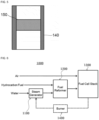
- FIG. 6 is a diagram illustrating a fuel cell system according to an embodiment of the present invention.
- a fuel cell system 1000 may include a steam generating device 1100, a fuel reformer 1200, and a fuel cell stack 1300.
- the steam generating device 1100 may receive liquid water from an external water supply device (not illustrated), convert the water into steam, and then supply the steam to the fuel reformer 1200. Because the steam generating device 100 described above with reference to FIG. 1 to FIG. 5 may be applied as the steam generating device 1100, detailed descriptions thereof are omitted.
- the fuel reformer 1200 may generate fuel gas containing hydrogen by reacting hydrocarbon fuel supplied from an external fuel supply device (not illustrated) with steam supplied from the steam generating device 1100. Any known or future fuel reformer may be applied as the fuel reformer 1200 without limitation, and accordingly, detailed descriptions thereof are omitted.
- the fuel cell stack 1300 may generate electricity by using hydrogen of fuel gas provided from the fuel reformer 1200 and oxygen of air provided from an external air supply device (not illustrated). Any solid oxide fuel cell stack, solid polymer fuel cell stack, phosphoric acid fuel cell stack, molten carbonate fuel cell stack, or so on may be applied as the fuel cell stack 1300 without limitation.
- a heating device of the steam generating device 1100 may include a combustor 1400 illustrated in FIG. 6 .
- the combustor 1400 may combust the gas discharged from the fuel cell stack 1300 and then supply high-temperature combustion gas to the heating space 20 of the steam generating device 1100. Also, the combustor 1400 may supply thermal energy required for reaction between the hydrocarbon fuel and the steam to the fuel reformer 1200.
- a known combustion device may be applied as the combustor 1400 without limitation.
Landscapes
- Chemical & Material Sciences (AREA)
- Engineering & Computer Science (AREA)
- Chemical Kinetics & Catalysis (AREA)
- Organic Chemistry (AREA)
- Sustainable Energy (AREA)
- Sustainable Development (AREA)
- Manufacturing & Machinery (AREA)
- Life Sciences & Earth Sciences (AREA)
- Electrochemistry (AREA)
- General Chemical & Material Sciences (AREA)
- Combustion & Propulsion (AREA)
- Health & Medical Sciences (AREA)
- General Health & Medical Sciences (AREA)
- Inorganic Chemistry (AREA)
- Hydrogen, Water And Hydrids (AREA)
Abstract
A steam generating device is disclosed. The steam generating device includes a container having an internal space; a space partition member including a first partition portion connected to a side wall of the container and having an opening formed in a central portion and a second partition portion extending downward from the opening, and configured to partition the internal space into a steam discharge space and a heating space; a preheating member arranged in the heating space of the container and configured to receive water from an external water supply device and preheat the water; a vaporization tube arranged in a coil shape surrounding the second partition portion in the heating space and having a first end portion connected to the preheating member and a second end portion in the steam discharge space; and a heating device configured to supply thermal energy to the heating space.
Description
- The present invention relates to a steam generating device that supplies steam to a fuel reformer for reforming hydrocarbon fuel and a fuel cell system including the steam generating device.
- A fuel cell generates electricity by using a reaction of hydrogen and oxygen. Fuel cells generate some hydrogen through external reformation by using hydrocarbon fuels such as city gas, and the generated hydrogen is used as fuel for the fuel cells. The fuel cells are most efficient when hydrogen is directly used as fuel, but in this case, a hydrogen storage tank has to be installed directly where the fuel cells are installed, which may cause serious safety issues. Therefore, in the case of fuel cells that operate at a relatively high temperature, hydrogen is generally generated by reforming hydrocarbon fuel within a fuel cell system, and then the hydrogen is used as fuel for the fuel cells.
- As a method for reforming the hydrocarbon fuel, a steam reforming method that reacts steam and hydrocarbon fuel to generate hydrogen is mainly used. In the steam reforming method, hydrogen, carbon monoxide, carbon dioxide, and so on are mainly generated by a reaction of steam and hydrocarbon fuel, and these are supplied to fuel cells as fuel gas.
- However, in the steam reforming method, when the amount of steam is less than the amount of hydrocarbon fuel or a reaction temperature is lowered, there is a problem that carbon (C) capable of rapidly damaging electrodes of fuel cells is generated by the reaction. Therefore, in order to prevent carbon (C) from being generated, steam has to be stably and uniformly supplied to a fuel reformer where a reaction of hydrocarbon fuel and steam occurs.
- An objective of the present invention is to provide a steam generating device that may stably and uniformly provide steam to a fuel reformer.
- Another objective of the present invention is to provide a fuel cell system including the steam generating device.
- A steam generating device according to an embodiment of the present invention includes a container having an internal space; a space partition member including a first partition portion connected to a side wall of the container and having an opening formed in a central portion and a second partition portion extending downward from the opening, and configured to partition the internal space into a steam discharge space and a heating space; a preheating member arranged in the heating space of the container and configured to receive water from an external water supply device and preheat the water; and a vaporization tube arranged in a coil shape surrounding the second partition portion in the heating space and having a first end portion connected to the preheating member and a second end portion in the steam discharge space.
- In one embodiment, the preheating member may include a chamber arranged on a bottom surface of the container forming the heating space and providing a preheating space that accommodates water supplied from the external water supply device; and an inlet and an outlet formed respectively adjacent to the first end portion and the second end portion of the chamber which are opposite to each other and connected respectively to the external water supply device and the vaporization tube.
- In one embodiment, the chamber may include a first chamber portion forming a first preheating space extending along a first side wall among side walls of the container, and a second chamber portion forming a second preheating space extending along a second side wall adjacent to the first side wall among the side walls of the container and connected to be bent from the first preheating space.
- In one embodiment, the preheating member may further include a plurality of baffles arranged inside the preheating space of the chamber to increase a flow path length of a fluid moving through the preheating space. In this case, the plurality of baffles may include at least one first baffle protruding downward from an upper surface of the chamber forming an upper surface of the preheating space and at least one second baffle protruding upward from a lower surface of the chamber forming a lower surface of the preheating space, and the at least first baffle and the at least second baffle may be alternately arranged.
- In one embodiment, the vaporization tube may include a bellows-type tube.
- In one embodiment, the steam generating device may further include a steam pressure change reduction member arranged inside the vaporization tube and having a porous structure through which steam is capable of passing.
- In one embodiment, the space partition member may further include a plurality of guide protrusion portions protruding from a surface of the second partition portion to support the vaporization tube.
- A fuel cell system according to an embodiment of the present invention includes a steam generating device configured to convert liquid water provided from a water supply device into steam; a fuel reformer configured to react steam provided from the steam generating device with hydrocarbon fuel to generate fuel gas containing hydrogen; and a fuel cell stack configured to generate electricity by using the fuel gas provided from the fuel reformer and air provided from an external air supply device, wherein the steam generating device includes a container having an internal space; a space partition member including a first partition portion connected to a side wall of the container and having an opening formed in a central portion and a second partition portion extending downward from the opening, and configured to partition the internal space into a steam discharge space and a heating space; a preheating member arranged in the heating space of the container and configured to receive water from the water supply device and preheat the water; and a vaporization tube arranged in a coil shape surrounding the second partition portion in the heating space and having a first end portion connected to the preheating member and a second end portion in the steam discharge space.
- In one embodiment, the preheating member may include a chamber arranged on a bottom surface of the container forming the heating space and providing a preheating space that accommodates water supplied from the water supply device; a plurality of baffles arranged inside the preheating space of the chamber to increase a flow path length of a fluid moving through the preheating space; and an inlet and an outlet formed respectively adjacent to the first end portion and the second end portion of the chamber which are opposite to each other and connected respectively to the water supply device and the vaporization tube.
- In one embodiment, the chamber may include a first chamber portion forming a first preheating space extending along a first side wall among side walls of the container, and a second chamber portion forming a second preheating space extending along a second side wall adjacent to the first side wall among the side walls of the container and connected to be bent from the first preheating space.
- In one embodiment, the plurality of baffles may include at least one first baffle protruding downward from an upper surface of the chamber forming an upper surface of the preheating space and at least one second baffle protruding upward from a lower surface of the chamber forming a lower surface of the preheating space, and the at least first baffle and the at least second baffle may be alternately arranged.
- In one embodiment, the heating device may include a combustor configured to combust gas discharged from a fuel cell stack and supply the gas to the heating space.
- According to a steam generating device of the present invention and a fuel cell system including the steam generating device, a position in which water is changed into steam may be advanced by arranging, in a heating space of a container, a preheating member that receives water from an external water supply device and supplying the water to a vaporization tube through the preheating member, and a certain amount of steam may be stably supplied to a fuel reformer by installing the plurality of
baffles 132 inside thechamber 131 of the preheatingmember 130 to prevent or reduce occurrence of back pressure, and as a result, stability of power generated by a fuel cell stack may be significantly improved. - In addition, a vaporization tube is connected to a fuel reformer through a steam discharge space of a container without being directly connected to the fuel reformer, and thus, steam may be supplied more uniformly to the fuel reformer. In the conventional steam generating device, an external water supply device (not illustrated) generally supplies water to a vaporization tube by using a pump device and the vaporization tube is directly connected to a fuel reformer, and in this case, the steam supplied to the fuel reformer by pulsation of the pump device is also supplied unevenly according to the pulsation of the pump device. However, according to the present invention, in a case where first and second vaporization tubes are connected to a fuel reformer through a steam discharge space of a chamber, the steam discharge space may alleviate the pulsation of the pump device.
-
-
FIG. 1 and FIG. 2 are respectively a cross-sectional view and a plan view illustrating a steam generating device according to an embodiment of the present invention. -
FIG. 3 illustrates embodiments of a preheating member illustrated inFIG. 1 and FIG. 2 . -
FIG. 4 is a cross-sectional perspective view illustrating an embodiment of a vaporization tube illustrated inFIG. 1 . -
FIG. 5 is a cross-sectional view illustrating a steam pressure change reduction member according to an embodiment of the present invention. -
FIG. 6 is a diagram illustrating a fuel cell system according to an embodiment of the present invention. - Hereinafter, embodiments of the present invention are described in detail with reference to the attached drawings. Since the present invention may be variously changed and take various forms, specific embodiments are illustrated in the drawings, and the present invention is described in detail in the specification. However, this is not intended to limit the present invention to a specific disclosure form and should be understood to include all changes, equivalents, and substitutes included in the idea and technical scope of the present invention. While describing respective drawings, similar reference numerals are used for similar components. In the attached drawings, the dimensions of structures are enlarged more than actual sizes for the sake of clarity of the present invention.
- The terms, first, second, and so on, may be used to describe various components, but the components should not be limited by the terms. The terms are used only for the purpose of distinguishing one component from another component. For example, the first component may be referred to as the second component without departing from the scope of the present invention, and similarly, the second component may also be referred to as the first component.
- Terms used in the present disclosure are only used to describe specific embodiments and are not intended to limit the present invention. The singular expression includes the plural expression unless the context clearly indicates otherwise. In the present disclosure, terms, such as "comprise", "include", or "have" are intended to designate the presence of features, steps, operations, configurations, components, or combinations thereof described in the present disclosure, and should be understood that the terms do not exclude in advance the presence or possibility of addition of one or more other features, steps, operations, configurations, components, or combinations thereof.
- Unless otherwise defined, all terms used herein, including technical or scientific terms, have the same meaning as commonly understood by those skilled in the art to which the present invention pertains. Terms that are commonly used and defined in the dictionary should be interpreted as having a meaning consistent with the meaning in the context of the related technology, and should not be interpreted in an ideal or excessively formal sense unless clearly defined in the present invention.
-
FIG. 1 and FIG. 2 are respectively a cross-sectional view and a plan view illustrating a steam generating device according to an embodiment of the present invention,FIG. 3 illustrates embodiments of a preheating member illustrated inFIG. 1 and FIG. 2 ,FIG. 4 is a cross-sectional perspective view illustrating an embodiment of a vaporization tube illustrated inFIG. 1 , andFIG. 5 is a cross-sectional view illustrating a steam pressure change reduction member according to an embodiment of the present invention. - Referring to
FIG. 1 to FIG. 5 , asteam generating device 100 according to an embodiment of the present invention may provide steam to a fuel reformer (1200 ofFIG. 6 ) that generates hydrogen required for a fuel cell reaction from hydrocarbon fuel that chemically contains hydrogen, such as methane (CH4), ethane (C2H6), propane (C3H8), butane (C4H10), natural gas, or coal gas. In one embodiment, when methane (CH4) is supplied as the hydrocarbon fuel, thefuel reformer 1200 may react the methane with the steam supplied from the steam generating device (100 and 1100 ofFIG. 6 ) according to the following reaction formula 1 to generate hydrogen.
[Reaction Formula 1] 3CH4+4H2O→10H2+2CO+CO2
- Along with this reaction, a side reaction that generates carbon (C) may occur inside the fuel reformer (1200 of
FIG. 6 ) depending on a reaction temperature, a ratio of steam to carbon components, and so on as represented by reaction formula 2 below, and when the carbon generated by the side reaction is supplied to a fuel cell stack (1300 ofFIG. 6 ), a fuel electrode of the fuel cell is damaged, and accordingly, there may be a problem in that performance of the fuel cell is rapidly reduced. Therefore, in order to suppress the carbon generation side reaction described above, steam has to be stably supplied to the fuel reformer.
[Reaction Formula 2] 2CO→C+CO2
- In one embodiment, the
steam generating device 100 according to the embodiment of the present invention may include acontainer 110, a space partition member 120, apreheating member 130, and avaporization tube 140. - The
container 110 may haveinternal spaces container 110 to divide theinternal spaces container 110 into two spaces, that is, asteam discharge space 10 and aheating space 20. In addition, asteam outlet 111, through which steam is discharged, may be formed in a portion of thecontainer 110 which forms asteam discharge space 10, and thesteam outlet 111 may be connected to the fuel reformer (1200 ofFIG. 6 ). - The
container 110 and the space partition member 120 may each be formed of a material that is stable at high temperature. For example, thecontainer 110 and the space partition member 120 may be formed of different materials, and may each be formed of a material, which is stable at high temperature, such as a metal, an alloy, a ceramic, a metal composite, or a composite of metal and ceramic. Meanwhile, thecontainer 110 and the space partition member 120 may be formed of the same material or may be formed of different materials. - In one embodiment, the
steam discharge space 10 may include afirst space 10a directly connected to thesteam outlet 111 and asecond space 10b located below thefirst space 10a and temporarily storing water that is not converted into steam or is generated by cooling the steam, and the water stored in thesecond space 10b may be converted into steam by heat energy supplied to theheating space 20. In order to effectively supply the heat energy provided to theheating space 20 to the water stored in thesecond space 10b, thesecond space 10b may have an upper portion side connected to thefirst space 10a and have a side portion and/or bottom portion surrounded by theheating space 20. In this way, a shape of thesecond space 10b is not limited in particular as long as thesecond space 10b may accommodate water and effectively receive heat energy from theheating space 20. For example, thesecond space 10b may have a shape, such as a cylinder, a square column, a cone, or a square pyramid, a side portion of which is surrounded by theheating space 20. - In one embodiment, in order to form the
first space 10a and thesecond space 10b, the space partition member 120 may include afirst partition portion 121 and asecond partition portion 122. Thefirst partition portion 121 may have an opening of a predetermined shape formed in a central portion, be connected to a side wall of thecontainer 110, and partition thefirst space 10a from theheating space 20. Thesecond partition portion 122 may extend downward from the opening of thefirst partition portion 121 to form thesecond space 10b and may partition thesecond space 10b and theheating space 20. - In one embodiment, the space partition member 120 may include a plurality of
guide protrusion portions 123 protruding from a surface of thesecond partition portion 122 toward thevaporization tube 140. Theguide protrusion portions 123 may support a lower portion of thevaporization tube 140 to guide and maintain an arrangement position of thevaporization tube 140. - The preheating
member 130 may receive water from an external water supply device (not illustrated) and preheat the water, and supply the preheated water or steam to thevaporization tube 140. - In one embodiment, the preheating
member 130 may include achamber 131, a plurality ofbaffles 132, aninlet 133, and anoutlet 134. - The
chamber 131 may be arranged on a bottom surface of theheating space 20 inside thecontainer 110 and may provide a preheating space in which water supplied from an external water supply device (not illustrated) is accommodated. - In one embodiment, the
chamber 131 may be arranged to be separated from thesecond partition portion 122 and may include a first chamber portion that forms a first preheating space extending along a first sidewall among sidewalls of thecontainer 110, and a second chamber portion that forms a second preheating space extending along a second sidewall adjacent to the first sidewall among the sidewalls of thecontainer 110 and connected to be bent from the first preheating space. As illustrated inFIG. 3 , shapes of the first and second chamber portions may be variously changed. For example, widths of the first and second chamber portions in a direction perpendicular to a fluid flow may be changed depending on positions, and for example, a width of a bent portion may be greater than a width of the other portion. - Meanwhile, the
chamber 131 may further include a third chamber portion that forms a third preheating space extending along a third side wall adjacent to the second side wall among the side walls of thecontainer 110 and connected to be bent from the second preheating space, or may further include a fourth chamber portion that forms a fourth preheating space extending along a fourth side wall adjacent to the third side wall among the side walls of thecontainer 110 and connected to be bent from the third preheating space, together with the third chamber portion. - The plurality of
baffles 132 may be arranged inside the preheating space of thechamber 131 to increase a flow path length of water or steam moving through the preheating space, and may reduce or prevent a back pressure from occurring within the preheating space. - In one embodiment, the plurality of
baffles 132 may include at least one first baffle protruding downward from an upper surface of thechamber 131 forming an upper surface of the preheating space and at least one second baffle protruding upward from a lower surface of thechamber 131 forming a lower surface of the preheating space, and the first and second baffles may be alternately arranged. Meanwhile, as illustrated inFIG. 3 , heights, intervals, numbers, positions, and so on of the first and second baffles are not limited in particular and may be appropriately adjusted depending on required performances. For example, the first and second baffles may be uniformly arranged inside the chamber (see A and B), arranged at positions closer to theinlet 133 than theoutlet 134, or arranged at positions closer to theoutlet 134 than theinlet 133. - The
inlet 133 may connect the preheating space of thechamber 131 to the external water supply device (not illustrated), and theoutlet 134 may connect the preheating space of thechamber 131 to thevaporization tube 140. - In one embodiment, in order to increase a flow path length within the preheating space, the
inlet 133 may be formed adjacent to a first end side of thechamber 131, and theoutlet 134 may be formed adjacent to a second end side of thechamber 131 opposite to the first end. - The
vaporization tube 140 may be arranged in a coil shape surrounding thesecond space 10b within theheating space 20. Thevaporization tube 140 may each have a first end portion connected to theoutlet 134 of the preheatingmember 130 and a second end portion located within thesteam discharge space 10, and may be arranged to extend to thesteam discharge space 10 via theheating space 20. - When the
vaporization tube 140 is installed as described above, water supplied from the preheatingmember 130 to thevaporization tube 140 may be converted into steam while moving through theheating space 20, and the converted steam may be discharged into thesteam discharge space 10 through the second end portion of thevaporization tube 140. In addition, the steam discharged from thevaporization tube 140 into thesteam discharge space 10 may be supplied to the fuel reformer (1200 ofFIG. 6 ) through thesteam outlet 111. - In one embodiment, the
vaporization tube 140 may include a bellows type tube having wrinkles formed on an inner surface thereof as illustrated inFIG. 4 . In this way, when thevaporization tube 140 is formed as a bellows type tube, not only water may be converted into steam with higher efficiency due to an increase in surface area caused by internal wrinkles of thevaporization tube 140, but also a change in pressure of the steam discharged from thevaporization tube 140 may be reduced. - In one embodiment of the present invention, the
steam generating device 100 may further include a heating device (not illustrated) that supplies thermal energy to theheating space 20 to convert water moving through the preheatingmember 130 and thevaporization tube 140 into steam. - In one embodiment, the heating device may include a high-temperature gas supply device (see 1400 of
FIG. 6 ) that supplies high-temperature gas to the heating space. In this case, a gas supply hole through which high-temperature gas is injected from the high-temperature gas supply device and a gas outlet through which high-temperature gas is discharged from theheating space 20 may be formed in a portion of thecontainer 110 which forms theheating space 20. The high-temperature gas is not limited in particular as long as the temperature of theheating space 20 may be increased. In one embodiment, the high-temperature gas may be gas discharged from a fuel cell stack (1300 ofFIG. 6 ). For example, the heating device may combust the gas discharged from the fuel cell stack by using a combustor (1400 ofFIG. 6 ) or so on and then supply the combusted high-temperature gas to theheating space 20 through a blower or so on. - In another embodiment, the heating device may include an electric heater (not illustrated) and so on installed on a side wall of the
container 110 forming theheating space 20. - Meanwhile, in one embodiment, the
steam generating device 100 according to the embodiment of the present invention may further include a temperature sensor (not illustrated) coupled to a lower portion of thesecond space 10b in thecontainer 110 to measure the temperature inside thecontainer 110. - Meanwhile, in one embodiment, as illustrated in
FIG. 5 , thesteam generating device 100 according to the embodiment of the present invention may further include a steam pressurechange reduction member 150 inside thevaporization tube 140 to reduce a pressure change of the steam discharged from thevaporization tube 140. - The steam pressure
change reduction member 150 may be arranged adjacent to a second end portion of thevaporization tube 140 from which steam is discharged, and may have a porous structure through which steam may pass. For example, the steam pressurechange reduction member 150 may include a mesh structure or a foam structure inserted into thevaporization tube 140. The steam pressurechange reduction member 150 may reduce a phenomenon of steam pressure change due to the LeidenFrost effect. - Meanwhile, in one embodiment, the
steam generating device 100 according to the embodiment of the present invention may further include a water detector (not illustrated) that is arranged in thesecond space 10b and detects liquid water existing in thesecond space 10b. When steam is not supplied to the fuel reformer (1200 ofFIG. 6 ), such as when liquid water is stored in thesecond space 10b without being converted into steam in thevaporization tube 140 due to an abnormal situation such as a decrease in temperature of high-temperature gas or a failure of a heating device, a large amount of carbon that damages a fuel electrode of a fuel cell may be generated as described above. The water detector may detect liquid water existing in thesecond space 10b and notify of occurrence of an abnormal situation in advance as described above, and accordingly, stability of a fuel cell system may be significantly improved. As long as the liquid water in thesecond space 10b may be detected, a configuration of the water detector is not limited in particular. - According to the steam generating device of the present invention, a position in which water is changed into steam may be advanced by arranging, in a heating space of a container, a preheating member that receives water from an external water supply device and supplying the water to a vaporization tube through the preheating member, and a certain amount of steam may be stably supplied to a fuel reformer by installing the plurality of
baffles 132 inside thechamber 131 of the preheatingmember 130 to prevent or reduce occurrence of back pressure, and as a result, stability of power generated by a fuel cell stack may be significantly improved. - In addition, a vaporization tube is connected to a fuel reformer through a steam discharge space of a container without being directly connected to the fuel reformer, and thus, steam may be supplied more uniformly to the fuel reformer. In the conventional steam generating device, an external water supply device (not illustrated) generally supplies water to a vaporization tube by using a pump device and the vaporization tube is directly connected to a fuel reformer, and in this case, the steam supplied to the fuel reformer by pulsation of the pump device is also supplied unevenly according to the pulsation of the pump device. However, in a case where first and second vaporization tubes are connected to a fuel reformer through a steam discharge space of a chamber as in the present invention, the steam discharge space may alleviate the pulsation of the pump device.
-
FIG. 6 is a diagram illustrating a fuel cell system according to an embodiment of the present invention. - Referring to
FIG. 6 together withFIG. 1 to FIG. 4 , afuel cell system 1000 according to an embodiment of the present invention may include asteam generating device 1100, afuel reformer 1200, and afuel cell stack 1300. - The
steam generating device 1100 may receive liquid water from an external water supply device (not illustrated), convert the water into steam, and then supply the steam to thefuel reformer 1200. Because thesteam generating device 100 described above with reference toFIG. 1 to FIG. 5 may be applied as thesteam generating device 1100, detailed descriptions thereof are omitted. - The
fuel reformer 1200 may generate fuel gas containing hydrogen by reacting hydrocarbon fuel supplied from an external fuel supply device (not illustrated) with steam supplied from thesteam generating device 1100. Any known or future fuel reformer may be applied as thefuel reformer 1200 without limitation, and accordingly, detailed descriptions thereof are omitted. - The
fuel cell stack 1300 may generate electricity by using hydrogen of fuel gas provided from thefuel reformer 1200 and oxygen of air provided from an external air supply device (not illustrated). Any solid oxide fuel cell stack, solid polymer fuel cell stack, phosphoric acid fuel cell stack, molten carbonate fuel cell stack, or so on may be applied as thefuel cell stack 1300 without limitation. - Meanwhile, in the
fuel cell system 1000 according to the embodiment of the present invention, a heating device of thesteam generating device 1100 may include acombustor 1400 illustrated inFIG. 6 . - The
combustor 1400 may combust the gas discharged from thefuel cell stack 1300 and then supply high-temperature combustion gas to theheating space 20 of thesteam generating device 1100. Also, thecombustor 1400 may supply thermal energy required for reaction between the hydrocarbon fuel and the steam to thefuel reformer 1200. A known combustion device may be applied as thecombustor 1400 without limitation. - Although a preferred embodiment of the present invention is described, it will be understood by those skilled in the art that the present invention may be variously modified and changed within the scope and idea of the present invention as set forth in the following patent claims.
Claims (14)
- A steam generating device comprising:a container having an internal space;a space partition member including a first partition portion connected to a side wall of the container and having an opening formed in a central portion and a second partition portion extending downward from the opening, and configured to partition the internal space into a steam discharge space and a heating space;a preheating member arranged in the heating space of the container and configured to receive water from an external water supply device and preheat the water; anda vaporization tube arranged in a coil shape surrounding the second partition portion in the heating space and having a first end portion connected to the preheating member and a second end portion in the steam discharge space.
- The steam generating device of claim 1, wherein
the preheating member comprises a chamber arranged on a bottom surface of the container forming the heating space and providing a preheating space that accommodates water supplied from the external water supply device, and an inlet and an outlet formed respectively adjacent to the first end portion and the second end portion of the chamber which are opposite to each other and connected respectively to the external water supply device and the vaporization tube. - The steam generating device of claim 2, wherein
the chamber includes a first chamber portion forming a first preheating space extending along a first side wall among side walls of the container, and a second chamber portion forming a second preheating space extending along a second side wall adjacent to the first side wall among the side walls of the container and connected to be bent from the first preheating space. - The steam generating device of claim 2, wherein
the preheating member further includes a plurality of baffles arranged inside the preheating space of the chamber to increase a flow path length of a fluid moving through the preheating space. - The steam generating device of claim 4, whereinthe plurality of baffles include at least one first baffle protruding downward from an upper surface of the chamber forming an upper surface of the preheating space and at least one second baffle protruding upward from a lower surface of the chamber forming a lower surface of the preheating space, andthe at least first baffle and the at least second baffle are alternately arranged.
- The steam generating device of claim 1, wherein
the vaporization tube includes a bellows-type tube. - The steam generating device of claim 1, further comprising:
a steam pressure change reduction member arranged inside the vaporization tube and having a porous structure through which steam is capable of passing. - The steam generating device of claim 1, wherein
the space partition member further includes a plurality of guide protrusion portions protruding from a surface of the second partition portion to support the vaporization tube. - A fuel cell system comprising;a steam generating device configured to convert liquid water provided from a water supply device into steam;a fuel reformer configured to react steam provided from the steam generating device with hydrocarbon fuel to generate fuel gas containing hydrogen; anda fuel cell stack configured to generate electricity by using the fuel gas provided from the fuel reformer and air provided from an external air supply device,wherein the steam generating device comprises:a container having an internal space;a space partition member including a first partition portion connected to a side wall of the container and having an opening formed in a central portion and a second partition portion extending downward from the opening, and configured to partition the internal space into a steam discharge space and a heating space;a preheating member arranged in the heating space of the container and configured to receive water from the water supply device and preheat the water; anda vaporization tube arranged in a coil shape surrounding the second partition portion in the heating space and having a first end portion connected to the preheating member and a second end portion in the steam discharge space.
- The fuel cell system of claim 9, wherein the preheating member comprises:a chamber arranged on a bottom surface of the container forming the heating space and providing a preheating space that accommodates water supplied from the water supply device;a plurality of baffles arranged inside the preheating space of the chamber to increase a flow path length of a fluid moving through the preheating space; andan inlet and an outlet formed respectively adjacent to the first end portion and the second end portion of the chamber which are opposite to each other and connected respectively to the water supply device and the vaporization tube.
- The fuel cell system of claim 10, wherein
the chamber includes a first chamber portion forming a first preheating space extending along a first side wall among side walls of the container, and a second chamber portion forming a second preheating space extending along a second side wall adjacent to the first side wall among the side walls of the container and connected to be bent from the first preheating space. - The fuel cell system of claim 10, whereinthe plurality of baffles include at least one first baffle protruding downward from an upper surface of the chamber forming an upper surface of the preheating space and at least one second baffle protruding upward from a lower surface of the chamber forming a lower surface of the preheating space, andthe at least first baffle and the at least second baffle are alternately arranged.
- The fuel cell system of claim 9, further comprising:
a heating device configured to supply thermal energy to the heating space. - The fuel cell system of claim 13, wherein
the heating device includes a combustor configured to combust gas discharged from a fuel cell stack and supply the gas to the heating space.
Applications Claiming Priority (2)
| Application Number | Priority Date | Filing Date | Title |
|---|---|---|---|
| KR1020220091642A KR102472119B1 (en) | 2022-07-25 | 2022-07-25 | Apparatus of generating water vapor and fuel cell system having the apparatus |
| PCT/KR2023/010707 WO2024025289A1 (en) | 2022-07-25 | 2023-07-25 | Steam generating device, and fuel cell system including same |
Publications (1)
| Publication Number | Publication Date |
|---|---|
| EP4563206A1 true EP4563206A1 (en) | 2025-06-04 |
Family
ID=84235363
Family Applications (1)
| Application Number | Title | Priority Date | Filing Date |
|---|---|---|---|
| EP23846948.0A Pending EP4563206A1 (en) | 2022-07-25 | 2023-07-25 | Steam generating device, and fuel cell system including same |
Country Status (4)
| Country | Link |
|---|---|
| US (1) | US20250372682A1 (en) |
| EP (1) | EP4563206A1 (en) |
| KR (1) | KR102472119B1 (en) |
| WO (1) | WO2024025289A1 (en) |
Families Citing this family (2)
| Publication number | Priority date | Publication date | Assignee | Title |
|---|---|---|---|---|
| KR102472119B1 (en) * | 2022-07-25 | 2022-11-29 | 주식회사 미코파워 | Apparatus of generating water vapor and fuel cell system having the apparatus |
| KR102775843B1 (en) * | 2024-01-17 | 2025-03-06 | 주식회사 미코파워 | Apparatus of generating water vapor and fuel cell system having the apparatus |
Family Cites Families (6)
| Publication number | Priority date | Publication date | Assignee | Title |
|---|---|---|---|---|
| KR101127688B1 (en) * | 2004-12-07 | 2012-03-23 | 에스케이이노베이션 주식회사 | Small-sized reformer of cylinder type |
| KR100860115B1 (en) * | 2007-02-22 | 2008-09-25 | 주식회사 씨엔엘에너지 | Humidifier for Fuel Cell |
| KR101421355B1 (en) * | 2012-12-24 | 2014-07-18 | 포스코에너지 주식회사 | Fuel humidifier |
| KR102328007B1 (en) * | 2015-04-17 | 2021-11-17 | 주식회사 미코파워 | Apparatus of generating water vapor and fuel cell system having the apparatus |
| KR102699881B1 (en) * | 2019-02-27 | 2024-08-29 | 주식회사 미코파워 | Apparatus of generating water vapor and fuel cell system having the apparatus |
| KR102472119B1 (en) * | 2022-07-25 | 2022-11-29 | 주식회사 미코파워 | Apparatus of generating water vapor and fuel cell system having the apparatus |
-
2022
- 2022-07-25 KR KR1020220091642A patent/KR102472119B1/en active Active
-
2023
- 2023-07-25 EP EP23846948.0A patent/EP4563206A1/en active Pending
- 2023-07-25 WO PCT/KR2023/010707 patent/WO2024025289A1/en not_active Ceased
- 2023-07-25 US US18/998,297 patent/US20250372682A1/en active Pending
Also Published As
| Publication number | Publication date |
|---|---|
| KR102472119B1 (en) | 2022-11-29 |
| US20250372682A1 (en) | 2025-12-04 |
| WO2024025289A1 (en) | 2024-02-01 |
Similar Documents
| Publication | Publication Date | Title |
|---|---|---|
| EP4563206A1 (en) | Steam generating device, and fuel cell system including same | |
| US11857891B2 (en) | Steam generating device, and fuel cell system including the same | |
| EP3208878B1 (en) | High-temperature operating fuel-cell module | |
| KR102328007B1 (en) | Apparatus of generating water vapor and fuel cell system having the apparatus | |
| US20140099561A1 (en) | Fuel cell module | |
| EP2707923B1 (en) | Fuel cell system | |
| JP5760874B2 (en) | Fuel cell evaporator | |
| EP3309887B1 (en) | Fuel cell system and method of running fuel cell system | |
| EP2707922B1 (en) | Fuel cell module | |
| KR102775843B1 (en) | Apparatus of generating water vapor and fuel cell system having the apparatus | |
| EP2702627B1 (en) | Fuel cell module | |
| JP7790224B2 (en) | fuel cell module | |
| JP2021068617A (en) | Water evaporator | |
| JP6650812B2 (en) | Starting combustor and fuel cell system using the starting combustor | |
| KR20230117904A (en) | Hydrogen extraction apparatus and operating method thereof | |
| JP2017152313A (en) | Fuel cell combined power generation system and operation method thereof | |
| JP6185903B2 (en) | Combustor for fuel cell and fuel cell module |
Legal Events
| Date | Code | Title | Description |
|---|---|---|---|
| STAA | Information on the status of an ep patent application or granted ep patent |
Free format text: STATUS: THE INTERNATIONAL PUBLICATION HAS BEEN MADE |
|
| PUAI | Public reference made under article 153(3) epc to a published international application that has entered the european phase |
Free format text: ORIGINAL CODE: 0009012 |
|
| STAA | Information on the status of an ep patent application or granted ep patent |
Free format text: STATUS: REQUEST FOR EXAMINATION WAS MADE |
|
| 17P | Request for examination filed |
Effective date: 20250127 |
|
| AK | Designated contracting states |
Kind code of ref document: A1 Designated state(s): AL AT BE BG CH CY CZ DE DK EE ES FI FR GB GR HR HU IE IS IT LI LT LU LV MC ME MK MT NL NO PL PT RO RS SE SI SK SM TR |
|
| DAV | Request for validation of the european patent (deleted) | ||
| DAX | Request for extension of the european patent (deleted) |