EP4560947A1 - Information transmission method, apparatus, network device, and terminal - Google Patents
Information transmission method, apparatus, network device, and terminal Download PDFInfo
- Publication number
- EP4560947A1 EP4560947A1 EP23841964.2A EP23841964A EP4560947A1 EP 4560947 A1 EP4560947 A1 EP 4560947A1 EP 23841964 A EP23841964 A EP 23841964A EP 4560947 A1 EP4560947 A1 EP 4560947A1
- Authority
- EP
- European Patent Office
- Prior art keywords
- information
- value
- encoding
- parameter
- length
- Prior art date
- Legal status (The legal status is an assumption and is not a legal conclusion. Google has not performed a legal analysis and makes no representation as to the accuracy of the status listed.)
- Pending
Links
Images


Classifications
-
- H—ELECTRICITY
- H04—ELECTRIC COMMUNICATION TECHNIQUE
- H04L—TRANSMISSION OF DIGITAL INFORMATION, e.g. TELEGRAPHIC COMMUNICATION
- H04L1/00—Arrangements for detecting or preventing errors in the information received
- H04L1/0001—Systems modifying transmission characteristics according to link quality, e.g. power backoff
- H04L1/0023—Systems modifying transmission characteristics according to link quality, e.g. power backoff characterised by the signalling
- H04L1/0025—Transmission of mode-switching indication
-
- H—ELECTRICITY
- H04—ELECTRIC COMMUNICATION TECHNIQUE
- H04L—TRANSMISSION OF DIGITAL INFORMATION, e.g. TELEGRAPHIC COMMUNICATION
- H04L1/00—Arrangements for detecting or preventing errors in the information received
- H04L1/0001—Systems modifying transmission characteristics according to link quality, e.g. power backoff
- H04L1/0023—Systems modifying transmission characteristics according to link quality, e.g. power backoff characterised by the signalling
- H04L1/0028—Formatting
- H04L1/003—Adaptive formatting arrangements particular to signalling, e.g. variable amount of bits
-
- H—ELECTRICITY
- H04—ELECTRIC COMMUNICATION TECHNIQUE
- H04L—TRANSMISSION OF DIGITAL INFORMATION, e.g. TELEGRAPHIC COMMUNICATION
- H04L1/00—Arrangements for detecting or preventing errors in the information received
- H04L1/0001—Systems modifying transmission characteristics according to link quality, e.g. power backoff
- H04L1/0002—Systems modifying transmission characteristics according to link quality, e.g. power backoff by adapting the transmission rate
- H04L1/0003—Systems modifying transmission characteristics according to link quality, e.g. power backoff by adapting the transmission rate by switching between different modulation schemes
-
- H—ELECTRICITY
- H04—ELECTRIC COMMUNICATION TECHNIQUE
- H04L—TRANSMISSION OF DIGITAL INFORMATION, e.g. TELEGRAPHIC COMMUNICATION
- H04L1/00—Arrangements for detecting or preventing errors in the information received
- H04L1/0001—Systems modifying transmission characteristics according to link quality, e.g. power backoff
- H04L1/0009—Systems modifying transmission characteristics according to link quality, e.g. power backoff by adapting the channel coding
-
- H—ELECTRICITY
- H04—ELECTRIC COMMUNICATION TECHNIQUE
- H04L—TRANSMISSION OF DIGITAL INFORMATION, e.g. TELEGRAPHIC COMMUNICATION
- H04L1/00—Arrangements for detecting or preventing errors in the information received
- H04L1/0001—Systems modifying transmission characteristics according to link quality, e.g. power backoff
- H04L1/0023—Systems modifying transmission characteristics according to link quality, e.g. power backoff characterised by the signalling
- H04L1/0028—Formatting
- H04L1/0029—Reduction of the amount of signalling, e.g. retention of useful signalling or differential signalling
-
- H—ELECTRICITY
- H04—ELECTRIC COMMUNICATION TECHNIQUE
- H04L—TRANSMISSION OF DIGITAL INFORMATION, e.g. TELEGRAPHIC COMMUNICATION
- H04L1/00—Arrangements for detecting or preventing errors in the information received
- H04L1/0001—Systems modifying transmission characteristics according to link quality, e.g. power backoff
- H04L1/0023—Systems modifying transmission characteristics according to link quality, e.g. power backoff characterised by the signalling
- H04L1/0028—Formatting
- H04L1/0031—Multiple signaling transmission
-
- H—ELECTRICITY
- H04—ELECTRIC COMMUNICATION TECHNIQUE
- H04L—TRANSMISSION OF DIGITAL INFORMATION, e.g. TELEGRAPHIC COMMUNICATION
- H04L5/00—Arrangements affording multiple use of the transmission path
- H04L5/003—Arrangements for allocating sub-channels of the transmission path
- H04L5/0044—Allocation of payload; Allocation of data channels, e.g. PDSCH or PUSCH
- H04L5/0046—Determination of the number of bits transmitted on different sub-channels
-
- H—ELECTRICITY
- H04—ELECTRIC COMMUNICATION TECHNIQUE
- H04L—TRANSMISSION OF DIGITAL INFORMATION, e.g. TELEGRAPHIC COMMUNICATION
- H04L5/00—Arrangements affording multiple use of the transmission path
- H04L5/0091—Signalling for the administration of the divided path, e.g. signalling of configuration information
- H04L5/0092—Indication of how the channel is divided
-
- H—ELECTRICITY
- H04—ELECTRIC COMMUNICATION TECHNIQUE
- H04W—WIRELESS COMMUNICATION NETWORKS
- H04W92/00—Interfaces specially adapted for wireless communication networks
- H04W92/04—Interfaces between hierarchically different network devices
- H04W92/10—Interfaces between hierarchically different network devices between terminal device and access point, i.e. wireless air interface
Definitions
- the present disclosure relates to the field of communication technologies, and in particular to an information transmission method and apparatus, network device and user equipment.
- each piece of information that needs to be indicated is individually coded. It is assumed that an encoding length of each information is a, then for M pieces of information, a ⁇ M bits need to be transmitted. In this way, a large overhead is required, resulting in a waste of air interface resources.
- An object of the present disclosure is to provide an information transmission method and apparatus, network device and user equipment, which can solve the problem of how to save air interface resources when performing multiple information transmission in the related art.
- one embodiment of the present disclosure provides an information transmission method, applied to a network device, including:
- the M pieces of transmission information are used to indicate dividing points of M+1 segments of the parameter length W; or, the M pieces of transmission information are used to indicate M pieces of modulation code scheme (MCS) index information.
- MCS modulation code scheme
- the determining a target encoding length according to a parameter length W and a number M of transmission information includes:
- the determining the first parameter includes: determining the first parameter according to the parameter length W, the number M of transmission information, and a first algorithm.
- the first algorithm includes:
- the determining the target encoding length according to the first parameter includes: determining the target encoding length according to the first parameter and a second algorithm.
- the M pieces of transmission information include: first information, second information and third information, and a value of the first information is less than or equal to a value of the second information, and the value of the second information is less than or equal to a value of the third information;
- the encoding the M pieces of transmission information to obtain indication information includes:
- the determining a first encoding value according to the first information and the parameter length W includes:
- the determining a second encoding value according to the parameter length W, the first information, the second information, and the third information includes: determining the second encoding value according to the parameter length W, a difference between the second information and the first information, and a distance from the second information to the third information.
- the determining the second encoding value according to a difference between the second information and the first information and a distance from the second information to the third information includes:
- the determining the second encoding value according to a difference between the second information and the first information and a distance from the second information to the third information includes:
- the determining the second encoding value according to the parameter length W, the first information, the second information, and the third information includes:
- the determining the second encoding value according to the parameter length W, the first information, the second information, and the third information includes:
- the M pieces of transmission information include: fourth information, fifth information, sixth information and seventh information, and a value of the fourth information is less than or equal to a value of the fifth information, the value of the fifth information is less than or equal to a value of the sixth information, and the value of the sixth information is less than or equal to a value of the seventh information;
- the encoding the M pieces of transmission information to obtain indication information includes:
- the determining the third encoding value according to the fourth information and the parameter length W includes:
- the determining the fourth encoding value according to the fifth information and the parameter length W includes:
- the determining the fifth encoding value according to the fourth information, the fifth information and the sixth information includes: determining the fifth encoding value according to a difference between the fifth information and the fourth information, and a distance from the sixth information to the seventh information.
- the determining the fifth encoding value according to a difference between the fifth information and the fourth information, and a distance from the sixth information to the seventh information includes:
- one embodiment of the present disclosure provides an information transmission method, applied to a user equipment (UE), including:
- the M pieces of transmission information are used to indicate dividing points of M+1 segments of the parameter length W; or, the M pieces of transmission information are used to indicate M pieces of modulation code scheme (MCS) index information.
- MCS modulation code scheme
- the determining a target encoding length according to a parameter length W and a number M of transmission information includes:
- the determining the first parameter includes: determining the first parameter according to the parameter length W, the number M of transmission information, and a first algorithm.
- the first algorithm includes:
- the determining the target encoding length according to the first parameter includes: determining the target encoding length according to the first parameter and a second algorithm.
- the M pieces of transmission information include: first information, second information and third information, and a value of the first information is less than or equal to a value of the second information, and the value of the second information is less than or equal to a value of the third information;
- the decoding to obtain the first information and a first code value corresponding to the first information according to the parameter length W and the target encoding length includes:
- the determining the second information and the third information according to the parameter length W, the first information and the second encoding value includes: obtaining a difference between the second information and the first information and a distance from the second information to the third information according to the parameter length W, the first information and the second encoding value.
- the obtaining a difference between the second information and the first information and a distance from the second information to the third information according to the parameter length W, the first information and the second encoding value includes:
- the obtaining a difference between the second information and the first information and a distance from the second information to the third information according to the parameter length W, the first information and the second encoding value includes:
- one embodiment of the present disclosure provide a network device, including: a transceiver, a memory, a processor, and a computer program stored on the memory and executable on the processor; wherein the processor is used to read the program in the memory and perform the following process:
- the M pieces of transmission information are used to indicate dividing points of M+1 segments of the parameter length W; or, the M pieces of transmission information are used to indicate M pieces of modulation code scheme (MCS) index information.
- MCS modulation code scheme
- the processor is further used to read the program in the memory and perform the following process:
- the processor is further used to read the program in the memory and perform the following process: determining the first parameter according to the parameter length W, the number M of transmission information, and a first algorithm.
- the first algorithm includes:
- the processor is used to read the program in the memory and perform the following process: determining the target encoding length according to the first parameter and a second algorithm.
- the M pieces of transmission information include: first information, second information and third information, and a value of the first information is less than or equal to a value of the second information, and the value of the second information is less than or equal to a value of the third information;
- the processor is used to read the program in the memory and perform the following process:
- the processor is used to read the program in the memory and perform the following process:
- the processor is used to read the program in the memory and perform the following process: determining the second encoding value according to the parameter length W, a difference between the second information and the first information, and a distance from the second information to the third information.
- the processor is used to read the program in the memory and perform the following process:
- the processor is used to read the program in the memory and perform the following process:
- the processor is used to read the program in the memory and perform the following process:
- the processor is used to read the program in the memory and perform the following process:
- the M pieces of transmission information include: fourth information, fifth information, sixth information and seventh information, and a value of the fourth information is less than or equal to a value of the fifth information, the value of the fifth information is less than or equal to a value of the sixth information, and the value of the sixth information is less than or equal to a value of the seventh information;
- the processor is used to read the program in the memory and perform the following process:
- the processor is used to read the program in the memory and perform the following process:
- the processor is used to read the program in the memory and perform the following process:
- the processor is used to read the program in the memory and perform the following process: determining the fifth encoding value according to a difference between the fifth information and the fourth information, and a distance from the sixth information to the seventh information.
- the processor is used to read the program in the memory and perform the following process:
- one embodiment of the present disclosure provides a user equipment (UE), including: a transceiver, a memory, a processor, and a computer program stored on the memory and executable on the processor; wherein the processor is used to read the program in the memory and perform the following process:
- the M pieces of transmission information are used to indicate dividing points of M+1 segments of the parameter length W; or, the M pieces of transmission information are used to indicate M pieces of modulation code scheme (MCS) index information.
- MCS modulation code scheme
- the processor is used to read the program in the memory and perform the following process:
- the processor is used to read the program in the memory and perform the following process: determining the first parameter according to the parameter length W, the number M of transmission information, and a first algorithm.
- the first algorithm includes:
- the processor is used to read the program in the memory and perform the following process: determining the target encoding length according to the first parameter and a second algorithm.
- the M pieces of transmission information include: first information, second information and third information, and a value of the first information is less than or equal to a value of the second information, and the value of the second information is less than or equal to a value of the third information;
- the processor is used to read the program in the memory and perform the following process:
- the processor is used to read the program in the memory and perform the following process:
- the processor is used to read the program in the memory and perform the following process: obtaining a difference between the second information and the first information and a distance from the second information to the third information according to the parameter length W, the first information and the second encoding value.
- the processor is used to read the program in the memory and perform the following process:
- the processor is used to read the program in the memory and perform the following process:
- an information transmission device including:
- the M pieces of transmission information are used to indicate dividing points of M+1 segments of the parameter length W; or, the M pieces of transmission information are used to indicate M pieces of modulation code scheme (MCS) index information.
- MCS modulation code scheme
- the first determination module includes:
- the first determination sub-module is specifically used to: determine the first parameter according to the parameter length W, the number M of transmission information, and a first algorithm.
- the first algorithm includes:
- the second determination sub-module is specifically used to: determine the target encoding length according to the first parameter and a second algorithm.
- the M pieces of transmission information include: first information, second information and third information, and a value of the first information is less than or equal to a value of the second information, and the value of the second information is less than or equal to a value of the third information;
- the encoding module includes:
- the first encoding submodule is specifically used to determine:
- the first encoding submodule includes: a first encoding unit used to determine the second encoding value according to the parameter length W, a difference between the second information and the first information, and a distance from the second information to the third information.
- the first encoding unit is specifically used to:
- the first encoding unit is specifically used to:
- the first encoding sub-module includes a second encoding unit used to:
- the first encoding sub-module includes a third encoding unit used to:
- the M pieces of transmission information include: fourth information, fifth information, sixth information and seventh information, and a value of the fourth information is less than or equal to a value of the fifth information, the value of the fifth information is less than or equal to a value of the sixth information, and the value of the sixth information is less than or equal to a value of the seventh information;
- the encoding module includes:
- the fourth encoding submodule is specifically used to determine:
- the fifth encoding submodule is specifically used to determine:
- the sixth coding submodule includes: a fourth encoding unit used to determine a fifth encoding value according to a difference between the fifth information and the fourth information, and a distance from the sixth information to the seventh information.
- the fourth encoding unit is specifically used to:
- an information transmission device including:
- the M pieces of transmission information are used to indicate dividing points of M+1 segments of the parameter length W; or, the M pieces of transmission information are used to indicate M pieces of modulation code scheme (MCS) index information.
- MCS modulation code scheme
- the second determination module includes:
- the third determination sub-module is specifically used to: determine the first parameter according to the parameter length W, the number M of transmission information, and a first algorithm.
- the first algorithm includes:
- the fourth determination sub-module is specifically used to: determine the target encoding length according to the first parameter and a second algorithm.
- the M pieces of transmission information include: first information, second information and third information, and a value of the first information is less than or equal to a value of the second information, and the value of the second information is less than or equal to a value of the third information;
- the decoding module includes:
- the first decoding sub-module is specifically used to:
- the second decoding sub-module includes: a first decoding unit used to obtain a difference between the second information and the first information and a distance from the second information to the third information according to the parameter length W, the first information and the second encoding value.
- the first decoding unit is specifically used to:
- the first decoding unit is specifically used to:
- processor-readable storage medium including a computer program stored thereon; wherein the computer program is used to cause a processor to perform the information transmission method according to the first aspect or the second aspect.
- a target encoding length is determined according to a parameter length W and a number M of transmission information; wherein a value or a value range of a corresponding index value s, of each transmission information in the M transmission information is: 0 ⁇ s ⁇ W-1; a value of an n-th transmission information is less than or equal to a value of (n+1)-th transmission information, 1 ⁇ n ⁇ M, n, M and W are positive integers; the M pieces of transmission information are encoded to obtain indication information, where a length of the indication information is the target encoding length; the indication information is sent to a user equipment (UE).
- UE user equipment
- association relationship between associated objects and indicate that there may be three relationships, for example, A and/or B means there are three situations, i.e., there is A alone, there are both of A and B, or, there is B alone.
- the character "/" generally means that relationship between associated objects before and after the character "/" is "or”.
- plurality in the embodiments of the present disclosure means two or more, and other quantifiers are similar.
- the terminal involved in the embodiments of the present disclosure is a device for providing voice data and/or any other service data to a user, e.g., a handheld device having a wireless connection function, or any other processing device capable of being connected to a wireless modem.
- the terminal device may have different names.
- the terminal device is called as User Equipment (UE).
- UE User Equipment
- a wireless terminal device communicates with one or more Core Networks (CNs) via a Radio Access Network (RAN).
- CNs Core Networks
- RAN Radio Access Network
- the parameter length Wireless terminal device may be a mobile terminal, e.g., a mobile phone (or cellular phone), or a computer having the mobile terminal device, e.g., a portable, pocket-sized, handheld, built-in or vehicle-mounted mobile device, which are capable of exchanging voice and/or data with the RAN.
- the parameter length Wireless terminal device may be a Personal Communication Service (PCS) telephone, a cordless telephone, a Session Initiation Protocol (SIP) phone, a Wireless Local Loop (WLL) station, or a Personal Digital Assistant (PDA).
- PCS Personal Communication Service
- SIP Session Initiation Protocol
- WLL Wireless Local Loop
- PDA Personal Digital Assistant
- the parameter length Wireless terminal device may also be called as system, subscriber unit, subscriber station, mobile station, mobile, remote station, access point, remote terminal, access terminal, user terminal, user agent or user device, which will not be particularly defined herein.
- the network device involved in the embodiment of the present disclosure may be a base station which includes a plurality of cells providing services for the UE.
- the base station is called as an access point, a device in an access network in communication with the parameter length Wireless terminal device through one or more sectors on an air interface, or any other name.
- the network device is used to exchange a received air frame with an Internet Protocol (IP) packet, and it serves as a router between the parameter length Wireless terminal device and the other part of the access network.
- IP Internet Protocol
- the other part of the access network includes an IP communication network.
- the network device may further coordinate attribute management on the air interface.
- the network device involved in the embodiments of the present disclosure is a Base Transceiver Station (BTS) in the Global System for Mobile communications (GSM) or Code Division Multiple Access (CDMA) system, a NodeB in the parameter length Wide-band Code Division Multiple Access (WCDMA) system, an evolutional Node B (eNB, or e-NodeB) in the LTE system, a 5G base station (gNB) in 5G network architecture (next generation system), a Home evolved Node B (HeNB), a relay node, a femto, or a pico, which will not be particularly defined herein.
- the network device includes a Centralized Unit (CU) and a Distributed Unit (DU), which may be geographically separated from each other.
- CU Centralized Unit
- DU Distributed Unit
- MIMO Multi Input Multi Output
- SU-MIMO Single User MIMO
- MU-MIMO Multiple User MIMO
- the MIMO transmission may be 2D-MIMO, 3D-MIMO, FD-MIMO or massive-MIMO, and it may also be diversity transmission, precoding transmission or beam-forming transmission.
- the so-called smart behavior of the repeater means that the repeater can perform real-time adjustment to a sending or receiving process based on actual needs of a service terminal.
- a base station needs to send some auxiliary information or control information to the SR, so the SR is also called a network control repeater (NCR).
- NCR network control repeater
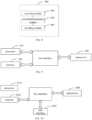
- FIG. 1 shows a schematic topology diagram of NCR in the network.
- NCR includes two functional modes: NCR UE (function) and NCR forwarding (function).
- the NCR UE is used to exchange control signaling with the base station.
- the control signaling controls forwarding parameters of NCR, such as controlling a beam direction of an access link.
- the NCR forwarding is used to forward signals from the base station to the UE, and forward signals from the UE to the base station, and relevant forwarding parameters are sent by the NCR UE.
- the beam can be considered to be relatively stable and does not change.
- An access link between the NCR and the UE can be covered by multiple beams.
- a beam indication is indicated to the NCR by the base station, that is, the gNB uses control signaling to indicate for the NCR, beam used for forwarding signals. Therefore, how gNB effectively indicates transmission beam information from the NCR to UE to adapt to environmental changes or UE's mobility is a technical problem that needs to be solved.
- the base station needs to divide the parameter length W symbols into up to 5 time segments (for example, an actual number of period segments can be one of 1, 2, 3, 4, and 5) according to scheduling requirements.
- Modulation code scheme (MCS) indication for multi-carrier scheduling is provided.
- Multi-carrier scheduling means that one scheduling signaling DCI can schedule two or more pieces of carrier information.
- MCS of each carrier data needs to be indicated.
- MCS values includes values ranging from 0 to 31, and related examples are shown in the following Table 1: Table 1.
- MCS index table MCS index I MCS modulation order Q m target code rate Rx [1024] Spectral efficiency 0 2 120 0.2344 1 2 157 0.3066 2 2 193 0.3770 3 2 251 0.4902 4 2 308 0.6016 5 2 379 0.7402 6 2 449 0.8770 7 2 526 1.0273 8 2 602 1.1758 9 2 679 1.3262 10 4 340 1.3281 11 4 378 1.4766 12 4 434 1.6953 13 4 490 1.9141 14 4 553 2.1602 15 4 616 2.4063 16 4 658 2.5703 17 6 438 2.5664 18 6 466 2.7305 19 6 517 3.0293 20 6 567 3.3223 21 6 616 3.6094 22 6 666 3.9023 23 6 719 4.2129 24 6 772 4.5234 25 6 822 4.8164 26 6 873 5.1152 27 6 910 5.3320 28 6 948 5.5547 29 2 Reserved 30 4 reserved 31 6 reserved
- the MCS value of each scheduled carrier needs to be indicated. For example, when 4 carriers are scheduled, 4 MCS values need to be indicated; when 3 carriers are scheduled, 3 MCS values need to be indicated.
- each piece of information that needs to be indicated is individually coded. It is assumed that an encoding length of each information is a, then for M pieces of information, a ⁇ M bits need to be transmitted in total.
- an encoding length of each segment is: log 2 W ⁇ W + 1 / 2
- SIV start and length indicator value
- an indication range of MCS is 0 to 31
- the SLIV encoding method is as follows: assuming that L is a length of each time segment, 1 ⁇ L ⁇ W; S is a starting point position of each time segment (0 ⁇ S ⁇ W-1), then the SLIV encoding method is as follows:
- each transmission information is encoded separately, which results in relatively large overhead and a waste of air interface resources.
- embodiments of the present disclosure provide an information transmission method and apparatus, network device and UE to solve the problem of how to reduce information transmission overhead and save air interface resources when performing multiple information transmission.
- one embodiment of the present disclosure provides an information transmission method, which is applied to a network device and includes the following steps.
- Step 101 determining a target encoding length according to a parameter length W and a number M of transmission information; where a value or a value range of a corresponding index value s, of each transmission information in the M transmission information is: 0 ⁇ s ⁇ W-1; a value of an n-th transmission information is less than or equal to a value of (n+1)-th transmission information, 1 ⁇ n ⁇ M, n, M and W are positive integers.
- the value of the n-th transmission information is less than or equal to the value of the (n+1)-th transmission information.
- the M pieces of transmission information are used to indicate dividing points of M+1 segments of the parameter length W; or, the M pieces of transmission information are used to indicate M pieces of modulation code scheme (MCS) index information.
- MCS modulation code scheme
- the dividing points of the M+1 segments may be symbol values, slot values or other data.
- the parameter length W is the number of symbols.
- W 15 symbols
- M 3, there are a total of 3 pieces if transmission information including: start_1, start_2, start_3; start_1, start_2, start_3 are specific symbol indexes respectively, and indicate dividing points of 4 time segments over a length of 15 symbols.
- start_1, start_2, start_3 are specific symbol indexes respectively, and indicate dividing points of 4 time segments over a length of 15 symbols.
- from 0 to start_1 is a time segment 1
- from start_1 to start_2 is a time segment 2
- from start_2 to start_3 is a time segment 3
- from start3_ to start_4 is a time segment 4.
- start_1 corresponds to scheduled first carrier data
- start_2 corresponds to scheduled second carrier data
- start_3 corresponds to scheduled third carrier data.
- start_1, start_2, and start_3 here correspond to indication index of MCS.
- Step 102 encoding the M pieces of transmission information to obtain indication information, where a length of the indication information is the target encoding length.
- the indication information is obtained by jointly encoding the M pieces of transmission information.
- the encoding length of the M pieces of transmission information can be reduced, and indication information with a smaller encoding length can be obtained.
- Step 103 sending the indication information to a user equipment (UE).
- UE user equipment
- the UE can obtain that the length of the indication information is the target encoding length, and then the UE can decode the indication information based on the target encoding length to obtain M pieces of transmission information.
- the above step 101 includes:
- the specific values can be found in Table 4 in the following example 1.
- the determining the first parameter includes: determining the first parameter according to the parameter length W, the number M of transmission information, and a first algorithm.
- the first algorithm includes:
- start_1 For example, according to position relationship (0 ⁇ start_1 ⁇ start_2 ⁇ start_3 ⁇ W-1) of three pieces of transmission information that need to be indicated, the following combinations of start_1 can be obtained:
- the determining the target encoding length according to the first parameter includes: determining the target encoding length according to the first parameter and a second algorithm.
- the information transmission overhead can be reduced and the transmission efficiency can be improved.
- start_1, start_2, start_3 three pieces of transmission information (start_1, start_2, start_3) are included.
- step 102 is introduced hereinafter with two situations.
- the three pieces of transmission information include: first information, second information and third information, and a value of the first information is less than or equal to a value of the second information, and the value of the second information is less than or equal to a value of the third information.
- the above step 102 includes:
- the indication information can be calculated based on the first encoding value and the second encoding value, such as, simply, the indication information is a sum of the first encoding value and the second encoding value.
- the determining a first encoding value according to the first information and the parameter length W includes:
- an encoding relationship between the first encoding value SIV1 and the first information start_1 is defined.
- the determining a second encoding value according to the parameter length W, the first information, the second information, and the third information includes the following two modes.
- the determining a second encoding value according to the parameter length W, the first information, the second information, and the third information includes: determining the second encoding value according to the parameter length W, a difference between the second information and the first information, and a distance from the second information to the third information.
- the difference between the second information and the first information is equivalent to a starting position of the second information relative to the first information; and the distance from the second information to the third information can be a difference between the third information and the second information plus 1.
- the mode one includes the following two embodiments.
- the determining the second encoding value according to a difference between the second information and the first information and a distance from the second information to the third information includes:
- the start is encoded in the low bit
- the L is encoded in the high bit
- the determining the second encoding value according to a difference between the second information and the first information and a distance from the second information to the third information includes:
- the start is encoded in the high bit and the L is encoded in the low bit.
- the determining the second encoding value according to the parameter length W, the first information, the second information, and the third information includes:
- the second encoding value is determined based on the SLIV encoding method.
- start3, start_2, start_1 and W are used to directly express the encoding method, it is expressed as:
- the determining the second encoding value according to the parameter length W, the first information, the second information, and the third information includes:
- the four pieces of transmission information include: fourth information, fifth information, sixth information and seventh information, and a value of the fourth information is less than or equal to a value of the fifth information, the value of the fifth information is less than or equal to a value of the sixth information, and the value of the sixth information is less than or equal to a value of the seventh information, that is, 0 ⁇ the value of the fourth information ⁇ the value of the fifth information ⁇ the value of the sixth information ⁇ the value of the seventh information ⁇ W-1.
- the above step 102 includes:
- the indication information can be calculated based on the third encoding value, the fourth encoding value and the fifth encoding value.
- the indication information is a sum of the third encoding value, the fourth encoding value and the fifth encoding value.
- determining the third encoding value according to the fourth information and the parameter length W includes:
- an encoding relationship between the third encoding value SIV0 and the fourth information start_0 is defined.
- the determining the fourth encoding value according to the fifth information and the parameter length W includes:
- an encoding relationship between the fourth encoding value SIV1 and the fifth information start_1 is defined.
- the determining the fifth encoding value according to the fourth information, the fifth information and the sixth information includes: determining the fifth encoding value according to a difference between the fifth information and the fourth information, and a distance from the sixth information to the seventh information.
- the difference between the fifth information and the fourth information is equivalent to a starting position of the fifth information relative to the fourth information; and the distance from the sixth information to the seventh information can be a difference between the seventh information and the sixth information plus 1.
- the determining the fifth encoding value according to a difference between the fifth information and the fourth information, and a distance from the sixth information to the seventh information includes:
- the start is encoded in the low bit and the L is encoded in the high bit.
- one embodiment of the present disclosure provides an information transmission method, which is applied to a UE and includes the following steps:
- the M pieces of transmission information are used to indicate dividing points of M+1 segments of the parameter length W; or, the M pieces of transmission information are used to indicate M pieces of modulation code scheme (MCS) index information.
- MCS modulation code scheme
- the parameter length W is the number of symbols.
- W 15 symbols
- M 3, there are a total of 3 pieces if transmission information including: start_1, start_2, start_3; start_1, start_2, start_3 indicate dividing points of 4 time segments over a length of 15 symbols.
- start_1, start_2, start_3 indicate dividing points of 4 time segments over a length of 15 symbols.
- start_1, start_2, start_3 indicate dividing points of 4 time segments over a length of 15 symbols.
- from 0 to start_1 is a time segment 1
- from start_1 to start_2 is a time segment 2
- from start_2 to start_3 is a time segment 3
- from start3_ to start_4 is a time segment 4.
- start_1 corresponds to scheduled first carrier data
- start_2 corresponds to scheduled second carrier data
- start_3 corresponds to scheduled third carrier data.
- start_1, start_2, and start_3 here correspond to indication index of MCS.
- Step 203 decoding the indication information according to the target encoding length to obtain M pieces of transmission information.
- the above step 202 includes:
- the specific values can be found in Table 4 in the following example 1.
- the determining the first parameter includes: determining the first parameter according to the parameter length W, the number M of transmission information, and a first algorithm.
- the first algorithm includes:
- the determining the target encoding length according to the first parameter includes: determining the target encoding length according to the first parameter and a second algorithm.
- the above step 203 includes:
- decoding to obtain the first information and a first code value corresponding to the first information according to the parameter length W and the target encoding length includes:
- the determining the second information and the third information according to the parameter length W, the first information and the second encoding value includes:
- the obtaining a difference between the second information and the first information and a distance from the second information to the third information according to the parameter length W, the first information and the second encoding value includes:
- the decoding process of the second information and the third information may include:
- the obtaining a difference between the second information and the first information and a distance from the second information to the third information according to the parameter length W, the first information and the second encoding value includes:
- the decoding process of the second information and the third information may include:
- Step A determining the number of bits of indication information (i.e., a target encoding length) as: log 2 W ⁇ W + 1 ⁇ 2 W + 1 12 + W ⁇ W + 1 4 .
- step A-1 determining the number of combinations of values of the three pieces of transmission information in a way including:
- Step A-2 based on the number of combinations of values of the three pieces of transmission information, obtaining the number of bits required for the indication information as: log 2 W ⁇ W + 1 ⁇ 2 W + 1 12 + W ⁇ W + 1 4 .
- the step B includes the following steps B-1 and B-2:
- the encoding length of the output indication information SIV can be limited to 5 bits.
- the decoding process mainly includes the following steps:
- Step C3 determining values start and L in a way including:
- Step C5 according to start_1, start_2, start_3, determining four segments in W as follows: from 0 to start_1 is a time segment 1; from start_1 to start_2 is a time segment 2; from start_2 to start_3 is a time segment 3; from start3_ to start_4 is a time segment 4.
- the parameter length configured and indicated by the base station is W
- the number of transmission information is 3
- the three pieces of transmission information are: start_1, start_2, start_3, and 0 ⁇ start_1 ⁇ start_2 ⁇ start_3 ⁇ W-1.
- Step A determining the number of bits of the indication information (i.e., a target encoding length) as: log 2 W ⁇ W + 1 ⁇ 2 W + 1 12 + W ⁇ W + 1 4 .
- the step A includes the following steps: Step A-1: determining the number of combinations of values of the three pieces of transmission information.
- start_1 has the following situations:
- Step A-2 based on the number of combinations of values of the three pieces of transmission information, obtaining the number of bits required for the indication information as: log 2 W ⁇ 1 ⁇ W ⁇ 2 ⁇ 2 W ⁇ 3 12 + W ⁇ 1 ⁇ W ⁇ 2 4 .
- the indication information SIV SIV1+SIV2.
- the step B includes the following steps B-1 and B-2.
- Step B-1 determining SIV1 based on the value of start_1 and the value of W, which specifically includes:
- N in the above formula can be understood as the maximum value that L can take when the start_1 point is determined, and then subtracting 2. Considering that start_2 will not coincide with start_1, it is necessary to subtract 1, and considering that an original length of L is reduced by 1, it also needs to subtract 1 here.
- the encoding length of the output indication information SIV can be limited to 5 bits.
- the parameter length configured and indicated by the base station is W
- the number of transmission information is 4, and the 4 pieces of transmission information are: start_0, start_1, start_2, start_3, and 0 ⁇ start_0 ⁇ start_1 ⁇ start_2 ⁇ start_3 ⁇ W-1.
- Step A determining the number of bits of the indication information (i.e., a target encoding length) as: log 2 W ⁇ W + 1 2 ⁇ 2 W + 1 12 ⁇ W ⁇ W + 1 2 8 + W ⁇ W + 1 ⁇ 2 W + 1 24 + W ⁇ W + 1 8 .
- the step A includes the following steps.
- Step A-1 determining the number of combinations of values of the four pieces of transmission information.
- start_0 has the following situations:
- the indication information SIV SIV0+SIV1+SIV2.
- the step B includes the following steps B-1, step B-2 and step B-3.
- Step B-1 determining SIV0 based on values of start_0 and W.
- Step B-2 determining SIV1 based on the value of start _0, the value of start_1 and the value of W.
- Step B-3 determining SIV2 based on (start_2-start_1-1) and (start_3-star2).
- the encoding length of the output indication information SIV can be limited to 4 bits.
- Table 9 serial number W start_0 start_1 start2 start3 SIV2 SIV1 SIV SIV0 0 3 0 0 0 0 0 0 1 3 0 0 0 1 3 0 3 0 2 3 0 0 0 2 5 0 5 0 3 3 3 0 0 1 1 1 0 1 0 4 3 0 0 1 2 4 0 4 0 5 3 0 0 2 2 2 0 2 0 6 3 0 1 1 1 1 0 6 6 0 7 3 0 1 1 2 2 6 8 0 8 3 0 1 2 2 1 6 7 0 9 3 0 2 2 2 0 9 9 0 10 3 1 1 1 1 0 0 10 10 11 3 1 1 1 2 2 0 12 10 12 3 1 1 2
- the decoding process mainly includes the following steps.
- Step C2 decoding the indication information SIV sent by the base station according to the information bit length of the indication information.
- Step C2-1 determining a possible value of a third encoding value (SIVO) according to the formula:
- SIVO third encoding value
- Step C2-3 based on the start_0 and SIV0 calculated in the step C2-2, further determining SIV1 and start_1.
- Step C-3 calculating values start and L.
- Step C5 based on information of start_0, start_1, start_2, and start_3, determining the four segments in W as follows: from 0 to start_0 is a time segment 0; from start_0 to start_1 is a time segment 1; from start_1 to start_2 is a time segment 2; from start_2 to start_3 is a time segment 3; from start3_ to start 4 is a time segment 4.
- Example four for the scheme in which SIV2 in the examples 1 and 2 is encoded using the SLIV method, the following decoding example is given: for the SIV2 encoding scheme in the examples 1 and 2 using the SLIV method, a decoding example is provided as follows.
- the UE receives indication information sent by the base station and parses a value of SIV2 according to the first and second embodiments.
- the following describes the process of decoding S and L via SIV2, which mainly includes the following steps.
- Step 2 determining values of L and S according to decode1.
- L SIV 2 / N + 1
- mod() means finding the remainder, and . means rounding down.
- an information transmission device 700 including:
- the M pieces of transmission information are used to indicate dividing points of M+1 segments of the parameter length W; or, the M pieces of transmission information are used to indicate M pieces of modulation code scheme (MCS) index information.
- MCS modulation code scheme
- the first determination module 701 includes:
- the first determination sub-module is specifically used to: determine the first parameter according to the parameter length W, the number M of transmission information, and a first algorithm.
- the first algorithm includes:
- the second determination sub-module is specifically used to: determine the target encoding length according to the first parameter and a second algorithm.
- the M pieces of transmission information include: first information, second information and third information, and a value of the first information is less than or equal to a value of the second information, and the value of the second information is less than or equal to a value of the third information.
- the encoding module 702 includes:
- the first encoding submodule is specifically used to determine:
- the first encoding submodule includes: a first encoding unit used to determine the second encoding value according to the parameter length W, a difference between the second information and the first information, and a distance from the second information to the third information.
- the first encoding unit is specifically used to:
- the first encoding unit is specifically used to:
- the first encoding sub-module includes a second encoding unit used to:
- the first encoding sub-module includes a third encoding unit used to:
- the M pieces of transmission information include: fourth information, fifth information, sixth information and seventh information, and a value of the fourth information is less than or equal to a value of the fifth information, the value of the fifth information is less than or equal to a value of the sixth information, and the value of the sixth information is less than or equal to a value of the seventh information.
- the encoding module 702 includes:
- the fourth encoding submodule is specifically used to determine:
- the fifth encoding submodule is specifically used to determine:
- the sixth coding submodule includes: a fourth encoding unit used to determine a fifth encoding value according to a difference between the fifth information and the fourth information, and a distance from the sixth information to the seventh information.
- the fourth encoding unit is specifically used to:
- the above device provided in the embodiment of the present disclosure can implement all the method steps implemented by the above method embodiment on the third network element side, and can achieve the same technical effect.
- the parts and beneficial effects of this embodiment that are the same as those of the method embodiment will not be described in detail here.
- an information transmission device 800 including:
- the M pieces of transmission information are used to indicate dividing points of M+1 segments of the parameter length W; or, the M pieces of transmission information are used to indicate M pieces of modulation code scheme (MCS) index information.
- MCS modulation code scheme
- the second determination module 802 includes:
- the third determination sub-module is specifically used to: determine the first parameter according to the parameter length W, the number M of transmission information, and a first algorithm.
- the first algorithm includes:
- the fourth determination sub-module is specifically used to: determine the target encoding length according to the first parameter and a second algorithm.
- the M pieces of transmission information include: first information, second information and third information, and a value of the first information is less than or equal to a value of the second information, and the value of the second information is less than or equal to a value of the third information.
- the decoding module 803 includes:
- the first decoding sub-module is specifically used to:
- the second decoding sub-module includes: a first decoding unit used to obtain a difference between the second information and the first information and a distance from the second information to the third information according to the parameter length W, the first information and the second encoding value.
- the first decoding unit is specifically used to:
- the first decoding unit is specifically used to:
- the above device provided in the embodiment of the present disclosure can implement all the method steps implemented by the above method embodiment on the UE side, and can achieve the same technical effect.
- the parts and beneficial effects of this embodiment that are the same as those of the method embodiment will not be described in detail here.
- one embodiment of the present disclosure provides a network device, including: a processor 910; and a memory 920 connected to the processor 910 through a bus interface.
- the memory 920 is used to store programs and data used by the processor 910 when performing operations.
- the processor 910 calls and executes the programs and data stored in the memory 920.
- a transceiver 900 is connected to the bus interface and is used to receive and send data under the control of the processor 910.
- the processor 910 is used to read the program in the memory 920 and perform the following processes:
- the M pieces of transmission information are used to indicate dividing points of M+1 segments of the parameter length W; or, the M pieces of transmission information are used to indicate M pieces of modulation code scheme (MCS) index information.
- MCS modulation code scheme
- the processor 910 is further used to read the program in the memory 920 and perform the following processes:
- the processor 910 is further used to read the program in the memory 920 and perform the following processes: determining the first parameter according to the parameter length W, the number M of transmission information, and a first algorithm.
- the first algorithm includes:
- the processor 910 is further used to read the program in the memory 920 and perform the following processes: determining the target encoding length according to the first parameter and a second algorithm.
- the M pieces of transmission information include: first information, second information and third information, and a value of the first information is less than or equal to a value of the second information, and the value of the second information is less than or equal to a value of the third information.
- the processor 910 is further used to read the program in the memory 920 and perform the following processes:
- the processor 910 is further used to read the program in the memory 920 and perform the following processes:
- the processor 910 is further used to read the program in the memory 920 and perform the following processes: determining the second encoding value according to the parameter length W, a difference between the second information and the first information, and a distance from the second information to the third information.
- the processor 910 is further used to read the program in the memory 920 and perform the following processes:
- the processor 910 is further used to read the program in the memory 920 and perform the following processes:
- the processor 910 is further used to read the program in the memory 920 and perform the following processes:
- the processor 910 is further used to read the program in the memory 920 and perform the following processes:
- the M pieces of transmission information include: fourth information, fifth information, sixth information and seventh information, and a value of the fourth information is less than or equal to a value of the fifth information, the value of the fifth information is less than or equal to a value of the sixth information, and the value of the sixth information is less than or equal to a value of the seventh information.
- the processor 910 is further used to read the program in the memory 920 and perform the following processes:
- the processor 910 is further used to read the program in the memory 920 and perform the following processes:
- the processor 910 is further used to read the program in the memory 920 and perform the following processes:
- the processor 910 is further used to read the program in the memory 920 and perform the following processes: determining a fifth encoding value according to a difference between the fifth information and the fourth information, and a distance from the sixth information to the seventh information.
- the processor 910 is further used to read the program in the memory 920 and perform the following processes:
- a bus architecture may include any number of interconnected bus and bridge. Specifically, various circuits of one or more processors, which are represented by the processor 910, and one or more memories, which are represented by the memory 920, are linked together.
- the bus architecture may link various other circuits, such as a peripheral device, voltage regulator and a power management circuit together. These features are well known in this field; therefore, this disclosure does not make further description on these features.
- the bus interface provides an interface.
- the transceiver 900 may be multiple elements, including a transmitter and a receiver and provide units, which communicate with other devices on the transmission medium.
- the transmission medium includes radio channels, wired channels, optical cables, etc.
- the processor 910 is responsible for managing the bus architecture and the normal processing.
- the memory 920 may be used to store data used by the processor 910 for performing operations.
- the processor 910 may be a central processing unit (CPU), an application specific integrated circuit (ASIC), a field-programmable gate array (FPGA) or a complex programmable logic device (CPLD).
- the processor may also adopt multi-core architecture.
- the processor calls the computer program stored in the memory to execute any method provided in the embodiment of the present disclosure according to obtained executable instructions.
- the processor and the memory may also be arranged physically separately.
- one embodiment of the present disclosure provides a UE, including: a processor 1010, and a memory 1020 connected to the processor 1010 through a bus interface.
- the memory 1020 is used to store programs and data used by the processor 1010 when performing operations.
- the processor 1010 calls and executes the programs and data stored in the memory 1020.
- a transceiver 1000 is connected to the bus interface and is used to receive and send data under the control of the processor 1010.
- the processor 1010 is used to read the program in the memory 1020 and perform the following processes:
- the M pieces of transmission information are used to indicate dividing points of M+1 segments of the parameter length W; or, the M pieces of transmission information are used to indicate M pieces of modulation code scheme (MCS) index information.
- MCS modulation code scheme
- processor 1010 is further used to read the program in the memory 1020 and perform the following processes:
- the processor 1010 is further used to read the program in the memory 1020 and perform the following processes: determining the first parameter according to the parameter length W, the number M of transmission information, and a first algorithm.
- the first algorithm includes:
- the processor 1010 is further used to read the program in the memory 1020 and perform the following processes: determining the target encoding length according to the first parameter and a second algorithm.
- the M pieces of transmission information include: first information, second information and third information, and a value of the first information is less than or equal to a value of the second information, and the value of the second information is less than or equal to a value of the third information.
- processor 1010 is further used to read the program in the memory 1020 and perform the following processes:
- processor 1010 is further used to read the program in the memory 1020 and perform the following processes:
- the processor 1010 is further used to read the program in the memory 1020 and perform the following processes: obtaining a difference between the second information and the first information and a distance from the second information to the third information according to the parameter length W, the first information and the second encoding value.
- processor 1010 is further used to read the program in the memory 1020 and perform the following processes:
- processor 1010 is further used to read the program in the memory 1020 and perform the following processes:
- a bus architecture may include any number of interconnected bus and bridge. Specifically, various circuits of one or more processors, which are represented by the processor 1010, and one or more memories, which are represented by the memory 1020, are linked together.
- the bus architecture may link various other circuits, such as a peripheral device, voltage regulator and a power management circuit together. These features are well known in this field; therefore, this disclosure does not make further description on these features.
- the bus interface provides an interface.
- the transceiver 1000 may be multiple elements, including a transmitter and a receiver and provide units, which communicate with other devices on the transmission medium.
- the transmission medium includes radio channels, wired channels, optical cables, etc.
- a user interface 1030 may be an interface that can be connected to external or internal devices. The connected devices include but are not limited to a small keyboard, a display, a speaker, a microphone, a joystick, etc.
- the processor 1010 may be a central processing unit (CPU), an application specific integrated circuit (ASIC), a field-programmable gate array (FPGA) or a complex programmable logic device (CPLD).
- the processor may also adopt multi-core architecture.
- the present disclosure further provides a processor-readable storage medium that stores a computer program, and the computer program is used to cause the processor to execute the above method.
- the processor-readable storage medium may be any available media or data storage device that the processor can access, including but not limited to magnetic storage (such as floppy disks, hard disks, magnetic tapes, magneto-optical disks (MO), etc.), optical storage (such as compact disk (CD), digital versatile disc (DVD), blu-ray disc (BD), high-definition versatile disc (HVD), etc.), and semiconductor memories (such as ROM, erasable programmable read-only memory (EPROM), electrically erasable programmable read-only memory (EEPROM), non-volatile memory (NAND FLASH), solid state drive (SSD)), etc.
- magnetic storage such as floppy disks, hard disks, magnetic tapes, magneto-optical disks (MO), etc.
- optical storage such as compact disk (CD), digital versatile disc (DVD), blu-ray disc (BD), high-definition versatile disc (HVD), etc.
- semiconductor memories such as ROM, erasable programmable read-only memory (
- each functional unit in each embodiment of the present application may be integrated into one processing unit, each unit may exist separately physically, or two or more units may be integrated into one unit.
- the foregoing integrated units may be implemented in the form of hardware or in the form of software functional units.
- the integrated units are realized in the form of software function units and sold or used as independent products, they may be stored in a processor-readable storage medium.
- the computer software product is stored in a storage medium, includes several instructions which enables a computer device (which may be a personal computer, a server, or a network device, etc.) or a processor to execute all or part of the steps of the methods described in various embodiments of the present disclosure.
- the storage medium includes various media capable of storing program codes such as U disk, mobile hard disk, ROM, RAM, magnetic disk or optical disk.
- processor-executable instructions may also be stored in a processor-readable storage that may guide the computer or the other programmable data process devices to function in a certain way, so that the instructions stored in the processor-readable storage may create a product including an instruction unit which achieves the functions assigned in one or more flows in the flow chart and/or one or more blocks in the block diagram.
- processor-executable instructions may also be loaded in the computer or the other programmable data process devices, so that a series of operation steps are executed on the computer or the other programmable devices to create processes achieved by the computer. Therefore, the instructions executed in the computer or the other programmable devices provide the steps for achieving the function assigned in one or more flows in the flow chart and/or one or more blocks in the block diagram.
Landscapes
- Engineering & Computer Science (AREA)
- Signal Processing (AREA)
- Computer Networks & Wireless Communication (AREA)
- Quality & Reliability (AREA)
- Compression, Expansion, Code Conversion, And Decoders (AREA)
- Compression Or Coding Systems Of Tv Signals (AREA)
Abstract
Description
- The present disclosure claims the priority of
Chinese Application No. 202210864235.X, filed on July 20, 2022 - The present disclosure relates to the field of communication technologies, and in particular to an information transmission method and apparatus, network device and user equipment.
- In the related technical solution, each piece of information that needs to be indicated is individually coded. It is assumed that an encoding length of each information is a, then for M pieces of information, a×M bits need to be transmitted. In this way, a large overhead is required, resulting in a waste of air interface resources.
- Considering scarcity of air interface resources, how to save air interface resources when transmitting multiple pieces of information is an urgent technical issue that needs to be solved.
- An object of the present disclosure is to provide an information transmission method and apparatus, network device and user equipment, which can solve the problem of how to save air interface resources when performing multiple information transmission in the related art.
- In a first aspect, in order to solve the above technical problem, one embodiment of the present disclosure provides an information transmission method, applied to a network device, including:
- determining a target encoding length according to a parameter length W and a number M of transmission information; wherein a value or a value range of a corresponding index value s, of each transmission information in the M transmission information is: 0≤s≤W-1; a value of an n-th transmission information is less than or equal to a value of (n+1)-th transmission information, 1≤n≤M, n, M and W are positive integers;
- encoding the M pieces of transmission information to obtain indication information, where a length of the indication information is the target encoding length;
- sending the indication information to a user equipment (UE).
- Optionally, the M pieces of transmission information are used to indicate dividing points of M+1 segments of the parameter length W; or,
the M pieces of transmission information are used to indicate M pieces of modulation code scheme (MCS) index information. - Optionally, the determining a target encoding length according to a parameter length W and a number M of transmission information, includes:
- determining a first parameter; wherein the first parameter is used to represent the number of combinations of values of the M pieces of transmission information in a range of 0 to W-1;
- determining the target encoding length according to the first parameter.
- Optionally, the determining the first parameter, includes:
determining the first parameter according to the parameter length W, the number M of transmission information, and a first algorithm. - Optionally, the first algorithm includes:
- when M=3,

- when M=4,


- Optionally, the determining the target encoding length according to the first parameter, includes:
determining the target encoding length according to the first parameter and a second algorithm. - Optionally, the second algorithm includes:

- Optionally, in a case where M=3, the M pieces of transmission information include: first information, second information and third information, and a value of the first information is less than or equal to a value of the second information, and the value of the second information is less than or equal to a value of the third information;
the encoding the M pieces of transmission information to obtain indication information, includes: - determining a first encoding value according to the first information and the parameter length W;
- determining a second encoding value according to the parameter length W, the first information, the second information and the third information;
- obtaining the indication information according to the first encoding value and the second encoding value.
- Optionally, the determining a first encoding value according to the first information and the parameter length W, includes:
- when start_1=0, SIV1=0; or,
- when start_1≥1,

- wherein start_1 is the first information; i=0, ..., start_1-1; and i is an integer; W is the parameter length; SIV1 is the first encoding value.
- Optionally, the determining a second encoding value according to the parameter length W, the first information, the second information, and the third information includes:
determining the second encoding value according to the parameter length W, a difference between the second information and the first information, and a distance from the second information to the third information. - Optionally, the determining the second encoding value according to a difference between the second information and the first information and a distance from the second information to the third information, includes:
- determining the second encoding value according to the formula:

- wherein start is the difference between the second information and the first information; SIV2 is the second encoding value; N is the difference between W and the first information; L is the distance from the second information to the third information; i=1, ..., L-1; and i is an integer; W is the parameter length.
- Optionally, the determining the second encoding value according to a difference between the second information and the first information and a distance from the second information to the third information, includes:
- when Start=0, the second encoding value is L;
- when start≥1, determining the second encoding value according to the formula:

- wherein start is the difference between the second information and the first information; SIV2 is the second encoding value; N is the difference between W and the first information; L is the distance from the second information to the third information, L≥1, and L is an integer; i=1, ..., L-1; and i is an integer; W is the parameter length.
- Optionally, the determining the second encoding value according to the parameter length W, the first information, the second information, and the third information, includes:
- in a case where start_3 - start_2 ≤ |(W - start_1)/2|, determining the second encoding value according to the formula: SIV2 = (W - start_1) (start_3 - start_2) + start_2 - start_1;
- in a case where start_3 - start_2 > |(W - start_1)/2|, determining the second encoding value according to the formula: SIV2 = (W - start_1) (W + start_2 - start_1 - start_3) + (W - 1 - start_2);
- wherein 0 < start_3 - start_2 + 1 ≤ W - start_2; SIV2 is the second encoding value; start_1 is the first information; start_2 is the second information; start_3 is the third information; W is the parameter length.
- Optionally, the determining the second encoding value according to the parameter length W, the first information, the second information, and the third information, includes:
- determining the second encoding value according to the formula:

- wherein start_1 is the first information; start_2 is the second information; start_3 is the third information; W is the parameter length.
- Optionally, in a case where M=4, the M pieces of transmission information include: fourth information, fifth information, sixth information and seventh information, and a value of the fourth information is less than or equal to a value of the fifth information, the value of the fifth information is less than or equal to a value of the sixth information, and the value of the sixth information is less than or equal to a value of the seventh information;
the encoding the M pieces of transmission information to obtain indication information, includes: - determining a third encoding value according to the fourth information and the parameter length W;
- determining a fourth encoding value according to the fifth information and the parameter length W;
- determining a fifth encoding value according to the fourth information, the fifth information and the sixth information;
- obtaining the indication information according to the third encoding value, the fourth encoding value and the fifth encoding value.
- Optionally, the determining the third encoding value according to the fourth information and the parameter length W, includes:
- when start_0=0, SIV0=0;
- when start_0 ≥ 1,


- wherein start_0 is the fourth information; i=0, ..., start_0-1; and i is an integer; W is the parameter length; SIV0 is the third encoding value.
- Optionally, the determining the fourth encoding value according to the fifth information and the parameter length W, includes:
- when start_1=0, SIV1=0;
- when start_1≥1,

- wherein start_1 is the fifth information; i=0, ..., start_1-1; and i is an integer; W is the parameter length; SIV1 is the fourth encoding value.
- Optionally, the determining the fifth encoding value according to the fourth information, the fifth information and the sixth information, includes:
determining the fifth encoding value according to a difference between the fifth information and the fourth information, and a distance from the sixth information to the seventh information. - Optionally, the determining the fifth encoding value according to a difference between the fifth information and the fourth information, and a distance from the sixth information to the seventh information, includes:
- determining the fifth encoding value according to the formula: SIV2 =

- wherein start is the difference between the fifth information and the fourth information; SIV2 is the fifth encoding value; N is the difference between W and the fourth information; L is the distance from the sixth information and to the seventh information, L≥ 1, and L is an integer; i=1, ..., L-1; and i is an integer.
- In a second aspect, in order to solve the above technical problem, one embodiment of the present disclosure provides an information transmission method, applied to a user equipment (UE), including:
- receiving indication information sent by a network device;
- determining a target encoding length according to a parameter length W and a number M of transmission information; wherein an encoding length of the indication information is the target encoding length; a value or a value range of a corresponding index value s, of each transmission information in the M transmission information is: 0≤s≤W-1; a value of an n-th transmission information is less than or equal to a value of (n+1)-th transmission information, 1≤n≤M, n, M and W are positive integers;
- decoding the indication information according to the target encoding length to obtain M pieces of transmission information.
- Optionally, the M pieces of transmission information are used to indicate dividing points of M+1 segments of the parameter length W; or,
the M pieces of transmission information are used to indicate M pieces of modulation code scheme (MCS) index information. - Optionally, the determining a target encoding length according to a parameter length W and a number M of transmission information, includes:
- determining a first parameter; where the first parameter is used to represent the number of combinations of values of the M pieces of transmission information in a range of 0 to W-1;
- determining the target encoding length according to the first parameter.
- Optionally, the determining the first parameter, includes:
determining the first parameter according to the parameter length W, the number M of transmission information, and a first algorithm. - Optionally, the first algorithm includes:
- when M=3,

- when M=4,


- Optionally, the determining the target encoding length according to the first parameter, includes:
determining the target encoding length according to the first parameter and a second algorithm. - Optionally, the second algorithm includes:
the target encoding
- Optionally, in a case where M=3, the M pieces of transmission information include: first information, second information and third information, and a value of the first information is less than or equal to a value of the second information, and the value of the second information is less than or equal to a value of the third information;
- the decoding the indication information according to the target encoding length to obtain M pieces of transmission information, includes:
- decoding to obtain the first information and a first encoding value corresponding to the first information according to the parameter length W and the target encoding length;
- according to the first encoding value and the target encoding length, obtaining a second encoding value;
- determining the second information and the third information according to the parameter length W, the first information and the second encoding value.
- Optionally, the decoding to obtain the first information and a first code value corresponding to the first information according to the parameter length W and the target encoding length includes:
- within the value range, traversing possible values of the first information, and determining a value that meets a first condition as the first information; the first condition is:

- determining the first encoding value according to the formula:

- wherein start_1 is the first information; i=0, ..., start_1-1; and i is an integer; W is the parameter length; SIV1 is the first encoding value; when start_1=0,

- Optionally, the determining the second information and the third information according to the parameter length W, the first information and the second encoding value, includes:
obtaining a difference between the second information and the first information and a distance from the second information to the third information according to the parameter length W, the first information and the second encoding value. - Optionally, the obtaining a difference between the second information and the first information and a distance from the second information to the third information according to the parameter length W, the first information and the second encoding value, includes:
- according to the formula:

- wherein start is the difference between the second information and the first information; SIV2 is the second encoding value; N is the difference between W and the first information; L is the distance from the second information to the third information; i=1, ..., L-1; and i is an integer; W is the parameter length.
- Optionally, the obtaining a difference between the second information and the first information and a distance from the second information to the third information according to the parameter length W, the first information and the second encoding value, includes:
- according to the formula:

- wherein when Start=0, the second encoding value is L; start is the difference between the second information and the first information; SIV2 is the second encoding value; N is the difference between W and the first information; L is the distance from the second information to the third information, L≥1, and L is an integer; i=1, ..., L-1; and i is an integer; W is the parameter length.
- In a third aspect, in order to solve the above technical problem, one embodiment of the present disclosure provide a network device, including: a transceiver, a memory, a processor, and a computer program stored on the memory and executable on the processor; wherein the processor is used to read the program in the memory and perform the following process:
- determining a target encoding length according to a parameter length W and a number M of transmission information; wherein a value or a value range of a corresponding index value s, of each transmission information in the M transmission information is: 0≤s≤W-1; a value of an n-th transmission information is less than or equal to a value of (n+1)-th transmission information, 1≤n≤M, n, M and W are positive integers;
- encoding the M pieces of transmission information to obtain indication information, where a length of the indication information is the target encoding length;
- sending the indication information to a user equipment (UE).
- Optionally, the M pieces of transmission information are used to indicate dividing points of M+1 segments of the parameter length W; or,
the M pieces of transmission information are used to indicate M pieces of modulation code scheme (MCS) index information. - Optionally, the processor is further used to read the program in the memory and perform the following process:
- determining a first parameter; wherein the first parameter is used to represent the number of combinations of values of the M pieces of transmission information in a range of 0 to W-1;
- determining the target encoding length according to the first parameter.
- Optionally, the processor is further used to read the program in the memory and perform the following process:
determining the first parameter according to the parameter length W, the number M of transmission information, and a first algorithm. - Optionally, the first algorithm includes:
- when M=3,

- when M=4,


- Optionally, the processor is used to read the program in the memory and perform the following process:
determining the target encoding length according to the first parameter and a second algorithm. - Optionally, the second algorithm includes:
the target encoding
- Optionally, in a case where M=3, the M pieces of transmission information include: first information, second information and third information, and a value of the first information is less than or equal to a value of the second information, and the value of the second information is less than or equal to a value of the third information;
the processor is used to read the program in the memory and perform the following process: - determining a first encoding value according to the first information and the parameter length W;
- determining a second encoding value according to the parameter length W, the first information, the second information and the third information;
- obtaining the indication information according to the first encoding value and the second encoding value.
- Optionally, the processor is used to read the program in the memory and perform the following process:
- when start_1=0, SIV1=0; or,
- when start_1≥1,

- wherein start_1 is the first information; i=0, ..., start_1-1; and i is an integer; W is the parameter length; SIV1 is the first encoding value.
- Optionally, the processor is used to read the program in the memory and perform the following process:
determining the second encoding value according to the parameter length W, a difference between the second information and the first information, and a distance from the second information to the third information. - Optionally, the processor is used to read the program in the memory and perform the following process:
- determining the second encoding value according to the formula:

- wherein start is the difference between the second information and the first information; SIV2 is the second encoding value; N is the difference between W and the first information; L is the distance from the second information to the third information; i=1, ..., L-1; and i is an integer; W is the parameter length.
- Optionally, the processor is used to read the program in the memory and perform the following process:
- when Start=0, the second encoding value is L;
- when start≥1, determining the second encoding value according to the formula:

- wherein start is the difference between the second information and the first information; SIV2 is the second encoding value; N is the difference between W and the first information; L is the distance from the second information to the third information, L≥1, and L is an integer; i=1, ..., L-1; and i is an integer; W is the parameter length.
- Optionally, the processor is used to read the program in the memory and perform the following process:
- in a case where start_3 - start_2 ≤ |(W - start_1)/2|, determining the second encoding value according to the formula: SIV2 = (W - start_1) (start_3 - start_2) + start_2 - start_1;
- in a case where start_3 - start_2 > |(W - start_1)/2|, determining the second encoding value according to the formula: SIV2 = (W - start_1) (W + start_2 - start_1 - start_3) + (W - 1 - start_2);
- wherein 0 < start_3 -
start_2+ 1≤ W - start_2; SIV2 is the second encoding value; start_1 is the first information; start_2 is the second information; start_3 is the third information; W is the parameter length. - Optionally, the processor is used to read the program in the memory and perform the following process:
- determining the second encoding value according to the formula:

- wherein start_1 is the first information; start_2 is the second information; start_3 is the third information; W is the parameter length.
- Optionally, in a case where M=4, the M pieces of transmission information include: fourth information, fifth information, sixth information and seventh information, and a value of the fourth information is less than or equal to a value of the fifth information, the value of the fifth information is less than or equal to a value of the sixth information, and the value of the sixth information is less than or equal to a value of the seventh information;
the processor is used to read the program in the memory and perform the following process: - determining a third encoding value according to the fourth information and the parameter length W;
- determining a fourth encoding value according to the fifth information and the parameter length W;
- determining a fifth encoding value according to the fourth information, the fifth information and the sixth information;
- obtaining the indication information according to the third encoding value, the fourth encoding value and the fifth encoding value.
- Optionally, the processor is used to read the program in the memory and perform the following process:
- when start_0=0, SIV0=0;
- when start_0 ≥ 1,


- wherein start_0 is the fourth information; i=0, ..., start_0-1; and i is an integer; W is the parameter length; SIV0 is the third encoding value.
- Optionally, the processor is used to read the program in the memory and perform the following process:
- when start_1=0, SIV1=0;
- when start_1≥1,

- wherein start_1 is the fifth information; i=0, ..., start_1-1; and i is an integer; W is the parameter length; SIV1 is the fourth encoding value.
- Optionally, the processor is used to read the program in the memory and perform the following process:
determining the fifth encoding value according to a difference between the fifth information and the fourth information, and a distance from the sixth information to the seventh information. - Optionally, the processor is used to read the program in the memory and perform the following process:
- determining the fifth encoding value according to the formula: SIV2 =

- wherein start is the difference between the fifth information and the fourth information; SIV2 is the fifth encoding value; N is the difference between W and the fourth information; L is the distance from the sixth information and to the seventh information, L≥ 1, and L is an integer; i=1, ..., L-1; and i is an integer.
- In a fourth aspect, in order to solve the above technical problem, one embodiment of the present disclosure provides a user equipment (UE), including: a transceiver, a memory, a processor, and a computer program stored on the memory and executable on the processor; wherein the processor is used to read the program in the memory and perform the following process:
- receiving indication information sent by a network device;
- determining a target encoding length according to a parameter length W and a number M of transmission information; wherein an encoding length of the indication information is the target encoding length; a value or a value range of a corresponding index value s, of each transmission information in the M transmission information is: 0≤s≤W-1; a value of an n-th transmission information is less than or equal to a value of (n+1)-th transmission information, 1≤n≤M, n, M and W are positive integers;
- decoding the indication information according to the target encoding length to obtain M pieces of transmission information.
- Optionally, the M pieces of transmission information are used to indicate dividing points of M+1 segments of the parameter length W; or,
the M pieces of transmission information are used to indicate M pieces of modulation code scheme (MCS) index information. - Optionally, the processor is used to read the program in the memory and perform the following process:
- determining a first parameter; where the first parameter is used to represent the number of combinations of values of the M pieces of transmission information in a range of 0 to W-1;
- determining the target encoding length according to the first parameter.
- Optionally, the processor is used to read the program in the memory and perform the following process:
determining the first parameter according to the parameter length W, the number M of transmission information, and a first algorithm. - Optionally, the first algorithm includes:
- when M=3,

- when M=4,


- Optionally, the processor is used to read the program in the memory and perform the following process:
determining the target encoding length according to the first parameter and a second algorithm. - Optionally, the second algorithm includes:
the target encoding
- Optionally, in a case where M=3, the M pieces of transmission information include: first information, second information and third information, and a value of the first information is less than or equal to a value of the second information, and the value of the second information is less than or equal to a value of the third information;
the processor is used to read the program in the memory and perform the following process: - decoding to obtain the first information and a first encoding value corresponding to the first information according to the parameter length W and the target encoding length;
- according to the first encoding value and the target encoding length, obtaining a second encoding value;
- determining the second information and the third information according to the parameter length W, the first information and the second encoding value.
- Optionally, the processor is used to read the program in the memory and perform the following process:
- within the value range, traversing possible values of the first information, and determining a value that meets a first condition as the first information; the first condition is:

- determining the first encoding value according to the formula:

- wherein start_1 is the first information; i=0, ..., start_1-1; and i is an integer; W is the parameter length; SIV1 is the first encoding value; when start_1=0,

- Optionally, the processor is used to read the program in the memory and perform the following process:
obtaining a difference between the second information and the first information and a distance from the second information to the third information according to the parameter length W, the first information and the second encoding value. - Optionally, the processor is used to read the program in the memory and perform the following process:
- according to the formula:

- wherein start is the difference between the second information and the first information; SIV2 is the second encoding value; N is the difference between W and the first information; L is the distance from the second information to the third information; i=1, ..., L-1; and i is an integer; W is the parameter length.
- Optionally, the processor is used to read the program in the memory and perform the following process:
- according to the formula:

- wherein when Start=0, the second encoding value is L; start is the difference between the second information and the first information; SIV2 is the second encoding value; N is the difference between W and the first information; L is the distance from the second information to the third information, L≥1, and L is an integer; i=1, ..., L-1; and i is an integer; W is the parameter length.
- In a fifth aspect, in order to solve the above technical problem, one embodiment of the present disclosure provides an information transmission device, including:
- a first determination module used to determine a target encoding length according to a parameter length W and a number M of transmission information; where a value or a value range of a corresponding index value s, of each transmission information in the M transmission information is: 0 ≤ s ≤ W-1; a value of an n-th transmission information is less than or equal to a value of (n+1)-th transmission information, 1≤n≤M, n, M and W are positive integers;
- an encoding module used to encode the M pieces of transmission information to obtain indication information, where a length of the indication information is the target encoding length;
- a transmission module used to send the indication information to a user equipment (UE).
- Optionally, the M pieces of transmission information are used to indicate dividing points of M+1 segments of the parameter length W; or,
the M pieces of transmission information are used to indicate M pieces of modulation code scheme (MCS) index information. - Optionally, the first determination module includes:
- a first determination sub-module used to determine a first parameter; wherein the first parameter is used to represent the number of combinations of values of the M pieces of transmission information in a range of 0 to W-1;
- a second determination sub-module used to determine the target encoding length according to the first parameter.
- Optionally, the first determination sub-module is specifically used to:
determine the first parameter according to the parameter length W, the number M of transmission information, and a first algorithm. - Optionally, the first algorithm includes:
- when M=3,

- when M=4,


- Optionally, the second determination sub-module is specifically used to:
determine the target encoding length according to the first parameter and a second algorithm. - Optionally, the second algorithm includes:
the target encoding
- Optionally, in a case where M=3, the M pieces of transmission information include: first information, second information and third information, and a value of the first information is less than or equal to a value of the second information, and the value of the second information is less than or equal to a value of the third information;
the encoding module includes: - a first encoding submodule used to determine a first encoding value according to the first information and the parameter length W;
- a second encoding submodule used to determine a second encoding value according to the parameter length W, the first information, the second information, and the third information;
- a third encoding submodule used to obtain the indication information according to the first encoding value and the second encoding value.
- Optionally, the first encoding submodule is specifically used to determine:
- when start_1=0, SIV1=0;
- when start_1>=1,

- wherein start_1 is the first information; i=0, ..., start_1-1; and i is an integer; W is the parameter length; SIV1 is the first encoding value.
- Optionally, the first encoding submodule includes:
a first encoding unit used to determine the second encoding value according to the parameter length W, a difference between the second information and the first information, and a distance from the second information to the third information. - Optionally, the first encoding unit is specifically used to:
- determine the second encoding value according to the formula: SIV2 =

- wherein start is the difference between the second information and the first information; SIV2 is the second encoding value; N is the difference between W and the first information; L is the distance from the second information to the third information; i=1, ..., L-1; and i is an integer; W is the parameter length.
- Optionally, the first encoding unit is specifically used to:
- when Start=0, determine the second encoding value as L;
- when start≥1, determine the second encoding value according to the formula:

- wherein start is the difference between the second information and the first information; SIV2 is the second encoding value; N is the difference between W and the first information; L is the distance from the second information to the third information, L≥1, and L is an integer; i=1, ..., L-1; and i is an integer; W is the parameter length.
- Optionally, the first encoding sub-module includes a second encoding unit used to:
- in a case where start_3 - start_2 ≤ |(W - start_1)/2|, determine the second encoding value according to the formula: SIV2 = (W - start_1) (start_3 - start_2) + start_2 - start_1;
- in a case where start_3 - start_2 > |(W - start_1)/2|, determine the second encoding value according to the formula: SIV2 = (W - start_1) (W + start_2 - start_1 - start_3) + (W - 1 - start_2);
- wherein 0 < start_3 -
start_2 + 1 ≤ W - start_2; SIV2 is the second encoding value; start_1 is the first information; start_2 is the second information; start_3 is the third information; W is the parameter length. - Optionally, the first encoding sub-module includes a third encoding unit used to:
- determine the second encoding value according to the formula: SIV2 =

- wherein start_1 is the first information; start_2 is the second information; start_3 is the third information; W is the parameter length.
- Optionally, in the case of M=4, the M pieces of transmission information include: fourth information, fifth information, sixth information and seventh information, and a value of the fourth information is less than or equal to a value of the fifth information, the value of the fifth information is less than or equal to a value of the sixth information, and the value of the sixth information is less than or equal to a value of the seventh information;
the encoding module includes: - a fourth encoding submodule used to determine a third encoding value according to the fourth information and the parameter length W;
- a fifth encoding submodule used to determine a fourth encoding value according to the fifth information and the parameter length W;
- a sixth encoding submodule used to determine a fifth encoding value according to the fourth information, the fifth information, and the sixth information;
- a seventh encoding sub-module used to obtain the indication information according to the third encoding value, the fourth encoding value and the fifth encoding value.
- Optionally, the fourth encoding submodule is specifically used to determine:
- when start_0=0, SIV0=0;
- when start_0 ≥ 1,


- wherein start_0 is the fourth information; i=0, ..., start_0-1; and i is an integer; W is the parameter length; SIV0 is the third encoding value.
- Optionally, the fifth encoding submodule is specifically used to determine:
- when start_1=0, SIV1=0;
- when start_1≥1,

- wherein start_1 is the fifth information; i=0, ..., start_1-1; and i is an integer; W is the parameter length; SIV1 is the fourth encoding value.
- Optionally, the sixth coding submodule includes:
a fourth encoding unit used to determine a fifth encoding value according to a difference between the fifth information and the fourth information, and a distance from the sixth information to the seventh information. - Optionally, the fourth encoding unit is specifically used to:
- determine the fifth encoding value according to the formula: SIV2 =

- wherein start is the difference between the fifth information and the fourth information; SIV2 is the fifth encoding value; N is the difference between W and the fourth information; L is the distance from the sixth information and to the seventh information, L≥ 1, and L is an integer; i=1, ..., L-1; and i is an integer.
- In a sixth aspect, in order to solve the above technical problem, one embodiment of the present disclosure provides an information transmission device, including:
- a receiving module used to receive indication information sent by a network device;
- a second determination module used to determine a target encoding length according to a parameter length W and a number M of transmission information; where an encoding length of the indication information is the target encoding length; a value or a value range of a corresponding index value s, of each transmission information in the M transmission information is: 0 ≤ s ≤ W-1; a value of an n-th transmission information is less than or equal to a value of (n+1)-th transmission information, 1≤n≤M, n, M and W are positive integers;
- a decoding module used to decode the indication information according to the target encoding length to obtain M pieces of transmission information.
- Optionally, the M pieces of transmission information are used to indicate dividing points of M+1 segments of the parameter length W; or,
the M pieces of transmission information are used to indicate M pieces of modulation code scheme (MCS) index information. - Optionally, the second determination module includes:
- a third determination sub-module used to determine a first parameter, where the first parameter is used to represent the number of combinations of values of the M pieces of transmission information in a range of 0 to W-1;
- a fourth determination sub-module used to determine the target encoding length according to the first parameter.
- Optionally, the third determination sub-module is specifically used to:
determine the first parameter according to the parameter length W, the number M of transmission information, and a first algorithm. - Optionally, the first algorithm includes:
- when M=3,

- when M=4,


- Optionally, the fourth determination sub-module is specifically used to:
determine the target encoding length according to the first parameter and a second algorithm. - Optionally, the second algorithm includes:
the target encoding
- Optionally, in a case of M=3, the M pieces of transmission information include: first information, second information and third information, and a value of the first information is less than or equal to a value of the second information, and the value of the second information is less than or equal to a value of the third information;
the decoding module includes: - a first decoding submodule used to decode to obtain the first information and a first encoding value corresponding to the first information according to the parameter length W and the target encoding length;
- a second decoding submodule used to obtain a second encoding value according to the first encoding value and the target encoding length;
- a third decoding submodule used to determine the second information and the third information according to the parameter length W, the first information and the second encoding value.
- Optionally, the first decoding sub-module is specifically used to:
- within the value range, traverse possible values of the first information, and determine a value that meets a first condition as the first information; the first condition is:

- determine the first encoding value according to the formula:

- wherein start_1 is the first information; i=0, ..., start_1-1; and i is an integer; W is the parameter length; SIV1 is the first encoding value; when start_1=0,

- Optionally, the second decoding sub-module includes:
a first decoding unit used to obtain a difference between the second information and the first information and a distance from the second information to the third information according to the parameter length W, the first information and the second encoding value. - Optionally, the first decoding unit is specifically used to:
- according to the formula:

- wherein start is the difference between the second information and the first information; SIV2 is the second encoding value; N is the difference between W and the first information; L is the distance from the second information to the third information; i=1, ..., L-1; and i is an integer; W is the parameter length.
- Optionally, the first decoding unit is specifically used to:
- according to the formula:

- wherein when Start=0, the second encoding value is L; start is the difference between the second information and the first information; SIV2 is the second encoding value; N is the difference between W and the first information; L is the distance from the second information to the third information, L≥1, and L is an integer; i=1, ..., L-1; and i is an integer; W is the parameter length.
- In a seventh aspect, in order to solve the above technical problem, one embodiment of the present disclosure provide processor-readable storage medium, including a computer program stored thereon; wherein the computer program is used to cause a processor to perform the information transmission method according to the first aspect or the second aspect.
- The beneficial effects of the above technical solution in the present disclosure are as follows.
- In the above solution, a target encoding length is determined according to a parameter length W and a number M of transmission information; wherein a value or a value range of a corresponding index value s, of each transmission information in the M transmission information is: 0 ≤ s ≤ W-1; a value of an n-th transmission information is less than or equal to a value of (n+1)-th transmission information, 1≤n ≤M, n, M and W are positive integers; the M pieces of transmission information are encoded to obtain indication information, where a length of the indication information is the target encoding length; the indication information is sent to a user equipment (UE). Through this solution, the encoding length of M pieces of transmission information can be reduced, thereby reducing information transmission overhead and saving air interface resources.
-
-
FIG. 1 is a schematic diagram of NCR's network topology; -
FIG. 2 is a schematic diagram of beams of forwarding link indicated by L1 signaling for NCR; -
FIG. 3 is a schematic diagram of time segment and beam indication; -
FIG. 4 is a first schematic flowchart of an information transmission method according to an embodiment of the present disclosure; -
FIG. 5 is a schematic diagram showing relationship between time segments and multiple transmission information according to an embodiment of the present disclosure; -
FIG. 6 is a second schematic flowchart of an information transmission method according to an embodiment of the present disclosure; -
FIG. 7 is a first schematic diagram of an information transmission device according to an embodiment of the present disclosure; -
FIG. 8 is a second schematic diagram of an information transmission device according to an embodiment of the present disclosure; -
FIG. 9 is a block diagram showing hardware structure of a network device according to an embodiment of the present disclosure; and -
FIG. 10 is a block diagram showing hardware structure of a user equipment according to an embodiment of the present disclosure. - The technical solutions in the embodiments of the present disclosure will be described hereinafter in a clear and complete manner in conjunction with the accompanying drawings of the embodiments of the present disclosure. Obviously, the following embodiments are merely a part of, rather than all of, the embodiments of the present disclosure, and based on these embodiments, a person skilled in the art may obtain the other embodiments, which also fall within the scope of the present disclosure.
- The terms "and/or" in the embodiments of the present disclosure are used to describe association relationship between associated objects, and indicate that there may be three relationships, for example, A and/or B means there are three situations, i.e., there is A alone, there are both of A and B, or, there is B alone. The character "/" generally means that relationship between associated objects before and after the character "/" is "or".
- The term "plurality" in the embodiments of the present disclosure means two or more, and other quantifiers are similar.
- The terminal involved in the embodiments of the present disclosure is a device for providing voice data and/or any other service data to a user, e.g., a handheld device having a wireless connection function, or any other processing device capable of being connected to a wireless modem. In different systems, the terminal device may have different names. For example, in a 5G system, the terminal device is called as User Equipment (UE). A wireless terminal device communicates with one or more Core Networks (CNs) via a Radio Access Network (RAN). The parameter length Wireless terminal device may be a mobile terminal, e.g., a mobile phone (or cellular phone), or a computer having the mobile terminal device, e.g., a portable, pocket-sized, handheld, built-in or vehicle-mounted mobile device, which are capable of exchanging voice and/or data with the RAN. For example, the parameter length Wireless terminal device may be a Personal Communication Service (PCS) telephone, a cordless telephone, a Session Initiation Protocol (SIP) phone, a Wireless Local Loop (WLL) station, or a Personal Digital Assistant (PDA). In addition, the parameter length Wireless terminal device may also be called as system, subscriber unit, subscriber station, mobile station, mobile, remote station, access point, remote terminal, access terminal, user terminal, user agent or user device, which will not be particularly defined herein.
- The network device involved in the embodiment of the present disclosure may be a base station which includes a plurality of cells providing services for the UE. Depending on different application scenarios, the base station is called as an access point, a device in an access network in communication with the parameter length Wireless terminal device through one or more sectors on an air interface, or any other name. The network device is used to exchange a received air frame with an Internet Protocol (IP) packet, and it serves as a router between the parameter length Wireless terminal device and the other part of the access network. The other part of the access network includes an IP communication network. The network device may further coordinate attribute management on the air interface. For example, the network device involved in the embodiments of the present disclosure is a Base Transceiver Station (BTS) in the Global System for Mobile communications (GSM) or Code Division Multiple Access (CDMA) system, a NodeB in the parameter length Wide-band Code Division Multiple Access (WCDMA) system, an evolutional Node B (eNB, or e-NodeB) in the LTE system, a 5G base station (gNB) in 5G network architecture (next generation system), a Home evolved Node B (HeNB), a relay node, a femto, or a pico, which will not be particularly defined herein. In some network structures, the network device includes a Centralized Unit (CU) and a Distributed Unit (DU), which may be geographically separated from each other.
- Multi Input Multi Output (MIMO) transmission is performed between the network device and the terminal device each with one or more antennae, and the MIMO transmission is Single User MIMO (SU-MIMO) or Multiple User MIMO (MU-MIMO). Depending on the form of an antenna combination and the quantity of antennae, the MIMO transmission may be 2D-MIMO, 3D-MIMO, FD-MIMO or massive-MIMO, and it may also be diversity transmission, precoding transmission or beam-forming transmission.
- Content involved in the solution provided in the embodiment of the present disclosure is first introduced hereinafter.
-
- 1. Smart repeater (SR) dynamically indicates beam information within a period of time.
- The so-called smart behavior of the repeater means that the repeater can perform real-time adjustment to a sending or receiving process based on actual needs of a service terminal. Generally, in order to support the real-time adjustment process of the SR, a base station needs to send some auxiliary information or control information to the SR, so the SR is also called a network control repeater (NCR).
-
FIG. 1 shows a schematic topology diagram of NCR in the network. As shown inFig. 1 , NCR includes two functional modes: NCR UE (function) and NCR forwarding (function). The NCR UE is used to exchange control signaling with the base station. The control signaling controls forwarding parameters of NCR, such as controlling a beam direction of an access link. The NCR forwarding is used to forward signals from the base station to the UE, and forward signals from the UE to the base station, and relevant forwarding parameters are sent by the NCR UE. - As shown in
FIG. 2 , between the base station (such as gNB) and the NCR, the beam can be considered to be relatively stable and does not change. An access link between the NCR and the UE can be covered by multiple beams. As the UE moves or the environment changes, the beam direction from the NCR to the UE needs to be adjusted. A beam indication is indicated to the NCR by the base station, that is, the gNB uses control signaling to indicate for the NCR, beam used for forwarding signals. Therefore, how gNB effectively indicates transmission beam information from the NCR to UE to adapt to environmental changes or UE's mobility is a technical problem that needs to be solved. - As shown in
FIG. 3 , within W symbols, the base station needs to divide the parameter length W symbols into up to 5 time segments (for example, an actual number of period segments can be one of 1, 2, 3, 4, and 5) according to scheduling requirements. Each time segment indicates the corresponding beam information; for example,time segment 1 indicates beam ID=3,time segment 2 indicates beam ID=3,time segment 1 indicates beam ID=2,time segment 3 indicates beam ID=3, andtime segment 4 indicates beam ID=2. - It should be pointed out that for the problem of how gNB effectively indicates transmission beam information from the NCR to the UE, this technical solution only solves how to transmit duration of each beam (i.e., time domain information of the beam), and does not solve how to efficiently transmit beam direction information.
- 2. Modulation code scheme (MCS) indication for multi-carrier scheduling.
- Multi-carrier scheduling means that one scheduling signaling DCI can schedule two or more pieces of carrier information. In the scheduling signaling DCI indication, MCS of each carrier data needs to be indicated. In the related art, MCS values includes values ranging from 0 to 31, and related examples are shown in the following Table 1:
Table 1. MCS index table MCS index IMCS modulation order Qm target code rate Rx [1024] Spectral efficiency 0 2 120 0.2344 1 2 157 0.3066 2 2 193 0.3770 3 2 251 0.4902 4 2 308 0.6016 5 2 379 0.7402 6 2 449 0.8770 7 2 526 1.0273 8 2 602 1.1758 9 2 679 1.3262 10 4 340 1.3281 11 4 378 1.4766 12 4 434 1.6953 13 4 490 1.9141 14 4 553 2.1602 15 4 616 2.4063 16 4 658 2.5703 17 6 438 2.5664 18 6 466 2.7305 19 6 517 3.0293 20 6 567 3.3223 21 6 616 3.6094 22 6 666 3.9023 23 6 719 4.2129 24 6 772 4.5234 25 6 822 4.8164 26 6 873 5.1152 27 6 910 5.3320 28 6 948 5.5547 29 2 Reserved 30 4 reserved 31 6 reserved - As shown in the above table 1, when multi-carrier scheduling is supported, ideally, the MCS value of each scheduled carrier needs to be indicated. For example, when 4 carriers are scheduled, 4 MCS values need to be indicated; when 3 carriers are scheduled, 3 MCS values need to be indicated.
- Therefore, in a communication system, considering the scarcity of air interface resources, how to transmit indication of MCS index of multiple scheduled carrier data with minimum overhead are required.
- In the related art, each piece of information that needs to be indicated is individually coded. It is assumed that an encoding length of each information is a, then for M pieces of information, a×M bits need to be transmitted in total.
- For example, for gNB indicating multiple time information of NCR, it is assumed that a duration range is W, an encoding length of each segment is:
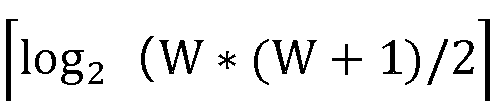


- For another example, for multi-carrier scheduling, it is assumed that an indication range of MCS is 0 to 31, then an encoding length for each MCS indication is:


- Specifically, the SLIV encoding method is as follows:
assuming that L is a length of each time segment, 1≤L≤W; S is a starting point position of each time segment (0≤S≤W-1), then the SLIV encoding method is as follows:
- In the above encoding process, 0≤L≤W-S.
- In summary, it can be seen that in the related art, each transmission information is encoded separately, which results in relatively large overhead and a waste of air interface resources.
- In view of this, embodiments of the present disclosure provide an information transmission method and apparatus, network device and UE to solve the problem of how to reduce information transmission overhead and save air interface resources when performing multiple information transmission.
- Referring to
FIG. 4 , one embodiment of the present disclosure provides an information transmission method, which is applied to a network device and includes the following steps. - Step 101: determining a target encoding length according to a parameter length W and a number M of transmission information; where a value or a value range of a corresponding index value s, of each transmission information in the M transmission information is: 0≤s≤W-1; a value of an n-th transmission information is less than or equal to a value of (n+1)-th transmission information, 1≤n≤M, n, M and W are positive integers.
- In this step, the value of the n-th transmission information is less than or equal to the value of the (n+1)-th transmission information. For example, when M=3, there are three pieces of transmission information including: start_1, start_2, and start_3, and 0≤start_1<start_2<start_3≤W-1; or, 0≤start_1≤start_2≤start_3≤W-1.
- The M pieces of transmission information are used to indicate dividing points of M+1 segments of the parameter length W; or,
the M pieces of transmission information are used to indicate M pieces of modulation code scheme (MCS) index information. - Optionally, the dividing points of the M+1 segments may be symbol values, slot values or other data.
- For example, in a specific application scenario, the parameter length W is the number of symbols. In
FIG. 5 , W=15 symbols, M=3, there are a total of 3 pieces if transmission information including: start_1, start_2, start_3; start_1, start_2, start_3 are specific symbol indexes respectively, and indicate dividing points of 4 time segments over a length of 15 symbols. Specifically, from 0 to start_1 is atime segment 1; from start_1 to start_2 is atime segment 2; from start_2 to start_3 is atime segment 3; from start3_ to start_4 is atime segment 4. - Exemplarily, in another specific application scenario, W is a value length of an MCS index, for example, W=32, and the transmission information is M pieces of MCS index information (for example, M=3, and the transmission information is: start_1, start_2, start_3), the relationship between the three pieces of transmission information is: 0<=start_1<=start_2<=start_3<=W-1, where start_1 corresponds to scheduled first carrier data, start_2 corresponds to scheduled second carrier data, and start_3 corresponds to scheduled third carrier data. It is to be pointed out that start_1, start_2, and start_3 here correspond to indication index of MCS.
- Step 102: encoding the M pieces of transmission information to obtain indication information, where a length of the indication information is the target encoding length.
- Optionally, the indication information is obtained by jointly encoding the M pieces of transmission information.
- In this step, by jointly encoding the M pieces of transmission information, the encoding length of the M pieces of transmission information can be reduced, and indication information with a smaller encoding length can be obtained.
- Step 103: sending the indication information to a user equipment (UE).
- By receiving the parameter length W and the number M of transmission information configured by the network device, the UE can obtain that the length of the indication information is the target encoding length, and then the UE can decode the indication information based on the target encoding length to obtain M pieces of transmission information.
- The
above step 101 is introduced hereinafter. - In one embodiment, the
above step 101 includes: - determining a first parameter; where the first parameter is used to represent the number of combinations of values of the M pieces of transmission information in a range of 0 to W-1;
- determining the target encoding length according to the first parameter.
- For example, when W=4, M=3, the three pieces of transmission information are: start_1, start_2, start_3, and 0≤start_1≤start_2≤start_3≤3, then when start_1=0, there are 10 possible values for start_2 and start_3; when start_1=1, there are 6 possible values for start_2 and start_3; when start_1=2, there are 3 possible values for start_2 and start_3; when start_1=3, there is 1 possible value for start_2 and start_3. It can be seen that when W=4 and M=3, the first parameter=10+6+3+1=20, that is, there are 20 possible combinations of numerical values. The specific values can be found in Table 4 in the following example 1.
- For example, when W=6, M=3, the three pieces of transmission information are: start_1, start_2, start_3, and 0≤start_1<start_2<start_3≤3, then when start_1=0, there are 10 possible values for start_2 and start_3; when start_1=1, there are 6 possible values for start_2 and start_3; when start_1=2, there are 3 possible values for start_2 and start_3; when start_1=3, there is 1 possible value for start_2 and start_3. It can be seen that when W6 and M=3, the first parameter=10+6+3+1=20, that is, there are 20 possible combinations of numerical values. The specific values can be found in Table 6 in the following example 2.
- For example, when W=3, M=4, the four pieces of transmission information are: start_0, start_1, start_2, start_3, and 0 ≤ start_0 ≤ start_1 ≤ start_2 ≤ start_3≤W-1, then when start_0=0, there are 10 possible values for start_1, start_2 and start_3; when start_0=1, there are 6 possible values for start_1, start_2 and start_3; when start_0=2, there are 3 possible values for start_1, start_2 and start_3. It can be seen that when W=3 and M=4, the first parameter=10+4+1=15 types. That is, there are 15 possible combinations of numerical values. The specific values can be found in Table 8 in the following example 3.
- In one embodiment, the determining the first parameter includes:
determining the first parameter according to the parameter length W, the number M of transmission information, and a first algorithm. - The first algorithm includes:
- when M=3,

- when M=4,


- In this embodiment, the first algorithm can summarize to obtain the above formula by exhaustively enumerating values of each transmission information for the cases of M=3 and M=4 respectively.
- For example, according to position relationship (0≤start_1≤start_2≤ start_3≤W-1) of three pieces of transmission information that need to be indicated, the following combinations of start_1 can be obtained:
- when start_1=0, values of start_2 and start_3 are W*(W+1)/2=10 types;
- when start_1=1, values of start_2 and start_3 are W*(W-1)/2=6 types;
- when start_1=2, values of start_2 and start_3 are (W-1)*(W-2)/2=3 types;
- when start_1=3, values of start_2 and start_3 are (W-2)*(W-3)/2=1 type.
- Further, it can be obtained that when M=3, the number of combinations of values of the three pieces of transmission information is:

- In one embodiment, the determining the target encoding length according to the first parameter, includes:
determining the target encoding length according to the first parameter and a second algorithm. - The second algorithm includes:
the target encoding
- Specifically, when M=3, the target encoding


when M=4, the target encoding

- In this embodiment, the target encoding

- In the above embodiment, by encoding correlation between the M pieces of transmission information, the information transmission overhead can be reduced and the transmission efficiency can be improved.
- For example, when M=3, three pieces of transmission information (start_1, start_2, start_3) are included. When the relationship between the three pieces of transmission information is 0≤start_1≤start_2≤start_3≤W-1, taking W=14 as an example, the number of bits required by the traditional encoding method is: 3 *


- For example, when M=4, four pieces of transmission information (start_0, start_1, start_2, start_3) are included. When the relationship between the four pieces of transmission information is 0≤start_0≤start_1≤start_2≤start_3≤W-1, taking W=14 as an example, the number of bits required by the traditional method is: 4 *
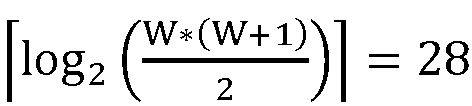


- The
above step 102 is introduced hereinafter with two situations. - M=3, the three pieces of transmission information include: first information, second information and third information, and a value of the first information is less than or equal to a value of the second information, and the value of the second information is less than or equal to a value of the third information.
- The
above step 102 includes: - determining a first encoding value according to the first information and the parameter length W;
- determining a second encoding value according to the parameter length W, the first information, the second information and the third information;
- obtaining the indication information according to the first encoding value and the second encoding value.
- In this embodiment, the indication information can be calculated based on the first encoding value and the second encoding value, such as, simply, the indication information is a sum of the first encoding value and the second encoding value.
- In one embodiment, the determining a first encoding value according to the first information and the parameter length W, includes:
- when start_1=0, SIV1=0; or,
- when start_1≥1,

- where start_1 is the first information; i=0,..., start_1-1; and i is an integer; W is the parameter length; SIV1 is the first encoding value.
- In this embodiment, an encoding relationship between the first encoding value SIV1 and the first information start_1 is defined.
- Specifically, the determining a second encoding value according to the parameter length W, the first information, the second information, and the third information, includes the following two modes.
- in one embodiment, the determining a second encoding value according to the parameter length W, the first information, the second information, and the third information includes:
determining the second encoding value according to the parameter length W, a difference between the second information and the first information, and a distance from the second information to the third information. - In this embodiment, the difference between the second information and the first information is equivalent to a starting position of the second information relative to the first information; and the distance from the second information to the third information can be a difference between the third information and the second information plus 1. Specifically, the distance from the second information to the third information is L=start_3-
star_2+ 1, where start_3 is the third information, and star_2 is the second information. - Specifically, the mode one includes the following two embodiments.
- In one embodiment, the determining the second encoding value according to a difference between the second information and the first information and a distance from the second information to the third information, includes:
- determining the second encoding value according to the formula:

- where start is the difference between the second information and the first information; SIV2 is the second encoding value; N is the difference between W and the first information; L is the distance from the second information to the third information; i=1, ..., L-1; and i is an integer; W is the parameter length.
- In this embodiment, the start is encoded in the low bit, and the L is encoded in the high bit.
- In another embodiment, the determining the second encoding value according to a difference between the second information and the first information and a distance from the second information to the third information, includes:
- when Start=0, the second encoding value is L;
- when start≥1, determining the second encoding value according to the formula:

- where start is the difference between the second information and the first information; SIV2 is the second encoding value; N is the difference between W and the first information; L is the distance from the second information to the third information, L≥1, and L is an integer; i=1, ..., L-1; and i is an integer; W is the parameter length.
- In this embodiment, the start is encoded in the high bit and the L is encoded in the low bit.
- For example, taking W=5 and start_1=0 as an example, the relationship between the above input information (start and L) and the second encoding value SIV2 is as shown in the following Table 2:
Table 2 N start L SIV2 5 0 0 0 5 0 1 1 5 0 2 2 5 0 3 3 5 0 4 4 5 1 0 5 5 1 1 6 5 1 2 7 5 1 3 8 5 2 0 9 5 2 1 10 5 2 2 11 5 3 0 12 5 3 1 13 5 4 0 14 - In one embodiment, the determining the second encoding value according to the parameter length W, the first information, the second information, and the third information, includes:
- in a case where

- in a case where

- where S is a difference between the second information and the first information; L is a distance from the second information to the third information; N is a difference between W and the first information; SIV2 is the second encoding value; start_1 is the first information; start_2 is the second information; start_3 is the third information; W is the parameter length. That is, S= start 2 - start_1 ; L= start 3 - start 2 + 1; N = W - start_1.
- In this embodiment, the second encoding value is determined based on the SLIV encoding method.
- For example, by taking W=5 and start_1=0 as an example, the relationship between the above input information (N, S, L) and the second encoding value SIV2 is as shown in the following Table 3.
Table 3 N S L SIV2 5 0 1 0 5 0 2 5 5 0 3 10 5 0 4 14 5 0 5 9 5 1 1 1 5 1 2 6 5 1 3 11 5 1 4 13 5 2 1 2 5 2 2 7 5 2 3 12 5 3 1 3 5 3 2 8 5 4 1 4 - It is to be noted that if start3, start_2, start_1 and W are used to directly express the encoding method, it is expressed as:
- in a case where start_3 - start_2 ≤ |(W - start_1)/2|, determining the second encoding value according to the formula: SIV2 = (W - start_1) (start_3 - start_2) + start_2 - start_1;
- in a case where start_3 - start_2 > |(W - start_1)/2|, determining the second encoding value according to the formula: SIV2 = (W - start_1) (W + start_2 - start_1 - start_3) + (W - 1 - start_2);
- where 0 < start_3 -
start_2+ 1 ≤ W - start_2; SIV2 is the second encoding value; start_1 is the first information; start_2 is the second information; start_3 is the third information; W is the parameter length. - In one embodiment, the determining the second encoding value according to the parameter length W, the first information, the second information, and the third information, includes:
- determining the second encoding value according to the formula:

- where start_1 is the first information; start_2 is the second information; start_3 is the third information; W is the parameter length.
- M=4, the four pieces of transmission information include: fourth information, fifth information, sixth information and seventh information, and a value of the fourth information is less than or equal to a value of the fifth information, the value of the fifth information is less than or equal to a value of the sixth information, and the value of the sixth information is less than or equal to a value of the seventh information, that is, 0≤ the value of the fourth information ≤ the value of the fifth information ≤ the value of the sixth information ≤ the value of the seventh information ≤ W-1.
- The
above step 102 includes: - determining a third encoding value according to the fourth information and the parameter length W;
- determining a fourth encoding value according to the fifth information and the parameter length W;
- determining a fifth encoding value according to the fourth information, the fifth information and the sixth information;
- obtaining the indication information according to the third encoding value, the fourth encoding value and the fifth encoding value.
- In this embodiment, the indication information can be calculated based on the third encoding value, the fourth encoding value and the fifth encoding value. For example, simply, the indication information is a sum of the third encoding value, the fourth encoding value and the fifth encoding value.
- In one embodiment, determining the third encoding value according to the fourth information and the parameter length W, includes:
- when start_0=0, SIV0=0;
- when start_0 ≥ 1,


- where start_0 is the fourth information; i=0, ..., start_0-1; and i is an integer; W is the parameter length; SIV0 is the third encoding value.
- In this embodiment, an encoding relationship between the third encoding value SIV0 and the fourth information start_0 is defined.
- In one embodiment, the determining the fourth encoding value according to the fifth information and the parameter length W, includes:
- when start_1=0, SIV1=0;
- when start_1≥1,

- where start_1 is the fifth information; i=0, ..., start_1-1; and i is an integer; W is the parameter length; SIV1 is the fourth encoding value.
- In this embodiment, an encoding relationship between the fourth encoding value SIV1 and the fifth information start_1 is defined.
- In one embodiment, the determining the fifth encoding value according to the fourth information, the fifth information and the sixth information, includes:
determining the fifth encoding value according to a difference between the fifth information and the fourth information, and a distance from the sixth information to the seventh information. - In this embodiment, the difference between the fifth information and the fourth information is equivalent to a starting position of the fifth information relative to the fourth information; and the distance from the sixth information to the seventh information can be a difference between the seventh information and the sixth information plus 1. Specifically, the distance from the sixth information to the seventh information is L=start_3-
star_2+ 1, where start_3 is the seventh information, and star_2 is the sixth information. - Specifically, the determining the fifth encoding value according to a difference between the fifth information and the fourth information, and a distance from the sixth information to the seventh information, includes:
- determining the fifth encoding value according to the formula: SIV2 =

- where start is the difference between the fifth information and the fourth information; SIV2 is the fifth encoding value; N is the difference between W and the fourth information; L is the distance from the sixth information and to the seventh information, L≥ 1, and L is an integer; i=1, ..., L-1; and i is an integer.
- In this embodiment, the start is encoded in the low bit and the L is encoded in the high bit.
- Referring to
FIG. 6 , one embodiment of the present disclosure provides an information transmission method, which is applied to a UE and includes the following steps: - Step 201: receiving indication information sent by a network device;
- Step 202: determining a target encoding length according to a parameter length W and a number M of transmission information; where an encoding length of the indication information is the target encoding length; a value or a value range of a corresponding index value s, of each transmission information in the M transmission information is: 0≤s≤W-1; a value of an n-th transmission information is less than or equal to a value of (n+1)-th transmission information, 1≤n≤M, n, M and W are positive integers.
- The M pieces of transmission information are used to indicate dividing points of M+1 segments of the parameter length W; or, the M pieces of transmission information are used to indicate M pieces of modulation code scheme (MCS) index information.
- Exemplarily, in a specific application scenario, the parameter length W is the number of symbols. In
FIG. 5 , W=15 symbols, M=3, there are a total of 3 pieces if transmission information including: start_1, start_2, start_3; start_1, start_2, start_3 indicate dividing points of 4 time segments over a length of 15 symbols. Specifically, from 0 to start_1 is atime segment 1; from start_1 to start_2 is atime segment 2; from start_2 to start_3 is atime segment 3; from start3_ to start_4 is atime segment 4. - Exemplarily, in another specific application scenario, W is a value length of an MCS index, for example, W=32, and the transmission information is M pieces of MCS index information (for example, M=3, and the transmission information is: start_1, start_2, start_3), the relationship between the three pieces of transmission information is: 0<=start_1<=start_2<=start_3<=W-1, where start_1 corresponds to scheduled first carrier data, start_2 corresponds to scheduled second carrier data, and start_3 corresponds to scheduled third carrier data. It is to be pointed out that start_1, start_2, and start_3 here correspond to indication index of MCS.
- Step 203: decoding the indication information according to the target encoding length to obtain M pieces of transmission information.
- In one embodiment, the
above step 202 includes: - determining a first parameter; where the first parameter is used to represent the number of combinations of values of the M pieces of transmission information in a range of 0 to W-1;
- determining the target encoding length according to the first parameter.
- For example, when W=4, M=3, the three pieces of transmission information are: start_1, start_2, start_3, and 0 ≤ start_1≤start_2≤start_3≤3, then when start_1=0, there are 10 possible values for start_2 and start_3; when start_1=1, there are 6 possible values for start_2 and start_3; when start_1=2, there are 3 possible values for start_2 and start_3; when start_1=3, there is 1 possible value for start_2 and start_3. It can be seen that when W=4 and M=3, the first parameter=10+6+3+1=20, that is, there are 20 possible combinations of numerical values. The specific values can be found in Table 4 in the following example 1.
- In one embodiment, the determining the first parameter, includes:
determining the first parameter according to the parameter length W, the number M of transmission information, and a first algorithm. - The first algorithm includes:
- when M=3,

- when M=4,


- In this embodiment, the first algorithm can summarize to obtain the above formula by exhaustively enumerating values of each transmission information for the cases of M=3 and M=4 respectively.
- In one embodiment, the determining the target encoding length according to the first parameter, includes:
determining the target encoding length according to the first parameter and a second algorithm. - The second algorithm includes:
the target encoding
- Specifically, when M=3, the target encoding


when M=4, the target encoding

- In this embodiment, the target encoding

- In one embodiment, M=3, the three pieces of transmission information include: first information, second information and third information, and a value of the first information is less than or equal to a value of the second information, and the value of the second information is less than or equal to a value of the third information.
- The
above step 203 includes: - decoding to obtain the first information and a first encoding value corresponding to the first information according to the parameter length W and the target encoding length;
- according to the first encoding value and the target encoding length, obtaining a second encoding value;
- determining the second information and the third information according to the parameter length W, the first information and the second encoding value.
- In one embodiment, decoding to obtain the first information and a first code value corresponding to the first information according to the parameter length W and the target encoding length includes:
- within the value range, traversing possible values of the first information, and determining a value that meets a first condition as the first information; the first condition is:

- determining the first encoding value according to the formula:

- where start_1 is the first information; i=0, ..., start_1-1; and i is an integer; W is the parameter length; SIV1 is the first encoding value; when start_1=0,

- For example, assuming W=4, according to the formula:


- In one embodiment, the determining the second information and the third information according to the parameter length W, the first information and the second encoding value, includes:
- obtaining a second encoding value according to the indication information and the first encoding value;
- obtaining a difference between the second information and the first information and a distance from the second information to the third information according to the parameter length W, the first information and the second encoding value.
- In one embodiment, the obtaining a difference between the second information and the first information and a distance from the second information to the third information according to the parameter length W, the first information and the second encoding value, includes:
- according to the formula:

- where start is the difference between the second information and the first information; SIV2 is the second encoding value; N is the difference between W and the first information; L is the distance from the second information to the third information; i=1, ..., L-1; and i is an integer; W is the parameter length.
- Exemplarily, the decoding process of the second information and the third information may include:
- Step 1: subtract SIV1 from SIV to get a value of SIV2, that is, SIV2=SIV-SIV1 (such as SIV2=8);
- Step 2: determining L and start according to

- first, traversing all possible values of L and calculating

- secondly, traversing X values corresponding to multiple L, and taking the L value so that X satisfies: 0<SIV2-X≤W-1-star_1;
- further, based on the above calculated L value and the corresponding X value, calculating start=SIV2-X.
- first, traversing all possible values of L and calculating
- Step 3: calculating the second information (start_2) and the third information (start_3) based on start and L.
- The formula is: start_2=start+start_1; start_3=start_2+L-1.
- In one embodiment, the obtaining a difference between the second information and the first information and a distance from the second information to the third information according to the parameter length W, the first information and the second encoding value, includes:
- according to the formula:

- wherein when Start=0, the second encoding value is L; start is the difference between the second information and the first information; SIV2 is the second encoding value; N is the difference between W and the first information; L is the distance from the second information to the third information, L≥1, and L is an integer; i=1, ..., L-1; and i is an integer; W is the parameter length.
- Exemplarily, the decoding process of the second information and the third information may include:
- Step 1: subtracting SIV1 from SIV to get a value of SIV2, that is, SIV2=SIV-SIV1 (such as SIV2=8);
- Step 2: using

- first, traversing all possible values of L and calculating

- second, traversing X values corresponding to multiple L, and taking the L value so that X satisfies: 0<SIV2-X≤W-1-star_1;
- further, based on the above calculated L value and the corresponding X value, calculating start=SIV2-X.
- first, traversing all possible values of L and calculating
- Step 3: determining the second information (start_2) and the third information (start_3) based on start and L.
- The formula is: start_2=start+start_1; start_3=start_2+L-1.
- The encoding and decoding processes in the above information transmission method of the present disclosure will be introduced hereinafter with reference to specific examples 1 to 3.
- For the situation that the parameter length configured and indicated by the base station is W, the number of transmission information is 3, and the 3 pieces of transmission information are: start_1, start_2, start_3, and 0≤start_1≤start_2≤start_3 ≤W-1, the following takes W=4 as an example for introduction.
- Step A: determining the number of bits of indication information (i.e., a target encoding length) as:

- Specifically, the step A includes the following steps:
step A-1, determining the number of combinations of values of the three pieces of transmission information in a way including: - first, according to position relationship of the three pieces of transmission information that need to be indicated (0≤start_1≤start_2≤start_3≤W-1), the following combinations of start_1 can be obtained:
- when start_1=0, values of start_2 and start_3 are

- when start_1 = 1, values of start_2 and start_3 are

- when start_1=2, values of start_2 and start_3 are

- when start_1=3, values of start_2 and start_3 are

- Further, it can be obtained that when M=3, the number of combinations of values of the three pieces of transmission information is:

- Therefore, when W=4,

- In order to facilitate verification, the values of the three pieces if transmission information when W=4 are listed in the following Table.
Table 4 serial number start_1 start_2 start_3 note 0 0 0 0 start_1=0, a total of 10 combinations 1 0 0 1 2 0 0 2 3 0 0 3 4 0 1 1 5 0 1 2 6 0 1 3 7 0 2 2 8 0 2 3 9 0 3 3 10 1 1 1 start_1=1, a total of 6 combinations 11 1 1 2 12 1 1 3 13 1 2 2 14 1 2 3 15 1 3 3 16 2 2 2 start_1=2, a total of 3 combinations 17 2 2 3 18 2 3 3 19 3 3 3 start_1=3, a total of 1 combination - Step A-2: based on the number of combinations of values of the three pieces of transmission information, obtaining the number of bits required for the indication information as:

- Therefore, when W=4, the number of bits required for the indication information is:

- Step B: in a case where bits of the indication information are limited to

- The step B includes the following steps B-1 and B-2:
- Step B-1: determining SIV1 based on the value of start_1 and the value of W; which specifically includes:
- when start_1=0, SIV1=0;
- when start 1 ≥ 1,

- Step B-2: determining SIV2 based on (start_2-start_1) and (start_3-star_2+1); which specifically includes:
- assuming start=start_2-start_1, L=(start_3-
star_2+ 1; N=W-star_1; - then,


- assuming start=start_2-start_1, L=(start_3-
- From the above steps B-1 and B-2, the following is obtained:

- In order to facilitate calculation, it can be simplified as:

- Further, based on the following Table 5, it can be seen that based on the above SIV determining method, the encoding length of the output indication information SIV can be limited to 5 bits.
Table 5 serial number W start_1 (input) start2 (input) start3 (input) SIV2 SIV1 SIV (output) 0 4 0 0 0 0 0 0 1 4 0 0 1 4 0 4 2 4 0 0 2 7 0 7 3 4 0 0 3 9 0 9 4 4 0 1 1 1 0 1 5 4 0 1 2 5 0 5 6 4 0 1 3 8 0 8 7 4 0 2 2 2 0 2 8 4 0 2 3 6 0 6 9 4 0 3 3 3 0 3 10 4 1 1 1 0 10 10 11 4 1 1 2 3 10 13 12 4 1 1 3 5 10 15 13 4 1 2 2 1 10 11 14 4 1 2 3 4 10 14 15 4 1 3 3 2 10 12 16 4 2 2 2 0 16 16 17 4 2 2 3 2 16 18 18 4 2 3 3 1 16 17 19 4 3 3 3 0 19 19 - Next, for the above example 1, a possible decoding process is introduced.
- First, it is assumed that the UE has received the parameter length W=4 and the number of transmission information M=3 configured by the base station. The decoding process mainly includes the following steps:
- Step C1: the UE determines an information bit length of a received DCI or MAC-CE (i.e., a length of the indication information SIV) according to the formula

- Step C2: according to the information bit length of the indication information, decoding indication information SIV sent by the base station (for example, the indication information is used to indicate (M+1) time segment information). Specifically, it includes the following steps:
Step C2-1: according to theformula 
- W=4, then when start_1=0, SIV1=0; when start_1=1, SIV1=10; when start_1=2, SIV1=16; when start_1=3, SIV1=19.
- Step C2-2: according to the received SIV, traversing all possible start_1, so that start_1 meets the following condition:

- For example, when the base station indicates SIV=8 and start_1=0, SIV1=0 and its corresponding value is closest to and smaller than SVI=8.
- Step C3: determining values start and L in a way including:
- Step C3-1: first finding a value of SIV2: subtracting SIV1 calculated in the
step 1 from SIV, that is, SIV2=SIV-SIV1 (such as SIV2=8); - Step C3-2: determining L and start according to SIV2 = start +

- Step C3-3: traversing all possible values of L and calculating

- assuming start_1=0, then N=4, then when L=1, X=0; when L=2, X=4; when L=3, X=4+3=7; when L=4, X=4+3+2=9;
- Step C3-4: traversing X values corresponding to multiple L, so that X satisfies 0<SIV2-X<=W-1-star_1, and calculating L.
- For example, start_1=0, W=4, SIV2=8, then when L=3, X=7, satisfying the above conditions.
- Step C3-5: calculating start=SIV2-X based on the above calculated L value and the corresponding X value.
- That is, L=3, start=8-7=1.
- Step C4: calculating start_2 and start_3 based on start and L; where start_2=start+start_1; start_3=start_2+L-1.
- That is, start_2=1, start 3=1+3-1=3.
- Therefore, a final decoding result is that when SIV=8, the decoding information is: start_1=0, start_2=1; start_3=3.
- Step C5: according to start_1, start_2, start_3, determining four segments in W as follows: from 0 to start_1 is a
time segment 1; from start_1 to start_2 is atime segment 2; from start_2 to start_3 is atime segment 3; from start3_ to start_4 is atime segment 4. - The parameter length configured and indicated by the base station is W, the number of transmission information is 3, and the three pieces of transmission information are: start_1, start_2, start_3, and 0 ≤start_1<start_2<start_3≤W-1.
- The following takes W=6 as an example for introduction.
- Step A: determining the number of bits of the indication information (i.e., a target encoding length) as:

- Specifically, the step A includes the following steps:
Step A-1: determining the number of combinations of values of the three pieces of transmission information. - First, according to relationship between the three pieces of transmission information (0<=start_1<start_2<start_3<W-1), it can be obtained that start_1 has the following situations:
- when start_1=0, values of start_2 and start_3 are

- when start_1 = 1, values of start_2 and start_3 are
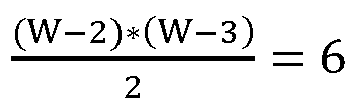
- when start_1=2, values of start_2 and start_3 are

- when start_1=3, values of start_2 and start_3 are

- Further, it can be obtained that when M=3, the number of combinations of values of the three pieces of transmission information is:

- Therefore, when W=6,

- In order to facilitate verification, when W=6, values of the three pieces of transmission information are listed in the following Table 6.
Table 6 serial number start_1 start_2 start_3 note 0 0 1 2 When start_1=0, a total of 10 combinations 1 0 1 3 2 0 1 4 3 0 1 5 4 0 2 3 5 0 2 4 6 0 2 5 7 0 3 4 8 0 3 5 9 0 4 5 10 1 2 3 When start_1=1, a total of 6 combinations 11 1 2 4 12 1 2 5 13 1 3 4 14 1 3 5 15 1 4 5 16 2 3 4 When start_1=2, a total of 3 combinations 17 2 3 5 18 2 4 5 19 3 4 5 When start_1=3, a total of 1 combination - Step A-2: based on the number of combinations of values of the three pieces of transmission information, obtaining the number of bits required for the indication information as:

- When W=6, the number of bits required for indication information is:

- Step B: determining the indication information SIV in a case where the bit length of the indication information is limited to
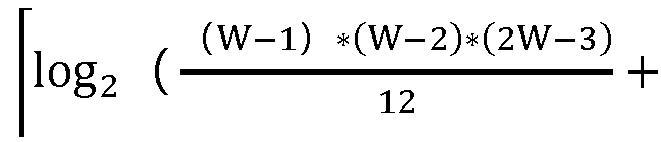

- The step B includes the following steps B-1 and B-2.
- Step B-1: determining SIV1 based on the value of start_1 and the value of W, which specifically includes:
- when start_1=0, SIV1=0;
- when start_1≥1,

- Step B-2: determining SIV2 based on (start_2-start_1-1) and (start_3-star2), which specifically includes:
assuming start=start_2-start_1-1, L=(start_3-star_2), N=W-1-star_1-1; then

- Note 1: L in the above formula can be understood as a distance from start_2 as a starting point to start_3, and then subtracting 1; when start_2 is equal to start_3, L=1; when start_2 and start_3 cannot overlap, the minimum value of L is 2. The purpose of subtracting 1 is to start from 1.
- Note 2: N in the above formula can be understood as the maximum value that L can take when the start_1 point is determined, and then subtracting 2. Considering that start_2 will not coincide with start_1, it is necessary to subtract 1, and considering that an original length of L is reduced by 1, it also needs to subtract 1 here.
- Note 3: start in the above formula is equivalent to the position of star_2 relative to
star 1, and then subtracting 1. The purpose is to make offset values of star_2 and start_1 start from 0. - From the above steps B-1 and B-2, the following can be obtained:

- In order to facilitate calculation, it can be simplified as:

- Further, based on the following Table 7, it can be seen that based on the above SIV determination method, the encoding length of the output indication information SIV can be limited to 5 bits.
Table 7 serial number W (parameter) Start_1 (input) Start_2 (input) Start_3 (input) SIV2 SIV1 SIV (output) 0 6 0 1 2 0 0 0 1 6 0 1 3 4 0 4 2 6 0 1 4 7 0 7 3 6 0 1 5 9 0 9 4 6 0 2 3 1 0 1 5 6 0 2 4 5 0 5 6 6 0 2 5 8 0 8 7 6 0 3 4 2 0 2 8 6 0 3 5 6 0 6 9 6 0 4 5 3 0 3 10 6 1 2 3 0 10 10 11 6 1 2 4 3 10 13 12 6 1 2 5 5 10 15 13 6 1 3 4 1 10 11 14 6 1 3 5 4 10 14 15 6 1 4 5 2 10 12 16 6 2 3 4 0 16 16 17 6 2 3 5 2 16 18 18 6 2 4 5 1 16 17 19 6 3 4 5 0 19 19 - It should be pointed out that the decoding process in the above example 2 is similar to the example 1 and can be executed as a reference.
- The parameter length configured and indicated by the base station is W, the number of transmission information is 4, and the 4 pieces of transmission information are: start_0, start_1, start_2, start_3, and 0 ≤ start_0 ≤ start_1 ≤ start_2 ≤ start_3 ≤W-1.
- The following takes W=3 as an example for introduction.
- Step A: determining the number of bits of the indication information (i.e., a target encoding length) as:


- Specifically, the step A includes the following steps.
- Step A-1: determining the number of combinations of values of the four pieces of transmission information.
- First, according to relationship between the four pieces of transmission information (0≤start_0≤start_1≤start_2≤start_3≤W-1), it can be obtained that start_0 has the following situations:
- when start_0=0, values of start_1, start_2 and start_3 are

- when start_0 = 1, values of start_1, start_2 and start_3 are

- when start_0=2, values of start_1, start_2 and start_3 are

- Further, it can be obtained that when M=4, the number of combinations of values of the four pieces of transmission information is:

- Therefore, when W=3,


- In order to facilitate verification, when W=3, the values of the four pieces pf transmission information are listed in the following Table 8.
Table 8 serial number start_0 start_1 start_2 start_3 note 0 0 0 0 0 start_0=0, 10 combinations 1 0 0 0 1 2 0 0 0 2 3 0 0 1 1 4 0 0 1 2 5 0 0 2 2 6 0 1 1 1 7 0 1 1 2 8 0 1 2 2 9 0 2 2 2 10 1 1 1 1 start_0=1, 4 combinations 11 1 1 1 2 12 1 1 2 2 13 1 2 2 2 14 2 2 2 2 start_0=2, 1combination - Step A-2: based on the number of combinations of values of the four pieces of transmission information, obtaining the number of bits required for the indication information as:


when w=3,

- Step B: in a case where the bit length of the indicated information is limited to


- Specifically, the indication information SIV=SIV0+SIV1+SIV2.
- The step B includes the following steps B-1, step B-2 and step B-3.
- Step B-1: determining SIV0 based on values of start_0 and W.
- When start_0=0, SIV1=0;
when start _0 ≥ 1,

- Step B-2: determining SIV1 based on the value of start _0, the value of start_1 and the value of W.
- When start _1=0, SIV1=0;
When start_1 ≥,
- Step B-3: determining SIV2 based on (start_2-start_1-1) and (start_3-star2).
- It is assumed that start=start_2-start_1, L=(start_3-star_2+1), N=W-
star 1; then

- Note 1: L in the above formula can be understood as a distance from start_2 as a starting point to start_3, and when start_2 and start_3 are equal, L=1.
- Note 2: N in the above formula can be understood as the maximum value that L can take when star_1 point is determined. For example, when star_1=0, the maximum value of L is W. When star_2=1, the maximum value of L is W-1.
- Note 3: start in the above formula is equivalent to the position of star_2 relative to star_1.
- From the above steps B-1, B-2 and B-3, the following can be obtained:

- For ease of calculation, it can be simplified as:

- Further, the following table shows encoding output results of 4 pieces of information when W=3. Based on the following Table 9, it can be seen that based on the above SIV determination method, the encoding length of the output indication information SIV can be limited to 4 bits.
Table 9 serial number W start_0 start_1 start2 start3 SIV2 SIV1 SIV SIV0 0 3 0 0 0 0 0 0 0 0 1 3 0 0 0 1 3 0 3 0 2 3 0 0 0 2 5 0 5 0 3 3 0 0 1 1 1 0 1 0 4 3 0 0 1 2 4 0 4 0 5 3 0 0 2 2 2 0 2 0 6 3 0 1 1 1 0 6 6 0 7 3 0 1 1 2 2 6 8 0 8 3 0 1 2 2 1 6 7 0 9 3 0 2 2 2 0 9 9 0 10 3 1 1 1 1 0 0 10 10 11 3 1 1 1 2 2 0 12 10 12 3 1 1 2 2 1 0 11 10 13 3 1 2 2 2 0 3 13 10 14 3 2 2 2 2 0 0 14 14 - Next, for the above example three, a possible decoding process is introduced.
- First, it is assumed that the UE has received the parameter length W=3 configured by the base station, and the number of transmission information M=5, including: start_0, start_1, start_2, start_3. The decoding process mainly includes the following steps.
- Step C1: the UE determines an information bit length (a length of the indication information SIV) of DCI or MAC-CE according to the formula

- Step C2: decoding the indication information SIV sent by the base station according to the information bit length of the indication information.
- Step C2-1: determining a possible value of a third encoding value (SIVO) according to the formula:


- W=3, when start_0=0, SIV0=0, when start_0=1, SIV0=10; when start_0=2, SIV0=14.
- Step C2-2: according to the received indication information SIV, traversing all possible start_0, so that start_0 meets the following condition:

- For example, when the base station indicates SIV=8 and start _0=0, SIV0=0 and its corresponding value is closest to and smaller than SIV, then it can be determined: start_0=0 and SIV0=0.
- Step C2-3: based on the start_0 and SIV0 calculated in the step C2-2, further determining SIV1 and start_1.
- First, calculating the possible value of SIV1 according to the formula

- For the sake of illustration, if start_0=0, then when start_1=0, SIV0=0; when start_1=1, SIV0=6; when start_1=2, SIV0=9.
- Second, using SIV-SIV0 to traverse all possible start_1 so that start_1 satisfies the following condition: max

- For example, the base station indicates SIV-SIV0=8, then when start_1=1, the corresponding value of SIV0=6 is closest to and smaller than SVI=8. Then it can be determined: start_1=1, SIV1=8.
- Step C-3: calculating values start and L.
- Step C3-1: calculating SIV2 (such as SIV2=2) according to the formula: SIV2=SIV-SIV0-SIV1;
Step C3-2: using
traversing all possible values of L and calculating
- Step C3-21: assuming start_1=1, then N=2, and when L=1, X=0; when L=2, X=2.
- Step C3-22: traversing multiple X values corresponding to L, so that X satisfies 0<SIV2-X<=W-1-star_1, and calculating L.
- For example, start_1=1, W=3, SIV2=2, then when L=2, X=2, satisfying the above condition.
- Step C3-23: calculating start=SIV2-X based on the above calculated L value and the corresponding X value. That is, L=2, start=0.
- Step C4: calculating start_2 and start_3 based on start and L; where start_2=start+start_1; start_3=start_2+L-1.
- That is, start_2=0+1=1, start_3=1+2-1=2.
- In summary, it can be concluded from the above steps: when the current SIV=8, the decoded 4 pieces of transmission information is: start_0=0, start_1=1, start_2=1, start_3=2.
- Step C5: based on information of start_0, start_1, start_2, and start_3, determining the four segments in W as follows: from 0 to start_0 is a
time segment 0; from start_0 to start_1 is atime segment 1; from start_1 to start_2 is atime segment 2; from start_2 to start_3 is atime segment 3; from start3_ to start 4 is atime segment 4. - Example four: for the scheme in which SIV2 in the examples 1 and 2 is encoded using the SLIV method, the following decoding example is given:
for the SIV2 encoding scheme in the examples 1 and 2 using the SLIV method, a decoding example is provided as follows. - The UE receives indication information sent by the base station and parses a value of SIV2 according to the first and second embodiments. The following describes the process of decoding S and L via SIV2, which mainly includes the following steps.
- Step 1: dividing SIV2 by N, adding an integer part and a remainder part, and obtaining decode1; that is,

- Step 2: determining values of L and S according to decode1.
- Specifically, if decode1 ≤N-1 (note: decode1=L+S-1), then



- In the above formula, mod() means finding the remainder, and

- Referring to
FIG. 7 , one embodiment of the present disclosure provides aninformation transmission device 700, including: - a
first determination module 701 used to determine a target encoding length according to a parameter length W and a number M of transmission information; where a value or a value range of a corresponding index value s, of each transmission information in the M transmission information is: 0 ≤ s ≤ W-1; a value of an n-th transmission information is less than or equal to a value of (n+1)-th transmission information, 1 ≤n≤M, n, M and W are positive integers; - an
encoding module 702 used to encode the M pieces of transmission information to obtain indication information, where a length of the indication information is the target encoding length; - a
transmission module 703 used to send the indication information to a user equipment (UE). - Optionally, the M pieces of transmission information are used to indicate dividing points of M+1 segments of the parameter length W; or, the M pieces of transmission information are used to indicate M pieces of modulation code scheme (MCS) index information.
- Optionally, the
first determination module 701 includes: - a first determination sub-module used to determine a first parameter; where the first parameter is used to represent the number of combinations of values of the M pieces of transmission information in a range of 0 to W-1;
- a second determination sub-module used to determine the target encoding length according to the first parameter.
- Optionally, the first determination sub-module is specifically used to:
determine the first parameter according to the parameter length W, the number M of transmission information, and a first algorithm. - Optionally, the first algorithm includes:
- when M=3, the first

- when M=4, the first


- Optionally, the second determination sub-module is specifically used to:
determine the target encoding length according to the first parameter and a second algorithm. - Optionally, the second algorithm includes:
the target encoding
- Optionally, in a case where M=3, the M pieces of transmission information include: first information, second information and third information, and a value of the first information is less than or equal to a value of the second information, and the value of the second information is less than or equal to a value of the third information.
- The
encoding module 702 includes: - a first encoding submodule used to determine a first encoding value according to the first information and the parameter length W;
- a second encoding submodule used to determine a second encoding value according to the parameter length W, the first information, the second information, and the third information;
- a third encoding submodule used to obtain the indication information according to the first encoding value and the second encoding value.
- Optionally, the first encoding submodule is specifically used to determine:
- when start_1=0, SIV1=0;
- when start_1>=1,

- wherein start_1 is the first information; i=0, ..., start_1-1; and i is an integer; W is the parameter length; SIV1 is the first encoding value.
- Optionally, the first encoding submodule includes:
a first encoding unit used to determine the second encoding value according to the parameter length W, a difference between the second information and the first information, and a distance from the second information to the third information. - Optionally, the first encoding unit is specifically used to:
- determine the second encoding value according to the formula: SIV2 =

- where start is the difference between the second information and the first information; SIV2 is the second encoding value; N is the difference between W and the first information; L is the distance from the second information to the third information; i=1, ..., L-1; and i is an integer; W is the parameter length.
- Optionally, the first encoding unit is specifically used to:
- when Start=0, determine the second encoding value as L;
- when start ≥ 1, determine the second encoding value according to the formula:

- where start is the difference between the second information and the first information; SIV2 is the second encoding value; N is the difference between W and the first information; L is the distance from the second information to the third information, L ≥ 1, and L is an integer; i=1, ..., L-1; and i is an integer; W is the parameter length.
- Optionally, the first encoding sub-module includes a second encoding unit used to:
- in a case where start_3 - start_2 ≤ |(W - start_1)/2|, determine the second encoding value according to the formula: SIV2 = (W - start_1) (start_3 - start_2) + start_2 - start_1;
- in a case where start_3 - start_2 > |(W - start_1)/2|, determine the second encoding value according to the formula: SIV2 = (W - start_1) (W + start_2 - start_1 - start_3) + (W - 1 - start_2);
- where 0 < start_3 -
start_2 + 1 ≤ W - start_2; SIV2 is the second encoding value; start_1 is the first information; start_2 is the second information; start_3 is the third information; W is the parameter length. - Optionally, the first encoding sub-module includes a third encoding unit used to:
- determine the second encoding value according to the formula: SIV2 =

- where start_1 is the first information; start_2 is the second information; start_3 is the third information; W is the parameter length.
- Optionally, in the case of M=4, the M pieces of transmission information include: fourth information, fifth information, sixth information and seventh information, and a value of the fourth information is less than or equal to a value of the fifth information, the value of the fifth information is less than or equal to a value of the sixth information, and the value of the sixth information is less than or equal to a value of the seventh information.
- The
encoding module 702 includes: - a fourth encoding submodule used to determine a third encoding value according to the fourth information and the parameter length W;
- a fifth encoding submodule used to determine a fourth encoding value according to the fifth information and the parameter length W;
- a sixth encoding submodule used to determine a fifth encoding value according to the fourth information, the fifth information, and the sixth information;
- a seventh encoding sub-module used to obtain the indication information according to the third encoding value, the fourth encoding value and the fifth encoding value.
- Optionally, the fourth encoding submodule is specifically used to determine:
- when start_0=0, SIV0=0;
- when start_0 ≥ 1,


- where start_0 is the fourth information; i=0, ..., start_0-1; and i is an integer; W is the parameter length; SIV0 is the third encoding value.
- Optionally, the fifth encoding submodule is specifically used to determine:
- when start_1=0, SIV1=0;
- when start_1 ≥ 1,

- where start_1 is the fifth information; i=0, ..., start_1-1; and i is an integer; W is the parameter length; SIV1 is the fourth encoding value.
- Optionally, the sixth coding submodule includes:
a fourth encoding unit used to determine a fifth encoding value according to a difference between the fifth information and the fourth information, and a distance from the sixth information to the seventh information. - Optionally, the fourth encoding unit is specifically used to:
- determine the fifth encoding value according to the formula: SIV2 =

- where start is the difference between the fifth information and the fourth information; SIV2 is the fifth encoding value; N is the difference between W and the fourth information; L is the distance from the sixth information and to the seventh information, L ≥ 1, and L is an integer; i=1, ..., L-1; and i is an integer.
- It is to be noted here that the above device provided in the embodiment of the present disclosure can implement all the method steps implemented by the above method embodiment on the third network element side, and can achieve the same technical effect. The parts and beneficial effects of this embodiment that are the same as those of the method embodiment will not be described in detail here.
- Referring to
FIG. 8 , one embodiment of the present disclosure provides aninformation transmission device 800, including: - a
receiving module 801 used to receive indication information sent by a network device; - a
second determination module 802 used to determine a target encoding length according to a parameter length W and a number M of transmission information; where an encoding length of the indication information is the target encoding length; a value or a value range of a corresponding index value s, of each transmission information in the M transmission information is: 0 ≤ s ≤ W-1; a value of an n-th transmission information is less than or equal to a value of (n+1)-th transmission information, 1 ≤n≤M, n, M and W are positive integers; - a
decoding module 803 used to decode the indication information according to the target encoding length to obtain M pieces of transmission information. - Optionally, the M pieces of transmission information are used to indicate dividing points of M+1 segments of the parameter length W; or,
the M pieces of transmission information are used to indicate M pieces of modulation code scheme (MCS) index information. - Optionally, the
second determination module 802 includes: - a third determination sub-module used to determine a first parameter, where the first parameter is used to represent the number of combinations of values of the M pieces of transmission information in a range of 0 to W-1;
- a fourth determination sub-module used to determine the target encoding length according to the first parameter.
- Optionally, the third determination sub-module is specifically used to:
determine the first parameter according to the parameter length W, the number M of transmission information, and a first algorithm. - Optionally, the first algorithm includes:
- when M=3, the first

- when M=4, the first


- Optionally, the fourth determination sub-module is specifically used to:
determine the target encoding length according to the first parameter and a second algorithm. - Optionally, the second algorithm includes:
the target encoding
- Optionally, in a case of M=3, the M pieces of transmission information include: first information, second information and third information, and a value of the first information is less than or equal to a value of the second information, and the value of the second information is less than or equal to a value of the third information.
- The
decoding module 803 includes: - a first decoding submodule used to decode to obtain the first information and a first encoding value corresponding to the first information according to the parameter length W and the target encoding length;
- a second decoding submodule used to obtain a second encoding value according to the first encoding value and the target encoding length;
- a third decoding submodule used to determine the second information and the third information according to the parameter length W, the first information and the second encoding value.
- Optionally, the first decoding sub-module is specifically used to:
- within the value range, traverse possible values of the first information, and determine a value that meets a first condition as the first information; the first condition is:

- determine the first encoding value according to the formula:

- where start_1 is the first information; i=0, ..., start_1-1; and i is an integer; W is the parameter length; SIV1 is the first encoding value; when start_1=0,

- Optionally, the second decoding sub-module includes:
a first decoding unit used to obtain a difference between the second information and the first information and a distance from the second information to the third information according to the parameter length W, the first information and the second encoding value. - Optionally, the first decoding unit is specifically used to:
- according to the formula:

- where start is the difference between the second information and the first information; SIV2 is the second encoding value; N is the difference between W and the first information; L is the distance from the second information to the third information; i=1, ..., L-1; and i is an integer; W is the parameter length.
- Optionally, the first decoding unit is specifically used to:
- according to the formula:

- where when Start=0, the second encoding value is L; start is the difference between the second information and the first information; SIV2 is the second encoding value; N is the difference between W and the first information; L is the distance from the second information to the third information, L ≥ 1, and L is an integer; i=1, ..., L-1; and i is an integer; W is the parameter length.
- It is to be noted here that the above device provided in the embodiment of the present disclosure can implement all the method steps implemented by the above method embodiment on the UE side, and can achieve the same technical effect. The parts and beneficial effects of this embodiment that are the same as those of the method embodiment will not be described in detail here.
- Referring to
FIG. 9 , one embodiment of the present disclosure provides a network device, including: aprocessor 910; and amemory 920 connected to theprocessor 910 through a bus interface. Thememory 920 is used to store programs and data used by theprocessor 910 when performing operations. Theprocessor 910 calls and executes the programs and data stored in thememory 920. Atransceiver 900 is connected to the bus interface and is used to receive and send data under the control of theprocessor 910. Theprocessor 910 is used to read the program in thememory 920 and perform the following processes: - determining a target encoding length according to a parameter length W and a number M of transmission information; where a value or a value range of a corresponding index value s, of each transmission information in the M transmission information is: 0≤s≤W-1; a value of an n-th transmission information is less than or equal to a value of (n+1)-th transmission information, 1 ≤n≤M, n, M and W are positive integers;
- encoding the M pieces of transmission information to obtain indication information, where a length of the indication information is the target encoding length;
- sending the indication information to a user equipment (UE).
- Optionally, the M pieces of transmission information are used to indicate dividing points of M+1 segments of the parameter length W; or, the M pieces of transmission information are used to indicate M pieces of modulation code scheme (MCS) index information.
- Optionally, the
processor 910 is further used to read the program in thememory 920 and perform the following processes: - determining a first parameter; where the first parameter is used to represent the number of combinations of values of the M pieces of transmission information in a range of 0 to W-1;
- determining the target encoding length according to the first parameter.
- Optionally, the
processor 910 is further used to read the program in thememory 920 and perform the following processes:
determining the first parameter according to the parameter length W, the number M of transmission information, and a first algorithm. - Optionally, the first algorithm includes:
- when M=3, the first

- when M=4, the first


- Optionally, the
processor 910 is further used to read the program in thememory 920 and perform the following processes:
determining the target encoding length according to the first parameter and a second algorithm. - Optionally, the second algorithm includes:
the target encoding
- Optionally, in a case where M=3, the M pieces of transmission information include: first information, second information and third information, and a value of the first information is less than or equal to a value of the second information, and the value of the second information is less than or equal to a value of the third information.
- Optionally, the
processor 910 is further used to read the program in thememory 920 and perform the following processes: - determining a first encoding value according to the first information and the parameter length W;
- determining a second encoding value according to the parameter length W, the first information, the second information, and the third information;
- obtaining the indication information according to the first encoding value and the second encoding value.
- Optionally, the
processor 910 is further used to read the program in thememory 920 and perform the following processes: - when start_1=0, SIV1=0;
- When start_1>=1,

- wherein start_1 is the first information; i=0, ..., start_1-1; and i is an integer; W is the parameter length; SIV1 is the first encoding value.
- Optionally, the
processor 910 is further used to read the program in thememory 920 and perform the following processes:
determining the second encoding value according to the parameter length W, a difference between the second information and the first information, and a distance from the second information to the third information. - Optionally, the
processor 910 is further used to read the program in thememory 920 and perform the following processes: - determining the second encoding value according to the formula:

- where start is the difference between the second information and the first information; SIV2 is the second encoding value; N is the difference between W and the first information; L is the distance from the second information to the third information; i=1, ..., L-1; and i is an integer; W is the parameter length.
- Optionally, the
processor 910 is further used to read the program in thememory 920 and perform the following processes: - when Start=0, determining the second encoding value as L;
- when start ≥ 1, determining the second encoding value according to the formula:

- where start is the difference between the second information and the first information; SIV2 is the second encoding value; N is the difference between W and the first information; L is the distance from the second information to the third information, L ≥ 1, and L is an integer; i=1, ..., L-1; and i is an integer; W is the parameter length.
- Optionally, the
processor 910 is further used to read the program in thememory 920 and perform the following processes: - in a case where start_3 - start_2 ≤ |(W - start_1)/2|, determining the second encoding value according to the formula: SIV2 = (W - start_1) (start_3 - start_2) + start_2 - start_1;
- in a case where start_3 - start_2 > |(W - start_1)/2|, determining the second encoding value according to the formula: SIV2 = (W - start_1) (W + start_2 - start_1 - start_3) + (W - 1 - start_2);
- where 0 < start_3 -
start_2 + 1 ≤ W - start_2; SIV2 is the second encoding value; start_1 is the first information; start_2 is the second information; start_3 is the third information; W is the parameter length. - Optionally, the
processor 910 is further used to read the program in thememory 920 and perform the following processes: - determining the second encoding value according to the formula:

- where start_1 is the first information; start_2 is the second information; start_3 is the third information; W is the parameter length.
- Optionally, in the case of M=4, the M pieces of transmission information include: fourth information, fifth information, sixth information and seventh information, and a value of the fourth information is less than or equal to a value of the fifth information, the value of the fifth information is less than or equal to a value of the sixth information, and the value of the sixth information is less than or equal to a value of the seventh information.
- Optionally, the
processor 910 is further used to read the program in thememory 920 and perform the following processes: - determining a third encoding value according to the fourth information and the parameter length W;
- determining a fourth encoding value according to the fifth information and the parameter length W;
- determining a fifth encoding value according to the fourth information, the fifth information, and the sixth information;
- obtaining the indication information according to the third encoding value, the fourth encoding value and the fifth encoding value.
- Optionally, the
processor 910 is further used to read the program in thememory 920 and perform the following processes: - when start_0=0, SIV0=0;
- when start_0 ≥ 1,


- where start_0 is the fourth information; i=0, ..., start_0-1; and i is an integer; W is the parameter length; SIV0 is the third encoding value.
- Optionally, the
processor 910 is further used to read the program in thememory 920 and perform the following processes: - when start_1=0, SIV1=0;
- when start_1 ≥ 1,

- where start_1 is the fifth information; i=0, ..., start_1-1; and i is an integer; W is the parameter length; SIV1 is the fourth encoding value.
- Optionally, the
processor 910 is further used to read the program in thememory 920 and perform the following processes:
determining a fifth encoding value according to a difference between the fifth information and the fourth information, and a distance from the sixth information to the seventh information. - Optionally, the
processor 910 is further used to read the program in thememory 920 and perform the following processes: - determining the fifth encoding value according to the formula: SIV2 =

- where start is the difference between the fifth information and the fourth information; SIV2 is the fifth encoding value; N is the difference between W and the fourth information; L is the distance from the sixth information and to the seventh information, L ≥ 1, and L is an integer; i=1, ..., L-1; and i is an integer.
- In
FIG. 9 , a bus architecture may include any number of interconnected bus and bridge. Specifically, various circuits of one or more processors, which are represented by theprocessor 910, and one or more memories, which are represented by thememory 920, are linked together. The bus architecture may link various other circuits, such as a peripheral device, voltage regulator and a power management circuit together. These features are well known in this field; therefore, this disclosure does not make further description on these features. The bus interface provides an interface. Thetransceiver 900 may be multiple elements, including a transmitter and a receiver and provide units, which communicate with other devices on the transmission medium. The transmission medium includes radio channels, wired channels, optical cables, etc. Theprocessor 910 is responsible for managing the bus architecture and the normal processing. Thememory 920 may be used to store data used by theprocessor 910 for performing operations. - The
processor 910 may be a central processing unit (CPU), an application specific integrated circuit (ASIC), a field-programmable gate array (FPGA) or a complex programmable logic device (CPLD). The processor may also adopt multi-core architecture. - The processor calls the computer program stored in the memory to execute any method provided in the embodiment of the present disclosure according to obtained executable instructions. The processor and the memory may also be arranged physically separately.
- Referring to
FIG. 10 , one embodiment of the present disclosure provides a UE, including: aprocessor 1010, and amemory 1020 connected to theprocessor 1010 through a bus interface. Thememory 1020 is used to store programs and data used by theprocessor 1010 when performing operations. Theprocessor 1010 calls and executes the programs and data stored in thememory 1020. - A
transceiver 1000 is connected to the bus interface and is used to receive and send data under the control of theprocessor 1010. Theprocessor 1010 is used to read the program in thememory 1020 and perform the following processes: - receiving indication information sent by a network device;
- determining a target encoding length according to a parameter length W and a number M of transmission information; where an encoding length of the indication information is the target encoding length; a value or a value range of a corresponding index value s, of each transmission information in the M transmission information is: 0≤s≤W-1; a value of an n-th transmission information is less than or equal to a value of (n+1)-th transmission information, 1≤n≤M, n, M and W are positive integers;
- decoding the indication information according to the target encoding length to obtain M pieces of transmission information.
- Optionally, the M pieces of transmission information are used to indicate dividing points of M+1 segments of the parameter length W; or,
the M pieces of transmission information are used to indicate M pieces of modulation code scheme (MCS) index information. - Optionally, the
processor 1010 is further used to read the program in thememory 1020 and perform the following processes: - determining a first parameter; where the first parameter is used to represent the number of combinations of values of the M pieces of transmission information in a range of 0 to W-1;
- determining the target encoding length according to the first parameter.
- Optionally, the
processor 1010 is further used to read the program in thememory 1020 and perform the following processes:
determining the first parameter according to the parameter length W, the number M of transmission information, and a first algorithm. - Optionally, the first algorithm includes:
- when M=3, the first

- when M=4, the first


- Optionally, the
processor 1010 is further used to read the program in thememory 1020 and perform the following processes:
determining the target encoding length according to the first parameter and a second algorithm. - Optionally, the second algorithm includes:
the target encoding
- Optionally, in a case where M=3, the M pieces of transmission information include: first information, second information and third information, and a value of the first information is less than or equal to a value of the second information, and the value of the second information is less than or equal to a value of the third information.
- Optionally, the
processor 1010 is further used to read the program in thememory 1020 and perform the following processes: - decoding to obtain the first information and a first encoding value corresponding to the first information according to the parameter length W and the target encoding length;
- obtaining a second encoding value according to the first encoding value and the target encoding length;
- determining the second information and the third information according to the parameter length W, the first information and the second encoding value.
- Optionally, the
processor 1010 is further used to read the program in thememory 1020 and perform the following processes: - within the value range, traversing possible values of the first information, and determining a value that meets a first condition as the first information; the first condition is:

- determining the first encoding value according to the formula:

- where start_1 is the first information; i=0, ..., start_1-1; and i is an integer; W is the parameter length; SIV1 is the first encoding value; when start_1=0,

- Optionally, the
processor 1010 is further used to read the program in thememory 1020 and perform the following processes:
obtaining a difference between the second information and the first information and a distance from the second information to the third information according to the parameter length W, the first information and the second encoding value. - Optionally, the
processor 1010 is further used to read the program in thememory 1020 and perform the following processes: - according to the formula:

- where start is the difference between the second information and the first information; SIV2 is the second encoding value; N is the difference between W and the first information; L is the distance from the second information to the third information; i=1, ..., L-1; and i is an integer; W is the parameter length.
- Optionally, the
processor 1010 is further used to read the program in thememory 1020 and perform the following processes: - according to the formula:

- where when Start=0, the second encoding value is L; start is the difference between the second information and the first information; SIV2 is the second encoding value; N is the difference between W and the first information; L is the distance from the second information to the third information, L ≥ 1, and L is an integer; i=1, ..., L-1; and i is an integer; W is the parameter length.
- In
FIG. 10 , a bus architecture may include any number of interconnected bus and bridge. Specifically, various circuits of one or more processors, which are represented by theprocessor 1010, and one or more memories, which are represented by thememory 1020, are linked together. The bus architecture may link various other circuits, such as a peripheral device, voltage regulator and a power management circuit together. These features are well known in this field; therefore, this disclosure does not make further description on these features. The bus interface provides an interface. Thetransceiver 1000 may be multiple elements, including a transmitter and a receiver and provide units, which communicate with other devices on the transmission medium. The transmission medium includes radio channels, wired channels, optical cables, etc. For different UEs, auser interface 1030 may be an interface that can be connected to external or internal devices. The connected devices include but are not limited to a small keyboard, a display, a speaker, a microphone, a joystick, etc. - The
processor 1010 may be a central processing unit (CPU), an application specific integrated circuit (ASIC), a field-programmable gate array (FPGA) or a complex programmable logic device (CPLD). The processor may also adopt multi-core architecture. - The present disclosure further provides a processor-readable storage medium that stores a computer program, and the computer program is used to cause the processor to execute the above method.
- The processor-readable storage medium may be any available media or data storage device that the processor can access, including but not limited to magnetic storage (such as floppy disks, hard disks, magnetic tapes, magneto-optical disks (MO), etc.), optical storage (such as compact disk (CD), digital versatile disc (DVD), blu-ray disc (BD), high-definition versatile disc (HVD), etc.), and semiconductor memories (such as ROM, erasable programmable read-only memory (EPROM), electrically erasable programmable read-only memory (EEPROM), non-volatile memory (NAND FLASH), solid state drive (SSD)), etc.
- It is to be noted that division of units in the embodiment of the present disclosure is exemplary, and is only a logical function division, and there may be another division manner in actual implementation. In addition, each functional unit in each embodiment of the present application may be integrated into one processing unit, each unit may exist separately physically, or two or more units may be integrated into one unit. The foregoing integrated units may be implemented in the form of hardware or in the form of software functional units.
- If the integrated units are realized in the form of software function units and sold or used as independent products, they may be stored in a processor-readable storage medium. Based on this understanding, the essence of the technical solution of the present disclosure or the part that contributes to the related art or the part of the technical solution may be embodied in the form of a software product. The computer software product is stored in a storage medium, includes several instructions which enables a computer device (which may be a personal computer, a server, or a network device, etc.) or a processor to execute all or part of the steps of the methods described in various embodiments of the present disclosure. The storage medium includes various media capable of storing program codes such as U disk, mobile hard disk, ROM, RAM, magnetic disk or optical disk.
- Those skilled in the art should understand that the embodiments of the present application may be provided as methods, systems, or computer program products. Accordingly, in this application, an entirely hardware embodiment, an entirely software embodiment, or an embodiment combining software and hardware aspects may be adopted. Further, this application may adopt the form of a computer program product implemented on one or more computer available storage media (including but not limited to disk memory and optical memory) including computer available program codes.
- These processor-executable instructions may also be stored in a processor-readable storage that may guide the computer or the other programmable data process devices to function in a certain way, so that the instructions stored in the processor-readable storage may create a product including an instruction unit which achieves the functions assigned in one or more flows in the flow chart and/or one or more blocks in the block diagram.
- These processor-executable instructions may also be loaded in the computer or the other programmable data process devices, so that a series of operation steps are executed on the computer or the other programmable devices to create processes achieved by the computer. Therefore, the instructions executed in the computer or the other programmable devices provide the steps for achieving the function assigned in one or more flows in the flow chart and/or one or more blocks in the block diagram.
- Obviously, those skilled in the art can make various changes and modifications to the present disclosure without departing from the spirit and scope of the present disclosure. Thus, if these modifications and variations of the present disclosure fall within the scope of the claims of the present disclosure and equivalent technologies thereof, the present disclosure also intends to include these modifications and variations.
Claims (94)
- An information transmission method, applied to a network device, comprising:determining a target encoding length according to a parameter length W and a number M of pieces of transmission information; wherein a value or a value range of a corresponding index value s, of each transmission information in the M pieces of transmission information is: 0≤s≤W-1; a value of an n-th transmission information is less than or equal to a value of (n+1)-th transmission information, 1 ≤n≤M, n, M and W are positive integers;encoding the M pieces of transmission information to obtain indication information, wherein a length of the indication information is the target encoding length; andsending the indication information to a user equipment (UE).
- The method according to claim 1, wherein the M pieces of transmission information are used to indicate dividing points of M+1 segments of the parameter length W; or,
the M pieces of transmission information are used to indicate M pieces of modulation code scheme (MCS) index information. - The method according to claim 1, wherein the determining a target encoding length according to a parameter length W and a number M of pieces of transmission information, includes:determining a first parameter; wherein the first parameter is used to represent the number of combinations of values of the M pieces of transmission information in a range of 0 to W-1;determining the target encoding length according to the first parameter.
- The method according to claim 3, wherein the determining a first parameter, includes:
determining the first parameter according to the parameter length W, the number M of pieces of transmission information, and a first algorithm. - The method according to claim 4, wherein the first algorithm includes:when M=3, the first
 when M=4, the first

- The method according to claim 3, wherein the determining the target encoding length according to the first parameter, includes:
determining the target encoding length according to the first parameter and a second algorithm. - The method according to claim 6, wherein the second algorithm includes:
the target encoding
- The method according to claim 1, wherein in a case where M=3, the M pieces of transmission information include: first information, second information and third information, and a value of the first information is less than or equal to a value of the second information, and the value of the second information is less than or equal to a value of the third information;
the encoding the M pieces of transmission information to obtain indication information, includes:determining a first encoding value according to the first information and the parameter length W;determining a second encoding value according to the parameter length W, the first information, the second information and the third information;obtaining the indication information according to the first encoding value and the second encoding value. - The method according to claim 8, wherein the determining a first encoding value according to the first information and the parameter length W, includes:when start_1=0, SIV1=0; or,when
 wherein start_1 is the first information; i=0, ..., start_1-1; and i is an integer; W is the parameter length; SIV1 is the first encoding value.
 - The method according to claim 8, wherein the determining a second encoding value according to the parameter length W, the first information, the second information, and the third information includes:
determining the second encoding value according to the parameter length W, a difference between the second information and the first information, and a distance from the second information to the third information. - The method according to claim 10, wherein the determining the second encoding value according to a difference between the second information and the first information and a distance from the second information to the third information, includes:determining the second encoding value according to a formula: SIV2 = start +
 wherein start is the difference between the second information and the first information; SIV2 is the second encoding value; N is a difference between the parameter length W and the first information; L is the distance from the second information to the third information; i=1, ..., L-1; and i is an integer; W is the parameter length.
 - The method according to claim 10, wherein the determining the second encoding value according to a difference between the second information and the first information and a distance from the second information to the third information, includes:when Start=0, the second encoding value is L;when start ≥ 1, determining the second encoding value according to a formula:
 wherein start is the difference between the second information and the first information; SIV2 is the second encoding value; N is a difference between the parameter length W and the first information; L is the distance from the second information to the third information, L ≥ 1, and L is an integer; i=1, ..., L-1; and i is an integer; W is the parameter length.
 - The method according to claim 8, wherein the determining the second encoding value according to the parameter length W, the first information, the second information, and the third information, includes:in a case where start_3 - start_2 ≤ |(W - start_1)/2|, determining the second encoding value according to a formula: SIV2 = (W - start_1) (start_3 - start_2) + start_2 - start_1;in a case where start_3 - start_2 > |(W - start_1)/2|, determining the second encoding value according to a formula: SIV2 = (W - start_1) (W + start_2 - start_1 - start_3) + (W - 1 - start_2);wherein 0 < start_3 - start_2+1≤W - start_2; SIV2 is the second encoding value; start_1 is the first information; start_2 is the second information; start_3 is the third information; W is the parameter length.
- The method according to claim 8, wherein the determining the second encoding value according to the parameter length W, the first information, the second information, and the third information, includes:determining the second encoding value according to a formula: SIV2 =
 wherein start_1 is the first information; start_2 is the second information; start_3 is the third information; W is the parameter length.
 - The method according to claim 1, wherein in a case where M=4, the M pieces of transmission information include: fourth information, fifth information, sixth information and seventh information, and a value of the fourth information is less than or equal to a value of the fifth information, the value of the fifth information is less than or equal to a value of the sixth information, and the value of the sixth information is less than or equal to a value of the seventh information;
the encoding the M pieces of transmission information to obtain indication information, includes:determining a third encoding value according to the fourth information and the parameter length W;determining a fourth encoding value according to the fifth information and the parameter length W;determining a fifth encoding value according to the fourth information, the fifth information and the sixth information;obtaining the indication information according to the third encoding value, the fourth encoding value and the fifth encoding value. - The method according to claim 15, wherein the determining the third encoding value according to the fourth information and the parameter length W, includes:when start_0=0, SIV0=0;when start_0 ≥ 1,

 wherein start_0 is the fourth information; i=0, ..., start_0-1; and i is an integer; W is the parameter length; SIV0 is the third encoding value.
 - The method according to claim 15, wherein the determining a fourth encoding value according to the fifth information and the parameter length W, includes:when start_1=0, SIV1=0;when start_1≥1,
 wherein start_1 is the fifth information; i=0, ..., start_1-1; and i is an integer; W is the parameter length; SIV1 is the fourth encoding value.
 - The method according to claim 15, wherein the determining a fifth encoding value according to the fourth information, the fifth information and the sixth information, includes:
determining the fifth encoding value according to a difference between the fifth information and the fourth information, and a distance from the sixth information to the seventh information. - The method according to claim 18, wherein the determining the fifth encoding value according to a difference between the fifth information and the fourth information, and a distance from the sixth information to the seventh information, includes:determining the fifth encoding value according to a formula: SIV2 = start +
 wherein start is the difference between the fifth information and the fourth information; SIV2 is the fifth encoding value; N is a difference between the parameter length W and the fourth information; L is the distance from the sixth information and to the seventh information, L ≥ 1, and L is an integer; i=1, ..., L-1; and i is an integer.
 - An information transmission method, applied to a user equipment (UE), comprising:receiving indication information sent by a network device;determining a target encoding length according to a parameter length W and a number M of pieces of transmission information; wherein an encoding length of the indication information is the target encoding length; a value or a value range of a corresponding index value s, of each transmission information in the M transmission information is: 0≤s≤W-1; a value of an n-th transmission information is less than or equal to a value of (n+1)-th transmission information, 1 ≤n≤M, n, M and W are positive integers; anddecoding the indication information according to the target encoding length to obtain M pieces of transmission information.
- The method according to claim 20, wherein the M pieces of transmission information are used to indicate dividing points of M+1 segments of the parameter length W; or,
the M pieces of transmission information are used to indicate M pieces of modulation code scheme (MCS) index information. - The method according to claim 20, wherein the determining a target encoding length according to a parameter length W and a number M of pieces pf transmission information, includes:determining a first parameter; wherein the first parameter is used to represent the number of combinations of values of the M pieces of transmission information in a range of 0 to W-1;determining the target encoding length according to the first parameter.
- The method according to claim 22, wherein the determining the first parameter, includes:
determining the first parameter according to the parameter length W, the number M of transmission information, and a first algorithm. - The method according to claim 23, wherein the first algorithm includes:when M=3, the first
 when M=4, the first

- The method according to claim 22, wherein the determining the target encoding length according to the first parameter, includes:
determining the target encoding length according to the first parameter and a second algorithm. - The method according to claim 25, wherein the second algorithm includes:

- The method according to claim 20, wherein in a case where M=3, the M pieces of transmission information include: first information, second information and third information, and a value of the first information is less than or equal to a value of the second information, and the value of the second information is less than or equal to a value of the third information;
the decoding the indication information according to the target encoding length to obtain M pieces of transmission information, includes:decoding to obtain the first information and a first encoding value corresponding to the first information according to the parameter length W and the target encoding length;according to the first encoding value and the target encoding length, obtaining a second encoding value;determining the second information and the third information according to the parameter length W, the first information and the second encoding value. - The method according to claim 27, wherein the decoding to obtain the first information and a first code value corresponding to the first information according to the parameter length W and the target encoding length includes:within the value range, traversing possible values of the first information, and determining a value that meets a first condition as the first information; the first condition is:
 determining the first encoding value according to a formula:
 wherein start_1 is the first information; i=0, ..., start 1-1; and i is an integer; W is the parameter length; SIV1 is the first encoding value; when start_1=0,
- The method according to claim 27, wherein the determining the second information and the third information according to the parameter length W, the first information and the second encoding value, includes:
obtaining a difference between the second information and the first information and a distance from the second information to the third information according to the parameter length W, the first information and the second encoding value. - The method according to claim 29, wherein the obtaining a difference between the second information and the first information and a distance from the second information to the third information according to the parameter length W, the first information and the second encoding value, includes:according to a formula:
 wherein start is the difference between the second information and the first information; SIV2 is the second encoding value; N is the difference between W and the first information; L is the distance from the second information to the third information; i=1, ..., L-1; and i is an integer; W is the parameter length.
 - The method according to claim 29, wherein the obtaining a difference between the second information and the first information and a distance from the second information to the third information according to the parameter length W, the first information and the second encoding value, includes:according to a formula:
 wherein when Start=0, the second encoding value is L; start is the difference between the second information and the first information; SIV2 is the second encoding value; N is the difference between W and the first information; L is the distance from the second information to the third information, L ≥ 1, and L is an integer; i=1, ..., L-1; and i is an integer; W is the parameter length.
 - A network device, comprising: a transceiver, a memory, a processor, and a computer program stored on the memory and executable on the processor; wherein the processor is used to read the program in the memory and perform the following process:determining a target encoding length according to a parameter length W and a number M of transmission information; wherein a value or a value range of a corresponding index value s, of each transmission information in the M transmission information is: 0≤s≤W-1; a value of an n-th transmission information is less than or equal to a value of (n+1)-th transmission information, 1≤n≤M, n, M and W are positive integers;encoding the M pieces of transmission information to obtain indication information, wherein a length of the indication information is the target encoding length;sending the indication information to a user equipment (UE).
- The network device according to claim 32, wherein the M pieces of transmission information are used to indicate dividing points of M+1 segments of the parameter length W; or,
the M pieces of transmission information are used to indicate M pieces of modulation code scheme (MCS) index information. - The network device according to claim 33, wherein the processor is further used to read the program in the memory and perform the following process:determining a first parameter; wherein the first parameter is used to represent the number of combinations of values of the M pieces of transmission information in a range of 0 to W-1;determining the target encoding length according to the first parameter.
- The network device according to claim 34, wherein the processor is further used to read the program in the memory and perform the following process:
determining the first parameter according to the parameter length W, the number M of transmission information, and a first algorithm. - The network device according to claim 36, wherein the first algorithm includes:when M=3, the first
 when M=4, the first

- The network device according to claim 34, wherein the processor is used to read the program in the memory and perform the following process:
determining the target encoding length according to the first parameter and a second algorithm. - The network device according to claim 37, wherein the second algorithm includes:

- The network device according to claim 32, wherein in a case where M=3, the M pieces of transmission information include: first information, second information and third information, and a value of the first information is less than or equal to a value of the second information, and the value of the second information is less than or equal to a value of the third information;
the processor is used to read the program in the memory and perform the following process:determining a first encoding value according to the first information and the parameter length W;determining a second encoding value according to the parameter length W, the first information, the second information and the third information;obtaining the indication information according to the first encoding value and the second encoding value. - The network device according to claim 39, wherein the processor is used to read the program in the memory and perform the following process:when start_1=0, SIV1=0; or,when
 wherein start_1 is the first information; i=0, ..., start 1-1; and i is an integer; W is the parameter length; SIV1 is the first encoding value.
 - The network device according to claim 39, wherein the processor is used to read the program in the memory and perform the following process:
determining the second encoding value according to the parameter length W, a difference between the second information and the first information, and a distance from the second information to the third information. - The network device according to claim 41, wherein the processor is used to read the program in the memory and perform the following process:determining the second encoding value according to a formula: SIV2 = start +
 wherein start is the difference between the second information and the first information; SIV2 is the second encoding value; N is the difference between W and the first information; L is the distance from the second information to the third information; i=1, ..., L-1; and i is an integer; W is the parameter length.
 - The network device according to claim 41, wherein the processor is used to read the program in the memory and perform the following process:when Start=0, the second encoding value is L;when start ≥ 1, determining the second encoding value according to a formula:
 wherein start is the difference between the second information and the first information; SIV2 is the second encoding value; N is the difference between W and the first information; L is the distance from the second information to the third information, L ≥ 1, and L is an integer; i=1, ..., L-1; and i is an integer; W is the parameter length.
 - The network device according to claim 39, wherein the processor is used to read the program in the memory and perform the following process:in a case where start_3 - start_2 ≤ |(W - start_1)/2|, determining the second encoding value according to a formula: SIV2 = (W - start_1) (start_3 - start_2) + start_2 - start_1;in a case where start_3 - start_2 > |(W - start_1)/2|, determining the second encoding value according to a formula: SIV2 = (W - start_1) (W + start_2 - start_1 - start_3) + (W - 1 - start_2);wherein 0 < start_3 - start_2+1≤W - start_2; SIV2 is the second encoding value; start_1 is the first information; start_2 is the second information; start_3 is the third information; W is the parameter length.
- The network device according to claim 39, wherein the processor is used to read the program in the memory and perform the following process:determining the second encoding value according to a formula: SIV2 =
 wherein start_1 is the first information; start_2 is the second information; start_3 is the third information; W is the parameter length.
 - The network device according to claim 32, wherein in a case where M=4, the M pieces of transmission information include: fourth information, fifth information, sixth information and seventh information, and a value of the fourth information is less than or equal to a value of the fifth information, the value of the fifth information is less than or equal to a value of the sixth information, and the value of the sixth information is less than or equal to a value of the seventh information;
the processor is used to read the program in the memory and perform the following process:determining a third encoding value according to the fourth information and the parameter length W;determining a fourth encoding value according to the fifth information and the parameter length W;determining a fifth encoding value according to the fourth information, the fifth information and the sixth information;obtaining the indication information according to the third encoding value, the fourth encoding value and the fifth encoding value. - The network device according to claim 46, wherein the processor is used to read the program in the memory and perform the following process:when start_0=0, SIV0=0;when start_0 ≥ 1,

 wherein start_0 is the fourth information; i=0, ..., start_0-1; and i is an integer; W is the parameter length; SIV0 is the third encoding value.
 - The network device according to claim 46, wherein the processor is used to read the program in the memory and perform the following process:when start_1=0, SIV1=0;when start_1≥1,
 wherein start_1 is the fifth information; i=0, ..., start_1-1; and i is an integer; W is the parameter length; SIV1 is the fourth encoding value.
 - The network device according to claim 46, wherein the processor is used to read the program in the memory and perform the following process:
determining the fifth encoding value according to a difference between the fifth information and the fourth information, and a distance from the sixth information to the seventh information. - The network device according to claim 49, wherein the processor is used to read the program in the memory and perform the following process:determining the fifth encoding value according to a formula: SIV2 = start +
 wherein start is the difference between the fifth information and the fourth information; SIV2 is the fifth encoding value; N is the difference between W and the fourth information; L is the distance from the sixth information and to the seventh information, L ≥ 1, and L is an integer; i=1, ..., L-1; and i is an integer.
 - A user equipment (UE), comprising: a transceiver, a memory, a processor, and a computer program stored on the memory and executable on the processor; wherein the processor is used to read the program in the memory and perform the following process:receiving indication information sent by a network device;determining a target encoding length according to a parameter length W and a number M of transmission information; wherein an encoding length of the indication information is the target encoding length; a value or a value range of a corresponding index value s, of each transmission information in the M transmission information is: 0 ≤s≤W-1; a value of an n-th transmission information is less than or equal to a value of (n+1)-th transmission information, 1 ≤n≤M, n, M and W are positive integers;decoding the indication information according to the target encoding length to obtain M pieces of transmission information.
- The UE according to claim 51, wherein the M pieces of transmission information are used to indicate dividing points of M+1 segments of the parameter length W; or,
the M pieces of transmission information are used to indicate M pieces of modulation code scheme (MCS) index information. - The UE according to claim 51, wherein the processor is used to read the program in the memory and perform the following process:determining a first parameter; wherein the first parameter is used to represent the number of combinations of values of the M pieces of transmission information in a range of 0 to W-1;determining the target encoding length according to the first parameter.
- The UE according to claim 53, wherein the processor is used to read the program in the memory and perform the following process:
determining the first parameter according to the parameter length W, the number M of transmission information, and a first algorithm. - The UE according to claim 54, wherein the first algorithm includes:when M=3, the first
 when M=4, the first

- The UE according to claim 53, wherein the processor is used to read the program in the memory and perform the following process:
determining the target encoding length according to the first parameter and a second algorithm. - The UE according to claim 56, wherein the second algorithm includes:

- The UE according to claim 51, wherein in a case where M=3, the M pieces of transmission information include: first information, second information and third information, and a value of the first information is less than or equal to a value of the second information, and the value of the second information is less than or equal to a value of the third information;
the processor is used to read the program in the memory and perform the following process:decoding to obtain the first information and a first encoding value corresponding to the first information according to the parameter length W and the target encoding length;according to the first encoding value and the target encoding length, obtaining a second encoding value;determining the second information and the third information according to the parameter length W, the first information and the second encoding value. - The UE according to claim 58, wherein the processor is used to read the program in the memory and perform the following process:within the value range, traversing possible values of the first information, and determining a value that meets a first condition as the first information; the first condition is:
 determining the first encoding value according to a formula:
 wherein start_1 is the first information; i=0, ..., start_1-1; and i is an integer; W is the parameter length; SIV1 is the first encoding value; when start_1=0,
- The UE according to claim 58, wherein the processor is used to read the program in the memory and perform the following process:
obtaining a difference between the second information and the first information and a distance from the second information to the third information according to the parameter length W, the first information and the second encoding value. - The UE according to claim 60, wherein the processor is used to read the program in the memory and perform the following process:according to a formula:
 wherein start is the difference between the second information and the first information; SIV2 is the second encoding value; N is the difference between W and the first information; L is the distance from the second information to the third information; i=1, ..., L-1; and i is an integer; W is the parameter length.
 - The UE according to claim 60, wherein the processor is used to read the program in the memory and perform the following process:according to a formula:
 wherein when Start=0, the second encoding value is L; start is the difference between the second information and the first information; SIV2 is the second encoding value; N is the difference between W and the first information; L is the distance from the second information to the third information, L ≥ 1, and L is an integer; i=1, ..., L-1; and i is an integer; W is the parameter length.
 - An information transmission device, comprising:a first determination module used to determine a target encoding length according to a parameter length W and a number M of transmission information; wherein a value or a value range of a corresponding index value s, of each transmission information in the M transmission information is: 0 ≤ s ≤ W-1; a value of an n-th transmission information is less than or equal to a value of (n+1)-th transmission information, 1 ≤n≤M, n, M and W are positive integers;an encoding module used to encode the M pieces of transmission information to obtain indication information, wherein a length of the indication information is the target encoding length;a transmission module used to send the indication information to a user equipment (UE).
- The device according to claim 63, wherein the M pieces of transmission information are used to indicate dividing points of M+1 segments of the parameter length W; or,
the M pieces of transmission information are used to indicate M pieces of modulation code scheme (MCS) index information. - The device according to claim 63, wherein the first determination module includes:a first determination sub-module used to determine a first parameter; wherein the first parameter is used to represent the number of combinations of values of the M pieces of transmission information in a range of 0 to W-1;a second determination sub-module used to determine the target encoding length according to the first parameter.
- The device according to claim 65, wherein the first determination sub-module is specifically used to:
determine the first parameter according to the parameter length W, the number M of transmission information, and a first algorithm. - The device according to claim 66, wherein the first algorithm includes:when M=3, the
 when M=4, the

- The device according to claim 65, wherein the second determination sub-module is specifically used to:
determine the target encoding length according to the first parameter and a second algorithm. - The device according to claim 68, wherein the second algorithm includes:

- The device according to claim 63, wherein in a case where M=3, the M pieces of transmission information include: first information, second information and third information, and a value of the first information is less than or equal to a value of the second information, and the value of the second information is less than or equal to a value of the third information;
the encoding module includes:a first encoding submodule used to determine a first encoding value according to the first information and the parameter length W;a second encoding submodule used to determine a second encoding value according to the parameter length W, the first information, the second information, and the third information;a third encoding submodule used to obtain the indication information according to the first encoding value and the second encoding value. - The device according to claim 70, wherein the first encoding submodule is specifically used to determine:when start_1=0, SIV1=0;when start_1>=1,
 wherein start_1 is the first information; i=0, ..., start _1-1; and i is an integer; W is the parameter length; SIV1 is the first encoding value.
 - The device according to claim 70, wherein the first encoding submodule includes:
a first encoding unit used to determine the second encoding value according to the parameter length W, a difference between the second information and the first information, and a distance from the second information to the third information. - The device according to claim 72, wherein the first encoding unit is specifically used to:determine the second encoding value according to a formula: SIV2 = start +
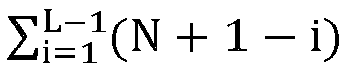 wherein start is the difference between the second information and the first information; SIV2 is the second encoding value; N is the difference between W and the first information; L is the distance from the second information to the third information; i=1, ..., L-1; and i is an integer; W is the parameter length.
 - The device according to claim 72, wherein the first encoding unit is specifically used to:when Start=0, determine the second encoding value as L;when start≥1, determine the second encoding value according to a formula:
 wherein start is the difference between the second information and the first information; SIV2 is the second encoding value; N is the difference between W and the first information; L is the distance from the second information to the third information, L≥1, and L is an integer; i=1, ..., L-1; and i is an integer; W is the parameter length.
 - The device according to claim 70, wherein the first encoding sub-module includes a second encoding unit used to:in a case where start_3 - start_2 ≤ |(W - start_1)/2|, determine the second encoding value according to a formula: SIV2 = (W - start_1) (start_3 - start_2) + start_2 - start_1;in a case where start_3 - start_2 > |(W - start_1)/2|, determine the second encoding value according to a formula: SIV2 = (W-start_1) (W + start_2 - start_1 - start_3) + (W - 1 - start_2);wherein 0 < start_3 - start_2+1≤W - start_2; SIV2 is the second encoding value; start_1 is the first information; start_2 is the second information; start_3 is the third information; W is the parameter length.
- The device according to claim 70, wherein the first encoding sub-module includes a third encoding unit used to:determine the second encoding value according to a formula: SIV2 =
 wherein start_1 is the first information; start_2 is the second information; start_3 is the third information; W is the parameter length.
 - The device according to claim 63, wherein in the case of M=4, the M pieces of transmission information include: fourth information, fifth information, sixth information and seventh information, and a value of the fourth information is less than or equal to a value of the fifth information, the value of the fifth information is less than or equal to a value of the sixth information, and the value of the sixth information is less than or equal to a value of the seventh information;
the encoding module includes:a fourth encoding submodule used to determine a third encoding value according to the fourth information and the parameter length W;a fifth encoding submodule used to determine a fourth encoding value according to the fifth information and the parameter length W;a sixth encoding submodule used to determine a fifth encoding value according to the fourth information, the fifth information, and the sixth information;a seventh encoding sub-module used to obtain the indication information according to the third encoding value, the fourth encoding value and the fifth encoding value. - The device according to claim 67, wherein the fourth encoding submodule is specifically used to determine:when start_0=0, SIV0=0;when start_0 ≥ 1,

 wherein start_0 is the fourth information; i=0, ..., start_0-1; and i is an integer; W is the parameter length; SIV0 is the third encoding value.
 - The device according to claim 67, wherein the fifth encoding submodule is specifically used to determine:when start_1=0, SIV1=0;when start_1≥1,
 wherein start_1 is the fifth information; i=0, ..., start_1-1; and i is an integer; W is the parameter length; SIV1 is the fourth encoding value.
 - The device according to claim 67, wherein the sixth coding submodule includes:
a fourth encoding unit used to determine a fifth encoding value according to a difference between the fifth information and the fourth information, and a distance from the sixth information to the seventh information. - The device according to claim 80, wherein the fourth encoding unit is specifically used to:determine the fifth encoding value according to a formula: SIV2 = start +
 wherein start is the difference between the fifth information and the fourth information; SIV2 is the fifth encoding value; N is the difference between W and the fourth information; L is the distance from the sixth information and to the seventh information, L ≥ 1, and L is an integer; i=1, ..., L-1; and i is an integer.
 - An information transmission device, comprising:a receiving module used to receive indication information sent by a network device;a second determination module used to determine a target encoding length according to a parameter length W and a number M of transmission information; wherein an encoding length of the indication information is the target encoding length; a value or a value range of a corresponding index value s, of each transmission information in the M transmission information is: 0 ≤ s ≤ W-1; a value of an n-th transmission information is less than or equal to a value of (n+1)-th transmission information, 1 ≤n≤M, n, M and W are positive integers;a decoding module used to decode the indication information according to the target encoding length to obtain M pieces of transmission information.
- The device according to claim 82, wherein the M pieces of transmission information are used to indicate dividing points of M+1 segments of the parameter length W; or,
the M pieces of transmission information are used to indicate M pieces of modulation code scheme (MCS) index information. - The device according to claim 82, wherein the second determination module includes:a third determination sub-module used to determine a first parameter, wherein the first parameter is used to represent the number of combinations of values of the M pieces of transmission information in a range of 0 to W-1;a fourth determination sub-module used to determine the target encoding length according to the first parameter.
- The device according to claim 84, wherein the third determination sub-module is specifically used to:
determine the first parameter according to the parameter length W, the number M of transmission information, and a first algorithm. - The device according to claim 85, wherein the first algorithm includes:when M=3, the
 when M=4, the

- The device according to claim 84, wherein the fourth determination sub-module is specifically used to:
determine the target encoding length according to the first parameter and a second algorithm. - The device according to claim 87, wherein the second algorithm includes:

- The device according to claim 82, wherein in a case of M=3, the M pieces of transmission information include: first information, second information and third information, and a value of the first information is less than or equal to a value of the second information, and the value of the second information is less than or equal to a value of the third information;
the decoding module includes:a first decoding submodule used to decode to obtain the first information and a first encoding value corresponding to the first information according to the parameter length W and the target encoding length;a second decoding submodule used to obtain a second encoding value according to the first encoding value and the target encoding length;a third decoding submodule used to determine the second information and the third information according to the parameter length W, the first information and the second encoding value. - The device according to claim 89, wherein the first decoding sub-module is specifically used to:within the value range, traverse possible values of the first information, and determine a value that meets a first condition as the first information; the first condition is:
 determine the first encoding value according to a formula:
 wherein start_1 is the first information; i=0, ..., start _1-1; and i is an integer; W is the parameter length; SIV1 is the first encoding value; when start_1=0,
- The device according to claim 89, wherein the second decoding sub-module includes:
a first decoding unit used to obtain a difference between the second information and the first information and a distance from the second information to the third information according to the parameter length W, the first information and the second encoding value. - The device according to claim 91, wherein the first decoding unit is specifically used to:according to a formula:
 wherein start is the difference between the second information and the first information; SIV2 is the second encoding value; N is the difference between W and the first information; L is the distance from the second information to the third information; i=1, ..., L-1; and i is an integer; W is the parameter length.
 - The device according to claim 91, wherein the first decoding unit is specifically used to:according to a formula:
 wherein when Start=0, the second encoding value is L; start is the difference between the second information and the first information; SIV2 is the second encoding value; N is the difference between W and the first information; L is the distance from the second information to the third information, L ≥ 1, and L is an integer; i=1, ..., L-1; and i is an integer; W is the parameter length.
 - A processor-readable storage medium, comprising a computer program stored thereon; wherein the computer program is used to cause a processor to perform the information transmission method according to any one of claims 1 to 19, or perform the information transmission method according to any one of claims 20 to 31.
Applications Claiming Priority (2)
| Application Number | Priority Date | Filing Date | Title |
|---|---|---|---|
| CN202210864235.XA CN117478266A (en) | 2022-07-20 | 2022-07-20 | An information transmission method, device, network equipment and terminal |
| PCT/CN2023/099900 WO2024016898A1 (en) | 2022-07-20 | 2023-06-13 | Information transmission method, apparatus, network device, and terminal |
Publications (2)
| Publication Number | Publication Date |
|---|---|
| EP4560947A1 true EP4560947A1 (en) | 2025-05-28 |
| EP4560947A4 EP4560947A4 (en) | 2025-11-05 |
Family
ID=89616963
Family Applications (1)
| Application Number | Title | Priority Date | Filing Date |
|---|---|---|---|
| EP23841964.2A Pending EP4560947A4 (en) | 2022-07-20 | 2023-06-13 | INFORMATION TRANSMISSION METHOD, DEVICE, NETWORK DEVICE AND END DEVICE |
Country Status (4)
| Country | Link |
|---|---|
| US (1) | US20260031927A1 (en) |
| EP (1) | EP4560947A4 (en) |
| CN (1) | CN117478266A (en) |
| WO (1) | WO2024016898A1 (en) |
Family Cites Families (6)
| Publication number | Priority date | Publication date | Assignee | Title |
|---|---|---|---|---|
| CN101902313B (en) * | 2010-06-22 | 2013-03-20 | 中兴通讯股份有限公司 | PUSCH transmission (Physical Uplink Shared Channel) based coding method and system of uplink control information |
| CN102231659A (en) * | 2011-06-22 | 2011-11-02 | 中兴通讯股份有限公司 | Precoding method, system and equipment of COMP (coordinated multiple point) transmission |
| WO2018044849A1 (en) * | 2016-08-29 | 2018-03-08 | Idac Holdings, Inc. | Methods for finite blocklength coding in wireless communication systems |
| CN111181707B (en) * | 2018-11-09 | 2022-11-04 | 华为技术有限公司 | Method and communication device for data transmission |
| US12075392B2 (en) * | 2019-03-29 | 2024-08-27 | Lg Electronics Inc. | Method, user equipment, device, and storage medium for performing uplink transmission, and method and base station for performing uplink reception |
| CN114765482B (en) * | 2021-01-15 | 2024-07-05 | 华为技术有限公司 | Signal sending and receiving method and device |
-
2022
- 2022-07-20 CN CN202210864235.XA patent/CN117478266A/en active Pending
-
2023
- 2023-06-13 WO PCT/CN2023/099900 patent/WO2024016898A1/en not_active Ceased
- 2023-06-13 US US18/995,575 patent/US20260031927A1/en active Pending
- 2023-06-13 EP EP23841964.2A patent/EP4560947A4/en active Pending
Also Published As
| Publication number | Publication date |
|---|---|
| WO2024016898A1 (en) | 2024-01-25 |
| CN117478266A (en) | 2024-01-30 |
| EP4560947A4 (en) | 2025-11-05 |
| US20260031927A1 (en) | 2026-01-29 |
Similar Documents
| Publication | Publication Date | Title |
|---|---|---|
| US11984977B2 (en) | Code block segmentation for new radio | |
| EP3751765A1 (en) | Rate matching method and apparatus, and rate de/matching method and apparatus | |
| CN114390679B (en) | Resource allocation information determining method, indicating method, terminal and network equipment | |
| US7746827B2 (en) | Methods and arrangements for selection of a wireless transmission method based upon signal to noise ratios | |
| US8543880B2 (en) | Techniques for successive refinement of metrics stored for HARQ combining | |
| WO2025107667A1 (en) | Data transmission method and apparatus, data receiving method and apparatus, and storage medium | |
| CN114765505B (en) | Method for transmitting demodulation reference signal (DMRS), method for receiving DMRS and device for receiving DMRS | |
| EP4099601B1 (en) | Resource configuration indication method, terminal device, and storage medium | |
| EP4664810A1 (en) | Information processing method, apparatus, terminal, and network device | |
| US20260031927A1 (en) | Information transmission method, apparatus, network device, and user equipment | |
| EP4611452A1 (en) | Method and apparatus for determining guard period | |
| CN117896767B (en) | Methods, methods and apparatus for transmitting and receiving channel state information, and storage media | |
| EP4383891A1 (en) | Resource indication method and apparatus, terminal, network side device, and storage medium | |
| US20240187996A1 (en) | Uplink channel power control method, apparatus, network device and terminal | |
| WO2019201196A1 (en) | Rate matching method and apparatus, and rate de/matching method and apparatus | |
| WO2020133036A1 (en) | Repeat transmission method and apparatus, chip and computer program | |
| US9374205B1 (en) | Inter-cell interference reduction | |
| EP4654711A1 (en) | Multi-carrier data processing method, apparatus, terminal, and network side device | |
| EP4598254A1 (en) | Resource coordination method and apparatus, and storage medium | |
| EP4661327A1 (en) | Information processing method and apparatus, network device, and terminal | |
| EP4561146A1 (en) | Configuration information indication method and device | |
| EP4668948A1 (en) | Data transmission method, device and apparatus | |
| CN114095116B (en) | DCI analysis method, transmission method, terminal and network equipment | |
| CN115706637B (en) | Information indication method, terminal and storage medium | |
| EP4518264A1 (en) | Method and apparatus for sending sidelink positioning reference signal, and terminal positioning method and apparatus |
Legal Events
| Date | Code | Title | Description |
|---|---|---|---|
| STAA | Information on the status of an ep patent application or granted ep patent |
Free format text: STATUS: THE INTERNATIONAL PUBLICATION HAS BEEN MADE |
|
| PUAI | Public reference made under article 153(3) epc to a published international application that has entered the european phase |
Free format text: ORIGINAL CODE: 0009012 |
|
| STAA | Information on the status of an ep patent application or granted ep patent |
Free format text: STATUS: REQUEST FOR EXAMINATION WAS MADE |
|
| 17P | Request for examination filed |
Effective date: 20250117 |
|
| AK | Designated contracting states |
Kind code of ref document: A1 Designated state(s): AL AT BE BG CH CY CZ DE DK EE ES FI FR GB GR HR HU IE IS IT LI LT LU LV MC ME MK MT NL NO PL PT RO RS SE SI SK SM TR |
|
| DAV | Request for validation of the european patent (deleted) | ||
| DAX | Request for extension of the european patent (deleted) | ||
| A4 | Supplementary search report drawn up and despatched |
Effective date: 20251007 |
|
| RIC1 | Information provided on ipc code assigned before grant |
Ipc: H04L 1/00 20060101AFI20250930BHEP Ipc: H04L 5/00 20060101ALI20250930BHEP Ipc: H04W 72/232 20230101ALI20250930BHEP Ipc: H04W 72/0446 20230101ALI20250930BHEP |