EP4560913A1 - Power electronic transformer - Google Patents
Power electronic transformer Download PDFInfo
- Publication number
- EP4560913A1 EP4560913A1 EP24187068.2A EP24187068A EP4560913A1 EP 4560913 A1 EP4560913 A1 EP 4560913A1 EP 24187068 A EP24187068 A EP 24187068A EP 4560913 A1 EP4560913 A1 EP 4560913A1
- Authority
- EP
- European Patent Office
- Prior art keywords
- submodule
- power
- power conversion
- conversion units
- electronic transformer
- Prior art date
- Legal status (The legal status is an assumption and is not a legal conclusion. Google has not performed a legal analysis and makes no representation as to the accuracy of the status listed.)
- Pending
Links
Images




Classifications
-
- H—ELECTRICITY
- H02—GENERATION; CONVERSION OR DISTRIBUTION OF ELECTRIC POWER
- H02M—APPARATUS FOR CONVERSION BETWEEN AC AND AC, BETWEEN AC AND DC, OR BETWEEN DC AND DC, AND FOR USE WITH MAINS OR SIMILAR POWER SUPPLY SYSTEMS; CONVERSION OF DC OR AC INPUT POWER INTO SURGE OUTPUT POWER; CONTROL OR REGULATION THEREOF
- H02M3/00—Conversion of DC power input into DC power output
- H02M3/22—Conversion of DC power input into DC power output with intermediate conversion into AC
- H02M3/24—Conversion of DC power input into DC power output with intermediate conversion into AC by static converters
- H02M3/28—Conversion of DC power input into DC power output with intermediate conversion into AC by static converters using discharge tubes with control electrode or semiconductor devices with control electrode to produce the intermediate AC
- H02M3/325—Conversion of DC power input into DC power output with intermediate conversion into AC by static converters using discharge tubes with control electrode or semiconductor devices with control electrode to produce the intermediate AC using devices of a triode or a transistor type requiring continuous application of a control signal
- H02M3/335—Conversion of DC power input into DC power output with intermediate conversion into AC by static converters using discharge tubes with control electrode or semiconductor devices with control electrode to produce the intermediate AC using devices of a triode or a transistor type requiring continuous application of a control signal using semiconductor devices only
- H02M3/33569—Conversion of DC power input into DC power output with intermediate conversion into AC by static converters using discharge tubes with control electrode or semiconductor devices with control electrode to produce the intermediate AC using devices of a triode or a transistor type requiring continuous application of a control signal using semiconductor devices only having several active switching elements
- H02M3/33576—Conversion of DC power input into DC power output with intermediate conversion into AC by static converters using discharge tubes with control electrode or semiconductor devices with control electrode to produce the intermediate AC using devices of a triode or a transistor type requiring continuous application of a control signal using semiconductor devices only having several active switching elements having at least one active switching element at the secondary side of an isolation transformer
- H02M3/33584—Bidirectional converters
-
- H—ELECTRICITY
- H02—GENERATION; CONVERSION OR DISTRIBUTION OF ELECTRIC POWER
- H02J—ELECTRIC POWER NETWORKS; CIRCUIT ARRANGEMENTS OR SYSTEMS FOR SUPPLYING OR DISTRIBUTING ELECTRIC POWER; SYSTEMS FOR STORING ELECTRIC ENERGY
- H02J3/00—Circuit arrangements for AC mains or AC distribution networks
- H02J3/04—Arrangements for connecting networks of the same frequency but supplied from different sources
- H02J3/06—Controlling the transfer of power between connected networks; Controlling load sharing between connected networks
-
- H—ELECTRICITY
- H02—GENERATION; CONVERSION OR DISTRIBUTION OF ELECTRIC POWER
- H02M—APPARATUS FOR CONVERSION BETWEEN AC AND AC, BETWEEN AC AND DC, OR BETWEEN DC AND DC, AND FOR USE WITH MAINS OR SIMILAR POWER SUPPLY SYSTEMS; CONVERSION OF DC OR AC INPUT POWER INTO SURGE OUTPUT POWER; CONTROL OR REGULATION THEREOF
- H02M1/00—Details of apparatus for conversion
- H02M1/0067—Converter structures employing plural converter units, other than for parallel operation of the units on a single load
- H02M1/007—Plural converter units in cascade
-
- H—ELECTRICITY
- H02—GENERATION; CONVERSION OR DISTRIBUTION OF ELECTRIC POWER
- H02M—APPARATUS FOR CONVERSION BETWEEN AC AND AC, BETWEEN AC AND DC, OR BETWEEN DC AND DC, AND FOR USE WITH MAINS OR SIMILAR POWER SUPPLY SYSTEMS; CONVERSION OF DC OR AC INPUT POWER INTO SURGE OUTPUT POWER; CONTROL OR REGULATION THEREOF
- H02M1/00—Details of apparatus for conversion
- H02M1/0067—Converter structures employing plural converter units, other than for parallel operation of the units on a single load
- H02M1/0077—Plural converter units whose outputs are connected in series
-
- H—ELECTRICITY
- H02—GENERATION; CONVERSION OR DISTRIBUTION OF ELECTRIC POWER
- H02M—APPARATUS FOR CONVERSION BETWEEN AC AND AC, BETWEEN AC AND DC, OR BETWEEN DC AND DC, AND FOR USE WITH MAINS OR SIMILAR POWER SUPPLY SYSTEMS; CONVERSION OF DC OR AC INPUT POWER INTO SURGE OUTPUT POWER; CONTROL OR REGULATION THEREOF
- H02M1/00—Details of apparatus for conversion
- H02M1/0083—Converters characterised by their input or output configuration
- H02M1/0085—Partially controlled bridges
-
- H—ELECTRICITY
- H02—GENERATION; CONVERSION OR DISTRIBUTION OF ELECTRIC POWER
- H02M—APPARATUS FOR CONVERSION BETWEEN AC AND AC, BETWEEN AC AND DC, OR BETWEEN DC AND DC, AND FOR USE WITH MAINS OR SIMILAR POWER SUPPLY SYSTEMS; CONVERSION OF DC OR AC INPUT POWER INTO SURGE OUTPUT POWER; CONTROL OR REGULATION THEREOF
- H02M3/00—Conversion of DC power input into DC power output
- H02M3/22—Conversion of DC power input into DC power output with intermediate conversion into AC
- H02M3/24—Conversion of DC power input into DC power output with intermediate conversion into AC by static converters
- H02M3/28—Conversion of DC power input into DC power output with intermediate conversion into AC by static converters using discharge tubes with control electrode or semiconductor devices with control electrode to produce the intermediate AC
- H02M3/325—Conversion of DC power input into DC power output with intermediate conversion into AC by static converters using discharge tubes with control electrode or semiconductor devices with control electrode to produce the intermediate AC using devices of a triode or a transistor type requiring continuous application of a control signal
- H02M3/335—Conversion of DC power input into DC power output with intermediate conversion into AC by static converters using discharge tubes with control electrode or semiconductor devices with control electrode to produce the intermediate AC using devices of a triode or a transistor type requiring continuous application of a control signal using semiconductor devices only
- H02M3/33569—Conversion of DC power input into DC power output with intermediate conversion into AC by static converters using discharge tubes with control electrode or semiconductor devices with control electrode to produce the intermediate AC using devices of a triode or a transistor type requiring continuous application of a control signal using semiconductor devices only having several active switching elements
- H02M3/33571—Half-bridge at primary side of an isolation transformer
-
- H—ELECTRICITY
- H02—GENERATION; CONVERSION OR DISTRIBUTION OF ELECTRIC POWER
- H02M—APPARATUS FOR CONVERSION BETWEEN AC AND AC, BETWEEN AC AND DC, OR BETWEEN DC AND DC, AND FOR USE WITH MAINS OR SIMILAR POWER SUPPLY SYSTEMS; CONVERSION OF DC OR AC INPUT POWER INTO SURGE OUTPUT POWER; CONTROL OR REGULATION THEREOF
- H02M3/00—Conversion of DC power input into DC power output
- H02M3/22—Conversion of DC power input into DC power output with intermediate conversion into AC
- H02M3/24—Conversion of DC power input into DC power output with intermediate conversion into AC by static converters
- H02M3/28—Conversion of DC power input into DC power output with intermediate conversion into AC by static converters using discharge tubes with control electrode or semiconductor devices with control electrode to produce the intermediate AC
- H02M3/325—Conversion of DC power input into DC power output with intermediate conversion into AC by static converters using discharge tubes with control electrode or semiconductor devices with control electrode to produce the intermediate AC using devices of a triode or a transistor type requiring continuous application of a control signal
- H02M3/335—Conversion of DC power input into DC power output with intermediate conversion into AC by static converters using discharge tubes with control electrode or semiconductor devices with control electrode to produce the intermediate AC using devices of a triode or a transistor type requiring continuous application of a control signal using semiconductor devices only
- H02M3/33569—Conversion of DC power input into DC power output with intermediate conversion into AC by static converters using discharge tubes with control electrode or semiconductor devices with control electrode to produce the intermediate AC using devices of a triode or a transistor type requiring continuous application of a control signal using semiconductor devices only having several active switching elements
- H02M3/33573—Full-bridge at primary side of an isolation transformer
-
- H—ELECTRICITY
- H02—GENERATION; CONVERSION OR DISTRIBUTION OF ELECTRIC POWER
- H02M—APPARATUS FOR CONVERSION BETWEEN AC AND AC, BETWEEN AC AND DC, OR BETWEEN DC AND DC, AND FOR USE WITH MAINS OR SIMILAR POWER SUPPLY SYSTEMS; CONVERSION OF DC OR AC INPUT POWER INTO SURGE OUTPUT POWER; CONTROL OR REGULATION THEREOF
- H02M5/00—Conversion of AC power input into AC power output, e.g. for change of voltage, for change of frequency, for change of number of phases
- H02M5/40—Conversion of AC power input into AC power output, e.g. for change of voltage, for change of frequency, for change of number of phases with intermediate conversion into DC
- H02M5/42—Conversion of AC power input into AC power output, e.g. for change of voltage, for change of frequency, for change of number of phases with intermediate conversion into DC by static converters
- H02M5/44—Conversion of AC power input into AC power output, e.g. for change of voltage, for change of frequency, for change of number of phases with intermediate conversion into DC by static converters using discharge tubes or semiconductor devices to convert the intermediate DC into AC
- H02M5/453—Conversion of AC power input into AC power output, e.g. for change of voltage, for change of frequency, for change of number of phases with intermediate conversion into DC by static converters using discharge tubes or semiconductor devices to convert the intermediate DC into AC using devices of a triode or transistor type requiring continuous application of a control signal
- H02M5/458—Conversion of AC power input into AC power output, e.g. for change of voltage, for change of frequency, for change of number of phases with intermediate conversion into DC by static converters using discharge tubes or semiconductor devices to convert the intermediate DC into AC using devices of a triode or transistor type requiring continuous application of a control signal using semiconductor devices only
- H02M5/4585—Conversion of AC power input into AC power output, e.g. for change of voltage, for change of frequency, for change of number of phases with intermediate conversion into DC by static converters using discharge tubes or semiconductor devices to convert the intermediate DC into AC using devices of a triode or transistor type requiring continuous application of a control signal using semiconductor devices only having a rectifier with controlled elements
-
- H—ELECTRICITY
- H02—GENERATION; CONVERSION OR DISTRIBUTION OF ELECTRIC POWER
- H02M—APPARATUS FOR CONVERSION BETWEEN AC AND AC, BETWEEN AC AND DC, OR BETWEEN DC AND DC, AND FOR USE WITH MAINS OR SIMILAR POWER SUPPLY SYSTEMS; CONVERSION OF DC OR AC INPUT POWER INTO SURGE OUTPUT POWER; CONTROL OR REGULATION THEREOF
- H02M7/00—Conversion of AC power input into DC power output; Conversion of DC power input into AC power output
- H02M7/02—Conversion of AC power input into DC power output without possibility of reversal
- H02M7/04—Conversion of AC power input into DC power output without possibility of reversal by static converters
- H02M7/12—Conversion of AC power input into DC power output without possibility of reversal by static converters using discharge tubes with control electrode or semiconductor devices with control electrode
- H02M7/21—Conversion of AC power input into DC power output without possibility of reversal by static converters using discharge tubes with control electrode or semiconductor devices with control electrode using devices of a triode or transistor type requiring continuous application of a control signal
- H02M7/217—Conversion of AC power input into DC power output without possibility of reversal by static converters using discharge tubes with control electrode or semiconductor devices with control electrode using devices of a triode or transistor type requiring continuous application of a control signal using semiconductor devices only
- H02M7/219—Conversion of AC power input into DC power output without possibility of reversal by static converters using discharge tubes with control electrode or semiconductor devices with control electrode using devices of a triode or transistor type requiring continuous application of a control signal using semiconductor devices only in a bridge configuration
-
- H—ELECTRICITY
- H02—GENERATION; CONVERSION OR DISTRIBUTION OF ELECTRIC POWER
- H02M—APPARATUS FOR CONVERSION BETWEEN AC AND AC, BETWEEN AC AND DC, OR BETWEEN DC AND DC, AND FOR USE WITH MAINS OR SIMILAR POWER SUPPLY SYSTEMS; CONVERSION OF DC OR AC INPUT POWER INTO SURGE OUTPUT POWER; CONTROL OR REGULATION THEREOF
- H02M7/00—Conversion of AC power input into DC power output; Conversion of DC power input into AC power output
- H02M7/42—Conversion of DC power input into AC power output without possibility of reversal
- H02M7/44—Conversion of DC power input into AC power output without possibility of reversal by static converters
- H02M7/48—Conversion of DC power input into AC power output without possibility of reversal by static converters using discharge tubes with control electrode or semiconductor devices with control electrode
- H02M7/483—Converters with outputs that each can have more than two voltages levels
- H02M7/4835—Converters with outputs that each can have more than two voltages levels comprising two or more cells, each including a switchable capacitor, the capacitors having a nominal charge voltage which corresponds to a given fraction of the input voltage, and the capacitors being selectively connected in series to determine the instantaneous output voltage
-
- H—ELECTRICITY
- H02—GENERATION; CONVERSION OR DISTRIBUTION OF ELECTRIC POWER
- H02J—ELECTRIC POWER NETWORKS; CIRCUIT ARRANGEMENTS OR SYSTEMS FOR SUPPLYING OR DISTRIBUTING ELECTRIC POWER; SYSTEMS FOR STORING ELECTRIC ENERGY
- H02J2103/00—Details of circuit arrangements for mains or AC distribution networks
- H02J2103/30—Simulating, planning, modelling, reliability check or computer assisted design [CAD] of electric power networks
- H02J2103/35—Grid-level management of power transmission or distribution systems, e.g. load flow analysis or active network management
Definitions
- the disclosure relates to the field of flexible interconnection of an AC/DC power network and power electronic technology in a power system, and particularly to a power electronic transformer.
- interconnection and mutual assistance are achieved using multiple AC feeder lines
- joint supply to low voltage DC users may be achieved fully using a residual capacity of the connected feeder lines, where the low voltage is less than 1500V
- power interaction between different feeder lines may be achieved using real-time performance and rapidity of control of the power electronic transformer, thereby solving the problem of decrease of an utilization rate of the equipment and the feeder lines caused by dynamic unbalance of distribution of loads in space.
- scholars provide a multiple medium voltage AC port solid-state transformer and a method of controlling the same.
- the solution forms a common DC bus using small power single phase converters, and then achieves joint supply to a low voltage DC bus by connecting a Cascaded H-Bridge Power Electronics Transformer (CHB-PET), but a common DC bus voltage of a series loop formed in a 10KV AC power distribution network reaches 2500V, and a rated voltage of the switching device is typically twice the DC bus voltage. Since the existing conventional IGBT voltage withstand level is only about 600V to about 1700V, the solution has a large limit in selection of devices, is hard to satisfy low cost and large-scale promotion and application of the power distribution network, and also hard to be applied to a higher voltage level power distribution network.
- CHB-PET Cascaded H-Bridge Power Electronics Transformer
- An object of this part is to summarize some aspects of the embodiments of the disclosure and briefly introduce some preferable embodiments.
- the Abstract and the title of the present application there may be some simplifications or omissions to avoid ambiguity of the object of this part, the Abstract and the title, and such simplifications or omissions cannot be used to limit scope of the disclosure.
- the disclosure provides a power electronic transformer, which solves the original problem of insufficient of voltage withstand level of the devices due to a large common DC bus voltage of the multiple medium voltage AC port solid-state transformer, and can be applied to a high-voltage power distribution network by increasing the number of cascaded small power second submodules in a flexible interconnection module with multiple medium voltage AC ports.
- a power electronic transformer including three modules, the three modules each including: a first submodule including a first input port and N output ports, where N is an integer greater than 0; a second submodule including a first input port and M output ports, where M is an integer greater than 0; and a third submodule including a first power conversion module and a second power conversion module, the first power conversion module includes N first power conversion units having input ports connected to the N output ports of the first submodule in one-to-one correspondence, the second power conversion module includes M first power conversion units having input ports connected to the M output ports of the second submodule in one-to-one correspondence, the first input port of the first submodule of the three modules has one port connected to three phases of a first three-phase alternating current in one-to-one correspondence, and the other port connected to three phases of a second three-phase alternating current in one-to-one correspondence, the first input port of the second submodule of the three modules has one port connected to three phases of a first three-phase alternating
- the first submodule in the disclosure provides multiple AC ports, achieves interconnection between the respective AC ports, and can make decoupling control of powers between the feeder lines by regulating a magnitude of series voltage sources to achieve interconnection and mutual assistance of the AC ports, thereby facilitating efficient operation of the power distribution network, and flexibly expandable, flexibly controllable and control decoupling operation of the multiple ports; in the disclosure, DC sides of the second submodule and the first submodule are connected to one end of the third submodule, and the other end of the third submodule is connected in parallel to form a low voltage DC bus, which achieves joint supply to the low voltage DC side, and improves operational reliability of the low voltage DC power distribution network, where the low voltage is 1500V; the first submodule in the disclosure uses modular design, which may achieve expansion of the AC ports by increasing the number of SCHBs, and achieve rapidity and economy of expansion of the AC ports; the SCHBs in the disclosure use small power cascaded full bridge design, which reduces
- the disclosure is described explicitly with reference to the schematic diagrams, when describing the embodiments of the disclosure, for sake of explanation, it means that the cross-section diagram of the device structure is not locally enlarged according to a general scale, and the schematic diagrams are only exemplary, and shall not limit the scope of protection of the disclosure. Moreover, in actual production, it shall include three-dimensional space dimensions of length, width and height.
- orientation or positional relations indicated by the terms “upper, lower, inner and outer” are orientation or positional relations shown in the drawings, and only for convenience of describing the disclosure and simplifying the description, instead of indicating or suggesting that the referred device or element must have specific orientation, is constructed and operated in specific orientation, so they cannot be understood as limit to the disclosure.
- first, second or third is only for the purpose of description, and cannot be understood to indicate or suggest the relative importance.
- mount, link and connect shall be understood in a broad sense, unless the disclosure clearly specifies and defines otherwise, for example, being fixedly connected, detachably connected or integrally connected, also being mechanically connected, electrically connected or directly connected, being indirectly linked by an intermediate medium, and also communication inside two elements.
- mount, link and connect shall be understood in a broad sense, unless the disclosure clearly specifies and defines otherwise, for example, being fixedly connected, detachably connected or integrally connected, also being mechanically connected, electrically connected or directly connected, being indirectly linked by an intermediate medium, and also communication inside two elements.
- FIG. 1 is a structural diagram of a power electronic transformer 10 provided in a first embodiment of the disclosure.
- the power electronic transformer 10 includes three modules, which correspond to phase A, phase B and phase C, respectively, and three modules each includes three submodules, which are a first submodule 11, a second submodule 12 and a third submodule, respectively.
- the first submodule 11 includes a first input port and N output ports, where N is an integer greater than 0,
- the second submodule 12 includes a first input port and M output ports, where M is an integer greater than 0, and the third submodule includes a first power conversion module 131 and a second power conversion module 132.
- the first power conversion module 131 includes N first power conversion units having input ports connected to the N output ports of the first submodule 11 in one-to-one correspondence
- the second power conversion module 132 includes M first power conversion units having input ports connected to the M output ports of the second submodule 12 in one-to-one correspondence
- the first input port of the first submodule 11 of the three modules has one terminal P1 connected to three phases of a first three-phase alternating current in one-to-one correspondence, and the other terminal P2 connected to three phases of a second three-phase alternating current in one-to-one correspondence.
- the first three-phase alternating current corresponds to feeder line 1
- the second three-phase alternating current corresponds to feeder line 2.
- the first input port of the second submodule 12 of the three modules has one terminal P1' connected to three phases of the first three-phase alternating current in one-to-one correspondence, and the other terminal P2' connected to a neutral point.
- Output ports of the N first power conversion units are connected in parallel to output ports of the M first power conversion units to form a low voltage DC bus for powering a load.
- the first submodule 11 includes N second power conversion units with input ports connected in series to form the first input port of the first submodule 11, and output ports to form the N output ports of the first submodule 11.
- the second submodule 12 includes M second power conversion units with input ports connected in series to form the first input port of the second submodule 12, and output ports to form the M output ports of the second submodule 12.
- FIG. 2 is an exemplary schematic diagram of typical topologies of first power conversion units and second power conversion units of the power electronic transformer 10 provided in the first embodiment of the disclosure.
- the first power conversion units are isolated DC-DC converters, which have medium-high frequency isolation transformers in the middle. Further, the first power conversion units are isolated bidirectional DC-DC converters, and the topology is dual active full bridge DC-DC converters or half-bridge DC-DC converters.
- the second power conversion units are full bridge converters, and the second submodule 12 formed by M cascaded full bridge converters is voltage source converters. Referring to FIGS. 1 and 2 , each of the second conversion units of the first submodule 11 is connected to the low voltage DC bus through one first power conversion unit, and each of the second conversion units of the second submodule 12 is connected to the low voltage DC bus through one first power conversion unit.
- FIG. 3 is a structural diagram of a power electronic transformer 20 provided in a second embodiment of the disclosure.
- the power electronic transformer 20 includes three modules, which correspond to phase A, phase B and phase C, respectively, and the three modules each includes three submodules, which are a first submodule 21, a second submodule 22 and a third submodule, respectively.
- the first submodule 21 includes a first input port and N output ports, where N is an integer greater than 0,
- the second submodule 22 includes a first input port and M output ports, where M is an integer greater than 0, and the third submodule includes a first power conversion module 231 and a second power conversion module 232.
- the first power conversion module 231 includes N first power conversion units having input ports connected to the N output ports of the first submodule 21 in one-to-one correspondence
- the second power conversion module 232 includes M first power conversion units having input ports connected to the M output ports of the second submodule 22 in one-to-one correspondence
- the first input port of the first submodule 21 of the three modules has one terminal P1 connected to the feeder line 1 in one-to-one correspondence, and the other terminal P2 connected to the feeder line 2 in one-to-one correspondence
- the first input port of the second submodule 22 has one terminal P 1' connected to the feeder line 1 in one-to-one correspondence, and the other terminal P2' connected to a neutral point.
- Output ports of the N first power conversion units are connected in parallel to output ports of the M first power conversion units to form a low voltage DC bus for powering a load.
- the power electronic transformer 20 can achieve power flow control of two feeder lines, and a topology of low voltage DC joint powering devices and system connection.
- the first submodule 21 includes N second power conversion units having input ports connected in series to form the first input port of the first submodule 21, and output ports to form the N output ports of the first submodule 21.
- the second submodule 22 includes M second power conversion units having input ports connected in series to form the first input port of the second submodule 22, and output ports to form the M output ports of the second submodule 22.
- the first power conversion units are isolated bidirectional DC-DC converters (hereinafter referred to as IBDC), and the second power conversion units are full bridge sub-modules (hereinafter referred to as FBSM).
- the first submodule 21 is formed of N full bridge sub-modules (FBSM) cascaded, and hereinafter the N cascaded full bridge sub-modules (FBSM) included in the first submodule 21 are referred to as series cascaded H-bridges (SCHB).
- the second submodule 22 is formed by M full bridge sub-modules (FBSM) cascaded, and hereinafter the second submodule 22 is referred to as cascaded H-bridges (CHB).
- the power electronic transformer 20 provided in the disclosure further includes a controller (not shown) for executing a control method, and achieving active control of active powers and reactive powers on the feeder lines by controlling equivalent voltage AC components connected in series to the feeder lines.
- the control method includes a power flow control loop, a cascaded full bridge control loop, a SCHB voltage balance control loop and a low voltage DC bus voltage balance control loop.
- FIG. 4 is a block diagram of control strategy of a topological structure of a dual port power electronic transformer where second power conversion units use a full bridge topology, and first power conversion units use a dual active full bridge DC converter topology and implementation of interconnection of two AC feeder lines of the power electronic transformer provided in the second embodiment of the disclosure.
- the control strategy of the power electronic transformer includes a power flow control loop, a cascaded full bridge control loop, a SCHB voltage balance control loop and a low voltage DC bus voltage balance control loop.
- the power flow control loop of the feeder line is performed in a dq coordinate system, and when the power of the feeder line is controlled, a d -axis current and a q -axis current of the feeder line are coupled to each other, and also affected by disturbance of a node voltage of the feeder line and a node voltage of the feeder line 1, so these adverse effects on the control effect shall be eliminated.
- the cascaded full bridge control loop includes an outer voltage loop, a reactive outer loop and an inner current loop.
- the outer voltage loop controls a sum of capacitor voltages of the second submodule, inputs a deviation between the actual value and the reference value into an PI regulator, calculates to obtain the d -axis current of the CHB, and then makes a difference with the d -axis current of the feeder line 2 to obtain a reference voltage i 1 d ⁇ of the inner current loop.
- d -axis and q -axis current sampling values of the feeder line 1 and d -axis and q -axis current reference values of the feeder line 1 are inputted into the PI regulator, respectively, and coupling compensation items ⁇ L 1 L 1 q and ⁇ L 1 L 1 d of the current are added to achieve current decoupling control, thereby obtaining output voltage dq -axis reference values ⁇ pd ⁇ and ⁇ pq ⁇ of the CHB.
- the SCHB voltage balance control loop and the low voltage DC bus voltage balance control loop include: control of a low voltage DC bus capacitor voltage uses single phase shift (SPS) modulation, where control object of the IBDC is to regulate an active power flowing into a low voltage DC bus capacitor, thereby maintaining stability of the capacitor voltage V LVDC .
- SPS single phase shift
- control of a SCHB capacitor voltage uses single phase shift (SPS) modulation, where control object of the third submodule is to regulate an active power flowing out of a capacitor connected in series to the first submodule, thereby maintaining stability of the capacitor voltage V SCHB .
- SPS single phase shift
- FIG. 5 is a structural diagram of a power electronic transformer 30 provided in a third embodiment of the disclosure.
- the power electronic transformer 30 is used to achieve power flow control of three feeder lines and a topology of low voltage DC joint powering devices and system connection.
- the power electronic transformer 30 includes three modules, which correspond to phase A, phase B and phase C, respectively, and the three modules each include three submodules, which are a first submodule 31, a second submodule 32 and a third submodule, respectively.
- the first submodule 31 includes N second power conversion units
- the second submodule 32 includes M second power conversion units.
- the third submodule includes a first power conversion module 331 and a second power conversion module 332.
- the first power conversion module 331 includes N first power conversion units
- the second power conversion module 332 includes M first power conversion units. Structures and connection relations of the second submodule 32 and the third submodule are substantially the same as that in the second embodiment.
- the first submodule 31 includes two SCHBs, which are SCHB-1 and SCHB-2, respectively, and SCHB-1 has the same structure as the SCHB structure in the second embodiment.
- SCHB-2 includes a second input port, P output ports and P second power conversion units, where P is an integer greater than 0, the second power conversion units are full bridge sub-modules (FBSM), P second power conversion units have input ports connected in series to form the second input port of the first submodule 31, and output ports to form the P output ports of the first submodule 31, and the second input port of the first submodule 31 of the three modules has one terminal P4 connected to three phases of a third three-phase AC current in one-to-one correspondence, and the other terminal P3 connected to three phases of the first three-phase AC current in one-to-one correspondence, and the third three-phase AC current corresponds to feeder line 3.
- the first submodule of the power electronic transformer may also include more SCHBs to achieve power flow control of multiple feeder lines and a top
- the first power conversion module 331 further includes P first power conversion units having input ports connected to the P output ports of the first submodule 31 in one-to-one correspondence, and output ports connected in parallel to the low voltage DC bus.
- Control strategy of the power electronic transformer 30 of this embodiment is the same as that in the second embodiment, and for details, please refer to FIG. 4 .
- Table 1 Simulation Parameters of Power Electronic Transformer [0072] Parameter Value Parameter Value Feeder line capacity 3MVA Low voltage DC bus voltage 750V Medium voltage AC feeder line voltage 10kV SCHB Submodule capacitance 1.6mF Feeder line equivalent inductance 10.61mH CHB Submodule capacitance 1.6mF CHB submodule voltage 800V Low voltage DC bus capacitance 4mF CHB cascaded number 12 SCHB module switching frequency 3kHz SCHB submodule voltage 800V CHB module switching frequency 3kHz SCHB cascaded number 3 IBDC switching frequency 3kHz
- the power electronic transformer 30 is connected to three feeder lines, as for a schematic diagram of connection, please refer to FIG. 5 , and as for a control method in the simulation examples, please refer to FIG. 4 .
- the power electronic transformer 30 includes active powers and reactive powers on the two SCHB control feeder lines (the feeder line 2 and the feeder line 3), the feeder line 1 is a balance feeder line, and can balance the active powers of other feeder lines and the low voltage DC bus load, and the corresponding control loop is a power flow control loop of the feeder line.
- the reactive power of the feeder line 1 is controlled by the second submodule 32, balance of the capacitor voltage of the second submodule 32 is controlled by an amplitude and a phase of the second submodule 32, and the corresponding control loop is a cascaded full bridge control loop.
- the first power conversion units connected to the second power conversion units of the SCHB control balance of the SCHB capacitor voltage, and the corresponding control loop is a SCHB voltage balance control loop.
- the first power conversion units connected to the second power conversion units of the second submodule 32 control balance of the low voltage DC bus capacitor voltage, and the corresponding control loop is a low voltage DC bus voltage balance control loop.
- simulation sets three operating cases.
- Case 1 the feeder line 1 neither emits nor absorbs the reactive power
- the feeder line 2 emits 0.3p.u. active power, and neither emits nor absorbs the reactive power
- the feeder line 3 emits 0.3p.u. active power, and neither emits nor absorbs the reactive power
- the low voltage DC bus absorbs 0.9p.u..
- Case 3 the feeder line 1 neither emits nor absorbs the reactive power, the feeder line 2 emits 0.3p.u. active power, and absorbs 0.3p.u. reactive power, the feeder line 3 emits 0.4p.u. active power, and emits 0.1p.u. reactive power, and the low voltage DC bus absorbs 0.9p.u..
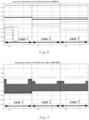
- FIG. 6 is an simulation result of power flow control of respective feeder lines and joint supply to a low voltage DC bus of the power electronic transformer in three cases, including a waveform diagram of an active power P 1 of the feeder line 1, a waveform diagram of a reactive power Q 1 of the feeder line 1, a waveform diagram of an active power P 2 of the feeder line 2, a waveform diagram of a reactive power Q 2 of the feeder line 2, a waveform diagram of an active power P 3 of the feeder line 3, a waveform diagram of a reactive power Q 3 of the feeder line 3, and a waveform diagram of an active power of the low-voltage DC bus P LVDC .
- FIG. 7 is a waveform diagram of a current of a feeder line 1 of the power electronic transformer in three cases.
- FIG. 8 is a waveform diagram of a current of a feeder line 2 of the power electronic transformer in three cases.
- FIG. 9 is a waveform diagram of a current of a feeder line 3 of the power electronic transformer in three cases.
- FIG. 10 is a waveform diagram of a SCHB submodule capacitor voltage of the feeder line 2 of the power electronic transformer in three cases.
- FIG. 11 is a waveform diagram of a SCHB submodule capacitor voltage of the feeder line 3 of the power electronic transformer in three cases.
- FIG. 12 is a waveform diagram of a CHB submodule capacitor voltage of the power electronic transformer in three cases.
- FIG. 13 is a waveform diagram of a low voltage DC bus capacitor voltage of the power electronic transformer in three cases.
- the simulation waveform result shows that in the case of being connected to three power transmission lines, the power electronic transformer achieves decoupling active power flow control of the active powers and the reactive powers on the feeder lines, capability of joint supply to the low-voltage direct current while also keeping internal energy balance of the device, i.e., ensures capacitor voltage stability and supports port expansion.
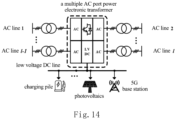
- FIG. 14 is a schematic diagram of an AC/DC hybrid power distribution network system including the power electronic transformer in interconnection of multiple medium voltage AC ports provided in the disclosure.
- the power electronic transformer provides multiple AC ports, which correspond to an AC line 1 to an AC line l , respectively, and achieves interconnection between the respective AC ports, and one end of the isolated DC-DC converters is connected in parallel to form a low voltage DC feeder line, which achieves joint supply to the low voltage DC side, such that large power DC loads such as charging stations, optoelectronics, and base stations are connected to the power distribution network, and operational reliability of the low voltage DC power distribution network is improved.
- the first submodule of the power electronic transformer in the disclosure provides multiple AC ports, achieves interconnection between the respective AC ports, and can make decoupling control of powers between the feeder lines by regulating a magnitude of series voltage sources to achieve interconnection and mutual assistance of the AC ports, thereby facilitating efficient operation of the power distribution network, and flexibly expandable, flexibly controllable and control decoupling operation of the multiple ports; in the disclosure, DC sides of the respective second power conversion units of the second submodule and the first submodule are connected to one end of the isolated DC-DC converters, and the other end of the isolated DC-DC converters is connected in parallel to form a low voltage DC bus, which achieves joint supply to the low voltage DC side, and improves operational reliability of the low voltage DC power distribution network; the first submodule in the disclosure uses modular design, which may achieve expansion of the AC ports by increasing the number of SCHBs, and achieve rapidity and economy of expansion of the AC ports; the SCHBs in the disclosure use small power cascaded full bridge design, which reduces
- the embodiments of the application may provide a method, a system, or a computer program product. Therefore, the application may use the form of full hardware embodiments, full software embodiments or embodiments combining software and hardware. Moreover, the application may use the form of a computer program product implemented on one or more computer readable storage mediums (including but not limited to disk memory, CD-ROM, optical memory, or the like) containing computer usable program codes.
- the solution in the embodiments of the application can be implemented using various computer languages, for example, object-oriented program design language Java and literal scripting language JavaScript.
- These computer program instructions also may be stored in a computer readable memory that can guide the computers or other programmable data processing equipment to work in a specific way, such that the instructions stored in the computer readable memory produce a product including the instruction device, which achieves specific functions in one or more flows of the flow diagram and/or one or more blocks of the block diagram.
- These computer program instructions also may be loaded onto the computers or other programmable data processing equipment to execute a series of operation steps on the computers or other programmable equipment to produce processing implemented by the computers, such that the instructions executed on the computers or other programmable data processing equipment provide steps for achieving the specific functions in one or more flows of the flow diagram and/or one or more blocks of the block diagram.
Landscapes
- Engineering & Computer Science (AREA)
- Power Engineering (AREA)
- Direct Current Feeding And Distribution (AREA)
- Dc-Dc Converters (AREA)
- Rectifiers (AREA)
Abstract
A power electronic transformer (10; 20; 30) includes three modules, the three modules each including: a first submodule (11;21;31); a second submodule (12;22;32); and a third submodule including a first power conversion module (131, 231, 331) including N first power conversion units having input ports connected to the N output ports of the first submodule (11;21;31) in one-to-one correspondence, and a second power conversion module (132, 232, 332) including M first power conversion units having input ports connected to the M output ports of the second submodule (12;22;32) in one-to-one correspondence, the first input port of the first submodule (11;21;31) of the three modules has one terminal (P1) connected to three phases of a first three-phase alternating current in one-to-one correspondence, and the other terminal (P2) connected to three phases of a second three-phase alternating current in one-to-one correspondence, output ports of the N first power conversion units are connected in parallel to output ports of the M first power conversion units.
Description
- The disclosure relates to the field of flexible interconnection of an AC/DC power network and power electronic technology in a power system, and particularly to a power electronic transformer.
- Recently, the growing environmental crisis and the shortage problem of fossil energy promote the pace of change in energy consumption structure, and new clean renewable energy sources representative of wind energy and solar energy gradually replace the fossil energy as dominant energy sources. In the background of energy structure transformation and new infrastructure layout, distributed power sources such as photovoltaics, wind power and energy storage will be connected to the power network on a large scale, and large power DC loads such as electric vehicle supercharger stations and data centers are also widely connected to the power distribution network, causing profound influence on development trend of the future power distribution network: 1) the traditional AC power distribution network mainly relies on one-way powering, power distribution primary control equipment (on-load voltage regulators, capacitors, interconnection switches, etc.) lack regulation and control capability, and with wide connection of new source loads, the power distribution network has problems of poor flexibility in operation and unbalance of feeder loads; 2) with scale application of techniques such as new source load storage and supercharger stations, the power distribution network faces the development trend of a large capacity, and it is difficult for the single distribution network feeder capacity to support connection of super large power DC source loads; 3) since development and construction of the cities are expanding, when facing limits of urban development and power supply corridor, it is difficult for the power distribution network to achieve rapid reformation of capacity expansion and large scale energy storage configuration, and it is difficult to face high-speed wide electrification progress.
- To solve the problems, interconnection and mutual assistance are achieved using multiple AC feeder lines, joint supply to low voltage DC users may be achieved fully using a residual capacity of the connected feeder lines, where the low voltage is less than 1500V, and power interaction between different feeder lines may be achieved using real-time performance and rapidity of control of the power electronic transformer, thereby solving the problem of decrease of an utilization rate of the equipment and the feeder lines caused by dynamic unbalance of distribution of loads in space. Currently, scholars provide a multiple medium voltage AC port solid-state transformer and a method of controlling the same. The solution forms a common DC bus using small power single phase converters, and then achieves joint supply to a low voltage DC bus by connecting a Cascaded H-Bridge Power Electronics Transformer (CHB-PET), but a common DC bus voltage of a series loop formed in a 10KV AC power distribution network reaches 2500V, and a rated voltage of the switching device is typically twice the DC bus voltage. Since the existing conventional IGBT voltage withstand level is only about 600V to about 1700V, the solution has a large limit in selection of devices, is hard to satisfy low cost and large-scale promotion and application of the power distribution network, and also hard to be applied to a higher voltage level power distribution network.
- Therefore, it is required to provide a new solution, which can solve the problem of voltage withstand level of the switching devices, and also shall ensure that the solution can combine multiple AC feeder lines to achieve joint supply to the low voltage DC bus, where the low voltage is less than 1500V.
- An object of this part is to summarize some aspects of the embodiments of the disclosure and briefly introduce some preferable embodiments. In this part, the Abstract and the title of the present application, there may be some simplifications or omissions to avoid ambiguity of the object of this part, the Abstract and the title, and such simplifications or omissions cannot be used to limit scope of the disclosure.
- Considering of the existing problems, the disclosure provides a power electronic transformer, which solves the original problem of insufficient of voltage withstand level of the devices due to a large common DC bus voltage of the multiple medium voltage AC port solid-state transformer, and can be applied to a high-voltage power distribution network by increasing the number of cascaded small power second submodules in a flexible interconnection module with multiple medium voltage AC ports.
- To solve the technical problem, the disclosure provides the following technical solution: a power electronic transformer, including three modules, the three modules each including: a first submodule including a first input port and N output ports, where N is an integer greater than 0; a second submodule including a first input port and M output ports, where M is an integer greater than 0; and a third submodule including a first power conversion module and a second power conversion module, the first power conversion module includes N first power conversion units having input ports connected to the N output ports of the first submodule in one-to-one correspondence, the second power conversion module includes M first power conversion units having input ports connected to the M output ports of the second submodule in one-to-one correspondence, the first input port of the first submodule of the three modules has one port connected to three phases of a first three-phase alternating current in one-to-one correspondence, and the other port connected to three phases of a second three-phase alternating current in one-to-one correspondence, the first input port of the second submodule of the three modules has one port connected to three phases of the first three-phase alternating current in one-to-one correspondence, and the other port connected to a neutral point, output ports of the N first power conversion units of the three modules are connected in parallel to output ports of the M first power conversion units to form a DC bus for powering a load.
- Advantageous effects of the disclosure are as follows: the first submodule in the disclosure provides multiple AC ports, achieves interconnection between the respective AC ports, and can make decoupling control of powers between the feeder lines by regulating a magnitude of series voltage sources to achieve interconnection and mutual assistance of the AC ports, thereby facilitating efficient operation of the power distribution network, and flexibly expandable, flexibly controllable and control decoupling operation of the multiple ports; in the disclosure, DC sides of the second submodule and the first submodule are connected to one end of the third submodule, and the other end of the third submodule is connected in parallel to form a low voltage DC bus, which achieves joint supply to the low voltage DC side, and improves operational reliability of the low voltage DC power distribution network, where the low voltage is 1500V; the first submodule in the disclosure uses modular design, which may achieve expansion of the AC ports by increasing the number of SCHBs, and achieve rapidity and economy of expansion of the AC ports; the SCHBs in the disclosure use small power cascaded full bridge design, which reduces a voltage level of the DC side, such that the devices can select a lower voltage withstand level, so as to facilitate more economical and safer operation of the power distribution network; the SCHBs in the disclosure enable the disclosure to be applied to a power distribution network with a higher voltage level by the way of increasing cascaded full bridges.
- In order to clearly explain the technical solution in the embodiments of the disclosure, hereinafter the accompanying drawings used in description of the embodiments are briefly introduced, and obviously, the accompanying drawings in the following description are only some embodiments of the disclosure. For those of ordinary skill in the art, other accompanying drawings can be obtained according to these accompanying drawings on the premise of not paying creative effort, wherein:
-
FIG. 1 is a structural diagram of a power electronic transformer provided in a first embodiment of the disclosure. -
FIG. 2 is an exemplary schematic diagram of typical topologies of first power conversion units and second power conversion units of the power electronic transformer provided in the first embodiment of the disclosure. -
FIG. 3 is a structural diagram of a power electronic transformer provided in a second embodiment of the disclosure. -
FIG. 4 is a block diagram of control strategy of the power electronic transformer shown inFIG. 3 . -
FIG. 5 is a structural diagram of a power electronic transformer provided in a third embodiment of the disclosure. -
FIG. 6 are waveform diagrams of powers for power flow control of respective feeder lines and joint supply to a low voltage DC bus of the power electronic transformer in three cases provided in the disclosure. -
FIG. 7 is a waveform diagram of a current of afeeder line 1 of the power electronic transformer in three cases provided in the disclosure. -
FIG. 8 is a waveform diagram of a current of afeeder line 2 of the power electronic transformer in three cases provided in the disclosure. -
FIG. 9 is a waveform diagram of a current of afeeder line 3 of the power electronic transformer in three cases provided in the disclosure. -
FIG. 10 is a waveform diagram of a SCHB submodule capacitor voltage on thefeeder line 2 of the power electronic transformer in three cases provided in the disclosure. -
FIG. 11 is a waveform diagram of the SCHB submodule capacitor voltage on thefeeder line 3 of the power electronic transformer in three cases provided in the disclosure. -
FIG. 12 is a waveform diagram of a CHB submodule capacitor voltage of the power electronic transformer in three cases provided in the disclosure. -
FIG. 13 is a waveform diagram of a low voltage DC bus capacitor voltage of the power electronic transformer in three cases provided in the disclosure. -
FIG. 14 is a schematic diagram of an AC/DC hybrid power distribution network system in interconnection of multiple medium voltage AC ports of the power electronic transformer provided in the disclosure. - To make the object, features and advantages of the disclosure more apparent, hereinafter the detailed embodiments of the disclosure are explained in detail with reference to the accompanying drawings, and obviously, the described embodiments are a part of the embodiments of the disclosure, not all embodiments. Based on the embodiments in the disclosure, all other embodiments obtained by those of ordinary skill in the art without any creative effort shall be within the scope of protection of the disclosure.
- Many details are set forth in the following description to fully understand the disclosure, but the disclosure also can be implemented using other ways different from those described here, and those skilled in the art can make similar promotions without departing from essence of the disclosure, so the disclosure is not limited to the following detailed embodiments as disclosed.
- Secondly, reference to "one embodiment" or "an embodiment" here refers to particular feature, structure or characteristic that can be included in at least one implementation of the disclosure. "In one embodiment" in different places of the specification does not refer to the same embodiment, or the embodiment that is separately or selectively excluded from other embodiments.
- The disclosure is described explicitly with reference to the schematic diagrams, when describing the embodiments of the disclosure, for sake of explanation, it means that the cross-section diagram of the device structure is not locally enlarged according to a general scale, and the schematic diagrams are only exemplary, and shall not limit the scope of protection of the disclosure. Moreover, in actual production, it shall include three-dimensional space dimensions of length, width and height.
- Meanwhile, in the description of the disclosure, it shall be noted that orientation or positional relations indicated by the terms "upper, lower, inner and outer" are orientation or positional relations shown in the drawings, and only for convenience of describing the disclosure and simplifying the description, instead of indicating or suggesting that the referred device or element must have specific orientation, is constructed and operated in specific orientation, so they cannot be understood as limit to the disclosure. Furthermore, the term "first, second or third" is only for the purpose of description, and cannot be understood to indicate or suggest the relative importance.
- The terms "mount, link and connect" shall be understood in a broad sense, unless the disclosure clearly specifies and defines otherwise, for example, being fixedly connected, detachably connected or integrally connected, also being mechanically connected, electrically connected or directly connected, being indirectly linked by an intermediate medium, and also communication inside two elements. For those of ordinary skill in the art, specific meaning of the terms in the disclosure can be understood depending on specific situations.
- Hereinafter the technical solution of the disclosure is further explained with reference to the accompanying drawings, but the disclosure is not limited thereto, and any modifications or equivalent replacements to the technical solution of the disclosure shall all fall into the scope of protection of the disclosure without departing from spirit and scope of the disclosure.
-
FIG. 1 is a structural diagram of a powerelectronic transformer 10 provided in a first embodiment of the disclosure. As shown inFIG. 1 , the powerelectronic transformer 10 includes three modules, which correspond to phase A, phase B and phase C, respectively, and three modules each includes three submodules, which are afirst submodule 11, asecond submodule 12 and a third submodule, respectively. Thefirst submodule 11 includes a first input port and N output ports, where N is an integer greater than 0, thesecond submodule 12 includes a first input port and M output ports, where M is an integer greater than 0, and the third submodule includes a firstpower conversion module 131 and a secondpower conversion module 132. - As shown in
FIG. 1 , the firstpower conversion module 131 includes N first power conversion units having input ports connected to the N output ports of thefirst submodule 11 in one-to-one correspondence, and the secondpower conversion module 132 includes M first power conversion units having input ports connected to the M output ports of thesecond submodule 12 in one-to-one correspondence. The first input port of thefirst submodule 11 of the three modules has one terminal P1 connected to three phases of a first three-phase alternating current in one-to-one correspondence, and the other terminal P2 connected to three phases of a second three-phase alternating current in one-to-one correspondence. Referring toFIG. 1 , the first three-phase alternating current corresponds tofeeder line 1, and the second three-phase alternating current corresponds tofeeder line 2. The first input port of thesecond submodule 12 of the three modules has one terminal P1' connected to three phases of the first three-phase alternating current in one-to-one correspondence, and the other terminal P2' connected to a neutral point. Output ports of the N first power conversion units are connected in parallel to output ports of the M first power conversion units to form a low voltage DC bus for powering a load. - Continuing to refer to
FIG. 1 , thefirst submodule 11 includes N second power conversion units with input ports connected in series to form the first input port of thefirst submodule 11, and output ports to form the N output ports of thefirst submodule 11. Thesecond submodule 12 includes M second power conversion units with input ports connected in series to form the first input port of thesecond submodule 12, and output ports to form the M output ports of thesecond submodule 12. -
FIG. 2 is an exemplary schematic diagram of typical topologies of first power conversion units and second power conversion units of the powerelectronic transformer 10 provided in the first embodiment of the disclosure. As shown inFIG. 2 , the first power conversion units are isolated DC-DC converters, which have medium-high frequency isolation transformers in the middle. Further, the first power conversion units are isolated bidirectional DC-DC converters, and the topology is dual active full bridge DC-DC converters or half-bridge DC-DC converters. The second power conversion units are full bridge converters, and thesecond submodule 12 formed by M cascaded full bridge converters is voltage source converters. Referring toFIGS. 1 and2 , each of the second conversion units of thefirst submodule 11 is connected to the low voltage DC bus through one first power conversion unit, and each of the second conversion units of thesecond submodule 12 is connected to the low voltage DC bus through one first power conversion unit. -
FIG. 3 is a structural diagram of a powerelectronic transformer 20 provided in a second embodiment of the disclosure. As shown inFIG. 3 , the powerelectronic transformer 20 includes three modules, which correspond to phase A, phase B and phase C, respectively, and the three modules each includes three submodules, which are afirst submodule 21, asecond submodule 22 and a third submodule, respectively. Thefirst submodule 21 includes a first input port and N output ports, where N is an integer greater than 0, thesecond submodule 22 includes a first input port and M output ports, where M is an integer greater than 0, and the third submodule includes a firstpower conversion module 231 and a secondpower conversion module 232. - The first
power conversion module 231 includes N first power conversion units having input ports connected to the N output ports of thefirst submodule 21 in one-to-one correspondence, and the secondpower conversion module 232 includes M first power conversion units having input ports connected to the M output ports of thesecond submodule 22 in one-to-one correspondence. The first input port of thefirst submodule 21 of the three modules has one terminal P1 connected to thefeeder line 1 in one-to-one correspondence, and the other terminal P2 connected to thefeeder line 2 in one-to-one correspondence, and the first input port of thesecond submodule 22 has one terminal P 1' connected to thefeeder line 1 in one-to-one correspondence, and the other terminal P2' connected to a neutral point. Output ports of the N first power conversion units are connected in parallel to output ports of the M first power conversion units to form a low voltage DC bus for powering a load. The powerelectronic transformer 20 can achieve power flow control of two feeder lines, and a topology of low voltage DC joint powering devices and system connection. - The
first submodule 21 includes N second power conversion units having input ports connected in series to form the first input port of thefirst submodule 21, and output ports to form the N output ports of thefirst submodule 21. Thesecond submodule 22 includes M second power conversion units having input ports connected in series to form the first input port of thesecond submodule 22, and output ports to form the M output ports of thesecond submodule 22. In this embodiment, the first power conversion units are isolated bidirectional DC-DC converters (hereinafter referred to as IBDC), and the second power conversion units are full bridge sub-modules (hereinafter referred to as FBSM). Thefirst submodule 21 is formed of N full bridge sub-modules (FBSM) cascaded, and hereinafter the N cascaded full bridge sub-modules (FBSM) included in thefirst submodule 21 are referred to as series cascaded H-bridges (SCHB). Thesecond submodule 22 is formed by M full bridge sub-modules (FBSM) cascaded, and hereinafter thesecond submodule 22 is referred to as cascaded H-bridges (CHB). - In order to satisfy system level energy balance, the power electronic transformer satisfies the following power equation:

wherein Pk is an active power expression of a feeder line k of the power electronic transformer, where 1≤k≤ l , l ≥2, and P L is a low voltage DC port power of the power electronic transformer. - Further, combining with the power
electronic transformer 10 shown inFIG. 1 , the power equation satisfies:

wherein P 1 is an active power expression of thefeeder line 1 of the power electronic transformer, Pk is an active power expression of the feeder line k of the power electronic transformer, where 2≤k≤/, l ≥2, PL is a low voltage DC port power of the power electronic transformer, and P loss is active loss of the system. - The power
electronic transformer 20 provided in the disclosure further includes a controller (not shown) for executing a control method, and achieving active control of active powers and reactive powers on the feeder lines by controlling equivalent voltage AC components connected in series to the feeder lines. The control method includes a power flow control loop, a cascaded full bridge control loop, a SCHB voltage balance control loop and a low voltage DC bus voltage balance control loop. -
FIG. 4 is a block diagram of control strategy of a topological structure of a dual port power electronic transformer where second power conversion units use a full bridge topology, and first power conversion units use a dual active full bridge DC converter topology and implementation of interconnection of two AC feeder lines of the power electronic transformer provided in the second embodiment of the disclosure. As shown inFIG. 4 , the control strategy of the power electronic transformer includes a power flow control loop, a cascaded full bridge control loop, a SCHB voltage balance control loop and a low voltage DC bus voltage balance control loop. - The power flow control loop calculates a d -axis component reference value


wherein

- Still further, the power flow control loop of the feeder line is performed in a dq coordinate system, and when the power of the feeder line is controlled, a d -axis current and a q -axis current of the feeder line are coupled to each other, and also affected by disturbance of a node voltage of the feeder line and a node voltage of the
feeder line 1, so these adverse effects on the control effect shall be eliminated. - More further, control is performed using a proportional integral (PI) controller, and the calculating method is as follows:

wherein


feeder line 1, i 1 is an AC current on thefeeder line 1, ν l is an AC voltage on the feeder line l , i l is an AC voltage on the feeder line l , ω represents an AC frequency of the feeder line, L represents an equivalent inductance value of the feeder line, a lower index d represents a d -axis component, a lower index q represents a q -axis component, an upper index * represents a reference value, k p is a gain coefficient in a proportional element of the PI controller, and k i is a gain coefficient in an integral element of the PI controller. - Preferably, the cascaded full bridge control loop includes an outer voltage loop, a reactive outer loop and an inner current loop. The outer voltage loop controls a sum of capacitor voltages of the second submodule, inputs a deviation between the actual value and the reference value into an PI regulator, calculates to obtain the d -axis current of the CHB, and then makes a difference with the d -axis current of the
feeder line 2 to obtain a reference voltage
feeder line 1, the controller outputs a reference voltage

wherein
feeder line 1, and ν 1d represents a d -axis component of an AC voltage on thefeeder line 1. - Even further, d -axis and q -axis current sampling values of the
feeder line 1 and d -axis and q -axis current reference values of thefeeder line 1 are inputted into the PI regulator, respectively, and coupling compensation items ωL 1 L 1q and ωL 1 L 1d of the current are added to achieve current decoupling control, thereby obtaining output voltage dq -axis reference values


- Even more further, after obtaining the output voltage reference values of the CHB, output voltage reference values of each phase submodule of the CHB may be calculated and obtained from the following formula:

- When the IBDC is a dual active full bridge converter, the SCHB voltage balance control loop and the low voltage DC bus voltage balance control loop include:
control of a low voltage DC bus capacitor voltage uses single phase shift (SPS) modulation, where control object of the IBDC is to regulate an active power flowing into a low voltage DC bus capacitor, thereby maintaining stability of the capacitor voltage V LVDC . - Still further, control of a SCHB capacitor voltage uses single phase shift (SPS) modulation, where control object of the third submodule is to regulate an active power flowing out of a capacitor connected in series to the first submodule, thereby maintaining stability of the capacitor voltage V SCHB.
-
FIG. 5 is a structural diagram of a powerelectronic transformer 30 provided in a third embodiment of the disclosure. As shown inFIG. 5 , the powerelectronic transformer 30 is used to achieve power flow control of three feeder lines and a topology of low voltage DC joint powering devices and system connection. In this embodiment, the powerelectronic transformer 30 includes three modules, which correspond to phase A, phase B and phase C, respectively, and the three modules each include three submodules, which are afirst submodule 31, asecond submodule 32 and a third submodule, respectively. Thefirst submodule 31 includes N second power conversion units, and thesecond submodule 32 includes M second power conversion units. The third submodule includes a firstpower conversion module 331 and a secondpower conversion module 332. The firstpower conversion module 331 includes N first power conversion units, and the secondpower conversion module 332 includes M first power conversion units. Structures and connection relations of thesecond submodule 32 and the third submodule are substantially the same as that in the second embodiment. - In this embodiment, the
first submodule 31 includes two SCHBs, which are SCHB-1 and SCHB-2, respectively, and SCHB-1 has the same structure as the SCHB structure in the second embodiment. SCHB-2 includes a second input port, P output ports and P second power conversion units, where P is an integer greater than 0, the second power conversion units are full bridge sub-modules (FBSM), P second power conversion units have input ports connected in series to form the second input port of thefirst submodule 31, and output ports to form the P output ports of thefirst submodule 31, and the second input port of thefirst submodule 31 of the three modules has one terminal P4 connected to three phases of a third three-phase AC current in one-to-one correspondence, and the other terminal P3 connected to three phases of the first three-phase AC current in one-to-one correspondence, and the third three-phase AC current corresponds tofeeder line 3. In other embodiments, the first submodule of the power electronic transformer may also include more SCHBs to achieve power flow control of multiple feeder lines and a topology of low voltage DC joint powering devices and system connection, but the disclosure is not limited thereto. - In the third embodiment, the first
power conversion module 331 further includes P first power conversion units having input ports connected to the P output ports of thefirst submodule 31 in one-to-one correspondence, and output ports connected in parallel to the low voltage DC bus. - Control strategy of the power
electronic transformer 30 of this embodiment is the same as that in the second embodiment, and for details, please refer toFIG. 4 . - Hereinafter application of structures and methods in the above embodiments are further explained with reference to specific simulation examples.
- Combining with the above embodiments, hereinafter simulation verification is performed on the system using MATLAB/Simulink software, and simulation parameters are shown in Table 1.
Table 1: Simulation Parameters of Power Electronic Transformer [0072] Parameter Value Parameter Value Feeder line capacity 3MVA Low voltage DC bus voltage 750V Medium voltage AC feeder line voltage 10kV SCHB Submodule capacitance 1.6mF Feeder line equivalent inductance 10.61mH CHB Submodule capacitance 1.6mF CHB submodule voltage 800V Low voltage DC bus capacitance 4mF CHB cascaded number 12 SCHB module switching frequency 3kHz SCHB submodule voltage 800V CHB module switching frequency 3kHz SCHB cascaded number 3 IBDC switching frequency 3kHz - The power
electronic transformer 30 is connected to three feeder lines, as for a schematic diagram of connection, please refer toFIG. 5 , and as for a control method in the simulation examples, please refer toFIG. 4 . The powerelectronic transformer 30 includes active powers and reactive powers on the two SCHB control feeder lines (thefeeder line 2 and the feeder line 3), thefeeder line 1 is a balance feeder line, and can balance the active powers of other feeder lines and the low voltage DC bus load, and the corresponding control loop is a power flow control loop of the feeder line. The reactive power of thefeeder line 1 is controlled by thesecond submodule 32, balance of the capacitor voltage of thesecond submodule 32 is controlled by an amplitude and a phase of thesecond submodule 32, and the corresponding control loop is a cascaded full bridge control loop. The first power conversion units connected to the second power conversion units of the SCHB control balance of the SCHB capacitor voltage, and the corresponding control loop is a SCHB voltage balance control loop. The first power conversion units connected to the second power conversion units of thesecond submodule 32 control balance of the low voltage DC bus capacitor voltage, and the corresponding control loop is a low voltage DC bus voltage balance control loop. - To verify active power flow control capability of the hybrid transformer, simulation sets three operating cases.
- Case 1: the
feeder line 1 neither emits nor absorbs the reactive power, thefeeder line 2 emits 0.3p.u. active power, and neither emits nor absorbs the reactive power, thefeeder line 3 emits 0.3p.u. active power, and neither emits nor absorbs the reactive power, and the low voltage DC bus absorbs 0.9p.u.. - Case 2: the
feeder line 1 neither emits nor absorbs the reactive power, thefeeder line 2 emits 0.3p.u. active power, and absorbs 0.1p.u. reactive power, thefeeder line 3 emits 0.4p.u. active power, and neither emits nor absorbs the reactive power, and the low voltage DC bus absorbs 0.9p.u.. - Case 3: the
feeder line 1 neither emits nor absorbs the reactive power, thefeeder line 2 emits 0.3p.u. active power, and absorbs 0.3p.u. reactive power, thefeeder line 3 emits 0.4p.u. active power, and emits 0.1p.u. reactive power, and the low voltage DC bus absorbs 0.9p.u.. -
FIG. 6 is an simulation result of power flow control of respective feeder lines and joint supply to a low voltage DC bus of the power electronic transformer in three cases, including a waveform diagram of an active power P 1 of thefeeder line 1, a waveform diagram of a reactive power Q 1 of thefeeder line 1, a waveform diagram of an active power P 2 of thefeeder line 2, a waveform diagram of a reactive power Q 2 of thefeeder line 2, a waveform diagram of an active power P 3 of thefeeder line 3, a waveform diagram of a reactive power Q 3 of thefeeder line 3, and a waveform diagram of an active power of the low-voltage DC bus P LVDC .FIG. 7 is a waveform diagram of a current of afeeder line 1 of the power electronic transformer in three cases.FIG. 8 is a waveform diagram of a current of afeeder line 2 of the power electronic transformer in three cases.FIG. 9 is a waveform diagram of a current of afeeder line 3 of the power electronic transformer in three cases.FIG. 10 is a waveform diagram of a SCHB submodule capacitor voltage of thefeeder line 2 of the power electronic transformer in three cases.FIG. 11 is a waveform diagram of a SCHB submodule capacitor voltage of thefeeder line 3 of the power electronic transformer in three cases.FIG. 12 is a waveform diagram of a CHB submodule capacitor voltage of the power electronic transformer in three cases.FIG. 13 is a waveform diagram of a low voltage DC bus capacitor voltage of the power electronic transformer in three cases. - The simulation waveform result shows that in the case of being connected to three power transmission lines, the power electronic transformer achieves decoupling active power flow control of the active powers and the reactive powers on the feeder lines, capability of joint supply to the low-voltage direct current while also keeping internal energy balance of the device, i.e., ensures capacitor voltage stability and supports port expansion.
-
FIG. 14 is a schematic diagram of an AC/DC hybrid power distribution network system including the power electronic transformer in interconnection of multiple medium voltage AC ports provided in the disclosure. As shown inFIG. 14 , the power electronic transformer provides multiple AC ports, which correspond to anAC line 1 to an AC line l , respectively, and achieves interconnection between the respective AC ports, and one end of the isolated DC-DC converters is connected in parallel to form a low voltage DC feeder line, which achieves joint supply to the low voltage DC side, such that large power DC loads such as charging stations, optoelectronics, and base stations are connected to the power distribution network, and operational reliability of the low voltage DC power distribution network is improved. - The first submodule of the power electronic transformer in the disclosure provides multiple AC ports, achieves interconnection between the respective AC ports, and can make decoupling control of powers between the feeder lines by regulating a magnitude of series voltage sources to achieve interconnection and mutual assistance of the AC ports, thereby facilitating efficient operation of the power distribution network, and flexibly expandable, flexibly controllable and control decoupling operation of the multiple ports; in the disclosure, DC sides of the respective second power conversion units of the second submodule and the first submodule are connected to one end of the isolated DC-DC converters, and the other end of the isolated DC-DC converters is connected in parallel to form a low voltage DC bus, which achieves joint supply to the low voltage DC side, and improves operational reliability of the low voltage DC power distribution network; the first submodule in the disclosure uses modular design, which may achieve expansion of the AC ports by increasing the number of SCHBs, and achieve rapidity and economy of expansion of the AC ports; the SCHBs in the disclosure use small power cascaded full bridge design, which reduces a voltage level of the DC side, such that the devices can select a lower voltage withstand level, so as to facilitate more economical and safer operation of the power distribution network; the SCHBs in the disclosure enable the disclosure to be applied to a power distribution network with a higher voltage level by the way of increasing cascaded full bridges.
- Those skilled in the art shall understand that the embodiments of the application may provide a method, a system, or a computer program product. Therefore, the application may use the form of full hardware embodiments, full software embodiments or embodiments combining software and hardware. Moreover, the application may use the form of a computer program product implemented on one or more computer readable storage mediums (including but not limited to disk memory, CD-ROM, optical memory, or the like) containing computer usable program codes. The solution in the embodiments of the application can be implemented using various computer languages, for example, object-oriented program design language Java and literal scripting language JavaScript.
- The application is described with reference to the flow diagram and/or the block diagram of the method, the equipment (system) and the computer program product in the embodiments of the application. It shall be understood that each flow and/or block in the flow diagram and/or the block diagram, and a combination thereof may be implemented by the computer program instructions. These computer program instructions also may be provided to general-purpose computers, application specific computers, embedded processors or processors for other programmable data processing equipment to produce a machine, such that the instructions executed by the computers or processors for other programmable data processing equipment produce a device for achieving specific functions in one or more flows of the flow diagram and/or one or more blocks of the block diagram.
- These computer program instructions also may be stored in a computer readable memory that can guide the computers or other programmable data processing equipment to work in a specific way, such that the instructions stored in the computer readable memory produce a product including the instruction device, which achieves specific functions in one or more flows of the flow diagram and/or one or more blocks of the block diagram.
- These computer program instructions also may be loaded onto the computers or other programmable data processing equipment to execute a series of operation steps on the computers or other programmable equipment to produce processing implemented by the computers, such that the instructions executed on the computers or other programmable data processing equipment provide steps for achieving the specific functions in one or more flows of the flow diagram and/or one or more blocks of the block diagram.
- Although the preferable embodiments of the application have been described, once those skilled in the art know the basic inventive concept, these embodiments may have additional changes and modifications. Therefore, the appended claims intend to interpret to include the preferable embodiments and all changes and modifications falling into the scope of the application.
- Obviously, those skilled in the art can make various alternations and variations to the application without departing from spirit and scope of the application. In such way, if these modifications and variations to the application are within the scope of the claims and equivalent techniques of the application, the application also intends to include these alternations and variations.
Claims (10)
- A power electronic transformer (10; 20; 30), comprising three modules, characterized in that the three modules each comprising:a first submodule (11;21;31) comprising a first input port and N output ports, where N is an integer greater than 0;a second submodule (12;22;32) comprising a first input port and M output ports, where M is an integer greater than 0; anda third submodule comprising a first power conversion module (131, 231, 331) and a second power conversion module (132, 232, 332),the first power conversion module (131, 231, 331) comprises N first power conversion units having input ports connected to the N output ports of the first submodule in one-to-one correspondence,the second power conversion module (132, 232, 332) comprises M first power conversion units having input ports connected to the M output ports of the second submodule in one-to-one correspondence,the first input port of the first submodule (11;21;31) of the three modules has one terminal (P1) connected to three phases of a first three-phase alternating current in one-to-one correspondence, and the other terminal (P2) connected to three phases of a second three-phase alternating current in one-to-one correspondence,the first input port of the second submodule (12;22;32) of the three modules has one terminal (P1') connected to three phases of the first three-phase alternating current in one-to-one correspondence, and the other terminal (P2') connected to a neutral point, andoutput ports of the N first power conversion units of the three modules are connected in parallel to output ports of the M first power conversion units to form a DC bus for powering a load.
- The power electronic transformer (10; 20; 30) according to claim 1, wherein the first submodule (11;21;31) comprises N second power conversion units having input ports connected in series to form the first input port of the first submodule (11;21;31), and output ports to form the N output ports of the first submodule (11;21;31).
- The power electronic transformer (10; 20; 30) according to claim 1, wherein the second submodule (12;22;32) comprises M second power conversion units having input ports connected in series to form the first input port of the second submodule (12;22;32), and output ports to form the M output ports of the second submodule (12;22;32).
- The power electronic transformer (30) according to claim 1, wherein,the first submodule (31) further comprises a second input port, P output ports and P second power conversion units, where P is an integer greater than 0, and the P second power conversion units have input ports connected in series to form the second input port of the first submodule (31), and output ports to form the P output ports of the first submodule (31),the second input port of the first submodule (31) of the three modules has one terminal (P4) connected to three phases of a third three-phase alternating current in one-to-one correspondence, and the other terminal (P3) connected to three phases of the first three-phase alternating current in one-to-one correspondence,the first power conversion module (331) further comprises P first power conversion units having input ports connected to the P output ports of the first submodule (31) in one-to-one correspondence, andthe P first power conversion units of the three modules have output ports connected in parallel to the DC bus.
- The power electronic transformer (10;20; 30) according to claim 1, wherein the first power conversion units are isolated DC-DC converters.
- The power electronic transformer (10; 20; 30) according to claim 5, wherein the first power conversion units are isolated bidirectional DC-DC converters.
- The power electronic transformer (10; 20; 30) according to claim 1, wherein the first power conversion units are dual active full bridge DC-DC converters.
- The power electronic transformer (10; 20; 30) according to claim 1, wherein the first power conversion units are half-bridge DC-DC converters.
- The power electronic transformer (10;20;30) according to any of claims 2 to 4, wherein the second power conversion units are full bridge converters.
- The power electronic transformer (10;20;30) according to claim 1, wherein the second submodule is a voltage source converter.
Applications Claiming Priority (1)
| Application Number | Priority Date | Filing Date | Title |
|---|---|---|---|
| CN202311569718.8A CN120034009A (en) | 2023-11-22 | 2023-11-22 | Power Electronic Transformer |
Publications (1)
| Publication Number | Publication Date |
|---|---|
| EP4560913A1 true EP4560913A1 (en) | 2025-05-28 |
Family
ID=91856101
Family Applications (1)
| Application Number | Title | Priority Date | Filing Date |
|---|---|---|---|
| EP24187068.2A Pending EP4560913A1 (en) | 2023-11-22 | 2024-07-08 | Power electronic transformer |
Country Status (4)
| Country | Link |
|---|---|
| US (1) | US20250167662A1 (en) |
| EP (1) | EP4560913A1 (en) |
| CN (1) | CN120034009A (en) |
| TW (1) | TW202522872A (en) |
Families Citing this family (1)
| Publication number | Priority date | Publication date | Assignee | Title |
|---|---|---|---|---|
| CN121098122B (en) * | 2025-11-12 | 2026-02-17 | 中国科学院合肥物质科学研究院 | Single-input multi-output modularized multi-port power supply and control method thereof |
Citations (1)
| Publication number | Priority date | Publication date | Assignee | Title |
|---|---|---|---|---|
| CN116207741A (en) * | 2023-02-13 | 2023-06-02 | 东南大学 | AC/DC multi-port flexible interconnection device, control method and power distribution network system thereof |
Family Cites Families (4)
| Publication number | Priority date | Publication date | Assignee | Title |
|---|---|---|---|---|
| JP5894777B2 (en) * | 2011-12-07 | 2016-03-30 | 株式会社日立製作所 | Power converter |
| CN104052305B (en) * | 2013-03-14 | 2019-01-25 | 通用电气公司 | power conversion system |
| CN108574420B (en) * | 2017-03-08 | 2020-02-28 | 台达电子企业管理(上海)有限公司 | Power electronic conversion unit and system |
| WO2021217622A1 (en) * | 2020-04-30 | 2021-11-04 | 华为数字能源技术有限公司 | Power electronic transformer and power supply system |
-
2023
- 2023-11-22 CN CN202311569718.8A patent/CN120034009A/en active Pending
-
2024
- 2024-06-28 TW TW113124252A patent/TW202522872A/en unknown
- 2024-07-02 US US18/762,626 patent/US20250167662A1/en active Pending
- 2024-07-08 EP EP24187068.2A patent/EP4560913A1/en active Pending
Patent Citations (1)
| Publication number | Priority date | Publication date | Assignee | Title |
|---|---|---|---|---|
| CN116207741A (en) * | 2023-02-13 | 2023-06-02 | 东南大学 | AC/DC multi-port flexible interconnection device, control method and power distribution network system thereof |
Non-Patent Citations (4)
| Title |
|---|
| IMAN-EINI H ET AL: "A modular power electronic transformer based on a cascaded H-bridge multilevel converter", ELECTRIC POWER SYSTEMS RESEARCH, ELSEVIER, AMSTERDAM, NL, vol. 79, no. 12, 1 December 2009 (2009-12-01), pages 1625 - 1637, XP026626602, ISSN: 0378-7796, [retrieved on 20090901] * |
| MA DAJUN ET AL: "Multiport AC-AC-DC Converter for SNOP With One Medium-Frequency Transformer", CPSS TRANSACTIONS ON POWER ELECTRONICS AND APPLICATIONS, vol. 7, no. 4, 1 December 2022 (2022-12-01), pages 374 - 385, XP093231524, ISSN: 2475-742X, Retrieved from the Internet <URL:https://ieeexplore.ieee.org/ielx7/7873541/10016241/10016246.pdf?tp=&arnumber=10016246&isnumber=10016241&ref=aHR0cHM6Ly9pZWVleHBsb3JlLmllZWUub3JnL2RvY3VtZW50LzEwMDE2MjQ2> DOI: 10.24295/CPSSTPEA.2022.00034 * |
| XU FEI ET AL: "A fast simulation model of cascaded H bridge-power electronic transformer", IECON 2019 - 45TH ANNUAL CONFERENCE OF THE IEEE INDUSTRIAL ELECTRONICS SOCIETY, IEEE, vol. 1, 14 October 2019 (2019-10-14), pages 6755 - 6760, XP033670361, DOI: 10.1109/IECON.2019.8927578 * |
| ZHANG JIANWEN ET AL: "A Novel Multiple-Medium-AC-Port Power Electronic Transformer", IEEE TRANSACTIONS ON INDUSTRIAL ELECTRONICS, IEEE SERVICE CENTER, PISCATAWAY, NJ, USA, vol. 71, no. 7, 15 August 2023 (2023-08-15) - 1 July 2024 (2024-07-01), pages 6568 - 6578, XP011966470, ISSN: 0278-0046, [retrieved on 20230815], DOI: 10.1109/TIE.2023.3301550 * |
Also Published As
| Publication number | Publication date |
|---|---|
| US20250167662A1 (en) | 2025-05-22 |
| TW202522872A (en) | 2025-06-01 |
| CN120034009A (en) | 2025-05-23 |
Similar Documents
| Publication | Publication Date | Title |
|---|---|---|
| US11616450B2 (en) | Modular DC-DC converter and a battery charging device including the same | |
| Zhao et al. | Switched Z-source isolated bidirectional DC–DC converter and its phase-shifting shoot-through bivariate coordinated control strategy | |
| Sun et al. | Model predictive direct power control of three-port solid-state transformer for hybrid AC/DC zonal microgrid applications | |
| CN106374830B (en) | High-power high step-up ratio photovoltaic DC converter device and control method | |
| CN104600997B (en) | Self coupled modular multilevel high-voltage DC-DC transformer and control method thereof | |
| CN113037117B (en) | MMC-SST topology based on four active bridges and control method | |
| CN110112942B (en) | Control Method for Suppressing Capacitor Voltage Fluctuation in Modular Solid State Transformer | |
| CN204835971U (en) | Multiport power electronic transformer | |
| CN104578803A (en) | High-voltage direct current-direct current power electronic transformer | |
| CN111416529A (en) | Modular multilevel solid-state transformer and submodule power balance control method thereof | |
| CN204578370U (en) | High-voltage direct current-direct current power electronic transformer | |
| US20160006243A1 (en) | Hub | |
| EP4560913A1 (en) | Power electronic transformer | |
| Mao et al. | Energy-based control design for a solid state transformer | |
| CN119582629A (en) | A multi-phase-to-multi-phase direct AC-AC converter based on MMC and a control method thereof | |
| Jakka et al. | A triple port active bridge converter based multi-fed power electronic transformer | |
| Chen et al. | Modular DC‐DC auto‐transformer: Topology, operation, and system design | |
| CN116488224A (en) | Multi-port AC-DC hybrid converter device and multi-port AC-DC hybrid system | |
| CN106099969A (en) | A kind of megawatt-grade high-power wired in parallel control method based on series inductance | |
| CN105591547B (en) | A kind of more level Large Powers friendship alternating flow devices of Y types modularization | |
| CN119419961B (en) | A collaborative control method for a cascaded common DC bus photovoltaic storage system | |
| CN114583706A (en) | Direct-current power distribution system for treating low voltage at tail end | |
| CN120049443A (en) | True bipolar flexible low-frequency power transmission system | |
| CN111030102A (en) | Unified power quality regulator based on DC-DC isolation | |
| Wijesekera et al. | A new class of modular multilevel converter for direct ac-ac conversion |
Legal Events
| Date | Code | Title | Description |
|---|---|---|---|
| PUAI | Public reference made under article 153(3) epc to a published international application that has entered the european phase |
Free format text: ORIGINAL CODE: 0009012 |
|
| STAA | Information on the status of an ep patent application or granted ep patent |
Free format text: STATUS: THE APPLICATION HAS BEEN PUBLISHED |
|
| AK | Designated contracting states |
Kind code of ref document: A1 Designated state(s): AL AT BE BG CH CY CZ DE DK EE ES FI FR GB GR HR HU IE IS IT LI LT LU LV MC ME MK MT NL NO PL PT RO RS SE SI SK SM TR |
|
| STAA | Information on the status of an ep patent application or granted ep patent |
Free format text: STATUS: REQUEST FOR EXAMINATION WAS MADE |
|
| 17P | Request for examination filed |
Effective date: 20251125 |