EP4560602A1 - Information processing device, information processing method, and program - Google Patents
Information processing device, information processing method, and program Download PDFInfo
- Publication number
- EP4560602A1 EP4560602A1 EP23872401.7A EP23872401A EP4560602A1 EP 4560602 A1 EP4560602 A1 EP 4560602A1 EP 23872401 A EP23872401 A EP 23872401A EP 4560602 A1 EP4560602 A1 EP 4560602A1
- Authority
- EP
- European Patent Office
- Prior art keywords
- moving object
- targets
- general knowledge
- information
- captured image
- Prior art date
- Legal status (The legal status is an assumption and is not a legal conclusion. Google has not performed a legal analysis and makes no representation as to the accuracy of the status listed.)
- Pending
Links
Images



Classifications
-
- G—PHYSICS
- G06—COMPUTING OR CALCULATING; COUNTING
- G06V—IMAGE OR VIDEO RECOGNITION OR UNDERSTANDING
- G06V20/00—Scenes; Scene-specific elements
- G06V20/50—Context or environment of the image
- G06V20/56—Context or environment of the image exterior to a vehicle by using sensors mounted on the vehicle
- G06V20/58—Recognition of moving objects or obstacles, e.g. vehicles or pedestrians; Recognition of traffic objects, e.g. traffic signs, traffic lights or roads
- G06V20/586—Recognition of moving objects or obstacles, e.g. vehicles or pedestrians; Recognition of traffic objects, e.g. traffic signs, traffic lights or roads of parking space
-
- G—PHYSICS
- G06—COMPUTING OR CALCULATING; COUNTING
- G06V—IMAGE OR VIDEO RECOGNITION OR UNDERSTANDING
- G06V20/00—Scenes; Scene-specific elements
- G06V20/50—Context or environment of the image
- G06V20/56—Context or environment of the image exterior to a vehicle by using sensors mounted on the vehicle
- G06V20/58—Recognition of moving objects or obstacles, e.g. vehicles or pedestrians; Recognition of traffic objects, e.g. traffic signs, traffic lights or roads
-
- G—PHYSICS
- G06—COMPUTING OR CALCULATING; COUNTING
- G06V—IMAGE OR VIDEO RECOGNITION OR UNDERSTANDING
- G06V20/00—Scenes; Scene-specific elements
- G06V20/50—Context or environment of the image
- G06V20/56—Context or environment of the image exterior to a vehicle by using sensors mounted on the vehicle
- G06V20/58—Recognition of moving objects or obstacles, e.g. vehicles or pedestrians; Recognition of traffic objects, e.g. traffic signs, traffic lights or roads
- G06V20/582—Recognition of moving objects or obstacles, e.g. vehicles or pedestrians; Recognition of traffic objects, e.g. traffic signs, traffic lights or roads of traffic signs
Definitions
- the present invention relates to an information processing device, an information processing method, and a program.
- Patent Document 1 discloses an automated driving system for controlling an automated driving vehicle that provides a driverless transportation service to a user.
- the technique disclosed in Patent Document 1 performs control so as to stop a vehicle at a target stop space within a predetermined boarding/alighting area.
- Patent Document 1 Japanese Unexamined Patent Application, First Publication No. 2021-162886
- Patent Document 1 is for stopping a vehicle in a target stop space specified in advance, and more generally, is not capable of determining a stop position of the vehicle from among candidates for the countless stop positions existing on a road.
- a technique of using a trained model obtained through, for example, reinforcement learning to specify a movement position from an image captured by a camera mounted on a vehicle has been known.
- the details of processing in a method using such a trained model are non-intuitive and black box.
- traffic rules related to the movement of vehicles are updated, the entire trained model needs to be updated on the basis of a new data set, which may result in low scalability.
- the present invention was contrived in view of such circumstances, and one object thereof is to provide an information processing device, an information processing method, and a program that make it possible to determine the movement position of a moving object using an intuitive and highly scalable method.
- the information processing device is mounted on a moving object.
- the moving object moves both on a roadway and in a predetermined region different from the roadway.
- the moving object is sometimes referred to as a micro mobility.
- An electric kickboard is a type of micro mobility.
- the predetermined region is, for example, a sidewalk.
- the predetermined region may be some or all of a roadside strip, a bicycle lane, a public open space, and the like, or may include all of the sidewalk, the roadside strip, the bicycle lane, the public open space, and the like.
- the information processing device determines the movement position of the moving object on the basis of a captured image obtained by capturing an image of the vicinity of the moving object.
- a case in which the information processing device according to the present embodiment determines a stop position as the movement position of the moving object will be described below.
- FIG. 1 is a diagram illustrating an example of a configuration of a moving object 1 and a control device 100 according to an embodiment.
- the moving object 1 is equipped with, for example, an external detection device 10, a moving object sensor 12, an operator 14, an internal camera 16, a positioning device 18, an HMI 20, a mode changeover switch 22, a moving mechanism 30, a driving device 40, an external notification device 50, a storage device 70, and the control device 100. Meanwhile, some of these configurations which are not essential for realizing the functions of the present invention may be omitted.
- the moving object is not limited to a vehicle, and may include small mobility objects that run alongside a walking user to carry luggage or lead a person, or may include other moving objects that can move autonomously (such as, for example, walking robots).
- the external detection device 10 is a variety of devices having a detection range in the traveling direction of the moving object 1.
- the external detection device 10 includes an external camera, a radar device, a light detection and ranging (LIDAR), a sensor fusion device, and the like.
- the external detection device 10 outputs information indicating the detection result (such as an image or the position of an object) to the control device 100.
- the external detection device 10 is assumed to output a captured image obtained by capturing an image of the vicinity of the moving object 1 using an external camera to the control device 100.
- the moving object sensor 12 includes, for example, a speed sensor, an acceleration sensor, a yaw rate (angular velocity) sensor, an orientation sensor, an operation amount detection sensor attached to the operator 14, or the like.
- the operator 14 includes, for example, an operator for instructing acceleration and deceleration (for example, an accelerator pedal or a brake pedal) and an operator for instructing steering (for example, a steering wheel).
- the moving object sensor 12 may include an accelerator position sensor, a brake stepping amount sensor, a steering torque sensor, or the like.
- the moving object 1 may be provided with operators in a form other than that described above (such as, for example, a rotary operator which is not annular, a joystick, or a button) as the operator 14.
- the internal camera 16 captures an image of at least the head of an occupant of the moving object 1 from the front.
- the internal camera 16 is a digital camera that uses an imaging element such as a charge coupled device (CCD) or a complementary metal oxide semiconductor (CMOS).
- CCD charge coupled device
- CMOS complementary metal oxide semiconductor
- the internal camera 16 outputs the captured image to the control device 100.
- the positioning device 18 is a device that measures the position of the moving object 1.
- the positioning device 18 is, for example, a global navigation satellite system (GNSS) receiver, and specifies the position of the moving object 1 on the basis of signals received from GNSS satellites and outputs it as position information. Meanwhile, the position information of the moving object 1 may be estimated from the position of a Wi-Fi base station to which a communication device to be described later is connected.
- GNSS global navigation satellite system
- the HMI 20 includes a display device, a speaker, a touch panel, keys, and the like.
- the occupant of the moving object 1 sets, for example, a destination of the moving object 1 through the HMI 20, and a control unit 150 to be described later causes the moving object 1 to travel to the set destination.
- the HMI 20 includes a voice input instrument such as a microphone, and the occupant of the moving object 1 speaks an instruction sentence for instructing the stop position of the moving object 1 to input it to the voice input instrument.
- the HMI 20 analyzes the voice of the input instruction sentence, converts the voice to text, and outputs it to the control device 100.
- the HMI 20 may, for example, accept an instruction sentence which has been input as text by the occupant through a touch panel, and output the accepted instruction sentence to the control device 100.
- the mode changeover switch 22 is a switch which is operated by an occupant.
- the mode changeover switch 22 may be a mechanical switch, or may be a graphical user interface (GUI) switch which is set on the touch panel of the HMI 20.
- the mode changeover switch 22 accepts an operation for switching the driving mode to, for example, either mode A: an assist mode in which one of the steering operation and acceleration/deceleration control is performed by the occupant and the other is performed automatically (there may be mode A-1 in which the steering operation is performed by the occupant and acceleration/deceleration control is performed automatically, and mode A-2 in which the acceleration/deceleration operation is performed by the occupant and steering control is performed automatically), mode B: a manual driving mode in which the steering operation and acceleration/deceleration operation are performed by the occupant, or mode C: an automated driving mode in which the operation control and acceleration/deceleration control are performed automatically.
- mode A an assist mode in which one of the steering operation and acceleration/deceleration control is performed by the occupant
- the moving mechanism 30 is a mechanism for moving the moving object 1 on a road.
- the moving mechanism 30 is, for example, a group of wheels including a steering wheel and driving wheels.
- the moving mechanism 30 may also be a leg for walking on multiple legs.
- the driving device 40 outputs a force to the moving mechanism 30 to move the moving object 1.
- the driving device 40 includes a motor that drives the driving wheels, a battery that stores electric power to be supplied to the motor, a steering device that adjusts the steering angle of the steering wheel, and the like.
- the driving device 40 may include an internal-combustion engine, a fuel cell, or the like as a driving force output means or a power generation means.
- the driving device 40 may further include a brake device based on frictional force or air resistance.
- the external notification device 50 is, for example, a lamp, a display device, a speaker, or the like which is provided on the outer plate portion of the moving object 1 to notify the outside of the moving object 1 of information.
- the external notification device 50 performs different operations depending on a state in which the moving object 1 is moving on a sidewalk and a state in which it is moving on a roadway.
- the external notification device 50 is controlled so that the lamp is caused to emit light in a case where the moving object 1 is moving on a sidewalk, and that the lamp is caused not to emit light in a case where the moving object 1 is moving on a roadway.
- the color of light emitted by this lamp is preferably a color specified by law.
- the external notification device 50 may be controlled so that the lamp is caused to emit green light in a case where the moving object 1 is moving on a sidewalk, and that the lamp is caused to emit blue light in a case where the moving object 1 is moving on a roadway.
- the external notification device 50 is a display device
- the external notification device 50 displays a text or graphic message of "traveling on a sidewalk" when the moving object 1 is traveling on a sidewalk.
- FIG. 2 is a perspective view of the moving object 1 seen from above.
- FW is a steering wheel
- RW is a driving wheel
- SD is a steering device
- MT is a motor
- BT is a battery.
- the steering device SD, the motor MT, and the battery BT are included in the driving device 40.
- AP is an accelerator pedal
- BP is a brake pedal
- WH is a steering wheel
- SP is a speaker
- MC is a microphone.
- the moving object 1 shown in the figure is a single-seat moving object, and an occupant P is seated in a driver's seat DS and fastened with a seat belt SB.
- An arrow D1 is the traveling direction (velocity vector) of the moving object 1.
- the external detection device 10 is provided near the front end portion of the moving object 1, the internal camera 16 is provided at a position where an image of the head of the occupant P can be captured from in front of the occupant P, and the mode changeover switch 22 is provided at the boss portion of the steering wheel WH.
- the external notification device 50 serving as a display device is provided near the front end portion of the moving object 1.
- the storage device 70 is a non-transitory storage device such as, for example, a hard disk drive (HDD), a flash memory, or a random access memory (RAM).
- the storage device 70 stores navigation map information 72, general knowledge information 74, and the like.
- the storage device 70 may be included in the control device 100.
- the storage device 70 may also be provided on a server (not shown).
- the navigation map information 72 is map information which is stored in in advance in the storage device 70 and includes, for example, information on the center of a road including a roadway and a sidewalk, information on the boundary of the road, or the like.
- the navigation map information 72 further includes information (such as name, address, or area) on facilities and buildings which are adjacent to the boundary of the road. The details of the general knowledge information 74 will be described later.
- the control device 100 includes, for example, an acquisition unit 110, a detection unit 120, an addition unit 130, a determination unit 140, and the control unit 150.
- the acquisition unit 110, the detection unit 120, the addition unit 130, the determination unit 140, and the control unit 150 are realized by a hardware processor such as, for example, a central processing unit (CPU) executing a program (software).
- CPU central processing unit
- Some or all of these components may be realized by hardware (a circuit unit; including circuitry) such as a large scale integration (LSI), an application specific integrated circuit (ASIC), a field-programmable gate array (FPGA), or a graphics processing unit (GPU), and may be realized by software and hardware in cooperation.
- LSI large scale integration
- ASIC application specific integrated circuit
- FPGA field-programmable gate array
- GPU graphics processing unit
- the program may be stored in advance in the storage device 70, may be stored in a detachable storage medium (non-transitory storage medium) such as a DVD or a CD-ROM, or may be installed in the storage device 70 by the storage medium being mounted in a drive device.
- a detachable storage medium non-transitory storage medium
- a combination of the acquisition unit 110, the detection unit 120, the addition unit 130, and the determination unit 140 is an example of an "information processing device.”
- the acquisition unit 110 acquires a captured image IM obtained by capturing an image of the vicinity of the movement position of the moving object 1 using an external camera which is the external detection device 10.
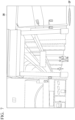
- FIG. 3 is a diagram illustrating an example of the captured image IM captured by the external camera.
- FIG. 3 shows, as an example, a situation in which the captured image IM captured by the external camera includes a road R, and a shop S and a passage P which are adjacent to the road R.
- the acquisition unit 110 acquires an instruction to stop the moving object 1 which is input by the occupant of the moving object 1 through a voice input instrument that is the HMI 20.
- the processes executed by the detection unit 120, the addition unit 130, and the determination unit 140 which will be described below are assumed to be executed when the acquisition unit 110 acquires an instruction to stop the moving object 1.
- the detection unit 120 detects one or more targets included in the captured image acquired by the acquisition unit 110 and a spatial relationship between the one or more targets. More specifically, the detection unit 120 detects one or more targets as objects belonging to a certain class from the captured image by performing a well-known scene graph (scene graph) generation process on the captured image, and detects the spatial relationship between the one or more detected targets as the spatial relationship between the detected objects.
- the class represents the type of target defined in advance (such as, for example, a road or a shop to be described later)
- the spatial relationship between objects represents the type of spatial relationship defined in advance (such as, for example, 'adjacent' or 'connect' to be described later). It is assumed that these classes and spatial relationships are specified by performing a well-known scene graph generation process on the captured image.
- FIG. 4 is a diagram illustrating an example of one or more targets and spatial relationships which are detected by the detection unit 120.
- FIG. 4 shows an example of one or more targets and their spatial relationships detected as objects by the detection unit 120 by performing a scene graph generation process on the image shown in FIG. 3 .
- the object shop represents a shop corresponding to the shop S in FIG. 3
- the object path represents a passage for pedestrians corresponding to the passage P in FIG. 3
- the object road (road1, road2, road3) represents a roadway corresponding to the road R in FIG. 3 .
- 'adjacent' and 'connect' represent the spatial relationship between two objects. More specifically, 'adjacent' represents that objects of a plurality of different classes are adjacent to each other, and 'connect' represents that objects of the same class are adjacent to each other (that is, connected). Meanwhile, these classes and spatial relationships are merely examples, and different classes and spatial relationships may be obtained depending on the settings in the scene graph generation process. For example, in FIG. 3 , a 'path' which is a passage for pedestrians and a 'road' which is a roadway may be assigned the same class (for example, 'path') as a common concept. In addition, for example, instead of 'adjacent,' spatial relationships such as 'front,' 'behind,' 'left,' and 'right' may be assigned based on the viewpoint of the camera that has captured the image.
- the addition unit 130 adds the general knowledge information 74 relating to the traveling of the moving object 1 to at least any of the one or more targets or spatial relationships detected by the detection unit 120.
- FIG. 5 is a diagram illustrating an example of a configuration of the general knowledge information 74.
- the general knowledge information 74 is, for example, information such as attributes, relationships, and general knowledge associated with a class.
- the attribute is a value that defines a property associated with an object indicated by the class.
- the road class has a width as an attribute. In this case, for example, in a case where a target belonging to the road class is detected from the captured image, the detection unit 120 estimates the width of the target through image processing, and sets the value of the estimated width of the target as 'width.'
- the relationship is a value that defines a possible relationship with another object. For example, in a case where the road class is adjacent to another object classified as the same road class, it has a 'connect' relationship with the other object, whereas in a case where it is adjacent to another object classified as a class different from the road class, it has an 'adjacent' relationship with the other object.
- the general knowledge is information that defines in advance rules related to the traveling of the moving object 1, and is information that defines common knowledge related to objects indicated by a certain class. For example, generally, it is common knowledge that in a case where there is an object (for example, a shop) adjacent to a road, a vehicle should not stop in front of the object. That is, this common knowledge is defined for the road class of the scene graph as "stop is not allowed on a road having an 'adjacent' relationship with another object.” In addition, for example, generally, it is common knowledge to avoid stop insofar as possible on a road where heavy traffic is expected (for example, a point of intersection or a branching route).
- this common knowledge can be defined for the road class of the scene graph as "stop on a road where the number of roads with which there is a 'connect' relationship is equal to or greater than a threshold (for example, 3) is not allowed” (not allowed at all), or can be defined as "only when it is not possible to stop on a road where the number of roads with which there is a 'connect' relationship is less than a threshold (for example, 3), stop on a road where the number is equal to or greater than the threshold is allowed" (conditional allowance).
- a threshold for example, 3
- this common knowledge can be defined for the road class of the scene graph as "stop is not allowed on a road where the attribute width is less than the threshold,” or can be defined as "stop is not allowed on a road where the vehicle width divided by the attribute width is equal to or greater than the threshold" on the basis of vehicle width information stored in advance.
- the general knowledge can be defined not only in combination with objects in the scene graph, but with information relating to the moving object 1 (such as, for example, a vehicle width or a vehicle model).
- the general knowledge information 74 is defined in a table format, but the general knowledge information 74 may be defined in any format (such as, for example, XML or JSON).
- the general knowledge does not necessarily have to be limited to content such as common knowledge.
- the general knowledge may include knowledge for improving user convenience, knowledge for bringing about business benefits in a case where the moving object 1 is provided as a service, and the like.
- the general knowledge may include knowledge for improving user convenience, knowledge for bringing about business benefits in a case where the moving object 1 is provided as a service, and the like.
- it is more convenient for a user to stop on a road facing a roofed area.
- this knowledge can be defined as adding an attribute roof (for example, roof: 1 (roof present)/0 (no roof)) indicating whether or not there is a roof to the attributes of the road class of the scene graph, and then defined as "In case of bad weather, stop on a road where the roof is 1.”
- roof for example, roof: 1 (roof present)/0 (no roof)
- In this case, whether the weather is "bad weather” can be determined, for example, by detecting raindrops shown in the captured image through image processing, or can be determined by acquiring weather information through a communication device (not shown) mounted on the moving object 1.
- this knowledge can be defined as adding the attribute slope indicating the slope of the road (for example, it may be defined as a continuous value of an angle, or may be defined as a discrete value indicating the degree of slope) to the attributes of the road class of the scene graph, and then defined as "if it is possible to stop on a plurality of roads, stop on a road with the smallest slope.”
- the slope of the road can be estimated, for example, through image processing of the captured image, or slope information stored in the navigation map information 72 can be acquired.
- one of the purposes of providing the moving object 1 as a service may be to increase the income of a shop within the service area.
- it can be considered to stop the moving object 1 on a road near the shop and guide the occupant to the shop.
- this knowledge can be defined as general knowledge of the road class of the scene graph, for example, as "a road having a 'connect' relationship stops on a road having an 'adjacent' relationship with 'shop.'"
- the attribute affiliate for example, affiliate: 1 (affiliated)/0 (unaffiliated)
- the attribute affiliate for example, affiliate: 1 (affiliated)/0 (unaffiliated)
- the attribute affiliate for example, affiliate: 1 (affiliated)/0 (unaffiliated)
- the attribute affiliate for identifying affiliated shops within the service area
- the attribute affiliate for example, affiliate: 1 (affiliated)/0 (unaffiliated)
- the attribute affiliate for identifying affiliated shops within the service area
- the attribute affiliate for example, affiliate: 1 (affiliated)/0 (unaffiliated)
- the attribute affiliate for example, affiliate: 1 (affiliated)/0 (unaffiliated)
- the attribute affiliate for example, affiliate: 1 (affiliated)/0 (unaffiliated)
- content such as common knowledge on traffic rules and content such as user convenience and business benefits may be defined as separate data. This allows information that does not change easily, such as common knowledge on traffic rules, to be managed separately from information that is relatively prone to change, such as user convenience and business benefits, which has the advantage of being highly scalable.
- the addition unit 130 adds general knowledge to at least any of the one or more targets or spatial relationships defined in the scene graph by collating the scene graph detected by the detection unit 120 with the general knowledge information 74.
- FIG. 6 is a diagram illustrating an example of addition of general knowledge which is performed by the addition unit 130.
- FIG. 6 shows a situation in which the addition unit 130 collates the scene graph shown in FIG. 4 with the general knowledge information 74 shown in FIG. 5 and adds general knowledge to an object defined in the scene graph.
- the addition unit 130 adds flag information indicating that stop is not allowed on road1 and road2 to these objects. Further, on the basis of the general knowledge information 74, the addition unit 130 recognizes that, in principle, stop is not allowed on two objects classified into the shop class and the path class, and adds flag information indicating stop is not allowed to these objects.
- stop is not allowed is added to road1 and road2 as flag information, but any information indicating that stop is not allowed may be added to these objects.
- the determination unit 140 refers to the result of addition of the general knowledge to specify a position at which the moving object 1 can stop among one or more targets and determine a stop position of the moving object 1 from the specified position at which stop is allowed.
- FIG. 7 is a diagram illustrating an example of a stop position of the moving object 1 determined by the determination unit 140.
- the determination unit 140 recognizes only road3 as an object on which stop is allowed by referring to the scene graph shown in FIG. 6 to which the general knowledge is added by the addition unit 130. Therefore, as shown in FIG. 7 , the determination unit 140 determines the position of the captured image corresponding to road3 as a stop position SP.
- control unit 150 drives the driving device 40 to cause the moving object 1 to travel to the stop position SP determined by the determination unit 140.
- the determination unit 140 may determine, as the stop position SP, an object which is closest in distance to the moving object 1 among the plurality of recognized objects.
- the general knowledge may be added to spatial relationships.
- a flag indicating information on stop not being allowed can be assigned to 'adjacent' that represents the relationship between an object of the shop class and another object, and the stop position SP can be determined so as not to stop on a road having an 'adjacent' relationship with another object to which the above-described flag has been assigned. This allows detailed settings regarding whether or not stop on an adjacent road is allowed for each object class.
- the present invention in order to determine the stop position of a moving object, flag information indicating that stop is not allowed has been assigned to the object, the present invention is not limited to this and can also be applied to a case where the priority order of stop positions is determined. That is, in addition to the flag information indicating that stop is not allowed, score information indicating whether stop is suitable or unsuitable may be added. Whether stop is suitable or unsuitable can likewise be recognized on the basis of the general knowledge information 74. For example, it is better not to stop in front of a store, but it is even worse to stop in the middle of a curve or close to a narrow side road.
- the score of a road having an 'adjacent' relationship with an object of the shop class can be set to be more suitable for stop than the score of a road having an attribute curve indicating that the road is in the middle of a curve (for example, curve: 1 (the curvature of the road is equal to or greater than a threshold)/0 (the curvature of the road is less than the threshold)).
- curve: 1 the curvature of the road is equal to or greater than a threshold
- 0 the curvature of the road is less than the threshold
- a total score value may be calculated only for a road that satisfies predetermined essential conditions (for example, conditions for the safety of an occupant), and the moving object 1 may be stopped on the road that satisfies the predetermined essential conditions and has the highest total score value. This allows the moving object 1 to stop at a more appropriate position while preventing the moving object from being unable to stop in an area desired by a user.
- predetermined essential conditions for example, conditions for the safety of an occupant
- the method of the present invention is intuitive and transparent in the details of processing because rules expressing human common knowledge is added to the scene graph and then the stop position SP is determined.
- the records of the general knowledge information 74 can be updated when update of traffic rules or changes in common knowledge occurs, and this has the advantage of being highly scalable unlike a method such as reinforcement learning which imposes a heavy load on re-learning.
- FIG. 8 is a flowchart illustrating an example of a flow of processing executed by the control device 100.
- the processing of the flowchart shown in FIG. 8 is executed, for example, when an occupant of the moving object 1 inputs an instruction to stop the moving object 1 through the HMI 20.
- the acquisition unit 110 acquires a captured image obtained by an external camera, which is the external detection device 10, capturing an image of the vicinity of the moving object 1 (step S100).
- the detection unit 120 detects one or more targets included in the captured image acquired by the acquisition unit 110 and a spatial relationship between the one or more targets as a scene graph (step S102).
- the addition unit 130 adds general knowledge to at least any of the detected targets or spatial relationships (step S104).
- the determination unit 140 determines the stop position of the moving object 1 on the basis of the result of addition of the general knowledge (step S106).
- the control unit 150 causes the moving object 1 to travel to the determined stop position (step S108). This completes the processing according to this flowchart.
- the present invention is not limited to such an application.
- common knowledge related to meeting for example, "meet at a famous place (in this case, a "famous place” can be extracted, for example, from the search volume of a search engine, or the like)," "do not meet on a road,” or the like
- general knowledge information for example, "meet at a famous place (in this case, a "famous place” can be extracted, for example, from the search volume of a search engine, or the like)
- common knowledge related to meeting is added to a scene graph representing a certain area, so that the meeting place can be determined.
- the present invention is applicable not only to determining a destination such as the stop position of a moving object or meeting place, but also to determining a route to a destination.
- a route to the stop position is determined, common knowledge related to regions where it is better not to travel (such as, for example, "if there is a puddle on the road surface, do not pass over the puddle") is defined as general information, and common knowledge related to regions where it is better not to travel is added to the scene graph generated from the captured image, so that it is possible to avoid regions where it is better to avoid traveling even if it is physically possible to travel.
- the present invention is not limited to such a configuration, and at least the moving object 1 (more specifically, an information processing device included in the moving object 1) need only be able to acquire a captured image of the vicinity of the movement position.
- the moving object 1 may acquire a captured image representing the vicinity of the movement position of the moving object 1 through a network.
- the present embodiment described above it is possible to acquire a captured image obtained by capturing an image of the vicinity of a movement position of a moving object using a camera, detect one or more targets included in the captured image and a spatial relationship between the one or more targets, add general knowledge information to at least any of the detected one or more targets or spatial relationship, and determine the movement position of the moving object on the basis of a result of addition of the general knowledge information.
- This makes it possible to determine the movement position of the moving object using an intuitive and highly scalable method.
- An information processing device including:
Landscapes
- Engineering & Computer Science (AREA)
- Physics & Mathematics (AREA)
- General Physics & Mathematics (AREA)
- Multimedia (AREA)
- Theoretical Computer Science (AREA)
- Traffic Control Systems (AREA)
Abstract
Description
- The present invention relates to an information processing device, an information processing method, and a program.
- Since the past, techniques of automatically determining a movement position of a vehicle has been known. For example,
Patent Document 1 discloses an automated driving system for controlling an automated driving vehicle that provides a driverless transportation service to a user. The technique disclosed inPatent Document 1 performs control so as to stop a vehicle at a target stop space within a predetermined boarding/alighting area. -
Patent Document 1Japanese Unexamined Patent Application, First Publication No. 2021-162886 - However, the technique disclosed in
Patent Document 1 is for stopping a vehicle in a target stop space specified in advance, and more generally, is not capable of determining a stop position of the vehicle from among candidates for the countless stop positions existing on a road. In this regard, in recent years, a technique of using a trained model obtained through, for example, reinforcement learning to specify a movement position from an image captured by a camera mounted on a vehicle has been known. However, the details of processing in a method using such a trained model are non-intuitive and black box. Further, when traffic rules related to the movement of vehicles are updated, the entire trained model needs to be updated on the basis of a new data set, which may result in low scalability. - The present invention was contrived in view of such circumstances, and one object thereof is to provide an information processing device, an information processing method, and a program that make it possible to determine the movement position of a moving object using an intuitive and highly scalable method.
- The following configurations are adopted in an information processing device, an information processing method, and a program according to this invention.
- (1) According to an aspect of this invention, there is provided an information processing device including: an acquisition unit that acquires a captured image obtained by capturing an image of the vicinity of a movement position of a moving object using a camera; a detection unit that detects one or more targets included in the captured image and a spatial relationship between the one or more targets; an addition unit that adds general knowledge information to at least any of the detected one or more targets or spatial relationship; and a determination unit that determines the movement position of the moving object on the basis of a result of addition of the general knowledge information.
- (2) In the aspect of the above (1), the general knowledge information is information that defines in advance rules related to traveling of the moving object.
- (3) In the aspect of the above (1), the detection unit detects the one or more targets from the captured image as objects in a scene graph, and detects the spatial relationship as a spatial relationship between the objects.
- (4) In the aspect of the above (3), the addition unit adds the general knowledge information to at least any of the one or more objects or spatial relationships in the scene graph.
- (5) In the aspect of the above (1), the determination unit determines the movement position by specifying a position to which the moving object is able to move among the one or more targets with reference to the result of addition of the general knowledge information.
- (6) In the aspect of the above (1), the determination unit determines the movement position by specifying a priority order of positions to which the moving object is able to move among the one or more targets with reference to the result of addition of the general knowledge information.
- (7) In any aspect of the above (1) to (6), the information processing device further includes a control unit that causes the moving object to travel to the determined movement position.
- (8) According to another aspect of this invention, there is provided an information processing method comprising causing a computer to: acquire a captured image obtained by capturing an image of the vicinity of a movement position of a moving object using a camera; detect one or more targets included in the captured image and a spatial relationship between the one or more targets; add general knowledge information to at least any of the detected one or more targets or spatial relationship; and determine the movement position of the moving object on the basis of a result of addition of the general knowledge information.
- (9) According to another aspect of this invention, there is provided a program causing a computer to: acquire a captured image obtained by capturing an image of the vicinity of a movement position of a moving object using a camera; detect one or more targets included in the captured image and a spatial relationship between the one or more targets; add general knowledge information to at least any of the detected one or more targets or spatial relationship; and determine the movement position of the moving object on the basis of a result of addition of the general knowledge information.
- According to the aspects of (1) to (9), it is possible to determine the movement position of a moving object using an intuitive and highly scalable method.
-
- [
FIG. 1 ] A diagram illustrating an example of a configuration of amoving object 1 and acontrol device 100 according to an embodiment. - [
FIG. 2 ] A perspective view of themoving object 1 seen from above. - [
FIG. 3 ] A diagram illustrating an example of a captured image IM captured by an external camera. - [
FIG. 4 ] A diagram illustrating an example of one or more targets and spatial relationships which are detected by adetection unit 120. - [
FIG. 5 ] A diagram illustrating an example of a configuration ofgeneral knowledge information 74. - [
FIG. 6 ] A diagram illustrating an example of general knowledge added by anaddition unit 130. - [
FIG. 7 ] A diagram illustrating an example of a movement position of themoving object 1 determined by adetermination unit 140. - [
FIG. 8 ] A flowchart illustrating an example of a flow of processing executed by thecontrol device 100. - Hereinafter, an embodiment of an information processing device, an information processing method, and a program of the present invention will be described with reference to the accompanying drawings. The information processing device is mounted on a moving object. The moving object moves both on a roadway and in a predetermined region different from the roadway. The moving object is sometimes referred to as a micro mobility. An electric kickboard is a type of micro mobility. The predetermined region is, for example, a sidewalk. In addition, the predetermined region may be some or all of a roadside strip, a bicycle lane, a public open space, and the like, or may include all of the sidewalk, the roadside strip, the bicycle lane, the public open space, and the like. As will be described below, the information processing device according to the present embodiment determines the movement position of the moving object on the basis of a captured image obtained by capturing an image of the vicinity of the moving object. As an example, a case in which the information processing device according to the present embodiment determines a stop position as the movement position of the moving object will be described below.
-
FIG. 1 is a diagram illustrating an example of a configuration of amoving object 1 and acontrol device 100 according to an embodiment. Themoving object 1 is equipped with, for example, anexternal detection device 10, amoving object sensor 12, anoperator 14, aninternal camera 16, apositioning device 18, anHMI 20, amode changeover switch 22, amoving mechanism 30, adriving device 40, anexternal notification device 50, astorage device 70, and thecontrol device 100. Meanwhile, some of these configurations which are not essential for realizing the functions of the present invention may be omitted. The moving object is not limited to a vehicle, and may include small mobility objects that run alongside a walking user to carry luggage or lead a person, or may include other moving objects that can move autonomously (such as, for example, walking robots). - The
external detection device 10 is a variety of devices having a detection range in the traveling direction of themoving object 1. Theexternal detection device 10 includes an external camera, a radar device, a light detection and ranging (LIDAR), a sensor fusion device, and the like. Theexternal detection device 10 outputs information indicating the detection result (such as an image or the position of an object) to thecontrol device 100. Particularly, in the present embodiment, theexternal detection device 10 is assumed to output a captured image obtained by capturing an image of the vicinity of themoving object 1 using an external camera to thecontrol device 100. - The
moving object sensor 12 includes, for example, a speed sensor, an acceleration sensor, a yaw rate (angular velocity) sensor, an orientation sensor, an operation amount detection sensor attached to theoperator 14, or the like. Theoperator 14 includes, for example, an operator for instructing acceleration and deceleration (for example, an accelerator pedal or a brake pedal) and an operator for instructing steering (for example, a steering wheel). In this case, themoving object sensor 12 may include an accelerator position sensor, a brake stepping amount sensor, a steering torque sensor, or the like. Themoving object 1 may be provided with operators in a form other than that described above (such as, for example, a rotary operator which is not annular, a joystick, or a button) as theoperator 14. - The
internal camera 16 captures an image of at least the head of an occupant of themoving object 1 from the front. Theinternal camera 16 is a digital camera that uses an imaging element such as a charge coupled device (CCD) or a complementary metal oxide semiconductor (CMOS). Theinternal camera 16 outputs the captured image to thecontrol device 100. - The
positioning device 18 is a device that measures the position of themoving object 1. Thepositioning device 18 is, for example, a global navigation satellite system (GNSS) receiver, and specifies the position of the movingobject 1 on the basis of signals received from GNSS satellites and outputs it as position information. Meanwhile, the position information of the movingobject 1 may be estimated from the position of a Wi-Fi base station to which a communication device to be described later is connected. - The
HMI 20 includes a display device, a speaker, a touch panel, keys, and the like. The occupant of the movingobject 1 sets, for example, a destination of the movingobject 1 through theHMI 20, and acontrol unit 150 to be described later causes the movingobject 1 to travel to the set destination. Particularly, in the present embodiment, theHMI 20 includes a voice input instrument such as a microphone, and the occupant of the movingobject 1 speaks an instruction sentence for instructing the stop position of the movingobject 1 to input it to the voice input instrument. TheHMI 20 analyzes the voice of the input instruction sentence, converts the voice to text, and outputs it to thecontrol device 100. Alternatively, theHMI 20 may, for example, accept an instruction sentence which has been input as text by the occupant through a touch panel, and output the accepted instruction sentence to thecontrol device 100. - The
mode changeover switch 22 is a switch which is operated by an occupant. Themode changeover switch 22 may be a mechanical switch, or may be a graphical user interface (GUI) switch which is set on the touch panel of theHMI 20. Themode changeover switch 22 accepts an operation for switching the driving mode to, for example, either mode A: an assist mode in which one of the steering operation and acceleration/deceleration control is performed by the occupant and the other is performed automatically (there may be mode A-1 in which the steering operation is performed by the occupant and acceleration/deceleration control is performed automatically, and mode A-2 in which the acceleration/deceleration operation is performed by the occupant and steering control is performed automatically), mode B: a manual driving mode in which the steering operation and acceleration/deceleration operation are performed by the occupant, or mode C: an automated driving mode in which the operation control and acceleration/deceleration control are performed automatically. - The moving
mechanism 30 is a mechanism for moving the movingobject 1 on a road. The movingmechanism 30 is, for example, a group of wheels including a steering wheel and driving wheels. In addition, the movingmechanism 30 may also be a leg for walking on multiple legs. - The driving
device 40 outputs a force to the movingmechanism 30 to move the movingobject 1. For example, the drivingdevice 40 includes a motor that drives the driving wheels, a battery that stores electric power to be supplied to the motor, a steering device that adjusts the steering angle of the steering wheel, and the like. The drivingdevice 40 may include an internal-combustion engine, a fuel cell, or the like as a driving force output means or a power generation means. In addition, the drivingdevice 40 may further include a brake device based on frictional force or air resistance. - The
external notification device 50 is, for example, a lamp, a display device, a speaker, or the like which is provided on the outer plate portion of the movingobject 1 to notify the outside of the movingobject 1 of information. Theexternal notification device 50 performs different operations depending on a state in which the movingobject 1 is moving on a sidewalk and a state in which it is moving on a roadway. For example, theexternal notification device 50 is controlled so that the lamp is caused to emit light in a case where the movingobject 1 is moving on a sidewalk, and that the lamp is caused not to emit light in a case where the movingobject 1 is moving on a roadway. The color of light emitted by this lamp is preferably a color specified by law. Theexternal notification device 50 may be controlled so that the lamp is caused to emit green light in a case where the movingobject 1 is moving on a sidewalk, and that the lamp is caused to emit blue light in a case where the movingobject 1 is moving on a roadway. In a case where theexternal notification device 50 is a display device, theexternal notification device 50 displays a text or graphic message of "traveling on a sidewalk" when the movingobject 1 is traveling on a sidewalk. -
FIG. 2 is a perspective view of the movingobject 1 seen from above. In the drawing, FW is a steering wheel, RW is a driving wheel, SD is a steering device, MT is a motor, and BT is a battery. The steering device SD, the motor MT, and the battery BT are included in the drivingdevice 40. In addition, AP is an accelerator pedal, BP is a brake pedal, WH is a steering wheel, SP is a speaker, and MC is a microphone. The movingobject 1 shown in the figure is a single-seat moving object, and an occupant P is seated in a driver's seat DS and fastened with a seat belt SB. An arrow D1 is the traveling direction (velocity vector) of the movingobject 1. Theexternal detection device 10 is provided near the front end portion of the movingobject 1, theinternal camera 16 is provided at a position where an image of the head of the occupant P can be captured from in front of the occupant P, and themode changeover switch 22 is provided at the boss portion of the steering wheel WH. In addition, theexternal notification device 50 serving as a display device is provided near the front end portion of the movingobject 1. - Referring back to
FIG. 1 , thestorage device 70 is a non-transitory storage device such as, for example, a hard disk drive (HDD), a flash memory, or a random access memory (RAM). Thestorage device 70 storesnavigation map information 72,general knowledge information 74, and the like. Although thestorage device 70 is illustrated outside the frame of thecontrol device 100 in the drawing, thestorage device 70 may be included in thecontrol device 100. In addition, thestorage device 70 may also be provided on a server (not shown). - The
navigation map information 72 is map information which is stored in in advance in thestorage device 70 and includes, for example, information on the center of a road including a roadway and a sidewalk, information on the boundary of the road, or the like. Thenavigation map information 72 further includes information (such as name, address, or area) on facilities and buildings which are adjacent to the boundary of the road. The details of thegeneral knowledge information 74 will be described later. - The
control device 100 includes, for example, anacquisition unit 110, adetection unit 120, anaddition unit 130, adetermination unit 140, and thecontrol unit 150. Theacquisition unit 110, thedetection unit 120, theaddition unit 130, thedetermination unit 140, and thecontrol unit 150 are realized by a hardware processor such as, for example, a central processing unit (CPU) executing a program (software). Some or all of these components may be realized by hardware (a circuit unit; including circuitry) such as a large scale integration (LSI), an application specific integrated circuit (ASIC), a field-programmable gate array (FPGA), or a graphics processing unit (GPU), and may be realized by software and hardware in cooperation. The program may be stored in advance in thestorage device 70, may be stored in a detachable storage medium (non-transitory storage medium) such as a DVD or a CD-ROM, or may be installed in thestorage device 70 by the storage medium being mounted in a drive device. A combination of theacquisition unit 110, thedetection unit 120, theaddition unit 130, and thedetermination unit 140 is an example of an "information processing device." - The
acquisition unit 110 acquires a captured image IM obtained by capturing an image of the vicinity of the movement position of the movingobject 1 using an external camera which is theexternal detection device 10.FIG. 3 is a diagram illustrating an example of the captured image IM captured by the external camera.FIG. 3 shows, as an example, a situation in which the captured image IM captured by the external camera includes a road R, and a shop S and a passage P which are adjacent to the road R. - Further, the
acquisition unit 110 acquires an instruction to stop the movingobject 1 which is input by the occupant of the movingobject 1 through a voice input instrument that is theHMI 20. The processes executed by thedetection unit 120, theaddition unit 130, and thedetermination unit 140 which will be described below are assumed to be executed when theacquisition unit 110 acquires an instruction to stop the movingobject 1. - The
detection unit 120 detects one or more targets included in the captured image acquired by theacquisition unit 110 and a spatial relationship between the one or more targets. More specifically, thedetection unit 120 detects one or more targets as objects belonging to a certain class from the captured image by performing a well-known scene graph (scene graph) generation process on the captured image, and detects the spatial relationship between the one or more detected targets as the spatial relationship between the detected objects. Here, the class represents the type of target defined in advance (such as, for example, a road or a shop to be described later), and the spatial relationship between objects represents the type of spatial relationship defined in advance (such as, for example, 'adjacent' or 'connect' to be described later). It is assumed that these classes and spatial relationships are specified by performing a well-known scene graph generation process on the captured image. -
FIG. 4 is a diagram illustrating an example of one or more targets and spatial relationships which are detected by thedetection unit 120.FIG. 4 shows an example of one or more targets and their spatial relationships detected as objects by thedetection unit 120 by performing a scene graph generation process on the image shown inFIG. 3 . InFIG. 4 , the object shop represents a shop corresponding to the shop S inFIG. 3 , the object path represents a passage for pedestrians corresponding to the passage P inFIG. 3 , the object road (road1, road2, road3) represents a roadway corresponding to the road R inFIG. 3 . - Further, in the scene graph of
FIG. 4 , 'adjacent' and 'connect' represent the spatial relationship between two objects. More specifically, 'adjacent' represents that objects of a plurality of different classes are adjacent to each other, and 'connect' represents that objects of the same class are adjacent to each other (that is, connected). Meanwhile, these classes and spatial relationships are merely examples, and different classes and spatial relationships may be obtained depending on the settings in the scene graph generation process. For example, inFIG. 3 , a 'path' which is a passage for pedestrians and a 'road' which is a roadway may be assigned the same class (for example, 'path') as a common concept. In addition, for example, instead of 'adjacent,' spatial relationships such as 'front,' 'behind,' 'left,' and 'right' may be assigned based on the viewpoint of the camera that has captured the image. - The
addition unit 130 adds thegeneral knowledge information 74 relating to the traveling of the movingobject 1 to at least any of the one or more targets or spatial relationships detected by thedetection unit 120.FIG. 5 is a diagram illustrating an example of a configuration of thegeneral knowledge information 74. Thegeneral knowledge information 74 is, for example, information such as attributes, relationships, and general knowledge associated with a class. The attribute is a value that defines a property associated with an object indicated by the class. For example, the road class has a width as an attribute. In this case, for example, in a case where a target belonging to the road class is detected from the captured image, thedetection unit 120 estimates the width of the target through image processing, and sets the value of the estimated width of the target as 'width.' - The relationship is a value that defines a possible relationship with another object. For example, in a case where the road class is adjacent to another object classified as the same road class, it has a 'connect' relationship with the other object, whereas in a case where it is adjacent to another object classified as a class different from the road class, it has an 'adjacent' relationship with the other object.
- The general knowledge is information that defines in advance rules related to the traveling of the moving
object 1, and is information that defines common knowledge related to objects indicated by a certain class. For example, generally, it is common knowledge that in a case where there is an object (for example, a shop) adjacent to a road, a vehicle should not stop in front of the object. That is, this common knowledge is defined for the road class of the scene graph as "stop is not allowed on a road having an 'adjacent' relationship with another object." In addition, for example, generally, it is common knowledge to avoid stop insofar as possible on a road where heavy traffic is expected (for example, a point of intersection or a branching route). That is, this common knowledge can be defined for the road class of the scene graph as "stop on a road where the number of roads with which there is a 'connect' relationship is equal to or greater than a threshold (for example, 3) is not allowed" (not allowed at all), or can be defined as "only when it is not possible to stop on a road where the number of roads with which there is a 'connect' relationship is less than a threshold (for example, 3), stop on a road where the number is equal to or greater than the threshold is allowed" (conditional allowance). In addition, for example, generally, it is common knowledge that a vehicle should not stop on a narrow road. That is, this common knowledge can be defined for the road class of the scene graph as "stop is not allowed on a road where the attribute width is less than the threshold," or can be defined as "stop is not allowed on a road where the vehicle width divided by the attribute width is equal to or greater than the threshold" on the basis of vehicle width information stored in advance. In this way, the general knowledge can be defined not only in combination with objects in the scene graph, but with information relating to the moving object 1 (such as, for example, a vehicle width or a vehicle model). Meanwhile, inFIG. 5 , for convenience of description, thegeneral knowledge information 74 is defined in a table format, but thegeneral knowledge information 74 may be defined in any format (such as, for example, XML or JSON). - In addition, the general knowledge does not necessarily have to be limited to content such as common knowledge. For example, the general knowledge may include knowledge for improving user convenience, knowledge for bringing about business benefits in a case where the moving
object 1 is provided as a service, and the like. For example, generally, in the case of bad weather, it is more convenient for a user to stop on a road facing a roofed area. That is, this knowledge can be defined as adding an attribute roof (for example, roof: 1 (roof present)/0 (no roof)) indicating whether or not there is a roof to the attributes of the road class of the scene graph, and then defined as "In case of bad weather, stop on a road where the roof is 1." In this case, whether the weather is "bad weather" can be determined, for example, by detecting raindrops shown in the captured image through image processing, or can be determined by acquiring weather information through a communication device (not shown) mounted on the movingobject 1. - In addition, for example, generally, it is more convenient for a user to stop on a flat road than to stop on a road with a steep slope. That is, this knowledge can be defined as adding the attribute slope indicating the slope of the road (for example, it may be defined as a continuous value of an angle, or may be defined as a discrete value indicating the degree of slope) to the attributes of the road class of the scene graph, and then defined as "if it is possible to stop on a plurality of roads, stop on a road with the smallest slope." In this case, the slope of the road can be estimated, for example, through image processing of the captured image, or slope information stored in the
navigation map information 72 can be acquired. - Similarly, for example, one of the purposes of providing the moving
object 1 as a service may be to increase the income of a shop within the service area. In order to increase the income of a shop within the service area, for example, it can be considered to stop the movingobject 1 on a road near the shop and guide the occupant to the shop. That is, this knowledge can be defined as general knowledge of the road class of the scene graph, for example, as "a road having a 'connect' relationship stops on a road having an 'adjacent' relationship with 'shop.'" In addition, for example, the attribute affiliate (for example, affiliate: 1 (affiliated)/0 (unaffiliated)) for identifying affiliated shops within the service area can be defined as the attribute of the shop class of the scene graph, and then defined as "if stop is allowed on a plurality of roads, a road having a 'connect' relationship stops on a road having an 'adjacent' relationship with a shop whose affiliate is 1." In this case, whether or not an object of a certain shop class has an affiliate of 1 can be determined based on the appearance information and loge information of the object shown in the captured image. - In addition, in a case where such knowledge is incorporated into the
general knowledge information 74, content such as common knowledge on traffic rules and content such as user convenience and business benefits may be defined as separate data. This allows information that does not change easily, such as common knowledge on traffic rules, to be managed separately from information that is relatively prone to change, such as user convenience and business benefits, which has the advantage of being highly scalable. - The
addition unit 130 adds general knowledge to at least any of the one or more targets or spatial relationships defined in the scene graph by collating the scene graph detected by thedetection unit 120 with thegeneral knowledge information 74.FIG. 6 is a diagram illustrating an example of addition of general knowledge which is performed by theaddition unit 130.FIG. 6 shows a situation in which theaddition unit 130 collates the scene graph shown inFIG. 4 with thegeneral knowledge information 74 shown inFIG. 5 and adds general knowledge to an object defined in the scene graph. - More specifically, among three objects (road1, road2, and road3) classified into the road class, 'road1' has an 'adjacent' relationship with 'shop,' and road2 has an 'adjacent' relationship with "path." Therefore, on the basis of the general knowledge stored in the
general knowledge information 74 that "stop is not allowed on a road having an 'adjacent' relationship with other objects," theaddition unit 130 adds flag information indicating that stop is not allowed on road1 and road2 to these objects. Further, on the basis of thegeneral knowledge information 74, theaddition unit 130 recognizes that, in principle, stop is not allowed on two objects classified into the shop class and the path class, and adds flag information indicating stop is not allowed to these objects. As a result, among five objects defined in the scene graph, only road3 is recognized as an object on which stop is allowed. Meanwhile, inFIG. 6 , for convenience of description, "stop is not allowed" is added to road1 and road2 as flag information, but any information indicating that stop is not allowed may be added to these objects. - The
determination unit 140 refers to the result of addition of the general knowledge to specify a position at which the movingobject 1 can stop among one or more targets and determine a stop position of the movingobject 1 from the specified position at which stop is allowed.FIG. 7 is a diagram illustrating an example of a stop position of the movingobject 1 determined by thedetermination unit 140. For example, thedetermination unit 140 recognizes only road3 as an object on which stop is allowed by referring to the scene graph shown inFIG. 6 to which the general knowledge is added by theaddition unit 130. Therefore, as shown inFIG. 7 , thedetermination unit 140 determines the position of the captured image corresponding to road3 as a stop position SP. Thereafter, thecontrol unit 150 drives the drivingdevice 40 to cause the movingobject 1 to travel to the stop position SP determined by thedetermination unit 140. Meanwhile, in a case where a plurality of objects on which stop is allowed are recognized from the scene graph, thedetermination unit 140 may determine, as the stop position SP, an object which is closest in distance to the movingobject 1 among the plurality of recognized objects. - In addition, although a case where the general knowledge is added to a target has been described here, the subject to which the general knowledge is added is not limited to this. That is, the general knowledge may be added to spatial relationships. For example, on the basis of the general knowledge "stop is not allowed on a road having an 'adjacent' relationship with an object of the shop class" stored in the
general knowledge information 74, a flag indicating information on stop not being allowed can be assigned to 'adjacent' that represents the relationship between an object of the shop class and another object, and the stop position SP can be determined so as not to stop on a road having an 'adjacent' relationship with another object to which the above-described flag has been assigned. This allows detailed settings regarding whether or not stop on an adjacent road is allowed for each object class. - Meanwhile, in the above description, in order to determine the stop position of a moving object, flag information indicating that stop is not allowed has been assigned to the object, the present invention is not limited to this and can also be applied to a case where the priority order of stop positions is determined. That is, in addition to the flag information indicating that stop is not allowed, score information indicating whether stop is suitable or unsuitable may be added. Whether stop is suitable or unsuitable can likewise be recognized on the basis of the
general knowledge information 74. For example, it is better not to stop in front of a store, but it is even worse to stop in the middle of a curve or close to a narrow side road. Knowledge regarding the priority order of these may be included in thegeneral knowledge information 74, and the score of a road having an 'adjacent' relationship with an object of the shop class can be set to be more suitable for stop than the score of a road having an attribute curve indicating that the road is in the middle of a curve (for example, curve: 1 (the curvature of the road is equal to or greater than a threshold)/0 (the curvature of the road is less than the threshold)). More generally, in a case where the conditions for each attribute such as roof, slope, or curve described above are satisfied, a score value corresponding to the satisfaction of the conditions may be given, and the movingobject 1 may be stopped on a road where the total score value is highest and where it can be stopped. In that case, a total score value may be calculated only for a road that satisfies predetermined essential conditions (for example, conditions for the safety of an occupant), and the movingobject 1 may be stopped on the road that satisfies the predetermined essential conditions and has the highest total score value. This allows the movingobject 1 to stop at a more appropriate position while preventing the moving object from being unable to stop in an area desired by a user. - In this way, unlike a method such as reinforcement learning which is non-intuitive and of which the details of processing are a black box, the method of the present invention is intuitive and transparent in the details of processing because rules expressing human common knowledge is added to the scene graph and then the stop position SP is determined. Further, in the method of the present invention, the records of the
general knowledge information 74 can be updated when update of traffic rules or changes in common knowledge occurs, and this has the advantage of being highly scalable unlike a method such as reinforcement learning which imposes a heavy load on re-learning. - Next, a flow of processing executed by the
control device 100 will be described with reference toFIG. 8. FIG. 8 is a flowchart illustrating an example of a flow of processing executed by thecontrol device 100. The processing of the flowchart shown inFIG. 8 is executed, for example, when an occupant of the movingobject 1 inputs an instruction to stop the movingobject 1 through theHMI 20. - First, the
acquisition unit 110 acquires a captured image obtained by an external camera, which is theexternal detection device 10, capturing an image of the vicinity of the moving object 1 (step S100). Next, thedetection unit 120 detects one or more targets included in the captured image acquired by theacquisition unit 110 and a spatial relationship between the one or more targets as a scene graph (step S102). - Next, the
addition unit 130 adds general knowledge to at least any of the detected targets or spatial relationships (step S104). Next, thedetermination unit 140 determines the stop position of the movingobject 1 on the basis of the result of addition of the general knowledge (step S106). Next, thecontrol unit 150 causes the movingobject 1 to travel to the determined stop position (step S108). This completes the processing according to this flowchart. - Meanwhile, in the above embodiment, an example in which the stop position of a moving object is determined on the basis of a scene graph to which general knowledge information is added has been described. However, the present invention is not limited to such an application. For example, when a meeting place is determined, common knowledge related to meeting (for example, "meet at a famous place (in this case, a "famous place" can be extracted, for example, from the search volume of a search engine, or the like)," "do not meet on a road," or the like) is defined as general knowledge information, and common knowledge related to meeting is added to a scene graph representing a certain area, so that the meeting place can be determined.
- In addition, the present invention is applicable not only to determining a destination such as the stop position of a moving object or meeting place, but also to determining a route to a destination. For example, when a route to the stop position is determined, common knowledge related to regions where it is better not to travel (such as, for example, "if there is a puddle on the road surface, do not pass over the puddle") is defined as general information, and common knowledge related to regions where it is better not to travel is added to the scene graph generated from the captured image, so that it is possible to avoid regions where it is better to avoid traveling even if it is physically possible to travel.
- In addition, in the above embodiment, an example in which an external camera which is the
external detection device 10 is mounted on the movingobject 1 and captures an image of the vicinity of the movement position of the movingobject 1 has been described. However, the present invention is not limited to such a configuration, and at least the moving object 1 (more specifically, an information processing device included in the moving object 1) need only be able to acquire a captured image of the vicinity of the movement position. For example, the movingobject 1 may acquire a captured image representing the vicinity of the movement position of the movingobject 1 through a network. - According to the present embodiment described above, it is possible to acquire a captured image obtained by capturing an image of the vicinity of a movement position of a moving object using a camera, detect one or more targets included in the captured image and a spatial relationship between the one or more targets, add general knowledge information to at least any of the detected one or more targets or spatial relationship, and determine the movement position of the moving object on the basis of a result of addition of the general knowledge information. This makes it possible to determine the movement position of the moving object using an intuitive and highly scalable method.
- The above-described embodiment can be represented as follows.
- An information processing device including:
- a storage medium having computer-readable instructions stored therein; and
- a processor connected to the storage medium,
- wherein the processor executes the computer-readable instructions to
- acquire a captured image obtained by capturing an image of the vicinity of a movement position of a moving object using a camera,
- detect one or more targets included in the captured image and a spatial relationship between the one or more targets,
- add general knowledge information to at least any of the detected one or more targets or spatial relationship, and
- determine the movement position of the moving object on the basis of a result of addition of the general knowledge information.
- While preferred embodiments of the invention have been described and illustrated above, it should be understood that these are exemplary of the invention and are not to be considered as limiting. Additions, omissions, substitutions, and other modifications can be made without departing from the spirit or scope of the present invention. Accordingly, the invention is not to be considered as being limited by the foregoing description, and is only limited by the scope of the appended claims.
-
- 10 External detection device
- 12 Moving object sensor
- 14 Operator
- 16 Internal camera
- 18 Positioning device
- 20 HMI
- 22 Mode changeover switch
- 30 Moving mechanism
- 40 Driving device
- 50 External notification device
- 70 Storage device
- 72 Navigation map information
- 100 Control device
- 110 Acquisition unit
- 120 Detection unit
- 130 Addition unit
- 140 Determination unit
- 150 Control unit
Claims (9)
- An information processing device comprising:an acquisition unit that acquires a captured image obtained by capturing an image of the vicinity of a movement position of a moving object using a camera;a detection unit that detects one or more targets included in the captured image and a spatial relationship between the one or more targets;an addition unit that adds general knowledge information to at least any of the detected one or more targets or spatial relationship; anda determination unit that determines the movement position of the moving object on the basis of a result of addition of the general knowledge information.
- The information processing device according to claim 1, wherein the general knowledge information is information that defines in advance rules related to traveling of the moving object.
- The information processing device according to claim 1, wherein the detection unit detects the one or more targets from the captured image as objects in a scene graph, and detects the spatial relationship as a spatial relationship between the objects.
- The information processing device according to claim 3, wherein the addition unit adds the general knowledge information to at least any of the one or more objects or spatial relationships in the scene graph.
- The information processing device according to claim 1, wherein the determination unit determines the movement position by specifying a position to which the moving object is able to move among the one or more targets with reference to the result of addition of the general knowledge information.
- The information processing device according to claim 1, wherein the determination unit determines the movement position by specifying a priority order of positions to which the moving object is able to move among the one or more targets with reference to the result of addition of the general knowledge information.
- The information processing device according to any one of claims 1 to 6, further comprising a control unit that causes the moving object to travel to the determined movement position.
- An information processing method comprising causing a computer to:acquire a captured image obtained by capturing an image of the vicinity of a movement position of a moving object using a camera;detect one or more targets included in the captured image and a spatial relationship between the one or more targets;add general knowledge information to at least any of the detected one or more targets or spatial relationship; anddetermine the movement position of the moving object on the basis of a result of addition of the general knowledge information.
- A program causing a computer to:acquire a captured image obtained by capturing an image of the vicinity of a movement position of a moving object using a camera;detect one or more targets included in the captured image and a spatial relationship between the one or more targets;add general knowledge information to at least any of the detected one or more targets or spatial relationship; anddetermine the movement position of the moving object on the basis of a result of addition of the general knowledge information.
Applications Claiming Priority (2)
| Application Number | Priority Date | Filing Date | Title |
|---|---|---|---|
| JP2022156063 | 2022-09-29 | ||
| PCT/JP2023/035103 WO2024071179A1 (en) | 2022-09-29 | 2023-09-27 | Information processing device, information processing method, and program |
Publications (2)
| Publication Number | Publication Date |
|---|---|
| EP4560602A1 true EP4560602A1 (en) | 2025-05-28 |
| EP4560602A4 EP4560602A4 (en) | 2025-08-06 |
Family
ID=90477858
Family Applications (1)
| Application Number | Title | Priority Date | Filing Date |
|---|---|---|---|
| EP23872401.7A Pending EP4560602A4 (en) | 2022-09-29 | 2023-09-27 | INFORMATION PROCESSING DEVICE, INFORMATION PROCESSING METHOD AND PROGRAM |
Country Status (4)
| Country | Link |
|---|---|
| EP (1) | EP4560602A4 (en) |
| JP (1) | JP7802194B2 (en) |
| CN (1) | CN119678198A (en) |
| WO (1) | WO2024071179A1 (en) |
Family Cites Families (3)
| Publication number | Priority date | Publication date | Assignee | Title |
|---|---|---|---|---|
| JP6623602B2 (en) | 2015-07-31 | 2019-12-25 | アイシン精機株式会社 | Parking assistance device |
| JP7213015B2 (en) * | 2018-01-31 | 2023-01-26 | ジオテクノロジーズ株式会社 | Parking position extraction device, parking position extraction method, and information processing program |
| JP7238838B2 (en) | 2020-03-30 | 2023-03-14 | トヨタ自動車株式会社 | Autonomous driving system |
-
2023
- 2023-09-27 CN CN202380058939.0A patent/CN119678198A/en active Pending
- 2023-09-27 EP EP23872401.7A patent/EP4560602A4/en active Pending
- 2023-09-27 JP JP2024550383A patent/JP7802194B2/en active Active
- 2023-09-27 WO PCT/JP2023/035103 patent/WO2024071179A1/en not_active Ceased
Also Published As
| Publication number | Publication date |
|---|---|
| WO2024071179A1 (en) | 2024-04-04 |
| EP4560602A4 (en) | 2025-08-06 |
| CN119678198A (en) | 2025-03-21 |
| JP7802194B2 (en) | 2026-01-19 |
| JPWO2024071179A1 (en) | 2024-04-04 |
Similar Documents
| Publication | Publication Date | Title |
|---|---|---|
| US10867510B2 (en) | Real-time traffic monitoring with connected cars | |
| CN107848533A (en) | Controller of vehicle, control method for vehicle and wagon control program | |
| US20240140468A1 (en) | Driving assistance device, driving assistance method, and storage medium | |
| US12617416B2 (en) | Mobile object control device and mobile object control method | |
| JP7688220B2 (en) | MOBILE BODY CONTROL DEVICE, MOBILE BODY CONTROL METHOD, AND STORAGE MEDIUM | |
| US12403903B2 (en) | Mobile object control device and mobile object control method | |
| EP4538134A1 (en) | Mobile body, control method, and program | |
| US20250206315A1 (en) | Device for controlling mobile object, method for controlling mobile object, and storage medium | |
| JP7802194B2 (en) | Information processing device, information processing method, and program | |
| US12633137B2 (en) | Moving body control device, moving body control method, and storage medium using trained models adapted for multiple types of roads | |
| US20240071103A1 (en) | Image recognition device, image recognition method, and program | |
| US12394208B2 (en) | Mobile object control device, mobile object control method, and storage medium | |
| EP4501733A1 (en) | Device for controlling mobile body, method for controlling mobile body, and storage medium | |
| EP4502983B1 (en) | Control device for mobile body, control method for mobile body, and storage medium | |
| US12097864B2 (en) | Mobile object control device and mobile object control method | |
| US20250187604A1 (en) | Device for controlling mobile object, method for controlling mobile object, and storage medium | |
| CN118985016A (en) | Control device for mobile object and control method for mobile object |
Legal Events
| Date | Code | Title | Description |
|---|---|---|---|
| STAA | Information on the status of an ep patent application or granted ep patent |
Free format text: STATUS: THE INTERNATIONAL PUBLICATION HAS BEEN MADE |
|
| PUAI | Public reference made under article 153(3) epc to a published international application that has entered the european phase |
Free format text: ORIGINAL CODE: 0009012 |
|
| STAA | Information on the status of an ep patent application or granted ep patent |
Free format text: STATUS: REQUEST FOR EXAMINATION WAS MADE |
|
| 17P | Request for examination filed |
Effective date: 20250220 |
|
| AK | Designated contracting states |
Kind code of ref document: A1 Designated state(s): AL AT BE BG CH CY CZ DE DK EE ES FI FR GB GR HR HU IE IS IT LI LT LU LV MC ME MK MT NL NO PL PT RO RS SE SI SK SM TR |
|
| RAP3 | Party data changed (applicant data changed or rights of an application transferred) |
Owner name: HONDA MOTOR CO., LTD. |
|
| A4 | Supplementary search report drawn up and despatched |
Effective date: 20250707 |
|
| RIC1 | Information provided on ipc code assigned before grant |
Ipc: G08G 1/09 20060101AFI20250701BHEP Ipc: B60W 30/14 20060101ALI20250701BHEP Ipc: G06V 20/58 20220101ALI20250701BHEP |
|
| DAV | Request for validation of the european patent (deleted) | ||
| DAX | Request for extension of the european patent (deleted) | ||
| STAA | Information on the status of an ep patent application or granted ep patent |
Free format text: STATUS: EXAMINATION IS IN PROGRESS |
|
| 17Q | First examination report despatched |
Effective date: 20260306 |