EP4560056A1 - Ga-based room-temperature van der waals ferromagnetic crystal material, preparation, and use - Google Patents
Ga-based room-temperature van der waals ferromagnetic crystal material, preparation, and use Download PDFInfo
- Publication number
- EP4560056A1 EP4560056A1 EP22951818.8A EP22951818A EP4560056A1 EP 4560056 A1 EP4560056 A1 EP 4560056A1 EP 22951818 A EP22951818 A EP 22951818A EP 4560056 A1 EP4560056 A1 EP 4560056A1
- Authority
- EP
- European Patent Office
- Prior art keywords
- temperature
- ferromagnetic crystal
- powder
- gega
- ferromagnetic
- Prior art date
- Legal status (The legal status is an assumption and is not a legal conclusion. Google has not performed a legal analysis and makes no representation as to the accuracy of the status listed.)
- Pending
Links
Images



Classifications
-
- H—ELECTRICITY
- H01—ELECTRIC ELEMENTS
- H01F—MAGNETS; INDUCTANCES; TRANSFORMERS; SELECTION OF MATERIALS FOR THEIR MAGNETIC PROPERTIES
- H01F1/00—Magnets or magnetic bodies characterised by the magnetic materials therefor; Selection of materials for their magnetic properties
- H01F1/01—Magnets or magnetic bodies characterised by the magnetic materials therefor; Selection of materials for their magnetic properties of inorganic materials
- H01F1/03—Magnets or magnetic bodies characterised by the magnetic materials therefor; Selection of materials for their magnetic properties of inorganic materials characterised by their coercivity
- H01F1/032—Magnets or magnetic bodies characterised by the magnetic materials therefor; Selection of materials for their magnetic properties of inorganic materials characterised by their coercivity of hard-magnetic materials
- H01F1/04—Magnets or magnetic bodies characterised by the magnetic materials therefor; Selection of materials for their magnetic properties of inorganic materials characterised by their coercivity of hard-magnetic materials metals or alloys
- H01F1/06—Magnets or magnetic bodies characterised by the magnetic materials therefor; Selection of materials for their magnetic properties of inorganic materials characterised by their coercivity of hard-magnetic materials metals or alloys in the form of particles, e.g. powder
-
- C—CHEMISTRY; METALLURGY
- C01—INORGANIC CHEMISTRY
- C01B—NON-METALLIC ELEMENTS; COMPOUNDS THEREOF; METALLOIDS OR COMPOUNDS THEREOF NOT COVERED BY SUBCLASS C01C
- C01B19/00—Selenium; Tellurium; Compounds thereof
- C01B19/002—Compounds containing, besides selenium or tellurium, more than one other element, with -O- and -OH not being considered as anions
-
- C—CHEMISTRY; METALLURGY
- C30—CRYSTAL GROWTH
- C30B—SINGLE-CRYSTAL GROWTH; UNIDIRECTIONAL SOLIDIFICATION OF EUTECTIC MATERIAL OR UNIDIRECTIONAL DEMIXING OF EUTECTOID MATERIAL; REFINING BY ZONE-MELTING OF MATERIAL; PRODUCTION OF A HOMOGENEOUS POLYCRYSTALLINE MATERIAL WITH DEFINED STRUCTURE; SINGLE CRYSTALS OR HOMOGENEOUS POLYCRYSTALLINE MATERIAL WITH DEFINED STRUCTURE; AFTER-TREATMENT OF SINGLE CRYSTALS OR A HOMOGENEOUS POLYCRYSTALLINE MATERIAL WITH DEFINED STRUCTURE; APPARATUS THEREFOR
- C30B11/00—Single-crystal growth by normal freezing or freezing under temperature gradient, e.g. Bridgman-Stockbarger method
-
- C—CHEMISTRY; METALLURGY
- C30—CRYSTAL GROWTH
- C30B—SINGLE-CRYSTAL GROWTH; UNIDIRECTIONAL SOLIDIFICATION OF EUTECTIC MATERIAL OR UNIDIRECTIONAL DEMIXING OF EUTECTOID MATERIAL; REFINING BY ZONE-MELTING OF MATERIAL; PRODUCTION OF A HOMOGENEOUS POLYCRYSTALLINE MATERIAL WITH DEFINED STRUCTURE; SINGLE CRYSTALS OR HOMOGENEOUS POLYCRYSTALLINE MATERIAL WITH DEFINED STRUCTURE; AFTER-TREATMENT OF SINGLE CRYSTALS OR A HOMOGENEOUS POLYCRYSTALLINE MATERIAL WITH DEFINED STRUCTURE; APPARATUS THEREFOR
- C30B25/00—Single-crystal growth by chemical reaction of reactive gases, e.g. chemical vapour-deposition growth
-
- C—CHEMISTRY; METALLURGY
- C30—CRYSTAL GROWTH
- C30B—SINGLE-CRYSTAL GROWTH; UNIDIRECTIONAL SOLIDIFICATION OF EUTECTIC MATERIAL OR UNIDIRECTIONAL DEMIXING OF EUTECTOID MATERIAL; REFINING BY ZONE-MELTING OF MATERIAL; PRODUCTION OF A HOMOGENEOUS POLYCRYSTALLINE MATERIAL WITH DEFINED STRUCTURE; SINGLE CRYSTALS OR HOMOGENEOUS POLYCRYSTALLINE MATERIAL WITH DEFINED STRUCTURE; AFTER-TREATMENT OF SINGLE CRYSTALS OR A HOMOGENEOUS POLYCRYSTALLINE MATERIAL WITH DEFINED STRUCTURE; APPARATUS THEREFOR
- C30B29/00—Single crystals or homogeneous polycrystalline material with defined structure characterised by the material or by their shape
- C30B29/10—Inorganic compounds or compositions
- C30B29/46—Sulfur-, selenium- or tellurium-containing compounds
-
- C—CHEMISTRY; METALLURGY
- C30—CRYSTAL GROWTH
- C30B—SINGLE-CRYSTAL GROWTH; UNIDIRECTIONAL SOLIDIFICATION OF EUTECTIC MATERIAL OR UNIDIRECTIONAL DEMIXING OF EUTECTOID MATERIAL; REFINING BY ZONE-MELTING OF MATERIAL; PRODUCTION OF A HOMOGENEOUS POLYCRYSTALLINE MATERIAL WITH DEFINED STRUCTURE; SINGLE CRYSTALS OR HOMOGENEOUS POLYCRYSTALLINE MATERIAL WITH DEFINED STRUCTURE; AFTER-TREATMENT OF SINGLE CRYSTALS OR A HOMOGENEOUS POLYCRYSTALLINE MATERIAL WITH DEFINED STRUCTURE; APPARATUS THEREFOR
- C30B9/00—Single-crystal growth from melt solutions using molten solvents
- C30B9/04—Single-crystal growth from melt solutions using molten solvents by cooling of the solution
- C30B9/06—Single-crystal growth from melt solutions using molten solvents by cooling of the solution using as solvent a component of the crystal composition
-
- H—ELECTRICITY
- H01—ELECTRIC ELEMENTS
- H01F—MAGNETS; INDUCTANCES; TRANSFORMERS; SELECTION OF MATERIALS FOR THEIR MAGNETIC PROPERTIES
- H01F1/00—Magnets or magnetic bodies characterised by the magnetic materials therefor; Selection of materials for their magnetic properties
- H01F1/0036—Magnets or magnetic bodies characterised by the magnetic materials therefor; Selection of materials for their magnetic properties showing low dimensional magnetism, i.e. spin rearrangements due to a restriction of dimensions, e.g. showing giant magnetoresistivity
- H01F1/0045—Zero dimensional, e.g. nanoparticles, soft nanoparticles for medical/biological use
-
- H—ELECTRICITY
- H01—ELECTRIC ELEMENTS
- H01F—MAGNETS; INDUCTANCES; TRANSFORMERS; SELECTION OF MATERIALS FOR THEIR MAGNETIC PROPERTIES
- H01F1/00—Magnets or magnetic bodies characterised by the magnetic materials therefor; Selection of materials for their magnetic properties
- H01F1/01—Magnets or magnetic bodies characterised by the magnetic materials therefor; Selection of materials for their magnetic properties of inorganic materials
- H01F1/03—Magnets or magnetic bodies characterised by the magnetic materials therefor; Selection of materials for their magnetic properties of inorganic materials characterised by their coercivity
- H01F1/12—Magnets or magnetic bodies characterised by the magnetic materials therefor; Selection of materials for their magnetic properties of inorganic materials characterised by their coercivity of soft-magnetic materials
- H01F1/14—Magnets or magnetic bodies characterised by the magnetic materials therefor; Selection of materials for their magnetic properties of inorganic materials characterised by their coercivity of soft-magnetic materials metals or alloys
- H01F1/147—Alloys characterised by their composition
-
- H—ELECTRICITY
- H01—ELECTRIC ELEMENTS
- H01F—MAGNETS; INDUCTANCES; TRANSFORMERS; SELECTION OF MATERIALS FOR THEIR MAGNETIC PROPERTIES
- H01F41/00—Apparatus or processes specially adapted for manufacturing or assembling magnets, inductances or transformers; Apparatus or processes specially adapted for manufacturing materials characterised by their magnetic properties
- H01F41/02—Apparatus or processes specially adapted for manufacturing or assembling magnets, inductances or transformers; Apparatus or processes specially adapted for manufacturing materials characterised by their magnetic properties for manufacturing cores, coils, or magnets
-
- B—PERFORMING OPERATIONS; TRANSPORTING
- B82—NANOTECHNOLOGY
- B82Y—SPECIFIC USES OR APPLICATIONS OF NANOSTRUCTURES; MEASUREMENT OR ANALYSIS OF NANOSTRUCTURES; MANUFACTURE OR TREATMENT OF NANOSTRUCTURES
- B82Y25/00—Nanomagnetism, e.g. magnetoimpedance, anisotropic magnetoresistance, giant magnetoresistance or tunneling magnetoresistance
-
- B—PERFORMING OPERATIONS; TRANSPORTING
- B82—NANOTECHNOLOGY
- B82Y—SPECIFIC USES OR APPLICATIONS OF NANOSTRUCTURES; MEASUREMENT OR ANALYSIS OF NANOSTRUCTURES; MANUFACTURE OR TREATMENT OF NANOSTRUCTURES
- B82Y40/00—Manufacture or treatment of nanostructures
-
- C—CHEMISTRY; METALLURGY
- C01—INORGANIC CHEMISTRY
- C01P—INDEXING SCHEME RELATING TO STRUCTURAL AND PHYSICAL ASPECTS OF SOLID INORGANIC COMPOUNDS
- C01P2002/00—Crystal-structural characteristics
- C01P2002/50—Solid solutions
-
- C—CHEMISTRY; METALLURGY
- C01—INORGANIC CHEMISTRY
- C01P—INDEXING SCHEME RELATING TO STRUCTURAL AND PHYSICAL ASPECTS OF SOLID INORGANIC COMPOUNDS
- C01P2002/00—Crystal-structural characteristics
- C01P2002/70—Crystal-structural characteristics defined by measured X-ray, neutron or electron diffraction data
- C01P2002/72—Crystal-structural characteristics defined by measured X-ray, neutron or electron diffraction data by d-values or two theta-values, e.g. as X-ray diagram
-
- C—CHEMISTRY; METALLURGY
- C01—INORGANIC CHEMISTRY
- C01P—INDEXING SCHEME RELATING TO STRUCTURAL AND PHYSICAL ASPECTS OF SOLID INORGANIC COMPOUNDS
- C01P2004/00—Particle morphology
- C01P2004/20—Particle morphology extending in two dimensions, e.g. plate-like
-
- C—CHEMISTRY; METALLURGY
- C01—INORGANIC CHEMISTRY
- C01P—INDEXING SCHEME RELATING TO STRUCTURAL AND PHYSICAL ASPECTS OF SOLID INORGANIC COMPOUNDS
- C01P2006/00—Physical properties of inorganic compounds
- C01P2006/32—Thermal properties
-
- C—CHEMISTRY; METALLURGY
- C01—INORGANIC CHEMISTRY
- C01P—INDEXING SCHEME RELATING TO STRUCTURAL AND PHYSICAL ASPECTS OF SOLID INORGANIC COMPOUNDS
- C01P2006/00—Physical properties of inorganic compounds
- C01P2006/42—Magnetic properties
-
- Y—GENERAL TAGGING OF NEW TECHNOLOGICAL DEVELOPMENTS; GENERAL TAGGING OF CROSS-SECTIONAL TECHNOLOGIES SPANNING OVER SEVERAL SECTIONS OF THE IPC; TECHNICAL SUBJECTS COVERED BY FORMER USPC CROSS-REFERENCE ART COLLECTIONS [XRACs] AND DIGESTS
- Y02—TECHNOLOGIES OR APPLICATIONS FOR MITIGATION OR ADAPTATION AGAINST CLIMATE CHANGE
- Y02B—CLIMATE CHANGE MITIGATION TECHNOLOGIES RELATED TO BUILDINGS, e.g. HOUSING, HOUSE APPLIANCES OR RELATED END-USER APPLICATIONS
- Y02B30/00—Energy efficient heating, ventilation or air conditioning [HVAC]
Definitions
- the disclosure belongs to the technical field of nanoscale magnetic material preparation, and more specifically relates to a Ga-based van der Waals room-temperature ferromagnetic crystal material, preparation and use thereof.
- magnetism Originating from moving charges and spins of elementary particles, magnetism has revolutionized important technologies such as data storage and biomedical imaging, and continues to stimulate new application for emerging materials and reducing dimensions.
- ferromagnetic materials are able to exhibit ferromagnetic order in three-dimensional space
- the limitations of the Mermin-Wagner theory hinder the realization of materials with intrinsic ferromagnetism in two-dimensional systems.
- the theorem points out through a rigorous proof that long-range magnetic order is impossible to exist in a two-dimensional isotropic Heisenberg spin system because thermodynamic fluctuations will destroy all ordered states.
- breakthroughs have been made experimentally in studies of 2D ferromagnetic materials.
- the purpose of the present disclosure is to provide a type of Ga-based van der Waals room-temperature ferromagnetic crystal material and a preparation method in order to solve the above problems.
- the lateral size is on the order of microns, which is suitable for various current micro-nano processing techniques, and may be adopted to prepare various multifunctional two-dimensional quantum devices.
- the preparation method of a type of Ga-based van der Waals room-temperature ferromagnetic crystal materials described in the present disclosure has simple process, low cost, and good process stability. This disclosure is expected to facilitate the development and practical application of various multifunctional two-dimensional quantum devices based on Ga-based two-dimensional van der Waals room-temperature ferromagnetic crystals.
- Both the Fe 3-a Ga b Te 2 compound of the Fe 3-a Ga b Te 2 ferromagnetic crystal and the Fe 5-c GeGa d Te 2 compound of the Fe 5-c GeGa d Te 2 ferromagnetic crystal contain iron atoms with a valence of zero.
- the Curie temperatures of the Fe 3-a Ga b Te 2 ferromagnetic crystal and the Fe 5-c GeGa d Te 2 ferromagnetic crystal are 330 K to 367 K and 320 K to 345 K respectively, and the Fe 3-a Ga b Te 2 ferromagnetic crystal and the Fe 5-c GeGa d Te 2 ferromagnetic crystal exhibit ferromagnetism below their respective Curie temperatures.
- the saturation magnetic moments of the Fe 3-a Ga b Te 2 ferromagnetic crystal and the Fe 5-c GeGa d Te 2 ferromagnetic crystal are 50 emu/g to 57.2 emu/g and 80 emu/g to 88.5 emu/g, respectively.
- a method for preparing a ferromagnetic crystal including the following steps.
- the heating time is 24 hours to 48 hours.
- the temperature is reduced rapidly to 880 °C at a rate of 70 °C/h to 170 °C/h, then reduced slowly to 780 °C at a rate of 0.5 °C/h to 1.5 °C/h, and then cooled naturally.
- a method for preparing a ferromagnetic crystal including the following steps.
- the reaction time is 168 hours to 330 hours.
- the ratio of the mass of the I 2 particles to the volume of the container is 3 mg/cm 3 to 9 mg/cm 3 .
- a use of the Ga-based van der Waals ferromagnetic crystal material in a two-dimensional quantum device is provided.
- the two-dimensional quantum device is an anomalous Hall device or an electrically regulated magnetic device.
- the preparation method of the material is as follows.
- the size of the Ga blocks is 1 mm to 10 mm, and the volume is 0.1 cm 3 to 0.5 cm 3 ; the diameter of the I 2 particles is 1 mm to 3 mm, and the ratio of the mass of the I 2 particles to the volume of the container is 3 mg/cm 3 to 9 mg/cm 3 , the powder size of the Fe, Ge, Te is 100 mesh to 300 mesh.
- the vacuum sealing process of the quartz tube is as follows: a mechanical pump is pumped to a vacuum below 1 Pa, then washed with argon gas with a purity of 99.999% for thee times to remove the oxygen from the quartz tube, and finally sealed with oxyhydrogen flame.
- the crystal materials are silvery white, and may be exfoliated into flat and thin sheet-like two-dimensional nanocrystals, which may be used to prepare various multifunctional two-dimensional quantum devices; the materials are all single crystals.
- FIG. 1 is an X-ray diffraction spectrum of Fe 3 GaTe 2 single crystal. After comparing FIG. 1 with the theoretical X-ray diffraction spectrum, it can be seen that the equidistant diffraction peaks in the X-ray diffraction spectrum of Fe 3 GaTe 2 single crystal correspond to the (00l) crystal plane, and no impurity peaks are observed, which indicates that the synthesized Fe 3 GaTe 2 single crystal has high crystal quality and strict growth orientation.
- FIG. 2 is an X-ray diffraction spectrum of Fe 5 GeGa 0.1 Te 2 single crystal. After comparing FIG.
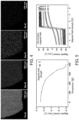
- FIG. 3 is an energy spectrum element distribution diagram of Fe 3 GaTe 2 nanosheets, and energy spectrum analysis shows that Fe, Ga, and Te elements are evenly distributed in Fe 3 GaTe 2 .
- FIG. 4 is an energy spectrum element distribution diagram of Fe 5 GeGa 0.1 Te 2 nanosheets, and energy spectrum analysis shows that the Fe, Ge, Ga, and Te elements are evenly distributed in Fe 5 GeGa 0.1 Te 2 .
- FIG. 5 shows a spontaneous magnetization curve, and hysteresis loops under out-of-plane magnetic field at different temperatures of Fe 3 GaTe 2 single crystal, which shows intrinsic above-room-temperature ferromagnetism and large saturation magnetic moment of Fe 3 GaTe 2 single crystal.
- FIG. 5 shows a spontaneous magnetization curve, and hysteresis loops under out-of-plane magnetic field at different temperatures of Fe 3 GaTe 2 single crystal, which shows intrinsic above-room-temperature ferromagnetism and large saturation magnetic moment of Fe 3 GaTe 2 single crystal.
- FIG. 6 shows a spontaneous magnetization curve, and hysteresis loops under out-of-plane magnetic field at different temperatures of Fe 5 GeGa 0.1 Te 2 single crystal, which shows intrinsic above-room-temperature ferromagnetism and large saturation magnetic moment of Fe 5 GeGa 0.1 Te 2 single crystal.
- FIG. 7 shows an anomalous Hall device and above-room-temperature anomalous Hall effect of Fe 3 GaTe 2 nanosheets, which shows the easy-exfoliating characteristics of Fe 3 GaTe 2 single crystal, intrinsic above-room-temperature ferromagnetism and the application potential of two-dimensional quantum devices.
- FIG. 7 shows an anomalous Hall device and above-room-temperature anomalous Hall effect of Fe 3 GaTe 2 nanosheets, which shows the easy-exfoliating characteristics of Fe 3 GaTe 2 single crystal, intrinsic above-room-temperature ferromagnetism and the application potential of two-dimensional quantum devices.
- FIG. 8 shows an anomalous Hall device and above-room-temperature anomalous Hall effect of Fe 5 GeGa 0.1 Te 2 nanosheets, which shows the easy-exfoliating characteristics of Fe 5 GeGa 0.1 Te 2 single crystal, intrinsic above-room-temperature ferromagnetism and the application potential of two-dimensional quantum devices.
- FIG. 9 shows a hysteresis loop under in-plane magnetic field at 300 K of a Ga-based two-dimensional van der Waals room-temperature ferromagnetic Fe 3 GaTe 2 single crystal in Example 1. Based on FIG. 9 , it can be calculated that the perpendicular magnetic anisotropy energy of Fe 3 GaTe 2 at 300 K is as high as 4.79 ⁇ 10 5 J/m 3 .
- FIG. 9 shows a hysteresis loop under in-plane magnetic field at 300 K of a Ga-based two-dimensional van der Waals room-temperature ferromagnetic Fe 3 GaTe 2 single crystal in Example 1. Based on FIG. 9
- FIG. 10 shows an electrically regulated magnetism curve graph of a Ga-based two-dimensional van der Waals room-temperature ferromagnetic Fe 3 GaTe 2 single crystal in Example 1.
- FIG. 10 shows that the current flowing through the device has an obvious adjustment effect on the Hall resistance of the sample, exhibiting an application prospect thereof in the field of two-dimensional quantum devices.
Landscapes
- Chemical & Material Sciences (AREA)
- Engineering & Computer Science (AREA)
- Organic Chemistry (AREA)
- Power Engineering (AREA)
- Crystallography & Structural Chemistry (AREA)
- Materials Engineering (AREA)
- Metallurgy (AREA)
- Inorganic Chemistry (AREA)
- Physics & Mathematics (AREA)
- Manufacturing & Machinery (AREA)
- Dispersion Chemistry (AREA)
- Electromagnetism (AREA)
- General Health & Medical Sciences (AREA)
- Molecular Biology (AREA)
- Nanotechnology (AREA)
- Health & Medical Sciences (AREA)
- Biomedical Technology (AREA)
- Life Sciences & Earth Sciences (AREA)
- Chemical Kinetics & Catalysis (AREA)
- General Chemical & Material Sciences (AREA)
- Crystals, And After-Treatments Of Crystals (AREA)
- Hard Magnetic Materials (AREA)
Abstract
The present invention provides a Ga-based van der Waals room-temperature ferromagnetic crystal material, preparation and use thereof, which belong to the technical field of nano magnetic material preparation. The materials include Fe3-aGabTe2(a=-0.3 to 0.1, b=0.8 to 1.2) and Fe5-cGeGadTe2(c=-0.2 to 0.2, d=0.01 to 0.5). The growth method of Fe3-aGabTe2(a=-0.3 to 0.1, b=0.8 to 1.2) is a self-flux method, using excess Ga and Te as flux to grow crystals. The growth method of Fe5-cGeGadTe2(c=-0.2 to 0.2, d=0.01 to 0.5) is the chemical vapor transport method, using iodine as a transport agent to grow crystals. The Ga-based van der Waals room-temperature ferromagnetic crystal Fe3-aGabTe2(a=-0.3 to 0.1, b=0.8 to 1.2) and Fe5-cGeGadTe2(c=-0.2 to 0.2, d=0.01 to 0.5) materials provided by the present invention have uniform constituents, have a van der Waals structure, may be easily exfoliated mechanically, the Curie temperature thereof is 330 K to 367 K and 320 K to 345 K, and the saturation magnetic moments are 50 emu/g to 57.2 emu/g and 80 emu/g to 88.5 emu/g, respectively. The perpendicular magnetic anisotropy energy of Fe3-aGabTe2(a=-0.3 to 0.1, b=0.8 to 1.2) single crystal is as high as 3.25×10⁵ to 4.79×10⁵ J/m3.
Description
- The disclosure belongs to the technical field of nanoscale magnetic material preparation, and more specifically relates to a Ga-based van der Waals room-temperature ferromagnetic crystal material, preparation and use thereof.
- Originating from moving charges and spins of elementary particles, magnetism has revolutionized important technologies such as data storage and biomedical imaging, and continues to stimulate new application for emerging materials and reducing dimensions. Although ferromagnetic materials are able to exhibit ferromagnetic order in three-dimensional space, the limitations of the Mermin-Wagner theory hinder the realization of materials with intrinsic ferromagnetism in two-dimensional systems. The theorem points out through a rigorous proof that long-range magnetic order is impossible to exist in a two-dimensional isotropic Heisenberg spin system because thermodynamic fluctuations will destroy all ordered states. Until recently, breakthroughs have been made experimentally in studies of 2D ferromagnetic materials. Just in the past few years, ferromagnetic ordering has been observed in two-dimensional van der Waals crystals with van der Waals structures such as CrI3, Cr2Ge2Te6, FenGeTe2 (n=3,4,5). This series of two-dimensional van der Waals ferromagnetic crystals and their heterostructures not only involve rich physical mechanisms and interesting electronic properties, but also are expected to provide a research platform for a variety of exotic quantum effects, such as quantum anomalous Hall effect, quantum spin Hall effect and Valley Hall effect, etc., and provide a material basis for realization of various multifunctional quantum devices.
- However, although the recently discovered two-dimensional van der Waals intrinsic ferromagnetic crystals have promoted the development of intrinsic two-dimensional magnetism and various multifunctional spintronic devices such as tunneling electron magnetic detection, spin quantum sensors, giant tunneling magnetoresistance, spin tunneling field-effect transistors, etc., due to their extremely low Curie temperature, these devices still only operate well below room temperature. Therefore, there is still a considerable level of challenge to prepare an intrinsic two-dimensional van der Waals ferromagnetic crystal with above-room-temperature Curie temperature, large saturation magnetic moment and large perpendicular magnetic anisotropy, and realize two-dimensional quantum device that is able to operate at room temperature based on the intrinsic two-dimensional van der Waals ferromagnetic crystal.
- The purpose of the present disclosure is to provide a type of Ga-based van der Waals room-temperature ferromagnetic crystal material and a preparation method in order to solve the above problems. By utilizing the present disclosure, it is possible to prepare high-quality Ga-based van der Waals room-temperature ferromagnetic crystal: Fe3-aGabTe2(a=-0.3~0.1, b=0.8~1.2) and Fe5-cGeGadTe2(c=-0.2~0.2, d=0.01~0.5). Both Fe3-aGabTe2(a=-0.3~0.1, b=0.8~1.2) and Fe5-cGeGadTe2(c=-0.2~0.2, d=0.01~0.5) crystals prepared by the present disclosure have a van der Waals structure, which may be easily exfoliated down to only a few layers. The Curie temperatures are higher than room temperature, respectively 330 K to 367 K and 320 K to 345 K, and the saturation magnetic moments are 50 emu/g to 57.2 emu/g and 80 emu/g to 88.5 emu/g, respectively. Specifically, the perpendicular magnetic anisotropy energy of Fe3-aGabTe2(a=-0.3~0.1, b=0.8~1.2) single crystal may be as high as 3.25× 10⁵ to 4.79×10⁵ J/m3. In addition, the thickness of two-dimensional Fe3-aGabTe2(a=-0.3~0.1, b=0.8~1.2) and Fe5-cGeGadTe2(c=-0.2~0.2, d=0.01~0.5) nanosheets obtained through mechanical exfoliation is on the order of nanometers, the lateral size is on the order of microns, which is suitable for various current micro-nano processing techniques, and may be adopted to prepare various multifunctional two-dimensional quantum devices. The preparation method of a type of Ga-based van der Waals room-temperature ferromagnetic crystal materials described in the present disclosure has simple process, low cost, and good process stability. This disclosure is expected to facilitate the development and practical application of various multifunctional two-dimensional quantum devices based on Ga-based two-dimensional van der Waals room-temperature ferromagnetic crystals.
- According to the first aspect of the present disclosure, a Ga-based van der Waals ferromagnetic crystal material is provided, the ferromagnetic crystal material is Fe3-aGabTe2 ferromagnetic crystal, wherein a=-0.3 to 0.1, b=0.8 to 1.2; or Fe5-cGeGadTe2 ferromagnetic crystal, wherein c=-0.2 to 0.2, d=0.01 to 0.5.
- Both the Fe3-aGabTe2 compound of the Fe3-aGabTe2 ferromagnetic crystal and the Fe5-cGeGadTe2 compound of the Fe5-cGeGadTe2 ferromagnetic crystal contain iron atoms with a valence of zero.
- The Curie temperatures of the Fe3-aGabTe2 ferromagnetic crystal and the Fe5-cGeGadTe2 ferromagnetic crystal are 330 K to 367 K and 320 K to 345 K respectively, and the Fe3-aGabTe2 ferromagnetic crystal and the Fe5-cGeGadTe2 ferromagnetic crystal exhibit ferromagnetism below their respective Curie temperatures.
- Preferably, the saturation magnetic moments of the Fe3-aGabTe2 ferromagnetic crystal and the Fe5-cGeGadTe2 ferromagnetic crystal are 50 emu/g to 57.2 emu/g and 80 emu/g to 88.5 emu/g, respectively.
- According to another aspect of the present disclosure, a method for preparing a ferromagnetic crystal is provided, including the following steps.
- (1) Mixing Fe powder, Ga block and Te powder thoroughly. The sum of the amount of Fe powder substance and Ga block substance is equal to the amount of Te powder substance; the amount of Fe powder substance accounts for 40% to 60% of the sum of the amount of the Fe powder substance and Ga block substance.
- (2) Vacuuming the container containing the mixture obtained in step (1).
- (3) Heating the mixture, the heating temperature is 950 °C to 1050 °C, and then the temperature is reduced at a rate of 0.5 °C/h to 1.5 °C/h during the crystal growth process to obtain Fe3-aGabTe2 ferromagnetic crystals, wherein a=-0.3 to 0.1, b=0.8 to 1.2.
- Preferably, the heating time is 24 hours to 48 hours.
- Preferably, first the temperature is reduced rapidly to 880 °C at a rate of 70 °C/h to 170 °C/h, then reduced slowly to 780 °C at a rate of 0.5 °C/h to 1.5 °C/h, and then cooled naturally.
- According to another aspect of the present disclosure, a method for preparing a ferromagnetic crystal is provided, including the following steps.
- (1) Mixing Fe powder, Ge powder, Ga block, Te powder and I2 particles thoroughly, the ratio of the amount of Fe powder substance, the sum of the amount of Ge powder substance and Ga block substance, and the amount of Te powder substance is 4:1:2, the amount of the Ge powder substance accounts for 40% to 60% of the sum of the amount of Ge powder substance and Ga block substance.
- (2) Vacuuming the container containing the mixture obtained in step (1).
- (3) Placing the part of the container containing the mixture in the high-temperature raw material zone in a dual-temperature zone tube furnace, and placing the part of the container not containing the mixture in the low-temperature crystallization zone in the dual-temperature zone tube furnace. The temperature in the high-temperature raw material zone is 950 °C to 1050 °C, and the temperature in the low-temperature crystallization zone is 600 °C to 700 °C. The I2 particles serve as a transport agent, and the mixture is transported to the low-temperature crystallization zone for reaction to obtain Fe5-cGeGadTe2 ferromagnetic crystals, wherein c=-0.2 to 0.2, d=0.01 to 0.5.
- Preferably, in step (3), the reaction time is 168 hours to 330 hours.
- Preferably, the ratio of the mass of the I2 particles to the volume of the container is 3 mg/cm3 to 9 mg/cm3.
- According to another aspect of the present disclosure, a use of the Ga-based van der Waals ferromagnetic crystal material in a two-dimensional quantum device is provided.
- Preferably, the two-dimensional quantum device is an anomalous Hall device or an electrically regulated magnetic device.
- Generally speaking, compared with the related art, the above technical solution conceived by the present disclosure mainly has the following technical advantages.
- (1) In the adopted self-flux method, the Fe3-aGabTe2(a=-0.3~0.1, b=0.8~1.2) bulk single crystal grown by slow cooling near the crystallization temperature has high purity and may be easily exfoliated to obtain few-layer two-dimensional nanosheets. The size is suitable for micro-nano processing techniques such as photolithography, and is suitable for the preparation of various multifunctional two-dimensional quantum devices.
- (2) In the adopted chemical vapor transport method, iodine is used as a transport agent, and Fe5-cGeGadTe2(c=-0.2~0.2, d=0.01~0.5) single crystal grown in the low-temperature crystallization zone of the quartz ampoule at a constant temperature has high purity, and may be easily exfoliated to obtain few-layer two-dimensional nanosheets. The size is suitable for micro-nano processing techniques such as photolithography, and is suitable for the preparation of various multifunctional two-dimensional quantum devices.
- (3) With respect to Fe3-aGabTe2(a=-0.3~0.1, b=0.8~1.2), the ratio of raw materials as described in claims is adopted because sufficiently excess Ga and Te is required as fluxes to melt high melting point Fe, and Ga plays a more critical role, so the relationship between the amount of Fe and Ga in the raw material is further defined. With respect to Fe5-cGeGadTe2(c=-0.2~0.2, d=0.01~0.5), the ratio of amount of raw material as described in claims is adopted because the four elements involved in the iodine element transport compound have different efficiency. For example, compared with Ge, Ga is more difficult to be transported, so even if the amount of Ga in the compound Fe5-cGeGadTe2(c=-0.2~0.2, d=0.01~0.5) is much smaller than Ge, it is still required to put excess Ga into the raw material.
- (4) The Curie temperatures of single crystals of a type of Ga-based van der Waals room-temperature ferromagnetic crystals Fe3-aGabTe2(a=-0.3~0.1, b=0.8~1.2) and Fe5-cGeGadTe2(c=-0.2~0.2, d=0.01~0.5) are 330 K to 367 K and 320 K to 345 K, respectively. This above-room-temperature ferromagnetism comes from the zero-valence iron atoms contained in both materials. Fe3-aGabTe2(a=-0.3~0.1, b=0.8~1.2) compound of Fe3-aGabTe2(a=-0.3~0.1, b=0.8~1.2) ferromagnetic crystal has an iron atom with zero valence, the theoretical Curie temperature of zero valence iron atom (i.e. iron element) is as high as 1043 K. However, in the compound, due to the difference in the crystal structure of Fe3-aGabTe2(a=-0.3~0.1, b=0.8~1.2) and Fe5-cGeGaaTe2(c=-0.2~0.2, d=0.01~0.5) single crystal and elemental iron, the Curie temperature is decreased but is still higher than 300 K, which is higher than most of the known van der Waals ferromagnetic crystals.
- (5) A type of Ga-based van der Waals room-temperature ferromagnetic crystals prepared by the present disclosure all have relatively large saturation magnetic moments. Specifically, the saturation magnetic moment of Fe3-aGabTe2(a=-0.3~0.1, b=0.8~1.2) single crystal is 50 emu/g to 57.2 emu/g, and the saturation magnetic moment of Fe5-cGeGadTe2(c=-0.2~0.2, d=0.01~0.5) single crystal is 80 emu/g to 88.5 emu/g, which is higher than most known two-dimensional van der Waals ferromagnetic crystals.
- (6) The Ga-based van der Waals room-temperature ferromagnetic crystal Fe3-aGabTe2(a=-0.3~0.1, b=0.8~1.2) prepared in the present disclosure has large perpendicular magnetic anisotropy, and the perpendicular magnetic anisotropy energy is as high as 3.25 × 10⁵~4.79×10⁵ J/m3 at 300 K, which is higher than most widely-used ferromagnetic thin film materials.
- (7) The size of two-dimensional nanosheets obtained by mechanical exfoliation of Fe3-aGabTe2(a=-0.3~0.1, b=0.8~1.2) and Fe5-cGeGadTe2(c=-0.2~0.2, d=0.01~0.5) single crystals is on the order of microns and the thickness is on the order of nanometers, which allows micro-nano processing technology such as lithography to be better performed on materials, makes it possible to realize anomalous Hall devices, electrically regulated magnetic devices, etc., and has broad application prospects in the field of two-dimensional quantum devices.
-
-
FIG. 1 is an X-ray diffraction spectrum of a Ga-based two-dimensional van der Waals room-temperature ferromagnetic Fe3GaTe2 single crystal of Example 1. -
FIG. 2 is an X-ray diffraction spectrum of a Ga-based two-dimensional van der Waals room-temperature ferromagnetic Fe5GeGa0.1Te2 single crystal in Example 4. -
FIG. 3 is an energy spectrum element distribution diagram of Ga-based two-dimensional van der Waals room-temperature ferromagnetic crystal Fe3GaTe2 nanosheets in Example 1. -
FIG. 4 is an energy spectrum element distribution diagram of Ga-based two-dimensional van der Waals room-temperature ferromagnetic crystal Fe5GeGa0.1Te2 nanosheets in Example 4. -
FIG. 5 shows a spontaneous magnetization curve, and hysteresis loops under out-of-plane magnetic field at different temperatures of a Ga-based two-dimensional van der Waals room-temperature ferromagnetic Fe3GaTe2 single crystal of Example 1. -
FIG. 6 shows a spontaneous magnetization curve, and hysteresis loops under out-of-plane magnetic field at different temperatures of a Ga-based two-dimensional van der Waals room-temperature ferromagnetic Fe5GeGa0.1Te2 single crystal of Example 4. -
FIG. 7 shows an anomalous Hall device and above-room-temperature anomalous Hall effect based on a Ga-based two-dimensional van der Waals room-temperature ferromagnetic crystal Fe3GaTe2 nanosheets in Example 1. -
FIG. 8 shows an anomalous Hall device and above-room-temperature anomalous Hall effect based on Ga-based two-dimensional van der Waals room-temperature ferromagnetic crystal Fe5GeGa0.1Te2 nanosheets in Example 4. -
FIG. 9 shows a hysteresis loop under in-plane magnetic field at 300K of a Ga-based two-dimensional van der Waals room-temperature ferromagnetic Fe3GaTe2 single crystal in Example 1. -
FIG. 10 shows an electrically regulated magnetism curve graph of a Ga-based two-dimensional van der Waals room-temperature ferromagnetic Fe3GaTe2 single crystal in Example 4. - In order to make the purpose, technical solution and advantages of the present disclosure clearer, the present disclosure will be further described in detail below in conjunction with the accompanying drawings and embodiments. It should be understood that the specific embodiments described here are only used to explain the present disclosure, not to limit the present disclosure. In addition, the technical features involved in the various embodiments of the present disclosure described below can be combined with each other as long as they do not constitute a conflict with each other.
- With regard to a type of Ga-based van der Waals room-temperature ferromagnetic crystal material and preparation of the same in the present disclosure, the preparation method of the material is as follows.
- With respect to Fe3-aGabTe2(a=-0.3~0.1, b=0.8~1.2):
- 1) Step 1: Fe powder (99.99%), Ga block (99.999%), and Te powder (99.999%) with a particular molar ratio are put into the bottom of a quartz ampoule. A particular molar ratio refers to that the sum of the amount Fe powder substance and Ga block substance is equal to the amount of Te powder substance; the amount of the Fe powder substance accounts for 40% to 60% of the sum of the amount of Fe powder substance and Ga block substance.
- 2) Step 2: The ampoule is vacuumized and sealed.
- 3) Step 3: The ampoule is placed in a muffle furnace. The temperature is raised to a range from 950 °C to 1050 °C within 1 hour to 5 hours and kept warm for 1 day to 2 days, then rapidly cooled down to 880 °C and slowly cooled down to 780 °C at a rate of 0.5 °C/h to 1.5 °C/h. Then the program ends, and the ampoule is naturally cooled to room temperature with the furnace.
- With respect to Fe5-cGeGadTe2(c=-0.2~0.2, d=0.01~0.5):
- 1) Step 1: Fe powder (99.99%), Ge powder (99.999%), Ga block (99.999%), Te powder (99.999%) with a particular molar ratio and I2 particles (99.99%) with a particular mass are put into the bottom of the quartz ampoule. A particular molar ratio refers to that the ratio of the amount of the Fe powder substance, the sum of the amount of the Ge powder substance and the Ga block substance, and the amount of the Te powder substance is 4:1:2, and the amount of the Ge powder substance accounts for 40% to 60% of the sum of the amount of Ge powder substance and Ga block substance.
- 2) Step 2: The ampoule is vacuumized and sealed.
- 3) Step 3: The ampoule bottle is placed in a dual-temperature zone tube furnace, the raw material end is a high-temperature raw material zone, and the other end is a low-temperature crystallization zone. The high-temperature zone and the low-temperature zone are respectively heated to 950 °C to 1050 °C and 600 °C to 700 °C within 1 hour to 5 hours and kept warm for 1 week to 2 weeks and cooled down to room temperature naturally.
- In some embodiments, the size of the Ga blocks is 1 mm to 10 mm, and the volume is 0.1 cm3 to 0.5 cm3; the diameter of the I2 particles is 1 mm to 3 mm, and the ratio of the mass of the I2 particles to the volume of the container is 3 mg/cm3 to 9 mg/cm3, the powder size of the Fe, Ge, Te is 100 mesh to 300 mesh.
- In some embodiments, the vacuum sealing process of the quartz tube is as follows: a mechanical pump is pumped to a vacuum below 1 Pa, then washed with argon gas with a purity of 99.999% for thee times to remove the oxygen from the quartz tube, and finally sealed with oxyhydrogen flame.
- In some embodiments, the quartz ampoule for growing Fe3-aGabTe2(a=-0.3~0.1, b=0.8~1.2) has a diameter of 2 cm and a length of 10 cm. The quartz ampoule for growing Fe5-cGeGadTe2(c=-0.2~0.2, d=0.01~0.5) has a diameter of 2 cm to 5 cm and a length of 40 cm.
- In some embodiments, the crystal material sizes of the Fe3-aGabTe2(a=-0.3~0.1, b=0.8~1.2) and Fe5-cGeGadTe2(c=-0.2~0.2, d=0.01~0.5) are 2~3 "×" 1~2"×" 0.1~0.5 mm and 6"×" 4"×" 0.1~0.5 mm.
- With regard to a type of Ga-based van der Waals room-temperature ferromagnetic crystal material and preparation method for the same in the present disclosure, the Fe3-aGabTe2(a=-0.3~0.1, b=0.8~1.2) and Fe5-cGeGadTe2(c=-0.2~0.2, d=0.01~0.5) crystal materials are all high-quality room-temperature ferromagnetic compounds, which have a van der Waals structure and are easily exfoliated mechanically. The crystal materials are silvery white, and may be exfoliated into flat and thin sheet-like two-dimensional nanocrystals, which may be used to prepare various multifunctional two-dimensional quantum devices; the materials are all single crystals.
- A type of Ga-based van der Waals room-temperature ferromagnetic crystal material and preparation method for the same in the present disclosure will now be further described in detail in conjunction with the following specific examples and accompanying drawings.
-
- 1) The high-purity Fe powder, Ga block and Te powder were weighted with a molar ratio of 1:1:2, and poured into the bottom of the quartz ampoule respectively and vacuumed for sealing.
- 2) The sealed ampoule was placed in the muffle furnace. The temperature was raised to 1000°C within 1 hour and kept warm for 1 day, then quickly cooled down to 880°C at a rate of 100°C/h and slowly cooled down to 780°C at a rate of 1°C/h. Then the program was finished, and the ampoule was naturally cooled to room temperature with the furnace to obtain Fe3GaTe2 single crystal.
-
- 1) The high-purity Fe powder, Ga block and Te powder were weighted with a molar ratio of 0.8:1.2:2, and poured into the bottom of the quartz ampoule respectively and vacuumed for sealing.
- 2) The sealed ampoule was placed in the muffle furnace. The temperature was raised to 1000 °C within 1 hour and kept warm for 1 day, then quickly cooled down to 880 °C at a rate of 100 °C/h and slowly cooled down to 780 °C at a rate of 1 °C/h. Then the program was finished, and the ampoule was naturally cooled to room temperature with the furnace to obtain Fe2.9Ga1.2Te2 single crystal.
-
- 1) The high-purity Fe powder, Ga block and Te powder were weighted with a molar ratio of 1.2:0.8:2, and poured into the bottom of the quartz ampoule respectively and vacuumed for sealing.
- 2) The sealed ampoule was placed in the muffle furnace. The temperature was raised to 1000°C within 1 hour and kept warm for 1 day, then quickly cooled down to 880 °C at a rate of 100°C/h and slowly cooled down to 780 °C at a rate of 1 °C/h. Then the program was finished, and the ampoule was naturally cooled to room temperature with the furnace to obtain Fe3.3Ga0.8Te2 single crystal.
-
- 1) The high-purity Fe powder, Ge powder, Ga block and Te powder were weighted with a molar ratio of 8:1:1:4, the I2 particles were weighted with a mass of 0.3 g, and poured into the bottom of the quartz ampoule respectively and vacuumed for sealing.
- 2) The sealed ampoule bottle was placed in a dual-temperature zone tube furnace, the raw material end is a high-temperature raw material zone, and the other end is a low-temperature crystallization zone. The high-temperature zone and the low-temperature zone were respectively heated to 1000 °C and 650 °C within 1 hour and kept warm for 2 weeks and cooled down to room temperature naturally, and Fe5GeGa0.1Te2 single crystal was obtained in low-temperature crystallization zone.
-
- 1) The high-purity Fe powder, Ge powder, Ga block and Te powder were weighted with a molar ratio of 8:1.2:0.8:4, the I2 particles were weighted with a mass of 0.3 g, and poured into the bottom of the quartz ampoule respectively and vacuumed for sealing.
- 2) The sealed ampoule bottle was placed in a dual-temperature zone tube furnace, the raw material end is a high-temperature raw material zone, and the other end is a low-temperature crystallization zone. The high-temperature zone and the low-temperature zone were respectively heated to 1000 °C and 650 °C within 1 hour and kept warm for 2 weeks and cooled down to room temperature naturally, and Fe5.2GeGa0.01Te2 single crystal was obtained in low-temperature crystallization zone.
-
- 1) The high-purity Fe powder, Ge powder, Ga block and Te powder were weighted with a molar ratio of 8:0.8:1.2:4, the I2 particles were weighted with a mass of 0.3 g, and poured into the bottom of the quartz ampoule respectively and vacuumed for sealing.
- 2) The sealed ampoule bottle was placed in a dual-temperature zone tube furnace, the raw material end is a high-temperature raw material zone, and the other end is a low-temperature crystallization zone. The high-temperature zone and the low-temperature zone were respectively heated to 1000 °C and 650 °C within 1 hour and kept warm for 2 weeks and cooled down to room temperature naturally, and Fe4.8GeGa0.5Te2 single crystal was obtained in low-temperature crystallization zone.
-
FIG. 1 is an X-ray diffraction spectrum of Fe3GaTe2 single crystal. After comparingFIG. 1 with the theoretical X-ray diffraction spectrum, it can be seen that the equidistant diffraction peaks in the X-ray diffraction spectrum of Fe3GaTe2 single crystal correspond to the (00l) crystal plane, and no impurity peaks are observed, which indicates that the synthesized Fe3GaTe2 single crystal has high crystal quality and strict growth orientation.FIG. 2 is an X-ray diffraction spectrum of Fe5GeGa0.1Te2 single crystal. After comparingFIG. 2 with the theoretical X-ray diffraction spectrum, it can be seen that the equidistant diffraction peaks in the X-ray diffraction spectrum of Fe5GeGa0.1Te2 single crystal correspond to the (00l) crystal plane, and no impurity peaks are observed, which indicates that the synthesized Fe5GeGa0.1Te2 single crystal has high crystal quality and strict growth orientation.FIG. 3 is an energy spectrum element distribution diagram of Fe3GaTe2 nanosheets, and energy spectrum analysis shows that Fe, Ga, and Te elements are evenly distributed in Fe3GaTe2.FIG. 4 is an energy spectrum element distribution diagram of Fe5GeGa0.1Te2 nanosheets, and energy spectrum analysis shows that the Fe, Ge, Ga, and Te elements are evenly distributed in Fe5GeGa0.1Te2.FIG. 5 shows a spontaneous magnetization curve, and hysteresis loops under out-of-plane magnetic field at different temperatures of Fe3GaTe2 single crystal, which shows intrinsic above-room-temperature ferromagnetism and large saturation magnetic moment of Fe3GaTe2 single crystal.FIG. 6 shows a spontaneous magnetization curve, and hysteresis loops under out-of-plane magnetic field at different temperatures of Fe5GeGa0.1Te2 single crystal, which shows intrinsic above-room-temperature ferromagnetism and large saturation magnetic moment of Fe5GeGa0.1Te2 single crystal.FIG. 7 shows an anomalous Hall device and above-room-temperature anomalous Hall effect of Fe3GaTe2 nanosheets, which shows the easy-exfoliating characteristics of Fe3GaTe2 single crystal, intrinsic above-room-temperature ferromagnetism and the application potential of two-dimensional quantum devices.FIG. 8 shows an anomalous Hall device and above-room-temperature anomalous Hall effect of Fe5GeGa0.1Te2 nanosheets, which shows the easy-exfoliating characteristics of Fe5GeGa0.1Te2 single crystal, intrinsic above-room-temperature ferromagnetism and the application potential of two-dimensional quantum devices.FIG. 9 shows a hysteresis loop under in-plane magnetic field at 300 K of a Ga-based two-dimensional van der Waals room-temperature ferromagnetic Fe3GaTe2 single crystal in Example 1. Based onFIG. 9 , it can be calculated that the perpendicular magnetic anisotropy energy of Fe3GaTe2 at 300 K is as high as 4.79×10⁵ J/m3.FIG. 10 shows an electrically regulated magnetism curve graph of a Ga-based two-dimensional van der Waals room-temperature ferromagnetic Fe3GaTe2 single crystal in Example 1.FIG. 10 shows that the current flowing through the device has an obvious adjustment effect on the Hall resistance of the sample, exhibiting an application prospect thereof in the field of two-dimensional quantum devices. - It is easy for those skilled in the art to understand that the above descriptions are only preferred embodiments of the present disclosure, and are not intended to limit the present disclosure. Any modifications, equivalent replacements and improvements made within the spirit and principles of the present disclosure should all be included within the protection scope of the present disclosure.
Claims (10)
- A Ga-based van der Waals ferromagnetic crystal material, characterized in that, the ferromagnetic crystal material is a Fe3-aGabTe2 ferromagnetic crystal, wherein a=-0.3 to 0.1, b=0.8 to 1.2; or a Fe5-cGeGadTe2 ferromagnetic crystal, wherein c=-0.2 to 0.2, d=0.01 to 0.5;both a Fe3-aGabTe2 compound of the Fe3-aGabTe2 ferromagnetic crystal and a Fe5-cGeGadTe2 compound of the Fe5-cGeGadTe2 ferromagnetic crystal contain iron atoms with a valence of zero;Curie temperatures of the Fe3-aGabTe2 ferromagnetic crystal and the Fe5-cGeGadTe2 ferromagnetic crystal are 330 K to 367 K and 320 K to 345 K respectively, and the Fe3-aGabTe2 ferromagnetic crystal and the Fe5-cGeGadTe2 ferromagnetic crystal exhibit ferromagnetism below their respective Curie temperatures.
- The Ga-based van der Waals ferromagnetic crystal material according to claim 1, characterized in that, saturation magnetic moments of the Fe3-aGabTe2 ferromagnetic crystal and the Fe5-cGeGadTe2 ferromagnetic crystal are 50 emu/g to 57.2 emu/g and 80 emu/g to 88.5 emu/g, respectively.
- A method for preparing a ferromagnetic crystal, characterized in that, comprising following steps:(1) mixing Fe powder, Ga block and Te powder thoroughly, a sum of an amount of the Fe powder and the Ga block is equal to an amount of the Te powder; the amount of the Fe powder accounts for 40% to 60% of the sum of the amount of the Fe powder and the Ga block;(2) vacuuming a container containing a mixture obtained in step (1); and(3) heating the mixture, a heating temperature is 950 °C to 1050 °C, and then the heating temperature is reduced at a rate of 0.5 °C/h to 1.5 °C/h during a crystal growth process to obtain a Fe3-aGabTe2 ferromagnetic crystal, wherein a=-0.3 to 0.1, b=0.8 to 1.2.
- The method for preparing the ferromagnetic crystal according to claim 3, characterized in that, a heating time is 24 hours to 48 hours.
- The method for preparing the ferromagnetic crystal according to claim 3, characterized in that, first the heating temperature is reduced rapidly to 880 °C at a rate of 70 °C/h to 170 °C/h, then reduced slowly to 780 °C at a rate of 0.5 °C/h to 1.5 °C/h, and then cooled naturally.
- A method for preparing a ferromagnetic crystal, characterized in that, comprising following steps:(1) mixing Fe powder, Ge powder, Ga block, Te powder and I2 particles thoroughly, a ratio of an amount of the Fe powder, a sum of an amount of the Ge powder and the Ga block, and an amount of the Te powder is 4:1:2, the amount of the Ge powder accounts for 40% to 60% of the sum of the amount of the Ge powder and the Ga block;(2) vacuuming a container containing a mixture obtained in step (1); and(3) placing a part of the container containing the mixture in a high-temperature raw material zone in a dual-temperature zone tube furnace and placing a part of the container not containing the mixture in a low-temperature crystallization zone in the dual-temperature zone tube furnace, a temperature in the high-temperature raw material zone is 950 °C to 1050 °C, and a temperature in the low-temperature crystallization zone is 600 °C to 700 °C; the I2 particles serve as a transport agent; and transporting the mixture to the low-temperature crystallization zone for reaction to obtain a Fe5-cGeGadTe2 ferromagnetic crystal, wherein c=-0.2 to 0.2, d=0.01 to 0.5.
- The method for preparing the ferromagnetic crystal according to claim 6, characterized in that, in step (3), a time of the reaction is 168 hours to 330 hours.
- The method for preparing the ferromagnetic crystal according to claim 6, characterized in that, a ratio of a mass of the I2 particles to a volume of the container is 3 mg/cm3 to 9 mg/cm3.
- A use of the Ga-based van der Waals ferromagnetic crystal material in a two-dimensional quantum device according to claim 1 or 2.
- The use according to claim 9, characterized in that, the two-dimensional quantum device is an anomalous Hall device or an electrically regulated magnetic device.
Applications Claiming Priority (2)
| Application Number | Priority Date | Filing Date | Title |
|---|---|---|---|
| CN202210849612.2A CN115354396B (en) | 2022-07-19 | 2022-07-19 | Ga-based van der Waals room temperature ferromagnetic crystal materials, preparation and application |
| PCT/CN2022/136400 WO2024016560A1 (en) | 2022-07-19 | 2022-12-03 | Ga-based room-temperature van der waals ferromagnetic crystal material, preparation, and use |
Publications (1)
| Publication Number | Publication Date |
|---|---|
| EP4560056A1 true EP4560056A1 (en) | 2025-05-28 |
Family
ID=84032069
Family Applications (1)
| Application Number | Title | Priority Date | Filing Date |
|---|---|---|---|
| EP22951818.8A Pending EP4560056A1 (en) | 2022-07-19 | 2022-12-03 | Ga-based room-temperature van der waals ferromagnetic crystal material, preparation, and use |
Country Status (6)
| Country | Link |
|---|---|
| US (1) | US12145842B2 (en) |
| EP (1) | EP4560056A1 (en) |
| JP (1) | JP7841774B2 (en) |
| KR (1) | KR102867066B1 (en) |
| CN (1) | CN115354396B (en) |
| WO (1) | WO2024016560A1 (en) |
Families Citing this family (6)
| Publication number | Priority date | Publication date | Assignee | Title |
|---|---|---|---|---|
| CN115354396B (en) * | 2022-07-19 | 2023-08-25 | 华中科技大学 | Ga-based van der Waals room temperature ferromagnetic crystal materials, preparation and application |
| CN115867113A (en) * | 2022-12-26 | 2023-03-28 | 华中科技大学 | Spin-orbit moment device and fabrication method based on Ga-based two-dimensional ferromagnetic heterojunction |
| CN118330522B (en) * | 2024-03-03 | 2025-11-21 | 中南大学 | Fe5GeTe2Material application, magnetic resistance angle sensor and application thereof |
| CN118073082B (en) * | 2024-04-19 | 2024-08-13 | 西安交通大学 | A two-dimensional room temperature ferromagnetic nanosheet and its preparation method and application |
| CN119162670B (en) * | 2024-08-23 | 2025-05-30 | 华中科技大学 | Multielement alloy two-dimensional van der Waals Ga-based magnetic crystal, preparation and application |
| CN119277954B (en) * | 2024-09-27 | 2025-11-21 | 华中科技大学 | Electric control magnetic device based on Ga-based super-room temperature Van der Waals ferromagnetic material and preparation method thereof |
Family Cites Families (8)
| Publication number | Priority date | Publication date | Assignee | Title |
|---|---|---|---|---|
| KR100476321B1 (en) * | 2002-01-24 | 2005-03-10 | 조성래 | transition metal-doped ferromagnetic semiconductor single crystal |
| CN1252741C (en) * | 2002-11-13 | 2006-04-19 | 中国科学院物理研究所 | A magnetic strap material having high strain shape memory effect and preparing method thereof |
| US8591669B2 (en) | 2004-11-23 | 2013-11-26 | University Of Maryland | Method of texturing polycrystalline iron/gallium alloys and compositions thereof |
| WO2021183049A1 (en) * | 2020-03-10 | 2021-09-16 | National University Of Singapore | A new class of 3d materials generated from layered materials |
| CN111593402A (en) * | 2020-07-06 | 2020-08-28 | 李焱 | Two-dimensional ferromagnetic material Fe3GeTe2 and Co-doped Fe3-xCoxGeTe2 single crystal growth method |
| WO2022115379A1 (en) * | 2020-11-30 | 2022-06-02 | Carnegie Mellon University | Field-free spin-orbit torque switching of perpendicularly polarized magnets |
| CN112921297B (en) * | 2021-01-19 | 2022-03-15 | 电子科技大学 | CVD preparation method of ferromagnetic two-dimensional material FeGeTe |
| CN115354396B (en) * | 2022-07-19 | 2023-08-25 | 华中科技大学 | Ga-based van der Waals room temperature ferromagnetic crystal materials, preparation and application |
-
2022
- 2022-07-19 CN CN202210849612.2A patent/CN115354396B/en active Active
- 2022-12-03 EP EP22951818.8A patent/EP4560056A1/en active Pending
- 2022-12-03 US US18/273,780 patent/US12145842B2/en active Active
- 2022-12-03 JP JP2024559114A patent/JP7841774B2/en active Active
- 2022-12-03 KR KR1020247031685A patent/KR102867066B1/en active Active
- 2022-12-03 WO PCT/CN2022/136400 patent/WO2024016560A1/en not_active Ceased
Also Published As
| Publication number | Publication date |
|---|---|
| CN115354396A (en) | 2022-11-18 |
| WO2024016560A1 (en) | 2024-01-25 |
| US12145842B2 (en) | 2024-11-19 |
| US20240262687A1 (en) | 2024-08-08 |
| KR102867066B1 (en) | 2025-10-01 |
| KR20240153586A (en) | 2024-10-23 |
| CN115354396B (en) | 2023-08-25 |
| JP7841774B2 (en) | 2026-04-07 |
| JP2025511696A (en) | 2025-04-16 |
Similar Documents
| Publication | Publication Date | Title |
|---|---|---|
| US12145842B2 (en) | GA-based van der Waals room-temperature ferromagnetic crystal material, preparation and use thereof | |
| Feygenson et al. | Properties of highly crystalline NiO and Ni nanoparticles prepared by high-temperature oxidation and reduction | |
| Yang et al. | Ferromagnetism in sphalerite and wurtzite CdS nanostructures | |
| Bobev et al. | Ternary rare-earth alumo-silicides—single-crystal growth from Al flux, structural and physical properties | |
| Liu et al. | Selective synthesis and magnetic properties of FeSe2 and FeTe2 nanocrystallites obtained through a hydrothermal co-reduction route | |
| CN111593402A (en) | Two-dimensional ferromagnetic material Fe3GeTe2 and Co-doped Fe3-xCoxGeTe2 single crystal growth method | |
| CN110294463A (en) | A kind of transition element doped room-temperature ferromagnetic two-dimensional material and preparation method | |
| Shitsevalova | Crystal chemistry and crystal growth of rare-earth borides | |
| CN119913621A (en) | A method for preparing a ternary magnetic selenide and a single crystal thereof | |
| Mei et al. | Room-temperature ferromagnetism in Fe-doped SnSe bulk single crystalline semiconductor | |
| CN111118605B (en) | An ideal Dirac semimetal Cu2HgSnSe4 crystal and its growth method and application | |
| Lejay et al. | Crystal growth and magnetic property of MCo2V2O8 (M= Sr and Ba) | |
| CN115627537A (en) | A kind of magnetic transition metal chalcogenide material FexMnyTaS2 crystal and preparation method thereof | |
| CN114735751A (en) | Single-layer CrI prepared based on chemical vapor transport3Sheet and method | |
| CN112647129B (en) | NbGe2Single crystal, method for producing the same and use thereof | |
| Reimann et al. | Salt-flux growth of HoCuMg 4 single crystals | |
| Nair et al. | Magnetocaloric effect in frustrated magnetic systems: from bulk to nano | |
| CN120830156B (en) | Nanocrystalline antiferromagnetic material, preparation method and application | |
| CN105097173B (en) | A kind of ferromagnetic semiconductor material (Sr, Na) (Zn, Mn)2As2And preparation method thereof | |
| RU2722664C1 (en) | Method for producing 2d germanium-based ferromagnetic materials euge2 and gdge2 | |
| CN118147758A (en) | Van der Waals antiferromagnetic metal single crystal and preparation method thereof | |
| Komedera et al. | Magnetism of BaFe2Se3 studied by M\" ossbauer spectroscopy | |
| CN120866947A (en) | Quaternary ferrocolumbium sulfide crystal, preparation method and application | |
| CN119495481A (en) | A semi-metallic compensating ferrimagnetic material and its preparation method and use | |
| CN119162670B (en) | Multielement alloy two-dimensional van der Waals Ga-based magnetic crystal, preparation and application |
Legal Events
| Date | Code | Title | Description |
|---|---|---|---|
| STAA | Information on the status of an ep patent application or granted ep patent |
Free format text: STATUS: THE INTERNATIONAL PUBLICATION HAS BEEN MADE |
|
| PUAI | Public reference made under article 153(3) epc to a published international application that has entered the european phase |
Free format text: ORIGINAL CODE: 0009012 |
|
| STAA | Information on the status of an ep patent application or granted ep patent |
Free format text: STATUS: REQUEST FOR EXAMINATION WAS MADE |
|
| 17P | Request for examination filed |
Effective date: 20240821 |
|
| AK | Designated contracting states |
Kind code of ref document: A1 Designated state(s): AL AT BE BG CH CY CZ DE DK EE ES FI FR GB GR HR HU IE IS IT LI LT LU LV MC ME MK MT NL NO PL PT RO RS SE SI SK SM TR |
|
| DAV | Request for validation of the european patent (deleted) | ||
| DAX | Request for extension of the european patent (deleted) |