EP4559961A1 - Polyalkylene carbonate resin composition and preparation method therefor - Google Patents
Polyalkylene carbonate resin composition and preparation method therefor Download PDFInfo
- Publication number
- EP4559961A1 EP4559961A1 EP24803777.2A EP24803777A EP4559961A1 EP 4559961 A1 EP4559961 A1 EP 4559961A1 EP 24803777 A EP24803777 A EP 24803777A EP 4559961 A1 EP4559961 A1 EP 4559961A1
- Authority
- EP
- European Patent Office
- Prior art keywords
- polyalkylenecarbonate
- cyclohexanol
- cyclopentanol
- weight
- resin composition
- Prior art date
- Legal status (The legal status is an assumption and is not a legal conclusion. Google has not performed a legal analysis and makes no representation as to the accuracy of the status listed.)
- Pending
Links
Images
Classifications
-
- C—CHEMISTRY; METALLURGY
- C08—ORGANIC MACROMOLECULAR COMPOUNDS; THEIR PREPARATION OR CHEMICAL WORKING-UP; COMPOSITIONS BASED THEREON
- C08K—Use of inorganic or non-macromolecular organic substances as compounding ingredients
- C08K5/00—Use of organic ingredients
- C08K5/04—Oxygen-containing compounds
- C08K5/09—Carboxylic acids; Metal salts thereof; Anhydrides thereof
-
- C—CHEMISTRY; METALLURGY
- C08—ORGANIC MACROMOLECULAR COMPOUNDS; THEIR PREPARATION OR CHEMICAL WORKING-UP; COMPOSITIONS BASED THEREON
- C08G—MACROMOLECULAR COMPOUNDS OBTAINED OTHERWISE THAN BY REACTIONS ONLY INVOLVING UNSATURATED CARBON-TO-CARBON BONDS
- C08G64/00—Macromolecular compounds obtained by reactions forming a carbonic ester link in the main chain of the macromolecule
- C08G64/02—Aliphatic polycarbonates
- C08G64/0208—Aliphatic polycarbonates saturated
-
- C—CHEMISTRY; METALLURGY
- C08—ORGANIC MACROMOLECULAR COMPOUNDS; THEIR PREPARATION OR CHEMICAL WORKING-UP; COMPOSITIONS BASED THEREON
- C08G—MACROMOLECULAR COMPOUNDS OBTAINED OTHERWISE THAN BY REACTIONS ONLY INVOLVING UNSATURATED CARBON-TO-CARBON BONDS
- C08G64/00—Macromolecular compounds obtained by reactions forming a carbonic ester link in the main chain of the macromolecule
- C08G64/20—General preparatory processes
- C08G64/32—General preparatory processes using carbon dioxide
- C08G64/34—General preparatory processes using carbon dioxide and cyclic ethers
-
- C—CHEMISTRY; METALLURGY
- C08—ORGANIC MACROMOLECULAR COMPOUNDS; THEIR PREPARATION OR CHEMICAL WORKING-UP; COMPOSITIONS BASED THEREON
- C08G—MACROMOLECULAR COMPOUNDS OBTAINED OTHERWISE THAN BY REACTIONS ONLY INVOLVING UNSATURATED CARBON-TO-CARBON BONDS
- C08G65/00—Macromolecular compounds obtained by reactions forming an ether link in the main chain of the macromolecule
- C08G65/02—Macromolecular compounds obtained by reactions forming an ether link in the main chain of the macromolecule from cyclic ethers by opening of the heterocyclic ring
- C08G65/26—Macromolecular compounds obtained by reactions forming an ether link in the main chain of the macromolecule from cyclic ethers by opening of the heterocyclic ring from cyclic ethers and other compounds
- C08G65/2642—Macromolecular compounds obtained by reactions forming an ether link in the main chain of the macromolecule from cyclic ethers by opening of the heterocyclic ring from cyclic ethers and other compounds characterised by the catalyst used
- C08G65/2645—Metals or compounds thereof, e.g. salts
- C08G65/2663—Metal cyanide catalysts, i.e. DMC's
-
- C—CHEMISTRY; METALLURGY
- C08—ORGANIC MACROMOLECULAR COMPOUNDS; THEIR PREPARATION OR CHEMICAL WORKING-UP; COMPOSITIONS BASED THEREON
- C08L—COMPOSITIONS OF MACROMOLECULAR COMPOUNDS
- C08L25/00—Compositions of, homopolymers or copolymers of compounds having one or more unsaturated aliphatic radicals, each having only one carbon-to-carbon double bond, and at least one being terminated by an aromatic carbocyclic ring; Compositions of derivatives of such polymers
- C08L25/02—Homopolymers or copolymers of hydrocarbons
- C08L25/04—Homopolymers or copolymers of styrene
- C08L25/08—Copolymers of styrene
- C08L25/14—Copolymers of styrene with unsaturated esters
-
- C—CHEMISTRY; METALLURGY
- C08—ORGANIC MACROMOLECULAR COMPOUNDS; THEIR PREPARATION OR CHEMICAL WORKING-UP; COMPOSITIONS BASED THEREON
- C08L—COMPOSITIONS OF MACROMOLECULAR COMPOUNDS
- C08L69/00—Compositions of polycarbonates; Compositions of derivatives of polycarbonates
Definitions
- the present invention relates to a polyalkylenecarbonate resin composition with excellent thermal stability and a method for preparing the same.
- a polyalkylenecarbonate resin obtained by polymerizing carbon dioxide and epoxide is attracting great attention as one of biodecomposable resins.
- a process of preparing the polyalkylenecarbonate resin using carbon dioxide may fix an amount of carbon dioxide in the atmosphere to reduce a global warming problem, and is also actively studied due to the prespective that carbon dioxide is utilized as a carbon resource.
- the polyalkylenecarbonate resin is thermally decomposed at a temperature equal to or more than 180°C due to low thermal stability thereof, there is a significant limitation in industrial application.
- a zinc dicarboxylate-based catalyst such as a zinc glutarate catalyst combined with dicarboxylic acid, and a double metal cyanide catalyst composed of a complex of Co, Zn, Al, etc., is used as a typical heterogeneous catalyst.
- CN 103842406 B discloses a method for preparing polyalkylenecarbonate in which the polyalkylenecarbonate is prepared in an organic solvent in the presence of the catalyst, the organic solvent is removed, a polyalkylenecarbonate granule is formed, and then an aqueous acid solution containing 0.01 to 5 wt% acid without the organic solvent is added to the polyalkylenecarbonate granule, followed by solid-liquid mixing, heat treatment and drying.
- Patent 1 CN 103842406 B (November. 02. 2016 )
- An aspect of the present invention provides a polyalkylenecarbonate resin composition with excellent thermal stability.
- An aspect of the present invention also provides a method for preparing the polyalkylenecarbonate resin composition.
- a polyalkylenecarbonate resin composition and a method for preparing the same.
- a polyalkylenecarbonate resin composition according to the present invention includes a chain extender and an organic acid and/or an acid anhydride, there is an effect that thermal stability is improved by increasing a thermal decomposition temperature.
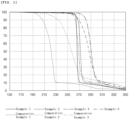
- FIG. 1 is a graph of mass change analysis results, through a thermogravimetric analyzer, of polyethylenecarbonate resin compositions prepared in Examples and Comparative Examples.
- alkyl group may mean a monovalent aliphatic saturated hydrocarbon.
- aryl group may mean a cyclic aromatic hydrocarbon, and may mean all of a monocyclic aromatic hydrocarbon in which one ring is formed, or a polycyclic aromatic hydrocarbon in which two or more rings are bonded to each other.
- alkenyl group may mean a monovalent unsaturated aliphatic hydrocarbon including one or at least two double bonds.
- cycloalkyl group may mean all of a cyclic saturated hydrocarbon, or a cyclic unsaturated hydrocarbon including one or at least two unsaturated bonds.
- molecular weight characteristics are analyzed by gel permeation chromatography (GPC) using polystyrene as a standard material, and are specifically measured using GPC (a Waters 1515 isocratic HPLC pump, a Waters 2414 refractive index detector, Waters Inc.) under the following conditions.
- GPC gel permeation chromatography
- thermogravimetric analyzer TGA
- TGA2 Mettler Toledo thermogravimetric analyzer
- the present invention provides a polyalkylenecarbonate resin composition with improved thermal stability by suppressing thermal decomposition.
- the polyalkylenecarbonate resin composition according to an embodiment of the present invention is characterized by including polyalkylenecarbonate, a chain extender, and at least one additive selected from an organic acid and acid anhydride.
- a polyalkylenecarbonate resin is prepared using carbon dioxide as a resource, and is attracting great attention as a biodecomposable resin, but is thermally decomposed at a temperature of at least 180°C due to low thermal stability thereof, and there is a significant limitation in industrial application.
- carbon dioxide and epoxide but also a catalyst are needed so as to prepare the polyalkylenecarbonate resin, and when such a catalyst remains in the resin, polymer chain decomposition is accelerated in a heat treatment process of the resin to be a cause of degrading thermal stability of the polyalkylenecarbonate resin, and thus development of various purification techniques of removing the catalyst after completion of polymerization is required.
- a chain extender, and at least one additive of an organic acid and an acid anhydride may be directly added a polymer to inactivate the remaining catalyst without any additional process such as extraction or precipitation, and thermal decomposition is suppressed, thereby being capable of having excellent thermal stability.
- polyalkylenecarbonate resin composition will be more specifically described by being divided into components included therein.
- the polyalkylenecarbonate may include a repeating unit represented by Formula 2 below and a repeating unit represented by Formula 3 below, as a polymer prepared by polymerizing an alkylene oxide compound and carbon dioxide.
- R 1 to R 8 are each independently hydrogen, a linear alkyl group having a carbon number of 1 to 20, a branched alkyl group having a carbon number of 3 to 20, an aryl group having a carbon number of 6 to 20, an alkenyl group having a carbon number of 2 to 20, or a cycloalkyl group having a carbon number of 3 to 20, * means a connection site between repeating units, x and y are mole fractions, x is 0.70 to 1.00, y is 0.00 to 0.30, and x+y is 1.
- the x may be 0.80 to 1.00
- the y may be 0.00 to 0.20, and preferably the x may be 0.90 to 1.00, and the y may be 0.00 to 0.10.
- a fixation ratio of carbon dioxide is high to be effective in reduction of green-house gas, and to be advantageous in biodecomposition characteristics.
- the polyalkylenecarbonate according to the present invention is prepared as a film, the film shows low oxygen permeability to exhibit excellent barrier characteristics.
- the polyalkylenecarbonate may be at least any one selected from the group consisting of polyethylenecarbonate, polypropylenecarbonate, polypentenecarbonate, polyhexenecarbonate, polyoctenecarbonate and polycyclohexenecarbonate.
- R 1 to R 8 are each independently hydrogen, a linear alkyl group having a carbon number of 1 to 20, a branched alkyl group having a carbon number of 3 to 20, an aryl group having a carbon number of 6 to 20, an alkenyl group having a carbon number of 2 to 20, or a cycloalkyl group having a carbon number of 3 to 20, and a proper functional group may be selected considering final physical properties of the resin to be obtained.
- repeating unit represented by Formula 2 above may be represented by Formula 4 below.
- R 1 to R 4 are each independently hydrogen, or a linear alkyl group having a carbon number of 1 to 10, and x and * are the same as defined in Formula 1 above.
- repeating unit represented by Formula 2 above may be represented by Formula 5 or Formula 6 below.
- repeating unit represented by Formula 3 above may be represented by Formula 7 below.
- R 5 to R 8 are each independently hydrogen or a linear alkyl group having a carbon number of 1 to 10, and y and * are the same as defined in Formula 3 above.
- repeating unit represented by Formula 3 above may be represented by Formula 8 or Formula 9 below.
- the polyalkylenecarbonate according to the present invention has a glass transition temperature (Tg) of -10°C to 50°C, 0°C to 50°C, or 10°C to 50°C. When the range is satisfied, the polyalkylenecarbonate may have excellent processability at the room temperature.
- Tg glass transition temperature
- the polyalkylenecarbonate may have a glass transition temperature (Tg) of 0°C to 20°C.
- the polyalkylenecarbonate may have a glass transition temperature (Tg) of 30°C to 50°C, or 35°C to 50°C.
- a cyclic carbonate content with respect to the total weight of the polyalkylenecarbonate according to the present invention may be 0.5 wt% to 15.0 wt%, 0.5 wt% to 10.0 wt%, or 0.5 wt% to 5.0 wt%.
- a problem of glass transition temperature decrease caused by the cyclic carbonate acting as a softener may be minimized to exhibit an excellent mechanical property.
- the cyclic carbonate content may be measured by dissolving 10 mg of a polyalkylenecarbonate resin sample in a chloroform-d6 solvent using a 1H-NMR spectrometer (a 500 MHz spectrometer, Jeol Inc.). Specifically, a peak appears around 4.5 ppm, which is a cyclic carbonate peak, from a result measured in the 1H-NMR spectrometer, and thus the cyclic carbonate content may be calculated as shown in Equation 2 below using a carbonate peak area and an ether peak area.
- A, B, C, N, and a CO 2 content may be defined as follows.
- A is a cyclic carbonate peak area
- B is a carbonate peak area
- C is an ether peak area
- N is an alkylene oxide molar mass divided by (44 + an alkylene oxide molar mass)
- the CO 2 content is (a carbonate unit mole fraction x 44) divided by [(the carbonate unit mole fraction x 44) + (an alkylene oxide molar mass x 100)].
- the chain extender reacts with a polyalkylenecarbonate polymer chain end or an end generated by thermal decomposition to connect the polymer chains, and may be included in the polyalkylenecarbonate resin composition in an amount of 0.01 parts by weight to 3.00 parts by weight with respect to 100 parts by weight of the polyalkylenecarbonate.
- the chain extender may be at least any one selected from 2,2'-(1,3-phenylene)bis-2-oxazoline, 2,2'-bis(2-oxazoline) and a compound represented by Formula 1 below.
- the polyalkylenecarbonate resin composition may include at least one additive selected from the group consisting of an organic acid and an acid anhydride, and the additive may serve to inactivate a catalyst.
- the additive may be included in the polyalkylenecarbonate resin composition in an amount of 0.001 parts by weight to 5.000 parts by weight, or 0.05 parts by weight to 0.1 parts by weight with respect to 100 parts by weight of the polyalkylenecarbonate.
- the catalyst When the additive is included in the above range, the catalyst may be effectively inactivated without a problem of accelerating thermal decomposition, and thus thermal stability of the composition may be effectively improved.
- the organic acid and the acid anhydride when included together as the additive, the organic acid and the acid anhydride may be included in an amount that falls within the additive content range described above, and then a ratio of the organic acid and the acid anhydride is not specially limited, but a weight ratio thereof may be, for example, 1:0.1 to 20.0 or 1:0.4 to 10.
- the organic acid may be at least any one selected from citric acid, tartaric acid, ascorbic acid, and maleic acid.
- the acid anhydride may be a dicarboxylic acid anhydride having a carbon number of 4 to 8, and specifically, may be at least any one selected from a maleic anhydride, a phthalic anhydride, and a succinic anhydride.
- the polyalkylenecarbonate resin composition according to an embodiment of the present invention may have a molecular weight change rate, defined by Equation 1 below, equal to or less than 35%.
- Molecular weight change rate % M W 1 ⁇ M W 2 / M W 1 ⁇ 100
- M W1 is a weight average molecular weight of the polyalkylenecarbonate resin composition before heat treatment measured by gel chromatography
- M W2 is a weight average molecular weight of the polyalkylenecarbonate resin composition after heat treatment at 180°C for 20 minutes measured by gel chromatography.
- the polyalkylenecarbonate resin composition according to an embodiment of the present invention may include the additive and the chain extender in a weight ratio of 1:0.1 to 20.0, specifically 1:1 to 10.
- the organic acid and/or the acid anhydride may increase reactivity of the chain extender to more advantageously act in connecting polymer chain ends.
- polyalkylenecarbonate resin composition according to an embodiment of the present invention may further include an anti-oxidant as needed, and according to another embodiment, may further include the anti-oxidant in an amount of 0.01 parts by weight to 3.00 parts by weight.
- the polymer chain decomposition caused by a radical may be prevented to be more advantageous in thermal stability improvement.
- the anti-oxidant may be at least any one selected from tetrakis[methylene-3-(3,5-di-t-butyl-4-hydroxyphenyl)propionate]methane, triethyleneglycol-bis-3-(3-t-butyl-4-hydroxy-5-methylphenyl)propionate, thiodiethylenebis[3-(3,5-di-t-butyl-4-hydroxyphenyl)propionate], 1,2-bis(3,5-di-t-Butyl-4-hydroxyhydrocinnamoyl)hydrazine, octadecyl 3-(3,5-di-t-butyl-4-hydroxyphenyl)propionate, 1,3,5-tris(4-t-butyl-3-hydroxy-2,6-dimethylbenzyl)-1,3,5-triazine-2,4,6-(1H,3H,5H)-trione, 2,4-di-t-pentyl-6-1-(
- the polyalkylenecarbonate resin composition according to an embodiment of the present invention is prepared in a preparation method to be described later without a step of adding the chain extender, the organic acid, and/or the acid anhydride, and removing the same, contents of the chain extender, the organic acid and/or the acid anhydride in the polyalkylenecarbonate resin composition may be the same as the amounts added in preparing.
- contents of the chain extender, the organic acid and/or the acid anhydride in the polyalkylenecarbonate resin composition according to the present invention may be confirmed through an ingredient quantitative analysis method generally known in the art, and a quantitative analyzer such as UPLC/MS/MS, HPLC/RI, and UPLC-QTOF/MS may be exemplarily used.
- a quantitative analyzer such as UPLC/MS/MS, HPLC/RI, and UPLC-QTOF/MS may be exemplarily used.
- the present invention provides a method for preparing the polyalkylenecarbonate resin composition.
- the method for preparing the polyalkylenecarbonate resin composition includes a step (S1) of preparing a polymer including polyalkylenecarbonate by polymerizing an alkylene oxide compound and carbon dioxide in a solvent in the presence of a catalyst, a step (S2) of adding, to the polymer, at least one additive selected from an organic acid, an anti-oxidant, and a hydrolysis inhibitor, and agitating, and a step (S3) of removing the solvent.
- the preparation method according to an embodiment of the inventive concept does not include an additional process for removing the catalyst such as extraction or precipitation, and thus the polymer includes the catalyst.
- the step (S1) is a step of forming polyalkylenecarbonate and preparing a polymer including the same, and may be performed by polymerizing an alkylene oxide compound and carbon dioxide in a solvent in the presence of a catalyst.
- the catalyst includes a double metal cyanide compound and a complexing agent, and the double metal cyanide compound and the complexing agent may be used without limitation as long as being general in the art.
- the double metal cyanide compound may be derived from a metal cyanide complex salt and a metal salt, and the metal cyanide complex salt may be aqueous.
- the metal cyanide complex salt may be represented by Formula 10 below. [Formula 10] Y a M'(CN) b
- M' may be at least any one selected from the group consisting of Fe(II), Fe(III), Co(II), Co(III), Cr(II), Cr(III), Mn(II), Mn(III), Ir(III), Ni(II), Rh(III), Ru(II), V(V), and V(IV), and preferably, may be at least any one selected from the group consisting of Co(II), Co(III), Fe(II), Fe(III), Cr(III), Ir(III), and Ni(II).
- Y is an alkali metal ion, or an alkaline earth metal ion.
- a is an integer of 1 to 4
- b is an integer of 4 to 6
- a and b are selected such that the metal cyanide complex salt is electrically neutral.
- the metal cyanide complex salt may be potassium hexacyanocobaltate(III), potassium hexacyanoferrate(II), potassium hexacyanoferrate(III), calcium hexacyanocobaltate(III) or lithium hexacyanoiridate(III), and preferably, may be potassium hexacyanocobaltate(III).
- the metal salt may be aqueous. Specifically, the metal salt may be represented by Formula 11 below. [Formula 11] M(X) n
- M may be a transition metal, preferably, may be at least any one selected from the group consisting of Zn(II), Fe(II), Ni(II), Mn(II), Co(II), Sn(II), Pb(II), Fe(III), Mo(IV), Mo(VI), Al(III), V(V), V(IV), Sr(II), W(IV). W(VI), Cu(II) and Cr(III), and more preferably, may be at least any one selected from the group consisting of Zn(II), Fe(II), Co(II) and Ni(II).
- X is an anion selected from a halide, a hydroxide, a sulfate, a carbonate, a cyanate, an oxalate, a thiocyanate, an isocyanate, an isothiocyanate, a carboxylate, and a nitrate.
- n is a number satisfying a valence state of M.
- the metal salt may be zinc (II) chloride, zinc (III) chloride, zinc bromide, zinc iodide, zinc acetate, zinc acetylacetonate, zinc benzoate, zinc nitrate, iron (II) sulfate, iron (II) bromide, cobalt chloride (II), cobalt thiocyanate (II), nickel (II) formate, nickel (II) nitrate and a mixture thereof, and preferably, may be zinc chloride (II), zinc chloride (III), zinc bromide or zinc iodide.
- the catalyst according to the present invention may be represented by Formula 12 below.
- M 1 and M 2 are each independently a transition metal
- X is an anion
- L is cyclobutanol, cyclopentanol, cyclohexanol, cycloheptanol, or cyclooctanol.
- p, q, d, r, e, and f are each independently an integer of 1 to 6.
- the catalyst according to the present invention may be represented by Formula 13 below.
- Formula 13 Zn 3 [Co(CN) 6 ] 2 ⁇ gZnCl 2 ⁇ hL ⁇ iH 2 O
- L is cyclobutanol, cyclopentanol, cyclohexanol, cycloheptanol, or cyclooctanol, and g, h and i are each independently an integer of 1 to 6.
- the complexing agent may be used without special limitation as long as being generally used in the art, but may be exemplarily at least any one selected from the group consisting of ethanol, isopropanol, normal butanol, isobutanol, sec-butanol, and tert-butanol.
- the complexing agent may be a compound represented by Formula 14 below.
- R 9a and R 9b are each independently a single bond or an alkylene group having a carbon number of 1 to 5, and at least one of R 9a and R 9b is an alkylene group having a carbon number of 1 to 5,
- R 9c and R 9d are each independently a hydrogen atom, or an alkyl group having a carbon number of 1 to 6, and
- n is an integer of 0 to 2.
- R 9a and R 9b are each independently a single bond or an alkylene group having a carbon number of 1 to 3 at least one of R 9a and R 9b is an alkylene group having a carbon number of 1 to 3 R 9c and R 9d are each independently a hydrogen atom, or an alkyl group having a carbon number of 1 to 4, and n is an integer of 0 to 2.
- R 9a and R 9b are each independently a single bond or an alkylene group having a carbon number of 1 to 3, at least one of R 9a and R 9b may be an alkylene group having a carbon number of 1 to 3, R 9c is a hydrogen atom, and n may be 0
- the complexing agent may be a cycloalkyl alcohol having a carbon number of 3 to 12, and specifically, may be a cycloalkyl alcohol having a carbon number of 4 to 10, or 5 to 7.
- the complexing agent may be at least any one selected from the group consisting of cyclobutanol, cyclopentanol, cyclohexanol, cycloheptanol, cyclooctanol, 1-methyl cyclopentanol, 2-methyl cyclopentanol, 3-methyl cyclopentanol, 1-ethyl cyclopentanol, 2-ethyl cyclopentanol, 3-ethyl cyclopentanol, 1-propyl cyclopentanol, 2-propyl cyclopentanol, 3-propyl cyclopentanol, 1-butyl cyclopentanol, 2-butyl cyclopentanol, 3-butyl cyclopentanol, 1-isopropyl cyclopentanol, 2-isopropyl cyclopentanol, 3-isopropyl cyclopentanol, 1-(propan-2-yl
- the complexing agent may be at least any one selected from the group consisting of cyclobutanol, cyclopentanol, cyclohexanol, cycloheptanol, and cyclooctanol.
- the complexing agent may be at least any one selected from the group consisting of cyclobutanol, cyclopentanol, cyclohexanol, cycloheptanol, and cyclooctanol.
- a cycloalkane-type alcohol having a bulky structure may be used as the complexing agent so that the catalyst may have various crystal structures, for example, cubic, amorphous, monoclinic, and the like, and thus a ratio of a repeating unit including carbon dioxide in the polyalkylenecarbonate prepared by appropriately controlling a reaction rate of an epoxide compound and carbon dioxide may be increased and a content of a cyclic carbonate, which is a by-product, may be reduced, thereby obtaining the polyalkylenecarbonate with more excellent thermal stability and excellent processability.
- the catalyst may further include a sub-complexing agent, the sub-complexing agent may be a compound having a hydroxy group, an amine group, an ester group, or an ether group at an end thereof.
- the sub-complexing agent may improve activation of the catalyst, and may be, for example, at least any one selected from the group consisting of polyacrylamide, poly(acrylamide-co-acrylic acid), polyacrylic acid, poly(acrylic acid-co-maleic acid), polyacrylonitrile, polyalkyl acrylate, polyalkyl methacrylate, polyvinyl methyl ether, polyvinyl ethyl ether, polyvinyl acetate, polyvinyl alcohol, poly-N-vinylpyrrolidone, poly(N-vinylpyrrolidone-co-acrylic acid), polyvinyl methyl ketone, poly(4-vinylphenol), poly(acrylic acid-co-styrene), oxazoline polymer, polyalkyleneimine, maleic acid, maleic anhydride copolymer, hydroxyethylcellulose, polyacetal, glycidyl ether, glycoside, carboxylic acid ester of polyhydric alcohol, gall
- the sub-complexing agent may be a compound prepared by ring-opening polymerization of a cyclic ether compound, an epoxy polymer, or an oxetane polymer, and may be, for example, at least any one selected from the group consisting of polyether, polyester, polycarbonate, polyalkylene glycol, polyalkylene glycol sorbitan ester, and polyalkylene glycol glycidyl ether.
- the polymerization is not specially limited, but preferably, may be performed as solution polymerization.
- the solution polymerization may appropriately control a reaction heat, and may easily control a weight average molecular weight or viscosity of the polyalkylenecarbonate to be obtained.
- the catalyst and the alkylene oxide compound may be used in a weight ratio of 1:100 to 1:8000, 1:300 to 1:6000, or 1:1000 to 1:4000. In the ranges described above, there are effects that high activation of the catalyst may be exhibited and the by-product may be minimized, and a back-biting phenomenon of the prepared polyalkylenecarbonate caused by heating may be minimized.
- polymerization of the alkylene oxide compound and carbon dioxide may be performed in a temperature range of 30°C to 120°C, 40°C to 110°C, or 50°C to 100°C.
- polymerization time of the alkylene oxide compound and carbon dioxide may be controlled within 24 hours, thereby improving preparation productivity.
- the polymerization of the alkylene oxide compound and carbon dioxide may be performed in a pressure range of 5 bar to 50 bar, 10 bar to 40 bar, or 15 bar to 30 bar.
- a ratio of the repeating unit including carbon dioxide is high in the prepared polyalkylenecarbonate, and a content of a cyclic carbonate, which is a by-product, may be reduced.
- the alkylene oxide compound may be at least any one selected from the group consisting of an alkylene oxide having a carbon number of 2 to 20 substituted or unsubstituted with halogen or an alkyl group having a carbon number of 1 to 5, a cycloalkylene oxide having a carbon number of 4 to 20 substituted or unsubstituted with halogen or an alkyl group having a carbon number of 1 to 5,and a styrene oxide having a carbon number of 8 to 20 substituted or unsubstituted with halogen or an alkyl group having a carbon number of 1 to 5, and may be, for example, at least any one compound selected from the group consisting of ethylene oxide, propylene oxide, butene oxide, pentene oxide, hexene oxide, octene oxide, decene oxide, dodecene oxide, tetradecene oxide, hexadecene oxide, octadecene oxide, butadiene mon
- the alkylene oxide compound and the solvent may be mixed, and the solvent may be at least any one selected from the group consisting of methylene chloride, ethylene dichloride, trichloroethane, tetrachloroethane, chloroform, acetonitrile, propionitrile, dimethylformamide, N-methyl-2-pyrrolidone, dimethyl sulfoxide, nitromethane, 1,3-dioxalane, 1,4-dioxane, hexane, toluene, tetrahydrofuran, methyl ethyl ketone, methylamine ketone, methyl isobutyl ketone, acetone, cyclohexanone, trichlorethylene, methyl acetate, vinyl acetate, ethyl acetate, propyl acetate, butyrolactone, caprolactone,
- the solvent and the alkylene oxide compound may be used in a weight ratio of 1:0.1 to 1:100, 1:1 to 1:100, or 1:1 to 1:10. Since the solvent may be appropriately acted as a reaction medium in the range, there are effects that productivity of the polyalkylenecarbonate resin may be improved, and a byproduct generated in a preparation process may be minimized.
- the step (S2) is a step of adding a chain extender and at least one additive selected from an organic acid, and an acid anhydride to a polymer including the prepared polyalkylenecarbonate and agitating.
- the at least one additive selected from the organic acid and the acid anhydride may be added in an amount of 0.001 parts by weight to 5.000 parts by weight with respect to 100 parts by weight of a polyalkylenecarbonate solid content in the polymer, and specific examples of the organic acid and the acid anhydride are the same as described above.
- chain extender may be added in an amount of 0.01 parts by weight to 3.00 parts by weight with respect to 100 parts by weight of the polyalkylenecarbonate solid content, and a specific example of the chain extender is the same as described above.
- an anti-oxidant may be further added to the polymer, and in this case, the anti-oxidant may be added in an amount of 0.01 parts by weight to 3.00 parts by weight with respect to 100 parts by weight of the polyalkylenecarbonate solid content in the polymer, and a specific example of the anti-oxidant is the same as described above.
- the agitating may be performed without significant limitation as long as mixing to uniformly distribute the organic acid in the polymer.
- a step of additionally adding a solvent to the polymer such that the polyalkylenecarbonate sold content is 10 wt% to 40 wt% in the polymer may be further performed, and in this case, viscosity of the polymer may be reduced to more uniformly mix the organic acid and/or the acid anhydride in the polymer.
- the solvent may be the same as the solvent used in the step (S1), or may be at least any one selected from the solvents described above.
- the preparation method according to an embodiment of the present invention does not include an additional process such as extraction or precipitation for removing the catalyst component after polymerization, there are effects such as economic efficiency and productivity improvement due to a simple process and reduction of the cost for the additional process.
- the step (S3) is a step for preparing the polyalkylenecarbonate resin composition by removing the solvent.
- the solvent removal may be performed by a means general in the art without particular limitation as long as removing the solvent, and may be performed by adding heat, for example, at a temperature of 30°C to 150°C for 30 minutes to 10 hours.
- a first mixed solution was prepared by mixing 11.45 g of zinc chloride, 30 ml of distilled water, and 39 g of cyclohexanol in a 500 ml beaker.
- a second mixed solution was prepared by dissolving 4 g of potassium hexacyanocobaltate in 100 ml of distilled water in a 250 ml beaker.
- the second mixed solution was added dropwise to the first mixed solution for 1 hour at 25°C using a mechanical agitator, and then the third mixed solution was added at once and reacted for 1 hour. Thereafter, the mixed product was separated using high-speed centrifugation, and the separated precipitate was cleaned twice using a mixture of 70 ml of distilled water and 70 ml of cyclohexanol. Thereafter, after additional cleaning using 140 ml of cyclohexanol, the cleaned precipitate was dried in a vacuum oven at 80°C for 12 hours to finally obtain 6.2 g of a double metal cyanide catalyst.
- Example 1 a polyethylenecarbonate resin composition was prepared in the same manner as Example 1, except that a chain extender was added in an amount of 0.5 parts by weight. At this time, a catalyst component remaining in the composition was at the same level as Example 1.
- Example 1 a polyethylenecarbonate resin composition was prepared in the same manner as Example 1, except that 0.5 parts by weight of a chain extender was added, and 0.1 parts by weight of citric acid was added instead of a maleic anhydride. At this time, a catalyst component remaining in the composition was at the same level as Example 1.
- Example 3 a polyethylenecarbonate resin composition was prepared in the same manner as Example 3, except that SONGNOX ® 2450 (SONGWON Inc.) was added as an anti-oxidant in an amount of 0.5 parts by weight with respect to 100 parts by weight of a polyethylenecarbonate solid content. At this time, a catalyst component remaining in the composition was at the same level as Example 3.
- SONGNOX ® 2450 SONGWON Inc.
- Example 1 a polyethylenecarbonate resin composition was prepared in the same manner as Example 1, except that 0.1 parts by weight of Joncryl ® ADR 4468 (BASF Inc.) was added. At this time, a catalyst component remaining in the composition was at the same level as Example 1.
- Joncryl ® ADR 4468 BASF Inc.
- Example 5 a polyethylenecarbonate resin composition was prepared in the same manner as Example 5, except that 0.5 parts by weight of Joncryl ® ADR 4468 (BASF Inc.) was added. At this time, a catalyst component remaining in the composition was at the same level as Example 5.
- Joncryl ® ADR 4468 BASF Inc.
- Example 5 a polyethylenecarbonate resin composition was prepared in the same manner as Example 5, except that 1.0 parts by weight of Joncryl ® ADR 4468 (BASF Inc.) was added. At this time, a catalyst component remaining in the composition was at the same level as Example 5.
- Joncryl ® ADR 4468 BASF Inc.
- Example 6 a polyethylenecarbonate resin composition was prepared in the same manner as Example 6, except that SONGNOX ® 1035 (SONGWON Inc.) was further added in an amount of 0.5 parts by weight with respect to 100 parts by weight of a polyethylenecarbonate solid content. At this time, a catalyst component remaining in the composition was at the same level as Example 6.
- Example 6 a polyethylenecarbonate resin composition was prepared in the same manner as Example 6, except that tartaric acid was added instead of a maleic anhydride in an amount of 0.05 parts by weight with respect to 100 parts by weight of a polyethylenecarbonate solid content. At this time, a catalyst component remaining in the composition was at the same level as Example 6.
- Example 6 a polyethylenecarbonate resin composition was prepared in the same manner as Example 6, except that maleic acid was added instead of maleic anhydride in an amount of 0.5 parts by weight with respect to 100 parts by weight of a polyethylenecarbonate solid content. At this time, a catalyst component remaining in the composition was at the same level as Example 6.
- Example 6 a polyethylenecarbonate resin composition was prepared in the same manner as Example 6, except that ascorbic acid was added instead of a maleic anhydride in an amount of 0.3 parts by weight with respect to 100 parts by weight of a polyalkylenecarbonate solid content. At this time, a catalyst component remaining in the composition was at the same level as Example 6.
- Example 1 a polyethylenecarbonate resin composition was prepared in the same manner as Example 1, except that a maleic anhydride was not added. At this time, a catalyst component remaining in the composition was at the same level as Example 1.
- Example 6 a polyethylenecarbonate resin composition was prepared in the same manner as Example 6, except that a maleic anhydride was not added. At this time, a catalyst component remaining in the composition was at the same level as Example 6.
- Example 1 a polyethylenecarbonate resin composition was prepared in the same manner as Example 1, except that a chain extender was not added. At this time, a catalyst component remaining in the composition was at the same level as Example 1.
- the molecular weight characteristics were analyzed by gel permeation chromatography (GPC) using polystyrene as a standard material.
- M W1 is a weight average molecular weight of the polyalkylenecarbonate resin composition before heat treatment measured by gel chromatography
- M W2 is a weight average molecular weight of the polyalkylenecarbonate resin composition after heat treatment at 180°C for 20 minutes measured by gel chromatography.
- Mass change analysis was measured using a thermogravimetric analyzer (TGA), and a temperature at which 5% by weight mass loss occurred with respect to a mass at 30°C before temperature increase in a fifth step below was recorded as a thermal decomposition temperature.
- TGA thermogravimetric analyzer
- thermogravimetric analyzer TGA2, Mettler Toledo
- the polyalkylenecarbonate resin compositions according to Examples 1 to 11 have molecular weight change rates of 35% or less, and have higher thermal decomposition temperatures, compared to Comparative Examples.
- the polyalkylenecarbonate resin compositions according to Examples 1 to 11 have the molecular weight change rates of 34% to 66% of those of the polyalkylenecarbonate resin compositions according to Comparative Examples 1 and 2 not including an additive (an organic acid or an acid anhydride) to remarkably reduce the molecular weight change caused by heat treatment, and the polyalkylenecarbonate resin compositions according to Examples 2, 4, and 6 have thermal decomposition temperatures of 132% to 139%, and 118% to 125% of those of the polyalkylenecarbonate resin compositions according to Comparative Examples 1 and 2.
- the polyalkylenecarbonate resin compositions according to Examples 1 to 11 have the molecular weight change rates of 38% to 74% of that of the polyalkylenecarbonate resin composition according to Comparative Examples 3 not including a chain extender. Accordingly, it is confirmed that the polyalkylenecarbonate resin composition according to the present invention includes the chain extender and the additive to suppress the thermal decomposition and to significantly improve thermal stability.
Landscapes
- Chemical & Material Sciences (AREA)
- Health & Medical Sciences (AREA)
- Chemical Kinetics & Catalysis (AREA)
- Medicinal Chemistry (AREA)
- Polymers & Plastics (AREA)
- Organic Chemistry (AREA)
- Toxicology (AREA)
- Compositions Of Macromolecular Compounds (AREA)
- Polyesters Or Polycarbonates (AREA)
Abstract
Description
- This application claims the benefit of
Korean Patent Application No. 10-2023-0060479, filed on May 10, 2023 - The present invention relates to a polyalkylenecarbonate resin composition with excellent thermal stability and a method for preparing the same.
- Since the Industrial Revolution, humankind has built a modern society by consuming a large amount of fossil fuel, but environmental destruction such as deforestation is increasing a concentration of carbon dioxide in the atmosphere. Since increase of the concentration of carbon dioxide is a cause of increasing a greenhouse effect, it is important to reduce the concentration of carbon dioxide, in the atmosphere, having a high contribution to global warming, and various studies are being conducted on carbon dioxide emission regulation, fixation, or the like.
- Recently, a polyalkylenecarbonate resin obtained by polymerizing carbon dioxide and epoxide is attracting great attention as one of biodecomposable resins. In particular, a process of preparing the polyalkylenecarbonate resin using carbon dioxide may fix an amount of carbon dioxide in the atmosphere to reduce a global warming problem, and is also actively studied due to the prespective that carbon dioxide is utilized as a carbon resource.
- However, since the polyalkylenecarbonate resin is thermally decomposed at a temperature equal to or more than 180°C due to low thermal stability thereof, there is a significant limitation in industrial application.
- In addition, not only carbon dioxide and epoxide but also a catalyst are needed so as to prepare the polyalkylenecarbonate resin, and thus a zinc dicarboxylate-based catalyst such as a zinc glutarate catalyst combined with dicarboxylic acid, and a double metal cyanide catalyst composed of a complex of Co, Zn, Al, etc., is used as a typical heterogeneous catalyst.
- When such catalysts remain in the resin, polymer chain decomposition is accelerated in a heat treatment process of the resin to be a cause of degrading thermal stability of the polyalkylenecarbonate resin, and thus development of various purification techniques of removing the catalyst after completion of polymerization is required.
- For example,
CN 103842406 B discloses a method for preparing polyalkylenecarbonate in which the polyalkylenecarbonate is prepared in an organic solvent in the presence of the catalyst, the organic solvent is removed, a polyalkylenecarbonate granule is formed, and then an aqueous acid solution containing 0.01 to 5 wt% acid without the organic solvent is added to the polyalkylenecarbonate granule, followed by solid-liquid mixing, heat treatment and drying. However, there are problems that since in the method of solid-liquid mixing through adding the aqueous acid solution, the polyalkylenecarbonate is present in a form of a granule (solid) in the aqueous acid solution, the catalyst remaining in the polyalkylenecarbonate has low inactivation efficiency, and a large amount of acid is needed. - (Patent 1)
CN 103842406 B (November. 02. 2016 ) - An aspect of the present invention provides a polyalkylenecarbonate resin composition with excellent thermal stability.
- An aspect of the present invention also provides a method for preparing the polyalkylenecarbonate resin composition.
- According to an aspect of the present invention, there is provided a polyalkylenecarbonate resin composition and a method for preparing the same.
- (1) The present invention provides a polyalkylenecarbonate resin composition including polyalkylenecarbonate, a chain extender, and at least one additive selected from an organic acid and an acid anhydride.
- (2) In (1) above, the additive is included in an amount of 0.001 parts by weight to 5.000 parts by weight with respect to 100 parts by weight of the polyalkylenecarbonate.
- (3) In (1) or (2) above, the organic acid is at least any one selected from citric acid, tartaric acid, ascorbic acid, and maleic acid.
- (4) In any one among (1) to (3) above, the acid anhydride is a dicarboxylic acid anhydride having a carbon number of 4 to 8.
- (5) In any one among (1) to (4) above, the chain extender is included in an amount of 0.01 parts by weight to 3.00 parts by weight with respect to 100 parts by weight of the polyalkylenecarbonate.
- (6) In any one among (1) to (5) above, the chain extender is at least any one selected from 2,2'-(1,3-phenylene)bis-2-oxazoline, 2,2'-bis(2-oxazoline) and a compound represented by
Formula 1 below.
- R1 to R5 are each independently a hydrogen atom, or an alkyl group having a carbon number of 1 to 10,
- R6 is an alkyl group having a carbon number of 1 to 10,
- p, q, and r are each independently a real number of 1 to 20.
- (7) In any one among (1) to (6) above, the additive and the chain extender are included in a weight ratio of 1:0.1 to 20.0.
- (8) In any one among (1) to (7) above, the polyalkylenecarbonate resin composition further includes an anti-oxidant.
- (9) In any one among (1) to (8) above, an anti-oxidant is further included in an amount of 0.01 parts by weight to 3.00 parts by weight with respect to 100 parts by weight of the polyalkylenecarbonate.
- (10) In (8) or (9) above, the anti-oxidant is at least any one selected from tetrakis[methylene-3-(3,5-di-t-butyl-4-hydroxyphenyl)propionate]methane, triethyleneglycol-bis-3-(3-t-butyl-4-hydroxy-5-methylphenyl) propionate, thiodiethylenebis[3-(3,5-di-t-butyl-4-hydroxyphenyl)propionate], 1,2-bis(3,5-di-t-Butyl-4-hydroxyhydrocinnamoyl)hydrazine, octadecyl 3-(3,5-di-t-butyl-4-hydroxyphenyl)propionate, 1,3,5-tris(4-t-butyl-3-hydroxy-2,6-dimethylbenzyl)-1,3,5-triazine-2,4,6-(1H,3H,5H)-trione, 2,4-di-t-pentyl-6-1-(3,5-di-t-pentyl-2-hydroxyphenyl)ethyl)phenylacrylate, 1,3,5-trimethyl-2,4,6-tris(3,5-di-t-butyl-4-hydroxybenzyl)benzene, α-tocopherol, and 2,6-di-t-butyl-p-cresol.
- (11) In any one among (1) to (10) above, a molecular weight change rate defined by
Equation 1 below is equal to or less than 35%.
InEquation 1 above,
MW1 is a weight average molecular weight of the polyalkylenecarbonate resin composition before heat treatment measured by gel chromatography, and MW2 is a weight average molecular weight of the polyalkylenecarbonate resin composition after heat treatment at 180°C for 20 minutes measured by gel chromatography. - (12) In any one among (1) to (11) above, the polyalkylenecarbonate includes a repeating unit represented by Formula 2 below, and a repeating unit represented by Formula 3 below.


Formulae - R1 to R8 are each independently hydrogen, a linear alkyl group having a carbon number of 1 to 20, a branched alkyl group having a carbon number of 3 to 20, an aryl group having a carbon number of 6 to 20, an alkenyl group having a carbon number of 2 to 20, or a cycloalkyl group having a carbon number of 3 to 20,
- * means a connection site between repeating units,
- x and y are mole fractions, x is 0.70 to 1.00, y is 0.00 to 0.30, and x+y is 1.
- (13) In any one among (1) to (12) above, the polyalkylenecarbonate is at least any one selected from the group consisting of polyethylenecarbonate, polypropylenecarbonate, polypentenecarbonate, polyhexenecarbonate, polyoctenecarbonate and polycyclohexenecarbonate.
- (14) The present invention provides a method for preparing a polyalkylenecarbonate resin composition including a step (S1) of preparing a polymer including polyalkylenecarbonate by polymerizing an alkylene oxide compound and carbon dioxide in a solvent in the presence of a catalyst, a step (S2) of adding, to the polymer, a chain extender and at least one additive selected from an organic acid, and an acid anhydride, and agitating, and a step (S3) of removing the solvent.
- (15) In (14) above, in the step (S2), the additive is added in an amount 0.001 parts by weight to 5.000 parts by weight with respect to 100 parts by weight of the polyalkylenecarbonate.
- (16) In (14) or (15) above, in the step (S2), the additive and the chain extender are included in a weight ratio of 1:0.1 to 20.0.
- (17) In any one among (14) to (16) above, in the step (S2), before adding the chain extender and the additive to the polymer, a solvent is additionally added to the polymer such that a polyalkylenecarbonate solid content in the polymer is 10% by weight to 40% by weight.
- (18) In any one among (14) to (17) above, in the step (S2), an anti-oxidant is further added to the polymer.
- (19) In any one among (14) to (18) above, the catalyst includes a double metal cyanide compound and a complexing agent.
- (20) In (19) above, the complexing agent is at least any one selected from the group consisting of cyclobutanol, cyclopentanol, cyclohexanol, cycloheptanol, cyclooctanol, 1-methyl cyclopentanol, 2-methyl cyclopentanol, 3-methyl cyclopentanol, 1-ethyl cyclopentanol, 2-ethyl cyclopentanol, 3-ethyl cyclopentanol, 1-propyl cyclopentanol, 2-propyl cyclopentanol, 3-propyl cyclopentanol, 1-butyl cyclopentanol, 2-butyl cyclopentanol, 3-butyl cyclopentanol, 1-isopropyl cyclopentanol, 2-isopropyl cyclopentanol, 3-isopropyl cyclopentanol, 1-(propan-2-yl) cyclopentanol, 2,2-dimethyl cyclopentanol, 2,3-dimethyl cyclopentanol, 3,3-dimethyl cyclopentanol, 1,2-dimethyl cyclopentanol, 1,3-dimethyl cyclopentanol, 1-methyl cyclohexanol, 1-ethyl cyclohexanol, 1-propyl cyclohexanol, 1-butyl cyclohexanol, 2-methyl-1-cyclohexanol, 2-ethyl-1-cyclohexanol, 3-ethyl-1-cyclohexanol, 4-ethyl-1-cyclohexanol, 2-propy-1-cyclohexanol, 3-propyl-1-cyclohexanol, 4-propyl-1-cyclohexanol, 2-butyl-1-cyclohexanol, 3-butyl-1-cyclohexanol, 4-butyl-1-cyclohexanol, 2-isopropyl-1-cyclohexanol, 3-isopropyl-1-cyclohexanol, 4-isopropyl-1-cyclohexanol, 2-tert-butyl-1-cyclohexanol, 3-tert-butyl-1-cyclohexanol, 4-tert-butyl-1-cyclohexanol, 2,3-dimethyl-1-cyclohexanol, 2,4-dimethyl-1-cyclohexanol, 3,4-dimethyl-1-cyclohexanol, 1-methyl cycloheptanol, 2-methyl cycloheptanol, 3-methyl cycloheptanol, and 4-methyl cycloheptanol.
- Since a polyalkylenecarbonate resin composition according to the present invention includes a chain extender and an organic acid and/or an acid anhydride, there is an effect that thermal stability is improved by increasing a thermal decomposition temperature.
- The following drawings attached to the specification illustrate preferred examples of the present invention by example, and serve to enable technical concepts of the present invention to be further understood together with detailed description of the invention given below, and therefore the present invention should not be interpreted only with matters in such drawings:
FIG. 1 is a graph of mass change analysis results, through a thermogravimetric analyzer, of polyethylenecarbonate resin compositions prepared in Examples and Comparative Examples. - Hereinafter, the present invention will be described in more detail to help understand the present invention.
- It will be understood that words or terms used in the specification and claims shall not be interpreted as the meaning defined in commonly used dictionaries, and it will be further understood that the words or terms should be interpreted as having a meaning that is consistent with their meaning in the context of the relevant art and the technical idea of the invention, based on the principle that an inventor may properly define the meaning of the words or terms to best explain the invention.
- In the present specification, the term "alkyl group" may mean a monovalent aliphatic saturated hydrocarbon.
- In the present specification, the term "aryl group" may mean a cyclic aromatic hydrocarbon, and may mean all of a monocyclic aromatic hydrocarbon in which one ring is formed, or a polycyclic aromatic hydrocarbon in which two or more rings are bonded to each other.
- In the present specification, the term "alkenyl group" may mean a monovalent unsaturated aliphatic hydrocarbon including one or at least two double bonds.
- In the present specification, the term "cycloalkyl group" may mean all of a cyclic saturated hydrocarbon, or a cyclic unsaturated hydrocarbon including one or at least two unsaturated bonds.
- In the present specification, molecular weight characteristics are analyzed by gel permeation chromatography (GPC) using polystyrene as a standard material, and are specifically measured using GPC (a Waters 1515 isocratic HPLC pump, a Waters 2414 refractive index detector, Waters Inc.) under the following conditions.
- Column: Two Agilent PLgel MIXED-B (7.5 mmx300, 10 µm)
- Solvent: Chloroform
- Flux: 0.7 ml/min
- Column temperature: 40°C
- Sample: Chloroform of 4.0 mg/1.0ml
- Sample injection volume: 20 µl
- Standard material: polystyrene
- In the present specification, mass change analysis is measured using a thermogravimetric analyzer (TGA), and is specifically measured using the thermogravimetric analyzer (TGA2, Mettler Toledo) under the following conditions.
- 1) first step: increasing a temperature from 30°C to 150°C (10°C/min)
- 2) second step: maintaining at 150°C for 5 minutes
- 3) a third step: reducing a temperature from 150°C to 30°C (10°C/min)
- 4) fourth step: maintaining at 30°C for 5 minutes
- 5) fifth step: increasing a temperature from 30°C to 400°C (10°C/min)
- The present invention provides a polyalkylenecarbonate resin composition with improved thermal stability by suppressing thermal decomposition.
- The polyalkylenecarbonate resin composition according to an embodiment of the present invention is characterized by including polyalkylenecarbonate, a chain extender, and at least one additive selected from an organic acid and acid anhydride.
- A polyalkylenecarbonate resin is prepared using carbon dioxide as a resource, and is attracting great attention as a biodecomposable resin, but is thermally decomposed at a temperature of at least 180°C due to low thermal stability thereof, and there is a significant limitation in industrial application. In addition, not only carbon dioxide and epoxide but also a catalyst are needed so as to prepare the polyalkylenecarbonate resin, and when such a catalyst remains in the resin, polymer chain decomposition is accelerated in a heat treatment process of the resin to be a cause of degrading thermal stability of the polyalkylenecarbonate resin, and thus development of various purification techniques of removing the catalyst after completion of polymerization is required.
- However, in the polyalkylenecarbonate resin composition according to an embodiment of the present invention, after polymerization of the polyalkylenecarbonate, a chain extender, and at least one additive of an organic acid and an acid anhydride may be directly added a polymer to inactivate the remaining catalyst without any additional process such as extraction or precipitation, and thermal decomposition is suppressed, thereby being capable of having excellent thermal stability.
- Hereinafter, the polyalkylenecarbonate resin composition will be more specifically described by being divided into components included therein.
- According to the present invention, the polyalkylenecarbonate may include a repeating unit represented by
Formula 2 below and a repeating unit represented byFormula 3 below, as a polymer prepared by polymerizing an alkylene oxide compound and carbon dioxide.

- In
Formula 2 andFormula 3 above,
R1 to R8 are each independently hydrogen, a linear alkyl group having a carbon number of 1 to 20, a branched alkyl group having a carbon number of 3 to 20, an aryl group having a carbon number of 6 to 20, an alkenyl group having a carbon number of 2 to 20, or a cycloalkyl group having a carbon number of 3 to 20, * means a connection site between repeating units, x and y are mole fractions, x is 0.70 to 1.00, y is 0.00 to 0.30, and x+y is 1. - In addition, the x may be 0.80 to 1.00, the y may be 0.00 to 0.20, and preferably the x may be 0.90 to 1.00, and the y may be 0.00 to 0.10. When the ranges are satisfied, a fixation ratio of carbon dioxide is high to be effective in reduction of green-house gas, and to be advantageous in biodecomposition characteristics. In addition, when the polyalkylenecarbonate according to the present invention is prepared as a film, the film shows low oxygen permeability to exhibit excellent barrier characteristics.
- The polyalkylenecarbonate may be at least any one selected from the group consisting of polyethylenecarbonate, polypropylenecarbonate, polypentenecarbonate, polyhexenecarbonate, polyoctenecarbonate and polycyclohexenecarbonate. In addition, in
Formula 1 above, R1 to R8 are each independently hydrogen, a linear alkyl group having a carbon number of 1 to 20, a branched alkyl group having a carbon number of 3 to 20, an aryl group having a carbon number of 6 to 20, an alkenyl group having a carbon number of 2 to 20, or a cycloalkyl group having a carbon number of 3 to 20, and a proper functional group may be selected considering final physical properties of the resin to be obtained. - In addition, the repeating unit represented by
Formula 2 above may be represented byFormula 4 below.
- In
Formula 4 above, R1 to R4 are each independently hydrogen, or a linear alkyl group having a carbon number of 1 to 10, and x and * are the same as defined inFormula 1 above. - More specifically, the repeating unit represented by
Formula 2 above may be represented by Formula 5 orFormula 6 below.


- In
Formulae 5 and 6 above, x and * are the same as defined inFormula 2 above. - In addition, the repeating unit represented by
Formula 3 above may be represented by Formula 7 below.
- In Formula 7 above, R5 to R8 are each independently hydrogen or a linear alkyl group having a carbon number of 1 to 10, and y and * are the same as defined in
Formula 3 above. - More specifically, the repeating unit represented by
Formula 3 above may be represented byFormula 8 or Formula 9 below.


- In
Formulae 8 and 9 above, y and * are the same as defined inFormula 3 above. - The polyalkylenecarbonate according to the present invention has a glass transition temperature (Tg) of -10°C to 50°C, 0°C to 50°C, or 10°C to 50°C. When the range is satisfied, the polyalkylenecarbonate may have excellent processability at the room temperature.
- According to another embodiment, when R1 to R8 are each independently hydrogen in
Formulae - According to another embodiment, when R1 to R8 are each independently a linear alkyl group having a carbon number of 1 to 20, a branched alkyl group having a carbon number of 3 to 20, an aryl group having a carbon number of 6 to 20, an alkenyl group having a carbon number of 2 to 20, or a cycloalkyl group having a carbon number of 3 to 20 in
Formulae - In addition, a cyclic carbonate content with respect to the total weight of the polyalkylenecarbonate according to the present invention may be 0.5 wt% to 15.0 wt%, 0.5 wt% to 10.0 wt%, or 0.5 wt% to 5.0 wt%. When the range is satisfied, a problem of glass transition temperature decrease caused by the cyclic carbonate acting as a softener may be minimized to exhibit an excellent mechanical property.
- The cyclic carbonate content may be measured by dissolving 10 mg of a polyalkylenecarbonate resin sample in a chloroform-d6 solvent using a 1H-NMR spectrometer (a 500 MHz spectrometer, Jeol Inc.). Specifically, a peak appears around 4.5 ppm, which is a cyclic carbonate peak, from a result measured in the 1H-NMR spectrometer, and thus the cyclic carbonate content may be calculated as shown in
Equation 2 below using a carbonate peak area and an ether peak area.
- In
Equation 2 above, A, B, C, N, and a CO2 content may be defined as follows. - A is a cyclic carbonate peak area, B is a carbonate peak area, C is an ether peak area, N is an alkylene oxide molar mass divided by (44 + an alkylene oxide molar mass), and the CO2 content is (a carbonate unit mole fraction x 44) divided by [(the carbonate unit mole fraction x 44) + (an alkylene oxide molar mass x 100)].
- According to an embodiment of the present invention, the chain extender reacts with a polyalkylenecarbonate polymer chain end or an end generated by thermal decomposition to connect the polymer chains, and may be included in the polyalkylenecarbonate resin composition in an amount of 0.01 parts by weight to 3.00 parts by weight with respect to 100 parts by weight of the polyalkylenecarbonate.
- In addition, the chain extender may be at least any one selected from 2,2'-(1,3-phenylene)bis-2-oxazoline, 2,2'-bis(2-oxazoline) and a compound represented by
Formula 1 below.

- In
Formula 1 above, - R1 to R5 are each independently a hydrogen atom, or an alkyl group having a carbon number of 1 to 10,
- R6 is an alkyl group having a carbon number of 1 to 10,
- p, q, and r are each independently a real number of 1 to 20.
- According to an embodiment of the present invention, the polyalkylenecarbonate resin composition may include at least one additive selected from the group consisting of an organic acid and an acid anhydride, and the additive may serve to inactivate a catalyst.
- The additive may be included in the polyalkylenecarbonate resin composition in an amount of 0.001 parts by weight to 5.000 parts by weight, or 0.05 parts by weight to 0.1 parts by weight with respect to 100 parts by weight of the polyalkylenecarbonate.
- When the additive is included in the above range, the catalyst may be effectively inactivated without a problem of accelerating thermal decomposition, and thus thermal stability of the composition may be effectively improved.
- Meanwhile, in the polyalkylenecarbonate resin composition according to an embodiment of the present invention, when the organic acid and the acid anhydride are included together as the additive, the organic acid and the acid anhydride may be included in an amount that falls within the additive content range described above, and then a ratio of the organic acid and the acid anhydride is not specially limited, but a weight ratio thereof may be, for example, 1:0.1 to 20.0 or 1:0.4 to 10.
- In addition, the organic acid may be at least any one selected from citric acid, tartaric acid, ascorbic acid, and maleic acid.
- In addition, the acid anhydride may be a dicarboxylic acid anhydride having a carbon number of 4 to 8, and specifically, may be at least any one selected from a maleic anhydride, a phthalic anhydride, and a succinic anhydride.
- The polyalkylenecarbonate resin composition according to an embodiment of the present invention may have a molecular weight change rate, defined by
Equation 1 below, equal to or less than 35%.
- In
Equation 1, MW1 is a weight average molecular weight of the polyalkylenecarbonate resin composition before heat treatment measured by gel chromatography, and MW2 is a weight average molecular weight of the polyalkylenecarbonate resin composition after heat treatment at 180°C for 20 minutes measured by gel chromatography. - In addition, the polyalkylenecarbonate resin composition according to an embodiment of the present invention may include the additive and the chain extender in a weight ratio of 1:0.1 to 20.0, specifically 1:1 to 10. When the additive and the chain extender are included in the polyalkylenecarbonate resin composition in the weight ratio, the organic acid and/or the acid anhydride may increase reactivity of the chain extender to more advantageously act in connecting polymer chain ends.
- In addition, the polyalkylenecarbonate resin composition according to an embodiment of the present invention may further include an anti-oxidant as needed, and according to another embodiment, may further include the anti-oxidant in an amount of 0.01 parts by weight to 3.00 parts by weight.
- When the polyalkylenecarbonate resin composition further includes the anti-oxidant, the polymer chain decomposition caused by a radical may be prevented to be more advantageous in thermal stability improvement.
- In addition, the anti-oxidant may be at least any one selected from tetrakis[methylene-3-(3,5-di-t-butyl-4-hydroxyphenyl)propionate]methane, triethyleneglycol-bis-3-(3-t-butyl-4-hydroxy-5-methylphenyl)propionate, thiodiethylenebis[3-(3,5-di-t-butyl-4-hydroxyphenyl)propionate], 1,2-bis(3,5-di-t-Butyl-4-hydroxyhydrocinnamoyl)hydrazine, octadecyl 3-(3,5-di-t-butyl-4-hydroxyphenyl)propionate, 1,3,5-tris(4-t-butyl-3-hydroxy-2,6-dimethylbenzyl)-1,3,5-triazine-2,4,6-(1H,3H,5H)-trione, 2,4-di-t-pentyl-6-1-(3,5-di-t-pentyl-2-hydroxyphenyl)ethyl)phenylacrylate, 1,3,5-trimethyl-2,4,6-tris(3,5-di-t-butyl-4-hydroxybenzyl)benzene, α-tocopherol, and 2,6-di-t-butyl-p-cresol.
- Meanwhile, since the polyalkylenecarbonate resin composition according to an embodiment of the present invention is prepared in a preparation method to be described later without a step of adding the chain extender, the organic acid, and/or the acid anhydride, and removing the same, contents of the chain extender, the organic acid and/or the acid anhydride in the polyalkylenecarbonate resin composition may be the same as the amounts added in preparing.
- According to another embodiment, contents of the chain extender, the organic acid and/or the acid anhydride in the polyalkylenecarbonate resin composition according to the present invention may be confirmed through an ingredient quantitative analysis method generally known in the art, and a quantitative analyzer such as UPLC/MS/MS, HPLC/RI, and UPLC-QTOF/MS may be exemplarily used.
- In addition, there is no difference between the amount of the organic acid, the anti-oxidant, the hydrolysis inhibitor, and/or the fatty acid metal salt added in preparing the polyalkylenecarbonate resin composition and the content of the same analyzed using the quantitative analyzer, or the difference is within an error range (±10%).
- The present invention provides a method for preparing the polyalkylenecarbonate resin composition.
- The method for preparing the polyalkylenecarbonate resin composition according to an embodiment of the present invention includes a step (S1) of preparing a polymer including polyalkylenecarbonate by polymerizing an alkylene oxide compound and carbon dioxide in a solvent in the presence of a catalyst, a step (S2) of adding, to the polymer, at least one additive selected from an organic acid, an anti-oxidant, and a hydrolysis inhibitor, and agitating, and a step (S3) of removing the solvent.
- Here, the preparation method according to an embodiment of the inventive concept does not include an additional process for removing the catalyst such as extraction or precipitation, and thus the polymer includes the catalyst.
- Hereinafter, the method will be divided into steps and will be more specifically described.
- The step (S1) is a step of forming polyalkylenecarbonate and preparing a polymer including the same, and may be performed by polymerizing an alkylene oxide compound and carbon dioxide in a solvent in the presence of a catalyst.
- The catalyst includes a double metal cyanide compound and a complexing agent, and the double metal cyanide compound and the complexing agent may be used without limitation as long as being general in the art.
- Exemplarily, the double metal cyanide compound may be derived from a metal cyanide complex salt and a metal salt, and the metal cyanide complex salt may be aqueous. Specifically, the metal cyanide complex salt may be represented by
Formula 10 below.
[Formula 10] YaM'(CN)b
- In
Formula 10 above, M' may be at least any one selected from the group consisting of Fe(II), Fe(III), Co(II), Co(III), Cr(II), Cr(III), Mn(II), Mn(III), Ir(III), Ni(II), Rh(III), Ru(II), V(V), and V(IV), and preferably, may be at least any one selected from the group consisting of Co(II), Co(III), Fe(II), Fe(III), Cr(III), Ir(III), and Ni(II). Y is an alkali metal ion, or an alkaline earth metal ion. a is an integer of 1 to 4, b is an integer of 4 to 6, and a and b are selected such that the metal cyanide complex salt is electrically neutral. - As another example, the metal cyanide complex salt may be potassium hexacyanocobaltate(III), potassium hexacyanoferrate(II), potassium hexacyanoferrate(III), calcium hexacyanocobaltate(III) or lithium hexacyanoiridate(III), and preferably, may be potassium hexacyanocobaltate(III).
- The metal salt may be aqueous. Specifically, the metal salt may be represented by Formula 11 below.
[Formula 11] M(X)n
- In Formula 11 above, M may be a transition metal, preferably, may be at least any one selected from the group consisting of Zn(II), Fe(II), Ni(II), Mn(II), Co(II), Sn(II), Pb(II), Fe(III), Mo(IV), Mo(VI), Al(III), V(V), V(IV), Sr(II), W(IV). W(VI), Cu(II) and Cr(III), and more preferably, may be at least any one selected from the group consisting of Zn(II), Fe(II), Co(II) and Ni(II). X is an anion selected from a halide, a hydroxide, a sulfate, a carbonate, a cyanate, an oxalate, a thiocyanate, an isocyanate, an isothiocyanate, a carboxylate, and a nitrate. n is a number satisfying a valence state of M.
- As another example, the metal salt may be zinc (II) chloride, zinc (III) chloride, zinc bromide, zinc iodide, zinc acetate, zinc acetylacetonate, zinc benzoate, zinc nitrate, iron (II) sulfate, iron (II) bromide, cobalt chloride (II), cobalt thiocyanate (II), nickel (II) formate, nickel (II) nitrate and a mixture thereof, and preferably, may be zinc chloride (II), zinc chloride (III), zinc bromide or zinc iodide.
- The catalyst according to the present invention may be represented by Formula 12 below.
[Formula 12] M2 p[M1(CN)6]q·dM2(X)r·eL·fH2O
- In Formula 12 above, M1 and M2 are each independently a transition metal, X is an anion, and L is cyclobutanol, cyclopentanol, cyclohexanol, cycloheptanol, or cyclooctanol. p, q, d, r, e, and f are each independently an integer of 1 to 6.
- More specifically, the catalyst according to the present invention may be represented by Formula 13 below.
[Formula 13] Zn3[Co(CN)6]2·gZnCl2·hL·iH2O
- In Formula 13 above, L is cyclobutanol, cyclopentanol, cyclohexanol, cycloheptanol, or cyclooctanol, and g, h and i are each independently an integer of 1 to 6.
- In addition, the complexing agent may be used without special limitation as long as being generally used in the art, but may be exemplarily at least any one selected from the group consisting of ethanol, isopropanol, normal butanol, isobutanol, sec-butanol, and tert-butanol.
- According to another embodiment, the complexing agent may be a compound represented by Formula 14 below.

- In Formula 14 above, R9a and R9b are each independently a single bond or an alkylene group having a carbon number of 1 to 5, and at least one of R9a and R9b is an alkylene group having a carbon number of 1 to 5,
- R9c and R9d are each independently a hydrogen atom, or an alkyl group having a carbon number of 1 to 6, and
- n is an integer of 0 to 2.
- Specifically, in Formula 14 above, R9a and R9b are each independently a single bond or an alkylene group having a carbon number of 1 to 3, at least one of R9a and R9b is an alkylene group having a carbon number of 1 to 3, R9c and R9d are each independently a hydrogen atom, or an alkyl group having a carbon number of 1 to 4, and n is an integer of 0 to 2.
- As another example, in Formula 14 above, R9a and R9b are each independently a single bond or an alkylene group having a carbon number of 1 to 3, at least one of R9a and R9b may be an alkylene group having a carbon number of 1 to 3, R9c is a hydrogen atom, and n may be 0
- As another example, the complexing agent may be a cycloalkyl alcohol having a carbon number of 3 to 12, and specifically, may be a cycloalkyl alcohol having a carbon number of 4 to 10, or 5 to 7.
- More specifically, the complexing agent may be at least any one selected from the group consisting of cyclobutanol, cyclopentanol, cyclohexanol, cycloheptanol, cyclooctanol, 1-methyl cyclopentanol, 2-methyl cyclopentanol, 3-methyl cyclopentanol, 1-ethyl cyclopentanol, 2-ethyl cyclopentanol, 3-ethyl cyclopentanol, 1-propyl cyclopentanol, 2-propyl cyclopentanol, 3-propyl cyclopentanol, 1-butyl cyclopentanol, 2-butyl cyclopentanol, 3-butyl cyclopentanol, 1-isopropyl cyclopentanol, 2-isopropyl cyclopentanol, 3-isopropyl cyclopentanol, 1-(propan-2-yl) cyclopentanol, 2,2-dimethyl cyclopentanol, 2,3-dimethyl cyclopentanol, 3,3-dimethyl cyclopentanol, 1,2-dimethyl cyclopentanol, 1,3-dimethyl cyclopentanol, 1-methyl cyclohexanol, 1-ethyl cyclohexanol, 1-propyl cyclohexanol, 1-butyl cyclohexanol, 2-methyl-1-cyclohexanol, 2-ethyl-1-cyclohexanol, 3-ethyl-1-cyclohexanol, 4-ethyl-1-cyclohexanol, 2-propy-1-cyclohexanol, 3-propyl-1-cyclohexanol, 4-propyl-1-cyclohexanol, 2-butyl-1-cyclohexanol, 3-butyl-1-cyclohexanol, 4-butyl-1-cyclohexanol, 2-isopropyl-1-cyclohexanol, 3-isopropyl-1-cyclohexanol, 4-isopropyl-1-cyclohexanol, 2-tert-butyl-1-cyclohexanol, 3-tert-butyl-1-cyclohexanol, 4-tert-butyl-1-cyclohexanol, 2,3-dimethyl-1-cyclohexanol, 2,4-dimethyl-1-cyclohexanol, 3,4-dimethyl-1-cyclohexanol, 1-methyl cycloheptanol, 2-methyl cycloheptanol, 3-methyl cycloheptanol, and 4-methyl cycloheptanol. Specifically, the complexing agent may be at least any one selected from the group consisting of cyclobutanol, cyclopentanol, cyclohexanol, cycloheptanol, and cyclooctanol.
- According to another embodiment, the complexing agent may be at least any one selected from the group consisting of cyclobutanol, cyclopentanol, cyclohexanol, cycloheptanol, and cyclooctanol.
- Meanwhile, when a compound represented by Formula 14 is included in the catalyst as the complexing agent, a cycloalkane-type alcohol having a bulky structure may be used as the complexing agent so that the catalyst may have various crystal structures, for example, cubic, amorphous, monoclinic, and the like, and thus a ratio of a repeating unit including carbon dioxide in the polyalkylenecarbonate prepared by appropriately controlling a reaction rate of an epoxide compound and carbon dioxide may be increased and a content of a cyclic carbonate, which is a by-product, may be reduced, thereby obtaining the polyalkylenecarbonate with more excellent thermal stability and excellent processability.
- In addition, the catalyst may further include a sub-complexing agent, the sub-complexing agent may be a compound having a hydroxy group, an amine group, an ester group, or an ether group at an end thereof.
- The sub-complexing agent may improve activation of the catalyst, and may be, for example, at least any one selected from the group consisting of polyacrylamide, poly(acrylamide-co-acrylic acid), polyacrylic acid, poly(acrylic acid-co-maleic acid), polyacrylonitrile, polyalkyl acrylate, polyalkyl methacrylate, polyvinyl methyl ether, polyvinyl ethyl ether, polyvinyl acetate, polyvinyl alcohol, poly-N-vinylpyrrolidone, poly(N-vinylpyrrolidone-co-acrylic acid), polyvinyl methyl ketone, poly(4-vinylphenol), poly(acrylic acid-co-styrene), oxazoline polymer, polyalkyleneimine, maleic acid, maleic anhydride copolymer, hydroxyethylcellulose, polyacetal, glycidyl ether, glycoside, carboxylic acid ester of polyhydric alcohol, gallic acid, ester and amide.
- In addition, the sub-complexing agent may be a compound prepared by ring-opening polymerization of a cyclic ether compound, an epoxy polymer, or an oxetane polymer, and may be, for example, at least any one selected from the group consisting of polyether, polyester, polycarbonate, polyalkylene glycol, polyalkylene glycol sorbitan ester, and polyalkylene glycol glycidyl ether.
- In addition, the polymerization is not specially limited, but preferably, may be performed as solution polymerization. The solution polymerization may appropriately control a reaction heat, and may easily control a weight average molecular weight or viscosity of the polyalkylenecarbonate to be obtained.
- The catalyst and the alkylene oxide compound may be used in a weight ratio of 1:100 to 1:8000, 1:300 to 1:6000, or 1:1000 to 1:4000. In the ranges described above, there are effects that high activation of the catalyst may be exhibited and the by-product may be minimized, and a back-biting phenomenon of the prepared polyalkylenecarbonate caused by heating may be minimized.
- In addition, polymerization of the alkylene oxide compound and carbon dioxide may be performed in a temperature range of 30°C to 120°C, 40°C to 110°C, or 50°C to 100°C. When the range described above is satisfied, polymerization time of the alkylene oxide compound and carbon dioxide may be controlled within 24 hours, thereby improving preparation productivity.
- In addition, the polymerization of the alkylene oxide compound and carbon dioxide may be performed in a pressure range of 5 bar to 50 bar, 10 bar to 40 bar, or 15 bar to 30 bar. When the range described above is satisfied, there are effects that a ratio of the repeating unit including carbon dioxide is high in the prepared polyalkylenecarbonate, and a content of a cyclic carbonate, which is a by-product, may be reduced.
- The alkylene oxide compound may be at least any one selected from the group consisting of an alkylene oxide having a carbon number of 2 to 20 substituted or unsubstituted with halogen or an alkyl group having a carbon number of 1 to 5, a cycloalkylene oxide having a carbon number of 4 to 20 substituted or unsubstituted with halogen or an alkyl group having a carbon number of 1 to 5,and a styrene oxide having a carbon number of 8 to 20 substituted or unsubstituted with halogen or an alkyl group having a carbon number of 1 to 5, and may be, for example, at least any one compound selected from the group consisting of ethylene oxide, propylene oxide, butene oxide, pentene oxide, hexene oxide, octene oxide, decene oxide, dodecene oxide, tetradecene oxide, hexadecene oxide, octadecene oxide, butadiene monoxide, 1,2-epoxy-7-octene, epifluorohydrin, epichlorohydrin, epibromohydrin, isopropyl glycidyl ether, butyl glycidyl ether, t-butyl glycidyl ether, 2-ethylhexyl glycidyl ether, allyl glycidyl ether, cyclopentene oxide, cyclohexene oxide, cyclooctene oxide, cyclododecene oxide, alpha-pinene oxide, 2,3-epoxynorbornene, limonene oxide, dieldrin, 2,3-epoxypropylbenzene, styrene oxide, phenylpropylene oxide, stilbene oxide, chlorostilbene oxide, dichlorostilbene oxide, 1,2-epoxy-3-phenoxypropane, benzyloxymethyl oxirane, glycidyl-methylphenyl ether, chlorophenyl-2,3-epoxypropyl ether, epoxypropyl methoxyphenyl ether, biphenyl glycidyl ether and glycidyl naphthyl ether.
- In addition, when the solution polymerization of the alkylene oxide compound and carbon dioxide is performed, the alkylene oxide compound and the solvent may be mixed, and the solvent may be at least any one selected from the group consisting of methylene chloride, ethylene dichloride, trichloroethane, tetrachloroethane, chloroform, acetonitrile, propionitrile, dimethylformamide, N-methyl-2-pyrrolidone, dimethyl sulfoxide, nitromethane, 1,3-dioxalane, 1,4-dioxane, hexane, toluene, tetrahydrofuran, methyl ethyl ketone, methylamine ketone, methyl isobutyl ketone, acetone, cyclohexanone, trichlorethylene, methyl acetate, vinyl acetate, ethyl acetate, propyl acetate, butyrolactone, caprolactone, nitropropane, benzene, styrene, xylene, and methyl propasol.
- The solvent and the alkylene oxide compound may be used in a weight ratio of 1:0.1 to 1:100, 1:1 to 1:100, or 1:1 to 1:10. Since the solvent may be appropriately acted as a reaction medium in the range, there are effects that productivity of the polyalkylenecarbonate resin may be improved, and a byproduct generated in a preparation process may be minimized.
- The step (S2) is a step of adding a chain extender and at least one additive selected from an organic acid, and an acid anhydride to a polymer including the prepared polyalkylenecarbonate and agitating.
- The at least one additive selected from the organic acid and the acid anhydride may be added in an amount of 0.001 parts by weight to 5.000 parts by weight with respect to 100 parts by weight of a polyalkylenecarbonate solid content in the polymer, and specific examples of the organic acid and the acid anhydride are the same as described above.
- In addition, the chain extender may be added in an amount of 0.01 parts by weight to 3.00 parts by weight with respect to 100 parts by weight of the polyalkylenecarbonate solid content, and a specific example of the chain extender is the same as described above.
- According to another embodiment, in the step (S2), an anti-oxidant may be further added to the polymer, and in this case, the anti-oxidant may be added in an amount of 0.01 parts by weight to 3.00 parts by weight with respect to 100 parts by weight of the polyalkylenecarbonate solid content in the polymer, and a specific example of the anti-oxidant is the same as described above.
- In addition, the agitating may be performed without significant limitation as long as mixing to uniformly distribute the organic acid in the polymer.
- Meanwhile, before adding the chain extender, the organic acid and/or the acid anhydride, a step of additionally adding a solvent to the polymer such that the polyalkylenecarbonate sold content is 10 wt% to 40 wt% in the polymer may be further performed, and in this case, viscosity of the polymer may be reduced to more uniformly mix the organic acid and/or the acid anhydride in the polymer. In this case, the solvent may be the same as the solvent used in the step (S1), or may be at least any one selected from the solvents described above.
- In addition, since the preparation method according to an embodiment of the present invention does not include an additional process such as extraction or precipitation for removing the catalyst component after polymerization, there are effects such as economic efficiency and productivity improvement due to a simple process and reduction of the cost for the additional process.
- The step (S3) is a step for preparing the polyalkylenecarbonate resin composition by removing the solvent.
- Here, the solvent removal may be performed by a means general in the art without particular limitation as long as removing the solvent, and may be performed by adding heat, for example, at a temperature of 30°C to 150°C for 30 minutes to 10 hours.
- Hereinafter, the present invention will be described in more detail by Examples. However, Examples below will only exemplify the present invention, and a range of the present invention is not limited thereto.
- A first mixed solution was prepared by mixing 11.45 g of zinc chloride, 30 ml of distilled water, and 39 g of cyclohexanol in a 500 ml beaker. A second mixed solution was prepared by dissolving 4 g of potassium hexacyanocobaltate in 100 ml of distilled water in a 250 ml beaker. A third mixed solution was prepared by dissolving 5 g of polypropylene glycol (Mw=3000) and 23 g of cyclohexanol in 2 ml of distilled water in a 100 ml beaker. The second mixed solution was added dropwise to the first mixed solution for 1 hour at 25°C using a mechanical agitator, and then the third mixed solution was added at once and reacted for 1 hour. Thereafter, the mixed product was separated using high-speed centrifugation, and the separated precipitate was cleaned twice using a mixture of 70 ml of distilled water and 70 ml of cyclohexanol. Thereafter, after additional cleaning using 140 ml of cyclohexanol, the cleaned precipitate was dried in a vacuum oven at 80°C for 12 hours to finally obtain 6.2 g of a double metal cyanide catalyst.
- 10 mg of the double metal cyanide catalyst prepared in Preparation Example, 20 g of ethylene oxide, and 10 g of dioxolane solvent were placed in a high-pressure reactor. Thereafter, carbon dioxide was added into the reactor, and the reactor was pressurized to 30 bar. A polymerization reaction was carried out at 70°C for 24 hours, and after completion of the reaction, unreacted carbon dioxide was removed and a polymer containing polyethylenecarbonate was prepared. Thereafter, the polymer was diluted with dioxolane solvent such that a polyethylenecarbonate solid content in the polymer reaches 20 wt%, and then 0.1 parts by weight of 2,2'-(1,3-phenylene)bis-2-oxazoline as a chain extender and 0.5 parts by weight of maleic anhydride were added with respect to 100 parts by weight of the polyalkylenecarbonate solid content, were agitated, were poured into a tray, and were dried in a vacuum oven at 40°C for 6 hours to prepare a polyethylenecarbonate resin composition. At this time, catalyst components remaining in the composition were Co=80 ppm and Zn=165 ppm.
- In Example 1 above, a polyethylenecarbonate resin composition was prepared in the same manner as Example 1, except that a chain extender was added in an amount of 0.5 parts by weight. At this time, a catalyst component remaining in the composition was at the same level as Example 1.
- In Example 1 above, a polyethylenecarbonate resin composition was prepared in the same manner as Example 1, except that 0.5 parts by weight of a chain extender was added, and 0.1 parts by weight of citric acid was added instead of a maleic anhydride. At this time, a catalyst component remaining in the composition was at the same level as Example 1.
- In Example 3 above, a polyethylenecarbonate resin composition was prepared in the same manner as Example 3, except that SONGNOX®2450 (SONGWON Inc.) was added as an anti-oxidant in an amount of 0.5 parts by weight with respect to 100 parts by weight of a polyethylenecarbonate solid content. At this time, a catalyst component remaining in the composition was at the same level as Example 3.
- In Example 1 above, a polyethylenecarbonate resin composition was prepared in the same manner as Example 1, except that 0.1 parts by weight of Joncryl®ADR 4468 (BASF Inc.) was added. At this time, a catalyst component remaining in the composition was at the same level as Example 1.
- In Example 5 above, a polyethylenecarbonate resin composition was prepared in the same manner as Example 5, except that 0.5 parts by weight of Joncryl®ADR 4468 (BASF Inc.) was added. At this time, a catalyst component remaining in the composition was at the same level as Example 5.
- In Example 5 above, a polyethylenecarbonate resin composition was prepared in the same manner as Example 5, except that 1.0 parts by weight of Joncryl®ADR 4468 (BASF Inc.) was added. At this time, a catalyst component remaining in the composition was at the same level as Example 5.
- In Example 6 above, a polyethylenecarbonate resin composition was prepared in the same manner as Example 6, except that SONGNOX®1035 (SONGWON Inc.) was further added in an amount of 0.5 parts by weight with respect to 100 parts by weight of a polyethylenecarbonate solid content. At this time, a catalyst component remaining in the composition was at the same level as Example 6.
- In Example 6 above, a polyethylenecarbonate resin composition was prepared in the same manner as Example 6, except that tartaric acid was added instead of a maleic anhydride in an amount of 0.05 parts by weight with respect to 100 parts by weight of a polyethylenecarbonate solid content. At this time, a catalyst component remaining in the composition was at the same level as Example 6.
- In Example 6 above, a polyethylenecarbonate resin composition was prepared in the same manner as Example 6, except that maleic acid was added instead of maleic anhydride in an amount of 0.5 parts by weight with respect to 100 parts by weight of a polyethylenecarbonate solid content. At this time, a catalyst component remaining in the composition was at the same level as Example 6.
- In Example 6 above, a polyethylenecarbonate resin composition was prepared in the same manner as Example 6, except that ascorbic acid was added instead of a maleic anhydride in an amount of 0.3 parts by weight with respect to 100 parts by weight of a polyalkylenecarbonate solid content. At this time, a catalyst component remaining in the composition was at the same level as Example 6.
- In Example 1 above, a polyethylenecarbonate resin composition was prepared in the same manner as Example 1, except that a maleic anhydride was not added. At this time, a catalyst component remaining in the composition was at the same level as Example 1.
- In Example 6 above, a polyethylenecarbonate resin composition was prepared in the same manner as Example 6, except that a maleic anhydride was not added. At this time, a catalyst component remaining in the composition was at the same level as Example 6.
- In Example 1 above, a polyethylenecarbonate resin composition was prepared in the same manner as Example 1, except that a chain extender was not added. At this time, a catalyst component remaining in the composition was at the same level as Example 1.
- Molecular weight characteristics and thermal stability of the polyalkylenecarbonate resin composition prepared in the above Examples and Comparative Examples were compared and analyzed. A result is shown in Table 1 below and
FIG. 1 . - The molecular weight characteristics were analyzed by gel permeation chromatography (GPC) using polystyrene as a standard material.
- Column: Two Agilent PLgel MIXED-B (7.5 mmx300, 10 µm)
- Solvent: Chloroform
- Flux: 0.7 ml/min
- Column temperature: 40°C
- Sample: Chloroform of 4.0 mg/1.0 ml
- Sample injection volume: 20 µl
- Standard material: polystyrene
- In addition, the molecular weight characteristics were measured before and after heat-treatment of the polyalkylenecarbonate resin composition, and a molecular weight change rate was confirmed according to
Equation 1 below.
- In
Equation 1,
MW1 is a weight average molecular weight of the polyalkylenecarbonate resin composition before heat treatment measured by gel chromatography, and MW2 is a weight average molecular weight of the polyalkylenecarbonate resin composition after heat treatment at 180°C for 20 minutes measured by gel chromatography. - Mass change analysis was measured using a thermogravimetric analyzer (TGA), and a temperature at which 5% by weight mass loss occurred with respect to a mass at 30°C before temperature increase in a fifth step below was recorded as a thermal decomposition temperature.
- Specifically, the mass change analysis was measured using a thermogravimetric analyzer (TGA2, Mettler Toledo) under the following steps.
- 1) first step: increasing a temperature from 30°C to 150°C (10°C/min)
- 2) second step: maintaining at 150°C for 5 minutes
- 3) third step: reducing a temperature from 150°C to 30°C (10°C/min)
- 4) fourth step: maintaining at 30°C for 5 minutes
- 5) fifth step: increasing a temperature from 30°C to 400°C (10°C/min)
- As shown in Table 1 above and
FIG. 1 , it is confirmed that the polyalkylenecarbonate resin compositions according to Examples 1 to 11 have molecular weight change rates of 35% or less, and have higher thermal decomposition temperatures, compared to Comparative Examples. Specifically, the polyalkylenecarbonate resin compositions according to Examples 1 to 11 have the molecular weight change rates of 34% to 66% of those of the polyalkylenecarbonate resin compositions according to Comparative Examples 1 and 2 not including an additive (an organic acid or an acid anhydride) to remarkably reduce the molecular weight change caused by heat treatment, and the polyalkylenecarbonate resin compositions according to Examples 2, 4, and 6 have thermal decomposition temperatures of 132% to 139%, and 118% to 125% of those of the polyalkylenecarbonate resin compositions according to Comparative Examples 1 and 2. In addition, the polyalkylenecarbonate resin compositions according to Examples 1 to 11 have the molecular weight change rates of 38% to 74% of that of the polyalkylenecarbonate resin composition according to Comparative Examples 3 not including a chain extender. Accordingly, it is confirmed that the polyalkylenecarbonate resin composition according to the present invention includes the chain extender and the additive to suppress the thermal decomposition and to significantly improve thermal stability.
| Classificat ion | GPC (Before heat treatment) | GPC (After heat treatment) | Mole cula r weig ht chan ge rate (%) | Therm al decom posit ion tempe ratur e (°C) | ||||
| Mw | Mn | PDI | Mw | Mn | PDI | |||
| Example 1 | 2153 39 | 6821 6 | 3.16 | 1510 43 | 5311 5 | 2.84 | 30 | - |
| Example 2 | 2163 80 | 6954 0 | 3.11 | 1431 25 | 5766 8 | 2.48 | 34 | 264 |
| Example 3 | 2054 82 | 6786 9 | 3.03 | 1471 81 | 5743 3 | 2.56 | 28 | 265 |
| Example 4 | 2140 50 | 6888 5 | 3.11 | 1752 03 | 6448 7 | 2.72 | 18 | 278 |
| Example 5 | 1964 19 | 6701 9 | 2.93 | 1493 08 | 6002 8 | 2.49 | 24 | - |
| Example 6 | 2069 05 | 7002 3 | 2.95 | 1508 43 | 5949 3 | 2.54 | 27 | 263 |
| Example 7 | 1909 83 | 6801 3 | 2.81 | 1571 22 | 6253 4 | 2.51 | 18 | - |
| Example 8 | 2035 96 | 6810 8 | 2.99 | 1518 51 | 6132 7 | 2.48 | 25 | - |
| Example 9 | 2053 70 | 5803 5 | 3.54 | 1330 14 | 5672 4 | 2.34 | 35 | - |
| Example 10 | 1988 37 | 5597 3 | 3.55 | 1287 72 | 5305 3 | 2.43 | 35 | - |
| Example 11 | 2113 85 | 6803 2 | 3.11 | 1472 04 | 6676 6 | 2.20 | 30 | - |
| Comparative Example 1 | 2136 10 | 6803 9 | 3.14 | 9968 1 | 4486 2 | 2.22 | 53 | 200 |
| Comparative Example 2 | 2003 16 | 6954 2 | 2.88 | 1227 49 | 5803 8 | 2.11 | 39 | 223 |
| Comparative Example 3 | 1910 91 | 7495 7 | 2.55 | 1013 57 | 4709 2 | 2.15 | 47 | 260 |
Claims (20)
- A polyalkylenecarbonate resin composition comprising:polyalkylenecarbonate;a chain extender; andat least one additive selected from an organic acid and an acid anhydride.
- The polyalkylenecarbonate resin composition of claim 1, wherein the additive is included in an amount of 0.001 parts by weight to 5.000 parts by weight with respect to 100 parts by weight of the polyalkylenecarbonate.
- The polyalkylenecarbonate resin composition of claim 1, wherein the organic acid is at least any one selected from citric acid, tartaric acid, ascorbic acid, and maleic acid.
- The polyalkylenecarbonate resin composition of claim 1, wherein the acid anhydride is a dicarboxylic acid anhydride having a carbon number of 4 to 8.
- The polyalkylenecarbonate resin composition of claim 1, wherein the chain extender is included in an amount of 0.01 parts by weight to 3.00 parts by weight with respect to 100 parts by weight of the polyalkylenecarbonate.
- The polyalkylenecarbonate resin composition of claim 1, wherein the chain extender is at least any one selected from 2,2'-(1,3-phenylene)bis-2-oxazoline, 2,2'-bis(2-oxazoline) and a compound represented by Formula 1 below.
 where R1 to R5 are each independently a hydrogen atom, or an alkyl group having a carbon number of 1 to 10,R6 is an alkyl group having a carbon number of 1 to 10, andp, q, and r are each independently a real number of 1 to 20.
 - The polyalkylenecarbonate resin composition of claim 1, wherein the additive and the chain extender are included in a weight ratio of 1:0.1 to 20.0.
- The polyalkylenecarbonate resin composition of claim 1, further comprising an anti-oxidant.
- The polyalkylenecarbonate resin composition of claim 1, wherein an anti-oxidant is further included in an amount of 0.01 parts by weight to 3.00 parts by weight with respect to 100 parts by weight of the polyalkylenecarbonate.
- The polyalkylenecarbonate resin composition of claim 8 or 9, wherein the anti-oxidant is at least any one selected from tetrakis[methylene-3-(3,5-di-t-butyl-4-hydroxyphenyl)propionate]methane, triethyleneglycol-bis-3-(3-t-butyl-4-hydroxy-5-methylphenyl) propionate, thiodiethylenebis[3-(3,5-di-t-butyl-4-hydroxyphenyl)propionate], 1,2-bis(3,5-di-t-Butyl-4-hydroxyhydrocinnamoyl)hydrazine, octadecyl 3-(3,5-di-t-butyl-4-hydroxyphenyl)propionate, 1,3,5-tris(4-t-butyl-3-hydroxy-2,6-dimethylbenzyl)-1,3,5-triazine-2,4,6-(1H,3H,5H)-trione, 2,4-di-t-pentyl-6-1-(3,5-di-t-pentyl-2-hydroxyphenyl)ethyl)phenylacrylate, 1,3,5-trimethyl-2,4,6-tris(3,5-di-t-butyl-4-hydroxybenzyl)benzene, α-tocopherol, and 2,6-di-t-butyl-p-cresol.
- The polyalkylenecarbonate resin composition of claim 1, wherein a molecular weight change rate defined by Equation 1 below is equal to or less than 35%.

- The polyalkylenecarbonate resin composition of claim 1, wherein the polyalkylenecarbonate comprises a repeating unit represented by Formula 2 below, and a repeating unit represented by Formula 3 below.


 wherein R1 to R8 are each independently hydrogen, a linear alkyl group having a carbon number of 1 to 20, a branched alkyl group having a carbon number of 3 to 20, an aryl group having a carbon number of 6 to 20, an alkenyl group having a carbon number of 2 to 20, or a cycloalkyl group having a carbon number of 3 to 20,* means a connection site between repeating units,x and y are mole fractions, x is 0.70 to 1.00,y is 0.00 to 0.30, and x+y is 1.
 - The polyalkylenecarbonate resin composition of claim 1, wherein the polyalkylenecarbonate is at least any one selected from the group consisting of polyethylenecarbonate, polypropylenecarbonate, polypentenecarbonate, polyhexenecarbonate, polyoctenecarbonate and polycyclohexenecarbonate.
- A method for preparing a polyalkylenecarbonate resin composition, the method comprising:a step (S1) of preparing a polymer including polyalkylenecarbonate by polymerizing an alkylene oxide compound and carbon dioxide in a solvent in the presence of a catalyst;a step (S2) of adding, to the polymer, a chain extender and at least one additive selected from an organic acid, and an acid anhydride, and agitating; anda step (S3) of removing the solvent.
- The method of claim 14, wherein in the step (S2), the additive is added in an amount 0.001 parts by weight to 5.000 parts by weight with respect to 100 parts by weight of the polyalkylenecarbonate.
- The method of claim 14, wherein in the step (S2), the additive and the chain extender are included in a weight ratio of 1:0.1 to 20.0.
- The method of claim 14, wherein in the step (S2), before adding the chain extender and the additive to the polymer, a solvent is additionally added to the polymer such that a polyalkylenecarbonate solid content in the polymer is 10% by weight to 40% by weight.
- The method of claim 14, wherein in the step (S2), an anti-oxidant is further added to the polymer.
- The method of claim 14, wherein the catalyst comprises a double metal cyanide compound and a complexing agent.
- The method of claim 19, wherein the complexing agent is at least any one selected from the group consisting of cyclobutanol, cyclopentanol, cyclohexanol, cycloheptanol, cyclooctanol, 1-methyl cyclopentanol, 2-methyl cyclopentanol, 3-methyl cyclopentanol, 1-ethyl cyclopentanol, 2-ethyl cyclopentanol, 3-ethyl cyclopentanol, 1-propyl cyclopentanol, 2-propyl cyclopentanol, 3-propyl cyclopentanol, 1-butyl cyclopentanol, 2-butyl cyclopentanol, 3-butyl cyclopentanol, 1-isopropyl cyclopentanol, 2-isopropyl cyclopentanol, 3-isopropyl cyclopentanol, 1-(propan-2-yl) cyclopentanol, 2,2-dimethyl cyclopentanol, 2,3-dimethyl cyclopentanol, 3,3-dimethyl cyclopentanol, 1,2-dimethyl cyclopentanol, 1,3-dimethyl cyclopentanol, 1-methyl cyclohexanol, 1-ethyl cyclohexanol, 1-propyl cyclohexanol, 1-butyl cyclohexanol, 2-methyl-1-cyclohexanol, 2-ethyl-1-cyclohexanol, 3-ethyl-1-cyclohexanol, 4-ethyl-1-cyclohexanol, 2-propy-1-cyclohexanol, 3-propyl-1-cyclohexanol, 4-propyl-1-cyclohexanol, 2-butyl-1-cyclohexanol, 3-butyl-1-cyclohexanol, 4-butyl-1-cyclohexanol, 2-isopropyl-1-cyclohexanol, 3-isopropyl-1-cyclohexanol, 4-isopropyl-1-cyclohexanol, 2-tert-butyl-1-cyclohexanol, 3-tert-butyl-1-cyclohexanol, 4-tert-butyl-1-cyclohexanol, 2,3-dimethyl-1-cyclohexanol, 2,4-dimethyl-1-cyclohexanol, 3,4-dimethyl-1-cyclohexanol, 1-methyl cycloheptanol, 2-methyl cycloheptanol, 3-methyl cycloheptanol, and 4-methyl cycloheptanol.
Applications Claiming Priority (2)
| Application Number | Priority Date | Filing Date | Title |
|---|---|---|---|
| KR1020230060479A KR20240163348A (en) | 2023-05-10 | 2023-05-10 | Polyalkylene carbonate resin composition and method for preparing thereof |
| PCT/KR2024/006383 WO2024232724A1 (en) | 2023-05-10 | 2024-05-10 | Polyalkylene carbonate resin composition and preparation method therefor |
Publications (2)
| Publication Number | Publication Date |
|---|---|
| EP4559961A1 true EP4559961A1 (en) | 2025-05-28 |
| EP4559961A4 EP4559961A4 (en) | 2026-01-07 |
Family
ID=93430697
Family Applications (1)
| Application Number | Title | Priority Date | Filing Date |
|---|---|---|---|
| EP24803777.2A Pending EP4559961A4 (en) | 2023-05-10 | 2024-05-10 | POLYALKYLENE CARBONATE RESIN COMPOSITION AND MANUFACTURING METHOD THEREOF |
Country Status (5)
| Country | Link |
|---|---|
| EP (1) | EP4559961A4 (en) |
| JP (1) | JP2025534105A (en) |
| KR (1) | KR20240163348A (en) |
| CN (1) | CN119923435A (en) |
| WO (1) | WO2024232724A1 (en) |
Families Citing this family (1)
| Publication number | Priority date | Publication date | Assignee | Title |
|---|---|---|---|---|
| CN119823363B (en) * | 2025-03-20 | 2025-07-04 | 拓烯科技(衢州)有限公司 | A biodegradable polycarbonate resin and its preparation method and preparation system |
Family Cites Families (10)
| Publication number | Priority date | Publication date | Assignee | Title |
|---|---|---|---|---|
| JPH11263904A (en) * | 1998-03-18 | 1999-09-28 | Mitsui Chem Inc | Polyalkylene carbonate resin composition |
| KR101418485B1 (en) * | 2011-01-27 | 2014-07-10 | 에스케이이노베이션 주식회사 | Polymer blend composition based on the carbon dioxide polymers and the environment friendly decorating materials using it |
| GB201111928D0 (en) | 2011-07-12 | 2011-08-24 | Norner As | Process |
| CN102936307B (en) * | 2012-11-27 | 2015-10-21 | 山西省化工研究所 | The preparation method of a kind of epoxy-functional chainextender, epoxy-functional chainextender and application thereof |
| GB201300538D0 (en) * | 2013-01-11 | 2013-02-27 | Norner As | Polycarbonates |
| CN105482385B (en) * | 2016-01-20 | 2018-06-29 | 中国科学院长春应用化学研究所 | A kind of biodegradation agricultural mulching and preparation method thereof |
| CN117916020A (en) * | 2021-09-08 | 2024-04-19 | 株式会社Lg化学 | Double metal cyanide catalyst, method for preparing the same, and method for preparing polyalkylene carbonate using the same |
| EP4273183A4 (en) * | 2021-09-29 | 2024-07-17 | Lg Chem, Ltd. | PROCESS FOR PRODUCING POLYALKYLENE CARBONATE RESIN |
| CN115160760B (en) * | 2022-08-24 | 2023-10-27 | 岳阳昌德新材料有限公司 | Modified polycyclohexenyl carbonate material and preparation method and application thereof |
| CN115772326B (en) * | 2022-12-05 | 2024-05-28 | 岳阳昌德新材料有限公司 | Modified polypropylene carbonate material and preparation method and application thereof |
-
2023
- 2023-05-10 KR KR1020230060479A patent/KR20240163348A/en active Pending
-
2024
- 2024-05-10 CN CN202480003726.2A patent/CN119923435A/en active Pending
- 2024-05-10 JP JP2025522772A patent/JP2025534105A/en active Pending
- 2024-05-10 WO PCT/KR2024/006383 patent/WO2024232724A1/en not_active Ceased
- 2024-05-10 EP EP24803777.2A patent/EP4559961A4/en active Pending
Also Published As
| Publication number | Publication date |
|---|---|
| EP4559961A4 (en) | 2026-01-07 |
| CN119923435A (en) | 2025-05-02 |
| JP2025534105A (en) | 2025-10-09 |
| KR20240163348A (en) | 2024-11-19 |
| WO2024232724A1 (en) | 2024-11-14 |
Similar Documents
| Publication | Publication Date | Title |
|---|---|---|
| EP3041882B1 (en) | Low viscosity polyether carbonate polyols with side chains | |
| KR102807547B1 (en) | Method for preparing polyalkylene carbonate resin | |
| BR112019015180A2 (en) | PROCESS FOR THE MANUFACTURE OF AN ALCOXYLATED POLYALKYLENEIMINE AND ALCOXYLATED POLYALKYLENEIMINE | |
| EP4556520A1 (en) | Polyalkylene carbonate resin composition and preparation method therefor | |
| EP3526270B1 (en) | Method for producing elastomers | |
| EP4400212B1 (en) | Double metal cyanide catalyst, method for preparing same and method for preparing polyalkylene carbonate using the catalyst | |
| US12091492B2 (en) | Method for producing polyoxymethylene polyoxyalkylene block copolymers | |
| JP2025534105A (en) | Polyalkylene carbonate resin composition and method for producing same | |
| US20260132251A1 (en) | Polyalkylenecarbonate resin composition and method for preparing the same | |
| US11613507B2 (en) | Method for fabricating a high-activity double-metal-cyanide catalyst | |
| EP4631999A1 (en) | Polyalkylene carbonate resin composition and preparation method therefor | |
| US20220403087A1 (en) | Method for producing polyoxymethylene polyoxyalkylene copolymers | |
| KR20030090503A (en) | Double-Metal Cyanide Catalysts for Preparing Polyether Polyols | |
| KR20240123214A (en) | Polyalkylene carbonate resin composition and method for preparing thereof | |
| WO2020030538A1 (en) | Method for producing a polymer which contains double bonds as an elastomer precursor | |
| KR20260010173A (en) | Polyalkylene carbonate resin composition and method for preparing thereof | |
| US20230212352A1 (en) | Process for producing polyoxymethylene-polyoxyalkylene copolymers | |
| AU2024395322A1 (en) | Polyalkylene carbonate-based resin and method for producing same | |
| KR20240136775A (en) | Double metal cyanide catalyst, preparation method of the catalyst, and preparation method of polyalkylene carbonate using the catalyst | |
| KR102705225B1 (en) | A preparation method of organic zinc catalyst with high activity and a preparation method of polyalkylene carbonate using the catalyst prepared by the same | |
| US11602740B2 (en) | High-activity double-metal-cyanide catalyst | |
| EP3670568A1 (en) | Method for producing a polyester | |
| JPH04198215A (en) | Polymerization of monoepoxide |
Legal Events
| Date | Code | Title | Description |
|---|---|---|---|
| STAA | Information on the status of an ep patent application or granted ep patent |
Free format text: STATUS: THE INTERNATIONAL PUBLICATION HAS BEEN MADE |
|
| PUAI | Public reference made under article 153(3) epc to a published international application that has entered the european phase |
Free format text: ORIGINAL CODE: 0009012 |
|
| STAA | Information on the status of an ep patent application or granted ep patent |
Free format text: STATUS: REQUEST FOR EXAMINATION WAS MADE |
|
| 17P | Request for examination filed |
Effective date: 20250218 |
|
| AK | Designated contracting states |
Kind code of ref document: A1 Designated state(s): AL AT BE BG CH CY CZ DE DK EE ES FI FR GB GR HR HU IE IS IT LI LT LU LV MC ME MK MT NL NO PL PT RO RS SE SI SK SM TR |
|
| A4 | Supplementary search report drawn up and despatched |
Effective date: 20251208 |
|
| RIC1 | Information provided on ipc code assigned before grant |
Ipc: C08K 5/09 20060101AFI20251202BHEP Ipc: C08L 69/00 20060101ALI20251202BHEP Ipc: C08G 64/34 20060101ALI20251202BHEP Ipc: C08G 65/26 20060101ALI20251202BHEP Ipc: C08L 25/14 20060101ALI20251202BHEP |