EP4559850A1 - Method for managing an automatic packaging machine for consumer products - Google Patents
Method for managing an automatic packaging machine for consumer products Download PDFInfo
- Publication number
- EP4559850A1 EP4559850A1 EP24213527.5A EP24213527A EP4559850A1 EP 4559850 A1 EP4559850 A1 EP 4559850A1 EP 24213527 A EP24213527 A EP 24213527A EP 4559850 A1 EP4559850 A1 EP 4559850A1
- Authority
- EP
- European Patent Office
- Prior art keywords
- roll
- loading station
- parameter
- stack
- conformant
- Prior art date
- Legal status (The legal status is an assumption and is not a legal conclusion. Google has not performed a legal analysis and makes no representation as to the accuracy of the status listed.)
- Pending
Links
Images
Classifications
-
- B—PERFORMING OPERATIONS; TRANSPORTING
- B65—CONVEYING; PACKING; STORING; HANDLING THIN OR FILAMENTARY MATERIAL
- B65H—HANDLING THIN OR FILAMENTARY MATERIAL, e.g. SHEETS, WEBS, CABLES
- B65H19/00—Changing the web roll
- B65H19/10—Changing the web roll in unwinding mechanisms or in connection with unwinding operations
- B65H19/12—Lifting, transporting, or inserting the web roll; Removing empty core
- B65H19/123—Lifting, transporting, or inserting the web roll; Removing empty core with cantilever supporting arrangements
-
- A—HUMAN NECESSITIES
- A24—TOBACCO; CIGARS; CIGARETTES; SIMULATED SMOKING DEVICES; SMOKERS' REQUISITES
- A24C—MACHINES FOR MAKING CIGARS OR CIGARETTES
- A24C5/00—Making cigarettes; Making tipping materials for, or attaching filters or mouthpieces to, cigars or cigarettes
- A24C5/14—Machines of the continuous-rod type
- A24C5/20—Reels; Supports for bobbins; Other accessories
-
- B—PERFORMING OPERATIONS; TRANSPORTING
- B65—CONVEYING; PACKING; STORING; HANDLING THIN OR FILAMENTARY MATERIAL
- B65H—HANDLING THIN OR FILAMENTARY MATERIAL, e.g. SHEETS, WEBS, CABLES
- B65H26/00—Warning or safety devices, e.g. automatic fault detectors, stop-motions, for web-advancing mechanisms
- B65H26/06—Warning or safety devices, e.g. automatic fault detectors, stop-motions, for web-advancing mechanisms responsive to predetermined lengths of webs
- B65H26/066—Warning or safety devices, e.g. automatic fault detectors, stop-motions, for web-advancing mechanisms responsive to predetermined lengths of webs responsive to information, e.g. printed mark, on the web or web roll
-
- B—PERFORMING OPERATIONS; TRANSPORTING
- B65—CONVEYING; PACKING; STORING; HANDLING THIN OR FILAMENTARY MATERIAL
- B65H—HANDLING THIN OR FILAMENTARY MATERIAL, e.g. SHEETS, WEBS, CABLES
- B65H26/00—Warning or safety devices, e.g. automatic fault detectors, stop-motions, for web-advancing mechanisms
- B65H26/08—Warning or safety devices, e.g. automatic fault detectors, stop-motions, for web-advancing mechanisms responsive to a predetermined diameter
-
- B—PERFORMING OPERATIONS; TRANSPORTING
- B65—CONVEYING; PACKING; STORING; HANDLING THIN OR FILAMENTARY MATERIAL
- B65H—HANDLING THIN OR FILAMENTARY MATERIAL, e.g. SHEETS, WEBS, CABLES
- B65H2301/00—Handling processes for sheets or webs
- B65H2301/40—Type of handling process
- B65H2301/41—Winding, unwinding
- B65H2301/417—Handling or changing web rolls
- B65H2301/4171—Handling web roll
- B65H2301/4173—Handling web roll by central portion, e.g. gripping central portion
- B65H2301/41734—Handling web roll by central portion, e.g. gripping central portion involving rail
-
- B—PERFORMING OPERATIONS; TRANSPORTING
- B65—CONVEYING; PACKING; STORING; HANDLING THIN OR FILAMENTARY MATERIAL
- B65H—HANDLING THIN OR FILAMENTARY MATERIAL, e.g. SHEETS, WEBS, CABLES
- B65H2408/00—Specific machines
- B65H2408/20—Specific machines for handling web(s)
- B65H2408/24—Specific machines for handling web(s) unwinding machines
- B65H2408/241—Turret
- B65H2408/2415—Turret specified by number of arms
- B65H2408/24153—Turret specified by number of arms with two arms
-
- B—PERFORMING OPERATIONS; TRANSPORTING
- B65—CONVEYING; PACKING; STORING; HANDLING THIN OR FILAMENTARY MATERIAL
- B65H—HANDLING THIN OR FILAMENTARY MATERIAL, e.g. SHEETS, WEBS, CABLES
- B65H2511/00—Dimensions; Position; Numbers; Identification; Occurrences
- B65H2511/10—Size; Dimensions
- B65H2511/14—Diameter, e.g. of roll or package
-
- B—PERFORMING OPERATIONS; TRANSPORTING
- B65—CONVEYING; PACKING; STORING; HANDLING THIN OR FILAMENTARY MATERIAL
- B65H—HANDLING THIN OR FILAMENTARY MATERIAL, e.g. SHEETS, WEBS, CABLES
- B65H2553/00—Sensing or detecting means
- B65H2553/40—Sensing or detecting means using optical, e.g. photographic, elements
- B65H2553/42—Cameras
-
- B—PERFORMING OPERATIONS; TRANSPORTING
- B65—CONVEYING; PACKING; STORING; HANDLING THIN OR FILAMENTARY MATERIAL
- B65H—HANDLING THIN OR FILAMENTARY MATERIAL, e.g. SHEETS, WEBS, CABLES
- B65H2555/00—Actuating means
- B65H2555/30—Multi-axis
-
- B—PERFORMING OPERATIONS; TRANSPORTING
- B65—CONVEYING; PACKING; STORING; HANDLING THIN OR FILAMENTARY MATERIAL
- B65H—HANDLING THIN OR FILAMENTARY MATERIAL, e.g. SHEETS, WEBS, CABLES
- B65H2801/00—Application field
- B65H2801/54—Cigarette making
Definitions
- the present invention relates to a method for managing an automatic packaging machine for consumer products, in particular of the tobacco industry.
- the packaging machines receive the incoming web material, which is unwound and successively rolled/wound about the product or group of products to be wrapped.
- the Applicant has observed that besides the correct and efficient operation of the packaging machine of the consumer products, it is essential to ensure a correct supply of the web material being processed. In fact, an incorrect type of web material and/or incorrect dimension of said web material and/or incorrect positioning on loading the web material to the packaging machine will inevitably substantially result in the production of non-conformant products, which must be rejected, thus inevitably causing a reduction in the efficiency of the production process carried out by the machine.
- the machine comprises at least one working unit configured to operate on a web material, e.g., on a web of paper.
- the working unit is any unit adapted to operate, preferably continuously, on the web.
- the unit can comprise: an embosser, a gluer, a crimper, a printer, a longitudinal cutting tool for cutting into two or more strips, a humidifier, a perforator, a forming beam, a folder.
- the web material is preferably fed to the working unit by means of an unwinding action of a roll "B," which will be described in detail below.
- the method comprises a step of providing at least one roll "B" of web material at a loading station 100 of the machine.
- At least one roll can be understood to mean that in the providing step:
- the at least one roll “B” is stationary in the loading station 100, and arranged, in particular, resting on a receiving zone "R" of the loading station 100.
- the loading station 100 receives the at least one roll "B” arranged on a pallet or flatbed of an AGV (Automatic Guided Vehicle) positioned in the receiving zone "R".
- AGV Automatic Guided Vehicle
- the pallet or flatbed are preferably provided with at least one central support in the form of a pole or shaft onto which the at least one roll "B" is fitted so as to have the axis thereof oriented vertically.
- the central support could have an inclined or horizontal extension.
- the loading station 100 comprises at least one lower support oriented horizontally so that in the providing step, the at least one roll “B” is arranged resting on said lower support so as to have the axis thereof oriented horizontally.
- the receiving zone "R" is defined by the support portion.
- the loading station 100 further comprises automated movement means 10.
- the automated movement means 10 are made in the form of a robotic arm provided with a clamp.
- the automated movement means 10 can comprise a Cartesian mover.
- the method comprises a step of picking up, by the automated movement means 10, a roll “B” from the loading station 100 and a step of releasing, again by the automated movement means 10, the roll “B” picked up in a feeding station 200, in which it is gradually unwound to be fed to the working unit.
- a feeding station 200 can comprise a support pin with a preferably horizontal axis, e.g., mounted onto a vertical wall of the machine. More preferably, the feeding station 200 comprises a rotatable tower for supporting two or more rolls, adapted to carry out an automated roll change.
- the method comprises a step of detecting at least one quality and/or dimensional and/or positional parameter of the at least one roll "B".
- the detection of at least one quality parameter, the detection of at least one dimensional parameter and the detection of at least one positional parameter are aspects of the present invention, which can be protected separately and independently of one another.
- the term "quality parameter" is understood to mean a type of web (material), color of the web and the like.
- dimensional parameter is understood to mean an inner diameter of the roll “B,” outer diameter of the roll “B”, dimension in the axial direction of the roll "B”.
- positional parameter is understood to mean: a position in the plane or in the space occupied by the at least one roll “B” in the loading station 100, an orientation of the at least one roll “B” in the loading station 100 (mounting direction on the central support).
- the detection step is preferably carried out while the at least one roll "B" is stationary in the loading station 100, and, in particular, arranged resting on the receiving zone "R" of the loading station 100. In the case of a stack of rolls "B,” the detection is carried out at least on the next head roll "B" to be picked up by the automated movement means 10.
- the detection step is carried out by detection means 300.
- the detection means 300 comprise at least one camera.
- the detection means 300 further comprise software, implemented by means of a computer, capable of receiving and processing the images captured by the camera.
- the method comprises a step of comparing the at least one parameter detected with a corresponding reference parameter.
- the method comprises a step of determining at least one of the following states:
- one or more quality and/or dimensional parameters can be compared, such as, for example, the inner and/or outer diameter of the roll "B”, the dimension in the axial direction of the roll “B”, the type of material of the roll “B”, the color of the roll “B” and the like.
- the method can comprise a step of generating an operator alert signal.
- the alert signal preferably determines the need for an operation to remove the non-conformant roll "B" from the loading station 100 so that said roll "B" does not reach the working unit and preferably does not reach the feeding station 200.
- the method comprises a step of sending, to the automated movement means 10, a command signal identifying an action to transfer the non-conformant roll "B" to a reject station so that the at least one roll "B” does not reach the working unit and preferably does not reach the feeding station 200.
- the method provides a step of removing the at least one non-conformant roll "B" so as to avoid the production of products wrapped with the web material of the non-conformant roll "B".
- At least one roll "B” is detected in the loading station 100 with a different color with respect to the color expected for the current processing, it will be removed from the feeding station 100 so as to prevent the web material of said at least one roll "B” from reaching the working unit and successively being used for wrapping operations, resulting in the need to eliminate the products wrapped with said web material.
- the method can comprise a step of generating an operator alert signal.
- the alert signal preferably identifies a corrective operation to be carried out.
- the operator preferably intervenes to overturn the at least one roll "B” in the event of incorrect orientation, or to reposition the at least one roll "B” in the plane and/or space in the loading station 100, in the event of incorrect positioning.
- an upside down roll “B” affects the unwinding direction of the roll and it is apparent how an upside down position prevents the correct unwinding path of the web of the roll on the special means affected (rollers). Said overturning also affects the overwrap label, which is detected as an indicator of the initial engagement zone of the web and which has a directional nature (it can be detached from one end thereof but not from the other).
- the method can comprise a step of sending, to the automated movement means 10, a command signal determining a corrective positioning action to be carried out.
- the movement means 10 are preferably actuated so as to calibrate the successive pick-up configuration with the current position of the roll "B" detected, in the event of positioning outside the tolerance, or to overturn the roll "B" during the transfer from the loading station 100 to the movement station 200, carried out by the same automated movement means 10.
- the movement means 10 are actuated so as to overturn the at least one roll "B" in the event of incorrect orientation and reposition it in the loading station 100 or to reposition the at least one roll "B” in the plane and/or in the space in the loading station 100, in the event of incorrect positioning.
- the method provides determining both the correctly or incorrectly positioned and/or oriented roll state and the conformant or non-conformant roll state.
- the conformant or non-conformant roll state is determined and then the correctly or incorrectly positioned and/or oriented roll state is determined. In so doing, if it can be immediately determined that the at least one roll "B" placed in the loading station 100 does not comply with the type of roll "B" expected for the current processing (i.e. it is not the type of roll "B” desired for use for the current processing) time is not spent determining whether it is correctly positioned and/or oriented.
- the correctly or incorrectly positioned and/or oriented roll state cannot be assessed.
- the conformant roll state is determined, the correctly or incorrectly positioned and/or oriented roll state is assessed.
- the machine can comprise, in the loading station 100, weighing means 20 configured to acquire a weight parameter representative of the weight of the at least one roll "B".
- the weighing means 20 are arranged in the receiving zone "R" of the loading station 100 so as to acquire the weight of the at least one roll "B” while the at least one roll “B” is resting in a stationary manner in the receiving zone "R".
- the weighing means 20 are arranged at the bottom of the flatbed of a pallet.
- the weighing means 20 are integrated with the automated movement means 10, e.g., by means of a load cell or other equivalent element applied to a gripping member of the robotic arm or of the Cartesian mover. In said situation, when the automated movement means 10 pick up the at least one roll "B", the weighing means acquire the weight parameter.
- the method comprises a step of calculating the axial dimension of the at least one roll "B” using the weight parameter and a density parameter of the at least one roll "B.”
- the axial dimension of the entire stack "P" of rolls “B” is determined from the calculation step if several rolls “B” are stacked, defining a stack "P.” Moreover, the demarcation line in the stack of rolls between adjacent rolls is not easily identifiable from the camera images.
- the machine comprises a processing unit 400.
- the method comprises a step of providing, in the loading station 100, at least one stack "P" of rolls “B", in particular, arranged in a configuration in which they are coaxial with one another along an axis "Z", preferably horizontal or vertical.
- the method comprises a step of detecting, in particular, by the detection means 300, a dimension in the axial direction of the stack "P". Therefore, in the aforesaid detection step, a distance is measured between the top roll “B” of the stack “P” and the bottom one (if the stack “P” has the rolls “B” in a coaxial configuration along a vertical axis "Z") or between the head roll “B” of the stack “P” and the tail one (if the stack “P” has the rolls “B” in a coaxial configuration along a horizontal axis).
- a stack "P" height is detected (if the stack “P” has the rolls “B” in a coaxial configuration along a vertical axis "Z") or a stack “P” length (if the stack “P” has the rolls “B” in a coaxial configuration along a horizontal axis). Said detection is carried out by exploiting the contrast between the ends of the stack of rolls and the surrounding environment.
- the method comprises a step of determining, by means of the processing unit 400, the number of rolls "B” stacked in the stack “P” through a calculation by using the axial dimension value of the stack "P", detected by the detection means 300, and an axial dimension value of at least one roll "B" of the stack "P".
- the axial dimension value of at least one roll "B" of the stack "P" can be sent to the processing unit 400 in the form of a data item entered by an operator.
- the aforesaid axial dimension value is calculated using the weight parameter and a density parameter of the roll "B," as described above.
- the web material is fed to the working unit by unwinding one roll "B" at a time.
- the method comprises a step of acquiring, preferably at predetermined time intervals during an unwinding period, a plurality of values representing the current outer diameter of the roll "B" being unwound and a step of acquiring an unwinding data item representative of a length of the web material unwound in said unwinding period.
- Said unwinding data item is obtainable by the constant monitoring of the machine operation by a special control unit, in particular the processing unit 400.
- the acquisition steps are preferably carried out by the detection means 300, e.g., one or more cameras, placed in the feeding station 200.
- the method may comprise a step of calculating said unwinding data item. Then, the method comprises a step of processing the plurality of values and the unwinding data item to determine a thickness value of the web material of the roll "B" being unwound.
- the present invention achieves the preset objects, eliminating the drawbacks of the prior art.
- the present invention allows a more precise and reliable control of the web material fed to a packaging machine. This results in a reduction in number of faulty products obtained by the packaging machine and a reduction in number of machine stop times due to a loading of non-conformant material.
Landscapes
- Replacement Of Web Rolls (AREA)
Abstract
A method for managing an automatic packaging machine for consumer products, in particular of the tobacco industry, in which the machine comprises at least one working unit configured to operate on a web material. A method comprises a step of providing at least one roll (B) in a loading station (100) and a step of carrying out at least one processing on the web material unwound from the roll (B). A method further comprises a step of detecting, by detection means (300), at least one quality and/or dimensional and/or positional parameter of the roll (B) as it is at the loading station (100) and a step of comparing the parameter with a corresponding reference parameter. Based on the comparison, at least one of the following states is determined: - roll correctly or incorrectly positioned and/or oriented in the loading station (100); - roll of the type conformant or non-conformant with a type of roll expected for the current processing
Description
- The present invention relates to a method for managing an automatic packaging machine for consumer products, in particular of the tobacco industry.
- As known, the packaging machines receive the incoming web material, which is unwound and successively rolled/wound about the product or group of products to be wrapped.
- The increase in requests for production volumes in industrial processes has led to the need to develop packaging machines, which are capable of operating in a highly automated manner and which are flexible with every change in the type and/or format of the packaging to be produced. Consequently, increasing importance is being paid to the need to ensure the precision and correct execution of the supply of the web material in order to reduce to a minimum the number of faulty products, which are not marketable and must therefore be rejected during the production process or thereafter.
- In fact, besides representing an expense both in terms of the waste of raw materials and disposal, the removal of a faulty product can also mean lengthy machine stops, making said problem highly burdensome in terms of actual production of a production plant.
- The Applicant has observed that besides the correct and efficient operation of the packaging machine of the consumer products, it is essential to ensure a correct supply of the web material being processed. In fact, an incorrect type of web material and/or incorrect dimension of said web material and/or incorrect positioning on loading the web material to the packaging machine will inevitably substantially result in the production of non-conformant products, which must be rejected, thus inevitably causing a reduction in the efficiency of the production process carried out by the machine.
- Therefore, it is the technical task of the present invention to provide a method for managing an automatic packaging machine for consumer products capable of overcoming the drawbacks of the prior art.
- Therefore, it is the object of the present invention to provide a method for managing an automatic packaging machine for consumer products, which allows great flexibility in supplying the web material.
- Thus, it is the object of the present invention to provide a method for managing an automatic packaging machine for consumer products, which allows a drastic reduction in obtaining faulty products.
- The specified technical task and objects are substantially achieved by a method for managing an automatic packaging machine for consumer products comprising the technical features presented in one or more of the appended claims. The dependent claims correspond to possible embodiments of the invention.
- Further features and advantages of the present invention will be more apparent in the following indicative and consequently non-limiting description of an embodiment of a method for managing an automatic packaging machine for consumer products.
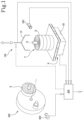
- Said description will be presented here below with reference to
figure 1 attached, provided purely by way of non-limiting example, showing a diagrammatic view of a portion of an automatic packaging machine for consumer products, in particular, of the tobacco industry, adapted to implement the method according to the present invention. - With reference to the appended figure, a method is now described for managing an automatic packaging machine for consumer products, in particular of the tobacco industry.
- The machine comprises at least one working unit configured to operate on a web material, e.g., on a web of paper. The working unit, not shown, is any unit adapted to operate, preferably continuously, on the web. By way of non-limiting example, the unit can comprise: an embosser, a gluer, a crimper, a printer, a longitudinal cutting tool for cutting into two or more strips, a humidifier, a perforator, a forming beam, a folder.
- The web material is preferably fed to the working unit by means of an unwinding action of a roll "B," which will be described in detail below.
- The method comprises a step of providing at least one roll "B" of web material at a
loading station 100 of the machine. - The term "at least one roll" can be understood to mean that in the providing step:
- there is provided at least one single roll "B;" or
- there is provided at least one stack "P" of rolls "B" arranged in configuration with one another coaxially along a horizontal or vertical axis (by depositing single rolls in a block or by overlaying).
- Note that the steps of the method described for the at least one roll "B" can be applied to a stack "P" of rolls "B."
- At the end of the providing step, the at least one roll "B" is stationary in the
loading station 100, and arranged, in particular, resting on a receiving zone "R" of theloading station 100. - According to the illustrated embodiment, the
loading station 100 receives the at least one roll "B" arranged on a pallet or flatbed of an AGV (Automatic Guided Vehicle) positioned in the receiving zone "R". - The pallet or flatbed are preferably provided with at least one central support in the form of a pole or shaft onto which the at least one roll "B" is fitted so as to have the axis thereof oriented vertically. Alternatively, the central support could have an inclined or horizontal extension.
- As an alternative to the illustrated embodiment, the
loading station 100 comprises at least one lower support oriented horizontally so that in the providing step, the at least one roll "B" is arranged resting on said lower support so as to have the axis thereof oriented horizontally. In said situation, the receiving zone "R" is defined by the support portion. - As shown in the appended figure, the
loading station 100 further comprises automated movement means 10. - In the embodiment illustrated by way of non-limiting example, the automated movement means 10 are made in the form of a robotic arm provided with a clamp. Alternatively, the automated movement means 10 can comprise a Cartesian mover.
- Following the providing step, the method comprises a step of picking up, by the automated movement means 10, a roll "B" from the
loading station 100 and a step of releasing, again by the automated movement means 10, the roll "B" picked up in afeeding station 200, in which it is gradually unwound to be fed to the working unit. In said working unit, at least one processing is carried out on the web material unwound from the at least one roll "B". Thefeeding station 200 can comprise a support pin with a preferably horizontal axis, e.g., mounted onto a vertical wall of the machine. More preferably, thefeeding station 200 comprises a rotatable tower for supporting two or more rolls, adapted to carry out an automated roll change. - According to one aspect of the invention, while the at least one roll "B" is at the
loading station 100, the method comprises a step of detecting at least one quality and/or dimensional and/or positional parameter of the at least one roll "B". - Note that the detection of at least one quality parameter, the detection of at least one dimensional parameter and the detection of at least one positional parameter are aspects of the present invention, which can be protected separately and independently of one another.
- By way of non-limiting example, the term "quality parameter" is understood to mean a type of web (material), color of the web and the like.
- By way of non-limiting example, the term "dimensional parameter" is understood to mean an inner diameter of the roll "B," outer diameter of the roll "B", dimension in the axial direction of the roll "B".
- By way of non-limiting example, the term "positional parameter" is understood to mean: a position in the plane or in the space occupied by the at least one roll "B" in the
loading station 100, an orientation of the at least one roll "B" in the loading station 100 (mounting direction on the central support). - The detection step is preferably carried out while the at least one roll "B" is stationary in the
loading station 100, and, in particular, arranged resting on the receiving zone "R" of theloading station 100. In the case of a stack of rolls "B," the detection is carried out at least on the next head roll "B" to be picked up by the automated movement means 10. - The detection step is carried out by detection means 300.
- Preferably, the detection means 300 comprise at least one camera.
- The detection means 300 further comprise software, implemented by means of a computer, capable of receiving and processing the images captured by the camera.
- Following the detection step, the method comprises a step of comparing the at least one parameter detected with a corresponding reference parameter.
- Based on the above comparison, the method comprises a step of determining at least one of the following states:
- roll correctly or incorrectly positioned and/or oriented in the loading station (100);
- type of roll conformant or non-conformant with a type of roll expected for the current processing.
- While determining the state of the conformant or non-conformant-type roll, one or more quality and/or dimensional parameters can be compared, such as, for example, the inner and/or outer diameter of the roll "B", the dimension in the axial direction of the roll "B", the type of material of the roll "B", the color of the roll "B" and the like.
- If the non-conformant-type roll state is determined from the comparison step, the method can comprise a step of generating an operator alert signal.
- The alert signal preferably determines the need for an operation to remove the non-conformant roll "B" from the
loading station 100 so that said roll "B" does not reach the working unit and preferably does not reach thefeeding station 200. - As an alternative to the step of generating an operator alert signal, the method comprises a step of sending, to the automated movement means 10, a command signal identifying an action to transfer the non-conformant roll "B" to a reject station so that the at least one roll "B" does not reach the working unit and preferably does not reach the
feeding station 200. - In other words, in the case where the state of a non-conformant-type roll is achieved, the method provides a step of removing the at least one non-conformant roll "B" so as to avoid the production of products wrapped with the web material of the non-conformant roll "B".
- For example, if at least one roll "B" is detected in the
loading station 100 with a different color with respect to the color expected for the current processing, it will be removed from thefeeding station 100 so as to prevent the web material of said at least one roll "B" from reaching the working unit and successively being used for wrapping operations, resulting in the need to eliminate the products wrapped with said web material. - Whereas, if the state of a roll is obtained as incorrectly positioned and/or oriented, the method can comprise a step of generating an operator alert signal.
- The alert signal preferably identifies a corrective operation to be carried out.
- In said situation, the operator preferably intervenes to overturn the at least one roll "B" in the event of incorrect orientation, or to reposition the at least one roll "B" in the plane and/or space in the
loading station 100, in the event of incorrect positioning. - In particular, an upside down roll "B" affects the unwinding direction of the roll and it is apparent how an upside down position prevents the correct unwinding path of the web of the roll on the special means affected (rollers). Said overturning also affects the overwrap label, which is detected as an indicator of the initial engagement zone of the web and which has a directional nature (it can be detached from one end thereof but not from the other).
- As an alternative to the step of generating an operator alert signal, the method can comprise a step of sending, to the automated movement means 10, a command signal determining a corrective positioning action to be carried out.
- In said situation, the movement means 10 are preferably actuated so as to calibrate the successive pick-up configuration with the current position of the roll "B" detected, in the event of positioning outside the tolerance, or to overturn the roll "B" during the transfer from the
loading station 100 to themovement station 200, carried out by the same automated movement means 10. - Alternatively, the movement means 10 are actuated so as to overturn the at least one roll "B" in the event of incorrect orientation and reposition it in the
loading station 100 or to reposition the at least one roll "B" in the plane and/or in the space in theloading station 100, in the event of incorrect positioning. - Preferably, the method provides determining both the correctly or incorrectly positioned and/or oriented roll state and the conformant or non-conformant roll state.
- Even more preferably, first, the conformant or non-conformant roll state is determined and then the correctly or incorrectly positioned and/or oriented roll state is determined. In so doing, if it can be immediately determined that the at least one roll "B" placed in the
loading station 100 does not comply with the type of roll "B" expected for the current processing (i.e. it is not the type of roll "B" desired for use for the current processing) time is not spent determining whether it is correctly positioned and/or oriented. - In other words, if the non-conformant-type roll state is determined, the correctly or incorrectly positioned and/or oriented roll state cannot be assessed. On the contrary, if the conformant roll state is determined, the correctly or incorrectly positioned and/or oriented roll state is assessed.
- According to one aspect of the present invention, the machine can comprise, in the
loading station 100, weighing means 20 configured to acquire a weight parameter representative of the weight of the at least one roll "B". - According to the embodiment shown, the weighing
means 20 are arranged in the receiving zone "R" of theloading station 100 so as to acquire the weight of the at least one roll "B" while the at least one roll "B" is resting in a stationary manner in the receiving zone "R". - In particular, in the illustrated embodiment, the weighing
means 20 are arranged at the bottom of the flatbed of a pallet. - Alternatively, the weighing
means 20 are integrated with the automated movement means 10, e.g., by means of a load cell or other equivalent element applied to a gripping member of the robotic arm or of the Cartesian mover. In said situation, when the automated movement means 10 pick up the at least one roll "B", the weighing means acquire the weight parameter. - According to an aspect of the present invention, in the detection step, at least one quality parameter is detected representative of the outer diameter and inner diameter of the at least one roll "B." In said situation, the method comprises a step of calculating the axial dimension of the at least one roll "B" using the weight parameter and a density parameter of the at least one roll "B."
- If there is a single roll "B," the axial dimension of said roll "B" is determined from the calculation step.
- The axial dimension of the entire stack "P" of rolls "B" is determined from the calculation step if several rolls "B" are stacked, defining a stack "P." Moreover, the demarcation line in the stack of rolls between adjacent rolls is not easily identifiable from the camera images.
- According to an aspect of the present invention, the machine comprises a
processing unit 400. In said situation, the method comprises a step of providing, in theloading station 100, at least one stack "P" of rolls "B", in particular, arranged in a configuration in which they are coaxial with one another along an axis "Z", preferably horizontal or vertical. - In the embodiment illustrated by way of non-limiting example, a single stack "P" has been provided, in which the rolls "B" are arranged in a coaxial configuration along a vertical "Z" axis.
- After the providing step, the method comprises a step of detecting, in particular, by the detection means 300, a dimension in the axial direction of the stack "P". Therefore, in the aforesaid detection step, a distance is measured between the top roll "B" of the stack "P" and the bottom one (if the stack "P" has the rolls "B" in a coaxial configuration along a vertical axis "Z") or between the head roll "B" of the stack "P" and the tail one (if the stack "P" has the rolls "B" in a coaxial configuration along a horizontal axis).
- In other words, in the aforesaid detection step, a stack "P" height is detected (if the stack "P" has the rolls "B" in a coaxial configuration along a vertical axis "Z") or a stack "P" length (if the stack "P" has the rolls "B" in a coaxial configuration along a horizontal axis). Said detection is carried out by exploiting the contrast between the ends of the stack of rolls and the surrounding environment.
- After the detection step, the method comprises a step of determining, by means of the
processing unit 400, the number of rolls "B" stacked in the stack "P" through a calculation by using the axial dimension value of the stack "P", detected by the detection means 300, and an axial dimension value of at least one roll "B" of the stack "P". - According to a possible embodiment, the axial dimension value of at least one roll "B" of the stack "P" can be sent to the
processing unit 400 in the form of a data item entered by an operator. - Alternatively, the aforesaid axial dimension value is calculated using the weight parameter and a density parameter of the roll "B," as described above.
- In the case of a single roll arranged in the
loading station 100, it is also possible to measure the axial dimension of the roll by the detection means 10 (there is a contrast between both the heads of the roll and the surrounding environment). - In use, once the at least one roll "B" has reached the feeding
station 200, the web material is fed to the working unit by unwinding one roll "B" at a time. - During the unwinding of the roll "B", according to an aspect of the present invention, the method comprises a step of acquiring, preferably at predetermined time intervals during an unwinding period, a plurality of values representing the current outer diameter of the roll "B" being unwound and a step of acquiring an unwinding data item representative of a length of the web material unwound in said unwinding period. Said unwinding data item is obtainable by the constant monitoring of the machine operation by a special control unit, in particular the
processing unit 400. - The acquisition steps are preferably carried out by the detection means 300, e.g., one or more cameras, placed in the feeding
station 200. - As an alternative to the acquisition step of the unwinding data item, the method may comprise a step of calculating said unwinding data item. Then, the method comprises a step of processing the plurality of values and the unwinding data item to determine a thickness value of the web material of the roll "B" being unwound.
- The present invention achieves the preset objects, eliminating the drawbacks of the prior art.
- In particular, the present invention allows a more precise and reliable control of the web material fed to a packaging machine. This results in a reduction in number of faulty products obtained by the packaging machine and a reduction in number of machine stop times due to a loading of non-conformant material.
Claims (10)
- A method for managing an automatic packaging machine for consumer products, in particular of the tobacco industry, wherein said machine comprises at least one working unit to operate on a web material; the method comprising the following steps:- providing at least one roll (B) of web material at a loading station (100) of the machine, said loading station (100) comprising automated movement means (10);- picking up the roll (B), by said automated movement means (10), from the loading station (100);- releasing the roll (B), by said automated movement means (10), in a feeding station (200) wherein the roll (B) is gradually unwound to be fed to the working unit;- in the at least one working unit, performing at least one processing on the web material unwound from the roll (B);- detecting, by detection means (300), at least one quality and/or dimensional and/or positional parameter of said at least one roll (B) while the roll (B) is at the loading station (100);- comparing said at least one parameter with a corresponding reference parameter;- based on said comparison, determining at least one of the following states:
roll correctly or incorrectly positioned and/or oriented in the loading station (100);- roll of a type conformant or non-conformant with a type of roll expected for the current processing;the method being characterized in that, if the non-conformant-type roll state is obtained, the method comprises the steps of:- generating an operator alert signal, said alert signal preferably determining an operation of removing said at least one roll (B) from the loading station (100) so that said roll does not reach the working unit; or- sending, to said automated movement means (10), a drive signal determining an action of transferring said at least one roll (B) to a reject station so that said at least one roll (B) does not reach the working unit. - A method according to claim 1, wherein, if the state determined is that of a roll incorrectly positioned and/or oriented, the method comprises the steps of:- generating an operator alert signal, said alert signal preferably determining a corrective operation to be carried out; or- sending, to said automated movement means (10), a drive signal determining a corrective positioning action to be carried out.
- A method according to any one of the preceding claims, wherein said detection step is carried out while said at least one roll (B) is stationary in the loading station (100), and in particular, resting on a receiving zone (R) of the loading station (100).
- A method according to any one of the preceding claims, wherein said machine comprises, in the loading station (100), weighing means (20) configured to acquire a weight parameter representing the weight of said at least one roll (B).
- A method according to claim 4, when dependent on claim 3, wherein said weighing means (20) are located in the receiving zone (R) of the loading station (100) so as to acquire the weight of said at least one roll (B) while said roll (B) is resting, in a stationary manner, in the receiving zone (R).
- A method according to claim 4, wherein said weighing means (20) are integral with said automated movement means (10).
- A method according to any one of the preceding claims, wherein said machine comprises a processing unit (400) and wherein the method comprises the steps of:- providing, in the loading station (100), at least one stack (P) of rolls (B), in particular arranged in a configuration in which they are coaxial with each other along an axis (Z) which is preferably horizontal or vertical;- detecting, in particular, by said detection means (300), a dimension in an axial direction of the stack (P);- determining, by means of said processing unit (400), the number of rolls (B) stacked in said stack (P) through a calculation using the axial dimension value of the stack (P), detected by the detection means (300), and an axial dimension value of at least one roll (B) of the stack (P).
- A method according to any one of claims 4 to 7, wherein, in said detection step, at least one quality parameter representing the outer diameter and the inner diameter of said at least one roll (B) is detected, the method further comprising a step of calculating the axial dimension of the at least one roll (B) using said weight parameter and a density parameter of said at least one roll (B).
- A method according to any one of the preceding claims, wherein said detection means (300) comprise at least one camera.
- A method according to any one of the preceding claims, wherein, during the unwinding of the roll, the method comprises the steps of:- acquiring, preferably at predetermined time intervals during an unwinding period, a plurality of values representing the current outer diameter of the roll (B) being unwound;- acquiring or calculating an unwinding data item representing a length of the web unwound in said unwinding period;- processing said plurality of values and said unwinding data item to determine a thickness value of the roll (B) being unwound.
Applications Claiming Priority (1)
| Application Number | Priority Date | Filing Date | Title |
|---|---|---|---|
| IT102023000024735A IT202300024735A1 (en) | 2023-11-22 | 2023-11-22 | METHOD FOR MANAGING AN AUTOMATIC PACKAGING MACHINE FOR CONSUMER PRODUCTS |
Publications (1)
| Publication Number | Publication Date |
|---|---|
| EP4559850A1 true EP4559850A1 (en) | 2025-05-28 |
Family
ID=89845304
Family Applications (1)
| Application Number | Title | Priority Date | Filing Date |
|---|---|---|---|
| EP24213527.5A Pending EP4559850A1 (en) | 2023-11-22 | 2024-11-18 | Method for managing an automatic packaging machine for consumer products |
Country Status (2)
| Country | Link |
|---|---|
| EP (1) | EP4559850A1 (en) |
| IT (1) | IT202300024735A1 (en) |
Citations (4)
| Publication number | Priority date | Publication date | Assignee | Title |
|---|---|---|---|---|
| EP1273541B1 (en) * | 2001-02-27 | 2007-05-16 | Focke & Co. (GmbH & Co. KG) | Device for providing packaging machines with packaging material |
| DE102006017379A1 (en) * | 2006-04-11 | 2007-10-18 | Focke & Co.(Gmbh & Co. Kg) | Device for handling bobbins from packaging material |
| DE102015208118A1 (en) * | 2015-04-30 | 2016-11-03 | Krones Aktiengesellschaft | Method and device for conveying, providing and exchanging rolls of packaging material in a packaging machine |
| EP3625159B1 (en) * | 2017-05-19 | 2022-07-06 | Philip Morris Products S.A. | Method and apparatus for feeding and splicing sheet of material wound in a bobbin |
-
2023
- 2023-11-22 IT IT102023000024735A patent/IT202300024735A1/en unknown
-
2024
- 2024-11-18 EP EP24213527.5A patent/EP4559850A1/en active Pending
Patent Citations (4)
| Publication number | Priority date | Publication date | Assignee | Title |
|---|---|---|---|---|
| EP1273541B1 (en) * | 2001-02-27 | 2007-05-16 | Focke & Co. (GmbH & Co. KG) | Device for providing packaging machines with packaging material |
| DE102006017379A1 (en) * | 2006-04-11 | 2007-10-18 | Focke & Co.(Gmbh & Co. Kg) | Device for handling bobbins from packaging material |
| DE102015208118A1 (en) * | 2015-04-30 | 2016-11-03 | Krones Aktiengesellschaft | Method and device for conveying, providing and exchanging rolls of packaging material in a packaging machine |
| EP3625159B1 (en) * | 2017-05-19 | 2022-07-06 | Philip Morris Products S.A. | Method and apparatus for feeding and splicing sheet of material wound in a bobbin |
Also Published As
| Publication number | Publication date |
|---|---|
| IT202300024735A1 (en) | 2025-05-22 |
Similar Documents
| Publication | Publication Date | Title |
|---|---|---|
| CN107531436B (en) | Method and apparatus for conveying, supplying and changing rolls with packaging material in packaging machines | |
| CN107683249B (en) | Method and apparatus for feeding, supplying and changing reels with packaging material in a packaging machine | |
| US12570428B2 (en) | System and method for moving and unbundling a carton stack | |
| CN106660727B (en) | For operating the method and apparatus of flat material and/or thin-film material on reel | |
| US20210139264A1 (en) | Method for reel changing in automatic machines | |
| RU2768288C2 (en) | Method and apparatus for making rolls of thin articles | |
| US11485594B2 (en) | Substrate handling system comprising a robot cell and method for operating the same | |
| CN114131615B (en) | Visual guidance-based robot unstacking system and unstacking and stacking method thereof | |
| US8826787B2 (en) | Cutting machine media feeder system with fixed in-feed and out-feed trays | |
| US20210147167A1 (en) | Device and method for producing transformer cores | |
| CN117141862B (en) | Silk spindle packaging system and control method and control device thereof | |
| US6705979B1 (en) | Method of and apparatus for machining web-shaped workpiece and apparatus for processing scrap | |
| US12560424B2 (en) | Machine for controlling the shape of a reel of web product | |
| CN102196978A (en) | Apparatus for loading a relatively rigid material, for example cardboard, and relative loading method | |
| CN223421998U (en) | Packaging machine | |
| EP3838818A1 (en) | A method and apparatus for preparing edges of reels of web material | |
| IT202300024735A1 (en) | METHOD FOR MANAGING AN AUTOMATIC PACKAGING MACHINE FOR CONSUMER PRODUCTS | |
| EP1129843A1 (en) | Method and machine for separating blanks for cardboard boxes | |
| EP1783072A1 (en) | Method and device for handling profile parts, particularly stacking profile parts | |
| CN118180282A (en) | Automatic material receiving system and method | |
| JP2008012778A (en) | Method and apparatus for punching flat board | |
| EP4549351A1 (en) | System for feeding web material, manipulator head for system for feeding web material and method for feeding web material | |
| WO2019102414A1 (en) | Assembly and method to handle a web or wire bobbin | |
| WO2013170868A1 (en) | Cardboard article production line | |
| CN1479682A (en) | Coil Packaging Equipment |
Legal Events
| Date | Code | Title | Description |
|---|---|---|---|
| PUAI | Public reference made under article 153(3) epc to a published international application that has entered the european phase |
Free format text: ORIGINAL CODE: 0009012 |
|
| STAA | Information on the status of an ep patent application or granted ep patent |
Free format text: STATUS: THE APPLICATION HAS BEEN PUBLISHED |
|
| AK | Designated contracting states |
Kind code of ref document: A1 Designated state(s): AL AT BE BG CH CY CZ DE DK EE ES FI FR GB GR HR HU IE IS IT LI LT LU LV MC ME MK MT NL NO PL PT RO RS SE SI SK SM TR |
|
| STAA | Information on the status of an ep patent application or granted ep patent |
Free format text: STATUS: REQUEST FOR EXAMINATION WAS MADE |
|
| 17P | Request for examination filed |
Effective date: 20251107 |