EP4559610A1 - Electric discharge machine, and chemical agent addition method - Google Patents
Electric discharge machine, and chemical agent addition method Download PDFInfo
- Publication number
- EP4559610A1 EP4559610A1 EP23859939.3A EP23859939A EP4559610A1 EP 4559610 A1 EP4559610 A1 EP 4559610A1 EP 23859939 A EP23859939 A EP 23859939A EP 4559610 A1 EP4559610 A1 EP 4559610A1
- Authority
- EP
- European Patent Office
- Prior art keywords
- chemical agent
- working fluid
- added
- electric discharge
- electrode potential
- Prior art date
- Legal status (The legal status is an assumption and is not a legal conclusion. Google has not performed a legal analysis and makes no representation as to the accuracy of the status listed.)
- Pending
Links
Images


Classifications
-
- B—PERFORMING OPERATIONS; TRANSPORTING
- B23—MACHINE TOOLS; METAL-WORKING NOT OTHERWISE PROVIDED FOR
- B23H—WORKING OF METAL BY THE ACTION OF A HIGH CONCENTRATION OF ELECTRIC CURRENT ON A WORKPIECE USING AN ELECTRODE WHICH TAKES THE PLACE OF A TOOL; SUCH WORKING COMBINED WITH OTHER FORMS OF WORKING OF METAL
- B23H1/00—Electrical discharge machining, i.e. removing metal with a series of rapidly recurring electrical discharges between an electrode and a workpiece in the presence of a fluid dielectric
- B23H1/08—Working media
Definitions
- the present disclosure relates to an electric discharge machine and a chemical agent addition method.
- WO 2006/126248 A1 discloses an electric discharge machine.
- a first aspect of the present disclosure is an electric discharge machine including: an electric discharge machining unit configured to perform electric discharge machining on a workpiece in a working fluid; and a filter configured to remove sludge contained in the working fluid, wherein, when the workpiece is made of an aluminum-based material, the electric discharge machine performs the electric discharge machining by using the working fluid containing a cation of a metal having a standard electrode potential lower than a standard electrode potential of aluminum.
- a second aspect of the present disclosure is a chemical agent addition method for adding a chemical agent to a working fluid of an electric discharge machine including an electric discharge machining unit that performs electric discharge machining on a workpiece in the working fluid and a filter that removes sludge contained in the working fluid, wherein by adding a first chemical agent to the working fluid, the working fluid contains a cation of a first metal having a standard electrode potential lower than a standard electrode potential of aluminum, and by adding a second chemical agent to the working fluid, the working fluid contains a cation of a second metal having a standard electrode potential lower than the standard electrode potential of the first metal, the chemical agent addition method including a chemical agent determination step of determining a chemical agent to be added to the working fluid; and an addition step of, when the first chemical agent is added to the working fluid, increasing an amount of the first chemical agent to be added, as compared with an amount of the second chemical agent to be added when the second chemical agent is added to the working fluid, and when the second chemical agent is added to the working fluid,
- An electric discharge machine performs electric discharge machining on a workpiece in a working fluid (dielectric working fluid).
- the working fluid used in the electric discharge machining contains sludge generated during the electric discharge machining.
- the working fluid used in the electric discharge machining is recycled after sludge has been removed therefrom by a filter.
- the sludge adheres to the filter as a result of filtration of the working fluid.
- the filter When the filter is clogged by the adhesion of the sludge and the resistance of the filter thus increases, the user needs to replace the filter.
- the filter after use is usually discarded without being reused. In order to reduce the number of times of replacement of the filter and to reduce the number of discarded filters, it is required to extend the life time of the filter.
- the life time of the filter for the electric discharge machine is shorter than when the electric discharge machine performs electric discharge machining on a workpiece made of an iron-based material.
- electric discharge machining is performed on a workpiece made of an aluminum-based material, aluminum hydroxide is generated in the dielectric fluid. It is considered that aluminum hydroxide is gelled due to contact with water for a long time, and the gelled aluminum hydroxide adheres to the filter, thereby shortening the life time of the filter.
- the life time of the filter for electric discharge machine in the case where electric discharge machining is performed on a workpiece made of an aluminum-based material is 10% to 25% of the life time of the filter for electric discharge machine in the case where electric discharge machining is performed on a workpiece made of an iron-based material.
- An object of the technology according to the present disclosure is to provide an electric discharge machine and a chemical agent addition method capable of extending the life time of a filter of the electric discharge machine when electric discharge machining is performed on an aluminum-based material.
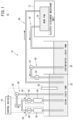
- FIG. 1 is a schematic view of an electric discharge machine 10.
- the electric discharge machine 10 includes an electric discharge machining unit 12, a working fluid processing unit 14, and a control device 16.
- the electric discharge machine 10 is a wire electric discharge machine.
- the electric discharge machining unit 12 includes a work pan 18.
- the electric discharge machining unit 12 performs electric discharge machining on a workpiece in a working fluid (dielectric working fluid) stored in the work pan 18.
- the working fluid processing unit 14 includes a contaminated liquid tank 20, a clean liquid tank 22, an ion exchange unit 24, an addition unit 26, and a resistivity value measurement unit 28.
- the working fluid used in the electric discharge machining is discharged from the work pan 18 to the contaminated liquid tank 20 through a fluid discharge path 29.
- the working fluid discharged from the work pan 18 contains sludge generated during electric discharge machining.
- the working fluid stored in the contaminated liquid tank 20 is sent to the clean liquid tank 22 through a filtration path 30.
- the filtration path 30 is provided with a first pump 32 and a filter 34.
- the first pump 32 sends the working fluid from the contaminated liquid tank 20 to the clean liquid tank 22.
- the filter 34 filters the working fluid sent from the contaminated liquid tank 20 to the clean liquid tank 22, and removes sludge from the dielectric working fluid.
- the working fluid stored in the clean liquid tank 22 circulates between the clean liquid tank 22 and the ion exchange unit 24 or between the clean liquid tank 22 and the addition unit 26 through a circulation path 36.
- a second pump 38 is provided in the circulation path 36. The second pump 38 supplies the working fluid in the clean liquid tank 22 to the ion exchange unit 24 or the addition unit 26.
- the ion exchange unit 24 includes a first valve 40 and an ion exchange resin 42.
- the first valve 40 is opened, and a second valve 44 described below is closed.
- the working fluid is supplied from the clean liquid tank 22 to the ion exchange unit 24.
- the ion exchange resin 42 captures specific ions contained in the working fluid passing through the ion exchange resin 42 and releases the other ions.
- the addition unit 26 includes the second valve 44 and a chemical agent storage unit 46.
- the second valve 44 When the electric discharge machining unit 12 performs electric discharge machining on a workpiece made of an aluminum-based material, the second valve 44 is opened and the first valve 40 is closed. Thus, the working fluid is supplied from the clean liquid tank 22 to the chemical agent storage unit 46.
- the chemical agent storage unit 46 adds a chemical agent for reducing the resistivity, to the working fluid passing through the chemical agent storage unit 46.
- the chemical agent added to the working fluid include sodium hydrogen sulfite (sodium bisulfite), sodium carbonate, sodium sulfate, calcium hydroxide, sodium disulfite (sodium pyrosulfite), potassium disulfite (potassium pyrosulfite), magnesium sulfate, and magnesium sulfate heptahydrate.
- the chemical agent may be a compound other than those described above.
- the chemical agent may comprise one kind of compound.
- the chemical agent may comprise more than one kind of compound.
- the working fluid contains one or more kinds of cations among cations of metals having a standard electrode potential lower than the standard electrode potential of aluminum.
- the cations of the metal having a standard electrode potential lower than the standard electrode potential of aluminum are lithium ion, potassium ion, calcium ion, sodium ion, and magnesium ion. That is, the working fluid may contain one or more kinds of cations selected from among lithium ion, potassium ion, calcium ion, sodium ion, and magnesium ion.
- the working fluid contains one or more kinds of anions among the following anions.
- the anions are sulfate ion, sulfite ion, disulfite ion, bisulfite ion (hydrogen sulfite ion), hydroxide ion, nitrate ion, and nitrite ion.
- the working fluid may contain one or more kinds of anions selected from among sulfate ion, sulfite ion, disulfite ion, bisulfite ion, hydroxide ion, nitrate ion, and nitrite ion.
- the resistivity value measurement unit 28 measures the resistivity of the working fluid stored in the clean liquid tank 22.
- the addition unit 26 is controlled by the control device 16 based on the resistivity.
- the working fluid with the adjusted resistivity is sent from the clean liquid tank 22 to the work pan 18 through a supply path 48.
- FIG. 2 is a block diagram showing the configuration of the control device 16.
- the control device 16 includes a computation unit 50 and a storage unit 52.
- the computation unit 50 includes a processor, for example, such as a CPU (Central Processing Unit), a GPU (Graphics Processing Unit), or the like.
- the computation unit 50 includes a resistivity value acquisition unit 54, an agent addition amount information acquisition unit 56, and a control unit 60.
- the resistivity value acquisition unit 54, the agent addition amount information acquisition unit 56, and the control unit 60 are realized by the computation unit 50 executing a program stored in the storage unit 52.
- At least a part of the resistivity value acquisition unit 54, the agent addition amount information acquisition unit 56, and the control unit 60 may be realized by an integrated circuit such as an application specific integrated circuit (ASIC) or a field-programmable gate array (FPGA). At least a part of the resistivity value acquisition unit 54, the agent addition amount information acquisition unit 56, and the control unit 60 may be realized by an electronic circuit including a discrete device.
- ASIC application specific integrated circuit
- FPGA field-programmable gate array
- the storage unit 52 is configured by a volatile memory (not illustrated) and a nonvolatile memory (not illustrated), which are computer-readable storage media.
- the volatile memory is, for example, a RAM (Random Access Memory), or the like.
- the nonvolatile memory for example, is a ROM (Read Only Memory), a flash memory, or the like.
- data and the like are stored in the volatile memory.
- programs, tables, maps, and the like are stored in the nonvolatile memory.
- At least a portion of the storage unit 52 may be provided in the aforementioned processor, integrated circuit, or the like. At least a part of the storage unit 52 may be mounted on a device connected to the electric discharge machine 10 via a network.
- the resistivity value acquisition unit 54 acquires information on the resistivity value of the dielectric working fluid stored in the clean liquid tank 22, from the resistivity value measurement unit 28.
- the agent addition amount information acquisition unit 56 acquires chemical agent addition amount information from the storage unit 52.
- the chemical agent addition amount information is information about the amount of chemical agent to be added to the working fluid when the workpiece is made of an aluminum-based material.
- the storage unit 52 stores the chemical agent addition amount information for each chemical agent.
- the control unit 60 controls the addition unit 26. A method of controlling the addition unit 26 will be described later in detail.
- the inventors of the present invention conducted an experiment for determining the life time of the filter 34 by performing electric discharge machining on a workpiece made of an aluminum-based material in a plurality of types of dielectric working fluids containing different cations.
- FIG. 3 is a graph showing the standard electrode potential of the metal of the cation contained in the working fluid and the life time of the filter 34.
- the resistivity values of the working fluids containing cations of the metals are the same.
- the life time of the filter 34 in the case where the cations of a metal having a standard electrode potential lower than the standard electrode potential of aluminum are contained in the working fluid is longer than the life time of the filter 34 in the case where aluminum ions are contained in the working fluid.
- aluminum hydroxide is also inhibited when sodium carbonate, sodium sulfate, calcium hydroxide, sodium disulfite (sodium pyrosulfite), potassium disulfite (potassium pyrosulfite), magnesium sulfate, or magnesium sulfate heptahydrate is added to the working fluid.
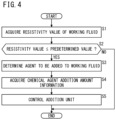
- FIG. 4 is a flowchart showing a chemical agent addition process executed by the control device 16.
- the chemical agent addition process is repeatedly executed at a predetermined cycle while a workpiece made of an aluminum-based material is being machined in the electric discharge machining unit 12.
- step S1 the resistivity value acquisition unit 54 acquires information on the resistivity value of the working fluid, from the resistivity value measurement unit 28. Next, the process transitions to step S2.
- step S2 the control unit 60 determines whether or not the resistivity value of the working fluid is equal to or less than a predetermined value, based on the information of the resistivity value acquired by the resistivity value acquisition unit 54. If the resistivity value of the working fluid is equal to or less than the predetermined value, the process proceeds to step S3, and if the resistivity value of the working fluid is greater than the predetermined value, the chemical agent addition process is terminated.
- step S3 the control unit 60 determines the chemical agent to be added to the working fluid. Thereafter, the process transitions to step S4.
- the chemical agent to be added to the working fluid may be input to the control device 16 by a user of the electric discharge machine 10.
- step S4 the agent addition amount information acquisition unit 56 acquires chemical agent addition amount information from the storage unit 52.
- the storage unit 52 stores chemical agent addition amount information that is information on the amount of chemical agent to be added to the working fluid, for each chemical agent. Thereafter, the process transitions to step S5.
- step S5 the control unit 60 controls the addition unit 26 based on the agent addition amount information. Thereafter, the chemical agent addition process is terminated.
- the control unit 60 controls a chemical agent supply device (not shown) to supply the chemical agent of the addition amount based on the chemical agent addition amount information corresponding to the chemical agent determined in step S3, to the chemical agent storage unit 46. Thereafter, the control unit 60 opens the second valve 44. Thus, the chemical agent of the addition amount based on the chemical agent addition amount information is added.
- the amount of the chemical agent to be added is determined according to the standard electrode potential of the metal constituting the compound contained in the chemical agent.
- the amount of the chemical agent to be added will be described below by using a first chemical agent and a second chemical agent as examples.
- the standard electrode potential of the metal constituting the compound contained in the first chemical agent is lower than the standard electrode potential of aluminum.
- a chemical agent containing magnesium sulfate can be selected as the first chemical agent.
- the working fluid contains magnesium cations by adding the chemical agent containing magnesium sulfate to the working fluid.
- the standard electrode potential of magnesium is lower than the standard electrode potential of aluminum.
- the standard electrode potential of the metal constituting the compound contained in the second chemical agent is lower than the standard electrode potential of the metal constituting the compound contained in the first chemical agent.
- a chemical agent containing sodium sulfate can be selected as the second chemical agent.
- the chemical agent containing sodium sulfate is added to the working fluid, so that the working fluid contains sodium cations.
- the standard electrode potential of sodium is lower than the standard electrode potential of magnesium.
- the storage unit 52 stores chemical agent addition amount information indicating that the amount of the second chemical agent to be added when the second chemical agent is added to the working fluid is smaller than the amount of the first chemical agent to be added when the first chemical agent is added to the working fluid.
- the life time of the filter 34 in the case where the working fluid contains sodium cations is longer than the life time of the filter 34 in the case where the working fluid contains magnesium cations. Therefore, when the first chemical agent is added to the working fluid, the amount of the first chemical agent added is increased as compared with the amount of the second chemical agent added when the second chemical agent is added to the working fluid, whereby the life time of the filter 34 can be extended similarly. In addition, when the second chemical agent is added to the working fluid, the life time of the filter 34 can be extended similarly even if the amount of the second chemical agent added is reduced as compared with the amount of the first chemical agent added when the first chemical agent is added to the working fluid.
- control device 16 controls the addition unit 26 to add the chemical agent to the working fluid.
- the user of the electric discharge machine 10 may add the chemical agent to the working fluid.
- the user determines the chemical agent to be added.
- the user increases the amount of the first chemical agent to be added, compared with the amount of the second chemical agent to be added when the second chemical agent is added to the working fluid.
- the user reduces the amount of the second chemical agent to be added, compared with the amount of the first chemical agent to be added when the first chemical agent is added to the working fluid.
- the electric discharge machine (10) includes the electric discharge machining unit (12) for performing electric discharge machining on the workpiece in the working fluid and the filter (34) for removing sludge contained in the working fluid.
- the electric discharge machine performs electric discharge machining by using the working fluid containing a cation of a metal having a standard electrode potential lower than the standard electrode potential of aluminum when the workpiece is made of an aluminum-based material.
- the working fluid may contain one or more kinds of anions selected from among sulfate ion, sulfite ion, disulfite ion, bisulfite ion, hydroxide ion, nitrate ion, and nitrite ion.
- the working fluid by adding the first chemical agent to the working fluid, the working fluid may contain the cation of the first metal having a standard electrode potential lower than the standard electrode potential of aluminum, and by adding the second chemical agent to the working fluid, the working fluid may contain the cation of the second metal having a standard electrode potential lower than the standard electrode potential of the first metal, the electric discharge machine further including: the agent addition amount information acquisition unit (56) configured to acquire chemical agent addition amount information from the storage unit (52) that stores the chemical agent addition amount information, the chemical agent addition amount information being information on the amount of a chemical agent to be added to the working fluid when the workpiece is made of the aluminum-based material; the addition unit (26) configured to add the chemical agent to the working fluid; and the control unit (60) configured to control the addition unit based on the chemical agent addition amount information, the storage unit may store the chemical agent addition amount information that causes the amount of the second chemical agent to be added when the second chemical agent is added to the working fluid to be smaller than the amount of the first chemical agent to be
Landscapes
- Engineering & Computer Science (AREA)
- Mechanical Engineering (AREA)
- Electrical Discharge Machining, Electrochemical Machining, And Combined Machining (AREA)
- Treatment Of Water By Ion Exchange (AREA)
Abstract
An electric discharge machine comprising an electric discharge processing unit that performs electric discharge processing on a workpiece in a processing liquid, and a filter that removes sludge included in the processing liquid, wherein if the workpiece is made of an aluminum-based material, the electric discharge machine performs electric discharge processing using a processing liquid containing positive ions of a metal having a standard electrode potential lower than the standard electrode potential of aluminum.
Description
- The present disclosure relates to an electric discharge machine and a chemical agent addition method.
-
WO 2006/126248 A1 discloses an electric discharge machine. - Recently, there is a demand for further improved electric discharge machines and further improved chemical agent addition methods.
- A first aspect of the present disclosure is an electric discharge machine including: an electric discharge machining unit configured to perform electric discharge machining on a workpiece in a working fluid; and a filter configured to remove sludge contained in the working fluid, wherein, when the workpiece is made of an aluminum-based material, the electric discharge machine performs the electric discharge machining by using the working fluid containing a cation of a metal having a standard electrode potential lower than a standard electrode potential of aluminum.
- A second aspect of the present disclosure is a chemical agent addition method for adding a chemical agent to a working fluid of an electric discharge machine including an electric discharge machining unit that performs electric discharge machining on a workpiece in the working fluid and a filter that removes sludge contained in the working fluid, wherein by adding a first chemical agent to the working fluid, the working fluid contains a cation of a first metal having a standard electrode potential lower than a standard electrode potential of aluminum, and by adding a second chemical agent to the working fluid, the working fluid contains a cation of a second metal having a standard electrode potential lower than the standard electrode potential of the first metal, the chemical agent addition method including a chemical agent determination step of determining a chemical agent to be added to the working fluid; and an addition step of, when the first chemical agent is added to the working fluid, increasing an amount of the first chemical agent to be added, as compared with an amount of the second chemical agent to be added when the second chemical agent is added to the working fluid, and when the second chemical agent is added to the working fluid, reducing the amount of the second chemical agent to be added, as compared with the amount of the first chemical agent to be added when the first chemical agent is added to the working fluid.
-
- [
FIG. 1] FIG. 1 is a schematic view of an electric discharge machine; - [
FIG. 2] FIG. 2 is a block diagram showing a configuration of a control device; - [
FIG. 3] FIG. 3 is a graph showing the standard electrode potential of a metal of a cation contained in a dielectric working fluid and the life time of a filter; and [FIG. 4] FIG. 4 is a flowchart showing a chemical agent addition process executed in the control device. - An electric discharge machine performs electric discharge machining on a workpiece in a working fluid (dielectric working fluid). The working fluid used in the electric discharge machining contains sludge generated during the electric discharge machining. The working fluid used in the electric discharge machining is recycled after sludge has been removed therefrom by a filter. The sludge adheres to the filter as a result of filtration of the working fluid.
- When the filter is clogged by the adhesion of the sludge and the resistance of the filter thus increases, the user needs to replace the filter. The filter after use is usually discarded without being reused. In order to reduce the number of times of replacement of the filter and to reduce the number of discarded filters, it is required to extend the life time of the filter.
- When the electric discharge machine performs electric discharge machining on a workpiece made of an aluminum-based material, the life time of the filter for the electric discharge machine is shorter than when the electric discharge machine performs electric discharge machining on a workpiece made of an iron-based material. When electric discharge machining is performed on a workpiece made of an aluminum-based material, aluminum hydroxide is generated in the dielectric fluid. It is considered that aluminum hydroxide is gelled due to contact with water for a long time, and the gelled aluminum hydroxide adheres to the filter, thereby shortening the life time of the filter. The life time of the filter for electric discharge machine in the case where electric discharge machining is performed on a workpiece made of an aluminum-based material is 10% to 25% of the life time of the filter for electric discharge machine in the case where electric discharge machining is performed on a workpiece made of an iron-based material.
- Therefore, when the electric discharge machine performs electric discharge machining on a workpiece made of an aluminum-based material, the number of times of replacement of the filter by the user increases, and the number of discarded filters increases. An object of the technology according to the present disclosure is to provide an electric discharge machine and a chemical agent addition method capable of extending the life time of a filter of the electric discharge machine when electric discharge machining is performed on an aluminum-based material.
-
FIG. 1 is a schematic view of anelectric discharge machine 10. Theelectric discharge machine 10 includes an electricdischarge machining unit 12, a workingfluid processing unit 14, and acontrol device 16. Theelectric discharge machine 10 is a wire electric discharge machine. - The electric
discharge machining unit 12 includes awork pan 18. The electricdischarge machining unit 12 performs electric discharge machining on a workpiece in a working fluid (dielectric working fluid) stored in thework pan 18. - The working
fluid processing unit 14 includes a contaminatedliquid tank 20, a cleanliquid tank 22, anion exchange unit 24, anaddition unit 26, and a resistivityvalue measurement unit 28. - The working fluid used in the electric discharge machining is discharged from the
work pan 18 to the contaminatedliquid tank 20 through afluid discharge path 29. The working fluid discharged from thework pan 18 contains sludge generated during electric discharge machining. - The working fluid stored in the contaminated
liquid tank 20 is sent to the cleanliquid tank 22 through afiltration path 30. Thefiltration path 30 is provided with afirst pump 32 and afilter 34. Thefirst pump 32 sends the working fluid from the contaminatedliquid tank 20 to the cleanliquid tank 22. Thefilter 34 filters the working fluid sent from the contaminatedliquid tank 20 to theclean liquid tank 22, and removes sludge from the dielectric working fluid. - The working fluid stored in the clean
liquid tank 22 circulates between the cleanliquid tank 22 and theion exchange unit 24 or between the cleanliquid tank 22 and theaddition unit 26 through acirculation path 36. Asecond pump 38 is provided in thecirculation path 36. Thesecond pump 38 supplies the working fluid in theclean liquid tank 22 to theion exchange unit 24 or theaddition unit 26. - The
ion exchange unit 24 includes afirst valve 40 and anion exchange resin 42. When the electricdischarge machining unit 12 performs electric discharge machining on a workpiece made of a material other than an aluminum-based material, thefirst valve 40 is opened, and asecond valve 44 described below is closed. Thus, the working fluid is supplied from the cleanliquid tank 22 to theion exchange unit 24. Theion exchange resin 42 captures specific ions contained in the working fluid passing through theion exchange resin 42 and releases the other ions. - The
addition unit 26 includes thesecond valve 44 and a chemicalagent storage unit 46. When the electricdischarge machining unit 12 performs electric discharge machining on a workpiece made of an aluminum-based material, thesecond valve 44 is opened and thefirst valve 40 is closed. Thus, the working fluid is supplied from the cleanliquid tank 22 to the chemicalagent storage unit 46. - The chemical
agent storage unit 46 adds a chemical agent for reducing the resistivity, to the working fluid passing through the chemicalagent storage unit 46. Examples of the chemical agent added to the working fluid include sodium hydrogen sulfite (sodium bisulfite), sodium carbonate, sodium sulfate, calcium hydroxide, sodium disulfite (sodium pyrosulfite), potassium disulfite (potassium pyrosulfite), magnesium sulfate, and magnesium sulfate heptahydrate. The chemical agent may be a compound other than those described above. The chemical agent may comprise one kind of compound. The chemical agent may comprise more than one kind of compound. - By adding the chemical agent to the working fluid, the working fluid contains one or more kinds of cations among cations of metals having a standard electrode potential lower than the standard electrode potential of aluminum. The cations of the metal having a standard electrode potential lower than the standard electrode potential of aluminum are lithium ion, potassium ion, calcium ion, sodium ion, and magnesium ion. That is, the working fluid may contain one or more kinds of cations selected from among lithium ion, potassium ion, calcium ion, sodium ion, and magnesium ion.
- In addition, by adding the chemical agent to the working fluid, the working fluid contains one or more kinds of anions among the following anions. The anions are sulfate ion, sulfite ion, disulfite ion, bisulfite ion (hydrogen sulfite ion), hydroxide ion, nitrate ion, and nitrite ion. That is, the working fluid may contain one or more kinds of anions selected from among sulfate ion, sulfite ion, disulfite ion, bisulfite ion, hydroxide ion, nitrate ion, and nitrite ion.
- The resistivity
value measurement unit 28 measures the resistivity of the working fluid stored in the cleanliquid tank 22. Theaddition unit 26 is controlled by thecontrol device 16 based on the resistivity. The working fluid with the adjusted resistivity is sent from the cleanliquid tank 22 to thework pan 18 through asupply path 48. -
FIG. 2 is a block diagram showing the configuration of thecontrol device 16. Thecontrol device 16 includes acomputation unit 50 and astorage unit 52. Thecomputation unit 50 includes a processor, for example, such as a CPU (Central Processing Unit), a GPU (Graphics Processing Unit), or the like. Thecomputation unit 50 includes a resistivityvalue acquisition unit 54, an agent addition amountinformation acquisition unit 56, and acontrol unit 60. The resistivityvalue acquisition unit 54, the agent addition amountinformation acquisition unit 56, and thecontrol unit 60 are realized by thecomputation unit 50 executing a program stored in thestorage unit 52. At least a part of the resistivityvalue acquisition unit 54, the agent addition amountinformation acquisition unit 56, and thecontrol unit 60 may be realized by an integrated circuit such as an application specific integrated circuit (ASIC) or a field-programmable gate array (FPGA). At least a part of the resistivityvalue acquisition unit 54, the agent addition amountinformation acquisition unit 56, and thecontrol unit 60 may be realized by an electronic circuit including a discrete device. - The
storage unit 52 is configured by a volatile memory (not illustrated) and a nonvolatile memory (not illustrated), which are computer-readable storage media. The volatile memory is, for example, a RAM (Random Access Memory), or the like. The nonvolatile memory, for example, is a ROM (Read Only Memory), a flash memory, or the like. For example, data and the like are stored in the volatile memory. For example, programs, tables, maps, and the like are stored in the nonvolatile memory. At least a portion of thestorage unit 52 may be provided in the aforementioned processor, integrated circuit, or the like. At least a part of thestorage unit 52 may be mounted on a device connected to theelectric discharge machine 10 via a network. - The resistivity
value acquisition unit 54 acquires information on the resistivity value of the dielectric working fluid stored in theclean liquid tank 22, from the resistivityvalue measurement unit 28. The agent addition amountinformation acquisition unit 56 acquires chemical agent addition amount information from thestorage unit 52. The chemical agent addition amount information is information about the amount of chemical agent to be added to the working fluid when the workpiece is made of an aluminum-based material. Thestorage unit 52 stores the chemical agent addition amount information for each chemical agent. Thecontrol unit 60 controls theaddition unit 26. A method of controlling theaddition unit 26 will be described later in detail. - The inventors of the present invention conducted an experiment for determining the life time of the
filter 34 by performing electric discharge machining on a workpiece made of an aluminum-based material in a plurality of types of dielectric working fluids containing different cations. -
FIG. 3 is a graph showing the standard electrode potential of the metal of the cation contained in the working fluid and the life time of thefilter 34. The resistivity values of the working fluids containing cations of the metals are the same. - As shown in
FIG. 3 , it was confirmed that the life time of thefilter 34 in the case where the cations of a metal having a standard electrode potential lower than the standard electrode potential of aluminum are contained in the working fluid is longer than the life time of thefilter 34 in the case where aluminum ions are contained in the working fluid. - As shown in
FIG. 3 , it was confirmed that the lower the standard electrode potential of the metal of the cation contained in the working fluid, the longer the life time of thefilter 34. - When sodium hydrogen sulfite is added to the working fluid, aluminum oxide and aluminum oxide trihydrate are generated in the working fluid during electric discharge machining of a workpiece made of an aluminum-based material. On the other hand, when sodium hydrogen sulfite is not added to the working fluid, aluminum hydroxide is produced in the working fluid during electric discharge machining of a workpiece made of an aluminum-based material. It is considered that, by adding sodium hydrogen sulfite to the working fluid, aluminum oxide and aluminum oxide trihydrate are generated, instead of aluminum hydroxide which shortens the life time of the
filter 34. - Further, it is considered that the generation of aluminum hydroxide is also inhibited when sodium carbonate, sodium sulfate, calcium hydroxide, sodium disulfite (sodium pyrosulfite), potassium disulfite (potassium pyrosulfite), magnesium sulfate, or magnesium sulfate heptahydrate is added to the working fluid.
-
FIG. 4 is a flowchart showing a chemical agent addition process executed by thecontrol device 16. The chemical agent addition process is repeatedly executed at a predetermined cycle while a workpiece made of an aluminum-based material is being machined in the electricdischarge machining unit 12. - In step S1, the resistivity
value acquisition unit 54 acquires information on the resistivity value of the working fluid, from the resistivityvalue measurement unit 28. Next, the process transitions to step S2. - In step S2, the
control unit 60 determines whether or not the resistivity value of the working fluid is equal to or less than a predetermined value, based on the information of the resistivity value acquired by the resistivityvalue acquisition unit 54. If the resistivity value of the working fluid is equal to or less than the predetermined value, the process proceeds to step S3, and if the resistivity value of the working fluid is greater than the predetermined value, the chemical agent addition process is terminated. - In step S3, the
control unit 60 determines the chemical agent to be added to the working fluid. Thereafter, the process transitions to step S4. The chemical agent to be added to the working fluid may be input to thecontrol device 16 by a user of theelectric discharge machine 10. - In step S4, the agent addition amount
information acquisition unit 56 acquires chemical agent addition amount information from thestorage unit 52. Thestorage unit 52 stores chemical agent addition amount information that is information on the amount of chemical agent to be added to the working fluid, for each chemical agent. Thereafter, the process transitions to step S5. - In step S5, the
control unit 60 controls theaddition unit 26 based on the agent addition amount information. Thereafter, the chemical agent addition process is terminated. Thecontrol unit 60 controls a chemical agent supply device (not shown) to supply the chemical agent of the addition amount based on the chemical agent addition amount information corresponding to the chemical agent determined in step S3, to the chemicalagent storage unit 46. Thereafter, thecontrol unit 60 opens thesecond valve 44. Thus, the chemical agent of the addition amount based on the chemical agent addition amount information is added. - The amount of the chemical agent to be added is determined according to the standard electrode potential of the metal constituting the compound contained in the chemical agent. The amount of the chemical agent to be added will be described below by using a first chemical agent and a second chemical agent as examples.
- The standard electrode potential of the metal constituting the compound contained in the first chemical agent is lower than the standard electrode potential of aluminum. For example, a chemical agent containing magnesium sulfate can be selected as the first chemical agent. The working fluid contains magnesium cations by adding the chemical agent containing magnesium sulfate to the working fluid. The standard electrode potential of magnesium is lower than the standard electrode potential of aluminum.
- The standard electrode potential of the metal constituting the compound contained in the second chemical agent is lower than the standard electrode potential of the metal constituting the compound contained in the first chemical agent. For example, a chemical agent containing sodium sulfate can be selected as the second chemical agent. The chemical agent containing sodium sulfate is added to the working fluid, so that the working fluid contains sodium cations. The standard electrode potential of sodium is lower than the standard electrode potential of magnesium.
- The
storage unit 52 stores chemical agent addition amount information indicating that the amount of the second chemical agent to be added when the second chemical agent is added to the working fluid is smaller than the amount of the first chemical agent to be added when the first chemical agent is added to the working fluid. - As shown in
FIG. 3 , even when the resistivity value of the working fluid is the same, the life time of thefilter 34 in the case where the working fluid contains sodium cations is longer than the life time of thefilter 34 in the case where the working fluid contains magnesium cations. Therefore, when the first chemical agent is added to the working fluid, the amount of the first chemical agent added is increased as compared with the amount of the second chemical agent added when the second chemical agent is added to the working fluid, whereby the life time of thefilter 34 can be extended similarly. In addition, when the second chemical agent is added to the working fluid, the life time of thefilter 34 can be extended similarly even if the amount of the second chemical agent added is reduced as compared with the amount of the first chemical agent added when the first chemical agent is added to the working fluid. - In the above description, the
control device 16 controls theaddition unit 26 to add the chemical agent to the working fluid. However, the user of theelectric discharge machine 10 may add the chemical agent to the working fluid. - When the user adds a chemical agent to the working fluid, the user determines the chemical agent to be added. When the first chemical agent is added to the working fluid, the user increases the amount of the first chemical agent to be added, compared with the amount of the second chemical agent to be added when the second chemical agent is added to the working fluid. On the other hand, when the second chemical agent is added to the working fluid, the user reduces the amount of the second chemical agent to be added, compared with the amount of the first chemical agent to be added when the first chemical agent is added to the working fluid.
- The following Supplementary Notes are further disclosed in relation to the above embodiment.
- The electric discharge machine (10) includes the electric discharge machining unit (12) for performing electric discharge machining on the workpiece in the working fluid and the filter (34) for removing sludge contained in the working fluid. The electric discharge machine performs electric discharge machining by using the working fluid containing a cation of a metal having a standard electrode potential lower than the standard electrode potential of aluminum when the workpiece is made of an aluminum-based material.
- In the electric discharge machine according to
Supplementary Note 1, the working fluid may contain one or more kinds of anions selected from among sulfate ion, sulfite ion, disulfite ion, bisulfite ion, hydroxide ion, nitrate ion, and nitrite ion. - In the electric discharge machine according to Supplementary Note 1 or 2, by adding the first chemical agent to the working fluid, the working fluid may contain the cation of the first metal having a standard electrode potential lower than the standard electrode potential of aluminum, and by adding the second chemical agent to the working fluid, the working fluid may contain the cation of the second metal having a standard electrode potential lower than the standard electrode potential of the first metal, the electric discharge machine further including: the agent addition amount information acquisition unit (56) configured to acquire chemical agent addition amount information from the storage unit (52) that stores the chemical agent addition amount information, the chemical agent addition amount information being information on the amount of a chemical agent to be added to the working fluid when the workpiece is made of the aluminum-based material; the addition unit (26) configured to add the chemical agent to the working fluid; and the control unit (60) configured to control the addition unit based on the chemical agent addition amount information, the storage unit may store the chemical agent addition amount information that causes the amount of the second chemical agent to be added when the second chemical agent is added to the working fluid to be smaller than the amount of the first chemical agent to be added when the first chemical agent is added to the working fluid, and wherein, when the first chemical agent is added to the working fluid, the control unit may control the addition unit based on the chemical agent addition amount information to increase the amount of the first chemical agent to be added, as compared with the amount of the second chemical agent to be added when the second chemical agent is added to the working fluid, and when the second chemical agent is added to the working fluid, the control unit may control the addition unit based on the chemical agent addition amount information to reduce the amount of the second chemical agent to be added, as compared with the amount of the first chemical agent to be added when the first chemical agent is added to the working fluid.
- The chemical agent addition method for adding the chemical agent to the working fluid of the electric discharge machine including the electric discharge machining unit that performs electric discharge machining on the workpiece in the working fluid and the filter that removes sludge contained in the working fluid, wherein by adding the first chemical agent to the working fluid, the working fluid contains the cation of the first metal having a standard electrode potential lower than the standard electrode potential of aluminum, and by adding the second chemical agent to the working fluid, the working fluid contains the cation of the second metal having a standard electrode potential lower than the standard electrode potential of the first metal, the chemical agent addition method including: the chemical agent determination step of determining the chemical agent to be added to the working fluid; and the addition step of, when the first chemical agent is added to the working fluid, increasing the amount of the first chemical agent to be added, as compared with the amount of the second chemical agent to be added when the second chemical agent is added to the working fluid, and when the second chemical agent is added to the working fluid, reducing the amount of the second chemical agent to be added, as compared with the amount of the first chemical agent to be added when the first chemical agent is added to the working fluid.
- Although the present disclosure has been described in detail, the present disclosure is not limited to the above-described individual embodiments. Various additions, substitutions, modifications, partial deletions, and the like can be made to these embodiments without departing from the essence and gist of the present disclosure or without departing from the essence and gist of the present disclosure derived from the content described in the claims and equivalents thereof. These embodiments may also be implemented in combination. For example, in the above-described embodiments, the order of operations and the order of processes are shown as examples, and the present invention is not limited to them. The same applies to a case where numerical values or mathematical equations are used in the description of the above-described embodiments.
-
- 10: electric discharge machine
- 12: electric discharge machining unit
- 26: addition unit
- 34: filter
- 52: storage unit
- 56: agent addition amount information acquisition unit
- 60: control unit
Claims (4)
- An electric discharge machine comprising:an electric discharge machining unit configured to perform electric discharge machining on a workpiece in a working fluid; anda filter configured to remove sludge contained in the working fluid,wherein, when the workpiece is made of an aluminum-based material, the electric discharge machining is performed using the working fluid containing a cation of a metal having a standard electrode potential lower than a standard electrode potential of aluminum.
- The electric discharge machine according to claim 1, wherein
the working fluid contains one or more kinds of anions selected from among sulfate ion, sulfite ion, disulfite ion, bisulfite ion, hydroxide ion, nitrate ion, and nitrite ion. - The electric discharge machine according to claim 1 or 2, whereinby adding a first chemical agent to the working fluid, the working fluid contains a cation of a first metal having a standard electrode potential lower than the standard electrode potential of aluminum, andby adding a second chemical agent to the working fluid, the working fluid contains a cation of a second metal having a standard electrode potential lower than the standard electrode potential of the first metal,the electric discharge machine further comprising:an agent addition amount information acquisition unit configured to acquire chemical agent addition amount information from a storage unit that stores the chemical agent addition amount information, the chemical agent addition amount information being information on an amount of a chemical agent to be added to the working fluid when the workpiece is made of the aluminum-based material;an addition unit configured to add the chemical agent to the working fluid; anda control unit configured to control the addition unit based on the chemical agent addition amount information,whereinthe storage unit stores the chemical agent addition amount information that causes an amount of the second chemical agent to be added when the second chemical agent is added to the working fluid, to be smaller than an amount of the first chemical agent to be added when the first chemical agent is added to the working fluid, andwhereinwhen the first chemical agent is added to the working fluid, the control unit controls the addition unit based on the chemical agent addition amount information to increase the amount of the first chemical agent to be added, as compared with the amount of the second chemical agent to be added when the second chemical agent is added to the working fluid, andwhen the second chemical agent is added to the working fluid, the control unit controls the addition unit based on the chemical agent addition amount information to reduce the amount of the second chemical agent to be added, as compared with the amount of the first chemical agent to be added when the first chemical agent is added to the working fluid.
- A chemical agent addition method for adding a chemical agent to a working fluid of an electric discharge machine including an electric discharge machining unit that performs electric discharge machining on a workpiece in the working fluid and a filter that removes sludge contained in the working fluid,
whereinby adding a first chemical agent to the working fluid, the working fluid contains a cation of a first metal having a standard electrode potential lower than a standard electrode potential of aluminum, andby adding a second chemical agent to the working fluid, the working fluid contains a cation of a second metal having a standard electrode potential lower than the standard electrode potential of the first metal,the chemical agent addition method comprising:a chemical agent determination step of determining a chemical agent to be added to the working fluid; andan addition step of, when the first chemical agent is added to the working fluid, increasing an amount of the first chemical agent to be added, as compared with an amount of the second chemical agent to be added when the second chemical agent is added to the working fluid, and when the second chemical agent is added to the working fluid, reducing the amount of the second chemical agent to be added, as compared with the amount of the first chemical agent to be added when the first chemical agent is added to the working fluid.
Applications Claiming Priority (2)
| Application Number | Priority Date | Filing Date | Title |
|---|---|---|---|
| PCT/JP2022/033154 WO2024047874A1 (en) | 2022-09-02 | 2022-09-02 | Electric discharge machining device |
| PCT/JP2023/028044 WO2024048170A1 (en) | 2022-09-02 | 2023-08-01 | Electric discharge machine, and chemical agent addition method |
Publications (1)
| Publication Number | Publication Date |
|---|---|
| EP4559610A1 true EP4559610A1 (en) | 2025-05-28 |
Family
ID=90099041
Family Applications (2)
| Application Number | Title | Priority Date | Filing Date |
|---|---|---|---|
| EP22957468.6A Pending EP4559608A1 (en) | 2022-09-02 | 2022-09-02 | Electric discharge machining device |
| EP23859939.3A Pending EP4559610A1 (en) | 2022-09-02 | 2023-08-01 | Electric discharge machine, and chemical agent addition method |
Family Applications Before (1)
| Application Number | Title | Priority Date | Filing Date |
|---|---|---|---|
| EP22957468.6A Pending EP4559608A1 (en) | 2022-09-02 | 2022-09-02 | Electric discharge machining device |
Country Status (5)
| Country | Link |
|---|---|
| EP (2) | EP4559608A1 (en) |
| JP (3) | JP7758745B2 (en) |
| CN (2) | CN119744210A (en) |
| TW (1) | TW202506278A (en) |
| WO (2) | WO2024047874A1 (en) |
Family Cites Families (8)
| Publication number | Priority date | Publication date | Assignee | Title |
|---|---|---|---|---|
| JPS62259717A (en) * | 1986-05-01 | 1987-11-12 | Ibuki Denshi Seiki:Kk | Machining waste water purification method for wire-cut electric discharge machining and device thereof |
| JP3335741B2 (en) * | 1993-12-15 | 2002-10-21 | 株式会社ソディック | Small hole electric discharge machine |
| JP2005224887A (en) * | 2004-02-12 | 2005-08-25 | Honjo Yuri Sangyo Kagaku Gijutsu Shinko Zaidan | Electric discharge machining method and apparatus using an electrode coated with an electrical insulator using an electrolytic machining liquid |
| JP2005329451A (en) * | 2004-05-21 | 2005-12-02 | Fuji Photo Film Co Ltd | Method for working surface of aluminum plate, base material for lithographic printing plate and lithographic printing plate |
| US7737380B2 (en) | 2005-05-23 | 2010-06-15 | Mitsubishi Electric Corporation | Electrical-discharge machining apparatus and method and apparatus for dielectric-fluid quality control |
| JP2009248247A (en) * | 2008-04-07 | 2009-10-29 | Mitsubishi Electric Corp | Electric discharge machine and electric discharge machining method |
| JP5103685B2 (en) * | 2009-07-13 | 2012-12-19 | 三菱電機株式会社 | Electric discharge machine and electric discharge machining method |
| CN104289774A (en) | 2014-10-30 | 2015-01-21 | 苏州市宝玛数控设备有限公司 | Novel water-based electrospark wire-electrode cutting liquid |
-
2022
- 2022-09-02 JP JP2023551761A patent/JP7758745B2/en active Active
- 2022-09-02 WO PCT/JP2022/033154 patent/WO2024047874A1/en not_active Ceased
- 2022-09-02 CN CN202280099374.6A patent/CN119744210A/en active Pending
- 2022-09-02 EP EP22957468.6A patent/EP4559608A1/en active Pending
-
2023
- 2023-08-01 CN CN202380061052.7A patent/CN119768244A/en active Pending
- 2023-08-01 EP EP23859939.3A patent/EP4559610A1/en active Pending
- 2023-08-01 JP JP2024544050A patent/JPWO2024048170A1/ja active Pending
- 2023-08-01 WO PCT/JP2023/028044 patent/WO2024048170A1/en not_active Ceased
-
2024
- 2024-07-31 TW TW113128423A patent/TW202506278A/en unknown
-
2025
- 2025-07-25 JP JP2025124418A patent/JP7799130B2/en active Active
Also Published As
| Publication number | Publication date |
|---|---|
| CN119744210A (en) | 2025-04-01 |
| JPWO2024047874A1 (en) | 2024-03-07 |
| JPWO2024048170A1 (en) | 2024-03-07 |
| WO2024048170A1 (en) | 2024-03-07 |
| JP2025160333A (en) | 2025-10-22 |
| EP4559608A1 (en) | 2025-05-28 |
| JP7799130B2 (en) | 2026-01-14 |
| JP7758745B2 (en) | 2025-10-22 |
| WO2024047874A1 (en) | 2024-03-07 |
| TW202506278A (en) | 2025-02-16 |
| CN119768244A (en) | 2025-04-04 |
Similar Documents
| Publication | Publication Date | Title |
|---|---|---|
| EP0972858B1 (en) | Electrolytic recovery of metal from solution | |
| JP4828420B2 (en) | Machining fluid quality control device and method, and electrical discharge machining device | |
| DE10326767B4 (en) | A method of regenerating ferrous etchant solutions for use in etching or pickling copper or copper alloys, and an apparatus for performing the same | |
| JP4623756B2 (en) | Electric discharge machine and electric discharge machining method | |
| US4139431A (en) | Process and apparatus for the removal of silver from fixer solutions | |
| WO2024048170A1 (en) | Electric discharge machine, and chemical agent addition method | |
| EP4678321A1 (en) | Control device, electrodischarge machining apparatus, and control method | |
| JP4925475B2 (en) | Electric discharge machining method and electric discharge machining apparatus | |
| EP0972860B1 (en) | Electrolytic recovery of metal from solution | |
| WO2024247075A1 (en) | Control device, electric discharge machine, and control method | |
| EP4201569A1 (en) | Lifetime prediction device and machine tool | |
| JP4925473B2 (en) | Method for recovering corrosion inhibitor in electrical discharge machining equipment | |
| EP4559609A1 (en) | Water supplying device and control method for water supplying device | |
| WO2024257155A1 (en) | Control device, electrodischarge machining apparatus, and control method | |
| EP4631659A1 (en) | Device for treating water for machining | |
| JP4849568B2 (en) | Workpiece anticorrosion method and electric discharge machining apparatus in electric discharge machining apparatus | |
| EP4523826A1 (en) | Electrical discharge machine | |
| WO2024224563A1 (en) | Control device, electrodischarge machining apparatus, and control method | |
| TW202442346A (en) | Electrical discharge machine | |
| JP2785626B2 (en) | Metal ion supply method | |
| WO2024247147A1 (en) | Control device and treatment system for liquid filtration device | |
| JP2013249518A (en) | Method for peeling tin component and recycled copper material | |
| DE102018102707A1 (en) | Method and device for the electrochemical machining of a metallic blank | |
| JP2017202539A (en) | Machining system, control device and control program |
Legal Events
| Date | Code | Title | Description |
|---|---|---|---|
| STAA | Information on the status of an ep patent application or granted ep patent |
Free format text: STATUS: THE INTERNATIONAL PUBLICATION HAS BEEN MADE |
|
| PUAI | Public reference made under article 153(3) epc to a published international application that has entered the european phase |
Free format text: ORIGINAL CODE: 0009012 |
|
| STAA | Information on the status of an ep patent application or granted ep patent |
Free format text: STATUS: REQUEST FOR EXAMINATION WAS MADE |
|
| 17P | Request for examination filed |
Effective date: 20250224 |
|
| AK | Designated contracting states |
Kind code of ref document: A1 Designated state(s): AL AT BE BG CH CY CZ DE DK EE ES FI FR GB GR HR HU IE IS IT LI LT LU LV MC ME MK MT NL NO PL PT RO RS SE SI SK SM TR |
|
| DAV | Request for validation of the european patent (deleted) | ||
| DAX | Request for extension of the european patent (deleted) |