EP4559381A1 - Method and system for training self-supervised learning based-sleep stage classification model using small number of labels - Google Patents
Method and system for training self-supervised learning based-sleep stage classification model using small number of labels Download PDFInfo
- Publication number
- EP4559381A1 EP4559381A1 EP23843326.2A EP23843326A EP4559381A1 EP 4559381 A1 EP4559381 A1 EP 4559381A1 EP 23843326 A EP23843326 A EP 23843326A EP 4559381 A1 EP4559381 A1 EP 4559381A1
- Authority
- EP
- European Patent Office
- Prior art keywords
- sleep
- data
- stage classification
- sleep stage
- learning
- Prior art date
- Legal status (The legal status is an assumption and is not a legal conclusion. Google has not performed a legal analysis and makes no representation as to the accuracy of the status listed.)
- Pending
Links
Images




Classifications
-
- A—HUMAN NECESSITIES
- A61—MEDICAL OR VETERINARY SCIENCE; HYGIENE
- A61B—DIAGNOSIS; SURGERY; IDENTIFICATION
- A61B5/00—Measuring for diagnostic purposes; Identification of persons
-
- A—HUMAN NECESSITIES
- A61—MEDICAL OR VETERINARY SCIENCE; HYGIENE
- A61B—DIAGNOSIS; SURGERY; IDENTIFICATION
- A61B5/00—Measuring for diagnostic purposes; Identification of persons
- A61B5/48—Other medical applications
- A61B5/4806—Sleep evaluation
- A61B5/4812—Detecting sleep stages or cycles
-
- A—HUMAN NECESSITIES
- A61—MEDICAL OR VETERINARY SCIENCE; HYGIENE
- A61B—DIAGNOSIS; SURGERY; IDENTIFICATION
- A61B5/00—Measuring for diagnostic purposes; Identification of persons
- A61B5/24—Detecting, measuring or recording bioelectric or biomagnetic signals of the body or parts thereof
- A61B5/316—Modalities, i.e. specific diagnostic methods
- A61B5/369—Electroencephalography [EEG]
-
- A—HUMAN NECESSITIES
- A61—MEDICAL OR VETERINARY SCIENCE; HYGIENE
- A61B—DIAGNOSIS; SURGERY; IDENTIFICATION
- A61B5/00—Measuring for diagnostic purposes; Identification of persons
- A61B5/24—Detecting, measuring or recording bioelectric or biomagnetic signals of the body or parts thereof
- A61B5/316—Modalities, i.e. specific diagnostic methods
- A61B5/369—Electroencephalography [EEG]
- A61B5/372—Analysis of electroencephalograms
-
- A—HUMAN NECESSITIES
- A61—MEDICAL OR VETERINARY SCIENCE; HYGIENE
- A61B—DIAGNOSIS; SURGERY; IDENTIFICATION
- A61B5/00—Measuring for diagnostic purposes; Identification of persons
- A61B5/24—Detecting, measuring or recording bioelectric or biomagnetic signals of the body or parts thereof
- A61B5/316—Modalities, i.e. specific diagnostic methods
- A61B5/398—Electrooculography [EOG], e.g. detecting nystagmus; Electroretinography [ERG]
-
- A—HUMAN NECESSITIES
- A61—MEDICAL OR VETERINARY SCIENCE; HYGIENE
- A61B—DIAGNOSIS; SURGERY; IDENTIFICATION
- A61B5/00—Measuring for diagnostic purposes; Identification of persons
- A61B5/72—Signal processing specially adapted for physiological signals or for diagnostic purposes
- A61B5/7235—Details of waveform analysis
- A61B5/7264—Classification of physiological signals or data, e.g. using neural networks, statistical classifiers, expert systems or fuzzy systems
- A61B5/7267—Classification of physiological signals or data, e.g. using neural networks, statistical classifiers, expert systems or fuzzy systems involving training the classification device
-
- G—PHYSICS
- G06—COMPUTING OR CALCULATING; COUNTING
- G06N—COMPUTING ARRANGEMENTS BASED ON SPECIFIC COMPUTATIONAL MODELS
- G06N3/00—Computing arrangements based on biological models
- G06N3/02—Neural networks
- G06N3/04—Architecture, e.g. interconnection topology
- G06N3/045—Combinations of networks
-
- G—PHYSICS
- G06—COMPUTING OR CALCULATING; COUNTING
- G06N—COMPUTING ARRANGEMENTS BASED ON SPECIFIC COMPUTATIONAL MODELS
- G06N3/00—Computing arrangements based on biological models
- G06N3/02—Neural networks
- G06N3/04—Architecture, e.g. interconnection topology
- G06N3/0475—Generative networks
-
- G—PHYSICS
- G06—COMPUTING OR CALCULATING; COUNTING
- G06N—COMPUTING ARRANGEMENTS BASED ON SPECIFIC COMPUTATIONAL MODELS
- G06N3/00—Computing arrangements based on biological models
- G06N3/02—Neural networks
- G06N3/08—Learning methods
- G06N3/088—Non-supervised learning, e.g. competitive learning
-
- G—PHYSICS
- G06—COMPUTING OR CALCULATING; COUNTING
- G06N—COMPUTING ARRANGEMENTS BASED ON SPECIFIC COMPUTATIONAL MODELS
- G06N3/00—Computing arrangements based on biological models
- G06N3/02—Neural networks
- G06N3/08—Learning methods
- G06N3/0895—Weakly supervised learning, e.g. semi-supervised or self-supervised learning
-
- G—PHYSICS
- G06—COMPUTING OR CALCULATING; COUNTING
- G06N—COMPUTING ARRANGEMENTS BASED ON SPECIFIC COMPUTATIONAL MODELS
- G06N3/00—Computing arrangements based on biological models
- G06N3/02—Neural networks
- G06N3/08—Learning methods
- G06N3/09—Supervised learning
-
- G—PHYSICS
- G06—COMPUTING OR CALCULATING; COUNTING
- G06N—COMPUTING ARRANGEMENTS BASED ON SPECIFIC COMPUTATIONAL MODELS
- G06N3/00—Computing arrangements based on biological models
- G06N3/02—Neural networks
- G06N3/08—Learning methods
- G06N3/092—Reinforcement learning
-
- G—PHYSICS
- G06—COMPUTING OR CALCULATING; COUNTING
- G06N—COMPUTING ARRANGEMENTS BASED ON SPECIFIC COMPUTATIONAL MODELS
- G06N3/00—Computing arrangements based on biological models
- G06N3/02—Neural networks
- G06N3/08—Learning methods
- G06N3/094—Adversarial learning
-
- G—PHYSICS
- G16—INFORMATION AND COMMUNICATION TECHNOLOGY [ICT] SPECIALLY ADAPTED FOR SPECIFIC APPLICATION FIELDS
- G16H—HEALTHCARE INFORMATICS, i.e. INFORMATION AND COMMUNICATION TECHNOLOGY [ICT] SPECIALLY ADAPTED FOR THE HANDLING OR PROCESSING OF MEDICAL OR HEALTHCARE DATA
- G16H50/00—ICT specially adapted for medical diagnosis, medical simulation or medical data mining; ICT specially adapted for detecting, monitoring or modelling epidemics or pandemics
- G16H50/20—ICT specially adapted for medical diagnosis, medical simulation or medical data mining; ICT specially adapted for detecting, monitoring or modelling epidemics or pandemics for computer-aided diagnosis, e.g. based on medical expert systems
-
- G—PHYSICS
- G16—INFORMATION AND COMMUNICATION TECHNOLOGY [ICT] SPECIALLY ADAPTED FOR SPECIFIC APPLICATION FIELDS
- G16H—HEALTHCARE INFORMATICS, i.e. INFORMATION AND COMMUNICATION TECHNOLOGY [ICT] SPECIALLY ADAPTED FOR THE HANDLING OR PROCESSING OF MEDICAL OR HEALTHCARE DATA
- G16H50/00—ICT specially adapted for medical diagnosis, medical simulation or medical data mining; ICT specially adapted for detecting, monitoring or modelling epidemics or pandemics
- G16H50/70—ICT specially adapted for medical diagnosis, medical simulation or medical data mining; ICT specially adapted for detecting, monitoring or modelling epidemics or pandemics for mining of medical data, e.g. analysing previous cases of other patients
Definitions
- the following description relates to a sleep stage classification technique.
- Sleep occupies a huge part of a person's life and significantly affects the body. Since sleep disorders, sleep deprivation, etc. are highly likely to cause problems in our everyday life, such as poor concentration, research on sleep is being actively conducted. Sleep stage classification is an essential step in sleep studies, and the use of artificial intelligence has enabled effective and more accurate prediction. For deep learning-based sleep stage classification, increasing attention is now being paid to approaches employing a supervised learning model, and, more recently, models using self-supervised learning.
- sleep stage classification methods using a supervised learning model adopt rules by using given labels.
- These sleep stage classification methods using a supervised learning model have several limitations. There is a practical limit to performing training after producing labels for each dataset to improve the performance of the supervised learning model, and another problem is that the quality of rule learning also depends on the quality of labels.
- a sleep stage classification method using a supervised learning model may have performance only on datasets on which training is conducted, which makes the method unfit.
- a sleep stage classification method performed by a computer system may comprise the steps of: receiving polysomnography data to be inputted into a self-supervised learning based-sleep stage classification model; and classifying sleep stages from the polysomnography data by using the self-supervised learning based-sleep stage classification model, wherein the self-supervised learning based-sleep stage classification model is trained on patterns for sleep stage classification from new sleep data through transfer learning by fine-tuning weights on the basis of a representation learning model that is trained on representations from sleep signal data.
- the self-supervised learning-based sleep stage classification model may be constructed of an unsupervised learning-based adversarial generative model in order to minimize impact on imbalanced class distribution which is inherent in the sleep signal data.
- the unsupervised learning-based adversarial generative neural network model may be trained in such a way as to maximize mutual information between a signal generated by a generator and a class code by receiving electroencephalography (EEG) data and electrooculography (EOG) data for a preset time frame extracted from the sleep signal data.
- EEG electroencephalography
- EOG electrooculography
- the generator may generate per-class data by receiving a code that represents class identity and noise as an input.
- the self-supervised learning-based sleep stage classification model may generate a plurality of positive pairs for the sleep signal data by using an attention-based signal augmentation technique, and may perform pairwise representation learning in such a way as to make the plurality of generated positive pairs similar to each other.
- the self-supervised learning-based sleep stage classification model may obtain an attention score for the sleep signal data, and may obtain a plurality of positive pairs with different masks applied thereto by applying a random mask to the obtained attention score and randomly masking out results of an attention score matrix.
- the pairwise representation learning may be performed in such a manner as to minimize negative cosine similarity between the generated positive pairs.
- the pairwise representation learning may be performed in such a manner as to minimize negative cosine similarity by constructing positive pairs for entire sleep signal data, and in such a manner as to minimize average cosine similarity by constructing positive pairs for a preset signal frame of sleep signal data.
- a physical state classification method performed by a computer system may comprise the steps of: receiving biological signal data to be inputted into a self-supervised learning based-physical state classification model; and classifying physical states from the biological signal data by using the self-supervised learning based-physical state classification model, wherein the self-supervised learning based-sleep stage classification model is trained on patterns for physical state classification from new biological data through transfer learning by fine-tuning weights on the basis of a representation learning model that is trained on representations of biological data.
- a computer system for sleep stage classification may comprise: a data input unit that receives polysomnography data to be inputted into a self-supervised learning based-sleep stage classification model; and a sleep stage classification unit that classifies sleep stages from the polysomnography data by using the self-supervised learning based-sleep stage classification model, wherein the self-supervised learning based-sleep stage classification model is trained on patterns for sleep stage classification from new sleep data through transfer learning by fine-tuning weights on the basis of a representation learning model that is trained on representations from sleep signal data.
- the self-supervised learning-based sleep stage classification model may be constructed of an unsupervised learning-based adversarial generative model in order to minimize impact on imbalanced class distribution which is inherent in the sleep signal data, and the unsupervised learning-based adversarial generative neural network model may be trained in such a manner as to maximize mutual information between a signal generated by a generator and a class code by receiving EEG data and EOG data for a preset time frame extracted from the sleep signal data.
- the self-supervised learning-based sleep stage classification model may generate a plurality of positive pairs for the sleep signal data by using an attention-based signal augmentation technique, and may perform pairwise representation learning in such a way as to make the plurality of generated positive pairs similar to each other.
- the self-supervised learning-based sleep stage classification model may obtain an attention score for the sleep signal data, and may obtain a plurality of positive pairs with different masks applied thereto by applying a random mask to the obtained attention score and randomly masking out results of an attention score matrix.
- the pairwise representation learning may be performed in such a manner as to minimize negative cosine similarity between the generated positive pairs.
- the pairwise representation learning may be performed in such a manner as to minimize negative cosine similarity by constructing positive pairs for entire sleep signal data, and in such a manner as to minimize average cosine similarity by constructing positive pairs for a preset signal frame of sleep signal data.
- FIG. 1 is a view for explaining a representation learning operation according to an embodiment.
- Sleep stage classification refers to classifying a given period of time as a specific stage according to a sleep staging manual on the basis of polysomnographic data.
- Polysomnography may involve various electrical signal-based polysomnography data recorded during sleep, including various kinds of electroencephalography (EEG) data, electrooculography (EOG) data, electrocardiography (ECG) data, and electromyography (EMG) data.
- EEG electroencephalography
- EOG electrooculography
- ECG electrocardiography
- EMG electromyography
- a computer system may automatically classify sleep stages on the basis of polysomnography data.
- the computer system may be a sleep stage classification system which classifies sleep stages.
- the computer system may perform sleep stage prediction with a small number of labels by extracting latent representations from signals to provide better representations of data through a self-supervised learning technique.
- the computer system may use attention-based signal augmentation and a self-supervised learning model in order to learn effective representations from EEG data and EOG data which are polysomnography data, and may classify sleep stages with a small number of labels.
- the computer system may perform a representation learning step in which overall features of polysomnography data are learned using a representation learning model and a transfer learning step in which sleep stage classification is performed with a small number of labels.
- the representation learning model may be constructed of a self-supervised learning framework based on a generative model.
- the representation learning model may extract EEG data and EOG data for a preset time frame (e.g., every 30 seconds (1 epoch)) from polysomnography data for a whole period and use it as input data.
- an unsupervised learning-based, adversarial generative model is used as a basic framework in order to minimize impact on imbalanced class distribution which is inherent in polysomnography data.
- the generator may receive a code c that represents class identity and noise z as input data and generate per-class data.
- the adversarial generative model is trained in such a manner as to maximize mutual information between a signal generated by the generator and the class code.
- V(D,F,g) is the loss function of a general adversarial generative model
- D,F,g are networks that constitute the adversarial generative model
- D is the discriminator
- F is the encoder
- g is the generator.
- self-supervised learning-based pairwise representation learning may be performed to learn representations of each class. Pairwise representation learning may be performed in such a way as to generate two positive pairs for original signal data (EEG data and EOG data) and make the positive pairs similar to each other.
- an attention-based signal augmentation technique may be used.
- a random mask may be applied to the attention score, so that results of an attention score matrix may be randomly masked out in the following way.
- z ⁇ w x k ⁇ s ⁇ M
- positive pairs ⁇ Z 1 , Z 2 ⁇ with different masks applied to them may be generated by putting the same sleep signal data (input instance X k ) to the encoder F( ⁇ w (x k )) twice.
- An overall algorithm for pairwise representation learning is as follows.
- Input EEG and EOG concatenated signals ⁇ X 1 ,x 2 , ...., x n ⁇ , total number of batch size N, convolution layers ⁇ W , latent predictor K, projector Q, Random mask M.
- learning may be performed in such a manner as to generate two positive pairs by randomly applying a mask to the attention score matrix, and to minimize negative cosine similarity between the positive pairs.
- the two positive pairs are put into a latent prediction model to obtain p 1 , p 2 , and the obtained p 1 , p 2 are put into a latent projection model Q to obtain q 1 , q 2 .
- sg denotes the 'stop-gradient' operator that keeps the model's learning parameters from being updated.
- learning may be performed by constructing positive pairs for the global loss function and the local loss function, respectively.
- learning may be performed in such a way as to minimize negative cosine similarity by constructing positive pairs for an entire signal.
- L pos ⁇ g ⁇ L global + ⁇ l ⁇ L global
- ⁇ g and ⁇ l are parameters that control the importance of the global loss function and local loss function in the full objective function.
- ⁇ oos is a parameter that controls the contribution of pairwise representation learning in the full objective function.
- Transfer learning may be performed for sleep stage classification. Transfer learning may be conducted by attaching one fully connected layer to the end of a latent projection model Q. Sleep stage classification may be implemented by fine-tuning the weights of a model trained in representation learning and the weights of the one fully connected layer by using a limited number of labels.
- FIG. 2 is a view illustrating an example of data utilization in representation learning and transfer learning according to an embodiment.
- a computer system may perform representation learning and transfer learning on the basis of a self-supervised learning model.
- the computer system does not use labels and learns latent representations of data by non-contrastive learning.
- the most frequently used sleep data, Sleep EDF may be used.
- the transfer learning step the computer system fine-tunes weights on the basis of a representation learning model trained in the representation learning step, and learn sleep stage classification patterns by using a small number of labels.
- training is done with new data that has not been used in representation learning, whereby the knowledge may be transferred to and used on certain data.
- Sleep EDFx data and ISRUC data may be used.
- the Sleep EDFx data 10 % or 20 % of the data that has not been used for sleep data feature learning and its labels may be used to classify sleep stages.
- the labels of 10 % or 20 % of ISRUC may be used on a model that is trained on 20 % of the Sleep EDFx data, thereby classifying sleep stages by fine-tuning weights. For performance comparison, average accuracy and F1-macro may be used.
- Table 1 Comparison of performance with self-supervised learning-based model Method Label Ratio SleepEDF ISRUC F1-Score Accuracy F1-Score Accuracy RP 10% 39.3 ⁇ 2.3 62.4 ⁇ 6.0 17.1 ⁇ 5.7 21.7 ⁇ 7.5 TS 10% 38.4 ⁇ 1.9 62.5 ⁇ 5.2 12.7 ⁇ 2.1 21.2 ⁇ 5.4 MoCo 10% 24.8 ⁇ 4.1 40.9 ⁇ 6.3 14.7 ⁇ 3.9 27.1 ⁇ 17.2 CPC 10% 46.9 ⁇ 6.2 65.6 ⁇ 5.4 38.6 ⁇ 3.4 51.8 ⁇ 4.7 DPC 10% 40.1 ⁇ 10.6 59.8 ⁇ 11.1 32.1 ⁇ 3.2 43.9 ⁇ 3.3 Triplet Loss 10% 37.9 ⁇ 3.4
- the method according to the embodiment exhibits outstanding performance with only a small number of labels compared to the conventional methods. Especially, on 10% labels setting, it was observed that the proposed method greatly outperforms other self-supervised learning-based models. It was also observed that the proposed method exhibits outstanding performance on ISRUC data which has not been used in representation learning, compared to the conventional self-supervised and supervised learning-based models. These results show that the proposed model preserves consistency in generalization performance compared to the conventional learning models, and that the proposed model performs relatively accurate sleep stage classification under a limited label setting.
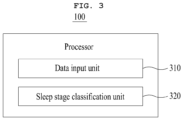
- FIG. 3 is a block diagram for explaining a configuration of a computer system according to an embodiment.
- FIG. 4 is a flowchart for explaining a method for classifying sleep stages according to an embodiment.
- a processor of the computer system 100 may include a data input unit 310 and a sleep stage classification unit 320.
- the components of the processor may be representations of different functions performed by the processor in response to a control instruction provided from a program code stored in the computer system.
- the processor and the components of the processor may control the computer system to perform the steps 410 and 420 included in the sleep stage classification method of FIG. 4 .
- the processor and the components of the processor may be implemented to execute an instruction in responses to a code of an operating system included in a memory and a code of at least one program.
- the processor may load, to the memory, a program code stored in a file of a program for the sleep stage classification method. For example, when the program is executed in the computer system, the processor may control the computer system to load the program code from the file of the program to the memory under control of the operating system.
- the data input unit 310 and the sleep stage classification unit 320 may be different functional representations of the processor to perform the steps 410 and 420 to be described below by executing an instruction of a part corresponding to the program code loaded to the memory.
- the data input unit 310 may receive polysomnography data to be inputted into a self-supervised learning-based sleep stage classification model.
- polysomnography data of different electrical signals may be inputted into the sleep stage classification model.
- EEG data and EOG data which is polysomnography data, may be inputted into the sleep stage classification model.
- the sleep stage classification unit 320 may classify sleep stages from polysomnography data by using a self-supervised learning-based sleep stage classification model.
- the sleep stage classification unit 320 may classify sleep stages including a first stage, a second stage, a third stage, and a fifth stage.
- the sleep stage classification unit 320 may classify sleep stages as a light sleep stage or a deep sleep stage.
- the computer system may receive biological signal data to be inputted into a self-supervised learning-based physical state classification model.
- the biological signal data may be result data from a medical checkup or data measured during the user's everyday life.
- the computer system may classify physical states from biological signal data by using a self-supervised learning-based physical state classification model.
- a physical state may refer to state information that is distinguished according to the mobility of the user's body.
- the computer system may classify the user's physical health status based on the user's medical checkup result data of the heart, the brain (stroke, cerebral hemorrhage), the lungs, the kidneys, etc.
- the computer system may classify the user's physical health status based on (joint) movement data measured during the user's everyday life. In this case, the computer system may classify physical states based on the possible range of motion according to the user's age.
- the system described above may be implemented in hardware components, software components, and/or a combination of the hardware components and software components.
- the system and components described in the embodiments may be implemented using one or more general purpose computers or special purpose computers, such as, for example, a processor, a controller, an arithmetic logic unit (ALU), a digital signal processor, a microcomputer, a field programmable gate array (FPGA), a programmable logic unit (PLU), a microprocessor, or any other device capable of executing and responding to instructions.
- a processing device may execute an operating system (OS) and one or more software applications running on the operating system. Further, the processing device may access, store, manipulate, process, and generate data in response to execution of the software.
- OS operating system
- the processing device may access, store, manipulate, process, and generate data in response to execution of the software.
- the processing device may include a plurality of processing elements and/or a plurality of types of processing elements.
- the processing device may include a plurality of processors, or a single processor and a single controller. Further, other processing configurations such as a parallel processor are possible.
- the software may include a computer program, a code, an instruction, or a combination of one or more thereof, configure the processing device to operate as desired, or independently or collectively command the processing device to operate as desired.
- the software and/or data may be permanently or temporarily embodied in any type of a machine, a component, a physical device, virtual equipment, a computer storage medium or device, or a signal wave which will be transmitted in order to be interpreted by the processing device or provide a command or data to the processing device.
- the software may be distributed over computer systems connected through a network and be stored or executed in a distributed manner.
- the software and data may be stored in one or more computer-readable recording media.
- the method according to the embodiment may be implemented in the form of a program instruction which is executable through various computer means and be recorded in a computer-readable medium.
- the computer-readable medium may include program instructions, data files, data structures, and the like alone or in a combination thereof.
- the program instructions recorded on the media may be those specially designed and configured for embodiments or may be known and available to those skilled in the art of computer software.
- Examples of the computer-readable recording medium include magnetic media such as a hard disk, a floppy disk, and a magnetic tape, optical media such as CDROM and DVD, magneto-optical media such as floptical disks, and hardware devices specially configured to store and perform program commands such as read-only memory (ROM), random-access memory (RAM), and flash memory.
- Examples of the program instructions may include not only machine codes created by a compiler, but also high-level language codes that may be executed by a computer using an interpreter and the like.
- the system described above may be implemented in hardware components, software components, and/or a combination of the hardware components and software components.
- the system and components described in the embodiments may be implemented using one or more general purpose computers or special purpose computers, such as, for example, a processor, a controller, an arithmetic logic unit (ALU), a digital signal processor, a microcomputer, a field programmable gate array (FPGA), a programmable logic unit (PLU), a microprocessor, or any other device capable of executing and responding to instructions.
- a processing device may execute an operating system (OS) and one or more software applications running on the operating system. Further, the processing device may access, store, manipulate, process, and generate data in response to execution of the software.
- OS operating system
- the processing device may access, store, manipulate, process, and generate data in response to execution of the software.
- the processing device may include a plurality of processing elements and/or a plurality of types of processing elements.
- the processing device may include a plurality of processors, or a single processor and a single controller. Further, other processing configurations such as a parallel processor are possible.
- the software may include a computer program, a code, an instruction, or a combination of one or more thereof, configure the processing device to operate as desired, or independently or collectively command the processing device to operate as desired.
- the software and/or data may be permanently or temporarily embodied in any type of a machine, a component, a physical device, virtual equipment, a computer storage medium or device, or a signal wave which will be transmitted in order to be interpreted by the processing device or provide a command or data to the processing device.
- the software may be distributed over computer systems connected through a network and be stored or executed in a distributed manner.
- the software and data may be stored in one or more computer-readable recording media.
- the method according to the embodiment may be implemented in the form of a program instruction which is executable through various computer means and be recorded in a computer-readable medium.
- the computer-readable medium may include program instructions, data files, data structures, and the like alone or in a combination thereof.
- the program instructions recorded on the media may be those specially designed and configured for embodiments or may be known and available to those skilled in the art of computer software.
- Examples of the computer-readable recording medium include magnetic media such as a hard disk, a floppy disk, and a magnetic tape, optical media such as CDROM and DVD, magneto-optical media such as floptical disks, and hardware devices specially configured to store and perform program commands such as read-only memory (ROM), random-access memory (RAM), and flash memory.
- Examples of the program instructions may include not only machine codes created by a compiler, but also high-level language codes that may be executed by a computer using an interpreter and the like.
Landscapes
- Health & Medical Sciences (AREA)
- Engineering & Computer Science (AREA)
- Life Sciences & Earth Sciences (AREA)
- Physics & Mathematics (AREA)
- Biomedical Technology (AREA)
- General Health & Medical Sciences (AREA)
- Biophysics (AREA)
- Molecular Biology (AREA)
- Medical Informatics (AREA)
- Public Health (AREA)
- Pathology (AREA)
- Theoretical Computer Science (AREA)
- Artificial Intelligence (AREA)
- Veterinary Medicine (AREA)
- Heart & Thoracic Surgery (AREA)
- Surgery (AREA)
- Animal Behavior & Ethology (AREA)
- Data Mining & Analysis (AREA)
- Mathematical Physics (AREA)
- Evolutionary Computation (AREA)
- General Physics & Mathematics (AREA)
- Software Systems (AREA)
- General Engineering & Computer Science (AREA)
- Computing Systems (AREA)
- Computational Linguistics (AREA)
- Psychiatry (AREA)
- Psychology (AREA)
- Ophthalmology & Optometry (AREA)
- Databases & Information Systems (AREA)
- Epidemiology (AREA)
- Primary Health Care (AREA)
- Fuzzy Systems (AREA)
- Computer Vision & Pattern Recognition (AREA)
- Physiology (AREA)
- Signal Processing (AREA)
- Information Retrieval, Db Structures And Fs Structures Therefor (AREA)
- Measurement And Recording Of Electrical Phenomena And Electrical Characteristics Of The Living Body (AREA)
Abstract
Disclosed are a method and system for training a self-supervised learning based-sleep stage classification model using a small number of labels. The sleep stage classification method performed by a computer system according to an embodiment may comprising the steps of: receiving polysomnography data to be inputted into a self-supervised learning based-sleep stage classification model; and classifying sleep stages from the polysomnography data by using the self-supervised learning based-sleep stage classification model, wherein the self-supervised learning based-sleep stage classification model is trained on patterns for sleep stage classification from new sleep data through transfer learning by fine-tuning weights on the basis of a representation learning model that is trained on representations from sleep signal data.
Description
- The following description relates to a sleep stage classification technique.
- Sleep occupies a huge part of a person's life and significantly affects the body. Since sleep disorders, sleep deprivation, etc. are highly likely to cause problems in our everyday life, such as poor concentration, research on sleep is being actively conducted. Sleep stage classification is an essential step in sleep studies, and the use of artificial intelligence has enabled effective and more accurate prediction. For deep learning-based sleep stage classification, increasing attention is now being paid to approaches employing a supervised learning model, and, more recently, models using self-supervised learning.
- However, sleep stage classification methods using a supervised learning model adopt rules by using given labels. These sleep stage classification methods using a supervised learning model have several limitations. There is a practical limit to performing training after producing labels for each dataset to improve the performance of the supervised learning model, and another problem is that the quality of rule learning also depends on the quality of labels. In addition, a sleep stage classification method using a supervised learning model may have performance only on datasets on which training is conducted, which makes the method unfit.
- It is possible to provide a method and system for classifying sleep stages with a small number of labels by extracting latent representations from signals to provide better representations of data through self-supervised learning.
- A sleep stage classification method performed by a computer system may comprise the steps of: receiving polysomnography data to be inputted into a self-supervised learning based-sleep stage classification model; and classifying sleep stages from the polysomnography data by using the self-supervised learning based-sleep stage classification model, wherein the self-supervised learning based-sleep stage classification model is trained on patterns for sleep stage classification from new sleep data through transfer learning by fine-tuning weights on the basis of a representation learning model that is trained on representations from sleep signal data.
- The self-supervised learning-based sleep stage classification model may be constructed of an unsupervised learning-based adversarial generative model in order to minimize impact on imbalanced class distribution which is inherent in the sleep signal data.
- The unsupervised learning-based adversarial generative neural network model may be trained in such a way as to maximize mutual information between a signal generated by a generator and a class code by receiving electroencephalography (EEG) data and electrooculography (EOG) data for a preset time frame extracted from the sleep signal data.
- The generator may generate per-class data by receiving a code that represents class identity and noise as an input.
- The self-supervised learning-based sleep stage classification model may generate a plurality of positive pairs for the sleep signal data by using an attention-based signal augmentation technique, and may perform pairwise representation learning in such a way as to make the plurality of generated positive pairs similar to each other.
- The self-supervised learning-based sleep stage classification model may obtain an attention score for the sleep signal data, and may obtain a plurality of positive pairs with different masks applied thereto by applying a random mask to the obtained attention score and randomly masking out results of an attention score matrix.
- The pairwise representation learning may be performed in such a manner as to minimize negative cosine similarity between the generated positive pairs.
- The pairwise representation learning may be performed in such a manner as to minimize negative cosine similarity by constructing positive pairs for entire sleep signal data, and in such a manner as to minimize average cosine similarity by constructing positive pairs for a preset signal frame of sleep signal data.
- A physical state classification method performed by a computer system may comprise the steps of: receiving biological signal data to be inputted into a self-supervised learning based-physical state classification model; and classifying physical states from the biological signal data by using the self-supervised learning based-physical state classification model, wherein the self-supervised learning based-sleep stage classification model is trained on patterns for physical state classification from new biological data through transfer learning by fine-tuning weights on the basis of a representation learning model that is trained on representations of biological data.
- A computer system for sleep stage classification may comprise: a data input unit that receives polysomnography data to be inputted into a self-supervised learning based-sleep stage classification model; and a sleep stage classification unit that classifies sleep stages from the polysomnography data by using the self-supervised learning based-sleep stage classification model, wherein the self-supervised learning based-sleep stage classification model is trained on patterns for sleep stage classification from new sleep data through transfer learning by fine-tuning weights on the basis of a representation learning model that is trained on representations from sleep signal data.
- The self-supervised learning-based sleep stage classification model may be constructed of an unsupervised learning-based adversarial generative model in order to minimize impact on imbalanced class distribution which is inherent in the sleep signal data, and the unsupervised learning-based adversarial generative neural network model may be trained in such a manner as to maximize mutual information between a signal generated by a generator and a class code by receiving EEG data and EOG data for a preset time frame extracted from the sleep signal data.
- The self-supervised learning-based sleep stage classification model may generate a plurality of positive pairs for the sleep signal data by using an attention-based signal augmentation technique, and may perform pairwise representation learning in such a way as to make the plurality of generated positive pairs similar to each other.
- The self-supervised learning-based sleep stage classification model may obtain an attention score for the sleep signal data, and may obtain a plurality of positive pairs with different masks applied thereto by applying a random mask to the obtained attention score and randomly masking out results of an attention score matrix.
- The pairwise representation learning may be performed in such a manner as to minimize negative cosine similarity between the generated positive pairs.
- The pairwise representation learning may be performed in such a manner as to minimize negative cosine similarity by constructing positive pairs for entire sleep signal data, and in such a manner as to minimize average cosine similarity by constructing positive pairs for a preset signal frame of sleep signal data.
- It is possible to accurately classify sleep stages even with a small number of labels by using a self-supervised learning-based sleep stage classification model.
-
-
FIG. 1 is a view for explaining a representation learning operation according to an embodiment. -
FIG. 2 is a view illustrating an example of data utilization in representation learning and transfer learning according to an embodiment. -
FIG. 3 is a block diagram for explaining a configuration of a computer system according to an embodiment. -
FIG. 4 is a flowchart for explaining a method for classifying sleep stages according to an embodiment. -
FIG. 5 is a view schematically illustrating a method for classifying physical states according to various embodiments of the present disclosure. - Hereinafter, an embodiment will be described in detail with reference to the accompanying drawings.
-
FIG. 1 is a view for explaining a representation learning operation according to an embodiment. - Sleep stage classification refers to classifying a given period of time as a specific stage according to a sleep staging manual on the basis of polysomnographic data. Polysomnography may involve various electrical signal-based polysomnography data recorded during sleep, including various kinds of electroencephalography (EEG) data, electrooculography (EOG) data, electrocardiography (ECG) data, and electromyography (EMG) data. A computer system may automatically classify sleep stages on the basis of polysomnography data. In this case, the computer system may be a sleep stage classification system which classifies sleep stages. The computer system may perform sleep stage prediction with a small number of labels by extracting latent representations from signals to provide better representations of data through a self-supervised learning technique.
- The computer system may use attention-based signal augmentation and a self-supervised learning model in order to learn effective representations from EEG data and EOG data which are polysomnography data, and may classify sleep stages with a small number of labels. The computer system may perform a representation learning step in which overall features of polysomnography data are learned using a representation learning model and a transfer learning step in which sleep stage classification is performed with a small number of labels.
- The representation learning model may be constructed of a self-supervised learning framework based on a generative model. The representation learning model may extract EEG data and EOG data for a preset time frame (e.g., every 30 seconds (1 epoch)) from polysomnography data for a whole period and use it as input data. In representation learning, an unsupervised learning-based, adversarial generative model is used as a basic framework in order to minimize impact on imbalanced class distribution which is inherent in polysomnography data.
- First, the generator may receive a code c that represents class identity and noise z as input data and generate per-class data. In this case, to learn the latent factors for class identification, the adversarial generative model is trained in such a manner as to maximize mutual information between a signal generated by the generator and the class code. In training the adversarial generative model, an objective function for maximizing the mutual information is given by:

where V(D,F,g) is the loss function of a general adversarial generative model, D,F,g are networks that constitute the adversarial generative model, D is the discriminator, F is the encoder, and g is the generator. - Next, self-supervised learning-based pairwise representation learning may be performed to learn representations of each class. Pairwise representation learning may be performed in such a way as to generate two positive pairs for original signal data (EEG data and EOG data) and make the positive pairs similar to each other. To generate two positive pairs for original sleep signal data, an attention-based signal augmentation technique may be used. First, when encoding an input signal, the attention score may be computed by the following method:

where the score denotes inner product computation. After then, a random mask may be applied to the attention score, so that results of an attention score matrix may be randomly masked out in the following way.
- Here, positive pairs {Z1, Z2} with different masks applied to them may be generated by putting the same sleep signal data (input instance Xk) to the encoder F(Øw(xk)) twice. An overall algorithm for pairwise representation learning is as follows.
-
Algorithm 1 SSLAPP's pairwise representation learning.Input: EEG and EOG concatenated signals {X1,x2, ...., xn} , total number of batch size N, convolution layers ØW, latent predictor K, projector Q, Random mask M. 1: for sampled mini batch 
2: for all k ∈ {1, ..., N} do 3: #first augmentation 4: s1 = score(øw(xk)) 5: z1 = øW(xK)·(s1⊙M) 6: #second augmentation 7: s2 = score(øw(xk)) 8: z2 = øw(xK)·(s2⊙ M) 9: end for 10: p 1 = K(z1 ) # latent prediction 11: p 2 = K(z2) # latent prediction 12: q 1 = Q(p 1) # latent prediction 13: q 2 = Q(p 2) # latent prediction 14: end for 15: define the negative similarity loss (5) with p1 , p2 , q1 , q2 . - As can be seen from
Algorithm 1, learning may be performed in such a manner as to generate two positive pairs by randomly applying a mask to the attention score matrix, and to minimize negative cosine similarity between the positive pairs. The loss function to minimize the negative cosine similarity is given by:
- After encoding, the two positive pairs are put into a latent prediction model to obtain p1, p2, and the obtained p1, p2 are put into a latent projection model Q to obtain q1, q2. sg denotes the 'stop-gradient' operator that keeps the model's learning parameters from being updated. As a result, when learning latent representations for making two positive pairs similar, the model's learning parameters are updated only for p1, while q2 is used only for obtaining cosine similarity.
- In addition, since different sleep stages are shown to have different salient waves within an epoch, learning may be performed by constructing positive pairs for the global loss function and the local loss function, respectively. For the global loss function, learning may be performed in such a way as to minimize negative cosine similarity by constructing positive pairs for an entire signal. The global loss function is given by:

- For the local loss function, learning may be performed in such a manner as to minimize average cosine similarity by segmenting a signal into preset time frames (e.g., 5 seconds) and constructing respective positive pairs. The local loss function is given by:
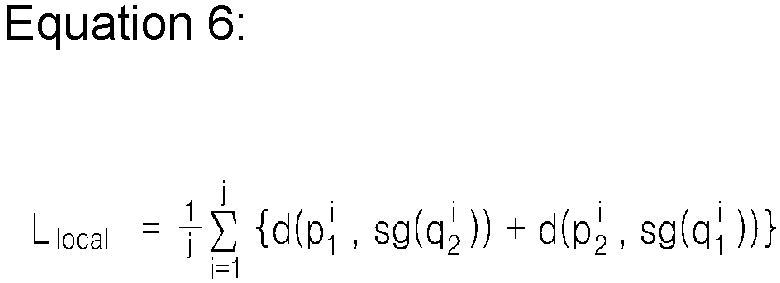
- An objective function for pairwise representation learning including both the local loss function and the global loss function is given by:

where λg and λl are parameters that control the importance of the global loss function and local loss function in the full objective function. Finally, the full objective function including the loss functions of the adversarial generative model and pairwise representation learning is given by:
- λoos is a parameter that controls the contribution of pairwise representation learning in the full objective function.
- After representation learning, transfer learning may be performed for sleep stage classification. Transfer learning may be conducted by attaching one fully connected layer to the end of a latent projection model Q. Sleep stage classification may be implemented by fine-tuning the weights of a model trained in representation learning and the weights of the one fully connected layer by using a limited number of labels.
- Although the embodiment has been described with respect to representation learning and transfer learning operations for sleep stage classification, the present disclosure is not limited by this and the same may apply to physical state classification as well as sleep stage classification.
-
FIG. 2 is a view illustrating an example of data utilization in representation learning and transfer learning according to an embodiment. - A computer system may perform representation learning and transfer learning on the basis of a self-supervised learning model. In the representation learning step, the computer system does not use labels and learns latent representations of data by non-contrastive learning. In the representation learning step, the most frequently used sleep data, Sleep EDF, may be used. In the transfer learning step, the computer system fine-tunes weights on the basis of a representation learning model trained in the representation learning step, and learn sleep stage classification patterns by using a small number of labels. In the transfer learning step, training is done with new data that has not been used in representation learning, whereby the knowledge may be transferred to and used on certain data.
- To evaluate the accuracy of sleep stage classification according to the embodiment, Sleep EDFx data and ISRUC data may be used. As for the Sleep EDFx data, 10 % or 20 % of the data that has not been used for sleep data feature learning and its labels may be used to classify sleep stages. As for the ISRUC data, the labels of 10 % or 20 % of ISRUC may be used on a model that is trained on 20 % of the Sleep EDFx data, thereby classifying sleep stages by fine-tuning weights. For performance comparison, average accuracy and F1-macro may be used.
- The tables below show the performance of a model for each data type. To compare the performance of sleep stage classification according to the embodiment with conventional methods, a comparison may be made between self-supervised learning-based models using a small number of labels and supervised learning models using all labels.
Table 1: Comparison of performance with self-supervised learning-based model Method Label Ratio SleepEDF ISRUC F1-Score Accuracy F1-Score Accuracy RP 10% 39.3 ± 2.3 62.4 ± 6.0 17.1 ± 5.7 21.7 ± 7.5 TS 10% 38.4 ± 1.9 62.5 ± 5.2 12.7 ± 2.1 21.2 ± 5.4 MoCo 10% 24.8 ± 4.1 40.9 ± 6.3 14.7 ± 3.9 27.1 ± 17.2 CPC 10% 46.9 ± 6.2 65.6 ± 5.4 38.6 ± 3.4 51.8 ± 4.7 DPC 10% 40.1 ± 10.6 59.8 ± 11.1 32.1 ± 3.2 43.9 ± 3.3 Triplet Loss 10% 37.9 ± 3.4 59.4 ± 4.5 39.8 ± 3.5 49.6 ± 3.1 SleepDPC 10% 64.0 ± 1.5 70.1 ± 0.8 48.9 ± 1.8 53.6 ± 1.5 CoSleep 10% 55.8 ± 3.0 71.6 ± 4.0 50.1 ± 5.6 57.9 ± 5.1 SSLAPP 10% 72.0 ± 0.4 77.2 ± 0.3 72.5 ± 0.3 74.4 ± 0.2 TS-TCC 20% 73.5 ± 0.7 83.0 ± 0.7 - - SSLAPP 20% 73.9 ± 0.6 78.9 ± 0.2 74.1 ± 0.3 76.1 ± 0.1 Table 2: Comparison of performance with supervised learning-based model Method SleepEDF ISRUC F1-Score Accuracy F1-Score Accuracy SVM 57.8 71.2 72.1 73.3 RF 62.4 72.7 70.8 72.9 DeepSleepNet 75.3 78.5 - - AttnSleep 75.1 81.3 - - SSLAPP (Full label) 78.0 82.0 77.0 79.9 - As can be seen from the experimental results, the method according to the embodiment exhibits outstanding performance with only a small number of labels compared to the conventional methods. Especially, on 10% labels setting, it was observed that the proposed method greatly outperforms other self-supervised learning-based models. It was also observed that the proposed method exhibits outstanding performance on ISRUC data which has not been used in representation learning, compared to the conventional self-supervised and supervised learning-based models. These results show that the proposed model preserves consistency in generalization performance compared to the conventional learning models, and that the proposed model performs relatively accurate sleep stage classification under a limited label setting.
-
FIG. 3 is a block diagram for explaining a configuration of a computer system according to an embodiment.FIG. 4 is a flowchart for explaining a method for classifying sleep stages according to an embodiment. - A processor of the
computer system 100 may include adata input unit 310 and a sleepstage classification unit 320. The components of the processor may be representations of different functions performed by the processor in response to a control instruction provided from a program code stored in the computer system. The processor and the components of the processor may control the computer system to perform thesteps FIG. 4 . Here, the processor and the components of the processor may be implemented to execute an instruction in responses to a code of an operating system included in a memory and a code of at least one program. - The processor may load, to the memory, a program code stored in a file of a program for the sleep stage classification method. For example, when the program is executed in the computer system, the processor may control the computer system to load the program code from the file of the program to the memory under control of the operating system. Here, the
data input unit 310 and the sleepstage classification unit 320 may be different functional representations of the processor to perform thesteps - In
step 410, thedata input unit 310 may receive polysomnography data to be inputted into a self-supervised learning-based sleep stage classification model. In this case, polysomnography data of different electrical signals may be inputted into the sleep stage classification model. For example, EEG data and EOG data, which is polysomnography data, may be inputted into the sleep stage classification model. - In
step 420, the sleepstage classification unit 320 may classify sleep stages from polysomnography data by using a self-supervised learning-based sleep stage classification model. For example, the sleepstage classification unit 320 may classify sleep stages including a first stage, a second stage, a third stage, and a fifth stage. Alternatively, the sleepstage classification unit 320 may classify sleep stages as a light sleep stage or a deep sleep stage. -
FIG. 5 is a flowchart for explaining a method for classifying physical states. - In
step 510, the computer system may receive biological signal data to be inputted into a self-supervised learning-based physical state classification model. In this case, the biological signal data may be result data from a medical checkup or data measured during the user's everyday life. - In
step 520, the computer system may classify physical states from biological signal data by using a self-supervised learning-based physical state classification model. For example, a physical state may refer to state information that is distinguished according to the mobility of the user's body. The computer system may classify the user's physical health status based on the user's medical checkup result data of the heart, the brain (stroke, cerebral hemorrhage), the lungs, the kidneys, etc. Alternatively, the computer system may classify the user's physical health status based on (joint) movement data measured during the user's everyday life. In this case, the computer system may classify physical states based on the possible range of motion according to the user's age. - The system described above may be implemented in hardware components, software components, and/or a combination of the hardware components and software components. For example, the system and components described in the embodiments may be implemented using one or more general purpose computers or special purpose computers, such as, for example, a processor, a controller, an arithmetic logic unit (ALU), a digital signal processor, a microcomputer, a field programmable gate array (FPGA), a programmable logic unit (PLU), a microprocessor, or any other device capable of executing and responding to instructions. A processing device may execute an operating system (OS) and one or more software applications running on the operating system. Further, the processing device may access, store, manipulate, process, and generate data in response to execution of the software. For ease of understanding, it has been described that a single processing device is used in some cases, but those skilled in the art will appreciate that the processing device may include a plurality of processing elements and/or a plurality of types of processing elements. For example, the processing device may include a plurality of processors, or a single processor and a single controller. Further, other processing configurations such as a parallel processor are possible.
- The software may include a computer program, a code, an instruction, or a combination of one or more thereof, configure the processing device to operate as desired, or independently or collectively command the processing device to operate as desired. The software and/or data may be permanently or temporarily embodied in any type of a machine, a component, a physical device, virtual equipment, a computer storage medium or device, or a signal wave which will be transmitted in order to be interpreted by the processing device or provide a command or data to the processing device. The software may be distributed over computer systems connected through a network and be stored or executed in a distributed manner. The software and data may be stored in one or more computer-readable recording media.
- The method according to the embodiment may be implemented in the form of a program instruction which is executable through various computer means and be recorded in a computer-readable medium. The computer-readable medium may include program instructions, data files, data structures, and the like alone or in a combination thereof. The program instructions recorded on the media may be those specially designed and configured for embodiments or may be known and available to those skilled in the art of computer software. Examples of the computer-readable recording medium include magnetic media such as a hard disk, a floppy disk, and a magnetic tape, optical media such as CDROM and DVD, magneto-optical media such as floptical disks, and hardware devices specially configured to store and perform program commands such as read-only memory (ROM), random-access memory (RAM), and flash memory. Examples of the program instructions may include not only machine codes created by a compiler, but also high-level language codes that may be executed by a computer using an interpreter and the like.
- Although the embodiments have been described above with reference to the limited embodiments and drawings, those skilled in the art may apply various technical modifications and variations on the basis of the above description. For example, appropriate results may be achieved even when the described technique is performed in a different order from the described method and/or the components of the described system, structure, device, circuit and the like may be combined in a different form or replaced or substituted by other components or equivalents.
- Therefore, other implementations, other embodiments, and those equivalents to the claims are within the scope of the claims to be described below.
- The system described above may be implemented in hardware components, software components, and/or a combination of the hardware components and software components. For example, the system and components described in the embodiments may be implemented using one or more general purpose computers or special purpose computers, such as, for example, a processor, a controller, an arithmetic logic unit (ALU), a digital signal processor, a microcomputer, a field programmable gate array (FPGA), a programmable logic unit (PLU), a microprocessor, or any other device capable of executing and responding to instructions. A processing device may execute an operating system (OS) and one or more software applications running on the operating system. Further, the processing device may access, store, manipulate, process, and generate data in response to execution of the software. For ease of understanding, it has been described that a single processing device is used in some cases, but those skilled in the art will appreciate that the processing device may include a plurality of processing elements and/or a plurality of types of processing elements. For example, the processing device may include a plurality of processors, or a single processor and a single controller. Further, other processing configurations such as a parallel processor are possible.
- The software may include a computer program, a code, an instruction, or a combination of one or more thereof, configure the processing device to operate as desired, or independently or collectively command the processing device to operate as desired. The software and/or data may be permanently or temporarily embodied in any type of a machine, a component, a physical device, virtual equipment, a computer storage medium or device, or a signal wave which will be transmitted in order to be interpreted by the processing device or provide a command or data to the processing device. The software may be distributed over computer systems connected through a network and be stored or executed in a distributed manner. The software and data may be stored in one or more computer-readable recording media.
- The method according to the embodiment may be implemented in the form of a program instruction which is executable through various computer means and be recorded in a computer-readable medium. The computer-readable medium may include program instructions, data files, data structures, and the like alone or in a combination thereof. The program instructions recorded on the media may be those specially designed and configured for embodiments or may be known and available to those skilled in the art of computer software. Examples of the computer-readable recording medium include magnetic media such as a hard disk, a floppy disk, and a magnetic tape, optical media such as CDROM and DVD, magneto-optical media such as floptical disks, and hardware devices specially configured to store and perform program commands such as read-only memory (ROM), random-access memory (RAM), and flash memory. Examples of the program instructions may include not only machine codes created by a compiler, but also high-level language codes that may be executed by a computer using an interpreter and the like.
- Although the embodiments have been described above with reference to the limited embodiments and drawings, those skilled in the art may apply various technical modifications and variations on the basis of the above description. For example, appropriate results may be achieved even when the described technique is performed in a different order from the described method and/or the components of the described system, structure, device, circuit and the like may be combined in a different form or replaced or substituted by other components or equivalents.
- Therefore, other implementations, other embodiments, and those equivalents to the claims are within the scope of the claims to be described below.
Claims (15)
- A sleep stage classification method performed by a computer system, comprising the steps of:receiving polysomnography data to be inputted into a self-supervised learning based-sleep stage classification model; andclassifying sleep stages from the polysomnography data by using the self-supervised learning based-sleep stage classification model,wherein the self-supervised learning based-sleep stage classification model is trained on patterns for sleep stage classification from new sleep data through transfer learning by fine-tuning weights on the basis of a representation learning model that is trained on representations from sleep signal data.
- The sleep stage classification method of claim 1, wherein the self-supervised learning-based sleep stage classification model is constructed of an unsupervised learning-based adversarial generative model in order to minimize impact on imbalanced class distribution which is inherent in the sleep signal data.
- The sleep stage classification method of claim 2, wherein the unsupervised learning-based adversarial generative neural network model is trained in such a way as to maximize mutual information between a signal generated by a generator and a class code by receiving electroencephalography (EEG) data and electrooculography (EOG) data for a preset time frame extracted from the sleep signal data.
- The sleep stage classification method of claim 3, wherein the generator generates per-class data by receiving a code that represents class identity and noise as an input.
- The sleep stage classification method of claim 1, wherein the self-supervised learning-based sleep stage classification model generates a plurality of positive pairs for the sleep signal data by using an attention-based signal augmentation technique, and performs pairwise representation learning in such a way as to make the plurality of generated positive pairs similar to each other.
- The sleep stage classification method of claim 5, wherein the self-supervised learning-based sleep stage classification model obtains an attention score for the sleep signal data, and obtains a plurality of positive pairs with different masks applied thereto by applying a random mask to the obtained attention score and randomly masking out results of an attention score matrix.
- The sleep stage classification method of claim 5, wherein the pairwise representation learning is performed in such a manner as to minimize negative cosine similarity between the generated positive pairs.
- The sleep stage classification method of claim 5, wherein the pairwise representation learning is performed in such a manner as to minimize negative cosine similarity by constructing positive pairs for entire sleep signal data, and in such a manner as to minimize average cosine similarity by constructing positive pairs for a preset signal frame of sleep signal data.
- A physical state classification method performed by a computer system, comprising the steps of:receiving biological signal data to be inputted into a self-supervised learning based-physical state classification model; andclassifying physical states from the biological signal data by using the self-supervised learning based-physical state classification model,wherein the self-supervised learning based-sleep stage classification model is trained on patterns for physical state classification from new biological data through transfer learning by fine-tuning weights on the basis of a representation learning model that is trained on representations of biological data.
- A computer system for sleep stage classification, comprising:a data input unit that receives polysomnography data to be inputted into a self-supervised learning based-sleep stage classification model; anda sleep stage classification unit that classifies sleep stages from the polysomnography data by using the self-supervised learning based-sleep stage classification model,wherein the self-supervised learning based-sleep stage classification model is trained on patterns for sleep stage classification from new sleep data through transfer learning by fine-tuning weights on the basis of a representation learning model that is trained on representations from sleep signal data.
- The computer system of claim 10, wherein the self-supervised learning-based sleep stage classification model is constructed of an unsupervised learning-based adversarial generative model in order to minimize impact on imbalanced class distribution which is inherent in the sleep signal data, and the unsupervised learning-based adversarial generative neural network model is trained in such a way as to maximize mutual information between a signal generated by a generator and a class code by receiving EEG data and EOG data for a preset time frame extracted from the sleep signal data.
- The computer system of claim 11, wherein the self-supervised learning-based sleep stage classification model generates a plurality of positive pairs for the sleep signal data by using an attention-based signal augmentation technique, and performs pairwise representation learning in such a way as to make the plurality of generated positive pairs similar to each other.
- The computer system of claim 12, wherein the self-supervised learning-based sleep stage classification model obtains an attention score for the sleep signal data, and obtains a plurality of positive pairs with different masks applied thereto by applying a random mask to the obtained attention score and randomly masking out results of an attention score matrix.
- The computer system of claim 12, wherein the pairwise representation learning is performed in such a manner as to minimize the negative cosine similarity between the generated positive pairs.
- The computer system of claim 12, wherein the pairwise representation learning is performed in such a manner as to minimize negative cosine similarity by constructing positive pairs for entire sleep signal data, and in such a manner as to minimize average cosine similarity by constructing positive pairs for a preset signal frame of sleep signal data.
Applications Claiming Priority (2)
| Application Number | Priority Date | Filing Date | Title |
|---|---|---|---|
| KR1020220089734A KR102753499B1 (en) | 2022-07-20 | 2022-07-20 | Method and system for training sleep stage classification model based on self-supervised learning with limited labeled data |
| PCT/KR2023/010288 WO2024019480A1 (en) | 2022-07-20 | 2023-07-18 | Method and system for training self-supervised learning based-sleep stage classification model using small number of labels |
Publications (1)
| Publication Number | Publication Date |
|---|---|
| EP4559381A1 true EP4559381A1 (en) | 2025-05-28 |
Family
ID=89618218
Family Applications (1)
| Application Number | Title | Priority Date | Filing Date |
|---|---|---|---|
| EP23843326.2A Pending EP4559381A1 (en) | 2022-07-20 | 2023-07-18 | Method and system for training self-supervised learning based-sleep stage classification model using small number of labels |
Country Status (5)
| Country | Link |
|---|---|
| US (1) | US20260000348A1 (en) |
| EP (1) | EP4559381A1 (en) |
| JP (1) | JP7837596B2 (en) |
| KR (1) | KR102753499B1 (en) |
| WO (1) | WO2024019480A1 (en) |
Families Citing this family (2)
| Publication number | Priority date | Publication date | Assignee | Title |
|---|---|---|---|---|
| KR20250143032A (en) * | 2024-03-22 | 2025-09-30 | 서울대학교병원 | Apparatus and method for predicting sleep stage |
| CN119760494B (en) * | 2024-11-18 | 2025-11-11 | 华南理工大学 | Electroencephalogram sleep staging method, equipment and medium based on space-time relation learning |
Family Cites Families (11)
| Publication number | Priority date | Publication date | Assignee | Title |
|---|---|---|---|---|
| JP7393748B2 (en) * | 2017-12-01 | 2023-12-07 | オリジン ワイヤレス, インコーポレイテッド | Apparatus, system and method for fall detection based on radio signals |
| KR102267105B1 (en) * | 2018-12-26 | 2021-06-22 | (주)허니냅스 | Apparatus and method for inspecting sleep disorder based on deep-learning |
| KR102258726B1 (en) * | 2019-08-12 | 2021-06-01 | (주)허니냅스 | Apparatus of data processing for automatic determination of sleeping condition using deep running and method of the same |
| KR20210030063A (en) * | 2019-09-09 | 2021-03-17 | 서강대학교산학협력단 | System and method for constructing a generative adversarial network model for image classification based on semi-supervised learning |
| US11481607B2 (en) * | 2020-07-01 | 2022-10-25 | International Business Machines Corporation | Forecasting multivariate time series data |
| US11622117B2 (en) * | 2020-07-21 | 2023-04-04 | Tencent America LLC | Method and apparatus for rate-adaptive neural image compression with adversarial generators |
| WO2022020968A1 (en) * | 2020-07-30 | 2022-02-03 | Interaxon Inc. | Learning representations of eeg signals with self-supervised learning |
| KR20230137869A (en) * | 2020-09-25 | 2023-10-05 | 리누스 헬스 인코포레이티드 | Systems and methods for machine learning assisted cognitive assessment and treatment |
| EP3985558B1 (en) * | 2020-10-14 | 2024-11-06 | MicroVision, Inc. | Method and device for classifying sensor data |
| CN114528896A (en) * | 2020-11-23 | 2022-05-24 | 京东城市(北京)数字科技有限公司 | Model training method, data enhancement method, device, electronic equipment and storage medium |
| KR102707406B1 (en) * | 2020-12-10 | 2024-09-20 | 주식회사 에이슬립 | Method and computer device for providing analytical information related to sleep |
-
2022
- 2022-07-20 KR KR1020220089734A patent/KR102753499B1/en active Active
-
2023
- 2023-07-18 WO PCT/KR2023/010288 patent/WO2024019480A1/en not_active Ceased
- 2023-07-18 US US18/865,418 patent/US20260000348A1/en active Pending
- 2023-07-18 EP EP23843326.2A patent/EP4559381A1/en active Pending
- 2023-07-18 JP JP2024566195A patent/JP7837596B2/en active Active
Also Published As
| Publication number | Publication date |
|---|---|
| KR20240012168A (en) | 2024-01-29 |
| US20260000348A1 (en) | 2026-01-01 |
| JP7837596B2 (en) | 2026-03-31 |
| JP2025517151A (en) | 2025-06-03 |
| WO2024019480A1 (en) | 2024-01-25 |
| KR102753499B1 (en) | 2025-01-10 |
Similar Documents
| Publication | Publication Date | Title |
|---|---|---|
| Ju et al. | Tensor-cspnet: A novel geometric deep learning framework for motor imagery classification | |
| CN116071292B (en) | A method for identifying blood vessels in fundusscopic retinal images based on generative contrast learning | |
| Amin et al. | Physiological characterization of electrodermal activity enables scalable near real-time autonomic nervous system activation inference | |
| Goceri | Diagnosis of Alzheimer's disease with Sobolev gradient‐based optimization and 3D convolutional neural network | |
| Wang et al. | A unified framework for automatic wound segmentation and analysis with deep convolutional neural networks | |
| Zeng et al. | A new approach for the detection of abnormal heart sound signals using TQWT, VMD and neural networks | |
| Arribas et al. | Automatic Bayesian classification of healthy controls, bipolar disorder, and schizophrenia using intrinsic connectivity maps from FMRI data | |
| US20260000348A1 (en) | Method and system for training self-supervised learning based-sleep stage classification model using small number of labels | |
| Wang et al. | Identification of depression with a semi-supervised GCN based on EEG data | |
| Li et al. | Semi-supervised EEG emotion recognition model based on enhanced graph fusion and GCN | |
| Latha et al. | Performance analysis of machine learning and deep learning architectures on early stroke detection using carotid artery ultrasound images | |
| Zhang et al. | A deep learning scheme for mental workload classification based on restricted Boltzmann machines | |
| CN115985513B (en) | Data processing method, device and equipment based on multiple groups of chemical cancer typing | |
| Najdi et al. | Feature transformation based on stacked sparse autoencoders for sleep stage classification | |
| Afrakhteh et al. | Applying an efficient evolutionary algorithm for EEG signal feature selection and classification in decision-based systems | |
| WO2024173597A2 (en) | Atrial flutter classification system | |
| Tariq et al. | Diabetic retinopathy detection using transfer and reinforcement learning with effective image preprocessing and data augmentation techniques | |
| Tahmassebi et al. | An interpretable deep learning framework for health monitoring systems: a case study of eye state detection using eeg signals | |
| Song et al. | Feature extraction processing method of medical image fusion based on neural network algorithm | |
| Molachan et al. | Brain Tumor Detection that uses CNN in MRI | |
| EP4339965A1 (en) | Method and system for eeg motor imagery classification | |
| Brüsch et al. | Multi-view self-supervised learning for multivariate variable-channel time series | |
| Craley et al. | A novel method for epileptic seizure detection using coupled hidden markov models | |
| Mavaddati | Classification of ECG arrhythmia using wavelet packet transform analysis and sparse learning method | |
| Roy et al. | Identification and classification of human mental stress using physiological data: A low-power hybrid approach |
Legal Events
| Date | Code | Title | Description |
|---|---|---|---|
| STAA | Information on the status of an ep patent application or granted ep patent |
Free format text: STATUS: THE INTERNATIONAL PUBLICATION HAS BEEN MADE |
|
| PUAI | Public reference made under article 153(3) epc to a published international application that has entered the european phase |
Free format text: ORIGINAL CODE: 0009012 |
|
| STAA | Information on the status of an ep patent application or granted ep patent |
Free format text: STATUS: REQUEST FOR EXAMINATION WAS MADE |
|
| 17P | Request for examination filed |
Effective date: 20241114 |
|
| AK | Designated contracting states |
Kind code of ref document: A1 Designated state(s): AL AT BE BG CH CY CZ DE DK EE ES FI FR GB GR HR HU IE IS IT LI LT LU LV MC ME MK MT NL NO PL PT RO RS SE SI SK SM TR |
|
| DAV | Request for validation of the european patent (deleted) | ||
| DAX | Request for extension of the european patent (deleted) |