EP4557804A1 - Control method for networking using reconfigurable intelligent surfaces, and controller and storage medium - Google Patents
Control method for networking using reconfigurable intelligent surfaces, and controller and storage medium Download PDFInfo
- Publication number
- EP4557804A1 EP4557804A1 EP23844802.1A EP23844802A EP4557804A1 EP 4557804 A1 EP4557804 A1 EP 4557804A1 EP 23844802 A EP23844802 A EP 23844802A EP 4557804 A1 EP4557804 A1 EP 4557804A1
- Authority
- EP
- European Patent Office
- Prior art keywords
- ris
- base station
- configuration information
- location information
- networking
- Prior art date
- Legal status (The legal status is an assumption and is not a legal conclusion. Google has not performed a legal analysis and makes no representation as to the accuracy of the status listed.)
- Pending
Links
Images



Classifications
-
- H—ELECTRICITY
- H04—ELECTRIC COMMUNICATION TECHNIQUE
- H04B—TRANSMISSION
- H04B7/00—Radio transmission systems, i.e. using radiation field
- H04B7/02—Diversity systems; Multi-antenna system, i.e. transmission or reception using multiple antennas
- H04B7/04—Diversity systems; Multi-antenna system, i.e. transmission or reception using multiple antennas using two or more spaced independent antennas
- H04B7/04013—Intelligent reflective surfaces
- H04B7/04026—Intelligent reflective surfaces with codebook-based beamforming
-
- H—ELECTRICITY
- H04—ELECTRIC COMMUNICATION TECHNIQUE
- H04B—TRANSMISSION
- H04B7/00—Radio transmission systems, i.e. using radiation field
- H04B7/02—Diversity systems; Multi-antenna system, i.e. transmission or reception using multiple antennas
- H04B7/04—Diversity systems; Multi-antenna system, i.e. transmission or reception using multiple antennas using two or more spaced independent antennas
- H04B7/04013—Intelligent reflective surfaces
-
- H—ELECTRICITY
- H04—ELECTRIC COMMUNICATION TECHNIQUE
- H04B—TRANSMISSION
- H04B7/00—Radio transmission systems, i.e. using radiation field
- H04B7/02—Diversity systems; Multi-antenna system, i.e. transmission or reception using multiple antennas
- H04B7/04—Diversity systems; Multi-antenna system, i.e. transmission or reception using multiple antennas using two or more spaced independent antennas
- H04B7/0413—MIMO systems
- H04B7/0456—Selection of precoding matrices or codebooks, e.g. using matrices antenna weighting
-
- H—ELECTRICITY
- H04—ELECTRIC COMMUNICATION TECHNIQUE
- H04B—TRANSMISSION
- H04B7/00—Radio transmission systems, i.e. using radiation field
- H04B7/02—Diversity systems; Multi-antenna system, i.e. transmission or reception using multiple antennas
- H04B7/04—Diversity systems; Multi-antenna system, i.e. transmission or reception using multiple antennas using two or more spaced independent antennas
- H04B7/0413—MIMO systems
- H04B7/0456—Selection of precoding matrices or codebooks, e.g. using matrices antenna weighting
- H04B7/0478—Special codebook structures directed to feedback optimisation
-
- H—ELECTRICITY
- H04—ELECTRIC COMMUNICATION TECHNIQUE
- H04B—TRANSMISSION
- H04B7/00—Radio transmission systems, i.e. using radiation field
- H04B7/14—Relay systems
- H04B7/15—Active relay systems
- H04B7/155—Ground-based stations
- H04B7/15528—Control of operation parameters of a relay station to exploit the physical medium
-
- H—ELECTRICITY
- H04—ELECTRIC COMMUNICATION TECHNIQUE
- H04W—WIRELESS COMMUNICATION NETWORKS
- H04W24/00—Supervisory, monitoring or testing arrangements
- H04W24/02—Arrangements for optimising operational condition
-
- H—ELECTRICITY
- H04—ELECTRIC COMMUNICATION TECHNIQUE
- H04W—WIRELESS COMMUNICATION NETWORKS
- H04W4/00—Services specially adapted for wireless communication networks; Facilities therefor
- H04W4/02—Services making use of location information
-
- H—ELECTRICITY
- H04—ELECTRIC COMMUNICATION TECHNIQUE
- H04W—WIRELESS COMMUNICATION NETWORKS
- H04W4/00—Services specially adapted for wireless communication networks; Facilities therefor
- H04W4/02—Services making use of location information
- H04W4/029—Location-based management or tracking services
-
- H—ELECTRICITY
- H04—ELECTRIC COMMUNICATION TECHNIQUE
- H04W—WIRELESS COMMUNICATION NETWORKS
- H04W4/00—Services specially adapted for wireless communication networks; Facilities therefor
- H04W4/06—Selective distribution of broadcast services, e.g. multimedia broadcast multicast service [MBMS]; Services to user groups; One-way selective calling services
-
- H—ELECTRICITY
- H04—ELECTRIC COMMUNICATION TECHNIQUE
- H04W—WIRELESS COMMUNICATION NETWORKS
- H04W64/00—Locating users or terminals or network equipment for network management purposes, e.g. mobility management
Definitions
- the present disclosure relates to the technical field of communication, and more particularly, to a method for controlling Reconfigurable Intelligent Surface (RIS) networking, a controller, and a storage medium.
- RIS Reconfigurable Intelligent Surface
- a Reconfigurable Intelligent Surface can perform configuration according to codebook information sent by a base station, to change the phase, polarization, and other attributes of an incident signal to fill a coverage hole, improve indoor coverage, enhance edge coverage, etc.
- the base station needs to calculate codebooks of multiple RISs, and configure the codebooks to the RISs through codebook control signaling.
- the base station is required to have a high computing power, the overheads of the codebook control signaling between the base station and the RISs are high, and the timeliness of codebook control is often inadequate.
- Embodiments of the present disclosure provide a method for controlling RIS networking, a controller, and a storage medium.
- an embodiment provides a method for controlling RIS networking, applied to a base station in an RIS network, where the RIS network includes a plurality of RISs, the method including: determining a first RIS and a second RIS from a plurality of RISs; and sending first configuration information corresponding to the first RIS to the first RIS and the second RIS, for the first RIS and the second RIS to perform codebook configuration processing.
- an embodiment provides a method for controlling RIS networking, applied to a first RIS in an RIS network, where the RIS network includes a base station, the method including: receiving first configuration information sent by the base station, where the first configuration information is configuration information corresponding to the first RIS; and performing codebook configuration processing according to the first configuration information.
- an embodiment provides a method for controlling RIS networking, applied to a second RIS in an RIS network, where the RIS network includes a base station, the method including: receiving first configuration information sent by the base station, where the first configuration information is configuration information corresponding to a first RIS; and performing codebook configuration processing according to the first configuration information.
- an embodiment provides a controller, including a memory, a processor, and a computer program stored in the memory and executable by the processor, where the computer program, when executed by the processor, causes the processor to implement the method for controlling RIS networking in accordance with any embodiment of the first aspect, the second aspect, and the third aspect.
- an embodiment provides a computer-readable storage medium, storing a computer-executable instruction which, when executed by a processor, causes the processor to implement the method for controlling RIS networking in accordance with any embodiment of the first aspect, the second aspect, and the third aspect.
- modules have been divided in the schematic diagrams of apparatuses and logical orders have been shown in the flowcharts, in some cases, the modules may be divided in a different manner, or the steps shown or described may be executed in an order different from the orders as shown in the flowcharts.
- the terms such as “first”, “second” and the like in the description, the claims, and the accompanying drawings are used to distinguish similar objects, and are not necessarily used to describe a specific sequence or a precedence order.
- an RIS can change the phase, polarization, and other attributes of an incident signal to implement single-beam reflection, multi-beam reflection, diffuse scattering, refraction, transmission, and other flexible effects, so as to fill a coverage hole, improve indoor coverage, enhance edge coverage, etc.
- RISs are mainly divided into two forms: a static passive RIS (with a fixed codebook which is non-reconfigurable) and a dynamic/semi-static active RIS.
- the static passive RIS has a preset fixed unit array codebook, which can achieve only a fixed reflection mode and direction, and cannot be adjusted.
- the dynamic/semi-static active RIS has a reconfigurable unit array codebook, which can be controlled to achieve flexible beam reflection patterns and directions.
- FIG. 1 is a schematic diagram of a conventional RIS network.
- a base station gNB (the next Generation Node B) is a 5G base station.
- the base station gNB After using an existing measurement technology to calculate a codebook W 0 corresponding to RIS 0 , the base station gNB needs to send the codebook W 0 to the RIS 0 through codebook control signaling, for the RIS 0 to implement codebook configuration.
- the base station gNB also needs to use the existing measurement technology to calculate codebooks W 1 , ..., W n of RIS 1 , ..., RIS n .
- the base station needs to calculate the codebooks corresponding to all RISs, and deliver the codebooks through codebook control signaling, to respectively configure W 0 , ..., W n to RIS 0 , ..., RIS n .
- Conventional RIS networking requires the base station to perform a large amount of calculation, and involves high overheads of codebook control signaling between the gNB and the RISs.
- the present disclosure discloses a method for controlling RIS networking, a controller, and a storage medium.
- the method for controlling RIS networking includes: determining a first RIS and a second RIS from a plurality of RISs; acquiring location information of the first RIS; generating first configuration information according to the location information of the first RIS; and sending the first configuration information to the first RIS and the second RIS, for the first RIS to perform codebook configuration processing according to the first configuration information, and for the second RIS to obtain second configuration information according to the first configuration information and first relative location information, and perform codebook configuration processing according to the second configuration information, where a configuration parameter is generated according to the first RIS and sent in a multicast mode.
- each of the second RIS calculates its own codebook and configures and applies the codebook. As such, the calculation amount of the base station is reduced, and the overheads of codebook control signaling between the base station and the RISs are reduced.
- FIG. 2 is a schematic flowchart of a method for controlling RIS networking according to an embodiment of the present disclosure.
- the method for controlling RIS networking is applied to a base station in an RIS network.
- the RIS network includes a plurality of RISs.
- the method for controlling RIS networking includes, but not limited to, the following steps.
- a first RIS and a second RIS are determined from a plurality of RISs.
- the second RIS is RIS capable of receiving a communication signal from the base station
- the first RIS is an RIS capable of transmitting a communication signal to the base station among the second RISs.
- the RISs are dynamic/semi-static active RISs having a reconfigurable unit array codebook, which can be controlled to achieve flexible beam reflection patterns and directions.
- the first RIS is a primary RIS
- the second RIS is a secondary RIS.
- one multicast base station corresponds to a plurality of RISs
- RISs capable of receiving a configuration parameter from a multicast base station gNB 0 are formed into a virtual multicast group
- an RIS capable of two-way communication with the multicast base station gNB 0 is selected from the multicast group and defined as a primary RIS RIS 0
- the other RISs in the multicast group are defined as secondary RISs, RIS 1 to RIS n .
- the primary RIS and the secondary RISs are determined from the plurality of RISs, and in subsequent steps, the base station calculates codebook information of only the primary RIS, and sends the codebook information in multicast mode. As such, the calculation amount of the base station is reduced, and the overheads of codebook control signaling between the base station and the RISs are reduced.
- sending the first configuration information to the first RIS and the second RIS includes: sending the first configuration information to the first RIS and the second RIS by using a multicast capability of the base station, where the plurality of RISs include one first RIS and a plurality of second RISs, and the first configuration information is codebook configuration information corresponding to the first RIS.
- the second RIS after the first configuration information is sent to the second RIS, the second RIS obtains second configuration information according to the first configuration information and first relative location information, and perform codebook configuration processing according to the second configuration information.
- the multicast base station does not need to calculate configuration information of the second RISs, and the second RISs can adjust the first configuration information according to the relative location relationship to obtain its own configuration information. Therefore, the timeliness of codebook calculation in the system is improved, the range of system application scenarios is widened, and system capacity is improved, such that the system can be used in high-speed trains, dense buildings, and other scenarios where the environment changes rapidly.
- FIG. 3 is a schematic flowchart of a method for controlling RIS networking according to an embodiment of the present disclosure.
- the method for controlling RIS networking is applied to a base station in an RIS network.
- the RIS network includes a plurality of RISs.
- the method for controlling RIS networking includes, but not limited to, the following steps.
- a step of S310 location information of the first RIS is acquired.
- acquiring location information of the first RIS includes: receiving, by the multicast base station gNB 0 , location information sent by the first RIS, where the location information is absolute location information of the first RIS, and the absolute location information is reported by the first RIS RIS 0 to the multicast base station gNB 0 ; and calculating, by the gNB 0 , an incident angle a i0 ,b i0 ,c i0 of the RIS 0 relative to a communication source base station gNB y by using a commonly used three-dimensional calculation method according to absolute location information of the gNB y and the absolute location information of the RIS 0 .
- the multicast base station gNB 0 is the communication source base station gNB y , and after the multicast base station gNB 0 receives the location information sent by the first RIS, the multicast base station gNB 0 calculates the incident angle a i0 ,b i0 ,c i0 of the RIS 0 relative to the gNB y by using a commonly used three-dimensional calculation method according to absolute location information of the gNB 0 and the absolute location information of the RIS 0 .
- the first configuration information is generated according to the location information of the first RIS.
- generating first configuration information according to the location information of the first RIS includes: generating a first incident angle according to the location information of the first RIS.
- the multicast base station calculates only an incident angle corresponding to the first RIS according to the location information of the first RIS.
- the first RIS determines an exit angle according to a current working scenario of the RIS (e.g., transmission or reflection over a large range or in a specific direction, etc.) or other general methods, then calculates a codebook according to the incident angle and the exit angle or by using an existing commonly used method, and configures and applies the codebook. As such, the overheads of codebook control signaling between the base station and the RISs are reduced.
- generating first configuration information according to the location information of the first RIS includes: generating a first codebook according to the location information of the first RIS.
- the multicast base station calculates only an incident angle corresponding to the first RIS according to the location information of the first RIS, determines an exit angle according to a current working scenario of the RIS (e.g., transmission or reflection over a large range or in a specific direction, etc.) or other general methods, then calculates a codebook according to the incident angle and the exit angle or by using an existing commonly used method, and sends the codebook to the first RIS, for the first RIS to configure and apply the codebook. As such, computing resources of the base station are saved.
- the first configuration information is sent to the first RIS and the second RIS, for the first RIS to perform codebook configuration processing according to the first configuration information, and for the second RIS to obtain second configuration information according to the first configuration information and first relative location information, and perform codebook configuration processing according to the second configuration information, where the first relative location information represents a relationship between relative locations of the first RIS and the second RIS.
- the first RIS after the first configuration information is sent to the first RIS, the first RIS performs codebook configuration processing according to the received first configuration information.
- the first configuration information includes, but not limited to, any combination of a codebook W 0 , absolute location information of the communication source base station gNB y , an incident angle a i0 ,b i0 ,c i0 , an exit angle a o0 ,b o0 ,c o0 , and a working scenario of the RIS 0 .
- the multicast base station gNB 0 may deliver the configuration information by broadcasting signaling to RIS 0 to RIS n in multicast mode or through third-party communication, for the first RIS RIS 0 to configure and apply the codebook W 0 .
- the first relative location information represents a relationship between relative locations of the first RIS and the second RIS.
- the second RISs RIS 0 to RIS n obtain location information D x ,D y ,D z relative to the first RIS RIS 0 by, for example, but not limited to, the following methods that: relative location information of RIS 0 to RIS n is preset, obtained through positioning, obtained through mutual communication, or configured and delivered by a third party; or absolute location information of RIS 0 to RIS n is preset, obtained through positioning, obtained through mutual communication, or configured and delivered by a third party, and RIS 0 to RIS n calculate location information relative to RIS 0 according to the absolute location information.
- the method for controlling RIS networking further includes: obtaining, by gNB 0 to gNB m , location information L x ,L y ,L z relative to gNB 0 by, for example, but not limited to, the following methods that: relative location information of gNB 0 to gNB m is preset, obtained through positioning, obtained through mutual communication, or configured and delivered by a third party; or absolute location information of gNB 0 to gNB m is preset, obtained through positioning, obtained through mutual communication, or configured and delivered by a third party, and gNB 0 to gNB m calculate location information relative to gNB 0 according to the absolute location information.
- the RIS network includes a plurality of base stations.
- the plurality of base stations and the RISs are grouped according to communication capabilities, i.e., a plurality of multicast base stations correspond to a plurality of RIS groups.
- the RIS group includes a first RIS and a plurality of second RISs.
- gNB x is a gNB for angle calculation, and may be any one of gNB 0 to gNB m
- gNB y is a gNB for allocating target change channel characteristics to RIS 0 to RIS n .
- a three-dimensional relative location relationship between RIS 0 and RIS 1 is defined as D x0 ,D y0 ,D z0 , ..., and a three-dimensional relative location relationship between RIS n-1 and RIS n is defined as D xn-1 ,D yn-1 ,D zn-1 .
- D x ,D y ,D z is a general term for the location relationship between two RISs.
- a three-dimensional relative location relationship between gNB 0 and gNB 1 is defined as L x0 ,L y0 ,L z0 , ..., and a three-dimensional relative location relationship between gNB m-1 and gNB m is defined as L xm-1 ,L ym-1 .
- L x ,L y ,L z is a general term for the location relationship between two gNBs.
- the location information includes, but not limited, to global navigation satellite system (GNSS) information and location coordinate information.
- GNSS global navigation satellite system
- a timer is set, and steps S310 to S330 is repeatedly executed according to a preset time period, i.e., a target configuration is updated according to the preset time period, and the relative position relationships in the base stations and the RISs are also updated according to the preset time period.
- the method of the present disclosure is applied to 5G base stations and RIS devices, and is suitable for networking scenarios with a large number of RIS devices. Because RISs are cost-effective, the networking costs can be reduced.
- the base station controls the plurality of RISs.
- a configuration parameter is generated according to the first RIS and sent in a multicast mode.
- the second RIS calculates its own codebook and configures and applies the codebook.
- the calculation amount of the base station is reduced, the problems of high calculation amount, high signaling overheads, and unsatisfactory codebook control timeliness are overcome, and the overheads of codebook control signaling between the base station and the RISs are reduced. Therefore, the timeliness of codebook control is improved, the range of system application scenarios is widened, and system capacity is improved.
- FIG. 4 is a flowchart of generating the first configuration information according to the location information of the first RIS according to an embodiment of the present disclosure.
- the first configuration information includes a first incident angle.
- the method for controlling RIS networking includes, but not limited to, the following step.
- the first incident angle is obtained according to the location information of the first RIS and location information of the base station.
- the base station includes a multicast base station and a communication source base station
- the first configuration information includes a first incident angle
- generating the first configuration information according to the location information of the first RIS includes: obtaining, by the multicast base station, the first incident angle according to the location information of the first RIS and location information of the communication source base station.
- the location information of the first RIS includes absolute location information of the first RIS.
- the communication source base station is a communication source corresponding to a channel formed after the first RIS is configured according to a codebook.
- the multicast base station can acquire the location information of the communication source base station according to the relative location information and its own absolute location information, and then obtain the first incident angle.
- the communication source base station may serve as the multicast base station which sends the configuration information.
- the multicast base station is not an intermediate node base station, the multicast base station can obtain the first incident angle according to the location information of the first RIS and its own absolute location information. As such, the flexibility of RIS networking is improved. Whether the communication source base station serves as the multicast base station which sends the configuration information is not limited in the embodiment.
- the base station includes a multicast base station and a communication source base station
- the first configuration information includes a first incident angle
- generating the first configuration information according to the location information of the first RIS includes: sending, by the multicast base station, the first location information to a computing base station; and receiving, by the multicast base station, the first incident angle sent by the computing base station, and the first incident angle is an incident angle calculated by the computing base station according to the location information of the first RIS.
- the multicast base station which sends the configuration information is not the computing base station that performs codebook calculation processing, but serves as an intermediate node to send the first location information to the computing base station.
- the computing base station After receiving the first location information, the computing base station calculates the first incident angle, and then sends the first incident angle to the multicast base station, for the multicast base station to perform the subsequent operation of delivering the configuration information.
- the computing base station may serve as the multicast base station which sends the configuration information.
- the multicast base station is not an intermediate node base station, the multicast base station can obtain the first incident angle according to the location information of the first RIS and its own absolute location information. As such, the flexibility of RIS networking is improved. Whether the computing base station serves as the multicast base station which sends the configuration information is not limited in the embodiment.
- RIS 0 reports the absolute location information to gNB 0
- gNB 0 transmits the absolute location information of RIS 0 to gNB x for angle calculation
- gNB x calculates the incident angle a i0 ,b i0 ,c i0 of the RIS 0 relative to the target base station gNB y by using a commonly used three-dimensional calculation method according to absolute location information of the gNB y and the absolute location information of the RIS 0
- RIS 0 reports the absolute location information to gNB 0
- gNB 0 transmits the absolute location information of RIS 0 to gNB x for angle calculation
- gNB x calculates the incident angle a i0 ,b i0 ,c i0 of the RIS 0 relative to gNB y by using a commonly used three-dimensional calculation method according to absolute location information of the target base station gNB x , relative location information L x ,L y ,L z
- the location information of the communication source base station includes absolute location information of the communication source base station
- a method for acquiring the absolute location information of the communication source base station includes: obtaining, by the multicast base station, the absolute location information of the communication source base station according to second relative location information and absolute location information of the multicast base station, where the second relative location information represents a relationship between relative locations of the multicast base station and the communication source base station.
- FIG. 5 is a flowchart of generating the first configuration information according to an embodiment of the present disclosure. After obtaining the first incident angle according to the location information of the first RIS and location information of the communication source base station, the method for controlling RIS networking includes, but not limited to, the following steps.
- a first exit angle is obtained according to working scenario information of the first reflecting surface.
- the first codebook is obtained according to the first incident angle and the first exit angle.
- a first exit angle is obtained according to working scenario information of the first reflecting surface
- the first codebook is obtained according to the first incident angle and the first exit angle.
- the multicast base station selects an exit angle a o0 ,b o0 ,c o0 of RIS 0 relative to gNB y according to a current working scenario of RIS 0 (e.g., transmission or reflection over a large range or in a specific direction, etc.) or other general methods, and calculates a codebook W 0 of RIS 0 according to the incident angle and the exit angle; or calculates a codebook W 0 of RIS 0 by using an existing commonly used method.
- RISs when the location relationship between RISs is relatively fixed, RISs transmit or reflect a signal from a gNB to different areas, and working scenarios of the method for controlling RIS networking include, but not limited to, scenarios where windows of high-speed trains serve as RISs, windows or facades of buildings serve as RISs, etc.; or when the location relationship between RISs changes slowly, RISs transmit or reflect a signal from a gNB to different areas, and working scenarios of the method for controlling RIS networking include, but not limited to, factories, ports, mines, etc. In such scenarios, the deployment positions of the RISs will change, but the relative location relationship between the RISs changes slowly, and the relative location relationship can be obtained through presetting, positioning, or other means.
- the first configuration information includes absolute location information of the communication source base station
- the method further includes: sending the absolute location information of the communication source base station to the primary RIS and the secondary RISs, for the primary RIS and the secondary RISs to perform codebook configuration processing according to the absolute location information of the communication source base station.
- gNB 0 configures and delivers absolute location information of gNB y through signaling broadcast or third-party communication
- RIS 0 calculates an incident angle a i0 ,b i0 ,c i0 of the RIS 0 relative to gNB y by using a commonly used three-dimensional calculation method according to its own absolute location information and the absolute location information of the target base station gNB y ; or gNB y measures the incident angle a i0 ,b i0 ,c i0 of RIS 0 relative to gNB y in real time by using an existing commonly used method during communication with a terminal device.
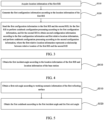
- FIG. 6 is a schematic flowchart of a method for controlling RIS networking applied to a first RIS according to an embodiment of the present disclosure.
- the RIS network includes a base station.
- the method for controlling RIS networking includes, but not limited to, the following steps.
- first configuration information sent by the base station is received, where the first configuration information is configuration information corresponding to a first RIS.
- codebook configuration processing is performed according to the first configuration information.
- the first configuration information is a first incident angle obtained by the base station according to the location information of the first RIS and the location information of the corresponding communication source base station.
- the first configuration information is a parameter configured and delivered by gNB 0 for RIS 0 .
- the parameter includes, but not limited to, any combination of W 0 , absolute location information of the target base station gNB y , an incident angle a i0 ,b i0 ,c i0 , an exit angle a o0 ,b o0 ,c o0 , and a working scenario of RIS 0 .
- gNB 0 may deliver the first configuration information by broadcasting signaling to RIS 0 to RIS n in multicast mode or through third-party communication, for RIS 0 to configure and apply the codebook W 0 , thus realizing RIS networking configuration.
- the first RIS receives first configuration information sent by the base station, where the first configuration information is first configuration information obtained by the base station according to location information of the first RIS, and performs codebook configuration processing according to the first configuration information.
- the first RIS can change the phase, polarization, and other attributes of an incident signal to implement single-beam reflection, multi-beam reflection, diffuse scattering, refraction, transmission, and other flexible effects, so as to fill a coverage hole, improve indoor coverage, enhance edge coverage, etc.
- the first RIS is a dynamic/semi-static active RIS having a reconfigurable unit array codebook, which can be controlled to achieve flexible beam reflection patterns and directions.
- FIG. 7 is a schematic flowchart of a method for controlling RIS networking applied to a second RIS according to an embodiment of the present disclosure.
- the RIS network includes a base station.
- the method for controlling RIS networking includes, but not limited to, the following steps.
- first configuration information sent by the base station is received, where the first configuration information is configuration information corresponding to a first RIS.
- codebook configuration processing is performed according to the first configuration information.
- the process of performing codebook configuration processing according to the second configuration information is as follows.
- the second RISs RIS 1 to RIS n monitor a configuration parameter in groups, where the configuration parameter may include, but not limited to, any combination of W 0 , absolute location information of the target base station gNB y , an incident angle a i0 ,b i0 ,c i0 , an exit angle a o0 ,b o0 ,c o0 , and a working scenario of RIS 0 .
- the second RIS RIS 1 calculates a codebook W 1 by using a method including, but not limited to the following, and configures and applies the codebook W 1 .
- the other second RISs RIS 2 to RIS n respectively calculate their respective codebooks W 2 to W n , and configure and apply the codebooks.
- FIG. 8 is a schematic flowchart of a method for controlling RIS networking applied to a second RIS according to an embodiment of the present disclosure.
- the RIS network includes a base station.
- the method for controlling RIS networking includes, but not limited to, the following steps.
- second configuration information is obtained according to the first configuration information and first relative location information, where the first relative location information represents a relationship between relative locations of the first RIS and the second RIS.
- codebook configuration processing is performed according to the second configuration information.
- methods of acquiring the first relative location information include, but not limited to, presetting, positioning, mutual communication, or third-party configuration and delivery.
- the first configuration information includes a first codebook
- the second configuration information includes a second codebook
- obtaining second configuration information according to the first configuration information and first relative location information includes: obtaining the second codebook according to the first codebook and the first relative location information.
- the first configuration information includes absolute location information of the communication source base station
- the method further includes: obtaining the second configuration information according to the absolute location information of the communication source base station and absolute location information of the RIS; and performing codebook configuration processing according to the second configuration information.
- the second RIS receives first configuration information sent by the base station, where the first configuration information is first configuration information obtained by the base station according to location information of the first RIS; obtains second configuration information according to the first configuration information and first relative location information, where the first relative location information represents a relationship between relative locations of the first RIS and the second RIS; and performs codebook configuration processing according to the second configuration information.
- the second RIS calculates its own codebook and configures and applies the codebook. As such, the calculation amount of the base station is reduced, and the overheads of codebook control signaling between the base station and the RISs are reduced. Therefore, the timeliness of codebook control is improved, the range of system application scenarios is widened, and system capacity is improved.
- FIG. 9 is a flowchart of obtaining second configuration information according to an embodiment of the present disclosure.
- the first configuration information includes a first incident angle
- the second configuration information includes a second codebook.
- the method for controlling RIS networking includes, but not limited to, the following steps.
- a second incident angle is obtained according to the first incident angle and the first relative location information.
- a second exit angle is obtained according to working scenario information.
- the second codebook is obtained according to the second incident angle and the second exit angle.
- the process of calculating the incident angle a i1 ,b i1 ,c i1 by the second RIS includes, but not limited to, the following methods: calculating the incident angle a i1 ,b i1 ,c i1 by using a commonly used three-dimensional calculation method according to the incident angle a o0 ,b o0 ,c o0 of RIS 0 and location information D x1 ,D y1 ,D z1 of RIS 1 relative to RIS 0 ; or directly calculating W 1 according to the codebook W 0 of RIS 0 and location information D x1 ,D y1 ,D z1 of RIS 1 relative to RIS 0 ; or calculating the incident angle a i1 ,b i1 ,c i1 of RIS 1 relative to gNB y by using a commonly used three-dimensional calculation method according to absolute location information of the gNB y and the absolute location information of RIS 1 .
- an exit angle a o1 ,b o1 ,c o1 of the second RIS RIS 1 is selected according to a current working scenario of the second RIS or according to a working scenario preset by the second RIS or a working scenario configured and delivered; and a codebook W 1 of RIS 1 is calculated according to the incident angle and the exit angle by using an existing method for RISs, or calculated by using an existing commonly used method.
- FIG. 10 is a schematic structural diagram of RIS networking according to an embodiment of the present disclosure.
- FIG. 11 is a schematic flowchart of an example of a method for controlling RIS networking according to an embodiment of the present disclosure.
- the method for controlling RIS networking includes, but not limited to, the following steps.
- a step of S1101 the method for controlling RIS networking starts to run.
- RIS grouping is performed.
- step of S1104 it is determined whether a time period for updating RIS 0 location information is satisfied, and if yes, S1102 is executed.
- a codebook parameter W 0 of RIS 0 is calculated.
- gNB 1 configures and applies the codebook parameter W 0 of RIS 0 .
- RIS 1 to RIS n monitor the codebook parameter W 0 of RIS 0 .
- RIS 1 to RIS n calculate and apply their respective codebook parameters.
- step of S1109 it is determined whether a time period for updating the codebook parameter W 0 of RIS 0 is satisfied, and if yes, S1105 is executed.
- the method including the above steps S1101 to S1109 involves: determining a first RIS and a second RIS from a plurality of RISs; acquiring location information of the first RIS; generating first configuration information according to the location information of the first RIS; and sending the first configuration information to the first RIS and the second RIS, for the first RIS to perform codebook configuration processing according to the first configuration information, and for the second RIS to obtain second configuration information according to the first configuration information and first relative location information, and perform codebook configuration processing according to the second configuration information.
- a configuration parameter is generated according to the first RIS and sent in a multicast mode. According to the received configuration parameter, the second RIS calculates its own codebook and configures and applies the codebook.
- the calculation amount of the base station is reduced, and the overheads of codebook control signaling between the base station and the RISs are reduced. Therefore, the timeliness of codebook control is improved, the range of system application scenarios is widened, and system capacity is improved.
- FIG. 12 is a structural diagram of a controller according to an embodiment of the present disclosure.
- An embodiment of the present disclosure provides a controller 1200, including: a memory 1220, a processor 1210, and a computer program stored in the memory and executable by the processor.
- the computer program when executed by the processor 1210, causes the processor 1210 to implement the method for controlling RIS networking in any one of the above embodiments, for example, implements the method steps S210 to S220 in FIG. 2 , the method steps S310 to S330 in FIG. 3 , the method step S410 in FIG. 4 , the method steps S510 to S520 in FIG. 5 , the method steps S610 to S620 in FIG. 6 , the method step S710 to S720 in FIG. 7 , the method steps S810 to S820 in FIG. 8 , the method steps S910 to S930 in FIG. 9 , or the method steps S1101 to S1109 in FIG. 11 .
- an embodiment of the present disclosure provides an RIS networking system, including the controller described above. Because the RIS networking system of the embodiment of the present disclosure includes the controller of the above embodiment, and the controller of the above embodiment can execute the method for controlling RIS networking in the above embodiments, reference may be made to the implementations and technical effects of the method for controlling RIS networking in any one of the above embodiments for implementations and technical effects of the system in the embodiment of the present disclosure.
- an embodiment of the present disclosure provides a computer-readable storage medium, storing a computer-executable instruction which, when executed by one or more control processors, causes the one or more control processors to implement, for example, the method steps S210 to S220 in FIG. 2 , the method steps S310 to S330 in FIG. 3 , the method step S410 in FIG. 4 , the method steps S510 to S520 in FIG. 5 , the method steps S610 to S620 in FIG. 6 , the method step S710 to S720 in FIG. 7 , the method steps S810 to S820 in FIG. 8 , the method steps S910 to S930 in FIG. 9 , or the method steps S1101 to S1109 in FIG. 11 .
- the present disclosure has the following beneficial effects: determining a first RIS and a second RIS from a plurality of RISs; and sending first configuration information corresponding to the first RIS to the first RIS and the second RIS, for the first RIS and the second RIS to perform codebook configuration processing.
- a configuration parameter is generated according to the first RIS and sent in a multicast mode.
- the second RIS calculates its own codebook and configures and applies the codebook. As such, the calculation amount of the base station is reduced, and the overheads of codebook control signaling between the base station and the RISs are reduced. Therefore, the timeliness of codebook control is improved, the range of system application scenarios is widened, and system capacity is improved.
- the term "computer storage medium” includes volatile and nonvolatile, removable and non-removable media implemented in any method or technology for storage of information (such as computer-readable instructions, data structures, program modules, or other data).
- the computer storage medium includes, but not limited to, a Random Access Memory (RAM), a Read-Only Memory (ROM), an Electrically Erasable Programmable Read-Only Memory (EEPROM), a flash memory or other memory technology, a Compact Disc Read-Only Memory (CD-ROM), a Digital Versatile Disc (DVD) or other optical storage, a cassette, a magnetic tape, a magnetic disk storage or other magnetic storage device, or any other medium which can be used to store the desired information and can be accessed by a computer.
- the communication medium typically includes computer-readable instructions, data structures, program modules, or other data in a modulated data signal such as a carrier or other transport mechanism, and can include any information passing medium.
Landscapes
- Engineering & Computer Science (AREA)
- Computer Networks & Wireless Communication (AREA)
- Signal Processing (AREA)
- Multimedia (AREA)
- Mobile Radio Communication Systems (AREA)
Abstract
Description
- This application is filed on the basis of
Chinese patent application No. 202210906010.6 filed July 29, 2022 - The present disclosure relates to the technical field of communication, and more particularly, to a method for controlling Reconfigurable Intelligent Surface (RIS) networking, a controller, and a storage medium.
- In the field of communications, a Reconfigurable Intelligent Surface (RIS) can perform configuration according to codebook information sent by a base station, to change the phase, polarization, and other attributes of an incident signal to fill a coverage hole, improve indoor coverage, enhance edge coverage, etc.
- However, in conventional RIS networking, the base station needs to calculate codebooks of multiple RISs, and configure the codebooks to the RISs through codebook control signaling. The base station is required to have a high computing power, the overheads of the codebook control signaling between the base station and the RISs are high, and the timeliness of codebook control is often inadequate.
- Embodiments of the present disclosure provide a method for controlling RIS networking, a controller, and a storage medium.
- In accordance with a first aspect of the present disclosure, an embodiment provides a method for controlling RIS networking, applied to a base station in an RIS network, where the RIS network includes a plurality of RISs, the method including: determining a first RIS and a second RIS from a plurality of RISs; and sending first configuration information corresponding to the first RIS to the first RIS and the second RIS, for the first RIS and the second RIS to perform codebook configuration processing.
- In accordance with a second aspect of the present disclosure, an embodiment provides a method for controlling RIS networking, applied to a first RIS in an RIS network, where the RIS network includes a base station, the method including: receiving first configuration information sent by the base station, where the first configuration information is configuration information corresponding to the first RIS; and performing codebook configuration processing according to the first configuration information.
- In accordance with a third aspect of the present disclosure, an embodiment provides a method for controlling RIS networking, applied to a second RIS in an RIS network, where the RIS network includes a base station, the method including: receiving first configuration information sent by the base station, where the first configuration information is configuration information corresponding to a first RIS; and performing codebook configuration processing according to the first configuration information.
- In accordance with a fourth aspect of the present disclosure, an embodiment provides a controller, including a memory, a processor, and a computer program stored in the memory and executable by the processor, where the computer program, when executed by the processor, causes the processor to implement the method for controlling RIS networking in accordance with any embodiment of the first aspect, the second aspect, and the third aspect.
- In accordance with a fifth aspect of the present disclosure, an embodiment provides a computer-readable storage medium, storing a computer-executable instruction which, when executed by a processor, causes the processor to implement the method for controlling RIS networking in accordance with any embodiment of the first aspect, the second aspect, and the third aspect.
-
-
FIG. 1 is a schematic diagram of a conventional RIS network; -
FIG. 2 is a schematic flowchart of a method for controlling RIS networking according to an embodiment of the present disclosure; -
FIG. 3 is a flowchart of performing codebook configuration processing according to first configuration information according to an embodiment of the present disclosure; -
FIG. 4 is a flowchart of generating the first configuration information according to location information of a first RIS according to an embodiment of the present disclosure; -
FIG. 5 is a flowchart of generating the first configuration information according to an embodiment of the present disclosure; -
FIG. 6 is a schematic flowchart of a method for controlling RIS networking applied to a first RIS according to an embodiment of the present disclosure; -
FIG. 7 is a schematic flowchart of a method for controlling RIS networking applied to a second RIS according to an embodiment of the present disclosure; -
FIG. 8 is a flowchart of performing codebook configuration according to location information of the first RIS according to an embodiment of the present disclosure; -
FIG. 9 is a flowchart of obtaining second configuration information according to an embodiment of the present disclosure; -
FIG. 10 is a schematic structural diagram of RIS networking according to an embodiment of the present disclosure; -
FIG. 11 is a schematic flowchart of an example of a method for controlling RIS networking according to an embodiment of the present disclosure; and -
FIG. 12 is a structural diagram of a controller according to an embodiment of the present disclosure. - To make the objects, technical schemes, and advantages of the present disclosure clear, the present disclosure is described in further detail in conjunction with accompanying drawings and embodiments. It should be understood that the embodiments described herein are merely used for illustrating the present disclosure, and are not intended to limit the present disclosure.
- In some embodiments, although functional modules have been divided in the schematic diagrams of apparatuses and logical orders have been shown in the flowcharts, in some cases, the modules may be divided in a different manner, or the steps shown or described may be executed in an order different from the orders as shown in the flowcharts. The terms such as "first", "second" and the like in the description, the claims, and the accompanying drawings are used to distinguish similar objects, and are not necessarily used to describe a specific sequence or a precedence order.
- In terms of RIS networking and control technologies in the field of communications, an RIS can change the phase, polarization, and other attributes of an incident signal to implement single-beam reflection, multi-beam reflection, diffuse scattering, refraction, transmission, and other flexible effects, so as to fill a coverage hole, improve indoor coverage, enhance edge coverage, etc. RISs are mainly divided into two forms: a static passive RIS (with a fixed codebook which is non-reconfigurable) and a dynamic/semi-static active RIS. The static passive RIS has a preset fixed unit array codebook, which can achieve only a fixed reflection mode and direction, and cannot be adjusted. The dynamic/semi-static active RIS has a reconfigurable unit array codebook, which can be controlled to achieve flexible beam reflection patterns and directions.
-
FIG. 1 is a schematic diagram of a conventional RIS network. A base station gNB (the next Generation Node B) is a 5G base station. After using an existing measurement technology to calculate a codebook W0 corresponding to RIS0, the base station gNB needs to send the codebook W0 to the RIS0 through codebook control signaling, for the RIS0 to implement codebook configuration. Similarly, the base station gNB also needs to use the existing measurement technology to calculate codebooks W1, ..., Wn of RIS1, ..., RISn. In other words, the base station needs to calculate the codebooks corresponding to all RISs, and deliver the codebooks through codebook control signaling, to respectively configure W0, ..., Wn to RIS0, ..., RISn. Conventional RIS networking requires the base station to perform a large amount of calculation, and involves high overheads of codebook control signaling between the gNB and the RISs. - To at least partially solve the above problems, the present disclosure discloses a method for controlling RIS networking, a controller, and a storage medium. The method for controlling RIS networking includes: determining a first RIS and a second RIS from a plurality of RISs; acquiring location information of the first RIS; generating first configuration information according to the location information of the first RIS; and sending the first configuration information to the first RIS and the second RIS, for the first RIS to perform codebook configuration processing according to the first configuration information, and for the second RIS to obtain second configuration information according to the first configuration information and first relative location information, and perform codebook configuration processing according to the second configuration information, where a configuration parameter is generated according to the first RIS and sent in a multicast mode. According to the multicast configuration parameter, each of the second RIS calculates its own codebook and configures and applies the codebook. As such, the calculation amount of the base station is reduced, and the overheads of codebook control signaling between the base station and the RISs are reduced.
- The embodiments of the present disclosure will be further described in detail below with reference to the accompanying drawings.
-
FIG. 2 is a schematic flowchart of a method for controlling RIS networking according to an embodiment of the present disclosure. The method for controlling RIS networking is applied to a base station in an RIS network. The RIS network includes a plurality of RISs. In some embodiments, the method for controlling RIS networking includes, but not limited to, the following steps. - In a step of S210, a first RIS and a second RIS are determined from a plurality of RISs.
- In some embodiments, the second RIS is RIS capable of receiving a communication signal from the base station, and the first RIS is an RIS capable of transmitting a communication signal to the base station among the second RISs.
- In some embodiments, the RISs are dynamic/semi-static active RISs having a reconfigurable unit array codebook, which can be controlled to achieve flexible beam reflection patterns and directions.
- In some embodiments, the first RIS is a primary RIS, and the second RIS is a secondary RIS. In an RIS network, one multicast base station corresponds to a plurality of RISs, RISs capable of receiving a configuration parameter from a multicast base station gNB0 are formed into a virtual multicast group, and an RIS capable of two-way communication with the multicast base station gNB0 is selected from the multicast group and defined as a primary RIS RIS0, and the other RISs in the multicast group are defined as secondary RISs, RIS1 to RISn. The primary RIS and the secondary RISs are determined from the plurality of RISs, and in subsequent steps, the base station calculates codebook information of only the primary RIS, and sends the codebook information in multicast mode. As such, the calculation amount of the base station is reduced, and the overheads of codebook control signaling between the base station and the RISs are reduced.
- In a step of S220, first configuration information corresponding to the first RIS is sent to the first RIS and the second RIS, for the first RIS and the second RIS to perform codebook configuration processing.
- In some embodiments, sending the first configuration information to the first RIS and the second RIS includes: sending the first configuration information to the first RIS and the second RIS by using a multicast capability of the base station, where the plurality of RISs include one first RIS and a plurality of second RISs, and the first configuration information is codebook configuration information corresponding to the first RIS.
- In some embodiments, after the first configuration information is sent to the second RIS, the second RIS obtains second configuration information according to the first configuration information and first relative location information, and perform codebook configuration processing according to the second configuration information. The multicast base station does not need to calculate configuration information of the second RISs, and the second RISs can adjust the first configuration information according to the relative location relationship to obtain its own configuration information. Therefore, the timeliness of codebook calculation in the system is improved, the range of system application scenarios is widened, and system capacity is improved, such that the system can be used in high-speed trains, dense buildings, and other scenarios where the environment changes rapidly.
-
FIG. 3 is a schematic flowchart of a method for controlling RIS networking according to an embodiment of the present disclosure. The method for controlling RIS networking is applied to a base station in an RIS network. The RIS network includes a plurality of RISs. In some embodiments, the method for controlling RIS networking includes, but not limited to, the following steps. - In a step of S310, location information of the first RIS is acquired.
- In some embodiments, acquiring location information of the first RIS includes: receiving, by the multicast base station gNB0, location information sent by the first RIS, where the location information is absolute location information of the first RIS, and the absolute location information is reported by the first RIS RIS0 to the multicast base station gNB0; and calculating, by the gNB0, an incident angle ai0,bi0,ci0 of the RIS0 relative to a communication source base station gNBy by using a commonly used three-dimensional calculation method according to absolute location information of the gNBy and the absolute location information of the RIS0.
- In some embodiments, the multicast base station gNB0 is the communication source base station gNBy, and after the multicast base station gNB0 receives the location information sent by the first RIS, the multicast base station gNB0 calculates the incident angle ai0,bi0,ci0 of the RIS0 relative to the gNBy by using a commonly used three-dimensional calculation method according to absolute location information of the gNB0 and the absolute location information of the RIS0.
- In a step of S320, the first configuration information is generated according to the location information of the first RIS.
- In some embodiments, generating first configuration information according to the location information of the first RIS includes: generating a first incident angle according to the location information of the first RIS. To be specific, the multicast base station calculates only an incident angle corresponding to the first RIS according to the location information of the first RIS. After receiving the incident angle, the first RIS determines an exit angle according to a current working scenario of the RIS (e.g., transmission or reflection over a large range or in a specific direction, etc.) or other general methods, then calculates a codebook according to the incident angle and the exit angle or by using an existing commonly used method, and configures and applies the codebook. As such, the overheads of codebook control signaling between the base station and the RISs are reduced.
- In some embodiments, generating first configuration information according to the location information of the first RIS includes: generating a first codebook according to the location information of the first RIS. To be specific, the multicast base station calculates only an incident angle corresponding to the first RIS according to the location information of the first RIS, determines an exit angle according to a current working scenario of the RIS (e.g., transmission or reflection over a large range or in a specific direction, etc.) or other general methods, then calculates a codebook according to the incident angle and the exit angle or by using an existing commonly used method, and sends the codebook to the first RIS, for the first RIS to configure and apply the codebook. As such, computing resources of the base station are saved.
- In a step of S330, the first configuration information is sent to the first RIS and the second RIS, for the first RIS to perform codebook configuration processing according to the first configuration information, and for the second RIS to obtain second configuration information according to the first configuration information and first relative location information, and perform codebook configuration processing according to the second configuration information, where the first relative location information represents a relationship between relative locations of the first RIS and the second RIS.
- In some embodiments, after the first configuration information is sent to the first RIS, the first RIS performs codebook configuration processing according to the received first configuration information. The first configuration information includes, but not limited to, any combination of a codebook W0, absolute location information of the communication source base station gNBy, an incident angle ai0,bi0,ci0, an exit angle ao0,bo0,co0, and a working scenario of the RIS0. The multicast base station gNB0 may deliver the configuration information by broadcasting signaling to RIS0 to RISn in multicast mode or through third-party communication, for the first RIS RIS0 to configure and apply the codebook W0.
- In some embodiments, the first relative location information represents a relationship between relative locations of the first RIS and the second RIS. The second RISs RIS0 to RISn obtain location information Dx,Dy,Dz relative to the first RIS RIS0 by, for example, but not limited to, the following methods that: relative location information of RIS0 to RISn is preset, obtained through positioning, obtained through mutual communication, or configured and delivered by a third party; or absolute location information of RIS0 to RISn is preset, obtained through positioning, obtained through mutual communication, or configured and delivered by a third party, and RIS0 to RISn calculate location information relative to RIS0 according to the absolute location information.
- In some embodiments, the method for controlling RIS networking further includes: obtaining, by gNB0 to gNBm, location information Lx,Ly,Lz relative to gNB0 by, for example, but not limited to, the following methods that: relative location information of gNB0 to gNBm is preset, obtained through positioning, obtained through mutual communication, or configured and delivered by a third party; or absolute location information of gNB0 to gNBm is preset, obtained through positioning, obtained through mutual communication, or configured and delivered by a third party, and gNB0 to gNBm calculate location information relative to gNB0 according to the absolute location information. The RIS network includes a plurality of base stations. The plurality of base stations and the RISs are grouped according to communication capabilities, i.e., a plurality of multicast base stations correspond to a plurality of RIS groups. The RIS group includes a first RIS and a plurality of second RISs. According to functions, gNBx is a gNB for angle calculation, and may be any one of gNB0 to gNBm, and gNBy is a gNB for allocating target change channel characteristics to RIS0 to RISn. A three-dimensional relative location relationship between RIS0 and RIS1 is defined as Dx0,Dy0,Dz0, ..., and a three-dimensional relative location relationship between RISn-1 and RISn is defined as Dxn-1,Dyn-1,Dzn-1. Dx,Dy,Dz is a general term for the location relationship between two RISs. A three-dimensional relative location relationship between gNB0 and gNB1 is defined as Lx0,Ly0,Lz0, ..., and a three-dimensional relative location relationship between gNBm-1 and gNBm is defined as Lxm-1,Lym-1. Lx,Ly,Lz is a general term for the location relationship between two gNBs. The location information includes, but not limited, to global navigation satellite system (GNSS) information and location coordinate information.
- In some embodiments, a timer is set, and steps S310 to S330 is repeatedly executed according to a preset time period, i.e., a target configuration is updated according to the preset time period, and the relative position relationships in the base stations and the RISs are also updated according to the preset time period.
- In some embodiments, the method of the present disclosure is applied to 5G base stations and RIS devices, and is suitable for networking scenarios with a large number of RIS devices. Because RISs are cost-effective, the networking costs can be reduced. The base station controls the plurality of RISs. A configuration parameter is generated according to the first RIS and sent in a multicast mode. According to the received configuration parameter, the second RIS calculates its own codebook and configures and applies the codebook. As such, the calculation amount of the base station is reduced, the problems of high calculation amount, high signaling overheads, and unsatisfactory codebook control timeliness are overcome, and the overheads of codebook control signaling between the base station and the RISs are reduced. Therefore, the timeliness of codebook control is improved, the range of system application scenarios is widened, and system capacity is improved.
-
FIG. 4 is a flowchart of generating the first configuration information according to the location information of the first RIS according to an embodiment of the present disclosure. The first configuration information includes a first incident angle. In some embodiments, the method for controlling RIS networking includes, but not limited to, the following step. - In a step of S410, the first incident angle is obtained according to the location information of the first RIS and location information of the base station.
- In some embodiments, the base station includes a multicast base station and a communication source base station, the first configuration information includes a first incident angle, and generating the first configuration information according to the location information of the first RIS includes: obtaining, by the multicast base station, the first incident angle according to the location information of the first RIS and location information of the communication source base station. The location information of the first RIS includes absolute location information of the first RIS. The communication source base station is a communication source corresponding to a channel formed after the first RIS is configured according to a codebook. When the multicast base station which sends the configuration information is not the communication source base station, the multicast base station obtains the first incident angle according to the location information of the first RIS and the location information of the communication source base station. Because the gNB1 to gNBm can acquire the location information Lx,Ly,Lz relative to the gNB0 by presetting or delivery in advance, the multicast base station can acquire the location information of the communication source base station according to the relative location information and its own absolute location information, and then obtain the first incident angle.
- In some embodiments, the communication source base station may serve as the multicast base station which sends the configuration information. When the multicast base station is not an intermediate node base station, the multicast base station can obtain the first incident angle according to the location information of the first RIS and its own absolute location information. As such, the flexibility of RIS networking is improved. Whether the communication source base station serves as the multicast base station which sends the configuration information is not limited in the embodiment.
- In some embodiments, the base station includes a multicast base station and a communication source base station, the first configuration information includes a first incident angle, and generating the first configuration information according to the location information of the first RIS includes: sending, by the multicast base station, the first location information to a computing base station; and receiving, by the multicast base station, the first incident angle sent by the computing base station, and the first incident angle is an incident angle calculated by the computing base station according to the location information of the first RIS. In other words, the multicast base station which sends the configuration information is not the computing base station that performs codebook calculation processing, but serves as an intermediate node to send the first location information to the computing base station. After receiving the first location information, the computing base station calculates the first incident angle, and then sends the first incident angle to the multicast base station, for the multicast base station to perform the subsequent operation of delivering the configuration information.
- In some embodiments, the computing base station may serve as the multicast base station which sends the configuration information. When the multicast base station is not an intermediate node base station, the multicast base station can obtain the first incident angle according to the location information of the first RIS and its own absolute location information. As such, the flexibility of RIS networking is improved. Whether the computing base station serves as the multicast base station which sends the configuration information is not limited in the embodiment. For example, RIS0 reports the absolute location information to gNB0, gNB0 transmits the absolute location information of RIS0 to gNBx for angle calculation, and gNBx calculates the incident angle ai0,bi0,ci0 of the RIS0 relative to the target base station gNBy by using a commonly used three-dimensional calculation method according to absolute location information of the gNBy and the absolute location information of the RIS0; RIS0 reports the absolute location information to gNB0, gNB0 transmits the absolute location information of RIS0 to gNBx for angle calculation, and gNBx calculates the incident angle ai0,bi0,ci0 of the RIS0 relative to gNBy by using a commonly used three-dimensional calculation method according to absolute location information of the target base station gNBx, relative location information Lx,Ly,Lz of gNBx and gNBy, and the absolute location information of the RIS0.
- In some embodiments, the location information of the communication source base station includes absolute location information of the communication source base station, and a method for acquiring the absolute location information of the communication source base station includes: obtaining, by the multicast base station, the absolute location information of the communication source base station according to second relative location information and absolute location information of the multicast base station, where the second relative location information represents a relationship between relative locations of the multicast base station and the communication source base station.
-
FIG. 5 is a flowchart of generating the first configuration information according to an embodiment of the present disclosure. After obtaining the first incident angle according to the location information of the first RIS and location information of the communication source base station, the method for controlling RIS networking includes, but not limited to, the following steps. - In a step of S510, a first exit angle is obtained according to working scenario information of the first reflecting surface.
- In a step of S520, the first codebook is obtained according to the first incident angle and the first exit angle.
- In some implementations, a first exit angle is obtained according to working scenario information of the first reflecting surface, and the first codebook is obtained according to the first incident angle and the first exit angle. The multicast base station selects an exit angle ao0,bo0,co0 of RIS0 relative to gNBy according to a current working scenario of RIS0 (e.g., transmission or reflection over a large range or in a specific direction, etc.) or other general methods, and calculates a codebook W0 of RIS0 according to the incident angle and the exit angle; or calculates a codebook W0 of RIS0 by using an existing commonly used method.
- In some embodiments, when the location relationship between RISs is relatively fixed, RISs transmit or reflect a signal from a gNB to different areas, and working scenarios of the method for controlling RIS networking include, but not limited to, scenarios where windows of high-speed trains serve as RISs, windows or facades of buildings serve as RISs, etc.; or when the location relationship between RISs changes slowly, RISs transmit or reflect a signal from a gNB to different areas, and working scenarios of the method for controlling RIS networking include, but not limited to, factories, ports, mines, etc. In such scenarios, the deployment positions of the RISs will change, but the relative location relationship between the RISs changes slowly, and the relative location relationship can be obtained through presetting, positioning, or other means.
- In some embodiments, the first configuration information includes absolute location information of the communication source base station, and the method further includes: sending the absolute location information of the communication source base station to the primary RIS and the secondary RISs, for the primary RIS and the secondary RISs to perform codebook configuration processing according to the absolute location information of the communication source base station. For example, gNB0 configures and delivers absolute location information of gNBy through signaling broadcast or third-party communication, and RIS0 calculates an incident angle ai0,bi0,ci0 of the RIS0 relative to gNBy by using a commonly used three-dimensional calculation method according to its own absolute location information and the absolute location information of the target base station gNBy; or gNBy measures the incident angle ai0,bi0,ci0 of RIS0 relative to gNBy in real time by using an existing commonly used method during communication with a terminal device.
-
FIG. 6 is a schematic flowchart of a method for controlling RIS networking applied to a first RIS according to an embodiment of the present disclosure. The RIS network includes a base station. In some embodiments, the method for controlling RIS networking includes, but not limited to, the following steps. - In a step of S610, first configuration information sent by the base station is received, where the first configuration information is configuration information corresponding to a first RIS.
- In a step of S620, codebook configuration processing is performed according to the first configuration information.
- In some embodiments, the first configuration information is a first incident angle obtained by the base station according to the location information of the first RIS and the location information of the corresponding communication source base station. The first configuration information is a parameter configured and delivered by gNB0 for RIS0. The parameter includes, but not limited to, any combination of W0, absolute location information of the target base station gNBy, an incident angle ai0,bi0,ci0, an exit angle ao0,bo0,co0, and a working scenario of RIS0. gNB0 may deliver the first configuration information by broadcasting signaling to RIS0 to RISn in multicast mode or through third-party communication, for RIS0 to configure and apply the codebook W0, thus realizing RIS networking configuration.
- In some embodiments, the first RIS receives first configuration information sent by the base station, where the first configuration information is first configuration information obtained by the base station according to location information of the first RIS, and performs codebook configuration processing according to the first configuration information. The first RIS can change the phase, polarization, and other attributes of an incident signal to implement single-beam reflection, multi-beam reflection, diffuse scattering, refraction, transmission, and other flexible effects, so as to fill a coverage hole, improve indoor coverage, enhance edge coverage, etc. The first RIS is a dynamic/semi-static active RIS having a reconfigurable unit array codebook, which can be controlled to achieve flexible beam reflection patterns and directions.
-
FIG. 7 is a schematic flowchart of a method for controlling RIS networking applied to a second RIS according to an embodiment of the present disclosure. The RIS network includes a base station. In some embodiments, the method for controlling RIS networking includes, but not limited to, the following steps. - In a step of S710, first configuration information sent by the base station is received, where the first configuration information is configuration information corresponding to a first RIS.
- In a step of S720, codebook configuration processing is performed according to the first configuration information.
- In some embodiments, the process of performing codebook configuration processing according to the second configuration information is as follows. The second RISs RIS1 to RISn monitor a configuration parameter in groups, where the configuration parameter may include, but not limited to, any combination of W0, absolute location information of the target base station gNBy, an incident angle ai0,bi0,ci0, an exit angle ao0,bo0,co0, and a working scenario of RIS0. The second RIS RIS1 calculates a codebook W1 by using a method including, but not limited to the following, and configures and applies the codebook W1. Similarly, the other second RISs RIS2 to RISn respectively calculate their respective codebooks W2 to Wn, and configure and apply the codebooks.
-
FIG. 8 is a schematic flowchart of a method for controlling RIS networking applied to a second RIS according to an embodiment of the present disclosure. The RIS network includes a base station. In some embodiments, the method for controlling RIS networking includes, but not limited to, the following steps. - In a step of S810, second configuration information is obtained according to the first configuration information and first relative location information, where the first relative location information represents a relationship between relative locations of the first RIS and the second RIS.
- In a step of S820, codebook configuration processing is performed according to the second configuration information.
- In some embodiments, methods of acquiring the first relative location information include, but not limited to, presetting, positioning, mutual communication, or third-party configuration and delivery.
- In some embodiments, the first configuration information includes a first codebook, the second configuration information includes a second codebook, and obtaining second configuration information according to the first configuration information and first relative location information includes: obtaining the second codebook according to the first codebook and the first relative location information.
- In some embodiments, the first configuration information includes absolute location information of the communication source base station, and the method further includes: obtaining the second configuration information according to the absolute location information of the communication source base station and absolute location information of the RIS; and performing codebook configuration processing according to the second configuration information.
- In some embodiments, the second RIS receives first configuration information sent by the base station, where the first configuration information is first configuration information obtained by the base station according to location information of the first RIS; obtains second configuration information according to the first configuration information and first relative location information, where the first relative location information represents a relationship between relative locations of the first RIS and the second RIS; and performs codebook configuration processing according to the second configuration information. According to the received configuration parameter, the second RIS calculates its own codebook and configures and applies the codebook. As such, the calculation amount of the base station is reduced, and the overheads of codebook control signaling between the base station and the RISs are reduced. Therefore, the timeliness of codebook control is improved, the range of system application scenarios is widened, and system capacity is improved.
-
FIG. 9 is a flowchart of obtaining second configuration information according to an embodiment of the present disclosure. The first configuration information includes a first incident angle, and the second configuration information includes a second codebook. In some embodiments, the method for controlling RIS networking includes, but not limited to, the following steps. - In a step of S910, a second incident angle is obtained according to the first incident angle and the first relative location information.
- In a step of S920, a second exit angle is obtained according to working scenario information.
- In a step of S930, the second codebook is obtained according to the second incident angle and the second exit angle.
- In some embodiments, the process of calculating the incident angle ai1,bi1,ci1 by the second RIS includes, but not limited to, the following methods: calculating the incident angle ai1,bi1,ci1 by using a commonly used three-dimensional calculation method according to the incident angle ao0,bo0,co0 of RIS0 and location information Dx1,Dy1,Dz1 of RIS1 relative to RIS0; or directly calculating W1 according to the codebook W0 of RIS0 and location information Dx1,Dy1,Dz1 of RIS1 relative to RIS0; or calculating the incident angle ai1,bi1,ci1 of RIS1 relative to gNBy by using a commonly used three-dimensional calculation method according to absolute location information of the gNBy and the absolute location information of RIS1.
- In some embodiments, after the incident angle ai1,bi1,ci1 of the second RIS RIS1 is calculated, an exit angle ao1,bo1,co1 of the second RIS RIS1 is selected according to a current working scenario of the second RIS or according to a working scenario preset by the second RIS or a working scenario configured and delivered; and a codebook W1 of RIS1 is calculated according to the incident angle and the exit angle by using an existing method for RISs, or calculated by using an existing commonly used method.
-
FIG. 10 is a schematic structural diagram of RIS networking according to an embodiment of the present disclosure.FIG. 11 is a schematic flowchart of an example of a method for controlling RIS networking according to an embodiment of the present disclosure. The method for controlling RIS networking includes, but not limited to, the following steps. - In a step of S1101, the method for controlling RIS networking starts to run.
- In a step of S1102, RIS grouping is performed.
- In a step of S1103, location information relative to RIS0 is acquired.
- In a step of S1104, it is determined whether a time period for updating RIS0 location information is satisfied, and if yes, S1102 is executed.
- In a step of S1105, a codebook parameter W0 of RIS0 is calculated.
- In a step of S1106, gNB1 configures and applies the codebook parameter W0 of RIS0.
- In a step of S1107, RIS1 to RISn monitor the codebook parameter W0 of RIS0.
- In a step of S1108, RIS1 to RISn calculate and apply their respective codebook parameters.
- In a step of S1109, it is determined whether a time period for updating the codebook parameter W0 of RIS0 is satisfied, and if yes, S1105 is executed.
- In some embodiments, the method including the above steps S1101 to S1109 involves: determining a first RIS and a second RIS from a plurality of RISs; acquiring location information of the first RIS; generating first configuration information according to the location information of the first RIS; and sending the first configuration information to the first RIS and the second RIS, for the first RIS to perform codebook configuration processing according to the first configuration information, and for the second RIS to obtain second configuration information according to the first configuration information and first relative location information, and perform codebook configuration processing according to the second configuration information. A configuration parameter is generated according to the first RIS and sent in a multicast mode. According to the received configuration parameter, the second RIS calculates its own codebook and configures and applies the codebook. As such, the calculation amount of the base station is reduced, and the overheads of codebook control signaling between the base station and the RISs are reduced. Therefore, the timeliness of codebook control is improved, the range of system application scenarios is widened, and system capacity is improved.
-
FIG. 12 is a structural diagram of a controller according to an embodiment of the present disclosure. An embodiment of the present disclosure provides acontroller 1200, including: amemory 1220, aprocessor 1210, and a computer program stored in the memory and executable by the processor. The computer program, when executed by theprocessor 1210, causes theprocessor 1210 to implement the method for controlling RIS networking in any one of the above embodiments, for example, implements the method steps S210 to S220 inFIG. 2 , the method steps S310 to S330 inFIG. 3 , the method step S410 inFIG. 4 , the method steps S510 to S520 inFIG. 5 , the method steps S610 to S620 inFIG. 6 , the method step S710 to S720 inFIG. 7 , the method steps S810 to S820 inFIG. 8 , the method steps S910 to S930 inFIG. 9 , or the method steps S1101 to S1109 inFIG. 11 . - In addition, an embodiment of the present disclosure provides an RIS networking system, including the controller described above. Because the RIS networking system of the embodiment of the present disclosure includes the controller of the above embodiment, and the controller of the above embodiment can execute the method for controlling RIS networking in the above embodiments, reference may be made to the implementations and technical effects of the method for controlling RIS networking in any one of the above embodiments for implementations and technical effects of the system in the embodiment of the present disclosure.
- In addition, an embodiment of the present disclosure provides a computer-readable storage medium, storing a computer-executable instruction which, when executed by one or more control processors, causes the one or more control processors to implement, for example, the method steps S210 to S220 in
FIG. 2 , the method steps S310 to S330 inFIG. 3 , the method step S410 inFIG. 4 , the method steps S510 to S520 inFIG. 5 , the method steps S610 to S620 inFIG. 6 , the method step S710 to S720 inFIG. 7 , the method steps S810 to S820 inFIG. 8 , the method steps S910 to S930 inFIG. 9 , or the method steps S1101 to S1109 inFIG. 11 . - The present disclosure has the following beneficial effects: determining a first RIS and a second RIS from a plurality of RISs; and sending first configuration information corresponding to the first RIS to the first RIS and the second RIS, for the first RIS and the second RIS to perform codebook configuration processing. A configuration parameter is generated according to the first RIS and sent in a multicast mode. According to the received configuration parameter, the second RIS calculates its own codebook and configures and applies the codebook. As such, the calculation amount of the base station is reduced, and the overheads of codebook control signaling between the base station and the RISs are reduced. Therefore, the timeliness of codebook control is improved, the range of system application scenarios is widened, and system capacity is improved.
- Those having ordinary skills in the art can understand that all or some of the steps in the methods disclosed above and the functional modules/units in the system and the apparatus can be implemented as software, firmware, hardware, and appropriate combinations thereof. Some or all physical components may be implemented as software executed by a processor, such as a central processing unit, a digital signal processor, or a microprocessor, or as hardware, or as an integrated circuit, such as an application-specific integrated circuit. Such software may be distributed on a computer-readable medium, which may include a computer storage medium (or non-transitory medium) and a communication medium (or transitory medium). As is known to those having ordinary skills in the art, the term "computer storage medium" includes volatile and nonvolatile, removable and non-removable media implemented in any method or technology for storage of information (such as computer-readable instructions, data structures, program modules, or other data). The computer storage medium includes, but not limited to, a Random Access Memory (RAM), a Read-Only Memory (ROM), an Electrically Erasable Programmable Read-Only Memory (EEPROM), a flash memory or other memory technology, a Compact Disc Read-Only Memory (CD-ROM), a Digital Versatile Disc (DVD) or other optical storage, a cassette, a magnetic tape, a magnetic disk storage or other magnetic storage device, or any other medium which can be used to store the desired information and can be accessed by a computer. In addition, as is known to those having ordinary skills in the art, the communication medium typically includes computer-readable instructions, data structures, program modules, or other data in a modulated data signal such as a carrier or other transport mechanism, and can include any information passing medium.
Claims (15)
- A method for controlling Reconfigurable Intelligent Surface (RIS) networking, applied to a base station in an RIS network, wherein the RIS network comprises a plurality of RISs, the method comprising:determining a first RIS and a second RIS from a plurality of RISs; andsending first configuration information corresponding to the first RIS to the first RIS and the second RIS, for the first RIS and the second RIS to perform codebook configuration processing.
- The method for controlling RIS networking of claim 1, wherein sending first configuration information corresponding to the first RIS to the first RIS and the second RIS, for the first RIS and the second RIS to perform codebook configuration processing comprises:acquiring location information of the first RIS;generating the first configuration information according to the location information of the first RIS;sending the first configuration information to the first RIS and the second RIS, for the first RIS to perform codebook configuration processing according to the first configuration information, and for the second RIS to obtain second configuration information according to the first configuration information and first relative location information, and perform codebook configuration processing according to the second configuration information, wherein the first relative location information represents a relationship between relative locations of the first RIS and the second RIS.
- The method for controlling RIS networking of claim 1 or 2, wherein the second RIS is an RIS capable of receiving a communication signal from the base station, and the first RIS is an RIS capable of transmitting a communication signal to the base station among the second RIS.
- The method for controlling RIS networking of claim 3, wherein the first configuration information comprises a first incident angle, and generating the first configuration information according to the location information of the first RIS comprises:
obtaining the first incident angle according to the location information of the first RIS and location information of the base station. - The method for controlling RIS networking of claim 4, wherein the base station comprises a multicast base station and a communication source base station, the first configuration information comprises a first incident angle, and generating the first configuration information according to the location information of the first RIS comprises:
obtaining, by the multicast base station, the first incident angle according to the location information of the first RIS and location information of the communication source base station. - The method for controlling RIS networking of claim 3, wherein the base station comprises a multicast base station and a computing base station, the first configuration information comprises a first incident angle, and generating the first configuration information according to the location information of the first RIS comprises:sending, by the multicast base station, the first location information to the computing base station; andreceiving, by the multicast base station, the first incident angle sent by the computing base station, wherein the first incident angle is an incident angle calculated by the computing base station according to the location information of the first RIS.
- The method for controlling RIS networking of claim 4, wherein the first configuration information comprises a first codebook, and after obtaining the first incident angle according to the location information of the first RIS and location information of the base station, the method comprises:obtaining a first exit angle according to working scenario information of the first reflecting surface; andobtaining the first codebook according to the first incident angle and the first exit angle.
- The method for controlling RIS networking of claim 5, wherein the location information of the communication source base station comprises absolute location information of the communication source base station, and a method for acquiring the absolute location information of the communication source base station comprises:
obtaining, by the multicast base station, the absolute location information of the communication source base station according to second relative location information and absolute location information of the multicast base station, wherein the second relative location information represents a relationship between relative locations of the multicast base station and the communication source base station. - A method for controlling Reconfigurable Intelligent Surface (RIS) networking, applied to a first RIS in an RIS network, wherein the RIS network comprises a base station, the method comprising:receiving first configuration information sent by the base station, wherein the first configuration information is configuration information corresponding to the first RIS; andperforming codebook configuration processing according to the first configuration information.
- A method for controlling Reconfigurable Intelligent Surface (RIS) networking, applied to a second RIS in an RIS network, wherein the RIS network comprises a base station, the method comprising:receiving first configuration information sent by the base station, wherein the first configuration information is configuration information corresponding to a first RIS; andperforming codebook configuration processing according to the first configuration information.
- The method for controlling RIS networking of claim 10, wherein the first configuration information is first configuration information obtained by the base station according to location information of the first RIS, and performing codebook configuration processing according to the first configuration information comprises:obtaining second configuration information according to the first configuration information and first relative location information, wherein the first relative location information represents a relationship between relative locations of the first RIS and the second RIS; andperforming codebook configuration processing according to the second configuration information.
- The method for controlling RIS networking of claim 11, wherein the first configuration information comprises a first incident angle, the second configuration information comprises a second codebook, and obtaining second configuration information according to the first configuration information and first relative location information comprises:obtaining a second incident angle according to the first incident angle and the first relative location information;obtaining a second exit angle according to working scenario information; andobtaining the second codebook according to the second incident angle and the second exit angle.
- The method for controlling RIS networking of claim 11, wherein the base station comprises a communication source base station, the first configuration information comprises absolute location information of the communication source base station, and the method further comprises:obtaining the second configuration information according to the absolute location information of the communication source base station and absolute location information of the RIS; andperforming codebook configuration processing according to the second configuration information.
- A controller, comprising a memory, a processor, and a computer program stored in the memory and executable by the processor, wherein the computer program, when executed by the processor, causes the processor to perform the method for controlling Reconfigurable Intelligent Surface (RIS) networking of any one of claims 1 to 13.
- A computer-readable storage medium, storing a computer-executable instruction which, when executed by a processor, causes the processor to perform the method for controlling Reconfigurable Intelligent Surface (RIS) networking of any one of claims 1 to 13.
Applications Claiming Priority (2)
| Application Number | Priority Date | Filing Date | Title |
|---|---|---|---|
| CN202210906010.6A CN117528559A (en) | 2022-07-29 | 2022-07-29 | Control method, controller and storage medium for reconfigurable intelligent reflective surface networking |
| PCT/CN2023/077225 WO2024021583A1 (en) | 2022-07-29 | 2023-02-20 | Control method for networking using reconfigurable intelligent surfaces, and controller and storage medium |
Publications (2)
| Publication Number | Publication Date |
|---|---|
| EP4557804A1 true EP4557804A1 (en) | 2025-05-21 |
| EP4557804A4 EP4557804A4 (en) | 2025-11-05 |
Family
ID=89705151
Family Applications (1)
| Application Number | Title | Priority Date | Filing Date |
|---|---|---|---|
| EP23844802.1A Pending EP4557804A4 (en) | 2022-07-29 | 2023-02-20 | CONTROL METHOD FOR NETWORKING USING RECONFIGURED SMART SURFACES, CONTROL DEVICE AND STORAGE MEDIUM |
Country Status (5)
| Country | Link |
|---|---|
| US (1) | US20260039334A1 (en) |
| EP (1) | EP4557804A4 (en) |
| KR (1) | KR20250035582A (en) |
| CN (1) | CN117528559A (en) |
| WO (1) | WO2024021583A1 (en) |
Families Citing this family (1)
| Publication number | Priority date | Publication date | Assignee | Title |
|---|---|---|---|---|
| CN119545301A (en) * | 2024-11-21 | 2025-02-28 | 煤炭科学技术研究院有限公司 | Mine communication system and method based on RIS |
Family Cites Families (6)
| Publication number | Priority date | Publication date | Assignee | Title |
|---|---|---|---|---|
| CN113259065B (en) * | 2020-02-13 | 2023-04-07 | 大唐移动通信设备有限公司 | Codebook transmission method and device |
| EP4014333A1 (en) * | 2020-05-18 | 2022-06-22 | Google LLC | Position control of adaptive phase-changing devices |
| US12160285B2 (en) * | 2020-05-29 | 2024-12-03 | Telefonaktiebolaget Lm Ericsson (Publ) | Intelligent surfaces for use in a wireless communication system |
| CN115812159B (en) * | 2020-07-17 | 2026-03-06 | 谷歌有限责任公司 | Determining the location of user equipment by using adaptive phase change devices |
| US20240007147A1 (en) * | 2021-01-14 | 2024-01-04 | Qualcomm Incorporated | Communicating reconfigurable intelligent surface (ris) information to support ris-division multiple access |
| WO2023220978A1 (en) * | 2022-05-18 | 2023-11-23 | Huawei Technologies Co., Ltd. | Systems and methods for control signaling for using a reconfigurable intelligent surface in communication systems |
-
2022
- 2022-07-29 CN CN202210906010.6A patent/CN117528559A/en active Pending
-
2023
- 2023-02-20 KR KR1020257004738A patent/KR20250035582A/en active Pending
- 2023-02-20 US US18/998,805 patent/US20260039334A1/en active Pending
- 2023-02-20 EP EP23844802.1A patent/EP4557804A4/en active Pending
- 2023-02-20 WO PCT/CN2023/077225 patent/WO2024021583A1/en not_active Ceased
Also Published As
| Publication number | Publication date |
|---|---|
| KR20250035582A (en) | 2025-03-12 |
| WO2024021583A1 (en) | 2024-02-01 |
| EP4557804A4 (en) | 2025-11-05 |
| US20260039334A1 (en) | 2026-02-05 |
| CN117528559A (en) | 2024-02-06 |
Similar Documents
| Publication | Publication Date | Title |
|---|---|---|
| US20220386263A1 (en) | Transmission delay indication method and device | |
| EP4223076B1 (en) | Adaptive phase-changing device sharing and handover | |
| US12342303B2 (en) | Communication method for non-terrestrial network and terminal device | |
| CN111615186A (en) | A method, terminal and network device for updating timing advance | |
| EP3866521A1 (en) | Handover-related rach requests reduction in non-terrestrial networks | |
| EP4557804A1 (en) | Control method for networking using reconfigurable intelligent surfaces, and controller and storage medium | |
| EP3273715B1 (en) | Layout method and system for base station, and computer storage medium | |
| WO2020023224A1 (en) | Dynamic allocation of satellite gateway assignments | |
| CN110011725B (en) | Relay satellite tracking method and device | |
| WO2024015819A1 (en) | Systems and methods for communication resource planning for ground to aerial vehicle communications | |
| WO2021106590A1 (en) | Video transmission device and display device | |
| CN111818558B (en) | A method and system for adaptively adjusting positioning signal measurement mode | |
| JP5072407B2 (en) | COMMUNICATION CONTROL METHOD, COMMUNICATION SYSTEM AND COMMUNICATION CONTROL DEVICE | |
| CN115707044B (en) | Non-land network switching method and device, storage medium and electronic equipment | |
| JP2018056961A (en) | Communication control device, communication system, and communication method | |
| EP3320360B1 (en) | Apparatus and method for generating boundaries of satellite coverage beams | |
| US11457446B2 (en) | Method, terminal device and computer storage medium for beam selection based on geographical positions of terminal devices | |
| CN116915308A (en) | Multimode communication method and system for mobile users | |
| CN113938831B (en) | Tracking area code sending method and device, electronic equipment and storage medium | |
| CN115765828B (en) | A beam scheduling method, device and electronic equipment | |
| CN120224412B (en) | Uplink and downlink scheduling method, device, equipment, medium and program product | |
| US12389439B2 (en) | Method of bandwidth part management for a network and controller therefor | |
| CN121218197B (en) | An Adaptive Network Architecture Construction Method | |
| RU2816351C1 (en) | System of high-speed communication with spacecrafts using technologies of automatic mutual guidance of highly directional antennae | |
| RU2673680C1 (en) | Radio communication system with mobile objects |
Legal Events
| Date | Code | Title | Description |
|---|---|---|---|
| STAA | Information on the status of an ep patent application or granted ep patent |
Free format text: STATUS: THE INTERNATIONAL PUBLICATION HAS BEEN MADE |
|
| PUAI | Public reference made under article 153(3) epc to a published international application that has entered the european phase |
Free format text: ORIGINAL CODE: 0009012 |
|
| STAA | Information on the status of an ep patent application or granted ep patent |
Free format text: STATUS: REQUEST FOR EXAMINATION WAS MADE |
|
| 17P | Request for examination filed |
Effective date: 20250214 |
|
| AK | Designated contracting states |
Kind code of ref document: A1 Designated state(s): AL AT BE BG CH CY CZ DE DK EE ES FI FR GB GR HR HU IE IS IT LI LT LU LV MC ME MK MT NL NO PL PT RO RS SE SI SK SM TR |
|
| REG | Reference to a national code |
Ref country code: DE Ref legal event code: R079 Free format text: PREVIOUS MAIN CLASS: H04W0024020000 Ipc: H04B0007155000 |
|
| A4 | Supplementary search report drawn up and despatched |
Effective date: 20251007 |
|
| DAV | Request for validation of the european patent (deleted) | ||
| DAX | Request for extension of the european patent (deleted) | ||
| RIC1 | Information provided on ipc code assigned before grant |
Ipc: H04B 7/155 20060101AFI20250930BHEP Ipc: H04B 7/04 20170101ALI20250930BHEP Ipc: H04W 24/02 20090101ALI20250930BHEP |