EP4557790A1 - Method, apparatus and computer program - Google Patents
Method, apparatus and computer program Download PDFInfo
- Publication number
- EP4557790A1 EP4557790A1 EP24211730.7A EP24211730A EP4557790A1 EP 4557790 A1 EP4557790 A1 EP 4557790A1 EP 24211730 A EP24211730 A EP 24211730A EP 4557790 A1 EP4557790 A1 EP 4557790A1
- Authority
- EP
- European Patent Office
- Prior art keywords
- data
- value
- loss function
- network function
- function
- Prior art date
- Legal status (The legal status is an assumption and is not a legal conclusion. Google has not performed a legal analysis and makes no representation as to the accuracy of the status listed.)
- Granted
Links
Images




Classifications
-
- H—ELECTRICITY
- H04—ELECTRIC COMMUNICATION TECHNIQUE
- H04W—WIRELESS COMMUNICATION NETWORKS
- H04W12/00—Security arrangements; Authentication; Protecting privacy or anonymity
- H04W12/02—Protecting privacy or anonymity, e.g. protecting personally identifiable information [PII]
-
- H—ELECTRICITY
- H04—ELECTRIC COMMUNICATION TECHNIQUE
- H04W—WIRELESS COMMUNICATION NETWORKS
- H04W24/00—Supervisory, monitoring or testing arrangements
- H04W24/02—Arrangements for optimising operational condition
-
- H—ELECTRICITY
- H04—ELECTRIC COMMUNICATION TECHNIQUE
- H04L—TRANSMISSION OF DIGITAL INFORMATION, e.g. TELEGRAPHIC COMMUNICATION
- H04L41/00—Arrangements for maintenance, administration or management of data switching networks, e.g. of packet switching networks
- H04L41/16—Arrangements for maintenance, administration or management of data switching networks, e.g. of packet switching networks using machine learning or artificial intelligence
-
- G—PHYSICS
- G06—COMPUTING OR CALCULATING; COUNTING
- G06N—COMPUTING ARRANGEMENTS BASED ON SPECIFIC COMPUTATIONAL MODELS
- G06N20/00—Machine learning
-
- G—PHYSICS
- G06—COMPUTING OR CALCULATING; COUNTING
- G06N—COMPUTING ARRANGEMENTS BASED ON SPECIFIC COMPUTATIONAL MODELS
- G06N3/00—Computing arrangements based on biological models
- G06N3/02—Neural networks
- G06N3/04—Architecture, e.g. interconnection topology
- G06N3/045—Combinations of networks
-
- G—PHYSICS
- G06—COMPUTING OR CALCULATING; COUNTING
- G06N—COMPUTING ARRANGEMENTS BASED ON SPECIFIC COMPUTATIONAL MODELS
- G06N3/00—Computing arrangements based on biological models
- G06N3/02—Neural networks
- G06N3/08—Learning methods
-
- G—PHYSICS
- G06—COMPUTING OR CALCULATING; COUNTING
- G06N—COMPUTING ARRANGEMENTS BASED ON SPECIFIC COMPUTATIONAL MODELS
- G06N3/00—Computing arrangements based on biological models
- G06N3/02—Neural networks
- G06N3/08—Learning methods
- G06N3/084—Backpropagation, e.g. using gradient descent
-
- H—ELECTRICITY
- H04—ELECTRIC COMMUNICATION TECHNIQUE
- H04L—TRANSMISSION OF DIGITAL INFORMATION, e.g. TELEGRAPHIC COMMUNICATION
- H04L41/00—Arrangements for maintenance, administration or management of data switching networks, e.g. of packet switching networks
- H04L41/14—Network analysis or design
-
- H—ELECTRICITY
- H04—ELECTRIC COMMUNICATION TECHNIQUE
- H04L—TRANSMISSION OF DIGITAL INFORMATION, e.g. TELEGRAPHIC COMMUNICATION
- H04L41/00—Arrangements for maintenance, administration or management of data switching networks, e.g. of packet switching networks
- H04L41/14—Network analysis or design
- H04L41/145—Network analysis or design involving simulating, designing, planning or modelling of a network
-
- H—ELECTRICITY
- H04—ELECTRIC COMMUNICATION TECHNIQUE
- H04W—WIRELESS COMMUNICATION NETWORKS
- H04W24/00—Supervisory, monitoring or testing arrangements
- H04W24/10—Scheduling measurement reports ; Arrangements for measurement reports
-
- H—ELECTRICITY
- H04—ELECTRIC COMMUNICATION TECHNIQUE
- H04W—WIRELESS COMMUNICATION NETWORKS
- H04W64/00—Locating users or terminals or network equipment for network management purposes, e.g. mobility management
Definitions
- Various example embodiments of this disclosure relate to a method, apparatus, system and computer program for a communications network. Some examples can be used for privacy auditing.
- a communication network can be seen as a facility that enables communications between two or more communication devices, or provides communication devices access to a data network.
- a mobile or wireless communication network is one example of a communication network.
- a communication device may be provided with a service by an application server.
- Such communication networks operate in according with standards such as those provided by 3GPP (Third Generation Partnership Project) or ETSI (European Telecommunications Standards Institute). Examples of standards are the so-called 5G (5th Generation) standards provided by 3GPP.
- an apparatus comprising: means for storing a dataset comprising first data and second data for at least one User Equipment, wherein the first data has been provided to a network function and the second data has not been provided to the network function, and wherein the network function trains a machine learning model based on the first data; means for storing ground truth labels for the first data and the second data; means for sending information based on the dataset to the network function; means for receiving, from the network function, information for determining a first value of a loss function, the first value of the loss function indicating a difference between the ground truth labels of the first data and at least one predicted ground truth label of the first data determined by the network function using the machine learning model; means for receiving, from the network function, information for determining a second value of the loss function, the second value of the loss function indicating a difference between the ground truth labels of the second data and at least one predicted ground truth label of the second data determined by the network function using the machine learning model; means for determining a difference between the first value of the loss function and
- the information for determining a first value of a loss function comprises predicted labels for the first data and the information for determining a first value of a loss function comprises predicted labels for the second data
- the apparatus comprises: means for determining the first value of the loss function based on the predicted labels for the first data and the ground truth labels for the first data; means for determining the first value of the loss function based on the predicted labels for the second data and the ground truth labels for the second data.
- the apparatus comprises: means for sending the predicted labels for the first data to the network function, wherein the information for determining a first value of a loss function comprises predicted labels for the first data and the information for determining a first value of a loss function comprises the first value of the loss function; means for sending the predicted labels for the second data to the network function, wherein the information for determining a second value of a loss function comprises predicted labels for the first data and the information for determining a second value of the loss function comprises the second value of the loss function.
- the dataset is stored in a first matrix
- the apparatus comprises: means for swapping, using a second matrix, columns of the first matrix to provide a third matrix; means for storing the second matrix; wherein the information based on the dataset comprises the third matrix.
- the information for determining the second value of the loss function apparatus comprises a fourth matrix
- the apparatus comprises: means for using the third matrix to swap the columns of the fourth matrix to correspond to an order of the columns of the first matrix.
- the apparatus comprises: means for sending an instruction to the network function to increase the privacy level of a Differential Privacy mechanism for the first data when it is determined that a Differential Privacy mechanism was not applied to the first data.
- the first dataset and/or the second dataset comprises at least one of: temperature measurements from at least one user equipment during a first time period; location data for at least one user equipment during a second time period.
- the apparatus comprises a 5G core network function.
- the network function comprises a Network Data and Analytics Function, NWDAF.
- an apparatus comprising at least one processor and at least one memory storing instructions that, when executed by the at least one processor, cause the apparatus at least to: storing a dataset comprising first data and second data for at least one User Equipment, wherein the first data has been provided to a network function and the second data has not been provided to the network function, and wherein the network function trains a machine learning model based on the first data; storing ground truth labels for the first data and the second data; sending information based on the dataset to the network function; receiving, from the network function, information for determining a first value of a loss function, the first value of the loss function indicating a difference between the ground truth labels of the first data and at least one predicted ground truth label of the first data determined by the network function using the machine learning model; receiving, from the network function, information for determining a second value of the loss function, the second value of the loss function indicating a difference between the ground truth labels of the second data and at least one predicted ground truth label of the second data determined by the network function
- the information for determining a first value of a loss function comprises predicted labels for the first data and the information for determining a first value of a loss function comprises predicted labels for the second data
- the at least one processor may be configured to cause the apparatus to perform: determining the first value of the loss function based on the predicted labels for the first data and the ground truth labels for the first data; determining the first value of the loss function based on the predicted labels for the second data and the ground truth labels for the second data.
- the at least one processor may be configured to cause the apparatus to perform: sending the predicted labels for the first data to the network function, wherein the information for determining a first value of a loss function comprises predicted labels for the first data and the information for determining a first value of a loss function comprises the first value of the loss function; sending the predicted labels for the second data to the network function, wherein the information for determining a second value of a loss function comprises predicted labels for the first data and the information for determining a second value of the loss function comprises the second value of the loss function.
- the dataset is stored in a first matrix
- the at least one processor may be configured to cause the apparatus to perform: swapping, using a second matrix, columns of the first matrix to provide a third matrix; storing the second matrix; wherein the information based on the dataset comprises the third matrix.
- the information for determining the second value of the loss function apparatus comprises a fourth matrix
- the at least one processor may be configured to cause the apparatus to perform: using the third matrix to swap the columns of the fourth matrix to correspond to an order of the columns of the first matrix.
- the at least one processor may be configured to cause the apparatus to perform: sending an instruction to the network function to increase the privacy level of a Differential Privacy mechanism for the first data when it is determined that a Differential Privacy mechanism was not applied to the first data.
- the first dataset and/or the second dataset comprises at least one of: temperature measurements from at least one user equipment during a first time period; location data for at least one user equipment during a second time period.
- the apparatus comprises a 5G core network function.
- the network function comprises a Network Data and Analytics Function, NWDAF.
- a method comprising: storing a dataset comprising first data and second data for at least one User Equipment, wherein the first data has been provided to a network function and the second data has not been provided to the network function, and wherein the network function trains a machine learning model based on the first data; storing ground truth labels for the first data and the second data; sending information based on the dataset to the network function; receiving, from the network function, information for determining a first value of a loss function, the first value of the loss function indicating a difference between the ground truth labels of the first data and at least one predicted ground truth label of the first data determined by the network function using the machine learning model; receiving, from the network function, information for determining a second value of the loss function, the second value of the loss function indicating a difference between the ground truth labels of the second data and at least one predicted ground truth label of the second data determined by the network function using the machine learning model; determining a difference between the first value of the loss function and the second value of the loss function;
- the information for determining a first value of a loss function comprises predicted labels for the first data and the information for determining a first value of a loss function comprises predicted labels for the second data
- the method comprises: determining the first value of the loss function based on the predicted labels for the first data and the ground truth labels for the first data; determining the first value of the loss function based on the predicted labels for the second data and the ground truth labels for the second data.
- the method comprises: sending the predicted labels for the first data to the network function, wherein the information for determining a first value of a loss function comprises predicted labels for the first data and the information for determining a first value of a loss function comprises the first value of the loss function; sending the predicted labels for the second data to the network function, wherein the information for determining a second value of a loss function comprises predicted labels for the first data and the information for determining a second value of the loss function comprises the second value of the loss function.
- the dataset is stored in a first matrix
- the method comprises: swapping, using a second matrix, columns of the first matrix to provide a third matrix; storing the second matrix; wherein the information based on the dataset comprises the third matrix.
- the information for determining the second value of the loss function apparatus comprises a fourth matrix
- the method comprises: using the third matrix to swap the columns of the fourth matrix to correspond to an order of the columns of the first matrix.
- the method comprises: sending an instruction to the network function to increase the privacy level of a Differential Privacy mechanism for the first data when it is determined that a Differential Privacy mechanism was not applied to the first data.
- the first dataset and/or the second dataset comprises at least one of: temperature measurements from at least one user equipment during a first time period; location data for at least one user equipment during a second time period.
- the method is performed by a 5G core network function.
- the network function comprises a Network Data and Analytics Function, NWDAF.
- a computer readable medium comprising instructions which, when executed by an apparatus, cause the apparatus to perform at least the following: storing a dataset comprising first data and second data for at least one User Equipment, wherein the first data has been provided to a network function and the second data has not been provided to the network function, and wherein the network function trains a machine learning model based on the first data; storing ground truth labels for the first data and the second data; sending information based on the dataset to the network function; receiving, from the network function, information for determining a first value of a loss function, the first value of the loss function indicating a difference between the ground truth labels of the first data and at least one predicted ground truth label of the first data determined by the network function using the machine learning model; receiving, from the network function, information for determining a second value of the loss function, the second value of the loss function indicating a difference between the ground truth labels of the second data and at least one predicted ground truth label of the second data determined by the network function using the machine learning model;
- a non-transitory computer readable medium comprising program instructions that, when executed by an apparatus, cause the apparatus to perform at least the method according to any of the preceding aspects.
- the network may be requested to maintain a certain level of privacy of an identity of a User Equipment (UE).
- the request may be sent from the UE, for example, or could be requested by another entity in the network.
- the request may be to preserve the privacy of the UE, at least partially, using Privacy Enhancing Technologies (PET) or by anonymizing data from the UE.
- PET Privacy Enhancing Technologies
- Some examples described herein provide a method, system and computer program for verifying whether the privacy request for the UE is respected in the network.
- the network may respect the request by receiving the privacy request, processing the privacy request and successful implementing the condition(s) in the privacy request.
- the verification results can be provided to the UE.
- the verification results can be provided to other network entities. This can be useful in communications networks (e.g., 5G, 6G networks) comprising software or components from different operators, and an inter-operator UE privacy verification is required (e.g., so that one operator can determine that another operator is correctly respecting UE privacy requests).
- communications networks e.g., 5G, 6G networks
- an inter-operator UE privacy verification is required (e.g., so that one operator can determine that another operator is correctly respecting UE privacy requests).
- FIG 1 shows a schematic representation of a 5G communication system (5GS).
- the 5GS may comprise a user equipment (UE), an access network such as a 5G radio access network (5G-RAN) or next generation radio access network (NG-RAN), a 5G core network (5GC), and one or more application functions.
- An application function may be deployed in the 5GS as trusted application function or may be deployed or host on one or more application servers of the data network. Such application functions are untrusted application functions.
- the 5GS connects the UE to a data network the access network and the 5GC (e.g., a UPF of the 5GC).
- the 5G-RAN may comprise one or more radio access nodes, such as gNodeB (GNB).
- a gNB may include one or more gNodeB (GNB) distributed units connected to one or more gNodeB (GNB) centralized units.
- the 5GC may comprise the following network functions: Network Slice Selection Function (NSSF); Network Exposure Function; Network Repository Function (NRF); Policy Control Function (PCF); Unified Data Management (UDM); Application Function (AF); Authentication Server Function (AUSF); an Access and Mobility Management Function (AMF); and Session Management Function (SMF), and a user plane function (UPF).
- FIG. 1 also shows the various interfaces (N1, N2 etc.) that may be implemented between the various elements of the system.
- DP gradient descent differs from GD such that sample-wise gradients of a random mini-batch are clipped to have L 2 -norm at most C (a pre-defined constant) and normally distributed noise with variance ⁇ 2 is added to the sum of gradients.
- ⁇ j + 1 ⁇ j ⁇ ⁇ ⁇ 1 N ⁇ x ⁇ X ⁇ f x , ⁇ j + Z j
- ⁇ stands for the model parameter represented as a d-dimensional vector
- each element of the noise vector Z j is distributed as (0, C 2 ⁇ 2 )
- ⁇ denotes the learning
- N denotes the total number of data points.
- M X : ⁇ x ⁇ X ⁇ f x , ⁇ j + Z j
- ⁇ can be a fixed value.
- the value of ⁇ can be small (for example, 1/n, where N is the total size of the dataset).
- the claie of ⁇ describes the level of privacy protection, and is determined by various parameters (here by the noise level only since delta is fixed).
- the only participant who knows whether user i added its share of noise is the user i .
- the model will have epsilon that is n m times higher than what is promised by the server providing the DP mechanism.
- Examples perform auditing by determining whether a machine learning model used in the network has been trained using training data that respects a privacy request for a UE identity. This can be performed by comparing loss values or prediction accuracy measurements for the trained machine learning model when using the training data and when using test data.
- the test data has not been processed using PET or to anonymise the test data.
- the training data has not been processed using PET (e.g., to anonymise the data or to remove at least some user identifiable data)
- the trained ML model performs predictions using the training data and the test data
- the trained ML model should perform better on the training data than on the test data. Threshold/statistical testing schemes can therefore analyse how much better the trained ML model performs making predictions on the training data than on the test data, to determine whether the training data has been processed using PET as requested.
- PANF Privacy Auditing Network Function
- the PANF can be used to detect the presence of a DP mechanism in training a dataset at an AI/ML Network Function (NF) /Application Function (AF), e.g., Network Data Analytics Function (NWDAF).
- NF AI/ML Network Function
- AF Application Function
- NWDAF Network Data Analytics Function
- the PANF does not require heaving access to the trained network's weights, such that the AI/ML NF/AF can be treated as a blackbox. This is useful in situations where the trained NN is private, such that it may not be feasible for some parties to gain access to the trained NN (the trained NN could be an industry secret, for example).
- the method requires the following datasets to be provided by the data owners:
- FIG. 2 An example algorithm that can be performed at the PANF is shown in FIG. 2 .
- Operations performed by PANF 202 can be used to determine whether DP has been used on data used to train an AI model (e.g., a Neural Network (NN)) at NF/AF 200 (e.g., an NWDAF).
- an AI model e.g., a Neural Network (NN)
- NF/AF 200 e.g., an NWDAF
- the raw training dataset comprises data given to the AI/ML trainer NF 200.
- the raw test data comprises data that has not been given to the AI/ML trainer.
- the raw training data and raw test data may be collected from a group of UEs to determine an AI/ML model for making predictions for the group of UEs.
- Data from different UEs is shuffled at random.
- Shuffling comprises swapping columns of matrix X at random.
- the shuffling key(s) can be stored local at 202.
- PANF 202 sends X p to network function 200 where the trained AI model/NN is stored.
- PANF 202 can compute the loss function of the predictions Y' and the corresponding ground truth labels Y to determine a value of a loss function for the training data, L 1 ,and a value of a loss function for the test data, L 2 . This can be performed using the following operations.
- PANF 202 determines whether L 1 - L 2 > T dp , where T dp is a threshold value for determining whether DP has been used for training the AI model at NF/AF 200. If L_1 - L_2 > T dp : No DP has been used. Else: DP has been used.
- the threshold T dp could be empirically achieved by PANF 202 by trying with different number of datasets, NN outputs, and by changing the privacy level ( ⁇ , ⁇ ).
- the threshold T dp can be determined experimentally.
- FIG. 3 An example algorithm that can be performed at the PANF is shown in FIG. 3 .
- the method of FIG. 3 is similar to the method of FIG. 2 , except that the loss values are determined at NF/AF 300 (e.g., a NWDAF).
- Operations performed by PANF 302 can be used to determine whether DP has been used on data used to train an AI model (e.g., a Neural Network (NN)) at NF/AF 300 (e.g., an NWDAF).
- an AI model e.g., a Neural Network (NN)
- NF/AF 300 e.g., an NWDAF
- the raw training dataset comprises data given to the AI/ML trainer NF 300.
- the raw test data comprises data that has not been given to the AI/ML trainer.
- the raw training data and raw test data may be collected from a group of UEs to determine an AI/ML model for making predictions for the group of UEs.
- Data from different UEs is shuffled at random.
- Shuffling comprises swapping columns of matrix X at random.
- the shuffling key(s) can be stored local at 302.
- the labels Y are also shuffled using the same shuffling key(s) ( P ).
- Shuffling comprises swapping columns of matrix Y at random.
- PANF 302 sends X p and Y p and to network function 300 where the trained AI model/NN is stored.
- L p L ( Y' p , Y p )
- PANF 302 determines whether L 1 -L 2 > T dp , where T dp is a threshold value for determining whether DP has been used for training the AI model at NF/AF 300. If L_1 - L_2 > T dp : No DP has been used. Else: DP has been used.
- the threshold T dp could be empirically achieved by PANF 302 by trying with different number of datasets, NN outputs, and by changing the privacy level ( ⁇ , ⁇ ).
- the threshold T dp can be determined experimentally.
- model parameters are output of training algorithm M ( D ) which takes as an input dataset D .
- D the dataset which includes x
- D - the dataset where x is replaced by another data element.
- D the actual training dataset and denote by A train and A test the auditing training and test sets, respectively. I.e., A train is part of D and A test is not. Support both have m data elements.
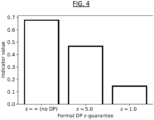
- Results of simulations are shown in FIG. 4 .
- THE layer is trained using DP-Stochastic Gradient Descent (DP-SGD), with batch size 1000, and with varied noise level ⁇ such that different levels of privacy ⁇ are provided.
- DP-SGD DP-Stochastic Gradient Descent
- FIG. 5 shows an example method flow.
- the method may be performed, for example, by a network function (e.g., PANF 202, 302).
- the method may be performed by a core network function.
- the method comprises storing a dataset comprising first data and second data for at least one User Equipment, wherein the first data has been provided to a network function and the second data has not been provided to the network function, and wherein the network function trains a machine learning model based on the first data.
- the method comprises storing ground truth labels for the first data and the second data.
- the method comprises sending information based on the dataset to the network function.
- the method comprises receiving from the network function, information for determining a first value of a loss function, the first value of the loss function indicating a difference between the ground truth labels of the first data and at least one predicted ground truth label of the first data determined by the network function using the machine learning model.
- the method comprises receiving from the network function, information for determining a second value of the loss function, the second value of the loss function indicating a difference between the ground truth labels of the second data and at least one predicted ground truth label of the second data determined by the network function using the machine learning model.
- the method comprises determining a difference between the first value of the loss function and the second value of the loss function.
- the method comprises comparing the difference to a threshold to determine whether a Differential Privacy mechanism was applied to the first data before the network function trained the machine learning model based on the first data.
- FIG. 6 illustrates an example of an apparatus 600 for one or more network functions illustrated in FIG. 1-5 .
- the apparatus 600 may comprise at least one random access memory (RAM) 611a, at least on read only memory (ROM) 611b, at least one processor 612, 613 and a network interface 614.
- the at least one processor 612, 613 may be coupled to the RAM 611a and the ROM 611b.
- the at least one processor 612, 613 may be configured to execute an appropriate software code 615. Execution of the software code 615 may for example may cause the apparatus to perform operations for one or more network functions.
- the software code 615 may be stored in the ROM 611b.
- the apparatus 600 may be interconnected with another apparatus 600 for controlling other network functions of the 5GC. In some embodiments, one or more network functions of the 5GC is deployed or hosted on an apparatus 600. In alternative embodiments, two or more functions of the 5GC may share an apparatus 600.
- FIG. 7 illustrates an example of a communication device 700, such as the terminal illustrated on FIG. 1 .
- the communication device 700 may be provided by any device capable of sending and receiving radio signals.
- Non-limiting examples of a communication device 900 comprise a user equipment, a mobile station (MS) or mobile device such as a mobile phone or what is known as a 'smart phone', a computer provided with a wireless interface card or other wireless interface facility (e.g., USB dongle), a personal data assistant (PDA) or a tablet provided with wireless communication capabilities, a machine-type communications (MTC) device, an Internet of things (IoT) type communication device or any combinations of these or the like.
- the communication device 900 may comprise a transceiver for transmitting and/or receiving, for example, wireless signals carrying communications, for example radio signals.
- the communications may be one or more of voice, electronic mail (email), text messages, multimedia data, machine data and so on.
- the communication device 700 may receive wireless signals (e.g., radio signals) over an air or radio interface 707 via appropriate apparatus for receiving and may transmit wireless signals via appropriate apparatus for transmitting radio signals.
- wireless signals e.g., radio signals
- transceiver is designated schematically by block 706.
- the transceiver 706 may comprise, for example, a radio part and associated antenna arrangement.
- the antenna arrangement may be arranged internally or externally to the mobile device and may comprise one or more antenna elements.
- the antenna arrangement may be a multi-input multi output (MIMO) antenna.
- MIMO multi-input multi output
- the communication device 700 may be provided with at least one processor 701, at least one memory ROM 702a, at least one RAM 702b and other possible components 703 for use in software and hardware aided execution of tasks it is designed to perform, including control of access to and communications with access networks (e.g., the 5G-RAN or NG-RAN illustrated in FIG. 1 ) and other communication devices.
- the at least one processor 701 is coupled to the RAM 702b and the ROM 702a.
- the at least one processor 701 may be configured to execute an appropriate software code 708.
- the software code 708 may for example allow to perform one or more operations of the communication device.
- the software code 708 may be stored in the ROM 702a.
- the processor, the ROM, and the RAM, the transceiver and other circuitry of the communication device can be provided on a circuit board, in chipsets, or in a system on chip.
- the circuit board, chipsets or system on chip is denoted by reference 704.
- the communication device 700 may optionally have a user interface such as key pad 705, touch sensitive screen or pad, combinations thereof or the like.
- a display, a speaker and a microphone may be provided depending on the type of communication device.
- FIG. 8 shows a schematic representation of non-volatile memory media 800a (e.g. computer disc (CD) or digital versatile disc (DVD)) and 800b (e.g. universal serial bus (USB) memory stick) storing instructions and/or parameters 802 which when executed by a processor allow the processor to perform one or more of the steps of any method flow described herein.
- 800a e.g. computer disc (CD) or digital versatile disc (DVD)
- 800b e.g. universal serial bus (USB) memory stick
- references in the above to various network functions may comprise apparatus that perform at least some of the functionality associated with those network functions.
- an apparatus comprising a network function may comprise a virtual network function instance of that network function.
- apparatuses may comprise or be coupled to other units or modules etc., such as radio parts or radio heads, used in or for transmission and/or reception.
- apparatuses have been described as one entity, different modules and memory may be implemented in one or more physical or logical entities.
- the various embodiments may be implemented in hardware or special purpose circuitry, software, logic or any combination thereof. Some aspects of the disclosure may be implemented in hardware, while other aspects may be implemented in firmware or software which may be executed by a controller, microprocessor or other computing device, although the disclosure is not limited thereto. While various aspects of the disclosure may be illustrated and described as block diagrams, flow charts, or using some other pictorial representation, it is well understood that these blocks, apparatus, systems, techniques or methods described herein may be implemented in, as non-limiting examples, hardware, software, firmware, special purpose circuits or logic, general purpose hardware or controller or other computing devices, or some combination thereof.
- circuitry may refer to one or more or all of the following:
- circuitry also covers an implementation of merely a hardware circuit or processor (or multiple processors) or portion of a hardware circuit or processor and its (or their) accompanying software and/or firmware.
- circuitry also covers, for example and if applicable to the particular claim element, a baseband integrated circuit or processor integrated circuit for a mobile device or a similar integrated circuit in server, a cellular network device, or other computing or network device.
- the embodiments of this disclosure may be implemented by computer software executable by a data processor of the mobile device, such as in the processor entity, or by hardware, or by a combination of software and hardware.
- Computer software or program also called program product, including software routines, applets and/or macros, may be stored in any apparatus-readable data storage medium and they comprise program instructions to perform particular tasks.
- a computer program product may comprise one or more computer-executable components which, when the program is run, are configured to carry out embodiments.
- the one or more computer-executable components may be at least one software code or portions of it.
- any blocks of the logic flow as in the Figures may represent program steps, or interconnected logic circuits, blocks and functions, or a combination of program steps and logic circuits, blocks and functions.
- the software may be stored on such physical media as memory chips, or memory blocks implemented within the processor, magnetic media such as hard disk or floppy disks, and optical media such as for example DVD and the data variants thereof, CD.
- the physical media is a non-transitory media.
- non-transitory is a limitation of the medium itself (i.e., tangible, not a signal) as opposed to a limitation on data storage persistency (e.g., RAM vs. ROM).
- the memory may be of any type suitable to the local technical environment and may be implemented using any suitable data storage technology, such as semiconductor based memory devices, magnetic memory devices and systems, optical memory devices and systems, fixed memory and removable memory.
- the data processors may be of any type suitable to the local technical environment, and may comprise one or more of general purpose computers, special purpose computers, microprocessors, digital signal processors (DSPs), application specific integrated circuits (ASIC), FPGA, gate level circuits and processors based on multi core processor architecture, as non-limiting examples.
- Various example embodiments of the disclosure may be practiced in various components such as integrated circuit modules.
- the design of integrated circuits is by and large a highly automated process. Complex and powerful software tools are available for converting a logic level design into a semiconductor circuit design ready to be etched and formed on a semiconductor substrate.
Landscapes
- Engineering & Computer Science (AREA)
- Computer Networks & Wireless Communication (AREA)
- Signal Processing (AREA)
- Theoretical Computer Science (AREA)
- Physics & Mathematics (AREA)
- Software Systems (AREA)
- Artificial Intelligence (AREA)
- Evolutionary Computation (AREA)
- Computing Systems (AREA)
- Data Mining & Analysis (AREA)
- Mathematical Physics (AREA)
- General Physics & Mathematics (AREA)
- General Engineering & Computer Science (AREA)
- Biophysics (AREA)
- Computational Linguistics (AREA)
- General Health & Medical Sciences (AREA)
- Molecular Biology (AREA)
- Biomedical Technology (AREA)
- Life Sciences & Earth Sciences (AREA)
- Health & Medical Sciences (AREA)
- Medical Informatics (AREA)
- Computer Vision & Pattern Recognition (AREA)
- Databases & Information Systems (AREA)
- Computer Security & Cryptography (AREA)
- Data Exchanges In Wide-Area Networks (AREA)
Abstract
Description
- Various example embodiments of this disclosure relate to a method, apparatus, system and computer program for a communications network. Some examples can be used for privacy auditing.
- A communication network can be seen as a facility that enables communications between two or more communication devices, or provides communication devices access to a data network. A mobile or wireless communication network is one example of a communication network. A communication device may be provided with a service by an application server.
- Such communication networks operate in according with standards such as those provided by 3GPP (Third Generation Partnership Project) or ETSI (European Telecommunications Standards Institute). Examples of standards are the so-called 5G (5th Generation) standards provided by 3GPP.
- Some example embodiments of this disclosure will be described with respect to certain aspects. These aspects are not intended to indicate key or essential features of the embodiments of this disclosure, nor are they intended to be used to limit the scope of thereof. Other features, aspects, and elements will be readily apparent to a person skilled in the art in view of this disclosure.
- According to some examples, an apparatus comprising: means for storing a dataset comprising first data and second data for at least one User Equipment, wherein the first data has been provided to a network function and the second data has not been provided to the network function, and wherein the network function trains a machine learning model based on the first data; means for storing ground truth labels for the first data and the second data; means for sending information based on the dataset to the network function; means for receiving, from the network function, information for determining a first value of a loss function, the first value of the loss function indicating a difference between the ground truth labels of the first data and at least one predicted ground truth label of the first data determined by the network function using the machine learning model; means for receiving, from the network function, information for determining a second value of the loss function, the second value of the loss function indicating a difference between the ground truth labels of the second data and at least one predicted ground truth label of the second data determined by the network function using the machine learning model; means for determining a difference between the first value of the loss function and the second value of the loss function; means for comparing the difference to a threshold to determine whether a Differential Privacy mechanism was applied to the first data before the network function trained the machine learning model based on the first data.
- According to some examples, the information for determining a first value of a loss function comprises predicted labels for the first data and the information for determining a first value of a loss function comprises predicted labels for the second data, and the apparatus comprises: means for determining the first value of the loss function based on the predicted labels for the first data and the ground truth labels for the first data; means for determining the first value of the loss function based on the predicted labels for the second data and the ground truth labels for the second data.
- According to some examples, the apparatus comprises: means for sending the predicted labels for the first data to the network function, wherein the information for determining a first value of a loss function comprises predicted labels for the first data and the information for determining a first value of a loss function comprises the first value of the loss function; means for sending the predicted labels for the second data to the network function, wherein the information for determining a second value of a loss function comprises predicted labels for the first data and the information for determining a second value of the loss function comprises the second value of the loss function.
- According to some examples, the dataset is stored in a first matrix, and wherein the apparatus comprises: means for swapping, using a second matrix, columns of the first matrix to provide a third matrix; means for storing the second matrix; wherein the information based on the dataset comprises the third matrix.
- According to some examples, the information for determining the second value of the loss function apparatus comprises a fourth matrix, and wherein the apparatus comprises: means for using the third matrix to swap the columns of the fourth matrix to correspond to an order of the columns of the first matrix.
- According to some examples, the apparatus comprises: means for sending an instruction to the network function to increase the privacy level of a Differential Privacy mechanism for the first data when it is determined that a Differential Privacy mechanism was not applied to the first data.
- According to some examples, the first dataset and/or the second dataset comprises at least one of: temperature measurements from at least one user equipment during a first time period; location data for at least one user equipment during a second time period.
- According to some examples, the apparatus comprises a 5G core network function.
- According to some examples, the network function comprises a Network Data and Analytics Function, NWDAF.
- According to an aspect, there is provided an apparatus comprising at least one processor and at least one memory storing instructions that, when executed by the at least one processor, cause the apparatus at least to: storing a dataset comprising first data and second data for at least one User Equipment, wherein the first data has been provided to a network function and the second data has not been provided to the network function, and wherein the network function trains a machine learning model based on the first data; storing ground truth labels for the first data and the second data; sending information based on the dataset to the network function; receiving, from the network function, information for determining a first value of a loss function, the first value of the loss function indicating a difference between the ground truth labels of the first data and at least one predicted ground truth label of the first data determined by the network function using the machine learning model; receiving, from the network function, information for determining a second value of the loss function, the second value of the loss function indicating a difference between the ground truth labels of the second data and at least one predicted ground truth label of the second data determined by the network function using the machine learning model; determining a difference between the first value of the loss function and the second value of the loss function; comparing the difference to a threshold to determine whether a Differential Privacy mechanism was applied to the first data before the network function trained the machine learning model based on the first data.
- According to some examples, the information for determining a first value of a loss function comprises predicted labels for the first data and the information for determining a first value of a loss function comprises predicted labels for the second data, and the at least one processor may be configured to cause the apparatus to perform: determining the first value of the loss function based on the predicted labels for the first data and the ground truth labels for the first data; determining the first value of the loss function based on the predicted labels for the second data and the ground truth labels for the second data.
- According to some examples, the at least one processor may be configured to cause the apparatus to perform: sending the predicted labels for the first data to the network function, wherein the information for determining a first value of a loss function comprises predicted labels for the first data and the information for determining a first value of a loss function comprises the first value of the loss function; sending the predicted labels for the second data to the network function, wherein the information for determining a second value of a loss function comprises predicted labels for the first data and the information for determining a second value of the loss function comprises the second value of the loss function.
- According to some examples, the dataset is stored in a first matrix, and the at least one processor may be configured to cause the apparatus to perform: swapping, using a second matrix, columns of the first matrix to provide a third matrix; storing the second matrix; wherein the information based on the dataset comprises the third matrix.
- According to some examples, the information for determining the second value of the loss function apparatus comprises a fourth matrix, and the at least one processor may be configured to cause the apparatus to perform: using the third matrix to swap the columns of the fourth matrix to correspond to an order of the columns of the first matrix.
- According to some examples, the at least one processor may be configured to cause the apparatus to perform: sending an instruction to the network function to increase the privacy level of a Differential Privacy mechanism for the first data when it is determined that a Differential Privacy mechanism was not applied to the first data.
- According to some examples, the first dataset and/or the second dataset comprises at least one of: temperature measurements from at least one user equipment during a first time period; location data for at least one user equipment during a second time period.
- According to some examples, the apparatus comprises a 5G core network function.
- According to some examples, the network function comprises a Network Data and Analytics Function, NWDAF.
- According to an aspect, there is provided a method comprising: storing a dataset comprising first data and second data for at least one User Equipment, wherein the first data has been provided to a network function and the second data has not been provided to the network function, and wherein the network function trains a machine learning model based on the first data; storing ground truth labels for the first data and the second data; sending information based on the dataset to the network function; receiving, from the network function, information for determining a first value of a loss function, the first value of the loss function indicating a difference between the ground truth labels of the first data and at least one predicted ground truth label of the first data determined by the network function using the machine learning model; receiving, from the network function, information for determining a second value of the loss function, the second value of the loss function indicating a difference between the ground truth labels of the second data and at least one predicted ground truth label of the second data determined by the network function using the machine learning model; determining a difference between the first value of the loss function and the second value of the loss function; comparing the difference to a threshold to determine whether a Differential Privacy mechanism was applied to the first data before the network function trained the machine learning model based on the first data.
- According to some examples, the information for determining a first value of a loss function comprises predicted labels for the first data and the information for determining a first value of a loss function comprises predicted labels for the second data, and the method comprises: determining the first value of the loss function based on the predicted labels for the first data and the ground truth labels for the first data; determining the first value of the loss function based on the predicted labels for the second data and the ground truth labels for the second data.
- According to some examples, the method comprises: sending the predicted labels for the first data to the network function, wherein the information for determining a first value of a loss function comprises predicted labels for the first data and the information for determining a first value of a loss function comprises the first value of the loss function; sending the predicted labels for the second data to the network function, wherein the information for determining a second value of a loss function comprises predicted labels for the first data and the information for determining a second value of the loss function comprises the second value of the loss function.
- According to some examples, the dataset is stored in a first matrix, and the method comprises: swapping, using a second matrix, columns of the first matrix to provide a third matrix; storing the second matrix; wherein the information based on the dataset comprises the third matrix.
- According to some examples, the information for determining the second value of the loss function apparatus comprises a fourth matrix, and the method comprises: using the third matrix to swap the columns of the fourth matrix to correspond to an order of the columns of the first matrix.
- According to some examples, the method comprises: sending an instruction to the network function to increase the privacy level of a Differential Privacy mechanism for the first data when it is determined that a Differential Privacy mechanism was not applied to the first data.
- According to some examples, the first dataset and/or the second dataset comprises at least one of: temperature measurements from at least one user equipment during a first time period; location data for at least one user equipment during a second time period.
- According to some examples, the method is performed by a 5G core network function.
- According to some examples, the network function comprises a Network Data and Analytics Function, NWDAF.
- According to an aspect, there is provided a computer readable medium comprising instructions which, when executed by an apparatus, cause the apparatus to perform at least the following: storing a dataset comprising first data and second data for at least one User Equipment, wherein the first data has been provided to a network function and the second data has not been provided to the network function, and wherein the network function trains a machine learning model based on the first data; storing ground truth labels for the first data and the second data; sending information based on the dataset to the network function; receiving, from the network function, information for determining a first value of a loss function, the first value of the loss function indicating a difference between the ground truth labels of the first data and at least one predicted ground truth label of the first data determined by the network function using the machine learning model; receiving, from the network function, information for determining a second value of the loss function, the second value of the loss function indicating a difference between the ground truth labels of the second data and at least one predicted ground truth label of the second data determined by the network function using the machine learning model; determining a difference between the first value of the loss function and the second value of the loss function; comparing the difference to a threshold to determine whether a Differential Privacy mechanism was applied to the first data before the network function trained the machine learning model based on the first data.
- According to an aspect, there is provided a non-transitory computer readable medium comprising program instructions that, when executed by an apparatus, cause the apparatus to perform at least the method according to any of the preceding aspects.
- In the above, many different embodiments have been described. It should be appreciated that further embodiments may be provided by the combination of any two or more of the embodiments described above.
- Some example embodiments will now be described, by way of non-limiting and illustrative example only, with reference to the accompanying Figures in which:
-
FIG. 1 shows a representation of a 5th generation communication system; -
FIG. 2 shows a first example algorithm; -
FIG. 3 shows a second example algorithm; -
FIG. 4 shows results of an example simulation; -
FIG. 5 shows an example method; -
FIG. 6 shows a representation of an apparatus for the communication system ofFIG. 1 according to some example embodiments; -
FIG. 7 shows a representation of an apparatus according to some example embodiments; and -
FIG. 8 shows a schematic representation of a non-volatile memory medium storing instructions which when executed by a processor allow a processor to perform one or more of the steps of the methods disclosed herein. - In communications networks, the network may be requested to maintain a certain level of privacy of an identity of a User Equipment (UE). The request may be sent from the UE, for example, or could be requested by another entity in the network. The request may be to preserve the privacy of the UE, at least partially, using Privacy Enhancing Technologies (PET) or by anonymizing data from the UE. Some examples described herein provide a method, system and computer program for verifying whether the privacy request for the UE is respected in the network. For example, the network may respect the request by receiving the privacy request, processing the privacy request and successful implementing the condition(s) in the privacy request.
- After verifying whether the privacy request has been respected or not, the verification results can be provided to the UE. In some examples, the verification results can be provided to other network entities. This can be useful in communications networks (e.g., 5G, 6G networks) comprising software or components from different operators, and an inter-operator UE privacy verification is required (e.g., so that one operator can determine that another operator is correctly respecting UE privacy requests).
- In the following various example embodiments are explained with reference to communication devices capable of communication with a communication system. Before explaining in detail the embodiments of the methods and apparatuses of the present disclosure, a 5th generation communication system (5GS), an access network and a core network (5GC) thereof, and communication devices are briefly explained with reference to
FIG. 1 . -
FIG 1 shows a schematic representation of a 5G communication system (5GS). The 5GS may comprise a user equipment (UE), an access network such as a 5G radio access network (5G-RAN) or next generation radio access network (NG-RAN), a 5G core network (5GC), and one or more application functions. An application function may be deployed in the 5GS as trusted application function or may be deployed or host on one or more application servers of the data network. Such application functions are untrusted application functions. The 5GS connects the UE to a data network the access network and the 5GC (e.g., a UPF of the 5GC). - The 5G-RAN may comprise one or more radio access nodes, such as gNodeB (GNB). A gNB may include one or more gNodeB (GNB) distributed units connected to one or more gNodeB (GNB) centralized units.
- The 5GC may comprise the following network functions: Network Slice Selection Function (NSSF); Network Exposure Function; Network Repository Function (NRF); Policy Control Function (PCF); Unified Data Management (UDM); Application Function (AF); Authentication Server Function (AUSF); an Access and Mobility Management Function (AMF); and Session Management Function (SMF), and a user plane function (UPF).
FIG. 1 also shows the various interfaces (N1, N2 etc.) that may be implemented between the various elements of the system. Some examples consider federated training of ML models with differential privacy (DP). Commonly, in DP Federated Learning (FL) methods, noise is added (with a certain tractable distribution, e.g. Gaussian) to the model updates to enhance privacy. - Consider a DP version of the gradient descent algorithm. DP gradient descent (DP-GD) differs from GD such that sample-wise gradients of a random mini-batch are clipped to have L2 -norm at most C (a pre-defined constant) and normally distributed noise with variance σ2 is added to the sum of gradients. One iteration of the algorithm is given by:
 (0, C 2 σ 2), and η denotes the learning and N denotes the total number of data points.
- The DP mechanism that can be analysed here is the total noisy gradient:

- The (ε, δ)-DP guarantee (Dwork, C., McSherry, F., Nissim, K., & Smith, A. (2006). Calibrating noise to sensitivity in private data analysis. In Theory of Cryptography: Third Theory of Cryptography Conference, TCC 2006, New York, NY, USA, March 4-7, 2006. Proceedings 3 (pp. 265-284). Springer Berlin Heidelberg) is obtained by, e.g., an analytic bound

- In general, in DP methods the total privacy guarantees depend on the sensitivity of the local function fi (Xi ) and on the total amount of added noise variance. δ can be a fixed value. The value of δ can be small (for example, 1/n, where N is the total size of the dataset). The claie of ε describes the level of privacy protection, and is determined by various parameters (here by the noise level only since delta is fixed). However, without some rather computationally and architecturally demanding procedures, the only participant who knows whether user i added its share of noise is the user i. Suppose only m users (m < n) actually add the noise. Then the model will have epsilon that is

- Consider an example where there is a collusion attack between n - 1 users and the server, such that n - 1 users would send some vectors known to the server which completely reveal the noisy message to the nth user, i.e., the message yn would then have (ε, δ)-DP protection for ε given by


- Examples perform auditing by determining whether a machine learning model used in the network has been trained using training data that respects a privacy request for a UE identity. This can be performed by comparing loss values or prediction accuracy measurements for the trained machine learning model when using the training data and when using test data. The test data has not been processed using PET or to anonymise the test data. When the training data has not been processed using PET (e.g., to anonymise the data or to remove at least some user identifiable data), when the trained ML model performs predictions using the training data and the test data, the trained ML model should perform better on the training data than on the test data. Threshold/statistical testing schemes can therefore analyse how much better the trained ML model performs making predictions on the training data than on the test data, to determine whether the training data has been processed using PET as requested.
- Examples related to auditing privacy. This can be performed by a network function, which is described herein as a Privacy Auditing Network Function (PANF). In some examples, the PANF is a core network function.
- The PANF can be used to detect the presence of a DP mechanism in training a dataset at an AI/ML Network Function (NF) /Application Function (AF), e.g., Network Data Analytics Function (NWDAF). In the method described herein, the PANF does not require heaving access to the trained network's weights, such that the AI/ML NF/AF can be treated as a blackbox. This is useful in situations where the trained NN is private, such that it may not be feasible for some parties to gain access to the trained NN (the trained NN could be an industry secret, for example).
- The method requires the following datasets to be provided by the data owners:
- 1) A set of un-processed (raw) training dataset, which is given to the AI/ML trainer NF.
- 2) A set of un-processed (raw) test dataset, which has not been given to the AI/ML trainer.
- An example algorithm that can be performed at the PANF is shown in
FIG. 2 . Operations performed byPANF 202 can be used to determine whether DP has been used on data used to train an AI model (e.g., a Neural Network (NN)) at NF/AF 200 (e.g., an NWDAF). - At 204,
PANF 202 stores raw training data and raw test data in a raw dataset X = [xs : xr ], where xs comprises the training data and xr comprises the test data. The raw training dataset comprises data given to the AI/ML trainer NF 200. The raw test data comprises data that has not been given to the AI/ML trainer. The raw training data and raw test data may be collected from a group of UEs to determine an AI/ML model for making predictions for the group of UEs.PANF 202 also has access to labels Y = [ys ; yr ] for the raw dataset. These labels Y may be considered ground truth labels. - At 206, the raw dataset X = [xs : xr ] T is shuffled at random. Data from different UEs is shuffled at random. Shuffling comprises swapping columns of matrix X at random. The shuffling key(s) can be stored local at 202. For example, the shuffled raw data may comprise Xp = XP, where P is a shuffling matrix.
- At 208,
PANF 202 sends Xp to networkfunction 200 where the trained AI model/NN is stored. At 208,PANF 202 requests predictions from the trained AI model to predict labels Yp' = F(Xp ). As the data has been shuffled, it is difficult fornetwork function 200 to determine which UE is being tested/audited. This can prevent data tampering bynetwork function 200. - At 210,
PANF 202 uses the shuffling key(s) stored atPANF 202 to de-shuffle the output Yp ' and re-order the output in the same order as X. This can be performed using the following operation: [AII_UE_Training; AII_UE_Test] data: Y' = Yp'P -1 = [y's :y'r ] T. - At 210,
PANF 202 can compute the loss function of the predictions Y' and the corresponding ground truth labels Y to determine a value of a loss function for the training data, L1 ,and a value of a loss function for the test data, L2 . This can be performed using the following operations. - a. Loss_All_UE_Training: L 1 = L(y's , ys )
- b. Loss_All_UE_Test L 2 = L(y'r , yr )
- At 212,
PANF 202 determines whether L 1-L 2 > Tdp , where Tdp is a threshold value for determining whether DP has been used for training the AI model at NF/AF 200. If L_1 - L_2 > Tdp : No DP has been used. Else: DP has been used. - The threshold Tdp could be empirically achieved by
PANF 202 by trying with different number of datasets, NN outputs, and by changing the privacy level (ε, δ). The threshold Tdp can be determined experimentally. - An example algorithm that can be performed at the PANF is shown in
FIG. 3 . The method ofFIG. 3 is similar to the method ofFIG. 2 , except that the loss values are determined at NF/AF 300 (e.g., a NWDAF). Operations performed byPANF 302 can be used to determine whether DP has been used on data used to train an AI model (e.g., a Neural Network (NN)) at NF/AF 300 (e.g., an NWDAF). - At 304,
PANF 302 stores raw training data and raw test data in a raw dataset X = [xs : xr ] T , where xs comprises the training data and xr comprises the training data. The raw training dataset comprises data given to the AI/ML trainer NF 300. The raw test data comprises data that has not been given to the AI/ML trainer. The raw training data and raw test data may be collected from a group of UEs to determine an AI/ML model for making predictions for the group of UEs.PANF 302 also has access to labels Y = [ys ; yr ] T for the raw dataset. These labels Y may be considered ground truth labels. - At 306, the raw dataset X = [xs : xr ] T is shuffled at random. Data from different UEs is shuffled at random. Shuffling comprises swapping columns of matrix X at random. The shuffling key(s) can be stored local at 302. For example, the shuffled raw data may comprise Xp = XP, where P is a shuffling matrix.
- At 306, the labels Y are also shuffled using the same shuffling key(s) (P). Shuffling comprises swapping columns of matrix Y at random. For example, the shuffled raw data may comprise Yp = YP, where P is a shuffling matrix.
- At 308,
PANF 302 sends Xp and Yp and to networkfunction 300 where the trained AI model/NN is stored. At 308,PANF 302 requests values for a loss function to be provided from the trained AI model to predict Lp = L(Y'p , Yp ). As the data has been shuffled, it is difficult fornetwork function 300 to determine which UE is being tested/audited. This can prevent data tampering bynetwork function 300. - At 310,
PANF 302 uses the shuffling key(s) stored atPANF 302 to de-shuffle the output Lp and re-order the output in the same order as X. This can be performed using the following operation: Use the shuffling keys to de-shuffle the output according to and re-order them too: [AII_UE_Training; AII_UE_Test] data: L = LpP -1 = [L 1: L 2] T - At 314,
PANF 302 determines whether L 1 -L2 > Tdp , where Tdp is a threshold value for determining whether DP has been used for training the AI model at NF/AF 300. If L_1 - L_2 > Tdp : No DP has been used. Else: DP has been used. - The threshold Tdp could be empirically achieved by
PANF 302 by trying with different number of datasets, NN outputs, and by changing the privacy level (ε, δ). The threshold Tdp can be determined experimentally. - An explanation is given below for the reasoning of using difference between loss values for the raw training data and for raw test data as an indicator that DP has been used for an AI model.
- Suppose there is a deterministic discrete-valued score function l which depends on the model parameters and a single data element x. Suppose the model parameters are output of training algorithm M(D) which takes as an input dataset D. Denote D + the dataset which includes x and D- the dataset where x is replaced by another data element.
- By the post-processing property of DP, we have that

- Denote by D the actual training dataset and denote by Atrain and Atest the auditing training and test sets, respectively. I.e., Atrain is part of D and Atest is not. Support both have m data elements. The DP property above indicates that the distributions


- This value should actually be directly related to the lower bound for the (ε, δ)-guarantees of the mechanism M. The larger the Indicator-value, the weaker the privacy guarantees of M should be.
- Results of simulations are shown in
FIG. 4 . - Consider a classification problem where train the last layer (fully connected layer) of a Resnet-18 network (He, K., Zhang, X., Ren, S., & Sun, J. (2016). Deep residual learning for image recognition. In Proceedings of the IEEE conference on computer vision and pattern recognition (pp. 770-778).) that is pre-trained with a subset of Imagenet (Deng, J., Dong, W., Socher, R., Li, L. J., Li, K., & Fei-Fei, L. (2009, June). Imagenet: A large-scale hierarchical image database. In 2009 IEEE conference on computer vision and pattern recognition (pp. 248-255). IEEE). The weights are obtained from the Torchvision library. Consider using the training split (50000 samples) of CIFAR-10 image dataset.
- THE layer is trained using DP-Stochastic Gradient Descent (DP-SGD), with batch size 1000, and with varied noise level σ such that different levels of privacy ε are provided.
- 1000 samples from the training data are randomly taken to be the "auditing train set" and 1000 samples are only taken to the to be the "auditing test set". The "auditing train set" is part of the training data for the model, the "auditing test set" is excluded. We measure the average loss over these two auditing sets along the training iteration and compute the Indicator described above.
- With three different values of the noise scale σ, the following is observed. Three different noise scales σ, to obtain three different formal ε-guarantees (for δ = 10-5) after 100 epochs of training. Here ε = 1.0 means a strong level of privacy protection and ε = 5.0 an intermediate level of privacy protection. It can be inferred whether there is DP by observing the value of the indicator. We make a threshold based on running experiments using similar datasets. E.g., here we could set 0.5 as a threshold in case the aggregator had promised intermediate DP guarantees.
-
FIG. 5 shows an example method flow. The method may be performed, for example, by a network function (e.g.,PANF 202, 302). The method may be performed by a core network function. - At 500, the method comprises storing a dataset comprising first data and second data for at least one User Equipment, wherein the first data has been provided to a network function and the second data has not been provided to the network function, and wherein the network function trains a machine learning model based on the first data.
- At 502, the method comprises storing ground truth labels for the first data and the second data.
- At 504, the method comprises sending information based on the dataset to the network function.
- At 506, the method comprises receiving from the network function, information for determining a first value of a loss function, the first value of the loss function indicating a difference between the ground truth labels of the first data and at least one predicted ground truth label of the first data determined by the network function using the machine learning model.
- At 508, the method comprises receiving from the network function, information for determining a second value of the loss function, the second value of the loss function indicating a difference between the ground truth labels of the second data and at least one predicted ground truth label of the second data determined by the network function using the machine learning model.
- At 510, the method comprises determining a difference between the first value of the loss function and the second value of the loss function.
- At 512, the method comprises comparing the difference to a threshold to determine whether a Differential Privacy mechanism was applied to the first data before the network function trained the machine learning model based on the first data.
-
FIG. 6 illustrates an example of anapparatus 600 for one or more network functions illustrated inFIG. 1-5 . Theapparatus 600 may comprise at least one random access memory (RAM) 611a, at least on read only memory (ROM) 611b, at least oneprocessor network interface 614. The at least oneprocessor RAM 611a and theROM 611b. The at least oneprocessor appropriate software code 615. Execution of thesoftware code 615 may for example may cause the apparatus to perform operations for one or more network functions. Thesoftware code 615 may be stored in theROM 611b. Theapparatus 600 may be interconnected with anotherapparatus 600 for controlling other network functions of the 5GC. In some embodiments, one or more network functions of the 5GC is deployed or hosted on anapparatus 600. In alternative embodiments, two or more functions of the 5GC may share anapparatus 600. -
FIG. 7 illustrates an example of acommunication device 700, such as the terminal illustrated onFIG. 1 . Thecommunication device 700 may be provided by any device capable of sending and receiving radio signals. Non-limiting examples of a communication device 900 comprise a user equipment, a mobile station (MS) or mobile device such as a mobile phone or what is known as a 'smart phone', a computer provided with a wireless interface card or other wireless interface facility (e.g., USB dongle), a personal data assistant (PDA) or a tablet provided with wireless communication capabilities, a machine-type communications (MTC) device, an Internet of things (IoT) type communication device or any combinations of these or the like. The communication device 900 may comprise a transceiver for transmitting and/or receiving, for example, wireless signals carrying communications, for example radio signals. The communications may be one or more of voice, electronic mail (email), text messages, multimedia data, machine data and so on. - The
communication device 700 may receive wireless signals (e.g., radio signals) over an air orradio interface 707 via appropriate apparatus for receiving and may transmit wireless signals via appropriate apparatus for transmitting radio signals. InFIG. 7 transceiver is designated schematically byblock 706. Thetransceiver 706 may comprise, for example, a radio part and associated antenna arrangement. The antenna arrangement may be arranged internally or externally to the mobile device and may comprise one or more antenna elements. The antenna arrangement may be a multi-input multi output (MIMO) antenna. - The
communication device 700 may be provided with at least oneprocessor 701, at least onememory ROM 702a, at least oneRAM 702b and otherpossible components 703 for use in software and hardware aided execution of tasks it is designed to perform, including control of access to and communications with access networks (e.g., the 5G-RAN or NG-RAN illustrated inFIG. 1 ) and other communication devices. The at least oneprocessor 701 is coupled to theRAM 702b and theROM 702a. The at least oneprocessor 701 may be configured to execute anappropriate software code 708. Thesoftware code 708 may for example allow to perform one or more operations of the communication device. Thesoftware code 708 may be stored in theROM 702a. - The processor, the ROM, and the RAM, the transceiver and other circuitry of the communication device (e.g., a modem) can be provided on a circuit board, in chipsets, or in a system on chip. The circuit board, chipsets or system on chip is denoted by
reference 704. Thecommunication device 700 may optionally have a user interface such askey pad 705, touch sensitive screen or pad, combinations thereof or the like. Optionally one or more of a display, a speaker and a microphone may be provided depending on the type of communication device. -
FIG. 8 shows a schematic representation ofnon-volatile memory media 800a (e.g. computer disc (CD) or digital versatile disc (DVD)) and 800b (e.g. universal serial bus (USB) memory stick) storing instructions and/orparameters 802 which when executed by a processor allow the processor to perform one or more of the steps of any method flow described herein. - It is understood that references in the above to various network functions (e.g., to an AMF, an SMF, TNF etc.) may comprise apparatus that perform at least some of the functionality associated with those network functions. Further, an apparatus comprising a network function may comprise a virtual network function instance of that network function.
- It should be understood that the apparatuses may comprise or be coupled to other units or modules etc., such as radio parts or radio heads, used in or for transmission and/or reception. Although the apparatuses have been described as one entity, different modules and memory may be implemented in one or more physical or logical entities.
- It is noted that whilst some embodiments have been described in relation to 5G networks, similar principles can be applied in relation to other networks and communication systems. Therefore, although certain embodiments were described above by way of example with reference to certain example architectures for wireless networks, technologies and standards, embodiments may be applied to any other suitable forms of communication systems than those illustrated and described herein.
- It is also noted herein that while the above describes example embodiments, there are several variations and modifications which may be made to the disclosed solution without departing from the scope of the present invention.
- As used herein, "at least one of the following: <a list of two or more elements>" and "at least one of <a list of two or more elements>" and similar wording, where the list of two or more elements are joined by "and" or "or", mean at least any one of the elements, or at least any two or more of the elements, or at least all the elements.
- In general, the various embodiments may be implemented in hardware or special purpose circuitry, software, logic or any combination thereof. Some aspects of the disclosure may be implemented in hardware, while other aspects may be implemented in firmware or software which may be executed by a controller, microprocessor or other computing device, although the disclosure is not limited thereto. While various aspects of the disclosure may be illustrated and described as block diagrams, flow charts, or using some other pictorial representation, it is well understood that these blocks, apparatus, systems, techniques or methods described herein may be implemented in, as non-limiting examples, hardware, software, firmware, special purpose circuits or logic, general purpose hardware or controller or other computing devices, or some combination thereof.
- As used herein, the term "circuitry" may refer to one or more or all of the following:
- (a) hardware-only circuit implementations (such as implementations in only analog and/or digital circuitry) and
- (b) combinations of hardware circuits and software, such as (as applicable):
- (i) a combination of analog and/or digital hardware circuit(s) with software/firmware and
- (ii) any portions of hardware processor(s) with software (including digital signal processor(s)), software, and memory(ies) that work together to cause an apparatus, such as a mobile phone or server, to perform various functions) and
- (c) hardware circuit(s) and or processor(s), such as a microprocessor(s) or a portion of a microprocessor(s), that requires software (e.g., firmware) for operation, but the software may not be present when it is not needed for operation."
- This definition of circuitry applies to all uses of the term "means" herein, including in any claims. As a further example, as used herein, the term circuitry also covers an implementation of merely a hardware circuit or processor (or multiple processors) or portion of a hardware circuit or processor and its (or their) accompanying software and/or firmware. The term circuitry also covers, for example and if applicable to the particular claim element, a baseband integrated circuit or processor integrated circuit for a mobile device or a similar integrated circuit in server, a cellular network device, or other computing or network device.
- The embodiments of this disclosure may be implemented by computer software executable by a data processor of the mobile device, such as in the processor entity, or by hardware, or by a combination of software and hardware. Computer software or program, also called program product, including software routines, applets and/or macros, may be stored in any apparatus-readable data storage medium and they comprise program instructions to perform particular tasks. A computer program product may comprise one or more computer-executable components which, when the program is run, are configured to carry out embodiments. The one or more computer-executable components may be at least one software code or portions of it.
- Further in this regard it should be noted that any blocks of the logic flow as in the Figures may represent program steps, or interconnected logic circuits, blocks and functions, or a combination of program steps and logic circuits, blocks and functions. The software may be stored on such physical media as memory chips, or memory blocks implemented within the processor, magnetic media such as hard disk or floppy disks, and optical media such as for example DVD and the data variants thereof, CD. The physical media is a non-transitory media.
- The term "non-transitory," as used herein, is a limitation of the medium itself (i.e., tangible, not a signal) as opposed to a limitation on data storage persistency (e.g., RAM vs. ROM).
- The memory may be of any type suitable to the local technical environment and may be implemented using any suitable data storage technology, such as semiconductor based memory devices, magnetic memory devices and systems, optical memory devices and systems, fixed memory and removable memory. The data processors may be of any type suitable to the local technical environment, and may comprise one or more of general purpose computers, special purpose computers, microprocessors, digital signal processors (DSPs), application specific integrated circuits (ASIC), FPGA, gate level circuits and processors based on multi core processor architecture, as non-limiting examples.
- Various example embodiments of the disclosure may be practiced in various components such as integrated circuit modules. The design of integrated circuits is by and large a highly automated process. Complex and powerful software tools are available for converting a logic level design into a semiconductor circuit design ready to be etched and formed on a semiconductor substrate.
- The scope of protection sought for various example embodiments of the disclosure is set out by the independent claims. The example embodiments and features thereof, if any, described in this disclosure that do not fall under the scope of the independent claims are to be interpreted as examples useful for understanding various example embodiments of the disclosure.
- The foregoing description has provided, by way of non-limiting and illustrative examples, a full and informative description of the various example embodiments of this disclosure. However, various modifications and adaptations may become apparent to those skilled in the relevant arts in view of the foregoing description, when read in conjunction with the accompanying drawings and the claims. However, all such and similar modifications of the teachings will still fall within the various example embodiments of the disclosure as set forth in the claims. By way of non-limiting and illustrative example, there is a further example embodiment comprising a combination of one or more example embodiments with any of the other example embodiments previously discussed.
Claims (15)
- An apparatus comprising:means for storing (500) a dataset comprising first data and second data for at least one User Equipment, wherein the first data has been provided to a network function and the second data has not been provided to the network function during a training of a machine learning model, and wherein the network function trains the machine learning model based on the first data;means for storing (502) ground truth labels for the first data and the second data;means for sending (504) a representation of the dataset to the network function;means for receiving (506), from the network function, information for determining a first value of a loss function, the first value of the loss function indicating a difference between the ground truth labels of the first data and at least one predicted ground truth label of the first data determined by the network function using the machine learning model;means for receiving (508), from the network function, information for determining a second value of the loss function, the second value of the loss function indicating a difference between the ground truth labels of the second data and at least one predicted ground truth label of the second data determined by the network function using the machine learning model;means for determining (510) a difference between the first value of the loss function and the second value of the loss function;means for comparing (512) the difference to a threshold to determine whether a Differential Privacy mechanism was applied to the first data before the network function trained the machine learning model based on the first data.
- The apparatus according to claim 1, wherein the information for determining the first value of the loss function comprises the predicted labels for the first data and the predicted labels for the second data, and wherein the apparatus comprises:means for determining the first value of the loss function based on the predicted labels for the first data and the ground truth labels for the first data;means for determining the first value of the loss function based on the predicted labels for the second data and the ground truth labels for the second data.
- The apparatus according to claim 1, wherein the apparatus comprises:means for sending the predicted labels for the first data to the network function, wherein the information for determining the first value of the loss function comprises the predicted labels for the first data and the first value of the loss function;means for sending the predicted labels for the second data to the network function, wherein the information for determining the second value of the loss function comprises the predicted labels for the first data and the second value of the loss function.
- An apparatus according to any preceding claim, wherein the dataset is stored in a first matrix, and wherein the apparatus comprises:means for swapping, using a second matrix, columns of the first matrix to provide a third matrix;means for storing the second matrix;wherein the representation of the dataset comprises the third matrix.
- An apparatus according to claim 4, wherein the information for determining the second value of the loss function apparatus comprises a fourth matrix, and wherein the apparatus comprises:
means for using the third matrix to swap the columns of the fourth matrix to correspond to an order of the columns of the first matrix. - An apparatus according to any preceding claim, wherein the apparatus comprises:
means for sending an instruction to the network function to increase the privacy level of a Differential Privacy mechanism for the first data when it is determined that a Differential Privacy mechanism was not applied to the first data. - An apparatus according to any preceding claim, wherein the first dataset and/or the second dataset comprises at least one of:temperature measurements from at least one user equipment during a first time period;location data for at least one user equipment during a second time period.
- An apparatus according to any preceding claim, wherein the apparatus comprises a 5G core network function.
- An apparatus according to any preceding claim, wherein the network function comprises a Network Data and Analytics Function, NWDAF.
- A method comprising:storing (500) a dataset comprising first data and second data for at least one User Equipment, wherein the first data has been provided to a network function and the second data has not been provided to the network function during a training of a machine learning model, and wherein the network function trains the machine learning model based on the first data;storing (502) ground truth labels for the first data and the second data;sending (504) a representation of the dataset to the network function;receiving (506), from the network function, information for determining a first value of a loss function, the first value of the loss function indicating a difference between the ground truth labels of the first data and at least one predicted ground truth label of the first data determined by the network function using the machine learning model;receiving (508), from the network function, information for determining a second value of the loss function, the second value of the loss function indicating a difference between the ground truth labels of the second data and at least one predicted ground truth label of the second data determined by the network function using the machine learning model;determining (510) a difference between the first value of the loss function and the second value of the loss function; andcomparing (512) the difference to a threshold to determine whether a Differential Privacy mechanism was applied to the first data before the network function trained the machine learning model based on the first data.
- The method according to claim 10, wherein the information for determining the first value of the loss function comprises the predicted labels for the first data the predicted labels for the second data, and wherein the method comprises:determining the first value of the loss function based on the predicted labels for the first data and the ground truth labels for the first data;determining the first value of the loss function based on the predicted labels for the second data and the ground truth labels for the second data.
- The method according to claim 10, wherein the method comprises:sending the predicted labels for the first data to the network function, wherein the information for determining the first value of the loss function comprises the predicted labels for the first data and the first value of the loss function;sending the predicted labels for the second data to the network function, wherein the information for determining the second value of the loss function comprises the predicted labels for the first data and the second value of the loss function.
- The method according to any of claims 10 to 12, wherein the dataset is stored in a first matrix, and wherein the method comprises:swapping, using a second matrix, columns of the first matrix to provide a third matrix;storing the second matrix;wherein the representation of the dataset comprises the third matrix.
- The method according to claim 13, wherein the information for determining the second value of the loss function apparatus comprises a fourth matrix, and wherein the method comprises: using the third matrix to swap the columns of the fourth matrix to correspond to an order of the columns of the first matrix.
- A computer program comprising instructions stored thereon for performing at least the following:storing (500) a dataset comprising first data and second data for at least one User Equipment, wherein the first data has been provided to a network function and the second data has not been provided to the network function, and wherein the network function trains a machine learning model based on the first data;storing (502) ground truth labels for the first data and the second data;sending (504) a representation of the dataset to the network function;receiving (506), from the network function, information for determining a first value of a loss function, the first value of the loss function indicating a difference between the ground truth labels of the first data and at least one predicted ground truth label of the first data determined by the network function using the machine learning model;receiving (508), from the network function, information for determining a second value of the loss function, the second value of the loss function indicating a difference between the ground truth labels of the second data and at least one predicted ground truth label of the second data determined by the network function using the machine learning model;determining (510) a difference between the first value of the loss function and the second value of the loss function; andcomparing (512) the difference to a threshold to determine whether a Differential Privacy mechanism was applied to the first data before the network function trained the machine learning model based on the first data.
Applications Claiming Priority (1)
| Application Number | Priority Date | Filing Date | Title |
|---|---|---|---|
| FI20236277 | 2023-11-17 |
Publications (2)
| Publication Number | Publication Date |
|---|---|
| EP4557790A1 true EP4557790A1 (en) | 2025-05-21 |
| EP4557790B1 EP4557790B1 (en) | 2026-04-08 |
Family
ID=93460441
Family Applications (1)
| Application Number | Title | Priority Date | Filing Date |
|---|---|---|---|
| EP24211730.7A Active EP4557790B1 (en) | 2023-11-17 | 2024-11-08 | Method, apparatus and computer program |
Country Status (3)
| Country | Link |
|---|---|
| US (1) | US20250168658A1 (en) |
| EP (1) | EP4557790B1 (en) |
| CN (1) | CN120021209A (en) |
Citations (3)
| Publication number | Priority date | Publication date | Assignee | Title |
|---|---|---|---|---|
| US20210382962A1 (en) * | 2015-10-16 | 2021-12-09 | Google Llc | Systems and Methods of Distributed Optimization |
| US20220108213A1 (en) * | 2020-10-02 | 2022-04-07 | Nvidia Corporation | Differential privacy dataset generation using generative models |
| CN116911382A (en) * | 2023-07-14 | 2023-10-20 | 重庆三峡学院 | Asynchronous aggregation and privacy protection methods in resource-limited federated edge learning |
-
2024
- 2024-11-07 US US18/939,723 patent/US20250168658A1/en active Pending
- 2024-11-08 EP EP24211730.7A patent/EP4557790B1/en active Active
- 2024-11-15 CN CN202411634814.0A patent/CN120021209A/en active Pending
Patent Citations (3)
| Publication number | Priority date | Publication date | Assignee | Title |
|---|---|---|---|---|
| US20210382962A1 (en) * | 2015-10-16 | 2021-12-09 | Google Llc | Systems and Methods of Distributed Optimization |
| US20220108213A1 (en) * | 2020-10-02 | 2022-04-07 | Nvidia Corporation | Differential privacy dataset generation using generative models |
| CN116911382A (en) * | 2023-07-14 | 2023-10-20 | 重庆三峡学院 | Asynchronous aggregation and privacy protection methods in resource-limited federated edge learning |
Non-Patent Citations (3)
| Title |
|---|
| DENG, J.DONG, W.SOCHER, R.LI, L. J.LI, K.FEI-FEI, L.: "2009 IEEE conference on computer vision and pattern recognition", June 2009, IEEE, article "Imagenet: A large-scale hierarchical image database", pages: 248 - 255 |
| DWORK, C.MCSHERRY, F.NISSIM, KSMITH, A.: "TCC", 2006, SPRINGER BERLIN HEIDELBERG, article "Calibrating noise to sensitivity in private data analysis. In Theory of Cryptography: Third Theory of Cryptography Conference", pages: 265 - 284 |
| HE, K.ZHANG, X.REN, S.SUN, J.: "Deep residual learning for image recognition.", PROCEEDINGS OF THE IEEE CONFERENCE ON COMPUTER VISION AND PATTERN RECOGNITION, 2016, pages 770 - 778, XP055536240, DOI: 10.1109/CVPR.2016.90 |
Also Published As
| Publication number | Publication date |
|---|---|
| EP4557790B1 (en) | 2026-04-08 |
| US20250168658A1 (en) | 2025-05-22 |
| CN120021209A (en) | 2025-05-20 |
Similar Documents
| Publication | Publication Date | Title |
|---|---|---|
| CN108520181B (en) | Data model training method and device | |
| US12056582B2 (en) | Method and device for training a model based on federated learning | |
| US11972213B2 (en) | Event recognition method and apparatus, model training method and apparatus, and storage medium | |
| US12190211B2 (en) | Privacy enhanced machine learning | |
| CN106034149B (en) | Account identification method and device | |
| CN111932269B (en) | Equipment information processing method and device | |
| CN110008984B (en) | Target fraud transaction model training method and device based on multitasking samples | |
| US10063562B1 (en) | Flexible access management framework based on measuring application usage behavior | |
| EP2037386A1 (en) | Method and apparatus for a community-based trust | |
| EP3543922A1 (en) | Method and device for identifying risk of service to be processed and electronic device | |
| CN118568695A (en) | Digital security management method and system based on block chain | |
| CN110348471B (en) | Abnormal object identification method, device, medium and electronic equipment | |
| JP7052879B2 (en) | Learner estimation device, learner estimation method, risk assessment device, risk assessment method, program | |
| US20180137421A1 (en) | Information processing apparatus, information processing method, and non-transitory computer readable storage medium | |
| US20230362593A1 (en) | Systems and methods for utilizing models to identify location spoofing by user equipment | |
| CN111611390B (en) | A data processing method and device | |
| CN117349899A (en) | Sensitive data processing method, system and storage medium based on forgetting model | |
| CN113891323B (en) | WiFi-based user tag acquisition system | |
| US20260127506A1 (en) | Hierarchical Gradient Averaging For Enforcing Subject Level Privacy | |
| Rogerson | Scan statistics adjusted for global spatial autocorrelation | |
| CN118796439A (en) | Computing node scheduling method, device, equipment and computer storage medium | |
| EP4557790B1 (en) | Method, apparatus and computer program | |
| JP2019159612A (en) | Learning program, learning method and learning device | |
| EP4315134A1 (en) | Classification model evaluation | |
| KR20190101690A (en) | Method of detecting abnormality of security log data using generative adversarial networks and apparatuses performing the same |
Legal Events
| Date | Code | Title | Description |
|---|---|---|---|
| PUAI | Public reference made under article 153(3) epc to a published international application that has entered the european phase |
Free format text: ORIGINAL CODE: 0009012 |
|
| STAA | Information on the status of an ep patent application or granted ep patent |
Free format text: STATUS: THE APPLICATION HAS BEEN PUBLISHED |
|
| AK | Designated contracting states |
Kind code of ref document: A1 Designated state(s): AL AT BE BG CH CY CZ DE DK EE ES FI FR GB GR HR HU IE IS IT LI LT LU LV MC ME MK MT NL NO PL PT RO RS SE SI SK SM TR |
|
| STAA | Information on the status of an ep patent application or granted ep patent |
Free format text: STATUS: REQUEST FOR EXAMINATION WAS MADE |
|
| GRAP | Despatch of communication of intention to grant a patent |
Free format text: ORIGINAL CODE: EPIDOSNIGR1 |
|
| STAA | Information on the status of an ep patent application or granted ep patent |
Free format text: STATUS: GRANT OF PATENT IS INTENDED |
|
| 17P | Request for examination filed |
Effective date: 20251121 |
|
| INTG | Intention to grant announced |
Effective date: 20251210 |
|
| GRAS | Grant fee paid |
Free format text: ORIGINAL CODE: EPIDOSNIGR3 |
|
| GRAA | (expected) grant |
Free format text: ORIGINAL CODE: 0009210 |
|
| STAA | Information on the status of an ep patent application or granted ep patent |
Free format text: STATUS: THE PATENT HAS BEEN GRANTED |
|
| AK | Designated contracting states |
Kind code of ref document: B1 Designated state(s): AL AT BE BG CH CY CZ DE DK EE ES FI FR GB GR HR HU IE IS IT LI LT LU LV MC ME MK MT NL NO PL PT RO RS SE SI SK SM TR |
|
| REG | Reference to a national code |
Ref country code: CH Ref legal event code: F10 Free format text: ST27 STATUS EVENT CODE: U-0-0-F10-F00 (AS PROVIDED BY THE NATIONAL OFFICE) Effective date: 20260408 Ref country code: GB Ref legal event code: FG4D |
|
| REG | Reference to a national code |
Ref country code: DE Ref legal event code: R096 Ref document number: 602024003842 Country of ref document: DE |