EP4557125A1 - Data access control for domain specific large language model services - Google Patents
Data access control for domain specific large language model services Download PDFInfo
- Publication number
- EP4557125A1 EP4557125A1 EP24206364.2A EP24206364A EP4557125A1 EP 4557125 A1 EP4557125 A1 EP 4557125A1 EP 24206364 A EP24206364 A EP 24206364A EP 4557125 A1 EP4557125 A1 EP 4557125A1
- Authority
- EP
- European Patent Office
- Prior art keywords
- llm
- access
- attributes
- computer
- application
- Prior art date
- Legal status (The legal status is an assumption and is not a legal conclusion. Google has not performed a legal analysis and makes no representation as to the accuracy of the status listed.)
- Pending
Links
Images


Classifications
-
- G—PHYSICS
- G06—COMPUTING OR CALCULATING; COUNTING
- G06F—ELECTRIC DIGITAL DATA PROCESSING
- G06F16/00—Information retrieval; Database structures therefor; File system structures therefor
- G06F16/90—Details of database functions independent of the retrieved data types
- G06F16/95—Retrieval from the web
- G06F16/953—Querying, e.g. by the use of web search engines
- G06F16/9535—Search customisation based on user profiles and personalisation
-
- G—PHYSICS
- G06—COMPUTING OR CALCULATING; COUNTING
- G06F—ELECTRIC DIGITAL DATA PROCESSING
- G06F16/00—Information retrieval; Database structures therefor; File system structures therefor
- G06F16/30—Information retrieval; Database structures therefor; File system structures therefor of unstructured textual data
- G06F16/33—Querying
- G06F16/332—Query formulation
- G06F16/3329—Natural language query formulation
-
- G—PHYSICS
- G06—COMPUTING OR CALCULATING; COUNTING
- G06F—ELECTRIC DIGITAL DATA PROCESSING
- G06F16/00—Information retrieval; Database structures therefor; File system structures therefor
- G06F16/30—Information retrieval; Database structures therefor; File system structures therefor of unstructured textual data
- G06F16/33—Querying
- G06F16/332—Query formulation
- G06F16/3329—Natural language query formulation
- G06F16/33295—Natural language query formulation in dialogue systems
-
- G—PHYSICS
- G06—COMPUTING OR CALCULATING; COUNTING
- G06F—ELECTRIC DIGITAL DATA PROCESSING
- G06F16/00—Information retrieval; Database structures therefor; File system structures therefor
- G06F16/30—Information retrieval; Database structures therefor; File system structures therefor of unstructured textual data
- G06F16/33—Querying
- G06F16/3331—Query processing
- G06F16/334—Query execution
- G06F16/3344—Query execution using natural language analysis
-
- G—PHYSICS
- G06—COMPUTING OR CALCULATING; COUNTING
- G06F—ELECTRIC DIGITAL DATA PROCESSING
- G06F16/00—Information retrieval; Database structures therefor; File system structures therefor
- G06F16/30—Information retrieval; Database structures therefor; File system structures therefor of unstructured textual data
- G06F16/33—Querying
- G06F16/335—Filtering based on additional data, e.g. user or group profiles
-
- G—PHYSICS
- G06—COMPUTING OR CALCULATING; COUNTING
- G06F—ELECTRIC DIGITAL DATA PROCESSING
- G06F16/00—Information retrieval; Database structures therefor; File system structures therefor
- G06F16/90—Details of database functions independent of the retrieved data types
- G06F16/903—Querying
- G06F16/9032—Query formulation
- G06F16/90332—Natural language query formulation or dialogue systems
-
- G—PHYSICS
- G06—COMPUTING OR CALCULATING; COUNTING
- G06F—ELECTRIC DIGITAL DATA PROCESSING
- G06F16/00—Information retrieval; Database structures therefor; File system structures therefor
- G06F16/90—Details of database functions independent of the retrieved data types
- G06F16/903—Querying
- G06F16/9035—Filtering based on additional data, e.g. user or group profiles
-
- G—PHYSICS
- G06—COMPUTING OR CALCULATING; COUNTING
- G06F—ELECTRIC DIGITAL DATA PROCESSING
- G06F21/00—Security arrangements for protecting computers, components thereof, programs or data against unauthorised activity
- G06F21/60—Protecting data
- G06F21/62—Protecting access to data via a platform, e.g. using keys or access control rules
- G06F21/6218—Protecting access to data via a platform, e.g. using keys or access control rules to a system of files or objects, e.g. local or distributed file system or database
- G06F21/6227—Protecting access to data via a platform, e.g. using keys or access control rules to a system of files or objects, e.g. local or distributed file system or database where protection concerns the structure of data, e.g. records, types, queries
-
- G—PHYSICS
- G06—COMPUTING OR CALCULATING; COUNTING
- G06F—ELECTRIC DIGITAL DATA PROCESSING
- G06F40/00—Handling natural language data
- G06F40/20—Natural language analysis
-
- G—PHYSICS
- G06—COMPUTING OR CALCULATING; COUNTING
- G06N—COMPUTING ARRANGEMENTS BASED ON SPECIFIC COMPUTATIONAL MODELS
- G06N20/00—Machine learning
Definitions
- the present disclosure generally relates to large language models (LLMs) and more specifically to data access control for large language model services.
- LLMs large language models
- LLMs can be trained to perform a variety of domain tailored services. For example, an application with many data domains can use multiple specialized LLMs with heterogeneous privacy commitments for executing the domain tailored services.
- the LLMs cannot be statically implemented but can be configurable and extensible by customers.
- Generating specialized LLMs can include implementing domain specific configurations and adjusting the LLMs to minimize the errors present in the output of the LLMs.
- configuring LLMs can include adjusting models according to different data requirements and privacy commitments. Domain specific LLMs are expected to evolve, requiring continuous adjustments.
- Implementations of the present disclosure are directed to large language model (LLM) services. More particularly, implementations of the present disclosure are directed to data access control for applications using LLMs for generative artificial intelligence.
- LLM large language model
- a method includes: receiving, by one or more processors from a user, a request to access attributes of an application object, determining, by the one or more processors, a large language model (LLM) object access layer defining an access level of the user to each attribute of the application object, querying, by the one or more processors, the LLM object access layer, to determine accessible attributes of the attributes of the application object, and providing, by the one or more processors, a response based on the accessible attributes of the application object to the user.
- LLM large language model
- implementations can each optionally include one or more of the following features, alone or in combination.
- implementations can include all the following features:
- the LLM object access layer includes a filter configured to determine the accessible attributes using a filter configuration.
- the LLM object access layer accesses a prompt generator to create a content for prompts sent to an external LLM to retrieve the accessible attributes.
- the computer-implemented method further includes interpreting, by the one or more processors, a question, using an application logic, to determine a context of the question.
- the computer-implemented method further includes determining a domain of an LLM configured to access the accessible attributes is based on processing the context of the question.
- the computer-implemented method further includes applying, by the one or more processors, a filtering configuration corresponding to the context of the question.
- the computer-implemented method further includes generating, by the one or more processors, an entry in an access log indicating the accessible attributes determined for the context of the question.
- the computer-implemented method further includes LLM includes a lifecycle including time varying terms and conditions.
- the computer-implemented method further includes determining, by the one or more processors, an action to be executed in response to determining the accessible attributes.
- the application object includes object nodes, each node including one or more attributes.
- implementations of the aspect include corresponding systems, apparatus, and computer programs, configured to perform the actions of the methods, encoded on computer storage devices.
- the present disclosure also provides a computer-readable storage medium coupled to one or more processors and having instructions stored thereon which, when executed by the one or more processors, cause the one or more processors to perform operations in accordance with implementations of the methods provided herein.
- the present disclosure further provides a system for implementing the methods provided herein.
- the system includes one or more processors, and a computer-readable storage medium coupled to the one or more processors having instructions stored thereon which, when executed by the one or more processors, cause the one or more processors to perform operations in accordance with implementations of the methods provided herein.
- Implementations described in the present disclosure provide access to application data by LLMs in a transparent way.
- Configurations can be pre-defined by users (software vendors), and are changeable by the users of the application, without modifications to application code.
- An advantage of the described technology is that it provides user access rights for database objects or by creating projection views or other data access control techniques. Configurations can be defined per application object or database table. The configurations can be re-usable for access by many LLMs, but the configuration can be adjusted to particular LLMs to increase an output accuracy.
- the described technology can ease access management and reduce storage costs for maintenance in case LLM terms and conditions change.
- the described data access control approach allows logging access by LLM to granted data and blocked access attempts.
- Another advantage of the described technology is that the described logging access allows users (e.g., developers) to optimize access settings, to optimize LLM use, or to optimize other aspects of the application with superior insight into actual access statistics in production use.
- Implementations of the present disclosure are directed to techniques and tools for large language models (LLMs). More particularly, implementations of the present disclosure are directed to applications using LLMs for generative artificial intelligence (AI), the applications being deployed "on-premise” or being provided "as a service.”
- the described implementations provide access to attributes of an application LLM object, according to user access levels and privacy demands for each attribute of the application object.
- An LLM object access layer can be queried to determine accessible attributes of the attributes of the application object.
- the accessible attributes of the application object can be provided.
- the data of the application can be provided to the LLM using the application object access layer.
- the application object access layer can be used to read the data either by a "large language model” directly using a "plug-in” in a callback fashion, or by using an application code, which can create the content for the "prompts" which are sent to the model.
- the application object access layer can be configured per LLM domain, by the provider (vendor) for each application object individually, specifying nodes and attributes which are accessible. Since in an enterprise resource planning application, multiple domains can be managed, and several different LLMs can be specialized to particular domains, the application object access layer can be configured per domain, to determine which application objects (AO) access can be granted.
- the attribute access control protocol described in the present disclosure enables configuration of user access levels and privacy demands for application objects and their respective attributes.
- a subset of the application objects of an application can be defined as being relevant for a particular LLM domain.
- Individual nodes and attributes of an AO have different sensitivity levels.
- a fine-grained access management, configurable per LLM domain and even per LLM service are configurable by system administrators, in addition to pre-defined defaults defined by the software vendor for well-known LLM service providers and their respective policies.
- An advantage of the implementations described in the present disclosure is that they provide access to application data by LLMs in a transparent way, using an access configuration that can be extended or restricted depending on the model privacy policy.
- Configurations can define which attribute values and ranges are usable and accessible by particular models, which allows to define different models for the same domain, the different models corresponding to different target groups (e.g., regions).
- the access configurations can be pre-defined by users (e.g., software vendors), and are changeable by the users of the application, without modifications to application code.
- Another advantage of the described technology is that it provides user access rights for database objects or by creating projection views or other data access control techniques.
- Configurations can be defined per application object or database table.
- the configurations can be re-usable for access by many LLMs, but the configuration can be adjusted to particular LLMs.
- the mechanism can ease access management and reduce time, effort, delay for maintenance in case LLM terms and conditions change.
- the described data access control approach allows logging access by LLM to the granted data and blocked access attempts.
- the access log includes granted access and rejected access requests for individual models that can be analyzed (by developers and system administrators) to optimize access settings, to optimize LLM use, or to optimize other aspects of the application with superior insight into actual access statistics in production use.
- the requested information can be used to optimize the application setup.
- the access level can also be correlated to user satisfaction feedback on the quality of the application with respect to particular queries (collected in the access log and correlated).
- the access logs enable entities to gain transparency about the amount of data and which data elements are accessed by each LLM, which can be used as a selection criterion of one model over another. Selection of particular models can maximize the respective data access control performances.
- collaboratively training the model versions can reduce configurations rearchitecting, while promoting optimal performance of evolving LLMs. Other advantages of the data access control techniques are described with reference to FIGS. 1-6 .
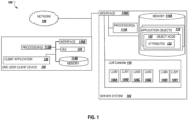
- FIG. 1 is a block diagram illustrating an example system 100 for data access control for LLMs.
- the illustrated example system 100 includes or is communicably coupled with a server system 102, an end-user client device 104, and a network 106.
- functionality of two or more systems or servers can be provided by a single system or server.
- functionality of one illustrated system, server, or component can be provided by multiple systems, servers, or components, respectively.
- the server system 102 is intended to represent various forms of servers including, but not limited to a web server, an application server, a proxy server, a network server, and/or a server pool.
- server systems 102 accept requests for application services and provides such services to any number of end-user client devices 104 (e.g., the client device 104 over the network 106).
- the server system 102 can host a solution environment that can be a cloud environment providing software applications, systems, and services that can be consumed by customers as a service.
- the server system 102 can support configuring of various LLMs 108A-108Y for users (tenants) of different types that are selectable through an LLM controller 110.
- the server system 102 includes a processor 112A, a memory 114A, and an interface 116A.
- the memory 114A can include application objects 118, each application object 118 including one or more object nodes 120, each object node 120 including one or more attributes 122. Particular portions (object nodes 120 and attributes 122) are accessible by LLMs 108A-108Y according to data access configurations.
- the end-user client device 104 can be communicatively coupled to the server system 102, through the network 106.
- the network 106 can include a large computer network, such as a local area network (LAN), a wide area network (WAN), the Internet, a cellular network, a telephone network or an appropriate combination thereof connecting any number of communication devices, mobile computing devices, fixed computing devices and server systems.
- Data exchanged over the network 106 is transferred using any number of network layer protocols, such as Internet Protocol (IP), Multiprotocol Label Switching (MPLS), Asynchronous Transfer Mode (ATM), and Frame Relay.
- IP Internet Protocol
- MPLS Multiprotocol Label Switching
- ATM Asynchronous Transfer Mode
- Frame Relay Frame Relay
- the network 106 represents a combination of multiple sub-networks
- different network layer protocols are used at each of the underlying sub-networks.
- the network 106 represents one or more interconnected internetworks, such as the public Internet.
- the end-user client device 104 can be any computing device operable to connect to or communicate in the network(s) 106 using a wireline or wireless connection.
- the end-user client device 104 includes an electronic computer device operable to receive, transmit, process, and store any appropriate data associated with the system 100 of FIG. 1 .
- the end-user client device 104 is generally intended to encompass any client computing device such as a laptop/notebook computer, wireless data port, smart phone, personal data assistant (PDA), tablet computing device, one or more processors within these devices, or any other suitable processing device.
- the client device 104 includes interface(s) 116B, processor(s) 112B, memory 114B, and graphical user interface 124A.
- the end-user client device 104 can include one or more client applications 126.
- the client application 126 can be any type of application that allows a client device to request and view content on the client device (e.g., generate a request for using a particular LLM 108 to control data access).
- a client application 126 can use parameters, metadata, and other API and event dependency information received at launch to access a particular LLM 108 from the server system 102.
- a client application 126 can be an agent or client-side version of the one or more enterprise applications running on an enterprise server (not shown).
- the end-user client device 104 can include a computer that includes an input device, such as a keypad, touch screen, or other device that can accept user information, and an output device that conveys information associated with the operation of the server system 102, or the client device itself, including digital data, visual information, or a GUI 124, respectively.
- an input device such as a keypad, touch screen, or other device that can accept user information
- an output device that conveys information associated with the operation of the server system 102, or the client device itself, including digital data, visual information, or a GUI 124, respectively.
- the GUI 124 can interface with at least a portion of the system 100 for any suitable purpose, including generating a visual representation of the client application 126 or the application 126, respectively.
- the GUI 124 can be used to view and navigate various Web pages.
- the GUI 124 provides the user with an efficient and user-friendly presentation of data provided by or communicated within the system 100.
- the GUI 124 can include multiple customizable frames or views having interactive fields, pull-down lists, and buttons operated by the user.
- the GUI 124 can include any suitable graphical user interface, such as a combination of a generic web browser, intelligent engine, and command line interface (CLI) that processes information and efficiently presents the results to the user visually.
- CLI command line interface
- Each processor 112A, 112B included in the server system 102 or the end-user client device 104 can be a central processing unit (CPU), an application specific integrated circuit (ASIC), a field-programmable gate array (FPGA), or another suitable component.
- each processor 112A, 112B included in the server system 102 or the end-user client device 104 executes instructions and manipulates data to perform the operations of the server system 102 or the end-user client device 104, respectively.
- each processor 112A, 112B included in the server system 102 or the end-user client device 104 executes the functionality required to process/ send requests to access attributes of an application object.
- Each processor 112A, 112B can be a central processing unit (CPU), a blade, an application specific integrated circuit (ASIC), a field-programmable gate array (FPGA), or another suitable component.
- Each processor 112A, 112B executes instructions and manipulates data to perform the operations of the respective system. Specifically, each processor 112A, 112B executes the functionality required to receive and respond to requests from the respective system (the server system 102, the end-user client device 104), for example.
- Interfaces 116A, 116B are used by the server system 102 and the end-user client device 104, respectively, for communicating with other systems in a distributed environment - including within the system 100 - connected to the network 106.
- the interfaces 116A, 116B each include logic encoded in software and/or hardware in a suitable combination and operable to communicate with the network 106.
- the interfaces 116A, 116B can each include software supporting one or more communication protocols associated with communications such that the network 106 or interface's hardware is operable to communicate physical signals within and outside of the illustrated system 100.
- the memory 114A, 114B can include any type of memory or database module and can take the form of volatile and/or non-volatile memory including, without limitation, magnetic media, optical media, random access memory (RAM), read-only memory (ROM), removable media, or any other suitable local or remote memory component.
- the memory 114A, 114B can store various objects or data, including caches, classes, frameworks, applications, backup data, application objects, jobs, web pages, web page templates, database tables, database queries, repositories storing application data and/or dynamic information, and any other appropriate information including any parameters, variables, algorithms, instructions, rules, constraints, or references thereto associated with the purposes of the server system 102 and the end-user client device 104, respectively.
- client devices there can be any number of end-user client devices associated with, or external to, the system 100. Additionally, there can also be one or more additional client devices external to the illustrated portion of system 100 that are capable of interacting with the system 100 using the network(s) 106. Further, the term “client,” “client device,” and “user” can be used interchangeably as appropriate without departing from the scope of the disclosure. Moreover, while client device can be described in terms of being used by a single user, the disclosure contemplates that many users can use one computer, or that one user can use multiple computers. As used in the present disclosure, the term "computer” is intended to encompass any suitable processing device. For example, although FIG.
- the system 100 can be implemented using a single, stand-alone computing device, two or more servers 102, or multiple client devices.
- the server system 102 and the end-user client device 104 can include any computer or processing device such as, for example, a blade server, general-purpose personal computer (PC), Mac ® , workstation, UNIX-based workstation, or any other suitable device.
- PC general-purpose personal computer
- Mac ® workstation
- UNIX-based workstation or any other suitable device.
- the present disclosure contemplates computers other than general purpose computers, as well as computers without conventional operating systems.
- server system 102 and the end-user client device 104 can be adapted to execute any operating system or runtime environment, including Linux, UNIX, Windows, Mac OS ® , Java TM , Android TM , iOS, BSD (Berkeley Software Distribution) or any other suitable operating system.
- server system 102 can also include or be communicably coupled with an e-mail server, a Web server, a caching server, a streaming data server, and/or another suitable server.
- "software” can include computer-readable instructions, firmware, wired and/or programmed hardware, or any combination thereof on a tangible medium (transitory or non-transitory, as appropriate) operable when executed to perform at least the processes and operations described herein. Indeed, each software component can be fully or partially written or described in any appropriate computer language including C, C++, Java TM , JavaScript ® , Visual Basic, assembler, Perl ® , ABAP (Advanced Business Application Programming), ABAP OO (Object Oriented), any suitable version of 4GL, as well as others. While portions of the software illustrated in FIG.
- an application using LLMs 108 can be developed and tested with particular LLM instance versions 108A-108Y for different LLM domains.
- the test results can be processed to select LLM instance versions 108A-108X working best (e.g., generating lowest number of errors) with the application.
- the selected LLM instance versions 108A-108X can be provided with the application upon initial release.
- Development teams accessing user devices 104) can identify a portion of the selected LLMs 108A-108D that satisfy a set of terms and conditions provided by an entity (e.g., vendor).
- LLMs 108A-108D can be run in the memory 114 of the server system 102, and the data being sent to the model can be controlled by the server system 102 of an application vendor.
- an application development can configure that the application can send also more sensitive (like person related) data.
- LLMs 108A-108Y can be configured to be provided by a user device 104 of a third-party vendor. If an LLM 108A is received from a user device 104 of a third-party vendor, the development team (accessing another user device 104) can analyze the terms and conditions. If the provider of a model is guaranteeing data privacy, the development team can approve transmission of particular sensitive data.
- the LLM configuration can be deployed as data in the configuration tables that map each LLM 108A-108Y to a respective domain LLM-filter-configuration.
- the LLM controller 110 can include a LLM Application Object Access Layer (LAOAL).
- LAOAL of the LLM controller 110 can be configured for a set of different LLMs 108A-108Y, each being configured to access a particular data set (including selected accessible object nodes 120 and attributes 122).
- the LAOAL of the LLM controller 110 can be connected to the interface 116A called by the interface 116B of the user device 104 that specifies for which LLM 109A, 108B, or 108Y the data is being read.
- the LAOAL of the LLM controller 110 reads data from memory 114A using a respective "filter", ensuring that only allowed application objects 118, nodes 120, and attributes 122 are read and exposed. Further details regarding the data access control are described in detail with reference to FIGS. 2-6 .
- FIG. 2 depicts a schematic diagram illustrating an example application object 200 (e.g., application object 118 described with reference to FIG. 1 ) that can be accessed by a large language model (e.g., LLM 108A-108Y described with reference to FIG. 1 ), in accordance with some example embodiments.
- the example application object 200 illustrated in FIG. 2 is provided according to a format used by a human resource department of an organization that can have multiple entities associated to it, the application objects defining personal data of the associated entities. Even though the example application object 200 illustrated in FIG. 2 is described in the context example of the human resource department of an organization, the application objects can be formatted according to any department of the organization.
- the example application object 200 can be associated to an entity 202.
- the example application object 200 can include multiple object nodes 204A, 204 B. Each of the object nodes 204A, 204 B includes multiple attributes 206A, 206B. One or more of the object nodes 204 B can include one or more object instances 208A, 208B. The object instances 208A, 208B include respective attributes 210A, 210B.
- the entity 202 can be identified using an entity (employee or consumer) identifier.
- the identifier can include an alphanumeric identifier (including an identifier of the entity type relative to an organization entity, such as the employer of the employee).
- the object nodes 204A, 204B can include a name 212A and/or a period 212B.
- the attributes 206A, 206B can be formatted according to their respective object node 204A, 204B. For example, attributes 206A corresponding to the object node 204A including the name 212A can include a first name 216A, a middle name 216B, and a last name 216C.
- the attributes 206B corresponding to the object node 204B including the period 212B can include a valid from 216A, valid until 216B, and active status 216C.
- the object instances 208A, 208B can include address 218A, and tax information 218B.
- the attributes 210A, 210B can be formatted according to their respective object instance 208A, 208B.
- attributes 210A corresponding to the object instance 208A including the address 218A can include a street name 216A, a zip code 220B, a city name 220C, and a state/country name 220D.
- the attributes 210B corresponding to the object instance 208B including the tax 218B can include a tax class 222A, dependents 222B, and non-profit donation 222C.
- a particular LLM can be configured to be granted access to a first portion of the attributes (first name attribute 214A) of the object node 204A and can be prevented from accessing a second portion of the attributes (middle and last name attributes 214B, 214C) of the object node 204A.
- the LLM can be configured to be granted access to a first portion of the attributes (valid from 216A and valid until 216B) of the object node 204B and can be prevented from accessing a second portion of the attributes (active status 216C 214B, 214C) of the object node 204B.
- the LLM can be configured to be granted access to a first portion of the attributes (city 220C and country 220D) of the object instance 208A and can be prevented from accessing a second portion of the attributes (street 220A and zip code 220B) of the object instance 208A.
- the LLM can be configured to be granted access to all attributes 210B of the object instance 208B.
- the selection of the accessible attributes per object node and instance can be independent from each other, such that a portion of (or all) attributes of an object node or object instance can be accessible, while a portion of (or all) attributes of another object node or object instance can be inaccessible for the particular LLM.
- An access configuration for the LLM can be updated at any time, such that access to any of the attributes by the LLM can be modified (switched from accessible to inaccessible or vice versa).
- FIG. 3 depicts a schematic diagram illustrating an example of a filter configuration 300 for large language models adjustments.
- FIG. 3 depicts a filter configuration 300 that can define data access control based on application objects 302, default access definitions 304, applicable LLM domains 306, and implemented LLM adjustments 308.
- the example filter configuration 300 illustrated in FIG. 3 is provided according to a format applicable to multiple domains 306 that can correspond to departments of an organization (e.g., a human resource department, customer department, hazardous goods) or categories of data stored by an organization that can have multiple entities associated to it.
- the application objects can define personal data of entities associated to the organization and/or items produced and/or handled by the organization.
- the example filter configuration 300 can include multiple application objects 302A-302H, for which the access filter can be set to standard default values 304A or customizable settings 304B. Each of the LLM domain 306A-306H can be associated to a particular LLM adjustment 308 of a particular LLM 308A-308F. For example, a subset of the application objects 302A-302H can be identified as relevant for a particular LLM domain 306A-306H.
- the example filter configuration 300 can reflect different sensitivity levels of individual nodes and attributes of the application objects 302A-302H.
- Adjustable access management includes configuring the LLM domain and the LLM service (in case several services are connected for the same domain, handling different sections of the complete data set) by system administrators, in addition to pre-defined defaults 304A defined by the software vendor for well-known LLM service providers and their respective policies.
- FIG. 4 depicts a schematic example architecture 400 configured to provide data access control for applications using large language models (e.g., LLM 108A-108Y described with reference to FIG. 1 and LLM 308A-308F described with reference to FIG. 3 ).
- the schematic example architecture 400 includes a chat bot 402, an application logic 404, a LLM selector 406, a LLM plug-in 408, an application object model 410, a LLM domain map 412, an application object access layer 414, a configuration filter 416, an application object 418, an access log 420, a prompt generator 422, one or more external LLMs 424A, 424B, and respective one or more external LLM plug-ins 426A, 426B.
- a chat bot 402 includes a chat bot 402, an application logic 404, a LLM selector 406, a LLM plug-in 408, an application object model 410, a LLM domain map 412, an application object access layer 414, a configuration filter 416, an application
- the chat bot 402 is configured to execute an automated process in response to a user input received from a user device.
- the user input can include a question for the application chat bot 402 (e.g., the question can be about legal regulations regarding retirement or pension terms for one employee).
- the chat bot can include a machine learning model trained to perform a question answering task.
- the machine learning model can be subjected to supervised pre-training, for example, to perform a question answering task before the machine learning model is fine-tuned to perform the question generation task.
- the chat bot 402 can include a machine learning controller that can collaboratively train the machine learning model to perform a question generation task including by adjusting one or more weights applied by the first machine learning model generating one or more questions in order to minimize an error in an output of the machine learning model.
- the machine learning model can still require fine-tuning in order to perform a question generation task.
- the fine-tuning can include the machine learning model 115a performing the question generation task to generate one or more questions, which are then answered by performing the question answering task.
- the weights applied by the first machine learning model can be adjusted through backpropagation of the error (or another optimization technique) present in the output of the machine learning model.
- the trained machine learning model can be deployed, for example, to the natural language processing engine in order to perform a question generation task and/or a question answering task associated with the natural language processing application.
- the natural language processing engine can receive, from the client user device, a request to perform a natural language processing task for accessing data associated to an employee.
- the natural language processing engine can apply the machine learning model to generate a query executable by the application logic 404 configured to answer a question.
- the chat bot 402 can send the query to the application logic 404 for processing.
- an application embedded in a computing system hosting the chat bot 402 can be used to interpret the question before it is sent to a matching external LLM service, including the right data needed in the context of the question.
- the chat bot 402 queries the internal application logic 404 to analyze the user question.
- the internal application logic 404 can send the analysis results to an LLM selector 406 to determine, which configured LLMs to be queried to answer the user question.
- the LLM selector 406 can include or be coupled to the LLM plug-in 408 that has access to the application object model 410 and can map the question to application object types (e.g., an "employee") of the questions data domain (e.g., "human resources") using the LLM domain map 412.
- application object types e.g., an "employee”
- questions data domain e.g., "human resources
- the LLM selector 406 has access to the application object instances 418 through the LAOAL 414 that includes a filter 428 and a logger 430.
- the LLM selector 406 can query for more information for entities mentioned in the question (e.g., query for information of the mentioned employee, like in which country the employee residing (let's assume it is "EU") or which jurisdiction is relevant for the particular employee).
- the LAOAL 414 reads the configuration and transmits access information for storage in the access log 420.
- the LLM selector 406 can access the LLM-domain-map 412 (e.g., configuration tables that map each LLM to a respective domain LLM-filter-configuration) to determine the domain of the question and to select a suitable configured external LLM 424A, 424B. For example, applicable rules and laws (e.g., "labor law") of a respective domain are identified.
- the LLM selector 406 can select a model instance relevant for employees in a particular jurisdiction (e.g., "U.S.A" or "E.U.”).
- the LLM selector 406 returns the information to the application logic 404.
- the returned information includes a recommendation to use the identified suitable configured external LLM 424A, 424B for the identified domain "labor law", the identified attribute value "EU”, for the identified employee "John Doe.”
- the application logic 404 transmits the request to the prompt generator 422.
- the application logic 404 generates a query for the application object instance using the required information to generate, using the prompt generator 422, the prompt (e.g., additional relevant attributes about employee "John Doe").
- the prompt generator 422 can access the application object using the LAOAL 414, specifying that the information is for the external LLM 424A, 424B.
- the LAOAL 414 is provided with the information, that the data access is to be evaluated for the external LLM 424A, 424B.
- the LAOAL 414 queries the LLM filter configuration 416.
- the LLM filter configuration 416 is read in a "layered" fashion: First the default configuration for the application object is read.
- LLM filter configuration 416 Potential entries for the LLM domain are read from the LLM filter configuration 416, which overwrite the default (e.g., domain "labor law").
- a potential configuration for the external LLM 424A, 424B is read, which can overwrite the LLM domain settings.
- the LAOAL 414 writes an entry to the access log 420, that for a model of the external LLM 424A, 424B a query has been received.
- the entry in the access log 420 can also include, which attributes have been provided and which have been rejected.
- the LAOAL 414 reads the data considering the access constraints read from the LLM filter configuration 416 and sends the data back to the prompt generator 422.
- the prompt generator 422 passes the created prompt (including the retrieved data from the LAOAL 414 to the application logic 404.
- the application logic 404 calls the identified external LLM 424A, 424B.
- the application logic 404 calls the configured external LLM 424A, 424B and sends the generated prompt and potentially, the initial question by the user. For example, a processed or a cleaned or a normalized variant of the question can be sent.
- the external LLM 424A, 424B can optionally, if configured and required, calls the external LLM plug-in 426A, 426B provided by the application for the model.
- the model can create a query and send the query to the respective external LLM plug-in 426A, 426B.
- the external LLM plug-in 426A, 426B queries data from the LAOAL 414.
- the LAOAL 414 reads the filter configuration, writes access log and retrieves data.
- the respective external LLM plug-in 426A, 426B can provide the read data to the respective external LLM 424A, 424B.
- the external LLM plug-in 426A, 426B can compute the response and can send the response to the application logic 404, which derives an action to be executed or response to be sent to the user device, which had submitted the question.
- FIG. 5 depicts a flowchart illustrating an example process 500 for data access control for applications using large language models, in accordance with some example embodiments.
- the process 500 can be performed by any components of the example system 100 and/or example architecture 400.
- a question is received.
- the question can be provided as a user input to a chat bot.
- the question can include a request for conditions (e.g., legal regulations, law and employer conditions) regarding a status (e.g., vacation, medical leave, extended leave, retirement or pension terms) for one employee (identified using an identifier such a s a name or an employee number) of an entity (e.g., an employer having multiple employees).
- conditions e.g., legal regulations, law and employer conditions
- a status e.g., vacation, medical leave, extended leave, retirement or pension terms
- the question is processed to interpret the question based on a context of the question, to generate an application processable query.
- the question is processed using a machine learning model configured to perform a question answering task.
- the machine learning model can include a machine learning model pre-trained and fine-tuned to perform the question answering task.by interpreting the question to determine the context of the question and to generate the application processable query.
- a questions data domain is determined by accessing an identified application object model and by mapping the question, based on its context, to application object types (e.g., an "employee") of the question data domain.
- the question data domain can correspond to a department and/or a section of the entity (e.g., "human resource department”).
- accessible attributes are determined by querying, the LLM object access layer.
- the LLM object access layer includes a filter configured to determine the accessible attributes using a filter configuration.
- the LLM object access layer accesses a prompt generator to create a content for prompts sent to an external LLM to retrieve the accessible attributes.
- the configuration provided by the application vendor defines application objects and attributes, which can be accessed by particular LLMs. The configuration is based on the vendor assessment of data privacy of a typical customer of the application.
- the configuration can include policies of entities (e.g., companies and organizations) defining how data access can be accessed. For example, the configurations can be adjusted to include the constraints of the company accessing application objects. Configuration defining data access levels can be different between entities.
- catalog entries can be defined as "public” entries for some entities and for other entities, catalog entries can be “internal” entries.
- the configuration can be adjustable to define the access (or choose to use a different LLM provider, see below "customer extensions") level to entries of each entity.
- the LLM- filter configuration can define access to application object content.
- the LLM- filter configuration can be configured for LLM domains or individual LLMs.
- the LLM- filter configuration can be done per application object type, application object node, and attribute.
- the LLM- filter configuration can constrain access to application objects with particular attribute values.
- the LLM- filter configuration can be defined in a "multi-layer" approach. A "default access" layer specifies, which nodes and attributes of an application object type can be accessed (by LLMs in general).
- a “LLM domain” layer specifies (for LLM domains), which application objects can be accessed, and the nodes and attributes that can be overwritten compared to the "default access” layer.
- a “LLM instance” layer indicates particular LLMs that can be configured to belong to a "domain” defined in the "LLM domain” layer.
- “LLM instance” layer indicates which AOs (and which of the respective nodes and attributes) can be accessed compared to the "default access” layer. Customers using the application can add an additional “LLM instance” and overwrite the "default access” or potential "LLM domain” layers.
- New LLM versions can be specified (by a development team) to update access to application objects and its attributes and provide updated data in the LLM-domain-map and LLM-filter-configuration to the users of the application either by deploying to the software as service application or by providing a "priority patch" for applications being deployed on customer computers.
- the LLM-domain-map specifies, which data domains an LLM is configured for. If a query is received, the query can be analyzed, which data domain matches and the respective model can be read from the map and further-on used to send the query to.
- the LLM-domain map can constrain an LLM to usage for particular application objects based on the respective attribute values.
- the LLM-domain map enables more than one model to be specified for the same domain, but for different attribute values. For example, different models can be defined for different regions, materials or according to other attribute properties.
- Applications can enable implementation of (customer) extension options. For example, customized fields can be added to application objects, new objects can be created and customized processes can also be added.
- the mapping to customized applications can be customized to call LLMs customized by the entity issuing the question or LLMs customized by third party providers, which had not been considered by the vendor of the application.
- the customized LLMs can include entries corresponding to the LLM-domain-map and LLM-filter-configuration, specifying to which application objects and attributes access can be granted for the individually configured LLMs.
- an entry in an access log is generated.
- the entry in the access log indicates the accessible attributes determined for the context of the question.
- the access log can record successful access of LLMs to data and can log rejected access attempts.
- the access log can be processed with user feedback on the quality of the application with respect to particular queries, to optimize the application and create a newer version, with an adjusted (changed) configuration indicative of a selection of LLM and data access.
- the LLMs can include a lifecycle. New versions of models can be provided with changed terms and conditions. Additionally, the development team might come to a different assessment on the privacy statements regarding a particular model. It is thus mandatory, that the application can be adjusted quickly to new situations.
- an action to be executed in response to determining the accessible attributes is determined.
- the action can include generating an executable query for the application to query the application object instance for the required information to generate the prompt (e.g., additional relevant attributes about employee "John Doe").
- the executable query can be generated using a prompt generator configured to access the application object using the LLM object access layer.
- the executable query can specify that the information is for an external LLM.
- the action can include providing the LLM object access layer with the information, that the data access is to be evaluated for the external LLM.
- the action can include triggering the LLM object access layer to query the external LLM-filter-configuration for reading potential entries for the external LLM domain, which can overwrite the LLM domain settings.
- the action can include writing an entry to the access log that for an external model LLM a query has been received and which attributes have been provided and which have been rejected.
- the action can include reading the data considering the access constraints read from the LLM-filter-configuration and sending the data back to the prompt generator.
- the prompt generator passes the created prompt (including the retrieved data from the LLM object access layer to the application.
- the LLMs can be called with "system message” and prompt the content for "system message.”
- the prompt can depend on the query.
- the prompt can be enriched with application data (especially if no plug-in is provided).
- accessible data is accessed using the LLM to generate a response (e.g., a text responsive to the received question).
- the prompt generator reads data using LLM object access layer.
- the LLM object access layer can restrict access to data, configured for the respective LLM.
- the LLM is provided the endpoint to the generated API for access.
- the accessible data can be accessed, by the plug-in of the selected LLM, configured for reading accessible data using the LLM object access layer.
- a response based on the accessible attributes of the application object are provided, for display, to the user device.
- the plug-in of the external LLM can provide the read data to the selected (internal or external) LLM.
- the selected (internal or external) LLM computes the response and sends the response to the application.
- the application derives an action to be executed.
- the action can include sending a response to the user device, which submitted the question.
- a feedback based on the displayed response to the initial question is automatically requested. The feedback can indicate an approval level of the response and can be used for further training the machine learning model.
- the example process 500 allows configuring the access to application data by LLMs in a transparent way.
- Configurations can be pre-defined by the software vendor, and are changeable by the users of the application, without modifications to application code, access rights for database objects or by creating projection views or another technique.
- Configurations can be defined per application object and/or database table, the configuration being re-usable for access by many LLMs, but the configuration can be adjusted to particular LLMs.
- the example process 500 can ease access management and reduce costs for maintenance in case LLM terms and conditions change.
- the example process 500 allows logging access by LLM to the granted data and blocked access attempts, which allows automatically triggered optimization of access settings, continuous fine tuning of the machine learning models, and optimization of LLM use with improved insight into actual access statistics in production use.
- FIG. 6 depicts a block diagram illustrating a computing system 600, in accordance with some example embodiments.
- the computing system 600 can be used to implement the LLM controller 110 and/or any components of the example system 100.
- the computing system 600 can include a processor 610, a memory 620, a storage device 630, and input/output devices 640.
- the processor 610, the memory 620, the storage device 630, and the input/output devices 640 can be interconnected using a system bus 650.
- the processor 610 is capable of processing instructions for execution within the computing system 600. Such executed instructions can implement one or more components of, for example, the LLM controller 110, described with reference to FIG. 1 .
- the processor 610 can be a single-threaded processor. Alternately, the processor 610 can be a multi-threaded processor.
- the processor 610 is capable of processing instructions stored in the memory 620 and/or on the storage device 630 to display graphical information for a user interface provided using the input/output device 640.
- the memory 620 is a computer readable medium such as volatile or non-volatile that stores information within the computing system 600.
- the memory 620 can store data structures representing configuration object databases, for example.
- the storage device 630 is capable of providing persistent storage for the computing system 600.
- the storage device 630 can be a floppy disk device, a hard disk device, an optical disk device, or a tape device, or other suitable persistent storage means.
- the input/output device 640 provides input/output operations for the computing system 600.
- the input/output device 640 includes a keyboard and/or pointing device.
- the input/output device 640 includes a display unit for displaying graphical user interfaces.
- the input/output device 640 can provide input/output operations for a network device.
- the input/output device 640 can include Ethernet ports or other networking ports to communicate with one or more wired and/or wireless networks (e.g., a local area network (LAN), a wide area network (WAN), the Internet).
- LAN local area network
- WAN wide area network
- the Internet the Internet
- the computing system 600 can be used to execute various interactive computer software applications that can be used for organization, analysis and/or storage of data in various (e.g., tabular) format (e.g., Microsoft Excel ® , and/or any other type of software).
- the computing system 600 can be used to execute any type of software applications. These applications can be used to perform various functionalities, e.g., planning functionalities (e.g., generating, managing, editing of spreadsheet documents, word processing documents, and/or any other objects), computing functionalities, or communications functionalities.
- the applications can include various add-in functionalities (e.g., SAP Integrated Business Planning add-in for Microsoft Excel as part of the SAP Business Suite, as provided by SAP SE, Walldorf, Germany) or can be standalone computing products and/or functionalities.
- the functionalities can be used to generate the user interface provided using the input/output device 640.
- the user interface can be generated and presented to a user by the computing system 600 (e.g., on a computer screen monitor).
- One or more aspects or features of the subject matter described herein can be realized in digital electronic circuitry, integrated circuitry, specially designed ASICs, field programmable gate arrays (FPGAs) computer hardware, firmware, software, and/or combinations thereof.
- These various aspects or features can include implementation in one or more computer programs that are executable and/or interpretable on a programmable system including at least one programmable processor, which can be special or general purpose, coupled to receive data and instructions from, and to transmit data and instructions to, a storage system, at least one input device, and at least one output device.
- the programmable system or computing system can include clients and servers.
- a client and server are generally remote from each other and typically interact through a communication network. The relationship of client and server arises by virtue of computer programs running on the respective computers and having a client-server relationship to each other.
- machine-readable medium refers to any computer program product, apparatus and/or device, such as for example magnetic discs, optical disks, memory, and Programmable Logic Devices (PLDs), used to provide machine instructions and/or data to a programmable processor, including a machine-readable medium that receives machine instructions as a machine-readable signal.
- machine-readable signal refers to any signal used to provide machine instructions and/or data to a programmable processor.
- the machine-readable medium can store such machine instructions non-transitorily, such as for example as would a non-transient solid-state memory or a magnetic hard drive or any equivalent storage medium.
- the machine-readable medium can alternatively or additionally store such machine instructions in a transient manner, such as for example, as would a processor cache or other random-access memory associated with one or more physical processor cores.
- one or more aspects or features of the subject matter described herein can be implemented on a computer having a display device, such as for example a cathode ray tube (CRT) or a liquid crystal display (LCD) or a light emitting diode (LED) monitor for displaying information to the user and a keyboard and a pointing device, such as for example a mouse or a trackball, by which the user can provide input to the computer.
- a display device such as for example a cathode ray tube (CRT) or a liquid crystal display (LCD) or a light emitting diode (LED) monitor for displaying information to the user and a keyboard and a pointing device, such as for example a mouse or a trackball, by which the user can provide input to the computer.
- CTR cathode ray tube
- LCD liquid crystal display
- LED light emitting diode
- keyboard and a pointing device such as for example a mouse or a trackball
- Other kinds of devices can be used to provide
- Example 1 A computer-implemented method comprising: receiving, by one or more processors from a user, a request to access attributes of an application object; determining, by the one or more processors, a large language model (LLM) object access layer defining an access level of the user to each attribute of the application object; querying, by the one or more processors, the LLM object access layer, to determine accessible attributes of the attributes of the application object; and providing, by the one or more processors, a response based on the accessible attributes of the application object to the user.
- LLM large language model
- Example 2 The computer-implemented method of example 1, wherein the LLM object access layer comprises a filter configured to determine the accessible attributes using a filter configuration.
- Example 3 The computer-implemented method of any of the preceding examples, wherein the LLM object access layer accesses a prompt generator to create a content for prompts sent to an external LLM to retrieve the accessible attributes.
- Example 4 The computer-implemented method of any of the preceding examples, further comprising: interpreting, by the one or more processors, a question, using an application logic, to determine a context of the question.
- Example 5 The computer-implemented method of any of the preceding examples, wherein determining a domain of an LLM configured to access the accessible attributes is based on processing the context of the question.
- Example 6 The computer-implemented method of any of the preceding examples, further comprising: applying, by the one or more processors, a filtering configuration corresponding to the context of the question.
- Example 7 The computer-implemented method of any of the preceding examples, further comprising: generating, by the one or more processors, an entry in an access log indicating the accessible attributes determined for the context of the question.
- Example 8 The computer-implemented method of any of the preceding examples, wherein the LLM comprises a lifecycle comprising time varying terms and conditions.
- Example 9 The computer-implemented method of any of the preceding examples, further comprising: determining, by the one or more processors, an action to be executed in response to determining the accessible attributes.
- Example 10 The computer-implemented method of any of the preceding examples, wherein the application object comprises object nodes, each node comprising one or more attributes.
- Example 11 A computer-implemented system comprising: memory storing application programming interface (API) information; and a server performing operations comprising: receiving, by one or more processors from a user, a request to access attributes of an application object; determining a large language model (LLM) object access layer defining an access level of the user to each attribute of the application object; querying the LLM object access layer, to determine accessible attributes of the attributes of the application object; and providing a response based on the accessible attributes of the application object to the user.
- API application programming interface
- Example 12 The computer-implemented system of example 11, wherein the LLM object access layer comprises a filter configured to determine the accessible attributes using a filter configuration, and wherein the application object comprises object nodes, each node comprising one or more attributes.
- Example 13 The computer-implemented system of any of the preceding examples, wherein the LLM object access layer accesses a prompt generator to create a content for prompts sent to an external LLM to retrieve the accessible attributes.
- Example 14 The computer-implemented system of any of the preceding examples, wherein the operations further comprise: interpreting a question, using an application logic, to determine a context of the question.
- Example 15 The computer-implemented system of any of the preceding examples, wherein determining a domain of an LLM configured to access the accessible attributes is based on processing the context of the question.
- Example 16 The computer-implemented system of any of the preceding examples, wherein the operations further comprise: applying a filtering configuration corresponding to the context of the question.
- Example 17 The computer-implemented system of any of the preceding examples, wherein the operations further comprise: generating an entry in an access log indicating the accessible attributes determined for the context of the question.
- Example 18 The computer-implemented system of any of the preceding examples, wherein the LLM comprises a lifecycle comprising time varying terms and conditions.
- Example 19 The computer-implemented system of any of the preceding examples, wherein the operations further comprise: determining an action to be executed in response to determining the accessible attributes.
- Example 20 A non-transitory computer-readable media encoded with a computer program, the computer program comprising instructions that when executed by one or more computers cause the one or more computers to perform operations comprising: receiving, by one or more processors from a user, a request to access attributes of an application object; determining a large language model (LLM) object access layer defining an access level of the user to each attribute of the application object; querying the LLM object access layer, to determine accessible attributes of the attributes of the application object; and providing a response based on the accessible attributes of the application object to the user.
- LLM large language model
Landscapes
- Engineering & Computer Science (AREA)
- Theoretical Computer Science (AREA)
- Physics & Mathematics (AREA)
- Databases & Information Systems (AREA)
- General Engineering & Computer Science (AREA)
- General Physics & Mathematics (AREA)
- Data Mining & Analysis (AREA)
- Computational Linguistics (AREA)
- Mathematical Physics (AREA)
- Artificial Intelligence (AREA)
- Software Systems (AREA)
- General Health & Medical Sciences (AREA)
- Health & Medical Sciences (AREA)
- Computer Hardware Design (AREA)
- Computer Security & Cryptography (AREA)
- Bioethics (AREA)
- Human Computer Interaction (AREA)
- Audiology, Speech & Language Pathology (AREA)
- Computer Vision & Pattern Recognition (AREA)
- Evolutionary Computation (AREA)
- Medical Informatics (AREA)
- Computing Systems (AREA)
- Information Transfer Between Computers (AREA)
- Information Retrieval, Db Structures And Fs Structures Therefor (AREA)
Abstract
The disclosure generally describes methods, software, and systems for to data access control for applications using large language models (LLM). A request to access attributes of an application object is received from a user. A LLM object access layer defining an access level of the user to each attribute of the application object is determined. The LLM object access layer is queried to determine accessible attributes of the attributes of the application object. A response is provided based on the accessible attributes of the application object to the user.
Description
- The present disclosure generally relates to large language models (LLMs) and more specifically to data access control for large language model services.
- LLMs can be trained to perform a variety of domain tailored services. For example, an application with many data domains can use multiple specialized LLMs with heterogeneous privacy commitments for executing the domain tailored services. The LLMs cannot be statically implemented but can be configurable and extensible by customers. Generating specialized LLMs can include implementing domain specific configurations and adjusting the LLMs to minimize the errors present in the output of the LLMs. For instance, configuring LLMs can include adjusting models according to different data requirements and privacy commitments. Domain specific LLMs are expected to evolve, requiring continuous adjustments.
- Implementations of the present disclosure are directed to large language model (LLM) services. More particularly, implementations of the present disclosure are directed to data access control for applications using LLMs for generative artificial intelligence.
- In some implementations, a method includes: receiving, by one or more processors from a user, a request to access attributes of an application object, determining, by the one or more processors, a large language model (LLM) object access layer defining an access level of the user to each attribute of the application object, querying, by the one or more processors, the LLM object access layer, to determine accessible attributes of the attributes of the application object, and providing, by the one or more processors, a response based on the accessible attributes of the application object to the user.
- The foregoing and other implementations can each optionally include one or more of the following features, alone or in combination. In particular, implementations can include all the following features:
- In a first aspect, combinable with any of the previous aspects, wherein the LLM object access layer includes a filter configured to determine the accessible attributes using a filter configuration. In another aspect, the LLM object access layer accesses a prompt generator to create a content for prompts sent to an external LLM to retrieve the accessible attributes. In another aspect, the computer-implemented method further includes interpreting, by the one or more processors, a question, using an application logic, to determine a context of the question. In another aspect, the computer-implemented method further includes determining a domain of an LLM configured to access the accessible attributes is based on processing the context of the question. In another aspect, the computer-implemented method further includes applying, by the one or more processors, a filtering configuration corresponding to the context of the question. In another aspect, the computer-implemented method further includes generating, by the one or more processors, an entry in an access log indicating the accessible attributes determined for the context of the question. In another aspect, the computer-implemented method further includes LLM includes a lifecycle including time varying terms and conditions. In another aspect, the computer-implemented method further includes determining, by the one or more processors, an action to be executed in response to determining the accessible attributes. In another aspect, the application object includes object nodes, each node including one or more attributes.
- Other implementations of the aspect include corresponding systems, apparatus, and computer programs, configured to perform the actions of the methods, encoded on computer storage devices.
- The present disclosure also provides a computer-readable storage medium coupled to one or more processors and having instructions stored thereon which, when executed by the one or more processors, cause the one or more processors to perform operations in accordance with implementations of the methods provided herein.
- The present disclosure further provides a system for implementing the methods provided herein. The system includes one or more processors, and a computer-readable storage medium coupled to the one or more processors having instructions stored thereon which, when executed by the one or more processors, cause the one or more processors to perform operations in accordance with implementations of the methods provided herein.
- It is appreciated that methods in accordance with the present disclosure can include any combination of the aspects and features described herein. That is, methods in accordance with the present disclosure are not limited to the combinations of aspects and features specifically described herein, but also include any combination of the aspects and features provided.
- Implementations described in the present disclosure, provide access to application data by LLMs in a transparent way. Configurations can be pre-defined by users (software vendors), and are changeable by the users of the application, without modifications to application code. An advantage of the described technology is that it provides user access rights for database objects or by creating projection views or other data access control techniques. Configurations can be defined per application object or database table. The configurations can be re-usable for access by many LLMs, but the configuration can be adjusted to particular LLMs to increase an output accuracy. The described technology can ease access management and reduce storage costs for maintenance in case LLM terms and conditions change. Furthermore, the described data access control approach allows logging access by LLM to granted data and blocked access attempts. Another advantage of the described technology is that the described logging access allows users (e.g., developers) to optimize access settings, to optimize LLM use, or to optimize other aspects of the application with superior insight into actual access statistics in production use.
- The details of one or more implementations of the subject matter of the specification are set forth in the accompanying drawings and the description below. Other features, aspects, and advantages of the subject matter can become apparent from the description, the drawings, and the claims.
- The accompanying drawings, which are incorporated in and constitute a part of this specification, show particular aspects of the subject matter disclosed herein and, together with the description, help explain some of the principles associated with the disclosed implementations. In the drawings,
-
FIG. 1 is a block diagram of an example system that can be used to execute implementations of the present disclosure; -
FIG. 2 depicts a schematic diagram illustrating an example of an application object accessible by large language models, in accordance with some example embodiments; -
FIG. 3 depicts a schematic diagram illustrating an example of a filter configuration for large language models adjustments, in accordance with some example embodiments; -
FIG. 4 depicts a schematic flow diagram illustrating an example architecture for data access control for applications using large language models, in accordance with some example embodiments; -
FIG. 5 depicts a flowchart illustrating an example process for data access control for applications using large language models, in accordance with some example embodiments; and -
FIG. 6 depicts a block diagram illustrating a computing system, in accordance with some example embodiments. - When practical, like labels are used to refer to same or similar items in the drawings.
- Implementations of the present disclosure are directed to techniques and tools for large language models (LLMs). More particularly, implementations of the present disclosure are directed to applications using LLMs for generative artificial intelligence (AI), the applications being deployed "on-premise" or being provided "as a service." The described implementations provide access to attributes of an application LLM object, according to user access levels and privacy demands for each attribute of the application object. An LLM object access layer can be queried to determine accessible attributes of the attributes of the application object. The accessible attributes of the application object can be provided. The data of the application can be provided to the LLM using the application object access layer. The application object access layer can be used to read the data either by a "large language model" directly using a "plug-in" in a callback fashion, or by using an application code, which can create the content for the "prompts" which are sent to the model. The application object access layer can be configured per LLM domain, by the provider (vendor) for each application object individually, specifying nodes and attributes which are accessible. Since in an enterprise resource planning application, multiple domains can be managed, and several different LLMs can be specialized to particular domains, the application object access layer can be configured per domain, to determine which application objects (AO) access can be granted.
- Addressing the challenges of evolving domain particular large language models, the attribute access control protocol described in the present disclosure enables configuration of user access levels and privacy demands for application objects and their respective attributes. A subset of the application objects of an application can be defined as being relevant for a particular LLM domain. Individual nodes and attributes of an AO have different sensitivity levels. A fine-grained access management, configurable per LLM domain and even per LLM service (in case several services are connected for the same domain, handling different sections of the complete data set) are configurable by system administrators, in addition to pre-defined defaults defined by the software vendor for well-known LLM service providers and their respective policies.
- An advantage of the implementations described in the present disclosure is that they provide access to application data by LLMs in a transparent way, using an access configuration that can be extended or restricted depending on the model privacy policy. Configurations can define which attribute values and ranges are usable and accessible by particular models, which allows to define different models for the same domain, the different models corresponding to different target groups (e.g., regions). The access configurations can be pre-defined by users (e.g., software vendors), and are changeable by the users of the application, without modifications to application code.
- Another advantage of the described technology is that it provides user access rights for database objects or by creating projection views or other data access control techniques. Configurations can be defined per application object or database table. The configurations can be re-usable for access by many LLMs, but the configuration can be adjusted to particular LLMs. The mechanism can ease access management and reduce time, effort, delay for maintenance in case LLM terms and conditions change. Furthermore, the described data access control approach allows logging access by LLM to the granted data and blocked access attempts. The access log includes granted access and rejected access requests for individual models that can be analyzed (by developers and system administrators) to optimize access settings, to optimize LLM use, or to optimize other aspects of the application with superior insight into actual access statistics in production use. For example, if an LLM request data outside of application objects configured to be accessed, the requested information can be used to optimize the application setup. The access level can also be correlated to user satisfaction feedback on the quality of the application with respect to particular queries (collected in the access log and correlated). The access logs enable entities to gain transparency about the amount of data and which data elements are accessed by each LLM, which can be used as a selection criterion of one model over another. Selection of particular models can maximize the respective data access control performances. Moreover, collaboratively training the model versions can reduce configurations rearchitecting, while promoting optimal performance of evolving LLMs. Other advantages of the data access control techniques are described with reference to
FIGS. 1-6 . -
FIG. 1 is a block diagram illustrating anexample system 100 for data access control for LLMs. Specifically, the illustratedexample system 100 includes or is communicably coupled with aserver system 102, an end-user client device 104, and anetwork 106. Although shown separately, in some implementations, functionality of two or more systems or servers can be provided by a single system or server. In some implementations, the functionality of one illustrated system, server, or component can be provided by multiple systems, servers, or components, respectively. - In the example of
FIG. 1 , theserver system 102 is intended to represent various forms of servers including, but not limited to a web server, an application server, a proxy server, a network server, and/or a server pool. In general,server systems 102 accept requests for application services and provides such services to any number of end-user client devices 104 (e.g., theclient device 104 over the network 106). In accordance with implementations of the present disclosure, and as noted above, theserver system 102 can host a solution environment that can be a cloud environment providing software applications, systems, and services that can be consumed by customers as a service. In some instances, theserver system 102 can support configuring ofvarious LLMs 108A-108Y for users (tenants) of different types that are selectable through anLLM controller 110. Theserver system 102 includes aprocessor 112A, amemory 114A, and aninterface 116A. Thememory 114A can include application objects 118, eachapplication object 118 including one ormore object nodes 120, eachobject node 120 including one or more attributes 122. Particular portions (objectnodes 120 and attributes 122) are accessible byLLMs 108A-108Y according to data access configurations. - The end-
user client device 104 can be communicatively coupled to theserver system 102, through thenetwork 106. In some implementations, thenetwork 106 can include a large computer network, such as a local area network (LAN), a wide area network (WAN), the Internet, a cellular network, a telephone network or an appropriate combination thereof connecting any number of communication devices, mobile computing devices, fixed computing devices and server systems. Data exchanged over thenetwork 106, is transferred using any number of network layer protocols, such as Internet Protocol (IP), Multiprotocol Label Switching (MPLS), Asynchronous Transfer Mode (ATM), and Frame Relay. Furthermore, in implementations where thenetwork 106 represents a combination of multiple sub-networks, different network layer protocols are used at each of the underlying sub-networks. In some implementations, thenetwork 106 represents one or more interconnected internetworks, such as the public Internet. - The end-
user client device 104 can be any computing device operable to connect to or communicate in the network(s) 106 using a wireline or wireless connection. In general, the end-user client device 104 includes an electronic computer device operable to receive, transmit, process, and store any appropriate data associated with thesystem 100 ofFIG. 1 . The end-user client device 104 is generally intended to encompass any client computing device such as a laptop/notebook computer, wireless data port, smart phone, personal data assistant (PDA), tablet computing device, one or more processors within these devices, or any other suitable processing device. Theclient device 104 includes interface(s) 116B, processor(s) 112B,memory 114B, and graphical user interface 124A. The end-user client device 104 can include one ormore client applications 126. Theclient application 126 can be any type of application that allows a client device to request and view content on the client device (e.g., generate a request for using a particular LLM 108 to control data access). In some implementations, aclient application 126 can use parameters, metadata, and other API and event dependency information received at launch to access a particular LLM 108 from theserver system 102. In some instances, aclient application 126 can be an agent or client-side version of the one or more enterprise applications running on an enterprise server (not shown). For example, the end-user client device 104 can include a computer that includes an input device, such as a keypad, touch screen, or other device that can accept user information, and an output device that conveys information associated with the operation of theserver system 102, or the client device itself, including digital data, visual information, or aGUI 124, respectively. - The
GUI 124 can interface with at least a portion of thesystem 100 for any suitable purpose, including generating a visual representation of theclient application 126 or theapplication 126, respectively. In particular, theGUI 124 can be used to view and navigate various Web pages. Generally, theGUI 124 provides the user with an efficient and user-friendly presentation of data provided by or communicated within thesystem 100. TheGUI 124 can include multiple customizable frames or views having interactive fields, pull-down lists, and buttons operated by the user. TheGUI 124 can include any suitable graphical user interface, such as a combination of a generic web browser, intelligent engine, and command line interface (CLI) that processes information and efficiently presents the results to the user visually. - Each
processor server system 102 or the end-user client device 104 can be a central processing unit (CPU), an application specific integrated circuit (ASIC), a field-programmable gate array (FPGA), or another suitable component. Generally, eachprocessor server system 102 or the end-user client device 104 executes instructions and manipulates data to perform the operations of theserver system 102 or the end-user client device 104, respectively. Specifically, eachprocessor server system 102 or the end-user client device 104 executes the functionality required to process/ send requests to access attributes of an application object. Eachprocessor processor processor server system 102, the end-user client device 104), for example. -
Interfaces server system 102 and the end-user client device 104, respectively, for communicating with other systems in a distributed environment - including within the system 100 - connected to thenetwork 106. Generally, theinterfaces network 106. More specifically, theinterfaces network 106 or interface's hardware is operable to communicate physical signals within and outside of the illustratedsystem 100. - The
memory memory server system 102 and the end-user client device 104, respectively. - There can be any number of end-user client devices associated with, or external to, the
system 100. Additionally, there can also be one or more additional client devices external to the illustrated portion ofsystem 100 that are capable of interacting with thesystem 100 using the network(s) 106. Further, the term "client," "client device," and "user" can be used interchangeably as appropriate without departing from the scope of the disclosure. Moreover, while client device can be described in terms of being used by a single user, the disclosure contemplates that many users can use one computer, or that one user can use multiple computers. As used in the present disclosure, the term "computer" is intended to encompass any suitable processing device. For example, althoughFIG. 1 illustrates asingle server system 102 and a single end-user client device 104, thesystem 100 can be implemented using a single, stand-alone computing device, two ormore servers 102, or multiple client devices. Theserver system 102 and the end-user client device 104 can include any computer or processing device such as, for example, a blade server, general-purpose personal computer (PC), Mac®, workstation, UNIX-based workstation, or any other suitable device. In other words, the present disclosure contemplates computers other than general purpose computers, as well as computers without conventional operating systems. Further, theserver system 102 and the end-user client device 104 can be adapted to execute any operating system or runtime environment, including Linux, UNIX, Windows, Mac OS®, Java™, Android™, iOS, BSD (Berkeley Software Distribution) or any other suitable operating system. According to one implementation, theserver system 102 can also include or be communicably coupled with an e-mail server, a Web server, a caching server, a streaming data server, and/or another suitable server. - Regardless of the particular implementation, "software" can include computer-readable instructions, firmware, wired and/or programmed hardware, or any combination thereof on a tangible medium (transitory or non-transitory, as appropriate) operable when executed to perform at least the processes and operations described herein. Indeed, each software component can be fully or partially written or described in any appropriate computer language including C, C++, Java™, JavaScript®, Visual Basic, assembler, Perl®, ABAP (Advanced Business Application Programming), ABAP OO (Object Oriented), any suitable version of 4GL, as well as others. While portions of the software illustrated in
FIG. 1 are shown as individual modules that implement the various features and functionality through various objects, methods, or other processes, the software can instead include multiple sub-modules, third-party services, components, libraries, and such, as appropriate. Conversely, the features and functionality of various components can be combined into single components as appropriate. - In some implementations, an application using LLMs 108 can be developed and tested with particular
LLM instance versions 108A-108Y for different LLM domains. The test results can be processed to selectLLM instance versions 108A-108X working best (e.g., generating lowest number of errors) with the application. The selectedLLM instance versions 108A-108X can be provided with the application upon initial release. Development teams (accessing user devices 104) can identify a portion of the selectedLLMs 108A-108D that satisfy a set of terms and conditions provided by an entity (e.g., vendor).LLMs 108A-108D can be run in the memory 114 of theserver system 102, and the data being sent to the model can be controlled by theserver system 102 of an application vendor. In some implementations, an application development can configure that the application can send also more sensitive (like person related) data.LLMs 108A-108Y can be configured to be provided by auser device 104 of a third-party vendor. If anLLM 108A is received from auser device 104 of a third-party vendor, the development team (accessing another user device 104) can analyze the terms and conditions. If the provider of a model is guaranteeing data privacy, the development team can approve transmission of particular sensitive data. If the provider of a model states that sent data is used to train a subsequent version of a model, the development team can select to use the model, but constrain access to data, which is typically considered "public" by the users of the application (e.g., catalog entries, or application documentation, frequently asked questions, or product marketing material). The LLM configuration can be deployed as data in the configuration tables that map eachLLM 108A-108Y to a respective domain LLM-filter-configuration. TheLLM controller 110 can include a LLM Application Object Access Layer (LAOAL). The LAOAL of theLLM controller 110 can be configured for a set ofdifferent LLMs 108A-108Y, each being configured to access a particular data set (including selectedaccessible object nodes 120 and attributes 122). The LAOAL of theLLM controller 110 can be connected to theinterface 116A called by theinterface 116B of theuser device 104 that specifies for whichLLM LLM controller 110 reads data frommemory 114A using a respective "filter", ensuring that only allowed application objects 118,nodes 120, and attributes 122 are read and exposed. Further details regarding the data access control are described in detail with reference toFIGS. 2-6 . - To further illustrate,
FIG. 2 depicts a schematic diagram illustrating an example application object 200 (e.g.,application object 118 described with reference toFIG. 1 ) that can be accessed by a large language model (e.g.,LLM 108A-108Y described with reference toFIG. 1 ), in accordance with some example embodiments. Theexample application object 200 illustrated inFIG. 2 is provided according to a format used by a human resource department of an organization that can have multiple entities associated to it, the application objects defining personal data of the associated entities. Even though theexample application object 200 illustrated inFIG. 2 is described in the context example of the human resource department of an organization, the application objects can be formatted according to any department of the organization. Theexample application object 200 can be associated to anentity 202. Theexample application object 200 can includemultiple object nodes 204A, 204 B. Each of theobject nodes multiple attributes object nodes 204 B can include one ormore object instances object instances respective attributes - The
entity 202 can be identified using an entity (employee or consumer) identifier. The identifier can include an alphanumeric identifier (including an identifier of the entity type relative to an organization entity, such as the employer of the employee). Theobject nodes name 212A and/or aperiod 212B. Theattributes respective object node object node 204A including thename 212A can include afirst name 216A, a middle name 216B, and alast name 216C. Theattributes 206B corresponding to theobject node 204B including theperiod 212B can include a valid from 216A, valid until 216B, andactive status 216C. Theobject instances object instances address 218A, andtax information 218B. Theattributes respective object instance object instance 208A including theaddress 218A can include astreet name 216A, azip code 220B, acity name 220C, and a state/country name 220D. Theattributes 210B corresponding to theobject instance 208B including thetax 218B can include atax class 222A,dependents 222B, andnon-profit donation 222C. - Within the context example illustrated in
FIG. 2 , a particular LLM can be configured to be granted access to a first portion of the attributes (first name attribute 214A) of theobject node 204A and can be prevented from accessing a second portion of the attributes (middle and last name attributes 214B, 214C) of theobject node 204A. The LLM can be configured to be granted access to a first portion of the attributes (valid from 216A and valid until 216B) of theobject node 204B and can be prevented from accessing a second portion of the attributes (active status 216Cobject node 204B. The LLM can be configured to be granted access to a first portion of the attributes (city 220C and country 220D) of theobject instance 208A and can be prevented from accessing a second portion of the attributes (street 220A andzip code 220B) of theobject instance 208A. The LLM can be configured to be granted access to allattributes 210B of theobject instance 208B. The selection of the accessible attributes per object node and instance can be independent from each other, such that a portion of (or all) attributes of an object node or object instance can be accessible, while a portion of (or all) attributes of another object node or object instance can be inaccessible for the particular LLM. An access configuration for the LLM can be updated at any time, such that access to any of the attributes by the LLM can be modified (switched from accessible to inaccessible or vice versa). -
FIG. 3 depicts a schematic diagram illustrating an example of afilter configuration 300 for large language models adjustments. In particular,FIG. 3 depicts afilter configuration 300 that can define data access control based on application objects 302,default access definitions 304,applicable LLM domains 306, and implemented LLM adjustments 308. Theexample filter configuration 300 illustrated inFIG. 3 is provided according to a format applicable tomultiple domains 306 that can correspond to departments of an organization (e.g., a human resource department, customer department, hazardous goods) or categories of data stored by an organization that can have multiple entities associated to it. The application objects can define personal data of entities associated to the organization and/or items produced and/or handled by the organization. Theexample filter configuration 300 can include multiple application objects 302A-302H, for which the access filter can be set to standard default values 304A orcustomizable settings 304B. Each of the LLM domain 306A-306H can be associated to a particular LLM adjustment 308 of aparticular LLM 308A-308F. For example, a subset of the application objects 302A-302H can be identified as relevant for a particular LLM domain 306A-306H. Theexample filter configuration 300 can reflect different sensitivity levels of individual nodes and attributes of the application objects 302A-302H. Adjustable access management includes configuring the LLM domain and the LLM service (in case several services are connected for the same domain, handling different sections of the complete data set) by system administrators, in addition topre-defined defaults 304A defined by the software vendor for well-known LLM service providers and their respective policies. -
FIG. 4 depicts aschematic example architecture 400 configured to provide data access control for applications using large language models (e.g.,LLM 108A-108Y described with reference toFIG. 1 andLLM 308A-308F described with reference toFIG. 3 ). Theschematic example architecture 400, includes achat bot 402, anapplication logic 404, aLLM selector 406, a LLM plug-in 408, anapplication object model 410, aLLM domain map 412, an applicationobject access layer 414, a configuration filter 416, anapplication object 418, anaccess log 420, aprompt generator 422, one or moreexternal LLMs ins - The
chat bot 402 is configured to execute an automated process in response to a user input received from a user device. For example, the user input can include a question for the application chat bot 402 (e.g., the question can be about legal regulations regarding retirement or pension terms for one employee). The chat bot can include a machine learning model trained to perform a question answering task. In some example embodiments, the machine learning model can be subjected to supervised pre-training, for example, to perform a question answering task before the machine learning model is fine-tuned to perform the question generation task. Thechat bot 402 can include a machine learning controller that can collaboratively train the machine learning model to perform a question generation task including by adjusting one or more weights applied by the first machine learning model generating one or more questions in order to minimize an error in an output of the machine learning model. In some example embodiments, once the first machine learning model is pre-trained to perform the question answering task, the machine learning model can still require fine-tuning in order to perform a question generation task. The fine-tuning can include the machine learning model 115a performing the question generation task to generate one or more questions, which are then answered by performing the question answering task. For example, the weights applied by the first machine learning model can be adjusted through backpropagation of the error (or another optimization technique) present in the output of the machine learning model. Alternatively, and/or additionally, the trained machine learning model can be deployed, for example, to the natural language processing engine in order to perform a question generation task and/or a question answering task associated with the natural language processing application. For example, the natural language processing engine can receive, from the client user device, a request to perform a natural language processing task for accessing data associated to an employee. In response to the request, the natural language processing engine can apply the machine learning model to generate a query executable by theapplication logic 404 configured to answer a question. - The
chat bot 402 can send the query to theapplication logic 404 for processing. For example, an application embedded in a computing system hosting thechat bot 402, can be used to interpret the question before it is sent to a matching external LLM service, including the right data needed in the context of the question. Thechat bot 402 queries theinternal application logic 404 to analyze the user question. theinternal application logic 404 can send the analysis results to anLLM selector 406 to determine, which configured LLMs to be queried to answer the user question. TheLLM selector 406 can include or be coupled to the LLM plug-in 408 that has access to theapplication object model 410 and can map the question to application object types (e.g., an "employee") of the questions data domain (e.g., "human resources") using theLLM domain map 412. - The
LLM selector 406 has access to theapplication object instances 418 through theLAOAL 414 that includes afilter 428 and alogger 430. TheLLM selector 406 can query for more information for entities mentioned in the question (e.g., query for information of the mentioned employee, like in which country the employee residing (let's assume it is "EU") or which jurisdiction is relevant for the particular employee). - The
LAOAL 414 reads the configuration and transmits access information for storage in theaccess log 420. TheLLM selector 406 can access the LLM-domain-map 412 (e.g., configuration tables that map each LLM to a respective domain LLM-filter-configuration) to determine the domain of the question and to select a suitable configuredexternal LLM LLM selector 406 can select a model instance relevant for employees in a particular jurisdiction (e.g., "U.S.A" or "E.U."). TheLLM selector 406 returns the information to theapplication logic 404. The returned information includes a recommendation to use the identified suitable configuredexternal LLM application logic 404 transmits the request to theprompt generator 422. - The
application logic 404 generates a query for the application object instance using the required information to generate, using theprompt generator 422, the prompt (e.g., additional relevant attributes about employee "John Doe"). Theprompt generator 422 can access the application object using theLAOAL 414, specifying that the information is for theexternal LLM LAOAL 414 is provided with the information, that the data access is to be evaluated for theexternal LLM LAOAL 414 queries the LLM filter configuration 416. The LLM filter configuration 416 is read in a "layered" fashion: First the default configuration for the application object is read. Potential entries for the LLM domain are read from the LLM filter configuration 416, which overwrite the default (e.g., domain "labor law"). A potential configuration for theexternal LLM LAOAL 414 writes an entry to theaccess log 420, that for a model of theexternal LLM LAOAL 414 reads the data considering the access constraints read from the LLM filter configuration 416 and sends the data back to theprompt generator 422. Theprompt generator 422 passes the created prompt (including the retrieved data from theLAOAL 414 to theapplication logic 404. - The
application logic 404 calls the identifiedexternal LLM application logic 404 calls the configuredexternal LLM - The
external LLM LAOAL 414. TheLAOAL 414 reads the filter configuration, writes access log and retrieves data. The respective external LLM plug-in 426A, 426B can provide the read data to the respectiveexternal LLM application logic 404, which derives an action to be executed or response to be sent to the user device, which had submitted the question. -
FIG. 5 depicts a flowchart illustrating anexample process 500 for data access control for applications using large language models, in accordance with some example embodiments. Referring toFIGS. 1 and4 , theprocess 500 can be performed by any components of theexample system 100 and/orexample architecture 400. - At 502, a question is received. The question can be provided as a user input to a chat bot. The question can include a request for conditions (e.g., legal regulations, law and employer conditions) regarding a status (e.g., vacation, medical leave, extended leave, retirement or pension terms) for one employee (identified using an identifier such a s a name or an employee number) of an entity (e.g., an employer having multiple employees).
- At 504, the question is processed to interpret the question based on a context of the question, to generate an application processable query. The question is processed using a machine learning model configured to perform a question answering task. The machine learning model can include a machine learning model pre-trained and fine-tuned to perform the question answering task.by interpreting the question to determine the context of the question and to generate the application processable query.
- At 506, a questions data domain is determined by accessing an identified application object model and by mapping the question, based on its context, to application object types (e.g., an "employee") of the question data domain. The question data domain can correspond to a department and/or a section of the entity (e.g., "human resource department").
- At 508, accessible attributes are determined by querying, the LLM object access layer. The LLM object access layer includes a filter configured to determine the accessible attributes using a filter configuration. The LLM object access layer accesses a prompt generator to create a content for prompts sent to an external LLM to retrieve the accessible attributes. The configuration provided by the application vendor defines application objects and attributes, which can be accessed by particular LLMs. The configuration is based on the vendor assessment of data privacy of a typical customer of the application. The configuration can include policies of entities (e.g., companies and organizations) defining how data access can be accessed. For example, the configurations can be adjusted to include the constraints of the company accessing application objects. Configuration defining data access levels can be different between entities. For example, catalog entries can be defined as "public" entries for some entities and for other entities, catalog entries can be "internal" entries. The configuration can be adjustable to define the access (or choose to use a different LLM provider, see below "customer extensions") level to entries of each entity.
- Different application versions can have different application objects that can be updated together with the LLM-domain-map and the respective LLM filter configuration. The LLM- filter configuration can define access to application object content. The LLM- filter configuration can be configured for LLM domains or individual LLMs. The LLM- filter configuration can be done per application object type, application object node, and attribute. The LLM- filter configuration can constrain access to application objects with particular attribute values. The LLM- filter configuration can be defined in a "multi-layer" approach. A "default access" layer specifies, which nodes and attributes of an application object type can be accessed (by LLMs in general). A "LLM domain" layer specifies (for LLM domains), which application objects can be accessed, and the nodes and attributes that can be overwritten compared to the "default access" layer. A "LLM instance" layer indicates particular LLMs that can be configured to belong to a "domain" defined in the "LLM domain" layer. "LLM instance" layer indicates which AOs (and which of the respective nodes and attributes) can be accessed compared to the "default access" layer. Customers using the application can add an additional "LLM instance" and overwrite the "default access" or potential "LLM domain" layers.
- New LLM versions can be specified (by a development team) to update access to application objects and its attributes and provide updated data in the LLM-domain-map and LLM-filter-configuration to the users of the application either by deploying to the software as service application or by providing a "priority patch" for applications being deployed on customer computers. The LLM-domain-map specifies, which data domains an LLM is configured for. If a query is received, the query can be analyzed, which data domain matches and the respective model can be read from the map and further-on used to send the query to. The LLM-domain map can constrain an LLM to usage for particular application objects based on the respective attribute values. The LLM-domain map enables more than one model to be specified for the same domain, but for different attribute values. For example, different models can be defined for different regions, materials or according to other attribute properties.
- Applications can enable implementation of (customer) extension options. For example, customized fields can be added to application objects, new objects can be created and customized processes can also be added. In the context of generative artificial intelligence, the mapping to customized applications can be customized to call LLMs customized by the entity issuing the question or LLMs customized by third party providers, which had not been considered by the vendor of the application. The customized LLMs can include entries corresponding to the LLM-domain-map and LLM-filter-configuration, specifying to which application objects and attributes access can be granted for the individually configured LLMs.
- At 510, an entry in an access log is generated. The entry in the access log indicates the accessible attributes determined for the context of the question. The access log can record successful access of LLMs to data and can log rejected access attempts. The access log can be processed with user feedback on the quality of the application with respect to particular queries, to optimize the application and create a newer version, with an adjusted (changed) configuration indicative of a selection of LLM and data access. The LLMs can include a lifecycle. New versions of models can be provided with changed terms and conditions. Additionally, the development team might come to a different assessment on the privacy statements regarding a particular model. It is thus mandatory, that the application can be adjusted quickly to new situations.
- At 512, an action to be executed in response to determining the accessible attributes is determined. The action can include generating an executable query for the application to query the application object instance for the required information to generate the prompt (e.g., additional relevant attributes about employee "John Doe"). The executable query can be generated using a prompt generator configured to access the application object using the LLM object access layer. The executable query can specify that the information is for an external LLM. The action can include providing the LLM object access layer with the information, that the data access is to be evaluated for the external LLM. The action can include triggering the LLM object access layer to query the external LLM-filter-configuration for reading potential entries for the external LLM domain, which can overwrite the LLM domain settings. The action can include writing an entry to the access log that for an external model LLM a query has been received and which attributes have been provided and which have been rejected. The action can include reading the data considering the access constraints read from the LLM-filter-configuration and sending the data back to the prompt generator. The prompt generator passes the created prompt (including the retrieved data from the LLM object access layer to the application. The LLMs can be called with "system message" and prompt the content for "system message." The prompt can depend on the query. The prompt can be enriched with application data (especially if no plug-in is provided).
- At 514, accessible data is accessed using the LLM to generate a response (e.g., a text responsive to the received question). The prompt generator reads data using LLM object access layer. The LLM object access layer can restrict access to data, configured for the respective LLM. The LLM is provided the endpoint to the generated API for access. The accessible data can be accessed, by the plug-in of the selected LLM, configured for reading accessible data using the LLM object access layer.
- At 516, a response based on the accessible attributes of the application object are provided, for display, to the user device. For example, the plug-in of the external LLM can provide the read data to the selected (internal or external) LLM. The selected (internal or external) LLM computes the response and sends the response to the application. The application derives an action to be executed. The action can include sending a response to the user device, which submitted the question. In some implementations, a feedback based on the displayed response to the initial question is automatically requested. The feedback can indicate an approval level of the response and can be used for further training the machine learning model.
- The
example process 500 allows configuring the access to application data by LLMs in a transparent way. Configurations can be pre-defined by the software vendor, and are changeable by the users of the application, without modifications to application code, access rights for database objects or by creating projection views or another technique. Configurations can be defined per application object and/or database table, the configuration being re-usable for access by many LLMs, but the configuration can be adjusted to particular LLMs. Theexample process 500 can ease access management and reduce costs for maintenance in case LLM terms and conditions change. Furthermore, theexample process 500 allows logging access by LLM to the granted data and blocked access attempts, which allows automatically triggered optimization of access settings, continuous fine tuning of the machine learning models, and optimization of LLM use with improved insight into actual access statistics in production use. -
FIG. 6 depicts a block diagram illustrating acomputing system 600, in accordance with some example embodiments. Referring toFIG. 1 , thecomputing system 600 can be used to implement theLLM controller 110 and/or any components of theexample system 100. - As shown in
FIG. 6 , thecomputing system 600 can include aprocessor 610, amemory 620, astorage device 630, and input/output devices 640. Theprocessor 610, thememory 620, thestorage device 630, and the input/output devices 640 can be interconnected using asystem bus 650. Theprocessor 610 is capable of processing instructions for execution within thecomputing system 600. Such executed instructions can implement one or more components of, for example, theLLM controller 110, described with reference toFIG. 1 . In some implementations of the current subject matter, theprocessor 610 can be a single-threaded processor. Alternately, theprocessor 610 can be a multi-threaded processor. Theprocessor 610 is capable of processing instructions stored in thememory 620 and/or on thestorage device 630 to display graphical information for a user interface provided using the input/output device 640. - The
memory 620 is a computer readable medium such as volatile or non-volatile that stores information within thecomputing system 600. Thememory 620 can store data structures representing configuration object databases, for example. Thestorage device 630 is capable of providing persistent storage for thecomputing system 600. Thestorage device 630 can be a floppy disk device, a hard disk device, an optical disk device, or a tape device, or other suitable persistent storage means. The input/output device 640 provides input/output operations for thecomputing system 600. In some implementations of the current subject matter, the input/output device 640 includes a keyboard and/or pointing device. In various implementations, the input/output device 640 includes a display unit for displaying graphical user interfaces. - According to some implementations of the current subject matter, the input/
output device 640 can provide input/output operations for a network device. For example, the input/output device 640 can include Ethernet ports or other networking ports to communicate with one or more wired and/or wireless networks (e.g., a local area network (LAN), a wide area network (WAN), the Internet). - In some implementations of the current subject matter, the
computing system 600 can be used to execute various interactive computer software applications that can be used for organization, analysis and/or storage of data in various (e.g., tabular) format (e.g., Microsoft Excel®, and/or any other type of software). Alternatively, thecomputing system 600 can be used to execute any type of software applications. These applications can be used to perform various functionalities, e.g., planning functionalities (e.g., generating, managing, editing of spreadsheet documents, word processing documents, and/or any other objects), computing functionalities, or communications functionalities. The applications can include various add-in functionalities (e.g., SAP Integrated Business Planning add-in for Microsoft Excel as part of the SAP Business Suite, as provided by SAP SE, Walldorf, Germany) or can be standalone computing products and/or functionalities. Upon activation within the applications, the functionalities can be used to generate the user interface provided using the input/output device 640. The user interface can be generated and presented to a user by the computing system 600 (e.g., on a computer screen monitor). - One or more aspects or features of the subject matter described herein can be realized in digital electronic circuitry, integrated circuitry, specially designed ASICs, field programmable gate arrays (FPGAs) computer hardware, firmware, software, and/or combinations thereof. These various aspects or features can include implementation in one or more computer programs that are executable and/or interpretable on a programmable system including at least one programmable processor, which can be special or general purpose, coupled to receive data and instructions from, and to transmit data and instructions to, a storage system, at least one input device, and at least one output device. The programmable system or computing system can include clients and servers. A client and server are generally remote from each other and typically interact through a communication network. The relationship of client and server arises by virtue of computer programs running on the respective computers and having a client-server relationship to each other.
- These computer programs, which can also be referred to as programs, software, software applications, applications, components, or code, include machine instructions for a programmable processor, and can be implemented in a high-level procedural and/or object-oriented programming language, and/or in assembly/machine language. As used herein, the term "machine-readable medium" refers to any computer program product, apparatus and/or device, such as for example magnetic discs, optical disks, memory, and Programmable Logic Devices (PLDs), used to provide machine instructions and/or data to a programmable processor, including a machine-readable medium that receives machine instructions as a machine-readable signal. The term "machine-readable signal" refers to any signal used to provide machine instructions and/or data to a programmable processor. The machine-readable medium can store such machine instructions non-transitorily, such as for example as would a non-transient solid-state memory or a magnetic hard drive or any equivalent storage medium. The machine-readable medium can alternatively or additionally store such machine instructions in a transient manner, such as for example, as would a processor cache or other random-access memory associated with one or more physical processor cores.
- To provide for interaction with a user, one or more aspects or features of the subject matter described herein can be implemented on a computer having a display device, such as for example a cathode ray tube (CRT) or a liquid crystal display (LCD) or a light emitting diode (LED) monitor for displaying information to the user and a keyboard and a pointing device, such as for example a mouse or a trackball, by which the user can provide input to the computer. Other kinds of devices can be used to provide for interaction with a user as well. For example, feedback provided to the user can be any form of sensory feedback, such as for example visual feedback, auditory feedback, or tactile feedback; and input from the user can be received in any form, including acoustic, speech, or tactile input. Other possible input devices include touch screens or other touch-sensitive devices such as single or multi-point resistive or capacitive track pads, voice recognition hardware and software, optical scanners, optical pointers, digital image capture devices and associated interpretation software, and the like.
- The preceding figures and accompanying description illustrate example processes and computer implementable techniques. The environments and systems described above (or their software or other components) may contemplate using, implementing, or executing any suitable technique for performing these and other tasks. It will be understood that these processes are for illustration purposes only and that the described or similar techniques may be performed at any appropriate time, including concurrently, individually, in parallel, and/or in combination. In addition, many of the operations in these processes may take place simultaneously, concurrently, in parallel, and/or in different orders than as shown. Moreover, processes may have additional operations, fewer operations, and/or different operations, so long as the methods remain appropriate.
- In other words, although the disclosure has been described in terms of certain implementations and generally associated methods, alterations and permutations of these implementations, and methods will be apparent to those skilled in the art. Accordingly, the above description of example implementations does not define or constrain the disclosure. Other changes, substitutions, and alterations are also possible without departing from the spirit and scope of the disclosure.
- A number of implementations of the present disclosure have been described. Nevertheless, it will be understood that various modifications may be made without departing from the spirit and scope of the present disclosure. Accordingly, other implementations are within the scope of the following claims.
- In view of the above-described implementations of subject matter this application discloses the following list of examples, wherein one feature of an example in isolation or more than one feature of said example taken in combination and, optionally, in combination with one or more features of one or more further examples are further examples also falling within the disclosure of this application.
- Example 1. A computer-implemented method comprising: receiving, by one or more processors from a user, a request to access attributes of an application object; determining, by the one or more processors, a large language model (LLM) object access layer defining an access level of the user to each attribute of the application object; querying, by the one or more processors, the LLM object access layer, to determine accessible attributes of the attributes of the application object; and providing, by the one or more processors, a response based on the accessible attributes of the application object to the user.
- Example 2. The computer-implemented method of example 1, wherein the LLM object access layer comprises a filter configured to determine the accessible attributes using a filter configuration.
- Example 3. The computer-implemented method of any of the preceding examples, wherein the LLM object access layer accesses a prompt generator to create a content for prompts sent to an external LLM to retrieve the accessible attributes.
- Example 4. The computer-implemented method of any of the preceding examples, further comprising: interpreting, by the one or more processors, a question, using an application logic, to determine a context of the question.
- Example 5. The computer-implemented method of any of the preceding examples, wherein determining a domain of an LLM configured to access the accessible attributes is based on processing the context of the question.
- Example 6. The computer-implemented method of any of the preceding examples, further comprising: applying, by the one or more processors, a filtering configuration corresponding to the context of the question.
- Example 7. The computer-implemented method of any of the preceding examples, further comprising: generating, by the one or more processors, an entry in an access log indicating the accessible attributes determined for the context of the question.
- Example 8. The computer-implemented method of any of the preceding examples, wherein the LLM comprises a lifecycle comprising time varying terms and conditions.
- Example 9. The computer-implemented method of any of the preceding examples, further comprising: determining, by the one or more processors, an action to be executed in response to determining the accessible attributes.
- Example 10. The computer-implemented method of any of the preceding examples, wherein the application object comprises object nodes, each node comprising one or more attributes.
- Example 11. A computer-implemented system comprising: memory storing application programming interface (API) information; and a server performing operations comprising: receiving, by one or more processors from a user, a request to access attributes of an application object; determining a large language model (LLM) object access layer defining an access level of the user to each attribute of the application object; querying the LLM object access layer, to determine accessible attributes of the attributes of the application object; and providing a response based on the accessible attributes of the application object to the user.
- Example 12. The computer-implemented system of example 11, wherein the LLM object access layer comprises a filter configured to determine the accessible attributes using a filter configuration, and wherein the application object comprises object nodes, each node comprising one or more attributes.
- Example 13. The computer-implemented system of any of the preceding examples, wherein the LLM object access layer accesses a prompt generator to create a content for prompts sent to an external LLM to retrieve the accessible attributes.
- Example 14. The computer-implemented system of any of the preceding examples, wherein the operations further comprise: interpreting a question, using an application logic, to determine a context of the question.
- Example 15. The computer-implemented system of any of the preceding examples, wherein determining a domain of an LLM configured to access the accessible attributes is based on processing the context of the question.
- Example 16. The computer-implemented system of any of the preceding examples, wherein the operations further comprise: applying a filtering configuration corresponding to the context of the question.
- Example 17. The computer-implemented system of any of the preceding examples, wherein the operations further comprise: generating an entry in an access log indicating the accessible attributes determined for the context of the question.
- Example 18. The computer-implemented system of any of the preceding examples, wherein the LLM comprises a lifecycle comprising time varying terms and conditions.
- Example 19. The computer-implemented system of any of the preceding examples, wherein the operations further comprise: determining an action to be executed in response to determining the accessible attributes.
- Example 20. A non-transitory computer-readable media encoded with a computer program, the computer program comprising instructions that when executed by one or more computers cause the one or more computers to perform operations comprising: receiving, by one or more processors from a user, a request to access attributes of an application object; determining a large language model (LLM) object access layer defining an access level of the user to each attribute of the application object; querying the LLM object access layer, to determine accessible attributes of the attributes of the application object; and providing a response based on the accessible attributes of the application object to the user.
Claims (12)
- A computer-implemented method comprising:receiving, by one or more processors from a user, a request to access attributes of an application object;determining, by the one or more processors, a large language model (LLM) object access layer defining an access level of the user to each attribute of the application object;querying, by the one or more processors, the LLM object access layer, to determine accessible attributes of the attributes of the application object; andproviding, by the one or more processors, a response based on the accessible attributes of the application object to the user.
- The computer-implemented method of claim 1 or 2, wherein the LLM object access layer comprises a filter configured to determine the accessible attributes using a filter configuration.
- The computer-implemented method of any one of the preceding claims, wherein the LLM object access layer accesses a prompt generator to create a content for prompts sent to an external LLM to retrieve the accessible attributes.
- The computer-implemented method of any one of the preceding claims, further comprising:
interpreting, by the one or more processors, a question, using an application logic, to determine a context of the question. - The computer-implemented method of any one of the preceding claims, wherein determining a domain of an LLM configured to access the accessible attributes is based on processing the context of the question.
- The computer-implemented method of any one of the preceding claims, further comprising:
applying, by the one or more processors, a filtering configuration corresponding to the context of the question. - The computer-implemented method of any one of the preceding claims, further comprising:
generating, by the one or more processors, an entry in an access log indicating the accessible attributes determined for the context of the question. - The computer-implemented method of any one of the preceding claims, wherein the LLM comprises a lifecycle comprising time varying terms and conditions.
- The computer-implemented method of any one of the preceding claims, further comprising:
determining, by the one or more processors, an action to be executed in response to determining the accessible attributes. - The computer-implemented method of any one of the preceding claims, wherein the application object comprises object nodes, each node comprising one or more attributes.
- A computer-implemented system comprising:memory storing application programming interface (API) information; anda server performing operations according to the method of any one of claims 1 to 10.
- A non-transitory computer-readable media encoded with a computer program, the computer program comprising instructions that when executed by one or more computers cause the one or more computers to perform operations according to the method of any one of claims 1 to 10.
Applications Claiming Priority (1)
| Application Number | Priority Date | Filing Date | Title |
|---|---|---|---|
| US18/508,695 US12541616B2 (en) | 2023-11-14 | 2023-11-14 | Data access control for domain specific large language model services |
Publications (1)
| Publication Number | Publication Date |
|---|---|
| EP4557125A1 true EP4557125A1 (en) | 2025-05-21 |
Family
ID=93119320
Family Applications (1)
| Application Number | Title | Priority Date | Filing Date |
|---|---|---|---|
| EP24206364.2A Pending EP4557125A1 (en) | 2023-11-14 | 2024-10-14 | Data access control for domain specific large language model services |
Country Status (2)
| Country | Link |
|---|---|
| US (1) | US12541616B2 (en) |
| EP (1) | EP4557125A1 (en) |
Families Citing this family (4)
| Publication number | Priority date | Publication date | Assignee | Title |
|---|---|---|---|---|
| US20240249012A1 (en) * | 2023-01-25 | 2024-07-25 | Jpmorgan Chase Bank, N.A. | Systems and methods for detection of toxic access combinations |
| US20250173330A1 (en) * | 2023-11-28 | 2025-05-29 | Accenture Global Solutions Limited | Generative artificial intelligence (ai) based information retrieval |
| US12614037B2 (en) * | 2024-01-31 | 2026-04-28 | Microsoft Technology Licensing, Llc | Large language model interface for complex databases |
| US20250371263A1 (en) * | 2024-06-04 | 2025-12-04 | Appian Corporation | Large language model prompt generation and structuring |
Family Cites Families (214)
| Publication number | Priority date | Publication date | Assignee | Title |
|---|---|---|---|---|
| US7523142B2 (en) | 2001-12-17 | 2009-04-21 | Sap Ag | Systems, methods and articles of manufacture for upgrading a database with a shadow system |
| US7720992B2 (en) | 2005-02-02 | 2010-05-18 | Sap Aktiengesellschaft | Tentative update and confirm or compensate |
| US7657575B2 (en) | 2005-12-30 | 2010-02-02 | Sap Ag | Sequencing updates to business objects |
| US7734648B2 (en) | 2006-04-11 | 2010-06-08 | Sap Ag | Update manager for database system |
| US9262763B2 (en) | 2006-09-29 | 2016-02-16 | Sap Se | Providing attachment-based data input and output |
| US7739387B2 (en) | 2007-03-08 | 2010-06-15 | Sap Ag | System and method for message packaging |
| US20090106371A1 (en) | 2007-10-22 | 2009-04-23 | Markus Schmidt-Karaca | Systems and methods to generate business reports based on electronic mail messages |
| US20090106372A1 (en) | 2007-10-22 | 2009-04-23 | Markus Schmidt-Karaca | Systems and methods to transmit information to a groupware client |
| US8407297B2 (en) | 2007-10-22 | 2013-03-26 | Sap Ag | Systems and methods to receive information from a groupware client |
| US8225303B2 (en) | 2007-11-30 | 2012-07-17 | Sap Ag | System and method for providing software upgrades |
| US20090150479A1 (en) | 2007-12-07 | 2009-06-11 | Peter Eberlein | Web Feeds for Work List Publishing |
| US20090172110A1 (en) | 2007-12-31 | 2009-07-02 | Peter Eberlein | Systems and methods to identify internal and external email |
| US9122669B2 (en) | 2008-08-29 | 2015-09-01 | Sap Se | Flat schema integrated document oriented templates |
| US8996466B2 (en) | 2008-12-01 | 2015-03-31 | Sap Se | Extend crud to support lifecyle management and business continuity |
| US8479187B2 (en) | 2008-12-02 | 2013-07-02 | Sap Ag | Adaptive switch installer |
| US9229707B2 (en) | 2008-12-18 | 2016-01-05 | Sap Se | Zero downtime mechanism for software upgrade of a distributed computer system |
| US8291038B2 (en) | 2009-06-29 | 2012-10-16 | Sap Ag | Remote automation of manual tasks |
| US8572369B2 (en) | 2009-12-11 | 2013-10-29 | Sap Ag | Security for collaboration services |
| US20110154445A1 (en) | 2009-12-22 | 2011-06-23 | Markus Schmidt-Karaca | Systems to provide business information over social networks |
| US8732083B2 (en) | 2010-06-15 | 2014-05-20 | Sap Ag | Managing consistent interfaces for number range, number range profile, payment card payment authorisation, and product template template business objects across heterogeneous systems |
| US8631406B2 (en) | 2010-06-30 | 2014-01-14 | Sap Ag | Distributed cloud computing architecture |
| US9032406B2 (en) | 2010-07-01 | 2015-05-12 | Sap Se | Cooperative batch scheduling in multitenancy system based on estimated execution time and generating a load distribution chart |
| US8560876B2 (en) | 2010-07-06 | 2013-10-15 | Sap Ag | Clock acceleration of CPU core based on scanned result of task for parallel execution controlling key word |
| US8250135B2 (en) | 2010-07-09 | 2012-08-21 | Sap Ag | Brokered cloud computing architecture |
| US8301610B2 (en) | 2010-07-21 | 2012-10-30 | Sap Ag | Optimizing search for insert-only databases and write-once data storage |
| US8880486B2 (en) | 2010-07-27 | 2014-11-04 | Sap Ag | Distributed database system utilizing an extended two-phase-commit process |
| US8392573B2 (en) | 2010-07-30 | 2013-03-05 | Sap Ag | Transport of customer flexibility changes in a multi-tenant environment |
| US8380667B2 (en) | 2010-08-11 | 2013-02-19 | Sap Ag | Selectively upgrading clients in a multi-tenant computing system |
| US8434060B2 (en) | 2010-08-17 | 2013-04-30 | Sap Ag | Component load procedure for setting up systems |
| US8751573B2 (en) | 2010-11-23 | 2014-06-10 | Sap Ag | Cloud-processing management with a landscape directory |
| US20120136839A1 (en) | 2010-11-30 | 2012-05-31 | Peter Eberlein | User-Driven Conflict Resolution Of Concurrent Updates In Snapshot Isolation |
| US8604973B2 (en) | 2010-11-30 | 2013-12-10 | Sap Ag | Data access and management using GPS location data |
| US8375130B2 (en) | 2010-12-16 | 2013-02-12 | Sap Ag | Shared resource discovery, configuration, and consumption for networked solutions |
| US8762929B2 (en) | 2010-12-16 | 2014-06-24 | Sap Ag | System and method for exclusion of inconsistent objects from lifecycle management processes |
| US8972934B2 (en) | 2010-12-20 | 2015-03-03 | Sap Ag | Support for temporally asynchronous interface extensions |
| US9009105B2 (en) | 2010-12-30 | 2015-04-14 | Sap Se | Application exits for consistent tenant lifecycle management procedures |
| US8706772B2 (en) | 2010-12-30 | 2014-04-22 | Sap Ag | Strict tenant isolation in multi-tenant enabled systems |
| US8875122B2 (en) | 2010-12-30 | 2014-10-28 | Sap Se | Tenant move upgrade |
| US8467817B2 (en) | 2011-06-16 | 2013-06-18 | Sap Ag | Generic business notifications for mobile devices |
| US9137130B2 (en) | 2011-09-22 | 2015-09-15 | Sap Se | Dynamic network load forecasting |
| US8566784B2 (en) | 2011-09-22 | 2013-10-22 | Sap Ag | Business process change controller |
| US20130085810A1 (en) | 2011-09-29 | 2013-04-04 | Volker Driesen | Federated business configuration and scoping |
| US8805986B2 (en) | 2011-10-31 | 2014-08-12 | Sap Ag | Application scope adjustment based on resource consumption |
| US8645483B2 (en) | 2011-11-15 | 2014-02-04 | Sap Ag | Groupware-integrated business document management |
| US9256840B2 (en) | 2011-12-01 | 2016-02-09 | Sap Se | Establishing business networks using a shared platform |
| US9633107B2 (en) | 2011-12-06 | 2017-04-25 | Sap Se | Mobile metadata model repository |
| US20130166415A1 (en) | 2011-12-21 | 2013-06-27 | Jens Odenheimer | Adapting Mobile Catalogs by Filtering for Available Products, Mass Movers and Hot-Sellers |
| US20130166416A1 (en) | 2011-12-21 | 2013-06-27 | Peter Eberlein | Dynamic catalogs on mobile wireless devices |
| US9069984B2 (en) | 2011-12-21 | 2015-06-30 | Sap Se | On-demand authorization management |
| US10013472B2 (en) | 2012-03-06 | 2018-07-03 | Sap Se | Aliases for accessing shared tables during provision of continuous access during application upgrade |
| US8612406B1 (en) | 2012-05-22 | 2013-12-17 | Sap Ag | Sharing business data across networked applications |
| US20130325672A1 (en) | 2012-05-31 | 2013-12-05 | Sap Ag | Mobile forecasting of sales using customer stock levels in a supplier business system |
| US20130324201A1 (en) | 2012-06-01 | 2013-12-05 | Peter Eberlein | Applying gamification techniques to process incidents |
| US20130339488A1 (en) | 2012-06-15 | 2013-12-19 | Peter Eberlein | Enterprise services framework for mobile devices |
| US20140019429A1 (en) | 2012-07-12 | 2014-01-16 | Volker Driesen | Downtime reduction for lifecycle management events |
| US20140025441A1 (en) | 2012-07-19 | 2014-01-23 | Sap Ag | Peer support gamification by application knowledge scoring in social networks |
| US20140047319A1 (en) | 2012-08-13 | 2014-02-13 | Sap Ag | Context injection and extraction in xml documents based on common sparse templates |
| US9720994B2 (en) | 2012-10-04 | 2017-08-01 | Sap Se | Replicated database structural change management |
| US8793230B2 (en) | 2012-10-23 | 2014-07-29 | Sap Ag | Single-database multiple-tenant software system upgrade |
| US9348929B2 (en) | 2012-10-30 | 2016-05-24 | Sap Se | Mobile mapping of quick response (QR) codes to web resources |
| US20140149158A1 (en) | 2012-11-28 | 2014-05-29 | Jens Odenheimer | Retail math optimization |
| US9077717B2 (en) | 2012-11-30 | 2015-07-07 | Sap Se | Propagation and adoption of extensions across applications in networked solutions |
| US9652744B2 (en) | 2012-12-10 | 2017-05-16 | Sap Se | Smart user interface adaptation in on-demand business applications |
| US20140164963A1 (en) | 2012-12-11 | 2014-06-12 | Sap Ag | User configurable subdivision of user interface elements and full-screen access to subdivided elements |
| US9367199B2 (en) | 2012-12-13 | 2016-06-14 | Sap Se | Dynamical and smart positioning of help overlay graphics in a formation of user interface elements |
| US9182979B2 (en) | 2013-04-29 | 2015-11-10 | Sap Se | Social coding extensions |
| US11050820B2 (en) | 2013-04-29 | 2021-06-29 | Sap Se | Cloud sharing system |
| US9632802B2 (en) | 2013-06-14 | 2017-04-25 | Sap Se | Automatic configuration of mobile programs |
| US9721116B2 (en) | 2013-06-24 | 2017-08-01 | Sap Se | Test sandbox in production systems during productive use |
| US9031910B2 (en) | 2013-06-24 | 2015-05-12 | Sap Se | System and method for maintaining a cluster setup |
| US9026502B2 (en) | 2013-06-25 | 2015-05-05 | Sap Se | Feedback optimized checks for database migration |
| US10191733B2 (en) | 2013-06-25 | 2019-01-29 | Sap Se | Software change process orchestration in a runtime environment |
| US9189226B2 (en) | 2013-06-25 | 2015-11-17 | Sap Se | Software logistics protocols |
| US10291704B2 (en) | 2013-06-26 | 2019-05-14 | Sap Se | Networked solutions integration using a cloud business object broker |
| US9639448B2 (en) | 2013-06-27 | 2017-05-02 | Sap Se | Multi-version systems for zero downtime upgrades |
| US9336227B2 (en) | 2013-10-07 | 2016-05-10 | Sap Se | Selective synchronization in a hierarchical folder structure |
| US9223985B2 (en) | 2013-10-09 | 2015-12-29 | Sap Se | Risk assessment of changing computer system within a landscape |
| US9767424B2 (en) | 2013-10-16 | 2017-09-19 | Sap Se | Zero downtime maintenance with maximum business functionality |
| US9436724B2 (en) | 2013-10-21 | 2016-09-06 | Sap Se | Migrating data in tables in a database |
| US10061788B2 (en) | 2013-12-19 | 2018-08-28 | Sap Se | Transformation of document flow to contributors network |
| US9800689B2 (en) | 2013-12-19 | 2017-10-24 | Sap Se | Distributed application integration auto-adjustment |
| US9274757B2 (en) | 2013-12-19 | 2016-03-01 | Sap Se | Customer tailored release master plan generation for hybrid networked solutions |
| US20150188890A1 (en) | 2013-12-26 | 2015-07-02 | Bare Said | Client side encryption in on-demand applications |
| US9569283B2 (en) | 2014-01-31 | 2017-02-14 | Sap Se | Write back of documents opened in third-party applications |
| US20150222665A1 (en) | 2014-01-31 | 2015-08-06 | Peter Eberlein | Restricting user actions based on document classification |
| US9875273B2 (en) | 2014-01-31 | 2018-01-23 | Sap Se | Methods and systems for managing configuration settings |
| US9354871B2 (en) | 2014-06-26 | 2016-05-31 | Sap Se | Multi-stage push notifications for software logistic tools |
| US9354860B2 (en) | 2014-07-15 | 2016-05-31 | Sap Se | Optimizing software change processes using real-time analysis and rule-based hinting |
| US20160026698A1 (en) | 2014-07-23 | 2016-01-28 | Peter Eberlein | Enabling business process continuity on periodically replicated data |
| US20160063050A1 (en) | 2014-08-28 | 2016-03-03 | Joerg Schoen | Database Migration Consistency Checker |
| US10303665B2 (en) | 2014-09-24 | 2019-05-28 | Sap Se | Zero downtime maintenance for applications and databases |
| US9361093B2 (en) | 2014-10-01 | 2016-06-07 | Sap Se | Revoking a zero downtime upgrade |
| US9519675B2 (en) | 2014-10-01 | 2016-12-13 | Sap Se | Data access management during zero downtime upgrade |
| US9858309B2 (en) | 2014-10-07 | 2018-01-02 | Sap Se | Managing write accesses during database upgrade procedure |
| US20160098253A1 (en) | 2014-10-07 | 2016-04-07 | Daniel Hutzel | Delivering and deploying services in multi-server landscapes |
| US20160127325A1 (en) | 2014-10-29 | 2016-05-05 | Jens Odenheimer | Scrambling business data |
| US9372685B1 (en) | 2014-12-16 | 2016-06-21 | Sap Se | Impact prediction of software change deployment on customer systems |
| US9501516B2 (en) | 2014-12-19 | 2016-11-22 | Sap Se | Zero downtime upgrade of database applications using triggers and calculated fields |
| US9898494B2 (en) | 2015-02-23 | 2018-02-20 | Sap Se | Zero downtime upgrade for database applications using tables with sequences |
| US9898495B2 (en) | 2015-02-23 | 2018-02-20 | Sap Se | Zero downtime upgrade for database applications with altering sequences |
| US9854045B2 (en) | 2015-04-13 | 2017-12-26 | Sap Se | Generic cloud enabling of stateful applications |
| US10120886B2 (en) | 2015-07-14 | 2018-11-06 | Sap Se | Database integration of originally decoupled components |
| US9678740B2 (en) | 2015-10-01 | 2017-06-13 | Sap Se | Migration mechanism |
| US10713375B2 (en) | 2015-10-09 | 2020-07-14 | Sap Se | Database public interface |
| US10311077B2 (en) | 2015-10-22 | 2019-06-04 | Sap Se | Database table conversion |
| US10296324B2 (en) | 2015-10-30 | 2019-05-21 | Sap Se | Zero downtime software system upgrade |
| US20170161511A1 (en) | 2015-12-03 | 2017-06-08 | Sap Se | Database public interface |
| US20170161291A1 (en) | 2015-12-03 | 2017-06-08 | Sap Se | Database table conversion |
| US9703554B2 (en) | 2015-12-07 | 2017-07-11 | Sap Se | Custom code migration suggestion system based on actual change references |
| US10187393B2 (en) | 2015-12-10 | 2019-01-22 | Sap Se | Closed-loop multi-service logging |
| US9740476B2 (en) | 2015-12-14 | 2017-08-22 | Sap Se | Version control for customized applications |
| US10013337B2 (en) | 2015-12-14 | 2018-07-03 | Sap Se | Feature switches for private cloud and on-premise application components |
| US9652214B1 (en) | 2015-12-18 | 2017-05-16 | Sap Se | Pluggable extension of software applications |
| US9672140B1 (en) | 2015-12-28 | 2017-06-06 | Sap Se | Processing special requests at dedicated application containers |
| US10157068B2 (en) | 2015-12-29 | 2018-12-18 | Sap Se | Configuring and operating applications using a descriptor |
| CN106951795B (en) * | 2016-01-07 | 2020-07-21 | 阿里巴巴集团控股有限公司 | Application data access isolation method and device |
| US10685007B2 (en) | 2016-03-29 | 2020-06-16 | Sap Se | Table content transport and delivery |
| US9898279B2 (en) | 2016-03-31 | 2018-02-20 | Sap Se | Optimizing ABAP development as a service |
| US20170329505A1 (en) | 2016-05-13 | 2017-11-16 | Sap Se | Transferring parameters in applications and interfaces across multiple platforms |
| US10230708B2 (en) | 2016-05-20 | 2019-03-12 | Sap Se | Application managed service instances |
| US10871962B2 (en) | 2016-05-27 | 2020-12-22 | Sap Se | Zero downtime maintenance in constrained systems |
| US10417205B2 (en) | 2016-06-07 | 2019-09-17 | Sap Se | Database system and method of operation thereof |
| US20180041568A1 (en) | 2016-08-08 | 2018-02-08 | Sap Se | Load balancing by moving sessions |
| US9927992B2 (en) | 2016-08-19 | 2018-03-27 | Sap Se | Segmented database migration |
| US10523662B2 (en) | 2016-09-16 | 2019-12-31 | Sap Se | In-memory database advanced programming model |
| US10157052B2 (en) | 2016-09-29 | 2018-12-18 | Sap Se | Software change management |
| US10055215B2 (en) | 2016-10-05 | 2018-08-21 | Sap Se | Enabling corrections during upgrade procedure |
| US10684999B2 (en) | 2016-10-05 | 2020-06-16 | Sap Se | Multi-procedure support in data migration |
| US10270743B2 (en) | 2016-10-11 | 2019-04-23 | Sap Se | Proxy-based access to remote database |
| US10083061B2 (en) | 2016-11-02 | 2018-09-25 | Sap Se | Cloud embedded process tenant system for big data processing |
| US10496401B2 (en) | 2016-11-08 | 2019-12-03 | Sap Se | Managing rename of tables and table fields |
| US11693945B2 (en) | 2016-11-18 | 2023-07-04 | Sap Se | Secure calls between applications |
| US10491700B2 (en) | 2016-11-18 | 2019-11-26 | Sap Se | Application managed service instances |
| US10268692B2 (en) | 2017-02-15 | 2019-04-23 | Sap Se | Multi-procedure support in data migration |
| US10706170B2 (en) | 2017-03-16 | 2020-07-07 | Sap Se | Tenant table sharing with content separation |
| US10656933B2 (en) | 2017-03-28 | 2020-05-19 | Sap Se | Zero downtime for frequent software updates |
| US10789220B2 (en) | 2017-03-28 | 2020-09-29 | Sap Se | Management of database API schema |
| US10528552B2 (en) | 2017-04-18 | 2020-01-07 | Sap Se | Dynamic aggregation for big data analytics |
| US10693989B2 (en) | 2017-04-28 | 2020-06-23 | Sap Se | Brokering services from partner cloud platforms |
| US10298591B2 (en) | 2017-04-28 | 2019-05-21 | Sap Se | Secure integration of independent cloud foundry applications in a fiori launchpad |
| US10505832B2 (en) | 2017-05-10 | 2019-12-10 | Sap Se | Resource coordinate system for data centers |
| US10437795B2 (en) | 2017-05-12 | 2019-10-08 | Sap Se | Upgrading systems with changing constraints |
| US10185552B2 (en) | 2017-05-12 | 2019-01-22 | Sap Se | Enforcing content constraints on delivery and end user changes |
| US10268472B2 (en) | 2017-05-16 | 2019-04-23 | Sap Se | Upgrading systems with replicated data |
| US10419445B2 (en) | 2017-07-03 | 2019-09-17 | Sap Se | Credential change management system |
| US10762075B2 (en) | 2017-07-11 | 2020-09-01 | Sap Se | Database interface agent for a tenant-based upgrade system |
| US11409719B2 (en) | 2017-07-27 | 2022-08-09 | Sap Se | Co-locating microservice persistence containers within tenant-specific database |
| US10733168B2 (en) | 2017-10-26 | 2020-08-04 | Sap Se | Deploying changes to key patterns in multi-tenancy database systems |
| US10452646B2 (en) | 2017-10-26 | 2019-10-22 | Sap Se | Deploying changes in a multi-tenancy database system |
| US10482080B2 (en) | 2017-10-26 | 2019-11-19 | Sap Se | Exchanging shared containers and adapting tenants in multi-tenancy database systems |
| US10657276B2 (en) | 2017-10-26 | 2020-05-19 | Sap Se | System sharing types in multi-tenancy database systems |
| US10713277B2 (en) | 2017-10-26 | 2020-07-14 | Sap Se | Patching content across shared and tenant containers in multi-tenancy database systems |
| US10740315B2 (en) | 2017-10-26 | 2020-08-11 | Sap Se | Transitioning between system sharing types in multi-tenancy database systems |
| US10621167B2 (en) | 2017-10-26 | 2020-04-14 | Sap Se | Data separation and write redirection in multi-tenancy database systems |
| US10740318B2 (en) | 2017-10-26 | 2020-08-11 | Sap Se | Key pattern management in multi-tenancy database systems |
| US10673962B2 (en) | 2017-11-28 | 2020-06-02 | Sap Se | Service cross-consumption based on an open service broker application programming interface |
| US10536461B2 (en) | 2017-12-19 | 2020-01-14 | Sap Se | Service identity propagation between applications and reusable services |
| US11030164B2 (en) | 2018-01-18 | 2021-06-08 | Sap Se | Artifact deployment for application managed service instances |
| US10715405B2 (en) | 2018-01-30 | 2020-07-14 | Sap Se | Tenant isolated data in shared reusable services |
| US10977212B2 (en) | 2018-05-03 | 2021-04-13 | Sap Se | Data partitioning based on estimated growth |
| US11061897B2 (en) | 2018-05-07 | 2021-07-13 | Sap Se | Materializable database objects in multitenant environments |
| US10686882B2 (en) | 2018-05-18 | 2020-06-16 | Sap Se | Change management using a thing-model on an internet-of-things platform |
| US10942892B2 (en) | 2018-05-18 | 2021-03-09 | Sap Se | Transport handling of foreign key checks |
| US10915551B2 (en) | 2018-06-04 | 2021-02-09 | Sap Se | Change management for shared objects in multi-tenancy systems |
| US10936624B2 (en) | 2018-06-12 | 2021-03-02 | Sap Se | Development and productive use of system with parallel use of production data and zero downtime of software changes |
| US10534585B1 (en) | 2018-10-29 | 2020-01-14 | Sap Se | Integrated development environment with deep insights and recommendations |
| US11232126B2 (en) | 2018-11-21 | 2022-01-25 | Sap Se | Zero downtime upgrade of systems with database-side replication |
| US10853693B2 (en) | 2018-12-04 | 2020-12-01 | Sap Se | Software logistic for learning applications |
| US10891217B2 (en) | 2018-12-10 | 2021-01-12 | Sap Se | Optimizing test coverage based on actual use |
| US10642609B1 (en) | 2018-12-13 | 2020-05-05 | Sap Se | Integrating preview systems for early validation and maintenance in development-to-production landscapes provisioned by continuous delivery |
| US11121943B2 (en) | 2018-12-13 | 2021-09-14 | Sap Se | Amplifying scaling elasticity of microservice meshes |
| US10700949B1 (en) | 2018-12-13 | 2020-06-30 | Sap Se | Stacking of tentant-aware services |
| US11310328B2 (en) | 2019-05-03 | 2022-04-19 | Sap Se | Generic command line interface to an extensible list of cloud platform services |
| US11797879B2 (en) | 2019-05-13 | 2023-10-24 | Sap Se | Machine learning on distributed customer data while protecting privacy |
| US10983762B2 (en) | 2019-06-27 | 2021-04-20 | Sap Se | Application assessment system to achieve interface design consistency across micro services |
| US11249812B2 (en) | 2019-07-25 | 2022-02-15 | Sap Se | Temporary compensation of outages |
| US11481676B2 (en) | 2019-08-27 | 2022-10-25 | Sap Se | Sensitivity in supervised machine learning with experience data |
| US11704430B2 (en) | 2019-09-10 | 2023-07-18 | Sap Se | Deriving and augmenting access control for data lakes |
| US11347873B2 (en) | 2019-09-20 | 2022-05-31 | Sap Se | Aggregated authorizations in a cloud platform |
| US11269717B2 (en) | 2019-09-24 | 2022-03-08 | Sap Se | Issue-resolution automation |
| US11368547B2 (en) | 2019-10-11 | 2022-06-21 | Sap Se | Component zones in a cloud platform |
| US11551141B2 (en) | 2019-10-14 | 2023-01-10 | Sap Se | Data access control and workload management framework for development of machine learning (ML) models |
| US11379211B2 (en) | 2019-12-05 | 2022-07-05 | Sap Se | Fencing execution of external tools during software changes |
| US11561836B2 (en) | 2019-12-11 | 2023-01-24 | Sap Se | Optimizing distribution of heterogeneous software process workloads |
| US11451537B2 (en) | 2020-04-15 | 2022-09-20 | Sap Se | Securing identity token forwarding |
| US20210385136A1 (en) | 2020-06-09 | 2021-12-09 | Sap Se | Personal digital operation assistant |
| US11354302B2 (en) | 2020-06-16 | 2022-06-07 | Sap Se | Automatic creation and synchronization of graph database objects |
| US11687670B2 (en) | 2020-07-08 | 2023-06-27 | Sap Se | Correlating experience data and operations data without compromising anonymity |
| US11206305B1 (en) | 2020-09-17 | 2021-12-21 | Sap Se | Latency minimization in datacenters |
| US11422925B2 (en) | 2020-09-22 | 2022-08-23 | Sap Se | Vendor assisted customer individualized testing |
| US11119883B1 (en) | 2020-09-24 | 2021-09-14 | Sap Se | Simulating event interdependencies in service meshes extended by event-driven applications |
| US12045697B2 (en) | 2020-10-02 | 2024-07-23 | Sap Se | Document initiated intelligent workflow |
| US11269620B1 (en) | 2020-11-19 | 2022-03-08 | Sap Se | Zero downtime upgrade through delta deployment procedure using target software stack |
| US11237821B1 (en) | 2020-11-19 | 2022-02-01 | Sap Se | Configuring zero-downtime upgrades using automated development and test analysis |
| US11153394B1 (en) | 2021-01-06 | 2021-10-19 | Sap Se | Migration delta analyzer and transition recommendation engine |
| US20220292420A1 (en) | 2021-03-11 | 2022-09-15 | Sap Se | Survey and Result Analysis Cycle Using Experience and Operations Data |
| US11907198B2 (en) | 2021-04-15 | 2024-02-20 | Sap Se | Selective recommendation and deployment of extensions in low-code approach |
| US11379217B1 (en) | 2021-05-06 | 2022-07-05 | Sap Se | Feature lifecycle management cockpit for hybrid cloud and edge systems |
| US20220398258A1 (en) | 2021-06-09 | 2022-12-15 | Sap Se | Virtual private data lakes and data correlation discovery tool for imported data |
| US11418550B1 (en) | 2021-07-12 | 2022-08-16 | Sap Se | Service-mesh session prioritization |
| US11463309B1 (en) | 2021-08-06 | 2022-10-04 | Sap Se | Automated service integration in service meshes |
| US12124840B2 (en) | 2021-08-25 | 2024-10-22 | Sap Se | Using view layer in database system for zero downtime upgrade |
| US11438437B1 (en) | 2021-09-30 | 2022-09-06 | Sap Se | Landscape simulation system |
| US20230119834A1 (en) | 2021-10-19 | 2023-04-20 | Sap Se | Multi-tenancy using shared databases |
| US11870651B2 (en) | 2021-11-29 | 2024-01-09 | Sap Se | Landscape model verification system |
| US11720342B2 (en) | 2021-12-16 | 2023-08-08 | Sap Se | Application update with data-preserving rollback |
| US11709658B2 (en) | 2021-12-17 | 2023-07-25 | Sap Se | Compliance assessment and simulation system |
| US11860841B2 (en) | 2022-02-07 | 2024-01-02 | Sap Se | Online import using system-versioned tables |
| US12487996B2 (en) | 2022-04-01 | 2025-12-02 | Sap Se | Low-development system for dynamic information queries |
| US11914574B2 (en) | 2022-04-06 | 2024-02-27 | Sap Se | Generation of inconsistent testing data |
| US20240419465A1 (en) * | 2023-06-16 | 2024-12-19 | Microsoft Technology Licensing, Llc | Collaborative prompting objects for productivity application environments |
| US20250061307A1 (en) * | 2023-07-11 | 2025-02-20 | Bao Tran | Ai system |
| US20250086467A1 (en) * | 2023-09-11 | 2025-03-13 | Salesforce, Inc. | Metadata driven prompt grounding for generative artificial intelligence applications |
| US20250148084A1 (en) * | 2023-11-03 | 2025-05-08 | Capital One Services, Llc | Determining security vulnerabilities based on cybersecurity knowledge graphs |
-
2023
- 2023-11-14 US US18/508,695 patent/US12541616B2/en active Active
-
2024
- 2024-10-14 EP EP24206364.2A patent/EP4557125A1/en active Pending
Non-Patent Citations (2)
| Title |
|---|
| AHTSHAM ZAFAR ET AL: "Building Trust in Conversational AI: A Comprehensive Review and Solution Architecture for Explainable, Privacy-Aware Systems using LLMs and Knowledge Graph", ARXIV.ORG, CORNELL UNIVERSITY LIBRARY, 201 OLIN LIBRARY CORNELL UNIVERSITY ITHACA, NY 14853, 13 August 2023 (2023-08-13), XP091788232, DOI: 10.3390/BDCC8060070 * |
| ANONYMOUS: "Access Control in Generative AI applications with Azure AI Search | Microsoft Community Hub", 18 October 2023 (2023-10-18), pages 1 - 11, XP093247620, Retrieved from the Internet <URL:https://techcommunity.microsoft.com/blog/azure-ai-services-blog/access-control-in-generative-ai-applications-with-azure-ai-search/3956408> * |
Also Published As
| Publication number | Publication date |
|---|---|
| US12541616B2 (en) | 2026-02-03 |
| US20250156574A1 (en) | 2025-05-15 |
Similar Documents
| Publication | Publication Date | Title |
|---|---|---|
| US12541616B2 (en) | Data access control for domain specific large language model services | |
| US11699352B2 (en) | Implementing an achievement platform using a database system | |
| RU2546322C2 (en) | Cooperation capability enhancement using external data | |
| US8151208B2 (en) | Workflow tracking information preview | |
| US9053445B2 (en) | Managing business objects | |
| US11074238B2 (en) | Real-time anonymization | |
| US20110161284A1 (en) | Workflow systems and methods for facilitating resolution of data integration conflicts | |
| US20100185968A1 (en) | Business software application system and method | |
| US20250272509A1 (en) | Systems And Methods For Generative Language Model Database System Action Configuration | |
| US10901977B2 (en) | Database independent detection of data changes | |
| US11870783B2 (en) | Classification management | |
| US11120155B2 (en) | Extensibility tools for defining custom restriction rules in access control | |
| US10133769B2 (en) | Integration device and integration method thereof | |
| US20230368103A1 (en) | Knowledge graph enabled augmentation of natural language processing applications | |
| US20260134139A1 (en) | Data access control for domain specific large language model services | |
| US20200012977A1 (en) | Refined system-aided user definition in the current modeling context | |
| US11537499B2 (en) | Self executing and self disposing signal | |
| US11657308B2 (en) | Rule scenario framework for defining rules for operating on data objects | |
| US8910183B2 (en) | Access to context information in a heterogeneous application environment | |
| US20210374028A1 (en) | Database monitoring using shared infrastructure | |
| US12086618B2 (en) | Service virtualization platform | |
| US12488145B2 (en) | Enabling customizations to a data privacy integration service | |
| US20250315549A1 (en) | Custom application responses in data privacy integration protocols | |
| US20260044616A1 (en) | Systems and Methods for Cloud-Based Database System Account Management Operations Tracking | |
| US20260141112A1 (en) | Enabling customizations to a data privacy integration service |
Legal Events
| Date | Code | Title | Description |
|---|---|---|---|
| PUAI | Public reference made under article 153(3) epc to a published international application that has entered the european phase |
Free format text: ORIGINAL CODE: 0009012 |
|
| STAA | Information on the status of an ep patent application or granted ep patent |
Free format text: STATUS: THE APPLICATION HAS BEEN PUBLISHED |
|
| AK | Designated contracting states |
Kind code of ref document: A1 Designated state(s): AL AT BE BG CH CY CZ DE DK EE ES FI FR GB GR HR HU IE IS IT LI LT LU LV MC ME MK MT NL NO PL PT RO RS SE SI SK SM TR |
|
| STAA | Information on the status of an ep patent application or granted ep patent |
Free format text: STATUS: REQUEST FOR EXAMINATION WAS MADE |
|
| 17P | Request for examination filed |
Effective date: 20251106 |