EP4556806A1 - Scene point-control apparatus and control method therefor, and computer-readable storage medium - Google Patents
Scene point-control apparatus and control method therefor, and computer-readable storage medium Download PDFInfo
- Publication number
- EP4556806A1 EP4556806A1 EP23844805.4A EP23844805A EP4556806A1 EP 4556806 A1 EP4556806 A1 EP 4556806A1 EP 23844805 A EP23844805 A EP 23844805A EP 4556806 A1 EP4556806 A1 EP 4556806A1
- Authority
- EP
- European Patent Office
- Prior art keywords
- control apparatus
- scene
- point
- air
- scene point
- Prior art date
- Legal status (The legal status is an assumption and is not a legal conclusion. Google has not performed a legal analysis and makes no representation as to the accuracy of the status listed.)
- Pending
Links
Images

Classifications
-
- F—MECHANICAL ENGINEERING; LIGHTING; HEATING; WEAPONS; BLASTING
- F24—HEATING; RANGES; VENTILATING
- F24F—AIR-CONDITIONING; AIR-HUMIDIFICATION; VENTILATION; USE OF AIR CURRENTS FOR SCREENING
- F24F11/00—Control or safety arrangements
- F24F11/62—Control or safety arrangements characterised by the type of control or by internal processing, e.g. using fuzzy logic, adaptive control or estimation of values
- F24F11/63—Electronic processing
- F24F11/65—Electronic processing for selecting an operating mode
-
- F—MECHANICAL ENGINEERING; LIGHTING; HEATING; WEAPONS; BLASTING
- F24—HEATING; RANGES; VENTILATING
- F24F—AIR-CONDITIONING; AIR-HUMIDIFICATION; VENTILATION; USE OF AIR CURRENTS FOR SCREENING
- F24F11/00—Control or safety arrangements
- F24F11/50—Control or safety arrangements characterised by user interfaces or communication
- F24F11/56—Remote control
- F24F11/58—Remote control using Internet communication
-
- F—MECHANICAL ENGINEERING; LIGHTING; HEATING; WEAPONS; BLASTING
- F24—HEATING; RANGES; VENTILATING
- F24F—AIR-CONDITIONING; AIR-HUMIDIFICATION; VENTILATION; USE OF AIR CURRENTS FOR SCREENING
- F24F11/00—Control or safety arrangements
- F24F11/62—Control or safety arrangements characterised by the type of control or by internal processing, e.g. using fuzzy logic, adaptive control or estimation of values
- F24F11/63—Electronic processing
- F24F11/64—Electronic processing using pre-stored data
-
- F—MECHANICAL ENGINEERING; LIGHTING; HEATING; WEAPONS; BLASTING
- F24—HEATING; RANGES; VENTILATING
- F24F—AIR-CONDITIONING; AIR-HUMIDIFICATION; VENTILATION; USE OF AIR CURRENTS FOR SCREENING
- F24F11/00—Control or safety arrangements
- F24F11/70—Control systems characterised by their outputs; Constructional details thereof
- F24F11/72—Control systems characterised by their outputs; Constructional details thereof for controlling the supply of treated air, e.g. its pressure
- F24F11/74—Control systems characterised by their outputs; Constructional details thereof for controlling the supply of treated air, e.g. its pressure for controlling air flow rate or air velocity
- F24F11/77—Control systems characterised by their outputs; Constructional details thereof for controlling the supply of treated air, e.g. its pressure for controlling air flow rate or air velocity by controlling the speed of ventilators
-
- F—MECHANICAL ENGINEERING; LIGHTING; HEATING; WEAPONS; BLASTING
- F24—HEATING; RANGES; VENTILATING
- F24F—AIR-CONDITIONING; AIR-HUMIDIFICATION; VENTILATION; USE OF AIR CURRENTS FOR SCREENING
- F24F11/00—Control or safety arrangements
- F24F11/50—Control or safety arrangements characterised by user interfaces or communication
-
- F—MECHANICAL ENGINEERING; LIGHTING; HEATING; WEAPONS; BLASTING
- F24—HEATING; RANGES; VENTILATING
- F24F—AIR-CONDITIONING; AIR-HUMIDIFICATION; VENTILATION; USE OF AIR CURRENTS FOR SCREENING
- F24F11/00—Control or safety arrangements
- F24F11/50—Control or safety arrangements characterised by user interfaces or communication
- F24F11/56—Remote control
-
- F—MECHANICAL ENGINEERING; LIGHTING; HEATING; WEAPONS; BLASTING
- F24—HEATING; RANGES; VENTILATING
- F24F—AIR-CONDITIONING; AIR-HUMIDIFICATION; VENTILATION; USE OF AIR CURRENTS FOR SCREENING
- F24F2110/00—Control inputs relating to air properties
- F24F2110/50—Air quality properties
- F24F2110/64—Airborne particle content
-
- F—MECHANICAL ENGINEERING; LIGHTING; HEATING; WEAPONS; BLASTING
- F24—HEATING; RANGES; VENTILATING
- F24F—AIR-CONDITIONING; AIR-HUMIDIFICATION; VENTILATION; USE OF AIR CURRENTS FOR SCREENING
- F24F2110/00—Control inputs relating to air properties
- F24F2110/50—Air quality properties
- F24F2110/65—Concentration of specific substances or contaminants
Definitions
- the present application relates to the technical field of intelligent control, and in particular to a scene point-control apparatus and a control method thereof, and a computer-readable storage medium.
- a scene point-control apparatus a can control the air conditioning equipment in the scene mode A (such as the energy-saving mode), and the scene point-control apparatus a is equipped with a wind speed sensor and a temperature sensor.
- a scene point-control apparatus b can control the air conditioning equipment in the scene mode B (such as the comfort mode), and the scene point-control apparatus b is equipped with a temperature sensor and a humidity sensor.
- a scene point-control apparatus c can control the air conditioning equipment in the scene mode C (such as the clean mode), and the scene point-control apparatus c is equipped with a 2.5-micrometer particulate matter (PM2.5) concentration sensor and a carbon dioxide concentration sensor.
- the smart air conditioning equipment in the scene mode D needs to be equipped with a wind speed sensor, a temperature sensor, a humidity sensor, a PM2.5 concentration sensor and a carbon dioxide concentration sensor, and a scene point-control apparatus d corresponding to the scene mode D needs to be purchased additionally, which greatly increases the hardware implementation cost for the user to control the smart air conditioning equipment to be in the user's personalized scene mode.
- the main purpose of the present application is to provide a scene point-control apparatus and a control method thereof, as well as a computer-readable storage medium, aiming to reduce the hardware implementation cost to control the smart air conditioning equipment to be in the personalized scene mode.
- the present application provides a method for controlling a scene point-control apparatus comprising following steps:
- the obtaining the air parameter from another scene point-control apparatus communicating with the scene point-control apparatus comprises:
- the determining the target point-control apparatus comprises:
- the determining the target point-control apparatus comprises:
- the determining the target point-control apparatus further comprises:
- the communicating with the target point-control apparatus to obtain the air parameter comprises: performing spatial positioning on the target point-control apparatus to obtain positioning information of the target point-control apparatus, and determining whether the target point-control apparatus is located in a working area corresponding to the air conditioning equipment according to the positioning information; and communicating with the target point-control apparatus in the working area to obtain the air parameter.
- controlling the air conditioning equipment to operate according to the air parameter comprises:
- the determining the air parameter required for the operation of the scene mode to be triggered comprises: querying the air parameter mapped in the scene mode to be triggered from a preset scene mode mapping table, and configuring a mapped air parameter as the air parameter required for the operation of the scene mode to be triggered.
- the present application further provides a scene point-control apparatus comprising a memory, a processor, and a control program of a scene point-control apparatus stored in the memory and executable on the processor.
- a scene point-control apparatus comprising a memory, a processor, and a control program of a scene point-control apparatus stored in the memory and executable on the processor.
- the present application further provides a computer-readable storage medium.
- a control program of a scene point-control apparatus is stored on the computer-readable storage medium, and when the control program of the scene point-control apparatus is executed by a processor, steps of the method for controlling the scene point-control apparatus according to any embodiment mentioned above are implemented.
- the scene point-control apparatus due to limitation of the self-equipped sensor hardware, the scene point-control apparatus usually cannot support more types of scene modes, and the user needs to purchase a high-end version of the scene point-control apparatus with top sensor hardware configuration, which usually increases the user cost and brings poor experience. Therefore, in the present application, the scene mode trigger instruction is received, and the air parameter required for the operation of the scene mode to be triggered will be determined. Then the air parameter is obtained from other scene point-control apparatuses communicating with the scene point-control apparatus, and the air conditioning equipment will be controlled to operate according to the air parameter, so that the air parameter information that can be collected by multiple scene point-control apparatuses in the room can be shared.
- the air conditioning equipment in more scene modes can be controlled, and there is no need to purchase a high-end version of the scene point-control apparatus with a top sensor hardware configuration, thereby reducing the hardware implementation cost for the user to control the smart air conditioning equipment to be in the user's personalized scene mode.
- the main solutions in embodiments of the present application are: receiving a scene mode trigger instruction, and determining an air parameter required for an operation of a scene mode to be triggered; obtaining the air parameter from other scene point-control apparatuses communicating with the scene point-control apparatus; and controlling an air conditioning equipment to operate according to the air parameter.
- the air conditioning equipment can be controlled, and the control efficiency for the air conditioning equipment is low.
- a scene point-control apparatus can be provided to perform intelligent control on the air conditioning equipment to customize the scene mode, thereby improving the control efficiency of the air conditioning equipment.
- different types of scene point-control apparatuses can correspondingly control the air conditioning equipment in different scene modes, different types of scene point-control apparatuses are usually equipped with different types of sensor hardware.
- FIG. 1 is a schematic diagram of the hardware structure involved in the operation according to an embodiment of the present application.
- the hardware can be the scene point-control apparatus described in the above embodiment.
- the hardware comprises: a processor 1001, such as a central processing unit (CPU), a communication bus 1002, a user interface 1003, a network interface 1004, and a memory 1005.
- the communication bus 1002 is used to realize the connection and communication between these components.
- the user interface 1003 may comprise a display, an input unit such as a keyboard, and the user interface 1003 may further comprise a standard wired interface and a wireless interface.
- the network interface 1004 may comprise a standard wired interface and a wireless interface (such as a wireless fidelity interface).
- the memory 1005 may be a high-speed random access memory (RAM), or a stable non-volatile memory (NVM), such as a disk memory.
- the memory 1005 may further be a storage device independent of the aforementioned processor 1001.
- FIG. 1 does not constitute a limitation on the scene point-control apparatus, and may comprise more or fewer components than shown in the figure, or combine certain components, or arrange components differently.
- the memory 1005 as a storage medium may comprise an operating system, a data storage module, a network communication module, a user interface module, and a control program of the scene point-control apparatus.
- the network interface 1004 is mainly used for data communication with other devices.
- the user interface 1003 is mainly used for data interaction with the user.
- the processor 1001 and the memory 1005 in the scene point-control apparatus of the present application can be provided in the scene point-control apparatus, and the scene point-control apparatus calls the control program of the scene point-control apparatus stored in the memory 1005 through the processor 1001, and executes the relevant steps of the method for controlling the scene point-control apparatus in the following embodiments.
- the first embodiment of the method for controlling the scene point-control apparatus in the present application is proposed.
- the method for controlling the scene point-control apparatus comprises following steps.
- Step S10 receiving a scene mode trigger instruction, and determining the air parameter required for the operation of the scene mode to be triggered.
- the user can input the scene mode trigger instruction by pressing a physical button or a touch screen button of the scene point-control apparatus.
- the air parameters required when different types of scene modes are operating are usually different.
- Each type of air parameter needs to be collected by a corresponding type of sensor (for example, the air parameter detected by the temperature sensor is the current ambient temperature, and the air parameter detected by the humidity sensor is the current ambient humidity), so that different types of scene point-control apparatuses are usually equipped with different types of sensor hardware.
- the scene modes that can be triggered by the user according to the specific application scene comprise but are not limited to the energy-saving mode, the comfort mode, the health mode, the children mode, the elderly mode, the pregnant mode, the home mode, the away mode, the sleep mode and the exercise mode.
- the parameter control information associated with different scene modes is different.
- the parameter control information comprises but is not limited to temperature control information, humidity control information, wind speed control information, cleanliness control information and freshness control information. Cleanliness is mainly judged according to the indoor PM2.5 concentration, and freshness is mainly judged according to the indoor carbon dioxide concentration.
- the parameter control information is related to the attributes of each scene mode.
- the requirements for cleanliness value and freshness value will be higher.
- the air conditioning equipment needs to operate more gently, and the temperature is usually appropriately higher and the wind speed is appropriately lower than that of the air conditioning equipment for middle-aged people (non-pregnant women).
- the air parameter value can be set with reference to the sleep curve.
- the air parameter value can be a specific value, or may be in a range, or may fall within a curve formed by a series of values.
- the parameter control information usually refers to the air parameter at the air outlet of the air conditioning equipment.
- the temperature control information indicates setting the temperature at 25°C, which usually means that the temperature at the air outlet of the air conditioning equipment is adjusted to 25°C.
- the humidity control information is 35%PH, which usually means that the humidity at the air outlet of the air conditioning equipment is adjusted to 35%PH.
- the wind speed control information is 30 wind gear, which usually means that the wind speed at the air outlet of the air conditioning equipment is set at 30 wind gear.
- the actual air parameter perceived by the user indoors is not necessarily the same as the air parameter at the air outlet of the air conditioning equipment.
- the scene point-control apparatus of this embodiment needs to perceive the indoor air parameter, and then compare the perceived actual air parameter with the target air parameter corresponding to the triggered scene mode.
- the parameter control information of the air conditioning equipment is dynamically and adaptively adjusted, so as to adaptively control the target operation parameter corresponding to the currently operating scene mode.
- the air effect current air parameters such as temperature, humidity and wind speed
- the operation capacity of the air conditioning equipment is determined based on the perceived current air parameter.
- the air conditioning equipment determines whether the air conditioning equipment reaches the current theoretical operation capacity that should be achieved, and then the operation control amount is adjusted when the operation capacity is insufficient, thereby avoiding the failure to achieve the target ambient expected by the user and realizing closed-loop regulation.
- the current operation parameters of the air conditioning equipment can be dynamically optimized and adjusted to make operation of the air conditioning equipment more suitable for the operation ambient corresponding to the target scene, thereby improving the adaptability of the air conditioning equipment to adjust the ambient.
- the scene point-control apparatus of this embodiment usually needs to collect the air parameters required for the operation of different scene modes through different types of sensors when controlling the air conditioning equipment to operate in different scene modes, so that when the scene point-control apparatus triggers the scene mode, the real-time air parameters of the user's ambient can be detected through the corresponding type of sensors, thus operation of the air conditioning equipment is more suitable for the operation ambient corresponding to the current scene mode.
- the air parameters required for the energy-saving mode comprise the current ambient wind speed and the current ambient temperature. Therefore, the current ambient wind speed can be detected by a wind speed sensor. The current ambient temperature can be detected by a temperature sensor. Then the target operation parameter of the air conditioning equipment in the energy-saving mode can be dynamically optimized and adjusted according to the current ambient wind speed and the current ambient temperature, so that operation of the air conditioning equipment is more suitable for the operation ambient corresponding to the energy-saving mode.
- the air parameters required for the comfort mode comprise the current ambient humidity, the current ambient freshness and the current ambient temperature. Therefore, the current ambient humidity can be detected by a humidity sensor, the current ambient freshness can be detected by a carbon dioxide concentration sensor, and the current ambient temperature can be detected by a temperature sensor. Then the target operation parameter of the air conditioning equipment in the comfort mode can be dynamically optimized and adjusted according to the current ambient humidity, the current ambient freshness and the current ambient temperature, to make the air conditioning equipment operate more in line with the operation ambient corresponding to the comfort mode.
- the air parameters required for the clean mode comprise the current ambient cleanliness and the current ambient humidity. Therefore, the current ambient cleanliness can be detected by the PM2.5 concentration sensor, and the current ambient humidity can be detected by the humidity sensor. Then the target operation parameter of the air conditioning equipment operating in the clean mode is dynamically optimized and adjusted according to the current ambient cleanliness and the current ambient humidity, so that the air conditioning equipment operates more in line with the operation ambient corresponding to the clean mode.
- the air parameters required for the healthy mode comprise the current ambient wind speed, the current ambient cleanliness and the current ambient freshness. Therefore, the current ambient wind speed can be detected by the wind speed sensor, the current ambient cleanliness can be detected by the PM2.5 concentration sensor, and the current ambient freshness can be detected by the carbon dioxide concentration sensor. Then, according to the current ambient wind speed, the current ambient cleanliness and the current ambient freshness, the target operation parameter of the air conditioning equipment in the healthy mode is dynamically optimized and adjusted to make operation of the air conditioning equipment more suitable for the operation ambient corresponding to the healthy mode.
- the wind speed sensor, the PM2.5 concentration sensor and the carbon dioxide concentration sensor are target type sensors.
- Step S20 obtaining the air parameter from other scene point-control apparatuses communicating with the scene point-control apparatus.
- the scene point-control apparatus can be used to detect whether the air parameters required for operation of the scene mode to be triggered are missing in the air parameters detected by the scene point-control apparatus. If all of the air parameters required for operation of the scene mode to be triggered are missing, the target air parameters will be obtained from other scene point-control apparatuses communicating with the scene point-control apparatus. If some air parameters required for operation of the scene mode to be triggered are missing, the target air parameters will be obtained from the scene point-control apparatus and other scene point-control apparatuses communicating with the scene point-control apparatus.
- the scene point-control apparatus a can control the air conditioning equipment in energy-saving mode, and is equipped with a wind speed sensor and a temperature sensor, which are self-equipped sensors.
- the scene point-control apparatus a comprises a pre-stored air conditioning control program corresponding to the comfort mode, and the air parameters required for the comfort mode comprise the current ambient temperature, the current ambient humidity and the current ambient carbon dioxide, the scene point-control apparatus a cannot detect the air parameters of the current ambient humidity when the comfort mode is triggered by touch operation.
- the other scene point-control apparatus b can control the air conditioning equipment in the clean mode, and is equipped with a PM2.5 concentration sensor and a humidity sensor.
- the air conditioning equipment controlled by the scene point-control apparatus may be an air conditioner, a humidifier, a fresh air blower, a purifier, an electric heater, and the like.
- the corresponding scene mode may be realized by the operation of one or more air conditioning equipment.
- the air conditioning instruction determined by the scene point-control apparatus according to the air parameter may be sent directly to each associated air conditioning equipment by the scene point-control apparatus, or may be sent to a central equipment, such as air conditioning equipment A, by the scene point-control apparatus first, and then may be forwarded to other associated air conditioning equipments by the air conditioning equipment A.
- different self-equipped sensors usually need to be installed at the scene point-control apparatus that controls the air conditioning equipment to operate in different scene modes, so that when the scene point-control apparatus triggers the scene mode it supports, the real-time target air parameter information of the ambient where the user is located can be detected through the self-equipped sensors.
- the scene point-control apparatus usually cannot support more types of scene modes, and the user needs to purchase a high-end version of the scene point-control apparatus with top sensor hardware configuration, which usually increases the user cost and brings poor experience. Therefore, in the present application, the scene mode trigger instruction is received, and the air parameter required for the operation of the scene mode to be triggered will be determined. Then the air parameter is obtained from other scene point-control apparatuses communicating with the scene point-control apparatus, and the air conditioning equipments will be controlled to operate according to the air parameter, so that the air parameter information that can be collected by multiple scene point-control apparatuses in the room can be shared.
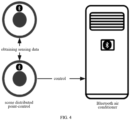
- the scene diagram shown in FIG. 4 can be referred to.
- Step S21 determining a target point-control apparatus from other scene point-control apparatuses communicating with the scene point-control apparatus.
- the target point-control apparatus is a scene point-control apparatus having the air parameter.
- Step S22 communicating with the target point-control apparatus to obtain the air parameter.
- the scene point-control apparatus c can control the air conditioning equipment in a comfort mode, and is equipped with a temperature sensor, a humidity sensor, and a carbon dioxide concentration sensor.
- the temperature sensor, the humidity sensor, and the carbon dioxide sensor are self-equipped sensors.
- the scene point-control apparatus c has a pre-stored air conditioning control program corresponding to the clean mode and the air parameters required when the clean mode is operating comprise the current ambient cleanliness and the current ambient humidity, the scene point-control apparatus c cannot detect the air parameters (such as the current ambient cleanliness) corresponding to the PM2.5 concentration sensor when the clean mode is triggered by touch operation.
- Another scene point-control apparatus d that supports the health mode is equipped with a wind speed sensor, a PM2.5 concentration sensor, and a carbon dioxide concentration.
- the scene point-control apparatus c can communicate with the scene point-control apparatus d and obtain the air parameters for the current ambient cleanliness from the scene point-control apparatus d, so that the current ambient cleanliness in the room can be indirectly detected through the PM2.5 concentration sensor of the scene point-control apparatus d.
- the scene point-control apparatus d can control the air conditioning equipment in the energy-saving mode, and is equipped with a wind speed sensor and a temperature sensor.
- the temperature sensor and the wind speed sensor are self-equipped sensors.
- the scene point-control apparatus d has pre-stored the air conditioning control program corresponding to the health mode and the air parameters required when the health mode is operating comprise the current ambient wind speed, the current ambient cleanliness and the current ambient freshness, the scene point-control apparatus d cannot detect the air parameters for the current ambient freshness and the current ambient cleanliness when the health mode is triggered by touch operation, while another scene point-control apparatus e supporting the clean mode is equipped with the PM2.5 concentration sensor and the humidity sensor.
- Another scene point-control apparatus f supporting the comfort mode is equipped with a temperature sensor, a humidity sensor and a carbon dioxide concentration sensor.
- the scene point-control apparatus d can communicate with the scene point-control apparatus e and the scene point-control apparatus f, and obtain the air parameter of the current ambient cleanliness from the scene point-control apparatus e, and obtain the air parameter of the current ambient freshness from the scene point-control apparatus f, so that the air parameter required for the operation of the health mode can be indirectly obtained through the PM2.5 concentration sensor of the scene point-control apparatus e and the carbon dioxide concentration sensor of the scene point-control apparatus f.
- the target point-control apparatus is determined as a scene point-control apparatus that cannot obtain the air parameter from the scene point-control apparatus, then by communicating with the target point-control apparatus, the air parameters are obtained. Then the air parameter required for the scene mode to be triggered can be obtained from the plurality of scene point-control apparatuses communicating with this scene point-control apparatus, thereby improving the accuracy of obtaining the the acquired air parameter.
- the step S40 of controlling the operation of the air conditioning equipment according to the air parameter comprises following steps.
- Step B10 when the scene switching instruction is obtained, the scene mode corresponding to the scene switching instruction is determined, and the switched scene mode is used as the scene mode to be triggered. Then it will return to perform the step of determining the air parameter required for the operation of the scene mode to be triggered.
- the scene switching instruction can be input by performing a user touch operation on the scene point-control apparatus, and the user touch operation may comprise a single click operation, a double click operation, and a long press operation (for example, the long press operation means pressing for 3 seconds).
- the user can switch from multiple scene modes to the target scene mode required by the user's intention by performing a user touch operation on the switch button of the scene point-control apparatus.
- the current scene point-control apparatus pre-stores air conditioning control programs corresponding to the energy-saving mode, the comfort mode, and the health mode.
- the currently operating target scene mode is the energy-saving mode
- the target scene mode triggered by the scene point-control apparatus is switched from the health mode back to the comfort mode, and the cycle repeats. That is, through the scene point-control apparatus, not only can the control of a certain scene mode be realized, but also the control of switching between multiple scene modes can be realized, so as to meet the different needs of users for scene modes at different times and the different needs of different users for scene modes, thereby enriching the operation types of scene modes that can be supported by a single scene point-control apparatus, and improving the user experience of using the scene point-control apparatus.
- the step of determining the target point-control apparatus comprises following steps.
- Step C10 broadcasting the information sharing request of the air parameter.
- Step C20 receiving the unique identification returned by other scene point-control apparatuses communicating with the scene point-control apparatus in response to the information sharing request.
- Step C30 determining the target point-control apparatus according to the unique identification.
- each scene point-control apparatus has a unique identification, which is the unique identification information that characterizes the scene point-control apparatus.
- the scene point-control apparatus can broadcast the information sharing request through communication methods, such as Bluetooth communication, Zifeng communication, WIFE communication and LIFI communication.
- the information sharing request carries the air parameters required for the operation of the scene mode to be triggered.
- the information sharing request of the air parameter is sent by broadcasting, thereby the unique identification returned by other scene point-control apparatuses communicating with the scene point-control apparatus in response to the information sharing request will be received, and then the target point-control apparatus is determined according to the unique identification, thereby further improving the accuracy of obtaining the air parameter required for the operation of the scene mode to be triggered from the multiple scene point-control apparatuses communicating with this scene point-control apparatus.
- the step of determining the target point-control apparatus comprises following steps.
- Step D10 determining the target point-control apparatus from a stored apparatus data mapping table, the apparatus data mapping table comprising air parameters that can be detected by other scene point-control apparatuses that communicate with the scene point-control apparatus; or
- step D20 determining the target point-control apparatus from a scene apparatus sharing record, the scene apparatus sharing record comprising air parameters that can be shared by other scene point-control apparatuses communicating with the scene point-control apparatus.
- the information in the apparatus data mapping table may be pre-stored in the target point-control apparatus before leaving the factory, or may be input by the user in the target point-control apparatus after leaving the factory.
- the scene apparatus sharing record refers to the air parameter that the scene point-control apparatus and other scene point-control apparatuses have shared in the historical use record. It is easy to understand that the scene point-control apparatus can automatically identify the air parameter that can be detected by other scene point-control apparatuses communicating with the scene point-control apparatus by reading the scene apparatus sharing record.
- the air parameter that can be detected by other scene point-control apparatuses communicating with the scene point-control apparatus can be automatically identified according to the information stored in the apparatus data mapping table or the scene apparatus sharing record, so that the air parameter required for the operation of the scene mode to be triggered can be obtained more accurately from the multiple scene point-control apparatuses communicating with this scene point-control apparatus, thereby improving the accuracy of obtaining the air parameter.
- the step of determining the target point-control apparatus further comprises following steps.
- Step E10 if there are multiple target point-control apparatuses, the target point-control apparatus closest to the air conditioning equipment is determined as the final target point-control apparatus, or
- step E20 the target point-control apparatus closest to the scene point-control apparatus is determined as the final target point-control apparatus.
- the target point-control apparatus closest to the air conditioning equipment is determined as the final target point-control apparatus, thereby improving the accuracy of the air parameter required for the scene mode to be triggered.
- the target point-control apparatus closest to the scene point-control apparatus is determined as the final target point-control apparatus, so as to avoid the situation that when the scene point-control apparatus and the target point-control apparatus are sharing air parameters, the signal strength is low due to the long distance between the scene point-control apparatus and the target point-control apparatus, which causes the loss of data packets between the scene point-control apparatus and the target point-control apparatus, resulting in the failure of air parameter sharing.
- the present embodiment can stably and effectively obtain the air parameters required for the operation of the scene mode to be triggered and can further improve the accuracy of the air parameters required for the scene mode to be triggered.
- the step of communicating with the target point-control apparatus to obtain the air parameter comprises following steps.
- Step F10 performing spatial positioning on the target point-control apparatus to obtain positioning information of the target point-control apparatus, and determining whether the target point-control apparatus is located in a working area corresponding to the air conditioning equipment according to the positioning information.
- Step F20 obtaining the air parameter from the target point-control apparatus in the working area.
- spatial positioning can be performed on the target point-control apparatus through near field communication positioning.
- the technical solutions of the above embodiments are used to prevent the target point-control apparatus from exceeding the working area corresponding to the air conditioning equipment.
- the air parameter shared by the target point-control apparatus cannot reflect indoor air conditioning operation ambient more accurately and effectively. Therefore, by obtaining the air parameter from the target point-control apparatus in the working area, the accuracy of the air parameter required for the scene mode to be triggered is further improved.
- the step of controlling the air conditioning equipment to start executing the target scene mode comprises following steps.
- Step G10 determining the target operation parameter for the operation of the scene mode to be triggered according to the air parameter, and sending the determined target operation parameter to the air conditioning equipment;
- step G20 sending the scene mode control instruction to the air conditioning equipment, and sending the obtained air parameter to the air conditioning equipment, so that the air conditioning equipment can operate in the scene mode according to the air parameter.
- the target operation parameter for the operation of the scene mode to be triggered can be determined, and the step of sending the determined target operation parameter to the air conditioning equipment comprises following steps.
- Step H10 obtaining the standard air parameter corresponding to the scene mode to be triggered.
- the preset mapping relationship table between each scene mode and the standard air parameter can be pre-stored in the system, and then when the triggered scene mode is determined, the standard air parameter corresponding to the triggered scene mode is queried from the preset mapping relationship table. It can be understood that the standard air parameter corresponding to different scene modes is different.
- the standard air parameter usually corresponds the target operation parameter.
- the standard air parameter may comprise at least one of the standard ambient temperature, standard ambient humidity, standard ambient wind speed, standard ambient freshness and standard ambient cleanliness.
- the target operation parameter associated with the energy-saving mode may comprise that, the temperature control information indicates setting the air conditioning temperature at 25°C, the humidity control information indicates setting the humidity at 35%PH, and the wind speed control information indicates setting the wind speed at 30 wind gear.
- the standard air parameter may comprise that, the standard ambient temperature indicates setting the temperature in a range from 24°C to 26°C, the standard ambient humidity indicates setting the humidity in a range from 25%PH to 45%PH, and the standard ambient wind speed indicates setting the wind speed in a range from 25 to 30 wind gear.
- the target operation parameter associated with the comfort mode may comprise that, the temperature control information indicates setting the air conditioning temperature at 23°C, the cleanliness control information indicates setting the fresh air system at 30 ⁇ g/m 3 filtration gear, and the freshness control information indicates setting the fresh air system at 500PPM wind discharging gear.
- the standard air parameter may comprise that, the standard ambient temperature is ranged from 22°C to 24°C, the standard ambient cleanliness is below 45 ⁇ g/m 3 , and the standard ambient freshness is below 800PPM.
- the target operation parameter associated with the health mode may comprise that, the temperature control information indicates setting the air conditioning temperature at 23°C, the humidity control information indicates setting the humidity at 50%PH, the cleanliness control information indicates setting the fresh air system at 25 ⁇ g/m 3 filtration gear, and the freshness control information indicates setting the fresh air system at 400 PPM wind discharging gear.
- the standard air parameter may comprise that, the standard ambient temperature is ranged from 22°C to 24°C, the standard ambient humidity is ranged from 45%PH to 65%PH, the standard ambient cleanliness is below 35 ⁇ g/m 3 , and the standard ambient freshness is below 600PPM.
- the target operation parameter associated with the light sleep stage in the sleep mode may comprise that, the air conditioning temperature control information indicates setting the temperature at 26°C, and the wind speed control information indicates setting the wind speed at 40 wind gear.
- the standard air parameter may comprise that, the standard ambient temperature is ranged from 25°C to 27°C, and the standard ambient wind speed is 40 wind gear.
- the target operation parameter associated with the deep sleep stage in the sleep mode may comprise that, the air conditioning temperature control information indicates setting the temperature at 27°C, and the wind speed control information indicates setting the wind speed at 20 wind gear.
- the standard air parameter may comprise that, the standard ambient temperature is ranged from 26°C to 28°C, and the standard ambient wind speed is ranged from 15 to 25 wind gear.
- Step H20 comparing the air parameter with the standard air parameter to obtain the air parameter deviation.
- Step H30 determining the operation parameter adjustment information for the operation of the scene mode to be triggered according to the real-time air parameter deviation, dynamically and adaptively adjusting the target operation parameter, and obtaining the adaptively adjusted target operation parameter.
- Step H40 sending the adaptively adjusted target operation parameter to the air conditioning equipment.
- the air parameter required for the operation of the scene mode to be triggered refers to the air parameter at the current moment, which may comprise at least one of the current ambient temperature, the current ambient humidity, the current ambient wind speed, the current ambient freshness and the current ambient cleanliness.
- the air parameter deviation may comprise at least one of the temperature deviation value, the humidity deviation value, the wind speed deviation value, the freshness deviation value and the cleanliness deviation value.
- the air parameter belonging to the same air parameter type can be compared with the standard air parameter to obtain the air parameter deviation.
- the standard air parameter comprises the standard ambient temperature and the current ambient wind speed.
- the standard ambient temperature is ranged form 24°C to 26°C
- the standard ambient wind speed is ranged form 15 to 25 wind gear.
- the current ambient temperature is detected to be 28°C by the temperature sensor
- the current ambient wind speed is detected to be 22 wind gear by the wind speed sensor.
- the air parameter deviation comprises a temperature deviation value and a wind speed deviation value
- the wind speed deviation value is equal to 0 (the standard ambient wind speed falls within the standard ambient wind speed range).
- the operation parameter adjustment information of adjusting the air conditioning equipment up by 3°C and adjusting the wind speed down by 5 wind speeds can be obtained, and the target operation parameter can be adjusted dynamically.
- the target operation parameter often refers to the operation control parameter at the outlet of the air conditioning equipment.
- the temperature control information indicates setting the air conditioning temperature at 25°C, which often means that the temperature at the outlet of the air conditioning equipment is adjusted to 25°C.
- the humidity control information indicates setting the humidity at 35%PH, which often means that the humidity at the outlet of the air conditioning equipment outlet is adjusted to 35%PH.
- the wind speed control information indicates setting the wind speed at 30 wind gear, which often means that the wind speed at the outlet of the air conditioning equipment is 30 wind gear.
- the actual target air parameter information perceived by the user indoors is not necessarily the same as the air parameter information at the air outlet of the air conditioning equipment.
- the steps of querying and obtaining the air parameter mapped in the scene mode to be triggered from the preset scene mode mapping table, and configuring the mapped air parameter as the air parameter required for the operation of the scene mode to be triggered comprise following steps.
- the scene mode mapping table comprises multiple scene modes and air parameters mapped in each scene mode.
- the scene mode currently triggered is the energy-saving mode
- the air parameters mapped in the energy-saving mode may comprise the ambient temperature, the ambient humidity and the ambient wind speed.
- the scene mode currently triggered is the comfort mode
- the air parameters mapped in the comfort mode may comprise the ambient temperature, the ambient cleanliness and the ambient freshness.
- the air parameters required for the operation of the scene mode to be triggered can be accurately determined.
- the embodiment of the present application further proposes a computer-readable storage medium, and a control program of the scene point-control apparatus is stored on the computer-readable storage medium.
- a control program of the scene point-control apparatus is executed by the processor, steps of the control method for controlling the scene point-control apparatus in any embodiment as described above are implemented.
- the above embodiments can be implemented by means of software plus the necessary general hardware platform, of course, it can further be implemented by hardware, but in many cases the former is a better implementation method.
- the technical solutions of the present application, or the part that contributes to the related art can be embodied in the form of a software product.
- the computer software product is stored in a storage medium (such as the ROM/RAM, the disk, or the CD) as described above, and comprises several instructions for enabling a terminal device (which can be a mobile phone, a computer, a server, an air conditioning equipment, or a network equipment, and the like) to execute the methods described in each embodiment of the present application.
Landscapes
- Engineering & Computer Science (AREA)
- Signal Processing (AREA)
- Chemical & Material Sciences (AREA)
- Combustion & Propulsion (AREA)
- Mechanical Engineering (AREA)
- General Engineering & Computer Science (AREA)
- Physics & Mathematics (AREA)
- Fuzzy Systems (AREA)
- Mathematical Physics (AREA)
- Fluid Mechanics (AREA)
- Human Computer Interaction (AREA)
- Air Conditioning Control Device (AREA)
Abstract
Description
- This application claims priority to
Chinese Patent Application No. 202210913451.9, filed on July 29, 2022 - The present application relates to the technical field of intelligent control, and in particular to a scene point-control apparatus and a control method thereof, and a computer-readable storage medium.
- At present, since different types of scene point-control apparatuses can correspondingly control the air conditioning equipment in different scene modes, different types of scene point-control apparatuses are usually equipped with different types of sensor hardware. For example, a scene point-control apparatus a can control the air conditioning equipment in the scene mode A (such as the energy-saving mode), and the scene point-control apparatus a is equipped with a wind speed sensor and a temperature sensor. A scene point-control apparatus b can control the air conditioning equipment in the scene mode B (such as the comfort mode), and the scene point-control apparatus b is equipped with a temperature sensor and a humidity sensor. A scene point-control apparatus c can control the air conditioning equipment in the scene mode C (such as the clean mode), and the scene point-control apparatus c is equipped with a 2.5-micrometer particulate matter (PM2.5) concentration sensor and a carbon dioxide concentration sensor. However, when the user needs to control the smart air conditioning equipment in the scene mode D (such as the health mode), the smart air conditioning equipment in the scene mode D needs to be equipped with a wind speed sensor, a temperature sensor, a humidity sensor, a PM2.5 concentration sensor and a carbon dioxide concentration sensor, and a scene point-control apparatus d corresponding to the scene mode D needs to be purchased additionally, which greatly increases the hardware implementation cost for the user to control the smart air conditioning equipment to be in the user's personalized scene mode.
- It should be noted that above contents are only used to assist in understanding the technical problems solved by the present application, and do not constitute an admission that the above contents fall within the prior art.
- The main purpose of the present application is to provide a scene point-control apparatus and a control method thereof, as well as a computer-readable storage medium, aiming to reduce the hardware implementation cost to control the smart air conditioning equipment to be in the personalized scene mode.
- To achieve above objects, the present application provides a method for controlling a scene point-control apparatus comprising following steps:
- receiving a scene mode trigger instruction, and determining an air parameter required for an operation of a scene mode to be triggered;
- obtaining the air parameter from another scene point-control apparatus communicating with the scene point-control apparatus; and
- controlling an air conditioning equipment to operate according to the air parameter.
- In an embodiment, the obtaining the air parameter from another scene point-control apparatus communicating with the scene point-control apparatus comprises:
- determining a target point-control apparatus from another scene point-control apparatus communicating with the scene point-control apparatus, the target point-control apparatus being the scene point-control apparatus having the air parameter; and
- communicating with the target point-control apparatus to obtain the air parameter.
- In an embodiment, the determining the target point-control apparatus comprises:
- broadcasting an information sharing request of the air parameter;
- receiving an unique identification returned by another scene point-control apparatus communicating with the scene point-control apparatus in response to the information sharing request; and
- determining the target point-control apparatus according to the unique identification.
- In an embodiment, the determining the target point-control apparatus comprises:
- determining the target point-control apparatus from a stored apparatus data mapping table, the apparatus data mapping table comprising an air parameter capable of being detected by another scene point-control apparatus communicating with the scene point-control apparatus; or
- determining the target point-control apparatus from a scene apparatus sharing record, the scene apparatus sharing record comprising an air parameter capable of being shared by another scene point-control apparatus communicating with the scene point-control apparatus.
- In an embodiment, the determining the target point-control apparatus further comprises:
- in response to that a plurality of target point-control apparatuses are provided, determining the target point-control apparatus closest to the air conditioning equipment as a final target point-control apparatus; or
- determining the target point-control apparatus closest to the scene point-control apparatus as a final target point-control apparatus.
- In an embodiment, the communicating with the target point-control apparatus to obtain the air parameter comprises: performing spatial positioning on the target point-control apparatus to obtain positioning information of the target point-control apparatus, and determining whether the target point-control apparatus is located in a working area corresponding to the air conditioning equipment according to the positioning information; and communicating with the target point-control apparatus in the working area to obtain the air parameter.
- In an embodiment, the controlling the air conditioning equipment to operate according to the air parameter comprises:
- determining a target operation parameter required for the operation of the scene mode to be triggered according to the air parameter, and sending a determined target operation parameter to the air conditioning equipment; or
- sending a scene mode control instruction to the air conditioning equipment, and sending an obtained air parameter to the air conditioning equipment, to make the air conditioning equipment operate in a scene mode according to the air parameter.
- In an embodiment, the determining the air parameter required for the operation of the scene mode to be triggered comprises:
querying the air parameter mapped in the scene mode to be triggered from a preset scene mode mapping table, and configuring a mapped air parameter as the air parameter required for the operation of the scene mode to be triggered. - Moreover, to achieve above objects, the present application further provides a scene point-control apparatus comprising a memory, a processor, and a control program of a scene point-control apparatus stored in the memory and executable on the processor. When the control program of the scene point-control apparatus is executed by the processor, steps of the method for controlling the scene point-control apparatus according to any embodiment mentioned above are implemented.
- Moreover, to achieve above objects, the present application further provides a computer-readable storage medium. A control program of a scene point-control apparatus is stored on the computer-readable storage medium, and when the control program of the scene point-control apparatus is executed by a processor, steps of the method for controlling the scene point-control apparatus according to any embodiment mentioned above are implemented.
- For the scene point-control apparatus and a control method thereof, and a computer-readable storage medium, due to limitation of the self-equipped sensor hardware, the scene point-control apparatus usually cannot support more types of scene modes, and the user needs to purchase a high-end version of the scene point-control apparatus with top sensor hardware configuration, which usually increases the user cost and brings poor experience. Therefore, in the present application, the scene mode trigger instruction is received, and the air parameter required for the operation of the scene mode to be triggered will be determined. Then the air parameter is obtained from other scene point-control apparatuses communicating with the scene point-control apparatus, and the air conditioning equipment will be controlled to operate according to the air parameter, so that the air parameter information that can be collected by multiple scene point-control apparatuses in the room can be shared. In this way, the air conditioning equipment in more scene modes can be controlled, and there is no need to purchase a high-end version of the scene point-control apparatus with a top sensor hardware configuration, thereby reducing the hardware implementation cost for the user to control the smart air conditioning equipment to be in the user's personalized scene mode.
-
-
FIG. 1 is a schematic diagram of the terminal structure involved in the operation of the method for controlling the scene point-control apparatus in the present application. -
FIG. 2 is a flowchart of the method for controlling the scene point-control apparatus according to a first embodiment of the present application. -
FIG. 3 is a detailed flowchart of step S20 of the method for controlling the scene point-control apparatus according to a second embodiment of the present application. -
FIG. 4 is a scene diagram showing that the scene point-control apparatus controls the air conditioning equipment to operate according to an embodiment of the present application. -
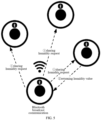
FIG. 5 is a scene diagram showing that the scene point-control apparatus shares air parameters with other scene point-control apparatuses according to an embodiment of the present application. - The realization of the objective, functional characteristics, and advantages of the present application are further described with reference to the accompanying drawings.
- It should be understood that the specific embodiments described herein are only used to explain the present application and are not used to limit the present application.
- The main solutions in embodiments of the present application are: receiving a scene mode trigger instruction, and determining an air parameter required for an operation of a scene mode to be triggered; obtaining the air parameter from other scene point-control apparatuses communicating with the scene point-control apparatus; and controlling an air conditioning equipment to operate according to the air parameter.
- In some embodiments, by setting control parameters via an application (APP) on the control terminal or a remote controller, the air conditioning equipment can be controlled, and the control efficiency for the air conditioning equipment is low. In order to improve the control efficiency, a scene point-control apparatus can be provided to perform intelligent control on the air conditioning equipment to customize the scene mode, thereby improving the control efficiency of the air conditioning equipment. However, since different types of scene point-control apparatuses can correspondingly control the air conditioning equipment in different scene modes, different types of scene point-control apparatuses are usually equipped with different types of sensor hardware. However, when users need to control the smart air conditioning equipment in more types of scene modes, they usually need to purchase a scene point-control apparatus equipped with corresponding sensor hardware that supports the operation of the scene mode, which greatly increases the hardware implementation cost for the user to control the smart air conditioning equipment to be in the user's personalized scene mode.
- In view of this, embodiments of the present application propose a method for controlling the scene point-control apparatus and a terminal thereof. The hardware terminal involved in the method for controlling the scene point-control apparatus can be a terminal for controlling the scene point-control apparatus. As shown in
FIG. 1, FIG. 1 is a schematic diagram of the hardware structure involved in the operation according to an embodiment of the present application. - As shown in
FIG. 1 , the hardware can be the scene point-control apparatus described in the above embodiment. The hardware comprises: aprocessor 1001, such as a central processing unit (CPU), acommunication bus 1002, auser interface 1003, anetwork interface 1004, and amemory 1005. Thecommunication bus 1002 is used to realize the connection and communication between these components. Theuser interface 1003 may comprise a display, an input unit such as a keyboard, and theuser interface 1003 may further comprise a standard wired interface and a wireless interface. Thenetwork interface 1004 may comprise a standard wired interface and a wireless interface (such as a wireless fidelity interface). Thememory 1005 may be a high-speed random access memory (RAM), or a stable non-volatile memory (NVM), such as a disk memory. Thememory 1005 may further be a storage device independent of theaforementioned processor 1001. - Those skilled in the art can understand that the structure shown in
FIG. 1 does not constitute a limitation on the scene point-control apparatus, and may comprise more or fewer components than shown in the figure, or combine certain components, or arrange components differently. - As shown in
FIG. 1 , thememory 1005 as a storage medium may comprise an operating system, a data storage module, a network communication module, a user interface module, and a control program of the scene point-control apparatus. - In the air conditioning equipment shown in
FIG. 1 , thenetwork interface 1004 is mainly used for data communication with other devices. Theuser interface 1003 is mainly used for data interaction with the user. Theprocessor 1001 and thememory 1005 in the scene point-control apparatus of the present application can be provided in the scene point-control apparatus, and the scene point-control apparatus calls the control program of the scene point-control apparatus stored in thememory 1005 through theprocessor 1001, and executes the relevant steps of the method for controlling the scene point-control apparatus in the following embodiments. - Based on the hardware architecture of the above terminal, various embodiments of the method for controlling the scene point-control apparatus in the present application are proposed.
- As shown in
FIG. 2 , the first embodiment of the method for controlling the scene point-control apparatus in the present application is proposed. In this embodiment, the method for controlling the scene point-control apparatus comprises following steps. - Step S10, receiving a scene mode trigger instruction, and determining the air parameter required for the operation of the scene mode to be triggered.
- In this embodiment, the user can input the scene mode trigger instruction by pressing a physical button or a touch screen button of the scene point-control apparatus.
- Since different types of scene point-control apparatuses can correspondingly control the air conditioning equipment in different scene modes, the air parameters required when different types of scene modes are operating are usually different. Each type of air parameter needs to be collected by a corresponding type of sensor (for example, the air parameter detected by the temperature sensor is the current ambient temperature, and the air parameter detected by the humidity sensor is the current ambient humidity), so that different types of scene point-control apparatuses are usually equipped with different types of sensor hardware.
- In this embodiment, since different types of scene point-control apparatuses can correspondingly control the air conditioning equipment in different scene modes, the scene modes that can be triggered by the user according to the specific application scene comprise but are not limited to the energy-saving mode, the comfort mode, the health mode, the children mode, the elderly mode, the pregnant mode, the home mode, the away mode, the sleep mode and the exercise mode. It should be noted that the parameter control information associated with different scene modes is different. The parameter control information comprises but is not limited to temperature control information, humidity control information, wind speed control information, cleanliness control information and freshness control information. Cleanliness is mainly judged according to the indoor PM2.5 concentration, and freshness is mainly judged according to the indoor carbon dioxide concentration. The parameter control information is related to the attributes of each scene mode. For example, when the scene mode is a health scene, the requirements for cleanliness value and freshness value will be higher. For example, when the scene mode is a child mode or an elderly mode, the air conditioning equipment needs to operate more gently, and the temperature is usually appropriately higher and the wind speed is appropriately lower than that of the air conditioning equipment for middle-aged people (non-pregnant women). For example, when the scene mode is a sleeping scene, the air parameter value can be set with reference to the sleep curve. The air parameter value can be a specific value, or may be in a range, or may fall within a curve formed by a series of values.
- It is easy to understand that the parameter control information usually refers to the air parameter at the air outlet of the air conditioning equipment. For example, the temperature control information indicates setting the temperature at 25°C, which usually means that the temperature at the air outlet of the air conditioning equipment is adjusted to 25°C. The humidity control information is 35%PH, which usually means that the humidity at the air outlet of the air conditioning equipment is adjusted to 35%PH. The wind speed control information is 30 wind gear, which usually means that the wind speed at the air outlet of the air conditioning equipment is set at 30 wind gear. However, the actual air parameter perceived by the user indoors is not necessarily the same as the air parameter at the air outlet of the air conditioning equipment. Therefore, the scene point-control apparatus of this embodiment needs to perceive the indoor air parameter, and then compare the perceived actual air parameter with the target air parameter corresponding to the triggered scene mode. According to the deviation information of the real-time comparison, the parameter control information of the air conditioning equipment is dynamically and adaptively adjusted, so as to adaptively control the target operation parameter corresponding to the currently operating scene mode. Through the "perception plus control" method, the air effect (current air parameters such as temperature, humidity and wind speed) is intuitively perceived, and the operation capacity of the air conditioning equipment is determined based on the perceived current air parameter. That is, whether the air conditioning equipment reaches the current theoretical operation capacity that should be achieved is determined, and then the operation control amount is adjusted when the operation capacity is insufficient, thereby avoiding the failure to achieve the target ambient expected by the user and realizing closed-loop regulation. Compared with the control method of entering a single operation mode, the current operation parameters of the air conditioning equipment can be dynamically optimized and adjusted to make operation of the air conditioning equipment more suitable for the operation ambient corresponding to the target scene, thereby improving the adaptability of the air conditioning equipment to adjust the ambient.
- That is, in order to adaptively control the target operation parameter corresponding to the scene mode, the scene point-control apparatus of this embodiment usually needs to collect the air parameters required for the operation of different scene modes through different types of sensors when controlling the air conditioning equipment to operate in different scene modes, so that when the scene point-control apparatus triggers the scene mode, the real-time air parameters of the user's ambient can be detected through the corresponding type of sensors, thus operation of the air conditioning equipment is more suitable for the operation ambient corresponding to the current scene mode.
- In an embodiment, when the scene point-control apparatus controls the air conditioning equipment to operate in an energy-saving mode, the air parameters required for the energy-saving mode comprise the current ambient wind speed and the current ambient temperature. Therefore, the current ambient wind speed can be detected by a wind speed sensor. The current ambient temperature can be detected by a temperature sensor. Then the target operation parameter of the air conditioning equipment in the energy-saving mode can be dynamically optimized and adjusted according to the current ambient wind speed and the current ambient temperature, so that operation of the air conditioning equipment is more suitable for the operation ambient corresponding to the energy-saving mode.
- In another embodiment, when the scene point-control apparatus controls the air conditioning equipment to operate in the comfort mode, the air parameters required for the comfort mode comprise the current ambient humidity, the current ambient freshness and the current ambient temperature. Therefore, the current ambient humidity can be detected by a humidity sensor, the current ambient freshness can be detected by a carbon dioxide concentration sensor, and the current ambient temperature can be detected by a temperature sensor. Then the target operation parameter of the air conditioning equipment in the comfort mode can be dynamically optimized and adjusted according to the current ambient humidity, the current ambient freshness and the current ambient temperature, to make the air conditioning equipment operate more in line with the operation ambient corresponding to the comfort mode.
- In another embodiment, when the scene point-control apparatus controls the air conditioning equipment to operate in the clean mode, the air parameters required for the clean mode comprise the current ambient cleanliness and the current ambient humidity. Therefore, the current ambient cleanliness can be detected by the PM2.5 concentration sensor, and the current ambient humidity can be detected by the humidity sensor. Then the target operation parameter of the air conditioning equipment operating in the clean mode is dynamically optimized and adjusted according to the current ambient cleanliness and the current ambient humidity, so that the air conditioning equipment operates more in line with the operation ambient corresponding to the clean mode.
- In another embodiment, when the scene point-control apparatus controls the air conditioning equipment to operate in the healthy mode, the air parameters required for the healthy mode comprise the current ambient wind speed, the current ambient cleanliness and the current ambient freshness. Therefore, the current ambient wind speed can be detected by the wind speed sensor, the current ambient cleanliness can be detected by the PM2.5 concentration sensor, and the current ambient freshness can be detected by the carbon dioxide concentration sensor. Then, according to the current ambient wind speed, the current ambient cleanliness and the current ambient freshness, the target operation parameter of the air conditioning equipment in the healthy mode is dynamically optimized and adjusted to make operation of the air conditioning equipment more suitable for the operation ambient corresponding to the healthy mode. In this case, the wind speed sensor, the PM2.5 concentration sensor and the carbon dioxide concentration sensor are target type sensors.
- Step S20, obtaining the air parameter from other scene point-control apparatuses communicating with the scene point-control apparatus.
- It should be noted that the communication between the scene point-control apparatus and other scene point-control apparatuses comprises but not is limited to bluetooth communication, Zifeng communication, wireless-fidelity (WIFE) communication and light fidelity (LIFI) communication.
- In this embodiment, it can be understood that, the scene point-control apparatus can be used to detect whether the air parameters required for operation of the scene mode to be triggered are missing in the air parameters detected by the scene point-control apparatus. If all of the air parameters required for operation of the scene mode to be triggered are missing, the target air parameters will be obtained from other scene point-control apparatuses communicating with the scene point-control apparatus. If some air parameters required for operation of the scene mode to be triggered are missing, the target air parameters will be obtained from the scene point-control apparatus and other scene point-control apparatuses communicating with the scene point-control apparatus.
- For example, the scene point-control apparatus a can control the air conditioning equipment in energy-saving mode, and is equipped with a wind speed sensor and a temperature sensor, which are self-equipped sensors. However, if the scene point-control apparatus a comprises a pre-stored air conditioning control program corresponding to the comfort mode, and the air parameters required for the comfort mode comprise the current ambient temperature, the current ambient humidity and the current ambient carbon dioxide, the scene point-control apparatus a cannot detect the air parameters of the current ambient humidity when the comfort mode is triggered by touch operation. The other scene point-control apparatus b can control the air conditioning equipment in the clean mode, and is equipped with a PM2.5 concentration sensor and a humidity sensor. In this case, the scene point-control apparatus a can communicate with the scene point-control apparatus b and obtain the air parameters of the current ambient humidity from the scene point-control apparatus b, so that the humidity sensor of the scene point-control apparatus b can be used to indirectly detect the current ambient humidity in the room, as shown in the scene schematic diagram of
FIG. 5 . - Step S30, according to the air parameter, controlling the air conditioning equipment to operate.
- In this embodiment, the air conditioning equipment controlled by the scene point-control apparatus may be an air conditioner, a humidifier, a fresh air blower, a purifier, an electric heater, and the like. The corresponding scene mode may be realized by the operation of one or more air conditioning equipment. The air conditioning instruction determined by the scene point-control apparatus according to the air parameter may be sent directly to each associated air conditioning equipment by the scene point-control apparatus, or may be sent to a central equipment, such as air conditioning equipment A, by the scene point-control apparatus first, and then may be forwarded to other associated air conditioning equipments by the air conditioning equipment A. Or, the air conditioning instruction determined by the scene point-control apparatus according to the air parameter may be sent to a server by the scene point-control apparatus (or through an associated air conditioning equipment, such as the air conditioning equipment B), and then sent to all associated air conditioning equipment by the server (or by the associated air conditioning equipment B).
- In order to adaptively control the target operation parameter for the operation of the scene mode to be triggered, in the embodiments of the present application, different self-equipped sensors usually need to be installed at the scene point-control apparatus that controls the air conditioning equipment to operate in different scene modes, so that when the scene point-control apparatus triggers the scene mode it supports, the real-time target air parameter information of the ambient where the user is located can be detected through the self-equipped sensors. Through the "perception plus control" method, the human body state, air effect (air parameters such as temperature, humidity and wind speed), and the like, can be intuitively perceived, to achieve closed-loop regulation of the air conditioning equipment, and then the current operation parameters of the air conditioning equipment are dynamically optimized and adjusted, so that the air conditioning equipment can operate more suitable for the operation ambient corresponding to the target scene.
- However, due to limitation of the self-equipped sensor hardware, the scene point-control apparatus usually cannot support more types of scene modes, and the user needs to purchase a high-end version of the scene point-control apparatus with top sensor hardware configuration, which usually increases the user cost and brings poor experience. Therefore, in the present application, the scene mode trigger instruction is received, and the air parameter required for the operation of the scene mode to be triggered will be determined. Then the air parameter is obtained from other scene point-control apparatuses communicating with the scene point-control apparatus, and the air conditioning equipments will be controlled to operate according to the air parameter, so that the air parameter information that can be collected by multiple scene point-control apparatuses in the room can be shared. The scene diagram shown in
FIG. 4 can be referred to. In this way, the air conditioning equipment in more scene modes can be controlled, and there is no need to purchase a high-end version of the scene point-control apparatus with a top sensor hardware configuration, thereby reducing the hardware implementation cost for the user to control the smart air conditioning equipment to be in the user's personalized scene mode. - In an embodiment, as shown in
FIG. 3 , the step of obtaining the air parameter from other scene point-control apparatuses communicating with the scene point-control apparatus comprises following steps. - Step S21, determining a target point-control apparatus from other scene point-control apparatuses communicating with the scene point-control apparatus. The target point-control apparatus is a scene point-control apparatus having the air parameter.
- Step S22, communicating with the target point-control apparatus to obtain the air parameter.
- For example, the scene point-control apparatus c can control the air conditioning equipment in a comfort mode, and is equipped with a temperature sensor, a humidity sensor, and a carbon dioxide concentration sensor. The temperature sensor, the humidity sensor, and the carbon dioxide sensor are self-equipped sensors. However, if the scene point-control apparatus c has a pre-stored air conditioning control program corresponding to the clean mode and the air parameters required when the clean mode is operating comprise the current ambient cleanliness and the current ambient humidity, the scene point-control apparatus c cannot detect the air parameters (such as the current ambient cleanliness) corresponding to the PM2.5 concentration sensor when the clean mode is triggered by touch operation. Another scene point-control apparatus d that supports the health mode is equipped with a wind speed sensor, a PM2.5 concentration sensor, and a carbon dioxide concentration. In this case, the scene point-control apparatus c can communicate with the scene point-control apparatus d and obtain the air parameters for the current ambient cleanliness from the scene point-control apparatus d, so that the current ambient cleanliness in the room can be indirectly detected through the PM2.5 concentration sensor of the scene point-control apparatus d.
- As another example, the scene point-control apparatus d can control the air conditioning equipment in the energy-saving mode, and is equipped with a wind speed sensor and a temperature sensor. The temperature sensor and the wind speed sensor are self-equipped sensors. However, if the scene point-control apparatus d has pre-stored the air conditioning control program corresponding to the health mode and the air parameters required when the health mode is operating comprise the current ambient wind speed, the current ambient cleanliness and the current ambient freshness, the scene point-control apparatus d cannot detect the air parameters for the current ambient freshness and the current ambient cleanliness when the health mode is triggered by touch operation, while another scene point-control apparatus e supporting the clean mode is equipped with the PM2.5 concentration sensor and the humidity sensor. Another scene point-control apparatus f supporting the comfort mode is equipped with a temperature sensor, a humidity sensor and a carbon dioxide concentration sensor. In this case, the scene point-control apparatus d can communicate with the scene point-control apparatus e and the scene point-control apparatus f, and obtain the air parameter of the current ambient cleanliness from the scene point-control apparatus e, and obtain the air parameter of the current ambient freshness from the scene point-control apparatus f, so that the air parameter required for the operation of the health mode can be indirectly obtained through the PM2.5 concentration sensor of the scene point-control apparatus e and the carbon dioxide concentration sensor of the scene point-control apparatus f.
- In this embodiment, the target point-control apparatus is determined as a scene point-control apparatus that cannot obtain the air parameter from the scene point-control apparatus, then by communicating with the target point-control apparatus, the air parameters are obtained. Then the air parameter required for the scene mode to be triggered can be obtained from the plurality of scene point-control apparatuses communicating with this scene point-control apparatus, thereby improving the accuracy of obtaining the the acquired air parameter.
- In an embodiment, the step S40 of controlling the operation of the air conditioning equipment according to the air parameter comprises following steps.
- Step B10, when the scene switching instruction is obtained, the scene mode corresponding to the scene switching instruction is determined, and the switched scene mode is used as the scene mode to be triggered. Then it will return to perform the step of determining the air parameter required for the operation of the scene mode to be triggered.
- In this embodiment, it can be understood that the scene switching instruction can be input by performing a user touch operation on the scene point-control apparatus, and the user touch operation may comprise a single click operation, a double click operation, and a long press operation (for example, the long press operation means pressing for 3 seconds).
- In an embodiment, the user can switch from multiple scene modes to the target scene mode required by the user's intention by performing a user touch operation on the switch button of the scene point-control apparatus. For example, the current scene point-control apparatus pre-stores air conditioning control programs corresponding to the energy-saving mode, the comfort mode, and the health mode. When the currently operating target scene mode is the energy-saving mode, the user presses the switch button once, and the target scene mode triggered by the scene point-control apparatus is switched from the energy-saving mode to the comfort mode. If the user presses the switch button again, the target scene mode triggered by the scene point-control apparatus is switched from the comfort mode to the health mode. If the user presses the switch button again, and the target scene mode triggered by the scene point-control apparatus is switched from the health mode back to the comfort mode, and the cycle repeats. That is, through the scene point-control apparatus, not only can the control of a certain scene mode be realized, but also the control of switching between multiple scene modes can be realized, so as to meet the different needs of users for scene modes at different times and the different needs of different users for scene modes, thereby enriching the operation types of scene modes that can be supported by a single scene point-control apparatus, and improving the user experience of using the scene point-control apparatus.
- In an embodiment, the step of determining the target point-control apparatus comprises following steps.
- Step C10, broadcasting the information sharing request of the air parameter.
- Step C20, receiving the unique identification returned by other scene point-control apparatuses communicating with the scene point-control apparatus in response to the information sharing request.
- Step C30, determining the target point-control apparatus according to the unique identification.
- In this embodiment, it is easy to understand that each scene point-control apparatus has a unique identification, which is the unique identification information that characterizes the scene point-control apparatus.
- The scene point-control apparatus can broadcast the information sharing request through communication methods, such as Bluetooth communication, Zifeng communication, WIFE communication and LIFI communication.
- In this embodiment, it is easy to understand that the information sharing request carries the air parameters required for the operation of the scene mode to be triggered.
- In this embodiment, the information sharing request of the air parameter is sent by broadcasting, thereby the unique identification returned by other scene point-control apparatuses communicating with the scene point-control apparatus in response to the information sharing request will be received, and then the target point-control apparatus is determined according to the unique identification, thereby further improving the accuracy of obtaining the air parameter required for the operation of the scene mode to be triggered from the multiple scene point-control apparatuses communicating with this scene point-control apparatus.
- In another practicable manner, the step of determining the target point-control apparatus comprises following steps.
- Step D10, determining the target point-control apparatus from a stored apparatus data mapping table, the apparatus data mapping table comprising air parameters that can be detected by other scene point-control apparatuses that communicate with the scene point-control apparatus; or
- step D20, determining the target point-control apparatus from a scene apparatus sharing record, the scene apparatus sharing record comprising air parameters that can be shared by other scene point-control apparatuses communicating with the scene point-control apparatus.
- In this embodiment, the information in the apparatus data mapping table may be pre-stored in the target point-control apparatus before leaving the factory, or may be input by the user in the target point-control apparatus after leaving the factory. The scene apparatus sharing record refers to the air parameter that the scene point-control apparatus and other scene point-control apparatuses have shared in the historical use record. It is easy to understand that the scene point-control apparatus can automatically identify the air parameter that can be detected by other scene point-control apparatuses communicating with the scene point-control apparatus by reading the scene apparatus sharing record.
- In this embodiment, the air parameter that can be detected by other scene point-control apparatuses communicating with the scene point-control apparatus can be automatically identified according to the information stored in the apparatus data mapping table or the scene apparatus sharing record, so that the air parameter required for the operation of the scene mode to be triggered can be obtained more accurately from the multiple scene point-control apparatuses communicating with this scene point-control apparatus, thereby improving the accuracy of obtaining the air parameter.
- In an embodiment, as an example, the step of determining the target point-control apparatus further comprises following steps.
- Step E10, if there are multiple target point-control apparatuses, the target point-control apparatus closest to the air conditioning equipment is determined as the final target point-control apparatus, or
- step E20, the target point-control apparatus closest to the scene point-control apparatus is determined as the final target point-control apparatus.
- In this embodiment, in order to avoid the target point-control apparatus exceeding the working area corresponding to the air conditioning equipment and avoid causing the air parameter shared by the target point-control apparatus to fail to reflect the indoor air conditioning operating environment accurately and effectively, the target point-control apparatus closest to the air conditioning equipment is determined as the final target point-control apparatus, thereby improving the accuracy of the air parameter required for the scene mode to be triggered.
- In addition, in order to avoid the low signal strength between the scene point-control apparatus and the target point-control apparatus and affect the normal sharing of air parameters between the scene point-control apparatus and the target point-control apparatus, the target point-control apparatus closest to the scene point-control apparatus is determined as the final target point-control apparatus, so as to avoid the situation that when the scene point-control apparatus and the target point-control apparatus are sharing air parameters, the signal strength is low due to the long distance between the scene point-control apparatus and the target point-control apparatus, which causes the loss of data packets between the scene point-control apparatus and the target point-control apparatus, resulting in the failure of air parameter sharing. As a result, the present embodiment can stably and effectively obtain the air parameters required for the operation of the scene mode to be triggered and can further improve the accuracy of the air parameters required for the scene mode to be triggered.
- In an embodiment, as an example, the step of communicating with the target point-control apparatus to obtain the air parameter comprises following steps.
- Step F10, performing spatial positioning on the target point-control apparatus to obtain positioning information of the target point-control apparatus, and determining whether the target point-control apparatus is located in a working area corresponding to the air conditioning equipment according to the positioning information.
- Step F20, obtaining the air parameter from the target point-control apparatus in the working area.
- In this embodiment, spatial positioning can be performed on the target point-control apparatus through near field communication positioning. The technical solutions of the above embodiments are used to prevent the target point-control apparatus from exceeding the working area corresponding to the air conditioning equipment. The air parameter shared by the target point-control apparatus cannot reflect indoor air conditioning operation ambient more accurately and effectively. Therefore, by obtaining the air parameter from the target point-control apparatus in the working area, the accuracy of the air parameter required for the scene mode to be triggered is further improved.
- In an embodiment, the step of controlling the air conditioning equipment to start executing the target scene mode comprises following steps.
- Step G10, determining the target operation parameter for the operation of the scene mode to be triggered according to the air parameter, and sending the determined target operation parameter to the air conditioning equipment; or
- step G20, sending the scene mode control instruction to the air conditioning equipment, and sending the obtained air parameter to the air conditioning equipment, so that the air conditioning equipment can operate in the scene mode according to the air parameter.
- In an embodiment, as an example, according to the air parameter, the target operation parameter for the operation of the scene mode to be triggered can be determined, and the step of sending the determined target operation parameter to the air conditioning equipment comprises following steps.
- Step H10, obtaining the standard air parameter corresponding to the scene mode to be triggered.
- In this embodiment, the preset mapping relationship table between each scene mode and the standard air parameter can be pre-stored in the system, and then when the triggered scene mode is determined, the standard air parameter corresponding to the triggered scene mode is queried from the preset mapping relationship table. It can be understood that the standard air parameter corresponding to different scene modes is different.
- It should be noted that the standard air parameter usually corresponds the target operation parameter. The standard air parameter may comprise at least one of the standard ambient temperature, standard ambient humidity, standard ambient wind speed, standard ambient freshness and standard ambient cleanliness.
- For example, in an embodiment, the target operation parameter associated with the energy-saving mode may comprise that, the temperature control information indicates setting the air conditioning temperature at 25°C, the humidity control information indicates setting the humidity at 35%PH, and the wind speed control information indicates setting the wind speed at 30 wind gear. In this case, the standard air parameter may comprise that, the standard ambient temperature indicates setting the temperature in a range from 24°C to 26°C, the standard ambient humidity indicates setting the humidity in a range from 25%PH to 45%PH, and the standard ambient wind speed indicates setting the wind speed in a range from 25 to 30 wind gear.
- In another embodiment, the target operation parameter associated with the comfort mode may comprise that, the temperature control information indicates setting the air conditioning temperature at 23°C, the cleanliness control information indicates setting the fresh air system at 30µg/m3 filtration gear, and the freshness control information indicates setting the fresh air system at 500PPM wind discharging gear. In this case, the standard air parameter may comprise that, the standard ambient temperature is ranged from 22°C to 24°C, the standard ambient cleanliness is below 45µg/m3, and the standard ambient freshness is below 800PPM.
- In another embodiment, the target operation parameter associated with the health mode may comprise that, the temperature control information indicates setting the air conditioning temperature at 23°C, the humidity control information indicates setting the humidity at 50%PH, the cleanliness control information indicates setting the fresh air system at 25µg/m3 filtration gear, and the freshness control information indicates setting the fresh air system at 400 PPM wind discharging gear. In this case, the standard air parameter may comprise that, the standard ambient temperature is ranged from 22°C to 24°C, the standard ambient humidity is ranged from 45%PH to 65%PH, the standard ambient cleanliness is below 35µg/m3, and the standard ambient freshness is below 600PPM.
- In another embodiment, the target operation parameter associated with the light sleep stage in the sleep mode may comprise that, the air conditioning temperature control information indicates setting the temperature at 26°C, and the wind speed control information indicates setting the wind speed at 40 wind gear. In this case, the standard air parameter may comprise that, the standard ambient temperature is ranged from 25°C to 27°C, and the standard ambient wind speed is 40 wind gear. The target operation parameter associated with the deep sleep stage in the sleep mode may comprise that, the air conditioning temperature control information indicates setting the temperature at 27°C, and the wind speed control information indicates setting the wind speed at 20 wind gear. In this case, the standard air parameter may comprise that, the standard ambient temperature is ranged from 26°C to 28°C, and the standard ambient wind speed is ranged from 15 to 25 wind gear.
- Step H20, comparing the air parameter with the standard air parameter to obtain the air parameter deviation.
- Step H30, determining the operation parameter adjustment information for the operation of the scene mode to be triggered according to the real-time air parameter deviation, dynamically and adaptively adjusting the target operation parameter, and obtaining the adaptively adjusted target operation parameter.
- Step H40, sending the adaptively adjusted target operation parameter to the air conditioning equipment.
- It can be understood that the air parameter required for the operation of the scene mode to be triggered refers to the air parameter at the current moment, which may comprise at least one of the current ambient temperature, the current ambient humidity, the current ambient wind speed, the current ambient freshness and the current ambient cleanliness. Correspondingly, the air parameter deviation may comprise at least one of the temperature deviation value, the humidity deviation value, the wind speed deviation value, the freshness deviation value and the cleanliness deviation value.
- In this embodiment, based on the air parameter and the standard air parameter, the air parameter belonging to the same air parameter type can be compared with the standard air parameter to obtain the air parameter deviation. For example, in an air conditioning operation scene, the standard air parameter comprises the standard ambient temperature and the current ambient wind speed. The standard ambient temperature is ranged form 24°C to 26°C, and the standard ambient wind speed is ranged form 15 to 25 wind gear. In addition, the current ambient temperature is detected to be 28°C by the temperature sensor, and the current ambient wind speed is detected to be 22 wind gear by the wind speed sensor. In this case, the air parameter deviation comprises a temperature deviation value and a wind speed deviation value, and the temperature deviation value is equal to 3°C (28°C-25°C=3°C), and the wind speed deviation value is equal to 0 (the standard ambient wind speed falls within the standard ambient wind speed range).
- For example, in an embodiment, if the temperature deviation value in the air parameter deviation is equal to 3°C, and the wind speed deviation value is equal to -5 wind gear, the operation parameter adjustment information of adjusting the air conditioning equipment up by 3°C and adjusting the wind speed down by 5 wind speeds can be obtained, and the target operation parameter can be adjusted dynamically.
- It is easy to understand that the target operation parameter often refers to the operation control parameter at the outlet of the air conditioning equipment. For example, the temperature control information indicates setting the air conditioning temperature at 25°C, which often means that the temperature at the outlet of the air conditioning equipment is adjusted to 25°C. The humidity control information indicates setting the humidity at 35%PH, which often means that the humidity at the outlet of the air conditioning equipment outlet is adjusted to 35%PH. The wind speed control information indicates setting the wind speed at 30 wind gear, which often means that the wind speed at the outlet of the air conditioning equipment is 30 wind gear. However, the actual target air parameter information perceived by the user indoors is not necessarily the same as the air parameter information at the air outlet of the air conditioning equipment. Therefore, it is necessary to perceive the current indoor air parameter, and then compare the current air parameter with the standard air parameter corresponding to the scene mode. According to the deviation information of the real-time comparison, the target operation parameter of the air conditioning equipment is dynamically and adaptively adjusted, so as to adaptively control the target operation parameter corresponding to the scene mode. Through the "perception plus control" method, the air effect (current air parameters such as temperature, humidity and wind speed) can be intuitively perceived, and the target operation parameter of the air conditioner can be dynamically optimized and adjusted, so that the air conditioner operation is more suitable for the operating environment corresponding to the target scene, thereby improving the adaptability of the air conditioning equipment to the air conditioning environment.
- As an example, the steps of querying and obtaining the air parameter mapped in the scene mode to be triggered from the preset scene mode mapping table, and configuring the mapped air parameter as the air parameter required for the operation of the scene mode to be triggered comprise following steps.
- Step I10, querying and obtaining the air parameter mapped in the scene mode to be triggered from the preset scene mode mapping table, and configuring the mapped air parameter as the air parameter required for the operation of the scene mode to be triggered.
- It is easy to understand that the scene mode mapping table comprises multiple scene modes and air parameters mapped in each scene mode.
- In an embodiment, the scene mode currently triggered is the energy-saving mode, and the air parameters mapped in the energy-saving mode may comprise the ambient temperature, the ambient humidity and the ambient wind speed.
- In another embodiment, the scene mode currently triggered is the comfort mode, and the air parameters mapped in the comfort mode may comprise the ambient temperature, the ambient cleanliness and the ambient freshness.
- In this embodiment, by pre-storing the mapping relationship between each scene mode and the corresponding air parameter, the air parameters required for the operation of the scene mode to be triggered can be accurately determined.
- In addition, the embodiment of the present application further proposes a computer-readable storage medium, and a control program of the scene point-control apparatus is stored on the computer-readable storage medium. When the control program of the scene point-control apparatus is executed by the processor, steps of the control method for controlling the scene point-control apparatus in any embodiment as described above are implemented.
- It should be noted that in the present application, the terms "comprise", "comprise" or any other variants thereof are intended to cover a non-exclusive inclusion. Thus, a process, method, article, or system that comprises a series of elements not only comprises those elements, but also comprises other elements that are not explicitly listed, or also comprises elements inherent to the process, method, article, or system. If there are no more restrictions, the element defined by the sentence "comprising a..." does not exclude the existence of other identical elements in the process, method, article or system that comprises the element.
- The serial numbers of the embodiments of the present application are only for description and do not represent the advantages and disadvantages of the embodiments.
- Through the description of the above embodiments, those skilled in the art can clearly understand that the above embodiments can be implemented by means of software plus the necessary general hardware platform, of course, it can further be implemented by hardware, but in many cases the former is a better implementation method. Based on this, the technical solutions of the present application, or the part that contributes to the related art, can be embodied in the form of a software product. The computer software product is stored in a storage medium (such as the ROM/RAM, the disk, or the CD) as described above, and comprises several instructions for enabling a terminal device (which can be a mobile phone, a computer, a server, an air conditioning equipment, or a network equipment, and the like) to execute the methods described in each embodiment of the present application.
- The above are only preferred embodiments of the present application, and do not limit the scope of the present application thereto. Any equivalent structural transformation or equivalent process transformation made according to the description and drawings of the present application, or direct/indirect applied in other related technical fields shall fall within the claimed scope of the present application.
Claims (10)
- A method for controlling a scene point-control apparatus, characterized by comprising:receiving a scene mode trigger instruction, and determining an air parameter required for an operation of a scene mode to be triggered;obtaining the air parameter from another scene point-control apparatus communicating with the scene point-control apparatus; andcontrolling an air conditioning equipment to operate according to the air parameter.
- The method for controlling the scene point-control apparatus according to claim 1, wherein the obtaining the air parameter from another scene point-control apparatus communicating with the scene point-control apparatus comprises:determining a target point-control apparatus from another scene point-control apparatus communicating with the scene point-control apparatus, wherein the target point-control apparatus is a scene point-control apparatus having the air parameter; andcommunicating with the target point-control apparatus to obtain the air parameter.
- The method for controlling the scene point-control apparatus according to claim 2, wherein the determining the target point-control apparatus comprises:broadcasting an information sharing request of the air parameter;receiving an unique identification returned by another scene point-control apparatus communicating with the scene point-control apparatus in response to the information sharing request; anddetermining the target point-control apparatus according to the unique identification.
- The method for controlling the scene point-control apparatus according to claim 2, wherein the determining the target point-control apparatus comprises:determining the target point-control apparatus from a stored apparatus data mapping table, wherein the apparatus data mapping table comprises an air parameter capable of being detected by another scene point-control apparatus communicating with the scene point-control apparatus; ordetermining the target point-control apparatus from a scene apparatus sharing record, wherein the scene apparatus sharing record comprises an air parameter capable of being shared by another scene point-control apparatus communicating with the scene point-control apparatus.
- The method for controlling the scene point-control apparatus according to claim 3 or 4, wherein the determining the target point-control apparatus further comprises:in response to that a plurality of target point-control apparatuses are provided, determining a target point-control apparatus closest to the air conditioning equipment as a final target point-control apparatus; ordetermining a target point-control apparatus closest to the scene point-control apparatus as a final target point-control apparatus.
- The method for controlling the scene point-control apparatus according to claim 2, wherein the communicating with the target point-control apparatus to obtain the air parameter comprises:performing spatial positioning on the target point-control apparatus to obtain positioning information of the target point-control apparatus, and determining whether the target point-control apparatus is located in a working area corresponding to the air conditioning equipment according to the positioning information; andcommunicating with the target point-control apparatus in the working area to obtain the air parameter.
- The method for controlling the scene point-control apparatus according to claim 1, wherein the controlling the air conditioning equipment to operate according to the air parameter comprises:determining a target operation parameter required for the operation of the scene mode to be triggered according to the air parameter, and sending a determined target operation parameter to the air conditioning equipment; orsending a scene mode control instruction to the air conditioning equipment, and sending an obtained air parameter to the air conditioning equipment, to make the air conditioning equipment operate in a scene mode according to the air parameter.
- The method for controlling the scene point-control apparatus according to claim 1, wherein the determining the air parameter required for the operation of the scene mode to be triggered comprises:
querying an air parameter mapped in the scene mode to be triggered from a preset scene mode mapping table, and configuring a mapped air parameter as the air parameter required for the operation of the scene mode to be triggered. - A scene point-control apparatus, characterized by comprising a memory, a processor, and a control program of the scene point-control apparatus stored in the memory and executable on the processor, wherein when the program of the scene point-control apparatus is executed by the processor, steps of a method for controlling the scene point-control apparatus according to any one of claims 1 to 8 are implemented.
- A computer-readable storage medium, characterized in that, a control program of a scene point-control apparatus is stored on the computer-readable storage medium, and when the control program of the scene point-control apparatus is executed by a processor, steps of a method for controlling the scene point-control apparatus according to any one of claims 1 to 8 are implemented.
Applications Claiming Priority (2)
| Application Number | Priority Date | Filing Date | Title |
|---|---|---|---|
| CN202210913451.9A CN117515801A (en) | 2022-07-29 | 2022-07-29 | Scenic spot control device, control method thereof and computer readable storage medium |
| PCT/CN2023/077283 WO2024021586A1 (en) | 2022-07-29 | 2023-02-21 | Scene point-control apparatus and control method therefor, and computer-readable storage medium |
Publications (2)
| Publication Number | Publication Date |
|---|---|
| EP4556806A1 true EP4556806A1 (en) | 2025-05-21 |
| EP4556806A4 EP4556806A4 (en) | 2025-10-29 |
Family
ID=89705152
Family Applications (1)
| Application Number | Title | Priority Date | Filing Date |
|---|---|---|---|
| EP23844805.4A Pending EP4556806A4 (en) | 2022-07-29 | 2023-02-21 | DEVICE FOR CONTROLLING A SCENE POINT AND CONTROL METHOD FOR IT, AS WELL AS COMPUTER-READABLE STORAGE MEDIUM |
Country Status (3)
| Country | Link |
|---|---|
| EP (1) | EP4556806A4 (en) |
| CN (1) | CN117515801A (en) |
| WO (1) | WO2024021586A1 (en) |
Family Cites Families (12)
| Publication number | Priority date | Publication date | Assignee | Title |
|---|---|---|---|---|
| JP6105246B2 (en) * | 2012-10-02 | 2017-03-29 | シャープ株式会社 | Air conditioner and air conditioning system |
| CN108444076B (en) * | 2018-03-08 | 2020-03-06 | 广东美的制冷设备有限公司 | Push method, air conditioning equipment, mobile terminal and storage medium |
| CN111503846A (en) * | 2018-04-19 | 2020-08-07 | 广东美的制冷设备有限公司 | Air conditioning equipment and control method and control equipment thereof |
| CN109539489A (en) * | 2018-10-26 | 2019-03-29 | 吴诗琴 | A kind of intelligent air condition and its control method based on technology of Internet of things |
| CN112013516A (en) * | 2019-05-31 | 2020-12-01 | 广东美的制冷设备有限公司 | Air conditioning equipment, automatic control method thereof and terminal control equipment |
| JP7742550B2 (en) * | 2019-06-21 | 2025-09-22 | パナソニックIpマネジメント株式会社 | Air quality control system, air quality control method, and program |
| CN110864415A (en) * | 2019-11-04 | 2020-03-06 | 佛山市云米电器科技有限公司 | A smart home appliance system for combined air purification |
| CN211903221U (en) * | 2019-11-04 | 2020-11-10 | 佛山市云米电器科技有限公司 | Intelligent household appliance system combining air purification |
| CN110805994B (en) * | 2019-11-27 | 2021-12-21 | 广东美的制冷设备有限公司 | Control method and device of air conditioning equipment and server |
| CN112984751A (en) * | 2019-12-02 | 2021-06-18 | 佛山市云米电器科技有限公司 | Control method, system and device of air conditioning device |
| CN111578465B (en) * | 2020-04-27 | 2021-09-21 | 青岛海尔空调器有限总公司 | Intelligent adjusting method and system for indoor environment |
| CN114061096A (en) * | 2021-12-02 | 2022-02-18 | 浙江弩牌电器有限公司 | Air conditioning assembly and method of using the same |
-
2022
- 2022-07-29 CN CN202210913451.9A patent/CN117515801A/en active Pending
-
2023
- 2023-02-21 EP EP23844805.4A patent/EP4556806A4/en active Pending
- 2023-02-21 WO PCT/CN2023/077283 patent/WO2024021586A1/en not_active Ceased
Also Published As
| Publication number | Publication date |
|---|---|
| CN117515801A (en) | 2024-02-06 |
| WO2024021586A1 (en) | 2024-02-01 |
| EP4556806A4 (en) | 2025-10-29 |
Similar Documents
| Publication | Publication Date | Title |
|---|---|---|
| CN108518803B (en) | Air conditioner control method, air conditioner, and computer-readable storage medium | |
| WO2021196912A1 (en) | Intelligent regulation method for environment scene, and environment adjustment system | |
| CN107883539B (en) | Air conditioner controller, air conditioner, control method thereof and storage medium | |
| CN112346353B (en) | Intelligent device control method and device | |
| CN108759002B (en) | Air conditioner control method, air conditioner, and computer-readable storage medium | |
| CN104879883A (en) | Terminal, device and method for controlling household appliances | |
| CN107606705A (en) | Floor air conditioner control method, device and computer-readable recording medium | |
| US20160245537A1 (en) | Communication terminal, program, and control system | |
| CN110207336A (en) | Control method, control device and the readable storage medium storing program for executing of multi-connected machine | |
| WO2016155552A1 (en) | Information pushing method and apparatus based on smart home system | |
| CN107676938A (en) | Air-conditioner control method, device, electronic equipment and computer-readable recording medium | |
| CN107655172A (en) | Control method, air-conditioning and the computer-readable recording medium of air-conditioning | |
| CN107490976A (en) | Control method, device and the readable storage medium storing program for executing of intelligent home device | |
| CN110986327A (en) | Sleep mode control method of air conditioner and air conditioner | |
| CN107906699A (en) | Floor air conditioner control method, device and computer-readable recording medium | |
| CN114391082A (en) | Household appliance system, control method, and control program | |
| CN108848011A (en) | Household appliance and its voice interactive method and device | |
| CN107906667A (en) | Control method, air-conditioning and the computer-readable recording medium of air-conditioning | |
| CN113739354B (en) | Air conditioner control method, air conditioner and storage medium | |
| EP4556806A1 (en) | Scene point-control apparatus and control method therefor, and computer-readable storage medium | |
| CN105020849B (en) | Air conditioning control method and device | |
| CN113359498A (en) | Intelligent household system and control method thereof | |
| CN107730100A (en) | Home appliance method for early warning, device, system and computer-readable recording medium | |
| CN114738957A (en) | Control method of air conditioner and air conditioner | |
| WO2024244434A1 (en) | Device control method and apparatus, and computer device and storage medium |
Legal Events
| Date | Code | Title | Description |
|---|---|---|---|
| STAA | Information on the status of an ep patent application or granted ep patent |
Free format text: STATUS: THE INTERNATIONAL PUBLICATION HAS BEEN MADE |
|
| PUAI | Public reference made under article 153(3) epc to a published international application that has entered the european phase |
Free format text: ORIGINAL CODE: 0009012 |
|
| STAA | Information on the status of an ep patent application or granted ep patent |
Free format text: STATUS: REQUEST FOR EXAMINATION WAS MADE |
|
| 17P | Request for examination filed |
Effective date: 20250211 |
|
| AK | Designated contracting states |
Kind code of ref document: A1 Designated state(s): AL AT BE BG CH CY CZ DE DK EE ES FI FR GB GR HR HU IE IS IT LI LT LU LV MC ME MK MT NL NO PL PT RO RS SE SI SK SM TR |
|
| A4 | Supplementary search report drawn up and despatched |
Effective date: 20250926 |
|
| RIC1 | Information provided on ipc code assigned before grant |
Ipc: F24F 11/56 20180101AFI20250922BHEP Ipc: F24F 11/64 20180101ALI20250922BHEP Ipc: F24F 11/65 20180101ALI20250922BHEP Ipc: F24F 11/58 20180101ALI20250922BHEP Ipc: F24F 110/64 20180101ALI20250922BHEP Ipc: F24F 110/65 20180101ALI20250922BHEP Ipc: F24F 11/77 20180101ALI20250922BHEP |
|
| DAV | Request for validation of the european patent (deleted) | ||
| DAX | Request for extension of the european patent (deleted) |