EP4556591A1 - Lithium secondary battery and preparation method therefor - Google Patents
Lithium secondary battery and preparation method therefor Download PDFInfo
- Publication number
- EP4556591A1 EP4556591A1 EP23213114.4A EP23213114A EP4556591A1 EP 4556591 A1 EP4556591 A1 EP 4556591A1 EP 23213114 A EP23213114 A EP 23213114A EP 4556591 A1 EP4556591 A1 EP 4556591A1
- Authority
- EP
- European Patent Office
- Prior art keywords
- layer
- thin film
- preparation
- target
- film layer
- Prior art date
- Legal status (The legal status is an assumption and is not a legal conclusion. Google has not performed a legal analysis and makes no representation as to the accuracy of the status listed.)
- Pending
Links
Images
Classifications
-
- C—CHEMISTRY; METALLURGY
- C23—COATING METALLIC MATERIAL; COATING MATERIAL WITH METALLIC MATERIAL; CHEMICAL SURFACE TREATMENT; DIFFUSION TREATMENT OF METALLIC MATERIAL; COATING BY VACUUM EVAPORATION, BY SPUTTERING, BY ION IMPLANTATION OR BY CHEMICAL VAPOUR DEPOSITION, IN GENERAL; INHIBITING CORROSION OF METALLIC MATERIAL OR INCRUSTATION IN GENERAL
- C23C—COATING METALLIC MATERIAL; COATING MATERIAL WITH METALLIC MATERIAL; SURFACE TREATMENT OF METALLIC MATERIAL BY DIFFUSION INTO THE SURFACE, BY CHEMICAL CONVERSION OR SUBSTITUTION; COATING BY VACUUM EVAPORATION, BY SPUTTERING, BY ION IMPLANTATION OR BY CHEMICAL VAPOUR DEPOSITION, IN GENERAL
- C23C6/00—Coating by casting molten material on the substrate
-
- H—ELECTRICITY
- H01—ELECTRIC ELEMENTS
- H01M—PROCESSES OR MEANS, e.g. BATTERIES, FOR THE DIRECT CONVERSION OF CHEMICAL ENERGY INTO ELECTRICAL ENERGY
- H01M10/00—Secondary cells; Manufacture thereof
- H01M10/05—Accumulators with non-aqueous electrolyte
- H01M10/058—Construction or manufacture
-
- C—CHEMISTRY; METALLURGY
- C23—COATING METALLIC MATERIAL; COATING MATERIAL WITH METALLIC MATERIAL; CHEMICAL SURFACE TREATMENT; DIFFUSION TREATMENT OF METALLIC MATERIAL; COATING BY VACUUM EVAPORATION, BY SPUTTERING, BY ION IMPLANTATION OR BY CHEMICAL VAPOUR DEPOSITION, IN GENERAL; INHIBITING CORROSION OF METALLIC MATERIAL OR INCRUSTATION IN GENERAL
- C23C—COATING METALLIC MATERIAL; COATING MATERIAL WITH METALLIC MATERIAL; SURFACE TREATMENT OF METALLIC MATERIAL BY DIFFUSION INTO THE SURFACE, BY CHEMICAL CONVERSION OR SUBSTITUTION; COATING BY VACUUM EVAPORATION, BY SPUTTERING, BY ION IMPLANTATION OR BY CHEMICAL VAPOUR DEPOSITION, IN GENERAL
- C23C14/00—Coating by vacuum evaporation, by sputtering or by ion implantation of the coating forming material
- C23C14/06—Coating by vacuum evaporation, by sputtering or by ion implantation of the coating forming material characterised by the coating material
-
- C—CHEMISTRY; METALLURGY
- C23—COATING METALLIC MATERIAL; COATING MATERIAL WITH METALLIC MATERIAL; CHEMICAL SURFACE TREATMENT; DIFFUSION TREATMENT OF METALLIC MATERIAL; COATING BY VACUUM EVAPORATION, BY SPUTTERING, BY ION IMPLANTATION OR BY CHEMICAL VAPOUR DEPOSITION, IN GENERAL; INHIBITING CORROSION OF METALLIC MATERIAL OR INCRUSTATION IN GENERAL
- C23C—COATING METALLIC MATERIAL; COATING MATERIAL WITH METALLIC MATERIAL; SURFACE TREATMENT OF METALLIC MATERIAL BY DIFFUSION INTO THE SURFACE, BY CHEMICAL CONVERSION OR SUBSTITUTION; COATING BY VACUUM EVAPORATION, BY SPUTTERING, BY ION IMPLANTATION OR BY CHEMICAL VAPOUR DEPOSITION, IN GENERAL
- C23C14/00—Coating by vacuum evaporation, by sputtering or by ion implantation of the coating forming material
- C23C14/06—Coating by vacuum evaporation, by sputtering or by ion implantation of the coating forming material characterised by the coating material
- C23C14/0676—Oxynitrides
-
- C—CHEMISTRY; METALLURGY
- C23—COATING METALLIC MATERIAL; COATING MATERIAL WITH METALLIC MATERIAL; CHEMICAL SURFACE TREATMENT; DIFFUSION TREATMENT OF METALLIC MATERIAL; COATING BY VACUUM EVAPORATION, BY SPUTTERING, BY ION IMPLANTATION OR BY CHEMICAL VAPOUR DEPOSITION, IN GENERAL; INHIBITING CORROSION OF METALLIC MATERIAL OR INCRUSTATION IN GENERAL
- C23C—COATING METALLIC MATERIAL; COATING MATERIAL WITH METALLIC MATERIAL; SURFACE TREATMENT OF METALLIC MATERIAL BY DIFFUSION INTO THE SURFACE, BY CHEMICAL CONVERSION OR SUBSTITUTION; COATING BY VACUUM EVAPORATION, BY SPUTTERING, BY ION IMPLANTATION OR BY CHEMICAL VAPOUR DEPOSITION, IN GENERAL
- C23C14/00—Coating by vacuum evaporation, by sputtering or by ion implantation of the coating forming material
- C23C14/06—Coating by vacuum evaporation, by sputtering or by ion implantation of the coating forming material characterised by the coating material
- C23C14/14—Metallic material, boron or silicon
- C23C14/18—Metallic material, boron or silicon on other inorganic substrates
- C23C14/185—Metallic material, boron or silicon on other inorganic substrates by cathodic sputtering
-
- C—CHEMISTRY; METALLURGY
- C23—COATING METALLIC MATERIAL; COATING MATERIAL WITH METALLIC MATERIAL; CHEMICAL SURFACE TREATMENT; DIFFUSION TREATMENT OF METALLIC MATERIAL; COATING BY VACUUM EVAPORATION, BY SPUTTERING, BY ION IMPLANTATION OR BY CHEMICAL VAPOUR DEPOSITION, IN GENERAL; INHIBITING CORROSION OF METALLIC MATERIAL OR INCRUSTATION IN GENERAL
- C23C—COATING METALLIC MATERIAL; COATING MATERIAL WITH METALLIC MATERIAL; SURFACE TREATMENT OF METALLIC MATERIAL BY DIFFUSION INTO THE SURFACE, BY CHEMICAL CONVERSION OR SUBSTITUTION; COATING BY VACUUM EVAPORATION, BY SPUTTERING, BY ION IMPLANTATION OR BY CHEMICAL VAPOUR DEPOSITION, IN GENERAL
- C23C14/00—Coating by vacuum evaporation, by sputtering or by ion implantation of the coating forming material
- C23C14/22—Coating by vacuum evaporation, by sputtering or by ion implantation of the coating forming material characterised by the process of coating
- C23C14/34—Sputtering
- C23C14/35—Sputtering by application of a magnetic field, e.g. magnetron sputtering
-
- C—CHEMISTRY; METALLURGY
- C23—COATING METALLIC MATERIAL; COATING MATERIAL WITH METALLIC MATERIAL; CHEMICAL SURFACE TREATMENT; DIFFUSION TREATMENT OF METALLIC MATERIAL; COATING BY VACUUM EVAPORATION, BY SPUTTERING, BY ION IMPLANTATION OR BY CHEMICAL VAPOUR DEPOSITION, IN GENERAL; INHIBITING CORROSION OF METALLIC MATERIAL OR INCRUSTATION IN GENERAL
- C23C—COATING METALLIC MATERIAL; COATING MATERIAL WITH METALLIC MATERIAL; SURFACE TREATMENT OF METALLIC MATERIAL BY DIFFUSION INTO THE SURFACE, BY CHEMICAL CONVERSION OR SUBSTITUTION; COATING BY VACUUM EVAPORATION, BY SPUTTERING, BY ION IMPLANTATION OR BY CHEMICAL VAPOUR DEPOSITION, IN GENERAL
- C23C14/00—Coating by vacuum evaporation, by sputtering or by ion implantation of the coating forming material
- C23C14/58—After-treatment
- C23C14/5806—Thermal treatment
-
- C—CHEMISTRY; METALLURGY
- C23—COATING METALLIC MATERIAL; COATING MATERIAL WITH METALLIC MATERIAL; CHEMICAL SURFACE TREATMENT; DIFFUSION TREATMENT OF METALLIC MATERIAL; COATING BY VACUUM EVAPORATION, BY SPUTTERING, BY ION IMPLANTATION OR BY CHEMICAL VAPOUR DEPOSITION, IN GENERAL; INHIBITING CORROSION OF METALLIC MATERIAL OR INCRUSTATION IN GENERAL
- C23C—COATING METALLIC MATERIAL; COATING MATERIAL WITH METALLIC MATERIAL; SURFACE TREATMENT OF METALLIC MATERIAL BY DIFFUSION INTO THE SURFACE, BY CHEMICAL CONVERSION OR SUBSTITUTION; COATING BY VACUUM EVAPORATION, BY SPUTTERING, BY ION IMPLANTATION OR BY CHEMICAL VAPOUR DEPOSITION, IN GENERAL
- C23C24/00—Coating starting from inorganic powder
- C23C24/02—Coating starting from inorganic powder by application of pressure only
- C23C24/06—Compressing powdered coating material, e.g. by milling
-
- C—CHEMISTRY; METALLURGY
- C23—COATING METALLIC MATERIAL; COATING MATERIAL WITH METALLIC MATERIAL; CHEMICAL SURFACE TREATMENT; DIFFUSION TREATMENT OF METALLIC MATERIAL; COATING BY VACUUM EVAPORATION, BY SPUTTERING, BY ION IMPLANTATION OR BY CHEMICAL VAPOUR DEPOSITION, IN GENERAL; INHIBITING CORROSION OF METALLIC MATERIAL OR INCRUSTATION IN GENERAL
- C23C—COATING METALLIC MATERIAL; COATING MATERIAL WITH METALLIC MATERIAL; SURFACE TREATMENT OF METALLIC MATERIAL BY DIFFUSION INTO THE SURFACE, BY CHEMICAL CONVERSION OR SUBSTITUTION; COATING BY VACUUM EVAPORATION, BY SPUTTERING, BY ION IMPLANTATION OR BY CHEMICAL VAPOUR DEPOSITION, IN GENERAL
- C23C28/00—Coating for obtaining at least two superposed coatings either by methods not provided for in a single one of groups C23C2/00 - C23C26/00 or by combinations of methods provided for in subclasses C23C and C25C or C25D
- C23C28/30—Coatings combining at least one metallic layer and at least one inorganic non-metallic layer
- C23C28/32—Coatings combining at least one metallic layer and at least one inorganic non-metallic layer including at least one pure metallic layer
-
- C—CHEMISTRY; METALLURGY
- C23—COATING METALLIC MATERIAL; COATING MATERIAL WITH METALLIC MATERIAL; CHEMICAL SURFACE TREATMENT; DIFFUSION TREATMENT OF METALLIC MATERIAL; COATING BY VACUUM EVAPORATION, BY SPUTTERING, BY ION IMPLANTATION OR BY CHEMICAL VAPOUR DEPOSITION, IN GENERAL; INHIBITING CORROSION OF METALLIC MATERIAL OR INCRUSTATION IN GENERAL
- C23C—COATING METALLIC MATERIAL; COATING MATERIAL WITH METALLIC MATERIAL; SURFACE TREATMENT OF METALLIC MATERIAL BY DIFFUSION INTO THE SURFACE, BY CHEMICAL CONVERSION OR SUBSTITUTION; COATING BY VACUUM EVAPORATION, BY SPUTTERING, BY ION IMPLANTATION OR BY CHEMICAL VAPOUR DEPOSITION, IN GENERAL
- C23C28/00—Coating for obtaining at least two superposed coatings either by methods not provided for in a single one of groups C23C2/00 - C23C26/00 or by combinations of methods provided for in subclasses C23C and C25C or C25D
- C23C28/30—Coatings combining at least one metallic layer and at least one inorganic non-metallic layer
- C23C28/34—Coatings combining at least one metallic layer and at least one inorganic non-metallic layer including at least one inorganic non-metallic material layer, e.g. metal carbide, nitride, boride, silicide layer and their mixtures, enamels, phosphates and sulphates
-
- H—ELECTRICITY
- H01—ELECTRIC ELEMENTS
- H01M—PROCESSES OR MEANS, e.g. BATTERIES, FOR THE DIRECT CONVERSION OF CHEMICAL ENERGY INTO ELECTRICAL ENERGY
- H01M10/00—Secondary cells; Manufacture thereof
- H01M10/05—Accumulators with non-aqueous electrolyte
- H01M10/052—Li-accumulators
-
- H—ELECTRICITY
- H01—ELECTRIC ELEMENTS
- H01M—PROCESSES OR MEANS, e.g. BATTERIES, FOR THE DIRECT CONVERSION OF CHEMICAL ENERGY INTO ELECTRICAL ENERGY
- H01M10/00—Secondary cells; Manufacture thereof
- H01M10/05—Accumulators with non-aqueous electrolyte
- H01M10/052—Li-accumulators
- H01M10/0525—Rocking-chair batteries, i.e. batteries with lithium insertion or intercalation in both electrodes; Lithium-ion batteries
-
- H—ELECTRICITY
- H01—ELECTRIC ELEMENTS
- H01M—PROCESSES OR MEANS, e.g. BATTERIES, FOR THE DIRECT CONVERSION OF CHEMICAL ENERGY INTO ELECTRICAL ENERGY
- H01M10/00—Secondary cells; Manufacture thereof
- H01M10/05—Accumulators with non-aqueous electrolyte
- H01M10/056—Accumulators with non-aqueous electrolyte characterised by the materials used as electrolytes, e.g. mixed inorganic/organic electrolytes
- H01M10/0561—Accumulators with non-aqueous electrolyte characterised by the materials used as electrolytes, e.g. mixed inorganic/organic electrolytes the electrolyte being constituted of inorganic materials only
- H01M10/0562—Solid materials
-
- H—ELECTRICITY
- H01—ELECTRIC ELEMENTS
- H01M—PROCESSES OR MEANS, e.g. BATTERIES, FOR THE DIRECT CONVERSION OF CHEMICAL ENERGY INTO ELECTRICAL ENERGY
- H01M10/00—Secondary cells; Manufacture thereof
- H01M10/05—Accumulators with non-aqueous electrolyte
- H01M10/058—Construction or manufacture
- H01M10/0585—Construction or manufacture of accumulators having only flat construction elements, i.e. flat positive electrodes, flat negative electrodes and flat separators
-
- H—ELECTRICITY
- H01—ELECTRIC ELEMENTS
- H01M—PROCESSES OR MEANS, e.g. BATTERIES, FOR THE DIRECT CONVERSION OF CHEMICAL ENERGY INTO ELECTRICAL ENERGY
- H01M10/00—Secondary cells; Manufacture thereof
- H01M10/42—Methods or arrangements for servicing or maintenance of secondary cells or secondary half-cells
- H01M10/4235—Safety or regulating additives or arrangements in electrodes, separators or electrolyte
-
- H—ELECTRICITY
- H01—ELECTRIC ELEMENTS
- H01M—PROCESSES OR MEANS, e.g. BATTERIES, FOR THE DIRECT CONVERSION OF CHEMICAL ENERGY INTO ELECTRICAL ENERGY
- H01M4/00—Electrodes
- H01M4/02—Electrodes composed of, or comprising, active material
- H01M4/04—Processes of manufacture in general
- H01M4/0402—Methods of deposition of the material
- H01M4/0407—Methods of deposition of the material by coating on an electrolyte layer
-
- H—ELECTRICITY
- H01—ELECTRIC ELEMENTS
- H01M—PROCESSES OR MEANS, e.g. BATTERIES, FOR THE DIRECT CONVERSION OF CHEMICAL ENERGY INTO ELECTRICAL ENERGY
- H01M4/00—Electrodes
- H01M4/02—Electrodes composed of, or comprising, active material
- H01M4/04—Processes of manufacture in general
- H01M4/0402—Methods of deposition of the material
- H01M4/0421—Methods of deposition of the material involving vapour deposition
- H01M4/0423—Physical vapour deposition
- H01M4/0426—Sputtering
-
- H—ELECTRICITY
- H01—ELECTRIC ELEMENTS
- H01M—PROCESSES OR MEANS, e.g. BATTERIES, FOR THE DIRECT CONVERSION OF CHEMICAL ENERGY INTO ELECTRICAL ENERGY
- H01M4/00—Electrodes
- H01M4/02—Electrodes composed of, or comprising, active material
- H01M4/04—Processes of manufacture in general
- H01M4/043—Processes of manufacture in general involving compressing or compaction
-
- H—ELECTRICITY
- H01—ELECTRIC ELEMENTS
- H01M—PROCESSES OR MEANS, e.g. BATTERIES, FOR THE DIRECT CONVERSION OF CHEMICAL ENERGY INTO ELECTRICAL ENERGY
- H01M4/00—Electrodes
- H01M4/02—Electrodes composed of, or comprising, active material
- H01M4/04—Processes of manufacture in general
- H01M4/043—Processes of manufacture in general involving compressing or compaction
- H01M4/0435—Rolling or calendering
-
- H—ELECTRICITY
- H01—ELECTRIC ELEMENTS
- H01M—PROCESSES OR MEANS, e.g. BATTERIES, FOR THE DIRECT CONVERSION OF CHEMICAL ENERGY INTO ELECTRICAL ENERGY
- H01M4/00—Electrodes
- H01M4/02—Electrodes composed of, or comprising, active material
- H01M4/04—Processes of manufacture in general
- H01M4/0471—Processes of manufacture in general involving thermal treatment, e.g. firing, sintering, backing particulate active material, thermal decomposition, pyrolysis
-
- H—ELECTRICITY
- H01—ELECTRIC ELEMENTS
- H01M—PROCESSES OR MEANS, e.g. BATTERIES, FOR THE DIRECT CONVERSION OF CHEMICAL ENERGY INTO ELECTRICAL ENERGY
- H01M4/00—Electrodes
- H01M4/02—Electrodes composed of, or comprising, active material
- H01M4/04—Processes of manufacture in general
- H01M4/0483—Processes of manufacture in general by methods including the handling of a melt
- H01M4/0485—Casting
-
- H—ELECTRICITY
- H01—ELECTRIC ELEMENTS
- H01M—PROCESSES OR MEANS, e.g. BATTERIES, FOR THE DIRECT CONVERSION OF CHEMICAL ENERGY INTO ELECTRICAL ENERGY
- H01M4/00—Electrodes
- H01M4/02—Electrodes composed of, or comprising, active material
- H01M4/13—Electrodes for accumulators with non-aqueous electrolyte, e.g. for lithium-accumulators; Processes of manufacture thereof
- H01M4/136—Electrodes based on inorganic compounds other than oxides or hydroxides, e.g. sulfides, selenides, tellurides, halogenides or LiCoFy
-
- H—ELECTRICITY
- H01—ELECTRIC ELEMENTS
- H01M—PROCESSES OR MEANS, e.g. BATTERIES, FOR THE DIRECT CONVERSION OF CHEMICAL ENERGY INTO ELECTRICAL ENERGY
- H01M4/00—Electrodes
- H01M4/02—Electrodes composed of, or comprising, active material
- H01M4/13—Electrodes for accumulators with non-aqueous electrolyte, e.g. for lithium-accumulators; Processes of manufacture thereof
- H01M4/139—Processes of manufacture
- H01M4/1395—Processes of manufacture of electrodes based on metals, Si or alloys
-
- H—ELECTRICITY
- H01—ELECTRIC ELEMENTS
- H01M—PROCESSES OR MEANS, e.g. BATTERIES, FOR THE DIRECT CONVERSION OF CHEMICAL ENERGY INTO ELECTRICAL ENERGY
- H01M4/00—Electrodes
- H01M4/02—Electrodes composed of, or comprising, active material
- H01M4/13—Electrodes for accumulators with non-aqueous electrolyte, e.g. for lithium-accumulators; Processes of manufacture thereof
- H01M4/139—Processes of manufacture
- H01M4/1397—Processes of manufacture of electrodes based on inorganic compounds other than oxides or hydroxides, e.g. sulfides, selenides, tellurides, halogenides or LiCoFy
-
- H—ELECTRICITY
- H01—ELECTRIC ELEMENTS
- H01M—PROCESSES OR MEANS, e.g. BATTERIES, FOR THE DIRECT CONVERSION OF CHEMICAL ENERGY INTO ELECTRICAL ENERGY
- H01M4/00—Electrodes
- H01M4/02—Electrodes composed of, or comprising, active material
- H01M4/36—Selection of substances as active materials, active masses, active liquids
- H01M4/38—Selection of substances as active materials, active masses, active liquids of elements or alloys
- H01M4/381—Alkaline or alkaline earth metals elements
- H01M4/382—Lithium
-
- H—ELECTRICITY
- H01—ELECTRIC ELEMENTS
- H01M—PROCESSES OR MEANS, e.g. BATTERIES, FOR THE DIRECT CONVERSION OF CHEMICAL ENERGY INTO ELECTRICAL ENERGY
- H01M4/00—Electrodes
- H01M4/02—Electrodes composed of, or comprising, active material
- H01M4/36—Selection of substances as active materials, active masses, active liquids
- H01M4/58—Selection of substances as active materials, active masses, active liquids of inorganic compounds other than oxides or hydroxides, e.g. sulfides, selenides, tellurides, halogenides or LiCoFy; of polyanionic structures, e.g. phosphates, silicates or borates
- H01M4/5825—Oxygenated metallic salts or polyanionic structures, e.g. borates, phosphates, silicates, olivines
-
- H—ELECTRICITY
- H01—ELECTRIC ELEMENTS
- H01M—PROCESSES OR MEANS, e.g. BATTERIES, FOR THE DIRECT CONVERSION OF CHEMICAL ENERGY INTO ELECTRICAL ENERGY
- H01M4/00—Electrodes
- H01M4/02—Electrodes composed of, or comprising, active material
- H01M4/62—Selection of inactive substances as ingredients for active masses, e.g. binders, fillers
-
- H—ELECTRICITY
- H01—ELECTRIC ELEMENTS
- H01M—PROCESSES OR MEANS, e.g. BATTERIES, FOR THE DIRECT CONVERSION OF CHEMICAL ENERGY INTO ELECTRICAL ENERGY
- H01M4/00—Electrodes
- H01M4/02—Electrodes composed of, or comprising, active material
- H01M4/62—Selection of inactive substances as ingredients for active masses, e.g. binders, fillers
- H01M4/624—Electric conductive fillers
- H01M4/625—Carbon or graphite
-
- H—ELECTRICITY
- H01—ELECTRIC ELEMENTS
- H01M—PROCESSES OR MEANS, e.g. BATTERIES, FOR THE DIRECT CONVERSION OF CHEMICAL ENERGY INTO ELECTRICAL ENERGY
- H01M4/00—Electrodes
- H01M4/02—Electrodes composed of, or comprising, active material
- H01M4/64—Carriers or collectors
- H01M4/66—Selection of materials
- H01M4/661—Metal or alloys, e.g. alloy coatings
-
- H—ELECTRICITY
- H01—ELECTRIC ELEMENTS
- H01M—PROCESSES OR MEANS, e.g. BATTERIES, FOR THE DIRECT CONVERSION OF CHEMICAL ENERGY INTO ELECTRICAL ENERGY
- H01M4/00—Electrodes
- H01M4/02—Electrodes composed of, or comprising, active material
- H01M2004/021—Physical characteristics, e.g. porosity, surface area
-
- H—ELECTRICITY
- H01—ELECTRIC ELEMENTS
- H01M—PROCESSES OR MEANS, e.g. BATTERIES, FOR THE DIRECT CONVERSION OF CHEMICAL ENERGY INTO ELECTRICAL ENERGY
- H01M4/00—Electrodes
- H01M4/02—Electrodes composed of, or comprising, active material
- H01M2004/026—Electrodes composed of, or comprising, active material characterised by the polarity
- H01M2004/028—Positive electrodes
-
- H—ELECTRICITY
- H01—ELECTRIC ELEMENTS
- H01M—PROCESSES OR MEANS, e.g. BATTERIES, FOR THE DIRECT CONVERSION OF CHEMICAL ENERGY INTO ELECTRICAL ENERGY
- H01M2300/00—Electrolytes
- H01M2300/0017—Non-aqueous electrolytes
- H01M2300/0065—Solid electrolytes
- H01M2300/0068—Solid electrolytes inorganic
-
- H—ELECTRICITY
- H01—ELECTRIC ELEMENTS
- H01M—PROCESSES OR MEANS, e.g. BATTERIES, FOR THE DIRECT CONVERSION OF CHEMICAL ENERGY INTO ELECTRICAL ENERGY
- H01M2300/00—Electrolytes
- H01M2300/0017—Non-aqueous electrolytes
- H01M2300/0065—Solid electrolytes
- H01M2300/0068—Solid electrolytes inorganic
- H01M2300/008—Halides
-
- H—ELECTRICITY
- H01—ELECTRIC ELEMENTS
- H01M—PROCESSES OR MEANS, e.g. BATTERIES, FOR THE DIRECT CONVERSION OF CHEMICAL ENERGY INTO ELECTRICAL ENERGY
- H01M2300/00—Electrolytes
- H01M2300/0088—Composites
- H01M2300/0094—Composites in the form of layered products, e.g. coatings
-
- Y—GENERAL TAGGING OF NEW TECHNOLOGICAL DEVELOPMENTS; GENERAL TAGGING OF CROSS-SECTIONAL TECHNOLOGIES SPANNING OVER SEVERAL SECTIONS OF THE IPC; TECHNICAL SUBJECTS COVERED BY FORMER USPC CROSS-REFERENCE ART COLLECTIONS [XRACs] AND DIGESTS
- Y02—TECHNOLOGIES OR APPLICATIONS FOR MITIGATION OR ADAPTATION AGAINST CLIMATE CHANGE
- Y02E—REDUCTION OF GREENHOUSE GAS [GHG] EMISSIONS, RELATED TO ENERGY GENERATION, TRANSMISSION OR DISTRIBUTION
- Y02E60/00—Enabling technologies; Technologies with a potential or indirect contribution to GHG emissions mitigation
- Y02E60/10—Energy storage using batteries
-
- Y—GENERAL TAGGING OF NEW TECHNOLOGICAL DEVELOPMENTS; GENERAL TAGGING OF CROSS-SECTIONAL TECHNOLOGIES SPANNING OVER SEVERAL SECTIONS OF THE IPC; TECHNICAL SUBJECTS COVERED BY FORMER USPC CROSS-REFERENCE ART COLLECTIONS [XRACs] AND DIGESTS
- Y02—TECHNOLOGIES OR APPLICATIONS FOR MITIGATION OR ADAPTATION AGAINST CLIMATE CHANGE
- Y02P—CLIMATE CHANGE MITIGATION TECHNOLOGIES IN THE PRODUCTION OR PROCESSING OF GOODS
- Y02P70/00—Climate change mitigation technologies in the production process for final industrial or consumer products
- Y02P70/50—Manufacturing or production processes characterised by the final manufactured product
Definitions
- the present invention relates to the technical field of electrochemical energy storage, and in particular, to a lithium secondary battery and a preparation method therefor.
- Lithium secondary batteries are widely used as power sources for portable electronic devices, power tools, and the like thanks to advantages such as high energy density and long life. Recently, the lithium secondary batteries are also applied to large batteries mounted in Electric Vehicles (EV), Hybrid Electric Vehicles (HEV), and the like.
- EV Electric Vehicles
- HEV Hybrid Electric Vehicles
- a conventional lithium battery adopts a flammable and explosive organic electrolyte solution. If the battery has a short circuit in charging and discharging processes, fire is easily caused, which brings harm to the personal safety and the property safety of consumers. Therefore, a nonflammable solid electrolyte is used to replace the organic electrolyte solution to develop an all-solid-state lithium ion battery, which is expected to fundamentally solve the above safety problems.
- a sulfide solid electrolyte is considered to be one of the most commercially viable solid electrolytes because of its advantages of high ionic conductivity, good mechanical ductility, and good interfacial contact with electrodes.
- the sulfide solid electrolyte itself has some disadvantages, which restrict its widespread use.
- this type of material is sensitive to wet air and easily reacts with water to generate H 2 S.
- the sulfide solid electrolyte and a lithium negative electrode have poor stability and are easy to reduce.
- the electrode is in solid-solid contact with the sulfide electrolyte, so that the interfacial contact resistance is higher than the interfacial contact resistance of solid-liquid contact. Meanwhile, the interfacial compatibility and stability would also obviously affect the cycle performance and rate performance of the all-solid-state lithium battery.
- the present invention provides a lithium secondary battery and a preparation method therefor.
- the method includes the following steps in sequence:
- the purity of the target material is greater than or equal to 99.9%.
- a sulfide solid electrolyte in step (1) is one or more of Li 2 S-P 2 S 5 , Li 10 GeP 2 S 12 , Li 7 P 2 S 8 X, and Li 6 PS 5 X, and X is one or more of Cl, Br, and I; and the sulfide solid electrolyte layer is prepared by tabletting sulfide solid electrolyte powder.
- the LiPON thin film layer in step (1) has a thickness of 5 to 10 ⁇ m.
- the Li 3 PO 4 thin film layer in step (2) has a thickness of 0.1 to 1 ⁇ m.
- the composite material layer in step (3) has a thickness of 5 to 10 ⁇ m.
- the high-temperature calcination in step (4) is two-stage sintering; in the first stage of sintering, a heating rate is 3 to 5 °C/min, a sintering temperature is 350 to 450°C, and the temperature is kept for 3 to 6 h; and in the second stage of sintering, a heating rate is 5 to 10 °C/min, a sintering temperature is 650 to 900°C, and the temperature is kept for 6 to 18 h.
- the aluminum current collector layer in step (5) has a thickness of 1 to 10 ⁇ m.
- the metal lithium layer in step (6) has a thickness of 1 to 5 ⁇ m; and the applying a pressure is performed by applying a pressure of 5 to 10 MPa to one side of the metal lithium layer using a polyimide plate.
- Another objective of the present invention is to provide a lithium secondary battery, wherein the lithium secondary battery is prepared by the preparation method according to any one of claims 1 to 9.
- a sulfide Li 2 S-P 2 S 5 solid electrolyte film was used as a base material; the Li 2 S-P 2 S 5 solid electrolyte film was prepared by tabletting Li 2 S-P 2 S 5 powder; Li 3 PO 4 with the purity greater than or equal to 99.9% was used as a target material; magnetron sputtering was carried out in a nitrogen atmosphere; a distance between the magnetron sputtering target material and the base material was 5 cm; power of the magnetron sputtering was 10 W/cm 2 ; a LiPON thin film layer with a thickness of 5 ⁇ m was sputtered on one surface of the base material; a magnetron sputtering chamber was vacuumized until a pressure was less than 1 ⁇ 10 -4 Pa; afterwards, argon was introduced; Li 3 PO 4 with the purity greater than or equal to 99.9% was used as a target material; a Li 3 PO 4 thin film layer with a thickness of 1 ⁇ m was continuously sputtered
- a sulfide Li 10 GeP 2 S 12 solid electrolyte film was used as a base material; the Li 10 GeP 2 S 12 solid electrolyte film was prepared by tabletting Li 10 GeP 2 S 12 powder; Li 3 PO 4 with the purity greater than or equal to 99.9% was used as a target material; magnetron sputtering was carried out in a nitrogen atmosphere; a distance between the magnetron sputtering target material and the base material was 5 cm; power of the magnetron sputtering was 10 W/cm 2 ; a LiPON thin film layer with a thickness of 10 ⁇ m was sputtered on one surface of the base material; a magnetron sputtering chamber was vacuumized until a pressure was less than 1 ⁇ 10 -4 Pa; afterwards, argon was introduced; Li 3 PO 4 with the purity greater than or equal to 99.9% was used as a target material; a Li 3 PO 4 thin film layer with a thickness of 0.5 ⁇ m was continuously sputtered on the
- a sulfide Li 6 PS 5 Cl solid electrolyte film was used as a base material; the Li 6 PS 5 Cl solid electrolyte film was prepared by tabletting Li 6 PS 5 Cl powder; Li 3 PO 4 with the purity greater than or equal to 99.9% was used as a target material; magnetron sputtering was carried out in a nitrogen atmosphere; a distance between the magnetron sputtering target material and the base material was 5 cm; power of the magnetron sputtering was 10 W/cm 2 ; a LiPON thin film layer with a thickness of 8 ⁇ m was sputtered on one surface of the base material; a magnetron sputtering chamber was vacuumized until a pressure was less than 1 ⁇ 10 -4 Pa; afterwards, argon was introduced; Li 3 PO 4 with the purity greater than or equal to 99.9% was used as a target material; a Li 3 PO 4 thin film layer with a thickness of 0.1 ⁇ m was continuously sputtered on the other surface of the base material
- a sulfide Li 2 S-P 2 S 5 solid electrolyte film was used as a base material; the Li 2 S-P 2 S 5 solid electrolyte film was prepared by tabletting Li 2 S-P 2 S 5 powder; three target materials, such as a Li 3 PO 4 target, a Fe 2 O 3 target, and a carbon target, with the purities greater than or equal to 99.9% were used; the three target materials were simultaneously co-sputtered at powers of 5 W/cm 2 , 5 W/cm 2 , and 10 W/cm 2 respectively; a composite material layer with a thickness of 5 ⁇ m was deposited on one surface of the Li 2 S-P 2 S 5 solid electrolyte film to obtain a double-layer material with the composite material layer/sulfide solid electrolyte layer; the double-layer material was then transferred into a muffle furnace; high-temperature calcination was carried out in the argon atmosphere; the temperature was heated to 350°C at a heating rate of 5 °C/min
- Charge and discharge cut-off voltages of the lithium secondary batteries were 2.5 to 4.2 V.
- a constant current was used for charging and discharging.
- An activation current was 0.1 C.
- a current for a charge and discharge cycle test was 1 C; and currents for a rate test were 0.1 C, 0.2 C, 0.5 C, 1 C, and 2 C.
- Example 1 0.1 C 0.2 C 0.5 C 1C 2C
- Example 1 (mAh ⁇ g -1 ) 154.6 147.8 147.1 119.7 104.3
- Example 2 (mAh ⁇ g -1 ) 156.4 149.2 137.4 118.5 102.4
- Example 3 (mAh ⁇ g -1 ) 152.2 144.7 128.5 113.7 100.3
- Comparative example (mAh ⁇ g -1 ) 146.2 137.6 133.4 101.5 85.4
- Example 1 Example 2
- Example 3 Comparative example Specific capacity after 100 cycles (mAh ⁇ g -1 ) 109.3 104.9 105.1 93.5
- the lithium secondary batteries according to the examples of the present invention have higher rate performance and cycle performance than those of the battery of the Comparative example in which the Li 3 PO 4 layer and the LiPON layer are not deposited on the surfaces of the sulfide solid electrolyte layer in advance. This is because the interfacial compatibility and stability of the lithium secondary batteries of the examples are higher than those of the battery of Comparative example.
Landscapes
- Chemical & Material Sciences (AREA)
- Chemical Kinetics & Catalysis (AREA)
- Engineering & Computer Science (AREA)
- Electrochemistry (AREA)
- General Chemical & Material Sciences (AREA)
- Manufacturing & Machinery (AREA)
- Materials Engineering (AREA)
- Mechanical Engineering (AREA)
- Organic Chemistry (AREA)
- Metallurgy (AREA)
- Inorganic Chemistry (AREA)
- Physics & Mathematics (AREA)
- General Physics & Mathematics (AREA)
- Thermal Sciences (AREA)
- Crystallography & Structural Chemistry (AREA)
- Condensed Matter Physics & Semiconductors (AREA)
- Secondary Cells (AREA)
- Battery Electrode And Active Subsutance (AREA)
Abstract
The present invention provides a lithium secondary battery and a preparation method therefor. According to the method, a LiPON thin film layer and a Li3PO4 thin film layer are separately deposited on two surfaces of a sulfide solid electrolyte layer by magnetron sputtering; afterwards, a positive electrode raw material (Li3PO4, Fe2O3, and carbon) composite material layer is deposited on a surface of the Li3PO4 thin film layer; the composite material layer is transformed into a positive active material layer after high-temperature sintering; a current collector layer is sputtered and deposited on a surface of the positive active material layer; the LiPON is dropwise coated with molten metal lithium; and the lithium secondary battery is obtained after pressing and packaging. The all-solid-state lithium secondary battery prepared by the present invention has excellent rate performance and cycle performance.
Description
- The present invention relates to the technical field of electrochemical energy storage, and in particular, to a lithium secondary battery and a preparation method therefor.
- Lithium secondary batteries are widely used as power sources for portable electronic devices, power tools, and the like thanks to advantages such as high energy density and long life. Recently, the lithium secondary batteries are also applied to large batteries mounted in Electric Vehicles (EV), Hybrid Electric Vehicles (HEV), and the like. However, a conventional lithium battery adopts a flammable and explosive organic electrolyte solution. If the battery has a short circuit in charging and discharging processes, fire is easily caused, which brings harm to the personal safety and the property safety of consumers. Therefore, a nonflammable solid electrolyte is used to replace the organic electrolyte solution to develop an all-solid-state lithium ion battery, which is expected to fundamentally solve the above safety problems.
- A sulfide solid electrolyte is considered to be one of the most commercially viable solid electrolytes because of its advantages of high ionic conductivity, good mechanical ductility, and good interfacial contact with electrodes.
- However, the sulfide solid electrolyte itself has some disadvantages, which restrict its widespread use. First, this type of material is sensitive to wet air and easily reacts with water to generate H2S. Secondly, the sulfide solid electrolyte and a lithium negative electrode have poor stability and are easy to reduce. In addition, the electrode is in solid-solid contact with the sulfide electrolyte, so that the interfacial contact resistance is higher than the interfacial contact resistance of solid-liquid contact. Meanwhile, the interfacial compatibility and stability would also obviously affect the cycle performance and rate performance of the all-solid-state lithium battery.
- Based on this, in order to solve the above technical problems, the present invention provides a lithium secondary battery and a preparation method therefor. The method includes the following steps in sequence:
- (1) carrying out magnetron sputtering in a nitrogen atmosphere by using a sulfide solid electrolyte layer as a base material and using Li3PO4 as a target material, to sputter a LiPON thin film layer on one surface of the base material;
- (2) vacuumizing a magnetron sputtering chamber, then introducing argon, and sputtering a Li3PO4 thin film layer on the other surface of the base material by using the Li3PO4 as the target material;
- (3) maintaining an argon atmosphere, simultaneously co-sputtering three target materials: a Li3PO4 target, a Fe2O3 target, and a carbon target, and depositing a composite material layer on the Li3PO4 thin film layer to obtain a multilayer material with the composite material layer/Li3PO4 thin film layer/sulfide solid electrolyte layer/LiPON thin film layer;
- (4) transferring the multilayer material into sintering equipment, and carrying out high-temperature calcination in the argon atmosphere to transform the composite material layer into a positive active material layer through a high-temperature solid-phase reaction;
- (5) carrying out magnetron sputtering on the material subjected to the high-temperature calcination by using an aluminum target, to sputter and deposit an aluminum current collector layer on a surface of the positive active material layer;
- (6) uniformly dropwise coating a surface of the LiPON thin film layer with molten metal lithium under an argon protection atmosphere, applying a pressure after cooling to flatten a metal lithium layer, and compressing a battery core; and
- (7) packaging the battery core in a battery shell to obtain the lithium secondary battery.
- Further, the purity of the target material is greater than or equal to 99.9%.
- Further, a sulfide solid electrolyte in step (1) is one or more of Li2S-P2S5, Li10GeP2S12, Li7P2S8X, and Li6PS5X, and X is one or more of Cl, Br, and I; and the sulfide solid electrolyte layer is prepared by tabletting sulfide solid electrolyte powder.
- Further, the LiPON thin film layer in step (1) has a thickness of 5 to 10 □m.
- Further, the Li3PO4 thin film layer in step (2) has a thickness of 0.1 to 1 □m.
- Further, the composite material layer in step (3) has a thickness of 5 to 10 □□m.
- Further, the high-temperature calcination in step (4) is two-stage sintering; in the first stage of sintering, a heating rate is 3 to 5 °C/min, a sintering temperature is 350 to 450°C, and the temperature is kept for 3 to 6 h; and in the second stage of sintering, a heating rate is 5 to 10 °C/min, a sintering temperature is 650 to 900°C, and the temperature is kept for 6 to 18 h.
- Further, the aluminum current collector layer in step (5) has a thickness of 1 to 10 □m. Further, the metal lithium layer in step (6) has a thickness of 1 to 5 □m; and the applying a pressure is performed by applying a pressure of 5 to 10 MPa to one side of the metal lithium layer using a polyimide plate.
- Another objective of the present invention is to provide a lithium secondary battery, wherein the lithium secondary battery is prepared by the preparation method according to any one of
claims 1 to 9. - The present invention has the following beneficial effects:
- (1) According to the present invention, the Li3PO4 thin film layer is deposited in advance on the surface of one side, facing a positive electrode, of the sulfide solid electrolyte layer through magnetron sputtering. The thin film layer is used as a protective layer for the sulfide solid electrolyte layer and is the same as one of raw materials of a positive active material LiFePO4 generated in a high-temperature solid phase stage, so that a C@LiFePO4 active material layer generated in by a high-temperature solid phase can be induced to be tightly combined with the thin film layer deposited in advance, and a solid-solid interface between the electrode and the solid electrolyte is improved.
- (2) According to the present invention, the LiPON thin film layer is deposited in advance on a surface of one side, facing a negative electrode, of the sulfide solid electrolyte layer through magnetron sputtering. The LiPON thin film layer can play a role in protecting the sulfide solid electrolyte layer to avoid the reduction effect of lithium metal on the sulfide solid electrolyte. Furthermore, the LiPON thin film layer reacts with the molten metal lithium dropwise coated on the surface of the LiPON thin film layer, and the Li3N generated can modify the surface of the metal lithium, so that formation of lithium dendrites is avoided.
- (3) According to the present invention, the LiPON thin film layer and the Li3PO4 thin film layer are separately deposited on the two surfaces of the sulfide solid electrolyte layer through the magnetron sputtering, and the two deposited functional layers use the same raw material Li3PO4 target material. The deposition of different functional layers can be achieved by switching magnetron sputtering atmospheres, so that the technological process is simplified, and the economic efficiency is better.
- (4) According to the high-temperature sintering step of the present invention, the composite material layer of the positive raw material obtained by sputtering can be transformed into the positive active material layer, and the sulfide solid electrolyte layer obtained by pressing can be more compact. A stepwise sintering treatment measure is adopted in the sintering process, so that it is more favorable for implementing the process.
- (5) The lithium secondary battery prepared by the present invention has better solid-solid interfacial compatibility and stability, and can obviously improve the rate performance and cycle performance of the all-solid-state lithium secondary battery.
-
-
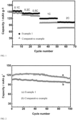
FIG. 1 shows a diagram of rate performance of batteries of Example 1 and Comparative example -
FIG. 2 shows a diagram of cycle performance of batteries of Example 1 and Comparative example - The present invention will be further described below with reference to examples and comparative examples.
- A sulfide Li2S-P2S5 solid electrolyte film was used as a base material; the Li2S-P2S5 solid electrolyte film was prepared by tabletting Li2S-P2S5 powder; Li3PO4 with the purity greater than or equal to 99.9% was used as a target material; magnetron sputtering was carried out in a nitrogen atmosphere; a distance between the magnetron sputtering target material and the base material was 5 cm; power of the magnetron sputtering was 10 W/cm2; a LiPON thin film layer with a thickness of 5 □m was sputtered on one surface of the base material; a magnetron sputtering chamber was vacuumized until a pressure was less than 1×10⁻⁴ Pa; afterwards, argon was introduced; Li3PO4 with the purity greater than or equal to 99.9% was used as a target material; a Li3PO4 thin film layer with a thickness of 1 □m was continuously sputtered on the other surface of the base material;
- an argon atmosphere was maintained; three target materials, such as a Li3PO4 target, a Fe2O3 target, and a carbon target, with the purities greater than or equal to 99.9% were used; the three target materials were simultaneously co-sputtered at powers of 5 W/cm2, 5 W/cm2, and 10 W/cm2 respectively; a composite material layer with a thickness of 5 □m was sputtered on the Li3PO4 thin film layer to obtain a multilayer material with the composite material layer/Li3PO4 thin film layer/sulfide solid electrolyte layer/LiPON thin film layer; the multilayer material was then transferred into a muffle furnace; high-temperature calcination was carried out in the argon atmosphere; the temperature was heated to 350°C at a heating rate of 5 °C/min and was maintained for 6 h; the temperature was then heated to 900 °C at a heating rate of 10 °C/min and was maintained for 6 h; the composite material layer was transformed into a positive active material layer through a high-temperature solid-phase reaction; afterwards, the multilayer material was fixed in a magnetron sputtering chamber, and magnetron sputtering was carried out by using an aluminum target at power of 10 W/cm2, so that an aluminum current collector layer with a thickness of 5 □m was sputtered and deposited on a surface of the positive active material layer;
- finally, the material described above was placed in a glove box filled with argon; a surface of the LiPON thin film layer was uniformly dropwise coated with molten metal lithium; a pressure of 5 MPa was applied after cooling to flatten a metal lithium layer; the flattened metal lithium layer had a thickness of 2 □□m; a battery core was compressed; and the multilayer material of the battery core was packaged in a battery shell, so that a lithium secondary battery in Example 1 was obtained.
- A sulfide Li10GeP2S12 solid electrolyte film was used as a base material; the Li10GeP2S12 solid electrolyte film was prepared by tabletting Li10GeP2S12 powder; Li3PO4 with the purity greater than or equal to 99.9% was used as a target material; magnetron sputtering was carried out in a nitrogen atmosphere; a distance between the magnetron sputtering target material and the base material was 5 cm; power of the magnetron sputtering was 10 W/cm2; a LiPON thin film layer with a thickness of 10 □m was sputtered on one surface of the base material; a magnetron sputtering chamber was vacuumized until a pressure was less than 1×10⁻⁴ Pa; afterwards, argon was introduced; Li3PO4 with the purity greater than or equal to 99.9% was used as a target material; a Li3PO4 thin film layer with a thickness of 0.5 □m was continuously sputtered on the other surface of the base material;
- an argon atmosphere was maintained; three target materials, such as a Li3PO4 target, a Fe2O3 target, and a carbon target, with the purities greater than or equal to 99.9% were used; the three target materials were simultaneously co-sputtered at powers of 5 W/cm2, 5 W/cm2, and 10 W/cm2 respectively; a composite material layer with a thickness of 10 □m was sputtered on the Li3PO4 thin film layer to obtain a multilayer material with the composite material layer/Li3PO4 thin film layer/sulfide solid electrolyte layer/LiPON thin film layer; the multilayer material was then transferred into a muffle furnace; high-temperature calcination was carried out in the argon atmosphere; the temperature was heated to 450°C at a heating rate of 5 °C/min and was maintained for 3 h; the temperature was then heated to 650°C at a heating rate of 5°C/min and was maintained for 18 h; the composite material layer was transformed into a positive active material layer through a high-temperature solid-phase reaction; afterwards, the multilayer material was fixed in a magnetron sputtering chamber, and magnetron sputtering was carried out by using an aluminum target at power of 10 W/cm2, so that an aluminum current collector layer with a thickness of 1 □m was sputtered and deposited on a surface of the positive active material layer;
- finally, the material described above was placed in a glove box filled with argon; a surface of the LiPON thin film layer was uniformly dropwise coated with molten metal lithium; a pressure of 10 MPa was applied after cooling to flatten a metal lithium layer; the flattened metal lithium layer had a thickness of 1 □□m; a battery core was compressed; and the multilayer material of the battery core was packaged in a battery shell, so that a lithium secondary battery in Example 2 was obtained.
- A sulfide Li6PS5Cl solid electrolyte film was used as a base material; the Li6PS5Cl solid electrolyte film was prepared by tabletting Li6PS5Cl powder; Li3PO4 with the purity greater than or equal to 99.9% was used as a target material; magnetron sputtering was carried out in a nitrogen atmosphere; a distance between the magnetron sputtering target material and the base material was 5 cm; power of the magnetron sputtering was 10 W/cm2; a LiPON thin film layer with a thickness of 8 □m was sputtered on one surface of the base material; a magnetron sputtering chamber was vacuumized until a pressure was less than 1×10⁻⁴ Pa; afterwards, argon was introduced; Li3PO4 with the purity greater than or equal to 99.9% was used as a target material; a Li3PO4 thin film layer with a thickness of 0.1 □m was continuously sputtered on the other surface of the base material;
- an argon atmosphere was maintained; three target materials, such as a Li3PO4 target, a Fe2O3 target, and a carbon target, with the purities greater than or equal to 99.9% were used; the three target materials were simultaneously co-sputtered at powers of 5 W/cm2, 5 W/cm2, and 10 W/cm2 respectively; a composite material layer with a thickness of 10 □m was sputtered on the Li3PO4 thin film layer to obtain a multilayer material with the composite material layer/Li3PO4 thin film layer/sulfide solid electrolyte layer/LiPON thin film layer; the multilayer material was then transferred into a muffle furnace; high-temperature calcination was carried out in the argon atmosphere; the temperature was heated to 350°C at a heating rate of 3°C/min and was maintained for 6 h; the temperature was then heated to 750°C at a heating rate of 5°C/min and was maintained for 12 h; the composite material layer was transformed into a positive active material layer through a high-temperature solid-phase reaction; afterwards, the multilayer material was fixed in a magnetron sputtering chamber, and magnetron sputtering was carried out by using an aluminum target at power of 10 W/cm2, so that an aluminum current collector layer with a thickness of 10 □m was sputtered and deposited on a surface of the positive active material layer;
- finally, the material described above was placed in a glove box filled with argon; a surface of the LiPON thin film layer was uniformly dropwise coated with molten metal lithium; a pressure of 5 MPa was applied after cooling to flatten a metal lithium layer; the flattened metal lithium layer had a thickness of 5 □□m; a battery core was compressed; and the multilayer material of the battery core was packaged in a battery shell, so that a lithium secondary battery in Example 3 was obtained.
- A sulfide Li2S-P2S5 solid electrolyte film was used as a base material; the Li2S-P2S5 solid electrolyte film was prepared by tabletting Li2S-P2S5 powder; three target materials, such as a Li3PO4 target, a Fe2O3 target, and a carbon target, with the purities greater than or equal to 99.9% were used; the three target materials were simultaneously co-sputtered at powers of 5 W/cm2, 5 W/cm2, and 10 W/cm2 respectively; a composite material layer with a thickness of 5 □m was deposited on one surface of the Li2S-P2S5 solid electrolyte film to obtain a double-layer material with the composite material layer/sulfide solid electrolyte layer; the double-layer material was then transferred into a muffle furnace; high-temperature calcination was carried out in the argon atmosphere; the temperature was heated to 350°C at a heating rate of 5 °C/min and was maintained for 6 h; the temperature was then heated to 900 °C at a heating rate of 10 °C/min and was maintained for 6 h; the composite material layer was transformed into a positive active material layer through a high-temperature solid-phase reaction; afterwards, the double-layer material was fixed in a magnetron sputtering chamber, and magnetron sputtering was carried out by using an aluminum target at power of 10 W/cm2, so that an aluminum current collector layer with a thickness of 5 □m was sputtered and deposited on a surface of the positive active material layer;
finally, the material described above was placed in a glove box filled with argon; the other surface of the Li2S-P2S5 solid electrolyte film was uniformly dropwise coated with molten metal lithium; a pressure of 5 MPa was applied after cooling to flatten a metal lithium layer; the flattened metal lithium layer had a thickness of 2 □□m; a battery core was compressed; and the multilayer material of the battery core was packaged in a battery shell, so that a lithium secondary battery in Comparative example was obtained. - Charge and discharge cut-off voltages of the lithium secondary batteries were 2.5 to 4.2 V. A constant current was used for charging and discharging. An activation current was 0.1 C. A current for a charge and discharge cycle test was 1 C; and currents for a rate test were 0.1 C, 0.2 C, 0.5 C, 1 C, and 2 C.
- The test results are shown in Table 1 and Table 2 below:
Table 1 0.1 C 0.2 C 0.5 C 1C 2C Example 1 (mAh·g-1) 154.6 147.8 147.1 119.7 104.3 Example 2 (mAh·g-1) 156.4 149.2 137.4 118.5 102.4 Example 3 (mAh·g-1) 152.2 144.7 128.5 113.7 100.3 Comparative example (mAh·g-1) 146.2 137.6 133.4 101.5 85.4 Table 2 Example 1 Example 2 Example 3 Comparative example Specific capacity after 100 cycles (mAh·g-1) 109.3 104.9 105.1 93.5 - As can be seen from the rate performance test results and the cycle performance test results, the lithium secondary batteries according to the examples of the present invention have higher rate performance and cycle performance than those of the battery of the Comparative example in which the Li3PO4 layer and the LiPON layer are not deposited on the surfaces of the sulfide solid electrolyte layer in advance. This is because the interfacial compatibility and stability of the lithium secondary batteries of the examples are higher than those of the battery of Comparative example.
Claims (10)
- A preparation method for a lithium secondary battery, comprising the following steps in sequence:(1) carrying out magnetron sputtering in a nitrogen atmosphere by using a sulfide solid electrolyte layer as a base material and using Li3PO4 as a target material, to sputter a LiPON thin film layer on one surface of the base material;(2) vacuumizing a magnetron sputtering chamber, then introducing argon, and sputtering a Li3PO4 thin film layer on the other surface of the base material by using the Li3PO4 as the target material;(3) maintaining an argon atmosphere, simultaneously co-sputtering three target materials: a Li3PO4 target, a Fe2O3 target, and a carbon target, and depositing a composite material layer on the Li3PO4 thin film layer to obtain a multilayer material with the composite material layer/Li3PO4 thin film layer/sulfide solid electrolyte layer/LiPON thin film layer;(4) transferring the multilayer material into sintering equipment, and carrying out high-temperature calcination in the argon atmosphere to transform the composite material layer into a positive active material layer through a high-temperature solid-phase reaction;(5) carrying out magnetron sputtering on the material subjected to the high-temperature calcination by using an aluminum target, to sputter and deposit an aluminum current collector layer on a surface of the positive active material layer;(6) uniformly dropwise coating a surface of the LiPON thin film layer with molten metal lithium under an argon protection atmosphere, applying a pressure after cooling to flatten a metal lithium layer, and compressing a battery core; and(7) packaging the battery core in a battery shell to obtain the lithium secondary battery.
- The preparation method according to claim 1, wherein a purity of the target material used is greater than or equal to 99.9%.
- The preparation method according to claim 1, wherein the sulfide solid electrolyte in step (1) is one or more of Li2S-P2S5, Li10GeP2S12, Li7P2S8X, and Li6PS5X, and X is one or more of Cl, Br, and I; and the sulfide solid electrolyte layer is prepared by tabletting sulfide solid electrolyte powder.
- The preparation method according to claim 1, wherein the LiPON thin film layer in step (1) has a thickness of 5 to 10 □m.
- The preparation method according to claim 1, wherein the Li3PO4 thin film layer in step (2) has a thickness of 0.1 to 1 □m.
- The preparation method according to claim 1, wherein the composite material layer in step (3) has a thickness of 5 to 10 □□m.
- The preparation method according to claim 1, wherein the high-temperature calcination in step (4) is two-stage sintering; in the first stage of sintering, a heating rate is 3 to 5 °C/min, a sintering temperature is 350 to 450°C, and the temperature is kept for 3 to 6 h; and in the second stage of sintering, a heating rate is 5 to 10 °C/min, a sintering temperature is 650 to 900°C, and the temperature is kept for 6 to 18 h.
- The preparation method according to claim 1, wherein the aluminum current collector layer in step (5) has a thickness of 1 to 10 □m.
- The preparation method according to claim 1, wherein the metal lithium layer in step (6) has a thickness of 1 to 5 □m; and the applying a pressure is performed by applying a pressure of 5 to 10 MPa to one side of the metal lithium layer using a polyimide plate.
- A lithium secondary battery, wherein the lithium secondary battery is prepared by the preparation method according to any one of claims 1 to 9.
Applications Claiming Priority (1)
| Application Number | Priority Date | Filing Date | Title |
|---|---|---|---|
| CN202311510718.0A CN117352856B (en) | 2023-11-14 | 2023-11-14 | Lithium secondary battery and preparation method thereof |
Publications (1)
| Publication Number | Publication Date |
|---|---|
| EP4556591A1 true EP4556591A1 (en) | 2025-05-21 |
Family
ID=89029587
Family Applications (1)
| Application Number | Title | Priority Date | Filing Date |
|---|---|---|---|
| EP23213114.4A Pending EP4556591A1 (en) | 2023-11-14 | 2023-11-29 | Lithium secondary battery and preparation method therefor |
Country Status (3)
| Country | Link |
|---|---|
| US (1) | US20250158011A1 (en) |
| EP (1) | EP4556591A1 (en) |
| CN (1) | CN117352856B (en) |
Citations (2)
| Publication number | Priority date | Publication date | Assignee | Title |
|---|---|---|---|---|
| US20160351950A1 (en) * | 2015-05-26 | 2016-12-01 | Panasonic Intellectual Property Management Co., Ltd. | All-solid-state lithium-ion secondary battery including a solid electrolyte and an intermediate layer |
| US20200235388A1 (en) * | 2018-09-05 | 2020-07-23 | Tianjin Ruisheng Huineng Technology Co., Ltd. | Positive electrode of lithium-ion battery, all-solid-state lithium-ion battery and preparation method thereof, and electrical device |
Family Cites Families (17)
| Publication number | Priority date | Publication date | Assignee | Title |
|---|---|---|---|---|
| JP4187524B2 (en) * | 2002-01-31 | 2008-11-26 | 日本化学工業株式会社 | Lithium iron phosphorus composite oxide carbon composite, method for producing the same, lithium secondary battery positive electrode active material, and lithium secondary battery |
| US8268488B2 (en) * | 2007-12-21 | 2012-09-18 | Infinite Power Solutions, Inc. | Thin film electrolyte for thin film batteries |
| JP2009158416A (en) * | 2007-12-27 | 2009-07-16 | Ulvac Japan Ltd | Manufacturing method for solid electrolyte thin film, parallel flat-plate type magnetron sputtering device, and manufacturing method for thin-film solid lithium ion secondary battery |
| JP5417757B2 (en) * | 2008-07-16 | 2014-02-19 | ソニー株式会社 | Method for producing positive electrode of thin film battery and method for producing thin film battery |
| CN102169990B (en) * | 2011-04-07 | 2013-06-26 | 先进储能材料国家工程研究中心有限责任公司 | A kind of ternary cathode material and its production method |
| FR3002695B1 (en) * | 2013-02-28 | 2021-04-02 | I Ten | PROCESS FOR MANUFACTURING AN ENTIRELY SOLID MONOLITHIC BATTERY |
| DE102014105531A1 (en) * | 2014-04-17 | 2015-10-22 | Schmid Energy Systems Gmbh | LiPON or LiPSON solid electrolyte layers and methods of making such layers |
| CN105514491B (en) * | 2015-12-29 | 2018-06-26 | 湖州创亚动力电池材料有限公司 | A kind of preparation of all solid state inoganic solids lithium-ion electrolyte |
| CN106099201B (en) * | 2016-08-18 | 2019-01-29 | 江华邦能电子科技有限公司 | A kind of preparation method of the All-solid film batteries of high-energy density |
| JP6887240B2 (en) * | 2016-11-29 | 2021-06-16 | 株式会社アルバック | Thin-film lithium secondary battery and its manufacturing method |
| CN108649264B (en) * | 2018-05-15 | 2020-07-31 | 北京科技大学 | Preparation method of thin film solid electrolyte added with buffer layer |
| CN110120547B (en) * | 2019-05-20 | 2021-03-09 | 河南固锂电技术有限公司 | Preparation method of electrolyte membrane for all-solid-state lithium ion battery and electrolyte membrane |
| CN113745651B (en) * | 2021-08-27 | 2023-12-05 | 深圳市研一新材料有限责任公司 | Coated sulfide solid electrolyte and preparation method and application thereof |
| CN114388895A (en) * | 2021-12-29 | 2022-04-22 | 深圳大学 | Preparation method of interface modification layer between lithium metal and garnet type solid electrolyte and solid lithium metal battery |
| CN116053572A (en) * | 2023-01-30 | 2023-05-02 | 大连理工大学 | A kind of polyvalent transition metal ion doped LiPON solid film electrolyte, preparation method and application thereof |
| CN116314809B (en) * | 2023-03-21 | 2026-03-10 | 欣旺达动力科技股份有限公司 | Solid-state battery, preparation method thereof and electric equipment |
| CN116845333A (en) * | 2023-07-20 | 2023-10-03 | 武汉工程大学 | An all-solid-state thin-film lithium-ion battery and its preparation method |
-
2023
- 2023-11-14 CN CN202311510718.0A patent/CN117352856B/en active Active
- 2023-11-29 EP EP23213114.4A patent/EP4556591A1/en active Pending
-
2024
- 2024-01-16 US US18/414,343 patent/US20250158011A1/en not_active Abandoned
Patent Citations (2)
| Publication number | Priority date | Publication date | Assignee | Title |
|---|---|---|---|---|
| US20160351950A1 (en) * | 2015-05-26 | 2016-12-01 | Panasonic Intellectual Property Management Co., Ltd. | All-solid-state lithium-ion secondary battery including a solid electrolyte and an intermediate layer |
| US20200235388A1 (en) * | 2018-09-05 | 2020-07-23 | Tianjin Ruisheng Huineng Technology Co., Ltd. | Positive electrode of lithium-ion battery, all-solid-state lithium-ion battery and preparation method thereof, and electrical device |
Non-Patent Citations (2)
| Title |
|---|
| IOANNITI MARINA MARIA ET AL: "Energy-dense Li metal anodes enabled by thin film electrolytes", JOURNAL OF VACUUM SCIENCE, AMERICAN INSTITUTE OF PHYSICS, 2 HUNTINGTON QUADRANGLE, MELVILLE, NY 11747, vol. 38, no. 6, 060801, 21 September 2020 (2020-09-21), pages 1 - 23, XP012250217, ISSN: 0734-2101, [retrieved on 20200921], DOI: 10.1116/6.0000430 * |
| WANG CHUNHUA ET AL: "Dendrite-free all-solid-state lithium batteries with lithium phosphorous oxynitride-modified lithium metal anode and composite solid electrolytes", NANO RESEARCH, TSINGHUA UNIVERSITY PRESS, CN, vol. 12, no. 1, 22 September 2018 (2018-09-22), pages 217 - 223, XP036659998, ISSN: 1998-0124, [retrieved on 20180922], DOI: 10.1007/S12274-018-2205-7 * |
Also Published As
| Publication number | Publication date |
|---|---|
| CN117352856B (en) | 2024-08-27 |
| CN117352856A (en) | 2024-01-05 |
| US20250158011A1 (en) | 2025-05-15 |
Similar Documents
| Publication | Publication Date | Title |
|---|---|---|
| EP1162675B1 (en) | Negative electrode of lithium secondary battery | |
| US8197781B2 (en) | Sputtering target of Li3PO4 and method for producing same | |
| JP2011096630A (en) | Solid-state lithium secondary battery, and method for producing the same | |
| CN104659412B (en) | Lithium-carbon-boron oxide solid electrolyte material containing plane triangle group and battery | |
| JP2015072772A (en) | Lithium ion secondary battery and method for producing positive electrode active material for lithium ion secondary battery | |
| CN112490445B (en) | Preparation and application methods of modified lithium composite negative electrode material for improving solid battery interface | |
| CN108365169A (en) | A kind of lithium an- ode structure combination and preparation method thereof, lithium battery electric core | |
| CN108232108B (en) | A lithium battery positive electrode structure and preparation method thereof, lithium battery structure | |
| CN112838217A (en) | Composite structure containing lithium cathode, preparation method thereof and solid-state battery | |
| CN101692493A (en) | Metallic film capable of improving stability of anode of lithium ion battery and manufacturing method | |
| CN110911733A (en) | Lithium-stable sulfide solid electrolyte, preparation method thereof and solid-state battery with solid electrolyte | |
| CN108565403A (en) | A kind of lithium battery graphene silicium cathode material and its preparation method and application | |
| CN115732643A (en) | A kind of halogenated solid electrolyte interfacial layer composite electrode material based on solid source plasma and its preparation method and application | |
| CN111224068A (en) | Metal lithium cathode for lithium battery and lithium battery | |
| CN114865099A (en) | All-solid-state thick film lithium battery with alloy interface-lithium thick film structure and preparation method thereof | |
| JP2011113735A (en) | Nonaqueous electrolyte battery | |
| EP4556591A1 (en) | Lithium secondary battery and preparation method therefor | |
| CN117352854B (en) | All-solid-state lithium battery and preparation method thereof | |
| CN110713186B (en) | Method for preparing amorphous silicon/carbon composite material | |
| CN103215554B (en) | BiFeO 3the preparation method of sodium-ion battery anode material | |
| CN111647863A (en) | Preparation method and application of Li2FexSiO4 cathode film | |
| CN120117647B (en) | Surface modified Li3InxGa1-xCl6 materials, their preparation and applications in lithium metal solid-state batteries | |
| CN120089675B (en) | A PVD-modified cathode material, its preparation method and application | |
| CN116845182B (en) | A lithium-carbon composite negative electrode sheet, battery and all-solid-state battery | |
| JP2023128768A (en) | All-solid-state lithium battery and its manufacturing method |
Legal Events
| Date | Code | Title | Description |
|---|---|---|---|
| PUAI | Public reference made under article 153(3) epc to a published international application that has entered the european phase |
Free format text: ORIGINAL CODE: 0009012 |
|
| STAA | Information on the status of an ep patent application or granted ep patent |
Free format text: STATUS: THE APPLICATION HAS BEEN PUBLISHED |
|
| AK | Designated contracting states |
Kind code of ref document: A1 Designated state(s): AL AT BE BG CH CY CZ DE DK EE ES FI FR GB GR HR HU IE IS IT LI LT LU LV MC ME MK MT NL NO PL PT RO RS SE SI SK SM TR |
|
| STAA | Information on the status of an ep patent application or granted ep patent |
Free format text: STATUS: REQUEST FOR EXAMINATION WAS MADE |
|
| 17P | Request for examination filed |
Effective date: 20260209 |