EP4556538A1 - Antivirus composite resin composition with excellent virus inactivation function and composite-resin-coated steel sheet using same - Google Patents
Antivirus composite resin composition with excellent virus inactivation function and composite-resin-coated steel sheet using same Download PDFInfo
- Publication number
- EP4556538A1 EP4556538A1 EP23840009.7A EP23840009A EP4556538A1 EP 4556538 A1 EP4556538 A1 EP 4556538A1 EP 23840009 A EP23840009 A EP 23840009A EP 4556538 A1 EP4556538 A1 EP 4556538A1
- Authority
- EP
- European Patent Office
- Prior art keywords
- antiviral
- composite resin
- steel sheet
- resin composition
- coating
- Prior art date
- Legal status (The legal status is an assumption and is not a legal conclusion. Google has not performed a legal analysis and makes no representation as to the accuracy of the status listed.)
- Pending
Links
Images
Classifications
-
- C—CHEMISTRY; METALLURGY
- C21—METALLURGY OF IRON
- C21D—MODIFYING THE PHYSICAL STRUCTURE OF FERROUS METALS; GENERAL DEVICES FOR HEAT TREATMENT OF FERROUS OR NON-FERROUS METALS OR ALLOYS; MAKING METAL MALLEABLE, e.g. BY DECARBURISATION OR TEMPERING
- C21D9/00—Heat treatment, e.g. annealing, hardening, quenching or tempering, adapted for particular articles; Furnaces therefor
- C21D9/46—Heat treatment, e.g. annealing, hardening, quenching or tempering, adapted for particular articles; Furnaces therefor for sheet metals
-
- A—HUMAN NECESSITIES
- A01—AGRICULTURE; FORESTRY; ANIMAL HUSBANDRY; HUNTING; TRAPPING; FISHING
- A01N—PRESERVATION OF BODIES OF HUMANS OR ANIMALS OR PLANTS OR PARTS THEREOF; BIOCIDES, e.g. AS DISINFECTANTS, AS PESTICIDES OR AS HERBICIDES; PEST REPELLANTS OR ATTRACTANTS; PLANT GROWTH REGULATORS
- A01N59/00—Biocides, pest repellants or attractants, or plant growth regulators containing elements or inorganic compounds
- A01N59/16—Heavy metals; Compounds thereof
- A01N59/20—Copper
-
- A—HUMAN NECESSITIES
- A01—AGRICULTURE; FORESTRY; ANIMAL HUSBANDRY; HUNTING; TRAPPING; FISHING
- A01N—PRESERVATION OF BODIES OF HUMANS OR ANIMALS OR PLANTS OR PARTS THEREOF; BIOCIDES, e.g. AS DISINFECTANTS, AS PESTICIDES OR AS HERBICIDES; PEST REPELLANTS OR ATTRACTANTS; PLANT GROWTH REGULATORS
- A01N25/00—Biocides, pest repellants or attractants, or plant growth regulators, characterised by their forms, or by their non-active ingredients or by their methods of application, e.g. seed treatment or sequential application; Substances for reducing the noxious effect of the active ingredients to organisms other than pests
- A01N25/08—Biocides, pest repellants or attractants, or plant growth regulators, characterised by their forms, or by their non-active ingredients or by their methods of application, e.g. seed treatment or sequential application; Substances for reducing the noxious effect of the active ingredients to organisms other than pests containing solids as carriers or diluents
- A01N25/10—Macromolecular compounds
-
- A—HUMAN NECESSITIES
- A01—AGRICULTURE; FORESTRY; ANIMAL HUSBANDRY; HUNTING; TRAPPING; FISHING
- A01N—PRESERVATION OF BODIES OF HUMANS OR ANIMALS OR PLANTS OR PARTS THEREOF; BIOCIDES, e.g. AS DISINFECTANTS, AS PESTICIDES OR AS HERBICIDES; PEST REPELLANTS OR ATTRACTANTS; PLANT GROWTH REGULATORS
- A01N59/00—Biocides, pest repellants or attractants, or plant growth regulators containing elements or inorganic compounds
-
- A—HUMAN NECESSITIES
- A01—AGRICULTURE; FORESTRY; ANIMAL HUSBANDRY; HUNTING; TRAPPING; FISHING
- A01N—PRESERVATION OF BODIES OF HUMANS OR ANIMALS OR PLANTS OR PARTS THEREOF; BIOCIDES, e.g. AS DISINFECTANTS, AS PESTICIDES OR AS HERBICIDES; PEST REPELLANTS OR ATTRACTANTS; PLANT GROWTH REGULATORS
- A01N59/00—Biocides, pest repellants or attractants, or plant growth regulators containing elements or inorganic compounds
- A01N59/06—Aluminium; Calcium; Magnesium; Compounds thereof
-
- A—HUMAN NECESSITIES
- A01—AGRICULTURE; FORESTRY; ANIMAL HUSBANDRY; HUNTING; TRAPPING; FISHING
- A01N—PRESERVATION OF BODIES OF HUMANS OR ANIMALS OR PLANTS OR PARTS THEREOF; BIOCIDES, e.g. AS DISINFECTANTS, AS PESTICIDES OR AS HERBICIDES; PEST REPELLANTS OR ATTRACTANTS; PLANT GROWTH REGULATORS
- A01N59/00—Biocides, pest repellants or attractants, or plant growth regulators containing elements or inorganic compounds
- A01N59/16—Heavy metals; Compounds thereof
-
- A—HUMAN NECESSITIES
- A01—AGRICULTURE; FORESTRY; ANIMAL HUSBANDRY; HUNTING; TRAPPING; FISHING
- A01N—PRESERVATION OF BODIES OF HUMANS OR ANIMALS OR PLANTS OR PARTS THEREOF; BIOCIDES, e.g. AS DISINFECTANTS, AS PESTICIDES OR AS HERBICIDES; PEST REPELLANTS OR ATTRACTANTS; PLANT GROWTH REGULATORS
- A01N59/00—Biocides, pest repellants or attractants, or plant growth regulators containing elements or inorganic compounds
- A01N59/26—Phosphorus; Compounds thereof
-
- A—HUMAN NECESSITIES
- A01—AGRICULTURE; FORESTRY; ANIMAL HUSBANDRY; HUNTING; TRAPPING; FISHING
- A01P—BIOCIDAL, PEST REPELLANT, PEST ATTRACTANT OR PLANT GROWTH REGULATORY ACTIVITY OF CHEMICAL COMPOUNDS OR PREPARATIONS
- A01P1/00—Disinfectants; Antimicrobial compounds or mixtures thereof
-
- C—CHEMISTRY; METALLURGY
- C08—ORGANIC MACROMOLECULAR COMPOUNDS; THEIR PREPARATION OR CHEMICAL WORKING-UP; COMPOSITIONS BASED THEREON
- C08G—MACROMOLECULAR COMPOUNDS OBTAINED OTHERWISE THAN BY REACTIONS ONLY INVOLVING UNSATURATED CARBON-TO-CARBON BONDS
- C08G18/00—Polymeric products of isocyanates or isothiocyanates
- C08G18/06—Polymeric products of isocyanates or isothiocyanates with compounds having active hydrogen
- C08G18/08—Processes
- C08G18/10—Prepolymer processes involving reaction of isocyanates or isothiocyanates with compounds having active hydrogen in a first reaction step
-
- C—CHEMISTRY; METALLURGY
- C08—ORGANIC MACROMOLECULAR COMPOUNDS; THEIR PREPARATION OR CHEMICAL WORKING-UP; COMPOSITIONS BASED THEREON
- C08K—Use of inorganic or non-macromolecular organic substances as compounding ingredients
- C08K3/00—Use of inorganic substances as compounding ingredients
- C08K3/01—Use of inorganic substances as compounding ingredients characterized by their specific function
- C08K3/013—Fillers, pigments or reinforcing additives
-
- C—CHEMISTRY; METALLURGY
- C08—ORGANIC MACROMOLECULAR COMPOUNDS; THEIR PREPARATION OR CHEMICAL WORKING-UP; COMPOSITIONS BASED THEREON
- C08K—Use of inorganic or non-macromolecular organic substances as compounding ingredients
- C08K3/00—Use of inorganic substances as compounding ingredients
- C08K3/02—Elements
- C08K3/08—Metals
-
- C—CHEMISTRY; METALLURGY
- C08—ORGANIC MACROMOLECULAR COMPOUNDS; THEIR PREPARATION OR CHEMICAL WORKING-UP; COMPOSITIONS BASED THEREON
- C08K—Use of inorganic or non-macromolecular organic substances as compounding ingredients
- C08K3/00—Use of inorganic substances as compounding ingredients
- C08K3/18—Oxygen-containing compounds, e.g. metal carbonyls
- C08K3/20—Oxides; Hydroxides
- C08K3/22—Oxides; Hydroxides of metals
-
- C—CHEMISTRY; METALLURGY
- C08—ORGANIC MACROMOLECULAR COMPOUNDS; THEIR PREPARATION OR CHEMICAL WORKING-UP; COMPOSITIONS BASED THEREON
- C08K—Use of inorganic or non-macromolecular organic substances as compounding ingredients
- C08K3/00—Use of inorganic substances as compounding ingredients
- C08K3/32—Phosphorus-containing compounds
-
- C—CHEMISTRY; METALLURGY
- C08—ORGANIC MACROMOLECULAR COMPOUNDS; THEIR PREPARATION OR CHEMICAL WORKING-UP; COMPOSITIONS BASED THEREON
- C08K—Use of inorganic or non-macromolecular organic substances as compounding ingredients
- C08K3/00—Use of inorganic substances as compounding ingredients
- C08K3/34—Silicon-containing compounds
-
- C—CHEMISTRY; METALLURGY
- C08—ORGANIC MACROMOLECULAR COMPOUNDS; THEIR PREPARATION OR CHEMICAL WORKING-UP; COMPOSITIONS BASED THEREON
- C08K—Use of inorganic or non-macromolecular organic substances as compounding ingredients
- C08K3/00—Use of inorganic substances as compounding ingredients
- C08K3/34—Silicon-containing compounds
- C08K3/36—Silica
-
- C—CHEMISTRY; METALLURGY
- C08—ORGANIC MACROMOLECULAR COMPOUNDS; THEIR PREPARATION OR CHEMICAL WORKING-UP; COMPOSITIONS BASED THEREON
- C08K—Use of inorganic or non-macromolecular organic substances as compounding ingredients
- C08K5/00—Use of organic ingredients
- C08K5/0008—Organic ingredients according to more than one of the "one dot" groups of C08K5/01 - C08K5/59
- C08K5/0025—Crosslinking or vulcanising agents; including accelerators
-
- C—CHEMISTRY; METALLURGY
- C08—ORGANIC MACROMOLECULAR COMPOUNDS; THEIR PREPARATION OR CHEMICAL WORKING-UP; COMPOSITIONS BASED THEREON
- C08K—Use of inorganic or non-macromolecular organic substances as compounding ingredients
- C08K5/00—Use of organic ingredients
- C08K5/16—Nitrogen-containing compounds
- C08K5/29—Compounds containing one or more carbon-to-nitrogen double bonds
-
- C—CHEMISTRY; METALLURGY
- C08—ORGANIC MACROMOLECULAR COMPOUNDS; THEIR PREPARATION OR CHEMICAL WORKING-UP; COMPOSITIONS BASED THEREON
- C08K—Use of inorganic or non-macromolecular organic substances as compounding ingredients
- C08K5/00—Use of organic ingredients
- C08K5/16—Nitrogen-containing compounds
- C08K5/34—Heterocyclic compounds having nitrogen in the ring
- C08K5/3412—Heterocyclic compounds having nitrogen in the ring having one nitrogen atom in the ring
-
- C—CHEMISTRY; METALLURGY
- C08—ORGANIC MACROMOLECULAR COMPOUNDS; THEIR PREPARATION OR CHEMICAL WORKING-UP; COMPOSITIONS BASED THEREON
- C08K—Use of inorganic or non-macromolecular organic substances as compounding ingredients
- C08K5/00—Use of organic ingredients
- C08K5/16—Nitrogen-containing compounds
- C08K5/34—Heterocyclic compounds having nitrogen in the ring
- C08K5/3467—Heterocyclic compounds having nitrogen in the ring having more than two nitrogen atoms in the ring
- C08K5/3477—Six-membered rings
- C08K5/3492—Triazines
- C08K5/34922—Melamine; Derivatives thereof
-
- C—CHEMISTRY; METALLURGY
- C08—ORGANIC MACROMOLECULAR COMPOUNDS; THEIR PREPARATION OR CHEMICAL WORKING-UP; COMPOSITIONS BASED THEREON
- C08K—Use of inorganic or non-macromolecular organic substances as compounding ingredients
- C08K9/00—Use of pretreated ingredients
- C08K9/12—Adsorbed ingredients, e.g. ingredients on carriers
-
- C—CHEMISTRY; METALLURGY
- C09—DYES; PAINTS; POLISHES; NATURAL RESINS; ADHESIVES; COMPOSITIONS NOT OTHERWISE PROVIDED FOR; APPLICATIONS OF MATERIALS NOT OTHERWISE PROVIDED FOR
- C09D—COATING COMPOSITIONS, e.g. PAINTS, VARNISHES OR LACQUERS; FILLING PASTES; CHEMICAL PAINT OR INK REMOVERS; INKS; CORRECTING FLUIDS; WOODSTAINS; PASTES OR SOLIDS FOR COLOURING OR PRINTING; USE OF MATERIALS THEREFOR
- C09D167/00—Coating compositions based on polyesters obtained by reactions forming a carboxylic ester link in the main chain; Coating compositions based on derivatives of such polymers
-
- C—CHEMISTRY; METALLURGY
- C09—DYES; PAINTS; POLISHES; NATURAL RESINS; ADHESIVES; COMPOSITIONS NOT OTHERWISE PROVIDED FOR; APPLICATIONS OF MATERIALS NOT OTHERWISE PROVIDED FOR
- C09D—COATING COMPOSITIONS, e.g. PAINTS, VARNISHES OR LACQUERS; FILLING PASTES; CHEMICAL PAINT OR INK REMOVERS; INKS; CORRECTING FLUIDS; WOODSTAINS; PASTES OR SOLIDS FOR COLOURING OR PRINTING; USE OF MATERIALS THEREFOR
- C09D175/00—Coating compositions based on polyureas or polyurethanes; Coating compositions based on derivatives of such polymers
- C09D175/04—Polyurethanes
- C09D175/06—Polyurethanes from polyesters
-
- C—CHEMISTRY; METALLURGY
- C09—DYES; PAINTS; POLISHES; NATURAL RESINS; ADHESIVES; COMPOSITIONS NOT OTHERWISE PROVIDED FOR; APPLICATIONS OF MATERIALS NOT OTHERWISE PROVIDED FOR
- C09D—COATING COMPOSITIONS, e.g. PAINTS, VARNISHES OR LACQUERS; FILLING PASTES; CHEMICAL PAINT OR INK REMOVERS; INKS; CORRECTING FLUIDS; WOODSTAINS; PASTES OR SOLIDS FOR COLOURING OR PRINTING; USE OF MATERIALS THEREFOR
- C09D5/00—Coating compositions, e.g. paints, varnishes or lacquers, characterised by their physical nature or the effects produced; Filling pastes
- C09D5/14—Paints containing biocides, e.g. fungicides, insecticides or pesticides
-
- C—CHEMISTRY; METALLURGY
- C09—DYES; PAINTS; POLISHES; NATURAL RESINS; ADHESIVES; COMPOSITIONS NOT OTHERWISE PROVIDED FOR; APPLICATIONS OF MATERIALS NOT OTHERWISE PROVIDED FOR
- C09D—COATING COMPOSITIONS, e.g. PAINTS, VARNISHES OR LACQUERS; FILLING PASTES; CHEMICAL PAINT OR INK REMOVERS; INKS; CORRECTING FLUIDS; WOODSTAINS; PASTES OR SOLIDS FOR COLOURING OR PRINTING; USE OF MATERIALS THEREFOR
- C09D7/00—Features of coating compositions, not provided for in group C09D5/00; Processes for incorporating ingredients in coating compositions
- C09D7/20—Diluents or solvents
-
- C—CHEMISTRY; METALLURGY
- C09—DYES; PAINTS; POLISHES; NATURAL RESINS; ADHESIVES; COMPOSITIONS NOT OTHERWISE PROVIDED FOR; APPLICATIONS OF MATERIALS NOT OTHERWISE PROVIDED FOR
- C09D—COATING COMPOSITIONS, e.g. PAINTS, VARNISHES OR LACQUERS; FILLING PASTES; CHEMICAL PAINT OR INK REMOVERS; INKS; CORRECTING FLUIDS; WOODSTAINS; PASTES OR SOLIDS FOR COLOURING OR PRINTING; USE OF MATERIALS THEREFOR
- C09D7/00—Features of coating compositions, not provided for in group C09D5/00; Processes for incorporating ingredients in coating compositions
- C09D7/40—Additives
-
- C—CHEMISTRY; METALLURGY
- C09—DYES; PAINTS; POLISHES; NATURAL RESINS; ADHESIVES; COMPOSITIONS NOT OTHERWISE PROVIDED FOR; APPLICATIONS OF MATERIALS NOT OTHERWISE PROVIDED FOR
- C09D—COATING COMPOSITIONS, e.g. PAINTS, VARNISHES OR LACQUERS; FILLING PASTES; CHEMICAL PAINT OR INK REMOVERS; INKS; CORRECTING FLUIDS; WOODSTAINS; PASTES OR SOLIDS FOR COLOURING OR PRINTING; USE OF MATERIALS THEREFOR
- C09D7/00—Features of coating compositions, not provided for in group C09D5/00; Processes for incorporating ingredients in coating compositions
- C09D7/40—Additives
- C09D7/60—Additives non-macromolecular
- C09D7/61—Additives non-macromolecular inorganic
-
- C—CHEMISTRY; METALLURGY
- C09—DYES; PAINTS; POLISHES; NATURAL RESINS; ADHESIVES; COMPOSITIONS NOT OTHERWISE PROVIDED FOR; APPLICATIONS OF MATERIALS NOT OTHERWISE PROVIDED FOR
- C09D—COATING COMPOSITIONS, e.g. PAINTS, VARNISHES OR LACQUERS; FILLING PASTES; CHEMICAL PAINT OR INK REMOVERS; INKS; CORRECTING FLUIDS; WOODSTAINS; PASTES OR SOLIDS FOR COLOURING OR PRINTING; USE OF MATERIALS THEREFOR
- C09D7/00—Features of coating compositions, not provided for in group C09D5/00; Processes for incorporating ingredients in coating compositions
- C09D7/40—Additives
- C09D7/66—Additives characterised by particle size
- C09D7/69—Particle size larger than 1000 nm
-
- C—CHEMISTRY; METALLURGY
- C21—METALLURGY OF IRON
- C21D—MODIFYING THE PHYSICAL STRUCTURE OF FERROUS METALS; GENERAL DEVICES FOR HEAT TREATMENT OF FERROUS OR NON-FERROUS METALS OR ALLOYS; MAKING METAL MALLEABLE, e.g. BY DECARBURISATION OR TEMPERING
- C21D8/00—Modifying the physical properties of ferrous metals or ferrous alloys by deformation combined with, or followed by, heat treatment
- C21D8/02—Modifying the physical properties of ferrous metals or ferrous alloys by deformation combined with, or followed by, heat treatment during manufacturing of plates or strips
- C21D8/0278—Modifying the physical properties of ferrous metals or ferrous alloys by deformation combined with, or followed by, heat treatment during manufacturing of plates or strips involving a particular surface treatment
-
- C—CHEMISTRY; METALLURGY
- C22—METALLURGY; FERROUS OR NON-FERROUS ALLOYS; TREATMENT OF ALLOYS OR NON-FERROUS METALS
- C22C—ALLOYS
- C22C38/00—Ferrous alloys, e.g. steel alloys
-
- B—PERFORMING OPERATIONS; TRANSPORTING
- B32—LAYERED PRODUCTS
- B32B—LAYERED PRODUCTS, i.e. PRODUCTS BUILT-UP OF STRATA OF FLAT OR NON-FLAT, e.g. CELLULAR OR HONEYCOMB, FORM
- B32B15/00—Layered products comprising a layer of metal
- B32B15/01—Layered products comprising a layer of metal all layers being exclusively metallic
- B32B15/012—Layered products comprising a layer of metal all layers being exclusively metallic one layer being formed of an iron alloy or steel, another layer being formed of aluminium or an aluminium alloy
-
- B—PERFORMING OPERATIONS; TRANSPORTING
- B32—LAYERED PRODUCTS
- B32B—LAYERED PRODUCTS, i.e. PRODUCTS BUILT-UP OF STRATA OF FLAT OR NON-FLAT, e.g. CELLULAR OR HONEYCOMB, FORM
- B32B15/00—Layered products comprising a layer of metal
- B32B15/01—Layered products comprising a layer of metal all layers being exclusively metallic
- B32B15/013—Layered products comprising a layer of metal all layers being exclusively metallic one layer being formed of an iron alloy or steel, another layer being formed of a metal other than iron or aluminium
-
- C—CHEMISTRY; METALLURGY
- C08—ORGANIC MACROMOLECULAR COMPOUNDS; THEIR PREPARATION OR CHEMICAL WORKING-UP; COMPOSITIONS BASED THEREON
- C08K—Use of inorganic or non-macromolecular organic substances as compounding ingredients
- C08K3/00—Use of inorganic substances as compounding ingredients
- C08K3/18—Oxygen-containing compounds, e.g. metal carbonyls
- C08K3/20—Oxides; Hydroxides
- C08K3/22—Oxides; Hydroxides of metals
- C08K2003/2206—Oxides; Hydroxides of metals of calcium, strontium or barium
-
- C—CHEMISTRY; METALLURGY
- C08—ORGANIC MACROMOLECULAR COMPOUNDS; THEIR PREPARATION OR CHEMICAL WORKING-UP; COMPOSITIONS BASED THEREON
- C08K—Use of inorganic or non-macromolecular organic substances as compounding ingredients
- C08K3/00—Use of inorganic substances as compounding ingredients
- C08K3/18—Oxygen-containing compounds, e.g. metal carbonyls
- C08K3/20—Oxides; Hydroxides
- C08K3/22—Oxides; Hydroxides of metals
- C08K2003/2237—Oxides; Hydroxides of metals of titanium
-
- C—CHEMISTRY; METALLURGY
- C08—ORGANIC MACROMOLECULAR COMPOUNDS; THEIR PREPARATION OR CHEMICAL WORKING-UP; COMPOSITIONS BASED THEREON
- C08K—Use of inorganic or non-macromolecular organic substances as compounding ingredients
- C08K3/00—Use of inorganic substances as compounding ingredients
- C08K3/18—Oxygen-containing compounds, e.g. metal carbonyls
- C08K3/20—Oxides; Hydroxides
- C08K3/22—Oxides; Hydroxides of metals
- C08K2003/2265—Oxides; Hydroxides of metals of iron
- C08K2003/2272—Ferric oxide (Fe2O3)
-
- C—CHEMISTRY; METALLURGY
- C08—ORGANIC MACROMOLECULAR COMPOUNDS; THEIR PREPARATION OR CHEMICAL WORKING-UP; COMPOSITIONS BASED THEREON
- C08K—Use of inorganic or non-macromolecular organic substances as compounding ingredients
- C08K3/00—Use of inorganic substances as compounding ingredients
- C08K3/32—Phosphorus-containing compounds
- C08K2003/321—Phosphates
- C08K2003/325—Calcium, strontium or barium phosphate
-
- C—CHEMISTRY; METALLURGY
- C08—ORGANIC MACROMOLECULAR COMPOUNDS; THEIR PREPARATION OR CHEMICAL WORKING-UP; COMPOSITIONS BASED THEREON
- C08K—Use of inorganic or non-macromolecular organic substances as compounding ingredients
- C08K2201/00—Specific properties of additives
- C08K2201/002—Physical properties
- C08K2201/005—Additives being defined by their particle size in general
-
- C—CHEMISTRY; METALLURGY
- C08—ORGANIC MACROMOLECULAR COMPOUNDS; THEIR PREPARATION OR CHEMICAL WORKING-UP; COMPOSITIONS BASED THEREON
- C08K—Use of inorganic or non-macromolecular organic substances as compounding ingredients
- C08K3/00—Use of inorganic substances as compounding ingredients
- C08K3/02—Elements
- C08K3/04—Carbon
-
- C—CHEMISTRY; METALLURGY
- C08—ORGANIC MACROMOLECULAR COMPOUNDS; THEIR PREPARATION OR CHEMICAL WORKING-UP; COMPOSITIONS BASED THEREON
- C08K—Use of inorganic or non-macromolecular organic substances as compounding ingredients
- C08K3/00—Use of inorganic substances as compounding ingredients
- C08K3/02—Elements
- C08K3/04—Carbon
- C08K3/041—Carbon nanotubes
Definitions
- the present disclosure relates to a composite resin composition having antiviral properties capable of inactivating viruses such as coronaviruses, and also to a composite resin coated steel plate sheet having an excellent virus inactivation function using the composition.
- Coronaviruses Recently, the global pandemic caused by the coronavirus (Covid-19) has not only caused serious socio-economic problems, but has also made the development of vaccines and treatments urgent. Coronaviruses recently caused a global pandemic, but also evolved into the SARS virus in 2013, the MERS virus in 2016, and the Covid-19 virus in 2019. In addition, Covid-19 has mutated from alpha, beta, gamma, and delta to the recently prevalent omicron, which has a fatal impact on human health and well-being. Coronaviruses contain RNA nucleic acids in a spherical phospholipid and protein envelope. Most viruses invade human or animal host cells and multiply by replicating their nucleic acids in large quantities by using the host cell's ribosomes. Viruses are smaller than bacteria or fungi, can spread and replicate quickly, mutate quickly, and have a high transmission rate, making it difficult to develop treatments or vaccines therefor.
- a composite coated steel sheet used for home appliances and building materials is usually manufactured with a coating thickness of several to several tens of ⁇ m for long-term use of more than 10 years. Therefore, in the case of the metal, when a liquid coating solution is coated on the steel sheet, there is a problem that it is difficult to exhibit functionality on the surface because there is a high possibility that the solution will be present inside the coating due to density. In addition, there is a problem that a surface color changes due to oxidation, such as copper metal, when used for a long time. In addition, when using quaternary ammonium, some effects are shown, but the immediate effect is insufficient and may be incomplete, so the use thereof is limited.
- An aspect of the present disclosure is to provide a coating composition having the function of inactivating microorganisms on a surface of a coating with an inorganic-based compound that not only does not change color even when used for a long period of time, but also has a lower density than metal particles and thus easily floats to the surface of the coating, in order to solve the above-described problem.
- Another aspect of the present disclosure is to provide a coated steel sheet using a coating composition having antiviral properties as described above.
- an antiviral composite resin composition including: 30 to 60 wt% of a urethane-modified polyester binder resin; 3 to 15 wt% of a curing agent; 0.1 to 10 wt% of a pigment; 0.1 to 10 wt% of an antiviral compound; and a remainder of a solvent, wherein the antiviral component includes one or more selected from the group consisting of (A) metal hydroxide ([M 1 OH 2 ]), (B) hydroxyapatite ([Ca 10 (PO 4 ) 6 (OH) 2 )), and (C) metal-doped thermosensitive titanium dioxide photocatalyst ([M 2 -TiO 2 ]), wherein M 1 is Ca or Mg, and M 2 is Pt, Cr, V, Mn, Fe, Zn, Cu, Ni, Zr, Mo, Ag, W, or Au.
- an antiviral composite resin coated steel sheet including: a base steel sheet and an antiviral composite resin coating including an antiviral composite resin composition on at least one surface of the base steel sheet.
- an antiviral composite resin composition which is a composition in which an inorganic oxide and a thermosensitive photocatalyst having a virus-inactivation function are dispersed in a polymer resin composition.
- the coating formed with the composition of the present disclosure has the function of effectively inactivating viruses adsorbed on the coating surface in the form of droplets, i.e., moisture containing viruses, by hydroxide anions and active oxygen species generated in the coating.
- thermosensitive photocatalyst which is activated by infrared rays even in the absence of light, along with the strong cation and anion elution characteristics of inorganic hydroxides.
- thermosensitive photocatalyst which is activated by infrared rays even in the absence of light
- the properties of the antiviral material do not change significantly even when the steel sheet for building materials is used for a long period of time.
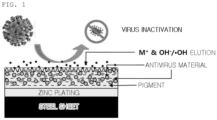
- FIG. 1 schematically illustrates a cross-section of an antiviral composite resin coated steel sheet provided by the present disclosure and a virus inactivation principle of the antiviral composite resin coated steel sheet.
- a composite resin composition in which a predetermined pigment and an antiviral material are included in a transparent resin composition comprising a urethane-modified polyester polymer resin, a curing agent, and a solvent.
- a coating coated with the resin composition of the present disclosure may form a coating having excellent antiviral properties when cured by causing an antiviral material with a low specific gravity to float to the interface.
- An antiviral composite resin composition according to an embodiment of the present disclosure may provide a coating having excellent processability and chemical resistance, and by forming a urethane-modified polyester resin coating in which a pigment and an antiviral compound are mixed, each of the components may form a composite network structure, thereby providing excellent press processability and surface functionality.
- an antiviral composite resin composition may include: 30 to 60 wt% of a urethane-modified polyester resin; 3 to 15 wt% of a curing agent; 0.1 to 10 wt% of a pigment; 0.1 to 10 wt% of an antiviral compound; and a remainder of a solvent.
- an antiviral composite resin composition may include: 40 to 60 wt% of a urethane-modified polyester resin; 5 to 15 wt% of a curing agent; 5 to 8 wt% of a pigment; 1 to 8 wt% of an antiviral compound; and a remainder of a solvent, based on a total weight of the resin composition.
- An antiviral composite resin composition according to an embodiment of the present disclosure may use a urethane-modified polyester resin as a binder resin of a coating.
- the urethane-modified polyester resin has excellent processability and chemical resistance of the coating when cured.
- the urethane-modified polyester resin may have a weight average molecular weight (MW) of 2,000 to 30,000.
- the urethane-modified polyester resin may have a weight average molecular weight (MW) of 5,000 to 25,000.
- the urethane-modified polyester resin may have a glass transition temperature of 0 to 70°C.
- the urethane-modified polyester resin may preferably have a hydroxyl value of 10 to 300, more preferably 20 to 200.
- the hydroxyl value of the urethane-modified polyester resin exceeds 300, the chemical resistance of the coating may be reduced, and if the hydroxyl value of the urethane-modified polyester resin is less than 10, the cross-linking property of the coating may be reduced.
- the urethane-modified polyester resin may have an acid value of 5 to 30 mgKOH/g, preferably an acid value of 10 to 25 mgKOH/g. If the acid value of the urethane-modified polyester resin exceeds 30, the chemical resistance of the coating may be reduced, and if the acid value of the urethane-modified polyester resin is less than 10, the cross-linking property of the coating may be reduced.
- a content of the urethane -modified polyester resin may be 30 to 60 wt% relative to the entire antiviral composite resin composition, more preferably 40 to 60 wt%. If the content thereof is out of the range, the drying property may be reduced during curing of the coating, and other physical properties may be reduced.
- An antiviral composite resin composition according to an embodiment of the present disclosure may use at least one selected from the group consisting of an aziridine curing agent, a melamine curing agent, and an isocyanate curing agent as a curing agent for curing the binder resin.
- the curing agent has excellent reactivity and is not particularly limited, but for example, an aziridine curing agent of the following structural formula (a) may be used.
- R can be -H, -CH 3 , - CH 2 CH 3 , -CH 2 CH 2 CH 3 , -CH 2 OH or -CH 2 CH 2 OH, and the aziridine curing agent may be used alone or as a mixture of two or more thereof.
- the melamine-based curing agent of the present disclosure may use imino melamine of the following structural formula (b) or methylated melamine of the following structural formula (c).
- the melamine curing agent is not limited thereto, but at least one selected from the group consisting of imino melamine of the structural formula (b) and methylated melamine of the structural formula (c) may be used.
- imino melamine has a faster curing reaction speed, which is advantageous for high-speed curing, and as the content increases, a degree of curing increases, which can increase hardness of a coating. Meanwhile, completely substituted methylated melamine has a slow curing speed but can provide excellent surface quality due to improved smoothness of the coating.
- the antiviral composite resin composition according to an embodiment of the present disclosure may improve the surface quality of the coating by using methylated melamine as a curing agent, while improving the reaction speed by adding imino melamine having a fast reaction speed.
- the imino melamine of the structural formula (b) and the methylated melamine of the structural formula (c) may be used in combination in a weight ratio of 1:1 to 1:4.
- the isocyanate curing agent of the present disclosure may use an isocyanate curing agent such as a monoisocyanate of the following structural formula (d) or a diisocyanate of the following structural formula (e).
- an isocyanate curing agent such as a monoisocyanate of the following structural formula (d) or a diisocyanate of the following structural formula (e).
- isocyanate curing agent a monoisocyanate of structural formula (d) or a diisocyanate of structural formula (e) may be used.
- R may be a methyl group, an ethyl group, a propyl group, a phenyl group, a 2-isopropylphenyl group, a cyclohexyl group, or the like.
- R' may be 1,3-phenylene, 1,4-phenylene, tolylene-2,4, tolylene-2,6, m-xylylene, dicyclohexylmethane 4,4', methylenediphenyl 4,4', hexamethylene, or the like.
- the isocyanate curing agents described above may be used alone, or two or more types thereof may be used in combination.
- a content of the curing agent may be 3 to 15 wt% with respect to the entire antiviral composite resin composition, and more preferably 5 to 15 wt%.
- the content of the curing agent is less than 3 wt%, processability may be poor due to insufficient curing, and when the content of the curing agent exceeds 15 wt%, the coating may easily crack or break due to over-curing.
- An antiviral composite resin composition according to an embodiment of the present disclosure may include a pigment having a unique color. Meanwhile, when an antiviral composite resin coated steel sheet according to another embodiment of the present disclosure further includes a primer coating, the primer coating may also include a pigment.
- the antiviral composite resin composition according to the present disclosure may have a unique color, especially a combination of black, red, and white pigments.
- the primer coating may use a yellow or light-yellow pigment, but an embodiment thereof is not limited thereto.
- a content of the pigment may be 0.1 to 10 wt% with respect to the entire antiviral composite resin composition, and more preferably 5 to 8 wt%.
- the content of the pigment is less than 0.1 wt%, it may be difficult to obtain a high hiding rate and appealing color of the steel sheet, and if the content of the pigment exceeds 10 wt%, the viscosity of the solution increases, which reduces workability and makes it difficult to obtain an appealing surface appearance.
- the primer coating may include 1 to 8 wt% of the pigment based on a total weight of the primer coating.
- the black pigment examples include carbon black, carbon nanotubes, graphite, graphene, or the like, and may include at least one selected from the group consisting of iron oxide (Fe 2 O 3 ), titanium dioxide (TiO 2 ), carbon black, carbon nanotubes, graphite, and graphene.
- the red pigment may include iron oxide (Fe 2 O 3 ). Iron oxide has the advantages of being non-toxic, chemically stable, and being able to produce various colors.
- An example of a white pigment in the present disclosure is titanium dioxide (TiO 2 ).
- An example of a yellow pigment in the present disclosure is strontium chromate.
- the oil absorption amount of the pigment may be less than 60%, and preferably may be in the range of 5 to 50%.
- an average particle size (particle diameter) of the colored pigment is within the range of the dry film thickness ⁇ 5 ⁇ m.
- the average particle size (particle diameter) of the colored pigment may be within the range of 5 to 30 ⁇ m.
- the antiviral composite resin composition according to an embodiment of the present disclosure may additionally include a rust-preventive pigment for enhancing the rust-preventive properties of the coating in addition to the colored pigment.
- a rust-preventive pigment for enhancing the rust-preventive properties of the coating in addition to the colored pigment.
- the rust-preventive pigment at least one selected from the group consisting of colloidal silica, silica sol, and alkali metal silicate may be used.
- An antiviral composite resin composition according to an embodiment of the present disclosure may include an antiviral compound.
- the antiviral compound may be at least one selected from the group consisting of (A) a metal hydroxide, which is represented by the formula [M 1 (OH) 2 ], where M 1 is Ca or Mg, (B) a hydroxyapatite, which is represented by the formula [Ca 10 (PO 4 ) 6 (OH) 2 ], and (C) a metal-doped thermosensitive titanium dioxide photocatalyst, which is represented by the formula [M 2 -TiO 2 ], where M 2 is Pt, Cr, V, Mn, Fe, Zn, Cu, Ni, Zr, Mo, Ag, W, or Au.
- An antiviral composite resin composition according to an embodiment of the present disclosure may include a thermosensitive TiO 2 , which is photoactivated by visible light and infrared light using a TiO 2 photocatalyst doped with a metal oxide.
- antiviral compound one selected from the group consisting of (A) metal hydroxide, (B) hydroxyapatite, and (C) metal-doped thermosensitive titanium dioxide photocatalyst may be used alone.
- the antiviral compound may include a combination of two or more selected from the group consisting of (A) metal hydroxide, (B) hydroxyapatite, and (C) metal-doped thermosensitive titanium dioxide photocatalyst.
- the antiviral compound can be used by combining one selected from the group consisting of (A) metal hydroxide and (B) hydroxyapatite; with a (C) metal-doped thermosensitive titanium dioxide photocatalyst.
- thermosensitive titanium dioxide photocatalyst Since the metal-doped thermosensitive titanium dioxide photocatalyst generates radical species, better antiviral performance may be exhibited when combined with one selected from the group consisting of (A) metal hydroxide and (B) hydroxyapatite.
- the most effective antiviral properties may be exhibited when the content of the (C) metal-doped thermosensitive titanium dioxide photocatalyst relative to the (A) metal hydroxide or (B) hydroxyapatite is used in a weight ratio of 3:1 to 1:3.
- the antiviral compound of the present disclosure may include all of (A) metal hydroxide, (B) hydroxyapatite, and (C) metal-doped thermosensitive titanium dioxide photocatalyst.
- the antiviral properties may exhibit excellent properties similar to those of the Example.
- a content of the antiviral compound may be 0.1 to 10 wt% with respect to the entire antiviral composite resin composition, and more preferably 1 to 8 wt%.
- the content of the antiviral compound is less than 0.1 wt%, the virus inactivation rate may be low, resulting in insufficient effectiveness.
- the content of the antiviral compound exceeds 10 wt%, the processability of the coating may deteriorate.
- a remainder, other than the components described above, may be a solvent.
- a primer coating composition for forming the primer coating may also include a remainder of a solvent.
- the solvent included in the primer coating composition may be the same as or different from the solvent used in the antiviral composite resin composition.
- the solvent may be a solvent comprised of at least one selected from the group consisting of, for example, toluene, xylene, isopropanol, solvent naphtha, cellosolve, cellosolve acetate, and butyl cellosolve.
- the solvent may be used alone or as a mixture of two or more thereof.
- the viscosity of the composition may vary depending on the content of the solvent, but the content of the solvent added to each composition may be appropriately adjusted as needed and is not specifically limited herein.
- the amount may be adjusted to a viscosity that takes 20 to 200 seconds to be discharged from a Dean cup (DIN, 53211), for example, by considering the coating amount and adhesiveness.
- An antiviral composite resin composition according to an embodiment of the present disclosure may further include at least one additive, such as a wax, a curing catalyst, a pigment agglomeration inhibitor, an anti-foaming agent, a leveling agent, or the like, in addition to the above-described components, as needed, to further improve the properties of the coating.
- the optional additives if commonly used, may be appropriately used in the present disclosure, and may be applied according to a normal mixing ratio.
- a method for producing an antiviral composite resin composition according to an embodiment of the present disclosure is not particularly limited, but for example, a resin composition may be prepared by dispersing a curing agent in a urethane-modified ester resin, which is a binder resin, and then additionally adding a pigment for color and rust prevention and an antiviral compound, dispersing the mixture, and then putting the mixture in a solvent.
- a resin composition may be prepared by dispersing a curing agent in a urethane-modified ester resin, which is a binder resin, and then additionally adding a pigment for color and rust prevention and an antiviral compound, dispersing the mixture, and then putting the mixture in a solvent.
- an antiviral composite resin coated steel sheet including a coating formed by the antiviral composite resin composition of the present disclosure is provided.
- the description of the antiviral composite resin composition may be applied equally.
- the antiviral composite resin coated steel sheet may be provided by applying the antiviral composite resin composition described above to at least one surface (first surface) and the other surface (second surface) of a base steel sheet.
- a galvanized steel sheet may be used as the base steel sheet.
- a hot-dip galvanized steel sheet GI
- a hot-dip galvannealed steel sheet GA
- an electrogalvanized steel sheet EG
- an aluminum-galvanized steel sheet a zinc-aluminum-magnesium ternary alloy-galvanized steel sheet, or the like, may be used.
- An antiviral composite resin coating on the base steel sheet is formed by the antiviral composite resin composition provided above, and the antiviral composite resin composition may include a urethane-modified polyester resin, a melamine curing agent, a pigment, and an antiviral compound as described above.
- the composition of the antiviral composite resin coating may be prepared using a composition including 30 to 60 wt% of a urethane-modified polyester resin, 3 to 15 wt% of a curing agent, 0.1 to 10 wt% of a pigment; 0.1 to 10 wt% of an antiviral compound; and a remainder of a solvent, as described above.
- the antiviral composite resin composition provided for manufacturing an antiviral composite resin coated steel sheet of the present disclosure may include 40 to 60 wt% of a urethane-modified polyester resin; 5 to 15 wt% of a curing agent; 5 to 8 wt% of a pigment; 1 to 8 wt% of an antiviral compound; and a remainder of a solvent, based on a total weight of the resin composition.
- the antiviral composite resin composition may be applied to a base steel sheet, and then dried to form an antiviral composite resin coating.
- an application method and drying method are not particularly limited, and any method generally known in this technical field may be used. Drying is not limited thereto, but may be performed by, for example, hot air heating, infrared heating, induction heating, natural drying, or the like.
- an antiviral composite resin composition according to an embodiment of the present disclosure at a peak metal temperature (PMT) of 180 to 260°C.
- PMT peak metal temperature
- the composition may be dried by hot air treatment at an ambient temperature of 200 to 340°C for 10 to 50 seconds.
- the antiviral composite resin film can be formed to have a dry film thickness of 3 to 40 ⁇ m, preferably 5 to 30 ⁇ m.
- the dry film thickness of the antiviral composite resin film is less than 5 ⁇ m, the color, hiding power, processability, and solvent resistance of the composite resin coating may deteriorate. If the dry film thickness of the antiviral composite resin film exceeds 30 ⁇ m, it is not preferable since manufacturing costs may increase and productivity may decrease.
- An antiviral composite resin coated steel sheet according to another embodiment of the present disclosure may be an antiviral composite resin coated steel sheet in which a primer coating is formed on at least one surface or both surfaces, and an antiviral composite resin coating provided as an embodiment of the present disclosure is formed on one surface of the primer coating.
- a primer coating may be positioned as a bottom coating between the base steel sheet and the antiviral composite resin coating (the top coating) .
- a primer coating composition for forming the primer coating may be a composition comprising 40 to 60 wt% of a polyethylene polymer resin, 5 to 15 wt% of a melamine curing agent, 1 to 8 wt% of a colloidal silica, 1 to 8 wt% of a pigment, and a remainder of a solvent.
- the remainder of the solvent may be different from or the same as the solvent used as the remainder of the solvent in the antiviral composite resin composition.
- the primer coating may be applied so that a dry film thickness thereof is 2 to 7 ⁇ m, preferably 3 to 5 ⁇ m. If the primer coating thickness exceeds 7 ⁇ m, it is not preferable since manufacturing costs may increase and productivity may decrease, and if the primer coating thickness is 2 ⁇ m or less, it may be difficult to secure quality characteristics.
- the primer coating is a coating for hiding power, rust prevention and color of a material, and is advantageous in terms of improving the color and hiding power, processability and corrosion resistance of the antiviral composite resin coating.
- an antiviral composite resin coating is formed on only one surface of a base steel sheet
- urethane-modified polyester resin a resin having a weight average molecular weight of 16,000 to 20,000 (manufactured by KCC Co., Ltd., glass transition temperature (Tg) of 10 to 30°C) was used.
- trimethylolpropane tris(-N-aziridinyl) propionate was used as the aziridine curing agent
- hexamethoxymethylmelamine was used as the melamine curing agent
- toluene diisocyanate was used as the isocyanate curing agent.
- carbon black (Printex TM series of Evonik Co., Ltd.) was used as a black pigment
- ferric oxide was used as a red pigment
- titanium dioxide was used as a white pigment.
- the antiviral compound was used by combining (A) calcium hydroxide (Ca(OH) 2 ) as the metal hydroxide or (B) hydroxyapatite (Osgen Co., Ltd.) with (C) a metal-doped thermosensitive titanium dioxide photocatalyst in a ratio of 3:1 to 1:3.
- A calcium hydroxide
- B hydroxyapatite
- C a metal-doped thermosensitive titanium dioxide photocatalyst in a ratio of 3:1 to 1:3.
- each component was mixed and used in a weight ratio of 1:1:1.
- thermosensitive titanium dioxide photocatalyst was prepared using a titanium compound [Ti(i-OC 3 H 7 ) 4 ], isopropyl alcohol, nitric acid, manganese compound [Mn(NO 3 ) 2 )], platinum compound [Pt(NH 3 ) 2 ], and methyltertiarymethylsilane.
- the mixed solution was cooled to room temperature, 10 g of methyl tertiarymethylsilane was added, the resulting precipitate was filtered, and then dried at 300°C to produce the (C) metal-doped thermosensitive titanium dioxide photocatalyst.
- the prepared antiviral composite resin composition described above was roll-coated on a Zn-Al-Mg ternary alloy-plated steel sheet having a single-sided plating weight of 60 g/m 2 as shown in [Table 2] or on the alloy-plated steel sheet having a primer coating layer, so that a dry coating thickness of the antiviral composite resin composition of the Example was 15 to 20 ⁇ m, and then cured and dried at a peak metal temperature (PMT) of 232°C, and then cooled to prepare an antiviral composite resin-coated steel sheet having a composite resin coating layer as an Example and a Comparative Example.
- PMT peak metal temperature
- the primer coating layer was formed using a composition comprising 50 wt% of a polyethylene polymer resin, 10 wt% of a melamine curing agent, 5 wt% of colloidal silica, 5 wt% of a light-yellow pigment, and a remainder of a solvent, so that a dry coating thickness of the primer coating layer after drying was 5 ⁇ m.
- a coating thickness was measured using a nondestructive portable coating thickness gauge.
- a color of a coating was evaluated as a color difference value as compared to a standard beige color specimen, and was expressed as follows.
- Glossiness was evaluated by measuring a 60° specular reflection value using SHEEN equipment.
- Corrosion resistance was evaluated using a Cyclic Corrosion Test (CCT).
- Salt spray (5% concentration, 1kg/cm 2 spray pressure at 35°C) was performed for 5 hours under conditions of 95% relative humidity, dried for 2 hours at 30% relative humidity and a temperature of 70°C, and then repeatedly treated for 3 hours at 95% relative humidity and a temperature of 50°C as one cycle, repeated 100 times, and then evaluated by an area of white rust, occurred on the surface of the steel sheet.
- Each smear was infected with monkey host cells (Vero E6 Cell) and cultured at 37°C for 72 hours.
- a MTT dye Triazolium
- a concentration value of living cells in the well (TCID50) was calculated and a virus inactivation rate was quantitatively evaluated by comparing the same with the control group.
- the composite resin coated steel sheet was irradiated for 1000 hours under QUV-B evaluation conditions, and then the antiviral properties were evaluated using the same method as the short-term antiviral evaluation.
- Virus inactivation rate (X) ( ⁇ ): 95% ⁇ X, ( ⁇ ): 90 ⁇ X ⁇ 95%, ( ⁇ : 80 ⁇ X ⁇ 90%, (X): X ⁇ 80%
- the antiviral composite resin composition has an appealing appearance color itself when coated with a dry film thickness of 15 ⁇ m, and thus has excellent external design.
- a primer layer is included in a lower portion of the composite resin top coating layer, an even more appealing color is exhibited.
- Such an effect is determined to be the result of the increase in the hiding effect of the base steel sheet as the thickness of the primer coating, which is a bottom coating, increases, and the increase in the vividness of the color by the pigment as the diffuse reflection of light decreases.
- the antiviral composite resin composition was effective even when (a) metal hydroxide or (b) hydroxyapatite is used alone, but when added together with (c) a metal-doped thermosensitive titanium dioxide photocatalyst, the virus inactivation rate significantly increased.
Landscapes
- Chemical & Material Sciences (AREA)
- Life Sciences & Earth Sciences (AREA)
- Engineering & Computer Science (AREA)
- Organic Chemistry (AREA)
- Health & Medical Sciences (AREA)
- Wood Science & Technology (AREA)
- Chemical Kinetics & Catalysis (AREA)
- Materials Engineering (AREA)
- Plant Pathology (AREA)
- General Health & Medical Sciences (AREA)
- Pest Control & Pesticides (AREA)
- Zoology (AREA)
- Environmental Sciences (AREA)
- Polymers & Plastics (AREA)
- Medicinal Chemistry (AREA)
- Agronomy & Crop Science (AREA)
- Dentistry (AREA)
- Inorganic Chemistry (AREA)
- Mechanical Engineering (AREA)
- Metallurgy (AREA)
- General Chemical & Material Sciences (AREA)
- Toxicology (AREA)
- Physics & Mathematics (AREA)
- Thermal Sciences (AREA)
- Crystallography & Structural Chemistry (AREA)
- Nanotechnology (AREA)
- Paints Or Removers (AREA)
- Laminated Bodies (AREA)
- Compositions Of Macromolecular Compounds (AREA)
Abstract
Description
- The present disclosure relates to a composite resin composition having antiviral properties capable of inactivating viruses such as coronaviruses, and also to a composite resin coated steel plate sheet having an excellent virus inactivation function using the composition.
- Recently, the global pandemic caused by the coronavirus (Covid-19) has not only caused serious socio-economic problems, but has also made the development of vaccines and treatments urgent. Coronaviruses recently caused a global pandemic, but also evolved into the SARS virus in 2013, the MERS virus in 2016, and the Covid-19 virus in 2019. In addition, Covid-19 has mutated from alpha, beta, gamma, and delta to the recently prevalent omicron, which has a fatal impact on human health and well-being. Coronaviruses contain RNA nucleic acids in a spherical phospholipid and protein envelope. Most viruses invade human or animal host cells and multiply by replicating their nucleic acids in large quantities by using the host cell's ribosomes. Viruses are smaller than bacteria or fungi, can spread and replicate quickly, mutate quickly, and have a high transmission rate, making it difficult to develop treatments or vaccines therefor.
- Meanwhile, it has been reported that a surface of copper metal, nanometal or metal ions, and quaternary ammonium ions have an inactivation function against viruses. It has been reported that copper metal inactivates viruses with nanometals that are eluted from the surface and penetrate into an outer cell of bacteria or viruses, causing them to lose their replication function and die, and it has been reported that metal ions such as Ag, Ni, and Zn inactivate viruses through a similar mechanism. It has been reported that a polymer containing quaternary ammonium has a hydrophobic functional group bonded to an envelope of bacteria or viruses, destroying their function and thus inactivating the same. However, when such metal ions are used as a coating, it is difficult to sufficiently elute the ions, and the effect tends to decrease or disappear due to oxidation discoloration when used for a long period of time. In addition, the inactivation action by organic compounds is not only incomplete when applied to a surface of a material, but also has the problem of human toxicity, so the use thereof is limited.
- In particular, a composite coated steel sheet used for home appliances and building materials is usually manufactured with a coating thickness of several to several tens of µm for long-term use of more than 10 years. Therefore, in the case of the metal, when a liquid coating solution is coated on the steel sheet, there is a problem that it is difficult to exhibit functionality on the surface because there is a high possibility that the solution will be present inside the coating due to density. In addition, there is a problem that a surface color changes due to oxidation, such as copper metal, when used for a long time. In addition, when using quaternary ammonium, some effects are shown, but the immediate effect is insufficient and may be incomplete, so the use thereof is limited.
- As part of efforts to address the harmful environment caused by such viruses, there is a need to develop special surface treatment products that can provide an inactivation function against viruses, especially coronaviruses, on the surface of steel sheets, which are essential materials in our lives.
- Republic of
Korea Patent Publication No. 10-2020-0047666 - An aspect of the present disclosure is to provide a coating composition having the function of inactivating microorganisms on a surface of a coating with an inorganic-based compound that not only does not change color even when used for a long period of time, but also has a lower density than metal particles and thus easily floats to the surface of the coating, in order to solve the above-described problem.
- Another aspect of the present disclosure is to provide a coated steel sheet using a coating composition having antiviral properties as described above.
- According to an embodiment of the present disclosure, provided is an antiviral composite resin composition, the antiviral composite resin composition including: 30 to 60 wt% of a urethane-modified polyester binder resin; 3 to 15 wt% of a curing agent; 0.1 to 10 wt% of a pigment; 0.1 to 10 wt% of an antiviral compound; and a remainder of a solvent, wherein the antiviral component includes one or more selected from the group consisting of (A) metal hydroxide ([M1OH2]), (B) hydroxyapatite ([Ca10(PO4)6(OH)2)), and (C) metal-doped thermosensitive titanium dioxide photocatalyst ([M2-TiO2]), wherein M1 is Ca or Mg, and M2 is Pt, Cr, V, Mn, Fe, Zn, Cu, Ni, Zr, Mo, Ag, W, or Au.
- According to another embodiment of the present disclosure, provided is an antiviral composite resin coated steel sheet, the antiviral composite resin coated steel sheet including: a base steel sheet and an antiviral composite resin coating including an antiviral composite resin composition on at least one surface of the base steel sheet.
- As set forth above, according to an aspect of the present disclosure, an antiviral composite resin composition is provided, which is a composition in which an inorganic oxide and a thermosensitive photocatalyst having a virus-inactivation function are dispersed in a polymer resin composition. The coating formed with the composition of the present disclosure has the function of effectively inactivating viruses adsorbed on the coating surface in the form of droplets, i.e., moisture containing viruses, by hydroxide anions and active oxygen species generated in the coating. In particular, it has the characteristics of easy adsorption of droplets containing viruses and easy inactivation of viruses due to a complementary effect of the thermosensitive photocatalyst, which is activated by infrared rays even in the absence of light, along with the strong cation and anion elution characteristics of inorganic hydroxides. In addition, it has the advantage that the properties of the antiviral material do not change significantly even when the steel sheet for building materials is used for a long period of time.
-
FIG. 1 schematically illustrates a cross-section of an antiviral composite resin coated steel sheet provided by the present disclosure and a virus inactivation principle of the antiviral composite resin coated steel sheet. - Hereinafter, preferred embodiments of the present disclosure will be described with reference to the attached drawings. However, the embodiments of the present disclosure may be modified to have various other forms, and the scope of the present disclosure is not limited to the embodiments described below.
- According to an embodiment of the present disclosure, a composite resin composition is provided, the composite resin composition in which a predetermined pigment and an antiviral material are included in a transparent resin composition comprising a urethane-modified polyester polymer resin, a curing agent, and a solvent. A coating coated with the resin composition of the present disclosure may form a coating having excellent antiviral properties when cured by causing an antiviral material with a low specific gravity to float to the interface.
- An antiviral composite resin composition according to an embodiment of the present disclosure may provide a coating having excellent processability and chemical resistance, and by forming a urethane-modified polyester resin coating in which a pigment and an antiviral compound are mixed, each of the components may form a composite network structure, thereby providing excellent press processability and surface functionality.
- To this end, an antiviral composite resin composition according to an embodiment of the present disclosure may include: 30 to 60 wt% of a urethane-modified polyester resin; 3 to 15 wt% of a curing agent; 0.1 to 10 wt% of a pigment; 0.1 to 10 wt% of an antiviral compound; and a remainder of a solvent.
- For example, an antiviral composite resin composition according to an embodiment of the present disclosure may include: 40 to 60 wt% of a urethane-modified polyester resin; 5 to 15 wt% of a curing agent; 5 to 8 wt% of a pigment; 1 to 8 wt% of an antiviral compound; and a remainder of a solvent, based on a total weight of the resin composition.
- Hereinafter, each component of the resin composition of the present disclosure will be described in more detail.
- An antiviral composite resin composition according to an embodiment of the present disclosure may use a urethane-modified polyester resin as a binder resin of a coating. The urethane-modified polyester resin has excellent processability and chemical resistance of the coating when cured.
- The urethane-modified polyester resin may have a weight average molecular weight (MW) of 2,000 to 30,000.
- Preferably, the urethane-modified polyester resin may have a weight average molecular weight (MW) of 5,000 to 25,000.
- If the molecular weight of the urethane-modified polyester resin is less than 2000, the chemical resistance and processability of the coating are insufficient, and if the molecular weight of the urethane-modified polyester resin exceeds 30000, the storage stability and workability of a solution may deteriorate. The urethane-modified polyester resin may have a glass transition temperature of 0 to 70°C.
- In addition, the urethane-modified polyester resin may preferably have a hydroxyl value of 10 to 300, more preferably 20 to 200.
- If the hydroxyl value of the urethane-modified polyester resin exceeds 300, the chemical resistance of the coating may be reduced, and if the hydroxyl value of the urethane-modified polyester resin is less than 10, the cross-linking property of the coating may be reduced.
- In addition, the urethane-modified polyester resin may have an acid value of 5 to 30 mgKOH/g, preferably an acid value of 10 to 25 mgKOH/g. If the acid value of the urethane-modified polyester resin exceeds 30, the chemical resistance of the coating may be reduced, and if the acid value of the urethane-modified polyester resin is less than 10, the cross-linking property of the coating may be reduced.
- A content of the urethane -modified polyester resin may be 30 to 60 wt% relative to the entire antiviral composite resin composition, more preferably 40 to 60 wt%. If the content thereof is out of the range, the drying property may be reduced during curing of the coating, and other physical properties may be reduced.
- An antiviral composite resin composition according to an embodiment of the present disclosure may use at least one selected from the group consisting of an aziridine curing agent, a melamine curing agent, and an isocyanate curing agent as a curing agent for curing the binder resin.
- The curing agent has excellent reactivity and is not particularly limited, but for example, an aziridine curing agent of the following structural formula (a) may be used.

- In the structural formula (a), R can be -H, -CH3, - CH2CH3, -CH2CH2CH3, -CH2OH or -CH2CH2OH, and the aziridine curing agent may be used alone or as a mixture of two or more thereof.
- In addition, the melamine-based curing agent of the present disclosure may use imino melamine of the following structural formula (b) or methylated melamine of the following structural formula (c).


- Meanwhile, the melamine curing agent is not limited thereto, but at least one selected from the group consisting of imino melamine of the structural formula (b) and methylated melamine of the structural formula (c) may be used.
- As compared to methylated melamine, imino melamine has a faster curing reaction speed, which is advantageous for high-speed curing, and as the content increases, a degree of curing increases, which can increase hardness of a coating. Meanwhile, completely substituted methylated melamine has a slow curing speed but can provide excellent surface quality due to improved smoothness of the coating.
- Therefore, the antiviral composite resin composition according to an embodiment of the present disclosure may improve the surface quality of the coating by using methylated melamine as a curing agent, while improving the reaction speed by adding imino melamine having a fast reaction speed. Preferably, the imino melamine of the structural formula (b) and the methylated melamine of the structural formula (c) may be used in combination in a weight ratio of 1:1 to 1:4.
- In addition, the isocyanate curing agent of the present disclosure may use an isocyanate curing agent such as a monoisocyanate of the following structural formula (d) or a diisocyanate of the following structural formula (e).
R - N=C=O (d)
O=C=N - R' - N=C=O (e)
- As the isocyanate curing agent, a monoisocyanate of structural formula (d) or a diisocyanate of structural formula (e) may be used.
- In the structural formula (d), R may be a methyl group, an ethyl group, a propyl group, a phenyl group, a 2-isopropylphenyl group, a cyclohexyl group, or the like.
- In the structural formula (e), R' may be 1,3-phenylene, 1,4-phenylene, tolylene-2,4, tolylene-2,6, m-xylylene, dicyclohexylmethane 4,4', methylenediphenyl 4,4', hexamethylene, or the like.
- The isocyanate curing agents described above may be used alone, or two or more types thereof may be used in combination.
- A content of the curing agent may be 3 to 15 wt% with respect to the entire antiviral composite resin composition, and more preferably 5 to 15 wt%. When the content of the curing agent is less than 3 wt%, processability may be poor due to insufficient curing, and when the content of the curing agent exceeds 15 wt%, the coating may easily crack or break due to over-curing.
- An antiviral composite resin composition according to an embodiment of the present disclosure may include a pigment having a unique color. Meanwhile, when an antiviral composite resin coated steel sheet according to another embodiment of the present disclosure further includes a primer coating, the primer coating may also include a pigment.
- The antiviral composite resin composition according to the present disclosure may have a unique color, especially a combination of black, red, and white pigments. The primer coating may use a yellow or light-yellow pigment, but an embodiment thereof is not limited thereto.
- By mixing the black, red, yellow, and white pigments in a predetermined ratio, various colors of pigments may be implemented.
- A content of the pigment may be 0.1 to 10 wt% with respect to the entire antiviral composite resin composition, and more preferably 5 to 8 wt%.
- If the content of the pigment is less than 0.1 wt%, it may be difficult to obtain a high hiding rate and appealing color of the steel sheet, and if the content of the pigment exceeds 10 wt%, the viscosity of the solution increases, which reduces workability and makes it difficult to obtain an appealing surface appearance.
- Meanwhile, the primer coating may include 1 to 8 wt% of the pigment based on a total weight of the primer coating.
- Examples of the black pigment include carbon black, carbon nanotubes, graphite, graphene, or the like, and may include at least one selected from the group consisting of iron oxide (Fe2O3), titanium dioxide (TiO2), carbon black, carbon nanotubes, graphite, and graphene. In the present disclosure, the red pigment may include iron oxide (Fe2O3). Iron oxide has the advantages of being non-toxic, chemically stable, and being able to produce various colors. An example of a white pigment in the present disclosure is titanium dioxide (TiO2). An example of a yellow pigment in the present disclosure is strontium chromate.
- It is preferable to use the pigment having a low oil absorption amount. The oil absorption amount of the pigment may be less than 60%, and preferably may be in the range of 5 to 50%.
- In addition, it is preferable that an average particle size (particle diameter) of the colored pigment is within the range of the dry film thickness ±5 µm. For example, the average particle size (particle diameter) of the colored pigment may be within the range of 5 to 30 µm.
- In addition, the antiviral composite resin composition according to an embodiment of the present disclosure may additionally include a rust-preventive pigment for enhancing the rust-preventive properties of the coating in addition to the colored pigment. As the rust-preventive pigment, at least one selected from the group consisting of colloidal silica, silica sol, and alkali metal silicate may be used.
- An antiviral composite resin composition according to an embodiment of the present disclosure may include an antiviral compound.
- The antiviral compound may be at least one selected from the group consisting of (A) a metal hydroxide, which is represented by the formula [M1(OH)2], where M1 is Ca or Mg, (B) a hydroxyapatite, which is represented by the formula [Ca10(PO4)6(OH)2], and (C) a metal-doped thermosensitive titanium dioxide photocatalyst, which is represented by the formula [M2-TiO2], where M2 is Pt, Cr, V, Mn, Fe, Zn, Cu, Ni, Zr, Mo, Ag, W, or Au.
- It is known that metal-doped titanium dioxide exhibits visible light or thermosensitive photocatalytic properties by the following principle. In general, a TiO2 photocatalyst requires 3.1 eV of light energy. However, if a special metal or a metal oxide are doped into the TiO2, photoactivity may be performed in the low energy range. An antiviral composite resin composition according to an embodiment of the present disclosure may include a thermosensitive TiO2, which is photoactivated by visible light and infrared light using a TiO2 photocatalyst doped with a metal oxide.
- As the antiviral compound, one selected from the group consisting of (A) metal hydroxide, (B) hydroxyapatite, and (C) metal-doped thermosensitive titanium dioxide photocatalyst may be used alone.
- In addition, as illustrated in
FIG. 1 , the antiviral compound may include a combination of two or more selected from the group consisting of (A) metal hydroxide, (B) hydroxyapatite, and (C) metal-doped thermosensitive titanium dioxide photocatalyst. - For example, the antiviral compound can be used by combining one selected from the group consisting of (A) metal hydroxide and (B) hydroxyapatite; with a (C) metal-doped thermosensitive titanium dioxide photocatalyst.
- (C) Since the metal-doped thermosensitive titanium dioxide photocatalyst generates radical species, better antiviral performance may be exhibited when combined with one selected from the group consisting of (A) metal hydroxide and (B) hydroxyapatite.
- The most effective antiviral properties may be exhibited when the content of the (C) metal-doped thermosensitive titanium dioxide photocatalyst relative to the (A) metal hydroxide or (B) hydroxyapatite is used in a weight ratio of 3:1 to 1:3.
- In addition, the antiviral compound of the present disclosure may include all of (A) metal hydroxide, (B) hydroxyapatite, and (C) metal-doped thermosensitive titanium dioxide photocatalyst. When the weight ratio of the (A) metal hydroxide, (B) hydroxyapatite, and (C) metal-doped thermosensitive titanium dioxide photocatalyst is 1:1:1, the antiviral properties may exhibit excellent properties similar to those of the Example.
- A content of the antiviral compound may be 0.1 to 10 wt% with respect to the entire antiviral composite resin composition, and more preferably 1 to 8 wt%. When the content of the antiviral compound is less than 0.1 wt%, the virus inactivation rate may be low, resulting in insufficient effectiveness. When the content of the antiviral compound exceeds 10 wt%, the processability of the coating may deteriorate.
- A remainder, other than the components described above, may be a solvent.
- In addition, a primer coating composition for forming the primer coating may also include a remainder of a solvent. The solvent included in the primer coating composition may be the same as or different from the solvent used in the antiviral composite resin composition.
- The solvent may be a solvent comprised of at least one selected from the group consisting of, for example, toluene, xylene, isopropanol, solvent naphtha, cellosolve, cellosolve acetate, and butyl cellosolve. The solvent may be used alone or as a mixture of two or more thereof.
- The viscosity of the composition may vary depending on the content of the solvent, but the content of the solvent added to each composition may be appropriately adjusted as needed and is not specifically limited herein. For example, in the case of an antiviral composite resin composition, the amount may be adjusted to a viscosity that takes 20 to 200 seconds to be discharged from a Dean cup (DIN, 53211), for example, by considering the coating amount and adhesiveness.
- An antiviral composite resin composition according to an embodiment of the present disclosure may further include at least one additive, such as a wax, a curing catalyst, a pigment agglomeration inhibitor, an anti-foaming agent, a leveling agent, or the like, in addition to the above-described components, as needed, to further improve the properties of the coating. The optional additives, if commonly used, may be appropriately used in the present disclosure, and may be applied according to a normal mixing ratio.
- A method for producing an antiviral composite resin composition according to an embodiment of the present disclosure is not particularly limited, but for example, a resin composition may be prepared by dispersing a curing agent in a urethane-modified ester resin, which is a binder resin, and then additionally adding a pigment for color and rust prevention and an antiviral compound, dispersing the mixture, and then putting the mixture in a solvent.
- According to another embodiment of the present disclosure, an antiviral composite resin coated steel sheet including a coating formed by the antiviral composite resin composition of the present disclosure is provided. In describing the antiviral composite resin coated steel sheet, the description of the antiviral composite resin composition may be applied equally.
- The antiviral composite resin coated steel sheet may be provided by applying the antiviral composite resin composition described above to at least one surface (first surface) and the other surface (second surface) of a base steel sheet.
- As the base steel sheet, a galvanized steel sheet may be used. As examples of the galvanized steel sheet, and while an embodiment thereof is not limited, a hot-dip galvanized steel sheet (GI), a hot-dip galvannealed steel sheet (GA), an electrogalvanized steel sheet (EG), an aluminum-galvanized steel sheet, a zinc-aluminum-magnesium ternary alloy-galvanized steel sheet, or the like, may be used.
- An antiviral composite resin coating on the base steel sheet is formed by the antiviral composite resin composition provided above, and the antiviral composite resin composition may include a urethane-modified polyester resin, a melamine curing agent, a pigment, and an antiviral compound as described above.
- The composition of the antiviral composite resin coating may be prepared using a composition including 30 to 60 wt% of a urethane-modified polyester resin, 3 to 15 wt% of a curing agent, 0.1 to 10 wt% of a pigment; 0.1 to 10 wt% of an antiviral compound; and a remainder of a solvent, as described above.
- For example, the antiviral composite resin composition provided for manufacturing an antiviral composite resin coated steel sheet of the present disclosure may include 40 to 60 wt% of a urethane-modified polyester resin; 5 to 15 wt% of a curing agent; 5 to 8 wt% of a pigment; 1 to 8 wt% of an antiviral compound; and a remainder of a solvent, based on a total weight of the resin composition.
- The antiviral composite resin composition may be applied to a base steel sheet, and then dried to form an antiviral composite resin coating. In this case, an application method and drying method are not particularly limited, and any method generally known in this technical field may be used. Drying is not limited thereto, but may be performed by, for example, hot air heating, infrared heating, induction heating, natural drying, or the like.
- More specifically, it is preferable to dry an antiviral composite resin composition according to an embodiment of the present disclosure at a peak metal temperature (PMT) of 180 to 260°C. Although not limited thereto, specifically, for example, in the case of a hot air heating method, the composition may be dried by hot air treatment at an ambient temperature of 200 to 340°C for 10 to 50 seconds.
- The antiviral composite resin film can be formed to have a dry film thickness of 3 to 40 µm, preferably 5 to 30 µm.
- If the dry film thickness of the antiviral composite resin film is less than 5 µm, the color, hiding power, processability, and solvent resistance of the composite resin coating may deteriorate. If the dry film thickness of the antiviral composite resin film exceeds 30 µm, it is not preferable since manufacturing costs may increase and productivity may decrease.
- An antiviral composite resin coated steel sheet according to another embodiment of the present disclosure may be an antiviral composite resin coated steel sheet in which a primer coating is formed on at least one surface or both surfaces, and an antiviral composite resin coating provided as an embodiment of the present disclosure is formed on one surface of the primer coating.
- In the case of a steel sheet including the antiviral composite resin coating (a top coating), a primer coating may be positioned as a bottom coating between the base steel sheet and the antiviral composite resin coating (the top coating) .
- In another embodiment of the present disclosure, in the antiviral composite resin coated steel sheet, the primer coating additionally formed on a first surface and/or a second surface of the base steel sheet is not particularly limited, and may be any coating known to be applicable between the base steel sheet and the antiviral composite resin coating (top coating) in this technical field may be used to increase the adhesion between the base steel sheet and the antiviral composite resin coating, which imparts properties required for the steel sheet, such as paintability, corrosion resistance, or the like, to the steel sheet.
- For example, a primer coating composition for forming the primer coating may be a composition comprising 40 to 60 wt% of a polyethylene polymer resin, 5 to 15 wt% of a melamine curing agent, 1 to 8 wt% of a colloidal silica, 1 to 8 wt% of a pigment, and a remainder of a solvent. The remainder of the solvent may be different from or the same as the solvent used as the remainder of the solvent in the antiviral composite resin composition.
- Meanwhile, the primer coating may be applied so that a dry film thickness thereof is 2 to 7 µm, preferably 3 to 5 µm. If the primer coating thickness exceeds 7 µm, it is not preferable since manufacturing costs may increase and productivity may decrease, and if the primer coating thickness is 2 µm or less, it may be difficult to secure quality characteristics.
- The primer coating is a coating for hiding power, rust prevention and color of a material, and is advantageous in terms of improving the color and hiding power, processability and corrosion resistance of the antiviral composite resin coating.
- In another embodiment of the present disclosure, when an antiviral composite resin coating is formed on only one surface of a base steel sheet, it is preferable to form a resin coating on a surface of the base steel sheet on which a composite resin coating is not formed, taking into consideration the workability and corrosion resistance of the steel sheet.
- Hereinafter, the present disclosure will be described in more detail through specific examples. The following examples are merely examples to aid understanding of the present disclosure, and the scope of the present disclosure is not limited thereto.
- A urethane-modified polyester resin, a curing agent, a pigment, an antiviral compound, and a remainder of a solvent were mixed in the contents in Examples 1 to 27 and Comparative Examples 1 to 9 of [Table 1] below, and then dispersed using a high-speed bead mill disperser to prepare an antiviral composite resin composition.
- As the urethane-modified polyester resin, a resin having a weight average molecular weight of 16,000 to 20,000 (manufactured by KCC Co., Ltd., glass transition temperature (Tg) of 10 to 30°C) was used.
- As the curing agents, trimethylolpropane tris(-N-aziridinyl) propionate was used as the aziridine curing agent, hexamethoxymethylmelamine was used as the melamine curing agent, and toluene diisocyanate was used as the isocyanate curing agent.
- As the pigments, carbon black (Printex™ series of Evonik Co., Ltd.) was used as a black pigment, ferric oxide was used as a red pigment, and titanium dioxide was used as a white pigment.
- The antiviral compound was used by combining (A) calcium hydroxide (Ca(OH)2) as the metal hydroxide or (B) hydroxyapatite (Osgen Co., Ltd.) with (C) a metal-doped thermosensitive titanium dioxide photocatalyst in a ratio of 3:1 to 1:3. In addition, in Examples 25 to 27 including (A): (B): (C), each component was mixed and used in a weight ratio of 1:1:1.
- The remainder of the solvent used was cellosolve acetate.
- In this case, (C) the metal-doped thermosensitive titanium dioxide photocatalyst was prepared using a titanium compound [Ti(i-OC3H7)4], isopropyl alcohol, nitric acid, manganese compound [Mn(NO3)2)], platinum compound [Pt(NH3)2], and methyltertiarymethylsilane.
- In more detail, 5 L of distilled water was added to a reactor, 100 ml of nitric acid and 20 g of Mn(NO3)2 were dissolved, the temperature was heated to 80°C, 12.5 g of a platinum compound [Pt(NH3)2] was added, and the mixture was stirred. In another reactor, 1,500 g of titanium compound [Ti(i-OC3H7)4] and 150 ml of isopropyl alcohol were mixed and then added to the solution. The mixed solution was cooled to room temperature, 10 g of methyl tertiarymethylsilane was added, the resulting precipitate was filtered, and then dried at 300°C to produce the (C) metal-doped thermosensitive titanium dioxide photocatalyst.
[Table 1] Classifica tion (Unit: Weight%) Urethane-modified polyester Curing agent Pigment Antiviral compound Aziridi Melam ne ine Isocyanate Bla ck Red Whi te A B C 1 60 10 0 0 3 2 2 2 0 6 2 60 10 0 0 3 2 2 0 2 6 3 60 0 10 0 2 3 2 2 0 6 4 60 0 10 0 2 3 2 0 2 6 5 60 0 0 15 2 2 3 2 0 6 6 60 0 0 15 2 2 3 0 2 6 7 60 10 0 0 7 0 0 2 0 6 8 60 10 0 0 7 0 0 0 2 6 9 60 0 10 0 0 7 0 2 0 6 Example 10 60 0 10 0 0 7 0 0 2 6 11 60 0 0 15 0 0 7 2 0 6 12 60 0 0 15 0 0 7 0 2 6 13 60 10 0 0 3 2 2 6 0 2 14 60 10 0 0 3 2 2 0 6 2 15 60 0 10 0 2 3 2 6 0 2 16 60 0 10 0 2 3 2 0 6 2 17 60 0 0 15 2 2 3 6 0 2 18 60 0 0 15 2 2 3 0 6 2 19 60 10 0 0 7 0 0 6 0 2 20 60 10 0 0 7 0 0 0 6 2 21 60 0 10 0 0 7 0 6 0 2 22 60 0 10 0 0 7 0 0 6 2 23 60 0 0 15 0 0 7 6 0 2 24 60 0 0 15 0 0 7 0 6 2 25 60 10 0 0 7 0 0 2 2 2 26 60 0 10 0 0 7 0 2 2 2 27 60 0 0 15 0 0 7 2 2 2 1 60 10 0 0 3 2 2 0 0 0 2 60 0 10 0 0 7 0 0 0 0 3 60 0 0 15 2 3 2 0 0 0 4 60 0 10 0 2 3 2 2 0 0 Compara tive Example 5 60 0 10 0 2 3 2 0 2 0 6 60 0 10 0 2 3 2 6 0 0 7 60 0 10 0 2 3 2 0 6 0 8 60 0 10 0 2 3 2 0 0 2 9 60 0 10 0 2 3 2 0 0 6 - The prepared antiviral composite resin composition described above was roll-coated on a Zn-Al-Mg ternary alloy-plated steel sheet having a single-sided plating weight of 60 g/m2 as shown in [Table 2] or on the alloy-plated steel sheet having a primer coating layer, so that a dry coating thickness of the antiviral composite resin composition of the Example was 15 to 20 µm, and then cured and dried at a peak metal temperature (PMT) of 232°C, and then cooled to prepare an antiviral composite resin-coated steel sheet having a composite resin coating layer as an Example and a Comparative Example.
- The primer coating layer was formed using a composition comprising 50 wt% of a polyethylene polymer resin, 10 wt% of a melamine curing agent, 5 wt% of colloidal silica, 5 wt% of a light-yellow pigment, and a remainder of a solvent, so that a dry coating thickness of the primer coating layer after drying was 5 µm.
- The surface properties of a composite resin-coated steel sheet having a composite resin coating layer obtained by the above-described preparation process were evaluated, and the results were shown in [Table 2] and [Table 3].
[Table 2] Classifica tion Composite resin top coating Primer (µm) Externa l design glossi ness Pencil hardness Corrosi on resista nce Compositio n Thickness (µm) Test Example 1 Example 1 15 0 ○ 20 2H ⊚ Test Example 2 Example 2 15 5 ⊚ 25 2H ⊚ Test Example 3 Example 3 15 0 ○ 20 2H ⊚ Test Example 4 Example 4 15 0 ○ 20 2H ⊚ Test Example 5 Example 5 15 5 ○ 20 2H ⊚ Test Example 6 Example 6 15 5 ○ 20 2H ⊚ Test Example 7 Example 7 15 5 ○ 20 2H ⊚ Test Example 8 Example 8 15 5 ○ 20 2H ⊚ Test Example 9 Example 9 15 5 ○ 20 2H ⊚ Test Example 10 Example 10 15 5 ○ 20 2H ⊚ Test Example 11 Example 11 15 5 ○ 20 2H ⊚ Test Example 12 Example 12 15 5 ○ 20 2H ⊚ Test Example 13 Example 13 15 0 ○ 20 2H ⊚ Test Example 14 Example 14 15 5 ⊚ 25 2H ⊚ Test Example 15 Example 15 15 5 ○ 20 2H ⊚ Test Example 16 Example 16 15 5 ○ 20 2H ⊚ Test Example 17 Example 17 15 5 ○ 20 2H ⊚ Test Example 18 Example 18 15 5 ○ 20 2H ⊚ Test Example 19 Example 19 15 5 ○ 20 2H ⊚ Test Example 20 Example 20 15 5 ○ 20 2H ⊚ Test Example 21 Example 21 15 5 ○ 20 2H ⊚ Test Example 22 Example 22 15 5 ○ 20 2H ⊚ Test Example 23 Example 23 15 5 ○ 20 2H ⊚ Test Example 24 Example 24 15 5 ○ 20 2H ⊚ Test Example 25 Example 25 15 5 ○ 20 2H ⊚ Test Example 26 Example 26 15 5 ○ 20 2H ⊚ Test Example 27 Example 27 15 5 ○ 20 2H ⊚ Test Example 28 Comparativ e Example 1 15 5 ○ 20 2H ⊚ Test Example 29 Comparativ e Example 2 15 5 ○ 20 2H ⊚ Test Example 30 Comparativ e Example 3 15 5 ○ 20 2H ⊚ Test Example 31 Comparativ e Example 4 15 5 ○ 20 2H ⊚ Test Example 32 Comparativ e Example 5 15 5 ○ 20 2H ⊚ Test Example 33 Comparativ e Example 6 15 5 ○ 20 2H Δ Test Example 34 Comparativ e Example 7 15 5 ○ 20 2H Δ Test Example 35 Comparativ e Example 8 15 5 ○ 20 2H ⊚ Test Example 36 Comparativ e Example 9 15 5 ○ 20 2H ⊚ [Table 3] classifica tion Composite resin top coating Primer (µm) Process ability Chemical resistan ce Virus inactivation rate compositio n Thickness (µm) Short-term Long-term Test Example 1 Example 1 15 0 ⊚ ⊚ ⊚ ⊚ Test Example 2 Example 2 15 5 ⊚ ⊚ ⊚ ⊚ Test Example 3 Example 3 15 0 ⊚ ⊚ ⊚ ⊚ Test Example 4 Example 4 15 0 ⊚ ⊚ ⊚ ⊚ Test Example 5 Example 5 15 5 ⊚ ⊚ ⊚ ⊚ Test Example 6 Example 6 15 5 ⊚ ⊚ ⊚ ⊚ Test Example 7 Example 7 15 5 ⊚ ⊚ ⊚ ⊚ Test Example 8 Example 8 15 5 ⊚ ⊚ ⊚ ⊚ Test Example 9 Example 9 15 5 ⊚ ⊚ ⊚ ⊚ Test Example 10 Example 10 15 5 ⊚ ⊚ ⊚ ⊚ Test Example 11 Example 11 15 5 ⊚ ⊚ ⊚ ⊚ Test Example 12 Example 12 15 5 ⊚ ⊚ ⊚ ⊚ Test Example 13 Example 13 15 0 ⊚ ⊚ ⊚ ⊚ Test Example 14 Example 14 15 5 ⊚ ⊚ ⊚ ⊚ Test Example 15 Example 15 15 5 ⊚ ⊚ ⊚ ⊚ Test Example 16 Example 16 15 5 ⊚ ⊚ ⊚ ⊚ Test Example 17 Example 17 15 5 ⊚ ⊚ ⊚ ⊚ Test Example 18 Example 18 15 5 ⊚ ⊚ ⊚ ⊚ Test Example 19 Example 19 15 5 ⊚ ⊚ ⊚ ⊚ Test Example 20 Example 20 15 5 ⊚ ⊚ ⊚ ⊚ Test Example 21 Example 21 15 5 ⊚ ⊚ ⊚ ⊚ Test Example 22 Example 22 15 5 ⊚ ⊚ ⊚ ⊚ Test Example 23 Example 23 15 5 ⊚ ⊚ ⊚ ⊚ Test Example 24 Example 24 15 5 ⊚ ⊚ ⊚ ⊚ Test Example 25 Example 25 15 5 ⊚ ⊚ ⊚ ⊚ Test Example 26 Example 26 15 5 ⊚ ⊚ ⊚ ⊚ Test Example 27 Example 27 15 5 ⊚ ⊚ ⊚ ⊚ Test Example 28 Comparativ e Example 1 15 5 ⊚ Δ X X Test Example 29 Comparativ e Example 2 15 5 Δ ⊚ X X Test Example 30 Comparativ e Example 3 15 5 ⊚ Δ X X Test Example 31 Comparativ e Example 4 15 5 Δ ⊚ Δ Δ Test Example 32 Comparativ e Example 5 15 5 Δ ⊚ Δ Δ Test Example 33 Comparativ e Example 6 15 5 ⊚ ⊚ Δ Δ Test Example 34 Comparativ e Example 7 15 5 ⊚ ⊚ Δ Δ Test Example 35 Comparativ e Example 8 15 5 Δ ○ Δ Δ Test Example 36 Comparative Example 9 15 5 ○ Δ Δ Δ - The surface characteristics and the evaluations thereof in [Table 2] and [Table 3] above were performed using the following methods.
- A coating thickness was measured using a nondestructive portable coating thickness gauge.
- A color of a coating was evaluated as a color difference value as compared to a standard beige color specimen, and was expressed as follows.
- [Evaluation criteria] ⊚: ΔE < 1.0 (very good), ∘: 1.0 ≤ ΔE < 1.5 (good), Δ: 1.5 ≤ ΔE < 2.5 (poor), X: 2.5 < ΔE (very poor)
- Glossiness was evaluated by measuring a 60° specular reflection value using SHEEN equipment.
- After drawing a 10cm line at a 45° angle with a load of 1000±10g using a Mitsubishi pencil (HB~4H), pencil hardness was evaluated by the presence or absence of scratches.
- Corrosion resistance was evaluated using a Cyclic Corrosion Test (CCT). Salt spray (5% concentration, 1kg/cm2 spray pressure at 35°C) was performed for 5 hours under conditions of 95% relative humidity, dried for 2 hours at 30% relative humidity and a temperature of 70°C, and then repeatedly treated for 3 hours at 95% relative humidity and a temperature of 50°C as one cycle, repeated 100 times, and then evaluated by an area of white rust, occurred on the surface of the steel sheet.
- [Evaluation Criteria] ⊚: Corrosion area 0%, ∘: Corrosion area 5% or less, △: Corrosion area 5-30%, X: Corrosion area 30% or more
- For an antiviral composite resin coated steel sheet, a surface of the steel sheet was put in a vice and bent by 180° with a pressure of 1 kgf, then tightened until the steel sheet becomes flat (0T-bending). After attaching Scotch tape to a bent coating and peeling the coating, the occurrence of cracks on the peeled surface of the tape and the presence or absence of peeling of coating were evaluated.
- [Evaluation criteria] ⊚: No cracks or peeling, ∘: Visible microcracks, but no peeling of coating, △: Severe cracking, no peeling of coating, X: Peeling of coating along with cracks
- It was determined by the number of times until the coating is peeled when a gauze soaked in methyl ethyl ketone (MEK) with a load of 1 kg was rubbed back and forth with a force of 1 kgf.
- [Evaluation criteria] ⊚: 100 times or more, ∘: 70 times or more but less than 100 times, △: 40 times or more but less than 70 times, X: less than 40 times
- Antiviral properties of composite resin coated steel sheets of Examples and Comparative Examples were evaluated according to the ISO 21702 standard at the Jeonbuk National University Infectious Disease Research Institute. 400 µL of COVID-19 (3.2X10⁶ TCID50/ml) virus stock solution cultured in monkey cells (Vero E6) was dropped onto each of a control group and composite resin-coated steel sheet specimens (50X50 mm), covered with a polymer film (40x40 mm, Polyethylene film), and then in contact for 2 hours at room temperature, and then recovered with 1.9 mL of culture medium. Serial dilutions were made until the culture medium reached 10-1 to 10-5. Each smear was infected with monkey host cells (Vero E6 Cell) and cultured at 37°C for 72 hours. A MTT dye (Triazolium) was dropped into each cultured well and a change in color was observed to determine the survival of the host cells. A concentration value of living cells in the well (TCID50) was calculated and a virus inactivation rate was quantitatively evaluated by comparing the same with the control group.
- The composite resin coated steel sheet was irradiated for 1000 hours under QUV-B evaluation conditions, and then the antiviral properties were evaluated using the same method as the short-term antiviral evaluation.
- [Evaluation criteria] Virus inactivation rate (X) (⊚): 95% ≤ X, (∘): 90 ≤ X < 95%, (Δ: 80 ≤ X < 90%, (X): X < 80%
- In the antiviral composite resin coated steel sheet of the present disclosure, the antiviral composite resin composition has an appealing appearance color itself when coated with a dry film thickness of 15 µm, and thus has excellent external design. However, it was found that when a primer layer is included in a lower portion of the composite resin top coating layer, an even more appealing color is exhibited. Such an effect is determined to be the result of the increase in the hiding effect of the base steel sheet as the thickness of the primer coating, which is a bottom coating, increases, and the increase in the vividness of the color by the pigment as the diffuse reflection of light decreases.
- In the antiviral composite resin coated steel sheet of the present disclosure, the antiviral composite resin composition was effective even when (a) metal hydroxide or (b) hydroxyapatite is used alone, but when added together with (c) a metal-doped thermosensitive titanium dioxide photocatalyst, the virus inactivation rate significantly increased. These results are determined that the inactivation of virus was promoted by the action of active oxygen generated by the action of (c) metal-doped thermosensitive titanium dioxide photocatalyst together with cations and anions generated by (a) metal hydroxide or (b) hydroxyapatite. In addition, the long-term durability evaluation of the antiviral composite resin coated steel sheet also showed excellent results without any decrease in antiviral properties.
- While example embodiments have been shown and described above, it will be apparent to those skilled in the art that modifications and variations could be made without departing from the scope of the present disclosure as defined by the appended claims.
Claims (19)
- An antiviral composite resin composition comprising:30 to 60 wt% of a urethane-modified polyester binder resin;3 to 15 wt% of a curing agent;0.1 to 10 wt% of a pigment;0.1 to 10 wt% of an antiviral compound; anda remainder of a solvent,wherein the antiviral component comprises one or more selected from the group consisting of(A) metal hydroxide ([M1OH2]),(B) hydroxyapatite ([Ca10(PO4)6(OH)2)), and(C) metal-doped thermosensitive titanium dioxide photocatalyst ([M2-TiO2]),wherein M1 is Ca or Mg, andM2 is Pt, Cr, V, Mn, Fe, Zn, Cu, Ni, Zr, Mo, Ag, W, or Au.
- The antiviral composite resin composition of claim 1, wherein the urethane-modified polyester binder resin has a weight average molecular weight (MW) of 2000 to 30000.
- The antiviral composite resin composition of claim 1, wherein the urethane-modified polyester binder resin has a hydroxy value of 10 to 300.
- The antiviral composite resin composition of claim 1, wherein the urethane-modified polyester binder resin has an acid value of 5 to 30 mgKOH/g.
- The antiviral composite resin composition of claim 1, wherein the curing agent is at least one selected from the group consisting of an aziridine curing agent, a melamine curing agent, and an isocyanate curing agent.
- The antiviral composite resin composition of claim 5, wherein the isocyanate curing agent is at least one selected from the group consisting of compounds represented by the following structural formula (d) and the following structural formula (e),
R - N=C=O (d)
in the structural formula (d), R is a methyl group, an ethyl group, a propyl group, a phenyl group, a 2-isopropylphenyl group, or a cyclohexyl group,
O=C=N - R' - N=C=O (e)
in the structural formula (e), R' is 1,3-phenylene, 1,4-phenylene, tolylene-2,4, tolylene-2,6, m-xylylene, dicyclohexylmethane 4,4', methylenediphenyl 4,4', or hexamethylene. - The antiviral composite resin composition of claim 1, wherein the pigment comprises at least one selected from the group consisting of iron oxide (Fe2O3), titanium dioxide (TiO2), carbon black, carbon nanotubes, graphite and graphene.
- The antiviral composite resin composition of claim 1, wherein the pigment has an average particle size of 5 to 30 µm.
- The antiviral composite resin composition of claim 1, further comprising:
at least one rust-preventive pigment selected from the group consisting of colloidal silica, silica sol and alkali metal silicate. - The antiviral composite resin composition of claim 1, wherein the antiviral compound is a combination of one of the (A) metal hydroxide and (B) hydroxyapatite and (C) the metal-doped thermosensitive titanium dioxide photocatalyst.
- The antiviral composite resin composition of claim 10, wherein the antiviral compound has a weight ratio of one of the (A) metal hydroxide and (B) hydroxyapatite and (C) the metal-doped thermosensitive titanium dioxide photocatalyst of 3:1 to 1:3.
- The antiviral composite resin composition of claim 1, wherein the antiviral compound comprises all of the (A) metal hydroxide, (B) hydroxyapatite, and (C) metal-doped thermosensitive titanium dioxide photocatalyst.
- The antiviral composite resin composition of claim 12, wherein the (A) metal hydroxide, (B) hydroxyapatite, and (C) metal-doped thermosensitive titanium dioxide photocatalyst have a weight ratio of 1:1:1.
- The antiviral composite resin composition of claim 1, wherein the remainder of the solvent is at least one selected from the group consisting of toluene, xylene, isopropanol, solvent naphtha, cellosolve, cellosolve acetate and butyl cellosolve.
- An antiviral composite resin coated steel sheet, comprising:a base steel sheet; andan antiviral composite resin coating comprising the antiviral composite resin composition according to any one of claims 1 to 14 on at least one surface of the base steel sheet.
- The antiviral composite resin coated steel sheet of claim 15, wherein the base steel sheet is a hot-dip galvanized steel sheet (GI), a hot-dip galvannealed steel sheet (GA), an electrogalvanized steel sheet (EG), an aluminum-plated steel sheet, or a zinc-aluminum-magnesium ternary alloy-plated steel sheet.
- The antiviral composition resin coated steel sheet of claim 15, wherein the antiviral composite resin coating has a dry coating thickness of 3 to 40 µm.
- The antiviral composition resin coated steel sheet of claim 15, further comprising:a primer coating between the base steel sheet and the antiviral composite resin coating,wherein the primer coating is prepared using a composition including 40 to 60 wt% of a polyethylene polymer resin, 5 to 15 wt% of a melamine curing agent, 1 to 8 wt% of colloidal silica, 1 to 8 wt% of a pigment, and a remainder of a solvent.
- The antivirus composition resin coated steel sheet of claim 18, wherein the primer coating has a dry coating thickness of 2 to 7 µm.
Applications Claiming Priority (2)
| Application Number | Priority Date | Filing Date | Title |
|---|---|---|---|
| KR1020220087518A KR20240010657A (en) | 2022-07-15 | 2022-07-15 | Composite resin composition with excellent virus inactivation function and composite resin coated steel sheet using the same |
| PCT/KR2023/010070 WO2024014918A1 (en) | 2022-07-15 | 2023-07-14 | Antivirus composite resin composition with excellent virus inactivation function and composite-resin-coated steel sheet using same |
Publications (2)
| Publication Number | Publication Date |
|---|---|
| EP4556538A1 true EP4556538A1 (en) | 2025-05-21 |
| EP4556538A4 EP4556538A4 (en) | 2025-10-29 |
Family
ID=89537143
Family Applications (1)
| Application Number | Title | Priority Date | Filing Date |
|---|---|---|---|
| EP23840009.7A Pending EP4556538A4 (en) | 2022-07-15 | 2023-07-14 | Antiviral composite resin composition with excellent virus inactivation function and with a resin-coated composite steel sheet so that |
Country Status (6)
| Country | Link |
|---|---|
| US (1) | US20260013507A1 (en) |
| EP (1) | EP4556538A4 (en) |
| JP (1) | JP2025523072A (en) |
| KR (1) | KR20240010657A (en) |
| CN (1) | CN119585377A (en) |
| WO (1) | WO2024014918A1 (en) |
Family Cites Families (12)
| Publication number | Priority date | Publication date | Assignee | Title |
|---|---|---|---|---|
| JPH11335596A (en) * | 1998-05-25 | 1999-12-07 | Nippon Paint Co Ltd | Far-infrared radiation type antibacterial deodorizing paint composition, substrate, film and far-infrared radiation panel |
| JP2007106876A (en) * | 2005-10-13 | 2007-04-26 | Tottori Univ | Antiviral coating composition and painted product |
| TWI523691B (en) * | 2009-10-19 | 2016-03-01 | Univ Tokyo | Methods of inactivating viruses and articles with antiviral properties |
| JP5243602B2 (en) * | 2010-04-12 | 2013-07-24 | 株式会社メタルテック | Photocatalyst paint, photocatalyst coating film and laminated coating structure |
| KR101744165B1 (en) * | 2015-06-29 | 2017-06-07 | 포스코강판 주식회사 | Coating Composition for PCM Steel Sheet and Antibacterial Matt Steel Sheet Using the Same |
| US20200359633A1 (en) | 2017-09-04 | 2020-11-19 | Nbc Meshtec Inc. | Antimicrobial/antiviral composition |
| JP6480054B1 (en) * | 2018-03-28 | 2019-03-06 | 関西ペイント株式会社 | Water-based coating composition containing calcium hydroxide and / or magnesium hydroxide |
| CN116034156A (en) * | 2020-03-31 | 2023-04-28 | 马特杰尼斯公司 | Electrospun nanofiber polymer films for personal protective equipment |
| JP7131722B2 (en) * | 2020-06-25 | 2022-09-06 | Dic株式会社 | Coating agent for paper substrates or plastic substrates, and paper substrates, plastic substrates, containers and packaging materials having coating layers of the coating agents |
| KR102289858B1 (en) * | 2020-09-17 | 2021-08-17 | 엔트리움 주식회사 | Antibacterial-antiviral ink and manufacturing method thereof |
| CN113604015B (en) * | 2021-08-03 | 2023-06-30 | 同曦集团有限公司 | Photocatalyst polylactic acid antibacterial master batch and preparation method and application thereof |
| KR20230029147A (en) * | 2021-08-24 | 2023-03-03 | 주식회사 포스코 | Coating composition for steel sheet of anti-microbial, coated steel sheet using the same |
-
2022
- 2022-07-15 KR KR1020220087518A patent/KR20240010657A/en active Pending
-
2023
- 2023-07-14 US US18/993,843 patent/US20260013507A1/en active Pending
- 2023-07-14 JP JP2025501622A patent/JP2025523072A/en active Pending
- 2023-07-14 WO PCT/KR2023/010070 patent/WO2024014918A1/en not_active Ceased
- 2023-07-14 EP EP23840009.7A patent/EP4556538A4/en active Pending
- 2023-07-14 CN CN202380054079.3A patent/CN119585377A/en active Pending
Also Published As
| Publication number | Publication date |
|---|---|
| JP2025523072A (en) | 2025-07-17 |
| US20260013507A1 (en) | 2026-01-15 |
| KR20240010657A (en) | 2024-01-24 |
| CN119585377A (en) | 2025-03-07 |
| WO2024014918A1 (en) | 2024-01-18 |
| EP4556538A4 (en) | 2025-10-29 |
Similar Documents
| Publication | Publication Date | Title |
|---|---|---|
| EP3006526B1 (en) | Hot-dip aluminum-zinc coated steel sheet with excellent weatherability, corrosion resistance, and alkali resistance, and preparation method and surface treatment agent therefor | |
| EP3131978B1 (en) | Corrosion-resistant coating composition | |
| JP4443581B2 (en) | Coating composition with excellent corrosion resistance | |
| EP0471801B1 (en) | Mirrorback coating | |
| EP2540865A1 (en) | Surface-treating agent for zinc-plated steel sheet, and zinc-plated steel sheet and process for production thereof | |
| EP3521381B1 (en) | Solution composition for surface treatment of steel sheet and surface-treated steel sheet using same | |
| HK1007553B (en) | Mirrorback coating | |
| EP3872228A1 (en) | Surface treatment solution composition containing trivalent chromium and inorganic compound, and method for manufacturing hot dip galvanized steel sheet surface-treated using same | |
| EP4394010A1 (en) | Antimicrobial coating composition and anti-microbial, coated steel sheet using same | |
| EP3730675B1 (en) | Solution composition for surface treatment of steel sheet and steel sheet surface-treated using same | |
| US20260013507A1 (en) | Antivirus composite resin composition with excellent virus inactivation function and composite-resin-coated steel sheet using same | |
| JP2002212765A (en) | Rust preventive and coating material composition | |
| EP1702009B1 (en) | Paint composition with improved far-infrared radioactivity, antibiotic activityand solvent resistance, and precoated metal sheet coated the same | |
| JP4246689B2 (en) | Pre-coated metal plate with excellent corrosion resistance | |
| JPH0713302B2 (en) | Corrosion resistant paint laminate | |
| KR20240087919A (en) | Anti-bio composite resin composition with excellent antibacterial and antivirus properties and composite resin coated steel sheet using the same | |
| JPH10204334A (en) | Antibacterial clear resin coating and coated metal material using the same | |
| JP5547438B2 (en) | Coating composition with excellent corrosion resistance | |
| JP4317695B2 (en) | High durability coated steel plate with excellent design | |
| JP4765902B2 (en) | Surface-treated metal material with excellent adhesion and film adhesion | |
| JP2010188526A (en) | Chromium-free coated steel sheet and housing made of the steel sheet | |
| JP4317694B2 (en) | Painted metal plate with excellent design | |
| JPS6166767A (en) | anti-corrosion paint | |
| JPH03215573A (en) | Anticorrosive coating composition | |
| JPS6065075A (en) | Rust-inhibiting paint composition |
Legal Events
| Date | Code | Title | Description |
|---|---|---|---|
| STAA | Information on the status of an ep patent application or granted ep patent |
Free format text: STATUS: THE INTERNATIONAL PUBLICATION HAS BEEN MADE |
|
| PUAI | Public reference made under article 153(3) epc to a published international application that has entered the european phase |
Free format text: ORIGINAL CODE: 0009012 |
|
| STAA | Information on the status of an ep patent application or granted ep patent |
Free format text: STATUS: REQUEST FOR EXAMINATION WAS MADE |
|
| 17P | Request for examination filed |
Effective date: 20250211 |
|
| AK | Designated contracting states |
Kind code of ref document: A1 Designated state(s): AL AT BE BG CH CY CZ DE DK EE ES FI FR GB GR HR HU IE IS IT LI LT LU LV MC ME MK MT NL NO PL PT RO RS SE SI SK SM TR |
|
| DAV | Request for validation of the european patent (deleted) | ||
| DAX | Request for extension of the european patent (deleted) | ||
| A4 | Supplementary search report drawn up and despatched |
Effective date: 20250930 |
|
| RIC1 | Information provided on ipc code assigned before grant |
Ipc: C09D 167/00 20060101AFI20250924BHEP Ipc: C09D 7/61 20180101ALI20250924BHEP Ipc: C09D 7/40 20180101ALI20250924BHEP Ipc: C09D 7/20 20180101ALI20250924BHEP Ipc: C09D 5/14 20060101ALI20250924BHEP Ipc: C08K 3/08 20060101ALI20250924BHEP Ipc: C08K 3/22 20060101ALI20250924BHEP Ipc: C08K 3/32 20060101ALI20250924BHEP Ipc: C08K 3/013 20180101ALI20250924BHEP Ipc: C08K 3/34 20060101ALI20250924BHEP Ipc: A01P 1/00 20060101ALI20250924BHEP Ipc: A01N 59/16 20060101ALI20250924BHEP Ipc: A01N 25/10 20060101ALI20250924BHEP Ipc: A01N 59/06 20060101ALI20250924BHEP Ipc: C08G 18/10 20060101ALI20250924BHEP Ipc: C08K 3/36 20060101ALI20250924BHEP Ipc: C09D 175/06 20060101ALI20250924BHEP Ipc: C21D 9/46 20060101ALI20250924BHEP |